The Gazette
Saturday, August 24, 1912
Cleveland, Ohio
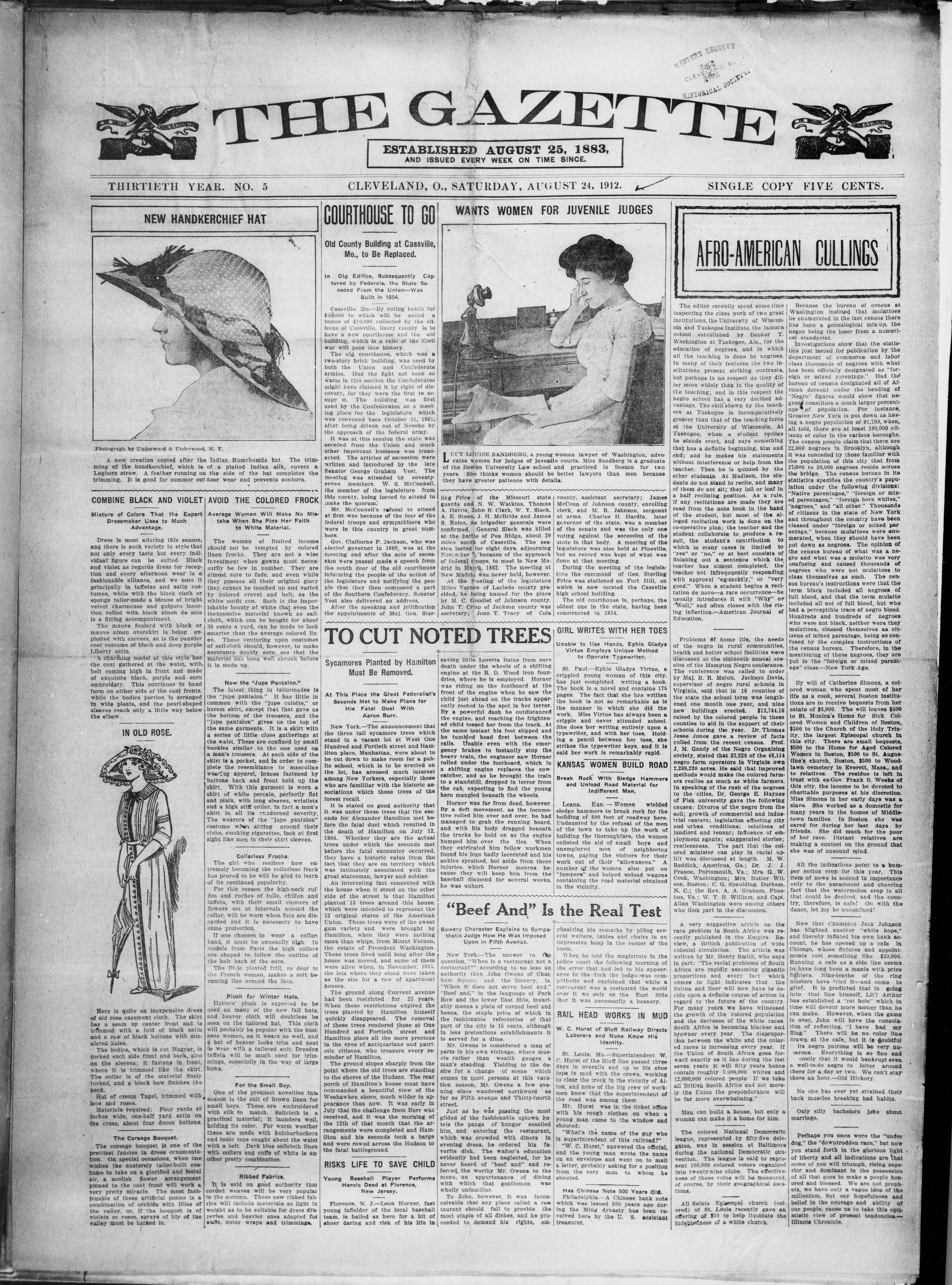
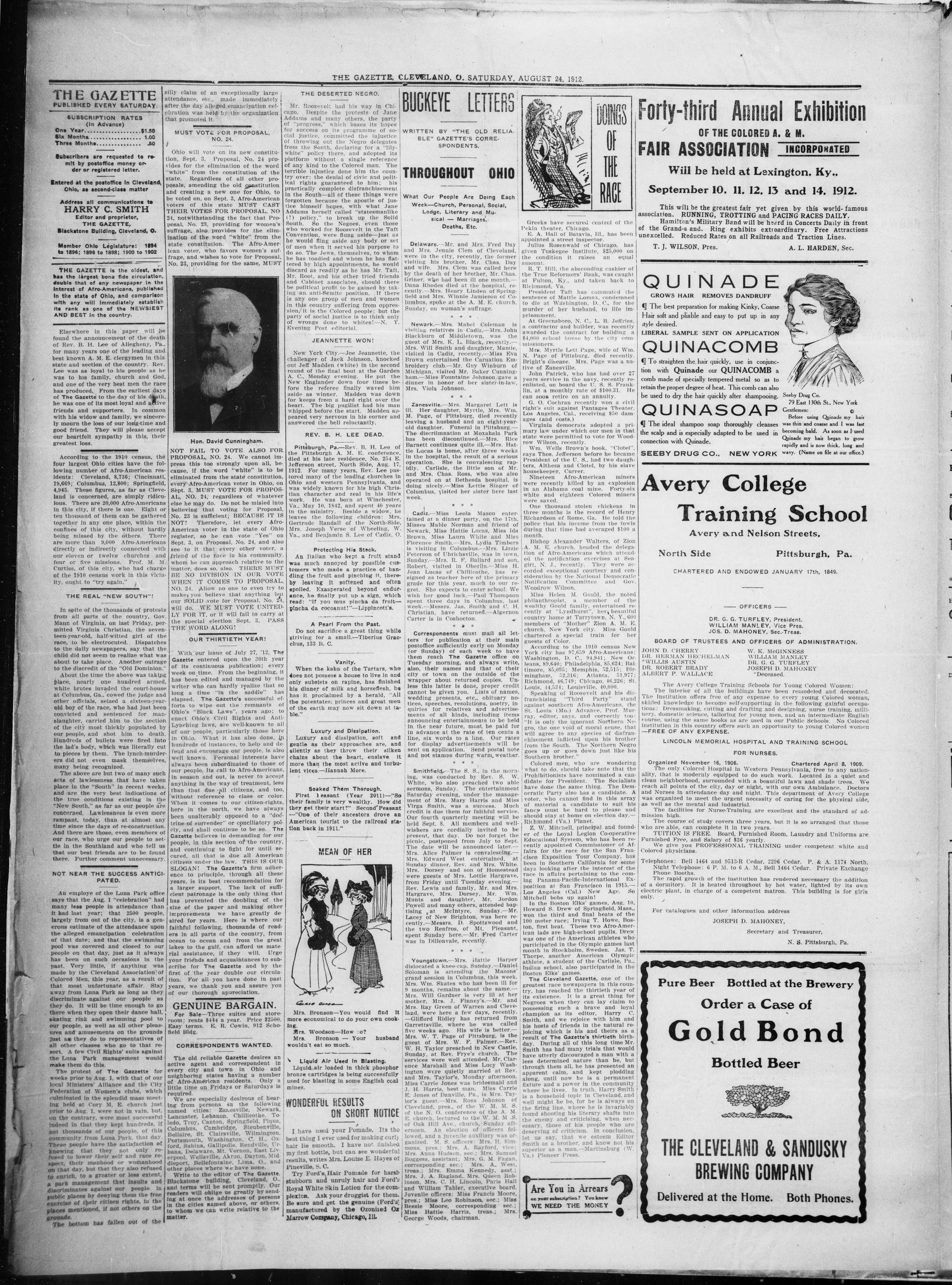
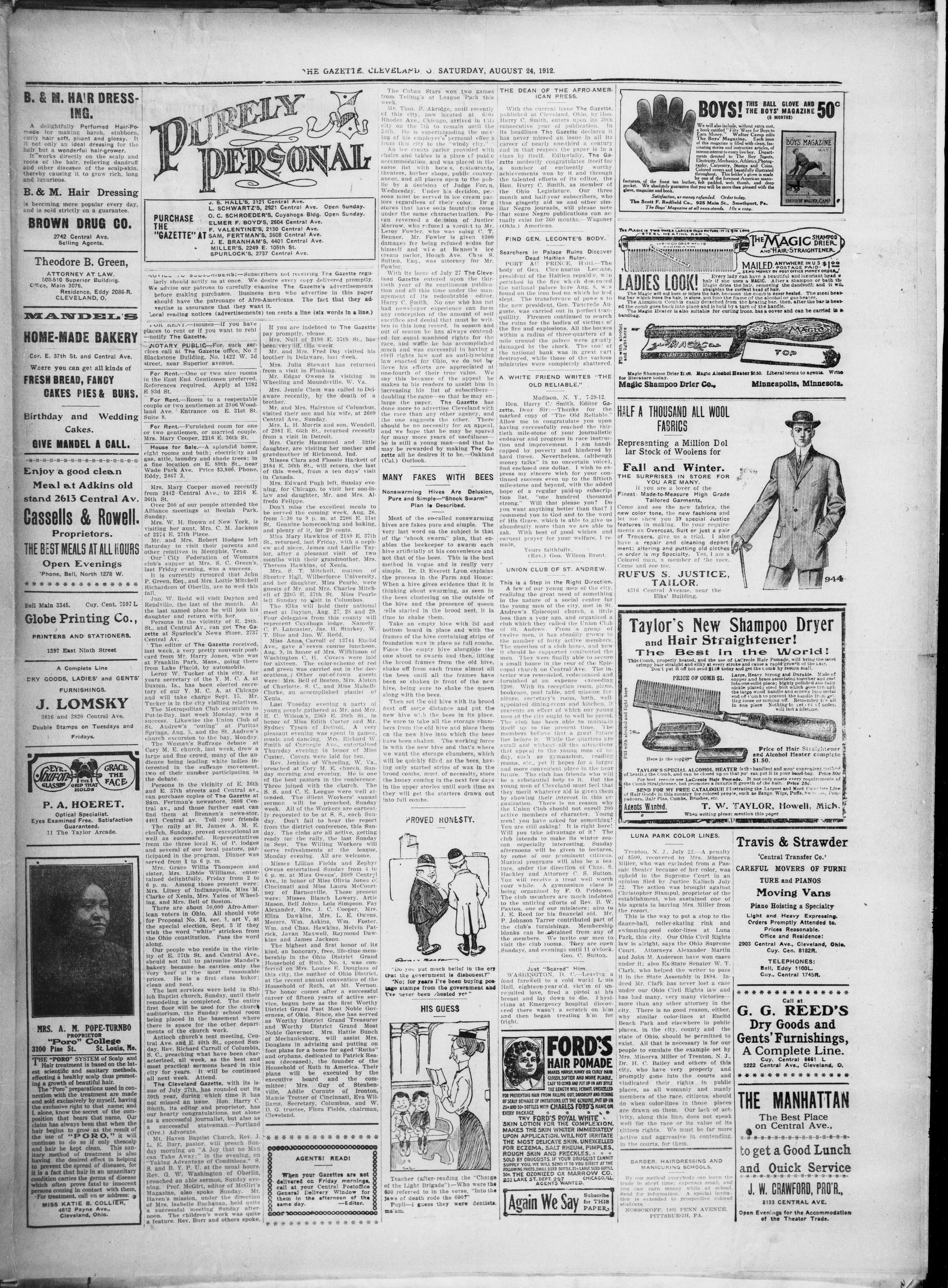
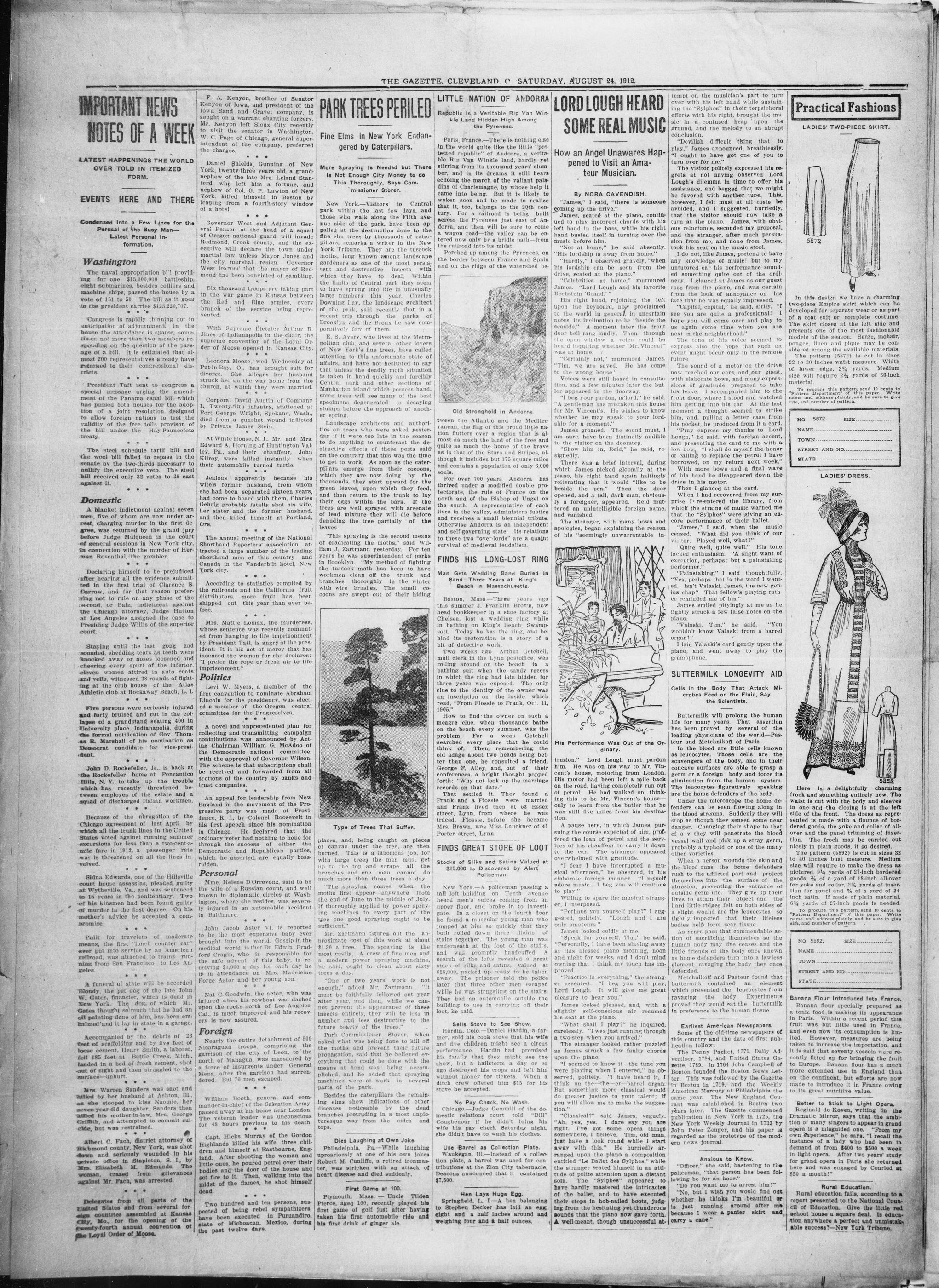
Page text (machine-generated)
THIRTIETH YEAR
THIRTIETH YEAR. NO. 5
NEW HANDKERCHIEF HAT
THE HAT
Photograph by Underwood & Underwood, N. Y.
A new creation copied after the India ming of the handkerchief, which is of a Leghorn straw. A feather running on the trimming. It is good for summer outdoor COMBINE BLACK AND VIOLET AVON
A new creation copied after the Indian Rumchumda hat. The trimming of the handkerchief, which is of a plaited Indian silk, covers a Leghorn straw. A feather running on the side of the hat completes the trimming. It is good for summer out door wear and prevents sunburn.
Mixture of Colors That the Expert Dressmaker Uses to Much Advantage.
Dress is most aluring this season, and there is such variety in style that not only every taste but every individual figure can be suited. Black and violet as regards dress for reception and every afternoon wear is a fashionable alliance, and we note it principally in taffetas and satin costumes, while with the black cloth or eponge tailor-made a blouse of bright velvet charmeuse and gulpure insertion velled with black ninon de soie is a fitting accompaniment.
The mauve foulard with black or mauve ninon overskirt is being exploited with success, as is the pannier coat costume of black and deep purple Liberty satin.
A charming model of this style has the coat gathered at the waist, with belt coming high in front and made of exquisite black, purple and ecu embroidery. This continues in band form on either side of the coat fronts, while the bodice portion is arranged in wide pleats, and the pearl-shaped sleeves reach only a little way below the elbow.
IN OLD ROSE.
Here is quite an inexpensive dress of old rose casement cloth. The skirt has a seam up center front and is trimmed with a fold of black satin and a row of black buttons with simulated holes. The bodice, which is cut Magyar, is tucked each side front and back, also on the sleeves; it fastens in front, where it is trimmed like the skirt. The collar is of the material finely tucked, and a black bow finishes the neck. Hat of cream Tagel, trimmed with lace and roses.
Materials required: Four yards 40 inches wide, one-half yard satin on the cross, about four dozen buttons.
The Corsage Bouquet.
The corsage bouquet is one of the prettiest fancies in dress ornamentation. On special occasions, when one wishes the austerity tallor-built costume to take on a glorified and festal air, a modish flower arrangement pinned to the coat front will work a very pretty miracle. The most fashionable of these artificial posies is a combination of orchids with lilies of the valley, or, If the bouquet is of violets or roses, sprays of lily of the valley must be tucked in.
THE GAZETTE
L. N. Y.
The Indian Rumchumda hat. The trim-
of a plaited Indian silk, covers a
on the side of the hat completes the
door wear and prevents sunburn.
AVOID THE COLORED FROCK
Average Woman Will Make No Mistake When She Pins Her Faith to White Material.
The woman of limited income should not be tempted by colored linen frocks. They are not a wise investment when gowns must necessarily be few in number. They are almost sure to fade, and even while they possess all their original glory they cannot be touched up and varied by colored cravat and belt, as the white outfit can. Such is the imperishable beauty of white that even the inexpensive material known as sailcloth, which can be bought for about 30 cents a yard, can be made to look smarter than the average colored linen. Those venturing upon costumes of sailcloth should, however, to make assurance doubly sure, see that the material has been well shrunk before it is made up.
Now the "June Pantalon"
The latest thing in tailormades is the "jue pantaion" that it has little in common, the "jue pantaio" or harme nament, except that the bottom of the trousers, and the "jue pantaion" gives us the top of the same garments. It is a skirt with a series of little close gatherings at the waist. These are confined by small buckles similar to the one used on a man's trousers. At each side of the skirt is a pocket, and in order to complete the resemblance to masculine wearing apparel, braces fastened by buttons back and front hold up the skirt. With this garment is worn a shirt of white percale, perfectly flat and plain, with long sleeves, wristlets and a high stiff collar, in fact a man's shirt in all its unadorned severity. The wearers of the "jue pantaion" costume when sitting around their clubs, smoking cigarettes, look at first sight like men in their shirt sleeves.
Collarless Frocks
The girl who realizes how extremely becoming the collarless frock has proved to be will be glad to learn of its continued popularity.
For this reason the high-neck ruffles and ruches of tuleh, chiffon and taffeta, with their small clusters of flowers set at intervals around the collar, will be worn when furs are discarded and it is necessary to have some protection.
If one chooses to wear a collar band, it must be unusually high. In models from Paris the high collar are shaped to follow the outline of the hair back of the ears.
The little pleated frill, so dear to the French woman, makes a soft be coming line around the face.
Plush for Winter Hats.
Hatters' plush is expected to be used on many of the new fall hats, and beaver cloth will doubtless be seen on the tailored hat. This cloth will probably be popular with the business women, as it wears so well, and a hat of beaver looks trim and neat to wear with a tailored suit. Dresden taffeta will be much used for trimming, especially in the way of large bows.
For the Small Boy.
One of the prettiest novelties tute season is the suit of brown linen for small boys. These are embroidered with silk to match. Sailcloth is a practical material; it launders well, holding its color. For warm weather these are made with knickerbockers and tunic tops caught about the waist with a belt. Dark blue sailcloth linen with collars and cuffs of white is another pretty combination.
Ribbed Fabrics
It is said on good authority that corded weaves will be very popular in the autumn. These new ribbed fabrics will include materials so light in weight as to be suitable for dress draperies and heavier ones adapted for suits, outer wraps and trimmings.
ESTABLISHED AUGUST 25, 1883 AND ISSUED EVERY WEEK ON TIME SINCE.
CLEVELAND, O., SATURDAY, AUGUST 24, 1912.
LUCY LOUISE SANDBERG, a young woman lawyer of Washington, advocates women for judges of juvenile courts. Miss Sandberg is a graduate of the Boston University Law school and practiced in Boston for two years. She thinks women should be better lawyers than men because they have greater patience with details.
UCY LOUISI SANDBERG, a young woman lawyer of Washington, advocates women for judges of juvenile courts. Miss Sandberg is a graduate of the Boston University Law school and practiced in Boston for two years. She thinks women should be better lawyers than men because they have greater patience with details.
ling Price of the Missouri state guards and N. W. Watkins, Thomas A. Harris, John B. Clark, W. Y. Slack, A. E. Steen, J. H. McBride and James A. Rains, as brigadier generals were confirmed. General Slack was killed at the battle of Pea Ridge, about 20 miles south of Cassville. The session lasted for eight days, adjourning November 7, because of the approach of federal troops, to meet in New Madrid in March, 1862. The meeting at New Madrid was never held, however. At the meeting of the legislature Miles Vernon of Lacute county presided, he being named for the place by M. C. Goodlet of Johnson county. John T. Crisp of Jackson county was secretary; John T. Tracy of Cole county, assistant secretary; James McCoun of Johnson county, enrolling clerk, and M. R. Johnson, sergeant at arms, Charles H. Hardin, later governor of the state, was a member of the senate and was the only one voting against the secession of the state in that body. A meeting of the legislature was also held at Pineville but no record was kept of what was done at that meeting.
During the meeting of the legislature the command of Gen. Sterling Price was stationed on Fort Hill, on which is now located the Cassville high school building.
The old courthouse is, perhaps, the oldest one in the state, having been constructed in 1854.
TO CUT NOTED TREES
saving little Loretta Baina from sure death under the engine of a shifting engine at the R. D. Wood iron foundries, where he is employed. Horner was riding on the footboard at the front of the engine when he saw the child just ahead on the tracks apparently rooted to the spot in her terror. By a powerful dash he outdistanced the engine, and reaching the frightened child tossed her from the track. At the same instant his feet slipped and he tumbled head first between the rails. Unable even with the emergency brakes to instantly stop the heavy train, the engineer saw Horner rolled under the footboard, which in a shifting engine replaces the cowcatcher, and as he brought the train to a standstill, dropped in terror from the cab, expecting to find the young hero mangled beneath the wheels.
Horner was far from dead, however. By a deft movement, as the locomotive rolled him over and over, he had managed to grab the running board, and with his body dragged beneath the trucks he held on as the engine bumped him over the ties. When they extricated him fellow workmen found his legs badly lacerated and his ankles sprained, but aside from these injuries, which Horner mourns because they will keep him from the baseball diamond for several weeks, he was unhurt.
Virtue Employs Unique Method to Operate Typewriter.
St. Paul—Ephile Gladys Virtue, a crippled young woman of this city, has just completed writing a book. The book is a novel and contains 175 pages. The fact that she has written the book is not so remarkable as is the manner in which she did the work. Miss Virtue has always been a cripple and never attended school. She does her writing entirely upon a typewriter, and with her toes. Holding a pencil between her toes, she strikes the typewriter keys, and it is said her work is remarkably rapid.
KANSAS WOMEN BUILD ROAD
Break Rock With Sledge Hammers and Unload Road Material for Indifferent Men.
Leana. Kan—Women welded sledge hammers to break rock for the building of 800 feet of roadway here. Undaunted by the refusal of the men of the town to take up the work of building the thoroughfare, the women enlisted the aid of small boys and unemployed men of neighboring towns, paying the visitors for their work out of their "allowances." A number of the women also put on "jumpers" and helped unload wagons containing the road material obtained in the vicinity.
"Beef And" Is the Real Test
Bowery Character Explains to Sympathetic Judge How He Was Imposed Upon in Fifth Avenue.
New York.—The answer to the question, "When is a restaurant not a restaurant?" according to no less an authority than John Owens of Chatham Square and the Bowery, is, "When it does not serve beef and," "Beef and," in the language of Park Row and the lower East Side, invariably means a plate of corned beef and beans, the staple price of which in the fashionable refectories of that part of the city is 15 cents, although in less pretentious establishments it is served for a dime.
Mr. Owens is considered a man of parts in his own vicinity, where muscle rather than wealth gauges a man's standing. Yielding to the desire for a change of scene which comes to most persons at this vacation season, Mr. Owens a few evening since wandered northward as far as Fifth avenue and Thirty-fourth street.
Just as he was passing the most gilded of the fashionable upto bottoms the pangs of hunger assailed him, and entering the restaurant, which was crowded with diners in evening dress, he ordered his favorite dish. The waiter's education evidently had been neglected, for he never heard of "beef and" and referred the worthy Mr. Owens to the menu, an apperturement of dining with which that gentleman was wholly unfamiliar.
To John, however, it was inconceivable that any place called a restaurant should fall to provide the most staple of all dishes, and he proceeded to demand his rights, em-
COURTHOUSE TO GO
Old County Building at Cassville, Mo., to Be Replaced.
In Old Edifice, Subsequently Captured by Federalis, the State Seceded From the Union—Was Built in 1854.
Cassville, Mo.—By voting bonds for $40,000 to which will be added a bonus of $10,000 collected by the citizens of Cassville, Barry county is to have a new courthouse and the old building, which is a relic of the Civil war will pass into history.
The old courthouse, which was a two-story brick building, was used by both the Union and Confederate armies. Had the fight not been so warm in this section the Confederates might have claimed it by right of discovery, for they were the first to occupy it. The building was first used by the Confederates as a meeting place for the legislature which was convened here October 31, 1861, after being driven out of Neosho by the approach of the federal army.
It was at this session the state was seceded from the Union and much other important business was transacted. The articles of secession were written and introduced by the late Senator George Graham Vest. The meeting was attended by seventy-seven members. W. S. McConnell, the member of the legislature from this county, being forced to attend to make the quorum.
Mr. McConnell's refusal to attend at first, was because of the fear of the federal troops and sympathizers who were in this country in great numbers.
Gov. Clalborne F. Jackson, who was elected governor in 1860, was at the meeting and after the acts of secession were passed made a speech from the south door of the old courthouse informing the people of the action of the legislature and notifying the people that they then composed a part of the Southern Confederacy. Senator Vest also delivered an address. After the speaking and jollification the appointments of Maj. Gen. Ster-
At This Place the Great Federalist's Seconds Met to Make Plans for His Fatal Duel With Aaron Burr.
New York.—The announcement that the three tall sycamore trees which stand in a vacant lot at West One Hundred and Fortieth street and Hamilton place, Manhattan, were about to be cut down to make room for a public school, which is to be erected on the lot, has aroused much interest among New Yorkers, especially those who are familiar with the historic associations which these trees of the forest recall.
It is stated on good authority that it was under these trees that the seconds for Alexander Hamilton met before the fatal duel which resulted in the death of Hamilton on July 12, 1804. Whether they are the actual trees under which the seconds met before the fatal encounter occurred, they have a historic value from the fact that they are on territory which was intimately associated with the great statesman, lawyer and soldier.
An interesting fact connected with the house when it stood on the other side of the street is that Hamilton planted 13 trees around this house, which were intended to represent the 13 original states of the American Union. These trees were of the sweet gum variety and were brought by Hamilton, when they were nothing more than whips, from Mount Vernon, the estate of President Washington. These trees lived until long after the house was moved, and some of them were alive when, in November, 1911, the lots where they stood were taken as the site for a row of apartment houses.
The ground along Convent avenue had been restricted for 25 years. When these restrictions expired the trees planted by Hamilton himself quickly disappeared. The removal of these trees rendered those at One Hundred and Fortieth street and Hamilton place all the more precious in the eyes of antiquarians and patriotic citizens, who treasure every reminder of Hamilton.
The ground slopes sharply from the point where the old trees are standing to the shores of the Hudson. The rear porch of Hamilton's house must have commanded a beautiful view of the Weehawken shore, much wilder in appearance than now. It was early in July that the challenge from Burr was received, and it was the morning of the 12th of that month that the arrangements were completed and Hamilton and his seconds took a barge and were rowed across the Hudson to the fatal battleground.
RISKS LIFE TO SAVE CHILD
Young Baseball Player Performs
Herolic Deed at Florence,
New Jersey.
Florence, N. J—Leon Horner, fast
young infielder of the local baseball
team, is hailed as hero for a bit of
sheer daring and risk of his life in
WANTS WOMEN FOR JUVENILE JUDGES
county, assistant secretary; James McCoun of Johnson county, enrolling clerk, and M. R. Johnson, sergeant at arms. Charles H. Hardin, later governor of the state, was a member of the senate and was the only one voting against the secession of the state in that body. A meeting of the legislature was also held at Pineville, but no record was kept of what was done at that meeting.
During the meeting of the legislature the command of Gen. Sterling Price was stationed on Fort Hill, on which is now located the Casville high school building.
The old courthouse is, perhaps, the oldest one in the state, having been constructed in 1854.
GIRL WRITES WITH HER TOES
Unable to Use Hands, Ephile Gladys Virtue Employs Unique Method to Operate Typewriter.
St. Paul—Ephile Gladys Virtue, a crippled young woman of this city, has just completed writing a book. The book is a novel and contains 175 pages. The fact that she has written the book is not so remarkable as is the manner in which she did the work. Miss Virtue has always been a cripple and never attended school. She does her writing entirely upon a typewriter, and with her toes. Holding a pencil between her toes, she strikes the typewriter keys, and it is said her work is remarkably rand.
KANSAS WOMEN BUILD ROAD
Break Rock With Sledge Hammers and Unload Road Material for Indifferent Men.
Leana. Kan. — Women welded sledge hammers to break rock for the building of 800 feet of roadway here. Undaunted by the refusal of the men of the town to take up the work of building the thoroughfare, the women enlisted the aid of small boys and unemployed men of neighboring towns, paying the visitors for their work out of their "allowances." A number of the women also put on "jumpers" and helped unload wagons containing the road material obtained in the vicinity.
phasing his remarks by pliling several waiters, tables and chairs in an impressive heap in the center of the toom. When he told the magistrate in the police court the following morning of the error that had led to his appearance in the dock the judge was sympathetic and explained that while a restaurant was a restaurant the world over it was only on the East Side that it was necessarily a beaery.
RAIL HEAD WORKS IN MUD
W. C. Hurst of Bluff Railway Directs Laborers and None Know His Identity.
St. Louis, Mo.—Superintendent W. C. Hurst of the Bluff line passed three days in overalls and up to his shoe tops in mud with the crews, working to clear the track in the vicinity of Alton, and none of the big crew of workmen knew that the superintendent of the road was among them.
Mr. Hurst was in the ticket office with his rough clothes on when a young man came to the window and shouted:
"What's the name of the guy who is superintendent of this railroad?"
"W. C. Hurst," answered the official, and the young man wrote the name on an envelope and went on to mail a letter, probably asking for a position from the very man to whom he shouted.
Has Chinese Note 500 Years Old.
Philadelphia Note—A Chinese bank note which was issued 500 years ago during the Ming dynasty has been received here by the U. S. assistant treasurer.
SINGLE COPY FIVE CENTS.
AFRO-AMERICAN CULLINGS
The editor recently spent some time inspecting the class work of two great institutions, the University of Wisconsin and Tuskegee Institute, the famous school established by Booker T. Washington at Tuskegee, Ala., for the education of negroes, and in which all the teaching is done by negroes. In many of their features the two institutions present striking contrasts, but perhaps in no respect do they differ more widely than in the quality of the teaching; and in this respect the negro school has a very decided advantage. The skill shown by the teachers at Tuskegee is incomparably greater than that of the teaching force at the University of Wisconsin. At Tuskegee, when a student recies he stands erect, and says something that has a definite beginning, aim and end; and he makes his statements without interference or help from the teacher. Then he is quizzed by the other students. At Madison, the students do not stand to recite, and many of them do not sit; they loll or loaf in a half reclining position. As a rule, if any recitations are made they are read from the note book in the hand of the student, but most of the alleged recitation work is done on the co-operative plan; the teacher and the student collaborate to produce a result, the student's contribution to which in many cases is limited to "yes" or "no," or at best consists of finishing out a sentence which the teacher has almost completed, the teacher not infrequently responding with approval "eg-zacktly," or "very good." When a student begins a recitation de novo—a rare occurrence he usually introduces it with "Why" or "Well," and often closes with the rising inflection—American Journal of Education.
Problems of home life, the needs of the negro in rural communities, health and better school facilities were discussed at the sixteenth annual session of the Hampton Negro conference. The conference was called to order by Maj. R. R. Moton. Jackson Davis, supervisor of negro rural schools in Virginia, said that in 18 counties of the state the school term was lengthened one month one year, and nine new buildings erected. $13,744.16 raised by the colored people in these counties to aid in the support of their schools during the year. Dr. Thomas Jesse Jones gave a review of facts culled from the recent census. Prof. J. M. Gandy of the Negro Organizing society, stated that 32,228 of the 48,114 negro farm operators in Virginia own 2,228,220 acres. He said that improved methods would make the colored farmers realize as much as white farmers. In speaking of the rush of the negroes to the cities, Dr. George E. Haynes of Fisk university gave the following causes: Divorce of the negro from the soil; growth of commercial and industrial centers; legislation affecting city and urban conditions; relations of landlord and tenant; influence of employment agents; exaggerated stories; restlessness. The part that the colored minister can play in racial uplift was discussed at length. M. W. Reddick, Americus, Ga.; Dr. J. J. France, Portsmouth, Va.; Mrs. G. W. Cook, Washington; Mrs. Butler Wilson, Boston; C. G. Spalding, Durham, N. C.; the Rev. A. A. Graham, Phoebus, Va.; W. T. B. William, and Capt. Allan Washington were among others who took part in the discussion.
A very suggestive article on the race problem in South Africa was recently published in the Empire Review, a British publication of wide colonial circulation. The article was written by Mr. Henry Smith, who says in part: "The racial problems of South Africa are rapidly assuming gigantic proportions and every fact which comes to light indicates that the Britton and Boer will now have to decide upon a definite course of action in regard to the future of the country. For many years we have witnessed the growth of the colored population and the decrease of the white races. South Africa is becoming blacker and browner every year. The disproportion between the white and the colored races is increasing every year. If the Union of South Africa goes forward exactly as it has during the last seven years it will fifty years hence contain roughly 3,000,000 whites and 12,000,000 colored people. If we take all British South Africa and not merely the Union the preponderance will be far more overwhelming."
Man can build a house, but only a woman can make it a home for him.
The colored National Democratic league, represented by fifty-five delegates, was in session at Baltimore during the national Democratic convention. The league is said to represent 100,000 colored voters organized into twenty-nine clubs. The effectiveness of these votes will be measured, of course, by their geographical locations.
All Saints Episcopal church (colored) of St. Louis recently gave an offering of $50 to help liquidate the indebtedness of a white church.
Because the bureau of census at Washington insisted that mulattoes be enumerated in the last census there has been a genealogical mix-up, the negro being the loser from a numerical standpoint.
Investigations show that the statistics just issued for publication by the department of commerce and labor class thousands of negroes with what has been officially designated as "foreign or mixed parentage." Had the bureau of census designated all of African descent under the heading of "Negro" figures would show that negroes constitute a much larger percentage of population. For instance, Greater New York is put down as having a negro population of 91,709, when all told, there are at least 100,000 citizens of color in the various boroughs. The census people claim that there are 22,000 negroes in Brooklyn, although it was conceded by those familiar with the population of this city that from 27,000 to 30,000 negroes reside across the bridge. The census bureau in its statistics specifies the country's population under the following divisions: "Native parentages," "foreign or mixed parentages," "foreign born whites," "negroes," and "all other." thousands of citizens in the state of New York and throughout the country have been classed under "foreign or mixed parentage," because mulattoes were enumerated, when they should have been put down as negroes. The opinion of the census bureau of what was a negro and what was a mulatto was very confusing and caused thousands of negroes who were not mulattoes to class themselves as such. The census bureau's instructions were that the term black included all negroes of full blood, and that the term mulatto included all not of full blood, but who had a perceptible trace of negro blood. Hundreds and hundreds of negroes who were not black, neither were they mulattoes, classed themselves as citizens of mixed parentage, being so confused by the complex instructions of the census bureau. Therefore, in the mentioning of these negroes, they are put in the "foreign or mixed parentage" class.—New York Age.
By will of Catherine Simons, a colored woman who spent most of her life as a cook, several Boston institutions are to receive bequests from her estate of $5,000. The will leaves $500 to St. Monica's Home for Sick Colored Women and Children of Boston, $500 to the Church of the Holy Trinity, the largest Episcopal church in this city. There are small bequests, $500 to the Home for Aged Colored Women in Boston, $500 to St. Augustine's church, Boston, $500 to Woodland cemetery in Everett, Mass, and to relatives. The residue is left in trust with ex-Gov. Frank B. Weeks of this city, the income to be devoted to charitable purposes at his discretion. Miss Simons in her early days was a slave. She worked as a domestic for many years in the homes of Middle-town families. In Boston she was cared for during her last days by friends. She did much for the poor of her race. Distant relatives are making a contest on the ground that she was of unsound mind.
All the indications point to a bumper cotton crop for this year. This item of news is second in importance only to the paramount and cheering fact that the watermelon crop is all that could be desired, and the country, therefore, is safe! On with the dance, let joy be unconfined!
Now that Champion Jack Johnson has blighted another "white hope," and thereby inflated his own bank account, he has opened up a cafe in Chicago, whose fixtures and appointments cost something like $50,000. Running a cafe as a side line seems to have long been a manta with prize fighters. Nine-tenths of the ring masters have tried it—and come to grief. It is predicted that in going into that line himself, Lil' Arthur has established a "rat hole" which in time will devour more money than he can make. However, when the game is over, John will have the consolation of reflecting, "I have had my fling." There will be no color line drawn at the cafe, but it is doifully its negro patrons will be very numerous. Everything is so fine and costly that it would bankrupt even a well-to-do neo to leiter around there for a day or two. We can't stay there an hour—Old Hickory.
No one has ever yet strained their back muscles breaking bad habits.
Only silly bachelors joke about marriage.
Perhaps you once were the "underdog," the "downtrodden race," but now you stand forth in the glorious light of liberty and all indications are that some of you will triumph, rising superior and dominant in the possession of all that goes to make a people honored and blessed. We are not prophets, we have only a vague idea of the millionen, but our hopefulness and belief in the courage and ability of our people, cause us to take this optimistic view of present tendencies. Illinois Chronicle.
THE GAZETTE
PUBLISHED EVERY SATURDAY
One Year..... $1.50
Six Months..... 1.00
Three Months..... 5.0
Subscribers are requested to re-
mit by postoffice money or-
der or registered letter.
Entered at the postoffice In Cleveland
Ohio, as second-class matter
Address all communications to
HARRY C. SMITH
Editor and proprietor,
THE GAZETTE,
Blackstone Building, Cleveland, O.
Blackstone Building, Cleveland, O.
Member Ohio Legislature: 1894 to 1896; 1896 to 1898; 1900 to 1902
THE GAZETTE is the oldest, and has the largest bona fide circulation, double that of any newspaper in the interest of Afro-Americans, published in the state of Ohio, and comparison with any will immediately establish its rank as one of the NEWSIEST AND BEST in the country.
Elsewhere in this paper will be found the announcement of the death of Rev. B. H. Lee of Allegheny, Pa., for many years one of the leading and best known A. M. E. clergymen in this state and section of the country. Rev. Lee was as loyal to his people as he was to his family, church and God, and one of the very best men the race has produced. From the earliest days of The Gazette of the day of his death, he was one of its most loyal and active friends and supporters. In common with his widow and family, we sincerely mourn the loss of our long-time and good friend. They will please accept our heartfelt sympathy in this, their greatest loss.
According to the 1910 census, the four largest Ohio cities have the following number of Afro-American residents: Cleveland, 8,738; Cincinnati, 19,669; Columbus, 12,800; Springfield, 4,945. These figures, as far as Cleveland is concerned, are simply ridiculous. There are 20,000 Afro-Americans in this city, if there is one. Eight or ten thousand of them can be gathered together in any one place, within the confines of this city, without hardly being missed by the others. There are more than 9,000 Afro-Americans directly or indirectly connected with our eleven or twelve churches and four or five missions. Prof. M. M. Curtiss, of this city, who had charged of the 1910 census work in this vicinity, ought to "try again."
THE REAL "NEW SOUTH"!
In spite of the thousands of protests from all parts of the country, Gov. Mann of Virginia, on last Friday, permitted Virginia Christian, the seventeen-year-old, half-witted girl of the race, to be electrocuted. Dispatches to the daily newspapers, say that the child did not seem to realize what was about to take place. Another outrage to the discredit of the "Old Dominion." About the time the above was taking place, nearly one hundred armed, white brutes invaded the court-house at Columbus, Ga., cowed the judge and other officials, seized a sixteen-year-old boy of the race, who had just been convicted and sentenced for manslaughter, carried him to the section of the city most thickly populated by our people, and shot him to death. Hundreds of bullets were fired into the lad's body, which was literally cut to pieces by them. The lynch-murders did not even mask themselves, many being recognized.
The above are but two of many such acts of lawlessness that have taken place in the "South" in recent weeks and are the very best indications of the true conditions existing in the "New South," as far as our people are concerned. Lawlessness is even more rampant, today, than at almost any time since the days of re-construction. And there are those, even members of our race, who urge our people to settle in the Southland and who tell us that our best friends are to be found there. Further comment unnecessary.
NOT NEAR THE SUCCESS ANTICI PATED.
An employee of the Luna Park office says that the Aug. 1 "celebration" had many less people in attendance than it had last year; that 2500 people largely from out of the city, is a generous estimate of the attendance upon the alleged emancipation celebration of that date; and that the swimming pool was covered and closed to our people on that day, just as it always has been on such occasions in the past. Very little, if anything was made by the Cleveland Association of Colored Men, this year, as a result of that most unfortunate affair. Stay away from Luna Park as long as they discriminate against our people as they do. It will be time enough to go there when they open their dance hall, skating rink and swimming pool to our people, as well as all other pleasures and amusements on the grounds just as they do to representatives of all other classes who go to that resort. A few Civil Rights' suits against the Luna Park management would make them do this.
The protest of The Gazzette for weeks prior to Aug. 1, with that of our local Ministers' Alliance and the City Federation of Women's clubs, which culminated in the splendid mass meeting held at Cory M. E. church just prior to Aug. 1, were not in vain, but, on the contrary, were most successful indeed in that they kept hundreds, if not thousands of our people, of this community from Luna Park, that day. These people have the satisfaction of knowing that they not only refused to lower their self and race respect, their manhood or womanhood on that day, but that they also refused to enrich, to a greater or less extent, a park management that insults and discriminates against our people in public places by denying them the free exercise of their citizen rights, in the places mentioned, if not others on the grounds.
The bottom has fallen out of the
silly claim of an exceptionally large attendance, etc., made immediately after the day alleged emancipation celebration was held by the organization that promoted it.
MUST VOTE FOR PROPOSAL,
NO. 24.
Ohio will vote on its new constitution, Sept. 3, Proposal, No. 24 provides for the elimination of the word "white" from the constitution of the state. Regardless of all other proposals, amending the old constitution and creating a new one for Ohio, to be voted on, on Sept. 3, Afro-American voters of this state MUST CAST THEIR VOTES FOR PROPOSAL, No. 24, notwithstanding the fact that Proposal, No. 23, providing for women's suffrage, also provides for the elimination of the word "white" from the state constitution. The Afro-Americanican voter, who favors women's suffrage, and wishes to vote for Proposal No. 23, providing for the same, MUST
Hon. David Cunningham.
NOT FAIL TO VOTE ALSO FOR PROPOSAL, No. 24. We cannot impress this too strongly upon all, because, if the word "white" is to be eliminated from the state constitution, every Afro-American voter in Ohio, on Sept. 3, MUST VOTE FOR PROPOSAL, No. 24, regardless of whatever else he may do. Do not be misled into believing that voting for Proposal, No. 23 is sufficient; BECAUSE IT IS NOT! Therefore, let every Afro-American voter in the state of Ohio register, so he can vote "Yes" on Sept. 3, on Proposal, No. 24, and also see to it that every other voter, a friend of the race in his community, whom he can approach relative to the matter, does so, also. THERE MUST BE NO DIVISION IN OUR VOTE WHEN IT COMES TO PROPOSAL, No. 24. Allow no one to even try to make you believe that anything but our SOLID vote for Proposal, No. 24 will do. WE MUST VOTE UNITEDLY FOR IT, or it will fail to carry at the special election Sept. 3. PASS THE WORD ALONG!
OUR THIRTIETH YEAR!
GENUINE BARGAIN.
For Sale-Three suites and store room; rents $444 a year. Price $2500 Easy terms. E. R. Cowin, 912 Schof field Bldg.
CORRESPONDENTS WANTED.
The old reliable Gazette desires an active agent and correspondent in every city and town in Ohio and neighboring states having a number of Afro-American residents. Only a little time on Fridays or Saturdays is required.
We are especially desirous of hearing from persons in the following named cities: Nashville, Newark, Namestown, banon, Chillicotte, Toley, Troy, Canton, Springfield, Piqua, Columbus, Cambridge, Steubenville, Bellaire, St. Clairville, Wilmington, Portsmouth, Washington, C. H., Oxford, Sabina, Gallipolis, Rendille, Urbana, Delaware, M. Vernon, East Lairpool, Wellsville, Akron, Dayton, Middleport, Bellefontaine, Lima, O., and other places where we have none.
Write to the editor of the Gazette, Blackstone building, Cleveland, O., and terms the agent promptly. Our send-off will oblige us greatly by sending once the addresses of persons in the cities named above, or others, to whom we can write relative to the matter.
THE GAZETTE, CLEVELAND, O. SATURDAY, AUGUST 24, 1912
THE DESERTED NEGRO.
Mr. Roosevelt and his way in Chicago. Despite the protests of Jane Addams and many others, the party of "progress," which bases its hopes for success on its programme of social justice, committed the injustice of throwing out the Negro delegates from the South, declaring for a "lily-white" policy there, and adopted its platform without a single reference of any kind to the Colored man. The terrible injustice done him the country over; the denial of civic and political rights; the practically complete distranchissement in the South—all of these things were forgotten because the apostle of justice himself hopes, with what Jane Addams herself called "statesmanlike (1) policy," to break up the Solid South. So the Negroes, even those who worked for Roosevelt in the Taft Convention, were fung aslide—just as would fling aslide any body or set of hands to the ground to do so. The Jews, themselves, to whom he has toadled and whom he has flattered by high appointments, he would discard as readily as he has Mr. Tatt, Mr. Root, and his other tried friends and Cabinet associates, should there be political profit to be gained by taking an anti-Semitic position. If there is any one group of men and women in the country suffering from oppression, should they be given a party of social justice is to think only of wrongs done to whites!—N. Y Evening Post editorial.
JEANNETTE WON!
New York City — Jack Jeannette, the challenger of Jack Johnson, knocked out Jeff Madden (white) in the second round of the final bout at the Garden A. C., Monday evening. He put the New Englander down four times before the referee waved him aside as winner. Madden was down for keeps from a hard right over the left, but the whipped before the start. Madden appeared very nervous in his corner and answered the bell reluctantly.
REV. B. H. LEE DEAD.
Pittsburgh, Pa.—Rev B. H. Lee of the Pittsburgh A. M. E. conference, died at his late residence, No. 254 E. Jefferson street, North Side, Aug. 17, 1912. For many years, Rev Lee passed Ohio and western Pennsylvania, and was widely known for his high Christian character and zeal in his life's work. He was born at Winchester, Va. May 10, 1842, and spent 40 years in the ministry. Beside a widow he met Gertrude Randall of the North-Side Mrs. Joseph Verse of Wheeling, W. Va., and Benjamin S. Lee of Cadiz, O.
Protecting His Stack.
An Italian who kept a fruit stand was much annoyed by possible customers who made a practice of handling the fruit and pinching it, thereby leaving it softened and often spoiled. Exasperated beyond endurance, he finally put up a sign, which read: "If you mus pincha da fruit—pincha da coconut!"—Lippincott's.
A Pearl From the Past
A Pearl from the Past
Do not sacrifice a great thing while
striving for a small.—Tiberius Grac-
chus. 133 B. C.
Vanity
When the kahn of the Tartars, who does not possess a house to live in and only subsists on rapine, has finished his dinner of milk and horseseesh, he has it proclaimed by a herald, "All the potentates; princes and great men of the earth may now sit down at table."
Luxury and Dissipation
Luxury and dissipation, soft and gentle as their approaches are, and silently as they throw their silken chains about the heart, enslave it more than the most active and turbulent vices.—Hannah More.
Soaked Them Thorough
First beasant (Year 2011)—"So their family is very wealthy. How did they get their start?" Second Peasant—"One of their ancestors drove an American tourist to the railroad station back in 1911."
MEAN OF HER
Mrs. Bronson--You would find it more economical to do your own cooking.
Mrs. Woodson—How o?
Mrs. Bronson — Your husband wouldn't eat so much.
Liquid Air Used in Blasting.
Liquid air loaded in thick phosphor bronze cartridges is being successfully used for blasting in some English coal mines.
WONDERFUL RESULTS
ON SHORT NOTICE
I have used your Pomade. Its the best thing I ever used for making curly hair lie smooth. I have not finished my first bottle, but can see wonderful results, writes Mrs. Louise E. Hayes of Pineville, S.C.
Try Ford's Hair Pomade for harsh stubborn and unruly hair and Ford's Royal White Skin Lotion for the complexion. Ask your druggist for them. Be sure and get the genuine (Ford's) manufactured by the Ozonized Ox Marrow Company, Chicago, Ill.
WRITTEN BY "THE OLD RELIA BLE" GAZETTE'S CORRESPONDENTS.
THROUGHOUT OHIO
What Our People Are Doing Each Week—Church, Personal, Social, Lodge, Literary and Musical — Marriages, Deaths, Etc.
Delaware.—Mr. and Mrs. Fred Day and Mrs. Jennie Clem of Cleveland, were in the city, recently, the former visiting his brother, Mr. Chas. Day and wife. Mrs. Clem was called here by the death of her brother, Mr. Chas. Griner, who had been ill one month.—Dana Rhodes died at the hospital, recurrently, from a stroke of the Spingfield and Mrs. Winnie Jamison of Columbus, spoke at the A. M. E. church Sunday, on woman's suffrage.
---
Newark.—Mrs. Mabel Coleman is visiting relatives in Cadiz.—Mrs. John Blackburn of Middletown, was the guest of Mr. K. L. Black, recently.—Mrs. John Blackburn visited in Cadiz, recently.—Miss Eva Brown entertained the Carnation Embroidery club.—Mr. Guy Winburn of Michigan, visited Mr. Baker Cunningham.—Miss Fountaine Johnson, gave a visit to her sister-in-law.—Miss Viola Johnson.
---
Zanciesville.—Mrs. Margaret Lett is ill. Her daughter, Mytle, Mrs. Wmn. M. Page, of Pittsburg, died recently leaving a husband and an eight-year-old daughter. Funeral in Pittsburg. The discrimination in Moxahala Park has been discontinued.—Mrs. Rice Barnett continues quite ill. Mrs. Hats tic Lucas is home, after three weeks in the hospital, the result of a serious motion. She is coworking rapidly. Carlisle, the little son of Mrs. and Mrs. Chas. Ross, who was also operated on at Bethesda hospital, is doing nicely.—Miss Lettle Singer of Columbus, visited her sister here last week.
Cadiz.-Miss Leola Mason entertained at a dinner party, on the 17th, Misses Mable Norman and friend of Newark, Miss Hattie Lucas, Miss Ida Brown, Miss Laura White and Miss Florence Smith.-Mrs. Lydia Timbers is visiting in Columbus.-Mrs. Lizzie Peterson of Ubrichsville, was in town, Sunday.-Mrs. R. F. Bailand and son, visited in Columbus, with Jean Lucille of Chillicothe, has resigned as teacher here of the primary grade for this year, much to our regret. She expects to enter school. We wish her good luck.-Paul Thompson spent three days in Columbus, last week.-Messrs. Jas. Smith and C. H. Christian, have returned.-Algenon Carter is in Coshocton.
Correspondents must mail all letters for publication at their main postoffice sufficiently early on Monday (or Sunday) of each week to have them reach The Gazette office on Tuesday morning, and always write to the city or town on the outside of the wrapper about returned copies. Unless this latter is done, proper credit cannot be given you. Lists of names, wedding presents, etc., obituary notices, speeches, resolutions, poetry, inquiries for relatives and advertisements for Kinds, including items concerning enquiries, be in the near future, must be paid for in advance at the rate of ten cents a line, six words to a line. Our rates for display advertisements will be sent on application. Send postal note and not stamps during warm, weather.
---
Smithfield.—The S. S., in the morning, was conducted by Rev. S. W. White, who also preached two able sermons, Sunday. The entertainment Saturday evening, under the management of Mrs. Mary Harris and Miss Virga Smith, was a success. Much credit is due them for faithful service. Our fourth quarterly meeting will be held Sept. 8. All members and well-wishers are cordially invited to be present at the picnic, postponed from July to Sept. The date will be announced later. Mrs. Alice Palmer is convalescing. Mrs. Edward West entertained, at Sunday dinner, Rev. and Mrs. White. Mrs. Dorsey and son of Homestead were guests of Mrs. Lottie Hargrave, from Friday until Tuesday evening. Rev. Lewis and family, Mr. and Mrs. Hargrave, Mrs. Dorsey, Mr. Wm. Munts and daughter, Mr. Jordon Powell and many others, included bap-
ping Mrs. Dorsey, Mrs. Sunday. Lacey of New Brighton, was here recently.—Messrs. D. Sportswood and the two Rentros, of Mr. Mpleasant, spent Sunday here. Mr. Fred Carter was in Dillonville, here.
---
Youngstown—Mrs. Hattie Harper dislocated a knee cup, Sunday—Daniel Soloman is attending the Masons grand session in Columbus, this week. Mrs. Wm. Skates who has been ill for 9 months, remains about the same. Mrs. Will Gardner is very ill at her mother, Mrs. J. Finney's. Mr. and Mrs. Ray Green of Warren and Cleveland, were here a few days, reed-Groffman didle, and came from Gerrville where he was called five weeks ago. His wife is better. Mrs. W. T. Page of Pittsburgh, is the guest of Mrs. W. F. Palmer. Rev. W. H. Taylor preached in New Castle, Sunday, at Rev. Frye's church. The services were well attended. Mr. Clarence Marshall and Miss Lucy Washington were quietly married at Rev. and Mrs. Taylor's, Monday afternoon. Miss Carrie Jones was bridesmaid and J. H. Harris, best man. Miss Carrie E. Jones of Danville, Pa., is Mrs. Taylor's guest—Mrs. James McCarthy of the W. M. S. of the N. O. conference of the A. M. S. e Church, lectured to the W. M. S. of Oak Hill Ave., church, Sunday afternoon. An election of officers followed, and a juvenile auxiliary was organized. M. S. officers: Mrs. H. Simmons, pres. Mrs. A. Rayford, vice. Mrs. Anna Hudson, sec. Mrs. Samuel Boggess, assistant, Mrs. G. M. Fagan, corresponding sec. Mrs. A. W. rests.; Mrs. Emma Kenny, asst.; Mrs. Emma Quinney, asst.; Mrs. C. H. Lincoln, Paris Hall and William Tabler, executive board. Juvenile officers: Miss Francis Moore, pres.; Miss Leo Robinson, sec.; Miss Bessie Moore, corresponding sec.; Miss Hattie Harris, treas.; Mrs. George Woods, chairman.
DOINGS
OF
THE
RACE
Greeks have secured control of the
Pekin theater, Chicago.
E.A. Hall of Hastavin, Ill. has been
appointed a street inspector.
Julius Rosenwald of Chicago, has given Tuskegee Institute, $25,000 on the condition it raises an equal amount.
R. T. Hill, the absconding cashier of the True Reformers' Bank, was caught at Fulton, Ky., and taken back to Richmond, Va.
Tuft Taft has commuted the sentence of Mattle Lomax, condemned to die at Washington, D. C., for the murder of her husband, to life imprisonment.
At Greensboro, N. C., L. B. Jeffries, a contractor and builder, was recently awarded the contract for building a $4,000 school house by the city commissioners.
M. Kurtle Lett Page, wife of Wm. N. Page of Pittsburgh, died recently. Bright's disease. Mrs. Page was a native of Zanesville.
John Patrick, who has had over 27 years service in the navy, recently reenlisted, on board the U. S. S. Franklin, at a monthly rate of $100.31. He can soon retire on an annuity.
O. C. Cochran recently won a civil rights case against Pantages Theater, Los Angeles Cal., receiving $50 damages (and costs).
Virginia democrats adopted a primary law under which our men in that state were permitted to vote for Woodrow Wilson, recently.
Win. Wells Brown's book, "Clotel," says Jefferson before he became President of the U.S., and two daughters, Althea and Clotel, by his slave housekeeper, Currer.
Nineteen Afro-American miners were recently killed by an explosion in an Alabama coal mine. Forty-six white and eighteen Colored miners were saved.
One thousand stolen chickens in this town is the record of Henry Richardson of Rome, Ga. He told the police that his income from the fowls during that time had averaged $100 a month.
Bishop Alexander Walters, of Zion A. M. E. church, headed the delegation of Afro-Americans which attended the notification exercises at Seagirt, N. J., recently. They were accustomed to the National Democratic Notification Committee and Gov. Woodrow Wilson.
Miss Helen M. Gould, the noted philanthropist, a member of the wealthy Gould family, entertained recently at "Lyndhurst", her beautiful country home at Tarrytown, N. Y., 600 members of "Mother" Zion A. M. E. Church, New York city, Miss Gould special train for her guests of Color.
According to the 1910 census New York city has 97,659 Afro-Americans; Washington, D. C., 94,941; New Orleans, 89,640; Philadelphia, 85,624; Baltimore, 85,095; Memphis, 52,515; Bingham, 52,316; Atlanta, 51,977; Richmond, 49,626; St. Louis, 41,534; Louisville, 40,000.
Speaking of Roosevelt and his disfranchising "Third Party" stand against southern Afro-Americans, the St. Louis (Mo.) Advance, Prof. Murray, editor, says, and correctly too: "It is only the ignorant Northern Negro, the one void of moral sense, that will agree to any species of dischranchishment inflicted upon his brother Sojourn to the Northern Negro goes up or goes down just like his Southern brother."
Colored men, who are wondering what to do, should take note that the Prohibitionists have nominated a candidate for President. The Socialists have done the same thing. The Democratic Party also has a candidate. A voter, who cannot find in this array of material a candidate to suit his fancy must be hard to please and the candidate will be selected day. - Richmond (Va.) Planet. Z. W. Mitchell, principal and founder of the Loyal Legion Co-operative Educational System, who has been recently appointed Commissioner of Affairs for the race for the San Francisco Exposition Tour Company, has been in Southern California for some days looking after the interest of the race in affairs pertaining to the coming Panama-Pacific International Exposition. In 1915, the Angeles (Cal.) New Age. So Mitchell, bobs up again!
In the Boston Elks' games, Aug. 10, Howard S. Drew of Springfield, Mass., won the third and final heats of the 100 meter race; Irving T. Howe, Boston, first heat. These two Afro-American lads are high-school pupils. Drew was one of the American athletes who participated in the Olympic games last month in Stockholm, Sweden. Jas. T. Thorpe, of Omaha, Iowa. Jas. T. Thorpe, a student of the Carlisle, Pa., Indian school, also participated in the Boston Elks' games.
The Cleveland Gazette, one of the greatest race newspapers in this country, has reached the thirtieth year of its existence. It is a great thing for Negroes when they can lay claim to possessing such a brave and loyal champion of the race and we rejoice with him and his hosts of friends in the natural rejoicing which is his and theirs as a result of The Gazette's thirtieth birthday. During all of this long time Mr. Smith has had many trials that would have utterly discouraged a man with a less determined nature than he, but through them all, he has presented an apparent challenge, he ploys until now he is a permanent fixture and a power in the community where he lives. In truth, Harry Smith is a household topic in Cleveland, and well might he be, for he is always on the firing line, where he is invariably found shooting his literary shafts into the enemy and criticising, when necessary, in the reigning of criticism. In conclusion, let us say, that we esteem Editor Smith as a brother, and know not his superior as a man—Martinsburg (W. Va.) Pioneer Press.
Are You in Arrears on your subscription? You know WE NEED THE MONEY
Forty-third Annual Exhibition OF THE COLORED A. & M. FAIR ASSOCIATION INCORPORATED
Will be held at Lexington, Ky..
This will be the greatest fair yet given by this world-famous association. RUNNING, TROTTING and PACING RACES DAILY. Hamilton's Military Band will be heard in Concerts Daily in front of the Grand-s and. Ring exhibits extraordinary. Free Attractions unexcelled. Reduced Rates on all Railroads and Traction Lines. T. J. WILSON, Pres. A. J. HARDEN, Sec.
A. L. HARDEN, Sec.
M.
QUINADE
GROWS HAIR REMOVES DANDRUFF
The best preparation for making Kinky, Coarse
Hair soft and pliable and easy to put up in any
style desired.
LIBERAL SAMPLE SENT ON APPLICATION
QUINACOMB
To straighten the hair quickly, use in conjunction with Quinade our QUINACOMB a comb made of specially tempered metal so as to retain the proper degree of heat. This comb can also be used to dry the hair quickly after shampooing.
Seeby Drug Co.
79 East 130th St., New York
Gentlemen:
QUINASOAP
Before using Quinade my hair was thin and coarse and I was fast becoming bald. As soon as I used Quinade my hair began to grow rapidly and is now thick, long and wavy. (Name on file at our office.)
The ideal shampoo soap thoroughly cleanses the scalp and is especially adapted to be used in connection with Quinade.
SEEBY DRUG CO., NEW YORK
Avery College Training School
Avery and Nelson Streets.
Avery College Training School Avery and Nelson Streets,
North Side
North Side Pittsburgh, Pa.
CHARTERED AND ENDOWED JANUARY 17th, 1849.
OFFICERS
CHARTERED AND ENDOWED JANUARY 17th, 1849.
DR. G. G. TURFLEY, President.
WILLIAM MANLEY, Vice Pres.
JOS. D. MAHONEY, Sec. Treas.
BOARD OF TRUSTEES AND OFFICERS OF ADMINISTRATION.
JOHN D. CHERRY
W. K. MCGINNESS
DR. HERMAN HECHELMAN
WILLIAM MANLEY
*WILLIIS AUSTIN
DR. G. G. TURFLEY
DR. ROBERT BRADY
JOSEPH D. MAHONEY
ALBERT P. WALLACE
*Deceased.
JOHN D. CHERRY W. K. McGINNESS
DR. HERMAN HECELMAN WILLIAM MANLEY
*WILLIAS AUSTIN DR. G. G. TURFLEY
DR. ROBERT BRADY JOSEPH D. MAHONEY
ALBERT P. WALLACE *Deceased.
The Avery College Training Schools for Young Colored Women:
The interior of all the buildings have been remodeled and decorated.
The Institution offers free of any expense to every young Colored woman skilled knowledge to become self-supporting in the following gainful occupations: Dreammaking, cutting and drafting and designing, nurse training, military, domestic science, tailoring for young men, and an intermediate English course, using the same books as are used in our Public Schools. No Colored institution in this country offers such an opportunity to young Colored women.
—FREE OF ANY EXPENSE.
LINCOLN MEMORIAL HOSPITAL AND TRAINING SCHOOL
FOR NURSES.
The Avery College Training Schools for Young Colored Women:
The interior of all the buildings have been remodeled and decorated.
The institution offers free of any expense to every young Colored woman, skilled knowledge to become self-supporting in the following gainful occupations: Dressmaking, cutting and drafting and design, nurse training, millinery, domestic science, tailoring for young men, and an intermediate English course, using the same books as are used in our Public Schools. No Colored institution in this country offers such an opportunity to young Colored women—FREE OF ANY EXPENSE.
LINCOLN MEMORIAL HOSPITAL AND TRAINING SCHOOL
FOR NURSES
Organized November 16, 1906. Chartered April 8, 1909.
The only Colored Hospital in Western Pennsylvania, free to any nationality, that is modernly equipped to do such work. Located in a quiet and clean neighborhood, surrounded with a beautiful lawn and shade trees. We reach all points of the city, day or night, with our own Ambulance. Doctor and Nurses in attendance day and night. This department of Avery College was organized to meet the urgent necessity of caring for the physical side as well as the mental and industrial.
The facilities for Nurse-Training are excellent and the standard of ad mission high.
The course of study covers three years, but it is so arranged that those who are able, can complete it in two years.
TUITION IS FREE. Board, Furnished Room, Laundry and Uniforms are Furnished Free, and Salary of $26 yearly.
We give you PROFESSIONAL TRAINING under competent white and Colored physicians.
Telephones: Bell 1464 and 9513-R Cedar, 2296 Cedar, P. & A. 1174 North
Night Telephone: 6 P. M. to 6 A. M., Bell 1464 Cedar. Private Exchange
Phone Booths.
The rapid growth of the institution has rendered necessary the addition of a dormitory. It is heated throughout by hot water, lighted by its own electric plant, in charge of a competent matron. This building is for girl only.
The only Colored Hospital in Western Pennsylvania, free to any nationality, that is modernly equipped to do such work. Located in a quiet and clean neighborhood, surrounded with a beautiful lawn and shade trees. We reach all points of the city, day or night, with our own Ambulance. Doctors and Nurses in attendance day and night. This department of Avery College was organized to meet the urgent necessity of caring for the physical side, as well as the mental industrial.
The facilities for Nurse-Training are excellent and the standard of admission high.
The course of study covers three years, but it is so arranged that those who are able, can complete it in two years.
TUITION IS FREE. Board, Furnished Room, Laundry and Uniforms are Furnished Free, and Salary of $36 yearly.
We give you PROFESSIONAL TRAINING under competent white and Colored physicians.
Telephones: Bell 1464 and 9513-R Cedar, 2296 Cedar. P. & A. 1174 North. Night Telephone: 6 P. M. to 6 A. M., Bell 1464 Cedar. Private Exchange Phone Booths.
The rapid growth of the institution has rendered necessary the addition of a dormitory. It is heated throughout by hot water, lighted by its own electric plant, in charge of a competent matron. This building is for girls only.
For catalogues and other information address
JOSEPH D. MAHONEY,
Secretary and Treasurer,
N. S. Pittsburgh, Pa.
Pure Beer Bottled at the Brewery
Order a Case of
Pure Beer Bottled at the Brewery
Order a Case of
Gold Bond
Bottled Beer
THE CLEVELAND & SANDUSKY
BREWING COMPANY
Delivered at the Home. Both Phones.
B. & M. HAIR DRESSING.
A delightfully Perfumed Hair-Pomade for making harsh, stubborn, curly hair soft, piant and glossy. It not only an ideal dressing for the hair but a wonderful hair-grower. It works directly on the scalp and roots of the hair, relieving dandruff and other diseases of the scalp-skin, thereby causing it to grow rich, long and luxurious.
is becoming more popular every day,
and is sold strictly on a guarantee.
2742 Central Ave Selling Agents.
ATTORNEY AT LAW.
508-518 Superior Building.
Office, Main 3076
Cleveland, Eddy 2086-R.
CLEVELAND, O.
MANDEL'S
HOME-MADE BAKERY
Cor. E. 37th St. and Central Ave.
Where you can get all kinds of
FRESH BREAD, FANCY
CAKES, PIES & BUNS
Birthday and Wedding Cakes.
GIVE MANDEL A CALL.
Enjoy a good clean
Meal at Adkins old stand 2613 Central Av Cassells & Rowell.
DRY GOODS, LADIES' and GENTS FURNISHINGS.
3816 and 3820 Central Ave.
Double Stamps on Tuesdays and
Fridays.
EYE
SUNFORT
GLASSES
GRACE
THE
FACE
GRIP THAT
HOLDS
Optical Specialist.
Eyes Examined Free. Satisfaction
Guaranteed.
11 The Taylor Arcade.
I
"Poro" College
3100 Pine St. St. Louis, Mo.
THE "PORO" SYSTEM of Scalp and
Hair treatment is based on the la-
test scientific and sanitary methods,
effecting a healthy scalp thus promoting
a growth of beautiful hair.
The "Poro" preparations used in connection with the treatment are made and sold exclusively by myself, having the exclusive right to that name; and I, alone, know the secret of the composition that bears that name. Our claim has always been that, when the hair begins to "PORO," it will continue to do so if only the scalp and hair be kept clean. This sanitary method of treatment is also having the desired effect in helping to prevent the spread of diseases, for it is a fact that hair in an uns sanitary condition carries the germs of disease which often prove fatal to innocent persons coming in contact with it. For treatment, on or address:
MISS THE B COLLIER,
812 Payne Ave.
Cleveland, Ohio.
---
PURELY
PERSONAL
PURCHASE
THE
"GAZETTE" AT
J. S. HALL'S, 3121 Central Ave.
L. SCHWARTZ'S, 2921 Central Ave. Open Sunday.
O. C. SCHROEDER'S, Cuyahoga Bldg. Open Sunday.
ELMER F. BOYD'S, 2604 Central Ave.
F. VALENTINE'S, 2130 Central Ave.
SAM, FERTMAN'S, 3608 Central Ave.
J. E. BRANHAM'S, 4401 Central Ave.
MILLER'S, 2249 E. 105th St.
SPURLOCK'S, 2737 Central Ave.
NOTICE TO SUBSCRIBERS: -Subscribers not receiving The Gazette regularly should notify us at once. We desire every copy delivered promptly. We advise our patrons to carefully examine The Gazette's advertisements before making purchases. Business men who advertise in this paper should have the patronage of Afro-Americans. The fact that they advertise is assurance that they want it. Local reading notices (advertisements) ten cents a line (six words in a line.)
PURCHASE
THE
"GAZETTE" AT
FOR RENT—Houses. If you have places to rent or if you want to reuit—notify The Gazette.
NOTARY PUBLIC—For such services call at The Gazette office, No 2 Blackstone Building, No. 1422 W. 30 street, near Superior avenue.
For Rent.—One or two nice rooms in the East End. Gentlemen preferred. References required. Apply at 1382 E 930 St.
For Rent.—Room to a respectable couple or two gentlemen at 3106 Woodland Ave. Entrance on E. 31st St. Suite 8.
For Rent.—Furnished room for one or two gentlemen, or married couple. Mrs. Mary Cooper, 2216 E. 36th St.
Mrs. Mary Cooper moved recently from 2422 Central Ave. to 2216 E. 36th St.
Over 200 of our people attended the Alliance meetings at Beulah Park, Sunday.
Mrs. W. H. Brown of New York, is visiting her aunt Mrs. C. M. Jackson of E. 27th Place.
Mr. and Mrs. Robert Hodges left Saturday to visit their parents and other relatives in Memphis, Tennessee.
Our City Federation of Womans club's supper at Mrs. S. C. Green's last Friday evening, was a success.
It is currently rumored that John P. Green, Esq., and Mrs. Lottie Mitchell Richardson of Oberlin, are towed this fall.
Juno. W. Red will visit Dayton and Rendville, the last of the month. At the last named place he will join his daughter and return with her.
Persons in the vicinity of E. 28th St., and Central Av., can get The Gazette at Spurlock's News Store, 2737
The editor of The Gazette received, last week, a very pretty souvenir postcard from Mr. Harry Jones, who was at Franklin Park, Mass, going there from Lake Placid, by automobile. Leroy W. Tucker of this city, for years secretary of the YMCA, at Buxton, Ia. M. C. A. selected secretary, Ia. M. C. A. at Chicago and will take charge Sept. 15. Mr. Tucker is in the city visiting relatives. The Metropolitan Club excursion to Putin-Bay, last week Monday, was a success. Likewise the Union Club of St. Andrew's "outing" at Puritas Springs, Aug. 5, and the St. Andrew's church excursion to the bay, Monday. The Woman's Suffrage debate at Cory M. E. church, last week, drew a large and fine crowd, many of aidence being leading the ladies in excursion to the suffrage movement, two of their number participating in the debate.
Persons in the vicinity of E. 36th and E. 37th streets and Central av., can purchase copies of The Gazette at Sam. Fertman's newsstore, 3608 Central av., and those further east can find them at Brennen's news-stor, 4401 Central av. Tell your friends the rally at St. James A. M. E. church, Sunday, proved exceptional well as successor of the representatives from local K. of P. lodges and several of our local pastors, participated in the program. Dinner was served from 1 to 6 p. m. Mrs. Grace Willis Thompson and sister, Mrs. Libbie Williams, entertained delightfully, Friday from 2 to 6 p. m. Among those present were: Mrs. Litsey of Indianapolis, Miss M. Clarke of Xenia, Mrs. Yates of Wheeling, and Mrs. Bell of Boston. There are about 60,000 Afro-American voters in Ohio. All should vote for response No. 24, art V, art V, for special election. Sept. 3 if they wish the word "white" stricken from the Ohio constitution. Pass the word along.
Our people who reside in the vicinity of E. 37th St. and Central Ave. should not fail to patronize Mandel's bakery because he carries only the very best at the most reasonable price. He a first class baker, clean and neat.
The last services were held in Shiloh Baptist church, Sunday, until their remodeling is completed. The entire first floor will be used for the church auditorium, the Sunday school room being placed there where there are places for the other departments of the church work.
Antioch church's tent meeting, Central Ave. and E. 40th St. opened Sunday. Rev. Richard Carroll of Columbia, S. C., preaching what have been characterized, all week, as the best and most practical sermons heard in this city, which will be continued next week. Attend
The Cleveland Gazette, with its issue of July 27th, has rounded out its 30th year, during which time it has not missed an issue. Hon. Harry C. Smith, its editor and proprietor, has our hearty congratulations, not alone as a successful journalist, but also as a successful statesman—Portland (Ore.) Advocate. It has hired a Baptist Church, Rev. J. L. E. Burr, pastor, will preach Sunday morning on "A Joy that no Man can Take Away," in the evening on "Taking Advantage of Conditions." S. S. and B. Y. P. U. at the usual hours. Rev. G. W. Washington of Oberlin, preached an able sermon, Sunday evening. Prof. McGirt, editor of McGirt's Magazine, also spoke Sunday. Haven's mission under the direction of Mrs. isabel Pritchard, held quite often, meeting Sunday afternoon. The children's work was quite a feature. Rev. Burr and others spoke.
THE GAZETIE. CLEVELAND. O. SATURDAY. AUGUST 24, 1912.
If you are indebted to The Gazette pay promptly, please.
Mrs. Null of 2198 E. 37th St., has been very ill, this week.
Mr. and Mrs. Fred Day visited his brother in Delaware, last week.
Mrs. Julia Stewart has returned from a visit in Flushing.
Mr. Edgar Owens is visiting in Wheeling and Moundsville, W. Va.
Mrs. Jennie Clem was called to Delaware recently, by the death of a brother.
Mr. and Mrs. Hairston of Columbus, visited their son and his wife, at 2690 Central Ave. Sunday.
Mrs. Morel and son, Wendell, of 2891 E. 66th St. returned recently from a visit in Detroit.
Mrs. Carrie Hammond and little daughter, are visiting her mother and grandmother in Richmond, Ind.
Misses Clara and Flossie Hackett of 2184 E. 36th St., will return, the last of this week, from a ten days' visit in Richmond.
Mrs. Edward Pugh left, Sunday evening, for Chicago, to visit her son-in-law and daughter, Mr. and Mrs. Alfredo Fellippe.
Don't miss the excellent meals to be served the coming week, Aug. 26, from 5:30 to 9 p. m., at 2206 E. 31st St. Genlue home cooking and baking.
Miss Mary Hawkins of 2189 E. 37th St., returned, last Friday, with a nephew and niece, James and Lucille Taylor, after a pleasant visit of two months with their grandmother, Mrs. Theresa Hawkins, of Xenia.
Mrs. S. T. Mitchell, matron of St. Mary's School, received university, and her daughter, Miss Pearle, were guests of Mr. and Mrs. Charles Mitchell of 2205 E. 37th St. Miss Pearle left Sunday to visit in Columbus.
The Elks will hold their national meet at Dayton, Aug. 27, 28 and 29. Four delegates from this county will represent Cuyahoga lodge. Namely: C. P. Lancaster, J. H. Starkhe, W. T. Mitchell, J. H. Starkhe, W. T. Anna, Carroll of 13744 Euclid Ave., gave a seven course luncheon, Aug. 9, in honor of Mrs. Wilkinson of Washington C. H. Covers were laid for sixteen. The color-scheme of red and green was carried out in the decorations. / Other out-of-town guests were: Mrs. Bel. B. of Boston, Mrs. Alston Charlotte, S. C. and Miss Michel Clarke, an accomplished pianist of Xenia.
Last Tuesday evening a party of young people gathered at Mr. and Mrs. E. C. Wilson's, 2369 E. 30th St., in honor of Miss Edith Euster and Mr. Sydney Tyson of Detroit. A very pleasant evening, and dancing, Mrs Richard W. Smith of Carnegie Ave., entertained Thursday evening in honor of Miss Custer. Covers were laid for Rev. Jenkins of Wheeling, W. Va., preached at Cory M. E. church, Sunday morning and evening. He is one of the best pastors in the conference. S. S. and C. E. League were well attended. The Silent Workers' annual sermon will be preached, Sunday week. All of the Workers are earnestly requested to be at S. S., each Sunday. Don't fail to hear the report from the district conference, this Sunday. The clubs are all active, getting involved in Sept. The Willing Workers will serve refreshments at the league, Monday evening. All are welcome.
Misses Lillian Fields and Zephyr Owens entertained Sunday from 4 to 6 p. m. at Miss Owens', 2699 Centrally Ave., in honor of Miss Olivia Jones of Lincoln College, and in honor of Barnesville. Those present were; Misses Blanch Lowery, Article Mason, Bell Johns, Lilah Simpson, Fay Alexander, Mrs. J. C. Cooper, Mrs. Eliza Dawkins, Mrs. L. E. Owens, Messrs. Wm. Askins, Wm. Foster, Mrs. J. C. Cooper, Mrs. Patrick, Javan Maxwell, Raymond Dawkins and James Jackson.
The highest and first honor of its kind, an honorary, free, life-time membership in the Ohio District Grand Household of Ruth, No. 4, was conferred on Mrs. Louise E. Doughlass of this city, the mother of Ohio District, at the recent annual convention of the Household of Ruth, at Mt. Vernon. The honor comes after a fifteen years of active service, begin here as the Worthy District Grand Past Most Noble Governess, of Ohio. Since, she has served as Worthy District Grand Treasurer and Worthy District Grand Most Noble Governor, Mrs. Hattie Bunch of Mechanicsburg, will assist Mrs. Doughlass in advising and putting on foot plans for a home for aged "Ruths" and orphans, dedicated to Patrick Reason (deceased), the founder of the Household of Ruth in America. Their plans will be executed by the executive board and the committee. Mrs. Guy of Steubenburg. Addie Cornute of Ironton, Manie Trotter of Cincinnati, Eva Wiliams, Secretary, Columbus, and W. D. G. trustee, Flora Fields, chairman, Cleveland.
The Cuban Stars won two games from Tellins at League Park this week.
Mr. Thos. B. Akridge, until recently of this city, now located at 6501 Hudson Ave., Chicago, arrived in this city in 7th to remain until the 21st. He is now the uncle of his employer's personal office from this city to the "windy city." An ice cream parlor provided with chairs and tables is a place of public accommodation, and was placed in the same list with hoe's, restaurants, theaters, barbers shop, public conveyances, and all places open to the pub by a decision of Judge Forn. Were Tuesday. Under his decision, persons must be served ice cream regardless of their color. Dr g stores that have soda fountains come under the same characterization. Foran reversed a decision of Justice Morrow, who refused a verdict to Mr. Leroy Fowler, who was suing C. T. Benner. Mr. Fowler is given 300 damages for being refused sodas for house and wile at Benner's ice cream parlor, Heshel Chas Sutton, Esq., was attorney for Mr. Fowler.
With its issue of July 27 The Cleveland Gazette entered upon the thirteenth year of its continuous publication and all this time under the management of its redoubtable editor Harry C. Smith. No one who has not had newspaper experience can form any conception of the amount of self-reliance that he has seen in this long record. In season and out of season he has always contended for equal manhood rights for the race, and while he has accomplished much and was successful in having a civil rights law and an anti-lynching law enacted for Ohio, we do not be lieve his efforts are appreciated at one-fourth of their true value. We say this because of his bravery in hecking him to assist him in increasing his list of subscribers—doubling the same—so that he may large the paper. The Gazette has done more to advertise Cleveland with the race than any other agency, and the one suggests the other. There should be no necessity for an appeal and we hope that he may be spared for many more years of usefulness. We may be rewarded by making The Gazette all he desires it to be—Oakland (Cal.) Outlook.
MANY FAKES WITH BEES
Nonswarming Hives Are Delusion,
Pure and Simple—"Shook Swarm"
Plan Is Described.
Most of the so-called nonswarming hives are fakes pure and simple. The very last word on the subject is that of the "shook swarm" plan, that enables the beekeeper to swarm each hive artificially at his convenience and not that of the bees. This is the best method in vogue and is really very simple. Dr. D. Everett Lyon explains the process in the Farm and Home: When a hive gives evidence that it is thinking about swarming, as seen in the bees clustering on the outside of the hive and the presence of queen cells started in the brood nest, it is time to shake them.
Take an empty hive with lid and bottom board in place and with the frames of the hive containing strips of foundation wax in place as full combs. Place the empty hive alongside the one about to swarm and then, lifting the brood frames from the old hive, shake off from each frame almost all the bees until all the frames have been so shaken in front of the new hive, being sure to shake the queen along with the bees.
Then set the old hive with its brood nest off some distance and put the new hive with the bees in its place. Pe sure to take all the storage chambers from the old hive and place them on the new hive into which the bees have been shaken. The working force is with the new hive and that's where we want the storage chambers, which will be quickly filled, as the bees, having only started strips of wax in the brood combs, must, of necessity, store the honey coming in the next few days in the upper stories until such time as they will get the starters drawn out into full combs.
PROVED HONESTY.
"Do you put much belief in the cry that the government is dishonest?"
"No; for years I've been buying postage stamps from the government and I've never been cheated yet."
Teacher (after reading the "Charge of the Light Brigade")—Who were the 600 referred to in the verse. "Into the laws of death rode the 600?"
Pupil-i guess they were dentists
ma am.
THE DEAN OF THE AFRO-AMERICAN PRESS.
With the current issue The Gazette, published at Cleveland, Ohio, by Hon. Harry C. Smith, enters upon its 30th consecutive year of publication.
In its headlines The Gazette declares it has never missed an issue in all its career of nearly one-third a century and in that respect the paper is in a class by itself. Editorially, The Gazette medently congratulates itself for a number of eminently worthy achievements won by it and through the talented efforts of its editor, the Hon. Harry C. Smith, as member of the Ohio Legislature. Our three month and half-year subscribers, who thus gingerly aid us and other simp-
FIND GEN. LECONTE'S BODY.
Searchers in Palace Ruins Discover
Dead Haitian Ruler
PORT B, PRINCE, Hattie. The body of Gen. Citee natus. Leucate president of the Haitian republic, who perished in the fire which destroyed the national palace here Aug. 8, was found on the iron bed on which he had slept. The transference of power to the new president, Gen. Tancrede Auguste, was carried out in perfect tranquility. Firemen continued to search the ruins for the bodies of victims of the fire and explosions. All the houses within a radius of three-quarters of a mile around the palace were greatly damaged by the shock. The too' of the national bank was in great part destroyed, while those of the various ministries were completely shattered.
A WHITE FRIEND WRITES "THE
OLD RELIABLE."
Madison, N. Y., 7-29-12
Hon. Harry C. Smith, Editor Gazette
Dear Sir--Thanks for the marked copy of "The Old Reliable"
Allow me to congratulate you upon having successfully reached the thirtieth mile-stone of your journalistic race instruction and improvement. I am handicapped by poverty and hindered by hard times. Nevertheless, (although money talks" in no uncertain voice),
found encased one dollar. I wish to express my sincere wish for your continued success even up to the fiftieth mile-stone and beyond, with the added hope of a regular paid-up subscription list, "one hundred thousand strong". Will that please you? Do you want anything better than that? I commend you to God and to you. I hope you can give us abundantly more than we are able to ask. With best of good wishes and earnest prayer for your welfare, I remain.
Yours faithfully,
(Rev.) Geo. Wilson Brent.
UNION CLUB OF ST. ANDREW
This is a Step in the Right Direction.
A few of our young men of the city, realizing the great need of something in the nature of a social center for the young men of the city, met in St. Andrew's Episcopal church, a little less than a year ago, and organized a club which they called the Union Club of St. Andrew. From a group of twelve men, it has steadily grown the club of our young men. The question of a club home, and how it should be supported contended the men. They were finally able to secure a small house in the rear of the Episcopal church on Central'Ave. The interior was remodeled, redecorated and furnished at an expense exceeding $200. With its reception room, plano, bookase, pool table, and mission furniture, secretary's room, bath, well appointed dining room, the court of which our young men of the city ought to well be prent. The club has been able to maintain itself up to the present time. The members believe that a great futures lies before it. While the quarters are small and without all the attractions that appeal to the young men of today, such as gymnasium, reading rooms, etc., yet it hopes for a larger and more convenient place in the near future. the club has friends who understand the young men of Cleveland must feel that they merit whatever aid is given them by showing their interest in this organization. There is no reason why the Union Club should not enroll 200 active members of character. Young men! you have asked for something! You are still asking! It is right here! Will you take advantage of it? The club intends to make its winter season especially interesting. Sunday afternoons will be given to our own constituent citizens. Musical programs will also be a treat, under the direction of Chas. S. Hackley and Attorney C. S. Sutton. You will receive a treat well worth your while. a gymnasium class is being organized by F. O. Pridgson. The club members are much indebted to the untriling efforts of Rev. B. W. Paxton, one of our ministers; also to J. E. Reed for his financial aid. Mr. P. Johnson Tarrer contributed to the club's furnishings. Membership blanks can be obtained from any of our members. We invite our men to visit the club rooms. They are open Sundays, and evenings until 11 o'clock. Geo. C. Sutton.
WASHINGTON, D. C.—Leaving a fond farewell to a cold world Louis Hail, eighteen year-old, victim of unrequited love, fired a pistol at his breast and lay down to die. Physicians at Emergency hospital discovered there wasn't a scratch on him and then began treating him for fright.
FORD'S
HAIR POMADE
MAKES HAIR, KINNY OR CURLY HAIR
COOLLY COATED HIM MORE WALLA
EASY TO COMB AND PUT IN ANY STYLE
THE LENGTH WILL PERMIT UNRECEIVED
MASSES MARSH, HUNNY OR CRUMB
MUGGS, SCOUSSE, AND MORE PLAGE,
EASY TO CROSS AND FUT UP ANY STYLE
THE LENGTH WILL MISS, UNCLEEDED
PREVENTING MAIN FROM FALLING OUT, DROUCHING AND FICTION OF SCALE BEVAPE OF INERTIGENCE, GET THE GENUINE, PUP UP IN 25 AND 50 BOTTLES WITH CHARLES FORD'S NAME ON EVERY PACKAGE
TRY FORD'S ROYAL WHITE SKIN LOTION FOR THE COMPLEXION. MAKES THE SKIN WHITER IMEDIATELY UPON APPLICATION. WILL NOT IRRITATE THE MOST DELICATE SKIN. UNEXCELLED FOR ECZEMA, SALT RHEUM, PIMPLES, ROUGH SKIN AND RHEUM. DO BY DRUGGING. CANNOT SUPPLY YOU WE WILL SEND IT TO YOU DIRECT AT THE FOLLOWING PRICES. SMALL SIZED BOTTLE 25. LARGE SIZED BOTTLE 50. THE OZONIZED XMARROW CO. 202 LAKE ST. DEPT. 297 AGENTS WANTED.
Again We Say
Subscribe for THIS PAPER.
BOYS! THIS BALL GLOVE AND THE BOYS' MAGAZINE 50°
(6 MONTHS)
We will also include, without extra cost, a book entitled "Fifty Ways for Boys to Play" in the Cami Troops The Boys' Magazine in their library of this magazine is filled with clean, fascinating and instructive articles, of which we have devoted to the Boys Sport, Electricity, Mechanics, Athletics, Photography, Carpentry, Stamps and Coins. We have devoted throughout this folder's glove is made by one of the foremost American manu-
foremost American manufac-
turer, of the finest tan leather, felt padded, with and deep-
pocket. We absolutely guarantee that you will be more than pleased with the
glove, magazine and book.
Satisfaction, or money refunded. Order today.
The Scott F. Redfield Co. 925 Main St., Smethport, Pa.
The Boy's Magazine at all newsstands. 10c a copy.
THE MAGIC IS TWO TIMES LARGER THAN PICTURE. IT IS 9 INCH LONG
STEEL HEATING BAR
ALUMINUM COMB
THE A
AND
MAILEER
SEND MORE.
LADIES LOOK!
Every lady can have a
hair. If she uses a MAGIC,
Magic dries the hair, remove
straightens the curliest head of
ing bar which irones the hair, is alone, put into the frame of the al-
The Aluminum Comb is easily detached from the heating
ed the combs good back into place and is sold by a turn of the al-
The Magic Heater is also suitable for curing iron has a
bandbag.
Fill with alcohol
and light here
MAGIC
PATENTS RELEASED 02
Magic Shampoo Drier $1.00. Magic Alcohol Heater $0.50. I
for literature today.
Magic Shampoo Drier Co.
THE MAGIC SHAMPOO DRIER AND HAIR-STRAIGHTENER.
MAILED. ANYWHERE IN U.S. $10 POSTAGE PAID. SEND MONEY BY POST OFFICE MONEY ORDER.
Every lady can have a beautiful and luxurious head of hair if she uses a Magic. After a shampoo or bath the Magic dries the hair, removing the dandruff, and it will straighten the curliest head of hair.
Once the hair becomes the count's never heated. The steel heat one put into the flame of the alcohol or gas heater, detached from the heating bar, then, after the bar is heat- and is held by a turn of the handle.
for curling from, has a cover and can be carried in a
Magic Alcohol Heater $0.50. Liberal terms to agents. Write
Mer Co.
Minneapolis, Minnesota.
THE MAGIC IS TWO THIRD LARGER THAN PICTURE. IT IS THE LONG
THE MAGIC SHAMPOO DRIER AND HAIR-STRAIGHTENER.
MAILED ANYWHERE IN U.S. POSTAGE PAID.
SEND MONEY POST OFFICE ONLY.
LADIES LOOK!
Every lady can have a beautiful and irrigant head of hair if she uses a MAGIC. After a shampoo or bath the hair after it is washed, the dandruff and it will straighten the curled head of hair.
The Magic will not burn or injure the hair, because the comb is never heated. The steel heaters which iron the hair, is alone, penetrate into the form of a steel coil or gas heater.
The Aluminum Coils are easily detached from the heating bar, after the bar is heated the comb goes back into place and is held by a turn of the handle.
The Magic Heater is also suitable for curing irons, has a cover and can be carried in a handbag.
Fill with alcohol and lighten.
Magic Shampoo Drier $1.00. Magic Alcohol Heater $0.50. Liberal terms to agents. Write for literature today.
Magic Shampoo Drier Co.
Minneapolis, Minnesota.
944
HALF A THOUSAND ALL WOOL
FABRICS
Representing a Million Dollar Stock of Woolens for
THE SURPRISES IN STORE FOR YOU ARE MANY.
If you are a lover of the Finest. Made-to-Measure High Grade Tailored Garments,
Come and see the new fabrics, the new color tone, the new fashions and let me show you 39 special Justice features in making. Be your requirements an Overcoat, Suit or just a pair of Trousers, give us a trial. I also have a repair and cleaning department; altering and putting old clothes in order is my Specialty. Yes, I am a Colored man, a member of the race. Come and see me.
RUFUS S. JUSTICE,
TAILOR
New Shampoo Dryer
for Straightener!
last in the World!
and the use of Lactoole Hair Pomade, will bring the most
at every stroke and cause a rapid growth of the hair.
send $1.00 today to get the comby by peter and.
OF OOMB $1.
Large, Heavy Strong and Durable. Made of
copper and brass associated together and cast
into one solid piece; highly polished and easy
middle plated; steel bolt which goes through
the large wood handle and screws into metal
end of comb to prevent the handle from
tugging house or coming off. Remember it will
in one piece. Nothing to get in order,
will last a lifetime.
Price of Hair Straightener
and Alcohol Heater complete
$1.50.
ALCOHOL HEATER is the handiest and most convenient method
be closed up so that you can put it in your hand-bag. Price $30.
Lactoole Hair Pomade. not only meet every requirements of
tumors at a hurried growth of the Remembrance Line
for colored people, such as Bengs, Wigs, Puffs, Neatness, Pom-
cuches, etc.
T. W. TAYLOR, Howell, Mich.
On writing please mention this paper
Taylor's New Shampoo and Hair Straightener
The Best in the
This Comb, properly heated, and the use of LaCreole Hair Stiffy hair straight and silky at every stroke and cause a don’t put it off but send $1.00 today and get the Comb.
PRICE OF 0UMB $1.
FILL with alcohol and light water
Here is the top!
TAYLOR'S SPECIAL ALCOHOL HEATER is the handle of both the comb, and can be closed up so that you can put it on your head. For short results use LaCreole Hair Products. It is not on the Comb Straightener, but promotes a luxurious growth of hair.
SEND FOR MY FREE CATALOGUE Illustrating the La Creole Hair Goods in this country for colored people, such as Bengal pads, Hair Plas, Combs, Brushes, etc.
Agents Wanted.
T. W. TAYLOR
When writing please mention this price and A. $1.50.
Taylor's New Shampoo Dryer and Hair Straightener!
The Best in the World!
This comb, properly heated, and the use of LaCreole Hair Pomade, will bring the most crimpy hair straight and silky at every stroke and cause a rapid growth of the hair.
Don't put it off but send $1.08 today and get the best.
PRICE OF OOMB $1.
Large, Heavy, Strong and Durable. Made of copper and brass associated together and cast into one solid piece, highly polished with gores to grit, uphold the large wood handle and screws into metal end of comb to preheat the soft hair. A large tissue box or coming off. Remember it will last a lifetime.
Price of Hair Straightener and Alcohol Heater complete $1.50.
TAYLOR'S SPECIAL ALCOHOL HEATER is the handset and most convenient method of heatening hair. It is not only a price booster, but for best results use LaCreole Hair Pomade. It not only meets every requirement of the Comb Straightener, but promotes a luxurious growth of the hair. Price 28c.
SEND FOR MY FREE CATALOGUE Illustrating the Largest and Most Complete Line of Hair Combs in this country for colored people, such as Bengs, Wigs, Puffs, Scales, Pomadours, Stainless, Combs, Brushes, etc.
Agents Wanted.
T. W. TAYLOR, Howell, Mich.
When writing please mention this paper
Travis & Strawder
Trenton, N. J., July 22 — A penalty of $500, recovered by Mrs. Minerva Miller, who was excluded from a Passaic theater because of her color, was upheld in the Supreme Court in an opinion filed by Justice Kallisch July 22. The action was brought against Christopher Stumpul, proprietor of the attic, who sustained one of his agents in barring Mrs. Miller from the resort.
'A penalty
mrs. Minerva
from a Pas-
ser color, was
Court in an
Kallisch July
night against
master of the
minded one of
Miller from
a stop to the
rink and
s at Luna
Civil Rights
this Supreme
under Martin
'Central Transfer Co.'
CAREFUL MOVERS OF FURNI
TURE and PIANOS
Moving Vans
Piano Hoisting a Specialty
Light and Heavy Expressing.
Orders Promptly Attended to.
Prices Reasonable.
Office and Residence:
2003 Central Ave. Cleveland, Ohio.
Cuy. Cen. 8182R.
This is the way to put a stop to the dance-ball, roller-skating rink and swimming-pool color-lines at Luna Park, this city. Our Ohio Civil Rights law is alright, says the Alexander Supreme Court. Attorneys Alexander Martin and John M. Anderson have won cases under it; also Ex-State Senator W. T. Clark, who helped the writer to pass it in the State Assembly in 1894. Indeed Mr. Clark has never lost a case under our Ohio Civil Rights law and has had many, very many victories—more than any other attorney in the city. There is no good reason, either, why similar color-lines at Enclud Beach Park and elsewhere in public places, in the city, county and the state of Ohio, should be permitted to exist. All that is necessary is for our people to emulate the example set by Mrs. Minerva Miller of Trenton, N. J., Dr. H. C. Bailey and others of this city, who have very properly and promptly gone into the courts and vindicated their rights in public places, as all womanly and many members of the race, citizens, should do when color-lines in those places are drawn on them. Our lack of activity, along this line, does not speak well for the race or its value of its citizen rights. We must be far more active and aggressive in contending in the courts, for them.
Call at
G. G. REED'S
Dry Goods and
Gents' Furnishings,
A Complete Line.
Cuy. Central 6661 L
3222 Central Ave., Cleveland, O.
THE MANHATTAN
The Best Place on Central Ave.,
to get a Good Lunch and Quick Service
By our method everybody can learn the trade in short time; expenses small, and you can earn money while at school. The course is extended to prospective colored students. NOSSOROFE, 1405 PENN AVENUE, PITTSEHGRA, PA.
Open Evenings for the Accommodation of the Theater Trade.
of
---
```markdown
```
4316 Central Avenue, near the Elks' Building.
LUNA PARK COLOR LINES.
BARBER. HAIRDRESSING AND
MANICURING SCHOOLS.
THE BOYS MAGAZINE
MAY
ENTITED BY WALTER CAMP
TELEPHONES:
Bell, Eddy 1100L.
Cuy, Central 1745R.
F. A. Kenyon, brother or Senator Kenyon of Iowa, and president of the Iowa Sand and Gravel company, is sought on a warrant charging forgery, Mr. Kenyon left Sloux City recently to visit the senator in Washington, W. C. Page of Chicago, general superintendent of the company, preferred the charges.
Daniel Shields, Gunning of New York, twenty-three years old, a grand-nephew of the late Mrs. Leland Stanford, who left him a fortune, and nephew of Col. G. P. Lawton of New York, killed himself in Boston by leaping from a fourth-story window of a hotel.
Governor West and Adjutant General Fenzer, at the head of a squad of Oregon national guard, will invade Redmond, Crook county, and the executive will declare the town under martial law unless Mayor Jones and the city marshal resign. Governor West learned that the mayor of Redmond had been convicted of gambling.
Six thousand troops are taking part in the war game in Kansas between the Red and Blue armies, every branch of the service being represented.
With Supreme Dictator Arthur R Jines of Indianapolis in the chair, the supreme convention of the Loyal Order of Moose opened in Kansas City.
Leonora Meese, wed Wednesday at Putin-Bay, O., has brought suit for divorce. She alleges her husband struck her on the way home from the church, at which they were married.
Corporal David Austin of Company L, Twenty-fifth infantry, stationed at Port George Wright, Spokane, Wash., died from a gunshot wound inflicted by Private James Stein.
At White House, N.J. J. Mr. and Mrs. Edward A. Horning of Huntington Valley, Pa., and their chauffeur, John Kilroy, were killed instantly when their automobile turned turtle.
Jealous apparently because his wife's former husband, from whom she had been separated sixteen years, had come to board with them, Charles Gehrig probably fatally shot his wife, her sister and the former husband, and then killed himself at Portland, Ore.
The annual meeting of the National Shorthorn Reporters' association attracted a large number of the leading shorthorn men of this country and Canada in the Vanderbilt hotel, New York city.
According to statistics compiled by the railroads and the California fruit distributors, more fruit has been shipped out this year than ever before.
* * *
Mrs. Mattle Lomax, the murderer, whose sentence was recently commuted from hanging to life imprisonment by President Taft, is angry at the president. It is his act of mercy that has incensed the woman for she declares: "I prefer the rope or fresh air to life imprisonment."
Politics
Levi W. Myers, a member of the first convention to nominate Abraham Lincoln for the presidency, was elected a member of the Oregon central committee for the Progressives.
A novel and unprecedented plan for collecting and transmitting campaign contributions was announced by Acting Chairman William G. McAdoo of the Democratic national committee, with the approval of Governor Wilson. The scheme is that subscriptions shall be received and forwarded from all sections of the country by banks and trust companies.
An appeal for leadership from New England in the movement of the Progressive party was made at Providence, R. I., by Colonel Roosevelt in his first speech since his nomination in Chicago. He declared that the ordinary voter had nothing to hope for through the success of either the Democratic and Republican parties, which, he asserted, are equally boss-ridden.
Personal
Mme. Helene D'Orrovonz, said to be the wife of a Russian count, and well known in diplomatic circles at Washington, where she resides, was severely injured in an automobile accident in Baltimore.
John Jacob Astor VI. is reported to be the most expensive baby ever brought into the world. Gossip in the medical world is that Dr. Edwin Bradford Creggin, who is responsible for the safe advance of this baby, is receiving $1,000 a day for each day he is in attendance on Mrs. Madeleine Force Astor and her young son.
Nat C. Goodwin, the actor, who was injured when his rowboat was dashed upon the rocks north of Los Angeles, Cal. is much improved and his recovery is now assured.
Foreign
Nearly the entire detachment of 500 Nicaraguan troops, comprising the garrison of the city of Leon, to the north of Managua, was massacred by a force of insurgents under General Mena, after the garrison had surrendered. But 70 men escaped.
William Booth, general and commander-in-chief of the Salvation Army, passed away at his home near London. The veteran leader was unconscious for 48 hours previous to his death.
Capt. Hicks Murray of the Gordon Highlands killed his wife, three children and himself at Eastbourne, England. After shooting the woman and little ones, he poured petrol over their bodies and the door of the house and set fire to it. Then, walking into the midst of the flames, he shot himself dead.
Two hundred and ten persons, suspected of being rebel sympathizers, have been executed in Puriandiro, state of Michoacan, Mexico, during the past twelve days.
IMPORTANT NEWS NOTES OF A WEEK
LATEST HAPPENINGS THE WORLD OVER TOLD IN ITEMIZED FORM.
Condensed Into a Few Lines for the
Perusal of the Busy Man—
Latest Personal In-
formation.
Washington
The naval appropriation b'1 providing for one $15,000,000 battleship, eight submarines, besides collers and machine ships, passed the house by a vote of 151 to 50. The bill as it goes to the president carries $123,220,707.
Congress is rapidly thinning out in anticipation of adjournment. In the house the attendance is sparse, sometimes not more than two members responding on the question of the passage of a bill. It is estimated that almost 200 representatives already have returned to their congressional district.
President Taft sent to congress a special message urging the amendment of the Panama canal bill which has passed both houses for the adoption of a joint resolution designed to allow foreign nations to test the validity of the free toils provision of the bill under the Hay-Pauncefote treaty.
The steel schedule tariff bill and the wool bill failed to repass in the senate by the two-thirds necessary to nullify the executive veto. The steel bill received only 32 votes to 39 cast against it.
Domestic
A blanket indictment against seven men, five of whom are now under arrest, charging murder in the first degree, was returned by the grand jury before Judge Mulqueen in the court of general sessions in New York city, in connection with the murder of Herman Rosenthal, the gambler.
---
Declaring himself to be prejudiced after hearing all the evidence submitted in the first trial of Clarence S. Darrow, and for that reason preferring not to rule on any phase of the second, or Pain, indictment against the Chicago attorney, Judge Hutton at Los Angeles assigned the case to Presiding Judge Willis of the superior court.
Staying until the last gong had sounded, shedding tears as teeth were knocked away or noses loosened and cheering every spurt of the inferior, eleven women attired in auto coats and vells, witnessed 28 rounds of fighting at the club house of the Atlas Athletic club at Rockaway Beach, L. I.
Five persons were seriously injured and forty bruised and cut in the collapse of a grandstand seating 400 in University place, Indianapolis, during the formal notification of Gov. Thomas R. Marshall of his nomination as Democrat candidate for vice-president.
John D. Rockefeller, Jr., is back at the Rockefeller home at Poncantico Hills, N. Y., to take up the trouble which has recently threatened between employees of the estate and a squad of discharged Italian workmen.
Because of the abrogation of the Chicago agreement of last April by which all the trunk lines in the United States voted against running summer excursions for less than a two-containable fare in 1912, a passenger rate war is threatened on all the lines involved.
Sidna Edwards, one of the Hillsville court house assassins, pleaded guilty at Wytheville, Va., and was sentenced to 15 years in the penitentiary. Two of his kinsmen had been found guilty of murder in the first degree. On his mother's advice he accepted a compromise
...
Fuilt for travelers of moderate means, the first "lunch counter car" ever put into service by an American railroad, was attached to trains running from San Francisco to Los Angeles.
A funeral of state will be accorded Blondy, the pet dog of the late John W. Gates, financier, which is dead in New York. The dog, of which Mr. Gates thought so much that he had an oil painting done of him, has been embalmed 'and it lay in a garage.
Accompanied by the debris of 28 feet of scaffolding and by five feet of loose cement, Henry Smith, a laborer, fell 185 feet at Battle Creek, Mich., landed in a bed of fresh cement, shot out of sight and then struggled to the surface—unhurt.
Mrs. Warren Sanders was shot and killed by her husband at Ashton, IL., as she stooped to kiss Naomie, her seven-year-old daughter. Sanders then killed his mother-in-law, Mrs. George Griffith, and attempted to commit suicide, but was restrained.
Albert C. Fach, district attorney of Richmond county, New York, was shot down and seriously wounded in his private office in Stapleton, S. I., by Mrs. Elizabeth M. Edmunds. The woman, crazed from grievances against Mr. Fach, was arrested.
Delegates from all parts of the United States and from several foreign countries assembled at Kansas City, Mo., for the opening of the twenty-fourth annual convention of the Loyal Order of Moose.
. . .
---
---
THE GAZETTE, CLEVELAND, C SATURDAY, AUGUST 24, 1912
PARK TREES PERILED
Fine Elms in New York Endangered by Caterpillars.
More Spraying Is Needed but There Is Not Enough City Money to do This Thoroughly, Says Commissioner Storer.
New York.—Visitors to Central park within the last few days, and those who walk along the Fifth avenue side of the park, have been appalled at the destruction done to the fine elm trees by thousands of caterpillars, remarks a writer in the New York Tribune. They are the tussock moths, long known among landscape gardeners as one of the most persistent and destructive insects with which they have to deal. Within the limits of Central park they seem to have sprung into life in unusually large numbers this year. Charles Downing Lay, the landscape architect of the park, said recently that in a recent trip through the parks of Brooklyn and the Bronx he saw comparatively few of them.
E. S. Avery, who lives at the Metropolitan club, and several other lovers of New York's fine trees, have called attention to this unfortunate state of affairs, and have not hesitated to say that unless the deadly moth situation is taken in hand quickly and forcibly Central park and other sections of Manhattan island which possess handsome trees will see many of the best specimens degenerated to decaying stumps before the approach of another spring.
Landscape architects and authorites on trees who were asked yesterday if it were too late in the season to do anything to counteract the destructive effects of these pests said on the contrary that this was the time to get to work. As soon as the caterpillars emerge from their cocoons, which they are now doing by the thousands, they start upward for the green leaves, upon which they feed, and then return to the trunk to lay their eggs within the bark. If the trees are well sprayed with arsenate of lead mixture they will die before denuding the tree partially of the leaves.
"This spraying is the second means of eradicating the moths," said William J. Zartmann yesterday. For ten years he was superintendent of parks in Brooklyn. "My method of fighting the moth has been to have workmen clean off the trunk and branches thoroughly in the winter with wire brushes. The small cocoons are swept out of their hiding
```markdown
```
Type of Trees That Suffer.
places, and, being caught on pieces of canvas under the tree, are then burned. This is a laborious job, for with large trees the men must get up to the top and scrape all the branches and one man cannot do much more than three trees a day.
"The spraying comes when the moths first appear—anywhere from the end of June to the middle of July. If thoroughly applied by power spraying machines to every part of the tree one good spraying ought to be sufficient."
Mr. Zartmann figured out the approximate cost of this work at about $1.30 a tree. The spraying is the most costly. A crew of five men and a modern power spraying machine, he said, ought to clean about sixty trees a day.
"One or two years" work is not enough," added Mr. Zartmann. "It must be faithfully followed out year after year, and then, while we cannot prevent the appearance of these insects entirely, they will be less in number and less destructive to the future beauty of the trees."
Park Commissioner Stover, when asked what was being done to kill off the moths and prevent their future propagation, said that he believed everything that could be done with the means at hand was being accomplished, and he added that spraying machines were at work in several parts of the park.
Besides the caterpillars the remaining elms show indications of other diseases noticeable by the dead branches protruding in a most unpicturesque way from the sides and tops.
Dies Laughing at Own Joke.
Philadelphia, Pa. - While laughing upoariously at one of his own jokes Robert M. Cunliffe, a retired ironmaster, was stricken with an attack of heart disease and died suddenly.
First Game at 100.
Plymouth, Mass. — Uncle Tilden Pierce, aged 100, recently played his first game of golf just after having taken his first automobile ride and his first drink of ginger ale.
LITTLE NATION OF ANDORRA
Republic is a Veritable Rip Van Win
kiel and Hidden High Among
Paris, France—There is nothing else in the world quite like the little "protected republic" of Andorra, a veritable Rip Van Winkle land, hardly yet stirring from its thousand years' slumber, and in its dreams it still hears echoing the march of the valiant palads of Charlemagne, by whose help it came into being. But it is likely to waken soon and be made to realize that it, too, belongs to the 20th century. For a railroad is being built across the Pyrenees just east of Andorra, and then will be sure to come a wagon road—the valley can be entered now only by a bridge path—from the railroad into its midst. Perched up among the Pyrenees, on the border between France and Spain and on the ridge of the watershed he
Old Stronghold in Andorra.
tween the Atlantic and the Mediterranean, the flag of this proud little nation flutters over a region that is almost as much the land of the free and quite as much the home of the brave as is that of the Stars and Stripes, although it includes but 175 square miles and contains a population of only 6,000 souls.
For over 700 years Andorra has thrived under a modified double protectorate, the rule of France on the north and of the Bishop of Ungel on the south. A representative of each lives in the valley, administers justice and receives a small biennial tribute. Otherwise Andorra is an independent and self-governing state. Its relations to these two "over-lands" are a quaint survival of medieval feudalism.
FINDS HIS LONG-LOST RING
Man Gets Wedding Band Buried in Sand- Three Years at King's Beach in Massachusetts.
Boston, Mass—Three years ago this summer J. Franklin Brown, now head bookkeeper in a shoe factory at Chelsea, lost a wedding ring while in bathing on King's Beach, Swamp sott. Today he has the ring, and behind its restoration is a story of a bit of detective work.
Two weeks ago Arthur Getheeil, mall clerk in the Lynn postoffice, was rolling around on the beach in a bathing suit when the sandy recess in which the ring had lain hidden for three years was exposed. The only clue to the identity of the owner was an inscription on the inside which read, "From Flossie to Frank, Oct. 11, 1905."
How to find the owner on such a meagre seat, when thousands bathe on the beach every summer, was the problem. For a week Getchell searched every place that he could think of. Then, remembering the old adage about two heads being better than one, he consulted a friend, George F. Alley, and, out of their conferences, a bright thought popped forth: "Why not look up the marriage records on that date."
That settled it. They found a Frank and a Flossie were married and Frank lived then at 53 Essex street, Lynn, from where he was traced. Flossie, before she became Mrs. Brown, was Miss Lauckner of 41 Porter street Lynn.
FINDS GREAT STORE OF LOOT
Stocks of Silks and Satins Valued a
$25,000 is issued by Alert
Policeguide
New York.—A policeman passing a tall loft floor on Tenth avenue heard men's voices coming from an upper floor, and broke in to investigate. In a closet on the fourth floor he found a muscular young man who jumped at him so quickly that they both rolled down three flights of stairs together. The young man was underneath at the foot of the stairs, and was promptly handcuffed. A search of the lofts revealed a great stack of silks and satins, valued at $25,000, packed up ready to be taken away. The prisoner told the police later that three other men escaped while he was struggling on the stairs. They had an automobile outside the building to use in carrying off their loot, he said.
Sells Stoves to See Show
Hardin, Colo—Daniel Hardin, a farmer, sold his cook house that his wife and five children might see a circus performance. Hardin had promised his faffety that they might see the show, but a hallstorm a day or so ago destroyed his crops and left him without money for tickets. When a ditch crew offered him $15 for his stove he accepted.
No Pay Check. No Wash.
Chicago.—Judge Gemmil of the domestic relations court told "Bill Cougheonur if he didn't bring his wife his pay check Saturday night, she didn't have to wash his clothes.
Use Barrel as Collection Plate.
Waukegan, Ill.—Instead of a collection plate, a barrel was used for contributions at the Zion City tabernacle. Deacons announced that it contained $7,500.
Hen Lays Huge Egg.
Springfield, L. I—A hen belonging to Stephen Decker has laid an egg eight and a half inches around and weighing four and a half ounces.
LORD LOUGH HEARD SOME REAL MUSIC
LORD LOUGH HEARD SOME REAL MUSIC
How an Angel Unawares Hap
pened to Visit an Amateur Musician.
Bv NORA CAVENDISH:
"James," I said, "there is someone coming up the drive."
James, seated at the piano, continued to play incorrect chords with his left hand in the bass, while his right hand busied itself in turning over the music before him.
"Not at home," he said absently, "His lordship is away from home."
"Hardly," I observed gravely, "when his lordship can be seen from the drive, seated at the piano."
"Celebrities at home," murmured James, "Lord Lough and his favorite Bechstein 'Grand.'"
His right hand, rejoining the left upon the keyboard, now proclaimed to the world in general, in uncertain notes, its inclination to be "beside the seaside." A moment before the front door bell rang loudly. Then through the open window a voice could be heard inquiring whether "Mr. Vincent" was at home.
"Certainly not," murmured James. "Tim, we are saved. He has come to the wrong house."
Voices were still heard in consultation, and a few minutes later the butler appeared in the doorway.
"I beg your pardon, m'lord," he said.
"A gentleman has mistaken this house for Mr. Vincent's. He wishes to know whether he may speak to your lordship for a moment."
James groaned. The sound must. I am sure, have been distinctly audible to the visitor on the doorstep.
"Show him in, Reid," he said, resignedly.
There was a brief interval, during which James picked gloomily at the piano, his right hand again haltingly reiterating that it would "like to be beside the sea." Then the door opened, and a tall, dark man, obviously a foreigner, appeared. Reid muttered an unintelligible foreign name, and vanished.
The stranger, with many bows and apologies, began explaining the reason of his "seemingly unwarrantable in-
A
His Performance Was Out of the Ordinary.
truslon." Lord Lough must pardon him. He was on his way to Mr. Vincent's house, motoring from London. His motor had been left a mile back on the road, having completely run out of petrol. He had walked on, thinking this to be Mr. Vincent's house—only to learn from the butter that he was still five miles from his destination.
A pause here, in which James, pursuing the course expected of him, profered the loan of petrol and the services of his chauffeur to carry it down to the car. The stranger appeared overwhelmed with gratitude.
"I fear I have interrupted a musical afternoon," he observed, in his elaborate foreign manner. "I myself adore music. I beg you will continue to play."
Willing to spare the musical stranger, I interposed.
"Perhaps you yourself play?" I suggested, politely, "Lough and I are only amateurs."
James looked coldly at me.
"Speak for yourself, Tim," he said.
"Personally, I have been slaving away at this blessed plano morning, noon and night for weeks, and I don't mind owning that I think my touch has improved.
"Practice is everything," the stranger or assented.
"I beg you will play, Lord Lough. It will give me great pleasure to hear you."
James looked pleased, and, with a slightly self-conscious air resumed his seat at the plano.
"What shall I play?" he inquired, carelessly, "I was just running through a two-step when you arrived."
The stranger looked rather puzzled as James struck a few faulty chords upon the plano.
"I seemed to know it—the tune you were playing when I entered," he observed, politely. "I have heard it, I think, on the—the-er—barr organ. But something more classical would do greater justice to your talent; if you will allow me to make the suggestion."
"Classical?!" said James, vaguely. "Ah, yes, yes. I dare say you are right. I've got some opera somewhere, I believe. Tim, old man, just have a look round while I start away with this." He hurriedly arranged upon the piano a composition entitled "Le Ballet des Sylphs," while the stranger seated himself in an attitude of polite attention upon a distant sofa. The "Sylphs" appeared to have hardly mastered the intricacies of the ballet, and to have executed their steps in hob-nailed boots, judging from the hesitating yet thundering sounds that the piano now gave forth. A well-meant, though unsuccessful at
tempt on the musician's part to turn over with his left hand while sustaining the "Sylphes" in their terpsichord efforts with his right, brought the music in a confused heap upon the ground, and the melody to an abrupt conclusion.
"Devilish difficult thing that to play," James announced, breathlessly, "I ought to have got one of you to turn over for me."
The visitor politely expressed his regrets at not having observed Lord Lough's dilemma in time to offer his assistance, and begged that we might be favored with another tune. This, however, I felt must at all costs be avoided, and I suggested, hurriedly, that the visitor should now take a turn at the plano. James, with obvious reluctance, seconded my proposal, and the stranger, after much persuasion from me, and none from James, took his seat on the music stool.
I do not, like James, pretend to have any knowledge of music! but to my mututored ear his performance sounded something quite out of the ordinary. I glanced at James as our guest rose from the piano, and was certain from the look of annoyance on his face that he was equally impressed. "Capital, capital," he said, irritly. "I see you are quite a professional! I hope you will come over and play to us again some time when you are next in the neighborhood."
The tone of his voice seemed to express also the hope that such an event might occur only in the remote future.
The sound of a motor on the drive now reached our ears, and our guest, with elaborate bows, and many expressions of gratitude, prepared to take his leave. I accompanied him to the front door, where I stood and watched him getting into his car. At the last moment a thought seemed to strike him, and, pulling a letter case from his pocket, he produced from it a card. "Pray express my thanks to Lord Lounge," he said, with foreign accent, and presenting the card to me with a low bow. "I shall do myself the honor of calling to replace the petrol I have borrowed, on my return next week." With more bows and a final wave of his hand he disappeared down the drive in his motor. Then I glanced at the card.
When I had recovered from my surprise I re-entered the library, from which the strains of music warned me that the "Sylphe" were giving an encore performance of their ballet.
"James," I said, when the music ceased. "What did you think of our visitor. Played well, what?" "Quite well, quite well." His tone lacked enthusiasm. "A slight want of execution, perhaps; but a painstaking performer."
"Painstaking," I said thoughtfully. "Yes, perhaps that is the word I wanted. Isn't Valaski, James, the new genius chap? That fellow's playing rather reminded me of his."
James smiled pityingly at me as he lightly struck a few false notes on the piano.
"Valaski, Tim," he said. "You wouldn't know Valaski from a barrel organ!"
I laid Valaski's card gently upon the piano, and went away to play the gramophone.
SUTTERMILK LONGEVITY AID
Cells in the Body That Attack Microbes Feed on the Fluid, Say the Scientists.
Buttermilk will prolong the human life for many years. That assertion has been proved by several of the leading physicians of the world—Pasteur and Metchnikoff of Paris.
In the blood are little cells known as leucocytes. Those cells are the scavengers of the body, and in their concave surfaces are able to grasp a germ or a foreign body and force its elimination from the human system.
The leucocytes figuratively speaking are the home defenders of the body.
Under the microscope the home defenders can be seen flowing along in the blood streams. Suddenly they will stop as though they sensed some near danger. Changing their shape to that of a v they will penetrate the blood vessel wall and pick up a stray germ, probably a typhoid or one of the many other varieties.
When a person wounds the skin and the blood runs the home defenders rush to the afflicted part and project themselves into the surface of the abrasion, preventing the entrance of outside germ life. They give up their lives to attain their object and the hard little ridges felt on both sides of a slight wound are the leucocytes so tightly impacted that their lifeless bodies help form scar tissue.
As years pass that commendable action of sacrificing themselves so the human body may live ceases and the little friends of the body once known as home defenders turn into a lawless element, ravaging the body they once defended.
Metchnikoff and Pasteur found that buttermilk contained an element which prevented the leucocytes from ravaging the body. Experiments proved they would eat the buttermilk in preference to the human tissue.
Earliest American Newspapers
Some of the old-time newspapers of this country and the date of first publication follow:
The Penny Packet, 1771. Daily Advertiser, 1784, and United States Gazette, 1789. In 1704 John Campbell of Boston founded the Boston News Letter. This was followed by the Gazette in Boston in 1719, and the Weekly American Mercury at Philadelphia the same year. The New England Courant was established in Boston two years later. The Gazette commenced publication in New York in 1725, the New York Weekly Journal in 1733 by John Peter Zenger, and his paper is regarded as the prototype of the modern news journal.
Anxious to Know
"Officer," she said, hastening to the policeman, "that person has been following be for an hour."
"Do you want me to arrest him?"
"No, but I wish you would find out whether he thinks I'm beautiful or is just running around after me because I wear a panier skirt and carry a cane."
LADIES' TWO-PIECE SKIRT.
5872
In this design we have a charming
two-piece Empire skirt which can be
developed for separate wear or as part
of a coat suit or complete costume.
The skirt closes at the left side and
presents one of the most fashionable
models of the season. Serge, mohair,
pongue, linen and pique may be
considered among the available materials.
The pattern (5872) is cut in sizes
22 to 30 inches waist measure. Width
of lower edge, 2 1/4 yards. Medium
size will require 2 3/4 yards of 36-inch
material.
To procure this pattern, send 10 cents to
"29 Westchester Square of this place. Write
name and address plainly, and be sure to give
size, and number of pattern.
NO 5872 SIZE
NAME
TOWN
STREET AND NO.
STATE
LADIES' DRESS.
LADIES' DRESS.
5259
Here is a delightfully charming frock and something entirely new. The waist is cut with the body and sleeves in one and the closing is at the left side of the front. The dress as represented is made with a flounce of bordered goods, the yoke and collar of all over and the panel trimming of insertion. The frock may be carried out nicely in plain goods, if so desired.
The pattern (5892) is cut in sizes 32 to 40 inches bust measure. Medium size will require to make the dress as pictured, 9¼ yards of 27-inch bordered goods, % of a yard of 18-inch all-over for yoke and collar, 2¾ yards of insertion for panel and % of a yard of 42-inch satin. If made of plain material, 6¾ yards of 27-inch goods is needed.
To procure this pattern, send 10 cents to "Pattern Department" of this paper. Write name and address paper and be sure to give
NO 5892. SIZE /
NAME
TOWN
STREET AND NO.
STATE
Banana Flour Introduced Into France.
Banana flour specially prepared as a tonic food is making its appearance in Paris. Within a recent period this fruit was but little used in France, and even now its consumption is limited. However, measures are being taken to increase the importation, and it is said that seventy vessels were recently fitted up for bringing the fruit to Europe. Banana flour has a much more extended use in England than on the continent, but efforts are now made to introduce it in France owing to its great nutritive value.
Better to Stick to Light Opera
Better to Stick to Light Opera.
Reginald de Koven, writing in the
Dramatic Mirror, says that the ambition
of many singers to appear in grand
opera is a misguided one. "From my
own experience," he says, "I recall the
instance of a lady who had been in
demand at from $400 to $500 a week
in light opera. After two years' study
for grand opera in Paris she returned
here and was engaged by Conried at
$50 a month!"
Rural Education.
Rural education fails, according to a report presented to the National Council of Education. Give the little red school house a square deal. Is education anywhere a perfect and unmistakable success? - New York Tribune