The Gazette
Saturday, September 7, 1912
Cleveland, Ohio
Page text (machine-generated)
THIRTIETH YEAR. NO. 7.
IN GOD WE TRUST
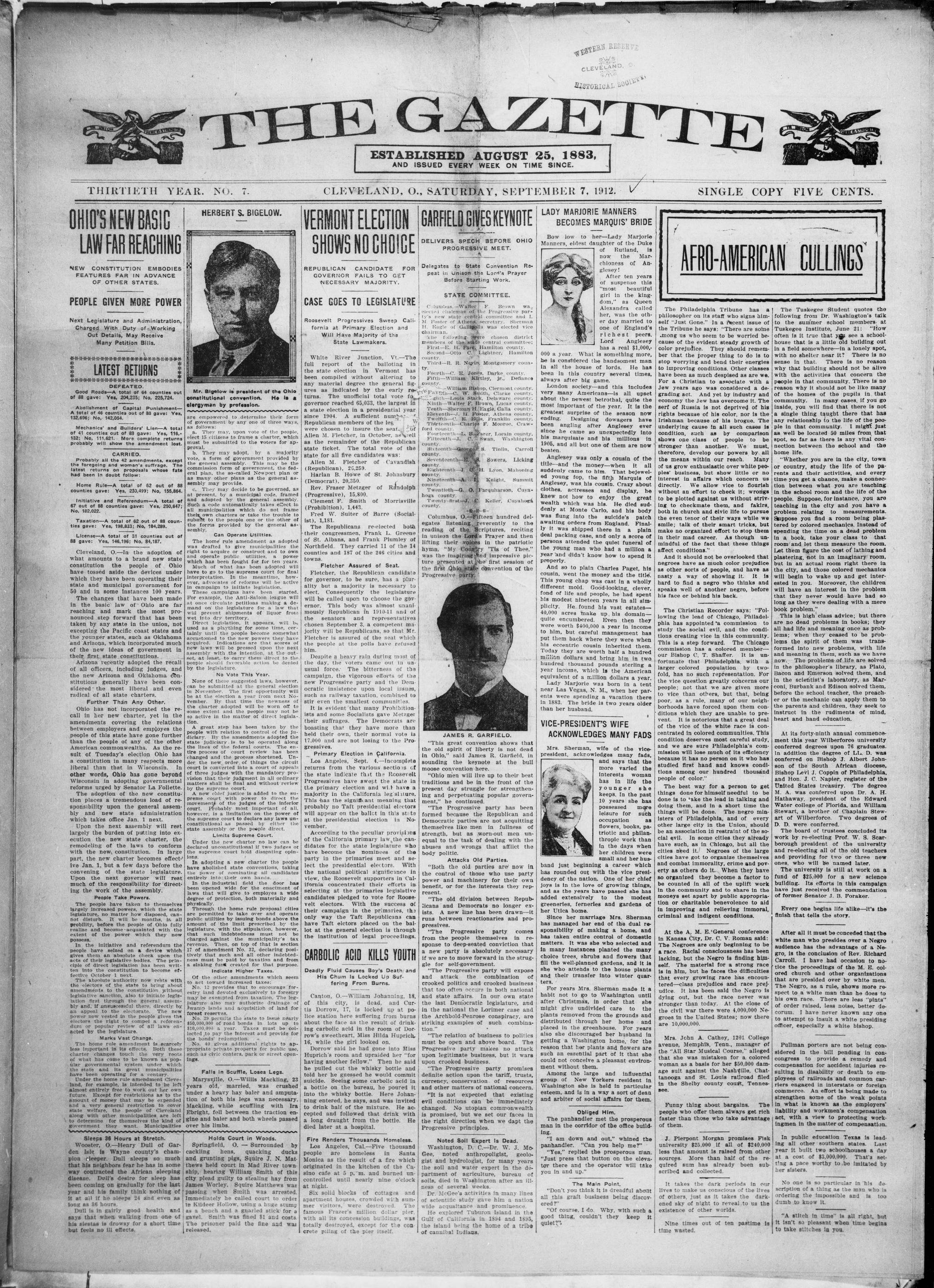
OHIO'S NEW BASIC LAW FAR REACHING
NEW CONSTITUTION EMBODIES FEATURES FAR IN ADVANCE OF OTHER STATES.
PEOPLE GIVEN MORE POWER
Next Legislature and Administration Charged With, Duty of-Working Out Details, May Receive Many Petition Bills.
Good Roads—A total of 64 counties out of 88 gave: Yes, 204,233; No, 225,724.
Abolishment of Capital Punishment—A total of 46 counties out of 88 gave: Yes, 132,696; No, 142,054.
Mechanics and Builders' Lien—A total of 41 counties out of 89 gave: Yes, 116,132; No, 111,621. More complete returns probably will show the amendment lost.
CARRIED
Probably all the 42 amendments, except the foregoing and woman's suffrage. The latest returns on proposals whose fate had been in doubt follow:
Home Rule—A total of 62 out of 88 counties gave: Yes, 230,499; No, 158,864.
Initiative and Referendum—A total of 67 out of 88 counties gave: Yes, 250,647; No, 182,022.
Taxation—A total of 62 out of 88 counties gave: Yes, 198,833; No, 184,289.
License—A total of 31 counties out of 88 gave: Yes, 146,196; No, 84,187.
Cleveland, O.—In the adoption of what amounts to a brand new state constitution the people of Ohio have tossed aside the devices under which they have been operating their state and municipal government for 50 and in some instances 100 years.
The changes that have been made in the basic law of Ohio are far reaching and mark the most pronounced step forward that has been taken by any state in the union, not excepting the Pacific coast states and the younger states, such as Oklahoma and Arizona, which incorporated much of the new ideas of government in their first state constitutions.
Arizona recently adopted the recall of all officers, including judges, and the new Arizona and Oklahoma constitutions generally have been considered the most liberal and even radical of all state charters.
Further Than Any Other.
Ohio has not incorporated the recall in her new charter, yet in the amendments covering the relations between employers and employees the people of this state have gone further than the people of any of the other American commonwealths. As the result of Tuesday's election Ohio has a constitution in many respects more liberal than that in Wisconsin. In other words, Ohio has gone beyond Wisconsin in adopting governmental reforms urged by Senator La Follette. The adoption of the new constitution places a tremendous load of responsibility upon the general assembly and new state administration which takes office Jan. 1. next.
Upon the next assembly will rest largely the burden of putting into execution the new state charter, the remodeling of the laws to conform with the new, constitution. In large part, the new charter becomes effective Jan. 1, but a few days before the convening of the state legislature. Upon the next governor will rest much of the responsibility for directing the work of the assembly.
People Take Powers.
The people have taken to themselves largely increased powers, which the state legislature, no matter how disposed, can not override, and the probability, before the people of Ohio fully realize and become-acquainted with the extent of the power which they now possess.
In the initiative and referendum the people have seized on a device which gives them an absolute check upon the powers of the state legislature now rekts with the electors of the state to bring about amendments to the constitution without legislative sanction, also to initiate legislation first through the general assembly, and then through an appeal to the electorate. The new power now vested in the people gives the electors the right to compel a referendum on all laws enacted by the legislature.
Marks Vast Change
The home rule amendment is scarcely less important in its effects. Both these charter changes touch the very roots of what has come to be known as popular governmental system under which municipalities have been operating for a century. Under the home rule amendment Cleveland, for example, is intended to be left almost entirely free to work out her own budget. Except for restittions as to the amount of money that may be expended and a very general restriction to cover state welfare, the people of Cleveland should be able to determine for themselves the kind of government they want. Municipalities Sleeps 36 Hours at Stretch. Wooster, O.-Henry Dull of Garden Isle is Wayne county's champion sleeper. Dull sleeps so much that his neighbors fear he has in some way contracted the African sleeping disease. Dull's desire for sleep has been coming on gradually for the last year and his family think nothing of it at all if he sleeps 24 and even as long as 36 hours. Dull is in fairly good health and says that when walking from one of his sleets is drowsy for a short time but feels no ill effects.
THE GAZETTE
HERBERT S. BIGELOW.
Mr. Bigelow is president of the Ohio constitutional convention. He is a slergyman by profession.
are empowered to determine their form of government by any one of three ways, as follows:
a. They may, upon vote of the people, elect 15 citizens to frame a charter, which must be submitted to the voters for approval.
b. They may adopt, by a majority vote, a form of government provided by the general assembly. This may be the commission form of government, the federal plan, the so-called Newport plan or as many other plans as the general assembly may provide.
c. They may decide to be governed, as at present, by a municipal code, framed by the mayor. Such a code automatically takes effect in all municipalities which do not frame a municipal code. Submit to the people one or the other of the forms provided by the general as-
Can Operate Utilities.
The home rule amendment as adopted was drafted to give municipalities the right to acquire or construct and to own land which has been fought for ten years. Much of what has been adopted will have to go to the supreme court for final interpretation. In the meantime, how much of the land which has been fought for, active in campaign to initiate legislation. These campaigns have been started. For example, the Anti-Saloon league will demand on the legislature for a law will prevent shipments of liquor from wet into dry territory. It appears, will be used as a plaything for some time, certainly until the people become somewhat accustomed to the new powers they have acquired. Indications are that scores of municipalities are in assembly with the intention, at the outset, at least, to carry their direct to the people should favorable action be denied.
No Vote This Year.
None of these suggested laws, however, can be submitted at the general election in November. The first opportunity will be at the eleventh that a year from next November, after the election, the charter adopted will be worn off to some extent and the people may not be so active in the matter of direct legislation. A great step has been taken by the people with relation to control of the judiciary. By the amendments adopted the state judiciary is to be operated along the lines of the process of court review has been changed and the process shortened. Under the new, order of, things the circuit court is converted into a court of appeals and the new, order of, things the vision that their judgment in all ordinary matters shall be final and without review by the supreme court. A new chief justice is added to the supreme court and is moved to direct the movements of the judges of the inferior court. Probably most important of all, however, is a limitation on the power of the supreme court to declare any laws unlawful.
Limits Supreme Court.
Under the new charter no law can be declared unconstitutional if two judges or the supreme court hold dissenting opinions. In adopting a new charter the people have abolished state conventions, taking the power of nominating all candidates entirely into their own hands. The court has been opened wide for the enactment of laws that will give to employees a wide degree of protection, both materially and physically. Through the home rule proposal cities are permitted to take over and operate public utilities by issuing bonds above the amount of the limit prescribed by the statute. The court must also that such indebtedness must not be charged against the municipality's tax revenue. Then, on top of that is section 11 of amendment No. 22, declaring postal services to be free from charge unless must be paid by taxation and from a sinking fund created for that purpose.
Indicate Higher Taxes.
Of the other amendments which seen to act toward increased taxes:
No. 12 provides that that to encourage forestry land devoted exclusively to forestry may be exempted from taxation. The legal statute also may authorize drainage of forestland and acquisition or land for forest reserves. No. 29 permits the state to issue nearly $400,000,000 of road bonds in lots up to $100,000,000 to be issued to belected to pay the interest and provide for the bonds' redemption. No. 40 gives additional rights to appropriate private property for public use, civic centers, park or street openings.
Falls in Seattle Loses Logs
Marysville, O.—Wills Mackling, 23 years old, married, was crushed under a heavy husbail and amputation of both his legs was necessary. Mackling while scuffling with Ira Ebright, fell between the traction engine and baler and both wheels passed over his limbs.
Holds Court in Woods.
Springfield, O. — Surrounded by cackling hens, quacking ducks and grunting pigs. Squire J. N. Matthws held court in Mad River township, hearing William Smith of this city plead guilty to scaling hay from James Worley. Squire Matthews was passing when Smith was arrested. Immediately he called court to order in Kilderoe Hollow, using a huge stump as a bench and a guarded stick for a gravel. Smith was fined $1 and costs The prisoner paid the fine and was released.
ESTABLISHED AUGUST 25, 1883 AND ISSUED EVERY WEEK ON TIME SINCE.
VERMONT ELECTION SHOWS NO CHOICE
REPUBLICAN CANDIDATE FOR GOVERNOR FAILS TO GET NECESSARY MAJORITY.
CASE GOES TO LEGISLATURE
Roosevelt Progressives Sweep California at Primary Election and Will Have Majority of the State Lawmakers.
White River Junction, Vt.—The full report of the balloting in the state election in Vermont has been compiled without altering to any material degree the general figures as indicated by the early returns. The unofficial total vote to governor reached 65,033, the largest in a state election in a presidential year since 1904. A sufficient number of Republican members of the leg were chosen to insure the seat. Of Allen M. Fletcher, in October, as well as the remainder of the Republican state ticket. The total vote of the state for all five candidates was:
Allen M. Fletcher of Cavandish (Republican), 25,259.
Harlan B. Howe of St. Johnsbury (Democrat), 20,350.
Rev. Fraser Metzger of Randolph (Progressive), 15,800.
Clement F. Smith of Morriaville (Prohibition), 1,443. Fred W. Suiter of Barre (Socialist), 1,181. The Republicans re-elected both their congressmen, Frank L. Greene of St. Albans, and Frank Plumley of Northfield. They carried 11 of the 14 counties and 187 of the 246 cities and towns.
Fletcher Assured of Seat
Fletcher Assured of Seat.
Fletcher, the Republican candidate for governor, to be sure, has a plurality but a majority is necessary to elect. Consequently the legislature will be called upon to choose the governor. This body was almost unanimously Republican in 1910-11 and of the senators and representatives chosen September 3, a competent majority will be Republicans, so that Mr. Fletcher is assured of the seat which the people at the polls have refused him.
Despite a heavy rain during most of the day, the voters came out in unusual force: The bitterness of the campaign, the vigorous efforts of the new Progressive party and the Democratic insistence upon local issues, such as railway taxation, combined to stir even the smallest communities.
It is evident that many Prohibitionists and some Socialists gave Metzger their suffrages. The Democrats are boasting that they have more than held their own, their normal vote is 17,000 and are not losing to the Progressives.
Primary Election in California.
Los Angeles, Sept. 4.—Incomplete returns from the various sections of the state indicate that the Roosevelt Progressives have swent the state in the primary election and will have a majority in the California leg sluice. This has the signifiant meaning that probably no Taft presidential electors will appear on the ballot in this state at the presidential election in November.
According to the peculiar provisions of the California primary law, the candidates for the state legislature who have become the nominees of the party in the primaries meet and select the presidential electors. With the national political significance in view, the Roosevelt supporters in California concentrated their efforts in selecting at the primaries legislative candidates pledged to vote for Roosevelt electors. With the success of their campaign in the primaries, the only way the Taft Republicans can have Taft electors placed on the ballot at the general election is through the institution of legal proceedings.
CARBOLIC ACID KILLS YOUTH
CARBOLIC ACID KILLS YOUTH
Deadly Fluid Causes Boy's Death and His Chum Is Locked Up Suffering From Burns.
Canton, O.—William Johanning, 18, of this city, is dead, and Curtis Dorrow, 17, is locked up at police station here suffering from burns about the face as the result of drinking carbolic acid in the room of Dorrow's sweetheart, Miss Hilda Huprich, 16, while the girl looked on.
Dorrow said he had gone into Miss Huprich's room and upraised her "for having another fellow." Then he said he pulled out the whisky bottle and told her he gushed he would commit suicide. Seeing some carbolic acid in a bottle on the bureau, he poured it into the whisky bottle. Here Johanning entered, he says, and was invited to drink half of the mixture. He accepted and followed that drink with a long draught from the bottle. He died later at a hospital.
Fire Renders Thousands Homeless.
Los Angeles, Cal.—Five thousand people are homeless in Santa Monica as the result of a fire which originated in the kitchen of the Casino cafe at 5 p. m. and burned uncontrolled until nearly nine o'clock at night.
Six solid blocks of cottages and apartment houses, crowded with summer visitors, were destroyed. The famous Frazer's million dollar pier, with all its concession buildings, was totally destroyed, except for the concrete piling of the pier itself.
GARFIELD GIVES KEYNOTE
GARFIELD GIVES KEYNOTE
DELIVERS SPECH BEFORE OHIO
PROGRESSIVE MEET.
Delegates to State Convention Repeat in Unison the Lord's Prayer
Before Starting Work.
STATE COMMITTEE.
Columbus - Walter F. Brown wa-
ter of the University of St. Mary's new state central committee and L. M Foster of Athens, secretary, Sherman
Ungle of Gallipoli was elected vice chair
The following were chosen district
measures of the central committee.
First—I Hertz, Furtwang.
Second—Otto C Lightner, Hamilton
county.
Third-R. R. Ngin, Montgomery county.
Fourth-C. E. Jones, Darke county.
Fifth-William Kirtley, Jr., Defiance county.
William Bishop, Clermont county.
Pavinth-C. W. Smith, Clarke county.
Lighthouse-Louis Stack, Delaware county.
Ninth-Walter F. Brown, Lucas county.
Twenth-Sherman H. Hagle, Galla county.
Twelfth-E. Ella, Franklin county.
Thirteenth-Charlie F. Monroe, Crawford county.
Fourteenth-L. B. Burger, Loveland county.
Fifteenth-J. C. Swan, Washington county.
Sixteenth—Guerra S. Tinlin, Carroll
county.
Seventeenth—II. 4. Sowers, Licking
county.
county
Eighteenth—L. C. H. Lyon, Mahoning
county.
Nineteenth - A. I. Knight, Summit county.
Twentieth—G. O. Farquharson, Cuyahoga county.
Twenty-first—J. C. Keller, Cuyahoga county.
Columbus, O.—Fifteen hundred delegates listening reverently to the reading of the Scriptures, reciting in unison the Lord's Prayer and then lifting their voices in the patriotic hymn, "My Country 'Tis of Thee," was the inspiring and impressive picture presented at the first session of the first Ohio state convention of the Progressive party.
JAMES B. GARFIELD
"This great convention shows that the old spirit of liberty is not dead in Ohio," said James R. Garfield, in sounding the keynote at the bull moose convention here.
"Ohio men will live up to their best traditions and be in the front of the present day struggle for strengthening and perpetuating popular government," he continued.
"The Progressive party has been formed because the Republican and Democratic parties are not acquiring themselves like men in fullness of strength, but as worn-out men unequal to the task of dealing with the abuses and wrongs that afflict the body politic.
**Attacks Old Parties.**
"Both the old parties are now in the control of those who use party power and machinery for their own benefit, or for the interests they represent.
"The old division between Republicans and Democrats no longer exists. A new line has been drawn—it runs between reactionaries and pro-pressives.
"The Progressive party comes from the people themselves in response to deep-seated conviction that a new party is absolutely necessary if we are to move forward in the struggle, for self-government."
"The Progressive party will expose and attack the combination of crooked politics and crooked business that too often occurs in both national and state affairs. In our own state the last Democratic legislature, and in the national the Lorimer case and the Archbold-Penrose conspiracy, are striking examples of such combination."
"The relation of business to politics must be open and above board. The Progressive party makes no attack upon legitimate business, but it wars upon crooked business.
"The Progressive party promises definite action upon the tariff, trusts, currency, conservation of resources and other matters of national concern.
"It is not expected that existing evil conditions can be immediately changed. No utopian commonwealth is promised, but we set our faces in the right direction when we dap the Progressive principles."
Noted Soil Expert Is Dead
Washington, D. C.-Dr. W. J. M. Gee, noted anthropologist, geologist and hydrologist, for many years the soil and water expert in the department of agriculture, bureau of soils, died in Washington after an illness of several weeks. Dr. McGee's activities in many lines of scientific study gave him a nation wide acquaintance and prominence.
He explored Tuburon Island in the Gulf of California in 1894 and 1895, the island being the home of a tribe of cannibal Indians.
WESTERN RESERVE
CLEVELAND, O.
HISTORICAL SOCIETY
LADY MARJORIE MANNERS
BECOMES MAROUIS' BRIDE
Bow low to her—Lady Marjorie Manners, eldest daughter of the Duke
nerer—Lady Marjorie
of the Duke
of Rutland, is
now the Mar-
chioness of Anglesey!
A.
After ten years of suspense this "most beautiful girl in the kingdom," as Queen Alexandra called her, was the other day married to one of England's richest peers, Lord Anglesey has a real $1,000,000 a year. What is something more, he is considered the handsomest man in all the house of lords. He has been in this country several times, always after big game. London society—and this includes very many Americans—is all upset about the newest betrothal, quite the most important of the year. It is the greatest surprise of the season now ending. Designing dowagers have been angling after Anglesey ever since he came so unexpectedly into his marquisate and his millions in 1905, and all but one of them are now beaten.
Anglesey was only a cousin of the title—and the money—when it all suddenly came to him. That bejeweled young fop, the fifth Marquis of Anglesey, was his cousin. Crazy about clothes, actresses and display, he knew not how to enjoy the great wealth which was his. He died suddenly at Monte Carlo, and his body was fung in the suicide's patch awaiting orders from England. Finally it was shipped there in a plain deal packing case, and only a score of persons attended the quiet funeral of the young man who had a million a year and didn't know how to spend it properly.
And so to plain Charles Paget, his cousin, went the money and the title. This young chap was cast in a wholly different mold. Good-looking, clever, fond of life and people, he had spent his modest nineteen years in all simplicity. He found his vast estates—40,000 acres make up his domain—quite encumbered. Even then they were worth $400,000 a year in income to him, but careful management has put them back where they were when his eccentric cousin inherited them. Today they are worth half a hundred million dollars and bring him in two hundred thousand pounds sterling a year income, which is the American equivalent of a million dollars a year. Lady Marjorie was born in a tent near Las Vegas, N. M., when her parents were spending a vacation there in 1883. The bride is two years older than her husband.
VICE-PRESIDENT'S WIFE
ACKNOWLEDGES MANY FADS
Mrs. Sherman, wife of the vice president, acknowledges many fads, and says that the more varied the interests woman has in life the younger she keeps. In the past 10 years she has possessed more leisure for such occupation as flowers, books, patriotic and philanthropic work than in the days when her children were small and her hus-
and says that the more varied the interests woman has in life the younger she keeps. In the past 10 years she has possessed more leisure for such occupation as flowers, books, patriotic and philanthropic work than in the days when her children were small and her husband just beginning a career which has rounded out with the vice presidency of the nation. One of her chief loves is in the love of groomingings, and as the years have passed she added extensively to the modest greeneries, ferners and gardens of her Utica home.
Since her marriage Mrs. Sherman has managed her end of the dual responsibility of making a home, and has taken entire control of domestic matters. It was she who selected and in many instances planted the many choice trees, shrubs and flowers that fill the well-planned gardens, and it is she who attends to the house plants and their transfer into winter quarters.
For years Mrs. Sherman made it a habit not to go to Washington until after Christmas, in order that she might give undived care to the plants removed from the grounds and distributed through her home and placed in the greenhouse. For years also she discouraged her husband in getting a Washington home, for the reason that her plants and flowers are such an essential part of it that she could not conceive a pleasant environment without them. Among the large and influential group of New Yorkers resident in Washington she is held in particular esteem, and is in a way a sort of dean and arbiter of social affairs for them.
Obliged Him.
The panhandler met the prosperous man in the corridor of the office building.
"I am down and out," whined the panhandler. "Can you help me?"
"Yes," replied the prosperous man. "Just press that button on the elevator there and the operator will take you in and up."
The Main Point.
"Don't you think it is dreadful about all this graft business being discovered?"
"Of course, I do. Why, with such a good thing, couldn't they keep it quiet?"
AFRO-AMERICAN CULLINGS
The Philadelphia Tribune has a philosopher on its staff who signs himself "Just Gone." In a recent issue of the Tribune he says: "There are some mong us who seem to be worried because of the evident steady growth of color prejudice. They should remember that the proper thing to do is to stop worrying and bend their energies to improving conditions. Other classes have been as much despised as are we. For a Christian to associate with a Jew years ago was considered a degrading act. And yet by industry and economy the Jew has overcome it. The serf of Russia is not deprived of his rights because of his color, nor is the Irishman because of his brogue. The underlying cause in all such cases is condition, such as by comparison shows one class of people to be stronger than another. We must, therefore, develop our powers by all the means within our reach. Many of us grow enthusiastic over white people' business, but show little or no interest in affairs which concern us directly. We allow vice to flourish without an effort to check it; wrongs to be plotted against us without striving to checkmate them, and fakers, both in church and civic life to pursue the even tenor of their ways while we smile; talk of their smart tricks, but make no organized effort to stop them in their mad career. As though unmindful of the fact that these things affect conditions."
And it should not be overlooked that negroes have as much color prejudice as other sorts of people, and have as nasty a way of showing it. It is hard to find a negro who thinks and speaks well of another negro, before his face or behind his back.
The Christian Recorder says: "Following the lead of Chicago, Philadelphia has appointed a commission to study the social evil, and the conditions creating vice in this community. This is a step forward. The Chicago commission has a colored member—our Bishop C. T. Shaffer. It is unfortunate that Philadelphia, with a larger colored population by two-fold, has no such representation. For the vice question greatly concerns our people; not that we are given more to vice than others, but that, being poor, as a rule, many of our neighborhoods have forced upon them conditions which they are unable to prevent. It is notorious that a great deal of the vice of the white race is concentrated in colored communities. This condition deserves most careful study, and we are sure Philadelphia's commission will lose much of its efficiency because it has no person on it who has studied first hand and knows conditions among our hundred thousand people of color."
The best way for a person to get things done for himself needful to be done is to 'ake the lead in talking and doing them, and in a short time the things will be done. The negro ministers of Philadelphia, and of every other large city in the Union, should be an association in restraint of the social evil. In some cities they already have such, as in Chicago, but all the cities need it. Negroes of the large cities have got to organize themselves and combat immorality, crime and poverty as others do it. When they have so organized they become a factor to be counted in all of the uplift work in the community and to share in the moneys set apart by public appropriation or charitable benevolence to aid in improving and relieving immoral, criminal and indigent conditions.
At the A. M. E.' General conference in Kansas City, Dr. C. V. Roman said: The Negroes are only beginning to be a race. Racial consciousness has been lacking, but the Negro is finding himself. The material for a strong race is in him, but he faces the difficulties that every growing race has encountered—class prejudices and race prejudice. It has been said the Negro is dying out, but the race never was stronger than today. At the close of the civil war there were 4,000,000 Negroes in the United States; now there are 10,000,000.
Mrs. John A. Cathey, 1291 College avenue, Memphis, Tenn., manager of the "All Star Musical Course," alleged that she was mistaken for a colored woman as a basis for her $50,000 damage suit against the Nashville, Chattanooga and St. Louis railroad filed in the Shelby county court, Tennessee.
Funny thing about bargains. The people who offer them always get rich faster than those who take advantage of them.
J. Plerpont Morgan promises Fisk university $25,000 if all of $240,000 less that amount is raised from other sources. More than half of the required sum has already been subscribed and collected.
It takes the dark periods in our lives to make us conscious of the lives of others, just as it takes the darkened sky of night to reveal to us the existence of other worlds.
Nine times out of ten pastime is time wasted.
PY FIVE CENTS.
AN CULLINGS
The Tuskegee Student quotes the following from Dr. Washington's talk to the summer school members at Tuskegee Institute, June 21: "How often is it true that you see a schoolhouse that is a little old building out in a field somewhere—in a lonely spot, with no shelter near it? There is no sense in that. There is no reason why that building should not be alive with the activities that concern the people in that community. There is no reason why it should not be like many of the homes of the pupils in that community. In many cases, if you go inside, you will find that there is not a single thing taught there that has any relationship to the life of the people in that community. I might just as well be located 50 miles from that spot, so far as there is any vital connection between the school and the home life.
"Whether you are in the city, town or country, study the life of the parents and their activities, and every time you get a chance, make a connection between what you are teaching in the school room and the life of the people. Suppose, for instance, you are teaching in the city and you have a problem relating to measurements. Suppose you find a room being plastered by colored mechanics. Instead of spending the time on a dead problem in a book, take your class to that room and let them measure the room. Let them figure the cost of lathing and plastering, not in an imaginary room, but in an actual room right there in the city, and those colored mechanics will begin to wake up and get interested in you. Moreover, the children will have an interest in the problem that they never would have had so long as they were dealing with a mere book problem."
This is high class advice; but there are no dead problems in books; they all had life and meaning once as problems; when they ceased to be problems the spirit of them was transformed into new problems, with life and meaning in them, such as we have now.
The problems of life are solved in the philosopher's library, as Plato, Bacon and Emerson solved them, and in the scientist's laboratory, as Marconi, Burbank and Edison solved them, before the school teacher, the preacher or the mechanic can apply them to the parents and children, they seek to instruct in the rudiments of mind, heart and hand education.
At its forty-ninth annual commencement this year Wil伯力force university conferred degrees upon 76 graduates. In addition the degree of LL. D. was conferred on Bishop J. Albert Johnson of the South African diocese, Bishop Levi J. Coppin of Philadelphia, and Hon. J. C. Napier, register of the United States treasury. The degree M. A. was conferred upon Dr. A. H. Hathaway, president of the Edward Water college of Florida, and William Stewart, a brother of Chaplain Stewart of Wil伯力force. Two degrees of D. D. were conferred. The board of trustees concluded its work by re-electing Prof. W. S. Scarborough president of the university and re-electing all of the old teachers and providing for two or three new ones, who will be named later. The university is still at work on a fund of $25,000 for a new science building. Its efforts in this campaign have just received the commendation of former Senator J. B. Foraker.
Every one begins life alike—it's the finish that tells the story.
After all it must be conceded that the white man who presides over a Negro audience has the advantage of a Negro, is the conclusion of Rev. Richard Carroll. I have had occasion to notice the proceedings of the M. E. colored church and other organizations that are presided over by white men. The Negro, as a rule, shows more respect to a white man than he does to his own race. There are less "plints" of order raised, less noise, better decorum. I have never known any one to attempt to insult a white presiding officer, especially a white bishop.
Pullman porters are not being considered in the bill pending in congress to provide a remedy and compensation for accident injuries resulting in disability or death to employees of railroads and common carriers engaged in interstate or foreign commerce. An effort is being made to strengthen some of the weak points in what is known as the employers' liability and workmen's compensation act, with a view to protecting workingmen in the matter of compensation.
In public education Texas is leading all other southern states. Last year it built two schoolhouses a day at a cost of $3,000,000. That's setting a pace worthy to be imitated by her sisters.
No one is so particular in his description of a thing as the man who is ordering the impossible and is too dumb to know it.
"A stitch in time" is all right, but it isn't so pleasant when time begins to take stitches in you.
One Year.....$1.50
Six Months.....1.00
Three Months......50
Subscribers are requested to remit by postoffice money order or registered letter.
Entered at the postoffice in Cleveland Ohio, as second-class matter
Address all communications to HARRY C. SMITH
Editor and proprietor,
THE GAZETTE,
Blackstone Building, Cleveland, O.
Member Ohio Legislature: 1894 to 1896; 1896 to 1898; 1898 to 1902
THE GAZETTE is the oldest, and has the largest bona fide circulation, double that of any newspaper in the interest of Afro-Americana, published in the state of Ohio, and comparison with any will immediately establish its rank as one of the NEWSIEST AND BEST in the country.
A GREAT VICTORY.
As we go to press, the indications are that proposal No. 24, with nearly all the others save a few, has been ratified by the voters of Ohio at the polls Tuesday. This will eliminate the word "white" from the suffrage clause but not from the military clause of the new state constitution. The major of the Ninth Battalion and the captain of its local company, both residents of this city, could have helped their organization last fall and since, by joining in the effort the great mass of our people of this community made to have the objectionable word eliminated from both clauses. Instead, they "knocked."
Hon. David Cunningham.
The Gazette, in common with our people of this community, has the great satisfaction of knowing it did its best nearly all of last year and this, to Tuesday, to do its full duty to those of the race in Ohio, in this matter. The following is self-explanatory, and is but one of many received on Wednesday of this week:
Cleveland, Sept. 4, T2.
Hon. Harry C. Smith,
Editor of The Gazette,
Dear Sir:
Allow me to congratulate you on your勇敢 fight and complete victory. May your every fight in the future be as successful, is my earnest wish.
Respectfully yours,
Frank D. Brown.
Thanks to all for such kind and encouraging words of commendation and praise. As a matter of fact, all who helped in any way in the effort, are entitled to the same, and Mr. Brown was one of the number.
THE MANHOOD IN THE PIT.
"A man may put me in a pit, and keep me there, if he is strong enough. BUT I WILL ACT SO THAT HE WILL KNOW THAT THERE'S A MAN IN THAT PIT."
It was a Negro who said this. He was speaking of the wrongs of the Negro race.
IT HAS A LESSON FOR EVERY MAN WHO FEELS THAT HE IS OPPRESSED. WRONGS WE MUST ALL ENDURE, BUT THE WRONG IS HALF UNDONE WHEN HE WHO IS IN THE PIT KEeps HIS MANHOOD UNSCATHED.
Does your employment seem beneath you? Are you subject to humiliations? You may not be able to cure the evils from which you outwardly suffer, but you may make respectable, and even noble, the pit in which you are placed—by being a MAN.
Marcus Aurelius Antonius said that nothing harms a man which does not make him a worse man. Slavery, pain, poverty, the wrongs of enemies—all these harm the enslayer, because they make him a worse man—harm the inflictor of pain, and the creator of poverty, and the doers of the wrong—but not the person suffering these things UNLESS HE ALLOWS THEM TO MAKE HIM A WORSE MAN.
Marcus Aurelius Antonius was an emperor, and suffered only those wrongs which emperors suffer. But Epictetus, the slave, was of the same mind with him. To slave and emperor alike, the way is open to triumph over adversity by keeping MANHOOD unimpaired.
And remember this, that no class of men can remain in the pit. If each sees to it that so far as he is concerned there shall be a MAN in the pit.
Shackles fall from the limbs of REAL MEN. Individuals like Epictetus may be REAL MEN and also slaves—though Epictetus finally ruled his master by sheer manhood.
BUT IF ALL THE SLAVES IN ROME HAD BEEN MEN LIKE EPictetus, WOULD THEY HAVE REMAINED SLAVES? NO! AND IF EVERY NEGRO, AND EVERY WAGE SLAVE IN THE LAND SHOULD SUDDENLY DEVELOP HIGH, EXALTED MANHOOD, THE RACE
PROBLEM AND THE LABOR PROBLEM WOULD BE SOLVED—SOLVED BY THE MANHOOD OF THE VERY MEN INVOLVED IN THEM.
WHEN MEN ARE IN THE PIT THEY ANNHILATE THE PIT.
THE GREATEST NEED OF THE WORLD IS MANHOOD—Ex.
SENATOR FORAKER
For the benefit of the editor of the Columbia (S. C.) Indicator we desire to say that we thought every member of the race knew that Senator Joseph Benson Foraker was an active and aggressive friend of the race for MANY years prior to the “Brownville” affair—ever since, when but a lad, he participated in the war of the rebellion—The Cleveland, Ohio Gazette.
"The Gazette has missed the point altogether. We do not say that Senator Foraker is in charge of Colored race. What we said and do say yet is that if the ex-Senator had hated Col. Roosevelt less, his defense of the Colored soldiers could be regarded purely and simply as a plea for them. Under the circumstances we are sure that even The Gazette must admit that there were motives other than a defense of the race. If not, then The Gazette must write Sen. Tillman down, too, as a defender of the race—an absurd thing. —Columbia (S. C.) Indicator.
The Gazette did not "miss the point altogether," or otherwise, but "hit the nail squately on the head." Our conferee was wrong in his original or first statement, anent the Senator, and is as wrong in his latest. Senator Foraker did NOT hate Roosevelt, and his defense of "The Black Battalion" WAS "a plea for them, pure and simple." Long after he began his grand fight for our outraged soldiers, he and Mrs. Foraker were special guests of President Roosevelt at the White House and were singled out from all the many guests present at that great governmental social function by the then Chief Executive and his wife, for attention that made them the cynosure of all eyes. This was received by our great Senator and his lovely wife in the kindly friendly spirit they believed it given. He told the writer shortly afterward, at the same time marveling at the President's strenuous opposition to any fair treatment of "The Black Battallion" on the part of the United States Senate or the Congress, saying that he (the Senator) could not understand the President (in that important matter) or his motives. It was a considerable time later, that Roosevelt began his miserable criticism of the Senator's efforts, in behalf of our outraged soldiers, that amounted almost to personal abuse: the kind that invariably characterizes his differences and controversies with every public man who has the temerity to differ from him on almost any important subject. The motive that prompted Senator Joseph Benson Foraker to defend the right of even an Afro-American soldier to "his day in court" when accused of crime, ought now to be clear to even our esteemed conferee of the Columbia (S. C.) Indicator. There was no other motive. Our great Senator was at the time, and still is, a veteran of the war of the rebellion, an orator, jurist and statesman! A Christian gentleman!
SAMUEL COLERIDGE-TAYLOR.
England's leading and most noted composer dead—Well known in this country—Author of "Hiawatha."
London, Enk., Sept. 1, '12—Samuel Coleridge-Taylor, England's most famous composer, director and teacher, author of "Hiawata," known throughout the world as a result of its excellence as a musical composition, died here today. He was born in this country in 1874 and was another being an educator in 1878 with his father a native African. Mr. Taylor was educated in this country. For nearly ten years past, he has been the most popular and leading composer and director in all England. His compositions, of the very best, are being sung and played throughout the world. He leaves a wife, an accomplished English lady, and several children. His life is one of people of the world. His family has the heartfelt sympathy of a host of friends in this country and America.
Shot and Killed.
Cadiz, O.—Fred, Bolden, who was shot and wounded instantly killed by Harrison Moss Saturday night, was buried from his sister, Mrs. Jennie Duling's residence, Tuesday morning—Mr. and Mrs. Ed. Peterson of Uhrichville, spent Sunday with, Mr. and Mrs. W. L. Johnson—Mr. Titus of Canton, lectured for Allen League last Sunday.
Subject: "The Negro, his relation to the industrial world and three important influences governing it."
Slays His Sister's Lover.
St. Clairsville, O.—Frank Bolon, wwent practically killed by killed by Harrison Moss, eighteen, while calling on his sweetheart, Mary Moss, at Cadiz, last night Saturday. The murderer is a brother of Bolon's sweetheart.
GENUINE BARGAIN.
For Sale—Three suites and store room; rents $444 a year. Price $2500. Easy terms. E. R. Cowin, 912 Schofield Bldg.
A SPLENDID OPPORTUNITY.
WANTED—Young man with busi-
ness education who understands ste-
nography and is willing to start at
the bottom and work up. Lifetime
position to the right fellow. Must have
good habits and good appearance. Ad-
dress-EDITOR, The Gazette, Cleveland,
O.
DOINGS OF THE RAGE
Chas. A. Roxborough of Detroit, Mich., has been appointed a deputy state oil inspector, a position held in Ohio by the editor of The Gazette, over 20 years ago.
BUCKEYE, LETTERS
WRITTEN BY "THE OLD RELIABLE" GAZETTE'S CORRESPONDENTS.
THROUGHOUT OHIO
What Our People Are Doing Each Week—Church, Personal, Social, Lodge, Literary and Musical — Marriages, Deaths, Etc.
APPOINTMENT CONFIRMATION
Atlantic City, N. J.—Broad assistant state commissionation, has confirmed the name of Dr. James E. Bourne as of the City Board of Education appointment of Dr. Bourne. White man were announced. Bacharach just before the form of government was. The legality of the same was but Dr. Bourne stood his white appointee withdrew fight.
BELGIUM'S GRANTS TO NATIVES.
Brussels, Belgium, meeting of the International institute, here in July, presidency of Colonel Trivignon, minister of foreign service the delegates, and in a speech stated that administration in Congo co-
Thomas W. Johnson' of Cincinnati, clerk R. M. S., died in Nashville after a long illness. Indigestion. He attended the recent masonic grand lodge meet at Columbus.
Hon. Robert Smalls.
Bishop Isaac B. Scott of the M. E. Church, at St. Louis, Mo., recently, urged our moneyed men to engage in business in Africa. He is bishop there.
Believing that they are upholding President Taft's "new southern policy," democratic U. S. Senators are "holding up" the confirmation of his appointment of Capt. Robert Smalls as Collector of the Port at Beaufort, S. C. There are comparatively few white residents of Beaufort.
A delegation of prominent eastern Afro-Americans recently went to the White House and invited the president to address the national convention of Negro Republicans in New York City Sept. 18, 19 and 20 and the annual session of the New York state Baptist convention to be held in New York, Oct. 24. The president held the invitation in abeyance.
The director of the census has just issued a report showing a big increase in the mulatto population. Our total population is given as 9,827,763. Of this number, 2,056,688 are mulattos. In 1870 the mulattos numbered 584,000, or 12 per cent of our whole population, while now they number 21 per cent.
Mrs. Laura Anderson Hamilton stood first in a civil service examination for postmaster at Fort Ethel Allen, Vermont, and was appointed July 25 at a salary of $80 per month. There were three candidates for the position, who were Mrs. Hamilton. She is the first woman of her race to land a like position over the civil service route.
The flood that drove Dennis McCullough from Cairo, Ill., to St. Louis, waffled him into a prosperous business. He set up a barbershop at McCullough set up a section of an iron fence and is barboring meat for the neighborhood. His sign, "Southern Barbecue," attracts the attention of every passenger on Page cars, which pass the place.
Sneaking for his party, Col. Theo, Roosevelt said, last week: "Our hope is that under the lead of practical, competent, high-minded white men, we shall in the end everywhere see—and nowhere save under such lead will we ever see—the right of free political expression secured to the Negro who shows that he possesses the intelligence, integrity and self-respect which justify such right of political expression in his white neighbor."
MOTHER KATHERINE DREXEL'S
SCHOOL
Chicago, Ill.—Mother M. Katherine Drexel of Philadelphia, superior and founder of the order of Sisters of the Blessed Sacrament at Cornwall, Pa., who has contributed several millions to Negro and Indian schools, has arrived to take charge of the new school for our Catholic children, the first in Chicago, which will be opened this month at Thirty-sixth and Dabash Ave. for the children of St. Monica's Church, of which Rev. John Morris is pastor. She paid $26,000 for the old armory and is converting it into a school for the children of the school be for a convent for the six sisters of the Blessed Sacrament order which Mother Drexel has assigned here as teachers in the school.
COL. "BOB" CHURCH DEAD.
Said to Have Been a Millionaire—
Father of Miree Mary Church
Memphis, Tenn.—From slavery to a millionaire is the brief life story of Col. Robert R. Church, who died here, Aug. 31. He was born seventy-four years ago in Holly Springs, Miss. Mr. Church's wealth is estimated by Memphis bankers to exceed $1,000,000. He owned valuable business property and over 350 acres in the area, hundred acres of land near it. He began life on a cotton plantation. When old enough to work he was "sold" to the owner of a Mississippi river steamboat. His boyhood life was spent as cabinboy on a boat that plied in and out of the harbor of Memphis. After the civil war he left the river and got a position with a wholesale merchant. From that he embarked in the saloon business. Then he began to buy real estate. Col. Church was the plow-Albert of prominence who ever subscribed to entertain the confederate veterans at their annual reunions. A wife and children, in addition to a son and daughter by his first wife, survive him.
BUGKEYE. LETTERS
WRITTEN BY "THE OLD RELIABLE BLE" GAZETTE'S CORRESPONDENTS.
THROUGHOUT OHIO
What Our People Are Doing Each Week—Church, Personal, Social, Lodge, Literary and Musical — Marriages, Deaths, Ete.
Sandusky. — Rev. and Mrs. G. D. Smith have returned from a two weeks' visit in Paris, Millersburg, Carlslea, Ky., and Cincinnati. He preached Sunday morning. They report a good time and the meeting of a host of relatives. Mr. and Mrs. Henry Lewis and Erica B. 227, Ky., enjoyed the trip. —Miss Ema Garrett of Indianapolis, and little niece, Miss Johnson, are visiting Mr. and Mrs. J. S. Davis. Biss Bessie Brown and Mrs. Dangerfield of Cleveland, also visited them. —Mrs. Henry Richard spent two weeks visiting her children in Cleveland, and visited her from Detroit visiting her. —Mr. Peter Scott died, Friday evening. —Mrs. O. B. Shackelford's mother is visiting her. —Mrs. Amanda Taylor is in Pittsburgh, visiting her daughter. —D. S. Anderson went to Put-in-Bay. Then, Also Misses Elmore and Mary Jesse and Mrs. York of Nashville, Teen, who is visiting her sister. —Miss Allie Guest of The Guests sent during my absence, were found in my home just as the mail-man had left them. —Miss Mauda Alexander and brother, Dean, and sister, are visiting an uncle in Dunkirk.
Correspondents must mail all letters for publication at their main postoffice sufficiently early on Monday (or Sunday) of each week to have them reach The Gazette office on Tuesday morning, and always write, also, their names and that of their city or town on the outside of the wrapper about returned copies. Unwarranted requests cannot be given you. Lists of names, wedding presents, etc., obituary notices, speeches, resolutions, poetry, inquiries for relatives and advertisements of all kinds, including items announcing entertainments to be held in the near future, must be paid for in advance at the rate of ten cents a week (or display advertisements will be sent on application. Send postal note and not stamps during warm weather.
Cadiz.—Mrs. Mary Boone of Masson, visited Miss Reba West.—Miss Sara Wyatt of Mt. Pleasant, was Mrs. Gertrude Randolph's guest, Sunday.—Mr. Walter Williams died at his sister-in-law's, Mrs. Susie White's, the 21st. Rev. Fox officiated. Mr. and Mrs. Wintry Smith of E. Liverpool, were called here by his death.—Miss Merrick Dunn of Miss Mwengolin Redmond. — Misses Pauline Barnaby and Alma White are visiting in Steubenville.—Miss B. M. Fox entertained at six o'clock dinner on the 19th: Miss Hisses Lucas, Mable Norman, Mable Coleman, Ida Brown, Laura White, Lizzie* Davis, Florence Smith, Smith E. Brown and Georgia Dulaine. Miss Ida Brown and Georgia Dulaine. 12 grade students of Howard University, Washington, D. C., is our teacher for the primary grade, this year.—Miss Louise Holmes of Youngtown, is a guest of Miss Edna Brown.—Miss May Johnson entertained in honor of Miss H. Jean Lucas, on the 14th.—Mr. and Mrs. Melvin Davis, Paul and Catherine Thompson have returned from Coshoton and Zanes.—Miss May Johnson has returned to Oberlin.—Bishop J. H. Jones preached two able sermons here, Sunday, at the Chautauqua grounds. A large number from Flushing and other neighboring towns attended the meeting. — Mrs. Lizzie Cooke and Mrs. Steubenville, visited Mrs. Ella Wallace. Mrs. Susie M. Hogans is home and Mrs. Noble Jason has returned to Independence, mailed last Wednesday, Aug. 28-12, according to the Cadiz, O., post-office stamp on it, arrived in Cleveland on last Thursday, Aug. 29, 1912. TWO DAYS TOO LATE for our last issue because it was mailed two days late.-Editor.)
Youngstown. "A most popular" lady-contest at Oak Hill Ave., fall festival, Tuesday evening. -- Will Thomas is convalescent after two weeks' illness. -- Mr. and Mrs. William Saunders spent a few days in Ravenna, with Mr. and Mrs. Boggess, Mr. Boggess is Mrs. Saunders' brother. -- Braggs Wright shows little improvement. -- Mrs. Boggess is natives in Erie, Pa. and Cleveland, last week. -- Miss Alberta Smith of Washington, Pa. spent Labor day here. -- Mrs. Wm. Brown entertained at a 5 o'clock tea, Tuesday, in honor of the Misses Ida and Mamie Johnson of New Castle, Pa. Those present were: Mrs. David Brannock, R. D. Lynch, Mrs. Chas. Reeves, Mrs. William Honesty and a number of people from near-by towns, who were on Labor day. -- Willis Collins is convalescent a week's illness. -- Jackson is ill. -- Miss Maud Johnson, aged 29, died Sunday. Diptheria. Funeral from the house, Monday afternoon. Interment in Belmont Park cemetery.
Mcintyre.-Mr. and Mrs. H. Smith are rejoicing over the arrival of a fine baby boy.-A. C. Smith and daughter, Sarah, spent Tuesday with his son, Walter.-Mrs. C. Atkins and sister, Ethel, were in Steubenville, Friday.-Several attended the reunion in Smithfield, Saturday, and report a fine time.-Rev. J. Oakey left, Sunday, to spend a few days with Fernwood folks. Rev. J. Christian of Steubenville, visited the Sunday School there and spoke.-Mr. E. West of Smithfield and son-in-law, Mr. Harrison visited the school. Mr. Harrison gave talk to the infant class.-Mr. and Mrs. Harrage of Smithfield and son, Charles, and lady friends, were here Sunday.-Miss Sarah Smith entertained at dinner, Sunday, her three nieces, Lucile, Margery and Elsie Smith.-A box social will be held here Saturday evening, Sept. 7.
Are You in Arrears on your subscription? You knew WE NEED THE MONEY
APPOINTMENT CONFIRMED.
Atlantic City, N. J.—Bregard Betts, assistant state commissioner of education, has confirmed the appointment of Dr. James F. Bourne as a member of the City Board of Education. The appointment of Dr. Bourne and a white man were announced by Mayor Barcharek just before the commission form of government was ushered. The legality of the same was attacked, but Dr. Bourne stood his ground. The white appointee withdrew from the fight.
BELGIUM'S GRANTS TO CONGO
NATIVES.
Brussels, Belgium. — The annual meeting of the International Colonial institute, here in July, under the presidency of Colonel Thys. M. Davignon, minister of foreign affairs, received the delegates, and M. Renkin in a speech stated that the Belgian government had delicately held the lands the natives occupy and the mines they work must be regarded as their inalienable property.
CORRESPONDENTS WANTED
The old reliable Gazette desires an active agent and correspondent in every city and town in Ohio and neighboring states having a number of Afro-American residents. Only a little time on Fridays or Saturdays is required.
We are especially desirous of hearing persons in the following named cities: Zanesville, Newark Lancaster, Lebanon, Chillicoat, Toledo, Troy, Canton, Springfield, Piqua, Columbus, Cambridge, Steubenville, Bellaire, St. Clairsville, Wilmington, Portmouth, Washington, C. H., Oxford, Sabina, Gallipolis, Rendville, Urbana, Delaware, M. Vernon, East Lairpool, Wellsville, Akron, Dayton, Middleport, Bellefontaine, Lima, O., and other places where we have none.
When to be the editor of The Gazette, we instone building, Cleveland, O. and terms will be sent promptly. Our attention is at once upon hearing at once the addresses of persons in the cities named above, or others, to whom we can write relative to the matter.
Improved Paper Fastener.
To save the use of metal fasteners to hold several papers together a hand punch has been invented that makes a tongue-shaped cut in several sheets at once and folds the tongues together.
Just the same, the trout wants to be mighty careful how he swats the fly—Boston Globe.
THE KITCHEN GABINET
ALWAYS thought cold vectuals the best.
Then farewell heat and welcome frost.
Ice creams are divided into two classes, the Neapolitan and the Philadelphia. The former contains a large proportion of eggs, is made like a custard. The latter is creamy, being made of cream almost wholly. In preparing the Neapolitan cream, care should be taken to strain the custard after adding the eggs well beaten. The cooking is another important matter, as too long cooking curdles the custard and too little leaves a raw, uncooked taste. In adding fruit, such as berries or peaches, care should be taken that they are thoroughly mashed and sweetened before adding to the frozen mixture. Always chill the cream before freezing, as it freezes smoother and quicker. The following recipes are not commonly seen, though they are not at all hard to prepare:
Burnt Almond Ice Cream.—Blanch four ounces of shelled almonds and brown them in the oven. Pound to a paste in a mortar, adding a little sugar and cream to make a paste. Beat six eggs, add the almond mixture, a pound of sugar and a quart of cream, with a teaspoonful of vanilla. Scald the eggs with half of the cream.
Maple Perfect.—Cook four well beaten eggs in a cup of hot maple sirup, add a teaspoonful of vanilla, a pint of thick cream and freeze.
Orange Ice.—Make a sirup of a pint of sugar and a quart of water, boil 15 minutes, add a pint of orange juice and a half cup of lemon juice, the peel of a lemon and orange. The peel can be boiled with the sugar. Cool and freeze.
Orange Delicious.—A cup each of orange and lemon juice, a cup and a half of sugar or sufficient to sweeten a pint of cream. Freeze.
Nellie Maxwell.
Charles M. Schwab, at a luncheon on the Olympic, praised temperance "Mistrust the hard drinker," said Mr. Schwab. "He is selfish, he is self-indulgent. Otherwise he wouldn't yield to so bestial a vice as drunkenness. "Especially mistrust the man who, over his seventeenth beer, tells you how much he loves his wife. She always takes in washing to support him."
WONDERFUL RESULTS
ON SHORT NOTICE
I have used your Pomade. Its the best thing I ever used for making curly hair lie smooth. I have not finished my first bottle, but can see wonderful results, writes Mrs. Louise E. Hayes of Pineville, S. C.
Try Ford's Hair Pomade for harsh stubborn and unruly hair and Ford's Royal White Skin Lotion for the complexion. Ask your druggist for them. Be sure and get the genuine (Ford's manufactured by the Ozonized Cx Marrow Company, Chicago, Ill.
Forty-third Annual Exhibition OF THE COLORED A. & M. FAIR ASSOCIATION INCORPORATED
Will be held at Lexington. Ky..
This will be the greatest fair yet given by this world-famous association. RUNNING, TROTTING and PACING RACES DAILY.
QUINADE
GROWS HAIR REMOVES DANDRUFF
The best preparation for making Kinky, Coarse
Hair soft and pliable and easy to put up in any
style desired.
LIBERAL SAMPLE SENT ON APPLICATION
To straighten the hair quickly, use in conjunction with Quinade our QUINACOMB a comb made of specially tempered metal so as to retain the proper degree of heat. This comb can also be used to dry the hair quickly after shampooing.
The ideal shampoo soap thoroughly cleanses the scalp and is especially adapted to be used in connection with Quinade.
SEEBY DRUG CO., NEW YORK
Avery College Training S
Avery and Nelson St
College
taining School
ery and Nelson Streets,
Avery College Training School Avery and Nelson Streets.
CHARTERED AND, ENDOWED JANUARY
OFFICERS
ED AND. ENDOWED JANUARY 17th, 1849.
OFFICERS
CHARTERED AND. ENDOWED JANUARY 17th, 1849.
DR. G. G. TURFLEY, President.
WILLIAM MANLEY, Vice Pres.
JOS. D. MAHONEY, Sec. Treas.
STEES AND OFFICERS OF ADMINISTRATION.
W. K. McGINNESS
ELMAN
WILLIAM MANLEY
DR. G. G. TURFLEY
JOSEPH D. MAHONEY
E
*Deceased.
Elege Training Schools for Young Colored Women:
All the buildings have been remodeled and decorated
free of any expense to every young Colored woman
become self-supporting in the following gainful occupa-
turing and drafting and designing, nurse training, mill
tailoring for young men, and an intermediate Engli-
books as are used in our Public Schools. No Colore-
tory offers such an opportunity to young Colored women
PENSE.
MORIAL HOSPITAL AND TRAINING SCHOOL
FOR NURSES.
The Avery College Training Schools for You
The interior of all the buildings have been
the Institution's first any expense to its
skilled knowledge to become self-supporting in
theitions: Dressmaking, cutting and drafting and design
ery, domestic science, tailoring for young men, and
course, using the same books as are used in our Pu
institution in this country offers such an opportunity
—FREE OF ANY EXPENSE,
LINCOLN MEMORIAL HOSPITAL AND TE
NURSES.
The Avery College Training Schools for Young Colored Women:
The interior of all the buildings have been remodeled and decorated.
The institution offers free of any expense to every young Colored woman, skilled knowledge to become self-supporting in the following gainful occupations: Dressmaking, cutting and drafting and design, nurse training, millinery, scientific science, tailoring for young men, and an intermediate English course, using computers are used in our Public Schools. No Colored institution in this country offers such an opportunity to young Colored women —FREE OF ANY EXPENSE.
LINCOLN MEMORIAL HOSPITAL AND TRAINING SCHOOL
The only Colored Hospital in Western Pennsylvania, free to any nationality, that is modernly equipped to do such work. Located in a quiet and clean neighborhood, surrounded with a beautiful lawn and shade trees. We reach all points of the city, day or night, with our own Ambulance. Doctors are in attendance day and night. This department of Avery College was organized to meet the necessity of caring for the physical side, as well as the mental and industrial.
The only Colored Hospital in Western Pennsylvania, that is modernly equipped to do such work, clean neighborhood, surrounded with a beautiful lair reach all points of the city, day or night, with our and Nurses in attendance day and night. This deep was organized to meet the urgent necessity of care as well as the mental and industrial. The facilities for Nurse-Training are excellent mission high. The course of study covers three years, but it who are able, can complete it in two years.
TUITION IS FREE. Board, Furnished Room, I Furnished Free, and Salary of $36 yearly. We give you PROFESSIONAL TRAINING un Colored physicians.
Telephones: Bell 1464 and 9513-R Cedar, 2296 Cedar Night. Telephone: 6 P. M. to 6 A. M., Bell 1464 Phone Booths. The rapid growth of the institution has rendered of a dormitory. It is heated throughout by hot w electric plant, in charge of a competent matron. only.
Hospital in Western Pennsylvania, free to any nation
equipped to do such work. Located in a quiet and
arrounded with a beautiful lawn and shade trees. W
city, day or night, with our own Ambulance. Doctor
day and night. This department of Avery College
the urgent necessity of caring for the physical side
and industrial.
Nurse-Training are excellent and the standard of ac-
cultures covers three years, but it is so arranged that those
plete it in two years.
S. Board, Furnished Room, Laundry and Uniforms are
salary of $36 year.
OFFESSIONAL TRAINING under competent white an-
d 3513-R Cedar, 2296 Cedar, P. & A. 1174 North
6 P. M. to 6 A. M., Bell 1464 Cedar. Private Exchange
of the institution has rendered the addition
heated throughout by hot water, lighted by its ow-
ge of a competent matron. This building is for girl
The facilities for Nurse-Training are excellent and the standard of admission high.
The course of study covers three years, but it is so arranged that those who are able, can complete it in two years.
TUITION. Revised Furnished Room, Laundry and Uniforms are Furnished Free, and Salary of $36 year.
We give you PROFESSIONAL TRAINING under competent white and Colored physicians.
Telephones: Bell 1464 and 9513-R Cedar, 2296 Cedar, P. & A. 1174 North.
Night Telephone: 6 P. M. to 6 A. M. Bell 1464 Cedar. Private Exchange Phone Booths.
The rapid growth of the institution has rendered necessary the addition of a dormitory. It is heated throughout by hot water, lighted by its own electric plant, in charge of a competent matron. This building is for girls only.
For catalogs and other information address
JOSEPH D. MAHONEY,
Secretary and
Pure Beer Bottled at the
Order a Case
JOSEPH D. MAHONEY,
Secretary and Treasurer,
N. S. Pittsburgh, Pa.
Pure Beer Bottled at the Brewery
Order a Case of
Gold Bond
Bottled Beer
THE CLEVELAND & SANDUSKY
BREWING COMPANY
Delivered at the Home. Both Phones.
T. J. WILSON. Pres.
North Side
JOHN D. CHERRY
H. HERMAN HECHELMAN
H. HERMAN
H. DR. ROBERT BRADY
ALBERT P. WALACE
Organized November 16, 1906
A. L. HARDEN, Sec.
Seeby Drug Co.
79 East 130th St., New York
Gentlemen:
Gentlemen:
Before using Quinade my hair was thin and coarse and I was fast becoming bald. As soon as I used Quinade my hair began to grow rapidly and is now thick, long and wavy. (Name on file at our office.)
Pittsburgh, Pa.
Chartered April 8, 1909.
EYE.
Shufon
GLASSES
GRACE
THE
GRIP THAT
HOLDS
THE
FACE
Optical Specialist.
Eyes Examined Free. Satisfaction
Guaranteed.
11 The Taylor Arcade.
B. & M. HAIR DRESS
A delightfully Perfumed Hair-Pomade for making harsh, stubborn, curly hair soft, pliant and glossy. It it not only an ideal dressing for the hair but a wonderful hair-grower. It works directly on the scalp and roots of the hair, relieving dandruff and other diseases of the scalp-skin, thereby causing it to grow rich, long and luxurious.
B. & M. Hair Dressing
is becoming more popular every day. is sold strictly on a guarantee.
BROWN DRUG CO.
2742 Central Ave.
Selling Agents.
ATTORNEY AT LAW.
508-510 Superior Building.
Office, Main 3076.
Residence, Eddy 2086-R.
CLEVELAND, O.
MANDEL'S
HOME-MADE BAKERY
Cor. E. 37th St. and Central Ave. Waere you can get all kinds of FRESH BREAD. FANCY
Birthday and Wedding Cakes.
GIVE MANDEL A CALL.
Enjoy a good clean
Meal at Adkins old
stand 2613 Central Av.
Cassells & Rowell.
Proprietors.
THE BEST MEALS AT ALL HOURS
Open Evenings
'Phone, Bell, North 1278 W.
Bell Main 8345. Cuy. Cent. 7597 L.
Globe Printing Co.,
PRINTERS AND STATIONERS.
1397 East Ninth Street
A Complete Line
DRY GOODS, LADIES' and GENTS'
FURNISHINGS.
J. LOMSKY
3816 and 3820 Central Ave.
Double Stamps on Tuesdays and
Fridays.
WILLIAMS
THE "PORO" SYSTEM of Scalp and Hair treatment is based on the latest scientific and sanitary methods, effecting a healthy scalp thus promoting a growth of beautiful hair. The "Poro" preparations used in connection with the treatment are made and sold exclusively by myself, having the exclusive right to that name; and I, alone, know the secret of the composition that bears that name. Our claim has always been that when the hair begins to grow, I call for the use of "PORO." I will continue to do so if only the scalp hair be kept clean. This sanitary method of treatment is also having the desired effect in helping to prevent the spread of diseases, for it is a fact that hair in an unsanitary condition carries the germs of disease which often prove fatal to innocent persons coming in contact with them. For treatment, call on or address: MISS KATIE B. COLLIER 4812 Payne Ave. Cleveland, Ohio.
---
PURELY
PERSONAL
PURCHASE
THE
"GAZETTE" AT
J. S. HALL'S, 3121 Central Ave.
L. SCHWARTZ'S, 2921 Central Ave. Open Sunday.
O. C. SCHROEDER'S, Cuyahoga Bldg. Open Sunday.
ELMER F. BOYD'S, 2604 Central Ave.
F. VALENTINE'S, 2130 Central Ave.
SAM. FERTMAN'S, 3608 Central Ave.
J. E. BRANHAM'S, 4401 Central Ave.
MILLER'S, 2249 E. 105th St.
SPURLOCK'S, 2737 Central Ave.
NOTICE TO SUBSCRIBERS:—Subscribers not receiving The Gazette regularly should notify us at once. We desire every copy delivered promptly. We advise our patrons to carefully examine The Gazette's advertisements before making purchases. Business men who advertise in this paper should have the patronage of Afro-Americans. The fact that they advertise is assurance that they want it. Local reading notices (advertisements) ten cents a line (six words in a line.)
FOR RENT—Houses—If you have places to rent or if you want to rent—notify The Gazette.
For Rent—Neatly furnished front room, for man and wife. Heat and bath. 3857 Carnegie Ave.
NOTARY PUBLIC—For such services call at The Gazette office, No. 3 Blackstone Building, No. 1422 W. 3d street, near Superior avenue.
Win. Brown of Youngstown, was in the city recently.
J. H. Cisco spent Sunday in St. Louis, Mo., and was in Columbus, recently.
J. H. Morton, of E. 36th St., visited in Detroit, last week.
Mrs. C. Sellers of E. 49th St., returned home. Saturday.
Mrs. J. Work has returned to this city and is residing on E. 27th St.
Mr. S. Lucas of E. 77th St., has returned from a business trip to Lima.
Mrs. Carrie Johnson is still quite ill. Also Mrs. A. McCoy and Mrs. Branch.
Mrs. Pearl Williams of E. 46th St. has returned from a visit in James.
Mrs. Steele, son and daughter of Duluth, are guests of Mrs. J. Weaver of E. 43rd St.
* * *
Miss Cornish and sister-in-law, Mrs. Cornish, guests of Mrs. B. Gaines of Quincy Ave., have returned to Cincinnati.
* * *
Mrs. Harvey Jackson, Jr., and two children of Detroit, are visiting her uncle and aunt, Mr. and Mrs. C. C. Jackson.
* * *
Miss Hester O. Brown's mother died, recently, in California. The remains were to be brought to this city for burial.
* * *
Mr. and Mrs. John Berkley's baby died. Sept. 1. Interment in E. Cleveland, the 3rd, E. F. Boyd, funeral director.
* * *
Miss Rose Henderson, one of our Indianapolis school teachers, who has been the guest of Mrs. E. Seelig, 2317 E. 71st St., returned home, Tuesday morning.
Mrs. Embrey of E. 43rd St., gave a delightful luncheon in honor of visitors in the city, last Monday afternoon. The decorations were elaborate and beautiful.
Mr. and Mrs. Benj. Shook of E. 74th St., entertained at progressive twist, Tuesday eve, in honor of their daughter, Dr. and Mrs. Sugg, their son-in-law and daughter.
Arthur D. Farlice, a son of Mr. and Mrs. T. M. Farlice of E. 63rd St., soon to wed a Miss Kerr of Youngstown. His parents will tender the bride and groom a reception, Sept. 17.
The editor of The Gazette acknowledges the receipt of an invitation from Mr. and Mrs. Tillman M. Farlice to attend the wedding reception to be tendered their son, Arthur D. Farlice, and his bride, at their residence in E. 63rd St., Sept. 17, at 8 p. m.
Mt. Zion Congregational church ladies will have charge of the soda fountain at Brown's drug store, cor. of E. 28th and Central Ave. Sept. 12. The choir will sing at a Congregational church in Painesville, Sunday.
Clarence Cheeks has returned to Cleveland after a long visit in Virginia. A younger brother, L. Cheeks, accompanied him.
Alexander H. Martin, Esq., is circulating petitions for a sufficient number of signatures to enable him to have his name placed on the ticket this fall as a candidate for Common Pleas Judge. All of our voters ought to willingly sign one of his petitions. The names of the Judicial candidates will appear on a non-partisan ticket and not on those of any of the old parties.
Almost one-half as many votes as were cast for Proposal No. 24 (to eliminate the word "white" from the constitution of the state), were cast against it Tuesday, in this county. The indications were, as we went to press, that approximately 30,000 votes would be cast for the proposal and about 15,000 against it. There is food for thought in this. What do you think?
R. R. Brooks, proprietor of the new "Palace Hotel" 2733 Central Ave., announces that it will be open for business today. The thorough renovation of the building, all new furniture, splendid dining and lunch room service, cigars, tobacco, etc., as well as the best sleeping and eating accommodations in the city. Notify your friends in and out of the city that Cleveland has, at last, a first-class hotel for the accommodation of our people particularly.
The Daughters of Eik banqueted grand officers, Tuesday evening, at Cassell & Rowell's restaurant, 2613 Central Ave. Mrs. David Quinn was toast-mistress. There were four splendid responses to toasts, and there were thirty guests seated at the tables, which, with the dining room, were very pretty decorated. The guests of honor were: J. Frank Wheaton, P. G. E. R., New York City; Mrs. Mamie Hodges, G. R., Hampton, Va.; Mrs. Frances Young, G. T., Hampton, Va.; Mrs. Emma Kelly, G. S., Norfolk, Va.; Miss Emma Cherry, G. A., Norfolk, Va. They were guests of Mrs. E. C. Green of Cedar Ave., while in the All hall mothing but praise for the excellent cooking of Cassell and Rowell's splendid chef, Mrs. Eva White.
Again We Say
Subscribe for THIS PAPER
THE GAZETTE, CLEVELAND, O. SATURDAY, SEPTEMBER 7, 1912.
J. H. Morton, of E. 36th St., visited in Detroit, last week.
Mrs. C. Sellers of E. 49th St., returned home, Saturday.
Mrs. J. Work has returned to this city and is residing on E. 27th St.
Mr. S. Lucas of E. 77th St., has returned from a business trip to Lima.
Mrs. Carrie Johnson is still quite ill. Also Mrs. A. McCoy and Mrs. Branch.
Mrs. Pearl Williams of E. 46th St. has returned from a visit in Jamestown.
Mrs. Eliza Lemon has returned from an extensive trip to Boston and elsewhere in the cast.
Mrs. Herbert L. Taylor of E. 43rd St., is confined to the house as the result of a slight injury.
Mrs. Nora Miner of Indianapolis, is the guest of Mrs. R. B. Summers of E. 108th St.
The Cleveland Benevolent Association gave $10 to the Babies' Dispensary fund, this week.
Mr. and Mrs. Anderson of E. 43rd St., and son, William, have returned from a visit in Kentucky and Dayton.
Mrs. F. Taylor of Detroit, who visited her daughter, Mrs. H. Lucas of Indiana Ave., left for home, Saturday.
Mrs. T. E. Green, sr., of Ashtabula, entertained Dr. and Mrs. J. K. Nickens and son, at a very fine dinner, Sunday.
Mrs. J. Hueston of Pierce Ct., has returned from Oberlin, where she was called by her mother, Mrs. Hudnell's illness.
* * *
Noble Sissle and George Dungall have returned from Chautauqua, Mrs. R. Sissle and family visited there, recently.
* * *
Elmer Dillard and Cyril Dandridge enjoyed a very pleasant time in Ravenna and Youngstown, Sunday and Labor day.
* * *
Mrs. Ina Perkins left, Saturday evening, for Chicago, where she will spend a two weeks' vacation, visiting her sister and brother-in-law, Mr. and Mrs. Alfredo Felipe.
Dr. J. K Nickens and family and Dr. A. J. M. Howard and family spent several days on the Howard farm near Ashtabula, last and this week. They returned with baskets well-filled with vegetables and fruits.
Bishop Wm. H. Heard of West Africa, preached two excellent sermons at St. John's A. M. E. church last Sunday. The church was well-filled at each service. Total collection, Sunday, for all purposes, was $160.
The Cleveland Gazette on July 27 entered upon its 30th year of consecutive publication, which is remarkable. The Hon. Harry C. Smith, the editor and founder, has proved that grit and common sense can accomplish wonders, even while riding on the hurricane deck of a Negro newspaper—Seattle (Wash.) Searchlight.
Mr. and Mrs. R. R. Brooks of Barberton, have leased the Philadelphia Hotel property, Central Ave., near E. 28th St. are, thoroughly renovating their place such as our people of this city, are so greatly in need of. Further an announcement in our next issue. Mr. Brooks was a resident of Cleveland, years ago, and is not only competent but experienced in the business.
Possibly the most thrillingly interesting series of moving pictures ever shown in this city, will be exhibited at the "Alpha" Theater, Sunday, "Dante's inferno," known as the "Picture of Fame," is positively the only photo-play that has aroused the curiosity of luge and equestrian. Millions of people have viewed it with great satisfaction. Be sure and go to the "Alpha," Sunday. It is one of the prettiest and coziest theaters in the city.
The Cleveland (O.) Gazette recently rounded its thirtieth year of continuous publication. The Gazette has been moderately successful as a business venture, eminently so as a defender of equal rights according to law for Colored Americans. Editor Harry C. Smith has not been in the editorial harness at these years for naught but with the success of laws and many other helpful measures were enacted through his uniting efforts.—Pittsburgh (Pa.) Courier.
When your Gazettes are not delivered on Friday mornings, call at your Central Postoffice General Delivery Window for them in the afternoon of the same day. —Editor.
Mrs. Genevra Minter is visiting in Columbus.
Miss Adah McDowell of Ravenna, is visiting in the city.
Mrs. Rose Whiting left recently for a sojourn in several northern states.
Miss Cora Johnson has returned from a visit in Dubois, Pa.
Mrs. Dangerfield and Miss Bessie Brown visited in Sandusky, last week.
St. Andrews Episcopal church ran an excursion to Cedar Point, Friday.
Mrs. Henry Richards of Sandusky, was in the city, recently, visiting her children.
J. H. Cisco spent Sunday in St. Louis, Mc., and was in Columbus, recently.
Mr. and Mrs. Henry Lewis of E. 31st St., visited relatives in Kentucky, recently.
The I. B. C. was entertained by Mrs. H. W. Cash, at their regular meeting, Friday of last week.
Mrs. Sutton of E. 101st St., gave an informal reception from 8 to 12 p. m., Aug. 30th, in honor of Dr. and Mrs. Suggs of Florence Ala.
Covers were laid for six at a dinner given Tuesday, the 27th ult., by Mrs. Sarah M. Bailey, in honor of Ernest O. Orsburn.
Miss Sadie B. Higginbothom of Chicago, who has been spending two weeks with Mrs. Wilson of E. 30th St., returned home on Saturday.
Mrs. Payne of Allensworth, Cal., the guest of her uncle, W. B. Wright of W. 85th St., for some weeks, also visited her former home, Rendville.
Win, G. Thurston of this city, and Julia Irene Stephens will be married Thursday morning in Richmond, Va. She is one of our popular school-teachers of that city.
Ernest O. Orsburn who has been spending the month of August with his niece, Mrs. H. W. Cash, left for his post of duty at St. Augustine School, Raleigh, N. C., Wednesday afternoon.
At Mt. Haven Baptist church a young man applied for baptism, Sunday morning. The pastor, Rev. J. L. E. Burr, will be away on a few days' vacation, Sunday. Other ministers will preach for him during his absence.
Mr. and Mrs. W. B. Wright of W. 55th St., entertained Mrs. Payne of Allensworth, Cal. Miss Jones of Rendville, E. O. Orsburn of Raleigh, N. C., and J. H. Cisco at a delightful six course dinner, Wednesday, the 28th ult.
Mrs. Joanie Jackson of Baltimore, Md., formed a resident of this city, spent a few days here last and this week, with her daughter, Miss Cora coming from Detroit where she visited her son. She left Tuesday, for Baltimore.
Rev. J. M. Gilmere, P. E., returned to the city, Sept. 3rd, after an extended absence. He is winding up the business of the western district, which is reported to be in splendid condition. He will leave in a few days to fill other appointments; then go to the conference at Toledo.
Rt. Rev. Wm. H. Heard, A. M. E. resident bishop in W. Africa, preached at St. John's church, Sunday. Many persons wore hoods he had pleased to hear and they known he was coming to the city. He addressed the S. S. and seemed greatly interested in it. The Baraca class must almost equal, in size. John D. Rockefeller's local S. S. class.
Mrs. H. Mikes and Mrs. M. Baldwin of 32 E. 36th St. entertained at a one o'clock dinner, in honor of Miss Work of St. Louis, and Mrs. South of Chicago, who are here visiting. Among those present were: Mrs. Arthur Minor, Mrs. L. Dickerson, Mrs. Williams and Mrs. Ada Dingus. The table was centered with a beautiful piece of drawn work and a bunch of cut flowers. Carnations were used as favors.
J. H. Cisco gave an elaborate course dinner, Friday, the 30th altar, in honor of his brother-in-law, E. O. Orsbum, at which the editor of The Gate was also a guest. The menu, cooked in cups, celery and oil, broiled white fish, cucumbers, spring chicken, baked sweet potatoes, green corn, tomato salad, Camenbert cheese and crackers, apple pie, black coffee, salted almonds.
Mrs. Julia Burdine of Bordentown, N. L. who has been a guest of Mrs. Thomas H. Edmonds of E. 39th St. for several weeks, has returned home. Her daughter, Mrs. Eda Anderson Gregory and husband, Rev. Gregory, are members of the faculty of "Old Ironides" Normal and school (Bordentown) principal of which Pres. Monroe Gregory, the state school for our youth, Mrs. Burdine, long a resident of Cleveland, has a host of friends in this city, who were delighted to see her again. She is in excellent health.
"VARNISHED HEATHENISM"!
That is What He Says the Negro Religion, Blames the White Man, the White Man.
Indianapolis, Ind.—The moral and religious advancement of the Negro in the south has not kept pace with his secular education and money-making progress, and the white man there is largely to blame, according to Rev. N. J. Baker (white) of New Orleans, La. who preached at Saturdays, Aug. 26. Rev. Baker has spent more than twenty years in the work of establishing Lutheran mission for our people in the south. He said that the moral standard of the race in that section is very low and that little is being done, religiously, to raise it; that the principles of secular education, of making money, and of obtaining political power have superseded religious teaching. Much is being said about the traffic, but little attention is said to the "black slave" traffic in the south which he said is appalling. He said that marrionial relations are very loose, that Negroes there marry and separate to live with others, that many live together without marriage and that statistics show that about 40 percent of our children are Negroes in the Lutheran missions, are born out of wed-dock. The Negro religion in the south, he said, is VARNISHED HEATHENISM that does not educate and does not indoctrinate. He said
that the Negro preacher in that section has, in many instances, helped keep the race in ignorance of the true nature of his deeds because of his own ignorance.
OUR OHIO ELKS ENJOINED
Local White Antlers Start the Fight in This State—The 13th Annual Session a Success. Notwithstanding.
Dayton, O.—The thirteenth annual session of the Grand Lodge of the I. B. P. O. E. of W., following many other reverses, was served notice of injunction proceedings by the B. P. O. Elks of this city while the annual session was assembled. The proceeding was adjourned with unfailing courage, for it is known that Harry H. Pace, the Grand Exalted Ruler, is a leader of unusual determination. It is due largely to his influence that the recent adverse decision in New York was taken to the U. S. Supreme Court. The 13th annual convention opened last week. Tuesday. There was a large attendance. The address of welcome order of the people of Dayton was made by a prominent city official and on behalf of the local lodge by the Exalted Ruler. Order of business transacted was a discussion of ways and means of maintaining the regular order, and of giving assistance to the New York lodges in taking their case to the U. S. Supreme Court, a session of the Grand Lodge from committees, selection of the place for the next convention, and election of officers.
STEPHENS:THURSTON.
Mrs. Indiana Jackson Dead — Annual
Meet of our National Association
of Graduate Nurses.
Richmond, Va. — George St. Julien
Stephens has issued invitations to the
marriage of his sister, Julia Brenne
from William Gordon Thurston
of Cleveland, O. Thursday, Sept.
10, at 10 a. m. Miss Stephens is one
of our most popular local public
school teachers, and is active in
church work.
Mrs. Indiana Jackson, mother of
Mrs. Mary Holt Dawson, assistant
cashier of St. Luke Penny Savings
Bank, died last week Tuesday morning.
Resident Mrs. W. Jackson is sur-
vived by a son, George W., Jackson
a clerk in the government service at
Washington.
The fifth annual convention of our
National Association of Graduate
Nurses, was in session here, last
week. Tuesday, Wednesday and Thursday.
There were between forty and
ninety nurses in attendance, coming
from the different sections of the
country.
MORRIS' COWARDLY ACTION!
Attorney Lewis, Morris and Wilson Are Seated in the National Bar Association.
Milwaukee, Wis.-The National Bar Association, at its annual meet here last week, took ten minutes to decide to sent its Afro-American members. There were 54 lawyers present, at least one from each State, and they adopted a resolution, presented by Jacob M. Dickinson, President Taft's first secretary of war, providing that the Afro-American is nominated for membership his race must be indicated to the executive committee. Prior to 1911, when Butler R. Wilson and Wm. M. Lewis, Boston, and William R. Morris, Minneapolis, the Afro-American members were admitted, the membership was composed of white lawyers only. Five of the votes of the executive council can now bar any lawyer from membership in the association. William R. Morris sent a telegram to the president, stating it was based on "the entirely unselfish consideration of the best interests of the association." SHAME!
Everybody who reads magazines buys newspapers, but everybody who reads newspapers doesn't buy magazines. Catch the Drift? Here's the medium to reach the people of this community.
ALPHA THEATER NEWS
Cor. Cent. & E. 33 St.
SUNDAY, SEPTEMBER 8, 1912
You Can't Afford to Miss It
The Only Genuine and Original
Dante's Inferno
Wonderful Scenery and Effects.
Wonderful Scenery and Effects.
Known as the "Picture of Fame," positively the only Photo Play in the world that has aroused the curiosity of Kings and Queens.
Viewed by millions of people throughout the entire world.
One man's dream of what Hell really is. By that illustrious poet, DANTE—famous the world over.
This picture is of the series of Hell, Purgatory, and Paradise, and is being furnished by the ominous cast. The cast is so powerful as to hold the masses in its aw-steerk grasp.
Viewed by Press, Clergy and Scholar.
Classic beautiful portrayed in sublime pictures.
Come and behold the MASTERPIECE of MOUNDI PICTURE ART.
MARVELS OF PHOTOGRAPHY.
PERFECT FILMS.
The Best Sleeping and
BOYS! THIS BALL GLOVE AND THE BOYS' MAGAZINE 50°
(6 MONTHS)
We will also include, without extra cost, the *Earn Money* series, *Walter Camp editions* the *Boys' Magazine*, *Echie issue* the *Cinema* series, *Cinema* stories and instructive articles, of interest in over 80 of the Boy's Sport, *Electricity, Mechanics, Athletics, Photog-raphy*, *Electricity, Mechanics*, *Colored covers and beautifully illustrated books*, by one of the foremost American man-
facturers, of the finest tan leather, felt packed, web thumb, and deep pocket. We always guarantee that you will be more than pleased with the glove, magazine and book. Satisfaction, or money refunded. Order today. The Scott F. Redfield Co., 925 Main St., Smethport, Pa. The Boys' Magazine at all newsstands. 10c a copy.
THE MAGIC is 2 TWELFS LARGER THAN PIECE IT IS 9 INCH LONG STEEL HEATING RAR
THE M AND
THE MAGIC is two TIMES LARGER THAN PICTURE IT IS IN LARGE
STEEL HEATING BAR
THE MAGIC SWAMPOO DRIER
AND HAIR-STRAIGHTENER
MAILED ANYWHERE IN U.S. POSTAGE PAID.
Every lady can have a beautiful and luxurious head of hair if she uses a MAGIC. After a shampoo or bath the hair will be shiny and less peeling than the manner of the dandruff and it will straighten the curliest head of hair.
The Magic will and burn or injure the hair, because the comb is never heated. The steel heaters should be used only when the comb is heated. The Aluminum Comb is easily detached from the heating bar, then, after the bar is heated the comb goes back into place and is held by a turn of the handle.
The Magic Heater is also suitable for curling irons, has a cover and can be carried in hand.
The Magic will not burn or injure the hair, because the comb is
ing bar which lions the hair, is alone, put into the flame of the sale.
The Aluminum Comb is easily detached from the heating bar
ed the comb goes back into place and is held by a turn of the ha-
dband.
The Magic Heater is also suitable for curling irons, has a co-
fill with alcohol and lighs here
Magic Shampoo Drier $1.00. Magic Alcohol Heater $0.50. Libr
for Literature today.
Magic Shampoo Drier Co. Minne
HALFA THOUSAND ALL WO
are the hair, because the comb is never healed. The steel needle, put into the flame of the alcohol or gasheater, is detached from the heating bar, then, after the bar is heated and is held by a turn of the handle.
Stable for curling irons, has a cover and can be carried in
Magic Alcohol Heater $0.50. Liberal terms to agents. Write
Co. Minneapolis, Minnesota.
SAND ALL WOOL FABRICS
Fill with alcohol and light here
Magic Shampoo Drier $1.00. Magic Alcohol Heater $0.50. Liberal terms to agents. Write for literature today.
Magic Shampoo Drier Co. Minneapolis, Minnesota.
HALF A THOUSAND ALL WOOL FABRICS
944
Representing a Million Dollar Stock of Woolens for
THE SURPRISES IN STORE FOR YOU ARE MANY.
If you are a lover of the Finest Made-to-Measure High Grade Tailored Garments, Come and see the new fabrics, the new color tone, the new fashions and let me tell you the features in making. Be your requirements an Overcoat, Suit or just a pair of Trousers, give us a trial. I also have a repair and cleaning department; altering and putting old clothing in order is my Specialty. Yes, I am a Colored man, a member of the race Come and see me.
RUFU S. JUSTICE,
Taylor's New Shampoo
and Hair Straightener
The Best in the
This Comb, properly heated, and the use of LaCrocle Hair Pencil, crimpy hair straight and silky at every stroke and cause a rage. Don't put it off but send $1.00 today and get the Comb. Have a Hair Press, copper and brass into one solid piece, nickle plated, see the large wood head end of 4 cm to prince closes or combs in one piece. No.
FILL with alcohol and light here
PRICE OF OOMB $1.
Here is the top.
Price and Alco $1.50.
TAYLOR'S SPECIAL ALCOHOL HEATER is the handiest of heating the Comb, and can be closed up so that you ran it out of the Comb Straightener, but LaCrocle Hair Pomade is not only the Comb Straightener, but promotes a hairrush growth of the Hair Goods in this country for colored people, such as Bangs, padours, Hair Pins, Combs, Brushes, etc.
Agents Wanted.
T. W. TAYLOR,
When writing please mention this paper.
New Shampoo Dryer
Straightener!
st in the World!
and the use of LaCreole Hair Pomade, will bring the most likely at every stroke and cause a rapid growth of the hair.
and it does best by everyone.
Taylor's New Shampoo Dryer and Hair Straightener!
The Best in the World!
This Comb, properly heated, and the use of LaCeure Hair Pomade, will bring the most crispy hair straight and silky at every stroke and cause a rapid growth of the hair.
Don't put it off but send $1.09 today and get the comb by request mail.
PRICE OF COMB $1.
Larger, Heavy Strong and Durable. Made of copper and brass associated to topics. Inside polished, highly polished and fully nickel plated, steel bolt which goes through the handle with the handle end of 4 comb to prevent the handle from getting clingous or coming off. Remember it all in one piece. Nothing to set out of order.
COHOL HEATER is the handiest and most convenient method of closing up so that yo can put it on your band-bag. Price 50c. Cote Hair Pomade. It not only meets every requirements of notes a luxurious growth of the hair. Price 25c. ATALOGUE Illustrating the Largest and Most Complete Line and colored people, such as Bangs, Wips, Puffs, Nettles, Pomades, etc.
T. W. TAYLOR, Howell, Mich.
writing please mention this paper
TAYLOR'S SPECIAL ALCOHOL HEATER is the handiest and most convenient method of heating the Comb, and can be closed up so that you can put in your bag-bag. Price $26 for the Comb Straightener, but promote a luxurious growth of the hair. Price $26.
SEND FOR MY FREE CATALOGUE! Illustrating the Largest and Most Complete Line of Hair Goods in this country for colored people, such as Bangs, Wigs, Puffs, Sutures, Pompades, Hair Plus, Combs, Brushes, etc.
Agents Wanted.
T. W. TAYLOR, Howell, Mich.
When writing please mention this paper
Travis & Strawder
'Central Transfer Co.'
CAREFUL MOVERS OF FURNI
TURE and PIANOS
Moving Vans
Piano Hoisting a Specialty
Light and Heavy Expressing.
Orders Promptly Attended to.
Prices Reasonable.
Office and Residence:
2003 Central Ave., Cleveland, Ohio.
Cuy, Cen. 8182R.
TELEPHONES:
Bell, Eddy 1100L.
Cuy., Central 1745R.
Miss Antique—In engaged.
Miss Caustique—Then there is hope
for all of us.
FORD'S
HAIR POMADE
MAKES HARSH, KIRKY OR CURLY HAIR
GUSSY SOFTER AND MORE PLAIN.
EASY TO DOME AND PETTUP IN WAVE-
THE LENGTH WILL PERMIT UNEXCELLED
G. G.
Dry
Gents'
A Cor
Call at
G. G. REED'S
Dry Goods and
Gents' Furnishings,
A Complete Line.
Cuy. Central 6661 L
3222 Central Ave., Cleveland, O.
FOR PREVENTING HAIR FROM FALLING OUT, BURDEN AND FIRED INGESTION OF SCALP BEWARE OF IMITATIONS. GET THE GENUINE, PUP UP IN 25* AND 50* BOTTLES WITH CHARLES FORD'S NAME ON EVERY PACKAGE
**FORD'S ROYAL WHITE**
**SKIN LOTION FOR THE COMPLEXION, MAKES THE SKIN WHITER IMMEDIATELY UPON APPLICATION. WILL NOT IRRITATE THE MOST DELICATE SKIN. UNEXCELLED FOR ECZEMA, SALT RHEUM, PIMPLES, ROUGH SKIN, AND SKIN CLEAR. IF YOU DRUGGING CANNOT SUPPLY YOU, WE WILL送它 TO YOU DIRECT AT THE FOLLOWING PICKS, SMALL SIZED BOTTLE 25* LARGE SIZED BOTTLE 50* THE OZONIZED OX MARROW CO. 232 LASE KING, CHICAGUILLE AGENTS WANTED
THE MANHATTAN
M. PIMPLES,
LAWYER
UGGIST CANNOT
DO DIRECT AT THE
LARGE SEED BOTTLE.
BROW CO.
CHICAGO,ILL.
ING AND
POOLS.
The Best Place
on Central Ave.,
to get a Good Lunch
and Quick Service
J. W. CRAWFORD, PRO'R.,
can learn the
small, and
at school.
special invita-
By our method everybody can learn the shining time, expenses small, and you can learn it easily. Send for information. A special invitation is extended to prospective colored teenagers.
2133 CENTRAL AVE.
Open Evenings for the Accommodations
of the Theater Trade
NOSSOKOFF, 1403 PENN AVENUE,
PITTSBURGH, PA
Open Evening
of the
---
```markdown
```
Fall and Winter.
4316 'Central Avenue' near the Elks' Building.
NOW THEY DON'T SPEAK
A
SRI SAMRITI
BARBER, HAIRDRESSING AND
MANICURING SCHOOLS.
BOYS MAGAZINE
MAY
EMPIRED BY WALTER CAMP
Price of Hair Straightener and Alcohol Heater complete $1.50.
Latest News of Interest
Boiled Down for the
Busy Man.
Washington
President and Mrs. Taft entertained
the foreign and American delegates to the eighth international conference of applied chemistry.
William Loeb, Jr., and George B.
Cortelyou, both former private secretaries to Colonel Roosevelt when he was president; William Hearst, and John D. Arcbold have formally been asked to appear before the senate committee investigating campaign contributions when it resumes hearings late this month.
Under an order by Postmaster General litchock the pay of rural carriers is increased from $1,000 to $1,100.
Domestic
The large force of armed guards which has been stationed around the John D. Rockefeller estate at Pocantico Hills, near Tarrytown, N. Y., for the last two weeks, was established because of death threats received by Mr. Rockefeller himself and members of the family, according to the New York World.
The fifth annual meeting of the Atlantic Deeper Waterways association opened in New London, Conn.
The Brotherhood of St. Andrew met in annual session at the University of Chicago.
A plot among convicts in the Michigan state prison at Jackson was subdued only after a pitched battle with several companies of militia under Governor Osborn, the local fire companies, the prison guards and special deputies. One prisoner was shot while trying to escape and the interior of the prison was wrecked.
Threats of instant death by bomb for himself and wife unless a spect-fied sum of money is paid at once to the society of the Black Hand are contained in a letter received by William Rutherford Mead, head of the noted firm of McKim, Mead & White, architects of New York city.
Declaring that his arrest in London was a part of a plot between the Belgian police and the thieves who stole the jewels from the princess of Thurn and Taxis to allow the real robbers time to escape, Norman Selby, better known as Kid McCoy, arrived in New York on board the American liner St. Lotls from Southampton.
The steamer Grosser Korfurst, which arrived at New York from Bremen, brought 375 members of the National German-American Teachers' association, who left New York July 2 and traveled through various parts of Europe, one month being passed in Germany.
Not fewer than twenty four known to be dead and eleven others believed to have perished are the results of a terrific storm which swept western and northern Pennsylvania. The Panhandle district of West Virginia and a section of eastern Ohio. The storm was the most devastating in the history of these localities.
Four persons were killed in the wreck of passenger train No. 10 on the Chicago, St. Paul, Minneapolis & Omaha railroad, which plunged into the Lemonweaver river near Camp Douglas, Wls. Every car, including the sleepers, with passengers still in their berths, was hurled into the stream, whose waters, augmented by cloudburst, had made it a torrent.
The body of James Donnelly, a wealthy coal mine operator of Bradford, Pa., was found in Lake Michigan at Chicago under circumstances so mysterious that the combined efforts of police, coroner's staff and Captain Carland of the United States life saving station have failed to explain the cause. Over $2,000 in cash was found in his pockets.
The trial of Police Lieutenant Charles Becker on an indictment charging him with the murder of the gambler, Herman Rosenthal, will begin in New York City September 12, before Supreme Court Justice John W. Goff, appointed by Governor Dix.
The thirtieth anniversary of the beginning of commercial incandescent lighting occurred Wednesday, September 4. September 4, 1882, Thomas A. Edison started in operation the world's first central station in an old brick building in Jouer New York.
Delegates from nearly every state in the union were at Denver for the opening of the fortieth annual convention of the American Fisheries society. President S. F. Fullerton of St. Paul called the convention to order.
County Prosecutor Conkling, who was to have set the date for the third trial of Dr. B. Clarke Hyde for the murder of Col. Thomas B. Swope of Kansas City,' postponed his decision until next Thursday.
One of the most remarkable scenes ever witnessed in the courtroom of a justice of the peace of Washington occurred in that city when Mrs. Elizabeth Platt, a negress, was placed on trial, charged by her neighbors, both black and white, with being a witch.
The number of deaths in the recent storm in western Pennsylvania, eastern Ohio and the panhandle district of West Virginia will run close to fifty. Belated reports from communities cut off from wire connection with the world by the devastating floods are adding to the death list.
His foot caught in the guy rope of a balloon. Chester Betts, aged fourteen years, son of Mr. and Mrs. Bert Betts, living in Flint, Mich. was carried 2,000 feet in the air and then dropped through the roof of a barn. The tragedy occurred at the fair grounds and 5,000吓red spectators, including his parents, saw the boy plunge to death.
Politics
The Progressives and the Democrats won the honors in the Vermont state election, for, although the Republicans carried the state on a plurality vote, there was no election by a majority vote and the choice of a governor was thrown into the legislature. There the Republicans will have a sufficient majority to elect Allen M. Fletcher and the remainder of the state ticket.
The nomination of Judge John C. Karel as gubernatorial candidate on the Democratic ticket is conceded by his opponent, Adolph J. Schmitz, by a safe majority, in Wisconsin. This was the chief state contest in the primary, there being no contest for the Republican nomination for governor.
California Progressives won the fight for control of the state legislature and the right to the designation "Kepublican" on the ticket in November.
Al-constitutional amendments proposed by the recent Ohio state constitutional convention save that providing for woman's suffrage were approved by voters at a special election.
Denying therein every allegation of John D. Archbold and Senator Bois Penrose that he sought or was cognizant of contributions by the Standard Oil company to his campaign of 1904, and branding Penrose as unfit to hold a seat in the United States senate, Colonel Roosevelt made public his letter to Senator Chapp, chairman of the committee investigating campaign contributions.
Justice John P. Elkin of the Pennsylvania supreme court admitted he had received $5,000 on one occasion and $10,000 on another from John D. Archbold of the Standard Oil company. "The contributions were received for political purposes and used for such," he said.
Personal
Hamilton King of Olivet, Mich.
United States minister to Siam, died suddenly at Bangkok, Siam, died media and heart failure. Mr. King was born at St. Johns, N. F., in 1852.
Carlton T. Garnett, editor of Judge, died in New York city as the result of injuries received when he was thrown from his horse May 10. He had been paralyzed from his neck down since the accident.
Sporting
George Gano and Minor Helf, owned by M. W. Savage, International 1:55 horse form, Savage, Minn, came within a second and a half of equalling the world's team record, held by Hedgewood Boy and Lady Maud C. also owned by Savage, at the Minnesota state fair races at Hamline. The record is 2:02%, and the time made was 2:04%.
Ralph De Palma, driving a Mercedes car, scored a double victory by winning both the Elgin National Watch company trophy and the free-for-all race at the historic Elgin (III.) course in record breaking time.
Foreign
More than 30,000 Americans will sail for home from English ports this week in the first and second cabins alone. They will crowd into twenty ships.
Papers captured from a rebel messenger passing through Mexico City revealed the existence of a plot on the part of the Zapatistas to capture and loot the capital September 15, the Independence day of Mexico.
Warning has been issued to Guadalajara, Mexico, the second city in the republic, with a population of 150,000, that it is to be destroyed by a volcano. The warning is given in all seriousness by the government through the seismograph branch of the national observatory of Mexico City.
The duke and duchess of Connaught visited Edmonton and the governor general dedicated the new parliament building there.
The Baroness von Eckhardstein, a Prussian noblewoman, is dead in Berlin, Germany, the victim of a wild boar hunt. She was accidentally shot and mortally wounded by her kinsman, Count Finkn von Finkenstein.
Napoleon's villa on the island of Elba was sold at auction in Rome to Marquis Camillo Ruspoli for $60,000 on condition that the original furniture and the artistic and scientific collections of reliies stay and that Napoleon's apartment remain unaltered.
The British association began its eighty-second congress in Dundee with an unusually large attendance of savants.
The British government will make a formal demand upon the United States government to arbitrate England's claim that the Panama canal act violates the Hay-Pauncefoote treaty, according to an official announcement made in London. It is understood that instructions already have been sent to the British embassy at Washington.
FACTS FEATURES and FANCIES for WOMEN
THE SEASON'S RISEBONS.
Have you noticed the variety and the beauty of the ribbons displayed even at this season of the year at the ribbon counter? So handsome and unusual are they that it is not surprising that the designers have made various uses of them. Just at present the picot edge ribbons are the newest and are a favorite trimming for the summer hat. In addition to the taffeta faille, moire and marquisette ribbons, there are some lovely ones showing antique designs with brocade and flower patterns. These
The chief concern regarding frocks that are of such materials as the popular marquise and batiste is how to invest them with the requisite amount of fullness at the top without increasing the number of inches Fashion has decreed for the hem. This problem is solved in various interesting ways, one of which is demonstrated in the model sketched. The original is of white marquiseette made, for convenience, on a foundation of wash blond, which is propally fitted, with the fullness taken in in darts. Then the marquiseette is gathered at the waist line, which is slightly eloped at the waist, which is eloped all round and bound with emerald taftafe. At this point the tunic is met and the length completed by a series of three ruffles, each scalloped and trimmed, with an inch-wide shirt red band of marquiseette, enclosed by the green silk cording.
The banding, with its hint of green encircles the waist as a belt. A scroll design formed of it finishes the short cut-in-one sleeve, and decorates the lower part of the blouse, while the rather deeply V-shaped neck is outlined with a double ruffle of white chiffon and a bit of the ruffling runs up the slashed sleeves.
Although the shirred bandings were ruffled a great deal during the first of the seasons, they seem neither to have lost anything of their popularity nor to have become common. They still figURE in the most exclusive new frocks
L.
and may be counted upon through fall. A new use for them is found in connection with panniers. For instance, a banding perhaps two inches wide is shaped around the pannier where it finishes below the hips, or a longer band of the same material is stretched across the back, holding up the pannier drapery. The ends of the band are gracefully curved, terminating in scroll points. Some of the white marquisettes, embroidered with detached flowers, are made up with taffeta bandings inclosed in marquisette cords, or the bandings are all of the taffeta in some bright color
An original and effective model that is equally suited to marquise or foulard involves a suggestion of the pannier. The design is carried out in white marquise in the original, embroidered in an all-over pattern in "old" blue. The straight, scant skirt turns tumultuous by the breath of the marquise of the embroidered accents sides and back. Around this is a wide band of blue taffeta. The band extends across the back, finishing in a circle at either end.
AFTERNOON TEA APRONS
Afternoon tea aprons of the daintiest fabrics are quite de riguer with us at present. For years these charming accessories of dress have been worn on the continent, but in this country they have rarely been seen, though in the days of our grandmothers no lady was considered "dressed" without her little apron of black satin, gaily embroidered. Household duties have demanded some practical sort of ploiseau, it is true, but it is only lately that we have again begun to look upon the little apron as ornamental rather than economical, and to make the afternoon tea, at which we receive our friends, an occasion for wearing one.
Dainty aprons may be evolved out of ribbons and lace, and may be of any size that pleases the fancy of the wearer. Soft white silk, with dainty sprigs of pale blue, made up a pretty apron cut in one piece, with a pointed bib and a long narrow drooping front. The apron is made from the waist with pale blue ribbon. An edge and frill of lace gave their pretty finishing touch.
QUAINT JEWELS
Animal jewelry does not decline in favor and the new fancy is for dogs and cats, made of chiseled topaz and amethyst. A marvelous amount of intelligence can be conveyed by a clever chiseling of the stones, and different kinds of dogs and also of cats are displayed.
All are very small, and though some are seated inside a triangle of gold, the majority are provided only with rings by which they can be attached and worn as charms on a long chain
THE SEASON'S RIBBONS.
Have you noticed the variety and the beauty of the ribbons displayed even at this season of the year at the ribbon counter? So handsome and unusual are they that it is not surprising that the designers have made various uses of them. Just at present the pictet edge ribbons are the newest and are a favorite trimming for the summer hat. In addition to the taffetta faille, moire and marquisette ribbons, there are some lovely ones showing antique designs with brocade and flower patterns. These are used as border to the frocks of crepon. Then there are the brocaded ribbons with the design picked out in silver or gold threads, the irregularly striped Peking ribbons, the handsome metallic ribbons and those with embroidered and open work designs.
To tie the feather boas which are so universally worn in Paris there are bows of ribbons with long ends, often falling below the waist line. More youthful in appearance are the ruffs made of gathered or pleated ribbon. Searls are often made with borders of ribbons or a series of graded ribbons, the widest being at the edge. A stunning scarf of pink and white mousseline de sole bands was joined with white fallie ribbon on which a design of pink roses had been outlined as artistically as if washed in with the brush of an artist. For ruchings, shirrings and quillings for gowns and hats and coats, and even parasols, ribbon is very much easier and more convenient to use than taffeta by the piece.
SLEEVES ARE TO BE LONG.
When this summer has passed women will put away the cold cream jar, as far as its use on the elbows is concerned. No more sitting up nights to cold cream the unagainst elbows in an effort to make them beautiful. No one will know if they are not.
"When the frost is on the 'punkkie' and the corn is in the shock" every woman who follows the fashion will be wearing long sleeves. Real long ones, which will come down well over the hands. These new sleeves will start at the shoulder and run down in a long straight line, covering half of the hands.
Talk about long, lean lines—they will be leaner and longer than ever. Women will try to be thinner than ever. With the long sleeves there will be longer and straighter skirts, and all of them will trail on the floor except those for street wear. Even they are longer than are now worn. There will be no place for the fat woman when the fall styles are in full swing.
THE ROMNEY HAT.
Autumn millinery nodes are undeclared yet, and changes of fashion will not be made known until about mid-August. Meanwhile we see many examples of the new round velour-felt with straw underbrim and straw band. This is very fascinating and quite light and useful for wear just now in the holiday season, while it will no doubt continue to be in vogue in the winter.
The picturesque Romney hat is a novel revival just now. Many pretty straws have been seen in this shape, with long, curling feather encircling the brim and falling over the crown. Both the Romney and Gainsborough shapes promise to be fashionable in the winter season.
A curious drooping Capeline hat in folded satin is a novelty which was seen recently worn with a gown of satin chameuse. It was more picturesque than practical, but what matters that if it is becoming?
FASHIONABLE FOOTWEAR
Some ingenious person has had the idea that we may as well have our feet in harmony with our faces, and so our hose are being made to match our veils in pattern of fine cobwebwy lace which are not quite so disgusting on our extremities as they are when masking the presumably delicate complexion of some fair lady. Our lengthening frocks for evening wear do not give our shoes the prominence they merit, but Cinderella would find it difficult to make any sensation in a modern ballroom, I am, sure, with nothing more remarkable than crystal slippers, for footwear is most dainty and artistic and individual, no two pairs being alike.
The distinctive extravagance of the season is the slipper of gold or silver tissue discreetly veiled with red lace—Brussels over gold, black chantilly over silver, the lace itself being frequently embroidered with beads.
EANS FOR THE BRIDE
A bride does not carry a fan to one altar, but if the wedding takes place in warm weather, there should be awaiting her at the scene of the marriage breakfast or reception, an alt white fan of hand-carved ivory or celluloid, or of mother-of-pearl having a hand-embroidered white silk spread. For other occasions, she will need, not only this fan, but several others. One of these might be of bamboo, having outside sticks that are lacquered and inlaid and a spread of hand-embroidered or beaded colored satin, another might be of hand-carved sandalwood, mounted with Chinese embroidery and a third of colored gauze, heavily spangled and mounted over the slenderest of silver-coated wood sticks. Any sort of pretty fan is a nice present to send to a bride, especially if she is of the class likely to receive gifts of the practical workaday sort.
A Poor Choice.
The stork had visited at Harold's house and at the same time at the doctor's house. One day the mother and doctor were talking about their babies. The doctor said his baby was so cross. When he went Harold, aged 2½ years, said: "Mamma, isn't it funny the doctor brought us a good baby and kept a bad one for himself."
Egyptian Telephone Operators.
Telephone operators in Egypt are required to speak English, French, Italian Greek and Arabic.
CAP and BELLS
ANSWER FOR A NERVOUS MAN
*Tinds Out What Was Turned In at
Lost Department of Railroad—
Probably Not His.*
A tall, nervous-looking man entered the department in the railroad station where lost articles are kept. "Anything turned in here today?" he shouted to the man at the desk.
There was no reply.
"I say, has anything been turned in here today?" he repeated in a louder tone of voice.
"Yes, sir," calmly replied the man at the desk, without raising his eyes.
"Well, why couldn't you say so? I've lost an umbrella."
"I heard you, sir."
"You heard me? Well, why can't you tell me what was turned in?"
"Well, sir, a man was in here this morning who turned his toes in. They wouldn't happen to be yours, sir, would they?"
Not to Be Thought Of
"No, I cannot consent to be your wife. I have been told that you are intemperate."
"Darling, if you will be mine, I'll promise never to drink another drop as long as I live."
"Yes, but you wouldn't keep your promise."
"I would. I swear it."
"If you can quit why don't you do so, even if I refuse to be your wife?"
"That wouldn't leave me anything to promise the next girl."
An Endless Job.
"Who are those fellows over in the corner?"
"They are Socialists."
"They seem to be engaged in a very earnest discussion."
"Yes. I suppose they are trying to invent new theories of government."
"I thought they had plenty of new theories."
"They did have, but the rest of the people have caught up with them, so they've got to invent more in order to keep ahead."
The Motor Murder
"What's your hard luck story, hobo?"
"I was a prosperous restaurant keeper in New York. But that last murder ruined me business."
"As to how?"
"After that, every time an automobile rolled up to me door, me patrons all rushed out at the back."
Her Gentle Hint
Borem—Some one must have been joking Miss Suburbs about me and told her I owned the street railway system here.
Borem—What makes you think so? Borem—Why, I was out to call on her last night, and every time she heard a car she said: "There comes your car, Mr. Borem."—Judge.
TOO MUCH SO.
Dorothy—Why don't you invite Vivian to your bridge whist parties? I understand she plays remarkably well. Estelle—Yes; she does play remarkably well. That is the reason we don't want her.
True 10 Form
When half way across the lake between Chicago and St. Joe Mr. Makinbrakes chanced to meet an old acquaintance.
"Why, Miss Gumwell," he said,
"where did you—er—get aboard this boat?"
An Office Ultimatum
"Son, we have a new twowewriter."
"Yes, dad, and she's a peach."
"I know she is. Now I have no objection to your failing in love with her, but that back correspondence must be brought down to date first."
Not so English
"You give all your money to your wife? Buh! You haven't much sense."
"Oh, I don't know. I think I'm improving. I gave it to the bookmakers for years."
Prepared.
"Three of the girls in that family have brought suits for breach of promise, and all have gained their suits. How do they manage it, I wonder?" "Keep away from that house. Their father has had a dictagraph installed in the parlor."
Atlas
"Ijs Wigworth a man of his word" "Oh, yes. But when his wife is around his word doesn't amount to much."
EFFECT PRECEDES THE CAUSE
Clever Edinburgh Clergyman Meets
His Match in Examining Student on Classes Attended.
The Rev. Dr. Ritchie, of Edinburgh,
although a very clever man, once met
his match. When examining a student
as to the classes he attended he said:
"I understand you attend the class
for mathematics."
"Yes."
"How many sides has a circle?"
"Two," said the student.
"Indeed! What are they?"
What a laugh in the court the student's answer produced when he said, promptly:
"An inside and an outside."
The doctor next asked:
"And you attend the moral philosophy class also?"
"Yes."
"Well, you doubtless heard lectures on various subjects. Did you ever hear one on cause and effect?"
"Yes."
"Does an effect ever go before a cause?"
"Yes."
"Give me an instance."
"A harrow wheeled by a man."
The doctor hastily sat down and proposed no more questions.—San Francisco Herald.
Too Bad.
"So your brother Bill is dead? I'm mighty sorry to hear it, old man. How long had he been slick?"
"Only about a week. But we always kind of expected Bill to go sudden."
"And when is the funeral?"
"This afternoon."
"Well, well! It's too bad."
"Yes. The cubs and giants are going to play a double-header."
CONVENIENT IGNORANCE.
A
"How can you tell whether your automobile is going faster than the law allows or not?" "I can't tell. That's one of the beauties of it."
A Familiar Legend.
"I ought to have some legends connected with the place," said the landlord. "They bring trade, legends do. There needn't necessarily be any truth in them, you know. I must be a legend that you are running a first-class hotel," advised the guest. "That legend will catch a few suckers every year."
Harrison of Journalism
"Here's an item," observed Rivers, who was looking over the exchanges, "to the effect that the king of Sweden raises prizes dogs on his farm."
After which the rattle of the typewheel broke out afresh with great klippe.
Style Good Initiation
Regstaff—Have had to borrow some money, have you? Well, you're a short story writer, all right.
Percolum (with some bitterness)—Yes—and I can't use that one, either; they'd never let me stick a byphen between 'story' and 'writer!'"
No Help for It.
The Dorkins family had spent a month at a summer resort.
"John," said Mrs. Dorkins, with every indication of profound sorrow, "we'll have to stay here another month. Here's a letter from Mrs. Jipes, and she says they've just oiled the street in front of our house."
In The Railway Mail Car
"In the holloway Maraar
"thee shall be adorned to Goli
"is there any such station?"
"Yes; there's one in Illinois, one in Ohio, and I think one in—"
"But this is addressed to Golf, Wis."
"O, that's easy; send it to La
Croix."
Entertaining Him.
"Mr. Spooner, I think I like you better than any o' the other fellers that come to our house."
"Why so, Bobby?"
"Cause when you give sister a box o' candy she always turns it over to me."
"I met Spendera just now."
"Yes."
"He told me he was on his way down town to pay a bill."
"Ah! Do you suppose the moving picture rights would be worth anything?"
The Winsome Widow.
"She says her heart is buried. That she can never love again."
"And only yesterday I heard her listening intently to a muff with side whiskers who was telling her that she looked beautiful in black."
Early Training.
"That boy of mine has a great future as a politician," proudly boasted the father.
"How is that?"
"When a dispute arises during a ball game, his companions call him every name that they can think of and it never disturbs him in the least."
The Proper Kind.
"How does the company propose to finance that balloon project?"
"I suppose, with inflated capital."
Practical Fashions
5878
The charming frock here pictured is designed for the miss and small woman. It is an empire model, with the closing at the left side of the front. The waist is made with the body and upper part of sleeves in one, and the skirt is a four-gored design. In the dress shown blue linen was used with the turn-down collar and rolled-back cuffs of white embroidery. Pattern (5878) is cut in sizes 14, 16 and 18 years. Medium size will require 4 yards or 36 inch material. To procure this pattern, send 10 cents to "Pattern Department" of this paper. Write size and number of pattern.
LADY'S WAIST.
5882
For dressy wear this charming waist is just the thing and it may be fashioned of silk, pongee, linen, marquette or other desirable fabrics. The garment is made with the body and sleeves in one, and has the closing at the back. The round yoke is applied, and it is pretty made of all-over lace or embroidery. It is outlined with banding or braid with which the short sleeves are likewise trimmed.
Pattern (5882) is cut in sizes 32 to 42 inches bust measure. Medium size will require 1½ yards of 36 inch material, ½ yard of 22 inch all-over, and 2½ yards of banding.
To procure this pattern, send 10 cents to "Pearl's department of this paper. Write name and address plainly and be sure to give size, and number of pattern.
NO 5882. SIZE
NAME
TOWN
STREET AND NO.
STATE
To Dry Lace Curtains
Housekeepers who possess quilting frames but not curtain stretchers will find the former an excellent substitute for the stretchers in drying their lace curtains of various sizes. The frames with clamps can be made to fit any curtains if not too long, in which case they may be turned back. Pin the curtains along the sides, then fit the frames, not pulling the lace too much. The next curtains may be "hooked" on the same pins. After three curtains are on it is well to put on the next with more pins. As many as six large curtains may be dried at one time in this way.
Preposterous.
She took her father's last summer suit, cut off one of the legs of the trousers, and thus provided herself with a skirt. From a worn-out linen handkerchief she secured enough material for the waist she desired. Then she found an old bath towel and converted it into a hat for herself. Yet the young man who loved her was warned by his mother that the girl did not have proper ideas of economy.
Patient Experiment
"What are you going to call that mule of yours, uncle?"
"Well, suh," answered the driver of the animal, "I ain't made up my mind. I's tried all de names I could think of. an' its g'ineter keep on huntin' mo. If I ever finds one he pays any 'tention to, da's what its g'ineter call 'im."
Found Wanting.
"What makes you think Biggis is not a patriotic citizen?"
"Why, he isn't as much interested in the score of the local baseball club as he is in a convention away off in some distant town."