The Gazette
Saturday, October 5, 1912
Cleveland, Ohio
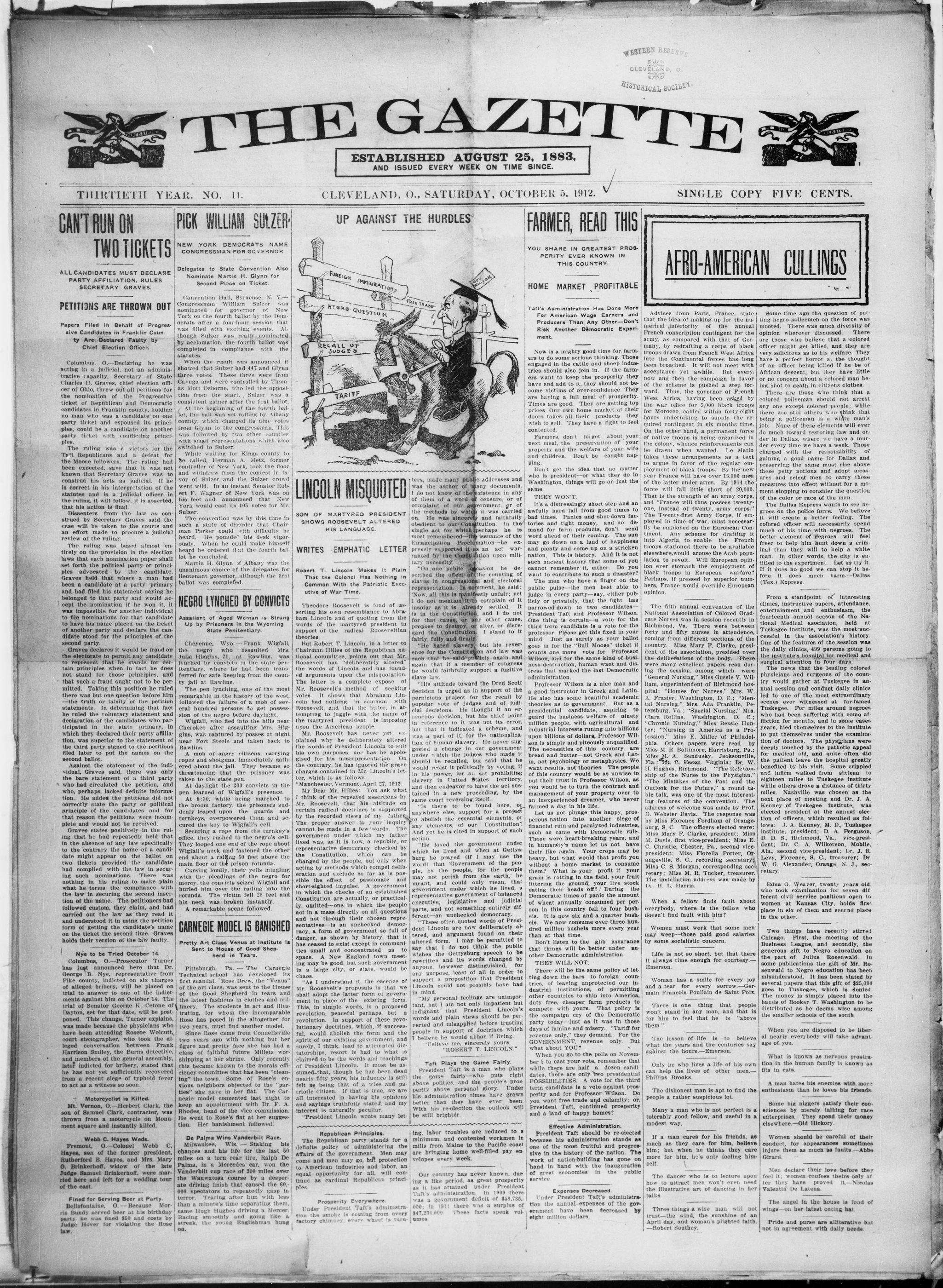
Page text (machine-generated)
THIRTIETH YEAR. NO. 11.
HOPE
BETTER
THAN
EVER
ALL CANDIDATES MUST DECLARE
PARTY AFFILIATION. RULES
SECRETARY GRAVES.
PETITIONS ARE THROWN OUT
Papers Filed in Behalf of Progressive Candidates in Franklin County Are Declared Faulty by Chief Election Officer.
Columbus, O.—Declaring he was acting in a judicial, not an administrative capacity, Secretary of State Charles H. Graves, chief election officer of Ohio, threw out all petitions for the nomination of the Progressive ticket of Republican and Democratic candidates in Franklin county, holding no man who was a candidate on one party ticket and espoused its principles, could be a candidate on another party ticket with conflicting principles.
The ruling was a victory for the Test Republicans and a defeat for the Moose followers. The ruling had been expected, save that it was not known that Secretary Graves was to construe his acts as judicial. If he is correct in his interpretation of the statutes and is a judicial officer in the ruling, it will follow, it is asserted, that his action is final.
Dissenters from the law as construed by Secretary Graves said the case will be taken to the courts and an effort made to procure a judicial review of the ruling.
The ruling was based almost entirely on the provision in the election laws that each nomination paper shall set forth the political party or principles advocated by the candidate. Graves held that where a man had been a candidate at a party primary and had filed his statement saying he belonged to that party and would accept the nomination if he won it, it was impossible for another individual to file nominations for that candidate to have his name placed on the ticket of another party and declare the candidate stood for the principles of the second party.
Graves declares it would be fraud on the electorate to permit any candidate to represent that he stands for certain principles when in fact he does not stand for those principles, and that such a fraud ought not to be permitted. Taking this position he ruled there was but one question before him—the truth or falsity of the petition statements. In determining that fact he ruled the voluntary statement and declaration of the candidates who participated in the state primary, in which they declared their party affiliation, was superior to the statement of the third party signed to the petitions filed later to put the names on the second ballot.
Against the statement of the individual, Graves said, there was only the bare statement of a third party who had circulated the petition, and who, perhaps, lacked definite information. He added the petitions did not correctly state the party or political principle of the candidates and for that reason the petitions were incomplete and would not be received. Graves states positively in the ruling that he had repeatedly held that in the absence of any law specifically to the contrary the name of a candidate might appear on the ballot on two tickets provided the candidate had compiled with the law in securing such nominations. There was nothing in his ruling to make plain what he terms the compliance with the law in securing the second insertion of the name. The petitioners had followed custom, they claim, and had carried out the law as they read it and understood it in using the petition form of getting the candidate's name on the ticket the second time. Graves holds their version of the law faulty.
Nye to be Tried October 14.
Columbus, O.—Prosecutor Turner has just announced he that Dr. George B. Nye, representative from Pike county, indicted on six charges of alleged bribery, will be placed on trial to answer to one of the indictments against him on October 14. The trial of Senator George K. Cetone of Dayton, set for that date, will be postponed. This change, Turner explains, was made because the physicians who have been attending Roscoe Wolcott, court stenographer, who took the alleged conversation between Frank Harrison Smiley, the Burns detective, and members of the general assembly, later indicted for bribery, stated that he has not yet sufficiently recovered from a recent siege of typhoid fever to act as a witness so soon.
Motorcyclist is Killed.
Mt. Vernon, O.-Herbert Clark, the son of Samuel Clark, contractor, was thrown from a motorcycle on Monument square and instantly killed.
Webb C. Haves Weds.
Fremont, O.—Colonel Webb C. Hayes, son of the former president, Rutherford B. Hayes, and Mrs. Mary O. Brinkerhoff, widow of the late Judge Samuel Brinkerhoff, were married here and left for a wedding tour of the east.
Fined for Serving Beer at Party.
Bellefainte, O.—Because Morris Bundy served beer at his birthday party, he was fined $50 and costs by Judge Hover for violating the Rose law
THE GAZETTE
PICK WILLIAM SULZER
NEW YORK DEMOCRATS NAME
CONGRESSMAN FOR GOVERNOR
Delegates to State Convention Also
Nominate Martin H. Glynn for
Second Place on Ticket.
Convention Hall, Syracuse, N. Y.
Congressman William Sulzer was nominated for governor of New York on the fourth ballot by the Democrats after a four-hour session that was filled with exciting events. Although Sulzer was really nominated by acclamation, the fourth ballot was completed in compliance with the statutes.
When the result was announced it showed that Sulzer had 447 and Glynn three votes. These three were from Cayuga and were controlled by Thomas Mott Osborne, who led the opposition from the start. Sulzer was a consistent gainer after the first ballot.
At the beginning of the fourth ballot, the ball was set rolling by Albany county, which changed its nine votes from Glyan to the congressman. This was followed by two other counties with small representations which also switched to Sulzer.
While waiting for Kings county to be called, Herman A. Metz, former controller of New York, took the door and withdrew from the contest in favor of Sulzer and the Sulzer crowd went wild. In an Instant Senator Robert F. Wagner of New York was on his feet and announced that New York would cast its 105 votes for Mr. Sulzer.
The convention was by this time in such a state of disorder that Chairman Parker could with difficulty be heard. He poudre' his desk vigorously. When he could make himself heard he ordered that the fourth ballot be concluded. Martin H. Glynn of Albany was the unanimous choice of the delegates for lieutenant governor, although the first ballot was completed.
NEGRO LYNCHED BY CONVICTS
Assailant of Aged Woman is Strung Up by Prisoners in the Wyoming State Penitentiary.
Cheyenne, Wyo.—Frank Wigfall, the negro who assaulted Mrs. Julia Higgins, 71, at Rawlins, was lynched by convicts in the state penitentiary, where he had been transferred for safe keeping from the county jail at Rawlins.
The pen lynching, one of the most remarkable in the history of the west, followed the failure of a mob of several hundred persons to get possession of the negro before daylight. Wigfall, who fled into the hills near Cherokee after assaulting Mrs. Higgins, was captured by posses at night near Fort Steele and taken back to Rawlins.
A mob of angry citizens, carrying ropes and shotguns, immediately gathered about the jail. They became so threatenable that the prisoner was taken to the state pen.
At daylight the 300 convicts in the pen learned of Wigfall's presence.
pen learned of Wigtail's presence. At 8:30, while being marched to the broom factory, the prisoners suddenly leaped upon the guards and turnkeys, overpowered them and secured the key to Wigtail's cell. Securing a rope from the turnkey's office, they rushed to the cell's cell. The hoop snapped and fastened the other end about a railing 50 feet above the main floor of the prison rotunda. Cursing loudly, their yells mingling with the pleadings of the negro for mercy, the convicts seized Wigtail and hurled him over the railing into the rotunda. The victim fell 25 feet and his neck was broken instantly. A remarkable scene followed.
CARNEGIE MODEL IS BANISHED
Pretty Art Class Venus at Institute is Sent to House of Good Shepherd in Tears.
Pittsburgh, Pa. — The Carnegie Technical school has developed its first scandal, Rose Drew, the "Venus" of the art class, was sent to the House of the Good Shepherd in tears and the latest fashions in clothes and millinery. The students in art and illustrating, for whom the incomparable Rose has posed in the altogether for two years, must find another model.
Since Rose came from Connellsville two years ago with nothing but her figure and pretty face she has had a class of faithful future Millets worshipping at her shrine. Only recently this became known to the morals efficiency committee that has been "cleaning" the town. Some of Rose's envious neighbors objected to the "parties" she gave in her flat. The Carnegie model consented last night to keep an appointment with Dr. F. A. Rhodes, head of the vice commission. He went to Rose's flat at her suggestion. Her banishment followed.
De Palma Wins Vanderbilt Race
Milwaukee, Wis. — Staking his chances and his life for the last 50 miles on a torn rear tire, Ralph De Palma, in a Mercedes car, won the Vanderbilt cup race of 300 miles over the Wauwatosa course by a desperate driving finish that caused the 60-90 spectators to repeatedly gasp in terror. Tearing after him with less than a minute's time separating them, came Hugh Hughes driving a Mercer, Racing smoothly and going like a streak, the young Englishman hung on.
ESTABLISHED AUGUST 25, 1883 AND ISSUED EVERY WEEK ON TIME SINCE.
AGAINST THE HURDLES
UP AGAINST THE HORDLES
FOREIGN IMMIGRATION
FREE TRADE
NEGRO QUESTION
RECALL OF JUDGES
TARIFF
FOREIGN IMMIGRATION
NEGRO QUESTION
RECALL OF
JUDGES
TARIFF
LINCOLN MISQUOTED
SON OF MARTYRED PRESIDENT
SHOWS ROOSEVELT ALTERED
HIS LANGUAGE
Robert T. Lincoln Makes It Plain
That the Colonel Has Nothing in Common With the Patriotic Executive of War Time.
Theodore Roosevelt is fond of asserting his own resemblance to Abraham Lincoln and of quoting from the words of the martyred president in support of the radical Rooseveltian theories.
But Robert T. Lincoln, in a letter to Chairman Hilles of the Republican national committee, points out that Mr. Roosevelt has "deliberately altered" the words of Lincoln and has found arguments upon the misquotation. The letter is a complete expose of Mr. Roosevelt's method of seeking votes. It shows that Abraham Lincoln had nothing in common with Roosevelt, and that the latter, in attempting to juggle with the name of the martyred president, is imposing upon the American people.
Mr. Roosevelt has never yet explained why he deliberately altered the words of President Lincoln to suit his own purposes, nor has he apologized for his misrepresentation. On the contrary, he has ignored the grave charges contained in Mr. Lincoln's letter, which is as follows:
"Manchester, Vermont, April 27, 1912. My Dear Mr. Hilles: You ask what I think of the repeated assertions by Mr. Roosevelt, that his attitude on certain radical doctrines is supported by the recorded views of my father. The proper answer to your inquiry cannot be made in a few words. The government under which my father lived was, as it is now, a republic, or representative democracy, checked by the Constitution, which can be changed by the people, but only when acting by methods which compel deliberation and exclude so far as is possible the effect of passionate and short-sighted impulse. A government in which the checks of an established Constitution are actually, or practically, omitted—one in which the people act in a mass directly on the questions and not through their chosen representatives is a checked democracy, a form of government so full of danger, as shown by history, that it should be to exist except in communities small and concentrated as to space. A New England town meeting may be good, but such government in a large city, or state, would be chaos.
"As I understand it, the essence of Mr. Roosevelt's proposals is that we shall adopt the latter form of government in place of the existing form. This, in simple words, is a proposed revolution, peaceful perhaps, but a revolution. In support of these revolutionary doctrines, which, if successful, would abolish the form and the spirit of our existing government, and surely, I think, lead to attempted dictatorships, resort is had to what is claimed to be the words and teachings of President Lincoln, and assumed that he has been dead for many years, his influence is still felt as being that of a wise and patriotic citizen. If that is true, we are all interested in having his opinions and sayings truthfully stated, and my interest is naturally peculiar.
"President Lincoln wrote many let-
Republican Principles
The Republican party stands for a definite policy of administering the affairs of the government. Men may come and men may go, but protection to American industries and labor, an equal opportunity for all, will continue as cardinal Republican principles.
Prosperity Everywhere.
Under President Taft's administration the smoke is coming from every factory chimney, every wheel is turn-
JOEY WILSON
REE TRADE
ters, was made many public addresses and was the author of many documents. I do not know of the existence in any of them of a word of censure, or of complaint of our government, or of the methods by which it was carried on. He was sincerely and faithfully obedient to our Constitution. In the single act for which perhaps he is most remembered—the issuance of the Emancipation Proclamation—he expressly supported it as an act warranted by the Constitution upon military necessity.
"On one public occasion he described the effect of the counting of slaves in congressional and electoral representation. In comment, he said: 'Now, all this is manifestly unfair; yet I do not mention it to complain of it insofar as it is already settled. It is in the Constitution, and I do not for that cause, or any other cause, propose to destroy, or alter, or disregard the Constitution. I stand to it fairly, fully and firmly."
"He hated slavery, but his reverence for the Constitution and law was such that he said publicly again and again that if a member of congress he would faithfully support a fugitive slave law.
"His attitude toward the Dred Scott decision is urged as in support of the pernicious project for the recall by popular vote of judges and of judicial decisions. He thought it an erroneous decision, but his chief point in reference to it was not its error, but that it indicated a scheme, and was a part of it, for the nationalization of human slavery. He never suggested a change in our government under which the judges who made it should be recalled, but said that he would resist it politically by voting, if in his power, for an act prohibiting slavery in United States territory, and then endeavor to have the act sustained in a new proceeding, by the same court reversing itself.
"Is there to be found here, or anywhere else, support for a project to abolish the essential elements, or any elements of our Constitution? And yet he is cited In support of such action.
He loved the government under which he lived and when at Gettysburg he prayed (if I may use the word) that 'Government of the people, by the people, for the people may not perish from the earth,' he meant, and could only mean, that government under which he lived, a representative government of balanced executive, legislative and judicial parts, and not something entirely different—an unchecked democracy.
"These often quoted words of President Lincoln are now deliberately altered, and argument found on their altered form. I may be permitted to say that I do not think the public wishes the Gettysburg speech to be rewritten and its words changed by anyone, however distinguished, for any purpose, least of all in order to support a proposition that President Lincoln could not possibly have had in mind. "Personal feelings are unimportant, but I am not only impatient but indignant that President Lincoln's words and plain views should be perverted and misapplied before trusting people in support of doctrines which I believe he would abhor if living. "Believe me, sincerely yours. "ROBERT T. LINCOLN."
Toft Plays the Game Fairly.
President Taft is a man who plays the game fairly—who puts right above politics, and the people's prosperity above personal glory. Under his administration times have grown better than they have ever been. With his re-election the outlook will be still brighter.
ing, labor troubles are reduced to a minimum, and contented workmen in mills from Maine to the Pacific coast are bringing home well-filled pay envelopes every week.
Our country has never known, during a like period, as great prosperity as it has attained under President Taft's administration. In 1909 there was a government deficit of $58,735,000; in 1911 there was a surplus of $47,234,000. These facts speak volumes
FARMER, READ THIS
YOU SHARE IN GREATEST PROSPERITY EVER KNOWN IN THIS COUNTRY.
HOME MARKET PROFITABLE
Taft's Administration Has Done More For American Wage Earners and Producers Than Any Other—Don't Risk Another Democratic Experiment.
Now is a mighty good time for farmers to do some serious thinking. Those engaged in the cattle and sheep industries should also join in. If the farmers want to keep the prosperity they have and add to it, they should not become victims of over-confidence. They are having a full meal of prosperity. Times are good. They are getting top prices. Our own home market at their doors takes all their products they wish to sell. They have a right to feel contented.
Farmers, don't forget about your next meal, the preservation of your property and the welfare of your wife and children. Don't be caught napping.
Don't get the idea that no matter who is president—or what they do in Washington, things will go on just the same.
THEY WONT.
It's a distressingly short step and an awfully hard fall from good times to bad times. Panicles and shut-down factories and tight money, and no demand for farm products, don't send word ahead of their coming. The sun may go down on a land of happiness and plenty and come up on a stricken nation. This is history. And it is not such ancient history that some of you cannot remember it, either. Do you want to contribute to such a disaster?
The men who have a finger on the public pulse—the men best able to judge in every party—say, either publicly or privately, that the fight has narrowed down to two candidates—President Taft and Professor Wilson. One thing is certain—a vote for the third term candidate is a vote for the professor. Please get this fixed in your mind. Just as surely as your ballot goes in for the "Bull Moose" ticket it counts one more vote for Professor Wilson, and for the same kind of business destruction, human want and distress that marked the last Democratic administration.
Professor Wilson is a nice man and a good instructor in Greek and Latin. He also has some beautiful academic theories as to government. But as a presidential candidate, aspiring to guard the business welfare of ninety million people, with agricultural and industrial interests running into billions upon billions of dollars, Professor Wilson is simply and piteously unqualified. The necessities of this country are bread and butter—not Greek and Latin, not psychology or metaphysics. We want results, not theories. The people of this country would be as unwise to put their trust in Professor Wilson, as you would be to turn the contract and management of your property over to an inexperienced dreamer, who never farmed a day in his life.
Let us not plunge this happy, prosperous nation into another siege of financial ruin and paralyzed industries, such as came with Democratic rule. Those were heart-breaking years, and in humanity's name let us not have their like again. Your crops may be heavy, but what would that profit you without a home market to consume them? What is your profit if your grain is rotting in the field, your fruit littering the ground, your live stock eating their heads off? During the Democratic times of panic the amount of wheat annually consumed per person in this country fell to four bushels. It is now six and a quarter bushels. We now consume over three hundred million bushels more every year than at that time.
Don't listen to the gib assurance that things will be better under another Democratic administration.
THEY WILL NOT.
There will be the same policy of letting down the bars to foreign countries, of leaving unprotected our industrial institutions, of permitting other countries to ship into America, duty free, cheaper farm products to compete with yours. That policy is the campaign cry of the Democratic party today—just as it was in those days of famine and misery. "Tariff for revenue only," they demand. For the GOVERNMENT, revenue only. But what about YOU?
When you go to the polls on November 5 to cast your vote, remember that while there are half a dozen candidates, there are only two presidential POSSIBILITIES. A vote for the third term candidate is a vote against prosperity and for Professor Wilson. Do you want free trade and calamity; or, President Taft, continued prosperity and a land of happy homes?
Effective Administration.
President Taft should be re-elected because his administration stands as one of the most fruitful and progressive in the history of the nation. The work of nation-building has gone on hand in hand with the inauguration of great economies in the public service.
Expenses Decreased.
Under President Taft's administration the annual expenses of the government have been decreased by eight million dollars.
THEY WON'T.
THEY WILL NOT
Effective Administration.
Expenses Decreased
WESTERN RESERVE
CLEVELAND, O.
HISTORICAL SOCIETY
THIS
PROS-
IN
TABLE
AFRO
SINGLE COPY
AFRO-AMERICA
SINGLE COPY FIVE CENTS.
AFRO-AMERICAN CULLINGS
Advices from Paris, France, state that the idea of making up for the numerical inferiority of the annual French conscription contingent for the army, as compared with that of Germany, by redrafting a corps of black troops drawn from French West Africa into the Continental forces has long been broached. It will not meet with acceptance yet awhile. But every now and then the campaign in favor of the scheme is pushed a step forward. Thus, the governor of French West Africa, having been asked by the war office for 5,000 black troops for Morocco cabled within forty-eight hours undertaking to supply the required contingent in six months time. On the other hand, a permanent force of native troops is being organized in the colony, whence reinforcements can be drawn when wanted. Le Matin takes these arrangements as a text to argue in favor of the regular employment of black troops. By the new France will have over 15,000 men of the latter under arms. By 1914 the force will fall little short of 20,000. That is the strength of an army corps, and "France will thus possess twenty-one, instead of twenty, army corps." The Twenty-first Army Corps, if employed in time of war, must necessarily be employed on the European Continent. Any scheme for drafting it into Algeria, to enable the French troops stationed there to be available elsewhere, would arouse the Arab population to revolt. Will European opinion ever stomach the employment of black troops in European warfare? Perhaps, if pressed by superior numbers, France would override European opinion.
The fifth annual convention of the National Association of Colored Graduate Nurses was in session recently in Richmond, Va. There were between forty and fifty nurses in attendance, coming from different sections of the country, Miss Mary F. Clarke, president of the association, presided over the deliberations of the body. There were many excellent papers read during the session, among which were "General Nursing." Miss Gussie V. William, superintendent of Richmond hospital; "Homes for Nurses," Mrs. W. A. Frazier, Washington, D. C.; "Mental Nursing," Mrs. Ada Franklin, Petersburg, Va.; "Special Nursing," Mrs. Clara Rolins, Washington, D. C.; "Chronic Nursing," Miss Bessie Hunter; "Nursing in America as a Profession." Miss E. Miller of Philadelphia. Others papers were read by Miss M. E. Baltimore, Harrisburg, Pa.; Miss M. E. Sandusky, Jacksonville, Fla.; Du B. Eason, Virginia; Dr. W. H. Hughes, Richmond. "The Relationship of the Nurse to the Physician." "The Mistakes of the Past and the Outlook for the Future," a round table talk, was one of the most interesting features of the convention. The address of welcome was made by Prof. D. Webster Davis. The response was by Miss Florence Fordham of Orangeburg, S. C. The officers elected were: Miss Mary F. Clarke, president; Miss M. Davis, first vice-president; Miss E. C. Christie, Chester, Pa., second vice-president; Miss Florella Porter, Orangeburg, S. C., recording secretary; Miss C. S. Morgan, corresponding secretary; Miss M. R. Tucker, treasurer. The installation address was made by D. H. L. Harris.
When a fellow finds fault about everybody, where is the fellow who doesn't find fault with him?
Women must work that some men may weep—those paid good salaries by some socialistic concern.
Life is not so short, but that there it always time enough for courtesy.—Emerson.
Woman has a smile for every joy and a tear for every sorrow.—Germain Francois Poullain de Saint Foix.
There is one thing that people won't stand in any man, and that is for him to feel that he is "above them."
The lesson of life is to believe what the years and the centuries say against the hours.—Emerson.
Only he who lives a life of his own can help the lives of other men.—Phillips Brooks.
The dishonest man is apt to find the people a rather suspicious lot.
Many a man who is not perfect is a tolerably good fellow, and useful in a modest way.
If a man cares for his friends, as much as they care for him, believe him; but when he thinks they care more for him, he's only fooling him self.
The dancer who is to lecture upon how to attract men won't even need the illustrative art of dancing in her talks.
ministra-
the gov-
sed by
Three things a wise man will not trust—the wind, the sunshine of an April day, and woman's plighted faith. —Robert Southey.
---
Some time ago the question of putting negro policemen on the force was mooted. There was much diversity of opinion wherever discussed. There are those who believe that a colored officer might get killed, and they are very solicitous as to his welfare. They have a perfect horror at the thought of an officer being killed if he be of African descent, but they have little or no concern about a colored man being shot to death in citizens clothes. There are those who think that a colored policeman should not arrest any one except colored people; while there are still others who think that being a policeman is a white man's job. None of these elements will ever do much toward restoring law and order in Dallas, where we have a murder every time we have a week. Those charged with the responsibility of gaining a good name for Dallas and preserving the same must rise above these petty notions and adopt measures and select men to carry those measures into effect without for a moment stopping to consider the question of the color or race of the man.
The Dallas Express wants to see negroes on the police force. We believe it will create a better feeling. The colored officer will necessarily spend much of his time with negroes. The better element of negroes will feel freer to help him hunt down a criminal than they will to help a white man. In other words, the city is entitled to the experiment. Let us try it. If it does no good we can stop it before it does much harm.—Dallas (Tex.) Express.
From a standpoint of interesting clinics, instructive papers, attendance, entertainment and enthusiasm, the fourteenth annual season of the National Medical association, held at Tuskegee institute, was the most successful in the association's history. One of the features of the session was the daily clinics, 499 persons going to the institute's hospital for medical and surgical attention in four days.
The news that the leading colored physicians and surgeons of the country would gather at Tuskegee in annual session and conduct daily clinics led to one of the most extraordinary scenes ever witnessed at far-famed Tuskegee. For miles along negroes who had been suffering with some affliction for months, and in some cases years, to put themselves to the institute to put themselves under the examination of doctors. The physicians were deeply touched by the tactile appeal for medical aid, and quite often did the patient leave the hospital greatly benefited by his visit. Some crippled and infirm walked from sixteen to eighten miles to Tuskegee institute while others drove a distance of thirty miles. Nashville was chosen as the next place of meeting and Dr. J. A. Kenney of Tuskegee institute, was elected president at the annual election of officers, which resulted as follows: J. A. Kenney, M. D. Tuskegee institute, president; D. A. Ferguson, D. D. S., Richmond, Va., vice-president; Dr. C. A. Wilkerson, Mobile, Ala., second vice-president; Dr. J. R. Levy, Florence, S. C., treasurer; Dr. W. G. Alexander, Orange, N. J., sec retary.
Edna G. Weaver, twenty years old, who took examination for seven different civil service positions open to women at Kansas City, holds first place in six of them and second place in the other.
Two things have recently stirred Chicago. First, the meeting of the Business League, and secondly, the generous gift to Negro education on the part of Julius Rosenwald. In some publications the gift of Mr. Rosenwald to Negro education has been misunderstood. It has been stated by several papers that this gift of $25,000 goes to Tuskegee, which is denied. The money is simply placed into the hands of Booker T. Washington to be distributed as he deems wise among the smaller schools of the south.
When you are disposed to be liberal nearly everybody will take advantage of you.
What is known as nervous prostration in the human family is known as fits in cats.
A man hates his enemies with more enthusiasm than he loves his friends.
Some big niggers satisfy their consciences by merely talking for race enterprises. They spend their money elsewhere—Old Hickory.
Women should be careful of their conduct, for appearances sometimes injure them as much as faults.—Abbe Girard.
Men declare their love before they feel it; women confess their only after they have proved it.—Nicolas Valentin be Latena.
The angel in the house is food of wings—on her latest outing hat.
Pride and purse are alliterative but not in agreement with daily needs.
PUBLISHED, EVERY SATURDAY
SUBSCRIPTION RATES
(dn Advance)
OMe Yearncececscentees +8180
Bix Menthe. eee. 1.00
Three Menthe... (ec... 50
Gubscribers are requested to re
mit by postoffice money or
der or registered letter.
Kntered at the postoffice In Cleveland,
‘Ohio, se second-class matter
Address all communications te
HARRY C. SMITH
Eéitor and proprietor,
THE GAZETTE,
Biackstone Pullding, Cleveland, O.
Member Ohio Legistature: 1894
to 1806; 1896 to 1898; 1900 to 1902
THE GAZETTE Is the oldest, and
hhas the targest bona fide circulation,
double that of any newspaper in the
Interest of Afro-Americans, published
fn the state of Oho, and comparison
with any will Immediately establish
ita rank as one of the NEWSIEST
AND BEST In the country.
In recent weeks, The Gazette has
been asked so often where it stood in
the presidential contest, now on, that
we have deemed it proper to answer
the question at this time; and do so
im the leader, headed “WHERE WE
STAND."
‘The Loa Angeles (Cai.) Liberator,
in a recent issue, denounces, as a
“faker,” “Prof.” Z W. Mitchell, weil-
Known in Obio and the northwest.
‘There are many in Ohio who remem-
ber him,
Goy. Donaghey recently pardoned an
Afro-American, twice condemned to
death on the charge of criminal as-
sault. “The man is undoubtedly Inno-
cent,” says the governor. Good!
‘The thirteen Afro-Americans who
called on Col, Roosevelt in Los An-
geles, Cal, last week, quarreled be-
fore going and after the conference.
Some had enough of “the hero of the
Brownsville episode” before they met
him; others got enough with what
they had, at the conference. "Twas
ever thus?
WE HEAR.
We hear a great deal ‘about the
number of “Colored papers” that have
“started and stopped.” We hear a
great many people tell of taking so
many “Colored papers," and low
finally the paper ceased pubilcation.
We don’t hear, however, about the
thousands of people who took said pa-
pers and failed to pay for them! We
hear nothing of those who advertised
fn them, and failed to pay’ for their
“ads.” If every Negro who has taken
“The Union” for the past six years
would send in the money that he or
she owed, lied about, or beat us out
of, “The Union” would haye enough
capital to run as a daily, and be as
large as the “New York Herald!”
‘Most of our people do not realize that
taking a newspaper and not paying
for {t is just as much stealing as tak-
ing money out of a man's pocket.
Many of our subscribers are honest
and all right-in every way. God bless
them. But the other class, the slow-
paying, dishonest bunch, is so numer-
ous that, should God withdraw his
mercy and send them, as they deserve
to go, down below, the devil would
have to open a new diviston for them!
White newspapers, with millions of
capital, have no trouble with their
thousands of Colored subscribers.
‘They pay in advance and are proud
to do it, yet they expect a Colored
paper to wait, sometimes forever, for
their money! Is it any wonder that
many such Colored papers do not sur-
vive and that there are no great ones,
Bo to speak, in America?—Cincinnati
(O.) Union, Prof. W. P. Dabney, ed:
ar.
“WHERE WE STAND.”
After careful thought and review of
the triangular political situation in the
present presidential campaign, we
have decided to remain In the ranks
‘of the republican party and support
its candidates, or as many of them as
we can, in this fall's campaign. Our
reasons for this, are:
First: There is absolutely nothing
for the Afro-American in the ranks of
democracy. This 1s as it always. has
been, excepting that this fall, for the
first ‘time since the war of the rebel-
Non, southern democracy is “in the
saddle,” not only controlling the
party's candidate for the presidency
@ native southerner, but also dominat-
ing the organization to such an ex-
tent as to make perfectly clear what
the condition will be, as far as our
people are concerned, after electiqn in
‘November, in event of the elevation
of Gov. Woodrow Wilson, of New Jer-
sey, to the presidency. It is hardly
necessary to explain to our readers, or
our people generally, what “domina-
tion of the solid south” means. They
know entirely too well that about all
the Ills of our people, in this country,
aro directly traceable to this very
game domination. Wholesale barbaric
tynching, mob violence, distranchise-
ment, ‘‘jim-crow” railroad and street
cars, a general assault upon our citi-
zen’s rights and privileges, and hun-
dreds of other ills that time will not
permit us to enumerate, are not all by
a creat deal, but are quite enough to
make it simply impossible for The
Gazette to support the candidacy for
the presidency of Gor. Woodrow Wil
sou.
Second: Aw to Col. Theodore
“Brownsville” Roosevelt and bis Thiré
of ~Cure-ANl” party which, in one
preath, bleats so loudly of “ite cause
pelng the welfare of humanity, of be
ing the foe of every form of injustice
ind oppression. of advocating social
dustrial and human liberty, of being
mbued with the ideals of hamar
ights aud wirhing to serve thelr fel
ow beings,” etc., evs, and in the ver:
gest breuth bars from representation
p fis Gret national convention in Chi
40, the 6,000,000 Afro-Americans of
he southiand who have suffered, anc
are suffering in every way, more than
all other elements (combined) of the
cosmopolitan population of this coun:
try, in addition to Roosevelt's lynch:
murder and subsequent persecution of
“The Mlack Battalion,” more need not
be said to the averexe, thoughtful
member of the race who has a spark
of loyalty, manhood, self and race re
spect. If southern Afro-Americans’
Yotes for delegates to “Bull Moose’
national conventions ere refused, as
they are by that party, no member of
the race, north or south, should so far
forget himself as to cast a vote for its
candidates, especially its candidate for
the presideney, on election day in No
vember. ‘The’ many “human itis”
Which our people throughout this
country, particularly in the south, suf
fer, do not materially concern Col.
“Brownsville” Roosevelt and his party
Therefore, race loyalty, manhood, sett
and race respect make it absolutely
Impossible for The Gazette to leave
the ranks of the republican party to
espouse only the white men’s, cause,
being so eloquently pleaded by the
Progressive (2) or “Third Party.”
Third: While the major portion of
the first term of President William
Howard Taft has been a bitter disap-
pointment to our people in several re
spects, nevertheless, he has said and
done some good things for us which
are of such recent occurrence as to
make it unnecessary for us to par
ticularize at this time, We are free
to confess that he has made some
Serious mistakes, He frankly admits
them and gives assurance that he will
rectify them as far as it lies in his
power, should he be reelected. While
this condition may not suit all, the
question recurs, where are we to turn
in the présent presidential campaign,
to find as good assurances or better?
Surely not to the democratic party
nor to the kocalled progressive party.
Nelther the socialist nor the prohibi:
tion parties’ candidates for the presi
dency are positive factors in the con:
test, this fall. ‘Therefore, are not to
be considered. Here, in Ohio, at the
head of the state republican ticket, we
have in the person of Gen, R. B.
Brown of Zanesville, » veteran of the
| war of the rebellion, a life-long friend
of the race, and a republican of the
“old school,” such as is his comrade
and longtime friend, our great seni.
|tor, Joseph Benson Foraker. The rest
of the state ticket and nearly all the
various county republican candidates
in Ohio, this. fall, are’ so infinitely
'| preferable to those of cither the dem
ocratle or so-called progressive party.
that it makes it much easier for oth
ers, ae it has for The Gazette, to reach
conclusion stich as it bas, after
|iittle careful thought and review of
{the politleal situation in nation, state
HW aagal eeseaty
Scranton eat
As are a Relbawahe oS,
eae. - ‘e
ok leas oe
eee eos
as a 2
me er os
eee A/ Gite
Ye
i Ae Nae fo) Se
[Peet Mic
, bo apy °
/ RISES ee CARENCE GUNBAR.
Sp aa ee ee ee te
| Hon. Harry C. Smith, Waitor Ga-
zette.—Dear Mr. Smith:' You have
asked me to give you some incidents
in the life of Paul Lawrence Dunbar
which have never appeared in print.
T take great pleasure in doing this,
since I believe it only due him and
Your people that something should be
known of bis troubles and triumphs.
It would serve to encourage others to
aim for high ideals.
My attention was first attracted to
him’ by a newspaper article, which
stated that the Western Association
of Writers had held a convention in
Dayton. It stated that no one had
heard of Paul Lawronce Dunbar and
all were surprised when a slender Ne-
gro boy came down the aisle and
mounted the platform. They were
more surprised at the quality of his
original poem. He disappeared just
as suddenly as he appeared.
‘They began to inquire who he was.
Some one answered, “Oh, he is only
an elevator boy in the Callaghan
Building.”
T wrote him a letter, asking him to
send me a copy of his poems and to
tell me of his life. He answered that
his life had been uneventful; that he
was running an elevator at $5 per
week, and gut of this trying to sup-
port himself’ and his widowed mother,
and pay for a home in the Building
and Loan Association, where the bulk
of his payments went for interest.
Next week I hope to give you some
further facts in his life.
Very truly yours,
CHARLES A. THATCHER
STOWAWAY HEEDS A VISION
Explains That He Received a Divine
‘Summons to Preach to Benighted
Chinese—is Shipped Back.
San Francisco Cal—Harold Yates,
@ frightened youth, who had seen a
vision and started for the Orient to
preach to the Chinese, was brought
back to San Francisco on the steamer
Nile, which reached here recently.
Yates’ “call,” by which he was sum-
moned to spread the message of the
gospel among the heathen, ted him to
sow away on the steamer Manchuria,
which left here Friday.
Captain Friele of the Manchuria Iis-
ened to the young man’s account of
Ms vision, after he had emerged from
ils hiding piace, but decided that it
fd not entitle Yates to free passage
nd the stowaway was transferred to
he Nile when that vessel was met in
anidocean.
Yates, who was employed as a bell-
joy at a local hotel, was awekened
vith di@lenity tast Friday morning by
inotber bellboy, Ee explained that
ye had been listening to a divine sum-
nons to the missionary fleld and hur
ciedly packed a few belongings and
voarded the Maucburia, where he hid
im the hold.
THE GAZETTE, CLEVELAND. 0, SATURDAY. OCTOTER 5, 1912.
EDITOR JOHN MITCHELL IN OHIO. | BUCKEYE LETTERS ‘aallaaiaaanie
- |
eZ WRITTEN BY “THE OLD. RELIA.
i BLE” GAZETTE’S CORRE. By Jeanne 0. Lol
i SPONDENTS.
C2
Rees z : Coperight His, Wy _Aasoe
te Bret
Li. eer It’s a matter of chang
Agee = THROUGHOUT OHIO ss 0
he 4 Yo Bes oe nee
ja Sg ~~ where his heart alrea
iF : (RB) | wrat our People Are Doing Each miles away on the gre
‘ Se iM! | + Week—Church, Personai, Social, | Was the lust of May, hot,
ree aaa Lodge, Literary and Nu: ee eee
. cher SOE Marcages, ore am as
See Beka mie 4nd liked to talk about n
On his return to Richmond, Va., last
week, from Detroit, Mich. where he
attended the annual meeting of the
American Bankers’ Association, Mr.
John Mitchell, jr, editor of the
Planet and president of the Mechan:
ics’ Savings Bank of that city, and
the only Afro-American member of
the A.B. A, published the following
in his paper, anent his brief stop in
Cleveland en route to Detroit:
IN THE UNION STATION.
“We were now on our way to Cleve:
land, where T expected to make con
‘nection with the Lake Shoreand Mich-
‘igan Southern flyer, and would have
reached Detroit at! 12:10 that day.
But we lost time and we continued to
lose it. When we reached Cleveland,
the Lake Shore train had gone. ‘The
white trainshed porter gathered up
my luggage and I placed it in the
check room and 1 started out to find
Hon. H. ©. Smith, editor of The Cleve:
land Gazette and one of the brainiest
newspapermen in the country, whom
Thad not met for more than 18 years.
EDITOR SMITH'S GREETING.
“When I re-entered the station 1
found walking up and down, Hon.
HC, Smith. T had left a note at his
office and he had come to meet me.
‘This was the same Harry Smith, al-
most as young looking as of yore. He
greeted me heartily and then after
minor inquiries plunged into a discus:
sion of coditions existing in this coun-
try of ours. He bewailed the fact
that Colored men would not stand up
for their rights
“Then he discussed public men and
told of changes which had taken
place even in bis home city. As he
talked, all of the fire of the old days
was in evidence. He was still a lead-
er, sometimes of an unwilling and
hesitating people. My train was late
‘end we talked on.”
MAY CALL OFFICER A “GINK”
And, Philadelphia Judge Holds, It
Doeen't Justity Arrest of Former
Position
Philadelphia.— Magistrate Coward,
sitting in city hall, today decided it
fs no crime to call a policeman a
“pink” no matter what ‘construction
is placed upon the word. The Magis-
trate listened to the evidence of Po-
Hieeman Pil of the vieo squad, who
had arrested Jack Hanlon, the former
puilist, whom hie accused of calling
him a gink when Pill was on duty in
the Tenderloin,
When the judge heard the case he
said: “Well, that {s not wrong. I'm
tailed worse things than that a dozen
times a day. I don't care how you
take it. If that fs all that the man
said you had no right to arrest him.”
Tn the crossexamination of Pill
Hanton’s lawyer asked Pill 1f he knew
what the word meant. When the po-
Tieeman sald he did not know the at
torney said: “Well, if you don't know
now, gon will soon enough, for you
have been accused of being a “eink:
before, and you had better be careful
or they may make more than accusn-
tions the next time.” The Magis-
trate suspended further hostilities by
discharging the prisoner.
Gives Skin to Son.
New York-David P, Condon, a
member of the New York fire depart-
ment, bas given forty inches of his
‘skin to save his son's leg.
ANSWERS FOR THE ANXIOUS.
J.P, 8—What will keep my hair
from falling?
Build a neat balcony around your
head.
Lucile writes—Where can I sell &
poem entitled “Spring, O Spring?”
‘That's what we want to know, Lu-
eile.
Jennie H. inquifes: “Can you taste
onions in caulifower that has been
dolled in a vessel which has been used
for cooking oniovs?”
We can't. We don't eat cauliflow-
er.
good way to trim my last summer's
panama?”
Flute the edge with manicure scis-
sors.
Herbert V. wants to know: “Are
oysters healthy?"
‘Yes, and they take very little exer
cise, too.
Arabella S. propounds: “I am thirty
years old. Should I wait until a young
man who 1s attentive to me has saved
enough for us to start housekeeping,
or should I marry an elderly gentle-
man with half a million and a sum-
mer home in the Thousand Islands?”
If you make {t “Will I.” Arabella,
We can answer your query instantly.
ae NRe Se Stee
“One of the unusual things T saw
on my vacation in northern Indiana
was a contented farmer,” said Annis
Burk, secretary to Mayor Shank. the
other day.
“We were going in ap automobile
on a fishing expedition north of
Bass Lake,” Burk related, “and we
stopped “to ask a farmer the road.
He gave us the information, nd,
just to let him know we were (nend-
iy, 1 asked him his opinion on poll-
ties.
““That's something that don't
worry me, the farmer sai. ‘Why
should T worry about politics or any-
thing else? Here I am, living on a
good farm. got a good barn and a
wife that’s a good worker: why
should I worry? "—Indianapolis Star.
WRITTEN BY “THE OLD RELIA-
BLE” GAZETTE’S CORRE.
SPONDENTS.
What Our People Are Doing Each
* Week—Chureh, Personai, Socal,
Lodge, Literary and Nu:
sical — Marriages,
Deaths, Ete.
Sandusky.—Mr. George Scott re-
turned from Elyria, He visited his
daughter, Mrs. Nelson Holding —Rev.
‘Turner will pastor Neal St. A.M. P.
church, succeeding Rev. Bass.—The
Second Baptist M. 8, meeting was well
attended Sunday. Mrs. Mary Jones,
pres, Mrs, J. S. Davis, supt. of Erie
And Huron counties, and Mrs. A, Dodd,
see. of the state work, gave good talks.
Miss Beatrice Shackelford is visiting
er grandma in Xenia—Mrs. Gardner,
Mr. M. Thompson and Mrs. M. H.
Washington attended conference in
‘Toledo last week. Mrs. Harris’ house,
three miles in the country, burned
Sunday night—Mrs, @. Miller who vis-
| ited her daughter, in Indianapolis, has
returned.—Mrs. Nuekels has returned
th Ch
Zanesville.-The emancipation cele-
bration here last week Monday, was a
success. Hon, W. M. Lewis,’ assist.
U.S. attorney general, was the speak:
er of the day, Gen. R. B. Brown, Re-
publican candidate for governor, also
delivered a splendid address. Major
R. R. Jackson of Chicago and Wilbur
F. King, Esq., agsistant county prose-
eutor, of Columbus, were the other
speakers. Rev. T. D. Scott presided
and Rey. A. M. Thomas opened the
exercises with prayer. ‘There was a
very creditable parade arid an enter-
tainment in the evening.+Mrs, Dro-
silla R. Harper and Mr. Rice Barnett,
old residents, were buried last week.
—Dr. Jos. C. Bradfield of Mt. Vernon,
who Was here recently, may locate in
this city.—Alfred Pritchett of Cleve.
land visited his parents here last
week. Mr. Nelson Gant was here from
Columbus last week. ‘There were also
many visitors from nearby towns and
ilies,
Correnponoents must mail ail let-
ters for publication at their main
postofiice sufficiently early on Monday
(or, Sunday) of each week to have
them reach The Gazette office on
‘Tuesday morning, aud always write,
also, their names and that of their
city or town on the outside of the
wrapper about returned copies. Un-
less this latter Is done, proper credit
cannot be given you, Lists of names,
wedding presents, etc., obituary no:
tices, speeches, resolutions. neetry, in
quiries for relatives and adveriise
ments of all kinds, including items
gnnouncing entertainments to be held
in the near future, must. be paid for
in advance at the rate of ten cents a
Iine, six words to a line. Our rates
for ‘display advertisements will be
sent on applications Send postal note
and not stamps during warm weather.
Cadiz—Miss Ida Prown has re-
turned. She spent the summer in
Newari.—Dwight Mason is visiting
his parents.—Prof. W. H. Lucas de-
livered the “emancipation” address at
Allen League, Sunday evening. The
“proclamation” was read by Miss B,
Fox.—J. E. Smith is home from Pitts-
burg—The B. B’s are buzzing ouce
iore—Ernest and Roy Wallace are
in Pittsburg. — ‘The Har, Co. Fair
Drought many outor-yown guests here
Mrs, Anderson of Pittsburg is Mrs.
Martha Jones’ guest.—Rev. IL. F. Fox,
former pastor of tie A. M. E. church,
goes to Lima, He will carry with him
the best wishes of a host of friends.
His successor is Rev. O. W. Childers
of Akron, who comes highly recom-
mended.—The young married ladies’
club Was the guest of Mrs. Maud Pet-
erson Smith of Urichsville. They al-
So attended: tha’ eaatenntal,.
Youngstown.—Gold Leaf Co. D, U.
R, K. of P,, has completed arrange:
ments for its banquet and ball, Oct.
24, Invitations will be issued’ Mon-
day.—Mrs, Bidle is convalescing.—
Mr. and Mrs. Jas. Saunders enter-
tained, Wednesday evening, in honor
of their wedding anniversary. Music
and games, A number of beautiful
presents were received. Lunch was
served,—The Third Baptist church will
lay the cornerstone of its new build-
ing, corner Oak Hill Ave. and Walter
St, Oct. 20 at 2 p. m—Mrs. Jos. Jack:
son is convalescent after two weeks"
illness.—-Mra, Henry Johnson returned,
Friday, from a three weeks’ visit in
southern Ohio.—The Hillman St. Bap-
tist church started, Monday evening,
to raise $1,200 to pay the debt on its
property, corner Hillman St. and W.
Myrtle Ave,, an ideal spot—Frank L.
age six months, ¢on of Clarence and
Relle M. Moore, died Sunday. Funeral
Tuesday; interment in Belmont Park
cemetery.—Those indebted for copies
of The Gazette will please pay the
agent, promptly.
‘Smithfield.—Misses M. Beall, A.
Faithful and Mr. J. Binns spent 'Sun-
day in Steubenville —Mrs. J. M. Davis
returned to Pittsburg, Sunday. morn-
ing, after several weeks’ visit with
her parents.—Mrs, Spencer Banks’ re-
mains were brought here last Friday,
for burial. Services at the A. M. E.
church, Rev. M. N, Culpher officiating.
Rev. W. H. Veney conducted services,
Sunday. They were well attended —
Mr, Dantel Cooper of Wheeling, spent
several days with his nlece, Mrs. Coop-
er Harris—Mr. Wm. Carter, a Steu-
denville restauranteur, kept « stand at
the fair \grounds and will go to
Cadiz. Our county fair was well at-
tended in spite of the rainy weather.
“Mrs, J. Christian of Steubenville
visited her daughter, Mrs. E. West
Mr. Wm. Beasley of Gipsonia, Pa..
visited his sister, Mrs, M. B. Veney,
from Wednesday to Saturday.—Mr. H
Moore of Mt. Pleasant was Mr. ard
Mrs. E. Jackson's guest during the
fair—Mr. and Mrs, Jos. Beall have
gone to housekeeping in the Miller
property.—Rev. and Mrs. W. H. White
have returned from conference and we
are sorry to learn that they have not
been returned here.
London's Smoke Nuisance,
Half of London's smoke nuisance 1s
eaused by the coal fires in private
dwellings, the owners of which are not
Mabie for prosecution. It is expected
that 2 good deal of missionary work
will have to be done among household
ert before the smoke evil can be les
sened appreciably.
Chance vs. Choice
ee ORE Oe ee ee
“it's a matter of change,” comment;
ed Bertrand, struggling into his coat,
and bastily preparing (o take his body)
where his heart slrendy was—ten'
miles away on the green links. It,
Was the last of May, hot, and Saturday
afternoon, and he was glad to et!
away from Harrison, who was in love
\nd liked to talk about marriage.
“It's @ matter of chance,” he ins
sisted. “Any sane man would prefer
his freedom. You know it, Harrison!
He fights shy as long as he can, and
when chance throws Just the right girl
in his way, she gets him. He strus-
gles, then yields, then pretends he
was the aggressor, whereas he {s near-
ly always merely accessory after tho
fact! He gets ignominlously enraged,
and then tries to talk himself and his
felends into believing that no mere
single man can know what happiness
Ist”
“The man chooses,” said Harrison
doggedly, putting some documents into
the safe. “Now, 1”
His friend and partner lifted a pro-
testing hand and started for the door,
his merry dark eyes dancing, his cap
‘on the back of his dark head.
“Don't! We all know just what hap-
pened to you! You went to a party
and met a pretty Indy from Los An-
geles and will never be yourself againt
T'm going now, so you can write your
dsily forty pages io her. But you're
a living warning to me, I've senso
enough to know I'm susceptible, and
don't dally with temptation, old fel
low—see you Monday. Hope it isn't
going to rain!” He swung into the
corridor of the big office building, but
Harrison was after im.
“Wait a moment,” he said. “Want
to tell you something—heard yester:
day that Nona Waite fs to marry that
Rawson creature from—where Is, he
from? Nobody seems to know. What
“Mrs. Harley meant by introducing him
about T cant think!” 1 thought that
you and Nona—"
John Bertrand shrugged his shou!
ders the least bit and took the eleva:
tor down. He would not discuss Nona
with any one, his little playmate
ON
Cle
ogy
Ly ®
from childhood. She was too close—
Uke a sister. But the information
‘about Rawson brought a black scowl
to his face, He would see the girl—
hadn't seen her for months save in
public, and he now remembered as he
went out on the street that she seemed
‘to avoid him. Then he remembered
golf and the country club and forgot
everything else. He hoped Carter
would be on hand. Carter played a
real game and made opposition worth
the trouble.
{Despite a hint of wet in the afr, the
day was perfect, the links were per-
fect, Carter was waiting and the world
was bright. Bertrand got his clube
and started, losing himself in the
game.
| Half way around the course he sud-
denly recognized Nona, She was with
Rawson, who was no match for her at
golf or any other game. She gave
Bertrand the merest recognition. In
fact, she almost turned her back on
him, and her nod was small and chilly.
‘What had he done? He teed off, won-
dering. The girl's Mttle red-brown
head was uncovered to the sun, her
blue dress blowing in the breeze. She
gave a vicious drive and missed the
ball. ‘That was unlike her usual care
ful, deliberate game.
‘Wondering what he should say to
her about Rawson, he missed his own
drive and unathematized himself in
vigorous words, hereafter concentrat-
ing his mind on the business of the
game in hand. He was no man to do
two things at once. When he was
nearly around the course he looked
up and saw the sky clouding. Also
‘he saw Nona’s blue dress disappearing
into the wood beyond, Rawson still
eside her. Ho frowned and holed
in with fine accuracy. He was leav-
ing Carter far behind.
Before long he felt a drop of rain
‘on his face, made a wild drive, and
in searching for his ball, the caddy be-
ing evidently of no account, he came
close to the little wood with its wild
paths and rustic seats. The caddy told
him, what he knew himself, that it
was beginning to rain, a soft, ewift
summer shower. He gent hie clubs
back by the boy and tured into the
wood. He did not mind a wetting. He
loved the wet, fresh grass, the bud-
ding flowers, the great trees. He went
up a path and then through brash up
HRN RHHRHRH HEE
AGENTS! READ!
When your Gazettes are not
Gelivered on Friday mornings,
call at your Centra! Postoftics
General Delivery Window tor
them In the afternoon of the.
fame day. Editor, |
a slope to an immense elm. It would
shelter him and he could enjoy the
outdoors and think,
Leaning against the great trunk, he
suddenly remembered Nona and a sort
of fear for her possessed him. Had
Rawson gotten ber back to the club
house? There was nelther car line,
house nor other shelter in this diree-
tion, and he knew she was afraid of @
storm, Of course the fellow knew:
enough to look after her—but Ber:
trand was nervous. The sky was
growing very black and thunder be-
san to rumble distantly. He dellb;
erately atfrted out to look for the
irl.
He had not gone a rod when he
heard * ewish in the bushes, and
turning, heard a queer little fright-
ened sound. He saw nothing, but
without consciously intending to, he
callad cut:
“Nona, where are you?” In a mo:
ment he saw her come from behind
tree. She was very pale, and as he
rushed to meet her, sho came quickly
close to him, clinging to his arm. He
drew her back under the big elm,
“What does this mean?” he asked
sternly. “Where is Rawson? What
fare you dong alone in this storm,
Nona?” He had his coat off and was
wrapping her in it.
-“f—went away and left him—I—oh,
there he comes now!”
| It was he, indeed, his not unpleas-
ing, but hard, face worried. Bertrand
stepped out.
| “If you ate looking for Miss Waite,
she is with me. I shall look after her
“now,” he sald coldly.
‘The other man laughed.
things!” he said coolly. “You don't
need to be so protective. I only. tn-
sisted on knowing whether she was
going to marry me or not, She has
played with me all summer, and 1
was tired of It. She had no need to
run away from me, You can see that
I couldn't leave her in this storm.
| Now you are responsible, and Twill
leave you. I believe I shall also wish
you joy,” he sald, coolly.
ee ee ar ee Oa ey
Bertrand turned to Nona. “Was he
annoying you In any way? If he was
he shall pay for it. Tell me just what
happened? Did he tell me the truth?”
| She leaned against the rough tree
trunk and nodded. “Yes, he told the
truth, Tt was silly, but all of a sud-
den I—was afraid—not of iim—but
of myself. It was as if he had me hyp-
notized or something. Iwas afraid I—
that he might make me promise—and,
after all, I did not want to, John. It
was awful! And so I ran away. 1
went off up the wrong path, away from
the links instead of toward them;
and couldn't find my way out. And I
heard him following me. Of course he
“had to—the storm was breaking, but
I could not bear to have him find me!
And then—I heard your voice, and—"
She began to ery.
John Rertrand laughed.
“Bless your dear little heart, Nona!”
he said. “I was out looking for you!
Thad had my eyes upon all afternoon.”
She did not resist when at a frightful
peal of thunder he came and put his
arms protectingly about her. She was
very still,
“If 1 should ask you when you in.
tend to marry me would you run
away through the wet woods lke a
‘wild, silly thing, Nona?” He looked
down, waiting for an answer.
|" She nodded a denial against his arm
where her head rested.
“Tell me!" he urged,
| much I—care!”
‘Then the young man was very glad
with a gladness entirely new to him.
‘The sweetness of life was in. his
heart; the sweetness of young, wet
growing things about him.
At length the rain ceased, the sky
cleared, a burst of sun came out. They
would have thelr world to face and
‘must not look too happy. That would
tell the tale sooner than they wished
ft told. They were halt way across
the green when, without warning,
John Bertrand threw back his head
and burst into a happy laugh. He had
remembered Harrison. Nona looked
at him for explanation.
“Nona,” he sald, “am I chance or
a choice? Which?"
| She did not answer him, for her
mother was coming fussily down the
steps to take her in charge, She had
something to tell that mother aud did
not then care whether the man were
8 chance oF not—he was her chofce
A bamper wheat crop is promised
this year. All of which goes to show
that political hot air bas no effect on
crops,
A Connecticut man says he has been
struck by lightning every seven years.
Probably he means political light-
ning,
Naturally the Summer Girl who
tans expects to have a much happier
vacation thet the Summer Girl who
freckles,
Philadelphia angler claims that he
caught a fish with a diamond ring in
its stomach. This brings the number
up to 1,456,762,
A California man claims to have
caught an elght-legged fish that barks
lke a dog. Siill, they clatm Callfornia
wines are harmiens.
fhe alphabet, according to a setent-
ht, ls 9,000 years old. And yef, a
(ood many of us have not taken ad-
antage of the opportunity to become
joquainted with It.
A rallroad must pay $200 for the
eath of on Alrodale terrier because
he dog used his best discretion to es
aye being hit, The life of the Aire-
Gain: taken on nee Sateeae
One hundred thovsand caddies are
Kopi trai Somley wohaol by eclkeas
a religious convention. fat there 1
Are You in Arrears
oa your sabecition? You know
WE NEED THE MONEY e
F
Are You in Arrears
oa your sabecition? You know
WE NEED THE MONEY e
aeake Wee eee was
hk RE
G. G. REED’S
Dry Goods and
’ Panes
Gents’ Furnishings,
A Complete Line.
DOUBLE STAMPS.
TUESDAYS AND FRIDAYS.
Guy. Central 6661 Le
2222 Central Aven Cleveland, ©.
eee eee EEE
Travis & Strawder
‘Central Transfer Co.’
CAREFUL MOVERS OF FURNI
TURE and PIANOS
Moving Vans
Piano Hoisting a Specialty
Light and Heavy Expressing.
Ceders Promptly Attended te,
Prices, Reseonable.
Office and Residence:
4903 Central Ave. Cleveland, Ohie.
Guy. Cen. B1a2R.
TELEPHONES:
Bell, Eady 1100L.
Guy, Central 1745R.
DANCING SCHOOL
MONDAYS AND THURSDAYS
At G. W. TURPIN’S
DANCING ACADEMY, ORKINS HALL,
2828 Genial Ave
special ATTENTION GIVEN BE-
jaitiangt fon ie borhan ue
Spa ie et ae tae ER
Yate Cessona iy apie Er
vate cates tough Tal suttdamn
cerca
a Modes onchesRA.
M. GOLDMAN,
Dealer in ?
Dry Goods, Hosiery.
Notions, Etc.,
Ladies and Gents Fur-
nishings, Curtains,
Oil Cloth, &c.
2003 Central Ave., Cor. E, 30th St
Cleveland, Obfo
"Phone, Cen. 2189 W.
The old reliable Gazette desires an
active agent and correspondent in
‘every city and town in Ohio and
neighboring states having a number
of Afro-American residents. Only a
little time on Fridays or Saturdays is
required,
We are especially desirous of hear:
Ing from persons in the following
named cities: Zanesville, Newark,
Laneaster, Lebanon, Chillicothe, To
ledo, Troy, Canton, Springfleld, Piqua,
Columbus,’ Cambridge, Steubenvinte,
Bellaire, St. Clairsville, Wilmington,
Portsmouth, Washington, C. H., Ox.
ford, Sabina, Gallipolis. Rendville, Cr-
bana, Delaware, Mt. Vernon, East’ Liv-
erpool, Wellsville, Akron, Dayton, Mid-
dleport, Bellefontaine, Lima, 0., and
other places where we have none.
‘Write to the editor of The Gazette,
Blackstone building, Cleveland, 0..
and terms will be sent promply. Our
readers will oblige us greatly by send-
ing at once the addresses of persons
in the cites named above, or others,
‘to whom we can write relative to the
‘matter.
Has Pig for Her Pet.
Miss Ethel Albright of Palmyra, N.
¥., has an unusual pet, a tame pig,
which she raised by artificial means,
ft was taken from the litter when a.
few days old. ‘The little animal shows
great affection for its young mistress,
following her about, as would a dog,
and showing its jealousy of her other
pets,
ph eng
“Why Is there no great American
dramatist?" asked the art pessimist.
“Because,” replied the sardonfo man-
‘ager, “when en American ls capable of
thinking up a firstlass practical plot
‘and lressing it up In good speeches,
he doesn't bother about the theater,
He goes into politics.”
Compensation,
A little girl who had been out walk-
ing with her aunt heard the latter
complain that her feet were tired, "My
feet get tired, too, when I go out walk-
ing.” sald the small maiden, “but T
always think what a nice ride my
stomach has been having.”
Mayflower Descendants.
‘There are today throughout the
United States several hundred de-
scendants each of Miles Standich,
Governor Pradford, Richrd Ware
ren, John Holland and Elder Brew.
ster. all Mayflower descendants and
worthy of thelr sires.
Time to Be Sifent.
Especially when there is excite:
mont rife in a community hold your
tongue. The time is ripe for scan
aakf every one talks, equally every
‘one repeats, and the simplest remar<
is distorted out of all semblance of
truth.
EYE
SURREN
GLASSES
THE
ORIGINAL
HOLDS
GRACE
THE
FACE
Optical Specialist.
Eyes Examined Free. Satisfaction
Guaranteed.
11 The Taylor Arcade.
B. & M. HAIR DRESS
A delightfully Perfumed Hair-Pomade for making hair, stubborn, curly hair soft, piltant and glossy. It not only an ideal dressing for the hair but a wonderful hair-grower. It works directly on the scalp and roots of the hair, relieving dandruff and other diseases of the scalp-skin. Simply causing it to grow rich, long and luxurious.
B. & M. Hair Dressing
is becoming more popular every day and is sold strictly on a guarantee
2742 Central Ave.
Selling Agents.
Theodore B. Green,
ATTORNEY AT LAW.
508-510 Superior Building.
Office, Main 3076.
Residence, Eddy 2086 R.
CLEVELAND, O.
Bell Main 3345. Cuy. Cent. 7597 L
Globe Printing Co.,
PRINTERS AND STATIONERS.
1397 East Ninth Street
A Complete Line
DRY GOODS, LADIES' and GENTS'
FURNISHINGS.
J. LOMSKY
3816 and 3820 Central Ave.
Double Stamps on Tuesdays and
Fridays.
THE MANHATTAN
The Best Place
on Central Ave..
to get a Good Lunch
and Quick Service
J. W. CRAWFORD, PRO'R.,
2133 CENTRAL AVE.
Open Evenings for the Accommodation
of the Theater Trade.
PALACE HOTEL
Dinin and Lunch
Rooms, Cigars,
Tobacco &c.
The Best Sleeping and
Eating Accommodations.
R. R. BROOKS, Prop'r.
2733 Central Ave. Cleveland, Ohio.
THE WOMAN WHO WAS A WOMAN
MRS. A. M. POPE-TURNBO
PROPRIETOR
"Poro" College
3100 Pine St. St. Louis, Mo.
THE "PORO" SYSTEM of Scalp and hair treatment is based on the latest scientific and sanitary methods, effecting a healthy scalp thus promoting a growth of beautiful hair.
The "Poro" preparations used in connection with the treatment are made and sold exclusively by myself, having the exclusive right to that name; and I, alone, know the secret of the composition that I have always been that when the hair begins to grow as the result of the use of "PORO," it will continue to do so if only the scalp and hair be kept clean. This sanitary method of treatment is also having the desired effect in helping to prevent the spread of diseases, for it is a fact that hair in an uns sanitary condition carries the germs of disease which often prove fatal to innocent persons even when not harmed. For treatment, call on or address:
MISS KATIE B. COLLIER,
4812 Payne Ave.
Cleveland, Ohio.
1
PURELY PERSONAL
PURCHASE
THE
"GAZETTE" AT
J. S. HALL'S, 3121 Central Ave.
L. SCHWARTZ'S, 2021 Central Ave. Open Sunday.
O. C. SCHROEDER'S, Cuyahoga Bldg. Open Sunday.
ELMER F. BOYD'S, 2604 Central Ave.
F. VALENTINE'S, 2130 Central Ave.
SAM. FERTMAN'S, 3608 Central Ave.
J. E. BRANHAM'S, 4401 Central Ave.
MILLER'S, 2249 E. 105th St.
SPURLOCK'S, 2737 Central Ave.
NOTICE TO SUSPENDERS: Subscribers not receiving The Gazette regularly should not notify us at once. We desire every copy delivered promptly. We advise our patrons to carefully examine The Gazette's advertisements before making purchases. Business men who advertise in this paper should have the patronage of Afro-Americans. The fact that they advertise is assurance that they want it. Local mailing notices (advertisements) ten cents a line (six words in a line.)
PURCHASE
THE "GAZETTE" AT
O. C. SCHROED
ELMER F. BOYD
F. VALENTINE
SAM, FERTMAN
J. E. BRANHAN
MILLER, 2249
SPURLOCK'S, 2
NOTICE TO Purchasers:—Subsidary should notify us at once. We welcome our patrons to carefully e before making purchases. Business should have the patronage of Afr vertice is assurance that they will oral reading notices (advertisement)
FOR RENT.—Houses. If you have places to rent or if you want to rent—netify The Gazette.
For Rent.—Modern furnished rooms for one or two persons. 3403 Cedar Ave, North 177 R.
NOTARY PUBLIC.—For such services call at The Gazette office, No 3403 clockhouse Building, No. 1422 W. 3d street, near Superior avenue.
For Rent. To two gentlemen, nicely furnished room with light, heat and bath. 3857 Carnegie Ave. Fourth house west of E. 40th St., next to the grocery.
Will Alexander, chef for an official of a Mexican railroad, was in the city this week.
Mrs. Jas. Huston, who was injured while getting on a street car, recently, is convalescing.
Do not fail to read Goldman's and Turpil's advertisements, elsewhere in this paper. Also the others.
Walter L. Brown has been appointed complaint clerk in the street department at the City Hall.
The Union Club of St. Andrew will hold its annual election of officers Tuesday evening. Lunch will be served.
Cassells & Rowell closed the restaurant at 2613 Central Ave., Monday evening. The former is in Alliance and the latter in Oberlin.
Mrs. James Starkey of 2235 E. 43d St., left last week to spend two weeks in Washington C. H., Dayton and other southern Ohio cities.
Sunday morning at M. Haven Baptist church. Rev. J. L. E. Burr's subject will be "Keep Close to Jesus." In the evening the Lord's supper. S. S. and B. Y. P. U. at the usual hours.
L. G. Adkins will leave for Pittsburgh the last of this week, to visit his mother, who is ill at the Old Folk's Home. It is feared that her mind is weakening.
Principal Edward C. Williams of M. St. High School, Washington, D.C. a native of this city, has declined the offer to become a member of the faculty of Howard University, that city, and will retain the position he has.
The Gilt Edge Needle Club met at Mrs. J. M. Maylor, 2419 E. $2d St., Sept. 20 and had a very pleasant and profitable session. Next meeting at Mrs. Fred Boydston's, 6940 Colfax Rd., when there will be an election of officers.
Miss Willa Ann Naylor has returned to Fairfax county, Va., to resume teaching school, after spending two months very enjoyably with her brother and sister, Mr. and Mrs. J. M. Naylor of 2419 E. $2d St.
Rev. F. G. Sheshon left for his new charge in Steubenville, Tuesday. At the annual conference at Toledo, last week, he made an excellent report for St. James' A. M. E. church. His wife and family will join him soon. A farewell dinner was given them by Mr. and Mrs. Jesse Washington of Arthur Ave. While in Toledo Dr. Snelson delivered an address on the missionary anniversary, a eulogy on the late Bishop Staines, the bishop's porch "State the Church," and vice chairman of the committee on "All Missionary Funds," amounting to nearly $1,000.
Wanted, some one to take the examination for the position of cemetery superintendent or for the position of assistant secretary of the fire department. Because of the lack of interest the city civil service commission may be forced to postpone both examinations. There has been but one application for assistant secretary of the fire department, a strong force for laborers at the city hall and a number of departments are unable to push work because of the need of men.
The rally and concert at Mt. Haven Baptist church. Tuesday evening, under the auspices of the Canaan Club, was a success. The program consisted of a song by the club's choir, solo, Mr. R. Smith; solo, Miss Susie Brown, with Miss R. Brown as accompanist; trio, Miss Green and the Bubuian sisters; instrumental, Miss Reld of Ravenna; solo, Miss Alice Matthews; cornet solo, Mr. Frederick Redd; solo, Mrs. Bertha Hood; song, Cary quartet; solo, Mrs. Glean, and a Japanese wedding. There were lady ushers and refreshments.
Sarah E. Harper, who has been visiting with her sister, Hattie E. Harper of 2236 E. 108th St., left Saturday for Washington, D. C., en route to Clinton, S. C., where she will teach school this fall. E. W. Harper, her brother, left Tuesday for Cincinnati, to meet a younger sister, Celestine, who was en route here from North Carolina to enter high school, having graduated from the public schools of her home city, Newberry, N. C. Their father, Rev. T. L. Harper, a former presiding elder, now stationed near his home at Newberry, who visited Cleveland in July and August, speaking and delivering several excellent sermons while here, sends his kindest regards to his many local friends and acquaintances.
THE GAZETTE, CLEVELAND, O. SATURDAY, OCTOBER 5, 1912.
Mrs. W. E. Jackson of Kansas City, Mo., was the guest of Mrs. S. C. Green of Cedar Ave., last week Thursday and Friday.
Prof. James C. Moore, financial agent of Livingston College and Industrial School, Salisbury, N. C., arrived in the city last week.
Mr. and Mrs. Arthur T. Abbott, en route home from Atlanta, Ga., recently, visited his brother Ashley, in Newport, Ky., and her sister, Mrs. Baldwia Allen, in Mrs. Abbott's former home, Xenia.
Mrs. Minnie Royce Munsey, who located in this city some months ago, coming from Steubenville, died recently. Her brief illness and was buried in Lakewood, September 14. She left several sons and daughters, some of whom have joined relatives elsewhere in this state and Pennsylvania, to reside.
C. W. Cordin of the National Soldiers and Sailors' Home, Virginia writes The Gazette, from Philadelphia, that he will soon be in Cleveland, Elyria, Lorain and Oberlin, his homes before he enlisted in the army for the Spanish-American war, during which his health was seriously impaired.
Rev. F. G. Snelson has been sent to St.ubenville, a good charge; Rev. D. W. Burder of that city, to St. James' church, this city; Dr. J. M. Glimere to Youngstown, an excellent charge, and Dr. Chas, Bunady, reappointed to St. Tuscaloosa, by Bishop C. T. Shafter who presided over the N. O. conference of the A. M. E. church at Tolteo, last week.
The King's Daughters and Sons of Antioch Baptist church entertained the elderly members of the church and the inmates of the "Old Folks" Home, last Friday evening, at Mrs Kate Pollars' E., 390th St. Two tables, decorated with cut flowers, were set for fifty persons. After dinner theograph was taken. There is talk of making the occasion an annual affair.
The few members of the Cleveland Association of Colored Men, who apparently so glibly boasted, after the Aug. 1 alleged emancipation celebration that "every knock was a boost," having reference particularly to the ministerial mass meeting at Cory M. E. church, just before that date, are in the deepest distress these days, so they are not being held up to the "celebration," being a financial failure, one of the leading members of the association, it seems, is "holding out" about $90 of the receipts which, current rumor also says, is needed to meet certain obligations in connection with the alleged celebration. This is quite as amusing as was the squashing of the association's weak, ineffectual behavior, and the Cory M. E. church's mass meeting referred to. Some of the members say that most, if not all of that "ninety went visiting."
Alleged evidence obtained by means of a dictograph was introduced before Judge S. S. Ford Monday for the first time in the history of the criminal courts of Cuvahoga County. The dictograph itself was shown and its intricacies explained by Detective Mintz. It aroused some curiosity among jury members and appointed a case that of Reuben White, chauffeur for Capt. John Mitchell, on trial for alleged perjury. It involved an alleged conversation between White and attorneys for the Cleveland Railway Co., said to have occurred in the office of Attorney Roy E. Green, assistant claim agent of the railway company. According to the stenographic white agreement to give evidence able to the company in a damage suit if paid $500. White witnessed the death of Mrs. Hunter Robb, well known nurse and wife of Dr. Hunter Robb killed by a Euclid Ave. car, April 1, 1910. W. Taylor, administrator of the estate of Mrs. Robb, the Cleveland Railway Co. for $10,000. During the hearing of the beforematter and apologetic Mintz the alleged dictograph evidence was offered by attorneys for the company. White denied he agreed to testify in behalf of the company for a he was indicted on the charge of perjury. White was represented by former Judge W. C. Ong. County Prosecuting Attorney J. A. Cline and his assistant Koryn Korshak of the criminal courts of Cuvahoga County. Detective Mintz offered to string the wires and demonstrate the dictograph. He said that a conversation could be distinguished two miles away by the machine. Judge Ong's repeated references to his client as "this Negro" or "the Negro," instead of using the man's name, caused considerable adverse comment and much feeling. White was convicted. Wednesday, Cline is the county prosecutor for the company under Martin (and the Attucks Club) a deputyship or an assistant prosecution, and then refused to keep his promise after being nominated and elected.
Remember That every added subscriber helps to make this paper better for everybody
THEATRE
MRS. ETTA DURYEA JOHNSON.
Champion Jack's Beautiful and Talented Woman of Culture and Refinement - Succeeded While III and Mentally Unbalanced.
So very many miserable lies, relative to the principles in the tragedy, have been told by the daily newspapers and the white press generally, that The Gazette takes this opportunity to impress upon its readers the truth of the lines in the head of this article, and what follows. Sept. 14, 1900, the first day of Chicago thousands congregated in the streets around the Johnson residence at the church and at the cemetery. The police estimated the crowd at 20,000 and great difficulty was experienced by sounds of mounted police clearing a path for the cortege. A the residence a wall of prayer was said by the police. W. R. Johnson, S. Marks A. M. E. church. The coffre received in a great bed of lilies of the valley. There were roses everywhere four automobiles being required to carry the floral tributes alone. A the cortege started from the residence, the police fought with the throne to make a path for the hearses and the police fought with the thieves and friends. Colored and white Women fainted and had to be lifted out of the dense crowd. It was a remarkable scene. Many whites were there who were genuinely distressed at the pitiful grief of Jack Johnson, for he has many friends among the prominent residents of Chicago. There were thousands of white men and women. Strains of "Nearer, My God, to Thee" seldom reach the ear of the hardened fighter of the prize ring. The cling of the bell and shouts of the crowd is their music. Yet when the song rose from the throats of the choir of girls at St. Marks' church tears unrestrained coursed down the cheeks of the crowd. Some battle-scarred pugilists. The church was densely packed and the heavy odor of the great masses of flowers caused women to faint. On the grey casket, in the midst of the
Madison White has been granted a life pension by the Louisville & Nashville Railroad after having served that company for more than fifty years.
A noted Spanish dancer, La Estrella has been engaged to tour the country in "The Follies of 1812," the leading star of which is the famed comedian, Bert Williams; weekly salary of $1,000.
The package containing $55,000 in currency, which was mysteriously extracted from an express shipment from New York to Nashville, Fla., to the Louisville & Nashville pay car at Fletown, Ala., was found at the rear of that bank by the Afro-American janitor.
I had nearly two hours to wait for the next train, so I busted myself with strolling through the business streets of this Ohio city and gazing upon the sights, which then possessed special interest to me. The Soldiers and Sailors' Monument attracted my attention, the County Court House Building and the City Hall, where I spent the interest, while the magnificent arcades were a source of never-ending delight. I entered a five and ten cent store and to my surprise saw a Colored man sitting behind a desk doing scroll-work with pen and ink and writing visiting cards. I spoke to him and gave him my card, expressing surprise and interest in a position there. His sign read, "Jim, the Penman." He instantly recognized me and said that he had heard and known of me, and that he was a friend of Hon. Harry C. Smith. I did not tarry long, but accepted one of his magnificently written cards and moved on to another point of interest, was a stranger and named to Colored men, they certainly knew the name, but not the individual. Tired out at last, I started for the Union Station. I failed to state that I had taken my breakfast in the Union Station. I felt somewhat indisposed, but after dining, I felt all right again. White waiters ministered to my wants and no sign of discrimination on account of my race. Editor John Mitchell, Jr., in Richmond (Va.) Planet. While in the city, last Saturday and Sunday week, Editor Mitchell was the guest of Mr. A. T. Abbott. The editor of The Gazette was out of the city and did not get to see Mr. Mitchell on his return trip to Cleveland.
Again We Say Subscribe for THIS PAPER
banks of flowers, there shone one tiny white candle. Rev. Mr Robinson announced that the mixed choir would shur the favorite song of Mrs. Johnson. "Take the Name of Jesus With You," which she learned to love when a member of the congregation of St. Mary's Church in Brownsville, N. Y. Mrs. Johnson's mother and sister, Mrs. David Terry and Miss Elaine Terry, of Brooklyn, N. Y., appeared in the doorway, the former supported by her son-in-law. She was sobbing bitterly and as she descended the stairs the pupil had supported, half carried her. They entered a limo in its gray curtains drawn. At the close of the services the casket was opened, and an opportunity arose when Mrs. Johnson for the last time, Johnson himself was the first to pass the oier, and as he did so the crowd became hushed, and the movement in the ables ceased. Johnson bent down and kissed the pailied clay on the brown and turned away, the great frame baked with emotion. He sobbed as could as the lenient procession of the children, the others who woe unmashed as they raised, were "Tom" Flaugran, Jackarry, were "Furie" Abe, Harris Jack, hurry and a score of lesser pugilists, many white people in the line. The palliate friends were Johnson's intimate friends of both races and included his rulers. Afro-American detectives from the city force, and businessmen from the city force, can capture the church, twenty mounted police ound themselves hard put to it to make a path for the cortege, which wormed its way through the thouands. Burial was at Graceland cemetery, where brief services were held. The throngs pushed eagerly forward as the casket was carried to the vault by six pall bearers. In the crowd the whites greatly outnumbered the blacks. bushing over each other, elkings in the cemetery nearly separated the mourning party. It was with difficulty that Jack Curry, ormerly Jack's manager, was able to keep his feet as he helped to support Mrs. David Terry, mother of the dead woman.
AS TO STATE'S RIGHTS, ETC.
Among the 42 proposals (amendments) to the constitution of the state of Ohio, submitted about two weeks ago to the voters of that state, and which was defended was "Federalism," written from the suffrage clause of the Ohio Constitution, and so far as the constitution of that state is concerned, the Negro could be denied the right of suffrage. Of course, they are not actually denied the right because the federal government has denied the suffrage because of "trace, color or previous condition of servitude." Charleston (W. Va.) Mountain Leader
The federal constitution provision, to which our conferee calls attention, is effective only in federal elections—where candidates for presidential electors and for congress are to be voted for—and is not effective in state elections, where all candidates from Governor down to the constable are to be voted for. This the state has absolute control of (states' rights) according to a decision, many years ago, of the United States supreme court. Over one million Afro-American voters in the south are thus legally disfranchised in the state elections and illegally restrained from voting for candidates for presidential electors and for congress (federal elections). With the word "white" in the sutrage clause of the new Ohio constitution, the Afro-American voters of Ohio will stand as they always have under the present or old state constitution, without the legal right, or to be technically correct without the legal privilege of voting in state elections. The present or old Ohio constitution was adopted before the war of the rebellion and, consequently, before the emancipation, Jan. 1, 1863.
Continuing, our esteemed conti-
porary, the Mountain Leader, says:
Ohio must be numbered among the
other Negro-hating commonwealths of
this country. After carefully studying
the attitude of the various states as to
their Colored citizens, we have reached
the conclusion that West Virginia | the
garden spot of the world for the
boys in black.
The "other Negro-hating states," in
this country, means all of them, in
including our birth-state, West Virginia
where a notoriously innocent Afro-
American was lynched, a few weeks
ago, by a mob of white brutes, lynch
murders.
The Magic will not burn or injure the hair, because the comb is never heated. The steel heating glove which leaves the hair, is alone, put into the flame of the alcohol or gas heater. The Aluminum comb is easily detached from the heating bar, then, after the bar is heated the comb goes back into place and is held by a turn of the handle. The Magic Heater is also suitable for curling irons, has a cover and can be carried in a handbag.
Fill with alcohol and lighten.
Magic Shampoo Drier 10.0. Magic Alcohol Heater 10.0. Liberal terms to agents. Write for literature today.
Magic Shampoo Drier Co., Minneapolis, Minnesota.
HALFA THOUSAND ALL WOOL FABRICS
Taylor's New Shampoo Dryer and Hair Straightener!
The Best in the World!
This Comb, properly heated, and the use of LaCreole Hair Pomade, will bring the most crimpy hair straight and silky at every stroke and cause a rapid growth of the hair.
Don't bit it off and send $10.00 today and get the comb by return mail.
PRICE OF COMB $1.
Large, Heavy Strong and Durable. Made of copper and brass assembled together and cast into one solid piece. Very good grip. Suitable for all plated steel bolt which goes through the large wood handle and screws into metal end of comb to prevent the handle from get tilted or combed off. Remember to all in one piece. Nothing to get on ceramic, will last a lifetime.
Price of Hair Straightener and Alcohol Heater complete $1.50.
TAYLOR'S SPECIAL ALCOHOL HEATER is the bandiest and most convenient method of heating the Comb, and can be closed up so that you can put it in your bandbag. Price 50c. For best results use LaCrete Hair Pomade. It not only meets every requirements of the Comb Straightener, but promotes a superior growth of the hair. Price 25c.
SEND FIRM CATALOGUE Illustrating the Largest and West Complete Line of Hair Straighteners.
Turn Over
a New Leaf
By subscribing
for THIS PAPER
Pure Beer Bottled at the Brewery
Order a Case of
Gold Bond
Bottled Beer
THE CLEVELAND & SANDUSKY
BREWING COMPANY
Delivered at the Home. Both Phones.
Representing a Million Dollar Stock of Woolens for
Fall and Winter.
THE SURPRISES IN STORE FOR
YOU ARE MANY.
If you are a lover of the
Finest Made-to-Measure High Grade
Tailored Garments,
Come and see the new fabrics,
the new color tone, the new fashions and
let me show you 39 special Justice
features in making. Be your requirements
an Overcoat, Suit or just a pair
of Trousers, give us a trial. I also
have a repair and cleaning department;
altering and putting old clothes
in order is my Specialty. Yes, I am.
Colored man, a member of the race
Come and see me.
RUFUS S. JUSTICE,
TAILOR.
4316 Central Avenue, near the
Elks' Building.
944
Latest News of Interest
Boiled Down for the
Busy Man.
Politics
Collier's Weekly charges that
alleged facsimiles of the Archbold
letters published in Hearst's magazine
are forgeries.
Job E. Hedges of New York was
nominated as Republican candidate
for governor of New York at the state
convention at Saratoga.
The Democratic national committee
needs $750,000 to defray the expenses
during the remainder of the campaign.
Henry Morgenthan, chairman
of the finance committee, so declared
in a formal statement issued at New
York.
Connecticut Progressives nominated Henry Knox Smith for lieutenant governor. Mr. Smith resigned his office in Washington last July to cast his fortunes with the Progressive party
Washington
William A. Flinn of Pennsylvania testified before the senate subcommittee investigating the campaign funds of the political parties that he spent $144,508 in behalf of the Progressive party.
---
The state department at Washington gave permission to President Maduro to transport a brigade of his troops from El Paro to a point near Del Río on the Mexican frontier. The Maduro government was informed that the rebels had massed at that point notwithstanding the frequent reports that the "northern half of Mexico had been pacified."
Charges that both the spirit and letter of the decree dissolving the Standard Oil company of New Jersey are being violated were sent to the headquarters of the department of justice at Washington by J. W. Fordyce, Jr., of counsel for the Waters-Pierce Oil company.
...
The United States subcommittee appointed to investigate relations with Mexico completed its work on Saturday. The report, it is believed, will hold that the evidence adduced points to the necessity for the United States to intervene in Mexico in order that Americans and American interests receive proper protection.
Threats to kill all identified with the prosecution of Joseph J. Ettor, Arturo Gliovanni and Joseph Caruso, who are being tried at Salem, Mass. on charges of having been responsible for the murder of Annie Lopizzo during the Lawrence textile strike last winter have so alarmed the talesmen who have been summoned for jury service that none of the 126 examined could be induced to serve.
Snowstorms in the last 24 hours have caused loss to farmers in Maine. Fruit and shade trees were broken by the weight of the damp snow and wounding grain damaged.
Five lives were lost in a fire which destroyed a house occupied by paper mills employees at Middletown, Me. A three-month-old baby was the only one rescued from the building.
The Central Fuel Oil company, an oil producing company in Oklahoma, chartered in Delaware, was adjudged a bankrupt by Judge Bradford in the United States district court at Wilmington. Liabilities are placed at $13,397,686.23 and assets at $2,529,514.46.
Samuel H. Hyde of Anderson, S. C., who killed his wife and her father, W. B. Beasley, at Orr Mill more than a year ago, went to the electric chair at Columbia, S. C.
The twentieth National irrigation congress opened in the Mormon tabernacle at Salt Lake, Utah, with a large attendance. Senator Francis G. Newlands presiding.
Two Pullman sleeping cars, four day coaches and two express cars of a Louisville & Nashville train plunged down an embankment near Eikmont, Ala., and were burned. All the passengers escaped, but an express messenger was burned to death.
Tuberculosis is the cause of more than eighty per cent. of the destination in New York, according to the results of an investigation. Just concluded by the Association for Improving the Condition of the Poor.
To prevent the destruction of many interesting books, papers, pictures and valuables of various kinds in the college buildings, Harvard university has added to its staff of employees an official rat catcher.
Visitors to the southern Illinois conference of the Methodist church at Cairo, Ill., were given an outing on the Ohio and Mississippi rivers followed by a plenic supper on the lawn at the residence of Mayor Parsons. Seven residents have been elected.
Many prominent men and women of America and Europe were present when the fourth annual conservation congress opened in Indianapolis. President J. B. White of Kansas City was to the chair.
Many of the veniremen called for jury service in the dynamite trials at Indianapolis express opinions that the accused are guilty. In consequence the selecting of a jury is a slow process.
---
David L. Bruce-Brown was killed while practicing for the Vanderbilt cup races at Milwaukee.
The explosion of the forward end of the port turbine, together with the steam chest, on the torpedo boat destroyer Walker off Brenton's Reef Rightship, near Newport, killed Llewnt Donald P. Morrison and wounded eight others, two of whom died shortly after the accident.
Nearly 500 union teamsters went on strike at Des Molines, Ia., following a failure of the employers and union officials to sign contracts.
Investigation of the killing of three citizens by members of the Georgia state militia—an outgrowth of the strike at Augusta of street railway employees—was started. The three men killed trespassed on "dead-line" territory established by the militia to protect the railway company's power plant.
That Ray Pfanschmidt murdered his father, Charles Pfanschmidt, his mother and sister, Blanche, and the school teacher, Miss Emma Knempen, at the home of his parents near Quincy, Ill., last Friday night and then burned the home to conceal the crime, has practically oen proven according to State's Attorney Tony Glimer. He said that Ray Pfanschmidt's arrest probably would be made.
The program of the American Road congress, which opened in Atlantic City, gave especial prominence to the legislative and engineering questions in the crusade for better highways.
The United States Mausoleum corporation has been incorporated to build a skyscraper mausoleum ten stories in height in New York, on a plot of ground containing the equivalent of thirty-two city lots. The edifice is to be of steel skeleton construction.
. . .
The selection of Tipton, Ia., as the next meeting place, and the reception of the fourth year class for ordination were features of the Upper Iowa Methodist conference at Marshalltown. It is now generally understood that there will be no reduction in the number of districts following the retirement of Dr. E. T. Gruwell, superintendent of the Cedar Rapids district. The men of that district presented Doctor Gruwell with a handsome gold watch.
The military court of inquiry at Lansing, Mich., that investigated the killing of John Elsy by soldiers of the National Guard who were doing guard duty during the recent prison riots, exonerated Capt. Frank L. Blackman, Lieut. R. F. Smith and Privates Howard Jackson and Clare McArdle from legal responsibility for Elsy's death
A plan, which the late Henry O. Haveneyer formulated in 1887 for the consolidation of most of the then existing independent sugar companies of the east, is outlined in a letter Mr. Haveneyer wrote at the time, which was made part of the evidence in the continued hearing of the government's suit to dissolve the so-called sugar trust in New York.
. . .
An indictment for conspiracy was found by the District of Columbia grand jury against Samuel J. Masters and John B. Kinnear of the Modern Workmen of the World. It is charged the defendants conspired to defraud the policy holders of the fraternal concern out of $42,138.44.
...
Two more men died in the effort of the United States army to conquer the air. They were Second Lieut. L. C. Rockwell and Coporal F. S. Scott of the signal corps. The men were making a flight at the College Park (Md.) aviation field when their aeroplane collapsed.
Judge J. N. Brown denied the habeas corpus petition of J. Beal Sneed, charged with killing Al G. Boyce, Jr., in Amarillo, Tex., September 14, and Sneed was remanded to jail to await trial. Attorneys for Sneed, it was announced, will take the case to the court of criminal appeals.
Foreign
Turkey has ordered the mobilization of its army for defense against the Balkan states.
The cigar Industry in Manila is practically suspended. Fifteen thousand men are on strike and fewer than 1,000 are at work. The cigarmakers object to the scheme of governmental registration.
---
Charles Voisin, the constructor of aeroplanes, was killed and Barreques de la Roche, the noted woman aviator, was seriously injured in an automobile accident at Lyons, France.
Five members on one family were drowned in the Pigeon river, near Toronto, the victims being William McCaffrey of Toronto, sales manager of the Canadian General Electric company; his mother, wife and two children. A fourteen pound muskellunge which had been hooked by Mr. McCaffrey overturned the boat.
Railroad workers who are on strike in many parts of Spain have accepted the offer of the president of the Barcelona chamber of commerce to act as arbitrator.
Personal
Mrs. Patrick Campbell, the famous emotional actress, is reported to be dying in London. She has been ill two weeks, but at the end of the first five days it was announced that she could not recover.
Ambassador Whitelaw Reid and Mrs. Reid sailed from Liverpool, Eng., for the United States on board the Lesitania. They intend to remain three weeks in America.
THE GAZETTE. CLEVELAND. C SATURDAY. OCTOBER 5. 1912.
CAP and BELLS
OFFICIAL UNIFORM OF BEAUTY
Potentate of Microscopic South American State Wished to Make Impression on People.
For the seventeenth time in three years the microscopic South American state had undergone a change of administration, and the new potentate, President Casper the three hundred and second, had summoned an artist, and was ordering new designs for all the official uniforms.
"I want something striking," he declared—"something showy, even. My people are impressed by such things I have here some sketches I made myself. Look them over, and be guided by these ideas as far as possible." The artist examined them carefully. They were gorgeous affairs. Green coats vied with crimson vests in brilliance, orange-colored trousers with scarves of Cambridge blue. All the colors of the rainbow were there.
"Ah!" he said, turning the pages. "This is evidently for the navy, this for the army, this for the—this—what is this for, with the long plum on the three-cornered hat, the bright yellow dress, trimmed with purple, and—that explained the president bravely, "is it the secret police!"—London, Answers.
Corrected
The friend took the visiting Bostonian to the ball game. The Bostonian didn't care for the game, but the local man had nothing else to show him.
"There, see," said the native; "the pitcher has just thrown a curved ball. Did you notice it?"
"I noticed it," replied the Bostonian.
"But I wouldn't call it curved. I would call it sinusoidal."
Whereupon the native ceased to offer further information—and they left the grounds at the end of the sixth inning, the home team being hopelessly in the minority—Cleveland Plain Dealer.
A. Real Philanthropist
A North side lumber dealer contracted to supply a lot of lumber to a stranger. On looking it over he found it full of knotholes and told his customer about it frankly.
"You may not want this lumber," he said.
"Why not?"
"I want to be honest with you. It's full of knotholes."
The stranger only laughed.
"I'll take it," he declared. "This lumber is to go around some baseball grounds. Knotholes won't hurt matters any. I was a kid myself once."
—Pittsburgh Post.
He Had an Explanation
A committee had the state senator on the carpet.
"Didn't you promise if we elected you to get our country good roads?"
"Why, certainly, gentlemen."
"Did you do it?"
"No. You see airships are getting very common now, I thought we'd better wait a few years. Maybe we won't need any roads at all then. Fine weather for corn; isn't it?"
Mrs. Uptown—We're living in a much better neighborhood now.
Mrs. Downtown—So are we
Mrs. Uptown—Have you moved, too?
Mrs. Downtown—No; we're still living on the street you moved away from.
A Glorious Time
"How do you like your new job?
"How are you working in an antique
furniture factory."
"What do you do?"
"Just what I've wanted to do all my life. I kick the new tables, put my feet on them, spill hot coffee and burn them with cigars and matches. I put each table through 100 years of wear in eight hours."
Doesn't Get Very Far
"Scriblet aspires to be an author and every time he runs across something unusual he says, 'I'm going to put that in a book!'"
"Pshaw! I dare say he never puts anything in a book."
"Oh, yes he does, but it's only a note book."
A Curious Result
"Mrs. Codgers is dreadfully afraid of emboundpoint," remarked Mrs. Gadslay. "Is that so?" chirped Mrs. Whopper. "My favorite aunt had it and the poor thing just wasted away!"
TEXT TAKEN TOO LITERALLY
Little Julia Was Deeply Impressed by Sunday School Lesson on Entertaining Angels.
"Be not forgetful to entertain strangers: for thereby some have entertained angels unawares."
The foregoing quotation is from chapter xiii, verse 2, Book of Hebrews, and it is introduced solely because it constitutes a vital part of this story. Julia is ten years old and she goes to Sunday school it appears that on a recent occasion the Sunday school teacher had considerable to say about this matter of "entertaining angels unawares." Anyway, it made a deep impression with Julia. A few days after the lesson Julia's mother left her in charge of the house for a few hours. When the mother returned she went to a particular cup in the cupboard to extract therefrom one-half dollar. In this cup is kept the family pin money, and Julia's mother knew that she had put fifty cents there before she had gone out. But the half dollar was gone. There was an expression of anxiety on Julia's face and mother scented mischief.
"Did you take that money?" asked the mother, somewhat severely. Julia broke into tears. "I gave it to a man that came to the back door," sobbed the little girl. "Gave it to a man!" exclaimed the mother. "What for?" "I thought he might be God," tearfully replied Julia.—Kansas City Star.
Mualled Knocks
"Verena, bring Ulele Elijah another napkin; he has tucked that one under his chin."
"I was only joking when I said you had been calling on the manicure, Mr. Plimmus; I can see that you haven't."
"It's awfully good of you to stay so long this evening, Mr. Spooner, suffering as you must be those tight shoes."
"How much trouble it is to look after boys! I don't wonder, Mrs. Chucksley, that you seldom have time to wash Bobby's face."
"Clarence, dear, are you starting a beard, or have you merely forgotten to shave?"
KEPT HIS PRESENCE OF MIND.
A man in a suit sits in a chair, talking to another man in a suit.
A New York farmer visited a dentist in one of the up-state cities, to be treated for an ulcerated tooth. The dentist advised taking gas as it would only make a difference of 50 cents and spare much pain, at the same time showing his machine and explaining its workings—how he would fall asleep for a minute or two and then would awake with tooth and pain gone. At last the patient consented and took out his wallet. "Never thought I would do that," the doctor "I wasn't thinking of paying" responded the patient, "but I thought if I was going to sleep I'd like to count my money first."
Wanes No Object.
"Can't you get any work?" asked a woman of the tramp who had applied at the back door for food.
"Yes, ma'ma," he retorted. "I was offered a steady jub by the man who lives down the road in that big white house."
"That's Mr. Oatseed. What was the work?"
"He wanted me to get up at four in the morning, milk 17 cows, feed, water and rub down four horses, clean the stables, and then chop wood until it was time to begin the day's work."
"What did he want to pay?"
"I dunno, ma'ma. I didn't stop to ask."—Youth's Companion.
Nautical Distinctions
"How do you tell the difference between tween a yacht and a sailboat?" said the girl with the inquiring mind. "By lookin' into the pantry," replied Capt. Cleet. "If she carries plenty of refreshments and seegars, she's a yacht. - If it's mostly plain victuals she's a sailboat."
A. Definition.
Willie—Pa. Mr. Jones and Mr. Smith and Mr. Robinson are always talking about the "H. P." of their autos. What does that mean?
Pa—in Mr. Jones' case it means "high priced." in Mr. Smith's "hit people" and in Mr. Robinson's, "half paid for"—Satire.
In Boston
Talkative Shopper—Don't you find that having to wait on so many fuss? disagreeable people has at least one compensation—that of making you forget your phone number. Cultured Salesley—Oh, yes; it acts as a counter irritant—Judge.
Progress
"I see you devote a great deal of time explaining the exact operations of free trade and protection." Yes," replied Senator Sorghum; "I have told you it is so much that I honestly believe I am beginning to understand it myself."
Natural to Him.
Artist—I think I will have to give your portrait a few touches here and there.
Easy Mark (sadly)—Go ahead; it wouldn't be natural if it didnt show me being 'touched.'
---
PLUSH MUCH FAVORED
PLUSH MUCH FAVORED
IS SEEN IN ALL EXAMPLES OF
THE NEW MILLINERY.
Fad for Huge, Low Hats, With Little Trimming, Seems Likely to Hold Over—Some Charming Color Combinations Seen.
Fall hats have been blossoming plentifully ever since early in August, and now even the fuzziest and warmest of plush and beaver and fur hats are on view.
Plush in particular, fairly romps through the new millinery, figuring in every type of hat from the soft little tailored model for street and outing wear to the handsomest of big dress hats, and white plush, though lamentably impractical, takes precedence.
"Oh, you can clean it easily with French chalk," the saleswoman says airily—but you can't, and there will be sad sights in connection with those white plush hats a little later when soot and dust have done their worst. While they are clean, however, they are soft and pretty and becoming, and Cassandra was a deservedly unpopular woman; so a truce to dire prophecy.
There are two kinds of plush, one with thick soft velvet like pile and one with longer nap and a little more of the look of silk beaver. The latter is one more often used for the dress head and that is frequently low plain crown or slightly draped crown of this plush in white associated with a wide brim of black velvet, or black satin.
A single great velvet rose white or black may be the only trimming, for the summer fad for huge low hats little trimmed, seems likely to hold over; but more often the trimming is some fancy feather set at a spiny angle or a full egret or tuft of para dise plums oddly and somewhat riskily posed. Full, fully trimming of rects concealing the hat lines are as little used as they have been during the summer. The line is the thing and in the small hats, whatever trimming is applied is likely to be narrow and high, while the trimming of the larger hat is usually low and unobtrusive or narrow and angling.
Fashions in Ostrich Plumes. There are, of course, many exceptions to this rule. Beautifully shaded or plain toned ostrich plumes curl out over some of the wide brims or around low crowns, but so far few of them stand up in the old dashing fashion.
Large tulle bows do blur the outlines of some of the hats, but these bows appear most frequently upon medium sized hats, not upon the large shapes, and often the hair is of the tulle, with touches of far to lend
A
a cold weather appropriateness. Pretty hats of this type are shown in soft But browns with narrow lines of skunk or other dark furs and a little dull gold lace here and there under the brown tulle. Attractive all black hats of tulle are numerous, too, but will doubtless give way as cold weather comes on. Big, soft, draped velvet or plush crowns on the Tam O'Shanter order are seen in both large and medium sized hats, and among the innumerable black and white models offered for "first hats" there are many whose lightly draped crowns are of white satin, while the brims are of black velvet or black satin beaver. These black and white hats are legion, particularly among the small, semi tailored hats, and there is little that is new in shape among them. The lines follow very closely those of the summer small hats, and originality is obtained only by some novelty in the fancy feather or bow of cockade with which the shape is trimmed.
Some of the small soft hats of this comfortable and practical sort are in charming colors, soft old reds, for ex ample, and lovely tones of brown and yellow. One extremely good looking imported model with round crown and close rolling brim was in chamois color or beaver, soft and phibile as velvet. The brim was faced with dark brown, velvet, and, oddly enough, but most effectively, the trimming was a slightly draped bands of thick, soft smoky gray silk embroidered in dull gold. The color scheme sounds unattractive but on the contrary was exceedingly successful.
Dark Blue Continues Popular.
Dark blue is a popular millinery color, as it has been during the summer, and is frequently combined with white, after the fashion of the black and white models, or is relieved by a lighter vivid blue or some one of the vieux rouge tones.
Autumn Fashion Notes
Winter hats will have a choice of blossoms for their adornment in a variety of material and color hitherto unknown in millinery circles. The hues will, of course, be of a more subdued character than the summer ones, and the materials used in the makeup of the flowers will be specially made to suit the weather. Rainproof roses will be seen, and artificial flowers will be created in fabrics immune from the onslaught of fog or snow. In order that the flowers shall have
ors in millinery and is used even more for trimmings than for hat shapes. This color tones down satisfactorily most of the brilliant hues and in fur, marabout, velvet, tulle, etc., gives good trimming effects.' A draped toque of glowing geranium red, for example, has taupe marabout next the face and a feather fancy of marabout and heron posed at a curious angle. Moleskin is much used also to sound the modish taupe note in millinery, and there are quantities of chic little toques fashioned from this fur and matching velvet or silk or felt, with some dull gold or silver ornament or a dash of bright color as a relieving note.
Harbark bits of embroidery in bright woods or silks trim some of these fur toques and similar small shapes in velvet, beaver or plush. Another trimming fancy suitable only for the little outing or tailored hat is the use of tiny narrow leather straps and buckles or tiny gold buttons, such as are provided in various gay colors for the ornamentation of white or black belts. Several of these set one above another on the front of a soft, round crown roll brim hat in plush, beaver or velours make a smart trimming for the outing hat, but she idea is of course merely a passing fad and will soon be tiresome
Preferred Hat Shapes
The small high shapes or small shapes trimmed high will in all probability take the lead as first hats for autumn wear, consorting anically with the tailored costumes which are the first essential of the fall outfit, and the French designers have sent over many of these on Girondin, Marquise and various nondescript lines. For their trimming, as has been said before, are the high narrow bows and cockades and feathers. A single ostrich plume standing straight and curling over and forward at the end is posed on the front in some of these small models and often this plume shows wonderful shading through several colors. Coque feathers, too, are used to lend height, and various uncurled feathers are pressed into service.
But quite in contrast to these high arrangements are low trimming even on certain types of small hats, an ostrich plume, for instance, curling around the hat and falling low over the ear and throat or even over the shoulder. Trimming is set under the hat brim, too, flat wings or bows or plumes that depart from their flatness to droop low at side or back. The mustard and sulphur yellows and the Raphi shades are modish in millinery, black usually toning down their brightness and making them less trying to the average complexion. A Tuscan hat, lined with soft white straw and edged with black velvet is the subject of the illustration.
Tea Gowns of Ninon.
Some of the bordered nippons that have been so prevalent during the summer, and were in many quarters appreciably reduced in price during the recent sales, fashion into the daintest tea gowns under deft manipulation. By a process of mitered corners the borders can be arranged to run up either front, as well as round the hem, while in these days of daringly apparent seams the remainder of the story becomes a mere bagatelle.
Over a basis of soft white satin draped with point de Bruxelles lace there was arranged a sort of tunic coat of rose nippon, bordered with a gold design, a sash of old blue crepe defining the waist of underdress, and only really revealing its presence just in the immediate center front. The ensemble was quite lovely.
Smart Fall Costume
A lovely little gown for smart afternoon wear, which would be equally useful on autumn days with rich furs, and which bears the unmistakable cachet of everything which emanates from Paris is carried out in satin meteore, in a pale copper shade, shot with flageolet green, and is encrusted with fancy net and lace embroidered in buff and gray flowers, while it is everywhere edged with little bullonnes of its own material. The corsage is scooped in out deep oval over a vest of black net over white, and there are big cut jet buttons for further decorations, and a great chou of flageolet green and copper silk on one side.
Pretty Hat Scarfs
For the outing hats there are to be had "that scarfs" of Roman ribbon, in soft tones from dark shades to light; these cost $1.10 to $1.35, and can be added to any hat at home, giving just the little touch which takes off the shop look. These ribbons are especially excellent for the hats of Panama straw. Another ribbon novelty for the hat is an imported butterfly bow of taffeta. The ribbon is dotted like the wings of a butterfly, and comes with a set of six small pins, which fasten it in butterfly form; a large tinsel "body" comes for the center of the bow. This is all the trimming a simple hat would require.
Swiss Dresses for Tota
Dresses of dotted swiss are being shown for the small tots. Many of these have insets of Irish laces or a combination of Irish and one of the pretty shadow laces, for even the little folks have more than one kind of lace introduced into their frocks this fall. Some of these swiss dresses are designed along empire lines, while others have the long-waisted effects so becoming to certain types of children. Dainty little sashes are worn with three dresses, or if the mother does not care for these, the frocks may be worn perfectly plain.
an appropriate setting there will be a change in the winter hat itself. During the coming autumn a large quantity of black chip hats are to be imported from Italy, and in one quarter it is stated that no fewer than two million dozen of these hats will shortly come on the market.
Synonymous?
First Wife—"What is your husband's average income. Mrs. Smith?" Second Wife—"Oh, about midnight." Judge
MME. CAMILLE DU GAST
TO VISIT UNITED STATES
France's, most versatile, widow,
Mme. Camille du Gast, has again cov
ered herself with political and phil- anthotic glory by carrying to a successful issue a difficult mission in Morocco. In trusted to her by the ministry of foreign affairs and the ministry of agriculture.
A.
Mme. Du Gast is the tallest and one of the richest and most accomplished widows in Paris. Unlike most French women she is quite blonde, with a hint of Titan red in her hair. Though not in the flush of youth, she returns from her trip in Morocco with the bloom of health and vigor fresh upon her. Mme. du Gast is the widow of the former partner of Dufayel, one of the richest merchants in Paris and the owner of one of the few private residences in the City of Light which tourists and natives alike go to see. Mme. du Gast has been a widow for fully a score of years, during which time her heart and hand have been vainly sought by the first nobles of France. Among other aspirants was the Duke de Talleyrand, then Prince de Sagan. On one occasion the Duke chastised an unchivalrous judge who made inappropriate remarks about a masked portrait of Mme. du Gast.
It is a moot question whether Mme. du Gast or the Countess de Bearn ranks first among the wealthiest of Paris widows, but the former has the most tenants. For on her rent roll there are the names of 400.
She is a woman of many accomplishments and is the best amateur pianist in Paris. Presently, she is to tour the United States.
A strong advocate of an entente cordiale between the two republics, Mme. du Gast believes the best way to develop it is by social, musical, literary, scientific and commercial intercourse.
She was born in Paris and is president of the Society of Native-Born Parisians. Once a month this society gives a dinner at which Mme. du Gast presides. On these occasions typical Parisian wit, which has the finest flavor in the world, may be heard. The recent visit of Mme. du Gast to Morocco was not her first. Two years ago, when M. Pichon was minister of foreign affairs, she visited that interesting country.
She saw the Sultan, gave him gifts from France and accepted the safe conduct of his bodyguard. When she returned to Paris a book of hers on Morocco was published from the government printing presses. Her recent trip was not devoid of adventure. She and her companion were about to be made prisoners by a Moorish band when Calds A Flou and Guellough came upon the scene. Recognizing the great Frenchwoman, they not only prevented her capture, but chivalrously loaded her with gifts. Mme. du Gast has brought back with her many studies of flora and fauna and of the industrial resources of Morocco; also wild animals that will be added to the collections of the Zoological gardens of Paris—the Jardin des Plantes and the Jardin d'Acclimation.
That there has been a political and diplomatic side to Mme. du Gast's visit everyone knows, but its precise nature is secret. She is quite friendly with the present Sultan of Morocco and her visit helps greatly to smooth the rocky road of the French protectorate.
QUEEN OF SWEDEN'S GRANDSON AMBITIOUS
To many visitors to the Swedish capital during the Olympic games
the simplicity of life of the Swed. is royal family came as a revelation. Yet, while their habits are democratic, they with enthusiasm for the army, and all are attached to one or more regiments.
A
The queen herself sets the example by acting as honorary commanding officer of the Thirty-fourth Pommeranian Fusiliers, whose uniform she dons on ceremonial occasions.
Not only are her sons and brothers-in-law equally prominent in encouraging Swedish military ardor, but the crown prince's eldest son, Prince Gustave, though only six years old, is the merry honorary lieutenant of a cavalry regiment and is ambitious already to become commander-in-chief of the army.
The military tendency in his case is hereditary on both sides, for his mother is the elder daughter of the Duke of Connaught and tremendously popular in Sweden. Her second son, little Prince Sigvard, aged five, also has military aspirations.
Just as England is ever haunted by the specter of a German invasion, so many Scandinavians believe that if Sweden's army comes to a clash it will be with the forces of the Czar, bent on making an outlet for Russia on the open Atlantic. But this fact does not minimize the popularity of the Russian wife of the queen's second son, Prince Charles Wilhelm.
Time to Be Silent
Especially when there is excitement rife in a community hold your tongue. The time is ripe for scandal; every one talks, equally every one repeats, and the simplest remark is distorted out of all semblance of truth.
And Neither Mean Anything.
A woman is always fond of talking about what she would do if she were a man, while a man contents himself about talking about what he wouldn't do if he were a woman.