The Gazette
Saturday, November 9, 1912
Cleveland, Ohio
Page text (machine-generated)
THIRTIETH YEAR. NO. 16.
UNITED STATES OF AMERICA
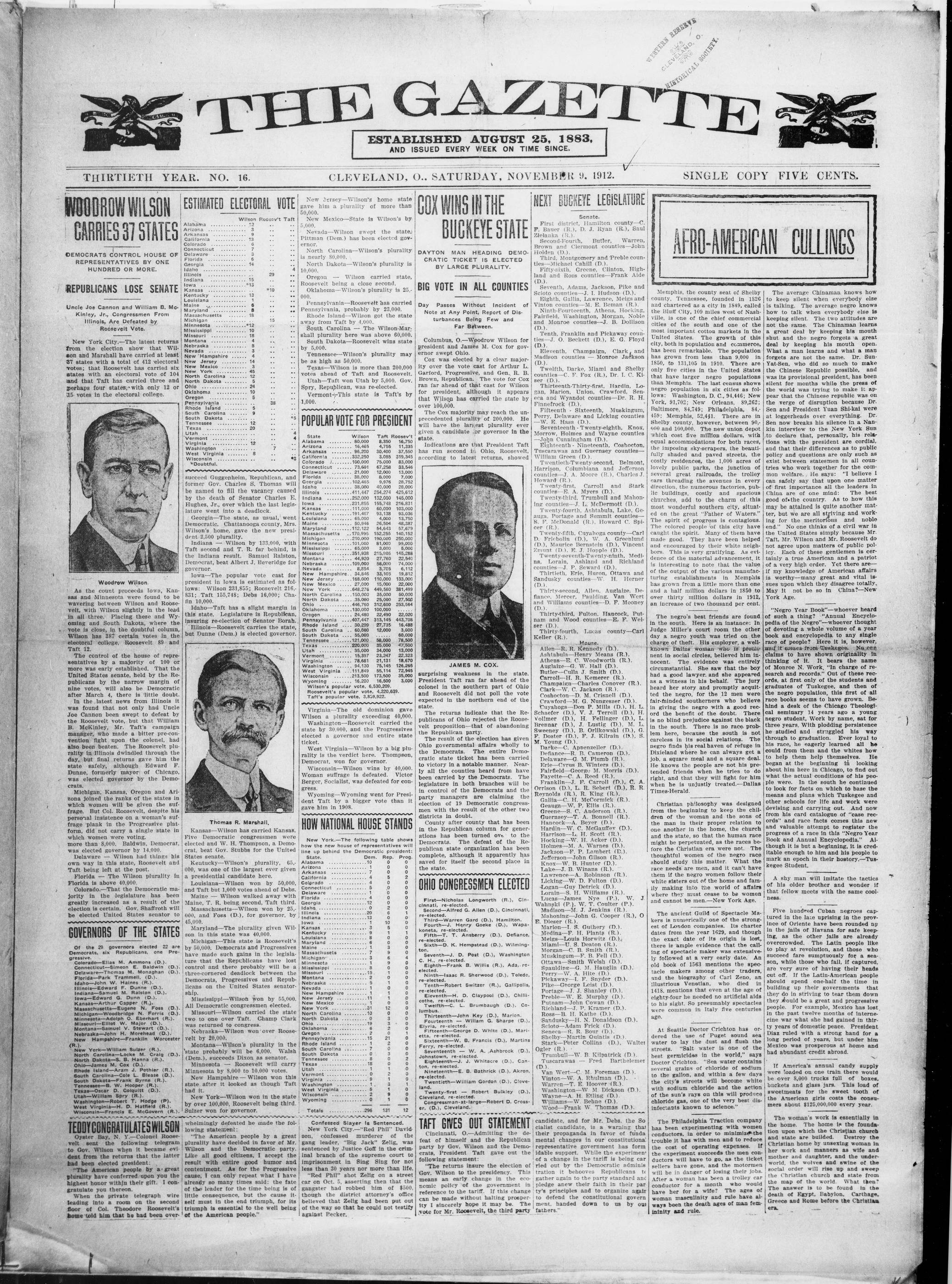
WOODROW WILSON CARRIES 37 STATES
DEMOCRATS CONTROL HOUSE OF REPRESENTATIVES BY ONE HUNDRED OR MORE.
REPUBLICANS LOSE SENATE
Uncle Joe Cannon and William B. McKinley, Jr., Congressmen From Illinois, Are Defeated by Roosevelt Vote.
New York City.—The latest returns from the election show that Wilson and Marshall have carried at least 37 states with a total of 412 electoral votes; that Roosevelt has carried six states with an electoral vote of 104 and that Taft has carried three and perhaps four states, with only 12 or 15 votes in the electoral college.
As the count proceeds Iowa, Kansas and Minnesota were found to be wavering between Wilson and Roosevelt, with Wilson slightly in the lead in all three. Placing these and Wyoming and South Dakota, where the vote is close, in the doubtful column, Wilson has 287 certain votes in the electoral college, Roosevelt 89 and Taft 12.
The control of the house of representatives by a majority of 100 or more was early established. That the United States senate, held by the Republicans by the narrow margin of nine votes, will also be Democratic after March 4, there is little doubt.
In the latest news from Illinois it was found that not only had Uncle Joe Cannon been swept to defeat by the Roosevelt vote, but that William B. McKinley, Mr. Taft's campaign manager, who made a bitter pre-convention fight upon the colonel, had also been beaten. The Roosevelt plurality in Illinois dwindled through the day, but final returns gave him the state safely, although Edward F. Dunne, formerly mayor of Chicago, was elected governor by the Democrats.
Michigan, Kansas, Oregon and Arizona joined the ranks of the states in which women will be given the suffrage. But Col. Roosevelt, despite his personal insistence on a woman's suffrage plank in the Progressive platform, did not carry a single state in which women were voting.
more than 8,000, Baldwin, Democrat, was elected governor by 14,000.
Delaware — Wilson had things his own way in this state, Roosevelt and Taft being left at the post.
Florida — The Wilson plurality in Florida is above 40,000.
Colorado—That the Democratic majority in the legislature has been greatly increased as a result of the election is certain. Gov. Shaffron will be elected United States senator to
GOVERNORS OF THE STATES
Of the 29 governors elected 22 are Democrats, six Republicans, one Progressive.
Columbus—Ellas M. Ammons (D).
Colorado—Simeon E. Baldwin (D).
Delaware—Thomas M. Monaghan (D).
Florida—Park Trammell (D).
Idaho—John W. Haines (D).
Illinois—Dunn M. Baldwin (D).
Indiana—Samanuel M. Ralston (D).
Iowa—Edward G. Dunn (D).
Kansas—Arthur Capper (R).
Massachusetts—Geneva W. Coas (D).
Minnesota—Boudreau N. Ferris (D).
Minnesota—Adolph O. Eberhart (D).
Missouri—Elliot W. Major (D).
Montana—Samuel V. Stewart (D).
Nebraska—John H. Morehead (D).
New Hampshire—Franklin Wocester (R).
New York—William Suizer (R).
North Carolina—Locke M. Craig (D).
North Dakota—Henry H. Hain (R).
Oklahoma—Cox (D).
Rhode Island—Aram J. Pothier (R).
South Carolina—Cole L. Bleae (D).
South Dakota—Frank Byrne (D).
Tennessee—W. H. Wheeler (D).
Oscar D. Colquitt (D).
Utah—William Spry (D).
TEDDYCONGRATULATESWILSON
Oyster Bay, N. Y.—Colonel Roosevelt sent the following telegram to Gov. Wilson when it became evident from the returns that the latter had been elected president. The American by a great plurality conferred upon you the highest honor within their gift. I congratulate you thereon. When the private telegraph wire leading into a room on the second floor of Col. Theodore Roosevelt's home told him that he had been over-
THE GAZETTE
ESTIMATED ELECTORAL VOTE
Wilson Wilson Roosev't Taft
Alabama 12
Arizona 3
Arkansas 9
California 13
Colorado 6
Connecticut 7
Delaware 5
Florida 6
Georgia 14
Idaho 4
Illinois 29
Indiana 15
Iowa *13
Kansas *10
Kentucky 13
Louisiana 1
Maine 6
Maryland 8
Massachusetts 18
Michigan 15
Minnesota *12
Mississippi 10
Missouri 18
Montana 4
Nebraska 8
Nevada 3
New Hampshire 4
New Jersey 14
New Mexico 3
New York 45
North Carolina 12
North Dakota 5
Ohio 24
Oklahoma 10
Oregon 5
Pennsylvania 38
Rhode Island 5
South Carolina 9
South Dakota *5
Tennessee 12
Texas 20
Utah 4
Vermont 4
Virginia 12
Washington 7
West Virginia 8
Wilsonson *3
Douglas
succeed Guggenheim, Republican, and former Gov. Charles S. Thomas will be named to fill the vacancy caused by the death of Senator Charles E. Hughes, Jr., over which the last legislature went into a deadlock. Georgia—The state, as usual, went Democratic. Chattanooga county, Mrs. Wilson's home, gave the new president 2,500 plurality. Indiana—Wilson by 133,000, with Taft second and T. R. far behind, is the Indiana result. Samuel Ralston, Democrat, beat Albert J. Beveridge for governor. Iowa—The popular vote cast for president in Iowa is estimated as follows: Wilson 231,855; Roosevelt 216,831; Taft 155,748; Debs 10,000; Chafin 10,000. Idaho—Taft has a slight margin in this state. Legislature is Republican, insuring re-election of Senator Borah. Illinois—Roosevelt carries the state, but Dunne (Dem.) is elected governor.
Thomas R. Marshall,
Kansas—Wilson has carried Kansas.
Five Democratic congressmen were elected and W. H. Thompson, a Democrat, beat Gov. Stubbs for the United States senate.
Kentucky—Wilson's plurality, 65,000, was one of the largest ever given a presidential candidate here.
Louisiana—Wilson won by 50,000, and Taft but 1,000 votes ahead of Debs.
Maine — Wilson wanked away with Maine, T. R. being second, Taft third. Massachusetts — Wilson won by 25,000, and Foss (D.), for governor, by 45,000. Maryland — The plurality given Wilson in this state was 40,000. Michigan — This state is Roosevelt's by 50,000. Democrats and Progressives have made such gains in the legislature that the Republicans have lost control and there probably will be a three-cornered deadlock between the Democrats, Progressives and Republicans on the United States senatorship. Mississippi — Wilson won by 55,000. All Democratic congressmen elected. Missouri — Wilson carried the state two to one over Taft. Champ Clark was returned to congress. Nebraska — Wilson won over Roosevelt by 20,000. Montana — Wilson's plurality in the state probably will be 6,000. Walsh (Dem.), succeeds Dixon as senator.
Minnesota — Roosevelt will carry Minnesota by 8,000 to 10,000 votes.
New Hampshire — Wilson won this state after it looked as though Taft had it.
New York—Wilson won in the state by over 100,000, Roosevelt being third.
Sulzer won for governor.
whelmingly defeated he made the following statement:
"The American people by a great plurality have decided in favor of Mr. Wilson and the Democratic party.
Like all good citizens, I accept the result with entire good humor and contentment.
As for the Progressive cause, I can only repeat what I have already so many times said: the fate of the leader for the time being is of little consequence, but the cause it must in the end triumph, for its triumph is essential to the well being of the American people."
ESTABLISHED AUGUST 25, 1883 AND ISSUED EVERY WEEK ON TIME SINCE.
CLEVELAND, O., SATURDAY, NOVEMBER 9, 1912.
New Jersey—Wilson's home state gave him a plurality of more than 50,000.
New Mexico—State is Wilson's by 5,000.
Nevada—Wilson swept the state; Pittman (Dem.) has been elected governor.
North Carolina—Wilson's plurality is nearly 80,000.
North Dakota—Wilson's plurality is 10,000.
Oregon — Wilson carried state, Regenerait being a close second.
Pennsylvania—Roosevelt has carried Pennsylvania, probably by 23,000. Rhode Island—Wilson got the state away from Taft by 4,000. South Carolina — The Wilson-Marshall plurality here was above 60,000. South Dakota—Roosevelt wins state by 5,000. Tennessee—Wilson's plurality may be as high as 50,000. Texas—Wilson is more than 200,000 votes ahead of Taft and Roosevelt. Utah—Taft won by 5,000. Gov. Spry, Republican was re-elected. Vermont—This state is Taft's by 1,000.
POPULAR VOTE FOR PRESIDENT
State Wilson Taft Roosevelt*
Alabama 80,000 8,350 16,750
Arizona 16,465 4,755 11,335
Arkansas 95,200 30,400 37,550
California 335,840 100,000 110,350
Colorado 100,000 75,000 83,000
Connecticut 73,601 67,258 33,546
Delaware 21,000 12,000 13,000
Florida 38,000 8,000 7,000
Georgia 100,465 8,000 72,000
Idaho 38,000 40,000 28,000
Illinois 411,447 254,274 425,612
Indiana 252,000 132,000 145,000
Iowa 231,855 155,748 216,831
Kansas 111,000 60,000 103,000
Kansas City 195,497 181,383 137,500
Louisiana 65,000 4,000 13,750
Maine 50,946 26,504 48,387
Maryland 112,122 54,643 57,679
Mississippi 175,974 161,838 130,750
Michigan 210,000 190,000 250,000
Minnesota 101,000 81,000 99,000
Mississippi 65,000 3,000 5,000
Missouri 351,938 215,968 142,588
Mississippi 65,000 3,000 15,288
Nebraska 109,000 58,000 74,000
Nevada 8,854 3,705 6,112
New Hampshire 34,846 33,105 19,812
New Jersey 168,000 110,000 132,000
New York 428,754 349,560 381,499
North Carolina 648,276 495,560 381,499
North Dakota 35,000 25,000 27,500
Oklahoma 446,760 312,600 253,644
Oregon 138,000 124,900 220,270
Pennsylvania 407,474 313,145 402,708
Rhode Island 30,299 27,735 16,488
South Carolina 60,000 12,000 3,000
Tennessee 121,000 88,000 78,500
Texas 220,000 35,000 75,500
Utah 35,000 34,000 13,000
Vaquette 60,000 12,000 13,000
Virginia 78,881 21,131 18,670
Washington 94,130 75,145 126,265
West Virginia 111,849 55,114 72,945
Wisconsin 213,500 173,500 35,000
Wyoming 16,200 16,500 3,000
Wilson's popular vote: 6,358,358
Rosewell's popular vote: 4,220,639
Taft's popular vote: 3,839,922.
Virginia—The old dominion gave
Wilson a plurality exceeding 40,000.
Washington—Roosevelt carried the state by 30,000, and the Progressives elected a governor and entire state ticket.
West Virginia—Wilson by a big plurality is the verdict here. Thompson, Democrat, won for governor.
Wisconsin—Wilson wins by 40,000. Woman suffrage is defeated. Victor Berger, Socialist, was defeated for congress.
Wyoming—Wyoming went for President Taft by a bigger vote than it gave him in 1808.
HOW NATIONAL HOUSE STANDS
New York.—The following table show
how the new house of representatives will
line up behind the Democratic president
State. Dem. Rep. Prog.
Alabama .10 0 0
Arizona .1 0 0
Arkansas .7 0 0
California .4 5 2
Colrado .4 0 0
Connecticut .5 0 0
Delaware .1 0 0
Florida .4 0 0
Georgia .12 0 0
Idaho .0 2 0
Illinois .20 6 1
Indiana .13 0 0
Iowa .1 10 0
Kansas .3 5 0
Kentucky .9 1 1
Louisiana .8 0 0
Maryland .6 0 0
Maine .1 3 0
Massachusetts .7 9 0
Michigan .3 6 4
Minnesota .1 9 0
Mississippi .8 0 0
Mourir .15 1 0
Montana .2 0 0
Nebraska .5 1 0
Nevada .1 0 0
New Hampshire .1 1 0
New Jersey .11 1 0
New Mexico .1 0 0
New York .31 12 0
North Carolina .10 0 0
North Dakota .0 3 0
Ohio .19 3 0
Oklahoma .6 2 0
Oregon .2 0 1
Pennsylvania .15 21 0
North Island .1 2 0
South Carolina .7 0 0
South Dakota .0 3 0
Tennessee .8 0 2
Texas .18 0 0
Utah .1 1 0
Vermont .0 2 0
Virginia .9 1 0
Washington .1 3 1
West Virginia .5 1 0
Wisconsin .2 9 0
Wyoming .0 1 0
Totals .296 131 12
Confessed Slayer is Sentenced.
New York City — "Red Phil" Davidson, confessed murderer of the gang leader, "Big Jack" Zellig, was sentenced by Justice Goff in the criminal branch of the supreme court to imprisonment in Sing Sing for not less than 30 years nor more than life. Red Phil shot Zellig on a street car Oct. 5, asserting that the gangster had robbed him of $500 though the district attorney's office believed that Zellig had been put out of the way so that he could not testify against Phil.
COX WINS IN THE BUCKEYE STATE
DAYTON MAN HEADING DEMO CRATIC TICKET IS ELECTED BY LARGE PLURALITY.
BIG VOTE IN ALL COUNTIES
Day Passes Without Incident of Note at Any Point, Report of Disturbances Being Few and Far Between.
Columbus, O.—Woodrow Wilson for president and James M. Cox for governor swept Ohio.
Cox was elected by a clear majority over the vote cast for Arthur L. Garford, Progressive, and Gen. R. B. Brown, Republican. The vote for Cox ran far ahead of that cast for Wilson for president, although it appears that Wilson has carried the state by over 100,000.
The Cox majority may reach the unprecedented plurality of 200,000. He will have the largest plurality ever given a candidate or governor in the state.
Indications are that President Taft has run second in Ohio, Roosevelt, according to latest returns, showed
JAMES M. COX.
surprising weakness in the state. President Taft ran far ahead of the colonel in the southern part of Ohio and Roosevelt did not poll the vote expected in the northern end of the state.
The returns indicate that the Republicans of Ohio rejected the Roosevelt proposition—that of abandoning the Republican party.
The result of the election has given Ohio governmental affairs wholly to the Democrats. The entire Democratic state ticket has been carried to victory in a notable manner. Nearly all the counties heard from have been carried by the Democrats. The legislature in both branches will be in control of the Democrats and the party managers are claiming the election of 19 Democratic congressmen with the result of the other two districts in doubt. County after county that has been in the Republican column for generations has been turned over to the Democrats. The defeat of the Republican state organization has been complete, although it apparently has saved for itself the second place in the state.
OHIO CONGRESSMEN ELECTED
First—Nicholas Longworth (R.), Cincinnati, re-elected.
Second—Alfred G. Allen (D.), Cincinnati, re-elected.
Third—Warren Gardar (D.), Hamilton.
Fourth—J. Henry Goeke (D.), Wapakoneta, re-elected.
Fifth—T. T. Ansberry (D.), Defiance, re-elected.
Sixth—D. K. Hempstead (D.), Wilmington.
Seventh—J. D. Post (D.), Washington C. H., re-elected.
Eighth—Frank B. Willis (R.), Ada, re-elected.
Ninth—Isaac R. Sherwood (D.), Toledo, re-elected.
Tenth—Robert Switzer (R.), Gallipolis, re-elected.
Eighth—H. D. Claypool (D.), Clilcothe, re-elected.
Twelfth—C. L. Brumbaugh (D.), Columbus.
Thirteenth—John Key (D.), Marion.
Fifteenth—William G. Sharpe (D.), Elyra, re-elected.
Fifteenth—George D. White (D.), Marietta, re-elected.
Fifteenth—George D. White (D.), Martins Ferry, re-elected.
Seventeenth—W. A. Ashbrook (D.).
Johnstown, re-elected.
Eighteenth—J. J. Whitacre (D.), Canton, re-elected.
Nineteenth—E. B. Batrick (D.), Akron, re-elected.
Twentieth—William Gordon (D.), Cleveland.
Twenty-first—Robert Bulkley (D.), Cleveland, re-elected.
Congressman at-large—Robert D. Crosser, (D.), Cleveland.
TAFT GVES OUT STATEMENT
Cincinnati, O.-Admitting the defeat of himself and the Republican party by Gov. Wilson and the Democrats, President Taft gave out the following statement: "The returns insure the election of Gov. Wilson to the presidency. This means the charges in the economic policy of the government in reference to the tariff. If this change can be made without hatting prosperity I sincerely hope it may be. The vote for Mr. Roosevelt, the third party
NEXT BUGKEYE LEGISLATURE
NEXT BUGKEYE LEGISLATURE
Senate.
First district, Hamilton county—C.
F. Bauer (R.), D. J. Ryan (R.), Saul Zielanka (R.).
Second-Fourth, Butler, Warren,
Brown and Clermont counties—John
Holt (R.).
Third, Montgomery and Freble
counties—Michael Cahill (D.).
Fifty-sixth, Greene, Clinton, Highland and Ross counties—Frank Alder (D).
Seventh, Adams, Jackson, Pike and Scioto counties—J. I. Hudson (D).
Eighth, Gallia, Lawrence, Melgs and Vinton counties—M. E. Beman (R).
Ninth-Fourteenth, Athens, Hocking, Fairfield, Washington, Morgan, Noble and Monroe counties—J. B. Dollson (D).
Eighth, Franklin and Pickaway counties—J. O. Beckett (D.), E. G. Floyd (D).
Eleventh, Champaign, Clark and Madison counties—Monroe Jackson (D).
Twelfth, Darke, Miami and Shelby counties—C. F. Fox (R.), Dr. I. C. Kiser (D).
Thirteenth-Thirty-first, Hardin, Logan, Marion, Union, Crawford, Seneca and Wyandot counties—Dr. R. H. Finnefrock (D.).
Fifteenth- Sixteenth, Muskingum, Perry, Delaware and Licking counties—F. P. Kiser (D.).
Seventeenth- Twenty-eighth, Knox, Morrow, Holmes and Wayne counties—John Cunningham (D.).
Eighteenth- Nineteenth, Coshocton, Tuscarawas and Guernsey counties—William Green (D).
Twentieth-Twenty-second, Belmont, Harrison, Columbiaiana and Jefferson counties—J. A. Moore (R.), Charles J. Howard (R).
Twenty-first, Carroll and Stark counties—E. A. Myers (D).
Twenty-third, Trumbull and Mahoning counties—J. L. McDermott (D).
Twenty-fourth, Abaka, Lake, Geauga, Portage and Summit counties—F. S. McBonald (R.), Howard C. Spier (R).
Twenty-fifth, Cuyahoga county—Carl D. Friickin (D), W. A. Greenland (D), Maurice Bernstein (D), Vincent Zmunt (D), E. J. Hopple (D).
Twenty-seventh-Twenty-ninth, Medina, Lorain, Ashland and Richland counties—J. P. Seward (D).
Thirtieth, Erie, Huron, Ottawa and Sandusky counties—W. H. Herner (D).
Thirtieth, Allen, Aulgeale, Defiance, Mereer, Pauling, Van Wert and Williams counties—D. F. Mooney (D).
Thirty-third, Fulton, Hancock, Putnam and Wood counties—E. F. Welser (D).
Thirty-fourth, Lucas county—Carl Keller (R.).
House.
Allen—R. R. Kennedy (D).
Ashtabula—Honry Means (R).
Athens—E. C. Woodworth (R).
Auglaize—G. W. Hall (D).
Butler—Culla J. Smith (D).
Carroll—H. R. Kemerer (R).
Champaign-Charles Conover (R).
Clark—W. C. Jackson (R).
Coshocton—D. M. Crisnell (D).
Crawford—M. G. Nungesser (D).
Cuyahoga-Donor P. Mills (D). H. L. Scholz (D). W. J. Turell (D). H. Vollmer (D). H. Felling (D). L. Brennar (D). J. Lustig (D). M. L. Sweeney (D). B. Orlkowski (D). G. F. Doster (D). F. J. Kilrain (D). S. M. Young (D).
Darke—C. Apenzeller (D).
Defiance—R. B. Cameron (D).
Delaware—G. M. Plumb (R).
Erie—Cyrus B. Winters (R).
Fondale-G. M. Morris (D).
Fayette—C. A. Reed (R).
Franklin—J. F. Carroll (D). C. A. Orrison (D). L. R. Sebert (D). R. R. Reynolds (D). R. K. King (R).
Gallia—C. H. McCormick (R).
Geaug—W. P. Ellis (R).
Greene—S. C. Anderson (R).
Guernsey—T. A. Bonnell (R).
Hancock—A. Beyer (D).
Hardin—W. C. McGauffe (D).
Harrison—L. H. Scott (R).
Hocking—M. A. Acker (R).
Harrison—M. A. Acker (R).
Jackson—F. P. Lambert (D).
Jefferson—John Gilson (R).
Knox—W. B. Hunter (D).
Lake—J. B. Winans (D).
Lawrence—A. Robinson (R).
Licking—W. D. Fulton (D).
Logan—Guy Detrick (D).
Loraln—S. H. Williams (R).
Lucas—M. A. Acker (R).
J Wahleh (P), W. T. Coulter (P).
Madison—M. J. Jenkins (R).
Mahoning—John G. Cooper (R.), O.
E. Dieser (R).
Marlon—I. S. Guthery (D).
Medina—F. H. Plants (R).
Meigs—Louis Horwitz (D).
Miami—U. S. Deaton (D).
Misman—B. G. Smith (D).
Muskingum—F. B. Fell (D).
Ottawa—Smith Welsh (D).
Spalding—G. M. Hauglin (D).
Perry—W. A. Hite (D).
Pickaway—I. F. Snyder (D).
Pike—George Leist (D).
Portage—J. J. Shanley (D).
Preble—W. E. Murphy (D).
Prowan—John Quintis (D).
Richland—J. P. Kramer (D).
Ross—B. H. Kathe (D).
Sandusky—H. N. Donaldson (D).
Scioto—Adam Frick (D).
Seneca—R. B. Rour (D).
Shelby—Martin Quintis (D).
Stark—Peter Collins (D). Walter
Ogler (R).
Trumbull—W. B. Kilpatrick (D).
Tuscarawas—W. B. Fred Barthelemen (D).
Van Wert—C. M. Foreman (D). Vinton—W. A. Rhulman (D). Warren—T. E. Hoover (R). Washington—W. M Dickson (D). Wayne—A. H. Ettling (D). Williams—W. Behne (D). Wood—Frank W. Thomas (D).
candidate, and for Mr. Debs, the Socialist candidate, is a warning that their propaganda in favor of fundamental changes in our constitutional representative government has formidable support. While the experiment of a change in the tariff is being carried out by the Democratic administration it behooves Republicans to gather again to the party standard and pledge anew their faith in their party's principles and to organize again to defend the constitutional government, handed down to us by our fathers."
AFRO-AMERICAN CULLINGS
Memphis, the county seat of Shelby county, Tennessee, founded in 1826 and chartered as a city in 1849, called the Bluff City, 119 miles west of Nashville, is one of the chief commercial cities of the south and one of the most important cotton markets in the United States. The growth of this city, both in population and commerce, has been remarkable. The population has grown from less than 9,000 to 131,105 in 1910. There are only five cities in the United States that have larger negro populations than Memphis. The last census shows negro population in six cities as follows: Washington, D. C., 94,446; New York, 91,702; New Orleans, 89,256; Baltimore, 84,749; Philadelphia, 84,459; Memphis, 52,441. There are in Shelby county, however, between 90,000 and 100,000. The new union depot which cost five million dollars, with equal accommodations for both races, the imposing scrappers, the beautifully shaded and paved streets, the costly residences, the 1,000 acres of lovely public parks, the junction of several great railroads, the trolley cars threading the avenues in every direction, the numerous factories, public buildings, costly and spacious churches, add to the charm of this most wonderful southern city, situated on the great Father of Waters." The spirit of progress is contagious. The colored people of this city have caught the spirit. Many of them have made good. They have been helped and encouraged by the white neighbors. This is very gratifying. As evidence of the material advancement, it is interesting to note that the value of the output of the various manufacturing establishments in this city has grown from a little more than one and a half million dollars in 1850 to over thirty million dollars in 1912, an increase of two thousand per cent.
The negro's best friends are found in the south. Here is an instance: In Judge Miller's court room the other day a negro youth was tried on the charge of theft. His employer, a well-known Dallas woman who is prominent in social circles, believed him innocent. The evidence was entirely circumstantial. She saw that the boy had a good lawyer, and she appeared as a witness in his behalf. The jury heard her story and promptly acquitted the negro, for the 12 men were fair-minded southerners who believe in giving the negro with a good record the benefit of the doubt. There is no blind prejudice against the black in the south. There is no race problem here, because the south is not careless in its social relations. The negro finds his real haven of refuge in Dixieland where he can always get a job, a square meal and a square deal. He knows the people are not his pretended friends when he tries to do right, and that they will fight for him when he is unjust treated—Dallas Times-Herald.
Christian philosophy was designed from the beginning to keep the children of the woman and the sons of the man in their proper relation to one another in the home, the church and the state, so that the human race might be perpetuated, as the races before the Christian era were not. The thoughtful women of the negro race should study this matter. What the race needs are men, and it can't have them if the negro women follow their white sisters out of the home and family making into the world of affairs where they must cease to be women and cannot be men.—New York Age.
The ancient Guild of Spectacle Makers is numerically one of the strongest of London companies. Its charter dates from the year 1629, and though the exact date of its origin is lost, there is ample evidence that the calling of spectacle maker was extensively followed at a very early date. An old book of 1563 mentions the spectacle makers among other traders, and the biography of Carl Zeno, an illustrious Venetian, who died in 1418, mentions that even at the age of eighty-four he needed no artificial aids to his sight. So presumably spectacles were common in Italy five centuries ago.
At Seattle Doctor Crichton has ordered the use of Puget sound sea water to lay the dust and flush the streets. "Salt water is one of the best germicides in the world," says Doctor Crichton. "Sea water contains several grains of chloride of sodium to the gallon, and within a few days the city's streets will become white with sodium chloride and the action of the sun's rays on this will produce chloride gas, one of the very best disinfectants known to science."
The Philadelphia Traction company has been experimenting with women conductors, in order to minimize the trouble it has with men and to reduce the cost of operating expenses. If the experiment succeeds the men conductors will have to go, as the ticket sellers have gone, and the motormen will be in danger of losing their jobs. After a woman has been a trolley car conductor for a month who would have her for a wife? The ages of woman masculinity and rule have always been the death ages of man femininity and rule.
THE EAGLE
The average Chinaman knows how to keep silent when everybody else is talking. The average negro knows how to talk when everybody else is keeping silent. The two attitudes are not the same. The Chinaman learns a great deal by keeping his mouth shut and the negro forgets a great deal by keeping his mouth open. What a man learns and what a man forgets are not the same. Dr. Sun-Yat-Sen, who did so much to make the Chinese Republic possible, and was its provisional president, has been silent for months while the press of the world was trying to make it appear that the Chinese republic was on the verge of disruption because Dr. Sen and President Shikad were at loggerheads over everything. Dr. Sen now breaks his silence in a Nankin interview to the New York Sun to declare that, personally, his relations with the president are cordial, and that their differences are only such as exist between statemen in all countries who work together for the common welfare. He says: "I believe I can safely say that upon one matter of first importance all the leaders in China are of one mind: The best good of the country. As to how this may be attained is quite another matter, but we are all striving and working for the meritorious and noble end." No one thinks of a civil war in the United States simply because Mr. Tatt. Mr. Wilson and Mr. Roosevelt do not agree upon matters of public policy. Each of these gentlemen is certainly a true American and a patriot of a very high order. Yet there are—if my knowledge of American affairs is worthy—many great and vital issues upon which they disagree totally. May it not be so in China?—New York Age.
"Negro Year Book"—whoheard of such a thing? "Annual Encyclopedia of the Negro"—whoheard thought of devoting a whole volume of a year book and encyclopedia to any single race of people? Here it is, however, and it comes from Tuskegee. No one claims to have shown originality in thinking of it. It bears the name of Monroe N. Work, "In charge of research and records." Out of these records, at first only of the students and graduates of Tuskegee, and then of the negro population, this first of all race books seems to have grown. Behind a desk of the Chicago Theological seminary 14 years ago a young negro student, Work by name, sat for three years. With ploiding persistence he studied and struggled his way through to graduation. Ever loyal to his race, he eagerly learned all he could from them and the whites how to help them help themselves. He began at the beginning in looking about him here in Chicago, to find out what the actual conditions of his people were. In the south he continued to look for facts on which to base the means and plans which Tuskegee and other schools for life and work were devising and carrying out. And now from his card catalogue of "case records" and race facts comes this new and valuable attempt to register the progress of a race in the "Negro Year Book and Annual Encyclopedia." Although it is but a beginning, it is credible enough to him and his people to mark an epoch in their hostory.—Tuskegee Student.
A shy man will imitate the tactics of his older brother and wonder if that fellow meets with the same coolness.
Five hundred Cuban negroes captured in the lace uprising in the province of Oriente have been rounded ng in the jails of Havana for safe keeping, as the other fails are already overcrowded. The Latin people like to play at revolution, and those who succeed fare sumptuously for a season, while those who fail, if captured, are very sure of having their heads cut off. If the Latin-American people should spend one-half the time in building up their governments that they do in striving to tear them down they would be a great and progressive people. For example, Mexico has lost in the past twelve months of internecine war what she had gained in thirty years of domestic peace. President Diaz ruled with a strong hand for a long period of years, but under Mexico was prosperous at home and had abundant credit abroad.
If America's annual candy supply were loaded on one train there would be over 8,000 trucks full of boxes, buckets and glass jars. This load of sweetmeats for the sweet tooth of the American girls costs the consumers about $125,000,000 every year.
The woman's work is essentially in the home. The home is the foundation upon which the Christian church and state are builted. Destroy the Christian home by unsexting woman in her work and manners as wife and mother and daughter, and the underworld, the wolves and swine of the social order will rise up and sweep the Christian church and state from the map of the world. What then? The answer is to be found in the death of Egypt, Babylon, Carthage, Greece and Rome before the Christian era.
One Year.....$1.50
Six Months.....1.00
Three Months......50
Subscribers are requested to
mit by postoffice money or
der or registered letter.
Entered at the postoffice In Cleveland
Ohio, as second-class matter
Address all communications to
HARRY C. SMITH
Editor and proprietor,
THE GAZETTE,
Blackstone Building, Cleveland, O.
Member Ohio Legislature: 1894
to 1896; 1896 to 1898; 1900 to 1902
THE GAZETTE is the oldest, and has the largest bona fide circulation, double that of any newspaper in the interest of Afro-Americans, published in the state of Ohio, and comparison with any will immediately establish its rank as one of the NEWSIEST AND'BEST in the country.
TAFT AND ROOSEVELT.
It was fortunate for our voters, this fall, that at least two of the three leading Presidential candidates had been chief executives of this great country and had developed their "Negro policies," involving our political status and civil rights. There is no better time than now, in the light of Tuesday's election, to again view the principles and results of these two national policies and to note their of fect upon our progress and civil en environment during the past five or six years.
Aside from his repudiation of the republican platform and his absolute disruption of the republican party, the only thing which President Taft has succeeded, is his perfect execution and successful performance of the inaugural announcement against Negro citizens. It is quite impossible to recite here all the many things which he has done in this connection, but it might be well to call attention to a few of the chief facts incident to his new southern policy:
(1) The discharge of 128 Negro fourth class postmasters.
(2) The discharge of Henry A. Rucker, the last Colored Georgia official, though endorsed by the best whites of his state, as well as our people.
(3) The dismissal of Joshua A. Wilson, Colored postmaster at Florence, S. C., though endorsed by a majority of whites and blacks in that section.
(4) The dismissal of over 108 Colored Federal appointees in Texas.
(5) The discharge of Mr. Christian, Colored postmaster for 25 years at Yorktown, Virginia, over the protest of the white and our business men.
(6) The reduction of Dr. John M. Prather and Hon Jere A. Brown in the immigration service because they were Colored.
(7) The refusal of R. Benjamin Bundy, a consular appointment, because of color.
(8) The order to Census Director Durand, not to permit Colored enumerators to count white people in the south.
(9) His statement in a letter to Fisk University, that the Negro race should be treated separate and distinct from the white race.
The Principle of the Roosevelt Negro Policy.
Ex-President Theodore Roosevelt, in a New York (Scribner's) magazine article, in April, 1899, soon after the
PETER H.
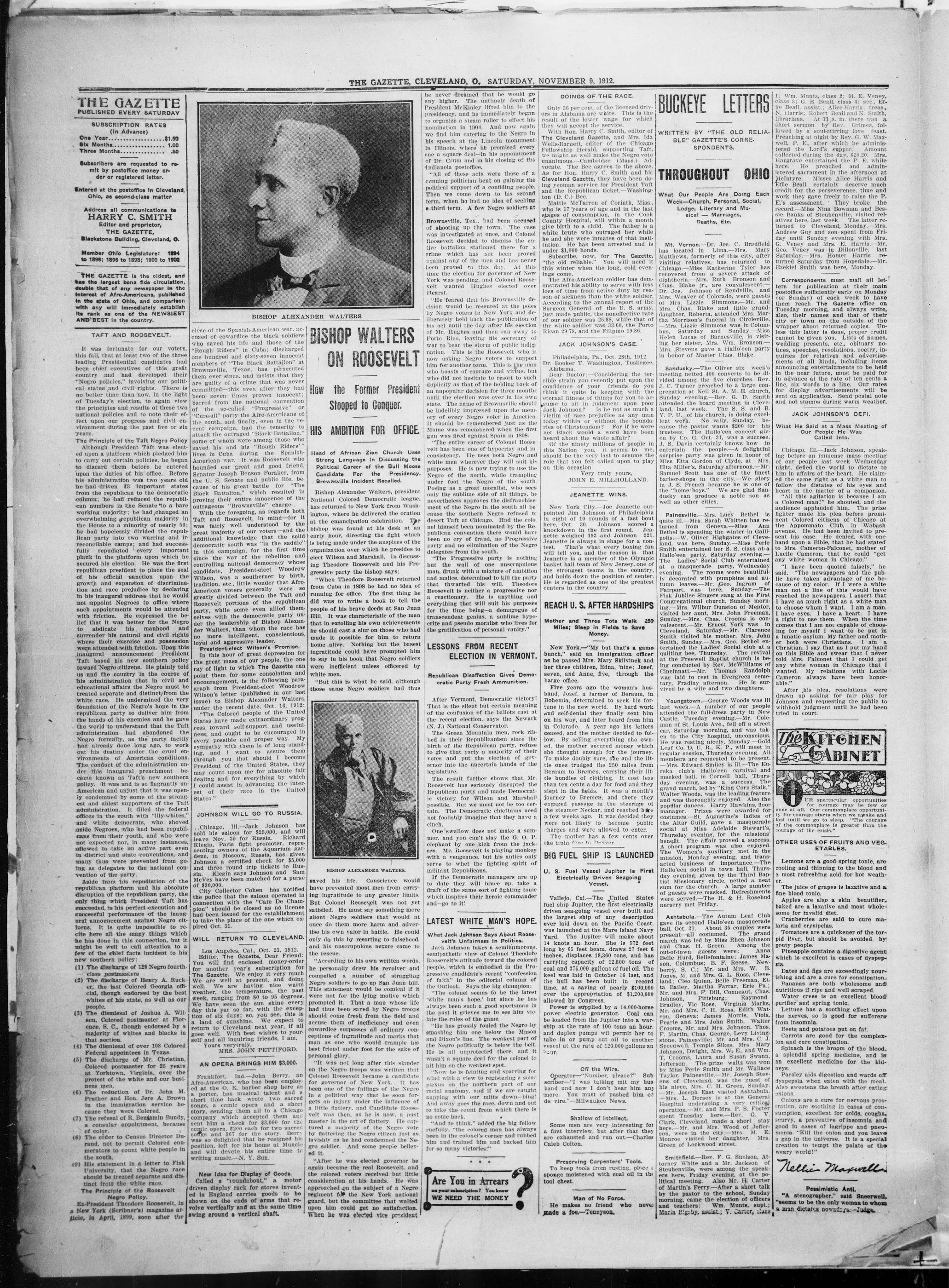
BISHOP ALEXANDER WALTERS
close of the Spanish-American war, accused of cowardice the black soldiers who saved his life and those of the "Rough Riders" in Cuba; discharged one hundred and sixty-seven innocent members of "The Black Battalion" at Brownville, Texas, has persecuted them ever since, and insists that they are guilty of a crime that was never committed—this even after they had been seven times proven innocent; saved from the national convention of the so-called "Progressive" or "Cureall" party the Afro-Americans of the south, and finally, even in the recent campaign, had the temerity to attack the outraged "Black Battalion," some of whom were among those who saved his and his "Rough Riders" lives in Cuba during the Spanish-American war. It was Roosevelt who bounded cur great and good friend, Senator Joseph Benson Foraker, from the U. S. Senate and public life, because of his great battle for "The Black Battalion," which resulted in proving their entire innocence of the outrageous "Brownville" charge.
With the foregoing, as regards both Taft and Roosevelt, in mind—for it was fairly well understood by the great majority of our voters—and the additional knowledge that the solid democratic south was "in the saddle" in this campaign, for the first time since the war of the rebellion and controlling national democracy whose candidate, President-elect Woodrow Wilson, was a southerner by birth, tradition, etc., little wonder that Afro-American voters generally were so greatly divided between the Taft and Roosevelt portions of the republican party, while some even allied themselves with the democratic party under the leadership of Bishop Alexander Walters, than whom the race has no more intelligent, conscientious, loyal and aggressive leader.
President-elect Wilson's Promise.
In this hour of great depression for the great mass of our people, the one ray of light to which The Gazette can point them for some consolation and encouragement, is the following paragraph from President-elect Woodrow Wilson's letter (published in our last issue) to Bishop Alexander Walters, under the recent date, Oct. 16, 1912: "The Colored people of the United States have made extraordinary progress toward self-support and usefulness, and ought to be encouraged in every possible and proper way. My sympathy with them is of long standing, and I want to assure them through you that should I become President of the United States, they may count upon me for absolute fair dealing and for everything by which I could assist in advancing the interest of their race in the United States."
JOHNSON WILL GO TO RUSSIA.
..Chicago, Ill.—Jack Johnson has sold his saloon for $25,000, and will leave Nov. 30 for Russia. Richard Klegin, Paris fight promoter, representing owners of the Aquarium gardens, in Moscow, Russia, has given Johnson a certified check for $500 and three round trip trips to Russia. Klegin says Johnson and Sam have been matched for a purse of $30,000.
City Collector Cohen has notified the police that the saloon operated in connection with the "Cafe De Champion" should be closed as no license had been issued for the establishment and because of the one which expired. Oct. 31.
WILL RETURN TO CLEVELAND
Los Angeles, Cal., Oct. 21, 1912.
The Gazette, Dear Friend: You will find enclosed money-order for another year's subscription for The Gazette. We enjoy it very much. We are well at present, and we are happy to warm weather, the temperature, the past week, ranging from 80 to 95 degrees. We have seen the sunshine every day this year so far, with the exception of six days; so, you see, this is a land of sunshine. We expect to return to Cleveland next year, if all goes well. With best wishes to yourself and all acquaintings I am. You very much.
MRS. JOHN PETTIFORD.
AN OPERA BRINGS HIM $3,000.
Frankfort, Ind.-John Berry, an Afro-American, who has been employed at the O. K. barber shop here as a porter, has musical talent and a short time back wrote two sacred songs, a comic opera and a short story, sending them all to a Chicago company which accepted them and sent him a check for $600 for the two sacred songs and $67 for the story. Berry was so delighted that he resigned his position, left for his home at Muncie and will devote his entire time to writing music.-N. Y. Sun.
New Idea for Display of Goods.
BISHOP WALTERS ON ROOSEVELT
HIS AMBITION FOR OFFICE.
Head of African Zion Church Uses Strong Language In Discussing the Political Career of the Bull Moose Candidate For the Presidency Brownville Incident Recalled.
Bishop Alexander Walters, president National Colored Democratic league, has returned to New York from Washington, where he delivered the oration at the emancipation celebration. The bishop was found at his desk at an early hour, directing the fight which is being made under the auspices of the organization over which he presides to elect Wilson and Marshall. In discussing Theodore Roosevelt and his Progressive party the bishop says:
"When Theodore Roosevelt returned from Cuba in 1898 he had no idea of running for office. The first thing he did was to write a book to tell the people of his brave deeds at San Juan Hill. It was characteristic of the man that in extolling his own achievements he should cast a slur on those who had made it possible for him to return home alive. Nothing but the basset ingratitude could have prompted him to say in his book that Negro soldiers were inefficient unless officered by white men.
"But this is what he said, although those same Negro soldiers had thus
BISHOP ALEXANDER WALTERS.
saved his life. Conscience would have prevented most men from carrying ingratitude to any greater limits. But Colonel Roosevelt was not yet satisfied. He must say something more about Negro soldiers that would at once do them more harm and advertise his own valor in battle. He could only do this by resorting to falsehood, and his unscrupulous nature came to the rescue.
"According to his own written words, he personally drew his revolver and compelled a number of struggling Negro soldiers to go up San Juan hill. This statement would be conical if it were not for the lying motive which prompted it. That a man whose life had thus been saved by Negro troops should come fresh from the field and accuse them of inefficiency and even cowardice surpasses all ordinary conceptions of ingratitude and marks that man as one who would trample his best friend under foot for the sake of personal glory.
"It was not long after this slander on the Negro troops was written that Colonel Roosevelt became a candidate for governor of New York. It has been one of the failings of the Negro in a political way that he soon forgets an injury under the influence of a little flattery, and Candidate Roosevelt was then, as he is now, a past master in the art of flattery. He captured a majority of the Negro vote by flattering the Negro citizen just as lavishly as he had condemned the Negro soldier. And some people believed it.
"After he was elected governor he again became the real Roosevelt, and the colored voters received but little consideration at his hands. He was approached on the subject of a Negro regiment for the New York national guard, but the committee that waited upon him could get no satisfaction. When he was elected vice president
THE GAZETTE, CLEVELAND, O. SATURDAY, NOVEMBER 9, 1912.
---
he never dreamed that he would go any higher. The untimely death of President McKinley lifted him to the presidency, and he immediately began to organize a steam roller to effect his nomination in 1904. And now again we find him catering to the Negro in his speech at the Lincoln monument in Illinois, where he promised every one a square deal-in his appointment of Dr. Crum and in his closing of the Indianola postoffice.
"All of these acts were those of a canning politician bent on gaining the political support of a confiding people. Then we come down to his second term, when he had no idea of seeking a third term. A few Negro soldiers at
Brownsville, Tex., had been accused of shooting up the town. The case was investigated at once, and Colonel Roosevelt decided to dismiss the entire battalion stationed there for a crime which has not been proved against any of the men and has never been proved to this day. At this time the election for governor of New York was pending, and Colonel Roosevelt wanted Hughes elected over Hearest.
"He feared that his Brownsville decision would be resented at the poles by Negro voters in New York and deliberately held back the publication of his act until the day after his election of Mr. Hughes and then run away to Porto Rico, leaving his secretary of war to bear the storm of public indignation. This is the Roosevelt who is now asking Negro voters to support him for another term. This is the man who boasts of courage and virtue, but who did not hesitate to resort to such duplicity as that of the holding back of an unpopular decision for three months until the election was over in his own state. The name of Brownsville should be indelibly impressed upon the memory of every Negro voter in America. It should be remembered just as the Maine was remembered when the first gun was fired against Spain in 1898.
"The entire career of Colonel Roosevelt has been one of hypocrisy and inconsistency. He uses both Negro and white men wherever they will suit his purposes. He is now trying to use the Negro of the north, while trampling under foot the Negro of the south. Posing as a great moralist, who sees only the sublime side of all things, he nevertheless approves the disfranchisement of the Negro in the south all because the southern Negro refused to desert Taft at Chicago. Had the colonel himself been nominated by the Republican convention there would have been no cry of fraud, no Progressive party and no elimination of the Negro delegates from the south.
"The Progressive party is nothing but the wall of one unscrupulous man, drunk with a mixture of ambition and malice, determined to kill the party that thwarted his will. Theodore Roosevelt is neither a progressive nor a reactionary. He is anything and everything that will suit his purposes for the time being—a demagogue of transcendent genius, a sublime hypocrite and pseudo moralist who lives for the gratification of personal vanity."
LESSONS FROM RECENT
ELECTION IN VERMONT.
Republican Disaffection Gives Democratic Party Fresh Ammunition.
After Vermont, Democratic victory? That is the silent but certain meaning of the confusion of the ballots cast at the recent election, says the Newark (N. J) National Conservator.
The Green Mountain men, rock ribbed in their Republicanism since the birth of the Republican party, refuse to give that party a majority of their votes and put the election of governor into the uncertain hands of the legislature.
The result further shows that Mr. Roosevelt has seriously disrupted the Republican party and made Democratic victory for Wilson and Marshall possible. But we must not be too certain. The Democratic chieftains need not foolishly imagine that they have a cinch.
One swallow does not make a summer, and you can't slay the G. O. P. elephant by one kick from the jackass. Mr. Roosevelt is playing monkey with a vengeance, but his antics only serve to whet the fighting spirit of militant Republicans.
If the Democratic managers are up to date they will brace up, take a draft of the same sort of fighting tonic which inspires their heroic commander and—go to it!
LATEST WHITE MAN'S HOPE.
What Jack Johnson Says About Rose-
with the Uniforms: Jealousy
Jack Johnson takes a semilimorous, semipathetic view of Colonel Theodore Roosevelt's attitude toward the colored people, which is embodied in the Progressive candidate's recent "confession of faith" in the editorial column of the Outlook. Says the big champion: "The colonel seems to be the latest 'white man's hope,' but since he has always been such a good sportsman in the past it grieves me to see him violate the rules of the game.
"He has grossly fouled the Negro by smashing him one below the Mason and Dixon's line. The weakest part of the Negro politically is below the belt. He is all unprotected there, and it wasn't a square deal for the colonel to hit him on the weakest spot.
"Now he is felting and sparring for wind with a view to registering a solar plexus on the northern part of our racial anatomy, and if we are caught mapping with our mitts down--bing! And away goes the race, down and out to take the count from which there is no come back.
"And to think." added the big fellow ruefully. "the colored man has always been in the colonel's corner and rubbed him and trained him and backed him for so many victories."
Are You in Arrears
on your subscription? You know
WE NEED THE MONEY
DOINGS OF THE RACE.
Only 36 per cent. of the licensed drivers in Alabama are white. This is the result of the lower wage for which they are accustomed to work with Harry C. Smith, editor of The Cleveland Gazette, and Mrs. Ida Wells-Barnett, editor of the Chicago Fellowship Herald, supporting Taft, we might as well make the Negro vote unanimous—Cambridge (Mass.) Advocate. The Bee agrees to the above, As for Hon. Harry C. Smith and his Cleveland Gazette, they have been doing yeoman service for President Taft and the Republican ticket—Washington C. Bess.
Mattie McTaren of Corinth, Miss, who is 17 years of age and in the last stages of consumption, in the Cook County Hospital, will within a month give birth to a child. The father is a white brute who outraged her while he and she were inmates of that institution. He has been arrested and is under $1,000 bonds.
Subscribe, now, for The Gazette "the old reliable." You will need it this winter when the long, cold冬 evening comes.
The Afro-American soldier has demonstrated his ability to serve with less loss of time from active duty by reason of sickness than the white soldier. According to the annual report of the Surgeon General of the U. S. army, just made public, the ineffective rate of our soldier was 25.88, while that of the white soldier was 33.60, the Porto Rican 29.78, and the Filipino 19.88.
JACK JOHNSON'S CASE.
Philadelphia, Pa., Oct. 28th, 1912.
Dr. Booker T. Washington, Tuskegee,
Alabama.
Dear Doctor:—Considering the terrible strain you recently put upon the confidence of your friends do you think it quite in keeping with the internal fitness of the student to assume a judgment upon popup Jack Johnson? Is he not as much a victim of race prejudice as any man today within or without the boundaries of Christendom? For if he were not Black would a word have been heard about the whole affair?
Of the ninety millions of people in this Nation you, it seems to me, should the very last list to assume the role that you felt called upon to play on this occasion.
Very truly yours,
JOHN E. MILLHOLLAND.
JEANETTE WINS
New York City—Joe Jeanette outpointed Jim Johnson of Philadelphia in eight of 10 rounds of a fast bout here, Oct. 30. Johnson scored a knockdown in the first round. Jeanette weighed 193 and Johnson 221. Jeanette is always in shape for a contest. That's what every boxing fan will tell you, and the reason is that Jeanette is one of the Olympic basket ball team of New Jersey, one of the strongest teams in the country, and holds down the position of center. He is regarded as one of the greatest centers in the country.
REACH U. S. AFTER HARDSHIPS
Mother and Three Tots Walk 250
Miles; Sleep in Fields to Save
Money.
New York—"M but that's a game bunch," said an immigration officer as he passed Mrs. Mary Skivinek and her three children, Edna, 'nine; Josef, seven, and Anne, five, through the barge office.
Five years ago the woman's husband, Josef, a farmer of Berau, in Bohemia, determined to seek his fortune in the new world. By hard work and self-denial they finally sent him on his way, and later heard from him in Colorado. A year ago his letters ceased, and the mother decided to follow. By selling everything she owned, the mother secured money which she thought enough for the journey. To make doubly sure, she and the little ones trudged the 250 miles from Berau to Bremen, carrying their little bundles of clothing. It cost less than ten cents a day for food and they slept in the fields. It was a month's journey to Bremen, and there they engaged passage in the steerage of the steamer Neckar, and reached here a few weeks ago. It was decided they were not likely to become public charges and were allowed to enter.
The mother has a few cents over the train fare to Denver
BIG FUEL SHIP IS LAUNCHED
U. S. Fuel Vessel Jupiter is First Electrically Driven Seagoing
Vallejo, Cal.-The United States fuel ship Jupiter, the first electrically driven sea-going vessel ever built and the largest ship of any description ever laid down on the Pacific Coast, was launched at the Mare Island Navy Yard. The Jupiter will make about 14 knots an hour. She is 572 feet long by 65 feet beam, draws 27 feet 6 inches, displaces 19,360 tons, and has carrying capacity of 12,500 tons of coal and 375,000 gallons of fuel oil. The keel was laid in October 16 last, and the hull has been built in record time, at a saving of nearly $100,000 over the appropriation of $1,200,000 allowed by Congress.
Power is supplied by a 14,000-horse power electric generator. Coal can be loaded from the Jupiter into a warship at the rate of 100 tons an hour, and duplex pumps will permit her to take in or pump out oil to another vessel at the rate of 120,000 gallons an hour.
Off the Wire
Operator—"Number, please?" Subcriber—"I was talking mit my hus band and now I don't hear him any more. You must of pushed him of de vire." -Milwaukee News.
Shallow of Intellect.
Some men are very interesting for a first interview, but after that they are exhausted and run out—Charles Caleb Colton.
Preserving Carpenters' Tools.
To keep tools from rusting, piece a spooge moltened with coal oil in the tool chest.
Man of No Force.
He makes no friend who never made a foe—Tennyson.
WRITTEN BY "THE OLD RELIA BLE" GAZETTE'S CORRESPONDENTS.
THROUGHOUT OHIO
What Our People Are Doing Each Week—Church, Personal, Social, Lodge, Literary and Musical — Marriages, Deaths, Etc.
Mt. Vernon.—Dr. Jos. C. Bradford has located in Lima.—Mrs. Mary Matthews, formerly of this city, after visiting relatives, has returned to Chicago.—Miss Katherine Tyler has recovered from a severe attack of diaptheria.—Mrs. Ruth Bronson and Chas Blake Jr. are convalescent. Dr. Jos. Johnson of Rendville, and Mrs. Weaver of Colorado, were guests of Mrs. Lizzie Simmons.—Mr. and Mrs. Chas. Blake and little grandmother, Roberta, attended Mrs. Martha Morrison's funeral in Circleville. Mrs. Lizzie Simmons was in Colombo, Mrs. Helen Lucas of Barnesville, is visiting her sister, Mrs. Wm. Bronson.—Mrs. Stevens gave a Hallo'en party in honor of Master Chas. Blake.
Sandusky.—The Oliver six week's meeting netted 400 converts to be divided among the five churches. Rev. J. C. Turner preached to a large congregation at Neil St. A. M. E. church, Sunday evening.—Rev. G. D. Smith attended the board meeting in Cleveland, last week. The S. S. and B. S. members of his church lent work. No rally, Sunday, because the pastor wants $200 for his trustees. The Hallo'en concert given by Co. G. Oct. 31, was a success. J. S. Davis certainly knows how to entertain the people.—A delightful surprise party was given in honor of Miss Etta Gordon of Clyde, at Mrs. Eita Miller's Saturday afternoon.—Mr. Samuel Scott has one of the first students in the school.—We glory in J. S. French because he is one of the "home-boys." We are glad Sandusky can produce a noble son as well as other cities.
Painnesville.—Mrs. Lucy Bethel is quite ill.—Mrs. Sarah Whitten has returned from Geneva.—Miss Ann Bethel is spending the winter in Gallipolis.—W. Oliver Highgates of Cleveland, was here, Sunday.—Miss Perle Smith entertained her S. S. class at the Ladies' Social Club. The Ladies' Social Club entertained at a masquerade party, Wednesday evening. The rooms were beautifully decorated with pumpkins and autumn leaves.—Mr. Geo. Ingram of Fairport, was here, Sunday.—The Fisk Jubilee Singers sang at the First Congregational church, Sunday morning, and the evening. The invited son, Mrs. John Freeman, Sunday.—Mrs. Chas. Crooms is convalescent.—Mr. Ernest York was in Cleveland, Saturday.—Mr. Clarence Smith visited his mother, Mrs. John Smith, Sunday.—Mrs. Geo. Bethel entertained the Ladies' Social club at a quilting bee. Thursday. The revival concert was conducted by Rev. McWiliams of Cincinnati.—Mr. Thomas Randolph was laid to rest in Evergreen cemetery, Fradiay afternoon. He is survived by a wife and two daughters.
Youngstown—George Woods was ill last week—a number of our people attended the full-dress party in New Castle, Tuesday evening—Mr. Coleman of St. Louis Ave., fell off a street car, Saturday morning, and was taken to the City hospital, unconscious, Leaf Co. D, U, R, U, K, P, will meet in regular session, Thursday evening. All members are requested to be present.—Mrs. Edward Smiley is ill. The Eureka club's Hallo'en carnival and masked ball, in Cornell hall, Thursday evening, given by "King Corm Stalk," Walter Woods, was the leading feature and was thoroughly enjoyed. Also the popular dances, Harry Hawkins, floor manager. Prizes were awarded for costumes. St. Augustine's ladies of the Altar Guild, gave a masquerade social at Miss L. C. Brown's evening, for the missions' benefit. The affair proved a success. A short program was also enjoyed. The Women's auxiliary met in the mission, Monday evening, and transacted business of importance. The Hallo'en social in town hall, Thursday evening, given by the Circle, set a neat sum for the church. A large number of guests were masked. Refreshments were served. The H. & H. Rosebud nursery met Friday.
Astabulae.—The Autum Leaf Club gave its second Hallo'een masquerade ball, Oct. 31. About 35 couples were present—all costumed. The grand march was led by Miss Rhea Johnson and Chas. H. Green. Among the out-of-town guests were: Anna Belle Hurd, Bellefontaine; James Mason, Columbus; B. F. Reese, Nberry, S. C.; Mr. C. W. W. B. Jones, S. C.; Mr. G. L. Rose, Cleo Quinn, B. L. G. Llewce, Martha Farrar, Erie Pa.; Mr. and Mrs. F. Dill, Conneaut, Chas Johnson, Pittsburg; Raymond Bradley, Vic Ross, Virginia Marks, Mr. and Mrs. C. H. Ross, Edith Watson, Geneva; James Morris, Viola, Pearle and Mrs. John Smith, Walter Crooms, Mr. and Mrs. Johnson, Thos. F. Martin, Chas. George, Levy Livingstone, Painesville; Mr. and Mrs. C. J. Speedwell, Temple Mrs. W. E., and Wm. Booth, Lara and Sara Swann, Jefferson. The prize waltz was won by Miss Perle Smith and Mr. Wallace Taylor, Painesville.—Mr. Joseph Stevens of Cleveland, was the guest of his niece, Mrs. C. H. Green, Sunday.
—Mr. Joseph East visited Ashtabula.
—M. L. Dorsey is at the General Hospital undergoing a very critical operation. —Mr. and Mrs. P. S. Foster spent Tuesday here.—Rev. G. V. Clark, Cleveland, made a short stay here.—Mr. and Mrs. P. S. Foster moved to the city.—Mrs. M. E. Monroe visited her daughter, Mrs. Green of Lockwood street.
Smithfield.—Rev. F. G. Snelson, Attorney White and a Mr. Jackson of Steubenville, were among the speakers here, Friday evening, at the political meeting. Also Mr. H. Carter of Martin's Ferry.—After a short talk by the pastor to the school, Sunday morning, came the election of officers and teachers: Wm. Munts, supt.; Maria Eigby, assist.; V. Carter, class
1; Wm. Munta, class 2; M. E. Veney,
3; Wm. G. E. Beall, class 4; sec. Ete
Beall, assist; Alice Harris; treas,
N. Harris; Robert Beall and N. Smith,
librarians. At 11 a. m. there was a
short sermon by Rev. Grimes, followed
by a saint-sirting love heart,
Preaching at night by Rev. G. W.
Maxwell, P. E., after which he adminis-
tates the sage's supper. Amount
collected during the service was $200.
Hargrave entertained the P. E. while
here. He preached and administered
sacrament in the afternoon at
McIntyre. Misses Alice Harris and
Effie Beall certainly deserve much
credit for the perseverance, time and
work they gave freely to raise the P.
E's assessment. They broke the
record—Miss Alice Bowman and Bess
Banks of Steubenville, visited rela-
tives here, last week. The latter re-
turned to Cleveland, Monday—Mrs.
Andrew Joy and son spent it,
until Sunday with Mrs. G. Veney
and Mrs. E. Harris—Mr. Geo
Veney was in Dillonville, last
Saturday—Mrs. Homer Harris
returned Saturday from Hopedale—Mr.
Ezekiel Smith was here, Monday.
Correspondents must mail all letters for publication at their main postoffice sufficiently early on Monday (or Sunday) of each week to have them reach The Gazette office on Tuesday morning, and always write, also, their names and that of their city or town on the outside of the building. Unless this latter is done, proper credit cannot be given you. Lists of names, wedding presents, etc., obituary notices, speeches, resolutions, poetry, inquiries for relatives and advertisements of all kinds, including items announcing entertainments to be held in the near future, must be paid for by the postmaster. On the line, six words to a line. Our rates for display advertisements will be sent on application. Send postal note and not stamms during warm weather.
JACK JOHNSON'S DEFL
What He Said at a Mass Meeting of Our People He Was Invented
Chicago. Ill.—Jack Johnson, speaking before an immense mass meeting of our people last week Wednesday night, defied the world to dictate to him in affairs of the heart. He claimed the same right as a white man to follow the distates of his eyes and hands. "All this agitation is because I am a Colored man!" he shouted, and the audience applauded him. The prize fighter made his plea before prominent Colored citizens of Chicago at the Appommato Club, in Wabash avenue. He had been invited to present his case, denied, with one word: "The Bible that he told to Mrs. Cameron-Falconet, mother of Lucile Cameron, that he could "get any white woman in Chicago."
"I have been quoted falsely," he said. "The newspapers and the public have taken advantage of me because of my color. If I were a white man not a line of this would have reached the newspapers. I assert that I have as much right as a white man to choose whom I want. I am a man. I am a man. I am a man. I am a right to use them. When the time comes that I am not capable of choosing for myself I want to be in a lunatic asylum. My father and mother both were Christians. I am a Christian. I say that as I put my hand on this Bible and swear that I never told Mrs. Falconet that I could get any white woman in Chicago that I wanted. My relations with Lucile Cameron always have been honorable. After his plea, resolutions were drawn up asking for fair play for Johnson and requesting the public to withhold judgment until he had been tried in court.
The KITCHEN GABINET
UR spectacular opportunities for courage may be few or none at all. Our commonplace opportunity for courage starts when we awake and last until we go to sleep. "The courage of the commonplace is greater than the courage of the crisis."
OTHER USES OF FRUITS AND VEGETABLES.
Lemons are a good spring tonic, are cooling and thinning to the blood and a most refreshing acid for hot weather.
The juice of grapes is laxative and a fine blood tonic.
Apples are also a skin beautifier, baked are a laxative and most wholesome for invalid diet.
Cranberries are said to cure malaria and erysipelas.
Tomatoes are a quickener of the torpid liver, but should be avoided, by gouty people.
Pineapple contains a digestive agent which is excellent in cases of dyspepsia.
Dates and figs are exceedingly nourishing and are a cure for constipation. Bananas are both wholesome and nutritious if ripe and well scraped. Water cress is an excellent blood purifier and spring tonic.
Lettuce has a soothing effect upon the nerves, is good for sufferers from insomnia. Beets and potatoes put on fat.
Beets and potatoes put on rat. Carrots are good for the complexion and cure constipation. Spinach is the broom of the blood, a splendid spring medicine, and is an excellent medicine for the kidneys. Parsley aids digestion and wards off dyspepsia when eaten with the meal. Also sweetens the breath after eating onion. Onions are a cure for nervous prostration, are soothing in cases of consumption, excellent for colds, coughs, scurvy, a preventive of insomnia and good in cases of lagripe and pneumonia. "Kill the onion and you leave a gap in the universe. It is a special creation to tempt the palate of the weary world!"
"A stenographer," said Sneerwell,
"seems to be the only woman to whom
a man dictates nowadays." Judge
Open Evenings for the Accommodation of the Theater Trade.
B. & M. HAIR DRESS-
A delightfully Perfumed Hair-Pomade for making harsh, stubborn, curly hair soft, pliant and glossy. It not only an ideal dressing for the hair but a wonderful hair-grower. It works directly on the scalp and roots of the hair, relieving dandruff and other diseases of the scalp-skin, thereby causing it to grow rich, long and luxurious.
B.&M. Hair Dressing
is becoming more popular every day and is sold strictly on a guarantee.
2742 Central Ave. Selling Agents.
Travis & Strawder
'Central Transfer Co.'
CAREFUL MOVERS OF FURNI
TURE and PIANOS
Light and Heavy Expressing.
Orders Promptly Attended to.
Prices Reasonable.
Office and Residence:
2903 Central Ave., Cleveland, Ohle.
Cuy. Cen. 8182R.
TELEPHONES:
Bell, Eddy 1100L.
Cuy., Central 1745R.
PALACE HOTEL
Dining and Lunch
Rooms, Cigars, Tobacco &c.
The Best Sleeping and Eating Accommodations.
R. R. BROOKS, Prop'r.
2733 Central Ave. Cleveland, Ohio.
DANCING SCHOOL
MONDAYS AND THURSDAYS
At G. W. TURPIN'S
DANCING ACADEMY, ORKINS HALL,
3623 Central Ave.
SPECIAL ATTENTION GIVEN BEGINNERS. Join the beginners' class, open the first of each month. PRIVATE LESSONS by appointment. Private classes taught. All out-of-town people are invited. Hall rented for private classes. MAY MOORE'S ORCHESTRA. G. W. TURPIN. 'Phone, E58 163.
A.
THE "PORO" SYSTEM of Scalp and Hair treatment is based on the latest scientific and sanitary methods, effecting a healthy scalp thus promoting a growth of beautiful hair. The "Poro" preparations used in connection with the treatment are made and sold exclusively by myself, having the exclusive right to that name; and I, alone, know the secret of the composition that bears that name. Our claim has always been that when the hair begins to grow as the result of the treatment, it will continue to do so if only the scalp and hair be kept clean. This sanitary method of treatment is also having the desired effect in helping to prevent the spread of diseases, for it is a fact that hair in an unsanitary condition carries the germs of disease which often prove fatal to innocent persons coming in contact with them. For treatment, call on or address: MISS KATIE B. COLLISON 4812 Payne Ave. Cleveland, Ohio.
```markdown
```
PURELY PERSONAL
PURCHASE THE "GAZETTE" AT
J. S. HALL'S, 3121 Central Ave.
L. SCHWARTZ'S, 2921 Central Ave. Open Sunday.
O. C. SCHROEDER'S, Cuyahoga Bldg, Open Sunday.
ELMER F. BOWD'S, 2604 Central Ave.
F. VALENTINE'S, 2910 Central Ave.
SAM, FERTMAN'S, 3608 Central Ave.
J. E. BRANHAM'S, 4401 Central Ave
MILLER'S, 2249 E. 105th St.
SPURLOCK'S, 2737 Central Ave.
PUSHAW, Superior Arcade.
SAM COHEN, 2928 Central Ave.
NOTICE TO SUBSCRIBERS:--Subscribers not receiving The Gazette regularly should notify us at once. We desire every copy delivered promptly. We advise our patrons to carefully examine The Gazette's advertisements before making purchases. Business men who advertise in this paper should have the patronage of Afro-Americans. The fact that they advertise is assurance that they want it. Local reading notices (advertisements) ten cents a line (six words in a line.)
For Rent—Five-room suite, bath, gas, stoves, etc., 2218 E. 46th St.
FOR RENT—Houses—If you have places to rent or if you want to rent—notify The Gazette.
NOTARY PUBLIC—For such services call at The Gazette office, No 3 Blackstone Building, No 1422 W. 3d street, near Superior avenue.
Do you want employment? Mr. Lezgus, of the May Co., in the basement, wishes two good boys, between 16 and 20 years of age. Steady employment.
ings, as well as on the evenings of the week. Go in and see for yourself.
Do not fail to read The Gazette's advertisements. All, who advertise in this paper, want your trade and will treat you better in every way that those who do not advertise in The Gazette.
Do not fail to read carefully Senator Foraker's splendid letters on page 4. This week. They contain food for much thought, and will help you to reach a sane and correct political decision.
Mrs. B. F. Simpson was the guest of Mrs. H. B. Mason and Mrs. M. Wise last week. Mrs. H. B. Mason of 3740 Scovill Ave. gave a five course lunch-on in her honor on Wednesday last. * * * *
High grade, man-tailored suits, Skirts, jackets and coats, up-to-date, for ladies. If you are a lover of well-tting, well-made, high-grade garments, come and see me. Rufus S. Justice, tailor, 4316 Central Ave. One of the race—Adv.
The Gazette desires to call it's readers' attention, particularly to the Dr. W. H. Baker company's "Tuberculosis Conquered" advertisement. Be sure to read it and call your friends' and acquaintances' attention to it.
John J. Brown is a "home boy"—born and raised right here in Cleveland—and The Gazette, with hundreds of others of his friends and acquaintances, is proud of him. "Go to it," Johnny!
We regret exceedingly the defeat of County Officers Prestien, Horner and Landers, particularly, on account of their deputies, "Germany" Hudson, "Jim" Jackson and Roy Fowler. Their places will not be filled by members of the race, under democratic rule.
Thanksgiving Nov. 28! All orders for men's new suits or overcoats received by Nov. 16th, will be delivered for Thanksgiving. Highest grade of workmanship and fit guaranteed. Order now! Rufus S. Justice, tailor, 4216 Central Ave. One of the race.
—Adv.
Dr. W. T. S. Culp, president of the Lakeside Chautauqua, will speak at Topical High School, cor. E. 55th St. and Scovill Av., Sunday, at 3:30 p. m. under the auspices of the Cleveland Association of Colored Men. His subject will be "The Kid on the Corner." Admission free. Be sure to attend. He is a fine speaker.
If you cannot get new garments this season, I alter, repair, clean, dye and overhaul old garments for both ladies and gentlemen. Anything in this line? Bring them in and let us look them over. Rufus S. Justice, tailor, 4316 Central Ave. One of the race—Adv. The editor of The Gazette spoke at Germania, now Acme hall, last Friday evening, and at Redd's hall, Broadway, Monday evening.
Mrs. Rosa Johnson, president of the W. M. M. S. N. O. C. B., returned Monday night from an extended visit to the Missionary societies in the N. O. branch, and also in southern Ohio. She has been given national credentiales as a missionary worker and can go wherever needed. Mrs. Johnson also attended the state W. C. T. U. at Lima, and reports a fine convention. She also reports the missionary work of the N. O. C. B. as increasing along all lines.
The D. S. C., a literary society, was reorganized, last week Thursday at Mrs. Mattie Biggs', in E. 76th St. There were nineteen members and three visitors present. The following officers were elected: Mrs. Ida Saunders, pres.; Mrs. Lulu Cox, vice-pres.; Mrs. Mattie Biggs, treas.; Mrs. ina Perkins, sec.; Mrs. Bessie Crawford, assist. The club is affiliated with St. John's S. S., and is doing excellent work. After the meeting, Mrs. Biggs assisted by Mrs. Wise, served a delicious luncheon.
Mr. Junius Carter who was killed in Central Ave. by that automobile, Oct. 27, 1912, was buried Friday afternoon at Miles Park cemetery. The services were held at Mr. and Mrs. Yewell's, of 2704 Central Ave. relatives of the deceased. The late Memorial church of fiacled. The remains were laid in a plot for veterans of the Spanish-American war. Mr. and Mrs. S. A. Dobbins and Mr. Edward Carter, brother-in-law, sister and brother, respectively, of the deceased, wish to thank the people whom shown in their bereavement. Elmer F. Boyd, funeral director.
It is always a pleasure for The Gazette to encourage our people to patronize business enterprises conducted by, members of the race, particularly, specially those who are enterprising enough to push their business in the best way—by advertising in this paper. The Alpha Theater is one of the coziest moving picture houses in the city; its management is enterprising, the house is properly cared for and conducted. It gives the latest and best pictures, vaudeville, etc., and ought to be even more largely patronized by our people of this community. The best pictures shown in the city are invariably on exhibition at The Alpha on Sunday afternoons and even-
PURCHASE
THE
"GAZETTE" AT
ings, as well as on the evenings of
the week. Go in and see for yourself.
* * *
Do not fail to read The Gazette's
advertisements. All, who advertise in
this paper, want your trade and will
treat you better in every way than
those who do not advertise in The
Gazette.
* * *
Do not fail to read carefully Sen-
ator Foraker's splendid letters
on page 4, this week. They contain food
for much thought, and will help you
to reach a sane and correct political
decision.
The following shows how Editor Barret of the Afro-American Review, "plays foot-ball" with the originator of the local daily paper's recent foolish tale of a $100,000 hotel" in this city for our people. He might have added that original stock-holders of the People's Drug Store also have a tale of a summe of white money, a year ago, a number of white money, the idea of starting a great insurance company for the benefit almost solely of 'Colored people.' They were to have branches all over the country. And people who bought stock, especially 'Colored people,' were to get positions in every department of the business. They named it the Fred Douglas. They felt they could get us easy by so doing. They hired a rather prominent 'Colored man' in this city to be one of the agents to go among the 'Colored people,' among his friends as well as among those whom he did not know and ask them to buy stock on the pretense that they would eventually get positions in the company. They felt they could get us easy here and elsewhere and sold considerable stock, the only tangibility of its existence being the paper it was written on. Stockholders were to receive a dividend. They failed to get their dividends. Not only is this true, but this company has never had an official meeting since its existence to declare the need for anything in their firm here and elsewhere. This same gentleman, having failed in the Fred Douglas Life Insurance Co. by not doing as he agreed to do, is planning to get some more easy money by building a $100,000 hotel. We are and always have been unalterably and diametrically opposed to 'big Afro-Americans fooling and deceiving them to commit anything.' The failure of the True Reformers bank, the wreck of the Metropolitan and Mercantile Realty Company is fresh within our minds. These failures and similar ones, men of the type of the man whom we have been describing above, who do not stop to think, we don't stop to realize that we are willing to enter any scheme, are the real traitors to the race. We are going to watch this $100,000 hotel scheme. It might be another 'Fred Douglas' fizzle."
Eight Who Deserve Slaps.
Eight men who deserve to be skipped on the face: He who despises a man of power; he who enters a house uninvited and unwelcomed; he who gives orders in a house not his own; he who takes a seat above his position; he who speaks to one who does not listen to him; he who intrudes on the conversation of others; he who seeks favors from the ungenerous; and he who expects love from his enemies.—From a Persian Saying.
There is something finer than to do right against inclination, and that is to have an inclination to do right. There is something nobler than reluctant obedience, and that is joyful obedience. The rank of virtue is not measured by its disagreeableness, but by its sweetness to the heart that loves it. The real test of character is joy. For what you rejoice in, that you love. And what you love, that you are like—Henry van Dyke.
Be Careful in Speech
If in our speech we would need consider how our words will affect those to whom they are spoken—if we would try to hear them with their ears and consider how they accept in their hearts, there would not be much passionate or unadvised speech; certainly there would be few spirits wounded or lives embittered by the words of our lips.—W. G. Horder.
Accentuating Plant Characters
Accentuating Plant Characters. It has been found that under red light (light through red glass) plants become more robust than in any other. They also become more pronounced in their chief characters—the leafy plant becomes more leafy, all shades of green become more pronounced, the sensitive plant more sensitive and all in every way become highly specialized.
Perhaps a Tragic Comedy.
A writer wrote said that the world is a comedy to those who think, a tragedy to those who feel. He doesn't say what it is to the fellow who tries to take a wide garbage can through a narrow alley-way.—Satra
THE GAZETTE, CLEVELAND, O. SATURDAY, NOVEMBER 9, 1912.
Real Test.
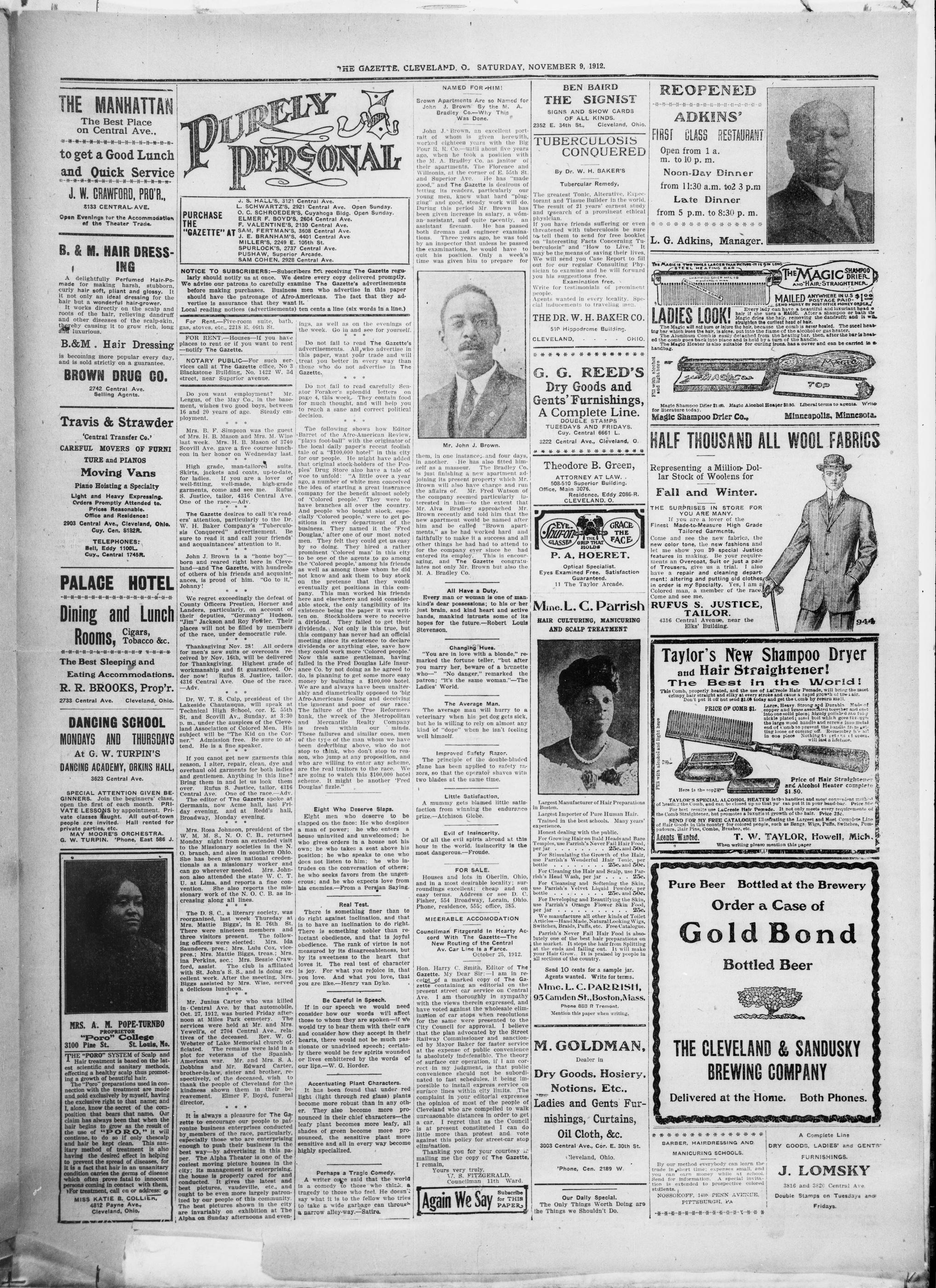
NAMED FOR -HIM!
Brown Apartments are so Named for John J. Brown By the M. A. Bradley Co.-Why This Was Done.
John J. Brown, an excellent portrait of whom is given herewith worked eighteen years with the Big Four R. R. Co.-until about five years ago, when he took a position with the A. A. Bradley, the janitor of their apartments. The Flower and Willsonia, at the corner of E. 55th St. and Superior Ave. He has "made good," and The Gazette is desirous of letting its readers, particularly our young men, know what hard "plugging" and good, steady work will do. During this period Mr. Brown has been given increase in salary, a woman-assistant, and quite recently, an assistant fireman. He has passed both fireman and engineer examinations by an inspector that unless he passed the examinations, he would have to quit his position. Only a week's time was given him to prepare for
M. B.
Mr. John J. Brown.
them, in one instance, and four days, in another. He has also fitted himself as a masseur. The Bradley Co. is just finishing a new apartment adjoining its present property which Mr. Brown will also have charge and run the affairs of. Mr. Fred Watson of the company seemed particularly interested in him—to the extent that Mr. Alva Bradley approached Mr. Brown recently and told him that the new apartment would be named after him and be called "Brown apartments," as he had worked hard and faithfully to make it a success and allot to all the company had to attend to for the company ever since he had entered its employ. This is encouraging, and The Gazette congratulates not only Mr. Brown but also the M. A. Bradley Co.
All Have a Duty.
Every man or woman is one of mankind's dear possessions; to his or her just brain, and kind heart and active hands, mankind intrusts some of its hopes for the future—Robert Louis Stevenson.
Changing Hues
"You are in love with a blonde," remarked the fortune teller, "but after you marry her, beware of a brunette who—" "No danger," remarked the patron; "It's the same woman."—The Ladies' World.
The Average Man
The average man will hurry to a veterinary when his pet dog gets sick, but he is willing to rely on almost any kind of "dope" when he isn't feeling well himself.
The principle of the double-bladed plane has been applied to safety irons, so that the operator shaves with two blades at the same time.
Little Satisfaction
A mummy gets blamed little satisfaction from winning the endurance prize.—Atchison Globe.
Exil of Insincerity:
Of all the evil spirits abroad at this hour in the world, insincerity is the most dangerous. - Froude.
FOR SALE.
Houses and lots in Oberlin, Ohio,
and in a most desirable location; surroundings excellent; cheap and on easy terms. Address or see D. C. Fisher, 554 Broadway, Lorain, Ohio.
Phone, residence, 555; office, 385.
MISERABLE ACCOMODATION
Councilman Fitzgerald in Hearty Acord With The Gazette—The New Routing of the Central Av. Car Line is a Force. 1912
Hon. Harry C. Smith, Editor of The Gazette. My Dear Sir: I am in receipt of a marked copy of The Gazette containing an editorial on the present street car service on Central Ave. I am thoroughly in sympathy with the views therein expressed, and have voted against it. I will stop when resolutions for the same were presented to the City Council for approval. I believe that the plan advocated by the Street Railway Commissioner and sanctioned by Mayor Baker for faster service at the expense of public convenience is absolutely indefensible. The theory of surface judgment is that public convenience should not be subordinated to fast schedules, it being impossible to install express service on surface lines within city limits. The complaint in your editorial expresses the opinion of most of the people of Cleveland who are compelled to walk unreasonable distances in order to get a car. I regret that as the Council is at present constituted, I plan protest and vote against this policy for street-car stop elimination.
Thanking you for your courtesy in
mailing me the copy of The Gazette,
I remain.
Yours very truly.
V. S. FITZGERALD,
Councilman 11th Ward.
Again We Say
Subscribe
for THIS
PAPER
2352 E. 34th St., Cleveland, Ohio.
TUBERCULOSIS CONQUERED
By Dr. W. H. BAKER'S
The greatest Tonic, Alterative, Expectorant and Tissue Builder in the world. The result of 21 years' earnest study and research of a prominent ethical physician. If you have friends suffering or even infected with tuberculosis be sure to tell them to send for free booklet on "Interesting Facts Concerning Tuberculosis" and "How to Live." It may be the means of saving their lives. We will send you Case Report to fill out for our regular Consulting Physician to examine and he will forward his son as a free Examination free. Write for testimonials of prominent people.
Agents wanted in every locality. Special inducements to traveling men.
THE DR. W. H. BAKER CO.
G. G. REED'S
Dry Goods and
Gents' Furnishings,
A Complete Line.
DOUBLE STAMPS
TUESDAYS AND FRIDAYS.
Cuy. Central 6661 L.
3222 Central Ave., Cleveland, O.
Theodore B. Green,
ATTORNEY AT LAW.
508-510 Superior Building.
Office, Main 3076.
Residence, Eddy 2086-R.
CLEVELAND, O.
EYE
Shufor
GLASSES
THE
OPERATION
HOLDS
GRACE
THE
FACE
Optical Specialist.
Eyes Examined Free. Satisfaction
Guaranteed.
11 The Taylor Arcade.
HAIR CULTURING, MANICURING
AND SCALP TREATMENT
Largest Manufacturer of Hair Preparations in Boston. Importer of Pure Human Hair. Trained in the best schools. Many years' experience.
Honest dealing with the public.
For Growing Hair on Bald Head and Bare Tenceles, use Parrish's Never Fail Hair Food, per jar.
25c. and 50c.
For Stimulating the Growth of the Hair, use Parrish's Wonderful Hair Tonic, per bottle
25c. and 50c.
For Cleaning the Hair and Scalp, use Parrish's Head Wash, per jar
25c.
For Cleansing and Softening the Skin, use Parrish's Velvet Liquid Powder, per bottle
25c. and 50c.
For Developing and Beautifying the Skin, use Parrish's Orange Flower Skin Food, per jar
25c.
We manufacture all other kinds of Toilet Articles—HandMade, NaturalLooking Wigs, Switches, Braids, Puffs, etc. Free Catalogue.
Parrish's Never Fail Hair Food is absolutely one of the best hair preparations on the market. It stops the hair from Splitting at the ends and falling out. It will make your Hair Grow. It is praised by people in all sections of the country.
Send 10 cents for a sample jar.
Agents wanted. Write for terms.
Mme. L. C. PARRISH,
95 Camden St., Boston, Mass.
Phone 883 R Tremont.
Mention this paper when writing.
M. GOLDMAN,
Dealer in
Dry Goods, Hosiery,
Notions, Etc..
Ladies and Gents Furnishings, Curtains,
Oil Cloth, &c.
3003 Central Ave., Cor. E. 30th St.
Cleveland, Ohio.
'Phone, Cen. 2189 W.
Our Daily Special.
The Only Things Worth Doing are
the Things we Shouldn't Do.
REOPENED
ADKINS'
FIRST CLASS RESTAURANT
Open from 1 a.m. to 10 p.m.
Noon-Day Dinner
from 11:30 a.m. to 2 p.m.
Late Dinner
from 5 p.m. to 8:30 p.m.
L. G. Adkins, Manager.
THE MAGIC IS TWO TIMES LARGER THAN PICTURE. IT IS
STEEL HEATING BAR.
SHAMPOO CHRISTMAS MAY 19
MOUNTAIN COURSE
LADIES LOOK!
Every lair hair if she Magic dries
The Magic will not burn or injure the hair, because
the hammer curls easily contained froc
ed the comb goes back into place and is held by
The Magic Heater is also suitable for curli
handbag.
FILL WITH ALCOHOL and lightness.
Magic Shampoo Drier $1.00. Magic Alcohol
for literature today.
Magic Shampoo Drier Co.
HALF THOUSAND A
THE M
AND
MAILED
Every lady can have a be
hair if she uses a MAGIC.
Magic dries the hair, removes
stagnant the curled head of
the hair, because the comb is
put into the flame of the alco
detached from the heating b
and is held by turn of the hea
bable for curling irons, has a o
Magic Alcohol Heater 80.50. L.
Co. Minn.
AND ALL WO
The Magic will not burn or injure the hair, because the comb is never heated. The steel heating wire which irons the hair, is easily, put into the flame of the alcohol or gas heater. The Aluminum Comb is easily detached from the heating fan. Then, after the bar is heated the comb goes back into place and is held by a turn of the handle. The Magic Heater is also suitable for curling irons, has a cover and can be carried in handbag.
Fill with alcohol and lighten.
Magic Shampoo Driller $1.50. Magic Alcohol Heater $0.50. Liberal terms to agents. Write for Literature today.
Magic Shampoo Drier Co.
Minneapolis, Minnesota.
HALF THOUSAND ALL WOOL FABRICS
Representing a Million-Dollar Stock of Woolens for
Fall and Winter.
THE SURPRISES IN STORE FOR
YOU ARE MANY.
If you are a lover of the
Finest Makers of High Grade
Tailored Garments.
Come and see the new fabrics, the new color tone, the new fashions and let me show you 39 special Justice features in making. Be your requirements an Overcoat, Suit or just a pair of Trousers, give us a trial, also have a cleaning department; altering and putting old clothes in order is my Specialty. Yes, I am a Colored man, a member of the race. Come and see me.
RUFUS S. JUSTICE,
SAILOR.
4316 Central Avenue, near the Elks' Building.
Taylor's New S
and Hair Stra
The Best in
This Comb, properly heated, and the use of
crimpy hair straight and silky at every str
Don't put it off but send $1.08 today
PRICE OF OOMB $1.
Here is the top
TAYLOR'S SPECIAL ALCOHOL HEATTE
of heating the Comb, and can be closed up so th
For neat,温柔, and LaCrete the Pe
the Comb Straightener, but promotes a luxuria
SEND FOR MY FREE CATALOGUE III
of Hair Goods in this country for colored people
padours, Hair Pins, Combs, Brushes, etc.
Agents Wanted.
T. W.
When writing please
Pure Beer Bottle
Order a
Gold
Bottle
THE CLEVELAN
BREWING
Delivered at the Ho
New Shampoo
Straightener
just in the
and the use of Lacrese Hair R
at every stroke and care and $1.00 today and get the Com-
poUNDMB $1. Large, Heavy, Stre
copper and brace into one solid plece
nickle plate; and the large wood on
the large wood on the end of 1 cmb to p
holding loops or com-
in one piece N
PRICE
and AL
$1.50.
CHOL HEATER is the handiest
closed up so that you can put it
in the place of growth of the
TALOGUE Illustrating the Larg
colored people, such as Benga
hees, etc.
T. W. TAYLOR
writing please mention this pa
Bottled at the
under a Case
old Bo
Bottled Bee
TAYLOR'S SPECIAL ALCOHOL HEATER is the handiest and most convenient method of heat; the Comb, and Comb closed up so that you can put in your hand-bar. Price $25.00 for Comb Straightener, but promotes a luxurious at growth of the hoff. Price $25.00. SEND FOR MY FREE CATALOGUE Illustrating the Largest and Most Complete Line of Hair Goods in this country for colored people, such as Bengs, Wigs, Puffs, Switches, Pom-pads, Hair Pins, Comb, Brushes, etc.
Agents Wanted.
T. W. TAYLOR, Howell, Mich.
When writing please mention this paper
Pure Beer Bottled at the Brewery
ELAND & S
BWING COMP
the Home.
Delivered at the Home. Both Phones.
BARBER, HAIRDRESSING AND
MANICURING SCHOOLS.
By our method everybody can learn the trade in short time; expenses small, and you can earn money while at school. Remember information. A special institution is extended to prospective colored students.
NOSSOKOFF, 1408 PENN AVENUE.
PITTSBURGH, PA
---
PETER H.
IN LONG
THE MAGIC SHAMPOO DRIER
AND HAIR-STRAIGHTENER
MAILED ANYWHERE IN U.S. POSTAGE PAID.
SEND MONEY BY POST OFFICE, MONDAY,
OCTOBER 14. You can have a beautiful and luxurious head
use a MAGIC, after a shampoo or bath tha
the hair, removing the dandruff, and it will
cause the comb is never heated. The steel head
flame of the alcohol or gas shatter
on the heating bar, then, after the bar is hea-
ing irons, has a cover and can be carried in
Reefer $0.50. Liberal terms to agents. Write
Minneapolis, Minnesota.
ALL WOOL FABRICS
944
Shampoo Dryer
Lightener!
the World!
LaCrete Hair Pomade, will bring the most
stroke and cause a rapid growth of the hair.
and get the comb by return mail.
Large, Heavy, glossy, heatable. Made of
copper and brass associated together and cut
into one solid piece; highly polished and fini-
ly plated; assembled and baked into great therapy
the large wood handles and scrape into metal
end of comb to prevent the handle from get-
ting hoose or combs. Price 24.95 for one
in one piece. Nothing else to open,
will last a lifetime.
Price of Hair Straightener
and Alcohol Heater complete
$1.50.
It is the handiest and most convenient method
that you can put in your hand-bar. Price 50.00
and not only meets every requirements of
growth of the hair. Price 24.95 for one
in one piece. Nothing else to open,
will last a lifetime.
TAYLOR, Howell, Mich.
mention this paper
Led at the Brewery
A Case of
Bond
Red Beer
D & SANDUSKY COMPANY
ome. Both Phones.
A Complete Line
DRY GOODS, LADIES' and GENTS'
FURNISHINGS.
ALFRED G. VANDERBILT AMONG MOST WEALTHY
Alfred G. Vanderbilt's thirty-fifth birthday was celebrated on October
20. This fact, of more or less general interest, was very significant to Mr. Vanderbilt himself, because this was the day on which, according to his father's will, he came into full possession of the vast fortune which was left to him. That is to say, $25,000,000, in addition
20. This fact, or more or less general interest, was very significant to Mr. Vanderbilt himself, because this was the day on which, according to his father's will, he came into full possession of the vast fortune which was left to him. That is to say, $25,000,000. This, in addition to the $25,000,000 he received on attaining his thirtieth year, put Mr. Vanderbilt in the ranks of the super-draughts of American finance.
While the sum of Mr. Vanderbilt's fortune is set down at $50,000,000, it is believed by those who have made a study of America's great private fortunes that the holdings of young Mr. Vanderbilt will exceed that amount by several million dollars. This accretion has come in spite of his prodigal expenditures both in this country and abroad.
Alfred G. Vanderbilt is now the master of the wealth left by his father for the reason that his elder brother, Cornelius, lost favor with his father a few years before the latter's death. Had this not occurred the great fortune would now be divided equally between the two brothers. The breach between Cornelius Vanderbilt and his father was never healed, although members of the family and close friends did all in their power to dissipate the elder Vanderbilt's anger against his son. As a consequence, Cornelius was cut off with the comparatively meager sum of $1,500,000, but it is believed, in fact, generally understood, that the "disinherited" son has not been obliged to worry along on his slim inheritance; that both his brother Alfred and his mother have contributed out of their own patrimonies to his purse to the extent of $10,000,000 or $12,000,000.
While Alfred G. Vanderbilt has now become one of America's real wealthy citizens, it is not generally believed that it will have any special or direct effect upon American finance so far as active commerce is concerned. This young millionaire seems never to have had much fancy for business or the manipulation of finance that involves any greater intricacies than the process of maintaining blooded horses and elegant apartments in New York, London and Paris, conducting horse shows and driving coaches. This has been his habit for years and it is not to be expected therefore that he will drop these diversions which he so dearly wants to enter into a business career, for which he has no taste.
Of late years Mr. Vanderbilt has spent most of his time abroad. He favors Europe as a playground more than he does his native country. His passion for coaching found an outlet a few years ago when he established the old coach line between London and Brighton, and he soon became a very familiar figure in the English metropolls sitting on the box of his coach speeding with his fashionable passengers on the way to Brighton. As president of the New York Horse show, Mr. Vanderbilt takes rank as the foremost society horseman in America, and in the circle of those who go in for such things, he enjoys great popularity.
While his social position and wealth gives him a place in the inner temple of society, he has never shown a great taste for the conventional functions of Fifth avenue and Newport nor London's West End.
However, society has always watched his movements with keen interest, and it is not overstating the case to say that he has given society many a piquant theme for drawing room discussion.
Mr. Vanderbilt has been married twice. His present wife was the divorced wife of Dr. Smith Holllins McKim of Baltimore. She is the daughter of Capt. Isaac E. Emerson of Baltimore and Mrs. C. Hazeltine Basshor. The present Mrs. Vanderbilt obtained a divorce from Dr. McKim at Reno, Nev., in 1910, and was married to Mr. Vanderbilt in England the following year. The romance of Mr. Vanderbilt and the beautiful Mrs. McKim is said to date from 1903.
AVERILL HARRIMAN TO WED KATHERINE BRITTON
AVERILL HARRIMAN TO WED KATHERINE BRITTON
Informal announcement of the engagement of Miss Katherine Britton
Averill Harriman has been made Miss Britton is the daughter of Mr. and Mrs. Alexander Britton of Washington, D.C. and young Harriman is the son of the late E. H. Harriman, the railroad magnate.
BENNETT
Miss Britton won fame fi the social circles at the national capita last winter by appearing at a dance with a golden serpent twined about her corsage. The effect was so lifelike that it startled the guests until the wearer assured them it was imade of jewels.
As a devotee of aviation she has also gained some note, having made several flights on the speedway with famous aviators. Harriman is twenty years old. He has had practical training in railroad work.
Name the institution.
"I am in receipt of a surprising letter from a young man who is just out of college."
"What is surprising about it?"
"What is surprising about it?"
"He uses faultless English and his penmanship is so good that I can read every word right off."
Elevation.
"There's always room at the top," said the ready made philosopher. "Yes," replied Mr. Groucher, "but who wants to spend his time in the outfit?"
PRESIDENT OF OLDEST COLLEGE FOR WOMEN
Miss Mary Woolley, the president of Mount Holyoke, the oldest college
by the president or the oldest college for women in America, made the astonishing statement at the opening of that institution. in September that she did not believe in girls working their way through college. This statement aroused a great deal of comment in the college world and of it, too. Miss
for women in America, made the astonishing statement at the opening of that institution. In September that she did not believe in girls working their way through college. This statement aroused a great deal of comment in the college world and out of it, too. Miss Woolley's stand is at such direct variance with the glowing stories published in the many women's magazines that she was requested to give her reasons for thus disagreeing with the optimistic views on the question. In the following exclusive interview Miss Woolley said:
"Snobbery is not at the root of my attitude, which, by the way, is being taken by the majority of the women's colleges, but a conviction that no girl can well serve two masters—her college and her pocketbook.
"Before I go into my reasons for taking so firm a stand on this question, let me tell you something of the place that Mount Holkyo holds in the college world. Then you can see why my stand seems so radical. The impression seems to obtain throughout the country that this college was founded for the poor girl, that it was to be a college where a girl could give service in return for an advanced education. This was not the case and it most certainly is not the case today."
"We are celebrating our seventy-fifth anniversary this week, and we find that the high cost of living, of which the world in general complains, is affecting all departments of our college life. The girl of today has to have a great deal more money than those early girls needed. If it was unwise for the girl of 1837 to work her way she needed but two hundred dollars, is it not trebly unwise for the girl of 1912 to try to do so when she needs six or perhaps seven hundred dollars?
"There are more opportunities, you say, for the girl to make money. Yes, but, alas, there are more girls for those opportunities. When opportunity knocks on the door today there are frequently twenty eager girls rushing to open it. With the growth of fortunes and incomes our problems have increased rather than lessened.
"I have several specific reasons for my attitude on the work question. One is the small amount that a girl is paid for her labor—15 cents an hour or less! Work demands a certain amount of physical labor. We have reduced the house service very greatly and will, perhaps, do away with it entirely before long. At present the girls make their beds, wash silver and the glasses, and wait on the tables. Those duties take about thirty minutes out of the day. Then our physical requirements are increasing each year, and I think they are of the utmost importance. Gynasium work is insisted upon throughout the whole course, and the seniors are required to report four periods of outdoor exercise weekly.
"Back of this 'work' question is the question of what a college education means. If it means just book knowledge, the memorizing of facts and the solving of scientific and mathematical problems, then a girl might work and still keep up with her classes, without injury to herself.
"But college means so much more; it means culture in the best sense of the word. A broadening outlook on life, a quickening of the senses. It means social pleasures and the formation of friendship.
"We never help poor students. We give scholarships to girls that prove their ability and who give promise of being a credit to their alma mater. These scholarships range from fifty to one hundred dollars and only reduce the cost of the tuition, not the board."
PLAIN MRS. MANDER
PROGRESSIVE PRINCESS
A dispatch from Calcutta says that
Princess Pretta, daughter of the rich
daughter of the richest maharajah of Coch Beeh, was married in that city to Lionel Mander. The ceremony was performed according to the Brahma Samar rites.
A
The bride and bridegroom wore Indian costumes at the wedding. The maharaja, Lady Hardinge and Prince and Princess William of Sweden were present at the ceremony. The princes, although born in India and typically Oriental in appearance, is essentially Occidental in her habits of thought. She has spent much of her time in London, where she occupied a prominent position in Anglo-Indian society, and has lived on the continent. At Moritz she established quite a reputation as a daring organist. The princess possesses one of the finest collections of pearls in the world, but her taste in dress and adornment is remarkable for its simplicity. She is extremely modern and progressive. While excelling in all domestic accomplishments, she is extremely fond of outdoor sports.
Child—What's a stag party, mamma?
Merry Widow—A party where there are only gentlemen, dear.
Child—And what do you call a party where there's only ladies?
Merry Widow—I should call it a stagnation party—Judge.
Had Heard of It.
"There's one thing I want to see while I am in Europe."
"And that is?"
"The Hungarian goulah in session."
THE GAZETTE, CLEVELAND, O. SATURDAY, NOVEMBER 9, 1912
CAP
and
BELLS
LITTLE TOT'S READY ANSWER
Fit Very Nicely, Considering Stepmother Got Her "Ready Made," Replied Miss Pollikins.
She was a pretty little tot, and everybody who knew her took pleasure in pausing to ask her some kind of a question, merely to show an interest and for the pleasure of hearing the musical cadence of her voice. Some of the questions were what might be termed leading, but for all she invariably had some kind of an answer. Among these latter inquiries was one from an intrusive busybody who was old enough to know better, but who belongs to a class of person who never learn. Knowing that the little girl had only recently become the possessor of a young and attractive stepmother, with a curiosity inborn she asked her very frankly:
"Well, Pollikins, how do you like your stepmother?"
The child raised her blue eyes gravely, and with her face glowing with happiness replied:
"Oh, very much, indeed. Mrs. Skillington! We fit very nicely, considering that she got us ready made"—Judge's Library.
Kept Her Word.
Senator Root was talking about a certain resourceful corporation. "They can get around anything," he said, a touch of admiration in his voice. "They remind me of a Narragansett girl.
"A Narraganset girl, driving a 60-horse-power gray roadster, admitted: 'Yes, I've accepted David.'
'Why', said the girl beside her, 'you told me positively that If Dave proposed to you your answer would be a word of two letters.'
"The other girl, blushing a little, said softly:
"But I answered Dave in German."
A. Philanthropist.
A north side lumber dealer contracted to supply a lot of lumber to a stranger. On looking it over he found it full of knotholes and told his customer about it frankly.
"You may not want this lumber," he said.
"Why not?"
"I'll have to be honest with you. It is full of knotholes."
The stranger only laughed.
"I'll take it," he declared. "The lumber is to go around some baseball grounds. Knotholes won't hurt matters any. I was a kid myself once."
Mr. Askitt—Why is it, doctor, that so many men are having nervous prostration. They didn't used to have in the old days.
The Old Doctor—No; in the old
dictionary we used to call it tell
delirium tremens.
Where Romance Failed
"I saw a curious item about that famous author of fairy tales who died a few days ago."
"Yes, I saw that he was dead. A man of extraordinary powers of invention."
"Why, you would think so, of course."
"What was the item?"
"Why, it stated that when he happened to be out late with the boys he would go home and stammer and falter and get confused and mixed up, and end by telling his wife the whole story as it happened!"
That Equalized It.
She (pouting)—You don't love me as much as you did. You used to hold on to your knees a whole hour, and now you tire in 45 minutes.
He—I love you just as much, darling, but you know while you were away this summer you gained 25 per cent in weight.
Business Ways.
"His wife is a business woman all right."
"What makes you say that?"
"She's installed a time clock in the hell, and he has to punch it when he goes out nights and when he gets back."
At the Shore.
PRIMARYLY, lots of colours. She has
evolved to worse looking shapes.
you look at her.
SATISFIED WITH OLD GAME
Provisions to Ante-Nuptial Agreement Suggested by Girl Cause Resumption of Love Making.
"Before we proceed any further with our courtship," he said, "would it not be well for us to consider the pre-nuptial agreement? All the best people, you know, are having pre-nuptial agreements now."
Miss Gaythorne looked at him in perplexity for a moment and then answered:
"I don't believe I quite understand you."
"Haven't you read about the pre-nuptial agreement that was entered into by Alfred Gwynne Vanderblit and Mrs. McKim?"
"I don't remember it, if I did. What was it?"
"They had a complete understanding concerning the divorce and the alimony and the disposition of the children and all that sort of thing, so that it would be unnecessary for them to have matters aired in court or published in the newspapers, if they ever decided that their marriage was a failure.
"And you wish to have me enter into an agreement of that kind?"
"It would simplify matters in case we ever found that our wedded life was not what we expected it to be."
"Very well, I will enter into an agreement of that kind if you will let me add a few provisions."
"What have you in mind?"
"Well, for one thing, you are to agree to always consider me the loveliest and most beautiful girl in the world. For another, you are to agree that you will never do or say anything which might cause me to cease to regard you as the ideal man. It will be further agreed that neither of us shall cease to love the other without a sufficient and reasonable cause, and that—" "Oh, pshaw, Bessle," he interrupted, "what's the use of considering the matter any further. Come on over and let's resume hugging and kissing where we left off."
TO MANAGER OFFICE
The Tragedian—They've sent poor Knight Stands to the almshouse.
The Comedian—He won't mind it. He's been used to poorhouses for years.
A Childish Idea.
"Why is it, Willie," his mother complained, "that you won't study? You can never amount to anything in the world unless you have an education, and you can never have an education unless you study. You don't want to grow up and have to be somebody's hired man all you love, do you?"
"No," replied Willie.
"Well, then, what do you think is going to become of you if you keep neglecting to get your lessons?"
"Oh, I can run a correspondence school of some kind, can't I?"
That Was Different.
"Now, Noguchl, in the matter of your wages," said Mrs. De Rich to the candidate for the office of Japanese butler.
"Money no object," smiled Noguchl.
"Oh, indeed! How nice!" said Mrs. De Rich. "You mean that you will work for nothing?"
"No, no, no!" cried Noguchl. "Me mean me no object to money."—Harper's Weekly.
Publicity.
"So you have a grievance against the newspapers," said the publisher, wearily.
"I have," replied Mr. Dustin Stax. "If a man wants to start a business he has to pay for advertising by the inch. But when a candidate comes along it is handed to him gratis by the column."
No Political Authority.
"What became of that smart little office boy you had all during the summer?"
"The chief clerk had to fire him."
"Sorter fell down in his work, eh?"
"Not altogether. It was all right as long as he was a part of the office's baseball controversies, but when he started to butt in on some of the fall politics they had to let him go."
Reflected Fame.
"Who was that very plain-looking man you spoke to so cordially just now?"
"That! Why, that's one of our leading citizens. I've forgotten his name, but his son was in the hop-skip-and-a-bump at Stockholm."
New Cusa Word.
Marks—When Foozler misses an easy one on the golf links he invariably exclaims: "Assouan!" What do you suppose he means?
Parks—Assouan? Oh, he says that because it's the biggest dam he knows of.
**Incompetent.**
Mrs. Kaller—Cooks are such ignorant things nowadays.
Mrs. Justwed—Aren't they? They can't do the simplest things. I asked mine to make some sweetbreads the other day and she said she couldn't—McCall's Magazine.
Stranger Than Fiction
"Well, there was nothing remarkable about that."
"There wasn't, oh! They were not talking show."
FACTS FEATURES and FANCIES for WOMEN NEW YORK.For dinner and evening wear really sumptuous materials are used. There seems
hardly any other word adequate to express their beauty. Brocaded velvets and silver and gold embroidered satins greet one at every turn, while an abundance of lace is used, and the gold and silver trimmings are marvelously beautiful. It is a season of graceful effects. The "raggedy" idea is constantly appearing and, at its best, it means very charming results.
trains for indoor gowns.
Even simple indoor gowns will be made with trains, although they may be short ones, and everything that is essentially feminine is smart. Color is superb when it is right handled, for we are seeing a very generous use of rich oriental effects, and combinations and trimmings sometimes are almost barbaric in suggestion. Hardly dled by trained designers, the results are delightful, but danger in many beautiful fabrics and many a superb clothing, is unduly used or unfortunately applied, they not alone lose their charm, but they became garish and out of taste. The season is one of many possibilities, and it behooves each of us to choose our garments with care. Fashion provides the best examples, and when such are offered it is surely needless to follow the bad.
Embroideries of many kinds are being used and many of them are distinctly novel, while not infrequently really superb effects are obtained by extremely simple means. In a notable autumn trousseau is to be found a gown the foundation of which is dark blue French serge, but it is combined with a loosely woven basket cloth in a delightful shade of buff, and this basket cloth is darned in wools in oriental colors to make the richest possible effect. The gown is not an extremely elaborate one, for the skirt escapes the floor and it can be worn either within doors or upon the street under a coat, but this entirely novel material renders it quite distinctive.
Happily for lovers of the beautiful material broadcloth has come into its own and is being much exploited. An extremely beautiful visiting costume is made of that material in the smoke gray that is so much liked this season. The cost collar and cuffs are trimmed with narrow bands of skunk and the revers and the vest are of ribbed silk in a wonderful shade of red that suggests coral, yet is not exactly that, while their edges are finished with an oriental embroidery in wool threads that is a delight. The beautiful color against the background of quiet toned broadcloth makes a wonderful effect, and, for the earlier season at least, the trimming of fur is practical as well as smart. Enveloping scarfs often are too warm for comfort until midwinter. These trimmled costumes are admirable from every point of view.
Bands of almost every known skirt are to be noted used in such wavy and the simplest are employed by the greatest dressmakers quite as well as the most costly. Suitings and trimmings appear to know almost no limit of variety. Among the extreme novelties is silk coiket cloth and some of the handsomest costumes sent over by M. Worth are made of that material with trimming of fur. The pretty, soft squirrel, or "petit gris," as our French cousins call it, is to be called into requisition for trimming, as well as the more costly skins, and it seems especially well adapted to the younger contingent. A very beautiful coat adapted to afternoon or carriage wear is made of basket cloth in a real delicious shade of coral with turban to match. The collar and cuffs of the coat are of gray squirrel. The turban is bound with the fur and trimmed with two bands round the high crown, while at the left side is a small bunch of maidenhair fern. The coat is loose and ample, easy to slip on and off, and one can fancy a fresh young face a dream of beauty so framed. Women who have found the coats of the kimono model comfortable and a genuine delight to wear, will be glad to know that this model and many another is made in that way. Hats are a little curious in their development and the big hats are mostly low, almost exaggeratedly wide, while the turbans are close fitting with high crowns. This especial one is designed to be drawn well over the head, while the brim rolls closely up to the crown.
Mole Color a Favorite
A great deal of mole color is to be worn and a great deal of yellow, and often the two are combined, although mole is beautiful with many brighter hues. A really fascinating costume designed for the theater, restaurant dinners and occasions of the kind, and which makes part of a trousseau, is made of mole colored chiffon cloth over a foundation of rich green charmeuse satin. The gown is trimmed with mole skin on both skirt and bodice, and accompanying it is a most fascinating set, consisting of muff and neckpiece. The muff is a great big one of the draped chiffon, with bands of fur and plaited frills of the material that fall over the hands.
A Young Girl's Gown
A dark silk frock is almost a necessity in the young girl's wardrobe. One seen recently was sensible and smart. It was navy blue, with a tiny red stripe. The kimono waist buttoned on the left front with red celluloid buttons. The plain skirt had a bliss fold set diagonally on the skirt from the belt to the foot of skirt. On the upper part of this fold, for a little distance below the belt, buttons were set to continue the button line on the waist. A turndown collar and cuffs of
ker" of the fur, with a big bow and long ends of the chiffon, the ends being edged with fur bands that weight them just sufficiently at the same time that they are exceedingly handsome. Smaller neckpieces for the most part take the "choker" form. They are worn very closely about the throat, and, to some extent, have been the outcome of the open collars that are having such vogue. Women who are clever with their needles and of an inventive turn will be able to create novelties of the sort for their own use, for every sort of material is used with fur, lace and chiffon to give a softening effect. For the early season a great many ostrich feather bands will be used in place of fur, and some of the ostrich neckpieces are a real delight.
As must inevitably be the case during a season of such delightfully feminine effects as these, lace is used in abundance upon every known garment. The normal woman always loves dainty and becoming neglectives. This season they are more beautiful than ever before and they take a variety of forms. Tea gowns are once more fashionable for the informal afternoon at home and for the boudou are made the loveliest conceivable toilettes. Pretty ones that are distinctly novel are quite simple in form, but are finished with hoods of lace attached at the neck edge, and these hoods are designed to be drawn up over the head to take the place of the separate cap that has become such an established feature. For the purpose is used the lovely shadow lace that is so generally becoming and the effect is really fascinating at the same time that the hood serves a practical end.
Caps for the Hair.
We are all learning the need of rest for the hair and the pretty little caps that allow of wearing it loosely tucked up for a part of the day at least mean preservation of its beauty, while at the same time they are delightful both to wear and to look up-
M. H.
on. More elaborate negleagues are made in a variety of ways, but the daintest, softest silks plaited either in accordion or very narrow, and plats always are pretty and are much liked, and not infrequently they are worn with fascinating little jackets or coatees of lace. They are fascinatingly lovely. Often these jackets are finished with tiny bands of fur and the effect of the fur on the lace and the soft satin is really revailing. As will be seen, it is indeed a fur season, for fur appears upon costumes for almost every hour of the day. There is talk of a shortage of supply in some quarters, but the display of white foxes in the windows of one of our leading dealers would seem to indicate an unlimited source of supply. The perfectly white skins were there literally in heaps until one almost wondered how there could be room for other creatures upon the earth.
Tweed Costume.
A smartly cut costume is shown in the illustration, and one that would make up well in tweed.
The skirt has a panel front and shape band at sides cut in one and laid on with wrapped seams; buttons and loops form a trimming.
The coat also has panels at back and front connected by the sides, which have tabs cut at the upper edge, a button and lop is sewn; black satin is used for the collar, and the revers are of material; buttons and loops are sewn where they join the collar, these also trim the cuffs and fronts; the fastening is invisible. Hat of black satin, trimmed with feathers.
Materials required: 5 yards tweed 46 inches wide, 2 dozen buttons, ½ yard satin 20 inches wide, 2 yards braid for loops.
white batiste, hemstitched with a red thread and a natty little bow of red silk were the only trimnings on this attractive little dress.
Remodeling Old Lease
Take any old lace edge or ornament and baste on stiff paper. Then with liquid gold paint the lace. Several coats of paint should be applied to make it effective and lasting, being careful to allow each coat to thoroughly dry before the next is applied. The effect is beautiful.
LADY'S WAIST.
5861
There is charm in every line of this attractive waist, yet the model is one that any woman can carry out without any difficulty. The sleeves are nicely tucked at the bottom and finished with a band cuff, or they may be made plain if so preferred. The round neck is collarless and is outlined with a band of insertion. All-over, bordered goods of plain material may be used. The pattern (5861) is cut in sizes 32 to 42 inches bust measure. Medium size will require 2½ yards of 36 inch material, % of a yard of 18 inch all-over and 1½ yards of insertion.
To procure this pattern send 10 cents to "Pattern Department," of this paper. Write name and address plainly, and sure to give size and number of pattern.
NO. 5861. SIZE
NAME
TOWN
STREET AND NO.
STATE
MISSES' FOUR GORED SKIRT.
5847
Here is a charming skirt model for the miss and small woman. The garment is cut in four gores and is made in Empire fashion. It closes at the front and is one of the very easiest designs to carry out. The skirt may be constructed for separate wear or it may serve as part of a complete costume when combined with a pretty waist.
The pattern (5847) is cut in sizes 14, 16 and 18 years. Medium size will require 3% yards of 36 inch material.
To procure this pattern send 10 cents to Pattern Department, of this paper. Write name and address plumbly, and be sure to give size and number of pattern.
NO. 5847. SIZE.
NAME
TOWN
STREET AND NO. STATE
Home.
Home! There is no word more precious than home. It stands for everything lovable and loving. It sums up the life of a man. Home stands for something more sacred than a mere roof-tree, where the members gather for friendly intercourse. It stands for the family, that sacred pillar on which rests the unity and integrity of the state. To interfere with it is to interfere with the state, for the state cannot exist without it. The mother makes the home. She is its mistress and its queen; the hearth on which glow the blazing love fires around which all the family gather for warmth. Home belongs to the mother. It may be a mud hut or a tent upon the wild prairie, but where mother is, there is home. And the place for mother is in the home. Man and women are in nothing alike. Each completes and is completed by the other. The two make up a wondrous, perfect unit—Immaculate Conception Magazine.
To Make Tires of Paper
Experiments have recently been made in Europe looking to the utilization of paper in the manufacture of pneumatic tires, tests recently made having convinced the experimenters that paper has the strength of metal, the elasticity of rubber, and a cheapness that is to be found in neither of these materials: all important qualities.
Painful Discovery
"Well," said the dentist as with a steel instrument he tapped Mr. Ackins's tooth. "I told you when I put that crown on that it might give you trouble. I never guarantee a crowned tooth." "Oh, I know. I wish I'd had the blame thing pulled!" monned Mr. Ackins sadly. "I've found out to my sorrow that uneasy rests the tooth that wears a crown!"
Hia Limit.
The Father-"Can you support my daughter in the style to which she has been accustomed?" The Sultor-"Yes, but not in the style to which her mother and you have been trying to make me think for the past six months she has been accustomed."