The Gazette
Saturday, December 7, 1912
Cleveland, Ohio
Page text (machine-generated)
THE DIVORCE
THERE IS STREETS
THIRD
THIRTIETH YEAR
SACRED
LAKE GUATAVITA
THIRTIETH YEAR. NO. 20.
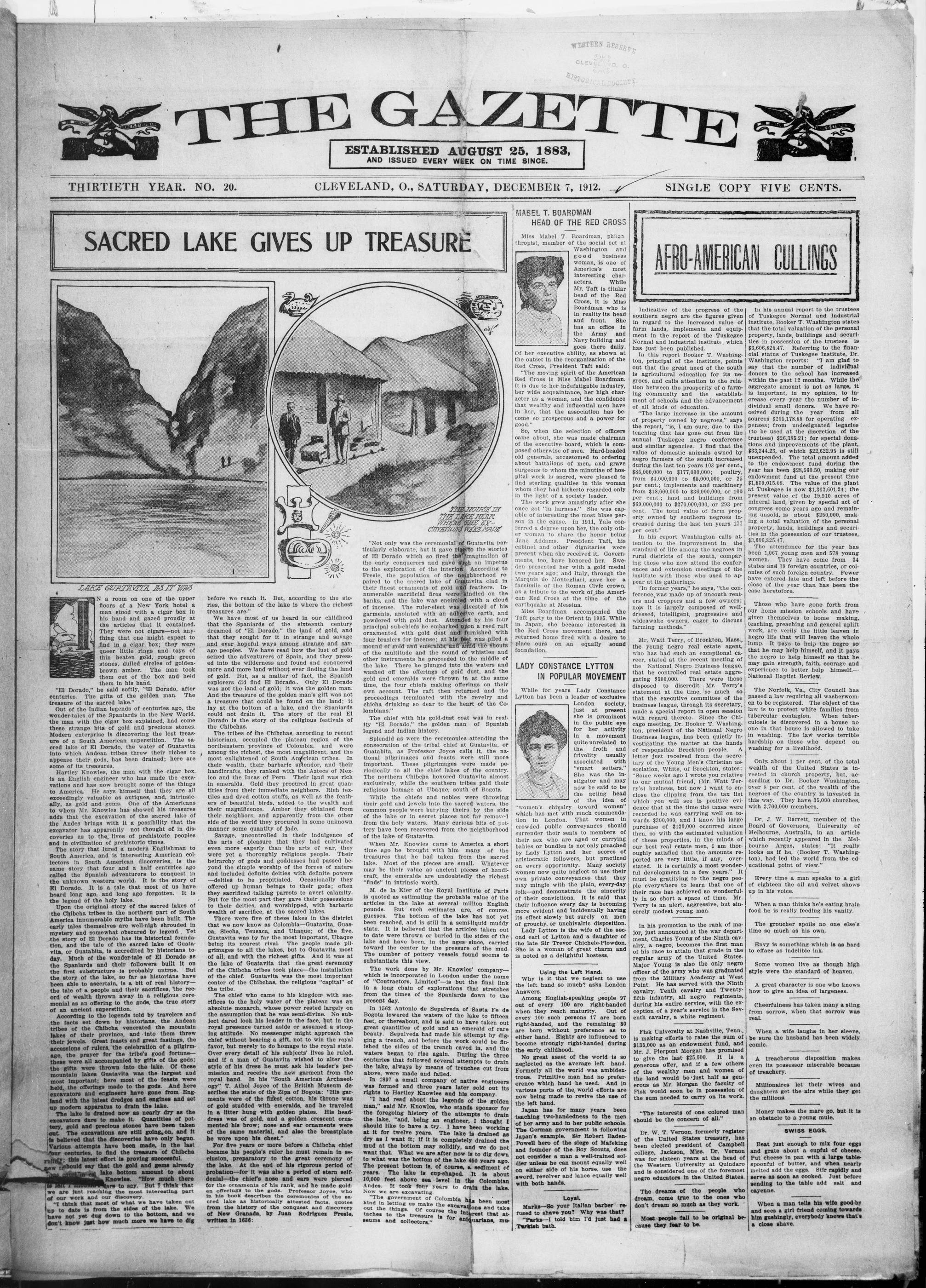
SACRED LAKE GIVES UP TREASURE
THE HOUSE IN
THE LAKE NEAR
WHERE THE EX-
CAVATIONS WERE MADE
"Not only was the ceremonial of Guatavita par-
ticularly elaborate, but it gave rise to the stories
of El Dorado which so fired the imagination of
the early conquerors and gave such an impetus
to the exploration of the interior. According to
Fresle, the population of the neighborhood re-
paired to the sacred lake of Guatavita clad in
"El Dorado," centuries. The treasure of the Out of the In wonder-tales of the man with these strange Modern enterprise of a South cred lake of E into which An appease the treasury of its tre
"El Dorado," he said softly, "El Dornes. The gifts of the golden measure of the sacred lake." Out of the Indian legends of centurys under-tales of the Spaniards in the he man with the cigar box explained these strange bits of gold and premodern enterprise is discovering the he of a South American superstitious lake of El Dorado, the water to which Andean tribes throw the appease their gods, has been drained one of its treasures.
"El Dorado," he said softly, "El Dorado, after centuries. The gifts of the golden man. The treasure of the sacred lake."
Out of the Indian legends of centuries ago, the wonder-tales of the Spaniards in the New World, the man with the cigar box explained, had come these strange bits of gold and precious stones. Modern enterprise is discovering the lost treasure of a South American superstition. The sacred lake of El Dorado, the water of Guatavita into which Andean tribes throw their riches to appease their gods, has been drained; here are some of its treasures.
Hartley Knowles, the man with the cigar box, is an English engineer who has made the excavations and has now brought some of the things to America. He says himself that they are all exceedingly valuable as antiques, and, intrinsically, as gold and gems. One of the Americans to whom Mr. Knowles has showed his treasures adds that the excavation of the sacred lake of the Andes brings with it a possibility that the excavator has apparently not thought of in discoveries as to the lives of prehistoric peoples and in civilization of prehistoric times.
The story that lured a modern Englishman to South America, and is interesting American collectors in South American discoveries, is the same story that four and a half centuries ago called the Spanish adventurers to conquest in the unknown western world. It is the story of El Dorado. It is a tale that most of us have heard long ago, and long ago forgotten. It is the legend of the holy lake.
Upon the original story of the sacred lakes of the Chibcha tribes in the northern part of South America innumerable myths have been built. The early tales themselves are well-nigh shrouded in mystery and somewhat obscured by legend. Yet the story of El Dorado has its historical foundation, and the tale of the sacred lake of Guatavita, or Guatabita, is accredited by historians today. Much of the wonder-tale of El Dorado as the Spaniards and their followers built it on the first substructure is probably untrue. But the story of the lake, so far as historians have been able to ascertain, is a bit of real history—the tale of a people and their sacrifices, the record of wealth thrown away in a religious ceremonial as an offering to the gods, the true story of an ancient superstition.
According to the legends told by travelers and the facts set down by historians, the Andean tribes of the Chibcha venerated the mountain lakes of their provinces, and into them threw their jewels. Great feasts and great fastings, the accessions of rulers, the celebration of a pilgrimage, the prayer for the tribe's good fortune—these were all accompanied by gifts of the gods; the gifts were thrown into the lake. Of these mountain lakes Guatavita was the largest and most important; here most of the feasts were held, the offerings made to the gods. And here excavators and engineers have gone from England with the latest dredges and engines and set up modern apparatus to drain the lake.
The lake is drained now as nearly dry as the excavators dare to make it. Quantities of pottery, gold and precious stones have been taken out. The excavations are still going on, and it is believed that the discoveries have only begun. Various attempts have been made, in the last four centuries, to find the treasure of Chibcha history; this latest effort is proving successful.
"I think that most of what we have taken out up to date is from the sides of the lake. We have not yet dug down to the bottom, and we don't know just how much more we have to dig
RTIETH YEAR.
ACRED L
E GUATAVITA AS IT WAS
N a room on one of the upper floors of a New York hotel a man stood with a cigar box in his hand and gazed proudly at the articles that it contained. They were not cigars—not anything that one might expect to find in a cigar box; they were queer little rings and toys of thin beaten gold, rough green stones, dulled circles of golden-brown amber. The man took them out of the box and held them in his hand.
he said softly, "El Dorado, after gifts of the golden man. The sacred lake." Dian legends of centuries ago, the Spaniards in the New World, he cigar box explained, had come fits of gold and precious stones, use is discovering the lost treasury superstition. The sa-Dorado, the water of Guatavaca can tribes throw their riches to gods, has been drained; here are sures.
he man with the cigar box
before we reach it. But, according to the stories, the bottom of the lake is where the richest treasures are."
We have most of us heard in our childhood that the Spaniards of the sixteenth century dreamed of "El Dorado," the land of gold, and that they sought for it in strange and savage and ever hopeful ways among strange and savage peoples. We have read how the lust of gold seized the adventurers of Spain, and they pressed into the wilderness and found and conquered more and more land without ever finding the land of gold. But, as a matter of fact, the Spanish explorers did find El Dorado. Only El Dorado was not the land of gold; it was the golden man. And the treasure of the golden man's gift was not a treasure that could be found on the land; it lay at the bottom of a lake, and the Spaniards could not drain it. The story of the real El Dorado is the story of the religious festivals of the Chibchas.
The tribes of the Chibchas, according to recent historians, occupied the plateau region of the northeastern province of Colombia, and were among the richest, the most magnificent, and the most enlightened of South American tribes. In their wealth, their barbarian spider, and their wealth, their barbarian snake, they ranked with the Artesan of Mexico and the Incas of Peru. Their land was rich in emeralds. Gold they procured in great quantities from their immediate neighbors. Rich textiles and dyed cotton stuffs, as well as the feathers and magnificence. Amber they obtained from their neighbors, and apparently from the other side of the world they procured in some unknown manner some quantity of fade.
Savage, uncontrolled in their indulgence of the arts of pleasure that they had cultivated even more eagerly than the arts of war, they were yet a thoroughly religious people. Their heirarchy of gods and goddesses had passed beyond the simple worship of the forces of nature and included definite deities with definite powers—deities to be propitied. Occasionally they offered up human beings to their gods; often they sacrificed talking parrots to avert calamity. But for the most part they gave their possessions to their deities, and worshipped, with barbaric wealth of sacrifice, at the sacred lakes.
There were five of these lakes in the district that we now know as Colombia—Guatavita, Guacsa, Siecha, Teusaca, and Uhaque; of the five Guatavita was by far the most important city in the greatest rival. The people made grimages to all the lakes, but to Guatavita most of all, and with the richest gifts. And it was at the lake of Guatavita that the great ceremony of the Chibcha tribes took place—the installation of the chief. Guatavita was the most important center of the Chibchas, the religious "capital" of the tribe.
The chief who came to his kingdom with sacrifices to the holy water of the plateau was an absolute monarch, whose power rested largely on the assumption that he was semi-divine. No subject dared look his leader in the face, but in the royal presence turned aside or assumed a stooping attitude. No messenger might approach the chief without bearing a gift, not to win the royal favor, but merely to domose to the royal state. Over every detail of his subjects' lives he ruled, and if a man of Guatavita wished to alter the style of his dress he must ask his leader's permission and receive the new garment from the royal hand. In his "South American Archaeology" T. Athol Joyce of the British Museum describes the state of the Zipa of Bogota: "His garments were of the finest cotton, his throne was of gold studded with emeralds, and he traveled in a litter hung with golden plates. His head dress was of gold, and a golden crescent ornamented his brow; nose and ear ornaments were of the same material, and also the breastplate he wore upon his chest."
For five years or more before a Chibcha chief became his people's ruler he must remain in seclusion, preparatory to the great ceremony of the lake. At the end of his rigorous period of probation—for it was also a period of stern self-denial—the chief's nose and ears were pierced for the ornaments of his rank, and he made golden offerings to the gods. Professor Joyce, who was a member of the creed lake as historically attested facts, quotes from the history of the conquest and discovery of New Granada, by Juan Rodriguez Freles, written in 1626:
WESTERN RESERVE
ESTABLISHED AUGUST 25, 1883 AND ISSUED EVERY WEEK ON TIME SINCE.
CLEVELAND, O., SATURDAY, DECEMBER 7, 1912.
MABEL T. BOARDMAN
HEAD OF THE RED CROSS
Miss Mabel T. Boardman, philanthropist, member of the social set at
Bushman, pruzier of the social set at Washington and good business woman, is one of America's most interesting characters. While Mr. Taft is titular head of the Red Cross, it is Miss Boardman who is in reality its head and front. She has an office in the Army and Navy building and goes there daily.
good business woman, is one of America's most interesting characters. While Mr. Taft is titular head of the Red Cross, it is Miss Boardman who is in reality its head and front. She has an office in the Army and Navy building and goes there daily.
Of her executive ability, as shown at the outset in the reorganization of the Red Cross, President Taft said:
"The moving spirit of the American Red Cross is Miss Mabel Boardman. It is due to her indefatigable industry, her wide acquaintance, her high character as a woman, and the confidence that wealthy and influential men have in her, that the association has become so prosperous and a power for good."
So, when the selection of officers came about, she was made chairman of the executive board, which is composed otherwise of men. Hard-headed old generals, accustomed to ordering about battalions of men, and grave surgeons to whom the minutie of hospital work is sacred, were pleased to find sterling qualities in this woman whom they had hitherto regarded only in the light of a society leader.
The work grew amazingly after she once got "in harness." She was capable of interesting the most blase person in the cause. In 1911, Yale conferred a degree upon her, the only other woman to share the honor being Jane Addams. President Taft, his cabinet and other dignitaries were present when she received it. Governments, too, have honored her. Sweden presented her with a gold medal two years ago; and Italy, through the maquis de Monteglari, gave her a fragrant bouquet. As a tribute to the work of the Americas can Red Cross at the time of the earthquake at Messina.
"Not only was the ceremonial of Guatavita particularly elaborate, but it gave rise to the stories of El Dorado which so fired the imagination of the early conquerors and gave such an impetus to the exploration of the interior. According to Freslie, the population of the neighborhood repaired to the sacred lake of Guatavita clad in their finest ornaments of gold and feathers. In numerable sacrificial fires were kindled on the banks, and the lake was encircled with a cloud of incense. The ruler-elect was divested of his garments, anointed with an adhesive earth, and powdered with gold dust. Attended by his four principal sub-chiefs he embarked upon a reed raft ornamented with gold dust and furnished with four braziers for incense; at his feet was piled a mound of gold and emeralds, and amid the shouts of the multitude and the sound of whistles and other instruments he proceeded to the middle of the lake. There he plunged into the waters and washed off the offerings of gold dust, and the gold and emeralds were thrown in at the same time, the four chiefs making offerings on their own account. The raft then returned and the proceedings terminated with the revelry and chicha drinking so dear to the heart of the Colombians."
Miss Boardman accompanied the Taft party to the Orient in 1905. While in Japan, she became interested in the Red Cross movement there, and returned home fired with a desire to place ours on an equally sound foundation.
LADY CONSTANCE LYTTON
IN POPULAR MOVEMENT
While for years Lady Constance
Lytton has been a leader of exclusive
London society,
just at present
she is prominent
in the public eye
for her activity
in a movement
quite unrelated to
the froth and
frivolity usually
associated with
"smart setters."
She was the instigator and may
now be said to be
the acting head of
the idea of
A.
The chief with his gold-dust coat was in reality "El Dorado," the golden man of Spanish legend and Indian history.
Splendid as were the ceremonies attending the consecration of the tribal chief at Guatavita, or Guatabita, as Professor Joyce calls it, the national pilgrimages and feasts were still more important. These pilgrimages were made periodically to all the chief lakes of the country. The northern Chibcha honored Guatavita almost exclusively, while the southern tribes paid their religious homage at Ubaque, south of Bogota.
While the chiefs and nobles were throwing their gold and jewels into the sacred waters, the common people were burying theirs by the side of the lake or in secret places not far removed from the holy waters. Many curious bits of pottery have been recovered from the neighborhood of the lake of Guatavita.
"women's chivalry toward women" which has met with much commendation in London. That women in crowded public conveyances should surrender their seats to members of their sex who are aged or carrying babies or bundles is not only preached by Lady Lytton and her scores of aristocratic followers, but practiced on every opportunity. Many society women now quite neglect to use their own private conveyances that they may mingle with the plain, every-day folk—and demonstrate the sincerity of their convictions. It is said that their influence every day is becoming more evident and incidentally having its effect slowly but surely on men of grouchy, or unchivalric disposition.
When Mr. Knowles came to America a short time ago he brought with him many of the treasures that he had taken from the sacred lake. Most of the pieces are small. Whatever may be their value as ancient pieces of handcraft, the emeralds are undoubtedly the richest "finds" in intrinsic worth. M. de la Kier of the Royal Institute of Paris is quoted as estimating the probable value of the articles in the lake at several million English pounds. But such estimates are, of course, guesses. The bottom of the lake has not yet been reached, and is still in a semi-liquid muddy state. It is believed that the articles taken out to date were thrown or buried in the sides of the lake and have been, in the ages since, carried toward the center by the pressure of the mud. The number of pottery vessels found seems to substantiate this view.
Lady Lytton is the wife of the second earl of Lytton and a daughter of the late Sir Trevor Chichele-Plowdon. Lytton is also noted as a delightful hostess.
The work done by Mr. Knowles' company—which is incorporated in London under the name of "Contractors, Limited"—is but the final link in a long chain of explorations that stretches from the times of the Spaniards down to the present day.
Using the Left Hand.
Why is it that we neglect to use the left hand so much? asks London Answers.
Among English-speaking people 97 out of every 100 are right-handed when they reach maturity. Out of every 100 such persons 17 are born right-handed, and the remaining 80 are born without preference as to either hand. Eighty are influenced to become strongly right-handed during the early childhood.
In 1562 Antonio de Sepulveda of Santa Fe de Bogota lowered the waters of the lake to fifteen feet, or thereabout, and is said to have taken out great quantities of gold and an emerald of rare beauty. Sepulveda had made his attempt by digging a trench, and before the work could be finished the sides of the trench caved in, and the waters began to rise again. During the three centuries that followed several attempts to drain the lake, always by means of trenches cut from above, were made and failed.
No great asset of the world is so neglected as the average left hand. Formerly all the world was ambidextrous. Primitive man had no preference which hand he used. And in various parts of the world efforts are now being made to revive the use of the left hand.
In 1897 a small company of native engineers was formed and three years later sold out its rights to Hartley Knowles and his company. "I had read about the legends of the golden man," said Mr. Knowles, who stands sponsor for the foregoing history of the attempts to drain the lake, "and, being an engineer, I thought I should like to have a try. I have been working at it for twelve years. The lake is drained as dry as I want it; if it is completely drained the mud at the bottom may solidify, and we do not want that. What we are after now is to dig down to what was the bottom of the lake 450 years ago. The present bottom is, of course, a sediment of years. The lake is cup-shaped. It is about 10,000 feet above sea level in the Colombian Andes. It took four years to drain the lake. Now we are excavating.
Japan has for many years been teaching two-handedness to the men of her army and in her public schools. The German government is following Japan's example. Sir Robert Baden-Powell hero of the siege of Mafeking and founder of the Boy Scouts, does not consider a man a well-trained soldier unless he can mount equally well on either side of his horse, use the sword, revolver and lance equally well with both hands.
The government of Colombia has been most kind in letting us make the excavations and take care of the lands. Of course the interest that attaches to the treasure is for antiquarians, museums and galleries.
Marks—So your Italian barber refused to shave you? Why was that? "Farks—I told him I'd just had a Turkish bath.
SINGLE COPY FIVE CENTS.
AFRO-AMERICAN CULLINGS
Indicative of the progress of the southern negro are the figures given in regard to the increased value of farm lands, implements and equipment in the report of the Tuskegee Normal and Industrial institute, which has just been published.
In this report Booker T. Washington, principal of the institute, points out that the great need of the south is agricultural education for its negroes, and calls attention to the relation between the prosperity of a farming community and the establishment of schools and the advancement of all kinds of education.
"The large increase in the amount of property owned by negroes," says the report, "is, I am sure, due to the teaching that has gone out from the annual Tuskegee negro conference and similar agencies. I find that the value of domestic animals owned by negro farmers of the south increased during the last ten years 108 per cent, $85,000,000 to $177,000,000; poultry, from $4,000,000 to $5,000,000, or 25 per cent; implements and machinery from $18,000,000 to $36,000,000, or 100 per cent; land and buildings from $69,000,000 to $270,000,000, or 293 per cent. The total value of farm property owned by southern negroes increased during the last ten years 177 per cent."
In his report Washington calls attention to the improvement in the standard of life among the negroes in rural districts of the south, comparing those who now attend the conferences and extension meetings of the institute with those who used to appear at its gatherings.
"In former years," he says, "the conference, was made up of uncut renters and croppers and a few owners; now it is largely composed of welldressed, intelligent, progressive and wideawake owners, eager to discuss farming methods."
Mr. Watt Terry, of Brockton, Mass., the young negro real estate agent, who has had such an exceptional career, stated at the recent meeting of the National Negro Business league, that he controlled real estate aggregating $500,000. There were those disposed to discredit Mr. Terry's statement at the time, so much so that the executive committee of the business league, through its secretary, made a special report in open session with regard thereto. Since the Chicago meeting, Dr. Booker T. Washington, president of the National Negro Business league, has been quietly investigating the matter at the hands of responsible Brockton people. A letter just received from the secretary of the Young Men's Christian association, White, of Brockton, states: "Some weeks ago I wrote you relative to our mutual friend, (Mr. Watt Terry's) business, but now I want to enclose the clipping from the tax list which you will see is positive evidence that at the time the taxes were recorded he was carrying well on towards $300,000, and I know his large purchase of $120,000 occurred since then, so with the estimated valuation of these properties, in the minds of our best real estate men, I am thoroughly satisfied that the amounts reported are very little, if any, overstated. It is certainly a most wonderful development in a few years." It must be gratifying to the negro people everywhere to learn that one of their race has achieved so wonderfully in so short a space of time. Mr. Terry is an alert, aggressive, but sincerely modest young man.
In his promotion to the rank of major, just announced at the war department, Charles Young of the Ninth cavalry, a negro, becomes the first man of his race to attain that grade in the regular army of the United States. Major Young is also the only negro officer of the army who was graduated from the Military Academy at West Point. He has served with the Ninth cavalry, Tenth cavalry and Twenty-fifth infantry, all negro regiments, during his entire service, with the exception of a year's service in the Seventh cavalry, a white regiment.
Fisk University at Nashville, Tenn., is making efforts to raise the sum of $135,000 as an endowment fund, and Mr. J. Pierpont Morgan has promised to give the last $25,000. It is a generous offer, and if a few others of the wealthy men and women of the land would be just half as generous as Mr. Morgan the faculty of Fisk would soon be in possession of the sum needed to carry on its work.
"The interests of one colored man should be the concern of all."
Dr. W. T. Vernon, formerly register of the United States treasury, has been elected president of Campbell college, Jackson, Miss. Dr. Vernon was for sixteen years at the head of the Western University at Quindaro and is considered one of the foremost negro educators in the United States.
The dreams of the people who dream, come true to the ones who don't dream so much as they work.
Most people fall to be original because they fear to be.
In his annual report to the trustees of Tuskegee Normal and Industrial institute, Booker T. Washington states that the total valuation of the personal property, lands, buildings and securities in possession of the trustees is $3,606,254.47. Referring to the financial status of Tuskegee Institute, Dr. Washington reports: "I am glad to say that the number of individual donors to the school has increased within the past 12 months. While the aggregate amount is not as large, it is important, in my opinion, to increase every year the number of individual small donors. We have received during the year from all sources $205,178.88 for operating expenses; from undesignated legacies (to be used at the discretion of the trustees) $2,355.21; for special donations and improvements of the plant, $33,444.23, of which $22,622.95 is still unexpended. The total amount added to the foundation fund during the year has been $28,560.50, making our endowment fund at the present time $1,859,015.08. The value of the plant at Tuskegee is now $1,362,601.24; the present value of the 19,910 acres of mineral land, given by special act of congress some years ago and remaining unsold, is about $50,000, making a total valuation of the personal property, lands, buildings and securities in the possession of our trustees, $3,606,254.47.
The attendance for the year has been 1,067 young men and 578 young women. They have come from 34 states and 19 foreign countries, or colonies of such foreign country. Fewer have entered late and left before the close of the year than has been the case heretofore.
Those who have gone forth from our home mission schools and have given themselves to home making, teaching, preaching and general uplift work, are verily the little leaven in negro life that will leaven the whole lump. It pays to help the negro so that he may help himself, and it pays the negro to help himself so that he may gain strength, faith, courage and experience to better help himself—National Baptist Review.
The Norfolk, Va., City Council has passed a law requiring all washerwomen to be registered. The object of the law is to protect white families from tubercular contagion. When tuberculosis is discovered in a house no one in that house is allowed to take in washing. The law works terrible hardship on those who depend on washing for a livelihood.
Only about 1 per cent of the total wealth of the United States is invested in church property, but, according to Dr. Booker Washington, over 8 per cent. of the wealth of the negroes of the country is invested in this way. They have 35,000 churches, with 3,700,000 members.
Dr. J. W. Barrett, member of the Board of Governors, University of Melbourne, Australia, in an article which recently appeared in the Melbourne Argus, states: "It really looks as if he, (Booker T. Washington), had led the world from the educational point of view."
Every time a man speaks to a girl of eighteen the oil and velvet shows up in his voice.
When a man thinks he's eating brain food he is really feeding his vanity.
The groucher spoils no one else's time so much as his own.
Envy is something which is as hard to efface as indelible ink.
Some women live as though high style were the standard of heaven.
A great character is one who knows how to give an idea of largeness.
Cheerfulness has taken many a sting from sorrow, when that sorrow was real.
When a wife laughs in her sleeve, be sure the husband has been widely comic.
A treacherous disposition makes even its possessor miserable because of treachery.
Millionaires let their wives and daughters get the airs while they get the millions.
Money makes the mare go, but it is an obstacle to a young mule.
SWISS EGGS.
Beat just enough to mix four eggs and grate about a cupful of cheese. Put cheese in pan with a large table-spoonful of butter, and when nearly melted add the eggs. Stir rapidly and serve as soon as cooked. Just before sending to the table add salt and cayenne.
When a man tells his wife good-by and sees a girl friend coming towards him gushingly, everybody knows that's a close shave.
One Year.....$1.50
Six Months.....1.00
Three Months......50
Subscribers are requested to rem-
mit by postoffice money or-
der or registered letter.
Entered at the postoffice In Cleveland
Ohio, as second-class matter
Address all communications to
HARRY C. SMITH
Editor and proprietor,
THE GAZETTE,
Blackstone Building, Cleveland, O.
Member Ohio Legislature: 1894
to 1896; 1896 to 1898; 1900 to 1902
THE GAZETTE is the oldest, and has the largest bona fide circulation, double that of any newspaper in the interest of Afro-Americans, published in the state of Ohio, and comparison with any will immediately establish its rank as one of the NEWSIEST AND BEST in the country.
Miss Beatrice Dawson has recently been appointed a teacher of domestic science in Chicago's public schools. She is a graduate of that city's Teachers' College. Good! This is encouraging.
Please remember that a year's subscript to The Gazette, for a friend or relative, is a Christmas gift that will be appreciated and that will be a weekly reminder of you for twelve months or one year. Try it!
The Jacksonville (Fla.) Daily Promoter, Geo. E. Taylor, manager, has made its appearance—a fine one, too! Welcome! Brother. We wish you every success. The Promoter is our only daily newspaper.
Do not squander money during the coming holiday season because you will surely and sorely need it before the expiration of next year. Use judgment in giving, having pleasure, etc., and SAVE all you can for future use. Be wise, this time.
Dr. Iryuil, Japanese orator, lecturing in the interest of world peace urged less self-conceit and more charity on the part of Americans toward other races, in an address to the faculty and students of the University of California, recently. Entirely too much color and race prejudice in this country, he says, and truthfully too
According to a prominent Afro-American office-holder at Washington, D. C., Cyrus F. Adams, until recently assistant Register of the Treasury, is to blame for the National Republican Executive Committee's refusal to spend any money with Afro-American newspapers as it did with other publications during the campaign just closed.
Editor John Mitchell is "going some" in the financial world, these days. Warmest congratulations, confere. As president of a bank and president of our first Trust Co., he is setting such a rapid pace that he is leaving our other bankers far in the rear. See our Richmond, Va., letter elsewhere in this paper.
U. S. Senator Isider Rayner of Maryland is dead. Though a Jew, he was one of the most persistent and harmful enemies of the race we have in that state. Like many other mis-representatives of his race, it seems that he sought to lessen the prejudice against the Jews in Maryland and the country by increasing that against our people.
The American daily newspaper that apparently located in Los Angeles, Cal. Monday. From that place came a "dispatch" to the daily papers, repeating the lie of several weeks ago which stated that Jack Johnson was so unpopular in Australia, as a result of his love affairs with white women, that he would be hooted and mobbed if he were to pass along the streets of Sidney or Melbourne.
Gov. Cole Blease of South Carolina, who we are sorry to say, was reelected (by a small majority) in recent months, has again leaped into the limo-light advocating "lynching of Negroes," and now easily overshadows those other Southern blather skites, Dixon, Tilfman, Vardaman, Jeff. Davis and Heflin, all of whom might be spared to join Senator Rayner and the entire country greatly benefited as a result. Blease's advocacy of lynch-murder, at the twenty-fifth Governor's conference held in Richmond, Va., Tuesday, is characteristic of the individual, who seems to be absolutely mentally incapable of rising to the dignity of the highest office within the gift of the citizens of the state of South Carolina—a position he disregards.
A FEMALE "COLE. BLEASE."
About ten days ago a woman by the name of Ida Vera Simonten, who poses as "a lecturer on Africa," and author of a book by the name of "Hell's Play ground," addressed the Women's Club (white) of this city. Among the things she said were, that she had spent three years "alone on an island in the heart of 'Darkest Africa;'" that two attempts were made to poison her, both by her cook, "but I caught him each time and after giving him a good beating, let him go. He never bothered me again;" that "the difference between the Negro brain and that of the white man, as declared by Lom-roso, was borne out;" that "the Negro learns all of the white man's vices but none of his virtues," and that "when it comes to choosing between the civilized Negro and the univilized one, I choose the latter."
"Nuff sed." They say that "like runs to like." Therefore, it is easily understood why the Simouton woman prefers the uncivilized Negro. That she is of the "Cole. Blease" order—crazy to bask in the lime-light of sensationalism, before the country—is quickly and easily seen, and made clear, in the sentences taken from her
alleged lecture in this city, recently, and republished above. What we cannot understand is how the good ladies of the Women's Club (white) of this city came to be invigiled into engaging this woman "lecturer." Her statements are so largely at variance with truth and fact, that further comment is unnecessary.
HEROIC ELEVATOR BOY
The burning of the Hotel St. George, which resulted in the loss of three lives and the maiming of twenty other persons, is one of those catastrophes that could have been avoided. The fact that the death roll did not reach 50 or more was due to the heroic efforts of the Negro elevator boy, who at the risk of his life, visited each of the floors and ran along the halls, arousing the sleeping inmates by crying fire. Returning to the elevator he kept it in operation rescuing guests until the flames took possession of the shaft. With his clothes all affame he fled to the streets where the fire of burning clothes was extinguished and he sent to a hospital suffering from numerous burns.
In recounting the deeds of heroism displayed there the newspapers have little to say of the heroic elevator boy because he is a Negro. Had he been suspicioned of a theft of a ring or some trifle, the tale would have been told under big headlines. When a Negro is charged with a crime, the white newspaper men, regardless of section or politics, lose their heads in their eagerness to tell the world know about it; but haven't the moral courage to tell the world when the Negro does a commendable thing—Los Angeles (Cal.) Liberator.
This condition, as far as our press and the daily papers are concerned, is now general throughout this country. It was not so in the north, particularly, until in recent years, and is the direct result of the growth of a baneful prejudice, and the great increase in "southern" control of the newspaper news-agencies, and the increase in the number of southern and southern-sympathizing employees on northern daily newspapers. These agencies and newspapers will "fall over one another" in their haste to "herald to the four corners of the world" anything sensational or rediculous that will prove harmful to our people, and all know it. And still the latter will patronize them, as a rule, in preference to our own papers, good or otherwise, and have the poor judgment (the politest way to put it) to boast of it in the hearing of others. Some Negroes just love to be to "kicked"—by the other class or race, and in their ignorance or cowardice or truckling spirit, revel in the same.
THE AFTERMATH
We hope that now all will see that even Jack Johnson has a right, under the law, to marry whom he pleases—if the woman he desires is willing. The effort of numerous prejudiced persons and the prejudiced daily press, as well as a few misguided Negroes, to make the opposite seem true, is positively silly and foolish.
This matter of marriage is so private a personal matter, even though thoroughly "alred" in the daily news papers of the entire country, that it is a mighty poor fool of a man or woman who will tamely submit to outside interference in their affairs of such a nature.
Jack Johnson has "handed" the prejudiced South, and their fool-friends in the north, "a body-blow that will hold them for a whirl," and the fool-daily-press of the country has promoted inter-marriage rather than discouraged it by their contemptible airing of the Johnson-Cameron-Schroeder cases and the Johnson-Cameron love affair. Mark our prediction and see if this latter does not prove to be the case.
Our only regret, in connection with the white American daily press Johnson-Cameron-Schroeder "mess," is that innocent members of the race, in all parts of the country, will have to suffer from a vastly increased prejudice, for awhile at least, as a direct result of it. However, since this very thing had to be "threshed out" in this country in this way, at some time or other, it is possibly best that it is done now.
Admiral Hawke's Ambition
When Admiral Hawke was a boy, about to go to sea for the first time, his father gave him much good advice, ending up with the words, "I hope to live to see you a captain." "A captain!" answered the boy; "if I did not think I should one day be an admiral I would not go to sea at all."
Why He Hesitated
"Why didn't you go to the assistance of the defendant in the light?" asked the judge of a policeman. "Shure," was the answer, "an 'Ol didn't know which av them was goin' to be th' defendant, yer honor."
CORRESPONDENTS WANTED
The old reliable Gazette desires an active agent and correspondent in every city and town in Ohio and neighboring states having a number of Afro-American residents. Only a little time on Fridays or Saturdays is required.
We are especially desirous of hearing from persons in the New York City, Nashville, New Lancaster, Lebanon, Chillicothe, Teledo, Troy, Canton, Springfield, Plaqua, Columbus, Cambridge, Steubenville, Bellaire, St. Clairsville, Wilmington, Portsmouth, Washington, C. H., Oxford, Sabina, Gallipolis, Rendville, Urbana, Delaware, M. Vernon, East Liverpool, Wellsville, Akron, Dayton, Middleport, Bellefontaine, Lima, O., and other places where we have none.
Write to the editor of The Gazette. Blackstone building, Cleveland, O. will be sent promptly. Our readers will oblige us greatly by sending at once the addresses of persons in the cities named above, or others, to whom we can write relative to the matter.
Houses and lots in Oberlin, Ohio,
and in a most desirable location; sur-
roundings excellent; cheap and on
easy terms. Address or see D. C.
Fisher, 554 Broadway, Lorain, Ohio.
Phone, residence, 555; office, $85.
THE GAZETTE, CLEVELAND, O. SATURDAY, DECEMBER 7, 1912
[Illustration of a man in a suit with a bow tie and a badge on his lapel.]
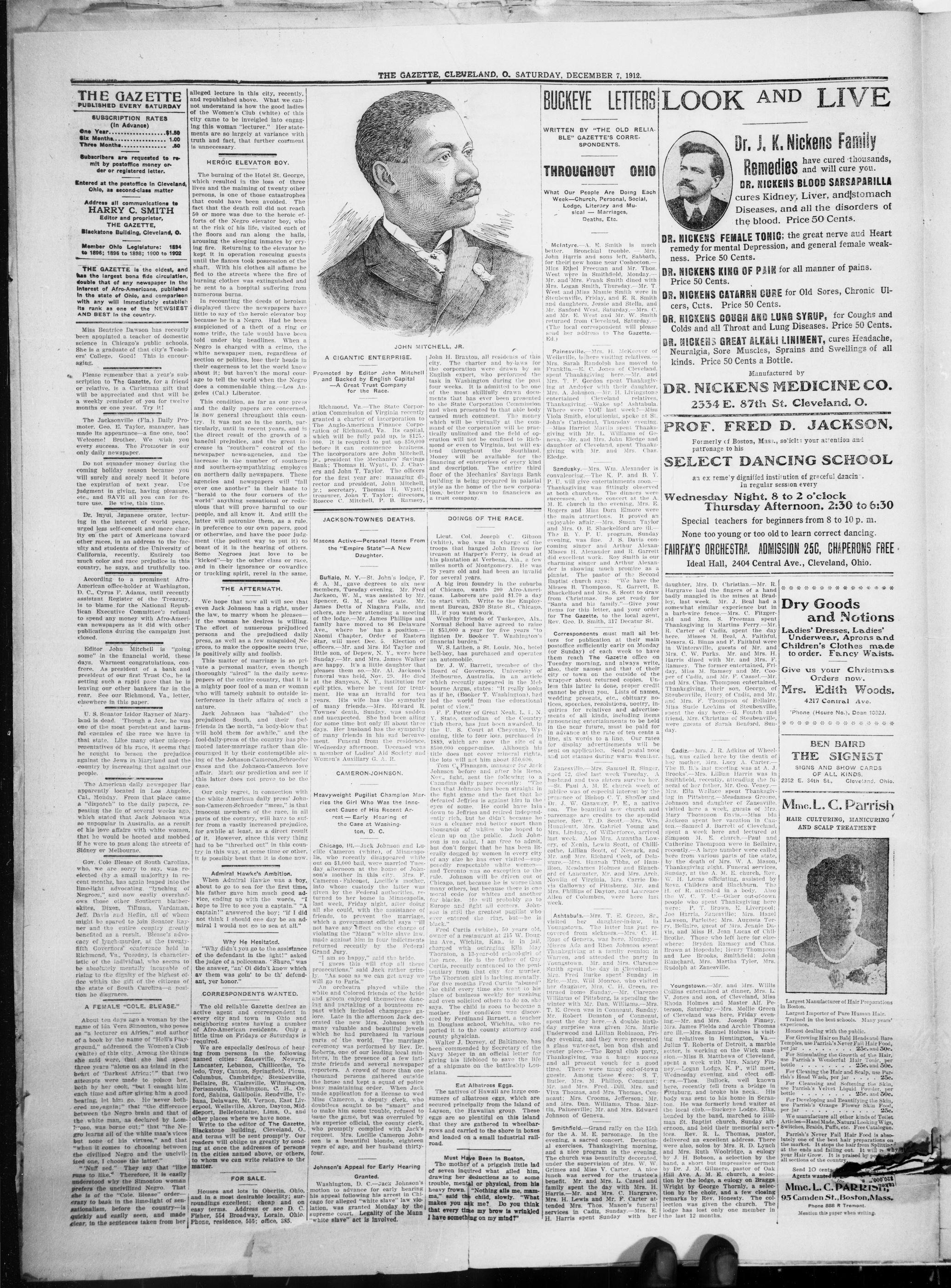
JOHN MITCHELL, JR
Promoted by Editor John Mitchell and Backed by English Capital —A Great Trust Company for the Race.
Richmond, Va.-The State Corporation Commission of Virginia recently granted a charter of incorporation to The Anglo-American Finance Corporation of Richmond, Va. Its capital, which will be fully paid, is $25,000. It is required to put up $50,000 before it can commence business. The incorporators are John Mitchell, Jr. president the Mechanics' Savings Bank; Thomas H. Wyatt, D. J. Chavers and John T. Taylor. The officers for the first year are: managing director and president, John Mitchell, secretary, H. Wyatt, treasurer, John T. Taylor; directors, Roscoe C. Mitchell, P. B. Ramsey,
JACKSON-TOWNES DEATHS.
Masons Active—Personal Items From the "Empire State"—A New Daughter.
Buffalo, N. Y.—St. John's lodge, F. & A. M., gave degrees to six new members, Tuesday evening. Mr. Fred Jackson, W. M., was assisted by Mr. Spencer, G. M., of the state. Mr. James Detts of Nigara Falls, and others, are here attending a meeting of the lodge—Mr. James Phillips and family have moved to 88 Delaware Ave., where he has a position—Railroad Order of Eastern Railroad Dec. Election of officers—Mr. and Mrs. Ed Taylor and little son, of Depew, N. Y., were here Sunday—Mr. and Mrs. James Walker are happy. It's a little daughter that pleases them so—Mr. Al. Jackson's funeral was held, Nov. 29. He died at the Sanyean, N. Y., institution for epil ptics, where he went for treatment. He was an invalid for ten years. His wife has the sympathy of many friends—Mrs. Edward R. Townes, Sunday, was sudden and unexpected. She has been in the house all about three days. Her husband has the sympathy of many friends in his sad bereavement. Funeral from the residence, Wednesday afternoon. Deceased was a member of Ladies' Aid Society and Women's Auxiliary G. A. R.
Heavyweight Pugilist Champion Ma-
ries the Girl Who Was the Innocent Cause of His Recent Arrest—Early Hearing of the Case at Washington, D. C.
Chicago, IL.—Jack Johnson and Lauille Cameron (white), of Minneapolis, who recently disappeared while out on $1,000 bail, were married Tuesday afternoon in the home of Johnson's mother in this city. Mrs. F Cameron - Falconet, Lauille's mother, into whose custody the latter was held, was turned to her home in Minneapolis, last week, Friday night, after doing all she could, with the assistance of friends, to prevent the marriage, which a government official says "will not have any effect on the charge of violating the "Mann" white slave law, made against him in four indictments returned recently by the Federal Grand Jury.
"I am so happy," said the bride. "I see this will all these prosecutions," said Jack rather grimly. "As soon as we can get away we will go to Paris."
An orchestra played while the white and Colored friends of the bride and groom enjoyed themselves dancing and partaking of a bountiful reapst which included champagne gala. Late in the afternoon Jack decoded the tables and many valuable and beautiful jewels which he had purchased in various parts of the world. The marriage ceremony was performed by Rev. Dr. Roberts, one of our leading local ministers, in the presence of a few intimate friends and several newspaper reporters. A crowd of more than one thousand persons gathered outside the church to enjoy a busy maintaining order. When Jack made application for a license to wed Miss Cameron, a deputy clerk, who doubtless sought to be "smart" and to make him some trouble, refused to issue the game, but was overruled by his superior official, the county clerk, who promptly complied with Jack's request. The son is a beautiful blonde, eighteen years of age, and her husband thirty-four.
Johnson's Appeal for Early Hearing Granted
Washington, D. C.—JACK Johnson's motion to advance for early hearing his appeal following his arrest in Chicago for alleged "white lion" lionization. Monday by the county court. Legality of the Mann "white slave" act is Involved.
CAMERON-JOHNSON.
John H. Braxton, all residents of this city. The charter and by-laws for the corporation were drawn by an English expert, who performed the task in Washington during the past four weeks. It is admitted to be one of the most skillfully drawn documents that has ever been presented to the State Corporation Commission and when presented to that able body caused much comment. The money which will be virtually at the command of the corporation will be practically unlimited and the field of operation will not be confined to Richmond or on the Fremont, Richmond, throughout the Southland. Money will be available for the financing of enterprises of every kind and description. The entire third floor of the Mechanics' Savings Bank building is being prepared in palatial style as the home of the new corporation, better known to financiers as a trust company.
DOINGS OF THE RACE
Lieut. Col. Joseph C. Gibson (white), who was in charge of the troops that hanged John Brown for treason at Harper's Ferry, is dead at his plantation at Verbena, Ala., a few miles north of Montgomery. He was 79 years old and had been an invalid for several years.
A big iron foundry in the suburbs of Chicago, wants 200 Afro-Americans. Laborers are paid $1.70 a day to with, with. Write to the Employer Bureau, 288 State St. Chicago, Ill., if you want work.
Wealthy friends of Tuskegee, Ala., Normal School have agreed to raise it $5,300 a year for five years "to lighten Dr. Booker T. Washington's financial burden."
W. S. Lathen, a St. Louis, Mo., hotel bell-boy, has purchased and operates an automobile.
Dr. J. W. Barrett, member of the Board of Governors, University of Montgomery, an art school which recently appeared in the Melbourne Argus, states: "I really looks as if he, (Booker T. Washington) had led the world from the educational point of view."
F. F. Potter of Great Neak, L. I. N. Y. State, custodian of the Country Club there, has just been awarded, in the U. S. Court at Cheyenne, Wyoming, title to four lots, purchased in 1889, which are now the site of a museum. The title does not cover mineral rights, the lots will not be umb about $50,000.
Tom C. Flanagan, manager for Jack Johnson before and after his Reno, Nev., fight, sent the following to a Canadian daily paper recently: "The fact that Johnson has been straight in the fight game and the fact that he defeated Jeffries is against him in the eyes of some. He could have lain down to Jeffries and retired independently rich but he didn't because he had been so successful thousands of whites who hoped to clean up on the public. Jack Johnson is no saint, I am free to admit, but don't forget that he has been literally dogged by women in every city of any size he has ever visited—supposedly respectable white women—and Toronto was no exception to the rule. Johnson will be driven out of Chicago, not because he is worse than many others, but because there is one moral code for whites and another for blacks. Europe and fight all comers. Johnson is still the greatest pugilist who ever entered the ring, but—he is black."
Fred Curtis (white), 50 years old, owner of a restaurant at 215 W. Douglas Ave, Wichita, Kan., is in jail, charged with outraging Ella May Thornton, a 13-year-old schoolgirl of the race. He is the father of Guy Curtis, recently sentenced to the penitentiary from that city for murder. The Thornton girl is lacking mentally. For five months Fred Curtis "abused" the child every time she went to his place of business weekly for washing and even solicited others to do so, she says. The child is soon to become a mother. Her condition was discovered by Ferdinand Barnett, a teacher in Douglass school, Wichita, who reported it to the county attorney and county physician. Vavil J. Dorser, of Baltimore, has been commended by Secretary of the Navy Meyer in an official letter for giving his lifeblood to save the life of a shipmate on the battleship Louisiana.
The natives of Hawaii are large consumers of albatross eggs, which are secured principally from the Island of Layson, the Hawaiian group. These eggs are so plentiful on this island that they are gathered in wheelbarrows and carried to the shore in boxes and loaded on a small industrial railroad.
Must Hake Been In Rests
Must Have Been in Boston.
The mother of a priggish little lad of seven inquired what allied him, drawing her deductions as to some trouble, mental or physical, from his heavy frown. "Nothing ails me, mamma," said the child, slowly. "What you ask you ask me? Do you think that every time my brow is wrinkled I have something on my mind?"
Eat Albatross Eggs
BUCKEYE LETTERS LOOK AND LIVE
WRITTEN BY "THE OLD RELIABLE" GAZETTE'S CORRESPONDENTS.
THROUGHOUT OHIO
What Our People Are Doing Each Week—Church, Personal, Social, Lodge, Literary and Musical — Marriages, Deaths, Etc.
Mcintyre.—A. E. Smith is much better. Bronchial trouble. — Mrs. John Harris and sons left, Sabbath, for their new home near Coshoction. — Miss Ethel Freeman and Mr. Thos. West were in Smithfield, Monday. — Mr. and Mrs. Frank Smith dined with Mrs. Logan Smith, Thursday. — Mr. T. West and Miss Mamie Smith were in Steubenville, Friday, and E. R. Smith and daughters, Jessie and Stella, and Mrs. West, Saturday. Mrs. C. and Mr. E. West and Mr. W. Smith returned from Cleveland. Saturday. (The local correspondent will please send her address to The Gazette-Ed.)
Painesville—Mrs. H. McKeever of Wellsville, is here visiting relatives.—Mrs. Sarah Randoboh has moved to Franklin—E. C. Jones of Cleveland, spent Thanksgiving here.—Mr. and Mrs. T. F. Gordon spent Thanksgiving at Andover with their daughter, Mrs. A. Johnson.—Mr. H. Livingstone entertained | Cleveland relatives, Thanksgiving.—Wake up! Ashtabula. Where were YOU last week?—Miss Viola Smith, locutionist, spoke at St. John's Cathedral, Thursday evening.—Miss Harriet Martin spent Thanksgiving, neva.—Mr. and Mrs. John Eledge and daughter of Cleveland, spent Thanksgiving with Mr. and Mrs. Chas Eledge.
Sandusky.—Mrs. Wm. Alexander is convalescing. The K. P., and B. Y. P. U. will give entertainments soon. Thanksgiving was fittingly observed at both churches. The dinners were successes. At the concert at the A. M. E. church on the evening, E. M. E. church and Miss D.J. Elmore have the main attractions. It proved an enjoyable affair.—Mrs. Susan Taylor and Mrs. O. B. Shackellier are ill. The B. Y. P. U. program, Sunday evening, was fine. J. S. Davis conning singer and Arthur Alexan-Misses H. Alexander and R. Garrett charming singer and Arthur Alexander is showing much promise as a pianist. The pastor of the Second Baptist church says: "We have the Misses B. Thompson, R. Garrett, B. Shackellier and Mrs. S. Scott to draw from Christmas. So get ready for the items for this letter, and your order for The Gazette, to the local agent, Rev. Geo. D. Smith, 317 Decatur St.
Correspondents must mail all letters for publication at their main postoffice sufficiently early on Monday (or Sunday) of each week to have them reach The Gazette office on Tuesday morning, and always write, also, their names and that of their employer, and the wrapper about returned copies. Unless this latter is done, proper credit cannot be given you. Lists of names, wedding presents, etc., obituary notices, speeches, resolutions, poetry, inquiries for relatives and advertisements of all kinds, including items announcing entertainments to be held in advance at the rate of ten cents a line, six words to a line. Our rates for display advertisements will be sent on application. Send postal note and not stamps during warm weather.
Zanestes—Mrs. Samuel R. Singer, aged 72, died last week Tuesday. A husband and two sisters survive her. St. Paul A. M. E. church week of jubilee was of especial interest by the presence of Bishop C. T. Shoffer and Dr. J. W. Gazaway, P. E., a native son. The beautiful new church and parsonage are credits to the spendid Hunticutt, Rev. D. Dr. Cohen, Mrs. Gabriel Young and Mrs. Lindsay, of Wilbertson, arrived last week. Also Mrs. Amanda Lowery, of Xenia, Lewis Scott, of Chillcothe, Lillian Scott, of Newark, and Mr. and Mrs. Richard Cook, of Delaware. Mrs. Hannah Tibbs, of Hamilton, Mesdames Holmes and Blanchard of Lancaster, Mr. and Mrs. Arch. Novillin of Virginia, Mrs. Carrie Dale, Mrs. Phillips of Dayton, and Lawrence Allen of Columbus, were here last week.
Ashtabula,—Mrs. T. E. Green, Sr., visited her daughter-in-law, in youngstown. The latter has just recovered from sickness—Mrs. C. H. Ross of Geneva, was here. Monday—Misses Ada and Rhon Johnson spent Thanksgiving at a family reunion in Warren, and attended the party in youngstown. Mr. and Mrs. Clarence the mother and niece of Mrs. Fred Burke spent Sunday in Erie—Mrs. Will Monroe who visited her daughter, Mrs. C. H. Green, returned home Sunday—Mr. Clarence Williams of Pittsburg, is spending the winter with Mr. Dan, Williams—Mrs. T. E. Green was in Conneaut, Sunday. Mr. Robert Dunston of Conneaut, spent the day here. A double birthday celebration of Mrs. Underwood and Lillian Robinson, Friday evening, and they were presented a glass waterset, bon bon dish and center piece. The Royal club party, Thanksgiving, was a huge success and all present vouch for a good time. There were many out-of-town guests. Among these were: S. T. Butler, Mrs. M. Phillip, Conneaut; Mr. and Mrs. Fred Dillon, Mrs. and Mrs. Food and Drink, Mrs. and neaut; Mrs. Crooms, Jefferson; Mr. and Mrs. Dan, Williams, Thos Martin, Palineville; Mr. and Mrs. Edward Johnson of Geneva.
Smithfield.—Grand rally on the 15th for the A. M. E. parsonage. In the evening, a sacred concert. Devotional exercises. Thanksgiving morning, and a nice program in the evening. The church was beautifully decorated. The choir sang in the Grimes and Miss V. Carter. A nice lunch was served for the trustee's benefit. Mr. and Mrs. L. Cassel and family spent the day with Mrs. H. Harris.—Mr. and Mrs. C. Hargrave, Mrs. H. Lewis and Mr. C. Carter at services in Cadiz, Sunday—Mrs. E. H Harris spent Sunday with her
Remedies have cured thousands, and will cure you. DR. NICKENS BLOOD SARSAPARILLA cures Kidney, Liver, and stomach Diseases, and all the disorders of the blood. Price 50 Cents. DR. NICKENS' FEMALE TONIC; the great nerve and Heart remedy for mental Depression, and general female weakness. Price 50 Cents.
DR. NICKENS FEMALE TONIC
remedy for mental Depression
ness. Price 50 Cents.
DR. NICKENS KING OF PAIR
Price 50 Cents.
DR. NICKENS CATARRH CURS
cers, Cuts. Price 50 Cents.
DR. NICKENS COUGH AND LU
Colds and all Throat and Lung
DR. NICKENS GREAT ALKALI
Neuralgia, Sore Muscles, S
kinds. Price 50 Cents a Box
Manufacturer
DR. NICKENS M
2534 E. 87th S
PROF. FRED
Formerly of Boston, Mass.,
patronage to his
SELECT DANCE
an extremely dignified inst
in regular s
Wednesday Night, 8
Thursday Afternoon
Special teachers for begin
None too young or too old
FAIRFAX'S ORCHESTRA. ADMIN
Ideal Hall, 2404 Central
DR. NICKENS KING OF PAIN for all manner of pains. Price 50 Cents.
DR. NICKENS CATARRH CURE for Old Sores, Chronic Ulcers, Cuts. Price 50 Cents.
DR. NICKENS COUGH AND LUNG SYRUP, for Coughs and Colds and all Throat and Lung Diseases. Price 50 Cents.
DR. NICKENS GREAT ALKALI LINIMENT, cures Headache, Neuralgia, Sore Muscles, Sprains and Swellings of all kinds. Price 50 Cents a Bottle.
Manufactured by
DR. NICKENS MEDICINE CO.
2534 E. 87th St. Cleveland, O.
Formerly of Boston, Mass., solicits your attention and patronage to his
SELECT DANCING SCHOOL
an extremely dignified institution of graceful dancing.
in regular session every
Wednesday Night, 8 to 2 o'clock
Thursday Afternoon, 2:30 to 6:30
Special teachers for beginners from 8 to 10 p. m.
None too young or too old to learn correct dancing.
FAIRFAX'S ORCHESTRA. ADMISSION 25C, CHAPERONS FREE
Ideal Hall, 2404 Central Ave., Cleveland, Ohio.
daughter, Mrs. D. Christian.—Mr. R. Hargrave had the fingers of a hand badly mangled in the mines at Bradley, last week. Mr. J. Beal had a somewhat similar experience but in a bar-bite fence.—Mrs. C. Fitzgerald and Mrs. S. Freeman spent Thanksgiving in Martins Ferry.—Mr. Carter spent M. Berry spent M. Cassier spent M. Faithless Messrs. G. Binus and F. Faithful were in Wintersville, guests of Mr. and Mrs. C. W. Parks. Mr. and Mrs. H. Harris dined with Mr. and Mrs. F Ramsey. The former entertained, Friday, Miss M. Ramsey and Mr. Cooper of Cadiz, and Mr. F. Cassel, and Mrs. Chas. Thompson entertained, Thanksgiving, their son, George, of Steubenville, and Mr. F. Cassel, and Mrs. F. Flemey of Steubenville, F. Flemey of Steubenville, spent the day here.—G. Foutch and friend, Mrs. Christian of Steubenville, were guests of Sarah Benford, Sunday.
Cadiz—Mrs. J. R. Adkins of Wheeling, was called here by the death of her mother, Mrs. Lucy A. Carter. The B. B's last meeting was at A. J. Brooks'—Mrs. Lillian Harris was in Smithfield, recently, attending the funeral of her father, Mr. Geo. Veney. A funeral in Pittsburgh—Midamedes Jacone, Johnson and daughter of Zanesville, visited here a week, guests of Mrs. Mary Thompson Davis—Miss Ida Jackson spent her vacation in Canton, Samuel J. Barrett of Cleveland, spent a week here and lectured at Simpson M. E. church—Paul and Samuel M. E. church—Bolton recently. A large number were called here from various parts of the state, by the death of Mrs. W. A. Mason. Thanksgiving night. Funeral services, Sunday, at the A. M. E. church, Rev. W. H. Lucas officiating, assisted by Revs. Childers and Blackburn. The O. of attendance a body. the W. H. Lucas officiating, assisted by people who spent Thanksgiving here were, P. T. Brown E. Liverpool; Joe Harris, Zancville; Mrs. Hazel Lawson, Parlette; Mrs. Augusta Terry, Bellaine, guest of Mrs. Jennie Davis, and Miss H. Jean Lucas of Chilicote. Those who left here for elsewhere, Bryden Ramsey and Chas. and Lee Brooks, Smithfield and Lee Brooks, Smithfield; John Blanchard, Martha Tyler, Mrs. Rudolph at Zanesville.
Youngstown.-Mr. and Mrs. Willis Collins entertained at dinner, Mrs. L. V. Jones and son, of Cleveland, Miss Rhoda Holmes and Master ALF, Peterson, Saturday.-Mrs. Mollie Green of Cleveland was here, Friday evening. Mrs. L. V. Jones and son, of Cleveland, Field and Arch Thomas are ill.-Mrs. Samuel Holmes is visiting relatives in Huntington, Va.-Julius T. Roberts of Detroit, a marble setter, is working on the Wick man迹-Miss B. Matthews of Cleveland, spent a week with Mrs. Nancy Finney-Logan Lodge, K. P., will meet, Wednesday evening, and elect officers.-Theos. Bullock, well known for his bridge bridge, will bridge Pittsburgh and broke his neck. His body was sent to his home in Scranton. He was formerly head waiter at the local club.-Buckeye Lodge, Elks, headed by the band, marched to Hillman St. Baptist church, Sunday afternoon, and held their memorial services. Rev. R. L. Thomas, pastor, delivered an excellent address. There were also, solos by Mrs. R. D. Lynch and Mrs. J. D. Lynch, by J. H. Bobson, a selection by the band, a short but impressive sermon by Dr. J. M. Gilmere, pastor of Oak Hill Ave. A. M. E. church, a selection by the lodge, a eulogy on Braggs Wright by George Thornly, a selection by the choir, and a few closing remarks by Rev Honesty. The collar of the church the lodge has lost only one member in the last 12 months.
```markdown
```
A. M.
Dry Goods and Notions
Ladies' Dresses, Ladies'
Underwear, Aprons and
Children's Clothes made
to order. Fancy Waists.
Give us your Christmas
Orders now.
Mrs. Edith Woods.
4217 Central Ave.
'Phone (House No.), Doan 1032J.
BEN BAIRD
THE SIGNIST
SIGNS AND SHOW CARDS
OF ALL KINDS.
2352 E. 34th St. Cleveland, Ohio.
HAIR CULTURING, MANICURING
AND SCALP TREATMENT
Largest Manufacturer of Hair Preparations in Boston.
Trained in the pure Human Hair.
Trained in the best schools. Many years' experience.
Honest dealing with the public.
cleaning with the paddle.
For Growing Hair on Bald Head and Baro
Temples, use Parish's Never Fail Hair Food,
per jar, **25c** and **50c**.
For Stimulating the Growth of the Hair,
use Parish's Wonderful Hair Toner, per
bottle, **25c** and **50c**.
For Cleaning the Hair and Scalp, use Parish's
Hair Toner, as per jar, **25c**.
For Cleaning the Hair and Beautifying the Skin,
use Parish's Orange Flower Skin Food,
per bottle, **25c**.
We manufacture all other kinds of Text
Articles—Hand-Made, Natural Looking W
Switches, Braids, Puffs, etc. Free Catalogue.
Parish's Never Fail Hair Food is absolutely one of the best hair preparations on the market. It stops the hair from Splitting
at the ends and falling out. It will be
used in all sections of the country.
Send 10 cents
Agents wanted
B . 0000 005$
Mme. L. C. PARRIS,
95 Camden St., Boston, Mass.
Phone 888 R Tremont.
Mention this paper when writing.
Theodore B. Green,
ATTORNEY AT LAW.
508-510 Superior Building.
Office, Main 3076.
Residence, Eddy 2086-R.
CLEVELAND, O.
G. G. REED'S
Dry Goods and
Gents' Furnishings,
A Complete Line.
DOUBLE STAMPS
TUESDAYS AND FRIDAYS.
Cuy, Central 6661 L.
3222 Central Ave., Cleveland, O.
THE MANHATTAN
The Best Place
on Central Ave..
to get a Good Lunch
and Quick Service
J. W. CRAWFORD, PRO'R.,
2133 CENTRAL AVE.
Open Evenings for the Accommodation
of the Theater Trade.
B. & M. HAIR DRESS-
ING AND TONIC
HAS PROVEN SUCH A BIG
SUCCESS THAT THE
Haa purchased the full control, and will start PLACING AGENTS all over the OUT-OF-TOWN AGENTS WENTED.
Write for full particulars to the
2742 Central Ave. CLEVELAND, OHIO
Travis & Strawder
CAREFUL MOVERS OF FURNI
TURE and PIANOS
Moving Vans
Piano Hoisting a Specialty
Light and Heavy Expressing.
Orders Promptly Attended to.
Prices Reasonable.
Office and Residence:
2903 Central Ave., Cleveland, Ohio.
Cuy, Cen. 8182R.
TELEPHONES:
Bell, Eddy 1100L.
Cuy., Central 1745R.
PALACE HOTEL
Dining and Lunch
Rooms, Cigars,
Tobacco &c.
The Best Sleeping and Eating Accommodations.
R. R. BROOKS, Prop'r.
2733 Central Ave. Cleveland, Ohio.
A.
MRS. A. M. POPE-TURNBO
PROPRIETOR
"Poro" College
3100 Pine St. St. Louis, Mo.
THE "Poro" SYSTEM of Scalp and
Hair treatment is based on the last
scientific and sanitary methods,
effecting a healthy scalp thus promo-
tating a growth of beautiful hair.
The "Poro" preparations used in connection with the treatment are made and sold exclusively by myself, having the exclusive right to that name; and I, alone, know the secret of the composition that bears that name. Our claim has always been that when the hair begins to grow it must of the use of "HORO" it will continue to do so if only thesecalp and hair be kept clean. This sanitary method of treatment is also rutilated the desired effect in helping new hair to the spread of diseases, for in an unsanitary manner the terms of disease persons coming in contact with them. For more information, call MISS KATIE B. COLLIER, 4812 Payne Ave., Cleveland, Ohio.
---
PURELY PERSONAL
PURCHASE
THE
"GAZETTE" AT
J. S. HALL'S, 3121 Central Ave.
L. SCHWARTZ'S, 2921 Central Ave. Open Sunday.
O. C. SCHROEDER'S, Cuyahoga Blvd. Open Sunday.
ELMER F. BOYD'S, 2604 Central Ave.
F. VALENTINE'S, 2130 Central Ave.
SAM, FERTMAN'S, 3608 Central Ave.
J. E. BRANHAM'S, 4401 Central Ave.
MILLER'S, 2249 E. 105th St.
SPURLOCK'S, 2737 Central Ave.
PUSHAW, Superior Arcade.
SAM COHEN, 2928 Central Ave.
NOTICE TO SUBSCRIBERS:--Subscribers not receiving The Gazette regularly should notify us at once. We desire every copy delivered promptly. We advise our patrons to carefully examine The Gazette's advertisements before making purchases. Business men who advertise in this paper should have the patronage of Afro-Americans. The fact that they advertise is assurance that they want it. Local reading notices (advertisements) ten cents a line (six words in a line.)
For Rent.—Rooms, all modern improvements. 2332 E. 90th St.
For Rent.—Six room house with bath. Inquire of Geo. Brooks. 2327 E. 90th St.
FOR RENT.—Houses—If you have places to rent or if you want to rent—notify The Gazette.
For Rent.—Six room cottage. 2380 E. 33d St., and a five room suite. 2218 E. 33d St. Enquire at 2214 E. 46th St.
NOTARY PUBLIC—For such services call at The Gazette office, No 3 Blackstone Building, No. 1422 W. 3d Street, near Superior avenue.
Ben. Baird, the "signist," writes us "The Gazette is fine as an advertising medium." Let the people know you wants through this paper and you will be successful.
The management of the Old Folk's Home should beware of real estate events—so one of the obligatory items be issued of the association. Write the Gazette. She points to the recent sae experience of Triedstone Baptist church.
One of the best cooks in the city is Mrs. L. Armstrong, who recently opened a restaurant and lunch room
For Rent—Five rooms, upstairs, bath, gas, etc. $15 per month, at 2506 Central Ave. 'Phone East 3600 M or North 1172 R.
For Rent—Large room for light housekeeping; also a single room. Inquire at 2223 E. 43d St. 2t
For Rent—Furnished front room, every convenience, for married couple. 2165 E. 22nd St. ::
There were a number of enjoyable dances at Orkins' hall, last week. * * *
Be sure to read and call your friends' attention to our "For Rent" and "Wanted" advertisements.
Mr. Silas Dixon's eye trouble compelled him to defer his contemplated trip to Youngstown, Thanksgiving.
Rev. J. L. E. Burr left, Monday, for Columbus, to attend an important meeting of a Baptist organization.
Messrs. Roger and Charles Dillard and wives, visited their mother, Mrs. Mary Lee of Youngstown, Thanksgiving.
Mr. Sands of E. 28th St., has moved to 2836 Pine Ave. He returned, recently, from a visit with his mother, in Virginia.
Dr. A. J. M. Howard of E. 31st St., entertained Dr. J. K. Nickens and family at a delicious “goose” dinner. Thanksgiving.
Master Roscoe Simms who has been on the lakes, this season, after a brief visit with his sisters, left, Sunday, for Ashtabula.
Mrs. Rufus S. Justice is in Columbus, this week, attending a meeting of the K. P. State Endowment board of which she is a member.
Judge Manuel Levine will be the speaker at the Du Bois literary club's lyceum at Antioch Baptist church, Sunday afternoon, Dec. 15.
Our City Federation of Women's clubs held an important meeting at its Social Settlement house, Central Ave., last week, Friday evening.
U. G. Weir of Chicago, court stenographer, formerly a resident of this city, visited his brother, T. C. Weir of 3857 Carnegie Ave., recently.
Go to P. A. Hooret, 11 The Taylor Arcade, for eye glasses, etc. This is one of the leading places in the city for the very best in that line, at honest and reasonable prices.—Adv.
Do not forget "The Manhattan." J. W. Crawford, proprietor, 3133 Central avenue, when you desire a good lunch or meal, and quick service. Open all night.—Adv.
Miss Mae Harris of Lorain, visited Miss Mamie Yates of Blainte Av., Thanksgiving. The latter accompanied her home, Sunday, returning in the evening.
"Shark bait" is what an exchange calls our people who patronize money-leaders like those that infest Central Av. almost from one end to the other. "Shark bait," is good.
Do not fall to read The Gazette's advertisements. All who advertise in this paper, want your trade and will treat you better in every way than those who do not advertise in The Gazette.
M. Goldman, 3003 Central Av., cor. E. 30th, dealer in dry goods, hostery, hottions, ladies' and gents' furnishings, curtains, oil cloth, etc., is too well known to need further introduction. Be sure to remember him, particularly, from now until the first of the year—during the holiday season.—Adv.
---
Mrs. F. J. Kitzmiller of 1850 Superior Av. gave an enjoyable reception, last week Friday afternoon, in honor of her sister-in-law from Knoxville, Tenn., who is visiting her. Mrs. Kitzmiller entertained the Episcopal choir, Wednesday evening.
The newly renovated Palace Hotel, R. R. Brooks, proprietor, has the very best sleeping and eating accommodations. Do not forget to tell your friends, at home and abroad, of the Palace Hotel, 2733 Central Ave.-Adv.
Mr. Daniel Fairfax of 2193 E. 35th St., an old and highly respected resident, died last week after months' illness and suffering. Age. 60 years.
Funeral, Tuesday, from the family residence. He leaves a wife, three children, a host of friends and a host of friends to mourn his demise. Rev. G. V. Clark officiated, assisted by Rev. H. C. Bailey.
THE GAZETTE, CLEVELAND, O. SATURDAY, DECEMBER 7, 1912.
Ben. Baird, the “signist,” writes us: “The Gazette is fine as an advertising medium.” Let the people know your wants through this paper and you will be successful.
The management of the Old Folk's Home should beware of real estate agents—so one of the intelligent members of the association writes The Gazette. She points to the recent sad experience of Triedstone Baptist church.
One of the best cooks in the city is Mrs. L. Armstrong, who recently opened a restaurant and lunch room at 2432 Central Av. Everything clean and neat; the very best home cooking and quick service.—Adv.
```markdown
```
Mrs. Mary Bradford of Cincinnati mother of Wm. Austin of 2043 Central Ave., died recently. He returned to the city, Wednesday, after attending the funeral, and has the sympathy of many friends. *
L. G. Adkins has never served bigger, better, cleaner or more whole some meals than he is providing in his newly renovated restaurant at 2613 Central Ave. Popular prizes and the very best service. Go in and see for yourself.—Adv. *
Mrs. Mary A. Brunch, 63, died at her residence 2001 Orange Ave. Nov. 26 Funeral services, the 29th alt., Rev. E. H. Smith officiating. Internment in E. Cleveland cemetery. E. F. Boyd funeral director. *
A. M. Mills, who formerly owned the grocery store at the corner of Central Av., and E. 30th St., has re-purchased it from A. H. Harper, and scores of old residents of that section of the city are greatly pleased. He has hosts of real good friends among all classes of friends of that section, particularly among our people.
If you wish **The Gazette** delivered to you, every week, by our carrier, send word, or a postal card with your address, to Cyril Dandridge, 4710 Central Ave. Local items for publication can be handed to him also. Only subscribers' papers are sent through the mail.
High grade, man-tailored suits, Shirts, jackets and coats, up-to-date for adults. If you have a lover of well-fitting, well-made, high-grade garments, come and see me. Rufus S. Justice, tailor, 4316 Central Ave One of the race. —Adv.
The case of Wm. J. Collins (white), charged with manslaughter, was considered by the Grand Jury last Thursday morning and this week. Monday morning. He is the chauffeur who operated the Cleveland Electric Illuminating Company's automobile that killed Junius Carter, in Central Av. Oct. 27.
We wish to call our readers' attention, particularly, to the display advertisement of the Select Dancing School in Ideal Hall, 2404 Central Avenue, Ft. Ford Jackson, formerly of Boston, Mass., is in charge and has the assistance of Mr. John Fairfax and his excellent orchestra. This school is designed to be above the average in every way. Call your friends' attention to it. Adv.
The Working Girls' Christian home, incorporated under the laws of Ohio, gave an enjoyable reception for widows and poor little children. Thanksgiving evening, at its headquarters, Mr. Carey presented the president and J. F. Beason, secretary of the home. In addition to other exercises by the young folk, a good program was rendered. Rev. J. H. Guther, Rev. Carter and the chaplain, Wm. Crossen, the president, Mr. McCarey, Mrs. Jensen, Mrs. Goss, Mr. Carey, Mrs. Exxon, Mr. McCarey, and Mr. Beason addressed addresses, and Mr. Beason spoke on "Thanksgiving."
"What is it the Chinese laundry-men, up Central avenue, put in the water that ruins my white shirts, is something I would like to know," said a well-known member of the race who resides in the 12th ward. "In the last year nearly one dozen have been ruined. The cloth gets so brittle after the shirts have been laundered three or four times, they break into boles about the cuff-bands and under the shirt bosom if they are 'drawn' the slightest." Some person, a member of the race, ought to open a good laundry in the Central avenue, and soon.
Mrs. Clara Haar, formerly of this city, and Mr. Geo. Allen of Pittsburgh, were married there, Sunday, at the bride's residence, 3 Rowley St. by Rev. P. A. Scott. The bride wore a beautiful gown of helloprote de sva and carried a bouquet of lavender chrysanthemum and muscari. Beatrice and Jessie and Mrs. Ada Shelton, were the bride's maids. Miss Jessie was dressed in blue satin covered with blue net lace; Miss Beatrice wore white satin, and Mrs. Shelton, black lawn over white messaline with pearl trimmings, and carried a bouquet of American Beauties. The bride was given a horseback ride. The Wheeler, of this city. The out-of-town guest was C. E. Webster of this city. Covers were held for Option, Pa., the home of the groom, who is a prosperous farmer.
Messrs. Lands and Wm. Brown of Lorain, are here visiting. * * * * *
Mrs. H. C. Walker moved recently to Mr. and Mrs. R. J. Havilow's residence, 10621 Arthur Ave. * * * * *
The Climber's Rally Club will give an entertainment at St. John's A. M. E. church, Tuesday evening. * * * * *
C. H. Hunt, tailor, Central Ave., is preparing to locate in Pasadena, Cal. He will leave next week. * * * * *
One of the leading bankers of the British Empire is an African, who resides at Johannesburg, South Africa. * * * * *
The third annual indoor picnic will be held at the Forest St. armory (E. 37th St.), Wednesday and Thursday evenings. * * * * *
Our local Elks held their memorial services, Sunday, at St. John's A. M. E. church, Dr. Chas. Bundy preaching the sermon. * * * * *
Mr. and Mrs. J. H. Hui, of 3018 Scovill Ave., wish to thank the many friends for their kind assistance during the illness, and at the death of his mother.
Mr. Chas. Hansbary of Painesville, who spent the summer on the lakes, was in the city, last week, on route home for the winter season. He said: "Send me The Gazette; we must have it in our home."
Ladies! Ladies!! Ladies!!!! Don't you know that Mrs. Edith Woods, a member of the race, has the nearest and nicest dry goods and notion store in Central Av., at No. 4217? See advertisements in this paper and patronize her.—Adv.
The Cleveland Benevolent Association met at Mrs. S. C. Green's, Monday evening, received $14.08 from its members, and voted $25 to the Cleveland Associated Charities. This is more excellent work. The Association is a credit to our people and to the city.
Shiloh Baptist church was packed, Sunday noon, when the pastor, Rev. E. H. Smith, baptized 34 persons, 22 being women, and two couples being newlyweds. The converts were all made during Shiloh's recent exceptionally successful revival.
Our Old Folks' Home was given a Thanksgiving donation—a wagon-load of provisions for the winter—by Sterling, Marion and Brownell public schools. Mrs. P. W. Lemon was in charge, with assistants. The Association returns thanks for the same.
The Chicago Defender published a portrait of Henry T. Eubanks, last week, and in connection with a "book" he and the Douglass Insurance Co., which white men were promoting here, and Eubanks representing some months ago. It is said that the company is dead.
The Gazette desires to call attention, particularly, to Dr. J. K. Nickens's splendid advertisement elsewhere in this paper. Some of the best physicians of both races, in the city, recommend highly the Doctor's medicines, while hundreds of his patrons do likewise. Try *-* -* -* - Adv.
"Hold-up advertising" is the way program and other similar advertising was characterized by R. R. Shuman of Chicago at the Cleveland Advertising club luncheon last week Friday noon. Members of the nation's Advertising Clubs of America attended. "This sort of advertising simply is 'big stick' coercion. Its value is on a pair with the junk shop."
From Senator Joseph B. Foraker's speech at the St. Louis convention nominating William McKinley for president, we take the following: "Over against this fearful penalty (the panic of 1833) we can set down one great blessed compensatory result. It has destroyed the Democratic party and makes us miserable here the Democratic party will go out of power on the 4th day of March, 1837, to remain out of power until God in his wisdom and mercy and goodness shall see fit once more to chastise his people."
Antioch Baptist church made the fourth best showing in the matter of attendance at the "Stackhouse" banquet at Chamber of Commerce hall, last week. Friday evening. There were 700 men at the banquet. Dr. Stackhouse, who is soon to college, big, big, big. The Baptists, take a big "hit" with the audience when he said, in substance, that all men were brothers in Christ; that he talked to white audiences and to Afro-American audiences, but that he liked best to address mixed audiences like the one he was going to talk to. He had no thought of color or race, and where they were all mixed (even in the seating of the guests) without any reference whatever to race, class or color, etc.
Our leading people in this community should beware—a "jim crow" Y. M. C. A. stranger has drifted into the city from "New York" or elsewhere and is quietly at work. Our people should remember the recent experiences of our people in "Chicago Downtown" and Boston or "As quickly resulted in "jim crow" or separate schools and many other color lines that were not in existence in those communities before the establishment of the "jim crow" Y. M. C. A. This latter is invariably urged, that it may furnish jobs to "jim crow" Negroes, who would foist any infliquity upon the races in order they might be able to live "The coat-tail" of the "jim crow" Y. M. C. A. Negro and send him to join "Noomday" Brasher in innocuous desuetude, which may mean Columbus, or any other old place in central or southern Ohio.
Thanks Friends.
We wish to express our sincere thanks to Rev. Chas. Bundy for his kind and consoling words, and to our many friends and students during the sudden bereavement in the loss of our dear daughter and sister.
Mrs. Sarah F. Dickerson and family,
2500 E. 28th St.
Remember That every added subscriber helps to make this paper better for everybody
AN APPRECIATION!
A White Friend Speaks Out Frankly and Encouragingly—"One Hundred Cents."
Madison, N. J., Nov. 25, 1912.
Hon. Harry C. Smith, Editor Gazette, Dear Sir—Have been intending for a long time to throw several "boquets" your way:
1st. Because your paper ACTUALLY ARRIVES REGULARLY ON TIME!!! In a 27 years' experience with Negro newspapers and periodicals, I find your record UNPARALLELED? And as an evidence of the honesty and sincerity of this compliment, I enclose "one hundred cents" ($1) to be added to my subscription from date.
2nd. Because your paper is sound on race issues and is both educative and enlightening on every topic held in the journal copies (during the campaign just closed) to friends in Delaware, Pennsylvania, Washington, D. C., and Maryland, and I think it helped them to "stand by" and "stick to" the Republican party.
3rd. Because your paper is aggressive and progressive in race principles—you call a spade "a spade," and do not refer to it as, "an agricultural implement whose utility is undeniably constructive and destructive." You are fearless and courageous in denouncing the wrong—be it committed by friend or foe; you are equally outspoken in defence of the right, where strict justice has been omitted. I admire the brevity and clarity of your editorials and have used them to settle political disputes more than once.
I only wish I was in a position to resolve my GOOD WILL into a more substantial and permanent form. However, allow me to wish you health, and grant you what I was. Thanksgiving day present, with the other compliments of the holiday season.
DR. WILLIAM DEMOS CRUM
U. S. Minister to Liberia, Africa, Very Ill at His Home in This Country. Charleston, S. C., Nov. 29, 1912. Editor Gazette, Dear Sir: "Your letter of the 26th received. In answer to your inquiry about Dr. W. D. Crum, permit me to say that he is and has been ill. He is still ill. He and is still very ill. His wife was in England but is expected in Charleston tomorrow. Yours truly,
MRS. F. H. HARLESTON.
Baby a Real Midget
The month-old child of a kypy, which was the subject of an inquest at Wandsworth, England, not long since, was described by a doctor as the smallest baby he had ever known. It only weighed 3 pounds 14 ounces, instead of the normal 7½ pounds, and its length was only 1 foot 5 inches, as compared with the average 2 feet 3 inches.
CHRISTMAS DATES.
Now is the time to engage your dates for the Holiday's Dances at Orkin's Hall. The most suitable and best equipped Hall in the city for Private Parties.
Call or 'Phone.
Don't forget, we dance every Thursday afternoon and evening. Good music and the best of order.
Yours respectfully,
G. W. TURPIN, Instructor and General Manager.
CLEVELAND, OHIO
A. M. MILLS,
Dealer in
Groceries,
Meats,
Fruits and
Vegetables.
2927 Central Ave.
Cor, E, 30th St.
EYE
SHOFOR
GLASSES
THE GRIN THAT
HOLDS
GRACE
THE FACE
Optical Specialist.
Eyes Examined Free. Satisfaction
Guaranteed.
11 The Taylor Arcade.
RESTAURANT & LUNCH BOOM
OPEN UNTIL MIDNIGHT.
Quick Service. Home
Cooking. The Best Meals.
MRS. L. ARMSTRONG.
2432 CENTRAL AVE.
M. GOLDMAN,
Dealer in
Dry Goods, Hosiery,
Notions, Etc..
Ladies and Gents Fur-
nishings, Curtains,
Oil Cloth, &c.
3003 Central Ave., Cor. E. 30th St.
Cleveland, Ohio.
'Phone, Cen. 2189 W.
FIRST CLASS RESTAURANT
Open from 1 a.
m. to 10 p. m.
Noon-Day Dinner
from 11:30 a.m. to 2:30 p.m
Late Dinner
from 5 p.m. to 8:30 p.m.
L. G. Adkins, Manager.
THE MAGIC IS TWO TIMES LARGER THAN PICTURE. IT IS STEEL HEATING BAR
SHAMPOO DRIER M10
LADIES LOOK!
Every lair half. If she Magic dries brighten the bar which irons the hair, is alone, put into the The Aluminum Comb is easily detached from ad the comb goes back into place and is held by The Magic Heater is also suitable for curly handbag.
Full light alcohol and lightness.
Magic Shampoo Drier $1.00. Magic Alcohol for literature today.
Magic Shampoo Drier Co.
HALF THOUSAND A
MARGHER than PICTURE IT IS 91 FT LONG
ING BAR
BOUND MAGIC
MAILED ANYWHERE
SEND MONEY BY POST
OK!
Every lady can have a beautiful hair if she uses a MAGIC. After a s
Magic dries the hair, removing the dirt
straighten the curls head of hair.
or injure the hair, because the combs is never heat
er is alone, put into the flame of the alcohol or g
or de-scaled from the boiling bar, then
to places de-scaled for a burn of the lambs.
also suitable for curling irons, has a cover and a
$1.00 Magic Alcohol Henser $2.50. Liberal torn
Drier Co.,
Minneapolis
US AND ALL WOOL
LADIES LOOK!
Every lady can have a beautiful and luxurious head of hair if she uses a MAGIC. After a shampoo or bath the Magic does the hair removing the dandruff and is with straight the curled head hair.
The Magic will not bury or injure the hair, because the comb is never heated. The steel head bar which lends the hair to shine, put into the flame of the alcohol or gas heater.
The Aluminum Comb is easily detached from the heating bar, then, after the bar is heated the comb goes back into place and is held by a turn of the handle.
The Magic Heater is also suitable for curing irons, has a cover and can be carried in a headbag.
Fill with alcohol and lighters.
Magic Shampoo Drier $1.00. Magic Alcohol Heater $4.00. Liberal terms to agents. Write for literature today.
Magic Shampoo Drier Co. Minneapolis, Minnesota.
HALF THOUSAND ALL WOOL FABRICS
Representing a Million Dollar Stock of Woolens for
THE SURPRISES IN STORE FOR YOU ARE MANY.
If you are a lover of the Finest Made-to-Measure High Grade Tailored Garments, Come and see the fabrics, the new color tone, the new fashions and let me show you 39 special Justice features in making. Be your requirements an Overcoat, Suit or just a pair of Trousers, give us a trial. I also have a repair and cleaning department; altering and putting old clothes on; a manicure. Yes, am a Colored man, a member of the am a Come and see me.
4316 Central Avenue, near the Elks' Building.
Taylor's New S
and Hair Straight
The Best in
This Comb, properly heated, and the use of
crumpy hair straight and silky at every str
Don't put it off but send $1.00 today.
PRICE OF OOMB $1.
Here is the top.
TAYLOR'S SPECIAL ALCOHOL HEATER
of heating the Comb, and can be closed up so th
For best results use LaCrole Hair Pom
the Comb Straighten it, but promotes a humid
SEND FOR MY FREE CATALOGUE Ull
of Hair Goods in this country for colored peg
padours, Hair Pins, Combs, Brushes, etc.
Agents Wanted.
T. W.
When writing please.
Pure Beer Bottle
Is New Shampoo for hair Straightener? Best in the Wor
heated, and the use of LaCreole Hair Pomade, w
and silky at every stroke and cause a rapid growth
in the Wor
Taylor's New Shampoo Dryer and Hair Straightener!
The Best in the World!
This Comb, properly hagged, and the use of La Creuse Hair Pomade, will bring the most crimpy hair straight and silky at every stroke and causes a rapid growth of the hair.
Don't put it off but send $1.00 today and get the Cumb by return mail.
Price of Hair
and Alcohol Hair
$1.50.
ALCOHOL HEATER is the handiest and most
can be closed up so that you: can put it in your
but promotes a luxuriat growth of the hair. Price
FREE CATALOGUE! Illustrating the Largest and M
nistry for colored people, such as Bango, Wigs, Pu-
ba, Brushes, etc.
T. W. TAYLOR, Howe
When writing please mention this paper
Bottled at the B
TAYLOR'S ALCOHOL HEATER is the handiest and most convenient method of heatin' the Comb, and can be closed up so that you: can put it in your hand-bag. Price 50c For best results use La Creme Hair Pomade. It only meets every requirements of the Comb Straightener, but promotes a luxurious growth of the hair. Price 25c For best results use La Creme Hair Pomade in the straight or curly hair. Price 40c For best results use La Creme Hair Pomade in the hair of Hair Goods in this country for colored people, such as Benga, Wips, Puffs, Swatches, Fonpadours, Hair Flips, Combs, Brushes, etc.
T. W. TAYLOR, Howell, Mich.
When writing please mention this paper
Pure Beer Bottled at the Brewery Order a Case of
Gold
Bottle
THE CLEVELAN
BREWING
Delivered at the H
Old Bor Bottled Beer
Gold Bond
LEVELAND & SAND
BREWING COMPANY
d at the Home. Both
A Comp
Delivered at the Home. Both Phones.
LADIES! LADIES! LADIES!
Call your lady friends' and acquaintances' attention to our up-to-date fashion and pattern departments and thus encourage them to subscribe or take The Gazette regularly. Oblige the Editor.
---
PETER H. HARRIS
THE MAGIC SHAMPOO DRIER AND HAIR-STRAIGHTENER
MAILED ANYWHERE IN U.S. POSTAGE PAID- SEND MONEY BY POST OFFICE MONEY ORDER.
Industrials can have a beautiful and luxurious head of hair uses a Magic. After a shampoo and shampoo the hair, removing the dandruff, and is with the curled head of hair.
Use the comb over heated. The steel heat- flame of the alcohol or gas heater, from the heating bar, then, after the bar is heating by turn of the handle, has a cover and can be carried in a Henser $45. Liberal terms to agents. Write Minneapolis, Minnesota.
ALL WOOL FABRICS
944
Shampoo Dryer
nightener!
in the World!
of Lacrete Hair Pomade, will bring the most
stroke and cause a rapid growth of the hair.
Large, Heavy, Strong and Durable. Made of
copper and grass associated together and case
holding. Gold plated, stainless steel, rubbed and
nickle plated; steel bolt which goes through
the large wood handle, accesses into metal
and comb to prevent the handle from get-
ting loose or coming off. Remember it's all
in one place. Not in order, will last a lifetime.
Price of Hair Straightener
and Alcohol Heater complete
$1.50.
ER is the handiest and most convenient method
that you can put it in your hand-bag. Price 50c
inside. It not only meets every requirements of
fast growth of the hair. Price 25c.
Illustrating the Largest and Most Complete Line
style, such as Bange, Wipe, Puffs, Switches, Fon-
TAYLOR, Howell, Mich.
to mention this paper
tled at the Brewery
Bond ed Beer
ND & SANDUSKY
G COMPANY
Home. Both Phones.
A Complete Line
DRY GOODS, LADIES' and GENTS
FURNISHINGS.
J. LOMSKY
3816 and 3820 Central Ave.
Double Stamps on Tuesdays and
Fridays.
HAPPENINGS OF A WEEK
Latest News Told in Briefest and Best Form.
Washington
President Taft, the Peruvian minister and other notables addressed the opening session of the National Rivers and Harbors congress in Washington.
For the ninth time in the history of the United States, its most plenary power—impeachment proceedings—was exercised by the senate. Robert W. Archbold, associate justice of the commerce court, was the defendant. His impeachment trial began, with a committee of seven representatives acting as prosecutors.
The U. S. Supreme court, in an opinion announced by Justice Day, held that the Union Pacific Railroad company, by the acquisition of stock in the Southern Pacific, had effected a combination in violation of the Sherman antitrust law. The opinion indicated that the court would enter a decree to dissolve the combination.
The court of appeals for the District of Columbia held that Thomas A. Edison is not the inventor of the motion picture film and that his patents are invalid and his assignee is not entitled to damages for infringement. Previous decisions were reversed.
Charles P. Taft of Cincinnati, brother of the president, led the contributions to the Republican campaign fund with $150,000, according to the final statement of the Republican national committee, filed with the clerk of the house at Washington. The total contributions received reached $904,828. The expenditures were $300,363.
The war department at Washington is making plans to care for the feeding and shelter of the army of veterans. Confederate as well as Federal, who are to attend the encampment of the Grand Army of the Republic on the battlefield of Gettysburg next July.
Domestic
Illness of eight insane patients in the Toledo State hospital has been pronounced smallpox by the city health department.
---
"Jack" Johnson, negro prize fighter, married at Chicago Lucie Cameron, the white girl who escaped the custody of her mother. Ragtime music and scenes of revelry followed the exchange of vows and then the wedding "feast" given by Johnson to his friends, which ended in an orgy.
Twelve jurors have been accepted at Baldwin, Mich., for the trial of O. M. Arebach, charged with shooting to death Harry. W. Fisher and reporting that the latter succumbed to wounds received when a gun leaning against a stump was toppled over and discharged.
...
Homer Whitlock, eighteen, and Ora Wilhelm, twenty-three, of Plaqua, O., were instantly killed when their motorcycles collided on the recently completed Plaqua-Troy speedway near here. They tried to pass an automobile at the same time. Their necks were broken by the collision.
Because of alleged "pernicious political activity," Sloan Simpson was relieved of his duties as postmaster of Dallas, Tex., and the post given to George P. Rockhold, a supporter of the administration. Simpson, it is understood, is a close personal friend of Cecil Lyon, the Texas Progressive leader.
Dismissal of four of the forty-five defendants because of insufficient evidence to convict, the closing of the government's side and the opening of the defense with Frank M. Ryan of Chicago as its first witness and the resignation of Herbert S. Hockin as secretary-treasurer of the International Association of Bridge and Structural Iron Workers marked the dynamite conspiracy trial in Indianapolis.
A spectacular demonstration of wild cowboy yells, and general riot followed the jury's announcement at Fort Worth, Tex., of "not gullity" in the case of John B. Snead, charged with the murder of Capt. Al G. Boyce, Sr.
Eight persons were killed, four fatally injured in a wreck on the Pennsylvania lines, near Dresden, Ohio, in a rear-end collision. A passenger engine west-bound on the Zanesville division plowed into the rear coach of a train bound for Zanesville.
The first jury composed entirely of women which ever sat in a Kansas court of record began its consideration of testimony in Eldorado, Kan., with prayer. Three hours later the women returned a verdict in favor of the plaintiff.
The steamer River Meander, New York, for Naples, has been abandoned at sea, and probably has foundered her captain and crew of 30 men were rescued by the steamer Ikbal which entered Halifax (N. S.) harbor.
The cotton exporting firm of W. W. Esper, maintaining offices at Savannah and Cordelle, Ga., has failed, with Habilities amounting to $250,000 and assets of about $125,000, according to a dispatch from Cordelle.
The suit of James W. Beach, a Chicago lawyer and inventor, against the government for $20,000,000 damages for alleged breach of contract growing out of the advertisement in 1882 by Postmaster General Wanamaker for proposals to install experimental pneumatic tube mail service, was decided against Beach by the Supreme court.
Laxity of present marriage laws was attacked by Judge Charles N. Goodnow of Chicago in an address before the National Reform association at Pittsburg, Pa.
When New York Central train 45, west-bound from New York and traveling between 50 and 60 miles an hour, was derailed at Hoffman's N. Y., seven miles west of Schenectady, not one of the 200 passengers was injured, although all were thoroughly shaken up.
Bruce M. Priddy, secretary of the real estate board of Kansas City, well-to-do and a prominent clubman, committed suicide by drinking poison.
Richard Frayne, an aeronaut, fell 2,000 feet at the county fair held in Jacksonville. Fla., and was killed instantly. Three thousand people witnessed the accident. The aviator was thrown from his seat in a parachute immediately after he cut loose from a balloon.
. . .
That Herbert S. Hockin, secretary of the Iron Workers' union, acted as their spy in running to earth the dynamiters of the Los Angeles Times building, was the testimony given by William J. Burns and his son, Raymond J. Burns, in the trial in Indianapolis of the 45 men indicted for conspiracy.
Two chorus girls danced rag-time dances on the platform of the pulpit of Rev. C. L. Morrill in Minneapolis, Minn., illustrating his sermon on "Praise Him With the Dance." The most amazing and bold dances were "put on the boards" by the two chorus girls and the audience fairly gasped at this.
The hunting season just closed was not so deadly as the season of 1911. The dead and injured numbered 32 and 51 respectively, as against 100 and 37 respectively for 1911. In 1910, the deadiest year of which there is record, 113 persons lost their lives while hunting game.
---
Five hundred miners and prospectors of Bishop, Cal., formed the Prospectors' Alliance of America, and sent to the governors of eleven western states a memorial asking their assistance in combating "government by bureaucratic interference with mining operations."
Balkan War
The protocol arranging an armistice was signed by the Turkish and Bulgarian delegates, the latter representing also Servia and Montenegro. The Greek delegate did not sign the protocol. *
The triple alliance, the coalition of Germany, Austria and Italy, was renewed for a period of three years. The statement, which was made officially at Berlin, is regarded as especially significant in the light of the present disturbed conditions in Europe, growing out of the Balkan war. *
Active war measures by Germany, Austria, Roumania and Servia are proceeding after an apparent lull of two days, and the conflict which the European chancellories have been trying to avert is no longer a possibility, but a probability. Meanwhile the Bulgar-Turkish conflict on the Tchatallia lines has been resumed with renewed fury.
Following a meeting of the council of ministers the porte issued the following statement. "The pourparlers at Baghtche are proceeding in a satisfactory manner and there is reason to hope that an armistice may be signed in a day or two."
Personal
The American Road Builders' association met in convention in Cincinnati.
The third biennial meeting of the Federated Democratic Clubs opened in Washington.
Mrs. Ethel Loratine Belmont, the chorus girl bride of Raymond Belmont, was in her apartments on the ground floor of the Hotel Gosford, New York in West thirty-fifth street, when she said: "Raymond is gone. He left last Thursday with his brother Morgan and I have received no news of him since."
---
William S. Taylor, formerly governor of Kentucky, who has been practicing law in Indianapolis since he fled from his home state following the assassination of William Goebel, was married to Mrs. Nora Meyers at Jamestown, Ky.
Foreign
More than one hundred persons were killed in the cyclone which swept over Madagascar. The damage is estimated at $2,000,000. Several villages, numbering hundreds of houses, were leveled.
Marquis Salionji, the Japanese premier, has decided to tender his resignation to the emperor, it is understood, owing to the difficulty of finding a successor to Lieutenant General Uyheera as minister of war.
Politics
Gov. Woodrow Wilson declares he would agree to sworn in as president of the United States on March 4 next, but the big ceremonies in connection with the inauguration will be held on the last Thursday in April.
The official vote of Maine for president was announced by the governor and council as follows: Wilson, 51, 115; Roosevelt, 48, 493; Taft, 26, 545; Debs, 2, 541; Chaffin, 945
THE GAZETTE, CLEVELAND, O. SATURDAY, DECEMBER 7, 1912
IN THE BULGARIAN CAPITAL
OLD CATHEDRAL AT SOPHIA
we pass through an area filled with
EAST known of all cities of Europe, for its size and modernity, at least, is Sofa, capital of Bulgaria, focal-point for the direction of revolution in Macedonia, heart of the camerillas of Balkan diplomats and city of strange and curious populace, all in one.
Last night the train came into Sofia too late to permit of even the hastiest inspection. Today we breakfast on the portico of a modern, wellkept hotel, overlooking a busy street; just such a street as one will find in thousands of American towns, where the street car is only run every 15 minutes and the electric lights may be interspersed only semi-occasionally between corners. That is the first impression of the capital of Bulgaria, the city of revolutionists, the headquarters of the bloody Macedonian committee, the place where was hatched the conspiracy against the American missionary, Miss Stone, and from which there emanate, constantly, plots against the sultan; the seat of secession and insurrection and everything else likely to overthrow the balance of power and plunge southern Europe in war! Yet, despite that, I would rather be left alone in Sofia, Bulgaria, than in a town in Arizona at midnight.
A Picturesque Capital.
Bulgaria is picturesque and its capital is particularly so. Pretty peasant girls throng the streets, dressed in long, lavender skirts, from which emerge just a few inches of white underskirt, gay in its fringe; and above this there hangs a cloak of dark lavender, covered with embroidery and the bosom the girls wear the heavy silver bells, which singles merrily as they pass.
Everybody is bound for the weekly market, and, as is the invariable rule in Balkan travel, the tourist, whenever he is fortunate enough to strike market day, follows the people to the bazar. Over a booth of little horn knives we stop a moment to watch a pair of lovers, the girl conspicuous for a heavily-worked apron of green, and with a lavender cap, worn to inclose two thin braids of hair. Great cords are drawn across her breast by way of ornament and a bracelet, and she stands on an ern globe trotter to fall in love with on the spot. Beyond is a man whose home-woven rugs, on a shoulder, tempt as he cries: "Only $2!" At home they would be $20 or $30.
We are in the quarter devoted to fruit, a lively one on the market. A pome like the pomegranate but filled with tiny red seeds, and known as the Maravi, is everywhere. Also there are grapes and plums, lemons, peaches and apples, and, among these, dishes of cottage cheese. Beyond are the vegetables, mangoes and cauliflowers, potatoes and egg-plant, okra, oysterplant, pickles and tomatoes, spinach, cabbage, red cabbage and peppers, all in picturesque confusion. Onions, tied in bunches, much as is garlic at home, grace other of the brown wicker baskets, appetizing in their cleanliness, on the racks before the stalls. But we come not to buy—not even the great Bulgar leek—but to see the people, the picturesque peasantry of southern Bulgaria.
Many of the folk of younger age have a V of beading on the yoke, and quite a number wear freshly-cut dahilas banked in the hair until they resemble Maori princesses, but this style is not ubiquitous.
Among the second-hand stores of another quarter of town-market one sees the Moslem women, noticeable in the face of the face they expose at this place.
Bear Baiting Popular Sport.
Few sports have had such a great and extended popularity as bear baiting. The Romans imported their bears from Britain, and the sport can be traced in England to the Conquest or beyond. Queen Elizabeth was so fond of the sport that, by an order in council, she prohibited "plays to be performed on Thursdays because bear baiting and such pastimes had usually been practiced."
Have Enjoyed Long Life
Living in the Isle of Wight is a family of three brothers and two sisters who are all in receipt of the oldage pension, and whose combined ages total 387 years. The veteran of the family is Mrs. Ann Harris of Cowes, aged eighty-four; the "baby" of the family is Mr. Robert Butt of Niton, who has seen only seventy-two summers.
Brilliant Afterthoughts
A bon mot is something that you might have said, but which does not occur to you until the next day.—Boston Globe.
bunches of shoes, slippers, or, better, even, sandals—red or yellow. We enter a court completely hung with brilliant footwear. It is crowded with peasants. Blue velvet skirts, fringed with lace; caps of blue lining, with fur prudring from the edge; long black cloaks, with a hem of gilt embroidery; longer white skirts, edged in red lace; pale blue kerchiefs about the knees; from the owner's back in a dozen ythr strands the proverbial Topsies at home, and each with a ribbon of another color. So the picture shifts and scintillates and changes ever, as in a kaleidoscope, before our eyes.
Revolutionists at Home.
One has a wonderful opportunity here to see how these revolutionists conduct themselves. A woman has a bunch of chickens by the legs in one hand, trying to sell. A man nearby, has a great hand about the waist to which hangs a pannier with coke. Coke is the soft coal of Bulgaria. Another hawker has pigeons in baskets, for the Bulgar is fond of these. In other baskets, or suspended from either end of a pole worn across the shoulders, are rabbits fresh from the Balkan wilderness. Turkeys, too, half wild, are carried in the same fashion.
The young market girls are pretty and their wares are the best of their sort. Many of the maidens have in their care large tin boxes of mushrooms, which are almost as plentiful as potatoes, and are frequently found in large, rounded trays on the sidewalks over the city. Fisherboys, with nets over the shoulder, as in pictures of the old "Arabian Nights," stop to chat with them while standing guard over like trays of river fish. Here is a man with sponges in one hand and fowl in another. Yonder a woman is selling spindles, sitting beside a basket of them in the broiling sun. A squail, and a lad goes by with a live pig under his arms. A cry, and the toy-seller is upon us. Women jingle as they pass for the silver bracelets on the arm.
Then we enter another quarter of the marketplace. Here most of the women bear black and white bags in which they carry their purchases, and here the hair is divided into still more numerous braids. I counted 17 of these on one woman's back while we were watching the spectacle.
To pick this melee apart would be to spoil it. There's a beggar, his arms crippled when a babe, that he might become a mendicant. Beyond is a girl who has each braid end in a ribbon and coln, and he covets these as she passes. Now and then a Turk will pass, selling Turkish coffee. So much for the market at present.
Gypsies are as numerous as the children; but even more plentiful are the harkers. They remind one of old London by their number.
Among the booths where the wooden water-flasks and the heavy peasant knives are sold, is the Greek cathedral. The czar of Russia has recently given a fund to this. Across the front of the church a wooden screen, known as the iconastas, is built, heavily painted in white and covered over with patterns of gray. On this the icons, or sacred paintings, are hung, but the workmanship of these is poor. Great pillars, in double rows, support the church itself, and on a stand beside one of these a "treasure" is shown. This latter is a glass case containing 13 medallions, about 5x2 inches in size, each exquisitely made miniatures from the life of Christ. Heavy crystal chandeliers serve to illumine the treasure
Almost Limit of Foolishness
Almost Limit of Fooliness.
An old woman named Czabo, who was found dead in Budapest, left a will in which she set forth that all her money, over $5,000, should be given to her dog. The animal was being the relatives, who it is said, will contest the will. The old woman had set a room apart for her dog. It was furnished with large mirrors and antique furniture upholstered in silk. Only the dog was allowed to enter this room.
Evident
"This car," said the demonstrator,
"is almost human. Perhaps you have
noticed—" "Yes, I have," said Blinks,
dryly. "It reminds me of several men
I know—been smoking ever since we
left the garage, and the last hill we
climbed it puffed like a porpoise.
Haven't you something less human
and more generally satisfactory*"
Harper's Weekly.
Necessary Courtesy.
The nearer you come into relation
with a person the more necessary do
tact and courtship become—Holmes.
---
Modes Put Forward by the Leader of Fashion.
Russian Blouse Is One of the Leading Garments Just Now—Some of the Hate Which Have Attained Popularity.
PARIS.—The Russian blouse coat is rapidly coming to the front in the race for popular favor. This
smart and attractive garment is slightly pouched just above the waist line and is confined by a handsome couture of embroidered glove kid or thick slik. The basque is of moderate length, just covering the hips, and the sleeves are almost always long and banded in at the wrist. On a tall, slender woman the Russian blouse coat is admirable, but its outline never fails to add width to the shoulders and bust; for this reason it has to be dealt with carefully. With a coat of this order the skirt is short, rather plain and moderately tight; a favorite style of trimming is a handsome row of large buttons running up the left side of the skirt, just at the seam, similar buttons appearing on the front of the coat and also on the bands of the sleeves.
More than ever it is the fashion to trim simple tailored suits with rows of handsome buttons, and these latter are now made in brilliant colors and in all sorts of unexpected materials. With the more exclusive tailors enamel buttons set in rims of cut jet are all the rage, and invariably the enamel is made to contrast with the dress material. The dainty little accessories of the feminine toilet are, this season, commanding a great deal of attention; buttons are considered of the first importance and many women of fashion make a point of having their umbrella handles, or sack fittings, made to match certain sets of buttons.
The result is excellent in conjunction with diagonal serges and heather mixture tweeds. Enamel buttons, etc., set in silver or jet, give particularly refined effects, and this is specially the case when the walking skirts are slightly cut up at one side, after the manner described in detail last week. Speaking generally, it may be said that narrow bands of fur and rows of handsome buttons form the two most popular styles of trimming of the present season, but then these bands of fur are kept, almost exclusively, for afternoon dresses or for morning suits of a specially elaborate order.
Ideal Morning Suit
An ideal morning suit for early winter wear was made of heather mixture tweed which showed artistic tints of nut-brown, dull red and dark blue. The material was covered with tiny hairs and had a thoroughly comfortable appearance. The skirt was short and moderately tight; it was slightly cut up at the left seam, close to the front, and on this seam there were eight large buttons of dark red enamel set in tiny rims of jet. The coat was very simple in outline and was half length, being slightly double-breasted and fastened with three large buttons similar to those on the skirt. There were side revers turned over with dull red peau de sole and a small collar and revers a Marceau collar, with plated frills, was arranged, and the delicate muslin of this collar gave a particularly fresh and attractive appearance to the simple costume. The coat opened over a chemisette of tucked muslin and the accompanying hat was in dull blue silk beaver; this hat was quite small and the beaver was so flexible that it seemed to mold the head and hair; the only trimming was a single sable skin which was Highly wound round the low crown.
Notwithstanding the fact that the turkish towel materials have been done to death this year, we find them still very much used by our leading tailors; but the "tissue d'ponge" of today is a more elaborate material than of yesterday. It is now made in heather mixtures and in a very much more firm texture. I have seen this cloth in lovely-shades of nut-brown, dull red shot with blue, violet with flicks of white, etc. One of the newest and most fascinating examples of turkish towel cloth recalled to my mind the varied plumage of a handsome pheasant.
One of our leading tailrs is making a specialty of camel's hair cloth this winter. This deliciously soft and comfortable material is at its best in bright shades of navy blue, with rows of buttons in royal blue. White camel's hair cloth is also very attractive, but in the best qualities of this material a great many tiny black hairs are always to be found and these suggest, to the ordinary eye, a slight appearance of soil.
Plaited Skirt
With regard to the newest walking skirts, it is safe to say that 90 percent, of them are plaited; either set in flat plaits all round, with a plain, tight, emplementation molding the hips, or set in plaits at either side. The attractive accordion-plaited frill is steadily creeping back into favor, but of course its place is on afternoon and evening dresses; for day skirts flat plaits similar to those on a Scotch kilt are considered the only possible. Speaking generally, it may be said that the skirts of morning dresses are plaited, and that those of afternoon dresses are draped; and in between these two styles we have the simple but perfectly cut skirt which molds the waist and hips and which falls in straight lines while giving room for the free use of the lower limbs. The Parisiennes are showing special favor to checked and striped cloths
Flattered Dr. Johnson
Doctor Ewing, an American, attended a dinner in London, at which Samuel Johnson was present. The cause of the colonies always stirred old Sam up to wrath, and when Ewing, answering questions from some of the guests, began explaining the wrongs of the Americans, the old autocrat turned upon him with a murderous scowl, and said: "Sir, what do you know in America? You never read; you have no books there." "I beg your pardon," replied Ewing, "we have read
this winter, it has almost always been the case that black and white checked materials have been in favor with the more exclusive leaders of Parisiian society; these dainty women seem to have a special gift for wearing this style of walking dress with perfect success, but it must be admitted that danger lurks in the black and white check. Unless worn by the right woman, and in just the right way, it is apt to look, what the English call, "loud." But when seen at its best a walking suit of fine black and white checked cloth is eminently attractive; it is smart, without being unduly startling, and it blends most perfectly with handsome furs. Black fox sets, in particular, look at their best when thrown on over a suit of black and white checked cloth, and the same may be said of sable and of astrakhan.
Chez Paquin I recently saw two ideal suits in this smart material. One of these showed flat plats at the sides of the round skirt, and these plats were caught down by stitched straps and small cut jet buttons. The coat was half length and tight fitting, with small revers of white glove kid and a collar of dull black satin; the fronts were single-breasted and fastened by three large jet buttons. This was an exceedingly elegant and attractive suit and one which might be worn in the afternoon as well as in the evening. The second suit was something similar in outline, but there were narrow pipings of pale yellow suede outlining the seams of the coat and skirt. These pipings were so small, and so daintily arranged that they seemed like threads in the material itself. The revers of this coat were in black peau de sole and there was a loose collar of embroidered muslin in which pale yellow threads made themselves felt.
Costume for the Afternoon
I saw recently a lovely costume for afternoon wear. The materials are velvet and faced cloth in a rich shade of cherry red, and the lines of the dress are long and eminently pictureque. The whole of the outer dress, which is cut after the manner of a redingote, is of cloth, while the under-dress is in velvet. This dress opens at one side and the corsage is slightly pouched in front, over the narrow waistband. The pictureque collar
8.
is entirely composed of velvet, and this collar forms a large Capuchin hood at the back. The sleeves are—long and tight, and I must draw attention to the fact that these sleeves are made with a kimono shoulder; that is to say, without a shoulder seam. This is the most popular sleeve of the present season, and when correctly arranged it is sufficiently attractive; but the long kimono sleeve needs to be most carefully cut and fitted.
A very quaint little hat is the latest idea of one of our leading milliners. It closely resembles a large bowl, and it fits down on the head after the manner of a soldier's helmet. The small hat, of strange and original design, has entered on a period of universal favor. This does not mean that large picture hats are not still very fashionable, only that for ordinary wear the small hat is to be received with open arms. And some of the latest editions of the smart, small hat are quaint as they are attractive. The illustration shows one composed of sealskin sked with ermine; the brim is wide at the back and very narrow in the front, recalling the curious hats worn by Louis XI. Another hat is more ordinary in outline, but is nevertheless original in style; it is composed of white velvet, and for trimming it has a large and important looking heron plume in jet black. This latter share is a favorite one with the Parisiennes, and we find it made in soft felts in velvet and in short-haired furs.
Tam o' Shanter shapes in sealskin or velvet are immensely popular, and the same may be said of soft turbans which almost completely cover the hair. The small hat in pure white felt threats to become a sort of uniform in Paris this winter, and this hat is frequently trimmed with a large black algrette or with a cluster of black and white wings.
Austrian Linens
Among new things for the table are the beautiful Austrian linens, ivory-white in color and delightfully soft in texture. The patterns are small and dainty, mostly in polka-dots and diamonds, satin-finished and well scattered over the surface. Scarfs, finished with hemstitched hems, cost one dollar; a lunch cloth, $1.65, and napkins to match, $4.50 a dozen. A large tablecloth costs five dollars. In damask table linens, those with centerpiece imprints to match the borders are very attractive, says the Ladies' Home Journal, both in round and square shapes, costing $3.25 each and upward, with napkins to match at four dollars a dozen.
the Rambler." Johnson thawed immediately upon receipt of this little bunch of flattery, and during the remainder of the festivities treated Ewing with great cordiality.
Story of Her Summer
"I suppose you met my fate while you were away?" exclaimed the Squirrel Hill girl, who is romantic.
"I got engaged nine or ten times, if that's what you mean," responded the Mount Washington girl, who is matter-of-fact—Pittsburgh Post.
LADY'S DRESS.
5956
This stylish frock is easy to make, yet combines in its construction the very best elements of the latest fashion features. It closes at the front, and may be made with Empire or regulation waist line. The skirt is a seven-gore design. The collar may be made in either of two styles, and the waist is nicely tucked at the shoulder.
The pattern (5586) is cut in sizes 32 to 42 inches bust measure. Medium size will require 5½ yards of 36 inch material and ½ yard of 24 inch satin.
To procure this pattern send 10 cents to Pattern House, address "1" of the paper. Write name and address plainly, and be sure to give size and number of pattern.
NO. 5956. SIZE.....
NAME.....
TOWN.....
STREET AND NO.....
STATE....
MISSES' AND SMALL WOMEN'S
CLOSED DRAWERS.
5930
The woman who knows the value of homemade underwear will appreciate this model, which is quite simple to carry out. The drawers are closed, and may be made with or without ruffles. Lawn, cambric, longcloth and crepe are the most serviceable materials. The last named is much used for the fashioning of underwear this season.
The pattern (5930) is cut in sizes 14, 16 and 18 years. Medium size will require % of a yard of 35 inch material. If ruffles are made of edging, 1% yards are needed.
To procure this pattern send 10 cents to "Pattern Department," of this paper. Write name and address plainly, and be sure to give size and number of pattern.
NO. 5930. SIZE
NAME
TOWN
STREET AND NO.
STATE
Growing Gift for a Child
One of the very best things that can be given a small boy at Christmas time or upon his birthday, both for present pleasure and his future good, is a savings bank and a deposit. By putting a dollar or more into a trust company, a clock bank may be obtained that keeps excellent time and is in itself an addition to any room. Then with it he gets a bank book, showing his new account, and if some loose coins are also put in as a "starter," the rattle makes that much more "Christmas music." With this might go a postcard picture of the bank building in which he is now a stockholder (!) and this tacked up over his clock will make him feel intensely important. Then, as he forms the habit of nightly winding up his clock—he will be reminded of his savings account and take a growing interest in it—Home Progress Magazine.
Horses and Music.
The Swiss horse is apparently a very musical animal—or not, according to the hearer's ear. Strings of bells are hung round their necks, producing a musical jangle at every step. Some of the horses with the meat bells, I noticed, were the thinnest—apparently they went without food to buy bells. A horse like that ought to be restrained.
European population of any city in Africa. Johannesburg comes next. then Oran. Will the class in geography kindly locate the latter town with its 100,000 Europeans, without reserving to the atlas?