The Gazette
Saturday, December 14, 1912
Cleveland, Ohio
Page text (machine-generated)
THIRTIETH YEAR. NO. 21.
MILITIA
MILITIA
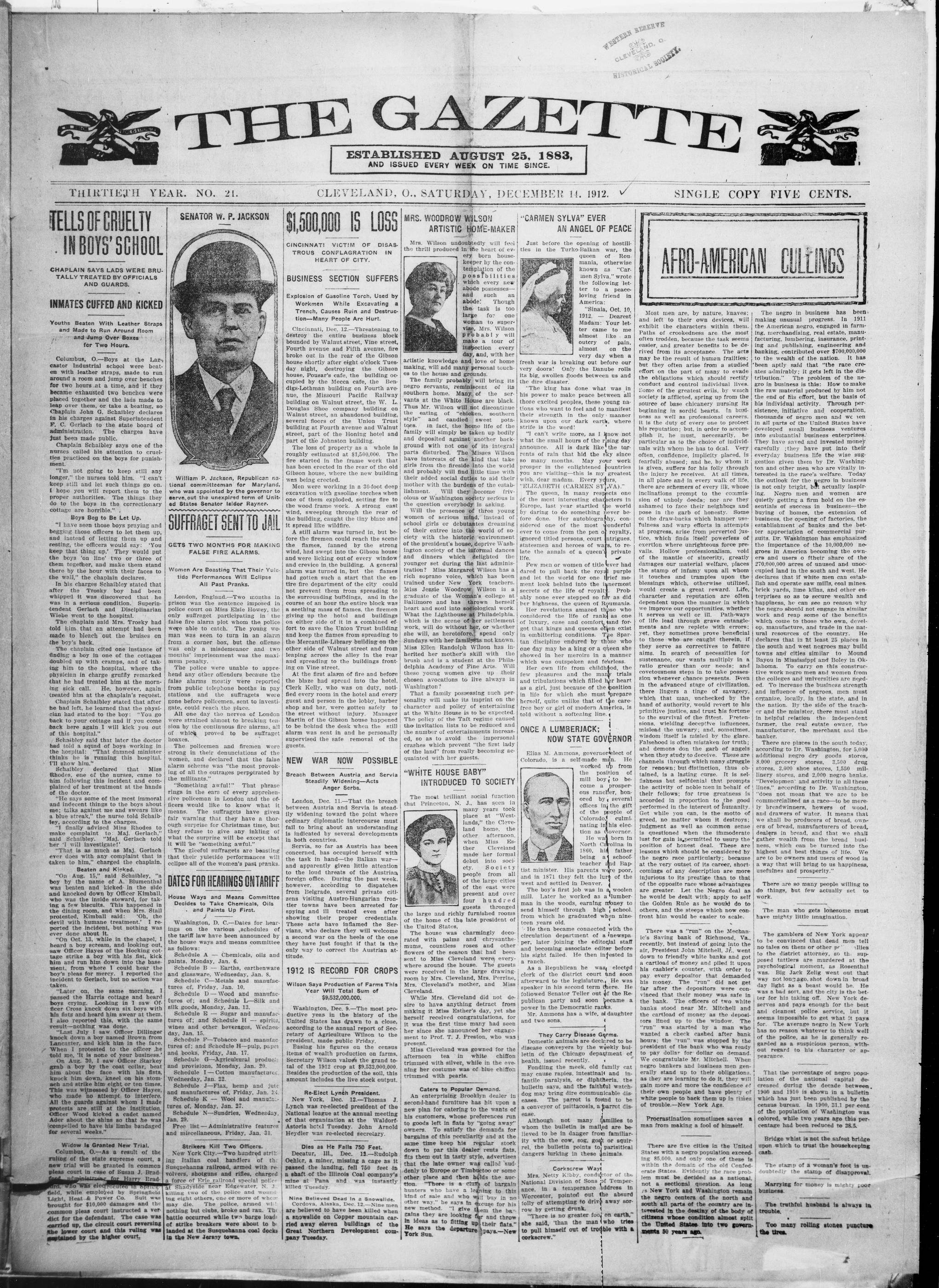
TELLS OF CRUELTY IN BOYS'SCHOOL
CHAPLAIN SAYS LADS WERE BRUTALLY TREATED BY OFFICIALS AND GUARDS.
INMATES CUFFED AND KICKED
Youths Beaten With Leather Straps and Made to Run Around Room and Jump Over Boxes for Two Hours.
Columbus, O.—Boys at the Lancaster Industrial school were beaten with leather straps, made to run around a room and jump over benches for two hours at a time, and if they became exhausted two benches were placed together and the lads made to leap over them, or take a beating, so Chaplain John G. Schaibley declares in his charges against Superintendent F. C. Gerlach to the state board of administration. The charges have just been made public.
Chaplain Schaibley says one of the nurses called his attention to cruelties practiced on the boys for punishment.
"I'm not going to keep still any longer," the nurses told him. "I can't keep still and let such things go on. I hope you will report them to the proper authorities. The things they do to the boys in the correctionary cottage are horrible."
Boys Beg to Be Let Up.
"I have seen those boys praying and begging those officers to let them up, and instead of letting them up and resting, the officers would say: 'You keep that thing up.' They would put the boys 'on line' two or three of them together, and make them stand there by the hour with their faces to the wall," the chaplain declares.
In his charges Schaibley stated that after the Trosky boy had been whipped it was discovered that he was in a serious condition. Superintendent Gerlach and Discipinarian Wiebe went to the hospital.
The chaplain said Mrs. Trosky had told him that an attempt had been made to bleach out the bruises on the boy's back.
The chaplain cited one instance of finding a boy in one of the cottages doubled up with cramps, and of taking him to the hospital, where the physician in charge gruffy remarked that he had treated him at the morning sick call. He, however, again treated him at the chaplain's request.
Chaplain Schaibley stated that after he had left, he learned that the physician had stated to the boy: "You go back to your cottage and if you come back here again I will kick you out of this hospital."
Schaibley said that later the doctor had told a squad of boys working in the hospital: "That damned minister thinks he is running this hospital. I'll show him."
Schaibley declared that Miss Rhodes one of the nurses, came to help this incident and complained of her treatment at the hands of the doctor.
"He says some of the most immoral and indecent things to the boys about me; talks against me and swears like a blue streak," the nurse told Schaibley, according to the charges. He also had Phodes to make complaint to Mal. Gerlach," said Schaibley. "Mal. Gerlach told her I will investigate!"
"That is as much as Maj. Gerlach ever does with any complaint that is taken to him," charged the chaplain.
**Beaten and Kicked.**
"On Aug. 15, said Schaibley, "a boy by the name of A. Blumenthal was beaten and kicked in the side and knocked down by Officer Kimball, and taken a few biscuits. This happened in the dining room, and when Mrs. Stall protested, Kimball said: 'Oh, the devil with humane treatment.' I reported the incident, but nothing was ever done about it.**
He was in the chapel, I heard a boy scream, and looking out, saw Officer Hayes of the Houghton cottage strike a boy with his flat, kick him and run him down into the basement, from where I could hear the boy's pleas for mercy. I reported the incident to Gerlach, but no action was taken.
Later on, the same morning, I passed the Harris cottage and heard boys crying. Looking in I saw Officer Cross kneck down six boys with his fists and heard him swear at them. I also reported this, with the same result—nothing was done.
"Last July I saw Officer Dillippe knocked down from Lancaster, and kick him in the face. When I protested to the officer he told me, 'It is none of your business.'"
On Aug. 30, I saw Officer Starkey grab a boy by the coat collar, beat him about the face with his fists, knock him down, kneel on his stomach and strike him eight or ten times, and hit him with a bullet by Officer Harvey who made no attempt to interfere. All the guards against whom I made protests are still at the institution, Officer Wood kicked a cadet named Ader about the shins so that he was compelled to have his limbs bandaged for several weeks."
Widow Is Granted New Trial.
Columbus, O.-As a result of the ruling of the state supreme court, a new trial will be granted in common pleas court in case of Susan J. Bradford administrator for Harry Bradford, who was elected in Springfield, while employed by Springfield Light, Heat & Power Co. Suit was brought for $10,000 damages and the common pleas court instructed a verdict for the defendant. The case was carried up, the circuit court reversing the lower court and this ruling was sustained by the higher court.
THE GAZETTE
SENATOR W. P. JACKSON
—
William P. Jackson, Republican national committeeman for Maryland, who was appointed by the governor to serve, out the unexpired term of United States Senator Isidor Rayner.
SUFFRAGET SENT TO JAIL
GETS TWO MONTHS FOR MAKING FALSE FIRE ALARMS.
Women Are Boasting That Their Yule-tide Performances Will Eclipse All Past Pranks.
London, England...Two months in prison was the sentence imposed in police court on Miss Elsie Howey, the only suffraget participating in the false fire alarm plot whom the police were able to catch. The young woman was seen to turn in an alarm from a corner box, but the offense was only a misdemeanor and two months' imprisonment was the maximum penalty.
The police were unable to apprehend any other offenders because the false alarms mostly were reported from public telephone booths in pay stations and the suffragets were gone before policemen, sent to investigate, could reach the place.
All one day the nerves of London were strained almost to breaking tension by the continuous fire alarms, all of which proved to be suffraget hoaxes.
The policemen and firemen were strong in their denunciations of the women, and declared that the false alarm scheme was "the most provoking of all the outrages perpetrated by the militants."
"Something awful!" That phrase rings in the ears of every apprehensive policeman in London and the officers would like to know what it means. The suffragetts have given fair warning that they have a thorough surprise for Christmas time, but they refuse to give any inkling of what the surprise will be except that it will be "something awful."
The gleeful suffragetts are beasting that their yuleide performances will ellipse all of the women's pranks.
DATES FOR HEARINGS ON TABIEE
Strikers Kill Two Officers.
New York City—Two hundred striking Italian coal handlers of the Susquehanna railroad, armed with revolvers, shotguns and rifles, charged a force of Erie railroad special police at Shadyside near Edgewater, N. J. killing two of the police and wounding eight others, the police, armed with nothing but clubs, broke and ran. The battle occurred while two loaded loads of strike breakers were about to be landed at the Susquehanna coal docks in the New Jersey town.
ESTABLISHED AUGUST 25. 1883 AND ISSUED EVERY WEEK ON TIME SINCE.
$1,500,000 IS LOSS
CINCINNATI VICTIM OF DISAS
TROUS CONFLAGRATION IN
HEART OF CITY.
BUSINESS SECTION SUFFERS
Explosion of Gasoline Torch, Used by Workmen While Excavating a Trench, Causes Ruin and Destruction—Many People Are Hurt.
Cincinnati, Dec. 12—Threatening to destroy the entire business block bounded by Walnut street, Vine street, Fourth avenue and Fifth avenue, fire broke out in the rear of the Gibson house shortly after eight o'clock Tuesday night, destroying the Gibson house, Pousar's cafe, the building occupied by the Mecca cafe, the Bendig-Lothman building on Fourth avenue, the Missouri Pacific Railway building on Walnut street, the W. L. Douglas Shoe company building on Walnut street, an abandoned building, several floors of the Union Trust building at Fourth avenue and Walnut street, part of the Honing hotel and part of the Johnston building.
The loss of property as a whole is roughly estimated at $1,500,000. The fire started in the frame work that has been erected in the rear of the old Gibson house, where the new building was being erected.
Men were working in a 30-foot deep excavation with gasoline torches when one of them exploded, setting fire to the wood frame work. A strong east wind, sweeping through the rear of the building, caught the thy blaze and it spread like wildfire.
A still alarm was turned in, but before the firemen could reach the scene the flames, fanned by the strong wind, had swept into the Gibson house and were licking out of every window and crevice in the building. A general alarm was turned in, but the flames had gotten such a start that the entire fire department of the city could not prevent them from spreading to the surrounding buildings, and in the course of an hour the entire block was a seething mass of flames, the firemen giving up the hotel and buildings on either side of it in a combined effort to save the Union Trust building and keep the flames from spreading to the Mercantile Library building on the other side of Walnut street and from leaping across the alley in the rear and spreading to the buildings fronting on Vine street.
At the first alarm of fire and before the blaze had spread into the hotel, Clerk Kelly, who was on duty, notified every room in the hotel and every guest and person in the lobby, barber shop and bar, were gotten safely to the street without injury. Manager Martin of the Gibson house happened to be behind the desk when the still alarm was sent in and he personally supervised the safe removal of the guests.
NEW WAR NOW POSSIBLE
Breach Between Austria and Servia Steadily Widening—Acts Anger Serbs.
London, Dec. 11.—That the breach between Austria and Servia is steadily widening toward the point where ordinary diplomatic intercourse must fall to bring about an understanding is indicated by several developments in both countries.
Servia, so far as Austria has been concerned, has occupied herself with the task in hand—the Balkan war—and apparently given little attention to the loud threats of the Austrian foreign office. During the past week, however, according to dispatches from Belgrade, several private citizens visiting Austro-Hungarian frontier towns have been arrested for spying and ill treated even after showing their proper credentials. These acts have inflamed the Servians, who declare they will welcome a second war on the heels of the one they have just fought if that is the only way to correct the Austrian attitude.
1912 IS RECORD FOR CROPS
Wilson Says Production of Farms This Year Year Total Sum of Year $9,532,000,000.
Washington, Dec. 9.—The most productive year in the history of the United States has drawn to a close, according to the annual report of Secretary of Agriculture Wilson to the president, made public Friday. Basing his figures on the census items of wealth production on farms, Secretary Wilson values the grand total of the 1912 crop at $9,532,000,000. Besides the production of the soil, this amount includes the live stock output.
Re-Elect Lynch President
New York, Dec. 12.—Thomas J. Lynch was re-elected president of the National league at the annual meeting of that organization at the Waldorf-Astoria hotel Tuesday. John Arnold Heydler was re-elected secretary.
Dies as He Falls 750 Feet. Decatur, Ill., Dec. 13.—Rudolph Ochler, a miner, missing a cage as it passed the landing, fell 750 feet in a shaft of the Illinois Coal company's mine at Pana and was instantly killed Tuesday.
Nine Believed Dead in a Snowslide. Cordova, Alaska, Dec. 12.—Nine men are believed to have been killed when a snowslide on Copper mountain carried away eleven buildings of the Great Northern Development company Tuesday.
MRS. WOODROW WILSON
ARTISTIC HOME-MAKER
Mrs. Wilson undoubtedly will feel the thrill produced in the heart of ev-
ery born housekeeper by the contemplation of the possibilities which every new abode possesses—and such an abode! though the task is too large for one woman to supervise. Mrs. Wilson probably will make a tour of inspection every day, and, with her
keeper by the contemplation of the possbilitie which every new abode possesses—and such an abode. Though the task is too large for one woman to supervise, Mrs. Wilson probably will make a tour of inspection every day, and, with her artistic knowledge and love of home making, will add many personal touches to the house and grounds.
The family probably will bring its negro servants, reminiscent of its southern home. Many of the servants at the White House are black. Thus Mr. Wilson will not discontinue the eating of "chicken, southern style" and candied sweet potatoes. in fact, the home life of the family will simply be taken up bodily and deposited against another background with not one of its integral parts disturbed. The Misses Wilson have interests of the kind that take girls from the fireside into the world and probably will find little time with their added social duties to aid their mother with the burdens of the establishment. Will they become frivolous or Washington society serious is the question everybody is asking.
Will the presence of three young women of serious mind, instead of school girls or debatants dreaming of their entree into the world of society with the historic environment of the president's house, deprive Washington society of the informal dances and dinners which delighted the younger set during the last administration? Miss Margaret Wilson has a rich soprano voice, which has been trained under New York teachers. Miss Jessie Woodrow Wilson is a graduate of the Woman's college at Baltimore and has thrown herself heart and soul into sociological work. What the Lighthouse at Philadelphia, which is the scene of her settlement work, will do without her, or whether she will, as heretofore, spend only Sundays with her family, is not known. Miss Ellen Randolph Wilson has inherited her mother's skill with the brush and is a student at the Philadelphia Academy of Fine Arts. Will these young women give up their chosen avocations to live always in Washington?
That a family possessing such personality will make its imprint on the character and policy of entertaining at the White House is to be expected. The policy of the Taft regime caused the invitation lists to be reduced and the number of entertainments increased, so as to avoid the impersonal crashes which prevent "the first lady of the land" from really becoming acquainted with her guests.
"WHITE HOUSE BABY"
INTRODUCED TO SOCIETY
The most brilliant social function that Princeton, N. J., has seen in
J. has seen in many years took place at "Westlands," the Cleveland home, the other of Miss Miss Ester Cleveland made her formal debut into society. Society people from all of the large cities of the east were present and over four hundred guests thronged
place at "West-
lands," the Cleveland
home, the other afternoon,
when Miss Ea-
ther Cleveland made her formal
debut into soci-
ety. Society
people from all
of the large cities
of the east were
present and over
four hundred
guests thronged
the large and richly
furnished rooms
of the home of the late president
of the United States.
The house was charmingly deco-
rated with palms and chrysanthem-
mums, countless roses and other
flowers of the season that had been
sent to Miss Cleveland were every-
where around the house. The guests
were received in the large drawing-
room by Mrs. Cleveland, Mrs. Perrine,
Mrs. Cleveland's mother, and Miss
Cleveland.
While Mrs. Cleveland did not desire
to have anything detract from
making it Miss Eaither's day, yet she
herself received congratulations, for
it was the first time many had seen
her since she announced her engagement
to Prof. T. J. Preston, who was
present.
Miss Cleveland was gowned for the
afternoon tea in white chiffon
trimmed with silver, while in the eve-
ning her costume was of blue chiffon
trimmed with pearls.
Caters to Popular Demand
Caters to Popular Demand.
An enterprising Brooklyn dealer in second-hand furniture has hit upon a new plan for catering to the wants of his customers, whose preferences run to goods left in flats by "growing away" owners. To satisfy the demands for bargains of this peculiarity and at the same time keep his regular stock down to par this dealer rents flats, fits them out in tasty style, advertises that the late owner was called suddenly to Europe or Timbutoo or some other place and then holds the auction. "There is a class of bargain hunters who have a leading to this kind of sale and who will buy in no other way," he says in excuse for his new method. "I give them the bargains they are looking for and throw in ideas as to fitting up their flats."
He says the departure pays.—New York Sun.
"CARMEN SYLVA" EVER
AN ANGEL OF PEACE
Just before the opening of hostilities in the Turko-Balkan war, the
Balkan war, the queen of Roumania, otherwise known as "Carmen Sylva" wrote the following letter to a peace-loving friend in America:
A
"Sinaia, Oct. 10, 1912. — Dearest Madam: Your letter came to me almost like an outy of pain, almost on the very day when a fresh war is breaking out before our very doors! Only the Danube rolls its big, swollen floods between us and the dire disaster.
"The king has done what was in his power to make peace between all those excited peoples, these young nations who want to feel and to manifest their strength in the only manner known upon our dark earth, where strife is the word!
"I can't write more, as I know not what the small hours of the rising day announce. All is dark like the torrents of rain that hid the sky since so many months. May your work prosper in the enlightened countries you are visiting—this is my greatest wish, dear madam. Every yours,
"ELZABETH (CARMEN SYLVIA)."
The queen, in many respects one of the most interesting characters in Europe, last year startled the world by daring to do something never before done. Her autobiography, considered one of the most wonderful ever to come from the pen of royalty, ignored titled persons, court intrigues, statesmen and heroes of wars, to relate the annals of a queen's private life.
Few men or women of title ever had dared to pull back the royal purple and let the world for one brief moment look behind into the innermost secrets of the life of royalty. Probably none ever stepped so far as did her highness, the queen of Romania. Her revelations amazed those who considered the life of rank as one of luxury, ease and comfort and forgot that kings and queens often exist in embittering conditions. The Spartan discipline endured by those who one day may be a king or a queen she showed in her mercuries in a manner which was outspoken and fearless. Her own life from childhood, the few pleasures and the many trials and tribulations which filled her heart as a girl, just because of the position in life for which she must prepare herself, quite unlike that of the carefree boy or girl of modern America, is told without a softening line.
ONCE A LUMBERJACK;
NOW STATE GOVERNOR
Elias M. Ammons, governor elect of Colorado, is a self-made man. He worked up from the position of mill boy to become a prosperous rancher, honored by several offices in the gift of the people of Colorado, culminating in his election as Governor.
PETER H.
He was born in North Carolina in 1860, his father being a schoolteacher and Baptist minister. His parents were poor, and in 1871 they felt the lure of the west and settled in Denver. The boy's first job was in a woolen mill. Later he worked as a lumberman in the woods, earning money to send himself through high school, from which he graduated when nineteen years old. He then became connected with the circulation department of a newspaper, later joining the editorial staff and becoming associate editor before his sight failed. He then invested in a ranch.
As a Republican he was elected clerk of the district court and soon afterward to the legislature. He was speaker in his second term there. He followed Senator Teller out of the Republican party and soon became a power in the Democratic ranks. Mr. Ammons has a wife, al daughter and two sons.
They Carry Disease Germs.
Domestic animals are declared to be disease conveyers by the weekly bulletin of the Chicago department of health, issued recently.
Fondling the meek, old family cat may cause rapies, intestinal and infantile paralysis, or diphtheria, the bulletin says, and the faithful watchdog may bring dire communicable diseases. The parrot is found to be a conveyor of psittacosis, a parrot disease.
Although not many families to whom the bulletin is mailed are believed to be in danger from familiarity with the cow, sog, goat or squirrel, the bulletin points to paristical dangers lurking in these animals.
Corkscrew Wav
Mrs. Netty Kibby, conductor of the National Division of Sons of Temperance, in a temperance address in Worcester, pointed out the absurdly of attempting to drive away sorrow by getting drunk. "There is no greater fool on earth," she said, "than the man who tries to pull himself out of trouble with a corkscrew."
AFRO-AMERICAN CULLINGS
Most men are, by nature, knaves; and left to their own devices, will exhibit the characters within them. Paths of crookedness are the most often trodden, because the task seems easier, and greater benefits to be derived from its acceptance. The acts may be the result of human frailties; but they often arise from a studied effort on the part of many to evade the obligations, which should rectify conduct and control individual lives. Some of the greatest evils, by which society is afflicted, spring up from the source of base chicarchy nursing its beginning in sordid hearts. In business as well as professional careers, the duty of every one to protect his reactivation; but, in order to plush it he must, necessarily, be particular as to the choice of individuals with whom he has to deal. Very often, confidence, implicit placed, is fearfully abused; and he, by whom it is given, suffers for his folly through the injury he receives. At all times, in all place and in every walk of life, there are schemers of every ilk, whose inclinations prompt to the commission of unholy deeds; nor are they ashamed to face their neighbors and pose in the garb of honesty. Some of the draw-backs which hamper usefulness and warp efforts in attempts at progress, arise from perverted justice, which finds itself powerless of exertion where unrigorous force prevails. Hollow professionalism, void of the mantle of sincerity, greatly damages our material welfare, places the stamp of infamy upon all whom it touches and tramples upon the blessings which, otherwise utilized, would create a great reward. Life, character and reputation are often dependent upon the manner in which we improve our opportunities, whether it serves us well or well. Path-ways of life lead through grave entanglement and are replete with vet, they sometimes prove beneficial to those who are caught therein, if they serve as correctives to future aims. In search of necessities for sustenance, our wants multiply in a ratio greater than our needs; and covetousness steps in to take possession whenever chance presents. Even in the advanced stage of civilization, there lingers a tinge of savagery, which that man, unchecked by the hand of authority, would revert to his primitive justice, and trust his fortune to the survival of the fittest. Pretenions, welding deceptive influences, mislead the unwary, and, sometimes, wisdom itself is misled by the glare. Falsehood is often mistaken for truth; and demons don the garb of angels when they study to deceive. These are channels through which many struggle for renown; but distinction, thus obtained, is a lasting curse. It is selfishness but selfdienial that prompts the activity of noble men in behalf of their fellows; for true greatness is accorded in proportion to the good performed in the interest of humanity. Get while you can, is the motto of greed, not matter whom it destroys; judgment as well as common态度 is questioned when the immoderate lust for gain is permitted to usurp the position of honest deal. These are lessons which should be considered by the negro race particularly; because at the very outset of its career, shortcomings of any description are more injurious to its prestige than to that of the opposite race whose advantages are more favorable. Let the Negro deal as he would be dealt with; apply to the Golden Rule as he would do to others, and the steeps which now confront him would be easier to scale.
There was a "run" on the Mechanic's Saving bank of Richmond, Va., recently, but instead of going into the air, President John Mitchell, Jr. went down to friendly white banks and got a cartload of money and piled it upon his cashier's counter, with order to pay every depositor that demanded his money. The "run" did not get far after the depositors were convinced that their money was safe in the bank. The officers of two white banks stood near Mr. Mitchell and the cartload of money as the depositors lined up to the window. The "run" was started by a man who wanted a check cashed after bank hours; the "run" was stopped by the president of the bank who was ready to pay dollar for dollar on demand. We congratulate Mr. Mitchell. When negro bankers and business men generally stand up to their obligations, as they are learning to do it, they will gain more and more the confidence of their own people and have plenty of white people to back them up in times of trouble—New York Age.
Procrastination sometimes saves a man from making a fool of himself.
There are five cities in the United States with a negro population exceeding 85,000, and only one of these is within the domain of the old Confederate States. Evidently the race problem must be decided as a national, not a sectional question. As long as New York and Washington remain the negro centers of the north and south all parts of the country are interested in the destiny of the body of citizens whose condition almost split the United States into two governments 50 years ago.
The negro in business has been making unusual progress. In 1911 the American negro, engaged in farming, merchandising, real estate, manufacturing, lumbering, insurance, printing and publishing, engineering and banking, contributed over $700,000,000 to the wealth of the nation. It has been aptly said that "the race creates admirably; it gets left in the distribution." The problem of the negro in business is this: How to make the raw material produced by him not the end of his effort, but the basis of his individual activity. Through persistence, initiative and cooperation, thousands of negro men and ween in all parts of the United States have developed small business ventures into substantial business enterprises. They have saved and invested money carefully; they have put into their everyday business life the wise suggestion given them by Dr. Washington and other men who are vitally interested in the race's welfare. Today the outlook for the negro in business is not only bright, but actually inspiring. Negro men and women are quietly getting a firm hold on the essentials of success in business—the buying of homes, the opening of factories, the establishment of banks and the better appreciation of commercial pursuits. Dr. Washington has emphasized the importance of the 10,000,000 negroes in America becoming the owners and users of their share of the 270,000,000 acres of unused and unoccupied land in the south and west. He declares that if white men can establish and operate saw mills, coal mines, brick yards, lime kilns, and other enterprises so as to secure wealth and happiness, he can see no reason why the negro should engage in similar work and reap some of the benefits come to those whom deprived of, manufacture, and trade in the natural resources of the country. He declares that in at least 25 places in the south and west negroes may build towns and cities similar to Mound Bayou in Mississippi and Boley in Oklahoma. To carry on this constructive work negro men and women from the colleges and universities are needed. To increase the business strength and influence of negroes, men must organize, locally, in the state, and in the nation. By the side of the teacher and the minister, there must stand in helpful relation the independent farmer, the real estate owner, the manufacturer, the merchant and the banker.
There are places in the south today, according to Dr. Washington, for 5,000 additional negro dry goods stores, 8,000 grocery stores, 3,500 drug stores, 2,000 shoe stores, 1,550 millinery stores, and 2,000 negro banks. "Developmen' and activity in all these lines," according to Dr. Washington, "does not mean that we are to be commercialized as a race to be merely breadwinners, hewers of wood, and drawers of water. It means that we shall be producers of bread, owners of bread, manufacturers of bread, dealers in bread, and that we shall gather wealth from the bread business, which can be turned into the highest and best things of life. We are to be owners and users of wood in a way that will bring to us happiness, usefulness and prosperity."
There are so many people willing to do things, but few actually set to work.
The man who gets lonesome must have mighty little imagination.
The gambblers of New York appear to be convinced that dead men tell no tales on them or other people to the district attorney, so the supposed tattlers are murdered at the psychological moment, as Rosenthal was. Big Jack Zelig went out that way not long ago, shot down in broad day light as a beast would be. He was a bad sort, and the city is the better for his taking off. New York deserves and pays enough for the best and cleanest police service, but it seems impossible to get what it pays for. The average negro in New York has no reason whatever to think well of the police, an he is generally regarded as a suspicious person, without regard to his character or appearance.
That the percentage of negro population of the national capital decreased during the decade between 1900 and 1910 is shown in a bulletin which has just been published by the census bureau. In 1900, 21.1 per cent of the population of Washington was colored, while two years ago this percentage had been reduced to 28.5.
Bridge whist is not the safest bridge upon which to trust the housekeeping cash.
The stamp of a woman's foot is undoubtedly the stamp of disapproval.
Marrying for money is mighty poor business.
The truthful husband is always in trouble.
_____
Too many rolling stones puncture
the tree.
SUBSCRIPTION RATES
(In Advance)
One Year.....$1.50
Six Months.....1.00
Three Months......50
Subscribers are requested to
mit by postoffice money order
or registered letter.
Entered at the postoffice In Cleveland
Ohio, as second-class matter
Address all communications to
HARRY C. SMITH
Editor and proprietor,
THE GAZETTE,
Blackstone Building, Cleveland, O.
Member Ohio Legislature: 1894
to 1896; 1898 to 1898; 1900 to 1902
THE GAZETTE is the oldest, and has the largest bona fide circulation, double that of any newspaper in the interest of Afro-Americans, published in the state of Ohio, and comparison with any will immediately establish its rank as one of the NEWSIEST and BEST in the country.
Please remember that a year's subscription to The Gazette, for a friend or relative, is a Christmas gift that will be appreciated and that will be a weekly reminder of you for twelve months or one year. Try it!
"To hell with the U. S. constitution" Please ought to be promptly impeached by the state of which he is governor. But will it do it and thus repudiate his endorsement of lynchmurder and his damning the U. S. constitution? We fear not.
Do not squander money during the coming holiday season because you will surely and sorely need it before the expiration of next year. Use judgment in giving, having pleasure, etc., and SAVE all you can for future use. Be wise, this time.
Somebody ought to wire Police Chief McWeeny of Chicago to write the Monroe; La., coward (white) who is alleged to have offered him $5,000 to deliver Jack Johnson anywhere in that state, that there are many persons here in the north who have real money, and not the kind the Monroe, La., coward offers, who will give much more than $5,000 to see him in the ring with Jack anywhere here in the north. The heating Johnson would give him, is needed, and would be worth a whole lot more than $5,000, to witness.
Every community in this country, where there is a dozen intelligent members of the race, or more, should have a Citizens' Rights club or "league," in order to be able to make an organized fight in the courts and elsewhere, when necessary, in defense of our civil and other rights. Our people of Washington, D. C., New York, and other large cities in the north, have such organizations. There can be a number of them, even in one city, as a large membership is not absolutely necessary. "Quality rather than quantity"—intelligence, loyalty and ability to contribute to the support of such movement—should be the first consideration when the qualifications for membership in such an organization are being passed upon.
F. Hopkinson Smith, the author who prides himself on being "a southern gentleman," was recently invited to address the pupils of a high school at Camden, N. J., and in the course of his remarks declared that "Uncle Tom's Cabin" has done more harm to the world than any other book ever written. In elaboration of this judgment Mr. Smith said that the Negro was much better off in the days of slavery than he is at present, and implied that emancipation was a mistake. Here is another "Cole Blesset." Not quite so coarse and loud, it is true, but almost as disgusting silly. Harriett Beecher Stowe's great book, like the great work it helped so materially to accomplish, is too much for F. Hopkinson Smith, southern gentleman. (7) to comprehend, and it will ever be regarded as one of the greatest literary productions of any age. Smith and his literary output are not very well known now, will never be, and both will soon be forgotten after his death. "Nother case of "an ass braying at the moon."
THE RACES IN JAMAICA
Are Jamaicans more highly civilized than Americans? Booker T. Washington hints at this in the Century, when he says:
"In the island of Jamaica there are about 15,000 white people and 600,000 black people, but of the 'race problem,' in regard to which there is much agitation in this country, one hears almost nothing there. Jamaica has neither mobs, race riots, lynchings, nor burnings, such as disgrace our civilization. In that country there is likewise no bitterness between white man and black man. One reason for this is that the laws are conceived and executed with exact and moral justice, without regard to any color. Reduced to its lowest terms, the laws are the part of our racial justice in the United States grow out of some attempt to pass and execute a law that will make and keep one man superior to another, whether he is intrinsically superior or not. No greater harm can be done to any group of people than to let them feel that a statutory enactment can keep them superior to anybody else."
Dr. Washington's statement of the Jamaica situation fails to take full account of the great and increasing mixing of white and Negro blood in Jamaica. Intermarriage of the races is common and in all ranks of society the whites and Negroes meet on equal terms. Intermarriage of whites and Negroes is different in the United States from this. — Chicago (III.) Daily News.
If that be true, then "the race instinct of both whites and Negroes in the United States" must and surely will change in time as a result of the influence of a higher civilization. intermarriage here, etc. The "race instinct" referred to, is nothing more or less than the American color or race prejudice and caste, a thing that is by no means "inheradable," as
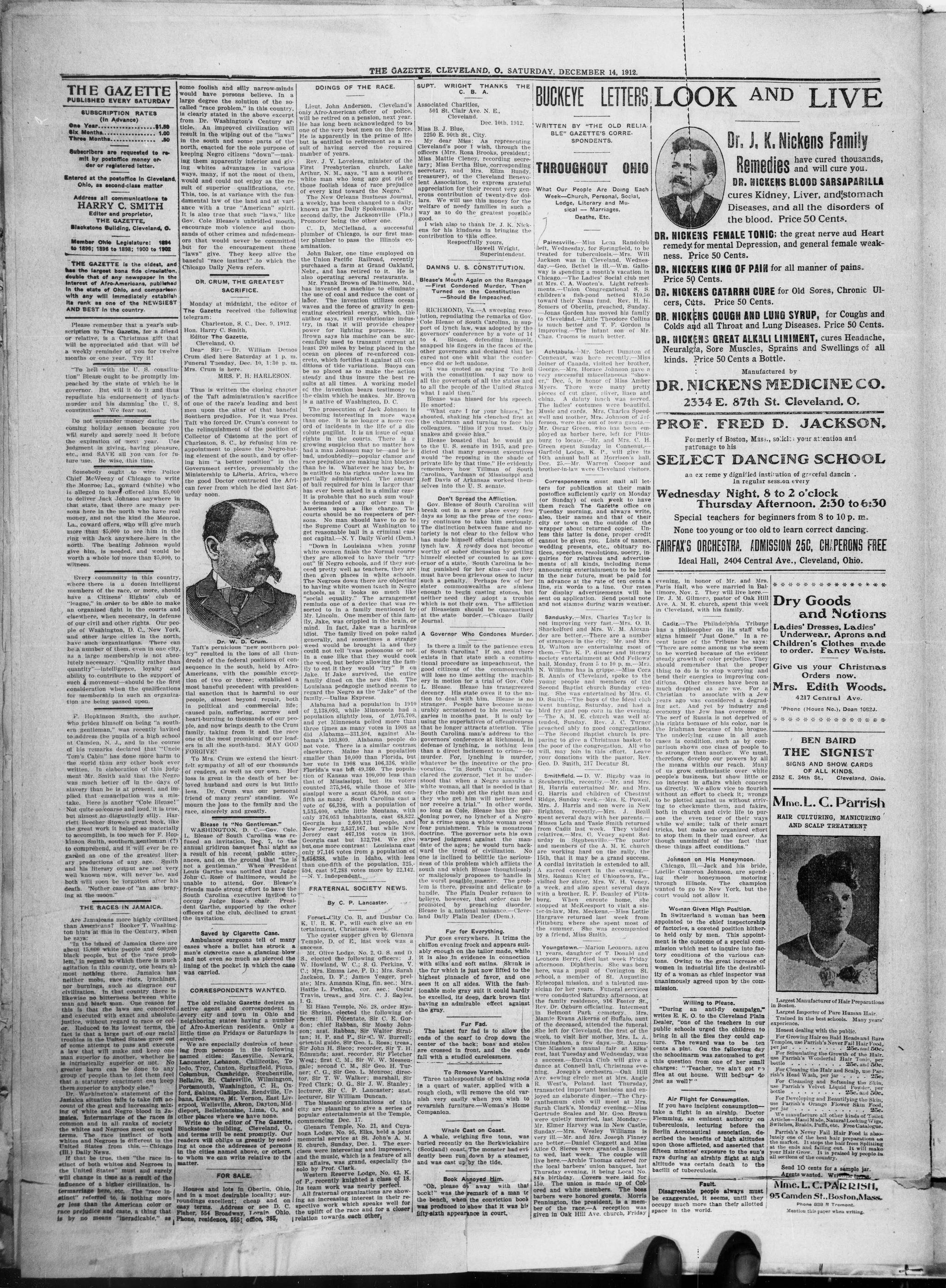
some foolish and silly narrow-minded would have persons believe. In a large degree the solution of the so-called "race problem," in this country, is clearly stated in the above excerpt from Dr. Washington's Century article. An improved civilization will result in the wiping out of the "laws" in the south and some parts of the north, enacted for the sole purpose of keeping Negro citizens "down"—making them apparently inferior and giving whites advantages in various ways, many, if not the most of them, would and could not enjoy as the result of superior qualifications, etc. This, too, is at variance with the fundamental law of the land and at variance with a true "American" spirit. It is also true that such "laws," like Gov. Cole Blease's unbridled mouth encourage mob violence and thou sands of other crimes and misdeemeans that would never be committed but for the encouragement these "laws" give. They keep alive the baneful "race instinct," to which the Chicago Daily News refers.
Monday at midnight, the editor of The Gazette received the following telegram:
Charleston, S. C., Dec. 9, 1912.
Hon. Harry C. Smith,
Editor The Gazette,
Cleveland, O.
Dear Sir: — Dr. William Demos
Crum died here Saturday at 1 p. m.
Funeral Tuesday, Dec. 10, 1:30 p. m.
Mrs. Crum is here.
MRS. F. H; HARLESON.
Thus is written the closing chapter of the Taft administration's sacrifice of one of the race's leading and best men upon the altar of that baneful Southern prejudice. For it was Press Taft who forced Dr. Crum's consent to the relinquishment of the position of Collector of Customs at the port of Charleston, S. C., by refusing him reappointment to please the Negro-hating element of the south, and by offering him "a better position" in the Government service, presumably the Ministership to Liberia, Africa, where the good Doctor contracted the Afri can fever from which he died last Sat urday noon.
M.
Taft's pernicious "new southern policy" resulted in the loss of all (hundreds) of the federal positions of consequence in the south, held by Afro-Americans, with the possible exception of two or three; established a most baneful precedent with presidential sanction that is harmful to our people, almost beyond repair, both in political and commercial life; caused pain, suffering, sorrow and heart-burning to thousands of our people, and now brings death to the Crum family, taking from it and the race one of the most promising of our leaders in all the south-hand. MAY GOD FORGIVE!
To Mrs. Crum we extend the heart-felt sympathy of all of our thousands of readers, as well as our own. Her loss is great in the death of her beloved husband and ours is but little less. Dr. Crum was our personal friend of many years' standing. We mourn the loss to the family and the race, sincerely and greatly.
Please Is "No Gentleman."
WASHINGTON, D.C. C. Cole L, Blease of South Carolina was refused an invitation, Dec. 7, to the annual brionet banquet that night as a result of his recent public utterances, and on the ground that "he is not a gentleman." When President Louis Garthe was notified that Judge John C. Rose of Baltimore, would be unable to attend, Gov. Blease's friends made strong effort to have the South Carolina executive invited to occupy Judge Rose's chair. President Garthe, supported by the other officers of the club, declined to grant the invitation.
Saved by Cigarette Case.
Ambulance surgeons tell of many cases where a bullet has struck a man's cigarette case a glancing blow and not even so much as pierced the lining of the pocket in which the case was carried.
CORRESPONDENTS WANTED.
The old reliable Gazette desires an active agent and correspondent in every city and town in Ohio and neighboring states having a number of Afro-American residents. Only a little time on Fridays or Saturdays is required.
We are especially desirous of hearing from persons in the following cities: Garveyville, Newark, Lomaster, Lebanon, Chillicothe, Toledo, Troy, Canton, Springfield, Piqua, Columbus, Cambridge, Steubenville, Bellaire, St. Clairsville, Wilmington, Portsmouth, Washington, C. H., Oxford, Sabina, Gallipolis, Rendille, Urbana, Delaware, M. Vernon, East Liverpool, Wellsville, Akron, Dayton, Middleport, Belfonteaint, Lima, O., and other places where we have none.
Write to the editor of The Gazette, Blackstone building, Cleveland, O., and terms will be sent promptly. Our readers will oblige us greatly by sending at once the addresses of persons whose names are known to us, or where to whom we can write relative to the matter.
Houses and lots in Oberlin, Ohio,
and in a most desirable location; surroundings excellent; cheap and on easy terms. Address or see D. C.
Fisher, 554 Broadway, Lorain, Ohio.
Phone, residence 555; office, 385.
THE GAZETTE, CLEVELAND, O. SATURDAY, DECEMBER 14, 1912
DOINGS OF THE RACE.
Lieut. John Anderson, Cleveland's only Afro-American officer of police, will be retired on a pension, next year. He has long been acknowledged to be one of the very best men on the force. He is apparently in the prime of life but is entitled to retirement as a result of having served the required number of years.
Rev. J. V. Loveless, minister of the First Presbyterian church, Lake Arthur, N. M., says, "I am a southern white man who long ago got rid of those foolish ideas of race prejudice of every kind toward the Negro. In the past I bushied Journal, a weekly, has been changed to a daily, known as The Daily Spokesman. Our second daily, the Jacksonville (Fla.) Promoter being the other one.
C. D. McClelland, a successful plumber of Chicago, is our first master plumber to pass the Illinois examination.
John Baker, one time employed on the Union Pacific Railroad, recently purchased a farm at Grand Oakland, and is also operating several restaurants.
The prosecution of Jack Johnson is becoming interesting in more ways than one. It is no longer a more reckless ord of incidents in the life of a dissolute pugilist. It is an issue of equal rights in the courts. There is a growing suspicion that no matter how bad a man Johnson may be—and he is bad, undoubtedly—popular clamor and race prejudice are making him blacker than he is. Whatever he may be, he is not a victim of the law, partially administered. The amount of bail required for him is larger than has ever been asked in a similar case. It is probable that no such sum would be demanded of any other man in America upon a like charge. The courts should be no respecters of persons. No man should have to go to the Supreme Court at Washington to get reasonable bail in a criminal case not capital—N. Y. Daily World (Dem.
"Down in Louisiana when young white women finish the Normal course they are allowed to have their 'try out' in Negro schools, and if they succeed pretty well as teachers, they are then given places in white schools, where they are allowed to have young white women teach in Negro schools, as it looks so much like "social equality." The arrangement reminds one of a device that was resorted to in a family mentioned by Mr. Lincoln. One member of this family, Jake, was crippled in the brain, or had a brain tumor, and did not. The family lived on poke salad generally, and sometimes a strange weed would be brought in and they could not tell 'twas poisonous or not. In a case like that they would cook the weed, but before allowing the family to eat it they would "try it or take it. If Jake was on the new dish. The Louisiana pedagogic method seems to regard the Negro as the 'Jake' of the family—Dallas Express.
Alabama had a population in 1910 of 2,138,038, while Minnesota had a population slightly less, of 2,075,708, and yet Minnesota polled more than three times as many votes in 1908 as did Alabama—331,304, against Alabama's 103,809. Alabama people do not vote. There is a similar contrast elsewhere. Maline has a population smaller than 10,000 than Florida, but her vote in Minnesota was 39,400. The population of Kansas was 100,000 less than that of Mississippi, but its voters counted 375,946, while those of Mississippi were a scant 66,904, not one-fifth as many. South Carolina cast a vote of 66,398, with a population of 1,515,400, while little Montana, with only 376,653 inhabitants, cast 68,822 Georgia has 2,609,121 people, and New Jersey has 2,537,167, but while New Jersey cast 467,198 votes in 1908, Georgia cast 369,198 votes in 1910, the contrast: Louisiana cast only 97,148 votes from a population of 1,556,388, while in Idaho, with less than one-fifth of the population, 325,594, cast 97,288 votes more by 22,142. N. Y. Independent.
FRATERNAL SOCIETY NEWS.
Forest City Co. B, and Dunbar Co. K, U. R. K. P., will each give an entertainment, Christmas week. The oyster supper given by Glenara Temple, D. of E., last week was a success. M. Olive Lodge, No. 2, G. S. and D. S., elected the following officers: W. H. Howland, W. C.; S. G. Perkins, V. Mrs. Emery, M. Sarah Sarah, D. F.; James Yaeen, prelate; Mrs. Amanda King, fin, sec.; Mrs. Hattie L. Perkins, cor. sec.; Oscar Travis, treas., and Mrs. C. J. Sayles, I. G.
El Hasa Temple, No. 28, order Mystic Shrine, elected the following offcers: Ill. Potentate, Sir C. E. Gorod; chief Rabban, Sir Mosby Johnson; asst. Rabban, Sir Walter Stratton; H. P. and P. Sir C. W. Burrell; oriental guide, Sir Geo. L. Ross; treas, Sir John H. Sisco; recorder, Sir T. H. Edmunds; asst. recorder, Sir Fletcher West; first recorder, Sir Messenger; second c. M. Sir Geo. H. Hener; C. G. Sir Geo. L. Monroe; director, Sir T. W. Walker; marshall, Sir Fred Clark; O. G. Sir J. W. Stanley; lecturer, Sir P. C. Lancaster; asst. lecturer, Sir William Duncan.
The Masonic organizations of this city are planning to give a series of popular entertainments at the Temple, commencing Dec. 17.
Glenara Temple, No. 21, and Cuyahoga Lodge, No. 95, Elks, held a joint memorial service at St. John's A. M. E. church, Sunday, December 16, cased were meeting and impressive, and the music, which is a feature of all Elk fairies, was grand, especially the by Prof. Clark.
Western Reserve Lodge, No. 42, K. of P., recently knighted a class of 18. Its team work was nearly perfect. All fraternal organizations are showing an increasing interest in their respective work which speaks well for the uplift of the race and for a closer relation towards each other.
SUPT. WRIGHT THANKS THE
C. B. A.
Dec. 10th, 1912.
Miss B. J. Blue,
2250 E. 90th St. City.
My dear Miss: As representing Cleveland's poor I wish, through the officers (Mrs. Rosa Brooks, president);
Miss Clement, recording secretary;
Miss Bera Blume, responding secretary,
and Mrs. Ellza, treasurer), of the Cleveland Benevolent Association, to express grateful appreciation for their recent very generous contribution of twenty-five dollars. We will use this money for the welfare of needy families in such a way as to do the greatest possible work.
I wish also to thank Dr. J. K. Nickens for his kindness in bringing the contribution to this office.
Blease's Mouth Again on the Rampage
—First Condoned Murder, Then
Turned on the Constitution
—Should Be Impeached.
RICHMOND, Va.—A sweeping resolution, repudiating the remarks of Gov. Cole Blease of South Carolina, in support of lynch law, was adopted by the governors' conference by a vote of 14 to 4. Blease, defending himself, snapped his fingers in the faces of the other governors and declared that he cared not one whit what the conference did or what undone.
He claimed as saying "To hell with the constitution. I say now to all the governors of all the states and to all the people of the United States what I said then."
Blease was hissed for his speech. He snorted:
"What care I for your hisses," he shouted, shaking his clenched first at the clenched face to face his colleagues. "Hiss if you must. Only snakes and seas hiss."
Blease boasted that he would go to the U. S. senate in 1915, and predicted that many present executives would "he reposing in the shade of private life by that time." He evidently believed that the senate would Carolina, Vardman of Mississippi and Jeff Davis of Arkansas worked themselves into the U. S. senate.
Don't Spread the Affliction.
Gov. Blease of South Carolina will break out in a new place every few days as long as the press of the country continues to take him seriously. The distinction between fame and notoriety is not clear to the fellow who has made himself official champion of lynch law. A rowdy does not become worthy of sober discussion by getting himself elected or counted in as governor of a state. South Carolina is being punished for her sins—and they must have been grievous ones to incur such a penalty. Perhaps few of her commonwealths were敢 enough to begin casting stones, but neither need they adopt a trouble which is not their own. The affection of Bleaseism should be quarantined at the state border.-Chicago Daily Journal.
A Governor Who Condones Murder
Is there a limit to the patience even of South Carolina? If so, and there exists in that state such a constitutional procedure as impeachment, the good citizens of the commonwealth will lose no time setting the machinery in motion for a trial of Gov. Cole L. Blease. Blease has transgressed decency. His state owes it to the nation to deal with him. Blease is no stranger. People have become means of gaining power, and garies in months past. It is only by using the superlatives of offensiveness that he longer attracts attention. The South Carolina man's address to the governors' conference at Richmond, in defense of lynching, is nothing less than a direct incitement to crime—to murder. For, lynching is murder, whatever be the incentive or the prosecution. "In South Carolina," declared the governor, "let it be understood that when a Negro assaults a the two (they) must get the needed is that they (they) get the needed is that they get him will neither need nor receive a trial." In other words, so long as Cole, Blease has the pardoning power, no lyncher of a Negro for a crime upon a white woman need fear punishment. This is monstrous doctrine. The governor sets his own warped judgment against the mandate of the ages; he would turn backward the trend of civilization. No one is inclined to belittle the seriousness of this problem which afflicts the south and which Blease thoughtlessly and worst possible, manner. The problem is there, pressing and delicate to believe, however, that order can be promoted by preaching disorder. Blease is a national nuisance—Cleveland Daily Plain Dealer (Dem.).
Eur for Everything.
Fur goes everywhere. It trims the chiffon evening frock and appears suitably enough on the tailor made, while it is also in evidence in connection with silks and soft satins. Skunk is the fur which is just now lifted to the highest pinnacle of favor, and one sees it on all sides. With the fashionable mole gray suit it could hardly be excelled, its deep, dark brown tint having an admirable effect against the gray.
Eur Fad
The latest fur fad is to allow the ends of the scarf to drop down the center of the back; boas and stoles are crossed in front, and the ends fall with a studied carelessness.
To Remove Varnish
Three tablespoonfuls of baking soda in a quart of water, applied with a rough cloth, will remove the old varnish very easily when you wish to revarnish furniture.—Woman's Home Companion.
Whale Cast on Coast
A whale, weighing five tons, was buried recently on the Berkwickshire (Scotland) coast. The monster had evidently been run down by a steamer, and was cast up by the tide.
Book Annoved Him
"Oh, please do, away with that book!" was the remark of a man to the bench, when the conviction book was produced to show that it was his fifty-sixth appearance in court.
BUCKEYE LETTERS LOOK AND LIVE
WRITTEN BY "THE OLD RELIABLE" GAZETTE'S CORRESPONDENTS.
THROUGHOUT OHIO
What Our People Are Doing Each Week—Church, Personal, Social, Lodge, Literary and Musical — Marriages,
Painesville—Miss Lea Randolph left, Wednesday, for springfield, to be treated for tuberculosis—Mrs. Will Jackson was in Cleveland, Wednesday—Geo. Bethel is ill. Wm. Galloway is spending a month's vacation in Chicago—The Ladies' Social club met at Mrs. C. A. Wooten's. Light refreshments—Union Congregational S. S. children's fish-pond netted $10.50 toward their Xmas fund. Rev. H. H. Somers of Oberlin, preached, Sunday—Jonas Gordon has moved his family to New York. The family is much better and T. F. Gordon is improving—The infant son of Mr. Chris. Crops is much better.
Astabula. —Mr. Robert Dunston of Conneaut, was here recently. —Miss Joiner of Canada, visited her brother, George. —Mrs. Horace Johnson gave a very successful miscellaneous "shower." Dec. 5, in honor of Miss Amber Myers. There were many pretty pieces of cut glass, silver, linen and china. A dainty lunch was served. The ladies' costumes were beautiful. Music and cards, Mrs. Charles Speedwell and mother, Mrs. Johnson of Jefferson, were the out of town guests. We were there to play, and played as barber here, left for Pittsburg to locate. —Mr. and Mrs. C. H. Green spent Sunday in Conneaut. —Garfield, Lodge, K. P., will give its 16th annual ball at Morrison's hall, Dec. 25. —Mr. Warren Cooper and brother-in-law were Cleveland visitors.
Correspondents must mail all letters for publication at their main postoffice sufficiently early on Monday (or Sunday) of each week to have them reach The Gazette office on Tuesday morning, and always write, also, their names and that of their city or town on the outside of the building. If the letter less this latter is done, proper credit cannot be given you. Lists of names, wedding presents, etc., obituary notices, speeches, resolutions, poetry, inquiries for relatives and advertisements of all kinds, including items announcing entertainments to be held in the near future, must be paid for in advance at the rate of ten cents a week. Correspondents for display advertisements will be sent on application. Send postal note and not stammes during warm weather.
Sandusky.—Mrs. Charles Tayler is not improving very fast.—Mrs. O. B. Shackelford and Mrs. W. M. Alexander are better.—There are a number of strangers in the city. Mr. and Mrs. D. Walton are entertaining most of them.—The K. P. dinner and literary society entertainment at Odd Follows午 Sunday, from 5 to 10.—Mrs. N. Willingham.—Miss B. Annis of Burls church, spoke to the young people and members of the Second Baptist church Sunday evening. She was entertained by Mrs. G. D. Smith.—The boys of the Ideal club went hunting, Saturday, and had a bird fry and pop corn in the evening.—The A. M. E. church was well attended, Sunday. Rev. J. C. Turner preached able to good congregations. She sent to Seventh Street, paring to give a Christmas basket to the poor of the congregation. All who will, may join in this effort. Leave your donations with the pastor. Rev. Geo. D. Smith, 317 Decatur St.
Smithfield. — D. W. Bigsy was in Steubenville, recently. —Mr. and Mrs. H. Harris entertained Mr. and Mrs. G. Harris and children of Chestnut Ridge, Sunday week. —Mrs. E. Powell Mrs. J. Harris and son were in New Brighton, recently. —Mrs. J. Beall spent several days with her parents. —Misses Lola and Taste Smith returned to Steubenville, relatives. —Mrs. G. Veney spent Saturday in Steubenville. —The pastor and members of the A. M. E. church are working hard on the rally, the 15th, that it may be a grand success. A cordial invitation is extended to all, a sacred concert in the evening. —Mrs. Roman King of Uniontown, Pa., visited her sister, Mrs. W. H. Veney, a week, and also spent several days with a brother, R. F. Beasley of Pittsburgh, who has been stopped at McKeepsport to visit a sister-in-law, Mrs. Meckens. —Miss Lottie Hargare returned last week from Pittsburg where she spent most of the summer. She was accompanied by a friend, Miss Smith.
Youngstown — Marion Leonora, age 11 years, daughter of T. Donald and Leonora Berry, died last week Friday afternoon. Diphtheria. She was born here, was a pupil of Covington St. school, a member of St. Augustine Episcopal mission, and a talented musician for her years. Funeral services were conducted Saturday afternoon at the deceased, attended the funeral. She left for Cleveland, the first of the week, to visit her mother, Mrs. L. A. Cunningham, a few days. St. Augustine Mission's annual fair at Elks rest, last Tuesday and Wednesday, was succeeded by a dance at Connell hall, Christmas evening. Joseph's orchestra — Oak Hill Ave sewing circle met at Mrs. Angle R. West's, Poland, last Thursday, transacted important business and enjoyed an elaborate dinner. The Chrystanthemum club will meet at Mrs. Sarah Clark's, Monday evening.—Miss Gertrude Scales and Mr. Geo. Brown were quietly married, last Monday. Elmer Harvey in Castle St. William Wesley, William Innes, Mr. Mary, and Mr. Joseph Finney are better. Daniel Cleggett and Miss Alice O. Sieres were granted a license to wed, last week. The couple will live here.—Archie Thomas catered for the local barbers' union banquet, last Thursday evening, it being Local No. 84's birthday. Covers were later issued for Colored and white clothes. The boss barbers were honored guests. Morris Pennington, the president, is a member of the race. A reception was given in Oak Hill A. church, Friday
Dr. J, K. Nickens Family Remedies have cured thousands, and will cure you. DR. NICKENS BLOOD SARSAPARILLA cures Kidney, Liver, and stomach Diseases, and all the disorders of the blood. Price 50 Cents.
DR. NICKENS FEMALE TONIC; the great nerve aud Heart remedy for mental Depression, and general female weakness. Price 50 Cents.
DR. NICKENS KING OF PAIN for all manner of pains. Price 50 Cents.
DR. NICKENS CATARRH CURE for Old Sores, Chronic Ulcers. Cuts. Price 50 Cents.
DR. NICKENS COUGH AND LUNG SYRUP, for Coughs and Colds and all Throat and Lung Diseases. Price 50 Cents.
DR. NICKENS GREAT ALKALI LINIMENT, cures Headache, Neuralgia, Sore Muscles, Sprains and Swellings of all kinds. Price 50 Cents a Bottle.
Manufactured by
DR. NICKENS MEDICINE CO.
2334 E. 87th St. Cleveland, O.
Formerly of Boston, Mass., solicits your attention and patronage to his
SELECT DANCING SCHOOL
an exreme dignified institution of graceful dancing.
In regular session every
Wednesday Night, 8 to 2 o'clock
Thursday Afternoon, 2:30 to 6:30
Special teachers for beginners from 8 to 10 p. m.
None too young or too old to learn correct dancing.
FAIRFAX'S ORCHESTRA. ADMISSION 25C, CHAPERONS FREE
Ideal Hall. 2404 Central Ave. Cleveland, Ohio
Ideal Hall, 2404 Central Ave., Cleveland, Ohio.
A. M.
DR. NICKENS FEMALE TONIC
remedy for mental Depression
ness. Price 50 Cents.
DR. NICKENS KING OF PAINT
Price 50 Cents.
DR. NICKENS CATARRH CUR
cers, Cuts. Price 50 Cents.
DR. NICKENS COUGH AND L
Colds and all Throat and L
DR. NICKENS GREAT ALKAL
Neuralgia, Sore Muscles,
kinds. Price 50 Cents a Bo
Manufact
DR. NICKENS
2334 E. 87th S
PROF. FRED
Formerly of Boston, Mass.
patronage to his
SELECT DAN
an extreme dignified inst
In regular a
Wednesday Night, 8
Thursday Afternoon
Special teachers for begin-
None too young or too old
FAIRFAX'S ORCHESTRA. ADMIN
Ideal Hall, 2404 Centra
evening, in honor of Mr. and Mrs. Paris Hall, who were married in Baltimore, Nov. 2. They will live here. Dr. J. M. Gilmere, pastor of Oak Hill Ave. A. M. E. church, spent this week in Cleveland, with his family.
Cadiz.—The Philadelphia Tribune has a philosopher on its staff who signs himself "Just Gone." In a recent issue of the Tribune he says: "There are some among us who seem to be worried because of the evident steady growth of color prejudice. They should remember that the proper thing to do is to stop worrying and bend their energies to improving conducive conditions, much despaired as are we. For a Christian to associate with a Jew years ago was considered a degrading act. And yet by industry and economy the Jew has overcome it. The serf of Russia is not deprived of his rights because of his color, nor is the Irishman because of his brogue. The underlying cause in all such cases is condition, such as by compulsion, or by people who are stronger than another. We must, therefore, develop our powers by all the means within our reach. Many of us grow enthusiastic over white people's business, but show little or no interest in affairs which concern us directly. We allow vice to flourish without an effort to check it; wrongs to be plotted against us without striving to checkmate them, and fakirs, both in church and civic life to purify themselves, to weaken while we smile; talk of their smart tricks, but make no organized effort to stop them in their mad career. As though unmindful of the fact that these things affect conditions."
Johnson on His Honeymoon.
Chicago, Ill.—Jack and his bride, Laurel Cameron Johnson, are spending their honeymoon motoring through Illinois. The champion wanted to go to New York, but the court would not allow it.
Woran Given High Position
In Switzerland a woman has been appointed to the chief inspectorship of factories, a coveted position hitherto held only by men. This appointment is the outcome of a special commission which met to inquire into factory conditions of the various cantons. Owing to the great increase of women in industrial life the desirability of a woman as chief inspector was unanimously agreed upon by the commission.
Willing to Please
"During an anti-fly campaign," writes E. K. O. to the Cleveland Plain Dealer, "one of the teachers in our public schools urged the children to bring in all the files they could capture. The reward was to be ten cents a pint. On the fellowing day the schoolmarm was satonhed to get this question from one of her small charges: "Teacher, we ain't got r files at out house. Will bedbug do jest as well?"
Air Flight for Consumption
If you have incipient consumption—take a flight in an airship. Doctor Flemming, an eminent authority on tuberculosis, lecturing before the Berlin Aeronautical association, described the benefits of high altitudes upon those afflicted, and asserted that fifteen minutes' exposure to the sun's rays during an airship flight at high altitude was certain death to the bacilli of tuberculosis.
Fault.
Disagreeable people always must be exaggerated, it seems, until they occupy much more than their allotted space in the world.
Ladies' Dresses, Ladies'
Underwear, Aprons and
Children's Clothes made
to order. Fancy Waists.
Give us your Christmas
Orders now.
Mrs. Edith Woods.
4217 Central Ave.
'Phone (Hours No.), Doan 1082J.
BEN BAIRD
THE SIGNIST
SIGNS AND SHOW CARDS
OF ALL KINDS.
2352 E. 34th St., Cleveland, Ohio.
Mme. L. C. Parrish
HAIR CULTURING, MANICURING
AND SCALP TREATMENT
Largest Manufacturer of Hair Preparations in Boston.
Largest Importer of Pure Human Hair.
Trained in the best schools. Many years' experience.
Honest dealing with the public.
For Growing Hair on Bald Heads and Bare
Temples, use Parrish's Never Fail Hair Food,
per jar. 25c and 50c.
For Stimulating the Growth of the Hair,
use Parrish's Wonderful Hair Conc., per
bottle. 25c and 50c.
For Cleaning the Hair and Scalp, use Parrish's
Head Wash, per jar. 25c.
For Cleansing and Softening the Skin,
use Parrish's Velvet Liquid Powder, per
bottle. 25c and 50c.
For Developing and Beautifying the Skin,
use Parrish's Orange Flower Skin Food,
per jar. 25c.
We manufacture all other kinds of Toilet
Articles—Hand Made, Natural Looking Viggs,
Switches, Braids, Puffs, etc. Free Catalogue.
Parrish's Never Fail Hair Food is also
one of the best hair preparations on
the market. It helps from Splitting
at the ends and falling out. It will
make your Hair Grow. It is praised by people
in all sections of the country.
Sund 10 cents for a sample jar.
Agents wanted. Write terms.
Mme. L. C. PARRISH,
95 Camden St., Boston, Mass.
Phone 838 R Tromont.
Mention this paper when writing.
---
THEORED B. GREEN,
ATTORNEY AT LAW.
898-510 Superior Building.
Office, main 39/8.
Residence, Eddy 2086-R.
CLEVELAND, O.
G. G. REED'S
Dry Goods and
Gents' Furnishings,
A Complete Line.
DOUBLE STAMPS
TUESDAYS AND FRIDAYS.
Cuy. Central 6661 L.
3222 Central Ave., Cleveland, O.
THE MANHATTAN
The Best Place on Central Ave..
to get a Good Lunch and Quick Service
J. W. CRAWFORD, PRO'R..
2133 CENTRAL AVE.
Open Evenings for the Accommodation of the Theater Trade
B. & M. HAIR DRESSING AND TONIC
HAS PROVEN SUCH A BIG
SUCCESS THAT THE
BROWN DRUG CO.
Has purchased the full control, and will start PLACING AGENTS all over the State. OUT-OF-TOWN AGENTS WANTED.
Write for full particulars to the
BROWN DRUG GO.
2742 Central Ave. CLEVELAND, OHIO
Travis & Strawder
'Central Transfer Co.'
CAREFUL MOVERS OF FURNI
TURE and PIANOS
Moving Vans
Piano Hoisting a Specialty
Light and Heavy Expressing.
Orders Promptly Attended to.
Prices Reasonable.
Office and Residence:
2003 Central Ave., Cleveland, Ohio.
Cuy. Cen. 8182R.
TELEPHONES:
Boll, Eddy 1100L.
Cuy. Central 1745R.
CHRISTMAS DATES.
Now is the time to engage your dates for the Holiday's Dances at Orkin's Hall. The most suitable and best equipped Hall in the city for Private Parties.
Call or 'Phone.
Don't forget, we dance every Thursday afternoon and evening. Good music and the best of order.
Yours respectfully,
G. W. TURPIN, Instructor and General Manager.
CLEVELAND, OHIO
A.
MRS. A. M. POPE-TURNBO
PROPRIETOR
"Poro" College
3100 Pine St. St. Louis, Mo.
THE "Poro" SYSTEM of Scrap and
Hair treatment is based on the la-
test scientific and sanitary methods,
effecting a healthy scalp thus promo-
tin a growth of beautiful hair.
The "Poro" preparations used in connection with the treatment are made and sold exclusively by myself, having the exclusive right to that name; and I, alone, know the secret of the composition that bears that name. Our client has a child when the hair begins to grow as the result of the use of "PORO," it will continue to do so if only the scalp and hair be kept clean. This sanitary method of treatment is also having the desired effect in helping to prevent the spread of diseases, for it is a fact that hair in an unsuitable condition can cause serious persons coming in contact with them. This treatment can be offered to:
MISS KATIE B. COLLIER
4812 Payne Ave.
Cleveland, Ohio.
```markdown
```
PURELY PERSONAL
PURCHASE
THE "GAZETTE" AT
J. S. HALL'S, 3121 Central Ave.
L. SCHWARTZ'S, 2921 Central Ave. Open Sunday.
O. C. SCHROEDER'S, Cuyphoga Blvd. Open Sunday.
ELMER F. BOYD'S, 2604 Central Ave.
F. VALENTINE'S, 2130 Central Ave.
SAM, FERTMAN'S, 3608 Central Ave.
J. E. BRANHAM'S, 4401 Central Ave.
MILLER'S, 2249 E. 105th St.
SPURLOCK'S, 2737 Central Ave.
PUSHAW, Superior Arcade.
SAM COHEN, 2928 Central Ave.
NOTICE TO SUBSCRIBERS:—Subscrib-
larly should notify us at once. We
We advise our patrons to carefully ex-
pre before making purchases. Insis-
sion should have the assurance of first
vertise is assurance that they war-
Local reading notices (advertisements
NOTICE TO SUBSCRIBERS:--Subscribers not receiving The Gazette regularly should notify us at once. We desire every copy delivered promptly. We advise our patrons to carefully examine The Gazette's advertisements before making purchases. Business men who advertise in this paper should have the patronage of Afro-Americans. The fact that they advertise is assurance that they want it. Local reading notices (advertisements) ten cents a line (six words in a line.)
For Rent.—Rooms, all modern improvements. 2332 E. 99th St.
For Rent.—Large furnished room, furnace heat, hot, hot and cold water. Bell 'phone, Bath, 1690 M. 2249 E. 49th St.
FOR RENT.—Houses. If you have places to rent or if you want to rent—notify The Gazette.
NOTARY PUBLIC: For such services call at The Gazette office, No. 3 Blackstone Building, No. 1422 W. 3d street, near Superior avenue.
For Rent.—Five rooms, upstairs, bath, gas, etc., $15 per month, at 2506 Central Ave. 'Phone East 3600 M or North 1172 R.
Mrs. Catherine Warwick of 2267 27th Place, is ill. Pneumonia.
Rev. J. R. Yewell of 2704 Central Ave. is confined to the house as the result of a kick by a horse.
A big iron foundry in the suburb of Chicago, wants 200 Afro-Americans. Laborers are paid $1.70 a day to start with. Write to the Employment Bureau, 2830 State St. Chicago Ill., if you want work.
Shiloh's Junior B. Y. P. U., 44 mem berr. Miss Fostenia Thomas, aged 14 president, assisted by Miss Seren Carpenter, raised $23.13 in their rally Sunday. Good!
Mr. James Beech of Washington, N.
For Rent—Large room for light housekeeping; also a single room, inquire at 2223 E. 43d St. 2t
For Rent—Furnished front room, every convenience, for married couple. 2165 E. 22nd St. :
Mr. Archie Allen gives his first recital at Cory M. E. church, Wednesday evening.
Mrs. E. Smiley and Miss Clarica Stewart of Youngstown, were guests of Mrs. L. S. Jones, 2180 E. 30th St., last week.
Dr. Scott, dentist, and Mrs. Scott, formerly Mrs. Jay Noble, are pleasantly located on E. 93d St., near Superior Ave.
W. M. Hawkins, 2238 E. 43d St., was called home, the first of the week, to Charleston, W. Vn., by the sudden death of his father, Mr. James Hawkins.
The executive committee of the Citizens' Rights league is requested to convene in The Gazette office, Monday at 4:30 p. m., sharp.
The inclement weather of last week was not favorable for the Indoor Picnic at "Forest St." armory, or for Dr. Bustard's lecture at Mt. Zion Congregational church.
The first annual "Rube" carnival was given by Turpin's dancing school at Orkin's Hall, Thursday evening. Cash prizes were given the nearest dressed "Rubes."
T. C. Collier of Starksville, Miss., who has been visiting his aunt, Mrs. C. J. Sayles of Payne Ave., left, last Tuesday, for St. Louis, Mo., to visit other relatives and friends.
Do not fail to read The Gazette's advertisement. All who advertise in this paper, want your trade and will treat you better in every way than those who do not advertise in The Gazette.
Our ministers should warn the poor, hard-working members of their "flocks," to stay out of those loan shops in Central Ave., and not become "sharks' bait," especially during these days before the holidays. The shops are "parasitic." This is important!
If you wish the Gazette delivered to you, every week, by our carrier, send word, or a postal card with your address, to Cyril Dandridge, 4710 Central Ave. Local items for publication can be handed to him also. Only subscribers' papers are sent through the mail.
There is a great deal of quiet discussion of Mrs. Amanda McGoy's financial troubles which involve the life savings of Mr. Wm. Branch, formerly a resident of Hudson for many years. If current rumors are to be credited, the case presents many heart-rending phases.
L. G. Adkins left, Friday night, for Pittsburgh to attend his mother's funeral. Some months ago he placed her in the Old Folks' Home there, that she might be near a daughter, a resident of that city. He returned, Sunday evening. Mr. Adkins has the earnest sympathy of a host of friends in this community.
Every affair that is even given at Orkin's hall is a success for some reason, a secret that was never told before. Hallowe'en and Thanksgiving nights people were turned away from the door because tickets could be sold to them for there were some thing like 400 people already in the hall at 11 o'clock. So when you want to dance, go early.—Adv.
In the manslaughter case against Wm. J. Collins, the chauffeur of the Cleveland Electric Illuminating Company's auto patrol that killed Junius the dopehead Ace, Oct. 27th, the grand jury refused to indict, returning "Not a True Bill" recently. This does not estop a civil case against the company for damages as a result of Carter's death.
"Hold-up advertising" is the way program and other similar advertising was characterized by R. R. Shuman of Chicago at the Cleveland Advertising club luncheon last week Friday noon. Members of the national vigilance committee of the Advertising Clubs of America attended. "This sort of advertising simply is 'big stick' coercion. Its value is on a par with the junk shop."
Mrs. Catherine Warwick of 2267 E 27th Place, is ill. Pneumonia
Rev. J. R. Yewell of 2704 Central Ave, is confined to the house as the result of a kick by a horse.
A big iron foundry in the suburbs of Chicago, wants 200 Africans. Laborers paid $1.70 a day to start with. Write to the Employment Bureau, 2830 State St, Chicago, Ill., if you want work.
Shiloh's Junior B. Y. P. U., 44 members. Fostenia Thomas, aged 14, president, assisted by Miss Serena Carpenter, raised $23.13 in their rally, Sunday. Good!
Mr. James Beebe of Washington, N.C., who visited his brother and the latter's wife, Mr. and Mrs. Wm. Owens of 2261 E. 49th St, left, Saturday, for home. Rev. and Mrs. W. G. Webster were entertained at dinner, Thursday, by Mr. and Mrs. Owens.
Mrs. Mamie Evans Aikemes of Buffalo, visited her mother, Mrs. L. A. Cunningham of East 43d Street, a few days, the first of the week. She enroute home from Youngstown, where she handed the funeral of a niece, a daughter of her sister, Mrs. Nonie Evans Berry.
Mr. and Mrs. Hines of Woodhill Road, and Mr. and Mrs. D. Harmon of Carnegie Ave., were presented with 10 and 8 pound boys, respectively, recently. Dr. A. J. M. Howard attended both mothers. The Harmon baby was born on the same bed and in the same room that his father was born 22 years ago.
Mrs. Sadie Skeene Fairfax, pianist, accompanist for Mrs. Kittle Skeene Mitchell, soprano, and another lady who also sang, furnished splendid music for the Du Bois Literary club's lecture by Dr. Bustard, at Mt. Zion for the week, Thursday evening. Mrs. J. M. Glenn, president of the club, presided.
The Ministers' Alliance, Tuesday morning, in Cory M. E. church study, declared vacant the office of president, to which Rev. B. W. Paxton was elected last spring, because of his failure to attend the recent meetings of the organization, and elected Rev. G. V. Clark, president to succeed him. Rev. J. L. E. Burr is secretary of the Alliance. The meeting proved very interesting.
There is something strange about Orkin's hall that never was true of people who would like people like something that can be given every night, and although something may be going on at some other place, yet Orkin's hall will be in the lead. We suppose it is because it is the neatest and best conducted hall our people have ever had in this city, and its floor is fine.
HEADQUARTERS for holiday dances at Orkin's hall, 3623 Central Ave. Dancing, Christmas and New year's afternoons from 2:30 to 6 o'clock; in the evening from 8 to 2 o'clock each day. We will assure you that these dances will be the best conducted in music and order and every other respect of first-class dances. All out-of-town people are invited. Regular dance every Thursday evening. G. W. Turpin, Instructor and General Manager, 3623 Central Ave., Cleveland, O.—Adv.
The Corinthian Baptist Church, 1007 Central Ave, has just closed its revival services, which resulted in fourteen conversions, four for baptism and ten reclaimed. The church is growing rapidly under its present pastor, Rev. G. W. Jackson, whose equal as a church builder is hard to find. He has a good set of officers, who have had electric lights placed in the church and are planning to carpet the floor. Corinthian church is destined to be one of the leading Baptist churches of the race in the city. It is impossible for it to fail under its present leadership.
Our leading people in this community should beware—a "jim crow" Y. M. C. A. stranger has drifted into the city from "New York" or elsewhere and is quietly at work. Our people should remember the recent experiences of our people in Chicago, Dayton and New York, and of our people in C. As quickly resulted in jim crow" or separate schools and many other color lines that were not in existence in those communities before the establishment of the "jim crow" Y. M. C. A. This latter is invariably urged, that it may furnish jobs to jim crow" Negroes, who would foist any iniquity upon the race in order that it be less desultory than being "the a tin can to the coat-tail" of the "jim crow" Y. M. C. A. Negro and send him to join "Noomday" Brasher in innocuous desuetude, which may mean Columbus, or any other old place in central or southern Ohio.
When your Gazette are not delivered on Friday mornings, call at your Central Postage General Delivery Window for them in the afternoon of the same day. —Editor.
THE GAZETTE. CLEVELAND, O. SATURDAY. DECEMBER 14, 1912.
o o' o
Dr. J. M. Gilmore was home from Youngstown, this week, visiting his family.
Judge Manuel Levine will lecture on "How the Law Makes the Man," at Antioch Baptist church, Sunday at 3 p.m., under the auspices of the DuBois Literary club. All are welcome. Men are extended a special invitation. Admission free. This will prove a treat.
Antioch ought to be crowded to the doors, Sunday afternoon. Judge Levine is our friend, a fine talker and always has something of interest to say to his audiences. Be sure to be at Antioch at 3 p.m., Sunday, and tell your friends and acquaintances to go, also.
The City Federation of Women's clubs will give a "Name social," Friday evening, Dec. 20th, at its Social Settlement rooms, 2506 East A beautiful doll will be given to the person drawing the lucky number. All are invited.
Rev, J. L. E. Burr, pastor of Mt Haven Baptist church, will preach Sunday at 10:45 a. m., on "Salvation by hope"; and at 7:45 p. m., Rev. F. P. Lynch will speak! He is from the Congo, Africa. S. S. at 12:30 noon, and B. Y. P. U. at 6:30 p. m., as usual. Do not fail to hear Dr. Lynch.
A very enjoyable affair of last week Thursday, evening, was the reception given by the Pleasant Company Club at Mrs. Mattie Pierson's, 2213 E. 430 St. The dining room was very pretty arranged for round table service and the tables were lighted with pink shaded candles. A very interesting program was rendered by some of our best local talent. An excellent address Mrs. B. P. Brown, Mrs. J. G. Brown. The ladies were beautifully gowned in evening costumes. About 75 guests were in attendance.
LITTLE NICETIES FOR BABY
Manufacturers Constantly Engaged in Turning Out Pretty Articles That Find Ready Sale.
The fascinating little afghans for the baby's carriage are made of white handkerchief linen. First a strip of the material is cut into three-quarter wide by one and one-half yard long proportions, then a half yard of the length is turned back from what is to be the upper end of the spread.
This turnover is daintly embroidered in white and trimmed at either end with huge bows of pink or blue satin ribbon. The lower end is rather more closely hand-embroidered, and finally the entire afghan, including the folded over edge, is bordered with wide cluy, put on flatly.
One of the most substantial and effective afghans is made of macrane, of appearance similar to those of handkerchief linen. But instead of folding over the top of a yard and a half long strip of the macrane all over, the apparent turnback vells coarse unbleached nets, and to this is attached the under section, after which the macrane edging is sewed flatly upon the sides of the entire spread.
MACRAME HANDBAG IS LIKED
Especially With Evening Wear They Make a Most Charming Addition to the Toilette.
We have developed a new mania for macrame handbags, and for evening wear these represent a charming addition to the toilette. The foundation of the bag is carried out in ivory or colored poplin, or some other stout silk, the macrame lace completely covering the whole, and being finished with a deep fringe at the base. These bags are looked upon as fully worthy of the handsome gold and silver mounts which form part of the scheme. Many women, who are clever with their fingers and naturally fond of work of this kind, find it a very simple matter to evolve the bag themselves. Another type of bag which is popular is entirely covered with strass and beadwork, in rich and multi-colored designs, and this is also often the fruit of the girl's industry when emancipated from the routine of school work.
Read Trimmings.
Many of the smartest evening gowns are trimmed with bend plaques. The beads are so closely set together that there is no space between them. They are wrought upon canvas in the old-fashioned mat and screen designs. These show baskets of flowers and birds unreal-looking in their strange coloring.
The peasant fashions are much in vogue, and the suspenders are decorated with beads and embroidery.
The most beautiful bead trimmings are those that represent the arabesque designs on black chiffon, crepe de chine, net or tafta.
Among the smartest evening gowns are those showing heavily beaded tunics over a foundation of chiffon.
Good and Bad Furniture
The line between good ornament and bad ornament is the line between beauty and uginess.
The only good furniture is that which is both beautiful and useful.
All furniture that lacks either beauty or usefulness is bad furniture.
Furniture that is well constructed, of good shape, and excellent finish, is good furniture no matter how elaborately it may be decorated.
Furniture of bad shape or bad finish, is bad furniture no matter how free from mereterious mounts and carvings—George Leland Hunter in Country Life in America.
Was Nothing to Worry Over.
A clothing designer of Philadelphia committed suicide because he couldn't figure out the season's styles. Who can?
Remember That every added subscriber helps to make this paper better for everybody
AN APPRECIATION!
A White Friend Speaks Out Frankly and Encouragingly—"One Hundred Cents."
Madison, N. J., Nov. 25, 1912.
Hon. Harry C. Smith, Editor Gazette, Dear Sir—Have been intending for a long time to throw several "boquets" your way:
1st. Because your paper ACTUALLY ARRIVES REGULARLY ON TIME!! In a 27 years' experience with Negro newspapers and periodicals, I find your record UNPARALLELED! And as an evidence of the honesty and sincerity of this compiment, I enclose "one hundred cents" to be added to my subscription from date.
2nd. Because your paper is sound on race issues and is both educative and enlightening on every topic handled. I have sent copies (during the campaign just closed) to friends in Delaware, Pennsylvania, Washington, D. C., and Maryland, and I think it helped them to "stand by" and "stick to" the Republican party.
3rd. Because your paper is aggressive and progressive in race principles—you call a spade "a spade," and do not refer to it as "an agricultural implement whose utility is undeniably constructive and destructive." You are fearless and courageous in denouncing the wrong—be it committed by friend or foe; you are equally outspoken in defence of the right, where strict justice has been omitted. I adhere the brevity and clarity of your editorials and have used them to settle political disputes more than once.
I only wish I was in a position to resolve my GOOD WILL into a more substantial and permanent form. However, allow me to wish you health, happiness and great success as a Thanksgiving day present, with the other compliments of the holiday season.
Yours, etc.
(Rev.) Geo. Wilson Brent.
Matter of Doubling.
Oliver Wendell Holmes is a classmate of Doctor Clarke at Harvard, and according to the reminiscences of the latter, the Autocrat of the Breakfast Table was as witty then as later. One day the two were talking of metaphysics, when the bright-tongued little great man exclaimed, "I'll tell you, James, what I think metaphysics is like. It is like a man splitting a log. When it is done he has two more to split!"
Finance.
Marks—"I have some money, but I don't know whether to buy a home or an automobile." Parks—"Take my advice; buy a home and mortgage it to get the machine. Then you'll have both."—Boston Transcript.
Things Worth While.
The things that are really worth while are not the goals of a struggle for existence, but those which can be partaken of by every one and not be exhausted.-Dr. John Grier Hibben.
Kind He Expected
"Why do you stand before this window for hours every day gazing at the wax figures?" "I am studying to be a concert singer. I am schooling myself to face an audience."
Reforming.
Too often reformers who are keen on converting the other half to cold, calm consideration of every act, goormm with them with the most heated frenzy.
An Intensely Dramatic Three Reel
Pictorial Version Depicting This
Famous Adage. Love—
Hatred—Jealousy.
This feature will be shown at
Alpha Theater
Con. Central and E. 33d Sts.
Sunday Dec. 15th
DOORS OPEN AT 1:30 P. M.
Week of Dec. 16th will be a week
of features at the Alpha.
Monday and Tuesday, Dec. 16 and 17,
"VENGEANCE OF EGYPT, OR THE
MYSTERIOUS RING," in 3 parts.
Wednesday & Thursday, Dec. 18 & 19,
"IN THE LAND OF THE LYONS."
A beautiful hand-colored picture
in two parts.
Friday & Saturday, Dec. 20 & 21,
Barney Gilmore in "DUBLIN DAN,
THE IRISH DETECTIVE," in
three parts
EYE
SURF-OFF
GLASSES
THE GRIP THAT HOLDS
GRACE
THE FACE
P. A. HOERET.
Optical Specialist.
Eyes Examined Free. Satisfaction
Guaranteed.
11 The Taylor Arcade.
RESTAURANT & LUNCH ROOM
OPEN UNTIL MIDNIGHT.
Quick Service. Home
Cooking. The Best Meals.
MRS. L. ARMSTRONG.
2432 CENTRAL AVE.
M. GOLDMAN,
Dry Goods, Hosiery.
Notions. Etc..
Ladies and Gents Furnishings, Curtains,
Oil Cloth, &c.
3003 Central Ave., Cor. E. 30th St.
Cleveland, Ohio.
'Phone, Gen. 2189 W.
THE M
AND
MAILED
SEND MONEY
Please ladies can use a BAGIC to be hair if she uses a BAGIC. Magic dries the hair, removes hairs, the comb is used in the hair, because the comb is put into the flame of the alcohol detached from the heating bar and is held by a turn of the hairable for curling irons, has a co.
Magic Alcohol Heater $20.00
Co.
Minneapolis
AND ALL WO
The Magic will not burn or injure the hair, because the comb is never heated. The steel heater bar will warm the hair in a warm, moist into the Form of the alcohol or gas heater. The Aluminum Combis easily detached from the heating bar, then after the bar is heated the comb goes back into place and is held by a turn of the handle. The Magic Heater is also suitable for curling irons, has a cover and can be carried in a handbag.
Fill with alcohol and lighture.
Magic Shampoo Drier $10.0. Magic Alcohol Heater $50.0. Liberal terms to agents. Write for literature today.
Magic Shampoo Drier Co. Minneapolis, Minnesota.
HALF THOUSAND ALL WOOL FABRICS
Representing a Million Dollar Stock of Woolens for
Fall and Winter.
THE SURPRISES IN STORE FOR
YOU ARE MANY.
If You are a Love of the
Finest Made-to-Love High Grade
Tailored Garments.
Come and see the new fabrics, the new color tone, the new fashions and let me show you 39 special Justice features in making. Be your requirements an, Overcoat, Suit or just a pair of Trousers, give us a trial, also a cleaning document; altering and putting old clothes in order is my Specialty. Yes, I am a Colored man, a member of the race. Come and see me.
4316 Central Avenue, near the
Elks' Building.
Taylor's New S
and Hair Stra
The Best in
This Comb, properly heated, and the use of
crinpy hair straight and silky at every str
Don't put it off but send $1.60 today.
PRICE OF OOMB $1.
Here is the top
TAYLOR'S SPECIAL ALCOHOL HEATHE
of Lemon, the Comb, and can be closed up so the
Comb Straightener, but promotes a luxuria
SEND FOR MY FREE CATALOGUE! Title
of Hair Goods in this country for coiled pegs
padours, hair Pins, Comb, Brushes, etc.
Agents Wanted.
T. W.
When writing please
Pure Beer Bottle
Order a
Gold
Bottle
THE CLEVELAN
BREWING
Delivered at the H
LADIES! LADIES! LADIES!!!
New Shampo
Straighten
best in the
and the use of LaCreole Hair P
kty at every stroke and cause a ru
ted and cause a ru
Taylor's New Shampoo Dryer and Hair Straightener!
The Best in the World! This Comb, properly heated, and the use of LaCreole Hair Pomade, will bring the most crispy hair straight and silky at every stroke and cause a rapid growth of the air.
Price and Alc.
HOLM HEATER do the hardest
closed up so that you can put it
eight Hair Porridge. It not only r
otes a luxuria at growth of the b
CALOGUE! Illustrating the Larger
colored people, such as Benga
ses, etc.
T. W. TAYLOR,
writing please mention this paper
Bottled at the
Under a Case
Old Bo
Bottled Beer
TAYLOR'S SPECIAL ALCOHOL HEATER dabbed hardwired and most convenient method of heatstri. the Comb, and can be closed up so that you rapt it in your hand-bag. Price $26. When you open the Comb, it requires the requirements of the Comb Straightener, but promotes a natural rise of the hair. Price $26.
SEND FOR MY FREE CATALOGUE Illustrating the Largest and Most Complete Line of Hair Goods in this country for colored people, such as Bengs, Wigs, Puffs, Switches, Fondapads, Hair Pla, Combe, Brushes, etc.
Agents Wanted.
T. W. TAYLOR, Howell, Mich.
When writing please mention this paper
EELAND & S
WING COMPANY
the Home. B
ADIES!!!
Delivered at the Home. Both Phones.
Call your lady friends' and acquaintances' attention to our up-to-date fashion and pattern departments and thus encourage them to subscribe or take The Gazette regularly. Oblige the Editor.
---
PETER H. HARRIS
THE MAGIC DRIER AND HAIR: STRAIGHTENER
MAILED ANYWHERE IN U.S. POSTAGE PAID.
SEND MONEY BY POST OFFICE MONEY ORDER.
dady can have a beautiful and luxurious head
made with a MICR. After a shampoo or bath the
hair is毛刷, removing the dandruff, and it will
causes the comb to never heated. The steel heat
flame of the alcohol or gas heater,
from the heating bar, then, after the bar is hoasting
a turn of the handle.
irons, has a cover and can be carried in a
Hoater $0.20. Liberal terms to agents. Write
Minneapolis, Minnesota.
ALL WOOL FABRICS
944
Shampoo Dryer
nightlight!
in the World!
Lacrete Hair Pomade, will bring the most
stroke and cause a rapid growth of the air.
In the Large, Heavy, Strong and Durable. Made of
copper and brass assoc. Made together and cut
into one solid piece. Brass polished and tow-
y of large wood a hard and heavy good dryer.
In the large wood handles and screws in metal
looses or coming off. Remember to seal
in one piece. Nothing to get or foder.
Price of Hair Straightener and Alcohol Heater complete $1.50.
To do the hardest and most convenient method that you rage put it in your hand-bag, Price 30c made. It not only meets every requirements of at growth of the hair, Price 25c.
Illustrating the Largest and Most Complete Line, such as Brussels, Wigs, Puffs, Switches, Pom-poms.
TAYLOR, Howell, Mich.
mention this paper
Tailed at the Brewery
A Case of
Bond
ed Beer
ND & SANDUSKY
COMPANY
Home. Both Phones.
A Complete Line
DRY GOODS, LADIES' and GENTS
FURNISHINGS.
J. LOMSKY
3816 and 3826 Central Ave.
Double Stamps on Tuesday and
Fridays.
HAPPENINGS OF A WEEK
Latest News Told in Briefest and Best Form.
Washington
Great Britain's formal note of protest against that section of the Pana-ma canal act which exempts American coastwise shipping from payment of tolls for passing through the Pana-ma canal, a document written by Sir Edward Grey, British minister for for eign affairs, was presented to Secretary of State Knox by British Ambas sador Brice.
...
The common towel was ordered abolished from railroad cars, vessels, all other interstate vehicles and from stations, by Secretary MacVeigh of the treasury department, in an amendment to the interstate quarantine regulations.
---
President Taft and Secretary of Agriculture Wilson have decided on the appointment of Dr. Carl Alsberg, a chemist, in the bureau of drugs and plants, as chief of the bureau of chemistry, a position that has been vacant since the resignation of Dr. Harvey W. Wiley.
In a speech to twenty-six governors in Washington, President Taft urged the adoption of uniform state legislation to make possible the adoption of a system of rural credits and low interest bearing loans to farmers. He favored a system similar to that in vogue in many European countries.
Unsparing condemnation of those who would from "misplaced sentimentality or lazy self-interest," cast the Filipinos upon the world in a state of helplessness and before they had acquired the full benefits of American civilization, is a strong feature in the annual report of Secretary of War Henry L. Stimson.
According to the annual report of Secretary of Agriculture Wilson, 1912 was the most productive year in the history of the United States. The value of the crop is estimated at $3,532,000.000
. . .
A complete revision of the tariff along the lines indicated in the bills passed by the Democrats in the last two sessions of congress will be made during the special session, according to Oscar W. Underwood, chairman of the house ways and means committee.
Joseph E. Ransdell, senator-elect from Louisiana, was elected president of the National Rivers and Harbors congress at the closing session in Washington.
Domestic
Three of Cinchmat's leading establishments, as well as more than a hundred offices, were destroyed by fire when the Gibson hotel, the Bendigs-Lothman company, a department store; W. L. Douglas Shoe company and the offices of the Missouri Pacific railway were swept by flames, while the top ten floors of the Union Trust building were ruined. Loss, $1,500,000.
. . .
Representative H. Oln Young of the Twelfth Michigan congressional district was re-elected because of a technicality, according to the official election results announced by the state board of convassers. Unofficial returns gave the election to William J. McDonald, Progressive.
---
Charged with sending "Black Hand" Letters to Gov. Weedow Wilson threatening him with the same treatment that was meted out to Colonel Roosevelt, unless he paid them $5,000 by November 24, Jacob Dunn, Peter Dunn and Seeley Davenport were arrested in the mountains near Ford Mine, N. J., by federal officers.
Kinney Bergman, train bandit and cracksman, was killed and three other bandits who have terrorized the trainmen and robbed banks and postoffice throughout the southwest in the last two years, were captured in a raid by local detectives in a lonely hut in the south part of Memphis, Tennessee.
Twenty thousand dollars in gold was the haul of two robbers who held up the express car of the Sunset western train board from Bakersfield for Taft, Cal. The money was consigned to the First National bank of Bakersfield.
O. M. Auerbach of Chicago, an 69
Princeton graduate, was sentenced to
life imprisonment at Jackson,
Mich. for the murder of his employer,
Harry W. Pfler, former Chicago promoter.
Auerbach has appealed to the supreme court.
* * *
It is announced that President Mel-
ten of the New Haven railroad is not
likely to be permitted to go before
the federal grand jury, as it is
announced nobody has the right to waive
immunity from prosecution.
George H. Rounds, for five years
bookkeeper at a hotel in Boston, was
arrested on the charge of the larceny
of $23,000 to spend buying books. The
police say Rounds confessed and
turned over securities to the amount
of $15,000 to the hotel proprietors.
No more news will be given out from Stanford university, California, unless it shall first have passed through the official sensor. Such is the decision of the undergraduate body known as the Associated Students.
The famous old rail steamer Dora of the Alaska Steamship company's fleet, which went ashore at Seaward, Alaska, probably will be a total loss.
The suit of the United States against John F. Gaynor and other members of his family to recover about $500,000 alleged proceeds of the Savannah harbor frauds of 1887 has been settled for $125,000.
---
Thomas Adams, a cattleman from Iowa City, Ia., and seven head of prize cattle were burned to death in a railroad car fire at Sheffield, Ill. Samuel Williamson, another cattle owner, was seriously burned.
---
Richard H. Townley, a retired naval officer and at one time state comprometer of Nebraska, accidentally shot and killed himself in cleaning a gun preparatory to a hunting trip. In recent years he had been superintendent of the Lincoln hospital in New York city.
---
Jurisdiction of the interstate commerce commission over the Union Stockyards and Transit company of Chicago was upheld by the United States Supreme court, which sustained the commission's right to bring suit to have the company's contract to pay $50,000 to Pfaelzer & Sons, packers, for erecting a plant adjacent to its tracks annuled as amounting to a rebate.
---
"Make a bonfire of your hats, throw away your corsets and wear trousers instead of these ridiculous tight skirts," is the recommendation of Mrs Carrie Chapman Catt to the Equal Suf frage club in her report of a two years' round the world campaign in behalf of votes for women.
---
A sweeping resolution repudiating the remarks of Governor Blease of South Carolina in support of lynch law was adopted by the governors' conference in Richmond, Va., by a vote of 14 to 4. Governor Blease, defending himself, snapped his fingers in the faces of the other governors, and declared that he cared not a whit what the conference did or left undone.
Balkan War
The Austro-Hungarian and Italian ministers at Athens protested to the Greek government against the bombardment of the Albanian town of Avlona and declared that the Greek occupation of either Avlona or the island of Sasone, on the Albanian coast, could not be considered as permanent.
Sporting
The National Baseball league, at its meeting in New York, unanimously reelected Thomas J. Lynch president for another year.
* * *
In one of the most terrific and desperate battles ever fought on the coast, Jim Flynn, with face beaten almost to a pulp, was declared loser in the sixteenth round of his scheduled 20-round fight with Luther McCarty in Los Angeles.
Foreign
The British battleship Centurion struck and sank an unidentified steam or off Devonport, England, and all on board perished.
* * *
President Gomes of Cuba has approved the report of the special commission on the Maine monument to be erected in Havana. The port turret of the battleship will serve as a base for an allegorical statue representing the figure of "Cuba Libre" springing from the flames of a blown up vessel.
* * *
Seven thousand railway men in Sunderland, York and Leeds, England, struck in sympathy with the 3,000 trainmen of the Northwestern railway who went out as a personal liberty protest against the reduction in rank of Engine Driver Knox for drunkenness of duty.
Municipal elections were held in Rome. All the anti-clerical candidates, including Mayor Nathan, were elected. The clericals abstained
---
The Fabian society, an organization whose aim is to propagate socialist ideas among the middle and upper classes, has added to its membership roll the name of Earl Russell, the first member of the British house of lords to become a socialist.
---
Mexican rebels attacked a northbound passenger train below Juarez Mexico, on the Mexican Central railroad, killed several of the guard of 30 federal soldiers and captured the remainder, robbed the passengers and burned the train.
Jacques Schnolder, who is identified with aviation, has decided to found an international cup for hydreneroplanes with prizes to the value of $20,000, it is announced in Paris.
Personal
T. E. Mitten, president of the Philadelphia Rapid Transit company and formerly of Chicago, is a patient at John Hopkins hospital, Baltimore, and within a few days will undergo an operation.
Daniel E. Sickles found himself in more financial trouble when the Bowery Savings bank filed suit in the supreme court to foreclose a $118,000 mortgage on his New York home.
Elaborate preparations are being made by the Alexandria-Washington Masonic lodge, of which the first president was the original worshipful master, for the observance Saturday of the one hundred and thirteenth anniver sary of Washington's death. Masons from many cities will join in the pilgrimage to Mount Vernon.
Noearly all the philanthropic agencies and societies in New York City—about 5,000 in number—are to be linked together by a bureau known as the Social Service exchange.
THE GAZETTE, CLEVELAND, Q. SATURDAY, DECEMBER 14, 1912
CAP
and
BELLS
FINE WAY CF PAYING DEBTS
Editor, Persuaded by Tailor to Order Suit of Clothes, Adopts Novel Method of Payment.
When a newspaper man of New Orleans was preparing to leave that city in order to take a position in New York, a tailor named Eisenstein overwhelmed him with offers of new suits of clothes at unusually low prices. The writer finally took the clothes, put them on, and set out for New York, carefully neglecting to pay Mr. Eisenstein any money at all.
A few months later he received this communication from the tailor:
"Dear Sir: On looking over my books I find that you are indebted to me in the sum of fifty dollars. Kindly remit same at your earliest convenience. Very truly yours,
"SAMUEL EISENSTEIN."
Hurling himself upon his trust typewriter, the newspaper man wrote the following gem:
"Dear Mr. Eisenstein: Inclosed find my check for one hundred dollars. If you can get it cashed, kindly remit the other fifty dollars."—Popular Magazine.
One That He Forget
Two black-faced minstrels were giving an entertainment on the sands of a certain seaside holiday resort recently. While one of them was telling funny stories about the humors of boarding house landlades, the other went among the crowd making a collection. He at length went up to a stern-looking woman, who promptly snatched the tambourine from his hand and poured the contents into her lap. As she returned the empty tambourine to the astonished minstrel she exclaimed:
"Tell your friend who knows so much about landlades that I'm the one he forgot to pay the last time he was here!"
Reporters' Troubles
A well-known newspaper man was talking about the difficulties of a reporter's life.
"A kind of intuition, a kind of mind reading," he said, "is essential to successful reporting.
"Two business men were talking at a club.
"Did you tell that reporter not to announce that you were a candidate for the shrievalty?" said the first.
"The other looked up from his journal gloomily.
"Yes," he answered, 'and the durn fool never put it in his paper!"
FEARFUL.
Editor—You made an awful mistake in setting up that poem.
Composer—What poem?
Editor—"Polly's Dimples;" and you set it up "Polly's Pimples."
Pessimism
"According to a recent report from Paris women's skirts will be wider." "Confound it! I'm sorry to hear that. Just when we get matters arranged so that it will be reasonable to expect an onslaught against the tariff and the trusts they'll be starting up the petticoat factories again."
Split Possessives
Split infinitives jar on the sensibilities of the meticulous, but split possessives are funny. Sometimes. You cure them by coming back with one that's slightly worse. Fristance: "Did you see the lady that got off the car's red parasol?" "Yes, but look at that man down there on the other side of the street's funny fuzzy hat."
His Time Is Money. "Is he a man of much importance in this community?" "I should say he is.' A caller has to pass through six ground glass doors and explain his mission to three secretaries before he ever gets a glimpse of that man."
Playing With Fire.
First Bachelor Maid—Miss Single
teen is playing with fire again.
ton is playing with fire again.
Second Bachelor Mald—How is that?
First Bachelor Mald—Going with an "old flame" of hers.—Judge.
Second Sight.
Mabel—But how do you know he loves you if he hasn't told you go?
Margery. Oh. I'm not sure of the way he sits at me when I'm not looking at him.
---
FURS IN MILLINERY
Styles Are Prettier and More Varied Than Ever.
Ermine-Trimmed Toques a Present
Fancy—Heavy and Filmy Mater-
ials Used in Combination—
Handsome Fur Sets.
NEW YORK—Never in the history of fashion have the small fur trimmed neck muff and hat been so varied and so bewitching as they are this season. The materials in vogue lend themselves delightfully to such purposes and furs are to be had in many kinds and at such a wide range of prices that the fur trimmed set seems to be within almost any clever woman's reach, though the smart little imported sets showing decidedly clever and original features are priced so high that they are but little less expensive, if at all, than handsome all fur neck and muff sets.
At the same price the latter are of course the more practical investment. They are sure of at least a few seasons modishness, while the combination sets, owing their vogue to the whim of fashion, rather than to intrinsic value, are likely to lose their smartness with the passing season; but if a woman can make up a pretty and effective set herself—and a surprising number of women can do that sort of thing—or can have one made by some little furrier or milliner under her own careful directions, then the combination set is altogether desirable and will give cachet to a simple costume.
Among the conventional neck and muff furs the fox sets hold their popularity. They are not of necessity extravagantly high priced, though if one wants to spend money one can dispose of a very large sum in the buying of silver fox. Even the cheaper varieties of fox when imported in fancy and beautiful sets bring high prices; but one can buy a very good looking muff and neckpiece of pointed fox or white fox or dyed brown fox or even good cross fox for a price by no means extravagant, as prices of good furs go, and black fox is distinctly reasonable.
fox with care.
For the younger contingent there is nothing in the line that more suitable and more practical than fox and with the onlipest velvet and velvetleen frocks and suits of this winter white fox will be coomorous worn. Erineine is smart for the youthful wearer and effective with velvet; but it is hardly so becoming or youthful as the fox, and when real is more expensive. "When real," one says; and the reservation is necessary, for an unbelievable number of rabbits and cats and other humble beasties perish nowadays in order that crineine may be worn.
Some of the imitations are not bad, are, in fact, quite effective and pretty enough to use for little touches of trimming; but one must be sure to pay the price of imitation; and unfortunately one does not always find honesty in this regard. The reputable furriers are reliable in matters of this kind, but importing milliners, dressmakers, etc., are not invariably so, and only within the last week a woman who purchased a velvet andermine set from a certain Fifth avenue shop noted for chic models and paid the price of real armour was told by a furrier to whom she happened to go wearing the set that her armour was only an imitation. And the moral of that is to recognize your cat or rabbit; but, as has been said, a great deal of the imitation fur is attractive.
One of the most pleasing details of the fur fad this fall is the clever use of fur in millinery and the piquant harmonizing of hat and muff or of hat, neckpiece and muff. The idea, to be sure, is now new. There have been fur hats and fur trimmed hats before; but not within the memory of this generation has the thing been so well done or done with such infinite variety.
All Materiala Utilized.
No material is to flinny or too rich to be combined with fur, and the milliners, going upon that theory, have produced sets for morning, afternoon and evening, for sports and for smart social functions, for the woman who does not care what she pays and for the woman who, like Mrs. Boffin of blessed memory, is "a high flier after fashion" but has little money to spend on dress.
Among the girlish sets adapted for winter sport, but quite as suitable for street wear is a handsome white fox set whose muff and neckpiece are conventional enough but whose hat takes the piquant form of a little pointed crown cap of black plush trimmed round the face with a band of the white fox. Simple? ! Of course, but eminently girlish and becoming.
There are many of the close capil-like furs for girls and for women, some of the prettiest draped a little tie and trimmed only with a single cluster or blossom of dull gold or silver or color; and there are still more of the small draped toques and hats made of velvet or plush or silk and fur trimmed. And then there are the small hats of two furs in combination. It seems useless to attempt description, so varied and so numerous are the models, but citing a few may give some idea of the general tendency. Among the close small toques, for example, there was in one well known and exclusive millinery establishment a low, crowned shape of ermine.
Coats of Colored Blush
Coats of Colored Plush.
According to the Dry Goods Economist, an unusually good demand has developed this season for smart-looking coats of colored plush, particularly seal brown and taupe. Many of the taupe-colored plushes are made of pressed plush, which gives the appearance of mole, and is meeting with remarkable success. As these coats are taken principally by women who are in search of something new, they frequently show the latest style features. The cutaway effect is very pro-
the pure white ermine which has almost pushed the white and black ermine out of sight. The closely rolled brim of this hat was of mole and the trimming was in the form of two osprey feathers crossing each other and posed at the two sides near the back of the hat. Next to this model was another which was all of ermine, a little higher than the last, though still closer and draped just a trifle. A single line of large brilliants raa around the crown, half hidden in the fur, and the trimming was a single ostrich feather at the back. A charming evening hat, this.
Mole and Ermine.
Mole and ermine are much pled together by the milliners, but one sees less black and white fur in the new millinery than one did last year. Hats with draped crowns of rich moire corded silk, velvet or brocade and with brims of fur are popular, and many of them are exceedingly like. The Rembrandt tam is easily and successfully developed in this combination, and there are countless other shapes, small and large, that are as adaptable.
The big hat whose crown is entirely of fur while the brim is of chiffon or lace trimmed is considered exceedingly chic and is often very lovely. Sometimes the crown of the big hat is of white and silver brocade or of brocade in some darker coloring, and the wide brim is of chiffon, its flat layers edged with narrow lines of fur, and often the whole large shape is of velvet or sain or brocade and the fur is used merely in a scarf or band around the crown or perhaps in a scarf and as a border to the brim.
Whole muffs and draped hats of stunning brocade, with very slight trimming of fur, are among the imported sets, and some of them are very good looking, though others are rather conspicuous for anything save evening wear. Velvet and plush are used in the same way, and any one who has even a few scraps of good old fur can easily find use for them in these sets.
Long Scarfs Much Admired.
The very wide long scarfs of fur in which the whole body may be swatched have their counterparts in similar scarfs of chiffon, lace, silk, etc., fur trimmed, with big hats en suite, and some of these sets are wonderfully lovely, though not every woman can wear such a scarf gracefully. A set
that attracted much attention in one shop, though, as one woman put it, "It would be dirty in a moment and it is a sort of imitation which I despise and yet it is pretty," consisted of a hat, muff and enormous scarf of white plush, the very handsome silk deep plush plush which, as every woman who has price it knows, is not exactly cheap. The trimming was of two kinds: the plush who shall say which—set on the plush scarf and muff to make deep bordering bands and holding the drapery of the toque.
An evening set in better taste, though the plush set did have a certain charm, was made of white satin embossed in velvet in a floral pattern of many soft rich hues. The big draped muff was shirred into a narrow band of white fox at one side and drooped lower at the other side to disappear under a whole white fox pelt. The neckpiece was a capelike shoulder drapery of the brocade on one side bordered narrowly with fox to be held by a whole fox skin that went over the right shoulder, the head being brought around to meet the brocade drapery in front and the tail hanging straight from the shoulder in the back.
New Brocaded Coat
The coat illustrated is in brocaded velvet on silk, with satin under-dress and skunk fur trimming. It is an up-to-date visiting gown design. The hat is of white velours faced with black velvet, and trimmed with a fancy plume.
nounce in some of the best selling models and the draped coat caught over at the left side is also one of the big favorites. Some of the city stores are taking these coats in 45 and 50-inch lengths, sharply cut away in front.
Plenty of That.
"Won't you do something for the fresh air fund?"
"I'll make a speech."
"Thank you, but we have all the wind we need."
The KITCHEN GABINET
I WOW in dese busy wukin' days, day's changed de Scripter fashions,
An' you needn't look to mirakuls to furnish you with rations;
Now, when you's wantin' loaves o'* bread, you got to go'* fetch 'em,
For you can put it down as sartin' dat de
When sages say taters use to rain out
of do sky. — Uncle Remus.
CHRISTMAS CANDIES
The home-made candies are so much more wholesome, especially for the little people, that everybody should know how to prepare a few kinds.
Butter Cups.—Boil a pound of granulated sugar with a half cup of water and a teaspoonful of butter five minutes; add a fourth of a teaspoonful of cream of tartar and boil until it hairs, then add a teaspoonful of molasses, and pour out to cool. Have a pound of fondant, previously prepared, flavor with vanilla, and roll out into a long strip. When the cooked sugar is cool enough to pull, place a long piece on the fondant and fold two ends together, gently rolling into a long, narrow strip. Cut up into small pieces with a sharp knife or scissors.
Fondant is prepared by boiling together two cups of sugar, a half cup of water and a quarter of a teaspoonful of cream of tartar until, when tried in water, the sirup makes a soft, waxy ball. Then cool and stir until creamy and white.
Panoche.—Cook together until the soft ball stage, a cup and a half each of white and brown sugar with two tablespoonfuls of butter. Cool before stirring, add nuts and mark off in squares.
Cream Candy.—Boll together three cups of sugar, with water to cover, a teaspoonful of cream of tartar and a teaspoonful of vanilla. When the mixture hairs add a tablespoonful of cream and pour out on a slab and cool; then pull, cut and put into fruit jars for a day or two to become creamy.
Nuggets.—Boll to the soft ball stage a cup of brown, a cup of white sugar and a cup of water; add a half teaspoonful of soda, a teaspoonful of vanilla and pour over the well-beaten white of an egg. Beat until firm enough to drop in nugget-like pieces, after adding a half cup of nut meats.
Potato Candy.—Cook and mash one small potato, add confectioners sugar until dry enough to roll; flavor and mold.
```markdown
```
HE law of worthy life is funda-
tionally based on the belief that
is only through labor and painful effort,
by grim energy and resolute courage, that
we move on to better things.
MORE CHOICE DESSERTS.
A delicious and well prepared dessert will often help us to forget that the preceding dishes were not all that they should be.
Manhattan Pudding.—Mix a fourth of a cup of lemon juice with a cup and a half of orange juice and sweeten to taste. Turn the mixture into a brick mold. Whip a pint of cream, add a half cup of powdered sugar, half a tablespoonful of vanilla and two twirls of a cup of nut meats; pour over the first mixture to overflow the mold, cover with buttered paper, fit on the cover and pack in ice and salt, three hours.
Nesselrode Pudding.-Make a custard of three cups of milk, a cup and a half of sugar, and the yolks of five eggs; strain and cool, add a pint of thin cream, a fourth of a cup of pineapple sirup, a half teaspoonful of salt, and a cup and a half of large chestnuts which have been cooked until soft and forced through a sleeve. Line a two-quart melon mold with a part of the mixture, and to the remainder add a half cup of candied fruit cut in small pieces, a quarter of a cup of Sultana raisins and eight chestnuts broken in pieces and soaked in Maraschino sirup several hours. Fill the mold, cover, pack in salt and ice and let stand for two hours. Serve with whipped cream sweetened and flavored with Maraschino sirup.
Italian Meringue—Make a sirup by boiling a half cup of sugar and a fourth of a cup of water until it threads; pour over the beaten whites of three eggs and continue beating. Place in a pan of ice water and beat until cold. Dissolve a fourth of a teaspoon of gelatine in a small quantity of boiling water, strain into the mixture, add a cup of whipped cream, flavor and chill.
This is delicious served with a strawberry or raspberry sauce.
Case of Nerves.
The young man entered the president's office and stood first on one foot and then on the other. He dropped his hat, handkerchief and umbrella. Altogether he was in a highly developed case of nervousness. "Well, well," said the employer. "Out with it." "I have come, sir," said the young man, and then began to stammer. "Well, speak up. Have you come to ask for the hand of my daughter or a raise in salary?" "If you please, sir," stammered the young man, "it's better." Detroit Free Press.
Divorce on Coffee Grounds.
A West Side shopper who is very partial to a certain brand of coffee has been much annoyed at her grocer's persistence in trying to induce her to try something else. Finally she exclaimed impatiently:
"Mr. Dick, I am wedded to this brand of coffee and what the Lord has joined together let no man put asunder."
"But there's grounds for a divorce, madam," replied the salesman, "you'll find them in the percolator."—Kansas City Star.
5941
Several of the latest fashion features are embodied in this stylish frock, which is designed for the miss and small woman. The chief attractions are the deep armholes, the tunic skirt with plaited foundation, and the clever collar, which is one of the two styles provided by the pattern. The garment closes at the front and the skirt is cut in four gores. The pattern (5941) is cut in sizes 14, 16 and 18 years. Medium size will require 5 yards of 36 inch material and % of a yard of 24 inch contrasting goods.
To procure this pattern send 10 cents to "Pattern Department," of this paper. Write name and address plainly, and be sure to give size and number of pattern.
NO. 5941. SIZE
NAME
TOWN
STREET AND NO.
STATE
5934
This pretty waist closes at the left side of the front, and the pattern provides for two styles of long sleeves as illustrated. The waist may be made with shoulder tucks and back yoke, and a frill at each side of the front of it may be finished with wide bands of insertion, as suggested by the d-awing, Silk, satin, ponge, marquisette, volle or batiste may be used to carry out the design.
The pattern (5939) is cut in sizes 32 to 42 inches bust measure. Medium size will require $2\frac{1}{2}$ yards of 36 inch material, 2 yards of wide insertion and $1\frac{1}{2}$ yard of narrow insertion.
To procure this pattern send 10 cents to the manufacturer. Write name and address plainly, and be sure to give size and number of pattern.
Would Do the Same.
The minister was noted as an indefatigable talker, and when Mrs. Schuyler, who was very busy, saw him coming she decided not to receive him. She instructed her daughter, aged four, accordingly:
"Mamma says she's not in," said the little one when she opened the door in response to a ring.
"You go and tell your mamma," said the minister impressively, "that I'd like to know what she'll do. If St. sends her that kind of a message when she knocks at the gate of heaven."
"She says," said the child when she returned, "that she'll do what you'll do, only she won't make so much fuss."
Marvel of Domestic Science.
A Kansas City girl recently added domestic science to her high school work, and was very boastful of her attainments in that direction, but one morning her coffee was so strong that no one could drink it. "I'm sure I don't understand why," she explained. "I thought that it looked too strong, so I put it back on the fire and bolled it half an hour to get the strength out."
Wise Man
upon a time a wise man named a letter full of confidential statements, and at the end he wrote a line, heavily underscored: "Burna this letter." Then, being a wise man, he took his own advice and burned the letter himself.