The Gazette
Saturday, January 18, 1913
Cleveland, Ohio
Page text (machine-generated)
THIRTIETH YEAR. NO. 26.
THIRTIETH YE
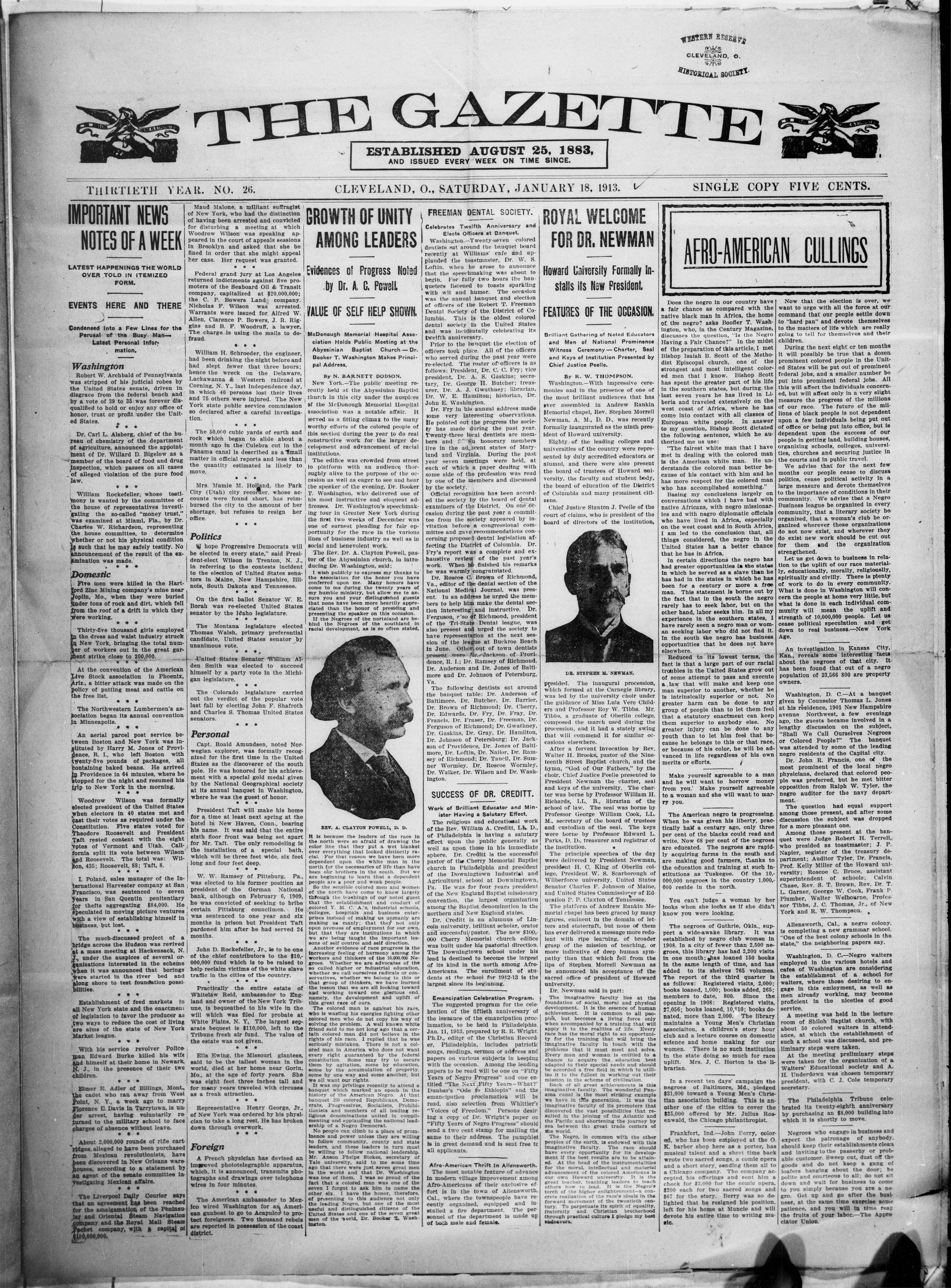
IMPORTANT NEWS
NOTES OF A WEEK
LATEST HAPPENINGS THE WORLD
OVER TOLD IN ITEMIZED
FORM.
EVENTS HERE AND THERE
Condensed Into a Few Lines for the
Perusal of the Busy Man—
Latest Personal Infor-
Washington
Robert W. Archald of Pennsylvania was stripped of his judicial robes by the United States senate, driven in disgrace from the federal bench and by a vote of 39 to 35 was forever disqualified to hold or enjoy any office of honor, trust or profit under the United States.
Dr. Carl L. Alsberg, chief of the bureau of chemistry of the department of agriculture, announced the appointment of Dr. Willard D. Bigelow as a member of the board of food and drug inspection, which passes on all cases of alleged violation of the pure food law.
---
William Rockefeller, whose testimony is wanted by the committee of the house of representatives investigating the so-called "money trust," was examined at Miami, Fla., by Dr. Charles W. Richardson, representing the house committee, to determine whether or not his physical condition is such that he may safely testify. No announcement of the result of the examination was made.
Domestic
Five men were killed in the Hart-
ford Zinc Mining company's mine near
Joplin, Mo., when they were buried
under tones of rock and dirt, which fell
from the roof of a drift in which they
were working.
Thirty-five thousand girls employed
in the dress and waist industry struck
in New York, bringing the total num-
ber of workers out in the great garm
ment strike close to 200,000.
At the convention of the American
Live Stock association in Phoenix,
Ariz, a bitter attack was made on the
policy of putting meat and cattle on
the free list.
The Northwestern Lumbermen's as-
sociation began its annual convention
in Minneapolis.
An aerial parcel post service bet-
ween Boston and New York was institu-
ted by Harry M. Jones of Providence,
R. L., who left Boston with
twenty-five pounds of packages, all
containing baked beans. He arrived
in Providence in 64 minutes, where he
stopped for the night and resumed his
trip to New York in the morning.
Woodrow Wilson was formally elected president of the United States when electors in 40 states met and cast their votes as required under the Constitution. Five states voted for Theodore Roosevelt and President Taft rested content with the eight votes of Vermont and Utah. California split its vote between Wilson and Roosevelt. The total was: Wilson, 435; Roosevelt, 88; Taft, 8.
I. Poland, sales manager of the International Harvester company at San Francisco, was sentenced to seven years in San Quentin penitentiary for thefts aggregating $84,000. He speculated in moving picture ventures with a view of establishing himself in business, but lost.
---
The much-discussed project of a bridge across the Hudson was revived at a mass meeting at Hackensack, N.J., under the auspices of several organizations interested in the scheme when it was announced that borings were started in the river bed and along shore to test foundation possibilities.
---
Establishment of feed markets in all New York state and the enactment of legislation to favor the producer as two ways to reduce the cost of living are aims of the state of New York Market league.
With his service revolver Police man Edward Burke killed his wife and himself at their home in Newark N. J., in the presence of their two children.
Elmer E. Adler of Billings, Mont., the cadet who ran away from West Point, N. Y., a week ago to marry Florence E. Davis in Tarrytown, is under arrest, having voluntarily returned to the military school to face charges of absence without leave.
About 2,000,000 rounds of rifle cartridges, alleged to have been purchased from Mexican revolutionists, have been discovered in New Orleans ware houses, according to a statement by an agent of the senate committee investigating Mexican affairs.
The Liverpool Daily Courier says that an agreement has been reached for the amalgamation of the Peninsular and Oriental Steam Navigation company and the Royal Mall Steam Packet company, with a capital of 110,000,000.
```markdown
```
THE GAZETTE
Maud Malone, a militant suffragist of New York, who had the distinction of having been arrested and convicted for disturbing a meeting at which Woodrow Wilson was speaking appeared in the court of appeals sessions in Brooklyn and asked that she be fined in order that she might appeal her case. Her request was granted.
Federal grand jury at Los Angeles returned indictments against five promoters of the Seaboard Oil & Transit company, capitalized at $20,000,000; the C. P. Bowers Land company. Nicholas F. Wilson was arrested. Warrants were issued for Alfred W. Allen, Clarence P. Bowers, J. R. Rigins and B. F. Woodruff, a lawyer. The charge is using the mails to defraud.
---
William H. Schroeder, the engineer, had been drinking the night before and had slept fewer that three hours; hence the wreck on the Delaware, Lackawanna & Western railroad at Corning, N. Y., last independence day, in which 40 persons lost their lives and 75 others were injured. The New York state public service commission so declared after a careful investigation.
The 50,000 cubic yards of earth and rock which began to slide about a month ago in the Culebra cut in the Panama canal is described as a small matter in official reports and less than the quantity estimated is likely to move.
---
Mrs. Mamie M. Holland, the Park City (Utah) city recorder, whose accounts were found short, has reimbursed the city to the amount of her shortage, but refuses to resign her office.
Politics
hope Progressive Democrats will be elected in every state," said President-elect Wilson in Trenton, N. J., in referring to the contests incident to the election of United States senators in Maine, New Hampshire, Illinois, South Dakota and Tennessee.
On the first ballot Senator W. E. Borah was re-elected United States senator by the Idaho legislature.
The Montana legislature elected Thomas Walsh, primary preferential candidate, United States senator by unanimous vote.
United States Senator William Alden Smith was elected to succeed himself by a party vote in the Michigan legislature.
The Colorado legislature carried out the verdict of the popular vote last fall by electing John F. Shafroth and Charles S. Thomas United States senators.
Personal
Capt. Roald Amundsen, noted Norwegian explorer, was formally recognized for the first time in the United States as the discoverer of the south pole. He was honored for his achievement with a special gold medal given by the National Geographical society at its annual banquet in Washington, where he was the guest of honor.
President Taft will make his home for a time at least next spring at the hotel in New Haven, Conn., bearing his name. It was said that the entire sixth floor front was being set apart for Mr. Taft. The only remodeling is the installation of a special bath, which will be three feet wide, six feet long and four feet deep.
W. W. Ramsey of Pittsburg, Pa., was elected to his former position as president of the German National bank, although on February 6, 1909, he was convicted of seeking to bribe certain Pittsburg councilmen. He was sentenced to one year and six months in prison but President Taft pardoned him after he had served 24 months.
---
John D. Rockefeller, Jr., is to be one of the chief contributors to the $10,000,000 fund which is to be raised to help reclaim victims of the white slave traffic in the cities of the country.
Practically the entire estate of Whitewalt Reid, ambassador to England and owner of the New York Tribune, is bequeathed to his wife in the will which was filed for probate at White Plains, N. Y. The largest separate bequest is $110,000, left to the Tribune fresh air fund. The value of the estate was not given.
Ella Ewing, the Missouri glantess, said to be the tallest woman in the world, died at her home near Gorin, Mo, at the age of forty years. She was eight feet three inches tall and for many years traveled with circuses as a freak attraction.
Representative Henry George, Jr., of New York was ordered by his physician to take a long rest. He has broken down through overwork.
Foreign
A French physician has devised an improved phototelegraphic apparatus, which, it is announced, transmits photographs and drawings over telephone wires in four minutes.
The American ambassador to Mexico wired Washington for an American gunboat to go to Acapulco to protect foreigners. Two thousand rebels are reported in possession of the coast district.
ESTABLISHED AUGUST 25, 1883 AND ISSUED EVERY WEEK ON TIME SINCE.
VALUE OF SELF HELP SHOWN
McDougain Memorial Hospital Association Holds Public Meeting at the Abyssinian Baptist Church — Dr. Booker T. Washington Makes Principal Address.
By N. BARNETT DODSON.
New York.—The public meeting recently held at the Abyssinian Baptist church in this city under the auspices of the McDougain Memorial Hospital association was a notable affair. It served as a fitting climax to the many worthy efforts of the colored people of this section during the year to do real constructive work for the larger development and advancement of racial institutions.
The edifice was crowded from street to platform with an audience thoroughly alive to the purpose of the occasion as well as eager to see and hear the speaker of the evening, Dr. Booker T. Washington, who delivered one of his most instructive and eloquent addresses. Dr. Washington's speechmaking tour in Greater New York during the first two weeks of December was one of earnest pleading for fair opportunity for the race in the various lines of business industry as well as in social and benevolent work.
The Rev. D. A. Clayton Powell, pastor of the Abyssinian church, in introducing Dr. Washington, said:
I wish publicly to express my thanks to the association for the honor you have conferred upon me. Many honors have come to me during the twenty years of my humble ministry, but allow me to assure you and your distinguished guests that none have been more heartily appreciated than the honor of presiding and presenting the speaker on this occasion. The Negroes of the northland are behind the Negroes of the southland in racial development, as is so often stated,
REV. A. CLAYTON POWELL. D. D.
it is because the leaders of the race in the north were so afraid of drawing the color line that they put a wet blanket over them to prevent them from being critical. For that reason we have been more dependent upon the white man in the north for the necessaries of life than have been our brothers in the south. But we have never been so dependent people are a poor and weak people. So the sensible colored men and women of the north have come to know largely that the establishment and conduct of colored Y. M. C. A.'s industrial schools, colleges, hospitals and business enterprises instead of making us unarmy like the people we are open avenues of employment for our own, but that they are institutions in which we are being taught the important lessons of the work. Another evidence of race progress is the increasing feeling of harmony among the workers and thinkers of the 10,000,000 New Yorkers so called higher or industrial education, whether we call ours radicals or conservatives, whether we belong to this or that race, whether we are the lesson that we are all looking toward and working toward one glerious end, namely, the development and uplift of the race. The colored man is against his race, who is wasting his energies fighting other colored men who do not copy his way of solving the problem. A well known white friend said to me not long ago that a certain group of people had rights of his race. I replied that he was seriously mistaken. There is not a colored man in America who does not want to work for the poor and some another, but constitution. Some may try to secure them by agitation, some by education, some by the accumulation of property, some by one way and some another, but
It was my privilege recently to attend a banquet which marked an epoch in the history of the United States, the banquet 200 colored Republicans, Democrats, Progressives, Socialists, Prohibitionists and members of all leading religious denominations united in compiling a national leadership of a Negro Democrat. No people can climb to a place of prominence and power unless they are willing to follow community, county and state politics. I will be willing to follow national leadership. Mr. Anson Phelps Stokes, secretary of Yale university, said to me some time ago that I was in the world and that Dr. Washington was one of them. I was so proud of the fact that a colored man was one of the seven I forgot to ask him to name the president of the United States of presenting to this audience not only the leading Negro, but one of the most useful and distinguished citizens of the United States and one of the seven great of the world, Dr. Booker 2, Washington.
FREEMAN DENTAL SOCIETY.
Celebrates Twelfth Anniversary and
Fiftea Officers at Banquet
Elect Officers at Bainbridge
Washington - Twenty-seven colored dentists sat around the banquet board recently at Williams' cafe and applauded the toastmaster, Dr W. S. Loftin, when he arose to announce that the banquet was about to begin. For fully two hours the banqueters listened to toasts sparkling with wit and humor. The occasion was the annual banquet and election of officers of the Robert T. Freeman Dental Society of the District of Columbia. This is the oldest colored dental society in the United States and was incidentally celebrating its twelfth anniversary.
Prior to the benquet the election of officers took place. All of the officers who served during the past year were re-elected. The roster of officers is as follows: President, Dr. C. C. Fry; vice president, Dr. A. S. Gaskins; secretary, Dr. George H. Butcher; treasurer, Dr. A. J. Gwattney; librarian, Dr. W. E. Hamilton; historian, Dr John E. Washington. Dr. Fry in his annual address made some very interesting observations. He pointed out the progress the society has made during the past year. Twenty-three local dentists are members and seven honorary members live in the adjective states of Maryland and Virginia. During the past year seven meetings were held, at each of which a paper dealing with some side of the profession was read by one of the members and discussed by the society. Official recognition has been accorded the society by the board of dental examiners of the District. On one occasion during the past year a committee from the society appeared by invitation before a congressional committee and gave recommendations concerning proposed dental legislation affecting the District of Columbia. Dr. Fry's report was a complete and exhaustive review of the past year's work. When he finished his remarks he was warmly congratulated.
Dr. Roscoe C. Brown of Richmond, Va., editor of the dental section of the National Medical Journal, was present. In an address he urged the members to help him make the dental session interesting and instructive. Dr. Ferguson, *r*so of Richmond, president of the Tri-State Dental league, was also present and urged the society to have representation at the next session of the league at Buckroe Beach in June. Others out of town dentists present were Dr. Jackson of Providence, R. I.; Dr. Ramsey of Richmond, Dr. Anderson and Dr. Jones of Baltimore and Dr. Johnson of Petersburg, Va.
The following dentists sat around the banquet table: Dr. Anderson of Baltimore, Dr. Butcher, Dr. Barrier, Dr. Brown of Richmond; Dr. Cherry, Dr. Edwards, Dr. Fry, Dr. Fray, Dr. Francis, Dr. Fraser, Dr. Freeman, Dr. Ferguson of Richmond; Dr. Gwattney, Dr. Gaskins, Dr. Gray, Dr. Hamilton, Dr. Johnson of Petersburg; Dr. Jackson of Providence, Dr. Jones of Baltimore, Dr. Loftin, Dr. Nailor, Dr. Ramsey of Richmond; Dr. Tancil, Dr. Sumner Wormley, Dr. Roscoe Wormley, Dr. Walker, Dr. Wilson and Dr. Wash ington.
SUCCESS OF DR. CREDITT.
Work of Brilliant Educator and Minister Having a Salutary Effect.
Iter. Having a background in the religious and educational work of the Rev. William A. Crediti, Lk. D. of Philadelphia is having a salutary effect upon the people generally as well as upon those in his immediate sphere. Crediti is the successful pastor of the Cherry Memorial Baptist church in Philadelphia and president of the Downingtown Industrial and Agricultural school at Downingtown, Pa. He was for four years president of the New England Baptist missionary convention, the largest organization among the Baptist denomination in the northern and New England states. Dr. Crediti is an alumnus of Lincoln university, brilliant scholar, orator and successful pastor. The new $100,000 Cherry Memorial church edifice was built under his pastorial direction. The Downingtown school under his lead is destined to become the largest of its kind in the north among Afro-Americans. The enrollment of students at the school for 1912-13 is the largest since its beginning.
Emancipation Celebration Program.
Emancipation Celebration Program.
The suggested program for the celebration of the fifteenth anniversary of the issuance of the emancipation proclamation, to be held in Philadelphia, Jan. 11, 1913, prepared by R. R. Wright Ph.D., editor of the Christian Recorder, Philadelphia, includes patriotic songs, readings, sermon or address and papers on various subjects in keeping with the occasion. Among the leading papers to be read will be one on "Fifty Years of Negro Progress" and one entitled "The Next Fifty Years—What? Dumbar's "Ode to Ethiopia" and the emancipation proclamation will be read, also selection from Whittier's "Voles of Freedom." Persons desiring a copy of Dr. Wright's paper on "Fifty Years of Negro Progress" should send a two cent stamp for mailing the same to their address. The pamphlet is in great demand and is sent free to all applicants.
Afro-American Thrift In Allensworth.
The most notable feature of advance in modern village improvement among Afro-Americans of their exclusive effort is in the town of Allensworth, Cal., where the townspeople have recently organized, equipped and installed a fire department. The personnel of the department is made up of both male and female.
Brilliant Gathering of Noted Educators and Men of National Prominence Witness Ceremony—Charter, Seal and Keys of Institution Presented by Chief Justice Pelle.
By R. W. THOMPSON.
Washington.—With impressive ceremonies and in the presence of one of the most brilliant audiences that has ever assembled in Andrew Rankin Memorial chapel, Rev. Stephen Morrell Newman, A. M., D. D., was recently formally inaugurated as the ninth president of Howard university. Eighty of the leading colleges and universities of the country were represented by duly accredited educators or alumni, and there were also present the board of trustees of Howard university, the faculty and student body, the board of education of the District of Columbia and many prominent citizens. Chief Justice Stanton J. Peele of the court of claims, who is president of the board of directors of the institution,
DR. STEPHEN M. NEWMAN.
presided. The inaugural procession, which formed at the Carnegie library, was led by the university choir under the guidance of Miss Lula Vere Childers and Professor Roy W. Tibbs. Mr. Tibbs, a graduate of Oberlin college, composed the march used during the procession, and it had a stately swing that will commend it for similar occasions elsewhere.
After a fervent invocation by Rev. Walter H. Brooks, pastor of the Nineteenth Street Baptist church, and the hymn, "God of Our Fathers," by the choir, Chief Justice Peelle presented to President Newman the charter, seal and keys of the university. The charter was borne by Professor William H. Richards, LL. B., librarian of the school of law. The seal was borne by Professor George William Cook, LL. M., secretary of the board of trustees and custodian of the seal. The keys were borne by Professor Edward L. Parks, D. D., treasurer and registrar of the institution.
The principle speeches of the day were delivered by President Newman, president H. C. King of Oberlin college, President W. S. Scarborough of Wilberforce university, United States Senator Charles F. Johnson of Maine, and United States Commissioner of Education P. P. Claxton of Tennessee.
The platform of Andrew Rankin Memorial chapel has been graced by many figures, eniment in the domain of letters and statecraft, but none of them has ever delivered a message more reolent with ripe learning, of broader grasp of the mission of teaching, or more indicative of deep human sympathy than that which fell from the lips of Stephen Morrell Newman as he announced his acceptance of the sacred office of president of Howard university.
Dr. Newman said in part:
The imaginative faculty lies at the foundation of social, moral and physical development. It is the essence of human achievement. It is common to all people, regardless of race, gender or age, when accompanied by a training that will apply it to the realities of life. Every race has the moral right to an opportunity for the training that will bring the human potential to the fullest, and the problems that it must meet and solve. Every man and woman is entitled to a chance to acquire the education best adapted to their special needs and should be encouraged to take the most effort to the fullest in working out their mission in the scheme of civilization. Back of all great achievements is this imaginative faculty. The wonderful Familias Negroes are the most attractive we have in this generation. It was the imaginative faculty of its promoters that discovered the vast possibilities that resulted in the joining of the Atlantic and the shortest of the journey by sea between the great trade centers of the world. The Negro, in common with the other peoples of the earth, is endowed with this imaginative faculty. The race should be encouraged to the greatest opportunity if the best results are to be attained. At the head of the instrumentalities for the moral, intellectual and material needs of the colorful Americans our own flowered with great teacher, teaching leaders to teach others how to lead. It is the Negro's role in the creation of the race's ideals in the forward movement of the twentieth century. To perpetuate its spirit of equality, freedom, and Christian brotherhood practical culture I pledge my best endeavors.
SINGLE COPY FIVE CENTS.
AFRO-AMERICAN CULLINGS
WESTERN RESERVE
CLEVELAND, O.
HISTORICAL SOCIETY.
SINGLE COPY
AFRO-AMERICA
Does the negro in our country have a fair chance as compared with the native black man in Africa, the home of the negro? asks Boofer T. Washington, who, in the Century Magazine, discusses the question, "Is the Negro Having a Fair Chance?" In the midst of the preparation of this article, I met Bishop Isaiah B. Scott of the Methodist Episcopal church, one of the strongest and most intelligent colored men that I know. Bishop Scott has spent the greater part of his life in the southern states, but during the last seven years he has lived in Liberia and traveled extensively on the west coast of Africa, where he has come into contact with all classes of European white people. In answer to my question, Bishop Scott dictated the following sentence, which he authorized me us use:
"The fairest white man that I have met in dealing with the colored man is the American white man. He understands the colored man better because of his contact with him and he has more respect for the colored man who has accomplished something."
Basing my conclusions largely on conversations which I have had with native Africans, with negro missionaries and with negro diplomatic officials who have lived in Africa, especially on the west coast and in South Africa, I am led to the conclusion that, all things considered, the negro in the United States has a better chance that he has in Africa.
In certain directions the negro has had greater opportunities in the states in which he served as a slave than he has had in the states in which he has been for a century or more a free man. This statement is borne out by the fact that in the south the negro rarely has to seek labor, but on the other hand, labor seeks him. In all my experience in the southern states, I have rarely seen a negro man or woman seeking labor who did not find it. In the south the negro has business opportunities that he does not have elsewhere.
Reduced to its lowest terms, the fact is that a large part of our racial troubles in the United States grow out of some attempt to pass and execute a law that will make and keep one man superior to another, whether he is intrinsically superior or not. No greater harm can be done to any group of people than to let them feel that a statutory enactment can keep them superior to anybody else. No greater injury can be done to any youth than to let him feel that because he belongs to this or that race, or because of his color, he will be advanced in life regardless of his own merits or efforts.
Make yourself agreeable to a man and he will want to borrow money from you. Make yourself agreeable to a woman and she will want to marry you.
The American negro is progressing. When he was given his liberty, practically half a century ago, only three per cent of the blacks could read and write. Now 68 per cent of the negroes are educated. The negroes are rapidly acquiring farms in the south and are making good farmers, thanks to the education and training at such institutions as Tuskegee. Of the 10,000,000 negroes in the country 1,000,000 reside in the north.
You can't judge a woman by her looks when she looks as if she didn't know you were looking.
The negroes of Guthrie, Okla, support a wide-awake library. It was established by negro club women in 1908. In a city of fewer than 2,500 negroes, this library has had 2,000 visits in one month; has loaned 150 books in the same length of time, and has added to its shelves 765 volumes. The report of the third quarter is as follows: Registered visits, 2,000; books loaned, 1,000; books added, 265; members to date, 800. Since the opening in 1908: Registered visits, 27,056; books loaned, 10,810; books donated, more than 2,000. The library maintains a Young Men's Christian association, a children's story hour club and a lecture course on domestic science and home making for our women. There is no such institution in the state doing so much for race uplift. Mrs. J. C. Horton is the librarian.
In a recent ten days' campaign the negroes of Baltimore, Md., pledged $21,000 toward a Young Men's Christian association building. This is another one of the cities to cover the $25,000 offered by Mr. Julius Rosenwald, the Chicago philanthropist.
Frankfort, Ind.—John Perry, colored, who has been employed at the O. K. barber shop here as a porter, has musical talent and a short time back wrote two sacred songs, a comic opera and a short story, sending them all to a Chicago company. The company accepted his offerings and sent him a check for $3,000 for the comic opera, $200 each for two sacred songs and $67 for the story. Berry was so delighted that he resigned his position, left for his home at Muncie and will devote his entire time to writing music.
SALVATORE
Now that the election is over, we want to urge with all the force at our command that our people settle down to "hard pan" and devote themselves to the matters of life which are really going to tell for themselves and their children.
During the next eight or ten months it will possibly be true that a dozen prominent colored people in the United States will be put out of prominent federal jobs, and a smaller number be put into prominent federal jobs. All this will affect the individuals concerned, but will affect only in a very slight measure the progress of the millions of our race. The future of the millions of black people is not dependent upon a few individuals being put out of office or being put into office, but is dependent upon the success of our people in getting land, building houses, organizing schools, colleges, universities, churches and securing justice in the courts and in public travel.
We advise that for the next few months our people cease to discuss politics, cease political activity in a large measure and devote themselves to the importance of conditions in their community. We advise that a Negro Business league be organized in every community, that a literary society be organized, that a woman's club be organized wherever these organizations do not now exist, and wherever they do exist new work should be cut out for them and the organization strengthened.
Let us get down to business in relation to the uplift of our race materially, educationally, morally, religiously, spiritually and civilly. There is plenty of work to do in every community. What is done in Washington will concern the people at home very little, but what is done in each individual community will mean the uplift and strength of 10,000,000 people. Let us cease political speculation and get down to real business.—New York Age.
An investigation in Kansas City, Kan., reveals some interesting facts about the negroes of that city. It has been found that out of a negro population of 23,566 800 are property owners.
Washington, D. C.—At a banquet given by Counselor Thomas L. Jones at his residence, 1901 New Hampshire avenue Northwest, a few evenings ago, the guests became involved in a lengthy discussion on the subject, "Shall We Call Ourself Negroes or Colored People?" The banquet was attended by some of the leading negro residents of the Capital city.
Dr. John R. Francis, one of the most prominent of the local negro physicians, declared that colored people was preferred, but he met bitter opposition from Ralph W. Tyler, the negro auditor for the navy department.
The question had equal support among those present, and after some discussion the subject was dropped for a more pleasant one.
Among those present at the banquet were Judge Robert H. Terrell, who presided as toastmaster; J. P. Napler, register of the treasury department; Auditor Tyril Dr. Francis, Prof. Kelly Miller of the Howard university; Roscoe C. Bruce, assistant superintendent of schools; Calvin Chase, Rev. S. T. Brown, Rev. Dr. L. Garner, George W. Cook, Frank P. Plumber, Walter Welbourne, Professor Tibbs, J. C. Thomas, Jr., of New York and R. W. Thompson.
Allensworth, Cal., a negro colony, is completing a new grammar school. "One of the best colony schools in the state," the neighboring papers say.
Washington, D. C.—Negro walters employed in the various hotels and cafes of Washington are considering the establishment of a school for waiters, where those desiring to engage in this employment, as well as men already working, may become proficient in the niceties of good service.
A meeting was held in the lecture room of Shiloh Baptist church, with about 50 colored waiters in attendance, at which the establishment of such a school was discussed, and preliminary steps were taken.
At the meeting preliminary steps were taken for the organization of a Waiters' Educational society and A. H. Underdown was chosen temporary president, with C. J. Cole temporary secretary.
The Philadelphia Tribune celebrated its twenty-eighth anniversary by purchasing an $8,000 building into which it is shortly to move.
Negroes who engage in business and expect the patronage of anybody, should keep their establishments clean and inviting to the passerby or probable customer. Sweep out, dust of the good, and do not keep a gang of lovers hanging about the door; be polite and courteous to all; do not sit down and wait for business to come to you simply because you are a negro. Get up and go after the business, at the same time exercise some patience, and you will in time reap the fruits of your labor.—The Appreciator Union.
One Year.....$1.50
Six Months.....1.00
Three Months......50
Subscribers are requested to re-
mit by postoffice money or
order or registered letter.
Entered at the postoffice in Cleveland
Ohio, as second-class matter
Address all communications to
HARRY C. SMITH
Editor and proprietor,
THE GAZETTE,
Blackstone Building, Cleveland, O.
Member Ohio Legislature 1894
to 1898; 1896 to 1898; 1900 to 1902
THE GAZETTE is the oldest, and
has the largest bona fide circulation
double that of any newspaper in the
interest of Afro-Americans, published
in the state of Ohio, and comparison
with any will immediately establish
its rank as one of the NEWSIEST
AND BEST in the country.
Wm. Winkfield and Charles Stump, the purporters of the Archbold letters in New York, that resulted in so much harm to Senator Foraker and others, have injured our people in much the same way that Jack Johnson has, in recent months. Their appearance before the Congressional investigating committee at Washington, D. C., the past week, has but revived the memory of their despicable connection with the theft of the letters, and as a result made the burden our people are to carry for some time to come, all the heavier. The Winkfields, Stumps and Johnsons must be "unloaded" pretty soon or they will "sink the ship."
AN EXCEPTIONAL APPOINTMENT
The last official act of Gov. Judson M. Harmon was a graceful one—that of naming Mr. Jacob B. Perkins of this city, an independent Republican, to fill the vacancy in the Board of Agriculture, caused by the death of Ex-Congressman Jacob Beidler. This practically maintains the equal balance of the board politically and gives to it a member second to none in the experience necessary to make him a positive quantity in its work. He is, also, full of energy, a GENTLEMAN in the fullest sense of the word, approachable, agreeable, honest to the core. Mr. Perkins will certainly make an ideal member of the board. About twelve years ago, when a member of the Ohio Legislature and among those insisting that he be appointed a member of Cleveland's Park Board, we held the same impressions as regard Mr. Perkins and have never had occasion to question them for a single moment since. We congratulate Gov. Harmon, the State of Ohio and Mr. Perkins, on his appointment.
MISS BURROUGHS RIGHT!
Miss Nannie H. Burrows, corresponding secretary of the Women's Auxiliary convention and president of the National Training School for Girls, said recently in a strong plea, for help, for the race:
"We have too many organizations. The Negro is the most organized race in the world, and his organizations are the least effective. We have our hands on the mass of people, and this is a great challenge, and it isingly difficult for the leaders to settle upon a definite plan either for our moral, social, political or industrial betterment."
Time and again have we also, called attention to the fact that we have a number of so-called "national" organizations, and not one of them making the slightest effort in a PROPER way to solve any one of the three greatest and by far most important problems of the times confronting our people—disfranchisement, "jim-crow" cars (as relating to inter-state passengers of color), and mob violence or lynchmurder. The first two can only be solved in the U. S. Supreme Court. Dr. Booker Washington, president of the National Business Men's League, knows this; Dr. W. E. B. Du Bois of the National Association for the Advancement of Colored People, knows this; so, too do the presidents of all the other "national" Negro or Afro-American organizations. Then, why do they fritter away time, money and effort with matters and things of minor importance? Washington, Du Bois and all the others know better, as we have indicated, and both are being maintained by ample funds supplied by both our people and the whites. There ought not to be any difficulty "in settling upon a definite plan." Miss Burroughs. All know what is to be done and the only way in which an effort to accomplish it, can be made. The thing to do is for our people, the country over, to demand of Messrs. Du Bois and Washington, particularly, and all the other "presidents" and heads of our "national" organizations, that they do their clear duty to them, and stop the frittering away of time, effort and money "chasing shadows." We say this, too, with full appreciation for all the many little "side issues" both the N. B. M. L. and the N. A. A. C. P. may have handled successfully. Rap them again. Miss Burroughs, but a little more definitely and to the point.
As pertinent to much of the foregoing it is only necessary to call our readers' attention to the fact that on the 10th of last month, the Supreme Court of Mississippi decided that its state "jim-crow" law applies to through sleeping cars, as well as day coaches. Here we have the spectacle of a state court endeavoring to fix our rights (in its state) as inter-state (U. S.) passengers, when this power for all the state rests in the U. S. Supreme Court. And we are making absolutely no effort whatever to defend our rights as inter-state passengers, as voters or anything else. We believe the U. S. Constitution will uphold both efforts—to knock out disaffirmation and "jim-crow" car laws (at least as far as the latter effect inter-state passengers of color), if Ors. Washington and Du Bois or
either, will but lead. Both can afford the time; they are being paid well, as we have indicated.
If ever there were two "worthies" who simply dote on basking in the limelight of newspaper publicity, regardless of how much they harm others by so doing, Johnson and Roosevelt are the persons. Their methods, at least as far as the element of impetuosity goes, are much the same. Why Jack Johnson left Chicago, the first of the week, without the permission of the U. S. court, knowing he was under bail ($30,000) and knowing he wanted to leave the country (to Toronto, Canada), if only "for a day or two." is something only he can explain. It was certainly foolish, to say the least. So like Roosevelt! He is compelled "to stay in jail until his trial" as a special government agent at Chicago intimates, as a result of his latest escapade, it can but do Jack some good. He seems to have "lost his head" entirely, since the death of his first wife.
New Years evening, the Eighth Regiment (Afro-American) of the Illinois State Guard, gave its annual ball in Chicago. The day following the daily papers of the country carried a dispatch from that city announcing that Jack and his new wife had been hissed at this ball. We did not believe it until an editorial in the Chicago Fellowship Herald of last week, was called to our attention. Mrs. Ida B. Wells-Barnett edits the Heldm. Knowing her as we do, and as all of the intelligent members of the race in this country do, it is impossible to pass over lightly the statements she makes in the following, especially since she has steadily shown a friendly side toward Johnson throughout his many recent troubles:
Negroes Hiss Jack Johnson.
The whole country is talking about the latest Jack Johnson sensation—the hissing of himself and wife By the patrons of the New Years ball of Eighth Regiment. Several reasons have been given for this by those who were present.
One, is that while it was a public ball, no other couple on the floor excepting themselves was dancing in such a vulgar fashion. Second, that while doing so, Mrs. Johnson made a reckless display of her hands, which savored more of the methods of the demimonde—than of respectable people. Third, that while there may have been others present who were not shining lights from a standpoint of virtue, no other woman there had openly confessed to having lived in a notorious house of ill-fame; or whose conduct with another woman's suicides was so horrific that her mother suicid, and who had then married that woman's husband in less than three months afterward.
In no single case was the reason because Jack Johnson had married a white woman. One year ago, the former Mrs. Johnson was present at this ball with her diamonds and no one else in the room. Jack Johnson has learned his lesson, yet he was heard to say to his wife on retiring, that it was all because "they were jealous as she had them all skinned to death." The Negroes of Chicago are to be congratulated on the moral courage displayed and the lives given those who would override the rules of decency and good breeding.
While we do not question Mrs. Barnett's veracity, we are loth to believe the statements anent Jack and his wife. It is barely possible that Mrs. Barnett's informants may have misled her. She does not claim to have been an eye-witness of or to have heard the things upon which she bases her "reasons" for the hissing of Johnson and wife. What has the editor of our contemporary, the Chicago Defender, who was undoubtedly in attendance upon the ball, to say about it? Regardless of the facts, the hissing and all of Jack's escapades, alleged and otherwise, are most unfortunate from a racial viewpoint. Our people, the country over, must pay the penalty in an increased prejudice and the loss of thousands of well-wishers, if not friends.
Would Revike the Town's Charter.
Harrisburg, Pa.-Gov. John K. Tener
of Pennsylvania, in his annual
message to the Legislature, makes
a statement that he is a member
of the Borough of Coatesville, Chester
county, be revoked by the Legislature
because of the obstructive tactics the
citizens of Chester county resorted to
when efforts were made to punish
those guilty of lynch-murdering at the
county jail. He is a colored man
burned because he had been charged
with killing a police officer.
Famous Bell of Moscow.
The largest bell is the great bell at Moscow, which is 86 feet in circumference at the bottom, over 21 feet high, and 23 inches thick at the top. Its weight has been computed at 217 tons. It has never been hung.
Charming Wife—"Gerald, all I had to pay for this lovely hat was $30. How does it strike you?" Surprised Husband (gasping) — "Marle, that strikes me below the money belt!" — Chicago Tribune.
CORRESPONDENTS WANTED.
The old reliable Gazette desires an active agent and correspondent in every city and town in Ohio and neighboring states having a number of Afro-American residents. Only a little time on Fridays or Saturdays is required. We are especially destroys of hearing from persons in the following named cities: Zanesville, Newark, Lancaster, Lebanon, Chillicot, Toledo, Troy, Canton, Springfield, Piqua, Columbus, Cambridge, Steubenville, Bellaire, St. Clairsville, Wilmington, Portmouth, Washington, C. H., Oxford, Sabina, Gallipolis, Rendville, Urbana, Delaware, M. Vernon, East Lairpool, Wellsville, Akron, Dayton, Middleport, Bellefontaine, Lima, O., and other places where we have none.
Write to the editor of The Gazette Blackstone building, Cleveland, O. and terms will be sent promptly. Our address is 1000 W. 12th St. at once at once the addresses of persons in the cities named above, or others, to whom we can write relative to the matter.
THE GAZETTE, CLEVELAND, O.. SATURDAY, JANUARY 18, 1913
Robert R. Horner and Rev. J. M. Waldron are our only two members of the Washington, D. C., inaugural committee (for President-elect Thomas Woodrow Wilson). The National Benefit Association of Washington, D. C., headed by Samuel W. Rutherford, employs about 500 Colored persons and the John Wanamaker store of Philadelphia, gives employment to 300: 11 in the dairy, 83 on the elevators, 20 in the tea room, 21 in the help's lunch room, 3 in the printing department, 3 in the warehouses, 10 as waiters and 10 as porters. The Gazette is indebted to Mrs. E. Azalia Hackley for a copy of her "Catechism in Voice Culture." The trustees of the Jeanes fund for the improvement of rural schools in the south for Afro-Americans has appropriated $36,375 with which to carry work in 109 counties during the year.
A careful reading of this department alone will convince any intelligent and loyal member of tl e race, that if one wishes all the best news of the week concerning our people everywhere, one must take the hard-ridden "Gazette" on the QWX. The suspension of both The Advocate and The Mountain Leader of Charleston, W. Va., is announced by J. C. Glmer and T. G. Nutter, editors. The Evening Gazette of New York City, E. C. Allen and H. B. Warner, publishers, is our only northern daily paper. One or two were started, recently the famous 25th infantry left Ft. Geo Wright, at Spokane, Wash., on Dec 24, where they have been stationed for the past two years, for the Hawaiian Islands. They were tendered a public reception, which was attended by a vast concourse of people which included the mayor (Hindley) and Police Judge Stockier, both of whom said Spokane was sorry the school was closed. A student of the A. & M. College, Greenboro, N. C., was recently left $101,000, by a former employer (white).
The lynching record for the past year, according to the Chicago daily Tribune, is smaller than ever before save for the years of 1906 and 1907. Only 64 persons were thus done to death. -Sixty of these were Negroes and four were white. As usual, Georgia leads the procession with 11 persons. Three of these 60 were women. The Tribune does not include those killed in alleged 'race riots' or by posses, or the number would be larger. In the shift America's department James W. Johnson, now consul at Corinto, Nicaragua, is transferred to St. Michaels, Spain, and Wm. J. Verhy, of Tennessee, is transferred from Sierra Leone, West Africa, to Messina, Turkey. Both Afro-Americans go to more desirable posts.
Albert Kelly of Colbert Co. Ala., recently paroled from the penitentiary where he had served 24 years of a life sentence for murder, is worth $25,000. Property purchased in Magic City, Ala., before his incarceration in the "pen," has so increased in value, that he and his friends and others, are soon to give the comedian, Sam. Lucas, age 71, a benefit. He will then retire from the stage.
Newton Johns, a Seattle, Wash., bootblack, last May, saved ten women and children from drowning in Puget Sound, after a steamboat explosion. He jumped into the water with his wife, and then went to want a Carnegie hero medal for him.
Officials of the Toledo & Ohio Central railroad have announced that white women will be substituted for Afro-Americans as waiters on the dining cars operated by that road. White women also will succeed the present Colored chefs.
Dorothy Costes, of Spokane, Wash., submitted a jury duty in Superior Court there, is believed to be the first woman of the race in the United States to have this opportunity.
President Taft has named Fred R. Moore, publisher of the New York Age, as U. S. Minister to Liberian, to succeed the late Dr. Wm. D. Crum. Mrs. Purnell, who has been employed at the Wanamaker store, Philadelphia, for 20 years, has been granted a pension for her valuable service. Mrs. Purnell, with the help of some present from her department. The chief of the elevators, and the maids of the store also gave her presents. The right of 5,000 Cherokee freedmen to participate in the distribution of lands and funds belonging to the Cherokee Indian nation was sustained recently by Judge Anderson, of the District of Columbia supreme court. The freedmen claim that their share the property runs anywhere from $100,000 to $100,000. The freedmen are the 'descendants of slaves of the Cherokees and are of mixed Negro and Indian blood. The court, in dismissing the suit, held that the freedmen were clearly entitled to equal rights with the native Cherokees.
Jack Johnson has created more stink by buying a fine residence "in the aristocratic Lake Geneva district" and moving in. When he is not in not water himself, it seems he insists he has a private residence. He sees his finish if he possessed single instead of double sight. No man in the country needs more than Jack Johnson to "lay low and keep quiet" for a season. N. Y. Age. Jack Johnson was refused the use of O'Connell's gymnasium in Chicago, last week. Prejudice. He is matched to the Grand Prix, France, or Grand Prix night. In 2012, it is well to remember that, to date, Johnson has not been convicted on any of the many criminal charges (indictments) made against him in recent months. The "smuggling" case has been continued indefinitely because there isn't sufficient evidence to convict. So with all the others. Jeanne Jeannette and Sam. Langford who are matched toight. In California, this time the latter and Sam. are pretty evenly balanced with the odds in favor of the latter.
London and Paris papers are telling how American rastime has taken possession of the public in those cities. Comparatively unknown "rag" singers from this side are making the hits of their lives in the London halls and some of them are getting big salaries.
Two Los Angeles, Cal., Afro-American policemen have been promoted. On the streetman has been made a detective and the other (Machuf) a nographer in the chief office. Rev. E. W. Klinchen, a former Ohioan, now located in that city, delivered the emancipation celebration address, there Jan. 1.
Mrs. Ella Flagg Young, superintendent of Chicago's public schools, said recently at Washington, D. C., in an interview: "In Chicago, we have mixed schools and we are proud of them. We have Colored teachers, too, and we are proud of them, and to speak of the kindly feeling between
them, it cannot be put too strongly. You people are making a grave mistake to try to keep the Colored people down. I for one will contend that we should not be in one school and we will find in the long run our nation will be richer by many millions. Then, too, the Colored citizens must stand up and demand their rights, and we who have these must stand by our darker brother."
BUCKEYE LETTERS
WRITTEN BY "THE OLD RELIA BLE" GAZETTE'S CORRE SPONDENTS.
What Our People Are Doing Each Week — Church, Personal, Social, Lodge, Literary and Musical — Marriages, Deaths, Etc.
Mt. Vernon.—Chief of Police Rollin S. Clements, while attempting to arrest William Rice Jan. 8 was struck over the head with a chair. His injuries are such that he cannot recover. After he lay on the floor unconscious, Rice hit through Oements' glove, completely severing the index finger of his left hand. The chief went to Rice's home to arrest him on a minor charge, when, without any warning, he was attacked. Clements formerly was sheriff of Knox county, and also city treasurer.
Piqua.—Mrs. Jane Rial visited Mrs. W. H. Gibson in Troy, recently.—Miss Hazel Taylor is visiting in Dayton, and Miss Eleanor Reese has returned from a visit with her grandparents.—Walter Thomas and Clyde Truss were happy recently when the two Troy young ladies were here visiting them.—Mrs. Maud Jackson of Pittsburgh spent several days here.—Mrs. Nandee,ee of Chicago, visited her parents, during the holidays. Mrs. Sephine Billings visited her parents, last week.—Miss Edith Bronson is visiting in Urbana.—Mrs. Fred. Haggards was visited recently by Dayton friends.
Cadiz.—The B. B.'s were entertained, last Sunday, by C. H. Christian.—Miss Hattie Brown has returned to Sewickley, Pa., after spending several weeks with Mrs. Anna Redman. The H. H. club entertained at a supper, on Monday, at the Musiche and the musicale and recital given at the A. M. E. church, the 9th, under the auspices of the stewards' board was enjoyed by all—M. Dora S. Johnson entertained the Y. M. L. club, the 10th.—The revival services at the A. M. E. church are in progress. You will be able to see personal work. Rev. Childers, with able assistance from others, hopes for great results.
Dayton.—The Nesbitt residence, 187 Hawthorne St., was the scene of a very pretty and successful social function, recently. It was a most enjoyable reception in honor of Miss Bessie Earley of Cleveland, one of that city's younger society leaders among our people. Our prominent society folk were the audience and the reception proved to be one of our social events of the holiday season. Miss Earley was Miss Nesbitt's guest. The evening was devoted to whist, singing, dancing and instrumental music, Mrs. Henry and Miss Mabel Finley, and Miss Nesbitt presiding at the piano. A dainty yet delicious meal was served. A returned to Cleveland. The out-of-town guests were Miss Bessie Smith of Franklin and Mr. Adolph Rice of Ann Arbor, Mich.
Correspondents must mail all letters for publication at their main postoffice sufficiently early on Monday (or Sunday) of each week to have them reach The Gazette office on Tuesday morning, and always write, also, their names and that of their city or town on the outside of the postoffice. If the letter less this latter is done, proper credit cannot be given you. Lists of names, wedding presents, etc., obituary notices, speeches, resolutions, poetry, inquiries for relatives and advertisements of all kinds, including items announcing entertainments to be held in the near future, must be paid for by the post office. In line, six words to a line. Our rates for display advertisements will be sent on application. Send postal note and not stamms during warm weather.
Ashtabula—Mrs. Etta Bailey has returned to Erla, Mrs. after spending a week with her aunt, Mrs. Fred Burke—Mrs. T. E. Green, sr., is visiting her son, Atty. Green of Youngstown. She will also visit in Franklin, Pa., before returning. —A theater party, composed of Miss Lillian Robinson, Mrs. H. Keyes, 'Mrs. C. H. Underwood, Mrs. John Blaine, Mrs. H. E. Johnson and Mrs. C. H. Green, were escorted to the Airdome Thursday evening by one of Ashtabula's charming young gentlemen, Mr. Lester Scott. Kenneth, lit the son of Mr. and Mrs. H. Keyes, sus- tions the children of Mrs. H. keyes to his eye by falling. —Charles H. Sunday in Painesville. —The Autumn Leaf club met at Mrs. H. Keyes, and held its annual election of officers. Miss Lillian Robinson, pres.; Mrs. C. H. Green, vice-pres.; Mrs. C. H. Underwood, sec.; Mrs. H. E. Johnson, treas. A dainty luncheon was served by the hostess.
Sandusky—Mrs. L. H. Dodd and Mrs. Chas. Taylor are convalescing Rev. Dodd returned. Friday, from Tledo, where he conducted a revival meeting—Mrs. Mary Jones is visiting in Pontiac, Mich.—Mrs. Stanley is doing all she can to care for her lit tre grand-daughter—Mrs. Mary Walden has heart trouble. The Second School in S. Pa. and P. were well attended, Sunday. Miss Hattie Alexander outlined the work and set things going nicely. Rev. and Mrs. Smith and Mr. and Mrs. David Anderson are convalescing—Mr. and Mrs. John Fraser left last week for Toledo, Detroit and Canada—Nell St. A. M. E. church was well attended, Rev. C. Turner preached ably M. S. D. Jones F. Dunkle are better—The young coop program for Sunday evening at Decatur St. Baptist church will be excellent. Don't miss it—The Gazette ought to be a regular visitor in every one of our homes. Indeed, no intelligent member of the race can afford to be without it.
Xenia.—Mrs. Jas. A. Taylor of Cleveland, spent New Year's with her mother, Mrs. Theresa E. Hawkins.—
Mrs. H. R. Hawkine, formerly of Cleveland, entertained at a dinner, Sunday week.—Mrs. Anna Freeman of Columbus, visited her sister, Mrs. Newsome, last week.—Clarence Lindsey of the Ohio Medical College, spent New Year's with his mother.—Miss Minnie Maxwell, a teacher in our Owensboro, Ky., schools, visited her parents, Hon. and Mrs. C. L. Maxwell, Mrs. R. R. Maxwell, Mrs. Anna Garnes of Columbia is visiting her daughter, Mrs. Earl Maxwell, Mrs. Flora Hirst, Misses Clara and Leah Gaines, Mrs. R. D. Pettiford and Mrs. Moll Elevans entertained recently.—Mr. and Mrs. Fred Pryor of Washington, D. C. were called here, last week, by his mother's illness.
Painesville.-Mr. Leroy Green was in Cleveland.-Thursday.-Mr. Walter Jones, S. R. Collins and J. H. Bethel are ill, and Mrs. Eugene Livingstone and Hall Bethel are better.-Invitations are being issued for the silver anniversary, the 26th, of the Mr. and Mrs. J. G. Smith.-The Victor Sewing club met at Miss Joseph Wooten's Friday, lightly entertained. Thursday afternoon, at Mrs. B. Crooms'. Light refreshments.-Miss Lucy Martin and Mr. Edward Becks were married. Thursday afternoon, by Rev. D. E. Carmen.-Union Congregational church's intermediate class met at its teacher, Miss Perle Smith's, and organized under the name of the Somers' class in honor of their pastor. Mrs. Perle Smith's, Wilkerson is much better.-Mrs. Lydia Christy has resigned as cook at the Chateau Louise.
Zanesville.—Miss Hulda Simpson went to Detroit, recently where she was married to W. E. Clarke of that city. It was a surprise. She is the youngest sister of Geo. T. Simpson, head of the vocal department of Willberforce University.—Mary J. Browne of this city, and John H. Holmes of this city, and Mrs. Holmes.—T. D. Scott, last week, were given a delightful reception, the same evening, by his parents of this city, Mr. and Mrs. Holmes will live with them temporarily.—Mr. Chas, Adams and Miss Bessie Lane were married, the 31st ult., by Rev. A. M. Thomas.—Mr. Schoeft Barnett of this city, and Miss Johnnie Vaughan of Birmingham, Ala., were married, the 26th ult. Mrs. Barnett taught for five years, in our schools of Natchez.—Miss Helen Pheasant of Lawrence Hicks were quietly married, the 16th ult., and kept the fact secret until last week.—Mrs. M. C. Holland died in a Columbus hospital, Jan. 3.
Smithfield. — Messrs. Fred, Carter and Burns Vermillion have purchased the mail route between Bradley, Smithfield and the Wabash station, from W. M. Munts. — Mr. Ben, Palmer of this city and Miss Eva Smith of Mcintyre, were quietly married at the Wabash station, and Miss Eva Smith of Mcintyre, one of our High School girls, is boarding at Mrs. D. Leekins. — Mr. Abe Smith, after many months' illness, was buried, Friday week, from his home in Mcintyre. — Mr. and Mrs. D. Bigsby entertained at dinner, Sunday, Mrs. Florence McIntyre, and Mrs. Taler, Mrs. Carrie Fitzgerald also entertained Mr. and Mrs. Chas. Thompson.
—Rev. D. D. Lewis was unable to get to his church at McIntyre, Sunday, because of bad roads. Mrs. Lewis and daughters attended services here, and the pastor, Mrs. Geo, Davis were in Bradley, recently. —Rev. Wm. Munts preached a very interesting sermon, Sunday morning, and Rev. W. W. Grimes, in the evening. The latter visited Steubenburg, the last of prayers at the A. M. E, church, of this church. C. West is slowly improving, while Miss Emma Carter remains ill. —Mrs. D. West and daughter, Thelma, of Hopedale, visited her sisters, recently.
Youngstown.—Mrs. William C. Ridley died at her mother's, in Garrettsville, the 23d ult., and was buried there, the 25th.—Mr. John Holmes, Jr. attended the funeral of Miss Marjorie Wickfield, in Jamestown, N. Y. Tues. John Williams was pallbearer. Mrs John Williams was her day, by her daughter, Miss Catherine Brannicks' death. Mr. Fred Stewart of Pittsburg, stopped here, Wednesday en route home from Jamestown, N. Y.—Mr. Arthur Brandon is out after two weeks' illness.—Douglass, Whitehead, age 46, died suddenly. Mrs. John Williams, Elks, will hold a social session, Sunday afternoon.—Miss Irene Holiday and James E. Harvey were married at the bride's grandmother's, the 2d Out-of-the-city guests were: Mr. and Mrs. Jno. McPearland, uncle and aunt of the bride, of Freeport, Pa.; Miss Goynn, McKeepson, Pa., and Mr. and Mrs. Jno. McPearland, a sister of New Castle, Miss Lolah Holmes, the bride's attendant and maid of honor, was gowned in white and carried pink carnations. The bride wore a beautiful gown of white Charmeuse and carried white carnations and bride's roses. She was given in marriage by her mother. Littermaster, was waker and Dr. J. M. Gilmere of Ouah Hill AW church, performed the wedding. A wedding supper followed and many valuable presents were received. Mr. and Mrs. Harvey are at home, at 421 McKinney St.—Mrs. Mildred Flood and Mrs. Estella Franklin of Pittsburgh, were guests of Mrs. S. E. Watkins.—Mrs. Anna Hicks is convulsive. One were in Johnstown, Pa recently.
—The New Year's dance at Connell's hall, was another success for the Eureka club—Buckeye lodge's dance will be given in March. About 12 of its members attended Lawrence lodge's memorial in New Castle, Sunday week. A large number of visitors in the city, New Year's.—Miss Gertrude Jackson and Randolph Washings were quietly married, week before her wedding, Taylor convalescent.—The All-Stars Taylor New Year's evening, was a fine affair. A large number of out-of-town guests.—Mrs. Z. W. Mitchell, who visited her sister, Mrs. F. H. Simpson, recently, went to Springfield, to attend her mother, who is ill. Miss Beulah Mitchell, who also visited her aunt, Mrs. Simpson, has returned to school at Wilberforce—Mrs. T. Don. Berry and Wilberforce—Mrs. T. Don. Berry, from a week's visit with her mother in Cleveland.—Mrs. Mathewson of Jamestown, N. Y., visited Mr. and Mrs. A. H. Berry.—Miss Gwynn was called home by illness.—Logan lodge, K. P., will initiate a number of candidates, this evening. Thos. E. Green, C. C., urges all members to be present at 8 p. m. sharp. His mother, Mrs. T. E. Green, sr. of, Ashtabula, has been visiting him and Mrs. Green, Jr. Give the local agent your order, the two girls. Here Drankicks, aged two years and months, died at her parents', David and Alice W. Brannieks, Saturday, from diphtheria. Funeral from the house Sunday and burial in Belmont Park cemetery.
LOOK AND LIVE
Dr. J. K. Nickens Family
Remedies have cured thousands, and will cure you.
DR. NICKENS BLOOD SARSAPARILLA cures Kidney, Liver, and stomach Diseases, and all the disorders of the blood. Price 50 Cents.
NALE TONIC; the great nerve and Heartal Depression, and general female weak-Cents.
G OF PAIN for all manner of pains.
ARRH CURE for Old Sores, Chronic Ulcer 50 Cents.
DUGH AND LUNG SYRUP, for Coughs and Croat and Lung Diseases. Price 50 Cents.
EAT ALKALI LINIMENT, cures Headache, Muscles, Sprains and Swellings of all Cents a Bottle.
Remedies have cured thousands, and will cure you. DR. NICKENS BLOOD SARSAPARILLA cures Kidney, Liver, and stomach Diseases, and all the disorders of the blood. Price 50 Cents.
DR. NICKENS FEMALE TONIC remedy for mental Depression. Price 50 Cents.
DR. NICKENS KING OF PAINT. Price 50 Cents.
DR. NICKENS CATARRH CURSORS, Cuts. Price 50 Cents.
DR. NICKENS COUGH AND LICE, Colds and all Throat and Lice.
DR. NICKENS GREAT ALKALA Neuralgia, Sore Muscles, kinds. Price 50 Cents a Bo
Manufact
DR. NICKENS H
2334 E. 87th S
HERE IS AGEN
McCall's Magazine
The Gazette
Any 15-cent M
All For O
McCall's Magazine is the Leading Fashion Journal in America.
DR. NICKENS FEMALE TONIC; the great nerve aud Heart remedy for mental Depression, and general female weakness. Price 50 Cents.
DR. NICKENS KING OF PAIN for all manner of pains. Price 50 Cents.
DR. NICKENS CATARRH CURE for Old Sores, Chronic Ulcers, Cuts. Price 50 Cents.
DR. NICKENS COUGH AND LUNG SYRUP, for Coughs and Colds and all Throat and Lung Diseases. Price 50 Cents.
DR. NICKENS GREAT ALKALI LINIMENT, cures Headache, Neuralgia, Sore Muscles, Sprains and Swellings of all kinds. Price 50 Cents a Bottle.
KENS MEDICINE CO.
87th St. Cleveland, O.
AGENUINE BARGAIN
's Magazine--one year
Gazette -- one year
-cent McCall Pattern
For Only $2.00
is the Leading
America. Don't Miss this Extraordinary Offre
DR. NICKENS MEDICINE CO. 2334 E. 87th St. Cleveland, O.
HERE IS AGENUINE BARGAIN
McCall's Magazine--one year The Gazette -- one year Any 15-cent McCall Pattern All For Only $2.00
McCall's Magazine is the Leading Fashion Journal in America.
In the matter of dress, McCall's is indispensable to every woman. There are over 50 of the newest designs of customized McCall Patterns in each issue.
Each month McCall's, brimful of latest fashions, fancy work, interesting short stories, and scores of labor-saving and money ideas for women, are welcome visitors to 1,100,000 wide-awake American homes.
The above extraordinary offer may be accepted by all persons who subscript "McCall's" on their bookstores' ahead on either publication for the time mentioned. The only requisite is that you pay in advance.
Don't Miss this Extraordinary Offer
We take pleasure in offering our friends this exceptional opportunity.
By special advertising arrangement with the publisher of McCall's we are able to offer you this weaker popular Home and Fashion Journal together with our own paper for only a little more than the regular price of our paper alone.
The above extraordinary offer may be accepted by all persons who subscript "McCall's" on their bookstores' ahead on either publication for the time mentioned. The only requisite is that you pay in advance.
cept our big McCall bargain—the best we have ever made—you may select free of charge any one of the celebrated 15c McCall Patterns from your first copy of McCall's by sending a post card request to The McCall Company.
Call at this office or send your order by mail. Subscribe today.
tte, Blackstone Bldg., Cleveland, Ohio
The Gazette, B
Cleveland
Looking to the Future.
"It is comfortable to see one's hus-
band sitting down after dinner to en-
joy his cigar, and then there is some
rather soothing about the aroma
of a good cigar, too." "Oh, I don't
care anything about the comfort of it
or the aroma; but as long as my hus-
band smokes, it will always be easy
to tell him how to begin when he in-
sists that we have got to economize."
-Judge.
ee one's nu dinner to en there is some out the aroma "Oh. I don't comfort of it Dry Goods and Notions
Give us your Christmas Orders now.
Mrs. Edith Woods.
4217 Central Ave.
'Phone (House No.) Dean 1082J.
There is an idea abroad among moral people that they should make their neighbors good. One person I have to make good: Myself. But my duty to my neighbor is much more nearly expressed by saying that I have to make him happy—if I may.—Robert Louis Stevenson.
PHILIP C. CUNNINGHAM
---
---
A. M. B.
The publishers of McCall's are planning to spend thousands of dollars extra in 1913 in order to keep McCall's head and should above all similar publications. Every issue will be full of delightful surprises. If you wish to save money, keep in style, get price wars every week, be happy and to-date, subscribe now for the Gazette and McCall's.
Looking to the Future
My Duty.
We take pleasure in offering our friends this exceptional opportunity. By special advertising arrangement with the publishers of McCall's we are able to offer you this well-known popular Home and Fashion Journal together with our own paper for only a little more than the regular price of our paper alone. The above extraordinary offer may be accepted by all persons who subscribe, renew or extend time ahead on either publication for a time mentioned. The only requisite is that you pay in advance.
Remember, if you accept our big McCall bargain—the best we have ever made—you may select free of charge any one of the celebrated 15c McCall Patterns from your first copy of McCall's by sending a post card request to The McCall Company.
Call at this office or send your order by mail. Subscribe today.
Ladies' Dresses, Ladies' Underwear, Aprons and Children's Clothes made to order. Fancy Waists.
```markdown
```
Travis & Strawde
'Central Transfer Co.'
CAREFUL MOVERS OF FURNI
TURE AND PIANOS
Moving Vans
Piano Hoisting a Specialty
Light and Heavy Expressing.
Orders Promptly Attended to.
Prices Reasonable.
Office and Residence:
2003 Central Ave., Cleveland, Ohio.
Cuy, Cen. 8182R.
TELEPHONES:
Bell, Eddy 1100L.
Cuy., Central 1745R.
G. G. REED'S
Dry Goods and
Gents' Furnishings,
A Complete Line.
DOUBLE STAMPS
TUESDAYS AND FRIDAYS.
Cuy, Central 6661 L.
3222 Central Ave., Cleveland, O.
Theodore B. Green,
ATTORNEY AT LAW.
508-510 Superior Building.
Office, Main 3076.
Residence, Eddy 2086-R.
CLEVELAND, O.
MARY
"Poro" College
3100 Pine St. St. Louis, Mo.
THE "PORO" SYSTEM of Scalp and Hair treatment is based on the latest scientific and sanitary methods, and the only scalp thus promoting a growth of hair. The "Poro" preparations used in connection with the treatment are made and sold exclusively by myself, having the exclusive right to that name; and I alone, know the secret of the composition that bears that name. Our claim has always been that when the hair begins to grow as the result of the use of "PORO," it will continue to do so if only the scalp and hair be kept clean. This sanitation method of treatment also having the desired effect in helping to prevent the spread of diseases, for it is a fact that hair in an unsanitary condition carries the germs of disease which often prove fatal to innocent persons coming in contact with them. For treatment, call on or address:
MISS KATIE B. COLLIER
4812 Payne Ave.
Cleveland, Ohio.
THE MANHATTAN
THE MANHATTAN
The Best Place on Central Ave..
to get a Good Lunch and Quick Service
J. W. CRAWFORD, PRO'R.,
3133 CENTRAL AVE.
Open Evenings for the Accommodation of the Theater Trade.
B. & M. HAIR DRESSING AND TONIC
HAS PROVEN SUCH A BIG SUCCESS THAT THE
Has purehased the full control, and will start PLACING AGENTS all over OUT-OF-TOWN AGENTS WANTED. WANTED. Write for full particulars to the
Mme. L. C. Parrish
HAIR CULTURING, MANICURING
AND SCALP TREATMENT
Largest Manufacturer of Hair Preparations in Boston.
Largest Importer of Pure Human Hair.
Trained in the best schools. Many years experience.
Honest dealing with the public.
Hones deining with the Hair for Growing Hair on Bald Heads and Bare Tailies, use Parish's Never Fail Hair Food, per jar. 25c and 50c. For Stimulating the Growth of the Hair, use Parish's Wonderful Hair Tonic, per bottle. 25c and 50c. For Cleaning the Hair and Scalp, use Parish's Head Wash, per jar. 25c. For Cleansing and Softening the Skin, use Parish's Velvet Liquid Powder, per bottle. 25c. For Developing and Beautifying the Skin, use Parish's Orange Flower Skin Food, per jar. 25c.
We manufacture all other kinds of Toilet Articles—Ham Made, Natural Looking Wigs, Switches, Brids, Puffs, etc. Free Catalogue. Parish's Never Fail Hair Food is absolutely one of the best hair preparations on the market. It stops the hair from Spiking and Staining, Brids, Puffs, etc. Find your Hair Grow. 4t is赞 by people in all sections of the country.
Send 10 cents for a sample jar.
Agenda wanted. Write for terms.
Mmc. L. C. PARRISH,
95 Camden St., Boston, Mass.
Phone 888 R Tremont.
Mention this paper when writing.
PURELY PERSONAL
PURCHASE
THE
"GAZETTE" AT
MILLER'S, 2249 E. 105th St.
SPURLOCK'S, 2737 Central Ave.
PUSHAW, Superior Arcade.
SAM COHEN, 2928 Central Ave.
NOTICE TO SUBSCRIBERS:--Subscribers not receiving The Gazette regularly should notify us at once. We desire every copy delivered promptly.
We advise our patrons to carefully examine The Gazette's advertisements before making purchases. Business men who advertise in this paper should have the patronage of Afro-Americans. The fact that they advertise is assurance that they want it.
Local reading notices (advertisements) ten cents a line (six words in a line.)
PURCHASE
"THE GAZETTE" AT
O. C. SCHROEDER
ELMER F. BOYD'
F. VALENTINE'S,
SAM. FERTMANS,
JE BRANHAM'S
MILLER'S, 2249 E
SPURLOCK'S, 273
PUSHHA, Superior
SAM COHEN, 2929
NOTICE TO SUBSCRIBERS:--Subsc
larly should notify us at once. We
we advise our patrons to carefully ex
before making purchases. Business
should have the patronage of Afro
vertise is assurance that they want
Local reading notices (advertisements
FOR RENT.—Houses.—If you have
places to rent or if you want to rent
-notify The Gazette.
NOTARY PUBLIC—For such services call at The Gazette office, No. 3 Blackstone Building, No. 1422 W. 3d street, near Superior avenue.
For Rent—Five rooms, upstairs, bath, gas, etc., $15 per month, at 2506 Central Ave. 'Phone East 3600 M or North 1172 R.
Cleveland
Sixth City
Mrs. Bell of Mechanicsburg, Pa., is here to locate. * * *
Mrs. Virginia Chafin of Lucia Ave., is convalescing. * * *
Mrs. M. Dwiggins of E. 12th St., is visiting in Columbus. * * *
John Wright visited relatives in Pittsburg, last week. * * *
Mrs. Laura Jackson of Keyes Ave., has typhoid pneumonia. * * *
Mrs. F. Guthrie of E. 12th St., and Webster Ave., has tonsilitis.
Mrs. J. W. Downs of E. 12th St., visited relatives in Warren, recently.
A chicken dinner will be given, Wednesday, Jan. 22, at Mrs. Jones', 2539 Central Ave.
Mrs. Pleasants of Pine Ave., dropped dead, Tuesday morning, while preparing breakfast.
Chaz. Carter has returned to Zanesville, Linwood Hogan visited relatives there, last week.
Mrs. Cora Burghardt of Rochester, N. Y., is visiting her uncle, W. H. Martin of 2180 E. 37th St.
The Allensworth, Cal., colony has recently installed a fire department and a new grammar school.
Mrs. D. C. Fisher and son, Arthur, of Lorain, were in the city, last week Thursday, on a shopping tour.
No lecture at *Cory M. E. church*
Sunday afternoon, *advertised*, last week. Revivi services will be held.
John H. Purdy of Closter, N. Y.
formerly of this city, Meadville and
Erie, Pa., his native home, died
Jan. 6.
Miss Mattie Dexter who has been
home, called by the illness and death
of her father, has returned to the
city.
The Progress club of St. John's A.
M. E. church, of which Mrs. Dandridge
Jones is the head, will give an en-
tertainment, Jan. 29.
"The Church of God and Saints of
Christ," Rev. J. E. Davis, pastor, has
purchased the Cory M. E. church
property on E. 37th St.
Mr. Fred Ewer of 120 Groveland St.
Oberlin, was in the city, a few days,
the first of the week. He is in the
transfer business there and very suc-
cessful.
Mrs. Ida M. Reed, daughter of Mr. and Mrs. Richard Scott of 9116 Aetna road, fell, last week Wednesday morning, and fractured a knee. It is slowly mending.
Start the new year right! If you owe The Gazette, pay promptly. Do not wait for our collectors but send it by mail or bring it to the office, please.
Do not fall to read The Gazette's advertisements. All who advertise in this paper, want your trade and will treat you better in every way than those who do not advertise in The Gazette.
Pittsburg papers announced, last week: "A letter has been received by the Department asking for the whereabouts of Ada Bell Brown or Ada Bell Reynolds. She is wanted as an heir for some property. The inquiry is made by her sister, Lilie Brown, who lives at 1615 E. Broadway, Cleveland, O."
Much of Mt. Zion Congregational church's emancipation celebration program, musical and literary, including Robert I. Drake's oration, will be given, Sunday evening, at the Glenville Congregational church (white).
"Mormonism—The Islam of America" will be discussed in the chapel "Old Stone church." Jan. 14, 17, 21, 24, 28 and 31; at 2:45 p. m. Dr. Loa E. Scott will lead in the discussion. Admission, 25 cents; Ontario St. entrance. It will pay you to attend.
Roger Williams, a bootblack and porter on E. 9th St. and Superior Ave., for many years, died at the City Hospital, last week. For a memorial from him, "Roger" undertaking works, "Roge" as he was familiarly called, had a large acquaintance and many friends.
```markdown
```
THE GAZETTE, CLEVELAND, O., SATURDAY, JANUARY 18, 1913.
Mrs. Martha Gregory, aged 70, is quite ill at the City Hospital.
Mrs. Nora Howard of Ashtabula, is visiting her brother-in-law, Dr. A. J. M. Howard.
Mrs. Jas. A. Taylor visited her mother, Mrs. Theresa E. Hawkins of Xenia, recently.
Miss Bessie Earley, Dr. and Mrs. A. Scott returned, recently, from delightful visits in Dayton.
Miss Ruth Lee who is here attending business college, visited her mother in Dayton, during the holidays.
Henry H. Poole, the last Afro-American patrolman appointed, a few months ago, was compelled to resign because of illness (rheumatism).
Harold Taylor and Louia V. Jones, Jr., spent New Years day and the Thursday following, visiting relatives and friends in Youngstown and Lowellville.
C. H. Hunt, "the N. Y. tailor," who told Cleveland people before leaving this city, recently, that he was going to Pasadena, Cal., to locate, is in business in Detroit, at 260 Antoine St.
* * * *
Miss Olive. Wells won the first, the "Perkins" prize, $10, in the declamation contest given by the public speaking class of Howard University, Washington. C. Dec. 18. She recited Paul Lawrence Dunbar's "When Maudy Sings."
---
At Mt. Haven Baptist church, Sunday morning, the pastor, Rev. J. L. E. Burk, will preach on "A Reason of Hope in Me"; in the evening on "The Supremacy of Jesus Christ." S. S. and B. Y. P. U. at the usual hours.
Mrs. Nona Evans Berry and daughter, Lillian, of Youngstown, formerly a resident of this city, arrived Thursday at Mrs. L. A. Cunningham of 2200 E. 3d St, and returned home, yesterday.
Mr. W. Tilton's lecture on business at Clayton hall, last Thursday evening, was very instructive and thoroughly appreciated. He has moved his place of business, nearly opposite Adkins' restaurant.
A muscle and "old fashioned" supper at Mt. Haven Baptist church, Wednesday evening, under the auspices of the Repair club. Among those on the program are: Mrs. Ira S. Perkins, Misses Minter, Ruby and Mayne Yates.
An ambitious and deserving young man of the race desires a position as butler, or something akin, that will permit him to continue his studies. Can you help him get "placed"? If so, notify The Gazette.
One of our oldest and most reliable readers, writes The Gazette, "I attended a musical at Woodchill (public) school, Monday evening, given by the Fortnightly club and was disgusted beyond measure, as one of the young bodies sang a "nigger" song, 'Little Happy Sail.'" Comment unnecessary!
Show some pride of race, ladies particularly, and patronize Mrs. Edith Woods' dry goods and not store, 4217 Central Ave. Ladies' house dresses, underwear, aprons and children's clothes made to order.—Adv.
Mrs. Mumie Moore, a form, resident of this city, is here this week, from N. Y. City, with Miss Texas Guian, one of the "stars" of "Passing Show" at the Colonial theater. They are stopping at the Statler hotel a. will leave late Saturday night for Calcago where the company is "booked" for a long run.
Be sure to read carefully The Gazette's McCall Fashion Magazine offer on page 2. Call your friends' and acquaintances' attention to it, also. This is a splendid opportunity particularly for ladies who would be both well-dressed and well-informed.
The revival at Cory M. E. church which was started since the use of the church was promised the DuBois Literary society for its lecture. Sunday compares its postponement of the latter. Tell your friends and acquaintances. The society feels that this is hardly fair treatment, at the hands of the officers and pastor of the church.
If you wish The Gazette delivered to you, every week, by our carrier, send word, or a postal card with your address, to Cyril Dandridge, 4710 Central Ave. Local items for publication can be handed to him also. Only subscribers' papers are sent through the mail.
* * * *
Mrs. Edna Davis Brown of 9603 Quebec Ave, 26 years of age, wife of Clarence ("Sonny") Brown, died. Monday night, after several weeks' illness—since the birth of a little son. The father and child have the earnest sympathy of the community. Mrs. Brown was a daughter of Mr. and Mrs. Henry Davis of Quebec Ave, and was a very popular young lady until her marriage, about three years ago. Her parents, also, have the sympathy of many friends. Funeral at St. Edwards (Catholic) Church, Thursday morning. Father J. P. Brennan officiating. He married Mr. and Mrs. Brown.
Mr. Chauncy Evans, 2249 E. 49th St., has la gripe.
* * * *
Rev. J. E. Thompson has returned from Windfall, N. C.
* * * *
The Oriole theater was closed this week for improvements.
* * * *
Mr. Wm. Orr who has been ill for several weeks, is convalesling.
* * * *
Rev. Harris of Mississippi, is assisting Rev. G. A. Sissle in the revival at Cory church, this week.
* * * *
The "All seats sold" sign was conspicuously displayed in front of the Alpha theater box office, the first of the week.
* * * *
Mrs. Nannie Meredith of Toledo, visited her brother-in-law, Mr. Seth Nickens of E. 37th St., a few days, last and this week.
* * * *
Rev. C. D. Holly, exp pastor of Mt. Zion Baptist church, East End, is having large crowds at the revival he is conducting in the church.
The Olympia Ladies' quartette, Miss Dazalia Underwood, manager, will leave the first of February for a tour of the New England states.
The old officers were re-elected by the Ministers' Alliance, Tuesday morning, and Rev. C. H. Young, pastor of St. James A. M. E. church, was elected assistant secretary.
There was a “hot time” at a meeting of the Union club of St. Andrew, Tuesday evening. Trouble has been brewing in this organization for some time. Dissatisfaction with some of its officers, etc.
Dr. and Mrs. J. K. Nickens, 2334 E. 87th St., entertained at dinner, Sunday, the following: Messrs. Seth Nickens, Wm Russell, Mrs. Nannie Meredith, Serena A. Carpenter, Mrs. L. A. Cunningham, Mrs. Nona Berry and daughter, Lillian.
Mr. and Mrs. John W. Reed and son, David, visited his sister, Mrs. Maria Wiley of Rendville, during the holidays. Mrs. Wylie and son, Walter, visited Mr. and Mrs. Redd, 2352 Broadway, last week.
The Harrison recital, Tuesday evening, at Mt. Zion church, E. 31st St, was appreciated enjoyably because Richard B. H. was the best readers in the country. His dialect work is far above the average.
Mr. David Mitchell, age 80 years, died at 2200 E. 31st St., the 12th Funeral services, the 14th, conducted by Rev. H. C. Bailey. Interment in E. Cleveland cemetery. E. F. Boyd, funeral director.
The Canadian jubilee singers gave a special feature program at Plymouth Congregational church, Prospect Ave S. E. and E. 22nd St. (white), Tuesday evening. This was the first appearance of this troupe in Cleveland for sixteen years.
Registration opened Monday for the charter commission election, Feb. 4. Fifty new electors enrolled and four secured removal certificates. Registration is on at the rooms of the board of elections in the city hall, every day this week. Hours are from 9 a. m. to 8 p. m.
---
Messrs. Harry and Charles Basey of Springfield, visited relatives here, during the holidays, Mrs. Elizabeth Minor, their aunt, entertained at dinner in their honor. Covers were laid for ten. Music for the evening was furnished by Lonia Jones (Locals Girl George G. Jones) to the office before Wednesday noon, and not to the editor's home.-Editor.)
Rev. H. C. Bailey has, for some time, refused to affiliate again with the Minister' Alliance, the members of which have, for a long time, been greatly at variance with one another on the subject of dancing by members of churches and on other matters. Alex H. Anger's unique position of Alex H. Martin, Esq., for a place on the Ohio Charter Commission, was not seriously considered, it is said. Wonder what it is doing (as promised) for Louis H. Peck, wrongly held in the Ohio Penitentiary? A little more publicity as to its work will help the Alliance.
Mrs. Mabel Imes, of Cleveland, Ohio one of the four surviving members of the original Fisk Jubilee Singers, is at present visiting her nephew, Mr. Imes, and Mrs. Imes and Tuskegee Institute. Mrs. Imes accompanied the original Fisk singers throughout this country and portions of Europe. On last Sunday evening in the Institute Chapel, she led the Institute Choir in singing a number of old-fashioned plantation melodies as they wore the Fisk Jubilee Singers. Mrs. Tuskegee (Ala.) Student,"11月11日
A pretty wedding was solemnized Xmas morning, at Mr. and Mrs. Edward Pugh's, 2165 E. 22d St., when their daughter, Miss Lovisa strange, became the bride of Robt. E. Smith. The ceremony was formally I. W. Smith only the immediate families of the bride and groom were present. Mrs. Smith is one of Cleveland's popular young women, and is a graduate of the Jeffersonville, Ind., High School, of the cewing department, Belle School department of the O'Bone Stone" church, Mr. and Mrs. Smith are officers and members of Mt. Harvent Baptist church. The groom's gift to the bride was a diamond ring.
"Now, I've got you," and a man (white) shoved a big revolver into the face of Henry Robinson, chauffeur for John Hartness Brown, as Robinson stood by his machine in front of the Standard Drug Company's store at E. 69th St. and Euclid Ave. early Sunday. "You have not," retorted Robinson blindly, grasped the revolver in barrel, wield it away and struck the man with it. In the struggle both fell to the ground. Robinson managed to get the revolver and was spanking the man with the butt of it when he broke from the chauffeur's hold and ran. Several pedestrians saw the fight but none interfered. Robinson followed a short distance and then returned to his machine, stationed on the road, stationed he reported the assault to the police. Robinson said he believed it was a case of mistaken identity. During the tussle both men's hats fell off and when the aggressor ran he picked up Robinson's hat, leaving his own. It was old and bore no marks of identification. The revolver is almost new. The man being sought for the police was well dressed save for the black stifh hat with he left. He was standing on one inch in height and weighed about 160 pounds. He was smooth shaven and wore a black suit and overcoat.
The ClevelandBenefit Association will hold its annual meeting at St. John's church, Jan. 26 and 27.
* * *
Mrs. Elizabeth Hightower of Kelly, Ga., is visiting her cousin, Mr, and Mrs. E. Brown or 2509 E. 28th St.
William Robinson, charged with selling cocaine illegally, was fined $200 and costs by Judge Beebe in criminal branch of municipal court, Tuesday. Robinson was arrested by Patrolman Walsh of the third precinct and a bottle containing the drug was found on his person.
* * *
Quarterly meeting at Lane Memorial C. M. e church, Cedar Ave, and E. 31st St, Sunday. Rev. P. H. Lewis of the Indiana Conference of the A. M. Rev. H. C. Bailey, at 3 p. m., and Rev. D. E. Walker, P. E., of Mt. Sterling, Ky., in the evening. You are invited. The Willing Workers' club will entertain in honor of the young people, at the church, Tuesday evening.
A full house greeted Richard B. Harrison at Mt. Zion church, Tuesday evening, and he fully met the highest expectations. It has been a long, long time since a reader of such splendid appearance; intelligence and ability has appeared before our people of this community. Everybody was pleased and Mt. Zion is to be congratulated.
* * *
The Progress club of St. John's A. M. E. church, will give a grand musical, Wednesday evening, Jan. 29. The participants: St. John's Male Choir, King David Mitchell, Mr. Harry Thompson, Miss Hester Brown, Mrs. Bertie Wills, Miss Holden, Mrs. Florence Washington, Mrs. Janet Allen, J. W. Wills, Miss Madeline Patterson, Miss Mable Sharp, Olympia Ladles' Quartette assisted by Master Louise Jones, Mrs. Pauline Brennan, Mrs. Alex Taylor, Mrs. Ethel Moss, accompanist, and Miss Marie McAbee, chairman.
NEW EDITOR FOR "THE
REFORMER."
Richmond, Va.-James W. Poe of Washington, D. C., has been appointed editor of "The Reformer," the official organ of the G. U. O. True Reber of the University of Omaha, and at one time taught school in that state. He also served in the
Hon. James W. Poe.
legislature of that state, and introduced the bills that provided for our normal schools in that state. He has been Washington, D. C., correspondent of The Gazette, the Star of Zion The Reformer, as well as a writer of race happenings for the Washington (D. C.) Evening Star. He is an active member of the A. M. E. Zion Church.
BUYS COSTLY FLAT.
James J. Turner Pays $20,000 for It—He Is Wealthy—Now Resting in California.
Chicago, Ill.—James Julius Turner, the well-known real estate broker of Kingston, Jamaica, who has amassed a fortune, recently bought a six-flat building at 40, 42 and 44 Indiana Ave. to be one of the finest buildings owned by any one individual in the Windy City, Mr. Turner does an extensive real estate business in and about Kingston. He owns a very costly winter home there and generally summers in various parts of the United States. He is a former "Hoosier," Indianapolis being his home. He is married and the father of seven children. At present he is wintering at San Diego, Cal. There he will reheat a child at Aurora. Next he says, "I will drop cut of sight and go back to Kingston, where I expect to make my home for the rest of my life and occupy my time with the real estate business."
A MAGNIFICENT SHOWING!
Our Progress in the South and in the North, in the Last Fifty Years.
During the past fifty years there has been a rapid increase in the wealth of Afro-Americans of the South. This increase has been especially marked in the past ten years, during which time the value of the domestic animals which they own increased from $85,216,337 to $177,273,785, or 107 per cent; poultry from $3,788,792 to $5,113,756, or 35 per cent; implements machinery from $18,868,225 to $267,418,418 per cent; land and buildings from $69,686,420 to $97,514,655, or 293 per cent. From 1900 to 1910 the total value of farm property owned by our farmers of the South, increased from $177,404,688 to $492,898,218, or 177 per cent.
In 1863, our total wealth in this country, was about $20,000,000. Now the total wealth (South and North) is over $700,000,000. No other emancipated people have made so great a progress in so short a time. The Russians were so poor in fifty years after, it was found that 14,000,000 of them had accumulated about $500,000,000 worth of property or about $36 per capita, an average of $200 per family. Fifty years after their emancipation only about 30 per cent of the Russian peasants were able to read and write. After fifty years of freedom the ten million of them have borne over $700,000,000 worth of property, or about $70 per capital, which is an average of $350 per family. After fifty years, 70 per cent have some education in books.
On the Spot.
'A girl on a footstool often has an advantage over a girl on a pedestal.— The Tatler.
Formerly f Boston, Mas , so iclt your at ention and patronage to his
SELECT DANCING SCHOOL
an exreme y digni ed institution of graceful dancin . in regular sess on every
Wednesday Night, 8 to 2 o'clock
Thursday Afternoon, 2:30 to 6:30
Special teachers for beginners from 8 to 10 p. m.
None too young or too old to learn correct dancing.
FAIRFAX'S ORCHESTRA. ADMISSION 25C, CH PERONS FREE
Ideal Hall, 2404 Central Ave., Cleveland, Ohio.
HALF THOUSAND ALL WOOL FABRICS
Representing a Million Dollar Stock of Woolens for
THE SURPRISES IN STORE FOR
YOU ARE MANY.
If you are a lover of the
Fineest Made-to-Measure High Grade
Made-to-Measure
Come and see the new fabrics, the new color tone, the new fashions and let me show you 39 special Justice features in making. Be your requirements an Overcoat, Suit or just a pair of Trousers, give us a trial. I also have a repair and cleaning department in order is my Specialty. Yes, I am a Colored man, a member of the race Come and see me.
RUFUS S. JUSTICE,
TAILOR.
4316 Central Avenue, near the Elks' Building.
Taylor's New S
and Hair Strai
The Best in
This Comb, properly heated, and the use of L
crimpy hair straight and silky at every stroke
Don't put it off but send it 814 600 today
PRICE OF OOMB $1.
Fill with alcohol and light here
Here is the top.
TAYLOR'S SPECIAL ALCOHOL HEATER
of heating the Comb, and can be closed up so that
For best result use LaCreole Hair Powder
the Comb Straightener, but promotes a luxurious
SEND FOR MY FREE CATALOGUE! Illus.
of Hair Coot in this country for colored people,
padura, like Fire, Combs, Straight, etc.
Agents Wanted.
T. W. T.
When writing please re
Pure Beer Bottle
Order a
Gold
Bottlec
New Shampo
Straighter
set in the
and the use of Lactreole Hair
at all ages, strokes and causes
$1.00 today and get the com
Price and All
$1.50.
OHOL HEATER in the handiest
closed up so that you can put it
on hair Pomade. It not only
notes a luxurious growth of the
PALOQUE illustrating the Lazy
colored people, such as Bange
hee, etc.
T. W. TAYLOR
writing please mention this pass
Bottled at the
under a Case
old Bo
Bottled Bee
TAYLOR'S SPECIAL ALCOHOL HEATER is handset and most convenient method of heaters, the Comb, and can be closed up so that you can put it in your hand bag. Price $26 For four bedrooms, the Comb Straightener, but promotes a luxurious growth of the hair. Price $26. SEND FOR MY FREE CATALOGUE! Illustrating the Largest and Most Complete Line of Hair Good, in this country for colored people, such as Banges, Wige, Puffa, Switches, Pompadour, St. Pina, Combe, Brush, etc. Agents Wanted. T. W. TAYLOR, Howell, Mich. When writing please mention this paper
THE BEST SELLING
TREE
THE CLEVELAND
BREWING
Delivered at the Hor
A Complete Line
DRY GOODS, LADIES' and GENTS'
FURNISHINGS.
J. LOMSKY
3816 and 3820 Central Ave.
Double Stamps on Tuesdays and
Fridays.
Many Deadly Weapons.
HELAND & S
BOWING COMPANY
the Home. B
THE CLEVELAND & SANDUSKY BREWING COMPANY
Delivered at the Home. Both Phones.
Some persons attribute all crime to the pistol, forgetting that history tells us that more crimes were committed in the world before there were pistols. What is to prevent a person murderously inclined from obtaining and using a carving knife, an ice pick, an ax, or hatchet, a razor or baseball bat? These all make deadly weapons.
"Love letters between young men and women are an excellent method of teaching literature," says Dr. Arthur Holmes. But it must be done tactfully. We have known a young lady who broke off an engagement because her fiance returned her love letters with the spelling errors neatly corrected in red ink.
Again We Say Subscribe for THIS PAPER
---
Learning by Love Letter
944
Shampoo Dryer
brightener!
in the World!
At Lacrete Hair Pomade, will bring the most
rocks and cause a rapid growth of the hair.
In the world, hair is light, polished and
large. Lazre, Heavy Strength and Durable. Made of
copper and brass assorted toenail and ear
plates, plaster, bolt which goes through
the large wood handle and screws into metal
at up to 10 inches to prevent the handle from
giving loops or comical off. Remember it all
in one piece. Nothing to set out, order,
or buy.
Price of Hair Straightener and Alcohol Heater complete $1.50.
ER is the handiest and most convenient method that you can put it in your hand-bag. Price 50c made. It not only meets every requirements of most growth of the hair. Price 25c.
Illustrating the Largest and Most Complete Line, such as Bange, Wige, Puffs, Switches, Pom-TAYLOR, Howell, Mich.
o mention this paper
led at the Brewery
a Case of
Bond
ed Beer
D & SANDUSKY
COMPANY
ome. Both Phones.
EYE-
SHUFOR
GLASSES
THE
GREAT TEAT
HOLDS
GRACE
THE
FACE
Optical Specialist.
Eyes Examined Free. Satisfaction
Guaranteed.
11 The Taylor Arcade.
RESTAURANT & LUNCH ROOM
OPEN UNTIL MIDNIGHT.
Quick Service. Home
Cooking. The Best Meals.
MRS. L. ARMSTRONG.
2432 CENTRAL AVE.
Turn Over
a New Leaf
By subscribing
for THIS PAPER
---
EUROPE to AMERICA by AEROPLANE in 30 HOURS
"LL cross the Atlantic in thirty hours," said Claude Grahame-White, the aviator, and named next summer as the time when he would make good his promise.
He might have said: "I will tempt all the terrors of the unknown. I will accomplish what has never been tried. I will risk my skill against the elements and win. I will take to myself the swiftness of the meteor and the sureness of the seascul. I will dexter
wind, the weather, the trackless wastes
and the ocean. I will make real the
the dreamer."
Gamehie is a true Briton and as such
dyllik for the grandlougent. He is
int with: "Till cross the Atlantic in
"—as if the feat were the most matter-
formance in the world—and the chances
regards it a good deal in that light.
heeting, it seems like an idle man,
who have followed the carousel of this
shrew, clear-headed and capable air
that he is neither a booster nor a vis-
sage says he will do a thing it is certain
feels firmly to he can—and believes
he has studied his facts and tested his
a short look back to the beginnings of
one and in the brief time that that man
attempt, even under the best of con-
reckless to the point of fool-
not so to the aviator. "Give me the
machine I'm thinking of," he remarks,
unsatastic trip would be just so much
—plain sailing."
he lies the nub of the question of air
from Europe to America—in the ma-
y must first of all have speed, great
must have a lifting speed, enough
is required of standing, they must
stupendous distance, they must have
that will locate the course with ac-
elements must have been considered
forly by Grahame before he
recent announcement. He must be
at he has an aeroplane that fulfils all
ons. So far, little detail has leaked
the manner of equipment he will use
only that he is building a machine
the course in four days ten hours and
minutes. The aviator proposes to clip
top 6,341 minutes from that record.
There are other roads which are
afer. There is that which leads from
the Bermudas, one that allows for
only short hops and a long one from
mainland. Then there is that other
by those who have planned out the
for an aeroplane but for a power
and course is practically the same over
bus was wafted across by the kindly
s centuries ago. From a meteor-
point it is said to be the best. It
adiz to Teneriffe, a distance of 807
Teneriffe to Porto Rico, a distance
from Porto Rico to Havana, dis-
124 miles; and thence to the main
course lies in a zone varying little
by degrees north latitude and in the
spring offers fair weather and a wind
city of fourteen to sixteen miles an
ofer of wind, however, seems to have
grahame-White little. It is probable
and select one of the northerly courses
probable that he may fly even as far
abrador. By choosing that as a point
and Ireland as point of starting, he
his distance by hundreds of miles.
his course, however, he must have
in at his own estimate of thirty hours,
a strain of guiding an aeroplane for
of time without sleep would be ter-
could increase immensely with every
White has always been a believer in
possibilities of his air crafts. Some
held that 100 miles an hour was no
time, the wind, the weather, the trackless wastes of the sky and the ocean. I will make real the dream of the dreamer."
But Grahame-White is a true Briton and as such has a hearty dislike for the grandiloquent. He is quite content with: "Till cross the Atlantic in thirty hours"—as if the feat were the most matter-of-fact performance in the world—and the chances are that he regards it a good deal in that light.
At first hearing, it sounds like an idle boat, but those who have followed the career of this eminently shrewd, clear-headed and capable airman know that he is neither a boaster nor a visionary. If he says he will do a thing it is certain that he believes firmly that he can—and believes it because he has studied his facts and tested his theories.
It is but a short look back to the beginnings of the aeroplane and in the brief time that that wonderful machine has been in the hands of men it has performed the very things that skeptics have declared impossible. It seems almost certain that at a time not remote someone will make the perilous trip overseas. And why not Grahame-White?
To the average earth-man who is satisfied never to rise above the top stories of an office building the attempt, even under the best of conditions, appears reckless to the point of fool-hardiness. Not so to the aviator. "Give me the kind of a machine I'm thinking of," he remarks, "and the transatlantic trip would be just so much duration flying—plain sailing."
Just there lies the nub of the question of air navigation from Europe to America—in the machines. They must first of all have speed, great speed; they must have a lifting capacity enough to carry the required amount of fuel, they must have enough speed to reach the train of terrific and stupendous distance, they must have instruments that will locate the course with accuracy.
All those elements must have been considered long and carefully by Grahame-White before he made his recent announcement. He must be satisfied that he has an aeroplane that fulfilss all the conditions. So far, little detail has leaked out as to the manner of equipment he will use. It is known only that he is building a machine which will carry four engines, arranged in independent pairs and each rated at 250 horsepower. He has said that he is convinced that he can show enough lifting capacity to carry the required fuel and enough speed to rush him to these shores in thirty hours.
That may seem simple to the unthinking, but consider. Roughly speaking, it is 3,000 miles from coast to coast and at Grahame-White's reckoning of thirty hours that means that he has a machine which he trusts for at least one hundred miles an hour, minute after minute without interruption.
What course he will choose has not yet developed. He has the whole great ocean to choose from. It has been hinted that the steamship lanes are the natural path for the adventurer to give some measure of protection in case of accidents. If he chooses that from Queenstown to SandyHook lightship he must traverse 2,800 miles; if from Plymouth to SandyHook, 2,962 miles; if from Southampton to SandyHook, 3,100; if from Havre to SandyHook, 3,170 miles; and if from Cherbourg, 3,644. The Mauretania has made the passage in four days ten hours and forty-one minutes. The aviator proposes to clip at one swoop 6,341 minutes from that record. To be sure there are other roads which are said to be safer. There is that which leads from the Azores to the Bermudas, one that allows for two relatively short hops and a long one from mainland to mainland. Then there is that other one favored by those who have planned out the course not for an aeroplane but for a power dirigible.
This second course is practically the same over which Columbus was wafted across by the kindly trade winds centuries ago. From a meteorological standpoint it is said to be the best. It lies from Cadiz to Tenerife, a distance of 807 miles; from Tenerife to Porto Rico, a distance of 3,219 miles; from Porto Rico to Havana, distance of 1,124 miles; and thence to the mainland. The course lies in a zone varying little from twenty degrees north latitude and in the winter and spring offers fair weather and a wind with a velocity of fourteen to sixteen miles an hour.
The matter of wind, however, seems to have troubled Grahame-White little. It is probable that he will select one of the northerly courses and it is probable that he may fly even as far north as Labrador. By choosing that as a point of landing and Ireland as point of starting, he might reduce his distance by hundreds of miles.
Whatever his course, however, he must have speed. Even at his own estimate of thirty hours, the nervous strain of guiding an airplane for that length of time without sleep would be terrific and would increase immensely with every added hour.
Grahame-White has always been a believer in the speed possibilities of his air crafts. Some of his most famous aircraft
WANT FULL HOURS OF SLEEP
Monkeys in Captivity Distinctly Object to Being Disturbed Too Early in the Morning.
An orang-outang named Jacob got out of his cage in the London Zoo a few days ago by prying off a rod somewhere in the roof of it. Then he escaped to a tall linden tree in the park and built himself a platform high up in the tree and resided there all night. The keepers only succeeded.
---
I
very remarkable rate, said, "who are experts of airmachinery, predict 200 miles and 300 miles. At this, one's imagination this much is certain: to become of real importance always a sporting toy, any method of transit to Perhaps he is convinced motor arrangement will sinuously. He must have in the time he has flown at the rate of an hour and George Fifteen hours of continuing a union of the two recalls and if Grahame-White he will promise the other.
It may seem strange matter of swiftness is in the problem. To think that counts. One other day that on White plans he would have to carry fuel more than 4,000 pounds. It is estimated that a motor with a speed capacity will use on an average an hour and one gallon of these weight approximations Grahame-White is to be in the air thirty hour figuring.
The main difficulty, the an aeroplane which has tremendous lift without speed. It is generally a airship used will be new daimy monoplane is not the tremendous weight cross-seas adventurer in France there is a sort lifting thirteen That, however, was a tainted flight. At best of freight was thus carried 150 pounds.
Whatever improvement has in his new machine must have unusual lift discovered some means gasoline requirements. tremendous drive to weight in his storage to achieve what he has to secure a machine anything that has been equipment, in strength His motors will have a flight record by half, so beat the lifting record. Granted, however, the command a machine will still have the ocean estimation of the aviates. Phillip W. Page, a agreement of hydroplanes cross-water flyers, expired of his fellow-airmen in the proposed flight the "Of course," he said, making a flight from Such a flight, however, theoretically perfect for a machine the journey terrifying as most people were sure of staying in required speed, the reasons would be one of the straightaway over and "Contrary to the genius conditions better than in the summer should be strong. He would end or abrupt changes in the split his air currents, tell you that he prefer fifteen-mile puff wind.
"The air-hole theory deal of a myth, but the up and down trends lend no little difficulty caused in a large amount to air currents and "The atmosphere overject to these obstructions.
beginnings of the that that the hands of that skepes almost someone will and why not his satisfied of an office best of content of foolish me the remarks, so much station of air in the maize, great speed enough they must the strain of must have use with accomposed before he that must be that fulfils all has leaked the will use. a machine been in indehorsepower, that he can carry the reach him to thinking, but 2,000 miles White's reck it he has a one hundred without in not yet deen to choose steamship adventurer in case of Queenstown reverse 2,800 Hook, 2,962andy Hook, 1,170 miles; Mauretania hours andoses to clip record, which are leads from allows for one from that other out the or a power same over the kindly a meteoroco best. Itence of 807 a distance Havana, disa the mainrying little and in the and a wind an miles an arms to have his probable courses even as far as a point starting, he is of miles, must have thirty hours, hydroplane for would be ter with every believer in crafts. Someour was no
ed in getting him back into captivity by squirting water at him with fire extinguishers.
Orang-outangs are always trying to get out of their cages, and are very ingenious about it. If one is awakened in the morning before a certain hour he is disturbed and upset all the rest of the day.
That may point to the theory of Mrs. Tingley and the Theosophists of
1870
A. B.
CLAUDE GRAHAM WHITE
very remarkable rate. "Friends of mine," he said, "who are experts on the scientific aspects of airmanship, predict that eventually speeds of 200 miles and 300 miles an hour will be possible. At this, one's imagination is apt to reel, but this much is certain: If the flying machine is to become of real importance, and not remain always a sporting toy, it must be speedier than any method of transit on land."
Perhaps he is convinced that his new four-motor arrangement will give him 100 miles continuously. He must have that to make his journey in the time he has set. Jules Vedrines has flown at the rate of a trifle better than 105 miles an hour and George Fourny holds a record of fifteen hours of continuous flight. Nothing like a union of the two records has yet been known and if Graham-White succeeds according to his promise he will have approached one and bettered the other.
It may seem strange, but to the aviator the matter of swiftness is a secondary consideration in the problem. To him the lifting power is the thing that counts. One prominent aviator figured the other day that on such a trip as Graham-White plans he would under known conditions have to carry fuel amounting in weight to more than 4,000 pounds.
It is estimated that an average aeroplane motor with a speed capacity of sixty miles an hour will use on an average five gallons of gasoline an hour and one gallon of lubricating oil. Both these weigh approximately six pounds a gallon Grahame-White is to have four motors and stay in the air thirty hours. The result is simple figuring.
The main difficulty, then, will be in producing an aeroplane which has the power to make a tremendous lift without materially reducing its speed. It is generally conceded that the type of airtship used will be necessarily a biplane as the dainty monoplane is not a weight carrier. Even the biplane has not yet shown power of moving the cross-sea adventurer must carry.
In France there is a record of a machine of this sort lifting thirteen people from the ground. That, however, was a mere hop and not a sustained flight. At best only 1,950 pounds of human freight was thus carried, if each person is allowed 150 pounds.
Whatever improvements Grahame-White may have in his new machine it is certain that he must have unusual lifting power even if he has discovered some means of cutting his oil and gasoline requirements. He will have to have a tremendous drive to overcome the drag of the weight in his storage tanks.
To achieve what he has set out to do he will have to secure a machine of a type superior to anything that has been so far seen in motor equipment, in strength, steadiness, and speed. His motors will have to better the continuous flight record by half, equal the speed record and beat the lifting record by long odds. Quietly, the motors will have at his command a machine equal to all emergencies he will still have the ocean to cross. That in the estimation of the aviator is the least of his troubles. Philip W. Page, aviator, expert in the management of hydroplanes, and one of the foremost cross-water飞艇, expressed the views of many of his fellow-airmen in discussing this phase of the proposed flight the other afternoon.
"Of course," he said, "there is a possibility of making a flight from continent to continent. Such a flight, however, presupposes an airplane theoretically perfect for the purpose. With such a machine the journey would be by no means as terrifying as most people imagine. If the aviator were sure of staying in the air and making the required speed, the rest under normal conditions would be one of the simplest kinds of flying—straightaway over an unimpeded course.
"Contrary to the general belief, he would have conditions better than those on land. The winds in the summer should be steady and never strong. He would encounter no buildings, trees or abrupt changes in the face of the country to split his air currents. Almost any aviator will tell you that he prefers a forty-mile steady to a fifteen-mile puff wind.
"The air-hole theory has come to be a good deal of a myth, but there are still troublesome up and down trends of the atmosphere which lend no little difficulty to land flying. These are caused in a large measure from sudden obstruction to air currents and from radiation.
"The atmosphere over the ocean is not subject to these obstructions nor is it affected by
---
"Friends of mine," he on the scientific aspects that eventually speeds of an hour will be possible. Opson is apt to reel, but if the flying machine is fortress, and not remain it must be speedier than on land."
ced that his new four-give him 100 miles cone that to make his journey. Jules Vedrines has life better than 105 miles curry holds a record ofous flight. Nothing like birds has yet been known succeeds according to his approached one and bet-but to the aviator the secondary consideration the lifting power is the prominent aviator figured a trip as Grahame-under known conditions intending in weight to more an average aeroplane mo-ly of sixty miles an hour five gallons of gasoline of lubricating oil. Bothely six pounds a gallon four motors and stay. The result is simple even, will be in producing the power to make a materially reducing its conceded that the type of essentially a biplane as the a weight carrier. Even shown power of moving which it is estimated the must carry. The record of a machine of people from the ground here hop and not a susly 1,950 pounds of human. if each person is al-ways Grahame-White may it is certain that he drag power even if he has of cutting his oil and He will have to have a overcome the drag of the tanks. as set out to do he will one of a type superior to so far seen in motor steadiness, and speed. so better the continuous the speed record and by long odds. at he will have at his tal to all emergencies he to cross. That in the is the least of his trou-lier, expert in the man- and one of the foremost assessed the views of many discussing this phase of other afternoon.
"There is a possibility of continent to continent. presupposes an aeroplane the purpose. With such could be by no means as imagine. If the aviator the air and making the first under normal condi- the simplest kinds of flying unimpeded course real belief, he would have nose on land. The winds he steady and never veryunter no buildings, trees the face of the country to Almost any aviator will a forty-mile steady to a has come to be a good ones are still troublesome of the atmosphere which on land flying. These are rare from sudden obstruc- from radiation. or the ocean is not sub-ans nor is it affected by
When a has to mine in peace of the field r Tit-Bits. ing on seel or quits良 to service death.
It would except for the prevail is necessary liability to. Similarly ordinary wenses be service. even in post- sention court-mart-charges: violence to cution of ner as to any lawful periorl off whether t or by sign. In peace not been years.
Active s practically most seri- is "forcing invading own men civilian in side. to bly mean Breaking search of when then ser penal good wink at lae are very s During men was or bottle of the readi- from the caught wily by no less riding with Asked for that he he the velidt chief was ask his kis The fowls. It is posi- time of able be cli prejudice sentenced be "disch. On active ishable by or previous culated to dency," is Who can service? who, with high rank rangement he must war one onel) R. eter.
"What do? "What? "He has under the
her sect, that anthropoid apes are degenerate human beings. Other apes, Mrs. Tingley tells us, are on the upgrade of evolution, but the anthropoids have been humans once and are on the way down. The disturbance of the orang-outang's nervous arrangements through being aroused before the regular getting up time would be explained if the ape's ancestors had been lazy men.
Put His Neck on Rail.
Clarkson Nicholas, thirty-two years
THE GAZETTE. CLEVELAND. C SATURDAY, JANUARY 18, 1913.
any such radiation as we meet with over land on a hot day. I should say that his difficulty would not lie primarily with atmospheric conditions, provided he had reasonably settled weather, but rather with the possible unsureness of his airplane, possible trouble with his motor and the intricacies of navigation."
Given fair weather and a machine which will make the speed he hopes, the actual physical demand upon Grahame-White would not be a severe one. The control of a machine running in steady currents would not be a trying one. Plain flying even at a great speed does not call for any very large amount of exertion.
On the other hand the nervous strain would be tremendous. It is hard to imagine the state of mind of a man hurled into the unknown with only a slender fabric of metal, wood and cloth between him and death. It is equally difficult to conceive of what thirty hours or more of catapulting across mile after mile of ocean at 100 miles an hour would mean. At the least it would necessitate a tension the like of which few men have ever experienced.
How British Soldier is Punished for Offenses in Time of War.
When a soldier proceeds on active service he has to mind his 'p's' and 'q's', for offenses which in peace time would be lightly punished may in the field render him liable to death, says London Tit-Bits. In time of peace, if Tommy Atkins, being on sentry go, sleeps or is drunk on his post or quits it without being properly relieved, he will probably get off with a short dose of imprisonment or perhaps of "detention" only. On active service the penalty for these offenses is death.
It would not usually be enforced nowadays, except for a repeated offense or where, owing to the prevalence of misbehavior among sentries, it is necessary to "make an example," but still the liability to death is there.
In peace the maximum penalty for desertion is two years' imprisonment, with or without hard labor, but in practice a first offense will get a short term of imprisonment. On active service the latter takes the risk of death if recaptured and if the offense is committed actually in face of the enemy he will probably be shot.
Similarly, acts of insubordination which in the ordinary way would be comparatively venal offenses become punishable by death on active service. In passing it may be mentioned that even in peace an insubordinate soldier may be sentenced to death if convicted by a general court-martial on one or another of the following charges: Striking or using or offering any violence to his superior officer, being in the execution of his office; or disobeying, in such manner as to show a willful defiance of authority, any lawful command given personally by his superior officer in the execution of his office whether the same is given orally or in writing or by signal or otherwise.
In peace, however, the maximum penalty has not been inflicted for these offenses for many years.
Active service brings into being offenses which practically do not exist in peace. One of the most serious of crimes peculiar to active service is "forcing a safeguard." The commander of an invading army will often detach parties of his own men to protect the persons and property of civilian inhabitants from violence by his own side. To force such a safeguard almost invariably means death.
Breaking into a house or any other place in search of plunder may also mean death, even when there is no safeguard; but as a rule a lesser penalty would be inflicted. It depends a good deal on the commander. Some generals wink at looting; others—Lord Roberts, for one—are very severe on it.
During the Boer war more than one of our men was executed for the sake of a Boer fowl or bottle of "square-face." On one occasion only the readiness of an Irish "Tommy" saved him from the firing party or the gallows. He was caught with a couple of fowls under his coat and by no less a personage than "Bobs" himself, out riding with his staff.
Asked for an explanation, he instantly replied that he had caught the fowls running loose on the veldt and that, hearing the commander in chief was on short rations, he was on his way to ask his lordship to accept them as a present. The lord complained that he were accepted.
It is possible for a soldier to show cowardice in time of peace. In such a case he would probably be charged with an act or conduct "to the prejudice of good order and military discipline," sentenced to a stiff dose of imprisonment and to be "discharged with insignomery."
On active service any act of cowardice is punishable by death, while a soldier who, "in action or previously to going into action, uses words calculated to create unnecessary alarm or despondency," is liable to penal servitude.
Who carries out a sentence of death on active service? This is the duty of the provost-marshal, who, with a large force, is an officer of fairly high rank. He is responsible for making all arrangements for the execution and, if necessary, he must himself act as executioner. In the Boer war one provost-marshal was Major (now Colonel) R. M. Poore, the famous Hampshire cricketer.
A Natural Mistake.
"What do you suppose the financial editor has done?"
"What?"
"He has put the article called Stock Phrases under the head of Market Quotations."
PENALTIES FOR TOMMY ATKINS.
When a soldier proceeds on active service he to mind his "p's" and "q's" for offences which peace time would be lightly punished may in cold render him liable to death, says London Bits. In time of peace, if Tommy Atkins, be sentry go, steeps or is drunk on his post posts it without being properly relieved, he probably get off with a short dose of imprisonment or perhaps of "detention" only. On active service the penalty for these offenses is high.
We would not usually be enforced nowadays, except for a repeated offense or where, owing to prevalence of misbehavior among sentries, it necessary to "make an example," but still the utility to death is there.
To peace the maximum penalty for desertion two years' imprisonment, with or without hard but, in practice a first, offense will get a term of imprisonment. On active service the deserter takes the risk of death if recaptured if the offence is committed actually in face of enemy he will probably be shot. Similarly, acts of insubordination which in the mary way be comparatively venial often become punishable by death on active service. In passing it may be mentioned that in peace an insubordinate soldier may beenced to death if convicted by a general mort-armalion on one or another of the following args: Striking or using or offering anycence to his superior officer, being in the ex-cession of his office; or disheveing, in such manner to show a willful defiance of authority, lawful command given personally by his superior officer in the execution of his office either the same is given orally or in writing, signal or otherwise.
Peace, the maximum penalty has been inflicted for these offences for many years.
Active service brings into being offences which actually do not exist in peace. One of that serious of crimes peculiar to active service for a safeguard. The commander of an army will often detach parties of his men to protect the persons and property of civilian inhabitants from violence by his own hand. To force such a safeguard almost invariably means death. In such a case he would be charged into house or any other place in the firing party or the gallows. He was right with a couple of fowls under his coat and no less a personage than "Bobs" himself, outing with his staff.
Asked for an explanation, he instantly replied that he had caught the fowls running loose on velvet and that, hearing the commander in firing on short rations, he was on his way to his lordship to accept them as a present, fowls and the explanation were accepted. It is possible for a soldier to show cowardice time of peace. In such a case he would be charged with an act or conduct "to the pudice of good order and military discipline,"enced to a stiff dose of imprisonment and to "discharged with ignominy."
On active service any act of cowardice is punishable by death, while a soldier who, "in action previously to going into action, uses words called to create unnecessary alarm or despondency," is liable to penal servitude.
Who carries out a sentence of death on active service? This is the duty of the provost-marshal, with a large force, is an officer of fairly rank. He is responsible for making all arguments for the execution and, if necessary, must himself act as executioner. In the Boer one provost-marshal was Major (now Colonel R. M. Poore, the famous Hampshire crick-
A Natural Mistake
What do you suppose the financial editor has?
What?"
He has put the article called Stock Phrases
er the head of Market Quotations."
es are old, a patient at the Middletown, N. Y., State hospital, committed suicide in an extraordinary manner in the grounds of the institution. A locomotive was backing down a car and Nicholas ran to the track and lying down, placed his neck on the rail in front of the car. One wheel passed over him, killing him instantly.
Nicholas was committed from Jeffersonville, N. Y., several weeks ago. His fiancee dropped dead while sitting beside him on a sofa and this unbalanced his mind.
---
DAY OF SMALL HAT
Parisians Turn From Mammoth Creations So Long Popular.
APPEAR IN VARIOUS SHAPES
Togue Has Come Into Its Own Again,
and the Change is Welcome—
Tam O'Shanters Appear on
the Boulevards.
PARIS, France.—Fur algrettes,
paradise plumes and marabou
bands trim scores of chic small
hats. One charm of the aigrette, whether made of fur, feathers or ribbon, is its lack of prejudice as to the position accorded to it. If posed in an upright maner, it will stand erectly and assume military, nay, a militant air. But it is quite as willing to drolaguiy from one side or from the back of a shape, or to cling affectionately to the under edge of a rolling brim. Paradise plumes have a similar happy faculty for adjusting a helmet to the characteristics of a chapeau, or to assess the witchlike quality of making a releve-brim shape look well above a middle-aged face. What wonder that these three types of garnishings are used on tiny chapeau which, at last, have definitely arrived. They are seen in various shapes, but are smartest in a toque which fits closely to the head and shows a short fringe across the brow and a mass of hair over both ears. This arrangement of
A
the hair, however, goes with hats of any dimensions, for, so far as the Parisian public knows, the mondaine and her grown daughters have no organs of hearing. It is the popular idea among milliners that a woman—no matter how regular may be her features or how flawless her complexion and teeth, cannot be pretty if her ears show. When posing her toque, the Parisienne places its rear against the nape of her neck, then presses its crown forward and brings its sides against the curled or waved or puffed locks covering her ears. If she arranges these tresses with a due regard to the shape of her face, the new toque cannot fail to become her—providing that it is of the right color. This rule may be applied to almost any of the new small shapes and notably to the Tam O'Shanters of velvet or corded silk matching the gown and garnished with aigrettes of fur or bands of marabou like the trimming on the skirt and the jacket. The huge puff of flexible material dropping over the narrow brim and concealing its hard line makes a soft halo which is flattering to any face, no matter how youthful and lovely.
Reign of the Small Turban.
Small turbans of the tailored velvet type such as every true Parisienne considers a necessity for the winter season, are flat of crown and broad of brim and so severe of line that they would be impossibly unbecoming were it not for their pose. They are placed squarely upon the head and so far forward that the eyebrows are covered. From the front no hair can be seen excepting the puffs covering the ears, but happily the velvet brim casts a soft shadow which, by making the eyes look larger and darker, adds to the attractiveness of the face. On some of these hats are two long loops of sash ribbon, wired, and rooted in a long twisted knot forming an algrette which projects straight outward from the side of the brim and in no way marring the sharp outline of the shape. But if a perfectly flat ensemble is preferred (some millers maintain that the tailored hat should be guiltless of projections), there may be placed against the brim and extending from it part way over the crown, a large, square cabochon of Oriental brocade, of cari-hued
Sapphires Popular.
The sapphire is considered beauty's chief adornment this winter. Blue has prevailed so long in the effections of the well-habited woman, and the sapphire reflects that wonderful blue which hints of Italian skies at night. When well chosen, the sapphire may be worn morning, noon and night. It harmonizes perfectly with the severely tailored suit or the exquisite dinner gown. The correct sapphire must not be of so deep a shade as to resemble a chip
boads working out a grectan design or of heavy tinsel lace embroidered with coarse floss.
Tableau Chapaux.
Even the so-called Tablenau Capeaux are noticeably smaller of late. Those worn by the bridesmaids at a recent smart wedding, had low crowns against which were pressed four-inch-wide brims that flared at the right side and pointed sharply beyond the left ear, making a new variation of the Napoleon. They were of skunked corbeau blue silk beaver decorated at the left front brim with a cluster of roses and foliage in pale gold tinsel. Still smaller was the maid of honor's headgear—a hat having a perfectly flat crown crown of cream colored fine felt into which was shirred a drooping three-inch brim of golden brown chiffon velvet. It was posed at a decided tilt toward the left ear and from the right side of its brim fell a bird of paradise matching the shade of her sable-band-trimmed yellow chiffon frock.
In Silk Beaver.
in Sik beaver.
Vastly becoming and decidedly out of the ordinary, is the Trelaway tableau chapeau of moderate size. This shape is most of all chic in silk beaver and has a rounded low crown a plush top faced frim which may vary slightly at the back and is correspondingly depressed at the front. Its outline should be softened by a band of marabou or fur about the crown, and to be truly picturesque and unusual looking there should be an extremely long ostrich plume, matching the color of the beaver, but centred from root to tip of stem with a narrow band of fur or marabou, projecting upward and backward from the left side.
Velvet blouses for the house are immensely chic. In black and all the fashionable dark shades they appear as belted coats—very short over the hips, very loose above the waist line and in front opening over a silk skirt with a soft collar and a lingerie frill. The long, wide sleeves are gathered into a wrist band but are opened at the other side to the elbow through which slit is drawn the lingerie frill on the under shirt's sleeve.
House Blouse for Winter.
Spotted-white net velling satin is employed in the development of a sensible sort of winter house blouse which has long sleeves set into sloping shoulder seams and fronts crossing over a high-collared guipme of plain net. Despite its simplicity of design, this blouse is not severe, for two deep frills of the spotted material cross the fronts diagonally from the waist line, and just below the shoulders under cabochons of gold and silver tinsel.
Brocade in pale blue or rose or mauve trimmed with dark fur narrow bands is made into a charming type of dinner blouse. This model closes invisibly at the back, has a rounded-out neck that is moderately low, half-length angel sleeves, and a cluster of silk and tinsel flowers. These three distinct classes of blouses are especially liked by women of rather limited income whose social position requires smart dressing.
The illustration shows a velvet costume without coat—this is a delightful suggestion for a velvet gown. The skirt is severely cut and is quite plain save for a hem of skunk and five silk tassels on each side.
WIDE CHOICE IS ALLOWED
Many Different Colors and Materials May Be Employed as Coverings for Large and Small Tables.
White coverings are not best for the table in the living room and it is not necessary that the cover should hide the whole surface. There are many attractive materials which can be utilized as covers for table tops. Pieces of old broocades or embroideries can be picked up at reasonable prices at upholstering shops and if bound in a plain color or with wide gold braid are charming. Oval or oblong pieces of plain velours, lined with soft felt or flannel make attractive and equally satisfactory covers for the Oriental rug environment.
For small tables, Japanese mats, with their rich blues, greens and golds or stripes of Oriental embroidery are just the thing. And what is more appropriate for the little old time sewing table than an old sampler with its soft bits of color?
Old-fashioned chenille covers if the colorings are right and not too gay are in vogue again. French cretonnes come in soft, rich colorings and sometimes in such odd designs that they have the appearance of tapestry. When finished with gold galloon no handsome covers could be found than cretonnes. For rooms furnished in the mission style strips and squares of heavy crash bound with coarse colored linen make suitable covers.
Odd Sleeves.
The novelty of the moment in Paris is detected in the various kinds of sleeves completing our simple Greek-draped gowns. There is a tendency, and one likely to spread, to make the sleeves in a material and color different from the dress. One would be inclined to believe that this interesting innovation is partly due to the gradual shortening of the kimono sleeve.
Some of the most clever effects are inspired from the middle ages in France. A few of these specimens appeared recently on the stage. The sleeves alone give the cachet to a simple dress of white crepe de chine. They are tight fitting from the elbow, and covered with raised flowers in crochet wool of polychrome eastern design. Another old world touch lies in the band of dark fur encircling the neck and crossing to the waist at the side.
of coal, nor must it be a washed-out blue which is absolutely characterless. When it's a perfect blue the black frock needs no other adornment than a lovely sapphire drop attached to a small chain. Complete sets of sapphire ornaments are being worn after the fashion of 50 years ago. These sets include a necklace, two bracelets and a brooch or two. If the sets are intended for evening wear, they include a band for the throat, a barette, ornamental combs and frequently a tira.
CAP
and
BELLS
MAN PREFERRED TO BE SHOT
Turgid Orator Bound to Finish Speech
Even If He Has to Shoot to
Hold an Audience.
A rather turgid orator, noted for
his verbosity and heaviness, was once
assigned to some campaigning in a
mining camp in the mountains. There
were about fifty miners present when
he began, but when, at the end of a
couple of hours, he gave no sign of
finishing, his listeners dropped away.
Some went back to work, but the
majority sought places to quench
their thirst, which had been aggravated
by the discourse.
Finally there was only one auditor
left—a dilapidated, weary-looking old
fellow. Fixing his gaze on him, the
orator pulled out a large six-shooter
and laid it on the table. The old yellow rose slowly and drawled out:
but being inquired by me. "You *am* I am!" replied the speaker. "I'm bound to finish my speech, even if I have to shoot to keep an audience." The old fellow sighed in a tired manner and edged slowly away, saying as he did so: "Well, shoot if you want to. I may just as well be shot as talked to death."—Tit-Bits.
No Free Shine.
Albert Groves, who lives somewhere out beyond stop umpity-six in the summer time, but who moves back to Euclid avenue when the leaves begin to fall, relates that he had an English guest at his country place this year. The guest was something of a nifty dresser, and he was so British that the Irish terrier bit him before he'd been in the house five minutes. Mr. Groves showed him to his room that night.
"Shall I have me boots outside the door?" inquired the Englishman, as he was retiring.
"You want to to," replied Groves heartily. "The servants are honest and nobody'll touch 'em"—Cleveland Plain Dealer.
Guaranteed.
A man who was greatly troubled with rheumatism bought some red flannel underwear recently, which was guaranteed, in every respect. A couple of weeks later he returned to the store where he made his purchase.
"These flannels are not what you claimed them to be," he said to the clerk.
"What is the trouble with them?" asked the clerk. "Have they faded or brunk?"
"Faded! Shrink!" cried the purchaser, indignantly. "Why, when I came down to breakfast this morning with one of them on my wife asked me:
"What are you wearing the baby's pink coral necklace for?"
WHERE BAD BOYS GO.
Clergyman (whose silk hat and dignity had been injured simultaneously)
—You bad boy. You must not throw snowballs. Some day you'll know how it feels to be snowballed yourself.
—Congster—Not if I keep on bein' bad, 'cause I'll go to a place where they ain't no snowballs.
Pessimistic.
"Are you going to send your son to college next year?"
"Yes."
"And what do you expect him to do when he gets through?"
"I expect him to quit devoting his entire attention to girls and frats and football, but I'll probably be disappointed."
Had a Good Time.
"Tell your husband enjoy himself at
the reception yesterday afternoon"
the reception yesterday afternoon?" "Yes. He found a place upstairs where he could smoke, and when we were starting away the host insisted on having him put a couple of cigars in his pocket."
Their Status.
"So you been to France again, Mrs. Comeup?"
"Yes, seems like we can't keep away from dear Paris. Indeed, my daughter says we're regular Parasites."
Oh, Shaw!
"Our college won."
"They did? Rah! Rah! Rah! What did they win?"
"The debate."
"Oh, pshaw!"