The Gazette
Saturday, January 25, 1913
Cleveland, Ohio
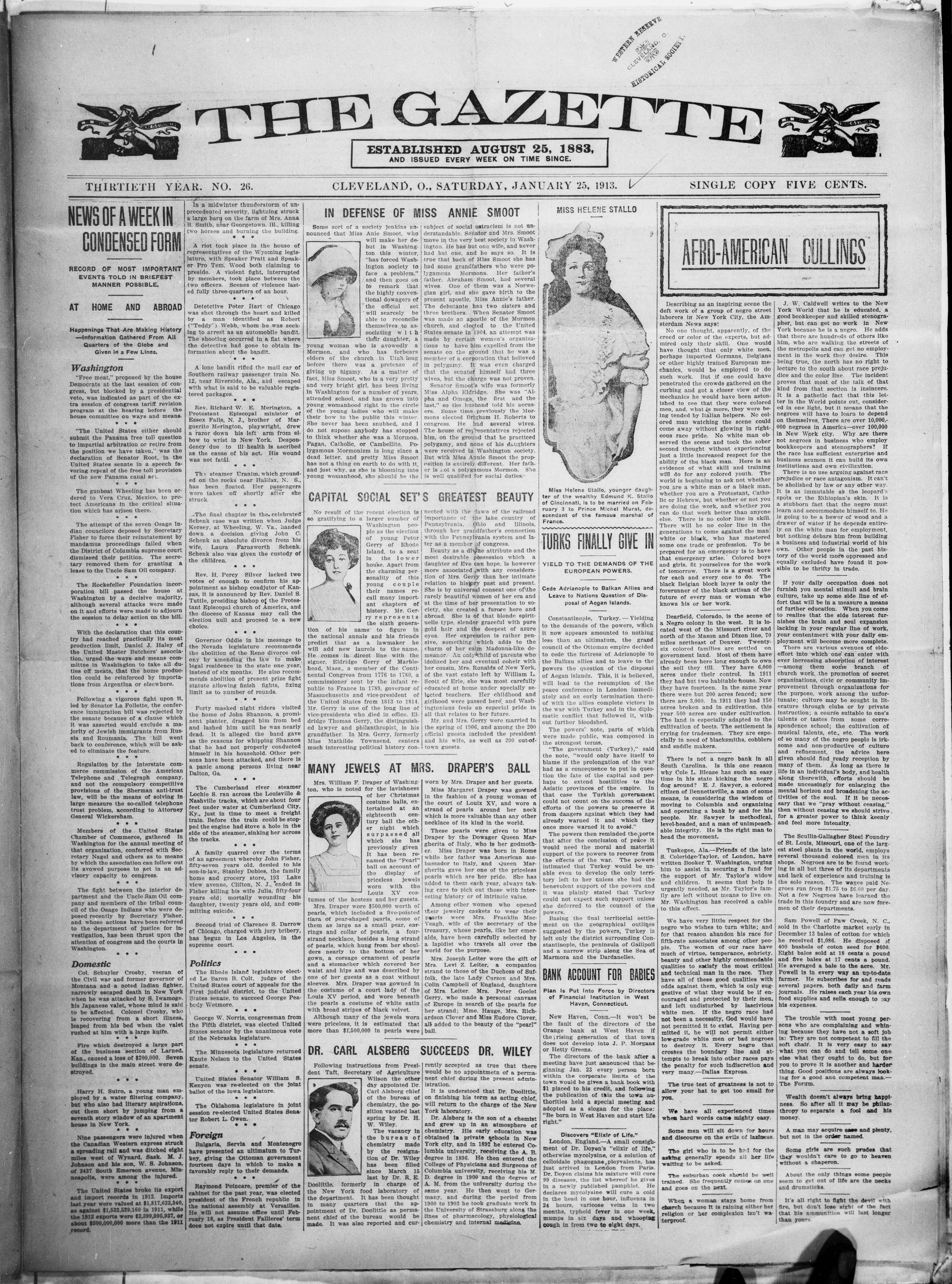
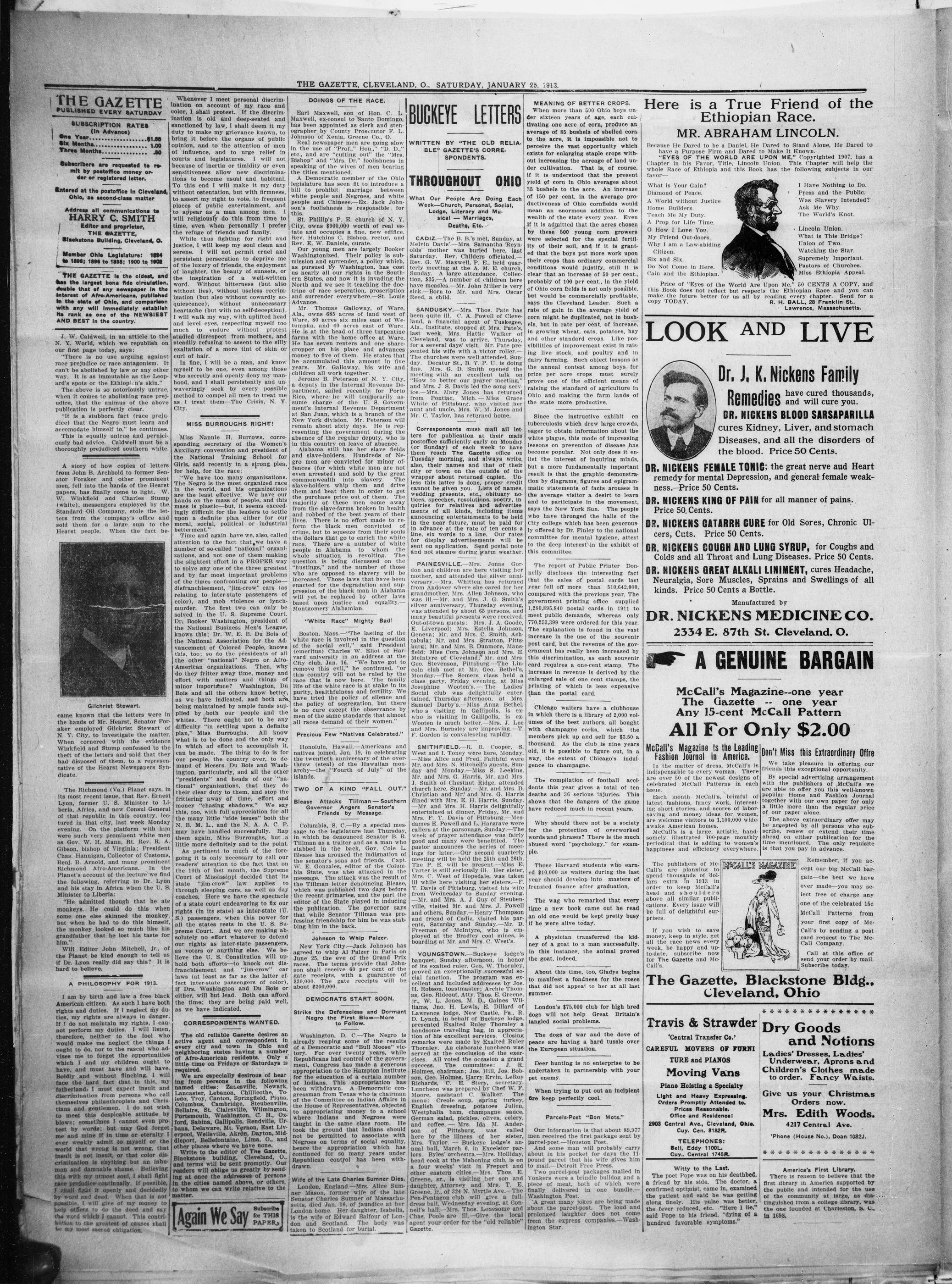
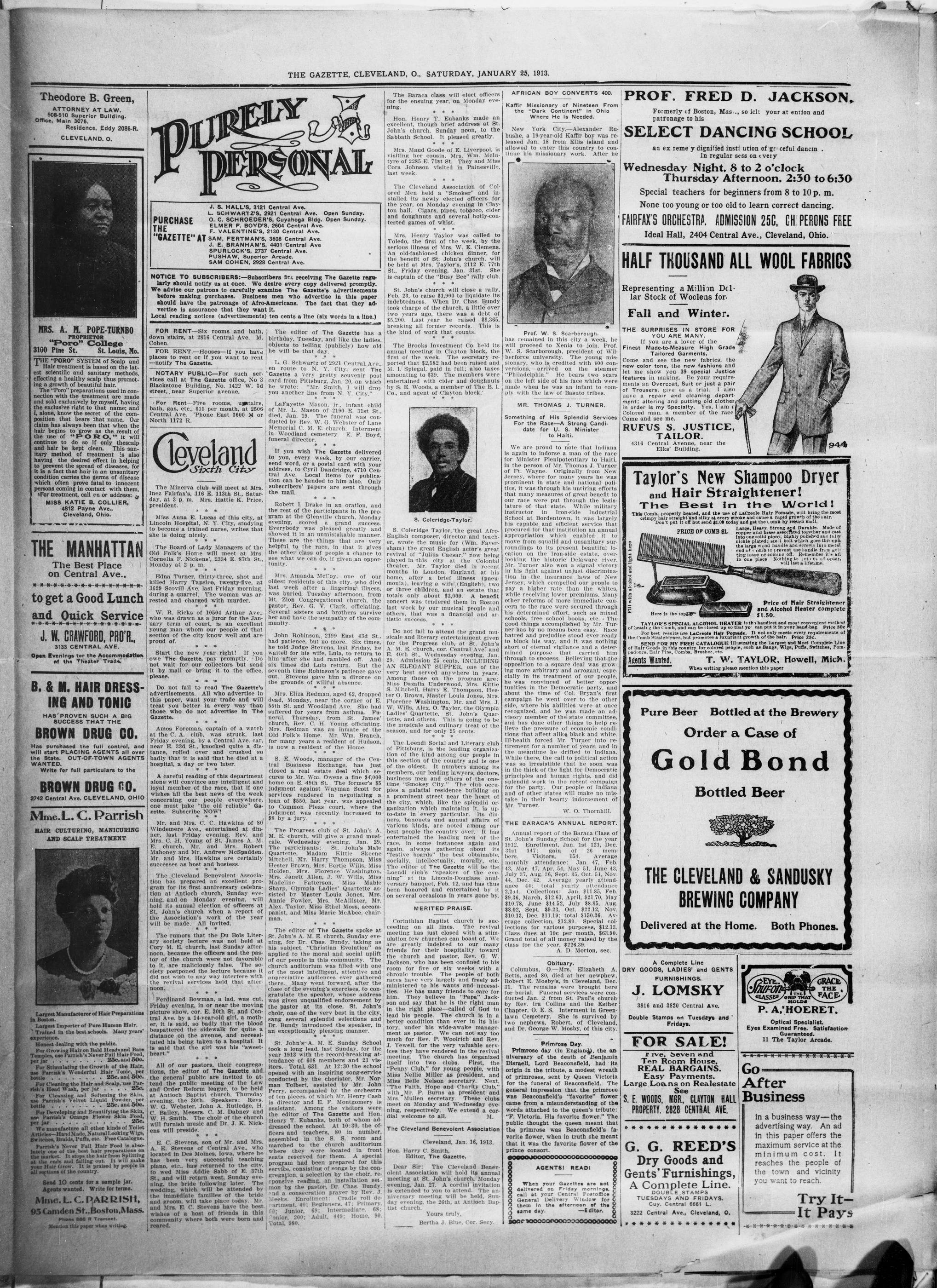
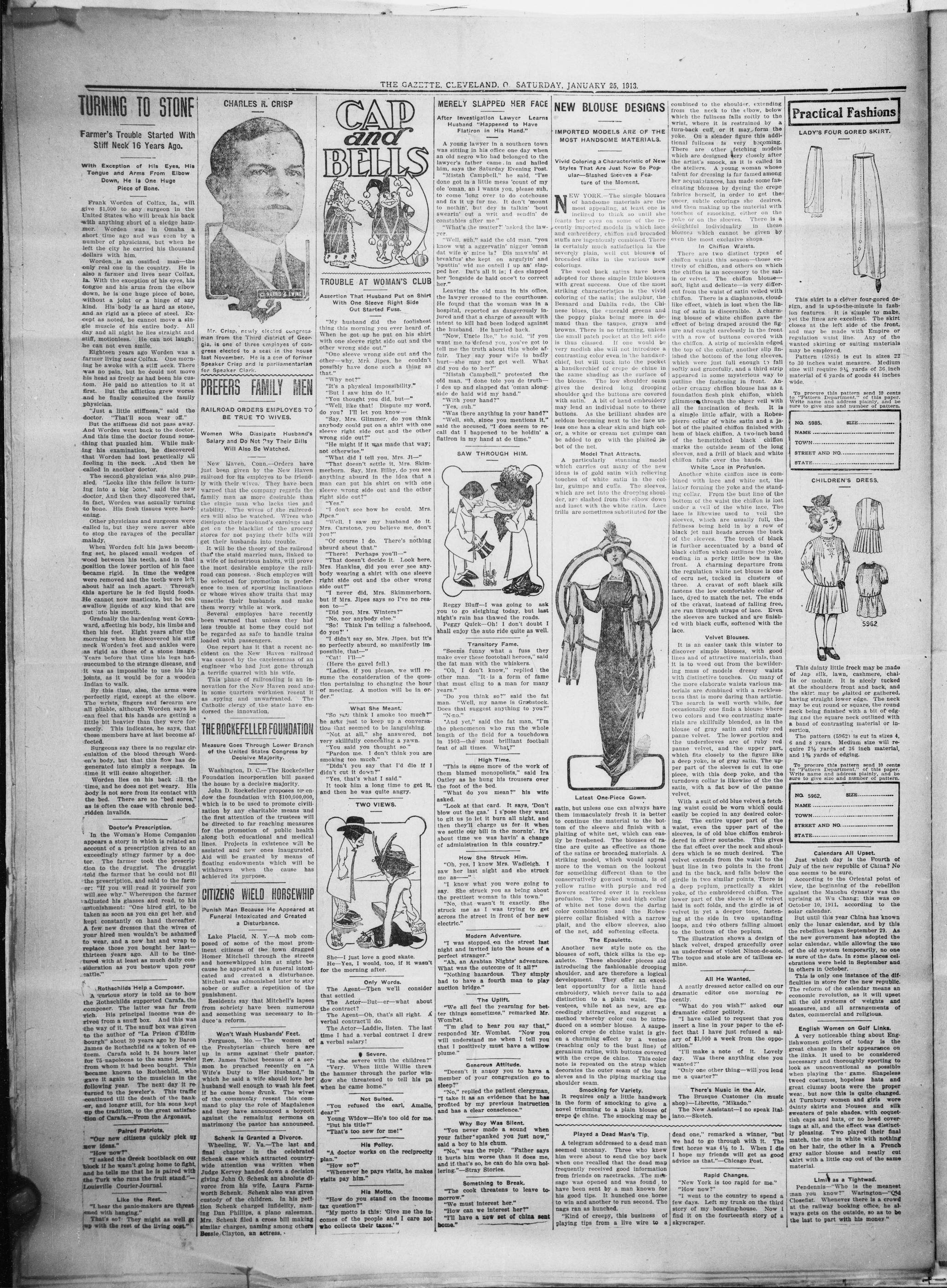
Page text (machine-generated)
THE GAZETTE
THIRTIETH YEAR. NO
In a midwinter thunderstorm of unprecedented severity, lightning struck a large barg on the farm of Mrs. Anna B. Smith, near Georgetown, IH, killing two horses and burning the building.
A riot took place in the house of representatives of the Wyoming legislature, with Speaker Pratt and Speaker Pro Tem. Wood both claiming to preside. A violent fight, interrupted by members, took place between the two officers. Scenes of violence lasted fully three-quarters of an hour.
ed fully three
AT HOME AND ABROAD
Detetetive was shot th
by a man
("Toddii")
Detective Peter Hart of Chicago was shot through the heart and killed by a man identified as Robert ("Teddy") Webb, whom he was seeking to arrest as an automobile bandit. The shooting occurred in a flat where the detective had gone to obtain information about the bandit.
A lone bandit riffed the mail car of Southern railway passenger train No. 12, near Riverside, Ala., and escaped with what is said to be valuable registered packages.
Rev. Richard W. E. Merington, a protestant Episcopal minister of Essex Falls, N. J., brother of Marguerite Merington, playwright, drew a razor down his left arm from elbow to wrist in New York. Despondency due to ill health is ascribed as the cause of his act. His wound was not fatal.
The steamer Uranium, which grounded on the rocks near Halifax, N. S., has been floated. Her passengers were taken off shortly after she struck.
The final chapter in the celebrated Schenk case was written when Judge Kersey, at Wheeling, W. Va., handed down a decision giving John C. Schenk an absolute divorce from his wife, Laura Farnsworth Schenk. Schenk also was given the custody of the children.
Rev, H, Percy Silver lacked two votes of enough to confirm his appointment as bishop coadjutor of Kansas, it is announced by Rev. Daniel S. Tuttle, presiding bishop of the Protestant Episcopal church of America, and the diocese of Kansas may call the election null and proceed to a new choice.
Governor Oddie in his message to the Nevada legislature recommends the abolition of the Reno divorce colony by amending the law to make legal residence in the state one year, instead of six months. He also recommends abolition of present prize fight statute allowing finish fights, fixing limit as to number of rounds.
Forty masked night riders visited the home of John Shannon, a prominent planter, dragged him from bed and lashed him until he was nearly dead. It is alleged the band gave as the reasons for whipping Shannon that he had not properly conducted himself in his household. Other persons have been attacked, and there is a panic among persons living near Dalton, Ga.
The Cumberland river steamer Lochie S. ran across the Lousville & Nashville tracks, which are about four feet under water at Cumberland City, Ky., just in time to meet a freight train. Before the train could be stopped the engine had stove a hole in the side of the steamer, sinking her across the tracks.
A family quarrel over the terms of an agreement whereby John Fisher, fifty-seven years old, deeded to his son-in-law, Stanley Dobies, the family home and grocery store, 193 Lake view avenue, Clifton, N. J., ended in Fisher killing his wife Julia, fifty-four years old; mortally wounding his daughter, twenty years old, and committing suicide.
Second trial of Clarence S. Darrow of Chicago, charged with jury bribery, has begun in Los Angeles, in the supreme court.
Politics
The Rhode Island legislature elected Le Baron B. Colt, judge of the United States court of appeals for the First judicial district, to the United States senate, to succeed George Peabody Wetmore.
George W. Norris, congressman from the Fifth district, was elected United States senator by the unanimous vote of the Nebraska legislature.
The Minnesota legislature returned Knute Nelson to the United States senate.
United States Senator William S. Kenyon was re-elected on the joint ballot of the Iowa legislature.
The Oklahoma legislature in joint session re-elected United States Senator Robert L. Owen.
Foreign
Bulgaria, Servia and Montenegro have presented an ultimatum to Turkey, giving the Ottoman government fourteen days in which to make favorably reply to their demands.
Raymond Polnare, premier of the cabinet for the past year, was elected president of the French republic in the national assembly at Versailles. He will not assume office until February 18, as President Falleri's term does not expire until that date.
---
THE UNION
INDEPENDENCE
NEWS OF A WEEK IN CONDENSED FORM
RECORD OF MOST IMPORTANT
EVENTS TOLD IN BRIEFEST
MANNER POSSIBLE.
Happenings That Are Making History
—Information Gathered From All
Quarters of the Globe and
Given in a Few Lines.
Washington
"Free meat," proposed by the house Democrats at the last session of congress, but blocked by a presidential veto, was indicated as part of the extra session of congress tariff revision program at the hearing before the house committee on ways and means.
"The United States either should submit the Panama free toll question to impartial arbitration or retire from the position we have taken," was the declaration of Senator Root, in the United States senate in a speech favoring repeal of the free toll provision of the new Panama canal act.
The gunboat Wheeling has been ordered to Vera Cruz, Mexico, to protect Americans in the critical situation which has arisen there.
The attempt of the seven Osage Indian councillors deposed by Secretary Fisher to force their reinstatement by mandamus proceedings failed when the District of Columbia supreme court dismissed their petition. The secretary removed them for granting a lease to the Uncle Sam Oil company.
The Rockefeller Foundation incorporation bill passed the house at Washington by a decisive majority, although several attacks were made on it and efforts were made to adjourn the session to delay action on the bill.
With the declaration that this country had reached practically its meat production limit, Daniel J. Haley of the United Master Butchers' association, urged the ways and means committee in Washington to take all duties off meats, that the home production could be reinforced by importations from Argentina or elsewhere.
Following a vigorous fight upon it, led by Senator La Follette, the conference immigration bill was rejected by the senate because of a clause which it was asserted would exclude a majority of Jewish immigrants from Russia and Roumania. The bill went back to conference, which will be asked to eliminate the feature.
---
Regulation by the interstate commerce commission of the American Telephone and Telegraph company, and not the compulsory competitive provisions of the Sherman ant-trust law, will be the means of solving in large measure the so-called telephone trust problem, according to Attorney General Wickersham.
. . .
Members of the United States Chamber of Commerce, gathered in Washington for the annual meeting of that organization, conferred with Secretary Nagel and others as to means by which the association can follow out its avowed purpose to act in an advisory capacity to congress.
* * *
The fight between the interior department and the Uncle Sam Oil company and members of the tribal council of the Osage Indians who were deposed recently by Secretary Fisher, and whose actions have been referred to the department of justice for investigation, has been thrust upon the attention of congress and the courts in Washington.
Domestic
Col. Schuyler Crosby, veerer of the Civil war and former governor of Montana and a noted Indian fighter, narrowly escaped death in New York when he was attacked by S. Iwamage, his Japanese valet, whose mind is said to be affected. Colonel Crosby, who is recovering from a short illness, leaped from his bed when the valet rushed at him with a large knife.
Fire which destroyed a large part of the business section of Larned, Kan., caused a loss of $200,000. Seven buildings in the main street were destroyed.
Harry H. Sutro, a young man employed by a water filtering company, but who also had literary aspirations, cut them short by jumping from a seventh story window of an apartment house in New York.
Nine passengers were injured when the Canadian Western express struck a spreading rail and was ditched eight miles west of Wynard, Sask. M. J. Johnson and his son, W. S. Johnson, of 2437 South Emerson avenue, Minneapolis, were among the injured.
The United States broke its export and import records in 1912. Imports last year were valued at $1,817,622,340, as against $1,532,529,160 in 1911, while the 1912 exports were $2,399,995,937, or about $500,000,000 more than the 1911 record.
CLEVELAND, O., SATURDAY, JANUARY 25, 1913.
IN DEFENSE OF MISS ANNIE SMOOT
CAPITAL SOCIAL SET'S GREATEST BEAUTY
CAPITAL SOCIAL SET'S GREATEST BEAUTY
MANY JEWELS AT MRS. DRAPER'S BALL
DR. CARL ALSBERG SUCCEEDS DR. WILEY
Some sort of a society jenkins announced that Miss Anie Smoot, who
society jenkins an- anie Smoot, who will make her debut in Washington this winter, "has forced Washington society to face a problem," and then goes on to remark that the highly conventional dawagers of the official set will scarcely be able to reconcile themselves to associating with it when their daughter, a
be back in Washington this winter, "has forced Washington society to face a problem," and then goes on to remark that the highly conventional dowagers of the official set will scarcely be able to reconcile themselves to associating w it h their daughter, a young woman who is avowedly a Mormon, and who has forbears elders of the church in Utah long before there was a pretense of giving up bigamy. As a matter of fact, Miss Smoot, who is a very pretty and very bright girl, has been living in Washington for a number of years, attended school, and has grown into young womanhood right in the circle of the young ladies who will make their bow to the public this winter. She never has been snubbed, and I do not supose anybody has stopped to think whether she was a Mormon, Pagan, Catholie, or Cambellite, Polygamous Mormonism is long since a dead letter, and pretty Miss Smoot has not a thing on earth to do with it, and just why, as she is blooming into young womanhood, she should be the
No result of the recent election is
so gratifying to a larger number of
recent election is larger number of Washington people as the election of young Peter Gerry of Rhode Island, to a seat in the lower house. Apart from the charming personality of this young couple their names recall many important chapters of history. Mr. Gerry represents the sixth genera-
Washington people as the election of young Peter Gerry of Rhode Island, to a seat in the lower house. Apart from the charming personality of this young couple their names recall many important chapters of history. Mr. Gerry represents the sixth generation of his name to figure in the national annals and his friends predict that as a lawmaker he will add new laurels to the name. He comes in direct line with the signer, Eldridge Gerry of Marblehead, Mass., a member of the Continental Congress from 1776 to 1780, a commissioner sent by the infant republic to France in 1789, governor of Massachusetts and vice-president of the United States from 1813 to 1814. Mr. Gerry is one of the long line of vice-presidents who died in office. Eldridge Thomas Gerry, the distinguished lawyer and philanthropist, is his grandfather. In Mrs. Gerry, formerly Miss Mathilde Townsend, centers much interesting political history con-
Mrs. William F. Draper of Washing-
ton, who is noted for the lavish-
ton.
Taper of training for the avishness of her Christmas costume balls, entertained at an eighteenth century ball the other night which surpassed all which she has previously given. It has been renamed the "Pearl" ball on account of the display of priceless jewels worn with the Louis XV cos-
costume balls, entertained at an eighteenth century ball the other night which surpassed all which she has previously given. It has been renamed the "Pearl" ball on account of the display of priceless jewels worn with the Louis XV costumes of the hostess and her guests. Mrs. Draper wore $500,000 worth of pearls, which included a five-pointed tiar of pear-shaped pearls, some of them as large as a small pear, earrings and collar of pearls, a fourstrand necklace, besides a long strand of pearls, which hung from her shoulders nearly to the bottom of her gown, a corsage ornament of pearls and a stomacher which covered her waist and hips and was described by one of her guests as a coat without sleeves. Mrs. Draper was gowned in the costume of a court lady of the Louis XV period, and wore beneath the pearls a costume of white satin with broad stripes of black velvet. Although many of the jewels worn were priceless, it is estimated that more than $1,500,000 in pearls were
Following instructions from President Taft, Secretary of Agriculture
Orry or Agriculture Wilson the other appointed by Dr Carl Burel chief of the bureau of the bureau of chemistry, the position vacated last spring by Dr. H. W. Wiley.
A.
The vacancy in the bureau of chemistry made by the resignation of Dr. Wiley has been filled since March 15 last by Dr. R. E. Doolittle, formerly in charge of the New York food laboratory of the department. It has been thought in many quarters that the appointment of Dr. Doolittle as permanent chief of the bureau would be made. It was also reported and cur-
subject of social ostracism is not understandable. Senator and Mrs. Smoot move in the very best society in Washington. He has but one wife, and never had but one, and he says so. It is true that back of Miss Smoot she has had some grandfathers who were polygamous Mormons. Her father's father, Abraham Smoot, had several wives. One of them was a Norwegian girl, and she gave birth to the present apostle, Miss Annie's father. The debentuate has two sisters and three brothers. When Senator Smoot was made an apostle of the Mormon church, and elected to the United States senate in 1904, an attempt was made by certain women's organizations to have him expelled from the senate on the ground that he was a member of a corporation that believed in polygamy. It was even charged that the senator himself had three wives, but the charge was not proven. Senator Smoot's wife was formerly Miss Alpha Eldridge. She was "Alpha and Omega, the first and the last," so the husband told his accusers. Some time previously the Mormons elected Brigham H. Roberts to congress. He had several wives. The house of representatives rejected him, on the ground that he practiced polygamy, and none of his daughters were received in Washington society. But with Miss Annie Smoot the proposition is entirely different. Her father is not a polygamous Mormon. She is well qualified for social duties.
nected with the dawn of the railroad importance of the lake country of Pennsylvania, Ohio and Illinois, through her grandfather's connection with the Pennsylvania system and later as a member of congress.
Beauty as a divine attribute and the most desirable possession which a daughter of Eve can hope, is however more associated with any consideration of Mrs. Gerry than her intimate relation to hispy past and present. She is by universal consent one of the rarely beautiful women of her era and at the time of her presentation to society, she created a furore here and abroad. She is of that blonde spirituelle type, slender graceful with pure gold hair and the deepest of azure eyes. Her expression is rather pensive, something which adds to the charm of her calm Madonna-like demeanor. An only child of parents who idolized her and eventual coheir with her cousin, Mrs. Ronalds of New York, of the vast estate left by William L. Scott of Erie, she was most carefully educated at home under specially selected teachers. Her childhood and girlhood were passed here, and Washingtonians feels an especial pride in all that relates to her future.
Mr. and Mrs. Gerry were married in the spring of 1906, and among the 200 official guests included the president and his wife, as well as 200 out-of-town guests.
worn by Mrs. Draper and her guests.
Miss Margaret Draper was gowned in the fashion of a young woman of the court of Louix XV, and wore a strand of pearls around her neck which is more valuable than any other neckace of its kind in the world.
These pearls were given to Miss Draper by the Dowager Queen Margherita of Italy, who is her godmother. Miss Draper was born in Rome while her father was American ambassador to Italy, and Queen Margherita gave her one of the priceless pearls which are her pride. She has added to them each year, always taking care to pick out those with interesting history or of intrinsic value.
Among other women who opened their jewelry caskets to wear their pearls were Mrs. Franklin MacVeagh, wife of the secretary of the treasury, whose pearls, like her emeralds, have been carefully selected by a lapidist who travels all over the world for the purpose.
Mrs. Joseph Leiter wore the gift of Mrs. Levi Z. Leiter, a companion strand to those of the Duchess of Suffolk, the late Lady Curzon and Mrs. Colin Campbell of England, daughters of Mrs. Leiter. Mrs. Peter Goelet Gerry, who made a personal canvass of Europe in search of the pearls for her strand; Mme. Hauge, Mrs. Richardson Clover and Miss Eudore Clover, all added to the beauty of the "pearl" ball.
rently accepted as true that there would be no appointment of a permanent chief during the present administration.
It is understood that Dr. Doolittle, on finishing his term as acting chief, will return to the charge of the New York laboratory.
Dr. Alsberg is the son of a chemist and grew up in an atmosphere of chemistry. His early education was obtained in private schools in New York city, and in 1892 he entered Columbia university, receiving the A. B. degree in 1896. He then entered the College of Physicians and Surgeons of Columbia university, receiving his M. D. degree in 1900 and the degree of A. M. from the university during the same year. He then went to Germany, and during the period from 1900 to 1903 he took graduate work in the University of Strassburg along the lines of pharmacology, physiological chemistry and internal medicine.
MISS HELENE STALLO
A.
Miss Helene Stallo, younger daughter of the wealthy Edmund K. Stallo of Cincinnati, is to be married on February 3 to Prince Michel Murat, descendant of the famous marshal of France.
YIELD TO THE DEMANDS OF THE EUROPEAN POWERS.
Cede Adrianople to Balkan Allies and Leave to Nations Question of Disposal of Aegan Islands.
Constantinople, Turkey. — Yielding to the demands of the powers, which it now appears amounted to nothing less than an ultimatum, the grand council of the Ottoman empire decided to cede the fortress of Adrianople to the Balkan allies and to leave to the powers the question of the disposal of Aegan islands. This, it is believed, will lead to the resumption of the peace conference in London immediately and an early termination thereof with the allies complete victors in the war with Turkey and in the diplomatic conflict that followed it, without further bloodshed.
The powers' note, parts of which were made public, was composed in the strongest terms.
"The government (Turkey)," said the note, "would only have itself to blame if the prolongation of the war had as a consequence to put in question the fate of the capital and perhaps to extend hostilities to the Asiatic provinces of the empire. In that case the Turkish government could not count on the success of the efforts of the powers to preserve it from dangers against which they had already warned it and which they once more warned it to avoid."
The powers then reminded the porte that after the conclusion of peace it would need the moral and material support of the powers to recover from the effects of the war. The powers intimated that Turkey would be unable even to develop the only territory left to her unless she had the benevolent support of the powers and it was plainly stated that Turkey could not expect such support unless she deferred to the counsel of the powers.
Basing the final territorial settlement on the geographical outlines suggested by the powers, Turkey is left only the district surrounding Constantinople, the peninsula of Gallipoli and a narrow strip along the Sea of Marmora and the Dardanelles.
BANK ACCOUNT FOR BABIES
Plan is Put Into Force by Directors of Financial Institution in West Haven, Connecticut.
New Haven, Conn.—It won't be the fault of the directors of the Orange bank at West Haven if the rising generation of that town does not develop into J. P. Morgans or Hetty Greens.
The directors of the bank after a meeting have just announced that beginning Jan. 23 every person born within the corporate limits of the town would be given a bank book with $1 placed to his credit, and following the publication of this the town authorities held a special meeting and adopted as a slogan for the place: "Be born in West Haven and start life right."
Discovers "Elixir of Life."
London, England.—A small consignment of Dr. Doyen's "elixir of life," otherwise mycolysine, a solution of celloidale phagogane, ployvalente, has just arrived in London from Paris. Dr. Doyen claims his mixture will cure 99 diseases, the list whereof he gives in a newly published pamphlet. He declares mycolysine will cure a cold in the head in one hour, influenza in 24 hours, varicose veins in two months, typhoid fever in one week, mumps in six days and whooping cough in from two to eight days.
SINGLE COPY FIVE CENTS.
AFRO-AMERICAN CULLINGS
Describing as an inspiring scene the deft work of a group of negro street laborers in New York City, the Amsterdam News says:
No one thought, apparently, of the creed or color of the experts, but admired only their skill. One would have thought that only white men, perhaps imported Germans, Belgians or other highly trained European mechanics, would be employed to do such work. But if one could have penetrated the crowds gathered on the curbing and got a closer view of the mechanics he would have been astonished to see that they were colored men, and, what as more, they were being tended by Italian helpers. No colored man watching the scene could come away without glowing in righteous race pride. No white man observed the scene and took the sober second thought without experiencing just a little increased respect for the ability of the black man. Here is an evidence of what skill and training will do for any colored youth. The world is beginning to ask not whether you are a white man or a black man, whether you are a Protestant, Catholic or Hebrew, but whether or not you are doing the work, and whether you can do that work better than anyone else. There is no color line in skill. There will be no color line in the generations to come against the man white or black, who has mastered some one trade or profession. To be prepared for an emergency is to have that emergency arise. Colored boys and girls, fit yourself for the work of tomorrow. There is a great work for each and every one to do. The black Belgian block layer is only the forerunner of the black artisan of the future of every man or woman who knows his or her work.
Dearfield, Colorado, is the scene of a Negro colony in the west. It is located west of the Missouri river and north of the Mason and Dixon line, 70 miles northeast of Denver. Twenty-six colored families are settled on government land. Most of them have already been here long enough to own the soil they till. They have 6,000 acres under their control. In 1911 they had but two habitable house. Now they have fourteen. In the same year there were but 200 acres fenced; now there are 3,000. In 1911 they had 150 acres broken and in cultivation, this year 500 acres are under cultivation. The land is especially adapted to the cultivation of beets. The settlement is crying for tradesmen. They are especially in need of blacksmiths, cobblers and saddle makers.
There is not a negro bank in all South Carolina. Is this one reason why Cole L. Blease has such an easy time in his state kicking the negro dog around? E. J. Sawyer, a colored citizen of Bennettsville, a man of some means, is considering the wisdom of moving to Columbia and organizing and operating a bank by and for his people. Mr. Sawyer is methodical, level-headed, and a man of unimpeachable integrity. He is the right man to head the movement.
Tuskegue, Ala.—Friends of the late S. Coleridge-Taylor, of London, have written Booker T. Washington, urging him to assist in securing a fund for the support of Mr. Taylor's widow and children. It seems that help is urgently needed, as Mr. Taylor's family are left without means to live on. Mr. Washington has received a cable to this effect.
We have very little respect for the negro who wishes to turn white; and for that reason abandon his race for fifth-rate associates among other people. The woman of our race have much of virtue, temperance, sobriety, beauty and other highly commendable qualities to satisfy the most critical and technical man in the race. They have all of these good qualities with odds against them, which is only suggestive of what they would be if encouraged and protected by their men, and left undisturbed by lascivious white men. If the negro race had not been a necessity, God would have not permitted it to exist. Having permitted it, he will not permit either low-grade white men or bad negroes to destroy it. Every negro that crosses the boundary line and attempts to break into other races pays the penalty for such indiscretion and very many—Dallas Express.
The true test of greatness is not to allow your hat to get too small for you.
We have all experienced times when hard words came mighty easy.
Some men will sit down for hours and discourse on the evils of laziness.
The girl who is to be had for the asking generally spends all her life waiting to be asked.
The suburban cook should be well trained. She frequently comes on one and goes on the next.
When a woman stays home from church because it is raining either her religion or her complexion isn't waterproof.
J. W. Caldwell writes to the New York World that he is educated, a good bookkeeper and skilled stenographer, but can get no work in New York because he is a negro. He adds that there are hundreds of others like him, who are walking the streets of the metropolis and can get no employment in the work they desire. This being true, the north has no right to lecture to the south about race prejudice and the color line. The incident proves that most of the talk of that kind from that section is insincere. It is a pathetic fact that this letter in the World points out, considered in one light, but it means that the negroes will have to learn to depend on themselves. There are over 10,000,000 negroes in America—over 100,000 in New York city. Why are there not negroes in business who employ bookkeepers and stenographers? If the race has sufficient enterprise and business acumen it can build its own institutions and own civilization.
There is no use arguing against race prejudice or race antagonism. It can't be abolished by law or any other way. It is as immutable as the leopard's spots or the Ethiopian's skin. It is a stubborn fact that the negro must learn and accommodate himself to. He is going to be a hewer of wood and a drawer of water if he depends entirely on the white man for employment, but nothing debars him from building a business and industrial world of his own. Other people in the past history of the world more oppressed and equally excluded have found it possible to be thrifty in trade.
If your daily occupation does not furnish you mental stimuli and brain culture, take up some side line of effort that will be in a measure a means of further education. When you come to realize that the side interest furnishes the brain and soul expansion lacking in your regular line of work, your contentment with your daily employment will become more complete
There are various avenues of side-effect into which one can enter with ever increasing absorption of interest—among them some branch of church work, the promotion of secret organizations, civic or community improvement through organizations for the purpose, work among the unfortunate; culture may be sought in literature through clubs or by private instruction; a course suitable to one's talents or tastes from some correspondence school; the cultivation of musical talents, etc., etc. The work of so many of the negro people is irksome and non-productive of culture and refinement, the advice here given should find ready reception by many of them. As long as there is life in an individual's body, and health along therewith, efforts should be made unceasingly for enlarging the mental horizon and broadening the activities of the soul. If it be necessary that we "pray without ceasing," then without ceasing we should strive for a greater power to think keenly and feel more intensity.
The Scuillin-Gallagher Steel Foundry of St. Louis, Missouri, one of the largest steel plants in the world, employs several thousand colored men in its shops. Negroes are to be found working in all but three of its departments and lack of experience and training is the sole reason. The wages paid Negroes run from $1.75 to $6.00 per day. Not a few Negroes have learned the trade in this foundry and are now foremen of their departments.
Sam Powell of Paw Creek, N. C., sold in the Charlotte market early in December 13 bales of cotton for which he received $1,086. He disposed of 400 bushels of cotton seed for $600. Eight bales at 18 cents a pound and five bales at 17 cents a pound. He averaged a bale to the acre. Mr. Powell is in every way an up-to-date farmer. He subscribes for and reads several papers, both daily and farm journals. He raises each year his own food supplies and sells enough to pay his expenses.
The trouble with most young persons who are complaining and whining because they have not a soft job is: They are not competent to fill the soft chair. It is very easy to say what you can do and tell some one else what they ought to do, but for you to prove it is another and harder thing. Good positions are always looking for a good and competent man—The Forum.
Wealth doesn't always bring happiness. So after all it may be philanthropy to separate a fool and his money.
A man may acquire case and plenty, but not in the order named.
Some girls are such prudes that they wouldn't care to go to heaven without a chaperon.
About the only things some people seem to get out of life are the necks and drumsticks.
It's all right to fight the devil with fire, but don't lose sight of the fact that his ammunition will last longer than yours.
One Year..... 61.80
Six Months..... 1.00
Three Months..... 8.00
Subscribers are requested to remit by postoffice money order or registered letter.
Entered at the postoffice In Cleveland Ohio, as second-class matter
Address all communications to HARRY C. SMITH
Editor and proprietor,
THE CAZETTE,
Blackstone Building, Cleveland, O.
Member Ohio Legislature: 1894
to 1896; 1896 to 1898; 1900 to 1902
THE GAZETTE is the oldest, and has the largest bona fide circulation, double that of any newspaper in the interest of Afro-Americans, published in the state of Ohio, and comparison with any will immediately establish its rank as one of the NEWSIEST AND BEST in the country.
J. W. Caldwell, in an article to the N. Y. World, which we republish on our first page today, says:
"There is no use arguing against race prejudice or race antagonism. It can't be abolished by law or any other way. It is as immutable as the Leopard's spots or the Ethiopian's skin."
The above is so notoriously untrue, when it comes to abolishing race prejudice, that the animus of the above publication is perfectly clear.
This is equally untrue and perniciously bad advice. Caldwell must be a thoroughly prejudiced southern white.
A story of how copies of letters from John B. Archbold to former Senator Foraker and other prominent men, fell into the hands of the Hearst papers, has finally come to light. W. W. Winkfield and Charles Stump (white), messengers employed by the Standard Oil Company, stole the letters from the company's office and sold them for a large sum to the Hearst people. When the fact be
Gilchrist Stewart.
came known that the letters were in the hands of Mr. Hearst, Senator Foraker employed Gilchrist Stewart of N. Y. City, to investigate the matter. When cornered with the evidence Winkfield and Stump confessed to the theft of the letters and said that they had disposed of them, to a representative of the Hearst Newspapers Syndicate.
The Richmond (Va.) Planet says, in its most recent issue, that Rev. Ernest Lyon, former U. S. Minister to L伯ia, Africa, and now Consult General of that republic in this country, lectured in that city, last week Monday evening. On the platform with him were such very prominent white men as Gov. W. H. Mann, Rt. Rev. R. A. Gibson, bishop of Virginia; President Chas. Hannigan, Collector of Customs, Benj. B. Arnold, and many prominent Richmond Afro-Americans. In the Planet's account of the lecture we find the following, referring to Dr. Lyon and his stay in Africa when the U. S. Minister to Liberia:
"He admitted though that he ate monkeys. He could do this when some one else skinned the monkey, but when he had to do this himself, the monkey looked so much like his grandfather that he lost his taste for him."
Will Editor John Mitchell, Jr., of the Planet be kind enough to tell us if Dr. Lyon really did say this? It is hard to believe.
A PHILOSOPHY FOR 1913.
I am by birth and law a free black American citizen. As such I have both rights and duties. If I neglect my duties, my rights are always in danger. If I do not maintain my rights, I cannot perform my duties. I will listen, therefore, neither to the fool who would make me neglect the things I ought to do, nor to the rascal who advises me to forget the opportunities which I and my children ought to have, and must have and will have Boldly and without filching, I will face the hard fact that in this, my fatherland, I must expect insult and discrimination from persons who call themselves philanthropists and Christians and gentlemen. I do not wish to meet this despicable attitude by blows; sometimes I cannot even protest by words; but may God forget me and mine if in time or eternity I ever weakly admit to myself or the world that wrong is not wrong, that insult is not insult, and that color discrimination is anything but an inhuman and damnable shame. Believing this with my timest soul, I shall fight race prejudice continually. If possible, I shall fight it openly and decidedly by word and deed. When that is not possible, I will give of my money to help offers to the deed and say the word which I cannot. This contribution to the greatest of causes shall be my most sacred obligation.
Whenever I meet personal discrimination on account of my race and color, I shall protest. If the discrimination is old and deep-seated and sanctioned by law, I shall deem it my duty to make my grievance known, to bring it before the organs of public opinion, and to the attention of men of influence, and to urge relief in courts and legislatures. I will not because of inertia or timidity or even sensitiveness allow new discriminations to become usual and habitual. To this end I will make it my duty without ostentation, with firmness, to assert my right to vote, to frequent places of public entertainment, and to appear as a man among men. I will religiously do this from time to time, even when personally I prefer the refuge of friends and family.
While thus fighting for right and justice, I will keep my soul clean and serene. I will not permit cruel and persistent persecution to deprive me of the luxury of friends, the enjoyment of laughter, the beauty of sunsets, or the inspiration of a well-written word. Without bitterness (but also without lies), without useless recrimination (but also without cowardly acquiescence), without unnecessary heartache (but with no self-deception), I will walk my way, with uplifted head and level eyes, respecting myself too much to endure without protest studied disrespect from mothers, and steadily refusing to assent to the silly exaltation of a mere tint of skin or curl of hair.
In fine, I will be a man, and know myself to be one, even among those who secretly and openly deny my manhood, and I shall persistently and unwaveringly seek by every possible method to compel all men to treat me as I treat them—The Crisis, N. Y. City.
MISS BURROUGHS RIGHT!
Miss Nannie H. Burrows, corresponding secretary of the Women's Auxiliary convention and president of the National Training School for Girls, said recently in a strong plea, for help, for the race: "We have too many organizations. The Negro is the most organized race in the world, and his organizations are the least effective. We have our hands on the mass of people, and this Negro is the most it seemed incredibly difficult for the leaders to settle upon a definite plan either for our moral, social, political or industrial betterment."
Time and again have we, also called attention to the fact that we have a number of so-called "national" organizations, and not one of them making the slightest effort in a PROPER way to solve any one of the three greatest and by far most important problems of the times confronting our people—disfranchisement, "jim-crow" cars (as relating to inter-state passengers of color), and mob violence or lynchmurder. The first two can only be solved in the U. S. Supreme Court. Dr. Booker Washington, president of the National Business Men's League, knows this; Dr. W. E. B. Du Bois of the National Association for the Advancement of Colored People, knows this; too, so do the presidents of all the other "national" Negro or Afro-American organizations. Then, why do they fritter away time, money and effort with matters and things of minor importance? Washington, Du Bois and all the others know better, as we have indicated, and both are being maintained by ample funds supplied by both our people and the whites. There ought not to be any difficulty in setting up a definite plan. Miss Burroughs. All know what is to be done and the only way in which an effort to accomplish it, can be made. The thing to do is for our people, the country over, to demand of Messrs. Du Bois and Washington, particularly, and all the other "presidents" and heads of our "national" organizations, that they do their clear duty to them, and stop the frittering away of time, effort and money "chasing shadows." We say this, too, with full appreciation for all the too many little "side issues" the N. B. M. L. and the N. A. A. C. P. may have handled successfully. Rap them again, Miss Burroughs, but a little more definitely and to the point.
As pertinent to much of the foregoing it is only necessary to call our readers' attention to the fact that on the 10th of last month, the Supreme Court of Mississippi decided that its state "jim-crow" law applies to through sleeping cars, as well as day coaches. Here we have the spectacle of a state court endeavoring to fix our rights (in its state) as inter-state (U. S.) passengers, when this power for all the states rests in the U. S. Supreme Court. And we are making absolutely no effort whatever to defend our rights as inter-state passengers, as voters or anything else. We believe the U. S. Constitution will uphold both efforts—to knock out disfranchisement and "jim-crow" car laws (at least as far as the latter effect inter-state passengers of color). If Drs. Washington and Du Bois or either, will but lead. Both can afford the time; they are being paid well, as we have indicated.
CORRESPONDENTS WANTED.
The old reliable Gazette desires an active agent and correspondent in every city and town in Ohio and neighboring states having a number of Afro-American residents. Only a little time on Fridays or Saturdays is required. We especially desirous of hearing from persons in the following named cities: Zateevville, Newark, Lancaster, Lebanon, Chillicoote, Toledo, Troy, Canton, Springfield, Piqua, Columbus, Cambridge, Steubenville, Bellaire, St. Clairsville, Wilmington, Portmouth, Washington, C. H., Oxford, Sabina, Gallipolis, Rendville, Urbana, Delaware, M. Ternon, East Lirpool, Wellesville, Akron, Dayton, Midport, Bellevue, Bellevue, and other cities we have none.
Write to the editor of The Gazette. Blackstone building, Cleveland, O., and terms will be sent promptly. Our readers will oblige us greatly by sending at once the addresses of persons in the cities named above, or others, to whom we can write relative to the matter.
Again We Say Subscribe for THIS PAPER
THE GAZETTE, CLEVELAND, O., SATURDAY, JANUARY 25, 1913
Earl Maxwell, son of Hon. C. M. Maxwell, excellent to Santo Domingo, has been appointed as clerk and stenographer by County Prosecutor F. L. Johnson of Xenia, Greene Co., O. Real newspaper men are going slow in the use of "Prof," Hon., "D. D.", etc. and are "cutting out" the "Mrs. Bishop" and "Mrs. Dr." foolishness in speaking of the wives of men bearing the titles mentioned.
A Democratic member of the Ohio legislature has seen fit to introduce a bill to prohibit marriage between white people and Negroes, and white people and Chinese. Ex. Jack Johnson's foolishness is responsible for the St. Phillip P. P. E. church of N. Y. City, owns $800,000 worth of real estate and occupies a fine, new edifice. Rev. Hutchins C. Bishop, rector, and Rev. E. W. Daniels, curate.
Our young men are largely Booker Washingtonized. Their policy is submission and surrender, a policy which, as pursued by Washington, has cost us nearly all our rights in the Southern States, and now it is invading the North and we see it teaching the docine of race seperation, proscription and surrender everywhere.—St. Louis Advance.
Mr. Thomas Galloway, of Ware, Ala., has 685 acres of land west of Ware, 80 acres six miles east of Wetumpka, and 40 acres east of Ware. He is at the head of three turpentine farms with the home office at Ware. He has seven renters and one share cropper on his place and advances money to him. He states that he accumulated an amount in five years. Mr. Galloway, his wife and children all work together.
Jerome B. Peterson of N. Y. City, a deputy in the Internal Revenue Department, sailed recently, for Porto Rico, where he will temporarily assume charge of the U. S. Government's Internal Revenue Department at San Juan, which is a branch of the New York division. Mr. Peterson will remain about sixty days. He is representing the government during the absence of the regular deputy, who is in this country on leave of absence.
Alabama still has her slave fields and slave-holders. Hundreds of Negro men are convicted for minor offences (for which white men are not even arrested) and sold by the great commonwealth into slavery. The slave-holders whip them and drive them and beat them in order to get the purchase price on them. Some come away from the slave-farms broken in health and robbed of the best years of their lives. There is no effort made to reform the black men convicted of crime, but to squeeze from their souls the dollars that go to enrich the white race. There are a number of white people in Alabama to whom the whole situation is revolting. The question is being discussed on the "hustings," and the number of those who are opposed to slavery will be enforced, and have been enacted for the degradation and suppression of the black man in Alabama will yet be replaced by other laws based upon justice and equality—Montgomery Alabamian.
"White Race" Mighty Bad!
Boston, Mass.—"The lasting of the white race is involved in the question of the social evil," said President (emeritus) Charles W. Eliot of Harvard university in an address at the City club, Jan. 16. "We have got to remove this evil," he continued, "or this country will not be ruled by the race that is now here. The family life of the white race is at stake in its purity, healthfulness and fertility. We have tried the policy of silence and the policy of segregation, but there is no cure except the observance by men of the same standards that almost all races demand of their women."
Precious Few "Natives Celebrated."
Honolulu, Hawaii.—Americans and natives joined, Jan. 19, in celebrating the twentieth anniversary of the overthrow (steal) of the Hawaiian monarchy—the "Fourth of July" of the islands.
TWO OF A KIND "FALL OUT."
Blease Attacks Tillman—Southern Governor Angers Senator's Friends by Message.
Columbia, S. C.-By a special message to the legislature last Thursday, in which he denounced Senator B. R. Tillman as a traitor and a man who stabbed in the back, Gov. Cole L. Blease has aroused the attention of the nation and the friends, Capt W. E. Gonzales, editor of the Columbia State, was also attacked in the message. The attack was the result of the Tillman letter denouncing Blease, which was published two days before the recent primaries, and the part the editor of the publication took in the publication. The governor says that while Senator Tillman was professing friendship for him he was stabbing him in the back.
Johnson to Whip Palzer.
New York City.-Jack Johnson has agreed to whip Al Palzer in Paris on June 25, the eve of the Grand Prix races. The terms provide that Johnson shall receive 60 per cent of the gate receipts, with a guarantee of $30,000. The gate receipts will be about $200,000.
DEMOCRATS START SOON.
Strike the Defenseless and Dormant Negro the First Blow—More to Follow.
Washington, D. C.—The Negro is already reaping some of the results of a Democratic and "Bull Moose" victory. For over twenty years, while Republicans had control of the government, Congress has made a generous appropriation to the Hampton Institute for the education of a certain number of Indians. This appropriation has been withdrawn. A Democratic concession from Texas schools is chairman of the Committee on Indian Affairs in the House of Representatives, objected to appropriating money to a school where Indians and Negroes were taught in the same class room. He took the ground that Indians should not be permitted to associate with Negroes on terms of social equality, hence the appropriation which has continued for so many years under Republican control has been withdrawn.
Wife of the Late Charles Sumner Dies
London, England—Mrs. Alice Sumner Mason, former wife of the late Senator Charles Sumner of Massachusetts, died Jan. 16, ofJAwndice at her London home. Her daughter, Isabella, is the wife of Edward Balfour of London and Scotland. The body was taken to Scotland for burial.
BUGKEYE LETTERS
WRITTEN BY "THE OLD RELIABLE" GAZETTE'S CORRESPONDENTS.
THROUGHOUT OHIO
What Our People Are Doing Each Week—Church, Personal, Social, Lodge, Literary and Musical — Marriages, Deaths, Etc.
CADIZ—The B. B.'s met, Sunday, at Melvin Davis'—Mrs. Samantha Reynolds' mother was buried here, last Saturday. Rev. Childers officiated.—Rev. G. W. Maxwell, P. E., held quarterly meeting at the A. M. E. church, Sunday. A large attendance, Collection, 855. A number of children here have measles.—Mr. John Miller is very sick—Born to Mr. and Mrs. Oscar Reed, a child
SANDUSKY—Mrs. Thos. Pate has been quite ill. C. A. Powell of Cleveland, a financial agent of Tuskegee, Ala., Institute, stopped at Mrs. Pate's last week. Mrs. Hattie Walker of Cleveland, was to arrive, Thursday, for a several days' visit. Mr. Pate presented his wife with a victor roller. The churches were well attended, Sunday. Decatur St., B. Y. P. U. is doing fine. Mrs. G. D. Smith opened the meeting with an excellent talk on the history of the Civil War and Mrs. J. S. Davis led the song service. Mrs. Mary Jones has returned from Pontiac, Mich.—Miss Grace White of Pittsburg, who visited her aunt and uncle, Mrs. W. M. Jones and Mr. C. Taylor, has returned home.
Correspondents must mail all letters for publication at their main postoffice sufficiently early on Monday (or Sunday) of each week to have them reach The Gazette office on Tuesday morning, and always write, also, their names and that of their city or town on the outside of the postoffice. If the correspondent less this latter is done, proper credit cannot be given you. Lists of names, wedding presents, etc., obituary notices, speeches, resolutions, poetry, inquiries for relatives and advertisements of all kinds, including items announcing entertainments to be held in advance at the rate of ten cents a line, six words to a line. Our rates for display advertisements will be sent on application. Send postal note and not stammes during warm weather.
PAINESVILLE—Mrs. Jonas Gordon and children are here visiting her mother, and attended the silver anniversary.—Mrs. Whitten has returned from Andover where she cared for her grandmother, Mrs. Allen Johnson, who was ill.—Mr. and Mrs. J. G. Smith's silver anniversary, Thursday evening, was attended by about 65 persons, and many beautiful presents were received.—Mr. and Mrs. E. Liverpool; Mrs. Estella Johnson Geneva; Mr. and Mrs. C. Smith, Ashtabula; Mr. and Mrs. Stratton, Pittsburg; Mr. and Mrs. B. Dummore, Mansfield; Miss Cora Johnson and Mrs. E Mcintyre of Cleveland,*Mr. and Mrs Geo. Stevenson, Pittsburg.—The Lincoln club met at Mr. Geo, Bethel's Monday.—The Somers class held a class party, Friday evening, at Miss Josephine Wooten.—The Ladies Society night is slightly extended, Thursday afternoon at Mrs. Samuel Darby's.—Miss Anna Bethel who s is visiting in Gallipolis, is ex who is visiting in Gallipolis, is ex Wooten is much better.—Mrs. J. Lee and Mrs. Burnsley are improving.—T. F. Gordon is convalescing rapidly.
SMITHFIELD.—R. R. Cooper, S. West and I. Toney were here, Monday.—Miss Alice and Fred. Faithful! we Mr. and Mrs. N. Mitchell's guests, Sunday and Monday.—Miss S. Leekins Mr. and Mrs. G. Harris, Mr. and Mrs. J. Smith of Chestnut Ridge, attended church here, Sunday.—Mr. and Mrs. D. Christian and Mr.' and Mrs. G. Harris dined with Mrs. E. H. Harris, Sunday.—Mr. and Mrs. D. dekritely attended dinner, Friday.—Mrs. F. T. Davis of Pittsburg.—Mes dames E. Powell and L. Hargrave were callers at the parsonage, Sunday.—The week of prayer attendance was fairly good and many were benefited. The pastor announces the series of meetings for later.—Our second quarterly meeting will be held the 25th and 26th The P. E. will be present.—Miss E Carter is still seriously ill. Her sister Mrs. C. West of Hopedale, was taken ill while here visiting her sisters.—F. T. Davis from Wednesday to Sunday evening—Mr. and Mrs. A. J. Guy of Steuben village, visited Mr. and Mrs. J. Powel and others, Sunday—Henry Thompson and friend of Cadiz, visited his parents, Saturday and Sunday.—Mr. D Freeman of McIntyre, who is employed at the Bradley coal mines, is boarding at Mr. and Mrs. C. West's.
YOUNGSTOWN — Buckeye lodge's banquet, Sunday afternoon, in honour of its exalted ruler, Geo. W. Thorley, proved an exceptionally successful social function. The program was excellent and included addresses by Jos. H. Robson, toastmaster; Archie Thomas, Geo. Rideout, Atty. Tos E. Greene, jr. W. L. Jones, M. D. Gaines Williams, Jno. H. Lewis, E. Dillard of Lawrence, in behalf of Buckeye lodge, presented Exalted Ruler Thorley a handsome traveling bag, in appreciation of his excellent services. Closing remarks were made by Exalted Ruler Thorley. An elaborate luncheon was served at the conclusion of the exercises. All voted the occasion a grand success. The committee: C. Rholmes, chairman; Jos. Hill, Jo Bobson, Geo Holmes, E. Holley, Holiday Luncheon was prepared by Chef W. F. Moore, assistant C. Walker. The menu: Creole soup, spring turkey, English dressing, potatoes Julien, Westphalia ham, champagne sauce, German salad, pickles, olives, celery, and coffee. — Mrs. Ida M. Anderson of Pittsburgh, was called here by the illness of her sister, Mrs. Taylor. — Buckeye lodge's annual ball, March 6, in Excelior parors Byles' architecture, Holiday Luncheon of the Mahonin club is on a four weeks' visit in Freport and other eastern cities—Mrs. Thos. E. Greene, sr., is visiting her son and daughter, Attorney and Mrs. T. E. Greene, jr. of 324 N. Myrkle Ave. The Pen-Pentagon club will give a full dress ball, Wednesday evening, at Connell's—Mrs. Thos. Lonesome and Chas. Poole are ill. Give the local agent your order for the "old reliable" Gazette.
MEANING OF BETTER CROPS. When more than 500 Ohio boys under sixteen years of age, each cultivating one acre of corn, produce an average of 85 bushels of shelled corn to the acre, it is impossible not to perceive the vast opportunity which exists for enlarging staple crops without increasing the acreage of land under cultivation. That is, of course, if it is understood that the present yield of corn in Ohio averages about 35 bushels to the acre. An increase of 150 per cent, in the average productiveness of Ohio cornfields would mean an enormous addition to the wealth of the state every year. Even if it is admitted that the acres chosen by these 500 young corn growers were selected for the special fertility of their soil, and if it is granted that the boys put more work upon their crops than ordinary commercial conditions would justify, still it is clear that an increase of 50 per cent, probably of 100 per cent, in the yield of Ohio corn fields is not only possible, but would be commercially profitable, says the Cleveland Leader. Such a rate of gain in the average yield of corn might be duplicated, not in bushels, but in rate per cent, of increase, in growing wheat, oats, potatoes, hay and other standard crops. Like possibilities of improvement exist in raising live stock, and poultry and in dairy farming. Such object lessons as the annual contest among boys for prize per acre crops must surely prove one of the efficient means of raising the standard of agriculture in Ohio and making the farm lands of the state more productive.
Since the instructive exhibit on tuberculosis which drew large crowds, eager to obtain information about the white plague, this mode of impressing lessons on prevention of disease has become popular. Not only does it enlist the interest of inquiring minds, but a more fundamentally important result is that the graphic demonstration by diagrams, figures and epigrammatic statements of facts arouses in the average visitor a desert to learn and to participate in the movement, says the New York Sun. The people who have thronged the halls of the City college which has been generously offered by Dr. Finley to the national committee for mental hygiene, attest to the deep interest in the exhibit of this committee.
The report of Public Printer Donnelly discloses the interesting fact that the sales of postal cards last year fell off more than 510,642,000, compared with the previous year. The government printing office supplied 1,280,895,840 postal cards in 1911 to meet public demands, whereas only 770,253,399 were ordered for this year. The explanation is found in the vast increase in the use of the souvenir post card, but the revenue of the government has really been increased by this discrimination, as each souvenir card requires a one-cent stamp. The increase in revenue is derived by the enlarged sale of one cent stamps, the printing of which is less expensive than the postal card.
Chicago watters have a clubhouse in which there is a library of 2,000 volumes of the best authors, all bought with champagne corks, which the members pick up and sell for $3.50 a thousand. As the club is nine years old, it is possible to figure out, in a way, the extent of Chicago's indulgence in champagne.
The compilation of football accidents this year gives a total of ten deaths and 36 serious injuries. This shows that the dangers of the game have reduced much in recent years.
Why should there not be a society for the protection of overworked words and phrases? There is the much abused word "psychology," for example.
Those Harvard students who earned $10,000 as waiters during the last year should develop into masters of frenzied finance after graduation.
The wag who remarked that every time a new book came out he read an old one would be kept pretty busy if he were alive today.
A physician transferred the kidney of a goat to a man successfully. In this instance, the animal proved the goat, indeed.
About this time, too, Gladys begins to manifest a fondness for the roses that did not appeal to her at all last summer.
London's $75,000 club for high bred dogs will not help Great Britain's tangled social problems.
The dogs of war and the dove of peace are having a hard tussle over the European situation.
Deer hunting is no enterprise to be undertaken in partnership with your pet enemy.
When trying to put out an incipient fire keep perfectly cool.
Parcel-Post "Bon Mots."
Our information is that about 89,977 men received the first package sent by parcel-post.—Houston Post.
And some man will probably carry about in his pocket for days the 11-pound parcel that his wife gives him to mail.—Detroit Free Press.
Two parcel-post packages mailed in Yonkers were a bundle bulldog and a piece of meat, both of which were finally delivered in one bundle.—Washington Post
'A great many jokes are being made about the parcel-post. The loud and prolonged laughter does not come from express companies—Washington Star.
Here is a True Friend of the Ethiopian Race. MR. ABRAHAM LINCOLN.
Because He Dared to be a Daniel, He Dared to Stand Alone, He Dared to
hope he Brought Fire and Dared to Meko It Known.
have a Purpose Firm and Dared to Make It Known.
"EVES OF THE WORLD ARE UPON ME." Copyrighted 1907, has a Chapter in his Favor, Title, Lincoln Union. This Chapter will help the whole Race of Ethiopia and this Book has the following subjects in our favor—
What is Your Gain?
Diamond of Peace.
A World without Justice
Home Builders.
Teach Me My Duty.
A Prop for Life Time.
O How I Love You.
My Friend Out-doors.
Why I am a Law-abiding Citizen.
Six and Six.
Do Not Come in Here.
Cain and the Ethiopian.
I Have Nothing to Do.
Press and the Public.
Was Slavery Intended?
Ask Me Why.
The World's Knot.
Lincoln Union.
What is This Bridge?
Union of Two.
Watching the Star.
Supremely Important.
Pastors of Churches.
Miss Ethiopia Appeal.
Price of "Eyes of the World Art this Book does not reflect but respect make the future better for us all by copy TODAY.
LOOK A
the World Are Upon Me," 50 CENTS A COPY, and
lect but respects the Ethiopian Race and you can
for us all by reading every chapter. Send for a
R. H. BALL, 28 Franklin St.
Lawrence, Massachusetts.
Price of "Eyes of the World Are Upon Me," 50 CENTS A COPY, and this Book does not reflect but respects the Ethiopian Race and you can make the future better for us all by reading every chapter. Send for a copy TODAY.
R. H. BALL, 28 Franklin St.
LOOK AND LIVE
Dr. J. K. Nickens Family
Remedies have cured thousands, and will cure you.
DR. NICKENS BLOOD SARSAPARILLA cures Kidney, Liver, and stomach Diseases, and all the disorders of the blood. Price 50 Cents.
MALE TONIC; the great nerve aud Heart al Depression, and general female weak-Cents.
G OF PAIN for all manner of pains.
WARRH CURE for Old Sores, Chronic Ulce 50 Cents.
UGH AND LUNG SYRUP, for Coughs and roat and Lung Diseases. Price 50 Cents.
EAT ALKALI LINIMENT, cures Headache, Muscles, Sprains and Swellings of all Cents a Bottle.
Remedies have cured thousands, and will cure you. DR. NICKENS BLOOD SARSAPARILLA cures Kidney, Liver, and stomach Diseases, and all the disorders of the blood. Price 50 Cents.
DR. NICKENS FEMALE TON
remedy for mental Depress
ness. Price 50 Cents.
DR. NICKENS KING OF PAIN
Price 50 Cents.
DR. NICKENS CATARRH CUR
cers, Cuts. Price 50 Cents.
DR. NICKENS COUGH and L
Colds and all Throat and L
DR. NICKENS GREAT ALKAL
Neuralgia, Sore Muscles,
kinds. Price 50 Cents a Bo
Manufact
DR. NICKENS
2334 E. 87th S
A GENU
McCall's Maga
The Gazette
Any 15-cent M
All For O
McCall's Magazine is the Leading
Fashion Journal in America
DR. NICKENS FEMALE TONIC; the great nerve and Heart remedy for mental Depression, and general female weakness. Price 50 Cents.
DR. NICKENS KING OF PAIN for all manner of pains. Price 50 Cents.
DR. NICKENS CATARRH CURE for Old Sores, Chronic Ulcers, Cuts. Price 50 Cents.
DR. NICKENS COUGH AND LUNG SYRUP, for Coughs and Colds and all Throat and Lung Diseases. Price 50 Cents.
DR. NICKENS GREAT ALKALI LINIMENT, cures Headache, Neuralgia, Sore Muscles, Sprains and Swellings of all kinds. Price 50 Cents a Bottle.
EENS MEDICINE CO.
87th St. Cleveland, O.
GENUINE BARGAIN
's Magazine--one year
Jazette -- one year
-cent McCall Pattern
For Only $2.00
is the Leading Don't Miss this Extraordinary Offre
DR. NICKENS MEDICINE CO. 2334 E. 87th St. Cleveland, O.
McCall's Magazine--one year
The Gazette -- one year
Any 15-cent McCall Pattern
All For Only $2.00
McCall's Magazine is the Leading
Fashion Journal in America.
In the matter of dress, McCall's is
indispensable to every woman. There
are over 50 of the newest designs of
celebrated McCall Patterns in each
issue.
Each month McCall's, brimful of
latest fashions, fancy work, interesting
short stories, and scores of labor-
saving and money ideas for women,
are welcome visitors to 110,000 wide-
awake American homes.
McCall's is a large, artistic, hand-
somely illustrated 100-page monthly
periodical that is adding to women's
happiness and efficiency everywhere.
Don't Miss this Extraordinary Offre
We take pleasure in offering our
friends this exceptional opportunity.
By special advertising arrangement
with the publishers of McCall's we
are able to offer you this well-known
popular Home and Fashion Journal
together with our own paper for only
a little more than the regular price
of our paper alone.
The above extraordinary offer may
be accepted by all persons who sub-
scribe, renew or extend their time
ahead on either publication for the
time mentioned. The only requisite
is that you pay in advance.
MCALLS MAGAZINE
The Gazette, B Cleveland
Travis & Strawder
'Central Transfer Co.'
CAREFUL MOVERS OF FURNI
TURE and PIANOS
Moving Vans
itte, Blackstone Bldg. Cleveland, Ohio
Piano Hosting a Specialty
Light and Heavy Expressing.
Orders Promptly Attended to.
Prices Reasonable.
Office and Residence:
2903 Central Ave., Cleveland, Ohio
Cuy, CX-8128.
table.
ence:
Ireland, Ohio.
122R.
ES5:
J.
Mrs. Edith Woods.
4217 Central Ave.
'Phone (House No.), Doan 1082J.
The poet Pope was on his deathbed, a friend by his side. The doctor, a confirmed optimist, came in, examined the patient and said he was getting along finely. His pulse was better, the fever reduced, etc. "Here I lie," said Pope to his friend, "dying of a hundred favorable symptoms."
ptoms."
---
What is Your Gain?
Diamond of Peace.
A World without Justice
Home Builders.
Teach Me My Duty.
A Prop for Life Time.
O How I Love You.
My Friend Out-doors.
Why I am a Law-abiding
Citizen.
Six and Six.
Do Not Come in Here.
Cain and the Ethiopian.
A. M.
The publishers of McCall's are planning to spend thousands of dollars extra in 1913 in order to keep McCall's head and shoulders above all similar publications. Every issue will be full of delightful surprises.
If you wish to save money, keep in style, get all the race news every week, be happy and up-to-date, subscribe now for The Gazette and McCall's.
TELEPHONES:
Bell, Bell 1100L.
Cuy. Central 1745R.
I Have Nothing to Do.
Press and the Public.
Was Slavery Intended?
Ask Me Why.
The World's Knot.
Lincoln Union.
What is This Bridge?
Union of Two.
Watching the Star.
Supremely Important.
Pastors of Churches.
Miss Ethiopia Appeal.
We take pleasure in offering our friends this exceptional opportunity.
By special advertising arrangement with the publishers of McCall's we are able to offer you this well-known popular Home and Fashion Journal together with our own paper for only a little more than the regular price of our paper alone.
The above extraordinary offer may be accepted by all persons who subscribe, renew or extend their time ahead on either publication for the time mentioned. The only requisite is that you pay in advance.
Remember, if you accept our big McCall bargain—the best we have ever made—you may select free of charge any one of the celebrated 15c McCall Patterns from your first copy of McCall's by sending a post card request to The McCall Company.
Call at this office or send your order by mail. Subscribe today.
* * * * * * * * * * * * * * *
Ladies' Dresses, Ladies'
Underwear, Aprons and
Children's Clothes made
to order. Fancy Waists.
Give us your Christmas
Orders now.
*****
America's First Library.
There is reason to believe that the first library in America supported by the public and intended for the use of the community at large, as distinguished from a college library, was the one founded at Charleston, S. C., in 1698.
Theodore B. Green,
ATTORNEY AT LAW.
508-510 Superior Building.
Office, Main 3076.
Residence, Eddy 2086-R.
CLEVELAND, O.
A.
"Poro" College
3100 Pine St. St. Louis, Mo.
THE "PORO" SYSTEM of Scalp and Hair treatment is based on the latest scientific and sanitary methods effecting a healthy scalp thus promoting a growth of beautiful hair.
The "Poro" preparations used in connection with the treatment are made and sold exclusively by myself, having the exclusive right to that name; and I alone, know the secret of the composition that bears that name. Our claim has always been that when the hair begins to grow as the result of the use of "PORO," it will continue to do so if only the scalp and hair be kept clean. This sanitary method of treatment is also having the desired effect in helping to prevent the spread of diseases, for it is a fact that hair in an unsanitary condition carries the germs of disease which often prove fatal to innocent persons coming in contact with them. For treatment, call on or address:
MISS KATIE B. COLLIER,
4812 Payne Ave.,
Cleveland, Ohio.
THE MANHATTAN
The Best Place on Central Ave..
to get a Good Lunch and Quick Service
J. W. CRAWFORD, PRO'R.,
3133 CENTRAL AVE.
Open Evenings for the Accommodation of the Theater Trade.
B. & M. HAIR DRESSING AND TONIC
HAS PROVEN SUCH A BIG SUCCESS THAT THE BROWN DRUG CO.
Has purchased the full control, and will start PLACING AGENTS all over OUT-OF-TOWN AGENTS WANTED.
Write for full particulars to the
Mme. L. C. Parrish
HAIR CULTURING, MANICURING
AND SCALP TREATMENT
Largest Manufacturer of Hair Preparations
in Boston.
*Importer of Pure Human Hair.
Trained in the best schools. Many years
experience.
Honest dealing with the public.
For Growing Hair on Bald Heads and Bare Temples, use Parrish's Never Fail Hair Food per jar 25c. and 50c.
For Stimulating the Growth of the Hair, use Parrish's Wonderful Hair Tonic, per bottle 25c. and 50c.
For Cleaning the Hair and Scalp, use Parrish's Head Wash, per jar 25c.
For Cleansing and Softening the Skin, use Parrish's Velvet Liquid Powder, per bottle 25c. and 50c.
For Developing and Beautifying the Skin, use Parrish's Orange Flower Skin Food, per jar 25c.
Parrish's Never Fail Hair Food is absolutely one of the best hair preparations on the market. It stops the hair from Splitting at the ends and falling out. It will make your Hair Grow. It is praised by people in all sections of the country.
Send 10 cents for a sample jar.
Agents wanted. Write for terms.
Mme. L. C. PARRISH,
95 Camden St., Boston, Mass.
Phone BBB R Tremont.
Mendon this paper when writing.
PURELY PERSONAL
PURCHASE THE "GAZETTE" AT
J. S. HALL'L'S, 3121 Central Ave.
L. SCHWARTZ'S, 2921 Central Ave. Open Sunday.
O. C. SCHROEDER'S, Cuyahoga Bldg. Open Sunday.
ELMER F. BOYD'S, 2604 Central Ave.
F. VALENTINE'S, 2130 Central Ave.
SAM, FERTMAN'S, 3608 Central Ave.
J. E. BRANHAM'S, 4401 Central Ave.
SPURLOCK'S, 2737 Central Ave.
PUSHAW, Superior Arcade.
SAM COHEN, 2928 Central Ave.
NOTICE TO SUBSCRIBERS:—Subscribers not receiving The Gazette regularly should notify us at once. We desire every copy delivered promptly. We advise our patrons to carefully examine The Gazette's advertisements before making purchases. Business men who advertise in this paper should have the patronage of Afro-Americans. The fact that they advertise is assurance that they want it.
Local reading notices (advertisements) ten cents a line (six words in a line.)
FOR RENT—Six rooms and bath, down stairs, at 2816 Central Ave. M. Cohen.
FOR RENT—Houses—If you have places to rent or if you want to rent—notify The Gazette.
The editor of The Gazette has a birthday, Tuesday, and like the ladies objects to telling (publicly) how old he will be that day.
L. G. Schwartz of 2921 Central Ave.
NOTARY PUBLIC—For such services call at The Gazette office, No. 3 Blackstone Building, No. 1422 W. 3d street, near Superior avenue.
For Rent—Five rooms, u stairs, bath, gas, etc., $15 per month, at 2506 Central Ave. 'Phone East 3600 M or North 1172 R.
Cleveland Sixth City
The Minerva club will meet at Mrs. Inez Fairfax's, 116 E. 1313th St. Saturday, at 3 p. m. Mrs. Hattie K. Price, president.
Miss Anna E. Lucas of this city, at Lincoln Hospital, N. Y. City, studying to become a trained nurse, writes that she is doing nicely.
The Board of Lady Managers of the Old Folk's Home will meet at Mrs. Cornelia F. Nickens's, 2334 E. 87th St., Monday at 2 p.m.
Edna Turner, thirty-three, shot and killed Harry Tapsico, twenty-five, at 3629 Scovill Ave. last Friday morning, during a quarrel. The woman was arrested and charged with murder.
W. R. Ricks of 10504 Arthur Ave., who was drawn as a juror for the January term of court, is an excellent young man whom our people of that section of the city know well and are proud of.
Start the new year right! If you owe The Gazette, pay promptly. Do not wait for our collectors but send it by mail or bring it to the office, please.
Do not fail to read The Gazette's advertisements. All who advertise in this paper, want your trade and will treat you better in every way than those who do not advertise in The Gazette.
Amos Foreman, captain of a watch at the C.A. club, was struck, last Friday evening, by a Central Ave. car, near E. 33d St., knocked quite a distance, rolled over and crushed so badly that it is said that he died at a hospital, a day or two later.
A careful reading of this department alone will convince any intelligent and loyal member of the race, that if one wishes hill the best news of the week concerning our people everywhere, one must take "the old reliable" Gazette. Subscribe NOW!
Mr. and Mrs. C. C. Hawkins of 80 Windemere Ave., entertained at dinner last Friday evening, Rev. and Mr. McKenzie, McKenzie E. church, Mr. and Mrs. Robert Mahoney and Mr. Andrew McSpadden. Mr. and Mrs. Hawkins are certainly successes as host and hostess.
The Cleveland Benevolent Association has prepared an excellent program for its first anniversary celebration at Antioch church, Sunday evening, and on Monday evening, will hold its annual election of officers at St. John's church when a report of the Association may be made of the year will be made. All Invited.
The rumors that the Du Bols Literary society lecture was not held at Cory M. E. church, last Sunday afternoon, because the officers and the pastor of the church were not favorable to the lecture. The society postponed the lecture because it did not wish to any way interfere with the revival services held that afternoon.
Ferdinand Bowman, a lad, was cut, Friday evening, in or near the moving picture show, cor. E. 30th St. and Central Ave. by a 14-year-old girl, a mother, it is said, so badly that the blood bespattered the sidewalk for quite a distance on the avenue, and necessitated his being taken to a hospital. It is said that the girl was his “sweetheart.”
All of our pastors, their congregations, the editor of The Gazette and the general public are invited to attend the public meeting of the Law and Order Reform league of the Amtico Baptist church. Thursday evening, the 30th. Speakers: Revs. W. G. Webster, John A. Rutledge, H. C. Bailley, Messrs. C. M. Dabney and W. H. Smith. The choir of the church will furnish music and Dr. J. K. Nickens will preside.
E. C. Stevens, son of Mr. and Mrs. A. E. Stevens of Central Ave., where located in Des Moines, Iowa, where he has been very successful teaching plane, etc., has returned to the city, to wed Miss Addie Sabb of B. E. 37th St, and will return west, Sunday evening, the bride following later. The wedding, which will be attended by the families of the bride and groom, will take place today. Mr. and Mrs. E. C. Stevens have the best wishes of a host of friends in this community where both were born and reared.
THE GAZETTE, CLEVELAND, O., SATURDAY, JANUARY 25, 1913.
The editor of The Gazette has a birthday, Tuesday, and like the ladies, objects to telling (publicly) how old he will be that day.
L. G. Schwartz of 2921 Central Ave. en route to N. Y. City, sent The Gazette a very pretty souvenir post card from Pittsburgh, Jan. 20, on which he wrote: "Mr. Smith, I will drop you another line from N. Y. City."
LaFayette Mason, jr., infant child of Mr. L. Mason of 2190 E. 31st St. died, Jan. 19. The funeral was conducted by Rev. W. G. Webster of Lane Memorial C. M. E. church. Interment in Woodland cemetery. E. F. Boyd, funeral director.
If you wish The Gazette delivered to you, every week, by our carrier, send word, or a postcard with your address, to Cyril Dandridge, 4710 Central. Items for publication can be handed to him also. Only subscribers' papers are sent through the mail.
Robert I. Drake in an oration, and the rest of the participants in the program at the Glenville church, Monday evening, scored a grand success. Everybody was pleased greatly and showed it in an unmistakable manner. These are the things that are very helpful to the race, in that it gives the other class of people a chance to see what we can do, if given an opportunity.
Mrs. Amanda McCoy, one of our oldest residents of this city, who died last week after a lingering illness, was buried. Tuesday afternoon, from Mt. Zion Congregational church, the pastor, Rev G. V. Clark, officiating. Several sisters and brothers survive her and have the sympathy of the community.
John Robinson, 2199 East 43d St.
had patience, but no more. Six times,
he told Judge Stevens, last Friday,
he waited for his wife, Lula, to return
to him after she had rambled off. And
six times did Lula return. But the
six times did Stevens's patience
out. Stevens gave him a divorce on
the grounds of willful absence.
Mrs. Eliza Redman, aged 62, dropped
dead, Monday, near the corner of E
56th St. and Woodland Ave. She had
suffered for years from asthma. Fur-
tured for the church, she joined the
church, Rev. C. H. Young officiating
Mrs. Redman was an inmate of the
Old Folk's Home. Mr. Wm. Branch
for many years a resident of Hudson
is now a resident of the Home.
S. E. Woods, manager of the Central Business Exchange, has just closed a real estate deal which secures to Mr. Wm. Owens a fine $4,000 home on E. 49th St. The former's $5 judgment against Wayman Scott for services rendered in negotiating a loan of $550, last year, was appealed to Common Pleas court, where the judgment was recently increased to $8 by a jury.
* * * *
The Progress club of St. John's A. M. E. church, will give a grand musical, Wednesday evening, Jan. 29 The participants: St. John's Male Quartette, Madam Kittie Skeene Mitchell, Mr. Harry Thompson, Miss Hester Brown, Mrs. Bertie Wills, Miss Holden, Mrs. Florence Washington, Mrs. Janet Allen, J. W. Wills, Miss Madeline Fatterson, Miss Mable Sharp, Olympia Ladies' Quattette assisted by Master Louis Jones, Mrs. Hester Brown, Mrs. McAllister, Mr. Alex Taylor, Miss Ethel Moss, accompanist, and Miss Marie McAbe, chairman.
The editor of The Gazette spoke at St. John's A. M. E. church, Sunday evening, for Dr. Chas. Bundy, taking as his subject "Christian Evolution" as applied to the moral and social uplift of our people in this community. The church auditorium was filled with one of the most intelligent, attentive and appreciative audiences ever gathered there. Many went forward, after the close of the evening's exercises, to congratulate the speaker, whose address was given unqualified endorsement by the pastor at its close. St. John's choir, one of the very best in the city, sang several splendid selections and Dr. Bundy introduced the speaker, in an exceptionally pleasing manner.
St. John's A. M. E. Sunday School took a long lead, last Sunday, for the year 1913 with the record-breaking attendance of 608 members and 23 visitors. Total, 631. At 12:30 the school opened with an inspiring song-service conducted by the chorister, Mr. Norman Tolbert, assisted by Mr. John Perry, accompanied by the orchestra of ten pieces, of which Mr. Henry Cash is director and E. F. Montgomery is assistant. Among the visitors were the editor of The Gazette and Hon. Henry T. Eubanks, both of whom addressed the school. At 10:30, the officers and teachers, 80 in number, assembled in the S. Room, marched to the church auditorium where they were located in front seat reserved for them. A special program had been prepared for this service, consisting of songs by the congregation, a selection by the choir, responsive reading, an installation session by the pastor, Dr. Chas. Bundy, and a consecration prayer by Rev. J. Meeks. Enrollment: Cradle room, 40; Beginners, 47; Primary, 60; Junior, 69; Intermediate, 68; Senior, 200; Adult, 449; Home, 80; Total, 980.
The Buraca class will elect officers for the ensuing year, on Monday evening.
* * * *
Hen. Henry T. Eubanks made an excellent, though brief address at St. John's church, Sunday noon, to the Sabbath School. It pleased greatly.
* * * *
Mrs. Maud Goude of E. Liverpool, is visiting her cousin, Mrs. Wm. Mcnytre of 2285 E. 71st St. They and Miss Cora Johnson visited in Painesville, last week.
* * * *
The Cleveland Association of Colored Men held a "Smoker" and instituted its newly elected officers for the year, Monday evening in Clayton hall. Cigars, pipes, tobacco, doughnuts and several hotly-contested games of whist.
Mrs. Henry Taylor was called to Toledo, the first of the week, by the serious illness of Mrs. W. E. Clemens. An old-fashioned chicken dinner, for the benefit of St. John's church, will be held at Mrs. Taylor's, 2112 E. 77th St., Friday evening, Jan. 31st. She is captain of the "Busy Bee" rally club.
St. John's church will close a rally, Feb. 23, to raise $1,900 to liquidate its indebtedness. When Dr. Chas. Bundy took charge of the church, a little over two years ago, there was a debt of $5,200. Last year he raised $8,365, breaking all former records. This is the kind of work that counts.
The Brooks Investment Co. held its annual meeting in Clayton block, the first of the week. The secretary reported that $2,582 had been raised and M. L. Spiegel, paid in full; also taxes amounting to $39. The members were entertained with cider and doughnuts by S. E. Woods, a member of The B. I. Co., and agent of Clayton block.
S. Coleridge-Taylor.
S. Coleridge Taylor, the great Aro-
n English composer, director and
teacher, wrote the music for (Wm. Fav-
ersham) the great English actor's great revival of "Julius Caesar," now being
played in the colonial theater, Mr. Taylor died in
months in London, England, at his
home, after a brief illness (pneumonia), leaving a wife (English), two
or three children, and an estate that
totals only about $3,000. a benefit
concert was tendered them in Boston
and our musical people and
others, that was a financial and arti-
tistic success.
Do not fail to attend the grand musicale and literary entertainment given for the Progress club, at St. John's A. M. E. church, cor. Central Ave. and A. M. E. church, central evening, Jan. 29. Admission is 15 per day. AN ELEGANT SUPPER, one of the very best served anywhere in years. Among those on the program are: Miss Dazella Underwood, Mrs. Kittie S. Mitchell, Harry E. Thompson, Hester O. Brown, Master Loula Jones, Mrs. J. Wills, Washington, Mr. and Mrs. J. Wills, Ladies' Quartette, St. John's Quarterette, and others. This is going to be the musicale and culinary treat of the season, and for only 25 cents.
The Loendi Social and Literary club of Pittsburg, is the leading organization of the kind among our people in this section of the country and is one of the oldest. It numbers among its members, our leading lawyers, doctors, and others. It is the one time "Smokey City." The club pleas a palatial residence building on a prominent street near the heart of the city, which, like the splendid organization which maintains it, is up-to-date in every particular. Its dinners, banquets and annual affairs of the kind, are noted among our best entertainers. It is entertained the leading men of the race, in some instances again and again, always gathering about its "festive boards" the best obtainable, socially, intellectually, morally, etc. The editor of the Gazette will be the author of "at its Lincoln-Douglas anniversary banquet, Feb. 12, and has thus been honored and entertained by it on several occasions in years gone by.
MERITED PRAISE
Corinthian Baptist church is succeeding on all lines. The revival meeting has just closed with a stimulation few churches can boast of. We are greatly indebted to our many friends for their hospitality toward the church and pastor, Rev. G. W. Jackson, who has been confined to his room for five or six weeks with a chronic trouble. The people of both races have largely and freely addressed to his hospitality. He has many friends to care for him. They believe in "Papa" Jackson and say that he is the right man in the right place—called of God to lead his people. The church is in a better condition than ever in its history, under his wide-awake management as pastor. We can not say too much for Rev. P. Woolrich and Rev. J. Yewell, for the very valuable services they have rendered in the revival meeting. The church has organized an annual fund, not only for "Penny Club" for young people, with Miss Nellie Miller as president, and Miss Belle Nelson secretary. Next, "The Faith, Hope and Charity Club," with Mr. P. Burns as president and Mrs. Mullen secretary. These clubs meet on Monday and Wednesday evening, respectively. We extend a cordial welcome to all. M.
The Cleveland Benevolent Association
Cleveland, Jan. 16, 1913.
Dear Sir: The Cleveland Benevolent Association will hold its annual meeting at St. John's church, Monday evening, Jan. 27. A cordial invitation is extended to you to attend. The anniversary meeting will be held, Sunday evening, the 26th, at Antioch Baptist church.
Yours truly,
Bertha J. Blue, Cor. Seey.
AFRICAN BOY CONVERTS 400.
Kaffir Missionary of Nineteen From the "Dark Continent" in Ohio Where He Is Needed.
New York City.-Alexander Rusbuse, a 19-year-old Kaffir boy was released Jan. 18 from Ellis island and allowed to enter this country to continue his missionary work. After he
JOHN H. HARRIS
has remained in this city by baker, he will proceed to Xenia to join, Prof. W. S. Scarborough, president of Wilbertforce university. The young missionary, who is credited with 400 conversions, arrived on the steamer "Philadelphia." He bears two scars on the left side of his face which were made when he was an infant to comply with the law of Basuto tribes.
MR. THOMAS J. TURNER.
Something of His Splendid Services
For the Race—A Strong Candidate for U. S. Minister
(to Haiti)
THE PARACA'S ANNUAL REPORT
Annual report of the Baraca Class of
St. John's Sunday School for the year
1912. Enrollment, Jan. 1st 121, Dec.
31st 147; gain of 26 members.
Visitors, 154. Average
monthly attendance: Jan. 47, Feb.
43, Mar. 47, Apr. 54, May 51, June 43,
July 37, Aug. 36, Sept. 35, Oct. 51, Nov.
44, Dec. 42. Average yearly attendance
44; total yearly attendance
2.24. Collection, Jan. 1, 1.85, Feb.
March, $2.61, April, 2.10, May
10.78, March, $1.45, April, $8.49,
Aug. $8.02, Sept, $9.32, Oct, $22.12, Nov.
10.13, Dec. $11.13; total $150.36.
Average collection, $12.89. Special
collections for various purposes, $12.13.
Class dues at 10c per month, $6.30.
Grand total of all money raised by
the class for the year, $226.39.
A. D. Morton, sec.
Obituary.
Columbus, O.—Mrs. Elizabeth A. Betts, aged 80, died at her newphew, Robert E. Mosby's, in Cleveland, Dec. 31. The remains were brought here for burial. Funeral services were conducted Jan. 2 from St. Paul's church in Greenwood, N.J., to Chapter, O. E. S. Interment in Greenwood Cemetery. She is survived by two nephews, Robert, of Cleveland, and Dr. George W. Mosby of this city.
Primrose Day
Primrose day (in England), the anniversary of the death of Benjamin Disraeli, Lord Beaconsfield, had its origin in the tribute, a modest wreath of primroses, sent by Queen Victoria for the funeral of Beaconsfield. The general impression that the primrose was Beaconsfield's "favorite" flower came from a misunderstanding of the words attached to the queen's tribute: "F. Victoria. His favorite flower." The public thought the queen meant that the primrose was Beaconsfield's favorite flower, when in truth she meant that it was the favorite flower of the prince consort.
AGENTS1 READ1
When your Gazette are not delivered on Friday mornings, call at your Central Postoffice General Delivery Window for them in the afternoon of the same day. —Editor.
PROF. FRED D. JACKSON.
Formerly of Boston, Mas . . . , so iclt: your at ention and patronage to his
SELECT DANCING SCHOOL
an extreme y dignified institution of graceful dancin . In regular sess on every
Wednesday Night, 8 to 2 o'clock Thursday Afternoon, 2:30 to 6:30 Special teachers for beginners from 8 to 10 p. m. None too young or too old to learn correct dancing. FAIRFAX'S ORCHESTRA. ADMISSION 25C, CH. PERONS FREE Ideal Hall, 2404 Central Ave., Cleveland, Ohio.
HALF THOUSAND ALL WOOL FABRICS
Representing a Million Dollar Stock of Woolens for.
THE SURPRISES IN STORE FOR YOU ARE MANY.
If you are a lover of the Finest Made-to-Measure High Grade Tailored Garments, Come and see the new fabrics, the new color tone, the new fashions and let me show you 39 special Justice features in making. Be your requirements an Overcoat, Suit or just a pair of Trouseres, give us a trial. I also have a repair and cleaning department; altering and putting old clothes in order is my Specialty. Yes, I am a Colored man, a member of the race Come and see me.
Taylor's New S
and Hair Stra
The Best in
This Comb, properly beaten, and the use of
crimpy hair straight and allyk at every str
Don't put it off but send $1.00 today
PRICE OF COMB $1.
Here is the top
TAYLOR'S SPECIAL ALCOHOL HEATE
of heating the Comb, and can be closed up so t
For hair conditioner. Logo of Hair Pup
the Comb Straightener, but promotes a luxuria
SEND FOR MY FREE CATALOGUE list
of Hair Goods in this country for colored pe
padours, Hair Pins, Combs, Brushes, etc.
Agents Wanted.
T. W.
When writing please
Pure Beer Bottle
Order a
Gold
Bottle
THE CLEVELAN
BREWING
Delivered at the Ho
New Shampoo Dryer
Straightener!
best in the World!
and the use of LaCreole Hair Pomade, will bring the most
key at every stroke and cause a rapid growth of the hair.
Please do today and the cumb by return mail
PHOL. HEATER is the handfeet and most convenient method
colored up so that you can put it in your hand-bag. Price 50c
one Hair Pomade. It not only meets every requirements of
the Industrial growth of the half. Price 25c.
TALOGUE! illuminating the Largest and Most Complete Line
colored people, such as Bings, Wigs, Puffs, Switches, Pom-
hes, etc.
T. W. TAYLOR, Howell, Mich.
writing please mention this paper
Bottled at the Brewery
Under a Case of
Old Bond
Bottled Beer
TAYLOR'S SPECIAL ALCOHOL HEATER is the handiest and most convenient method of heating the Comb, and can be closed up so that you can put it in your hand bag. Price 50c of the Comb Straightener, but promotes a luxurious growth of the hair. Price 25c. SEND FOR MY FREE CATALOGUE illustrating the Largest and Most Complete Line of Hair Goods in this country for colored people, such as Bangs, Wigs, Puffs, Switches, Pom-poms, Kari Kari, Combs, Brushes, etc. Agents Wanted. T. W. TAYLOR, Howell, Mich. When writing please mention this paper.
Pure Beer Bottled at the Brewery Order a Case of Gold Bond Bottled Beer
ELAND & SANDUSKY
WING COMPANY
the Home. Both Phones.
THE CLEVELAND & SANDUSKY BREWING COMPANY
Delivered at the Home. Both Phones.
FOR SALE!
Five, Seven and
Ten Room House.
REAL BARGAINS.
Easy Payments.
Large Loans on Realestate
See
S. E. WOODS, MGR., CLAYTON HALL
PROPERTY. 2828 CENTRAL AVE.
G. G. REED'S Dry Goods and Gents' Furnishings, A Complete Line. DOUBLE STAMPS TUESDAYS AND FRIDAYS. Guy. Central 6661 L. 3222 Central Ave., Cleveland, O.
---
---
Fall and Winter.
RUFUS S. JUSTICE,
TAILOR.
4316 Central Avenue, near the
Els' Building.
A Complete Line
DRY GOODS, LADIES' and GENTS
FURNISHINGS.
3816 and 3820 Central Ave.
Double Stamps on Tuesdays and Fridays.
944
Large, Heavy Strong and Durable. Made of copper and aluminum, highly polished and polished nickle plate; set in bolt which goes through the large wood grommet to prevent one hand from pressing it or coming off. Remember it in one piece. Nothing to get out of, over.
Price of Hair Straightener and Alcohol Heater complete $1.50.
EYE
Shuron
GLASSES
THE ORIGINAL
HOLDA
GRACE
THE
FACE
Optical Specialist.
Eyes Examined Free. Satisfaction
Guaranteed.
11 The Taylor Arcade.
After Business
In a business way—the advertising way. An ad in this paper offers the maximum service at the minimum cost. It reaches the people of the town and vicinity you want to reach. Try It- It Pays
TURNING TO STONE
Farmer's Trouble Started With Stiff Neck 16 Years Ago.
With Exception of His Eyes, His Tongue and Arms From Elbow Down, He Is One Huge Piece of Bone.
Frank Worden of Colfax, Ia., will give $1,000 to any surgeon in the United States who will break his back with anything short of a sledge hammer. Worden was in Omaha a short, time age and was seen by a number of physicians, but when he left the city he carried his thousand dollars with him.
Worden_ is an ossified man—the only real one in the country. He is also a farmer and lives near Colafax. la. With the exception of his eyes, his tongue and his arms from the elbow down, he is one huge piece of bone, without a joint or a hinge of any kind. His body is as hard as stone, and as rigid as a piece of steel. Except as noted, he cannot move a single muscle of his entire body. All day and all night he lies straight and stiff, motionless. He can not laugh; he can not even smile. Eighteen years ago Worden was a farmer living near Colafax. One morning he awoke with a stiff neck. There was no pain, but he could not move his arm, but he also his arm. He paid no attention to it at first. But the affliction grew worse, and he finally consulted the family physician. "Just a little stiffness," said the doctor. "That'll soon wear off."
But the stiffness did not pass away. And Worden went back to the doctor. And this time the doctor found something that puzzled him. While making his examination, he discovered that Worden had lost practically all feeling in the neck. And then he called in another doctor.
The second physician was also puzzled. "Looks like this fellow is turning into a big 'bone,'" said the new doctor. And then they discovered that, in fact, Worden was actually turning to bone. His flesh tissues were hardening. Our physicians and surgeons were called in, but they were never able to stop the ravages of the peculiar malady.
When Lord felt his jaws becoming set, he placed small wedges of wood between his teeth, and in that position the lower portion of his face became rigid. In time the wedges were removed and the teeth were left about half an inch apart. Through this aperture he is fed liquid foods. He cannot now masticate, but he can swallow liquids of any kind that are put into his mouth. Gradually the hardening went downward, affecting his body, his limbs and then his feet. Eight years after the morning when he discovered his stiff neck Worden's feet and ankles were as rigid as those of a stone image. Years before that time his legs had succumbed to the strange disease, and it was as impossible to use his hip joints, as it would be for a wooden Indian to walk.
By this time, also, the arms were perfectly rigid, except at the elbow. The wrists, fingers and forearm are all pliable, although Worden says he can feel that his hands are getting a little bit heavier than they were formerly. This indicates, he says, that these members have at last become affected. Surgeons say there is no regular circulation of the blood through Worden's body, but that this flow has degenerated into simply a seepage. In time it will cease altogether. Worden lies on his back all the time, and he does not get weary. His body is not sore from its contact with the bed. There are no "bed sores," as is often the case with chronic bed-ridden invalids.
Doctor's Prescription.
In the Woman's Home Companion appears a story in which is related an account of a prescription given to an exceedingly stingy farmer by a doctor. The farmer took the prescription to the druggist. The druggist told the farmer that he could not fill the prescription, and said to the farmer: "If you will read it yourself you will see why." Whereupon the farmer adjusted his glasses and read, to his astonishment: "One hired girl, to be taken as soon as you can get her, and kept constantly on hand thereafter. A few new dresses that the wives of your hired men wouldn't be ashamed to wear, and a new hat and wrap to replace those you bought her last—thirteen years ago. All to be tinted with at least as much daily consideration as you bestow upon your cattle."
Bethabilde Help a Composer
Rothschilds Help
A curious story is told as to how the Rothschilds supported Carafa, the composer. The latter was far from rich. His principal income was derived from a snuff box. And this was the way of it. The snuff box was given to the author of "La Prison d'Edimbourg" about 30 years ago by Baron James de Rothschild as a token of esteem. Carafa sold it 24 hours later for 50 napoleons to the same jeweler from whom it had been bought. This became known to Rothschild, who gave it again to the musician in the following year. The next day it returned to the jeweler's. This traffic continued till the death of the banker, and longer still, for his sons kept up the tradition, to the great satisfaction of Carafa.—From the Argonaut
Paled Patriots
"Our new citizens quickly pick up new ideas."
"How now?"
"I asked the Greek bootblack on our block if he wasn't going home to fight, and he tells me that he is paired with the Turk who runs the fruit stand."—Louisville, Courier Journal.
That's so? They might as well go up with the rest of the living cost."
HARRIS & EWING
Mr. Crisp, newly elected congressman from the Third district of Georgia, is one of three employees of congress elected to a seat in the house last November. He is a con of former Speaker Crisp and is parliamentarian for Speaker Clark.
PREFERS FAMILY MEN
RAILROAD ORDERS EMPLOYES TO BE TRUE TO WIVES.
Women Who Dissipate Husband's Salary and Do Not Pay Their Bills Will Also Be Watched.
New Haven, Conn.—Orders have just been given by the New Haven railroad for its employees to be friendly with their wives. They have been warned that the company regards the family man as more desirable than the single man who lacks ties and stability. The wives of the railroaders will also be watched. Wives who dissipate their husband's earnings and get on the blacklist of the grocery stores for not paying their bills will get their husbands into trouble. It will be the theory of the railroad that the staid married man, linked to a wife of industrious habits, will prove the most desirable employee the railroad can possess. Such employees will be selected for promotion in preference to men of sporting inclinations or whose wives show traits that may unsettle their husbands and make them worry while at work. Several employees have recently been warned that unless they had less trouble at home they could not be regarded as safe to handle trains loaded with passengers.
One report has it that a recent accident on the New Haven railroad was caused by the carelessness of an engineer who had just gone through a terrific quarrel with his wife.
This phase of railroading is an innovation for the New Haven road and in some quarters workmen resent it as spying and unwarranted. The Catholic clergy of the state have endorsed the innovation.
THE BOGKEFELLER FOUNDATION
Measure Goes Through Lower Branch of the United States Congress by Decisive Majority.
Washington, D. C.—The Rockefeller Foundation incorporation bill passed the house by a decisive majority.
John D. Rockefeller proposes to endow the foundation with $100,000,000, which is to be used to promote civilization by any charitable means and the first attention of the trustees will be directed to far reaching measures for the promotion of public health along both educational and medical lines. Projects in existence will be assisted and new ones inaugurated. Aid will be granted by means of floating endowments which will be withdrawn when the cause has achieved its purpose.
CITIZENS WIELD HORSEWHIP
Punish Man Because He Appeared at
Funeral Intoxicated and Created
a Disturbance.
Lake Placid, N. Y.-A mob com-
posed of some of the most pro-
minent citizens of the town dragged
Homer Mitchell through the streets
and horsewhipped him at night be-
cause he appeared at a funeral intoxicated
and created a disturbance.
Mitchell was admonished later to stay
sober or suffer a repetition of the
punishment.
Residents say that Mitchell's lapses
from sobriety have been numerous
and something was necessary to
induce a reform.
Won't Wash Husbands' Feet
Ferguson, Mo. — The women of the Presbyterian church here are up in arms against their pastor, Rev. James Talbot because of a sermon he preached recently on "A Wife's Duty to Her Husband," in which he said a wife should love her husband well enough to wash his feet if he came home drunk. The wives of the community resent this command to play the role of Magdalenes and they have announced a boycott against the remaining sermons on matrimony the pastor has announced.
Schenk Is Granted a Divorce.
Wheeling, W. Va.-The last and final chapter in the celebrated Schenk case which attracted country-wide attention was written when Judge Kerven handed down a decision giving John O. Schenk an absolute divorce from his wife, Laura Farnsworth Schenk. Schenk also was given custody of the children. In his petition Schenk charged infidelity, naming Dan Phillips, a plano salesman. Mrs. Schenk filed a cross bill making similar charges, naming among others Bessie Clayton, an actress.
THE GAZETTE, CLEVELAND, O. SATURDAY, JANUARY 25, 1913.
CAP
and
BELLS
TROUBLE AT WOMAN'S CLUB
Assertion That Husband Put on Shirt
With One Sleeve Right Side
Out Started Fuss.
"My husband did the foolishest thing this morning you ever heard of. When he got up he put on his shirt with one sleeve right side out and the other wrong side out."
"One sleeve wrong side out and the other—why, Mrs. Jipes, he couldn't possibly have done such a thing as that."
"Why not?"
"It's a physical impossibility."
"But I saw him do it."
"But I saw him do him it.
"You thought you did, but—"
"Well, like that! Dispute my word, do you? I'll let you know—"
"Say, Mrs. Glimmer, do you think anybody could put on a shirt with one sleeve right side out and the other wrong side out?"
"He might if it was made that way; not so wise."
"What did I tell you, Mrs. JI—"
"That doesn't settle it, Mrs. Skimmerhorn. Say, Mrs. Biby, do you see anything absurd in the idea that a man can put his shirt on with one sleeve wrong side out and the other right side out?"
"Yes."
"I don't see how he could, Mrs. Jipes."
"Well, I saw my husband do it. Mrs. Carstone, you believe me, don't you?"
"Of course I do. There's nothing absurd about that."
"There! Perhaps you'll—"
"That doesn't decide it. Look here, Mrs. Hankins, did you ever see any body wearing a shirt with one sleeve right side out and the other wrong side out?"
"I never did, Mrs. Skimmerhorn, but if Mrs. Jipes says so I've no reason to—"
"Did you, Mrs. Winters?"
"No, nor anybody else."
"So! Think I'm telling a falsehood, do you?"
"I didn't say so, Mrs. Jipes, but it's so perfectly absurd, so manifestly impossible, that—"
"Cat! I'll—"
("Here the gavel fell.)
"Ladies, if you please, we will resume the consideration of the question pertaining to changing the hour of meeting. A motion will be in order."
What She Meant:
"So you think I smoke too much?" he asks just to keep up a conversation that seemed to be languishing. "Not at all." she answered, not knowing.
not very skillfully concealing a yawn.
"You said you thought so."
"Pardon me. I don't think you are smoking too much."
"Didn't you say that I'd die if I didn't cut it down?"
"Yes, that's what I said."
It took him a long time to get it, and then he was quite angry.
She—I just love a good skate.
He—Yes, I would, too, if it wasn't
for the morning after.
The Actor—But—er—what about the contract?
The Agent—Oh, that's all right. A verbal contract'll do.
The Actor—Laddie, listen. The last time I had a verbal contract I drew a verbal salary!
Severe.
"Is she severe with the children?"
"Very. When little Willie threw the hammer through the parlor window she threatened to tell his pa when he came home."
Young Widow-He's too old for me
"But his title?"
"A doctor works on the reciprocity plan."
"How so?"
"Whenever he pays visits, he makes visits pay him."
His Motto.
"How do you stand on the income tax question?"
"My motto is this: 'Give me the incomes of the people and I care not who collects their taxes.'"
MERELY SLAPPED HER FACE
After Investigation Lawyer Learns
Husband "Happened to Have
Flatiron in His Hand."
A young lawyer in a southern town
was sitting in his office one day when
an old negro who had belonged to
the lawyer's father came, in and halted
him, says the Saturday Evening Post.
"Mistah Campbell," he said. "Tse
done got in a little mess 'count of my
ole 'oman, an I wants you, please suh,
to come 'long over to do cotehouse
and fix it up for me. It don't 'mount
to nothin', but dey is talkin' 'bout
sweairn' out a writ and sendin' de
constables after me."
"What's the matter?" asked the law-
yer.
"Well, suh," said the old man, "you know wut a aggervatin' nigger 'oman
dat wife o' mine is?' Dis mawhut at
breakfast the man arguyt' and
sputtin' wd me entail 'up an' slapped her. Dat's all it is; I des slapped her 'longside de haild once't to correct her."
Leaving the old man in his office, the lawyer crossed to the courthouse. He found that the woman was in a hospital, reported as dangerously injured and that a charge of assault with intent to kill had been lodged against the husband. He hurried back.
"Now, Uncle Ike," he said, "if you want me to defend you, you've got to tell me the truth about this whole affair. They say your wife is badly hurt—she may not get well. What did you do to her?"
"Mistah Campbell," protested the old man. "I done toole you de truth—I des up and slapped dat 'oman along-side de haid wid my hand."
"With your hand?"
"Yes, suh."
"Was there anything in your hand?" "Well, suh, since you mentions it," said the accused. "I does seem to recall dat I happened to be holdin' a flatron in my hand at de time."
SAW THROUGH HIM.
BENJAMIN BENJAMIN
Transitory Fame.
"Seems funny what a fuss they make over these football ballers," said the fat man with the whiskers.
"Oh, I don't know," replied the other man. "It is a form of fame that must cling to a man for many years."
"Do you think so?" said the fat man. "Well, my name is Grabstock. Does that suggest anything to you?"
"N-no."
"And yet," said the fat man. "I'm the phenomenon who ran the whole length of the field for a touchdown in 1903—the most brilliant football feat of all times. What?"
High Time.
"This is some more of the work of them blamed monopolists," said Ira Oatley as he hung his trousers over the foot of the bed.
"What do you mean?" his wife asked.
"Look at that card. It says, 'Don't blow out the gas.' I's pose they want to git us to let it burn all night, and then they'll charge us fer it when we settle our bill in the mornin'. It's about time we was havin' a change of administration in this country."
How She Struck Him
"Oh, yes, I know Mrs. Wadleigh. I saw her last night and she struck me as—"
"I know what you were going to say. She struck you as being about the prettiest woman in this town."
"No, that wasn't it exactly. She struck me as I was trying to get across the street in front of her new electric."
Modern Adventure
"I was stopped on the street last night and invited into the house of a perfect stranger." Then Nights' adventure. What was the outcue of it all?"
What was the outcome of it all?" "Nothing hazardous. They simply had to have a fourth man to play auction bridge."
The Unlift.
"We all feel the yearning for better things sometimes," remarked Mr. Wombat.
"I'm glad to hear you say that," responded Mr. Wombat. "Now you will understand me when I tell you that I positively must have a willow plume."
Generous Attitude
"Doesn't it annoy you to have a member of your congregation go to sleep?"
"No," replied the patient clergyman. "I take it as an evidence that he has profited by my previous instruction and has a clear conscience."
Why Boy Was Silent.
"You never made a sound when your father" spanked you just now," said a boy to his chum.
"No," was the reply. "Father says it hurts him worse than it does me, and if that's so, he can do his own hollering." - Stray Stories.
Something to Break
"The cook threatens to leave tomorrow."
"I'll have a new set of china sent home."
NEW BLOUSE DESIGNS
NEW BLOUSE DESIGNS
IMPORTED MODELS ARE OF THE MOST HANDSOME MATERIALS.
ture of the Moment
NEW YORK.—The simple blouses of handsome materials are the most appealing, at least one is inclined to think so until she feasts her eyes on some of the recently imported models in which lace and embroidery, chiffon and brocaded stuffs are ingeniously combined. There is certainly much satisfaction in the severely plain, well cut blouses of brocaded silks in the various new colorings.
The wool back satins have been adopted for these simple little blouses with great success. One of the most striking characteristics is the vivid coloring of the satin; the sulphur, the Besnard and Dahila reds, the Chinese blues, the emerald greens and the poppy pinks being more in demand than the taupes, grays and browns. There is no trimming, unless the small patch pocket at the left side is thus classed. If one would be very modish she will not introduce a contrasting color even in the handkerchief, but will tuck into the pocket a handkerchief of crepe de chine in the same shading as the surface of the blouse. The low shoulder seam gives the desired long drooping shoulder and the buttons are covered with satin. A bit of hand embroidery may lend an individual note to these buttons. As the brilliant shades are seldom becoming next to the face unless one has a clear skin and high color, a white or cream gum guipme can be added to go with the plaited jabot of the net.
Model That Attracts
A particularly stunning model which carries out many of the new ideas is of gold satin with relieving touches of white satin in the collar, guipme and cuffs. The sleeves, which are set into the drooping shoulder, are slashed from the elbow down and inset with the white satin. Lace frills are sometimes substituted for the
Latest One-Piece Gown.
satin, but unless one can always have them immaculately fresh it is better to continue the material to the bottom of the sleeve and finish with a plaiting of white net, which can easily be freshened. The blouses of rattie are quite as effective as those of the satins or brocaded materials. A striking model, which would appeal more to the woman on the lookout for something different than to the conservatively gowned woman, is of yellow rattie with purple and red flowers scattered over it in reckless profusion. The yoke and high collar of white net tone down the daring color combination and the Robespierre collar finished with a narrow plait, and the elbow sleeves, also of the net, add softening effects.
The Epaulette
Another new style note on the blouses of soft, thick silks is the epaulette. These shoulder pieces aid introducing the fashionable drooping shoulder, and are therefore a logical development. They offer an excellent opportunity for a little hand embroidery, which never fails to add distinction to a plain waist. The vestes, while not as new, are exceedingly attractive, and suggest a method whereby color can be introduced on a somber blouse. A saupe-colored crepe de chine waist is given a charming effect by a a vestee (reaching only to the bust line) of geranium ratine, with buttons covered with the crepe de chine. This color note is repeated on the strap which decorates the outer seam of the long sleeves and in the piping marking the shoulder seam.
Smocking for Variety.
It requires only a little handwork in the form of smocking to give a novel trimming to a plain blouse of crepe de chine. The smocking may be
Played a Dead Man's Tip.
A telegram addressed to a dead man seemed uncanny. Three who knew him were about to send the boy back when one recalled that the dead man frequently received good information from friends on ractracks. The message was opened and was found to have been sent by a man known for his good tips. It hunched one horse to win and another to run second. The nags ran as hunched.
"Kind of creepy, this business of playing tips from a live wire to a
combined to the shoulder, extending from the neck to the elbow, below which the fullness falls softly to the wrist, where it is restrained by a turn-back cuff, or it may form the form. On a slender figure this additional fullness is very becoming. There are other fetching models which are designed very closely after the artist's smock, as it is called in the ateliers. A young woman whose talent for dressing is far famed among her acquaintances, has made some fascinating blouses by dyeing the crepe fabrics herself, in order to get the queer, subtle colorings she desires, and then making up the material with touches of smocking, on either on the yoke or on the sleeves. There is a delightful individuality in these blouses which cannot be given by even the most exclusive shops.
In Chiffon Waists.
There are two distinct types of chiffon waistls this season—those entirely of chiffon, and others on which the chiffon is an accessory to the satin or velvet. The chiffon blouse—soft, light and delicate—is very different from the waist of satin veiled with chiffon. There is a diaphaneous, cloudlike effect, which is lost when the lining of satin is discernible. A charming blouse of white chiffon gave the effect of being draped around the figure and caught carelessly in the front with a row of buttons covered with the chiffon. A strip of moleskin skinned the top of the collar, another slip finished the bottom of the long sleeves, which were just full enough to fall softly and gracefully, and a third strip appeared in some mysterious way to outline the fastening in front. Another creamy chiffon blouse has as a foundation flesh pink chiffon, which glimmer through the sheer veil with all the fascination of flesh. It is a simple little affair, with a Robespierre collar of white satin and a jabot of the plaited chiffon finished with hem of black chiffon. A two-inch band of the hemstitched black chiffon marks the outside seam of the long sleeves, and a frill of black and white chiffon falls over the hands.
White Lace in Profusion
White Lace in Profusion.
Another white chiffon lace is combined with lace and white net, the latter forming the yoke and the standing collar. From the bust line of the bottom of the waist the waistcoat is lost under a veil of the white lace. The lace is likewise used to veil the sleeves, which are usually full, the fullness being held in by a row of black jet nail heads across the back of the sleeves. The touch of black is further accentuated by a band of black chiffon which outlines the yoke, ending in a perky little bow in the front. A charming departure from the regulation white net blouse is one of ecrun net, tucked in clusters of three. A cavat of soft black silk fastens the low comfortable collar of lace, dyed to match the net. The ends of the cavat, instead of falling free, are run through straps of lace. Even the sleeves are tucked and are finished with black cuffs, softened with the lace.
Velvet Blouses.
It is an easier task this winter to discover simple blouses, with good lines and of attractive materials, than it is to weed out from the bewildering mass of models dressy waists with distinctive touches. On many of the more elaborate waists various materials are combined with a recklessness that is more daring than artistic. The search is well worth while, for occasionally one finds a blouse where two colors and two contrasting materials are skillfully blended, as in the blouse of gray satin and ruby red panne velvet. The lower portion and the under sleeves are of ruby red panne velvet, and the upper part, which fits closely to the figure like a deep yoke, is of gray satin. The upper part of the sleeves is cut in one piece, with this deep yoke, and the turndown collar is likewise of the satin, with a flat bow of the panne velvet
With a suit of old blue velvet a fetching waist could be worn which could easily be copied in any desired coloring. The entire upper part of the waist, even the upper part of the sleeves, is of old blue chiffon embroidered in silver soutache. This gives the flat effect over the neck and shoulders is so much desired. The velvet extends from the waist to the bust line in two points in the front and in the back, and falls below the girdle in two similar points. There is a deep peplum, practically a skirt yoke, of the embroidered chiffon. The lower part of the sleeve is of velvet laid in soft folds, and the girdle is of velvet in yet a deeper tone, fastening at the side in two upstanding loops, and two others falling almost to the bottom of the peplum.
The illustration shows a design of black velvet, draped gracefully over an underdress of violet Ninon-de-sole. The toque and stole are of taillessermine.
All He Wanted
A neatly dressed actor called on our dramatic editor one morning recently.
"What do you wish?" asked our dramatic editor politely.
"I have called to request that you insert a line in your paper to the effect that I have just refused a salary of $1,000 a week from the opposition."
"I'll make a note of it." "Lovely day. Was there anything else you wanted?"
"Only one other thing—will you lend me a quarter?"
The Brusque Customer (in music shop)—Libretto, "Mikado." The New Assistant—I no speak Italiano—Sketch.
dead one," remarked a winner, "but we had to go through with it. The first horse was 4½ to 1. When I die I hope my friends will get as good advice as that."—Chicago Post.
Rapid Changes.
"New York is too rapid for me."
"How now?"
"I went to the country to spend a few days. Left my trunk on the third story of my boarding-house. Now I find it on the fourteenth story of a skyscraper.
5945
This skirt is a clever four-gored design, and is up-to-the-minute in fashion features. It is simple to make, yet the lines are excellent. The skirt closes at the left side of the front, and may be made with Empire or regulation waist line. Any of the wanted skirting or suiting materials may be employed.
Pattern (5985) is cut in sizes 22 to 30 inches waist measure. Medium size will require 9¼ yards of 36-inch material of 6 yards of goods 44 inches wide.
To procure this pattern send 10 cents to the Public Department of the police. Write name and address plainly, and be sure to give size and number of pattern.
NO. 5985. SIZE.
NAME.
TOWN.
STREET AND NO.
STATE.
CHILDREN'S DRESS.
5962
This dainty little frock may be made of Jap silk, lawn, cashmere, challis or mohair. It is nicely tucked at the shoulders front and back, and the skirt may be plaited or gathered, having straight lower edge. The neck may be cut round or square, the round neck being finished with a bit of edging and the square neck outlined with a band of contrasting material or insertion.
The pattern (5962) is cut in sizes 4 and 8 years. Medium size will require $2\frac{1}{2}$ yards of 36 inch material, and $1\frac{1}{2}$ yards of edging.
To procure this pattern send 10 cents to "Pattern Department," of this paper, and ensure to give size and number of pattern.
NO. 5962. SIZE.....
NAME.....
TOWN.....
STREET AND NO.....
STATE....
Calendars All Upset
Just which day is the Fourth of July of the new republic of China? No one seems to be sure.
According to the Oriental point of view, the beginning of the rebellion against the Mancha dynasty was the uprising at Wu Chang; this was on October 10, 1911, according to the solar calendar.
But until this year China has known only the lunar calendar, and by this the rebellion began September 23. As the new government has adopted the solar calendar, while allowing the use of the old system temporarily, no one is sure of the date. In some places celebrations were held in September and in others in October.
This is only one instance of the difficulties in store for the new republic. The reform of the calendar means an economic revolution, as it will upset all the old systems of weights and measures, and all arrangements of dates, commercial and religious.
English Women on Golf Links.
A very noticeable thing about Englishwomen golfers of today is the great change in their appearance on the links. It used to be considered necessary and thoroughly sporting to look as unconventional as possible when playing the game. Shapleess tweed costumes, hopeless hats and great clumsy boots were the proper wear, but now this is quite changed. At Turnbury women and girls wore dainty skirts and blouses and silk sweaters of pale shades, with coquettish caps and hats, or no head coverings at all, and the effect was distinctly pleasing. Two played their final match, the one in white with nothing on her hair, the other in a French gray sailor blouse and neatly cut skirt with a little cap out of the same material.
Limi as a Fightwad.
Pendennis—"Who is the meanest man you know?" Warington—"Old Closefist. Whenever there is a crowd at the railway booking office, he always gets on the outside, so as to be the last to part with his money."