The Gazette
Saturday, February 15, 1913
Cleveland, Ohio
Page text (machine-generated)
THIRTIETH YEAR. NO. 29.
IN GOD WE TRUST
REVIVES SCHOOL WORK IN RALEIGH
TEACHES MANY INDUSTRIES.
How St. Augustine Is Keeping Peace With Other Educational Institutions In North Carolina—Makes Extensive Improvements in Campus and Buildings to Meet Needs of Students.
By GEORGE F. KING.
Raleigh, N. C.-St. Augustine's school, this city, is keeping in the progressive procession of the educational institutions that are meeting the peculiar exigencies of the Afro-American young men and women. Professor J. W. Holmes, a graduate of the North Carolina Agricultural and Mechanical College For Afro-Americans, located at Greensboro, is a conservative and very competent young man.
He has elicited comment from the white people as well as the Afro-Americans of this section. He is a factor in this very creditable work of racial ascendancy as is being enhanced by St. Augustine's school. The thorough training that he received at his alma mater, which characterizes all of his graduates, has made him a success at everything that he has attempted to do. This is a fitting recognition of his ability to work to the extent of his natural limitation. After his graduation he became a contractor and builder in the city of Greensboro and at High Point, and in those cities there are many fine buildings as an attestation of his mechanical knowledge.
When St. Augustine's school wanted a man of his caliber to make its industrial department meet the needs which were much evidenced daily by a large number of young people, he accepted the position of teacher in carpentry in the year of 1804. This position he creditably filled until September, 1908, at which time he was elected superintendent of industries.
Professor Holmes succeeded the Rev. H. B. Qelany, D. D., who is now archdeacon for the work among Afro-
PROFESSOR J. W. HOLMES.
Americans in the diocese of North Carolina. The progress that this department has made under the skillful direction of Professor Holmes is eliciting praise in all sections of the country, for there are a host of young people that have been trained in this department, and they are meeting the strenuous competition in their respective trades and reflecting credit upon those that have so efficiently molded them for a life of service.
Professor Holmes supervised the construction of the stately structure, St. Agnes' hospital, which cost approximately $40,000, and is superintending the construction of the Thomas Memorial building, which will cost about $30,000 when completed.
These buildings, with other smaller buildings and extensive improvements made on the grounds and buildings of this beautiful school plant, is a "native ideal" for thousands of young Afro-Americans. The following industries are under his supervision: Carpentry, masonry, printing, farming, laundering, etc.
This young man is brim full of optimism when it comes to making the Negro a tangible force in material activities. His keen business perception and character of sterling worth have made him an indispensable factor in many movements among our people in North Carolina. He is vice president of the Capital Building Loan association, which is assisting hundreds of thrifty wage earners in the race to procure comfortable homes.
He is also a director and one of the principal stockholders of the Capital Development and Trust company. Both corporations are a fine success and a pride among the race in Raleigh and vicinity. In Masonic circles he holds two important positions. Such ambitions young men are a credit to their race and their alma mater and are solving the race problem in a very comprehensive and favorable manner.
Baltimore Times Changes Hands.
Melvin J. Chisum has lensed the Baltimore Times from Harry T. Pratt, owner of the paper. It will be Republican in politics. Mr. Chisum has been publishing the Tri-State News at Salisbury, Md., for some time. He has already assumed charge of the
THE GAZETTE
NOT as the great who grow more great
Until from us they are apart—
He walks with us in man's estate;
We know his was a brother heart.
The marching years may render dim
The humanness of other men,
Today we are akin to him
As they who knew him best were then.
Wars have been won by mail-clad hands,
Realms have been ruled by sword-hedged kings.
But he above these others stands
As one who loved the common things;
The common faith of man was his,
The common faith in man he had—
For this to-day his grave face is
A face half joyous and half sad.
A man of earth! Of earthy stuff,
As honest as the fruitful soil,
Gnarled as the friendly trees, and rough
As hillsides that had known his toil;
Of earthy stuff—let it be told,
For earth-born men rise and reveal
A courage fair as beaten gold
And the enduring strength of steel.
So now he dominates our thought,
This humble great man holds us thus
Because of all he dreamed and wrought,
Because he is akin to us.
He held his patient trust in truth
While God was working out His plan,
And they that were his foes, forsooth,
Come to pay tribute to the Man.
Not as the great who grow more great
Until they have a mystic fame.
No stroke of fortune nor of fate
Gave Lincoln his undying name.
A common man, earth-bred, earth-born,
One of the breed who work and wait—
His was a soul above all scorn,
His was a heart above all hate.
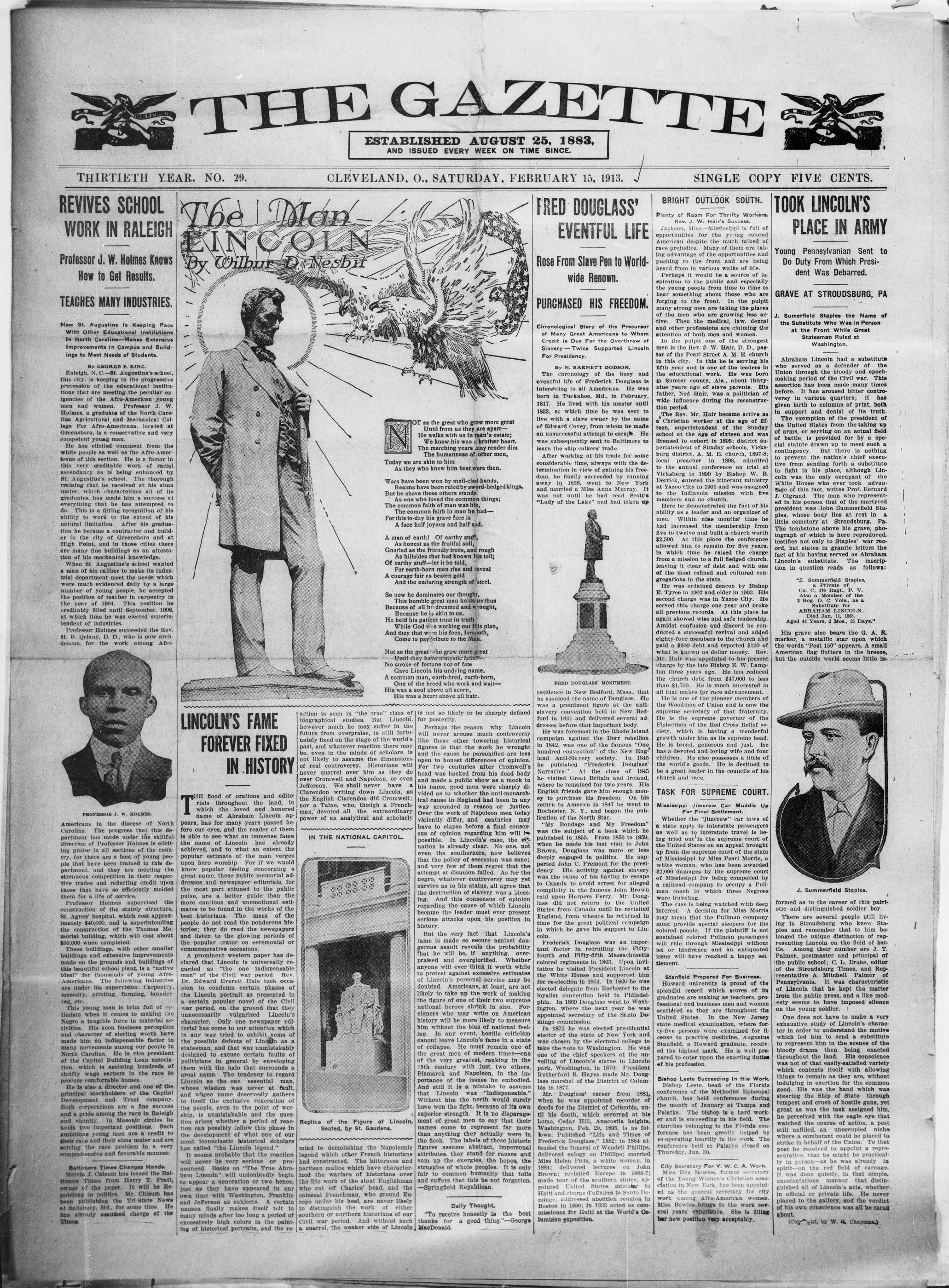
LINCOLN'S FAME FOREVER FIXED IN HISTORY
THE flood of orations and editorials throughout the land, in which the loved and honored
name of Abraham Lincoln appears, has for many years passed before our eyes, and the reader of them is able to see what an immense fame the name of Lincoln has already achieved, and to what an extent the popular estimate of the man verges upon hero worship. For if we would know popular feeling concerning a great name, these public memorial addresses and newspaper editorials, for the most part attuned to the public pulse, are a better guide than the more cautious and unemotional estimates to be found in the works of the best historians. The mass of the people do not read the ponderous histories; they do read the newspapers and listen to the glowing periods of the popular orator on ceremonial or commemorative occasions.
A prominent western paper has declared that Lincoln is universally regarded as "the one indispensable man" of the Civil war period. Rev. Dr. Edward Everett Hale took occasion to condemn certain phases of the Lincoln portrait as presented in a certain popular novel of the Civil war period, on the ground that they unnecessarily vulgarized Lincoln's character. Only one newspaper editorial has come to our attention which in any way tried to exhibit some of the possible defects of Lincoln as a statesman, and that was unmistakably designed to excuse certain faults of politicians in general by enveloping them with the halo that surrounds a great name. The tendency to regard Lincoln as the one essential man, whose wisdom was never at fault, and whose name deservedly gathers to itself the exclusive veneration of the people, even to the point of worship, is unmistakable and the question arises whether a period of reaction can possibly follow this phase in the development of what one of our most iconoclastic historical scholars has called "the Lincoln legend."
It seems probable that the reaction will never be very serious or pronounced. Books on "The True Abraham Lincoln" will undoubtedly begin to appear a generation or two hence, just as they have appeared in our own time with Washington, Franklin and Jefferson as subjects. A certain nausea finally makes itself felt in many minds after too long a period of excessively high colors in the painting of historical portraits, and the re
ESTABLISHED AUGUST 25, 1883 AND ISSUED EVERY WEEK ON TIME SINCE.
CLEVELAND, O., SATURDAY, FEBRUARY 15, 1913.
action is seen in "the true" class of biographical studies. But Lincoln, however much he may suffer in the future from overpraise, is still fortunately fixed on the stage of the world's past, and whatever reaction there may be, even in the minds of scholars, is not likely to assume the dimensions of real controversy. Historians will never quarrel over him as they do over Cromwell and Napoleon, or even Jefferson. We shall never have a Clarendon writing down Lincoln, as the English Clarendon did Cromwell; nor a Taine, who, though a Frenchman, devoted all the extraordinary power of an analytical and scholarly
—
Replica of the Figure of Lincoln, Seated, by St. Gaudens.
mind to demolish the Napoleonic legend which other French historians had constructed. The bitterness and partisan malice which have characterized the warfare of historians over the life work of the stout Englishman who cut off Charles' head, and the colossal Frenchman, who ground Europe under his heel, are never likely to distinguish the work of either southern or northern historians of our Civil war period. And without such a quarrel, the weaker side of Lincoln
Perhaps the reason why Lincoln will never arouse much controversy like these other towering historical figures is that the work he wrought and the cause he personified are less open to honest differences of opinion. For two centuries after Cromwell head was hacked from his dead body and made a public show as a mock to his name, good men were sharply divided as to whether the anti-monarchical cause in England had been in any way grounded in reason or justice. Over the work of Napoleon men today violently differ, and centuries may have to elapse before a final consensus of opinion regarding him will possible. In Lincoln's case, the situation is already clear. No one, not even the southernners, now believes that the policy of secession was sane; and very few of them regret that the attempt at disunion failed. As for the negro, whatever controversy may yet survive as to his status, all agree that the destruction of slavery was a blessing. And this consensus of opinion regarding the cause of which Lincoln became the leader must ever present serious attacks upon his position in history.
But the very fact that Lincoln's fame is made so secure against dangerous assault reveals the probability that he will be, if anything, overpraised and overglorified. Whether anyone will ever think it worth while to protest against excessive estimates of Lincoln's personal service may be doubted. Americans, at least, are not likely to take up the work of making the figure of one of their two supreme national heroes shrink in size. Foreigners who may write on American history will be more likely to measure him without the bias of national feeling. In any event, hostile criticism cannott leave Lincoln's fame in a state of collapse. He must remain one of the great men of modern times—one of the very greatest, ranking in the 19th century with just two others, Bismarck and Napoleon, in the importance of the issues he embodied. And still it is a mistake to assume that Lincoln was "indispensable." Without him the north would surely have won the fight, because of its own superior strength. It is no disparagement of great men to say that their names come to represent far more than anything they actually were in the flesh. The labels of these historic figures assume abstract, impersonal attributes, they stand for causes and sum up the energies, the hope, the struggles of whole peoples. It is only fair to common humanity that toils and suffers that this be not forgotten.—Springfield Republican.
Daily Thought.
"To receive honestly is the best thanks for a good thing."—George MacDonald.
FRED DOUGLASS' EVENTFUL LIFE
Rose From Slave Pen to Worldwide Renown.
PURCHASED HIS FREEDOM.
Chronological Story of the Precursor of Many Great Americans to Whom Credit is Due For the Overthrow of Slavery — Twice Supported Lincoln For Presidency.
By N. BARNETT DODSON.
The chronology of the busy and eventful life of Frederick Douglass is interesting to all Americans. He was born in Tuckahoe, Md., in February, 1817. He lived with his master until 1833, at which time he was sent to live with a slave owner by the name of Edward Covey, from whom he made an unsuccessful attempt to escape. He was subsequently sent to Baltimore to learn the caller skults' trade.
After working at his trade for some considerable time, always with the determination in view of gaining his freedom, he finally succeeded by running away in 1838, went to New York and married a Miss Anna Murray. It was not until he had read Scott's "Lady of the Lake" and had taken up
FRED DOUGLASS' MONUMENT. residence in New Bedford, Mass., that he assumed the name of Douglass. He was a prominent figure at the anti-slavery convention held in New Bedford in 1841 and delivered several addresses before that important body.
He was foremost in the Rhode Island campaign against the Dorr rebellion in 1842, was one of the famous "One hundred convention" of the New England Anti-Slavery society. In 1845 he published "Frederick Douglass" Narrative." At the close of 1845 he visited Great Britain and Ireland, where he remained for two years. His English friends gave him enough money to purchase his freedom. On his return to America in 1847 he went to Rochester, N. Y., and began the publication of the North Star. "My Bondage and My Freedom" was the subject of a book which he published in 1855. From 1856 to 1859, when he made his last visit to John Brown, Douglass was more or less deeply engaged in politics. He supported John C. Fremont for the presidency. His activity against slavery was the cause of his having to escape to Canada to avoid arrest for alleged complicity in the famous John Brown raid upon Harpers Ferry. Mr. Douglass did not return to the United States from Canada until he revisited England, from whence he returned in time for the great political campaign in which he gave his support to Lincoln.
Frederick Douglass was an important factor in recruiting the Fifty-fourth and Fifty-fifth Massachusetts colored regiments in 1863. Upon invitation he visited President Lincoln at the White House and supported him for re-election in 1864. In 1866 he was elected delegate from Rochester to the loyalist convention held in Philadelphia. In 1869 Douglass went to Washington, where the next year he was appointed secretary of the Santo Domingo commission. In 1872 he was elected presidential elector of the state of New York and was chosen by the electoral college to take the vote to Washington. He was one of the chief speakers at the unveiling of Lincoln's statue in Lincoln park, Washington, in 1876. President Rutherford B. Hayes made Mr. Douglass marshal of the District of Columbia in 1877.
Mr. "Douglas" career from 1881, when he was appointed recorder of deeds for the District of Columbia, until his death, which occurred at his home, Cedar Hill, Anacostia heights, Washington, Feb. 20, 1895, is as follows: Published "Life and Times of Frederick Douglass" 1882; in 1884 attended the funeral of Wendell Phillips, delivered eulogy on Phillips; married Miss Helen Pitts, a white woman, in 1884; delivered lectures on John Brown; revisited Europe in 1880; made tour of the southern states; appointed United States minister to Haiti and charge d'affaires to Santo Domingo; addressed abolition reunion in Boston in 1890; in 1893 acted as commissioner for Haiti at the World's Columbian exposition.
SINGLE COPY FIVE CENTS.
BRIGHT OUTLOOK SOUTH.
Plenty of Room For Thrifty Workers
Boy, Row W, Haitie, Success
Rev. J. W. Hair's Success.
Jackson, Miss.-Mississippi is full of opportunities for the young colored American despite the much talked of race prejudice. Many of them are taking advantage of the opportunities and pushing to the front and are being heard from in various walks of life.
Perhaps it would be a source of inspiration to the public and especially the young people from time to time to hear something about those who are forging to the front. In the pulpit many strong men are taking the places of the men who are growing less active. Then the medical, law, dental and other professions are claiming the attention of both men and women.
In the pulpit one of the strongest men is the Rev. J. W. Hair, D. D., pastor of the Pearl Street A. M. E. church in this city. In this he is serving his fifth year and is one of the leaders in the educational work. He was born in Sumter county, Ala., about thirty-nine years ago of slave parents. His father, Ned Hair, was a politician of wide influence during the reconstruction period.
The Rev. Mr. Hair became active as a Christian worker at the age of fifteen, superintendent of the Sunday school at the age of sixteen and was licensed to exhort in 1805; district superintendent of Sunday schools, Vicksburg district, A. M. E. church, 1897-8; local preacher in 1898, admitted to the annual conference on trial at Vicksburg in 1890 by Bishop W. B. Derrick, entered the itinerant ministry at Yazoo City in 1901 and was assigned to the Indianola mission with five members and no church. Here he demonstrated the fact of his ability as a leader and an organizer of men. Within nine months' time he had increased the membership from five to twelve and built a church worth $2,500. At this place the conference allowed him to remain for five years, in which time he raised the charge from a mission to a full fledged church, leaving it clear of debt and with one of the most refined and cultured congregations in the state.
He was ordained deacon by Bishop E. Tyree in 1902 and elder in 1903. His second charge was in Yazoo City. He served this charge one year and broke all previous records. At this place he again showed wise and safe leadership. Amidst confusion and discord he conducted a successful revival and added eighty-four members to the church and paid a $600 debt and reported $120 of what is known as dollar money. Rev. M. Hair was appointed to his present charge by the late Bishop E. W. Lampion three years ago. He has reduced the church debt from $47,000 to less than $1,700. He is much interested in all that makes for race advancement. He is one of the pioneer members of the Woodmen of Union and is now the supreme secretary of that fraternity. He is the supreme governor of the Fishermen of the Red Cross Relief society, which is having a wonderful growth under him as its supreme head. He is broad, generous and just. He has a devoted and loving wife and four children. He also possesses a little of the world's goods. He is destined to be a great leader in the councils of his church and race.
TASK FOR SUPREME COURT.
Mississippi Jimcrow Car Muddle Up For Final Settlement.
Whether the "Jimcrow" car laws of a state apply to interstate passengers as well as to interstate travel is being tried out in the supreme court of the United States on an appeal brought up from the supreme court of the state of Mississippi by Miss Pearl Morris, a white woman, who has been awarded $2,000 damages by the supreme court of Mississippi for being compelled by a railroad company to occupy a Pullman coach in which three Negroes were traveling.
The case is being watched with deep interest. A decision for Miss Morris may mean that the Pullman company must provide special sleepers for the colored people. If the plaintiff is not sustained colored Pullman passengers will ride through Mississippi without let or hindrance and an antiquated issue will have reached a happy settlement.
Stanfield Prepared For Business.
Howard university is proud of the splendid record which scores of its graduates are making as teachers, professional and business men and women scattered as they are throughout the United States. In the New Jersey state medical examination, where forty-five persons were examined for license to practice medicine, Augustus Stanford, a Howard graduate, received the highest mark. He is well prepared to enter upon the exacting duties of his profession.
Bishop Leete Succeeding In His Work.
Bishop Leete, head of the Florida conference of the Methodist Episcopal church, has held conferences during the month of January at Tampa and Palatka. The bishop is a hard worker and is succeeding in his field. The churches belonging to the Florida conference has been greatly helped by co-operating heartily in the work. The conference held at Palatka closed on Thursday, Jan. 30.
City Secretary For Y. W. C. A. Work.
Miss Eva Bowles, former secretary of the Young Women's Christian association in New York, has been appointed as the general secretary for city work among Afro-American women. Miss Bowles brings to the work several years' experience. She is filling her new position very acceptably.
THE UNION
TOOK LINCOLN'S PLACE IN ARMY
Young Pennsylvanian Sent to Do Duty From Which President Was Debarred.
GRAVE AT STROUDSBURG, PA
J. Sumerfield Staples the Name of the Substitute Who Was in Person at the Front While Great Statesman Ruled at Washington.
Abraham Lincoln had a substitute who served as a defender of the Union through the bloody and epoch-making period of the Civil war. This assertion has been made many times before. It has aroused bitter controversy in various quarters; it has given birth to columns of print, both in support and denial of its truth.
The exemption of the president of the United States from the taking up of arms, or serving on an actual field of battle, is provided for by a special statute drawn up to meet such a contingency. But there is nothing to prevent the nation's chief executive from sending forth a substitute to fight in his place, although Lincoln was the only occupant of the White House who ever took advantage of this fact, writes Prof. Bernard J. Cigrand. The man who represented in his person that of the martyred president was John Summerfield Staples, whose body lies at rest in a little cemetery at Stroudsburg. Pa. The tombstone above his grave, photograph of which is here reproduced, testifies not only to Staples' war record, but states in granite letters the fact of his having served as Abraham Lincoln's substitute. The inscription in question reads as follows:
"J. Summerfield Staples, a Private of Co. C, 175 Regt., P. V. Also a Member of the 2 Reg. D. C. Vols., as a Substitute for ABRAHAM LINCOLN. Died Jan. 11, 1888. Aged 43 Years, 2 Moz. 25 Days."
His grave also bears the G. A. R. marker, a metallic star upon which the words "Post 150" appear. A small American flag flutters in the breeze, but the outside world seems little in
J. Summerfield Staples.
formed as to the career of this patriotic and distinguished soldier boy.
There are several people still living in Stroudsburg who knew Staples and remember that to him belonged the unique distinction of representing Lincoln on the field of battle. Among their number are J. T. Palmer, postmaster and principal of the public school; C. L. Drake, editor of the Stroudsburg Times, and Representative A. Mitchell Palmer of Pennsylvania. It was characteristic of Lincoln that he kept the matter from the public press, and a like modestly seems to have imposed silence on the young soldier.
One does not have to make a very exhaustive study of Lincoln's character in order to understand the motive which led him to send a substitute to represent him in the scenes of the bloody drama then being enacted throughout the land. His conscience was not of that easily-satisfied variety which contents itself with allowing things to remain as they are, without indulging in exertion for the common good. His was the hand which was steering the Ship of State through tempest and crush of hostile guns, yet great as was the task assigned him, he perceived with the eagle eye that watched the course of action, a post still unfilled, an unoccupied niche where a combatant could be placed to strike in behalf of the Union. To that post he resolved to appoint a representative, that he might be practically in person—as he was already in spirit—on the red field of carnage. It was done quietly, in that simple, unostentatious manner that distinguished all of Lincoln's acts, whether in official or private life. He never played to the gallery, and the verdict of his own conscience was all he cared about.
(Copyright, by W. Q. Chapman.)
THE GAZETTE PUBLISHED EVERY SATURDAY
THE GAZETTE PUBLISHED EVERY SATURDAY
One Year. $1.99
Six Months. 1.00
Three Months. .50
Subscribers are requested to remit by postoffice money order or registered letter.
Entered at the postoffice In Cleveland Ohio, as second-class matter
Address all communications to HARRY C. SMITH
Editor and proprietor,
THE GAZETTE,
Blackstone Building, Cleveland, O.
Member Ohio Legislature: 1894 to 1896; 1896 to 1898; 1900 to 1902
THE GAZETTE is the oldest, and has the largest bona fide circulation, double that of any newspaper in the interest of Afro-Americans, published in the state of Ohio, and comparison with any will immediately establish its rank as one of the NEWSIEST AND BEST in the country.
Ohio's separate marriage bill must be fought. What are our state leaders doing to make the necessary organized effort and protest?
Now we have "mountain" whites, in N. Y. state, on a par, almost, with those in the south, according to Bishop Nelson (white) of Albany. See letter from that city, in this paper.
We regard Mr. T. W. Taylor's letter—protest, republished elsewhere in this paper, as one of the strongest and best on the subject of intermarriage, we have ever seen. It will repay you, many times, for a careful reading.
We felt sure, Dr. Rowley, president of the Massachusetts Society for the Prevention of Cruelty to Animals, and editor-in-chief of it's monthly publication, "Our Dumb Animals," would accede to our reasonable request. See his welcome letter elsewhere in The Gazette, today. Thanks, Dr. Rowley.
Democratic legislators in Ohio, New York, New Jersey, Iowa, Kansas and other northern states, are centerring their attack upon our civil rights in a general onslaught against intermariage. Anti-intermarriage bills are pending in many northern state assemblies and are prime notices to our people to wake up and "get very busy" if they would retain the citizen rights left, to say nothing of regaining those already lost.
Mr. Jesse Binga of Chicago, well-known and successful banker and real estate broker, is the first Afro-American to join the Illinois Bankers' Association, or that of any other state, although Jno. Mitchell fr., president of the Mechanics' Saving Bank of Richmond, Va., is a member of the National Bankers' Association. Showly but surely we are making progress in the business world in spite of tremens dous barriers built by racial prejudice We salute wise Messrs. Binga and Mitchell, and say to our other bankers, go thou, and do likewise if possible.
Harry A. Levy, a Jew, manager of the Lyric Theater, N. Y. city, refused Louis F. Baldwin and Miss Jennie Green, members of the race, orchestra circle seats, and was given a sentence of $50 fine or ten days in the city prison, as a result of the criminal action brought against him. He appealed the case and, last week, again lost. N. Y. state's Malby law is a copy of our Ohio Civil Rights' law. Now, let our people in this state again become active in the fight for their citizen rights in all public places where there is effort to deny them. Mr. Baldwin's victory is very encouraging, indeed, as it does fresh from the Supreme Court, Appellate Division, First Department, January term, 1913. Our attention has just been called to Attorney Graham Deuwell's recent splendid victory at Columbus. See letter from that city elsewhere in this paper. More prime encouragement, and right here in Ohio, too.
The Jews of N. Y. City, were right in their opposition to the reading of the "Merchant of Venice" in the public schools of that city because of its "Shylock" character. In referring to their protest, a writer in a N. Y. daily newspaper who sought to be "smart," asked why the Danes do not object to "Hamlet" and why the Negroes do not ask for the elimination of "Othello?" The answer is that the characters of "Hamlet" and "Othello" do not ridicule the Danes and Negroes, respectively. This cannot be said of the character "Shylock" and the Jews, and explains their righteous protest referred to above. Cleveland Jews who are promoting a Y. M. H. A. as a protest against, and as a result of, discriminations against members of their class or race, are waging a manly fight against the miserable local Central Y. M. C. A. for which they are to be commended.
We cannot commend too strongly the following excerpt from an editorial in the N. Y. Age of last week: "The Negro must fight for his rights, the least and greatest, whenever they are assailed, or he will have none in the end. The Separate Marriage law scheme should be fought to the bitter end. At the bottom of the whole scheme to isolate the Negro citizen in all of the public and private relations of life—in the industrial trades, skilled and unskilled, by trades union rules and regulations; in segregating them, separating them to themselves in living districts, in cities, villages and counties, and in branding them by law as so far inferior that they may not marry and give in marriage, not other races of the citizenship are free to do; in eating and drinking in places of licensed accommodation and amusement, and in accommodations in travel, by land and see, as others are free to do—at the bottom of the slave-holder's doctrine, as formulated into the law of precedent by Chief Justice Roger B. Taney of the Federal Supreme
Court in 1856, that it has been so far held to be good law and precedent that a black man has no rights that a white man is bound to respect."
LIBERIAN STRUGGLES.
Many who read the brief dispatches narrating the recent victory of the Liberian troops over the rebellious Croos doubtless believed the contest was waged in the remote and practically unexplored hinterland. Such an assumption, however, is quite unwarranted. The decisive fight took place at Rock Cess, about in the middle of Liberia's stretch of 500 miles of coast. It was in the center of the most civilized and best settled part of the republic.
The little war against the rebellious Croos of the coast has nothing whatever ever to do with the struggle for mastery of the hinterland. This seems altogether too large an undertaking for the Liberians, and the Liberian
S. H.
supremacy over the rich regions back from the coast is almost wholly theoretical. It is guarded, however, by treaties with France and Great Britain, the two nations with territory adjacent to Liberia.
Neither French nor British have made any menace against Liberia because of the Croo troubles. But the Germans, who are constantly on the outlook for a possible chance at any African acquisition, dispatched warships to the Liberian coast to demand the "protection of German interests." These "interests" have doubtless been conserved by the recent Liberian victory, which was won under the direction of a "borrowed," United States army officer (Major Charles Young of Ohio).
There is no possible doubt that Liberia would have already lost its independent existence were it not for the interest and friendliness of the United States. The Monroe doctrine does not extend to Liberia, and Liberia is in no sense a dependency of this country, yet the fact that the United States has had a sympathetic eye on the republic has unquestionably saved it from the aggressions of France and Great Britain, and may now be effective in holding the Germans from taking possession under some pretense or other. The undeveloped resources of the country are great, and it appears a tempting morsel for a land hungry power. There are plenty of pretexts discoverable for annexation or at least for the declaration of a protectorate, the most plausible being the admitted inability of the Liberians to make the most of their own country, or even to maintain the authority of their government except in a restricted area. The very existence of Liberia today is a high testimonial to the esteem in which the United States of America is held by European nations.—Cleveland Dally Plain Dealer.
The daily papers recently printed, without a word of adverse criticism, a resolution adopted by the South Carolina legislature and an excerpt from a speech delivered recently by former Speaker Cannon, as follows:
The resolution asserts:
"The Negro race has made no advancement only as he comes in contact with the other human races. The people of these United States have advanced the Negro further than any other nation, having taught him the most extensive language on the globe, the use of tools, the wearing of clothing, and, above all, the Christian religion. In return for all these advantages he has given the people of these United States only anxiety, strife, and hatred and hoodworm. In view of these circumstances Congress is asked to deprive the Negro of the ballot, and the South Carolina members of Congress are asked to take active steps toward the repeal of the fifteenth amendment."
The extract from Mr. Cannon's speech is equally significant following his defeat at the polls, last fall:
"There are certain great characters that will dwell in the history of the country," said Mr. Cannon; "first, and barely first, Washington; second, Lincoln; third, Lee, a great man, a great General, who did his duty from his patriotic standpoint; fourth, Jefferson Davis, a great man performing a great service for the Republic as he saw his duty."
The nation, especially the state of Ohio, feels the loss at the present juncture from the national congress, of such patriotic statesmen and friends of humanity as former Captain J. B. Foraker and Private D. A. Holingsworth, who, when in congress, stood manfully for the constitutional amendments and the rights of the Negro race thereunder. The Gazette hopes to see them returned.
Anti-Intermarriage Measure Fails. Topeka, Kan.—Following a stiff fight by the Topeka Plaindealer and leading Afro-American residents of this State, the bill prohibiting the intermarriage of other races with whites was killed by the State Legislature committee of the State Senate Jan. 31 it had previously passed the lower branch of the Legislature and divided big fines, imprisonment, or both, for those directly or indirectly concerned in the marriage of whites to other races.
THE GAZETTE, CLEVELAND, O., SATURDAY, FEBRUARY 15, 1913.
INTRODUCED IN THE OHIO AND
MICHIGAN LEGISLA;
THE
Such Legislation Promotes Immorality—Absolutely No Necessity for It Anyhow—Unconstitutional and Vicious.
Detroit, Mich. Feb. 12, 13.
Hon. Harry C. Smith,
Cleveland, Dear Ohio.
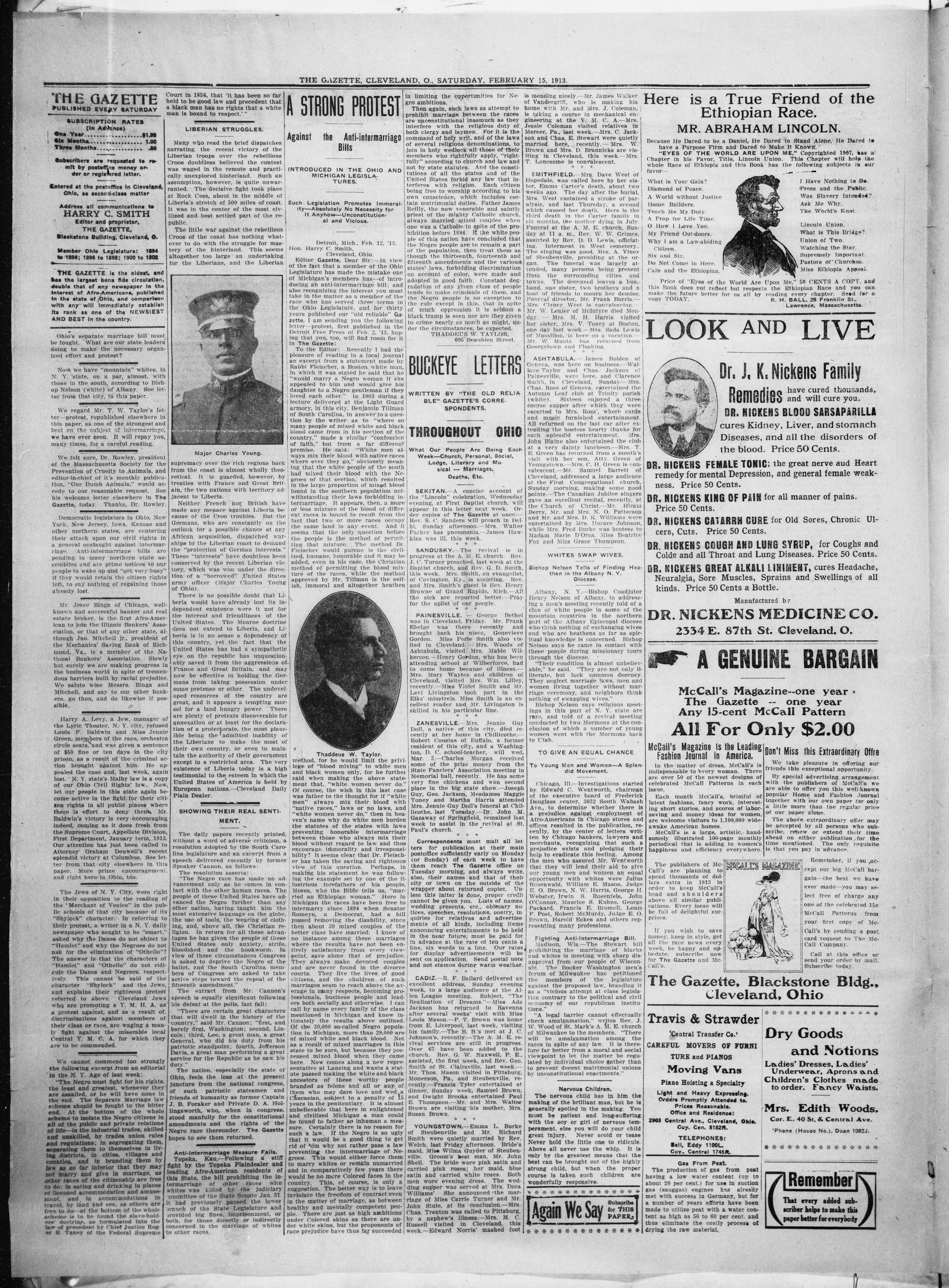
Editor Gazette, Dear Shr.:—In view of the fact that a member of the Ohio Legislature has made the mistake one of Michigan's, introducing an anti-marriage bill; also recognizing the interest you must take in the matter as a member of the race who has served three terms in the Ohio Legislature, and for thirty years published our "old reliable" Gazette. I am sending you the following letter—protest, first published in the Free Press of Feb. 2, 13, hoping that the office, will find room for it in The Gazette:
To the Editor: Recently I had the pleasure of reading in a local journal an excerpt from a statement made by Rabbi Fleischer, a Boston white man, in which it was stated he said that he "would marry a Negro woman if she appealed to him and would give his daughter to a Negro gentleman if they loved each other. In 1903 during a war, he and his armory, in the city, Benjamin Tillman of South Carolina, in answer to a question by the writer as to "where so many people of mixed white and black blood came from in his section of the country," made a similar "confession of faith," but from a far different premise. He said: "White men always mix their blood with native races where ever they go," obviously meaning that the white people of the south had mixed their blood with the Negro in the large proportion of mixed blood found in the southern population notwithstanding their laws forbidding intermarriage. It appears, then, a more or less mixture of the blood of different races is bound to result from the fact that two or more races occupy the same land in any event. And it seems that the only question before the people is the method of permitting that mixture. The method Dr. Tillman used was highly organized, humane honorable and it may be added, even in his case, the Christian method of permitting the blood mixture of the races, while the method approved by Mr. Tillman is the selfish, immoral and altogether heathen
[Picture of a man in a suit].
in limiting the opportunities for Negro ambitions.
Then again, such laws as attempt to prohibit marriage between the races are unconstitutional inasmuch as they interfere with the religious duty of both clergy and laymen. For it is the command of holy writ, and of the laws of several religious denominations, to join in holy wedlock all those of their members who rightfully apply, "rightfully" according to church and law and not by state statutes. And the constitutions of all the states and of the countries where they interferes with religion. Each citizen being free to worship according to his own conscience, which includes certain matrimonial duties. Father James Reilly, the now venerable and saintly priest of the mighty Catholic church, always married mixed couples when one was a Catholic in spite of the prohibition before 1884. If the white people of this nation have concluded that the Negro people are to remain a part of the population, then treat them as though the thirteenth, fourteenth and fifteenth centuries various states' laws for forbidding discrimination on account of color, were made and adopted in good faith. Constant degradation of any given class of people tends to make criminals of them, and the Negro people is no exception to the rule except in this, that in spite of much oppression it is seldom a black tramp is seen nor are they to crime nearly as much as might, under the circumstances, be expected.
THADDEUS W. TAYLOR.
605 Beaubien Street.
BUGKEYE LETTERS
WRITTEN BY "THE OLD RELIABLE" GAZETTE'S CORRESPONDENTS.
What Our People Are Doing Each Week—Church, Personal, Social, Lodge, Literary and Musical — Marriages, Deaths, Etc.
SEKITAN.—A concise account of the "Lincoln" celebration, Wednesday evening, at First Baptist church, will appear in this letter next week. Order copies of the *The Gazette* at once—Rev. S. C. Sanders will preach in Delhi, Sunday afternoon—Mrs. Walter Parker has pneumonia—James Hawkins was ill, this week.
SANDUSKY.—The revival is in progress at the A. M. E. church, Rev. J. C. Turner preached, last week at the Baptist church, and Rev. G. D. Smith, this week. Mrs. Smith, an evangelist, of Covington, Ky., is assisting. Rev. and Mrs. Smith's guest is Rev. Henry Browne of Grand Rapids, Mich.—All the sick are reported better.—Pray for the uplist of our people.
PAINESVILLE. — George Bethel was in Cleveland. Friday, Mr. Frank Eledge was there recently and brought back his niece, Genevieve Gordon. Miss Perle Smith also visited in Cleveland. — Mrs. Woods of Ashtabula, visited Mrs. Mable Wilkerson. — Henry Gordon, who has been attending school at Wilberforce, had to come home because of illness. — Mrs. Wilberforce, a member of Cleveland, visited Wm. Lilley, recently. — Miss Violet Smith and Mr. Levi Livingston took part in the Elks' minstrels. Miss Smith is an excellent reader and Mr. Livingston is skilled in his particular line.
ZANESVILLE—Mrs. Jennie Guy Doll, a native of this city, died recently at her home in Chillicothe. Robert Cousins of Buffalo, a former resident of this city, and a Washington, D. C. school-teacher, will wed, Mar. 3—Charles Morgan received some of the prize money from the State Fanciers' Association meeting in Memorial hall, recently. He has some very fine paintings and second on some of the big state show. Joseph Guy, Goo, Jackson, Mesmedes Maggie Toney and Martha Harris attended Mrs. Jennie Guy Doll's funeral at Chillicothe, last Tuesday—Dr. John M. Gazaway of Springfield, remained last week to assist in the revival at St. Paul's church.
Correspondents must mail all letters for publication at their main postoffice sufficiently early on Monday (or Sunday) of each week to have them reach The Gazette office on Tuesday morning, and always write, also, their names and that of their employer. If you send a wrapper about returned copies. Unless this latter is done, proper credit cannot be given you. Lists of names, wedding presents, etc., obteiary notices, speeches, resolutions, poetry, inquiries for relatives and advertisements of all kinds, including items announcing entertainments to be held in advance at the rate of ten cents a line, six words to a line. Our rates for display advertisements will be sent on application. Send postal note and not stamms during warm weather.
CADIZ—R. F. Ballard delivered an excellent address, Sunday evening week, to a large audience at the Alen League meeting. Subject, "The Realization of Dreams."—Miss Ada Jackson has returned to Ravenna after several weeks' visit with Miss Leola Mason—P. T. Brown was home on Monday. She entertained his family—The B. B's meet at J. C Johnson's, recently—the M. A. M. E. revival services are still in progress. Over 67 have been added to the church. Rev. G. W. Maxwell, P. E. assisted, the first week, and Rev. Geo. Smith of St. Clairsville, last week. Mr. Thos. Mason visited in Pittsburgh, Monesson, Pa., and Steubenville, recently.—Francis T. Swank, William Swank, Samuel Brown, and Dwight Brooks entertained Paul E. Thompson—Mr. and Mrs. Walter Brown are visiting his mother, Mrs. Susan Brown.
YOUNGSTOWN.—Emma L. Burke of Steubenville and Mr. Richard Smith were quietly married by Rev Welch, last Friday afternoon. Bride's maid, Wilma Wilma Guyder of Steubenville, Groom's best man, Mr. John Shell. The bride wore pink satin and carried pink roses; her maid, blue satin and carried white roses. Both men wore evening dress. The wedding supper was served at Mrs. Dora Williams'. She announced the marriage of Miss Curner and Mr. John Stule, at its conclusion.—Mrs. Chas. Trenton was called to Pittsburgh, by a nephew's illness.—Mrs. M. C. Russell visited in Cleveland, this week.—Edward Norris' mashed foot
is mending nicely. Mr. James Walker of Vandervigr, who is making his home with Mr. and Mrs. J. Coleman, is taking a course in mechanical engineering at the Y. M. C. A.—Mrs. Jessie Coleman visited relatives in Mercer, Pa., last week—Mrs. C. Jackson and Chas. E. Stewart were quietly married here, recently—Mrs. W. Brown and Mrs. D. Brannicks are visiting in Cleveland, this week—Mrs. T. Lonesome is convalescent.
SMITHFIELD.—Mrs. Dave West of Hopedale, was called here by her sister, Emma Carter's death, about two weeks ago. The day after the burial, Mrs. West sustained a stroke of paralysis, and last Thursday, a second which caused her death. Hers is the third death in the Carter family in six months, the mother dying in July. Mrs. West was hospitalized on Sunday at 11 a.m., m. Rev. W. W. Grinnes, assisted by Rev. D. D. Lewis, officiating. Interment in West cemetery. The singing was good. Mrs. A. Viney of Steubenville, presiding at the organ. The funeral was largely attended, many persons being present from the surrounding cities and towns. The deceased leaves a husband, one sister, two brothers and a host of friends to mourn her demise. Funeral director, Mr. Frank Burris.—Mrs. W. Leiden of Meltyne died. Mr. W. Leiden of Meltyne on Monday. — Mrs. M. H. Harris visited her sister, Mrs. V. Toney at Boston, one day last week.—Mrs. Sada Lewis of Massillon, is here on a vacation. Mr. W. Munts has returned from Georgetown and Flushing.
ASHTABULA. — James Bolden of Geneva, was here on business. — Wallace Taylor and Chas. Jackson of Painesville, were here, and Clarence Smith, in Cleveland, Sunday. — Mrs. Chas. Ross of Geneva, entertained the Autumn Leaf club at Trinity parish (white). Sixteen enjoyed a three course supper after which they were ordered music, music furnished entertainment. All returned on the last car after extending the hostess heart thanks for such splendid entertainment. Mrs. John Blaine also entertained the club at a very dainty luncheon. Mrs. T. E. Green has returned from a month's visit with her son, Atty. Green of youngstown. Mrs. C. H. Green is convalescent. — Mr. Samuel Barrett of Cleveland, addressed a large audience at the First Congregational church, Sunday morning, making some good progress. Mrs. H. G. Green gave an excellent recital, recently, at the Church of Christ. — Mr. Hiram Berry, Mr. and Mrs. N. O. Patterson and Mr. and Mrs. D. K. Williams were entertained by Mrs. Horace Johnson, while Mrs. Fred Burke was hostess to Madam Marie D'Orsa. Meiss Beatrice Fox and Miss Grace Thompson.
WHITES SWAP WIVES.
Bishop Nelson Tells of Finding Heathen in the Albany N. Y. Diocese.
Albany, N. Y.—Bishop Coadjutor Henry Nelson of Albany, in addressing a men's meeting recently told of a clan of white people in some of the mountain countries in the northern part of the Albany Episcopal diocese who think nothing of exchanging wives and who are heathens as far as spirited women. Bishop Nelson says he came in contact with these people during missionary tours through the diocese.
"Their condition is almost unbelievable," he said. "They are not only illiterate, but lack common decency. They neglect marriage laws, men and women living together without marriage ceremony, and neighbors think nothing of swapping wives."
Bishop Nelson says religious meetings in this part of N. Y. state are rare and told of a very recent meeting conducted by two Mormons at the conclusion of which a number of young women went with the Mormons back to Utah.
TO GIVE AN EQUAL CHANCE
To Young Men and Women—A Splendid Movement.
Chicago, Ill.—Investments started by Edward C. Wentworth, chairman of the executive board of Frederick Douglass center, 3032 South Wabash Ave., to determine whether there is a prejudice against employment of Afro-Americans in Chicago stores and offices resulted in the publication, reprinting, and censorship of a book written by Chicago bankers, lawyers and merchants, recognizing that such a prejudice exists and pledging their help to eradicate this feeling. Among the men who assured Mr. Wentworth that they will lend their aid to give our young men and women an equal opportunity with whites were Julius Rosenwald, William E. Mason, Judge E. O. Brown, N. W. Harris, George H. Gebster, Irwin, S. Roseniel, John O'Connor, Married S. Kahns, George Packard, Francis E. Bromell, Louis F. Post, Robert McMurdy, Judge E. O. Brown, Harold Eckes and others representing many professions.
Fighting Anti-Intermarriage Bill.
Madison, Wis.-The Stewart bill prohibiting the marriage of blacks and whites is meeting with sharp disapproval from our people of Wisconsin. The Washington men's forum of Milwaukee has petitioned the members of the legislature against the proposed law, branding it as a "vicious attempt at class legislation contrary to the political and civil economy of our republican institutions."
"A legal barrier cannot effectively check amalgamation," writes Rev. J. W. Wood of St. Mark's A. M. E. church of Milwaukee to the members. "There will be amalgamation among the races spite of any law. It is there far better for both men and women to viewpoint to let the matter be regulated by individual choice rather than to prevent decent matrimonial unions by unconstitutional enactments."
The nervous child has in him the making of the brilliant man, but he is generally spolied in the making. You must be patient and long-suffering with the ooy or girl of nervous temperament, else you will do your child great injury. Never scold or tease Never hold the little one to ridicule. Above all never use the whip. It is only by the greatest means that the best can be brought out of the highly strung child, but when the proper course is taken such children are wonderfully responsive.
Again We Say Subscribe for THIS PAPER
Here is a True Friend of the Ethiopian Race.
Because He Dared to be a Daniel, He Dared to Stand Alone; He Dared to have a Purpose, Firm, and Dared to Make It Known.
have a Purpose Firm and Dared to Make It Known.
"EYES OF THE WORLD ARE UPON ME." Copyrighted 1907, has a Chapter in his Favor, Title, Lincoln Union. This Chapter will help the whole Race of Ethiopia and this Book has the following subjects in our favor—
What is Your Gain?
Diamond of Peace.
A World without Justice
Home Builders.
Teach Me My Duty.
A Prop for Life Time.
O How I Love You.
My Friend Out-doors.
Why I am a Law-abiding Citizen.
Six and Six.
Do Not Come in Here.
Cain and the Ethiopian.
I Have Nothing to Do.
Press and the Public.
Was Slavery Intended?
Ask Me Why.
The World's Knot.
Lincoln Union.
What is This Bridge?
Union of Two.
Watching the Star.
Supremely Important.
Pastors of Churches.
Miss Ethiopia Appeal.
Price of "Eyes of the World Are this Book does not reflect but respect make the future better for us all by copy TODAY. LOOK AND
the World Are Upon Me," 50 CENTS A COPY, and
lect but respects the Ethiopian Race and you can
for us all by reading every chapter. Send for a
R. H. BALL, 28 Franklin St.,
Lawrence, Massachusetts.
Price of "Eyes of the World Are Upon Me." 50 CENTS A COPY, and this Book does not reflect but respects the Ethiopian Race and you can make the future better for us all by reading every chapter. Seed for a copy TODAY. R. H. BALL, 28 Franklin St.
LOOK AND LIVE
Dr. J. K. Nickens Family
have cured thousands, and will cure you.
DR. NICKENS BLOOD SARSAPARILLA cures Kidney, Liver, and stomach Diseases, and all the disorders of the blood. Price 50 Cents.
MALE TONIC; the great nerve aud Heart Depression, and general female weak-Cents.
G OF PAIN for all manner of pains.
STARRH CURE for Old Sores, Chronic Ulcer 50 Cents.
DUGH AND LUNG SYRUP, for Coughs and Croat and Lung Diseases. Price 50 Cents.
EAT ALKALI LINIMENT, cures Headache, Muscles, Sprains and Swellings of all Cents a Bottle.
Manufactured by KENS MEDICINE CO.
87th St. Cleveland, O.
GENUINE BARGAIN
's Magazine--one year
Gazette -- one year
-cent McCall Pattern
For Only $2.00
is the Leading
America.
Don't Miss this Extraordinary Offre
Remedies have cured thousands, and will cure you. DR. NICKENS BLOOD SARSAPARILLA cures Kidney, Liver, and stomach Diseases, and all the disorders of the blood. Price 50 Cents.
DR. NICKENS FEMALE TONIC remedy for mental Depression. Price 50 Cents.
DR. NICKENS KING OF PAINT. Price 50 Cents.
DR. NICKENS CATARRH CURSORS, Cuts. Price 50 Cents.
DR. NICKENS COUGH AND LICE. Colds and all Throat and Lice.
DR. NICKENS GREAT ALKALIS. Neuralgia, Sore Muscles, kinds. Price 50 Cents a Bo
Manufacture
DR. NICKENS M
2334 E. 87th S
A GENUINE
McCall's Magazine
The Gazette
Any 15-cent M
All For O
McCall's Magazine is the Leading Fashion Journal in America.
DR. NICKENS FEMALE TONIC; the great nerve and Heart remedy for mental Depression, and general female weakness. Price 50 Cents.
DR. NICKENS KING OF PAIN for all manner of pains. Price 50 Cents.
DR. NICKENS CATARRH CURE for Old Sores, Chronic Ulcers, Cuts. Price 50 Cents.
DR. NICKENS COUGH AND LUNG SYRUP, for Coughs and Colds and all Throat and Lung Diseases. Price 50 Cents.
DR. NICKENS GREAT ALKALI LINIMENT, cures Headache, Neuralgia, Sore Muscles, Sprains and Swellings of all kinds. Price 50 Cents a Bottle.
DR. NICKENS MEDICINE CO. 2334 E. 87th St. Cleveland, O.
A GENUINE BARGAIN
McCall's Magazine--one year
The Gazette -- one year
Any 15-cent McCall Pattern
All For Only $2.00
McCall's Magazine is the Leading Fashion Journal in America.
In the matter of dress, McCall's is indispensable to every woman. There are over 50 of the newest designs of celebrated McCall Patterns in each issue.
Each month McCall's, brimful of latest fashions, fancy work, interesting short stories, and scores of labor-saving and money ideas for women, are welcome visitors to 110,000 wide-wake American homes.
McCall's is a large, artistic, handsomely illustrated 100-page monthly periodical that is adding to women's happiness and efficiency everywhere.
Don't Miss this Extraordinary Offre
We take pleasure in offering our friends this exceptional opportunity.
By special advertising arrangement with the publishers of McCall's we are able to offer you this well-known popular Home and Fashion Journal together with our own paper for only a little more than the regular price of our paper alone.
The above extraordinary offer may be accepted by all persons who subscribe, renew or extend their time ahead on either publication for the time mentioned. The only requisite is that you pay in advance.
MA CHESTER PHOTOGRAPHY
itte, Blackstone Bldg.,
leveland, Ohio
rawder
er Co.'
OF FURNI
NOS
* * * * * * * * * * *
Dry Goods
and Notions
The Gazette, B Cleveland
Travis & Strawder
'Central Transfer Co.'
CAREFUL MOVERS OF FURNI
TURE and PIANOS
Moving Vans
The Gazette, Blackstone Bldg., Cleveland, Ohio
Piano Hoisting a Specialty
Light and Heavy Expressing.
Orders Promptly Attended to.
Prices Reasonable.
Office and Residence:
2003 Central Ave., Cleveland, Ohio.
Guy. Cen. 8182R.
The production of gas from peat having a low water content (up to about 20 per cent.) for use in suction gas (saugasg) engines has already met with success in Germany, but for a number of years efforts have been made to utilize peat with a water content as high as 50 to 60 per cent, and thus eliminate the costly process of drying the raw material.
---
---
What is Your Gain?
Diamond of Peace.
A World without Justice
Home Builders.
Teach Me My Duty.
A Prop for Life Time.
O How I Love You.
My Friend Out-doors.
Why I am a Law-abiding
Citizen.
Six and Six.
Do Not Come in Here.
A. B. S.
The publishers of McCall's are planning to spend thousands of dollars extra in 1913 in order to keep McCall's head and shoulders above all similar publications. Every issue will be full of delightful surprises.
If you wish to save money, keep in style, get all the race news every week, be happy and up-to-date, subscribe now for The Gazette and McCall's.
TELEPHONES:
Bell, Eddy 1100L
Cuy. Central 1745R
I Have Nothing to Do.
Press and the Public.
Was Slavery Intended?
Ask Me Why.
The World's Knot.
Lincoln Union.
What is This Bridge?
Union of Two.
Watching the Star.
Supremely Important.
Pastors of 'Churches.
Miss Ethiopia Appeal.
We take pleasure in offering our friends this exceptional opportunity. By special advertising arrangement with the publishers of McCalla's we are able to offer you this well-known popular Home and Fashion Journal together with our own paper for only a little more than the regular price of our paper alone. The above extraordinary offer may be accepted by all persons who subpoena or extend their time ahead on either in advance or the time mentioned. The only requisite is that you pay in advance.
Remember, if you accept our big McCall bargain—the best we have ever made—you may select free of charge any one of the celebrated 15c McCall Patterns from your first copy of McCall's by sending a post card request to The McCall Company. Call at this office or send your order by mail.
Call at this office or send your order by mail. Subscribe today.
Ladies' Dresses, Ladies'
Underwear, Aprons and
Children's Clothes made
to order. Fancy Waists.
Mrs. Edith Woods.
Cor. E. 40 St, & Central Ave.
'Phone (House No.), Doan 1082J.
Remember That every added subscriber helps to make this paper better for everybody
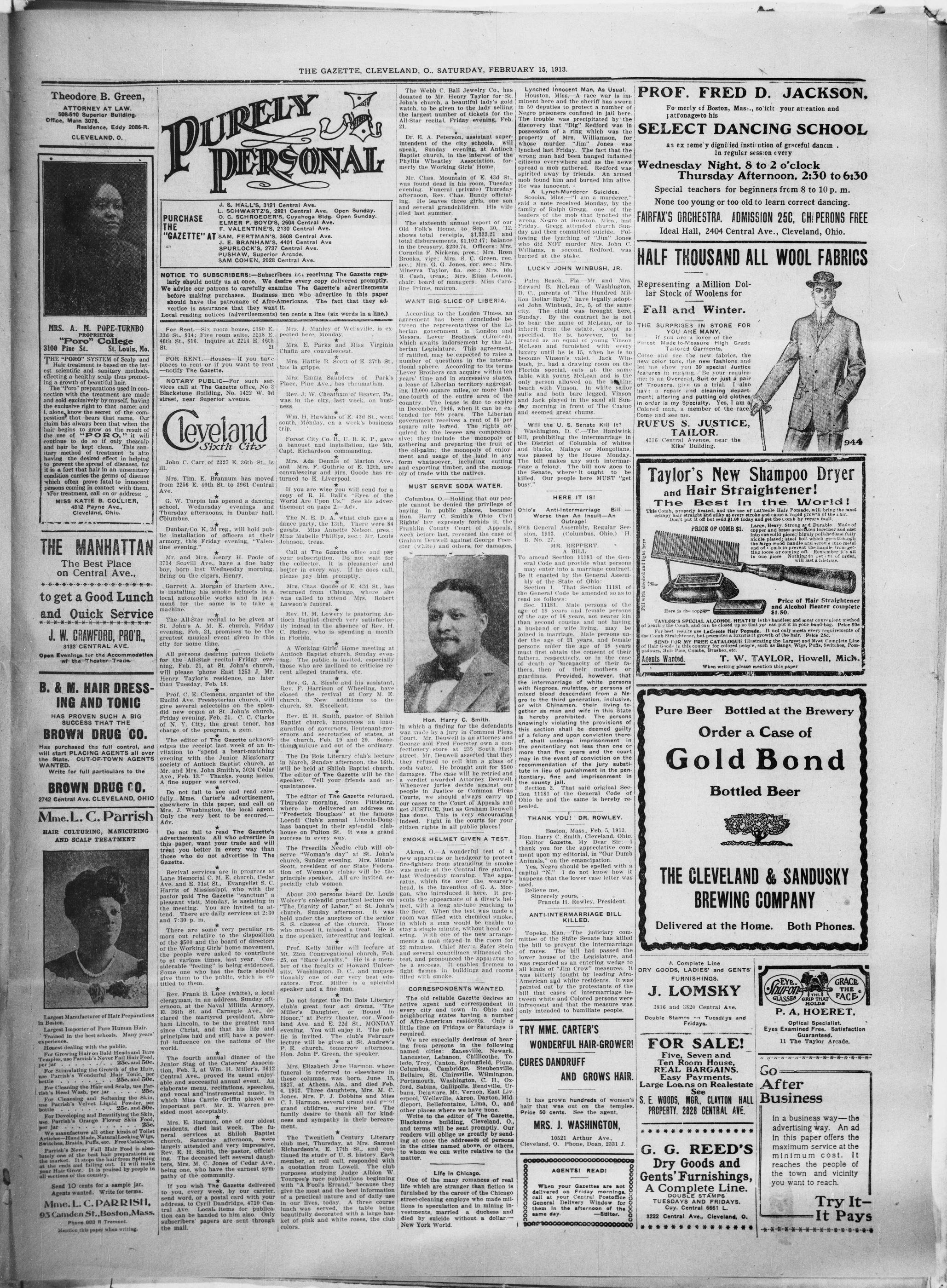
Theodore B. Green,
ATTORNEY AT LAW.
508510 Superior Building.
‘Office, Main 3076.
Residence, Eddy 2086-R.
CLEVELAND, oO,
ere)
Sdn.)
i
ie
|
|
MRS. A. M. POPE-TURNBO
PROPRIETOR
“Poro” College
$100 Pine St. St. Louis, Mo.
THE “PORO” SYSTEM of Scalp and
Hair treatment is based on the lat-
est scientific and sanitary methods,
effecting a healthy scalp thus promot-
‘ing a growth of beautiful hair,
__ The “Poro” preparations used in con-
‘nection with the treatment are made
and sold exclusively by myself, having
the exclusive right to that name; and
L cope pres the seeret of the com-
Position’ that bears that name, Our
claim has always been that when the
hair begins to grow as the result of
the use of “P ORO,” it will
continue to do so if only thescalp
and heir be kept clean. This san-
itary method of treatment 's also
having the desired effect in helping
to prevent the aot of diseases, for
it is a fact that hair in an unsanitary
condition carries the germs of disease
which often prove fatal to pee
emons coming in contact with them,
‘YFor treatment, call on or address: |
MISS KATIE B. COLLIER,
4812 Payne Ave.,
Cleveland, Ohio.
The Best Place
on Central Ave.,
Set ce
to get a Good Lunch
and Quick Service
Poutanen atari ao
J. W. CRAWFORD, PRO'R.,
3138 CENTRAL AVE.
baie Hisar sot $34 acenremndotion
We net henter Tend
aerial
B. & M. HAIR DRESS-
ING AND TONIC
HAS PROVEN SUCH A BIG
SUCCESS THAT THE
BROWN DRUG CO.
Has purchased the full control, and
will start PLACING AGENTS all over
the State. OUT-OF-TOWN AGENTS
WANTED.
Welte for full particulars to the
BROWN DRUG £0.
2742 Central Ave. CLEVELAND, OHIO
Mbe.L. C. Parris!
HAIR CULTURING, MANICURING
AND SCALP TREATMENT
Pte
" a
|
Gh rf
a = &
re ey
ee pee?” ’
ete QE at
Range Manwlacturer of sain’ Se
tn Boston. A
[Largest Importer of Pure Haman Halr,
+ rained in the best schools. Many years’
experience.
“Hravest dealing with the public.
Por Growing lairon Ya Meavinant Dae
ample me Rahs ever gg a
Fee eee, Bibow and BOC.
For Stimalathig th Growth, of the Matr,
un Partah's Wonderful Hait Tonic, pet
Bi es PS. ani Bbe.
or Cleaning the Hair and Sealp, use Pa
fein lent Webs per iar. = 250
© For, Cleansing and Softening the Skin,
“uso Pacrish’s Velvet Liquid Powvdler, per
Rese 'Bbc. and Sho.
For Developing aud Beantifying the Skin,
we peta Okinge Flower Skin’ Food,
eter cs ete. BBe.
‘We manufacture all other kinds of Toilet
_aseitions Hn Sig, Natral Lonkng Wis
| Bwitches, Braids, Puffs, eto. Free Catalogue.
d. Pacviahis Hover, Fall Hale Food is abso-
“tutely one, fr preparntions om
the market, It stops the ii nn Spe
See da an apg ont, HE wil mak
teesiecws
Send 10 cents for a sample jar.
| Agenta wanted. Write for terms.
| Mme.L.C.PARRISH,
5 Camden St.,Boston,Mass.
Phone 888 8 Tremont.
(| anthem ule paper when writing.
Tat
| r
; i)
i —
a’ (ca EE
He NK
| v | R ION
| 4. & HALL’S, 3121 Central Ave.
is L, SCHWARTZ'S, 2921 Central Ave. Open Sunday.
©. C, SCHROEDER'S, Cuyahoga Bldg. Open Sunday.
Jpuncanse © GG erorcrets aver
i F, VALENTINE’S, 2120 Central Ave.
GAZETTE” AT sam, FERTMAN’S, 3608 Central Ave.
J. E. BRANHAM'S, 4401 Central Ave
oi SPURLOCK'S, 2737 Central Ave.
PUSHAW, Superior Arcade
SAM COHEN, 2928 Central Ave.
NOTICE TO SUBSCRIBERS:—Subscribers ic. receiving The Gazette regu-
larly should notify us at once. We desire every copy delivered promptly.
‘We advise our patrons to carefully examine The Gazette's advertisements
before making purchases. Business men who advertise in this paper
should have the patronage of Afro-Americans, The fact that they ad-
vertise 1s assurance that they want it.
Local reading notices (advertisements) ten cents a line (six words in a line.)
For Rent.—Six room house, 2380 E,
330°St, $14) Five room suite, 2218 E
46th St, $16. Inquire at 2214 B, 46th
St. at
“POR RENT.—Houses—If you have
places to rent or if you want to reat
—notify The Gazette.
NOTARY PUBLIC—For such ser-
vices call at The Gazette office, No
Blackstone Building, No. 1422 W. 30
street, near Superior venue.
(level: HG
ae aoe eee eee
John C. Carr of 2827 B, 26th St, Is
an.
: *
Mrs. Tim. E. Brannum has moved
from 2256 E, 40th St. to 2961 Central
Ave.
G. W. Turpin hal opened » dancing
school, Wednesday” evenings and
‘Thursday afternoons, in Dunbax hall,
Columbus,
*
Dunbar/Co. K, 2d reg., will hold pub-
lic installation of officers at their
armory, this Friday evening, “Valen
tine evening”
*
Mr. and Mrs, Henry H. Poole of
3734 Scovill Ave, have a fine baby
doy, born. lest Wednesday morning,
Bring on the cigars, Henry.
Garrett A. Morgin of Harlem Ave.
ig Installing is smoke helmets ina
Toeal automobile works aad In, pay
ment for the same is to take
machine.
*
The All-Star recital to be given at
St. John’s A. M. E. chureh, Friday
evening, Feb, 21, promises to be the
greatest musical’ event given in this
city for some time.
All persons desiting patron tickets
for the AllStar recital Friday eve-
ning, Feb. 21, at St. John’s church,
will please ‘phone East 1253 J, Mr.
Henry Taylor's residence, no later
than Tuesday, Feb. 18.
Prot. C. B. Cleméns, organist of the
Buclid Ave. Presbyterian chureh, wil
give several selectoins on the splen:
id new organ at St. John's church,
Friday evening, Feb. 21. C. C. Clarke
of N. Y. City, the great tenor, has
charge of the program, a gem.
‘The editor of The Gazette acknow!
edges the receipt last week of an in
vitation to “spend a heart-matching
evening with the Junior Missionary
society of Antioch Baptist church, al
‘Mr. and Mrs. John Smith's, 3024 Cédar
‘Ave, Feb. 13.” Thanks, young ladies
A’ fine supper was served,
*
Do not fail to See and read care
fully. Mme. Carter's advertisement,
elsewhere in this paper, and call. on
Mrs. J. Washington, the local agent
Only the very best’ to be secured.—
Adv.
*
Do not fail to Fead The Gazette’
advertisements. All who advertise in
this paper, want your trade and will
treat you better in every way than
those who do not advertise in The
Gazette.
Revival services are in progress at
‘Lane Memorial C. M. E. church, Cedar
‘Ave. and B. 31st St, Evangelist 8. C
Harris of Mississippi, who with the
pastor paid The Gazette “sanctum” a
pleasant visit, Monday, is assisting in
the meeting. You aré invited to at
tend. There are daily services at 2:30
and 7:30 p.m.
‘There are some very peculiar ru
mors out relative to the disposition
‘of the $500 and the board of directors
of the Working Girls’ home movement,
‘the people were asked to contribute
to et various times, last year. Con
siderable “feeling” is being evidenced
Some one who has the facts should
give them to the public, which is en
{titled to them.
*
Rev. Frank B, Litce (white), # loca
clergyman, in an address, Sunday aft
ernoon, at the Naval Militia Armory
‘B geth St. and Carnegie Ave, de
clare the martyred president, Abra
ham Lincoln, to be the greatest man
‘since Christ, and that his life and
principles had and still have a power
Ril influence on the nations of the
world.
‘Phe fourth annal dinner of the
Junior Stag of the Caterers’ Associa
tion, Feb. 3, at Wm. H. Miller's, 3612
Central Ave., proved its usual enjoy
‘able and successful annual event. An
elaborate menu. recitations, speeches,
and vocal and“instrumental music, in
which Miss Carrie Griffin played an
important part. Mr. R. Warren pre
sided most Ses
Mrs. E. Harmon, one of our oldest
residents, died last week. The fu
‘neral services at Shiloh Baptist
church, Saturday afternoon, were
largely’ attended and very impressive
Rev, E. H. Smith, the pastor, officiat
ing. The deceased left several daugh
ters, Mrs. M. C. Jones of Cedar Ave.
being one. who have the earnest sym
pathy of the community.
*
If you wish The Gazette delivered
to you, every week, by our carrier,
send word, or a postal card with your
address, to Cyril Dandridge, 4710 Cen
tral Ave. Locale items for publica
tion can be handed to him also. Only
subscribers’ papers are sent through
THE GAZETTE, CLEVELAND, O., SATURDAY, FEBRUARY 15, 1913.
ten cents a line (six words in a line.)
semen nasa
Mrs. J. Manley of Wellsville, is ex
pected here, Sionday .
| : * shea
Mrs, B, Parks tnd Mies Virginia
Chain are convalescent,
*
Mrs. Hattie 8, Scott of B. azth St.
ches Ia gripe,
‘ *
Mrs, Emma Saiinders of Park's
Place, Pine Ave,, has rheumatism
*
Rev, Js W. Cheatham of Beaver, Pa.,
was in ihe city, last woek, on busi
ness
Win, 1, Hawkin of B, 42a St, went
south, Ménday, en a week's business
trip,
*
Forest City Co. H, UR. K.P. gave
a banquet and installation, the 5th,
Capt. Richardson commanding,
*
Mrs. Ada Denni® of Marion. Ave.
and Mrs. F. Guthrie of E. 12th, are
convalescing and Mrs. Goode has re
turned to E. Liverpool.
*
If you are wise You will send for a
copy of R. H. Ball's “Byes of the
World Are Upon Us." See his adver
tisement on page 2.—Adv
*
The N. B.D. Al whist club gave a
dance party, the ith, ‘There were 84
guests, Miss Annette Nelson, pres.:
Miss Mabelle Phillips, sec.; Mr, Louis
Johnson, teas.
*
Call at The Gazette offices and pay
your subscription. Do not walt for
the collector. It is pleasanter and
better in every way. If he does call,
please pay him promptly.
*
Mrs. Chas. Good® of B. 424 St. has
returned from Chicago, where’ she
was called to attend ‘Mrs, Robert
Lawson's funeral,
*
Rev. H, M, Lowery {e pastoring An
tioch Baptist church very satisfactor-
ily indeed in the absence of Rev. H.
©. Bailey, who is spending a month
in Florida.
*
A Working Girls! Home meeting at
“Antioch Baptist chureh, Sunday even
‘ing. The public is invited, especially
‘those who are Inclined to criticise re
cent alleged transfers, etc,
Rev, G. A. Sieel@ and his acsistant,
Rev. F. Harrison of Wheeling, have
closed the. revival at Cory M. E.
‘church. New additions to the
chureh, 89. Excellent,
Rev. E. H, Smith, pastor of Shiloh
‘Baptist churel, announces an inaw-
guration of governors, lientenant-2ov
ernors and secrctarles of states, at
the church, Feb. 19 and. 20. Some
thingyunique and out of the ordinary
*
‘The Du Bois Literary club's lecture
in March, Sunday afternoon. the 16th,
will be held at Shiloh Baptist. church
‘The editor of The Gazette will be the
‘speaker. Tell your friends and ac
-quaintances.
*
The editor of The Gazette returned,
‘Thursday morning, {rom Pittsburg,
where he delivered an address on
“Brederick Douglass” at the famous
'Loendi Club's annual Lincoln-Dous-
lass banquet in their splendid —club-
‘house on Fulton St. It was a grand
success in every way.
*
‘The Prescilla Needle club will ob-
‘serve “Woman's day” at St. John’s
church, Sunday evening. Mrs. Minnie
Scott, president of our State Federa.
tion of Women's clubse will be the
principle speaker, All are Invited, es-
pecially club women,
*
About 200 persons heard Dr. Louts
Wolsev's splendid practical lecture on
‘The, Dignity of Labor,” at St. John’s
church, Sunday afternoon. It was
held under the auspices of the senior
S. 8. classes of the church. Those
‘Who missed it, missed a treat. He is
& fine speaker, interesting and logical
. * ;
prof, Kelly Miller will Teefure at
Mt, Zion Congregational church, Feb.
25, on “Race Loyalty.” He is @’ men:
ber of the faculty of Howard Univer:
sity, Washington, D. Cand ungues
tlonably one of our very best edu
cators. Prof. Miller is a splendid
speaker and a fine man.
*
Do not forget the Du Bois Literary
‘club's great four act drama, “The
Miller's” Daughter, or Bound in
Honor,” at Perry theater, cor.. Wood
land Ave, and B. 22d Si. MONDAY
‘evening, You will enjoy it. The pub-
lic is invited. The club’s February
lecture will be given at St. Andrew's
PE. church, tomorrow afternoon
“Hon. John P. Green, the speaker.
*
Mrs, Elizabeth Jame Harmon. whore
‘funeral is referred to elsewhere in
these columns, was born, June 15,
1827. at Athens. Ala., and died Feb.
“4. 1813. Three daughters, Mrs. M. C.
Jones. Mrs. P. J. Dobbins and Miss
©. 1. Harmon, several grand and ¢--n"
‘grand children, survive her. The
family desire to thank all for kind:
ness and sympathy in their bereave
ment.
*
| ‘The Twentieth” Century Literary
club met, Thursday, at Mrs. Samuel
Richardson's, E. With St, and con
tinued its study of U. S. history. Each
member, at roll call, responded with
@ quotation from Lowell. The club
“purposes studying Judge Albion W
\Tourgee’g race publications. beginning
“with “A Fool's Errand,” because they
_give the most and the best information
of @ practical nature and of dally use
in our lives, today. A three course
lunch was served, the table being
deautifully decorated with a large bas
‘ket of pink and white roses, the clut
| colors.
The Webb C. Ball Jewelry Co., has
donated to Mr. Henry Taslor for” St
John’s church, a beautiful lady's gold
watch, to be given to the lady selling
the largest number of tickets for the
AllStar recital, Friday evening, Feb.
a1,
Dr. F. A, Peterson, assistant super.
intendent of the city schools, will
speak, Sunday evening, at Antioch
Baptist church, in the interest of the
Phyllis Wheatley Association, —for-
merly the Working Girls’ Home.
Mr. Chas. Mountain of E. 43d St.
was found dead in his room, Tuesday
evening. Funeral (private) "Thursday
afternoon, Rev. Chas. Bundy officiat-
ing. He leaves three girls, one son
and several grandehildren. | His wife
died last summer,
‘The sixteenth amnual report of our
Old Folk’s Home, to Sep. 30, ‘12,
shows total receipts, $1343.21. and
total disbursements, $1,102.47; balance
in the treasury, $280.74. Officers: Mrs.
Cornelia F. Nickens, pres.; Mrs. Rosa
Brooks, vige; Mrs. 8. C. Green, rec.
sec.; Mrs. G. G. Jones, cor. sec.; Mrs.
Minerva Taylor, fin, ‘see; Mrs. Ida
B, Cash, (reas; Mrs. Eliza Lemon,
chair. board of manzgers; Miss Caro:
line Prime, matron.
WANT BIG SLICE OF LIBERIA.
According to the London Times, an
agreement has been coneluded be-
tween the representatives of the Li-
berian government in London and
Messrs. Lever Brothers (Limited),
which awaits indorsement by the Lt
berian Legislature. This agreement,
if ratified, may be expected to raise a
humber of questions in the interna-
tional sphere. According to its terms
“Lever Brothers ean acquire within ten
years’ time and in successive stages,
‘a lease of Liberian territory aggrezat-
“ing 12,000 square miles, or more than
‘one-fourth of the entire area of the
country, ‘The lease is duc to expire
in December, 1946, when it ean be ex-
tended for $99 years. ‘The Liberian
government receives a rent of $5 per
square mile leased, ‘The rights ac-
‘quired by the lessee are comprehen-
‘sive: they include the monopoly of
‘gathering and preparing the fruit of
‘the oil-palm; the monopoly of enjoy:
ment and usage of the land in any
form whatsoever, including cutting
‘and exporting timber, and the monop-
oly of trade with the natives.
MUST SERVE SODA WATER.
Columbus, O.—Holding that our peo-
ple cannot be denied the privilege of
buying In public places, because
Hon. Harry C, Smith's Ohio Civil
Rights’ law expressly forbids it, the
Franklin County Court of Appeals,
week before last, reversed the case of
Graham, Deuwell against George Foer:
ster (white) and others, for damages,
Poe Sis
| es bd
—
she’s: a
aa
ey.
is See ra
et Se
Hon. Harry ©. Smith.
in which a fmding for the defendants
Boece ae baneel ig we nieartoy ane
Gooceetil Ores Teepe we
fontcey nore at atl eauty deh
treet Air, Deuwell absefted that they
they Fefused to gell Risa a. Blass of
oda waters He brought sult for 4600
damagen, ‘The case will be retried and
serait eearced Auoriey Dowell
itnerer iris decide ayatust ons
people in, Justice ‘or Common Pleas
bana te fog ees ey to
our cases to the Court of Appeals and
eet JUSTICE, Just a5 Oraham Deuvell
Sie lone. Thin ia very encourasing
indeed, Fight in the courts for your
Seen eee eisne toes!
SMOKE HELMET GIVEN A TEST.
Akron, 0.—A wonderful test of a
new apparatus or headgear to protect
fire-fighters from strangling in smoke
was made at the Central fire tation,
last. Wednesday morning. ‘The appa-
ratue, which fits over the wearer's
head, is the invention of G. A, Mor-
‘gan, who introduced it here, It pre-
‘sents the appearance of a diver's hel-
met, with a long alr-tube reaching to
‘the floor. When the test was made a
room was filled with chemical smoke,
in which a man would be unable to
stay a single minute, without head cov-
ering, With one of the new arrange:
ments a man stayed in the room for
22 minutes, Chief Meri, Safer Stein
and severai councilmen witnessed the
test, and pronounced the apparatus to
be a euccess. It enables firemen to
fight flames in buildings and rooms
filled with smoke.
CORRESPONDENTS WANTED.
The old reliable Gazette decires an
active agent and correspondent in
every city and town in Ohio and
Reighboring states having a number
of Afro-American residents. Only a
little time on Fridays or Saturdays is
required.
We are especially desirous of hear.
ing from persons in the following
named cities: Zanesville, Newark,
Laneaster, Lebanon, Chillicothe, To
ledo, Troy, Canton, Springfield, Piqua,
Columbus, Cambridge, Steubenville,
Bellaire, St. Clairsville, Wilmingvon,
Portsmouth, Washington, C. H., Ox:
ford, Sabina, Gallipolis. Rendville, Ur-
dana, Delaware, Mt. Vernon, East Liv-
erpool, Wellsville, Akron, Dayton, Mid-
deport, Bellefontaine, Lima, 0., and
other places where we have Hone.
Write to the editor of The Gazette,
Blackstone building, Cleveland, 0.,
and terms will be seat promptly. Our
readers will oblige us steatly by send-
ing at once the addresses of persons
in the cities named above, or others,
to whom we can write relative to the
‘matter.
Life In Chicago.
One of the many romances of real
ite which are stranger than fiction is
‘furnished by the career of the Chicago
“street-cleaning employe who made mil-
Hons in speculation and in mining in-
vestments, married a duchess and
@ied by suicide without a dollar—
New York World.
Lynched Innocent Man, As Usual.
| Houston, Miss.—A race war is in-
‘minent here and the sheriff has sworn
in 50 deputies to protect a number of
Negro prisoners confined in jail here.
The trouble was precipitated by the
Giscovery that “Dig” Redford was in
Possession of a ring which was the
property of Mrs. Williamson, for
whose murder “Jim” Jones” was
lynched last Friday. ‘The fact that the
‘wrong man had Deen hanged inflamed
citizens everywhere and as the news
spread a mob gathered. Redford was
spirited away by friends. An armed
mob found him and burned him alive,
He was Innocent. «
A Lynch-Murderer Suicides.
Scooba, Miss—"I am a murderer,”
eaid a note received Monday, by the
family of Ralph Gregg, one of the
Teaders of the mob that Iynched the
wrong Negro at Houston, Miss, last
Friday. Gregg attended church’ Sun
day and then committed suicide. Fol:
lowing the lynching of “Jim” Jones
who did NOT murder Mrs, John C.
Williams, a second, Redford, was
burned at the stake,
LUCKY JOHN WINBUSH, JR.
Palm Beach. Fla—Mr. and Mrs.
‘Riward B. MeLean_ of Washington,
D.C, parents of “The Hundred Mtl
jion Dollar Baby," have legally adopt
ed John Winbush, Jr., 5, of the same
city. The child was brought here,
Sunday. By the contract he is not
to bear the name of MeLean, or to
inherit from the estate, except as
specified. He is, however, to be
treated as an equal of yout Vinson
Mclean and. furnished with every
luxury until he is 15, when he is. to
become Vinson's valet. Jack Win-
bush, jr. had a drawing room on. the
Florida ‘special, eats at. the same
table with young MeLean and is the
only person allowed on the b&@ine
beach with Vinson, In white sailor
suits and both bare legged, Vinsow
jand Jack played in the sand all Suu:
‘dey morning in front of ‘The Casino
and seemed great chums,
Will the U. S. Senate Kill It?
Washington, D. C.—The Hardwick
bill, prohibiting the intermarriage in
the’ District of Columbia of whites
and blacks, Malays or Mongolians,
Was passed by the House Monday.
The bill makes any such intermar-
riage a felony. ‘The bill now goes to
the Senate, where It ought to be
killed. Our people here MUST “get
busy.”
HERE IT 1S!
‘Worse than Ae: ineuit—An:
Outrage!
Sith General Assembly, Regular Ses:
fon, 1913, (Columbus, Ohio.) 1
B, No. 2
MR. REPPERT. >
A DILL,
To amend Section 11181 of the Gen:
‘eral Code and provide what persons
may enter into a martiage contract
Be it enacted by the General Assem:
bly of the State of Ohio
Section 1. That Section 11181 of
the General Code be amended so as to
rend 8. follows
Sec 11181. Male persons of the
age of 18 years aad female persons
Of the age of 18 years, not nearer kin
than second. cousins and not having
a husband of wife living, way. be
Joined in marriage. Male persons uo-
der the age of 21 years, and female
persons tnder the age of 18 years
Must first obtain the content of their
fathers, respectively, or in. the case
of death of Sncapacity of their fa
thers, then of their mothers or
guardians, Provided, however, that
the intermarriage of white persons
With Negroes, mulattos, or persons of
mixed blood “descendant. from a. Ne
Gro to the third generation, inclusive,
Sr with Chinamen,. thelr’ living. to:
gether as man and wife in this State
ie hereby prohibited. ‘The persons
Knowingly violating the provisions. of
thie section shall be deemed guilty
| ef a felony and upon conviction there
|Gf, shall undergo. imprisenment in
the penitentiary not less than one cr
[more than five yeare and the cour
; may in the event of conviction on the
recommendation ef the jury substi:
|tute in lieu of punishment in the pen
jMontiary, fine and imprisonment. in
| the county. jail.
| "Section 2.” That said original Sec
tion 11181 of the General Code of
[Ohio ie andthe’ samne Is hereby re
Dae
THANK YOU! DR. ROWLEY.
Boston, Mass.. Feb. §, 1913
Hon. Harry C. Smith, Cleveland, Ohio
Editor Gazette, My Dear Sir:—I
thank you for the appreciative com:
ment upon my editorial, in “Oar Dumb
Animals,” on the emancipation
Yes, Negro should be spelled with a
capital “N.” 1 do not know how it
happens that the lower case letter was
used.
Believe me,
Sincerely yours,
Francis H. Rowley, President
ANTI-INTERMARRIAGE BILL
KILLED.
‘Topeka, Kan—The judiciary com:
mittee of the State Senate has killed
the bill to prevent the intermarriage
of races, The bill had passed the
lower house of the Legislature, and
was regarded as an entering wedge to
all kinds of “Jim Crow” measures.
was bitterly fought by leading Afro
‘American agd white residents. It was
pointed out by the protestants of the
Dill that cases of intermarriage be
tween white and Colored persons were
infrequent and that the measure was
caly tateded to bomiliate people:
TRY MME. CARTER’S
WONDERFUL HAIR-GROWER!
CURES DANDRUFF
AND GROWS HAIR.
MRS. J. WASHINGTON,
OOGVOIOCCCOCOOCC OCC 0080008
| AGENTS! READ!
ey Sm Sy
PROF. FRED D. JACKSON,
| Formerly of Boston, Mas:., so'iclt your attention and
yatfonagerto his
SELECT DANCING SCHOOL
aa ex reme’y dignilied insti'ution of graceful dancin .
In regular session every
Wednesday Night. 8 to 2 o’clock
Thursday Afternoon, 2:30 to 6:30
Special teachers for beginners frcm 8 to 10 p. m.
None too young or too old to learn correct dancing.
FAIRFAX'S CACHESTRA. ADMISSION 25C, CHiPERONS FREE
Ideal Hall, 2404 Central Ave., Cleveland, Ohio.
Representing a Million Dol-
lar Stock of Woolens for rid
a \S
Fall and Winter. 4) 4
THe SURPRISES IN STORE FOR f. vat phe be
YOU ARE MANY. fe ay
Finest’ Made to-Measure High Grade os ee
Tailored Garments, LS Lv se bb
Come and see the new. fabrics, the ‘cle 5 aa |
Tee ine show. ou 3p special Justies La) i ales
Tot me show you, $9 special Justice = sa Le
nie: ts an Overcoat, Suit or just a pair Aig” Bie i. MA)
of troveera, give un a tak” alo fy fi 8 PS
hays a. repair_end cleaning depart A Prk Ne BS
ment; altering and putting old elthes cag AMI diac
In order Ie my Specialty. “Yes, Tam af 9 A aa ia ca
Golcred many a member of the race BAD oD
some and seo tue. | fg ea
RUFUS S. JUSTICE, } Lei /
TAILOR. ae Peete
316 Central Avenne, near ee ¥
ere cere balding. a Eg 9a
Taylor's New Shampoo Dryer
and Hair Straightener!
The Best in the World!
‘hs ony ropecy beta. and te af bare Hale Pomade, il ring he noe
le Sam proven bret nt, aee of acral Bats Tendon ok ge ce
int put Rod od anda today and ys the Comb'byfearn mal
5 PRICE OF UOMB $1. La780: Beary scree tea topes and cast
peftiny $2LZone oli ploces bleulg peshre ava Cay
t Mi Michie plated Patee! bole wbich ro-etervogh
z it TAMA seen tolpeovent toc scale tem pe
2 Bees merece
2 TIL 8 Be Nose Sick!
a } se
5 cee Nae
i od i
2 Gocnmcama. : cae
ie venvitial eR) _ Price of Nair Straightener
E riots tbe opto Gea? snd Alcohol Heater complete
tAvepe's apvaasd: aucopet: unten Wide theatiet sol cee aeraierveian
toe cs Suithvenan bat pian ashen se trowth ofthe aie Price 280.
SEN Pan ite PRs EAT AL ae: Le mci Kareiel cos ces een cl
ot tat Cate pla Gout eaten co
Agents Wanted, T. W. TAYLOR, Howell, Mich.
Pee ‘When writing pleav> mention this paper
j ae Bose Benin a. Brewery
Order a Case of
Gold Bond |
Bottled Beer :
ys 0
THE CLEVELAND & SANDUSKY
BREWING COMPANY )
Delivered at the Home. Both Phones. |
A Complete Line |
DRY GOODS, LADIES’ and oe
FURNISHINGS.
J. LOMSKY
Fridays,
FOR SALE!
Five, Seven and
Ten Room House,
REAL BARGAINS.
Easy Payments.
Large eon on Realestate
S.£ WOODS, MGR, CLAYTON HALL
PROPERTY. 2828 CENTRAL AVE,
teeeweeeeenenen
G. G. REED’S
Dry Goods and
Gents’ Furnishings,
A Complete Line.
DOUBLE STAMPS.
TUESDAYS AND. FRIDAYS,
Cuy. Central 6661 L.
3222 Central Ave. Cleveland, 0,
s a
PAYP/“GRACE
ms He ‘THE
CCAS anita FACE:
a
P. A, HOERET.
Optical Specialists >
Eyes Examined Free. Satisfaction
Guaranteed.
11 The Taylor Arcade.
Go-
After
Business
in a business way—the
advertising way. An ad
In this paper offers the
maximum service at the
minimum cost. It
reaches the people of
the town and vicinity
you want to reach.
* Try It-
eet It Pays
ee ee ee a
C
THE WORLD IS MINE
VALENTINE DAY LONG IN FAVOR
Centuries Have Failed to Dim the Memory of the Good Old Saint.
DISPUTE AS TO HIS IDENTITY
At Least Two Bishops of Ancient Times Have Been Credited With the Honor of Being the Founder of the Day Consecrated to Cupid.
ST. VALENTINE of blessed memory, whose natal day falls upon the 14th of February, seems to be the saint of this particular season. His customs, which have survived the lapse of centuries, are associated in our minds with the sending of various amatory epistles, and the rather more agreeable glits and presents, which are occasionally sent in the shape of flowers and candies by the young men and maidens, one to another.
New York and New Yorkers still retain memories of the saint, who seems to have been like his associate, the good St. Nicholas, a patron saint of the Netherlands, and in this connection we, perhaps on account of our Dutch ancestry, celebrate his festival with a kettledrum, says the New York Times. Far back in the mists of antiquity lies the origin of the custom of sending letters, or valentines, on the saint's day, while the original St. Valentine would appear to be gifted with as many lives as the proverbial cat, or reincarnations under the same title, for we find two bishops of the name, a Virgin martyr, and a Tyrolean saint, all of whom have authentic records of their lives and deaths preserved in history, and none of whom would seem to be in any way connected with the valentines of today.
However, it is always possible to reconcile the two or three, and there is sufficient evidence to show that St. Valentine, a bishop of Rome, who died in 278 A. D., was born on the 14th of February, and he is so set down in the Roman and Anglican calendars. He was a martyr to his faith, and when cast into prison by his enemies he cured his keeper's daughter of blindness, for which miracle he was beaten with clubs and then beheaded, and his remains repose in the Church St. Praxades, at Rome, while a gate now known as the Porto Popolo was formerly called by the name of St. Valentine, or Porto Valentino.
Another Valentine, also a Bishop, claims a share in the day, and his claim to sainthship rests upon the cure of the son of Craton, the Rhetorician. His death was caused by choking on a fishbone, whether of his own choosing or administered by his enemies the legend does not state, but in Italy and Greece they pray to this saint to cure them from epilepsy.
The St. Valentine of Tyrol, who seems to have been born a little later, and who died in the fourth century has a church consecrated to his memory in South Tyrol, at Meran, where he is supposed to have preached Christianity to the heathen Lombards. In the legend he appears as a beautiful youth attired in the dress of a Roman soldier bearing a cross on his sword hilt, and coming over the mountains from Italy; entering Meran, in what is now known as Tyrol, he encounters the heathen priest of the temple, and after a long argument with him, he calls upon his gods to destroy the temple.
The heathen and the priest are all struck dumb by his threats, and when with one blow he pushes down the pillars of the temple, like Samson they rush forth in horror, expecting him to be destroyed under the falling walls. Instead of which St. Valentine kneels unhurt, with a seraphic look upon his face, while the wrath of their god is not shown by the fierce wind and tempest which they expect, and quantities of doves and birds alight upon the neighboring trees in peaceful flocks. St. Valentine immediately after this miracle marries the first heathen couple and performs the first marriage ceremony
in Tyrol according to Christian rites, which would seem to associate him with at least two of the modern customs as the saint of lovers, and with the emblem of his doves and birds.
FLOWERS THAT TELL OF LOVE
Nothing Better Than Nature's Blossoms to Convey the idea of a Tender Sentiment
There are lovers who do not admire the manufactured valentine to convey the state of their sentiments, and they ask the flowers to tell their love. These beautiful messengers prove to be a well-chosen proxy and have won more than one fair malden's heart.
They will gladly plead your cause in a most capable manner.
Send a colonial nosegay, with violins, small buds, sweet peas and lavender closely packed together in strips of contrasting color.
A frill of lace paper frames this delightful bouquet, suggesting the old-fashioned valentine.
For the man who still retains a small bit of sentiment, inherited from some gallant ancestor, there is the heart fashioned from her favorite flower.
Corsage bouquets of sweet peas, violets, orchids, attractively arranged with cords or ribbons, are always acceptable valentines.
Each flower has its symbolic meaning. For instance, violets mean love, faithfulness; moss rosebuds, confession of love; Marechal Niel rose, yours, heart and soul; a red carnation, ardent love; gardenia, perfected loveliness; helotrope, devotion; jonquil, can you return my love?
Any of these would carry its sweet, dainty message of love to the maldeen beloved.
"Sweets to the sweet." For the girl who displays a fondness for candy, the true lover will find many pretty novel ways to gratify her taste.
Heart-shaped boxes, covered with silk, plain or handsomely decorated, are to be had.
Dainty bags of Dresden silk, elaborate enough to be used afterward for the ones, make charming valentines.
Boxes of crystal or Bohemian glass, in many fanciful designs, are displayed at the confectioners' to tempt the purse of the modern Romeo.
At the stationers' there is a collection of exquisite water-colored cards depicting fairy-like scenes. These seem fresh from the brush of Watteau.
Any girl would be proud to own one of these lovely valentines.
The jewelers have fashioned wonderfully artistic articles to aform milady. The man who need not consider price will experience little difficulty in finding something to suit his fastidious taste.
THE VALENTINE BIRD
CUPID
Old English Valentine Custom.
In the west of England there was one ancient custom that was extraor dinarily singular. Early in the morning of St. Valentine's day young men necessarily of the character that "dee lights" in the strenuous life, started out together with a clap-net to catch an owl and two sparrows in some neighboring barn. If they were successful in catching the birds and brought them to the village inn without injury and before the women folk had risen, they were rewarded with three pots of purl (whatever that is) by the inkeeper. They also enjoyed the privilege of demanding similar consideration at the hands of every householder in the neighborhood.
THE GAZETTE. CLEVELAND. O SATURDAY, FEBRUARY 15, 1913.
CUPID'S ESPECIAL DAY IS THAT OF GOOD ST. VALENTINE.
CUPID'S ESPECIAL DAY IS THAT OF GOOD ST. VALENTINE.
CUSTOM, more potent than any other authority known to man, has decreed that on St. Valentine's day that of opposite sex shall exchange missives and epistles, either comic or sentimental, in which the folibles of the receiver or the love of the sender are set forth in prose, in verse and in emblematic picture. Now there is no custom without a reason, but the reason for this cannot be found in the life of the good saint who is made to indorse this custom with his name.
"He wrote no love song!
"No one rises to accuse him of casting sheep's eyes on any Roman maiden. He was a bishop or pope of Rome who stood steadfast to the faith during the Claudian persecutions, and for that faith was cast into jail, where he cured his keeper's daughter of blindness. Honi soilt quil y pense! It is the pleasure of Cupid, blind himself, to bring upon his votaries a similar blindness, not to cure it.
"Nor was there anything comic or sentimental in the fate of St. Valentine when the miracle was made known to the authorities. They first beat him with clubs and then beheaded him. What was left of him is preserved in the Church of St. Praxedes at Rome, where a gate, now known as the Porta del Popolo, was formerly named in his honor Porta Valentini, or Saint Valentine's gate," says William S. Walsh in his "Curiosities of Popular Customs."
Bailey's English Dictionary (1721) under the subject of Valentines, says: "About this time of the year—February—the birds choose their mates, and probably came the custom of the young men and maledens choosing valentines for special loving friends on that day."
Francis Douce (1807), discussing the same subject, says: "It was customary to put the names of young women into a box, from which they were drawn by the men as chance directed and the Christian clergy, finding it difficult or impossible, to extirpate, the pagan practice, give it at least a religious aspect by substituting the names of particular saints for those of the women."
"But see how strong is the old Adam in the hearts of the unregenerate," comments Mr. Walsh. "Wanton youth was not satisfied to imitate these holy fathers and ballot for a ghostly partner in heaven. It longed for tangible flesh and blood here on earth—flesh and blood of that
COPID UP TO DATE
delightful variety which has a spice of the devil in it and is known as woman.
"in the latter part of the sixteenth century" (according to Rev. Albain Butler) "the church, in the person of St. Francis de Sales, once more stepped in to sanctify the rites of St. Valentine's day. St. Francis severely forbade the custom of valentines or giving boys in writing the name of girls to be admired and attended on by them, and to abolish it he changed it into giving billets with the names of certain saints for them to honor and imitate in a particular manner." But in the end the boys and the girls triumphed over the saint. Nay, the girls triumphed also over the boys, wresting from them their exclusive privilege of choosing mates.
Othelia sings:
Good morrow, 'tis St. Valentine's day,
All in the morn bettime.
And I a maid at your window
To be your Valentine.
Last year an irate old maid who
had been the recipient of a comic
valentine which had stung her to
the quick repaired to the factory, where
it was made, with a rawhide and a
limb of the law. She demanded the
name of the person who had sent her
the objectionable missive. In vain
she was assured that the factory was
the last place in the world to learn
the name of the sender. When told
that the factory sold comics by the
hundred gross to jobbers by, in turn,
sold to wholesalers, and then supplied
the retailer dealer who vended to
individual customers, she swore roundly.
Many clever young people in society with artistic and literary ability write paint and otherwise decorate the valentines they send to favored ones. In some instances a part of the decoration consists of jewels, diamonds, pearls or other gems, and the intrinsic value of the buble is thus enhanced.
Valentine parties are still in popular favor, and those who have not the ability to write love-sonnets or design sentimental valentines frequently go to artist friends, and even to professional artists, and have private valentines made. At these parties each person exchanges valentines. French imported valentines run as high as $200 and $300, according to the richness of the lace and other trimmings, but these expensive missives are rarely kept in stock.
ED
CAP
and
BELLS
GAVE WAITER STRAIGHT TIP
Diner With Powerful Voice Willing to
Make It Roar If Anything Went
Wrong With Him.
"Everything all right, sir?" asked
the waiter.
The diner nodded, but still the
waiter hovered near.
"Steak cooked to suit you, sir?" he asked again, presently.
Again the diner nodded.
"Potatoes the way you like 'em, sir?"
"Yes."
"Yes."
Another period of silence.
"I hope the service is satisfactory, sir?"
"Are you asking for a tip?" demanded the diner.
"Well, sir, of course we get the tips sometimes, and I've got to go to the kitchen for another party, so—"
"So you'd like the tip now to be sure of it? Well, I'll give you one."
"Yes, sir."
"Here is the tip: I have a powerful voice that I am capable of using. If anything is wrong I'll let out a roar. If you do not hear from you me can know that I am dining in peace and comfort and not in the least regretting your absence, for it's no fun to have to pass verbal judgment on every mouthful I eat."
"But the tip?"
"That's the tip, and a mighty good one it is too."
One He Missed
A good illustration of the wit of Bishop Welldon, the popular dean of Manchester, is afforded by the following story: Once at a luncheon given by the lord mayor of Manchester the dean sat next to Sir Herbert Tree. "Well. Mr. Tree; what have you been doing lately?" he asked "I went for a long motor ride this morning and lost a bet," replied the famous actor. "Indeed," said the dean. "And may I ask what the bet was?" "I made a bet that we would pass through 400 different odors, and we only encountered 399." "Ah," replied Bishop Welldon, promptly, "you missed the odor of sanctity."—Strand
"Pretty nice land around here," said the stranger, as his dusty rig stopped in front of the gate.
"Certainly is." replied the eager farmer. "Finest in the state."
"I reckon it is too high priced for a poor man," said the stranger.
"Well," replied the farmer, "it is worth every cent of $1,200 an acre.
"That's the way I value it. Were you thinking of buying?"
"No," replied the stranger, as he jotted something down into a book.
"I'm the new county assessor."
Agreeable News.
"George," she asked, "is your watch correct?"
"Yes," replied George, "it is keeping better time since I put your picture inside the case."
"Oh, you flatterer! How could that be?"
"Well, you see, when I placed your picture inside the case I added another jewel!"—New Fun.
Thoughtful Jane.
"Twenty minutes for refreshments!" bawled the conductor as he passed down the aisle.
A little girl with raspberry jam on her chin plucked him by the sleeve.
"You needn't stop the train on our account," she said timidly. "We're going to eat our right here in the car." - Woman's Home Companion.
NOT LIKE HER.
"Does your little daughter take after your wife?"
"No. Why, she's nearly three years old and she can't say more than eight or ten words."
Couldn't Talk Without Hands
Couldn't Talk Without Hands.
The Beak—And why did you not explain this to the constable when he arrested you?
The Yid—Explain! Why, yer worship, I vos handeuffed; how could I explain anything?
Madge—chin him. Marjorie, too, know it, but he's just for anything. When he took me to the ball game he said, "Speak to me only with thine eyes." —Judge.
SMART LITTLE COATS
Children's Styles Receive Much Attention From Modistes.
Outdoor Clothes for Little Ones of All Ages Are as Attractive and Appealing as Frocks They Wear Indoors.
NEW YORK.—The fascinating coats and bewitching hats designed for the little ones awaken in almost every observer a desire to dress a child in them. For morning, when the wee one takes her ride in the perambulator, there is a simple little coat of white washable corduroy, with a cape outlined with scalloping. The bonnet to match is fashioned on the same severely plain lines. Even the carriage robe is of corduroy, finished with scalloping. This all-white outfit is so appealing that the fastidious mamma invariably prefers it to one of buff or gray.
For the Little Ones.
A coat of heavy white corded silk is appropriate for the afternoon, when the small girl accompanies her mother in the limousine. Some mothers insist on having this "dress-up" coat cut on the same simple lines as the morning one and quite as devoid of trimming. It is also best to keep some hand embroidery, which not only decorates the cape, but also the bottom of the coat. An effective rose design, interwoven with garlands and bowknots of ribbon, adds immensely to the beauty of a white bengaline coat. On another coat of the same material a narrow band of ermine outlines the cape and edges the fronts of the garment.
There is an enchanting little bonnet of silk, very much shirred, with tiny pink rosebuds peeping coquettishly out from between the soft folds of the silk at the sides, to go with it. To accompany a coat trimmed withermine there is a little bonnet of the faille silk, with revers of theermine. Ermine-coney could be substituted if the price were an object. Large, soft, squashy rosettes, in the center of which there are tiny blue forget-menots, trim the bat at the sides.
Coats for Play.
When the youngster is old enough to trust to the support of his chubby legs and toddle away from her nurse in search of such alluring pleasures as
A
mud pies, the wise mother bows to the inevitable and changes the easily soiled white coat for one of the darker color.
The box plaited coats compete with the reefers for first choice, with the Russian blouse following closely. For the simplest of these dark coats the rough cloths are considered the smartest, just as they are for the mother or for the big sister. One of the most attractive of these garments is made of a mustard colored ratine. It is a double breasted garment, fastening with large horn buttons, and it has collar and cuffs of plush in the tan shade. Distinction is given to the coat by a suede leather belt, matching the collar and cuffs. A sharp contrast is lent by the hat of dark beaver, jauntly turned up on the left side but utterly devoid of trimming. A similar idea is carried out in brown ratine and in the dark navy blue, but in neither is it quite as smart as in the mustard tones.
In Corduroy and Plush.
The coats of corduroy and plush are also popular. One particularly good looking coat is fashioned from a rich tone of sapphire blue corduroy. The garment is made with two box plats on either side of the double breasted front panel, and is finished with a suede leather belt of the same color. The hat, in a matching tone of blue felt, suggests the poke bonnet. A band of ribbon, still in the same color, crosses it in the front and loses itself at either side in large rosettes, from which depend tiny blue grapes. A pretty coat of silver gray plush is given a novel trimming by the folded girdle of matching silk, which is held in place by overlapping straps of the material. The collar is of the same silk, finished with a shirred puffing, which likewise edges the silk cuffs. These puffings of silk offer a change from the
Flowers Indoors.
Bulbs have the great advantage of being clean to keep in the house, no soil being required. Fill the pots to within one inch of the top with pebbles, set the bulbs in in and cover the whole with water. Put away in a dark, cool place for two qr three weeks, but take care to keep the water at the same height all the time. Then bring them out and give them as much light and air as possible, changing the water every eight days by draining it off, and replacing it by
usual method of trimming chileno's coats and yet are so simple that the most critical of mothers cannot object to them.
Black for Children.
Despite the fact that many mothers feel that black is too old for their children, it is very becoming to many tots. A child with golden curls looks well in a coat of black plush built in the Russian blouse style. The side fastening is marked with a strip of ermine and the small collar and the cuffs are of the ermine. The hat worn with this costume is of black velvet, with a soft crown and plaited frills of silk to serve as a brim. A strip of the ermine encircles the crown and is caught at intervals with clusters of pink rosebuds nestling among the green leaves.
Fur Trimmings.
There is almost sure to be a touch of fur on the cloth coats. A jaunty little jacket on the reefer order is made of a very light buff broadcloth, with shawl revers and deep cuffs of beaver fur. The hat has a soft Tam o' Shanter crown of cloth, which falls partly over the brim of the beaver. A quill in the soft brown colorings lends a jaunty effect.
On a coat of tapestry blue broadcloth a box plaited effect is given to the skirt below the belt of tan leather. A strip of beaver fur is used to edge the collar and finish the sleeves. The hat in this instance is a beaver, in the tan color of the belt, trimmed with a large rosette of blue silk.
Wool Velours
The wool finished velours are eagerly sought by the young girls who wish a material a little out of the ordinary. A coat of homepause similar to the one in the drawing could be worn by Miss Five-Year-Year and her sister of twelve. The side pieces extending from the front to the broad back panel distinguish the coat from the usual types found in the shops. The new tendency of the hats to turn up in the back may be noted in the hat worn with this coat. The lines of this hat are so good that it would have been a pity to spoil them with trimmings; the ribbon flower adds sufficient decoration.
Our model shows a smart little coat of elephant gray velveteen; it is a loose, straight shape and has a large collar of striped foulard, edged with plain of the same color; the cuffs match this; buttons form trimming, the fastening being invisible.
Hat of velvet, trimmed with a large ribbon how.
Materials required: 3¾ yards velveten 24 inches wide, 7 buttons, ¾ yard forlard 40 inches wide, 2 yards sateen 40 inches wide for lining.
Broken Crochet.
Irish crochet has been popular so long that the backgrounds of much of it have had time to become worn and broken, although the decoration itself may still be as good as new. In such cases the ornament can be used to adorn a soft pillow, a bureau cover, table dollies or a centerpiece, says the Youth's Companion.
Cut away the ground for the decoration and baste the design securely in place on the piece to which you are to apply it. Sew carefully round the edge of the design until it is securely attached to the new background, then cut away that part of the background that is included within the outlines of the ornament.
Success, in the artistic sense, will depend upon how you use the old designs in their new application. Circular pieces should be utilized for centers, straight-line pieces for borders. Finish the straight-line pieces by hemstitching the lines, and the round pieces by hemming and sewing lace on the edges.
New Tea Table
The latest thing in tea tables is one that can be used as a table or a tray. It has folding automatic legs and is in the shape of a tray 27x17 inches and 24 inches high when the legs are opened.
Some of these combination table trays are of plain mahogany, with brass handles, others are inlaid; still others are of satinwood, plain or inlaid, with plated or sterling silver rims. The table can be utilized for cards by means of a board covered with green cloth that fits into the tray.
Louis XVI. Bedsteads
Straight from Paris comes the account of the latest thing in bed decorations. So perishable is it that it might be considered as a bed de luxe—to be admired, but not slept in.
This decoration, which is adapted to Louis Quinze furniture, has canopy and curtains of white chiffon trimmed with ribbon flowerets in pastel tones and edged with a fringe of crystal tubular beads. The bedspread is also of chiffon, embroidered in delicate ribbon flowers edged with deep flouces of lace, and used over a lining of pink or blue satin.
Hints on Picture Hanging.
Hang the pictures from the ceiling or picture rail by means of a thin cord as nearly as possible the color of the walls. When this is done you may, if you like, fill up the spaces left above the smaller pictures by placing therein a miniature, or an old blue plate, or a little plaster relief. This arrangement gives all the space, above or below, upon which to rest your eyes, and is infinitely preferable to the usual way of hanging pictures one over the other or all up and down the walls.
Oriental Shawl to Be Revived.
The Oriental cashmere shawls which were worn at every occasion in the '40s and '50s of the last century may be revived.
water at the same temperature. The question of keeping the water at a moderate temperature all the time is a most important one.
The Exceptions.
"So you don't believe in the wearing of corsets by women?"
"I certainly don't."
"But you can't deny that corsets help the appearance of some women?"
"No, nor can I deny that masks would help the appearance of some women."
LADY'S DRESS.
5997
Here is a nice dress that is quite easy to make, and is quite stylish and serviceable. The garment closes at the back and can be made with long or short sleeves. There is an applied yoke which is the chief feature, and the skirt is a six gored design. Any of the wanted fabrics may be used with the yoke of the same or of contrasting fabrics.
The pattern (5997) is cut in sizes 32 to 42 inches bust measure. Medium size requires 4¼ yards of 44 inch material.
To procure this pattern, send 10 cents to Pattern Department, of this paper. Write name and address plainly, and be sure to give size and number of pattern.
NO. 5997. SIZE
NAME
TOWN
STREET AND NO.
STATE
BOY'S RUSSIAN DRESS.
6000
This pretty little Russian dress is for the real small lad who has not yet worn the regulation bloomers. It is a cunning model and a very becoming one. The garment closes at the right side of the front. The collar, cuffs and belt are fashioned of contrasting material and linen, plain gingham, percale or chambray, may be considered among the most appropriate materials.
The pattern (6000) is cut in sizes 1,
2 and 3 years. Medium size requires
3 yards of 27 inch material or 2¼
yards of 36 inch fabric, with ½ yard
of 27 inch contrasting fabrics.
To procure this pattern send 10 cents
to "Pattern Department." of this paper.
Write name and address plainly, and
be sure to give size and number of pattern.
NO. 6000. SIZE.....
NAME.....
TOWN.....
STREET AND NO.....
STATE....
A curious discovery was made on D'Urville island, New Zealand, by the skipper of a small steamer and his engineer while they were chasing a crane to its nest the other day. In the course of the hunt they stumbled across a cave, the opening of which had once been masked byoulders that had since fallen away. With the aid of a lantern the pair investigated the cavern, which proved to be quite a big one—some 60 or 70 feet in length. In it they discovered the remains of a dozen or so large coffins, primitively made of planks of totara and bound together with flax instead of being nailed. The coffins, however, had dropped to pieces and the human relics within were found buried in slit.
One Bacter.
A dear old lady had been presented with a parrot from the Congo, and she was showing it to her old gardener.
"You know, Horace, that this parrot come' from the Congo, and Congo parrots are so intelligent that they are almost human. This bird whistles 'Home, Sweet Home', so beautifully, that the tears run down its beak."
"Yes, mum," quoth Horace, "I know them parrots from the Congo. I used ter 'aw one, and it whistled 'The Village Blacksmith' so bewtiful that the sparks used ter fly from its blooming tail."
"That will do, Horace, you may go."
Not to Be Taken Literally.
Canon Knox-Little told a good story at a church congress. He said that he remembered a lychgate in front of a beautiful church, which had been restored and made very nice. There was painted over the door, "This is the Gate of Heaven," and underneath was the large notice, "Go round, the other way."—Tit-Bits.