The Gazette
Saturday, April 19, 1913
Cleveland, Ohio
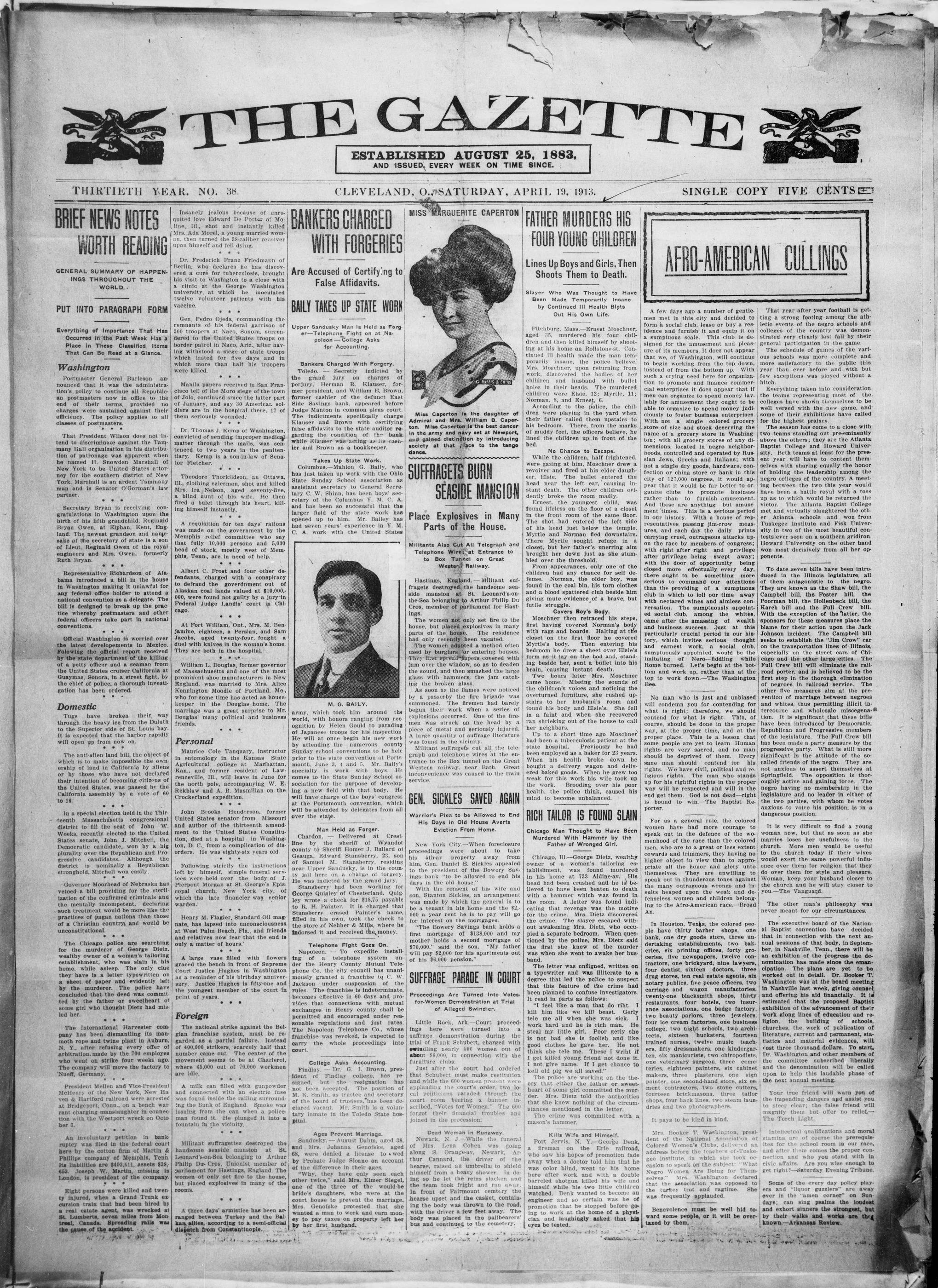
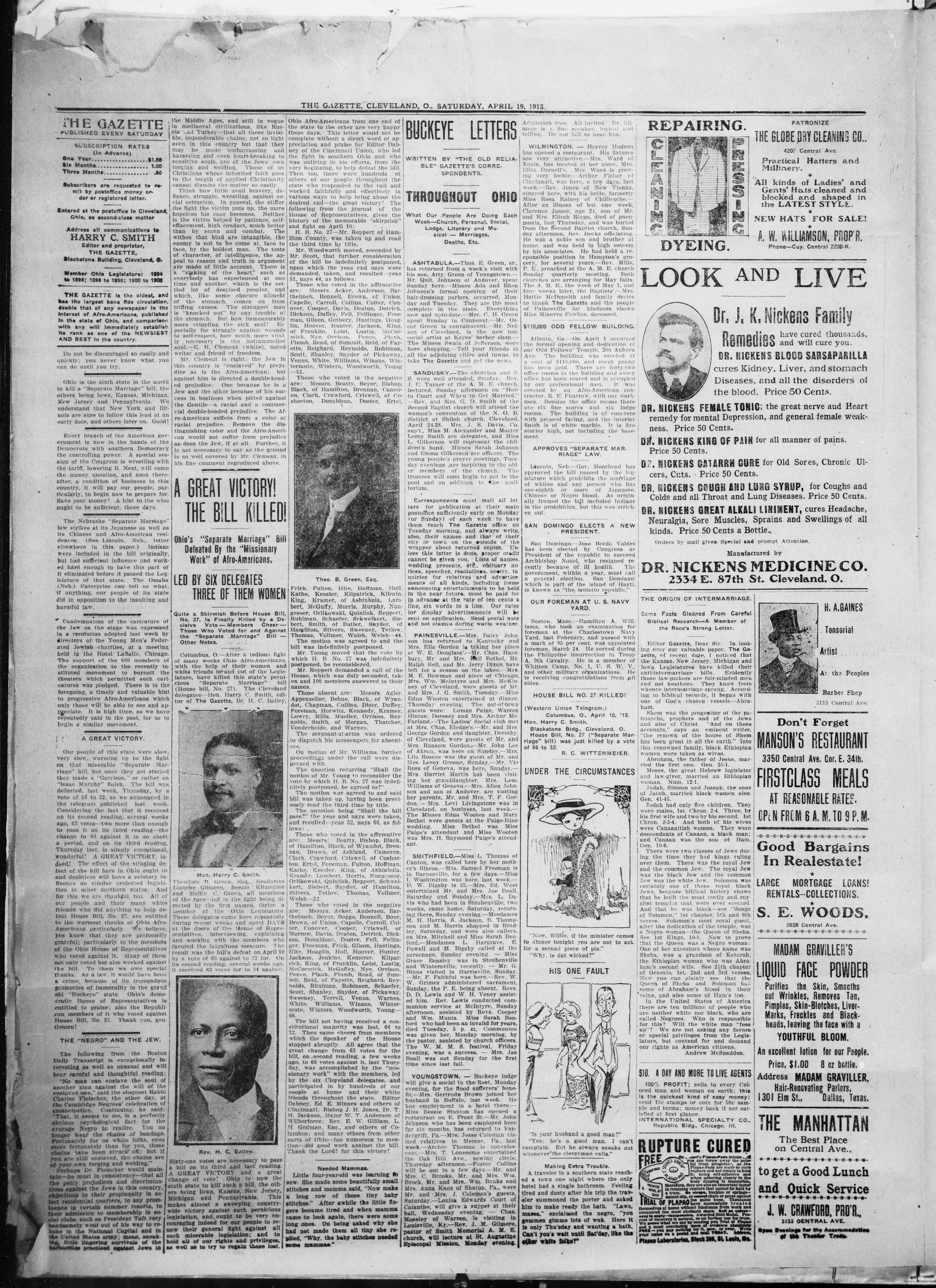
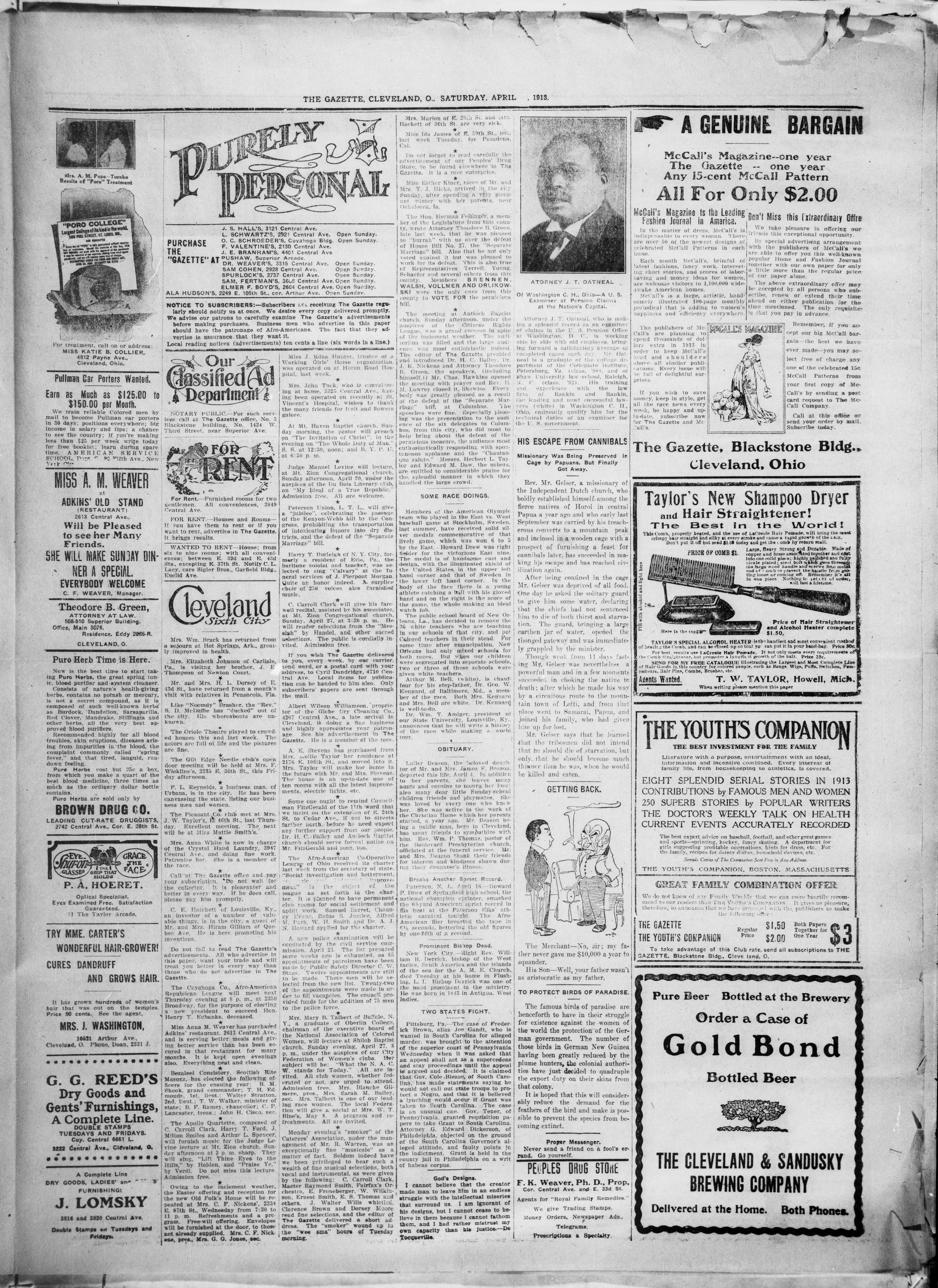
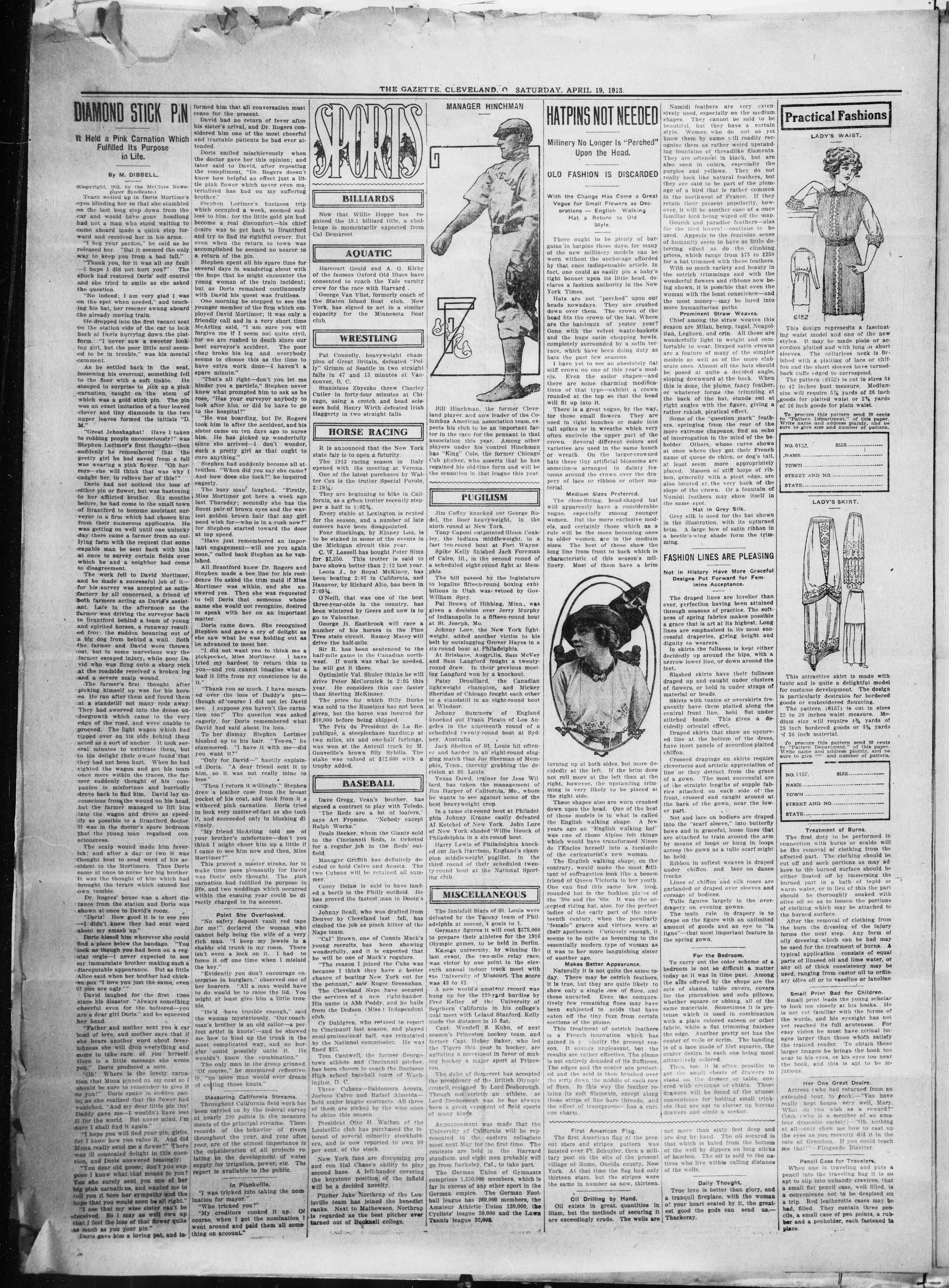
Page text (machine-generated)
AUTHORIZED
BRIEF NEWS NOTES WORTH READING
GENERAL SUMMARY OF HAPPEN- INGS THROUGHOUT THE WORLD.
Everything of Importance That Has
Occurred in the Past Week Has a
Place in These Classified Items
That Can Be Read at a Glance.
Washington
Postmaster General Burleson announced that it was the administration's policy to continue all Republican postmasters now in office to the end of their terms, provided no charges were sustained against their efficiency. The policy applies to all classes of postmasters.
That President Wilson does not intend to discriminate against the Tammany Hall organization in his distribution of patronage was apparent when he named H. Snowden Marshall of New York to be United States attorney for the southern district of New York. Marshall is an ardent Tammany man and is Senator O'Gorman's law partner.
Secretary Bryan is receiving congratulations in Washington upon the birth of his fifth grandchild, Reginald Bryan Owen, at Elphan, Kent, England. The newest grandson and nangesake of the secretary of state is a son of Lieut. Reginald Owen of the royal engineers and Mrs. Owen, formerly Ruth Bryan.
Representative Richardson of Alabama introduced a bill in the house in Washington making it unlawful for any federal office holder to attend a national convention as a delegate. The bill is designed to break up the practice whereby postmasters and other federal officers take part in national conventions.
Official Washington is worried over the latest developments in Mexico. Following the official report received by the state department of the killing of a petty officer and a seaman from the United States cruiser California at Guaymas, Sonora, in a street fight, by the chief of police, a thorough investigation has been ordered.
Domestic
Tugs have broken their way through the heavy ice from the Duluth to the Superior side of St. Louis bay. It is expected that the harbor rapidly will open up from now on.
The anti-alien land bill, the object of which is to make impossible the ownership of land in California by aliens or by those who have not declared their intention of becoming citizens of the United States, was passed by the California assembly by a vote of 60 to 16.
In a special election held in the Thirteenth Massachusetts congressional district to fill the seat of John W. Weeks, recently elected to the United States senate, John J. Mitchell, the Democratic candidate, won by a big plurality over the Republican and Progressive candidates. Although the district is nominally a Republican stronghold, Mitchell won easily.
Governor Moorhead of Nebraska has vetoed a bill providing for the sterilization of the confirmed criminals and the mentally incompetent, declaring such treatment would be more like the practices of pagan nations than those of a Christian country, and would be unconstitutional.
The Chicago police are searching for the murderer of George Dietz, wealthy owner of a woman's tailoring establishment, who was slain in his home, while asleep. The only chie they have is a letter typwritten on a sheet of paper and evidently left by the murderer. The police have concluded that the deed was committed by the father or sweetheart of some girl who thought Dietz had missed her.
The International Harvester company has been dismantling its man-moth rope and twine plant in Auburn, N. Y., after refusing every offer of arbitration, made by the 700 employees who went on strike four weeks ago. The company will move the factory to Nneff, Germany.
President Mellen and Vice-President McHenry of the New York, New Haven & Hartford railroad were arrested at Bridgeport, Conn., on a bench warant charging manslaughter in connection with the Westport wreck on October 3.
An involuntary petition in bank rupty was filed in the federal court here by the cotton firm of Martin & Phillips company of Memphis, Tenn. Its liabilities are $403,411, assets $38,653. Joseph W. Martin, missing in London, is president of the company.
Eight persons were killed and twenty injured, when a Grand Trunk excursion train that had been hired by a real estate agent, was wrecked at St. Lumberts, seven miles from Montreal, Canada. Spreading rails was the cause of the accident
THE GAZETTE
Insanely jealous because of unrequited love Edward De Porter of Moline, ill, shot and instantly killed Mrs. Ada Morel, a young married woman, then turned the 28-caliber revolver upon himself and fell dying.
Dr. Frederich Franz Friedmann of Berlin, who declares he has discovered a cure for tuberculosis, brought his visit to Washington to a close with a clinic at the George Washington university, at which he inoculated twelve volunteer patients with his vaccine.
Gen. Pedro Ojeda, commanding the remnants of his federal garrison of 300 troopers at Naco, Sonora, surrendered to the United States troops on border patrol in Naco, Ariz., after having withstood a siege of state troops which lasted for five days and in which more than half his troopers were killed.
Manila papers received in San Francisco tell of the Moro siege of the town of Jolo, continued since the latter part of January, and say 30 American, soldiers are in the hospital there, 17 of them seriously wounded.
Dr. Thomas J. Kemp of Washington, convicted of sending improper medical matter through the malls, was sentenced to two years in the penitentiary. Kemp is a son-in-law of Senator Fletcher.
Theodore Thorkildson, an Ottawa, ill, clothing salesman, shot and killed Mrs. Ira Nelson, aged seventy-five, a blind aunt of his wife. He then fired a bullet through his heart, killing himself instantly.
A requisition for ten days' rations was made on the government by the Memphis relief committee who say that fully 10,000 persons and 5,000 head of stock, mostly west of Memphis, Tenn., are in need of help.
Albert C. Frost and four other defendants, charged with a conspiracy to defraud the government out of Alaskaan coal lands valued at $10,000,000, were found not guilty by a jury in Federal Judge Landis' court in Chicago.
At Fort William, Ont., Mrs. M. Benjamine, eighteen a, Persian, and Sam Jacobs, aged twenty-four, fought a duel with knives in the woman's home. They are both in the hospital.
William L. Douglas, former governor of Massachusetts and one of the most prominent shoe manufacturers in New England, was married to Mrs. Alice Kennngton Moodie of Portland, Me, who for some time has acted as housekeeper in the Douglas home. The marriage was a great surprise to Mr. Douglas' many political and business friends.
Personal
Maurice Cole Tanquary, instructor in entomology in the Kansas State Agricultural college at Manhattan, Kan., and former resident of Lawrenceville, Ill. will leave in June for the north pole, accompanying W. E. Rekblaw and A. B. Masmillan on the Crockerland expedition.
John Brooks Henderson, former United States senator from Missouri and author of the thirteenth amendment to the United States Constitution, died at a hospital in Washington, D. C., from a complication of disorders. He was eighty-six years old.
Following strictly the instructions left by himself, simple funeral services were held over the body of J. Plerpont Morgan at St. George's Episcopal church, New York city, of which the late financier was senior warden.
---
Henry M. Flagler, Standard Oil magnate, has lapsed into unconsciousness at West Palm Beach, Fla., and friends and relatives now fear that the end is only a matter of hours.
A large vase filled with flowers graced the bench in front of Supreme Court Justice Hughes in Washington as a reminder of his birthday anniversary. Justice Hughes is fifty-one and the youngest member of the court in point of years.
Foreign
The national strike against the Belgian franchise system, must be regarded as a partial failure. Instead of 400,000 strikers, scarcely half that number came out. The center of the movement seems to be at Charlerol, where 65,000 out of 70,000 workmen are idle.
A milk can filled with gunpowder and connected with an electric fuse was found inside the rolling surrounding the Bank of England. Smoke was issuing from the can when a policeman found it. He plunged it into a fountain in the vicinity.
Militant suffragettes destroyed the handsome seaside mansion at St Leonard's-on-Sea belonging to Arthur Philip Du Cros, Unionist member of parliament for Hastings, England. The women of only set fire to the house, but placed explosives in many of the rooms.
A three days' armistice has been aranged between Turkey and the Balkan allies, according to a semi-official dispatch from Constantinople.
ESTABLISHED AUGUST 25, 1883 AND ISSUED, EVERY WEEK ON TIME SINCE.
BANKERS CHARGED WITH FORGERIES
Are Accused of Certifying to False Affidavits.
BAILY TAKES UP STATE WORK
Upper Sandusky Man Is Held as Forger—Telephone Flight on at Napoleon—College Asks for Accounting.
Bankers Charged With Forgery.
Toledo. — Secretly indicted by the grand jury on charges of perjury, Herman R. Klauser, former president, and William E. Brown, former cashier of the defunct East Side Savings bank, appeared before Judge Manton in common pleas court. The indictments specifically charge Klauser and Brown with certifying false affidavits to the state auditor regarding the condition of the bank while Klauser was acting as its cashier and Brown as a bookkeeper.
Takes Up State Work.
Columbus—Mahion G. Bally, who has just taken up work with the Ohio State Sunday School association as assistant secretary to General Secretary C. W. Shinn, has been boys' secretary of the Columbus Y. M. C. A. and has been so successful that the larger field of the state work has opened up to him. Mr. Bailey has had seven years' experience in Y. M. C. A. work with the United States
army, which took him around the world, with honors ranging from recognition by Helen Gould to parading of Japanese troops for his inspection. He will at once begin his new work by attending the numerous county Sunday school conventions to be held prior to the state convention at Portsmouth, June 3, 4 and 5. Mr. Bally's specialty is work with boys. He comes to the State Sunday School as association for the purpose of developing a new field with that body. He will have charge of the boys' congress at the Portsmouth convention, which will be attended by delegates from all over the state.
Man Hekl as Forger
Chardon. — Delivered at Crestline by the sheriff of Wyandot county to Sheriff Homer J. Ballard of Geauga, Edward Stansberry, 23, son of Samuel M. Stansberry, residing near Upper Sandusky, is in the county jail here on a charge of forcery. He was indicted by the grand jury. Stansberry had been working for George Quigley of Chesterland. Quigley wrote a check for $18.75 payable to R. H. Painter. It is charged that Stansberry erased Painter's name, filled in his own, took the check to the store of Nehher & Mills, where he indorsed it and received the money.
Telephone Fight Goes On.
Napoleon. — To expedite installing of a telephone system under the Henry County Mutual Telephone Co. the city council has unanimously granted a franchise to C. W. Jackson under suspension of the rules. The franchise is indeterminate, becomes effective in 60 days and provides that connections with mutual exchanges in Henry county shall be permitted and encouraged under reasonable regulations and just rates. The Napoleon Telephone Co. whose franchise was revoked, is expected to carry the whole proceedings into court.
College Asks Accounting
Findia, — Dr. G. I. Brown, president of Findiay college, has resigned, but the resignation has not been accepted. The position of M. K. Smith, as trustee and secretary of the board of trustees, has been declared vacant. Mr. Smith is a voluntary inmate in the Toledo State hospital.
Ages Prevent Marriage
Sandusky. — August Dahm, aged 38, and Mrs. Johanna Genofske, aged 68, were denied a license to weed by Probate Judge Sloane on account of the difference in their ages.
"Why, they have only seen each other twice," said Mrs. Elmer Siegel, one of the three of the would-be bride's daughters, who were at the court house to prevent the marriage. Mrs. Genofske protested that she wanted a man to work and earn money to pay taxes on property left her by her first husband.
Miss Caperton is the daughter of Admiral and Mrs. William B. Caperton. Miss Caperton is the best dancer in the army and navy set at Newport, and gained distinction by introducing society at that place to the tango dance.
SUFFRAGETS BURN
SEASIDE MANSION
Place Explosives in Many Parts of the House.
Militants Also Cut All Telegraph and Telephone Wires, at Entrance to to Box Tunnel on Great Wester Railway.
Hastings, England. — Militant suffrages destroyed the handsome sea side mansion at St. Leonard's on the Sea belonging to Arthur Philip Du Cros, member of parliament for Hastings.
The women not only set fire to the house, but placed explosives in many parts of the house. The residence had only recently been vacated.
The women adopted a method often used by burglars, or entering houses. They first spread papers covered with jam over the window, so as to deaden the sound, and then smashed the large glass with hammers, the jam catching the broken glass.
As soon as the flames were noticed by a passerboy the fire brigade was summoned. The firemen had barely begun their work when a series of explosions occurred. One of the firemen was struck on the head by a piece of metal and seriously injured. A large quantity of suffrage literature was found in the vicinity.
Militant suffrages cut all the telegraph and telephone wires at the entrance to the Box tunnel on the Great Western railway, near Bath. Great inconvenience was caused to the train service.
GEN. SICKLES SAVED AGAIN
Warrior's Plea to be Allowed to End His Days in Old House Averts Eviction From Home.
New York City.—When foreclosure proceedings were about to take his 5th-av property away from him, Gen. Daniel E. Sickles appealed to the president of the Bowery Savings bank "to be allowed to end his days in the old house."
With the consent of his wife and son, Stanton Sickles, an arrangement was made by which the general is to be a tenant in his home and the $2,000 a year rent he is to pay will go for interest on the mortgages.
"The Bowery Savings bank holds a first mortgage of $138,000 and my mother holds a second mortgage of $70,000," said the son. "My father will pay $2,000 for his apartments out of his $6,000 pension."
SUFFRAGE PARADE IN COURT
Proceedings Are Turned Into Votes for-Women Demonstration at Trial of Alleged Swindier.
Little Rock, Ark—Court proceedings here were turned into a suffrage demonstration during the trial of Frank Schubert, charged with wielding nearly 500 women out of about $6,000, in connection with the furniture clubs.
Just after the court had ordered that Schubert must make restitution and while the 600 women present were applauding the court's order, two local politicians paraded through the court room bearing a banner inscribed, "Votes for Women." The 600 forgot their financial troubles and joined in the procession.
Dead Woman in Runaway
Newark, N. J.-While the funeral of Mrs. Lena Cohen was going along S. Orange-eay, Newark, Arthur Cannard, the driver of the hearse, raised an umbrella to shield himself from a heavy shower. In doing so he let the reins slacken and the team took fright and ran away. In front of Fairmount cemetery the hearse upset and the casket, containing the body was thrown to the road, with the driver a few feet away. The body was placed in the palearbets' bus and continued to the cemetery.
FATHER MURDERS HIS FOUR YOUNG CHILDREN
Lines Up Boys and Girls, Then Shoots Them to Death.
Slayer Who Was Thought to Have Been Made Temporarily Insane by Continued III Health Blots Out His Own Life.
Fitchburg, Mass.—Ernest Moschner, aged 35, murdered his four children and then killed himself by shooting at his home on Rollstone-st. Continued ill health made the man temporarily insane, the police believe. Mrs. Moschner, upon returning from work, discovered the bodies of her children and husband with bullet holes in their heads. The murdered children were Elsei, 12; Myrtle, 11; Norman, 8, and Ernest, 6.
According to the police, the children were playing in the yard when their father called them upstairs to his bedside, from the marks of muddy feet, the officers believe, he lined the children up in front of the bed.
No Chance to Escape.
No Chance to Escape.
While the children, half frightened, were gazing at him, Moschner drew a revolver and fired at his elder daughter, Elsie. The bullet entered the head near the left ear, causing instant death. The other children evidently broke the room madly. Ernest, the youngest child, was frightened on the floor of a closet in the front of the same floor. The shot had entered the left side of his head just below the temple. Myrtle and Norman fled downstairs. There Myrtle sought refuge in a closet, but her father's unerring alm brought her down just as she stumbled over the threshold.
From appearances, only one of the children had any chance for self defense. Norman, the older boy, was found in the coal bin, his torn clothes and a blood spattered club beside him giving mute evidence of a brave, but futile struggle.
Covers Boy's Body.
Moschner then retraced his steps, first having covered Norman's body with rags and boards. Halting at the closet on the first floor he covered Myrtle's body. Then entering his bedroom he drew a sheet over Elsie's form as it lay on the bod and, standing beside her, sent a bullet into his brain, causing instant death.
Two hours later Mrs. Moschner came home. Missing the sounds of the children's voices and noticing the overturned furniture, she rushed upstairs to her husband's room and found his body and Elsie's. She fell in a faint and when she recovered ran shrieking out of the house to call her neighbors.
Up to a short time ago Moschner had been a tuberculosis patient at the state hospital. Previously he had been employed as a baker for 23 years. When his health broke down he bought a delivery wagon and delivered baked goods. When he grew too weak for this work his wife took up the work. Brooding over his poor health, the police think, caused his mind to become unbalanced.
RIGH TAILOR IS FOUND SLAIN
Chicago Man Thought to Have Been Murdered With Hammer by the Father of Wrong Girl.
Chicago, Ill.—George Dietz, wealthy owner of a woman's tailoring establishment, was found murdered in his home at 733 Aldine-av. His head had been crushed and he is believed to have been beaten to death with a hammer which was found in the room. A letter was found indicating that revenge was the motive for the crime. Mrs. Dietz discovered the crime. The slayer escaped without awakening Mrs. Dietz, who occupied a separate bedroom. When questioned by the police, Mrs. Dietz said the first she knew of the murder was when she went to awake her husband.
The letter was undigned, written on a typewriter and was illiterate to a degree that led the police to suspect that this feature of the crime had been planned to confuse investigators. It read in parts as follows:
"I feel like a man that do rhtt. I kill him like we kill beast. Gerly tele me all when she was sick. I work hard and he is rich man. He steal my little girl. Poor gerly she is not bad she is foolish and like good clothes he gave her. He not think she tele me. These I writhe if I get killed young friend not done it. I not give name. If I get chance to kill old pig we all saved."
The police are working on the theory that either the father or sweetheart of some girl committed the murder. Mrs. Dietz told the authorities that she knew nothing of the circumstances mentioned in the letter. The crime was committed with a mason's hammer.
Kills Wife and Himself
Port Jervis, N. Y.—George Denk, a fireman on the Erie railroad, who saw his hopes of promotion fade away when a doctor told him that he was color blind, went to his home here after work and with a double barreled egotgun killed his wife and himself while his two little children watched. Denk wanted to become an engineer and so certain was he of promotion that he stopped before going to work at the home of a physician and laughingly asked that his eyes be tested.
A few days ago a number of gentlemen met in this city and decided to form a social club, lease or buy a residence and furnish it and equip it on a sumptuous scale. This club is designed for the amusement and pleasure of its members. It does not appear that we, of Washington, will continue to begin working from the top down, instead of from the bottom up. With such a crying need for organization to promote and finance commercial enterprises it does appear that if men can organize to spend money lavishly for amusement they ought to be able to organize to spend money judiciously to foster business enterprises. With not a single colored grocery store of size and stock deserving the name of a grocery store in Washington; with all grocery stores of any dimensions, located in negro neighborhoods, controlled and operated by Russian Jews, Greeks and Italians; with not a single dry goods, confection or china store or bank in this city of 127,000 negroes, it would appear that it would be far better to organize clubs to promote business rather than to furnish amusement. And these are anything but amusement times. This is a serious period in our history. With a house of representatives passing jim-crow measures, and each day the daily prints carrying cruel, outrageous attacks on the race by members of congress; with right after right and privilege after privilege being swept away; with the door of opportunity being closed more effectually every day, there ought to be something more serious to command our attentions than the providing of a sumptuous club in which to loll our time away with nectared wines and alimless conversation. The sumptuously appointed social club, among the whites, came after the amassing of wealth and business success. Just at this particularly crucial period in our history, which invites serious thought and earnest work, a social club, sumptuously appointed, would be theimitating of Nero—fiddling while Rome burned. Let's begin at the bottom and work up, rather than at the top to work down.—The Washington Bee.
No man who is just and unbiased will condemn you for contending for what is right; therefore, we should contend for what is right. This, of course, should be done in the proper way, at the proper time, and at the proper place. This is a lesson that some people are yet to learn. Human rights are very sacred, and no man should be deprived of them. Every sane man should contend for his rights. We have civil, political and religious rights. The man who stands up for his rightful rights in the proper way will be respected and will in the end get them. God is not dead—right is bound to win.—The Baptist Reporter.
For as a general rule, the colored women have had more courage to speak out in the defence of the womenhood of the race than the colored men, who are to a great or less extent cowards and trimmers, they having no higher object in view than to appropriate all the honor and glory unto themselves. They are unwilling to speak out in thunderous tones against the many outrageous wrongs and insults heaped upon the weak and defenseless women and children belonging to the Afro-American race.—Broad Ax.
In Houston, Texx, the colored people have thirty barber shops, one bank, one dry goods store, three undertaking establishments, two bakeries, six printing offices, forty groceries, five newspapers, twelve contractors, one brickyard, nine lawyers, four dentist, sixteen doctors, three drug stores, ten real estate agents, six notary publics, five peace officers, two carriage and wagon manufactories, twenty-one blacksmith shops, thirty restaurants, four hotels, two insurance associations, one badge factory, two beauty parlors, three jewelers, four ice cream factories, one business college, two night schools, two architects, sixteen hucksters, fourteen trained nurses, twelve music teachers, fifty dressmakers, one kludgeran ten, six manicurists, two chiropodists, one veterinary surgeon, three cemeteries, eighteen painters, six cabinet makers, three plasterers, one sign painter, one second-hand store, six cement contractors, two stone cutters fourteen brickmasons, three tailor shops, four hack lines, two steam laundries and two photographers.
It pays to be kind in kind.
Mrs. Booker T. Washington, president of the National Association of Colored Women's Clubs, delivered an address before the teachers of Tuskegee institute, in which she took occasion to speak on the subject: "What Negro Women Are Doing for Themselves." Mrs. Washington declared that the association was opposed to the turkey trot and ragtime. She was frequently applauded.
Benevolence must be well hid toward some people, or it will be overtaxed by them.
PY FIVE CENTS
AN CULLINGS
That year after year football is getting a strong footing among the athletic events of the negro schools and colleges of the country was demonstrated very clearly last fall by their general participation in the game.
The schedule of games of the various schools was more complete and more satisfactory to the public this year than ever before and with but few exceptions was played without a hitch.
Everything taken into consideration the teams representing most of the colleges have shown themselves to be well versed with the new game, and some of their exhibitions have called for the highest praises.
The season has come to a close with two teams standing out pre-eminently above the others; they are the Atlanta Baptist College and Howard University. Both teams at least for the present year will have to content themselves with sharing equally the honor of holding the leadership among the negro colleges of the country. A meeting between the two this year would have been a battle royal with a toss up as to which would be returned the victor. The Atlanta Baptist College met and virtually slaughtered the other Atlanta schools and won from Tuskegee Institute and Fisk University in two of the most beautiful contests ever seen on a southern gridiron. Howard University on the other hand won most decisively from all her opponents.
To date seven bills have been introduced in the Illinois legislature, all of them antagonistic to the negro. They are known as the Shaw bill, the Campbell bill, the Foster bill, the Poorman bill, the Hollenbeck bill, the Karch bill and the Full Crew bill. With the exception of the latter, the sponsors for these measures place the blame for their action upon the lack Johnson incident. The Campbell bill seeks to establish the "Jim Crow" car on the transportation lines of Illinois, especially on the street cars of Chicago and the other large cities. The Full Crew bill will eliminate the railroad porter, and is believed to be the first step in the thorough elimination of negroes in railroad service. The other five measures alm at the prevention of marriage between negroes and whites, thus permitting illicit intercourse and wholesale miscengation. It is significant that these bills have been introduced by Democratic, Republican and Progressive members of the legislature. The Full Crew bill has been made a party measure by the progressive party. What is still more significant is the attitude of the so-called friends of the negro. They are not anxious to assert themselves at Springfield. The opposition is thoroughly active and gaining force. The negro having no membership in the legislature and no leader in either of the two parties, with whom he votes anxious to voice his position, is in a dangerous position.
It is very difficult to find a young woman now, but that as soon as she marries loses her usefulness to the church. More men would be useful to the church today if their wives would exert the same powerful influence over them for religion that they do over them for style and pleasure. Woman, keep your husband closer to the church and he will stay closer to you—The Vanguard.
The other man's philosophy was never meant for our circumstances.
The executive board of the National Baptist convention have decided that in connection with the next annual sessions of that body, in September, in Nashville, Tenn., there will be an exhibition of the progress the denomination has made since the emancipation. The plans are yet to be worked out in detail. Dr. Booker T. Washington was at the board meeting in Nashville last week, giving counsel and offering his aid financially. It is estimated that the proposed Baptist exhibition of the advancement of their work along lines of education and religion, the building of schools, churches, the work of publication of literature, current and permanent, statistics and material evidences, will cost three thousand dollars. To start, Dr. Washington and other members of the committee subscribed liberally and the denomination will be called upon to help this laudable phase of the next annual meeting.
Your true friend will warn you of the impending dangers and assist you to steer clear; the false friend will magnify them but offer no relief. The Torch Light.
Intellectual qualifications and moral stamina are of course the prerequisites for the school room in our race, and after them comes the proper connection and who you stand with in civic affairs. Are you wise enough to get right?—Saturday Evening Tribune.
Some of the every day policy players and "liquor guzzlers" are away over in the "amen corner" on Sundays; can sing psalms the loudest and exhort sinners the strongest, but by their walks and works are the known—Arkansas Review.
One Year.....$1.50
Six Months.....1.00
Three Months.....8.00
Subscribers are requested to re-
mit by postoffice money or
order or registered letter.
Entered at the postoffice In Cleveland
Ohio, as second-class matter
Address all communications to
HARRY C. SMITH
Editor and proprietor,
THE GAZETTE,
Blackstone Building, Cleveland, O.
Member Ohio Legislature: 1894
to 1896; 1898 to 1898; 1900 to 1902
THE GAZETTE is the oldest, and has the largest bona fide circulation, double that of any newspaper in the interest of Afro-Americans, published in the state of Ohio, and comparison with any will immediately establish its rank as one of the NEWSIEST AND BEST in the country.
Do not be discouraged so easily and quickly; you never know what you can do until you try.
Ohio is the sixth state in the north to kill a "Separate Marriage" bill, the others being Iowa, Kansas, Michigan, New Jersey and Pennsylvania. We understand that New York and Illinois are sure to follow this lead at an early date, and others later on. Good!
Every branch of the American government is now in the hands of the Democrats with southern Democracy the controlling power. A special session of the Congress is wrestling with the tariff, lowering it. Next, will come the money question, and soon thereafter, a condition of business in this country, it will pay our people, particularly, to begin now to prepare for. Save your money! A hint to the wise ought to be sufficient, these days.
The Nebraska "Separate Marriage" law strikes at its Japanese as well as its Chinese and Afro-American residences. (See Lincoln, Neb., latter elsewhere in this paper.) Indians were included in the bill originally, but had sufficient influence and worked hard enough to have this part of it eliminated before it passed the Legislature of that state. The Omaha (Neb.) Enterprise can tell us what, if anything, our people of its state did in opposition to the insulting and harmful law.
Condemnation of the caricature of the Jaw on the stage was expressed in a resolution adopted last week by directors of the Young Men's Federated Jewish charities, at a meeting held in the Hotel LaSalle, Chicago. The support of the 600 members of the organization to the recently instituted movement to boycott the theaters which permitted such caricatures was pledged. There is in the foregoing, a timely and valuable hint to progressive Afro-Americans which only those will be able to see and appreciate. It is high time, as we have repeatedly said in the past, for us to begin a similar movement.
A GREAT VICTORY.
Our people of this state were slow, very slow, warming up to the fight on that miserable "Separate Marriage" bill, but once they got started they made a "Garrison" or rather an "Isaac Murphy" finish. The bill was defeated, last week. Thursday, by a vote of 66 to 32, as we announced in the telegram published last week. Considering the fact that it received on its second reading, several weeks ago, 63 votes—two more than enough to pass it on its third reading—the change to 66 against it in so short a period, and on its third reading, Thursday last, is simply exceptional, wonderful! A GREAT VICTORY, indeed! The effect of the stinging defeat of the bill here in Ohio ought to and doubtless will have a salutary influence on similar projected legislation in other northern states. And for this we are thankful, too. All of our people and their many white friends who did anything to help defiant House Bill. No. 27, are entitled to the warmest thanks of Ohio Afro-Americans particularly. We believe, yes know that they are profoundly grateful; particularly to the members of the Ohio House of Representatives who voted against it. Many of them not only voted but also worked against the bill. To them we owe special thanks. As a law, it would have been a crime, because of its tremendous promotion of immorality in the grand old "Buckeye" state. Ohio's democratic House of Representatives is entitled to praise; also the Republican members of it who voted against House Bill, No. 27. Thank you, gentlemen!
THE "NEGRO" AND THE JEW.
The following from the Boston Daily Transcript is exceptionally interesting as well as unusual and will bear careful and thoughtful reading; "No man can enslave the soul of another man against the will of the enslaved one," said the eloquent Rabbi Charles Fielscher, the other day, at the Cambridge Negroes celebration of emancipation. Continuing, he said: "That, it seems to me, is a perfectly obvious psychological fact for the average Negro to realize. You no longer wear the chains of bondage. Fortunately for the chains of bondage, you are only than for you, those which have been struck off; but if you are still enslaved, the chains are of your own forging and welding."
Perhaps Dr. Fleischer would maintain—he must in consistency—that all the petty prejudices and discriminations against the Jews in this country, objections to their propinquity in select residential quarters, to any prominence in certain summer resorts, to their admission to membership in social clubs, such as President Taft very handsomely went out of his way to rebuke in the National Capital and in the United States army; mean, sneaking, little lingering survivals of the barbarism practiced against Jews in
the Middle Ages, and still in vogue in medieval civilizations, like Russia and Turkey—that all these invisible, imponderable chains, not so light even in this country but that they may be made embarrassing and harassing and even heart-breaking to sensitive souls, are of the Jews' own forging and welding. Those of us Christians whose inherited faith goes to the length of applied Christianity cannot dismiss the matter so easily.
Think how little avail bravery, defiance, struggle, wrestling, against social ostracism. In general, the stiffer the fight the victim puts up, the more hopeless his case becomes. Neither is the victim helped by patience, self-restraint, or better than by scorn and combat. The witches that bind are intagible, the enemy is not to be come at, face to face, by the boldest man. The tests of character, of intelligence, the appeal to reason and truth in argument are made of little account. There is a "sinking of the heart," such as everybody has experienced at one point, of a tortured lot of despised peoples, and which, like some obscure allure of the stomach comes on from trifling causes. The strongest man is "knocked out" by any trouble at the stomach. But how immeasurably more crippling the sick soul! Especially for struggle against wounds to self-respect, how much more vital the soul—E. H. Clement (white), note writer and friend of freedom.
Mr. Clement is right: the Jew in this country is "enslaved" by prejudice as is the Afro-American; but against him is directed a double-headed prejudice: One because he is a Jew and the other because of his success in business when pitted against the Gentile—a racial and a commercial double-headed prejudice. The Afro-American suffers from a color or racial prejudice. Remove the distinguishing color and the Afro-American would not suffer from prejudice as does the Jew, if at all. Further, it is not necessary to say as the ground is so well covered by Mr. Clement in his fine comment reproduced above.
A GREAT VICTORY! THE BILL KILLED!
Ohio's "Separate Marriage" Bill Defeated By the "Missionary Work" of Afro-Americans.
Quite a Skirmish Before House Bill, No. 27, is Finally Killed by a Decisive Vote — Members Cheer — Those Who Voted for and Against the "Separate Marriage" Bill — Other Notes.
Columbus, O. — After a tedious fight of many weeks Ohio Afro-Americans with the help of their women and white friends in out of the Legis district, the House voted for a passious "Separate Marriage" bill (House bill, No. 27). The Cleveland delegates—Hon. Harry C. Smith, editor of The Gazette, Dr. H. C. Bailey
Hon. Harry C. Smith.
Theodore B. Green, Esq., Mesdames Bianche Gillnerne, Bessie Kitzmilien and Mollie C. Green, all members of the race -ied in the fight being directed by the first named, thrice a member of the Ohio Legislature, elected delegate during recent weeks and spent DAYS at the doors of the House of Representatives, interviewing, explaining and working with the members who favored the inquisitive measure. The result was the bill's defeat on April 11 by a vote of 68 against 72 for. On May 1, the bill was defeated; it received 63 votes for 24 against.
A. B.
Sixty-one votes are necessary to pass a bill on its third and last reading A GREAT VICTORY and a great change of vote! Ohio is now the sixth state to kill such a bill, the others being Iowa, Kansas, New Jersey, Michigan and Pennsylvania. This makes almost a sweeping country wide victory and earns pernicious legislation and ought to be very envisioning indeed for our people to renew their general fight against all such miserable legislation; and to hold all of our rights and privileges, as well as to try to regain those lost.
THE GAZETTE, CLEVELAND, O., SATURDAY, APRIL 19, 1913
Ohio Afro-Americans from one end of the state to the other are very happy these days. This letter does not have complete without a direct word of appreciation and praise for Editor Dabney of the Cincinnati Union, who led the fight in southern Ohio and who was uniniring in his efforts, from the very beginning, to help defeat the bill. Then too, there were hundreds of others of our people throughout the state who responded to the call and worked faithfully and effectively in various ways to help bring about the desired end of the great victory. The following from the journal of the House of Representatives, gives the history of the memorable "skirmish" and fight on April 10:
BUCKEYE LETTERS
WRITTEN BY "THE OLD RELIABLE" GAZETTE'S CORRESPONDENTS.
THROUGHOUT OHIO
What Our People Are Doing Each Week—Church, Personal, Social, League of Representatives, gives the history of the memorable "skirmish" and fight on April 10:
H. B. No. 27—Mr. Reppert of Hamilton County, was taken up and read the third time by title.
Mr. Woodworth moved, seconded by Mr. Scott, that further consideration of the bill be indefinitely postponed, upon which the yea and nays were demanded, taken, and resulted—years 51, nays 44, as follows:
Those who voted in the affirmative are:
Capelle, Carroll, Collins, Colter, Conover, Cooper, Daff, Deaton, Detrick Dickson, Duffey, Fell, Fellinger, Freeman, Glison, Guthery, Hastings, Hoaglin, Hoover, Hunter, Jackson, King, of Franklin, Leist, Lustig, McCormick, Nye, Norrison, Pence, Plumb, Read, of Summit, Reid, of Faye, Reighard, Reynolds, Robinson, Scott, Shanley, Snyder of Pickaway, Venus, White, Williams, Wins, Winterte, Winters, Woodworth, Young...
Those who voted in the negative are:
Messrs. Beatty, Beyer, Bishop Black, of Hamilton, Brennan, Camer on, Clark, Crawford, Criswell, of Cochoncton, Donaldson, Doster, Ertl
Theo. B. Green. Esg.
Frick, Fulton, Hite, Hoffman, Holl, Kathe, Kessler, Kilpatrick, Killrain, King, Kramer, Ashtabula, Lambert, McGuffy, Morris, Murphy, Nungesser, Orlikowski, Quiniklin, Reppert, Ruhman, Schaefer, Schweikert, Siebert, Smith, of Butler, Snyder, of Hamilton, Stivers, Sweeney, Tetlow, Thomas, Tamer, Welsh -44 The motion was agreed to and the bill was indefinitely postponed. Mr. Young moved that the vote by which H. B No. 27 was indefinitely postponed, be reconsidered. Mr. Reppert demanded a call of the House, which was duly seconded, taken and 100 members answered to their motion. Those absent are: Messrs. Agler, Appenzeller, Behne, Black, of Wyandot, Chapman, Collins, Diser, Duffey, Foreman, Horwitz, Kennedy, Kramer, Lowry, Mills, Mueller, Orrison, Reynolds, Smith, of Morgan, Thatcher, Vonderheide, and Warnes. The sergeant-at-arms was ordered to dispatch his messengers for absentees. On motion of Mr. Williams, further proceedings under the call were dispensed with.
The question recurring "Shall the motion of Mr. Young to reconsider the vote by which H. B. No. 27 was indefinitely postponed, be agreed to?"
The motion was agreed to and said bill was taken up, having been previously read the third time by title.
The question being "Shall the bill pass?" the yeas and nays were taken, and resulted—years 32, nays 66, as follows:
Those who voted in the affirmative are: Messrs: Beatty, Bishop, Black, of Hamilton, Black, of Wyandot, Brennan, Brown, of Ashland, Cameron, Clark. Crawford. Criswell, of Coshocton. Ertel, Foreman, Fulton, Hoffman, Kather, Kessler, King, of Ashtabula, Kramer, Lambert, Morris, Nungesser, Orlikowski, Quinlik, Reppert, Schweikert, Siebert, Snyder, of Hamilton, Stivers, Tetlow, Thomas, Volmer, Welsh—22
Those who voted in the negative are: Messrs. Acker, Anderson, Barthelm, Beyer, Boggs, Bonnell, Bourn, Brown, of Union, Capelle, Carroll, Colter, Conover, Cooper, Criswell of,orrow, Davis, Deaton, Detrick, Dick, Genger, Freeman, Glison, Hastings, Hite, Hoaglin, Holl, Hoover, Hunter, Jackson, Jenkins, Kemerer, Kilpatrick, King, of Franklin, Leist, Lustig, McCormick, McGuffey, Orr, Nrerson, Pence, Plank, Plumb, Read, of Summit, Reid, of Fayette, Reighard, Reynolds, Rhrulman, Robinson, Schaefer, Scott, Shanley, Snyder, of Pickaway, Donald, Snyder, of Warness White, Williams, Winners, Wintermate, Winters, Woodworth, Young-
The bill not having received a constitutional majority was lost, 66 to 32. Then came cheers from members which the Speaker of the House stopped abruptly. All agree that the great change from 63 votes for the bill, on second reading, a few weeks ago, to 66 votes against it, last Thursday, was accomplished by the "missionary work" with the members, led by the six Cleveland delegates, and participated in by hundreds of our friends throughout the state. Ed Dahney, Ed. E. Mines and others of Clincinnati; Bishop J. H. Jones, Dr. T. H. Jackson, Major W. T. Anderson of Wilberforce; Rev. E. W. Gilliam, L. H. Godman, E. and others of Columbus; and many others from other parts of Ohio—too numerous to mention—did good work against the bill. Thank the Lord! for this victory!
Needed Mammas.
Little four-year-old was learning to sew. She made some beautifully small stitches and mamma said, "Now make a long row of those tiny baby stitches." After awhile the little fingers became tired and when mamma came to look again, there were some long ones. On being asked why she had not made them all tiny she replied, "Why, the baby stitches needed some mamma."
BUCKEYE LETTERS
WRITTEN BY "THE OLD RELIA-
BLE" GAZETTE'S CORRE-
SPONDENTS.
What Our People Are Doing Each Week—Church, Personal, Social, Lodge, Literary and Musical — Marriages, Deaths, Etc.
ASHTABULA.—Thos. E. Green, sr., has returned from a week's visit with his son, Atty. Green of Youngstown, Mr. Quit. Jebrower, spent Sunday here—Misses Ada and Rhea Johnson's formal opening of their hair-dressing parlor, occurred, Monday and Tuesday. They are the most complete in the state. Everything new and up-to-date—Mrs. C. H. Green spent Sunday in Connecnt, Mr. Oscar Green is convalescent. Mr. Nelson of Cleveland, is the new ton social artist at Keverel barbershop. The Misses Swain of Jefferson, were here shopping. Tell your friends in all the adjoining cities and towns, to take The Gazette and get the news.
SANDUSKY—The churches and S. S. were well attended, Sunday. Rev J. C. Turner of the A. M. E. church lectured, Sunday afternoon on "How to Court and When to Get Married."—Rev. and Mrs. G. D. Smith of the Second Baptist church will attend the woman's convention of the N. O. B. district at Shiloh church. Cleveland April 24-28. Mrs J. S. Davis, Co. Appalachian M. M. Smith, Lloy Smith are delegates, and Miss L. Gilkerson will represent the childrens' band. Misses Sarah Johnson and Emma Gilkerson are officers. The young people's prayer meetings. Tuesday evenings are inspiring to the old er members of the church. The trustees will soon begin to put in the pool and an addition to the auditorium.
Correspondents must mail all letters for publication at their main postoffice sufficiently early on Monday (or Sunday) of each week to have them reach The Gazette office on Tuesday morning, and always write, also, their names and that of their city or town on the outside of the postoffice. Unless this latter is done, proper credit cannot be given you. Lists of names, wedding presents, etc., obituary notices, speeches, resolutions, poetry, inquiries for relatives and advertisements of all kinds, including items announcing entertainments to be held in the near future, must be paid for on the same day. In line six words to a line. Our rates (or display advertisements will be sent on application. Send postal note and not stamms during warm weather.
PAINESVILLE.—Mrs. Daisy Johnson has returned to Kentucky and Mrs. Ella Gordon is taking her place at W. E. Douglass'.—Mr. Chas. Hansbary, Mr. and Mrs. Phil Bethel, Mr. Ralph Bell, and Mr. Jerry Dixon have left for a season on the lakes.—Mrs. H. E. Dowman and niece of Chicago, M. W. Raymond and Mrs. McKinley, in the New York City, and Mrs. New York, in the Cleveland, were guests of Mr. and Mrs. J. G. Smith, Tuesday.—Miss Edna Wooten entertained at dinner Thursday evening. The out-of-town guests were: Luman Paige, Warren Hinton, Doresey and Mrs. Arthur McFarland.—The Ladies' Social club met at Mrs. Chas. Eledge's.—Mr. and Mrs. George Gordon and daughter, Dorothy of Cleveland, were guests of Mr. and Mrs. Ranson Gordon.—Mr. John Lee, of Akra, was the guest of Mrs. Lila Roscoe was the guest of Mr. and Mrs. Leroy Greene, Sunday.—Mr. Vic Ross of Geneva, was here, Sunday. Mrs. Harriet Martin has been visiting her granddaughter, Mrs. Lem. Williams of Geneva.—Mrs. Allen Johnson and son of Andover, are visiting her parents, Mr. and Mrs. T. F. Gordon. —Mrs. Levi Livingstone was in Cleveland, on business last week. The Miss Edna Wooten and Mary Bethel were guests at the Paige-Hine wedding. Miss Bethel was Miss Paige's attendant and Miss Wooten was Mrs. H. Raymond Paige's attendant.
SMITHFIELD.—Miss L. Thomas of Canton, was called here by her mother's illness.—Mrs. Samuel Freeman is in Barnesville, for a few days.—Miss L. Washington was here, last week.—Miss L. Washington is entertained Mr. and Mrs. Joe Beall, Saturday and Sunday.—Mrs. L. Davis who had been in Steubenville, two weeks, came home, Saturday, returning there, Sunday evening.—Mesdames M. H. Harris, S. Jackson, B. Thompson, S. Shapiro, shopper, Saturday, and also calls on Mrs. Mitchell and Miss Sarah Benford.—Mesdames L. Hargrave, E. Powell and M. Biggsy called at the parsonage, Sunday evening. — Miss Grace Beasley was in Steubenville and Wintersville, reception. G. Wintersville, Wintersville.
—Mr. F, Faithful was here.—Rev. W, W. Grimes administered sacrament, Sunday, the P. E. being absent. Revs. D, D. Lewis and W. H. Veney assisted him. Rev. Lewis conducted com-munication, on Friday afternoon, assisted by Revs. Cooper and Wm. Munts. Miss Sarah Benford who had been an invalid for years, died Tuesday, 5 p. m. Communion was given her, Monday morning, by the pastor, assisted by church officers. First evening, was a success. — Mrs. Jas Beall was out Sunday for the first time since last fall.
YOUNGSTOWN. — Buckeye lodge will give a social in the Rest, Monday evening, for the flood sufferers' benefit.—Mrs. Gertrude Brown joined her husband in Buffalo, last week. He has employment in a hotel there.—Miss Bessie Stanton has opened a restaurant on E. Front St.—Mr. John Johnson who has been employed here for six months, has returned to Vandergrift, Pa.—Mrs. Jesse Coleman visited relatives in Mercer, Pa. last week.—Archie Thomas is convalescent.—Mrs. T. Lonesome entertained our guests on Thursday afternoon.—Foster Collins will be out in a few days.—Mr. and Mrs. C. Brooks, Mr. and Mrs. Wm. Brock, Mr. and Mrs. Wm. Banks and Mrs. Anna Knox of Sharon, Pa. were Mr. and Mrs. J. Coleman's guests, Saturday.—Louisa Edwards Court of Calanthe, will give a supper at their hall, Wednesday evening. — Chas. Moseley of Warren, is visiting in Louisville, Ky.—Rev. J. M. Glmere, pastor of St. Memorial A. M. E. church, will lecture at St. Augustine Episcopal Mission, Monday evening.
Admission tree. All invited. Dr. Gilmore is late. Do not eat. Do not fail. Do not eat.
WILMINGTON. — Harvey Hudson has opened a restaurant. His fixtures are very attractive—Mrs. Ward of Xenia, has located at her niece, Mrs. Eliza Darnell's. Mrs. Ward is growing very feeble—Arthur Fisher of Cincinnati, was here, a few days, last week. Rev. Jones of New Vienna, stopped here, with his bride, formerly Miss Rosa Rainey of Chillicothe. — After an illness of but one week, Clarence James, age 24, son of Mr. Ward, was born in Monroe, monia, last Thursday, and was buried from the Second Baptist church, Sunday afternoon, Rev. Becks officiating. He was a noble son and brother at home, and was held in high esteem by his associates. He had held a responsible position in Hampton's grocery, for several years.—Rev. Mills, P. E., preached at the A. M. E. church Sunday quarterly meeting. Both churches are arranging for May fairs. The two weeks later, Baptists!—Mrs. Hattie McDonell and family desire to thank The Gazette and the people of Painesville for kindness shown Miss Minerva Fowllies, deceased.
$110,000 ODD FELLOW BUILDING.
Atlanta, Ga.—On April 1 occurred the formal opening and dedication of our Odd Fellows' Temple, 200 Abunr Ave. The building was erected at a cost of $110,000, and every penny has been paid. There are forty-two office rooms and every office has been rented and is by our professional men. It was erected by an Afro-American contractor, R. E. Pharrow, with our men. Besides the office rooms there are six fine stores and six lodge rooms. The building is of concrete with pressed facing, and the interior is of white marble. It is five stories high, not including the basement.
APPROVES "SEPARATE MAR- RIAGE" LAW.
Lincoln, Neb.-Gov. Moorhead has approved the bill passed by the legislature which prohibits the marriage of whites and any person who has one-eighth or more of Japanese, noness or negro blood. As originally implied the bill included Indians in the prohibition, but this was stricken out.
SAN DOMINGO ELECTS A NEW PRESIDENT.
San Domingo.-Jose Borda Valdez has been elected by Congress as President of the republic to succeed Archbishop Nouel, who resigned recently because of ill health. The governor is also a general election. San Domingo, which is part of the island of Hayi, is known as "the mulatto republic."
OUR FOREMAN AT U. S. NAVY YARD.
Boston, Mass.—Hamilton A. Williams, who took an examination for foreman at the Charlestown Navy Yard, last February, and passed with a mark of 95 per cent, was appointed foreman, March 24. He served during the Philippine insurrection in Troop A, 4th Cavalry. He is a Member of Whitten Camp, I. U. S. W. V. and other military organizations. He is receiving congratulations from all sides.
HOUSE BILL NO. 27 KILLED!
(Western Union Telegram.)
Columbus, O., April 10, '13.
Hon. Harry C. Smith.
Blackstone Bidg, Cleveland, O.
House Bill, No. 27 ("Separate Marriage" bill) was just killed by a vote of 66 to 32.
R. C. WITTENMEIER.
UNDER THE CIRCUMSTANCES
"Now, Willie, if the minister comes to dinner tonight you are not to ask for a second piece of pie."
"Why, is dat wicked?"
"Is your husband a good man?"
"Yes; he's a good man. I can't complain. But he always sneaks out whenever'the clergyman calls."
Making Extra Trouble.
A traveler in a southern state reached a town one night where the only hotel had a single bathroom. Feeling tired and dusty after his trip the traveler summoned the porter and asked him to make ready the bath. "Laws, masea," exclaimed the negro, "you gemmen gimme lots of wuk. Here it is only Thu'sday and wanting a bath. Can't you's wait until Sat'day, like the other white folks?"
REPAIRING
CLEANING
DRESSING
NEW HATS FOR SALE!
A. W. WILLIAMSON, PROP'R.
Phone—Cuy. Central 2200-K.
LOOK
LOOK AND LIVE
Dr. J. K. Nickens Family
Remedies have cured thousands, and will cure you.
DR. NICKENS BLOOD SARSAPARILLA cures Kidney, Liver, and stomach Diseases, and all the disorders of the blood. Price 50 Cents.
MALE TONIC; the great nerve and Heart Depression, and general female weak-Cents.
G OF PAIN for all manner of pains.
ARRH CURE for Old Sores, Chronic Ulcer 50 Cents.
BUGH AND LUNG SYRUP, for Coughs and Croat and Lung Diseases. Price 50 Cents.
EAT ALKALI LINIMENT, cures Headache, Muscles, Sprains and Swellings of all Cents a Bottle.
En Special and prompt Attention.
Manufactured by
ENS MEDICINE CO.
87th St. Cleveland, O.
Remedies have cured thousands, and will cure you. DR. NICKENS BLOOD SARSAPARILLA cures Kidney, Liver, and stomach Diseases, and all the disorders of the blood. Price 50 Cents.
DR. NICKENS FEMALE TON
remedy for mental Depress
ness. Price 50 Cents.
DR. NICKENS KING OF PAIN
Price 50 Cents.
DR. NICKENS CATARRH GUR
cers, Cuts. Price 50 Cent.
DR. NICKENS COUGH AND L
Colds and all Throat and L
DR. NICKENS GREAT ALKAL
Neuralgia, Sore Muscles,
kinds. Price 50 Cents a Be
Orders by mail given Special and
Manufact
DR. NICKENS
2334 E. 87th S
DR. NICKENS FEMALE TONIC; the great nerve and Heart remedy for mental Depression, and general female weakness. Price 50 Cents.
DR. NICKENS KING OF PAIN for all manner of pains. Price 50 Cents.
DR. NICKENS CATARRH CURE for Old Sores, Chronic Ulcers, Cuts. Price 50 Cents.
DR. NICKENS COUGH AND LUNG SYRUP, for Coughs and Colds and all Throat and Lung Diseases. Price 50 Cents.
DR. NICKENS GREAT ALKALI LINIMENT, cures Headache, Neuralgia, Sore Muscles, Sprains and Swellings of all kinds. Price 50 Cents a Bottle.
DR. NICKENS MEDICINE CO. 2334 E. 87th St. Cleveland. O.
THE ORIGIN OF INTERMARRIAGE.
Some Facts Gleaned From Careful Biblical Research—A Member of the Race's Strong Letter.
Editor Gazette, Dear Sir: In looking over our valuable paper, The Gazette, of recent date, I noticed that the Kansas, New Jersey, Michigan and Iowa Legislatures have killed their anti-intermarriage bills. Evidently those law-makers are fair-minded men and not heathens. They know from whence intermarriage sprang. According to biblical records, it began with one of God's chosen vessels—Abraham.
Don’t Forget
MANSON’S RESTAURANT
3350 Central Ave. Cor. E. 34th.
25-1.
rew legislator
an Ethiopian
seph, the sons
women also.
children. They
2-4. Three. by
is second. 1st
of his wives.
They were
a black man;
son of Ham.
of Jews dur-
kings ruling
the royal Jew
the royal Jew
the common
Solomon was
royal black
history shows
ostly and roy-
ever erected.
see Songs.
5th and 6th
royal guest,
the temple, was
seen of Sheba.
How to prove
egro woman:
name was of Kettrah,
was Abra.
25th chapter
3rd verses.
see that the
Good Bargains
In Realestate!
LARGE MORTGAGE LOANS!
RENTALS--COLLECTIONS.
S. E. WOODS,
2828 Central Ave.
MADAM GRAVILLER’S
LIQUID FACE POWDER
Shem was the progenitor of the patriarchs, prophets and of the Jews and also of Christ. "And on these accounts," says an eminent writer, "the renown of the house of Shem has been great in all the earth." Into this renowned family, black Ethiopian women were taken as wives.
Abraham, the father of Jesus, married the first one. Gen. 25-1.
Moses, the great Hebrew legislator and law-giver, married an Ethiopian woman. Num. 12.1. Judah, Simeon and Joseph, the sons of Jacob, married black women also Gen. Gen. Judah had only five children. They were males, 1st. Chron. 24. Three, by his first wife and by two his second. 1st Chron. 2-3. And both of his wives were Canaanitish women. They were descendants of Canaan, a black man; Canaan was the son of Ham. Gen.
There were two classes of Jews during the time they had kings ruling over them. There was the royal Jew and the common Jew. The royal Jew was the black Jew and the common Jew was the white Jew. Solomon was certainly one of these royal black Jews, because biblical history shows that he built the most costly and royalty-given temple. And that he was black—see "Songs of Solomon," 1st chapter, 5th and 6th verses. Solomon's most royal guest, after the dedication of the temple, was a Negro woman—the Queen of Sheba. See 1st Kings, 10-1. Now to prove that the Queen was a Negro woman: One of her ancestors whose name was Sheba, was a grandson of Keturah, the Ethiopian woman who was Abraham's second wife. See 25th chapter, 10-1. Now you can plainly see that the Queen of Sheba and Solomon had some of Abraham's blood in their veins, and also some of Ham's too.
In the United States of America there are ten millions of people who are neither white nor black, who are called Negroes. Who is responsible for the problems of up? We are not asking any favors or special privileges from the Legislature, but contend for and demand our rights as American citizens.
YOUTHFUL BLOOM.
An excellent lotion for our People.
Price, $1.00 8 oz bottle.
Address MADAM GRAVILLER,
Hair-Renovating Parlors.
1301 Elm St., Dallas, Texas.
CACIALTY CO.,
cage, III.
Andrew McSpadden.
$10. A DAY AND MORE TO LIVE AGENTS
100% PROFIT; sells to every Colored man and woman on earth; this is the quickest kind of easy money; send 15c stamps or coin for 50c sample and terms; money back if not satisfied at first glance.
INTERNATIONAL SPECIALTY CO.,
Republic Bldg., Chicago, Ill.
RUPTURE CURED FREE
BY:
I want to find a Pliapo-Pada means of the pair of truss altogether, as the Pliapo-Pada is made to cure raptures and simply to hold it; being self-adhesive and when adhering closely to the body slipping is impossible, therefore, they can throw any important factor in retaining rupture that cannot be held by a truss. No stress, buckles or springs cannot slip, so cannot chafe or press against the pliapo-Pada. The results of this pliapo-Pada have successfully treated themselves at home without hindrance from work and conquered the most obstinate ones. Soft as vectured, easy to apply—inexcessive. A very good Good Model! From the recovery is nature, so no further use for truss. We prove what we say by sending you Trial of Pliapo and a most convincing mass of evidence absolutely free—you pay nothing for it, now, as ever. Write your name on a postal and mail Today. Address: Pliapo Laboratories, Block 388, St. Louis, Mo.
---
DYEING.
A. M. B.
THE GLOBE DRY CLEANING CO.
4207 Central Ave. Practical Hatters and Millinery. All kinds of Ladies' and Gents' Hats cleaned and blocked and shaped in the LATEST STYLE.
JOHN H. BROWN
H. A.GAINES
Tonsorial
Artist
At the Peoples
Barber Shop
315 Central Ave.
Purifies the Skin, Smooths out Wrinkles, Removes Tan, Pimples, Skin-Blotches, Liver-Marks, Freckles and Black-heads, leaving the face with a
The Best Place on Central Ave..
to get a Good Lunch and Quick Service
J. W. CRAWFORD, PRO'R.,
3133 OENTRAL AVE.
Open Evenings for the Accommodation of the Theater Trade
```markdown
```
Mrs. A. M. Pope- Turnbo
Results of "Poro" Treatment
"PORO COLLEGE"
Largest College of its kind in the world.
SUD PRIN STREET, ST. LOUIS, MO.
DON GRANTLEY
Every box of "Poro" is fully guaranteed without reserve.
Should a student be unable to attend this box, the student may be
replaced, and must with the agreement of the box, by a
new student, and any other student who was not agreed
with the original student. THE PORO AND PORO COLLEGE
WILL BE REQUIRED TO THE PORO AND PORO COLLEGE.
JOHN DO. INNA. COUNTY OF UTAH
Mrs. A. M. Pope-Turnbo Results of "Poro" Treatment
For treatment, call on or address:
MISS KATIE B. COLLIER,
4812 Payne Ave.
Cleveland, Ohio.
Pullman Car Porters Wanted.
Earn as Much as $125.00 to
$150.00 per Month.
We train reliable Colored men by
mail to become Pullman car porters
in 30 days; positions everywhere; big
in use in salary and tips; a chance
to see the country; if you're making
less than $25 per week, write today
for free booklet; learn during spare
time.
AMERICAN SERVICE
SCHOOL, Dart C. 80 Fifth Ave., New
York City.
MISS A. M. WEAVER
at ADKINS' OLD STAND (RESTAURANT) 2613 Central Ave. Will be Pleased to see her Many Friends. SHE WILL MAKE SUNDAY DINNER A SPECIAL. EVERYBODY WELCOME C. F. WEAVER, Manager. Theodore B. Green, ATTORNEY AT LAW. 508-510 Superior Building. Office, Main 3078. Residence, Eddy 2066-R. CLEVELAND, O.
Puro Herb Time is Here.
Now is the best time to start taking Puro Herbs, the great spring tonic, blood purifier and system cleanser. Consists of nature's health-giving herbs, contains no potash or mercury, is not a secret compound, as it is composed of such well-known herbs as Burdock, Dandelion, Sarsaparilla, Red Clover, Mandrake, Stillingia and other herbs, all the very best approved purifiers. Recommended highly for all blood troubles, skin eruptions, diseases arising from impurities in the blood, the complaint commonly called "spring fever," and that tired, languid, rundown feeling. Pure Herbs cost but 25c a box, from which you make a quart of the best blood medicine, three times as much as the ordinary dollar bottle contains. Puro Herbs are sold only by BROWN DRUG CO. LEADING CUT-RATE DRUGGISTS, 2742 Central Ave. Cor. E. 28th St.
EYE
SHUROF
GLASSES
THE ORIGINAL HOLD
GRACE
THE
FACE
Optical Specialist.
Eyes Examined Free. Satisfaction
Guaranteed.
11 The Taylor Arcade.
TRY MME. CARTER'S
WONDERFUL HAIR-GROWER!
CURES DANDRUFF
AND GROWS HAIR.
It has grown hundreds of women's
hair that was out on the temples.
Price 50 cents. See the agent.
MRS. J. WASHINGTON.
10521 Arthur Ave.
Cleveland, O. Phone, Doan, 2331 J.
G. G. REED'S
Dry Goods and
Gents' Furnishings,
A Complete Line.
DOUBLE STAMPS
TUESDAYS AND FRIDAYS.
Cuy, Central 6661 L.
3222 Central Ave., Cleveland, O.
A Complete Line
DRY GOODS, LADIES' and
FURNISHINGS
J. LOMSKY
3816 and 3820 Central Ave.
Double Stamps on Tuesdays and
Fridays.
PURELY PERSONAL
J. S. HALL'S, 3121 Central Ave.
L. SCHWARTZ'S, 2921 Central Ave. Open Sunday.
O. C. SCHROEDER'S, Cuyahoga Bldg. Open Sunday.
F. VALENTINE'S, 2100 Central Ave.
J. E. BRANHAM'S, 4401 Central Ave
'GAZETTEHAT PUSHAW, Superior Arcade'
NOTICE TO SUBSCRIBERS:--Subscribers LOC receiving The Gazette regularly should notify us at once. We desire every copy delivered promptly. We advise our patrons to carefully examine The Gazette's advertisements before making purchases. Business men who advertise in this paper should have the patronage of Afro-Americans. The fact that they advertise is assurance that they want it. Local reading notices (advertisements) ten cents a line (six words in a line.)
Our Classified Ad Department
NOTARY PUBLIC:—For such services call at The Gazette office, No. 3 Blackstone building, No. 1424 W. Third Street, near Superior Ave.
Miss J. Edna Hunter, trustee of the Working Girls' Home organization was operated on at Huron Road Hospital, last week.
Mrs. John Tuck, who is convalescing at home, 3253 Central Ave, having been operated on recently at St Vincent's Hospital, wishes to thank the many friends for fruit and flowers galore.
At Mt. Haven Baptist church, Sun day morning, the pastor will preach
FOR
RENT
For Rent—Furnished rooms for two
gentlemen. All conveniences, 3849
Central Ave.
FOR RENT—Houses and Rooms—
If you have them to rent or if you
want to rent, advertise in The Gazette.
It brings results.
WANTED TO RENT—House; from
six to nine rooms; with all conveniences; between E. 32d and L. 43d Sts., excepting E. 37th St. Notify C. L. Lacy, care Sigler Bros., Garfield Bldg., Enclid Ave.
Cleveland
Sixth City
Mrs. Wm. Brack has returned from a sojourn at Hot Springs, Ark., greatly improved in health.
Mrs. Elizabeth Johnson of Carlisle, Pa., is visiting her brother, J. E. Thompson of Newton Court.
Mr. and Mrs. H. L. Dorsey of E. 43d St., have returned from a month's visit with relatives in Pensacola, Fla.
Like "Nocomdy" Brasher, the "Rev." S. D. McDaffie has "ducked" out of the city. His whereabouts are unknown.
The Oriole Theatre played to crowded houses this and last week. The actors are full of life and the pictures are fine.
The Gilt Edge Needle club's open door meeting will be held at Mrs. F. Wicklinek, 2335 E. 36th St., this Friday afternoon.
F. L. Reynolds, a business man, of Urbana, is in the city. He has been canvassing the state, listing our business men and women.
The Pleasant Co. club met at Mrs. J. W. Taylor's, 46th St., last Thursday. Excelent meeting. The next will be at Miss Mattie Smith's.
Mrs. Anna White is now in charge of the Crystal Hand Laundry, 2947 Central Ave. and doing fine work. Patronize her. She is a member of the race.
Call at The Garage office and pay your subscription. Do not wait for the collector. It is pleasanter and better in every way. If he does call, please give him promptly.
C. E. Hatchett of Louisville, Ky., an inventor of a number of valuable things, is in the city, a guest of Mr. and Mrs. Hiram Girmi of Quebec Ave. He is here promoting his inventions.
Do not fail to read The Gazette's advertisements. All who advertise in this paper, want your trade and will treat you better in every way than those who do not advertise in The Gazette.
The Cuyahoga Co., Afro-American Republican League will meet next Thursday evening at 8 p.m. at 235 Broadway, for the purpose of electing a new president to succeed Hon. Henry T. Eubanks, deceased.
Miss Anna M. Weaver has purchased Adkins' restaurant, 2613 Central Ave., and is serving better meals and giving better service than has been secured in that restaurant for many months. It is kept open evenings also. Everything neat and clean.
Beazaleel Consistory, Scottish Rite Masons, has elected the following of ficeers for the ensuing year: B. M Shook, grand commander; T. H. Edmonds, 1st. lieut.; Walter Stratton, 2nd. lieut.; T. W. Walker, minister of state; B. F. Ramey, chancellor; C. P. Lancaster, treasurer. T. H. Cisco, sec.
The Apollo Quarter, composed of C. Carroll Clark, Harry T. Ford, J. Milton Smiles and Arthur L. Spencer will furnish music for the Judge Levine lecture at Mt. Zion church, Sunday afternoon at 3 p. m. sharp. They will sing, "Lift Thine Eyes to the Hills," by Holden, and "Praise Ye," by Verdil. Do not miss this lecture. Admission free.
Owing to the equipment weather, the Easter offering and reception for the new Old Folk's Home will be repeated at Mrs. C. F. Nickens, 2334 E. 87th St. Wednesday from 7:30 to 4:00. Refreshments and a program. Free-will offering. Envelopes will be furnished at the door, to those not already supplied. Mrs. C. F. Nickens, pres., Mrs. G. G. Jones, sec.
PURCHASE
THE
"GAZETTE" AT
THE GAZETTE, CLEVELAND, O., SATURDAY, APRIL 1913.
Miss J. Kibla Hunter, trustee of a Working Girls' Home organization, was operated on at Huron Road Hospital, last week.
Mrs. John Tuck, who is convulsing at home, 3325 Central Ave., having been operated on recently at St. Vincent's Hospital, wishes to thank the many friends for fruit and flowers galore.
At Mt. Haven Baptist church, Sunday morning, the pastor will preside on "The invitation of Christ"; in the evening on "The Whole Duty of Man." S. s. at 12:30, noon; and B. Y. P. u. at 6:30 p. m.
Judge Manuel Levine will lecture, at Mt. Zion Conservational church, Sunday afternoon, April 20, under the auspices of the Du Bois Literary club, on "My Idea of a True Republic." Admission free. All are welcome.
Peterson Union, L. T. L., will give a "jubilee," celebrating the passage of the Kenyon-Webb bill by the Congress, prohibiting the transportation of intoxicating liquors into dry districts, and the defeat of the "Separate Marriage" bill.
Harry T. Burleigh of N. Y. City, formerly a resident of Erie, Pa., the baritone soloist and teacher, was selected to sing "Calvary" at the funeral services of J. Pierpont Morgan. Quite an honor indeed. A surplus choir of 250 voices also furnished music.
C. Carroll Clark will give his farewell recital, assisted by his associates, as Mt. Zion Congregational church, chapel, 326 n. 350 m. will render selections from the "Mesasiah" by Handel, and other sacred selections. The public is cordially invited. Admission free.
If you wish The Gazette delivered to you, every week, by our carrier, send word, or a postal card with your address, to Cyril Dandridge, 4710 Central Ave. Local items for publication can be handed to him also. Only subscribers' papers are sent through the mail.
Albert Wilson Williamson, proprietor of the Globe Dry Cleaning Co. 4207 Central Ave., a late arrival in Cleveland, is doing a fine business and high quality area. See his advertisement in The Gazette. He is a member of the race.
A. E. Stevens has purchased from Mrs. Ellis Taylor her residence at 2176 E. 106th St., and moved into it. He is the owner of the future with Mr. and Mrs. Stevens. The house is an up-to-date one of ten rooms with all the latest improvements, electric lights, etc.
Some one ought to remind Councilman FitzGerald of the 11th ward that we insist on the extension of E. 24th St. to Cedar Ave, if not to streets further north, before he need expect any further support from our people, Dr. H. C. Bailey and Aniloch Baptist church should serve formal notice on Mr. FitzGerald and soon, too.
The Afro-American Co-Operative League of Ohio received its charter last week from the secretary of state. "Social investigation and betterment," is the object of the league as set forth in the charter. It is planned to have permanent chub rooms for social settlement and uplift work. Samuel Burret, Chaucy Evans, Rufus S. Justice, Alfred M. Park, W. H. Smith and Dr. A. J. N. Howard applied for the charter.
A new police examination will be conducted by the civil service commission, April 23. The list prepared some weeks ago is exhausted, as 85 appointments of patrolmen have been made by Public Safety Director C. W. Stage. Twelve appointments are still to be made. These men will have to attend a Twenty-two of the appointments were made in order to fill vacancies. The council provided funds for the addition of 75 men to the police force.
Mrs. Mary B. Talbert of Buffalo, N. Y., a graduate of Oberlin College chairman of the executive board of the National Association of Colored Women, will lecture at Shiloh Baptist church, Sunday evening, April 27, 8 p., m. under the auspices of our City Federation of Women's clubs. Her subject will be: "What the N. A. C. W. stands for Today." All are invited. All club women, whether federated or not, are urged to attend. Admission free, Mrs. Blanche Gillery, Acrere, Mrs. Chaleb Gillery, Mrs. Talbert is one of our lending race women. The local Federation will give a social at Mrs. W. T. Blue's, May 8. A program and refreshments. All are invited.
Monday evening's "smoker" of the Caterers' Association, under the management of Mr. R. Warren, was an exceptionally fine "musicale" as a matter of fact. Seldom indeed have we been privileged to hear such a wealth of fine musical selections, both vocal and instrumental, as were given by the following: C. Carroll Clark, Master Raymond Smith, Fairfax's Orchestra, E. Fronberger, W. Wilkinson, Ernest Smith, E. Thomas and others. Walter Wills, affiliated with Bruce Brown and Dorsey Moore read fine selections, and the editor of The Gazette delivered a short address. The "smoker" wound up in the "wee sma" hours of Tuesday morning.
Mrs. Marlon of E. 20th St. and Mrs. Hackett of 36th St. are very sick.
Miss Ida dames of E. 59th St. left, last week Tuesday, for Pasdeaune, Cal.
Do not forget to read carefully the adventures of our People's Drug Store, to be found elsewhere in The Gazette. It is a race enterprise.
Miss Ester Kiner, niece of Mr. and Mrs. T. J. Hicka, arrived in the city St. Petersburg spending a very pleasant winter with her parents, near Oskaloosa, Ia.
The Hon. Herman Fellinger, a member of the Legislature from this county, wrote Attorney Theodore B. Green, late last week, that he was pleased to "hurry" with us over the defeat of the bill. No one will be married Marriott bill, also that he nonetheless voted against it but was pleased to work for its defeat. This is also true of Representatives Terrell, Young, Schafer and several others from this county. Members BRENNER, VOLMER AARON, WISKI were the only ones from this county to VOTE FOR the pernicious bill.
The meeting at Antioch Episcopal church, Sunday afternoon, under the auspices of the Citizens Rights League, was a grand success in spite of the inclement weather. The auditorium was filled and the large audience was most enthusiastic indeed. The editor of The Gazette presided and introduced Dr. H. C. Bailley, dr. J. K. Nickens and Attorney Theodore B. Green, the speakers, including William M. Winkler, the meeting with prayer and Rev. H. L. Lowrey closed it, likewise. Everybody was greatly pleased as a result of the defeat of the "Separate Marriage" biff, at Columbus. The speeches were fine. Especially pleasing was the presentation to the audience of the six delegates to Columbus, from this city, who did most to help bring about the defeat of the pernicious measure, the audience most enthusiastically responding with the spontaneous applause. Messrs. Herbert L. Taylor and Edward M. Daw, the ushers, are entitled to considerable praise for the splendid manner in which they handled the large crowd.
SQME RACE DOINGS.
Members of the American Olympic team who played in the East vs. West baseball game at Stockholm, Sweden, last summer, have received solid silver medals commemorative of that lively game, which was won 6 to 5 by the East. Howard Drew was right fielder for the victorious Eight nine, and was a part of the design, with the illuminated shield of the United States in the upper left hand corner and that of Sweden in the lower left hand corner. In the body of the face there is a young athlete catching a ball with his gloved hand and on the right is the score of the game, the whole making an ideal shot. The public school board of New Orleans, La., has decided to remove the 36 white teachers who are teaching in our schools of that city, and put Colored teachers in their stead. For some time after emancipation, New Orleans had only mixed schools for both races. But when our children were segregated into separate schools, the same schools were given white teachers.
Arthur M. Bell, (white), is chaufeur for his step-father, Dr. Geo. W. Kennard, of Baltimore, Md., a member of the race. Both Mrs. Kennard and Mrs. Bell are white. Dr. Kennard is well-to-do. Dr. Wm. T. Amiger, president of our State University, Louisville, Ky., announces that he will write a history of the race while making a world tour.
OBITUARY.
Luller Beason, the beloved daughter of Mr. and Mrs. James F. Beason, departed this life. Avril 4. In addition to her parents, she leaves many aunts and cousins to mourn her loss; also many dear little Sunday school children friends and playmates. She was loved by every one who knew her. She is the work of the Christian Home which her parents started, a year ago. Mr Beason being a public man, here in Cleveland, has many friends to sympathize with him. Rev. Wm. P. Thomas, pastor of the Boulevard Presbyterian church, officiated at the funeral service. Mr. and Mrs. Beason thank their friends for interest and kindness shown during their daughter's illness.
Breaks Another Sprint Record.
Peterson, N. L., April 16. Howard P. Brew of Springfield high school, the nation's champion sprinter, smashed the 60-yard American sprint record in his heat at the Paterson Elks' athletic carnival tonight. The Afro-American filer breasted the tape in 63 seconds, bettering the old figures by one-fifth of a second.
Prominent Bishop Dead.
New York City.—Right Rev. William B. Derrick, bishop of the West Indies, South America and the islands of the sea for the A. M. E. Church, died Tuesday at his home in Flushing, L. I. Bishop Derrick was one of the most prominent in the ministry. He was born in 1833 in Antigua, West Indies.
TWO STATES FIGHT
Pittsburgh, Pa.—The case of Frederick Brown, alias Joe Gandt, who is wanted in South Carolina for alleged murder, was brought to the attention of the superior court of Pennsylvania Wednesday when it was asked that an appeal shall act as a supercedees and stay proceedings until the appeal is argued and decided. It is claimed that Gov. Cole-Blease, of South Carolina, has made statements saying he would not call out state troops to protect a Negro, and that it is believed a lynching would occur if Grant was taken to south Carolina. Gov. Tenen Pennsylvania, granted requisition papers to take Grant to South Carolina. Attorney G. Edward Dickerson, of Philadelphia, objected on the ground of the South Carolina Governor's alleged attitude, and faulty points in the indictment. Grant is held in the county jail in Philadelphia on a writ of habeas corpus.
God's Designs.
I cannot believe that the creator made man to leave him in an endless struggle with the intellectual miseries that surround us. I am ignorant of his designs, but I cannot cease to believe in them because I cannot fathom them, and I had rather mistrust my own capacity than his justice.—De Tocqueville.
ATORNEY J. T. OATNEAL
Of Washington C. H., Ohio—A U. S. Examiner of Pension Claims at the Nation's Capital.
Attorney J. T. O'Treal, who is making a splendid record as an examiner of claims in the U. S. Pension Office at Washington, D. C., is working side by side with old employees, bringing forward a satisfactory average of completed cases each day. Mr. O'Treal is a graduate of the college dept. of Petersburg, Va. (class, '90), and of show University law-school, Raleigh, N. C. (class, '92). His training and experience with the law firm of Rankin and Rankin, the leading and most successful law firm in Petersburg, Ohio, eminently qualify him for the technical duties of an examiner for the U. S. government.
HIS ESCAPE FROM CANNIBALS
Missionary Was Being Preserved In Cage by Papuans. But Finally Got Away.
Rev. Mr. Gelser, a missionary of the Independent Dutch church, who boldly established himself among the fierce natives of Horol in central Papua a year ago and who early last September was carried by his treacherous converts to a mountain peak and inclosed in a wooden cage with a prospect of furnishing a feast for cannibals later, has succeeded in making his escape and has reached civilization again.
After being conined in the cage Mr. Gelser was deprived of all food. One day he asked the solitary guard to give him some water, declaring that the chiefs had not sentenced him to die of both thirst and starvation. The guard, bringing a large earthen jar of water, opened the thonged gateway and was immediately grappled by the minister. Though weak from 11 days fasting Mg. Gelser was nevertheless a powerful man and in a few moments succeeded in choking the native to death; after which he made his way by a circuitous route to the mountain town of Letti, and from that place went to Samarai, Papua, and joined his family, who had given him up for lost.
Mr. Gelser says that he learned that the tribesmen did not intend that he should die of starvation, but only, that he should become much thinner than he was, when he would be killed and eaten
GETTING BACK.
The Merchant—No, sir; my fa-
ther never gave me $10,000 a year to
squander.
His Son—Well, your father wasn't as aristocratic as my father.
TO PROTECT BIRDS OF PARADISE
The famous birds of paradise are henceforth to have in their struggle for existence against the women of the world the protection of the German government. The number of those birds in German New Guinea having been greatly reduced by the plume hunters, the colonial authorities have just decided to quadruple the export duty on their skins from that colony.
It is hoped that this will considerably reduce the demand for the feathers of the bird and make is possible to prevent the species from becoming extinct.
Proper Messenger.
Never send a friend on a fool's errand. Go yourself.
F. K. Weaver, Ph. D., Prop.
Cor. Central Ave. and E. 33d St.
Agents for "Royal Family Remedies."
A GENUINE BARGAIN
McCall's Magazine--one year The Gazette -- one year Any 15-cent McCall Pattern All For Only $2.00
McCall's Magazine is the Leading Fashion Journal in America.
In the matter of dress, McCall's is indispensable to every woman. There are over 50 of the newest designs of celebrated McCall Patterns in each issue.
Each month McCall's, brimful of latest fashions, fancy work, interesting short stories, and scores of labor-saving and money ideas for women, are welcome visitors to 1,100,000 wide-awake American homes.
McCall's is a large, artistic, handsomely illustrated 100-page monthly periodical that is adding to women's happiness and efficiency everywhere.
The publishers of McCALL'S MAGAZINE
Don't Miss
We take friends this way.
By specia with the pane are able to popular Ho-together with a little more of our paper.
The above be accepted scribe, reene ahead on e time mendle is that you
THE FLOWER GARDEN
The Gazette, Blackstone Bldg. Cleveland, Ohio
Taylor's New Shampoo Dryer and Hair Straightener!
The Best in the World!
This Comb, properly heated, and the use of LaCreole Hair Pomade, will bring the most crimpy hair straight and silky at every stroke and cause a rapid growth of the hair.
Don't put it off but send $1.08 today and get the comb by return mail.
Large, Heavy Strong and Durable. Made of copper and brass asbestos. Not toلiver and other infine-solid pieces; highly poileable and fully nickel plated; steel bolt which gives through the end of a boll and handle and the handle from good-ing looss or coming off. Remember it's all in one piece. Nothing to set off or order.
Will last a lifetime.
PRICE of Hair Straightener
Here is the topper
TAYLOR'S SPECIAL ALCOOL HEATER is the handless and most convenient method of heating the Comb, and can be closed up so that yo can put it in your hand-bag. Price $0c. For best results use LaCreole Hair Pomade. It not only meets every requirement of the Comb Straightener, but promotes a luxurious growth of the hair. Price $2c.
SEND FOR MY FREE CATALOGUE: Illustrating the Largest and Most Completely Lies of hair Goods in this country for colored people, such as Bangs, Wigs, Puffs, Switches, Pom-hadours, hair Pine, Combs, Brushes, etc.
Agents Wanted.
T. W. TAYLOR, Howell, Mich.
When writing please mention this paper
THE YOUTH'S COMPANION THE BEST INVESTMENT FOR THE FAMILY
Literature with a purpose, entertainment with an ideal, information and incentive combined. Every interest of family life, from housekeeping to athletics, is covered.
EIGHT SPLENDID SERIAL STORIES IN 1913 CONTRIBUTIONS by FAMOUS MEN AND WOMEN 250 SUPERB STORIES by POPULAR WRITERS THE DOCTOR'S WEEKLY TALK ON HEALTH CURRENT EVENTS ACCURATELY RECORDED
The best expert advice on baseball, football, and other great games and sports--sprinting, hockey, fancy skating. A department for girls suggesting profitable occupations, hints for dress, etc. For the family, recipes for dainty dishes, household devices, etc.
Sample Covers of The Competition Sent Free to Any Address.
THE YOUTH'S COMPANION, BOSTON, MASSACHUSETTS
GREAT FAMILY COMBINATION OFFER
We do not know of any Family Weekly that we can more heartily recommend to our readers than THE VOYETTE'S COMPANY. It gives us pleasure, therefore, to announce that we have arrived with the publishers to make the following post:
To take advantage of this Club rate, send all subscriptions to THE
SAZETTE, Blackstone Bldg., Clevle land, O.
Pure Beer Bottled at the Brewery
Order a Case of
Gold Bond
Bottled Beer
THE CLEVELAND & SANDUSKY
BREWING COMPANY
Delivered at the Home. Both Phones.
The publishers of McCall's are planning to spend thousands of dollars extra in 1913 in order to keep McCall's used and well loved by all above all similar situations. Every issue will be full of delightful surprises.
If you wish to save money, keep in style, get all the race news every day, and update, subscribe now for The Gazette and McCall's.
We take pleasure in offering our friends this exceptional opportunity. By special advertising arrangement with the publishers of McCall's we are able to offer you this well-known popular Home and Fashion Journal together with our own paper for only more than the regular price of our paper. The above extraordinary offer may be accepted by all persons who subscribe, renew or extend their interest ahead on either publication for the time mentioned. The only requisite is that you pay in advance.
Blackstone Bldg.
and, Ohio
Shampoo Dryer
Lightener!
in the World!
La Crescent Hair Pomade, will bring the most
stroke and cause a rapid growth of the hair.
and get the comb by return mail.
Large, Heavy Strong and Durable. Made of
copper and brass asbestos, toppers and epo-
nate one solid pieces. Highly polished and fully
michelled. Plated, steel box which goes through
the large wood handle and screens. In most
and on' end to prevent the headgear from
growing loose or coming off. Remember it's all
in one piece. Nothing to get out of order,
will last a lifetime.
Price of Hair Straightener
and Alcohol Heater complete
$1.50.
List the handiest and most convenient method
that you can put it in your hand bag. Price So-
made. It not only meets every requirements of
growth in the Parks and Leagues from grow-
ing houses or coming off. Remember it's all
in one piece. Nothing to get out of order,
will last a lifetime.
S COMPANION
ENT FOR THE FAMILY
entertainment with an ideal,
combined. Every interest of
going to athletics, is covered.
MIRIAL STORIES IN 1913
MOUSS MEN AND WOMEN
by POPULAR WRITERS
MILLY TALK ON HEALTH
ACURATELY RECORDED
full, football, and other great games
nancy skating. A department for
rations, hints for dress, etc. For
cases, household devices, etc.
BOSTON. MASSACHUSETTS
MEMINATION OFFER
Only that we can more heartily recom-
mend it. It gives us pleasure,
proven with the publishers to make
ing offer:
led at the Brewery
a Case of
Remember, if you accept our big McCall bargain—the best we have ever made—you may select free of charge any one of the celebrated 156 McCall Patterns from your first copy of McCall's by sending a post card request to The McCall Company.
Call at this office or send your order by mail. Subscribe today.
Both Papers Together for One Year
$3
DIAMOND STICK PIN
It Held a Pink Carnation Which Fulfilled Its Purpose in Life.
By M. DIBBELL.
<Copyright, 1913, by the McClure News
paper Syndicate.)
Tears wied up in Doris Mortime's eyes blinding her so that she stumbled on the last long step down from the car and would have gone headlong had not a man who stood waiting to come aboard made a quick step forward and received her in his arms. "I beg your pardon," he said as he released her. "But it seemed the only way to keep you from a bad fall." "Thank you, for it was all my fault—I hope I did not hurt you." The shock had restored Doris' self control and she tried to smile as she asked the question. "No indeed; I am very glad I was on the spot when needed," and touching his hat, her rescuer swabbed the already moving train.
He dropped into the first vacant seat on the station side of the car to look at Doris hurrying down the platform. "I never saw a sweeter looking girl, but the poor little soul seemed to be in trouble," was his mental comment.
As he settled back in the seat, loosening his overcoat, something fell to the floor with a soft tinkle. He stooped in surprise to pick up a pink carnation, caught on the stem of which was a gold stick pin. The pin was an exact imitation of a four-leaved clover and tiny diamonds in the two upper leaves formed the initials "D.M."
"Great Jehoshaphat! Have I taken to robbing people unconsciously!" was Stephen Lorimer's first thought—then suddenly he remembered that the pretty girl he had saved from a fall was wearing a pink flower. "Oh horrors—she will think that was why I caught her, to relieve her of this!"
Doris had not noticed the loss of either pin or flower, but was hastening to her afflicted brother. Six months before, he had come to the small town of Brantford to become assistant surveyor in a firm which had chosen him from their numerous applicants. He was getting on well until one unlucky day there came a farmer from an outlying farm with the request that some capable man be sent with him at once to survey certain fields over which he and a neighbor had come to disagreement.
The work fell to David Mortimer, and he made a successful job of it—for his survey was accepted as satisfactory by all concerned, a friend of both farmers acting as David's assistant. Late in the afternoon as the farmer was driving the surveyor back to Brantford behind a team of young and spirted horses, a runaway resulted from the sudden bouncing out of a big dog from behind a wall. Both dog and David were thrown out, but in the ensuing weeks the farmer escaped injury, while poor David who was fungi onto a sharp rock at the roadside received a broken leg and a severe scab wound.
The farmer's first thought after picking him up was for his horses. He ran after them and found them at a standstill not many rods away. They had swerved into the dense undergrowth which came to the very edge of the road, and were unable to proceed. The light wagon which had tipped over on its side behind them acted as a sort of anchor. It took several minutes to extricate them, but to his delight their owner found that they had not been hurt. When he had righted the wagon and got his team once more within the traces, the farmer suddenly thought of his companion in misfortune and hurriedly drove back to find him. David lay unconscious from the wound on his head, but the farmer managed to lift him into the wagon and drove as speedily as possible to a Brantford doctor. It was in the doctor's spare bedroom that the young man regained consciousness.
The scalp wound made him feverish; and after a wound or two it was thought best to send word of his accident to the Mortimers. Thus Doris came at once to nurse her big brother. It was the thought of him which had brought the terrars which caused her own tumble.
Dr. Rogres' house was a short distance from the station and Doris was shown at once to David's room.
"Doris! How good it is to see you—I didn't know they had sent word about my smash up."
Doris kissed him wherever she could find a place below the bandage. "You look as though you had been on a regular orgle—I never expected to see my immaculate brother making such a disreputable appearance. But as little Alice said when her brother had chicken pox "I love you just the same, even if you are ugly."
David laughed for the first time since his disaster. "Always something cheerful even for the battered—you are a dear girl Doris," and he squeezed her hand.
"Father and mother sent you a car load of love, and mother says that if she hears another word about feverishness she will drop everything and come to take care of you herself. Here is a little message she wrote you." Doris produced a note.
"Oh! Where is the lovey carriage that Mona pinned on my coat so I should be sure to remember to give it so you!" Doris spoke in sudden panic, as she realized that the flower had vanished. "And my dear little pin that Daddy gave me—I wouldn't have lost it for the world. But never mind, I'm sure I shall find it again."
"I hope you will find your pin, girlle, for I know how you value it. And did Mona really send me a flower?" There was ill concealed delight in this question, and Doris answered tessingly:
"You dear old goose; don't you suppose I know what that means to you? Yes she surely sent you one of her pink carnations, and wanted me to tell you it bore her sympathy and the bone that you would soon be all right."
"I see that my wise sister can't be deceived. So I may as well own up that I feel the loss of that flower quite as much as you your pin." Dora says him a loving pat, and in-
formed him that all conversation must cease for the present.
David had no return of fever after his sister's arrival, and Dr. Rogers considered him one of the most cheerful and tractable patients he had ever attended.
Doris smiled mischievously when the doctor gave her this opinion; and later said to David, after repeating the compliment, "Dr. Rogers doesn't know how helpful an effect just a little pink flower which never even materialized has had on my suffering brother."
Stephen Lorimer's business trip which occupied a week, seemed endless to him; for the little gold pin had become a real discomfort—his chief desire was to get back to Brantford and try to find its rightful owner. But even when the return to town was accomplished he seemed no nearer to a return of the pin.
Stephen spent all his spare time for several days in wandering about with the hope that he might encounter the young woman of the train incident; but as Doris remained continuously with David his quest was fruitless.
One morning he stopped to see the younger member of the firm which employed David Mortimer; it was only a friendly call and in a very short time McArling said, "I am sure you will forgive me if I seem not quite civil, for we are rushed to death since our best surveyor's accident. The poor chap broke his leg and everybody seems to choose this as the time to have extra work done—I haven't a spare minute."
"That's all right—don't you let me hinder you a particle." Stephen never knew what prompted him to ask as he rose, "Has your surveyor anybody to look after him, or did he have to go to the hospital?"
"He was boarding, but Dr. Rogers took him in after the accident, and his sister came on ten days ago to nurse him. He has picked up wonderfully since she arrived—I don't wonder, such a pretty girl as that ought to cure anything."
Stephen had suddenly become all attention. "When did you say she came? And how does she look?" he inquired eagerly.
The busy man' laughed, "Firstly, Miss Mortimer got here a week ago last Thursday; secondly she has the finest pair of brown eyes and the wavest golden brown hair that any girl need wish for—who is in a rush now?" for Stephen started toward the door at top speed.
"Have just remembered an important engagement—will see you again soon," called back Stephen as he vanished.
All Brantford knew Dr. Rogers and Stephen made a bee line for his residence He asked the trim maid if Miss Mortimer was within, and she answered yes. Then she was requested to tell Doris that someone whose name she would not recognize, desired to speak with her on an important matter. Doris came down. She recognized Stephen and gave a cry of delight as she saw what he was holding out as he advanced to meet her. "I did not want you to think me a pickpocket, Miss Mortimer. I have tried my hardest to return this to you—and you cannot imagine what a load it lifts from my conscience to do it." "Thank you so much. I have mourned over the loss of Daddy's pin—though of course I did not let David see. I suppose you haven't the carnation too?" The question was asked eagerly, for Doris remembered what David had said about its loss.
To her dismay Stephen Lorimer blushed up to his hair. "Yes-es," he stammered. "I have it with me—did you want it?" "Only for David—" hastily explained Doris. "A dear friend sent it to him, so it was not really mine to lose." "Then I return it willingly." Stephen drew a leather case from the breast pocket of his coat, and took from it a withered pink carnation. Doris tried to look very matter-of-fact as she took it, and succeeded only in blushing divinely. "My friend McArling told me of your brother's misfortune—don't you think I might cheer him up a little if I came to see him now and then, Miss Mortimer?" This proved a master stroke, for to make time pass pleasantly for David was Doris' only thought. The pink carnation had fulfilled its purpose in life, and two weddings which occurred within the ensuing year could be directly charged to its account.
Point She Overlooked.
"No safety deposit vault red tape for me!" declared the woman who cannot help being the wife of a very rich man. "I keep my jewels in a shabby old trunk in my room. There isn't even a lock on it. I had to force it off one time when I mislaid the key."
"Evidently you don't encourage enterprise in burglaries," observed one of her hearers. "All a man would have to do would be to raise the lid. You might at least give him a little trouble.
"He'd have trouble enough," said the woman mysteriously. "Our coach-man's brother is an old sailor—a perfect artist in knots!" and he showed me how to bind up the trunk in the most complicated way, and no burglar could possibly untie it. He wouldn't know the combination."
The only man in the group grinned. "Of course," he murmured reflectively, "no mere man would ever dream of cutting those knots."
Measuring California Streams.
Throughout California field work has been carried on by the federal survey at nearly 200 points in the measurements of the principal streams. These records of the behavior of rivers throughout the year, and year after year, are of the utmost importance in the consideration of all projects relating to the development of water supply for irrigation, power, etc. The report is available to the public.
In Plunkville.
"I was tricked into taking the nomination for mayor."
"Who tricked you?"
"My creditors cooked it up. Of course, when I got the nomination I went around and paid them all something on account."
THE GAZETTE. CLEVELAND. SATURDAY. APRIL 19. 1913.
SPORTS
BILLIARDS
Now that Wille Hoppe has regained the 18.1 billiard title, a challenge is momentarily expected from Cal Demental.
AQUATIC
Harcourt Gould and A. G. Kirby of the famous Oxford Old Blues have consented to coach the Yale varsity crew for the race with Harvard . George Van Vliet, formerly coach of the Staten Island Boat club. New York has signed to act in a similar capacity for the Minnesota Boat club.
WRESTLING
Pat Connolly, heavyweight champion of Great Britain, defeated "Polly" Grimm of Seattle in two straight in 47 and 13 minutes at Vancouver, B.C.
Stanislaus Zbyszko threw Charley Cutler in forty-four minutes at Chicago, using a crotch and head scissors hold. Henry Wirth defeated Irish Hazzerty in two straight falls.
HORSE RACING
It is announced that the New York state fair is to open a futurity. The 1913 racing season in Italy ensued with the greeting at Verona.
1913 facing season. It has opened with the meeting at Verona. One of the latest purchases by Walter Cox is the trotter Special Parole. 2:14% They are beginning to hike in California, as a green trotter recently stoper a half in 1:02%. Every stable at Lexington is rested for the season, and a number of late comers have been disappointed. Four Stockings, by Klinney Lou, is to be staked in some of the events in the Michigan circuit this year. C. W. Lassell has bought Peter Sims for $2.250. This trotter is said to have shown better than 2:12 last year. Leota J. by Royal McKinney, has been beating 2:07 in California, and Hanover, by Richard Alto, has been in 2:09%. O'Neill, that was one of the best three-year-olds in the country, has been wintered by Geers and now is to go to Valentine. George H. Eastbrook will race a number of his horses in the Pine Tree state circuit. Ramey Macey will drive the half-mile.
Sir R. has been sentenced to the half-mile game in the Canadian northwest. If work was what he needed, he will get it there.
Optimistic Val. Shuler thinks he will drive Peter McCormick in 2:05 this year. He considers this one faster than Sterling McKinney.
The price for which Billy Burke was sold to the Russians has not been given, but the horse was insured for $10,000 before being shipped.
The Prix du President de La Republique, a steeplechase handicap at two miles, six and one-half furlongs, was won at the Anteuil track by M. Gouvelle's brown filly Sybilla. The stake was valued at $12,600 with a trophy added.
BASEBALL
Dave Gregg, Vean's brother, has signed a contract to play with Toledo
signed a contract to play with roeled
"The Reds are a lot of loafers."
says Art Fromme. "Nobody except
Ralph Works."
Beals Becker, whom the Giants sold
to the Cincinnati Reds, is ticketed
for a regular job in the Reds' out-
field.
Manager Griffith has definitely de-
cided to hold Calvo and Acosta. The
two Cubans will be retained all sum-
mer.
Cozy Dolan is said to have landed
a berth in the Philly outfield. He
has proved the fastest man in Dooin's
camp.
Johnny Beall, who was drafted from
Denver by Cleveland last fall, has
cinched the job as pinch hitter of the
Naps team.
"Cal" Brown, one of Connie Mack's
young recruits, has been showing
wonderfully, and it is expected that
he will be one of Mack's regulars.
"The reason I joined the Cubs was
because I think they have a better
chance of beating New York out for
the pennant," sair Roger Bresnahan.
The Cleveland Naps have secured the services of a new right-hander. His name is Abb Peddy, and he halls from the Dodson Miss.) Independent club. Cy Dahlgren, who refused to report to Cincinnati last season, and played semi-professional ball, was reinstated by the National commission. He was fined $25. Tom Cantwell, the former Georgetown athlete and Cincinnati pitcher, has been chosen to coach the Business High school baseball team of Washington, D.C. Three Cubans—Baldomera Acosta, Jacinto Calvo and Rafael Almeida—hold major league contracts. All three of them are picked by the wise ones to shine this season. President Otto H. Wathen of the Louisville club has purchased the interest of several minority stockholders, and is now reported to own 90 per cent. of the stock.
New York fans are discussing pro and con Hal Chase's ability to play second base. A left-hander covering the keystone position of the infield will be a decided novelty. Pitcher Jake Northrup of the Louisville team has joined the benedict ranks. Next to Mathewson, Northrup is regarded as the best pitcher ever turned out of Bucknell college.
7
Bill Hinchman, the former Cleveland player, and now leader of the Columbus American association team, expects his club to be an important factor in the race for the pennant in that association this year. Among other players under his control Hinchman has "King" Cole, the former Chicago Cub pitcher, who asserts that he has regained his old-time form and will be the sensation in that league this year.
PUGILISM
Jim Coffey knocked out George Rodel, the Boer heavyweight, in the ninth round at New York.
Tony Caponi outpainted Glenn Coakeley, the Indiana middleweight, in a fast ten-round bout at Wayne Wayne. Spike Kelly finished Jack Foreman of Cairo, Ill., in the second round of a scheduled eight-round fight at Memphis.
The bill passed by the legislature to legalize fifteen-round boxing exhibitions in Utah was vetoed by GovWilliam Spry.
Pal Brown of Hibbing, Minn., was given a decision over Jerry Murphy of Indianapolis in a fifteen-round bout at St. Joseph, Mo.
Johnny Lore, the New York lightweight, added another victim to his belt by outslingging Grover Hayes in a six-round bout at Philadelphia.
At Brisbane, Australia, Sam McVey and Sam Langtord fought a twenty-round draw. In their previous meeting Langtord won by a knockout.
Patsy Drouillard, the Canadian lightweight champion, and Mickey Sheridan of Chicago fought each other to a sandstill in an eight-round bout at Windsor.
Johnny Summers of England knocked out Frank Picato of Los Angeles in the nineteenth round of a scheduled twenty-round bout at Sydney, Australia.
Jack Shelton of St. Louis hit oftener and harder in an eight-round slugging match than Joe Sherman of Memphis, Tenn., thereby grabbing the decision at St. Louis.
Texas Dowd, trainer for Jess Willard, has taken the management of Jim Harper of California,'Mo., whom he wants to see against some of the best heavyweight crop.
In a tame six-round bout at Philadelphia Johnny Krause easily defeated AI Ketchel of New York. John Lore of New York shaded 'Wille Houck of Philadelphia in a six-round bout.
Harry Lewis of Philadelphia knocked out Jack Harrison, England's champion middleweight pugilist, in the third round of their scheduled twenty-round bout at the National Sporting club.
MISCELLANEOUS
The Innisfall Stars of St. Louis were defeated by the Tacony team of Philadelphia at soccer, 4 goals to 1.
Germany figures it will cost $375,000 to prepare their athletes for the 1910 Olympic games, to be held in Berlin.
Kansas university, by winning the last event, the two-mile relay race, was victor by one point in the eleventh indoor track meet with the University of Missouri. The score was 43 to 42.
A new world's amateur record was hung up for the 120-yard hurdles by Fred Kelley of the University of Southern California in his college's dual meet with Leland Stanford. Kelly made the distance in 15 flat.
Capt. Wendell S. Kuhn, of next season's Princeton hockey team, and former Capt. Hobey Baker, who led the Tigers this year in hockey, are agitating a movement in favor of making hockey a major sport at Princeton.
The duke of Somerset has accepted the presidency of the British Olympic council, resigned by Lord Desborough. Though not strictly an athlete, as Lord Desborough was, he has always been a great exponent of field sports of many kinds.
An announcement was made that the University of California will be represented in the eastern collegiate meet next May for the first time. The contests are held in the Harvard stadium, and eight men probably will go from Berkeley, Cal., to take part.
The German Union of Gymnasts comprises 1,250,000 members, which is far in excess of any other sport in the German empire. The German Football league has 160,000 members, the Amateur Athletic Union 120,000, the Cyclists' league 50,000 and the Lawn Tennis league 30,000.
---
HATPINS NOT NEEDED
Millinery No Longer Is "Perched" Upon the Head.
With the Change Has Come a Great Vogue for Small Flowers as Decorations — English Walking Hat a Return to Old Style.
There ought to be plenty of bargains in hats these days, for many of the new millinery models can be worn without the anchorage afforded by that once indispensable article. In fact, one could as easily pin a baby's tight bonnet upon its little head, declares a fashion authority in the New York Times.
Hats are not "perched" upon our heads nowadays. They are crushed down over them. The crown of the head fits the crown of the hat. Where are the bandeaux of yester year? Gone with the velvet waste baskets and the huge satin chopping bowls, completely surrounded by a satin terrace, which have been doing duty as hats, the most few seasons.
I have yet to see an absolutely flat stiff crown on one of this year's models. Even the sailor shapes—and there are some charming modifications of that type—exhibit a crown rounded at the top so that the head will fit up into it.
There is a great vogue, by the way, for these small flowers. They are used in tight bunches or made into tall spikes or in wreaths which very often encircle the upper part of the crown. Several different colors and varieties are used in the same bunch or wreath. On the larger-crowned hats these thy artificial blossoms are sometimes arranged in dainty festoons around the crown over the drapery of lace or ribbon or other material.
The close-fitting, head-shaped hat will apparently have a considerable vogue, especially among younger women. But the more exclusive models, and certainly those which as a rule will be the more becoming ones, are less fashionable in sizes. The best of these show the long line from front to back which is characteristic of this season's millinery. Most of them have a brim
S
turning up at both sides, but more decidedly at the left. If the brim does not roll more at the left than at the right, however, the upstanding trimming is very likely to be placed at the right side.
These shapes also are worn crushed down upon the head. One of the best of these models is in what is called the English walker, one go on "English walking hat" we use of those Alpine felt things which would have transformed Ninon de 'Enclos herself into a fascimile of the caricaturist's new woman.
The English walking shape, on the contrary, would make the most brilliant of suffragettes look like a bosom friend of Queen Victoria in her youth. One can find this same low, long rounded hat in the fashion planes of the '80s and the '60s. It was the accepted riding hat, also for the perfect ladies of the early part of the nineteenth century, when the peculiarly "female" graces and virtues were at their apotheosis. Curiously enough, it seems to be quite as becoming to the essentially modern type of woman as it was to her more languishing sister of another age.
Makes Better Appearance.
Naturally it is not quite the same today. There may be ostrich feathers, it is true, but they are quite likely to show only a single row of flues, and these uncured. Even the comparatively few remaining flues may have been subjected to acids that have eaten off the tiny fuzz from certain sections of the plume.
This treatment of ostrich feathers is a French innovation which has gained in popularity the present season. It sounds unpleasant, but the results are rather effective. The plume is not entirely denuded of its fluffiness. The edges and the center are protected and the acid is then brushed over the strip down the middle of each row of flues. In this way the feather retains its soft filaments, except along these strips of fine bare threads, and the effect of transparence has a curious charm.
The first American flag of the pres-
ent stars and stripes pattern was hoisted over Ft. Schuyler, then a military post on the site of the present
village of Rome, Oneida county, New
York. At that time the flag had only
thirteen stars, but the stripes were
the same in number as now, thirteen
Oil Drilling by Hand.
Oil exists in great quantities in Slam, but the methods of securing it are exceedingly crude. The wells are
Numidi feathers are very extensively used, especially on the medium shapes. They cannot be said to be beautiful, but they have a certain style. Women who do not as yet know them by name will readily recognize them as rather weird upstanding fountains of threadlike filaments. They are oftenest in black, but are also seen in colors, especially the purples and yellows. They do not really look like natural feathers, but they are said to be part of the plumage of a bird that is rather common in the northwest of France. If they retain their present popularity, however, it will be another case of a once familiar bird being wiped off the map. Gourah and paradise feathers—alas for the bird lovers!—continue to be used. Appeals to the feminine sense of humanity seem to have as little deterring effect as do the climbing prices, which range from $75 to $250 for a hat trimmed with these feathers. With so much variety and beauty in the ostrich trimmings and with the wonderful flowers and ribbons now being shown, it is possible that even the woman with the least conscience—and the most money—may be lured into more humanitarian paths.
Prominent Straw Weaves.
Chief among the straw weaves this season are Milan, hemp, tagal, Neapolitan, Leghorn, and crin. All these are wonderfully light in weight and comfortable to wear. Draped satin crowns are a feature of many of the simpler models as well as of the more elaborate ones. Almost all the hats should be posed at quite a decided angle, sloping downward at the back. When this is done, the plume, fancy feather, or whatever forms the trimming at the back of the hat, stands out at right angles with the figure, giving a rather rakish piratical effect.
Some of the "question mark" feathers, springing from the rear of the more extreme chapeus, find an echo of interrogation in the mind of the beholder. Others, whose curve shows at once where they got their French name of queue de chen, or dog's tail, at least seem more appropriately placed. Masses of stiff loops of ribbon, generally with a picot edge, are also located at the very back of the slope of the crown. Or a fountain of Numidii feathers may show itself in the same spot.
Hat in Grey Silk.
Grey silk is used for the hat shown in the illustration, with its upturned brim. A large bow of satin ribbon in a beetle's-wing shade form the trimming.
FASHION LINES ARE PLEASING
Not in History Have More Graceful Designs Put Forward for Feminine Acceptance.
The draped lines are lovelier than ever, perfection having been stained through seasons of practice. The softness of spring fabrics makes possible a grace that is art at its highest. Long lines are emphasized in its most successful draperies, giving height and dignity to wearers.
In skirts the fullness is kept either decidedly up around the hips, with a narrow lower line, or down around the feet.
Shaded skirts have their fullness draped up and caught under clusters of flowers, or held in under straps of material or beads.
Skirts with tunics or overskirts frequently have them plaited along the central front line, held flat under stitched bands. This gives a decidedly oriental effect.
Draped skirts that show an upcurved line at the bottom of the dress, have inset panels of accordion-plaited chiffon.
Crossed drapings on skirts require cleverness and artistic appreciation of line or they detract from the grace of a gown. The most successful are of the straight lengths of supple fabrics attached on each side of the front, crossed and caught around at the back of the gown, near the lower part.
Net and lace on bodices are draped into the "scarf sleeve," into butterfly bows and in graceful, loose lines that are attached to train around the arm by means of loops or hung in loops across the gown as a tulle scarf might be held.
Ribbon in softest weaves is draped under chiffon and lace on dance frocks.
Lines of chiffon and silk roses are garlanded or draped over sleeves and corsage of bodices.
Tulle figures largely in the over-drapery on evening gowns.
The main rule in drapery is to drape on the figure with an unlimited amount of goods and an eye to "la ligne"—that most important feature in the spring gown.
For the Bedroom.
To carry out the color scheme of a bedroom is not so difficult a matter today as it was in time past. Among the afss offered by the shops are the sets of shams, table covers, covers for the pincushion and sofa pillows, whether square or oblong, all of the same materials. Sometimes it is pretense which is used in combination with a plain colored sateen or other fabric, while a flat trimming finishes the edge. Another pretty set has the center of volle or scrim. The banding is of a lace made of filet squares, the center design in each one being most attractively colored. Then, too, it is often possible to get the small chests of drawers to stand on the dresser or table, covered with cretonne or chintz. These drawers will be found of the utmost convenience for holding small trinkets that are apt to clutter up bureau drawers and elude a seeker.
not more than sixty feet deep and are dug by hand. The oil secured is that which is baled from the bottom of the well by dippers on long sticks of bamboo. The oil is sold to the natives who live within calling distance of the wells.
Daily Thought.
True love is better than glory, and a tranquil fireplace, with the woman of your heart seated by it, the greatest good the gods can send us.— Thackeray.
LADY'S WAIST.
6152
This design represents a fascinating waist model and one of the new styles. It may be made plain or accordion plaited and with long or short sleeves. The collarless neck is finished with a plaiting of lace or chiffon and the short sleeves have turned back cuffs edged to correspond. The pattern (6152) is cut in sizes 34 to 42 inches bust measure. Medium size will require 5% yards of 36 inch goods for plaited waist or 2% yards of 36 inch goods for plain waist.
To procure this pattern send 10 cents to "Pattern Department, of this paper, to give sure size and number of pattern.
LADY'S SKIRT.
6157
This attractive skirt is made with tunic and is quite a delightful model for costume development. The design is particularly desirable for bordered goods or embroidered flouncing. The pattern (6157) is cut in sizes 22 to 30 inches waist measure. Medium size will require 4% yards of 28 inch bordered goods or 3% yards of 38 inch material. To procure this pattern send 10 cents for your purchase of this piece. Write name and address plainly, and be sure to give " and number of pattern.
NO. 6157. SIZE.
NAME
TOWN
STREET AND NO.
STATE
Treatment of Burns.
The first duty to be performed in connection with burns or scalds will be the removal of clothing from the affected part. The clothing should be cut off and such portions as may adhere to the burned surface should be either floated off by immersing the burned part in a bath of tepid or warm water, or in lieu of this the part should be thoroughly soaked with olive oil so as to loosen the portions of clothing which may be attached to the burned surface.
After the removal of clothing from the burn the dressing of the injury forms the next step. Any form of oily dressing which can be had may be used for the treatment of burns. A typical application consists of equal parts of linseed oil and lime water, or any oil of thick consistency may be used, ranging from castor oil to ordinary olive oil or to vaseline or laxine
Small Print Bad for Children.
Small print leads the young scholar to look too closely at his books. He is not yet familiar with the words of the words he has eyesight has not reached its full acuteness. For easy vision he must have retinal images larger than those which satisfy the trained reader. To obtain these larger images he brings the book too near to his eyes, or his eyes too near the book, and this is apt to be injurious.
Her One Great Desire.
Actress (who had returned from an extended tour, to *pook*)—"You have really kept house very well, Mary, What do you wish as a reward?" Cook (who is a member of an amateur dramatic society)—"Oh, nothing at all—only show me how to cast up the eyes as you recently did it in the role of Gretchen. If you could teach me that!"—Flegende Blaetter.
Penail Case for Travelers
When one is traveling and puts a pencil into the traveling bag it is so apt to slip into unhandy crevices, that a small flat pencil case, well filled, is a convenience not to be despised on a trip. Red leatherette cases may be had, filled. They contain three pencils, a small case of pen points, a rubber and a penholder, each fastened in place.