The Gazette
Saturday, May 24, 1913
Cleveland, Ohio
Page text (machine-generated)
THE GAZETTE
THIRTIETH YEAR. NO. 43.
THE LEGION
DESTINATION
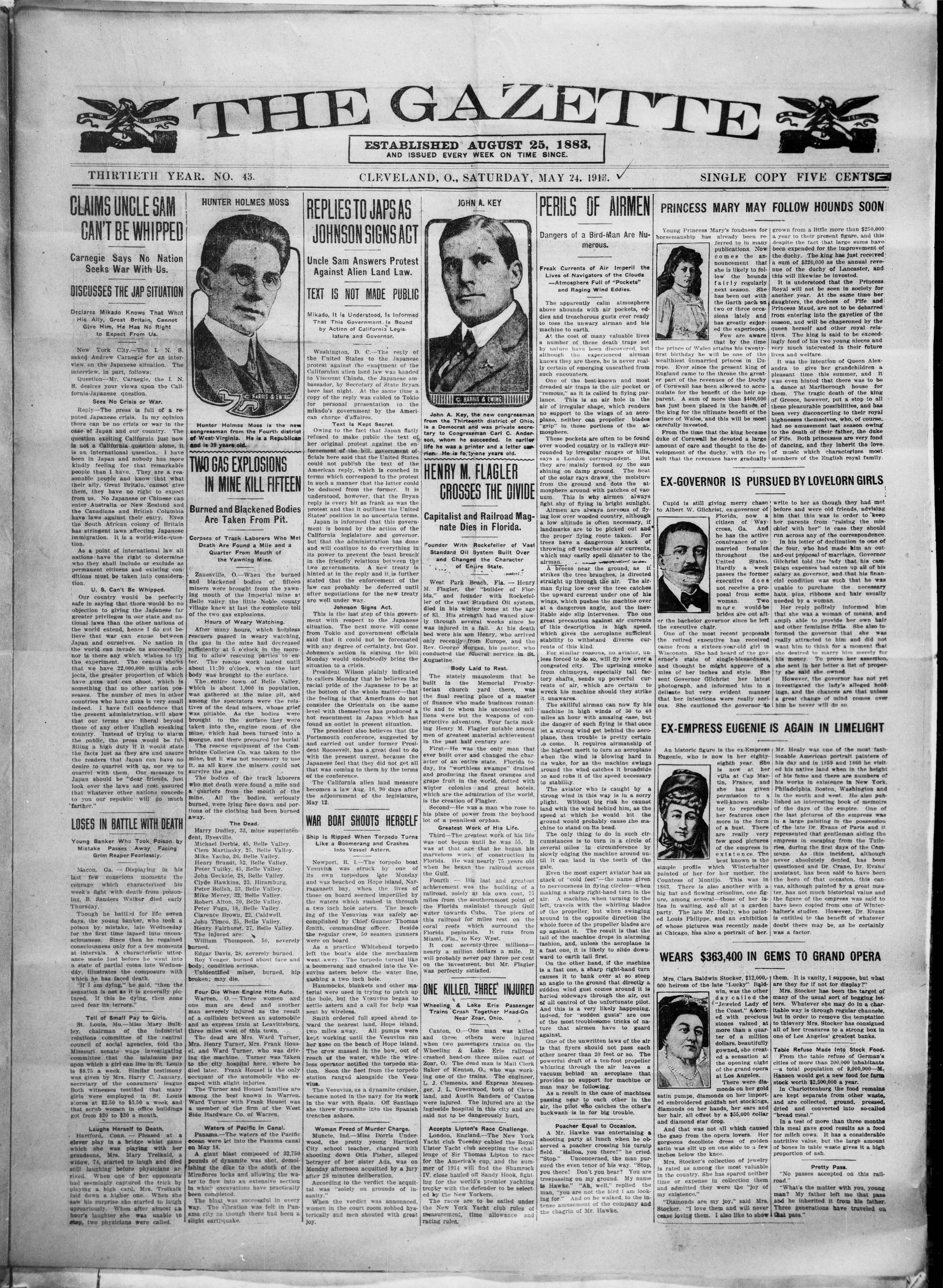
CLAIMS UNCLE SAM CAN'T BE WHIPPED
Carnegie Says No Nation Seeks War With Us.
DISCUSSES THE JAP SITUATION
Declares Mikado Knows That Whint
His Ally, Great Britain, Cannot
New York City—The I. N. S. asked Andrew Carnegie for an interview on the Japanese situation. The interview, in part, follows:
Question—Mr. Carnegie, the I. N. S. desires your views upon the California-Japanese question.
Sees No Crisis or War.
Reply—the press is full of a reputed Japanese crisis. In my opinion there can be no crisis or war in the case of Japan and our country. The question exciting California just now is not a California question alone, it is an international question. I have been in Japan and nobody has more kindly feeling for that remarkable people than I have. They are a reasonable people and know that what their ally, Great Britain, cannot give them, they have no right to expect from us. No Japanese or Chinese can enter Australia or New Zealand and the Canadians and British Columbia have laws against their entry. Even the South African colony of Britain has stringent laws affecting Japanese immigration. It is a world-wide question.
As a point of international law all nations have the right to determine who they shall include or exclude as permanent citizens and existing conditions must be taken into consideration.
U. S. Can't Be Whipped.
Our country would be perfectly safe in saying that there would be no objection to giving the Japanese far greater privileges in our state and national laws than the other nations of the world extend, hence I do not be lieve that war can ensue between Japan and ourselves. No nation in the world can invade us successfully nor is there any which wishes to try the experiment. The census shows that we have 22,000,000 militia subjects, the greater proportion of which have guns and can shoot, which is something that no other nation possesses. The number of men in other countries who have guns is very small indeed. I have full confidence that the present administration, will show that our terms are liberal beyond those of any other English speaking country. Instead of trying to alarm the public, the press would be full-filling a high duty if it would state the facts just as they are and assure the readers that Japan can have no desire to quarrel with us, nor we to quarrel with them. Our message to Japan should be "bear friends, just look over the laws and rest assured that whatever other nations concede to you our republic will go much farther."
LOSES IN BATTLE WITH DEATH
LOSES IN BATTLE WITH DEATH
Young Banker Who Took Poison by Mistake Passes Away Facing Grim Reaper Fearlessly.
Macon, Ga. — Displaying in his last few conscious moments the courage which characterized his week's fight with death from poisoning, B. Sanders Walker died early Thursday.
Though he battled for life seven days, the young banker, who took a poison by mistake, late Wednesday for the first time lapsed into unconsciousness. Since then he regained consciousness only for a few moments at intervals. A characteristic utterance made just before he went into a state of partial coma late Wednesday, illustrates the composure with which he has faced death.
"If I am dying," he said, "then the sensation is not as it is generally pictured. If this be dying, then none need fear its terrors."
Tell of Small Pay to Girls.
St. Louis, Mo.—Miss Mary Bulkley, chairman of the industrial relations committee of the central council of social agencies, told the Missouri senate wage investigating committee that the minimum pay upon which a girl can live in St. Louis is $7.5 a week. Similar testimony was given by Mrs. Harry C. January, secretary of the consumers' league Both witnesses testified that many girls were employed in St. Louis stores at $2.50 to $3.50 a week and that scrub women in office buildings got from $20 to $30 a month.
Laughs Herself to Death.
Hartford, Conn. — Please at a clever play in a bridge whist game which she was playing with her grandons, Mrs. Mary Trelklaid, a widow, 74, started to laugh and died still laughing before physicians arrived. When one of her opponents had seemingly captured the trick by playing a high card, Mrs. Trelklaid down a higher one. When she saw her surprise she started to laugh upsoresiously. When after almost a hour's laughter she was unable to stop, two physicians were called.
HUNTER HOLMES MOSS
C. WARRIS & EWING
Hunter Holmes Moss is the new congressman from the Fourth district of West Virginia. He is a Republican and is 39 years old.
TWO GAS EXPLOSIONS IN MINE KILL FIFTEEN
Burned and Blackened Bodies Are Taken From Pit.
Corpses of Track Laborers Who Met Death Are Found a Mile and a Quarter From Mouth of the Yawning Mine.
Zanesville, O.—When the burned and blackened bodies of fifteen miners were brought from the yawning mouth of the Imperial mine at Belle valley the little Noble county village knew at last the complete toll of the two gas explosions.
Hours of Weary Watching.
After many hours, which helpless rescues passed in weary watching, the gas in the mine had decreased sufficiently at 5 o'clock in the morning to allow rescuing parties to enter. The rescue work lasted until about 11:30 o'clock, when the last body was brought to the surface.
The entire town of Belle Valley, which is about 1,000 in population, was gathered at the mine pit, and among the spectators were the relatives of the dead miners, whose grief was pitiful. As the bodies were brought to the surface they were taken into the, engine room of the mine, which had been turned into a morgue, and there prepared for burial.
The rescue equipment of the Cambridge Collieries Co. was taken to the mine, but it was not necessary to use it, as all knew the miners could not survive the gas.
The bodies of the track laborers who met death were found a mile and a quarters from the mouth of the mine. All the bodies, seriously burned, were lying face down and portions of the clothing had been burned away.
The Dead.
Harry Dudley, 33, mine superintendent, Byesville.
Michael Derbis, 45, Belle Valley.
Clem Martinsky, 25, Belle Valley.
Mike Yacho, 26, Belle Valley.
Henry Brandt, 52, Belle Valley.
Peter Tuiky, 45, Belle Valley.
John Geckie, 28, Belle Valley.
Clyde Hawkins, 23, Hiramburg.
Peter Bolhah, 23, Belle Valley.
Mike Meyve, 22, Belle Valley.
Robert Alton, 30, Belle Valley.
Peter Fugn, 18, Belle Valley.
Clarence Brown, 22, Caldwell.
John Timco, 25, Belle Valley.
Henry Fairhurst, 27, Belle Valley.
The injured are:
William Thompson, 50, severely burned.
Edgar Davis, 28, severely burned.
Roy Yenger, burned about face and body; condition serious.
Unidentified miner, burned, hip broken; may die.
Four Die When Engine Hits Auto.
Warren, O.—Three women and one man are dead and another man severely injured as the result of a collision between an automobile and an express train at Leavittsburg, three miles west of this town.
The dead are Mrs. Ward Turner, Mrs. Henry Turner, Mrs. Frank Housel, and Ward Turner, who was driving the machine. Turner was taken to the city hospital here, where he died later. Frank Housel is the only occupant of the automobile who escaped with slight injuries.
The Turner and Houset families are among the best known in Warren. The hotel was a member of the firm of the West Side Hardware Co. of Warren.
Waters of Pacific In Canal
Panama.—The waters of the Pacific ocean were let into the Panama canal on May 18.
A giant blast composed of 32,750 pounds of dynamite was shot, demolishing the dike to the south of the Miraflores locks and allowing the water to flow into an extensive section in which excavations have practically been completed.
The blast was successful in every way. The vibration was felt in Panama city as though there had been a slight earthquake.
ESTABLISHED AUGUST 25, 1883,
AND ISSUED EVERY WEEK ON TIME SINCE.
CLEVELAND, O., SATURDAY, MAY 24, 1913.
REPLIESTO JAPSAS JOHNSON SIGNS ACT
Uncle Sam Answers Protest Against Alien Land Law.
Mikado, It is Understood, Is Informed That This Government, Is Bound by Action of California Legislature and Governor.
Washington, D. C.—The reply of the United States to the Japanese protest against the enactment of the Californiaian alien land law was handed to Viscount Chinda, the Japanese ambassador, by Secretary of State Bryan here last night. At the same time a copy of the reply was cabled to Tokio for personal presentation to the mikado's government by the American charge d'affaires.
Text is Kept Secret.
Owing to the fact that Japan flatly refused to make public the text of her original protest against the enforcement of the bill, government officials here said that the United States could not publish the text of the American reply, which is couched in terms which correspond to the protest in such a manner that the latter could be deduced from the former. It is understood, however, that the Bryan reply is every bit as frank as the protest and that it outlines the United States' position in no uncertain terms.
Japan is informed that this government is bound by the action of the California legislature and governor, but that the administration has done and will continue to do everything in its power to prevent the least breach in the friendly relations between the two governments. A new treaty is hereby proposed, which stated that the enforcement of the law can probably be deferred until after negotiations for the new treaty are well under way.
Johnson Signs Act.
This is the last step of this government with respect to the Japanese situation. The next move will come from Tokio and government officials said that it could not be forecasted with any degree of certainty, but Gov. Johnson's action in signing the bill Monday would undoubtedly bring the situation to a crisis.
President Wilson plainly indicated to callers Monday that he believes the racial pride of the Japanese to be at the bottom of the whole matter—that the feeling is that Americans do not consider the Orientals on the same level with themselves has produced a hot resentment in Japan which has found an outlet in present situation.
The president also believes that the Portsmouth conference, suggested by and carried out under former President Roosevelt, has a great deal to do with the present unrest, because the Japanese feel that they did not get all that was coming to them by the terms of the conference.
The California alien land measure becomes a law Aug. 10, 90 days after the adjournment of the legislature, May 12.
WAR BOAT SHOOTS HERSELF
Ship Is Ripped When Torpedo Turns Like a Boomerang and Crashes Into Vessel Astern.
Newport, R. I.-The torpedo boat Vesuvius was struck by one of its own torpedoes late Monday and was beached on Hope island, Narragansett bay, when the lives of those on board seemed imperiled by the waters which rushed in through a two inch hole astern. The beaching of the Vesuvius was safely accomplished by Chief Gunner Thomas Smith, commanding officer. Beside the regular crew, 50 seamen gunners were on board.
As a practice Whitehead torpedo left the boat's side the mechanism went awry. The torpedo turned like a boomerang and crashed into the Vesuvius astern below the water line, gashing a two inch hole.
Hammocks, blankets and other material were used in trying to patch up the hole, but the Vesuvius began to settle astern and a call for help was sent by wireless.
Smith ordered full speed ahead toward the nearest land, Hope island, two miles away. All pumps were kept working until the Vesuvius ran her nose on the beach of Hope island. The crow massed in the bow, out of reach of the water, while the wireless operator notified the torpedo station. Soon the fleet from the torpedo station ranged alongside the Vesuvius.
The Vesuvius, as a dynamite cruiser, became noted in the navy for its work in the war with Spain. Off Santiago she threw dynamite into the Spanish trenches ashore.
Woman Freed of Murder Charge.
Munecle, Ind.-Miss Dorris Underwood, the pretty young Hartford City school teacher, charged with shooting down Otis Fisher, alleged betrayer of her sister Ada, was on Monday afternoon acquitted by a jury after 28 minutes deliberation.
According to the verdict the acquittal was "solely on grounds of insanity."
When the verdict was announced, women in the court room sobbed hysterically and men shouted with great joy.
C HARRIS & EWING
John A. Key, the new congressman from the Thirteenth district of Ohio, is a Democrat and was private secretary to Congressman Carl C. Anderson, whom he succeeded. In earlier life he was a printer and a letter carrier. He is forty-one years old.
HENRY M. FLAGLER
CROSSES THE DIVIDE
Capitalist and Railroad Magnate Dies in Florida.
Founder With Rockefeller of Vast Standard Oil System Built Over and Changed the Character
West Park Beach, Fla. — Henry M. Flagler, the "builder of Florida," and founder with Rockefeller of the vast Standard Oil system, died in his winter home at the age of 83. His strength had waned slowly through several weeks since he was injured in a fall. At his death bed were his son Henry, who arrived only recently from Europe, and the Rev. George Morgan, his pastor, who conducted the funeral service in St. Augustine.
Body Laid to Rest.
the stately mausoleum that he built in the Memorial Presbyterian church yard there, was the final resting place of a master of finance who made business romantic and to whom his uncounted millions were but the weapons of constructive adventure. Four facts making Henry M. Flagler notable among men of greatest material achievement in the past half century are: First—He was the only man that ever built over and changed the character of an entire state. Florida today, its "worthless swamps" drained and producing the finest oranges and grape fruit in the world, dotted with wister colonies and great hotels, which are the admiration of the world, is the creation of Flagler. Second—He was a man who rose to his place of power from the boyhood lot of a penniless orphan. Greatest Work of His Life.
Greatest Work of This Life
Third — The greatest work of his life was not begun until he was 55. It was at that age that he began his marvelous work of construction in Florida. He was nearly 75 years old when he began the railroad across the Gulf.
Fourth — His last and greatest achievement was the building of a railroad, solely at his own cost, 75 miles from the southernmost point of the Florida mainland through Gulf water towards Cuba. The piers of this railroad for miles rest on the coral reefs which surround the Florida peninsula. It runs from Miami, Fla., to Key West.
It cost seventy-three millions—nearly a million dollars a mile. It will probably never pay three per cent on the investment, but Mr. Flagler was perfectly satisfied.
ONE KILLED, THREE INJURED
Wheeling & Lake Erie Passenger Trains Crash Together Head-On Near Zoar, Ohio.
Canton, O.-One man was killed and three others were injured when two passengers trains on the Wheeling & Lake Erie railroad crashed head-on three miles east of Zoar, O. The dead man is Mail Clerk Baker of Kenton, O., who was working one of the trains. The engineer, L. J. Clements, and Express Messenger, J. L. Greenwood, both of Cleveland, and Austin Sanders of Canton were injured. The injured are at the Ingleside hospital in this city and are said not to be dangerously hurt.
Accepts Lipton's Race Challenge
London, England.-The New York Yacht club Tuesday cabled the Royal Ulster Yacht club accepting the challenge of Sir Thomas Lipton to race for the America's cup, and the summer of 1914 will find the Shamrock IV. close hailed off Sandy Hook, fighting for the world's premier yachting trophy with the defender to be selected by the New Yorkers. The races are to be sailed under the New York Yacht club rules of measurement, time allowance and racing rules.
PERILS OF AIRMEN
PERILS OF AIRMEN
Dangers of a Bird-Man Are Numerous.
Freak Currents of Air Imperil the Lives of Navigators of the Clouds —Atmosphere Full of "Pockets" and Raging Wind Eddies.
The apparently calm atmosphere above abounds with air pockets, eddies and treacherous gusts ever ready to toss the unwary airman and his machine to earth.
At the cost of many valuable lives a number of these death traps set by nature have been discovered, but although the experienced airman knows they are there, he is never really certain of emerging unscathed from such encounters.
One of the best-known and most dreaded air traps is the air pocket or "remous," as it is called in flying parlance. This is an air hole in the air of irregular shape, which renders no support to the wings of an aeroplane, neither can propeller blades "grip" in those portions of the atmosphere.
These pockets are often to be found over wooded country or in valleys surrounded by irregular ranges or hills, says a London correspondent. But they are mainly formed by the sun shining on damp ground. The heat of the solar rays draws, the moisture from the ground and dots the atmosphere around with patches of vacuum. This is why airmen always fight shy of flying in bright sunlight.
Airmen are always nervous of flying low over wooded country, although a low altitude is often necessary, if landmarks are to be picked out and the proper flying route taken. For trees have a dangerous knack of throwing off treacherous air currents, which may easily spell disaster to the airman.
A breeze near the ground, as if strikes the tree branches, is directed straight up through the air. The airman flying low over the tree catches the upward current under one of his wings, which pushes the machine over at a dangerous angle, and the inevitable side slip intervenes. The one great precaution against air currents of this description is high speed, which gives the aeroplane sufficient stability to withstand diverse currents of this kind.
For similar reasons, no aviator, unless forced to do so, will fly low over a congested city. The uprising smoke from chimneys, especially tall factory shafts, sends up powerful currents of air, which are certain to wreck his machine should they strike it unaware.
The skillful airman can now fly his machine in high winds of 50 to 40 miles an hour with amazing ease, but the danger of such flying is that once it a strong wind get behind the aeroplane, then trouble is pretty certain to come. It requires airmanship of the highest merit to turn an aeroplane when the wind is blowing hard in its wake, for as the machine swings around the wind catches it broadside on and robs it of the speed necessary to stability.
The aviator who is caught by a strong wind in this way is in a sorry plight. Without big risk he cannot land with the wind behind him, as the speed at which he would hit the ground would probably cause the machine to stand on its head.
The only thing to do in such circumstances is to turn in a circle of several miles in circumference by slowly edging the machine around until it can land in the teeth of the gale.
Even the most expert aviator has an attack of "cold feet"—the name given to nervousness in flying circles—when making a sharp right-hand turn in the air. A machine, when turning to the left, travels with the whirling blades of the propeller, but when swinging around in the opposite direction the whole force of the propeller blades are up against it. The result is that the tail of the machine drops in alarming fashion, and, unless the aeroplane is a fast one, it is likely to slide downward to earth tail first.
On the other hand, if the machine is a fast one, a sharp right-hand turn causes it to bank over at so steep an angle to the ground that directly a sudden wind gust comes around it is hurled sideways through the air, out of all control of the unfortunate pilot. And this is a very likely happening, indeed, for "sudden gusts" are one of the most troublesome tricks of nature that airmen have to guard against.
One of the unwritten laws of the air is that flyers should not pass each other nearer than 20 feet or so. The powerful draft of a ten-foot propeller whizzing through the air leaves a vacuum behind an aeroplane that provides no support for machine or man may be following.
As a result in the case of machines passing near to each other in the air, the pilot who catches the other's backwash is in for big trouble.
Poacher Equal to Occasion.
A Mr. Hawke was entertaining a shooting party at lunch when he served a poacher crossing his turpill field. "Halloa, you there!" he cried "Stop." Unconcerned, the man pursued the even tenor of his way. "Stop you there! Don't you hear? You are trespassing on my ground. My name is Hawke." "Ah, well," replied the man, "you are not the bird I am looking for." And on he walked, to the intense amusement of the company and the chagrin of Mr. Hawke.
SINGLE COPY FIVE CENTS
PRINCESS MARY MAY FOLLOW HOUNDS SOON
PRINCESS MARY MAY FOLLOW HOUNDS SOON
EX-GOVERNOR IS PURSUED BY LOVELORN GIRLS
EX-EMPRESS EUGENIE IS AGAIN IN LIMELIGHT
WEARS $363,400 IN GEMS TO GRAND OPERA
---
Young Princess Mary's fondness for horsemanship has already been re
already been referred to in many publications. Now comes the announcement that she is likely to follow the hounds fairly regularly next season. She has been out with the Garth pack two or three occasions lately and has greatly enjoyed the experience. Few are aware that by the time
referred to in many publications. Now comes the announcement that she is likely to follow the hounds fairly regularly next season. She has been out with the Garth pack pa two or three occasions lately and has greatly enjoyed the experience. Few are aware that by the time the prince of Wales attains his twenty-first birthday he will be one of the wealthiest unmarried princess in Europe. Ever since the present king of England came to the throne the greater part of the revenues of the Duchy of Cornwall has been allowed to accumulate for the benefit of the heir apparent. A sum of more than $400,000 has just been placed in the hands of the king for the ultimate benefit of the prince of Wales, and this will be most carefully invested.
From the time that the king became duke of Cornwall he devoted a large amount of care and thought to the development of the duchy, with the result that the revenues have gradually
---
Cupid is still giving merry chase to Albert W. Glehrstich, governor of
Florida, now a citizen of Waycross, Ga. And he has the active connivance of unmarried females throughout the United States. Hardly a week passes the former executive does not receive a proposal from some woman. Two m or e would be brides are out aft
citizen of Waycross, Ga. And he has the active connivance of unmarried females throughout the United States. Hardly a week passes the former executive does not receive a proposal from some woman. Two more would-be brides are out after the bachelor governor since he left the executive chair.
One of the most recent proposals the retired executive has received came from a sixteen-year-old girl in Wisconsin. She had heard of the governor's state of single-blessedness, and thought he might approve of a miss of her inches and style. She sent Governor Gilchrist her latest photograph, and informed him in a delicate but very evident manner that her intentions were really serious. She cautioned the governor to
An historic figure is the ex-Empress
Eugene, who is now in her eighty-
eighth year. She is now at her villa at Cap Martin, France, and she has given permission to a well-known sculptor to reproduce her features once more in the form of a bust. There are really very few good pictures of the empress in existence. The best known is the
is now at her villa at Cap Martin, France, and she has given permission to a well-known sculptor to reproduce her features once more in the form of a bust. There are really very few good pictures of the empress in existence. The best known is the simple profile which Winterhalter painted of her for her mother, the Countess of Montijo. This was in 1863. There is also another with a big hat and flowing crinoline, one figure, among several—those of her lattes in waiting, and all at a garden party. The late Mr. Healy, who painted Louis Philippe, and an exhibition of whose pictures was recently made at Chicago, has also a portrait of her.
Mrs. Clara Baldwin Stocker, $12,000.
000 heirs of the late "Lucky" Baldw.
Baldw.
win, was the other day called the "Jewelled Lady of the Coast." Adorned with precious stones valued at more than a quarter of a million dollars, beautifully gowned, she created a sensation at the opening night of the grand opera at Los Angeles.
WILLIAMS
There were diamonds on her gold satin pumps, diamonds on her impor-ted embroidered goldfish net stockings, diamonds on her hands, her ears and her hair, all offset by a $55,000 collar and diamond star drop.
And that was not all which caused the gasp from the opera lovers. Her gorgeous decollete dress of golden satin was slit up on one side to a few inches below the knee.
Mrs. Stocker's collection of jewelry is rated as among the most valuable in the country. She has spared neither time or expense in collection them and admitted they were the "joy of my existence."
"Diamonds are my joy," said Mrs. Stocker. "I love them and will never cease loving them. I also like to show
grown from a little more than $250,000 a year to their present figure, and this despite the fact that large sums have been expended for the improvement of the duchy. The king has just received a sum of $320,000 as the annual revenue of the duchy of Lancaster, and this will likewise be invested.
It is understood that the Princess Royal will not be seen in society for another year. At the same time her daughters, the duchess of Fife and Princess Maud, are not to be debarred from entering into the gayeties of the season, and will be chaperoned by the queen herself and other royal relatives. The king is said to be exceedingly fond of his two young nieces and very much interested in their future lives and welfare.
It was the intention of Queen Alexandra to give her grandchildren a pleasant summer, and it was even hinted that there was to be a dance at Mariborough house for them. The tragic death of the king of Greece, however, put a stop to all these pleasurable possibilities, and has been very disconcerting to their royal highnesses themselves, who, of course, had no amusement last season owing to the death of their father, the duke of Fife. Both princesses are very fond of dancing, and they inherit the love, of music which characterizes most members of the English royal family.
write to her as though they had met before and were old friends, advising him that this was in order to keep her parents from "raising the mischief with her" in case they should run across any of the correspondence. In his letter of declination to one of the four, who had made him an out-and-out proposal of marriage, Governor Gilchrist told the lady that his campaign expenses had eaten up all of his salary as governor, and that his financial condition was such that he was unable to purchase the necessary hats, pins, ribbons and hair usually needed by a woman. Her reply politely informed him that she was a woman of means, and amply able to provide her own hair and other feminine frills. She also informed the governor that she was really attracted to him and did not want him to think for a moment that she desired to marry him merely for his money. To prove her assertion, she sent in her letter a list of property she said she owned. However, the governor has not yet investigated the lady's alleged holdings, and the chances are that unless a great change of mind comes over him he never will do so.
Mr. Healy was one of the most fashionable American portrait painters of his day and in 1859 and 1860 he visited his native land when in the height of his fame and there are numbers of his works in existence in New York Philadelphia, Boston, Washington and in the south and west. He also published an interesting book of memoirs of the days of the empire. One of the last pictures of the empress was in a large painting in the possession of the late Dr. Evans of Paris and it represented that gentleman aiding the empress in escaping from the Tullieries, during the first days of the Commune. As this incident, although never absolutely denied, has been questioned and Dr. Crane, Dr. Evans' assistant, has been said to have been the hero of that occasion, this canvas, although painted by a great master, has not much historical value and the figure of the empress was said to have been copied from one of Winterhalter's studies. However, Dr. Evans is entitled to the benefit of whatever doubt there may be, as he certainly was a factor.
them. It is vanity, I suppose, but what are they for if not for display?"
Mrs. Stocker has been the target of many of the usual sort of begging letters. Whatever she may do in a charitable way is through regular channels, but in order to remove the temptation to thievery Mrs. Stocker has consigned all of her treasures to a strong box in one of Los Angeles' greatest banks.
Table Refuse Made Into Stock Food.
From the table refuse of German's cities of more than 200,000 inhabitants—a total population of 9,000,000—M. Hansen would get a new food for farm stock worth $2,500,000 a year.
In Charlottetown the food remains are kept separate from other waste, and are collected, ground, pressed, dried and converted into so-called "bread meal."
In a test of more than three months this meal gave good results as a food for milch cows. It has a considerable nutritive value, but the large amount of bones in table waste gives it a high proportion of ash.
Pretty Pass.
"No passes accepted on this railroad."
"What's the matter with you, young man? My father left me that pass and he inherited it from his father. Three generations have traveled on that pass."
One Year.....$1.50
Six Months.....1.00
Three Months.....$0
Subscribers are requested to rem-
mit by postoffice money or
order or registered letter.
Entered at the postoffice in Cleveland,
Ohio, as second-class matter
Address all communications to
HARRY C. SMITH
Editor and proprietor,
THE GAZETTE,
Blackstone Building, Cleveland, G.
Member Ohio Legislature: 1894
to 1896; 1898 to 1898; 1900 to 1908
The Chicago Defender says, editor-
ally, that after his trial, Jack John-
son said: "I am satisfied; they (both
the judge and jury) treated me fair."
Everyone else ought to be "satisfied,"
too, or "tickled to death."
J. M. Holendorf, Collector of Port at St. Mary's, Ga. an Afro-American, in spite of his name, has been displaced and succeeded by a "southern white gentleman." Holendorf's salary was $1,800 a year. Lewis, Smalls and Tyler had their political "heads" chopped off by the democrats, several weeks ago. The next will be Collector Joe Lee of Florida Recorder Henry L. Johnson and Register J. C. Napier. "The south is in the saddle," under President Wilson in spite of this fact, that political monstrosity, the "Negro democrat," is still claiming and more or less anxiously awaiting appointment to office. We like his "nerve." That's all, too.
"THE NEWS'" BODY-BLOW!
The following are the headlines in (large, black letters) of an article in the May 14 issue of the Cleveland Daily News;
If He Has Been Persecuted It Should Be Lesson to Others, Says Attorney.
The intent of the foregoing is so plain that any one can see it. "The News" would promote another such "Separate Marriage" bill fight as we have but recently been relieved of after a bitter and long-standing effort that was state-wide. A few years ago, after months of effort we succeeded in getting the assistance of Editor Nat C. Wright, then in charge of that paper, who put a stop to much the same kind of miserable treatment at the hands of both "The Leader" and "The News," as is this latest "stab." There are 20,000 Afro-Americans in Cleveland, many of whom have of late months been patronizing "The Cleveland News." The above ought to be notice to them to discontinue taking that paper unless the present manager, Mr. Wm. Leach, who is a New York newspaperman of experience and ability, sees his way clear to stop such unwarranted attacks on the rights of our people. No other class of Americans are so mistreated and there is no more excuse for such mistreatment of us than there is for the others. Then too, such attacks do nothing but increase the prejudice against our people and make it all the harder for them to make a living in this community. Therefore we ask Mr. Leach in the interest of common decency, and the interests of our people in Cleveland, to put a stop to such harmful and unwarranted attacks.
THE "JIMCROW" NEGRO.
Cleveland, O., May, 10, 1913.
Prof. W. P. Dabney, editor of "The
Union." Cincinnati, Ohio
Union, Cincinnati, Ohio.
Dear Dahney: Tell the "jimcrow" school Negroes of Cincinnati that Cleveland has more Afro-American teachers in the public schools than she would have if there were "jimcrow" or separate schools in this city. Tell them to work for mixed teachers, and a little patience and time will get for them what Cleveland has in this respect. Separate or "jimcrow" schools are not legal in Ohio and can be closed at any time by any citizen who will go into the courts. This is right and proper. "jimcrow" schools are not wanted in Ohio, and Negroes who wish to "turn back the hands of the clock of progress" for the race, in Cincinnati and Ohio should go south where there is plenty of that sort of thing. They are a hindrance and detriment to race progress in this state.
When Negroes ask for one color line in any community they are simply opening the flood-gates of "jimcrow lam" and the prejudiced whites are quick to take advantage of it and give them far more than even the "jimcrow" Negro wants. The influence of "jimcrow" schools is all in favor of every kind of separation of the two races—separate street cars, too! Here in Cleveland we have "sent south" the "jimcrow" Negro who wanted separate schools, street cars and about everything or anything else that would get him and some friends, jobs. He did not care how great a sacrifice of his people's rights and privileges would have to be made to do this. This is always the case.
Reppert's "Separate Marriage" bill received its large vote on second reading because, as we were repeatedly told by members of the legislature, their Colored people at home had told them to vote for the bill. Poor misguided Negroes—like the "jimcrow" school Negro, they either did not know, or they did not care, whether
the race suffered by such pernicious legislation, or not. They too, are to be pitied; not condoned, however.
The influence of "jimcrow" or separate schools is "to widen the gulf" between Colored and white children, and to make it harder in every way for them—even to making a living later on in life. It also makes the gulf between the Colored and white man and woman greater, and the effort of the Colored man and woman to make a living for himself and herself and family, is doubled and tripped. This leads to a greater general discrimination, in all the walks of life, and in all the public places, which our women and children too, must suffer.
By all means "stop" the "jimcrow" school. Negro in Cincinnati, and send him south, where he belongs and where he can get a job for himself or his friend or friends. He would bring about a condition in Ohio like that he left in the south. Cleveland, the largest city in Ohio, sends this word to our people of the "Queen City of the West." Will they heed? We hope and pray, so.
Yours for the race,
Harry C. Smith.
—Cincinnati (O.) Union
SQUARELY UP TO FITZGERALD
Cleveland, May 17, 1918.
Editor, Gazette, Dear Mr. Smith: — I received a marked copy of The Gazette containing a suggestion that my attention be called to the extension of E. 24th St. to Cedar Ave.
In this connection you would probably be interested to learn that bonds in the sum of $$0000 for the extension of E. 24th St., from Central Ave., to Cedar Ave., were authorized by the City Council at my suggestion during the latter part of 1911. Upon entering the building the surveys made by the City Engineer's department and also appraisal of the properties on Central and Cedar Avenues, which would have to be acquired by the city in order to effect the extension. This was as far as I could carry the matter without approval of the Director of Public Service.
Unfortunately Director Springborn has refused to authorize the extension, claiming that the improvement is not necessary at the present time. To my mind his attitude in this question is a plain indication of the fact that he will do nothing voluntarily to assist a republican ward. I have conferred with the R. C. Bailey on this matter and I believe that he thoroughly appreciates the situation. If you will through the columns of your valuable paper, The Gazette, relieve me of any negligence in furthering the street extension, I will be grateful. Very truly yours.
We comply with Councilman FitzGerald's request to publish his letter, with pleasure, but balk some on relieving him "of any negligence in furthering the street extension." in question, for reasons that will appear later on. On receipt of his letter, we submitted it to Director of Public Service Springborn with a request for an early reply, because of the councilman's references to him and the blame for the delay in making the improvement so greatly desired, Mr FitzGerald was placing at the director's door. The following, from Mr Springhorn, is self-explanatory:
Cleveland, May 21, 1913.
Editor, Gazette, My dear Sir:—Regarding the extension of the 24th St from Central Ave., to Cedar Ave. would say, that the last legislation I am able to find any record of, relating to the extension of the 24th St, or no ordinance authorizing the name of Excouncilman Fleming, which ordinance authorized the selling of $12,000 in bonds for the purpose of paying the expense of opening and extending E. 24th St. This ordinance was passed by the council in December, 1911. The bonds authorized, however, have never been sold so that bonds have been sold for his wife. Councilman Fitzgrand did talk with me about a year ago in regard to the opening of this street, and I told him that I recalled the former effort in this same direction, but that some objection had arisen which prevented the councilman at that time serving the ward from carrying the work for the extension. I be unwise to sell the bonds unless it was really intended to make the improvement.
Inquiry at the city engineer's office fails to show that any survey of this street was ever made or that there was any appraisal of the property as stated by Mr. FitzGerald. Whether the $12,000 will pay the cost of opening the street or not is therefore at present unknown. Mr. FitzGerald said nothing which would have me about the assurance that he really wants the project carried through. I think you are fully aware of the face—that personally I have never opposed the extension of E. 24th St.; nor do I oppose it now. You probably recall that in 1808 or 1909, when the matter was under discussion, I recommended the opening of the street in question to the subdivisions with this office know that we pay no attention to ward lines or political subdivisions, but try to give an equal service to all.
Director of Public Service. About all of our people, and many others, in that section of the city have for years greatly desired a street cut through from Central Ave. to Cedar Ave. (at least), half way between E 28th St. and E. 22d St. The Gazette has favored an extension of E. 24th St. but possibly it would be cheaper more easily and quickly secured, and a better location, to widen and extend E. 27th place through to Cedar Ave. Wm. S. FitzGerald, when a candidate for council, PROMISED to see that this was done, and has been a member of the council long enough under both republican and democratic city administrations, to have accomplished this several times, to say the least. Therefore, The Gazette, after waiting more than "a reasonable length of time," called on Councilman FitzGerald to keep his PROMISE and have the street cut through if he desired the support of our people in that section, in the future. In response to our request, he sent us the letter, published above, and placed the blame, for his failure to do so, on Director of Public Service Springborn, whose letter of explanation follows Mr. FitzGerald's, and, as we have already said, places the matter squarely up to the councilman. The direc-
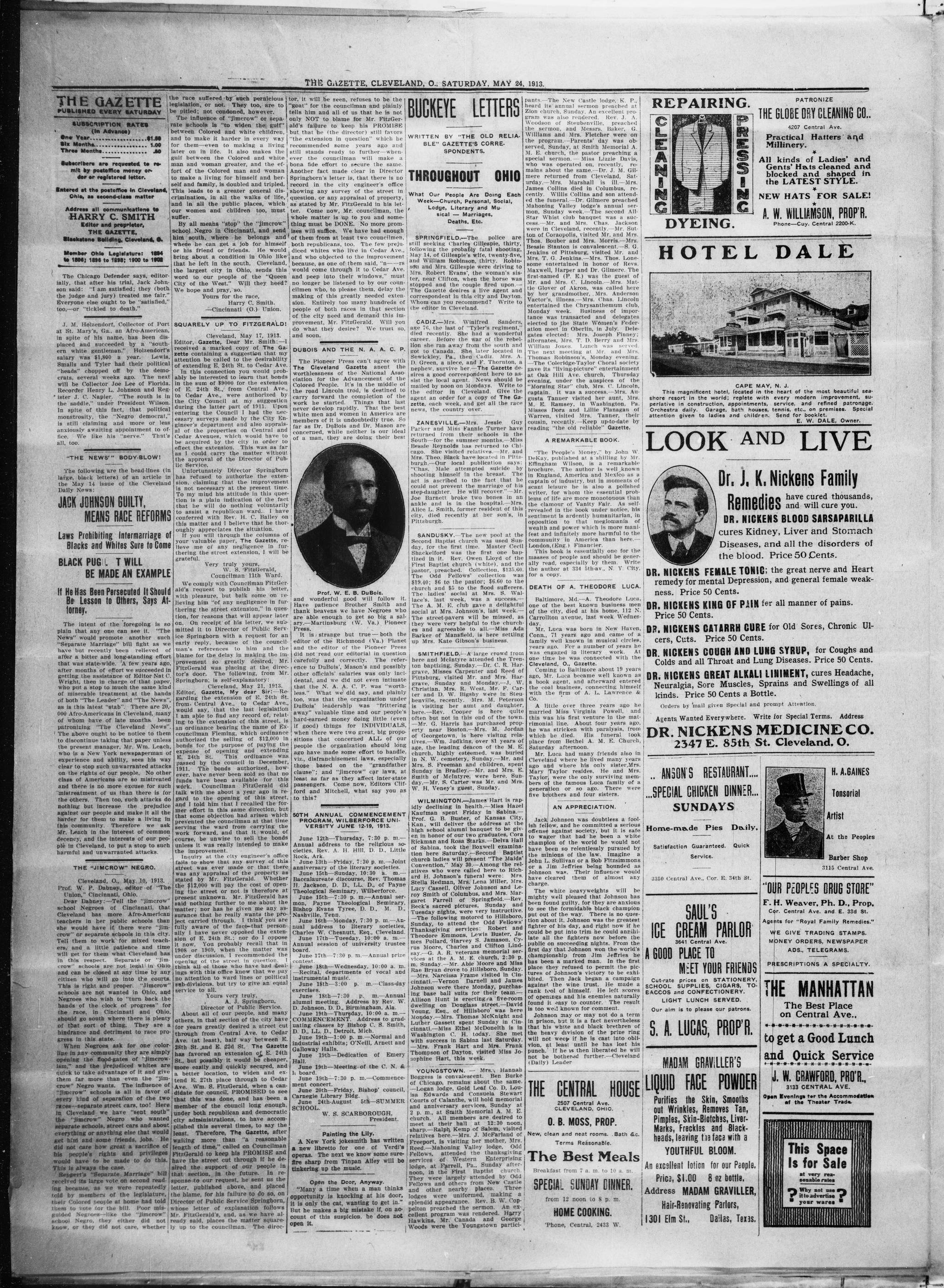
THE GAZETTE, CLEVELAND, O., SATURDAY, MAY 24, 1913.
tor, it will be seen, refuses to be the "goat" for the councilman and plainly tells him and all of us that he is not only NOT to blame for Mr. FitzGerald's failure to keep his PROMISE but that he (the director) still favors "the extension in question" which he recommended some years ago and still stands ready to whine whether the councilman will make a bona fide effort to secure the same. Another fact made clear in Director Springborn's letter is, that there is no record in the city engineer's office showing any survey of the street in question, or any appraisal of property, as stated by Mr. FitzGerald in his letter. Come now, Mr. councilman, the whole matter is up to you and something must be DONE. No more promises will suffice. We have had enough of them from at least two councilmen, both republicans, too. The few prejudiced whites who live in Cedar Ave., and who objected to the improvement because, as one of them said, "n—rs would come through it to Cedar Ave, and peep into their windows," must no longer be listened to by our councilmen who, to please them, delay the making of this greatly needed extension. Entirely too many hundreds of people of both races in that section of the city need and demand this improvement, Mr. FitzGerald. Will you do what they desire? We trust so and soon.
DUBOIS AND THE N. A. A. C. P
The Pioneer Press can't agree with the Cleveland Gazette anent the worthlessness of the National Association for the Advancement of the Colored People. It's an act of despair. The Liberation油井 is destined to carry forward the completion of the work he started. Things that last never develop rapidly. That the best white men and women in America are members of it is undoubtedly true. So the Pioneer Press is concerned, while neither is our ideal of a man, they are doing their best.
P. B.
and wonderful good will follow it. Have patience Brother Smith and thank heavens we have Negroes who are able enough to get so big a salary.—Martinsburg (W. Va.) Pioneer Press.
It is strange but true—both the editor of the Richmond (Va.) Planet and the editor of the Pioneer Press did not read our editorial in question carefully and correctly. The reference to DuBois, Mason's and possibly other officials' salaries was only incidental, and we did not even intimate that the N. A. A. C. P. was "worstless." What we did say, and plainly too, was that the organization under DuBois' leadership was "frittering away" valuable time and our people's hard-earned money doing little (even if good) things for INDIVIDUALS, when there were two great, big propositions that concerned ALL of our people the organization should long ago have made some effort to handle, viz. disfranchisement laws, especially those based on the "grandfather clause"; and "jimcrow" car laws, at least as far as they affect inter-state passengers. Come now, Editors Clifford and Mitchell, what say you as to this?
50TH ANNUAL COMMENCIEMENT
SPECIAL EVENT
INVITATION
VERSITY JUNE 12-19, 1983
June 12th—Thursday, 7:30 p. m.—
Annual address to the religious
societies, Rev. A. H. Hill, D. D. Little
Rock, Ark.
June 13th—Friday, 7:30 p. m.—Joint
anniversary of the literary societies
June 15th—Sunday, 10:30 a. m.—Baccalaureate discourse, Rev. Thomas H. Jackson, D. D., LL. D, of Payne Theological Seminary, Wilberforce.
June 15th—7:30 p. m.—Annual seminary, Payne Theological Seminary, Bishop Evans Tyree, D. D., M. D. Newark, T. F. W. Jr.
June 16th—Monday, 7:30 p. m.—Annual address to literary societies, Charles W. Chesnutt, Esq. Cleveland.
June 17th—Tuesday, 10:00 a. m.—Annual session of university trustee board.
June 17th—7:30 p. m.—Annual prize contest.
June 18th - Wednesday 10:00 a.m.
Instruments of vocal and instrumental music
June 18th—3:00 p. m.—Class-day exercises
June 18th—7:30 p. m.—Annual
alumni meeting. Address by Rev. W.
D. Johnson, D. D., Birmingham, Ala.
June 19th—10:00 p. m.—COMMENCEMENT. Address to grading classes by Bishop C. S. Smith,
D. D, L.L. D., Detroit, Mich.
June 19th—1:00 p. m.—Normal and
industrial exhibits; O'Neill, Arnett and
Galloway Halls.
June 19th—Dedication of Emery
Hall.
June 19th—Meeting of the C. N. &
11 board.
June 19th—7:30 p. m.—Commencement concert.
June 20th-Friday, Bishop' council, Carnegie Library Bldg.
JUNE 24th-August 5th—SUMMER
SCHOOL.
A New York jokesmith has written a new libretto for one of Verd's operas. The next we know some surefire sharp from Tinpan Alley will be tinkering up the music.
Open the Door, Anyway.
"Many a time when a man thinks opportunity is knocking at his door, it is only the cat, wanting to get in." But he makes a big mistake if, on account of this suspicion, he does not open it.
WRITTEN BY "THE OLD RELIA BLE" GAZETTE'S CORRESPONDENTS.
THROUGHOUT OHIO
What Our People Are Doing Each Week — Church, Personal, Social, Lodge, Literary and Musical — Marriages, Deaths, Etc.
SPRINGFIELD — The police are still seeking Charles Gillespie, thirty, following the probable fatal shooting, May 14, of Gillespie's wife, twenty-five, and William Robinson, thirty. Robinson and Mrs. Gillespie were driving to Mrs. Robert Evans, the woman's sister, near Clifton, when the horse was stopped and the couple fired upon. The Clerk, an agent and correspondent in this city and Dayton, Whom can you recommend? Write to the editor in Cleveland.
CADIZ—Mrs. Winifred Sanders, age 76, the last of "Tyler's regiment," died recently. She had a wonderful career. Before the war of the rebellion she ran away from the south and got to Canada. She later located in New York and then in D. Green, a nclee, and F. Thornton, a nephew, survive her. The Gazette describes a good correspondent here to assist the local agent. News should be mailed by noon on Mondays. Write to the agent, for an order for a copy of The Gazette, each week, and get all the race news, the country over.
ZANESVILLE.—Mrs. Jessie Guy Parker and Miss Fannie Turner have returned from their schools in the South—for the summer months.—Miss Bessie Reynolds has returned to Chicago. She visited relatives.—Mr. and Mrs. Reynolds have been burgh.—Our local publication says: "Chas, Male attempted suicide by shooting himself in the breast. The act is ascribed to the fact that he could not prevent the marriage of his step-daughter. He will recover."—Mr. Joe Barnett broke two bones in the hospital.—Mrs. Alice L. Smith, former resident of this city, died recently at her son's, in Pittsburgh.
SANDUSKY—The new pool at the Second Baptist church was used Sunday, for the first time. Master Cecil Shackelford was the first one baptized in it. Rev. Owen Lloyd of the First Baptist church (white), and the pastor, preached, Collection, $135.60 The Odd Fellows' collection was $19.40; $6 to the pastor; $6.60 to the church and $5 to the flood sufferers The ladies' social at Mrs. S. Allen is full of friends. The A.M. M. E. club gave a delightful social at Mrs. Johnson's, last week—The street-pavers will be missed, as they were very helpful to the churches and agreeable to all—Miss Ada Barker of Mansfield, is here setting up up Mrs. Kate Gibson's business.
SMITHFIELD.—A large crowd trump here and McIntyre attended the Trenton baptizing, Sunday.—Dr. C. R. Hargrave, Misses Carpenter and Reed of Pittsburg, visited Mr. and Mrs. Hargrave, Sunday and Monday.—J. W. Christian, Mrs. R. Vest, Mr. Hargrave, Mrs. R. Engelman, in St. Bonaventure, recently, Mrs. P. Peterson is visiting her aunt and daughter.—Rev. Cooper is here quite often but not in this end of the town.—Mr. G. Harris has purchased property near Boston.—Mrs. M. Jordan of Georgetown, is here visiting relatives.—Wm. Judkins, over 81 years of age, the leading deacon of the M. E. church, highly esteemed, was buried in St. Bonaventure.—Mrs. S. Freeman and children, spent Sunday in Bradley.—Mr. and Mrs. E. Smith of McIntyre, were here, Sunday.—Mr. S. Carter was Mr. and Mrs. W. H. Veney's guest, Sunday.
WILMINGTON—James Hart is rapidly declining in health—Miss Hazel Kaufman spends Friday in Sabina.—Prof. G. B. Buster, of Kansas City, Kan. will deliver the address at the high school alumni banquet to be given in honor of our two graduates, Cora Rickman and Rosa Starks.—Delva Hall of Sabina, took the Boxwell examination here Saturday.—Second Baptist church ladies will present the address at the college. More than the relatives who were called to Richard H. Johnson's funeral were: Mrs. Stella Redman, Mrs. Lena Miller, Mrs. Lucy Cassell, Oliver Johnson and Leroy Smith of Columbus, and Mrs. Margaret Farrell of Springfield.—Rev. Beck's sacred pictures, Sunday and Tuesday nights, were very instructive.—The following motored to Hillsboro, Sunday, to attend the Thanksgiving services. Robert and Theodore Emmons, James Buster, James S. Jamason, Cyrus Moore, Charles and Clifton Lindsay.—A. R. veterans memorial services at the A. M. E. church, 2:30 p.m. Sunday.—Mr. Able Moore and Miss Bryan drove to Hillsboro, Sunday.—Mrs. Narcissia Frame visited in Cincinnati.—Vernon Darnell and James Johnson were there Monday, purchasing base ball suits for their team. Allison Hunt is erecting a tee-dowelling on Egge of the field. Miss of Hillsboro was here Monday.—Mrs. Thomas McKnight and Luther Gassett spent Sunday in Cincinnati.—Miss Ethel McDonnell is in Washington C. H. today. She met with success in Sabina last Saturday.—Mrs. Frank Hart and Mrs. Frank Thompson of Dayton, visited Miss Josephine Hart, this week.
YOUNGSTOWN. — Mrs. Hannah Boggess is convalescent. Ben Burke of Chicago, remains about the same. — Logan lodge, Gold Leaf Co. D, Louisa Edwards and Consuela Stewart Courts of Calanthe, will hold memorial and anniversary services, Sunday at 2 p.m., at Smith Memorial A. M. E. church. All members are desired to meet at their hall at 12:30 noon, sharp—Ralp Kemp of Scalum, visited relatives here. Mrs. McCoy Freeport, is visiting her mother Mrs. Reed, Marsh Valley lodge, Odd Fellows, attended the thanksgiving services of Western Enterprising at Farrell, Pa., Sunday afternoon, in the First Baptist church. They were largely attended by Odd Fellows and others from New Castle and other nearby places. Three lodges were uniformed, making a splendid appearance. Rev. B. W. Copelton preached the sermon. An excellent program was rendered. Harry Hawkins, Mr. Canada and George Woods were the Youngstown partici-
A REMARKABLE BOOK.
"The People's Money," by John W. DeKay, published at a shilling by Mr. Effingham Wilson, is a remarkable brochure. The author is well known in England, America and Mexico as a captain of industry, but in moments of scant leisure he is also a polished writer, for whom the essential problems of life are more monotonous than the clamour of Vanity Fair. As self-revealed in the book under notice, his sentiment is ardently humanistic, and his sense of wealth and power which is more manifest and infinitely more harmful to the community in America than here—London (Eng.) Financier.
This book is essentially one for the masses of people and should be generally read, especially by them. Write at 334 58-av., N. Y. city for a copy.
DEATH OF A. THEODORE LUCA
Baltimore, Md.—A. Theodore Luca, one of the best known business men of the city, died at his home, 112 N. Carrollton avenue, last week Wednesday.
Mr. Luca was born in New Haven, Conn., 71 years ago and came of a family well known in musical circles, years ago. For a number of years he worked there in the work. At one time he was connected with the Cleveland, O., Gazette.
Coming to Baltimore about 19 years ago, Mr. Luca became well known as a book agent, and afterward entered the coal business, connecting himself with the firm of A. L. Lawrence & Co.
A little over three years ago he married Miss Virginia Powell, and this was his first venture in the matrimonial stock business with paralysis, from which he died. His funeral took place from Bethel A. M. E. Church, Saturday afternoon.
Mr. Luca had many friends also in Cleveland where he lived many years ago and where his only sister, Mrs. Mary Taylor resides. He and Mrs. Taylor, were the only surviving members of the famous Luca family of a generation or so ago. There were five brothers and four sisters.
AN APPRECIATION
Jack Johnson was doubtless a foolish fellow, and he committed a serious offense against society, but it is sate to wager that had he been a white champion of the world he would not have been so relentlessly pursued by the minions of the law. Imagine a John L. Sullivan or a Bob Fitzsimmons or a Jim Jeffries being hounded as Johnson was. Their influence would have cleared them of almost any charge.
The white heavyweights will be mighty well pleased that Johnson has been found guilty, for they are anxious to see the formidable black champion put out of the way. There is no question about it. Johnson was the greatest fighter of his day, and right now if he could be put into trim he could annihilate all the fighters now before the public on succeeding nights. From the first day that Johnson won the world's championship from Jim Jeffries he has been a master of the art. He was issued to permit the pictures of Johnson's victory to be exhibited. Then Jack began a campaign against the wine trust. He made a rank two of himself. He left scores of openings and his enemies naturally found it easy to counter. The result is too well known for comment.
Johnson may or may not do a term in prison, but it is a fact nevertheless that his white and black brethren of the heavy division of the prize ring will not weep if he is cast into oblivion. He will be punched by his punch. If he is then liberated he will not be bothered further—Cleveland (Daily) Leader
New, clean and neat rooms. . Bath &c.
Terms Reasonable.
REPAIRING.
CLEANING PRESSING
NEW HATS FOR SALE!
A. W. WILLIAMSON, PROP'R.
Phone—Cuy, Central 2200-K.
EL DALE
CAPE MAY, N. J.
hotel, located in the heart of the most beautiful sea-world; replete with every modern improvement, su-
on, appointments, service, and refined patronage.
age, bath houses, tennis, etc., on premises. Special
lies and children. Send for booklet.
HOTEL
CAPE
This magnificent hotel, located on shore resort in the world; replete with perlative in construction, appointment Orchestra daily. Garage, bath house attention given to ladies and children
LOOK A
HOTEL DALE
CAPE MAY, N. J.
This magnificent hotel, located in the heart of the most beautiful sea shore resort in the world; resplendid with every modern improvement, superlative in construction, appointments, service, and refined patronage. Orchestra daily. Garage, bath houses, tennis, etc., on premises. Special attention given to ladies and children. Send for booklet.
K AND LIVE
LOOK AND LIVE
Dr. J. K. Nickens Family
Remedies have cured thousands, and will cure you.
DR. NICKENS BLOOD SARSAPARILLA cures Kidney, Liver and Stomach Diseases, and all the disorders of the blood. Price 50 Cents.
MALE TONIC; the great nerve and Heart Distal Depression, and general female weak-Cents.
GOG OF PAIN for all manner of pains.
WARRH CURE for Old Sores, Chronic Ulcer 50 Cents.
BUGH AND LUNG SYRUP, for Coughs and Croat and Lung Diseases. Price 50 Cents.
GREAT ALKALI LINIMENT, cures Headache, Muscles, Sprains and Swellings of all Cents a Bottle.
Ens Special and prompt Attention.
Everywhere. Write for Special Terms. Address
NICKENS MEDICINE CO.
85th St. Cleveland, O.
Remedies have cured thousands, and will cure you. DR. NICKENS BLOOD SARSAPARILLA cures Kidney, Liver and Stomach Diseases, and all the disorders of the blood. Price 50 Cents.
DR. NICKENS FEMALE TONIC remedy for mental Depression. Price 50 Cents.
DR. NICKENS KING OF PAINT. Price 50 Cents.
DR. NICKENS CATARRH CURSERS, Cuts. Price 50 Cents.
DR. NICKENS COUGH AND LICKS and all Throat and LICKS. Price 50 Cents a Bake Orders by mail given Special and Agents Wanted Everywhere.
DR. NICKENS 2347 E. 85th S
.. ANSON'S RESTAURANT.....
...SPECIAL CHICKEN DINNER.....
SUNDAYS
Home-made Pies Daily.
Satisfaction Guaranteed. Quick Service.
DR. NICKENS FEMALE TONIC; the great nerve and Heart remedy for mental Depression, and general female weakness. Price 50 Cents.
DR. NICKENS KING OF PAIN for all manner of pains. Price 50 Cents.
DR. NICKENS CATARRH CURE for Old Sores, Chronic Ulcers, Cuts. Price 50 Cents.
DR. NICKENS COUGH AND LUNG SYRUP, for Coughs and Colds and all Throat and Lung Diseases. Price 50 Cents.
DR. NICKENS GREAT ALKALI LINIMENT, cures Headache, Neuralgia, Sore Muscles, Sprains and Swellings of all kinds. Price 50 Cents a Bottle.
Orders by mail given Special and prompt Attention.
Agents Wanted Everywhere. Write for Special Terms. Address
DR. NICKENS MEDICINE CO. 2347 E. 85th St. Cleveland, O.
3350 Central Ave., Cor. E. 34th St.
SAUL'S
ICE CREAM PARLOR
3641 Central Ave.
A GOOD PLACE TO
MEET YOUR FRIENDS
Cut-rate prices on STATIONERY,
SCHOOL SUPPLIES, CIGARS, TO-
EACCOS and CONFECTIONERY.
LIGHT LUNCH SERVED.
Our aim is to please our patrons.
S. A. LUCAS, PROP'R.
MADAM GRAVILLER'S
LIQUID FACE POWDER
PROP'R.
LLER'S
POWDER
to get a Good Lunch
and Quick Service
J. W. CRAWFORD, PRO'R.,
3133 CENTRAL AVE.
Purifies the Skin, Smooths out Wrinkles, Removes Tan, Pimples, Skin-Blotches, Liver-Marks, Freckles and Black-heads, leaving the face with a YOUTHFUL BLOOM.
An excellent lotion for our People. Price, $1.00 8 oz bottle.
Address MADAM GRAVILLER, Hair-Renovating Parlors,
1301 Elm St., Dallas, Texas.
---
DYEING.
```markdown
```
THE GLOBE DRY CLEANING CO.
Practical Hatters and Millinery.
All kinds of Ladies' and Gents' Hats cleaned and blocked and shaped in the LATEST STYLE.
E. W. DALE, Owner.
JOHN H. BROWN
"OUR PEOPLES DRUG STORE"
F. H. Weaver, Ph. D., Prop.
Cor. Central Ave. and E. 33d St.
Agents for "Royal Family Remedies."
WE GIVE TRADING STAMPS.
MONEY ORDERS, NEWSPAPER
ADS., TELEGRAMS.
PRESCRIPTIONS A SPECIALTY.
The Best Place on Central Ave.,
Open Evenings for the Accommodation
of the Theater Trade.
This Space
Is for Sale
at very rea-
sonable rates
Why not use
it to advertise
your wares
```markdown
```
For treatment, call on or address:
MISS KATIE B. COLLIER,
4812 Payne Ave.
Cleveland, Ohio.
A NEW GROCERY STORE
AND MEAT MARKET,
J. E. THOMPSON, PROP'R
3347 Central Ave.
A Full Line of Groceries,
Vegetables, Fruits,
Meats, Cigars, and
Tobacco.
Prices Reasonable!
Give Him a Call.
(A MEMBER OF THE RACE)
Are you going to move?
Tell your friends to call, also
BIGGS & BIGGS'
AUTO LIGHT EXPRESS.
2325 E. 90th Street.
'Phone, Doan, 1398 J.
Theodore B. Green,
ATTORNEY AT LAW.
508-510 Superior Building.
Office, Main 3076.
Residence, Eddy 2086-R.
CLEVELAND, O.
Puro Herb Time is Here.
Now is the best time to start taking Puro Herbs, the great spring tonic, blood purifier and system cleanser. Consists of nature's health-giving herbs, contains no potash or mercury, is not a secret compound, as it is commonly known, with well-known herbs as Burdock, Dandelion, Sarsaparilla, Red Clover, Mandrake, Stillingia and other herbs, all the very best approved blood purifiers.
Recommended highly for all blood troubles, skin eruptions, diseases arising from impurities in the blood, the complaint commonly called "spring fever," and that tired, languid, rundown feeling.
Puro Herbs cost but 35c a box, from which you make a quart of the best blood medicine, three times as much as the ordinary dollar bottle contains.
LEADING CUT-RATE DRUGGISTS,
2742 Central Ave., Cor. E. 28th St.
G. G. REED'S
Dry Goods and
Gents' Furnishings,
A Complete Line.
DOUBLE STAMPS
TUESDAYS AND FRIDAYS.
Cuy. Central 6661 L.
3222 Central Ave., Cleveland, O.
A Complete Line
DRY GOODS, LADIES' and
FURNISHINGS
8816 and 8820 Central Ave.
Double Stamps on Tuesdays and Fridays.
CHARLES R. SIMMONS
(A MEMBER OF THE RACE)
RUG AND CARPET CLEANING
WORKS
2160 E. 36th St. Cor. Cedar Ave.
Don't throw away your old carpets,
as we make new rugs out of them—
twelve different patterns (colors).
East, 1409 R.
Good Bargains
In Realestate!
LARGE MORTGAGE LOANS
RENTALS--COLLECTIONS.
CLAIMS ADJUSTED.
S. E. WOODS,
2828 Central Ave.
'Phone, North 996.
PURELY PERSONAL
PURCHASE
THE
HOAZETTEH AT PUSHAW. Supper Area.
NOTICE TO SUBSCRIBERS:--Subscribers not receiving The Gazette regularly should notify us at once. We desire every copy delivered promptly. We advise our patrons to carefully examine The Gazette's advertisements before making purchases. Business men who advertise in this paper should have the patronage of Afro-Americans. The fact that they advertise is assurance that they want it. Local reading notices (advertisements) ten cents a line (six words in a line.)
NOTARY PUBLIC:--For such services call at The Gazette office, No. 3 Blackstone building, No. 1424 W. Third Street, near Superior Ave.
FOR RENT:--Houses and Rooms--If you have them to rent or if you want to rent, advertise in The Gazette. It brings results.
Brown and Ethel Gregory were in Painesville, Saturday.
Misses Inez Bunch and Carrie Philips of Oberlin, were here, Sunday.
It will pay you to go to Orkins hall, Sunday afternoon--if you go on time. Everything free. Do not miss it.
Cleveland
Sixth City
Mrs. Ella Robinson of E. 27th Place, is ill.
Mrs. L. Laney of E. 30th St., has been quite ill.
H. C. Trent of E. 30th St., made a business trip to Columbus, recently.
Mrs. Mabel Busby and Miss Nina Thomas of Zanesville, have located in this city.
Mr. and Mrs. Albert Roberts from the west, are stopping at Mr. and Mrs. Tolles'.
Mr. Dwight Gordon of E. 37th St., is convalescent. Likewise Mr. John Moody of E. 43d St.
Mr. and Mrs. J. H. Burke of E. 30th St. have returned from a visit with relatives in the south.
R. B. Harrison, the fine reader, was in the city, this week. A mistaken business engagement drew him here.
"Father" Henry Adams, Mr. and Mrs. W. O. Bowles, old residents of this city, have located in Washington, D. C.
The Elks' ball at the armory, Tuesday evening, was not known of by hundreds because of the failure to properly advertise it.
Peterson's band has been renamed the Excelsior band and is in fine shape—ready for business. Will Howland, leader and manager.
The Pleasant Co. club, Mrs. Jennie Brown, pres. sent $2.50 and the Excelsior club, Mrs. Wm Hawkins, pres. gave $1.50, to the Old Folks' home.
Dr. J. K. Nickens' family remedies are being sent to many sections of the country and some splendid cures have been effected in recent weeks. Many persons in this city are using them and are greatly pleased.
Persons sending items to The Gazzette must always add their names and addresses. We want to know who the senders are. If you fail to do this, do not expect to see your items in the paper as they will NOT be published.
The Ozden theater is certainly drawing the crowds again this week. Standing room is at a premium. It has the finest program of vaudeville and pictures in its existence. SPLEN-DID! Go in and see for yourself.
The musicale and drama, for the benefit of the Ladies' Auxiliary to the Juvenile court and Humane society, by the DuBois club, will be given at M. Haven Baptist church on the 26th Monday evening—instead of 10am. This is to be a treat; so do not miss it. Admission only 10 cents. Refreshments. Letcher Dunn, generalissimo; Benj. Dunn, assistant.
Wm. Saunders of Youngstown, and his cousin, Sam Scott of this city, were dined, Sunday, by Mr. and Mrs. L, S. Stone of E. 30th St. Their son, L. V. Jones, was violinist, Sunday evening, at the Jennings Ave. Methodist church. A program was rendered. "Eating" Nickens, "Carnation" Taylor and "Music" Hicks (all this according to one of the trio), were guests of Mrs. R. Burroughs, 2188 E. 73d St. last Friday evening. "Three old people enjoyed it all, as it was a 'chainless' lunch." ★ Do not fail to read our advertisements. A number of new ones this week. Our advertisers want your trade. Those who do not ask in In The Gazette can take little, if not none. Therefore, we urge our readers and all of our friends to patronize those who ask for your trade in this paper.
Mrs. Nellie Lewis of E. 43d St., left, Wednesday, to visit her mother, Mrs. S. Lucas of Midland, Ont., who fell and seriously injured herself recently. It is rumored that Mrs. Lewis is to be married on her return, in June or July.
That brother by the name of Williams who "prefected" at Mt. Zion Congregation in March. Sunday evening, he was going to open a "jim-crow" industrial school, etc., out at Mt. Pleasant or somewhere else, for dependent Afro-American boys and girls, and others of this city, is in the wrong town. We wish to notify Judge Addams, the Chamber of Commerce and all others he may approach, that he has not the endorsement of the thinking and best Afro-Americans of this community and will never get it for such a backward step. This is Ohio and not Alabama. Mississippi etc. and not Atlanta, Memphis or Charleston, fam who preached at Mt. Zion Con
PURCHASE
THE
"GAZETTE" AT
THE GAZETTE, CLEVELAND, O. SATURDAY, MAY 24, 1913.
Ruth Brown and Ethel Gregory were in Painesville, Saturday.
Misses Inez Bunch and Carrie Phillips of Oberlin, were here, Sunday.
It will pay you to go to Orkins' hall, Sunday afternoon—if you go on time. Everything free. Do not miss it.
Mrs. Oldfield has closed her restaurant at the corner of Central and E, 24th St. It is said that a Chinaman will open it. Mrs. Oldfield has moved across the street from where she was.
Mrs. Seth. Nickens of E, 37th St. overjoyed as a result of his rapid valence from a recent illness, entertained Miss Mary Baldwin, Dr. and Mrs. J. K. Nickens and son, Armen G. Evans, at a delicious dinner, Sunday, at Mrs. Oldfield's restaurant.
Clinton Ross of this city, sent The Gazette a very pretty souvenir postcard from St. Louis, Mo., May 15. He said the condition there, among our people, "is terrible. Hook-worm everywhere," it up. Central Ave. too, we fear.
Miss Kittie S. Mitchell was soprano soloist at the S. Coleridge-Taylor testimonial concert in Metropolitan A. M. E. church, Washington, D. C., May 1. An effort is being made to raise $2.20 million for home in London, England, the composer left his wife and children when he died some months ago.
The editor of The Gazette acknowledges the receipt of an invitation, from the board of trustees and faculty of Tuskegee (Ala.) N. & I. Institute, to attend the 32d anniversary exercises, May 25 to the 29th inclusive. Dr. Booker T. Washington, principal.
The East End Men's Progressive club gave its first annual banquet at Royal hall, Woodland Ave. and E. 55th St., Monday evening. It was in honor of the members' wives. Mr. Napoleon Bonepart deserves great credit for the club's good work, thus far, and appreciates greatly the honor of being at the head of such an excellent organization. F. F. Scott was the very efficient toast-master, and a delicious five-course dinner was served. An excellent program was rendered by Miss Payne, pianist; L. V. Jones, violinist; Miss Daisy Underwood, soprano, a reader, and Mr. Smith, tenor. The club members' wives have organized the "Coterie" club, and were elegantly gowned at the banquet. Mrs. Bonepart made a very pleasing response to the address of welcome delivered by her husband.
The Brown Drug Co. has been making some good changes for the betterment of the already large and increasing business it has built up. It would be hard to find a drug store any more complete anywhere, as it has always been Mr. Brown's policy to have the best that money can provide in life, and to mount it on his store. Carl R. Seyfert, who has been chief chemist for the past two years, has purchased one-half interest in the firm and will devote a good deal of his time making analyses of all drugs and chemicals bought for the Brown Drug Co., as he has heretofore. Mr. Seyfert is a graduate of North Western University, of Chicago, Ill., and a man of high qualifications. Brown and Seyfert are the already large stock of medicines, such as rubber-goods, perfumes and toilet soaps and accessories, giving their customers everything that is good and up-to-date. The soda fountain has been donated for the benefit of the Home for Aged Colored People on June 4th and 5th. In addition Brown and Seyfert have taken $25 worth of tickets to help the good cause along. Mr. Oscar Bowers will have charge of the fountain for these two dates, and will be in making the benefit for the home a success. Tickets now on sale at our store, 2742 Central Av.; also by the committee of ladies.
There will be an interesting service Sunday afternoon at 3 o'clock at Orklin's Hall. Evangelist Wm. N. Bates, bible-scholar and lecturer, will give a series of three lectures, illustrated by a large painted chart. The object is to teach any denomination or sect but to stimulate christians and others to a study of the bible and to gain a clearer insight into God's word. Mr. Bates has given similar lectures throughout the country and at all of the seats ARE FREE AND NO COLLECTION IS LIFTED. Mr. Bates claims that when rightly understood, the bible contains sufficiency. He will prove its own sufficiency. He will teach his word is a pyramid of His love, justice and mercy, and explain from a scriptural standpoint why the bible is so difficult to understand. His thorough knowledge of the scriptures and his absolute loyalty to them, coupled with intense earnestness, make his lectures extremely interesting in general, the history from the fall of Adam, 6000 years ago, down to the culmination of the hope of all religions, the full inauguration of Messiah's kingdom, bringing in earth's great gibbole, when God's will is to be done on earth as it is in heaven. What became of the first world? Why will the present world be destroyed? Why will the present world be destroyed? These and many other perplexing questions will be satisfactorily answered. A cordial invitation is extended to all. Take your bible.
NEXT WEEK---All New Faces.
Free Bible Lecture. TOPIC: "THE THREE GREAT WORLDS"
At Orkin's Hall, 3623 Central Ave., 3;30 p.m Sunday, May 25, 1913.
If you wish The Gazette delivered to you, every week, by our carrier, send word, or a postal card with your address, to Cyril Dandridge, 4710 Central Ave. Local items for publication can be handed to him also. Only subscribers' papers are sent through the mail.
THE JACK JOHNSON VERDICT.
No one who had watched this case was surprised at the verdict rendered. It was a foregone conclusion that Jack would be convicted. It was a surprise however to read the comment subsequent to verdict made by United States District Attorney Harry Parkin. He sees in this verdict, a sentiment for statutes forbidding the marriage of white and black people. How such a thing can emulate from the trial of one of the worst cases of deliberate prostitution on the part of this woman, only Mr. Parkin can tell,
this woman, only Mr. Parkin can tell. Jack was not tried for being married to a white woman, but for trafficking in degraded white women. Marriage is honorable. Had Jack married Belle Schreiber, he would never have been in his present plight. Why Mr. Parkin would insult the decent white woman, he would have been by his very far-fetched remarks, is inexplicable, except it may show how biased and unworthy he is to represent a great nation in a lawsuit. Marriage is a matter of preference. This preference cannot be made by statutes but must originate in the personal taste of the parties marrying. No right-thinking man can uphold Johnson in his indecent career with women of the underworld. His using his position as Champion of the World to decoy and revel in just with unquestionable women, has been his undoing. Decency has been his undoing. He will high-fashion for public morals, will always exalt a man. The admission on the part of the prosecuting attorney that Jack as an individual may have been persecuted, is unworthy of a federal officer. He is sworn to see that justice is meted out by the federal government and he is also sworn to not to persecute any accused but to give him a fair and impartial trial. He practically admits that this may not have been done, but the accused may have been persecuted by the prosecuting federal attorney as Jack does Champion of the World. A man of his caliber should be removed from office. He is no credit to the government.
This leads to another subject that must occupy the attention of this nation. Since upon every charge against a Colored man so much prejudice hangs, it is a question whether a white jury is capable of giving a Colored man justice when a white individual has the right to all those where any rights of a Colored man are to be upheld against that of his white brother, that a mixed jury be had. The custom of excluding Colored men from such cases should be looked into. Here is a field where competent Colored lawyers can help the race greatly. Our jury system is a farce. Very few people have much respect for the verdicts of the average jury. Many men who are competent on the jury to vent their screws against some individual. In all cases where an individual may be tried for any crime against the virtue of a white woman, if that. individual is a black man, he stands a poor show of receiving justice at the hands of the average white jury. Colored men the country over are interested in jury reform. Those who are responsible for the crime of the indictment of the Colored man them be given a chance as well as white men. Our jury system is the curse of our trial trials. A Colored man is not to go on a jury to perjure himself and set free a guilty Colored criminal, but his presence there will be a check upon the prejudice of his white associates and from this cheek, justice may be given.
The wave of indignation now sweeping over the land because of the marriage of Colored and whites, does does not deserve servile retaliation. Their marriage is infinitely different when they have practiced custom of white men having their Colored mistresses, and that too in the face of their families and the law, impotent to act. The almost destruction of racial characteristics in certain portions of this country convict the loud-mouthed white bravets of worse trafficking in women, than that of Jack Johnson. In the South where the races cannot marry, white men openly support their black mistresses and very often their mistresses and scrapings. When women in unbridled liberties of white men with Colored women are checked then it is time for them to raise a cry of opposition to the Colored man. The fact of the moral deprivation of white men with Colored women needs no proof. Open your eyes and see. (Rev.) W. A. Byrd, Rochester, N. Y.
Might Well Be Dispensed With.
One of the most useless things in the world is a man who is continually making it necessary for his friends to explain that he means well.
3206
CENTRAL
AVENUE
DINGS
OF
THE
RACE
The New York legislature has followed the example of the lawmaking bodies of New Jersey and Pennsylvania by unpopularizing $25,000 toward celebrating the fifth anniversary of the issuance of Lincoln's Enunciation Proclamation.
Prof. Springgarn of Columbia University, interested in the welfare of the race, has offered a gold medal to be awarded annually to the Afro-American who shall have made the most distinguished achievement during the year in any field of worthy human endeavor. This announcement was made at the N. A. A. C. P. fourth conference, in Philadelphia, recently.
A white woman in the Recorder of Deeds' office in Washington, D. C. complained to a southern democratic congressman that a Colored clerk in the office had threatened to "Knock her Block Off," and straightway Recorder Henry Lincoln Johnson has trouble on his hands. Now we are willing to wager dollars to doughnuts, the kind with holes in them, that if the thing is true that the storesaid a woman was the aggressor, even if she had not done so in some fire-eating son of the south-"Baltimore. (Md.) Afro-American.
Democratic officeholders at Washington, D. C., encouraged seven of the 54 U. S. special delivery messengers (white) there, to resign in an effort to secure the dismissal of the 14 Afro-American messengers. They have not succeeded as yet. The pay is $40 a month.
Jos. Hudlin, janitor of the Chicago Board of Trade, for many years, saved important letters found in the waste baskets. This may materially help Chas. H. Baker win $2,500,000, establishing his partnership with his business associates in water-powered enterprises in Seattle and Tacoma. Wash. and other valuable properties.
The New York Age devotes much space to a discussion of the chasm which is alleged to be yawning between the colored people of the north and the black people of the north. We have always insisted that, whatever religion we, of the south have left are due to the protecting voting strength of the Colored people of the north. It is not a question for argument between sensible people.—Richmond (Va.) Planet. Our athletes played an important role in two of the colored meet. May the hammer throw and broad jump at the Cornell-Harvard meet, and A. L. Jackson took both of the hurdle events. At the Penn-Dartmouth, the anger, another of our boys, who used to run the hammer throw, used to walk the School, Newark, N. J., led the way in the half-mile race.
Dr. Booker T. Washington, the great apostle of industrial education, has brought down the wrath of bitter denunciation upon his head by a speech he made in defence of the Japs at the Peace conference in St. Louis, recently. Here's what the paper says of him: "Booker T. Washington, in his speech at the Peace Congress at the Odeon, spoke against the unfair manner in the Japanese treaty in California, uttered not a word of complaint against the wrongs and outrages inflicted upon the Negro in America. California is trying to deprive the Japanese of the right to own land. In many parts of the United States they segregate the Negro, deny him the right of residence in certain towns and on certain streets, and even to occupy, rent or purchase houses. He is hanged without trial and no recourse is taken or can be taken; he is sentenced to death and Congress are silent, and even our great champion, Booker T. Washington, is mum. But when a few Japanese in California are restricted in their right to purchase land Dr. Washington doesn't see the Negroes lynched and burned to death around him. He weeps over the wrongs inflicted on the Japanese. We wonder if Japan needs the defense of a Negro syncochant. Japan, with her dreadful dreadnaughts, her victorious army, just from Nan Shan Hills and Port Arthur, and her navy from the Japanese coast, he owes all these wonderful agents talking for her we do not think that the services of an Alabama Negro who submits to distranchisement and Jim Crowism in his own state is needed to uphold the rights of a people like the Japanese."
The Best in the World!
This Comb, properly heated, and the use of A lacele Hair Permeate, will bring the most crimpy hair straight and silky at every stroke and cause a rapid growth of the hair.
Don't put it off but buy it 10.00$ today and get the comb by return mail.
TAYLOR'S SPECIAL ALCOHOL HEATUP that is the handiest and most convenient method of heating the Comb, and can be closed up that you can put it in your hand-bag. Price $1ce. For best results use LaCrette Hair Pomade. It not only meets every requirement of the Comb Straightener, but promotes a luxurious growth of the hair. Price $25c.
SEND FOR MY FREE CATALOGUE illustrating the Largest and Most Complete Lines of Comb Straightener, and provide people, such as Bangs, Wipe, Wig, Switches, Pom帕, Stain Plot, Comb, Brushes.
A GENUINE BARGAIN
McCall's Magazine--one year The Gazette -- one year Any 15-cent McCall Pattern All For Only $2.00
In the matter of dress, McCall's is indispensable to every woman. There are over 50 of the newest designs of celebrated McCall Patterns in each issue.
Each month McCall's, brimful of latest fashions, fancy work, interesting short stories, and scores of laborsaving and money ideas for women, are welcome visitors to 1,100,000 wide-format American homes. McCall's is a large, artistic, handsomely illustrated 100-page monthly periodical that is adding to women's happiness and efficiency everywhere.
MCCALL'S MAGAZINE
Literature with a purpose, entertainment with an ideal, information and incentive combined. Every interest of family life, from housekeeping to athletics, is covered.
EIGHT SPLENDID SERIAL STORIES IN 1913 CONTRIBUTIONS by FAMOUS MEN AND WOMEN 250 SUPERB STORIES by POPULAR WRITERS THE DOCTOR'S WEEKLY TALK ON HEALTH CURRENT EVENTS ACCURATELY RECORDED
The best expert advice on baseball, football, and other great games and sports—sprinting, hockey, fancy skating. A department for girls suggesting profitable occupations, hints for dress, etc. For the family, recipes for dainty dishes, household devices, etc.
Sample Copies of The Companion Sent Free to Any Address.
THE YOUTH'S COMPANION, BOSTON, MASSACHUSETTS
- GREAT FAMILY COMBINATION OFFER
We do not know of any Family Weekly that we can more heartily recommend to our readers than THE YOUTH'S COMPANION. It gives us pleasure, therefore, to announce that we have arranged with the publishers to make the following offer:
To take advantage of this Club rate, send all subscriptions to THE GAZETTE. Blackette Bldg. Cleve land, O.
Pure Beer Bottled at the Brewery
Order a Case of
Gold Bond
Bottled Beer
THE CLEVELAND & SANDUSKY
BREWING COMPANY
Delivered at the Home. Both Phones.
The publishers of McCall's are planning to spend thousands of dollars extra in 1913 in order to keep McCall's and to avoid gaps above all similar publications. Every issue will be full of delightful surprises.
If you wish to save money, keep in style, get all the race news every day, and to-date, subscribe now for the Gazette and McCall's.
Price of Hair Straightener and Alcohol Heater complete $1.50.
ER is the handiest and most convenient method
that you can put it in your hand bag. Price 50c
made. It not only meets every requirement of
at growth of the haff. Price 25c.
instructing the Largest and Most Complete Line
te, such as Banges, Wige, Puffs, Switches, Poms.
TAYLOR, Howell, Mick
mention this paper.
INE BARGAIN
azine--one year
-- one year
McCall Pattern
only $2.00
Don't Miss this Extraordinary Offer
We take pleasure in offering our friends this exceptional opportunity. By special advertising arrangement with the publishers of McCall's we are able to offer you this well-known popular Home and Fashion Journal together with our own paper for only a little more than the regular price of our paper alone. The above ordinary offer may be accepted by all persons who subscribe, renew or extend their time ahead on either publication for the time mentioned. The only requisite is that you pay in advance.
Blackstone Bldg. nd, Ohio
Remember, if you accept our big McCall bargain—the best we have ever made—you may select free of charge any one of the celebrated Lise McCall Patterns from your first copy of McCall's by sending a post card request to The McCall Company.
Call at this office or send your order by mail. Subscribe today.
Both Pages Together for One Year
$1.50
$2.00
BASEBALL
Connie Mack is carrying ten pitchers on his roster.
Lee Magee of the St. Louis Cardinals is a fast man.
Mike Donlin has announced that he is through with the game.
"Up and at 'em, boys!" is the spirit Chance has instilled in his Yankees.
Joe Jackson is ready to try for big league base-stealing honors again this year.
We know that you'll be glad to learn that Brief still lingers with the Browns.
When it rains just console yourself with the thought that the home team can't lose.
There have been numerous extra inning games in the National league this spring.
Bobby Wallace of the St. Louis Browns has been in the big leagues seventeen years.
With the bases loaded, Buck O'Brien recently walked a man and handed a game to the Athletics.
Howard Shanks and Ray Morgan have won regular berths for themselves with the Senators.
Acosta, the sixteen-year-old Cuban who is with the Washington team, is looked upon as a coming star.
The tendency of the time is to use
as many pinch hitters as possible.
About one in ten seems to deliver.
Nick Altrock and Germany Schafer
are still rehearsing their vaudeville
act and coaching between times for
Griffith's Senators.
Bobby Beescher of the Reds is the
star base stealer in the game today.
Bobby not only possesses speed, but
knows how to use it.
Pitchers Johnson of Cincinnati,
Mayer of Philadelphia, Steele of St.
Louis and Demarcee of New York have
twirled three-hit games.
Manager Charley Carr's baseball
college is to cost $750,000. Carr will
have many star players of the majors
as instructors in his school.
Manager Jennings is doing his old stunts on the coaching lines this year and everything about the Tiger team is much the same as last year.
Manager McGraw has decided to keep three recruits on his staff, Gaillot, Demarame and Schupp are the lineup candidates for the regular turn in the box.
Chapman, one of the recruit catchers of the Reds, is attracting the attention of Manager Tinker because of the way he handles himself behind the bat.
Vean Gregg, Cleveland's star south paw hurler, thinks that a red shirt is a jinx, and says there will be nothing doing in the fiery garment line for him this year.
A Cifcinnati sport writer says that Tinker has a good team. "All he needs is one more star twirler; the other portions of the team will do," says the scribe.
Pitcher Fucich, who has made a first-class showing with the Nashville team in practice, cost Nashville $30, that being the price paid to the Beatrice club for his release.
Foater, the young pitcher who is showing up splendidly with the Red Sox, was once with the Browns, and last season was the star heaver of the Houston, Texas, team.
Griff has decided that Ray Morgan will cling to second base. Frank Laporte is to be the utility infielder and pinch hitter of the Nationals. Beauty before age did it for the veteran.
Sidney W. Challenger, of Bridgeport, has been elected president of the newly organized Eastern Baseball Writers' association, whose members will report Eastern association games.
And now Connie Mack doesn't think that the Senators will cut much of a caper in the American league pennant race. Either the Athletics or the Red Sox will attend to the winning stuff this season, avers Connie.
The New York Sun states that "camera fiends have become so numerous at major league ball parks that a halt may be called. Some of the club owners believe that persons are using cameras as a stall to get past the gate tenders for nothing."
When the Naps face the Yankees on the afternoon of June 3 at the Polo grounds it will be Larry Lajoie's first appearance at the historic ball yard since 1903. Larry hopes he will but as well there as he did in the old days, when he was a National league slugger.
Harry Lord is regarded as a come back in baseball this year. He was taken off third base last summer, but put back there this spring because he had recovered his stride.
When Griff's Nationals licked the Giants in an early exhibition game, McGraw criticized Griff for instructing Johnson to go at top speed. "Walter didn't even work up a sweat," was the Old Fox's reply. "If we ever get into a world's series with the Giants, he will show them a lot more than that."
NY
Leader of the New York Highlanders is much satisfied with his team and sanguine of finishing near the top in the race for the American league peanut despite the fact that from the very start of the season many of his best players were kept out of the game by reason of injuries.
This promises to be a good year for Eddie Collins.
Manager McGraw intends to make speed the main factor in the work of his players again this year.
Another collegian who may break into the majors is Costello, the Georgetown infielder, who obtained gridiron fame last fall by booting the field goal that beat Virginia.
Clevland looks better as a pennant contender than in years; in fact, since that memorable race of 1908. The Forest City infield is one of the strongest it has ever boasted.
Baseball traditions hold that in the spring the pitchers get the big end of it, pitching few hit battles, while along in June the batsmen get on to them and begin to smash the pill.
Jim Thorpe is taking the very best care of himself, according to the Giant players. He is far from being a finished ball-player, yet they claim he is learning to hit the ball good and hard every day.
The smoothness of the workings of the Polo grounds as a home for the Giants and the Highlanders this season has revived the talk of the two big leagues doubling up on grounds in some of the other cities.
SPORTING WORLD
Cleveland has declared off both of the free-for-all events because of the scarcity of entries.
Big money on the half-mile tracks is keeping a lot of horses from the grand circuit this year.
Havis James has a three-year-old pacer by Hedgewood Boy that has worked a mile in 2:12½.
Koji Yamada, the Japanese expert, has challenged Willie Hoppe for the 18.2 balk line billiard championship.
Gunboat Smith, with 183 pounds of
heft, is the lightest heavyweight now
in the limelight, but he has the stiffest
punch.
Shattuck of California hurled the
sixteen-pound hammer 175 feet 10
inches, setting a new mark for the
intercollegiate.
Harvard breathes a sigh of relief at
last. Haughton has signed his three-
year contract. The Crimson is now
ready to sit up and take notice.
The French champion cross-country
runner, Bouin, is ambitious of beating
Watkin's record of 11 miles 1,286
yards in an hour before retiring.
Tom Burrows, the Australian, made
an attempt to beat the record of 112
hours of continuous club swinging in
London a few days ago, but failed
after 108 hours of effort.
The interstate tournament committee has appointed its committee to allot the grand American handicap Guy Deering, Ed Cain, Charles Newcomb, Harvey Dixon and F. M. Edwards.
Henry Ordeman, the Minneapolis heavyweight wrestler, defeated Charles Cutler of Chicago in straight falls at Minneapolis. The first was made in forty-one minutes and the second in eleven minutes.
Swedish athletes who won championships at the Olympic games in Stockholm last summer are to be invited to participate in the American Olympic games to be held here from June 28 to July 6.
Charles Williams of London, the world's raquet champion, beat Jack Soutar of the Racquet club, Philadelphia, four out of six games in the first half of their $2,500 a side match at the Queen's club, London.
Forrest Smithson, the Pacific coast athlete, who won the 110-meter high hurdle race at the London Olympic in 15 seconds, has started out as a professional coach, taking charge of the Santa Clara college track team at Santa Clara, Cal.
The Berlin Olympic stadium will be better than either the London. or Stockholm building. The arena proper will measure 951 feet by 312 feet; the clinder track will be 1,312 feet by 19 feet, and the cycle track will measure 2,160 feet by 33 feet.
THE GAZETTE. CLEVELAND. C. SATURDAY. MAY 24. 1913
LONG OCEAN TRIP
Little Craft Went From Michigan to Russia.
Gasoline. Motor Boat 35 Feet Long Makes Remarkable Record—Voyage Completed in Less Than Two Months From Home.
When the stanch motor boat Detroit set out from the city whose name it bore, with St. Petersburg, Russia, as its final destination, wisecreases shook their heads at the idea of so diminutive a craft, propelled by a gasoline engine, being able to make the voyage.
But the croaking prophets were mistaken, the Technical World says. For while the Detroit was buffeted about by wind and wave until at times the doughy mariners confessed sharing the fears of the wiseacres, the launch—it was little more—poked its nose into Queenstown harbor, with scarcely a sign of hard usage, just 21 days day and 16 hours after setting out from New York. This was the longest continuous trip ever made by a motor boat, and until then regarded as an impossibility, if for nothing else than the inability to carry a sufficient supply of fuel.
The Detroit was not designed for beauty, strength and seaworthiness being the chief considerations. It was 35 feet over all, with nine-foot beams, five-foot six-inch draft, and a displacement of about 12 tons when fully equipped and loaded. It had a two-cylinder two cycle motor, developing 16 horsepower and capable of driving the boat a trifle more than six miles an hour. In addition it was fitted with a 32-foot mast and sufficient sail if occasion should arise.
The question of fuel supply was solved through the installation of seven tanks, with a combined capacity of 1,233 gallons of gasoline, two of these tanks being located on deck amidships, the rest in the hold. With a volcano like this under foot, every precaution had to be taken to guard against fire. Captain Day was the only man to carry matches, and smoking was positively prohibited. Cooking was done on a stove heated from the exhaust to the engine, the device proving entirely satisfactory. Only once on the entire trip was there danger from fire, and then the blaze was extinguished before any harm resulted.
A few days out from New York the Detroit was caught in a blow, and the shaking up revealed the fact that the 250 gallon freshwater tanks had not been properly cleaned before filling, the stock becoming brackish. Once on the voyage a big transatlantic liner was halted and requisitioned for a supply of drinking water. Aside from this, and continued rough weather that repeatedly sent even the most seasoned to their bunks, no inconvenience was experienced by the three men who assisted the captain as crew. The boat did not prove to be a good runner in the race, and the crew made up all this when it came to lying to and riding heavy seas. The low midship deck proved a defect, for the boat shipped water on slight provocation, although this did not interfere with the motor's operation.
The Detroit cleared from Detroit, running across Lake Erie, through the Erie canal, down the Hudson and to New York, where several days were spent in preparation for the dash across the Atlantic. Queenstown was reached three weeks later, the running time between the two ports being exactly 21 days 16 hours. A few days at Queenstown and the Detroit proceeded to Cowes, thence to St. Petersburg by the way of the English channel, the North and Baltic seas. The Russian capital was reached in less than two months after the departure from New York. Something more than 7,000 miles was covered in this remarkable voyage of nearly one-third the distance around the earth.
Just Fishing.
Capt. George Walker, an amateur yachtman of Savannah, says he used to have a dark hand on his Georgia plantation who loved ease and fishing. When he wasn't fishing he was loafing.
One night there was a rain almost heavy enough to be called a cloud-burst and the next morning all the low places on the plantation were flooded two feet deep. Passing the negro's cabin, Capt. Walker found him seated in an easy chair at the kitchen door, fishing in a small puddle of muddy water that had formed there.
"Henry, you old fool," said Capt. Walker, "what are you doing there?" "Boss," said Henry, "Pse jest fishin' a little."
"Well, don't you know there are no fish there?" demanded Capt. Walker. "Yas, suh," said Henry; "I knows dat. But this place is so handy!"
"Arresting the Soul."
Arresting the soul.
As a rule the Polish people are very fond of his pastor. They would love him still better "if he was not obliged to attend the dying, a service the soul rewards by following him." Therefore, when a peasant meets his pastor any where outside of the village he steps behind him and throws a bit of cord or a handful of hay on the shadow of the clerical gentleman. This is called "arresting the soul." For the soul "gets entangled in the cord or hay and can no longer follow the priest entering houses, gardens, etc., where it might do mischief."
Ambition.
Chief of Police—No, these hardly a vacancy in the department just now. Still, we could use one or two more plain clothes men, perhaps. Applicant—Great Scott, chief, it's because I'm everlastingly tired of wearing plain clothes that I want a job on the force!
None Better Known.
"So you've bought a new painting for your hall. Is it by some artist with a well-known name?" "Yes, his name is Smith."
CAP and BELLS
Those Inside of Cemetery Couldn't Get Out, and Those Outside Didn't Want to Get In.
To illustrate the difficulty which attends any attempt to part the average man, from his money for a church purpose collection, Bishop Murray recently told this story at a gathering in the Green Spring Valley. It seems that a certain church had a very well-kept cemetery surrounded by a good fence, which fence was one night blown down by a violent storm. A meeting of the church members was held to consider the rebuilding of the fence, and the resolution to do so was passed by a vote of 95 to 5. This point being decided, the minister announced that contributions to pay for the rebuilding would be next in order. The announcement was received in unenthusiastic silence, broken at last by a member who rose to object to the rebuilding of the fence.
"If you think it over," he argued,
"you will see we don't need the fence. For, gentlemen, those who are inside the cemetery can't get out, and those outside certainly don't want to get in, so what use is a fence after all? I move to recall the vote."
And recalled it was by a vote of 100 to 0.
Good Reason.
The defendant, who was held on the charge of keeping a dog without a license, repeatedly tried to interrupt the evidence, but was hushed each time by the court. Finally the clerk turned to him:
"Do you wish the court to understand that you refuse to renew your dog license?"
"Yes, but——"
"We want no 'buts.' You must renew your license or be fined. You know it expired on Jan. 1."
"Yes, but so did the dog."—Harris per's Weekly.
Mean Joke.
"Father in?"
"Nope"
"Mother in?"
"Nope."
"Sister?"
"Nope."
"Brother?"
"Nope."
"Well, it strikes me as mighty strange that even you are in."
"I guess they wanted to play a joke on me is the reason they didn't tell me you was comin'."
Vulgarity.
"It it is vulgar to dress so as to attract attention on the street."
"Isn't it!"
"I saw Miss Knobby going down the street yesterday in a gown which caused every man she passed turn and look at her."
"Sure enough? I wonder who is her dressmaker?"
"I asked her, but she wouldn't tell me."
She—Ferdy got the booby prize at our whist tournament.
He—Ha, ha! Just like the lobster. What was the prize?
She—A copy of your last book of poems.
What is that old sea captain doing making his way so unsteadily to the sideboard?"
"I think he is trying to steer to port."
Arguments Gone Wrong.
"Who had the best of that argument?"
"It was one of those arguments in which there couldn't be any best. It simply kept going from bad to worse."
When Women Rule.
"Even in alluding to the race they call it humanity."
"Well?"
"It shall be huwomania in a few years."
Their Kind.
"Do you think the militant suffragettes' threats are serious?"
"Yes, and at the same time it cannot be denied they are bombastic."
All Looking.
"It is a wonder the atrocities scandal was kept so long secret in Peru."
"Quite remarkable, considering it was a rubber district".
Clear Case.
Bertie—What makes you think I've got a sense of humor?
Gertie—Your self-ackreciation.—Harvard Lampoon.
YELLOW SLOWLY GAINING FAVOR
Possibility That That Color Will Yet Become a Favorite of the Season.
TRYING TO THE COMPLEXION
For the Corsage It Must Be Separated
From the Face by Some Amelior-
ating Zone—Materials for the
Tailored Sik Suits.
The shades of tan or beige in which
covert cloth comes are in line with the
present popularity of anything that
falls into the scale of yellows—a
popularity which is established in Paris, at
any rate, though it has been much
slower in invading this country. Yellow
appeared over here almost timidly; as, in blouses, perhaps of chiffon or net or tinted lace. Occasionally a lemon-colored evening gown was seen.
And so the thing has gone on, until
whole groups of gowns in striking new
shades of yellows are now displayed.
Many of these shades are really wonderful. But the fact that they are so fascinating constitutes them a veritable yellow peril. Of all trying colors, yellow is probably the most deadly enemy to the average woman's complexion. The worst of it is that the new shades are so wonderful and palpitating that women who never before cared for yellow are being fascinated now.
If yellow is adopted for a corsage it is absolutely essential—except in extremely rare cases—that it be separated from the face by an ameliorating zone of some more becoming color or combination of colors. With the present evening gowns this is easily accomplished, for the skirt material plays almost no role in the transparent chiffon or lace corsage. But in the afternoon or tailored frocks the problem is serious. Mustard-colored rattie, for example, may have other things to recommend it, but it certainly is not becoming to one woman in a thousand.
Tailored Silk Suits.
Silk fabrics in Bedford cord, cote de cheval, ratine, canvas and tussor are to be seen. The coats are either curiously designed short ones, elaborate modifications of the Russian blouse, godet coats, or hip-length ones very slightly cut away in front. Belted coats with godets, or else with the fulness made by plaiting the lower part on at the waistline, were a feature of some of the most attractive models. Tunic effects were conspicuous in the coats, as well as decidedly prominent in afternoon and evening costumes. Some of the short coats evoke a murmur of admiration, but, as a rule, the longer ones seem to please better. And yet, if Paris has its way, the short coat will be extremely fashionable for dressy models. The French women who help the couturiers in launching the styles have unqualifiedly accepted the bolero, which is the general name for all these short coats, just as "Russian blouse" is the general name for almost every variety of belted coat.
In the dry goods trade it is common talk that the demand for silks this year is greater than it has been for a number of seasons. Not only is the quantity greater, but the variety of kinds used is almost unprecedented. One can see the reason for it in every display of gowns. The immense popularity of the silk suits contributes to this demand, but the afternoon gowns in silk are so unusually interesting that they have been very successful. Those exhibited the other day were in taffettes, tussor, charmeuse, crepe, or crepe voile, with one or two in brocade poplin and in foulard. Taffetas, tussor and charmeuse were in the lead. Which moves one to comment more on the partiality which the great Paris dressmakers have shown this spring for a fabric which, so far, has failed to excite the popular enthusiasm here.
At any rate the enthusiasm has been reserved for the appearance of the new soft taffeta. The charm of this fabric and its appropriateness as a material for the universal separate coat have won for it immediate favor with women who can afford elaborate wardrobes. But whether the rank and file will take up even the new weaves is not in doubt. The tissue is another silk which has had consistently little attention here, although in the early news from Paris the all-powerful Callet was reported to be using it.
Use of Chiffon
These surely must be happy days for the makers of chiffon. It seems as if there is scarcely a costume in which it does not play a more or less important part. One of the very loveliest dresses shown was of pale-mauve chiffon. Of course, the greater part of the waist was of net and shadow lace, but otherwise there was no trimmings except a pictor edge on the chiffon. The drapery, however, was wonderful. It was brought up to the waist in the middle of the front in many long, soft folds. These were tucked under the belt so that the ends showed above it in almost a ruffle, which was bound with turquoise blue silk.
These contrasting bindings were a conspicuous detail in many of the gowns exhibited. Sometimes they were in black or beige, or turquoise on pale gray, or white on a silk Bedford cord in which the ribs were rose and white alternately. The bindings
Chinese "Polishing Jade."
A Chinese proverb is that as jade is of no value until it is cut and polished, so children must be trained before they are of use and an honor to their parents. This has had a singular application to Shanghai, where Miss Edwin, who has charge of the St. Mary's orphanage of the Episcopal mission, took in and cared for 60 girls who were brought to her from all sorts of source.
The older were set to aiding the cook in the homework and is make
were narrow, not a quarter of an inch in width, and were used in various ways.
For example, there was a mauve charmeuse dress with a tunic of black net, perfectly plain black net, which was cut so as to ripple slightly around the bottom. The edges of the very short sleeves (which were of the Chinese variety, with no armholes) and the lower edge of the tunic were bound with a little roll of turquoise satin. This stiffened it just enough to make the ripple apparent, while the cooler contrast was most effective. The black, of course, being over the mauve, was softened and became a mere velled color.
Unobtrusive Slashes.
Many of the skirts showed a slash of greater or less degree—generally less. Often these cuts were only a few inches deep. They were frankly cut out of the hem of the breadth, not formed by overlapping draperies. In some of the trained evening gowns there were long splits where the drapery crossed in front, and these showed the leg, in walking, almost to the knee.
A tailored suit in dark blue serge had two rows of buttons and buttonholes from the waist to the hem; one at the opposite side, toward the back.
Underwood & Underwood
Beautiful Summer Gown.
These were left open to the height of about six battles, producing two slashes. I saw this model the same afternoon. I saw the same afternoon, premade. On the whole the slashes, while quite common, were comparatively unobtrusive.
Lace Jacket Blouses.
One of the seations of the exhibition was a mauve chiffon dress with a short coat of pale green shot tafetas. The tafetas seemed almost as supple as satin and showed in its shifting play of tints the exquisite coloring of a sunset sky. Under this was worn a jacket made of ivory tinted net and lace, put together lengthwise. It reached four or five inches below the girdle, which was of the same silk as the coat.
The pale shades of blue have much more novelty and character than those of pink. Most of them have a decided turquoise cast. An ingenious use of satin was shown in one of these blue frocks. The girdle was of the same material, but was used wrong side out. This reverse side was much deeper in tone and gave him a note of charming contrast. The material was wound twice around the waist, then knotted loosely and the ends turned to show the other face of the fabric. Girdles and sashes, by the way, are an old topic by this time, but one cannot inspect any display of imported models without marveling anew at the part played by this feature. Several gowns the other day had a girdle tied in a large loose bow directly in front.
Waistlines High.
Waistlines were inclined to be high, especially in front, and were increased in size either by a 'girdle of several thicknesses or by a loosely adjusted broad belt. Narrow belts were also shown, but the waist was always ample. Elaborate tassels and ornaments finished some of the girdles, while others had plain ends. Some were long, others went around the waist two or three times and finished by twisting together, leaving little pointed ends only a few inches long.
The absence of any corset above the waistline was made very apparent. The effect was undeniably good; but just how the ordinary woman, with even a moderate amount of flesh, is going to look in these abbreviated corsets is a prospect not altogether reassuring.
A summer gown of white charmeuse and applique allover lace is shown in the illustration. Belt and sash of orange satin with lace inlay.
and mend the clothes of the little ones and several have been married to preachers and teachers. This work has so impressed the people of Shanghai that they have named the orphanage "The Poishing Jade Establishment."
The Result.
"I heard that Jfms had indigestion from the banquet."
"But he didn't like the speeches, but had to swallow his wrath and cat his word."
WRAPPER OR BATH ROBE
6184
There are some designs which, by their nature, are suitable for more than one garment. The design herewith pictured is one of these. It is, in reality, a wrapper, but the outlines are so simple that it will serve just as well for a bathrobe. The general lines are plain and straight, with a seam down the center of the back and the closing in the center of the front. The ornamental feature is the large collar which may be either rounded or square to suit the taste of the wearer. When intended for a bath robe terryclot, flannel, or some of the blanket robes may be employed, but if a wrapper be desired, soft silk, crepe, cotton and silk mixtures and the like can be advantageously employed, and the collar may be of soft, transparent mousselline with lace insertions.
The wrapper pattern (6184) is cut in sizes 34 to 42 inches bust measure. Medium size requires 6 yards of 38 inch material, 4 yards of edging and 6¼ yards of insertion to trim as shown.
To procure this pattern send 10 cents
to the address plainly written:
write name and address plainly, and be
signed by the person who sent the
pattern.
CHILDREN'S DRESS.
6191
No mother need hesitate to make a bunch of dresses for her little brood when such simple designs as this one are to be obtained. Moreover, the simple styles are by far the best. The little garment illustrated herewith is closed in the back. It is of sack cut, and the neck, which is slightly low, is outlined with a Bertha, which may be omitted if preferred. The sleeves may be full length and are finished with a cut. If desired a guipme may be worn over the neck, but it is hard to accommodate in warm clothing. Lawn, dimity, challie, cashmere, gingham, ete, are all appropriate for this design, and Hamburg embroidery will make a dainty trimming.
The dress pattern (6181) is cut in sizes 2, 4 and 6 years. Medium size requires 1½ yards of 36 inch material.
To procure this pattern send 10 cents w.r.t. "Pattern Department," of this paper. Write to the following address: to give sure size and number of material.
NO. 6181. SIZE.....
NAME.....
TOWN.....
STREET AND NO.....
STATE....
Gambling Between Acts.
It would be difficult to imagine anything more incongruous than the production of M. Maeterlinck's great sacred drama of Mary Magdalen at Nice. It is a remarkable play, full of grand conception and real religious spirit. The Saviour is never seen in this passion play, but his presence is keenly felt. Mme. Maeterlinck, the wife of the poet, played the part of Mary Magdalen with wonderful sympathy and conviction. But the incongruity of it all lay in the fact that between the acts the audience lost 5-franc pieces at miniature roulette of the casino in the theater and that after the play M. Maeterlinck want off to referee a prize fight between a black man and a white man.