The Gazette
Saturday, October 18, 1913
Cleveland, Ohio
Page text (machine-generated)
TH1RTY FIRST YEAR. NO. 12.
THE EAGLE
HONOURS THE
UNION
NEWS NOTES OF GENERAL INTEREST
KERNELS CULLED FROM THE
MOST IMPORTANT EVENTS.
Items From Happenings of World Arranged In Their Briefest and Most Succinct Form for the Busy Reader.
Washington
Representative Hobson of the house at Washington, launched a hot attack against the senatorial campaign of Democratic Leader Underwood in the house. He charged that his support of Underwood's presidential candidacy at the Baltimore convention was obtained under "false pretenses."
Representative Kinkead of New Jersey asked the house at Washington to appropriate for the immediate construction of three battleships of the dreadnought class.
James W. Orr of Atchison, Kan., has been appointed by Attorney General McReynolds a special attorney of the department of justice at Washington to prosecute the government's antitrust trust to compel the Southern Pacific to give up its ownership of the Central Pacific.
Dr. W. C. Rucker, assistant surgeon general of the public health service of Washington, in a report declares the country railroad station is one of the most prolific breeders of contagious diseases because of the loafing crowds that daily gather there in the winter. He also criticizes the playhouse for its lack of ventilation and overheating.
Mexican Revolt
President Huerta of Mexico has assured the American charge d'affaires, Nelson O'Shaughnessy, that no violence will be done the imprisoned deputies. He added that most of the deputies would have to stand trial for offenses against the government.
The foreign office decided at Berlin that the situation in Mexico was such as to necessitate the presence of a German warship in Mexican waters.
A message from O'Shaughnessy to the state department at Washington brought confirmation of the death of Senator Dominguez, whose body was found in the woods of the suburbs of the Mexican capital. He was arrested upon Huerta's order in September for delivering fiery speech in the Mexican senate. He disappeared soon after his arrest.
One hundred and ten members of the chamber of deputies of Mexico who had signed resolutions of warning to President Huerta, as the result of the disappearance of Dr. Bellisario Dominguez, senator for Chiapas, were arrested by soldiers and lodged in the penitentiary. The arrests followed a demand by Huerta that the chamber withdraw the resolution, which carried the threat that the deputies would abandon the capitol owing to an alleged lack of guarantees for their personal safety.
Fire at Springfield, Ill., caused a loss of approximately 225,000. The S. Mendenhall four-story building, occupied by the Johnston & Hatcher department store, was destroyed.
Six persons were drowned and two others narrowly escaped a similar death when a skiff was overturned in the Allegheny river at Tarentum, Pa.
Three hundred ministers and elders will attend the annual meeting of the Illinois Presbyterian synod at James Milliken university, Decatur, Ill., October 21, 22 and 23.
The annual convention of the American Electric Railways association opened in Atlantic City, N. J., with more than 5,000 delegates present.
President Seth Low of the National Civic Federation announced that that body will undertake a searching investigation of the social and industrial conditions, being actuated largely by the recent labor troubles and the growing vote of the Socialist party.
The situation developed by the opposition of the engineers and trainmen on the New Haven railroad to the revised rules has again become so acute that engineers say they would not be surprised if a strike was ordered at any time.
Miss Ellen Deeley, twenty, was attacked by a negro at San Diego, Cal. and was saved from her assailant by Chaffee Grant, son of U. S. Grant, Jr. As the negro fled Grant shot at him, but missed.
The Gamboa dike, the last remaining earth barrier in the Panama canal, was blown up by enormous charges of dynamite and the waters of Gatun lake allowed to run into the Culebra cut.
The Russian government steamers Talmyr and Waygate, under Commander Wilkitsky, which have been engaged in actie exploration north of Siberia for three years, arrived at St. Michael, Alaska, for coal. Captain Wilkitsky reports the discovery of a body of land as large as Greenland, extending beyond latitude, 81 north and longitude 102 east.
The Athletics won the final game of the world series by the score of 3 to 1 at New York after a heart-breaking effort on the part of the Glants to 'stem the tide. Plank for the Philadelphia team did noble work, while Mathewson played the game of his life, but could not save the day for his team. The Philadelphia们 become the champions of the world.
Schoolbooks 4,200 years old and a little clay "slate," on which a Babylonian schoolboy had copied his lesson, are among documents deciphered in the University of Pennsylvania collection of tablets from the ruins of Nippur.
After a fierce struggle the police arrested Miss Sylva Pankhurst at Bow Neaths, in the east end of London, where she was making a speech, Militant suffragettes attacked the police and Miss Pankhurst fled.
Balloons representing the United States, England, Germany, Belgium, Switzerland and France started from Paris in the race for the international cup.
The Volturno of the Uranium line, burning and helpless in a raging mid-Atlantic storm, sent a wireless call over the sea and drew to it ten ships that came up in time to save 521 of its 656 passengers and crew. The others, 135, were swallowed by the ocean when the lifting waves crushed four of the Volturno's lifeboats against the ship's side.
An attempt to assassinate Yuan Shi Kai, president of China, was prevented by the arrest of Chen, chief of the mounted police, who confessed he had been bribed by the southern rebels to murder the new chief executive.
The foreign missionaries, American and Norwegian, who had been in the hands of the bandits at Tsoo-Yang, in China, have been rescued. The captives included Rev. George Holm and Rev. Herman Fauske and his wife and child.
Mgr. Edward Kozlowski of Bay City, Mich., was appointed by the pope to be auxiliary bishop of Milwaukee, on the recommendation of Cardinal de Lai, secretary of the consistorial congregation.
Prince Joseph De Caraman Chimay, deserted husband of Clara Ward, the Detroit (Mich.) heiress, died at Brussels of pneumonia. Prince Chimay and Clara Ward were married in 1880 and four years later the princess eloped with Rigo, a Gypsy violin player, from whom she was later divorced.
When Mrs. Emmeline Pankhurst, the militant British suffragete, arrives on the liner La Provence, she will be detained at the Ellis Island immigration station, until a special board of inquiry can determine whether she comes within the class of aliens excluded from the United States.
Ad Wolgast of Cadillac, Mich., defeated his old rival, Bat Nelson of Gehsewil, in decisive style at Milwaukee. Although there are no decisions given here, it was as plain as the nose on every one's face that Wolgast was the winner.
Capt. Roald Amundsen, the polar explorer, is reported to have ordered in Paris an aeroplane, which he may take on his next expedition to the north pole.
Adolphus Busch, president of the Anheuser-Busch Brewing association of St. Louis died at his castle at Langen Schwalbach, Prussia. The wealth of Adolphus Busch is estimated at $60,000,000. Mr. Busch had been a sufferer from dropsy for seven years.
Miss Nancy Leishman, daughter of John G. A. Leishman, former United States ambassador to Germany, and the duke of Croy will be married at Geneva on October 28.
Gunboat Smith was given the decision over Carl Morris, the Oklahoma "white hope," on a foul in the fifth round of their fight at the Madison Square garden.
Policeman W. W. Heath was shot and killed by one of five men whom he discovered robbing the postoffice at Salisbury, Mass. The men escaped.
A coroner's jury at Hammondsport, N. Y., exonerated Lincoln Beachey, the aviator, from blame in the case of Miss Ruth Hildreth of New York, who was killed by Beachey's machine.
Former President William H. Taft and one of the members of his cabinet, former Secretary of War Henry L. Stimson, were speakers at the celebration of the one hundred and thirty-fifth anniversary of the founding of Phillips-Andover academy at Andover, Mass.
ESTABLISHED AUGUST 25, 1883,
AND ISSUED EVERY WEEK ON TIME SINCE.
CLEVELAND, O., SATURDAY, OCTOBER 18, 1913.
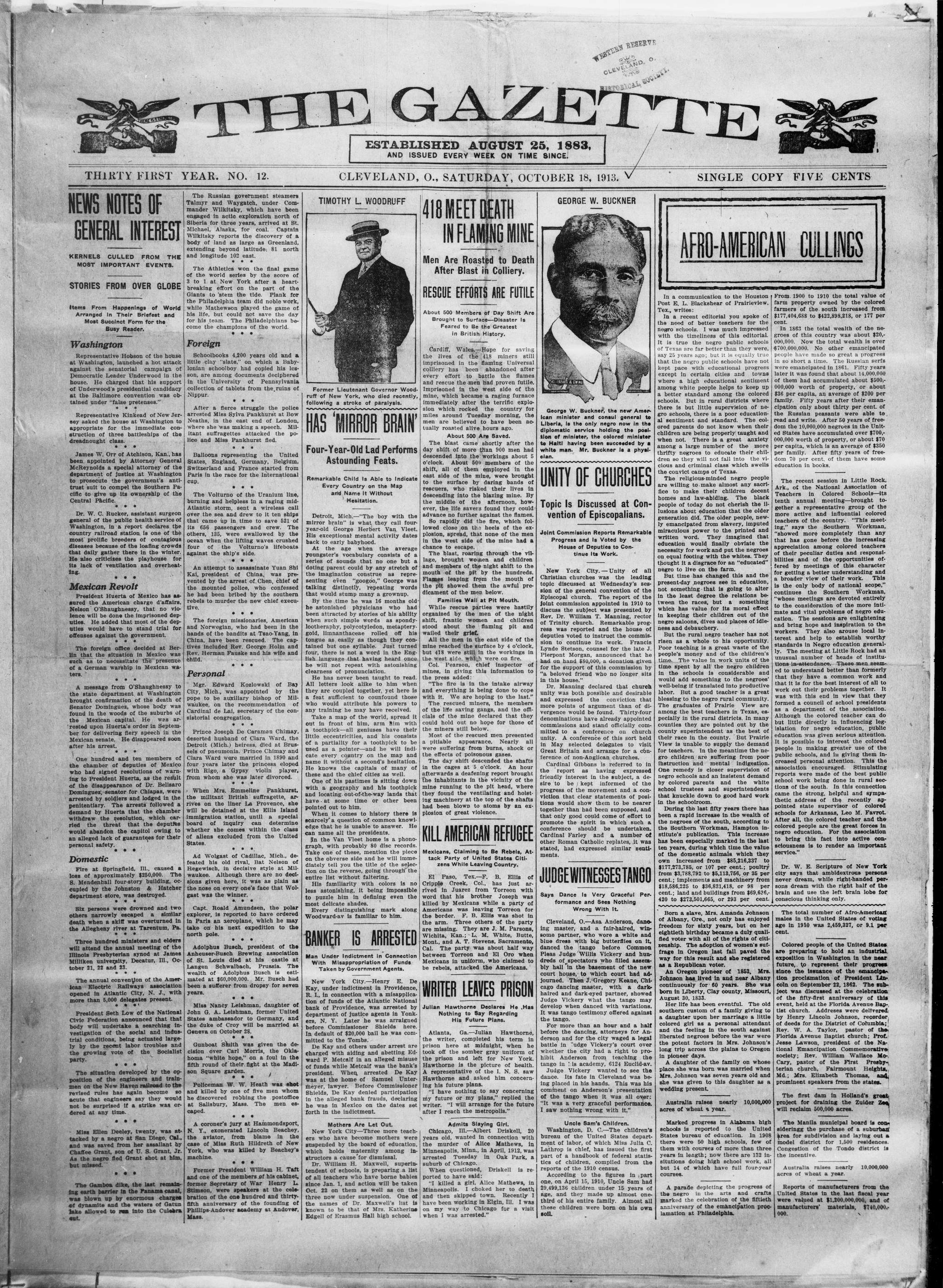
TIMOTHY L. WOODRUFF
Former Lieutenant Governor Wood ruff of New York, who died recently, following a stroke of paralysis.
HAS 'MIRROR BRAIN'
Four-Year-Old Lad Performs Astounding Feats.
Remarkable Child Is Able to Indicate Every Country on the Map and Name It Without Hesitation.
Detroit, Mich.—"The boy with the mirror brain" is what they call four-year-old George Herbert Van Vleet. His exceptional mental activity dates back to early babyhood.
At the age when the average youngster's vocabulary consists of a series of sounds that no one but a doting parent could by any stretch of the imagination construe as representing even "gooooo," George was talking distinctly, repeating words that would stump many a grownup.
By the time he was 16 months old he astonished physicians who had been attracted by stories of his ability when such simple words as spondy-lootherapy, polycytledon, metaptery-gold, limnathaceae rolled off his tongue as easily as though they contained but one syllable. Just turned onto the page, the King of English, language that having heard once he will not repeat with astonishing clearness of pronunciation.
He has never been taught to read. All letters look alike to him when they are coupled together, yet here is a feat sufficient to countfound those who would attribute his powers to any training he may have received.
Take a map of the world, spread it out in front of him, arm him with a toothpick—all geniuses have their little eccentricities, and his consists of a partiality for a toothpick to be used as a pointer—and he will indicate every country on the map and name it without a second's hesitation. He knows the capitals of many of these and the chief cities as well.
One of his pastimes is sitting down with a geography and his toothpick and locating out-of-the-way lands that have at some time or other been pointed out to him.
When it comes to history there is scarcely a question of common knowledge that he is unable to answer. He can name all the presidents.
In the Van Vleet home is a phonograph, with probably 80 disc records. Take one of these, mention the piece on the obverse side and he will immediately tell you the title of the selection on the reverse, going through the entire list without faltering.
His familiarity with colors is no less astonishing, it being impossible to puzzle him in defining even the most delicate shades.
Every distinguishing mark along Woodward-av is familiar to him.
'BANKER IS ARRESTED
Man Under Indictment in Connection With Misappropriation of Funds Taken by Government Agents.
New York City—Henry E. De Kay, under indictment in Providence, R. I., in connection with a misapplication of funds of the Atlantic National bank of Providence, was arrested by department of justice agents in Yonkers, N. Y. Later he was arraigned before Commissioner Shields here. In default of $20,000 bail he was committed to the Tombs.
De Kay and others under arrest are charged with aiding and abetting Edward P. Metcalf in an alleged misuse of funds while Metcalf was the bank's president. When arrested De Kay was at the home of Samuel Untermeyer, lawyer. Before Commissioner Shields, De Kay denied participation in the alleged bank frauds, declaring he was in Mexico on the dates set forth in the indictment.
Mothers Are Let Out.
New York City—Three more teachers who have become mothers were suspended by the board of education, which holds maternity among instructors a cause for dismissal.
Dr. William H. Maxwell, superintendent of schools, is preparing a list of all teachers who have borne babies since Jan. 1, and action will be taken Oct 22 on them as well as on the three now under suspension. One of the names of Dr. Maxwell's list is known to be that of Mrs. Katherine Edgell of Erasmus Hall high school.
About 500 Members of Day Shift Are Brought to Surface—Disaster Is Feared to Be the Greatest in British History.
Cardiff, Wales—Hope for saving the lives of the 418 miners still imprisoned in the flaming Universal colliery has been abandoned after every effort to battle the flames and rescue the men had proven futile. Imprisoned in the west side of the mine, which became a raging furnace immediately after the terrific explosion which rocked the country for miles around Tuesday morning, the men are believed to have been actually roasted alive hours ago.
About 500 Are Saved.
The blast came shortly after the day shift of more than 900 men had descended into the workings about 5 o'clock. About 500 members of the shift, all of them employed in the east side of the mine, were brought to the surface by daring hands of rescuers, who risked their lives in descending into the blazing mine. By the middle of the afternoon, however, the life savers found they could advance no further against the flames. So rapidly did the fire, which followed close on the heels of the explosion, spread, that none of the men in the west side of the mine had a chance to escape.
The blast, roaring through the village, brought women and children and members of the night shift to the mouth of the pit by the hundreds. Flames leaping from the mouth of the pit showed them the awful predicament of the men below.
Families Wall at Pit Mouth.
While rescue parties were hastily organized by the men of the night shift, frantic women and children stood about the flaming pit and wailed their grief.
All the men in the east side of the mine reached the surface by a 0'clock, but 418 were still in the workings in the west side, which were on fire.
Col. Pearson, chief inspector of mines, in giving this information to the press added:
"The fire is in the intake airway and everything is being done to cope with it. We are hoping to the last."
The rescued miners, the members of the life saving gangs, and the officials of the mine declared that they could hold out no hope for those of the miners still below.
Most of the rescued men presented a pititable appearance. Nearly all were suffering from burns, shock or the effects of poisonous gases.
The day shift descended the shafts in the cages at 5 o'clock. An hour afterwards a deafening report brought the inhabitants in the vicinity of the mine running to the pit head, where they found the ventilating and hoisting machinery at the top of the shafts had been blown to atoms by an explosion of great violence.
KILL AMERICAN REFUGEE
Mexicans, Claiming to Be Rebels, Attack Party of United States Citizens While Leaving Country.
El Paso, Tex.—F. B. Ellis of Cripple Creek, Col., has just arrived in Juarez from Torreon with word that his brother Joseph was killed by Mexicans while a party of Americans was leaving Torreon for the border. F. B. Ellis was shot in the arm. Three others of the party are missing. They are J. M. Parsons, Wichita, Kan.; L. M. White, Butte, Mont, and A. T. Stevens, Sacramento, Cal. The party was about half way between Torreon and El Oro when Mexicans in uniform, who claimed to be rebels, attacked the Americans.
WRITER LEAVES PRISON
Julian Hawthorne Declares He Has Nothing to Say Regarding His Future Plans.
Atlanta, Ga.—Julian Hawthorne, the writer, completed his term in prison here at midnight, when he took off the somber gray uniform of the prison and left for New York. Hawthorne is the picture of health. A representative of the I. N. S. saw Hawthorne and asked him concerning his future plans.
"I have nothing to say concerning my future or my plans," replied the writer. "I will arrange for the future after I reach the metropolis."
Admits Slaving Girl
Chicago, Ill.—Albert Driskell, 20 years old, wanted in connection with the murder of Alice Mathews, in Minneapolis, Minn., in April, 1912, was arrested Tuesday in Oak Park, a suburb of Chicago.
When questioned, Driskell is reported to have said:
"I killed a girl, Alice Mathews, in Minneapolis. I choked her to death and then skipped town. Recently I have been working in Elgin, Ill. I was on my way to Chicago for a visit when I was arrested."
GEORGE W. BUCKNER
George W. Buckner, the new American minister and consul general to Liberia, is the only negro now in the diplomatic service holding the position of minister, the colored minister to Haiti having been succeeded by a white man. Mr. Buckner is a phyle-ian.
Joint Commission Reports Remarkable Progress and Is Voted by the House of Deputies to Continue Its Work.
New York City.—Unity of all Christian churches was the leading topic discussed at Wednesday's session of the general convention of the Episcopal church. The report of the joint commission appointed in 1910 to discuss the subject was presented by Rev. Dr. William T. Manning, rector of Trinity church. Remarkable progress was reported and the house of deputies voted to instruct the commission to continue its work. Francis Lynde Stetson, counsel for the late J. Pleperp Morgan, announced that he had on hand $80,000, a donation given for the support of this commission by "a beloved friend who no longer sits in this house."
Dr. Manning declared that church unity was both possible and desirable and expressed the conviction that more points of argument than of divergence would be found. Thirty-four denominations have already appointed commissions and stand officially committed to a conference on church unity. A conference of this sort held in May selected delegates to visit Great Britain and arrange for a conference of non-Anglican churches.
Cardinal Gibbons is referred to in the report as having expressed friendly interest in the subject, a desire to be kept informed of the progress of the movement and a conviction that clear statements of positions would show them to be nearer together than had been supposed, and that only good could come of effort to promote the spirit in which such a conference should be undertaken. Cardinal Farley and a number of other Roman Catholic replates, it was stated, had expressed similar sentiments.
JUDGEWITNESSESTANGO
Says Dance Is Very Graceful Performance and Sees Nothing Wrong With It.
Cleveland, O.—Asa Anderson, dancing master, and a fair haired, winsome partner, who wore a white and blue dress with big butterflies on it, danced the tango before Common Pleas Judge Willis Vickery and hundreds of spectators who filled assembly hall in the basement of the new court house, to which court had adjourned. Then J. Gregory Keane, Chicago dancing master, with a dark haired and dark-eyed partner, showed Judge Vickery what the tango may develop when danced with variations. It was tango testimony offered against the tango.
For more than an hour and a half before the dancing, attorneys for Anderson and for the city waged a legal battle in "judge Vickery" the court over whether the city had a right to prohibit Anderson from teaching the tango in its academy, 6124 Euclid-av. Judge Vickery wanted to see the dance. Its fate in Cleveland was being placed in his hands. This was his comment on Anderson's presentation of the tango when it was all over: "It was a very graceful performance. I saw nothing wrong with it."
Uncle Sam's Children.
Washington, D. C.—The children's bureau of the United States department of labor, of which Miss Julia C. Lathrop is chief, has issued the first part of a handbook of federal statistics of children, compiled from the reports of the 1910 census. According to the figures in part one, on April 15, 1910, Uncle Sam had 29,499,136 children under 15 years of age, and they made up almost one-third of his entire family. Almost all these children were born on his own soil.
SINGLE COPY FIVE CENTS
AFRO-AMERICAN CULLINGS
In a communication to the Houston Post E, Blackshear of Prairieview, Tex., writes:
In a recent editorial you spoke of the need of better teachers for the negro schools. I was much impressed with the timeliness of this editorial. It is true the negro public schools of Texas are far better than they were, say 25 years ago; but it is equally true that the negro public schools have not kept pace with educational progress except in certain cities and towns where a high educational sentiment among white people helps to keep up a better standard among the colored schools. But in rural districts where there is but little supervision of negro schools, there is a poor educational sentiment and standard. The colored parents do not know when their children are being properly taught and when not. There is a great anxiety among a large number of the more thrifty negroes to educate their children so they will not fall into the vicious and criminal class which swells the convict camps of Texas.
The religious-minded negro people are willing to make almost any sacrilege to make their children decent homes and law-abiding. The black people of today do not cherish the illusions about education that the older generation did. The older people, newly emancipated from slavery, imputed miraculous power to the printed and written word. They imagined that education would finally obviate the necessity for work and put the negroes on equal footing with the whites. They thought it a disgrace for an "educated" negro to live on the farm.
But time has changed this and the present-day negroes see in education, not something that is going to alter in the least degree the relations between the races, but a something which has value for its moral effect in keeping their children out of the negro saloons, dives and places of iden-ness and debauchery.
But the rural negro teacher has not risen as a whole to his opportunity. Poor teaching is a great waste of the people's money and of the children's time. The value in work units of the time spent by all the negro children in the schools is considerable and would add something to the negroes' well-being if translated into productive labor. But a good teacher is a great blessing to the negro rural community. The graduates of Prairie View are among the best teachers in Texas, especially in the rural districts. In many counties they are pointed out by the county superintendent as the best of their race in the county. But Prairie View is unable to supply the demand for teachers. In the meantime the negro children are suffering from poor instruction and mental indigestion. One remedy is closer supervision of negro schools and an insistent demand by colored parents and the white school trustees and superintendents that knuckle down to good hard work in the schoolroom.
During the last fifty years there has been a rapid increase in the wealth of the negroes of the south, according to the Southern Workman, Hampton institute's publication. This increase has been especially marked in the last ten years, during which time the value of the domestic animals which they own increased from $5,216,337 to $177,273,785, or 107 per cent.; poultry from $3,788,792 to $5,113,756, or 35 per cent.; machinery from $18,586,262 to $36,831,418, or 98 per cent.; land and buildings from $69,636,420 to $273,501,665, or 293 per cent.
Born a slave, Mrs. Amanda Johnson of Albany, Ore., not only has enjoyed freedom for sixty years, but on her eighteenth birthday became a duly qualified voter with all of the rights of citizenship. The adoption of women's suffrage in Oregon last paved the way for this result and she registered as a Republican voter.
An Oregon pioneer of 1853, Mrs. Johnson has lived in and near Albany continuously for 60 years. She was born in Liberty, Clay county, Missouri, August 30, 1833.
Her life has been eventful. The old southern custom of a family giving to a daughter upon her marriage a little colored girl as a personal attendant and the feeling in the south against liberated negroes before the war were the potent factors in Mrs. Johnson's long trip across the plains to Oregon in pioneer days.
A daughter of the family on whose place she was born was married when Mrs. Johnson was seven years old and she was given to this daughter as a wedding present.
Australia raises nearly 10,000,000 acres of wheat a year.
Marked progress in Alabama high schools is reported to the United States bureau of education. In 1908 there were 50 high schools, few of them with courses of more than three years in length; now there are 132 institutions doing high school work, all but 14 of which have full four-year courses.
A parade depicting the progress of the negro in the arts and crafts marked the celebration of the fiftieth anniversary of the emancipation proclamation at Philadelphia.
PY FIVE CENTS
AN CULLINGS
From 1900 to 1910 the total value of farm property owned by the colored farmers of the south increased from $177,404,658 to $422,898,218, or 177 per cent.
In 1863 the total wealth of the negroes of this country was about $20,000,000. Now the total wealth is over $700,000,000. No other emancipated people have made so great a progress in so short a time. The Russian serfs were emancipated in 1861. Fifty years later it was found that about 14,000,000 of them had accumulated about $500,000,000 worth of property, or about $36 per capita, an average of $200 per family. Fifty years after their emancipation only about thirty per cent. of the Russian peasants were able to read and write. After 50 years of freedom the 10,000,000 in the United States have accumulated over $700,000,000 worth of property, or about $70 per capita, which is an average of $350 per family. After fifty years of freedom 70 per cent. of them have some education in books.
The recent session in Little Rock, Ark., of the National Association of Teachers in Colored Schools—its tenth annual meeting—brought together a representative group of the more active and influential colored teachers of the country. "This meeting," says the Southern Workman, "showed more completely than any that has gone before the increasing appreciation among colored teachers of their peculiar duties and responsibilities and of the opportunities offered by meetings of this character for getting a better understanding and a broader view of their work. This is the only body of national scope," continues the Southern Workman, "whose meetings are devoted entirely to the consideration of the more intimate and vital problems of negro education. The sessions are enlightening and bring hope and inspiration to the workers. They also arouse local interest and help to establish worthy standards in Negro education generally. The meeting at Little Rock had an unusual number of heads of institutions in attendance. These men seemed to understand better than formerly that to understand better than formerly that it is for the best interest of all to work out their problems together. It was with this end in view that they formed a council of school presidents as a department of the association. Although the colored teacher can do little directly in influencing legislation for negro education, public education was given serious attention. It is possible to interest the colored people in making greater use of the public schools, and in giving them increased personal attention. This the association encouraged. Stimulating reports were made of the best public school work being done in rural sections of the south. In this connection came the strong, helpful and sympathetic address of the recently appointed state supervisor of colored schools for Arkansas, Leo M. Favrot. After all, the colored teacher and the colored people are the great forces in negro education. For the association to bring this fact into active consciousness is to render an important service."
Dr. W. E. Scripture of New York city says that ambidextrous persons never dream, while right-handed persons dream with the right half of the brain and use the left brain lobe for conscious thinking only.
The total number of Afro-American males in the United States of voting age in 1910 was 2,459,327, or 9.1 per cent.
Colored people of the United States are preparing to hold an industrial exposition in Washington in the near future, to represent their progress since the issuance of the emancipation proclamation of President Lincoln on September 22, 1862. The subject was discussed at the celebration of the fifty-first anniversary of this event, held at the Florida Avenue Baptist church. Addresses were delivered by Henry Lincoln Johnson, recorder of deeds for the District of Columbia; Rev. W. A. Taylor, pastor of the Florida Avenue Baptist church; Prof. Jesse Lawson, president of the National Emancipation Commemorative society; Rev. William Wallace McCary, pastor of the First Presbyterian church, Fairmount Heights, Md.; Mrs. Elizabeth Thomas, and prominent speakers from the states.
The first dam in Holland's great project for draining the Zuider Zee will reclaim 500,000 acres.
The Manila municipal board is considering the purchase of a suburban area for subdivision and laying out a model district for 1,500 residences. Congestion of the Tondo district is the incentive.
Australia raises nearly 10,000,000 acres of wheat a year.
Reports of manufacturers from the United States in the last fiscal year were valued at $1,200,000,000, and of manufacturers' materials, $740,000,000.
One Year.....$1.00
Six Months.....1.00
Three Months......80
Subscribers are requested to remit by postoffice money order or registered letter.
Entered at the postoffice in Cleveland Ohio, as second-class matter
Address all communications to HARRY C. SMITH
Editor and proprietor,
THE GAZETTE,
Blackstone Building, Cleveland, O.
Member Ohio Legislature: 1894 to 1896; 1898 to 1898; 1900 to 1908
THE GAZETTE is the oldest, and has the largest bona fide circulation, double that of any newspaper in the interest of Afro-Americana, published in the state of Ohio, and comparison with any will immediately establish its rank as one of the NEWSIEST AND BEST in the country.
SATURDAY, OCTOBER 18, 1913.
"Our Message" is the name of a new, and yet, one of our best monthly publications. R. W. E. Ferguson, of Albany, O., a practical printer, is the editor and publisher. We advise our readers to subscribe for "Our Message." It is only ten cents a copy, forty cents a half year, and seventy-five cents, a year.
Gov. James M. Cox, honored the editor of The Gazette, last month, by appointing him one of the delegates from Ohio to attend the emancipation exhibition held in Exposition hall, At lantic City, N. J., Oct. 6, '13. On Oct 1, he again honored the editor with a similar appointment to the celebration of the fiftieth anniversary of the emancipation proclamation, to be held in New York City, Oct. 22-31, '13 Thank you, Governor.
THE SECOND EMANCIPATION.
Thoughful people must stand agast as they ponder over the insidious influences now at work to re-enslave our race. An alarmist should never be encouraged but the careful observer of his times and the trend of things, needs to be heard. The reunion at Gettysburg brought together the men who fought to save the union and free the slaves and the men who fought to destroy the union and keep in bondage over four millions of human beings, to fraternize and talk over the horrors of the past. We do not object to this, nor do we object to the old soldiers forever dismissing personal bitterness from their hearts but we do object to the silly and hypocritical fawning that places on equality "the wearers of the blue and gray." There was a principle at stake that caused that fierceest of struggles. Either the gray was right and the blue wrong, or vice versa. Which ever was wrong then is wrong now and any effort to glorify the destroyers of the union shows a perverse spirit abroad. It is just as sensible and reasonable for a pardoned murder to glory in his awful crime as it is for the wearers of the gray, or their progenitors, to glory in their unsuccessful attempt to destroy the union and continue slavery. The milions of silent graves all over the country do but echo the blackness of their deed. The worst of all this fawning hypocrisy is the subtle attempt to cement white man of the north and white man of the south while the south enslaved the Negro once he re-enslaved him again, and so long as this false friendship lasts the south will not be interfered with in its anti-Negro warfare. The present administration at Washington is decidedly anti-Negro. The rulers of this country are now southern men. Every attempt is being made to remove the Afro-American from the political life of the nation and make him a servant. President Wilson promised to be a Christian gentleman in his treatment of our race and judging from his present course, his Christianity consists in removing the Afro-American from office and segregating those who are covered by civil service from the companionship of white employees. Throughout the departments at Washington a nasty bourbon spirit stalks. Mr. Wilson has not deceived us. His Christianity, like the Christianity of his southern parents, is anti-golden rule. This administration an accident. The all-absorbing question will is this accident repeat itself at the next election? We hope not. The country is not safe in the hands of sons of rebels. The black man can but expect from the sons of rebels, who are inferior in kindly traits to their forefathers, whose acts shocked the world, the most brutal treatment. An intelligent electorate in 1916 can put an end to this awful accident. Those who shall succeed this administration must begin a new the emancipation of the Colored man. The laws of this land must protect all alike, whether in Maine or South Carolina. Fitness for political office must not rest upon the hue of the skin, either in California or Virginia. The Afro-American must not be robbed of a trial by a jury of his peers and in its stead be tried by a jury of avowed enemies to his rights in everything if they in anyway conflict with the rights of another (white) man. Just as this country could not stand while a portion were free and the others slaves, neither can it stand with a portion protected by the law and the other portion brutalized by that same law. As unsatisfactory as was the Taft administration. At was infinitely better in sentiment and deeds, so far the black man is concerned, than the present administration. Thoughtful colored men everywhere must use their pen, voice and ballot to secure for all races, and especially the black
race, the protection of the constitution. The initiative, referendum, recall and nation-wide primary are not to be considered, so far as the black man is concerned, till his constitutional rights are guaranteed. The Afro-American in the south must help fight this battle. So long as he is content to remain in the south and whine about his being kicked, but takes it meekly while the boot is being used, the world will have very little respect for him. The false position of acquiescing in and remaining sweet while all that is worth while for him is being taken away, must no longer hold sway. An individual that will not strike a blow for his own free dom is not deserving the assistance of another to free him. Let us vote right next time.
A CORRECTION
Editor Gazette, Dear Sir:—The statement in last week's Gazette to the effect that I, ("Starlight" Boyd) have been selected as one of Davis' "Colored" political leaders, is absolutely false. I am attending to my husband and have naval that I can do to attend to that. My choice for mayor will be Mr. Newton D. Baker.
Signed. A. D. Boyd.
JACK JOHNSON'S BAIL FOR
FEITED.
Chicago, Ill.—Federal Judge Carpenter has ordered Jack Johnson's $30,000 bail bond forfeited. The prize fighter left the country while an appeal from his sentence to one year and one day in the federal prison and was sentenced to a prison sentence. White slave law, was pending. Jack is now a citizen and resident of Paris, France. According to a letter from him, he is earning $2,000 a week in the French metropolis. Next week, he will be engaged at Vienna which will make him $27,000 richer. Following each performance, the pugilist and his (white) wife give an interpretation of "tango dancing as it is done in Chicago." Jack has purchased another piece of property in France, plans to move to New York and Pout a suburb of Paris, and to establish an American cafe in Paris.
Color Discrimination.
Dr. C. Motley, a native of this island, who for a considerable time has been residing in the United States, is now on a visit to Barbados. He has called at this office and provided the information that he has instructed his lawyers in New York to institute prosecution of a man who Holt for alleged color discrimination in passenger booking. He said that his case would come within the scope of a new law on the point which became operative on the 1st instant. When it is recollected how Madame Patti Brown, the popular singer, was treated some little time ago one can remember going good back to Dr. Motley's action. Weedy, well-illustrated Paper, Barbados, West Indies, Sept. 20—13.
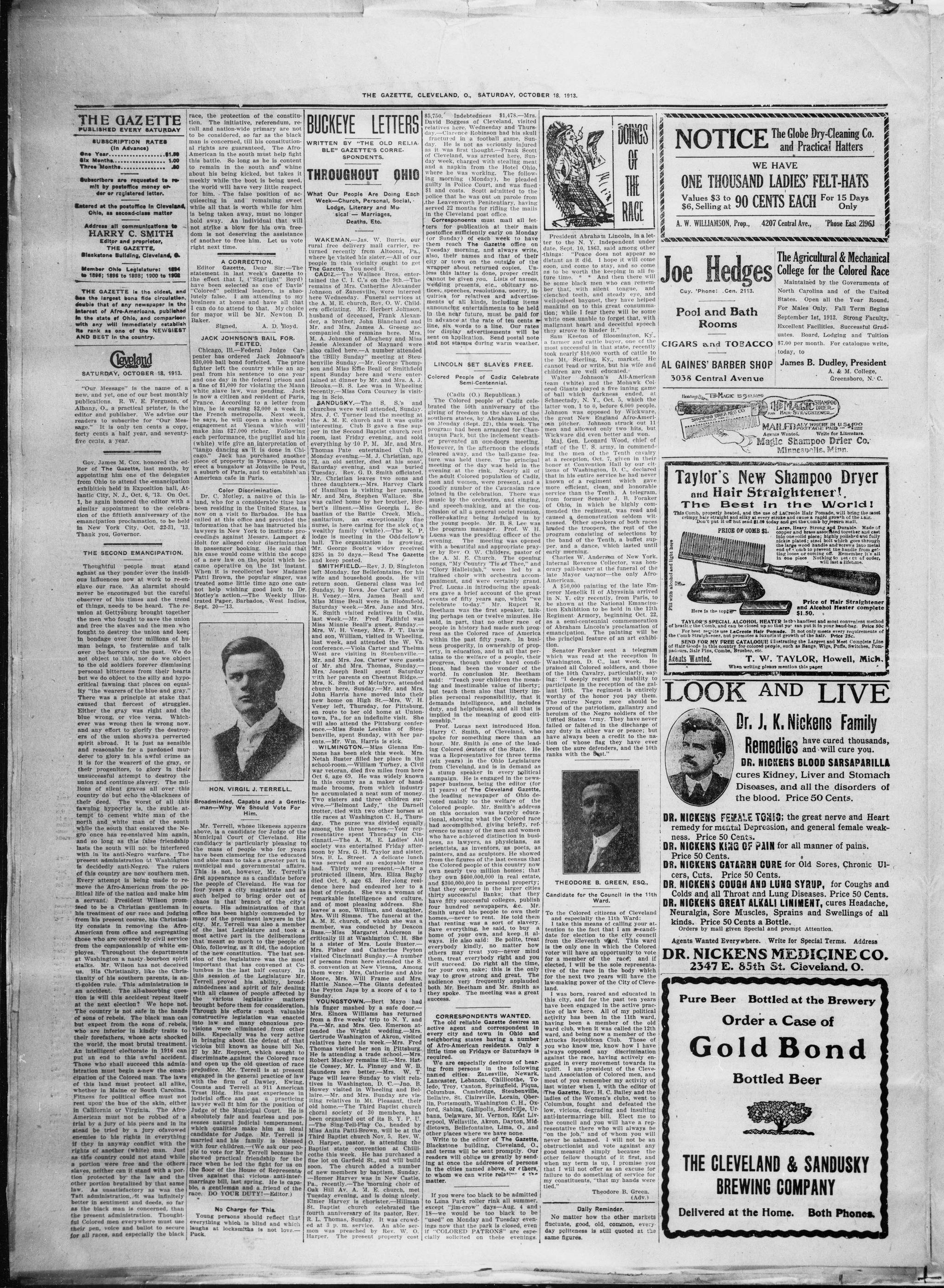
HON. VIRGIL J. TERRELL.
Broadminded, Capable and a Gentle man—Why We Should Vote For Him.
Mr. Terrell, whose likeness appears above, is a candidate for Judge of the Municipal Court of Cleveland. His candidacy is particularly pleasing to the mass of people who for years have been clamoring for the educated and able man to take a greater part in municipal and governmental affairs. Mr. Terrell's first appearance as a candidate before the people of Cleveland. He was for four years a city magistrate and as such helped to bring order out of chaos in that branch of the city's courts. His administration of that office has been highly commended by many of the prominent lawyers in the municipal and governmental affairs of the last Legislature and took an most active part in the deliberations that meant so much to the people of Ohio, following, as it did, the adoption of the new constitution. The last session of the legislature was the most important that has convened at Colton, as the county seat of the session of the Legislature. Mr. Terrell proved his ability to broad mindedness and many obnoxious projections of the legislative matters brought before them for consideration. Through his efforts much valuable constructive legislation was enacted into law and many obnoxious projections were made to the bills. Especially was he very active in bringing about the defeat of that vicious bill known as house bill No. 27 by Mr. Reppert, which sought to discriminate against the Colored race and open up the old question of race prejudice. Mr. Terrell is at present engaged in the general practice of law with the firm of Dawley, Ewing, and Terrell of the Municipal Court. Trust Bldg. His past experience in judicial office and as a practicing lawyer well fit him for the position of Judge of the Municipal Court. He is absolutely fair and fearless and possesses natural judicial temperament, which qualities make him an ideal candidate for Judge. Mr. Terrell is married and his family is blessed with a loving husband. Our people to vote for Mr. Terrell have shown practical friendship for the race when he led the fight for us on the floor of the House of Representatives against that vicious anti-intermarriage bill, last spring. He is capable, a gentleman and a friend of the race. DO YOUR DUTY!-Editor.)
No Charge for This.
Young persons should reflect that everything which is blind and which laughs at locksmiths is not love.—Puck.
THE GAZETTE, CLEVELAND, O., SATURDAY, OCTOBER 18, 1913.
WRITTEN BY "THE OLD RELIA-
BLE" GAZETTE'S CORRE-
SPONDENTS.
THROUGHOUT OHIO
What Our People Are Doing Each Week—Church, Personal, Social, Lodge, Literary and Musical — Marriages, Deaths, Etc.
WAKEMAN.—Jas. W. Burris, our rural free delivery mail carrier, returned recently from Altoona, Pa., where he visited them.—All of our people in this vicinity ought to get the Gazette. You need it.
CADIZ—The Wallace Bros. entertained the C. I. C.'s on the 9th. The remains of Mrs. Catherine Alexander Johnson of Zanesville, were interred here Wednesday. Funeral services at the A. M. E. church, Rev. O. V. Child, Jr., the President of the husband of deceased, Frank Alexander, a brother, John Blanchard and Mr. Mrs. James A. Greene accompanied the remains here. Mrs. M. A. Johnson of Allegeny and Miss Jessie Alexander of Maynard were also called here. A number attended the "Billy Sunday" meeting at Steu benville Sunday. Mr. George Thompson and Miss Effie Ellen of Smithfield spent Sunday here and were entertained at dinner by Mr. and Mrs. A. J. Johnson. The man was visiting recently—Miss Coa Coursey is visiting in Scio.
SANDUSKY.—The S. S.'s and churches were well attended. Sunday, Mrs. J. C. Turner lead the meeting at the A. M. E. church and it was quite interesting. Club B gave a fine supper in the Second Baptist church rest room, last Friday evening, and sold everything by 10 P. M. Mr. and Mrs. Thomas Pate entertained Club B, Monday evening. M. J. Christian, age old sister, at his sons' Saturday evening, and evening at Tuesday, Rev. G. D. Smith officiated, Mr. Christian leaves two sons and three daughters.—Mrs. Harvey Clark of Hamilton is visiting her parents, Mr. and Mrs. Stephen Wallace. She was called home by her brother, Herbert's illness.—Miss Georgina L. Se bastian of the Battle Creek, Mich. sanitarium, an exceptionally fine nurse, is here carving for the skid of a P lodge is meeting in the Odd-fellow's hall. The organization is growing 'Mr. George Scott's widow received $285 in 30 days.—Read The Gazette and keep posted.
SMITHFIELD.—Rev. J. D. Singleton left Monday, for Belfontaine, for his wife and household goods. He will return soon. General class was led Sunday, by Revs. Joe Carter and W. H. Veney.—Mrs. James Beall and Miss Mime Beall were in Bloomfield, Saturday week.—Mr. Jane and Mrs. Veney, Sunday.—Mr. James last week.—Mr. Fred Faithful was Miss Minnie Beall's guest, Sunday.—Mrs. H. Veney, Mrs. F. T. Davis and son, William, visited in Wheeling, last week, and attended the W. Va. conference.—Viola Carter and Thelma West are visiting in Steubenville.—Mr. and Mrs. Jos. Carter were guests of Mr. and Mrs. Thomas, Sunday.—Mr. and Mrs. Thomas with her parents on Chestnut Ridge.—Mrs. K. Smith of McIntyre, attended church here, Sunday.—Mr. and Mrs. John Harris have moved into their new home on High St.—Mrs. W. H. Veney left, Thursday, for Pittsburgh, en route to her old home at Uniontown, Pa., for an indefinite visit. She will return on Monday.—Miss Susie Leekins of Steubenville, spent Sunday, with her parents.—Mr. Wm. Harris is sick.
WILMINGTON—Miss Glenna Emons has been sick this week. Mrs. Netah Buster filled her place in the school-room.—William Turney, a Civil war veteran, died five miles from here Oct 6, age 69. He was widely known in this county as a maker of hand made brooms, from which industry he accumulated that sum money. He also purchased three such items to survive. "Belmont Lady," the Darnell trotter, tied with two other horses at the races at Washington C. H., Thursday. The purse was divided equally among the three horses. Your representative spent Thursday in Cincinnati.—The A. M. E. Ladies' Aid society was entertained Friday afternoon by Mrs. G. H. Taylor and sister, Mrs. E. M. E. W. of which a member was served and an enjoyable time had. Thirty were present.—After a protracted illness, Mrs. Eliza Baggy died Oct. 9, age 63. Her long residence here had endured her to a host of friends. She was a woman of remarkable intelligence and culture, and of most pleasing address. She leaves a son, William, and daughter, Mrs. Will Simms. The funeral at the M. E. W. of which a member was conducted by Deacon Bass.—Miss Margaret Anderson is critically ill at Washington C. H. She is a sister of Mrs. Louis Buster.—Mrs. Fisher and Catherine Peyton visited Cincinnati Sunday.—A number of persons from here attended the S. convention at New Vienna. Among them were: Mrs. Catherine and Able Frost, Mrs. Frances Hattle Nance. The Glants defeated the Peyton Jays by a score of 4 to 1 Sunday.
YOUNGSTOWN—Bert Mayo has his finger mashed by a safe door.—Mrs. Elnora Williams has returned from a five weeks' trip to N. Y. and Pa.—Mr. and Mrs. Geo. Emerson attended the Wright wedding.—Mrs. Gertrude Washington of Akron, visited relatives here this week.—Mrs. Free Thomas visited her son in Pittsburgh.—Mrs. Elizabeth Robert Mackey remains ill.—Mrs. Hat cossy, Mr. L. Finney and W. B. Saunders are better.—Mrs. W. T. Page will leave Sunday to visit relatives in Washington, D. C.—Jno. B. Howey visited in Wheeling and Belleaire.—Mr. and Mrs. Bunley are visiting relatives in Mt. Pleasant, their old home.—The Third Baptist church choral society of 30 members, has been organized out of its B. Y. U. and W. B. Saunders.—Miss Anita Patti-Brown, will be at the Third Baptist church Nov. 5. Rev W. O. Harper, pastor, is attending the Baptist state convention at Chillicothe this week. He has purchased a fine lot on Garfield St., and will build soon. The church added a number of new members by baptism, Sunday.—Homer Harvey was in New Castle, pa., recently.—The morning choir of Oak Hill Av. A. M. E. church, met Tuesday evening, and is doing nicely. The christianity of William St. Baptist church celebrated fourth anniversary of its pastor, Rev. R. L. Thomas, Sunday. It was crowded at 3 p. m. service. An able sermon was preached by Rev. W. O. Harper. The present property cost
85,750. Indebtedness $1,478.-Mrs. David Boggess of Cleveland, visited relatives here. Wednesday and Thursday.-Clarence Robinson had his skull fractured in a football game, Sunday as it was seriously injured as it was first injured. Of Cleveland, was arrested here, Sunday week, charged with stealing meat and a napkin from the Hotel Ohio, where he was working. The following morning (Monday), he pleaded guilty in Police Court, and was fined $200. Scott admitted to the police that he was stealing the Leavenworth Penitentiary, having served 22 months for riffing the mails in the Cleveland post office.
Correspondents must mail all letters for publication at their main postoffice sufficiently early on Monday (or Sunday) of each week to have them reach The Gazette office on Tuesday morning, and always write, also their names and that of their names, and that of the wrapper about return copies, less this latter is done, proper credit cannot be given you. Lists of names, wedding presents, etc., obituary notices, speeches, resolutions, poetry, inquiries for relatives and advertisements of all kinds, including items announcing entertainments to be held in the near future, must be paid for in the near future, the rate of ten cents a line, six words a line, for display advertisements will be sent on application. Send postal note and not stamp during warm weather.
LINCOLN SET SLAVES FREE.
Colored People of Cadiz Celebrate Semi-Centennial.
(Cadiz (O. Republican.) The Colored people of Cadiz celebrated the 50th anniversary of the giving of freedom to the slaves of the southern states, by Abraham Lincoln, in 1865. The program had been arranged for Chanqua Park, but the inclement weather prevented an one-door meeting. However, in the afternoon the clouds cleared away, and the ball-game feature was held there. The principal meeting of the day was held in the evening at the rink. Nearly all of the adult Colored population of Cadiz, men and women, were present, and a goodly number of the Caucasian race joined in the celebration. There was a good audience, and speech-making, and at the conclusion of all a general reunion, roller-skating being indulged in by the young people. Mr. B. S. Lee was the program manager. Prof. W. H. Lucas was the presiding officer of the evening. The meeting was opened with a beautiful and appropriate prayer by Rev. O. W. Childers, pastor of the Church. The opening of "My Country, This of God" the "Gallery HollyJuille" was led by a trained choir with orchestra accompaniment, and were certainly grand. Prof. Lucas in introducing the speakers gave a brief account of the great events of fifty years ago, which "we celebrate to-day." Mr. Rupert R. Beetham was the first speaker, talking perhaps ten or twelve minutes. He said, in part, that no other race of people in history had made such progress as the colony of America. In what the past fifty years in business prosperity, in ownership of property, in education, and in all that pertains to the welfare of a people, their progress, though under hard conditions, had been the wonder of the world. In conclusion Mr. Beetham said: "Teach your children the meaning and inestimable value of liberty; but teach them also that liberty implies personal responsibility, that if duty, and helpfulness, and all that is implied in the meaning of good citizenship."
Prof. Lucas next introduced Hon. Harry C. Smith, of Cleveland, who spoke for something more than an hour. Mr. Smith is one of the leading Colored orators of the State. He was a Representative for three terms (six years) in the Ohio Legislature from Cleveland, and is in demand as a candidate for the campaign. He is engaged in the newspaper business, being the editor (for 31 years) of The Cleveland Gazette, the leading newspaper of Ohio devoted mainly to the welfare of the Colored people. Mr. Smith's address on this occasion was largely educational, showing what the Colored race had accomplished, giving briefly, reference to many of the men and women in the community, as lawyers, as physicians, as scientists, as inventors, as poets, as painters, and as sculptors. He showed from the figures of the last census that the Colored people of this country now own nearly two million homes; that they own $600,000,000 in real estate; and $300,000,000 in personal property; that they operate in the larger cities thirty successful Banks; that they have fifty successful newspapers; and Mr. Smith urged his people to own their homes,—never to rent. He told them that renting was a sort of slavery. Save everything, he said, to buy a home of your own, and keep it always. He also said: Be polite, treat everybody kindly, no matter how others may treat you—never mind them, treat everybody else, succeed. Do right all the time, for own sake; this is the only way to grow strong and great. The audience very frequently applauded both Mr. Beetham and Mr. Smith as they spoke. The meeting was a great success.
CORRESPONDENTS WANTED.
CORRESPONDENTS WANTED.
The old reliable Gazette desires an active agent and a correspondent in every neighbouring state having a number of Afro-American residents. Only a little time on Fridays or Saturdays is required.
We are especially desirous of hearing from persons in the following named cities: Zan.esville, Newark, Lancaster, Lebanon, Chicopee, Todd, Troy, Canton, Spartfield, Piquet, Cambridge, Steubenville, Bellaire, St. Clairsville, Lorain, Oberlin, Portsmouth, Washington C.H., Oxford, Sabina, Gallipolis, Rendville, Urbana, Delaware, M. Vernon, East Liverpool, Wellsville, Akron, Dayton, Middletown, Bellefonte, Lima, O., and other places where we have none.
Write to the editor of The Gazette, Blackstone building, Cleveland, O., and terms will be sent promptly. Our correspondent will be sitting at once the addresses of persons in the cities named above, or others, to whom we can write relations to the matter.
If you were too black to be admitted to Luna Park roller rink all summer, except "jim-crow" days-Aug. 4 and 18—would be too black to be "used" on Monday and Tuesday evening now that the park is closed, even if "COLORED PATRONS" are especially solicited on these evenings.
DOINGS
OF
THE
RACE
President Abraham Lincoln, in a letter to the N. Y. Independent under date, Sept. 10, 1863, said among other things: "Peace does not appear so distant as it did. I hope it will come soon, and come to stay, and so come as to be worth the keeping in all future time." And then there will be some black men who can remember that, with silent tongue, and clenched teeth, and steady eye, and well-poised bayonet, they have helped mankind on to this great consummation; while I fear there will be some white ones unable to forget that, with malignant heart and deceitful speech they strove to hinder it.
Sam Keeton of Bloomington, KY., a farmer and cattle buyer, one of the most successful in that state, recently took nearly $10,000 worth of cattle to the Mt. Sterling, Ky., market. He cannot read or write, but his wife and children are well educated. He is an American team (white) and the Mohawk Colored Giants played a five inning game of ball which darkness ended, at Schnectady, N. Y., Oct. 5, which the latter won, 1 to 0, before 6,000 people. Johnson was opposed by Wickware, the great New England Afro-American pitcher. Johnson struck out 11 in the game, Johnson did better than Wickware did even better and won.
Maj. Gen. Leonard Wood, chief of staff of the U. S. army, in commending the men of the Tenth cavalry at a reception, Oct. 7, given in their honor at Convention Hall by our citizens of Washington, D. C. declared a service the headman known of a regiment which gave more efficient, clean, and honorable service than the Tenth. A telegram, from former Senator J. B. Foraker of Ohio, in which he highly commended the regiment, was read and caused a demonstration seldom witnessed. Other speakers of the program rest of the program consisting of selections by the band of the Tenth, a buffet supper, and a dance, which lasted until early morning. Charles W. Andersen of New York. Internal Revenue Collector, was honorary pail-bearer at the funeral of the late Mayor Gaynor—the only Afro-American.
A $50,000 painting of the late Emperor Menelik II of Abysinia arrived in N. Y. city recently, from Paris, to be shown at the National Emancipation Exhibition to be held in the 12th Regiment Armory, beginning Oct. 22, as a semi-centennial commemoration of Abraham Lincoln's proclamation of emancipation. The painting will be the principal feature of an art exhibition.
Senator Foraker sent a telegram which was read at the reception in Washington, D. C., last week. He praised all Colored soldiers, and those of the 10th Cavalry, particularly, saying: "I deeply regret my inability to participate in the reception of the gallant 10th. The regiment is entirely worthy of the honor you pay them. The entire Negro race should be proud of the patroltion, gallantry and heroism of the Negro soldiers of the 10th Cavalry, who they have never failed or faltered in the discharge of any duty in either war or peace; but have always been a credit to the nation of whose flag they have ever been the sure defenders, and the 10th ranks with the best."
THEODORE B. GREEN, ESQ.,
Candidate for the Council in the 11th
Ward.
To the Colored citizens of Cleveland
and especially the 11th Ward:
and especially the 11th Ward: I take this means of calling your attention to the candidate for election to the city council from the Eleventh ward. This ward is the only one in which the Colored voter will have an opportunity to vote for a member of the race; and if elected, I will be the sole representative of the race in the body which for the next two years will have the law-making power of the City of Cleveland.
I was born, reared and educated in this city, and for the past ten years have been engaged in the active practice of law rev. Here. All of my political activity has been in the 11th ward, which has been the ward of the ward club, when it was called the 12th ward, and being now a member of the Attucks Republican Club. Those of you who know me, know how I have always opposed any discrimination against the race, having actively engaged in every movement towards its establishment. In the land Association of Colored men, and most of you remember my activity of last winter when I, with the editor of The Gazette, H. H. C. Bailey and the ladies of the Women's clubs, went to Columbus, fought and defeated the low, vicious degrading and insulting anti-intermarriage bill. Elect me to the council and you will have a republican vote. I will not "on the job," and of whom you will never be ashamed. I will not be an obstructionist and vote against any good measure simply because the other fellow thought of it first, and when my term is up, I promise you that I will not offer as an excuse for failure to do something of service for constituents, "that my hands were tied."
No matter how the other markets fluctuate, good, old, common, everyday politeness is still quoted at the same figures.
WE HAVE ONE THOUSAND LADIES' FELT-HATS Values $3 to 90 CENTS EACH For 15 Days $6, Selling at Only
Healing Hair. THE MAGIC IS SUPPLIED
SHAMPOO DRIER RES CO.
SHAMPOO DRIER RES CO.
AND HAIR STRENGTHER.
MAIL DAILY WHERE IN U.S.$120
Agents Wanted.
Write for Literature.
Magic Shampoo Drier Co.
Minneapolis, Minn.
TAYLOR'S SPECIAL ALCOHOL HEATER is the handiest and most convenient method of heating the Comb, and can be closed up so that you *can* put in your hand-bag. Price 50c. For best results use La Crete Hair Pomade. It not only meets every requirements of the Comb Strengthener, but promotes a luxurial at growth of the hair. Price 25c.
SEND FOR MY FREE CATALOGUE illustrating the Largest and Most Complete Line of Comb Strips. Plain Strips, Brush Strips, etc.
DR. NICKENS BLOOD SARSAPARILLA cures Kidney, Liver and Stomach Diseases, and all the disorders of the blood. Price 50 Cents.
DR. NICKENS FEMALE TONIC; the great nerve and Heart remedy for mental Depression, and general female weakness. Price 50 Cents.
DR. NICKENS CATARRN CURE for Old Sores, Chronic Ulcers, Cuts. Price 50 Cents.
DR. NICKENS MEDICINE CO. 2347 E. 85th St. Cleveland, O.
Pure Beer Bottled at the Brewery
Order a Case of
Gold Bond
Bottled Beer
THE CLEVELAND & SANDUSKY
BREWING COMPANY
Delivered at the Home. Both Phones.
CIGARS and TOBACCO
AL GAINES' BARBER SHOP
3038 Central Avenue
Heating Cone
TRI-MAGIC IS WELCOME
SHAMP 90 DRESS HEB CO
MA
Age
Mag
Taylor's New
and Hair Stra
The Best in
This Comb, properly heated, and the use of
crimpy hair straight and silky is every
Don't put it off but send $1.00 too
PRICE OF COMB $1.
Fill with alcohol and light here
Here is the top.
TAYLOR'S SPECIAL ALCOHOL HEAT
of heating the Comb, and can be closed up so
for short people use LaCroche Hair Po
the Comb Straighten, and promotes a hum
SEND FOR MY FREE CATALOGUE
of Hair Goods in this country for colored peo
pacours, Hair Pins, Combs, Brushes, etc.
Agents Wanted.
T. W.
When writing please
LOOK A
Dr. J.
Reme
DR. NICKENS
cures Kid
Diseases
the blood
DR. NICKENS FEMALE TON
remedy for mental Depress
ness. Price 50 Cents.
DR. NICKENS KING OF PAIN
Price 50 Cents.
DR. NICKENS CATARRH CUR
cers. Cuts. Price 50 Cents.
The Agricultural & Mechanical College for the Colored Race
Maintained by the Governments of North Carolina and of the United States. Open all the Year Round. For Males Only. Fall Term Begins September 1st, 1913. Strong Faculty- Excellent Facilities. Successful Graduates. Board, Lodging and T tuition $7.00 per month. For catalogue write, today, to
James B. Dudley, President
A. & M. College,
Greensboro, N. C.
Mrs. A. M. Pope—Turnho
Results of "Poro" Treatment
"PORO COLLEGE"
Largest College of its kind in the world.
300 PINE STREET, ST. LOUIS, MO.
400 ORIGINATED
For more information, please visit the general office at 100 N. 20th Street, St. Louis, MO.
All students must attend classes at the college. Students must be registered at the college and must be present at all classes. Students must be present at all classes. Students must be present at all classes.
GRADUATE BORN THE CLOSE OF 1912
AND IN 1921, ENGINEERING NO. 47220
For treatment, call on or address:
MISS KATIE B. COLLIER,
4812 Payne Ave.
Cleveland, Ohio.
The New
Keystone
.RESTAURANT.
2408 Central Ave.
The Best Meals
.Quick Service.
Cigars & Tobacco.
Open Day
and Night.
Chas. McPherson, Prop'r.
Theodore B. Green,
ATTORNEY AT LAW.
508-510 Superior Building.
Office, Main 3076.
Residence, Eddy 2086-R.
CLEVELAND, O.
HOT WEATHER COMFORTS
such as Toilet Waters, Lotions, Talcums, Perfumes, bath preparations of all kinds—the largest and most complete assortment you will find, at the
BROWN DRUG CO.
Both the imported and domestic goods are carried in stock, at cut prices.
Preparations bought here insure satisfaction to the purchaser and help make the summer heat more bearable.
Another "heat reducer" is our sanitary soda fountain, which is now running full blast.
You're sure to meet your friends at THE BROWN DRUG CO., Brown & Seyfert, Proprs.
Leading Cut Rate Druggists.
2742 Central, Cor. E. 28th St.
P. S. We forgot to say we give Eagle stamps with all purchases.
G. G. REED'S
Ladies' and Gent's
Furnishings
A Complete Line of
LADIES' READY-MADE APPAREL.
Double Stamps on Tuesday.
Cuy. Central 6661-L.
3222 Central Ave., Cleveland.
A Complete Line
DRY GOODS, LADIES' AND GENTS'
FURNISHINGS
Double Stamps on Tuesdays and Fridays.
Good Bargains
In Realestate!
LARGE MORTGAGE LOANS!
RENTALS--COLLECTIONS.
CLAIMS ADJUSTED.
S. E. WOODS,
2828 Central Ave.
'Phone, North 996.
Ohio Dry-Cleaning
and Dyeing Co.
Established in 1911.
Cleaners of all kinds of Ladies and
Gentlemen's Garments.
Also Expert Cleaning and Blocking of
All Kinds of Hats.
We Call for and Deliver!
3858 Central Av.
Cuy. Phone, Central 2201-L.
AGENTS! READ!
When your Gazettes are not delivered on Friday mornings, call at your Central Postoffice General Delivery Window for them in the afternoon of the same day.
—Editor.
A Place for Ladies, Children and Gentlemen
Gilbert B. Johnson. Florence Ferguson, Jas. A. Hicks.
Stage Mgr. Musical Director. Gen. Mgr.
PURCHASE THE "GAZETTE" AT
NOTICE TO SUBSCRIBERS: — Subscribers are receiving The Gazette registration only should notify us at once. We desire every copy delivered promptly. We advise our patrons to carefully examine The Gazette's advertisements before making purchases. Business men who advertise in this paper should have the patronage of Afro-Americans. The fact that they advertise is assurance that they want it.
Local reading notices (advertisements) ten cents a line (six words a line).
Social and Personal
FOR RENT—Houses and Rooms—If you have them to rent or if you want to rent, advertise in The Gazette It brings results.
NOTARY PUBLIC—For such services call at The Gazette office, No. 3 Lightwells building, No. 1424 W. Third Street, near Superior Ave.
FOR RENT—Room for gentleman. All conveniences in house. 2340 E. 90th St.
Cleveland Sixth City Miss Nina Leach is visiting her cousin Mrs. Anna Leach of Chicago. Edith Woods of Springfield, is stopping with Mrs. Woods of E. 40th St.
William, infant child of Mr. and Mrs. Wm. Wem. of 1424 W. 52d St., died, Oct. 9. Funeral services Oct. 11, conducted by Rev. J. L. Burr. Intriment in E. Cleveland cemetery.
The Old Folk church association has voted to buy the property at 2236 E. 40th St., for $9,000. They were offered $2,700 and commission for the E. 39th St., this week.
R. A. Wilson, of this city and West Dover, spent a week or ten days in Atlanta, Ga., recently his old home visiting his mother and sisters who will locate here in about a year.
Mr. Saul Lucas entertained the Boethian bible class of young men of St. John's church at his spacious parlor, 3343 Central Ave. Monday evening. Covers were laid for 20.
Reserved-seat tickets on sale at the Peoples' Drug Store, E. 33rd St. and Central Ave., for the great Parti Brown recital at St. John's A. M. E. church, Monday evening, Nov. 3rd.—Adv.
Dr. J. M. Glimere, ex P. E., of the North Ohio conference, now pastor of Oak Hill Ave., A. M. E. church, Youngstown, will preach at Cory M. E. church, Sunday morning and evening.
The Clarence Cameron White recital and dance at Hortnorth's Hall Tuesday evening, was not a success.
If you wish your copy of The Gazette continued, pay at once, please.
This week, Friday and Saturday, are the last registration days before election.
Miss R. Gilliam of Quebec St., is in Detroit. The remainder of the family left this week.
Miss Leila Fox of Pawtucket, R. I., is visiting her sister, Mrs. Jas, Offer of 2236 Pine Av.
Mrs. Ola Wheatley and little daughter, Thelma, were here from Newark, the first of the week.
Mrs. G. A. Beck of Ann Arbor, Mich., was the guest of Mrs. F. Dandridge, of Central Av., this week.
The Women's Optomistic club is preparing to give a Hallo'en party at Mrs. John Nelson's, 2244 E. 46th St.
Miss Bessie Cook of E. 29th St., has accepted a position as one of the teachers of music in Curry School, Urbana.
Mrs. H. Douglass and Mrs. M. Greenwood of Akron, were guests of Mrs. C. Rudd of E. 36th St., this week.
Mrs. Robert Holly, age 55, died Oct. 9. Remains shipped to Columbus, Oct. 10, for interment. E. F. Boyd, funeral director.
Mrs. E. F. Boyd is in Chillicothe attending the state Baptist convention, as a delegate from Antioch church, M. S.
Miss H. Richards, Mrs. S. C. Johnson, Mrs. Watkins and daughters were in Akron, Sunday, attending the funeral of Mrs. C. Davis.
Send The Gazette your lodge news as well as your social, personal and church items of interest. This paper is for ALL of our people.
Mesdames Saul A. Lucas and Edward Gales left, Tuesday morning, for Detroit to attend the wedding of Miss Hilda Lucas and a gentleman of that city.
The Thimble class and Junior stewardess of St. John's church gave Miss Cora Johnson a "shower," Monday evening, at Mrs. Pearl Adams', E. 90th St.
The music-loving people of Cleveland and vicinity cannot afford to miss hearing the Sing-Tell-Play Co. at St. John's A. M. E. church, Monday evening, Nov. 2rd—Adv.
Dr. J. K. Nickens will lecture at New Bethel Baptist church near the corner of E. 13th St. and Scovill Ave. Monday evening. The doctor has some fine stercoptician views which he will show. Be sure to attend, if you possibly can arrange to do so. Admission, only ten cents. A prize of $5 is to be awarded to the 4 persons selling the largest number of tickets.
THE GAZETTE, CLEVELAND, O., SATURDAY, OCTOBER 18, 1913.
William, infant child of Mr. and Mrs. Wm. Ewell of 1424-W. 52d St., died. Oct. 9. Funeral services Oct. 11, conducted by Rev. J. L. Burr. interment in E. Cleveland cemetery.
The Old Folk's Home association has voted to buy the property at 2236 E. 40th St., for $9,000. They were offered $2,700 and commission for the old home on E. 39th St., this week.
R. A. Wilson, of this city and West Dover, spent a week or ten days in Atlanta, Ga., recently his old home—visiting his mother and sisters who will locate here in about a year.
Mr. R. Wilson, of this city and West Dover, spent a week or ten days in Atlanta, Ga., recently his old home—visiting his mother and sisters who will locate here in about a year.
Mr. R. Wilson, of this city and West Dover, spent a week or ten days in Atlanta, Ga., recently his old home—visiting his mother and sisters who will locate here in about a year.
Reserved-seat tickets on sale at the People's Drug Store, E. 33rd St. and Central Ave., the great Part-Brown recital at St. John's A. M. E. church, Monday evening, Nov. 3rd.—Adv.
Dr. J. M. Glimere, ex P. E., of the North Ohio conference, now pastor of Oak Hill Ave., A. M. E. church, Youngstown, will preach at Cory M. E. church, Sunday morning and en-
---
The Clarence Cameron White recital and dance at Hortonhill's Hall. Tuesday evening, was not a success because of the failure of the management of the same, to properly advertise it.
```markdown
```
Miss Ruth Brunaugh, niece of Mrs. Edward Daw, and one of our most promising young ladies, as the result of an injury to a knee, was compelled to have a limb amputated. Tuesday, at the Emergency Hospital.
The Central Hat Shoppe is offering for Saturday, Oct. 18, only, 100 hats, valued at from 6 to 9 dollars, for $3.98; also 100 hats, valued at from 10 to 15 dollars, for $5.98—the best in the city. Saturday only, at 4916 Central Av.
```markdown
```
Mrs. Georgiana Holman has been removed from the Old Folks' home to the hospital at Warrensville, where she now has daily attention of physicians and nurses. She is 80 years of age, and has been sick for several months.
Our advertisers want your trade. Those who do not ask for it in the Gazette can certainly care little, if at all, for it. Therefore, we urge our readers and all of our friends to patronize those who ask for your trade in this paper.
The attendance at St. John's S. S. was 506; the collection $16. Sunday was promotion day, many "Beginners" graduating to the primary and from the primaries to the junior. All are welcome. Sessions, every Sunday, at 12:30.
Mrs. Laura Brown, 2357 E. 30th St. died, Monday night; age 51. The husband, Wm. H. Brown; two boys and two girls survive her. Funeral, Wednesday afternoon, from Shiloh Baptist church, the pastor, Rev. E. H. Church, officating.
Mme. Anita Patti-Brown of Chicago, the greatest coloratura soprano of our race, and her associates; will present an extraordinary musical and literary program at St. John's A. M. E. Church, Monday evening, Nov. 3rd. Tickets 25c—Adv.
The General Assembly of the Church of God and Saints of Christ of the Western district, will convene, Oct. 29-Nov. 2, at 2226 E. 37th St. Delegates from the west and middle west will be present; also Bishops J. M. Groves and A. S. Dickerson.
ANNOUNCEMENT: — We most respectfully announce that we have opened "the Complete Hat Shoppe" pitch a "complete line of millinery. New hats, arriving, daily. A call will be appreciated—4916 Central Ave.—Adv.
***
Mrs. Rosa Johnson, who has been busily engaged in the district missionary conventions of the North Ohio Branch, returned home last week. She reports the work in a splendid condition. Mrs. Johnson was entertained at dinner, Sunday, by Mrs. Carrie Potter, with the children, ten days, leaving then to begin the winter missionary campaign in the east.
] When you want the news of our people, the country over, take the old reliable Gazette. That is the only way you can get it. The daily papers delight in ridiculing and insulting our people and still you will purchase them.
```markdown
```
Do not forget to call on Mrs. Edith Woods at 3969 Central Ave. "She has a new line of children's coats, just received. They are very fine and reasonable. Do not forget to give her a call, socn. - Ady.
Miss Cleota, daughter of Rev. i. A. Collins, has accepted a position as teacher of music in the Florida Baptist College, Jacksonville. St. Paul, A. M. E, church of Columbus, of which her father is pastor, gave her a testimonial in the shape of a recital, Sept. 19, in recognition of three years' fathur service.
Harry A. Williams, who has been connected with the Conservatory of Music for some time, has resigned and has opened a studio at 1944 9th St. N. W., where he is prepared to teach culture, French and Italian. Mr. Williams is one of the most accomplished musicians in the United States—Washington (D. C.) Bee.
There is really a great show at the New Orden, this week. The vaudeville specialties are all fine—splendid singing, dancing and comedian work. The pictures cannot be excelled—thrillingly interesting—Ady.
Charles W. Chesnutt, Esq., addressed the Bettel Literary Society and our public school teachers of Washington, D. C., recently. The latter adopted and presented to him a strong set of resolutions which praised Mr. Chesnutt high for his literary work along racial lines. Among them who helped the resolutions as members of the committee immediately in charge of the same, were: Miss Anna J. Cooper, chair; F. L. Cardosa, J. W. Cremwell, A. W. Grinke, M. E. Gibbs. Send or bring locals and all business matters to The Gazette's new office Suite 2. Blackstone Blvd. If you have business and not at his home. Please remember and tell this to all making beauty of him or The Gazette.
MR. FOVARGUE'S COMPLAINT.
Editor Gazette. Dear Sir: As you have always worked consistently, honorably and effectively for the Colored race, I wish to call your attention to a case in court in which one of the "headers" of your people figured. I believe you to be broad-minded and that you know that there are bad people in all races—white, Colored or good people in race—as well as good people.
Tom Fleming, and John Fulton are two, I am told that are shouting for Mr. Fitzgerald. Will the Colored people listen to these fellows? Have the men for whom Mr. Fleming has worked in the past ever said a word for the Colored people? I trust you will take this complaint in the right spirit and not say it is because Mr. Fleming is Colored. Mr. Fitzgerald put Mr. Fleming out of the booth—the one of which I am republican committeeman—and I heard he said it was because he was Colored. Nothing of the kind. I told Mr. Fitzgerald he could put any other Colored man in that booth but not Mr. Fleming. What self-respecting man could have a man under him who was in such a raw business as just related to you? Yours very truly. L. N. Fovargue. (Adv.)
L. N. FOVARGUE,
Republican Candidate For the Council in the 11th Ward.
Mr. L. N. Fovargue, one of the three republican candidates for the City Council in the 11th Ward, who resides at 2256 Carnegie Ave., was born in Cleveland, thirty years ago. His parents—Captain D. Fovargue, who served through both the Civil War and the Spanish American conflict, came to Cleveland in 1840; and his mother, Alice E. Mather, whose parents came to Cleveland from the cast in 1825, being of settlers of America. N. L. Fovargue, a graduate of education in the Cleveland public schools, spent three years in a private school, has read law for the past four years, and has had ten years' business experience with one of the largest commercial houses in Cleveland. He also runs a truck farm in the suburbs of Cleveland and owns real estate in the eleventh ward. Mr. Fovargue has seen the expansion of Central Cedar, Carnegie Aves, and the Chestnut-Chester-Perkins route, and wishes E. 25th Place cut through rightly, making a real street and not a narrow
"Bernstein-elbowed" alley as has been advocated by previous councilmen. He is one of the everyday people of the ward and, if elected, will work for the best interests of the ward and for the many different races and nationalities living therein, whose welfare has been forgotten by former candidates as soon as elected. As has been indicated, Mr. Fovargue is a son of a veteran; and the Civil League considers him qualified for the position.
(Adv.)
INDUSTRIAL SCHOOL PLANNED BY LIBERIA.
Washington, D. C. — An industrial school, modeled after the Hampton, Va., and Tuskegee, Ala., schools is to be established in Liberia, Africa, with part of $65,000 just turned over to the Liberty government as a gift from the American colonization society. The school is to be for the exclusive use of the children of the present citizens of the country.
"Getaway" in Gotham.
A New York newspaper has received a number of letters on the best method of accomplishing a graceful "getaway" when making a call. One correspondent says he manages it by exclaiming suddenly: "Oh, can the plifle; I guess I gotta be goin'."
PROPOSED AMENDMENT TO THE CON-
SHORT BALLOT FOR STATE OFFICERS.
Office of the Secretary of State
Senior Assembly of the State of Ohio
on the occasion of the office on the 30th day of April
A. D. 1913, entitled "Joint resolution proposing
a bill to abolish the state tax on the service
article 11 of the constitution of the State of Ohio, relative to the selection of governor
of Ohio, relative to the selection of governor
of Ohio, relative to the selection of governor
IN TESTIMONY WHENER, I have heretofore
submitted my name, and affixed my official
seal at the City of Columbus, Ohio, this 19th day of June, A. D. 1913.
CHAR. H. GRAVES,
Secretary of State
AUTHORIZATION OF PUBLICATION.
Publication of the above proposed amendment to the Constitution of Ohio, under Section 3 of an act entitled, "An act relating to the publication of Ohio and the publication thereof," passed by the General Assembly of Ohio, April 28, 1913, is authorized by the Department of Public Printing of the State of Ohio at the Frank HAMPER, Supervisor of Public Printing.
PROPOSED AMENDMENT TO THE CONSTITUTION, OF OHIO
SHORT BALLOT FOR COUNTY AND TOWNSHIP
OFFICERS
Be it resolved by the General Assembly of the State of Ohio, three-fifths of the members of Section 1. That, for the purpose of procuring a short ballot for county and town elections, the officers of this state, in the manner provided by law, on the first Tuesday after the first election section 3, 4 and 7 of article X. The constitution and to amend sections 1 and 2 of article X. The "Sic. I. Laws may be passed providing for the election or appointment and term may be necessary, whose officers shall have such power be necessary, whose police purposes, as may be prescribed by law.
"SEC. 2. Laws may be passed providing for a form of government for counties and the county. SECION 2. At such election this amendment shall be placed on the official ballot in N. SECTIONS 1 and 2 — SHORT BALLOT FOR COUNTY AND TOWNSHIP OF FORES OF the county designate it clearly, and if a majority of the electors voting on the same shall adopt such amendment, sections 1 and 2 hereinafore set forth in January, 1914, become and constitute the sections so amended of the constitution of the state of Ohio and of the constituent sections 1 and 2, and also sections 3, 4 and 7 of such article, and also sections 9 of article 1, shall be repealed and annulled.
C. L. SWAIN,
Speaker of the House of Representatives
HUGH L. NICHOLS,
I. CHAS. H. GRAVES, Secretary of State of the State of Ohio, do hereby certify that the complaint filed in this office and in my official custody, and correct, of a joint resolution, adopted by the General Assembly of the State of Ohio, constituted on the 30th day of April, 1913, filed in this office on the 30th day of April, A. D. 1913, entitled "Joint Resolution Proposing an Amendment to the Constitution of the State of Ohio relative to county, and township organizations." AUTHORITY WHEREFORE, have hereby subscribed to the office of affixing an official seal at the City of Columbus, Ohio, this 19th day of June, A. D. 1913. CHAS. H. GRAVES, Secretary of State
AUTHORIZATION OF PUBLICATION.
Publication of the above proposed amendment to the Constitution of Ohio, under Section 3 of an act entitled, "An act relating to certain proposed amendment in the Constitution of Ohio and the publication thereof," passed by the General Assembly of Ohio, April 28, 1913, is authorized the Department of Public Printing of the State of Ohio. FRANK HARPER. Supervisor of Public Printing
PROPOSED AMENDMENT TO THE CONSTITUTION OF OHIO.
EXEMPTING PUBLIC BONDS FROM TAXATION.
Be it resolved by the General Assembly of Ohio:
SECTION 1. A proposition shall be submitted to the electors of the state of Ohio, on the first Tuesday after the first Monday in the year, 1938, to amend article XII of the constitution of the state of Ohio by the addition of section 12, to read as follows:
THE NEW OGDEN THEATER
Booked Personally by Manager Lew F. Henry
NEW SHOWS EVERY MONDAY and THURS.
Special Features: Tues., Wed., Fri, and Sun.
SUNDAYS: Feature. Show of Phantom Playlets
GOOD ORDER
Single Line Poet.
Every man has the streak of poetry in him, and probably every man could write one line of poetry out of his life—as any man has one novel in himself. But we were talking at large the other day and man quoted the line, "A rose red city half as old as time." And then came the question. Who wrote that 'ine that everybody knows? One man said it referred to Damascus. But no one knew who wrote it.
There are single-line poets as there are "Single-Speech" Hamitons, and here is perhaps the only instance in which the N. dig te prize poem at Oxford has produced a living line. For the author was the Rev. J. W. Burgon, who won the prize in 1845, and doubtless recited portions of his poem in the Sheldonian theater. But that allusion to Perta, the Arabian rock city, has lived.
To Cure Headache.
For a nervous headache allow warm water to run on your wrist, and apply hot cloths at the back of your neck. If very severe, use mustard plasters on the back of the neck and temples.
RUSSELL'S REMEDY
for
CATARRH, HAY-FEVER,
ASTHMA, SORE-THROAT
AND LUNG TROUBLE.
Relieves When Others Fail
to Rest.
---
Sec. 12. Bonds of the state of Ohio and of any city, village, hamlet, county, road district in church in the county, road district in behalf of public schools of Ohio and the means of instruction in connection therewith shall be exempt from taxation. The investment shall take effect and be in force from and after its adoption.
C. L. SWAIN,
Speaker of the House of Representatives,
STATE OF OHIO.
Office of the Secretary of State.
I. CHIAS. H. GRAVES, Secretary of State of the State of Ohio, do hereby certify that the foregoing is an exemplified copy, carefully prepared, and issued by the State of Ohio on sale in this office and in my official custody as Secretary of State and found to be true and correct, of joint resolution, admonition, or order from the State of Ohio, on the 18th day of April, A. D. 1913, and A. D. 1914, issued on the 18th day of April, A. D. 1913, entitled "Ignorance Resolution to Amend Article III of the Constitution of Ohio," and A. D. 1914, entitled "In Testimony Whereof, I have hereunto subscribed my name, and affixed my official seal at the State of Ohio, Ohio, this 19th day June, A. D. 1913.
I. CHIAS. H. GRAVES, Secretary of State.
[Seal]
AUTHORIZATION OF PUBLICATION.
Publication of the above proposed amendment to the Constitution of Ohio, under Section 3 of an act entitled, "An act relating to certain proposed amendments to the Constitution of Ohio and the publication thereof," passed by the General Assembly of Ohio, April 28, 1913, is authorized by the Department of Public Printing of the State of Ohio.
FRANK HARPER,
Supervisor of Public Printing.
PROPOSED AMENDMENT TO THE CONSTITUTION OF OHIO
ELIGIBILITY OF WOMEN TO CERTAIN OFFICES.
Be it resolved by the General Assembly of the State of Ohio: Three-fifths of the member elected to each House concurring therein; that the purpose of securing the right of women to certain offices of proposals shall be submitted to the electors of this state in the manner provided by law, on the first Tuesday after the first Monday in November, 1913, and on the first Monday in November, 1914, amending article XV. section 4, thereof so that it will read as follows:
There is no person shall be elected or as pointed to and to which this state unless possible of the qualifications of an elector; provided that women who are citizens may be appointed as members of boards of boarders, of positions in the State of Ohio and the institution established by the state or any political subdivision thereof involving the interests or care of women or children or both.
Second, the such status of this amendment shall be placed on the official ballot in the manner prescribed by law as "ARTICLE XV. SECTION 4. ELIGIBILITY OF BOMEN TO APPROVAL MEET MEIN BERS OF BOARDS OF OR POSITIONS IN, DEPARTMENT AND INSTITUTIONS AFFECTING OR CARING FOR, WOMEN AND CHILDREN," or in other language suffice to provide an separate statement of the electors of the elector's voting on the same shall adopt such amendment, section 4, herein above set forth shall be on and after the first day of the election of 1914, and the first date of the election of 1915, so amended of article XV of the constitution of the state of Ohio and said original section 4 shall be repealed and annuled.
Speaker of the House of Representatives.
Hon. L. Nichols.
President of the Senate.
Adopted April 18th, 1913.
UNITED STATES OF AMERICA,
Oregon, D.C.
Office of the Secretary of State.
I. CHAS. H. GRAVES. Secretary of State of
Oregon, D.C.
foregoing is an exemplified copy, carefully
comparsed by me with the original rolls now
on file in this office and in my official custody
and correct, and of a joint resolution, adopted
by the General Assembly of the State of Ohio,
filed in this office on the 30th day of April.
A. D. 1913, entitled "Joint Resolution rela-
tive to the elegibility of women to certain
offices."
IN TESTIMONY WHEREOF, I have bequeathed
the seal at the City of Columbus, Ohio, this
day of June, A. D. 1913.
CHAR. H. GRAVES.
Secretary of State.
AUTHORIZATION OF PUBLICATION.
Department of Public Printing of
Oklahoma
Publication of the above proposed amendment
to the Constitution of Ohio, under Section
3 of an act entitled, "An act relating to
certain proposed amendments to the Constitution
of Ohio and the publication thereof"
passed by the General Assembly of Ohio, April
28, 1913, is authorized by the Department of
Public Printing of the State of Ohio.
FRANK HARPER,
Supervisor of Public Printing.
Crowded Nightly
DEN THEATER
Printing
Real Vaudeville
Manager Lew F. Henry
MONDAY and THURS.
es., Wed., Fri. and Sun.
Show of Phantom Playlets
Respectability
J. W. WILLS & CO.
The Leading
图
Funeral Directors
Chapel in Connection.
Service First Class.
2529 Central Avenue
North 474 Central 7562-L
"OUR PEOPLES DRUG STORE"
F. H. Weaver, Ph. D., Prop.
Cor. Central Ave. and E. 33d St.
Agents for "Royal Family Remedies."
WE GIVE TRADING STAMPS.
MONEY ORDERS, NEWSPAPER
ADS., TELEGRAMS.
PRESCRIPTIONS A SPECIALTY.
No Oil—No Grease
TANY'S NO-KINK
The only dressing that straightens
kinky and coarse hair without OIL
or GREASE.
Absolutely safe and pleasant to use.
A trial will convince you of its WON-
DERFUL MERITS.
Two sizes of bottles—25c and 50c.
Sent everywhere upon receipt of price.
Tany Chemical Co.
111 East 108th St., New York City.
THE CENTRAL HOUSE
2507 Central Ave.
CLEVELAND, OHIO.
O. B. MOSS, PROP.
New, clean and neat rooms. Bath &c.
Terms Reasonable.
The Best Meals
Breakfast from 7 a. m. to 10 a. m.
SPECIAL SUNDAY DINNER.
from 12 noon to 8 p. m.
HOME COOKING.
'Phone, Central, 2433 W.
FOR SALE!
Hundreds of acres, in large and small farms, in an aristocratic vicinity. This is a Splendid Opportunity to secure some of the best farms in the state—all within thirty miles of Cleveland.
Address: JOSEPH LANE, P. O. Box 68, Willoughby, O.
THE MANHATTAN
The Best Place on Central Ave.,
to get a Good Lunch and Quick Service
J. W. CRAWFORD, PRO'R.,
3133 CENTRAL AVE.
Open Evenings for the Accommodation of the Theater Trade.
Study Race Progress and Achievement
BY SECURING A
BUSINESS DIRECTORY AND
INFORMATION GUIDE
containing names and addresses
of all business men and wom-
en of Ohio, with other
Valuable Information
Every home should have one!
On one now while they last,
from Miss Alta Moss, Agent,
Central Hotel, 2567 Central Ave.,
Cleveland, O., or write
F. L. REYNOLDS, Publisher
Urbana, Ohio.
SPORTS
The Holy Cross players are working out the tackling dummy this fall for the first time in five years.
R. F. Ver Wiebo, Harvard's great 1908 halfback, is on the official list for games in the west. He is in Minneapolis.
Coach Robinson of Brown is up against it with only four veterans—Captain Henry, Mitchell, Bean and Andrews—on his football squad.
Being handicapped by the lack of heavy men, the Dartmouth squad plans to develop speed to be used in open plays and the forward pass.
Pennsylvania has lost one of its most promising candidates for quarterback, Walter Craig, who is kept out of the game by an old head injury.
The Vanderbilt university eleven will play no eastern eleven this year, Michigan being its most important opponent except the university of the South.
The Crystal palace, London, where the final association football game is played for the English cup in April every year, is to be remodeled so as to accommodate 150,000 spectators.
Barrett, candidate for the backfield on the Western Reserve university eleven, broke his right shoulder in practice the other day and will be out of the game for the rest of the season.
William Weldlein, last year's husky tackle and place kicker, has been appointed temporary captain of the University of Kansas football team to serve in the place of Willis K. Bramwell, who was elected captain at the close of last season.
The eligibility committee of the St Louis university dealt a hard blow to the school's football team's championship aspirations when it ruled that Johnny Maguire, quarter back, and Artie Zachritz, halftback, could not play this year because each had played during the season of 1910. Although neither played a full game during 1910 the committee decided they were Barred by the three-year rule.
United States of America Football association (soccer), which is the governing body in this country, will conduct a competition for the De War trophy this winter. The country is to be divided into district associations, each governing its own affairs. They will each run competitions for the trophy, the losing team dropping out and the winners meeting in succeeding rounds until only two are left.
PUGILISM
Ad Wolgast, former lightweight champion, has arrived at the conclusion that he belongs to the "has-been" class.
Battling Levinsky of Philadelphia knocked out Frank McGuinness of New York in the sixth round of a scheduled ten-round bout at New York.
Benny McGovern, St Louis feather weight, was awarded the decision over "Tickle" Sanders of Memphis after eight snappy rounds of boxing at St Louis.
At a meeting of the Royal and Ancient Golf club at St. Andrews a resolution was unanimously adopted disproving of the inclusion of golf in the Olympic games at Berlin in 1916.
"I have no intention of turning professional," Champion Francis Ouline told his fellow golfers at the Woodland Golf club, "for I feel that once I accepted money for my efforts my love for the game would lessen. I am content to make my money in other ways and thus get real enjoyment out of my golf."
Manager Ganzel of Rochester says that Tommy McMillan is going to shine more than ever as a third baseman.
On the mile track at the state fair Louis Disbrow drove an automobile five miles in 4:24.25. The judges announced this to be a world's record.
Alexander S. Cochran of the New York Yacht club, owner of the sensational racing schooner Westward, is negotiating for a sloop to contend next year as a defender of America's cup against Sir Thomas Lippon.
In this country it costs only 25 cents to see a bicycle or motorcycle race, but in Paris the Frenchmen pay $4.50 for seats in the oval. It is carpeted there and otherwise made attractive, wines and refreshments being served within the exclusive area.
The International Olympic committee is, it is stated, in favor of nominating Antwerp for the Olympic games of 1820. The French were anxious that the seventh Olympiad should take place in Paris.
A syndicate has been formed to supply funds for the building and manning of the American cup defender. Those who have agreed to subserve are: Cornelius Vanderhilt, Frederick G. Bourne, J. P. Morgan, Henry Walters, Arthur Curtise, James and George F. Baker.
WORTH THE TROUBLE
Story of a Spring, a Girl, a Man
and Quicksand.
By DONALD ALLEN.
She was going to the country for her
two weeks' vacation, but she was not
enthusiastic a bit about it. She felt
that she would rather gc to bed and
sleep for a fortnight.
She had found cheap board at a
farmhouse.
She had skimped herself for weeks
to buy a few extra things.
None of the other telephone girls at her station was going along.
There would be cows and pigs and sheep out there, but what of it?
There would be a meadow and a brook, but it would be just a common meadow with an old spotted cow in it/ and was that anything to enthuse over?
The brook, if there was one, would be about as big as a cent, and instead of babbling it would be as dumb as an owl by daylight.
There would be a hill somewhere around, but a girl would be an idiot to climb a hill when she might walk on level ground.
Very possibly there might be a sylvan grove, if the farmer hadn't sold it to the lumber trust, or the worms eaten up the leaves, but the palm trees on the roof garden beat a sylvan grove all hollow.
There would be a red-headed girl there from a department store—the one at the notion table—and every day she would be bragging of the tremendous sales she had made and how she froze the floor-walker when he got too funny. Besides, no telephone girl can have a friendship with a department store girl, and vice versa. For some unknown reason they glare at each other as they pass by.
No, it was not worth going away for, and yet Miss Mira Anderson would go. The manager of the office said she was fagged out and needed the change. As she sat in the park after her boarding dinner, out of sorts with the world, a woman came along and sat down beside her.
"You are sad," she said, after a moment.
No answer.
"You are going away very soon."
A shrug of the shoulders.
"Where the corn grows?"
A sniff of contempt.
"Out there where the corn grows you will find a spring near a creek. Look into it and you will see a face."
"My own, of course," laughed Miss Mira.
"No, it will not be."
"Then whose?"
"The face of the young man you are to marry within a year."
"Nonsense! I am no longer a kid!"
"You will see—you will see. I do not ask you for money. I tell you this because I see it. Things shall be better with you—goodbyy."
When the woman had passed on the girl laughed sarcastically to herself, but behold, what a queer thing human nature is! Five minutes later she was saying to herself:
"There nothing in it, of course, but it's funny she should tell my fortune without pay. I have read of such things and they may be true. It would be funny, wouldn't it?"
And at the end of half an hour she went home to finish her packing, and she actually whistled as she packed!
The state ought to pay some women by the year to go among discouraged, disheartened women and cheer them up with predictions.
Miss Mira found herself glad to be out in the country. Not so much on account of the spotted cow and the creek that didn't babble, but while she laughed over what the woman had told her on the park bench, down in her heart she almost believed it. She waited three days and then asked the farmer:
"Do you grow corn?"
"Lands, yes!" he replied.
"Where is it?"
"Right in front of your eyes. Don't you see that ten-acre field?"
"Why, I thought corn grew on trees?"
The field fronted on the highway and ran back to the woods. If there was a spring anywhere around it would be back there. Had the girl asked the farmer, he would have told her exactly where it was, and at the time given her a caution, but she imagined that if she asked he would suspect the reason and poke fun at her. Thus, she wandered off by herself, and it was two hours before she came upon the place she sought.
"Yes, there was the spring, and a little rivlet flowing away from it. The ground around was damp and soggy, but Miss Mira took little notice of that. If the woman had been right about the spring, why not about the face? Two steps more and she could kneel and look. "Then she stepped upon a wet and sandy spot and was pulled down.
Quicksand! It gripped her feet like the teeth of a wolf. It pulled at her ankles as if there was a rope around them. In a minute she had been gripped at the knees. Then she caught the branches of a bush and hung and screamed. She could save herself from sinking deeper, but she could not pull herself out more than she could fly. With the tall cornstalks and trees about her to another the sound, the girl's screams could not be heard 40 rods. She sized up the situation after awhile and was quiet. She would have to wait until they came in search of her. They would not know in what direction to search. They might not find her till next day. Six feet away was the face of the bubbling spring reflecting the face of the man she was to marry, but she could not pass over that six feet.
Two hours weast past, and then she heard some one whistling as he came through the corn. He came with careless step, and when within a few feet of her, but hidden by the corn, she heard him say: "Hang it all, that spring ought to be right around here somewhere!"
The captive did not call out. Some one else was in search of the spring. What for? Judging by the voice, it was a young man.
"Of course it's all nonsense, but I'm going to have a look just the same."
The owner of the voice moved to the right and halted. Then he moved to the left and halted. The luxuriant cornstalks made a jungle of the place.
"I'd better stayed away and looked in a glass of lemonade for the face. If I were a farmer and had a spring, I think I'd know where it was within half a mile. Perhaps some old cow has sucked all the water out, and the face I was to look for has become a hill of corn!"
"Were you looking for a spring, kind sir?" called the girl, in mocking tones.
"By George!" from the cornstalks.
"If so, it is here."
"What is it?"
"A damsel in distress."
"Say, if you are taking a bath in the spring—"
"But I'm not."
It was a young man who burst out of the corn and stood surveying her for a moment before whistling a note of surprise and then asking:
"What sort of a performance is this?"
"I guess we'll entitle it a quicksand bath!"
"By George! By George!"
"And when you get through with Mr. George you can see if I am worth saving! I have had all the feeling pinched out of me, and am tired of hanging to this bush."
George Chester had mechanical sense, even if he did work in a music store. A rope and a horse would have pulled the girl out, but he broke down a young tree and used it as a lever, and the quickand grudgingly let go.
"You see," he said, as Miss Mira sat on solid ground, "you came here to see a face in the spring."
"So did you!" she replied.
"Right to! Who told you to come?"
"A woman I met in the park."
"Same here. Didn't it strike you as silly?"
"It did"
"Same here, again. Are you stopping at Brown's?"
"Yes."
"Just got there after you left. I was in such a hurry to get to this spring that I didn't wait to unpack."
"And aren't you going to look for it?" laughingly queried the girl.
"No use. I'm looking at it right now, and so are you. I'll retire to the depths of the corn for ten minutes while you make yourself more presentable. Mustn't give ourselves away at Brown's."
"I am sure I am most grateful for your coming."
"Don't mention it. I'd do as much for any girl I was going to marry!"
"You—you—"
"Oh, the woman was right enough, only she didn't mention the quick-sand. Of course we shall marry!"
She had to be won in the customary way, however, but she was worth the trouble. She doesn't call "hello" to him, but makes it "dear!"
(Copyright, 1913, by the McClure News paper Syndicate.)
HAPPINESS AT ONE'S HANDS
Ideal Likely to Be Found Elusive if a Too Wide Search Is Con- templated.
Sometimes it seems as though the very ones who are untramured, who can go wherever and whenever they like, are the last to find happiness, having the whole wide world in which to carry on the quest of it. Felicity is discovered soonest by those who stay in one place long enough to make a thorough search. The restless ones, with the consciousness of all the earth outspread before them, are tempted to another spot before they have explored the region round about them.
When you were a child you may have played a ball game in long grass, where presently, to your exasperation, you lost the ball. It bounded over your head and hld as though an evil spirit dwelt in it, determined to stop the game and spoil your fun. You thought you knew precisely where it fell—and found you were the more deceived. It would not do, however, to "hunt all over the lot." You had to be patient, and compose your febrile eagerness to a systematic search over a limited area, while your comrade hunted in a circumscribed area adjoining. And presently you—or he—stumbled on an object that was not a rolling stone, and the lost was found.
That is the best rule in the hunt for happiness. Perhaps it is under your feet!—Philadelphia Ledger.
Theplan Happiness
Some one at the Lamb's club once asked George Cohen, the player, to define his idea of happiness. "Well," said George, "the term 'happiness' must, of course, carry a different notion of different people—for instance, folks in different lines of human endeavor would naturally have each their own notion of the meaning of the word. As an actor, I may say that my idea of true happiness would be to lie on a luxurious couch before a fine fire on a winter's afternoon, smoking a large Havana cigar presented to me by some admirer, while I listened to a woman who worships me read flattering press notices about my acting."
Vitally Interested.
A few minutes after the airplane had taken its flight a bare headed, wildly excited man came rushing to the aviation grounds.
"Did Hiram J. Squillinger go up in that thing as a passenger?" he asked breathlessly.
"Yes," answered one of the bystanders. "What difference does it make to you?
"I am an agent of the life insurance company that's carrying a $25,000 risk on him!" he gasped.
Proper Way to Pot Plant
In potting a plant place it in the center of the pot, on top of the one-half inch of soil which covers the drainage material, hold it with the left hand and sift the soil with the right in among the roots until they are covered; strike the bottom of the pot lightly on the table to settle the soil, and press down the soil firmly with the hands.
CAP
and
BELLS
BIT OF SENATORIAL SECRECY
Visitor Is Unable to Even Secure Initials of Senator Aldrich From Private Secretary.
Illustrative of the secretiveness of some of the secretaries of public men, a story is told by a resident of Washington who called on the private secretary of Senator Aldrich.
"I would like to get a little information," said the visitor to the young man who sat pounding the typewriter.
"That is impossible," returned the secretary. "The senator is away, and I can give nothing out while he is gone."
"But I only wish to ask what are the senator's initials," said the caller. The secretary pondered a while, pulled down the shade, coughed slightly and after much hesitancy replied: "I do not care, my dear sir, to answer that question. I will be obliged to refer you to the senator himself for such information."
Wanted the Earth.
An automobile manufacturer in this city tells of a bright young man in his employ who came to him not long ago for a raise in pay, according to the Cleveland Plain Dealer. He was a valuable workman but he was already getting what his employer considered a fair salary.
"How much do you expect and what do you want it for?" he asked. "You have no family responsibilities and should be able to save money on what you are getting now."
"That's the point," said the young man with a smile. "I am engaged to a girl. I only want enough so that I can get married and live comfortable."
"Great Scott, man!" cried the boss. "There isn't no such salary. I'll give you enough to get married on, but that's as far as I can go!"
Ended Happily
The talk at a recent reception turned to literature, when Louis Mann, the comedian, was reminded of a story by a party in New England. The party was the wife of a farmer, and as she laid down the magazine that she had been reading and soulfully sighed her husband glanced up from his newspaper. "What's the matter, Mariar?" asked the old man. "Have ye finished that story?" Henry." answered Maria, "just this very minute." "I spose," said Henry, resuming his paper, "that it ended happy?" "Yes," answered Maria. "The beautiful hero got over a long spell of sickness, an, what's more, the story give the name an' the price of the medicine what cured her."
MEAN.
The Novellist—Why, he told me my latest story was the best he ever read
The Jokesmith—Sarcasm is evidently lost on you.
She Lost It.
Mistress (hurrying frantically)—Mary, what time is it now?
Maid—Half-past two.
Mistress—Oh, I thought it was later! I still have twenty minutes to catch the steamer.
Maid—Yes, mum. I knew ye'd be rushed, so I set the clock back thirty minutes, to give ye more time.—Judge.
The Hurtful Truth.
"I shall never speak to him again, the mean thing."
"What has happened?"
"I was walking with him down the street the other day and we passed a fat woman. I asked him if he thought I was as fat as she and he looked at her for a moment and said that he thought perhaps I was."—Detroit Free Press.
Conspicuous Instance
"Is that the information editor?" "It is." "To settle a controversy, please tell me, if you can, how long it has been one of the peculiarities of our English cousins to drop their h's?" "Since the days of Ben Jonson, anyhow—and that's at least 300 years."
Summer Features.
"Wombat has some nice features on the roof of his new apartment house."
"What sort of features?"
"Every apartment is entitled to two posts and a hammock."
LOOSE MANTLE IS PARISIAN IDEA
Favored Because It Lends Itself to Most Graceful Folds About the Figure.
MUST BE FITTED WITH SKILL
Clever Woman Will, Have Little Difficulty With Attractive Garment—Sketch Shows New and Popular Style of Dressing the
Paris.—I have recently seen a mantle in a Paquin model and very fascinating in material as in design writes Idalia de Villiers in the Boston Globe. The high collar of white fox makes an ideal frame for a pretty face and the material used in the construction of this particular mantle was so pliable and soft that it folded itself naturally about the figure.
There is a deep fringe circling the hips, or perhaps I ought to say, indicating the long waist line.
The upper portion of the mantle is absolutely loose and "vague." The success of the garment, and of all such garments, depends upon how it is put on and how it is fastened.
Some of our Parisiennes are specially clever in this respect. They have a little way of gathering these loose mantles about them and of carelessly, producing most enchanting folds and curves. In some cases the cloaks are fastened with handsome claips of precious stones or of cut jet rimmed with paste. Other models have no visible fastening, and these are cleverly drawn around the figure and held together with the left hand. High Collar Much in Evidence. The high collar will be very popular all during the winter season. It is built on the same lines as the Medicis collar, and it is as becoming as it is practical. In the head sketch this week I have shown the new style of hairdressing which is now so popular in Paris, the loose, natural waves and headdresses of uncurled feathers.
On the full-face head I have shown a curious but very charming evening headdress composed of two rather small paradise plumes. These plumes are attached in the middle by a small velvet bow, and they curl out at either side after the manner of horns.
These modified paradise plumes are very popular in Paris this autumn; they are to be had in many different colors, but the most effective and elegant are those in black or in the natural tint of golden yellow.
Metallic feathers and wings are being freely used in the construction of autumn and winter millinery models. But of these the more beautiful are the various combinations of blues and greens, tipped with silver.
Metallic Laces.
Metallic laces are also fashionable just ngew and these look exceedingly well when outlined with narrow bands of sable or skunk. These laces are as a rule of the Venetian guipure order and the bold patterns are worked over with metallic silks; in this way very curious effects are obtained and these are sometimes highened by the introduction of thy porcelain beads in delicate parts of the scrolls or floral outlines.
While visiting San Sebastian quite recently I had the pleasure of inspecting some ideally lovely tea gowns which had just been sent down from Paris for the beautiful young Spanish queen. Both King Alfonso and his wife have passed a great part of the summer at Santander. The king is specially fond of San Sebastian, but he recognizes the fact that his subjects in other parts of Spain have a great claim on him.
He has therefore become possessed of a lovely royal residence at Santander and his presence there has attracted vast crowds of holiday make
Royalty Attracts Crowds.
At the end of August, however, the king and queen came into residence at San Sabastian and they will remain at the Palais Miramar until the end of September, perhaps even longer. The queen is looking very lovely this season. She has become slighter than she was last year and this suits her. Her coloring was always lovely, but I never remember having seen her look so fresh and pretty as this year. She is very fond of wearing white or white and pale blue in the summer. And in her dainty white muslin and linen dresses she looks little more than a girl. Amongst the tea gowns to which I have just alluded there was one in the finest white Indian muslin I have ever seen. This material was so thin that it seemed absolutely transparent, and it fell into the most artistic folds is is possible to imagine.
The gown was mounted over an underdress of pure white washing silk, and at the hem there were several gathered flouches trimmed with insertions and edgings of real valenciennes lace. The corsage was fashioned in kimono style, and there was a large fuchu entirely made of valenciennes of the finest quality.
At the waist there was a broad sash of pale hellotrope satin, of a specially supple texture, and this sash was worked over at the ends with Chinese
Women in Finland's Diet.
There are twenty-one women in the diet, or parliament, of Finland, elected in 1913, who will hold office for three years.
Laws which have been passed by the diet through the efforts of women members are: Improving the legal position of children born out of wedlock; mitigating the punishment for infanticide committed by an unmarried mother at the time of the birth; protecting minors from indecent assault; securing a state grant of 50.
designs carried out in dull red and blue silks. The sash was lightly wound round the waist, crossed at the back and then drawn forward over the hips, the embroidered ends being tied at the left side in a careless bow. The sleeves of this tea gown were quite short and were finished off with lovely frills of valenciennes.
A second gown of the same order was made of palest rose-pink chiffon and hand-painted gauze. The paintings represented careless garlands of pale roses and these were veiled in fragile white tulle which glittered with dew drops.
The dress was draped in a mysterious way; it seemed to mold the figure in front, but at the back the soft chiffon spread itself out into an important looking train, the hand-painted portion of the dress crossed the figure in front at the knee line and then it was drawn into the draperies at the back. There was a folded sash of rose-pink mirror velvet and at the breast a large conventional iris in black satin was to be worn.
A third gown was entirely composed of turquoise-blue Indian muslin. This gown was beautifully embroidered at the hem with black and white silks and with little porcelain beads in black, white, blue and dull red. The effect of this embroidery was peculiar and very charming.
The beads formed the centers, in some cases the petals, of the floral design, and the silks were raised in parts. The gown itself was mounted over a sheath dress of oyster-white crepe de chine, and the corsage was crossed over the bust and confined by a waist belt which was thickly embroidered in porcelain beads.
These bead embroideries are very popular with some of our leading dressmakers. They are worked in with floss or crewel, silks, and the beads themselves are so small that it is impossible to see how the embroidery is done until one inspects it closely.
Best Designs of Beads.
These little beads are always dull in surface, and they are made in the most exquisite pastel tints. But I personally think the most effective are those which give wedgewood china effects; that it to say, dull white beads on a china blue ground, or blue beads on pure white.
It has been remarked that the queen of Spain has worn exceedingly picturesque hats all through the summer. She is specially fond of the broad brimmed shape which one natu
Original Coiffure of Curling Algrettes.
ally associates with Tuscan straw. On these hats she wears lovely ostrich feathers in pure white or in such shades as pastel blue and shrimp pink. She is also fond of wearing black velvet-ribbon ceintures with white muslin dresses. While yachting at Santander Queen Victoria of Spain frequently wore silk tricot coats, lined with pongee. One of these attracted general attention and admiration at one of the regattas. It was in her favorite shade of pale heliotrope and the lining was shell-pink ponge. The coat was long and close fitting and it was bordered all round with white Fox. With this picturesque garment the young queen wore a plain white sailor hat in supple felt.
Ebenezer's Shadow
After the second waltz they never parted. Right through the dance they clung together, alternately dancing and sitting out the merry numbers. He was in the seventh heaven of delight with his new-found friend, and she was no whit less pleased. The one fly in the ointment or rift in the cloud of happiness was a mysterious stranger who followed the couple wherever they went, and seemed to be doing his best all the evening to mimic a shadow.
At last Tom could stand it no longer. He turned upon Evangeline an inquiring look.
"Who is he?" he whispered hoarsely. "And why does he follow us about so?"
The lady was perfectly calm and collected.
"Him?" she ejaculated. "Him? Oh, he's the John who bought me my ticket of admission."
Count Them!
M. Reedy of St. Louis gives these figures of women in industry. There are in this country 229,077 women stenographers, 327,635 women teachers and professors, 481,159 in various trades, 779,055 engaged in various agricultural pursuits, 7,355 physicians and surgeons, 7,395 preachers, 2,193 journalists, 1,037 architects, designers, and draughtsmen, 1,010 lawyers, and 429,497 in various professions.
"A composer is a musician with a good memory."
000 marks for helping prostitutes to reform; raising the age for marriage from fifteen to seventeen; legal protection for children who are victims of cruelty, neglect, or overwork, and motherhood insurance.
Domestic Animal Affairs
"We've had dreadful misfortune with our beasts this year. First we had swine fever, then we lost a call and now we've been fined 30 marks for watering the milk."—Fllegende Blaetter.
Practical Fashions
MISSES' AND SMALL WOMEN'S
DRESS.
DRESS.
6339
The one-piece dress remains a favorite. It is usually simple, depending upon its cut for attractiveness, rather than trimming. Collar and cuffs are often of contrasting materials. In this design there is seen the dropped shoulder, the new fullness at the waist line and a simple straight skirt. Sleeves may be long or short, and the waist line high or normal. Any of the new wool or silk stuffs may be used with this design.
The misses' and small women's dress pattern (6332) is cut in sizes 14, 16 and 18 years. Medium size requires 4¼ yards of 36 inch material.
To procure this pattern send 19 cents to "Pattern Department, of this paper, to give size and number of pattern.
NO. 6332. SIZE.....
NAME.....
TOWN.....
STREET AND NO.....
STATE....
GIRL'S DRESS.
6385
This dainty dress is cut in saquette fashion, without any division of blouse and skirt. The sleeves are in one with the body and there is a seam down the outside of the arm and along the shoulder. At the neck is a chemisette, finished with a wide roll collar. The sleeves may be full length or shorter, as preferred, and the belt of material or of leather.
The dress pattern (6385) is cut in sizes 6, 8, 10 and 12 years. Medium size requires 2% yards of 36 inch material and 5% yard of 27 inch contrasting goods to trim.
To procure this pattern send 10 cents to "Pattern Department," of this paper, and plainly, and be sure to give size and pattern
NO. 6385. SIZE.....
NAME.....
TOWN.....
STREET AND NO.....
STATE.....
Tunnel Under the Rhine.
The German government has decided to do away with the bridge of boats which unites Boblenz and Ehrenbreitstein and build instead a tunnel under the Rhine. The river at this point is about 340 meters wide.
The idea, of course, is to make communication between the two banks of the Rhine much safer in time of war. Coblentz is an important railway center and Germany would be seriously crippled with Coblentz cut off in time of war. Despite the width of the river at this point there are several bridges which span it in this vicinity and the government's proposition is to unite all lines and wires under the river.—From a Berlin Letter.
Salving a Balloon
Navigation of the air by no means simplifies things in a legal way in France. A short time ago two airmen were carried out to sea in a storm and in order to save their lives descended to the water 1,000 feet from the shore. After anchoring the balloon they saved themselves by swimming. While they were being revived several fishermen towed the balloon to shore. Claiming that the balloon should be considered wreckage the fishermen recently sued for one-third its value as salvage money.
Naturally.
Judge-You said the defendant turned and whistled to the dog. What followed?
Witness-The dog.-Illinois Siren.