The Gazette
Saturday, November 1, 1913
Cleveland, Ohio
Page text (machine-generated)
AMERICA
UNITED
IN
EVERY
WAY
PATRICIA E. EKING
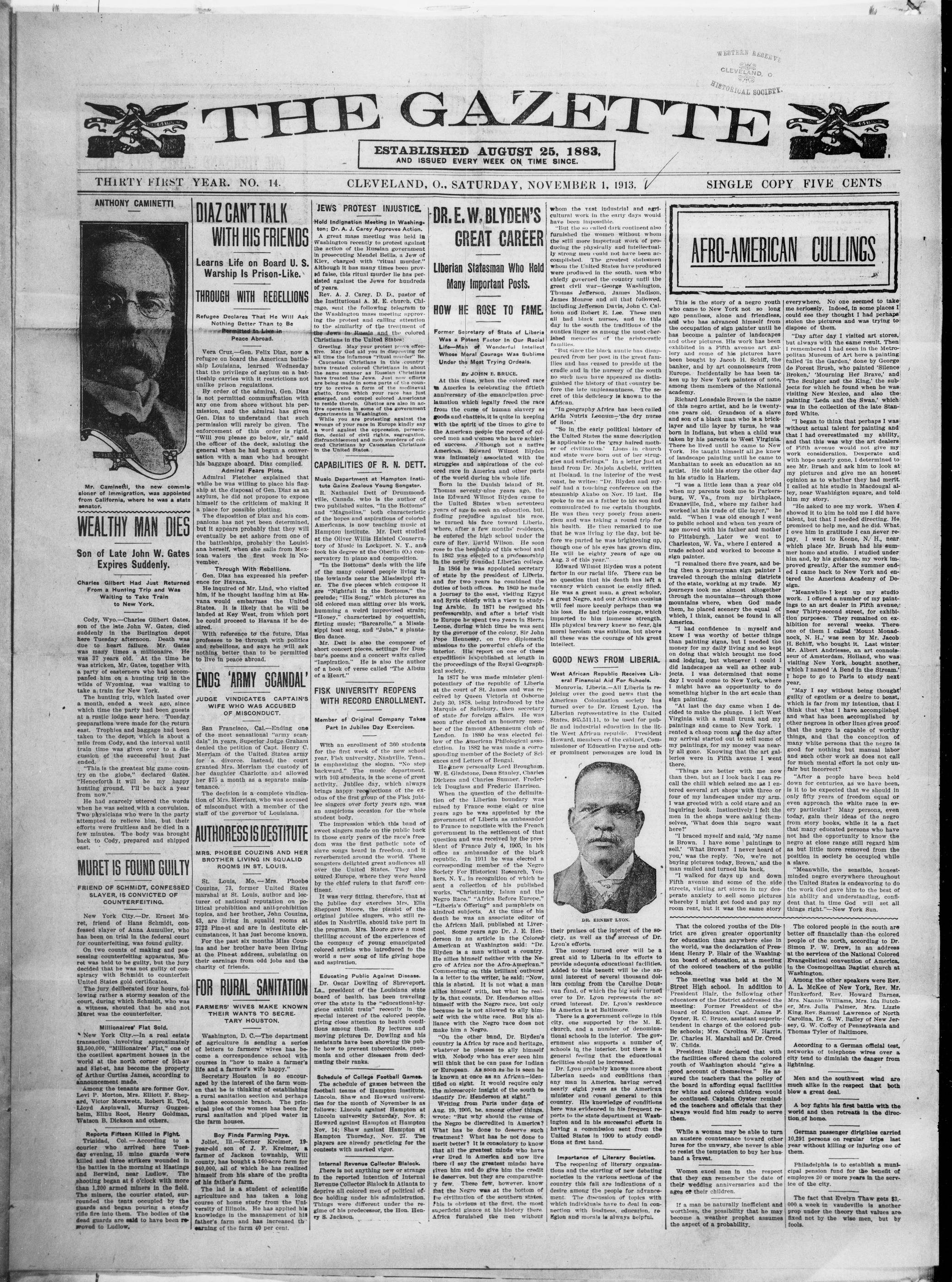
Mr. Caminetti, the new commis-
sor of immigration, was appointed
from California, where he was a state
senator.
WEALTHY MAN DIES
Charles Gilbert Had Just Returned
From a Hunting Trip and Was
Waiting to Take Train
to New York.
Cody, Wyo.—Charles Gilbert Gates,
son of the late John W. Gates, died
suddenly in the Burlington depot
here Tuesday afternoon. Death was
due to heart failure. Mr. Gates
was many times a millionaire. He
was 37 years old. At the time he
was stricken, Mr. Gates, together with
a party of easterners who had accom-
panied him on a hunting trip in the
wilds of Wyoming, was waiting to
take a train for New York.
The hunting trip, which lasted over
a month, ended a week ago, since
which time the party had been guests
at a rustic lodge near here. Tuesday
preparations were made for the return
east. Trophies and baggage had been
taken to the depot, which is about a
mile from Cody, and the interval until
train time was given over to a dis-
cussion of the successful hunt just
ended.
"This is the greatest big game country
on the globe," declared Gates.
"Henceforth it will be my happy
hunting ground. I'll be back a year
from now."
He had scarcely uttered the words
when he was seized with a convulsion.
Two physicians who were in the party
attempted to relieve him, but their
efforts were fruitless and he died in a
few minutes. The body was brought
back to Cody, prepared and shipped
east.
MURET IS FOUND GUILTY
FRIEND OF SCHMIDT, CONFESSED SLAYER, IS CONVICTED OF COUNTERFEITING.
New York City.—Dr. Ernest Muret, friend of Hans Schmidt, confessed slayer of Anna Aumuller, who has been on trial in the federal court for counterfeiting, was found guilty.
On two counts of making and possessing counterfeiting apparatus, Muret held to waive the jury decided he was not guilty of spiracy with Schmidt to counterfeit United States gold certificates.
The jury deliberated four hours, following rather a stormy session of the court, during which Schmidt, who was a witness, shouted that he and not Muret was the counterfeiter.
Millionaires' Flat Sold.
*New York City.*—In a real estate transaction involving approximately $3,500,000, "Millionaires" Flat," one of the costliest apartment houses in the world at the north corner of 5th- and 51st-at, has become the property of Arthur Curtiss James, according to announcement made.
Among the tenants are former Gov. Levi P. Morton, Mrs. Elliott F. Shepherd, Victor Morawetz, Robert E. Tod, Lloyd Aspinwall, Murray Guggenheim, Elliu Root, Henry Goldman, Watson B. Dickson and others.
Reports Fifteen Killed in Flight.
Trinidad, Col. — According to a courier who arrived here Tuesday evening, 15 mine guards were killed and three strikers wounded in the battles in the morning at Hastings and Berwind, near Ludlow. The shooting began at 6 o'clock with more than 1,200 armed miners in the field. The miners, the courier stated, surrounded the tents occupied by the guards and began pouring a steady rifle fire into them. The bodies of the dead guards are said to have been removed to Ludlow.
THE GAZETTE
DIAZ CAN'T TALK WITH HIS FRIENDS
Learns Life on Board U. S. Warship Is Prison-Like.
THROUGH WITH REBELLIONS
Refugee Declares That He Will Ask Nothing Better Than to Be
Vera Cruz—Gen. Felix Diaz, now a refugee on the American battleship Louisiana, learned Wednesday that the privilege of asylum on a battleship carries with it restrictions not unlike prison regulations.
By order of the admiral, Gen. Diaz is not permitted communication with any one from shore without his permission, and the admiral has given Gen. Diaz to understand that such permission will rarely be given. The enforcement of this order is rigid. "Will you please go below, sir," said the officer of the deck, saluting the general when he had begun a conversation with a man who had brought his baggage aboard. Diaz complied.
Admiral Fears Plots.
Admiral Fletcher explained that while he was willing to place his flagship at the disposal of Gen. Diaz as an asylum, he did not propose to expose himself to the criticism of making it a place for possible plotting.
The disposition of Diaz and his companions has not yet been determined, but it appears probably that they will eventually be set ashore from one of the battleships, probably the Louisiana herself, when she sails from Mexican waters the first week in November.
Through With Rebellions.
Gen. Diaz has expressed his preference for Havana.
He inquired of Mr. Lind, who visited him, if he thought landing him at Havana would embarrass the United States. It is likely that he will be landed at Key West, from which port he could proceed to Havana if he desired.
With reference to the future, Diaz professes to be through with politics and rebellions, and says he will ask nothing better than to be permitted to live in peace abroad.
ENDS 'ARMY SCANDAL'
JUDGE VINDICATES CAPTAIN'S WIFE WHO WAS ACCUSED OF MISCONDUCT.
San Francisco, Cal.—Ending one of the most sensational "army scandals" in years, Superior Judge Graham denied the petition of Capt. Henry C. Merriam of the United States army for a divorce. Instead, the court granted Mrs. Merriam the custody of her daughter Charlotte and allowed her $75 a month as a separate maintenance.
The decision is a complete vindication of Mrs. Merriam, who was accused of misconduct with a member of the staff of the governor of Louisiana.
AUTHORESS IS DESTITUTE
MRS. PHOEBE COUZINS AND HER BROTHER LIVING IN SQUALID ROOMS IN ST. LOUIS.
St. Louis, Mo.—Mrs. Phoebe Couzins, 73, former United States marshal at St. Louis, author and lecturer of national reputation on political prohibition and anti-prohibition topics, and her brother, John Couzins, 63, are living in squall rooms at 2722 Pine-st and are in destitute circumstances, it has just become known. For the past six months Miss Couzins and her brother have been living at the Pine-st address, subsisting on their earnings from odd jobs and the charity of friends.
FOR RURAL SANITATION
FARMERS' WIVES MAKE KNOWN THEIR WANTS TO SECRE-TARY HOUSTON.
Washington, D. C.—The department of agriculture is sending a series of letters to farmers' wives has become a correspondence school with courses in "how to make a farmer's life and a farmer's wife happy."
Secretary Houston is so encouraged by the interest of the farm women that he is thinking of establishing a rural sanitation section and perhaps a home economic branch. The principal plea of the women has been for rural sanitation and piped water in the farm houses.
Boy Finds Farming Pays.
Joliet, Ill.—Kerner Kreimer, 19-year-old son of J. F. Kreimer, a farmer of Jackson township, Will county, has bought a 160-acre farm for $40,000, all of which he has realized himself from his share of the profits of his father's farm.
The lad is a student of scientific agriculture and has taken a long course of home study from the University of Illinois. He has applied his knowledge in the management of his father's farm and has increased the earning of the farm 40 per cent.
ESTABLISHED AUGUST 25, 1883 AND ISSUED EVERY WEEK ON TIME SINCE.
JEWS PROTEST INJUSTICE
Hold Indignation Meeting in Washington; Dr. A. J. Carey Approves Action.
A great mass meeting was held in Washington recently to protest against the action of the Russian government in prosecuting Mendel Bellis, a Jew of Klev, charged with "ritual murder." Although it has many times been proved false, this ritual murder has persisted against the Jews for hundreds of years.
Rev. A. J. Carey, D. D., pastor of the Institutional A. M. E. church, Chicago, sent the following telegram to the Washington mass meeting approving the protest and calling attention to the similarity of the treatment of the Jews in Russia and the colored Christians in the United States:
Greeting. May your protest prove effective. May God aid you in disproving for all time the infamous "ritual murder." He has have treated colored Christians in about the same manner as Russian Christians have treated the Jews. Just now efforts are being made in some parts of the country to ghetto, from which your race has just emerged, and compel colored Americans to reside therein. Ghetto are also in active operation in some of the government offices in Washington.
While you are protesting against the wrongs of your race in Europe kindly say a word against the oppression, persecution, denial of civil rights, segregation, and murder of minorities and murdered colored Christians by Caucasian Christians in the United States.
CAPABILITIES OF R. N. DETT.
Music Department at Hampton Institute Gains Zealous Young Songster.
R. Nathaniel Dett of Drummondville, Camda, who is the author of two published suites, "In the Bottoms" and "Magnollas," both characteristic of the hopes and aspirations of colored Americans, is now teaching music at Hampton institute. Mr. Dett studied at the Oliver Willis Halsted Conservatory of Music in Lockport. N. Y., and took his degree at the Oberlin (O.) conservatory in piano and composition.
"In the Bottoms" deals with the life of the many colored people living in the lowlands near the Mississippi river. The five pieces which compose it are "Nightfall In The Bottoms," the prelude; "His Song," which pictures an old colored man sitting over his work, humming a weird improvised strain; "Honey," characterized by coquettish, flirting music; "Barcarolle," a Mississippi boat song, and "Juba," a plantation dance.
Mr. Dett is also the composer of short concert pieces, settings for Dumbar's poems and a concert waltz called "Inspiration." He is also the author of a book of verse called "The Album of a Heart."
FISK UNIVERSITY REOPENS
WITH RECORD ENROLLMENT.
Member of Original Company Takes Part In Jubilee Day Exercises.
With an enrollment of 300 students for the first week of the new school year, Fisk university, Nashville, Tenn. is emphasizing the slogan, "No step backward." The music department, with 103 students, is the scene of great activity. Jubilee day, which always brings happy receptions of the exodus of the first group of the Fisk jubilee singers over forty years ago, was an auspicious occasion for the whole student body.
The impression which this band of sweet singers made on the public back in those early years of the race's freedom was the first pathetic note of slave songs heard in freedom, and it reverberated around the world. These songsters delighted great audiences all over the United States. They also toured Europe, where they were heard by the chief rulers in that faroff continent.
It was very fitting, therefore, that at the jubilee day exercises Mrs. Ella Sheppard Moore, the pianist of the original jubilee singers, who still resides in Nashville, should take part in the program. Mrs. Moore gave a most thrilling account of the experiences of the company of young emancipated colored artists who introduced to the world a new song of life giving hope and aspiration.
Educating Public Against Disease.
Dr. Oscar Dowling of Shreveport, La., president of the Louisiana state board of health, has been traveling over the state in the "educational-bygiene exhibit train" recently in the special interest of the colored people, giving close attention to health conditions among them. By lectures and moving pictures Dr. Dowling and his assistants have been showing the public how to prevent tuberculosis, pneumonia and other diseases from declating their ranks.
Schedule of College Football Games.
The schedule of games between the football teams of Hampton institute, Lincoln, Shaw and Howard universities for the month of November is as follows: Lincoln against Hampton at Lincoln university Saturday, Nov. 8; Howard against Hampton at Hampton Nov. 14; Shaw against Hampton at Hampton Thursday, Nov. 27. The players are already practicing for the contests with marked vigor.
Internal Revenue Collector Blalock.
There is not anything new or strange in the reported intention of Internal Revenue Collector Blalock in Atlanta to deprive all colored men of political office holding under his administration. Things were different under the regime of his predecessor, the Hon. Henry S. Jackson.
Former Secretary of State of Liberia Was a Potent Factor In Our Racial Life—Man of Wonderful Intellect Whose Moral Courage Was Sublime Under the Most Trying Deals.
BY JOHN E. BRUCE.
At this time, when the colored race in America is celebrating the fiftieth anniversary of the emancipation proclamation which legally freed the race from the curse of human slavery as goods and chattels, it is quite in keeping with the spirit of the times to give to the American people the record of colored men and women who have achieved success. Although not a native American, Edward Wilmot Blydon was intimately associated with the struggles and aspirations of the colored race in America and other parts of the world during his whole life.
Born in the Danish island of St. Thomas seventy-nine years ago, the late Edward Wilmot Blydon came to the United States when seventeen years of age to seek an education, but, finding prejudice against his race, he turned his face toward Liberia, where, after a few months' residence, he entered the high school under the care of Rev. David Wilson. He soon rose to the headship of this school and in 1862 was elected to a professorship in the newly founded Libertian college.
In 1864 he was appointed secretary of state by the president of Liberia, and for two years he combined the duties of both offices. In 1869 he made a journey to the east, visiting Egypt and Syria chiefly with a view to studying Arabic. In 1871 he resigned his professorship, and after a brief visit to Europe he spent two years in Sherra Leone, during which time he was sent by the governor of the colony. Sir John Pope Hennessy, on two diplomatic missions to the powerful chiefs of the interior. His report on one of these expeditions is published at length in the proceedings of the Royal Geographical society. In 1877 he was made minister plenipotentiary of the republic of Liberia at the court of St. James and was received by the king. In 20, 1878, being introduced by the Marquis of Sallisbury, then secretary of state for foreign affairs. He was soon after elected an honorary member of the famous Athenaeum club of London. In 1880 he was elected fellow of the American Philological association. In 1882 he was made a corresponding member of the Society of Sciences and Letters of Bengal. He grew personally Lord Brougham, W. E. Gladstone, Dean Stanley, Charles Dickens and Charles Sumner, Frederick Douglass and Frederic Harrison.
When the question of the delimitation of the Liberian boundary was raised by France some eight or nine years ago he was appointed by the government of Liberia as ambassador to France to negotiate with the French government in the settlement of that question and was received by the president of France July 4, 1905, in his office as ambassador of the black republic. In 1911 he was elected a corresponding member of the Negro Society For Historical Research, Yonkers, N. Y., in recognition of which he sent a collection of his published works, "Christianity, Islam and the Negro Race." "Africa Before Europe," "Liberia's Offering" and pamphlets on kindred subjects. At the time of his death he was an associate editor of the African Mail, published at Liverpool. Some years ago Dr. J. E. Henderson in an article in the Colored American at Washington said: "Dr. Blyden is a man without a country. He allies neither with the Negro of Africa nor the Afro-American." Commenting on this brilliant outburst in a letter to the writer, he said: "Now, this is absurd. It is not what a man allies himself with, but what he really is, that counts. Dr. Henderson allies himself with the Negro race, but only because he is not allowed to ally himself with the white race. But his alliance with the Negro race does not make him a Negro.
"On the other hand, Dr. Blyden's country is Africa by race and heritage, whatever he pleases to ally himself with. Nobody who has ever seen him will think that he can pass for Indian or European. As soon as he is seen he is known at once as an African—identified on sight. It would require only the microscopic insight of the south to identify Dr. Henderson at sight."
Writing from Paris under date of Aug. 19, 1905, he, among other things, wrote: "But why should the cause of the Negro be discredited in America? What has he done to deserve such treatment? What has he not done to merit better? It is consolatory to know that all the greatest minds who have ever lived in America and now live there (say the greatest minds) have given him and do give him the credit he deserves, but they are comparatively few. These few, however, know that the Negro was at the bottom of the civilization of the southern states. This is obvious at the first, the most superficial glance at his history there. Africa furnished the men without
whom the vast industrial and agricultural work in the early days would have been impossible.
"But the so called dark continent also furnished the women without whom the still more important work of producing the physically and intellectually strong men could not have been accomplished. The greatest statesmen whom the United States have produced were produced in the south, men who chiefly governed the country until the great civil war-George Washington, Thomas Jefferson, James Madison, James Monroe and all that followed, including Jefferson Davis, John C. Calhoun and Robert E. Lee. These men all had black nurses, and to this day in the south the traditions of the aunties linger as among the most cherished memories of the aristocratic families.
"But since the black auntie has disappeared from her post in the great families and has ceased to preside at the cradle and in the nursery of the south no such men have appeared as distinguished the history of that country before the late unpleasantness. The secret of this deficiency is known to the African.
"In geography Africa has been called Arida Nutrix Leconium—the dry nurse of lions."
"So in the early political history of the United States the same description is applicable to the 'gray haired mother of civilization.' Lions in church and state were born out of her struggles and sufferings." In a letter just at hand from Dr. Majola Agbeil, written at Ioland, in the interior of the west coast, he writes: "Dr. Blyden and myself had a touching conference on the steamship Akabo on Nov. 19 last. He spoke to me as a father to his son and communicated to me certain thoughts. He was then very poorly from aneurism and was taking a round trip for his health. He then remarked to me that he was living by the day, but before we parted he was brightening up, though one of his eyes has grown dim. He will be eight years of age on Aug. 3 of this year." Edward Wilmot Blyden was a potent factor in our racial life. There can be no question that his death has left a vacancy which cannot be easily filled. He was a great man, a great scholar, a great Negro, and our African cousins will feel more keenly perhaps than we his loss. He had triple courage, which imparted to him immense strength. His physical bravery knew no fear, his moral heroism was sublime, but above all these was the courage of his great intellect.
GOOD NEWS FROM LIBERIA.
West African Republic Receives Liberal Financial Aid For Schools.
Monrovia, Liberia — All Liberia is rejoicing over the good news that the American Colonization society has turned over to Dr. Ernest Lyon, the Liberian representative in the United States, $6,511.11, to be used for public and industrial education in the little West African republic. President Howard, members of the cabinet, Commissioner of Education Payne and other prominent personages are loud in
DR. ERNEST LYON.
their priases of the interest of the society, as well as the success of Dr. Lyon's efforts.
The money turned over will be a great aid to Liberia in its efforts to provide adequate educational facilities. Added to this benefit will be the annual interest of several thousand dollars coming from the Caroline Donavan fund, of which the big sum turned over to Dr. Lyon represents the accrued interest. Dr. Lyon's residence in America is at Baltimore.
There is a government college in this city, one supported by the M. E. church, and a number of denominational schools in the interior. The government also supports a number of schools in the interior, but there is a general feeling that the educational facilities should be increased.
Dr. Lyon probably knows more about Liberian needs and conditions than any man in America, having served nearly eight years as the American minister and consul general to this country. His knowledge of conditions here was evidenced in his frequent reports to the state department at Washington and in his successful efforts in having a commission sent from the United States in 1900 to study conditions at first hand.
Importance of Literary Societies.
The reopening of literary organizations and the startling of new debating societies in the various sections of the country this fall are indications of a desire among the people for advancement. The discussion of topics with which individuals have to deal in connection with business, education, religion and morals is always helpful.
AFRO-AMERICAN CULLINGS
WESTERN RESERVE
CLEVELAND, O.
HISTORICAL SOCIETY.
SINGLE COP
AFRO-AMERICA
This is the story of a negro youth who came to New York not so long ago penniless, alone and friendless, and who has advanced himself from the occupation of sign painter until he has become a painter of landscapes and other pictures. His work has been exhibited in a Fifth avenue art gallery and some of his pictures have been bought by Jacob H. Schiff, the banker, and by art connoisseurs from Europe. Incidentally he has been taken up by New York painters of note, among them members of the National academy.
Richard Lonsdale Brown is the name of this negro artist, and he is twenty-one years old. Grandson of a slave and son of a black man who is a bricklayer and tile layer by turns, he was born in Indiana, but when a child was taken by his parents to West Virginia. There he lived until he came to New York. He taught himself all he knew of landscape painting until he came to Manhattan to seek an education as an artist. He told his story the other day in his studio in Harlem.
"I was a little less than a year old when my parents took me to Parkersburg, W. Va., from my birthplace, Evansville, Ind., where my father had worked at his trade of tile layer," he said. "When I was old enough I went to public school and when ten years of age moved with his father and mother to Pittsburgh. Later we went to Charleston, W. Va., where I entered a trade school and worked to become a sign painter.
"I remained there five years, and being then a journeyman sign painter I traveled through the mining districts of the estate, working at my trade. My journeys took me almost altogether through the mountains—through those mountains where, when God made them, he placed scenery the equal of which, I think, cannot be found in all America.
"I had confidence in myself and knew I was worthy of better things than painting signs, but I needed the money for my daily living and so kept on doing that which brought me food and lodging, but whenever I could I did landscapes as well as other subjects. I was determined that some day I would come to New York, where I might have an opportunity to do something higher in the art scale than sign painting.
"At last the day came when I decided to make the plunge. I left West Virginia with a small trunk and my paintings and came to New York. I rented a cheap room and the day after my arrival started out to sell some of my paintings, for my money was nearly all gone. Knowing that the art galleries were in Fifth avenue I went there.
"Things are better with me now than then, but as I look back I can recall the chill which seized me as I entered several art shops with three or four of my landscapes under my arm. I was greeted with a cold stare and an inquiring look. Instinctively I felt the men in the shops were asking themselves, 'What does this negro want here?'
"I braced myself and said, 'My name is Brown. I have some' paintings to sell. 'What Brown? I never heard of you,' was the reply. 'No, we're not buying pictures today, Brown,' and the man smiled and turned his back. "I walked for days up and down Fifth avenue and some of the side streets, visiting art stores in my desperate anxiety to sell some pictures whereby I might get food and pay my room rent, but it was the same story
That the colored youths of the District are given greater opportunity for education than anywhere else in the world, was the declaration of President Henry P. Blair of the Washington board of education, at a meeting of the colored teachers of the public schools.
The meeting was held at the M Street High School. In addition to President Blair, the following other educators of the District addressed the meeting: Former President of the Board of Education Capt. James P. Oyster, R. C. Bruce, assistant superintendent in charge of the colored public schools; Mrs. Carolina W. Harris, Dr. Charles H. Marshall and Dr. Creed W. Childs
President Blair declared that with the facilities offered them the colored youth of Washington should "give a good account of themselves." He assured the teachers that the policy of the board in affording equal facilities for white and colored children would be continued. Captain Oyster reminded the teachers and officials that they always would find him ready to serve them.
While a woman may be able to turn an austere countenance toward other lures for the unwary, she never is able to resist the temptation to buy her husband a cravat.
Women excel men in the respect that they can remember the date of their wedding anniversaries and the ages of their children.
If a man be naturally inefficient and worthless, the possibility that he may become a weather prophet assumes the aspect of a probability.
everywhere. No one seemed to take me seriously. Indeed, in some places I could see they thought I had perhaps stolen the pictures and was trying to dispose of them.
"Day after day I visited art stores, but always with the same result. Then I remembered I had seen in the Metropolitan Museum of Art here a painting called 'In the Garden,' done by George de Forest Brush, who painted 'Silence Broken,' 'Mourning Her Brave,' and 'The Sculptor and the King,' the subjects for which he found when he was visiting New Mexico, and also the painting 'Leda and the Swan,' which was in the collection of the late Stanford White.
"I began to think that perhaps I was without actual talent for painting and that I had overestimated my ability, and that this was why the art dealers of Fifth avenue would not give my work consideration. Desperate and with hope nearly gone, I determined to see Mr. Brush and ask him to look at my pictures and give me an honest opinion as to whether they had merit. I called at his studio in Macdougal alley, near Washington square, and told him my story.
"He asked to see my work. When I showed it to bim he told me I did have talent, but that I needed directing. He promised to help me, and he did. What I owe him in gratitude I can never repay. I went to Keene, N. H., near which place Mr. Brush had his summer home and studio. I studied under him and, by his guidance, my work improved greatly. After the summer ended I came back to New York and entered the American Academy of Design.
"Meanwhile I kept up my studio work. I offered a number of my paintings to an art dealer in Fifth avenue, near third-second street, for exhibition purposes. They remained on exhibition for several weeks. There one of them I called 'Mount Monadnock, N. H.' was seen by Mr. Jacob H. Schiff, who bought it. Last winter Mr. Albert Andriesse, an art connoisseur of Amsterdam, Holland, who was visiting New York, bought another, which I named 'A Bend in the Stream.' I hope to go to Paris to study next year.
"May I say without being thought guilty of egotism or a desire to boast, which is far from my intention, that I think that what I have accomplished and what has been accomplished by other negroes in other lines gives proof that the negro is capable of worthy things, and that the conception of many white persons that the negro is good for nothing but manual labor and such other work as does not call for much mental effort is not only unfair but incorrect?
"After a people have been held down for centuries, as we have been, is it to be expected that we should in only fifty years of freedom equal or even approach the white race in every particular? Many persons, even today, gain their ideas of the negro from story books, while it is a fact that many educated persons who have not had the opportunity to know the negro at close range still regard him as but little more removed from the position in society he occupied while a slave.
"Meanwhile, the sensible, honest-minded negro everywhere throughout the United States is endeavoring to do the work God gave him to the best of his ability and understanding, confident that in time God will set all things right."—New York Sun.
The colored people in the south are better off financially than the colored people of the north, according to Dr. Simon P. W. Drew, in an address at the services of the National Colored Evangelistical convention of America, in the Cosmopolitan Baptist church at Washington.
Among the other speakers were Rev A. L. McKee of New York, Rev. Mr. Hunkerford, Rev. Howard Barnes Mrs. Nannie Williams, Mrs. Ida Butch er, Mrs. Julia Palmer, Mrs. Lizzie King, Rev Samuel Lawrence of North Carolina, Dr. G. W. Bailey of New Jersey, G. W. Coffey of Pennsylvania and Thomas Tyler of Baltimore.
According to a German official test, networks of telephone wires over a city tend to diminish the danger from lightning.
Men and the southwest wind are much alike in the respect that both blow a great deal.
A boy fights his first battle with the world and then retreats in the direction of home.
German passenger dirigibles carried 10,291 persons on regular trips last year without killing or injuring one of them.
Philadelphia is to establish a municipal pension fund for the benefit of employees 20 or more years in the service of the city.
The fact that Evelyn Thaw gets $3,000 a week in vaudeville is another prop under the theory that values are fixed not by the wise men, but by fools.
One Year.....$1.89
Six Months.....1.00
Three Months.....$9
Subscribers are requested to
mit by postoffice money en-
der or registered letter.
Entered at the postoffice in Cleveland
Ohio, as second-class matter
Address all communications to
HARRY C. SMITH
Editor and proprietor,
THE GAZETTE,
Blackstone Building, Cleveland, C.
Member Ohio Legislature: 1894
to 1896; 1896 to 1898; 1900 to 1902
THE GAZETTE is the oldest, and has the largest bona fide circulation, double that of any newspaper in the interest of Afro-Americans, published in the state of Ohio, and comparison with any will immediately establish its rank as one of the NEWSIEST AND BEST In the country.
Cleveland
SATURDAY, NOVEMBER 1, 1913.
Possibly the most plitful subject in all this country, today, is the Negro democrat, who still has his "car to the ground and his eyes turned to Washington, D. C.," awaiting a presidential appointment to office, he will never receive. This applies to about all of them, too.
Those of our people who are making money will please remember that next year, this country will be suffering, in a business way, from the evil effects of the democratic Congress' (and President Wilson's) ill-advised tariff and currency legislation. Better save your money, because you will have great need of it, next year.
The splendid work on the rostrum and in the daily press of the country, against the Wilson administration's vicious insulting segregation of Afro-American employees in the departments at Washington, D. C., being done by Mr. Oswald Garrison Villap, president of the N. Y. Evening Fost, and one of that leading newspaper's editors, is one of the most encouraging things the race has had for some time. He is entitled to all the praise we can give him.
VOTE FOR JOSEPH E. ROBB!
When in the city, a week or ten days ago. Theodore E. Burton, republican United States Senator and a resident of Cleveland, said his mission here had no political significance; that he had not talked with Harry L. Davis, a candidate for mayor; and that it was unlikely that he would participate in the mayority campaign. "Of course I've been here only a few hours," he explained. "My trip to Cleveland for a few days has no connection with politics and I haven't BEEN ASKED TO ASSIST Mr. Davis Anyway, I understand that this campaign is of a nonpartisan nature."
Senator Burton left Cleveland with out saying anything more and has remained silent ever since. WHY Just prior to the senator's arrival in Cleveland, Harry L. Davis, announced through the local daily press that he was NOT the REPUBLICAN candidate for mayor. This undoubtedly explains his failure to invite the republican leader of Cleveland and the State of Ohio, U. S. Senator T. E. Burton, to assist him in this campaign. It, in all probability, also explains the willful insult he gave the great mass of our voters in this community, when he selected, as his Colored political leaders, such individuals as Charlie Crawford, John Fulton and Tom Fleming. This too, in spite of a very proper warning, and in face of the fact that he promised NOT to do that very thing.
Of vastly greater importance than the foregoing, is the fact that the low-fare question has again become the prime issue in the campaign, because of the activity, financially and otherwise, of Harry L. Davie' main backers in this contest. His success at the election, on Tuesday next, will undoubtedly mean an early raising of street-car fare, from three to five cents, because it would also sweep into power, a majority of the members of the in-coming City Council, who as candidates, have already practically committed themselves to such an increase. Low-fare has been a great boon to the mass of our people in this community, because we are poor. Therefore, we can ill afford to so vote on Tuesday next, election day, as to promote the threatened increase in street-car fare.
The Gazette is a republican paper and has been since its inception more than thirty years ago. There fore, we cannot support the candidacy of Mayor Newton D. Baker, democrat. Since there is no republican candidate for mayor, and the candidacy of Harry L. Davis threatens low street car fare we have decided to support the candidacy of Joseph E. Robb, $017 Silmon Ave. That Mr. Robb is a socialist, is not at this time material, but the fact that he is capable and stands for low street car fare, first, last and all the time, is of the supreme importance to our voters in this city at this time. Therefore, we call upon the Afro-American voters of Cleveland, to consult their own interests this time, holding them paramount to all others centered in this election, and so vote on Tuesday next, as to conserve, in the best possible manner, said interests. They will do this when they vote for Joseph E. Robb, for mayor, and have no second or third choice.
THE COMPLETE CASE!
Editor Gazette, Dean Sir: 'A you have always worked consistently, honorably and effectively for the Colored race, I wish to call your attention to a case in court in which one of the "leaders" of your people figured. I believe you to be broad-minded and that you know that there are bad people in all races—white, colored or the yellow races—as well as good people.
I have a piece of property on Cedar Ave., which I was renting a year ago to a family by the name of Sheehan, and this is part of the testimony given upon which I won my case:
One evening upon which the rent was due, I called for the rent and was told they would not pay the rent saying, "The alderman (Mr. Fleming) on Central Ave, told us we did not have to pay the rent until after we had paid." These people had been good tenants and I said to them that they knew rent always was paid in advance and that Mr. Fleming was not running my business, and if they refused to pay, the result would be that they would be put out. They still refused to pay and I bothered about until the time was up. Whereupon, they refused to pay all together stating as their reason that, "Mr. Fleming said they did not have to pay it." I took that and that I also told them their things. In about two weeks, I received a note from Mr. Fleming to come and see him and settle a bill for sickness, etc., resulting from putting these people (Sheehan's) out. I took the letter to Mr. Weaver and told him to write Mr. Fleming and tell him "nothing doing." Mr. Weaver did so and in another two weeks I got notice that I was sued for three hundred dollars and also for three hundred dollars. Think of it, so stupid and suit the case which cost the people of Cleveland, some one hundred and fifty dollars. My attorney told me that Mr. Fleming suggested to him to advise me to settle. There was not an iota of evidence against me—even the women's testimony cleared me. How Mr. Fleming got acquainted with these people I do not know. What would anyone think of me if I were a lawyer? I would be a affairs and then sues him and advises his lawyer to advise his client to set title? Any man practicing law who does not know better than what this party said Mr. Fleming told her, is not fit to be an attorney and any attorney giving such advice, is not fit to be a member of the bar, is he? Does he do this to others?
Mr. Fleming's Reply.
October 18, 1913.
Editor Gazette, Dear Sir:—I read with some amusement the latter from that unfair man, L. N. Fovargue, canonized on October 11, in your issue of October 18. I am surprised that a man with such hatred in his heart for my race, as Fovargue has, would send a letter to a newspaper printed in the interest of the Colored people. This man Fovargue, two years ago, in a letter he wrote to the City Council, was a member of the City Council from Ward 26, objected to having E. 25th Place opened through to Cedar Ave., because he (Fovargue) did not want Colored people on Cedar Ave., where he owns property. In this same letter he wrote to the City Council, in influence against this street opening
Here is the exact language this man Fovargue wrote to Councilman Fitzgerald, speaking of me, dated July 3, 1913: "Besides making the letter public which I (Fovargue) wrote to Mr. Lafferty in regard to the opening of East 25th Place, I cannot forgive the people responsible for this, because the letter was private and personal to a brother belonging to the same Lodge as I do, Woodward Nummer 111, in the sentence in this letter which was fanned into a flame by some for personal gain and by others for revenge."
Again, Mrs. John Sheehan, white, one of his tenants on Cedar Ave, brought suit against Fovargue last spring for forcibly electing her from his property. I was retained by Mrs. Sheehan to represent her in this mutually beneficial lawsuit. Low Fovargue said on the witness stand that he could not understand why Mrs. Sheehan went on Central Ave. and retained a Colored lawyer. He also wrote to Mr. Fitzgerald of July 3, 1913, these words: "How he (Fleming) got to giving this woman his council I do not know, for she was a white woman by the name Sheehan." When Fovargue says that Mr. Fitzgerald removed me from Precinct F Ward 11, as clerk, he tells a deliberate falsehood. I resigned on my own accord, as Mr. Edward Horn, then Deputy Clerk of the Board of Elections, will testify, for the reason that my business was such that I could not spare the time. I ask Fovargue: Why prevocate about Mr. Fitzgerald? Very truly yours. Thomas W. Fleming. This is a personal spite of Mr. Fleming's.
Ist.-His assertion about E. 25th Place. The people on Cedar Ave., objected to the plan of opening E. 25th Pl. The plan called for only an alley some ten or twelve feet wide, and it was to be a "Bernstein-Elbow" alley. There was not a suggestion of object owner, and the street opening Ave. I rented that very house to a Colored family before and after the street-opening question. Of all property owners on Cedar Ave, I would receive the greatest benefit from the opening of E. 25th Pl. Financially, it would be fine. In the letter referred to (which I have a copy of), I used the word "trail," and that was what the street opening street was first class street. No sensible person would complain of such a word, but Mr. Fleming and two or three of his friends made political capital out of the use of the word, and many untrue assertions made and believed by the Colored people. It seems that three or four years ago, Mr. Fleming was dickering on some property that would be bought by the city when E. 25th Pl. was opened, and I bought the property, although I knew nothing of the enterprise, and if the street is opened I will gain the advantage. Mr. Fleming knows it will benefit me to have E. 25th Pl. opened. This seems to be the sore spot in Mr. Fleming--he missed making some money.
2nd.-In regard to the Sheehans having a Colored lawyer. His statement is a deliberate falsehood. I had the case take down, word for word, and no such statement was made. Besides it is an insult, to the readers of this paper, to tell them that a question bringing such an answer would be allowed in court, and such a statement was outside of the case.
3rd.—In regard to Mr. Fleming being taken out of an election booth, my statement was my understanding of what Mr. Fitzgerald did. Mr. Fleming
ing may hate me, but I have been reared in the wrong kind of a family to be a hater of the Colored people. My father fought through the Civil War on the right side and we have always had Colored help and home both male and female. Any Colored man who knows me, knows I have treated him the best. Mr. Fleming's spite is not the Colored peoples' quarrel and they should pay no attention to it. Besides, I advise Mr. Fleming to be careful I says and cannot prove the may be dismissed from the bar, and there is a penalty for slander. Mr. Fitzgerald may be paying Mr. Fleming to swing the Colored vote to him, but dirty work, is not good politics.
Yours very truly,
L. N. Fovargue.
—Adv.
Don't forget that you will want and need The Gazette, this fall and winter. Subserte now!
BUCKEYE LETTERS
WRITTEN BY "THE OLD RELIABLE" GAZETTE'S CORRESPONDENTS.
THROUGHOUT OHIO
What Our People Are Doing Each Week—Church, Personal, Social, Lodge, Literary and Musical—Marriages, Deaths, Etc.
NORWALK.—B. F. Stewart, a local barber and active republican, has secured a job in State Auditor Donahay's department at Columbus. The latter is a democrat.
SANDUSKY—Mrs. A. H. Dodd has
DOING
Five mice were dismiss 10. Twent senting our States of Ala Kansas, Louisiana met in Chatt. 4 and organ of Postal E Sub-station Y., postoffice because the charge of it result of the American lestation. Dr. Knocke 3,500 farmer practical, ex A number of "white."
JUDGE
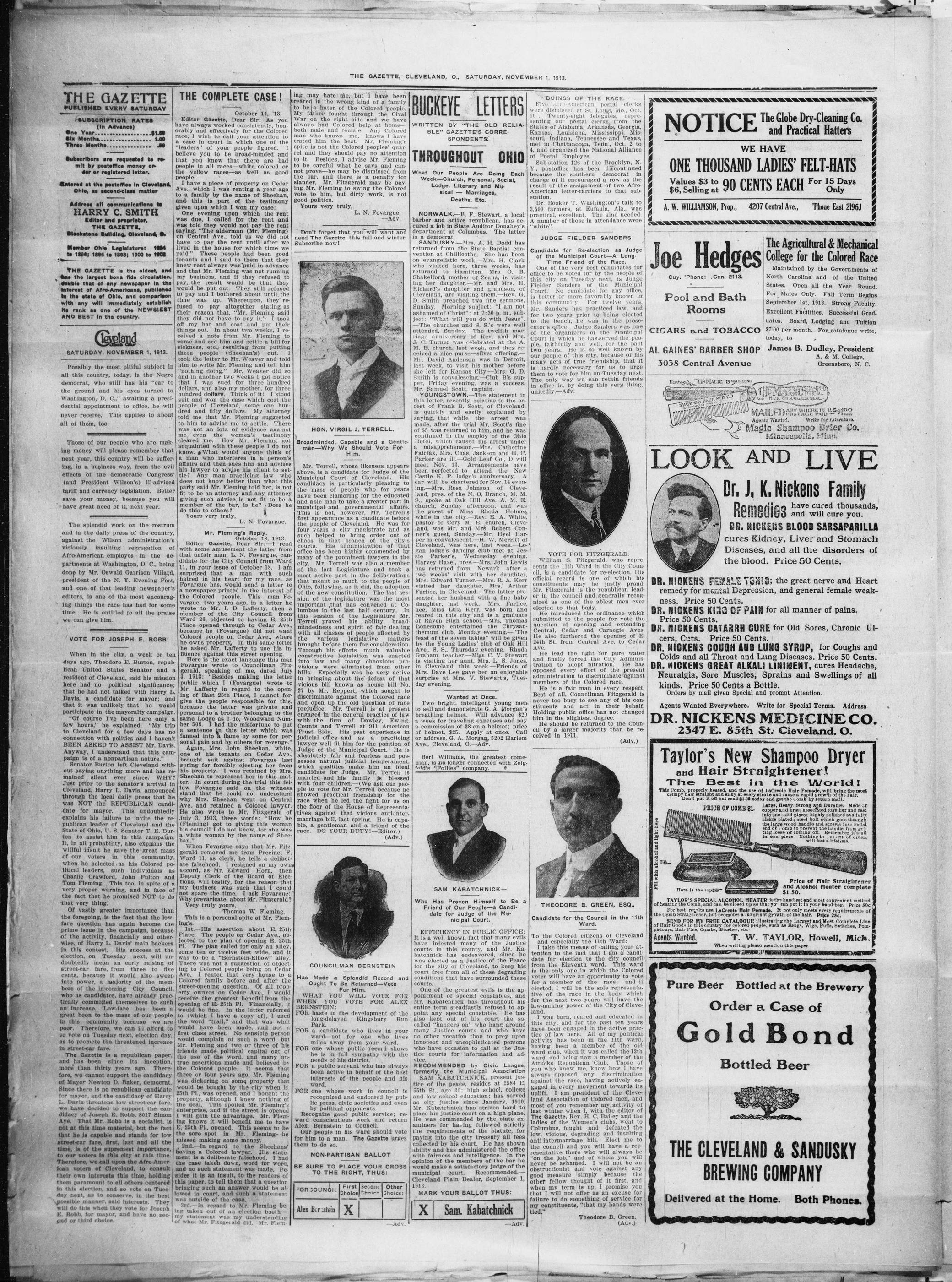
HON. VIRGIL J. TERRELL.
Broadminded, Capable and a Gentle man - Why WOULD Vote For Him
COUNCILMAN BERNSTEIN
Has Made a Splendid Record and Ought To Be Returned—Vote For Him.
WHAT YOU WILL VOTE FOR WHEN YOU VOTE FOR ALEX BERNSTEIN:
For haste in the development of the long-delayed Kingsbury Run Park.
For a candidate who lives in your ward—not for one who lives miles away from your ward.
For one whose public record shows he is in full sympathy with the needs of his district.
For a public servant who has always been active in behalf of the best interests of the people and his ward.
For one whose work in council is recognized and endorsed by public press, civic societies and even by political opponents.
Recognize good public service; reward conscientious work and return Alex. Bernstein to Council.
Our people in his ward should vote for him to a man. The Gazette urges them to do so.
NON-PARTISAN BALLOT
BE SURE TO PLACE YOUR CROSS TO THE RIGHT, THUS:
FOR SOUNGIL
First Choice
Second Choice
Other Choice
Alex Borstein
X
—Adv.
BUCKEYE LETTERS
WRITTEN BY "THE OLD RELIABLE" GAZETTE'S CORRESPONDENTS.
THROUGHOUT OHIO
What Our People Are Doing Each Week—Church, Personal, Social, Lodge, Literary and Musical — Marriages, Deaths, Eto.
NORWALK.—B. F. Stewart, a local barber and active republican, has secured a job in State Auditor Donahale's department at Columbus. The latter is a democra
SANDUSKY.—Mrs. A. H. Dodd has returned from the State Baptist convention at Chillicothe. She has been on evangelistic work.—Mrs. H. Clark who visited here, three weeks, has returned to Hamilton.—Mrs. O. B. Borkow mother of Zeana, a Visiting per son, Mrs. H. Richard's daughter and grandson, of Cleveland, are visiting them.—Rev. G. D. Smith preached two fine sermons, Sunday. Morning subject: "I am not ashamed of Christ"; at 7:30 p. m., subject: "What will you do with Jesus"? The churches and S. S.'s were well attended. Sunday. The twelfth marriage anniversary of Rev. and Mrs. J. C. Turner was celebrated at the A. M. E. church, last week, and they revered the Lord. Fellowship Mr. David Anderson was in Detroit, last week, to visit his mother before she left for Kansas City.—Mrs. G. D. Smith is convalescing. Club B's supper, Friday evening, was a success. Mr. Samuel Scott, captain.
YOUNGSTOWN. The statement in this letter, recently, relative to the arrest of Frank B. Scott, of Cleveland, is quickly and easily explained by saying, that while the arrest was made, after the trial Mr. Scott's fine of $5 was returned to him, and he was sent to the Hotel, which caused his arrest under a misapprehension.-Mrs. Catherine Fairax, Mrs. Chas. Jackson and H. P. Parker are ill.-Gold Leaf Co. D, will meet Nov. 13. Arrangements have been perfected to attend the New Castle K. P. lodge's anniversary. A car will be chartered for Nov. 14 evening, and will be taken to the Hotel, pres. of M. O. Branch, M. M. S., spoke at Oak Hill Ave. A. M. E. church, Sunday afternoon, and the guest of Miss Rhoda Holmes while in the city.-Rev. E. A. White, pastor of Cory M. E. church, Cleveland, was Mr. and Mrs. Robert Conner's guest, Sunday.-Mr. Hyel Harper is convalescent; here last week.-Gan lodge's dancing club met at Jesse Parker's, wedding club met at Jesse Harvey Hazel, pres.-Mrs. John Lewis has returned from Newark after a two weeks' visit with her daughter, Mrs. Edward Turner.-Mrs. R. A. Kerr visited her daughter, Mrs.' Arthur Furlie, in Cleveland. The arthur presented her husband with a fine baby daughter, Jasmine Furlie. Mrs. Mina Kerr was born reared in this city and is a graduate of Rayen High school.-Mrs. Thomas Lonesome entertained the Chrysanthemum club, Monday evening.-The feast of the seven tables" will be given by the Young Ladies' club of Oak Hill Ave., S. S. Thursday evening. Rhoda M. S. was visiting her aunt, Mrs. S. L. Jones, in Cleveland, this week.-Friends of Mrs. Dave Lee gave her an enjoyable surprise at Mrs. V. Stewart's Tuesday evening.
Wanted at Once.
Two bright, intelligent young men to sell and demonstrate G. A. Morgan's breathing helmet. Will advance $20 a week for traveling expenses and pay a commission of $$ on a helmet; price of helmet. $25. Apply at once. Call or address, G. A. Morgan, 5202 Harlem Ave., Cleveland, O.—Adv.
Bert Williams, the greatest comedian, is no longer connected with Zeigfeld's "Follies" company.
SAM KABATCHNICK
Who Has Proven Himself to Be
Friend of Our People—a Candidate for Judge of the Municipal Court.
Who Has Proven Himself to Be a Friend of Our People—a Candidate for Judge of the Municipal Court.
EFFICIENCY IN PUBLIC OFFICE:
It is a well known fact that many evils have infested many of the Justice courts in this county, and Mr. Kabatchnick has endeavored, once he was elected in justice, the Peace for the city of Cleveland, to keep his court free from all of these degrading conditions that have surrounded these courts.
One of the greatest evils is the appointment of special constables, and Mr. Kabatchnick has throughout his entire term steadfastly refused to appoint any special constable. He has also kept out of his court the so-called "hangers on" who hang around Justice courts, and have no other vocation than to prey upon innocent and unsophisticated persons who have occasion to call at the Justice courts for information and advice.
RECOMMENDED by Civic League, formerly the Municipal Association SAM KABATCHNICK, present justice of the peace, resides at 2584 E. 55th St., age 30; high school, college and law school education; has served as city justice since January, 1910. Mr. Kabatchnick has striven hard to place his justice court on a high plane, as he commended the office of the state attorney and followed strictly the requirements of the statute, for paying into the city treasury all fees collected by his court. He has shown ability and has administered the office with fairness and intelligence. In the opinion of the members of the bar he would make a satisfactory judge of the municipal court. Recommended.—Cleveland Plain Dealer, September 1, 1913.
MARK YOUR BALLOT THUS:
X Sam. Kabatchnick
DOINGS OF THE RACE.
Five African postal clerks were dismissed at St. Longi, Mo., Oct. 16. One sentencing our postal clerks from the States of Alabama, Arkansas, Georgia, Kansas, Louisiana, Mississippi, Missouri, Indiana, Tennessee and Texas, met in Chattanooga, Tenn., Oct. 2 to 4, and organized the National Alliance of Postal Employees.
Substitution 126 of the Brooklyn, N.Y. office has been discontinued because the southern democrat in charge of it encouraged a row as the result of the assignment of two Afro-American letter-carriers to that substation.
Dr. Booker T. Washington's talk to 30 farmers, at Eufaula, Ala., was practical. The kind needed. A number of those in attendance were "white."
JUDGE FIELDER SANDERS
Candidate for Re-election as Judge of the Municipal Court—A Long-
Time Friend of the Race.
One of the very best candidates for office, and for by the people of this city on Tuesday night, is Judge Fielder Sanders of the Municipal Court. No candidate for any office, is better or more favorably known in this community. For twelve years, Mr. Sanders has practiced law, and for two years prior to being elected to the bench, he was in the prosecution of the kidnapping of the organizers of the Municipal Court in which he has served the people, faithfully and well, for the past two years. He is so well known by our people of this city, because of his many acts of true friendship, that it is hardly necessary, that it be held on him on Tuesday next. The only way we can retain friends in office is, by doing this very thing, unitedly—Adv.
M. B.
VOTE FOR FITZGERALD.
William S. Fitzgerald, who represents the 11th Ward in the City Council, is a candidate for re-election. His official record is one of which his office has been recognized for re-election. Mr. Fitzgerald is the republican leader in the council and generally recognized as one of the ablest men ever elected to that body.
He introduced the ordinance which submitted to the people for vote the question of opening and extending Central, Cedar and Carnegie Aves. He also furthered the opening of E. 24th St. from Central Ave. to Cedar Ave.
He lead the fight for pure water and finally forced the City Administration to adopt filtration. He has opposed every effort of the present administration to discriminate against members of the Colored race.
He is a fair man in every respect. Best of all, Councilman Fitzgerald is never too busy to see and hear of his own behalf. Holding public office has not changed blm in the slightest degree.
He should be returned to the Council by a larger majority than he received in 1911. (Adv.)
THEODORE B. GREEN, ESQ.,
Candidate for the Council in the 11th
Ward.
To the Colored citizens of Cleveland
and executively the 11th Ward;
I take this means of calling your attention to the fact that I am a candidate for election to the city council from the Eleventh ward. This ward is the only one in which the Colored voter will have an opportunity to vote for a member of the race; and if elected, I will be the sole representative of the race in the body which for the next two years will have the law-making power of the City of Cleveland.
I was born, reared and educated in this city, and for the past ten years have been engaged in the active practice of law here. All of my political activity has been in the 11th ward, having been a member of the old ward club, when it was called the 12th ward, and being now a member of the attackive Rountown Club. Thought of you know me, know how I have always opposed any discrimination against the race, having actively engaged in every movement towards its uplift. I am president of the Cleveland Association of Colored men, and most of you remember my activity of last winter when I, with the editor of The Gazette, Rev. H. C. Balley and the ladies of the Women's clubs, went to Columbus, fought and defeated the low, vicious, degrading and insulting anti-intermarriage bill. Elect me to the council and you will have a representative there who will always be "on the job, and of whom you will be an obstructionist and vote against any good measure simply because the other fellow thought of it first, and when my term is up, I promise you that I will not offer as an excuse for failure to do something of service for my constituents, "that my hands were tied."
Theodore B. Green.
(Adv.)
WE HAVE ONE THOUSAND LADIES' FELT-HATS Values $3 to 90 CENTS EACH For 15 Days $6, Selling at Only
LOOK AND LIVE
DR. NICKENS FEMALE TONIC; the great nerve and Heart remedy for mental Depression, and general female weakness. Price 50 Cents.
DR. NICKENS KING OF PAIN for all manner of pains. Price 50 Cents.
DR. NICKENS CATARRH CURE for Old Sores, Chronic Ulcers, Cuts. Price 50 Cents.
DR. NICKENS COUGH AND LUNG SYRUP, for Coughs and Colds and all Throat and Lung Diseases. Price 50 Cents.
DR. NICKENS GREAT ALKALI LINIMENT, cures Headache, Neuralgia, Sore Muscles, Sprains and Swellings of all kinds. Price 50 Cents a Bottle.
Orders by mail given Special and prompt Attention.
DR. NICKENS MEDICINE CO. 2347 E. 85th St. Cleveland, O.
Taylor's New Shampoo Dryer and Hair Straightener! The Best in the World!
This Comb, properly beated, and the use of LaCreole Hair Pomade, will bring the most crispy hair straight and silky at every stroke and cause a rapid growth of the hair. Don't put it off but send $1.00 today and get the comb by return mail.
PRICE OF 00MB $1.
Large, Heavy, Strong and Durable. Made of copper and brass associated together and cast into one solid piece; highly polished and fully nickel plated; steel which goes through the larger wood handle and receives into metal end of comb to prevent the handle from getting loose or coming off. Remember it is all in one piece. Nothing to get out of order, will last a lifetime.
Here is the top.
Price of Hair Straightener and Alcohol Heater complete $1.50.
TAYLOR'S SPECIAL ALCOHOL HEATER is the handiest and most convenient method of heating the Comb, and can be closed up so that 70 can put it in your hand-bag. Price 50c. For best results use LaCreole Hair Pomade. It not only meets every requirements of the Comb Straightener, but promotes a luxuria at growth of the hair. Price 25c.
SEND FOR MY FREE CATALOGUE! Illustrating the Largest and Most Complete Line of Hair Goods in this country for colored people, such as Beams, Wigs, Puffs, Switches, Pompadours, Hair Pure Combs, Brushes, etc.
Agents Wanted.
T. W. TAYLOR, Howell, Mich.
When writing please mention this paper
Pure Beer Bottled at the Brewery
Order a Case of Gold Bond
Bottled Beer
THE CLEVELAND & SANDUSKY BREWING COMPANY
Delivered at the Home. Both Phones.
A. B.
4207 Central Ave.,
The Agricultural & Mechanical College for the Colored Race
Maintained by the Governments of North Carolina and of the United States. Open all the Year Round. For Males Only. Fall Term Begins September 1st, 1913. Strong Faculty. Excellent Facilities. Successful Graduates. Board, Lodging and Tuition $7.00 per month. For_catalogue write, today, to
James B. Dudley, President
A. & M. College,
Greensboro, N. C.
Remedies have cured thousands, and will cure you. DR. NICKENS BLOOD SARSAPARILLA cures Kidney, Liver and Stomach Diseases, and all the disorders of the blood. Price 50 Cents.
Mrs. A. M. Pope-Turnbo
Results of "Pore" Treatment
"PORO COLLEGE"
Luggeti College of its kind in the world.
See FOR STREET, ST. LOUIS, 184
For treatment, call on or address:
MISS KATIE B. COLLIER,
4812 Payne Ave.,
Cleveland, Ohio.
B. & M. HAIR DRESSING
A delightfully Perfumed Hair-Pomade for making harsh, stubborn, curly hair soft, pliant and glossy. It is not only an ideal dressing for the hair but a wonderful hair-grower. It works beautifully on scalp and roots of the hair, relieving dandruff and other diseases of the scalp-skin, thereby causing it to grow rich, long and luxurious.
B. & M. HAIR DRESSING is becoming more popular every day, and is sold strictly on a guarantee.
BROWN DRUG GO.
Brown and Seyfert, Prop's.
2742 Central Ave.
Selling Agents.
The New
Keystone
.RESTAURANT.
2408 Central Ave.
The Best Meals
Quick Service.
Cigars & Tobacco.
Open Day
and Night.
Chas. McPherson, Prop'r.
Theodore B. Green,
ATTORNEY AT LAW.
508-510 Superior Building.
Office, Main 3070.
Residence, Eddy 2086-R.
CLEVELAND. O.
RUSSELL'S REMEDY
for
CATARRH, HAY-FEVER,
ASTHMA, SORE-THROAT
AND LUNG TROUBLE.
Relieves When Others Fail
Send for Free Sample
CHAS. R. SIMMONS
404-405 Standard Bldg.,
323 Euelid Ave.
G. G. REED'S
Ladies' and Gent's
Furnishings
A Complete Line of
LADIES' READY-MADE APPAREL.
Double Stamps on Tuesday.
Cuy. Central 6661-L.
3222 Central Ave., Cleveland.
A Complete Line
DRY GOODS, LADIES' AND GENTS'
FURNISHINGS
J. LOMSKY
3816 and 3820 Central Ave.
Double Stamps on Tuesdays and
Fridays.
Good Bargains
In Realestate!
LARGE MORTGAGE LOANS!
RENTALS--COLLECTIONS.
CLAIMS ADJUSTED.
S. E. WOODS,
2828 Central Ave.
*Phone, North 996.
Ohio Dry-Cleaning and Dyeing Co.
Established in 1911.
Cleaners of all kinds of Ladies and
Gentlemen's Garments.
Also Expert Cleaning and Blocking of
All Kinds of Hats.
We Call for and Delivery!
2858 Central Av.
Cuy. Phope, Central 2201-L.
WHERE TO PURCHASE THE GAZETTE
M. H. DIXON'S, 2005 Central Ave.
J. S. HALL'S, 3121 Central Ave.
L. SCHWARTZ'S, 2921 Central Ave. Open Sunday.
O. C. SCHROEHER'S, Cuyahoga Bldg. Open Sunday.
F. VALENTINE'S, 2130 Central Ave.
J. E. BRANHAM'S, 4401 Central Ave
NOTICE TO SUBSCRIBERS:--Subscribers not receiving The Gazette regularly should notify us at once. We desire every copy delivered promptly. We advise our patrons to carefully examine The Gazette's advertisements before making purchases. Business men who advertise in this paper should have the patronage of Afro-Americans. The fact that they advertise is assurance that they want it. Local reading notices (advertisements) ten cents a line (six words in a line.)
FOR RENT.—Houses and Rooms.—If you have them to rent or if you want to rent, advertise in The Gazette. It brings results.
NOTARY PUBLIC.—For such services call at The Gazette office, No. 3 Blackstone building, No. 1424 W. Third Street, near Superior Ave.
FOR RENT.—Furnished rooms; all conveniences—hot-water heat, electric lights, telephone. Call, Doan 5524 R.
Cleveland
Sixth City
Mrs. Rosa Brooks of E. 90th St., is home after a slight operation on a limb at Lakeside Hospital.
* * *
Be sure to read carefully what the *Gazette* has to say, this week, about various candidates, Election, Tuesday.
* * *
The "All Star" concert at St. James's A. M. E. church, E. End, promoted by Mrs. Ollie Laster, proved an enjoyable affair.
* * *
Tom Hughes, night-cook at J. W. Crawford* "Manhattan restaurant" is very ill and has not been able to work for several weeks.
* * *
Theo. B. Green, Esq., was called to Dunkirk, N. Y., last week, on legal business. He is making a "hot" campaign in the 11th ward.
* * *
The Sing-Tell-Play Co., Mme. Anita Patti Brown of Chicago, the "star", will be at St. John's A. M. E. Church, Monday evening. -Adv.
Mrs. Wiley Miller who moved recently form E. 36th St., to 2328 E. 31st., is a fine dress-maker and is doing a nice business.—Adv.
Mrs. Helen Bouldon Brasher of Columbus, has secured a temporary position as a teacher in the normal department of Wilberforce University.
If you owe The Gazette, pay promptly, please, so we can continue sending you the paper.
Send The Gazette your lodge news as well as your social, personal and church items of interest. This paper is for ALL of our people.
Now is the time for dress hats. Come and see the latest styles and best offers ever given—at the Central Hat Shoppe, 4916 Central Ave., starting Friday, Oct. 31st.—Adv.
Rev. Joseph Courtney of Springfield, district superintendent of the M. E. Church, preached to a large congregation at Cory M. E. church, Sunday. Total collection for the day, $110.18.
The Jury's verdict, in the case of Mrs. Maud H. Arnold, plaintiff, against Mrs. Cora Curry, defendant, in the Municipal Court, last week, was for $2,619. The case was the outcome of a shooting scrape, some months ago, in the East End.
Mrs. James Tilly, 2242 E. 43d St., wishes to thank all who contributed to the Old Folk's Home Ingathering of last week Thursday. She was greatly pleased by the liberality of our people. Two hundred and eight persons were fed during the day.
The Jews as well as our people are, in the main, opposed to the candidacy of Harry L. Davis and for very similar reasons.
At Mt. Haven Baptist church, Sunday, the pastor will preach at 10:45 a.m., on "Dislodging the Giants"; at 7:45 p. m., on "The Burden of Service". Sermon at 3 p. m., by Rev. W. H. Page. At 12:30 p. m., S. S., and at 6 p. m., B. Y. P. U.
THE ALPHA THEATER now issues a program and the patrons are able to tell what act is being performed. A light is flashed on either side of the stage, giving the number of the act. The corresponding number, on the program, gives the name of the act.—Adv.
We warned Harry L. Davis that the selection of Charlie Crawford, Tom Fleming and John Fulton as his "Colored" political leaders would drive from his support the great mass of our voters in this city and it will too. He will know this, next Wednesday day morning.
Mrs. A. J. Oliver and mother, Mrs. D. E. Moore, of Albany, N. Y., who have spent several weeks in the city guests of Mrs. M. Greene, and Mrs. J. West, 265 E. 37th St., left for home, Sunday evening, highly pleased with their visit in their old home. Mendames Moore and Oliver were highly entertained while here.
Harry L. Davis said recently in a daily newspaper interview that he was NOT the republican candidate for mayor. Therefore vote for Jos. E. Robb, the socialist candidate. He and his party stand for EQUAL
THE GAZETTE, CLEVELAND, O.. SATURDAY, NOVEMBER 1, 1913.
RIGHTS for ALL without reference to race, color or "previous condition of servitude."
Miss E. Gilliam has returned from Detroit, where she attended a cousin's wedding. She wore a pink messaline skirt with a yellow dew-drop over-dress trimmed with yellow marabon and crystal bardings, with cap and bag to match. Miss LaZetta wore pure white with dew-drop over-dress with cap and bag. Both wore white satin slippers. Miss LaZetta will spend the winter in Detroit.
Our City Federation of Women's clubs will meet at Mrs. D. L. Quinn's 2211 E. 36th St. Thursday at 8 p.m. sharp. All members of the Federation are urged to attend. Friends in the community will bebridge Mrs. Bessie Kitzmiller and others of the committee, are preparing a very unique and interesting program, to be rendered at Cory M. E. church, Nov. 20, under the auspices of the Federation. Further notice later.
Little Helen Gaines, having sold 112 tickets, was awarded the doil, at the DuBois Literary club's musicae, Walter Wills, Jr., who sold 101 tickets, will be awarded the boys' prize at the clubs' regular meeting. Little Alma Burke, having sold 58 tickets, will be awarded a second prize. The club thanks all who in any way contributed to its success, and will in next weeks' Gazette make further report.
Mr. Louis Rubinstein, for many years the interpreter at the Police Court, and one of the best known of our older citizens, is a candidate for the City Council in the 18th Ward, and has exceedingly bright prospects of success. Mr. Rubinstein is capable and experienced, and would make a splendid representative of his ward in the local legislative body.—Adv.
Our advertisers want your trade. Those who do not ask for it in the Gazette certainly care little, if at all, for it. Therefore, we urge our readers and all of our friends to patronize those who ask for your trade in this paper.
Mrs. J. C. Sayles of 2335 E. 38th St. returned, last week, from a five weeks' visit to her old home, Starkville, Miss, visiting her sisters, Mrs. Collier, Mrs. Clay, and brother, M. J. Bardwell. Miss Bessle Adkins of Columbus, Miss, is stopping at Mrs. Sayles, and spending E. Peck each week. Miss Sayles says: "The old home-town isn't what it used to be." "Twas ever thus, these days of increased prejudice."
* * * *
The attendance-record at the Alpha theatre was broken, Sunday and Monday. The motion-pictureenes of our KKK are in excellent accommodation, great street parade in Baltimore, in August, and the motion-pictures of our great National Baptist jubilee, as well as of Fisk University, Meharry Medical College, and Dr. Booker T. Washington, taken in September, were the magnets which attracted the largest crowds to the Alma Amy Hall, the maximum all week, too. The very quiet and cozy theatre's attendance is certainly booming these days.—Adv.
Clifford James and his mother, of Mineral City, near Canton, were in this city, Sunday and Sunday week, asking collections from our local churches for the purpose of purchasing artificial limbs for the former. The boy, it seems, lost both hands picking up coal on a railroad. Sunday, they received $6.30 from St. John's A. M. E. church at the morning service; and $10.33 from Cory M. E. church at the evening service. Sunday week, they received $3 from Antoine Baptist church. They will be back, Sunday, on the same errand, in spite of the fact that the journey must cost them about $3 a piece, each week, to make the trip.
* * * *
Mrs. Georgiana Holman, age 80, an inmate of the Old Folk's Home, died, Tuesday morning, at the hospital, after an illness of several months. Friends of the family met on Friday afternoon. She came here from Charlottesville, Va. 20 years ago, and was a member of St. John's A. M. E. church.
When you want the news of our people, the country over, take the old reliable Gazette. That is the only way you can get it. The daily papers delight in ridiciting and insulting our people and still you will purchase them.
The DuBois Literary club's testimonial musicale at Mt. Zion Congregational church, Monday evening, was an artistic and financial success. The audience taxed the capacity of the combined auditorium and S. S. room. The entertainment proved to be one of exceedingly high music under the directorship of W. Walter Wills, the musicians were: Madam Kathryn S. Mitchell, soprano; Harry T. Ford, cornet imitator; Miss Edna Holden, of the Oberlin Conservatory of Music, accompanist, assisted by local musicians. The proceeds will be used to assist Miss Belle Harris, of this city, in her effort to complete a course in pedagogy at Howard University. She made a splendid record at Central School, from which she graduated in June of 1984 and during her first year at college. Mrs Blanche Gillmore, Mrs Ida Owens and Mrs Lena St. Johns constituted the club committee in charge of the arrangements for the musicale.
AT THE ALPHA THEATER, SUNDAY, NOV 2nd, ZIGOMAR, No. 3. When the people hear, the name Zigomar they know that it means the best motion-picture that has yet been produced. Those who remember seeing Zigomar, Nos. 1 & 2, will remember that in No. 2 it was thought Zigomar had ended his life by taking poison, but we find in No. 3 that this was another trick of Zigomar's, and he is at large again with the Z gang. The thrilling and startling adventures of the king of bandits, the wondrous exploits of the master-mind of the chief features, makes this one of the greatest features ever produced, and it will be seen at the Alpha Theater, Sunday. Mr. Morris Edelman, the lessee of the Alpha Theater, intends to furnish the patrons of the Alpha Theater the best vaudelle and motion-pictures that can be secured regardless of cost.—Adv.
Miss Burwell of Oberlin, is visiting her uncle, D. L. Quinn.
The many friends in this city of Mrs. Laura Wells-Freeman, wife of Mr. Steve, Freeman of Palnesville, will be painfully surprised to learn of her death, last Thursday. Funeral, Monday, from the family residence. Just a short time ago, Mr. and Mrs. Freeman lost a beautiful daughter. He has the heartfelt sympathy of a host of friends here and in Palnesville.
Send or bring locals and all business matters to The Gazette's new offices, Suite 2, Blackstone Bldg. If you wish to see the editor call there and not at his home. Please remember and tell this to all making inquiry of him or The Gazette.
A. SPLENDID SHOWING
Cleveland, O., October 28, 1913.
Hon. H. C. Smith, Editor Gazette,
Dear Sir:—Will you kindly publish
the following, for the benefit of
the public, in relation to the ingathering?
Thanking you for your co-operation in
the work of our Home, I remain,
Very respectfully,
(Mrs.) Marie Taylor Perkins,
Sec. Board of Managers.
The Board of Lady Managers of the
Old Folks' Home wish to heartily
thank the public for their co-operation
during the ingathering, last week,
and give the following report to date of
the proceeds:
Balance on hand ..... $101.13
Respectfully submitted,
Mrs. Lethia Fleming, Chairman,
Mrs. Marie Perkins, Secretary.
REAL ESTATE SALES.
East 37th St. R. H. Lee.
East 86th St. M. Lewis.
West 104th St. S. P. Koch.
All are well pleased.
The Notorious Prosecution of Him and John P. Bowen of "Up—"
"We, Expects."
Columbus, O.-The cases against Leroy H. Godman, special counsel in the office of the Attorney General, and John P. Bowles, general agent for the General Accident Insurance Co. of Massachusetts, were dismissed. Mr. Bowles pleaded Saturday October 11. It develops that a political plot was behind the affair, Mr. Godman being the first Afro-American attorney to hold a position in the Attorney General's office, and thence he has always been a Republican appointed attorney by Gen. Browne, who is a Democrat. Some time ago Godman and Bowles were called to the residence of Mrs. Margaret Royal, a dresmaker, on business. Two white women, customers of Mrs. Royal, were at the house at the time seeing about some sewing. Enemies of the men called a lawyer, who were arrested on technical charges. The case against Mrs. Royal was the only one tried in court and a jury of twelve men acquitted her very promptly. The other cases were not tried, but dragged along until dismissed by Judge Black on October 11. Pending the court, the Mr. Godman did not fill his position in the Attorney General's office, but he returned to his desk, October 13, and was given a warm welcome by Attorney General Hogan and his associates.
Purchase City Feed Mill.
Delaware, O.-Another change in a local business house became effective recently when A. D. Male took possession of the City Feed Mills on South Sandyuk St., which was formerly owned by M. A. Campion. Mr. Male may have moved to this city from West Mansfield where he was engaged as a farmer. He has several children whom he expects to educate here. He is doing a splendid business, his receipts running from $60 to $125 daily. His patrons are of all classes or nationalities. Mr. Male is a member of the race.
If you live in Ohio, see that The Gazette has an agent and correspondent in your city. You can help us in this way.
WILLIAM H. STOLTE
Candidate for the City Council in
Ward 19—Capable and Deserv-
Wm. H. Stolte, member of the City Council, Ward 19, is a candidate for the City Council at the coming election. For the brief time that Mr. Stolte has served in the Council, he has proved himself a man of deeds. He has been active in securing the opening of streets and the laying of roads. Mr. Stolte, the Lions Railroad Co., paid and provided a large saving to the taxpayers. He has also secured many electric lights at the intersection of streets, adding to the comfort and safety of the public. Mr. Stolte has been a resident of this ward for many years, and residues with his family on the property would be a just recognition of the services of a faithful servant—Ady.
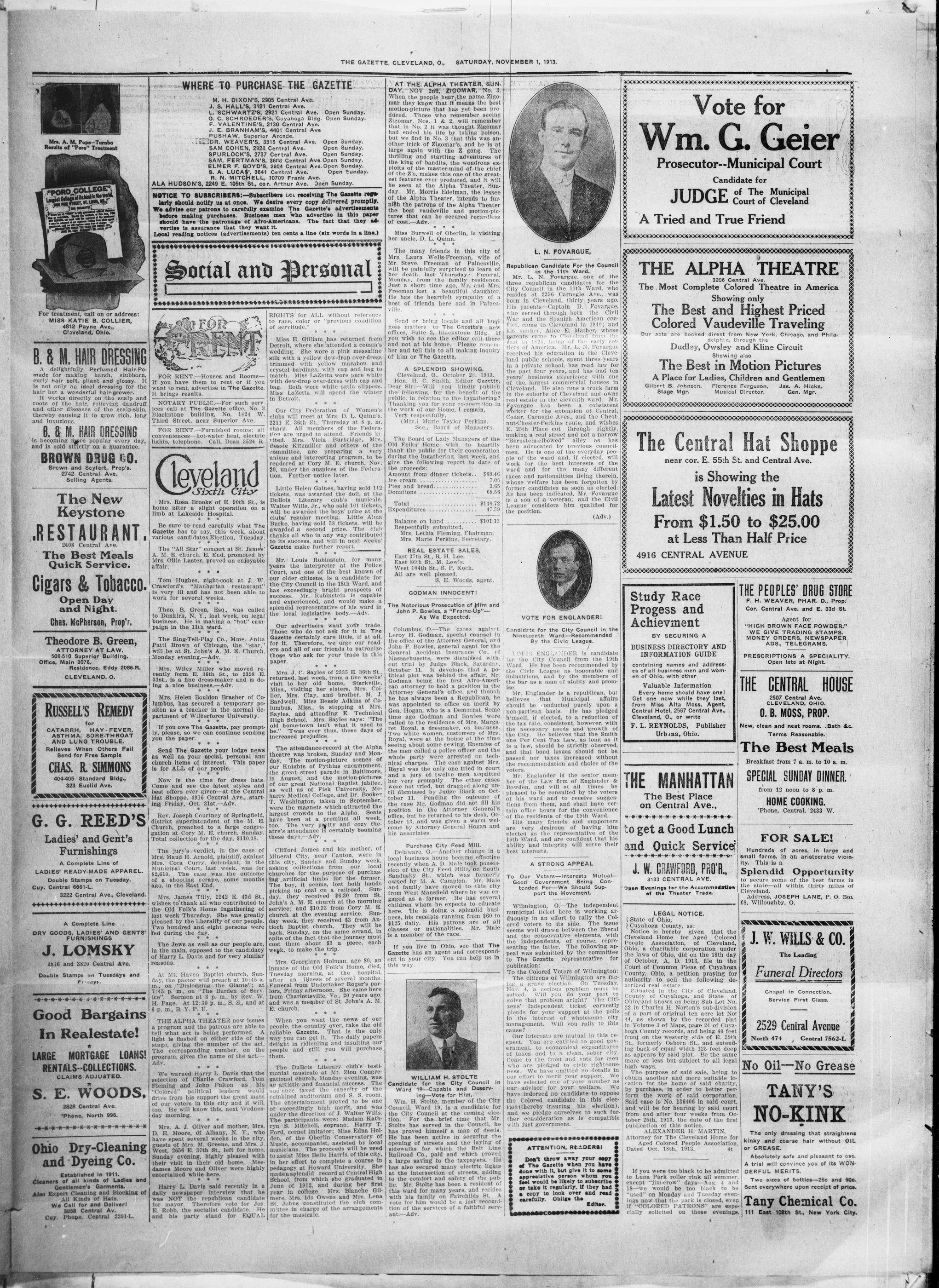
L. N. FOVARGUE,
Republican Candidate For the Council in the 11th Ward.
in the 11th Ward.
Mr. L. N. Fovargue, one of the three republican candidates for the City Council in the city of Wichita, who resides at 2256 Carnegie Ave, was born in Cleveland, thirty years ago. His parents—Captain D. Fovargue, who served through both the Civil War and the Spanish American conflict, came to Cleveland in 1840; and his mother, Alice E. Mather, whose parents came to Cleveland from the city in 1825, being of the early set of immigrants, received his education in the Cleveland public schools, spent three years in a private school, has read law for the past four years, and has had ten years' business experience with one of the largest commercial houses in Cleveland. He also runs a truck farm in the suburbs of Cleveland and owns real estate in the eleventh ward. Mr. Fovargue worked for the extension of Central, Cedar, Carnegie Aves, and the Chestnut-Chester-Perkins route, and wishes E. 25th Place cut through rightly, making a real street and not a narrow "Bernstein-elbowed" alley as he has been advocated by previous councilmen. He is one of the everyday people of the ward and, if elected, will work for the many different races and nationalities living therein, whose welfare has been forgotten by former candidates as soon as elected. As has been indicated, Mr. Fovargue is a son of a veteran; and the Civil League considers him qualified for the position.
VOTE FOR ENGLANDER!
Candidate for the City Council in the Nineteenth Ward—Recommended By the Civic League.
LOUIS ENGLANDER is candidate for the City Council from the 19th Ward. He has been recommended by the Civic League as honorable and industrious, and by the members of the bar as a man of ability and promise.
Mr. Englander is a republican, but believes that Municipal affairs should be conducted purely upon a non-partisan basis. He has pledged himself, if elected, to a reduction of the tax rate, consistent, however, with the necessary needs and growth of the City. He believes that the Smith one Per Cent Tax Law, as long as it is a law, should be strengthened and bonded, and should not be passed nor taxes increased without the recommendation and choice of the voters.
Mr. Englander is the senior member of the Law firm of Englander & Bowden, and will at all times be pleased to be consulted by the voters of his ward and to receive suggestions from them, and shall have certain office hours for the convenience of the residents of the 19th Ward.
His many friends and supporters have elected him as the representative of the 19th Ward, and are confident that his ability and integrity will serve their best interests.
A STRONG APPEAL
To Our Voters-Interests Mutual-
Good Government Being
Contended For-We Should Support
the Movement.
Wilmington, O.-The independent
municipal ticket here is working ardouly in an effort to rally the Colored voters to its side. The issue seems well drawn between the liberal and the conservative elements, with the Independents, of course, representing the latter. The following appeal was submitted by the committee to The Gazette representative for publication:
The colored Voters of Wilmington:
The citizens of Wilmington are facing a grave election. On Tuesday, Nov. 4, a serious problem must be solved. Will you do your part to solve that problem right? The Citizens' independent ticket earnestly pleads for your support at the call in the interest of wholesome city management. Will you rally to this cause?
Our interests are mutual in this respect. You are entitled to good government, to economical expenditures of taxes and to a clean, sober city. Come to the front to meet civic righteousness. We have omitted no details in our effort to merit your support. We have selected one of your number as our advisor for your welfare. We have indorsed no candidate to oppose the Colored candidate in his election, his election, and we pledge ourselves to such further consideration as is compatible with just government.
ATTENTION, READERSI
Don't throw away your copy of The Gazette when you have with it, but give it to some appreciative person whom you feel would be likely to subscribe or take it regularly, if they had a copy to look over and read carefully. Oblige the Editor.
A Tried and True Friend
THE ALPHA THEATRE
3206 Central Ave.
The Most Complete Colored Theatre in America
Showing only
The Best and Highest Priced
Colored Vaudeville Traveling
Our acts are booked direct from New York, Chicago, and Philadelphia, through the
Dudley, Owsley and Kline Circuit
Showing also
The Best in Motion Pictures
A Place for Ladies, Children and Gentlemen
Gilbert B. Johnson. Florence Ferguson. Jas. A. Hicks,
Stage Mgr. Musical Director. Gen. Mgr.
The Central Hat Shoppe
near cor. E. 55th St. and Central Ave.
is Showing the
Latest Novelties in Hats
From $1.50 to $25.00
at Less Than Half Price
4916 CENTRAL AVENUE
Study Race Progess and Achievement
BUSINESS DIRECTORY AND INFORMATION GUIDE
containing names and addresses of all business men and women of Ohio, with other
Valuable Information
Every home should have one!
Get one now while they last,
from Miss Alta Moss, Agent,
Central Hotel, 2567 Central Ave.,
Cleveland, O., or write
F. L. REYNOLDS, Publisher
Urbana, Ohio.
THE MANHATTAN
The Best Place
on Central Ave..
to get a Good Lunch and Quick Service
J. W. CRAWFORD, PRO'R.,
3133 CENTRAL AVE.
Open Evenings for the Accommodation of the Theater Trade.
LEGAL NOTICE.
Notice is hereby given that the Cleveland Home for Aged Colored People Association, of Cleveland, Ohio, a charitable corporation under the laws of Ohio, did on the 18th day of October, A. D. 1913, file in the Court of Common Pleas of Cuyahoga County, Ohio, a petition praying for authority to sell the following described real estate: In the City of Cleveland, County of Cuyahoga, and State of Ohio, and known as being Sub Lot No. 22 in Charles H. Norton's sub-division of a part of original ten acre lot No. 44, as shown by the recorded plat in Volume 3 of Maps, page 24 of Cuyahoga County records, and being 40 feet front on the westerly side of E. 39th St., formerly Osborn St., and extendeth to the east, and extended as appears by said plat. Be the same more or less but subject to all legal high ways.
The purpose of sale sale, being to obtain another and more suitable location for the home of said charity, perform the work of said corporation, Said case is No. 136406 in said court, and will be for hearing by said court from and after four weeks from October 25th, 1913, the date of the first publication of this notice. ARTIN, Attorney for The Cleveland Home for Aged Colored People Association, Dated Oct. 18th, 1913. 4t
If you were too black to be admitted to Luna Park roller rink all summer, except "jim-crow" days—Aug. 4 and 18—we would be too black to be "used" on Monday and Tuesday evenings now that the park is closed, even if "COLORED PATRONS" are especially solicited on these evenings.
F. H. HWEAVER, PHAR. D., Prop.
Cor. Central Ave. and E. 33d St.
Agent for
"HIGH BROWN FACE POWDER."
WE GIVE TRADING STAMPS.
MONEY VOLDERS, NEWSPAPER
ADS., TELEGRAMS.
PRESCRIPTIONS A SPECIALITY.
Open late at Night.
2507 Central Ave.
CLEVELAND, OHIO.
O. B. MOSS, PROP.
New, clean and neat rooms. Bath &c.
Terms Reasonable.
The Best Meals
Breakfast from 7 a. m. to 10 a. m.
SPECIAL SUNDAY DINNER.
from 12 noon to 8 p. m.
HOME COOKING.
Phone, Central, 2433 W.
FOR SALE!
Hundreds of acres, in large and small farms, in an aristocratic vicinity. This is a Splendid Opportunity to secure some of the best farms in the state--all within thirty miles of Cleveland. Address, JOSEPH LANE, P. O. Box 68, Willoughby, O.
J. W. WILLS & CO.
The Leading
Funeral Directors
Chapel in Connection.
Service First Class.
2529 Central Avenue
North 474 Central 7562-L
No Oil—No Grease
TANY'S
NO-KINK
The only dressing that straightens
kinky and coarse hair without OIL
or GREASE.
Absolutely safe and pleasant to use.
A trial will convince you of its WON-
DERFUL MERITS.
Two sizes of bottles—25c and 50c.
Sent everywhere upon receipt of price.
Tany Chemical Co.
111 East 108th St., New York City.
i GOLF j
‘Queen Mary of England is said to
‘be a golf enthusiast, and may play at
‘Balmoral.
l.vennis |
} Pe et
Los Angelon waite the 1914 nition
a lawn tennis, tourney, anauall
staged at Newport.
hee eAcina }
Dudie Archdale ‘s one of the won-
ders of the turf. Every one of her
victories is popular.
‘Westerville Girl was easy for Dr.
‘Thorne at Columbus. Snow's trotter
i ies perigee pleaser
College Gent, probably from the Mc
a ee ee
$7,250 in the pacing classes in the
a e
Sherman Audubon, by Edward Au-
dobon out of Lady Gail Hamilton, has
been a mile in 2:11, and will be held
over for 1914.
‘Winners of more than $10,000 in the
trip this year are Tenara, Lord Dewey.
‘Btawah, Reusens, Judson Girl and
‘Frank Bogash, Jr.
King Cole (2:05%), by Bingen, out
of Redinda, is dead. This pacer fig
ured both on the mile and half mile
tracks and was a good racing proposi
Hague:
Lord Dewey w6n the Grand Cireuit
ee oa
for $10,000 and made the third stake
boy telgeily Carrere ae operon
coane
Vi cneena
‘The pennant in the Border league
was won by Ypsilanti,
Joe Wood's brother Pete, after
mech drifting, finished the season
‘with Lowell, pennant winners in the
(New England league.
| Rumors emanating from Montreal
iare that Fred Parent of the Baltimore
\Orloles will succeed Kitty Bransfleld
‘as manager of the Royals next season.
Branch Rickey, the new manager ¢
the St. Louls Browns, has no bad hab
(ita, He nether drinks, smokes not
swears, and refuses to play baseball on
‘Sunday.
‘Fort Wayne has formerly released
Jimmy Burke, who managed the team
‘the past season, in order that he may
accept a position as scout with the De.
‘trolt club.
Manager Harry Wolverton has wed
ed himself to the coast. He has de-
velded to make his home in Sacramet
to this winter, removing his family
from the east,
Johnny Kling has’ returned to his
home in Kansas City to look after his
business affairs and makes his an-
nual announcement that he has retired
from baseball.
Manager Chance of the Yankees has
decided that his Eastern Association
reeruit, Bill Holden, is not quite fast
enough and he will be sent down for
more seasoning.
Dick Peebles, who as manager of
the Denison team of the Texas-Okla-
homa league copped the’ pennant in
the season recently closed, has been
signed to lead the team again next
FOOTBALL
Joe Horner, former Michigan univer-
sity captain ,will help train Germany's
athletes for the 1916 Olympiad.
Coach Yost.of Michigan Ys planning
several shifts of his men, believing
fm this way he can bring out the best
play.
‘The University of Minnesota Is
‘about to reeumne athletic relations with
Michigan, according to reports on the
‘campus there.
* Gtudents of Purdue university have
voluntarily become detectives to aid
in keeping undesirable persons off the
football field.
eee
With the change of coaches at
Franklin and Marshal! college, the
‘Yale system replaces the Penn form.
Prof. Mayser succeeds Dr. Draper, the
Jatter a former Penn line star.
Conch Yost avers that he has every-
thing but 2. good heavy kicking full-
feeck. The Michigan coach clalms
that if he can land a 190-pound kicker
he will have the strongest eleven
‘Michigan ever saW.
wee
i football playurs have
faenrd “vith interest at ta. a tow
they may have on the Tiger
Richard Cleveland, son of the
President Grover Cleveland.
foung Cleveland 1s 2 student in Exe.
‘seademy, Exeter, N, H., but will
Prisceton next’ year, ‘He 1s fit.
Fl yar aad 36 pound,
ie striving hard to make his class
eam this year.
‘diene Warnes, concts ME Partita
ONE OF PRINCETON’S STARS
shay
aun
Se |
A
q
: i
i
: 2 ie
ey |
ye
a a ee
EAL OFS
pee cenSeene
Left Tackle Phillips, One of the Main-
eee Silos cre ote ma
| } BILLIARDS |
La ee ee
Benny Allen of Kansas City won the
pocket lllard champlonstip ofthe
World by defeating Alfredo De. Ore
600 to 516, in their match, which clos-
ita, New York
i POLO }
eects af
Devereux Milburn, international po-
Joist, returned from Europe with the
pews that the best British polo team
evils katy to fovea aasertoan
Bee en efor regnis Goes
taruaeal i
{ PUGILISM {
Packey McFarland, the real gentle:
man of the ring game, beau ideal of
the squared circle, announces that he
Is ready to quit for good. He will en-
ter Note Dame to fit himself tor a
business career.
Johnny Kilbane, ths featherweight
champion, Is taking on welght 6 tas
that {t Is' predicted that he will soon
‘be forced to relinquish his claim to
‘the featherweight title and become a
lightweight.
i see
Ad Wolgast will settle down to the
life of a ranchman when his ring days
are ended.
Battling Levinsky keeps-on whip-
ping all comer in the middlo and
heavy-welght classes with surprising
regularity.
“Matt Wells was‘ given the decision
‘over Owen Moran at Sydney, N. 8.
W. The battle went 20 rounds and
tho referee's verdict did not please
the crowd, which believed that Moran
should have been returned victor.
Johnny Kilbane, featherweight
champion, declares he fe ready to meet
all of the good men in. his class.
Indianapolis 1s to have a new box-
ing pavilion this winter in which
bouts will be staged.
Packoy MoFariand has had an even
hundred battles since his ring career
began in 1904. ‘There are 53 K. 0.s,
27-no decisions, 16 wins and 4 draws
to his credit. A decision has never
been rendered against him.
Renny Chavez of Trinidad won a
decision at Denver over Frankie Con-
ley of Kenosha, ‘They are bantam:
qwetehits.
MISCELLANEOUS
“Ted” Meredith says that he may
run in the mile during the forthcom:
ee scholastic season.
Fred Price, sailing the Michicago.
‘the Chicago Yacht elub entry, won
‘the eighteenmilo race for the Man-
‘hasset cup on Lake Michigan at Chi
cago.
‘The University of Pennsylvania has
the finest system of athletics in the
world, according to Carl Diem, general
eecretary of the German Olympic com-
mission.
‘The National Aerial league has or-
Ranized two great aeroplane tours
‘he first will be trom Paris to Cairo,
Eeypt, and the second from Paris to
the Persian gulf. ‘
Frank L. Kramer has been officially
declared America’s cycling champion
tor the thirteenth consecutive season.
Kramer's longevity records put him
in a class with Cy Young, Mathewson
and Plank, by heck.
Sam Gordon, the star oarsman of
the Vesper Bost club of Philadelphia,
has matriculated in the freshman
claes of the University of Pennsyl-
yanta and will be a candidate for the
freshman crew next spring.
wee
George Miller, the Kansas City boy
who umpired fn the North Caroling
Teague last season and has signed for
the International ‘league next sum-
mer, has signed up as an auto polo
player. He will be a mallet man.
oe,
Dr. Emanuel Lasker, world’s chess
champion, and A. K, Rubinstein, Rus-
sian champion, in case they succeed
in raising a fund of at least $2,500,
will meet next year in a set match for
the title, for which, according to re-
ports at hand trom Germany, condl-
tions have been agreed to.
4% GAZETTE. CLEVELAND. 0.. SATURDAY, NOVEMBE!
CA | p
0274 S
Blt be
fx pala
b> OR
(A CVD
SS = V9
Wa. Pata
rs ae. y) 4
nag “oe R /\
rs y) a fc)
reel QOD
DIBBLE HAD ONE WEAKNESS
Grrmondable Unt Ho Met eFriend.
‘Wearing New Sult of Clothes.
“Dibble ts a man who would never
suggest a remedy for a cold.”
“Just 60."
“He Wouldn't ask, ‘Is it hot enough
for you?"
THiESY, commendanie-
“And ft you should inquire about
his health, no matter how well he was
feeling, he wouldn't answer, ‘If I felt
better I'd be in the hospital.”
“Dibble must be a fine fellows.”
“Indeed ho is, Still, whenever he
meets a friend wearing new togs Dib:
ble invariably chorties, ‘I didn’t see
anything tn the papers this morning
‘about a clothing store being robbed.’ ”
Little Surprises.
“No, sir, you haven't a single tooth
that needs any attention.”
“Put your money back in your pock-
et, Mr. Kajones. You've made a mis
take In your dates; this note isn't due
for six months yet”
“T have detained you after hours
young man, to notify you that next
‘week and thereafter your salary will
be $10 a week more than heretofore.
You can go now.”
“Hiram, I'm not a mind reader, but
anybody can see that you're aching to
ask me to marry you; why don't you
do it?
“Tl gladly change berths with you,
Mr. Giifgigley: 1 prefer the upper one.”
Roky Spin
A Washington clubman was ciceron-
ing a friend from the west through
‘the soclal whirl of the national capl-
tal.
“Who,” asked the westerner, indicat.
ing a big, good-looking feliow at one of
the clubs, “is that distinguished per-
son?”
“That,” “replied the Washingtonian
in the gravest of tones, “is Louls the
Fourteenth.”
“Don't be absurd,” exclaimed the
frend. “What do you mean?”
“Well, his name {s Louis, and he ts
always invited when without him
there would be thirteen at the table.”
—Argonaut.
Man Worth Knowing.
“1 am very anxious for you to meet
my friend, Tribble.”
“Is he a generous fellow?”
“No, he’s about as stingy as a man
ever gets to be.”
“Is he a man of superfor intellect?”
“Oh, no.”
“Is he rich, influential or in some
other way different from the common
order of men?”
“Now, you've struck It! Tribble fs
neither ‘rich nor influential, but he
knows two or three funny stories that
Iam quite sure you have never heard
before.”
COMES IN HANDY.
N4
Gl
L_ A oT
Ee >
“So your papa gave you a new wateh
before school began, did he?”
“Yea; an’ now when I get to school
I kin look at it and see how many
minutes 1am late.”
‘An Autocrat.
Downtown (visiting suburban
triend)—Who was that man to whom
you just took off your hat?
Subbubs—Him? He's the engineer
of our village water works, you know,
He has a great idea of himself, and if
we don't act with proper humility in
his presence he shuts off the pres-
sure and we can't wash, much less
sprinkle our lawns.—Puck.
diene
Mrs, Newrocks—Dear me! We must
leave Paria tomorrow, and we are only
up to page 19 of the guidebook.
‘Mr, Newrocks—Mark the place, and
we'll come tack next year and begin
at page 20.—Puck.
Rough on Harold.
“My love!”
“Yes, Harold?”
“What did your mother say when
you told her you were engaged to
me?”
“aid she knew the silly season was
about due”
Gifted.
Dickey Dolt—Fweddy is ambwider-
twous, doncher know.
+ Cholly Chapp—Ya-as?
Dickey Dolt—He can handle his
eane with his left hand just as well
las with his wight—Puck.
HIS CIGAR WAS DISTASTEFUL
Man Accosted on Rallroad Platform
Net Sure of Other's Society, But
Certain of His ““Twofer.”
“I hope my society is not disagree
able to you,” remarked the man who
Was smoking a “twofer” to another
‘man who rather hastily moved over to
‘the other side of the station platform
when he got a whiff of the first man’s,
cigar.
“Not beng acquainted with you,
air,” answered the man addressed, “I
cannot say whether your society
would be agreeable to mo or not, but
as conserns that cigar you aro smok-
ing I have reached a conclusion that
is fin. Tcannotymaintain that seren-
{ty of bearing wp which Tam accus-
tomed to taco the daily problems of
Mfe and at the same thme inhale
fumes that induce in mo an acute sen-
sation of nausea.”
‘Sancy ait Meck:
“So you managed to propose to that
trl at Inst?” said one young man.
“Yes; but the dialogue wasn't any-
thing like what 1 had figured out. 1
intended to say: ‘Hortense, 1 have
long regarded you with the affection
such as & man feels for but one woman
in the world—the woman he would
make his wife. Will you bo mine?
And I thought she would say some
thing like this: “Harold, 1 feol that 1
can trust my future happiness to
you.”
“That sounds fine.”
“Yes. Dut what took place? I
showed her the engagement ring azd
sald ‘Huh? And sho just sald ‘Ub
bub!’ and put ft on."—Washington
Star.
USUAL WAY.
Risaty ea
‘ ee \
Wf
\\
“Sy
i a at _|
ae
Mrs, Gotrocks—I am sure Mrs, No-
koyne’s husband 1s on the verge of
bankruptey.
Mrs, Richasmad—Why, how do you
know?
Mra. Gdtrocks—She has Just ordered
seven new and very elaborate gowns,
with hats to mateb.
Riccar a bee
“Hello, Blobbs!”
“How are you, Kirkly?”
“Say, I've got a new story to tell
you.”
“When did you originate it?”
“Oh, I didn't originate it. 1 heard
{t somewhere.”
“Then {t isn't new."
“Well—er, not exactly new.”
“And long experience has taught
me, Kirkly, that you never hear a
story until it has traveled all over
town four or five times. That's why
T'm not at all enthusiastic. But, fre
away. What is the story?”
“Shucks! I've forgotten it now.”
Capacity Underrated.
Mrs, Kindly-eNow, Vil give you a
dime, poor man. But I hope you will
not go and get drunk with it,
‘The Poor Man (much burt)—Laay,
you do me a great wrong'to suggest
such a thing.
Mra, Kindly—t didn't mean to ac
cuse you—
‘The Poor Man—I'm glad of it, lady.
Do I look like a man who could get
drunk of a dime?—Puck,
A Doubtful Transaction.
“1 don't know whether my oldest
boy is treating me right or not,” sald
‘Mr. Bliggins rather gloomily. “I told
hhim that If he wouldn't smoke until he
was twenty-one years old I would give
him a thousand dollars.”
“Did he.keep his part of the agree
ment?”
“Yes, but he took the thousand dot-
lars and bought an interest in a cigar
aieae
Living in New York.
Some people have queer ideas of
what it means to live in New York.
“[ couldn't possibly live elsewhere
than in New York,” declared oue lady.
“It is the only town.”
“it is a remarkable place,” admitted
the visitor. “What part of the elty
do you live in?”
“Bast Orange, N. J."
Misconstrued.
An American’ motoring through a
small Scotch town was" pylled up for
excessive speed.
“Didn't you see that notice, ‘Dead
Slow'?" inquired the policeman.
“Course I did,” replied the Yankeo,
“but I thought {t referred to your
durned little town.”—London Stan-
dard. 5.
* Between Girls.
Anything good at the theaters next
week?”
“Hadn't noticed,” sald the other girl.
“why?
“If there ts TL start a quarrel with.
Freddy tow and then he can send
me a couple of matinee tickets to
square himself.”
Endless Chain.
“Haye you any answer to make to
‘the charges that have been brought
against you?”
“No,” replied Mr. Grafton. “The
efroumstances are such that every
answer I might make would merely
lay the foundation for more: ques
tlons.”
Sadder Still.
“For of all sad words of tongue or
pen," ho muttered, “the saddest are
these: ‘It might have been.’”
Young Spooner's lip quivered.
“You've never heard a girl say “Nit!”
have you?” he muttered, sadly.—Puok.
FOR GHILOREN
Fashion Frowns on Too Fine Ef-
fects in Clothing the Young
People.
FRENCH FASHIONS NOT LIKED
Youthtut Costumes Are Tos Mush Be
frilled to Suit the Taste of the
‘Average American Mother—
School Frocks for the
‘Small Girl,
New York.—Busy with school and
“best” frocks 1s the average mother
now, for it is the part of wisdom to
get thove small wearables out of the
way before the sewing room is teem-
ing with work for older foll. Fall
fashions for children conform closely
to the French ideal of absolute sim-
plicity of line, combined with artistic
color blending {n materials. The great
couturieres insist that “children must
be children” and lttle frocks, coats
and hats always emphasize the youth
of thelr wearers,
‘The small boy in France is much
gayer in his attire than his American
cousin. He wears, on all formal oc-
casfons, a short-jacketed sult of vel
yet, wool or mobair with knickers
strapped at the knee under sparkling
buttons, and a betrilled blouse shows
not only at the front of the coat, but
also all around, under its abbreviated
edge. Such a'rig would put the
young American of eight years old in
a sulky temper, but the little French
laddio pursues his games in blithe un-
concern, togged out in his frills and
rhinestone buekles. The correctly
dressed American boy of the same
age wears, on everyday occasions, a
neat, mannish Httle suit combining
very full knickers and a Norfolk
coat, belted loosely end having a high
neck opening with small lapels; a
snowy Bton collar turning down over
the coat. His tle is a fourin-hand
Uke his dad’s, and his hat is a supple
affair of felt turned down a bit more
at back and front than {t is at the
sides. Only his footwear is essentially
childish, for even the boy of eight or
ten if his mamma elects may wear
ESPs. ? se
ana \
geile a ARN
$ Le Med If?
1) ae
5) ||
EH)
French Idea That Most, America
the babyish buttoned strap slippers
accompanied by socks or, full-length
stockings, In the street, of course,
high buttoned boots are the proper
footwear, and there is a slight heel
on the boot of the boy of eight years
—tor heellees boots are not conéld-
ered safe now for the fect of children
past babyhood, the idea being that the
growing arch of the foot needs some
Support under the heel.
At Newport and Tuxedo this sum-
mer the little sons of exclusive tam-
lies have worn, In the evening and at
very formal afternoon occasions Eton
coats with deep lapels, opening over
tucked white shirts with broad,
starched Eton collars, attached, and
long trousers of white flannel. ‘Such
a sult is accompanied by buttoned
boots of patent leather, or buttoned
strap slippers, acording to the age
of the boy. A bat-wing tle of black
silk is tied at the front of the turned-
down collar,
School Frocks for Little Girls.
So much for young America’s mas-
culine toggery. His little sister's
frocks are really much more interest-
ing in their grace of line and daintl-
ness of color. Many mothers rely en-
tirely on the shops for the little girl's
winter outfit, finding much smarter
styles at moderate prices than they
‘could possibly turn out at home, with
the ald of a seamstress. Many of the
Inexpensive little models are copies of
‘original French designs, and materi.
als and workmanship are excellent for
“the moderate prices asked.
‘There is a Paris woman who makes
a specialty of frocks for little girls
from babyhood to the debutante age,
‘and ber stunning little creations are
always different from anything else
one sees. A white cloth coat, bought
this summer for a small girl in high
social circles, was made by her early
In Style by Accident
Agnes—Where did you get the new
slit dress?
Carrie—It is my old hobble; I got
the slit in it stepping from a street
car thix morning.—Youngstown Tele
gram. ae
Bound to Be Heard.
Anna—What do you suppose makes
that baby cry so awfully loud?
Grace—Why, both of its parents are
hard of hearing, you know.—Yonkers
Statesman.
in the season. The coat fatis straight
and easily from the shoulders, and al-
most, but not quite, covers the frock
beneath. It is edged with white ball
trimming, and has a narrow turnover
collar of white velvet. Very ornamen-
tal buttons of red crochet with blue
velvot rims trim front and sleeves ef-
fectively. ‘This coat is matched by @
fascinating little bonnet-cap of white
velvet with a tumed-back brim edged
with ball trimming. A band of red
and blue ribbon is banded around the
crown and falls in streamers at the
back,
Plaids Have Preference.
In this season of plaids to the fore
It Is to bo expected that these materl-
als will be largely incorporated. in
childish costumes, and most of the
school frocks for little girls show a
large preponderance of plaids, Cherutt
has hit upon a new sash idea which
will appeal to all mothers, and this
sash is used most effectively in a
model of green and blue plaid, now on
exhibition in a Fifth avenue shop
where children's clothes are a spe-
claity. The frock 1s simple and
straight in line and has a broad box
plait at the front from neck to hem.
A wide, soft sash of black satin
passes under the box plait, emerging
through buttonholes at elther side,
and {s carried around to the back,
where the ends cross and come for-
ward again, to be knotted low on the
left hip, at the front. Black ball
fringe edges the sash ends and
weights them gracefully. A little col-
lar of very fine machine embroidery
in creamy tint finishes this frock at
the neck, a wee black satin bow being
set in front.
Mohair for Children.
‘The Fronch couturieres use a deal
of mohair in their models for children,
and the slightly more expensive mo-
hair and wool mixture which has such
silky sheon and which comes In ex-
‘ceptionally goft, agreeable colorings, 1s
algo favored. A Cherult frock of terra
cotta mohair and worsted mixture has
‘such a cash as has just been deseribed,
this sash being of black and terra
cotta plaid on a cream ground. The
‘front of the frock is slashed downward
in a deep U and a tiny frill of palited
net edges the U, over a ehemisette of
machine embroidery.
Fine white batiste, combined with
machine-embroidered ineertion and
edging—dotted net trimmed with Ve-
‘ise lace, sheer French organdie, elab-
orated with Irish crochet and Venise,
and plain white voile or net pintucked
and trimmed with a little handsome
lace or machine embroidery, are the
materials used for gala frocks. ‘These
ttle frocks, airy and soft in texture,
and slim and simple in line, despite
their elaborate trimmings, are mount-
elf over thin slips in color, matched by
silk stockings and buttoned strap slip-
pers or buttoned boots of patent
Jeather.
COOK IN NATURE’S KITCHEN
Maorie of Northern New Zealand Rely
on Friendly Geyser Instead
of Fire.
‘The Maoris of northern New Zea.
land enjoy cooked food to a far greater
extent than other natives, but they
never bother with fire, They build
thelr huts on the edge of some “friend
ly” geyser, where they may cook in
nature's kitchen. ‘The methods of this
primitive people living in so. strange
neighborhood are described by
Max Herz.
On a spot which superstition would
associate with death and the devil the
huts of about 200 Maoris lie scattered
—the remnant of the once warlike
tribe of Tuhourangt. It is lucky that
these simple folk need no kitchen, for
nature has built for them the best of
all cooking appliances and saved them
endless trouble, with the stove, gas
company or coal merchant,
‘A pond of boiling water lies in the
middle of the settlement, In this the
Maorl woman puts her water kettle
to boll, oF hangs the wide-meshed flax
bag filied with potatoes, and waits un-
til they are cooked. True, the pota
toes cooked in thelr okins taste a little
of sulphur, but that is the right flavor
for a Maori palate—the haut-gout for
the brown gourmet.
For the cooking of meats the fuma-
roles, or holes through which steam
escapes from the ground, are used. A
box with a wooden grating for a bot-
tom Is placed on the ground over the
hole, In this the Maori woman places
the meat, well covered with tin or
fron pots’ An old sugar bag is then
spread over the box, and the crude ap-
paratus is left until the imprisoned
steam has completely cooked the joint.
—New Zealand Magasine.
Didn't Matter Much.
Mrs, Breen had talked enthusiast!
cally of the largely advertised fire sale
‘which was to take piace in one of the
downtown department stores. That
‘evening when her husband came home
he looked about at a number of bun-
ales which were lying on a table,
“Well, Mabel, what did you find at
that wonderful fire sale?" he inquired.
“Oh, Will, I got ome of the loveli-
est silk stockings at 24 cents a pair?
‘There isn't a thing the matter with
them, except that the feet are burned
off.”"—Harper's Magazine.
Child’s Deduction.
A baby had died In @ house tn this
elty not far from where lttle Clara,
five years old, lived and her mother,
fn order to impress the child with the
necessity of silence for a few days,
told her: “They took that baby when
he died and put him in a box with ice
around him." When her father re
turned from work Clara amazed bim
with the declaration: “Say, papa,
they've got the baby in the refrigera-
tor back there.”
Honk!
“Your cows moo in a most peculiar
way.”
“The instinct for self-preservation
develops animals,” remarke¢ the
farmer. “Them cows don't want to
be run over by the pesky autos, so
they are learning to honk.”—Judge.
A setih 1nd Seeteemen Danae.
A 90,000,000-candlepower search.
light, which {lluminates every portion
of the city, has been installed on the
‘roof of a bank in Monteviedo,
Practical Fashions}
Nt
6569
Li
‘This thréb gore skirts in strictly
tailored style. It has either raised or
regulation waist line and fits snugly
by means of seams and darts. It
clown inthe back at hae sel plat
at the lower edge af enc feat gent
hls wile fe altable tori tallored
fabrics, broadcloth, velveteen, chev-
fot erg, et
The skirt pattern (6369) is cut in
sizes 22 to 30 Inches waist medsure.
Medium size requires 3% yards of 44
teh aera
ry Brae ile pasar tn 0 cnt
og esiia rae sr se
ettnaee Enna pS a
RAMS ns Ome Se ReSRNE tee
NO 6, rn
é
ee ts
¥
8
ay
A smart box cost, cut with body and
sleeves in one, a seam running along
the outside of the arm and also along
the shoulder. ‘There {s a small gus-
set under the arm to prevent pulling
or tearing. " The sleeve extends to the
wrist, where a wide cuff provides a
finish and a collar to correspond
trims the neck. ‘The belt is of the
material, but may be of Jeather.
‘The coat pattern (6379) is cut im
sizes 4, 6, 8, 10 and 12 years. Medium
size requires 2% yards of 44 inch ma-
terial.
ech@pbrmeure, thls pattern send 20 cents
Brie nara ‘and ddrens plainly, ha bo
sure to give size and number of pattern,
NO, NO. 6879, Sl2Beveesevenesnesnee
STREET AND NO, secessvcovnveesnsenner
TATE oe soem
Wonderful Woodcraft.
During some army maneuvers two
officers of the Royal artillery were dis
puting about tho classification of a
treo, One sald it was a birch tree
and the other an oak tree. They could
not agree, so they called a gunner whe
was sitting nearby and asked him if
ho could tell them what kind of a tree
it was.
‘The gunner looked up and down
the tree, walked all around it, drew
hhis sword and began cutting it. The
oficers asked him what he meant by
his behavior, when ho loked up af
thom and answered:
“Tam trying to discover what king
of tree ft is."
Inspecting the gash he had mada,
with the alr of a sage the gunner al
Tength delivered his long-expetced ver
dict:
“I's a wooden one, sirs."—Pitts
burgh Chronicle-Telegraph,
Death Rate.
A bulletin issued by the New York
board of health shows that the death
rate among married men is much Iow-
er than that among single men. From
twenty to thirty the death rate among
the married 1s 4.2, while among the
bachelors {t 1s 6.6. From thirty to
forty the rate is, the married, about 6;
the single, nearly 13. From forty to
fifty the Tate ameng the married t6
8.5; among the single, 19.5,
Lisslead Peenmenmanl
‘The first temperance society was
formed in New England and its pledge
read: “We, the undersigned, believing
in the evil effect of strong drink, do
hereby pledge ourselves on our sacred
honor that we will not get drunk-more
than four times @ year+Muster day,
Fourth of July, Thanksgiving and
Christmas.” ¢
Get Fine Ride.
All offenders whom it becomes de
sirable to detain for a greater or less
period in the new Bordeau jail, near
Montreal, are taken to thelr tempo:
rary dwelling place in a touring car,
which traverses a beautiful route,
alongside a river, and with serene and
uplifting scenery in the distance and
at hand.