The Gazette
Saturday, November 15, 1913
Cleveland, Ohio
Page text (machine-generated)
THIRTY FIRST YEAR. NO. 16
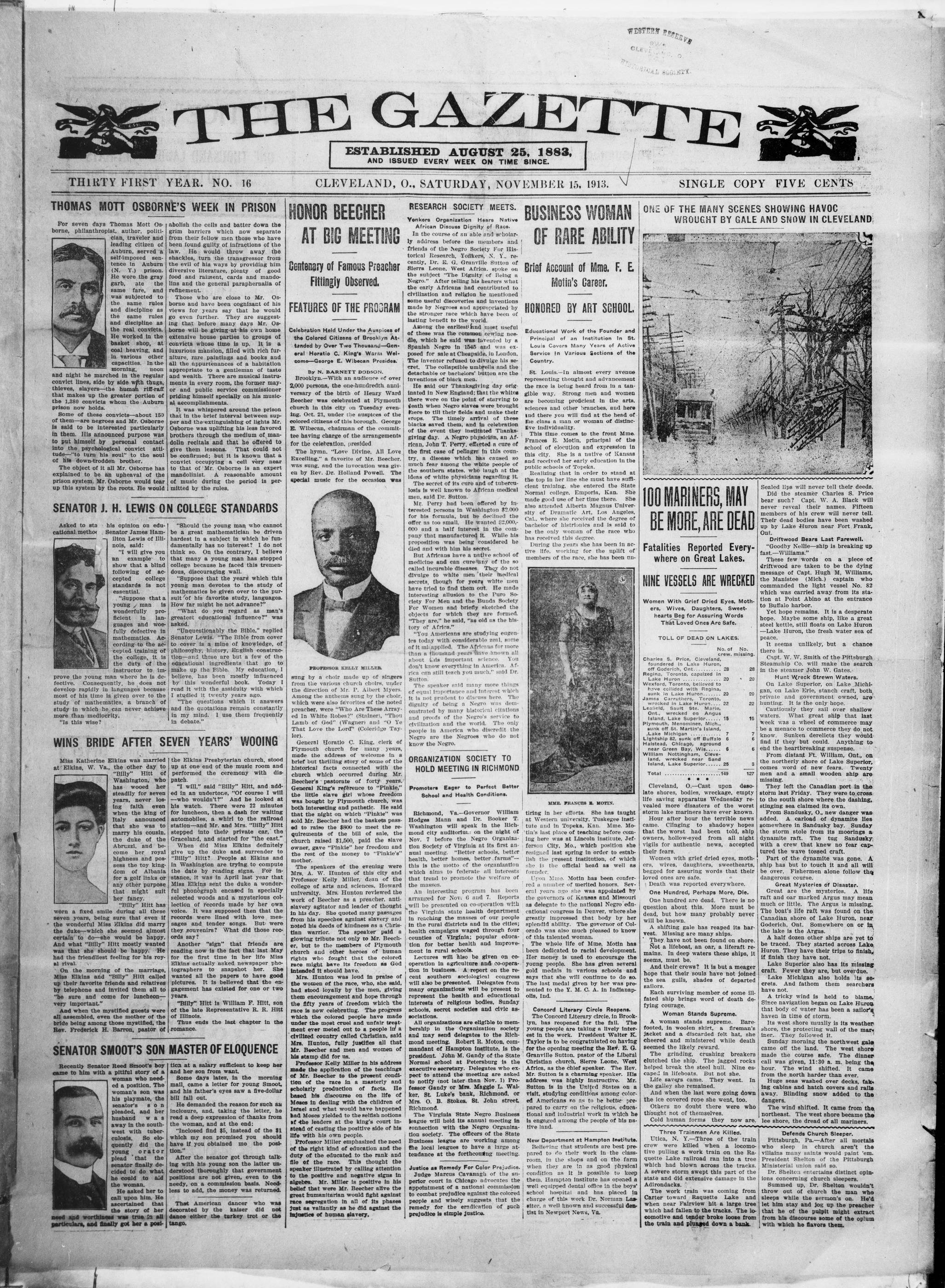
THOMAS MOTT OSBORNE'S WEEK IN PRISON
SENATOR J. H. LEWIS ON COLLEGE STANDARDS
SENATOR J. H. LEWIS ON COLLEGE STANDARDS
WINS BRIDE AFTER SEVEN YEARS' WOOING
SENATOR SMOOT'S SON MASTER OF ELOQUENCE
AUTHORIZED
For seven days Thomas Mott Oborne, philanthropist, author, politi-
list, author, politician, traveler and leading citizen of Auburn, served a self-imposed sentence in Auburn (N. Y.) prison. He wore the gray garb, ate the same fare, and was subjected to the same rules and discipline as the same rules and discipline as the real convicts. He worked in the basket shop, at coal heaving, and in various other capacities. In the morning, noon
can, traveler and leading citizen of Auburn, served a self-imposed sentence in Auburn (N. Y.) prison. He wore the gray garb, ate the same fare, and was subjected to the same rules and discipline as the same rules and discipline as the real convicts. He worked in the basket shop, at coal heaving, and in various other capacities. In the morning, noon and night he marched in the regular convict lines, side by side with thugs, thieves, slayers—the human riff-raff that makes up the greater portion of the 1,380 convicts whom the Auburn prison now holds.
Some of these convicts—about 150 of them—are negroes and Mr. Osborne is said to be interested particularly in them. His announced purpose was to put himself by personal contact into the psychological convict attitude—"to turn his soul" to the soul of his down-trodden brother.
The object of it all Mr. Osborne has explained to be an upheaval of the prison system. Mr. Osborne would lean up this system by the roots. He would
his opinion on edu
Senator James Ham
ilton Lewis of Illinois,
said.
Asked to sta
cational method
"I will give you an example to show that a blind following of accepted college standards is not essential.
"Suppose that a young man is wonderfully proficient in languages and woefully defective in mathematics. According to the accepted training of the college, it is the duty of the instructor to improve the young man where he is defective. Consequently, he does not develop rapidly in languages because most of his time is given over to the study of mathematics, a branch of study in which he can never achieve more than mediocrity.
Miss Katherine Elkins was married at Elkins, W. Va., the other day to
"Billy" Hitt of Washington; who has wooed her steadily for seven years, never losing faith even when the king of Italy announced that she was to marry his cousin, the duke of the Abruzzi, and become her roy highness and possess the toy king dom of Albania for a golf links or any other purpose that might suit her fancy.
Washington, who has wooed her steadily for seven years, never losing faith even when the king of Italy announced that she was to marry his cousin, the duke of the Abruzzi, and become her royal highness and possess the toy kingdom of Albania for a golf links or any other purpose that might suit her fancy.
"Billy" Hitt has worn a fixed smile during all these seven years, being sure that even if the wonderful Miss Elkins did marry the duke—which she seemed almost certain to do—she would be happy. And what "Billy" Hitt mostly wanted was that she should be happy. He had the friendliest feeling for his royal rival.
On the morning of the marriage, Miss Elkins and "Billy" Hitt called up their favorite friends and relatives by telephone and invited them all to "be sure and come for lunchoon—very important."
And when the mystified guests were all assembled, even the mother of the bride being among those mystified, the Rev. Frederick H. Barron, pastor of
Recently Senator Reed Smoot's boy came to him with a pliful story of a
woman who needed a position. The woman's son was his playmate, the senator's s o n pleaded, and her husband w a s away in the southwest with tuberculosis. So eloquently did the young or or plead that the senator finally decided to do what he could to aid the woman.
M. B.
He asked her to call upon him. He ascertained that the story of her need and worthiness was true, in all particulars, and finally got her a post-
abolish the cells and batter down the grim barriers which now separate from their fellow men those who have been found guilty of infractions of the law. He would throw away the shackles, turn the transgressor from the evil of his ways by providing him diversive literature, plenty of good food and raiment, cards and mandolins and the general paraphernalia of refinement.
Those who are close to Mr. Osborne and have been cognizant of his views for years say that he would go even further. They are suggesting that before many days Mr. Osborne will be giving at his own home extensive house parties to groups of convicts whose time is up. It is a luxurious mansion, filled with rich furniture, rare paintings and books and all the appurtenances of a habitation appropriate to a gentleman of taste and wealth. There are musical instruments in every room, the former mayor and public service commissioner priding himself specially on his musical accomplishments.
It was whispered the prison that in the brief interval between supper and the extinguishing of lights Mr. Osborne was uplifting his less favored brothers through the medium of mandolin recitals and that he offered to give them lessons. That could not be confirmed; but it is known that a convict occupying a cell very near to that of Mr. Osborne is an expert mandolinist. A reasonable amount of music during the period is permitted by the rules.
"Should the young man who cannot be a great mathematician be driven hardest in a subject in which he fundamentally has no interest? I do not think so. On the contrary, I believe that many a young man has stopped college because he faced this tremendous, discouraging wall.
"Suppose that the years which this young man devotes to the study of mathematics be given over to the pursuit' of his favorite study, languages. How far might he not advance?"
"What do you regard as man's greatest educational influence?" was asked.
"Unquestionably the Bible," replied Senator Lewis. "The Bible from cover to cover is a mine of knowledge, of philosophy, history, English construction—and these are but a few of the educational ingredients that go to make up the Bible. My education, I believe, has been mostly influenced by this wonderful book. Today I read it with the assiduity with which I studied it twenty years ago.
"The questions which it answers and the quotations remain constantly in my mind. I use them frequently in debate."
the Elkins Presbyterian church, stood up at one end of the music room and performed the ceremony with dispatch.
"I will," said "Billy" Hitt, and added in an undertone, "Of course I will—who wouldn't?" And he looked at his watch. There were 22 minutes for luncheon, then a dash for waiting automobiles, a whirl to the railroad station—and Mr. and Mrs. "Billy" Hitt stepped into their private car, the Graceland, and started for the "east." When did Miss Elkins definitely give up the duke and surrender to "Billy" Hitt? People at Elkins and in Washington are trying to compute the date by reading signs. For instance, it was in April last year that Miss Elkins sent the duke a wonderful phonograph encased in specially selected woods and a mysterious collection of records made by her own voice. It was supposed then that the records were lined with love messages and tender songs. But were they souvenir? What did those records say?
Another "sign" that friends are reading now is the fact that last May for the first time in her life Miss Elkins actually asked newspaper photographers to snapshot her. She wanted all the papers to have good pictures. It is believed that the engagement has existed for one or two years.
"Billy" Hitt is William F. Hitt, son of the late Representative R. R. Hitt of Illinois.
Thus ends the last chapter in the romance.
tion at a salary sufficient to keep her and her son from want.
Some days later, in the morning mall, came a letter for young Smoot, and his father's eyes saw a five-dollar bill fall out.
He demanded the reason for such an inclounce, and, taking the letter, he read a deep expression of thanks from the woman, and at the end:
"Inclosed find $5, instead of the $1 which my son promised you should have if you obtained me the position."
After the senator got through talking with his young son the latter understood thoroughly that government positions are not given, even to the needy, on a commission basis. Needless to add, the money was returned.
That American dancer who was decorated by the kaiser did not dance either the turkey trot or the tango.
ESTABLISHED AUGUST 25, 1883 AND ISSUED EVERY WEEK ON TIME SINCE.
Centenary of Famous Preacher Fittingly Observed.
Celebration Held Under the Auspices of the Colored Citizens of Brooklyn Attended by Over Two Thousand—General Horatio C. King's Warm Welcome—George E. Wibecan Presides.
By N. BARNETT DODSON.
Brooklyn—With an audience of over 2,000 persons, the one-hundredth anniversary of the birth of Henry Ward Beecher was celebrated at Plymouth church in this city on Tuesday evening, Oct. 21, under the auspices of the colored citizens of this borough. George E. Wibecan, chairman of the committee having charge of the arrangements for the celebration, presided
The hymn, "Love Divine, All Love Excelling," a favorite of Mr. Beecher, was sung, and the invocation was given by Rev. Dr. Holland Powell. The special music for the occasion was
PROFESSOR KELLY MILLER.
sung by a choir made up of singers from the various church choirs, under the direction of Mr. P. Albert Myers. Among the anthems sung by the choir, which were also favorites of the noted preacher, were "Who Are These Arrayed In White Robes?" (Stainer), "Thou Lamb of God" (Wagner) and "O Ye That Love the Lord" (Coleridge Taylor).
General Horatio C. King, clerk of Plymouth church for many years, made the address of welcome in a brief but thrilling story of some of the historical facts connected with the church which occurred during Mr. Beecher's pastorate of forty years. General King's reference to "Pinkle," the little slave girl whose freedom was bought by Plymouth church, was both interesting and pathetic. He said that the night on which "Pinkle" was sold Mr. Beecher had the baskets passed to raise the $900 to meet the requirements of the bill of sale, the church raised $1,500, paid the slave owner, gave "Pinkle" her freedom and the rest of the money to "Pinkle"'s mother.
The speakers of the evening were Mrs. A. W. Hunton of this city and Professor Kelly Miller, dean of the college of arts and sciences, Howard university. Mrs. Hunton reviewed the work of Beecher as a preacher, anti-slavery agitator and leader of thought in his day. She quoted many passages from his speeches against slavery and noted his deeds of kindness as a Christian warrior. The speaker paid a glowing tribute not only to Mr. Beecher, but to the members of Plymouth church and other heroes of human rights who fought that the colored race might have its freedom as God intended it should have.
Mrs. Hunton was loud in praise of the women of the race, who, she said, had stood loyally by the men, giving them encouragement and hope through the fifty years of freedom which the race is now celebrating. The progress which the colored people have made under the most cruel and unfair treatment ever meted out to a people in a civilized country called Christian, said Mrs. Hunton, fully justifies all that Mr. Beecher and men and women of his stamp did for us.
Professor Kelly Miller in his address made the application of the teachings of Mr. Beecher to the present condition of the race in a masterly and scholarly production of facts. He based his discourse on the life of Moses in dealing with the children of Israel and what would have happened had Moses yielded to the selfish notions of the leaders at the king's court instead of casting the positive side of his life with his own people.
Professor Miller emphasized the need of the right kind of education and the duty of the educated to the rank and file of the race. This thought the speaker illustrated by calling attention to the positive and negative signs in algebra. Mr. Miller is positive in his belief that were Mr. Beecher alive the great humanitarian would fight against race segregation in all of its phases just as valiantly as he did against the injustice of human slavery.
RESEARCH SOCIETY MEETS.
Yenkers Organization Hearts Native African Discuss Dignity of Race.
In the course of an able and scholarly address before the members and friends of the Negro Society For Historical Research, Yonkers, N. Y., recently, Dr. E. G. Granville Sutton of Sierra Leone, West Africa, spoke on the subject "The Dignity of Being a Negro." After telling his hearers what the early Africans had contributed to civilization and religion he mentioned some useful discoveries and inventions made by Negroes and appropriated by the stronger race which have been of lasting benefit to the world.
Among the earliest and most useful of these was the common sewing needle, which he said was invented by a Spanish Negro in 1545 and was exposed for sale at Cheapside, in London. The inventor refused to divulge his secret. The collapsible umbrella and the detachable or bachelor's button are the inventions of black men.
He said our Thanksgiving day originated in New England; that the whites there were on the point of starving to death when Negro slaves were brought there to till their fields and make their crops. The timely arrival of these blacks saved them, and in celebration of the event they instituted Thanksgiving day. A Negro physician, an African, John T. Perry, effected a cure of the first case of pellagra in this country, a disease which has caused so much fear among the white people of the southern states, who laugh at the ideas of white physicians regarding it. The secret of its cure and of tuberculosis is well known to African medical men, said Dr. Sutton. Mr. Perry had been offered by interested persons in Washington $2,000 for his formula, but he declined the offer as too small. He wanted $2,000,000 and a half interest in the company that manufactured it. While his proposition was being considered he died and with him his secret. But Africans have a native school of medicine and can cure any of the so called incurable diseases. They do not divulge to white men 'their medical secrets, though for years white men have tried to find them out. He made interesting allusion to the Puro Society For Men and the Bunda Society For Women and briefly sketched the objects for which they are formed. "They are," he said, "as old as the history of Africa."
"You Americans are studying engines today with considerable zeal, some of it applauded. The Africans for more than a thousand years have known all about its important science. You don't know everything in America. Africa can still teach you much," said Dr. Sutton.
The speaker said many more things of equal importance and interest which it is not prudent to discuss here. The dignity of being a Negro was demonstrated by many historical citations and proofs of the Negro's service to civilization and the world. The only people in America who discredit the Negro are the Negroes who do not know the Negro.
ORGANIZATION SOCIETY TO
HOLD MEETING IN RICHMOND
Promoters Eager to Perfect Better School and Health Conditions.
Richmond, Va.-Governor William Hodges Mann and Dr. Booker T. Washington will speak in the Richmond city auditorium on the night of Nov. 7 before the Negro Organization Society of Virginia at its first annual meeting. "Better schools, better health, better homes, better farms"—this is the motto of the organization which aims to federate all interests that trend to promote the welfare of the masses.
An interesting program has been arranged for Nov. 6 and 7. Reports will be presented on co-operation with the Virginia state health department in reaching the masses of our people in the rural districts and in the cities; health campauls waged through four counties of Virginia; popular education for better health and improvement in rural schools.
Lectures will also be given on cooperation in agriculture and co-operation in business. A report on the recent southern sociological congress will also be presented. Delegates from many organizations will be present to represent the health and educational interests of religious bodies, Sunday schools, secret societies and civic associations.
All organizations are eligible to membership in the Organization society and may send delegates to the Richmond meeting. Robert R. Moton, commandant of Hampton Institute, is the president. John M. Gandy of the State Normal school at Petersburg is the executive secretary. Delegates who expect to attend the meeting are asked to notify (not later than Nov. 1) Professor Gandy or Mrs. Maggie L. Walker, St. Luke's bank, Richmond, or Mrs. O. B. Stokes, St. John street, Richmond.
The Virginia State Negro Business league will hold its annual meeting in connection with the Negro Organization society. The officers of the State Business league are working among the local leagues to have a large attendance at the forthcoming meeting.
Justice as Remedy For Color Prejudice.
Judge Marcus Cavanagh of the superior court in Chicago advocates the appointment of a national commission to combat prejudice against the colored people and wisely suggests that the remedy for the eradication of such prejudice is simple justice.
BUSINESS WOMAN OF RARE ABILITY
Brief Account of Mme. F. E. Motin's Career.
HONORED BY ART SCHOOL.
Educational Work of the Founder and Principal of an Institution In St. Louis Covers Many Years of Active Service In Various Sections of the Country.
St. Louis. In almost every avenue representing thought and advancement the race is being heard from in a tangible way. Strong men and women are becoming proficient in the arts, sciences and other branches, and here and there you will find at the head of the class a man or woman of distinctive individuality.
This time comes to the front Mme. Frances E. Motin, principal of the school of elocation and expression in this city. She is a native of Kansas and received her early education in the public schools of Topeka.
Realizing that in order to stand at the top in her line she must have sufficient training, she entered the State Normal college, Emporia, Kan. She made good use of her time there. She also attended Alberta Magna University of Dramatic Art, Los Angeles, Cal., where she received the degree of bachelor of histiromics and is said to be the only woman of the race who has received this degree.
During the years she has been in active life, working for the uplift of members of the race, she has been un-
MMB. FRANCES B. MOTIN.
tiring in her efforts. She has taught at Western university, Tuskegee institute and in Topeka, Kan. Mme. Motin's last place of teaching before coming here was at Lincoln institute, Jefferson City, Mo., which position she resigned last spring in order to establish the present institution, of which she is the official head as well as founder. Upon Mme. Motin has been conferred a number of merited honors. Several years ago she was appointed by the governors of Kansas and Missouri as delegate to the national Negro educational congress in Denver, where she greatly impressed that body by her splendid ability. The governor of Colorado was also much pleased to know of this talented woman. The whole life of Mme. Motin has been dedicated to racial development. Her money is used to encourage the young people. She has given several gold medals in various schools and says that she will continue to do so. The last medal given by her was presented to the Y. M. C. A. in Indianapolis, Ind.
Concord Literary Circle Reopens.
The Concord Literary circle, in Brooklyn, has reopened for the fall. The young people are taking a lively interest in the work. President Walter K. Taylor is to be congratulated on having for the opening meeting the Rev. E. G. Granville Sutton, pastor of the Liberal Christian church, Sierre Leone, West Africa, as the chief speaker. The Rev. Mr. Sutton is a charming speaker. His address was highly instructive. Mr. Sutton is in the United States on a visit, studying conditions among colored Americans so as to be better prepared to carry on the religious, educational and industrial work in which he is engaged among the people of his native land.
New Department at Hampton Institute.
Believing that students are best prepared to do their work in the classroom, in the shops and on the farm when they are in as good physical condition as it is possible to keep them. Hampton Institute has opened a well equipped dental office in the boys school hospital and has placed in charge of this work Dr. Norman Lassiter, a well known and successful dentist in Newport News, Va.
WESTERN RESERVE
CLEVELAND.
HISTORICAL SOCIETY.
ONE OF THE WRO
100 MARITIME BE MORE
Fatalities R
where on
ONE OF THE MANY SCENES
WROUGHT BY GALE
100 MARINERS, MAY
BE MORE, ARE DEAD
Fatalities Reported Every-
where on Great Lakes.
ONE OF THE MANY SCENES SHOWING HAVOC WROUGHT BY GALE AND SNOW IN CLEVELAND
THE STORM
NINE VESSELS ARE WRECKED
Women With Grief Dried Eyes, Moth
ers, Wives, Daughters, Sweet-
hearts Beg for Assuring Words
That Loved Ores Are Safe.
crew. missing.
Charles S. Price, Cleveland,
foundered in Lake Huron,
off Golderich, Ont. ... 28
Regina, Toronto, capsized in
Lake Huron ... 20
Wacofero is beloved to
have collided with Regina,
sunk in Lake Huron ... 20
James Carruthers, Toronto,
wrecked in Lake Huron ... 20
Lake Huron, Mairie,
Ont., wrecked on Angus
Island, Lake Superior ... 15
Plymouth, Menominee, Mich.
sunk off Martin's Island,
Lake Michigan ... 7
Lightship 82, sunk off Buffalo ... 6
Halstead, Chicago, aground
near Green Bay, Wis. ... 6
Windy, Omaha, Island,
wrecked near Sand
Island, Lake Superior ... 25
Total ... 149
127
Cleveland, O—Cast upon des-
locate shores, bodies, wreckage, empty
life saving apparatus Wednesday re-
vealed more disasters of the worst
storm lake mariners have ever known.
Hour after hour the terrible news
came. Clinging to shadowy hopes
that the worst had been told, ship
owners, hollow-eyed from all night
vigils for authentic news, accepted
their fears.
Women with grief dried eyes, mothers,
wives, daughters, sweethearts,
begged for assuring words that their
loved ones are safe.
Death was reported everywhere.
One hundred, Perhaps Mile, Dle.
One hundred are dead. There is no
question about this. More must be
dead, but how many probably never
will be known.
A shifting gale has reaped its harvest. Missing are many ships. They have not been found on shore. Not a lifeboat, an oar, a liferaft remains. In deep waters these ships, it seems, must be. And their crews? It is but a meager hope that their souls have not joined the sea gulls, shades of departed sailors. Each surviving member of some ill-fated ship brings word of death defying courage.
Woman Stands Supreme.
A woman stands supreme. Bare-footed, in woolen skirt, a fireman's jacket and a discarded felt hat, she cheered and ministered while death seemed the likely reward. The grinding, crushing breakers clutched the ship. The jagged rocks helped break the steel hull. Nine essees, but not she. Life savers came. They went. In the galley she remained.
Cold human forms they now are.
Three Trainmen Are Killed.
Utica, N. Y.—Three of the train crew were killed when a locomotive pulling a work train on the Raquette Lake railroad ran into a tree which had blown across the tracks. A severe storm swept this part of the state and did extensive damage in the Adirondacks.
The work train was coming from Carter toward Raquette Lake and when near Fairview hit a large tree which had fallen to the tracks. The locomotive and tender broke loose from the train and plunged down a bank.
---
Sealed lips will never tell their deeds.
Did the charles Charles S. Price bear such? Capt. W. A. Black will never reveal their names. Fifteen members of his crew will never tell. Their dead bodies have been washed up by Lake Huron near Fort Frank, Ont.
Driftwood Bears Last Farewell.
"Goodbye Nellie—ship is breaking up fast—Williams."
These few words on a piece of driftwood are taken to be the dying message of Capt. Mugh M. Williams, the Manistee (Mich.) captain who commanded the light vessel No. 82 which was carried away from its station at Point Abino at the entrance to Buffalo harbor.
Yet hope remains. It is a desperate hope. Maybe some ship, like a great steel kettle, still floats on Lake Huron—Lake Huron, the fresh water sea of peace.
It seems unlikely, but a chance there is.
Capt. W. W. Smith of the Pittsburgh Steamship Co. will make the search in the steamer John W. Gates.
Hunt Wreck Strewn Waters.
On Lake Superior, on Lake Michigan, on Lake Erie, stanch craft, both private and government owned, are hunting. It is the only hope.
Cautiously they sail over shallow waters. What great ship that last week was a wheel of commerce may be a menace to commerce they do not know. Sunken derelicts they would find if they but could. Anything to end the heartbreaking suspense.
From distant Ft. William, Ont., on the northerly shore of Lake Superior, comes word of new fears. Twenty men and a small wooden ship are missing.
They left the Canadian port in the storm last Friday. They were to cross to the south shore where the dashing, stinging sea claimed its own.
From Sandusky, O, new danger was added. A carload of dynamite lies somewhere in Sandusky bay. Sunday the storm stole from its moorings a dynamite raft. The tug Sandusky with a crew that knew no fear captured the wave tossed craft.
Part of the dynamite was gone. A ship has but to touch it and all will be over. Fishermen alone follow the dangerous course.
Great Mysteries of Disaster
GREAT Mysteries of Disaster.
Are the mysteries. A life raft and oar marked Argus may mean much or little. The Argus is missing. The boat's life raft was found on the Canadian shore of Lake Huron, near Goderich, Ontario. Somewhere on or in the lake is the Argus.
A half dozen other ships are yet to be traced. They started across Lake Huron. They have their trips to finish, if finish they have not.
Lake Superior also has its missing craft. Fewer they are, but overdue. Lake Michigan also holds its secrets. And fathom them searchers have not.
A tricky wind is held to blame. Since navigation began on Lake Huron that body of water has been a sailor's haven in time of storm.
Its west shore usually is its weather shore, the protecting wall of the mariner. They followed it.
Sunday morning the northwest gale came off the land. The west shore made the course safe. The dinner call was given, 11:30 a. m. being the hour. The wind shifted. It came from the north harder than ever.
Huge seas washed over decks, taking cabins and hatch covers and rails away. Blinding snow added to the dangers.
The wind shifted. It came from the northeast. The west shore became the lee shore, the dread of all mariners.
Derekhs Church Sleeper.
Pittsburgh, Pa.—After all mortals who sleep in church aren't the villains many saints would paint 'em. President Obama the Pittsburgh Ministerial union said so.
Dr. Shelton entertains distinct opinions concerning church sleepers.
Summed up, Dr. Shelton wouldn't throw out of church the man who sleeps while the sermon's on. He'd let him stay and jog up the preacher that he of the pulpit might extract from his discourse some of the opium with which he flavors them.
One Year. $1.50
Six Months. 1.00
Three Months. .30
Subscribers are requested to
mit by postoffice money or
or registered letter.
Entered at the postoffice in Cleveland
Ohio, as second-class matter
Address all communications to
HARRY C. SMITH
Editor and proprietor,
THE GAZETTE,
Blackstone Building, Cleveland, C.
Member Ohio Legislature 1854
to 1896; 1886 to 1898; 1900 to 1902
THE GAZETTE is the oldest, and has the largest bona fide circulation, double that of any newspaper in the interest of Afro-Americans, published in the state of Ohio, and comparison with any will immediately establish its rank as one of the NEWSIEST AND BEST in the country.
Cleveland
SATURDAY, NOVEMBER 15, 1913.
THE USE OF INSULTING TERMS.
Cleveland, Ohio, Nov. 1, 1913.
Mr. Erie C. Hopwood, Managing Ed
itor, the Cleveland Plain Dealer: Dead Sir—The enclosed clipping is from this morning's Plain Dealer. Of the several daily papers in this city, it is regarded in the most friendly spirit by my people, and is read by more of them than any other daily paper. This is the result of its fairness, as a rule, in its references to them and its uniformly broadminded treatment of matters of prime interest to them. The mongrel word "darky" is almost as objectionable to them as that often most miserable one, "nigger." Both terms or mongrel words, and others somewhat similar, are regarded by the intelligent of my people just as the intelligent Jews regard the like mongrel term or word, "sheeny," when applied to them; the Irish, "mick," when applied to them, etc.
I take it that the Plain Dealer is too high class and excellent a news paper to permit the use of any of these mongrel terms or words. I am, therefore, calling your attention to the enclosed clipping, with the hope that those of us who prefer the Plain Dealer er to any other local daily newspaper may continue our kindly feeling and preference for it.
Yours very truly,
HARRY C. SMITH.
Editor Hopwood's Splendid Reply.
Cleveland, O., November 6th, 1913.
Hon. Harry C. Smith, editor Gazette
Hon. Harry C. Smith, editor Gazette:
My dear Sir:—I am very glad you
were kind enough to write me on No
vember 1st, and call our attention to
the use of the word "darky" as being
objectionable to many of your people.
I am frank to say that I did not know
that the word was objectionable. I
had always appealed to me as a word
which indicated affection and real
kindly sentiment existing between the
people of the South and the colored
race. I shall, however, request our
men not to use the word.
I thank you for your kind expressions in regard to the Plain Dealer. I trust you appreciate the fact that the Plain Dealer is anxious to do anything in its power to promote the advancement and progress of your people, that it would not willingly use a word or do a thing which even by inuendo might do an injury or bring in any degree into disrepute so worthy a class of our population.
Yours very truly,
Erie C. Hopwood,
Managing Editor.
STACKS OF "STRAWS."
Six months ago the question Will the Republican party come back? was discussed in an academic way, the an awer in the affirmative being based on historic precedent and the logic of the situation. Today that question is answering itself by political developments all over the country. There no doubt at all about it—the Republican party IS coming back, and the coming back is proceeding at a faster rate than even the most optimistic had ventured to anticipate. There be some who prefer another expression. They choose to define the movement as a merger, a reunion of the Progressives with the Republican party. Be it so; call it what you will, the great fact remains that the men who up to the unfortunate "split" of 1912 were enrolled under the grand old name of Republican, are getting together again to oppose their historic rival, the Democratic party, and what it stands for. Counting from the Spring there have been a number of elections and primary contests, and without exception they all tell one tale—the coming back of the Republican party and the disintegration of the Progressive organization as a separate political unit. Chicago led beat Taft two to one in Chicago; at the Spring elections the Progressives three to 2,000 votes in St. Louis, Mo.; in the following Spring elections the Republicans swept the city, electing their mayor against the personal pleadings of Roosevelt against the contrary; and the Progressives polled only 4,200 votes. In Michigan the Progressives, led by Col. Roosevelt himself, put up col. F. Col. Roosevelt state elections. They were anxious to make a good show, as in November Michigan had given Roosevelt the largest plurality of any state in the Union, he beating Taft by 62,340, and in addition turning the state into a Democratic administration. But in the Spring elections the Republicans elected their state ticket by an old-time majority, and the Progressives came in a bad third. In April a special Congressional election was held in the Thirteenth district of Massachusetts. Owing to the "split" a Democrat was
elected, but the Progressive vote fell off considerably. "As Maine goes, so goes the Union," is a venerable tradition which still holds away. So, when there was a special election in the Third Congressional district of Maine in September, there was intense interest all over the country. Last November Wilson received in this district 14,692 votes; Roosevelt 13,236; and Taft 7,159. In the September election the Republican candidate for Congress received 15,106; the Democratic received 14,553; and the Progressive received 6,487. In Pennsylvania there was a genuine landslide back to Republicanism in the September primaries. Philadelphia showed a Republican enrollment which defies any possible combination against it. It was an increase of 33,348 over the Taft vote of last November; the Bull Moosers fell short 44,025; and the Democrats a decrease of 36,203. In the primary elections of 1912 in Pennsylvania the Roosevelt men elected an overwhelming majority of the delegates, elected a full state committee (retaining the Republican organization under another name), and at the Presidential election the vote stood: Roosevelt, 447,426; Taft, 273,905; Wilson, 295,619. But at the September primaries this year the situation was completely reversed. In 18 out of the 50 senatorial districts of the state not a single Bull Mooser was elected. The Pennsylvania primary law requires that a meeting of the State Committee of each political party should be held subsequent to the primaries; this year the date fell on September 30th. The Bull Moose State Committee did not have a meeting, owing not only to lack of interest but to the fact that so many districts failed to elect representatives. The regular Republican State Committee had a meeting, every district being represented. Flinn was deposed and Penrose was elected Chairman of the Committee. And thus died the Bull Moose party of Pennsylvania. At a September primary in Omaha, Neb. the Republican vote was almost twice as great as was cast at the Presidential election; the Democratic vote was only a little more than half; and the Progressive vote fell from 6,062 to 343. In the Presidential election the Republicans were a bad third; but in the September primaries they beat the Democrats and Progressives combined with over 3,000 to spare. Progressiveism was strong in Kentucky last November, Roosevelt polling 102,766 to 115,512 for Taft. But in last August, primaries, while in some counties the Republicans doubled, trebled and ever quadrupled their strength, the Progressive vote fell off generally, in one case from 2,036 to 85. Then came the New Jersey primaries, in which the Republican vote was almost equal to that cast at the Presidential election, the Democratic vote fell off one third, and the Progressive vote dwindled from 145,410 to 10,095. A few days ago Connecticut held town elections The New York Sun editorially observed that, "the same shrinkage of the Progressive vote that has been noted in other parts of the country was recorded." And the Sun proceeds to
"If the weakness of the Progressive vote were confined to one State or section of the country local causes might plausibly be cited to account for it. But the tale is the same in all parts of the country. The Progressives are everywhere reprimanded for that. The Republican is for. For it, the Republican laid out for decent burial ten months ago the Republican organization is acting in a most unseemly manner." If further evidence were necessary, it can be found in the recent (November) elections, throughout the country, especially in the north, where the Republican strength has always been found—that is most of it. The "grand old Republican party" is again "coming into its own."
EDITOR N. Y. EVENING POST
WRITES.
New York City, November 5, 1913.
Hon. Harry C. Smith, Editor Gazette.
Dear Mr. Smith: I thank you most
sincerely for your kind letter of Nov
ember third and for your recent no
tice of me in your paper. It is a great
instrument to me. I receive exe
pressions of this kind. I only wish
that I could hold out to you some hope
of really accomplishing something big
for the colored people. At any rate
we shall fight on as hard as we can
and put our faith in time and in the
essential righteousness of the Ameri
can people.
Very truly yours,
Oswald Garrison Villard.
He Has Do So Frequently.
Willoughby, O., Nov. 10, 1913. Editor Gazzette, Dear Sir: I have read your fine letter to the editor of the Cleveland Plain Dealer requesting the plain Dealer to be used in articles in recent issues of that paper. But I ask you to add to your letter, as I think it voices the sentiment of a majority of our people of northern Ohio, at least. Send a letter to the Plain Dealer, Press, Leader and News, all of Cleveland, requesting them to refrain from heralding our people, when connected with crime or alleged crime, as they do, because such "scare-line" heads and sensational publications only increase prejudice and incite riots. Such a letter is not asking a favor but is in the interest of fairness, law and order. If it is not possible to secure this concession, then we should turn our efforts to secure action in the state legislature.
Boycotting Jews in Poland. The aim of the boycott is the organization of the Christian population toward the economic and social elimination of the Jews. Christian consummation shall not buy at Jewish stores, the manufacture of goods, theage Jewish workingmen and clerks. Christian banks shall not loan money on Jewish real estate. Christians shall not call in Jewish physicians or consult Jewish attorneys, or read books published by Jews, or, in general, tolerate a Jew in their midst. Christians shall not take a carriage which is driven by a Jewish driver, or buy an apple from a Jewish pedler. That is the practical program of the boycott, and its final aim is the total expulsion of the Jews from Poland—American Hebrew, N. Y. City.
Cheap Labor in Trinidad.
Labor is so cheap in Trinidad that it does not pay to buy lawn mowers, as cootles will cut the grass with a small sickle or knife at a trifling cost.
THE GAZETTE, CLEVELAND, O., SATURDAY, NOVEMBER 15, 1913.
WRITTEN BY "THE OLD RELIA-
BLE" GAZETTE'S CORRE-
SPONDENTS.
THROUGHOUT OHIO
What Our People Are Doing Each Week—Church, Personal, Social, Lodge, Literary and Musical — Marriages, Deaths, Etc.
KENT—Jas. Jackson caught by Marshal Crites for stealing 86c from the B. & O. depot, was on Oct. 31, given 15 years in the "Pen." The other man (white) got 20 years in the "O. P." for shooting to kill. Both sentences are indeterminate, but not to exceed the number of years given. (The foregoing was sent to The Gatzette, Nov. 7, 13, by Mrs. Mary E Douglass, 2052 Cornell Rd., Cleveland O. — Editor.)
XENIA—Chas. E. McGooden of Chicago, and Miss Ada E. Curl of this city, were quietly married here, recently. They are "at home" at 3756 Indiana Ave., that city—The Gazette desires a good correspondent here, preferably some one attending the High School. Write the editor (in English) of the Gazette, a excellent opportunity for the right person, male or female. Give your order for a paper every week to the local agent.
SANDUSKY—Mrs. Geo. Scott has returned from Chicago and Indianapolis. The storm closed the churches, Sunday evening. Mr. and Mrs. Seele are rejoicing over a 9-pound boy, born last week—Mrs. A. D. Gardner is ill. Mr. and Mrs. John Adams, newly wed, were surprised, last week, when a part of a soft many valuable and useful books was lost. Sunday day evening, at the Rest Room, has been postponed. No. 2 is the banner class.
OBERLIN—Mrs. A. N. Robinson was found dead, Thursday morning. She was very old. The fire at I. L. Hurd's, Wednesday evening, did considerable damage to the upper story. John Robinson, a Wil伯力学生, has been quite ill—Mrs. Anna Anderson entertained the "Jolly Club" club, Thursday evening. Mr. and Mrs. John Pettiford, formerly of Cleveland and Park Sh. have been there on S. Park Sh. Miss Clarence Bearse was married, Thursday evening. Mr. Clarence Howard of Sandusky, was here, Saturday. Mr. Edward Huston is very ill. Oberlin high school defeated Rayen high, Youngstown, 7 to 0. Cy Gayters and Willes were "stars" for Oberlin. Oberlin defeated Reserve, Saturday, 13 to 6. Broc. Henderson, Pete Fisher, captain, and Edwards, the Spurney captain, for Reserve. Oberlin high school expects a hard game with the Academy, Friday. Mrs. Eda Banks of Cleveland, is here. Mrs. Marin Chambers is slowly convalescing. Mr. Jas. Bell was found unconscious, Wednesday, and is very ill.
CADIZ—The young men connected with the "Happy Hour" club gave a reception to the ladies, on the 6th, at Mr. Chas, Mason's.—Mrs. Alice Howard visited recently, in Pittsburg and Carnegie, Pa.—Mrs. James Smith, who underwent an open surgery. In hospital recently, in convalescing.—Mr. Henry Bloodsaw of Cleveland, was the guest of Mrs. Lillian Harris, last week.—The W. C. T. U. gave a reception the 3rd, at Mrs. C. H. Christian's. There were 43 present.—The Green Leaf club gave a social, on the 6th, at Mrs. C. H. Christian's benefit of Mrs. Emma Tyler, a member, who is at a Columbus hospital. Receipts about $34.—A. L. Strother of Irwin, Pa., was home the 4th.—Prof. W. H. Lucas, R. F. Ballard, and Miss Ida Jackson attended the Teachers Institute at Steubenville, last week.—Mr. B. S. Church, E. Church rally.—Chester and Emery West entertained the C. I. C.'s, on the 7th. The B. B.'s met at the church, Sunday.
YOUNGSTOWN—Even though the weather was miserable, Oak Hill Ave. A. M. E. church was well attended and its collection amounted to $40. Sunday, Rev. G. W. Maxwell, P. E. conducted quarterly meeting and preached at 10:30 a. m. and at 3 p. m. The quarterly conference reports were made by Dr. J. M. Gilmore preached the third of his special sermons, Sunday evening, to a large congregation. He dealt most interestingly with "The Great and Awful Judgement of God." The solos rendered by Mr. Abraham Grant were fine and most appropriate. The fourth sermon of the series will be preached, Sunday evening, when Messrs. Gee, Woods and Allen Marvel will render solos. The fifth sermon, on Monday evening, at the Third Baptist church, by the Chrysanthemum club, in honor of the state officers. Mr. D. Jones was one of the speakers. —James F. Lewis and Miss Nellie F. Porter were married by Rev. W. O. Harper at the home on Earl Ave. prepared by the groom. Lunch was served by the church. A prominent member of the Third Baptist church, Mr. Lewis is a carpenter. They received a large number of beautiful and useful things. —Mrs. R. D. Lyuch, Mrs. Mollie Roberson and Thos. Lonesome are ill.
—Mrs. Rayford and Mr. Samuel Boggess are improving.—The funeral services of the late Nathaniel Alexander, age 62 of Uniontown, Pa., who died at his son, Henry's, 727 High St. Tuesday, were held, Friday, at the Third Baptist church, the pastor officiating. He leaves a wife, two sons and daughter.—Mrs. Maggie Taylor of Uniontown, and Miss Louisa Houser, were buried in Cleveland, last week.—The Third Baptist Missionary society met, Thursday. A large attendance.—Rev. Hatcher, formerly of Dayton, now located here, was struck on the head with a heavy weight and injured severely.
Correspondents must mail all letters for publication at their main postoffice sufficiently early on Monday (or Sunday) of each week to have them reach The Gazette office on Tuesday morning, and always write also, their names and that of the city or town on the other of the correspondents. Unlike these corresponded copies. Unless this latter is done, proper credit cannot be given you. Lists of names, wedding presents, etc., obituary notices, speeches, resolutions, poetry, inquiries for relatives and advertisements of all kinds, including items announcing entertainments to be held in the near future, must be paid for in advance at the rate of ten cents a line, six words to a line. Our rates are based on the amount sent on application. Send postal note and not stamps during warm weather.
"I see and I am Satisfied" Joke—An editor sticks a Pin in his pneumatic Expression.
Prof. Miller is nearer that great seat of American prejudice—the National Capital—than it is here in Minnesota THE APPEAL, clined to regard the Miller view as somewhat distorted. It is a joke to say that the American heart will beat true to the higher impulse. Christianity is all right until it strikes the color-line and then it is a farce. He does not realize the remorseless, unrelenting prejudice which resides in the average Caucasian heart. The professor's soul "abounds with reassurance and hope" just as orders have been issued by government officials which say that white and Colored emperors had the power to let the leets. By the way—did not the professor about fifteen years ago suggest "self-effacement" as the solution of the race problem?—St. Paul Appeal.
POLICE DETECTIVE SERGEANTS
Chicago, Ill.—A recent competitive examination, held by the Civil Service Board of Cook County, for second grade detective sergeants for the police department "landed" seven Colored men with high averages. Seventeen hundred took the examination; 511 were successful. Twelve Colored men took the examination and seven passed with the highest averages: Mertel Parker, Woodlawn station; Lilbur Jackson, Stanton Ave.; Julius Glenn, Cottage Grove Ave.; William A. D. Middleton, Cottage Grove Ave.; David Smith, detective bureau; James B. Tucker, Cottage Grove Ave., and Staple Head acquaintances. Other Parker, the first head, the last, is the nephew of Lleut. Childs. The percentage of each officer speaks well for his ability as a patrolman and qualifications necessary to be a plain clothes officer.
Organized To Fight Prejudice.
New York City—Delegates of Young Men's Hebrew associations and other Hebrew organizations in all parts of the country met here. Nov. 2, and organized the council of Young Men's Hebrew and kindred associations, the body that is to meet triennially and fight down prejudice against the Jewish race. Here is a "pointer" for Afro-Americans.
If you owe The Gazette, pay promptly, please, so we can continue sending you the paper.
Editor Gazette and Readers:
There grows here one of the most beautiful flowers, called the Royal Poinsettia and it is well named, for it is indeed a royal beauty. The plant grows six feet high the first year, and is one mass of fiery red flowers, produced in drooping grape-like clusters. The half fern like foliage is sensitive, closing at night or upon the approach of a storm. The Royal Poinsettia is a exotic bloom. The bloom is low, low damp ground, and it improves from year to year. Last winter I threw away a lot of the seed I had, and this spring they came up, and now a dozen or more of the shrubs, six to eight feet high, are full of ripe seed, and still they bloom, and now what I want to say is: I will send anyone the seed who wishes it if you send a stamp for postage. I have lots of the seed, and lots of people would like it. This is a free offer, nothing to follow, or axe to grind, only I would like to hear how you succeed with it. Plant in open ground now or early spring. Wouldn't you be glad to be the one to get the pretty flower in your state? Am I to blame? It was scarce here ten years ago, but many are grown now.
Yours,
ALICE WARNER,
2029 Hershel st., Jacksonville, Fl.
COLORED MEN
Wanted to prepare a
Sleeping Car and Tra
Porters
No experience neces
Positions pay $55 to $1
month. Steady work.
Eern Roads. Passes and
forms furnished when no
sary. Write now.
Inter. Ry. C. I., Dept.
THE BOOKS
COMMONS
DOINGS OF THE RACE
The largest Afro-American class (35), in recent years, was baptized into the Catholic faith, at Memphis, Tenn., recently.
Among the beneficiaries of the Carnegie Hero fund, according to the last report of the commission, were three members of the race, making twenty who have thus far received substantial recognition for acts of heroism.
New York Afro-Americans should demand Afro-American officers for their regiment or have none. It is an insult for that state's military officials to ask that our people submit to their demand for white officers under the circumstances.
Benjamin J. Davis, editor of the Atlanta (Ga.) Independent, under indictment for alleged offenses while employed as a gauger in the internal revenue service, is slated for trial in the federal court in November.
Rather than have the University of Nebraska observe the color line in football, that institution will withdraw from the Missouri Valley Conference and play no more football games with the schools in that circuit.
Gunboat Smith is proving his nerve by agreeing to meet Sam Langford in
Bishop Alex. Walters.
a 12-round bout at Boston Nov. 17. Despite Langford's poor (?) showing recently against Joe Jeannette there are no white heavyweights of prominence, barring Smith, who have shown any disposition to climb into the ring against the Boston wonder. Here is a program the Seattle (Wash). Searchlight promulgates as the foreword of Negro actors the understory of the baddie, holding a check for false leader must be placed in his true light; the hypocrites in our churches must be rooted quit; the impostors that assume to be leaders of our fraternal organizations must be dethroned. The snowstorm of the first of the week was a forcible reminder of the fact that our homes will not only want but need "the old reliable" Gazette, this winter. It is essentially "a fireside companion." Tell your friends and family that the paper --to subscribe at once-- the department, alone, is worth the price of the paper.
H. D. Colerane of Winchester, Ky., was elected to the city council, at the November election, defeating a white Progressive. Yes, he is a Republican. Yes, he is a Louis Mo., the 75 million dollar brewer who recently, left our people of his city and state, $10,000. Provident Hospital, $5,000; Old Folks' Home, $1,000; Orphans' Home, $1,000, and St. Francis Orphans' Home (Normandy) $1,000, all in St. Louis, and $2,000 to Bartlett Agricultural and Industrial School, Dalton, Mo. The father is likely to be elected mayor of Battersea, London, England. He is a photographer and very popular. Mr. and Mrs. Archer are members of the race. He has lived in London, 24 years. In a letter to the press and public, Bishop Alexander Walters again denies that he ever indorsed segregation in the governmental departments at St. Louis. What is Trotter and Du Bous' motive in trying to make people believe he did so?
Presiding Bishop Evans Tyree of the A. M. E. Church announces in the Philadelphia (Pa.) Christian Recorder, organ of the Church, that Editor R. R. Wright was removed from office for the publication in the Christian Recorder of things unlawful and detrimental to the Church and reflecting upon the bishops in their official duties. Rev. J. I. Lowe, business manager, was removed from office for alleged conduct unbecoming a minister and a General Officer. Gen. Ben L. Woodford of New Gen. said on one occasion while speaking at a literary society of Afro-Americans in Brooklyn in which he voiced the sentiments of his white fellow citizens: "We never freed the slaves until we had to, and we will never accord to them as free men all the rights and privileges which belong to them until we have to."
Jimmy Britt (white), exchampion pugilist, said recently, while in this city, that Joe Gans was the "little master" of all fighters, past and present, in his class. This all acknowledge. Continued Britt: "It was a pleasure to see Gans in action. I mean, of course, to a man who understood the finer points of the game. Joe had everything, including sped-up skills, skill in fighting ability. And still he did things so easily that he did not appear to be half the fighter he really was. It took the fellow in front of him to really appreciate Joe's true fighting ability, and I happened to be one of those."
Twenty-two years ago, Jonas W. Thomas of Mariborough county, S.C. began by buying an old horse for $40.75 and renting 30 acres for 1,400 pounds of lint cotton. Now he lives in a 12-room house and employees on his own $40,000 plantation, 39 families, consisting of 189 men, women, and children. He has received as much as $31,000 for his cotton crop alone—400 bales of long staple. On an averaged day, he worked for 22 years. In a single year he has borrowed of one local bank and repaid, $23,000.
The editor of The Cleveland (O.) Gazette is the dean of the Afro-American editorial corps—the oldest one in continuous service—Ex.
PROF. KELLY MILLER'S
A BEAUTIFUL FLOWER.
COLORED MEN
Wanted to prepare as
Sleeping Car and Train
Trainers
No experience necessary.
Positions pay $5 to $100 a
month. Steady work. East-
ern Roads. Passes and Uni-
forms furnished when neces-
sary. Write now.
No. 161, Indianapolis, Ind.
WE HAVE ONE THOUSAND LADIES' FELT-HATS Values $3 to 90 CENTS EACH For 15 Days $6, Selling at Only
Hammer Day. THE MAGIC U.S. LONG.
THE MAGIC SHAMPOO DRIER.
AND HAIR STRAIGHTENER.
SHAMPOO DRIER MED CO.
MAILED ANY WHERE IN U.S.$100
STATE AND STATE WANTED.
Agents Wanted.
Write for Literature.
Magic Shampoo Drier Co.
Minneapolis, Minn.
LOOK AND LIVE
DR. NICKENS FEMALE TONIC; the great nerve and Heart remedy for mental Depression, and general female weakness. Price 50 Cents.
DR. NICKENS KING OF PAIN for all manner of pains. Price 50 Cents.
DR. NICKENS CATARRH CURE for Old Sores, Chronic Ulcers, Cuts. Price 50 Cents.
DR. NICKENS COUGH AND LUNG SYRUP, for Coughs and Colds and all Throat and Lung Diseases. Price 50 Cents.
DR. NICKENS GREAT ALKALI LINIMENT, cures Headache, Neuralgia, Sore Muscles, Sprains and Swellings of all kinds. Price 50 Cents a Bottle.
Taylor's New Shampoo Dryer
and Hair Straightener!
The Best in the World!
This Comb, properly heated, and the use of LaCrete Hair Pomade, will bring the most crimped hair, strighten it with every strong and cause a rapid growth of the hair.
Don't put it off but send it for today and get the Comb.
PRICE OF OUMB $1.
Large, Heavy and Durable. Made of copper and brass associated together and cast in molten metal. Placed in nickel-plated steel, bolt which goes through the large wood handle and scrape into metal end of 4 comb to prevent the hand from securing loose or cooling off. Remember to tie in one piece. Nothing to set out of order, will last a lifetime.
Price of Hair Straightener and Alcohol Heater complete $1.50.
TAYLOR'S SPECIAL ALCOHOL HEATER is the handiest and most convenient method of heating the Comb, and can be closed up so that you can put it in your handbag. Price 50c.
For best results use LaCrete Hair Pomade. It not only meets every requirements of the Comb Straightener, but promotes a luxurious growth of the hair. Price 25c.
SEND FOR MY FREE CATALOGUE! Illustrating the Largest and Most Complete Line of Hair Cooks in this country for colored people, such as Bangs, Wigs, Puffs, Switches, Pomadours, Hair Fins, Combs, Brushes, etc.
Agents Wanted.
T. W. TAYLOR, Howell, Mich.
When writing please mention this paper
Pure Beer Bottled at the Brewery
Order a Case of
Gold Bond
Bottled Beer
THE CLEVELAND & SANDUSKY
BREWING COMPANY
Delivered at the Home. Both Phones.
A. M.
The Agricultural & Mechanical College for the Colored Race
Maintained by the Governments of North Carolina and of the United States. Open all the Year Round. For Males Only. Fall Term Begins September 1st, 1913. Strong Faculty. Excellent Facilities. Successful Graduates. Board, Lodging and Tuition $7.00 per month. For catalogue write, today, to
James B. Dudley, President
A. & M. College,
Greensboro, N. C.
Remedies have cured thousands, and will cure you. DR. NICKENS BLOOD SARSAPARILLA cures Kidney, Liver and Stomach Diseases, and all the disorders of the blood. Price 50 Cents.
For treatment, call on or address:
MISS KATIE B. COLLIER,
4812 Payne Ave.
Citadel, Ohio.
A delightfully Perfumed Hair-Pomade for making harsh, stubborn, curly hair soft, pliant and glossy. It is not only an ideal dressing for the hair, but also for the skin. It works directly on the scalp and roots of the hair, relieving dandruff and other diseases of the scalp-skin, thereby causing it to grow rich, long and luxurious.
B. & M. HAIR DRESSING is becoming more popular every day, and is sold stricly on a guarantee.
BROWN DRUG CO.
Brown and Seyfert, Prop's.
2742 Central Ave.
Selling Agents.
The New
Keystone
.RESTAURANT.
2408 Central Ave.
The Best Meals
Quick Service.
Cigars & Tobacco.
Open Day
and Night.
Chas. McPherson, Prop'r.
Theodore B. Green,
ATTORNEY AT LAW.
508-510 Superior Building.
Office, Main 3076.
Residence, Eddy 2086-R.
CLEVELAND, O.
RUSSELL'S REMEDY
for
CATARRH, HAY-FEVER,
ASTHMA, SORE-THROAT
AND LUNG TROUBLE.
Relieves When Others Fail
Send for Free Sample
CHAS. R. SIMMONS
404-405 Standard Bldg.,
323 Euclid Ave.
G. G. REED'S
A Complete Line of
LADIES' READY-MADE APPAREL.
Double Stamps on Tuesday.
Cuy. Central 6681-L.
3222 Central Ave., Cleveland.
A Complete Line
DRY GOODS, LADIES' AND GENTS'
FURNISHINGS
Double Stamps on Tuesdays and Fridays.
Good Bargains
In Realestate!
LARGE MORTGAGE LOANS!
RENTALS--COLLECTIONS.
CLAIMS ADJUSTED.
S. E. WOODS,
2828 Central Ave.
'Phone, North 996.
Ohio Dry-Cleaning and Dyeing Co.
Established in 1911.
Cleaners of all kinds of Ladies and Gentlemen's Garments.
Also Expert Cleaning and Blocking of All Kinds of Hats.
We Call for and Deliver!
2858 Central Av.
Cuy. Phone, Central 2201-L.
WHERE TO PURCHASE THE GAZETTE
M. H. DIXON'S, 2905 Central Ave.
M. J. HALL'S, 3121 Central Ave.
L. SCHWARTZ'S, 2921 Central Ave. Open Sunday.
O. C. SCHROEDEY'S, Cuyahoga Bldg. Open Sunday.
F. VALENTINE'S, 2130 Central Ave.
J. E. BRANHAM'S, 4040 Central Ave
NC State University Acadee
NOTICE TO SUBSCRIBERS:--Subscribers not receiving the Gazette regularly should notify us at once. We desire every copy delivered promptly. We advise our patrons to carefully examine the Gazette's advertisements before making purchases. Business men who advertise in this paper should have the patronage of Afro-Americans. The fact that they advertise is assurance that they want it.
Social and Personal
FOR RENT—Houses and Rooms—If you have them to rent or if you want to rent, advertise in The Gazette. It brings results.
In Toledo no Afro-American was given a license to conduct a saloon in Cinchmati, there were two; in Columbus, 7; in Youngstown, 1, while as The Gazette announced recently, it received licenses in Cleveland.
Mme. Anita Patti-Brown canceled two or more dates and left Cleveland Tuesday morning, for Washington, D.C., to give the members of the company a chance to see that beautiful city and hear the Clef Club at Howard theater, which might serve as an in
NOTARY PUBLIC—For such services call at The Gazette office, No. 3 Blackstone building, No. 1424 W. Third Street, near Superior Ave. FOR RENT—Furnished rooms, to men only. 2331 E. 38th St.
Mr. Henry Bloodsaw visited in Cadiz, last week.
Mr. Newsome of 2339 E. 30th St., is critically ill with dropsy.
Mrs. M. Reese of Fremont, visited Mrs. Henry Taylor of E. 77th St., last week.
Mr. Jarret Chavous of Columbus, visited his aunt, Mrs. Rebecca Lawson, 2257 E. 43d St., last week.
Miss (not "Mrs.") Rosa Lee of Pensacole, Fla., has located here, and is stopping with Mrs. H. L. Dorsey, a relative.
Mrs. Mary Garner Diehl left the city, Sunday morning, for Chicago, where she will make her home with a brother and study music.
On Thursday last a pleasant afternoon was spent with Mrs. Carl Morgan when the Pleasant Company Club held its regular meeting and presented her with a shower.
Ed. Huston, a resident of this city, many years, is very ill at his home in Oberlin. He has many old friends in Cleveland, some of whom ought to go to Oberlin, at once, to see him.
When you want the news of our people, the country over, take the old reliable Gazette. That is the only way you can get it. The daily papers delight in ridiculing and insulting our people and still you will purchase them.
Mrs. Lydia Wallace, 4308 Central Ave, died the 7th, LaGriffe and complications. Funeral, Monday afternoon, from St. John's A. M. E. church, the pastor officiating. She leaves a husband and mother. Mrs. Wallace came here, a bride, from Dayton about a year ago. Mr. Wallace has the sympathy of many friends.
Arthur A. Brown, manager of the "Sing-Tell-Play" Co., and wife, Mrs. A Patti-Brown, with the pianist, Miss Marion Garner of Chicago, were royally entertained at dinner, Sunday week, by Mr. George Carroll, Messrs. George Garner and Wyatt Huston tenor and violinist, respectively, were entertained at dinner by Mr. George Dunjil, the same day. "
The editor of The Gazette acknowledges the receipt of an invitation from Mr. and Mrs. Mrs. E. Clemens of Toledo, to attend the marriage of their daughter, Ina Edith, to James D. Brandon, Wednesday evening, Nov. 19, 8 p. m., at Warren A. M. E. church, that city. A reception will follow at the bride's parents' residence, 672 Woodland Av., Toledo. Mr. and Mrs. Brandon will be "at home," after Dec. 15 at 351 Woodland Av., Toledo.
Mrs. Sophia Madison wrote The Gazette, last week from Jackson, Mich., as follows: "Things shut down in Cleveland, so I am in Jackson working in the city market, making cakes of the old Folk." I am stall of my own. When you get through with this, give it to the president of the Old Folk's Home. Tell her I am not sitting around telling stories, like some of them at the Home do. Tell Lawyer Martin I will keep his eyes open. Tell him to keep his eyes open."
Send or bring locals and all business matters to The Gazette's new offices, Suite 2, Blackstone Bldg. If you wish to see the editor call them and not at his home. Please remember and tell this to all making inquiry of him or The Gazette.
The Hallowee'en mask party given by Miss Willa M. Griffin, 2275 E 101st St. Friday evening week, proved a very enjoyable and unique gift. The house was decorated in black and yellow, and centered with Hallowee'en lanterns, which furnished the only window. The house was covered with leaves and corn-husks, the noise of which, as the ghost-like figures strolled over them, but added to the uniqueness of the occasion. Covers were laid for 22 guests, who also enjoyed games and dancing.
If you were too black to be admitted to Luna Park roller rink all summer, except "jim-crow" days-Aug. 4 and 15—we would be too black to be "used" on Monday and Tuesday evenings now that the park is closed, even if "COLORED PATRONS" are especially solicited on these evenings.
THE GAZETTE, CLEVELAND, O., SATURDAY, NOVEMBER 15, 1913.
In Toledo no Afro-American was given a license to conduct a saloon; in Cincinnati, there were two; in Columbus, 7; in Youngstown, 1; while, as The Gazette announced recently, 6 received licenses in Cleveland.
Mme. Anita Patti-Brown canceled two or more dates and left Cleveland, Tuesday morning, for Washington, D.C., to give the members of the company a chance to see that beautiful attire he had at Howard theater, which might serve as an inspiration to the young artists with her before they sail on Saturday, Nov. 8, from New York, for South America. Mme. Brown with reluctance discharged her managing husband, bought him a ticket and sent him home, Tuesday, from Cleveland. He, too, was sorry — Chicago Defender.
Our advertisers want your trade. Those who do not ask for it in The Gazette certainly care little, if at all, for it. Therefore, we urge our readers and all of our friends to patronize those who ask for your trade in this paper.
Dr. J. K. Nickens will lecture at Mt. Haven Baptist church, 3725 Cedar Ave, Monday evening. One hundred panoramic scenes, showing business, religious, educational and the recent floods, will be exhibited. Refreshments will be served by the ladies. Don't miss it. Sunday, Rev. J. L. E. Burr, pastor will preach at 10:45 a.m. on "Jesus, the object of the World's greatest Abundant Ability." At 12:30 p. m. S. S.; at 3 p. m., sermon by Rev. R. A. Jones of Akron, and at 6 p. m. B. Y. P. U.
The DuBois Literary club held its regular meeting at Mrs. Wm McNaughton's, E. 30th St., last Wednesday. A very interesting program, prepared by Mrs. Ida Owens, was rendered. The club voted in as new members: Mrs. Vernon Lyons and Mrs. Fred Clarke. The active membership being filled, one other name presented and favorably acted upon was placed upon the "waiting list." Mrs. John Fairfax, unanimously voted in, at the club's previous meeting, as an honorary member, was present and made beneficial and interesting remarks. A bath-robe was presented to J. Walter Willis, Jr., who was the successful boy-competitor (ticket-selling) in the club's recent musical. A beautiful doll will be presented to Alma Burke, as second prize. It is being dressed and made ready for presentation.
Mrs. Anna Walker of N. Y. City has located here and opened a fine military store at 3882 Central Ave. We welcome her to the city. Patronize her race enterprise.—Adv.
Our City Federation of Women's clubs will hold a unique entertainment at Cory M. E. church. Thursday evening. The superintendent of the various Sunday schools will take part and a lady representative from each school, will have a paper on "An Ideal Home." A prize will be awarded to the lady serving the best paper. S. S. W. will be given a music from their junior departments. A banner will be given the one furnishing the best music. The judges selected are Charles W. Chesnutt, Esq., Mrs. Arnold Green of the School Board, Judge M. Levine of the Municipal Court, Mrs Laura Lee and John P. W. Levine, both of whom are unusually interesting entertainment and everybody is invited to attend it. Mrs. J. M. Glilme, pres. of the City Federation, announces a special meeting for next Friday, 4 p. m., at Mrs John Fairax's, 35th St.
Cleveland has a new musical organization composed of some of our best local musicians. It is the outgrowth of an effort to assist the Phyllis Wheatley Home for Working Girls. The membership will be limited to 100 voices, the first of which will be our churches; also an orchestra selected from S. S. Orchestra and other musical clubs. From such an organization the music-loving public has a right to expect some rare musical feasts, and our charities, ready assist; the choirs, which will be known, has as officers: J. Walter Wills, pres.; Miss Clara Dyson, vice-pres.; Miss Nina Thomas, sec.; Miss Emma Howell, treas.; Fred D. Hackley, librarian; Mr. Carroll Scott, musical director; B. McKinney Ward, assist.; Mrs. Geneva Minten, accountant; Mr. John B. McCormick, the orchestra. The club will produce "Queen Esther," as its first effort, during the early part of the new year. Its next study will, perhaps, be the masterful composition of the immortal S. Coleridge-Taylor—"Hiawatha."
Send The Gazette your lodge news as well as your social, personal and church items of interest. This paper is for ALL of our people.
PLEADS FOR COLORED MOTHER.
A Chicago Judge Is Moved by 13 Year Old Lad's Pathetic Story.
Chicago, Ill.-Judge Dolan leaned over his desk, recently, in the Desplains St., station and regarded a clean, well-dressed white boy clinging affectionately to an aged woman. Mrs. Mary Whiting, had been hauled before the Court on a charge of disorderly act, arrested in a dispute over the office of a quail.
"That boy ought to be taken from this woman," said Judge Dolan. "He is white and she is black. He should
be placed in different surroundings"
The boy, Richard, who during the thirteen years of his existence has known no other mother than the old "mammay," buried his head on the old woman's breast.
"Don't take me away from mammy, Mr. Judge," he sobbed. "She is the only one in the world who loves me and cares anything for me." I laughed over and kissed the old woman. She flipped. "Judge," she said, "this boy's mother was Mary Chansing, a white girl. I don't know who his father is. His mother came to my house one night thirteen years ago, and died shortly before he was born. Ever since I have cared for him. We live at No. 1222 Fulton St."
THE DU BOIS CLUB
Explains the Ballard Communications and Also Its Change of Student Financial Support.
Cleveland, O., Oct. 15, 1913.
Mr. Ballard:—This letter is to inform you that we, the members of the DuBois Literary club, have deemed it advisable to withdraw our support pledged you as our student last year.
We take this stand from the viewpoint that should you fail to make good at work, we would count for nothing.
However, we regret that circumstances have so shaped themselves, and wish you every success.
Cleveland, Nov. 11, 1913.
Editor Gazette, Dear Shr. In defense of The Du Bois Literary Club, of which I am president, I make the following statement, that the public may know why the letter printed in last week's issue by Mr. Ballard, was sent to Mr. Ballard, to inform the public. The public will please take notice that the letter was sent to him on Oct. 15th, and no reply made until Nov. 3rd, after the effort and grand success of The Du Bois Club in its musicale, Oct. 27th, which netted the club over $50. When organized, last year, the club decided to take up, as its specific work, the educating or raising of students, to gain a college education, preferably a girl. Such a notice was inserted in The Gazette. Mr. Ballard at once made application, bringing it to the president. She made strenuous efforts, in the face of opposition of several of the club members and also public sentiment, all contending that a girl and not a boy should be helped. However, those who favored Mr. Palmer won out and we went to work with the club to accredit Mr. Ballard's weeks after the close of his year's work. Mr. Ballard visited me, and I asked him how he had succeeded. He explained that he had done fairly well but had failed in two examinations—Criminal Law and Contracts. Upon this statement, the club took the action which they did: not because it was a "rumor" but came from the lips of Mr. Ballard. He explained to the Dean Walter T. Dunnmore's letter explaining that he does so "that it might enlighten all as to the truthfulness or falseness of said rumors". I ask the public to read and analyze said letter, and with all fairness to all concerned, decide whether it does or does not enlighten you as to the truthfulness or falseness of this statement made in the letter sent to Mr. Ballard by the public. I see in the issue of The Gazette of Nov. 8th, as is follows:
"To Whom this may concern—"This is to certify that John E. Ballard attended the Law School at W. R. U. during the college year of 1912 and 1913. He was always faithful in attendance at classes so far as he was able, and prepared his work to the best of his ability. (This the club does not handicap, his work does not handicap, his work was such as to satisfy his instructors that he should be given encouragement. (The Du Bois Club agrees with this and gave him encouragement financially and otherwise). It is with satisfaction that I personally commend Mr. Ballard for his ambition and for the courage with which he handled these diverse conditions." (The Du Bois club collectively and individually, does the same.) Signed, Walter T. Dummore, Dean, W. R. U. Law School.
The Du Bois club holds Mr. Ballard in the highest esteem and wishes to do nothing in any way that will retard his progress, but in managing the business of the club we try to study the best interests of all concerned and act accordingly without fear or favor. Mr. Ballard's appreciated so high that Mr. Ballard's business demands that at out meeting of Nov. 5 it was unanimously voted to send for publication to The Gazettes, for its issue of Nov. 15th, the letter which will follow, thinking it might relieve him of any embarrassment. The above communication is sent because I, as president, knowing the earnest desire of the club to help others and the readiness of the public to come to its assistance shown by the club, would have its effects cannot sit idly by and have its action condemned without making an explanation.
BLANCHE A. GILMERE.
President of the Du Bois Literary Club.
Mr. Ballard's Letter.
Cleveland, O., Oct. 16, 1913. To the Members of the Du Bois Club. My Dear Friends: Words cannot excuse your hardiness, even if you have been to me the past year. Getting started is almost always the hardest moment, seemingly, in any undertaking. Therefore, your assistance came at a very opportune time, and was all the more valuable. I feel that I can now aid myself sufficiently to get along without your most able and conscientious support, and then circumvent the circumstances, seems to me would be an imposition upon you and unfair to some other struggling person who likewise might need assistance. I reiterate the statement! made before the club last fall, that if I can be of assistance to you, then I would actually or collectively, remember I am most assuredly at your service. I sincerely appreciate your past efforts and beg of you to release me as the object of your support. And thanking you most heartily for all of the kindness shown me, and wishing the club abundant success, I am,
Yours respectfully,
JOHN BALLARD.
IMPROVED CITIZENSHIP.
Benefits the Entire Nation—A National Cause Writes a White Friend, a Southerner Now a New Yorker.
The State Industrial School for Colored people. located at Winston-Salem, North Carolina, is doing a great work elevating the Colored people to good citizenship is not a local matter, but a national one. It is positively the only
solution of the race problem. The influence of the school for good is beyond calculation; the proof of this fact is seen in the blotting out all race friction in the community in which it is located.
The institution is not an experiment, but a splendid reality being as important as any in the entire south for Colored people, save perhaps, only Hampton and Tuskegee. The lands, buildings, appliances, etc., cost about $50,000. One citizen tendered the trustees $5,000, provided they would raise the same amount, for a hospital for the sick and where Colored girls could be educated for trained nurses. His effort to splendid hospital has been built. The students of the school did much towards its erection.
The State Legislature, seeing the good influence of the school throughout the state, offered the trustees $12,000, provided they would raise the same amount. They must have outside aid to meet this offer, as they have taxed themselves to the limit to bring the plant up to its present state of development. The state has generously advanced much money for the school, and gives a liberal amount towards the running expenses of the school itself. If each reader of this article will slip even 25c or more in an envelope and mail it to Mr. Wm. A. Blair, Vice President of the Peoples National Bank, at Winston-Salem, N. C., who is actress treasurer of the school, the trustees will raise their $12,000, and meet the same amount from the state, and thus, with $24,000, cash in hand, they will greatly increase the plant, as the students will do much of the construction work themselves.
The small sum of 25c or more will be easy for each reader of this paper to send, and will mean much to the struggling Colored people of the south. The writer of this article is a native of North Carolina, and now a business man of New York City, and has just completed school, and verifies the above facts.
MRS. PANKHURST ENCOURAGES
Our People to Fight on for Every Right and Privilege—Dr. Carcy Active.
Chicago, Ill.—Just before leaving the Institutional Church where she made a great speech for women's rights, and also pleaded for justice to our people, Mrs. Emmeine Pankhurst, the famous English suffragette, was asked about her views on racial segregation and replied:
"My soul revolts at segregation whether of the Jews in Russia or of the Colored people in America. In the end such injustices really degrade the perpetrators and their children far more than the people who are wronged. Some day the United States must pay a fearful price for the wrongs done to humanity. My parents had some part in the agitation which culminated in the overthrow of slavery and I am glad that in addition to my work for the rights of women I may aid and encourage the Colored race in the United States. I am glad that it suffers in the United States. Do not give up the contest for absolute equality before the law. Every form of injustice must be fought to the bitter end. Who would be free, then we must strike the blow." In the December meeting of the United Committee of the Rights of Freedom, the following resolution, offered by Rev. A. J. Carey, was unanimously adopted:
Resolved, That we, the Executive Committee of the Illinois Commission, Half Century of Freedom, most earnestly protest against the segregation of employees of the Federal Government by race or color. We regard this as grievous wrong, an insult to loyal and law-abiding citizens, and one wish to other group of Americans is asked to join. This Commission earnestly appeals to President Wilson to use his authority to prevent this public degradation and humiliation of Afro-American employees of the National Government. The Legal Committee of the Republic National National Committee met in Washington, D. C., recently, to consider questions of changes in the rules for future Republican national conventions. One of the most important and far-reaching matters, is the proposed reorganization of the American nation. Rev. A. J. Carey, pastor of our Institutional Church, sent the following protest:
"As a lifelong Republican I protest against the proposed action of the Republican National Committee in reducing the representation of the southern states in future Republican national conventions. It would work a hard fight to have the sands of loyal Republicans who have remained steadfast in spite of the greatest odds, and such a change would probably mean the defeat of the party in the next national campaign. I trust that the Legal Committee will not recommend such action to the Republican National Committee."
CORRESPONDENTS WANTED.
The old reliable Gazette desires an active agent and correspondent in every city in town in Ohio and neighboring states, mainly of Afro-American residents. Only a little time on Fridays or Saturdays is required.
We are especially desirous of hearing from persons in the following named cities: Zanesville, Newark, Lancaster, Lebanon, Chillicothe. Toledo, Troy, Canton, Springfield, Piqua, Columbus, Cambridge, Steubenville, Bellaire, St. Clairsville, Portsmouth, Washington C. H., Oxford, Sabina, Gallipolls, Rendville, Urbana, Delaware, M. Vernon, East Liverpool, Wellsville, Akron, Dayton, Middletown, Bellefontaine, Lima, O., and other places where we will meet. We write to the editor of The Gazette, Blackstone building, Cleveland, O, and terms will be sent promptly. Our readers will oblige us greatly by sending at once the addresses of persons in the cities named above, or others, to whom we can write relative to the matter.
Handy.
Mrs. Knicker—I suppose you've missed your husband terribly since he's been away?" Mrs. Bocker—"Oh, dreadfully! He makes such a splendid fourth at bridge."
LEGAL NOTICE.
Notice is hereby given that the Cleveland Home for Aged Colored People Association, of Cleveland, Ohio, a charitable corporation under the laws of Ohio, did on the 18th day of October, A. D. 1913, file in the Court of Common Pleas of Cuyahoga County, Ohio, a petition praying for
The Central Hat Shoppe
near cor. E. 55th St. and Central Ave.
is Showing the
Latest Novelties in Hats
From $1.50 to $25.00
at Less Than Half Price
4916 CENTRAL AVENUE
QUINADE
GROWS HAIR
REMOVES DANDRUFF
SEND FOR SAMPLE
QUINASOAP
THE IDEAL SHAMPOO SOAP
NOROJOHLY BRANDES THE SCALE
QUINACOMB
HAIR STRAIGHTENER
SHAMPOO DRYER
QUINADE 25 & QUINASOAP 25 & QUINASOAP 25
AT ALL DRUG GROUPS
SEEBY DRUG COMPANY. NEW YORK CITY. N. Y.
Fine Millinery!
Blocking and
Remodeling
Feathers Dyed
and Curled
Anna Walker
3882 Central Avenue
Study Race Progress and Achievement
containing names and addresses of all business men and women of Ohio, with other
Valuable Information
Every home should have one!
Get one now while they last,
from Miss Ala Moss, Agent,
Central Hotel, 2567 Central Ave.,
Cleveland, O., or write
F. L. REYNOLDS, Publisher
Urbana, Ohio.
THE MANHATTAN
The Best Place
on Central Ave..
to get a Good Lunch
and Quick Service
J. W. CRAWFORD, PRO'R.,
3133 CENTRAL AVE.
Open Evenings for the Accommodation
of the Theater Trade.
authority to sell the following des-
cribed real estate:
Situated in the City of Cleveland, County of Cuyahoga, and State of Ohio, and known as being Sub Lot No. 22 in Charles H. Norton's subdivision of a part of original ten acre lot No. 44, as shown by the recorded plat in Volume 3 of Maps, page 24 of Cuyahoga County records, and being 40 feet wide in the front yard of E. B. St., formerly Osborn St., and extending back of equal width 125 feet deep as appears by said plat. Be the same more or less but subject to all legal high ways.
The purpose of said sale, being to obtain another and more suitable location for the home of said charity, by purchase, in order to better perform the work of said corporation. Said case is No. 136406 in said court, and will be for hearing by said court from October 25th, 1913, the date of the first publication of this notice.
ALEXANDER H. MARTIN,
Attorney for The Cleveland Home for
Aged Colored People Association.
Dated Oct. 18th, 1913.
41
---
THE PEOPLES' DRUG STORE
F. H. WEAVER, PHAR. D. Prop.
Cor. Central Ave. and E. 33d St.
Agent for
"HIGH BROWN FACE POWDER."
WE GIVE TRADING STAMPS.
MONEY ORDERS, NEWSPAPEH
ADS., TELEGRAMS.
PRESCRIPTIONS A SPECIALITY.
Open late at Night.
2507 Central Ave.
CLEVELAND, OHIO.
O. B. MOSS, PROP.
New, clean and neat rooms. Bath &c.
Terms Reasonable.
The Best Meals
Breakfast from 7 a. m. to 10 a. m.
SPECIAL SUNDAY DINNER.
from 12 noon to 8 p. m.
HOME COOKING.
Phone, Central, 2433 W.
FOR SALE!
Hundreds of acres, in large and small farms, in an aristocratic vicinity. This is a Splendid Opportunity to secure some of the best farms in the state—all within thirty miles of Cleveland. Address, JOSEPH LANE, P. O. Box 68, Willoughby, O.
J. W. WILLS & CO.
The Leading Funeral Directors
Chapel in Connection.
Service First Class.
2529 Central Avenue
North 474 Central 7562-L
No Oil—No Grease
TANY'S
NO-KLINK
The only dressing that straightens
kinky and coarse hair without OIL
or GREASE.
Absolutely safe and pleasant to use.
A trial will convince you of its WON-
DERFUL MERITS.
Two sizes of bottles-25c and 50c. Sent everywhere upon receipt of price. Tany Chemical Co. 111 East 108th St., New York City.
8 DIE, MANY HURT,
IN OHIO BLIZZARD
Cities All Over the Buckeye State Are Hit Hard.
FACTORIES FORCED TO CLOSE
Flerce Snow Storm and Gale Does Hundreds of Thousands of Dollars Worth of Damage in State.
WHAT STORM DID IN OHIO.
Paralyzed trolley and railroad traffic in state.
state.
off or northern section from telephone or telegraph communication with rest of world.
closed closing down of schools and factories because of huge snowdrifts.
Caused hundreds of thousands of dollars' damage to buildings and fruit trees.
Cut off food supplies to many cities.
Caused hardship and suffering among the poor.
Cut off lighting systems in many cities. Covered state with record depth of snow.
Columbus, O—The fierce blizzard which swept Ohio Saturday, Sunday and Monday cost three lives, injured three persons and did hundreds of thousands of dollars' damage in the northern section of the state outside of Cleveland, according to belated reports received by mail.
In Cleveland five people are dead and many sustained injuries.
Telegraph and telephone communication is still at a standstill in part of the northern section of the state, and trolley and train service is just starting to recover from the paralysis occasioned by the heavy fall of snow.
In the southern part of the state rail communication has been re-established, and in some parts of the northern section traffic has been resumed on the steam lines, but the service is slow and no attempt is made to keep to schedules.
一
Factories Closed Down.
In Lorain county almost all of the industries were closed down, according to reports.
The heavy fall of snow did great damage to buildings in some sections, and in others the gale which at times reached the velocity of a hurricane, unroofed houses and tore down trees.
Two of the victims of the storm lived in Youngstown. Three laborers there were engaged in shovelling snow in the yards of a steel plant when they were struck by an engine. Two were killed and the third was injured. A man in Conneaut was struck by a train as he was walking along the tracks. He was blinded by the snow and was killed before he could get out of the way.
Youngstown Hard Hit.
Youngstown sustained heavy damage through the storm. Wires were torn down, buildings were damaged by the wind and three buildings were destroyed by fire, causing a total loss of $23,000. Twenty inches of snow fell in Akron and caused a temporary abandonment of steam and trolley traffic. Factories which had been compelled to shut down have resumed operations. Canton, too, recovered quickly from the effects of the storm and car service is normal.
In East Liverpool the storm did damage estimated at $100,000.
Cottages Blown Into Lake.
Conneaut suffered heavily. It was reported that several summer cottages on the lake front were blown into the lake by the wind.
Big drifts of snow in Berea almost wiped the town off the map. Traffic on the interurban line is being resumed. The orchards in the vicinity are badly damaged as the heavy snow broke down many of the trees.
The blizzard in Lorain county was the worst in the history of the community. Lorain, Oberlin, Elyria, Wellington and Amherst were practically snowbound up to Tuesday morning. Up to that time there was no interurban or railroad traffic.
Live Stock Suffers.
Many freight trains, according to reports, were stalled and many cars of live stock were held up by the hung dritts of snow. Schools were closed in Zanesville, Upper Sandusky and Newark on account of the heavy snow. In Lima a heavy wind accompanied the blizzard and a number of buildings were unroofed. The damage is reported to be heavy. Columbus managed to keep the trolley traffic going, but the steam traffic was demoralized. Cincinnati and other cities in the southern section of the state were inconvenienced but little by the storm. Cleveland is gradually recovering from its demoralized condition of broken trolley, telephone and telegraph wires. Traffic on the majority of the trolley lines has been resumed. The property damage and loss to live stock will amount to several hundred thousand dollars.
Bottle Crosses Ocean.
Rochester, Pa.—When the Beaver river was at its flood height last March Clarence Mitchell wrote a note, signed his name and address and sealing it in a bottle tossed the bottle into the flood. He has received a letter from Frank Wathing in Glasgow, Scotland, saying he had picked up the bottle on the Scotch coast about two weeks ago. The bottle, to reach its landing place, had floated down the Ohio and Mississippi rivers to the Gulf of Mexico and making its way into the Atlantic had drifted to Scotland.
Vincent Astor to Marry.
New York, Nov. 10.—Vincent Astor, the most eligible young man in America, is engaged to be married. The future Mrs. Astor is Miss Helen Dinnore Huntington, daughter of R. P. Huntington, of Staatsburg, N. Y.
Robbery Causee Bank Failure.
Elmira, N. Y., Nov. 10—The private
bank of E. A. Dunham & Company at
Montour Falls was closed because of
the robbery of $12,000 during the
night. Yeggmen drilled through four
leeks and got into the vault.
SPORTS
WRESTLING
Mike Yokel of Salt Lake regained the world's middleweight championship title, which he lost to Chris Jordan of Cleveland last summer, when he won two straight falls from the eastern wrestler. Yokel won the first fall from Jordan in 3 hours 36 minutes, and the second in a minute and a half.
Golf, it is said, caused the cracking of the Red Sox this season. Speaker, Lewis, Hooper and Wood are devotees of the game described by the late Dan Daly as "hitting the ball and then trying to find it."
Louis Tellier, one of the best known professional golfers in France, who made a good showing in the recent national championship in the United States, has accepted a position as a salaried golfer at the Canoe Brook Country club. William Reid, the English professional, also is reported in golfing to be a candidate to fill a similar position at the Baltusrol Golf club.
FOOTBALL
Washington and Jefferson has one of the heaviest teams in its history this year.
Harry Kersburg, the former Harvard guard, has developed a strong and well-drilled team at Holy Cross this year.
John Cates, the old Yale end and track captain, is helping the coaches develop the John Hopkins university squad at Baltimore.
Princeton began playing football in 1869, Yale in 1872, Harvard in 1874, Pennsylvania in 1876, Dartmouth in 1882 and Cornell in 1887.
Harvard's regular team averages about 182 pounds on the line and 174 pounds in the back field, a general average of about 179 pounds.
Dartmouth has uncovered a young halfback, Tuck, who may leap into fame. He is regarded as one of the best kickers of the present season.
Ralph Capron, former University of Minnesota football star, who also appeared in professional baseball, has quit athletics to engage in the real estate business in Minneapolis.
Knowles, the Yale kicker and half back, runs with the ball very much as Mahan does. With him and Pumpelly in the back field, Yale's attack soon should amount to something.
Chicago football enthusiasts will do well to root for the Maroons this season, as it is practically a local aggregation. Seven of the eleven regulars are graduates of Chicago preparatory schools.
As the result of injuries suffered in a football game, Hal Warner, twelve years old, a public school student at Kalamazoo, died. The boy, when tackled, fell on the ball and his physician says his heart was affected by the fall.
---
Bullet Ambrose, one of the most promising of the Dartmouth backs, has developed a sprinter's breakdown, which may be traced back to overinfluence in track athletics last spring in the pulling of a tendon in the middle of the thigh.
Rupert Mills, the Newark man who halls from Barringer high school, is starring on the Notre Dame eleven that is cleaning up in the west. Mills is a pitcher of note and is reputed to have been signed up for next season by Hughie Jennings.
John Solzburg, the Brooklyn bantam, put away Archie McLeod at St. Louis in the second round.
Singing a song in the ring after putting the K. O. on an opponent is the latest fad of boxers in New York.
Matt Wells has lost none of his ambition. He has challenged Welsh, Ritchie and McFarland at $2,500 a side.
Joe Rivers of Los Angeles was awarded a popular decision over Frankie Russell after a ten round fight at New Orleans.
There must be some guys that hate Gunboat Smith or else love Carl Morris. New York headline reads: "Gunboat Smith Quits—Claims Foul!"
Boxing critics over the country are of the opinion that "Wildcat" Feras of Kansas City has as good a claim to the velterweight title as any of the 142-pounders.
Fighting for what they termed the weltweight championship of Pennsylvania, Tommy Howell won by a slight margin over the veteran Young Erne in six fast rounds at Philadelphia.
Gus Christie of Milwaukee defeated Jack (Twin) Sullivan of Boston in a ten-round no-decision bout at Fond du Lac. Sullivan was badly pummeled in the early rounds, but displayed great gameness and was fighting desperately at the close.
---
THE GAZETTE, CLEVELAND, O., SATURDAY, NOVEMBER 15, 1913.
-
Pontius of Michigan.
Yost has shifted Pontius from end and tackle to fullback, apparently the weakest spot of the Michigan offense this year.
BASEBALL
Major league contracts next season will include a clause by which the player promises not to write for papers. But what of the contracts that have not expired?
Bush and Bender aren't the only two pitchers on a big league team who hall from the same city. Al Demaree and Art Fromme of the Glants, both were born in Quincy, Ill.
With Wilbert Robinson managing the cavorting Glants at Marlin Springs before McGraw returns from the world tour, life will look rosette to another of the school of old Orioles.
HORSE RACING
It has taken 38 years to bring the two-year-old harness record from 2:40 to 2:05. And Peter Vole has been going some to beat that mark.
May Mack, that was a grand circuit failure, but took a record of 2:08% in California, won three races and $9,500 in seven days, which shows that she is a pretty fair sort.
By winning the Kentucky Futurity, Etawah, the blind and lame son of Al Stanley-Alicia Arion, became the biggest three-year-old winner in the last 15 years and of all time with the excitation of Beuzetta.
MISCELLANEOUS
The Vanderbilt cup races will probably be run in San Antonio. Several courses are being considered, but this is the most likely one.
An international tug-of-war between London and Stockholm policemen took place at Stockholm recently before 20,000 people. The London team won.
Mike Doriz, the Greek athlete, has returned to Penn and is eligible for all sports. He will add great strength to the Quaker weight throwers and to the wrestling team.
The English Kennel club show to be opened at the Crystal Palace, London, under the presidency of the duke of Connaught, will distribute prizes amounting to $39,500.
University of California's call for Rugby football candidates attracted a record number of candidates, totaling 235. Among them are 129 freshmen and 126 varsity players.
It is probable that Dr. E. Lasker, world's chess champion, and A. K. Rubinstein, Russian champion, will be such matched to play for the title, as they recently posted forfeits.
Indicative of the new spirit of "Win for Yale" revived at New Haven this fall, the Blue has decided to enter a five in the Intercollegiate Basketball league from which it withdrew last fall.
Several prominent athletic clubs in various cities are "making eyes" at Nick Glankopolous, the clever Greek runner, who has been attached for some time. Glan hails from Yonkers, N. Y.
George Orton, who is training the University of Pennsylvania athletes, has decided to point Ted Meredith for the half-mile and mile races at the intercollegiate championships next spring.
The international Olympic committee is, it is stated, in favor of nominating Antwerp for the Olympic games of 1920. The French were anxious that the seventh Olympiad should take place in Paris.
---
Lord Ashby St. Ledgers of England is in process of organizing a team to attempt the recovery next year of the international polo cup. Lord Ashby intends submitting, for the approval of the Hurlingham club, a definite proposal to enable the club to challenge.
CAP
and
BELLS
Famous Philanthropist Willing to Help Provided Ninety-nine Other Men Did Likewise.
"It is a very worthy charity, sir, and the need is immediate," said the member of the collecting committee who had been chosen to call on the well-known philanthropist for a donation. "We are not asking for large sums, therefore; we want small contributions which can be quickly collected. May we put you down for ten dollars?" The famous philanthropist frowned with surprise.
"Ten dollars?" he repeated. "Put my name—MY name—down for such an insignificant sum? No. No, that would never do. I shall give a thousand dollars, or nothing."
"Oh, thank you, sir! I am sure—" "Don't thank me—I could do no less. A thousand dollars, on condition that you get ninety-nine other men to do the same. Thank me when you have completed your list and come to me for the money. And never, never for the money for me, for a disgraceful sum as to dollars. Good morning!" And the famous philanthropist beamed upon the committeeman as he showed him the door—Cleveland Plain-Dealer.
Just a Hint.
Of the culprits haled before a police magistrate one Monday morning there was one—an Irishman—who had caused no end of trouble to the police the Saturday night preceding.
The magistrate regarded the prisoner with mingled curiosity and indignation.
"So you're the man that gave the officers so much trouble?" the magistrate asked. "I understand that it took seven policemen to lock you up." "Yis, your honor," responded the Celt, with a broad grin, "but it would take only wan to let me out."
Unknown Quantity.
"I'll bet she will," began the rash youth.
"Don't!' interrupted his older and wiser companion. "Don't bet that she will ever do anything. You can never tell what a woman will do."
"But," protested the young man, "I was going to bet that she would do the unexpected."
"Don't!' repeated the elder earnestly. "Even that is no safe bet." - Judge.
Discipline.
"How do you get your constituents so thoroughly accustomed to implicit reliance on your word?"
"Well," replied Senator Sorghum, "I made 'em understand at the outset that if they didn't accept my statements they'd have to listen to a long string of statistics."
In Later Life
"Do you have to be born with all these bumps?"
"Oh, no," said the phrenologist, "some bumps are acquired. A man often gets a bump of caution through being kicked by a horse."—Louisville Courier-Journal.
THE PROPER OUTCRY.
THE PROPER OUTCRY.
"What do you suppose the infant Hercules ejaculated when he saw the big serpents coming to his cradle?" "If he said anything I suppose it was, 'Great snakes!'"
A. Dangerous Start.
"So your baby won a prize in the baby show?"
"Yes," replied the proud but worried father. "And I guess we'll move out of the community. All the envious neighbors will resent it as long as he lives."
A Guess.
"What is that man's profession?"
"Lobbying."
"How do you know?"
"It's apparently the only profession a man can carry on successfully while he stands around doing nothing."
A Misfortune.
"Did you hear that poor Jimps had lost his grp?"
"No, indeed! How did it happen?"
"The man he gave it to carry to the train, went off with it."
Slight Modification.
"You said you were in sympathy with me in this fight!"
with me in the sight.
"I was," replied the man whose mind changes. "Now I have sympathy for you." - Washington Star.
EXPERIMENT IN QUEER FASHIONS
Parisian Modistes Put Out Eccentric Styles and Watch the Result.
CASE OF THE "SLIT UP" SKIRT
Most Elegant of Parisian Women Are Wearing Them in an Artistic Way With Delightful Effect—Hat That Has Won Favor.
PARIS.—At the beginning of each season we, as a rule, find a secret war raging in the private rooms of our great dressmakers and tailors. The famous A. insists that the new 'ligne' shall show a considerable amount of material at the feet.
The equally famous B. insists, quite as vehemently, that this extra material must be arranged over the hips. Perhaps, to make a still further complication, Mme. C. joins in and announces her intention of throwing all the fullness into the tunic.
To inexperienced persons these apparent differences of opinion are very bewildering. All three of the dress artists indicated are rulers in the world of dress. All three have the power to force certain fashions upon their clients.
"What, then, is going to happen? This question is very often asked—and asked in vain—by persons who do not thoroughly understand the mysterious ways of the great Parisian dressmakers. Those who do not understand these mysteries are content to "sit tight," if I may be permitted to introduce a slang phrase, writes Idalia de Villiers in the Boston Globe. It has long been the practice of our famous dressmakers to throw a new fashion upon the market, as it were, and to await results. If I may again break into slang, I will say it is their habit to try new fashions "on the dog." The power of the rue de la Paix and Place Vendome dressmakers is very great, but it is not autocratic.
Clients Sometimes Rebel
They may invent eccentric fashions, but they cannot always force their best clients to wear them. And this they know very well.
At the beginning of each season they seem to be extremely daring. As a matter of fact, they are frequently merely tentative. They are trying the new styles "on the dog."
They do this in the early autumn at Trouville and Blairzit. They repeat the process, with many additions in the early spring, at Nice and Monte Carlo.
All the world stares; some of the foreign buyers hasten to make purchases. But the wise ones of the earth sit still and wait.
In a recent article published in the New York Herald—the Paris edition—a famous American buyer gave his opinions upon the dress market in Paris. He at least understood his business, and he understood the strange little ways of the Parisian coutierries.
Some one asked him what American women of refined taste were going to do about the "silt-up" skirts. He laughed and said, "just what French women of refined taste are doing—refuse to wear them."
Not Real Parisian Fashions.
And he went on to point out that the eccentric styles displayed at the big race meetings had little or nothing to do with the real Parisian fashions.
They were, for the most part, caricatures of accepted modes. And he was right, many times over. It is only by launch eccentricities that the great dressmakers, who cater for the foreign buyers, can learn what will be ultimately accepted by the true elegantes.
For example the "slit up" skirt has been talked about all over Europe, and of course in America too. It has been discussed and disclaimed and ridiculed by many. It has been exploited by a few women who wished to attract attention. And just now the slit-up skirt has settled down into its proper place.
It is being worn in conjunction with accordion pleated under dresses, and the effect is delightful. The slit-up, at sides or front, gives freedom to the limbs and the effect of the accordion pleated flouces foaming out underneath is as artistic as it is becoming.
Really Attractive
Without doubt the latest outline shows a drawn-in effect at the knees. This "ligne" we find in very many of the new models, and when it is cleverly arranged it is most attractive. Ample material is allowed at the hem of the new skirts, whether they be for day or evening wear, but the materials used are so supple that this extra material clings in about the lower limbs and gives a "hobble" effect.
The "hobble" of today, if it exists at all, is to be found at the knee line. But even here plenty of room is given to the lower limbs.
It is all an affair of comparison, for the tied-in effect is brought about largely by the great fullness which is to be found in the upper portions of the new skirts and in the corsages. So far as modern evening gowns are concerned, the "ligne" is very much that of a well developed mermaid.
Keep a Thankful Heart.
The unthankful heart, like my finger in the sand, discovers no mercies; but let the thankful heart sweep through the day, and as the magnet finds the iron, so will it find in every hour some heavenly blessings; only the iron in God's sand is gold—Henry Ward Beecher.
Heard About the "XV." Furniture.
In the window of one of the large furniture stores last week was exhibited a magnificent Louis XV. bedroom
The little narrow, pointed trains are exactly like a fish tail and then there is a narrow appearance about the knees, which gradually gives way to a fullness of such exaggerated proportions that one might call it excessive. Many of the latest models show draperies above the knees, which recall the pannier outline. Nearly all the new evening dresses have kimoon corsages of such generous proportions that the line of the bust melts into the line of the waist.
Styles for Different Women.
It is a curious "ligne," but for tall and moderately slender women it is admirable. For short women of full figure there are of course many other styles. For them the glorified mermaid outline is frankly impossible.
With regard to waists they may be said to be non-existent, in the ordinary acceptance of the word. A small waist is a thing unknown in these days of grace. In fact, most women of fashion have apparently no waist at all, the bust melting into the hips in an extraordinary way. This style of dress is of course only possible when the most supple materials are used.
But then all the new materials are exaggeratedly supple. Many of them are indeed so fragile and transparent that they seem suitable only for fairies.
The latest material for evening gowns is brocaded and hand-painted gauze. I spoke some months ago about the new hand-painted gauze which displayed bold stencil designs, carried out in strong colors.
Some of these handsome patterns are printed from the designs of famous artists. They are used to decorate the hem of evening mantles or
A New Winter Model in Powder-Blue Velvet With Soft Flamingo Pink Marabout Feather Ball.
dinner gowns. The patterns may be printed in a single color or in several, with color posed upon color, in order to gain shot effects. Brocaded materials are decorated in this way with good effects, and even fine piece lace. Preference for Velvet.
Velvet is immensely popular this season, more popular than ever, I really think. In black it is trimmed with bands of skunk or of fox, and very handsome buttons are used on the corsages or coats.
The hat sketched this week is made of velvet. The model in a rich shade of powder-blue, shows one of the very new "beret" crowns. This is a Lewis model and a remarkably attractive one.
The crown is very wide at the top and the hat has a narrow brim, which juts out slightly over the hair in front. At one side, toward the back, there is a novel "mount" in the form of a large ball, composed of flamingo-pink marabout.
Such a hat as this will be immensely popular in Paris this winter. They are very much more picturesque than the little bowl-shaped toques which have been so universally worn during the past few months.
These new hats are not large, but neither are they exaggeratedly small. They are simply ideal for winter wear when it is necessary to wear a warm veil close to the face, and when it is an object to have a hat which does not easily blow off.
Exgulite Scarf.
a bureau scarf suitable for a room in which the color scheme is either pink or blue, and very, very lovely, can be made from sheer white handkerchief linen. Ornament each corner with a butterfly design in cut work. Hemstitch an inch-and-a-half hem about the entire edge, and then on the very edge of the hem whip a half-inch valenciennes edge. In the center of the scarf place a large wreath of pink roses in relief, made of little swirls of heavy rope silk. In the center work the monogram in white. Two smaller wreaths can be worked half way between the center wreath and the ends of the scarf at each end. The scarf, when use, is placed over a foundation of blue silk, of which a glimpse is obtained through the cut butterflies.
For the Linen Chest
For the woman who wishes to repleish her linen closet, many new designs are being shown. Tea napkins of fine linen with hand-drawn mosaic work in one corner and finished with a mosaic edge, are quite an innovation. Boudoir pillows of marquisette, with a hand-drawn filet design, and the more conventional embroidered lingerie pillow finished with an Irish crochet edge, make a most attractive set.
In table linens the embroidered scarf with a Cluny edge is ever popular. Tray cloths may be had in various sizes, finished with a Cluny edge and a design of ladder stitchery and embroidered wreaths.
set. Two women stopped and looked at it admiringly and one of them—she may have been Mrs. Wood B. Highbrow—exclaimed: "Oh, there is some of that 'ex-vee' furniture I've read so much about!"—Kansas City Star.
No Doubt About That
"I wouldn't say she is pretty," said the Simple Mug, as the light-haired woman of doubtful age handed her money to the conductor, "but she is passing fare."
6414
In the latest style this coat can be made of cloth, silk or velvet and trimmed with satin or with fur. It closes quite up to the throat where there is a small collar. The sleeves are regulation and plain, and there is a peplum, which has a panel cut in the back. Fur may replace the collar if preferred.
The coat pattern (6414) is cut in sizes 14, 16 and 18 years. Medium size requires 2½ yards of 54 inch material, with 1 yard of 24 inch velvet to trim.
To procure this pattern send 10 cents at "Pattern Department, of this paper. Write them and add their number to give sure size and number of pattern.
6360
This dainty garment may serve as a petticoat or as a slip for wear under dresses of sheer materials. It has princess front and back, the wide portion joined by seams extending from shoulder to hem. It is provided with full length sleeves which may be shortened or omitted together. There is also a small ruffle which need not be used.
The slip pattern (6360) is cut in sizes 2, 4, 6, 8, 10 and 12 years. Medium size requires 2½ yards of 36 inch material.
To procure this pattern send 10 cents to Pattern Department, of this paper. Write name and address plainly, and to ensure to give " " and number of pattern.
NO. 6360. SIZE.....
NAME.....
TOWN.....
STREET AND NO.....
STATE....
to show the reaper bear.
The origin of the expression "to show the white feather," which, as every one knows, means to prove oneself deficient in courage is interesting.
In the days when cockfighting was a sport of great popularity great care was taken to prevent the game fowls from mixing with the ordinary poultry of the farmyard. The slightest impurity of strain was said to destroy the bird's courage, and halfbreeds were never trained for the pit. The game birds were red and black, exclusively, and when a white feather appeared it was considered proof that the bird had the blood of domestic fowls in his veins and was worthless as a fighter.
A common saying of the period was that every cock would fight on his own dunghill, but only a bird without a white feather would fight in the pit.
The domestic fowls were considered—of course—inferior to the game fowls as fighters. Hence "to show the white feather" came to mean to display cowardice.
Great Business.
"Well, Jinks," said the friend who had not seen him for years. "I hear you are rich now. How did you make all your money?"
"Racing."
"Why, I thought you once swore you'd never bet?"
"That's a fact. I didn't bet. I merely started a pawnbash just outside the race track entrance for those who wanted the fare home after 'picking the winners.'"
Sublime Porte Sultans Court
The sublime porte is the official name of the court of the sultan of Turkey. Mostasem, the last of the Abbasside callips, fixed at the threshold of the principal entrance to his palace at Bagdad a piece of the black stone adored at Mecca, and thus the entrance became the "porte" by eminence, and the title of his court. The sultans, successors of the callips, assumed the title.