The Gazette
Saturday, November 29, 1913
Cleveland, Ohio
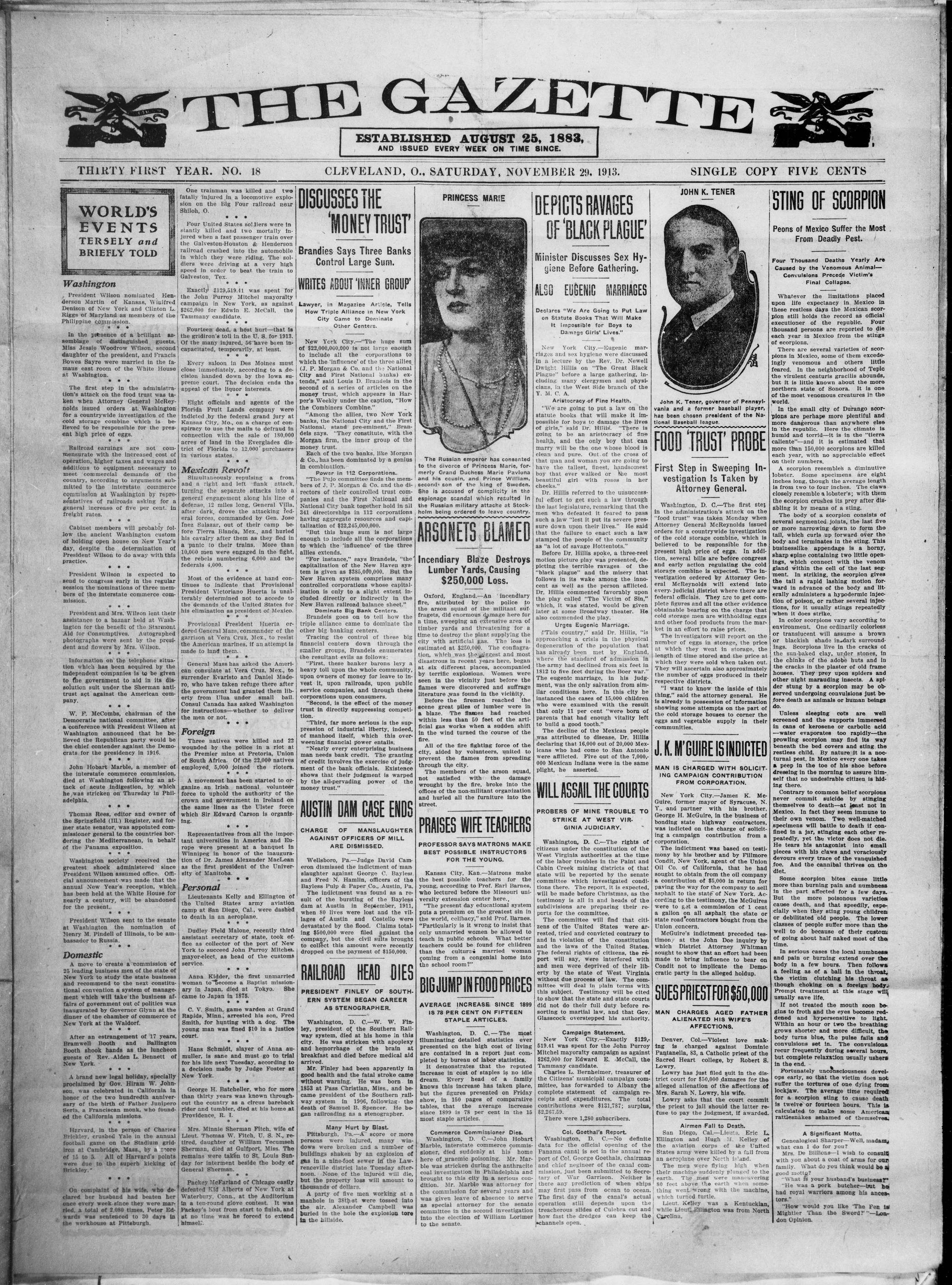
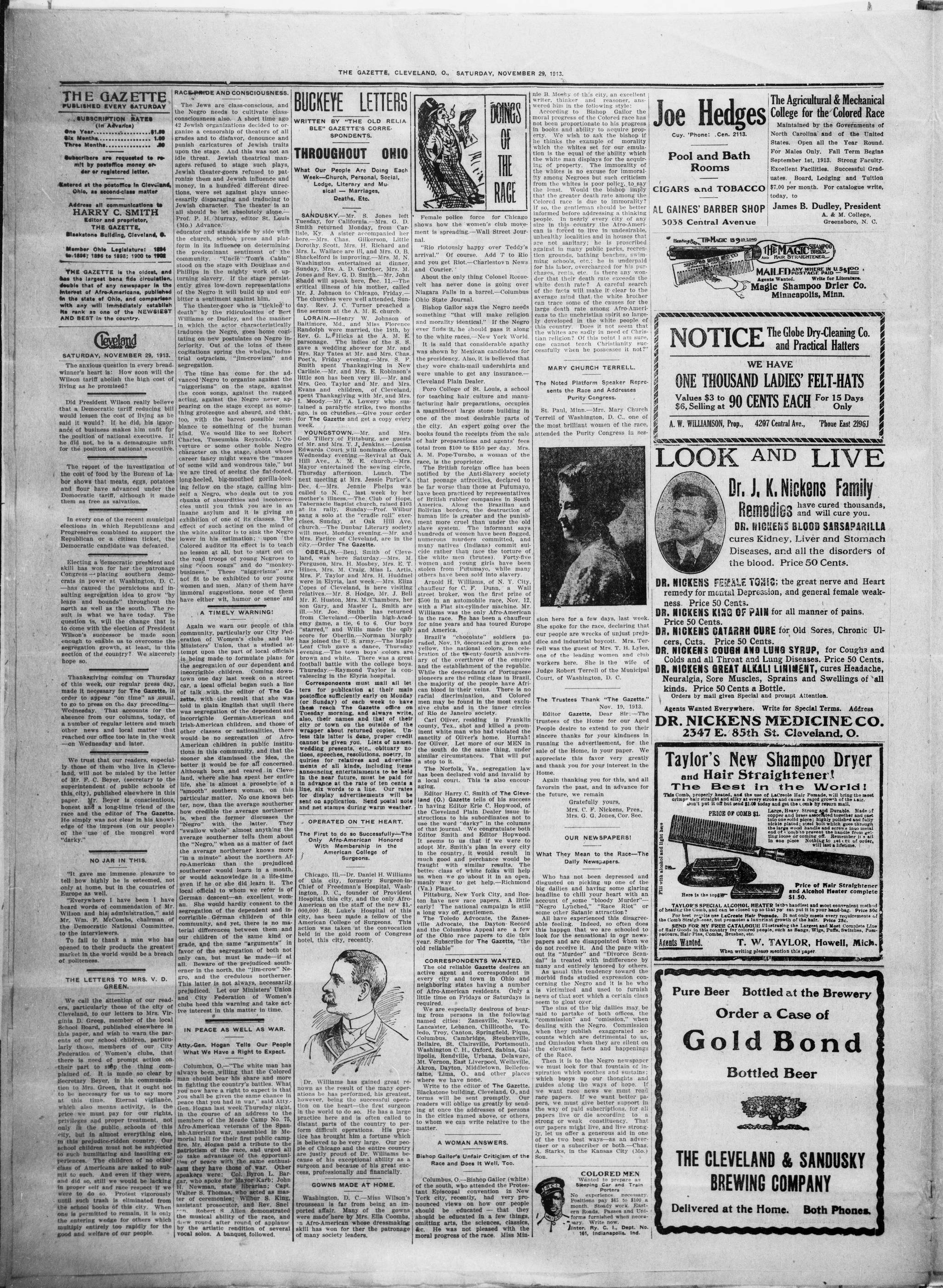
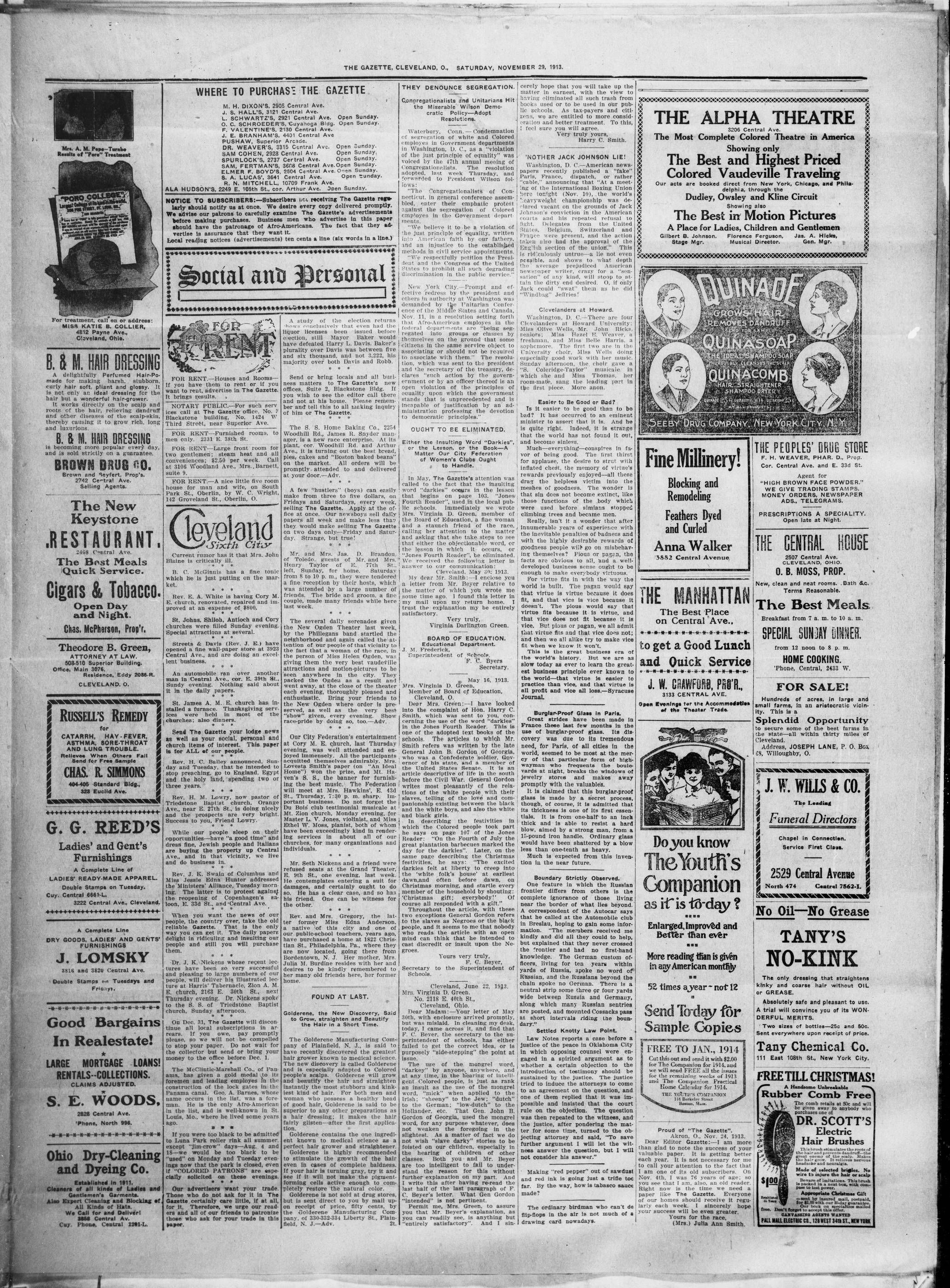
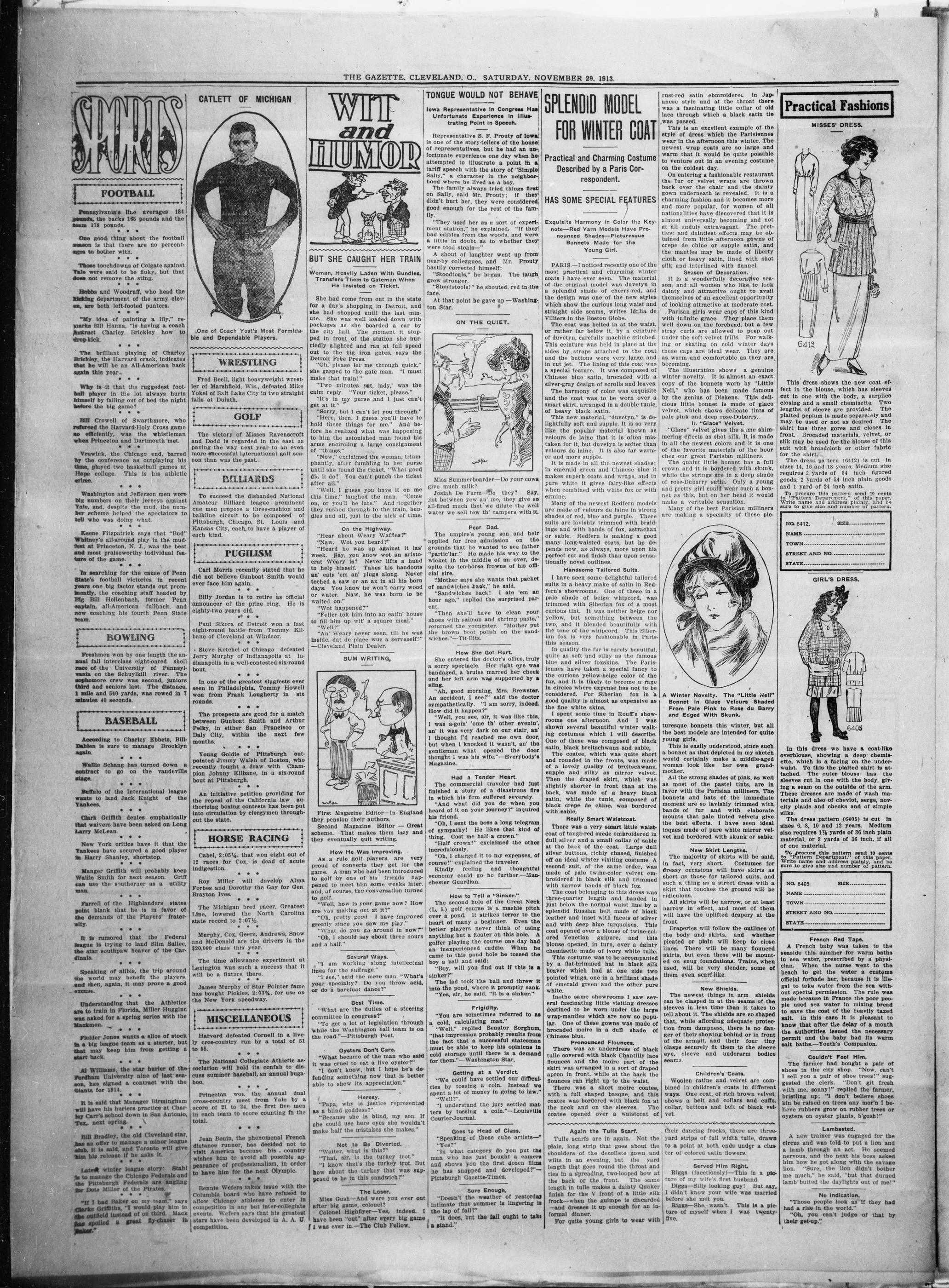
Page text (machine-generated)
THIRTY FIRST YEAR. NO. 18
UNITED STATES OF AMERICA
WORLD'S EVENTS TERSELY and BRIEFLY TOLD
Washington
President Wilson nominated Henderson Martin of Kansas, Winifred Denison of New York and Clinton L. Riggs of Maryland as members of the Philippine commission.
In the presence of a brilliant assemblage of distinguished guests, Miss Jessie Woodrow Wilson, second daughter of the president, and Francis Bowes Sayre were married in the fama east room of the White House at Washington.
The first step in the administration's attack on the food trust was taken when Attorney General McReynolds issued orders at Washington for a countrywide investigation of the cold storage combine which is believed to be responsible for the present high price of eggs.
Railroad earnings are not commensurate with the increased cost of operation, higher taxes and wages and additions to equipment necessary to meet commercial demands of the country, according to arguments submitted to the interstate commerce commission at Washington by representatives of railroads asking for a general increase of five per cent. in freight rates.
Cabinet members will probably follow the ancient Washington custom of holding open house on New Year's day, despite the determination of President Wilson to do away with this practice.
President Wilson is expected to send to congress early in the regular session the nominations of three members of the interstate commerce commission.
President and Mrs. Wilson lent their assistance to a bazaar held at Washington for the benefit of the Stormant Aid for Consumptives. Autographed photographs were sent by the president and flowers by Mrs. Wilson.
Information on the telephone situation which has been acquired by the independent companies is to be given to the government to aid in its dissolution suit under the Sherman antitrust act against the American company.
W. F. McCombs, chairman of the Democratic national committee, after a conference with President Wilson at Washington announced that he believed the Republican party would be the chief contender against the Democrats for the presidency in 1916.
John Hobart Marble, a member of the interstate commerce commission, died at Washington following an attack of acute indigestion, by which he was stricken on Thursday in Philadelphia.
Thomas Rees, editor and owner of the Springfield (III.) Register, and former state senator, was appointed commissioner general to the countries bordering the Mediterranean, in behalf of the Panama exposition.
* * * *
Washington society received the greatest shock administered since President Wilson assumed office. Official announcement was made that the annual New Year's reception, which has been held at the White House for nearly a century, will be abandoned for the present.
* * * *
President Wilson sent to the senate at Washington the nomination of Henry M. Pindell of Illinois, to be ambassador to Russia.
Domestic
A move to create a commission of 25 leading business men of the state of New York to study the state business and recommend to the next constitutional convention a system of management which will take the business affairs of government out of politics was inaugurated by Governor Glynn at the dinner of the chamber of commerce of New York at the Waldorf.
After an estrangement of 17 years, Bramwell Booth and Ballington Booth shook hands as the luncheon guests of Rev. Alden L. Bennett of New York.
A brand new legal holiday, specially proclaimed by Gov. Hiram W. Johnson, was celebrated in California in honor of the two hundredth anniversary of the birth of Father Junipero Seria, a Franciscan monk, founded the California missions.
Hurvard, in the person of Charles Brickley, crushed Yale in the annual football game on the Stadium gridiron at Cambridge, Mass., by a score of 15 to 5. All of Harvard's points were due to the superb kicking of Brickley.
On complaint of his wife, who declared her husband had beaten her once every week since they were married, a total of 2,080 times, Peter Edwards was sentenced to 30 days in the workhouse at Pittsburgh.
THE GAZETTE
One trainman was killed and two fatally injured in a locomotive explosion on the Big Four railroad near Silhol, O.
Four United States soldiers were in instantly killed and two mortally injured when a fast passenger train over the Galveston-Houston & Henderson railroad crashed into the automobile in which they were riding. The soldiers were driving at a very high speed in order to beat the train to Galveston, Tex.
Exactly $129,519.41 was spent for the John Purroy Mitchell mayoralty campaign in New York, as against $262,000 for Edwin E. McCall, the Tammany candidate.
Fourteen dead, a host hurt—that is the gridiron's toll in the U. S. for 1913. Of the many injured, 56 have been incapacitated, temporarily, at least.
Every saloon in Des Moines must close immediately, according to a decision handed down by the Iowa supreme court. The decision ends the appeal of the liquor interests.
Eight officials and agents of the Florida Fruit Lands company were indicted by the federal grand jury at Kansas City, Mo., on a charge of conspiracy to use the mails to defraud in connection with the sale of 180,000 acres of land in the Everglades district of Florida to 12,000 purchasers in various states.
Mexican Revolt
Simultaneously repulsing a from and a right and left flank attack, turning the separate attacks into a general engagement along his line of defense, 12 miles long, General Villa, after dark, drove the attacking federal forces, commanded by Gen. Jose Inez Salazar, out of their camp before Tierra Blanca, Mex., and hurried his cavalry after them as they fled in a panic to their trains. More than 10,000 men were engaged in the fight, the rebels numbering 6,000 and the federals 4,000.
Most of the evidence at hand continues to indicate that Provisional President Victoriano Huerta is unaltered determined not to accede to the demands of the United States for his elimination as president of Mexico.
Provisional President Huerta ordered General Mass, commander of the garrison at Vera Cruz, Mex., to resist the American marines, if an attempt is made to land them.
General Mass has asked the American consulate at Vera Cruz, Mex., to surrender Evaristo and Daniel Madero, who have taken refuge there after the government had granted them liberty from Ulaa under small ball. Consul Canada has asked Washington for instructions—whether to deliver the men or not.
Three natives were killed and 22 wounded by the police in a riot at the Premier mine at Pretoria, Union of South Africa. Of the 22,000 natives employed, 5,000 joined the rioters.
A movement has been started to organize an Irish national volunteer force to uphold the authority of the crown and government in Ireland on the same lines as the Ulster force which Sir Edward Carson is organizing.
Representatives from all the important universities in America and Europe were present at a banquet in Winnipeg in honor of the inauguration of Dr. James Alexander MacLean as the first president of the University of Manitoba.
Lieutenants Kelly and Ellington of the United States army aviation camp at San Diego, Cal., were dashed to death in an airplane.
Dudley Field Malone, recently third assistant secretary of state, took office as collector of the port of New York to succeed John Purro Mitchell, mayor-elect, as head of the customs service.
Anna Kidder, the first unmarried woman to become a Baptist missionary in Japan, died at Tokyo. She came to Japan in 1875.
C. V. Smith, game warden at Grand Rapids, Minn., arrested his son, Fred Smith, for hunting with a dog. The young man was fined $10 in a justice court.
Hans Schmidt, slayer of Anna au-muller, is life and must go to trial for his life next Tuesday, according to a decision made by Judge Foster at New York.
George H. Batcheller, who for more than thirty years was known throughout the country as a circus bareback rider and tumbler, died at his home at Providence, R. I.
Mrs. Minnie Sherman Fitch, wife of Lieut. Thomas W. Fitch, U. S. N., retired, daughter of William Tecumseh Sherman, died at Gulfport, Miss. The remains were taken to St. Louis Sunday for interment beside the body of General Sherman.
Packey McFarland of Chicago easily defeated Kid Alberts of New York at Waterbury, Conn., at the Auditorium in a ten-round glove contest. It was Packey's bout from start to finish, and at no time was he forced to extend himself.
ESTABLISHED AUGUST 25, 1883,
AND ISSUED EVERY WEEK ON TIME SINCE.
CLEVELAND, O., SATURDAY, NOVEMBER 29, 1913.
DISCUSSES THE 'MONEY TRUST'
Brandies Says Three Banks Control Large Sum.
WRITES ABOUT 'INNER GROUP'
Lawyer, in Magazine Article, Tells How Triple Alliance in New York City Gamed to Dominate
New York City.—"The huge sum of $22,000,000 is not large enough to include all the corporations to which the 'influence' of the three allies (J. P. Morgan & Co. and the National City and First National banks) extends," said Louis D. Brandels in the second of a series of articles on the money trust, which appears in Harper's Weekly under the caption, "How the Combiners Combine."
"Among the allies, two New York banks, the National City and the First National, stand pre-eminent." Brandels says. "They constitute, with the Morgan firm, the inner group of the money trust.
Each of the two banks, like Morgan & Co., has been dominated by a genius in combination.
Poem in 112 Corporations.
"The Pujojo company finds the members of J. P. Morgan & Co. and the directors of their trusted trust companies and the First National and National City bank together hold in all 341 directorships in 112 corporations having aggregate resources and capitalization of $22,245,000,000.
"But this huge sum is not large enough to include all the corporations to which the 'influence' of the three allies extends.
"For instance," says Brandels, "the capitalization of the New Haven system is given as $385,000,000. But the New Haven system comprises many controlled corporations whose capitalization is only to a slight extent included directly or indirectly in the New Haven railroad balance sheet."
Dominate Big Bank Centers.
Brandels goes on to tell how the triple alliance came to dominate the other big banking centers.
Tracing the control of these big financial centers down through the smaller groups, Brandels enumerates the resultant evils as follows:
"First, these banker barons levy a heavy toll upon the whole community, upon owners of money for leave to invest it, upon railroads, upon public service companies, and through these corporations upon consumers.
"Second, is the effect of the money trust in directly suppressing competition.
"Third, far more serious is the suppression of industrial liberty, indeed, of manhood itself, which this overweening financial power entails.
"Nearly every enterprise business man needs bank credit. The granting of credit involves the exercise of judgment of the bank officials. Existence shows that their judgment is warped by the all-pervading power of the money trust."
CHARGE OF MANSLAUGHTER AGAINST OFFICERS OF MILL ARE DISMISSED.
Wellsboro, Pa.—Judge David Cameron dismissed the indictment of man slaughter against George C. Bayless, and Fred N. Hamlin, officers of the Bayless Pulp & Paper Co., Austin, Pa. The indictment was found as a result of the bursting of the Bayless dam at Austin in September, 1911, when 80 lives were lost and the villages of Austin and Costello were devastated by the flood. Claims totaling $500,000 were filed against the company, but the civil suits brought to collect this amount were recently dropped on the payment of $150,000.
PRESIDENT FINLEY OF SOUTHERN SYSTEM BEGAN CAREER AS STENOGRAPHER.
Washington, D. C.—W. W. Finley, president of the Southern Railway system, died at his home in this city. He was stricken with apoplexy and hemorrhage of the brain at breakfast and died before medical aid arrived.
Mr. Finley had been apparently in good health and the fatal stroke came without warning. He was born in 1853 at Pass Christian, Miss, and became president of the Southern railway system in 1996, following the death of Samuel B. Spencer. He began railroading as a stenographer.
Many Hurt by Blast:
Pittsburgh, Pa.—A score or more persons were injured, many windows were broken and a number of buildings shaken by an explosion of gas in a nine-foot sewer in the Lawrenceville district late Tuesday afternoon. None of the injured will die, but the property loss will amount to thousands of dollars. A party of five men working at a manhole in 38th-st were tossed into the air. Alexander Campbell was buried in the hole the explosion tore in the hillside.
—
The Russian emperor has consented to the divorce of Princess Marie, formerly Grand Duchess Marie Pavlina and his cousin, and Prince William, second son of the king of Sweden. She is accused of complicity in the espionage scandal which resulted in the Russian military attache at Stockholm being ordered to leave country.
Incendiary Blaze Destroys
Lumber Yards, Causing
$250,000 Loss.
Oxford, England—An incendary fire, attributed by the police to the arson squad of the militant suffrages, did enormous damage here for a time, sweeping an extensive area of timber yards and threatening for a time to destroy the plant supplying the city with artificial gas. The loss is estimated at $250,000. The conflagration, which was the biggest and most disastrous in recent years here, began at six different places, accompanied by terrific explosions. Women were seen in the vicinity just before the flames were discovered and suffrage literature was found in the vicinity.
Before the firemen reached the scene great piles of lumber were in a blaze. The flames had reached within less than 50 feet of the artificial gas works when a sudden shift in the wind turned the course of the fire.
All of the fire fighting force of the city, aided by volunteers, united to prevent the flames from spreading through the city.
The members of the arson squad, not satisfied with the damage wrought by the fire, broke into the offices of the non-militant organization and hurled all the furniture into the street.
PRAISES WIFE TEACHERS
PRAISES WIFE TEACHERS
PROFESSOR SAYS MATRONS MAKE
BEST POSSIBLE INSTRUCTORS
FOR THE YOUNG.
Kansas City, Kan.—Matrons make the best possible teachers for the young, according to Prof. Earl Barnes, who lectured before the Missouri university extension center here.
"The present day educational system puts a premium on the greatest sin in the world, colibacy," said Prof. Barnes.
"Particularly is it wrong to insist that only unmarried women be allowed to teach in public schools. What better teachers could be found for children than the culture married woman coming from a congenial home into the school room?"
BIG JUMP IN FOOD PRICES
AVERAGE INCREASE SINCE 1899 IS 78 PER CENT ON FIFTEEN STAPLE ARTICLES.
Washington, D. C.—The most illuminating detailed statistics ever presented on the high cost of living are contained in a report just completed by bureau of labor statistics.
It demonstrates that the reputed increase in cost of staples is no idle dream. Every head of a family knows this increase has taken place, but the figures presented on Friday show, in 150 pages of comparative tables, that the average increase since 1899 is 78 per cent in the 15 most staple articles.
Commerce Commissioner Dies.
Washington, D. C.—John Hobart Marble, interstate commerce commissioner, died suddenly at his home here of jauciace poisoning. Mr. Marble was stricken during the anthracite coal investigation in Philadelphia and brought to this city in a serious condition. Mr. Marble was attorney for the commission for several years and was given leave of absence to serve as special attorney for the senate committee in the second investigation into the election of William Lorimer to the senate.
DEPICTS RAVAGES OF 'BLACK PLAGUE'
Minister Discusses Sex Hygiene Before Gathering.
Declares "We Are Going to Put Law on Statute Books That Will Make It Impossible for Boys to Damage Girls' Lives."
New York City—Eugenic marriages and sex hygiene were discussed in a lecture by the Rev. Dr. Newell Dwight Hillis on "The Great Black Plague" before a large gathering, including many clergymen and physicians, in the West Side branch of the Y. M. C. A.
Aristocracy of Fine Health.
"We are going to put a law on the statute books that will make it impossible for boys to damage the lives of girls," said Dr. Hillis. "There is going to be an aristocracy of fine health, and the only boy that can marry will be the one whose blood is clean and pure. Out of the cross of that man and woman you are going to have the tallest, finest, handsome boy that ever walked or the most beautiful girl with roses in her cheeks."
Dr. Hillis referred to the unsuccessful effort to get such a law through the last legislature, remarking that the men who defeated it feared to pass such a law "lest it put its severe pressure down upon their lives." He said that the failure to enact such a law stamped the people of the community as "a lot of savage Hottenots."
Before Dr. Hillis spoke, a three-reel motion picture play was presented, depicting the terrible ravages of the "black plague" and the misery that follows in its wake among the innocent as well as the person afflicted. Dr. Hillis commented favorably upon the play called "The Victim of Sin," given by the playwright later at some Broadway theater. He also commended the play.
Urges Eugenic Marriage.
"This country," said Dr. Hillis, "is approaching a crisis in the physical degeneration of the population that has been caused by England, where the standard of admission in the army had declined from six feet in 1812 to five feet during the Boer war." The eugenic marriage, in his judgment, was the only salvation from similar conditions here. In this city he instanced the cases of 15,000 children who were examined with the result that only 11 per cent "were born of parents that had enough vitality left to build a good tooth." The decline of the Mexican people was attributed to disease. Dr. Hillis declaring that 16,000 out of 20,000 Mexicans who had come to San Antonio were afflicted. Five out of the 7,000,000 Mexican Indians were in the same plight, he asserted.
WILL ASSAIL THE COURTS
PROBERS OF MINE TROUBLE TO STRIKE AT WEST VIRGINIA JUDICIARY.
Washington, D. C.—The rights of citizens under the constitution of the West Virginia authorities at the time of the labor troubles in the Paint and Cabin Creek mining districts of that state will be reported by the senate committee which investigated conditions there. The report, it is expected, will be made before Christmas, as the testimony is all in and heads of the subdivisions are preparing their reports for the committee.
The committee will find that citizens of the United States were arrested, tried and convicted contrary to and in violation of the constitution and the laws of the United States. The federal rights of citizens, the report will say, were interfered with and men were deprived of their liberty by the state of West Virginia without due process of law. The committee will deal in plain terms with this subject. Testimony will be cited to show that the state and state courts did not do their full duty before resorting to martial law, and that Gov. Glasscock overstepped his authority.
Campaign Statement.
New York City.—Exactly $129,
519.41 was spent for the John Purro Mitchel mayoralty campaign as against
$262,000 for Edward E. McCall, the Tammany candidate.
Charles L. Bernheimer, treasurer of the Citizens' municipal campaign committee, has forwarded to Albany the complete statement of campaign receipts and expenditures. The total contributions were $131,787; surplus,
$2,267.59.
There were 1,280 subscribers.
Col. Goethal's Report
Washington, D. C.—No definite data for the official opening of the Panama canal is set in the annual report of Col. George Goethals, chairman and chief engineer of the canal commission, just been submitted to Secretary of War Garrison. Neither is there any prediction of when ships may first pass from ocean to ocean. The first day of the canal's actual operation still depends upon the treacherous slides of Culebra cut and how fast the dredges can keep the channels open.
JOHN K. TENER
John K. Tener, governor of Pennsylvania and a former baseball player, has been chosen president of the National Baseball league.
FOOD 'TRUST' PROBE
First Step in Sweeping Investigation Is Taken by Attorney General.
Washington, D. C.—The first step in the administration's attack on the "food trust" was taken Monday when Attorney General McReynolds issued orders for a countrywide investigation of the cold storage combine, which is believed to be responsible for the present high price of eggs. In addition, several bills are before congress and early action regulating the cold storage combine is exigent. The investigation ordered by Attorney General McReynolds will extend into every judicial district where there are federal officials. They are to get complete figures and all the other evidence obtainable bearing on the charge that cold storage men are withholding eggs and other food products from the market in an effort to raise prices.
The investigators will report on the number of eggs in storage, the price at which they went in storage, the length of time stored and the price at which they were sold when taken out. They will ascertain also approximately the number of eggs produced in their respective districts.
"I want to know the inside of this thing," said the attorney general. He is already in possession of information showing some attempts on the part of the cold storage houses to corner the eggs and vegetable supply in their communities.
J. K. M'GUIRE IS INDICTED
MAN IS CHARGED WITH SOLICITING CAMPAIGN CONTRIBUTION FROM CORPORATION.
New York City.-James K. McGuire, former mayor of Syracuse, N.Y., and partner with his brother, George H. McGuire, in the business of bonding state highway contractors, was indicted on the charge of soliciting a campaign contribution from a corporation.
The indictment was based on testimony by his brother and by Fillmore Condit, New York, agent of the Union Oil Co. of California, that he had sought to obtain from the oil company a contribution of $5,000 in return for paving the way for the company to sell asphalt to the state of New York. According to the testimony, the McGuires were to get a commission of 1 cent a gallon on all asphalt the state or state road contractors bought from the Union concern.
McGuire's indictment preceded testimony at the John Doe inquiry by which District Attorney Whitman sought to show that an effort had been made to bring influence to bear on Condit not to implicate the Democratic party in the alleged holdup.
SUES PRIEST FOR $50,000
MAN CHARGES AGED FATHER ALIENATED HIS WIFE'S AFFECTIONS.
Denver, Col.—Violent love making is charged against Dominic Pantanella, 83, a Catholic priest of the Sacred Heart college, by Robert S. Lowry.
Lowry has just filed suit in the district court for $50,000 damages for the alleged alienation of the affections of Mrs. Sarah N. Lowry, his wife.
Lowry asks that the court commit the priest to jail should the latter refuse to pay the judgment, if awarded.
Airmen Fall to Death
San Diego, Cal.-Lieuts. Eric L. Ellington and Hugh M. Kelley of the aviation corps of the United States army were killed by a fall from an aeroplane over North Island.
The men were flying high when their machine suddenly plunged to the earth. The men were maneuvering 80 feet above the earth when something went wrong with the machine, which turned turtle.
Lieut. Kelley was a Kentuckian, while Lieut. Ellington was from North Carolina.
1
STING OF SCORPION
Peons of Mexico Suffer the Most From Deadly Pest.
Four Thousand Deaths Yearly Are Caused by the Venomous Animal—Convulsions Precede Victim's Final Collapse.
Whatever the limitations placed upon life expectancy in Mexico in these restless days the Mexican scorpion still holds the record as official executioner of the republic. Four thousand persons are reported to die each year in Mexico from the stings of scorpions.
There are several varieties of scorpions in Mexico, some of them exceedingly venomous and others little feared. In the neighborhood of Teplic the virulent centuris gracilis abounds, but it is little known about the more northern state of Sonora. It is one of the most venomous creatures in the world.
In the small city of Durango scorpions are perhaps more plentiful and more dangerous than anywhere else in the republic. Here the climate is humid and torrid—it is in the "tierra callante"—and it is estimated that more than 150,000 scorpions are killed each year, with no appreciable effect on their numbers.
A scorpion resembles a diminutive lobster. Some specimens are eight inches long, though the average length is from two to four inches. The claws closely resemble a lobster's; with them the scorpion crushes its prey after disabling it by means of a sting.
The body of a scorpion consists of several segmented joints, the last five or more narrowing down to form the tail, which curls up forward over the body and terminates in the sting. This businesslike appendage is a horny, sharp spine containing two little openings, which connect with the venom gland within the cell of the last segment. In striking, the scorpion gives the tail a rapid lashing motion forward in advance of the body and literally administers a hypodermic injection of poison, or rather several injections, for it usually stings repeatedly when it does strike.
In color scorpions vary according to environment. One ordinarily colorless or translucent will assume a brown or blackish shade in dark surroundings. Scorpions live in the cracks of the sun-baked clay, under stones, in the chinks of the adobe huts and in the cracks in the plaster of old frame houses. They prey upon spiders and other night marauding insects. A spider stung by a scorpion may be observed undergoing convulsions just before death as animals or human beings do.
Unless sleeping cots are well screened and the supports immersed in cans of kerosene or carbolic acid—water evaporates too rapidly—the prowling scorpion may find its way beneath the bed covers and sting the restless child. By nature it is a no-turnal pest. In Mexico every one takes a peep in the toe of his shoe before dressing in the morning to assure himself that no undesirable citizen is hiding there.
Contrary to common belief scorpions never commit suicide by stinging themselves to death—at least not in Mexico. In fact they seem immune to their own venom. Two well-matched specimens will battle to death if confined in a jar, stinging each other repeatedly, yet the victor does not die. He tears his antagonist into small pieces with his claws and voraciously devours every trace of the vanquished foe. And the cannibal thrives on the diet.
Some scorpion bites cause little more than burning pain and numbness in the part affected for a few days. But the more poisonous varieties cause death, and that speedily, especially when they sting young children or debilitated old people. The lower classes of people suffer more than the well to do because of their custom of going about half naked most of the time.
In serious cases the local numbness and pain or burning extend over the body in a few hours. Then follows a feeling as of a ball in the throat, the victim clutching his throat as though choking on a foreign body. Prompt treatment at this stage will usually save life.
If not treated the mouth soon begins to froth and the eyes become reddened and hypersensitive to light. Within an hour or two the breathing grows shorter and more difficult, the body turns blue, the pulse fails and convulsions set in. The convulsions recur frequently during several hours, but complete relaxation usually usheres in the end.
Fortunately unconsciousness develops early, so that the victim does not suffer the tortures of one dying from lockjaw. The average time required for a scorpion sting to cause death is twelve or fourteen hours. This is calculated to make some American rattlesnakes ashamed of themselves.
Genealogical Sharper—Well, madam,
what can I do for you?
Mrs. De Billions—I wish to consult
with you about a coat of arms for our
family. What do you think would be a
good motto?
"What is your husband's business?"
"He was a pork butcher—but he
had royal warriors among his ancestors."
"How would you like 'The Fen is
Mightier Than the Sword'?"—London
Opinion.
THE GAZETTE
PUBLISHED EVERY SATURDAY
SUBSCRIPTION RATES
(In Advance)
One Year.....$1.00
Six Months.....1.00
Three Months.....$0
Subscribers are requested to
remit by postoffice money or
order or registered letter.
Entered at the postoffice in Cleveland
Ohio, as second-class matter
Address all communications to
HARRY C. SMITH
Editor and proprietor,
THE GAZETTE,
Blackstone Building, Cleveland, G.
Member Ohio Legislature: 1894
to 1896; 1896 to 1898; 1900 to 1902
THE GAZETTE is the oldest, and has the largest bona fide circulation, double that of any newspaper in the interest of Afro-Americans, published in the state of Ohio, and comparison with any will immediately establish its rank as one of the NEWSIEST AND BEST in the country.
Cleveland
SATURDAY, NOVEMBER 29, 1913.
The anxious question in every bread, winner's heart is: How soon will the Wilson tariff abolish the high cost of living as he promised?
Did President Wilson really believe that a Democratic tariff reducing bill would lessen the cost of living as he said it would? If he did, his ignorance of business makes him unit for the position of national executive. If he did not, he is a demagogue unit for the position of national executive.
The report of the investigation of the cost of food by the Bureau of Labor shows that meats, eggs, potatoes and flour have advanced under the Democratic tariff, although it made them as free as salvation.
In every one of the recent municipal elections in which Republicans and Progressives combined to support the Republican or a citizen ticket, the Democratic candidate was defeated.
Electing a democratic president and skill has won for her the patronage Congress—placing southern democrats in power at Washington, D.C. has caused the pernicious and insulting segregation idea to grow "by leaps and bounds" throughout the north as well as the south. The result is what we have today. The question is, will the change that is to come with the election of President Wilson's successor be made soon enough to enable us to overcome the segregation growth, at least, in this section of the country? We sincerely hope so.
Thanksgiving coming on Thursday of this week, our regular press day, made it necessary for The Gazette, in order to appear "on time" as usual, to go to press on the day preceding Wednesday. That accounts for the absence from our columns, today, of a number of regular letters and much other news and local matter that reached our office too late in the week—on Wednesday and later.
We trust that our readers, especially those of them who live in Cleveland, will not be misled by the letter of Mr. F. C. Beyer (secretary to the superintendent of public schools of this city), published elsewhere in this paper. Mr. Beyer is conscientious, honest and a long-time friend of the race and the editor of The Gazette. He simply was not clear in his knowledge of the impress (on our people) of the use of the mongrel word "darky."
NO JAR IN THIS.
"It gave me immense pleasure to tell how highly he is esteemed, not only at home, but in the countries of Europe as well.
"Everywhere I have been I have heard words of commendation of Mr. Wilson and his administration," said Mr. Wm. F. McCombs, chairman of the Democratic National Committee, to the interviewers.
To fail to thank a man who has opened to their products the greatest market in the world would be a breach of politeness.
THE LETTERS TO MRS. V. D. GREEN.
We call the attention of our readers, particularly those of the city of Cleveland, to our letters to Mrs. Virginia D. Green, member of the local School Board, published elsewhere in this paper, and wish to warn the parents of our school children, particularly those, members of our City Federation of Women's clubs, that there is need of prompt action on their part to stop the thing complained of. It is made so clear by Secretary Beyer, in his communication to Mrs. Green, that it ought not to be necessary for us to say more at this time. Eternal vigilance, which also means activity, is the price we must pay for our rights, privileges and proper treatment, not only in the public schools of this city, but in almost everything else, in this prejudice-ridden country. Our school children must not be subjected to such humiliating and insulting experiences. The children of no other class of Americans are asked to submit to such. And even if they were, and did so, still we would be lacking in proper self and race respect if we were to do so. Protest vigorously until such trash is eliminated from the school books of this city. When one is permitted to remain, it is only the entering wedge for others which multiply entirely too rapidly for the good and welfare of our people.
RACE PRIDE AND CONSCIOUSNESS
The Jews are class-conscious, and the Negro needs to cultivate class-consciousness also. A short time ago 42 Jewish organizations decided to organize a censorship of theaters of all grades and to disfavor, denounce and punish caricatures of Jewish traits upon the stage. And this was not an idle threat. Jewish theatrical managers refused to stage such plays, Jewish theater-goers refused to patronize them and Jewish influence and money, in a hundred different directions, were set against plays unnecessarily disparaging and traducing to Jewish character. The theater is an all should be let absolutely alone.—Prof. P. H. Murray, editor St. Louis (Mo.) Advance.
educator and stands side by side with the church, school press and platform in its influence on determining the predominant sentiment of the community. "Uncle Tom's Cabin" stood on the stage with Douglass and Phillips in the mighty work of upturning slavery. If the stage persistently gives low-down representations of the Negro it will build up and embitter a sentiment against him. The theater-goer who is "tickled to death" by the ridiculosities of Bert Williams or Dudley, and the manner in which the actor characteristically traduces the Negro, goes home cogitating on new postulates on Negro inferiority. Out of the loins of these cogitations spring the whelps, industrial ostracism, "jim-crowism" and segregation.
The time has come for the advanced Negro to organize against the "niggerisms" on the stage, against the coon songs, against the ragged acting, against the Negro never appearing on the stage except as something grotesque and absurd, and that, too, with the barest possible semblance to something of the human kind. We would like to see Robert Charles, Tusemiah Reynolds, L'Ouverture or some other hobble Negro character on the stage, about whose career fancy might weave the "mazes of some wild and wondrous tale," but we are tired of seeing the flat-footed, long-heeled, big-mouthed gorilla-looking fellow on the stage, calling himself a Negro, who deals out to you chunks of absurdities and incoherences until you think you are in an insane asylum and it is giving an exhibition of one of its classes. The effect of such acting on the mind of the white auditor is to sink the Negro lower in his estimation: upon the Colored auditor its effect is to teach no lesson at all, but to start out on the road troops of young Negroes to sing "coon songs" and do "monkey business." These "niggerisms" are not fit to be exhibited to our young women and men. Many of them have immoral suggestions, none of them have either wit, humor or sense and
A TIMELY WARNINGS
Again we warn our people of this community, particularly our City Federation of Women's clubs and the Ministers' Union, that a study attempt upon the part of local officials is being made to formulate plans for the segregation of our dependent and incorrigible children. Coming downtown one day last week on a street car, a local official began such a line of talk with the editor of The Gazette, with the result that she was told in plain English that until there was segregation of the dependent and incorrigible German-American and Irish-American children, and those of other classes or nationalities, there would be no segregation of Afro-American children in public institutions in this community, and that the sooner she dismissed the idea, the better it would be for all concerned. Although born and reared in Cleveland, where she has spent her entire life, she is almost a proselyte of a "smooth" southern woman, on this particular matter. No one knows better, than, than the average southerner how credible the southerner tells about the "Negro" with the latter. They "swallow whole" almost anything the average southerner tells about the "Negro" when as a matter of fact the average northerner knows more "in a minute" about the Afro-American than the prejudiced southerner would learn in a month, or would acknowledge in a life-time even if he or she did learn it. The local official to whom we refer is of German descent—an excellent woman. She would hardly consent to the segregation of the dependent and incorrigible German children of this community, and yet, there is no material differences between them and our children of the same kind or grade, and the same "arguments" in favor of the segregation of both not only can, but must be made—if at all. Beware of the prejudiced northerner in the north, the "jim-crow" Negro, and the credulous northerner. This latter is not always, necessarily prejudiced. Let our Ministers' Union and City Federation of Women's clubs heed this warning and take active interest in this matter in time.
IN PEACE AS WELL AS WAR.
Atty.Gen. Hogan Tells Our People What We Have a Right to Expect.
Columbus, Q.—"The white man has always been, willing that the Colored man should bear his share and more in fighting the country's battles. What you now have a right to expect is that you shall be given the same chance in peace that you had in war," said Atty-Gen. Hogan last week Thursday night, in the course of an address to the members of the Meade Camp No. 75, Afro-American veterans of the Spanish-American war, assembled in Memorial hall for their first public campfire. Mr. Hogan paid a tribute to the patriotism of the race, and urged all to take advantage of the opportunities of peace with the same enthusiasm they have those of war. O'Barger, speakers were; O'Barger, who spoke to Mayor Karb; John Weaver, state librarian; Capt. Walter S. Thomas, who acted as master of ceremonies; Wilbur S. King, assistant prosecutor, and Rev. Snel, Robert S. Allen demonstrated the musical ability of the race, and drew round after round of applauses by the artistic rendition of several vocal solos. A banquet followed.
THE GAZETTE, CLEVELAND, O., SATURDAY, NOVEMBER 29, 1913.
WRITTEN BY "THE OLD RELIA
BLE" GAZETTE'S CORRE-
SPONDENTS.
THROUGHOUT OHIO
What Our People Are Doing Each Week—Church, Personal, Social, Lodge, Literary and Musical — Marriages, Deaths, Etc.
SANDUSKY—Mr. S. Jones left Tuesday, for California. Mrs. G. D. Smith returned Monday, from Carlslea, Ky. A sister accompanied her here. Mrs. Ches. Glikerson, Little Dorothy, Scott, Mrs. J. Richard and Mrs. L. Wallace are ill, and Mrs. O. B. Shackelford is improving—Mrs. M. N. Washington entertained at dinner, Sunday, Mrs. A. D. Gardner, Mrs. M. Jones and A. D. G. Smith. Mr. John Shadd will speak here, Dec. 11. The critical illness of his mother, called Mr. J. Johnson to Chicago, Friday. The churches were well attended, Sunday. Rev. J. C. Turner preached a fine sermon at the A. M. E. church.
LORAIN—Henry W. Johnson of Baltimore, Md. and Miss Florence Randolph were married, the 18th by Rev. G. L. Hicks at the A. M. E. parsonage. The ladies of the S. S. gave a wedding shower for Mr. and Mrs. Ray Tates at Mr. and Mrs. Chas Poet's, Friday evening—Mrs. S. F. Smith spent Thanksgiving in New Carlisle, Mr. and Mrs. E. Robinson's little son has been very ill—Mr. and Mrs. Geo Taylor and Mr. and Mrs. Evans and children, of Cleveland, spent Thanksgiving with Mr. and Mrs. Mooda Taylor, Lawyer, trained a paralyptic strike, two months ago, is on crutches. Give your order for The Gazette and get a copy every week.
YOUNGSTOWN.—Mr. and Mrs. Geo. Tillery of Pittsburg, are guests of Mr. and Mrs. T. J. Jenkins.—Louisa Edwards Court, will nominate officers, Wednesday evening.—Revival at Oak Ave. Ave., church.—Mrs. Mayoerville trained the school. Thursday afternoon. Lunch. The next meeting at Mrs. Jessie Parker's Dec. 4.—Mrs. Jennie Phelps was called to N. C., last week by her mother's illness.—The Club of Hope, Tabernacle Baptist church, raised $103 at its rally, Sunday—Prof. Wilbun sang a solo at the "cradle roll" exercises, Sunday. at Oak Ave. Ave. Tabernacle District, will meet, Monday evening.—Mr. and Mrs. Farlice of Cleveland, are in the city.—Order The Gazette.
OBERLIN|N—Benj. Smith of Cleveland, was here Saturday—Mrs. M. Ferguson, Mrs. H. Mosby, Mrs. E. T. Hines, Mrs. M. Craig, Miss L. Artis, Mrs. F. Taylor and Mrs. H. Huddens were in Elyria, last week—Mrs. Eliza Copes of Cleveland, is here visiting relatives—Mr. S. Craig, Mr. Bell M. Craig, Mrs. M. Craig, Mrs. Gary and Master L. Smith are ill—Mr. Joe. Smith has returned from Cleveland—Oberlin high-Academy game, a tie, 6 to 6. Our boys "starred," and Wills made the only score for Oberlin—Norman Murphy has joined the U. S. army. The Maple Leaf Club gave a dance. Thursday was brown and white. There was a great football battle with the college boys. Thursday—Raymond Taylor is convalescing in the Elyria hospital.
Correspondents must mail all letters for publication at their main postoffice sufficiently early on Monday (or Sunday) of each week to have them reach The Gazette office on Tuesday morning, and always write, also, their names and that of their employer. If you send a wrapper about returned copies, Unless this latter is done, proper credit cannot be given you. Lists of names, wedding presents, etc., obituary notices, speeches, resolutions, poetry, inquiries for relatives and advertisements of all kinds, including items announcing entertainments to be held in advance, speeches, resolutions, in advance at the rate of ten cents a line, six words to a line. Our rates for display advertisements will be sent on application. Send postal note and not stamps during warm weather.
OPERATED ON THE HEART.
The First to do so Successfully—The Only Afro-American Honored With Membership in the American College of Surgeons.
Chicago, Ill.—Dr. Daniel H. Williams of this city, formerly Surgeon-in-Chief of Freedman's Hospital, Washington, D. C., founder of Provident Hospital, this city, and the only Afro-American on the staff of the new $1,000,000 St. Luke's Hospital of this city, has been made a fellow of the American College of Surgeons. This action was taken at the convocation held in the gold room of Congress hotel, this city, recently.
J.
Dr. Williams has gained great renown as the result of the many operations he has performed, his greatest, however, being the successful operation on the heart—the first surgeon in the world to do so. He has a large practice here and is often called to distant parts of the country to perform difficult operations. His practice has brought him a fortune which is believed to be very large. Our people of Chicago and the entire country are justly proud of Dr. Williams because of his exceptional ability as a surgeon and because of his great success, professionally and financially.
GOWNS MADE AT HOME.
Washington. D. C.-Miss Wilson's trousseau is far from being an imported affair. Many of the gowns were made here by Mrs. Ella Coombs, n Afro-American whose dressmaking skill has won for ther the patronage of many society leaders.
nie B. Meeby of this city, an excellent
thinker, with a kind answer,
answered in the followup.
writer, thinker and reasoner, answered him in the following style:
According to Bishop Gallor the man who taught the whites has not been proportionate to his progress in books and ability to acquire property. We wish to ask the bishop if he thinks the example of morality which the whites set for our emulation is the equal of the ability which the white man displays for the acquiring of property. The immorality of the whites is no excuse for immorality among Negroes but such criticism from the whites is poor policy, to say the least. Would the bishop imply that the greater death rate among the Colored race is due to immorality? If so, the goal is to be better addressed among African people. In nearly every city of any size in this country the Afro-American is forced to live in undesirable, unhealthy localities and in houses that are not sanitary; he is proscribed against in many public parks, recreation grounds, bathing beaches, swimming schools, etc.; he is underpaid for his labor, overcharged for his purchases, rents, etc. Is there any wonder that their death rate exceeds the white death rate? A careful search of the facts will help us to understand that the white brother can trace some of the causes for the large death rate among Afro-American to the unchristian spirit so largely developed in the white people of this country. Does it not seem that the whites are sadly in need of Christian religion? Of this point I am sure one cannot teach Christianity successfully when he possesses it not?
St. Paul, Minn.—Mrs. Mary Church Terrell of Washington, D. C., one of the most brilliant women of the race, attended the Purity Congress in se-
ston here for a few days, last week. She spoke for the race, declaring that our people are wrecks of unjust prejudice and industrial boycott. Mrs. Terrell was the guest of Mrs. T. H. Lyles, one of the leading women and chub workers here. She is the wife of Judge Robert Terrell of the Municipal Court, of Washington, D. C.
The Trustees Thank "The Gazette."
Nov. 19, 1913.
Editor Gazette. Dear Sir:—The trustees of the Home for our Aged People desire to extend to you their sincere thanks for your kindness in running the advertisement, for the sale of the Home, in your paper. We appreciate this favor very greatly and thank you for your interest in the Home.
Again thanking you for this, and all favorsin the past, and in advance for the future, we remain
What They Mean to the Race—The Daily Newspapers.
Who has not been depressed and disgusted on picking up one of the big dallies and having some glaring headline to chill your heart with an account of the murder "Burrow" "Negro Lynched" "Race Riot" or some other Satanic attraction?
All have experienced this disagreeable feeling. Indeed, so often does this happen that we are schooled to look for the sensational in our newspapers and are disappointed when we do not receive it. And the page without its "Murder" and "Divorce Scandal" is treated with indifference by many and entirely ignored by others. The morbid finds studied expression concerning the Negro and it is he who is victimized and used to furnish news of that sort which a certain class seem to glott over.
The sins of the big dallies may be said to partake of both offices, the "commission" and "omission," when dealing with the Negro. Commission when they publish exaggerated accounts which are detrimental to us, and Omission when they are silent on elevating facts and happenings on the Race. Then it is to the Negro newspaper we must look for that fountain of inspiration which soothes and sustains; which buoys up our thonghs and guides along the ways of hope. If we want race news we must read race papers. If we want better papers, we must give better support in the way of paid subscriptions, for all papers live or die according to a strong or weak constituency. That means might live and live strong; but it uses a generous aid in one of the two best ways—as an advertiser or a subscriber or both—Chas. A. Starks, in the Kansas City (Mo.) Son.
R.C.P.
SINCE 1830
DOINGS OF THE RACE
Female police force for Chicago shows how the women's club movement is spreading.—Wall Street Journal.
"Rio riotously happy over Teddy's arrival." Of course. Add T to Rio and you get Riot.—Charlestown News and Courier.
About the only thing Colonel Roosevelt has never done is going over Niagara Falls in a barrel.—Columbus Ohio State Journal.
Bishop Gallor says the Negro needs something "that will make religion and morality identical." If the Negro ever finds it, he should pass it along to the white races.—New York World. It is said that considerable apathy was shown by Mexican candidates for the presidency. Also, it is believed that they wore chain-mail undershirts and were unable to get any insurance.—Cleveland Plain Dealer.
Poro College of St. Louis, a school for teaching hair culture and manufacturing hair preparations, occupies a magnificent large stone building in one of the most desirable parts of the city. An expert going over the books found the receipts from the sale of hair preparations and agents' fees total from $100 to $150 per day. Mrs. A. M. Pope-Turnbo, a woman of the race, is the proprietor
The British foreign office has been notified by the Anti-Slavery society that peonage attrocities, declared to be far worse than those at Putumayo, have been practiced by representatives of British rubber companies in South America. Along the Brazilian and Bolivian borders, the destruction of human life is greater and the punishment more cruel than under the old laws. The number of women have been flogged, numerous murders committed, and many natives (Indians) commit suicide rather than face the torture of the white men (brutes). Forty-five women and young girls have been stolen from Putumayo, while many others have been sold into slavery.
Arnold H. Williams, of N. Y. City, chauffeur for C. F. Dunn, a Wall street broker, won the first prize of $500 in an automobile race, Nov. 12, with a Flat six-cylinder machine. William was an American in the race. He has been a chauffeur for nine years and has toured Europe and America.
Brazil's "chocolate" soldiers paraded, Nov. 19, decorated in green and yellow, the national colors, in celebration of the twenty-fourth anniversary of the overthrow of the empire and the establishment of the republic. While the descendants of Portuguese immigrants class in Brazil the majority of the people have African blood in their veins. There is no racial discrimination, and Colored men may be found in the most exclusive clubs and in the inner circles of Rio de Janeiro society. Carl Olver, residing in Franklin county, Tex., shot and killed a prominent white man who had violated the sanctity of Olver's home. Hurrah! for Oliver. Let more of our MEN in the south do the same thing, under similar circumstances. That will put a stop to it. The Norfolk, Va., segregation law has been declared void and invalid by a local court. This is also encouraging.
Editor Harry C. Smith of The Cleveland (O.) Gazette tells of his success in having Editor Erie C. Hopwood, of the Cleveland Plain Dealer issue instructions to his subordinates not to use the word "darky" in the columns of the Gazette. We permeate both Editor Smith and Editor Hopwood. It seems to us that if we were to adopt Mr. Smith's plan in every city in the country, it would result in much good and perchance would be fraught with similar results. The better: class of white folks will help us when we go about it in an open, open to get help - Richmond (Va.) Planet. Pittsburgh, New York City, and Boston have new race papers. A little early! The national campaign is still a long way off, gentlemen.
The Toledo Advocate, the Zanesville Advocate, the Dayton Record and the Columbus paper are the papers of the Ohio race papers to die this year. Subscribe for The Gazette, "the old reliable."
CORRESPONDENTS WANTED.
The old reliable Gazette desires an active agent and correspondent in the neighboring states having a number of Afro-American residents. Only a little time on Fridays or Saturdays is required.
We are especially desirous of hearing from persons in the following named cities: Zanesville, Newark, Lancaster, Lebanon, Chillicothe, Toledo, Troy, Canton, Springfield, Piqua, Canton, Mass., Shelbyville, Bellaire, St. Chailsville, Portsmouth, Washington C. H., Oxford, Sabina, Galipolis, Rendville, Urbana, Delaware, M. Ternon, East Liverpool, Wellsville, Akron, Dayton, Middletown, Bellefontaine, Lima, O., and other places where we have none.
Write to the editor of The Gazette. Blackstone building, Cleveland, O, and terms will be sent promptly. Our services will be available by writing at once the addresses of persons in the cities named above, or others, to whom we can write relative to the matter.
A WOMAN ANSWERS
Bishop Gallor's Unfair Criticism of the Race and Does It Well, Too.
Columbus, O.-Bishop Gallor (white) of the south, who attended the Protestant Episcopal convention in New York city, recently, had very pronounced views on how our people should be educated — that they should be educated in a few things, omitting arts, the sciences, classics, &c. He was not pleased with the moral progress of the race. Miss Min-
MARY CHURCH TERRELL.
The Noted Platform Speaker Represents the Race and Addresses Purity Congress.
THE WORLD'S FINEST WOMAN
Gratefully yours,
Mrs. C. F. Nickens, Pres,
Mrs. C. G. Jones, Cor. Sec.
OUR NEWSPAPERS
COLORED MEN
Wanted to prepare as
Sleeping Car and Train
Workers.
No experience necessary
Positions pay $65 to $100 a
month. Steady work. Easten
Roads. Passes and Utili-
tion. Needed then necessary.
Write now.
Inter. Ry. C. I., Dept. No. 161, Indianapolis, Ind.
Heating Boar
TR-MAGIC IS 9 IN LONG
THE MAGIC SHAMPOO
DRYER
AND HAIR STRAIGHTENER
SHAMPOO DRYER RED CO
MAILED ANYWHERE IN U.S.$100
POSTAGE PAID
Agents Wanted.
Write for Literature.
Magic Shampoo Drier Co.
Minneapolis, Minn.
NOTICE The Globe Dry-Cleaning Co. and Practical Hatters
A. W. WILLIAMSON, Prop., 4207 Central Ave., 'Phouse East 2196J
LOOK AND LIVE
Remedies have cured thousands, and will cure you. DR. NICKENS BLOOD SARSAPARILLA cures Kidney, Liver and Stomach Diseases, and all the disorders of the blood. Price 50 Cents. DR. NICKENS FEMALE TONIC; the great nerve and Heart remedy for mental Depression, and general female weakness. Price 50 Cents. DR. NICKENS KING OF PAIN for all manner of pains. Price 50 Cents. DR. NICKENS CATARRH OURE for Old Sores, Chronic Ulcers. Cuts. Price 50 Cents.
DR. NICKENS COUGH AND LUNG SYRUP, for Coughs and Colds and all Throat and Lung Diseases. Price 50 Cents.
DR. NICKENS GREAT ALKALI LINIMENT, cures Headache, Neuralgia, Sore Muscles, Sprains and Swellings of all kinds. Price 50 Cents a Bottle.
DR. NICKENS MEDICINE CO. 2347 E. 85th St. Cleveland, O.
TAYLOR'S SPECIAL ALCOHOL HEATER is the handiest and most convenient method of heating the Comb, and can be closed up so that you can put it in your handbag. Price 50c
For best results use LaCreole Hair Pomade. It not only meets every requirements of the Comb Straightener, but promotes a luxuriant growth of the hair. Price 25c.
SEND FOR MY FREE CATALOGUE Illustrating the Largest and Most Complete Line of Hair Goods in this country for colored people, such as Bangs, Wigs, Puffs, Switches, Pompeurs, and Other Gum.
Pure Beer Bottled at the Brewery
Order a Case of
Gold Bond
Bottled Beer
THE CLEVELAND & SANDUSKY
BREWING COMPANY
Delivered at the Home. Both Phones.
CIGARS and TOBACCO
AL GAINES' BARBER SHOP
3038 Central Avenue
Heating Corp.
TRI-MAGIC 159 ID. LONG
SHIPPING BUYING CO.
NOTICE
WE
ONE THOUSAND
Values $3 to
$6, Selling at
90 CEN
A. W. WILLIAMSON, Prop., 420
LOOK A
Dr. J. Remo
DR. NICKENS cures Kid Diseases the blood
DR. NICKENS FEBALE TON
remedy for mental Depress
ness. Price 50 Cents.
DR. NICKENS KING OF PAIR
Price 50 Cents.
DR. NICKENS CATAPRN OH
The Agricultural & Mechanical College for the Colored Race
Maintained by the Governments of North Carolina and of the United States. Open all the Year Round. For Males Only. Fall Term Begins September 1st, 1913. Strong Faculty. Excellent Facilities. Successful Graduates. Board, Lodging and Tuition $7.00 per month. For catalogue write, today, to James B. Dudley, President A. & M. College, Greensboro, N. C.
Mrs. A. M. Pepe—Turnbo
Results of "Poro" Treatment
"PORO COLLEGE"
Largest College of its kind in the world,
200 FUR STREET, JC. LOOK, NJ.
If you are in charge of the personnel related to
the republication, should be the responsible for all
the personnel. If you are in charge of the administration of the personnel,
should be the responsible for all the personnel.
If you are in charge of the administration of the personnel,
should be the responsible for all the personnel.
PORO COLLEGE
200 FUR STREET, JC. LOOK, NJ
12345 STREET
MRS. A. M. PEPE
JC. LOOK, NJ
For treatment, call on or address:
MISS KATIE B. COLLIER,
4212 Payne Ave.
Cleveland, Ohio.
B. & M. HAIR DRESSING
A delightfully Perfumed Hair-Pomade for making harsh, stubborn, curly hair soft, plant and glossy. It is not only an ideal dressing for the hair but a wonderful hair-grower. It works directly on the scalp and roots of the hair, relieving dandruff and other diseases of the scalp-skin, thereby causing it to grow rich, long and luxurious.
B. & M. HAIR DRESSING is becoming more popular every day, and is sold strictly on a guarantee.
BROWN DRUG CO.
Brown and Seyfert, Prop's.
2742 Central Ave.
Selling Agents.
The New Keystone
.RESTAURANT.
2468 Central Ave.
The Best Meals
Quick Service.
Cigars & Tobacco.
Open Day
and Night.
Chas. McPherson, Prop'r.
Theodore B. Green,
ATTORNEY AT LAW.
508-510 Superior Building.
Office, Main 3076.
Residence, Eddy 2086-R.
CLEVELAND, O.
RUSSELL'S REMEDY
CATARRH, HAY-FEVER,
ASTHMA, SORE-THROAT
AND LUNG TROUBLE.
Relieves When Others Fall
Send for Free Sample
CHAS. R. SIMMONS
404-405 Standard Bldg,
323 Euclid Ave.
G. G. REED'S
A Complete Line of
LADIES' READY-MADE APPAREL.
Double Stamps on Tuesday.
Cuy. Central 6681-L.
3222 Central Ave., Cleveland.
A Complete Line
DRY GOODS, LADIES' AND GENTS'
FURNISHINGS
3816 and 3820 Central Ave.
Double Stamps on Tuesdays and
Fridays.
Good Bargains
In Realestate!
LARGE MORTGAGE LOANS!
RENTALS--COLLECTIONS.
CLAIMS ADJUSTED.
2828 Central Ave.
'Phone, North 996.
Ohio Dry-Cleaning
and Dyeing Co.
Established in 1811.
Cleaners of all kinds of Ladies and
Gentlemen's Garments.
Also Expert Cleaning and Blocking of
All Kinds of Hate.
We Call for and Deliver!
2858 Central Av.
Cuy. Phone, Central 2201-L.
WHERE TO PURCHASE THE GAZETTE
FOR RENT.—Houses and Rooms—
If you have them to rent or if you
want to rent, advertise in The Gazette.
It brings results.
NOTARY PUBLIC—For such services call at The Gazette office, No. 2
Blackstone building, No. 1424 W
Third Street, near Superior Ave.
FOR RENT—Furnished rooms, to men only. 2331 E. 38th St.
FOR RENT—Large front room for
two gentlemen; steam heat and all
conveniences; $2.50 per week. Call
at 3106 Woodland Ave., Mrs., Barnett,
suite 9.
FOR RENT.—A nice little five room house for man and wife, on South Park St., Oberlin, by W. C. Wright, 142 Groveland St., Oberlin, O.
Cleveland Sixth City
Current rumor has it that Mrs. John Blaine is critically ill.
B. C. McGinnis has a fine tonic which he is just putting on the market.
Rev E. A. White is having Cory M. E. church, renovated, repaired and improved at an expense of $800.
St. Johns, Shiloh, Antioch and Cory churches were filled Sunday evening. Special attractions at several.
Streets & Davis (Rev. J. E.) have opened a fine wall-paper store at 3923 Central Ave., and are doing an excellent business.
An automobile ran over another man in Central Ave., cor. E. 39th St., Sundy evening. Nothing said about it in the daily papers.
St. James A. M. E. church has installed a furnace. Thanksgiving services were held in most of the churches; also dinners.
Send The Gazette your lodge news as well as your social, personal and church items of interest. This paper is for ALL of our people.
Rev. H. C. Balley announced, Sunday and Tuesday, that he intended to stop preaching, go to England, Egypt and the holy land, spending two or three years.
Rev. H. M. Lowry, now pastor of Triedstone Church, church, Orange Ave., near E. 27th is ding nicely and the prospect is very bright. Success to you, Friend Lowry.
While our people sleep on their opportunities—have "a good time" and dress fine, Jewish people and Italians are buying the property up Central Ave., and in that vicinity, we live and do business in.
Rev. J. K. Swain of Columbus and Miss Jessie Edna Hunter addressed the Minister's Alliance, Tuesday morning. The latter is to protest against the reopening of Copenhagen's salon, E. 33d St. and 'Central Ave.
When you want the news of our people, the country over, take the old reliable Gazette. That is the only way you can get it. The daily papers delight in ridiculing and insulting our people and still you will purchase them.
Dr. J. K. Nickens whose recent lectures have been so very successful and pleasing to large numbers of our people, will deliver his illustrated lecture at Harris' Tabernacle, Zion A. M. E. church, 2163 E. 30th St., next Thursday evening. Dr. Nickens spoke to the S. S. of Triedstone Baptist church, Sunday afternoon.
On Dec. 31, The Gazette will discontinue all local subscriptions in arrears. If you owe, pay promptly please, so we will not be compelled to stop your paper. Do not wait for the collector but send or bring your money to the office before Dec. 1.
The McClintic-Marshall Co., of Panama, has given a gold medal to its foremen and leading employees in the construction of the lock gates in the canoe Goo A. Bums whose name occurs in the list, was a foreman. He is the only Afro-American in the list, and is well-known in St. Louis, Mo., where he lived some years ago.
If you were too black to be admitted to Luna Park roller rink all summer, except "jim-crow" days-Aug. 4 and 18—would be too black to be "used" on Monday and Tuesday evenings now that the park is closed, even if "COLORED PATRONS" are especially solicited on these evenings
Our advertisers want your trade. Those who do not ask for it in The Gazette certainly care little, if at all, for it. Therefore, we urge our readers and all of our friends to patronize those who ask for your trade in this paper.
THE GAZETTE, CLEVELAND, O., SATURDAY, NOVEMBER 29, 1913.
A study of the election returns shows conclusively that even had the liquor licenses been issued before election, still Mayor Baker would have defeated Harry L. Davis, Baker's plurality over Davis was between five and six thousand, and not 3,222, his majority over both Davis and Robb.
Send or bring locals and all business matters to The Gazette's new offices, Suite 2, Blackstone Bldg. If you wish to see the editor call there and not at his home. Please remember and tell this to all making inquiry of him or The Gazette.
The S. S. Home Baking Co., 2254 Woodhill Rd., James R. Snyder manager, is a new race enterprise. At its plant, cor. Woodhill Rd. and Arthur Ave, it is turning out the best bread, pies, cakes and "Boston baked beans" on the market. All orders will be promptly attended to and delivered at your door.—Adv.
A few "hustlers" (boys) can easily make from three to five dollars, on Fridays and Saturdays, every week, selling The Gazette. Apply at the office at once. Our newsboys sell daily papers all week and make less than they would make selling The Gazette on two days only—Friday and Saturday. Strange, but true!
Mr. and Mrs. Jas. D. Brandon of Toledo, guests of Mr. and Mrs. Henry Taylor, of E. 77th St. left, Sunday, for home. Saturday from 8 to 10 p. m., they were tendered a fine reception by their hosts, which was attended by a large number of friends. The bride and groom, a fine couple, made many friends while here last week.
The several daily scenarios given the New Ogden Theater last week, by the Philllegans band started the neighborhood and again called the attention of our people of that vicinity to the fact that a woman of the race, in the person of Miss Helen Ogden, was giving them the very best vaudeville attractions and motion-pictures to be seen anywhere in the city. They packed the Ogden as a result and went away, at the close of the theater each evening, thoroughly pleased and enthusiastic. Bring your friends to the New Ogden where order is preserved, as well as the very best "show" given, every evening. Show race-pride by doing so, too.—Adv.
Our City Federation's entertainment at Cory M. E. church, last Thursday evening, was well attended and enjoyed immensely. All the participants acquired themselves admirably. Mrs. Lovesta Smith's paper (on "An Ideal Home") won the prize, and Mt. Haven's S. S., the banner for furnishing the best music. The Federation will meet at Mrs. Hawkins' E. 430 St., Thursday, 7:30 p. m. sharp. Important business. Do not forget the Du Bois club testimonial musicale at Mt. Zion church. Monday evening, for laster M. J. Jones, violinist, and Miss Ethel W. Moss, pianist, both of whom have been exceedingly kind in rendering services in about all of our churches, for many organizations and individuals.
Mr. Seth Nickens and a friend were refused seats at the Grand Theater, E. 9th St., one evening, last week. He contemplates entering a suit for damages, and certainly ought to do so. He has a clear case, and so has his friend. One can be witness for the other.
Rev. and Mrs. Gregory, the latter former Miss Edna Anderson, a native of this city and one of our public-school teachers, years ago, have purchased a home at 1822 Christian St., Philadelphia, Pa., where they are now located, going there from Bordentown, N. J. Her mother, Mrs. Julia M. Burdine resides with her and desires to be kindly remembered to her many old friends here, her former home.
FOUND AT LAST.
Golderene, the New Discovery, Said to Grow, straighten and Beautify the Hair in a Short Time.
The Golderene Manufacturing Company of Plainfield, N.J., is said to have recently discovered the greatest hair grower known to medical science. The new discovery is called Golderene and he especially wants to Growd people's scals. Golderene will grow and beautify the hair and straighten instantly the most stubborn and kinkiest kind of hair. For both men and woman who possess a healthy head of good hair, Golderene is said to be and he especially wants to Growd people's scals. Golderene will grow and beautify the hair and straighten instantly the most stubborn and kinkiest kind of hair. For both men and woman who possess a healthy head of good hair, Golderene is said to be and he especially wants to Growd people's scals. Golderene will grow and beautify the hair fairly glisten—after the first application.
Golderene contains the one ingredient known to medical science as a perfect hair grower and straightener. Golderene is highly recommended to stimulate the growth of the hair even in cases of complete baldness. Golderene is not recommended to see if it will not make the pigment-forming cells active enough to completely restore the natural color. Golderene is not sold at drug stores, but is sent direct to you by mail upon receipt of price, fifty cents, by the manufacturer, manufacturing Plainfield, N. J.-Adv. 21.
THEY DENOUNCE SEGREGATION.
Congregationalists and Unitarians Hit the Miserable Wilson Democratic Policy—Adopt Resolutions.
Waterbury, Conn. — Condemnation of segregation of white and Colored employees in Government departments in Washington, D.C., as a "violation of the shut marriage of equality," as voiced by the 17th annual meeting of Congregationalists. The resolution adopted, last week Thursday, and forwarded to President Wilson follows:
"The Congregationalists of Connecticut, in general conference assembled, enter their emphatic protest against the segregation of Colored employees in the Government departments.
"I believe it to be a violation of the just principle of equality, written into American faith by our fathers, and an injustice to the established methods in civil service appointments.
"We respectfully petition the President and the Congress of the United States to prohibit all such degrading discrimination in the public service."
New York City—Prompt and effective redress by the president and others in authority at Washington was demanded by the Unitarian Conference of the Middle States and Canada, Nov. 11, in a resolution setting forth that Afro-American employees in the federal departments are "being segregated into groups or classes by themselves on the ground that some citizens in the same service object to associating or should not be required to assume such a reservation which was sent to the president and the secretary of the treasury, declares "such action by the government or by an officer thereof is an open violation of the principles of equality upon which the government stands that is unprecedented and is incapable of justification by an administration professing the devotion to democratic principles."
OUGHT TO BE ELIMINATED
Either the Insulting Word "Darkies," or the lesson, or the book "A Matter Our City Federation of Women's Clubs Ought to Handle.
In May, The Gazette's attention was called to the fact that the insulting word "darkies" occurs in the lesson that begins on page 103. "Jones Fourth Reader", used in the local public schools, immediately we wrote Mrs. Virginia Green member of the Board of Education, a fine woman and a staunch friend of the race, calling her attention to the matter and asking that she take steps to see that either the objectionable word, or the lesson in which it occurs, or "Jones Fourth Reader", be eliminated. We received the following letter in answer to our communication:
Cleveland, May 30; 1912.
My dear Mr. Smith, I endose you a letter from Mr. Rever to the matter of which you wrote me some time ago. I found this letter in my mail upon my return home. I trust the explanation my be entirely satisfactory.
BOARD OF EDUCATION.
Educational Department.
J. M. Frederick
Superintendent of Schools
Mrs. Virginia D. Green
Member of Board of Education,
Missouri
Deer Mr. Green:—I have looked into the complaint of Hon. Harry C. Smith, which was sent to you, concerning the use of the word "darkies" in the Jones Fourth Reader. This is one of the adopted text books of the schools. The articles to which Mr. Smith refers was written by the late General John B. Gordon of Georgia, who was underate soldier. Governor of the state. He joined the United States Senate. It is an article descriptive of life in the south before the Civil War. General Gordon writes most pleasantly of the relations of the white people with their slaves, telling of the love and companionship existing between the black men and the white men, and also the white and black girls.
In describing the festivities in which the Colored people took part he says on page 107 of the Jones Reader: "On the Fourth of July the great plantation barbecues marked the day for the darkies." Later, on the same page describing the Christmas festivities, he says: "The excited darkies felt at liberty to creep into the white folk's house at earliest daunt and demean on Christmas morning, and startle every member of the household by shouting; 'Christmas gift; everybody!' Of course all responded with a gift." Throughout the article, with these two exceptions General Gordon refers to the slaves as Negroes or the black people, and it seems to me that nobody who reads the article with an open mind can think that he intended to cast discredit or insult upon the Negroes.
Yours very truly.
F. C. Beyer.
Secretary to the Superintendent of Schools.
Cleveland, June 22, 1913.
Mrs. Virginia D. Green.
Dear Madam:—Your letter of May 30th, with enclosure arrived promptly, but was mislaid. In cleaning my desk, today, I came across it, and find that F. C. Bever, the secretary to the superscript of schools, was either failed to get the correct idea, or purposefully "side-stepping" the point at issue.
The use of the mongrel word, "darkey" by anyone, anywhere, and at any time, in the hearing of intelligent Colored people, is just as rank an insult as the use of the mongrel word, "mick" when applied to the Irish, "sheeny" to the Jew; "dutch" to the German, "lowdutch" to the Holocaust; "John Gordon of Georgia, used the mongrel word, for any purpose whatever, does not weaken the foregoing in the slightest. As a matter of fact we do not wish "slave darky" stories to be foisted on our children, especially in the hearing of children of other classes. Both you and Mr. Beyer are too intelligent to fail to understand the reason for this without further explanation on my part. And I write this after having re-read the last half of the last paragraph of F. C. Beyer's letter. What Gen Gordon "intended" is not pertinent. Permit me, Mr. Green, to assure you that the reason for explanation, as you can readily see, is anything but "entirely satisfactory". And I sh-
cerely hope that you will take up the matter in earnest, with the view to having eliminated all such trash from books used or to be used in our public schools. As tax-payers and citizens, we are entitled to more consideration and better treatment. To this, I feel sure you will agree.
Very truly yours.
Harry C. Smith.
'NOTHER JACK JOHNSON LIE!
Washington, D. C.—American newspapers recently published a "fake" Paris, France, dispatch, or rather "cable," announcing that "At a meeting of the International Boxing Union here tonight (Nov. 10), the world's heavyweight championship was declared vacant on the grounds of Jack Johnson's conviction in the American courts and his repeated refusal to fight. Delegates from the United States, Belgium, Switzerland and France were present, and the action taken also had the approval of the English section of the union." This is ridiculously untrue—a lie not even possible, and shows to what depth the newspaper writer, crazy for a "sensation" of any kind, will stoop to attain the dirty end desired. O. if only Jack could "swat" them as he did "Windbag" Jeffries!
Clevelanders at Howard.
Washington, D. C.—There are four Clevelanders at Howard University: Miss Olive Wells, Mr. John Rickens; seniors; Miss Hazel E. Weaver, a freshman, and Miss Belle Harris, a sophomore. The first two are in the University choir. Miss Wells doing unaccompanied music at the music. Sunday afternoon, the choir calls "S. Coleridge-Taylor" musicale in which she and Miss Thomas, her room-mate, sang the leading part in the first piece. More anon.
Easier to Be Good or Bad?
Is it easier to be good than to be bad? It has occurred to an eminent minister to assert that it is. And he is quite right. Indeed, it is strange that the world has not found it out, and become sinless.
Much—everything—conspires in favor of being good. The first thirst for applause, the desire to strut with inflated chest, the memory of virtue's rewards previously enjoyed—all these drag the helpless victim into the meshes of goodness. The wonder is that sin does not become extinct, like those functions of the body which were used before simians stopped climbing trees and became men.
Really, isn't it a wonder that after innumerable years of experience with the inevitable penalties of badness and with the highly desirable rewards of goodness people will go on misbehaving themselves? Plough or pagan, the facts are obvious to all, and a well-developed business sense ought to be enough to make everybody virtuous.
For virtue fits in with the way the world is built. The pagan would say that virtue is virtue because it does fit, and that vice is vice because it doesn't. The pious would say that virtue fits because it is virtue, and that vice does not fit because it is vice. But pious or pagan, we all admit that virtue fits and that vice does not; and then we all alike try to make vice fit when we know it won't.
This is the great business era of the world's history. We are as slow today as ever to learn the greatest business principle ever known to the world—that virtue is easier to practice than vice, and that virtue is all profit and vice all loss.—Syracuse Journal.
Burglar-Proof Glass in Paris.
Great strides have been made in France these last few months in the use of burglar-proof glass. Its discovery was due to its tremendous need, for Paris, of all cities in the world, seemed to be most at the mercy of that particular form of highwayman who frequents the boulevards at night, breaks the windows of jewelry stores and makes away promptly with the valuables.
It is claimed that this burglar-proof glass is made by a secret process, though, of course, it is admitted that its thickness is one of its first essentials. It is from one-half to an inch thick and is able to resist a hard blow, aimed by a strong man, from a 15-pound iron handle. Ordinary glass would have been shattered by a blow less than one-tenth as heavy.
Much is expected from this invention in the near future.
Boundary Strictly Observed.
One feature in which the Russian frontier differs from others is the complete ignorance of those living near the border of what lies beyond. A correspondent of the Autocar says that he called at the Automobile club in Breslau, hoping to gain some information. "The members received me kindly and did all they could to help, but explained that they never crossed the 'frontier and had no first-hand knowledge. The German custom officers, living for ten years within yards of Russia, spoke no word of Russian, and the Russians beyond the chain spoke no German. There is a neutral strip some three or four yards wide between Russia and Germany, along which many Russian sentries are posted, and mounted Cossacks pass at short intervals riding the boundary."
Settled Knotty Law Point.
Settled Knotty Law Point.
Law Notes reports a case before a justice of the peace in Oklahoma City in which opposing counsel were engaged in a spirited argument as to whether a certain objection to the introduction of testimony should be sustained by the justice. The justice tried to induce the attorneys to come to an agreement on the question, and one of them replied that it was impossible and insisted that the court rule on the objection. The question was then repeated to the witness, and the justice, after pondering the matter for some time, turned to the objecting attorney and said, "To save further argument I will let the witness answer the question, but I will not consider his answer."
Making "red pepper" out of sawdust and red ink is going just a trifle too far. By the way, how is tabasco sauce made?
The ordinary birdman who can't do flip-flops in the air is not much of a drawing card nowadays.
QUINADE
GROWS HAIR
REMOVES DANDRUFF
SEEBY DRUG COMPANY
QUINASOAP
THE IDEAL SHAMPOO SOAR
MORGING HAIR
QUINACOMB
HAIR, STRAIGHTENER
SHAMPOO DRYER
QUINADE 25¢ QUINASOAP 10¢ QUINACOMB 25¢
AMAL BRUGGIES
SEEBY DRUG COMPANY. NEW YORK CITY. N.Y.
Fine Millinery!
Blocking and
Remodeling
Feathers Dyed
and Curled
Anna Walker
3882 Central Avenue,
THE MANHATTAN
The Best Place
on Central Ave..
to get a Good Lunch
and Quick Service
J. W. CRAWFORD, PRO'R.
3133 CENTRAL AVE.
Open Evenings for the Accommodation
of the Theater Trade.
D. D.
Do you know The Youth's Companion as it is to-day?
Enlarged, Improved and Better than ever
More reading than is given in any American monthly
52 times a year - not 12
Send Today for Sample Copies
FREE TO JAN., 1914
Cut this out and send it with $2.00 for The Companion for 1914, and we will send FREE all the issues for the remaining weeks of 1913 and The Companion Practical Home Calendar for 1914.
THE YOYTEN COMPANION
114 BERKLEY Street
Boston, Mass.
Proud of "The Gazette"
Akron, O. Nov. 24, 1913.
Dear Editor Gazette:—I am more than glad to note the success of your valuable paper. It is getting better each year. It is not necessary for me to call your attention to the fact that I am one of its old subscribers. On Nov. 4th, I was 76 years of age; so you see that I am, also, an old reader. Right now is the time we need a paper like The Gazette. Everyone of our homes should receive it regularly each week. I sincerely hope your success will be even greater.
(Mrs.) Julia Ann Smith.
Agent for
"HIGH BROWN FACE POWDER."
WE GIVE TRADING STAMPS.
MONEY ORDERS, NEWSPAPER
ADS., TELEGRAMS.
PRESCRIPTIONS A SPECIALITY.
Open late at Night.
THE CENTRAL HOUSE
2507 Central Ave.
CLEVELAND, OHIO.
O. B. MOSS, PROP.
New, clean and neat rooms. Bath &c.
Terms Reasonable.
The Best Meals
Breakfast from 7 a. m. to 10 a. m.
SPECIAL SUNDAY DINNER.
from 12 noon to 8 p. m.
HOME COOKING.
'Phone, Central, 2433 W.
FOR SALE!
Hundreds of acres, in large and small farms, in an aristocratic vicinity. This is a Splendid Opportunity to secure some of the best farms in the state—all within thirty miles of Cleveland.
Address, JOSEPH LANE, P. O. Box 68, Willoughby, O.
J. W. WILLS & CO.
The Leading
Funeral Directors
Chapel in Connection.
Service First Class.
2529 Central Avenue
North 474 Central 7562-I
No Oil—No Grease
TANY'S NO-KINK
The only dressing that straightens
kinky and coarse hair without OIL
or GREASE.
Absolutely safe and pleasant to use.
A trial will convince you of its WON-
DERFUL MERITS.
Two sizes of bottles—25c and 50c.
Sent everywhere upon receipt of price.
Tany Chemical Co.
111 East 108th St., New York City.
FREE TILL CHRISTMAS!
A Handicome Unbreakable
Rubber Comb Free
The comb retails at 50c and will be given away to anybody who purchases one of
DR. SCOTT'S
Electric
Hair Brushes
This brush stimulates the roots of the great antique comb and provides great enemy of the scalp. Makes hair soft, shiny and nervous headache and neurasia.
Made of selected brigles. No wire to injure the hair or scalp.
Beware of limitations. This brush is not designed to test power.
Appropriate Christmas gift
for $1.00 with our 8-day passpald,
for $1.00 with our 24-hour passpald.
Mails mailed free. Don't forget to accept this offer
GAVWASING AGENTS WANTED
PALL MALL ELECTRIC CO. 128 WEST 3418 ST. NEW YORK
---
SPORTS
Pennsylvania's line averages 184 pounds, the backs 185 pounds and the team 178 pounds.
One good thing about the football season is that there are no percentages to bother with.
Those touchdowns of Colgate against Yale were said to be fuky, but that does not remove the sting.
Hobbs and Woodruff, who head the Mickey department of the army eleven, are both left-footed punters.
"My idea of painting a lily," remarks Bill Hanna, "is having a coach instruct Charley Brickley how to drop-kick.
The brilliant playing of Charley Brickley, the Harvard crack, indicates that he will be an All-American back again this year.
Why is it that the ruggedest football player in the lot always hurts himself by falling out of bed the night before the big game?
Bill Crowell of Swarthmore, who referred the Harvard-Holy Cross game so efficiently, was the whistleman when Princeton and Dartmouth met.
Vruwink, the Chicago end, barred by the conference as outplaying his time, played two basketball games at Hope college. This is his athletic crime.
Washington and Jefferson men wore big numbers on their jerseys against Yale, and, despite the mud, the number scheme helped the spectators to tell who was doing what.
Keene Fitzpatrick says that "Bud" Whitney's all-around play in the mud at Princeton, N. J., was the best and most praiseworthy individual feature of the game.
In searching for the cause of Penn State's football victories in recent years one big factor stands out prominently, the coaching staff headed by Big Bill Hollenbach, former Penn captain, all-American fullback, and now coaching his four Penn State team.
Freshmen won by one length the annual fall interclass eight-oared shell race of the University of Pennsylvania on the Schuylkill river. The sophomore crew was second, juniors third and seniors last. The distance 1 mile and 540 yards, was rowed in 2 minutes 40 seconds.
BASEBALL
According to Charley Ebbets, Bill Dahlen is sure to manage Brooklyn arash.
Buffalo of the International league wants to land Jack Knight of the Yankees.
Clark Griffith denies emphatically that waivers have been asked on Long Larry McLean.
New York critics have it that the Yankees have secured a good player in Harry Shanley, shortstop.
Manger Griffith will probably keep Wallee Smith for next season. Griff can use the southerner as a utility man.
Farrell of the Highlanders states point blank that he is in favor of the demands of the Players' fraternity.
It is rumored that the Federal league is trying to land Slim Sallee, the star southpaw heaver of the Cardinals.
Speaking of alibis, the trip around the world may benefit the players, and then, again, it may prove a good excuse.
Understanding that the Athletics are to train in Florida, Miller Huggins was asked for a spring series with the Mackmen.
Fielder Jones wants a slice of stock in a big league team as a starter, but that may keep him from getting a start back.
Al Williams, the star hurler of the Fordham University nine of last season, has signed a contract with the Stants for 1914.
It is said that Manager Birmingham will have his hurlers practice at Charley Carr's school down in San Antonio, Tex., next spring.
Bill Bradley, the old Cleveland star, has an offer to manage a minor league club, it is said, and Toronto will give him his release if he asks it.
Late winter league story: Stahl is to manage the Chicago Federals and the Pittsburgh Federals are angling for Dots Miller of the Pirates.
"If I had Baker on my team," says Clarke Griffiths, "I would play him in the outfield instead of on third. Mack has spoiled a great fly-chaser in Baker."
-
One of Coach Yost's Most Formidable and Dependable Players.
WRESTLING
Fred Beell, light heavyweight wrestler of Marshfield, Wis., defeated Mike Yokel of Salt Lake City in two straight falls at Duluth.
GOLF
The victory of Misses Ravenscroft and Dodd is regarded in the east as paving the way next year to an even more successful international golf season than was the past.
To succeed the disbanded National Amateur Billard league prominent cue men propose a three-cushion and balkline circuit to be composed of Pittsburgh, Chicago, St. Louis and Kansas City, each to have a player of each kind.
PUGILISM
Carl Morris recently stated that he did not believe Gunboat Smith would ever face him again.
Billy Jordan is to retire as official announcer of the prize ring. He is eighty-two years old.
Paul Sikora of Detroit won a fast eight-round battle from Tommy Kilbane of Cleveland at Windsor.
Steve Ketchel of Chicago defeated Jerry Murphy of Indianapolis at Indianapolis in a well-contested six-round bout.
In one of the greatest slugfests ever seen in Philadelphia, Tommy Howell won from Frank Lougherty in six rounds.
The prospects are good for a match between Gunboat Smith and Arthur Pelky, in either San Francisco or Daly City, within the next few months.
Young Goldie of Pittsburgh outpointed Jimmy Walsh of Boston, who recently fought a draw with Champion Johnny Kilbane, in a six-round bout at Pittsburgh.
An initiative petition providing for the repeal of the California law authorizing boxing contests has been put into circulation by clergymen throughout the state.
HORSE RACING
Cabel, 2:05%, that won eight out of 12 races for Cox, is dead of acute indigestion.
Roy Miller will develop Alma Forbes and Dorothy the Gay for Gen. Brayton Ives.
The Michigan bred pacer, Greatest Line, lowered the North Carolina state record to 2:07%.
Murphy, Cox, Geers, Andrews, Snow and McDonald are the drivers in the $20,000 class this year.
The time allowance experiment at Lexington was such a success that it will be a fixture there.
James Murphy of Star Pointer fame has bought Pickles, 2:03%, for use on the New York speedway.
MISCELLANEOUS
Harvard defeated Cornell in a live-
ly cross-country run by a total of 51
to 55.
The National Collegiate Athletic as sociation will hold its confab to discuss summer baseball, an annual buga boo.
Princeton won, the annual dual cross-country meet from Yale by a score of 21 to 24, the first five men in each team to score counting in the total.
Jean Bouin, the phenomenal French distance runner, has decided not to visit America because his, country wishes him to avoid all possible appearance of professionalism, in order to have him for the next Olympic.
Bennie Wefers takes issue with the Columbia board who have refused to allow Chicago athletes to enter in competition in any but inter-collegiate events. Wefers says that his greatest stars have been developed in A. A. U. competition.
THE GAZETTE, CLEVELAND, O., SATURDAY, NOVEMBER 29, 1913
WIT and HUMOR
BUT SHE CAUGHT HER TRAIN
Woman, Heavily Laden With Bundles,
Transfers Them to Gateman When
He Insisted on Ticket.
She had come from out in the state for a day's shopping in Detroit, and she had shopped until the last minute. She was well loaded down with packages as she boarded a car by the city hall. The moment it stopped in front of the station she hurriedly alighted and ran at full speed out to the big iron gates, says the Detroit Free Press. "Oh, please let me through quick," she gasped to the gate man. "I must make that train!"
"Sorry, but I can't let you through." "Here, then, I guess you'll have to hold these things for me." And before he realized what was happening to him the astonished man found his arms encircling a large consignment of "things."
"No, exclaimed the woman, triumphantly, after fumbling in her purse until she found the ticket, "What good di, it do? You can't punch the ticket after all."
"Well, I guess you have it on me this time," laughed the man. "Come on, or you'll be late." And together they rushed through to the train, bundles and all, just in the nick of time.
On the Highway.
"Hear about Weary Waffles?"
"Naw. Wot you heard?"
"Heard he was up against it las'
week. Say, you know wot an aristocrat Weary is? Never lifts a hand to help hisself. Takes his handouts an' eats 'em an' plugs along. Never teched a saw or an ax in all his born days. You know he won't carry wood or water. Naw, he was born to be waited on."
"Wot happened?"
"Feller tok him into an eatn' house to fill him up wit' a square meal."
"Well?"
"An' Weary never seen, till he wuz inside, dat de place wuz a serveself!"
— Cleveland Plain Dealer.
BUM WRITING,
First Magazine Editor—In England they pension their authors. Second Magazine Editor — Great scheme. That makes them lazy and they eventually quit writing.
How He Was Improving
As a rule golf players are very proud of converts they get for the game. A man who had been introduced to golf by one of his friends happened to meet him some weeks later, and, of course, the conversation turned to golf.
"Well, how is your game now? How are you making out at it?"
"Oh, pretty good. I have improved greatly since you saw me play."
"What do you go around in now?"
"Oh, I should say about three hours and a half."
Several Ways.
"I am working along intellectual lines for the suffrage."
"I see, said the mere man. 'What's your speciality? Do you throw acid, or do a barefoot dance?'
Best Time
"What are the duties of a steering committee in congress?" "To get a lot of legislation through while the Washington ball team is on the road."—Pittsburgh Post.
Oysters Don't Care.
it was cruel to
"I don't know, but I hope he's de-
fending something now that is better
able to show its appreciation."
Hersey.
"Papa, why is justice represented
as a blind goddess?"
"Because she is blind, my son. If
she could use here eyes she wouldn't
make half the mistakes she makes."
"That, sir, is the turkey trot." "I know that's the turkey trot. But how about the turkey that was supposed to be in this sandwich?"
The Loser.
Miss Gush—And were you ever out
after big game, colonel?
after big game, colonel:
Colonel Highflier—Yes, indeed. I
have been "out" after every big game
I was ever in—The Club Fellow.
TONGUE WOULD NOT BEHAVE
Iowa Representative in Congress Has Unfortunately Experience in Illustrating Point in Speech.
Representative S. F. Prouty of Iowa is one of the story-tellers of the house of representatives, but he had an unfortunate experience one day when he attempted to illustrate a point in a tarliff speech with the story of "Simple Sally," a character in the neighborhood where he lived as a boy.
The family always tried things first on Sally, said Mr. Prouty; if they didn't hurt her, they were considered good enough for the rest of the family.
"They used her as a sort of experiment station," he explained. "If they had edibles from the woods, and were a little in doubt as to whether they were tood steals—"
A shout of laughter went up from near-by colleagues, and Mr. Prouty hastily corrected himself:
"Stoodtoals," he began. The laugh grew stronger.
"Staedstools!" he shouted, red in the face.
At that point he gave up.—Washington Star.
Miss Summerboarder—Do your cows etve much milk?
Josiah De Farm—Do they? Say, jist between yw an'ew them, they give all o-flared much that we dilute the well water we sell teh th' campers with it.
Poor Dad.
The umpire's young son and heir applied for free admission on the grounds that he wanted to see father "particle'lar." He made his way to the inward in the middle of an over, despite the ten-horse frowns of his official sire.
"Mother says she wants that packet of sandwiches back," he said.
"Sandwiches back! I ate 'em an hour ago," replied the surprised parent.
"Then she'll have to clean your shoes with salmon and shrimp paste," returned the youngster. "Mother put the brown boot polish on the sandwiches."-Tit-Bits.
How She Got Hurt
She entered the doctor's office, truly a sorry spectacle. Her right eye was bandaged, a bruise marred her cheek and her left arm was supported by a sling.
"Ah, good morning, Mrs. Brewster. An accident, I see?" said the doctor sympathetically. "I am sorry, indeed. How did it happen?"
"Well, you see, sir, it was like this. I was a-goin' 'ome th' other evenn', an' it was very dark on our stair', an' it thought I'd reached me own door, but when I knocked it wasn't, an' the gentleman what opened the door thought I was his wife."—Everybody's Magazine.
Had a Tender Heart
The commercial traveler had just finished a story of a disastrous fire in which his firm suffered severely.
"And what did you do when you heard of it on your journey?" inquired his friend.
"Oh, I sent the boss a long telegram of sympathy! He likes that kind of thing. Cost me half a crown."
"Half crown!" exclaimed the other incredulously.
"Oh, I charged it to my expenses, of course!" explained the traveler. Kindly feeling and thoughtful economy could go no further.—Manchester Guardian.
How to Tell a "Sinker."
The second hole of the Great Neck (L, L) golf course is a mashek pitch over a pond. It strikes terror to the heart of many a beginner. Even the better players never think of using anything but a floater on this hole. A golfer playing the course one day had an inexperienced caddle. When he came to this pond hole he tossed the boy a ball and said: "Boy, will you find out if this is a sinker?" The lad took the ball and threw it into the pond, where it promptly sank. "Yes, sir, he said, 'It is a sinker.'"
Friidity.
"You are sometimes referred to as a cold, calculating man." "Well," replied Senator Sorghum, "that impression probably results from the fact that a successful statesman must be able to keep his opinions in cold storage until there is a demand for them."—Washington Star.
Getting at a Verdict
"We could have settled our difficulties by tossing a coin. Instead we spent a lot of money in going to law." "Well?" "I understand the jury settled matters by tossing a coin."—Louisville Courier-Journal.
Goes to Head of Class
"Speaking of these cube artists—"
"Yes?"
"In what category do you put the man who has just bought a camera and shows you the first dozen films he has snapped and developed?"—Pittsburgh Gazette-Times.
Sure Enough,
"Doesn't the weather of yesterday intimate that summer is lingering in the lap of fall?"
"It does, but the fall ought to take a stand."
SPLENDID MODEL FOR WINTER COAT
Practical and Charming Costume Described by a Paris Correspondent.
Exquisite Harmony in Color the Keynote—Red Yarn Models Have Pronounced Shades—Picturesque Bonnets Made for the Young Girl.
PARIS.—I noticed recently one of the most practical and charming winter coats I have ever seen. The material of the original model was duvetyn in a splendid shade of cherry-red, and the design was one of the new styles which show the curious long waist and straight side seams, writes Idilia de Villiers in the Boston Globe.
The coat was belted in at the waist, or rather far below it, by a ceinture of duvetyn, carefully machine stitched. This ceinture was held in place at the sides by straps attached to the coat and the buttons were very large and in cut jet. The lining of this coat was a special feature. It was composed of Chinese blue satin, brocaded with a silver-gray design of scrolls and leaves.
The harmony of color was exquisite and the coat was to be worn over a smart skirt, arranged in a double tunic, of heavy black satin.
This new material, "duvetyn," is delightfully soft and supply. It is so very like the popular material known as velours de laine that it is often mistaken for it, but duvetyn is softer than velours de laine. It is also far warmer and more supple.
It is made in all the newest shades; in emerald green and Chinese blue it makes superb coats and wraps, and in pure white it gives fairy-like effects when combined with white fox or with ermine.
Many of the newest Redfern models are made of velours de laine in strong shades of red, blue and purple. These suits are lavisily trimmed with braidings and with bands of fox, astrachan or sable. Redfern is making a good many long-waisted coats, but he depends now, as always, more upon his perfect cut and finish than upon sensationally novel outlines.
Handsome Tailored Suits
I have seen some delightful tailored suits in a heavy make of satin in Redfern's showrooms. One of these in a pale shade of beige whipcord, was trimmed with Siberian fox of a most curious tint. It was neither beige nor yellow, but something between the two, and it blended beautifully with the tone of the whipcord. This Siberian fox is very fashionable in Paris this season.
In quality the fur is rarely beautiful, quite as soft and silky as the famous blue and silver foxskins. The Parisiennes have taken a special fancy to the curious yellow-beige color of the fur, and it is likely to become a rage in circles where expense has not to be considered. For Siberian fox in a good quality is almost as expensive as the fine white skins.
I spent some time in Rouff's showrooms one afternoon. And I was shown several beautiful winter walking costumes which I will describe. One of these was composed of black satin, black bretschwanz and sable.
The coatee, which was quite short and rounded in the fronts, was made of a lovely quality of bretschwanz, supple and silky as mirror velvet. Then the draped skirt, which was slightly shorter in front than at the back, was made of a heavy black satin, while the tunic, composed of black crepe de chine, was bordered with sable.
Really Smart Waistcoat
There was a very smart little waist-coat of tango-red suede embroidered in dull silver and a small collar of sable at the back of the coat. Large dull silver buttons, richly chased, finished off an ideal winter visiting costume. A second suit, of the same order, was made of pale twine-color velvet embroidered in black silk and trimmed with narrow bands of black fox. The coat belonging to this dress was three-quarter length and banded in just below the normal waist line by a splendid Russian belt made of black leather and inset with facets of silver and with deep blue turquoises. This coat opened over a blouse of twine-colored Venetian guiure, and this blouse opened, in turn, over a dainty chemisette made of ivory white tulle. This costume was to be accompanied by a flat-brimmed hat in black silk beaver which had at one side two pointed wings, one in a brilliant shade of emerald green and the other pure white.
In the same showrooms I saw several fascinating little visiting dresses destined to be worn under the large wrap-marches which are now so popular. One of these gowns was made of brocaded moire in a dull shade of Chinese blue.
Pronounced Floundences.
There was an underdress of black tulle covered with black Chantilly lace flouces and the moire part of the skirt was arranged in a sort of draped apron in front, while at the back the flouces ran right up to the waist.
There was a short moire coatee, with a full shaped basque, and this coatee was bordered with black fox at the neck and on the sleeves. The coatee opened over a waistcoat of
Again the Tulle Scarf.
Tulle scarfs are in again. Not the plain, long strip that goes about the shoulders of the decollete gown and wilts in an evening, but the yard length that goes round the throat and ties in a spreading, two-looped bow at the back or the front. The same length in tulle makes a dainty Quaker finish for the V front of a little silk frock—when the guipme is discarded—and dresses it up enough for an informal dinner. For quite young girls to wear with
rusted satin ebmrolderce. In Japanese style and at the throat there was a fascinating little collar of old lace through which a black satin tie was passed.
This is an excellent example of the style of dress which the Parisiennes wear in the afternoon this winter. The newest wrap coats are so large and warm that it would be quite possible to venture out in an evening costume on the coldest day.
On entering a fashionable restaurant the Tur or velvet wraps are thrown back over the chair and the dainty gown underneath is revealed. It is a charming fashion and it becomes more and more popular, for women of all nationalities have discovered that it is almost universally becoming and not at ill unduly extravagant. The prettiest and daintiest effects may be obtained from little afternoon gowns of crepe de chine or supple satin, and the mantles may be made of liberty cloth or heavy satin, lined with shot silk and interlined with fannel.
SEASON OF DECORATION.
It is a wonderfully decorative season, and all women who like to look dainty and attractive ought to avail themselves of an excellent opportunity of looking attractive at moderate cost. Parisian girls wear caps of this kind with infinite grace. They place them well down on the forehead, but a few stray curls are allowed to peep out under the soft velvet frills. For walking or skating on cold winter days these caps are ideal wear. They are as warm and comfortable as they are becoming.
The illustration shows a genuine winter novelty. It is almost an exact copy of the bonnets worn by "Little Nell," who has been made famous by the genius of Diekens. This delicious little bonnet is made of glace velvet, which shows delicate tints of pale pink and deep rose-Dubarry.
15. "Glace" Velvet
"Glace" velvet gives the sume shimmering effects as shot silk. It is made in all the newest colors and it is one of the favorite materials of the hour chez our great Parisian milliners. The quiet little bonnet has a full crown and it is bordered with skunk, while the strings are in a deep shade of rose-Dubarry satin. Only a young and pretty girl could wear such a bonnet as this, but on her head it would make a veritable sensation.
Many of the best Parisian milliners are making a specialty of these pice-
A
A Winter Novelty. The "Little Nell"
Bonnet in Glace Velours Shaded
From Pale Pink to Rose du Barry
and Edged With Skunk.
turesque bonnets this winter, but all
the best models are intended for quite
young girls.
This is easily understood, since such
a bonnet as that depicted in my sketch
would certainly make a middle-aged
woman look like her own grand-
mother.
All the strong shades of pink, as well
as most of the past tints, are in
favor with the Parisian milliners. The
bonnets and hats of the immediate
moment are so lavishly trimmed with
bands of fur and with elaborate
mounts that pale tinted velvets give
the best effects. I have seen ideal
toques made of pure white mirror velvet
and bordered with skunk or sable.
New Skirt Lengths:
The majority of skirts will be said, in fact, very short. Costumes for dressy occasions will have skirts as short as those for tailored suits, and such a thing as a street dress with a skirt that touches the ground will be ridiculous. All skirts will be narrow, or at least narrow in effect, and most of them will have the uplifted drapery at the front. Draperies will follow the outlines of the body and skirts, and whether pleated or plain will keep to close lines. There will be many flounced skirts, but even these will be mounted on snug foundations. Trains, when used, will be very slender, some of them even scarf-like.
New Shields.
The newest things in arm shields can be clasped in at the seams of the sleeves in less time than it takes to tell about it. The shields are so shaped that, while affording adequate protection from dampness, there is no danger of their showing behind or in front of the armpit, and their four tiny claps securely fit them to the sleeve eye, sleeve and underarm bodice seams.
Children's Coats
Woolen ratine and velvet are combined in children's coats in different ways. One coat, of rich brown velvet, shows a belt and collars and cuffs, collar, buttons and belt of black velvet.
their dancing frocks, there are three yard strips of full width tulle, drawn to a point at both ends under a cluster of colored satin flowers.
Served Him Right.
Riggs (facetiously)—This is a picture of my wife's first husband.
Diggs—Silly looking guy! But say, I didn't know your wife was married before she met you.
Riggs—She wasn't. This is a picture of myself when I was twenty five.
MISSES' DRESS.
6412
This dress shows the new coat effect in the blouse, which has sleeves cut in one with the body, a surplus closing and a small chemisette. Two lengths of sleeve are provided. The plaited peplum is made separately and may be used or not as desired. The skirt has three gores and closes in front. Brocaded materials, velvet, or silk may be used for the blouse of this suit with broadcloth or other fabric for the skirt.
The dress pattern (6412) is cut in sizes 14, 16 and 18 years. Medium size requires 2 yards of 54 inch figured goods, 2 yards of 54 inch plain goods and 1 yard of 24 inch satin.
To procure this pattern send 10 cents to "Pattern Department, of this paper, and have a surplus number of pattern.
NO. 6412. SIZE.....
NAME.....
TOWN.....
STREET AND NO.....
STATE....
GIRL'S DRESS.
6405
In this dress we have a coat-like overhouse, showing a deep chemisette, which is a facing on the underwist. To this the plaited skirt is attached. The outer blouse has the sleeves cut in one with the body, giving a seam on the outside of the arm. These dresses are made of wash materials and also of cheviot, serge, novelty plaids and cheeks and of simple silks. The dress pattern (6405) is cut in sizes 6, 8, 10 and 12 years. Medium size requires $1\%$ yards of 36 inch plain material, or 3 yards of 36 inch, if all of one material.
To procure this pattern send 10 cents to "Pattern Department," of this paper. Write "Written Order" and the order to give size and number of pattern.
NO. 6405 SIZE.....
NAME.....
TOWN.....
STREET AND NO.....
STATE....
French Red Tape.
A French baby was taken to the seaside this summer for warm baths in sea water, prescribed by a physician. When the nurse went to the beach to get the water a customs official offbade her, because it is illegal to take water from the sea without special permission. The rule was made because in France the poor people used sea water in mixing bread to save the cost of the heavily taxed salt. In this case it is pleasant to know that after the delay of a month the authorities issued the necessary permit and the baby had its warm salt baths—Youth's Companion.
Couldn't Feel Him
The farmer had bought a pair of shoes in the city shop. "Now, can't I sell you a pair of shoe trees!" suggested the clerk. "Don't git fresh with me, sonny!" replied the farmer, bristling up; "I don't believe shoes kin be raised on trees any mor'n I believe rubbers grow on rubber trees or oysters on oyster plants, b'gosh!"
Lambasted.
A new trainer was engaged for the circus and was told to put a lion and a lamb through an act. He seemed nervous, and the next his boss asked him how he got along with the savage lion. "Sure, the lion didn't bother me much," he said, "but that durned lamb butted the daylights out of me!"