The Gazette
Saturday, January 31, 1914
Cleveland, Ohio
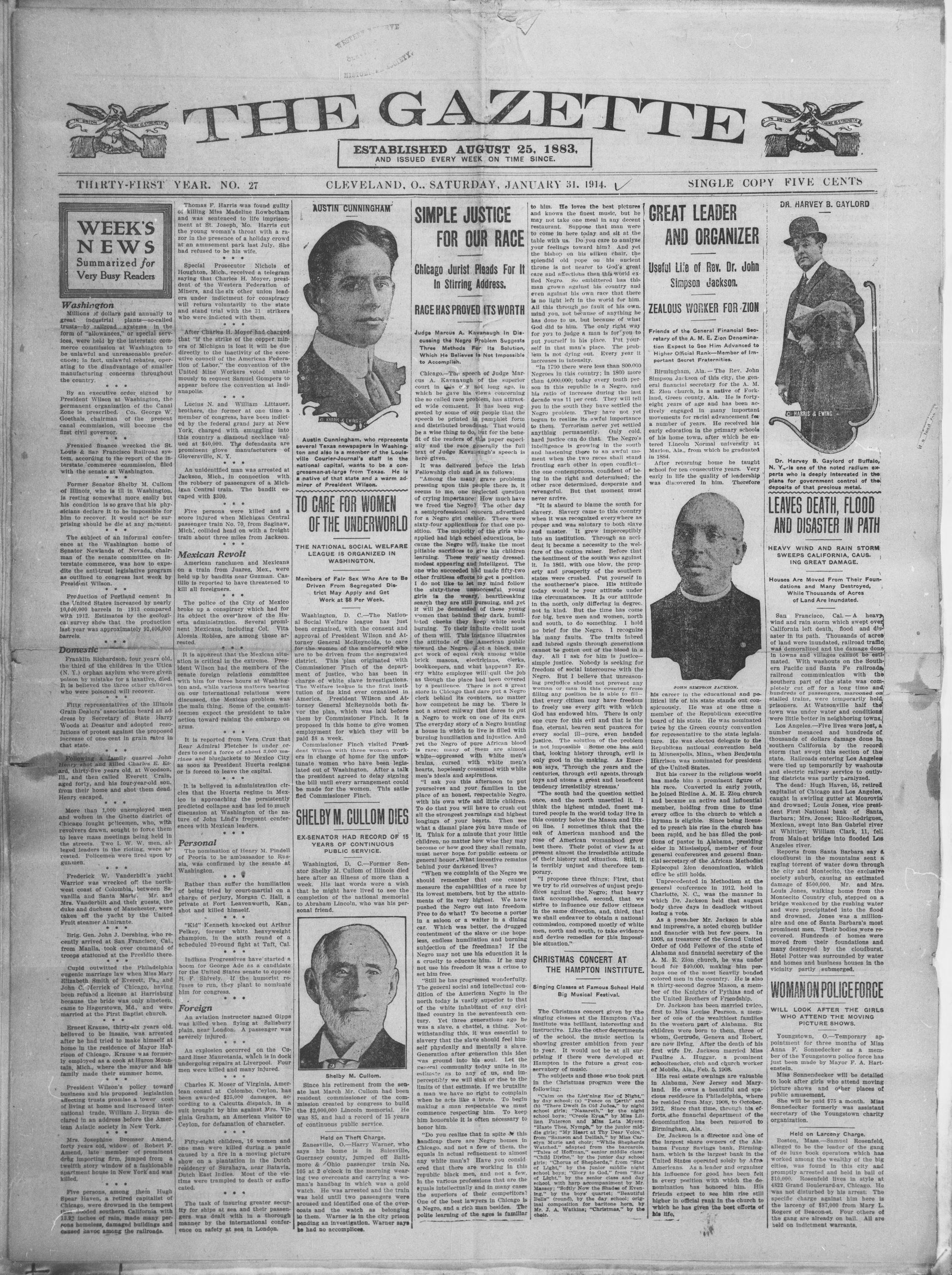
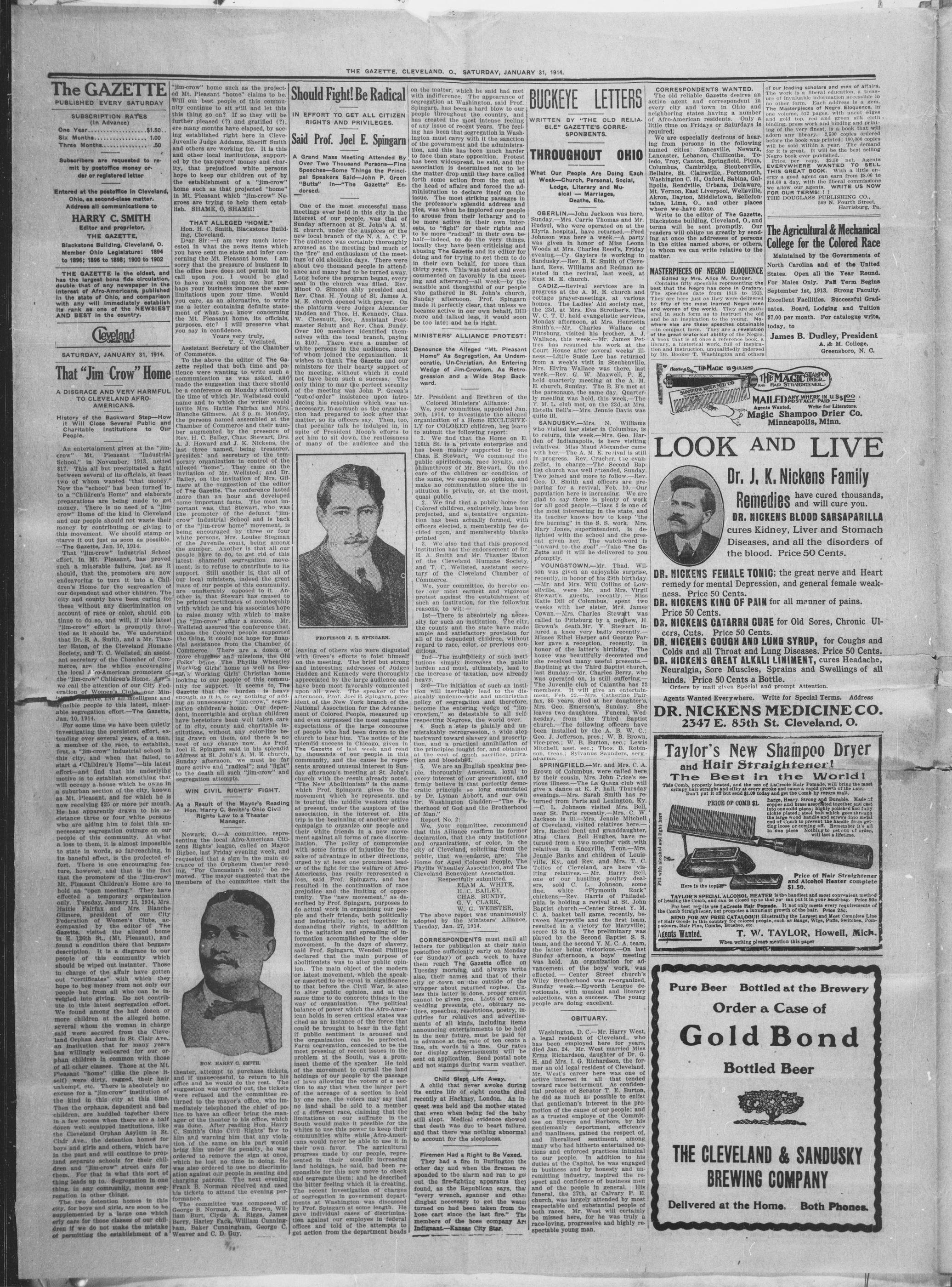
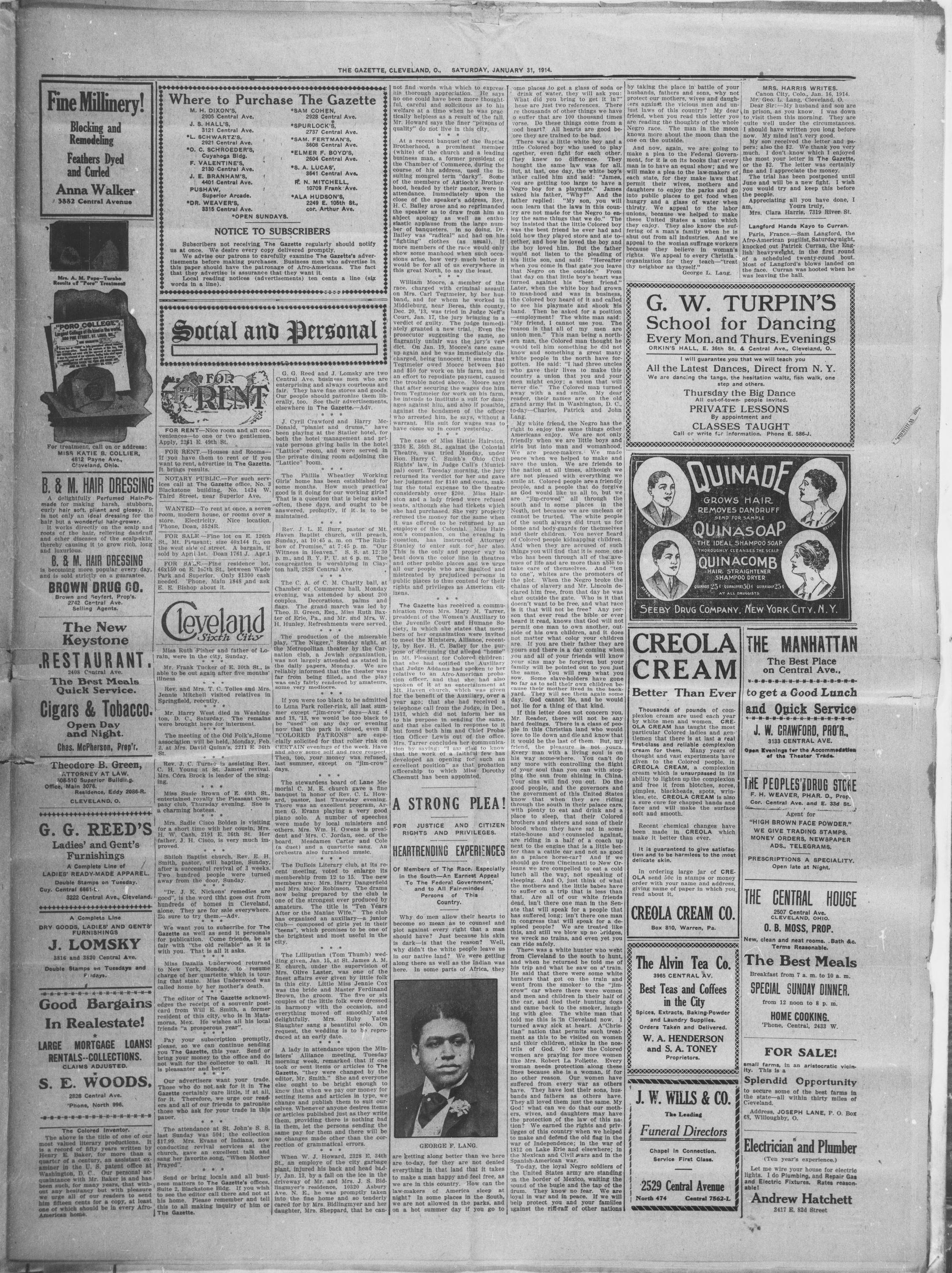
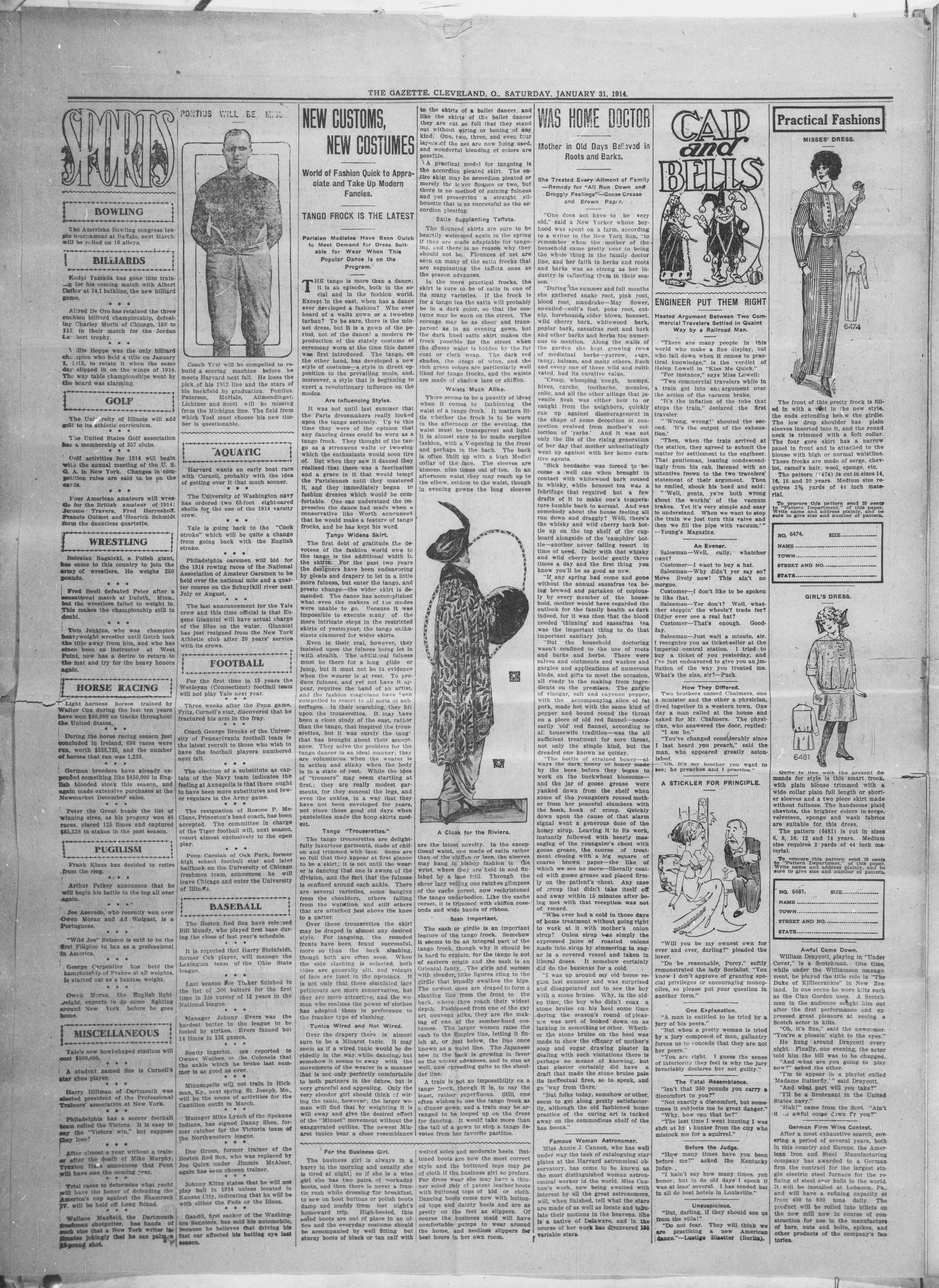
Page text (machine-generated)
THIRTY-FIRST YEAR. NO. 27
IN DATION
IHAM CATHERINE
WEEK'S NEWS Summarized for Very Busy Readers
Washington
Millions of dollars paid annually to great industrial plants—so-called trusts by railroad systems in the form of "allowances," or special services, were held by the interstate commerce commission at Washington to be unlawful and unreasonable preferences; in fact, unlawful rebates, operating to the disadvantage of smaller manufacturing concerns throughout the country.
By an executive order signed by President Wilson at Washington, the permanent organization of the Canal Zone is prescribed. Con. George W. Goethals, chairman of the present canal commission, will become the first civil governor.
Frenzied finance wrecked the St. Louis & San Francisco Railroad system, according to the report of the interstate commerce commission, filed with the senate at Washington.
Former Senator Shelby M. Cullom of Illinois, who is ill in Washington, is resting somewhat more easily but his condition is so grave that his physicians declare it to be impossible for him to recover. It would not be surprising should he die at any moment.
The subject of an informal conference at the Washington home of Senator Newlands of Nevada, chairman of the senate committee on interstate commerce, was how to expedite the anti-trust legislative program as outlined to congress last week by President Wilson.
Production of Portland cement in the United States increased by nearly 10,000,000 barrels in 1913 compared with 1912. Estimates by the geological survey show that the production last year was approximately 92,406,000 barrels.
Franklin Richardson, four years old, the third of the children in the Utica (N. Y.) orphan asylum who were given poison by mistake for a laxative, died. It is believed the three other children who were poisoned will recover.
Flity representatives of the Illinois Grain Dealers' association heard an address by Secretary of State Harry Woods at Deatur and adopted resolutions of protest against the proposed increase of one cent in grain rates in that state.
Following a family quarrel John Henry shot and killed Charles E. Ezzard, thirty-five years old, at Woodson, II., and then called Everett Crain, aged forty, and his four-year-old son, from their home and shot them dead. Henry escaped.
More than 1,000 unemployed men and wohen in the Ghetto district of Chicago fought policemen, who, with revolvers drawn, sought to force them to leave mass meetings being held in the streets. I. W. I. W. men, alleged leaders in the rioting, were arrested. Policemen were fired upon by gunmen.
Frederick W. Vanderbilt's yacht Warrior was wrecked on the north-west coast of Colombia, between Savannila and Santa Marta. Mr. and Mrs. Vanderbilt and their guests, the duke and duchess of Manchester, were taken off the yacht by the United Fruit steamer Almirante.
Brig. Gen. John J. Dershing, who recently arrived at San Francisco, Cal., from Manila, took over command of troops stationed at the Presidio there.
Cupid outwitted the Philadelphia eugenic marriage law when Miss Mary Elizabeth Smith of Everett, Pa., and John C. Merrick of Chicago, having been refused a license at Harrisburg because the bride was only nineteen, came to Hagerstown, Md., and were married at the First Baptist church.
Ernest Krause, thirty-six years old, believed to be insane, was arrested after he had tried to make himself at home in the residence of Mayor Harrison of Chicago. Krause was formerly employed as a cook at Huron Mountain, Mich., where the mayor and his family made their summer home.
President Wilson's policy toward business and his proposed legislation affecting trusts promise a lower cost of living at home and increased international trade, William J. Bryan declared in an address before the American Asiatic society in New York.
Mrs. Josephine Bromser Amend, forty years old, widow of Robert F. Amend, late member of prominent drug importing firm, jumped from a twelfth story window of a fashionable apartment house in New York and was killed.
Five persons, among them Hugh Spear Haven, a retired capitalist of Chicago, were drowned in the tempest that flooded southern California with 13.92 inches of rain, made many persons homeless, damaged buildings and caused navoc among the railroads.
THE GAZETTE
Thomas F. Harris was found guilty of killing Miss Madeline Rothwatham and was sentenced to life imprisonment at St. Joseph, Mo. Harris cut the young woman's throat with a razor in the presence of a holiday crowd at an amusement park last July. She had refused to be his wife.
Special Prosecutor Nichols of Houghton, Mich., received a telegram saying that Charles H. Moyer, president of the Western Federation of Miners, and the six other union leaders under indictment for conspiracy will return voluntarily to the state and stand trial with the 31 strikers who were indicted with them.
After Charles H. Moyer had charged that "if the strike of the copper miners of Michigan is lost it will be due directly to the inactivity of the executive council of the American Federation of Labor," the convention of the United Mine Workers voted unanimously to request Samuel Gompers to appear before the convention at Indianapolis.
Lucius N. and William Littauer, brothers, the former at one time a member of congress, have been indicted by the federal grand jury at New York, charged with smuggling into this country a diamond necklace valued at $40,000. The defendants are prominent glove manufacturers of Gloversville, N. Y.
An unidentified man was arrested at
Jackson, Mich., in connection with
the robbery of passengers of a Michigan Central train. The bandit escaped with $300.
Five persons were killed and a score injured when Michigan Central passenger train No. 70, from Saginaw, Mich., collided on head with a freight train about three miles from Jackson.
Mexican Revolt
American ranchmen and Mexicans on a train from Juarez, Mex., were held up by bandits near Guzman. Castillo is reported to have threatened to kill all foreigners.
The police of the City of Mexico broke up a conspiracy which had for its object the overthrow of the Huerta administration. Several prominent Mexicans, including Col. Vita Alosia Robles, are among those arrested.
It is apparent that the Mexican situation is critical in the extreme. President Wilson had the members of the senate foreign relations committee with him for three hours at Washington and, while various matters bearing on our international relations were discussed, the Mexican problem was the main thing. Some of the committeemen expect the president to take action toward raising the embargo on arms.
It is reported from Vera Cruz that Rear Admiral Fletcher is under orders to send a force of about 3,000 marines and bluejackets to Mexico City as soon as President Huerta resigns or is forced to leave the capital.
It is believed in administration circles that the Huerta regime in Mexico is approaching the persistently predicted collapse and has led to much discussion at Washington of the nature of John Lind's frequent conferences with Mexican leaders.
The nomination of Henry M. Pindell of Peoria to be ambassador to Russia, was confirmed by the senate at Washington.
Rather than suffer the humiliation of being tried by court-martial on a charge of perjury, Morgan C. Hall, a private at Fort Leavenworth, Kan., shot and killed himself.
"Kid" Kenneth knocked out Arthur Pelkey, former white heavyweight champion, in the sixth round of a scheduled 20-round fight at Taft, Cal.
Indiana Progressives have started a boom for George Ade as a candidate for the United States senate to oppose B. F. Shively. If the humorist refuses to run, they plant to nominate him for congress.
An aviation instructor named Gipps was killed when flying at Salisbury plain, near London. A passenger was severely injured.
An explosion occurred on the Cunard liner Mauretania, which is in dock undergoing repairs at Liverpool. Four men were killed and many injured.
Charles K. Moser of Virginia, American consul at Colombo, Ceylon, has been awarded $25,000 damages, according to a Calcutta dispatch, in a suit brought by him against Mrs. Virginia Graham, an American visitor to Ceylon, for defamation of character.
Fifty-eight children, 16 women and one man were killed during a panic caused by a fire in a moving picture show on a plantation in the Dutch residency of Surahara, near Batavia, Dutch East Indies. Most of the victims were trampled to death or suffocated.
The task of insuring greater security for ships at sea and their passengers was dealt with in a thorough manner by the international conference on safety at sea in London.
ESTABLISHED AUGUST 25, 1883 AND ISSUED EVERY WEEK ON TIME SINCE.
AUSTIN CUNNINGHAM
G. KARRIS & EWING
Austin Cunningham, who represents several Texas newspapers in Washington and also is a member of the Louisville Courier-Journal's staff in the national capital, wants to be a congressman-at-large from Texas. He is a native of that state and a warm admirer of President Wilson.
TO CARE FOR WOMEN OF THE UNDERWORLD
THE NATIONAL SOCIAL WELFARE LEAGUE IS ORGANIZED IN WASHINGTON.
Members of Fair Sex Who Are to Be Driven From Segregated District May Apply and Get Work at $8 Per Week.
Washington, D. C.-The National Social Welfare league has just been organized, with the consent and approval of President Wilson and Attorney General McReynolds, to care for the women of the underworld who are to be driven from the segregated district. This plan originated with Commissioner Finch of the department of justice, who has been in charge of white slave investigations. The Welfare league is the first institution of its kind ever organized in America. President Wilson and Attorney General McReynolds both favor the plan, which was laid before them by Commissioner Finch. It is proposed in this home to give women employment for which they will be paid $8 a week. Commissioner Finch visited President Wilson with three women workers in charge of home for the unfortunate women who have been legislated out of Washington. After a talk the president agreed to delay signing the bill until every arrangement could be made for the women. This satisfied Commissioner Finch.
SHELBY M. CULLOM DIES
EX-SENATOR HAD RECORD OF 15 YEARS OF CONTINUOUS PUBLIC SERVICE.
Washington, D. C.—Former Senator Shelby M. Cullom of Illinois died here after an illness of more than a week. His last words were a wish that he might have lived to see the completion of the national memorial to Abraham Lincoln, who was his personal friend.
Shelby M. Cullom.
Since his retirement from the senate last March Mr. Cullom had been resident commissioner of the commission created by congress to build the $2,000,000 Lincoln memorial. He was 85, and had a record of 15 years of continuous public service.
Held on Theft Charge.
Zanesville, O.—Harry Warner, who says his home is in Salesville, Guernsey county, jumped off Baltimore & Ohio passenger train No. 105 at 2 o'clock in the morning wearing two overcoats and carrying a woman's handbag in which was a gold watch. He was arrested and the train was held until two passengers were aroused and identified one of the overcoats and the watch as belonging to them. Warner is in the city prison pending an investigation. Warner says he had no accomplices.
SIMPLE JUSTICE FOR OUR RACE
Judge Marcus A. Kavanaugh in Discussing the Negro Problem Suggests Three Methods For Its Solution, Which He Believes to Not Impossible to Accomplish.
Chicago.—The speech of Judge Marcus A. Kavanaugh of the superior court in this c. v. not long ago, in which he gave his views concerning the so called race problem, has attracted wide comment. It has been suggested by some of our people that the speech be printed in pamphlet form and distributed broadcast. That would be a wise thing to do, but for the benefit of the readers of this paper especially and the race generally the full text of Judge Kavanaugh's speech is here given.
It was delivered before the Irish Fellowship club and is as follows:
"Among the many grave problems pressing upon this people there is, it seems to me, one neglected question of crying importance: How much have we freed the Negro? The other day a semiprofessional concern advertised for a Negro girl cashier. There were sixty-four applications for that one position. The majority of the girls who applied had high school education, because the Negro will make the most pittable sacrifices to give his children learning. These were neatly dressed, modest appearing and intelligent. The one who succeeded had made fifty-two other fruitless efforts to get a position. I do not like to let my mind follow the sixty-three unsuccessful young girls in the weary, heartbreaking search they are still pursuing, and yet it will be demanded of these young women that behind their dark, humiliated cheeks they keep white soul's burning. To their infinite credit most of them. This instance illustrates the attitude of the American public toward the Negro. Get a black man get work of equal rank among white brick masons, electricians, clerks, bookkeepers, and what happens? Every employee will quit the job as though the place had been covered by a pestilence. There is not a great store in Chicago that dare put a Negro clerk behind its counters, no matter how competent he may be. There is not a street railway that dares to put a Negro to work on one of its cars. The everyday story of a Negro hunting a house in which to be filled with burning humiliation and injustice. And yet the Negro of pure African blood is rare; many of them are almost white—oppressed with white men's brains, cursed with white men's hearts, hopelessly consumed with white men's ideals and aspirations.
"I ask you this afternoon to put yourselves and your families in the place of an honest, respectable Negro, with his own wife and little children. To do that you will have to crush out all the strongest yearnings and highest longings of your hearts. Then see what a dismal place you have made of it. Think for a minute that your little children, no matter how wise they may become or how good they shall remain, must never hope for public esteem or general honor. What incentive remains behind your darkened lives?
"When we complain of the Negro we should remember that one cannot measure the capabilities of a race by its lowest members, but by the attainments of its very highest. We have pushed the Negro out into freedom. Free to do what? To become a porter in a saloon or a waiter in a dining car. Which was better, the drugged contentment of the slave or the hopeless, endless humiliation and burning subjection of the freedman? If the Negro may not use his education it is a cruelty to educate him. If he may not use his freedom it was a crime to set him free.
"Still he has progressed wonderfully. The general social and intellectual condition of the American Negro in the north today is vastly superior to that of the white inhabitant of any civilized country in the seventeenth century. Yet three generations ago he was a slave, a chattel, a thing. Notwithstanding this, it was essential to slavery that the slave should feel himself physically and mentally a slave. Generation after generation this idea was ground into his soul. Let the general community today unite in its estimate to us of any of us, and imperecibly we will sink or rise to the limits of that estimate. If we brutalize a man we have no right to complain when he acts like a brute. To begin making a man respectable we must commence respecting him. To keep him honorable it is often necessary to honor him.
"Do you realize that in spite this handicap there are Negro homes in Chicago, and not a few of them, the equals in actual refinement to almost any white man's? Have you considered that there are working in this republic black men, and not a few, in the various professions that are in the equals intellectually and in many cases the superiors of their competitors' One of the best lawyers in Chicago is a Negro, and a rich man besides. The polite learning of the ages is familiar
to him. He loves the best pictures and knows the finest music, but he may not take one meal in any decent restaurant. Suppose that man were to come in here today and sit at the table with us. Do you care to analyze your feelings toward him? And yet the bishop on his silken chair, the splendid old pope on his ancient throne is not nearer to God's great care and affections than this world exiled Negro. So embittered has this man grown against his country and even against his own race that there is no light left in the world for him. All this through no fault of his own, mind you, not because of anything he has done to us, but because of what God did to him. The only right way for you to judge a man is for you to put yourself in his place. Put yourself in that man's place. The problem is not dying out. Every year it increases in intensity.
"In 1700 there were less than 800,000 Negroes in this country; in 1800 more than 4,000,000; today every tenth person in this republic is a Negro, and his ratio of increase during the last decade was 11 per cent. They will tell you in the south they have settled the Negro problem. They have not yet begun to realize its awful importance to them. Terrorism never yet settled anything permanently. Only cold, hard justice can do that. The Negro's intelligence is growing in the south and hastening there to an awful moment when the two races shall stand fronting each other in open conflict—the one contemptuous, confident of being in the right and determined; the other race determined, desperate and revengeful. But that moment must never arrive.
"It is absurd to blame the south for slavery. Slavery came to this country when it was recognized everywhere as proper and was salutary to both slave and master. It grew imperceptibly into an institution. Through an accident it became a necessity to the welfare of the cotton raiser. Before that the sentiment of the south was against it. In 1861, with one blow, the property and prosperity of the southern states were crushed. Put yourself in the southerner's place. His attitude today would be your attitude under like circumstances. It is our attitude in the north, only differing in degree, not in kind. But the time has come for big, brave men and women, north and south, to do something. I hold no brief for the Negro. I recognize his many faults. The traits inbred and inbred again through generations cannot be gotten out of the blood in a day. All I ask for him is justice—simple justice. Nobody is seeking for freedom of social intercourse with the Negro. But I believe that unreasoning prejudice should not prevent any woman or man in this country from being freed. I will tell you that every citizen may have freedom to freely use every gift with which God has endowed him. There is only one cure for this evil and that is the fine, eternal, heaven sent panacca for every social ill—pure, even handed justice. The solution of the problem is not impossible. Some one has said that, looking history through, evil is only good in the making. As Emerson says, "Through the years and the centuries, through evil agents, through toys and atoms a great and beneficent tendency irresistibly streams."
"The south had the question settled once, and the north unsettled it. I think the highest minded, finest matured people in the world today live in this country below the Mason and Dixon line. I sometimes think that the oak of American manhood and the rose of American womanhood grow best there. Their point of view is at present almost the irresistible attitude of their history and situation. Still, it is terribly unjust and therefore temporary.
"I propose three things: First, that we try to rid ourselves of unjust prejudices against the Negro; that heavy task accomplished, second, that we strive to influence our fellow citizens in the same direction, and, third, that we shall endeavor to obtain a national commission, composed mostly of white men, north and south, to take evidence and devise remedies for this impossible situation."
CHRISTMAS CONCERT AT THE HAMPTON INSTITUTE
Singing Classes at Famous School Hold Big Musical Festival.
The Christmas concert given by the singing classes at the Hampton (V.A.) institute was brilliant, interesting and instructive. Like the other departments of the school, the music section is showing greater ambition from year to year. It would not be at all surprising if there were developed at Hampton in the future a great conservatory of music.
The subjects and those who took part in the Christmas program were the following:
"Calm on the Listening Ear of Night," by day school; "(a) Peace on Earth" and "Childhood," by school girls; "Nazareth," by the night school boys; "Creole Eyes," by Miss Lillian Paterson and Miss Leta Myers; "Haste Thee, Nymph," by the junior middle class; "Mr Hare," by junior day school girls; "Chorus of Shepherds," from "Star of Light," by the junior middle night school boys; "Glory to God," from "Star of School," by junior day school with harp accompaniment by Mr. Musely; "Softly Now the Shades of Evening," by the boys' quartet; "Beautiful Bella" (round), by the day school; original composition for baritone horn, by A. Watking; "Christmas," by the choir.
SINGLE COPY FIVE CENTS
Friends of the General Financial Secretary of the A. M. E. Zion Denomination Expect to See Him Advanced to Higher Official Rank—Member of Important Secret Fraternities.
Birmingham, Ala. — The Rev. John Simpson Jackson of this city, the general financial secretary for the A. M. E. Zion church, is a native of Forkland, Green county, Ala. He is forty-eight years of age and has been actively engaged in many important movements for racial advancement for a number of years. He received his early education in the primary schools of his home town, after which he entered Lincoln Normal university at Marion, Ala., from which he graduated in 1884.
After returning home he taught school for ten consecutive years. Very early in life the quality of leadership was discovered, in him. Therefore
P.
his career in the educational and political life of his state stands out conspicuously. He was at one time a member of the Republican executive board of his state. He was nominated twice by the Green county convention for representative to the state legislature. He was elected delegate to the Republican national convention held in Minneapolis, Minn., when Benjamin Harrison was nominated for president of the United States.
But his career in the religious world has made him a prominent figure of his race. Converted in early youth, he joined Birdline A. M. E. Zion church and became an active and influential member, holding from time to time every office in the church to which a layman is eligible. Since being licensed to preach his rise in the church has been rapid, and he has filled the positions of pastor in Alabama, presiding elder in Mississippi, member of four general conferences and general financial secretary of the African Methodist Episcopal Zion denomination, which office he still holds.
Unprecedented in Methodism at the general conference in 1912, held in Charlotte, N. C., was the manner in which Dr. Jackson held that august body three days in deadlock without losing a vote.
As a preacher Mr. Jackson is able and impressive, a noted church builder and financier with but few peers. In 1908, as treasurer of the Grand United Order of Odd Fellows of the state of Alabama and financial secretary of the A. M. E. Zion church, he was under bond for $40,000, making him perhaps one of the most biologically bonded colored men in the country. He is also a thirty-second degree Mason, a member of the Knights of Pythias and of the United Brothers of Friendship. Dr. Jackson has been married twice, first to Miss Louise Pearson, a member of one of the wealthiest families in the western part of Alabama. Six children were born to them, three of whom, Gertrude, Geneva and Robert, are now living. After the death of his first wife Dr. Jackson married Miss Pauline A. Huggar, a prominent schoolteacher, club and church worker of Mobile, Ala., Feb. 5. 1908. His real estate ownings are valuable in Alabama, New Jersey and Maryland. He owns a beautiful and spacious residence in Philadelphia, where he resided from May, 1908, to October, 1912. Since that time, through his efforts, the financial department of the denomination has been removed to Birmingham Ala.
Dr. Jackson is a director and one of the largest share owners of the Alabama Penny Savings bank, Birmingham, which is the largest bank in the United States operated solely by Afro-Americans. As a leader and organizer his influence for good has been felt in every position with which the denomination has honored him. His friends expect to see him rise still higher in official rank in the church to which he has given the best efforts of his life.
IN UNITOK THERE IS STRUGGLE
© HARRIS & EWING
Dr. Harvey B. Gaylord of Buffalo, N. Y., is one of the noted radium experts who is deeply interested in the plans for government control of the deposits of that precious metal.
LEAVES DEATH, FLOOD AND DISASTER IN PATH
HEAVY WIND AND RAIN STORM SWEEPS CALIFORNIA, CAUS-ING GREAT DAMAGE.
Houses Are Moved From Their Foundations and Many Destroyed, While Thousands of Acres of Land Are Inundated.
San Francisco, Cal. — A heavy wind and rain storm which swept over California left death, flood and disaster in its path. Thousands of acres of land were inundated, railroad traffic was demoralized and the damage done in towns and villages cannot be estimated. With washouts on the Southern Pacific and Santa Fe railroads, railroad communication with the southern part of the state was completely cut off for a long time and hundreds of passengers marooned on stalled trains, were temporarily held prisoners. At Watsonville half the town was under water and conditions were little better in neighboring towns. Los Angeles. — Five lives were lost, a number menaced and hundreds of thousands of dollars damage done in southern California by the record storm that swept this section of the state. Railroads entering Los Angeles were tied up temporarily by washouts and electric railway service to outlying districts was partly paralyzed.
The dead: Hugh Haven, 55, retired capitalist of Chicago and Los Angeles, caught in swirling gut at Monrovia and drowned; Louis Jones, vice president First National bank of Santa Barbara; Mrs. Jones; Rico Rodriguez, Mexican, swept into San Gabriel river at Whittier; William Clark, 11, fell from Main-st bridge into flooded Los Angeles river.
Reports from Santa Barbara say a cloudburst in the mountains sent a raging torrent of water down through the city and Montecito, the exclusive society suburb, causing an estimated damage of $500,000. Mr. and Mrs. Louis Jones, walking home from the Montecito Country club, stepped on a bridge weakened by the rushing water and were precipitated into the flood and drowned. Jones was a millionaire and one of Santa Barbara's most prominent men. Their bodies were recovered. Hundreds of homes were moved from their foundations and many destroyed by the cloudburst. Hotel Potter was surrounded by water and homes and business houses in the vicinity partly submerged.
WOMANON POLIGE FORCE
WILL LOOK AFTER THE GIRLS WHO ATTEND THE MOVING PICTURE SHOWS.
Youngstown, O.—Temporary appointment for three months of Miss Anna F. Sonnedecker as a member of the Youngstown police force has just been made by Mayor F. A. Hartenstein.
Miss Sonnedecker will be detailed to look after girls who attend moving picture shows and other places of public amusement.
She will be paid $75 a month. Miss Sonnedecker formerly was assistant secretary of the Youngstown charity organization.
Held on Larceny Charge.
Boston, Mass.—Samuel Rosenfeld, alleged to be the leader of the gang of de luxe book operators which has worked among the wealthy of the big cities, was found in this city and promptly arrested and held in ball of $10,000. Rosenfeld lives in style at 4822 Grand Boulevard-sv. Chicago. He was not disturbed by his arrest. The specific charge against him here is the larceny of $7,000 from Mary L. Rogers of Beacon-st. Four others of the gang are already on ball. All are held on indictment warrants.
Subscribers are requested to remit by postoffice money order or registered letter
Entered at the postoffice In Cleveland Ohio, as second-class matter. Address all communications to
Blackstone Building, Cleveland, O.
Member Ohio Legislature: 1894
to 1896; 1896 to 1898; 1900 to 1902
THE GAZETTE Is the oldest, and has the largest bona fide circulation, doubling in size every year. In the interest of Afro-Americans, published in the state of Ohio, and comparison with any will immediately establish its rank as one of the NEWSIEST AND BEST In the country.
A DISGRACE AND VERY HARMFUL TO CLEVELAND AFRO-AMERICANS.
History of the Backward Step—How it Will Close Several Public and Charitable Institutions to Our People.
An entertainment given at the "jim-crow" Mt. Pleasant "Industrial School," in November, 1913, netted $17. This all but precipitated a fight between several of its officials, at least two of whom wanted "that money." Now the "school" has been turned in to a "Children's Home" and elaborate preparations are being made to get money. There is no school of a "jim-crow" Home. There is no kind in Cleveland and our people should not waste their money by contributing or giving to this movement. We should stamp or carve it out just as soon as possible.
The Gazette, Jan. 10, 1914.
That "jim-crow" Industrial School effort, in M. Pleasant, has proved such a miserable failure, just as it should, that the promoters are now endeavoring to turn it into a Children's Home for the segregation of our dependent and other children. The city and county have been caring for these without any discrimination or account of race or color, should continue to do so, and will, if this latest "jim-crow" effort is promptly throtled as it should be. We understand that Dr. E. A. Smith, and a Mr. Thaxter Eaton, of the Cleveland Human Society, and T. C. Wellsted, an assistant secretary of the Chamber of Commerce, are the whites encouraging the local co-American promoters of the "jim-crow" Children's Home. Again we call the attention of our City Federation of Women's Clubs, our Mining Alliance, and all intelligent and sensible people to this latest, miserable segregation effort.—The Gazette, Jan. 10, 1914.
For some time we have been quietly investigating the persistent effort, extending over several years, of a man, a member of the race, to establish, first, a "jim-crow" industrial school in this city, and when that failed, to start a "Children's Home"—his latest effort—and that his underlying motive is to establish something that will occupy a house which he owns in a suburban section of the city, known as Mt. Pleasant, and for which he is now receiving $25 or more per month. He has apparently drawn to his assistance three or four white persons who are aiding him to foil this unnecessary segregation out on our people of this community. At what a loss to them, it is almost impossible to state in words, so far-reaching, in its baneful effect, is the projected effort. There is one encouraging feature, however, and that is the fact that the promoters of the "jim-crow" Mt. Pleasant Children's Home are to hold an "open meeting." They have effected a temporary organization only, Tuesday, January 13, 1914, Mrs. Hattie Fhalrax and Mrs. Blanche Glimere, president of our City Federation of Women Clubs, to the editor of the Editor of the Gazette, visited the alleged home in E. 1862 (St. Mt. Pleasant), and found a condition there that beggars description of the affair have gotten out "certificates" with which they hope to beg money from not only our people but from all who can be invigorated into giving. Do not contribute to this latest segregation effort. We found among the half dozen or more children at the alleged home, several whom the woman in charge said were secured from the Cleveland Orphan Asylum in St. Clair Ave., an institution that for many years has willingly well-cared for our orphan children in common with those of all other classes. Those at the Mt. Pleasant "home" (like the place itself) were dirty, ragged, their hair unkempt, etc. There is absolutely no excuse for a "jim-crow" institution of the kind in this city at this time. Then the orphans, dependent and bad children, are huddled together there in a few rooms when there are a half dozen well equipped institutions, like the Cleveland Orphan Asylum in St. Clair Ave., the detention homes for boys and girls and others, which have in the past and will continue to presidate separate schools for their children and "jim-crow" street cars for them. For that is what this sort of thing leads up to. Segregation in one thing, in any community, means segregation in other things.
The two detention homes in this city, for boys and girls, are soon to be supplemented by a large one which erly care for those classes of our children if we do not make the mistake of permitting the establishment of a
"jim-crow" home such as the projected Mt. Pleasant "home" claims to be. Will our best people of this community continue to sit still and let this thing go on? If so they will be further pleased (?) and gratified (?), are many months have elapsed, by seeing established right here in Cleven Juvenile Judge Addams, Sheriff Smith and others are working for. It is this and other local institutions, supported by the tax-payers' money and charity, that prejudiced white persons hope to keep our children out of by the establishment of a "jim-crow" home such as that projected "home" in Mt. Pleasant which "jim-crow" Negroes are trying to help them establish. SHAME, O, SHAME!
THAT ALLEGED "HOME."
Hon. H. C. Smith, Blackstone Building, Cleveland.
Dear Sir:—I am very much interested in what the news items which you have sent me state and infer concerning the Mt. Pleasant home. I am sorry that the pressure of business in the office here does not permit me to call upon you. I would be glad that you will call upon me, but haps your business imposes the same limitations upon your time. Would you care, as an alternative, to write a letter containing definite statement of what you know concerning the Mt. Pleasant home, its officials, purposes, etc? I will preserve what you say in confidence.
Yours very truly,
Assistant Secretary of the Chamber of Commerce.
To the above the editor of The Gazette replied that both time and patience were wanting to write such a communication as was asked, and made the suggestion that there should be a conference on Monday afternoon, the time of which Mr. Wellstead could name and to which the writer would invite Mrs. Hattie Fairax and Mrs. Blanche Gilmore. At 3 p.m. Monday, the persons named assembled at the Chamber of Commerce and their number was 100. At 4 p.m. Roel H. C. Bailey, Stewart, Dr. A. J. Howard and J. K. Nickens, the last three named, being treasurer, president and secretary of the temporary organization in control of the alleged "home". They came on the invitation of Mr. Wellsted; and Dr. Bailey, on the invitation of Mrs. Gilmore at the suggestion of the editor of The Gazette. The conference was held and developed some important facts. The most important was, that Stewart, who was the promoter of the defunct "jim-crow" Industrial School and is back of the "jim-crow home" movement, is being forced to three or four white persons, Mrs. Louise Stegman the Juvenile court being the number. Another is that all our local ministers, indeed of the most latest, shameful segregation movement, is to refuse to contribute to its support. Still another is that all of our local ministers, indeed of the most are unaltered opposed to it. Another is, that Stewart has caused to be printed certificates of membership with which he and his associates hope to raise money with which to make the "jim-crow" affair a success. Mr. Wellsted assured the conference that, less the Colored people than the Jim-crow, the Jim-crow hope for financial assistance from the Chamber of Commerce. There are a dozen or more churches and missions, the Old Folks' home, The Phyllis Wheatley Working Girls' home as well as Beaulieu's Working Girls' Christian home looking to our people of this community for support. It seems to, The Gazette that the murder of the Jim-crow so sadly adding an unnecessary "jim-crow" segregation children's home. Our dependent, incorrigible and orphan children have heretofore been well taken care of in city, county and charitable institutions, without any color-line being drawn on them, and there is no need of any change now. As, Prof. Joel H. K. Howard, his eldest son at St. John's A. M. E. Church, Sunday afternoon, we must be far more active and "radical"; and "fight" to the death all such "jim-crow" and segregation attempts.
WIN CIVIL RIGHTS' FIGHT.
As a Result of the Mayor's Reading Hon. Harry C. Smith's Ohio Civil Rights Law to a Theater Manager.
Newark, O.-A committee, representing the local Afro-American Citizens Rights' league, called on Mayor Bigge, last Friday evening week, and requested that a sign in the main entrance of the Orpheum theater reading, "For Caucasian's only," be removed. The mayor suggested that the members of the committee visit the
HON. HARRY C. SMITH.
theater, attempt to purchase tickets, and if unsuccessful, to return to his office and he would do the rest. The suggestion was carried out, the tickets were refused and the committee returned to the mayor's office, who immediately telephoned the chief of police to have an officer bring the manager of the theater to his office, which was done. After reading Hoary, Harry B. Norman received the sign him and warning him that any violation of the same on his part would bring him under its penalty, he was ordered to remove the sign at once, which he lost no time in doing. He was also ordered to use no discrimination against our people in seating and charging patrons. The next evening Frank B. Norman received and used his tickets to attend the evening performance. The committee was composed of George B. Norman, A. H. Brown, William Burke, Clyde A. Riggs, James Berry, Harry Fack, William Cunningham, Baker Cunningham, George C. Weaver and C. D. Guy.
THE GAZETTE, CLEVELAND, O., SATURDAY, JANUARY 31, 1914.
Should Fight! Be Radical
IN EFFORT TO GET ALL CITIZEN RIGHTS AND PRIVILEGES.
Said Prof. Joel E. Spingarn
A Grand Mass Meeting Attended By
Over Two Thousand Persons—Fine
Speeches—Some Things the Principal Speakers Said—John P. Green
"Butt" In—"The Gazette" Endorsed.
One of the most successful mass meetings ever held in this city in the interest of our people, was that of Sunday afternoon at St. John's A. M. E. church, under the auspices of the new local branch of the N. A. A. C. P. The audience was certainly thoroughly aroused as the meeting had much of the "fire" and enthusiasm of the meetings of old abolition days. There were about two thousand people in attendance and many had to be turned away, because of the lack of seats on the church was filled. Rev. Minot O. Simons absided and Rev. Chas. H. Young of St. James A. M. E. church opened with prayer. On the platform were Judges Alexander Hadden and Thos. H. Kennedy, Chas. W. Chesnut, Esq., Assistant Postmaster Schutt and Chas. Buny. Over 100 members identified themselves with the local branch, paying their fees. The majority of white persons in the audience, most of whom joined the organization, I wishes to thank The Gazette and our ministers for their hearty support of the meeting, without which it could not have been such a success. The only thing to mar the perfect serenity of the meeting was John P. Green's "out-of-order" insistence upon introducing his resolution which was unnecessary, in-as-much as the organization had prepared to look after that incident, that peculiar talk he indulged in, in spite of President Moon's efforts to get him to sit down, the restlessness of many of the audience and the
C
PROFESSOR J. E. SPINGARN.
on the matter, which he said had met with indifference. The appearance of segregation at Washington, said Prof. Spingar, has been a hard blow to our people throughout the country, and has created the most intense feeling of any issue of recent years. The feeling has been that segregation in Washington must carry with it the sanction of the government and the administration, and this has been much harder to face than state opposition. Protest has been widespread, he said, and the government determines not to let the matter drop, they will forth some action from the men at the head of affairs and forced the administration to declare itself on the issue. The most striking passages in the professor's splendid address and plea, was when he implored our people to arouse from their lethargy and to be more active in their own interests, to "fight" for their rights and to be more "radical" in their own behalf—indeed, to do the very things, locally they have been criticising and abusing The Gazette and its editor for doing and for trying to get them to do in their own behalf, for more than thirty years. This was noted and even ing and afterwards in the meeting sensible and thoughtful of our people who gathered in St. John's church Sunday afternoon. Prof. Spingar made it perfectly clear, that unless became active in our own behalf, DID more and talked less, it would soon be too late; and he is right.
MINISTERS' ALLIANCE PROTEST!
Denounce the Alleged "Mt. Pleasant Home" As Segregation, As Undemocratic, Un-Christian, An Entering Wedge of Jim-Crowism, As Retrogradation and a Wide Step Backward.
Mr. President and Brethren of the Colored Ministers' Alliance.
W. President, committed to support Jan. 20th, 1914, to investigate the alleged organization of a Home EXCLUSIVE-LY for COLORED children, beg leave to submit the following report:
1. We find that the Home on E. 126th St. is a private enterprise and has been mainly supported by one Chas. E. Stewart. We commend the public spiritedness, race loyalty, and philanthropy of Mr. Stewart. On the care of the children or condition of the name, we express no oposition, and make communication since the institution is private, or, at the most, quasi public.
2. We find that a public home for Colored children, exclusively, has been projected, and a tentative organization has been actually formed, with officers elected, a membership fee decided upon, and membership blanks printed. We also find that this proposed institution has the endorsement of Dr. E. A. Smith and Mr. Thaxter Eaton of the Cleveland Humane Society, and T. C. Wellsted, assistant secretary of the Cleveland Chamber of Commerce. We, your committee, do hereby enter our most earnest and vigorous protest against the establishment of such institution, for the following reasons, to wit:—
1st—There is absolutely no necessity for such an institution. The city the county and the state have made ample and satisfactory provision for all of its dependent children, without regard to race, color, or previous conditions.
2nd—The multitude of such institutions simply increases the public burden and must, ultimately, lead to the heavy of taxation, now already heavy.
3rd—The initiation of such an institution will inevitably lead to the displeasing undemocratic and unchristian policy of segregation and therefore a lack of emancipation for "crowdswism," so detestable to all self-respecting Negroes, the world over.
4. Such a step is plainly and unmistakably retrogression, a wide step backward toward slavery and proscription, and a practical annihilation of the principles fought for, and obtained through sacrifice, privation and bloodshed.
5. We are an English speaking people, thoroughly American, loyal to every interest of our government, and firmly believe in that perfectly demonstrable Dr. Lyman Abbott, and our own Dr. Washington Gladden—"The Fatherhood of God and the Brotherhood of Man."
We, your committee, recommend that this Alliance reaffirm its former declaration, that the only institutions and organizations, of color, in the city of Cleveland, soliciting from the public, that we endorse are: The Home or Aged Colored People The Public or Aged Colored People The Cleveland Benevolent Association and The Cleveland Benevolent Association.
The above report was unanimously adopted by the Ministers' Alliance, Tuesday, Jan. 27, 1914.
CORRESPONDENTS must mail all letters for publication at their main postoffice sufficiently early on Monday (or Sunday) of each week to have them reach The Guardian. The Guardian, Tuesday morning, and always write their manis and that of their city or town on the outside of the wrapper about returned copies. Unless this latter is done, proper credit cannot be given you. Lists of names, wedding presents, etc., obituary notices, speeches, resolutions, poetry, inquiries for menus and advertisements of all kinds, including items announcing entertainments to be held in the near future, must be paid for in advance at the rate of ten cents a line, six words to a line. Our rates for display advertisements will be sent on application. Send postal note and not stamps during warm weather.
Child Slept Life Away.
A child that never awoke during its entire life of eight months died recently at Hackney, London. An inquest was held and the mother stated that even when being fed the baby still slept. Medical evidence showed that death was due to heart failure, and that there was nothing abnormal to account for the sleepiness.
Firemen had a Right to Be Vexed. They had a fire in Burlington the other day and when the firemen responde to the alarm and ran to get out the fire-fighting apparatus they found, as the Republican says, that "every wrench, spanner and other dingbat necessary to get the water turned on had been taken from the hose cart since the last fire." The members of the hose company Are Indignant—Kansas City Star.
BUCKEYE LETTERS
WRITTEN BY "THE OLD RELIA
BLE" GAZETTE'S CORRE-
SPONDENTS.
THROUGHOUT OHIO
What Our People Are Doing Each Week—Church, Personal, Social, Lodge, Literary and Musical — Marriages, Deaths, Etc.
OBERLIN.—John Jackson was here, Sunday.—Mrs. Carrie Thomas and Mr. Hudusl, who were operated on at the Elyria hospital, have returned.—Fred Johnson, have returned. A party was given in honor of Miss Leona Woods at Mrs. Charles Reed's, Friday evening.—Cy. Gayeters is working in Sandusky.—Rev. B. K. Smith of Cleveland, Revs. Williams and Redman assisted in the revival, last week, at Rust M. E. church.
CADI2—Revival services are in progress at the A. M. E. church and cottage prayer-meetings, at various homes. The Ladies' Aid society met, the 23d, at Mrs. Eva Strother's. The W. C. T. U. held evangelistic services, Monday afternoon, at Mrs. Henrietta Smith's.—Mr. Charles Wallace of Pittsburg, visited his brother, A. J. Wallace, this week.—Mr. James Petres has resumed his work at the Court House after several weeks' illness.—Little Susie Hue has returned from a week's visit in Steubenville, where was there, last week.—Rev G. W. Mawell, P. B. held quarterly meeting at the A. M. E. church, Sunday. The B. B's met at the parsonage, the same day. Quarterly meeting was held, this week.—The Y. M. L. club met, on the 23d, at Mrs. Estella Bell's.—Mrs. Jennie Davis was quite ill.
SANDUSKY.—Mrs. N. Williams who visited her sister in Columbus, is to return, this week.—Mrs. Geo. Harden of Indianapolis, is here visiting relatives. Miss Madu Alexander came with her.—The A. M. E. revival is still in progress. Rev. Crucher, the evangelist, in charge.—The Second Baptist, in charge.—The Second Sunday. Two joined and more to follow. Geo. D. Smith and officers are preparing for a revival, Feb. 10.—Our population here is increasing. We are glad to say there is plenty of work for all good people. Class 2 is one of the most interesting in the state, and its teacher knows how to keep "the fire burning" in the S. S. work. Mrs. Mary Jones, superintendent, is designee of the school. The student given her. The watch-word is "onward to the goal." Take The Ga-Zette and it will be delivered to you promptly.
YOUNGSTOWN—Mr. Thad. Wilson was given an enjoyable surprise, recently, in honor of his 29th birthday. —Mr. and Mrs. Will Collins of Lowellville, were Mr. and Mrs. Virgil Stewart's guests, recently. —Miss Katie Dill of Columbus, spent two weeks with her sister, Mrs. James Cowan.—Mrs. Charles Stewart was called to Pittsburgh by a nephew, H. Brown's death. Mr. V. Stewart injured a knee very badly recently. —Misses Ethel Harper and George Parker gave a reception, recently, in honor of the latter's birthday. The house was beautifully decorated and she received many useful presents. —Misses Ethel Harper and last Sunday—Mr. Charles Berry, who was operated on, is still suffering. The Juvenile club of Calantha has 22 members. It will give an entertainment. Feb. 22.—Mrs. Catherine Fairfax, 85 years, died at her daughter's, Mrs. Geo. Emerson's, Sunday. She leaves two daughters. Funeral, Wednesday, from the Third Baptist church. The following officers have been installed by the A. B. W. C.; Geo. J. Jefferson, pres.; W. B. Brown, vice-pres.; W. B. Burton, less; Lewis ast. pres.; Thos B. Robinson, treas.; Secus Saunders, serg.-atarms.
SPRINGFIELD—Mr. and Mrs. C. A. Brown of Columbus, were called here by their cousin, Mrs. John Price's serious illness. The La Qua club will give a dance at K. P. hall, Thursday from 10 a.m. to 1 p.m. turned from Paris and Lexington, Ky.
—C. L. Johnson visited Mrs. Bell, near St. Paris recently—Mrs. C. W. Jackson is ill—Mrs. Jennie Mitchell of Cleveland, visited relatives here—Mrs. Rachel Dent and granddaughter, Miss Clara Bell Hughes, have returned from a two months' visit with relatives in Knoxville, Tenn.—Mrs. Jennie Banks and children of Louisville, Ky., and Rev. and Mrs. T. C. Tolles of Cleveland are here visiting relatives, including the house of hustling poutry dealers, sold C. L. Johnson, some fine, white "Plymouth Rock" chickens—Rev. Harris of Philadelphia, is holding a revival at St. John Baptist church—Center Street Y. M. C. A. basket ball game, recently, between Marysville and the first team, resulted in a victory for Maryville; score 18 to 16. The preliminary was played by the Second Baptist S. T. team, and the second Y. M. C. A. team, the latter being victorious—On last Sunday afternoon, a boys meeting was held. An organization for ad vancement of the boys' work was enacted—Center Street church's Brotherhood was re-organized, Sunday week—Epworth League devotionals, with musical and literary selections, was a success. The young people are doing excellent.
OBITUARY.
Washington, D. C.-Mr. Werry West, a legal resident of Cleveland, who has been employed here for years, died Jan. 24. Mr. West married Miss Erma Richardson, daughter of Dr. G. H. and Mrs. I. G. Richardson, the former an old legal resident of Cleveland, Mr. West's career here was one of active interest in all that tended toward race betterment. As confidential protege of Senator E. Burton, he did as much as possible to insist that gentleman's interest in the motion of the cause of our people; and that gentleman's interest in the Committee on Rivers and Harbors, by his gentlemanly deportment, efficiency and manliness, gained the respect of, and liberalized sentiment, among many who had hitherto entertained notions and enforced practices inimical to our people. In addition to his duties at the Capitol, he was engaged in business and by honesty and unremitting industry, inspired the respect and confidence of business men and of the people in general. His funeral, the day of his obeyance, P.E. faculty, was largely attended by most respectable and substantial people of both races. Mr. West will certainly be missed here, for he was truly a race-loving, progressive and highly respectable young man.
Heating Boar
TR-MAGIC IS 9 IN 1886
THE MAGIC SHAMPOO
DRIER
AND HAIR STRAIGHTENER
SHAMPOO DRIER PED CO
MAILED ANY WHERE IN U.S. $100
POSTAGE PAID
Agents Wanted.
Write for Literature.
Magic Shampoo Drier Co.
Minneapolis, Minn.
LOOK AND LIVE
Remedies have cured thousands, and will cure you. DR. NICKENS BLOOD SARSAPARILLA cures Kidney, Liver and Stomach Diseases, and all the disorders of the blood. Price 50 Cents. DR. NICKENS FEMALE TONIC; the great nerve and Heart remedy for mental Depression, and general female weakness. Price 50 Cents. DR. NICKENS KING OF PAIN for all manner of pains
DR. NICKENS KING OF PAIN for all manner of pains. Price 50 Cents.
DR. NICKENS CATARRH CURE for Old Sores, Chronic Ulcers, Cuts. Price 50 Cents.
DR. NICKENS COUGH AND LUNG SYRUP, for Coughs and Colds and all Throat and Lung Diseases. Price 50 Cents.
DR. NICKENS GREAT ALKALI LINIMENT, cures Headache, Neuralgia, Sore Muscles, Sprains and Swellings of all kinds. Price 50 Cents a Bottle.
Orders by mail given Special and prompt Attention.
Agents Wanted Everywhere. Write for Special Terms. Address
DR. NICKENS MEDICINE CO.
2347 E. 85th St. Cleveland, O.
Taylor's New Shampoo Dryer and Hair Straightener! The Best in the World!
This Comb, properly heated, and the use of LaCroole Hair Pomade, will bring the most crimpy hair straight and silky at every stroke and cause a rapid growth of the hair. Don't put it off but send $1.00 today and get the Comb by return mail.
PRICE OF 00MB $1.
Large, Heavy, Strong and Durable. Made of copper and brass asses. Shed together and cast into one solid piece. Highly polished and fully nickle plated. Steel bolt which goes through the large wood handle and screws into metal end of tumbler to prevent the handle. From getting loose or coming off. Remember it's all in one piece. Nothing to get out of order, will last a lifetime.
Here is the top!
Price of Hair Straightener and Alcohol Heater complete $1.50.
TAYLOR'S SPECIAL ALCOHOL HEATER is the handiest and most convenient method of heating the Comb, and can be closed up so that you can put it in your hand-bag. Price 500 for hair goods in a LaCroole Hair Pomade. It not only prevents extrairements of the Comb Straightener, but promotes a luxurial growth of the hair. Price 25c.
SEND FOR MY FREE CATALOGUE! illustrating the Largest and Most Complete Line of Hair Goods in this country for colored people, such as Bange, Wigs, Puffa, Switches, Pom-paours, Hair Pins, Combs, Brushes, etc.
T. W. TAYLOR, Howell, Mich.
When writing please mention this paper.
Pure Beer Bottled at the Brewery
Order a Case of
Gold Bond
Bottled Beer
THE CLEVELAND & SANDUSKY
BREWING COMPANY
Delivered at the Home. Both Phones.
CORRESPONDENTS WANTED.
The old reliable Gazette desires an active agent and correspondent in every city and town in Ohio and throughout the country. One number of Afro-American residents. Only a little time on Fridays or Saturdays is required.
We are especially desirous of hearing from persons in the following named cities: Zanesville, Newark, Lancaster, Lebanon, Chillicothe, Toledo, Troy, Canton, Springfield, Plaquemont, Cambria, Cambria, Rockport, Cliswell, Portsmouth, Washington C. H., Oxford, Sabina, Gallipolis, Rendville, Urbana, Delaware, M. Vernon, East Liverpool, Wellsville, Akron, Dayton, Middletown, Bellefontaine, Lima, O., and other places where we have none.
Write to the editor of The Gazette, Blackstone building, Cleveland, O., and Bermuda. We will write to you, Our students will oblige us greatly by sending at once the addresses of persons in the cities named above, or others, to whom we can write relative to the matter.
MASTERPIECES OF NEGRO ELOQUENCE
Edited by Mrs. Alice M. Dunbar. Composed by Mr. John H. the best that the Negro has done in Oratory. The speeches date from 1818 to 1913. They are here just as they were delivered by fifty of the most learned Negro men in the country, and are in such form as to instruct the old and be an inspiration to the young. Now where else are these speeches obtainable in the public domain? Of the great oratorical ability of the Negro. A book that is at once a reference book, a library, a historical work, full of inspiration, and a book of wisdom, by Dr. Booker T. Washington and others
Heating Box TIP MAGIC IS 9 IN LONG
SHAND DO DRER MED CO
MA
Agents
Mag
LOOK A
Dr. J.
Reme
DR. NICKENS
cures Kid
Diseases
the bloo
DR. NICKENS FEMALE TON
remedy for mental Depress
ness. Price 50 Cents.
DR. NICKENS KING OF PAIR
Price 50 Cents.
DR. NICKENS CATARRH CUR
cers. Cuts. Price 50 Cents.
of our leading scholars and men of affairs.
The work is a liberal education, a treasure of invaluable information accessible in no other form. Each address is accompanied by Eloquence, in one volume, 512 pages, with uncut edges and gold top, red and green silk cloth binding, press work and binding and printing of the very finest, is a book that will adorn any library. The book is printed, 100,000 copies will be sold within a year. The demand for it is great. It will be the best selling Negro book ever published.
Price, per copy, $2.50 net. Agents ELOQUENCE AUDIO TEDDY TO SELL THIS GREAT BOOK. With a little energy a good agent can earn from $2.00 to $10.00 a day, with the liberal commissions we allow our agents, WRITE US NOW FOR OUR TERMS!
THE DOUGLASS PUBLISHING CO., 599 N. Fourth Street, Harrisburg, Pa.
The Agricultural & Mechanical College for the Colored Race
Maintained by the Governments of North Carolina and of the United States. Open all the Year Round. For Males Only. Fall Term Begins September 1st, 1913. Strong Faculty. Excellent Facilities. Successful Graduates. Board, Lodging and Tuition $7.00 per month. For catalogue write, today, to James D. Dudley, President A. & M. College, Greensboro, N. C.
Mrs. A. M. Pope—Turnbe
Results of "Poro" Treatment
"PORO COLLEGE"
Largest College of the kind in the world.
200 PINE STREET, ST. LOUIS, OIL.
For admission to Poro College, you must possess either a high school diploma or the 100th grade certificate. You must also possess the appropriate degree. If you are required to enroll in the college, you must possess a high school diploma or the 100th grade certificate. Poro College is located at 200 Pine Street, St. Louis, OIL. FOR INFORMATION, CONTACT PORO COLLEGE, 200 PINE STREET, ST. LOUIS, OIL.
For treatment, call on or address:
MISS KATIE B. COLLIER,
4812 Payne Ave.,
Cleveland, Ohio.
For treatment, call on or address:
MISS KATIE B. COLLIER,
4812 Payne Ave.,
Cleveland, Ohio.
A delightfully Perfumed Hair-Pomade for making harsh, stubborn, curly hair soft, pliant and glossy. It is not only an ideal dressing for the hair but a wonderful hair-grower. It works directly on the scalp and roots of the hair, relieving dandruff and other diseases of the scalp-skin, thereby causing it to grow rich, long and luxurious.
B. & M. HAIR DRESSING is becoming more popular every day, and is sold strictly on a guarantee.
BROWN DRUG CO.
Brown and Seyft, Props.
2742 Central Ave.
Selling Agents.
The New Keystone
.RESTAURANT.
2408 Central Ave.
The Best Meals
Quick Service.
Cigars & Tobacco.
Open Day
and Night.
Chas. McPherson, Prop'r.
Theodore B. Green,
ATTORNEY AT LAW.
508-510 Superior Buildlng.
Office, Main 3076
Residence, Eddy 2086-R.
CLEVELAND, O.
G. G. REED'S
Ladies' and Gent's
Furnishings
A Complete Line of
LADIEB' READY-MADE APPAREL.
Double Stamps on Tuesday.
Cuy. Central 6661-L
3222 Central Ave., Cleveland.
DRY GOODS, LADIES' AND GENTS'
FURNISHINGS
J. LOMSKY
3816 and 3820 Central Ave.
Double Stamps on Tuesdays and Fridays.
Good Bargains
In Realestate!
LARGE MORTGAGE LOANS!
RENTALS--COLLECTIONS.
CLAIMS ADJUSTED.
S. E. WOODS,
2828 Central Ave.
'Phone, North 996.
The Colored Inventor.
The above is the title of one of our most valued literary productions. It is a record of fifty years written by Henry E. Baker, for more than a quarter of a century, an assistant examiner in the U. S. patent office at Washington, D. C. Our personal acquaintance with Mr. Baker is and has been such, for many years, that without any hesitancy but with pleasure we urge all of our readers to send him fifteen cents for a copy, at least one of which should be in every Afro-American home.
NOTICE TO SUBSCRIBERS
Subscribers not receiving The us at once. We desire every copy We advise our patrons to care tirements before making purchas this paper should have the patro that they advertise is assurance Local reading notices (adve words in a line).
Social and
Subscribers not receiving The Gazette regularly should notify us at once. We desire every copy delivered promptly.
us at once. We desire every copy delivered promptly.
We advise our patrons to carefully examine The Gazette's advertisements before making purchases. Business men who advertise in this paper should have the patronage of Afro-Americans. The fact that they advertise is assurance that they want it.
We advise reading notices (advertisements) ten cents a line (six words in a line).
FOR RENT—Nice room and alt conveniences—to one or two gentlemen. Apply, 2261 E. 49th St.
FOR RENT—Houses and Rooms—If you have them to rent or if you want to rent, advertise in The Gazette. It brings results.
NOTARY PUBLIC—For such services call at The Gazette office, No. 3 Blackstone building, No. 1424 W. Third Street, near Superior Ave.
WANTED—To rent at once, a seven room, modern house, or rooms over a store. Electricity. Nice location. Phone, Doan, 3524R.
FOR SALE—Fine lot on E. 126th St. M. Pleasant; size 40x144 ft. on the west side of street. A bargain, if sold by April 1st. Doan 1761 J. Apr.1
FOR SALE—Fine residence lot. 40x150 on E. 100th St. between Wade Park and Superior. Only $1300 cash needed. Phone, Main 1848 and ask E. E. Bishop about it.
Cleveland Sixth City
Miss Ruth Fisher and father of Lorain, were in the city, Sunday.
Mr. Frank Tucker of E. 30th St., is able to be out again after five months' illness
Rev. and Mrs. T. C. Tolles and Mrs. Jennie Mitchell visited relatives in Springfield, recently.
Mr. Harry West died in Washington, D. C., Saturday. The remains were brought here for interment.
The meeting of the Old Folk's Home association will be held, Monday, Feb. 2, at Mrs. David Quinn's, 2211 E. 36th St.
Rev. J. C. Turner is assisting Rev. C. H. Young at St. James' revival. Mrs. Cora Brock is leader of the singing.
Miss Susie Brown of E. 49th St., entertained royally the Pleasant Company club, Thursday evening. Sne is a charming hostess.
Mrs. Sadie Cisco Bolden is visiting for a short time with her cousin, Mrs. H. W. Cash, E. 36th St. Her father, J. H. Cisco, is very much improved.
Shiloh Baptist church, Rev. E. H. Smith, pastor, will baptize, Sunday, after a successful revival of 3 weeks. Two hundred people were turned away from the door, Sunday.
"Dr. J. K. Nickens' remedies are good", is the word that goes out from hundreds of homes in Cleveland, alone. They are for sale everywhere. Be sure to try them—Adv.
We want you to subscribe for The Gazette as well as men's personal for women's friends, be as fun with you. The all it asks.
Miss Dazalia Underwood returned to New York, Monday, to resume charge of her quartette which is touring that state. Miss Underwood was called home by her mother's death.
The editor of The Gazette acknowledges the receipt of a souvenir postcard from Will E. Smith, a former resident of this city, who is in Matamoras, Mex. He wishes all his local friends "a prosperous year."
Pay your subscription promptly, please, so we can continue sending you The Gazette, this year. Send or bring your money to the office and do not wait for the collector to call. It is pleasant and better.
Our advertisers want your trade. Those who do not ask for it in The Gazette certainly care little, if at all, for it. Therefore, we urge our readers and all of our friends to patronize those who ask for your trade in this panel.
The attendance at St. John's S. S. last Sunday was 504; the collection $17.99. Mrs. Evans of Indiana, now conducting revival services at the church, gave an excellent talk and sang her favorite song, "When Mother Prayed".
Send or bring locals and all business matters to The Gazette's offices, Suite 2, the house and Bldg. If you wish to see the editor call there and not at home, Please remember and tell this to all making inquiry of him or The Gazette.
```markdown
```
The Gazette regularly should notify
by delivered promptly.
fully examine The Gazette's adver-
sess. Business men who advertise in
image of Afro-Americans. The fact
that they want it.
arrisements) ten cents a line (six
G. G. Reed and J. Lomsky are two
Central Ave. business men who are
enterprising and always courteous and
fair. They have fine stores and goods.
Our people should patronize them liberally, too. See their advertisements,
elsewhere in The Gazette.-Adv.
J. Cyril Crawford and Harry McDonald, "pianist and drums," have been playing at the Statler hotel, for both the hotel management and private persons giving balls in the hotel "Lattice" room, and were served in the private dining room adjoining the "Lattice" room.
The Phillis Wheatley Working Girls' home has been established for some months. How much practical good is it doing for our working girls? That is a question that is being asked often, these days, and ought to be answered, promptly. if it is to be maintained.
Rev. J. L. N. Rurr, pastor of Mt. Haven Baptist church, will preach, Sunday, at 10:45 a. m. on "The Rainbow of Promise," at 7:45 p. m. "Our Witness in Heaven." S. S. at 12:30 p. m., and B. Y. P. U. at 6 p. m. The congregation is worshiping in Clayton hall, 2828 Central Ave.
The C. A. of C. M. Charity ball, at
Chamber of Commerce hall, Monday
evening, was attended by about 200
couples, Decorations, palms and
flags. The grand march was led by
Theo. B. Green, Esq., Miss Ruth Baxter
of Erie, Pa., and Mr. and Mrs. W.
H. Hunley, Refreshments were served.
The production of the miserable
play, "The Nigger," Sunday night, at
the Metropolitan theater by the
Carnation club, a Jewish organization,
was not largely attended as stated in
the play. We are well-reliably informed that the theater was far from being filled, and the play
was only fairly rendered by amateurs
very some mediocre.
If you were too black to be admitted to Luna Park roller-rink, all last summer except "jim-crow" days—Aug. 4 and 18, 13, we would be too black to be "used" on any day or evening now that the park is closed, even if "COLORED PATRONS" are especially solicited for that roller rink on CERTAIN evenings of the week. Have and show some self and race respect. Then, too, your money was refused, last summer, except on "jim-crow" days.
The stewardess board of Lane Memorial C. M. E. church gave a fine banquet in honor of Rev. C. L. Howard, pastor, last Thursday evening. There was an excellent program, Armen G. Evans playing a very good piano solo. A number of speeches were made by local ministers and others. Mrs. Wm. H. Owens is president and Mrs. C. Jordan, sec. of the board. Mesdames Carter and Cole (a duet) and a quartette sang. An orchestra also furnished music.
The DuBois Literary club, at its recent meeting, voted to enlarge its membership from 12 to 15. The new members are: Mrs. Harry Dangerfield and Mrs. Major Robinson. The drama now being prepared by the club is one of the strongest ever produced by amateurs. The title is "Ten Years After or the Maniac Wife." The club has organized an auxiliary...—Mrs. Harry Dangerfield, yet in their "teens", which promises to be one of the brightest and most useful in the city.
* * *
The Lilliputian (Tom Thumb) wedding given, Jan. 15, at St. James A. M. E. church, under the supervision of Mrs. Olive Laster, was one of the finest affairs ever given by little folk in this city. Little Miss Jenex Cox on the bride and Master Ferdinand Brown the groom. The five or six couples of the little folk were dressed in harmony with the occasion, and everything moved off smoothly and delightfully. Mrs. Ruby Yates Slaughter sang a beautiful solo. On request, the wedding is to be reproduced at an early date.
A lady in attendance upon the Ministers' Alliance meeting, Tuesday morning week, remarked that if one took or sent items or articles to The Gazette, "they were changed by the editor, Mr. Smith." She and everyone else ought to be bright enough to know that when we pay our money for setting items and asking them to suit ourselves. Whenever anyone desires items or articles published just as they write them, providing there is nothing bad in them, let the persons sending the same pay for them and there will be no changes made other than the correction of grammatical errors.
When W. J. Howard, 2328 E. 34th St., an employee of the city garbage plant, injured his back and head badly, Jan. 13, by a fall on the ice in the driveway of Mr. and Mrs. Lingman, while 10320 Abbey Ave. N. E., he was promptly taken into the fine home and so tenderly cared for by Mrs. Bidlingerm and her daughter, Mrs. Sheppard, that he can-
---
THE GAZETTE, CLEVELAND, O., SATURDAY, JANUARY 31, 1914
Gazette
not find words with which to express his thorough appreciation. He says no one could have been more right, ful, careful and solicitous as to his welfare at a time when he was practically helpless as a result of the fall. Mr. Howard says the finer "persons of quality" do not live in this city.
some places to drink of wine. What are these are just thousands to suffer that worse. Do the heart good?
At a recent banquet of the Bantist Brotherhood, a prominent member (white) of the church and a leading business man, a former president of the Chamber of Commerce, during the course of his address, used the insulting mongrel term "darky". Some of the members of Antioch's Brotherhood, headed by their pastor, were in attendance. Immediately upon the close of the speaker's address, Rev. Bentley arose and so reprimanded the speaker to draw from him an object apology to well-versed elastic aplause from the large number of banqueters. In so doing, Dr. Bailey was "radical" and had on his "fighting" clothes (as usual). If more members of the race would only show some manhood when such occasions arise, how very much better it would be for all of us everywhere in this great North, to say the least.
William Moore, a member of the race, charged with criminal assault on Mrs. Carl Tegmeier, by her husband, and for whom he worked in Middleburg, near Berea, this county, Dec. 20, '13, was tried in Judge Neff's Court, Jan. 17, the jury bringing in a sense of guilt. The judge immediately sentenced him to the prosecutor suggesting the garment fragrantly unlawful is the jury's verdict. On Jan. 15, Moore's case came up again and he was immediately discharged, being innocent. It seems that Tegmeier owed Moore between $40 and $50 for work on his farm, and in an effort to repudiate payment, caused the trouble noted above. Moore says that after securing the wages due him, he intends to institute a suit for damages against him, and also if possible, against the bondsmen of the officer who arrested him, he says, without a warrant. His suit for wages was to have come up in court yesterday.
The case of Miss Hattie Hairston, 2336 E. 36th St., against the Colonial Theatre, was tried Monday, under Hon. Harry C. Smith's Ohio Civil Rights' law, in Judge Cull's (Municipal) court. Tuesday morning, the jury returned its verdict for her and gave her judgment for $140 and costs, making the total expense to the theatre considerably over $200. Miss Hairston and a lady friend were refused seats, although she had tickets which she had purchased. She very properly refused the money for the same when it was offered to be returned by an employee of the Colonial. Miss Hairson's companion, on the evening in which she was arrested, Attorney Stanley to enter suit for her. This is the only and proper way to beat down the color line in the theatres and other public places and we urge all our people who are ingested and mistreated by prejudiced persons in public places to thus contend for their rights and privileges as American citizens.
The Gazette has received a communication from Mrs. Mary M. Tarrer, president of the Women's Auxiliary to the Juvenile Court and Humane Society, in which she states that members of her organization were invited to meet the Ministers, Alliance, recently, by Rev. H. V. C. Ballay for the purposes of the meeting in Mr. Pleasant for Colored children; that she had notified the Auxiliary that Judge Addams had spoken to her relative to an Afro-American probation officer, and that she had also spoken of it at an entertainment at the Chesapeake Theater for the benefit of the Auxiliary, over a year ago; that she had received a telephone call from the Judge, in Dec. 1913, which did not inform her as to his purpose in sending the same, and that she called in response to it but found both him and Chief Probation Officer Lewis out of the office. Mrs. Tarrer concludes her communication by saying: "I am glad to know that Mrs. C. Ballay has developed an opening for such an excellent position" as that probation officership to which Miss Dorothy Chesnut has been appointed.
A STRONG PLEA!
FOR JUSTICE AND CITIZEN
RIGHTS AND PRIVILEGES.
Why do men allow their hearts to become so mean as to counsel and plot against every right that a man should have? Just because his skin is dark—is that the reason? Well, why didn't the white people leave us in our native land? We were getting along there as well as the Indian was here. In some parts of Africa, they
M. B.
are ketting along better than we here are to-day, for they are not denied everything in that land that it takes to make a man happy and feel free, as we are in this country. How can the law-makers of America sleep at night? In some places in the South, we are not allowed in the parks, and on a hot summer day if you go to
some places to get a glass of soda or drink of water, they will ask you: What did you bring to get it in?" these are just two references. There are thousands of other things we have to do in our lives or worse. Do these things come from a good heart? All hearts are good before they are trained to be bad.
There was a little white boy and a little Colored boy who used to play together, even fight for each other. They knew no difference. They thought the same law was for all. But, at last, one day, the white boy's father called him and said: "James, you are getting too large to have a Negro boy for a playmate." James asked his father, "Why?" And the father, "My son, you learn that the laws in this country are not made for the Negro to enjoy the same things that we do." The father insisted that the little Colored boy was the best friend he ever had and told how they played store and ate together, and how he loved the boy and the boy loved him. But the father would not listen to the pleading of his little son, and said: "Hereafter when you come in that gate you leave the Colored boy heard of it and called to see his playmate and shook his hand. Then he asked for a position—employment! The white man said: "The reason is that all of them are union men." This man being a northern man, the Colored man thought he would tell him something he did not know and something a great many white people in the north have forgotten. He said: "I had three uncles who gave their lives to make this country a union that you and your men might enjoy; a union that will never die. The Colored man turned to the reader, their names are on the old grand army list in Washington, D. C., to-day—Charles, Patrick and John Lang.
My white friend, the Negro has the right to enjoy the same things other Americans enjoy. We are not only friendly when we are little boys and girls but into man and womanhood. We are peace-makers. We made peace when we helped to make and save the union. We are friends to the nation at all times, although we are not pleased with everything we people, and Colored people are a friend people, and Colored people are a friend because God would use all us to, but we are "jim-crowd" all through the south and in some places in the North, not because we are unclean or cannot be trusted. The white people of the south always did trust us for home and body-guards for themselves and their children. You never heard of Colored kids nidapping children. And when they are accused of such things you will find that it is some one of the greatest crimes of life and are more than able to take care of themselves. And "ten to one", whites are the promoters of the plot. When the Negro broke the chains of slavery and Mr. Lincoln declared him free, from that day he was shut outside the gate. Who is it that doesn't want to be free, and what race is it that will not be free? Any person that ever read the bible or ever heard it read, knows that God will not be forgiven for his side of his own children, and it does not matter what color your children are. If you are their father they are yours and there is a day coming when you and all of your friends will know your sins may be forgiven but your family will be pointed out to you just the same. You will reap what you have. Some slave-holders have gone so far that they cause their mother lived in the backyard. They will see them again some day. God cannot lie, and he would not lie for a thing of that kind.
If this letter does not concern you, Mr. Reader, there will not be any hard feelings. There is a class of people in this Christian land who would love to lie down and die and know that it would be the last of them. But, my friend, the pleasure is not yours. Every man with a living soul is on earth, and every man with any more with controlling the flight of your soul than you can with stopping the sun from shining in China. Your sins will find you out. Do the good people, and the governors and the government of this United States know that when they are riding through the south in their caricels, with plenty to eat and drink and a place to sleep, that their Colored brothers and sisters and sons of their blood whom they have sat in some state-house and counseled against, are riding in a half of a coach up a hill, or a little better than a cattle car and not as a palace horse-car? And if we should go from Cincinnati to New Orleans we are compelled to eat a cold lunch all the way, not speaking of sleeping. And O, just think of what the mothers and the little babies have to suffer on a trip that is less than that. Are all of our white friends dead, isn't there one man in the Senate that will speak for a people that has suffered long; isn't there one man in the Senate that will speak for a displaced people? We are present this, and still we blow up no bridges, we wreck no trains, and even yet you can ride safely.
There was a white hunter who went from Cleveland to the south to hunt, and when he returned he told me of his trip and what he saw on a train. He said that there were some white hunters that got on the train and went from the smoker to the "jimcrow" car where there were women like him. He said that the life of the car, and tied their hunting dogs and came back to the smoker, laughing with glee. The white man that told me this is in Cleveland now. I turned away sick at heart. "A Christian" nation that permits such treatment as this to be visited on women and their children, stinks in the nostrils of God. O! how the Colored women are praying for more women like Mrs. Robert Collette. Every woman is protected by laws lines because she is a woman, if for no other reason. Our women have suffered from every war as others have. They have lost their sons, husbands and fathers, as others have. They all loved them just the same. My God! what can we do that our mothers, wives, and daughters may have the protection of the law of this nation? We earned the rights and privileges of this country when we helped to make a man a king in the independence; and the 1812 on Lake Erie and elsewhere; in the Mexican and Civil wars and in the Spanish-American war.
To-day, the loyal Negro soldiers of the United States army are standing on the border of Mexico, waiting the sound of the bugle and the tap of the drum. They know no fear. We are loyal in war and in peace. If we will help protect you and your families against the riff-raff of other nations
QUINADE
GROWS HAIR
REMOVES DANDRUFF
SEND FOR SAMPLE
QUINASOAP
THE IDEAL SHAMPOO 50AP
THOROUGHLY CLEANSSES THE SCALP
QUINACOMB
HAIR STRAIGHTENER
SHAMPOO DRYER
QUINADE 25¢ QUINACOMB 50¢ QUINADE 25¢
AT ALL DRUGGISTS
SEEBY DRUG COMPANY. NEW YORK CITY. N. Y.
by taking the place in battle of your husbands, fathers and sons, why not protect our mothers, wives and daughters against the vicious men and unjust laws of this country? My dear friend, when you read this letter you are reading the thoughts of the whole Negro race. The man in the moon knows more about the moon than the one on the outside.
And now, again, we are going to make a plea to the Federal Government, for it is on its books that every man is to have an equal show; and we will make a plea to the law-makers of each state, for they make laws that permit their wives, mothers and daughters to enjoy the parks and into public places to get food when hungry and a glass of water when thirsty. We appeal to the labor unions, because we helped to make these United States a union which would know how to know the suffering of a man's family when he is shut out from all industries. And we appeal to the woman suffrage workers because they believe in woman's rights. We appeal to every Christia: organization for they teach—"treat thy neighbor as thyself."
George L. Lang.
G. W. T.
School for
Every Mon. and
ORKIN'S HALL, E. 36th St.
I will guarantee you
All the Latest Dance
We are dancing the tango, the
step and
Thursday th
All out-of-town
PRIVATE
By appoint
CLASSES
Call or write for info
QUIN
GROWS
REMOVES
SEND FOR
QUINA
THE IDEAL S
THOROUGHLY CLEAR
QUINA
HAIR STR
SHAMPOO
QUINAPE 25£ QUINAKOM
AT ALL E
SEEBY DRUG COMPANY
CREOLA
CREAM
Better Than Ever
Thousands of pounds of complexion cream are used each year by white men and women. CREOLA CREAM has taught the most particular Colored ladies and gentlemen that there is at last a real first-class and reliable complexion cream for them. Many years of thought and vast experiments have given to the Colored people, in CREOLA CREAM, a complexion cream which is unsurpassed in its ability to lighten up the complexion and free it from blotches, sores, plummes, blackheads, spots, wrinkles, etc. CREOLA CREAM is also a sure cure for chapped hands and face and will make the surface soft and smooth.
Recent chemical changes have been made in CREOLA which make it better than ever.
It is guaranteed to give satisfaction and to be harmless to the most delicate skin.
In ordering large jar of CREOLA send 50c in stamps or money order with your name and address, giving name of paper in which you read about it.
CREOLA CREAM CO.
Box 810, Warren, Pa.
The Alvin Tea Co.
3965 CENTRAL AV.
Best Teas and Coffees
in the City
Spices, Extracts, Baking-Powder
and Laundry Supplies.
Orders Taken and Delivered.
W. A. HENDERSON
and S. A. TONEY
Proprietors.
J. W. WILLS & CO.
The Leading
Funeral Directors
Chapel in Connection.
Service First Class.
2529 Central Avenue
North 474 Central 7562-L
Canon City, Colo. Jan. 16, 1914.
Mr. Geo. L. Lang, Cleveland, O.
Dear Sir:—My husband and son are in prison, as you know. I was down to visit them this morning. They are quite well under the circumstances. I should have written you long before now. My mind isn't very good.
My son received the letter and papers; also the $2. We thank you very much. I don't know which I enjoyed the most your letter in The Gazette, or the $2. The letter was certainly fine and I appreciate the money.
The trial has been postponed until June and will be a new fight. I wish you would try and keep this before the people.
Appreciating all you have done, I am,
Yours truly.
Mrs. Clara Harris, 7319 River St.
Langford Hands Kayo to Curran.
Paris, France.—Sam Langford, the Afro-American pugilist, Saturdaynight, knocked out Patrick Curran, the English heavyweight, in the first round of a scheduled twenty-round bout. the face of Langford blows landed on the face of Curran was hooted when he was leaving the hall.
URPIN'S
For Dancing
Thurs. Evenings
& Central Ave., Cleveland, O.
that we will teach you
less, Direct from N. Y.
to hesitation waltz, fish walk, one
and others.
The Big Dance
people invited.
LESSONS
Department and
TAUGHT
Information. Phone E. 586-J.
HAIR
DANDRUFF
SAMPLE
SOAP
CHAMPOO SOAP
ANSES THE SCALP.
COMB
TAIGHTENER
DO DRYER
$50.00 QUINASGAP 25¢
BRUGGISTS.
NEW YORK CITY. N. Y.
THE MANHATTAN
The Best Place
on Central Ave..
to get a Good Lunch
and Quick Service
J. W. GRAWFORD, PRO'R.,
3133 CENTRAL AVE.
Open Evenings for the Accommodation
of the Theater Trade.
THE PEOPLES' DRUG STORE
F. H. WEAVER, PHAR. D. Prop.
Cor. Central Ave. and E. 33d St.
Agent for
"HIGH BROWN FACE POWDER."
WE GIVE TRADING STAMPS.
MONEY ORDERS, NEWSPAPER
ADS., TELEGRAMS.
PRESCRIPTIONS A SPECIALITY.
Open late at Night.
CENTRAL HOUSE
2507 Central Ave.
CLEVELAND, OHIO.
O. B. MOSS, PROP.
New, clean and neat rooms. Bath &c.
Terms Reasonable.
The Best Meals
Breakfast from 7 a. m. to 10 a. m.
SPECIAL SUNDAY DINNER.
from 12 noon to 8 p. m.
HOME COOKING.
'Phone, Central, 2433 W.
FOR SALE!
small farms, in an aristocratic vicinity. This is a
Splendid Opportunity
to secure some of the best farms in the state—all within thirty miles of Cleveland.
Address, JOSEPH LANE, P. O. Box 68, Willoughby, O.
Electrician and Plumber
(Ten year's experience.)
Let me wire your house for electric lights. I do Plumbing, and Repair Gas and Electric Fixtures. Rates reasonable!
Andrew Hatchett
2417 E. 82d Street
SPORTS
The American Bowling congress ten-
tion tournament at Buffalo, next March
10.
Kodpi Yamada has gone into training for his coming match with Albert Caster at 14.1 balkline, the new billiard game.
Alfred De Oro has retained the three cushion billiard championship, defeating Charley Morin of Chicago, 150 to 113, in their match for the Jordan La-bert trophy.
Willie Hoppe was the only billiard champion who held a title on January 1, 1133, to retain it when the same day slipped in on the wings of 1914. The way table championships went by the board was alarming.
The University of Illinois will add golf to its athletic curriculum.
The United States Golf association has a membership of 357 clubs.
Golf activities for 1914 will begin with the annual meeting of the U. S. G. A. in New York. Changes in competition rules are said to be on the cards.
Four American amateurs will wrestle for the British amateur of 1914: Jerome Travers, Fred Herreschoff, Francis Ouimet and Henrich Schmidt form the dauntless quartette.
Boleslau Ragalski, a Polish giant,
has come to this country to join the
army of wrestlers. He weighs 250
pounds.
Fred Beell defeated Peter after a
sensational match at Duluth, Minn.
but the wrestlers failed to weight in.
This makes the championship still in
doubt.
Tom Jenkins, who was champion
heavyweight wrestler until Gotch took
the title away from him, and who has
since been an instructor at West
Point, now has a desire to return to
the mat and try for the heavy honors
again.
HORSE RACING
Light harness horses trained by Walter Cox during the last ten years have won $40,000 on tracks throughout the United States.
During the horse racing season just concluded in Ireland, 698 races were run, worth $338,725, and the number of horses that ran was 1,239.
German breeders have already expended something like $450,000 in English blooded stock this season, and again made extensive purchases at the Newmarket December sales.
Peter the Great heads the list of winning sires, as his progeny won 40 races, placed 125 times and captured $65,538 in stakes in the past season.
Frank Klaus has decided to retire
from the ring.
Arthur Pelkey announces that he
will begin his battle to the top all over
again.
Joe Asevedo, who recently won over
Owen Moran and Ad Wolgast, is a
Portuguese.
"Wild Joe" Belasco is said to be the
first Flipino to box as a professional
in America.
George Carpentier has held the
honorship of France at all weights,
he started out as a bantam weight.
Owen Moran, the English light-
weight, expects to do some fighting
around New York before he goes
home.
MISCELLANEOUS
Yale's new bowl-shaped stadium will cost $500,000.
A student named Sze is Cornell's star chess player.
Harry Hillman of Dartmouth was elected president of the Professional Trainers' association at New York.
Philadelphia has a soccer football team called the Victors. It is easy to say the "Victors' win," but suppose they lose?
After almost a year without a trainer after the death of Mike Murphy, Truxton Hale announces that Penn will have one the coming year.
Trial races to determine what yacht will have the honor of defending the America's cup against the Shamrock IV. will be held off Long Island.
Wallace Maxfield, the Dartmouth freshman shotputter, has hands of such size that a New York writer imitates jokingly that he can palm a 25-pound shot.
M.
Coach Yost will be compelled to rebuild a scoring machine before he meets Harvard next fall. He loses the pick of his 1913 line and the stars of his backfield by graduation. Pontius, Paterson, McHale, Allmendinger, Lichtner and Scott will be missing from the Michigan line. The field from which Yost must choose his new timber is questionable.
AQUATIC
Harvard wants an early boat race with Cornell, probably with the idea of getting over it that much sooner.
The University of Washington navy has ordered two 62-foot eight-oared shells for the use of the 1914 varsity crew.
Yale is going back to the "Cook stroke" which will be quite a change from going back with the English stroke.
Philadelphia oarsmen will bid for the 1914 rowing races of the National Association of Amateur Oarsmen to be held over the national mile and a quarter course on the Schuylkill river next July or August.
The last announcement for the Yale crew and this time official is that Eugene Glannini will have actual charge of the Blue on the water. Glannini has just resigned from the New York Athletic club after 20 years' service with its crews.
For the first time in 15 years the Westleyan (Connecticut) football team will not play Yale next year.
Three weeks after the Penn game, Fritz, Cornell's star, discovered that he fractured his arm in the fray.
Coach George Brooks of the University of Pennsylvania football team is the latest recruit to those who wish to have the football players numbered next fall.
The election of a substitute as captain of the Navy team indicates the feeling at Annapolis is that there ought to have been more substitutes and fewer regulars in the Army game.
The resignation of Roscoe P. McClane, Princeton's head coach, has been accepted. The committee in charge of the Tiger football will, next season, resort almost exclusively to the open play.
Penn Carolin of Oak Park, former high school football star and later haltback on the University of Chicago freshmen team, announces he will leave Chicago and enter the University of Illinois.
BASEBALL
The Boston Red Sox have released Bill Mundy, who played first base during the close of last year's schedule.
It is reported that Harry Steinfeldt, former Cub player, will manage the Lexington team of the Ohio State league.
Last season Joe Thaker finished in the list of .300 batters for the first time in his career of 12 years in the National league.
Manager Johnny Evers was the hardest batter in the league to be fooled by strikes. Evers fanned but 14 times in 136 games.
Scotty Ingertor has reported to Owner Wathen of the Colonels that the ankle which he broke last summer is as good as ever.
Minneapolis will not train in Hickman, Ky., next spring. St. Joseph, Mo., will be the scene of activities for the Cantillon outfit in March.
Manager Mike Lynch of the Spokane Indians, has signed Danny Shea, former catcher for the Victoria team of the Northwestern league.
Doc Green, former trainer of the Boston Red Sox, who was replaced by Joe Quirk under Jimmie McAleer, again has seen chosen trainer.
Johnny Kling states that he will not play ball in 1914 unless located in Kansas City, indicating that he will be with either the Feds or the Blues.
Gandil, first sacker of the Washington Senators, has sold his automobile, because he believes that driving his fast car affected his batting eye last season.
THE GAZETTE. CLEVELAND, O., SATURDAY, JANUARY 31, 1914.
---
NEW CUSTOMS,
NEW COSTUMES
World of Fashion Quick to Appreciate and Take Up Modern Fancies.
TANGO FROCK IS THE LATEST
Parisian Modistes Have Been Quick to Meet Demand for Dress Suitable for Wear Whon This
THE tango is more than a dance;
it is an episode, both in the so-
It is an episode, both in the social and in the fashion world. Except in the east, when has a dance ever developed a fashion? Who ever heard of a waltz gown or a two-step turban? To be sure, there is the minuet dress, but it is a gown of the period, not of the dance! a modern reproduction of the stately costume of ceremony worn at the time this dance was first introduced. The tango, on the other hand, has developed a new style of costume a style in direct opposition to the prevailing mode, and, moreover, a style that is beginning to exert a revolutionary influence on the modes.
Are Influencing Styles.
It was not until last summer that the Paris dressmakers really looked upon the tango seriously. Up to this time they were of the opinion that any dancing dress could be worn as a tango frock. They thought of the tango as a strenuous waltz or two-step which the enthusiasts would soon tire of. But when they saw it danced they realized that there was a fascination and a grace in it that would tempt the Parisiennes until they mastered it, and they immediately began to fashion dresses which would be comfortable. One can understand the impression the dance had made when a conservative like Worth announced that he would make a feature of tango frocks, and he has kept his word.
Tango Widens Skirt.
The first debt of gratitude the devotees of the fashion world owe to the tango is the additional width in the skirt. For the past two years the designers have been endeavoring by pleats and drapery to let in a little more fulness, but enter the tango, and presto change—the wider skirt is demanded. The dance has accomplished what even the makers of the modes were unable to go. Because it was impossible to execute many of the mere intricate steps in the restricted skirts of yesteryear, the tango enthusiasts clamored for wider skirts.
Even in their zeal, however, they insisted upon the fulness being let in with stealth. The additional fulness must be there for a long glide or jump, but it must not be in evidence when the wearer is at rest. To produce fulness, and yet not have it appear, requires the hand of an artist, and the fashion magicians have been compelled to resort to all sorts of subfugues. In their searching, they hit upon the trouserettes. It may have been a close study of the east, rather than the tango, that inspired the trouserettes, but it was surely the tang' that has brought about their acceptance. They solve the problem for the tango dancer in an ideal manner; they are voluminous when the wearer is in a state of rest. While the idea of "trousers" may seem startling at first; they are really modest garments, for they conceal the legs, and even the ankles, in a way that they have not been enveloped for years, not since those good old days when pantellettes made the hoop skirts modest.
Tango "Trouserettes."
The tango trouserettes are delightfully luxurious garments, made of chiffon and trimmed with lace. Some are so full that they appear at first glance to be a skirt; it is not until the wearer is dancing that one is aware of the division, and the fact that the fulness is confined around each ankle. There are several varieties, some hanging from the shoulders, others falling from the waistline, and still others that are attached just above the knee to a garter.
Over these trouserettes the skirt may be draped in almost any desired style. For tanguing, the rounded fronts have been found successful, more so than the back slashing, though both are often seen. When the side slashing is selected, both sides are generally slit, and volvets of lace are inset in the openings. It is not only that these simulated lace petticoats are more conservative, but they are more attractive, and the woman who realizes the power of clothes has adopted them in preference to the franker type of slashing.
Tunics Wired and Not Wired.
Over the drapery there is almost sure to be a Minaret tunic. It may seem as if a wired tunic would be decidedly in the way, while dancing, but somehow it seems to sway with the movements of the wearer in a manner that is not only perfectly comfortable to both partners in the dance, but is very graceful and appealing. Only the very slender girl should think of wiring the tunic, however; the larger woman will find that by weighting it is will sway and give the desired effect of the "Minuet" movement without the exaggerated outline. The newest Minaret tunic bears a close resemblance
The business girl is always in a hurry in the morning and usually she is tired at night; so if she is a wise girl she has two pairs of workaday boots, and then there is never a frantic rush while dressing for breakfast, to saw on boot buttons or polish boots damp and muddy from lost night's homeward trip. High-heeled, thin polled boots are out of place in an office and the everyday costume should be accompanied by well fitting but sturdy boots of black or tan calf with
to the skirts of a ballet dancer, and like the skirts of the ballet dancer they are cut so full that they stand out without wiring or boning of any kind. One, two, three, and even four layers of the net are now being used, and wonderful blending of colors are possible.
A practical model for tangoring is the accordion pleated skirt. The entire skirt may be accordion pleated or merely the lower flounce or two, but there is no method of gaining fulness and yet preserving a straight silhouette that is as successful as the accordion pleating.
Satin Supplanting Taffeta
The flounced skirts are sure to be heartily welcomed again in the spring if they are made adaptable for tangoring, and there is no reason why they should not be. Flouces of net are seen on many of the satin frocks that are supplanting the taffeta ones as the season advances.
In the more practical frocks, the skirt is sure to be of satin in one of its many varieties. If the frock is for a tango tea the satin will probably be in a dark color, so that the costume may be worn on the street. The corsage may be as sheer and transparent as in an evening gown, but the dark hued satin skirt makes the frock possible for the street when the dressy waist is hidden by the fur coat or cloth wrap. The dark red shades, the dregs of wine, and the rich green colors are particularly well liked for tango frocks, and the waists are made of shadow lace or chiffon.
Waista Much Allike.
There seems to be a paucity of ideas when it comes to fashioning the waist of a tango frock. It matters little whether the frock is to be worn in the afternoon or the evening, the waist must be transparent and light. It is almost sure to be made surpice fashion, with a V-opening in the front and perhaps in the back. The back is often built up with a high Medici collar of the lace. The sleeves are kimono, nine times out of ten. In an afternoon waist they may reach up to the elbow, seldom to the waist, though in evening gowns the long sleeves
276
A Cloak for the Riviera.
are the latest novelty. In the exceptional waist, one made of satin rather than of the chiffon or lace, the sleeves may hang in bishop fashion to the wrist, where they are held in and finished by a lace trill. Through the sheer lace vellying one catches glimpses of the cache corset, now rechristened the tango underbodice. Like the cache corset, it is trimmed with chiffon rose-peeds and wide bands of ribbon.
Sash Important.
The sash or girdle is an important feature of the tango frock. Somehow it seems to be an integral part of the tango frock, though why it should be is hard to explain, for the tango is not of eastern origin and the sash is an Oriental fancy. The girls and women with slender, lithe figures cling to the girdle that broadly swathes the hips. The newest ones are draped to form a slanting line from the front to the back, where they reach their widest depth. Fashioned from one of the gay art nouveau silks, they are the making of one of the somber-hued costumes. The larger women raise the sash to the Empire line, letting it finish at, or just below, the line once known as a waist line. The Japanese bow in the back is growing in favor as the winter advances, and in size as well, now spreading quite to the shoulder line.
A train is not an impossibility on a tango frock, though it is, to say the least, rather superfluous. Still, one often wishes to use the tango frock as a dinner sown, and a train may be arranged to be looped up on the dress for dancing. It would take more than the tail of a gown to stop a tango devotee from her favorite pastime.
welted soles and moderate heels. Buttoned boots are now the most correct style and the buttoned tops may be of cloth if the business girl so prefers. For dress wear she may have a thinner soled pair of patent leather boots with buttoned tops of kid or cloth. Dancing boots come now with buttoned tops and dainty heels and are as pretty on the feet as slippers. Of course the business maid will have comfortable pumps to wear around the home, and needless slippers for best hours in her own room.
WAS HOME DOCTOR
Mother in Old Days Believed in Roots and Barks.
She Treated Every Alliment of Family —Remedy for "All Run Down and Draggly Feelings"—Goose Grease and Brown Paper.
"One does not have to be very old," said a New Yorker whose boyhood was spent on a farm, according to a writer in the New York Sun, "to remember when the mother of the household came pretty near to being the whole thing in the family doctor line, and her faith in herbs and roots and barks was as strong as her industry in collecting them in their season.
"During the summer and fall months she gathered snake root, pink root, blood root, mandrake—May flower, so-called—colt's foot, poke root, catnip, borehounds, elder blows, boneset, wild cherry bark, whitewood bark, poplar bark, saffrasrarest root and bark and other barks and herbs too numerous to mention. Along the walls of the garden she kept growing rows of medicinal herbs—yarrow, sage, tangy, balsam, and many others. Each and every one of these wild and cultivated, had its curative value.
"Croop, whooping cough, mumps, hives, carche, toothache, measles, colic, and all the other allings that juvenile flesh was either heir to or caught from the neighbors, quickly ran up against discouragement in the shape of some decoction or coction evolved from mother's collection of 'yarbs.' And it was not only the ills of the rising generation of her day that mother unhesitatingly went up against with her home curative agents.
"Sick headache was forced to become a well one when brought in contact with whitewood bark soused in whisky, while bonset tea was a febrifuge that required but a few drafts of it to make one's temperature tumble back to normal. And was somebody about the house feeling all run down and draggly? Well, there's the whisky and wild cherry bark bottle up on the top shelf of the cupboard alongside of the 'camphire' bottle—another never falling resort in time of need. Dally with that whisky and wild cherry bottle gently three times a day and the first thing you know you'll be as good as new.
"If any spring had come and gone without the annual sassafras tea being brewed and partaken of copiously by every member of the household, mother would have regarded the outlook for the family health as dark indeed, for it was then that the blood needed 'thinning' and sassafras tea was the important thing to do that important sanitary job.
"But the household doctoring wasn't confined to the use of roots and barks and herbs. There were salves and ointments and washes and gargles and applications of numerous kinds, and gifts to meet the occasion, all ready to the making from ingredients on the premises. The gargle of vinegar, salt and cayenne pepper, with the accompanying slice of fat pork, made hot with the same kind of pepper and bound round the throat on a piece of old red flannel—necessarily 'old' red flannel, according to all, housewife tradition—was the all sufficient treatment for sore throat, not only the simple kind, but the dreaded one known as quirsey.
"The bottle of strained honey—always the dark honey or honey made by the bees before they began to work on the buckwheat blossoms—and the jar of goose grease were yanked down from the shelf when some of the youngsters roused mother from her peaceful slumbers with the honk, honk of croup. Quickly down upon the cause of that alarm signal went a generous dose of the honey sirup. Leaving it to its work, instantly followed with hearty massaging of the youngster's chest with goose grease, the course of treatment closing with a big square of coarse brown paper—the like of which we see no more—liberally coated with goose grease and placed firmly on the patient's chest. Any case of croup that didn't take itself off and away within 15 minutes after being met with that reception was not of record.
"Who ever had a cold in those days of home treatment without going right to work at it with mother's onion sirup? Onion sirup was simply the expressed juice of roasted onions made into sirup by simmering in sugar in a covered vessel and taken in liberal doses. It somehow certainly did do the busienss for a cold.
"I was up around my old home region last summer and was surprised and disappointed not to see the boy with a stone bruise. Why, in the old age, the boy who didn't coax a stone bruise on his heel some time during the season's round of pleasure was sort of looked down on as lacking in something or other. Whether the stone bruise on the heel was made to show the efficacy of mother's soap and sugar drawing plaster in dealing with such visitations there is perhaps no means of knowing, but that plaster certainly did have a draft that made the stone bruise pale its ineffectual fires, so to speak, and go 'way from there.
"But folks today, somehow or other, seem to get along pretty satisfactorily, although the old fashioned home practice of the curing art is tucked away on the commodious shelf of the has been."
Famous Woman Astronomer
Miss Annie J. Cannon, who has well under way the task of cataloguing star plates at the Harvard astronomical observatory, has come to be known as the most distinguished woman astronomical worker in the world. Miss Cannon's work, now being awaited with interest by all the great astronomers, will, when finished, tell what the stars are made of as well as locate and tabulate their motions in the heavens. She is a native of Delaware, and in the course of her work has discovered 160 variable stars.
CAP and BELLS
ENGINEER PUT THEM RIGHT
Heated Argument Between Two Commercial Travelers Settled in Quaint Way by a Railroad Man.
"There are many people in this world who make a fine display, but who fall down when it comes to practical knowledge," is the verdict of Helen Lowell in "Kiss Me Quick."
"For instance," says Miss Lowell: "Two commercial travelers while in a train got into an argument over the action of the vacuum brake.
"It's the inflation of the tube that stops the train," declared the first traveler.
"Wrong, wrong!" shouted the second. "It's the output of the exhaust."
"Then, when the train arrived at the station, they agreed to submit the matter for settlement to the engineer. That gentleman, leaning condescendingly from his cab, listened with an attentive frown to the two travelers' statement of their argument. Then he smiled, shook his head and said: "Well, gents, you're both wrong about the workin' of the vacuum brakes. Yet it's very simple and easy to understand. When we want to stop the train we just turn this valve and then we fill the pipe with vacuum." --Young's Magazine.
Salesman—Well, cully, whatcher want?
Customer—I want to buy a hat.
Salesman—Why didn't you say so?
Move lively now! This ain't no morgue.
Customer—I don't like to be spoken to like that.
Salesman—Yer don't? Well, whatatcher stoppin' the wheels' t trade fer? Didier ever see a real hat?
Customer—That's enough. Goodday.
Salesman—Just wait a minute, sir. I recognize you as ticket-seller at the imperial central station. I tried to buy a ticket of you yesterday, and I've just endeavored to give you an imitation of the way you treated me. What's the size, sir?—Puck.
Two brothers named Chalmers, one a minister and the other a physician, lived together in a western town. One day a man called at the house and asked for Mr. Chalmers. The physician, who answered the door, replied: "You are all changed considerably since I last heard you preach," said the man, who appeared greatly astonished. "Oh, it's my brother you want to see; he preaches and I practice."
"Will you be my ownest own for ever and ever, darling?" pleaded the lover.
"Do be reasonable, Percy," softly remonstrated the lady Socialist. "You know I don't approve of granting special privileges or encouraging monopolies, so please put your question in another form."
One Explanation.
"A man is entitled to be tried by a jury of his peers."
"But when a pretty woman is tried by a jury composed of men, gallantry forces us to concede that they are not her peers."
"You are right. I guess the sense of inferiority they feel is why the jury invariably declares her not guilty."
The Fatal Resemblance.
"Isn't that 300 pounds you carry a discomfort to you?"
"Not exactly a discomfort, but sometimes it subjects me to great danger."
"Why, how can that be?"
"The last time I went hunting I was shot at by a hunter from the city who mistook me for a squirrel."
Before the Judge
"How many times have you been before me?" asked the Kentucky judge.
"I kain't say how many times, yoh honor; but in de old days I speck it in at leas' several. I has tended bar in all de best hotels in Louisville."
Unsuspicious.
"But, darling, if they should see us from the villa!"
from the
"Do not fear. They will think we
are practicing a new American
dance."—Lustigie Biaster (Berlin).
MISSES' DRESS.
6474
The front of this pretty frock is filled in with a wist in the new style, the ends extending below the girdle. The low drop shoulder has plain sleeves inserted into it, and the round neck is trimmed with a soft collar. The four gore skirt has a narrow panel in front and is attached to the blouse with high or normal waistline. These frocks are made of serge, chevlot, camel's hair, wool, eponge, etc. The pattern (474) is cut in sizes 14, 16, 18 and 20 years. Medium size requires 3% yards of 44 inch material.
To procure this pattern send 10 cents to "Pattern Department," of this paper, sure to give size and number of pattern.
6481
Quite in line with the present demands for style is this smart trock, with plain blouse trimmed with a wide collar plain full length or shorter sleeves and a two piece skirt made without fullness. The handsome plaid chevets, the brighter colors in serge, velveteen, eponge and wash fabrics are suitable for this dress.
The pattern (6481) is cut in sizes 6, 8, 10, 12 and 14 years. Medium size requires 2 yards of 44 inch material.
To procure this pattern send 10 cents to "Pattern Department," of this paper. Write name and address plainly, and be sure to give size and number of pattern.
NO. 6481. SIZE
NAME
TOWN
STREET AND NO.
STATE
William Draycott, playing in "Under Cover," is a Scotchman. One time, while under the Williamson management, he played the title role in "The Duke of Killiecrankie" in New Zealand. In one scene he wore kills such as the Clan Gordon uses. A Scotchman in the audience sought him out after the first performance and expressed great pleasure at seeing a Scotch actor in kills. "Oh, it's fine," said the newcomer. "You're a pleasin' sight to the eyes." He hung around Draycott every night. Finally, one evening, the actor told him the bill was to be changed. "And what are you going to play now?" asked the other. "I'm to appear in a playlet called Madame Butterly," said Draycott. "And what part will you take?" "Till be a lieutenant in the United States nav." "Huh!" came from the Scot. "Ain't it a awful corge dwn fr you?"
German Firm Wins Contest.
After a most exhaustive search, covering a period of several years, both in this country and Europe, the American Iron and Steel Manufacturing company has awarded to a German firm the contract for the largest single electric steel furnace for the refining of steel ever built in the world. It will be installed at Lebanon, Pa., and will have a refining capacity of from 400 to 800 tons daily. The product will be rolled into billets on the new mill now in course of construction for use in the manufacture of bars, nuts and bolts, spikes, and other products of the company's factories.