The Gazette
Saturday, February 7, 1914
Cleveland, Ohio
Page text (machine-generated)
THIRTY-FIRST YEAR. NO. 28
IN UNION
THERE IS STRength
HIGH IDEALS OF MASONIC ORDER
PRINCE HALL AS PIONEER.
Spirit of Brotherhood Which Pervades the Ranks of Time Honored Society Extalled—How the First Lodge of the Order Among Colored Men In America Was Established. By RALPH W. TYLER.
By RALPH W. TYLER.
The Masonic fraternity is a most beneficent order. Its fundamental principles know no color or race, no country or clime. With more than 3,000 years of well doing behind it, it is just as earnest and vigorous to uphold the traditions of the order as when building the temple—to spread the gospel of the brotherhood of man throughout the length and breadth of the land.
The legitimacy of Negro Masonry is today honoured in the breach, if not in the observance, everywhere. In the face of historical facts and records the legitimacy of the Negro Mason cannot be questioned. At one time our legitimacy was questioned because Prince Hall, the founder of the first Masonic lodge among colored men in this country, had been made a Mason in an army lodge back in the Revolutionary days.
Laws and records, however, established the right for the existence of army lodges. After this objection had been completely swept aside still our legitimacy was questioned, primarily on the ground that two grand bodies could not exist in the same jurisdiction. At one time, many years ago, whle Masons made the tentative position that if Negro Masons would prefix the descriptive word "Negro" to our grand lodges they would recognize us as Masonic brothers.
The Negro Masons came back with the reply that Masonry knows no color or clime or country.
When evidence was produced to prove that Prince Hall, the first Negro Mason in the United States, had been recognized by the grand lodge of England, from which came the charter for the white Masons.
The great lesson which Masonry teaches its volatiles is that "a man is a man for a that." And the fundamental principles of Masonry teach that we are all citizens of one country, which is the whole world itself; members of one family, which is the entire human race, and children of one father, who is the Omnipotent God above and around us.
Whether he comes from the jungles of Africa, the cotton plantations of Mississippi, the plains of Hindustan, the burning sands of Arabia, the snow capped summits of Greenland or from whatever nation or clime, if he is a Mason and can prove himself such, he should be welcomed as a man and a brother.
The wisdom of Masonry is exemplified in establishing her basis on the immutable foundation of truth. The shackles fall from the hands of prejudice and digotry at the entrance of her shrine. In her sacred retreat every discordant voice is hushed, and the bitterness of sectarian strife is abashed into silence in the awful presence of pure and absolute truth.
If Masonry were to require any other creed than God is our, Father and that men are his children and therefore bound to love him and one another, her grand object would at once be defeated. Next to allegiance to God and springing from it, its controlling principle is love for man as man.
Masonry meets man in all the varieties of his condition with sympathy and comprehends him in all of his complex nature. Before the altar all distinctions vanish, and all man, prince or peasant, stand alike in the presence and must meet upon the level. Prince Hall was never discouraged. When bitterly treated as a clandestine, he approached the fountain head—the grand lodge of England. After he had established the first lodge among Negroes he wrote from Boston. under date of March 21, 1784, as follows: "I would inform you that this lodge hath been founded almost eight years. We have had no opportunity to apply for a warrant before, though we have been importunt to send to France for one, yet we thought best to send to the fountain head from whence we received the light for a warrant."
Six months later, on Sept. 29, 1734, 129 years ago, the grand lodge of England, whose grand east is in London, granted his prayer by issuing to the fifteen colored men who had been initiated into the mysteries of Masonry a warrant of constitution, No. 459. This warrant of constitution was duly signed by R. Holt, deputy grand master, and William White, grand secretary of the grand lodge of England, and bore its great seal. It is further a matter of record that for this warrants Prince Hall forwarded to the grand lodge of England the usual fee of 51.15s.
There can be no question as to the legitimacy of the Negro Mason. He is as regular as the most regular white Mason who faces the east and makes the proper signs before the three great lights. His warrant of constitution makes him a brother regardless of his color or race.
THE GAZETTE
JAMES E. GAFFNEY
J.
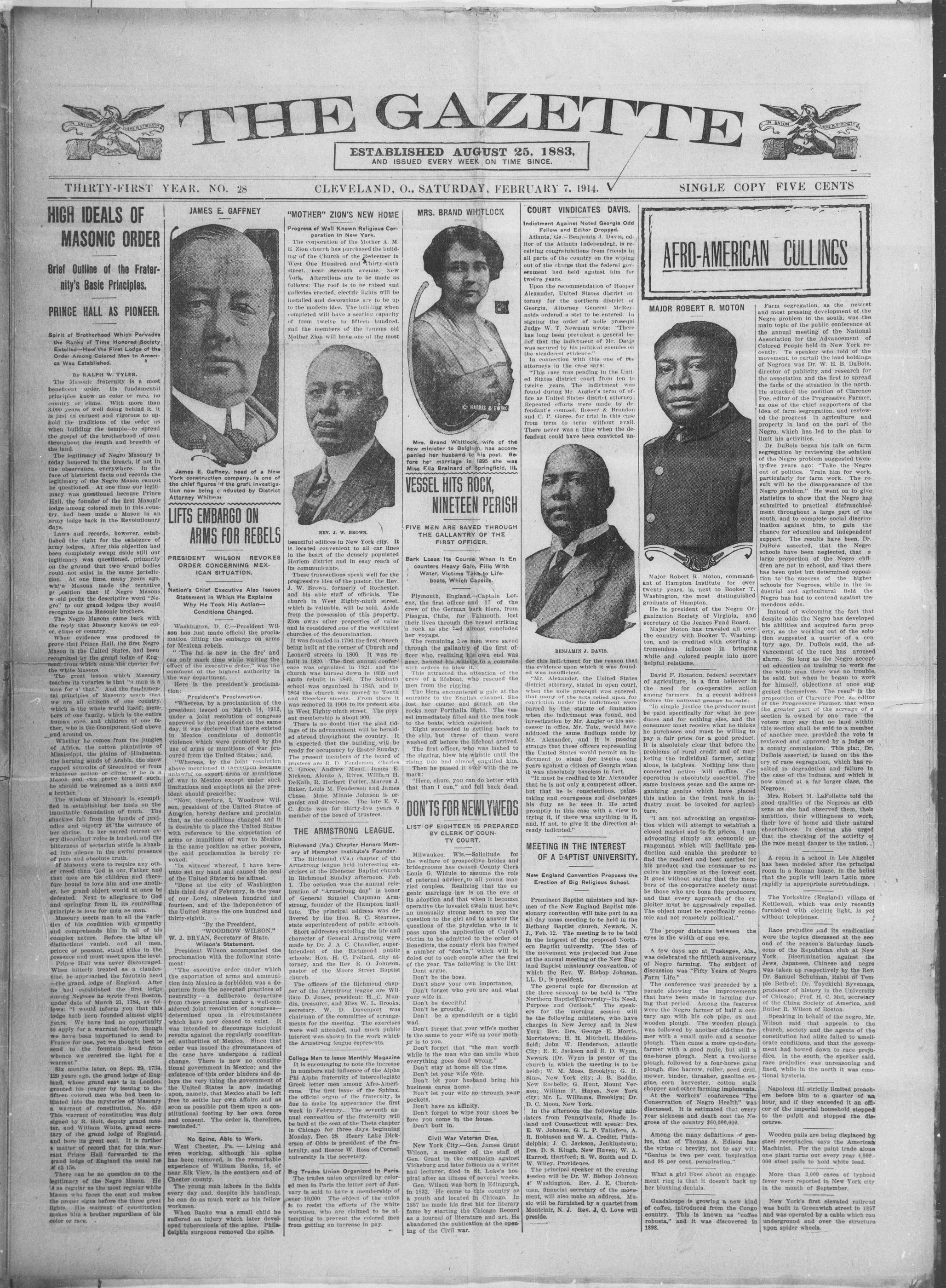
James E. Gaffney, head of a New York construction company, is one of the chief figures in the grant Investigation now being conducted by District Attorney Whitmar.
LIFTS EMBARGO ON ARMS FOR REBELS
PRESIDENT WILSON REVOKES ORDER CONCERNING MEXICAN SITUATION.
Nation's Chief Executive Also Issues Statement in Which He Explains Why He Took His Action—Conditions Changed.
Washington, D. C.—President Wilson has just made official the proclamation lifting the embargo on arms for Mexican rebels.
"The fat is now in the fire" and can only mark time while waiting the effect of the executive order." was the comment of the highest authority in the war department.
Here is the president's proclamation:
President's Proclamation.
"Whereas, by a proclamation of the president issued on March 14, 1912, under a joint resolution of congress approved by the president on the same day, it was declared that there existed in Mexico conditions of domestic violence which were promoted by the use of arms or munitions of war procured from the United States; and,
"Whereas, by the joint resolution above mentioned in the United States, by the conditions of war to Mexico except under such limitations and exceptions as the president should prescribe:
"Now, therefore, I, Woodrow Wilson, president of the United States of America, hereby declare and proclaim that, as the conditions changed and it is desirable to place the United States with reference to the exportation of arms or munitions of war to Mexico in the same position as other powers, the said proclamation is hereby revoked.
"In witness whereof, I have hereunto set my hand and caused the seal of the United States to be affixed.
"Done at the city of Washington this third day of February, in the year of our Lord, nineteen hundred and fourteen, and of the independence of the United States the one hundred and thirty-eighth.
"By the President,
"WOODROW WILSON."
W. J. BRYAN, Secretary of State.
Wilson's Statement.
President Wilson accompanied the proclamation with the following statement:
"The executive order under which the exportation of arms and ammunition into Mexico is forbidden was a departure from the accepted practices of neutrality—a delibrate departure from those practices under a well-considered joint resolution of congress—determined upon in circumstances which have now ceased to exist. It was intended to discourage incipient revolts against the regularly constituted authorities of Mexico. Since that order was issued the circumstances of the case have undergone a radical change. There is now no constitutional government in Mexico; and the existence of this order hinders and delays the very thing the government of the United States is now insisting upon, namely, that Mexico shall be left free to settle her own affairs and as soon as possible put them upon a constitutional footing by her own force and consent. The order is, therefore, rescinded."
No Spine, Able to Work.
West Chester, Pa. — Living and even working, although his spine has been removed, is the remarkable experience of William Banks, 18, of near Elk View, in the southern end of Chester county.
The young man laborers in the fields every day and, despite his handicap, he can do as much work as his fellow workmen.
When Banks was a small child he suffered an injury which later developed tuberculosis of the spine. Philadelphia surgeons removed the spine.
ESTABLISHED AUGUST 25, 1883. AND ISSUED EVERY WEEK ON TIME SINCE.
"MOTHER" ZION'S NEW HOME
Progress of Well Known Religious Corporation in New York. The corporation of the Mother A. M. E Zion church has purchased the building of the Church of the Redeemer in West One Hundred and Thirty-sixth street, near Seventh avenue, New York. Alterations are to be made as follows: The roof is to be raised and galleries erected, electric lights will be installed and decorations are to be up to the modern idea. The building when completed will have a seating capacity of from twelve to fifteen hundred, and the members of the famous old Mother Zion will have one of the most
REV. J. W. BROWN. beautiful edifices in New York city. It is located convenient to all car lines in the heart of the densely populated Harlem district and in easy reach of its communists.
These transactions speak well for the progressive idea of the pastor, the Rev. J. W. Brown, formerly of Rochester, and his able staff of officials. The church in West Eighty-ninth street, which is valuable, will be sold. Aside from the possession of this property, Zion owns other properties of value and is considered one of the wealthiest churches of the denomination.
It was founded in 1796, the first church being built at the corner of Church and Leonard streets in 1800. It was rebuilt in 1820. The first annual conference was organized in 1821, and the church was burned down in 1839 and again rebuilt in 1840. The Sabbath school was organized in 1845, and in 1864 the church was moved to Tenth and Bleecker streets. From there it was removed in 1904 to its present site in West Eighty-ninth street. The present membership is about 900.
There is no doubt that the glad tidings of its advancement will be heralded abroad throughout the country. It is expected that the building will be ready for occupancy by Easter Sunday. The present members of the board of trustees are B. D. Fenderson, Charles C. Groce, Andrew Mead, James E. Nickson, Alonzo A. Rives, William H. DeKalb, R. Herbert Porter, Marcus B. Baker, Louis M. Fenderson and James Chase. Mme. Minnie Johnson is organist and directress. The late E. V. C. Euto was for thirty-five years a member of the board of trustees.
THE ARMSTRONG LEAGUE.
Richmond (Va.) Chapter Honors Memory of Hampton Institute's Founder. The Richmond (Va.) chapter of the Armstrong league held interesting exercises at the Ebenezer Baptist church in Richmond Sunday afternoon. Feb. 1. The occasion was the annual celebration of "Armstrong day" in honor of General Samuel Chapman Armstrong, founder of the Hampton institute. The principal address was delivered by the Hon. R. C. Stearnes, state superintendent of public schools. Short addresses extolling the life and character of General Armstrong were made by Dr. J. A. C. Chandler, superintendent of the Richmond public schools; Hon. H. C. Pollard, city attorney, and the Rev. R. O. Johnson, pastor of the Moore Street Baptist church. The officers of the Richmond chapter of the Armstrong league are William D. Jones, president; H. C. Mundell, treasurer, and Miss W. L. Brooks, secretary. W. D. Davenport was chairman of the committee of arrangements for the meeting. The exercises were well attended, and much public interest was shown in the work which the Armstrong league represents.
College Men to Issue Monthly Magazine
It is encouraging to note the increase in numbers and influence of the Alpha Phi Alpha fraternity of intercollegiate Greek letter men among Afro-Americans. The first issue of the Sphinx, the official organ of the fraternity, is due to make its appearance the first week in February. The seventh annual convention of the fraternity will be held at the seat of the Theta chapter in Chicago for three days beginning Monday. Dec. 28. Henry Lake Dickerson of Ohio is president of the fraternity, and Roscoe W. Ross of Cornell university is the secretary.
Big Trades Union Organized In Paris
The trades union organized by colored men in Paris the latter part of January is said to have a membership of over 10,000. The object of the union is to resist the efforts of the white workmen, who are claimed to be attempting to prevent the colored men from getting an increase in pay.
C HARRIS & EWING
Mrs. Brand Whitlock, wife of the new minister to Belgium, has accompanied her husband to his post. Before her marriage in 1895 she was Miss Ella Brainard of Springfield, ILL.
VESSEL HITS ROCK,
NINETEEN PERISH
FIVE MEN ARE SAVED THROUGH THE GALLANTRY OF THE FIRST OFFICER.
Bark Loses Its Course When It Encounters Heavy Gale, Fills With Water, Victims Take to Life-boats, Which Capsize.
Plymouth, England—Captain Lorenz, the first officer and 17 of the crew of the German bark Hera, from Pisagua, Chile, for Falmouth, lost their lives through the vessel striking a rock as she had almost concluded her voyage.
The remaining five men were saved through the gallantry of the first officer who, realizing his own end was near, handed his whistle to a comrade with orders to blow it.
This attracted the attention of the crew of a lifeboat, who rescued the men from the rigging.
The Hera encountered a gale at the entrance to the English channel. She lost her course and struck on the rocks near Porthalla Bight. The vessel immediately filled and the men took to the boats, which capsized.
Eight succeeded in getting back to the ship, but three of them were washed off before the lifeboat arrived.
The first officer, who was lashed to the rigging, blew his whistle until the rising tide had almost engulfed him.
Then he passed it over with the remark:
"Here, chum, you can do better with that than I can," and fell back dead.
LIST OF EIGHTEEN IS PREPARED BY CLERK OF COUNTY COURT.
Milwaukee, Wis.—Solicitude for the welfare of prospective brides and bridegrooms has caused County Clerk Louis G. Widule to assume the role of paternal adviser to all young married couples. Realizing that the eugenic marriage law is on the eve of its adoption and that when it becomes operative the lovesick swain must have an unusually strong heart to pop the question to the girl and to answer the questions of the physician who is to pass upon the application of Cupid's victim to be admitted to the order of Benedicts, the county clerk has framed a number of "don'ts", which will be doled out to each couple after the first of the year. The following is the list:
Dont argue.
Dont be the boss.
Dont show your own importance.
Dont forget who you are and what your wife is.
Dont be deceitful.
Dont be grouchy.
Dont be a spendthrift or a tight wad.
Dont forget that your wife's mother is the same to your wife as your mother is to you.
Dont forget that "the man worth while is the man who can smile when everything goes dead wrong."
Dont stay at home all the time.
Dont let your wife vote.
Dont let your husband bring his business cares home.
Don't let your wife go through your pockets.
Don't have an affinity.
Don't forget to wipe your shoes before you come in the house.
New York City—Gen. James Grant Wilson, a member of the staff of Gen. Grant in the campaign against Vicksburg and later famous as a writer and lecturer, died in St. Luke's hospital after an illness of several weeks. Gen. Wilson was born in Edingburgh, in 1832. He came to this country as a youth and made in Chicago. In 1867 he made his first bid for literary fame by starting the Chicago Record as a journal of literature and art. He abandoned the publication at the opening of the Civil war.
COURT VINDICATES DAVIS.
Indictment Against Noted Georgia Odd
Fellow and Editor Dropped
Fellow and Editor Dropped
Atlanta, GA.-Benjamin J. Davis, editor of the Atlanta Independent, is receiving congratulations from friends in all parts of the country on the wiping out of the charge that the federal government had held against him for twelve years.
Upon the recommendation of Hooper Alexander, United States district attorney for the northern district of Georgia, Attorney General McLennells ordered a stet to be entered. In signing the order of noelle prosqueli Judge W. T. Newman wrote: "There has long been prevalent a general belief that the indictment of Mr. Davis was secured by his political enemies on the slenderest evidence. In connection with this one of the attorneys in the case says: "This case was pending in the United States district court from ten to twelve years. The indictment was found during Mr. Angier's term of office as United States district attorney. Repeated efforts were made by defendant's counsel, Rosser & Brandon and C. P. Gore, for trial in this case from term to term without avail. There never was a time when the defendant could have been convicted un-
BENJAMIN J. DAVIS.
der this indictment for the reason that
the evidence upon which it was found
ed was insufficient.
"Mr. Alexander, the United States district attorney, stated in open court, when the noelle prosequi was entered, that many of the acts relied upon for conviction under the indictment were barred by the statute of limitation when the indictment was found, and investigation by Mr. Angier or his successor in office, Mr. Tate, would have received the sentence by Mr. Alexander, and it is passing strange that these officers representing the United States would permit an indictment to stand for twelve long years against a citizen of Georgia when it was absolutely baseless in fact. "It must be credited to Mr. Alexander that he is not only a competent officer, but that he is conscientious, painstaking and courageous and discharges his duty as he sees it. He acted promptly in this case with a view to trying it, if there was anything in it, and, if not, to give it the direction already indicated."
MEETING IN THE INTEREST OF A BAPTIST UNIVERSITY.
New England Convention Proposes the Erection of Big Religious School.
Prominent Baptist ministers and laymen of the New England Baptist missionary convention will take part in an all day mass meeting to be held in the Bethany Baptist church, Newark, N. J., Feb. 12. The meeting is to be held in the interest of the proposed Northern Baptist university. The idea of the movement was projected last June at the annual meeting of the New England Baptist missionary convention, of which the Rev. W. Bishop Johnson, LL. D., is president.
The general topic for discussion at the three sessions to be held is "The Northern Baptist University—Its Need, Purpose and Outlook." The speakers for the morning session will be the following ministers, who have charges in New Jersey and in New York: Rev. Drs. George E. Morris, Morristown; H. H. Mitchell, Haddonfield; John W. Henderson, Atlantic City; E. E. Jackson and R. D. Wynn, Newark (Dr. Wynn is pastor of the church in which the meeting is to be held; W. M. Moss, Brooklyn; G. H. Sims, New York city; J. B. Boddie, New Rochelle; G. H. Mount Veron; William P. Hayes, New York city; Mr. L. Williams, Brooklyn; Dr. D. C. Moon, New York.
In the afternoon the following ministers from Pennsylvania, Rhode Island and Connecticut will speak: Drs. E. W. Johnson, G. L. P. Tallafero, A. R. Robinson and W. A. Creditt, Philadelphia; J. C. Jackson, Jenkinstown; Drs. D. S. Klugh, New Haven; W. A. Harrod, Hartford; S. W. Smith and D. W. Wiley, Providence.
The principal speaker at the evening session will be Dr. W. Bishop Johnson Washington. Rev. J. E. Churchman, financial secretary of the movement, will also make an address. Music will be furnished by a quartet from Montclair, N. J. Rev. J. C. Love will preside.
SINGLE COPY FIVE CENTS
AFRO-AMERICAN CULLINGS
[Name]
Major Robert R. Moton, commandant of Hampton Institute for over twenty years, is, next to Booker T. Washington, the most distinguished graduate of Hampton.
He is president of the Negro Organization Society of Virginia, and secretary of the Jeanes Fund Board.
Major Moton has traveled all over the country with Booker T. Washington, and is credited with exerting a tremendous influence in bringing white and colored people into more helpful relations.
David F. Houston, federal secretary of agriculture, is a firm believer in the need for co-operative action among farmers. In a recent address before the national grange he said: "In simple justice the producer must be paid specifically for what he produces and for nothing else, and the consumer must receive what he thinks he purchases and must be willing to pay a fair price for a good product. It is absolutely clear that before the problems of rural credit and of marketing the individual farmer, acting alone, is helpless. Nothing less than concerted action will suffice. Cooperation is absolutely essential. The same business sense and the same organizing genius which have placed this nation in the front rank in industry must be invoked for agriculture.
"I am not advocating an organization which will attempt to establish a closed market and to fix prices. I am advocating simply an economic arrangement which will facilitate production and enable the producer to find the readiest and best market for his product and the consumer to receive his supplies at the lowest cost. It goes without saying that the members of the co-operative society must be those who are bona fide producers, and that every approach of the explorer must be aggressively repelled. The object must be specifically economic and not remotely political."
The proper distance between the eyes is the width of one eye.
A few days ago at Tuskegee, Ala., was celebrated the fifteenth anniversary of Negro farming. The subject of discussion was "Fifty Years of Negro Farm Life."
The conference was preceded by a parade showing the improvements that have been made in farming during that period. Among the features were the Negro farmer of half a century ago with his cob pipe, ox and wooden plough. The wooden plough was followed by another old-time farmer with a small mule and a scooter plough. Then came a more up-to-date farmer with a good mule, but still a one-horse plough. Next a two-horse plough, followed by a four-horse gang plough, disc harrow, roller, seed drill, mower, binder, thrasher, gasoline engine, corn harvester, cotton stalk chopper and other farming implements.
At the workers' conference "The Conservation of Negro Health" was discussed. It is estimated that every year sickness and cost the Negroes of the country $60,000,000.
Among the many definitions of genius, that of Thomas A. Edison has the virtue of brevity, not to say wit: "Genius is two per cent. inspiration and 88 per cent. perspiration."
What a girl likes about an engagement ring is that it doesn't back up her blushing denials.
Guadaloupe is growing a new kind of coffee, introduced from the Congo country. This is known as "coffee robusta," and it was discovered in 1898.
IN UNION THERE WAS STRONGER
PY FIVE CENTS
AN CULLINGS
Farm segregation, as the newest and most pressing development of the Negro problem in the south, was the main topic of the public conference at the annual meeting of the National Association for the Advancement of Colored People held in New York recently. Te speaker who told of the movement, to curtail the land holdings of Negroes was Dr. W. E. B. DuBois, director of publicity and research for the association and the first to spread the facts of the situation in the north. He attacked the position of Clarence Poe, editor of the Progressive Farmer, as one of the chief supporters of the idea of farm segregation, and reviewed the progress in agriculture and property in land on the part of the Negro, which has led to the plan to limit his activities.
Dr. DuBois began his talk on farm segregation by reviewing the solution of the Negro problem suggested twenty-five years ago: "Take the Negro out of politics. Train him for work, particularly for farm work. The result will be the disappearance of the Negro problem." He went on to give statistics to show that the Negro has submitted to practical distranchise throughout a large part of the south, and to complete social discrimination against him, to gain the chance for education and independent support. The results have been, Dr. DuBois asserted, that the Negro schools have been neglected, that a large proportion of the Negro children are not in school, and that there has been quiet but determined opposition to the success of the higher schools for Negroes, while in the in dustrial and agricultural field the Negro has had to contend against tre mendous odds.
Instead of welcoming the fact that despite odds the Negro has developed his abilities and acquired farm property, as the working out of the solution suggested a quarter of a century ago. Dr. DuBois said, the adancement of the race has aroused alarm. So long as the Negro accepted ed education as training to work for the white man there was no trouble he said, but when he began to work for himself, objections at once suggested themselves. The result* is the proposition of Clarence Poe, as editor of the Progressive Farmer, that when the greater part of the acreage of a section is owned by one race the voters may say that no land within this section shall be sold to a member of another race, provided the vote is reviewed and approved by a judge of a county commission. This plan, Dr. DuBois asserted, is based on the theory of race segregation, which has resulted in degradation and failure in the case of the Indians, and which is now aimed at a far larger class, the Negroes.
Mrs. Robert M. LaFollette told the good qualities of the Negroes as citizens as she had observed them, their ambition, their willingness to work their love of home and their natural cheerfulness. In closing she urged that the checking of the activity of the race meant danger to the nation.
A room in a school in Los Angeles has been modeled after the principal room in a Roman house, in the belled that the pupils will learn Latin more rapidly in appropriate surroundings.
The Yorkshire (England) village of Kettlewell, which was only recently furnished with electric light, is yet without telephones.
Race prejudice and its eradication were the topics discussed at the second of the season's Saturday luncheons of the Republican club at New York. Discrimination against the Jews, Japanese, Chinese and negro was taken up respectively by the Rev. Dr. Samuel Schuilman, Rabbi of Temple Beth-el; Dr. Toyckichi Syvenaga, professor of history in the University of Chicago; Prof. H. C. Mel, secretary of the China Society of America, and Butler R. Wilson of Boston.
Speaking in behalf of the negro, Mr. Wilson said that appeals to the church, society and the agents of the constitution had alike failed to ameliorate conditions, and that the government had bowed down to race prejudice. In the south, the speaker said, race prejudice was unreasoning and fixed, while in the north it was emotional hysteria.
Napoleon III. strictly limited preachers before him to a quarter of an hour, and if they exceeded it an officer of the imperial household stepped to the pulpit and stopped the discourse.
Wooden pails are being displaced by steel receptacles, says the American Machinist. For the paint trade alone one plant turns out every year 4,000-000 steel pails to hold white lead.
More than 3,000 cases of typhoid fever were reported in New York city in the month of September.
New York's first elevated railroad was built in Greenwich street in 1857 and was operated by a cable which ran underground and over the structure upon spider wheels.
SUBSCRIPTION RATES
(In Advance)
One Year.....$1.50.
Six Months.....1.00
Three Months......50
Subscribers are requested to re-
mit by postoffice money or
order or registered letter
Entered at the postoffice in Cleveland
Ohio, as second-class matter.
Address all communications to
Blackstone Building, Cleveland, O.
Member Ohio Legislature: 1894
to 1896; 1896 to 1898; 1900 to 1902
THE GAZETTE is the oldest, and has the largest bona fide circulation, double that of any newspaper. In the interest of American publication, the state of Ohio, and comparison with any will immediately establish its rank as one of the NEWSIEST AND BEST in the country.
SATURDAY, FEBRUARY 7, 1914.
An exchange asks: "Will the Progressive party survive?" Recall all the other "reform" party movements of the last fifty years and answer the question?
Tom Dixon's miserable play, "The Leopard's Spots," a vicious attack on the race, was barred out of Nashville, Tenn., last week. Good! Other Southern and Northern cities have done the same thing, be it said to their everlasting credit.
Ex-President W. H, Taft in an address delivered recently, in N. Y., before the New York Peace Soiety, urged the enactment by Congress of a law which would give the Federal Courts jurisdiction to prevent and punish crimes of mob violence against aliens in the United States Strange, that he persists in overlooking or ignoring the lynching of nearly one hundred American citizens, on an average, every year!
Safety Director Beneesch of this city in a recent letter to President Daniel W. Lothman of the Harvard club of Cleveland, rejected an invitation to attend the club's dinner, to be held at the University club Feb. 14. "I will not enter the doors of a club which practices race discrimination, and which, because I am a Jew, would be me from membership," said Beneesch
And he is right, too. We trust he will stamp out of the city department he presides over, as far as he is able to do so, all discrimination on account of race or color. Safer Benesch impresses us as being "the right sort"; also Editor William P. Reynold of the Jewish Daily World whose splendid letters are published elsewhere in these columns. More power, to their manly kind in all races.
HOMES FOR BOYS AND GIRLS.
some one find the shadow of a good excuse for the existence of that "jim-crow" Mt. Pleasant children's home?
MORE SEGREGATION?
A rumor has reached The Gazette that, at its meeting Tuesday morning in Cory M. E. church this city, the Ministers' Alliance appointed a committee, consisting of Revs. Chas. Bundy, E. A. White, H. C. Bailey and E. H. Smith, to confer with the Central Y. M. C. A. officials with a view to learning what can be done for our people along Y. M. C. A. lines. It seems that some one or more of our ministers have been approached by a person or persons who have assured them that some where in this community there is a considerable sum ready to be placed in a "jim-crow" Y. M. C. A. This is not new. We have not years for the existence of such a desire upon the part of prejudiced white persons who are not only anxious to get rid of the few remaining Afro-American members of the Central Y. M. C. A, but, also, to establish this new segregation movement in the city of Cleveland. The hope of getting this fund has ever and anon been so alluring to certain members of the race that they have been unable to stand the pressure. This accounts for the periodic and spasmodic "jim-crow" Y. M. C. A. efforts among our people in this community in recent years and doubtless explains the selection of the committee by the Ministers' Alliance, Tuesday morning. We are told that one of our leading ministers remarked at this meeting that he did not care "what the old residents, among the matter." We hope that this is not so, and that the committee, if appointed, has not been selected for any such purpose. Any of our people in this city who have developed an over-wearing desire for such a "jim-crow" initiation or segregation movement, should not forget the sad experience of our people in Dayton, Columbus, and more recently in Chicago, as well as other northern cities, where separate schools for Colored children either followed, immediately the establishment of a jim-crow Y. M. C. A. There is nothing so harmful as such a precedent in any community, because of its great encouragement of segregation and color-lines of all kinds in public and quasi-public places and institutions. What is needed in the section of the city, most thickly populated by our people, is a social settlement house, open to all races or classes residing there—something that will reach the class of our people mistaken in individuals believe a "jim crow" Y. M. C. A. there would affect directly. As a matter of fact, none of that class would be eligible for membership in a Y. M. C. A., but could be reached through the medium of a social settlement house open to all without reference to class or color. This has been promised at an early date for that section of the city, and committees, representing both races, are at work on the matter, backed financially and other wise by one of the most substantial white organizations in the city of Cleveland. We trust that we have been misinformed, not only as to the instructions of the committee referred to above, but also as to its selection or appointment. God forbid that local Negro ministers should ever so far forget the vital interests of our people of this community as to become the agents of "prejudiced white people to saddle upon us more segregation and more "jim-crowism."
AS TO THAT MISERABLE PLAY.
Hon. Harry C. Smith, Editor Cleveland
Gazette, CITY.
Dear Sir—I read with the greatest interest your editorials in The Gazette of Jan. 17 and 24, 1914, and I can assure you that I am fully in accord with your opinions. The one thing that pleases me most to note is that the Jewish teacher who represents the real Jewish ideals and views, I much doubt, in fact, whether the leaders of that club know anything of the Jewish teachings; for had they kown the teaching of Rabbi Hillel and the views of the ancient as well as the modern Jew, they would have been more interested just as they would think of playing "The Sheeny" (if there were such a play).
I herewish take the pleasure to enclose a translation of my remarks in today's issue of "The Jewish World." You are at liberty to reprint my remarks and also this letter. Yours very truly. WILLIAM REYNOLD.
Translation of an editorial note in the Cleveland (Daily) Jewish World, Jan. 30, 1914:
"What is hateful to thee, do not do unto thy fellow man"—Talmud
The Cleveland Gazette, the organ of the Afro-American citizens, strongly complains about the conduct of the Carnation club, an organization of Jewish young men, for presenting the play "The Nigger."
The editor of The Gazette, Hon. Harry C. Smith, a man with broad views, declares that he had never felt so pleased as when we raised the fight against Shakespeare's "Merchant Velvet." He criticizes the Jew in insisting light, "Then," asks Editor Smith, "why should not the Jews be at least as tolerant as not to affect the feelings of another suffering race?"
"The Nigger," according to Editor Smith's statement, is a shameful and offensive play in the eyes of the Afro-American citizens. It contains throughout the word "nigger" which has the same meaning as "sheeny" for the Jew, and it also contains remarks about lynchings and such other things that offend the feelings of that suffering race.
Occurrence should really be regretted, and especially, because the Carnation club had ignored the protest and had presented that race-insulting play after all, forgetting the noble Jewish teaching which is called in American, "The Golden Rule"—"What is hateful to thee, do not do unto thy fellow man."
Cleveland, Ohio, Feb. 1, 1914.
Editor, Jewish World:
Dear Sir—Permit me to thank you for your excellent editorial, and to ask the publication of the following as the last chapter of the discussion anent the presentation by the Carnation club of the insulting play, "The Nigger." First, Afro-Americans object not only to the title, but also to many of its lines and scenes, and
consequently the very harmful impress upon all who witness its rendition. The benefit, if any, derived from the presentation of the play is more than offset by the insulting and harmful title, passages and scenes of the play. While I endorse heartily the objections to "The Merchant of Venice" raised some months ago by the editor of the Jewish World, and have only words of praise for him as a result of the same, I wish to call attention to the fact that neither in its title nor in the body of the play are there such miserable, mongrel references to the Jewish race as are found in the play, "The Nigger," having reference to my people. A Mr. Korach is wrong in his comparison of the two plays, from a racial prejudice viewpoint. He also errs in at least one other conclusion: The production of either play does not "eliminate race prejudice," but, as a matter of fact, has an opposite effect. Whether the authors of these two plays had any "prejudice or race feeling when they were written," is not pertinent.
In conclusion permit me to indulge the hope that neither the Carnation club nor any other Jewish organization will ever repeat the mistake it made in the presentation of that miserable play, "The Nigger."
was put off a train at Vinita, OK, arrested and fined by a justice of the peace.
On New Year's Eve, 1910, Mr. Thompson started from Kansas City to McAlester, OK, buying a berth in a sleeper. Oklahoma has a "jim-crow-car law. When the train reached the Oklahoma line he was ordered to move into the "jim-crow" coach. He refused and a deputy sheriff was called. He was fined $13. Good Lord!
In his suit in the District Court in Kansas City, Mr. Thompson sought to recover the fine, $3.81 fare from Vinita to McAlester, and $50,000 damages. The jury at the trial of the case brought in a verdict for the defendants.
It was contended that the Oklahoma law could not apply to interstate passengers. The Court of Appeals held that railroads have a right to separate the races, as long as the same accommodations are provided for. This decision the U.S. Supreme Court will surely wipe out when the case reaches it. No other decision could well be expected from either court or jury in prejudiced Missouri.
DOING OF THE RACE.
Charles A. Cottrell of Toledo, U.S. Collector of Customs at Honolulu, and Municipal Judge Robert H. Terrell of
BUCKET
WRITTEN BY BLEE G
THROUGH
What Our Week—Chow Lodge, sica
CADIZ—Mmer resident visit—Last S Day here. were 175 at S. S., and 15—The Y. Brown's the city, Thurs. P. Lucas'. A le services must men on MONDAY—Week—Education
OBERLING sport must week
GREETINGS FROM SOME FRIENDS.
"Hello! Mr. Lang, I see that you are writing for Mr. Smith's paper now," phoned a friend.
No, I am not writing for Mr. Smith's paper, I am writing for you. That is one of the troubles with our people. They are so afraid that they will do too much for the other fellow, especially if the latter happens to be a member of the race. Mr. Smith did not ask me to publish my letter in his paper, but I think people could see it and also some of the better class of white people. If we were trying to raise 2 or $3,000 for the Old Folks' Home you would never see it in a white paper, but just let some white man in the South burn or lynch his own son or grand son of color and you will find it herald
GEO. L. LANG.
ed in the white papers with great, large, black head-lines. Shame on them! If you want to know what our people are doing, you must read our papers, especially The Gazette, and every Negro that has any race pride, should do all that he or she can to promote their interests. This is no time "to sleep on our rights." If schooling will not put you where you should be experience and age ILL. Parents are working hard to keep their children in school and to send them to college. Too many of these young men are found in pool-rooms, while many of the girls walk the streets, at unseemly hours—after school. Oftimes they are not as appreciative nor as kind to their parents as they should be. Some of them seem to forget that they, too, will grow old, and their good looks fade, some day. Then there are others who refuse to work because they cannot get just what they need the most mistake and unfair to their parents. Much more could be said along these lines but the foregoing is quite enough to answer the purpose. GEORGE L. LANG.
MRS. LETHIA FLEMING APOLO GIZED.
The following communication, which is self-explanatory, was read, Monday evening, at a meeting of the Old Folks' Home association at Mrs. D. Quinn's, E. 36th St. The Old Folks' Home Association, City: Linden and Gentlemen—It has come to my knowledge that Dr. J. K. Nickens was charged at a recent meeting of the association with having given The Gazette information relative to the proceeds of the "Talbert" Benefit concert at Cory M. E. church. Some one has made a mistake and in so doing has done the doctor an injustice which I am sure entitled him to an apology. He did not give us the information. As everyone knows, it is policy of any reputable paper to divulge the source of its authentic information. The rule is, to publish the names only of informants who bring or send information or statements that are questionable or untrue. I understand that there was considerable discussion at the same meeting of the Gazette without any reputable same concert. Permit me to say that The Gazette, without any return whatever, gave notice of the concert prior to the date of the same. Our notice, which followed the same, was more free publication and such as we deemed proper. As we were paying for the same, this of course was our right and privilege. If others desired different notice it was a very easy matter for them to secure the same Gazette to the highest feeling in all of the participants in the concert and all concerned in it.
WILL WIN IN U. S. SUPREME
COURT.
That "Oklahoma" Case of William J
Thompkins, who was shot by Mo—
Freeduced Missouri.
St. Louis, Mo.—The right of railroads to require Afro-Americans and whites to ride in separate coaches was unheld by the U. S. Circuit Court of Appeals, last week, in its decision in the case of William J. Thompson of Kansas City, Mo. against the Missouri, Kansas and Texas Railroad and the Pullman Company. Mr. Thompson sued to recover $40,012.81 because he
was put off a train at Vinita, Ok., arrested and fined by a justice of the peace.
On New Year's Eve, 1910, Mr. Thompkins started from Kansas City to McAlester, Ok., buying a berth in a sleeper. Oklahoma has a "jim-crow" law that trains train workers in Oklahoma line he ordered to move into the "jim-crow" coach. He refused and a deputy sheriff was called. He was fined $13. Good Lord!
In his suit in the District Court in Kansas City, Mr. Thompkins sought to recover the fine, $3.81 fare from Vinita to McAlester, and $50,000 damages. The jury at the trial of the case bought in a verdict for the defendant.
It was contended that the Oklahoma law could not apply to interstate passengers. The Court of Appeals held that railroads have a right to separate the races, as long as the same accommodations are provided for each. This decision the U.S. Supreme Court ruled that railroads reach it. No other decision could well be expected from either court or jury in prejudiced Missouri.
DOINGS OF THE RACE.
Charles A. Cottrell of Toledo, U. S. Collector of Customs at Honolulu, and Municipal Judge Robert H. Terrell of Washington, D. C., are soon to be dismissed, by the democratic Wilson administration. Within 60 days after opening up for business in Paducah, Ky., the Standard Life Insurance company, of Atlanta, Ga., had over 600 policies in force. Looks like Georges Carpentier is biting off more than he can chew when he takes on a classy heavy-weight as Joeanneette, with 85 pounds weight advantage, and, as the latter is a clever, heady boxer and a hard hitter, the idol of Europe is going to have trouble. No doubt if Editor Harry C. Smith is always on the right side for the best for his people. He thinks he sees a possibility to get Joseph Benson Foraker back in the senate-hope so, for his kind, these days, are few and far between. If Ohio would redeem herself and send to Congress, Judge John A. Mansfield with Foraker, and others, tried and true, and our old man great, William E. Chandler of New Hampshire, and many others to keep company with the lonely Clapp, who is treading the wine press alone, wouldn't the judge use alone, would the judge Wonderful things happen at times-Martinsburg (W. Va.) Pioneer Press.
That the Jewish people are up and doing all the time when it comes to protecting their rights is a well known fact. Recently a moving picture concern showed a film deploring humorously a Jewish wedding, to which they took exception, and were upheld by the chief of police, who ordered the picture suppressed. Similar action should be taken by our people, not only as to moving scenes, but also the daily puppe and journals. Such things tend to create prejudice—Chicago Defender.
Is it not time, too, for The Crisis to realize the harm of helping on every separate "im-crow" Y. M. C. A. and Settlement house in the North, and for the National Association for the Advancement of Colored People, to realize the harm now of manning a harmed house with support of separation in philanthropy in the North, and to perceive that their fight against legal and Federal segregation is weakened very materially by compromise upon non-legal segregation in the North and failure to contend radically for the mixing of the races in all institutions for public benefit. Boston, MA. D. C. wants an Afro-American to come there and open a grocery store, a shoe-repairing shop, &c. Cleveland wants one to open a meat-market in Central Ave.
A PERTINENT QUESTION.
Editor Gazette. Dear Siri:—Might I ask, through your columns, why we throw away our time criticising Roman Catholic and Christian Scientist beliefs. They already have three fourths of the Christianized world as theirs. What the rest of them use world needs to do to have meth world needs to do to they can increase and hold their own members. To ac knowledge that one's flock is going elsewhere for worship, don't speak well for the church with which it is connected. I fear spiritual training is weak, too material, or we expect to sing people to Jesus Christ, instead of preaching the word of Christ Jesus. It last longer. Talmadge and Torrey's sermons are printed and sent over the world as good Christian guldes; likewise Mrs. Baker Eddy's, Mrs. Baker Eddy's, Mrs. Baker Eddy has always preached Christ as our atenuation and Saviour, and uses the present day Bible, and no ordinary Christian woman can convince anybody, she'd use any other kind. I believe Robert Ingersoll did follow the teaching of some questionable bible, but not Mrs. Eddy. It's very easy for those who are charitable-minded to find this out. However, Catholicism and Christian Scientists are growing more popular every day. B C
Good Lord!,"Rejoicing"!
Good Lord! "Rejoicing": Louisville, Ky. — Beginning with Monday, February 22, the national Theatre will open our door and second welcome to our people instead of the Rev. Parrish, who was the great mover in bringing this about, who do not believe in encouraging theatre going, but since they exist, were against the extreme Jim Crow principle shown. So we are all rejoicing.
Appointed City Paymaster
Cincinnati, O.—W. P. Dabney, editor of the Cincinnati Natl. and active Republican worker, has been reappointed assistant city paymaster. This is the third time he has held the position. Congratulations, conferee.
CORRESPONDENTS must mail all letters for publication at their main postoffice sufficiently early on Monday (or Sunday) of each week to have them reach The Gazette office on Tuesday morning, and always write also, their names and that of their city or town on the outside of the wrapper about returned copies. Unless this latter is done, proper credit cannot be given you. Lists of names, wedding presents, state diplomas, tices, speeches, resolutions, poetry, inquiries for relatives and advertisements of all kinds, including items announcing entertainments to be held in the near future, must be paid for in advance at the rate of ten cents a line, six words to a line. Our rates for display advertisements will be sent on application. Send postal note and not stamps during warm weather.
WRITTEN BY "THE OLD RELIA
BLE" GAZETTE'S CORRE-
SPONDENTS.
THROUGHOUT OHIO
What Our People Are Doing Each Week — Church, Personal, Social, Lodge, Literary and Musical — Marriages, Deaths, Etc.
CADIZ — Mr. Calvin Strother, a former resident, is here for a week's visit. — Last Sunday was "Go-to-Church-Day" here. At the A. M. E., there were 175 at morning service; 142 at S. S., and 196 at the evening service. — The Y. M. L. club met at Mrs. Ola Brown's, the 30th, and the M. M. society. Thursday afternoon, at Mrs. J. P. Lucas'. After business, evangelistic services were held. (Correspondent must mall the newsletter earlier on MONDAYS, and not later in the week.) Editor.
OBERLIN — Mrs. John Pattiford spent time in Cleveland, last week. — Rust M. E. church revival was a success. It will start at the Baptist church, Tuesday evening — Mr. James Huston of Cleveland, visited his parents, here, Sunday. — Mr. and Mrs. Ferguson went to Cleveland Saturday, with Mrs. Richardson to be baptized with his children, Sunday. — Miss Emma Jones is ill — Mrs. Gayters, Mrs. Evan's were given spread for their Evan's to be spread for Mrs. Evan's Saturday evening. — Jackson was here, last week. — Ella Smith has been ill.
SMITHFIELD.—The A. M. E. church revival is meeting with success. Rev. D. D. Lewis is ably assisting the pastor.—A large wheelright shop on E st. opposite W. H. Veney's barn and next to Mr. M. Washington's house, was burned recently. Both the buildings and therick's house. The lattar was owner of the shop. None of the buildings was insured that were burned—Mrs. E. G. Beall is sick—Mr. and Mrs. Homer Harris were in Hopedale from Friday till Monday—Mr. and Mrs. Finley T. Davis and little son, of Pittsburg, spent Monday with her parents.—Miss Etheela Smith of Melntyre, who is leading high school, is boarding with Mrs. A. Palmer. Mr. Gant is there also.
SANDUSKY.—The revival at the A. M. E. church closed with good success. The Baptist church was well attended, Sunday, and one joined. Quite a number of strangers are in town. All sick are improving except Mr. H. Bartlett, who is quite feeble. Adolescens' supper at the Second Baptist Church was held. Mr. and Mrs. W. M. Alexander entertained at a delicious dinner. Sunday: Mrs. M. Geharden of Indianapolis, Mrs. A. Crouch of Cincinnati, and Mrs. J. R. Davis and Rev. and Mrs. G. D. Smith. The B. Y. P. U was wellended. The M. B. U. was handed. Mrs. H. Landon Thompson, and Mrs. Geharden a singe fine, "Abide With Me." Her name has been changed, but she is our "Rosey", still.—The church collection, Sunday, was $75.—The revival will start Feb. 10.
SPRINGFIELD—Miss Martha, Wilson of Cleveland, is visiting her cousin, Miss Maggie Wise. Miss Clara Harris of Columbus, is the guest of Miss Queenie Pettiford. Miss Leah and Rhus Brisco are visiting in Dayton. Mr. and Mrs. Winn, Miss Maggie Wise, are visiting in deinite town. Lois Deppe went to Louisville, Ky., to take part in State Conservatory of Music recital. The Third Baptist church closed its revival, Sunday, with 56 conversions. Mrs. Henry Linden was in Dayton, Sunday. Mrs. Cora Brown and children of Nashville, Tenn., are visiting relatives here. Miss Bessie Scott of Detroit, and Miss Mattie Brown are visiting here. Miss Robt. H. Elam and sons, Robert and Russell, of Troy, spent Sunday with her mother, Mrs. Bell, near St. Paris. Mrs. T. A. Green, spent Sunday in Columbus with her husband, who is holding a revival there. Mrs. C. C. Reed of Detroit, is visiting Matthew and children, and Miss Ruth Cowell of Lexington, Ky., are visiting their sister, Mrs. C. A. Brown.—Misses Margaret Simpson and Della Patterson of Columbus, visited recently, recently. Mrs. C. L. Smith entertained recently at a six o'clock dinner for Dr. and Mrs. A. A. Patton of Chicago. Covers were laid for ten. James Goins and Earl Scott of Fort Wayne, Ind., were here at Thursday, ind., were here at Friday, Honey and Wilbur Baker of Dayton, were here, Sunday and Monday.—Mrs. Howard Clark and Mrs. Geo. Harper of Lima, spent Tuesday here.
YOUNGSTOWN—Mrs. Clara, V. Henry visited her daughter in Detroit, and Mrs. L. Woods spent a week here with her mother—Mr. P. Henderson of Franklin, Pa., visited his sister Mrs. Jessie Coleman—Mrs. L. Minister was in McDonald, Pa., recently—Mrs. Mary Thomas visited her son, Daniel, in Pittsburg. He is attending school—the K. P. public installation was attended by Roy of Clewley, the staff. They impersonated U. R. Mrs. Thos. Lonesome and Mrs. Beverley Jackson visited in Akron. Mrs. Howard Thompson, who fell and broke an arm, was taken to the hospital—Mrs. C. Fairax, age 83, died at her daughter, Mrs. Geo. Emerson's, the 23d uilt, and left two daughters and six grandchildren. Funeral from the Third Baptist church, the 28th. The Odessa orchestra's social at Mrs. J. H. Parker's, Monday evening, was a success—The Dunbar Literary society is doing excellent work—Mrs. H. Irvin and Mrs. Sandy Duff entertained royally recently in honor of Mrs. J. H. Parker's, Sluice Pittsburgh was called here by her mother's death—Quite a number from here attended the Charity ball in Cleveland, last week—Mrs. Asby Johnson is home from the hospital—Mrs. Nellie Brooks was called to Akron by her mother's illness. (Correspondent should mail news on Monday, not later in the week. Then it will not be over a week old when published, as has been the case for several weeks, Editor.)
WANTED!
Agents—$24 in goods and free sample case, if answered at once. Largest Mail Order House in the East wants local agents at once for their 100 big sellers. Full line household necessities and toilet articles. Finest soaps, perfumes, etc., manufactured in the United States. Our line; $35 to $50 weekly profit easy Marvin Co., Inc., (Dept. A) 9 W 20th St, New York City.
Heating Bar.
THE MAGIC IS 9 IN LONG
THE MAGIC SHAMPOO DRIER
AND HAIR STRAIGHTENER
SHAMPOO DRIER MED CO
MAILLED ANY WHERE IN U.S. $100
POSTAL MEMBER
Agents Wanted.
Write for Literature.
Magic Shampoo Drier Co.
Minneapolis, Minn.
LOOK AND LIVE
Taylor's New Shampoo Dryer
and Hair Straightener!
The Best in the World!
This Comb, properly beated, and the use of LaCreole Hair Pomade, will bring the most crimp hair straight and silky at every stroke and cause a rapid growth of the hair.
Don't put it off but send it $1.00 today and get the comb and groomer.
PRIOR OF OUMB $1.
Large, Heavy, Strong and Durable. Made of copper and brass associated together and cast into one solid piece, highly polished and fully nickel plated, steel bolt which goes through the large wood handle and screws into metal end of comb to prevent the handle from getting dorsal or coming off. Remember, it is all in one piece. Nothing to get out of order, will last a lifetime.
Price of Hair Straightener and Alcohol Heater complete $1.50.
TAYLOR'S SPECIAL ALCOHOL HEATER is the handiest and most convenient method of heating the Comb, and can be closed up so that you can put it in your hand-bag. Price $0.60.
For best results use LaCreole Hair Pomade. It not only meets every requirements of the Comb Straightener, but promotes a luxurious growth of the hair. Price $25.
FUND FOR MY FREE CATALOG! Illustrates the complete Line of Hair Coats in this country for colored people, such as Bangs, Wigs, Puffs, Switches, Pom-pads, Hair Pins, Combs, Brushes, etc.
T. W. TAYLOR, Howell, Mich.
When writing please mention this paper.
Pure Beer Bottled at the Brewery
Order a Case of
Gold Bond
Bottled Beer
THE CLEVELAND & SANDUSKY
BREWING COMPANY
Delivered at the Home. Both Phones.
CORRESPONDENTS WANTED.
The old reliable Gazette desires an active agent and correspondent in every city and town in Ohio and neighboring states having a number of Arbo-American residents. Only one on Fridays or Saturdays is required.
We are especially destroys of hearing from persons in the following named cities: Zanesville, Newark, Lancaster, Lebanon, Chillicothe. Toledo, Troy, Canton, Springfield, Plqua, Columbus, Cambridge, Steubenville, Bellaule, St. Clairsville, Portsmouth, Washingtoe, G.H. Oxford, Salina, Galway, Rendville, Urbana, Delaware, Mt. Vernon, East Liverpool, Wellsville, Akron, Dayton, Middletown, Bellefontaine, Lima, O., and other places where we have none.
Write to the editor of The Gazette, Blackstone building, Cleveland, O, and terms will be sent promptly. Our readers will oblige us greatly by writing to us. Of persons in the cities named above, or others, to whom we can write relative to the
MASTERPIECES OF NEGRO ELOQUENCE
Edited by Mrs. Alice M. Dunbar.
Contains fifty speeches representing the best that the Negro has done in Oratory.
The speeches date from 1818 to 1913.
They are here just as they were delivered by fifty of the most learned Negro men and women of the world. They are gathered in such form as to instruct the old and be an inspiration to the young.
Now where else are these speeches obtainable in compact form of historical ability of the Negro?
A book that is least once a reference book, a library, a historical work, full of inspiration and instruction, unqualifiedly induced by Dr. Booker T. Washington and others.
Heating Box
TR MAGIC IS 9 IN LONG
SHIPPOO DRIER MUF CO
LOOK A
Dr. J.
Remed
DR. NICKENS cures Kid Diseases the bloo
DR. NICKENS FEMALE TON
remedy for mental Depress
ness. Price 50 Cents.
DR. NICKENS KING OF PAIR
Price 50 Cents.
DR. NICKENS CATARRH CU
cers, Cuts. Price 50 Cents
of our leading scholars and men of affairs
The work is a liberal education a treasure
of invaluable information across life
in no other form. Each address,
the Masterpiece, contains Elegance, in
the Masterpiece, 212 pages, with uncut edges
and gold top, red and green silk cloth
binding, press work and binding and print-
ing of the very finest, is a book that will
adorn any library: 2,500 copies ordered
before the book was printed; 100,000 copies
will be sold; 100,000 copies will be sold
and it will be the best selling
Negro book ever published.
Price, per copy, $2.50 net, Agents
EVERYWHERE WANTED TO SELL
THIS GREAT BOOK. With this book
agree a good price. With $8.00 to
$10.00, with the liberal commissions
we allow our agents. WRITE US NOW
FOR OUR TERMS!!!
THE DOUGLASS PUBLISHING CO.
509 N. Fourth Street
Washington, D.C. 10036
PRINTED BY
PRINTWORK, PR
The Agricultural & Mechanical College for the Colored Race
Maintained by the Governments of North Carolina and of the United States. Open all the Year Round. For Males Only. Fall Term Begins September 1st, 1913. Strong Faculty. Excellent Facilities. Successful Graduates. Board, Lodging and Tuition $7.00 per month. For catalogue write, today, to James B. Dudley, President A. & M. College, Greensboro, N. C.
Fine Millinery!
Blocking and
Remodeling
Feathers Dyed
and Curled
Anna Walker
3882 Central Avenue
Mrs. A. M. Pope—Turnbo
Results of "Poro" Treatment
"PORO COLLEGE"
Largest College of its kind in the world.
SUM PINE STREET, ST. LOUIS, MO.
PORO GUARANTEE
Every box of "Poro" is fully guaranteed without warranty.
Can or cannot be used with the equipment of this box.
PORO GUARANTEE is not used with the equipment of this box.
If may be used with the equipment of this box, it will agree
not to be used with the equipment of this box.
GENERATED UNDER TITLE OF PORO GUARANTEE
PORO STREET, ST. LOUIS, MO.
4720
PORO GUARANTEE NO. 4720
For treatment, call on or address:
MISS KATIE B. COLLIER,
4812 Payne Ave.
Cleveland, Ohio.
A delightfully Perfumed Hair-Pomade for making hair, stubborn, curly hair soft, pliant and glossy. It is the perfect hair for all hairs the hair but a wonderful hair-grower. It works directly on the scalp and roots of the hair, relieving dandruff and other diseases of the scalp-skin, thereby causing it to grow rich, long and luxurious. B. & M. HAIR DRESSING is becoming more popular every day, and is sold stricly on a guarantee.
Brown and Seyfert, Prop's.
2742. Central Ave.
Selling Agents.
The New
Keystone
.RESTAURANT.
2408 Central Ave.
The Best Meals
Quick Service.
Cigars & Tobacco.
Open Day
and Night.
Chas. McPherson, Prop'r.
Theodore B. Green,
ATTORNEY AT LAW.
508-510 Superior Building.
Office, Main 3076.
Residence, Eddy 2086-R.
CLEVELAND, O.
G. G. REED'S
Ladies' and Gent's
Furnishings
A Complete Line of
LADIES' READY-MADE APPAREL.
Double Stamps on Tuesday.
Cuv. Central 6661-L.
DRY GOODS, LADIES' AND GENTS'
FURNISHINGS
Double Stamps on Tuesdays and Fridays.
Good Bargains
In Realestate!
LARGE MORTGAGE LOANS!
RENTALS--COLLECTIONS.
CLAIMS ADJUSTED.
S. E. WOODS,
2828 Central Ave.
'Phone, North 996.
$2,000 in $15 Payments.
New Orleans, La.—After more than fifty years' service in one family, Mrs. Mary Ann Pearson, a member of the race, has been remembered by Fergus D. Lee, a son of her first employer. In his will, Lee leaves $2,000 to be paid Mrs. Pearson in monthly installments of $16. He also provides that she be buried in the same grave with him. Mrs. Pearson is about ninety years of age.
Where to Purchase The Gazette
NOTICE TO SUBSCRIBERS
Subscribers not receiving The us at once. We desire every copy. We advise our patrons to care tisations before making purchase this paper should have the patron that they advertise is assurance Local reading notices (adve words in a line).
Social an
Subscribers not receiving The Gazette regularly should notify us at once. We desire every copy delivered promptly.
We advise our patrons to carefully/examine The Gazette's advertisements before making purchases. Business men who advertise in this paper should have the patronage of Afro-Americans. The fact that they advertise is assurance that they want it.
Local reading notices (advertisements) ten cents a line (six words in a line).
Social and Personal
Classified Ad Department
FOR RENT—Nicely furnished rooms; 10512 Arthur Ave. Call after 5 p. m.
FOR RENT—Neat room, steam-heat, bath Apply, suite No. 4, Winona Apts, E 40th and Central Ave. Reference.
FOR RENT—Houses and Rooms—If you have them to rent or if you want to advertise in The Gazette it brings results.
FOR SALE—A new $15 Acme adjustable dress-form; size 32 to 46 inches, for $10, including crate. Phone, Doan, 3524 R.
NOTARY PUBLIC—For such services call at The Gazette office. No. 3 Blackstone building, No. 1424 W. Third Street, near Superior Ave.
FOR SALE—Fine lot on E. 126th St. Mt. Pleasant; size 40x144 ft., on the west side of street. A bargain, if sold by April 1st. Doan 1761 J. Apr.1
FOR SALE.—Houses or lots. If you have either or anything else to sell, or if you wish to purchase, advertise in The Gazette. If anything can bring you results, it can and will.
Cleveland
Sixth City
Mrs. Bell, of Central Ave., is very ill with pneumonia.
Miss Martha Wilson is visiting relatives in Springfield.
Mrs. Ola Wheatley of Newark, was in the city, the first of the week.
St. John's A. M. E. church added 106 to its roll, Sunday, as a result of its revival so far.
Mrs. John Pettiford of Oberlin, was the guest of Mrs. Mary Carter of E. 31st St., last week.
Mrs. Ada Graham of Cedar Ave., has returned from Franklin, O., where she visited relatives.
Little Benjamin, the youngest son of Mr. and Mrs. W. H. Smith, is convalescent. Pneumonia.
It is said that the attendants upon the Charity ball were charged $5 each for taxicab service, last Monday evening.
Mrs. Lella B. Cosby has returned from Nashville, where she attended her brother, Mr. Ernest Spindle's funeral.
Mrs. Frank Thomas, 3111 Cedar Ave., was called to Cincinnati by her mother's death. The latter was 85 years old.
Dunbar Co. K, K. of P., will publicly install its officers, next Friday evening at Teutonia Hall, Scovill Ave., and E. 31st St.
Miss Helen Ogden has sold her theater in Central Ave., to a member of the Jewish race, who has renamed the place the Pekin theater.
Queen Elizabeth Chapter, No. 9, O. E. S., will hold its monthly meeting, this Friday evening, at Clayton Hall. Mrs. Lucy Douglass, W. M.
Misses Willie and Eva Davison, Ethel Robinson of Elyria, were guests of Mrs. Humphrey of E. 63d St., last week, Monday and Tuesday.
If "Charles Williams," who sent The Gazette a communication for publication last week, will send his address, The Gazette will be pleased to publish his letter.
"Dr. J. K. Nickens" remedies are good", is the word that goes out from hundreds of homes in Cleveland, alone. They are for sale everywhere. Be sure to try them—Adv.
We want you to subscribe for The Gazette as well and send it personal for publication. Come friends, be as fair with "the old reliable" as it is with you. That is all it asks.
The Cuyahoga county Afro-American Republican League met, last Thursday evening, at 2352 Broadway. Business of importance was transacted and officers elected. John W. Redd, chair; P. E. Minter, sec.
Pay your subscription promptly, please, so we can continue seeding you The Gazette, this year. Send or bring your money to the office and do not wait for the collector to call. It is pleasanter and better.
---
The Gazette regularly should notify
they delivered promptly.
fetully examine The Gazette's adver-
ses. Business men who advertise in
image of AroAmericans. The fact
that they want it.
arrisements) ten cents a line (six
to Personal
Sunday was "Decision Day" at St.
John's church. The auditorium was
filled at each service, many new mem-
bers being added to the roll. Mrs.
Evans the evangelist, addressed the
S. S. in an impressive manner.
Our advertisers want your trade.
Those who do not ask for it in *The Gazette* certainly care little, if at all,
for it. Therefore, we urge our readers and all of our friends to patronize
those who ask for your trade in this paper.
* * *
Alwynne, infant of Mr. and Mrs.
Harry Robinson, died at their residence, 2358 Marion Ave., Feb. 1st.
Funeral services, Feb. 3d at 2 p. m., conducted by Rev. E. H. Smith. Interment in E. Cleveland cemetery. E. F. Boyd,
funeral director.
* * *
Send or bring locals and all business matters to *The Gazette*'s offices,
Suite 2, Blackstone Bldg. If you wish
to see the editor call there and not at
his home. Please remember and tell
this to all making inquiry of him or
The Gazette.
Miss Roberta Queen wishes to contradict the statement concerning the death of Chas. C. Hart. His letter dated, Jan. 10, 1914, mailed from London, Eng., states that he is better and played the Tivolo Theatre, London, Jan. 12-19, 1914.
Mrs. Richard Ball of Detroit, who was in the city visiting Mr. and Mrs. Millard P. Case, paid the Gazette a pleasant call, Tuesday afternoon, in company with Mrs. Case and J. Walter Wills, sr. and Jr. he returned to Detroit, Thursday.
Jesse C. Morgan, a brother of Mr. Garrett Morgan, and a resident of this city several years ago, has been pro-
fected with the Office of the Board O
offices in Chicago, after having charge of the president's car for nearly twelve years. He has charge of all U. S.
and company mail.
Mrs. Mamie Willis, 2228 Elandon Drive, Amble Heights, has returned from an extended visit in South Carolina, her old home, and reports having a lovely visit in Washington, D.C. Greenville, S. C., and other cities and towns. She writes The Gazette: "but no more authority to me live in." T. C. Wellsted, assistant secretary of the Chamber of Commerce, assured a reporter of the Plain Dealer; last week, that "nothing which might be called race discrimination will be permitted the home this is at vaward with officials existing at the "jim-crow" Mt. Pleasant home. A valentine social will be given at Mrs. J. Quin's, 2211 E. 36th St. Wednesday evening, under the auspices of the Progressive club. The proceeds are to be used for furnishing the rear hull of the home. Colored people Committee. Messdames Quinn, Burbridge and Kitzmiller.
The Gazette is indebted to Elliott Blaine Henderson of Springfield, for a neatly bound copy (in cloth) of his splendid book of noems, "Old Fashioned Black Fok." Mr. Henderson was in the city for a few days and called on The Gazette. Monday afternoon. Mr. Henderson is also a splendid reader.
Miss Maude York, who was with Miss Hairtie Hairton and was also raised a sea son of the colonial Theater, last fall, through Attorney Stanley, has also entered suit for damages, under our Ohio Civil Rights Law. Miss Hairtie was given judgment for $140 and costs in Municipal Court, last week, as stated in our last issue.
The notable feature of the graduating exercises at Marion School, last Thursday evening, was, that out of the class of 17 pupils, two of whom were members of the race, the honors were given to our pupils. Master J. Walter Wills, was valedictorian and Bichannum stood second. Both deserve much credit for their achievement.
Rev. E. H. Smith, who is conducting his own revival at Shiloh church, baptized 55. Sunday. In this number, were 10 couples. Mr. Robert Ferguson, $2 years of age, of Oberlin, and his daughter, a resident of this city, were also among the number. Sunday, 25 more will be baptized. Several hundred persons were unable to get into the church Sunday to witness the baptizing. * * * *
Welfare Director Cooley Tuesday announced he is preparing to establish a municipal free employment bureau, as provided by the new charter. It will be maintained in the basement of the old gas building, where laborers are being registered for the civil service commission's eligible list. Cooley and Charities Commissioner Vining will try to obtain $10,00 to establish the employment bureau the first year. "The necessity for a free employment bureau is shown by the number of people registering with the civil service commission under the impression it is a free
---
THE GAZETTE, CLEVELAND, O., SATURDAY, FEBRUARY 7, 1914.
---
```markdown
```
employment bureau," Cooley declared. "I believe there is plenty of work for laborers and mechanics if they knew where to apply. We hope to have the co-operation of every large industrial concern in the city." *
The following has been reported by J. W. Wills and Co., leading funeral directors: Mrs. Margaret Garner, age 42, died at Glenville hospital, recent; funeral Shiloh Baptist Church; Daughters of Tabor (lodge) in attendance. Rev. E. H. Smith officiated. Interment in Lakeview cemetery. Carrie Smith, aged 32, died at 119 Hamilton Ave. The remains were shipped to Harrisburg, Pa. for interment.
Mr. Cosley E. Kea, No. 2209 E. 39th St., has just returned from an extended trip to South Carolina, Georgia and Florida. Mr. Arthur B. Polite, representative of the N. Y. Amsterdam News, of Jersey City, N. J., and Mr. Kea were fellow-passengers on the train en route from Branchville to Orangeburg, S. C., to visit relatives attending Claflin University. Mr. Polite is very solicitous as to the welfare of our people in Cleveland.
If you were too black to be admitted to Luna Park roller-rink, all last summer except "jim-crow" days—Aug. 4 and 18, 13, we would be too black to be "used" on any day or evening now that the park is closed, even if "COLORED PATRONS" are especially solicited for that roller rink on CERTAIN evenings of the week. Have you seen them? Then, too, your money was refused, last summer, except on "jim-crow" days.
The civil service commission distributed circulars among councilmen Tuesday announcing examinations for city jobs. Here is the examination schedule: Patrolmen, Feb. 17; superintendent of storage, Feb. 10; mechanical draftman, grade 1, Feb. 11; mechanical draftman, grade 2, Feb. 13; engineering draftman, Feb. 16; guards at correction farm, grade 1, Feb. 18; guards at correction farm, grade 2, Feb. 20; prison officer at correction farm, Feb. 23.
Charles R. Mathews who for several years has conducted a stationery and news store at 365 Corner Ave., building A, the street from his old stand, corner of E. 37th St, and moved his business to the commodious store room in it. In a short time, he promises his large number of patrons one of the nearest and nicest stores in that section of the city. "Charlie" and his assistants are all who enter their store easily. The Gazette will be on sale, too, at this store.
---
The Cleveland Plain Dealer of Wednesday morning announced the transfer of the property (50x190 ft.) at 4807 Cedar Ave. Tuesday, from Henrietta Metzger to Laura Green and from the latter to The Cleveland Home for Aged Colored People. Consideration, $9000, $5000 of which was paid. Tuesday, leaving a mortgage of $4000. Credit for the foregoing is due the president, Mrs. Cornellia F. Nickens, and her associate officers and members of The Old Folk's Home Association and its Auxiliary. Furniture for the new Home, costing $500, has been contracted for.
At a meeting, last week Wednesday evening, of the Auxiliary to the Juvenile Court and the Humane Society, quite a heated discussion was had as the result of the statement that Mrs Lethia Fleming had said at a previous meeting that a protest should be made to the appointment of Miss Dorothy Chesnut as a probation officer to the Juvenile Court, Mrs. Fleming insisting that she had not made such a remark, and Mr. Boleh so did stating that she had done so of stating that it was this suggestion of Mrs. Fleming that called from her and also Rev. H. C. Balley the remarks that she made immediately following the same, in opposition to such action.
---
An assemblage of thirty guests spent a very pleasant evening, Friday, Jan. 30, at a card party given in honor of Miss Mabel Clarke of Xenia, O., at Dr. F. D. Webster's residence, no. 2209 E. 39th St. Progressive whist featured the evening, although dancing was a delightful diversion. After awarding the honor prize to Miss Clarke, first prizes were given to Miss Blanche Wilson and Mr. Horace Biggs; Miss Ethel Wilson and Mr. Thaddaeus Cansellar being the recipients of the booby prizes. Miss Randolph and Miss Moore, hostesses, deserve much credit for their splendid conduct of the affair. Miss Clarke was one of several out-of-town guests, who attended the Charity ball, Jan. 26, at Chamber of Commerce hall.
Dr. Horton, a well-known local dentist, over 60 years of age, said recently: "Really all that is the matter with us is that stimulants have closed the glands which contain the fluids of life. The tannin in coffee and tea, and in both black and white pepper is probiotic. And that is why Red pepper, has the opposite effect—it opens the glands and keeps life racing within us. In addition to being beneficial in itself, it creates a thirst for water. It seems impossible for a human being to drink too much water. The body cannot be flushed too often, cannot be kept too clean. Drink more water. The food is the right kind. Overeating puts more people in the graveyards over than overdrinking!"
Terry Pays Taxes of $10,166.
Brockton, Mass. — Mr. Watt Terry of Main St. real estate dealer, is Brockton's third largest individual taxpayer, his assessment being exceeded only by that of George E. Keith and ex-Gov. W L. Douglas. Mr. Terry is assessed on $475,400 valuation in real estate. He pays a tax of $10,000 on the estate and on personal property. The Mr. Keith referred to is the managing director of the 'Walk-Over Shoe Company, while Mr. Douglas is at the head of the W. L. Douglas Shoe Company, well-known throughout the country.
Chairman, Board of Aldermen
Chelsea, Mass.—One of the features of the inauguration ceremonies of the recently elected officers of this city, a suburb of Boston, was the election of a new attorney and member of the race, as chairman of the Board of Aldermen.
Mrs. Roberts Dead.
London, Eng.-Mrs. Jane Roberts, widow of the first president of Liberia, Africa, died at Mayor H. R. Archer's, of Battersea, near London, recently. She was born in America, 94 years ago.
KILLED BOTH OF THEM!
In an Effort to Protect His Home and
Aged Parents—A Heart-rend-
ing Incident—The Mother's
Account of the Affair.
Most sincerely,
Mrs. Clara Harris,
1319 River St.
Canon City, Colo.
WANT FEDERAL AID.
Leaders Say the Original Bill, Un
amended, Exclude
the "Our Farmers"
Washington, D. C.—An amendment to the Smith-Lever Agricultural Extension bill, providing that in all cases of Federal aid to the work of instruction of farmers the Afro-American farmer shall have his fair share, presented in the Senate by Senator Jones, of Washington, brought the Democrats in Congress squarely up to the issue of peace or war with the Northern Afro-American sentiment. The leading race organizations have denied the Republican members of the senate that the operation of the original extension plan, without a special amendment to the bill, would exclude our farmers from the benefit of instruction. Southern states will be the chief gainers by the federal allowance, which in ten years will reach $3,480,000 annually. Our agricultural colleges want their quota of the appropriation.
Two Detectives Appointed
Washington, D. C.—Our people of the district are jubilant over the appointment of two of our patrolmen as members of the detective force. The lucky ones are W. H. Beckley of the second precinct, and R. L. Carroll of the eighth precinct. The promotions came as the result of pure merit. Two white men were also named as detectives.
Chosen a Medical Examiner.
York, Pa.—Dr. George W. Bowles has been appointed one of the six medical examiners of the public schools.
Appointed a Deputy Sheriff
New York City — Julius W. Watson, a member of the race, has been appointed a deputy sheriff at $1500 a year. At one time he was a deputy State Representent of elections. Robert N. Wooldridge, local "United Colored Democracy" has been appointed to an inspectorship in the State Factory Department. The position pays $2000 a year, a considerable increase over his former position under the municipal government which he held until October last.
Denounce the Alleged "Mt. Pleasant Home" As Segregation, As Undemocratic, Un-Christian, An Entering Wedge of Jim-Crowism, As Retrogradation and a Wide Step Backward.
Mr. President and Brethren of the Colored Ministers' Alliance:
Colored ministers Announce:
We our committee, appointed Jan. 20th, 1949, to investigate the alleged organization of a House EXTUSIVELY for COLORED children, beg leave to submit the following report:
1. We find that the Home on E 128th St. is a private enterprise and has been mainly supported by one Chas. E. Stewart. Relative to the care of the children or condition of the same, we express no opinion, and make no commendation since the institution is private, or, at the most, quasi public.
2. We find that a public home for Colored children, exclusively, has been projected, and a tentative organization has been formed by officers elected, a membership fee decided upon, and membership blanks printed
G. W. TURPIN'S School for Dancing Every Mon. and Thurs. Evenings ORKIN'S HALL, E. 36th St. & Central Ave., Cleveland, O.
All the Latest Dances, Direct from N. Y. We are dancing the tango, the hesitation waltz, fish walk, one step and others.
QUINADE
GROWS HAIR
REMOVES DANDRUFF
SEE FOR SAMPLE
QUINASOAP
THE IDEAL SHAMPOO 50AP
THOROUGHLY CLEANSES THE SCALP
QUINACOMB
HAIR STRAIGHTENER
SHAMPOO DRYER
QUINADE 25¢ QUINACOMB 30¢ QUINASOAP 25¢
AT ALL DRUGGISTS
SEEBY DRUG COMPANY, NEW YORK CITY, N.Y.
3. We also find that this proposed institution has the endorsement of Dr. E. A. Smith and Mr. Thaxter Eaton of the Cleveland Humane Society, and T. C. Wellsted, assistant secretary of the Cleveland Chamber of Commerce.
We your committee, do hereby endorse the most earnest and vigorous protest against the establishment of such an institution, for the following reasons, to wit:—
1st—There is absolutely no necessity for such an institution. The city, the county and the state have made ample and satisfactory provision for all of its dependent children, without regard to race, color, or previous conditions.
2nd—The multiplicity of such institutions simply increases the public burden and must, ultimately, lead to the increase of taxation, now already heavy.
3rd—The initiation of such an institution will inevitably lead to the displeciably undemocratic and unchristian policy of segregation and therefore, become the entering wedge of "jim-crowism," so detestable to all self-respecting Negroes, the world over. 4. Such a step is plainly and un
G. W. T.
School for
Every Mon. and
ORKIN'S HALL, E. 36th St.
I will guarantee you
All the Latest Dance
We are dancing the tango, the
step and
Thursday th
All out-of-town
PRIVATE
By appoint
CLASSES
Call or write for info
QUIN
GROWS
REMOVES
SEND FOR
QUINA
THE IDEAL S
THROUGHLY CLE
QUINA
HAIR STR
SHAMP
QUINADE 25£ QUINADE
AT ALL
SEEBY DRUG COMPANY
CREOLA CREAM Better Than Ever
Thousands of pounds of complexion cream are used each year by white men and women. CREOLA CREAM has taught the most particular Colored ladies and gentlemen there is at last a real first-class and reliable complexion cream for them. Many years of thought and vast experiments have given to the Colored people, in CREOLA CREAM, a complexion cream which is unsurpassed in its ability to lighten up the complexion, pumps, blackheads, blotches, sores, pumps, blackheads, blotches, sores, etc. CREOLA CREAM is also a sure cure for chapped hands and face and will make the surface soft and smooth.
Recent chemical changes have been made in CREOLA which make it better than ever.
It is guaranteed to give satisfaction and to be harmless to the most delicate skin.
In ordering large jar of CREOLA send 50c in stamps or money order with your name and address, giving name of paper in which you read about it.
CREOLA CREAM CO.
Box 810, Warren, Pa.
The Alvin Tea Co.
3965 CENTRAL AV.
Best Teas and Coffees
in the City
Spices, Extracts, Baking-Powder
and Laundry Supplies.
Orders Taken and Delivered.
W. A. HENDERSON
and S. A. TONEY
Proprietors.
J. W. WILLS & CO.
The Leading
Funeral Directors
Chapel in Connection.
Service First Class.
2529 Central Avenue
North 474 Central 7562-L
backward toward slavery and proscription, and a practical annihilation of the principles fought for, and obtained at the cost of much sacrifice, privation and bloodshed.
5. We are an English speaking people, thoroughly American, loyal to every interest of our government, and firmly believe in that perfectly democratic principle so long enunciated by Dr. Lyman Abbott, and our own Dr. Washington Gladden—"The Fatherhood of God and the Brotherhood of Man."
Report No. 2:
We, your committee, recommend that this Alliance reaffirm its former declaration, that the only institutions and organizations, of color, in the city of Cleveland, soliciting from the public, that we endorse, are: The Home for Aged Colored People, The Phyllis Wheatley Association, and The Cleveland Benevolent Association.
Respectfully submitted.
ELAM A. WHITE,
H. C. BALLEY,
CHAS. BUNDY,
G. V. CLARK,
W. G. WERSTER.
The above report was unanimously adopted by the members' Alliance, by the 27 January 1971
URPIN'S
For Dancing
Thurs. Evenings
& Central Ave., Cleveland, O.
What we will teach you
es, Direct from N. Y.
hesitation waltz, fish walk, one
others.
The Big Dance
people invited.
LESSONS
treatment and
TAUGHT
information. Phone E. 586-J.
HAIR
DANDRUFF
SAMPLE
SOAP
CHAMP00 50AP
ANSES THE SCALP
COMB
TAIGHTENER
DO DRYER
500 QUINASOAP 25+
RUGGISTS
NEW YORK CITY, N. Y.
Charles R. Mathews
3664 Central Avenue
Fine Line of
Books, Cigars,
Papers, Cigarettes,
Magazines, Tobacco,
Candies, Pipes,
Ice Cream, Souvenir
Soda, Post Cards
Canned Goods, Etc. Etc.
LAUNDRY AGENCY
THE PEOPLES' DRUG STORE
P. H. WEAVER, PHAR. D., Prop.
Cor. Central Ave. and E. 33d St.
Agent for
"HIGH BROWN FACE POWDER."
WE GIVE TRADING STAMPS.
MONEY ORDERS, NEWSPAPER
ADS., TELEGRAMS.
PRESCRIPTIONS A SPECIALITY.
Open late at Night.
THE CENTRAL HOUSE
2507 Central Ave.
CLEVELAND, OHIO.
O. B. MOSS, PROP.
New, clean and neat rooms. Bath &
Terms Reasonable.
The Best Meals
Breakfast from 7 a. m. to 10 a. m.
SPECIAL SUNDAY DINNER.
from 12 noon to 8 p. m.
HOME COOKING.
'Phone, Central, 2433 W.
FOR SALE!
small farms, in an aristocratic vicinity. This is a Splendid Opportunity to secure some of the best farms in the state—all within thirty miles of Cleveland. Address, JOSEPH LANE, P. O. Box 68, Willoughby, O.
Electrician and Plumber
Let me wire your house for electric lights. I do Plumbing, and Repair Gas and Electric Fixtures. Rates reasonable!
Andrew Hatchett
2417 E. 82d Street
”
NEW YORK’S POLICE GOMISSIONER HAS IDEAS
The man at the head’ of the police ; one knows, but there ts a belief tha
iment ot New York is no appren-|he has them filed away somewhere
tioe on the job, in | conventont wiren necessary
this Douglas 1. Me-| ‘The new police commissicacr ha
Kay differs from | the bearing and dignity of a well-bre«
—" other men who|man. He has a gentle, but effective
BA | have been put in| way of giving orders, and he is no
ee charge of the| given to bousting of extending to hi
p> branch of muniel-| men “a square deal.” ‘They get ft, an¢
Pal government | the patrotmen are enthusiastic over
ee ‘which is always| the change, ‘The men realize that they
ti inthe limelight: | will have a fair hearing conceruing
4 For 30 months he | thelr complaints, As a deputy com
S777 | as beon an ob-| missioner he had instituted | man}
— server of things | small reforms which worked to grea
ae trom the inside. | advantage to the members of the force
‘ He was made first | One of them was of the “mutual trans
F Aeputy police com-| fer system.” A patrolman was no
(| missioner in June, | required to go to some. politician t
f} 1911, and since | procure a transfer to some precine
then’ he has been |near his home, but if he could fin
Teatanaatwaent | eovie’otber neko: (he force equall
‘m, and the policeman himself. Loyal) exchange with him. McKay was al
‘the jast to his chief, Rhinelander | ways accessible to the men, and he
falin. today saying nothing to his| treated them as fellow humans. ‘The
a, there is strong reason to be-| other day the writer of this sketch o
an ‘Uhat many of the fads that were | the new man met @ partolman who ha¢
Hintraduced in the government of the | been called to headquarters and he
Hie in tho tast administration may | was enthusiastic over the change.
abolished by the new man, Waldo | “Why,” sald this man, “Commission
dad a previous apprenticeship in| er McKay asked me into his office
[tie tice kervice as deputy commis-| sald: “Sit down, offcer.’n the friend
Imioniry oder General Bingham, but | Ifest way and during our interview he
[Bingham dominated. Waldo's service | treated me with the same considera
brief, and he was not in a posi-| tion that he would have given to ay
in Jearn much about the business. | ingpector. It is a pleasure to work
fey. on the other hand, had been | for such a man, and take my word fo
‘eobs/ientlourly trying to learn, and he | it, (ie members of the force will dc
Shad'4 direct way of getting at the bot- | their best for him. He did not get raw
tom ot things. He ls not likely to be | beet to eat-in his boy'iood, as some o
swiyed by men, fusiderot the depart. | us suspect was the ease with Waldo.”
‘monk who have axes to grind. Commissioner McKay lives in Man
{ *¥pw'l have many counsellors,” one | hattan, at 1 Lexington avenue, but fd
Bik friende suggested, after he took | ™#l8 that he te not running the de
[chara partment for Manhattan alone, but fo
; cay. wn, | OVEFY borough. He was educated {
emmnw.” sald Mr. McKay. “I'm the public schools and in the City col
Seeking suggestions, but I'l know the lege, and he obtained entrance t
Heoure of them before I adopt any of | weet Point bs itive
Heer There will be plenty of advisers | tion trom the thirteenth exumeccions
tron) the inside-of the force.” tion from the Thirteenth congressiona
hog ring oe: f Alstrict, He way in the class of 190
The new commissioner 4s quietly ob-| and graduated; eligible for appoint
< ‘emt. It {e recalled that when he | ment to ‘the .engineering corps. H
iGeciine 4 deputy commissioner he had | chose the coast artillery Instead an
mys at hand a very small scratch | was first assigned to military duty a
and ready pencil, and as he went | Fort St.* Philip, New Orleans; For
mit among the buréaus and in the | Barrancas, Florida; Fort Caswell,
inete he made dainty little notes | the mouth of the Cape Fear river
‘what he saw. | What he did with | North Carolina, and at Fortress Mon
the random records thus collected no | roe, Va.
JUSTICE DEPENDS ON JUDGE, SAYS HUGHES
a men who were chosen to ad-) Hughes. “But more depends on th
infater it and not pa He law whieh | man sitting in trial on a case than o
they adininister, | any rules of procedure which you ma
Gepends the equt-| lay down. More depends on the trad
ee table. dispensation | tiona behind him than on any’ stat
Fe A, | 2 nstice among | tory enactments.
Be | a people. So Jus| “If the tradition is that the law |
© MBI eo Chartes | sunt a game, in which tho parties af
Si MM| Wnshes of the to play thelr every card and the on
" Vilted States Su-| who plays most skilfully, wins, the
“i preme court told you will have contempt for the la
A the 500 persons| but an impartial judse, knowing th
att gathered at the! law and insisting that all that is dor
| Waldorf in New shall assist in the administration «
Diem | York the other| justice, will make your system, wha
- nigt to honor|ever jt may be, one can almost. sa
| Baar M. Cul-| dignifled and worthy of popular eu
yw in, retiring chiet| port.”
BA focge of tre sourt| ee
ot appeals. Tho! Remarkable.
a dinner was given| Miriam—Now you are out here «
ee its. “Brooktyn| Loncsomenurse. you must fately rev
' Bar association. | in fresh vegetables, dear!
) “We ure all anxtots to got rid of] Millicent (rapturousty)—We — ac
kisddiess technicalities of the Iaw, to| Would you believe {t? (impressively)
“the administration of justice, | We can buy them almost as cheapl
mit ean be hastened without foar| here us we could in the hot clty!—
f working injustice,” sald Justice | Puck.
| Mt takes @ good deal to fluster: Sen- | Was a sudden Jar of the bullding, :
ir eedite. sate, dihen:| matted faible end out. went th:
mined a little more) A chaotic. jumble of squeals an
Pe to do it Last|fominine eries of distress, mingle
XY | sour ho. deitvered | with the base of the bewildered mate
Pp © \ | aw address before) immediately ensued. ‘Then throug
FB | the Catitornta So-| tho darkness came booming the rea:
fie S| ciety of Washing-| surance of the senator—who ha
| ton city in the) swittly ascertained the Guuse of th
eB inain hall of a trouble—
[Feng | oter |. “Undies and gentlemen,” he sal
ee Now, fn word| “don't bo frightened. I've mere
_ painting, the sena-| talked the bead out of the boiler!"
tor is an old mas- nob ecu
Le ff ter, and, when he| Elephants for the United States,
tonehed upon the) ‘The maharajah of Mysoro. is pr
| Pigee) 88% Francisco) senting 40 clephant to the Edinburg
| y 4nethquake and] z00, says the London World, and c
sketched the| the 90 captured in the two kheddah
| scenes of that) (for his highness gave a second on
dreadtal " dawn,) afterwards for bis perso..al friend
or the goose - flesh | Burovean and Indian, in Mysore an
up on hip audience; and folks | Bangalore) an American syndicate {
to wriggle tn the chars, buying about 60 for show purposes
“Right in the middle of it al! there | the United States,
y
RODIN IS PIQUED AT FRANCE’S CHILLINESS
Angus Rodin, sculptor, who is now | the present rental of $1,800, his qua
alr ditastytearth wear aud whose | ‘ers in the historic Hotel Biron, |
= “Homme au Nez
<— Casse" is just ff
pani. ty years old, fs by
Bere. | wo means pleased
Be A, | cot aot baying. re
ae ceived trom the
aici lgges 9 | French — govern-
me ment. definite
Pee eh) revly to bis offer
S| | made three years
— Te
as) all bis art collec-
BA | tions, all the orl-
2 es
y Ea aS
eateries) Fo Bumerous
+ Mew) bronzes, antique
H and raodern, est-
si tuated at a value
‘ of several million
panes, to the French nation on cond!
‘Gut he be allowed to occupy. at
‘rank €. Murray, a rubber goods
ileeman, came to the city and re
jeted the discovery of a new kind of
that lives on a ceneshaped moun-
‘My about Lfty miles southeast of Hin-
con, W. Va. For several generations,
"guid, theee foxes have been in the
‘of running in one direction
6 the mountain. This has result-
‘in thé lege 0B one aide becoming
than thowe of the other. Be
‘of tbls the foxes are capable’of
‘at @ terrific rate of speed.
oe on the job. in
this Douglas 1. Me-
Kay differs from
other men who
have been put in
charge of the
branch of munici-
pal government
which is always
in’ the limelight.
For 30 months he
has been an ob-
server of things
from the inside.
He was made first
deputy police com-
‘missioner in June,
1911, and since
then he has been
a careful student
lof tee flies pro’:
they adzninister,
Sopends the equl
table. dispensation
of justice among
® people. So Jus
tlce Charles B,
Hnghes of the
United States Su-
preme court told
the 500 persons
gathered at the
Waldorf in New
York the other
igbt to honor
Bagar M. Cul
lin, retiring chief
fudge of the court
of appeals, The
dinner was given
by the Prooklyn
et ashoctatioe.
FORTE. SROURINY
needa little more
to do it. Last
your he. delivered
fn address: before
the California So-
ciety of Washing-
ton city in the
iain hall of a
hotel
Now, ft word
painting, the sena-
tor is an old mas:
ter, and, when he
toitehed upon the
Ban Prapets ec
4pethquake and
sketched the
scones, of that
dreadtal ” dawn,
Sa tie vee cae
one, renawnce
“Homme au Nea
Casse” is Just Hf
ty years old, ts by
uo means pleased
at not baying re
celyed from the
French govern-
ment. a definite
reply to his offer
made three years
ago to bequeath
all bis art collec-
tions, all the orl-
i plasters of
is works and al-
o numerous
bronzes, sntique
‘and todern, esti-
tuated at a value
‘of several million
Lop-Leeged Foxes.
one knows, but there ts a bellef that
he has them filed awny comewhere,
convenient when necessary.
‘The new police commissicaer has
the bearing and dignity of a well-bred
man. He has a gentle, but effective,
way of giving orders, and he is not
given to bousting of extending to his
men “a equare deal." They get ft, and
the patrotmen are enthusiastic over
the change, The men realize that they
will have a fair hearing concerning
thelr complaints. As a deputy com-
missioner he had instituted many
small reforms which worked to great
advantage to the members of the force.
One of them was of the “mutual trans-
fer system.” 4 patrolman was not
required to go to some politicidn to
procure a transfer to some precinct
near his home, but if he could find
some other man on the force equally
situated he was allowed to make an
exchange with him. McKay was al-
‘ways accessible to the men, and he
treated them as fellow humans. ‘The
other day the writer of this sketch of
the new man met @ partolman who had
deen called to headquarters and he
was enthusiastic over the change.
“Why,” said this man, “Commission-
er McKay asked me into his office,
said: ‘Sit down, officer,’ in the friend
Mest way and during our interview he
treated me with the same considera-
tion that he would have given to an
Inspector. It is a pleasure to work
for such @ man, and take my word for
{t, the members of the force will do
thetr best for him. He aid not get raw
beet to eat in his boy’ood, as some of
“us suspect was the case with Waldo.”
Commissioner McKay lives in Man-
hattan, at 1 Lexington avenue, but ad:
mits that he ts not running the de-
partment for Manhattan alone, but for
every borough. He was educated in
the public schools and in the City col-
lege, and he obtained entrance to
West Point by competitive examina-
tlon from the Thirteenth congressional
district. He was in the class of 1901
and graduated, eligible for appoint
tment to the engineering corps. He
chose the coast artillery Instead and
‘was first assigned to military duty at
Fort St. Philip, New Orleane; Fort
Barrancas, Florida; Fort Caswell, at
the mouth of the Cape Fear river.
North Carolina, and at Fortress Mon
roe, Va.
Hughes. “But more depends on the
man sitting in trial on a case than on
any rules of procedure which you may
lay down. More depends on the tradi-
tons behind “him than on any statu
tory enactments.
“If the tradition is that the law Is
just a game, In which the parties aro
to play their every card and the ono
who plays most skilfully wins, then
you will have contempt for the law,
but an impartial judge, knowing the
law and insisting that all that is done
‘shall ansist In the administration of
Justice, will make your system, what-
ever it may be, one can almost say,
‘dignified and worthy of popular sup-
port”
Remarkable.
Mirlam—Now you are out here at
Lonesomeburst you must fairly revel
in fresh vegetables, dear!
Millicent (rapturousty)—We — do.
Would you believe {t2 (Impressively) :
We can buy them almost as cheaply
here as we could in the hot city!—
Puck.
Was a sudden jar of the buflding, a
muffled rumble—and out went the
electric ghts!
A chaotic. jumble of squeals and
feminine cries of distress, mingled
with the bass of the bewildered mates,
Immediately ensued. Then through
the darkness came booming the reas-
surance of the senator—who had
swiftly ascertained the Cause of the
trouble—
“Ladies and gentlemen.” he said,
“don't bo frightened. I've _ merely
talked the head out of the boiler!”
Elephants for the United States,
‘The maharajah, of Mysore. is pre-
senting 4a elephant to the Edinburgh
00, says the London World, and of
the 90 captured in the two kheddahs
(for his highness gave a second one
afterwards for his perso..al friends,
Buropean and Indian, in Mysore and
Bangalore) an American syndicate is
buying about 60 for show purposes in
the United States.
the present rental of $1,800, his quar-
fers in the historic Hotel’ Biron, in
Paris, and at his death that the Hotel
Biron be transformed into a Rodin
museum,
M. Rodin has recently added to his
collection a marvelous primitive statue
of St. Sebastian and three Florentine
frescos. He contemplates making still
moro important acquisitions, and to
day, while afirming that he is a pa-
triotic Frenchman in every way, he
talks to hig friends about quiting Paris
altogether and going to live in Rome,
and he even hinted that he might. be-
queath all his works of art and collee-
tions to the city of Rome.
ee
iableneias Peiiitne.
“I wish some powder for a bomb,”
said the militant sufftagette.”
“Quite so,” murmured the clerk
“What. kind?”
“Pink, I guess. That's the shade 1
always use on my face.”
ees
On the straight chase no man or
dog ever has been able to run them
down. The only way to catch them,
Mr, Murray sald, {8 to run around in
the opposite direction and head them
off. Then, be explained. they turn
and, because of the difference in the
length of their legs, cannot help out
lose their balance and- tumble head
over heels down the mountain.
All one bas to do then, be said, is
to run down the mountain and pick
them up—Washington Dispatch in New
York Herald.
THE GAZETTE. CLEVELAND, ©. SATURDAY, FEBRUARY 7, 1914.
| PONTIUS WILL BE MISSED. TAFFETAS WILL
| ”,
| ee OPAING FAV
Nel A i] eM Ve 2 U
PAA RY oy eta
} NS | J 2 Fitch Trimmings to Ma
i Models That Are Disti
prhisanreeApiewdiowiamaeremen, | . Parisian.
{ BOWLING ; :
beteereerenernreneneeent | fil | Toman neuace Aas
James 1, Garland, a well-known | :
Minneapolis bowler, made a record | | ae
score for the northwest when he rolled F by EEE eek lac a
a total of 1,730 in seven consecutive ee Seat a
frames. His lowest score In any of the ae cer
games was 215, and the highest 279. ee sot Sih aa
fierce mrennceor entry, ee #idh sg Russian Blouse.
: BILLIARDS i he —
icoeeerenteeenynicescoes ee ARIS—Onee more taffeta:
' Pana Phe tednc in tus woaid
London Field says the recovery of poe | *Atithe Beginning of tle apein
form by E. Diggle, now nearing Atty- aoe A (Ghb.ot the beabeabwa-arente
ubirearh OE tgs 1 Gas of Ath vie WA Le
prises of the English billiard season. . (etd Ould auiewy cakeitis.
Pegs ot EF soft silk and charmeuse, Th
The preliminary tournament for the Co 4 maker showed some complie:
Mies (a cabilengs waldearatamad for | ee peer ee one
the English billiard championship will | af 7 Padualeciien tiulckly grade ie
be held tn London, March 2 to 7, 9 to| ee ‘ ttiey. Intended to. remain. fa
14 and 16 to 28. | ‘a be Fe ON ge | te oro t) Raee Lareey
{ Aguatic
Richard Armstrong has been ap-
pelated tend coach of the Yale crsv
ee balteyea that Armbrong "l
Regs eer conte oat cae
trode the "Cook stroke,” oF 8 vars
tion o
Coach Daly of the Army te anxious
ton Nack Bion of andy type 3
tupelntaent a Weet Polat The to
Prracsare iunations ate alive
{play sion reenrdlone of how much
tne they have hadat older eslegee.
‘While stating that Yale will proba-
bly be more successful with the Bob
Cook stroke, Courtney, Cornell's fam-
as meh Ihlgnaitiy deni tat te
stated at Uhaes was coped ts
ook and sates emptatialy that te
worked it out himself.
( aoeoe eA |
Battle was sold by (he Allen farm
jeer larseel tected tues oe
telefon ams
seein ail pian cade tor
wards of $3,000,000 in this country and
Reap
Ernest Axtell, 2:08%, is the six-
teenth 2:10 staltion sold to the foreign-
Seaueevar
Flower Direct, 2:01, is only three
years younger than her sire, Direct
Se fee ee ue, Sora
ie :
Pris Desvar eed peas hu 2:9,
is being strongly touted for the stakes
this year. He is eligible to the M.
oe
} PUGILISM j
champion, outpointed rank Whitney
of Cedar Rapids at Atlanta in a ten-
round bout
Boxing will be a part of the athletic
training at the University of Califor-
nia, Indiana university also bas box-
ing instruction.
Kia Williams of Baltimore knocked
out Chick Hayes of Indianapolis at
Baltimore tn the seventh round, ‘The
boys are bantam weights,
Bob Fitz 1s still anxious to re-enter
the ving. Perhaps the New York box:
Ing commission might relent’ enoagh
to tet him box exhibitions
Jonny Kilbane hopes to decisively
defeat ex-Champion Abe Attell, whom
ho will meet in a 20-round contest
at San Francisco, on February 22.
A Aght has been arranged between
Bendsman, Blake, English. middle
weight boxing champion, and George
Carpentier, French champion, for $2,-
500 a side and a purse of $10,000. The
bout will be ut Lendon,
} BASEBALL 7
Harold Janvrin, the former Boston
high school athlete, who is a member
‘of the Red Sox, may be turned over to
‘the St, Paul club In final payment for
| Walter Rebs.
Art Shafer of the Giants hasan:
nounceé his retirement from the game.
When baseball dope is scarce Art can
always be depended upon to put over
the Patti stuff,
Should Theodcre Brzozowski make
good with the Athletics next season
imagine what a time the umps will
have in pronouncing his name and the
fans in catching it.
President Dreyfuss of the Pirates
made Honus Wagner the only excep-
tion in any trade for big E@ Konetchy,
when he and Manager Clarke dis.
cussed the proposed deal. z
Earl Mack, son of Connie Mack ot
the Athletics, will coach the baseball
‘squad at the University of North Caro-
Mina before he begins his duties as
manager of the Raleigh team,
: wee
a
don efforts to make Cashion great with
a changed delivery. The big Caro-
Mnian will be allowed to pitch his
pee ‘underhand ball.
vee
Tokio and Yokohoma newspapers
‘are strong for the American ball play-
‘era touring the world. The two teams
‘gained much prestige and made much
money on their visit to Japan.
wee
As a dispenser of surprises, sensa-
‘Bous and bombs the Federal league Is
‘a great little institution,
PONTIUS WILL BE MISSED.
re _
er
ow
RAK
re
Coach Fielding Yost of Michigan in
building up his (otball team will have
much trouble in getting together a
strong-combination on account of many
of his veteran players graduating
Practically a new team will be put
onto the field this fall. Among the
stars who pill be among (he missing
is Pontius, who has played a brilliant
game for Michigan
proteeewesceennesenennen |
{ TENNIS i
In the opinion of most of the Amert-
can tennis stars, the adoption of the
new service rule proposed by the Brit
ons would resilt in ruining the game
There is much speculation in tennie
cirelos regarding the probable forma-
tion of the Australasian tennis team
which will challenge for the Davis cup
next spring.
‘The lawn teunis doubles champion:
ship of the Orlent was won by William
M, Johnston and Elia Fottrell, both
of California, who beat the Japanese
players, Kunagao and Nomure, in
three straight sets, The score was
6-2, 6-4, 6-2,
f WRESTLING {
Once more Frank Goteh bas an
nouuosd his Fetirement from tho mat
"Twill pay uo attention to. the am:
bitious promoters,” declares the
aa
Pristendky ia one of the most ik
able iat characters) evse (coming. t
America. He is a gentleman posses:
fos oe arnes anh eee
speak several languages fuently.
utee Hototovich, o Bere jet, ti
Obits ge yet enone
Sealant whe. turned) pestesslonal, ts
out with challenge to Mast Kartye
Sod other akalmema’ fangtoa radi
aise a
} GOLF j
It is, vory nearly a certainty that
voth amateur and opgn golf cham.
plonshipe will be nasifued 4 tho’ wes
Be Wie shuval mectigg’a whe'U. 6
aa
English sporting publications are
calling Ouimet the open American gol
champion, a “professional,” and are
fuggesting that "doubt about his azn
teur standing" will make it unlikely
that he can compete in the British
suiatenr championship nett semmuer,
‘Three’of the best British profession
al golfers will compete in the United
States open championship at the Mid-
lothian Country club of Chicago next
suinnie}. George Dunégp, Jeter Braid
and J. G. Taylor are named ns possible
invaders. "
Bite es ne etcetera es
t MISCELLANEOUS
Cornell is the odds-on favorite in the
Intercollegiate basicet ball league.
‘The American polo contestants will
again hold a series of practice elimina-
tions at Lakewood, in New Jersey,
next spring.
Well, there's one champlonship old
Harvard does not get from. Yale, and
that is the “big four” intercollegiate
chess championship.
Northwestern university claims to
possess the tallest athlete engaged in
varsity sport competition in the per-
son of Alvan Van Dyke. He is seven
feet three ard oaehalf inches in
height.
It is sald that a map has been dis-
covered who has beaten both the chess
champion, Capablanea, and the billiard
champion, Willie Hoppe. But it seems
that he played chess with Hoppe and
billiards with Capablanca.
Syracuse university has a most com-
mebdable persistence, it will. make
another bid for fe. aegey sons
track and fleld champlinships, regard:
less of the numeroug failures tO se-
cure these games in the past.
Yale captured the Intercollegiate
chess championship. Harvard didn't
have a Brickley on hand to execute the
checkmate in a needed moment from
the elght-move line.
‘The penthalon is the lure that may
cause Platt Adams, the wonderful all-
‘round jumper of the last Olympiad to
retire from his determination to aban-
don the sport. He ig anxious to -vin
houers in the all'round event
‘The Detroit Boat/ club has 1,160
euteck. ae oh
SPRING FAVORITE
Fitch Trimmings to Mark the
Models That Are Distinctly
Parisian.
COLLARS OF LACE AND LINEN
Smart Eton Jacket Very Much In Fa
vor—One of Black Velvet With an
Oriental Sach Recently Seen
—Tinted Silk Guipure for
gussiein kisuaa
Pee eee ae
the front in the world of fashion.
At the beginaing of the spring season
che of the best-known dressmakers in
the rue de la Paix predicted that taf-
fetas would quickly take the place of
xoft silk and charmeuse. This dress-
maker showed some complicated and
wonderful toilets tn taffetas, but the
Parisiennes quickly made it clear that
they Intended to remain faithful to
supple satin a little while longer
Now, however, we find taffetas very
much {o the fore, writes Idalta de Vil
liers in the Boston Globe. I have seen
several really lovely models of after-
noon dresses in taffetas and these
gowns have nearly always been trim:
med with fitch In the natural tint or
pic aaa gie aig Macho nN sal Eg
+ Se
[ ie vA
L AR \
|
5 oO ih
oh ry
ie Oe,
Style for the Spring.
ors, such as emerald green, deep blue,
orahge and even viotet,
Fitch ts the leading novelty of the
preseut season, elther in the natural
tint or in the colors I have indicated.
The Parisian dressmakers are doing
wonderful things with this fur. They
are really using it as one might use
bands of velvet ribbon or folds of sup-
ple satin, that fs to say, they are
trimming’ coats and dresses with it
without paying the least attention to
the fact that in its orange and violet
impersonations it is highly unnatural.
Taffetas and Dyed Fitch.
1 saw last week a lovely model cos-
tume, in which taffetas and dyed fiteh
play leading roles. ‘This was an af-
ternoon gown of the latest design.
The hem of the short skirt Is bor-
dered with emerald-green fitch and the
same curious fur appeara on the el
bow slecves. The underdress itself
4g made of crepe de chine, and the fur
dorder fs more than half a yard in
width.
Then there is @ long, straight tunte
of black taffetas, and a picturesque
corsage of the same opening over a
chemisette, finished with a high Mv.
@icl collar of fine white linen, The
outline shown in this model is exceod-
ingly attractive. It Is also very new.
‘The dress {s confined at the waist by a
folded sash of emerald-green mirror
velvet, which boasts handsome tasscl-
ed ends.
Such a high collar as that worn with
jthis model is very picturesque In
plain white linen {t possesses a desira-
ble cachet, and it is the “dernier eri”
in the rue de la Paix. Some of these
collors are finely hem-stitehed at the
border; others are finished with a row
of machine stitching. Others, again,
are hemmed in pale colors.
For elaborate visiting dresses these
Wrote Poetry That Lived.
Sir Aubrep De Vere, a celebrated
poet, was born 100 years ago. He is
accounted an English poet, though
County Limerick, Ireland, was his
dirthplace. His early education was
recetved at home. Later he attended
‘Trinity college, Dublin. His Iterary
career began in his college days. One
of the dearest friends of his life was
Sara Coleridge, the only daughter of
the great Coleridge—poet and critic
Wordsworth, Southey and Tennyson
also were among his intimates. De
peoter sy haeanlclig sag wine pe tube ile epepatei bra
visibly wired, but the new models in
white linen are considered specially
chic
Eton Jacket Coming Back.
__I think 1 mettioned some time 3zo
“that the little garment known as an
Eton jacket is returning to favor. It
| is gome time since we had these smart
coats with us. They were replaced
by rounded boleros and then by loose
[coatees, but now the genuine Eton
| siape is again in favor with tro. or
three of the leading Parisian tailors
I recently saw a beautiful and unex-
pected suit in which an Eton coat was
prominent. The skirt was composed
(of black taffetas and it was arranged
In the three-tier style, each flounce
being edged with a narrow band of
| skunk
Then there was an Eton coat of
black velvet and an Oriental sash
which showed a wonderful combina-
tion-of colora, red, blue, dull green and
copper. ‘The coat opened over a frill
| ed shirt of fine white linen, and this
shirt was decorated with handsome
diamond studs, There was a neat Iit-
[Ale tle in black taffetas and the toque
[which accompanied the costume was
'a high shape, in black velvet, with a
| palm-tree mount set at one side.
Tunic Effect Market.
| Nearly all the new models for after.
[noon dresses have tunics or panniers
| which stand out from the figure at the
“sides. ‘These tunies, or draperies, are
Tor the most part long, and they give
fa curious apearance to the figure be-
cause the skirts for day wear continue
to cling in about the feet. Even the
new plaited skirts are cleverly. welght-
|ed In order that they should seem nar-
| row and clinging.
| It must be admitted that some of
“tho new blouse models are extraorél-
nary in outline, in fact they seem ut-
| terly without shape. They are bloused,
or pouched, at the waist and some of
“them are gathered at the neck and
‘finished off with a band of fur, These
blouses are invariably accompanied by
a swathed sash and worn in conjune-
‘tion with draped skirts which are
quite full over the hips. It really
takes a very graceful and slender
woman to woar a costume of this
kind successfully. On an ordinary in-
dividual {t would look clumsy, if not
ridiculous. Russian blouses are very
much worn just now.
__, Tinted silk gulpure Is used for these
Russian blouses, and also mirror yel-
vet in a supple make, and brocaded
‘satin In which metallic threads are
introduced. Nearly all the new blouses,
“even those which are transparent, have
hands of fur on the collar, or narrow
borders of the same down the fronts.
[It ts a case of fur, fur and yet again
“fur this winter.
Spanish Queen's Mantle.
‘The day the young queen of Spain
arrived in Paris she was wearing an
| exquisite traveling mantle, It was com-
posed of camel's hair cloth In a subtle
‘shade of hedge sparrow egg blue aud
‘trimmed with sable, the lining being
made of shot taffeta which showed
gleams of brown, éllver and blue.
| ‘The queen wore a small black hat
which set off her fair beauty to per-
fection. ‘The advent of the king and,
}ueen of Spain has brought a great
many members of the court efrete of
| Madrid to the French capital.
| At @ Spanish gathering at Colom.
bin's, for the five o'clock, some really
lovely gowns were worn. A dark-eyed
| beauty, for example, was wearing a
coat sind skirt tn famfngo red veloure
9 laine and a charming, “Cavalies”
hat made of black silk beaver. This
hat was turned up sharply at the right
side and trimmed with a very high
black mount.
Velvet Trimmed With Fox.
Another Spanish beauty, the Du
quesa de Arion, wore u delicious gown
of-bleu nutt velvet trimmed with black
fox. ‘The skirt was beautifully draped
| and there wan a loose coat Hined with
| brocaded satin and finiohed with 1
| small collar of black fox. An enor-
mous muff of the same fur was carried
and a successful touch of vivid color
was supplied by a waistcoat of em-
broidered suede in a rich shade of rose
Dubarry.
Nearly all the Spanish women wore
ostrich feathers in thelr hats and
me to a very Important point, which is
this: Ostrich feathers are once again
the fashion, thanks to the humane ef-
forts of American women!
It certainly 1s duo to the ceaceless
efforts of certain American society
|Teaders that aigrettes and osproye—ot
| a genuine order—have been driven out
|of the fleld and thelr place taken by
| the ever-graceful ostrich feather.
| "Por some time past your women
| are: been (waging wer agsinat «teal
aigrettes and ospreys. At first the
| Parisian milliners tried to compromise
the matter. They introduced excellent
|{mitations of algrettes and ospreys,
| made entirely of fine horse hair.
| These imitations are still very tash-
| ionable, but they will quickly be re-
Medical Value of Rest =|
The value of Test In the medical
management of acute inflammatory
and infectious diseases 1s not fully ap-
preciated, says the Family Doctor. Its
effect on the efrculation 1s significant.
‘The average daily output of energy by
the heart 1s 400,000 pounds. By sim-
ple rest in bed it 1s poselble to eave
the heart a daily expenditure of 60,
000 foot pounds of energy. The faster
the heart beats the leas time it has for
rest, #0 that decreasing the pulae rate
saves the heart. Again, in the recum-
ent position thts organ {s sayed the
labor of elevating that part of the
blood which goes to parts above ite
own love). Rest of the voluntary mus.
cles is still more tmportant. An im-
mento amount of energy evolved in
muscle movement fs conserved by rest
in bed.
Ue An eee
Vere lived to be almost ninety years
old. “The Waldenses” and "Alexan-
Ger the Great,” the firat and the last
fof his pudiications, are perhaps his
‘Rorthiest works. Some one has sald
of him his poems are like the pletures
of Fran Angellca—full of divine {n-
spiration. At the same time De Vers
had a touch of quaint Irish humor that
wwas constantly giving a touch of sing:
ular,graes to bis work,
There ‘are floating “movies” tn the
Netherlands.
; aa
ee
iis > oo
ae 4
EMS
GOOD BEACON A POOR GUIDE
Didn't Even Know Way to PostoMes;
ict Rion ‘sien oral ors
| Alone Directing Small B
| They were speaking of the import-
ance of always being well qualified for
‘the work in hand, recently, when
Goorge Fred Williams of Boston, the
new minister to Greece, recalled the
experience of a certain good deacon.
| One afternoon the deacon happened
in a town with which he wasn't fa-
mfllar, and wishing to go to the post-
office he approached a crowd of small
boys for Informaation.
| “Boys,” said he, in a kind and gen-
tle voleo, “ean you tell me where the
postoffice 1s?"
“Yes, sir,” answered one of the boys.
“Turn to the left two squares down.
It's in the middle of the block on the
righthand side.”
|_ ‘The deacon was about to ramble on,
when he suddenly noticed that the
boys were pitching pennies. Natural-
ly the good man was shocked like
‘stepping on a live wire.
| “Boys,” severely cried the deacon,
“Lam surprised and hurt to see that
you are pitching pennies. It ts a wiek-
‘e4 form of gambling. Come here
‘while T speak to you, and 1 will show
you tho way to heaven.”
“Forget it,” was the prompt / re
jointer of the boy who had first spo-
ken. z¥ou don't even know the way
‘to the postoffice!"—Philadelphia Tele
graph.
ee
| Hemmandhaw—Here is an interest-
ing article on dress.
Mrs, Hemmandhaw—What ts it all|
about?
H.—A lecturer describes the clothes:
which women will be wearing 100
years from now.
Mra. H.—Huh! That doesn't inter-
est me a particle.
H.—Why not?
Mrs, H.—Recause, unless something.
wonderful happens I will still be wear-|
Ing that same old blue velvet sult I'vo)
had ever since we were married.
Questions of Great Moment.
“Your society started out to decide!
a number of questions of great sclenti-
fie importance.”
“Yes, We arranged to consider the)
manifestation of the psychic tmpulse
in protoplasmle life and the molecular
‘energy developed by the _ prismatie|
‘@ansmutation of light waves and kin-
dred topics.”
"And have you done so?
| "No. We've only been in session a
week. We hayen't yet decided the
| question of who's boss.”
mid te.
“Unfortunately, Mike, who 1s very!
hot-tempered, undertook to smooth out}
the difficulty.”
“Didn't he succeed?” ’
IN THE NEAR FUTURE.
Cn
ee
ea oe)
ee oF}
<< Ko
Z| /,
PEL
=
——— a=
—
Ruth—I'm awfully frightened way
gee
el ee
ie
“I wish the young people-who came
with their baby to look at the cottage
and lot I’had to sel, could have chang-
ed places with the baby.”
“Why do you wish that?”
“Because the youngster took the
piace.”
Inferential.
“Humph!” said Mrs. Jingla “It T
bad married Harry Larriking, as he
repeatedly asked me to do, I'd have
had a touring car by this time.”
“Ves,” said Jingle, “but 10 tell you
fight now it would have taken all
your alimony to run it"—Judge.
_ Explained.
“Why waé there such a breaking up
of the atter-theater party last night to
the chorus?”
“Because some fresh young million-
aire insisted on treating the pony bal-
let to brandy smashes.”
Misplaced Pity.
“Isn't it awful about poor Mr. Jones’
trouble?”
“1 didn’t hear about tt."
“Didn't you? Mrs. Gaddy told me
Just now that his son has turned out
to be a eriminal lawyer.”
Sure.
“There's always room for improve.
ment,” observed the Sage.
“And there’s always a lack of
building material,” replied the Fook
cy ee
eos St aa
Ps Se ete
et te
ae
PES