The Gazette
Saturday, February 21, 1914
Cleveland, Ohio
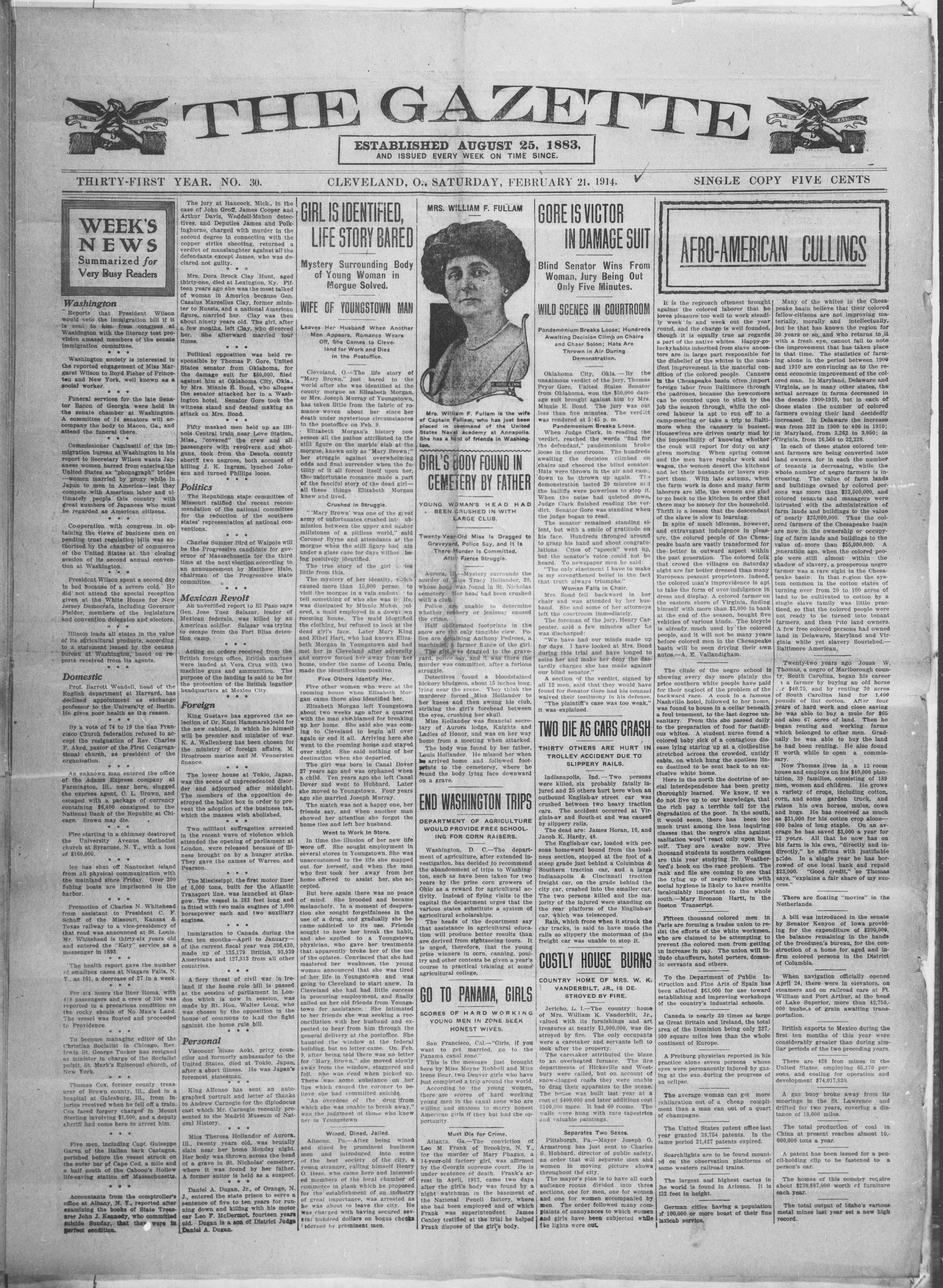
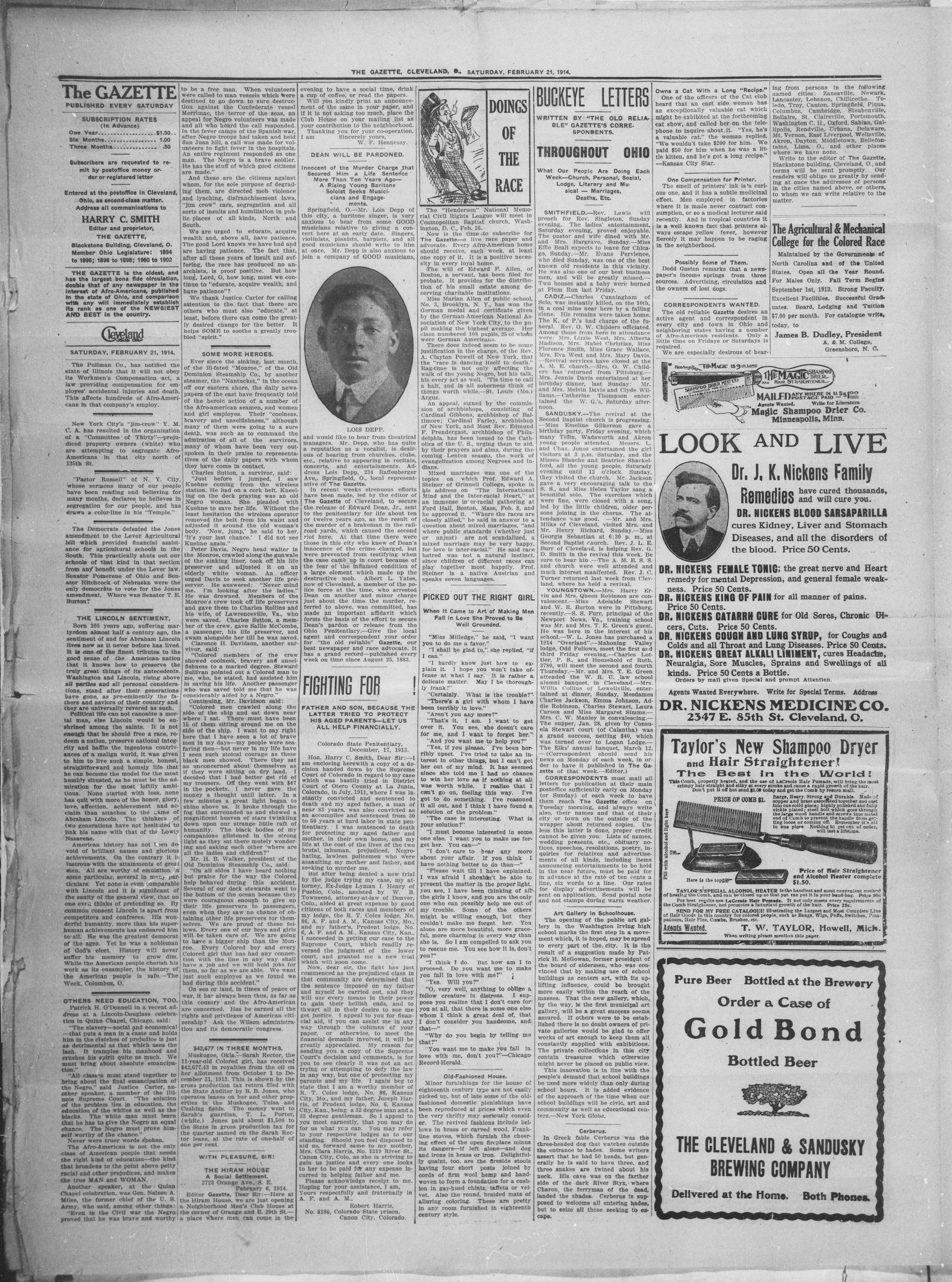
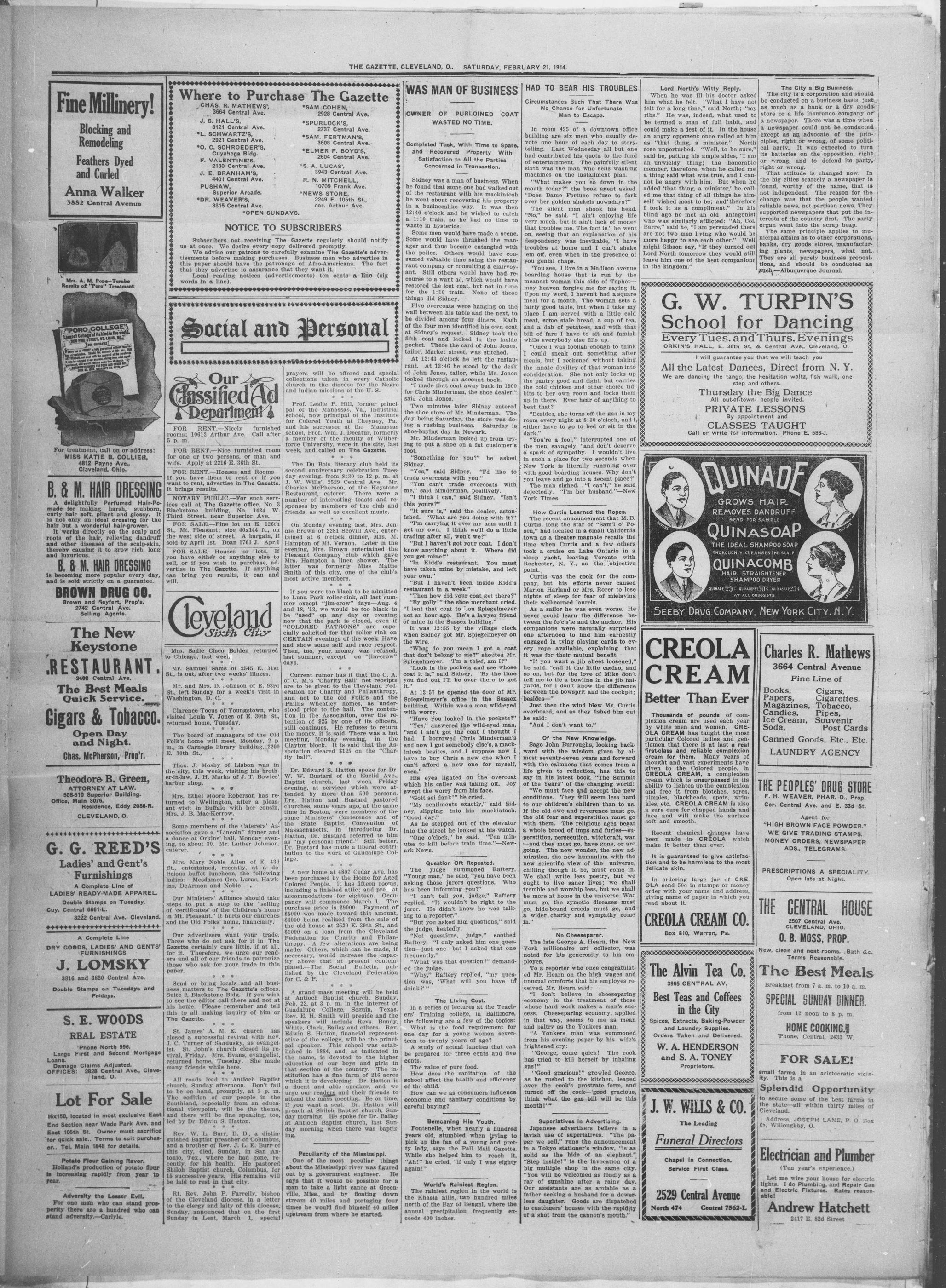
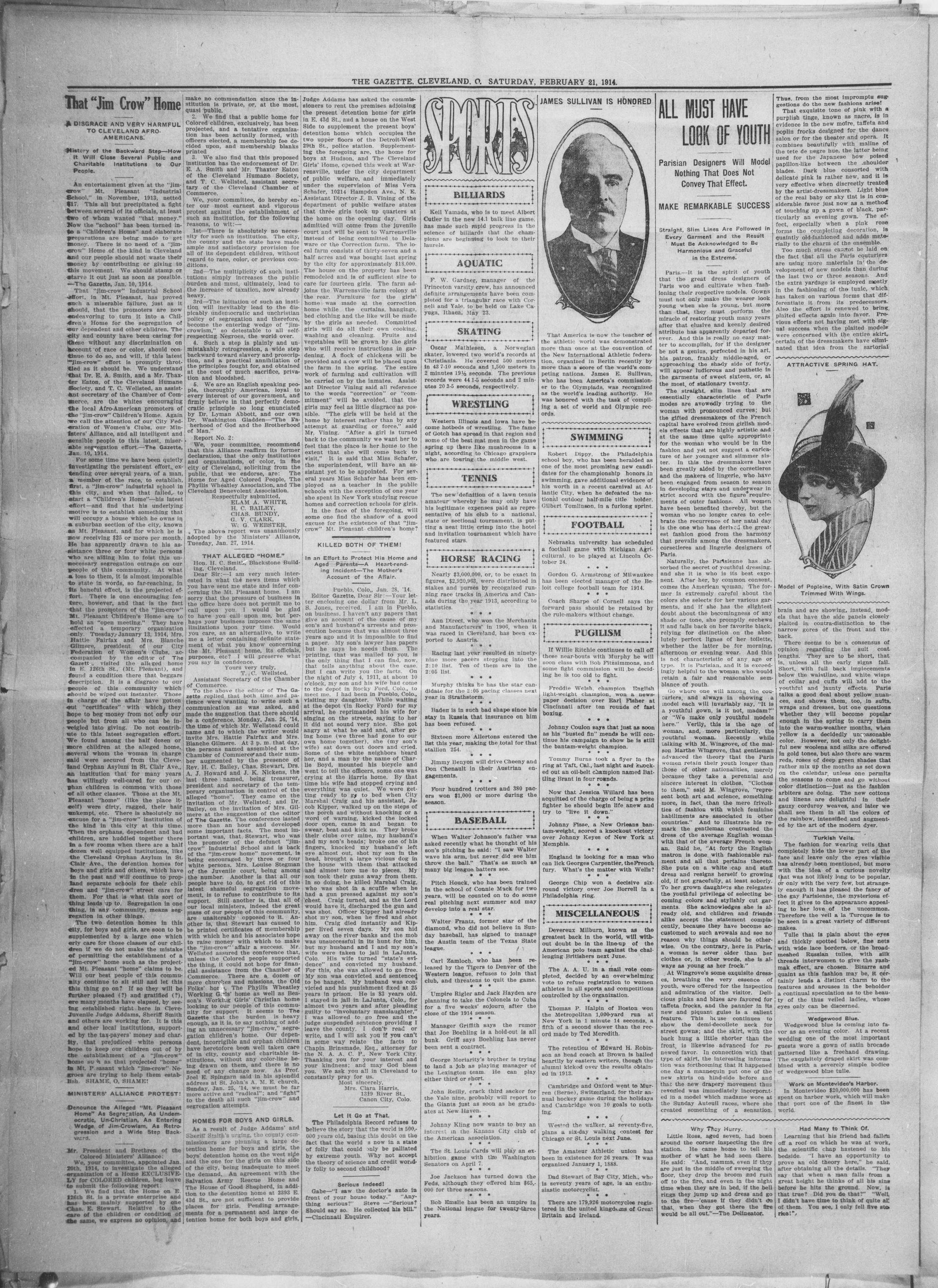
Page text (machine-generated)
IN UNION
THE ESTATE
THIRTY-FIRST
WEEK'S
NEWS
Summarized for
Very Busy Readers
Washington
Reports that President Wilson would veto the immigration bill if it is sent to him from congress at Washington with the literacy test provision amazed members of the senate immigration committee.
Washington society is interested in the reported engagement of Miss Margaret Wilson to Boyd Fisher of Princeton and New York, well known as a social worker.
Funeral services for the late Senator Bacon of Georgia were held in the senate chamber at Washington. A committee of 14 senators will accompany the body to Macon, Ga., and attend the funeral there.
Commissioner Caminetti of the immigration bureau at Washington in his report to Secretary Wilson wants Japanese women barred from entering the United States as "phonograph" brides—women married by proxy while in Japan to men in America—lest they compete with American labor and ultimately people this country with great numbers of Japanese who must be regarded as American citizens.
Co-operation with congress in obtaining the views of business men on pending trust regulation bills was authorized by the chamber of commerce of the United States at the closing session of its second annual convention at Washington.
President Wilson spent a second day in bed because of a severe cold. He did not attend the special reception given at the White House for New Jersey Democrats, including Governor Fielder, members of the legislature and convention delegates and electors.
Illinois leads all states in the value of its agricultural products, according to a statement issued by the census bureau at Washington, based on reports received from its agents.
Domestic
Prof. Barrett Wendell, head of the English department at Harvard, has declined appointment as exchange professor to the University of Berlin. He gives poor health as the reason.
By a vote of 74 to 19 the San Francisco Church federation refused to accept the resignation of Rev. Charles F. Aked, pastor of the First Congregational church, as president of the organization.
An unknown man entered the office of the Adams Express company at Farmington, Ill., near here, slugged the express agent, C. L. Brown, and escaped with a package of currency containing $6,400, consigned to the National Bank of the Republic at Chicago. Brown may die.
Fire starting in a chimney destroyed the University Avenue Methodist church at Syracuse, N. Y., with a loss of $160,000.
Ice has shut off Nantucket island from all physical communication with the mainland since Friday. Over 200 fishing boats are imprisoned in the harbor.
Promotion of Charles N. Whitehead from assistant to President C. F. Schaff of the Missouri, Kansas & Texas railway to a vice-presidency of that road was announced at St. Louis-Mr. Whitehead is thirty-six years old and entered the "Katy" service as a messenger in 1893.
The health report gave the number of smallpox cases at Niagara Falls, N. Y., as 101, a decrease of 27 in a week.
For six hours the liner Roma, with 418 passengers and a crew of 100 was reported in a precarious condition on the rocky shoals of No Man's Land. The vessel was floated and proceeded to Providence.
To become managing editor of the Christian Socialist in Chicago, Rev. Iwin St. George Tucker has resigned as minister in charge of the Socialist pulpit, St. Mark's Episcopal church, of New York.
Thomas Cox, former county treasurer of Brown county, Ill., died in a hospital at Galesburg, Ill., from injuries received when he fell off a train. Cox faced forgery charges in Mount Sterling involving $1,600, and a deputy sheriff had come here to arrest him.
Five men, including Capt. Guisette Garva of the Italian bark Castagna, perished before the vessel struck on the outer bar of Cape Cod, a mile and a half south of the Cahoon's Hollow life-saving station off Massachusetts.
Accountants from the comptroller's office at Albany, N. Y., reported after examining the books of State Treasurer John J. Kennedy, who committed suicide Sunday, that they were in perfect condition.
---
THE GAZETTE
The jury at Hancock, Mich., in the case of John Groff, James Cooper and Arthur Davis, Waddeel-Mahon detectives, and Deputies James and Polkinghorne, charged with murder in the second degree in connection with the copper strike shooting, returned a verdict of manslaughter against all the defendants except James, who was declared not guilty.
Mrs. Dora Brock Clay Hunt, aged thirty-one, died at Lexington, Ky. Fifteen years ago she was the most talked of woman in America because Gen. Cassius Marcellus Clay, former minister to Russia, and a national American figure, married her. Clay was then about ninety years old. The girl, after a few months, left Clay, who divorced her. She afterward married four times.
Political opposition was held responsible by Thomas P. Gore, United States senator from Oklahoma, for the damage suit for $60,000, filed against him at Oklahoma City, Okla., by Mrs. Minnie E. Bond, who alleges the senator attacked her in a Washington hotel. Senator Gore took the witness stand and denied making an attack on Mrs. Bond.
Fifty masked men held up an Illinois Central train near Love Station, Miss., "covered" the crew and all passengers with revolvers and shotguns, took from the Desota county sheriff two negroes, both accused of killing J. K. Ingram, lynched Johnson and turned Phillips loose.
Politics
The Republican state committee of Missouri ratified the recent recommendation of the national committee for the reduction of the southern states' representation at national conventions.
* * *
Charles Sumner Bird of Walpole will be the Progressive candidate for governor of Massachusetts for the third time at the next election according to an announcement by Matthew Hale, chairman of the Progressive state committee.
Mexican Revolt
An unverified report to El Paso says Gen. Jose Yuez Salazar, leader of Mexican federales, was killed by an American soldier. Salazar was trying to escape from the Fort Bliss detention camp.
Acting on orders received from the British foreign office, British marines were landed at Vera Cruz with two machine guns and ammunition. The purpose of the landing is said to be for the protection of the British legation headquarters at Mexico City.
Foreign
King Gustave has approved the selection of Dr. Kurt Hammarskjoel for the new cabinet, in which he himself will be premier and minister of war. K. A. Wallenberg has been chosen for the ministry of foreign affairs, M. Brostrom marine and M. Vennersten finance.
The lower house at Tokyo, Japan, was the scene of unprecedented disorder and adjourned after midnight. The members of the opposition destroyed the ballot box in order to prevent the adoption of the business tax, which the masses wish abolished.
Two militant suffragettes arrested in the recent wave of violence which attended the opening of parliament at London, were released because of illness brought on by a hunger strike. They gave the names of Warren and Pearson.
The Mississippi, the first motor liner of 5,000 tons, built for the Atlantic Transport line, was launched at Glasgow. The vessel is 382 feet long and is fitted with two main engines of 1,600 horsepower each and two auxiliary engines.
Immigration to Canada during the first ten months—April to January—of the current fiscal year was 356,430, made up of 135,179 British, 93,939 Americans and 127,313 from all other countries.
A fiery threat of civil war in Ireland if the home rule bill is passed at the session of parliament in London which is now in session, was made by Rt. Hon. Walter Long, who was chosen by the opposition in the house of commons to lead the fight against the home rule bill.
Personal
Viscount Siuzo Aoki, privy councilor and formerly ambassador to the United States, died at Tokio, Japan, after a short illness. He was Japan's foremost statesman.
King Alfonso has sent an autographed portrait and letter of thanks to Andrew Carnegie for the diplodocus cast which Mr. Carnegie recently presented to the Madrid Museum of Natural History.
Miss Theresa Hollander of Aurora, Ill., twenty years old, was brutally slain near her home Monday night. Her body was thrown across the head of a grave in St. Nicholas' cemetery, where it was found by her father. A former suitor is held as a suspect.
Daniel A. Dugan, Jr., of Orange, N. J., entered the state prison to serve a sentence of five to ten years for running down and killing with his motor car Leo F. McDermott, fourteen years old. Dugan is a son of District Judge Daniel A. Dugan.
ESTABLISHED AUGUST 25, 1883 AND ISSUED EVERY WEEK ON TIME SINCE.
GIRL IS IDENTIFIED. LIFE STORY BARED
Mystery Surrounding Body of Young Woman in Morgue Solved.
Leaves-Her Husband When Another Man Appears, Romance Wears Off, She Comes to Cleveland for Work and Dies in the Postoffice.
Cleveland, Q.-The life story of "Mary Brown." just bared to the world after she was identified at the county morgue as Elizabeth Morgan, or Mrs. Joseph Murray of Youngstown, has taken little from the fabric of romance woven about her since her death under mysterious circumstances in the postoffice on Feb. 9.
Elizabeth Morgan's history possesses all the pathos attributed to the still figure on the marble slab at the morgue, known only as "Mary Brown." her struggle against overwhelming odds and final surrender when the futility of it all forced itself upon her, the fortunate romance made a part of the fanciful story of the dead girl- all these things Elizabeth Morgan knew and lived.
Crushed in Struggle.
"Mary Brown was one of the great army of unfortunate crushed into submission between the upper and newer millstones of a pitiless world," said Coroner Byrne and attendants at the morgue when the still figure had ain under a glass case for days without being positively identified.
The true story of the girl lies little from this.
The mystery of her identity, which caused more than 15,000 person, to visit the morgue in a vain endow, to tell something of who she was in life, was dissipated by Minnie Mukes, colored, a maid employed in a downtown rooming house. The maid identified the clothing, but refused to look at the dead girl's face. Later Mary King and Ethel Hart, who had known Elizabeth Morgan in Youngstown and had met her in Cleveland after adversity and sorrow forced her away from her home, under the name of Leona Dale, made the identification positive.
Five Others Identify Her.
Five other women who were at the rooming house when Elizabeth Morgan came there also identified her. Elizabeth Morgan left Youngstown about two weeks ago after a quarrel with the man she blamed for breaking up her home. She said she was coming to Cleveland to begin all over again or end it all. Arriving here she went to the rooming house and stayed over night. She said nothing of her destination when she departed. The girl was born in Canal Dover 27 years ago and was orphaned when a child. Ten years ago she left Canal Dover and went to Hubbard. Later she moved to Youngstown. Four years ago she married Joseph Murray. The match was not a happy one, her friends say, and when another man showed her attention she forgot the home ties and left her husband.
Went to Work In Store.
In time the illusion of her new life wore off. She sought employment in several stores in Youngstown. She was unaccustomed to the life she mapped out for herself, and when the man who first took her away from her home offered to assist her, she accepted.
But here again there was no peace of mind. She brooded and became melancholy. In a moment of desperation she sought forgetfulness in the use of a drug, and gradually she became addicted to its use. Friends sought to have her break the habit, and she applied to a Youngstown physician, who gave her treatments that apparently broke her of the use of the opiates. Convinced that she had mastered her weakness, the young woman announced that she was tired of her life in Youngstown and was going to Cleveland to start anew. In Cleveland she had had little success in procuring employment, and finally called on her old friends from Youngstown for assistance. She intimated to her friends she was seeking a reconciliation with her husband and expected to hear from him through the general delivery at the postoffice. She haunted the window at the federal building, but no letter came. On Feb. 9, after being told there was no letter for "Mary Brown," she moved slowly away from the window, staggered and fell. She was dead when picked up. There was some substance on her lips which caused the coroner to believe she had committed suicide.
"An overdose of the drug from which she was unable to break away," was the judgment of those who knew her in Youngstown
Wined Dined Jailed
Altoong, Pa.—After being wined and dined by prominent business men and introduced into some of the best society of the city, a young stranger, calling himself Henry O. Hess, who came here and interested members of the local chamber of commerce in plans which he proposed for the establishment of an industry of great importance, was arrested as he was about to leave the city. He was charged with having secured several hundred dollars on bogus checks adored by prominent men.
MRS. WILLIAM F. FULLAM
Mrs. William F. Fullam is the wife of Captain Fullam, who has just been placed in command of the United States Naval academy at Annapolis. She has a host of friends in Washington.
YOUNG WOMAN'S HEAD HAD
. BEEN CRUSHED IN WITH
LARGE CLUB.
Aurora, IL—Mystery surrounds the murder of Miss Tracy Hollander, 20, whose body was found in St. Nicholas cemetery. Her head had been crushed with a club.
Police are unable to determine whether robbery or jealousy caused the crime.
Half obliterated footprints in the snow are the only tangible clew. Police are detaining Anthony Pedroes, a machinist, a former fiance of the girl.
The girl was dragged to the graveyard, police say, and it was there the murder was committed, after a furious struggle.
Detectives found a bloodstained hickory bludgeon, about 15 inches long, lying near the scene. They think the murderer forced Miss Hollander to her knees and then swung his club, striking the girl's forehead between the eyes, crushing her skull.
Miss Hollander was financial secretary of Aurora lodge, Knights and Ladies of Honor, and was on her way home from a meeting when attacked.
The body was found by her father, Louis Hollander. He missed her when arrived home and followed footprints to the cemetery, where he found the body lying face down on a grave.
END WASHINGTON TRIPS
DEPARTMENT OF AGRICULTURE WOULD PROVIDE FREE SCHOOLING FOR CORN RAISERS.
Washington, D. C.—The department of agriculture, after extended investigation, has decided to recommend the abandonment of trips to Washington, such as beetles taken for two years by the prize corn growers Ohio as a reward for agricultural activity. Instead of flying visits to the capital the department urges that the various states substitute a system of agricultural scholarships.
The heads of the department say that assistance in agricultural education will produce better results than are derived from sightsseeing tours. It is urged, therefore, that the young prize winners in corn, canning, poultry and other contests be given a year's course in practical training at some agricultural college.
GO TO PANAMA, GIRLS
GO TO PANAMA, GIRLS
SCORES OF HARD WORKING
YOUNG MEN IN ZONE SEEK
HONEST WIVES.
San Francisco, Cal.—"Girls, if you want to get married, go to the Panama canal zone."
This is the message just brought here by Miss Moyne Rubbell and Miss Irene Bear, two Denver girls who have just completed a trip around the world. According to the young women, there are scores of hard working young men in the canal zone who are willing and anxious to marry honest American girls if they but had the opportunity.
Must Die for Crime
Atlanta, Ga.-The conviction of Leo M. Frank of Brooklyn, N. Y., for the murder of Mary Phagan, a 14-year-old factory girl, was affirmed by the Georgia supreme court. He is under sentence of death. Frank's arrest in April, 1913, came two days after the girl's body was found by a night watchman in the basement of the National Pencil factory, where she had been employed and of which Frank was superintendent. James Conley testified at the trial he helped Frank dispose of the girl's body.
GORE IS VICTOR IN DAMAGE SUIT
Blind Senator Wins From Woman, Jury Being Out Only Five Minutes.
WILD SCENES IN COURTROOM
Pandemonium Breaks Loose; Hundreds
Awaiting Decision Climb on Chairs
and Chaser Solon; Hats Are
Thrown in Air During
Demonstration.
Oklahoma City, Okla. — By the
unanimous verdict of the jury, Thomas
Pryor Gore, United States Senator
from Oklahoma, won the $50,000 damage
suit brought against him by Mrs.
Minnie E. Bond. The jury was out
less than five minutes. The verdict
was rendered at 5:45 p. m.
Pandemonium Breaks Loose.
When Judge Clark, in reading the
verdict, reached the words "find for
the defendant," pandemonium broke
loose in the courtroom. The hundreds
awaiting the decision climbed on
chairs and cheered the blind senator.
Hats were thrown in the air and camp
down to be thrown up again. The
demonstration lasted 20 minutes and
the ballfires were powerless to stop it.
When the noise had quieted down,
Judge Clark finished reading the
verdict. Senator Gore was standing when
the judge began to read.
The senator remained standing silent, but with a smile of gratitude on his face. Hundreds thronged around to grasp his hand and shout congratulations. Cries of "speech" went up, but the senator's voice could not be heard. To newspaper men he said:
"The only steward I have to make
is my strengthened belief in the fact
that truth always triumphs."
Mrs. Bond fell backward in her chair and was attended by her husband. She and some of her attorneys left the courtroom immediately.
The foreman of the jury, Henry Carpenter, said a few minutes after he was discharged:
"We have had our minds made up for days. I have looked at Mrs. Bond during this trial and have longed to seize her and make her deny the dastardly charges she has made against our blind senator."
A section of the verdict, signed by all 12 men, said that they would have found for Senator Gore had his counsel waived their testimony in his defense.
"The plaintiff's case was too weak," it was explained.
TWO DIE AS CARS CRASH
THIRTY OTHERS ARE HURT IN TROLLEY ACCIDENT DUE TO SLIPPERY RAILS.
Indianapolis, Ind.—Two persons were killed, six probably fatally injured and 25 others hurt here when an outbound English-av street car was crushed between two heavy traction cars. The accident occurred at Virginia-av and South-st and was caused by slippery rails.
The dead are: James Horan, 16, and Jacob K. Hardy, 48.
The English-av car, loaded with persons homeward bound from the business section, stopped at the foot of a steep grade just behind a Columbus & Southern traction car, and a large Indianapolis & Cincinnati traction freight car, on the grade behind the city car, crashed into the smaller car. The two persons killed and the majority of the injured were standing on the rear platform of the English-av car, which was telescoped.
Rain, which froze when it struck the car tracks, is said to have made the rails so slippery the motorman of the freight car was unable to stop it.
COSTLY HOUSE BURNS
COUNTRY HOME OF MRS. W. K. VANDERBILT, JR., IS DE-STROYED BY FIRE.
Jericho, L. I.-The country home of Mrs. William K. Vanderbilt, Jr., valued with its furnishings and art treasures at nearly $10,000,000, was destroyed by fire. The only occupants were a carestaker and servants left to look after the property.
The carestaker attributed the blaze to an overheated furnace. The fire departments of Hicksville and Westbury were called, but on account of snow-clogged roads they were unable to drag their apparatus to the scene. The house was built last year at a cost of $400,000 and later additions cost $100,000 more. It had 60 rooms. The walls were hung with rare tapestries and valuable paintings.
Separates Two Sexes
Pittsburgh, Pa.—Mayor Joseph G. Armstrong has just sent to Charles S. Hubbard, director of public safety, an order that will separate men and women in moving picture shows throughout the city.
The mayor's plan is to have all such audience rooms divided into three sections, one for men, one for women and one for women accompanied by men. The order followed many complaints of annoyances to which women and girls have been subjected while the lights were out.
AFRO-AMERICAN CULLINGS
It is the reproach oftensen brought against the colored laborer that he loves pleasure too well to work steadily week in and week out the year round, and the charge is well founded, though it is equally true as regards a part of the native whites. Happy-glockyhabits inherited from slave ancestors are in large part responsible for the disbelief of the whites in the manifest improvement in the material condition of the colored people. Canners in the Chesapeake basin often import foreign labor from Baltimore through the padrones, because the newcomers can be counted upon to stick by the job the season through, while the colored laborer is apt to run to a camp-meeting or take a trip to Baltimore when the cannery is busiest. Housewives are driven nearly mad by the impossibility of knowing whether the cook will report for duty on any given morning. When spring comes and the men have regular work and wages, the women desert the kitchens and let their husbands or lovers support them. With late autumn, when the farm work is done and many farm laborers are idle, the women are glad to go back to the kitchen in order that there may be money for the household. Thrift is a lesson that the descendant of the slave is slow in learning.
In spite of much idleness, however, and extravagant indulgence in pleasure, the colored people of the Chesapeake basin are vastly transformed for the better in outward aspect within the past generation. The colored folk that crowd the villages on Saturday night are far better dressed than many European peasant proprietors. Indeed, the colored man's improvidence is apt to take the form of over-indulgence in dress and display. A colored farmer on the eastern shore of Virginia, finding himself with more than $2,000 in bank at the end of the season, bought five vehicles of various kinds. The bicycle is already much used by the colored people, and it will not be many years before colored men in the Chesapeake basin will be seen driving their own autos. A. E. Vallandigham.
The clinic of the negro school is showing every day more plainly the price southern white people have paid for their neglect of the problem of the backward race. A cook in a famous Nashville hotel, followed to her home, was found to house in a cellar beneath a foul tenement, to the last degree unsanitary. From this she passed daily to the preparation of food for fastidious whites. A student nurse found a colored baby sick of a contagious disease lying staring up at a clothesline stretched across the crowded, untidy cabin, on which hung the spotless linen destined to be sent back to an exclusive white home.
Here in the north the doctrine of social interdependence has been pretty thoroughly learned. We know, if we do not live up to our knowledge, that the rich pay a terrible toll for the degradation of the poor. In the south, it would seem, there has been too much trust among the less inquiring classes that the negro's sins against sanitation would react only upon himself. They are awake now. Five thousand students in southern colleges are this year studying Dr. Weatherford's book on the race problem. The rank and file are coming to see that the tying up of negro religion with social hygiene is likely to have results incalculably important to the whole south.-Mary Bronson Hartt, in the Boston Transcript.
Fifteen thousand colored men in Paris are forming a trades union to resist the efforts of the white workmen, who are claimed to be attempting to prevent the colored men from getting an increase in pay. The union will include chauffeurs, hotel porters, domestic servants and others.
To the Department of Public Instruction and Fine Arts of Spain has been allotted $63,000 for use toward establishing and improving workshops of the country's industrial schools.
Canada is nearly 30 times as large as Great Britain and Ireland, the total area of the Dominion being only 237,000 square miles less than the whole continent of Europe.
A Freiburg physician reported in his practice alone seven persons whose eyes were permanently injured by gazing at the sun during the progress of an eclipse.
The average woman can get more axillarization out of a cheap compliment than a man can out of a quart of champagne.
The United States patent office last year granted 38,754 patents. In the same period 21,427 patents expired.
Searchlights are to be found mounted on the observation platforms of some western railroad trains.
The largest and highest cactus in the world is found in Arizona. It is 132 feet in height.
German cities having a population of 100,000 or more boast of their fine taxicab service.
IN UNION IN ESSENTIA
PY FIVE CENTS
CAN CULLINGS
Many of the whites in the Chesapeake basin believe that their colored fellow-citizens are not improving materially, morally and intellectually, but he that has known the region for 30 years or so, and who returns to it with a fresh eye, cannot fail to note the improvement that has taken place in that time. The statistics of farming alone in the period between 1900 and 1910 are convincing as to the recent economic improvement of the colored man. In Maryland, Delaware and Virginia, as in many other states, the actual acreage in farms decreased in the decade 1900-1910, but in each of those states the number of colored farmers owning their land decidedly increased. In Delaware the increase was from 332 in 1900 to 406 in 1910; in Maryland, from 3,262 to 3,950; in Virginia, from 26,566 to 32,228.
In each of these states colored tenant farmers are being converted into land owners, for in each the number of tenants is decreasing, while the whole number of negro farmers is increasing. The value of farm lands and buildings owned by colored persons was more than $23,500,000, and colored tenants and managers were intrusted with the administration of farm lands and buildings to the value of nearly $25,000,000. Thus the colored farmers of the Chesapeake basin are now in the ownership or occupying of farm lands and buildings to the value of more than $55,000,000. A generation ago, when the colored people were still almost within the shadow of slavery, a prosperous negro farmer was a rare sight in the Chesapeake basin. In that region the system common in the cotton states of turning over from 20 to 100 acres of land to be cultivated to cotton by a single slave family was little practiced, so that the colored people were not ready to be turned into tenant farmers, and then into land owners. A few free colored persons had owned land in Delaware, Maryland and Virginia while yet slavery flourished.—Baltimore American.
Twenty-two years ago Jonas W. Thomas, a negro of Mariborough county, South Carolina, began his career as a farmer by buying an old horse .r $40.75, and by renting 30 acres of South Carolina land for 1,400 pounds of lint cotton. After four years of hard work and close saving he was able to buy a mule for $65 and also 67 acres of land. Then he began renting and working farms which belonged to other men. Gradually he was able to buy the land he had been renting. He also found it worth while to open a commissary.
Now Thomas lives in a 12 room house and employs on his $40,000 plantation, 39 families, consisting of 189 men, women and children. He grows a variety of crops, including cotton, corn, and some garden truck, and raises his own horses, mules, cows and hogs. He has received as much as $31,000 for his cotton crop alone—400 bales of long staple. On an average he has saved $3,000 a year for 22 years. All that he now has on his farm is his own, "directly and indirectly," he affirms with justifiable pride. In a single year he has borrowed one local bank and repaid $23,000. "Good credit," so Thomas says, "explains a fair share of my success."
There are floating "movies" in the Netherlands.
A bill was introduced in the senate by Senator Kenyon of Iowa providing for the expenditure of $200,000, the balance remaining in the hands of the freedmen's bureau, for the construction of a home for aged and infirm colored persons in the District of Columbia.
When navigation officially opened April 24, there were in elevators, on steamers and on railroad cars at Ft. William and Port Arthur, at the head of Lake Superior, more than 42,750,000 bushes of grain awaiting transportation.
British exports to Mexico during the first ten months of this year were considerably greater than during similar periods of the two preceding years.
There are 438 iron mines in the United States, employing 65,170 persons, and costing for operation and development $74,017,830.
A gas buoy broke away from its moorings in the St. Lawrence and drifted for two years, covering a distance of 18,000 miles.
The total production of coal in China at present reaches almost 10,000,000 tons a year.
A patent has been issued for a pencil-holding clip to be fastened to a person's car.
in
is
on
ne
The homes of this country require
about $239,887,000 worth of furniture
each year.
The total output of Idaho's various
metal mines last year set a new high
record.
One Year.....$1.50.
Six Months.....1.00
Three Months......50
Subscribers are requested to remit by postoffice money order or registered letter
Entered at the postoffice in Cleveland, Ohio, as second-class matter.
Address all communications to
HARRY C. SMITH
Editor and proprietor,
THE GAZETTE,
Blackstone Building, Cleveland, O.
Member Ohio Legislature: 1894
to 1896; 1896 to 1898; 1900 to 1902
THE GAZETTE is the oldest, and has the largest bona fide circulation, double that of any newspaper in the interest of Afro-Americans, published in the state of Ohio, and comparison with any will immediately establish its rank as one of the NEWSIEST AND BEST in the country.
SATURDAY, FEBRUARY 21, 1914.
The Pullman Co., has notified the state of Illinois that it will not obey its Workmen's Compensation act, a law providing compensation for employees' accidental injuries and death. This affects hundreds of Afro-Americans in that company's employ.
New York City's "jim-crow" Y. M. C. A. has resulted in the organization of a "Committee of Thirty"—prejudiced property owners (white) who are attempting to segregate Afro-Americans in that city north of 135th St.
"Pastor Russell" of N. Y. City, whose sermons many of our people have been reading and believing for many months, declares he believes in segregation for our people, and has drawn a color-line in his "Temple."
The Democrats defeated the Jones amendment to the Lever Agricultural bill which provided financial assistance for agricultural schools in the South. This practically shuts out our schools of that kind in that section from any benefit under the Lever law. Senator Pomerene of Ohio and Senator Hitchcock of Nebraska were the only democrats to vote for the Jones amendment. Where was Senator T. E. Burton?
THE LINCOLN SENTIMENT.
THE LINCOLN SENTIMENT
Born 105 years ago, suffering martyrdom almost half a century ago, the sentiment of and for Abraham Lincoln lives now as it never before has lived. It is one of the finest tributes to the good sense of the American nation that it knows how to preserve the truly great things of its antecedents. Washington and Lincoln, rising above all parties and all personal considerations, stand after their generations go on, going on and going on, and saviors of their country and they are universally viewed as such.
Political life can not canonize a mortal man, else Lincoln would be enshrined among the saints. It is not enough that he should free a race, redeem a nation, preserve national integrity and baffle the ingenious contrivances of a malign world, it was given to him to live such a simple, honest, straightforward and homely life that he can become the model for the most humbly situated, as he must be the admiration for the most loftly ambitious. None started with less, none has quit with more of the honor, glory, love, affection, achievement and acclaim than attaches to the name of Abraham Lincoln. The thinkers of two generations have not hesitated to link his name with that of the Lowly Nazarene.
American history has not been devoid of brilliant names and glorious achievements. On the contrary it is lustrous with the attainments of great men. All are worthy of emulation in some particular, several in many particulars. Yet none is even comparable with Lincoln and it is significant of the sanity of the general view, that no one even thinks of pretending so. By common consent Lincoln is apart from competitors and confreres. His wonderful humanity, more than his superhuman achievements has endeared him to all. He was the greatest democrat of the ages. Yet he was a nobleman of God's elect. History will never suffer his memory to grow dim. While the American people cherish his work as its ensmaller, the history of the American people is safe.—The Week, Columbus, O.
OTHERS NEED EDUCATION, TOO
Patrick H. O'Donnell in a recent address at a Lincoln-Douglass celebration in Quinn Chapel, Chicago, said:
"The slavery—social and economical—that puts a man in a caste and holds him in the clutches of prejudice is just as detrimental as that which uses the lash. It tramples his manhood and crushes his spirit quite as much. We must bring about absolute emancipation."
"All classes must stand together to bring about the final emancipation of the Negro," said Justice Carter, another speaker, a number of the Lil'kings Court. "The solution of the problem lies in education, the education of the whites as well as the blacks. The white man must learn that he has to give the Negro an equal chance. The Negro must prove himself worthy of the chance."
Never were truer words spoken. The Afro-American is not the only class of American people that needs the right kind of education—the kind that broadens to the point above petty racial and other prejudices, and makes the true MAN and WOMAN. Another speaker, the Quinn Chapel celebration, was Nelson A. Miles, chief of the U. S. Army who said, among other things: "Even in the Civil war the Negro prozed that he was brave and worthy
to be a free man. When volunteers were called to man vessels which were destined to go down to sure destruction against the Confederate vessel Morrimac, the terror of the seas, an appeal for Negro volunteers was made and all who heard the call responded. In the fever camps of the Spanish war, after Negro troops had taken and held San Juan hill, a call was made for mobilization. An entire regiment responded as one man. The Negra is a brave soldier. He has the stuff of which good citizens are made."
And these are the citizens against them, for the sole purpose of degrading them, are directed mob violence and lynching, disfribishment laws, "jim crow" cars, segregation and all sorts of insults and humiliation in public places of all kinds, North and South.
We are urged to educate, acquire wealth and, above all, have patience. The good Lord knows we have had and are having patience. The fact that, after all these years of insult and suffering, the race has produced no anarchists, is proof positive. But how long, Lord, O, how long, must we continue to "educate, acquire wealth, and have patience"?
We thank Justice Carter for calling attention to the fact that there are others who must also "educate," at least, before there can come the greatly desired change for the better. It helps SOME to soothe a greatly troubled "spirit."
SOME MORE HEROES
Ever since the sinking, last month, of the ill-fated "Monroe," of the Old Dominion Steamship Co., by another steamer, the "Nantucket," in the ocean off our eastern shore, the daily newspapers of the east have frequently told of the heroic action of a number of the Afro-american seamen, and women and girl employees. Their "coolness, bravery and unselfishness," although many of them were going to a sure death, was such as to command the admiration of all of the survivors, many of whom have been very outspoken in their praise to representatives of the daily papers with whom they have come in contact.
Charles Sutton, a survivor, said: "Just before I jumped, I saw Kuehn coming from the wireless station. He had on a cork belt. Kneeling on the deck praying was an old Negro woman. She pleaded with Kuehn to save her life. Without the least hesitation the wireless operator removed the belt from his waist and inserted it into the body. 'Now, jump,' he said to her, 'It's your last chance.' I did not see Kuehn again.'
Peter Davis, Negro head waiter in the Peter Davis, crawled along the gunwale of the sinking liner, took off his life preserver and adjusted it on an elderly white woman. An officer urged Davis to seek another life preserver. He answered: "Never mind me. I'm looking after the ladies." Monroe's crew took off life preservers and gave them to Charles Rollins and his wife, of Lawrenceville, Va, who were saved. Charles Sutton, a member of the crew, gave Sallie McCombs, a passenger, his life preserver, and swam alongside her till he was saved. Clarence H. Davidson, another survivor, said: "Colored members of the crew showed coolness, bravery and unselfishness. Sullivan pointed out a Colored man to me, who, he stated, had assisted him in saving his life. Another passenger who was saved told me that he was considerably aided by a Negro."
Continuing, Mr. Davidson said: "Colored men crawled along the shores near near where I sat. There must have been 15 of them sitting around me on the side of the ship. I want to say right here that I have seen a lot of brave men in my days—my people were seafaring men—but never in my life have I seen such stocal courage as these black men showed. There they sat as unconcerned about themselves as if they were sitting on dry land. I saw a kid of my trousers. Off they went with $47 in the pockets. I never gave the money a thought until latter. In a few minutes a great light began to shine above us. It broke through the fog that surrounded us and showed a magnificent heaven of stars twinkling down upon our strange litter raft of companions glistened in the strong light as they sat there mutely wondering and asking each other 'where are all the ladies and children?'
Mr. H, B. Walker, president of the Old Dominion Steamship Co. said:
Old Dominion Steamship Co. said: "On all sides I have heard nothing but praise for the color help be given during this account. Several of our deck stewards went to the bottom of the ocean because they were courageous enough to give up their life preservers to passengers, even when they saw no chance of obtaining other life preservers for themselves. We are proud of these fellows. Every one of our boys and girls will be taken care of. We are going to have a bigger ship than the Monaco. Every Colored boy and every Colorless boy will have any connection with the line in any way shall have a job and we will hold jobs for them, so far as we are able. We want just such employees as we found we had during this accident." On sea or land, in times of peace or war, it has always been thus, as far as this country and the Afro-American are concerned. Has he earned all the rights and privileges of American citizenship? Ask the Wilson administration and its democratic congress.
---
$42,677 IN THREE MONTHS
$42,677 IN THREE MONTHS.
Muskegee, Okla.—Kara Rector, the 11-year-old Colored girl, has received $42,677.33 in royalties from the oil on her allotment from October 1 to December 31, 1913. This is shown by the gross production tax return filed with the State Auditor by B. B. Jones, who has received $1,050.00 and other estates in Muskegee, Tulsa and Cushing fields. The money went to Sarah's guardian, T. L. Porter, (white.) Jones paid about $1,500 to the State in gross production tax for the quarter named on the Sarah Rector lease, at the rate of one-half of one per cent.
WITH PLEASURE, SIR!
THE HIRM HOUSE
A Social Settlement.
2723 Orange Ave., S. E.
February 6, 1914.
Editor Gazette, Dear Sir--Here at the Hirm House, we are just opening
the door to the house at the corner of Orange and E. 29th St.
a place where men can come in.
THE GAZETTE, CLEVELAND, SATURDAY, FEBRUARY 21, 1914. evening to have a social time, drink a cup of coffee or read the napers.
a cup of coffee, or read the papers.
Will you kindly print an announcement of the same in your paper, and if it is not asking too much, place the Club House on your mailing list as your contribution to the neighborhood.
Thanking you for your co-operation,
I am Sincerely yours.
DEAN WILL BE PARDONED.
Innocent of the Murder Charge that Secured Him a Life Sentence
More Than Ten Years Ago—
A Rising Young Baritone
Solist Seeks Musicians and Engagements.
Springfield, O.—Mr. Lois Depp of this city, a baritone singer, is very anxious to hear from some GOOD musicians relative to giving a concert here at an early date. Singers, violinists, pianists, harpists, and all good musicians should write to him at once. Mr. Depp is also anxious to join a company of GOOD musicians.
LOIS DEPP
and would like to hear from theatrical managers. Mr. Depp, who has quite a reputation as a vocalist, is desirous of hearing from churches, clubs, etc., relative to appearing in recitals, concerts, and entertainments. Ads for the Raffenberger Ave, Springfield, O, local represent active of the Gazette.
In recent weeks strenuous efforts have been made, led by the editor of the Gazette of Cleveland, to secure the release of Edward Dean, Jr., sent to the penitentiary for life about ten or twelve years ago, as the result of the murder of a brakeman in the railroad yards, which caused the second riot here. At that time there were those in this city who knew of Dean's murder, and were prevented from testifying when the case came up in court because of the fear of the inflamed condition of a large element which made up the destructive mob. Albert L. Yates, now of Cleveland, a member of the police force at the time, who arrested Dean on another and minor charge just about the time the murder, referred to above, was committed, has made an important affidavit which forms the basis of the effort to secure Dean's pardon or release from the prison, and agent and correspondent your order for "the old reliable" Gazette, our best newspaper and race advocate. It has a grand record—published every week on time since August 25, 1883.
FIGHTING FOR
FATHER AND SON, BECAUSE THE LATTER TRIED TO PROTECT HIS AGED PARENTS—LET US ALL HELP FINANCIALLY.
Colorado State Penitentiary,
December, 17, 1913.
Hon. Harry C. Smith, Dear Sir:—am enclosing herewith a copy of a decision handed down by the Supreme Court of Colorado in regard to my case which was hastily tried in District Court of Colorado in Linda, Santa, Colorado, in July, 1911, where I was stantly convicted and sentenced to death and my aged father, a man of near 83 years, was also convicted as an accomplice and sentenced from 30 to 50 years at hard labor in state penitentiary. I was sentenced to death for protecting my aged father and mother, in their own home, and my life at the cost of the lives of the two brutal inmates, produced. Negro hating, lawless policemen, who were assaulting my mother and father, and seeking to murder.
But after being denied a new trial by the judge trying my case, my attorney, Ek-Judge Lyman I. Henry of Pueblo, Colo., assisted I. W. B. Townsend, attorney-at-law of Denver, B.C., added at great expense by good counsel and friend of my lodge, the R. C. H. 86, A. F. and A. M., Kansas City, Mo., and my father's, Prudent lodge, No. 6, A. F. and A. M., Kansas City, Kan. I succeeded in getting our case to the Supreme Court, which readily reversed the judgment of the lower court, and granted me a new trial
Now, dear sir, the fight has just commenced as the prejudiced class in that community are determined that the sentence imposed on my father and myself be carried out, and they will use every means in their power to gain their hellish ends, and to thwart all in their desire to see me get justice. I appeal to you for financial aid, if you can assist me in any way through the columns of your paper, or otherwise, to meet the financial demands involved, it will be greatly appreciated. My reason for doing so is that the Court's decision and comments, is for you to see clearly it was not an act trying or attempting to defy the law in any way, but one of protecting my parents and my life. I again beg to state that I am a worthy member of R. T. Coles lodge, No. 86, Kansas City, Mo., and my father, Joseph Harris, of Prudent lodge, No. 6, Kansas City, Kan, being a 32 degree man and a 33 degree gentleman. So I appeal to you most earnestly, that you may do for us what you can. You may refer to your respectful lodges as to our mutual benefit, and you would aid us, forward same to my mother, Ms. Clara Harris, No. 1319 River St., Canon City, Colo, as she is striving to gain us justice and every one looks to her to be paid for any expense incurred in helping father and me.
Please acknowledge receipt to me
Hoping for your assistance, I am,
Yours respectfully and fraternally in
A. F. and A. M.
Robert Harris,
No. 8180, Colorado State prison,
Cannon City, Colorado
DOINGS
OF
THE
RACE
The "Henderson" National Memorial Civil Rights League will meet in Cosmopolitan Baptist church, Washington, D. C., Feb. 25.
Now is the time to subscribe for The Gazette's live race paper and advocate. Every Afro-American home should receive, each week, at least one copy of it. It is a positive necessity in every loyal home.
The will of Edward F. Allen, of Boston, a servant, has been filed for probate. It provides for the distribution of his small estate among deserving charitable institutions.
Miss Marion Allen of public school, New York, has been given the German medal and certificate given by the German-American National Association of New York City, to the pupil making the highest average. Her class numbered 108 pupils, 25 of whom were German Americans; 60 of whom would be to some justification in the charge, of the Rev A. Clayton Powell of New York, that the "race is dancing itself to death." Rag-time is not only affecting the walk of the young Negro, but his talk, his every act as well. "Tis time to call a halt, and in all soberness think of worth while." St. Louis (Mo. Argus.
An appeal, signed by the commission of archbishops, consisting of Cardinal Gibbons, archbishop of Baltimore; Cardinal Farley, archbishop of New York, and Most Rev. Edmund F. Prendergast, archbishop of Philadelphia of the U. S., urging them to aid, by their prayers and alms, during the coming Lenten season, the work of evangelization among Negroes and Indians.
Mixed marriages was one of the topics on which Prof. Edward A. Steininger, Annul Collected Collections of the address of "T" the International Mind and the Inter-racial Heart," at an immense 'in'racial gathering at Ford Hall, Boston, Mass, Feb. 8, and approved it. "Where the races are closely allied," he said in answer to a question about mixed marriages, "and where public standards (whether just or unjust) are not scandalized, a mixed marriage may be very happy, and where hatred was not a natural instinct, since children of different races can play together most happily. Prof. Steininger is a native Austrian and speaks seven languages.
PICKED OUT THE RIGHT GIRL
When It Came to Art of Making Men Fall In Love She Proved to Be Well Grounded.
"Miss Milledge," he said, "I want you to do me a favor."
"I shall be glad to," she replied, "if I can."
"I hardly know just how to explain it. I hope you won't take offense at what I say. It is rather a delicate matter. May I be thoroughly frank."
"Certainly. What is the trouble?" "There's a girl with whom I have been terrily in love."
"Aren't you any more?" "That's it. I am. I want to get over it. You see, she doesn't care for me, and I want to forget her."
"And you want me to help you?" "Yes, if you please. I've been horribly upset. I've tried to take an interest in other things, but I can't get her out of my mind. It has seemed, since she told me I had no chance, to win her love as if nothing at all was worth while. I realize that I can't go on, feeling this way. I've got to do something. I've reasoned it all out, and I think I have found a solution of the problem."
"The case is interesting. What is your solution?"
"I must become interested in some one else. I want you to make me forget her. You can—"
"I don't care to hear any more about your affair. If you think I have nothing better to do than—"
"Please wait till I have explained. I was afraid I shouldn't be able to present the matter in the proper light, you see, I have been thinking of all the girls I know, and you are the only one who can possibly help me out of my trouble. Some of the others might be willing enough, but they couldn't make me forget her. You alone are more beautiful, more graceful, more charming in every way than she is. So I am compelled to ask you to rescue me. You see how it is, don't you?"
"I think I do. But how am I to proceed. Do you want me to make you fall in love with me?"
"O, very well, anything to oblige a fellow creature in distress. I suppose you realize that I don't care for you at all, that there is some one else whom I think a great deal of, that I don't consider you handsome, and that—"
"Why do you begin by telling me that?"
"You want me to make you fall in love with me, don't you?"—Chicago Record-Herald.
Old-Fashioned House
Minor furnishings for the house of eighteenth century type are not easily picked up, but of late some of the old-fashioned domestic plenishings have been reproduced at prices which even the very thrifty may seriously consider. The revived fashions include bellows in brass or carved wood, Franklin stoves, which furnish the cheering effect of the open fireplace minus its dangers—if left alone—and dog and irons in brass or iron. Delightfully quaint, too, are the fireside stools having four short posts joined by cords of firm wool hemp and hand-woven to form a foundation for a cushion in gay-hued china; taffeta or velvet. Also the round, braided mats of alluring coloring. These are pretty in any room furnished in eighteenth century style.
WRITTEN BY "THE OLD RELIABLE" GAZETTE'S CORRESPONDENTS.
THROUGHOUT OHIO
What Our People Are Doing Each Week—Church, Personal, Soial, Lodge, Literary and Musical — Marriages, Deaths, Etc.
SMITHFIELD.—Rev. Lewis will preach for Rev. Singleton, Sunday evening. The ladies' entertainment, Saturday evening, proved enjoyable. The pastor and wife dined with Mr. and Mrs. Hargrave, Sunday.—Miss Eilee Beall expects to leave for Chicago, Sunday. Mr. Beall, perforce, who died Sunday, was one of the best known old residents in this vicinity. He was also one of our best business men, and will be greatly missed.—Two houses and a baby were burned at Plum Run last Friday.
CADIZ—Charles Cunningham of Scio, was instantly killed, on the 10th, in a coal mine near here by a falling stone. His remains were taken home. The K. of P.'s had charge of the funeral. Rev. O. W. Childers officiated. Among those from here in attendance were Eleanor Madison, Mrs. Mabel Christian, Miss Florence Eva, Miss Grace Wallace, Mrs. Eva West and Mrs. Mary Davis.—Revival services have closed at the M. A. E. church.—Mrs. O. W. Childers has returned from Pittsburgh.—Mrs. Jennie Davis entertained at her birthday dinner, last Sunday: Mr. Mrs. Melvin Davis and Clyde Williams; Catherine Thompson entertained the W. G.'s, Saturday afternoon.
SANDUSKY. The revival at the Second Baptist church is progressing. —Miss Emeline Gilkerson gave a birthday party, Friday evening, which many Tifflin, Wadsworth and Akron young people attended. Messrs. L. and Chas, Jones entertained the girl visitors at 3 p.m. Saturday, and the Misses Blanche and Beatrice Shackle- evening, and young people. Saturday evening, until 12 p.m. they visited the church, Mr. Jackson gave a very encouraging talk to the S. S., and Miss Helen Taylor sang a beautiful solo. The exercises which were fine, were closed with a song, led by the little children, older persons joining in the chorus. The attendance was good. —Mr. and Mrs. Milks of Cleveland, visited Mrs. and Mr. Henry Richard, Sunday. —Miss Georgia Sebastian at 6:30 p. m., at Second Baptist church. Rev. J. L. E. Burr of Cleveland, is helping Rev. G. S. S. sure to hear him. —A. M. E. S. S. and church were well attended and much interest manifested. Rev. J. C. Turner returned last week from Cleveland, where he held a revival.
YOUNGSTOWN—Mrs. Harry Ervin and Mrs. Queen Robinson are convalescent—Miss Adelaide Stewart and W. R. Burton were in Pittsburgh, recently—S. S. Furr, principal of the Newport News, Va., training school was Mr. and Mrs. T. E. Green's guest. He was here in the interest of his school—W. L. Jones has purchased a school,—Mahoning Valleyodge, Lodd Opperson, third Friday evening—Charles Lottier, P. S., and Household of Ruth, 3780, will meet the second and fourth Thursday—Mr. and Mrs. T. E. Green attended the W. R. U. law school alumni banquet, in Cleveland—Mrs. Willis Collins of Lowelville, entertained at dinner, Sunday, Mesdames Charles Jackson, Emma Johnson, Addie Robinson, Charles Stewart, Laura Carson and Miss Margaret Simms—Mrs. C. W. Manley is convalescing—Mrs. C. W. Manley is convalescing—Mrs. C. W. Manley is convalescing—Esa Stewart Jan. 28, given by Consultant, was a grand success, netting $14 which was turned over to Logan Lodge. The Elks' annual banquet, March 12—(Correspondent should send his news on Monday of each week, in order to have it published in The Gazette of that week.—Editor.)
CORRESPONDENTS must mail all letters for publication at their main postoffice sufficiently early on Monday (or Sunday) of each week to have them reach The Gazette office on Tuesday morning, and always write also, their names and that of their employer, in the envelope wrapper about returned copies. Unless this latter is done, proper credit cannot be given you: Lists of names, wedding presents, etc., obituary notices, speeches, resolutions, poetry, inquiries for relatives and advertisements of all kinds, including items announcing entertainments to be held in the near future, must be paid for by the postmaster, and on the line, six words to a line. Our rates for display advertisements will be sent on application. Send postal note and not stamps during warm weather.
Art Gallery in Schoolhouse.
The opening of the public art gallery in the Washington Irving high school marks the first step in a movement which, it is hoped, may be spread to every part of the city. It is the result of a suggestion made by Patrick H. McGowan, former president of the board of aldermen, who was convinced that by making use of school buildings as centers art, with its uplifting influence, could be brought more easily within the reach of the masses. That the new gallery, which, by the way, is the first municipal art gallery, will be a great success seems assured. If others were to be established there is no doubt owners of private galleries would be glad to offer works of art enough to keep them all constantly supplied with exhibitions. The private collections in this city contain treasures which otherwise might never be placed on public view.
This innovation is in line with the people's demand that school buildings be used more widely than only during school hours. It is added evidence of the approach of the time when our school buildings will be civic, art and community as well as educational centers.—New York Globe.
Cerberus.
In Greek fable Cerberus was the three-headed dog that watches outside the entrance to hades. Some writers assert that he had 50 heads, but generally he is said to have three, and three snakes are twined about his neck. His cave was on the farther side of the dark River Styx, where Charon, the ferryman of the dead, landed the shades. Cerberus is supposed to welcome all entering hades, but to seize all those seeking to escape.
Heating Bars
THE MAGIC IS 9 IN LONG
THE MAGIC SHAMPOO DRIER AND HAIR STRAIGHTENER
SHAMPOO DRIER MED CO
MAILED ANYWHERE IN U.S.$100 POSTAGE PAID
Agents Wanted. Write for Literature.
Magic Shampoo Drier Co.
Minneapolis, Minn.
LOOK AND LIVE
Remedies have cured thousands, and will cure you. DR. NICKENS BLOOD SARSAPARILLA cures Kidney, Liver and Stomach Diseases, and all the disorders of the blood. Price 50 Cents. DR. NICKENS FEMALE TONIC; the great nerve and Heart remedy for mental Depression, and general female weakness. Price 50 Cents.
DR. NICKENS KING OF PAIN for all manner of pains.
Price 50 Cents.
DR. NICKENS CATARRH CURE for Old Sores, Chronic Ulcers, Cuts. Price 50 Cents.
DR. NICKENS COUGH AND LUNG SYRUP, for Coughs and Colds and all Throat and Lung Diseases. Price 50 Cents.
DR. NICKENS GREAT ALKALI LINIMENT, cures Headache, Neuralgia, Sore Muscles, Sprains and Swellings of all kinds. Price 50 Cents a Bottle.
TAYLOR'S SPECIAL ALCOHOL HEATER is the handiest and most convenient method of heating the Comb, and can be closed up so that you can put it in your handbag. Price 50c
The Comb Straightener, but promotes a luxurious growth of the hair. Price 25c
SEND FOR MY FREE CATALOGUE! Illustrating the Largest and Most Complete Line of Hair Goods in this country for colored people, such as Bangs, Wigs, Puffs, Switches, Pom-paours, Hair Pins, Combs, Brushes, etc.
Agents Wanted.
T. W. TAYLOR, Howell, Mich.
When writing please mention this paper.
Pure Beer Bottled at the Brewery
Order a Case of
Gold Bond
Bottled Beer
THE CLEVELAND & SANDUSKY
BREWING COMPANY
Delivered at the Home. Both Phones.
Owns a Cat With a Long "Recipe."
One of the officers of the Cat club heard that an east side woman has an exceptionally valuable cat which might be exhibited at the forthcoming cat show, and called her on the telephone to inquire about it. "Yes, he's a valuable cat," the woman replied. "We wouldn't take $200 for him. We paid $50 for him when he was a little kitten, and he's got a long recipe."
—Kansas City Star.
One Compensation for Printer
One Compensation for Printer.
The smell of printers' ink is 'a curious one, and it has a subtle medicinal effect. Men employed in factories where it is made never contract consumption, or a medical lecturer said recently. And in tropical countries it is a well known fact that printers always escape yellow fever, however fiercely it may happen to be raging in the neighborhood.
Possibly Some of Them
Possibly some of them.
Dodd Gaston remarks that a newspaper's income springs from three sources. Advertising, circulation and the owners of lost dogs.
CORRESPONDENTS WANTED.
The old reliable Gazette desires an active agent and correspondent in every city and town in Ohio and neighboring states having a number of Afro-American residents. Only a little time on Fridays or Saturdays is required.
We are especially desirous of hear
Heating Bars TR MAGIC IS 9 IN LONG
SHAMPOO DINER MED CO
MA
Agent
Mag
LOOK A
Dr. J.
Reme
DR. NICKENS
cures Kill
Diseases
the bloo
DR. NICKENS FEMALE TON
remedy for mental Depress
ness. Price 50 Cents.
DR. NICKENS KING OF PAIR
Price 50 Cents.
DR. NICKENS CATARRH GU
cers, Cuts. Price 50 Cents.
ing from persons in the following named cities: Zanesville, Newark, Lancaster, Lebanon, Chillicothe. Toledo, Troy, Canton, Springfield, Piqua, Columbus, Cambridge, Steubenville, Belliaire, St. Clairville, Portsmouth, Washington, C.I. Oxford, Sabbus, Galton, Bendville, Urbana, Delaware, Mt. Vernon, East Liverpool, Wellesville, Akron, Dayton, Middletown, Bellefontaine, Lima, O., and other places where we have none.
Write to the editor of The Gazette, Blackstone building, Cleveland, O, and terms will be sent promptly. Our readers will oblige us greatly by sending us a letter of thanks to the cities named above, or others, to whom we can write relative to the matter.
The Agricultural & Mechanical College for the Colored Race
Maintained by the Governments of North Carolina and of the United States. Open all the Year Round. For Males Only. Fall Term Begins September 1st, 1913. Strong Faculty. Excellent Facilities. Successful Graduates. Board, Lodging and Tuition $7.00 per month. For catalogue write today, to
James B. Dudley, President
A. & M. College,
Greensboro, N. C.
Fine Millinery!
Blocking and
Remodeling
Feathers Dyed
and Curled
Anna Walker
3882 Central Avenue
Mrs. A. M. Pope—Turnbo
Results of "Poro" Treatment
"PORO, COLLEGE"
Largest College of its kind in the world.
300 PINE STREET, N.Y. CITY, N.Y.
FOR QUARANTEN
Every box of "Poro" is to be presented online treasury.
Free registration. Due to the presence of the box, the treasury will be distributed and with the approval of the purchaser it may be opened at its expense, and sold to all interested persons.
Proceeds will be used to provide care for the poor.
GALLEMER STREET THE PORO BANK
JUNE 19, 1920. GALLEMER ST. 42TH
For treatment, call on or address:
MISS KATIE B. COLLIER,
4812 Payne Ave.,
Cleveland, Ohio.
B. & M. HAIR DRESSING
A delightfully Perfumed Hair-Pom-made for making hair, stubborn, curly hair soft, plant and glossy. It works directly on the scalp and roots of the hair, relieving dandruff and other diseases of the scalp-skin, thereby causing it to grow rich, long
B. & M. HAIR DRESSING
is becoming more popular every day,
and is sold strictly on a guarantee.
BROWN DRUG CO.
Brown and Seyfert, Prop's.
2742 Central Ave.
Selling Agents.
The New
Keystone
.RESTAURANT.
2468 Central Ave.
The Best Meals
Quick Service.
Cigars & Tobacco.
Open Day
and Night.
Chas. McPherson, Prop'r.
Theodore B. Green,
ATTORNEY AT LAW.
508-810 Superior Building.
Office, Main 8076.
Residence, Eddy 2088-R.
CLEVELAND, O.
G. G. REED'S
Ladies' and Gent's
Furnishings
A Complete Line of
LADIES' READY-MADE APPAREL.
Double Stamps on Tuesday.
Cuy. Central 6661-L.
DRY GOODS, LADIES AND GENTS
JEWELRY/WGS.
Double Stamps on Tuesdays and Fridays.
S. E. WOODS
REAL ESTATE
'Phone North 996.
Large First and Second Mortgage Loans.
Damage Claims Adjusted.
OFFICES: 2828 Central Ave., Cleveland, O.
Lot For Sale
16x150, located in most exclusive East End Section near Wade Park Ave. and East 105th St. Owner must sacrifice for quick sale.. Terms to suit purchaser. Tel. Main 1848 for details.
Potato Flour Gaining Raver.
Holland's production of potato flour is increasing rapidly from year to year.
Adversity the Lesser Evil.
For one man who can stand prosperity there are a hundred who can stand adversity.—Carlyle.
Where to Purchase The Gazette
NOTICE TO SUBSCRIBERS
Subscribers not receiving The us at once. We desire every copy. We advise our patrons to car tisations before making purchas this paper should have the patro that they advertise is assurance of Local reading notices (adve words in a line).
Social and
We advise our patrons to carefully examine The Gazette's advertisements before making purchases. Business men who advertise in this paper should have the patronage of Afro-Americans. The fact that they advertise is assurance that they want it.
Local reading notices (advertisements) ten cents a line (six words in a line).
Our Classified Ad Department
FOR RENT.—Nicole furnished rooms; 16012 Arthur Ave. Call after 5 p. m.
FOR RENT.—Nice furnished room for one or two persons, or man and wife. Apply at 2216 E. 36th St.
FOR RENT.—Houses and Rooms—If you have them to rent or if you want to advertise in the Gazette it brings results.
NOTARY PUBLIC.—For such services call at the Gazette office, No. 3 Blackstone building, No. 1424 W. Third Street Superior Ave.
FOR SALE.—Fine lice on E. 128th St. Mt. Pleasant; size 40x144 ft. on the west side of street. A bargain, if sold by April 1st. Doan 1761 J. Apr1.
FOR SALE.—Houses or lots. If you have either or anything else to sell, have cash with to purchase, advertise in the Gazette. If anything can bring you results, it can and will.
Cleveland
Sixth City
Mrs. Sadie Cisco Bolden returned
to Chicago, last wee.
Mr. Samuel Sans of 2545 E. 31st
St., is out, after two weeks' illness.
Mr. and Mrs. D. Johnson of E. 93rd
St., left Sunday for a week's visit in
Washington, D. C.
Clarence Tocus of Youngstown, who
visited Loula V. Jones of E. 30th St.
returned home, Tuesday.
The board of managers of the Old
Folk's home will meet, Monday, 2 p.
m., in Carnegie library building, 2200
E. 30th St.
Thos. J. Mosby of Lisbon was in the city, this week, visiting his brother-in-law, J. H. Marks of J. T. Bowles' barber shop.
Mrs. Ethel Moore Roberson has returned to Wellington, after a pleasant visit in Buffalo with her cousin, Mrs. J. B. Mac-Kerrow.
Some members of the Caterers' Association gave a "Lincoln" dinner and a dance at Orkins' hall, Monday evening, to about 30. Mr. Luther Johnson, caterer.
Mrs. Mary Noble Allen of E. 430 St., entertained, recently, at a delicious buffet luncheon, the following ladies: Mesdames Gee, Lucas, Hawk ins, DeArmon and Noble.
Our Ministers' Alliance should take steps to put a stop to the "selling of 'certificates' of the Children's home in Mt. Pleasant." It hurts our churches and the Old Folks' home, financially.
Our advertisers want your trade. Those who do not ask for it in The Gazette certainly care little, if at all, for it. Therefore, we urge our readers and all of our friends to patronize those who ask for your trade in this paner.
Send or bring locals and all business matters to The Gazette's offices, Suite 2, Blackstone Bldg. If you wish to see the editor call there and not at his home. Please remember and tell this to all making inquiry of him or The Gazette.
St. James' A. M. E. church has closed a successful revival with Rev. J. C. Turner of Saudius, as evangelist. St. John's church closed its revival, Friday. Mrs. Evans, evangelist, returned home. Tuesday. She made many friends while here.
All roads lead to Antioch Baptist church, Sunday afternoon. Don't fail to be on hand, promptly, at 3 p. m. The covenant of our people in the Southland, especially from an educational viewpoint, will be the theme, and there will be fine speaking, too, led by Dr. Edwin S Hatton.
Rev. W. L. Burr, D. D, a distinguished Baptist preacher of Columbus, and a brother of Rev. J. L. E. Burr of this city, died, Sunday, in San Antonio, Tex., where he had gone, recently, for his health. He pastored Shiloh Baptist church, Columbus, for 15 successive years. His remains will be laid to rest in that city.
Rt. Rev. John P. Farrelly, bishop of the Cleveland diocese, in a letter to the clergy and laity of this diocese, Sunday, announced that on the first Sunday in Lent, March 1, special
---
The Gazette regularly should notify
they delivered promptly.
finitely examine The Gazette's adver-
ses. Business men who advertise in
image of Afro-Americans. The fact
that they want it.
pertirements) ten cents a line (six
Personal
prayers will be offered and special
collections taken in every Catholic
church in the diocese for the Negro
and Indian missions of the U. S.
Prof. Leslie P. Hill, former principal of the Manassas, Va., industrial school, now principal of the Institute for Colored Youth at Cheyney, Pa., and his successor at the Manassas school, Prof. Wm. J. Decatur, formerly a member of the faculty of Wilberforce University, were in the city, last week, and called on the Gazette.
The Du Bois literary club held its second anniversary celebration Tuesday evening, from 8:30 to 12 p. m. at J. W. Wills', 2529 Central Ave. Mr. Charles McPherson, of the Keystone Restaurant, caterer. There were a number of interesting toasts and responses by members of the club and friends, as well as excellent music.
On Monday evening last, Mrs. Jennie Brown of 2281 Scovill Ave., entertained at 6 o'clock dinner, Mrs. M. Crawford, Later in the evening, Mrs. Brown entertained the Pleasant Company club which gave Mrs. Hampton a linen shower. The latter was formerly Miss Mattie Smith of this city, one of the club's most active members.
If you were too black to be admitted to Luna Park roller-rink, all last summer except "jim-crow" days—Aug. 4 and 18, 13, we would be too black to be "used" on any day or evening now that the park is closed, even if COLORED PATRONS" are especially solicited for that roller rink on CERTAIN evenings of the week. Have and show some self and race respect. Then, too, your money was refused, last summer, except on "jim-crow" days.
Current rumor has it that the C. A. of C. M.'s "Charity Club" not receive money for the Charity Clearing andervation for Charity and Philanthropy, and not to the Old Folk's and the Phillis Wheatley homes, as understood prior to the ball. The contention in the Association, over the retention of $25 by one of its officers, still continues. He refuses to return the money, it is said. There was a hot debate over Clayton block. It is said that the Association cleared $125 on the "Charity ball".
Dr. Edward S. Hatton spoke for Dr. W, W. Bustard of the Euclid Ave, Baptist church, last week Friday evening, at services which were attended by more than 500 persons. Drs. Hatton and Bustard pastored churches, some years ago, at the same time in Boston, were members of the same Ministers' Conference and of the State Baptist Convention of Massachusetts. In introducing Dr. Hatton, Dr. Bustard referred to him as "my personal friend." Still better, Dr. Bustard has made a liberal contribution to the work of Gaudalue College.
A new home at 4807 Cedar Ave. has been purchased by the Home for Aged Colored People. It has fifteen rooms, including a finished attic; and pre. at accommodations for eighteen. Occupancy will commence March 1. The purchase price is $5000. Payment of $5000 was made toward this amount, $4000 being realized from the sale of the old house at 2520 E. 39th St., and $1000 on a loan from the Cleveland Federation for Charity and Philanthropy. Other alterations are being made. Others which can be made by assistance could be the capacity above that at present contemplated—The Social Bulletin, published by the Cleveland Federation for C. & P.
A grand mass meeting will be held at Antioch Baptist church, Sunday, Feb. 22, at 3 p. m. in the interest of Guadalupe College, Sequin, Texas. Rev. E. H. Smith will preside and the speakers will include Revs. Bundy, White, Clark, Bailey and others. Rev. Ewid S. Hatton, financial representative of the college, will be the principal speaker. This school was established in 1884, and, as indicated in the name, is devoted to the higher education of our boys and girls in that section of the school. This school has a fine form of 214 acres which it is developing. Dr. Hatton is a fluent and able speaker, and we urge our readers and their friends to attend the mass meeting. Be on time, if you want a seat. Dr. Hatton will preach at泸丘 Baptist church, Sunday morning. He spoke for Dr. Bailey at Antioch Baptist church, last Sunday morning when there was baptizing.
Peculiarity of the Mississippi
One of the most peculiar things about the Mississippi river was figured out by a government engineer. He says that it would be possible for a man to take a light canoe at Greenville, Miss., and by floating down stream 40 miles and portaging four times he would find himself 40 miles upstream from where he started.
THE GAZETTE, CLEVELAND, O., SATURDAY, FEBRUARY 21, 1914.
---
---
```markdown
```
OWNER OF PURLOINED COAT
WASTED NO TIME.
Completed Task, With Time to Spare and Recovered Property With Satisfaction to All the Parties Concerned in Transaction.
Sidney was a man of business. When he found that some one had walked out of the restaurant with his maskintoshot he went about recovering his property in a businesslike way. It was then 12:40 o'clock and he wished to catch a 1:10 train, so he had no time to waste in hysteria.
Some men would have made a scene. Some would have thrashed the manager and thus become entangled with the police. Others would have consumed valuable time suing the restaurant company or consulting a clairvoyant. Still others would have had recourse to a want ad, which would have restored the lost coat, but not in time for the 1:10 train. None of these things did Sidney.
Five overcoats were hanging on the wall between his table and the next, to be divided among four diners. Each of the four men identified his own coat at Sidney's request. Sidney took the fifth coat and looked in the inside pocket. There the card of John Jones, tailor, Market street, was stitched.
At 12:43 o'clock he left the restaurant. At 12:46 he stood by the desk of John Jones, tailor, while Mr. Jones looked through an account book.
"I made that coat away back in 1900 for Chris Minderman, the shoe dealer," said John Jones.
Two minutes later Sidney entered the shoe store of Mr. Minderman. The day being Saturday, the store was doing a rushing business. Saturday is shoe-buying day in Newark.
Mr. Minderman looked up from trying to put a shoe on a fat customer's foot.
"Something for you?" he asked Sidney.
"Yes," said Sidney. "Td like to trade overcoats with you."
"You can't trade overcoats with me," said Minderman, positively.
"I think I can," said Sidney. "Isn't this yours?"
"It sure is," said the dealer, astonished. "What are you doing with it?"
"I'm carrying it over my arm until I get my own. I think we'll do a little trading after all, won't we?"
"But I haven't got your coat. I don't know anything about it. Where did you get mine?"
"In Kidd's restaurant. You must have taken mine by mistake, and left your own."
"But I haven't been inside Kidd's restaurant in a week."
"Then how did your coat get there?"
"By golly!" the shoe merchant cried.
"I lent that coat to Lon Spiegelmeyer not an hour ago. He's a lawyer friend of mine in the Sussex building."
It was 12:55 by the village clock when Sidney got Mr. Spiegelmeyer on the wire.
"What do you mean I got a coat that don't belong to me?" shouted Mr. Spiegelmeyer. "I'm a thief, am I?" "Look in the pockets and see whose coat it is," said Sidney. "By the time you find out I'll be over there to get it." At 12:57 he opened the door of Mr. Spiegelmeyer's office in the Sussex building. Within was a man wild-eyed with worry. "Have you looked in the pockets?" "Yes," answered the wild-eyed man, "and I sn't got the coat I thought I had. I borrowed Chris Minderman's and now I got somebody else's, a mack-intosh besites, and I suppose now I have to buy Chris a new one when I can't afford a new one for myself, even." His eyes lighted on the overcoat which his caller was taking off. Joy swept the worry from his face.
"Gott sel dank!" he cried.
"My sentiments exactly," said Sidney, slipping into his mackintosh.
"Good day."
As he stepped out of the elevator into the street he looked at his watch.
"One o'clock," he said. "Ten minutes to kill before train time."—Newark News.
Question Oft Repeated.
The judge summoned Raftery. "Young man," he said, "you have been asking those jurors questions. Who has been informing you?" "I can't tell you, judge," Raftery replied. "It wouldn't be right to the juror. He didn't know he was talking to a reporter." "But you asked him questions," said the judge, heatedly. "Not questions, judge," soothed Raftery. "I only asked him one question—just one—but I asked that one frequently." "What was that question?" demanded the judge. "Why," Raftery replied, "my question was, What will you have to drink?"
The Living Cost.
In a series of lectures at the Teachers' Training college, in Baltimore, the following are a few of the topics: What is the food requirement for one day for a young woman seventeen to twenty years of age? A study of actual lunches that can be prepared for three cents and five cents. The value of pure food. How does the sanitation of the school affect the health and efficiency of the child. How can we as consumers influence economic and sanitary conditions by careful buying?
Bemcaning His Youth
Fontenelle, when nearly a hundred years old, stumbled when trying to pick up the fan of a young and pretty lady, says the Pall Mall Gazette. While she helped him to reach it, "Ah!" he cried, "if only I was eighty again!"
World's Rainiest Region
The rainiest region in the world is the Khasla hills, two hundred miles north of the Bay of Bengal, where the annual precipitation frequently exceeds 400 inches.
HAD TO BEAR HIS TROUBLES
Circumstances Such That There Was No Chance for Unfortunate Man to Escape.
In room 425 of a downtown office building are six men who usually devote one hour of each day to story-telling. Last Wednesday all but one had contributed his quota to the fund of entertainment. The painfully silent sixth was the man who sells washing machines on the instalment plan.
"What makes you so down in the mouth today?" the book agent asked. "Does Dame Fortune refuse to fork over her golden shekels nowadays?" The silent man shook his head. "No," he said. "I ain't enjoying life very much, but it ain't lack of money that troubles me. The fact is," he went on, seeing that an explanation of his despondency was inevitable, "I have troubles at home and I can't shake 'em off, even when in the presence of you genial chaps.
"You see, I live in a Madison avenue boarding house that is run by the meanest woman this side of Tophet—may heaven forgive me for saying it. Upon my word, I haven't had a square meal for a month. The woman sets a fairly good table, but when I take my place I am served with a little cold meat, some stale bread, a cup of tea, and a dab of potatoes, and with that bill of fare I have to sit and famish while everybody else fills up.
"Once I was foolish enough to think I could sneak out something after meals, but I reckoned without taking the innate devilry of that woman into consideration. She not only locks up the pantry good and tight, but carries the cold chicken and other choice tidbits to her own room and locks them up in there. Ever hear of anything to beat that?
"Besides, she turns off the gas in my room every night at $:30 o'clock, and I either have to go to bed or sit in the dark."
"You're a fool," interrupted one of the men, savagely, "and don't deserve a spark of sympathy. I wouldn't live in such a place for two seconds when New York is literally running over with good boarding houses. Why don't you leave and go into a decent place?" The man sighed. "I can't," he said dejectedly. "I'm her husband"—New York Times.
How Curtis Learned the Bones
How Curtis Learned the Ropes.
The recent announcement that M.B. Curtis, long the star of "Sam'l o' Posen," had located in a small California town as a theater magnate recalls the time when Curtis and a few others took a cruise on Lake Ontario in a sloop yacht, leaving Toronto with Rochester, N. Y., as the "objective point.
Curtis was the cook for the company, but his efforts never caused Marion Harland or Mrs. Rorer to lose mind of sleep or fear of mislaying their well-earned laurels.
As a sailor he was even worse. He never could learn the difference between the fo'c'ste and the anchor. His companions were naturally surprised one afternoon to find him earnestly engaged in tying playing cards to every rope available, explaining that it was for their mutual benefit.
"If you want a jib sheet loosened," he said, "call it the little casino, and so on, but for the love of Mike don't tell me to a bowline in the jib hailyards, for I don't know the difference between the bowsprit and the cockpit; bowsprit." Just then the wind blew Mr. Curtis overboard, and as they fished him out he said: "And I don't want to."
Of the New Knowledge
Sage John Burroughs, looking backward with the wisdom given by almost seventy-seven years and forward with the calmness that comes from a life given to reflection, has this to say in his latest book, "The Summit of the Years" of the changing world: "We must face and accept the new conditions. They will seem less hard to our children's children than to us. If the old awe and reverence must go, the old fear and superstition must go with them. The religious ages begat a whole brood of imps and furies—superstition, persecution, witchcraft, war—and they must go, have gone, or are going. The new wonder, the new admiration, the new humanism with the new scientific view of the universe, chilling though it be, must come in. We shall write less poetry, but we ought to live saner lives; we shall tremble and worship less, but we shall be more at home in the universe. War must go, the zymotic diseases must go, hide-bound creeds must go, and a wider charity and sympathy come in."
No Cheeseparer.
The late George A. Hearn, the New York millionaire art collector, was noted for his generosity to his employees.
To a reporter who once congratulated Mr. Hearn on the high wages and unusual comforts that his employees received, Mr. Hearn said:
"I don't believe in cheesesearing economy in the treatment of those whose hard work makes a man's success. Cheesesearing economy, applied in that way, seems to me as mean and paltry as the Yonkers man.
"A Yonkers man was summoned from his evening paper by his wife's frightened cry:
"George, come quick! The cook has tried to kill herself by inhaling gas!
"Good gracious!" growled George, as he rushed to the kitchen, leaped over the cook's prostrate form, and turned off the cook—good gracious, think what the gas bill will be this month!"
Superlatives in Advertising.
Japanese advertisers believe in a lavish use of superlatives. "The paper we sell," runs the announcement in a Tokyo stationer's window, "is as solid as the hide of an elephant." "Step inside!" is the invocation of a big multiple shop in the same city. "You will be welcomed as fondly as a ray of sunshine after a rainy day. Our assistants are as amiable as a father seeking a husband for a do-well daughter. Goods are dispatched to customers' houses with the rapidity of a shot from the cannon's mouth."
G. W. TURPIN'S School for Dancing
All the Latest Dances, Direct from N. Y. We are dancing the tango, the hesitation waltz, fish walk, one step and others.
QUINADE
GROWS HAIR
REMOVES DANDRUFF
SEND FOR SAMPLE
QUINASOAP
THE IDEAL SHAMPOO SOAP
THOROUGHLY CLEANSES THE SCAIP
QUINACOMB
HAIR STRAIGHTENER
SHAMPOO DRYER
QUINADE 25¢ QUINACOMB 50¢ QUINADE 25¢
AT ALL DRUGGISTS
SEEBY DRUG COMPANY, NEW YORK CITY. N.Y.
Lord North's Witty Reply.
When he was ill his doctor asked him what he felt. "What I have no felt for a long time," said North; "my ribs." He was, indeed, what used to be termed a man of full habit, and could make a jest of it. In the house an angry opponent once railed at him as "that unperturbed," "Well, to be sure," said he, patting his ample sides. "I am an unwieldy thing; the honorable member, therefore, when he called me a thing said what was true, and I cannot be angry with him. But when he added 'that thing, a minister,' he called me that thing of all things he himself wished most to be; and therefore I took it as a compliment." In his blind age he met an old antagonist who was similarly afflicted: "Ah, Col Barre," said he, "I am persuaded there are not two men living who would be more happy to see each other." Well might Gibson say, "If they turned out Lord North tomorrow they would still leave him one of the best companions in the kingdom."
G. W. T.
School for
Every Tues. and
ORKIN'S HALL, E. 36th St.
I will guarantee you
All the Latest Dance
We are dancing the tango, the
step and
Thursday the
All out-of-town
PRIVATE
By appoint
CLASSES
Call or write for info
QUIN
GROWS
REMOVES
SEED FOR
QUINA
THE IDEAL S
THOROUGHLY CLEAR
QUINA
HAIR STR
SHAMPO
QUINADE 25
AT ALL D
SEEBY DRUG COMPANY.
CREOLA CREAM Better Than Ever
Thousands of pounds of complexion cream are used each year by white men and women. CREOLA CREAM has taught the most particular Colored ladies and gentlemen that there is at last a real first-class and reliable complexion cream. It has been used for years thought and vast experiments have given to the Colored people, in CREOLA CREAM, a complexion cream which is unsurpassed in its ability to lighten up the complexion and free it from blotches, sores, creams for blondes, powders, whiskies, etc. CREOLA CREAM is also a sure cure for chapped hands and face and will make the surface soft and smooth.
Recent chemical changes have been made in CREOLA which make it better than ever.
It is guaranteed to give satisfaction and to be harmless to the most delicate skin.
In ordering large jar of CRE-OLAE send 50c in stamps or money order with your name and address, or send a paper in which you read about it.
Box 810, Warren, Pa.
The Alvin Tea Co.
3965 CENTRAL AV.
Best Teas and Coffees in the City
Spices, Extracts, Baking-Powder and Laundry Supplies.
Orders Taken and Delivered.
W. A. HENDERSON
and S. A. TONEY
Proprietors.
J. W. WILLS & CO.
The Leading
Funeral Directors
Chapel in Connection.
Service First Class.
2529 Central Avenue
North 474 Central 7562-L
The City a Big Business
The city is a corporation and should be conducted on a business basis, just as much as a bank or a dry goods store or a life insurance company or a newspaper. There was a time when a newspaper could not be conducted except as an advocate of the principles, right or wrong, of some political party. It was expected to turn its batteries on the opposition, right or wrong, and to defend its party, right or wrong.
That attitude is changed now. In the big cities scarcely a newspaper is found, worthy of the name, that is not independent. The reason for the change was that the people wanted reliable news, not partisan news. They supported newspapers that put the interests of the country first. The party organ went into the scrap heap. The same principle applies to municipal affairs as to other corporations, banks, dry goods stores, manufacturing plants, newspapers, what not. They are all purely business propositions, and should be conducted as such—Albuquerque Journal.
URPIN'S
For Dancing
Thurs. Evenings
& Central Ave., Cleveland, O.
that we will teach you
less, Direct from N. Y.
hesitation waltz, fish walk, one
others.
The Big Dance
people invited.
LESSONS
treatment and
TAUGHT
information. Phone E. 586-J.
MADE
HAIR
DANDRUFF
SAMPLE
SOAP
HAMPOO 50AP
ENSES THE SCAIP
COMB
LIGHTENER
DRYER
5504 QUINSAOP254
BUGGISTS
NEW YORK CITY, N. Y.
Charles R. Mathews
3664 Central Avenue
Fine Line of
Books, Cigars,
Papers, Cigarettes,
Magazines, Tobacco,
Candies, Pipes,
Ice Cream, Souvenir
Soda, Post Cards
Canned Goods, Etc., Etc.
LAUNDRY AGENCY
THE PEOPLES' DRUG STORE
F. H. WEAVER, PHAR. D., Prop.
Cor. Central Ave. and E. 33d St.
Agent for
"HIGH BROWN FACE POWDER."
WE GIVE TRADING STAMPS.
MONEY ORDERS, NEWSPAPER
ADS., TELEGRAMS.
PRESCRIPTIONS A SPECIALITY.
Open late at Night.
THE CENTRAL HOUSE
2507 Central Ave.
CLEVELAND, OHIO.
O. B. MOSS, PROP.
New, clean and neat rooms. Bath &c.
Terms Reasonable.
The Best Meals
Breakfast from 7 a. m. to 10 a. m.
SPECIAL SUNDAY DINNER.
from 12 noon to 8 p. m.
HOME COOKING.
'Phone, Central, 2433 W.
FOR SALE!
small farms, in an aristocratic vicinity. This is a Splendid Opportunity to secure some of the best farms in the state-all within thirty miles of Cleveland.
Address, JOSEPH LANE, P. O. Dox
©s, Willoughby, O.
Electrician and Plumber
Let me wire your house for electric lights. I do Plumbing, and Repair Gas and Electric Fixtures. Rates reasonable!
Andrew Hatchett
2417 E. 82d Street
That "Jim Crow" Home
DISGRACE AND VERY HARMFUL TO CLEVELAND AFRO-AMERICANS.
History of the Backward Step—How It Will Close Several Public and Charitable Institutions to Our People.
An entertainment given at the "jimrow" Mt. Pleasant, "Industrial School," in November, 1913, netted 117. This all but precipitated a fight between several of its officials, at least two of whom wanted "that money." Now the "school" has been turned into a "Children's Home" and elaborate preparations are being made to get money. There is no need of a "jimrow" Home of the kind in Cleveland and our people should not waste their money by contributing or giving to this movement. We should stamp or starve it out just as soon as possible. The Gazette, Jan. 10, 1914.
That "jim-crow" Industrial School effort, in M. Pleasant, has proved such a miserable failure, just as it should, that the promoters are now endeavoring to turn it into a Children's Home for the segregation of our dependent and other children. The city and county have been caring for these without any discrimination on account of race or color, should continue to do so, and will, if this latest "jim-crow" effort is promptly threatened as it should be. We understand that Dr. E. A. Smith, and a Mr. Thax Eaton, of the Cleveland Humane Society, and T. C. Wellsted, an assistant secretary of the Chamber of Commerce, are the whites encouraging the local Afro-American promoters of the "jim-crow" Children's Home. Again we call the attention of our City Federation of Women's Clubs, our Ministers' Alliance, and all intelligent and sensible people to this latest, miserable segregation effort—The Gazette Jan. 10, 1914.
For some time we have been quietly investigating the persistent effort, extending over several years, of a man, a member of the race, to establish first, a "jim-crow" industrial school in this city, and when that failed, to start a "Children's Home"—his latest effort—and find that his underlying motive is to establish something that will occupy a house which he owns in a suburban section of the city, known as Mt. Pleasant, and for which he is now receiving $25 or more per month. He has apparently drawn to his assistance three or four white persons who are asking him to foist this unnecessary segregation outrage on our people of this community. At what loss to them, it is almost impossible to state in words, so far reaching, in his harmful effect, is the projected effect. There is one encouraging feature, however, and that is the fact that the promoters of the "jim-crow" Mt. Pleasant Children's Home are to hold a special meeting, and effect a special organization only Tuesday, January 13, 1914, Mrs. Hattle Fairlux and Mrs. Blanche Glillem, president of our City Federation of the Women's Clubs, accompanied by the Editor of the Gazette, visited the alleged home in E. 126th St. (Mt. Pleasant), and found a condition there that beggars description. it is a disgrace to our people of this community which should be wiped out instanter. Those in charge of the affair have gotten "certificates" with which hope to be money from not only our invigorate into giving. Do not contribute to this latest segregation effort. We found among the half dozen or more children at the alleged home, several whom the woman in charge said were secured from the Cleveland Orphan Asylum in St. Clair Ave., an institution that for many years has willingly well cared for our orphan children in common with those of all other classes. Those at the Mt. Pleasant "home" (like the place itself) were dirty, ragged, their hair unkempt, etc. There is absolutely no excuse for a "jim-crow" institution of the kind in this city at this time. Then the orphans, dependent and bad children, are huddled together there in a few rooms when there are a half dozen well equipped institutions, like the Cleveland Orphan Asylum in St. Clair Ave., the detention homes for boys and girls and others, which have in the past and will continue to prop land separate schools for their children and "jim-crow" street cars for them. For that is what this sort of thing leads up to. Segregation in one thing, in any community, means segregation in other things.
The two detention homes in this city, for boys and girls, are soon to be supplemented by a large one which only care for those classes of our children if we do not make the mistake of permitting the establishment of a "jim-crow" home such as the project ed Mt. Pleasant "home" claims to be. Will our best people of this community continue to sit still and let this thing go on? If so they will be further pleased (?) and gratified (?), are many months have elapsed, by seeing established right here in Clevenger Juvenile Judge Addams, Sheriff Smith and others are working for. It is this and other local institutions, supported by the tax-payers' money and charity, that prejudiced white persons hope to keep our children out of by the establishment of a "jim-crow" home such as that projected "home" in Mt. Pleasant which "jim-crow" Negroes are trying to help them establish. SHAME O, SHAME!
MINISTERS' ALLIANCE PROTEST!
Denounce the Alleged "Mt. Pleasant Home" As Segregation, As Undemocratic, Un-Christian, An Entering Wedge, of Jim-Crowism, As Retrogradation and a Wide Step Backward.
Mr. President and Brethren of the
Colored Ministers' Alliance:
We your committee, appointed Jan.
2014, will organize a
organization of a Home EXCLUSIVE
LY for COLORED children, leave
to submit the following report:
1. We find that the Home on E.
1226 St. is a private enterprise and
the home is not owned by
E. C. Stewart. Relative to the
care of the children or condition
of the same, we express no opinion, and
make no commendation since the institution is private, or, at the most, quasi public.
2. We find that a public home for Colored children, exclusively, has been projected, and a tentative organization has been actually formed, with elections elected, a membership fee decided upon, and membership blanks printed
3. We also find that this proposed institution has the endorsement of Dr. E. A. Smith and Mr. Thaxter Eaton of the Cleveland Humane Society, and T. C. Wellsted, assistant secretary of the Cleveland Chamber of Commerce.
We, your committee, do hereby enter our most earnest and vigorous protest against the establishment of such an institution, for the following reasons, to wit:—
1st—There is absolutely no necessity for such an institution. The city, the county and the state have made ample and satisfactory provision for all of its dependent children, without regard to race, color, or previous conditions.
2nd—The multiplicity of such institutions simply increases the public burden and must, ultimately, lead to the increase of taxation, now already heavy.
3rd—The initiation of such an institution will inevitably lead to the displeasing undemocratic and unchristian policy of segregation and therefore, become the entering wedge of "jimmy" and "Jimmy" to all self-s respecting Nerroes, the world over.
4. Such a step is plainly and unmistakably retrogression, a wide step backward toward slavery and proscription, and a practical annihilation of the principles fought for, and obtained at the cost of much sacrifice, privation and bloodshed.
5. We are an English speaking people, thoroughly American, loyal to every interest of our government, and firmly believe in that perfectly democratic principle so long enunciated by Dr. Lyman Abbott, and our own Washington Gladden—"The Fatherhood of God and the Brotherhood of Man."
We, your committee, recommend that this Alliance readform its former declaration, that the only institutions and organizations, of color, in the city of Cleveland, soliciting from the public, that we endorse, are: The Home for Aged Colored People, The Phyllis Wheatley Association, and The Cleveland Benevolent Association. Respectfully submitted. ELAM A. WHITE, H. C. BAILEY, CHAS BUNDY, G. V. CLARK, W. G. WEBSTER. The above report was unanimously adopted by the Ministers' Alliance, Tuesday, Jan. 27, 1914.
THAT ALLEGED "HOME." Hon. H. C. Smith, Blackstone Building, Cleveland.
Dear Sr:--I am very much interested in what the news items which you have sent me state and infer concerning the Mt. Pleasant home. I am sorry that the pressure of business in the office here does not permit me to call upon you. I would be glad to have you call upon me, but per the instructions of the same limitations upon your time. Would you care, as an alternative, to write me a letter containing definite statement of what you know concerning the Mt. Pleasant home, its officials, purposes, etc? I will preserve what you say in confidence.
Yours very truly,
T. G. Wellsted,
Assistant Secretary of the Chamber of Commerce.
HOMES FOR BOYS AND GIRLS.
As a result of Judge Addams' and Sheriff Smith's urging, the county commissioners are planning a large detention home for boys and girls, the boys' detention home on the west side and the one for the girls on this side of the city, being inadequate to meet the demand. An agreement with the Salvation Army Rescue Home and The House of Good Shepherd, in addition to the detention home at 2393 E. 43d St., are not sufficient to provide places for girls. Pending arrangements for a permanent and large detention home for both boys and girls,
THE GAZETTE. CLEVELAND, O. SATURDAY, FEBRUARY 21, 1914.
Judge Addams has asked the commissioners to rent the premises adjoining the present detention home for girls in E. 43d St., and a house on the West Side to supplement the present girls' detention home which occupies the two upper floors of the Detroit-West 29th St., police station. Supplementing the foregoing are, the home for boys at Hudson, and The Cleveland Girls' Home, opened this week at Warrensville, under the city department of public welfare, and immediately under the supervision of Miss Vera Schafer, 10214 Hampden Ave., N. E. Assistant Director J. B. Vining of the department of public welfare states that three girls took up quarters at the home on the opening day. Girls admitted will come from the juvenile court and will be sent to Warrensville instead of being committed to Delaware or the Correction farm. The local farm consists of thirty-seven and a half acres and was bought last spring by the city for approximately $18,000. The house on the property has been remodeled and is of sufficient size to care for fourteen girls. The farm joins the Warrensville farm colony at the rear. Furniture for the home' home was made at the correction home while the curtains, hangings, bed clothing and the like will be made by the girls as needed. Committed girls will do all their own cooking and cleaning. Fruits and vegetables will be grown by the girls who will receive instructions in gardening. A flock of chickens will be provided and a cow will be placed upon the farm in the spring. The entire work of farming and cultivation will be carried on by the inmates. Assistant Director Vining said all reference to the words "correction" or "commitment" will be avoided, that the girls may feel as little disgrace as possible. "The girls will be held at the home by interest rather than by any attempt at guarding or force," said Mr. Vining. "After a girl is turned back to the community we want her to feel that the place is her home to the extent that she will come back to visit. It is said that Miss Schafer, the superintendent, will have an assistant yet to be appointed. For several years Miss Schafer has been employed as a teacher in the public schools with the exception of one year she spent in New York studying rescue homes and correction schools for girls. In the face of the foregoing, will some one find the shadow of a good excuse for the existence of that "jimcrow" M. Pleasant-children's home'
KILLED BOTH OF THEM!
In an Effort to Protect His Home and Aged Parents—A Heart-reading Incident—The Mother's Account of the Affair.
Most sincerely,
Mrs. Clara Harris,
1239 River St.
Canon City, Colo.
Let It Go at That.
The Philadelphia Record refuses to believe the story that the world is 500,000 years old, basing this doubt on the fact that the world's now in a state of folly that could only be pallied by extreme youth. Why not accept the theory of science and credit wordly folly to second childhood?
Serious Indeed
Gabe—"I saw the doctor's auto in front of your house today." "Anything serious?" Steve —"Serious? Should say so. He collected his bill." —Cincinnati Enquirer.
SPORTS
Keil Yamada, who is to meet Albert Cutler in the new 14.1 balk line game, has made such rapid progress in the science of billiards that the champions are beginning to look to their laurels.
AQUATIC
F. W. Gardner, manager of the Princeton varsity crew, has announced definite arrangements have been completed for a triangular race with Cornell and Yale, to be held on Lake Cayuga, Ithaca, May 23.
SKATING
Oscar Mathlesen, a Norwegian skater, lowered two world's records at Christiana. He covered 500 meters in 43.7-10 seconds and 1,500 meters in 2 minutes 19½ seconds. The previous records were 44.1-5 seconds and 2 minutes 20.3-5 seconds, respectively.
WRESTLING
Western Illinois and Iowa have become hotbeds of wrestling. The fame of Gotch has spread in that region and some of the best mat men in the game spring up there like mushrooms in a night, according to Chicago grapplers who are touring the middle west.
The new definition of a lawn tennis amateur whereby he may only have his legitimate expenses paid as representative of his club to a national, state or sectional tournament, is putting a neat little crimp into the hotel and invitation tournament which have featured stars.
HORSE RACING
Nearly $3,000,000, or, to be exact in figures, $2,920,963, were distributed in stakes and purses by recognized running race tracks in America and Canada during the year 1913, according to statistics.
Ann Direct, who won the Merchants and Manufacturers' in 1906, when it was raced in Cleveland, has been exported to Austria.
Racing last year resulted in ninety-nine more pacers stepping into the 2:10 list. Ten of them are in the 2:05 list.
Murphy thinks he has the star candidate for the 2:05 pacing classes next year in Strathstorm.
Baden is in such bad shape since his stay in Russia that insurance on him has been refused.
Sixteen more Allertons entered the
list this year, making the total for that
stallion 254.
Jimmy Benyon will drive Cheeny and
Don Chenault in their Austrian
engagements.
Four hundred trotters and 380 pac-
ers won $1,000 or more during the
season.
When Walter Johnson's father was asked recently what he thought of his son's pitching he said: "I saw Walter wave his arm, but never did see him throw the ball." That's as much as many big league batters see.
Pitch Honack, who has been trained in the school of Connie Mack for two years, will be counted on to do some real pitching next summer and may develop into a real star.
Walter Frantz, former star of the diamond, who did not believe in Sunday baseball, has signed to manage the Austin team of the Texas State league.
Carl Zamloch, who has been released by the Tigers to Denver of the Western league, refuses to join that club, and threatens to quit the game.
Umpire Rigler and Jack Hayden are planning to take the Colonels to Cuba for a five weeks' sojourn after the close of the 1914 season.
Manager Griffith says the rumor that Joe Boehling is a hold-out is all bunk. Griff says Boehling has never been sent a contract.
George Moriarity's brother is trying to land a job as playing manager of the Lexington team. He can play either third or short.
John Reilly, crack third sacker for the Yale nine, probably will report to the Giants just as soon as he graduates at New Haven.
Johnny Kling now wants to buy an interest in the Kansas City club of the American association.
The St. Louis Cards will play an exhibition game with the Washington Senators on April 7.
Bob Emslie has been an umpire in the National league for twenty-three years.
JAMES SULLIVAN IS HONORED
[Image of a man in a suit with a tie, facing forward, set against an oval frame with decorative borders].
That America is now the teacher of the athletic world was demonstrated more than once at the convention of the New International Athletic federation, organized in Berlin recently by more than a score of the world's competing nations. James E. Sullivan, who has been America's commissioner to the Olympiads, was recognized as the world's leading authority. He was honored with the task of compiling a set of world and Olympic records.
Robert Dippy, the Philadelphia school boy, who has been heralded as one of the most promising new candidates for the championship honors in swimming, gave additional evidence of his worth in a recent carnival at At lantic City, when he defeated the national outdoor half-mile title holder Gilbert Tomlinson, in a furlong sprint
Nebraska university has scheduled a football game with Michigan Agricultural, to be played at Lincoln October 24.
Gordon G. Armstrong of Milwaukee has been elected manager of the Beloit college football team for 1914.
Coach Sharpe of Cornell says the forward pass should be retained by the rule-makers without change.
If Willie Ritchie continues to call off these near-bouts with Murphy he will soon class with Bob Fitzsimmons, and some fight commission will be deciding he is too old to fight.
Freddie Welsh, champion English light-weight champion, won a newspaper decision over Earl Fisher at Cincinnati after ten rounds of fast boxing.
Johnny Coulon says that just as soon as his "busted fist" mends he will continue his campaign to show he is still the bantam-weight champion.
Tommy Burns took a flyer in the ring at Taft, Cal. last night and knocked out an oil-belt champion named Battling Brant in four rounds.
Now that Jessica Willard has been acquitted of the charge of being a prize fighter he should begin life anew and try to "live it down."
Johnny Fisse, a New Orleans ban-
tam-wheel, scored a knockout victory
over Johnny Keyes of New York at
Memphis.
* * * *
England is looking for a man who
can lick Georges Carpentier, the French
fury. What's the matter with Wells?
* * * *
George Chip won a decisive six-
round victory over Joe Borrell in a
Philadelphia ring.
Devereux Milburn, known as the greatest back in the world, will without doubt be in the line-up of the American polo team against the challenging Britishers next June.
The A. A. U. in a mail vote completed, decided by an overwhelming vote to refuse registration to women athletes in all sports and competitions controlled by the organization.
Thomas P. Halpin of Boston won the Metropolitan 1,000-yard run at New York in 1 minute 14 seconds, a fifth of a second slower than the record made by Ted Meredith.
The retention of Edward H. Robinson as head coach at Brown is hailed heartily by eastern writers, though the alumni kicked over the results obtained in 1913.
Cambridge and Oxford went to Murren (Berne), Switzerland, for their annual hockey game during the holidays and Cambridge won 10 goals to nothing.
Weston the walker, at seventy-five, plans a six-day walking contest for Chicago and St. Louis next June.
The Amateur Athletic union has been in existence for 26 years. It was organized January 1, 1888.
Dad Stewart of Bay City, Mich., who is seventy years of age, is an enthusiastic motorcyclist.
There are 179,926 motorcycle registered in the united kingdoms of Great Britain and Ireland.
---
---
ALL MUST HAVE LOOK OF YOUTH
Parisian Designers Will Model Nothing That Does Not Convey That Effect.
MAKE REMARKABLE SUCCESS
Straight, Slim Lines Are Followed in Every Garment and the Result Must Be Acknowledged to Be
Paris—it is the spirit of youth that the great dress designers of Paris woo and cultivate when fashioning their respective models. Gowns must not only make the wearer look young when she is young, but more than that, they must perform the miracle of restoring youth many years after that elusive and keenly desired attribute has apparently departed forever. And this is really no easy matter to accomplish, for if the designer be not a genius, perfected in his art, his patron, frankly middle-aged, or approaching the shady side of forty, will appear ludicrous and pathetic in the garments of sweet sixteen, or, at the most of stationary twenty.
The straight, slim lines that are essentially characteristic of Paris modes are avowedly trying to the woman with pronounced curves; but the gifted dressmakers of the French capital have evolved from girlish models effects that are highly artistic and at the same time quite appropriate for the woman who would be in the fashion and yet not suggest a caricature of her younger and slimmer sister. In this the dressmakers have been greatly added by the corsetieres and the makers of lingerie, who have been engaged from season to season in developing stays and underwear in strict accord with the figure requirements of outer fashions. All women have been benefited thereby, but the woman who no longer cares to celebrate the recurrence of her natal day is the one who has derived the greatest fashion good from the harmony that prevails among the dressmakers, corsetieres and lingerie designers of Paris.
Naturally, the Parisienne has absorbed the secret of youthful dressing, and she it is who is its best exponent. After her, by common consent, comes the American woman. The former is extremely careful about the colors she selects for her various garments, and if she has the slightest doubt about the becomingness of any shade or tone, she promptly eschews it and falls back on her favorite black, relying for distinction on the absolutely perfect lignes of her toilette, whether the latter be for morning, afternoon or evening wear. And this is not characteristic of any age or type. It is Parisian, and it is exceedingly helpful to the woman who would retain a fair and reasonable semblance of youth.
Go where one will among the courtiers, and always in showing a model each will invariably say, "It is a youthful gown, it is not, madam?" or "We make only youthful models here." Verily, this is the age of woman, and, more particularly, the youthful woman. Recently while talking with M. Wingrove, of the male son Martine Wingrove, that gentleman advanced the theory that the Paris women retain their youth longer than those of other nationalities, merely because they take a perennial and sincere interest in clothes. "Clothes to them," said M. Wingrove, "represent both art and science, something more, in fact, than the mere frivolities of fashion with which feminine habiliments are associated in other countries." And to illustrate his remark the gentleman contrasted the dress of the average English woman with that of the average French woman. Said he, "At forty the English matron is done with fashionable ralment and all that pertains thereto. She puts on a white cap and stuff dress and resigns herself to growing old, if not gracefully, at least sober. To her grown daughters she relegates the youthful privilege of selecting becoming colors and stylish cut garments. She acknowledges she is already old, and children and friends alike accept the statement complacently, because they have become accustomed to such avowals and see no reason why things should be otherwise. On the contrary, here in Paris, a woman is never older than her clothes or, in other words, she is always as young as her frock."
At Wingrove's some exquisite dresses, breathing the very essence of youth, were offered for the inspection and admiration of the visitor. Delicious pinks and blues are fayored for taffeta frocks, and the pannier in its new and piquant guse is a salient feature. This house continues to show the demi-decollete neck for street gowns; and the skirt, with the back hung a little shorter than the front, is likewise advanced for renewed favor. In connection with that type of skirt, the interesting information was forthcoming that it happened one day a mannequin put one of the new skirts on hind-side before and that the new drapery movement thus revealed was immediately incorporated in a model which madame wore at the Sunday Auteuil races, where she created something of a sensation.
Why They Hurry
Little Ross, aged seven, had been around the corner inspecting the fire station. He came home to tell his mother of what he had seen there. He said: "And, mamma, even if they are just in the middle of sweeping the floor, they drop the broom and rush off to the fire, and even in the night time when they are in bed, if the bell rings they jump up and dress and go to the fire—cause if they didn't do that, when they got there the fire would be all out."—The Dellineator.
Thus, from the most impromptu suggestions do the new fashions arise!
That exquisite tone of pink with a purplish tinge, known as nacre, is in evidence in the new mobre, taffeta and poplin frocks designed for the dance salon or for the theater and opera. It combines beautifully with maline of the tete de négue hue, the latter being used for the Japanese bow poised papillon-like between the shoulder blades. Dark blue consorted with delicate pink is rather new, and it is very effective when discreetly treated by the artist-dressmakers. Light blue of the real baby or sky tint is in considerable favor just now as a method of touching up a gown of black, particularly an evening gown. The effect, especially when a pink rose forms the completing decoration, is quantify old-fashioned and adds material to the charm of the ensemble.
Too much stress cannot be laid on the fact that all the Paris couturiers are using more materials in' the development of new models than during the last two or three seasons. And the extra yardage is employed mostly in the fashioning of the tunic, which has taken on various forms that differentiate it from its predecessors. Also the effort is renewed to bring plaited effects again into favor. Previous efforts not having met with signal success when the plaited models were concerned with the entire skirt, certain of the dressmakers have eliminated that idea from the sartorial ATTRACTIVE SPRING HAT.
-
Model of Popleine, With Satin Crown Trimmed With Wings.
brain and are showing, instead, models that have the side panels closely plaited in contra-distinction to the narrow groes of the front and the back.
There seems to be a consensus of opinion regarding the suit coat lengths. They are to be short, that is, unless all the early signs fall. Short, with full back implemентаions below the waistline, and white wispes of collar and cuffs will add to the youthful and jaunty effects. Paris talks a good deal about yellow nuances, and shows them, too, in suits, wraps and dresses, but one questions whether they will become popular enough in the spring to carry them into the warm-weather months, when yellow is a decidedly unreasonable color. However, not only the delightful new woolens and silks are offered in gold tones, but also there are warm reds, roses of deep green shades that rather mix up the months as set down on the calendar, unless one permits the seasons to come and go without color distinction—just as the fashion arbitrators are doing. The new cottons and linens are delightful in their gauzy corduroy weaves, and later we shall see them in all the colors of the rainbow, intensified and augmented by the art of the modern dyer.
Turkish Vells
The fashion for wearing veils that completely hide the lower part of the face and leave only the eyes visible has already been mentioned, but more with the idea of a curious novelty that was not likely long to be popular, or only with the very few, but strangely enough it has pleased the fancy of the gay Parisienne, the mysterious effect it gives to the appearance appealing to her love of the uncommon. Therefore the veil a la Turque is to be seen in a great variety of different makes. Tulle that is plain about the eyes and thickly spotted below, fine nets with wide lace borders, or the broadened Russian tulle, with silk threads interwomen to give the yashak effect, are chosen. Bizarre and quaint as this fashion may be, it certainly lends a distinct charm to the features and arouses in the beholder a continual speculation as to the beauty of the thus veiled ladies, whose eyes only can be discerned.
Wedgewood Blue.
Wedgewood blue is coming into favor as an evening color. At a recent wedding one of the most important guests wore a gown of satin brocade patterned like a freehand drawing. The exquisitely draped skirt was combined with a severely simple bodice of wedgewood blue tulle.
Work on Montevideo's Harbor.
In Montevideo $20,000,000 has been spent on harbor work, which will make that port one of the finest in the world.
Learning that his friend had fallen off a roof on which he was at work, the scientific chap hastened to his bedside. "I have an opportunity to prove an old theory here," he said, after obtaining all the details. "They say that when a man falls from a great height he thinks of all his sins before he hits the ground. Now, is that true? Did you do that?" "Well, I didn't have time to think of quite all of them. You see, I only fell five storkes!"