The Gazette
Saturday, August 1, 1914
Cleveland, Ohio
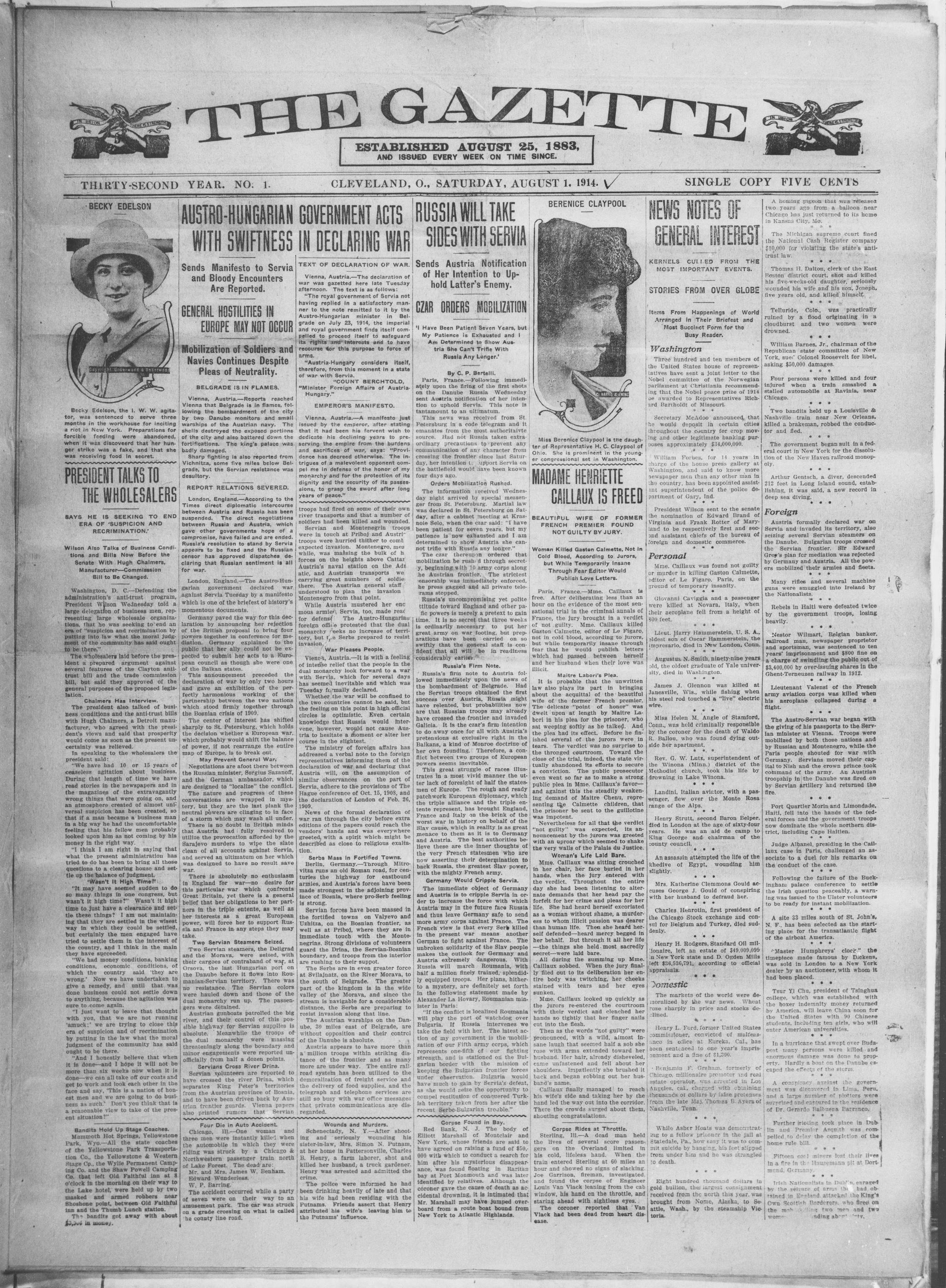
Page text (machine-generated)
THIRTY-SECOND YEAR. NO.
IN DETON
IN THE GREATNESS
BECKY EDELSON
Becky Edelson, the I. W. W. agitator, was sentenced to serve three months in the workhouse for inciting a riot in New York. Preparations for forcible feeding were abandoned, when it was discoverd that her hunger strike was a fake, and that she was receiving food in secret.
PRESIDENT TALKS TO THE WHOLESALERS
SAYS HE IS SEEKING TO END ERA OF 'SUSPICION AND RECRIMINATION.'
Wilson Also Talks of Business Conditions and Bills Now Before the Senate With Hugh Chalmers, Manufacturer—Commission Bill to Be Changed.
Washington, D. C.—Defending the administration's anti-trust program, President Wilson Wednesday told a large delegation of business men, representing large wholesale organizations, that he was seeking to end an era of "suspicion and recrimination by putting into law what the moral judgment of the community has said ought to be there."
The wholesalers laid before the president a prepared argument against several features of the Clayton antitrust bill and the trade commission bill, but said they approved of the general purposes of the proposed legislation.
Chalmers Has Interview.
The president also talked of business conditions and the anti-trust bills with Hugh Chalmers, a Detroit manufacturer, who agreed with the president's views and said that prosperity would come as soon as the present uncertainty was relieved.
In speaking to the wholesalers the president said:
"We have had 10 or 15 years of ceaseless agitation about business. During that length of time we have read stories in the newspapers and in the magazines of the extravagantly wrong things that were going on, and an atmosphere created of almost universal suspicion has been created, so that if a man became a business man in a big way he had the uncomfortable feeling that his fellow men probably looked upon him as not coming by his money in the right way.
"I think I am right in saying that what the present administration has tried to do has been to bring all those questions to a clearing house and settle up the balance of judgment.
"Wasn't it High Time?"
"It may have seemed sudden to do so many things in one congress, but wasn't it high time?". Wasn't it high time to just have a clearance and settle these things? I am not maintaining that they are settled in the wisest way in which they could be settled, but certainly the men engaged have tried to settle them in the interest of the country, and I think in the main they have succeeded.
"We had money conditions, banking conditions, economic conditions, of which the country said 'they are wrong'. Now we have undertaken to give a remedy, and until that was done business could not settle down to anything, because the agitation was sure to come again.
"I just want to leave that thought with you, that we are not running 'amuck,' we are trying to close this era of suspicion and of recrimination by putting in the law what the moral judgment of the community has said ought to be there.
"And I honestly believe that when it is done—and I hope it will not be more than six weeks now when it is done—we can all take off our coats and get to work and look each other in the face and say. 'This is a nation of honest men and we are going to do business as such.' Don't you think that is a reasonable view to take of the present situation?"
Bandita Wold Up Stage Coaches.
Mammoth Hot Springs, Yellowstone Park, Wyo.—All the state coaches of the Yellowstone Park Transportation Co., the Yellowstone & Western Stage Co., the Wylie Permanent Camping Co. and the Shaw Powell Camping Co. that left Old Faithful inn at 8 o'clock in the morning on their way to the Lake hotel, were held up by two masked and armed robbers near Shoshone point, between Old Faithful inn and the Thumb Lunch station.
The bandits got away with about $3,000 in money.
THE GAZETTE
AUSTRO-HUNGARIAN GOVERNMENT ACTS WITH SWIFTNESS IN DECLARING WAR
Sends Manifesto to Servia and Bloody Encounters Are Reported.
Mobilization of Soldiers and Navies Continues Despite Pleas of Neutrality.
BELGRADE IS IN FLAMES.
Vienna, Austria.—Reports reached Vienna that Belgrade is in flames, following the bombardment of the city by two Danube monitors and small warships of the Austrian navy. The shells destroyed the exposed portions of the city and also battered down the fortifications. The king's palace was badly damaged.
Sharp fighting is also reported from Vichitza, some five miles below Belgrade, but the Servian resistance was desultory.
REPORT RELATIONS SEVERED.
London, England.—According to the Times direct diplomatic intercourse between Austria and Russia has been suspended. The direct negotiations between Russia and Austria, which gave other governments hope of a compromise, have failed and are ended. Russia's resolution to stand by Servia appears to be fixed and the Russian censor has approved dispatches declaring that Russian sentiment is all for war.
London, England.—The Austro-Hungarian government declared war against Servia Tuesday by a manifesto which is one of the briefest of history's momentous documents.
Germany paved the way for this declaration by announcing her rejection of the British proposal to bring four powers together in conference for mediation. Germany explained to the public that her ally could not be expected to submit her acts to a European council as though she were one of the Balkan states.
This announcement preceded the declaration of war by only two hours and gave an exhibition of the perfectly harmonious working of the partnership between the two nations which stood firmly together through the Bosnian crisis of 1909.
The center of interest has shifted sharply to St. Petersburg, which holds the decision whether a European war, which probably would shift the balance of power, if not rearrange the entire map of Europe, is to break out.
May Prevent General Wary
Negotiations are afoot there between the Russian minister, Sergius Sazanoff, and the German ambassador, which are designed to "localize" the conflict.
The nature and progress of these conversations are wrapped in mystery, but they are the last plank the neutral powers are clinging to in face of a storm which may wash all under. There is no doubt in British minds that Austria had fully resolved to utilize the provocation afforded by the Sarajevo murders to wipe the slate clean of all accounts against Servia, and served an ultimatum on her which was designed to have no result save war.
There is absolutely no enthusiasm in England for war—no desire for this particular war which confronts Great Britain, yet there is a general belief that her obligations to her partners in the triple entente, as well as her interests as a great European power, will force her to support Russia and France in any steps they may take.
Two Servian Steamers Seized.
Two Servian steamers, the Deligrad and the Moraya, were seized, with their cargoes of contraband of war, at Orsova, the last Hungarian port on the Danube before it flows into Romanian-Servian territory. There was no resistance. The Servian colors were hauled down and those of the dual monarchy run up. The passengers were detained.
Austrian gunboats patrolled the big river, and their control of this possible highway for Servian supplies is absolute. Meanwhile the troops of the dual monarchy were massing threateningly along the boundary and minor engagements were reported unofficially from half a dozen points.
Servians Cross River Drina.
Servian volunteers are reported to have crossed the river Drina, which separates King Peter's territories from the Austrian province of Bosnia, and to have been driven back by Austrian frontier guards. Vienna papers also printed rumors that Servian
Four Die in Auto Accident.
Chicago, Ill.-One woman and three men were instantly killed when the automobile in which they were riding was struck by a Chicago & Northwestern passenger train north of Lake Forest. The dead are:
Mr. and Mrs. James W. Benham.
Edward Wunderless.
W. P. Barring.
The accident occurred while a party of seven were on their way to an amusement park. The car was struck on a grade crossing on what is called the county line road.
ESTABLISHED AUGUST 25, 1883 AND ISSUED EVERY WEEK ON TIME SINCE.
TEXT OF DECLARATION OF WAR.
Vienna, Austria.—The declaration of war was gazetted here late Tuesday afternoon. The text is as follows:
"The royal government of Servia not having replied in a satisfactory manner to the note remitted to it by the Austro-Hungarian minister in Belgrade on July 23, 1914, the imperial and royal government finds itself compelled to proceed itself to safeguard its rights and interests and to have recourse for this purpose to force of arms.
"Austria-Hungary considers itself, therefore, from this moment in a state of war with Servia.
"COUNT BERCHTOLD,
"Minister Foreign Affairs of Austria-Hungary."
EMPEROR'S MANIFESTO.
Vienna, Austria.—A manifesto just issued by the emperor, after stating that it had been his fervent wish to dedicate his declining years to preserving the empire from the burdens and sacrifices of war, says: "Providence has decreed otherwise. The intrigues of a malevolent opponent compel me in defense of the honor of my monarchy and for the protection of its dignity and the security of its passions, to grasp the sword after long years of peace."
troops had fired on some of their own river transports and that a number of soldiers had been killed and wounded.
Servian and Montenegrin troops were in touch at Priboj and Austri-troops were hurried thither to com-pected invasion. Montenegrin, mea while, was massing the bulk of h forces on the heights above Cattar Austria's naval station on the Adriatic, and Austrian transports we carrying great numbers of soldie there. The Austrian general staff undertook the invasion. Austri-mento from that point. While Austria must hered en-mous armies, Servia, too, made read for defense. The Austro-Hungarian foreign office protested that the dual monarchy noises no increase of territory, but t, e Serbs prepared to resist invasion.
War Pleases People.
Vienna, Austria.—It is with a feeling of interite relief that the people in the dual monarchy look forward to a war with Servia, which for several days has seemed inevitable and which was Tuesday formally declared.
Whether the war will be confined to the two countries cannot be said, but the feeling on this point in high official circles is optimistic. Even certain knowledge that Russia would intervene, however, would not cause Austria to hesitate a moment or alter her course in the slightest.
The ministry of foreign affairs has addressed a verbal note to the foreign representatives informing them of the declaration of war and declaring that Austria will, on the assumption of similar observances on the part of Servia, adhere to the provisions of The Hague conference of Oct. 15, 1908, and the declaration of London of Feb. 26, 1909.
News of the formal declaration of war ran through the city before extra editions of the papers could reach the vendors' hands and was everywhere greeted, with a spirit which might be described as close to religious exaltation.
Serbs Mass in Fortified Towns.
Berlin, Germany.—Through Mitrovita runs an old Roman road, for centuries the highway for eastbound armies, and Austria's forces have been made strongest in the adjoining province of Bosnia, where pro-Serb feeling is strong.
Servian forces have been massed in the fortified towns on Valyevo and Uzhitza, on the Bosnian frontier, as well as at Priboj, where they are in immediate touch with the Montenegrin. Strong divisions of volunteers guard the Drina, the Servian-Bosnian boundary, and troops from the interior are rushing to their support.
The Serbs are in even greater force at Svilajnatz, on the River Morava, to the south of Belgrade. The greater part of the kingdom is in the wide valley of the Morava, and since the stream is navigable for a considerable distance, the Serbs are preparing to resist invasion along that line.
The Austrian warships on the Danube, 30 miles east of Belgrade, are without opposition and their control of the Danube is absolute.
Austria appears to have more than a million troops within striking distance of the frontier and as many more are under way. The entire railroad system has been utilized to the demoralization of freight service and the delivery of food supplies, and the telegraph and telephone services are still so busy with war office messages that private communications are disregarded.
Wounds and Murders.
Schenectady, N. Y.-After shooting and seriously wounding his sister-in-law, Mrs. Simon N. Putnam, at her home in Pattersonville, Charles B. Henry, a farm laborer, shot and killed her husband, a truck gardener, Henry was arrested and admitted the crime.
The police were informed he had been drinking heavily of late and that his wife had been residing with the Putnams. Friends assert that Henry attributed his wife's leaving him to the Putnams' influence.
RUSSIA WILL TAKE SIDES WITH SERVIA
Sends Austria Notification of Her Intention to Uphold Latter's Enemy.
CZAR ORDERS MOBILIZATION
'I Have Been Patient Seven years, but My Patience Is Exhausted and I Am Determined to Show Austria She Can't Trifle With Russia Any Longer.'
By C. P. Bertelli.
Paris, France.—Following immediately upon the firing of the first shots on the Danube Russia Wednesday sent Austria notification of her intention to uphold Servia. This note is tantamount to an ultimatum.
This news was received from St. Petersburg in a code telegram and it emanates from the most authoritative source. Had not Russia taken extraordinary precautions to prevent any communication of any character from crossing the frontier since last Saturday, her intention to support Servia on the battlefield would have been known four days ago.
Orders Mobilization Rushed.
The information received Wednesday night arrived by special messenger from St. Petersburg. Martial law was declared in St. Petersburg on Saturday, after a cabinet meeting at Krasnole Selo, when the czar said: "I have been patient for seven years, but my patience is now exhausted and I am determined to show Austria she cannot trifle with Russia any longer." The czar thereupon ordered that mobilization be pushed through secretly, beginning with 10 army corps along the Austrian frontier. The strictest censorship was immediately enforced, the press gagged and all private telegrams stopped. Russia's uncompromising yet polite attitude toward England and other pacific powers is merely a pretext to gain time. It is no secret that three weeks is ordinarily necessary to put her great army on war footing, but preparations have been carried on so swiftly that the general staff is confident that all will be in readiness considerably earlier.
Russia's Firm Note.
Russia's firm note to Austria followed immediately upon the news of the bombardment of Belgrade. Had the Servian troops obtained the first success over Austria, Russia might have relented, but probabilities now are that Russian troops may already have crossed the frontier and invaded Galicia. It is the czar's firm intention to do away once for all with Austria's pretensions at exclusive right in the Balkans, a kind of Monroe doctrine of her own founding. Therefore, a conflict between two groups of European powers seems inevitable.
This great struggle of races illustrates in a most vivid manner the utter lack of foresight of half the statesmen of Europe. The rough and ready patchwork European diplomacy, which the triple alliance and the triple entire represent, has brought England, France and Italy on the brink of the worst war in history on behalf of the Slav cause, which in reality is as great menace to them as it is to Germany and Austria. The best authorities believe these are the inner thoughts of the very French statesmen who are now asserting their determination to back Russia, the greatest Slav power, with the mighty French army.
Germany Would Cripple Servia.
The immediate object of Germany and Austria is to cripple Servia in order to increase the force with which Austria may in the future face Russia and thus leave Germany safe to send more army corps against France. The French view is that every Serb killed in the present war means another German to fight against France. The unbroken solidarity of the Slav people makes the outlook for Germany and Austria extremely dangerous, with Russia will march Roumania, with half a million finely trained, splendidly equipped troops. Her plans, hitherto to a mystery, are definitely set forth in the following statement made by Alexander La Hovay, Roumanian minister in Paris: If the connet is localized Roumania will play the part of watchdog over Bulgaria. If Russia intervenes we take the field with her. The latest action of my government is the mobilization of our Fifth army corps, which represents one-fifth of our fighting strength, and is stationed on the Bulgarian border with the mission of keeping the Bulgarian frontier forces under observation. Bulgaria would have much to gain by Servia's defeat, as she would seize the opportunity to compel restitution of conquered Turkish territory taken from her after the recent Serbo-Bulgarian trouble."
Cornea Found in Bay
Uprise Park
Red Bank, N.J. The body of Elliott McMallon of Montclair and New York, whose friends are said to have agreed on raising a fund of $50,000 with which to conduct a search for him after his mysterious disappearance, was found floating in Raritan bay at Port Montmouth and was later identified by relatives. Although the coroner gave the cause of death as accidental drowning, it is intimated that Mr. Marshall may have jumped overboard from a route boat bound from New York to Atlantic Highlands.
BERENICE CLAYPOOL
Miss Berenice Claypool is the daughter of Representative H. C. Claypool of Ohio. She is prominent in the younger congressional set in Washington.
MADAME HENRIETTE
CAILLAUX IS FREED
BEAUTIFUL WIFE OF FORERI
FRENCH PREMIER FOUND
NOT GUILTY BY JURY.
Woman Glausted Gaston Calmette, Not in
Cold Blood, According to Jurors,
but While Temporarily Insane
Through Fear Editor Would
Publish Love Letters.
Paris, France—Mme, Caillaux la
free. After deliberating less than an
hour on the evidence of the most sensational trial in the criminal annals of
France, the jury brought in a verdict
of not guilty. Mme Caillaux killed
Gaston Calmette, editor of Le Figaro,
not cold blood, according to jurors,
but while temporarily insane through
fear that he would publish letters
which had passed between herself
and her husband when their love was
illicit.
Maitre Labori's Plea.
Maitre Labori Plea.
It is probable that the unwritten law also plays its part in bringing about the acquittal of the beautiful wife of the former French premier. The delicate "point of honor" was dwell upon at length by Maitre Labori in his plea for the prisoner, who sat weeping softly as he talked. And the plea had its effect. Before he finished several of the jurors were in tears. The verdict was no surprise to the thronged courtroom. Toward the close of the trial, indeed, the state virtually abandoned its efforts to secure a conviction. The public prosecutor even went so far as to make a strong public plea in Mme. Caillau's favor—and against this the steadily weakening demand of Maitre Chenu, representing the Calmette children, that the prisoner be sent to the gullotine was impotent.
Nevertheless for all that the verdict "not guilty" was expected, its announcement by the jurors was greeted with an uprora which seemed to shake the very walls of the Palais du Justice.
Woman's Life Lair Bare.
Mme. Callaux was sitting crouched in her chair, her face buried in her hands, when the jury entered with the verdict. Throughout the afternoon he looked listening to alternative demands that her head pay the forfeit for her crime and pleas for her life. She had heard herself excoriated as a woman without shame, a murderess to whom illicit passion was dearer than human life. Then she heard herself defended—he mercy begged in her behalf. But through it all her life—the things she held, most sacredly secret—were laid bare.
All during the summing up Mme. Callaux sobbed. When the jury finally filed out to its deliberation the entire body was twitching, the cheeks stained with tears and her eyes sunken.
Mme. Callaux looked up quickly as the jurors re-entered the courtroom with their verdict and clenched her hands so tightly that her finger nails cut into the flesh.
Then as the words "not guilty" were pronounced, with a wild, almost insane laugh that seemed half a sob she rose with arms extended toward her husband. Her hair, already disheveled, came unfasted and fell about her shoulders. Impatiently she brushed it back and began sobbing out her husband's name.
Callaux finally managed to reach his wife's side and taking her by the hand led the way out into the corridor. There the crowds surged about them, shouting congratulations.
Corpse Bides at Throttle
Sterling, III.—A dead man held the lives of several score passengers on the Overland limited in his cold, lifeless hand. When the train entered Sterling at 60 miles an hour and showed no signs of slacking, Joe Garrison, fireman, investigated, and found the corpse of Engineer Louis Van Vlack leaning from the cab window, his hand on the throttle, and staring ahead with sightless eyes. The coroner reported that Van Vlack had been dead from heart disease.
SINGLE COPY FIVE CENTS
NEWS NOTES OF GENERAL INTEREST
KERNELS CULLED FROM THE
MOST IMPORTANT EVENTS.
Items From Happenings of World Arranged in Their Briefest and Most Succinct Form for the Busy Reader.
Washington
Three hundred and ten members of the United States house of representatives have sent a joint letter to the Nobel committee of the Norwegian parliament at Christiaна recommending that the Nobel peace prize of 1914 be awarded to Representatives Richard Barthelmott of Missouri.
Secretary McAdoo announced that he would deposit in certain cities throughout the country for crop moving and other legitimate banking purposes approximately $14,000,000.
William Forbes, for 14 years in charge of the house press gallery at Washington, and said to know more newspaper man than any other man in the country, has been appointed assistant superintendent of the police department of Gary, Ind.
President Wilson sent to the senate the nomination of Edward Brand of Virginia and Frank Rotter of Maryland to be respectively first and second assistant chiefs of the bureau of foreign and domestic commerce.
Personal
Mine, Caillaua was found not guilty or murder in killing Gaston Calmette, editor of Le Figaro, Paris, on the ground of temporary insanity.
Glovanni Caviggia and a passenger were killed at Novara, Italy, when their aeroplane fell from a height of 800 feet.
Lieut. Harry Hammerman, U. S. A., oldest son of Oscar Hammerman, the impresario, died in New London, Conn.
Augustus N. Smith, ninety-nine years old, the oldest graduate of Yale university, died in Washington.
James J. Glennon was killed at Janesville, Wis., while fishing when his steel rod touched a "live" electric wire.
Miss Helen M. Angle of Stamford, Conn., was held criminally responsible by the coroner for the death of Waldo R. Ballou, who was found dying outside her apartment.
Rev. G. W. Lutz, superintendent of the Winona (Minn.) district of the Methodist church, took his life by drowning in Lake Winona.
Landini, Italian aviator, with a passenger, flew over the Monte Rosa range of the Alps.
Henry Strutt, second Baron Helper, died in London at the age of sixty-four years. He was an aid de camp to King George and chairman of the county council.
An assassin attempted the life of the khedive of Egypt, wounding him slightly.
Mrs. Katherine Clemmons Gould accuses George J. Gould of conspiring with her husband to detraud her.
Charles Henrotin, first president of the Chicago Stock exchange and consul for Belgium and Turkey, died suddenly.
Henry H. Rodgers, Standard Oil millionaire, left an estate of $49,009,099 in New York state and D. Ogden Mills left $36,536,791, according to official appraisals.
Domestic
The markets of the world were demineralized by the war news. Wheat rose sharply in price and stocks declined.
Henry L. Ford, former United States commissioner, convicted of malfeasance in office at Eureka, Cal., has been sentenced to one year's imprisonment and a fine of $1,200.
Benjamin F. Graham, formerly of Chicago, millionaire promoter and real estate operator, was arrested in Los Angeles, cal., charged with obtaining thousands of dollars by false pretenses from the late Maj. Thomas B. Ayers of Nashville, Tenn.
While Asher Hoats was demonstrating to a fellow prisoner in the jail at Statedale, Pa., how easy it was to commit suicide by hanging, his feet slipped from under him and he was strangled to death.
Eight hundred thousand dollars in gold bullion, the largest consignment received from the north this year, was brought from Nome, Alaska, to Seattle, Wash., by the steamship Victoria.
IN UNION
THE GREATEST GREATNESS
A homing pigeon that was released two years ago from a balloon near Chicago has just returned to its home in Kansas City, Mo.
The Michigan supreme court fined the National Cash Register company $10,000 for violating the state's ant-trust law.
Thomas H. Dalton, clerk of the East Boston district court, shot and killed his five-weeks-old daughter, seriously wounded his wife and his son, Joseph, five years old, and killed himself.
Telluride, Colo., was practically ruined by a flood originating in a cloudburst and two women were drowned.
William Barnes, Jr., chairman of the Republican state committee of New York, sued Colonel Roosevelt for libel, asking $50,000 damages.
Four persons were killed and four injured when a train smashed a stalled automobile at Ravinia, near Chicago.
Two bandits held up a Louisville & Nashville train near New Orleans, killed a brakeman, robbed the conductor and fled.
The government began suit in a federal court in New York for the dissolution of the New Haven railroad monopoly.
Arthur Gentsch, a diver, descended 212 feet in Long Island sound, establishing, it was said, a new record in deep sea diving.
**Foreign**
Austria formally declared war on Servia and invaded its territory, also seizing several Servian steamers on the Danube. Bulgarian troops crossed the Servian frontier. Sir Edward Greg's plan for mediation was rejected by Germany and Austria. All the powers mobilized their armies and fleets.
1
Many rifles and several machine guns were smuggled into Ireland by the Nationalists.
Rebels in Haiti were defeated twice by the government troops, losing heavily.
Nestor Wilmart, Belgian banker, railroad man, newspaper proprietor and sportsman, was sentenced to ten years' imprisonment and $800 fine on a charge of swindling the public out of $3,400,000 by over-issuing shares in the Ghent-Terneuzen railway in 1912.
Lieutenant Valensi of the French army aviation corps was killed when his aeroplane collapsed during a flight.
The Austro-Servian war began with the giving of his passports to the Servian minister at Vienna. Troops were mobilized by both those nations and by Russian and Montenegro, while the Paris people shouted for war with Germany. Servians moved their capital to Nish and the crown prince took command of the army. An Austrian troopship in the Danube was fired on by Servian artillery and returned the fire.
Port Quartier Morin and Limondade, Haiti, fell into the hands of the federal forces and the government troops now dominate the northern district, including Cape Haitien.
Judge Albanel, presiding in the Cailaux case in Paris, challenged an associate to a duel for his remarks on the conduct of the case.
Following the failure of the Buckingham palace conference to settle the Irish question peaceably, a warning was issued to the Ulster volunteers to be ready for instant mobilization.
A site 33 miles south of St. John's, N. F., has been selected as the starting place for the transatlantic flight of the airboat America.
"Master Humphreys' clock" the timepiece made famous by Dickens, was sold in London to a New York dealer by an auctioneer, with whom it had been placed.
Tsur Yi Chu, president of Tsinghua college, which was established with the boxer indemnity money returned by America, will leave China soon for the United States with 90 Chinese students, including ten girls, who will enter American universities.
一
In a hurricane that swept over Budapest many persons were killed, and enormous damage was done to property. Hardly a boat on the Panube escaped the effects of the storm.
A conspiracy against the government was discovered in Lima, Pern, and a large number of plotters were surprised and captured in the residence of Dr. Gernardo Baluera Barranco.
Further rioting took place in Dublin and Premier Asquith was compelled to delay the completion of the home rule bill.
Fifteen cool miners lost their lives in a fire in the Hausmuster pit at Dortmund, Germany.
Irish Nationalists in Dublin'en enraged by the seizure of arms of the had obtained in England, attacked the King's Own Scottish Borderers, who fired on the mob killing two men and two women, ending about city.
One Year.....$1.50.
Six Months.....1.00
Three Months......50
Subscribers are requested to remit by postoffice money or order or registered letter
Entered at the postoffice in Cleveland
Ohio, as second-class matter.
Address all communications to
Blackstone Building, Cleveland, O.
Member Ohio Legislature: 1894
to 1896; 1896 to 1898; 1900 to 1902
THE GAZETTE is the oldest, and
has the largest bona fide circulation,
double that of any newspaper in the
interest of Afro-Americans, published
in the state of Ohio, and comparison
with any will immediately establish
its rank as one of the NEWSIEST
AND BEST in the country.
10,080,000 Afro-Americans..
160,000 in Ohio.
20,000 in Cleveland.
Cleveland
SATURDAY, AUGUST 1, 1914.
Early last year, there was hardly a
member of the race in this city that
did not fully realize the need of a
member of the Ohio Legislature. Have
we forgotten so soon?
Why is it that our men and women of Cleveland are apparently unconcerned as to the nomination of a member of the race, on August 11, as a candidate for the Legislature? Wake up and get active, now!—before it is too late. It is not going to be an easy thing to get what we really want and need, this time.
THEY BREED PREJUDICE, IN THE NORTH.
"Jimcrowism" in Chicago, started by its Y. M. C. A., "exclusively for Negroes," which was opened some months ago and dedicated about a month ago, continues to spread, just as The Gazette predicted when the unfortunate movement was launched. Now, anything may be expected, it seems, in that city and vicinity, as a result. The "jimcrow" Christian (?) association is a dangerous breeder of prejudice wherever it is found, here in the North. Evanston is a city of 40,000, contiguous to Chicago. Read the following, from a recent issue of a Chicago daily paper—it shows that the effort to force separate schools on our people of that city, that began just as soon as the "jimcrow" Y. M. C. A. was assured, is not the latter's only benevolent effect; to date:
"The banquet of postal clerks in Evanston in honor of the new post master, George Taylor, was preceded yesterday with a bit of dispute over the advisability of recognizing or ignoring the color-line. After a protest from seven Negroes in the organization had been met by a refusal of the committee of arrangements to alter its plans, the Negroes refused to attend. For them exclusively at the Avenue house was unoccupied last night. About 100 clerks of the Evanston post-office attended the banquet."
All honor to those seven "Negroes," none of whom we hope are identified with Chicago's prejudice-breeder—"Negro Y. M. C. A." We shall never forget the demand (made in the daily papers of Chicago soon after it was announced that the money for the "Jimcrow" Y. M. C. A. had been raised as the result of "a great rally") that, "now, since Chicago Negroes have secured a Y. M. C. A. why not give them separate schools?" This question was put to the Chicago public by a public school teacher (white). And there are a number of colored teachers in that city, too. Even this, did not open the eyes of many of our people of Chicago to what was coming and soon, as a result of establishing a prejudice breeder in the shape of their "Jimcrow" Y. M. C. A. Will our people here in the North ever learn the less son being taught many of them in Chicago and its suburban cities and towns, like Evanston, and the place nearer to the "Windy City" where, immediately after "the great (jimcrow) Y. M. C. A. rally," aristocratic residents organized and began a movement, for "jimcrow" schools in that great city, whilst at times has been aggressive enough to compel Chicago Afro-Americans to appeal to the Mayor, and if memory serves us correctly, even to the Governor of Illinois, for help in their effort to preserve the present status of the public schools there, at least so far as it concerns our people. And if it had not been for that broad-minded and splendid woman superintendent of Chicago's schools, the Lord only knows what the condition would have been by this time.
FORAKER, COLE AND HARDING.
When Senator Foraker was fighting the battle, for "The Black Battalion" and the race, that cost him his seat in the U. S. Senate, his opponents, our former colleagues in the Ohio Legislature, the Hon. Ralph D. Cole, was in Congress, and the Hon. Warren G. Harding, was editing the Marlor Star. Did either, or both of them, ever do or say anything in behalf of "The Black Battalion," or any of our people in Ohio or anywhere else, at that time or any other, that was heard as a whisper in this state or out of it? We have been here, "on the firing line" for the race, for the past thirty-one years, every week, and want to know because we do not even remember ever hearing the whisper.
It would be ingratitude, amounting almost to a crime, for a member of the race in this state to fail to vote at the primaries on August 11, and for Senator Foraker. As far as we are
concerned there is only one candidate for the nomination for U. S. Senator in Ohio, these days. Let us be MEN—work hard from now until the primaries for the Senator, and then walk to the polls on August 11 and do our DUTY! Be as loyal to him as he has always been to us; especially when fighting that great and long-drawn-out battle for our "soldier-boys in blue." Let our ministers and newspapers throughout the state "tell the story" to our people daily, including Sunday, from now until August 11. We owe it to him brethren of the pulpit and the press.
REPRESENTATION IN THE LEGIS LATURE.
There is an opportunity for our people of Cleveland to have a member of the next Legislature. It will come on August 11; but they have certainly got to work hard from now until that time if they would take advantage of the opportunity. Last year we, all, felt the need, and sorely too, of such representation — when that vicious anti-intermarriage bill of Reppart's was pending and about to pass. It would have made our girls the helpless victims of any white scoundrel that could, by any means, take advantage of them, and there would have been no redress in the courts for us, either, if the miserable bill had become a law. Don't you think that you had better wake up, brother, and take an exceptional interest in the coming primaries, and work hard for the representation we refer to? Better begin now! This is a matter of sufficient importance for our local clergy to bring to the attention of their various congregations, immediately. Sound the note of warning and do not longer let our people "sleep on their rights."
OUR THIRTY-SECOND YEAR.
With this issue, The Gazette enters upon its thirty-second year, having been published every week on time since August 25, 1883. A remarkable record for any publication! It will be noticed that in thirty-one years, we have gained in time almost a month. From the very beginning, it has been edited and managed by the writer who can hardly realize that so long a time "in the saddle," has elapsed. The Gazett's successful efforts to wipe out the remnants of Ohio's "Blue Laws," years ago, secure the enactment of Ohio's Civil Rights and Anti-Lynch laws, are well-known to our people, particularly those here in Ohio. What it has done, in hundreds of instances, to help, defend and encourage our people, is also well known. One has only to recall the successful fight, led by The Gazette early last year, to kill the Ohio Assembly's anti-intermarriage bill, to appreciate the full force of the preceding sentence. Personal interests have always been subordinated in The Gazette to those of our people. Its call to Afro-Americans, in season, and is never to accept anything in treatment, less than that due all citizens, without reference to class or color. When it comes to our citizen rights, here in the North, we always been unalterably opposed to a "doctrine of surrender" or corollary policy, and shall continue to be so. The Gazette believes in demanding for our people, in this section of the country, and continuing to fight for until secured, ALL that is due all American citizens under the law. THIS IS OUR SLOGAN! The Gazette's firm adherence to principle, through all these years, is its best recommendation for greater support. The lack of sufficient patronage is the only thing that has prevented the doubling of the size of this paper and making other improvements we have greatly desired for years. Here is where our faithful following, thousands of readers in all parts of the country, from ocean to ocean, and from the great lakes to the gulf, can afford us material assistance, if they will. Urge your friends and acquaintances to subscribe for The Gazette and by the first of the year double our circulation. For all you have done in past years, we thank you and assure you of our thorough appreciation.
HARRY C. SMITH.
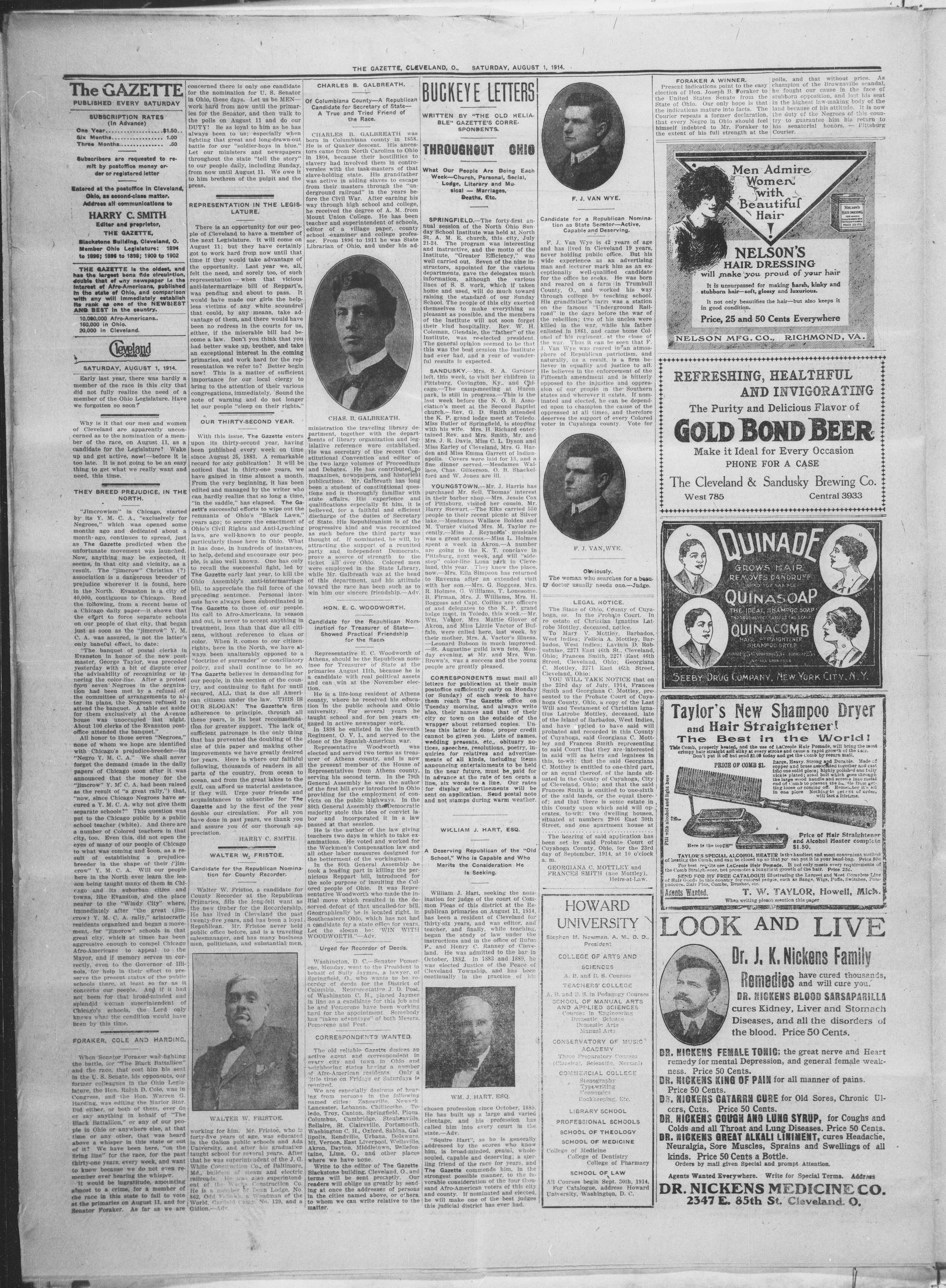
WALTER W. FRISTOE.
Candidate for the Republican Nomination for County Recorder.
Walter W. Fristoe, a candidate for County Recorder at the Republican Primaries, fills the long-felt want as the new timber for the Recordership. He has lived in Cleveland the past twenty-five years, and has been a loyal Republican. He fristoe never held public office before he is a traveling salesman, and has many business men, politicians, and substantial men.
WALTER W. FRISTOE.
working for him. Mr. Frifotet, who is forty-five years of age, was educated in the Galion public schools and Ada University, and after his graduation taught school for several years. After that he was superintendent of the J. G. White Construction Co., of Baltimore, Md., builders of steam and electric railroads. He was also superintendent of the Wash's Construction Co. He is a member of Donn Lodge, No. 882, Odd Fellows, a Woodman of the World, Gardel camp. No. 129, and a Glidden - Ady.
THE GAZETTE, CLEVELAND, O., SATURDAY, AUGUST 1, 1914.
Of Columbiaiana County—A Republican Candidate for Secretary of State—A True and Tried Friend of the Race.
CHARLES B. GALBREATH was born in Columbiaiana county in 1888. He is of Quaker descent. His ancestors came from North Carolina to Ohio in 1894, because their hostilities to slavery had involved them in controversies with the task-masters of that slave-holding state. His grandfather was active in aiding slaves to escape from their masters through the "underground railroad" in the years before the Civil War. After earning his way through high school and college, he received the degree of A. M. from Mount Union College. He had been teacher and superintendent of schools, school of law, the paper, county school-examiner and college professor. From 1896 to 1911 he was State Librarian of Ohio, and under his ad
CHAS. B. GALBREATH.
ministration the traveling library department, together with the departments of library organization and legislative reference were established. He was secretary of the recent Constitutional Convention and editor of the two large volumes of Proceedings of the Convention, magazines, newspapers, and historical publications. Mr. Galbread has long been a student of constitutional questions and is thoroughly familiar with state affairs. His experience and qualifications especially fit him. It is believed, for a faithful reader, that Mr. Galbread is Secretary of State. His Republicism is of the progressive kind and was recognized as such before the third party was thought of. If nominated, he will, by attracting the support of a reunited party and independent Democrats, prove a sense of strength and the man he were employed in the State Library, while Mr. Galbread was at the head of this department, and his attitude toward the race has been such as to win him our sincere friendship.—Adv.
HON. E. C. WOODWORTH.
Candidate for the Republican Nomination for Treasurer of State—Showed Practical Friendship for the Race
Representative E. C. C. Woodworth of Athens, should be the Republican nominee for Treasurer of State at the primaries August 11th, because he is a candidate with real political assets and can win at the November election.
He is a life-long resident of Athens county, where he received his education in the public schools and Ohio university, and for ten years he taught school and, for ten years engaged in active newspaper work.
In 1898 he enlisted in the Seventh Regiment, O. V. L, and served to the close of the Spanish-American war.
Representative Woodworth was elected and served two terms as treasurer of Athens county, and is now the present member of the House of Representatives from Athens county, serving his second term. In the 79th General Assembly he was the author of the first even one of the proposed Ohio laws for the employment of convicts on the public highways. In the 80th General Assembly the Democratic majority stole this idea of convict labor and incorporated it in a law passed at that session.
He is the author of the law giving teachers two days in which to take examinations. He voted and worked for the Workman's Compensation law and the House of Representatives for the betterment of the workman.
In the 80th General Assembly he took a leading part in killing the pernicious Reppart bill, introduced for the sole purpose of insulting the Colored people of Ohio. It was Representative Woodworth who made the initial move which resulted in the deserved death of bill for which he is located right, in Southeastern Ohio, which has not had a candidate for a state office for years. Let the slogan be: 'WIN WITH WOODWORTH.'—Adv.
Urged for Recorder of Deeds.
Washington, D. C.-Senator Pomerene, Monday, went to the President in behalf of Sully Jaymes, a lawyer, of Springfield, O., who wants to be recorder of deeds for the District of Columbia. Representative J. D. Post, of Washington C. H., placed Jaymes in line as a candidate for this job and he and Pomerene have been working hard for the appointment. Somebody has "taken advantage" of both Messrs. Pomerene and Post.
CORRESPONDENTS WANTED.
The old reliable Gazette desires an active agent and correspondent in every city and town in Ohio and neighboring states having a number of Afro-American residents. Only a little time on Fridays or Saturdays is required, especially destroys of hearing from persons in the following named cities: Zanesville, Newark Lancaster, Lebanon, Chillicothe, Toledo, Troy, Canton, Springfield, Pluana, Columbus, Cambridge, Steubenville, Bellaire, St. Clairsville, Portsmouth, Washington C. H., Oxford, Sabina, Gallipolis, Rendville, Urbana, Delaware, Akron, Dayton, Middletown, Bellefontaine, Lime, O., and other places where we have none.
Write to the editor of The Gazette Blackstone building, Cleveland, O, and terms will be sent promptly. Our readers will oblige us greatly by sending at once the addresses of persons in the cities named above, or others, to whom we can write relative to the matter.
BUGKEYE LETTERS
WRITTEN BY "THE OLD RELIABLE" GAZETTE'S CORRESPONDENTS.
What Our People Are Doing Each Week—Church, Personal, Social, Lodge, Literary and Musical — Marriages, Deaths, Etc.
SPRINGFIELD.—The forty-first annual session of the North Ohio Sunday School Institute was held at North St. A. M. E. church, this city, July 21-24. The program was interesting and instructive, and the motto of the Institute, "Greater Efficiency," was well carried out. Seven of the nine instructors, appointed for the various departments, gave the delegates much information, although the various lines of S. S. work, which if taken home and used, will do much toward raising the standard of our Sunday School. The people of this city exerted themselves to make everything as it was meant, and the members of the Institute who were soon forget their kind hospitality. Rev W. H. Coleman, Glendale, the "father" of the Institute, was re-elected president. The general opinion seemed to be that this was the best session the Institute had ever had, and a year of wonderful results is expected.
SANDUSKY—Mrs. S. A. Gardner left, this week, to visit her children in Pittsburgh, Covington, Ky., and Chicago—The camp-meeting at Huron park, is still in progress.—This is the last week before the N. O. B. Association's meet at the D. Second Baptist church—Rev. G. D. Smith attended the K. P. grand lodge meet at Toledo, Miss Butler of Springfield, is stopping with his wife, Mrs. H. Richard enterer, and Mrs. Smith, Mr. and Mrs. J. R. Dawson, Miss Earley of Cleveland, Mrs. G. Harnd and Miss Emma Garrett of Indianapolis. Covers were laid for 18, and a fine dinner served—Mesdames Wallace, Chas. Gilkerson, O. B. Shackelford and W. Jones are卧.
YOUNGSTOWN—Mr. J. Harris has purchased Mr. Sell. Thomas' interest in their barber shop—Mrs. Jessie Cox of Pittsburgh, visited her cousin, Mr. Harry Stewart—The Elks carried 550 people to their recent picnic at Silver lake—Mesdames Wallace Bolden and M. Turner visited Mrs. M. Taylor recently—Miss J. Reynolds' musicale was a great success—Miss L. Holmes spent a week in Akron—A number are going to the K. T. conclave in New York this week "will step" color-line Luna park in Cleveland, this year. They know the place, now—Mrs. Ella Simpson has returned to Ravenna after an extended visit with her sons—Mrs. G. Boggess, Mrs. R. Holmes, G. Williams, T. Lonesome, B. Firman, Mrs. J. Williams, Mrs. H. Boggess and Capt. Collins are officers of and delegates to the K. P. grand lodge meet, in Toledo, this week—Mr. Wm. Vactor, Mrs. Mattle Glover of Akron, and Miss Lizzie Vactor of Buffalo, were called here, last week, by their mother, Mrs. A. Vactor, and their uncle, Mrs. Amine Inrowe—St. Augustine guild lawn fete, Monday evening, at Mr. and Mrs. Wm. Brown's, was a success and the young people are greatly pleased.
CORRESPONDENTS must mail all letters for publication at their main postoffice sufficiently early on Monday (or Sunday) of each week to have them reach The Gazette office on Tuesday morning, and always write also, their names and that of their relatives, and send a wrapped wrapper about returned copies. Unless this latter is done, proper credit cannot be given you. Lists of names, wedding presents, etc., obituary notices, speeches, resolutions, poetry, inquiries for relatives and advertisements of all kinds, including items announcing entertainments to be held in the near future, must be paid for by the postmaster. On line six words to a line. Our rates for display advertisements will be sent on application. Send postal note and not stamps during warm weather.
WILLIAM J. HART, ESQ
A Deserving Republican of the "Old School," Who is Capable and Who Merits the Consideration He Is Seeking.
William J. Hart, seeking the nomination for judge of the court of Common Pleas of this district at the Republican primaries on August 11, 1914, has been a resident of Cleveland for thirty-six years, and was editor, and teacher, and finally, while teaching, began the study of law under the instructions and in the office of Rufus P., and Henry C. Ranney of Cleveland, he was asked to the bar in October, 1882. In 1883 and 1889, he was elected Justice of the Peace of Cleveland Township, and has been continually in the practice of his
WM. J. HART, ESQ.
chosen profession since October, 1885.
He has built up a large and varied
clientage, and his profession has
called him into every court in the
state—Ady.
"Squire Hart", as he is generally addressed by the scores who know him, is broad-minded, genial, wholesouled, capable and deserving; a staring friend of the race for years, and The Gazette commends him, in the strongest possible manner, to the favorable consideration of the four thousand Afro-American voters of this city and county. If nominated and elected, he will make one of the best judges this judicial district has ever had.
F. J. VAN WYE.
Candidate for a Republican Nomination as State Senator—Active, Capable and Deserving.
F. J. Van Wye is 42 years of age and has lived in Cleveland 19 years, never holding public office. But his wide experience as an advertising man and lecturer mark him as an exceptionally well-qualified candidate for the office he seeks. He was born and reared on a farm in Trumbull County, O. and worked his way through college by teaching school. His grandfather's farm was a station on the famous "Underground Railroad" in the days before the war of the rebellion; two of his uncles were enlisted in 1861, and came home Colonel of his regiment, at the close of the war. Thus it can be seen that F. J. Van Wye was reared in an atmosphere of Republican patriotism, and naturally, as a result, is a firm believer in equality and justice to all. He believes in the enforcement of the Fifteenth amendment and is bitterly opposed to the injustice and oppression of our people in the Southern states and wherever it exists. I nominated and elected, he can be trusted, and I oppose the oppressed at all times, and therefore deserves the support of every Colored voter in Cuyahoga county. Vote for
P. M.
*widely*. The woman usually nurses for a beau-
dy doctor usually needs one—judge.
The State of Ohio, County of Cuyahoga, es. In the Probate Court. In re estate of Christian Ignatius Latrobe Mottley, deceased, notice. To Mary V. Mottley, Barbados, West Indies; Felicia A. Mottley, Barbados, West Indies; Lavinia D. Robustiae, 217 East 46th St. Cleveland, Ohio; Frances Smith, 227 East 46th Street, Cleveland, Ohio; Georgiana C. Mottley, 227 East 46th Street, Cleveland, Ohio;
YOU WILL TAKE NOTICE that on the 23rd day of July, 1914, Frances Smith and Georgiana C. Mottley, presented to the Probate Court of Cuyahoga County, Ohio, a copy of the Last Will and Testament of Christian Ignatius C. Mottley, a member of the island of Barbados, West Indies, and have applied to have said will probated and recorded in this County of Cuyahoga, said Georgiana C. Mottley and Frances Smith representing to said Court that they are interested in said will as heirs and legates in this, to-wit; that the said Georgiana C. Mottley is entitled to one-third part, or an equal thereof, of the lands situated in this county of Cleveland, Ohio; and that the said Frances Smith is entitled to one-sixth of the said lands, or the equal thereof; and that there is some estate in this County upon which said will operates, to-wit: two dwelling houses, situated at numbers 2946 East 30th Street, and one apartment house at
The hearing of said application has been set by said Probate Court of Cuyahoga County, Ohio, for the 23rd day of September, 1914, at 10 o'clock a.m.
GEORGIANA C. MOTTLEY and FRANCES SMITH (nee Mottley).
Heirs-at-Law.
HOWARD
UNIVERSITY
Stephen M. Newman, A. M. D. D.
President
COLLEGE OF ARTS AND
SCIENCES
A. B. and D. S. Courses
TEACHERS' COLLEGE
A. B. and D. S. in Pedagogy Courses
SCHOOL OF MANUAL ARTS
AND APPLIED SCIENCES
Courses in Engineering
Domestic Science
Domestic Arts
Manual Arts
CONSERVATORY OF MUSIC
ACADEMY
Three Preparatory Courses
(Classical, Scientific, Normal)
COMMERCIAL COLLEGE
Stemography
Typewriting
Economics
Dockkeeping, Etc.
LIBRARY SCHOOL
PROFESSIONAL SCHOOLS
SCHOOL OF THEOLOGY
SCHOOL OF MEDICINE
College of Medicine
College of Dentistry
College of Pharmacy
SCHOOL OF LAW
All Courses begin Sept. 30th, 1914.
For Catalogue, address Howard
University, Washington, D. C.
FORAKER A WINNER
Present election winner of the easy election, Joseph B. Foraker to the United States Senate from the State of Ohio. Our only hope is that the indications mature into facts. The Courier repeats a former declaration, that every Negro in Ohio was a slave. Foraker to the extent of his full strength at the
Men Admire Women with Beautiful Hair!
NELSON'S HAIR DRESSING
Make you proud of your hair
ourpassed for making harah, kinky and hair—soft, glossy and luxurious.
Only beautifies the hair—but also keeps it condition.
5 and 50 Cents Everywhere
HING, HEALTHFUL AND INVIGORATING
City and Delicious Flavor of
BOND BEER
It Ideal for Every Occasion
PHONE FOR A CASE
Band & Sandusky Brewing Co.
Central 3933
QUINADE
GROWS HAIR
RE MOVES DANDRUFF
BAND FOR HAIR BEAUTY
QUINASOAP
THE IDEAL SHAMPOO SOAP
THROUGH HANDS CHANGES THE SKIN
QUINACOMB
HAIR STRAIGHTENER
SHAMPOO DRYER
INCREASES 25% WATER 30% PRESERVES 25%
JAN 31, 2015
COMPANY, NEW YORK CITY, N.Y.
New Shampoo Dryer
Hair Straightener!
Best in the World!
Used, and the use of LaCreole Hair Pomade, will bring the most radial set every stroke and cause a rapid growth of the hair.
But send $1.00 today and get the comb by return mail.
O OF OOMB $1.
Large, Heavy, Strong and Durable. Made of copper and brass associated together and east London world place. Mighty polished and tally nickle plated, steel bolt which goes through the large wood handle and screws into metal end of comb to prevent the hair from getting lodged on one end of the comb. It all in one piece. Nothing to get out of order, will last a lifetime.
Price of Hair Straightener and Alcohol Haster complete $1.50.
ALCOHOL HEATER is the handiest and most convenient method to be closed up so that you can put it in your head-bag. Price $50.
LaCreole Hair Pomade. It not only meets every requirement of promotes a luxurious growth of the hair. Price 25c.
CATALOGUE Illustrating the Largest and Most Complete Line for colored people, such as Bengs, Wigs, Puffs, Switches, Ponies, Brushes etc.
T. W. TAYLOR, Howell, Mich.
When writing please mention this paper.
Men A
World
will
Beauty
Ha
NELSON
HAIR DR
will make you p
It is unsurpassed for
stubborn hair-soft, gloss
It not only beautifies
in good condition.
Price, 25 and 50
NELSON MFG. CO.
REFRESHING,
AND
The Purity and
GOLD BO
Make it Ideal for
PHONE F
The Cleveland & S
West 785
QUIN
GROWS
REMOVES
QUINA
THE IDEAL
THE OLDEST
QUINA
HAIR ST
SHAM
SEEBY DRUG COMPANY
Taylor's New
and Hair Str
The Best in
This Comb, properly heated, and the use
crimy hair straight and silky at every
Don't put it off but send $1.00 to
PRIOR OF OOMB $1.
Fill with alcohol and light here
Here is the top.
TAYLOR'S SPECIAL ALCOHOL HEAT
of heating the Comb, and can be closed up so
The best for hair. Lecorda Hair-P
the Comb Straightener, but promotes a luxur
SEND FOR MY FREE CATALOGUE
of Hair Goods in this country for colored pea
pacours. Hair Pins, Combs, Brushes, etc.
Agents Wanted.
T. W.
When writing please
Men Admire Women with Beautiful Hair!
NELSON'S HAIR DRESSING
will make you proud of your hair
It is unsurpassed for making harah, kinky and stubborn hair—soft, glossy and luxurious.
It not only beautifies the hair—but also keeps it in good condition.
Price, 25 and 50 Cents Everywhere
NELSON MFG. CO., RICHMOND, VA.
Make it Ideal for Every Occasion PHONE FOR A CASE
QUINADE
GROWS HAIR
REMOVES DANDRUFF
FOR SAN PLE
QUINASOAP
THE IDEAL SHAMPOO SOAP:
THE TOUCHING RADIES THE SOAP.
QUINACOMB
HAIR, STRAIGHTENER
SHAMPOO DRYER
QUINADE 2.5 L. QUINACOMB 3.0 L. PADDED 25 L.
IN SELL DURING 10/15
SEEBY DRUG COMPANY, NEW YORK CITY, N.Y.
Taylor's New Shampoo Dryer
and Hair Straightener!
The Best in the World!
This Comb, properly heated, and the use of LaCrèche Hair Pomade, will bring the most
crimpy hair straight and like a coarse stroke and cause a rapid growth of the hair.
It will not hurt hair and add added shine to your hair.
PRICE OF COMB $1.
Large, Heavy, Strong and Durable. Made of copper and brass associated together and cast into one solid piece, lightly shaded and tilt rightly placed steel bolt which goes through the large wood handle and screws into metal end of comb to prevent the ha. The from get loops or coming off. Remains kept in one piece. Nothing to set out of order, will last a lifetime.
Price of Hair Straightener and Alcohol Hair Master complete $1.50.
Here is the top!
TAYLOR'S SPECIAL ALCOHOL HEATER is the handiest and most convenient method of heating the Comb, and can be closed up so that you can put it in your handbag. Price $50. For best results use LaCreole Hair Pomade. It not only meets every requirements of the Comb Straightener, but promotes a luxurious growth of the hair. Price $25.
SEND FOR MY FREE CATALOGUE Illustrating the Largest and Most Complete Lines of Hair Cream in this country for colored people, such as Bangs, Wigs, Puffs, Striches, Pom-pours, Hair Pins, Combs, Brushes, etc.
Agents Wanted.
T. W. TAYLOR, Howell, Mich.
When writing please mention this paper.
LOOK AND LIVE
Dr. J. K. Nickens Family
Remedies have cured thousands, and will cure you.
DR. NICKENS BLOOD SARSAPARILLA cures Kidney, Liver and Stomach Diseases, and all the disorders of the blood. Price 50 Cents.
MALE TONIC; the great nerve and Heart al Depression, and general female weak- Cents.
G OF PAIN for all manner of pains.
TARRN CURE for Old Sores Chronic Ill
Remedies have cured thousands, and will cure you. DR. NICKENS BLOOD SARSAPARILLA cures Kidney, Liver and Stomach Diseases, and all the disorders of the blood. Price 50 Cents.
DR. NICKENS FEMALE TON
remedy for mental Depress
ness. Price 50 Cents.
DR. NICKENS KING OF PAIR
Price 50 Cents.
DR. NICKENS CATARRH CU
cers, Cuts. Price 50 Cents.
DR. NICKENS COUGH AND I
Colds and all Throat and I
DR. NICKENS GREAT ALKA
Neuralgia, Sore Muscles,
kinds. Price 50 Cents a B
Orders by mall given Special a
Agents Wanted Everywhere.
DR. NICKENS FEMALE TONIC; the great nerve and Heart remedy for mental Depression, and general female weakness. Price 50 Cents.
DR. NICKENS KING OF PAIN for all manner of pains. Price 50 Cents.
DR. NICKENS CATARRH CURE for Old Sores, Chronic Ulcers, Cuts. Price 50 Cents.
DR. NICKENS COUGH AND LUNG SYRUP, for Coughs and Colds and all Throat and Lung Diseases. Price 50 Cents.
DR. NICKENS GREAT ALKALI LINIMENT, cures Headache, Neuralgia, Sore Muscles, Sprains and Swellings of all kinds. Price 50 Cents a Bottle.
DR. NICKENS MEDICINE CO.
2347 E. 85th St. Cleveland, O.
A. M.
polls, and that without price. As champion of the Brownsville scandal, he fought our cause in the face of stubborn opposition, and lost his seat in the highest law-making body of the land because of his attitude. It is now the duty of the Negroes of this country to guarantee him his return to his senatorial honors. — Pittsburg Courier.
The Best is the Cheapest; hence we are the Cheapest.
Arlington Pharmacy
WE WILL ACCEPT THIS ADVERTISEMENT FOR FIVE CENTS IN TRADE, TO APPLY ON ANY PURCHASE OF TWENTY-FIVE CENTS OR MORE.
E. Rubenstein, Ph. C., Prop.
S. W. Ccr. Central Ave. & E.
55th St.
STERLING
5 and 10 Cent Store
3003 Central Ave.
Watch Our Windows
For Bargains
Colored Salesladies
9
Mrs. A. M. Pope-Turnbo
Results of "Poro" Treatment
"PORO COLLEGE"
Largest Chicago of its kind in the world.
200 Pore Street, St. Louis, MO.
"I can't wait for any time."
"I can't wait for any time."
For treatment, call on or address:
MISS KATIE B. COLLIER,
4812 Payne Ave.
Cleveland, Ohio.
THE PEOPLES' DRUG STORE
F. H. WEAVER, PHAR. D., Prop.
Cor. Central Ave. and E. 33d St.
Agent for
"HIGH BROWN FACE POWDER."
WE GIVE TRADING STAMPS.
MONEY ORDERS, NEWSPAPER
ADS, TELEGRAMS.
PRESCRIPTIONS A SPECIALITY.
Open late at Night.
MEN'S HAIR The Morgan Hair Refiner
is a new discovery that positively
straightens the hair within fifteen
minutes. No grease. No hot irons. Water
will not affect it.
Absolutely harmless if used accord-
ing to directions.
Manufactured by
The G. A. Morgan
Hair Refining Co.
5202 Harlem Avenue, Cleveland, Ohio
Theodore B. Green,
ATTORNEY AT LAW.
507 Superior Building.
Phones: Office, Main 3078.
Residence, Eddy 3088-J.
CLEVELAND, O.
DRY GOODS, LADIES' AND GENTS'
FURNISHINGS
Double Stampa on Tuesday and Fridays.
S. E. WOODS
Large First and Second Mortgage
Loans.
Damage Claims Adjusted.
OFFICES 2028 Central Ave., Cleveland, O.
Where to Purchase The Gazette
Where to Purchase The Gazette
CHAS. R. MATHEWS'
3664 Central Ave.
J. S. HALL'S,
3121 Central Ave.
*L. SCHWARTZ'S,
2921 Central Ave.
*O. C. SCHROEDER'S,
Cuyahoga Bldg.
F. VALENTINE'S,
2130 Central Ave.
J. E. BRANHAM'S,
4401 Central Ave.
PUSHAW
Superior Arcade.
NOTICE TO SUBSCRIBERS
Subscribers not receiving The us at once. We desire every copy. We advise our patrons to car tisements before making purchase this paper should have the patron that they advertise is assurance Local reading notices (adve words in a line).
Subscribers not receiving The Gazette regularly should notify us at once. We desire every copy delivered promptly.
We advise our patrons to carefully examine The Gazette's advertisements before making purchases. Business men who advertise in this paper should have the patronage of Afro-Americans. The fact that they advertise is assurance that they want it.
Local reading notices (advertisements) ten cents a line (six words in a line).
Social and Personal
Our
Gassified Ad
Department
FOR RENT—Furnished rooms, all
conveniences. 3525 Cedar Ave.
FOR RENT—Houses and Rooms—
If you have them to rent or if you
want to rent, advertise in The Gazette.
It brings results.
NOTARY PUBLIC.—For such services
call at The Gazette office, No. 3
Blackstone building, No. 1424 W.
Third Street, near Superior Ave.
FOR SALE—Houses or lots. If you have either or anything else to sell, or if you wish to purchase, advertise in The Gazette. If anything can bring you results, it can and will.
Cleveland
Sixth City
The Elks' picnic to Cedar Point, Monday, was a success.
Miss Singford of Ironton, is a guest at the Philips Wheatley home.
Little Leonel C., baby son of Mr. and Mrs. William Gaines, has diphtheria.
Mrs. L. E. Warren was called to Pittsburg, Tuesday, by a sister's death.
Mr. and Mrs. Arthur McFarland of Cedar Ave., have a new baby daughter.
The Grand Theatre in E. 9th and Bolivar Road, was closed most of last week.
Mr. William Vactor was called to Youngstown, last week, by his mother's illness.
George A. Myers presented the Old Folks' Home with a neat sign for the building, last week.
Mr. George Carroll of E. 74th St., leaves, today, for a three weeks' vacation in Chicago, &c.
The former Mrs. Fannie Blackburn of Hudson Ave., is now Mrs. Fannie Lewis of 16th St. Elyria.
Dr. and Mrs. J. K. Nickens of E. 85th St., entertained Ernest O. Orsburn at dinner, Sunday.
Mrs. Roberta Queen and son,
George, left, last week Wednesday,
for Atlanta, Ga., to spend the summer.
Mr. and Mrs. Fred Berry, 10716 Arthur Ave., gave a very pleasant "at home" reception, last week Thursday afternoon.
Mr. Clint. Fowler has resigned his position with the Pullman Co. having received his appointment as railway mail clerk.
Mr. John Scott died, Sunday evening, of acute pneumonia, and was buried, Tuesday, from Boyd's undertaking establishment.
Rev. C. H. Young of St. James A. M. E. church, is making splendid progress along all lines and is "up and doing" with the boy, scouts.
A great rally was held at Shiloh Baptist church. Sunday, netting $1,752.20. Splendid! Rev. E. H. Smith certainly knows how to lead in raising money.
Misses Wilkensetta and Helen, daughters of Mr. and Mrs. W. F. Hansbury, of 1702 W. 24th St., are visiting relatives in Waynesburg, Pa., for three weeks.
The Du Bols club's garden party, Monday evening, was a decided success. The playlists were well rendered, the participants receiving many compliments.
Mr. and Mrs. F. P. Simmons, Miss Alverda Simmons, and Mr. Hairy Thomas of Monongahola, Pa., are guests of Mr. and Mrs. John Smith of 2188 E. 36th St.
Mr. and Mrs. J. P. Herndon, the former a post office employee of McKeesport, Pa., passed through the city, Tuesday, en route to Salem from Detroit and Windsor.
Prof. Bradley of Knoxville, Tenn., and Rev. Chandler of Columbus, were guests of Mr. and Mrs. W. H. Smith of E. 36th St., while in the city on business this week.
Do not fail to read and call your
*DR. WEAVER'S,
3315 Central Ave.
*A. GORDON,
2928 Central Ave.
*SAM FERTMAN'S,
3608 Central Ave.
*ELMER F. BOYD'S,
2604 Central Ave.
*S. A. LUCAS,
3943 Central Ave.
*NEWS STORE,
2249 E. 105th St.
cor. Arthur Ave.
the Gazette regularly should notify
by delivered promptly.
Finitely examine The Gazette's adver-
sia. Business men who advertise in
manner of Afro-Americans. The fact
that they want it.
ortisements) ten cents a line (six
Personal
friends' attention to the advertisement
of S. Kauffman, elsewhere in this
paper. He does only the best work, and
at the most reasonable rates.—Adv.
Any person desiring some of the editor's candidate-cards can secure them at The Gazette office; or we will send them to your address if you will notify us by card, letter or otherwise.
Mr. and Mrs. James Owens gave a six-course dinner, recently, in honor of Mrs. Charles Boyd of Chattanooga, Tennessee, he laid eight, and the house was beautifully decorated with June roses.
Chaplin Oscar J. W. Scott of the 25th Inf., stationed in the Hawaiian Islands, has recently been promoted from a leuvenanty to a captaincy in the U. S. Army. He is an Ohio "boy" and was born at Gallipolis.
Mrs. A. W. Ricks, wife of Prof. Blake of our Industrial School at Manasquan, Ya. Va., has visited her brother, Jas. Naylor, 2419 E. $230 St. They will also visit other relatives in the city.
Our advertisers want your trade. Those who do not ask for it in The Gazette certainly care little, if at all, for it. Therefore, we urge our readers and all of our friends to patronize those who ask for your trade in this paper.
Mr. Robert Hyatt of Jacksonville, Ill., a brother of Benjamin and Letcher Dunn of this city, died, last Friday. Mr. Letcher Dunn attended the funeral. Mrs. Benn Dunn and children are visiting her mother in Akron, her former home.
Rev. Chas Bundy, Mesdames Ida Owens, Minerva Taylor, Marle Perkins, and P. W. Lemon, composing the delegates to the S. S. Institute in Springfield, returned, Monday, with excellent reports of the proceedings of the session.
The Du Bois club will tender a re-reception to Master Louis Vagain Jones, violinist, who leaves about Ain't 17th for Europe. All friends and well-wishers invited to be present. See The Gazette, next week, for notice of the time and place.
Terreville L. Douglass, a manufacturer of high grade cigars, at 3205 State St., Chicago, is visiting the city, a guest at S. C. Green's, Cedar Ave. He was entertained at dinner at the Forest City House, one day, this week by Geo. W. Johnson.
The loud-mouthed, noisy Negroes, male and female, in street-cars and on the streets, PARTICULARLY, are too much in evidence, these days. What can we do, to lessen this very harmful evil? It hurts all of our people of this community.
Mrs. Josie Crawford and daughter, Mrs. La Pearl Adama, 2346 E. 70th St. gave a very enjoyable reception to fifty ladies. Tuesday afternoon, in honor of their guests, Mrs. La Grand Crawford of Chicago and Mrs. Adams and daughter of Danville, Ky.
Mr. Elmer Bury, undertaker, had the following funerals recently: Mrs. Louise Cooper, from St. Andrews church; the infant Viola Green, from the parents, Mr. and Mrs. Wm. Green's residence, 1357 Webster Ave.; and John Scott, from Boyd's chapel.
Mrs. La Santee of E. 31st St., left, Tuesday, for Toledo to a delegate from Damien Court, to the K. F. Next week she will attend the U. B. F. convention in Columbus, being state secretary of the endowment department of the U. B. F. and S. M. T.
Send or bring locals and all business matters to The Gazette's offices, suite 2. Blackstone Bldg. If you wish to attend, call 212-745-2121. All matters for publication in current issues of The Gazette, must be in the office by 4 p. m. WEDNESDAY at the latest.
Mrs. John D. Jackson and daughter Luella of 2366 E. 33rd St. have been visiting Atlantic City, Camden, N. J. Garmentown, Pa., and will visit a brother in Pittsburgh en route home. They are now with Mrs. Jackson's daughter, Mrs. Nellie Green in Philadelphia.
Mrs. Blanche A. Gilmore entertained, Sunday afternoon, in honor of Madame Frances Motin of St. Louis, Mo. A well rendered dramatic reading by the madame and vocal numbers by Mme. Kittle S. Mitchell, in her exceptional style, delighted the thirty guests present.
At its regular meeting at Mrs. Blanche Gilmore's, the Du Bois Literary club planned for its annual outing to be held at Cedar Point. The second week in August, Guests present were: Mesdames Hearn, John Fairfax, James Tilley, Messrs. W. McNaughton, J. W. Wills and Rev. J. M. Gilmore.
We desire to ask all interested in
---
THE GAZETTE, CLEVELAND, O., SATURDAY, AUGUST 1, 1914
---
the candidacy of the editor of The Gazette for State Representative to speak to their white Republican friends and acquaintances also, urging them, too, to be sure to vote for him (to put an X before his name on the ticket) on Aug. 11, the day of the primaries. Do not forget this, please.
Shiloh Baptist church will celebrate its fifty-fifth anniversary, Aug. 9, and the fifth anniversary of the pastor, Rev. Edw. H. Smith. There will be an anniversary banquet, the following evening, under the auspices of the Ladies' Trustee Ald society: Mrs. David Mead, chairman: C. B. Milligan, chairman of the trustee board.
The Ohio A. C. and Balley's Giants will play, Sunday, at 9 a. m. on the Lake-Front grounds, No. 1. The Giants have requested The Gazette to ask why the Z Stars fear to play them? Both teams, it seems, have not lost a game this season. One of the Stars answer the Giants' question? Our columns are open to them.
Mrs. Ia Perkins, president, very pleasantly entertained the Deborah class of St. John's Sunday School, Tuesday evening, at her home, 2307 E. 86th St. The class numbers thirty-three, Mrs. Blunt being the efficient teacher, P. W. Lemon, general superintendent, and Miss Bertha J. Blite, supt. of the adult department, were also present.
Can you dance and skate, days and evenings, at Luna Park, NOW? If not, why voluntarily give of your hard-earned money to its management? Ask these questions of those you meet who would discuss the matter. Be MEN and WOMEN with as much self- and race respect as the members of other races or classes, have. Persons who do not respect themselves and their race or class, cannot expect others to do so, isn't this a fact, too?
Bishop C. Lennox, deputy I. G. P. for this section of the U. S. and Canada, who returned recently from the Imperial Grand Council of the A. F. and A. M., at Washington, D. C., left, Wednesday, for Chicago to secure official papers of the order from the estate of Hon. Jno. G. Jones, I. G. P. recently deceased. Jordan E. Lettter, A. M. de Gaulle, G. L. of York, will speak in Cleveland soon before the convention of the Blue ledges of the U. S. and Canada.
A large attendance greeted the pastor at both services, Sunday, at Antioch Baptist church, to hear his enthusiastic sermons. Like attendance greeted the B. Y. P. sessions, Mr. Vassor Wallace opened the subject, "Value of a Christian College", which was beautifully discussed by Rev. H. C. Bailey. The standard for excel in the Methodist church is to be B. Y. P. U. by S. G. Baldwin of the international board of the First Methodist church. Every fourth Sunday is given to the Missionary society; committee, Mrs. J. H. Brown, pres.; Mrs. M. Willis, reporter.
The community was shocked to learn of the death of one of its most promising young men, Mr. Eugene Robinson, Monday, followed on Tuesday morning early by that of his loving mother, Mr. Frisbie Robinson, who was too much for her. The family resides on E. 76th St. Mr. Robinson, the father and husband, has been a trusted employee of the Forest City House for years. The son was a member of the Boehner Class of St. John's church. Mr. Saul A. Lacus, teacher, hired a operation table at "Charity" hospital.
The Columbus (O.) Independent died a month or two ago. A few weeks prior to its demise, its editor and publisher, Floyd G. Snelson, Jr., offered The Gazette its subscription list, which he said consisted of about 300 three-monthly' subscriptions and a dozen year-old book that would have unexpired terms, with copies of The Gazette. He also offered The Gazette a "new "Smith" type-writer if we would assume an indebtedness of $40 cash on it and the balance of $50 worth of advertising due the type-writer company on the purchase price ($100) of the type-writer. The Gazette refused the offers.
Hon. Harry C. Smith, editor of that great race paper, The Cleveland, Ohio, Gazette, and thrice a member of the Ohio Legislature, is again, at the solicitation of hundreds of Afro-American and white friends, seeking the nomination for the legislature from his, the Cleveland district.) The Pioneer Press has noted the strenuous career and long service of Editor Smith during the 30 or more years that it has known him, and he has never been found wanting in that one most important quality of a man who of course would eminently fit him for the honor which is rightfully his, but the qualifications possessed by him are so many and varied, that it would be in the nature of a calamity for his constituents in Cuyahoga County to allow him to fall in either the nomination or election. Not only is Editor Smith intensely interested in everything affecting the welfare of the race with which he is identified, but he is truly a representative man—one having hundreds of pale-face friends who know his standard. In conclusion, it gives us pleasure to know such a man as Editor Smith is seeking membership in Ohio's legislature, and it is the shiney wish of the Pioneer Press that he may be successful at the primaries on August 11—Martimabra (W. Va.) Pioneer Press.
RUDOLPH W. ARCHER
Candidate for the Republican Nomination for State Treasurer—A Friend of the Race.
The subject of this sketch, Mr. Rudgeh W. Archer, was born in Bellevue, Belmont county, Ohio, Sept. 29, 1883; served his county as treasurer from 1903 to 1911, and as a Republican, has always been found in the front ranks, Belting for the party, for the nation for treasurer of state, has special significance to, and special charm at the hands of, Republicans of Ohio, from the fact that he was the party's candidate for the same office two years ago when the state ticket was defeated by the Democratic landslide. That is why his friends are advancing his candidacy in such a vigorous manner as to make him the nominee, this fall, and they solicit the fullest investigation for the position he serves. Mr. Archer, as the matter of fact, is entitled to the nomination on Aug. 11, and our voters of the state will make no mistakes in voting for him. He has throughout his life been friendly to our people
and will show this in a practical way if nominated and elected. Remember Rudolph Acher, Archer, candidate for the measure, student, vote at the primaries, August 11—Adv.
HENRY I. EMERSON. ESQ.
Candidate for the Republican Nomination for Congress in the Twenty-Second District — A Good Friend of the Race.
Mr. Emerson comes from "New England stock," and has conducted one of the hardest-fought campaigns ever carried on in this part of the state. He is one of the common people—easy to approach, and is highly spoken of among our people here in Cleveland
HENRY I. EMERSON, ESQ.
because his friends among us are many, the friends of quiet demonstrations of true friendships among many years. When you go to the primaries, August 11, do not forget Henry I. Emerson, a leading attorney of this city for many years. He is capable of candidate for Congress, add strength to the Republican ticket, this fall—Adv.
VOLCANOES IN ACTION
VOLCANOES IN ACTION
TERRIFIC DAMAGE DONE WHEN MOUNTAINS BLOW UP.
Long List of Disasters Due to Eruptions—That of Krakatoa in 1883 About the Worst of Which There Is Record.
The eruption of Sakura recalls that of Mount Pelee, which destroyed St. Pierre, Martinique, the most beautiful city in the West Indies, with appalling suddenness. Like Sakura, the volcanic peak of Pelee had been quiescent for a long period, and was believed to be practically extinct. It smoked a little for a few days before it blew up, but it had previously sent up similar thin, vaporous clouds at intervals of ten or twenty years—so nobody paid attention to its seemingly harmless activity. Without warning a pillar of rock shot up from the crater of Mount Pelee to a height of nearly 100 feet, and a rent opened half-way up the mountain's slope, from which blew a hot blast, stupefying and incinerating every organic thing in the path of its withering breath. In less time than it takes to tell, St. Pierre, with nearly its entire population, was wiped out and buried in the rain of ashes which followed the explosion.
In its tremendous force, however, the eruption of Sakura more nearly resembles that of Krakatoa in 1883. This is believed to have been the greatest cataclysmic disturbance suffered by the earth in historic times, and possibly within the more recent of the geologic eras. Krakatoa was a volcanic peak rising 2,000 feet above sea level, in Sunda strait. After warning manifestations, which continued several days, the outburst came on August 27. The entire northern half of the volcano was blown away, and the soundings subsequently made showed a depth of 1,000 feet of water where the mountain had stood. An eye-witness of some of the prenomena observed from the shore of Java processes of native boats, held by a current many times more irresistible than that of Niagara and sucked into the vortex caused by the great hole torn in the floor of the ocean. It is estimated that the column of stones and ashes thrown up by Krakatoa's explosion shot up to a height of 17 miles. Nearby islands were covered with volcanic debris to the height of the tree tops of their forests. The dust particles left floating in the upper strata of the atmosphere encompassed the earth as with a belt 75 degrees wide, producing a deep red glow in the sky after sunset for months after the upheaval. On the day of the eruption and for several days thereafter lamps had to be lighted at Batavia at noon. The waves started by the explosion reached almost around the earth. They were distinctly observed at Cape Horn, and were perceptible even in the English channel. The most remarkable fact, however, was the distance to which the noise of the explosion traveled. It was audible in the Philippines, 1,400 miles; at Ceylon, 2,000 miles, and in South Australia 2,200 miles away; and a sea captain claims to have distinctly heard it all the way across the Indian ocean off Zanzibar.
---
Even as you're the publication you likely question the meaning of some new word. A friend class!" What makes mortar hardness? You can't be a location of Lockdown time or the accumulation of High-Water Whiteவort? This NEW CREATION answers all kinds of questions in Language, History, Biography, Foreign Words, Trads, and Sciences, with final authority.
400,000 Words and "Income Defined. 3000 Illustrations. Get $400,000.
The only dictionary with the new divided page, an�nacterized as "Strok of Genius." Write for speeltman pages, illustration, etc.
Mention this publication and resolve THE act of pocket maps.
C. & C. MERRIAM
CO., Springfield, Mass.
Germany Takes to Ragtime.
Notwithstanding the prevalence of folk songs among the peasantry the deeply-rooted love for classical music that pervades all Italy retains the introduction of American "ragtime" music which is making its way but slowly in that kingdom. In Germany, on the other hand, American music, especially ragtime, is very popular and has a good and ready sale, says a United States consular report.
A German music publishing firm in Berlin is said to copy the popular and "catchy" instrumental music and sell it in all parts of Germany; songs are also translated and published by this firm, and some of these American songs are quite popular. Music dealers in Strasburg say the German firm referred to can sell the copied music more cheaply than the original can be imported from America.
ADVERTISING
THE A. & M.
of Colored People will hold its 45TH
KY., SEPT. 8TH, 9TH, 10TH
This bid
The banner year, as the finest pre-
best racing to be had will be given
fun for
"PEOPLE'S MILITARY BAND," of
Daily before the Grand Stand.
Reduced rates on all ra-
"Home Coming for
T. J. WILSON, Pres.
S. KAU
Can Save You
Tinning, Roofing,
Furnace Work
Furnaces Cleaned
Let Us Figure
S. KAU
3953 Cen
Telephone C 4304-W
Straightens
Kinky
Curly
HAIR.
ADVERTISEMENT.
A. & M. ASSOCIATION will hold its 45TH ANNUAL FAIR, 8TH, 9TH, 10TH, 11TH AND 12TH. This bids fair to be the finest premiums will bring and will be given here. A royal w fun for everyone.
BRY BAND," of Dayton, Ohio, Grand Stand. All attractions and rates on all railroads entering Coming for All Kentu
KAUFFMAN
Can Save You Money on Roofing, Sheet Fence Work and Situces Cleaned on Short N
KAUFFMAN
3953 Central Ave.
C 4304-W
ADVERTISEMENT.
THE A. & M. ASSOCIATION
of Colored People will hold its 45TH ANNUAL FAIR AT LEXINGTON.
KY, SEPT. 8TH, 9TH, 10TH, 11TH AND 12TH, 1914.
This bids fair to be
the banner year, as the finest premiums will bring the best stock. The
best racing to be had will be given here. A royal welcome, pleasure and
fun for everyone.
"PEOPLE'S MILITARY BAND," of Dayton, Ohio, WILL BE HEARD
Daily before the Grand Stand. All attractions are new and good.
Reduced rates on all railroads entering the city.
"Home Coming for All Kentuckians"
T. J. WILSON, Pres.
A. L. HARDEN, Sec.
OZONO
KING OF ALL
HAIR TONICS
Straightfens
Kinky
Curly Hair.
AN HONEST REMEDY
HAS GIVEN SATISFACTION FOR MORE THAN 30 YEARS
Straightens Kinky, Troublesome, Refractory Hair
HAS GIVEN SATISFACTION
Straightens Kinky, Trouble
The Best Remedy for Dandruff, Iddh
Scalp Diseases, Causes the Hair to Grow
anyway, Carriage, prepaid, on rec
OUR GRAND OFFER. Send this
we will immensely satisfy you 4 Boxes O
Food, 1 Package Anti-Odor -removes
1 Bar of Purity Scalp Soap and a Hand
Write your name and post-office plain
BOSTON C
ISFACTION FOR MORE
Kinky, Troublesome, Refr
or Dandruff, Ith, Tetter and eith
the Hair to Grow Long and Stra
pretty Metal Boxes of 25c, 50c,
prepaid, on receipt of price.
ER. Send this advertisement to
i you 4 Boxes Ozono, 1 Bottle O
Odor-removes all odors arising
Soap and a Handsome Aluminum
post-office plainly when you send
BOSTON CHEMICAL CO.
The Best Remedy for Dandruff, Itch, Tettler and other disagreeable Hair and Scalp Diseases, Causes the Hair to Grow Long and Straight, making it Soft and Beautiful. Put up in Pretty Metal Boxes of 25c, 50c, and $1 each. Sent to any address, carriage prepaid, on receipt of price.
OUR GRAND OFFER. Send this advertisement to us with One Dollar, and we will immediately send you 4 Boxes Ozono, 1 Bottle Skin Refiner, 1 Jar Skin Food, 1 Package Anti-Odor—removes all odors arising from the human body—1 Bar of Purity Scalp Soap and a Handsome Aluminum Comb.
Write your name and post-office plainly when you send your order to BOSTON CHEMICAL CO., RICHMOND, VA.
Cuy. Central 6661-L
G. G. REED
Dry Goods
Ladies' and Gents' Furnishings
Sole agents for the
AMERICAN LADY NEMO
R. @ G. CORSETS
3222 Central Ave.
SURE DEATH TO BUGS
“Macks”
Lightning Insect Destroyer
and Non-Staining Disinfectant
Used with a Spray
KILLS INSTANTLY
ROACHES, BED-BUGS, MOTHS,
&c. Also DESTROYS GERMS and
Unpleasant Odors.
THE WALLOONSAC INN Cor. Central Ave. & E 31st St.
AC INN
E 31st S.
SHOULD BE
Price per Gau
Price per Qty
Spraye, each
SOL
Ohio Spe
2928
CLEV
NEAT, CLEAN AND NEW
RESTAURANT
BEST HOME COOKING
Special Sunday Dinners
PETE ROSS, Prop.
J. W. WILLS & CO.
The Leading
Funeral Directors
Prop. TEACHERS Agricu Mechan
Chapel In Connection.
Service First Class.
2529 Central Avenue
North 474 Central 7562-L
Coney Island Valet System
Men's, Ladies' and
Children's Clothes Cleaned
Repaired and Pressed
Hilet System Charles
3664
Fir
es' and
es Cleaned
Garments Pressed by the Month.
by the Month.
WM. J. KENNY :: Manager:
3203 Central Ave.
CLEVELAND :: :: OHIO
Manager.
I Ave.
OHIO
Canned by
LAUNK
"The late Bishop Bowman," said a Philadelphia minister, "once rebuked my too soft and conciliatory leanings by telling me a story about a little girl.
"This little girl, it seems, had written with great pains a composition on the cow. The composition ran as follows:
"The cow is a very useful animal."
"That evening the bishop dined at the little girl's house, and her mother since she was a very little girl, indeed, was proud of the composition, and requested its author to read it aloud.
"The little girl got her manuscript, but instead of reading it it stood, she amended it on the bishop's behalf so that it ran:
"The cow is the most useful animal there is exert religion."
INSEMENT.
ASSOCIATION
A ANNUAL FAIR AT LEXINGTON.
MTH, 11TH AND 12TH, 1914.
fair to be
alums will bring the best stock. The
more. A royal welcome, pleasure and
everyone.
Dayton, Ohio, WILL BE HEARD
All attractions are new and good.
Railroads entering the city.
For All Kentuckians"
A. L. HARDEN, Sec.
FFMAN
You Money in
g, Sheet Metal,
k and Slating
on Short Notice
Work Guaranteed
FFMAN
Central Ave.
NO
KING OF ALL
HAIR TONICS.
FOR MORE THAN 30 YEARS
Talesome, Refractory Hair
Tetter and other disagreeable Hair and
Long and Straight, making it Soft and
of 26c, 50c, and $1 each. Sent to
price of $1.
advertisement to us with One Dollar, and
one, I Bottle Skin Refiner, I Jar Skin
all odors arising from the human body
some Aluminum Comb.
by when you send your order to
HEMICAL CO., RICHMOND, VA.
SURE DEATH TO BUGS
"Macks"
Lightning Insect Destroyer
and Non-Staining Disinfectant
Used with a Spray
KILLS INSTANTLY
ROACHES, BED-BUGS, MOTHS,
&c. Also DESTROYS GERMS and
Unpleasant Odors.
SHOULD BE IN EVERY HOME
Price per Cal. $1.75
Price per Qt. $4.5
Sprays, each .30
SOLD ONLY BY
Ohio Specialty Sales Co.
2928 Scovill Ave.
CLEVELAND, OHIO
And Its Duly Authorized Agents
'PHONE, CEN. 7214-K
Mail Orders Given Prompt Attention
The Fifteenth Annual Session of the
State Summer School
for Colored
TEACHERS OF BOTH SEXES
at the
Agricultural and
Mechanical College
will begin June $2th, 1914, and continue five weeks.
In addition to the regular work, an attractive lecture course has been arranged, in which will appear some of the most distinguished white and Califoried educators in the country.
Board and lodging for the entire session $12.00. Tuition 25c per subject unless other arrangements have been made.
Limited accommodations. Send $1 and have room reserved in advance.
For further information write at once to:
James B. Dudley, President, or
D. J. Jordan, Director,
A. & M. College, Greensboro, N. C.
Charles R. Mathews
3664 Central Ave.
Fine Line of
Books, Cigars,
Papers, Cigarretts,
Magazines, Tobacco,
Candies, Pipes,
Ice Cream, Souvenir
Soda, Post Cards
Canned Goods, Etc., Etc.
LAUNDRY AGENCY
AFRO-AMERICAN CULLINGS
"The farm is the place for the people of my race," said H. P. Ewing, in referring to the Kaw Valley Truck Farm company. "We aim to come to Kansas City and hire our help. Men who are loafing around the street corners now will be given an opportunity to earn good wages and also will be taught practical farming, in all its branches.
"We are now employing nine men at the farm and will have employment for 60 when harvest time comes. As fast as our capital will permit we will lease other lands, carrying out the same system in vegae at our present location, which we call Farm No. 1. Judge Sims of Kansas City, Kan., has promised he will parole to us some of the negroes sentenced for minor offences, so that we may make better men of them."
Among some of the ideas Ewing has put to practical use in his plan for intensive farming is in the raising of spinach. This he drills in and cultivates thoroughly, resulting in a plant that commands a ready market. Between the spinach rows he plants tomato vines. In 20 days the spinach is harvested and the tomato plants are in shape to furnish another good crop from the same piece of ground.
In one plot of 20 acres on the association farm he has watermelons, tomatoes and turnips. Between the watermelon rows are two rows of turnips, and between the turnip rows a row of tomatoes are planted. The watermelon vines curling around the tomato plants steady them during hard winds, resulting in a sturder plant, while the tomato plants furnish shade for the watermelons, each benefiting the other and at the same time making the ground produce twice what it otherwise would.
While a board of directors controls the Kaw Valley Truck Farm company the farm work is under the direct management of Ewing. The officers are: Rev. J. R. Richardson, president; Rev Bowen, vice-president; Rev D. B. Jackson, treasurer; H. P. Ewing, secretary and manager; Rev George McNeal, assistant treasurer; Nick Chiles, auditor; J. F. Bradley, attorney—Kansas City Star.
No wonder the colored men, with the habits and traditions inherited from slave ancestors, tends to idle self-indulgence, where work is to be laid for the asking, and food to be obtained by the occasional use of net rod, or gun. A colored family can be brought up in rude abundance if the head of the household earns in cash even as little as $150 or $200 a year and this he can do by working two days a week. On most of the tidal streams a boy of ten can supply the family with fish much of the year by tending a set net morning and evening. There are basket-making communities where all adults who choose can earn from $1 to $2 a day the year round. There are canneries where men and women are employed for most of the year in canning oysters, vegetables and fruit for nearly ten months out of twelve—Exchange.
Attempts recently were made to grow tobacco commercially in the south of England. In Ireland the department of agriculture for several years has offered substantial bounties in connection with this industry. However, neither in Ireland nor in England has the attempt gone further than the experimental stage.
The christening of the steamship Liberia, the "Back to Africa" vessel controlled exclusively by negroes, took place at Galveston, Tex. The Liberia was waiting to take a large number of negroes to Africa under the leadership of A. C. Sam. Speech making and the breaking of a bottle over the bows by an Oklahoma negro girl formed the christening ceremony.
New York will have the highest jail building so far erected if present plans are carried out. It will be built in Thirthill street, near Sixth avenue, will be 14 stories tall and will cost about forty-five thousand dollars. It is planned chiefly for the care of women prisoners.
In the Malay peninsula an English naturalist has discovered a species of ant that makes its nest in the fleshy stems of ferns that grow on the limbs of trees high in the air.
Probably the highest death rate of any city in the world belongs to Cochabamba, Boilvia, where there was a mortality of 75 in each 1,000 last year.
The Bank of the Phillipine Islands received about April 1 from the syndicate mine in Masabate a consignment of 600 ounces of gold, valued at $10,000. This makes the second shipment from the same mine in two weeks.
The smallest tax bill in New York is on property in Tottenville. The assessment is $1 and the tax amounts to one cent a year. The city already has spent four cents for postage stamps in an effort to collect the one cent.
The agricultural experiment station in Pullman, Wash., is establishing an arboretum in which it is proposed to grow a group of each of the important timber trees of the temperate zone.
Telling the people through newspapers and in other ways of the 160 or more species of birds to be found in their home town is the task which the Sloux City Bird club has set itself.
Last year there were 31,499 home-stand entries in the Canadian North west.
Creek-Seminole Agricultural college, founded by President J. C. Leftwich, under the Christian churches, is the most potent factor in developing the town, and Christian education and agricultural training among the Indian and negro youths of the town, community and state. Mr. Leftwich founded this college seven years ago, without a dollar to begin with, but with the encouragement of J. H. O. Smith, formerly minister of First Christian church of Oklahoma City, Okla.; he ventured to build a large institution. It was believed, among the people of the town, community and state, that to build a school of such character out in the forest, and in a new country, was simply folly and out of the question. Pluck and tenacity dominated the spirit of the young man to try, if but to fail. To the astonishment of all, Mr. Leftwich succeeded, in seven years, in building up a plant valued at $25,000, 300 students, and faculty of eight instructors. Eighty of the students are full-blooded Indians. Mr. Leftwich was succeeding nicely up until the 18th of May, 1912, when his main building burned, at a loss of $10,000; five students were burned to death. This was a great blow to the president and to the college. Mr. Leftwich is still determined to build a great institution, and asks the aid of his brethren in the effort to do so. This is the finest field in America for the brotherhood to help build and foster a college for Indians and negroes.
President Leftwich has been traveling in the North for 12 months, appealing to the Christian churches to help him in his hour of struggle and trials. He is attempting to raise $8,000. The college proper will be located on 40 acres of land, as an agricultural experiment station. This institution is located in the heart of the red and black belt of Oklahoma, only 20 miles from Craz (Indian) Snake's "Stump" and camp grounds. This institution now calls on the churches and interested friends to raise $2,000 at once—Exchange.
How long will the negro be upon this step of life's ladder, depending upon the whites for assistance? The monotony is unpleasant to the ear in this progressive age. If they have been like the grasshopper, instead of the ant, consider the punishment as the reward.
If they had learned self-reliance in the nineteenth century, the negro problem would have been solved today. If negro men would form stock companies to purchase lands, erect buildings and establish stores they would not be dependent upon the white union for work. Apparently they have not the necessary confidence.—Exchange.
Bohemia has a forest area equal to 29 per cent of its total area, and the quantity of wood cut annually averages 6,474,105 cubic yards, of which 4,316,070 cubic yards are suitable for building and manufacturing, and the remainder for fuel. Bohemia exports annually about one million three hundred and seven thousand cubic yards of forest products to Germany.
As a result of promising surface indication of petroleum near Villamarin, a small town 27 miles from Jerez, the Spanish government has appropriated 700,000 pesetas (approximately $126,000) for exploring the region thoroughly, and has sent a force of engineers into the field.
Julius Rosenwald of Chicago has sent his check for $25,000 toward the erection of a building for negro men by the Young Men's Christian association of Kansas City. This is the fifth city to receive a like sum for Young Men's Christian association buildings for negroes. Besides Kansas City they are Washington, Philadelphia, Indianapolis and Chicago.
A popular drink among the peasants of Russia is called quass. It is made by pouring warm water over rye or barley meal. It is fermented liquor and is very sour, but has been used for years by these poverty stricken people.
Sandy Archer, a former slave, believed to be one hundred and twelve years old, died in Hayden station, Conn., at the home of Mrs. M. E. Garrett. He had lived there for more than sixty years.
At the close of 1911 the asylums in Ireland held 24,655 insane, or 5.63 to each 1,000 population. In 1880 it was 2.50 in each 1,000.
Philo Thomas of La Prairie, Wis., is wearing a pair of the old style knee-high variety of shoes which he says he bought in Janesville in the sprlg. of 1872. 42 years ago. He has h. 1 them rebottomed four times.
One of the senior directors of the Hamburg-American line said recently that although the Vaterland is 960 feet long, another ten years was likely to clapse before a thousand-foot liner would be built.
The Panama-Pacific expedition has established a clearing house for lost children and relatives and has communication with the entro San Francisco telephone system.
Two hundred megaphones have been ordered by the British war office for military use. They will be used chiefly by artillery officers to give commands at a distance.
There are a whole lot of married rabbits who go downtown and pose as lions.
BASEBALL
Shortly after he had been married to Miss Villa Glassman of Lincoln, Neb., and while his bride sat in the grand stand at Kansas City, Howard McLarry, second baseman of the Louisville team, knocked two home runs and a single, resulting in the defeat of the Kansas City team.
AUTOS TO FEDERAL STARS
MODES FOR NOW ON
The Tunic, Casco Basque Are O the Sea
THERE'S VOGUE
Black Very Much In in the Least Excuse
Manager Dunn of the Orioles considers Shore one of the greatest pitchers in the country. This fellow, who was once with the Giants, is almost 6 feet 4 inches in height and built in proportion. "The Baltimore magnate declares the big fellow has as much speed as Walter Johnson.
President Barrow emphatically denies the report that a Richmond syndicate has made an offer for the Baltimore club; and adds that the team would not be moved to Richmond even if Manager Dunn should sell his club to anyone outside of Baltimore.
Says the New York Amedican: "Even if he fails to win a pennant, Joe Tinker is sure of undying fame. He has had a cigar named after him. We do not hesitate to say that if you smoke a Joe Tinker cigar you will never forget him."
Sheldon LeJeune, who is leading the Western league in hitting this season, is the former White Sox player, but in spite of the fact that every one is looking for hitters, nobody has tried to grab the veteran of many seasons. "Kid" Burns, the East Providence twirler, has signed a contract to play with Jack Dunn's Oriole team. Burns has just finished a successful season with the Mt. St. Joseph's college team of Baltimore.
```markdown
```
Shortstop Dlon, who went to the New England league from New Jersey and tried out on the Lynn team, in the spring, has been sent by the Newark club to Hamilton in the Canadian league.
---
Jimmy Isamering, the w. k. Philadelphia scribe, says that while Jack Coombs has been nominated for the state senate in Maline, Connie Mack may appoint Bill Kopt to run for him.
Clarence Walker of the St. Louis Browns is leading the batsmen of the American league. Walker was with the Washington team last year, but was not a sensation with the stick.
Garry Herrmann says that he thinks the raid on his ball team is over. After getting about all of the players they think worth while, the outlaws are seeking their men in other fields.
Charlie Herzoz says that there is no such thing as luck. In the seven years he has been in major league games he his never seen anything except baseball skill win ball games.
The Naps may play Glass in the outfield. That will give them Wood, Graney and Glass, besides the allotted amount of bone, which is material enough for something.
---
As a result of its victory over Pennsylvania, Coach Lundgren claims the 1914 collegiate baseball championship, both East and West, for the University of Michigan.
Charley Mullen is coming back into the big show again. The former White Sox first sacker, and manager of the Lincoln (Neb.) club, has been gobbled up by Chance.
The Millers have signed Ben Chase, a former Chicago semi-pro pitcher, who has been playing this spring with the Cedar Rapids club of the I. I. I. league.
The Columbus club has signed pitcher Taylor, a member of the Utica club last season. Taylor was with the Philadelphia Nationals in the South this spring.
Perhaps when Ty Cobb swung on that butcher boy he was thinking of vengeance for what Joe Benz, once a butcher boy, did to his batting average.
Miller Huggins and his Cardinals are causing a lot of real trouble for the dopesters in the National league by hanging up around the top so long.
There is a new Alexander with the Phillies. He is a pitcher and utility player, and a brother of the famous Grover. He will get a trial.
We are beginning to wonder where the major leagues get all the good players the Feds take away from them.
Captain Schwert of the Penn baseball team, may backstop for the Cincinnati team of the National league.
The Harvard baseball team has elected as captain for next season Russell R. Ayres of Montclair, N. J.
The Baltimore club has secured second baseman Murray of the Holy Cross college team.
An exchange says Ping Bodie would fill a big hole in any outfield. Suresh thing.
Pitcher Batchley of Champaign, Ill., is being watched closely by Cleveland scouts.
Bill Carrigan, manager of the Red
Sox, is sweet on his new shortstop,
Scott.
Bill Gossett, former White Sox and
Yankee, will play for the Indianapolis
A. A.
[Image of a man with a mustache and a suit]
John Montgomery Ward, the old Giant shortstop and new business manager of the Brooklyn Federals, has made known a plan whereby the stars of the outlaw league will each receive a $4,000 automobile. The idea was enthusiastically received by President Gilmore. Further details of the plan will be made known in the near future.
Eddie Collins calls Vean Gregg, the Naps' southpaw, a left-handed Johnson. We'll go him one better and call Ping Bodie a right-handed Cobb at bat.
Pitcher Foster of the Boston Red Sox has shut out teams five times this season—the Brown's twice, and Chicago, Detroit and New York.
Manager Herzog of the Cincinnati team writes that he is confident Howard Lohr, the young Philadelphia outfielder, will make good.
Manager Griffith announced that hereafter "bone-head" plays by any of his Senators would entail more or less heavy fines.
According to President Gilmore St. Louis, Pittsburgh and Kansas City are the only cities now playing to poor crowds.
The Milwaukee club has purchased outright Pitcher Shackleford of the Rockford Wisconsin-Illinois League team.
Without Stock and Robertson this season, Manager McGraw would hardly be able to keep his team up in first place.
George Stallings of the Braves believes the St. Louis Cardinals are the class of the Western teams this year.
The Phillies have signed a football player. Gee, and we thought Red Doo in had enough booters now.
SPORTING WORLD
M. Bazil Zanaroll, a wealthy French sportsman, has given $100,000 to be used by the directors of the French committee of sports in the development of athletics preparatory to the 1916 Olympic games at Berlin.
The foundation of the cinder path upon which the Panama-Pacific exposition games will be run off from February 22 to October 24, 1915, will be of shavings instead of straw.
"Bud" Goodwin of the New York Athletic club, who holds the American one-mile swimming championship, intends to defend the title. He has worn the crown for fourteen years.
James A. Power, the Boston Athletic association runner, holder of the Pacific coast and Australian records for the one-mile run, will enter Georgetown university next fall.
Rifle shooting ranks second to skiing as the national sport of Norway. Last year there were 1,600 clubs, with an active membership of 60,000, in that country.
Several British golf players are likely to come over to this country for the amateur championship to be held at Ekwanok.
Miss Muriel Dodd of Bromborough,
Cheshire, England, is the woman golf
champion of both Great Britain and
Canada.
Yale, having beaten Harvard, calmly
appropriates the rowing championship,
which is a good joke—outside of New
Haven.
Emperor William of Germany is president of the German Olympic committee having charge of the 1916 revival.
The Eastern Intercollegiate Soccer league will begin its next matches on October 21 and conclude December 21.
Virginia Barnett, the sensational California filly, is to be brought east for her futurity engagements.
Eddie Santry is one of the most-sought-after referees in the country.
England has $80,000,000,000 besides 1914 cups in relay, golf and polo.
Chattanooga's new golf and country club building will cost $50,000.
Australia wants the 1920 Olympic games.
MODES FOR FALL NOW ON DISPLAY
The Tunic, Cascade and the Basque Are Orders of the Season.
THERE'S VOGUE FOR MOHAIR
Black Very Much in Evidence, Often in the Least Expected Places—new Rival for Linen for the Heavier Summer Costumes.
PARIS—The fall fashions have declared themselves already. The tunic, the basque, the cascade, the wider skirt and the cape in one form or another are all there.
Black is very much in evidence, often in the, the least expected places. For instance, Drecoll shows a tunic dress, made of unstitched of a gray purple, with about four inches of a black satin tunic showing beneath.
The tunic is going to be worn not a little in the fall, notwithstanding the fact that there are so many advance summer editions of it.
Jinny shows a tunic dress of navy blue cashmere, in which the tunic is double; both tunic edges and the underskirt are trimmed with bands of vertically tucked taffeta; a navy blue liberty satin sash is then brought about the waist twice to form a high girdle, then tied low behind in low softly hanging loops.
Mohair to Be Popular.
Good things to notice about these creations are that mohair promises to be one of the materials of the autumn hour, that the fancy for vertical tucking is to be continued and that sashes are going to be worn with the bows very soft—as opposed to the wired bows of last season.
And the basque—of what that? Will it really get a hold upon us? We do not claim the gift of prophecy for ourselves, but the idea certainly seems to have taken a firm grip upon the imaginations that design for us. Bernard is exhibiting a model of ale brown worsted mohair.
Now when we speak of the arrival of basques we do not mean that our artists put upon patient womankind the unadulterated, be-buttoned, carefully outlining affaire that crystallized the charms of grandmother. The modern basque barely carries its own message. Bernard's design shows the fairly tight waist and the narrow sleeve, but does not flare over the hand as of old. It is finished by a cuff of stiff brown satin with pointed edges. The waist line of the basque is concealed by means of the same sash effect that Jinny uses, achieving a girdle in the front. The back, however, slopes into a fishtail, over which the sash is tied far down and into the same soft bows.
A. New Rival for Linen
For the days when the heavier summer materials may, still be worn, for what may be called an advance fall costume, a new material has been created to take the place of linen; it is a corded cotton, and Cheruit has made a tunic dress of it in white. Jinny comes to the front again, with a cascade dress of dark blue pussy willow silk, with a Mexican Aztec design—by the way, silk and design both the creations of an American house. Everyone knows what the cascade is—the flat, soft falling side pannier on the dress, coming to a point and finishing with some such ornament as a tassel. A Russian peasant blouse is worn over this cascade skirt. This is a style, which, like the basque, is peculiarly becoming to the slender. Some of these Russian blouses, by the way, fasten down the back; all we wear is a tunic about it. In this way we breathe a prayer to the powers that be to keep said notion dark in its dungeon.
As for capes, they are as settled a thing as if they had already outworn a season. They are being shown in many materials. A new cloth made of chutedo is the last variation on the corduroy idea, the next to the last two being the popular golfine and duvene; they are all glorified corduroys. This last though chutedo is especially nice; the stripes are spaced more widely than in the other two, and there is a plush stripe running between them.
Black and White.
A very pretty cape has been made of this material, narrow at the shoulders and widening cascade-like miles and miles and miles at the sides. For a threefold reason the capes are mostly cut at the sides to let the hands and arms come through, first of all to facilitate the cascade effect and to insure a warm well hanging front. The front pannier in almost every case is strapped behind under the cloak. A promise of fur as a trimming is hinted at in this cape, as it has an oval shaped collar draping the back. Another cape of brown and white woolen check, about three-quarters of an inch square has the odd and rather likable audacity to wear a belt square across the front. This is another Cheeruit model.
And the hat! the hat! It promises to be neither small nor large. Black velvet is again being favored; also the long, narrow streaming, narrow bird-tails of various sorts.
Another hat—quite small—is of black taffeta—with merely a small white grosgrain bow of heavy taffeta trimming it.
Attuned to Higher Things
Attained to Higher Things.
"What's the matter with the elevator?" asked the nervous man. "You keep trying to run it through the roof" "You'll have to excuse me," replied the operator. "I'm not used to one of these little 20-story buil'dors."
Question of Height
Lady Southwark, in her recently published reminiscences, tells a story of an Irishman who was cutting turf near a box when a friend came up to
Of course, while the gowns and wraps and headgear capture the leading roles in this annual comedy of fall fashion, there are many new things in the way of accessories that play the important part of animated acency. For example, there is a hint at the high collar in a neck ruche which reminds one of the bows that appeared years ago behind the ears of the fashionable demoiselle. This ruche is of black accordion plated chiffon, about six inches wide, gathered in the middle, and framing the face as did the Elizabethan ruffle. It is a pliant even though a not generally becoming fashion.
The fad for pique is being encouraged by a pique stole and vest, heavily embroidered with a rose-leaf design; and ribbons of extraordinary design and texture are going to be used not a little for trimmings and facings and girdles. A really marvelous ribbon is one that looks precisely like a strip of birch bark, feels like it too, and yet it is ribbon. It is another "Pussy Willow" triumph. There are some who claim that the day of the separate blouse has about passed; in fact, many couturiers are so emphatic about this that we have left our word upon the subject for an emphatic place—the end. The blouses are not dead by any means. They are vigorous, in fact, and are coming out in nets, pussy willow silks and chiffons. The sleeves are all long, many have a waterfall effect at the wrist, but the main thing to note about them is that the tucking and plaiting schemes are reversed.
Upon the body of the waist the former vertical plan has been made horizontal, and upon the sleeve the horizontal plan has been banished for the vertical. The necks are for the most part collarless. The favorite fabric designs will be Mexican. The old Aztec designs of bubble, stripe and sacred bird are especially effective.
BLOUSES FOR THE SUMMER
In Varied and Beautiful Designs, and the Materials Are of the Finish
Never have separate waists been more popular than at present, and they are fashioned in various and beautiful designs and in the most charming materials. Almost all smart blouses for the summer have waist-coat fronts and gladstone collars. The all-white designs continue as drooping as those of chiffon have been, and whether made of batiste, handkerchief linen, voile, marquiseette or Persian lawn, whether simply trimmed with tucks or elaborately inserted with lace, they are all adapted to the new figure acquired by the low-busted corsets.
Crepe is one of the most popular and practical materials for midsummer blouses, for the reason that it gives the soft, sheer appearance of chiffon and yet launders beautifully and wears well, and the range of colors in which the material may be brought is very large.
Sheer colored linen waists are made in tailored style. When white is used the collars, cuffs and fronts are touched up with colored linen bands.
Lace waists are combined with crepe de chine, taffeta or fancy ribbon, or other material which will give a touch of color. They are also made up over a colored chiffon or net lining, particularly in yellow, flesh, absinthe and wisteria.
Long sleeves and short sleeves all have their place. The long sleeve has the special advantage, now that women are all slender, of covering up any scragginess at the elbow, and is the favorite sleeve for waists and dresses that are worn out of doors, but as a rule is not the favorite for gowns to be worn indoors. Here are worn elbow sleeves, three-quarter sleeves and those that are neither the one nor the other. In regard to wear, there is not much variety, as all sleeves, what-over their type or length may be, should cling to the arm.
To Make a Dress Form.
There is no doubt that the fitting of one's own clothes is a trying process. Dress forms that may be adjusted to one's measurements are important in successful dressmaking. An excellent waist form may be made at home with slight trouble. To make, a fitted bodice foundation lining, including the sleeves, out of a heavy unbleached muslin or drilling; basto and fit it perfectly to your body. To curly with machine stitching. Try on the lining and mark with pins or chalk the normal waist line, and after removing the waist make a permanent mark with rows of machine stitching, or sew on a tape. Now place the waist foundation on an ordinary paper-mache bust form at least two sizes smaller than your size. Fill out the space between the form and lining with wadding or old scraps of material, as required to make a firm foundation form for fitting. The sleeve may be stuffed to within a few inches of the lower edge, and the opening then may be sewed together.
Camphor Dispels Dampness
Blocks of campiper dispersed in all corners of damp rooms in a new house will effectively banish dampness in a short time, even when fires have proved ineffectual. They should be simply laid on paper, or on the bare shelves of a damp room or linen closet. The blocks gradually decrase in size, and when they finally disappear should be replaced until their purpose is served.
him, crying: "Patrick is stuck in the bog up to his ankles." "Don't worry, then," was the reply, "if he's only up to his ankles he can soon get out again!" "Yes, but he went in head first!" retorted the other—Pearson's Weekly.
Uncle Pen Hatches Something. "Pa, I heard Uncle Henry say that he had hatched out a scheme. How could he do that?" "He probably had his mind set on it."
ON THE
FUNNY
SIDE
ONE LUXURY NOT PROVIDED
Secretary to Postmaster General
Amazed When Typical Country
Rube Borrows Toothbrush.
Col. Edward B. Smith, for 20
years a Washington newspaper man,
now serving the postmaster general
in a secretarial capacity, has had his
full share of amusing adventures.
This story is told by Mr. Smith of
an incident which happened to him
while en route from Washington to
Baltimore. At one of the little way-
side stations a typical country "rube"
boarded the train and immediately
went to the wash room at the end of
the car, where Colonel Smith was
"dolling up," preparatory to his
arrival in Baltimore. His toothbrush
was lying conveniently on the wash
basin, and the Marylander, after
removing a goodly portion of Kentucky
leaf from his mouth, unhesitatingly
proceeded to make use of it.
"Here! What are you doing with my toothbrush?" exclaimed Smith.
"Susce me, jedge, I didn't know that was yours. Where's the 'regular' one?" inquired the innocent countryman. Whereupon Smith enlightened the old farmer to the effect that the railroad has not yet, in its magnanimity, seen fit, for sanitary reasons or otherwise, to provide such luxuries for its natrons.
Hibernlan Wlt.
An Irish farmer was asked if he used any of the commercial fertilizers on his land.
"No, sorr," he replied. "To my notion there's nothing like the old barn-yard kind."
"Nonsense, man," said the other; "the time is coming when a man can carry the fertilizer for an acre of land in one of his walscott pocket."
"Maybe it will, sorr," returned Pat. "An' he'll be able to carry the crop in the other pocket, I'm thinkin'."
Escaped From Irish Pastures.
Gentleman (riding on jaunting car, which is just passing a large mansion, to driver)—Who lives there, Pat?
"Och! sure, it's Mr. O'Flaherty—but he's dade."
"And what did he die of, Pat?"
"Faith, thin, he died of a Tuesday."
"And how long has he been dead?"
"Shure, yer honor, if he'd lived tomorrow he'd have been dade a fortnight."—London Evening Standard.
His Golf
Alfred Plus—Your caddle is missing.
George Minus—Where is the little beggar?
Alfred Plus—The other boys say he's gone fishing, because in the morning round you dug him up such a fine supply of worms.—London Opinion.
THE QUESTION.
Pim Jones
"Jones is going away next month."
"Hay fever or a vacation?"
A. Suggestion
Visitor to the Salon—How many pictures are there?
Attendant—More than six thousand, sir.
Visitor—How fatiguing, and I have only half an hour to spend. Why don't they hang them end by end all along the subway tracks?—L-Illustration.
Back-Yard Scenery
Belle—How do you and your mother like your new home?
Beulah—We don't like the neighborhood.
"Why not?"
"Oh, we've been accustomed to seeing better-looking clothes on the lines wash-days."
Leading.
Patience—What business is Clarence in?
Patrice—Why, he's interested in one of our leading industries.
"Indeed!"
"Yes; he leads the germans."
Case for Arbitration.
"There's a difference of opinion between my employer and myself."
"About compensation?"
"Yes. He thinks I ought to make a rebate because I hear all his lectures and I think I ought to get more."
Lower Broadway All Right.
Flatbush—If a man asked you to
meet him in lower Broadway, where
would you meet him?
Bronxborough—in the