The Gazette
Saturday, August 15, 1914
Cleveland, Ohio
Page text (machine-generated)
IN UNION THERE IS STRENGET
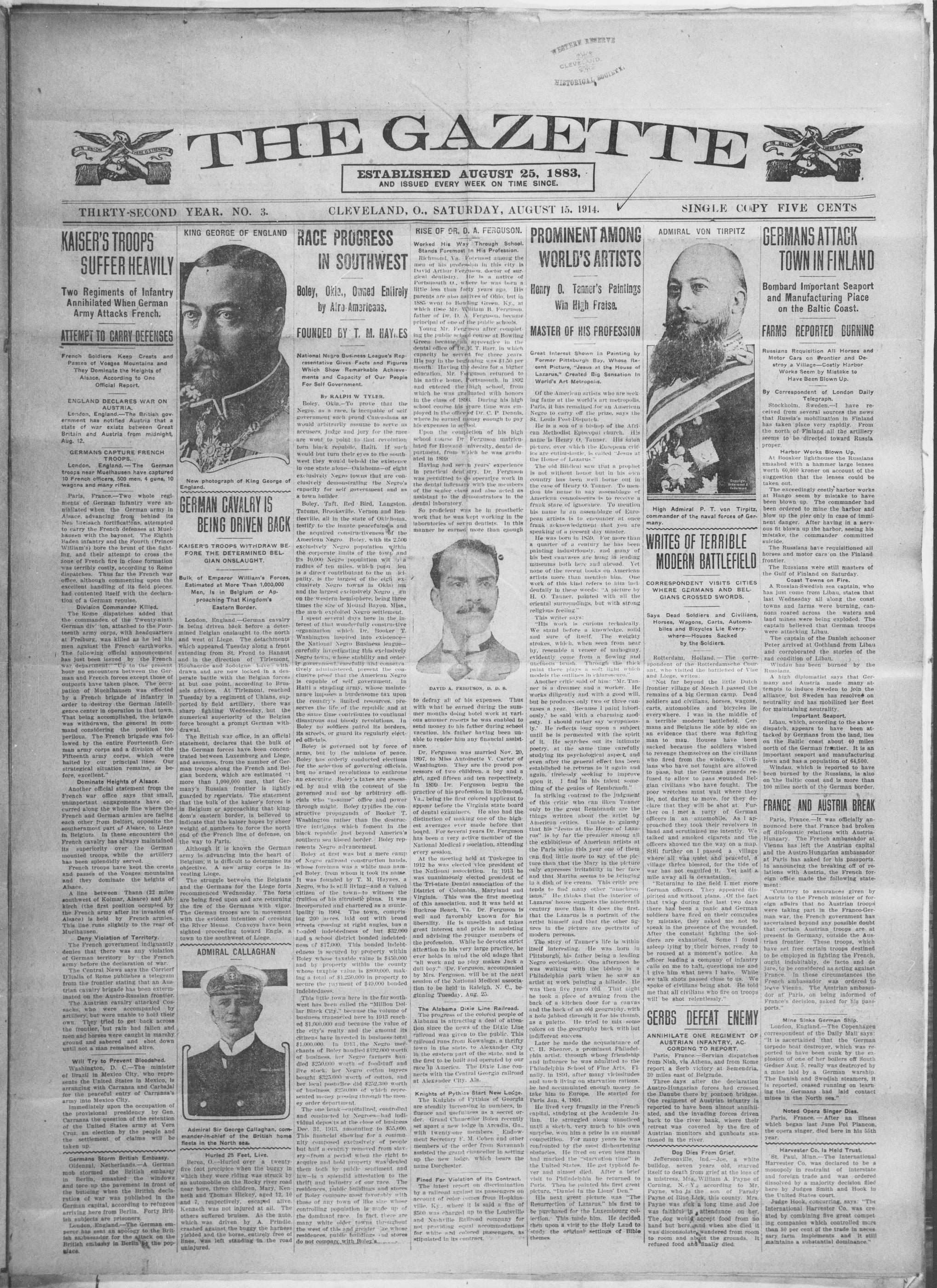
KAISER'S TROOPS SUFFER HEAVILY
Two Regiments of Infantry
Annihilated When German
Army Attacks French.
ATTEMPT TO CARRY DEFENSES
French Soldiers Keep Crests and
Passes of Voages Mountains and
They Dominate the Heights of
Alsace, According to One
Official Report.
ENGLAND DECLARES WAR ON
AUSTRIA.
London, England.—The British gov-
ernment has notified Austria that a
state of war exists between Great
Britain and Austria from midnight,
Aug. 12.
GERMANS CAPTURE FRENCH
TROOPS.
London, England.—The German
troops near Muethausen have captured
10 French officers, 500 men, 4 guns, 10
wagons and many rifles.
Paris, France—Two whole regiments of German infantry were annihilated when the German army in Alsace, advancing from behind its New Breisach fortifications, attempted to carry the French defenses at Muelhausen with the bayonet. The Eighth Baden infantry and the Fourth (Prince William's) bore the brunt of the fighting, and their attempt to cross the zone of French fire in close formation was terribly costly, according to Rome dispatches. Thus far the French war office, although commenting upon the excellent handling of its field pieces, had contented itself with the declaration of a German repulse.
Division Commander Killed.
The Rome dispatches added that the commander of the Twenty-ninth German div'ion, attached to the Fourteenth army corps, with headquarters at Freiburg, was killed as he led his men against the French earthworks. The following official announcement has just been issued by the French war department: "Up to the present hour no encounters between the German and French forces except those of outposts have taken place. The occupation of Muehlhausen was effected by a French brigade of infantry in order to destroy the German intelligence center in operation in that town. That being accomplished, the brigade was withdrawn, the general in command considering the position too perilous. The French brigade was followed by the entire Fourteenth German army corps and a division of the Fifteenth army corps, which were halted by our principal lines. Our strategical situation remains, as before, excellent."
Dominate Heights of Alsace.
Another official statement from the French war office says that small, unimportant engagements have occurred along the whole line where the French and German armies are facing each other from Belfort, opposite the southernmost part of Alsace, to Liege in Belgium. In these encounters the French cavalry has always maintained its superiority over the German mounted troops, while the artillery has been sundially served.
French troops have kept the crests and passes of the Vosges mountains and they dominate the heights of Alsace.
A line between Thann (22 miles southwest of Kolmar, Alasca) and Altkirch (the first position occupied by the French army after its invasion of Alsace) is held by French armies. This line runs slightly to the rear of Muelhausen.
Deny Violation of Territory.
The French government indignantly denies that there was any violation of German territory by the French army before the declaration of war.
The Central News says the Corrieri Dittala of Rome publishes a telegram from the frontier stating that an Austrian cavalry brigade had been exterminated on the Austro-Russian frontier.
The Austrian cavalry attacked Cossacks, accompanied by artillery, but were unable to hold their own. They tried to get back across the frontier, but rain had fallen and men and horses were caught in marshy ground and sabered and shot down until not a man remained alive.
Will Try to Prevent Bloodshed.
Washington, D. C. —The minister of Brazil in Mexico City, who represents the United States in Mexico, is arranging with Carranza and Carhali for the peaceful entry of Carranza's army into Mexico City.
Immediately upon the occupation of the provisional presidency by Gen. Curranza the question of the retention of the United States army at Vera Cruz, an election by the people and the settlement of claims will be taken up.
Germans Storm British Embassy. Oldenzi, Netherlands.—A German rob stormed the British embassy in Berlin, smashed the windows and tore up the pavement in front of the building when the British declaration of war was published in the German capital, according to refugees arriving here from Berlin. Forty British subjects are prisoners. London, England.—The German emperor has sent an apology to the British ambassador for the attack on the British embassy in Berlin by the populace.
THE GAZETTE
KING GEORGE OF ENGLAND
New photograph of King George of England.
KAISER'S TROOPS WITHDRAW BEFORE THE DETERMINED BELGIAN ONSLAUGHT.
Bulk of Emperor William's Forces, Estimated at More Than 1,000,000 Men, Is in Belgium or Ap-
men, is in Belgium of Ap proaching That Kingdom's Eastern Border.
London, England—German cavalry is being driven back before a determined Belgian onslaught to the north and west of Liege. The detachments which appeared Tuesday along a front extending from St. Frond to Hannut and in the direction of Tirlemont, Houhaerde and Jodigne have withdrawn and are now locked in a desperate battle with the Belgian forces at but one point, according to Brussels advices. At Tirlemont, reached Tuesday by a regiment of Uhlans, supported by field artillery, there was sharp fighting Wednesday, but the numerical superiority of the Belgian force brought a prompt German withdrawal.
The British war office, in an official statement, declares that the bulk of the German forces have been concentrated between Luxemburg and Liege, and assumes, from the number of German troops along the French and Belgian borders, which are estimated at more than 1,000,000 men, that Germany's Russian frontier is lightly guarded by reservists. The statement that the bulk of the kaiser's forces is in Belgium or approaching that kingdom's eastern border, is believed to indicate that the kaiser hopes by sheer weight of numbers to force the north end of the French line of defense, on the way to Paris.
Although it is known the German army is advancing into the heart of Belgium, it is difficult to determine its objective. A new army corps is investing Liege.
The struggle between the Belgians and the Germans for the Liege forts recommenced Wednesday. The forts are being fired upon and are returning the fire of the Germans with vigor. The German troops are in movement with the evident intention of crossing the River Meuse. Convoyes have been sighted proceeding toward Engls, a town to the southwest of Liege.
Admiral Sir George Callaghan, commander-in-chief of the British home fleets in the North sea.
Hurled 25 Feet, Live.
Beren, O.-Hurled over a twenty-five foot precipice when the buggy in which they were riding was struck by an automobile on the Rocky river road near here, three children, Mary, Kenneth and Thomas Hickey, aged 12, 10 and 7, respectively, escaped alive. Kenneth was not injured at all. The others suffered bruises. As the auto, which was driven by A. Prindle, crashed against the buggy the harness yielded and the horse, entirely free of lines, was left standing in the road unmintured.
ESTABLISHED AUGUST 25,1883 AND ISSUED EVERY WEEK ON TIME SINCE.
Boley, Okla., Owned Entirely by Afro-Americans.
FOUNDED BY T. M. HAYES
National Negro Business League's Representative Gives Facts and Figures Which Show Remarkable Achievements and Capacity of Our People For Self Government.
By RALPH W TYLER.
BY NALPH W. TILER.
Boley. Okla-To prove that the Negro, as a race, is incapable of self government such proud Caucasians as would arbitrarily assume to serve as accusers, judge and jury for the race are wont to point to that revolution turn black republic, Haiti. If such would but turn their eyes to the south-west they would behold the existence in one state alone - Oklahoma - of eight exclusively Negro towns that are conclusively demonstrating the Negro's capacity for self government and as a town builder.
Boley, Taft, Red Bird, Langston, Tatums, Brooksville, Vernon and Rentiesville, all in the state of Oklahoma, testify to the innate peacefulness and the acquired constructiveness of the American Negro. Boley, with its 2,500 exclusively Negro population within the corporate limits of the town and its 10,000 Negro population within a radius of ten miles, which population is a direct contributor to the municipality, is the largest of the eight exclusively Negro towns in Oklahoma and the largest exclusively Negro town on the western hemisphere, being three times the size of Mound Bayon, Miss, the much exploited Negro settlement.
I spent several days here in the interest of that wonderfully constructive organization which Dr. Booker T. Washington inspired into existence—the National Negro Business league—carefully investigating this exclusively Negro town, whose stability and orderly government carefully and conservatively administered, present the conclusive proof that the American Negro is capable of self government. In Halti a standing army, whose maintenance imposes a burdensome tax upon the country's limited resources, preserves the life of the republic and at the same time contributes to continual disastrous and bloody revolutions. In Boley no soldiers patrol its borders, its streets, or guard its regularly elected officials. Boley is governed not by force of arms, but by the minions of peace. Boley has orderly conducted elections for the selection of governing officials, but no armed revolutions to enthrone an executive. Boley's taxes are assessed by and with the consent of the governed and not by arbitrary officials who "assume" office and power through might. Boley typifies the constructive propaganda of Booker T. Washington rather than the destructive intrigues which foment in the black republic just beyond America's southern sea kissed border. Boley represents Negro advancement.
Boley at first was but a mere camp of Negro railroad construction hands, whose foreman was a white man named Boley, from whom it took its name. It was founded by T. M. Haynes, a Negro, who is still living—and a valued citizen of the town—to witness the fruition of his attriupless plans. It was incorporated and chartered as a municipality in 1904. The town, comprising 200 acres, laid out with broad streets crossing at right angles, has a bonded indebtedness of but $22,000 and a school district bonded indebtedness of $17,000. This bonded indebtedness is secured by property within Boley whose taxable value is $450,000 and by property within the county whose taxable value is $800,000, making a total of $1,250,000 in property to secure the payment of $49,000 bonded indebtedness.
This little town here in the far southwest has been called the "Million Dollar Black City," because the volume of business transacted here in 1913 reached $1,000,000 and because the value of the city's reality and the amount its citizens have invested in business total $1,000,000. In 1913, the Negro merchants of Boley handled $192,000 worth of business, her Negro farmers handled $250,000 worth of foodstuff and live stock, her Negro cotton buyers bought $252,000 worth of cotton, and her local postoffice did $252,300 worth of business, $200,000 of which represented money passing through the money order department.
The one bank—capitalized, controlled and conducted by Negroes—bad individual deposits at the close of business Dec. 31, 1915, amounting to $55,000. This financial showing for a community composed exclusively of people but half a century removed from slavery—from a period when the right to acquire and hold property was denied them both by public sentiment and law—is a splendid坠 attestation to the thrift and industry of our race. The residences, public buildings and stores of Boley compare most favorably with those of any town of like size whose controlling population is made up of the dominant race. In fact, there are many white older towns throughout the west of this and greater whose residences, public buildings and stores do not compare with Boley's.
RISE OF DR. D. A. FERGUSON
Worked His Way Through School.
Stands Foremost In His Profession.
Richmond, Va. Foremost among the men of his profession in this city is David Arthur Ferguson, doctor of surgery, Portsmouth O., where he was born a little less than forty years ago. His parents are also natives of Ohio, but in 1855 went to Bowling Green, Ky., at which time Mr. William R. Ferguson, father of Dr. D. A. Ferguson, became principal of one of the public schools.
Young Mr. Ferguson after compiling the public school course at Bowling Green became an apprentice in the dental office of Dr. E. T. Barr, in which capacity he served for three years. His pay in the beginning was $1.50 per month. Having the desire for a higher education, Mr. Ferguson returned to his native home, Portsmouth, in 1892 and entered the high school, from which he was graduated with honors in the class of 1894. During his high school course his spare time was employed in the office of Dr. C. P. Dennis, where he earned money enough to pay his expenses in school.
Upon the completion of his high school course Dr. Ferguson matriculated for Howard university, dental department, from which he was graduated in 1899.
Having had seven years' experience in practical dentistry, Dr. Ferguson was permitted to do operative work in the dental infirmary with the members of the senior class and also acted as assistant to the demonstrators in the dental laboratory.
So proficient was he in prosthetic work that he was kept working in the laboratories of seven dentists. In this manner he earned more than enough
DAVID A. FERGUSON, D. D. S.
to defray all of his expenses. Thus with what he earned during the summer months doing hotel work at various summer resorts he was enabled to send money to his father during school vacation, his father having been unable to render him any financial assistance. Dr. Ferguson was married Nov. 20, 1897, to Miss Antoinette V. Carter of Washington. They are the proud possessors of two children, a boy and a girl, aged fifteen and ten respectively. In 1890 Dr. Ferguson began the practice of his profession in Richmond, Va., being the first colored applicant to appear before the Virginia state board of dental examiners. He also had the distinction of making one of the highest averages ever made before that board. For several years Dr. Ferguson has been a very active member of the National Medical association, attending every session.
At the meeting held at Tuskegee in 1912 he was elected vice president of the National association. In 1913 he was unanimously elected president of the Tri-state Dental association of the District of Columbia, Maryland and Virginia. This was the first meeting of this association, and it was held at Buckroe Beach, Va. Dr. Ferguson is well and favorably known for his liberality. He is unselfish and takes great interest and pride in assisting and advising the younger members of the profession. While he devotes strict attention to his very large practice, he ever holds in mind the old adage that "all work and no play makes jack a dull boy." Dr. Ferguson, accompanied by Mrs. Ferguson, will be at the next session of the National Medical association to be held in Raleigh, N. C., beginning Tuesday, Aug. 25.
The Alabama Dixie Line Railroad.
The progress of the colored people of Alabama is attracting a deal of attention since the news of the Dixie Line railroad was given to the public. This railroad runs from Kowalnia, a thrifty town in the state, to Alexander City in the eastern part of the state, and is the first to be built and operated by our race in America. The Dixie Line connects with the Central Georgia railroad at Alexander City, Ala.
Knights of Pythias Start New Lodge.
The Knights of Pythias of Georgia are steadily increasing in numbers, in fluence and usefulness as a secret order. Grand Chancellor Bolen recently set apart a new lodge in Arcadia, Ga., with twenty-one members. Endowment Secretary F. M. Cohen and other members of the order from Savannah assisted the grand chancellor in setting up the new lodge, which bears the name Dorchester.
Fined For Violation of Its Contract.
The latest report on discrimination by a railroad against its passengers on account of color comes from Hopkinson, Ky., where it is said a fine of $500 was charged up to the Louisville and Nashville Railroad company for not providing equal accommodations for white and colored passengers, as stipulated in its contract.
WESTERN RESERVE
CLEVELAND.
HISTORICAL SOCIETY.
PROMINENT AMONG WORLD'S ARTISTS Henry O. Tanner's Paintings Win High Praise.
MASTER OF HIS PROFESSION
Great Interest Shown in Painting by Former Pittsburgh Boy, Whose Recent Picture, "Jesus at the House of Lazarus," Created Big Sensation in World's Art Metropolis.
Of the American artists who are seeking fame at the world's art metropolis, Paris, it has remained for an American Negro to carry off the prize, says the St. Louis Post-Dispatch.
He is a son of a bishop of the African Methodist Episcopal church. His name is Henry O. Tanner. His salon picture, over which the European critics are enthused, is called "Jesus at the House of Lazarus."
The old Biblical saw that a prophet is not without honor but in his own country has been well borne out in the case of Henry O. Tanner. To mention his name in any assemblage of American connoisseurs is to receive a frank stare of ignorance. To mention his name in an assemblage of European artists is to encounter at once frank acknowledgment that you are speaking of a present day master.
He was born in 1859. For more than a quarter of a century he has been painting industriously, and many of his best canvases are hung in leading museums both here and abroad. Yet none of the recent books on American artists more than mention him. One work of this kind refers to him incidentally in these words: "A picture by H. O. Tanner, painted with all the oriental surroundings, but with strong religious feeling."
This writer says:
"His work is curious technically. We stand before a knowledge, solid and sure of itself. The weight strokes, which, when seen from near by, resemble a veneer of malhogany, evidently come from a flowing and unbeautiful brush. Through the thick paint there plays a soft light which models the outlines of a another. Another critic said of him: 'Mr. Tanner is a dreamer and a worker. He works diligently and with a good will, but he produces only two or three canvases a year. 'Because I paint laboriously,' he said with a charming modesty. I should rather say serpentiously.' He reflects long upon a subject until he is permeated with the spirit of it. He searches out its intimate poetry, at the same time carefully studying its psychological aspect, and even after the general effect has been established he returns to it again and again, tirelessly seeking to improve upon it. I find in his talent something of the genius of Rembrandt."
In striking contrast to the judgment of this critic who can liken Tanner only to the great Rembrandt are the things written about the artist by American critics. Unable to gansay that his "deems at the House of Lazarus" is by far the premier among all the exhibitions of American artists at the Paris salon this year one of them can find little more to say of the picture than that the Mary in the picture only expresses irritability in her face and that Martin seems to be bringing in a dish of ice cream. This critereptends to find many other "anachronisms". He thinks that the interior of Lazarus house suggests the nineteenth century more than it does the first, that the Lazarus is a portrait of the artist himself and that the other figures in the picture are portraits of modern persons.
The story of Tanner's life is within itself interesting. He was born in Pittsburgh, his father being a leading Negro ecclesiastic. One afternoon he was walking with the bishop in a Philadelphia park when he saw an artist at work painting a hillside. He was then five years old. That night he took a piece of awning from the back of a kitchen door for a canvas and the back of an old geography, with a hole jabbed through it for his thumb, as a palette. He tried to mix some colors on the geography back with but indifferent success.
Later he made the acquaintance of C. H. Shearer, a prominent Philadelphia artist, through whose friendship and influence he was admitted to the Philadelphia School of Fine Arts. Finally, in 1891, after many vellissitudes and much living on starvation rations, he had accumulated enough money to take him to Europe. He started for Paris Jan. 4, 1891.
He lived very frugally in the French capital, studying at the Academie Julian. He struggled along unnoticed until a sketch, very much to his own surprise, won him a prize in an annual competition. For many years he was confronted by the most disheartening obstacles. He lived on even less than and marked the "starvation time" in the United States. He got typhoid fever and almost died. After a brief visit to Philadelphia he returned to Paris. He then painted his first great picture, "Daniel in the Lions' Den." His next great picture was "The Resurrection of Lazarus." his first to be purchased for the Luxembourg collection. This made him. He decided then upon a visit to the Holy Land to study the original settings of Bible themes.
ADMIRAL VON TIRPITZ
Copyright
Petersen &
Underwood
High Admiral P. T. von Tirpitz commander of the naval forces of Germany.
CORRESPONDENT VISITS CITIES WHERE GERMANS AND BELGIANS CROSSED SWORDS.
Says Dead Soldiers and Civilians, Horses, Wagons, Carts, Automobiles and Bicycles Lie Everywhere—Houses Sacked by the Soldiers.
Rotterdam, Holland. — The correspondent of the Rotterdamsche Courant, who visited the battlefield of Vise and Liege, writes:
"Not far beyond the little Dutch frontier village of Mesch I passed the remains of a big German camp. Dead soldiers and civilians, horses, wagons, carts, automobiles and bicycles lie everywhere. I was in the middle of a terrible modern battlefield. Germans and Belgians lie side by side as an evidence that there was fighting man to man. Houses have been sacked because the soldiers wished to revenge themselves on the civilians who fired from the windows. Civilians who have not fought are allowed to pass, but the German guards refused to allow to pass wounded Belgian civilians who have fought. The poor wretches must wait where they lie, not daring to move, for they declare that they will be shot at. Further on I met a party of German officers in an automobile. As I approached they took their revolvers in hand and scrutinized me intently. We talked and smoked cigarettes and the officers showed me the way on a map. Still further on I passed a village where all was quiet and peaceful, a village thrice blessed, for the tide of war has not engulfed it. Yet half a mile away all is devastation.
"Returning to the field I met more German officers. They appeared dispirited and without plans. Of the fact that twopiece during the last two days there has been a panic and German soldiers have fired on their comrades by mistake, they asked me not to speak in the presence of the wounded. After the constant fighting the soldiers are exhausted. Some I found asleep lying by their horses, ready to be roused at a moment's notice. An officer leading a company of infantry calls on me to halt, questions me and I give him what news I have. While we talk shots passed close to us. We spoke of civilians being shot. He told me that all civilians who fire on troops will be shot relentlessly."
SERBS DEFEAT ENEMY
ANNIHILATE ONE REGIMENT OF
AUSTRIAN CIVIL CAMPAIGN
TO REFORM GOVERNMENT
Paris, France—Servian dispatches from Nish, via Athens, and from Rome report a Sorb victory at Semendria, 30 miles east of Belgrade.
Three days after the declaration Austro-Hungarian forces had crossed the Danube there by pontoon bridges. One regiment of Austrian infantry is reported to have been almost annihilated, and the invading forces driven back to the river bank, where their retreat was covered by the fire of Austrian monitors and gunboats stationed in the river.
Dog Dies From Grief
Jeffersonville, Ind — Joe A. a white bulldog, seven years old, starved itself to death from grief at the loss of a mistress, Mrs. William A. Payne of Corning, N. Y. according to Mr. Payne, who is the son of Paraday Payne of Blue Lick, this county. Mrs. Payne was sick a long time and Joe was faithful in attendance on her. The dog would accept food from no hand but here and when she died it was disconsolate wandered from room to room and about the grounds. It refused food and finally died.
IN DUTILON
JUSTIFICIO
GERMANS ATTACK
TOWN IN FINLAND
Russians Requisition All Horses and Motor Cars on Frontier and Destroy a Village—Costly Harbor Works Seem by Mistake to Have Been Blown Up.
By Correspondent of London Daily Telegraph.
Stockholm, Sweden—I have received from several sources the news that Russia's mobilization in Finland has taken place very rapidly. From the north of Finland all the artillery seems to be directed toward Russia proper.
Harbor Works Blown Up.
At Boosker lighthouse the Russians unashed with a hammer large lenses worth 60,000 kroner on account of the suggestion that the lenses could be taken out.
The exceedingly costly harbor works at Hango seem by mistake to have been blown up. The commander had been ordered to mine the harbor and blow up the pier only in case of imminent danger. After having in a nervous fit blown up the harbor, seeing his mistake, the commander committed suicide.
The Russians have requisitioned all horses and motor cars on the Finland frontier.
The Russians were still masters of the Gulf of Finland on Saturday.
Coast Towns on Fire.
A Russian-Swedish sea captain, who has just come from Liban, states that last Wednesday all along the coast towns and farms were burning, cannons roared across the waters and land mines were being exploded. The captain believed that German troops were attacking Libau.
The captain of the Danish schooner Peter arrived at Gothland from Libau and corroborated the stories of the sad condition of Libau.
Windau has been burned by the Russians.
A high diplomatist says that Germany and Austria made many attempts to induce Sweden to join the alliance, but Sweden has resolved on neutrality and has mobilized her fleet for maintaining neutrality.
Libau, which, according to the above disatch, appears to have been attacked by Germans from the land, lies on the Baltic coast about 40 miles north of the German frontier. It is an important seaport and manufacturing town and has a population of 64,500. Windau, which is reported to have been burned by the Russians, is also on the Baltic coast and is more than 100 miles north of the German border.
FRANCE AND AUSTRIA BREAK
Paris, France.—It was officially announced here that France had broken off diplomatic relations with Austria-Hungary. The French ambassador at Vienna has left the Austrian capital and the Austro-Hungarian ambassador at Paris has asked for his passports. In announcing the breaking off of relations with Austria, the French foreign office made the following statement:
"Contrary to assurances given by Austria to the French minister of foreign affairs that no Austrian troops were taking part in the Franco-German war, the French government has ascertained beyond any possible doubt that certain Austrian troops are at present in Germany, outside the Austrian frontier. These troops, which have set free certain troops destined to be employed in fighting the French, ought indubitably, de facto and dejure, to be considered as acting against France. In these circumstances the French ambassador was ordered to leave Vienna. The Austrian ambassador at Paris, on being informed of France's decision, asked for his passports."
Mine Sinks German Ship.
London, England.—The Copenhagen
correspondent of the Daily Mall says:
"It is ascertained that the German
torpedo boat destroyer, which was
reported to have been bunk by the
explosion of one of her boilers off South
Gedser Aug. 5, really was destroyed by
a mine laid by a German warship.
The Danish and Swedish steamers, it
is reported, ceased running on learning
the Germans had laid contact
mines in the North sea."
Noted Opera Singer Dies.
Paris, France.—After an illness
which began last June Pol Plancon,
the opera singer, died here in his 55th
year.
Harvester Co. is held trust.
St. Paul, Minn.—The International Harvester Co. declared to be a monopoly in restraining the state and foreign trade and was ordered dissolved by a majority decision filed here by Judges Smith and Hook in the United States court.
Judge Hook, concurring, says: "The International Harvester Co. was created by combining five great competing companies which controlled more than $8 per cent of the trade in necessary farm implements and it still maintains a substantial dominance."
PUBLISHED EVERY SATURDAY
One Year.....$1.50.
Six Months.....1.00
Three Months......50
Subscribere are requested to re-
mit by postoffice money or-
der or registered letter
Entered at the postoffice in Cleveland
Ohio, as second-class matter.
Address all communications to
HARRY C. SMITH
Editor and proprietor,
THE GAZETTE,
Blackstone Building, Cleveland, O.
Member Ohio Legislature: 1894
to 1896; 1896 to 1898; 1900 to 1902
THE GAZETTE is the oldest, and has the largest bona fide circulation, double that of any newspaper in the interest of Afro-Americans, published in the state of Ohio, and comparison in the country immediately establishes its rank as one of the NEWSIEST AND BEST in the country.
10,000,000 Afro-Americans.
160,000 in Ohio.
20,000 in Cleveland.
SATURDAY, AUGUST 15, 1914.
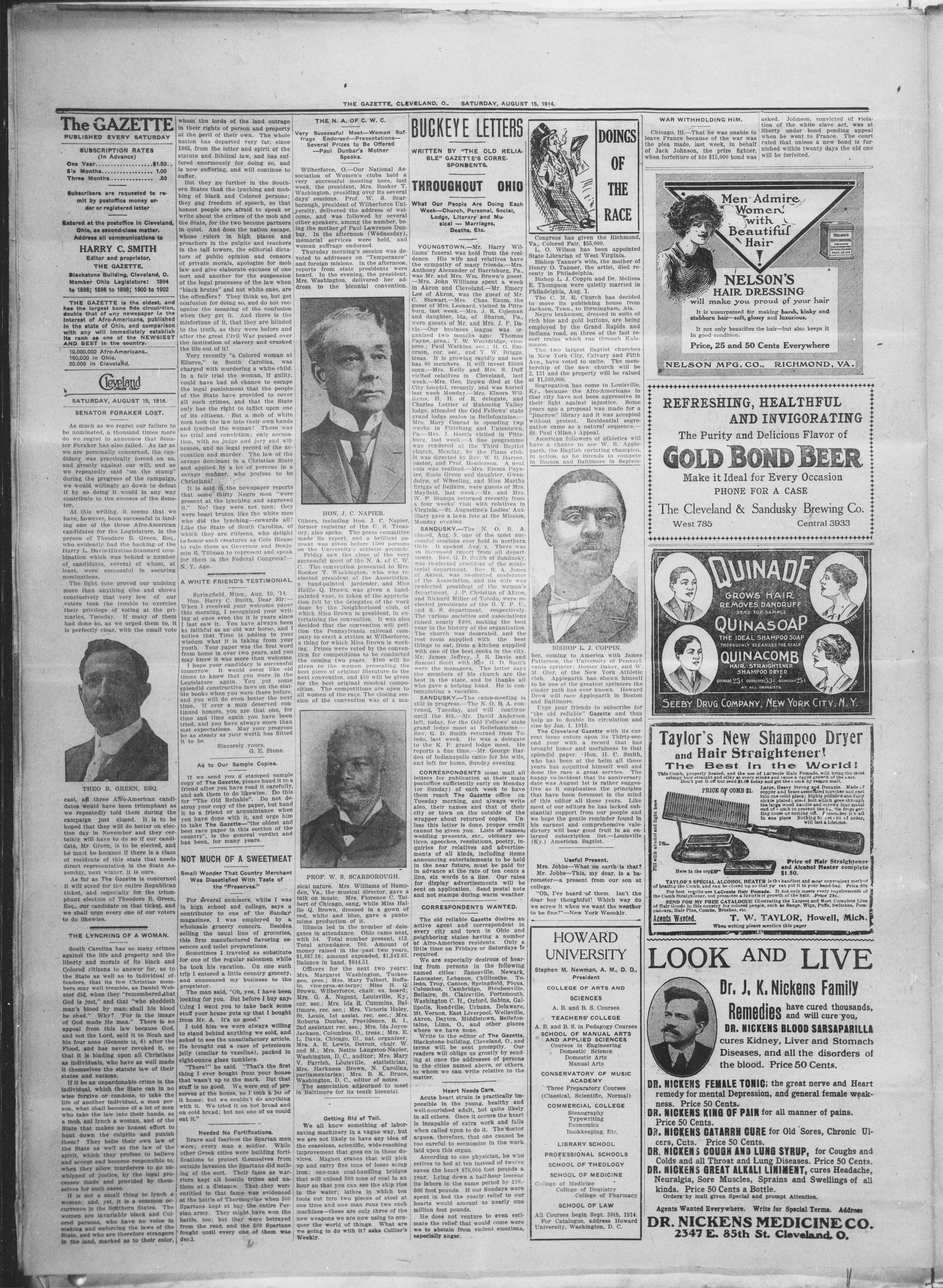
As much as we regret our failure to be nominated, a thousand times more do we regret to announce that Senator Foraker has also failed. As far as we are personally concerned, the candidacy was practically forced on us, and greatly against our will, and as we repeatedly said "on the stump" during the progress of the campaign, we would willingly go down to defeat if by so doing it would in any way contribute to the success of the Senator.
At this writing, it seems that we have, however, been successful in landing one of the three Afro-American candidates for the Legislature, in the person of Theodore B. Green, Esq., who evidently had the backing of the Harry L. Davis-Hirthus-Stannard combination which was behind a number of candidates, several of whom, at least, were successful in securing nominations.
The light vote proved our undoing more than anything else and shows conclusively that very few of our voters took the trouble to exercise their privilege of voting at the primaries, Tuesday. If many of them had done so, as we urged them, it is perfectly clear, with the small vote
THEO B. GREEN, ESQ.
cast, all three ATO-American candidates would have been triumphant as we repeatedly told them during the campaign just closed. It is to be hoped that they will do better on election day in November and they certainly will have to do so if our candidate, Mr. Green, is to be elected, and he must be because if there is a class of residents of this state that needs direct representation in the State Assembly, next winter, it is ours.
As far as the Gazette is concerned it will stand for the entire Republican ticket, and especially for the triumphant election of Theodore B. Green, Esq., our candidate on that ticket, and we shall urge every one of our voters to do likewise.
THE LYNCHING OF A WOMAN.
South Carolina has so many crimes against the life and property and the liberty and morals of its black and Colored citizens to answer for, as to the State as well as to individual of fenders, that its few Christian members may well tremble, as Daniel Webster did, when they "remembered that God is just," and that "who shedeth man's blood by man shall his blood be shed." Why? "For in the image of God made He man." There is no appeal from this law because God, and not the Lord, said it to Noah and his four sons (Genesis ix. 6) after the Flood, and has never revoked it, so that it is binding upon all Christians as individuals, who have as well made it themselves the statute law of their states and nations.
If it be an unpardonable crime in the individual, which the State can in no wise forgive or condone, to take the life of another individual, a man person, what shall become of a lot of men who take the law into their hands, as a mob, and lynch a woman, and of the State that makes no honest effort to hunt down the culprits and punish them? They believe their own law of the State as well as the law of the spirit, which they profess to believe and accept and become responsible to, when they allow murderers to go unwhipped of justice, by the legal processes made and provided by themselves for such cases. It is not a small thing to lynch a woman; and, yet, it is a common occurrence in the Southern States. The women are invariably black and Colored persons, who have no voice in making and enforcing the laws of the State, and who are therefore strangers in the land, marked as to their color,
whom the lords of the land outrage in their rights of person and property at the peril of their own. The whole nation has departed very far, since 1865, from the letter and spirit of the statute and Biblical law, and has suffered enormously for doing so, and is now suffering, and will continue to suffer.
But they go further in the Southern States than the lynching and mobbing of black and Colored persons; they gag freedom of speech, so that honest people are afraid to speak or write about the crimes of the mob and the State, for the two become partners in quiet. And does the nation escape, whose rulers in high places and preachers in the pulpits and teachers in the tail towers, the editorial dictators of public opinion and censors of private morals, apologize for mob law and give elaborate excuses of one sort and another for the suspension of the legal processes of the law when "black brutes" and not white ones, are the offenders? They think so, but get confusion for doing so, and do not recognize the meaning of the confusion when they get it. And there is the misfortune of it, that they are blinded to the truth, as they were before and after the great Civil War passed over the institution of slavery and crushed the life out of it!
Very recently "a Colored woman at Ellorce," in South Carolina, was charged with murdering a white child. In a fair trial the woman, if guilty, could have had no chance to escape the legal punishment that the people of the State have provided to cover all such crimes, and that the State only has the right to inflict upon one of its citizens. But a mob of white men took the law into their own hands and lynched the woman! There was no trial and conviction; only accusation, with no judge and jury and witnesses, and no legal record of the accusation and murder. The law of the savage dominant in a Christian State and applied by a lot of persons in a savage manner, who profess to be Christians!
It is said in the newspaper reports that some thirty Negro men "were present at the lynching and approved it." No! they were not men; they were beast brutes, like the white men who did the lynching—cowards all! Like the State of South Carolina, of which they are citizens, who delight to honor such creatures as Cole Blease to rule them as Governor and Benjamin R. Tillman to represent and speak for them in the Federal Congress!—N. Y. Age.
A WHITE FRIEND'S TESTIMONIAL
Springfield, Minn., Aug. 10, T14. Hon. Harry C. Smith, Dear Shr:—When I received your welcome paper this morning, I recognized your writing at once even tho it is years since I last saw it. You have always been as faithful as an old war horse, and I notice that Time is adding to your wisdom what it is taking from your youth. Your paper was first word from home in over ten years, and you may know it more than welcome. When your candidacy is successful tomorrow. It would seem like old times to know that you were in the legislature again. You put some splendid constructive laws on the statute books when you were there before, and you will do even better the next time. If ever a man deserved continued honors, you are one. For time and time again you have been tried, and you have always more than met expectations. May your progress be steady as your worth has fitted it to be.
As to Our Sample Copies.
If we send you a stamped sample copy of The Gazette, please hand it to a friend after you have read it carefully, and ask them to do likewise. Do this for "The Old Reliable". Do not destroy your copy of the paper, but hand it to a friend or acquaintance when you have done with it, and urge him to take The Gazette—"the oldest and best race paper in this section of the country", is the general verdict and has been, for many years.
NOT MUCH OF A SWEETMEAT
Small Wonder That Country Merchant Was Dissatisfied With Taste of the "Preserves."
For several suminers, while I was in high school and college, says a contributor to one of the Sunday magazines, I was employed by a wholesale grocery concern. Besides selling the usual line of groceries, this firm manufactured flavoring essences and toilet preparations.
Sometimes I traveled as substitute for one of the regular salesmen while he took his vacation. On one such trip I entered a little country grocery, and announced my business to the proprietor.
The man said, "Oh, yes, I have been looking for you. But before I buy anything I want you to take back some stuff your house puts up that I bought from Mr. A. It's no good."
I told him we were always willing to stand behind anything we sold, and asked to see the unsatisfactory article. He brought out a case of petroleum jelly (similar to vaseline), packed in eight-ounce glass tumblers. "There!" he said. "That's the first thing I ever bought from your house that wasn't up to the mark. But that stuff is no good. We were out of preserves at the house, so I took a jar of it home; but we couldn't do anything with it. We tried it on hot bread and on cold bread; but not one of us could eat it."
Needed No Fortifications
Brave and fearless the Spartan men were; every man a soldier. While other Greek cities were building fortifications to protect themselves from outside invasion the Spartans did nothing of the sort. Their fame as warriors all hostile tribes and nations at a distance. That they were entitled to that fame was evidenced at the battle of Thermopylae when 300 Spartans kept at bay the entire Persian army. They might have won the battle, too; but they were betrayed from the rear, and the 300 Spartans fought until every one of them was dead.
THE GAZETTE, CLEVELAND, O., SATURDAY, AUGUST 15, 1914.
THE N. A. OF C. W. C.
BUCKEX E LETTERS
Very Successful Meet—Woman Sufrage Endorsed—Presentations
Wilberforce, O.-Our National Association of Women's clubs held a very successful meeting here, last week, the president, Mrs. Booker T. Washington, presiding over its several days' sessions, Prof. W. S. Scarborough, president of Wilberforce University, delivered the address of welcome, and was followed by several other speakers, among the number, being the mother of Paul Lawrence Dunbar. In the afternoon (Wednesday) memorial services were held, and woman suffrage endorsed. Thursday morning's session was devoted to addresses on "Temperance" and "Suffrage." In the afternoon, reports from state presidents were heard. In the evening, the president, Mrs. Washington, delivered her address to the biennial convention.
PETER H. BURGESS
HON J C NAPIER
Others, including Hon. J. C. Napier, former registrar of the U. S. Treasury, also spoke. The press committee made its report, and a brilliant paean was given before 1500 persons on the University's athletic ground, to the University's athletic ground, a successful meet of the N. A. of C. W. C. The convention presented to Mrs Booker T. Washington, who was re elected president of the Association, a hand-painted jardiner, and Miss Hallie Q. Brown was given a hand painted vase, in token of the appreciation done by the Neighborhood club, of which Miss Brown is president, in entertaining the convention. It was also decided that the convention will petition the Pennsylvania railroad company to erect a station at Wilberforce a thing for which Miss Brown is work for. The convention for competitions to be conducted the coming two years. $100 will be given to the women presenting the best piece of original literature to the next convention, and $50 will be given for the best original musical composition. The competition will be open to all women of the campus, the closing solution of the convention was of a mu
PROF. W. S. SCARBOROUGH.
sical nature. Mrs. Williams of Hampden, Va., the musical director, gave a talk on music. Mrs. Florence C. Tolbert of Chicago, sang, while Miss Halle Q. Brown, dressed in a gown of panto-mime production of it. Illinois led in the number of delegates in attendance. Ohio came next, with 54. Total number present, 413. Total attendance, 700. Amount of money raised in the last two years, 2,000. Amount expected, $1,242.65. Balance in hand, $844.51.
Officers for the next two years: Mrs. Margaret Washington, Tuskegee, ges, pres; Mrs. Mary Talbert, Buffalo, vice-pres-at-large; Mrs. H. Q. Brown, Bataille, hale; Mrs. G. A. Pogues, Louisville, ky, cor; sec, Mrs. Ida R. Cummins, Baltimore, rec. sec; Mrs. Victoria Haley, St. Louis, 1st assist. rec; sec; Mrs. Roberta Dunbar, Providence, R. I, 2nd assistant rec. sec; Mrs. Ida Joyce-Jackson, Columbus, O., treas; Mrs. E. L. Davis, Chicago, Il. nat. organizer; Mrs. E. L. Davis, Chicago, Il. nat. organizer; W. M. Mrs. Nettle Langston-Napler, Washington, D. C., auditor; Mrs. Mary V, Parrish, Louisville, statistician; Mrs. Harkness Brown, N. Carolina, parlamentarian; Mrs. B. K. Bruce, Washington, D. C., editor of notes.
The association adjourned to meet in Baltimore for its tenth biennial.
Getting Rid of Toll.
We all know something of labor-saving machinery in a vague way, but we are not likely to have any idea of the coaseless, scientific, wide-reaching improvement that goes on in these devices. Magnet cranes that will pick up and carry five tons of loose scrap iron; one-man coal-handling bridges that will unload 500 tons of coal in an hour so that you can see the ship rise in the water; laths in which ten tools cut into two pieces of steel at one time and one man runs two such machines—these are only three of the new weapons we are now using to conquer the world of things. What are we going to do with it? asks Collier's Weekly.
WRITTEN BY "THE OLD RELIABLE" GAZETTE'S CORRE- SPONDENTS.
THROUGHOUT OHIO
What Our People Are Doing Each Week — Church, Personal, Social, Lodge, Literary and Musical — Marriages, Deaths, Etc.
YOUNGSTOWN.—Mr. Harry Williams' funeral was held from the residence. His wife and relatives have the sympathy of many friends.—Mrs. Anthony Alexander of Harrisburg, Pa.
—Mrs. John Williams spent a week in Akron and Cleveland. Mr. Emery Lee of Akron, was the guest of Mr. C. Stewart.—Mrs. Chas. Exum, the guest of Mrs. Leonard, visited in Pittsburgh, last week. Mrs. J. R. Coleman, daughter, Ida, of Sharon, Pa, wore guests of Mr. and Mrs. J. P. Daemon, two members of the House of Puyallup, pres; W. T. Widgewood, vicepres; Paul Watkins, sec.; H. G. Emerson, cor. sec., and T. W. Briggs, treas. It is growing rapidly and now has 80 members. It will invest $3000 soon. Mrs. Kelly and Mrs. S. Duff visited relatives in Cleveland, last week. Mrs. Geo Brown died at the age of 80, buried last week Mrs. Elnora Williams, H. H. of R. delegate, and Charles Lottier of Mahoning Valley lodge, attended the Odd Fellows' state grand lodge session in Bellefontaine.—Mrs. Mary Conrad is spending two weeks in Pittsburg and Uniontown, Pa.—Mrs. J. Harris visited in Pittsburg.—Mrs. A fine programme was written by the third House of Puyallup church. Monday, by the Piano club It was directed by Rev. W. O. Harper, pastor, and Prof. Henderson. A neat sum was realized.—Mrs. Emma Paynter, Susie Green and daughter, Gwen dolyn, of Wheeling, and Miss Martha Briggs of Bellaire, were guests of Mrs Mayfield, last week—Mr. and Mrs. Stamps returned from a four-week visit to relatives in Virginia.—St. Augustine's Lads' auxiliary gave a lawn fete at the Mission Monday evening.
SANDUSKY—The N. O. B. A. closed, Aug. 5, one of the most successful sessions ever held in northern Ohio. It opened, Aug. 4. There was an increased report from all departments. Rev. G. D. Smith of Sandusky, was re-elected president of the ministers' department. Rev. G. D. Jones of Akron was re-elected model of the Association, and his wife was re-elected president of the woman's department. J. P. Christian of Akron, and Richard Miller of Toledo, were re-elected presidents of the B. Y. P. U. and S. S. department, respectively. The various societies and associations raised nearly $400, making the best of the church. The church was decorated, and the rest room supplied with the best things to eat, from a kitchen supplied with one of the best cooks in the city. Mr. James Jeffrey, J. R. Davis and Samuel Scott with Rev. G. D. Smith were the managers. The latter says the members of his church are the ones who thank the thanks who gave a helping hand. He is contemplating a vacation.
SANDUSKY—The camp-meeting is still in progress.—The N. O. B. A. convened, Tuesday, and will continue until the 8th.—Mr. David Anderson left, today, for the Old Fellows' state grand lodge meet at Bellefontaine.—Rev. G. D. Smith returned to Tolteo, last week. He was a delegate to the K. P. grand lodge meet. He reports a fine time.—Mr. George Harden of Indianapolis came for his wife, and left for home, Sunday evening.
CORRESPONDENTS must mail all letters for publication at their main postoffice sufficiently early on Monday (or Sunday) of each week to have them reach The Gazette office on Tuesday morning, and always write to the office of the city or town on the outside of the wrapper about returned copies. Unless this latter is done, proper credit cannot be given you. Lists of names, wedding presents, etc., obituary notices, speeches, resolutions, poetry, inquiries for relatives and advertisements of all kinds, including items announcing entertainments to be held in advance at the rate of ten cents a line, six words to a line. Our rates for display advertisements will be sent on application. Send postal note and not stamps during warm weather.
CORRESPONDENTS WANTED
The old reliable Gazette desires an active agent and correspondent in every city and town in Ohio and neighboring states having a number of Afro-American residents. Only a little time on Fridays or Saturdays is required.
We are especially desirous of hearing from persons in the following named cities: Zaneville, Newark, Tacoma, Milwaukee, Lincoln, Troy, Canton, Springfield, Plaqua, Columbus, Cambridge, Steubenville, Bellaire, St. Clairsville, Portsmouth, Washington C. H., Oxford, Sabina, Galipolis, Rendville, Urbana, Delaware, M. Vernon, East Liverpool, Wellsville, Akron, Dayton, Middletown, Bellefontaine, Lima, O., and other places where we have none.
Write to the editor of The Gazette. Blackstone building, Cleveland, O. and terms will be sent promptly. Our笔会 will be greatly by sending at once the addresses of persons in the cities named above, or others, to whom we can write relative to the
Heart Needs Care
Acute heart strain is practically impossible in the young, healthy and well-nourished adult, but quite likely in all others. Once it occurs the heart is incapable of extra work and falls when called upon to do it. The doctor argues, therefore, that one cannot be too careful to economize in the work laid upon this organ.
According to one physician, he who retries to bed at ten instead of twelve saves the heart 876,000 foot pounds a year. Lying down a half-hour loses its labors in the same period by 219,000 foot pounds. If our Sundays were spent in bed the yearly relief to our hearts would amount to nearly one million foot pounds.
He does not venture to even estimate the relief that would come were we to abstain from violent emotions, especially anger.
DOINGS
OF
THE
RACE
Congress has given the Richmond,
Va., Colored Fair, $55,000.
L. O. Wilson has been appointed State Librarian of West Virginia.
Bishop Tanner's wife, the mother of Henry O. Tanner, the artist, died recently in Philadelphia.
Bishop L. J. Coppin and Dr. Melissa E. Thompson were quietly married in Philadelphia, Aug. 1.
The C. M. E. Church has decided to move its publishing house from Jackson, Tenn., to Birmingham, Ala.
Negro brakemen, dressed in suits of rich blue and gold buttons, are being employed by the Grand Rapids and Indiana road, on three of the fast resort trains which run through Kalamazoo.
Two two largest Baptist churches in New York City, Calvary and Fifth Ave., have voted to unite. The membership of the new church will be 2, 131 and the property will be valued at $1,500,000.
Segregation has come to Louisville, Ky., because the Afro-Americans in that city have not been aggressive in their fight against injustice. Some of the most aggressive were "jimrow" library and it was accepted without protest. Residential segregation came as a natural sequence. St. Paul (Minn.) Appeal. American followers of athletics will have a chance to see W. R. Appleton in action, as he intends to compete in Boston and Baltimore in Septem-
J. H. H.
BISHOP L. J. COPPIN.
ber, coming to America with James
Patterson, the University of Penns-
vania spinner; Homer Baker, and W.
M. Oler of the New York Athletic
School, the University of be-
come to one of the greatest sprinters the
cinder path has ever known. Howard
Drew will race Applearth in Boston
and Baltimore.
Urge your friends to subscribe for
"tourismable" Gazette and thus
help us to double its circulation
and size by Jan. 1, 1915.
The Cleveland Gazette with its current issue enters upon its Thirty-second year with a record that has brought honor and usefulness to that splendid paper. · Hon. H. C. Smith, who has been at the helm all these years has acquired a great service. The happy co-incident that its anniversary date was August 1st is rather suggestive as it emphasizes the principles that have been foremost in the mind of this editor all these years. Like most of our editors he has lacked substantial support from our people and has been a great friend of his career and comprehensive valedictory will bear good fruit in an enlarged subscription Ist.—Louisville (Ky.) American Baptist.
Useful Present
Mrs. Jobs—What on earth is that?
Mr. Jobs—This, my dear, is a barometer—a present from our son at college.
"Oh, I've heard of them. Isn't the dear boy thoughtful! Which way do we screw it when we want the weather to be fine?"—New York Weekly.
HOWARD
UNIVERSITY
Stephen M. Newman, A. M., D. D., President
COLLEGE OF ARTS AND
SCIENCES
A. B. and B. S. Courses
TEACHERS' COLLEGE
A. B. and B. S. in Pedagogy Courses
SCHOOL OF MANUAL ARTS
AND APPLIED SCIENCES
Courses in Engineering
Domestic Science
Domestic Arts
Manual Arts
CONSERVATORY OF MUSIC
ACADEMY
Three Preparatory Courses
(Classical, Scientific, Normal)
COMMERCIAL COLLEGE
Stenography
Typewriting
Economics
Bookkeeping, Etc.
LIBRARY SCHOOL
PROFESSIONAL SCHOOLS
SCHOOL OF THEOLOGY
SCHOOL OF MEDICINE
College of Medicine
College of Dentistry
College of Pharmacy
SCHOOL OF LAW
All Courses begin Sept. 30th, 1914.
For Catalogue, address Howard
University, Washington, D. C.
Men Admire Women with Beautiful Hair!
NELSON'S HAIR DRESSING
will make you proud of your hair
It is unsurpassed for making harsh, kinky and stubborn hair—soft, glossy and luxurious.
It not only beautifies the hair—but also keeps it in good condition.
Price, 25 and 50 Cents Everywhere
NELSON MFG. CO., RICHMOND, VA.
QUINADE
GROWS HAIR
REMOVES DANDRUFF
SEND FOR SAMPLE
QUINASOAP
THE IDEAL SHAMPOO SOAP
THOROUGHLY CLEANSSES THE SCALP
QUINACOMB
HAIR STRAIGHTENER
SHAMPOO DRYER
QUINADE 25¢ QUINACOMB 50¢ QUINASOAP 25¢
AT ALL DRUGGISTS
SEEBY DRUG COMPANY, NEW YORK CITY, N. Y.
Taylor's New Shampoo Dryer and Hair Straightener!
The Best in the World!
This Comb, properly heated, and the use of LaCrete Hair Pomade, will bring the most crimson curls and the most voluminous curls of hair.
Don't put it off but butt it $1.99 today and get the comb by return mail.
TAYLOR'S SPECIAL ALCOHOL HEATER is the handiest and most convenient method of heating the Comb, and can be closed up so that you can put it in your hand-bag. Price $5c for regulars and La Grange for larger customers. Price $10c for Comb Straighteners and a luxurious growth of their customers. Price $5c. SEND FOR MY FREE CATALOGUE illustrating the Largest and Most Complete Line of Hair Goods in this country for colored people, such as Bange, Wigs, Puffs, Switches, Pom-paours, Hair Plains, Combs, Brushes, etc.
Agents Wanted.
T. W. TAYLOR, Howell, Mich.
When writing please mention this paper
LOOK AND LIVE
Remedies have cured thousands, and will cure you,
DR. NICKENS BLOOD SARSAPARILLA
cures Kidney, Liver and Stomach
Diseases, and all the disorders of
the blood. Price 50 Cents.
DR. NICKENS FEMALE TONIC; the great nerve and Heart
remedy for mental Depression, and general female weak-
ness. Price 50 Cents.
DR. NICKENS KING OF PAIN for all manner of pains.
Price 50 Cents.
DR. NICKENS CATARRH CURE for Old Sores, Chronic Ul-
cers. Cuts. Price 50 Cents.
DR. NICKENS MEDICINE CO.
2347 E. 85th St. Cleveland O.
WAR WITHHOLDING HIM.
Chicago, Ill.—That he was unable to leave France because of the war was the plea made, last week, in behalf of the French government when forfeiture of his $15,000 bond was
Men A
World
w
Beaut
Hair
NELSON
HAIR DR
will make you p
It is unsurpassed for
stubborn hair—soft, gloss
It not only beautifies
in good condition.
Price, 25 and 50
NELSON MFG. CO.
REFRESHING,
AND
The Purity and
GOLD BO
Make it Ideal for
PHONE FOR
The Cleveland & S
West 785
QUIN
GROWS
REMOVES
SEND FOR
QUINA
THE IDEAL HE
THOROUGHLY CLE
QUINA
HAIR ST
SHAM
QUINADE 25¢ QUINA
AT ALL
SEEBY DRUG COMPANY
Taylor's New
and Hair Stra
The Best in
This Comb, properly heated, and the use
crimpy hair straight and silky at every
Don't put it off but send $1.00 to
PRICE OF OOMB $1.
Here is the topic
TAYLOR'S SPECIAL ALCOHOL HEAT
of heatsty the Comb, and can be closed up so
You best舒服 see Locale Hair up
the Comb Straighten, not promotes a luxurious
SEND FOR MY FREE CATALOGUE!
of Hair Goods in this country for colored pe
padours, Hair Pins, Combs, Brushes, etc.
Agents Wanted.
T. W.
When writing please
LOOK A
A. M.
DR. NICKENS FEMALE TON
remedy for mental Depress
ness. Price 50 Cents.
DR. NICKENS KING OF PAIN
Price 50 Cents.
DR. NICKENS CATARRH CUR
cers, Cuts. Price 50 Cents.
DR. NICKENS COUGH AND L
Colds and all Throat and L
DR. NICKENS GREAT ALKAL
Neuralgia, Sore Muscles,
kinds. Price 50 Cents a B
Orders by mail given Special an
Agents Wanted Everywhere.
asked. Johnson, convicted of violation of the white slave act, was at liberty under bond pending appeal when he went to France. The court ordered him to a new court, is furnished within twenty days the old one will be forfeited.
Admire
owner
with
beautiful
hair!
SON'S
PRESSING
a proud of your hair
making harsh, kinky and
say and luxurious.
the hair—but also keeps it
Cents Everywhere
RICHMOND, VA.
HEALTHFUL
INVIGORATING
Delicious Flavor of
BOND BEER
for Every Occasion
FOR A CASE
andusky Brewing Co.
Central 3933
NADE
HAIR
DANDRUFF
FOR SAMPLE
ASOAP
SHAMPOO SOAP
CLEANSES THE SCALP
ACOMB
RAIGHTENER
500 DRYER
QUINASOAP 25
DRUGGISTS
Y. NEW YORK CITY. M. Y.
Shampoo Dryer
rightener!
in the World!
Of latecole hair Pomade will bring the most
trouble and cause a rapid growth of the hair.
And get the comb by return mail.
Large, Heavy Strong and Durable. Made of one solid piece; highly polished and fully nickel plated; steel bolt which goes through end of end of end to prevent the bolt from getting looses or coming off. Punches it all in one piece. Nothing is of order, or
Price of Hair Straightener and Alcohol Heater complete $1.50.
FR is the handiest and most convenient method that yo can put it in your hand-bag. Price 80 mugs. It not only meets every requirements of the growth of the hair. Price 25c. Illustrating the Largest and Most Complete Lime cake, such as Bange, Wigs, Puffs, Switches, Pom.
TAYLOR, Howell, Mich.
mention this paper
ND LIVE
Nickens Family
The Best is the Cheapest; hence we are the Cheapest.
Arlington Pharmacy
WE WILL ACCEPT THIS ADVERTISEMENT FOR FIVE CENTS IN TRADE, TO APPLY ON ANY PURCHASE OF TWENTY-FIVE CENTS OR MORE.
E. Rubenstein, Ph. C., Prop.
S. W. Cor. Central Ave. & E.
55th St.
STERLING
5 and 10 Cent Store
3003 Central Ave.
Watch Our Windows
For Bargains
Colored Salesladies
Mrs. A. M. Pope-Turnbo
Results of "Poro" Treatment
"PORO COLLEGE"
Largest College of its kind is the world.
SOO PHE STREET, N.T. Louis, USA.
Your CRANATED
For treatment, call on or address:
MISS KATIE B. COLLIER,
4812 Payne Ave.,
C:veland, Ohio.
THE PEOPLES' DRUG STORE
F. H. WEAVER. PHAR. D. Prob.
Cor. Central Ave. and E. 33d St.
Agent for
"HIGH BROWN FACE POWDER."
WE GIVE TRADING STAMPS.
MONEY ORDERS. NEWSPAPER
ADS. TELEGRAMS.
PRESCRIPTIONS. A SPECIALITY.
Open late at Night.
MEN'S HAIR
The Morgan Hair Refiner
is a new discovery that positively
straightens the hair within fifteen
minutes. No grease. No hot irons. Water
will not affect it.
Absolutely harmless if used accord-
ing to directions.
The G. A. Morgan
Hair Refining Co.
5202 Harlem Avenue, Cleveland, Ohio
Theodore B. Green,
ATTORNEY AT LAW.
507 Superior Building.
Phones: Office, Main 3076.
Residence, Eddy 3988-J.
DRY GOODS, LADIES' AND GENTS
FURNISHINGS
Double Stamps on Tuesdays and Fridays.
S. E. WOODS
REAL ESTATE
Phone No. 996.
Large First and second Mortgage
Loans.
Damage Claim Adjusted.
OFFICES: 220 Central Ave., Cleve-
ward, 96.
Where to Purchase The Gazette
CHAS. R. MATHEWS'
3664 Central Ave.
J. S. HALL'S.
3121 Central Ave.
*L. SCHWARTZ'S.
2921 Central Ave.
*O. C. SCHROEDER'S.
Cuyahoga Bldg.
F. VALENTINE'S.
2130 Central Ave.
J. E. BRANHAM'S.
4401 Central Ave.
PUSHAW
Superior Arcade.
NOTICE TO SUBSCRIBERS
Subscribers not receiving T us at once. We desire every cop We advise our patrons to car tisations before making purchas this paper should have the patro that they advertise is assurance Local reading notices (adve words in a line).
Subscribers not receiving The Gazette regularly should notify us at once. We desire every copy delivered promptly.
We advise our patrons to carefully examine The Gazette's advertisements before making purchases. Business men who advertise in this paper should have the patronage of Afro-Americans. The fact that they advertise is assurance that they want it. Local reading notices (advertisements) ten cents a line (six words in a line).
Social and Personal
Our Classified Ad Department
For rent—A room or rooms and board, to respectable parties; 2305 E. 86th St.
FOR RENT—Houses and Rooms—
If you have them to rent or if you want to rent, advertise in The Gazette. It brings results.
NOTARY PUBLIC—For such services call at The Gazette office, No. 3 Blackstone building, No. 1424 W. Third Street, near Superior Ave.
FOR SALE—Houses or lots. If you have either or anything else to sell, or if you wish to purchase, advertise in The Gazette. If anything can bring you results, it can and will.
Cleveland
Sixth City
W. M. Scott is on a six weeks' visit
in the South.
Mrs. Andrew Linney of E. 30th St.,
is convalescent.
Mrs. Hattie Fairfax of E. 35th St.,
is still critically ill.
Mr. W. Butter left, Sunday, for his
old home, Cincinnati.
Mrs. Lethin Fleming visited in
Youngstown, last week.
Mr. and Mrs. Geo. L. Ross visited
Fittsburg, last week.
C. F. West of Arthur Av., is visiting
relatives in Harrisburg, Pa.
Mr. and Mrs. Charleston of Pitts-
burg, were in the city, Sunday.
Rev. E. A. White attended his con-
ference in Indiana, last week.
Miss Sallie Fisher went to Detroit,
recently, attending a wedding.
Mrs. Geo, Washington of E. 30th St.,
is being visited by her mother.
Miss Willa B. Hodges of Knoxville,
Tenn., is here visiting relatives.
Rev. J. L. E. Burr attended the N.
O. B. A. in Sandusky, last week.
Miss Jennie Porter of Cincinnati,
is visiting Mr. and Mrs. Edward Smith.
Miss Addie Moore of Akron, is
the guest of Mrs. J. Brown, 2928 Scovill
Ave.
Rev. C. S. Howard is entertaining
his mother from Paducah, Ky., this
week.
Miss Lillian Fields of E. 36th St.,
who has been ill, this week, is convalescing.
Rev. G. W. Jackson, pastor of New
Hope Mission, 319 Central Ave., is
quite ill.
Theo. B. Green, Esq., went to
Atlantic City, Friday, for a two weeks'
vacation.
Mrs. David H. Saunders of W. 117th
St. has returned from a pleasant visit
in Pit堡burg.
The Du Bois Literary club will hold
its annual outing, Thursday, Aug. 20,
at Cedar Point.
Mrs. Edwina Seelig spent, Wednesday
evening, in Lorain, the guest of
Miss Ruth Fisher.
Mrs. Evans and Mrs. T. Adkins left,
Sunday, for a week's visit with relatives in Columbus.
Mrs. S. C. Green left, Monday, for Cincinnati, to attend the "Daughters of Tabor" convention.
Mrs. Booker T. Washington was the guest of Mrs. L. W. Price of Cedar Ave., while in the city.
Mrs. Nancy Hollingworth, of E. 38th St., went to Alliance, Wednesday, to visit for several days.
Mrs. Blanche Gilmere, Mrs. E. F. Boyd and others who went to Wilberforce, last week, have returned.
Miss Willa Joiner visited relatives in Lorain. Miss Ruth Fisher of that city, was in Cleveland, Tuesday.
Mr. and Mrs. Thos. Venable of E. 43d St., have returned from a two weeks' visit in Detroit, and Windsor, Ont.
Senator Foraker's defeat is a set
---
*DR. WEAVER'S,
3315 Central Ave.
*A. GORDON,
2928 Central Ave.
*SAM FERTMAN'S,
3608 Central Ave.
*ELMER F. BOYD'S,
2604 Central Ave.
*S. A. LUCAS',
3943 Central Ave.
*NEWS STORE,
2249 E. 105th 8t.
cor. Arthur Ave.
the Gazette regularly should notify
they delivered promptly.
finitely examine The Gazette's advert-
eses. Business men who advertise in
mance of Afro-Americans. The fact
that they want it.
ortisements) ten cents a line (six
back for our people, the country over
—so greatly do we need him in Congress.
Mr. and Mrs. James Offer have returned from a three weeks' trip to Ann Arbor, Mich., South Bend, Ind., and Chicago.
Mrs. James E. Payne and Mrs. Lee Alexander attended the U. B. F. and S. M. T. convention in Columbus, this week, as delegates.
Wm. A. Webster of the E. E., wrote The Gazette, from Washington, D. C., under date Aug. 7, that he was thoroughly enjoying his visit.
Mr. and Mrs. J. A. Stewart and Mr. and Mrs. Jackson of Dayton, are visiting the former's sister, Mrs. H. B. Thompson of 2835 Scovill Ave.
Mr. Wm. Smith and daughter of New Brighton, Pa., having visited, for three weeks, his cousin, R. E. Jackson of E. 825 St., have returned home.
Rube Foster, the "Colored Matty," who is over forty, has won 23 straight games for his American Giants, Chicago team. Rube is built like a barrel.
Mrs. M. Carroll, Mrs. Boyd and Mrs. C. J. Sayles left, Sunday, for Columbus, to attend the U. B. F. and S. M. T. convention, and to visit in Springfield.
Congratulations to Editor Harry C. Smith of The Gazette for 32 years of work in the newspaper field. Continued success, Mr. Smith!—The Advocate.
Edward P. Willis of Chicago, who has been visiting here, was relieved of $20 and an overcoat while waiting for a train in the Union station, recently.
In appointing the N. A. of C. W. C. committees, Cleveland was recognized by the placing of Mrs. Blanche Glimere on one of the important committees.
Do not fail to read Madam Groom's advertisement, elsewhere in this paper, and patronize her. She is a member of the race, intelligent and exceptionally proficient.—Adv.
Mr. Clifford Jackson of Akron, came to the city for Sunday, and he and Mrs. Jackson were guests of Mr. and Mrs. H. W. Cash for dinner. Both returned to Akron, Sunday evening.
Mrs. and Miss Dauson of Chicago, who have been visiting Mrs. Mamie Willis, returned home yesterday. Miss Willis is the only domestic science teacher in the "Windy City".
Willis, the Republican nominee for governor, and Harding, the nominee for U. S. Senator, were colleagues of the editor of The Gazette in the Ohio Assembly in 1900. So was Ralph D. Cole.
Our advertisers want your trade. Those who do not ask for it in The Gazette certainly care little, if at all, for it. Therefore, we urge our readers and all of our friends to patronize those who ask for your trade in this paper.
Send or bring locals and all business matters to The Gazette's offices, suite 2, Blackstone Bldg. If you wish to see the editor call there, please. All matters for publication in current issues of The Gazette must be in the office by 4 p. m., WEDNESDAY at the latest.
Mrs. Robert Shaw Wilkinson of Orangeburg, S. C., Mrs. Harriet Kelly of Indianapolis, Ind., and Mrs. C. H. Brown of Sedalia, N. C., accompanied by Miss Bertha Blue, paid The Gazette sanctum a very pleasant visit, Thursday morning. They were en route to Oberlin.
Kina, infant of Nellie McCard, died, Aug. 4, at 304 E. 126th St. Funeral, Aug. 6, from 2400 E. 36th Place. Interment in E. Cleveland cemetery, Mrs. Mary Skinner, age 95 years, died, Aug. 7, Funeral, Aug. 10. Interment in Woodland cemetery. E. F. Boyd, funeral director.
Mrs. Mary Skinner, one of Cleveland's oldest residents and possibly the oldest living member of St. John's church, died, last Friday, at her daughter, Mrs. Rebecca Coram's, E. 95th St. Funeral services at the residence, 2 p. m. Monday, were conducted by Revs. Bundy and Paxton.
A large number attended the reception tendered Mrs. B. T. Washington at St. John's. A. M. E. church, Tuesday evening, by the federated women's clubs of the city. Felicitous remarks were made by Mrs. French from the Pacific coast, Miss Brown from S. Carolina, and Mrs. Washington.
The antiCatholic organization that endorsed the candidacy of Charles Sutton showed its strength in the vote given him, Tuesday; and the Republican organization showed its, in the vote given the editor of The Gazette. Likewise, the Harry L. Davis-Stan
THE GAZETTE, CLEVELAND, O., SATURDAY, AUGUST 15, 1914.
* * *
---
---
nard-Hirstus combination showed its,
in Theo. B. Green's.
* * *
Robert E. Mosby of Los Angeles,
Cal., former resident of this city, wrote
The Gazette, under date, Aug. 7: "I
trust that everything is well with you
and that you will win the nomination,
Aug. 11. J. C. Brown and Earl Parker
join me in this hope, and that all are
doing well in the 'Forest City.' Sam,
Pentacost opened a cafe in Imperial
City, Cal., last month, and is doing
nicely."
---
The large audience that saw the Panama scenes and race pictures, and heard the lecture at Lane Memorial church, Monday evening, by Dr. J. K. Nickens, was greatly pleased as the entertainment was not only instructive but also amusing. Mr. and Mrs. Nickens and Mr. and Mrs. Seth Nickens are being visited by their only sister, Mrs. Mary A. Brown and her 13-year-old son, James, of Yellow Springs.
Theo. B. Green's vote was 3,979; Hon. Harry C. Smith's, 3,647; Chas. S. Sutton's, 3,220. The surprise of the campaign, however, was the defeat of Judges Collister and Kennedy, FitzGerald was defeated for Congress in the 22d district by Henry I. Emerson, Eso, who asked for support in Theo. B. Green's vote, andgressive ticket endangers the election of the Republican ticket nominated, Tuesday.
Mr. L. G. Adkins of Cleveland, O.
O. Mrs. Stella Combs and sister, Miss Ia
Jones of Kansas City, Mr. David
Broom of Shreveport, La. Mr. and
Mrs. Alexander of Tulsa, Oklahoma,
are recent arrivals in the city who
come to take in the scenes of the
Pike's Peak region for the next week
or ten days and are stopping with
Mrs. Jennie Henderson, 416 E. Huer-
fano street.—Colorado Springs (Colo.)
Advance.
Mrs. John T. Tuck and several of
our ladies were refused 20 cent seats
at the Miles theater, one evening, this
week, and will enter suit under Hon.
Mary Sullivan's Ohio Civil Rights'
law. Good! We hope Mrs. Tuck and
the other ladies will teach the man-
agement of that place of amusement,
a much-needed lesson. If more would
only do so, it would not be long until
all or nearly all of such discrimination
would cease.
```markdown
```
Misses Cecil Johnson and Mary Coleman of Detroit, are guests of Mrs. J. L. Seelig, 2317 E. 71st St. Mrs. Seelig and son, Fred., were guests of Miss Ruth Fisher in Lorain, recently. Mrs. Reed Jackson and little daughter, Mae, of Toronto, Ontario, Ca., arrived in the city, Tuesday afternoon from Springfield, en route to Lorain, to visit several days away. Miss Fisher, also arrived by Miss Fisher, Mrs. Seelig, they visited The Gazette sanctum sanctorum. Mrs. Jackson will return to Springfield before returning home.
---
Whenever you hear an individual insinuating, with mock modesty: "Of course, I don't claim to know it all", write that person "down an ass" who, as a matter of fact, knows so little that he does not realize that you are able to see through his transparent eyes, and you know him with his great knowledge, when, as a matter of fact, he is extremely shallow and possesses a very low order of intellectuality. This remark is "the stock in trade" of a few very cheap and dumb Negroes, young and old, in almost ever community." Ex.
"My Friend from Kentucky," which the "Darktown Follies of 1814" are presenting at the Empire theater, this week, includes in its cast, Harper & Gilliam, Gaines & Brown, Salle Byrd Dillen, Evelon Robinson, Ada Guy, Abbie Mitchell, "Toots Davis," Julius Glen, Ethel Williams, Mae Brown, Johnnie Peters, Will Brown and others. One of the swiftest and classiest choruses of singing and dancing types, is a most pleasing feature, one of the most beautiful plea. The production is complete in every detail. Abbie Mitchell, former wife of Will Marion Cook, an old Cleveland boy, is one of the delightful features with this record-breaking attraction. Abbie renders a number of catchy songs, in which she takes High C with the greatest ease. After this season she is to be sent on the road at the head of her own organization, which will number some seventy-five people. Lester A. Waltolf is in charge of and J. Lubrie Hill heads the "Darktown Follies," "Nuff sed!"
Editor Dabney of the Cincinnati (O.) Union, like Hon. H. C. Smith of the old reliable Gazette of Cleveland, is up in arms against sprouting caste in his city. Right you are, rights surreptitiously are seldom regained. Your rulers are rulers amount to nothing compared to the cowardlessness of the men and women "jimcrow" schools give us, is true. Our early life was spent in the schools of Chicago, never sitting by the side of children of darker color. Leaving that city and going south to teach, about ten years later, we returned to Chicago and going to the office seatmate, Mr. Frank Lane, head clerk over more than a hundred clerks. We embraced each other, and before all of the clerks he went with joy and sald to his first assistant: "Take my place, for John and I are going to paint the old town red to-day." He got his buggy and took us over, and we all greeted him. Of what a time we had that day. One of the old teachers threw her arms around us, and many of our school boys were then men in various kinds of business and all greeted us warmly. And Mrs. Curtin, one of the noblest and sweetest women Chicago ever owned, and for whom the whole city mourned by order of authority when she died later. We were told that she would her long-gone and returned son. Mix the schools, for there is no color line in heaven—Martinsburg (W. Va.) Pioneer Prés.
At the Young Men's Republican club meeting, at Ideal Hall, Saturday evening, great enthusiasm was aroused by the entrance of Mrs. Beason, president of the Working Girls' Christian Home, with the girls and members of the home, in a procession and wearing badges of Senator J. B. Foraker for U. S. Senator. All were again greatly enthusiased, especially when the president, Mrs. Beason, and Hon. Harry C. Smith were mentioned. Mrs. Beason said she would like to see both gentlemen elected to the positions they were seeking, especially the latter, because he made us such an exceptionally good representative when he was in the Legislature. One of the candidates (white) who spoke said that it was the first time a candidate was at a meeting during this campaign. Ex-Chief of Police Kohler was enthusiastically applauded when he referred
to his elevation of Patrolman Arthur McFarland to the detective department, and when he referred to the fact that Hon. Harry C. Smith had secured Mr. Charles Smith's appointment to the police force and his designation to the private secretary the Kohlian number candidates addressed the meeting, which was ably presided over by Major Jno C. Fulton, president of the club. He was introduced by Charles S. Sutton, Esq., in an interesting speech. The three Ace-American candidates addressed the candidate addresses. Wm. J. Hart, Harry L. Vail and others were particularly pleasing and satisfying, as speakers.
"LIMIT OF LEGAL TENDER"
Federal Law Governs Amount of Sill ver or Copper Colns That Must Be Accepted.
The greatest amount that a person making payment may offer in silver or copper coins, with the certainty that the other party to the transaction cannot refuse, is commonly known as the "limit of legal tender," and is a matter not of individual opinion but of federal law. A definite limit is specified for coins of each denomination except gold coins and silver dollars, both of which may be used in making legal tender up to any amount. Of the minor coins now current, one-cent and five-cent pieces are good only up to 25 cents. Dimes, quarter dollars and half dollars are good in making payments up to $10; while the old silver three-cent pieces, half dimes and 20-cent pieces were each good up to five dollars. Although it is done as a matter of business custom, there is no law compelling anyone to make change, and as a matter of law a street car conductor, can refuse to take the five-cent fare out of a dime just as he can refuse to take it out of a ten dollar bill. —Popular Mechanics.
At the Bazaar
A funny incident happened at a recent bazaar. The minister invited all the people of the parish to contribute something for a mammoth "lucky bag," and a most varied collection of goods was gathered. On the second evening of the fete a respectable citizen, imbued with the spirit of doing good in the church, paid the entrance fee and drew a prize from the bag. A crowd collected about him all anxious to see what he had drawn, and his surprise may be imagined when he got a note with the following inscription:
"Good for one grave, dug any time during the ensuing year."
Magnetic and Geographical
Magnetic and Geographical Poles.
The "geographical poles" of the earth are the extremities of the imaginary line passing through its center of gravity and about which it revolves. The "magnetic poles" are in no way coincident with the geographical poles and are determined by the "dip of the needle." The north magnetic pole was located by Capt. James Ross, in 1831, in King William's Land, northern Canada, attitude 70-5-2. The south magnetic pole has been located in latitude 72-23.
Pecocious Childhood
"Now, my child," said the kind old judge, "which parent do you prefer to go with?" "That depends," answered the fashionable child, "Is another going to get large alimony?" "Yes." Large enough to embarrass father financially."
LEGAL NOTICE.
The State of Ohio, County of Cuyahoga, ss. In the Probate Court. In re estate of Christian Ignatius Latrobe Mottley, deceased, notice.
To Mary V. Mottley, Barbados, West Indies; Felicia A. Mottley, Barbados, West Indies; Lavinia D. Robustiae, 2271 East 46th St. Cleveland, Ohio; Frances Smith, 2271 East 46th Street, Cleveland, Ohio; Georgiana C. Mottley, 2271 East 46th Street, Cleveland, Ohio.
YOU WILL TAKE NOTICE that on the 23rd day of July, 1914, Frances Smith and Georgiana C. Mottley, presented to the Probate Court of Cuyahoga County, Ohio, a copy of the Last Will and Testament of Christian Ignatius Latrobe Mottley, deceased, late and have applied to have said will and have applied to have said will probated and recorded in this County of Cuyahoga, said Georgiana C. Mottley and Frances Smith representing to said Court that they are interested in said will as heirs and legatees in this to-wait; that the said Georgiana C. Mottley and Frances Smith represent or an equal thereof, of the lands situated in the County of Cuyahoga, City of Cleveland, Ohio; and that the said Frances Smith is entitled to one-sixth of the said lands, or the equal thereof; and that there is some estate in this County upon which said will opposes to be situated at numbers 2346 East 20th Street, and one apartment house at 2341 E. 29th St. Cleveland, Ohio.
The hearing of said application has been set by said Probate Court of Cuyahoga County, Ohio, for the 23rd day of September, 1914, at 10 o'clock a.m.
GEORGIANA C. MOTTLEY and FRANCES SMITH (nee Mottley), Heirs-at-Law.
Just the Information We Need
WEBSTER'S
NEW INTERNATIONAL
- THE MERRIAM WEBSTER
Every day in your talk and reading,
on the street car, in the office, shop,
and school some new question is sure
to come up. You seek quick, accurate,
encyclopedic, up-to-date information.
The NEW CREATION will answer all your questions with Anglauthority.
400 write words Words Defined. 2700 Pages. 6000 Illustrations. Cost $400,000. The only dictionary with the new divided page. A "Stroke of Genius."
Write for specimen pages, 11 humorous articles.
Mention this publication and receive FREE a set of pocket maps.
G. & C. MERNIAM CO.
Springfield, Mass.
U. S. A.
The English Language.
The English language contains about 600,000 words, but of this total nearly one-half consists of scientific terminology—that is seldom met with outside text books—and of archaic terms. An examination of 100,000 words shows them to comprise 60,000 words of Teutonic origin, 30,000 of Greek or Latin origin, and 10,000 words derived from miscellaneous sources. The New Standard Dictionary contains approximately 435,000 words. Milton wrote his "Paradise Lost" with 8,000 words, and Shakespeare gave up his plays with 16,000.
Sunstroke on Mountains.
Sunstroke, according to experiments made by Profs. Victor Henry and Moycho and reported to the French Academie des Sciences, is due to the invisible ultra-violet rays at the extreme limit of the spectrum. If the solar spectrum be examined at an altitude of from three to four thousand meters it will be seen that the limit of these rays varies little, but that their intensity is greatly increased. At sea level this intensity is comparatively feeble. So one is much more likely to have sunstroke on a high mountain than in a valley.
J. W. WILLS & CO.
The Leading
Funeral Directors
& CO.
directors
Charles
3664
Fin
Chapel in Connection.
Service First Class.
2529 Central Avenue
North 474 Central 7562-L
The Fifteenth Annual Session of the
State Summer School
for Colored
TEACHERS OF BOTH SEXES
at the
will begin June 29th, 1914, and continue five weeks.
In addition to the regular work, an attractive lecture course has been arranged, in which will appear some of the most distinguished white and Colored educators in the country. Tuition for the entire session $12.00. Tuition 25c per subject unless other arrangements have been made.
Limited accommodations. Send $1 and have room reserved in advance. For further information write once to James B. Dudley, President, or D. J. Jordan, Director, A. & M. College, Greensboro, N. C.
Real Curley Creole Straight Hair
SWITCHES
1 oz., 18 in... $1.50 Trans
1½ oz., 20 in... $2.00 Extra
2 oz., 22 in... $2.50 Gray hair... $50 extra Wigs
Send Sample of Hair Combings
Grooms' Hair
This pomade will make the most long, and become soft and glossy.
MADAM GRO
2305 E. 86th St.
ADVERTISING
THE A. & M.
of Colored People will hold its 45TH KY., SEPT. 8TH, 9TH, 10TH.
This bids
The banner year, as the finest premise racing to be had will be given a fun for "PEOPLE'S MILITARY BAND," of Daily before the Grand Stand.
Reduced rates on all rays "Home Coating for T. J. WILSON, Pres.
S. KAU
Can Save You
Tinning, Roofing, Furnace Work
Furnaces Cleaned
Let Us Figure
S. KAU
3953 Cent
Hey Creole Hair or
Hair
SWITCHES
$1.50 Transformations
$2.00 Extra heavy
$2.50 Wigs
Do extra Hair Combings Made Into Braids
Ms' Hair Grower
Will make the most stubborn hair
soft and glossy.
ADAM GROOMS
CLEVELAND
ADVERTISEMENT.
A. & M. ASSOCIATION
will hold its 45TH ANNUAL FAIR
8TH, 9TH, 10TH, 11TH AND
This blds fair to be
the finest premiums will bring
will be given here. A royal w
fun for everyone.
RY BAND," of Dayton, Ohio,
Stand. All attractions
rates on all railroads entering
Cooring for All Kentu
KAUFFM
Can Save You Money
Roofing, Sheet
Face Work and S
paces Cleaned on Short N
e Work
KAUFFM
3953 Central Ave.
THE A. & M. ASSOCIATION of Colored People will hold its 45TH ANNUAL FAIR AT LEXINGTON, KY., SEPT. 8TH, 9TH, 10TH, 11TH AND 12TH, 1914. This bids fair to be The banner year, as the finest premium will bring the best stock. The best racing to be had will be given here. A royal welcome, pleasure and fun for everyone.
Telephone C 4304-W
OZON
Straightens
Kinky
Curly
Hair.
VONO
OZONO KING OF ALL HAIR TONICS.
Straightens
Kinky
Curly
Hair.
AN HONEST REMEDY
HAS GIVEN SATISFACTION FOR MORE THAN 30 YEARS
Straightbens Kinky, Troublesome, Refractive Hair
HAS GIVEN SATISFACTION
Straightens Kinky, Trouble
The Best Remedy for Dandruff, Itch
Scalp Diseases. Causes the Hair to Grow
Beautiful. Put up in Pretty Metal Box
any address, carriage prepaid, on reco
OUR GRAND OFFER. Send this
we will immediately send you 4 Boxes O
Food, 1 Package Anti-Odor-removes
1 Bar of Purity Scalp Scalp
Write your name and post-office pla
BOSTON'C
ISFACTION FOR MORE
Kinky, Troublesome, Refr
for Dunkleff, Iech, Tetter and oth
the Hair to Grow Long and Stru
pretty Metal Boxes of 25c, 50c,
prepaid, on receipt of price.
ER. Send this advertisement to
ad you 4 Boxes Ozono, 1 Bottle
Odor-removes all odors arising
Soap and a Handsome Aluminu
post-office plainly when you send
BOSTON CHEMICAL
The Best Remedy for Dandruff, Itch, Hair and other disagreeable Hair and Scalp Diseases, Causes the Hair to Trow Long and Straight, making it Soft and Beautiful. Put up in Pretty Metal Boxes of 25c, 50c, and $1 each. Sent to any address, carriage prepaid, on receipt of price.
OUR GRAND OFFER. This advertisement to us with One Dollar, and we will immediately send you 4 Boxes Ozone, 1 Bottle Skin Refiner, 1 Jar Skin Food, 1 Package Anti-Odor—removes all odors arising from the human body—1 Bar of Purity Scalp Soap and a Handsome Aluminum Comb.
Cuy. Central 6661-L
G. G. REED
Dry Goods
Ladies' and Gents' Furnishings
Sole agents for the
AMERICAN LADY NEMO
R. @ G. CORSETS
3222 Central Ave.
THE
WALLOONSAC INN
Cor. Central Ave. & E 31st S'.
NEAT, CLEAN AND NEW
RESTAURANT
BEST HOME COOKING
Special Sunday Din ers
PETE ROSS, Prop.
Charles R. Mathews
3664 Central Ave.
Fine Line of
Books, Cigars,
Papers, Cigarretts,
Magazines, Tobacco,
Candles, Pipes,
Ice Cream, Scouvenir
Soda, Post Cards
Canned Goods, Etc., Etc.
LAUNDRY AGENCY
SURE DEATH TO BUGS
"Macks"
Lightning Insect Destroyer
and Non-Staining Disinfectant
Used with a Spray
KILLS INSTANTLY
ROACHES, BED-BUGS, MOTHS,
&c. Also DESTROYS GERMS and
Unpleasant Oders.
SHOULD BE IN EVERY HOME
Price per Cal. $1.75
Price per Qt. 45
Sprays, each. 50
SOLD ONLY BY
Ohio Specialty Sales Co.
2928 Scovill Ave.
CLEVELAND, OHIO
And its Duly Authorized Agents
'PHONE, CEN. 7214-K
Mail Orders Given Prompt Attention
EMENT.
ASSOCIATION
ANNUAL FAIR AT LEXINGTON,
4, 11TH AND 12TH, 1914.
Fair to be
Rums will bring the best stock. The
store. A royal welcome, pleasure and
everyone.
Bayton, Ohio, WILL BE HEARD
all attractions are new and good.
Roads entering the city.
"All Kentuckians"
A. L. HARDEN, Sec.
FFMAN
You Money in
Rock, Sheet Metal,
Bask and Slating
On Short Notice
Work Guaranteed
FFMAN
Central Ave.
NO
KING OF ALL
HAIRTONICS.
FOR MORE THAN 30 YEARS
Ages, Refractory Floor
Tetter and other disagreeable Hair and
Long and Straight, making it Soft and
of 25c, 50c, and $1 each. Sent to
apt of price.
advertisement to us with One Dollar, and
one, 1 Bottle Refinizer, 1 Jar Skii
all odors arising from the human body-
some Aluminum Comb.
when you send your order to
CHEMICAL CO., RICHMOND, VA
```markdown
```
AFRO-AMERICAN CULLINGS
The recent visit of Dr. Booker T. Washington to this city and the splendid address which he delivered brought to mind an incident of a few weeks ago, relates the Chicago News. A young negro of what might be called the diletante class, was heard saying to a newly arrived stranger: "Don't tell any one in Chicago that you are from Tuskegee institute." To this advice the stranger without hesitation replied to the effect that he was proud to be identified with an institution that meant so much constructively in the life of his race, and that any one who was conversant with the needs of the people served by the school could not be disloyal to it.
The former young man did not necessarily mean harm, but unfortunately he misrepresented the spirit of this great city, Chicago, sharing the American ideal, is in harmony with movements everywhere which makes for human uplift, and her representative citizens are as eager to encourage in Alabama as well as in Illinois any organization representing an investment in useful, nondependent citizenship.
The Tuskegee institute is not only an efficient school for training the negro in manual arts and in agriculture. It is primarily a school for human culture, indeed for race culture, considering the important part it has played and is destined to play in the education of the negro race.
It took the world a long time to ac knowledge the truth that physical control and the workman's skill in the manipulation of his tools and the practise of his art are as essential contributions to human welfare and to appreciate fine are from an academic point of view or to translate classical writings or deeper fascinating problems in mathematics. Those who from apathy, indolence or prejudice have not kept abreast with the trend of education and the progress of the glorious humanitarian movements of this day are the ones who date upon what a living age has buried in books. They offer no helping hand in the solution of vital problems.
The Tuskegee institute is an active agency not only in education but in social amelioration. Truly there can be no complete appreciation of the work that Doctor Washington is doing for this country if the appalling need for this work is overlooked. As this need is realized so will the friends of the work increase, together with the encouragement and inspiration of his benevolent supporters.
At an expenditure exceeding $10,000,000 London will build a dock ample enough to accommodate any merchant steamer afloat or which will be likely to enter the Thames for many years to come.
A thousand persons gathered in Epiphany church in G street at Washington to bid farewell to James. For forty-one years James, the colored sexon, had rung the chapel bell that called the parishoners and greeted their arrival with a happy face. He was accorded honors at his funeral service that no person ever buried from that church has received. The aged negro was given the distinction of having a funeral address preached for him, as sermons on burial occasions are never given in the Eposcopal service. Five hundred colored people attended the service and were ushered into their places by the usual church attendants.
The Panama canal is lighted along its entire length by electricity, for lighthouses, buoys, etc.
A recent bulletin issued by the consu bureau giving mortality figures for the year 1913, seems to have made a deep impression in the South because of the ominously high figures for the negroes in the southern cities. These are the deaths per thousand:
White. Negro.
Memphis 15.9 Richmond 16.7 New Orleans 15.6 Baltimore 16.2 Nashville 14.7 Birmingham 12.3 Atlanta 13.5 Washington 14.4 24.4
The Atlanta Constitution vigorously calls attention to this situation, pointing out that the diseases which cause a death rate among the negroes must, in the close contact of urban life, be a menace to the whites, and that, therefore, the whites have a selfish interest in improving the standards of negro life—Springfield Republican.
A serious-minded Englishman read a paper before the Royal Statistical society the other day, in which he recommended that a card index register the details of the lives of every person should be kept at some central government office. Every person would have his number, according to this scheme, which already has given considerable amusement to Punch and the humorists generally.
Electric vehicles are now being used in the streets of London for sprinkling and sweeping.
The meteorological service of Russia finds itself in the position, rare in the experience of European scientific institutions, of having ample funds for its present needs and future development, thanks to a liberal increase in its budget recently authorized by the government.
The expression 'an inch of rain' refers to the mark on a standard rain gauge on the surface to the distance between two such marks being represented by nearly 101 tons over an acre of land.
"Give the negro a chance."
"Give the negro a chance."
This was the theme that thrilled through the address of Booker T. Washington when he spoke at Chicago before the convention of the International Sunday School association in Medinah temple.
Mr. Washington proved to be one of the most popular speakers that have addressed the convention and his appeal to the Sunday school leaders to help the negro and to give him a chance brought repeated applause from the delegates and visitors who filled the big hall to overflowing.
"What the black man needs is the old time religion," said the speaker.
"That's the theology I want to take to my people. The negro is better off close to the soil and in the South, and I want to keep him there, if you will bring the Sunday school to him. Take the old theology to him, the theology that says, 'Thou shalt not steal,' 'Thou shalt not kill,' 'Thou shalt not bear false witness,' 'Thou shalt not commit adultery.'
"I want no man's sympathy because I am a negro," he said. "I thank God every day that I belong to this race, I wouldn't change places with the whitest man in America. We have problems to solve such problems as the white man has not, and my people need some one to lead and help them. But remember, it is not always unfortunate for a race to have problems to confront, such problems turn races into kingdoms and nations."
The resolutions committee reported to the convention and resolutions tavoring a federal law for the regulation of marriage and divorce, a single standard of purity for both sexes, rigid laws against commercialized vice, lotteries and gambling, consoling of moving pictures, the abolishment of child under the age of sixteen, the destruction of the liquor traffic, the advancement of international peace and the observance of the sabbath were passed.
Country negroes of the better type are good workers and thrity managers, pretty sure to become ultimately land owners and self-employers. Negro ownership of land in the South increased 150 per cent in the first decade of the twentieth century. But in this advancement of the best of the race from tenancy and wage working to larger or smaller agricultural proprietorship the author sees a bad influence upon those less fortunate or deserving an agency making for the deterioration in character and efficiency in the labor left available for the white man's plantation; her observation and interest seem to be rural and agricultural more than urban and industrial. And the unreliability of this labor is in turn responsible for devices verging upon peonism, holding the laborer to the land with chains of debt.
"For many years the South squandered the fertility of her fields. We are learning of late years, slowly and painfully, to build up the impoverished soil, and restore it to its former richness. But we have overlooked the squandered fertility of labor. Until we build up the worker the material on which this work is spent will never yield its normal return. The houses of very many farm laborers are more than enough to sap their vitality, to destroy ambition and self-respect and to foster immorality and disease. Conditions like these flich from the community its capital of human productiveness."—Mrs. L. H. Hammond, in her book "In Black and White."
The president of Uruguay is reported to be considering the advisability of creating a national printing establishment to undertake all the printing work of the various government departments.
The National League on Urban Conditions Among Negroes has for its purpose to protect colored women from moral and financial exploitation, to provide playgrounds and recreation centers, to organize boys' and girls' clubs and neighborhood unions of adults, to secure and train negro social workers, to develop co-operation among welfare agencies, to provide employment facilities to fit workers for their occupation, to provide probation care for juvenile and adult delinquents, to render neighborhoods free from vice where respectable people may have homes, and to investigate city conditions among negroes. Its headquarters are in New York.
Argentine telegraph companies are bringing into general use a system whereby messages are received automatically with printed type.
In the days of old Rome a woman's character was known by her dress. The yoga was worn by the men, but the stola was the raiment for the women. It was a loose garment worn over the tunic, and was usually caught at the waist by a girdle. Divorced women and courtesans were not allowed to wear it.
Russia is making great efforts to develop unproductive parts of the Caucasus by preventing river floods and increasing irrigation drainage and canal construction.
A ship-building shop is maintained in connection with the high school in San Pedro, Cal., where, under the practical instruction of a nautical architect, the students learn how to build a boat, make and place the engine and launch and run the craft.
In the fall of 1913 the organized garment workers in New York numbered 226,528.
The United States in 1913 imported 852,529,498 pounds of coffee, valued at $105,000,000.
BASEBALL
The Southern league race is extremely close.
Eddie Plank does not seem to have slipped back so fast after all.
Wilbur Cooper is the most effective pitcher the Pirates have just now.
KONECHTY LOVES HIS HITS
MONTH OF J
SPENT IN
Fair Parisiennes So
Mind and Body Dr
Heated Seas
TIME FOR OUTDO
Lightest Form of Enter
Favor—Occasions Giv
ity for Display of
Beck of the St. Louis Cardinals has one of the best throwing arms in the big league.
Louis Bierbauer of London, looks like the cream of the Canadian league first sackers.
Pitcher Al Damaree of the Glants is not showing the classy goods he displayed in 1913.
The Rochester club has secured Pitcher Ernest Manning from the St. Louis American club.
Outfielder Frank Long, who was let out by the London team, has been picked up by Hamilton.
The Boston Red Sox are alleged to be after Ty Cobb. In exchange they would give Tris Speaker.
George Davis, once a White Sox star, has been engaged as a scout for the New York Highlanders.
That American league race is one of the prettiest that Ban Johnson has been able to engineer in years.
Josh Devore has done some flitting since he was a Giant, having been in turn a Red, a Quaker and a Brave.
The Pittsburgh Club has turned pitcher Barney Duffy over to the Des Moines club, of the Western league.
Benny Kauff, who is leading the Federal league with a batting average of 460, once belonged to the New Yorks.
Manager O'Brien of the New Bedford club, claims he has the best receiver in the Colonial league in Murphy.
Pitcher Dave Davenport, who forsook the Reds for the Feds, is having a rough time in his new field at St. Louis.
Infielder Eddie Grant of the Giants,
is back in the substitute set, but what
times he has been in the game he has
done capital work.
"Letty" Rogers, Ottawa's star left
hand heaver, is on crutches and hardly
able to move. Rogers will be out of
the game for weeks.
Hans Wagner has succumbed to
golf, along with many of his well-
known associates on some of the other
major league teams.
Bob Bescher of the Giants, is not
showing so well in the art of base
stealing as he did when he was a
member of the Reds.
Catcher Forrest Cady of the Red
Sox, has a brother; twenty years old,
who gives promise of developing into
an all-around player.
Newark evidently misses the fine stick work of Jack Dalton, who is now with Brooklyn, and is leading the National league batsmen.
Brockton fans claim President Dan Smith has picked up the greatest outfielder in the league in Jacobson, who is attending to the left pasture.
Ward Miller, the former Cub, is falling down in his hitting. He started out at the top of the list, but he has descended as have the Sloufeds.
Joe Cantillon is grooming Red Killifter for the big league this fall. Pongo wants big money for the former Washington Senator, and it looks as if he would get it.
Kingman, the youngster whom Griffith turned over to Chance, is the second left-handed first baseman from California the New York American league club has had.
"Midge" Craven, the scrappy manager of the St. Thomas team, is popular all over the circuit. His team, with a little strengthening, should be a pennant probability.
The Boston Braves this year have a battery composed of two brothers—George and Fred Tyler. George Tyler, the pitcher, is one of the best of the lefthanders when properly handled.
. . .
Scout Chick Fraser has turned in to the Pittsburgh club a young catcher named William H. Wagner, hailing from Sumner, Ia. He is six feet one inch high and is considered a promising youngster by Scout Fraser.
Jim Shaw and Joe Engel, the two young heavens of the Washington Senators, have been pitching wonderful ball in the last few days, and Clark Griffith believes they will help his team get there or thereabouts.
Pitcher Perdue of the Boston club, recently traded to St. Louis, is sore over the alleged fact that President Gaffney deprived him of a chance to play with the Giants by blocking a deal of Perdue for Murray and one other player.
When the Brooklyn Nationals drafted Shortstop O'Mara from Fort Wayne last September, few of the experts believed that the youngster would remain in fast company. O'Mara is a quick thinker, a good hitter, and very fast on the bases.
KONECHTY LOVES HIS HITS
MARK
They say that Bill Keeler never thought about his hits, but I don't believe it," said Ed Konechny, the Pirate first busman, during a discussion of the Pirate batting slump the other night.
"Keeler must have been human like the rest of us," went on Ed. "and any ball player who doesn't admit that he dearly loves to feel the safe ones ringing off his bat is only trying to kid himself.
"I haven't been hitting for a long time, but I have tried everything to get back in my stride. I have stepped this way and that, but when they're going against you it is no use."
Birdie Cree has regained his batting eye and is fielding sensational ball.
Joe Birmingham predicts that the Naps will win two-thirds of their remaining games.
At Milwaukee, Umpire Brick Owens sustained a broken shoulder when an old fracture was hit by a foul tip.
Marsans has vowed that he is going to do all in his power to disorganize the Reds and get the players to jump to the Feda.
The Kansas City club has sold Shortstop Pfeffer—who was purchased from the Athletics—to the Topeka club of the Western league.
Owner Woodward of the Birmingham (Aln.) club has had several dozen electric fans installed in his grand stand for the use of his patrons.
Smith, the Savannah catcher, signed by Scout Kinsella for the Giants and to report later, is said to be one of the few catchers who is a fast runner.
Vic Sailer is taking extra good care of his home run but these days. He will not let any other member of the team use his stick if he can help it.
They talk so much about Clyde Milan of the Senators as a base pilferer, but you've got to band it to young Fritz Maisel of the Highlanders.
Mike Gonzalez of the Cineinnatt team has been offered the management of the Havana club for the winter months, and the chance are that he will accept.
If the leaders of organized I'll have $400,000 locked away in their strong box they should lock loose with it if they expect to stop the Feds winning the public over.
Says the New York Sun—"Mr. Anderson, an umple, started a fight because the Indianapolis fans heaved bottles at him. There's a fellow that can't take a joke."
SPORTING WORLD
Kenrich Kelly, the former Baltimore Polytechnic institute sprinter, will enter Cornell university next fall.
The New York Athletic club has a runner named Homer Baker. He carried off the half-mile title in the British events.
Silk Hat recently worked a mile in 2:13½ and back in 2:13. He is going all right this year and may come up to expectations.
South Africa may send a team of Rugby football players to the San Francisco Panama-Pacific exposition sports next year.
Several British golf players are likely to come over to this country for the amateur championship to be held at Ekwanok.
Vincent G. Sanborn of New York city, a junior in Columbia college, has been elected captain of the victorious 'varsity crew for next year.
Robert Calander, a Canadian quot player, is to be matched to pitch a game against William Stemp, the English champion, in Buffalo.
Bud Goodwin, the veteran swimmer of the New York Athletic club, stands ready to defend his title of one-mile champion of America this season.
The six-day bicycle race in New York this year will take place from November 15 to 21. It will be held as usual in Madison Square garden.
The Prix du President de la Republique was run at Maleson-Lafitte, near Paris, France, and was won by Baron Maurice de Rocheshild's Sardanapale.
They're still disputing about that Harvard-Yale boat race, won by Old Ell by an eyelash. Some have the audacity to say the judges didn't see straight.
MONTH OF JULY SPENT IN REPOSE
Parisiennes Seek Rest of Mind and Body During the Heated Season.
TIME FOR OUTDOOR FETES
Lightest Form of Entertainment in Favor—Occasions Give Opportunity for Display of Charming Fragile Costumes—Tulle Ruffles Are Popular.
PARIS—The month of July represents a rest cure for many Parisiennes who do not feel obliged to abandon their Paris homes the moment the Grand Prix has been run. In fact, the idea that one must pack up and flee from Paris immediately after "La Grande Semaine" is regarded in exclusive circles as old-fashioned.
For the genuine grande dame July stands for a month of repose of mind and body. It may be spent in some glorious chateau on the Loise or it may be spent in Paris itself, for swift automobiles have made it possible to reach shady woods and emerald grass in an amazingly short time. Some of the environs of Paris are exquisite, and there is always the Bois de Boulogne. Parisiennes adore the Bois. If one knows where to look one finds that in this glorious month of July many of the butterflies of society are enjoying informal entertainments in the famous wood. Little parties of intimate friends plan to meet for tea or supper at Armenonville or the Pre Catalan. Light summer gowns are worn; shady hats and gorgeous wraps which find an effective background in the heart of the silent Bois, writes Claude Cherrys in the Washington Post.
There is a certain princess whom I have more than once mentioned in these columns and who is organizing delightful outdoor fetes in the environs of Paris this month. She is a notable leader of fashion and her ideas and suggestions are always taken up with fervor. This summer she has arranged a series of intimate reunions at Versailles. Teas at a hotel are followed by visits to unfrequented parts of the park. The guests all wear toilets of an ultra-picturesque order, and many tourists have been amazed to find themselves suddenly face to face with brilliant groups that seem to belong to the Marie Antoinette period.
Has Unlimited Influence
Has Unlimited Influence.
Princess Vera has unlimited influence with the powers that be. When she makes up her mind to carry out any scheme she does not recognize failure. Recently, for example, she organized an evening fete, which included a moonlight drive from Paris, supper at a hotel, and then a moonlight walk in the famous "hameau" of Marie Antoinette. Lanterns mounted on long poles were carried by the cavaliers and the scene was one of enchantment. The night was warm and sultry. It was possible to walk about in the park in film? evening gowns. Elaborate garden party toilets were the order of the evening and picture hats were worn. Several of the ladies present appeared in powder and patches, but the men did not dress up. They were content to wear ordinary clothes.
This idea of midnight garden fetes is very popular with some Parisian women. They have given such fetes in the grounds of their chateau in the country, and with great success. One hostess arranged a series of surprise supper tables. Her guests wandered about the grounds, which were lighted by big lanters, and suddenly they found themselves in a fairy dell where a supper table was set under a shady tree. Mysterious music came from the depth of the woods; the ground was covered with a carpet of emerald grass. One enjoyed a delicious supper, one danced, one flirted. Given a fine warm night, such a fete could not fall to a success.
For the intimate gatherings and fetes of which I have just been speaking the most dalty and picturesque gowns and hats are chosen; fragile dresses of flounced taffeta accompanied by voluminous mantles of black chantilly lace; clinging robes of first communion muslin finished off with a folded sash of black chiffon velvet; Greek robes made of supple Indian silk; Manon wraps composed of lettuce green taffeta or desert dawn charmeuse.
Beet-Root Red Taffeta
A famous Parisian beauty recently appeared at a fete given at Versailles wearing a full skirt covered with flouces of ivory lace and a quality little coatte which was reminiscent of "Papillons" in the Russian ballet. This curious little garment was made of beetroot-red tafetta shot with violet, and the surface of the silk was printed in Martine designs of a deep red shade. A flat bergere hat was worn with this charming dress. It was trimmed with reddish purple roses and very dark green foliage.
I also saw on this occasion an ideal summer costume. The material is white spotted muslin. On the hem of the skirt and also on the tunic there are plaited ruchings of muslin and the folded sash which molds the hips
"Guess I won't have to worry about a suitable boarding house this summer."
"Why not?"
"The doctor told me go somewhere and take off flesh."
Not a Handsome Man.
He—They say, dear, that people who live together get in time to look exactly alike.
She—Then you may consider my refusal final.
is in tapestry blue Indian silk. At the waist a large crimson rose is worn and the graceful cape is composed of black mirror velvet.
This model may be taken as representative of the fashions of the moment, where fate dresses are concerned. Black mirror and chiffon velvelts are in great demand for mantles and also for wide sashes. The deep touch of black is delightful when juxtaposed with delicate materials such as muslin or lace, and the idea of a broad blue silk sash worn over a spotted muslin dress has been borrowed from such painters as Romney and Fragonard.
The spotted muslins used for such gowns are fine and transparent as chiffon. The skirts of these dresses are gathered at the waist, but the muslin being extra fine, the gathers do not make the figure look clumsy.
Beautiful Paquin Model.
A rarely lovely Paquin model, intended for a summer fete, was made of white marquise gauze mounted over flesh pink tulle and charmeuse. The corsage was crossed over the bust and it opened over a vest of real old Valenciennes, which was finished with a square collar. There was a wide, loose sash of a new silk which bears the name of voluptueuse. The sash was in lovely shade of faded sapphire. The hat which was to be worn with this gown was a picturesque shape in Tuscan straw. The brim drooped slightly in front and the low crown was circled with wild roses and blackberry brambles.
I have seen a great many hats trimmed with blackberry brushes this summer. The homely little fruit has suddenly leaped into favor with the autocrats of the Rue de la Paix. Another favorite trimming for afternoon hats is a wreath of strawberry blossoms mixed with clusters of realistic fruit. A fascinating model recently created by Mme. Carlier was made of black basket straw and trimmed with carnations in every known shade; it was a large picture model and at one side lying out on the flat brim there was a bow of Fragonard blue velvet.
Tulle ruffles of gigantic proportions have suddenly become favorites in the Paris world of fashion. I think it was Lucille who first started this idea; it was certainly she who made some of these big Pierrot ruffles for a Parisian beauty whose photograph is in every window. It is difficult to decide whether the tulle ruffles of ex-
Smart "petit chapeau" created for the Marquise de Ganay. Supple straw in new shade of blue called "ciel d'Egypte." The mount is a mixture of black and metallic blue horsehair. aggerated proportions is or is not a becoming item of the feminine toilet. It makes considerable demands on the taste of its wearer, for unless accompanied by an absolutely suitable hat it looks absurd.
Need Much Consideration.
On the other hand, ruffles of medium size have a tiresome way of making their owners look just the least bit dowdy. It seems to be a case of ex-aggeration or of renunciation, and half-half course spills failure.
I have seen some charming Pierrot ruffles made of shot tulle and also of black tulle lined with such colors as saphure blue, leaf green, violet de monseigneur, etc. None of the newest and best ruffles are finished with bows or strings. In fact, no ribbons are used in connection with them—just a huge ruffle of fine tulle which completely frames the face and fastens invisibly. Ruffles of this order look very effective when made of black tulle and worn with an all-white dress or the reverse, a big white ruffle with an all-black costume.
Cling to "Magpie" Tints
The magpie tits remains the vogue. In London, as in Paris, black and white has been worn by all the leading members of the fashionable world on important occasions. Perhaps in London the tendency is to accentuate the white portion of the scheme, while in Paris the inclination is the other way. The smartest Parisiennes seem wedded to black materials, provided that these are of the most supple quality and almost transparent. Black chantilly lace has become a rage in certain circles, and so has black chiffon incrusted with chantilly. In some cases these laces are mounted over subtle colors, but for the most part it is a case of black upon black, the underdress being made of some such material as chiffon or tulle. At the present day one never sees black lace mounted directly over black satin or silk; there is always a cloud of filmy stuff between.
"What sort of bridge does she play?" "Cantilever; she never looks to her partner for support."—Judge
"A New York man gave up his seat in a street car to a lady passenger the other day and immediately fell dead."
"What puzzles me is why the lady didn't fall dead."
"Before we were married my wife swallowed everything I said." "How it now?" "How she often makes me eat my own words."
CAP
and
BELLS
ONE WAY TO HARNESS HORSE
Two Superior Town Youths Recuperating in Country Experienced Difficulty in Placing Bit.
"If you fellows care to go for a spin in the dogcart do so with pleasure," said the farmer to the two superior town youths who were recuperating in the country.
"Not bad sport, that," said one to the other when the farmer had set off for his turnip fields.
"Easy thing to harness a horse, isn't it?
"Oh, quite simple, dear boy."
Nevertheless, both seemed a little doubtful on reaching the stable as to whether the animal's head or tail was the correct point at which to start.
Argument decided that the latter end of the wretched animal was the starting point, and after much snorting and stamping, they reached the head, where their chief difficulty lay in adjusting the bit.
"There's only one thing to do—wait," said one despairingly.
"Wait? For what?"
"Why, wait for the wretched beast to yawn"—Pittsburgh Chronicle-Telegraph.
Sir Walter Raleigh—The king can do no wrong. Queen Elizabeth—Yes, but what a wearisome life a king's must be.
On the Bean.
"I see Diggs has gone in for agrit-
culture."
"I didn't know it."
"You saw that bit of court plaster on
hfs head?"
"What's that got to do with it?"
"It's a bean patch isn't it?"
Might Please Somebody
Might Please Somebody.
"If I had man's disposition I would drown myself."
"No, you wouldn't. If you had that man's disposition you would not be accommodating enough to drown yourself."
How to write a letter
Woman Election Inspectress—There are three spoiled ballots.
Ditto—oh, dear; but then, I suppose we can make them over into something else.—Puck.
What It Goes For
"To most people a nickel means one of three things."
"Well?"
"A glass of beer, a trolley ride or a moving-picture show."
Drawing.
Gabe—What does your friend do for a living?
Steve—He draws from real life.
Gabe—Oh, he's an artist!
Gabe—No; he's a dentist.
Literary.
"And what do you do for a living, Alexis?"
"I write."
Showed Him
"I told Uncle Simon that he was getting too old and feeble to attend to business."
"Did he take it kindly?" "He threw me out of the office."
Persuasive.
"You've heard the old saying that Satan finds work for idle hands to do." "Oh, yes. And not only that, but he often induces busy hands to make a radical change in the kind of work they do."
No Team Work.
Husband—I can't understand why they haven't sent one one to meet us, unless your letter went astray.
Wife—My letter! Why, Frank, I distinctly understood that you had written.—Judge.
The Ostrich.
"Why are you puffing like a steam engine and raising that cloud of smoke?"
"Sh-h-h! There's a man over there I owe money and I don't want him to see me."—Judge.
Paw Knows Everything.
Willie—Paw, are a man and his wife one?
Paw—Yes, my son.
Willie—Then how many was Solomon?
Paw—You go to bed young men