The Gazette
Saturday, August 22, 1914
Cleveland, Ohio
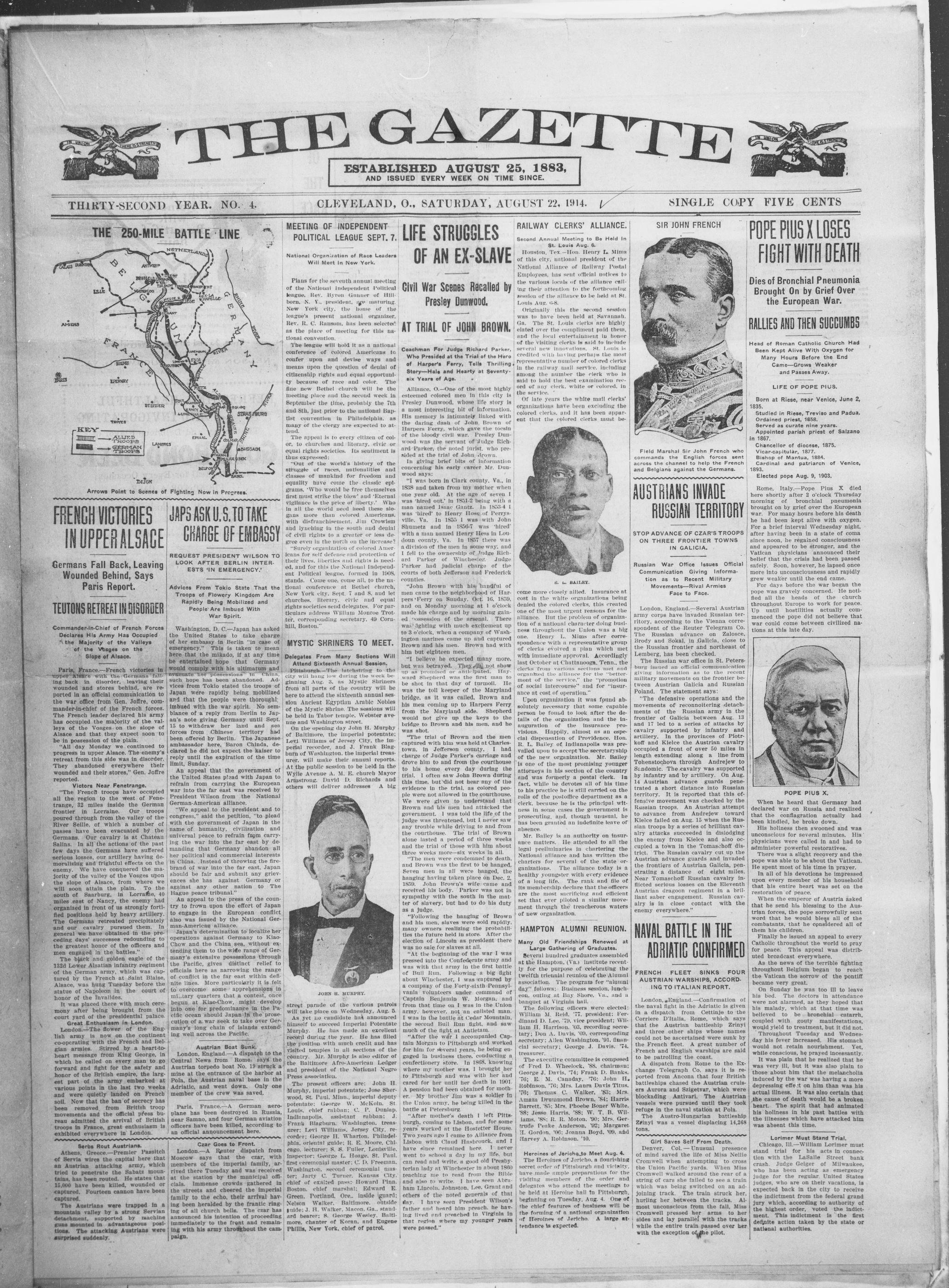
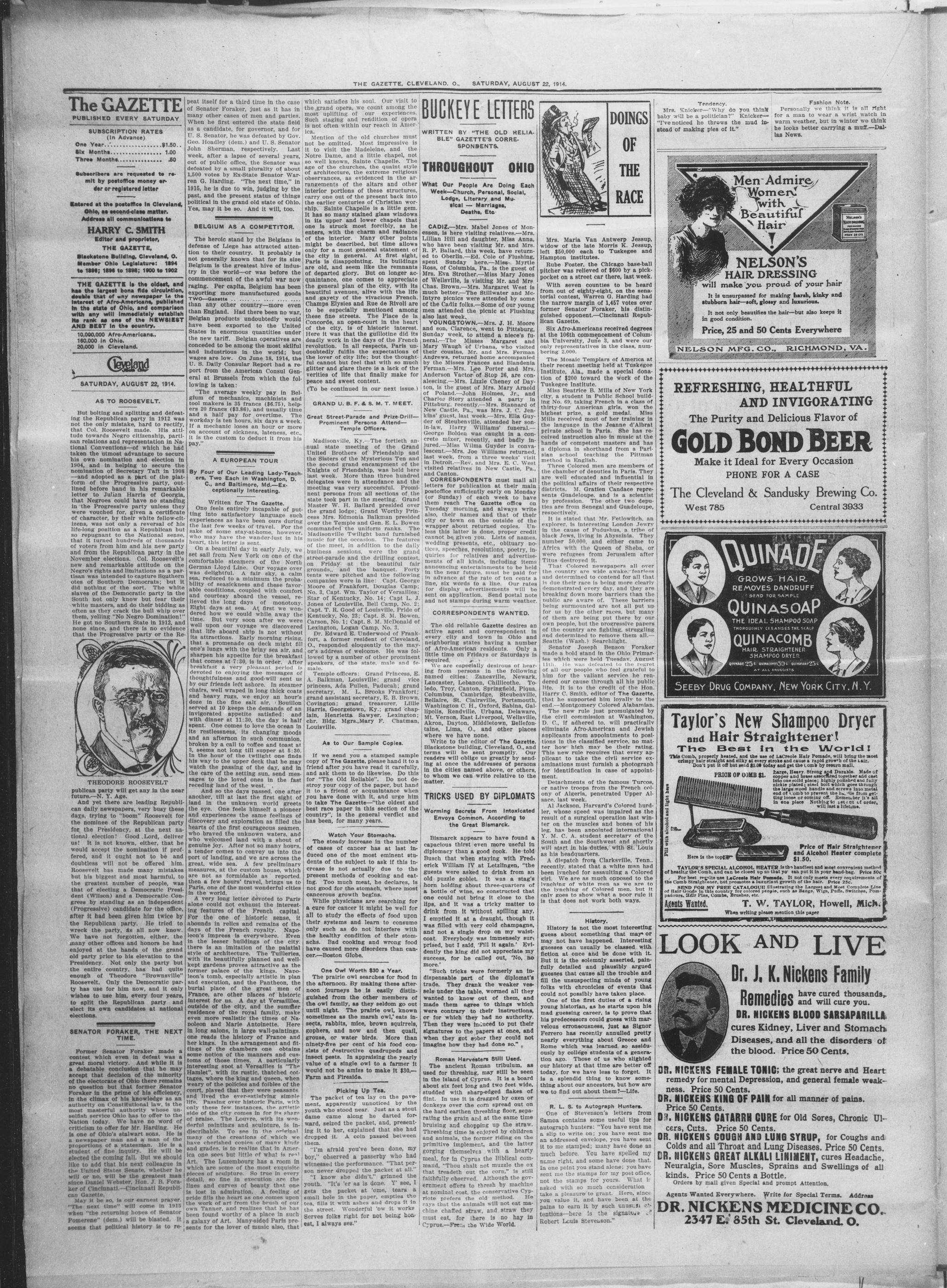
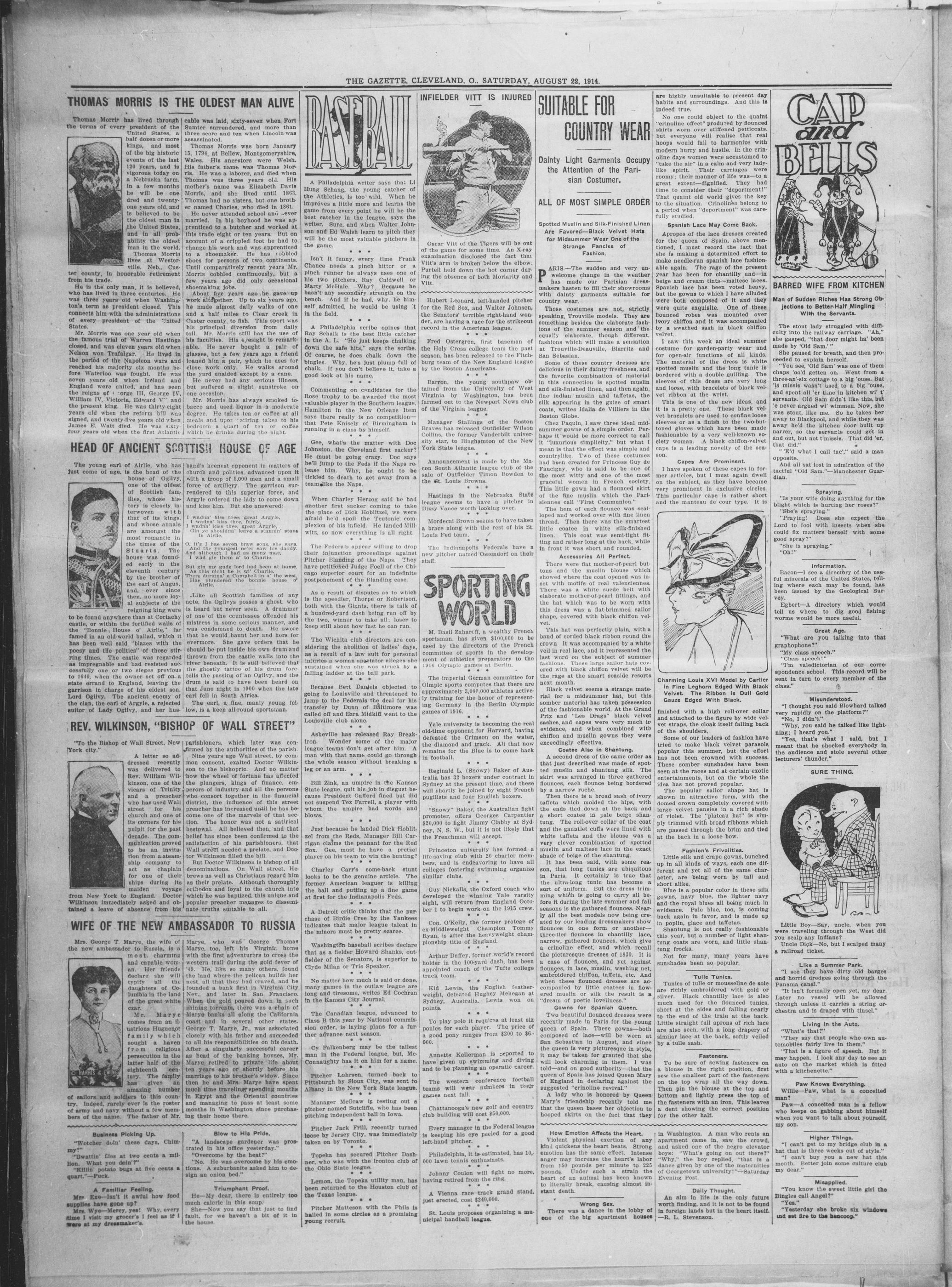
Page text (machine-generated)
THE 250-MILE BATTLE LINE
NETHERLANDS
CALAS DANUR
ANTWERP
BRUSSELS
THEMONT
THOMPSON MADRID
WATERLOO
HUSE & LIEGE
LAKKA
CHAPELLE
AMIENS
FRANCE
UM
RIVER
LUNES
LEMONT
SCHUTZEN
BELUS
EVERNAY
STEUZIER
TOUR BANQUET
HANCY
LUNDWILLE
STIRAS SEURG
KEY
ALLIED
TROOPS
GERMAN
TROOPS
LANORES
EPINAL
COLMAR
DREISACH
PHANN
MILHAUSEN
BELFOP
BASOL
DIJON
IN UNION THERE IS STRAIGHT
THIRTY-SECOND
THE 250-MILE
CALAS DANORS
ANTWERP
BRUSSELS
THE
WATERLOO
LELE
AMIENS
SEGAN
FRANCE
BELAS
ERDONY
STEUZIER
TROTES
KEY
ALLIED
TROOPS
GERMAN
TROOPS
LANO
DIJON
Arrows Point to Scenes of
FRENCH VICTORIES IN UPPER ALSACE
Germans Fall Back, Leaving Wounded Behind, Says Paris Report.
Commander-in-Chief of French Forces Declares His Army Has Occupied the Majority of the Valleys of the Voyages on the Slope of Alsace.
Paris, France.—French victories in upper Austria with the Gavwies falling back in disarray, leaving their wounded and stores behind, are reported in an official communication to the war office from Gen. Joffre, commander-in-chief of the French forces. The French leader declared his army occupied the majority of the valleys of the Voyages on the slope of Alsace and that they expect soon to be in possession of the plain.
"All day Monday we continued to progress in upper Alsace. The enemy's retreat from this side was in disorder. They abandoned everywhere their wounded and their stores," Gen. Joffre reported.
Victors Near Fenetrange.
"The French troops have occupied all the region to the west of Fenetrange, 32 miles inside the German frontier in Lorraine. Our troops poured through from the valley of the River Selle, of which a number of passes have been evacuated by the Germans. Our cavalry is at Chateau Salina. In all the actions of the past few days the Germans have suffered serious losses, our artillery having demoralizing and frightful effects on the enemy. We have conquered the majority of the valley of the Vosges upon the slope of Alsace, from where we will soon attain the plain. To the south of Saarburg, in Lorraine, 40 miles east of Nancy, the enemy had organized in front of us strongly fortified positions held by heavy artillery. The Germans retreated precipitately and our cavalry pursued them. In general we have obtained in the preceding days successes redounding to the greatest honor of the officers and men engaged in the battles."
The black and golden eagle of the 132d Lower Alsatian infantry regiment of the German army, which was captured by the French at Saint Blaise, Alsace, was hung Tuesday before the statue of Napoleon in the court of honor of the Invalides.
It was placed there with much ceremony after being brought from the court yard of the presidential palace.
Great Enthusiasm in London. London.—The flower of the English army is now on the continent co-operating with the French and Belgian armies. Stirred by a heart-toheart message from King George, in which he called on every man to go forward and fight for the safety and honor of the British empire, the largest part of the army embarked at various points in the last two weeks and were quietly landed on French soil. Now that the ban of secrecy has been removed from British troop movements and the official press bureau admitted the arrival of British troops in France, great enthusiasm is exhibited everywhere in London.
Serbs Rout Austrians.
Athens, Greece.—Premier Passitch of Servia wires the capital here that an Austrian attacking army, which tried to penetrate the Sabatz mountains, has been routed. He states that 15,000 have been killed, wounded or captured. Fourteen cannon have been captured.
The Austrians were trapped in a mountain valley by a strong Servian detachment, supported by machine guns mounted in advantageous positions. The attacking Austrians were surprised suddenly.
THE GAZETTE
JAPS ASK U.S.TO TAKE CHARGE OF EMBASSY
REQUEST PRESIDENT WILSON TO
LOOK AFTER BERLIN INTERE-
STS 'IN EMERGENCY.'
Advices From Tokio State That the
Troops of Flowery Kingdom Are
Rapidly Being Mobilized and
People Are Imbued With War Spirit.
Washington, D. C.—Japan has asked the United States to take charge of her embassy in Berlin "in case of emergency." This is taken to mean here that the mikado, if at any time he entertained hope that Germany would comply with his ultimatum and evacuate her possessions" in China, such hope has been abandoned. Advices from Tokio stated the troops of Japan were rapidly being mobilized and that the people were thoroughly imbued with the war spirit. No semblance of a reply from Berlin to Japan's note giving Germany until Sept. 15 to withdraw her land and sea forces from Chinese territory had been offered by Berlin. The Japanese ambassador here, Baron Chinda, declared he did not expect the kaiser to reply until the expiration of the time limit, Sunday.
An appeal that the government of the United States plead with Japan to refrain from carrying the European war into the far east was received by President Wilson from the National German-American alliance.
"We appeal to the president and to congress," said the petition, "to plead with the government of Japan in the name of humanity, civilization and universal peace to refrain from carrying the war into the far east by demanding that Germany abandon all her political and commercial interests in China. Instead of throwing the firebrand of war into the far east, Japan should be fair and submit any grievances she has against Germany or against any other nation to The Hague peace tribunal."
An appeal to the press of the country to frown upon the effort of Japan to engage in the European conflict also was issued by the National German-American alliance.
Japan's determination to localize her operations against Germany to Kiao-Chow and the China sea, without extending them to the wide range of Germany's extensive possessions through the Pacific, gives distinct relief to officials here as narrowing the range of conflict in the far east within definite lines. More particularly it is felt to overcome some apprehensions in military quarters that a contest, once begun at Kiao-Chow, might develop into one for predominance in the Pacific ocean should Japan in the prosecution of a war seek to take over Germany's long chain of islands extending well across the Pacific.
London, England.—A dispatch to the Central News from Rome says the Austrian torpedo boat No. 19 struck a mine at the entrance of the harbor at Pola, the Austrian naval base in the Adratic, and went down. Only one member of the crew was saved.
Paris, France.—A German aeroplane has been destroyed in Russia, near Samno, and four German aviation officers have been killed, according to an official announcement here.
Czar Goes to Front.
London.—A Reuter dispatch from Moscow says that the czar, with members of the imperial family, arrived there Tuesday and was received at the station by the municipal officials. Immense crowds gathered in the streets and cheered the imperial family to the echo, their arrival having been heralded by the frantic ringing of all church bells. The czar has announced his intention of proceeding immediately to the front and remaining with his army throughout the campa
ESTABLISHED AUGUST 25, 1883 AND ISSUED EVERY WEEK ON TIME SINCE.
MEETING OF INDEPENDENT POLITICAL LEAGUE SEPT. 7.
National Organization of Race Leaders Will Meet in New York.
Plans for the seventh annual meeting of the National Independent Political League, Rev. Byron Gunner of Hillborn, N. Y., president, age maturing, New York city, the home of the league's present national organizer, Rev. R. C. Ransom, has been selected as the place of meeting for this national convention.
The league will hold it as a national conference of colored Americans to confer upon and devise ways and means upon the question of denial of citizenship rights and equal opportunity because of race and color. The fine new Bethel church will be the meeting place and the second week in September the time, probably the 7th and 8th, just prior to the national Baptist convention in Philadelphia, as many of the clergy are expected to attend.
The appeal is to every citizen of color, to churches and literary, elicic or equal rights societies. Its sentiment is thus expressed:
"Out of the world's history of the struggle of races, nationalities and classes of mankind for freedom and equality have come the classic epigrams. 'Who would be free themselves first must strike the blow' and 'Eternal vigilance is the price of liberty.' Who in all the world need these slogans more than colored Americans, with disfranchisement, Jim Crowism and lynching in the south and denial of civil rights to a greater or less degree even in the north on the increase? "Surely organization of colored Americans for self defense and protection of their lives, liberties and rights is needed, and for this the National Independent Political league, formed in 1908, stands. Come one, come all, to the national conference at Bethel church, New York city, Sept. 7 and 8, and let churches, literary, civic and equal rights societies send delegates. For particulars address William Monroe Trotter, corresponding secretary, 40 Cornhill, Boston."
MYSTIC SHRINERS TO MEET.
Delegates From Many Sections Will
Attend Sixteenth Annual Session.
Pittsburgh. The lathstring to the city will hang low during the week beginning Aug. 3, as Mystic Shriners from all parts of the country will be here to attend the sixteenth annual session Ancient Egyptian Arabic Nobles of the Mystic Shrine. The sessions will be held in Tabor temple, Webster avenue and Washington street.
On the opening day John H. Murphy of Baltimore, the imperial potentate: Levi Williams of Jersey City, the imperial recorder, and J. Frank Blagburn of Washington, the imperial treasurer, will make their annual reports. At the public session to be held in the Wylie Avenue A. M. E. church Mayor Armstrong, David D. Richards and others will deliver addresses A big
JOHN H. MURPHY.
street parade of the various patrols will take place on Wednesday, Aug. 5. As yet no candidate has announced himself to succeed Imperial Potentate Murphy. He has made an excellent record during the year. He has filled the position with much credit and has visited temples in all sections of the country. Mr. Murphy is also editor of the Baltimore Afro-American Ledger and president of the National Negro Press association.
The present officers are: John H. Murphy, imperial potentate; Jose Sherwood, St. Paul, Minn., imperial deputy potentate; George W. McKohn, St. Louis, chief rubban; C. P. Dunlair, Indianapolis, assistant rubban; J. Frank Blugburn, Washington, treasurer; Levi Williams, Jersey City, treasurer; George H. Wharton, Philadelphia, oriental guide; R. E. Moore, Chicago, lecturer; S. S. Fuller, Louisville, inspector; George L. Honeg, St. Paul, first ceremonial master; C. D. Freeman, Washington, second ceremonial master; Jarry C. Turner, Kansas City chief of exalted pass; Howard Pinn, Boston, chief marshal; Edward E. Green, Portland, Ore., inside guard; Nelson Walker, Baltimore, outside guide; J. H. Walker, Macon, Ga., standard bearer; S. George Wesley, Baltimore, chanter of Koran, and Eugene Phillis, New York, chief of patrol.
LIFE STRUGGLES OF AN EX-SLAVE
LIFE STRUGGLES OF AN EX-SLAVE
Civil War Scenes Recalled by Presley Dunwood.
AT TRIAL OF JOHN BROWN.
Coachman For Judge Richard Parker, Who Presided at the Trial of the Hero of Harper's Ferry, Tells Thrilling Story—Hale and Hearty at Seventy-six Years of Age.
Alliance, O.—One of the most highly esteemed colored men in this city is Presley Dunwood, whose life story is a most interesting bit of information. His memory is intimately linked with the daring dash of John Brown of Harper's Ferry, which gave the toes of the bloody civil war. Presley Dunwood was the servant of Judge Richard Parker, the noted jurist, who presided at the trial of John drown.
In giving brief bits of information concerning his early career Mr. Dunwood says:
"I was born in Clark county, Va., in 1838 and taken from my mother when one year old. At the age of seven I was 'bired out.' in 1831-2 being with a man named Isaac Gantz. in 1835-4 I was 'bired' to Henry Hose of Perryville, Va. In 1855 I was with John Shumetz and in 1856-7 was 'bired' with a man named Henry Hess in Loudoun county, Va. In 1857 there was a division of the men in some way, and I fell to the ownership of Judge Richard Parker of Winchester. Judge Parker and judicial charge of the courts of both Jefferson and Frederick counties.
"John Brown with his handful of men came to the neighborhood of Harpers' Ferry on Sunday, Oct. 16, 1850, and on Monday morning at 1 o'clock made his charge and by morning gained possession of the arsenal. There was lighting with much excitement up to 3 o'clock, when a company of Washington marines came up and captured Brown and his men. Brown had with him but eighteen men.
"I believe he expected many more, but was betrayed. They did not show up as promised or anticipated. Hayward Shepherd was the first man to be shot in that day of turmoll. He was the toll keeper of the Maryland bridge, as it was called. Brown and his men coming up to Harpers Ferry from the Maryland side. Shepherd would not give up the keys to the bridge to Brown and his men, and he was shot.
"The trial of Brown and the men captured with him was held at Charlestown, in Jefferson county. He charge of Judge Parker's carriage and drove him to and from the courthouse to his home every day during the trial. I often saw John Brown during this time, but did not hear any of the evidence in the trial, as colored people were not allowed in the courthouse. We were given to understand that Brown and his men had attacked the government. I was told the life of the judge was threatened, but I never saw any trouble while driving to and from the courthouse. The trial of Brown alone lasted a period of three weeks and the trial of those with him about three weeks more—six weeks in all.
"The men were condemned to death, and Brown was the first to be hanged. Seven men in all were hanged, the hanging having taken place on Dec. 2, 1850. John Brown's wife came and received his body. Parker was not in sympathy with the south in the matter of slavery, but had to do his duty as a judge.
"Following the hanging of Brown and his men, slaves were sold rapidly, many owners realizing the probabilities the future held in store. After the election of Lincoln as president there was no sale for slaves at all.
"At the beginning of the war I was pressed into the Confederate army and was with that army in the first battle of Bull Run. Following a big fight about Winchester, I was captured by a company of the forty-six Pennsylvania volunteers under command of Captain Benjamin W. Morgan, and from that time on I was in the Union army, however, not an enlisted man. I was in the battle at Cedar Mountain, the second Bull Run fight, and saw much of the fight at Antietam.
"After the war I accompanied Captain Morgan to Pittsburgh and worked for him for several years, he being engaged in business there, conducting a confectionery store. In 1868, knowing where my mother was, I brought her to Pittsburgh and was with her and cared for her until her death in 1901. A pension had been obtained for mother. My brother Jim was a soldier in the Union army, he being killed in the battle at Petersburg.
"After mother's death I left Pittsburgh, coming to Lisbon, and for some years worked at the Hostetler House. Two years ago I came to Alliance from Lisbon with Claud Hasbrouck, and I have since remained here. I never went to school a day in my life, but can read and write, a good old Presbyterian lady at Winchester in about 1860 teaching me to read from the Bible and also to write. I have seen Abraham Lincoln, Johnston, Lee, Grant and others of the noted generals of that day. I have seen President Wilson's father and heard him preach, he having lived and preached in Virginia in that region where my younger years were passed."
RAILWAY CLERKS' ALLIANCE.
Second Annual Meeting to Be Held In St. Louis Aug. 6.
Houston, Tex - Hon. Henry L. Mims of this city, national president of the National Alliance of Railway Postal Employees, has sent official notice to the various locals of the alliance calling their attention to the forthcoming session of the alliance to be held at St. Louis Aug. 6-8.
Originally this the second session was to have been held at Savannah, Ga. The St. Louis clerks are highly elated over the compliment paid them, and the local entertainment in honor of the visiting clerks is said to include several new innovations. St. Louis is credited with having perhaps the most impressive record of colored clerks in the railway mail service, including among the number the clerk who is said to hold the best examination record or any clerk, white or colored, in the service.
Of late years the white mail clerk's organizations have been excluding the colored clerks, and it has been apparent that the colored clerks must be
come more closely alike. Insurance at cost in the white organizations being denied the colored clerks, this created one of the most urgent reasons for the alliance. But the problem of organization of a national character doing business throughout the Union was a big one. Henry L. Mims after correspondence with a representative group of clerks evolved a plan which met with immediate approval. Accordingly last October at Chattanooga, Tenn., the clerks from various sections met and organized the alliance for the "betterment of the service," the "promotion of social intercourse" and for "insurance at cost of operation."
Upon organization it was found absolutely necessary that some capable person be found to look after the details of the organization and the inauguration of the insurance provisions. Happily, almost as an especial dispensation of Providence, Hon. R. L. Bailey of Indianapolis was prevailed upon to accept the secretaryship of the new organization. Mr. Bailey is one of the most promising younger attorneys in his section of the country and was formerly a postal clerk. In fact, while he devotes all of his time to his practice he is still carried on the rolls of the postoffice department as a clerk, because he is the principal witness in some cases the government is prosecuting, and, though unusual, he has been granted an indefinite leave of absence. Mr. Bailey is an authority on insurance matters. He attended to all the legal preliminaries in chartering the National alliance and has written the charters for several of the state organizations. The alliance today is a healthy youngster with every evidence of a long life. The rank and file of its membership declare that the officers are the most sacrificing and efficient set that ever plotted a similar movement through the treacherous waters of new organization.
HAMPTON ALUMNI REUNION.
Many Old Friendships Renewed at Large Gathering of Graduates.
Several hundred graduates assembled at the Hampton, (Va.) institute recently for the purpose of celebrating the twelfth triennial reunion of the Alumni association. The program for "alumni day" follows: Business session, luncheon, outing at Bay Shore, Va., and a banquet at Virginia hall.
The following officers were elected: William M. Reid, 77; president; Ferdinand D. Lee, 79; vice president; William H. Harrison, 03; recording secretary; Don A. Davis, 00; corresponding secretary; Allen Washington, 91; financial secretary; George J. Davis, 74; treasurer.
The executive committee is composed of Fred D. Wheelock, '88; chairman; George J. Davis, '74; Frank D. Banks, '76; E. M. Canday, '76; John H. Robinson, '76; Mrs. Laura Davis Titus, '76; Thomas C. Walker, '83; Mrs. Amaza Drummond Brown, '84; Harris Barrett, '85; Mrs. Phoebe Boner White, '88; Jesse Harris, '88; W. T. B. Williams, '88; R. R. Moton, '90; Mrs. Gertrude Peake Anderson, '92; Margaret H. Gordon, '06; Joanna Boyd, '00, and Harvey A. Robinson, '10.
Heroines of Jericho to Meet Aug. 4.
The Heroines of Jericho, a flourishing secret order of Pittsburgh and vicinity, have made simple preparations for the visiting members of the order and delegates who attend the meetings to be held at Heroine hall in Pittsburgh, beginning on Tuesday, Aug. 4. One of the chief features of business will be the forming of a national organization of Heroines of Jericho. A large attendance is expected.
SIR JOHN FRENCH
Field Marshal Sir John French who commands the English forces sent across the channel to help the French and Belgians against the Germans.
AUSTRIANS INVADE
RUSSIAN TERRITORY
STOP ADVANCE OF CZAR'S TROOPS ON THREE FRONTIER TOWNS IN GALICIA.
Russian War Office Issues Official Communication Giving Information as to Recent Military Movements—Rival Armies Face to Face.
London, England.—Several Austrian army corps have invaded Russian territory, according to the Vienna correspondent of the Reuter Telegram Co. The Russian advance on Zalosie, Brody and Sokal, in Galicia, close to the Russian frontier and northeast of Lemberg, has been checked.
The Russian war office in St. Petersburg issued an official communication giving information as to the recent military movements on the frontier between Austrian Galicia and Russian Poland. The statement says:
The defensive operations and the movements of reconnoitering detachments of the Russian army in the frontier of Galicia between Aug. 13 and 17 led to a series of attacks by cavalry supported by infantry and artillery. In the provinces of Piotrkoff and Kielce the Austrian cavalry occupied a front of over 50 miles in length extending along a line from Tohenstochova through Andrejew to Sondomic. The cavalry was supported by infantry and by artillery. On Aug. 14 Austrian advance guards penetrated a short distance into Russian territory. It is reported that this offensive movement was checked by the Russian troops. An Austrian attempt to advance from Andrejew toward Kielce failed on Aug. 15 when the Russian troops by a series of brilliant cavalry attacks succeeded in dislodging the enemy from Kielce and also occupied a town in the Tomaschoff district. The Russian cavalry cut up the Austrian advance guards and invaded the frontiers of Austrian Galicia, penetrating a distance of eight miles. Near Tomaschoff Russian cavalry inflicted serious losses on the Eleventh Austrian dragoon regiment in a brilliant saber engagement. Russian cavalry is in close contact with the enemy everywhere."
NAVAL BATTLE IN THE ADRIATIC CONFIRMED
NAVAL BATTLE IN THE ADRIATIC CONFIRMED
FRENCH FLEET SINKS FOUR AUSTRIAN WARSHIPS, ACCORDING TO ITALIAN REPORT.
London, England—Confirmation of the naval fight in the Adelaitic is given in a dispatch from Cettinjs to the Corriere Ditala, Rome, which says that the Austrian battleship Zrinyi and three other ships whose names could not be acertained were sunk by the French fleet. A great number of French and English warships are said to be patrolling the coast.
A dispatch from Rome to the Exchange Telegraph Co. says it is reported from Ancona that four British battleships chased the Austrian cruisers Aurora and Szigetvar, which were blockading Antivari. The Austrian vessels were pursued until they took refuge in the naval station at Pola.
The Austro-Hungarian battleship Zrinyi was a vessel displacing 14,268 tons.
Girl Saves Self From Death.
Denver, Col.—Unusual presence of mind saved the life of Miss Nellie Cromwell when attempting to cross the Union Pacific yards. When Miss Cromwell walked around the rear of a string of cars she failed to see a train which was being switched on an adjoining track. The train struck her, hurling her between the tracks. Almost unconscious from the fall, Miss Cromwell pressed her arms to her sides and lay parallel with the tracks while the entire train passed over her with the exception of the pilot.
IN UMBRIA
SIN MUERTE
DE LOS AMERICANOS
POPE PIUS X LOSES FIGHT WITH DEATH
Dies of Bronchial Pneumonia Brought On by Grief Over the European War.
RALLIES AND THEN SUCCUMBS
Head of Roman Catholic Church Had Been Kept Alive With Oxygen for Many Hours Before the End Came—Grows Weaker and Passes Away.
Born at Riese, near Venice, June 2,
1835.
Studied in Riese, Treviso and Padua.
Ordained priest, 1858.
Served as curate nine years.
Appointed parish priest of Salzano
in 1867.
Cardinal and patriarch of Venice, 1893.
Elected pope Aug. 9, 1903.
Rome, Italy.-Pope Plus X died here shortly after 2 o'clock Thursday morning of bronchial pneumonia brought on by grief over the European war. For many hours before his death he had been kept alive with oxygen. For a brief interval Wednesday night, after having been in a state of coma since noon, he regained consciousness and appeared to be stronger, and the Vatican physicians announced their belief that the crisis had been passed safely. Soon, however, he lapsed once into unconsciousness and rapidly grew weaker until the end came.
For days before the war began the pope was gravely concerned. He notified all the heads of the church throughout Europe to work for peace. Up until hostilities actually commenced the pope did not believe that war could come between civilized nations at this late day.
POPE PIUS X.
When he heard that Germany had declared war on Russia and realized that the conflagration actually had been kindled, he broke down.
His holiness then swooned and was unconscious for several minutes. His physicians were called in and had to administer powerful restoratives.
There was a slight recovery and the pope was able to be about the Vatican. He spent most of his time in prayer.
In all of his devotions he impressed upon every member of his household that his entire heart was set on the restoration of peace.
When the emperor of Austria asked that he send his blessing to the Austrian forces, the pope sorrowfully sent word that he would bless all of the combatants, that he considered all of them his children.
Finally he issued an appeal to every Catholic throughout the world to pray for peace. This appeal was distributed broadcast everywhere.
As the news of the terrible fighting throughout Belgium began to reach the Vatican the sorrow of the pontiff became very great.
On Sunday he was too ill to leave his bed. The doctors in attendance were not alarmed, as they hoped that his malady, which at that time was believed to be bronchial catarrh, coupled with gouty manifestations, would yield to treatment, but it did not.
Throughout Tuesday and Wednesday his fever increased. His stomach would not retain nourishment. Yet, while conscious, he prayed incessantly.
It was plain that he realized that he was very ill, but it was also plain to those about him that the melancholia induced by the war was having a more depressing effect on him than was his actual illness. It was also certain that the cause of death would be a broken heart. The spirit that had animated his holiness in his past battles with the illnesses which have attacked him was absent this time.
Lorimer Must Stand Trial
Chicago, Ill.—William Lorimer must stand trial for his acts in connection with the LaSalle Street bank crash, Judge Geler of Milwaukee, who has been acting as emergency judge for the regular, United States judges, who are on their vacations, is expected back in the city to receive the indictment from the federal grand jury which, according to authority of the highest order, voted the indictment. This indictment is the first definite action taken by the state or national authorities.
PUBLISHED EVERY SATURDAY
One Year.....$1.50.
Six Months.....1.00
Three Months......50
Subscribers are requested to re-
mit by postoffice money en-
der or registered letter
Entered at the postoffice in Cleveland
Ohio, as second-class matter.
Address all communications to
Blackstone Building, Cleveland, O.
Member Ohio Legislature, 1894
to 1896; 1896 to 1898; 1900 to 1902
THE GAZETTE is the oldest, and
has the largest bona fide circulation,
double that of any newspaper in the
interest of Afro-Americans, published
in the state of Ohio, and comparison
with any will immediately establish
its rank as one of the NEWSIEST
AND BEST in the country.
10,000,000 Afro-Americans..
160,000 in Ohio.
20,000 in Cleveland.
AS TO ROOSEVELT.
But bolting and splitting and defeating the Republican party in 1912 was not the only mistake, hard to rectify, that Col. Roosevelt made. His attitude towards Negro citizenship, partisan relations and representation in National Conventions—of which he had taken the utmost advantage to secure his own nomination and election in 1912—in helping to secure the nomination, Tillman was—and adopted as a part of the platform of the Progressive party, outlined before hand in his remarkable letter to Julian Harris of Georgia that Negroes could have no standing in the Progressive party unless they were vouched for, given a certificate of character, by their white fellow-citizens, was not only a reversal of his life-long position as a Republican but also a reversal of his position that it turned hundreds of thousands of voters from him and his new party and from the Republican party in the November elections. Col. Roosevelt's new and remarkable attitude on the Negro's rights and limitations as a partisan was intended to capture Southernotes of Southern Democrats; but it did nothing of the sort. The white slaves of the Democratic party in the South not only know but fear their own rights, and often as they crack the bull whip over them, yelling "No Negro Domination!" He got no Southern State in 1912, and none since, and there is no evidence that the Progressive party or the Re
THEODORE ROOSEVELT
publican party will get any in the near
future.—N. Y. Age.
And yet there are leading Republican daily newspapers, very busy these days, trying to "boom" Roosevelt for the nominee of the Republican party for the Presidency, at the next national election! Good Lord, deliver us! It is not known, either, that he would accept the nomination if profered, and it ought not to be and doubtless will not be offered him. Roosevelt has made many mistakes, but his biggest and most harmful, to the greatest number of people, was that of electing a Democratic President (Wilson) and a Democratic Congress by standing as an independent (Progressive) candidate for the office, after it had been given him twice by the Republican party. He tried to wreck the party, as all now know. We have not forgotten, either, the many other offices and honors he had enjoyed at the hands of the grand old party prior to his elevation to the Presidency. Not only the party but the entire country, has had quite enough of Theodore "Brownsville" Roosevelt. Only the Democratic party has use for him now, and it only wishes to use him, every four years, to split the Republican party and elect its own candidates at national elections.
SENATOR FORAKER, THE NEXT TIME.
Former Senator Foraker made a contest which even in defeat was a great moral victory. And while it is a debatable conclusion that he may accept that decision of the minority of the electorate of Ohio there remains no question but that former Senator Foraker in the prime of his efficiency, he has been the authority on Constitutional law, is the most masterful authority whose unselfish service Ohio has to offer to the Nation today. We have no word of criticism to offer for Mr. Harding. He is one of Ohio's stalwart sons. He is a newspaper man and a man of the proportions of a statesman. He is a student of the finer things. He will be elected chairman. But we should add that his next colleague in the United States Senate, whether he will or no, will be the greatest man since Daniel Webster, Hon. J. B. Foraker of Cincinnati—Cincinnati Republican Gazette. May it be so, is our earnest prayer. "The next time" will come in 1915 when "the returning hopes of Senator Pomerene" (dem.) will be blasted. It seems that political history is to re-
peat itself for a third time in the case of Senator Foraker, just as it has in many other cases of men and parties. When he first entered the state field as a candidate, for governor, and for U. S. Senator, he was defeated by Gov. Geo. Hoadley (dem.) and U. S. Senator John Sherman, respectively. Last week, after a lapse of several years, out of public office, the Senator was defeated by a small plurality of about 1,500 votes by Ex-State Senator Warren G. Harding. "The next time," in 1915, he is due to win, judging by the past, and the present status of things political in the grand old state of Ohio. Yes, may it be so. And it will, too.
BELGIUM AS A COMPETITOR.
The heroic stand by the Belgians in defense of Liege has attracted attention to their country. It probably is not generally known that for its size Belgium is the greatest hive of industry in the world—or was before the commencement of the awful war now raging. Per capita, Belgium has been exporting more manufactured goods TWO-Gazette than any other country—more even than England. Had there been no war, Belgian products undoubtedly would have been exported to the United States in enormous quantities under the new tariff. Belgian operatives are conceded to be among the most skillful and industrious in the world; but wages are low. On June 18, 1914, the U. S. Dally Consular Report had a report from the American Consul General at Brussels from which the following is taken:
"The average weekly pay in Belgium of mechanics, machinists and tool makers is 35 francs ($6.75), helpers are 20 francs ($1.50), and a half pay for overtime. The workday is ten hours, six days a week. If a mechanic loses an hour or more on account of sickness, lateness, etc., the custom to deduct it from his pay."
A EUROPEAN TOUR
By Four of Our Leading Lady-Teach ers, Two Each in Washington, D. C., and Baltimore, Md.-Exceptionally Interesting.
zazzette
One feels entirely incarnate of putting into satisfactory language such experiences as have been ours during the last few weeks of travel. For the sake of some stay-at-home, however, we must underlust in his heart, this letter is sent.
On a beautiful day in early July, we set sail from New York on one of the comfortable steamers of the North German Lloyd Line. Our voyage over was delightful. A fair sky, a calm sea, reduced to a minimum the probability of seasickness and these favorable conditions, coupled with comfort courtesy aboard the vessel, relieved me of days at monotony. Eight days at sea. At first, derailed how we could while away the time. But very soon after we were well upon our voyage we discovered that life aboard ship is not without its attractions. Early morning rising, that a promenade on deck might fill one's lungs with the briny sea air, and sharpen his appetite for the breakfast that comes at 7:30, is in order. After breakfast a very pleasant period is beginning, sending the messages of thoughtfulness and joy by our friends left ashore. In steamer chats, well wrapped in long thick coats and heavy rugs, we enjoy an hour's doze in the fine salt air. 'Bouillon served at 10 keeps the demands of an invigorated appetite satisfied: and with dinner at 11:30, the day is half spent. One comes to love the ocean in its restlessness, its changing moods and an afternoon in such communion, broken by a call to coffee and toast at 3, seems not long till supper at 5:30. The day's warmth one finds his way to the upper deck, watch the passing of the day, and in the care of the setting sun, send messages to the loved ones in the fast receding land of the west.
And so the days passed, one after another, till at last the first sight of land in the unknown world greets the eye. One feels himself a pioneer and experiences the same feelings of discovery and exploration as filled the heart of the first courageous seamen, who braved the first sea and who welcomed land with a shout of genuine joy. After not so many hours, a tender comes to convey us into the port of landing, and we are across the great, wide sea. A few preliminary measures, at the custom house, which are not as formidable as reported, at the hours' travel, brings us to Paris, one of the most wonderful cities in the world.
A very long letter devoted to Paris alone could not exhaust the interesting features of the French capital. For the one of historic sense, it abounds in relics and remains of the days of the French royalty. Napoleon's impress is everywhere. Even in the lesser buildings of the city, there is an imitation of the palatial style of architecture. The Tullieries, with its beautifully planned and well-constructed prospere attractive as the former palace of the Napoleon's tomb, especially artistic in plan and execution, and the Pantheon, the burial place of the great men of France, are other places of historic interest for us. A day at Versailles, outside of the city, and the summer residence of the royal family, make even more realistic the times of Napoleon and Marle Antoinette. Here in long salons, in large wall-paintings, one reads the history of France and her kings. In the arrangement and fit of the palace, the kings one obtains some notion of the temples of those times. A particularly interesting spot at Versailles is "The Hamlet", with its rustic, thatched cottages, where the king and queen, when weary of the policies and foibles of the court, played that they were peasants, and lived the ever-satisfying simple life. Passing over historic Paris, with only these few instances, the artistic features of the palace of praise. The Louvre, with its wonderful paintings and sculpture, is indiscribable. To see in the original many of the creations of which we have cherished copies of many kinds and grades, is to realize that in America one sees but little of what is real Art. The Luzembourg has a room in which are some of the most exquisite pieces of sculpture. So true in every detail, so fine in execution are the lines and curves of beauty that one is lost in admiration. A feeling of pride fills the heart as one comes upon the scenes of the palace of the own Tanner, and realizes that he has been found worthy of a place in such a galaxy of Art. Many-sided Paris presents for the lover of music also, that
which satisfies his soul. Our visit to the grand opera, we count among the most uplifting of our experiences. Such staging and rendition of opera is not often within our reach in Amer-
BUCKEYE LETTERS
Written by #THE OLD BELLA
Mention of the old churches must not be omitted. Most impressive is it to visit the Madeleine, and the Notre Dame, and a little chapel, not so well known, Sainte Chapelle. The age of the churches, the quaint style of architecture, the extreme religious observances, as evidenced in the arrangements of the altars and other interior portions of these structures, carry one out of the present back into the eaethen. The Sainte Chapelle is a little gem. It has so many stained glass windows in its upper and lower chapels that one is struck most forcibly, as he enters, with the charm and radiance of the interior. Many other points might be described, but time allows only for a most general statement of the city in general. At first sight, Paris is disappointing. Its buildings are old, and seem like the remnants of departed glory. But on longer acquaintance, one comes to appreciate the general plan of the city, with its beautiful avenues, and the life of the city, with its priveous French Champs Elysées and Rue de Rivoli are to be especially mentioned among these fine streets. The Place de la Concorde, an open-court in the heart of the city, is of historic interest. Here it was that the guillottine did its deadly work in the days of the French revolution. In all respects, Paris undoubtedly fulfils the expectations of the lover of city life; but the thoughtful cannot but feel that with so much glitter and glare there is a lack of the verities of life that finally make for peace and sweet content.
(To be continued in our next issue.)
GRAND U. B. F. & S. M. T. MEET.
Great Street-Parade and Prize-Drill-
Promising Attend—
Temple Officers.
Madisonville, Ky. The fortieth annual state meeting of the Grand United Brothers of Friendship and the Sisters of the Mysterious Ten and the second grand encampment of the Knights of Friendship, was held here last week. More than three hundred delegates were in attendance and the meeting was very successful. Proni and the Knights of Friendship state took part in the meeting. Grand Master W. H. Ballard presided over the grand lodge; Grand Worthy Princess Mrs. Edmonia Balkman presided over the Temple and Gen. E. L. Bowen commanded the uniform ranks. The Madisonville Twilight band furnished music for the occasion. The features of the business sessions, including the grand street-parade and the drilling contest, on Friday at the beautiful fair grounds., and the banquet. Forty tents were pitched and the following companies were in line: Capt. George Moore of Frankfort, Douglas Camp; No. 3, Capt. Wm. Taylor of Versailles; No. 4, Capt. Kentucky, No. 14; Capt. L. J. Carson, No. 15; Capt. T. R. Good of Louisville, Pride of Kentucky, No. 23; Capt. S. M. Bowen, Carson, No. 1; Capt. S. M. McDonald of Lexington, Logan Camp, No. 3.
Dr. Edward E. Underwood of Frankfort, a former resident of Cleveland, O., responded eloquently to the mayor's address of welcome. He was followed by a number of other prominent speakers, of the state, male and female.
Temple officers: Grand Princess, E. A. Balkman, Louisville; grand vice princess, Ada Pullen, Paducah; grand secretary, M. L. Brooks Frankfort; grand assistant secretary, E. B. Brown, Covington; grand treasurer, Lillie Harris, Georgetown, Ky.; grand chapleau, Henlerta Sawyer, Lexington; chr. Bldg. Mgrs,Mary F. Chatman, Louisville.
As to Our Sample Copies.
If we send you a stamped sample copy of The Gazette, please hand it to a friend after you have read it carefully, and ask them to do likewise. Do this for "The Old Reliable". Do not destroy your copy of the paper, but hand it to a friend or acquaintance when you have done with it, and urge him to take The Gazette—the oldest and best race paper in this section of the country", is the general verdict and has been, for many years.
Watch Your Stomachs
The steady increase in the number of cases of cancer has at last induced one of the most eminent students of the subject to ask if this increase is not actually due to the present methods of cooking and eating. Too much meat, he declares, is not good for the stomach, where most cancerous growth begins.
While physicians are searching for a cure for cancer it might be well for all to study the effects of food upon their systems and learn to consume only such as do not interfere with the healthy condition of their stomachs. Bad cooking and wrong food have caused more disorders than cancer.—Boston Globe.
One Owl Worth $30 a Year
One Owl Worth $30 a Year.
The prairie owl searches for food in the afternoon. By making these afternoon journeys he is easily distinguished from the other members of the owl family, as they seldom go out until night. The prairie owl, known sometimes as the marsh owl, eats insects, rabbits, mice, brown squirrels, gophers, and now and then quail, grouse, or water birds. More than ninety-five per cent of his food consists of destructive quadrups and insect pests. In appraising the yearly value of a single owl to a farmer it would not be amiss to make it $30.—Farm and Fireside.
Picking Up Tea.
The packet of tea lay on the pavement, apparently unnoticed by the youth who stood near. Just as a stout dame came along he darted forward, selzed the packet, and, presenting it to her, explained that she had dropped it. A coin passed between them.
"I'm afraid you've been done, my boy," observed a passerby who had witnessed the performance. "That person never dropped the packet at all."
"I know she didn't," grinned the youth. "It's 'er as is done. Y see, I gets the packet at 'ome, tears a small hole in the paper, empties the tea, filling it with ashes and drops it in the street. Wonderful 'ow it works. Serves folks right for not being高危, I always sees."
BUGKEYE LETTERS
WRITTEN BY "THE OLD RELIA BLE" GAZETTE'S CORRESPONDENTS.
What Our People Are Doing Each Week — Church, Personal, Social, Lodge, Literary and Musical — Marriages, Deaths, Etc.
CADIZ — Mrs. Mabel Jones of Monessen, is here visiting relatives. — Mrs. Lillian Hill and daughter, Miss Anna, who have been visiting Mr. and Mrs. R. F. Ballard, this week, have returned to Oberlin. — Ed. Cole of Flushing, Sunday. — here. — Miss. Myrtle Ross, of Columbia, is the guest of Mrs. Eva Strother. — Miss Margaret Jones of Welleville, is visiting Mr. and Mr. Chas. Brown — Mrs. Margaret West is much better. — The Stillwater and McIntyre picnics were attended by some of the Cadiz folks. — Some of our young men attended the picnic at Flushing also last week.
YOUNGSTOWN—Mrs. J. H. Moore and son, Clarence, to attend to Pittsburgh, Sunday week, to attend a niece's funeral. The Misses Margaret and Mary Waugh of Urbana, who visited their cousins, Mr. and Mrs. Ferman and Mrs. Ferman, by the Misses Frances and Blandenia Ferman. Mrs. Lee Porter and Mrs. Anderson Vector of Stop 26, are conalescing. Mrs. Lizzle Cheney of Dayton, is the guest of Mrs. Mary Arnold of Poland. John Holmes, Jr., and Charles Stery attended a party in Pittsburgh, recently. Mrs. Stannard of Ohio, Mrs. Kins' guest, last week. Mrs. Ella Guyder of Steubenville, attended her son in-law, Harry Williams' funeral. George Bolden was caught in a concrete mixer, recently, and badly injured. Miss Wilma Guyder is convalescent. Mrs. Joe Williams returned last week, from a three weeks' visit. Rev. and Mrs. C. E. Wess visited relatives in New Castle, Pa. and Canton.
CORRESPONDENTS must mail all letters for publication at their main postoffice sufficiently early on Monday (or Sunday) of each week to have them reach The Gazette office on Tuesday morning, and always write also, their names and that of their employer. They must also wrap about returned copies. Unless this latter is done, proper credit cannot be given you. Lists of names, wedding presents, etc., obituary notices, speeches, resolutions, poetry, inquiries for relatives and advertisements of all kinds, including items announcing entertainments to be held in the near future, must be paid for in the near future, the tee to be on cents a line, six words to a line, for display advertisements will be sent on application. Send postal note and not stamps during warm weather.
CORRESPONDENTS WANTED.
The old reliable Gazette desires an active agent and correspondent in every city and town in Ohio and neighboring states having a number of Afro-American residents. Only a little time on Fridays or Saturdays is required. We are especially desirous of hearing Omaha people in the following named cities: Zanesville, Newark, Lancaster, Lebanon, Chillicothe, Toledo, Troy, Canton, Springfield, Piqua, Columbus, Cambridge, Steubenville, Bellaire, St. Clairsville, Portsmouth, Washington C. H., Oxford, Sabina, Galipolis, Rendville, Urbana, Delaware, M. Vernon, East Liverpool, Wellsville, Akron, Dayton, Middletown, Bellefontaine, Lima, O., and other places where we have none.
Write to the editor of The Gazette, Blackstone building, Cleveland, O., and researchers will oblige us greatly by sitting at once the addresses of persons in the cities named above, or others, to whom we can write relative to the matter.
TRICKS USED BY DIPLOMATS
Worming Secrets From Intoxicated Envoys Common, According to the Great Bismarck.
Bismarck appears to have found a capacious thirst even more useful in diplomacy than a good cook. He told Busch that when staying with Frederick William IV at Letzlingen, "the guests were asked to drink from an old puzzle goblet. It was a stag's horn holding about three-quarters of a bottle of wine, so constructed that one could not bring it close to the lips, and it was a tricky matter to drink from it without spilling any, I emptied it at a draught, though it was filled with very cold champagne, and not a single drop on my waistcoat. Everybody was immensely surprised, but I said, 'Fill it again.' Evidently the king did not appreciate my success, for he called out, 'No, no more.'
"Such tricks were formerly an indispensable part of the diplomat's trade. They drank the weaker vessels under the table, wormed all they wanted to know out of them, and made them agree to things which were contrary to their instructions, or for which they had no authority. Then they were induced to put their signatures to the papers at once, and when they got sober they could not imagine how they had done so."
Roman Harvesters Still Used.
Roman Harvesters Still Used.
The ancient Roman triumphal, as used for threshing, may still be seen in the island of Cyprus. It is a board about six feet long and two feet wide, studded with sharp-edged flakes of flint. In use it is dragged by oxen or donkeys over the corn spread out on the hard earthen threshing floor, separating the grain and at the same time bruising and chopping up the straw. Threshing time is enjoyed by children and animals, the former riding on the primitive implement, and the latter gorging themselves with a hearty meal, for in Cyprus the Biblical command, "Thou shalt not muzzle the oat that treadeth out the corn," is still faithfully observed. Although the government offers to thresh by machine at nominal cost, the conservative Cypriote prefers the old method. He says that the animals will not eat machine chaffed straw, and straw they must eat, for there is no hay in Cyprus.—Fears the Wide World.
DOINGS OF THE RACE
Mrs. Maria Van Antwerp Jessup, widow of the late Morris K. Jessup, left $50,000 each to Tuskegee and Hampton institutes.
Rube Foster, the Chicago base-ball pitcher was relieved of $600 by a pick-pocket on a street car there, last week.
With seven counties to be heard from out of eighty-eight, on the senatorial contest, Warren G. Harding had the narrow margin of 1,457 votes over former Senator Foraker, his distinguished opponent—Cincinnati Republican Gazette.
Six Afro-Americans received degrees at the 106th commencement of Columbia University, June 3, and were our only representatives in the class, numbering 2,000.
The Mosaic Templars of America at their recent meeting held at Tuskegee Institute, Ala., made a special donation of $200 toward the work of the Tuskegee Institute.
Miss Beatrice B. Mills of New York city, a student in Public School building No. 69, taking French in a class of thirty-four American girls, won the highest prize, a gold medal. Miss Mills received most of her training in the language in the Jeanne d'Albrat private school in Paris. She has received instruction also in music at the hands of competent masters and has been taught from a Persian school teaching the Pittman method in English.
Three Colored men are members of the chamber of deputies in Paris. They are well educated and influential in the political affairs of their respective districts. M. Gratien Candace represents Guadeloupe, and is a scientist by profession. The other two deputies are from Senegal and Guadeloupe, respectively. The other that deputies are from Senegal and Guadeloupe, respectively. That Mr. Fetowitch, an explorer is interesting London Jewry in the cause of Fudushus, a tribe of black Jews, living in Abyssinia. They number 50,000, and either came to Africa with the Queen of Sheba, or were refugees from Jerusalem after Titus destroyed it.
That Colored newspapers all over the country are wide awake, fearless and determined to contend for all that is due their race is being more clearly demonstrated every day, and they are public are aware of. These barriers being surmounted are not all put up for us by the other races, but many of them are being put there by our own people, but the progressive papers of the country are fighting, struggling and determined to remove them all. Seattle (Wash.) Searchlight. Foraker made a bold stand in the Ohio Primaries which he were held Tuesdav. August 11th. He was defeated to the regret of all our people who feel grateful to him for the valiant service he rendered our cause through all his public life. It is to the credit of the Hon. Harry Smith, editor of The Gazette, that he sailed to New York and — Montgomery Colored Abamanian.
The new rule just promulgated by the civil commission at Washington, D. C., if adhered to, will practically eliminate Afro-American and Jewish applicants from appointments to positions in the classified service, no matter how high may be their rating. This new rule requires that every applicant to take the civil service examinations must furnish a photograph for identification in case of appointment. Detachments of the famous Turcos, or native troops from the French colony of Algeria, penetrated Upper Alassas. Al Jackson, Harvard's Colored hurdle, whose speed was impaired as the result of a surgical operation last winter on the muscles and bones of his leg, has been appointed international Y. M. C. A. student secretary of the South and the Southwest and shortly will start in his duties, with St. Louis as his headquarters.
A dispatch from Clarksville, Tenn., recently, stated that a white man had been lynched for assaulting a Colored girl. We are as much opposed to the lynching of white men as we are to the lynching of Colored men, but it only goes to show what a poor rule it is that does not work both ways.
History.
History is not the most interesting guess about something that may or may not have happened. Interesting guesses can usually be classed, with fiction at once and be done with it. But it is the solemnly asserted, painfully detailed and plausibly argued guesses that cause all the trouble and fill the unsuspecting minds of young folks with chronicles of events that could not possibly have taken place.
One of the first duties of a rising young historian, as he starts upon his mad guessing career, is to prove that his predecessors could guess with marvelous erroneousness, just as Signor Ferrero has recently annulled pretty nearly everything about Greece and Rome which was learned, so assiduously by college students of a generation ago. Those of us who slighted our history at that time are better off today, for we have less to forget. It is a splendid thing to know something about our ancestors, but how are we to find out about them?—Life.
R. L. S. to Autograph Hunters.
One of Stevenson's letters from Samosa contains some useful tips for autograph hunters: "You have sent me a slip to write on; you have sent me an addressed envelope, you have sent it to the stamped; many have done as much before. You have spelled my name right, and some have done that. In one point you stand alone; you have sent me the stamps for my post office, not the stamps for yours. What is asked with so much consideration take a pleasure to grant. Here, since you value it, and have been at the pains to earn it by such unjust entitions—here is the signature, Robert Louis Stevenson."
Men Admire Women with Beautiful Hair!
NELSON'S HAIR DRESSING
will make you proud of your hair
It is unsurpassed for making harsh, kinky and stubborn hair—soft, glossy and luxurious.
It not only beautifies the hair—but also keeps it in good condition.
Price, 25 and 50 Cents Everywhere
NELSON MFG. CO., RICHMOND, VA.
QUINADE
GROWS HAIR
REMOVES DANDRUFF
SEND FOR SAMPLE
QUINASOAP
THE IDEAL SHAMPOO SOAP
TMOROUGHLY CLEANS THE SCALP
QUINACOMB
HAIR STRAIGHTENER
SHAMPOO DRYER
QUINADE 25+ QUINACOMB 30+ QUINASOAP 25+
AT ALL DRUGGISTS
SEEBY DRUG COMPANY, NEW YORK CITY, N. Y.
TAYLOR'S SPECIAL ALCOHOL HEATER is the handiest and most convenient method of heating the Comb, and can be closed up so that you can put it in your hand-bag. Price $260 for the Comb Straightener, but promotes a luxurious growth of the hair. Price $280.
SEND FOR MY FREE CATALOGUE illustrating the Largest and Most Complete Line of Hair Groom in this country for colored people, such as Bangs, Wigs, Puffs, Switches, Pom-poms, Hair Fil, Combs, Brushes, etc.
Agents Wanted.
T. W. TAYLOR, Howell, Mich.
When writing please mention this paper
LOOK AND LIVE
Remedies have cured thousands, and will cure you. DR. NICKENS BLOOD SARSAPARILLA cures Kidney, Liver and Stomach Diseases, and all the disorders of the blood. Price 50 Cents. DR. NICKENS FEMALE TONIC; the great nerve and Heart remedy for mental Depression, and general female weakness. Price 50 Cents.
DR. NICKENS KING OF PAIN for all manner of pains. Price 50 Cents.
DR. NICKENS CATARRH CURE for Old Sores, Chronic Ulcers, Cuts. Price 50 Cents.
DR. NICKENS COUGH AND LUNG SYRUP, for Coughs and Colds and all Throat and Lung Diseases. Price 50 Cents.
DR. NICKENS GREAT ALKALI LINIMENT, cures Headache, Neuralgia, Sore Muscles, Sprains and Swellings of all kinds. Price 50 Cents a Bottle.
DR. NICKENS MEDICINE CO. 2347 E. 85th St. Cleveland, O.
Mrs. Knickerbocker—"Why do you think baby will be a politician?" Knickerbocker—"I've noticed he throws the mud instead of making ples of it."
Men A
World
W
Beaut
Hair
NELSON MFG. CO.
HAIR DRY
will make you p
It is unsurpassed for
stubborn hair—soft, gloss
It not only beautifies
in good condition.
Price, 25 and 50
REFRESHING,
AND
The Purity and
GOLD BO
Make it Ideal for
PHONE FO
The Cleveland & S
West 785
QUIN
GROWS
REMOVES
SEND R
QUINA
THE IDEAL.
TOMOULYLY C
QUINA
HAIR ST
SHAM
QUINAGE 25¢ QUINA
AT AL
SEEBY DRUG COMPANY
Taylor's New
and Hair Str
The Best in
This Comb, properly heated, and the use
crimpy hair straight and silky promotes a luxur
Don't put it off but send $1.00 to
PRICE OF OOMB $1.
FILL with alcohol and light here
Here is the top.
TAYLOR'S SPECIAL ALCOHOL HEAT
of heating the Comb, and can be closed up so
For best results use LaCreate Hair Po
the Comb Straighten out and promotes a luxur
SEND FOR MY FREE CATALOGUE
of Hair Goods in this country for colored pe
padours, Hair Pins, Combs, Brushes, etc.
Agents Wanted.
T. W.
When writing please
LOOK A
A. B.
DR. NICKENS FEMALE TON
remedy for mental Depress
ness. Price 50 Cents.
DR. NICKENS KING OF PAIN
Price 50 Cents.
DR. NICKENS CATARRH CUR
cers, Cuts. Price 50 Cent
DR. NICKENS COUGH AND L
Colds and all Throat and L
DR. NICKENS GREAT ALKAL
Neuralgia, Sore Muscles,
kinds. Price 50 Cents a Bo
Orders by mail given Special an
Agents Wanted Everywhere. W
Fashion Note.
Personally we think it is all right for a man to wear a wrist watch in warm weather, but in winter we think he looks better carrying a muff—Dallas News.
Badmire
mer
with
beautiful
hair
SON'S
RESSING
groud of your hair
making harsh, kinky and
luxurious.
the hair—but also keeps it
Cents Everywhere
RICHMOND, VA.
HEALTHFUL
INVIGORATING
Delicious Flavor of
BAND BEER
for Every Occasion
FOR A CASE
andusky Brewing Co.
Central 3933
NADE
HAIR.
DANDRUFF
SAMPLE
ASOAP
SHAMPOO 50AP
CLEANSES THE SCALP
ACOMB
HAIGHTENER
000 DRYER
AMPS 50+ QUINOAAP 25+
BOREOGGISTS
NEW YORK CITY, N.Y.
Shampoo Dryer
rightener!
in the World!
La Creole Hair Pomade, will bring the most
stroke and cause a rapid growth of the hair.
lay and get the comb by return mail.
Large, heavy, strong and durable. Made of
copper and brass associated together and cast
into one solid piece, highly polished and fully
molded plated a steel hole which goes through
the large wood handle and screws into metal
end of tumbb to prevent the hole from get-
ting loose or coming off. Remember it's all
in one place. Nothing to get out of order,
will last a lifetime.
Price of Hair Straightener and Alcohol Heater complete $1.50.
ER is the handiest and most convenient method that you can put it in your hand-bag. Price $0.00 made. It not only meets every requirements of growth of the hair. Price $25.00, instracting the Largest and Most Complete Line, such as Bange, Wigs, Puffs, Switches, Pom.
TAYLOR, Howell, Mich.
mention this paper
ND LIVE
7 Nickole Family
The Best is the Cheapest; hence we are the Cheapest.
Arlington Pharmacy
WE WILL ACCEPT THIS ADVERTISEMENT FOR FIVE CENTS IN TRADE, TO APPLY ON ANY PURCHASE OF TWENTY-FIVE CENTS OR MORE.
E. Rubenstein, Ph. C., Prop.
S. W. Cor. Central Ave. & E.
55th St.
STERLING
5 and 10 Cent Store
3003 Central Ave.
Watch Our Windows
For Bargains
Colored Salesladies
```markdown
```
Results of "Fore" Treatment
"PORO COLLEGE"
Longed College of its kind in the world.
200 PINE STREET, ST. LOUIS, MA
For treatment, call on or address:
MISS KATIE B. COLLIER,
4812 Payne Ave.
C:Iseland, Ohio.
THE PEOPLES' DRUG STORE
P. H. WEAVER. PHAR. D. Prop.
Cor. Corr. Ave. and E. 33d St.
Adent for
"HIGH BROWN FACE POWDER."
WE GIVE TRADING STAMPS.
MONEY ORDERS. NEWSPAPER
ADS. TELEGRAMS.
PRESCRIPTIONS A SPECIALITY.
Open late at Night.
MEN'S HAIR
The Morgan Hair Refiner
is a new discovery that positively
straightens the hair within fifteen
minutes. No grease. No hot irons. Water
will not affect it.
Absolutely harmless if used accord-
ing to directions.
Manufactured by
The G. A. Morgan
Hair Refining Co.
5202 Harlem Avenue, Cleveland, Ohio
Theodore B. Green,
ATTORNEY AT LAW.
507 Superior Building.
Phones: Office, Main 3076.
Residence, Eddy 3988-J.
CLEVELAND, O.
A Complete Line
DRY GOODS, LADIES' AND GENTS'
FURNISHINGS
Double Stamps on Tuesdays and Fridays.
S. E. WOODS
REAL ESTATE
'Phone No. 996.
Large First and second Mortgage
Loans.
Damage Claim Adjusted.
OFFICES: 287 Central Ave., Cleve
90, 90.
Where to Purchase The Gazette
NOTICE TO SUBSCRIBERS
Subscribers not receiving T us at once. We desire every cop We advise our patrons to can tisements before making purchas this paper should have the patron that they advertise is assurance Local reading notices (adve words in a line).
Subscribers not receiving The Gazette regularly should notify us at once. We desire every copy delivered promptly.
We advise our patrons to carefully examine The Gazette's advertisements before making purchases. Business men who advertise in this paper should have the patronage of Afro-Americans. The fact that they advertise is assurance that they want it.
Local reading notices (advertisements) ten cents a line (six words in a line).
Our
Classified Ad
Department
FOR RENT—A room or rooms and
board, to respectable parties; 2305 E.
86th St.
FOR RENT—Houses and Rooms—
If you have them to rent or if you
want to rent, advertise in The Gazette.
It brings results.
FOR SALE—E. 90th St. Bet. Cedar
and Quincy AV's., 8 rm. modern, up-to-
date. Cheap, for quick sale. Address,
Box R, Gazette office.
NOTARY PUBLIC—For such services
call at The Gazette office, No. 3
Blackstone building, No. 1424 W.
Third Street, near Superior Ave.
FOR SALE—Houses or lots. If you have either or anything else to sell, or if you wish to purchase, advertise in The Gazette. If anything can bring you results, it can and will.
Cleveland
Sixth City
Rev. Robt. Campbell now lives at 3522 Central Ave.
If you wish to purchase a home, read our "For Sale" ads.
Mrs. John Fairfax is very much better, we are pleased to announce.
Mrs. Frances Mottley-Smith of Chicago, has located here with her sisters.
Mrs. N. Hollingsworth returned, Sunday, from a visit to Alliance and Lima-ville.
Mr. and Mrs. Hurt of Washington, D. C., are guests of Mr. and Mrs. John Early.
Miss Ida Clemens of 2537 E. 30th St. left, Wednesday, to visit in Columbus.
Edgar, the son of Mr. and Mrs. M. P. Scott of 10528 Hudson Ave., is critically ill.
Miss Theresa Smith of Oberlin, spent Monday in Cleveland visiting relatives.
The Misses Fields were entertained at Mrs. W. B. Wright's, W. 85th St., last week.
Mrs. Emma Lewis of E. 37th St., who has been so seriously ill, is reported much better.
A. N. Carter of 1108 Central Ave., is still very sick with inflammatory rheumatism.
Mrs. Luther Hall of E. 36th St., is visiting relatives in New York state, until September.
Mrs. Mary Otis of 2916 Central Ave., left, Sunday, for Cincinnati, to spend several months.
Mrs. Richard Washington of Pittsburg, is visiting Mrs. Josephine Givens of E. 37th St.
Miss Bernice Fox of Ann Arbor, Mich., is visiting her aunt, Mrs. Jas. G. Offer, of 2926 Pine Ave.
Miss Charlotte Greene of E. 43rd St. has returned home from the hospital, and is rapidly convalescing.
Miss Rose Stokes, of 2362 E. 36th St., returned, last Friday, from a pleaant week's visit in Adrian, Mich.
Mr. Robt. Donaldson of Chicago,
spent a week's vacation in the city,
returning home last Friday evening.
Mesdames Green and Gates of Bellaire,
had a pleasant visit with Mr. and Mrs. Wm. Owens of 2261 E. 49th St.
Mrs. Blanche Jackson, 2536 E. Overlook Rd., Euclid Heights, left, Wednesday, for her old home at Luray, Va.
Mrs. Jane Lewis of Columbus, who has been visiting Rets Adkins of 2124 Central Ave., returned home, Wednesday.
Mrs. Mary Carter of Oakdale. Pa. returned. Monday, from a month's visit with Mrs. Josie Johnson of 2351 E. 277th St.
Miss Mary Martin of Springfield, who has been visiting in Detroit, is the guest of Miss Rebecca Taylor of E. 27th Place.
Mr. Geo. Truss of New Castle, Pa. arrived recently for a few days' visit
the Gazette regularly should notify
by delivered promptly.
Frequently examine The Gazette's adver-
ses. Business men who advertise in
onage of Afro-Americans. The fact
that they want it.
certisements) ten cents a line (six
with his mother, Mrs. Otto Truss,
2537 E. 30th St.
Mr. and Mrs. Edward Dungill, who
have been on a camping excursion
near Erie, Pa., for two weeks, returned
Sunday evening.
Mr. and Mrs. Bruce and son, and Mrs. Rena Gray of 2247 E. 46th St. left, Sunday, for a ten days' visit in Wilkesbarre, Pa.
An enjoyable dancing party was given at Beck's Hall, Wade Park Ave., Monday evening for many of the visitors in the city.
Prof. Edward C. Williams, principal of M St. High School, Washington, D.C., is visiting his father and other relatives in the city.
Miss Tubbs of 2167 E. 76th St., left, Sunday, for an extensive visit in Baltimore, Philadelphia, Atlantic City and Washington, D.C.
Mr. Zion Congregational church is undergoing a thorough renovation preparatory to celebrating its fiftieth anniversary Sunday.
Mr. and Mrs. Wm. McIntire entertained Mrs. Florence Scott-Burke of New York city, and Ernest O. Orsburn at dinner, Sunday.
George L. Stevens, age 27, died Aug. 13th. Funeral services, Aug. 17, at E. F. Boyd's chapel. Interment in Highland Park cemetery.
Mrs. Emma Bounsler of Columbus, who has been visiting her brother, Lesley Gentry, 2193 E. 38th St., returned home, Wednesday.
Mrs. Mary A. Brown and son returned to Yellow Springs, after a pleasant visit with her brothers, Dr. J. K. and Mr. Seth Nickens.
D. E. Richardson of Jersey City, returned home, Monday, from a very pleasant visit with his sister, Mrs. Halley Morris, 2183 E. 37th St.
Mrs. Scott and her daughter, Gladys, Mrs. Daisy Ferguson and three children of 3265 E. 126th St., left last week for a six months' visit in the south.
Mr. and Mrs. Garfield Tate of Knoxville, Tenn., the guests of Mr. and Mrs. R. Campbell, 2174 E. 30th St., for two weeks, returned home, Tuesday.
Prof. Patterson, a representative from the Ethical Culture congress, preached at St. John's church, Sunday, morning and lectured Friday evening.
Miss Betty Stewart of Louisville, Ky., who has been spending several days with her aunt, Mrs. Sally Newton, 1310 E. 12th St., returned, Tuesday.
The Misses Cecil Johnson, and Mary Coleman, two very popular ladies of Detroit, Mich, returned home after a delightful visit with Mrs. E. Seelig, E. 71st St.
Miss Anna Gibson of Pittsburg, returned home last Wednesday after a two weeks' visit here, the guest of Mr. and Mrs. W. S. Dyson of 2259 E. 43rd St.
Miss Louise Howard of Washington, D. C., who has been attending summer school at Oberlin college, is the guest of Miss Edna Halden, 9904 Cedar Ave.
Mrs. Mary Diley Richardson of E. 105th St., has purchased Mr. Hooker Page's lot on Arthur Ave., and will soon erect a two-family residence on it. Good!
Do not fail to read Madam Groom's advertisement, elsewhere in this paper, and patronize her. She is a member of the race, intelligent and exceptionally proficient—Adv.
Mrs. E. A. Perry of New York City, niece Miss Elise Nelson, will visit her mother, Mrs. Wm. Nelson, at 8817 Blaine Ave. this week, and would like to meet some of her old friends.
The Federated clubs did not give Mrs. B. T. Washington, the reception, last week. It was given by the Minerva Reading club, so Mrs. Harriet K. Price, writes. The Gazette
We acknowledge the receipt of an invitation to attend the fourth annual dance and garden party given by the University Club of Atlantic City, N. J., at Fitzgerald's Auditorium, Aug. 20th
All delinquent subscriptions will be discontinued on Sept. 1. Therefore, if you owe, bring or send your subscription money to The Gazette office at once, and don't wait for our collectors.
Do not forget to patronize W. F. Hansbary's restaurant at the Forest City Fair, next week. It is just across from the poultry office on the midway. He is a member of the race.—Adv.
J. E. Burton of Dayton, spent two days in the city, recently, the guest
THE GAZETTE, CLEVELAND, O., SATURDAY, AUGUST 22, 1914.
Gazette
A. Ave.
A. Ave.
A. S.
A. S.
D. S.
A. Ave.
A. Ave.
B. St.
of Rev. E. A. White. Mr. Burton participated in a banquet in honor of the Ladies' Aid society of Cory M. E. church.
Mr. Chas. Garvin, who is attending Howard University, while spending a few days in the city, was called to Detroit. Tuesday, to the bedside of his brother, who is very ill with typhoid fever.
Mrs. C. R. Baldwin of Los Angeles, Cal., is visiting her brothers, Forest Baldwin of the Clayton Block, and Mr. Baldwin of E. 43rd St. She is a sister-in-law of Mrs. Mary F. B. Nickens of E. 37th St.
Mrs. Ethely and Miss Carmichael of Louisville, Ky., are guests of Mrs. H. E. Murrell of E. 49th St. Miss Harrison of Cincinnati, who has been visiting Mrs. Murrell for four weeks, left for home, Tuesday morning.
MADE IT
At Least B. Bill was lost tramped round different places probability of a job, but had at last he of the factor Messrs. O'Coe the foreman on the street, he we he could put "We're now," said he tomorrow brbt that might be "Right-bolt."
Our advertisers want your trade. Those who do not ask for it in The Gazette certainly care little, if at all, for it. Therefore, we urge our readers and all of our friends to patronize who ask for your trade in this paper.
---
H. E. Murrell, a postal clerk on the Cleveland and Chicago route, stands at the head, for excellence in his work, we are informed by a fellow-clerk who has been twenty-three years in the service. Mr. Murrell is always in line for promotion, as a result.
On a recent excursion to Put-in-Bay, given by St. Andrews' church, the pleasure-seekers were refused the use of the dancing-pavilion when they arrived at the bay. The first time this has happened, it is said. It should be stopped. Go into the courts.
Send or bring locals and all business matters to The Gazette's offices, suite 2, Blackstone Bldg. If you wish to attend, please contact all matters for publication in current issues of The Gazette, must be in the office by 4 p. m., WEDNESDAY at the latest.
Mr. and Mrs. Floyd Williams of Baltimore, Md., former residents of this city, left Thursday for Philadelphia, Atlantic City and Niagara Falls, en route to "dear old Cleveland," as Mr. Williams wrote. Both have a host of friends in this city who will be greatly pleased to see them after several years' absence.
Rev. Daniel W. Shaw, pastor of Ames Memorial Church, Baltimore, Md., has been forced to resign his charge on account of serious illness and is in Oberlin recuperating. Rev. Shaw pastored Mt. Zion Congregational Church, this city, many years ago, and returned to the M. E. Church, on leaving this city and that church.
Mrs. Louia Jones of E. 30th St., was assisted by Miss Mamye Willis, Thursday week, in entertaining Mrs. and Miss Dauston, Clarence Tous of Youngstown, her son's guest, and other friends. The European war has delayed Louia Jones' contemplated trip to Prague to continue his study of the violin. He was to leave on the 20th.
Mrs. Mary Bentley died August 13 at Scranton Road hospital, aged 30. Funeral, August 15, from J. W. Wills & Co.'s funeral parlor, Rev. E. A. White officiating. Interment in East Cleveland cemetery. Joseph, infant son of Mr. and Mrs. Carl Wolfe, aged 9 months, died Aug. 19 at the family residence, 2711 Croton St. Funeral, Aug. 20, Father McGregor officiating. Interment in East Cleveland cemetery, J. W. Wills & Co.'s funeral directors.
Daily does Luna Park discriminate against our people, and even on "Colored days", like the August 3 emancipation celebration, the swimming pool is closed to Negroes. We seem to have "south" right up north, these days, which is not necessary nor compulsory as we have a law covering all such affronts, if the insulted would only invoke its aid. The less you object, the more they will pile on you. Many complain, too, of the "doubling of charges" at the park on "Negro days" like Aug. 3.
Whenever you hear an individual insinuating, with mock modesty: "Of course, I don't claim to know it all", write that person "down an ass" who, as a matter of fact, knows so little that he does not realize that you are able to see through his transparent and assinine effort to impress you with his fact, he gives you a matter of fact, he is extremely shallow and possesses a very low order of intellectuality. This remark is "the stock in trade" of a few very cheap and dumb Negroes, young and old, in almost ever community.—Ex.
Not only did it require the quick action of two policemen and several men to catch Robert Foster, 38, after he had assaulted and robbed P. D. Hollister, 65, Pittsburg, of a watch valued at $25 at Rockwell Ave. and E. 6th St., but at central police station the same policemen had to act quickly when their prisoner drew a knife. Hollister had been in the city only a few hours when he was accosted by Foster. Chaufeurs near by saw the assault and chased him toward Superior Ave. Here the policemen joined the chase, catching the fugitive on Vincent Ave. He has no home.
George Stevens, 27, No. 3734 Central Av., committed suicide in the "bull pen" at police headquarters last week Thursday, soon after his arraignment in police court on a cutting-to-wound charge. Chief Rowe ordered an investigation to determine how Stevens obtained the poison with which he ended his life. Capt. Grau was instructed to learn before he failed to search Stevens before placing him in a cell, or whether friends handed him the poison during the hearse. He was arrested early that day and charged with cutting his wife Effie, twenty-seven. She is in a serious condition at Charity hospital.
Take It for What It's Worth.
A London visitor at the Lambs' club recounted a new version of the notable emity which followed the friendship that had existed between Whistler and Wilde. The latter one day asked the artist's opinion upon a poem which he had written, presenting a copy to be read. Whistler read it and was handing it back without comment. "Well," queried Wilde, "do you perceive any worth?" "It's worth its weight in gold," replied Whistler. The poem was written on the very thinnest tissue paper, weighing practically nothing.
MADE IT ALL QUITE PLAIN
At Least Bill Probably Understood
What His Prospects of Landing
the Job Were.
Bill was looking for work. He had
tramped round all day inquiring at the
different places where there was any
probability of a casual laborer finding
a job, but had not struck any luck.
At last he came to the great gates
of the factory owned and run by
Messra. O'Connor & Murphy. Seeing
the foreman standing looking down the
street, he went up and asked him if
he could put a job his way.
"We're full to burstin' wid men
now," said he. "But if yes came along
tomorrow bright and early, it's messel
that might be givin' of a job to yes."
"Right-oh!" answered Bill. "Til be
round all right." Then a shade of suspicion crossed his brow. "You're not pulling my leg, are you? There really
is a chance of a job."
"Bless the man, an' tell ing yes?
It's like this here: We've got a man
here now who isn't here, and, be-
gorra, if he isn't here tomorrow
I'll be after tellin' him he needn't stop
and it's yourself can have the job."
The State of Ohio, County of Cuyahoga, ss. In the Probate Court. In re estate of Christian Ignatus Latrobe Mottley, deceased, notice.
To Mary V. Mottley, Barbados,
West Indies; Felicia A. Mottley, Barbados,
West Indies; Lavinia D. Robustiae,
2171 East 46th St., Cleveland,
Ohio; Frances Smith, 2171 East 46th
Street, Cleveland, Ohio; Georgiana
C. Mottley, 2271 East 46th Street,
Cleveland, Ohio;
YOU WILL TAKE NOTICE that on the 23rd day of July, 1914, Frances Smith and Georgiana C. Mottley, presented to the Probate Court of Cuyahoga County, Ohio, a copy of the Last Will and Testament of Christian Ignatius Latrobe Mottley, deceased, late June 19, 1914, and have applied to have said will probated and recorded in this County of Cuyahoga, said Georgiana C. Mottley and Frances Smith representing to said Court that they are interested in said will as heirs and legatees in this to-wit: that the said Georgiana C. Mottley is the owner of or an equal thereof, of the lands situated in the County of Cuyahoga, City of Cleveland, Ohio; and that the said Frances Smith is entitled to one-sixth of the said lands, or the equal thereof; and that there is some estate in this County upon which said will opposes to be situated at numbers 2346 East 30th Street, and one apartment house at 2341 E. 29th St., Cleveland, Ohio.
The hearing of said application has been set by said Probate Court of Cuyahoga County, Ohio, for the 23rd day of September, 1914, at 10 o'clock a.m.
GEORGIANA C. MOTTLEY and FRANCES SMITH (nee Mottley).
Heirs-at-Law.
J. W. WILLS & CO.
The Leading
Funeral Directors
Chapel In Connection.
Service First Class.
2529 Central Avenue
North 474 Central 7562-L
THE
WALLOONSAC INN
Cor. Central Ave. & E 31st St.
NEAT, CLEAN AND NEW
RESTAURANT
BEST HOME COOKING
Special Sunday Din ers
PETE ROSS, Prop.
HOWARD
UNIVERSITY
Stephen M. Newman, A. M., D. D.,
President
COLLEGE OF ARTS AND
TEACHERS COLLEGE
A. B. and B. S. in Pedagogy Courses
SCHOOL OF MANUAL ARTS
AND APPLIED SCIENCES
Courses in Engineering
Domestic Science
Domestic Arts
Manual Arts
CONSERVATORY OF MUSIC
ACADEMY
Three Preparatory Courses
(Classical, Scientific, Normal)
COMMERCIAL COLLEGE
Stenography
Typewriting
Economics
Bookkeeping, Etc.
LIBRARY SCHOOL
PROFESSIONAL SCHOOLS
SCHOOL OF THEOLOGY
SCHOOL OF MEDICINE
College of Medicine
College of Dentistry
College of Pharmacy
SCHOOL OF LAW
All Courses begin Sept. 30th, 1914.
For Catalogue, address Howard
University, Washington, D. C.
---
Don't Fail to Stop at W. F. Hansbary's Restaurant
When you visit the Forest City Fair. It is just across from the Poultry Exhibit on the Midway
"Here is Your Answer;" in WEBSTER'S NEW INTERNATIONAL THE MERRIAN WEBSTER
Even as you read this publication you likely question the meaning of some words used in your text. Mortar harden? You seek the looseness of Loch Ketrine or the pronunciation of the word "creation." CREATION answers all kinds of questions in Language, History, Biography, Art, and Science with language. Arts and Science with language. 400, 000 Words and Phrases Defined. 6000 Illustrations. Cost $400,000.
2700 Pages.
The only dictionary with
characterized as "A
Stroke of Genius."
Write for specimen pages,
illustrations, etc.
Mention this publication
and receive
FEW a set
of colored maps.
G. & C. MERRIAM
CO.,
Springfield,
Mass.
The Fifteenth Annual Session of the State Summer School
Mechanical College
GREENSBORO, N. C.
will begin June 29th, 1914, and continue five weeks.
In addition to the regular work, an attractive lecture course has been arranged, in which will appear some of the most distinguished white and Colored educators in the country.
Board and lodging for the entire session $12.00. Tuition 25c per subject unless other arrangements have been made.
Limited accommodations. Send $1 and have room reserved in advance.
For further information write $1 once at
James B. Dudley, President; or
D. J. Jordan, Director,
A. & M. College, Greensboro, N. C.
Real Curly Creole Hair or Straight Hair
ADVERTISEMENT.
The banner year, as the finest premiums will bring the best stock. The best racing to be had will be given here. A royal welcome, pleasure and
S. KAUFFMAN
OZONO
KING OF ALL
HAIR TONES
Straightens
Kinky
Curly Hair.
AN HONEST REMEDY
HAS GIVEN SATISFACTION FOR MORE THAN 30 YEARS
Straightens Kinky, Troublesome, Refractory Hair
OUR GRAND OFFER. Send this advertisement to us with One Dollar, and we will immediately send you 4 Boxes Ozone, 1 Bottle Skin Refiner, 1 Jar Skin Food, 1 Package Anti-Odor -removes all odors arising from the human body—1 Bar of Purity Scalp Soap and a Handsome Aluminum Comb.
Write your name and post-office plainly when you send your order to BOSTON'CHEMICAL CO., RICHMOND, VA.
G. G. REED
Dry Goods
Ladies' and Gents' Furnishings
Sole agents for the
AMERICAN LADY NEMO
R. @ G. CORSETS
3222 Central Ave.
Charles R. Mathews
3664 Central Ave.
Fine Line of
Books, Cigars,
Papers, Cigarretts,
Magazines, Tobacco,
Candies, Pipes,
Ice Cream, Souvenir
Soda, Post Cards
Canned Goods, Etc., Etc.
LAUNDRY AGENCY
SURE DEATH TO BUGS "Macks"
KILLS INSTANTLY
ROACHES, BED-BUGS, MOTHS,
&c. Also DESTROYS GERMS and
Unpleasant Odors.
SHOULD BE IN EVERY HOME
Price per Gal. $1.75
Price per Qt. .45
Sprays, each .50
SOLD ONLY BY
Ohio Specialty Sales Co.
2928 Scovill Ave.
CLEVELAND, OHIO
And Its Duly Authorized Agents
'PHONE, CEN. 7214-K
Mail Orders Given Prompt Attention
THOMAS MORRIS IS THE OLDEST MAN ALIVE
HEAD OF ANCIENT SCOTTISH HOUSE OF AGE
REV. WILKINSON. "BISHOP OF WALL STREET"
"To the Bishop of Wall Street, New parishioners, which later was con- York city." armed by the authorities of the parish
WIFE OF THE NEW AMBASSADOR TO RUSSIA
Thomas Morrison has lived through the terms of every president of the United States, a half dozen or more kings, and most of the big historic events of the last 120 years, and is vigorous today on a Nebraska farm. In a few months he will be one dred and twenty-one years old, and is believed to be the oldest man in the United States, and in all probability the oldest man in the world. Thomas Morrison lives at Westerville.
half dozen or more kings, and most of the big historic events of the last 120 years, and is vigorous today on a Nebraska farm. In a few months he will be one dred and twenty-one years old, and is believed to be the oldest man in the United States, and in all probability the oldest man in the world. Thomas Morris lives at Westerville, Neb., Cus ter county, in honorable retirement from his trade.
He is the only man, it is believed, who has lived in three centuries. He was three years old when Washington's term as president closed. This connects him with the administrations of every president of the United States. Mr. Morris was one year old when the famous trial of Warren Hastings closed, and was eleven years old when Nelson Wotrafalgar. He lived in the period of the Napoleon wars and reached his majority six months before Waterloo was fought. He was seven years old when Ireland and England were united, and has seen the reigns of George III, George IV, William IV, Victoria, Edward V" and the present king. He was thirty-eight years old when the reform bill was signed, and twenty-five years old when James E. Watt died. He was sixty-four years old when the first Atlantic
The young earl of Airlite, who has just come of age, is the head of the
is the head of the house of Gilvry, one of the oldest of Scottish families, whose history is closely interwoven with that of its kings, and whose annals are amongst the most romantic in the times of the Stuarts. The house was founded early in the eleventh century by the brother of the earl of Angus, and, ever since then, no more loyal subjects of the reigning king were
SIR JOHN BURTON
to be found anywhere than at Cortchay castle, or within the fortified walls of the "Bonnie House o' Airlie," far famed in an old-world ballad, which it has been well said "blazes with the poesy and tile politics" of those stirring times. The castle was regarded as impregnable and had resisted successfully one or two sieges previous to 1640, when the owner set off on a state errand to England, leaving the garrison in charge of his oldest son, Lord Olgilv. The ancient enemy of the clan, the earl of Argyle, a rejected suitor of Lady Olgilv, and her hus-
A letter so addressed recently was delivered to Rev. William Wilkinson, one of the vicars of Trinity and a preacher who has used Wall street for his church and one of its corners for his pulpit for the past decade. The communication proved to be an invitation from a steamship company to act as chaplain for one of their ships during its maiden voyage
dressed recently was delivered to Rev. William Wilkinson, one of the vicars of Trinity and a preacher who has used Wall street for his church and one of its corners for his pulpit for the past decade. The communication proved to be an invitation from a steamship company to act as chaplain for one of their ships during its malden voyage from New York to England. Doctor Wilkinson immediately asked and obtained a leave of absence from his
Mrs. George T. Marry, the wife of the new ambassador to Russia, is a
Marye, the wife of or to Russia, is a most charm and canable woman. Her friends declare she will typify all the daughters of Columbia in the land of the great white czar.
C HARRIS & LYING
Mr. Marye comes from an illustrious Huguenot family which sought a haven from religious persecution in the latter half of the eighteenth century. The family has given an amazing number of sailors and soldiers to this country. Indeed, rarely ever is the roster of army and navy without a few members of the name. The father of Mr.
Business Picking Up.
"Wotcher doin' these days, Chimmy."
"Gwattin' lies at two cents a million. What you doin'."
supplies have gone up!
Mrs. Wye—Mercy, yes! Why, every
time I visit my grocer's I feel as if I
were at my dressmaker's.
cable was laid, sixty-seven when Fort Sumter surrendered, and more than three score and ten when Lincoln was assassinated.
Thomas Morris was born January 15, 1794, at Bellew, Montgomeryshire, Wales. His ancestors were Welsh. His father's name was Thomas Morris. He was a laborer, and died when Thomas was three years old. His mother's name was Elizabeth Davis Morris, and she lived until 1863. Thomas had no sisters, but one brother named Charles, who died in 1861. He never attended school and ever married. In his boyhood he was apprenticed to a butcher and worked at this trade eight or ten years. But on account of a crippled foot he had to change his work and was apprenticed to a shoemaker. He has cobbled shoes for persons of two continents. Until comparatively recent years Mr. Morris cobbled continuously, but a few years ago did only occasional shoemaking jobs.
About five years ago he gave up work altogether. Up to six years ago, he made almost daily walks of one and a half miles to Clear creek in Cluster county, to fish. This sport was his principal diversion from daily toll. Mr. Morris still has the use of his faculties. His gresight is remarkable. He never bought a pair of glasses, but a few years ago a friend loaned him a pair, which he uses for close work only. He walks around the yard unaled except by a cane. He never had any serious illness, but suffered a slight sunstroke on one occasion. Mr. Morris has always smoked tobacco and used liquor in a moderate degree. He takes tea or coffee at all meals and upor' string takes to his bedroom a quart of tea or coffee which he drinks during the night.
band's keenest opponent in matters of church and politics, advanced upon it with a troop of 5,000 men and a small force of artillery. The garrison surrendered to this superior force, and Argyle ordered the lady to come down and kiss him. But she answered:
I wadna' kiss thee, great Argyle,
I wadna' kiss thee, fairly,
I wadna' kiss thee, great Argyle,
Gin ve shouldna' leave a stannin' stane
Alm.
O it's I have seven braws sons, she says,
And the youngest nee saw his daddy.
And although I had as many mae,
I wad gie them a' to Charlie.
But gin my gude lord had been at hame.
As this nicht he is w'l Charlie.
There durstina' a Campbell in a' the west,
And preduced the bonnie house o' Airlle.
Like all Scottish families of any note, the Ogilvy possesses a ghost, who is heard but never seen. A drummer of one of the countesses offended his mistress in some serious manner, and was condemned to death. He swore that he would haunt her and hors for evermore. She gave orders that he should be put inside his own drum and thrown from the castle walls into the river beneath. It is still believed that the ghostly tattoo of his drum foretells the passing of an Ogilvy, and the drum is said to have been heard on that June night in 1900 when the late earl fell in South Africa. The earl, a fine, manly young fellow, is a keen all-round sportsman.
formed by the authorities of the parish.
Nine years ago Wall street, by common consent, exalted Doctor Wilkinson to the bishopric. And no matter how the wheel of fortune has affected the plungers, kings of finance, emperors of industry and all the persons who consort together in the financial district, the influence of this street preacher has increased until he has become one of the marvels of that section. The honor was not a satirical bestowal. All believed then, and that belief has since been confirmed to the satisfaction of his parishioners, that Wall street needed a prelate, and Doctor Wilkinson filled the bill.
But Doctor Wilkinson is bishop of all denominations. On Wall street, Hebrew as well as Christians regard him as their prelate. Although thoroughly orthodox and loyal to the church into which he was baptized, this unique and popular preacher manages to disseminate truths suitable to all.
Marye, who was "George Thomas Marye, too, left his Virginia, home with the first adventurers to cross the western trail during the gold fever of '19. He, like so many others, found the land where the pelican builds her nest, all that they had craved, and he founded a bank first in Virginia City Nev., and later in San Francisco. When the gold poured down in such shining torrents, there was a chain of Marye banks all along the California coast and in several other states. George T. Marye, Jr., was associated closely with his father and succeeded to all his responsibilities on his death. After a singularly successful career as head of the banking houses, Mr. Marye retired to private life about ten years ago or shortly before his marriage to his brother's widow. Since then he and Mrs. Marye have spent much time traveling spending months in Egypt and the Oriental countries and managing to pass at least some months in Washington since purchasing their home there.
"A landscape gardener was prostrated in his office yesterday." "Overcome by the heat?" "No. He was overcome by hfs emotions. A suburbanite asked him to design an onion bed."
Triumphant Proof
He-- My dear, there is entirely too much calorie in this soup.
much calorie in this soup.
She—Now you say that just to find
fault, for we haven't a bit of it in
the house.
BASEBALL
A Philadelphia writer says that Li Hung Schang, the young catcher of the Athletics, is too wild. When he improves a little more and learns the game from every point he will be the best catcher in the league, says the writer. Sure, and when Walter Johnson and Ed Walsh learn to pitch they will be the most valuable pitchers in the game.
INFIELDER VITT IS INJURED
Oscar Vitt of the Tigers will be out
SUITABLE FIELD COUNTY
Dainty Light Game the Attention of Asian Cos
ALL OF MOST SPORTS
Spotted Muslim and Slavic Are Favored—Black for Midsummer Wet Strange Fa
Isn't it funny, every time Frank Chance needs a pinch hitter or a pinch runner he always uses one of his two pitchers, Ray Caldwell or Marty McHale. Why? Because he hasn't any secondary strength on the bench. And if he had, why, he himself admitted, he would be using it in the field.
---
A Philadelphia scribe opines that Ray Schalk is the best little catcher in the A. L. "He just keeps chalking down the safe hits," says the scribe. Of course, he does chalk down the bingles. Why, he's just plump full of chalk. If you don't believe it, take a good look at his name.
Commenting on candidates for the Rose trophy to be awarded the most valuable player in the Southern league, Hamilton in the New Orleans Item says there really is no competition—that Pete Knisely of Birmingham is running in a class by himself.
Gee, what's the matter with Doc Johnston, the Cleveland first sacker? He must be going crazy. Doc says he'll jump to the Feds if the Naps release him. Why, he ought to be tickled to death to get away from a team like the Naps.
When Charley Herzog said he had another first sacker coming to take the place of Dick Hobitzel, we were afraid he'd spoil the Teutonic complexion of his infield. He landed Millwitz, so now everything is all right.
The Federals appear willing to drop their injunction proceedings against Pitcher Blanding of the Naps. They have petitioned Judge Foell of the Chicago superior court for an indefinite postponement of the Blanding case.
As a result of disputes as to which is the speedier, Thorpe or Robertson, both with the Giants, there is talk of a hundred-yard dash being run off by the two, winner to take all; loser to keep still about how fast he can run.
The Wichita club directors are considering the abolition of ladies' days, as a result of a law suit for personal injuries a woman spectator alleges she sustained when she was struck by a falling ladder at the ball park.
Because Bert Daniels objected to going to Louisville and threatened to jump to the Federal's the deal for his transfer by Dunn of Baltimore was called off and Eraa Midkiff went to the Louisville club alone.
Asheville has released Ray Breaktron. Wonder some of the major league teams don't get after him. A man with that name could go through the whole season without breaking a leg or an arm.
Bill Zink, an ampire in the Kansas State league, quit his job in disgust because President Gafford fined but did not suspend Tex Farrell, a player with whom the ampire had words and blows.
Just because he landed Dick Hobitz-
zel from the Reds, Manager Bill Carrigan claims the pennant for the Red Sox. Gee, must he have a pretzel
player on his team to win the bunting?
Charley Carr's come-back stunt
looks to be the genuine article. The
former American leaguer is killing
the ball and putting up a fine game
at first for the Indianapolis Feds.
A Detroit critic thinks that the purchase
of Birdie Cree by the Yankees
indicates that major league talent in
the minors must be pretty scarce.
Washington baseball scribes declare
that as a fielder Howard Shanks, out-
fielder of the Senators, is superior to
Clyde Milan or Tris Speaker.
No matter how much is sald or done,
many games in the outlaw league are
long and tiresome, writes Ed Cochran
in the Kansas City Journal.
The Canadian league, advanced to Class B this year by National commission order, is laying plans for a further advance next season.
Cy Falkenberg may be the tallest man in the Federal league, but, McConnaughty has it on him for a name.
Pitcher Luhrsen, turned back to Pittsburgh by Sloux City, was sent to Albany in the New York State league.
Manager McGraw is testing out a pitcher named Sutcliffe, who has been pitching independent ball in Iowa.
Pitcher Jack Frill, recently turned loose by Jersey City, was immediately taken on by Toronto.
Topeka has secured Pitcher Dashner, who was with the Ironton club of the Ohio State league.
Lemon, the Topeka utility man, has been returned to the Houston club of the Texas league.
Pitcher Matteson with the Phils is hailed in some circles as a promising young recruit.
Oscar Vitt of the Tigers will be out of the game for some time. An X-ray examination disclosed the fact that Vitt's arm is broken below the elbow. Purtell held down the hot corner during the absence of both Morlarity and Vitt.
Hubert Leonard, left-handed pitcher for the Red Sox, and Walter Johnson, the Senators' terrible right-hand wonder, are having a race for the strikeout record in the American league.
Fred Ostergren, first baseman of the Holy Cross college team the past season, has been released to the Fitchburg team of the New England league by the Boston Americans.
Barron, the young southpaw obtained from the University of West Virginia by Washington, has been farmed out to the Newport News club of the Virginia league.
Manager Stallings of the Boston Braves has released Outfielder Wilson Collins, the former Vanderbilt university star, to Binghamton of the New York State league.
Announcement is made by the Macon South Atlantic league club of the sale of Outfielder Timon Bowden to the St. Louis Browns.
Hastings in the Nebraska State league seems to have a pitcher in Dizzy Vance worth looking over.
Mordecai Brown seems to have taken a brace along with the rest of his St. Louis Fed team.
The Indianapolis Federals have a new pitcher named Ossendorf on their staff.
SPORTING WORLD
M. Basil Zaharoff, a wealthy French sportsman, has given $100,000 to be used by the directors of the French committee of sports in the development of athletics preparatory to the 1916 Olympic games at Berlin.
The imperial German committee for Olympic sports computes that there are approximately 3,000,000 athletes actively training for the honor of representing Germany in the Berlin Olympic games of 1916.
Yale university is becoming the real old-time opponent for Harvard, having defeated the Crimson on the water, the diamond and track. All that now remains for the Blue is to come back in football.
Reginald L. (Snowy) Baker of Australia has 32 boxes under contract in Sydney at the present time, and these will shortly be joined by eight French pugilists and four English boxers.
"Snowy" Baker, the Australian fight promoter, offers Georges Carpentier $20,000 to fight Jimmy Clabby at Sydney, N. S. W., but it is not likely that the Frenchman will accept.
Princeton university has formed a life-saving club with 20 charter members, and is endeavoring to have all colleges fostering swimming organized similar clubs.
Guy Nickalls, the Oxford coach who developed the winning Yale varsity eight, will return from England October 1 to begin work on the 1915 crew.
Con. O'Kelly, the former protege of ex-Middleweight Champion Tommy Ryan, is after the heavyweight championship title of England.
Arthur Duffey, former world's record holder in the 100-yard dash, has been appointed coach of the Tufts college track team.
Kid Lewis, the English featherweight, defeated Hughey Mehgan at Sydney, Australia. Lewis won on points.
To play polo it requires at least six ponies for each player. The price of a good pony ranges from $200 to $6,000.
Annetta Kellerman is reported to have given up swimming and diving and to be planning an operatic career.
The western conference football teams will wear numbers in their games next fall.
Chattanooga's new golf and country club building will cost $50,000.
Every manager in the Federal league is keeping his eye peeled for a good left-hand pitcher.
Philadelphia, it is estimated, has 10,000 lawn tennis enthusiasts.
Johnny Coulon will fight no more, having retired from the ring.
A Vienna race track grand stand, just erected, cost $240,000.
St. Louis proposes organizing a municipal handball league.
---
SUITABLE FOR COUNTRY WEAR
Dainty Light Garments Occupy the Attention of the Parisian Costumer.
ALL OF MOST SIMPLE ORDER
Spotted Muslin and Silk-Finished Liner Are Favored—Black Velvet Hats for Midsummer Wear One of the
PARIS--The sudden and very unwelcome change in the weather has made our Parisian dressmakers hasten to fill their showrooms with dainty garments suitable for country wear.
These costumes are not, strictly speaking, Trouville models. They are something besides the elaborate fashions of the summer season and the equally elaborate, though different, fashions which will make a sensation at Trouville-Deauville, Biarritz and San Sebasian.
Some of these country dresses are delicious in their dainty freshness, and the favorite combination of material in this connection is spotted muslin and silk-finished linen, and then again, fine indian muslin and taffetas, the silk appearing in the guise of smart coats, writes Idalia de Villiers in the Boston Globe.
Chez Paquin, I saw three ideal midsummer gowns of a simple order. Perhaps it would be more correct to call it "luxurious simplicity," but what I mean is that the effect was simple and countrylike. Two of these costumes had been created for Princess Guy de Faucigny, who is said to be one of the most witty and one of the most graceful women in French society. This little gown had a flounced skirt of the fine muslin which the Parisiennes call "First Communion."
The hem of each flounce was scalloped and worked over with fine linen thread. Then there was the smartest little coatte in white silk-finished linen. This coat was semi-tight fitting and rather long at the back, while in front it was short and rounded.
Accessories All Perfect.
There were flat mother-of-pearl buttons and the muslin blouse which showed where the coat opened was inset with motifs of real valenciennes. There was a white suede belt with elaborate mother-of-pearl fittings, and the hat which was to be worn with this dress was a flat-brimmed sailor shape, covered with black chiffon velvet.
This hat was perfectly plain, with a band of corded black ribbon round the crown. It was accompanied by a white veil in real lace, and it represented the last word on the subject of summer fashions. These large sailor hats covered with black chiffon velvet will be the rage at the smart seaside resorts next month.
Black velvet seems a strange material for a midsummer hat, but this somber material has taken possession of the fashionable world. At the Grand Prix and "Les Drags" black velvet sashes, and capes were very much in evidence, and when combined with chiffon and muslin gowns they were exceedingly effective.
Coates Also in Shantung.
A second dress of the same order as that just described was made of spotted muslin and shantung silk. The skirt was arranged in three gathered flouces, each flouce being bordered by a narrow ruche. Then there is a broad sash of ivory taffetta which molded the hips, with the ends tied down at the back and a short coatie in pale beige shantung. The roll-over collar of the coat and the gaudiet cuffs were lined with white taffetta and the blouse was a very clever combination of spotted muslin and maltese lace in the exact shade of beige of the shantung.
It has been said, with some reason, that long tunis are ubiquitous in Paris. It certainly is true that the ultra-long tunic has become a sort of uniform. But the dress trimming which is going to carry all before it during the late summer and fall seasons is the gathered floures. Nearly all the best models now being created by our leading dressmakers show floures in one form or another—three-tier floures in chantilly lace, narrow, gathered floures, which give a crinoline effect, and which recall the picturesque dresses of 1830. It is a case of floures, and yet against floures, in lace, muslin, washing net, embroidered chiffon, taffeta, etc. And when these flouced dresses are accompanied by little coattees in flowered muslin or silk the result is a "dream of poetic loveiness."
Gowns for Spanish Queen
Gowns for Spanish Queen.
Two beautiful fouled dresses were recently made in Paris for the young queen of Spain. These gowns—both composed of lace—will be worn at San Sebastian in August, and since the queen is very picturesque in style, it may be taken for granted that she will look charming in them. I was told—and on good authority—that the queen of Spain has joined Queen Mary of England in declaring against the suggested "crinoline revival."
A lady who is honored by Queen Mary's friendship recently told me that the queen bases her objection to hooped skirts on the fact that they
How Emotion Affects the Heart.
Violent physical exertion of any kind quickens the heart beats. Strong emotion has the same effect. Intense anger may increase the heart's labor from 150 pounds per minute to 225 pounds. Under such a strain the heart of an animal has been known to literally break, causing almost instant death.
Wrong Sex.
There was a dance in the lobby of one of the big apartment houses
are highly unsuitable to present day habits and surroundings. And this is indeed true.
No one could object to the quaint "crinoline effect" produced by flounced skirts worn over stiffened petticoats, but everyone will realize that real hoops would fail to harmonize with modern hurry and hustle. In the crinoline days women were accustomed to "take the air" in a calm and very lady-like spirit. Their carriages were roomy; their manner of life was—to a great extent—dignified. They had time to consider their "department!" That quaint old world gives the key to the situation. Crinoline belong to a period when "department" was carefully studied.
Spanish Lace May Come Back.
Appropos of the lace dresses created for the queen of Spain, above mentioned, I must record the tact that she is making a determined effort to make needle-run spanish lace fashionable again. The rage of the present year has been for chantilly and—in beige and cream tints—mattees laces. Spanish lace has been voted heavy, but the gowns to which I have alluded were both composed of it and they were quite exquisite. One of these founced robes was mounted over ivory chiffon and it was accompanied by a swathed sash in black chiffon velvet.
I saw this week an ideal summer costume for garden-party wear and for open-air functions of all kinds. The material of the dress is white spotted muslin and the long tunic is bordered with a double quilling. The sleeves of this dress are very long and loose, with bracelets of black velvet ribbon at the wrist.
This is one of the new ideas, and it is a pretty one. These black velvet bracelets are used to confine loose sleeves or as a finish to the two-buttoned gloves which have been made fashionable by a very well-known society woman. A black chiffon velvet cape is a leading novelty of the sea.
Capes Are Prominent.
I have spoken of these capes in former articles, but I must again dwell on the subject, as they have become very prominent in exclusive circles. This particular cape is rather short and the manteau de cour type. It is
Charming Louis XVI Model by Carlier in Fine Leghorn Edged With Black Velvet. The Ribbon Is Dull Gold Gauze Edged With Black.
Charming Louis XVI Model by Carlier in Fine Leghorn Edged With Black Velvet. The Ribbon Is Dull Gold Gauze Edged With Black.
finished with a high roll-over collar and attached to the figure by wide velvet straps, the cloak itself falling back of the shoulders.
Some of our leaders of fashion have tried to make black velvet parasols popular this summer, but the effort has not been crowned with success. These somber sunshades have been seen at the races and at certain exotic entertainments, but on the whole the idea has not proved popular.
The popular sailor shape hat is shown in attractive form, with the domed crown completely covered with large velvet pansies in a rich shade of violet. The "plateau hat" is simply trimmed with broad ribbons which are passed through the brim and tied at the back in a loose bow.
Fashion's Frivolities
Little silk and crape gowns, bunched up in all kinds of ways, each one different and yet all of the same character, are being worn by tall and short alike.
Blue is a popular color in these silk gowns, navy blue, the lighter navy and the royal blues all being much in evidence. Pale blue, too, is coming back again in favor, and is made up in poplin, glace and taffetas.
Shantung is not really fashionable this year, but a number of light shantung coats are worn, and little shantung frocks.
Not for many, many years have sunshades been so popular.
Tulle Tunics
Tunics of tulle or mousseline de sole are richly embroidered with gold or silver. Black chantilly lace is also much used for the flounced tunics, short at the sides and falling nearly to the end of the train at the back. Little straight full aprons of rich lace are also seen, with a long drapery of similar lace at the back, softly veiled by a tulle sash.
Fasteners.
To be sure of sewing fasteners on a blouse in the right position, first sew the smallest part of the fasteners on the top wrap all the way down. Then pin the blouse at the top and bottom and lightly press the top of the fasteners with an iron. This leaves a dent showing the correct position for the other half.
in Washington. A man who rents an apartment came in, saw the crowd, and asked one of the negro elevator doors opening on the other. Why? "the boy replied, "that is a dance given by one of the maternities of Georgetown university!"—Saturday Evening Post.
Daily Thought
An aim in life is the only future worth finding, and it is not to be found in foreign lands but in the heart itself —R. L. Stevenson.
CAP
and
BELLS
BARRED WIFE FROM KITCHEN
Man of Sudden Riches Has Strong Objections to Better-Half Mingling With the Servants.
The stout lady struggled with difficulty into the railway carriage. "Ah," she gasped, "that door might ha' been made by 'Old Sam.'"
She paused for breath, and then proceeded to explain herself.
"You see, 'Old Sam' was one of them chaps 'oo'd getten on. Went from a three-an-six cottage to a big 'ouse. But 'is missis wasn't used to a big 'ouse, and spent all 'er time in kitchen wi' t servants. Old Sam didn't like this, but e' never argued wi' wimmen. Now, she was stout, like me. So he takes her away to Blackpool, and while they was away he'd the kitchen door built up narrier, so the servar's could get in and out, but not m'missis. That did 'er, that did."
"E'd what I call tac," said a man opposite. And ail a sat lost in admiration of the tautal "Old Sam."—Manchester Guardian.
Spraying.
"Is your wife doing anything for the blight which is hurting her roses?" "She's spraying." "Praying! Does she expect the Lord to fool with insects when she could fix matters herself with some good spray?" "She is spraying." "Oh!"
Information.
Bacon—I see a directory of the useful minerals of the United States, telling where each may be found, has been issued by the Geological Survey. Egbert—A directory which would tell us where to dig good fishing worms would be more useful.
Great Age.
"What are you talking into that graphophone?"
"My class speech."
"Class speech!"
"I'm valedictorian of our correspondence school. This record will be sent in turn to every member of the class."
MIsunderstood.
"I thought you said Blowhard talked very rapidly on the platform?" "No, I didn't." "Why, you said he talked like lightning; I heard you." "Yes, that's what I said, but I meant that he shocked everybody in the audience and stole several other lecturers' thunder." SURE THING.
Little Boy—Say, uncle, when you were traveling through the West did you scalp any Indians?
Uncle Dick—No, but I scalped many a railroad ticket.
"I see they have dirty old barges and horrid dredges going through the Panama canal."
"It it isn't formally open yet, my dear. Later no vessel will be allowed through unless it carries a string orchestra and is draped with tinsel."
"They say that people who own automobiles fairly live in them."
"That is a figure of speech. But it may happen. I look any day to see an auto on the market which is fitted with a kitchenette."
Paw Knows Everything.
Willie—Paw, what is a conceited man?
Paw—A conceited man is a fellow who keeps on gabbing about himself when you want to talk about yourself, my son.
Higher Things
"I can't get to my bridge club in a hat that is three weeks out of style."
"I can't buy you a new hat this month but better join some culture club my day."
Misapplied.
"You know the sweet little girl the Bingles call Angel?"
"Yes."
"Yesterday she broke six windows and sst fire to the hancop."