The Gazette
Saturday, September 5, 1914
Cleveland, Ohio
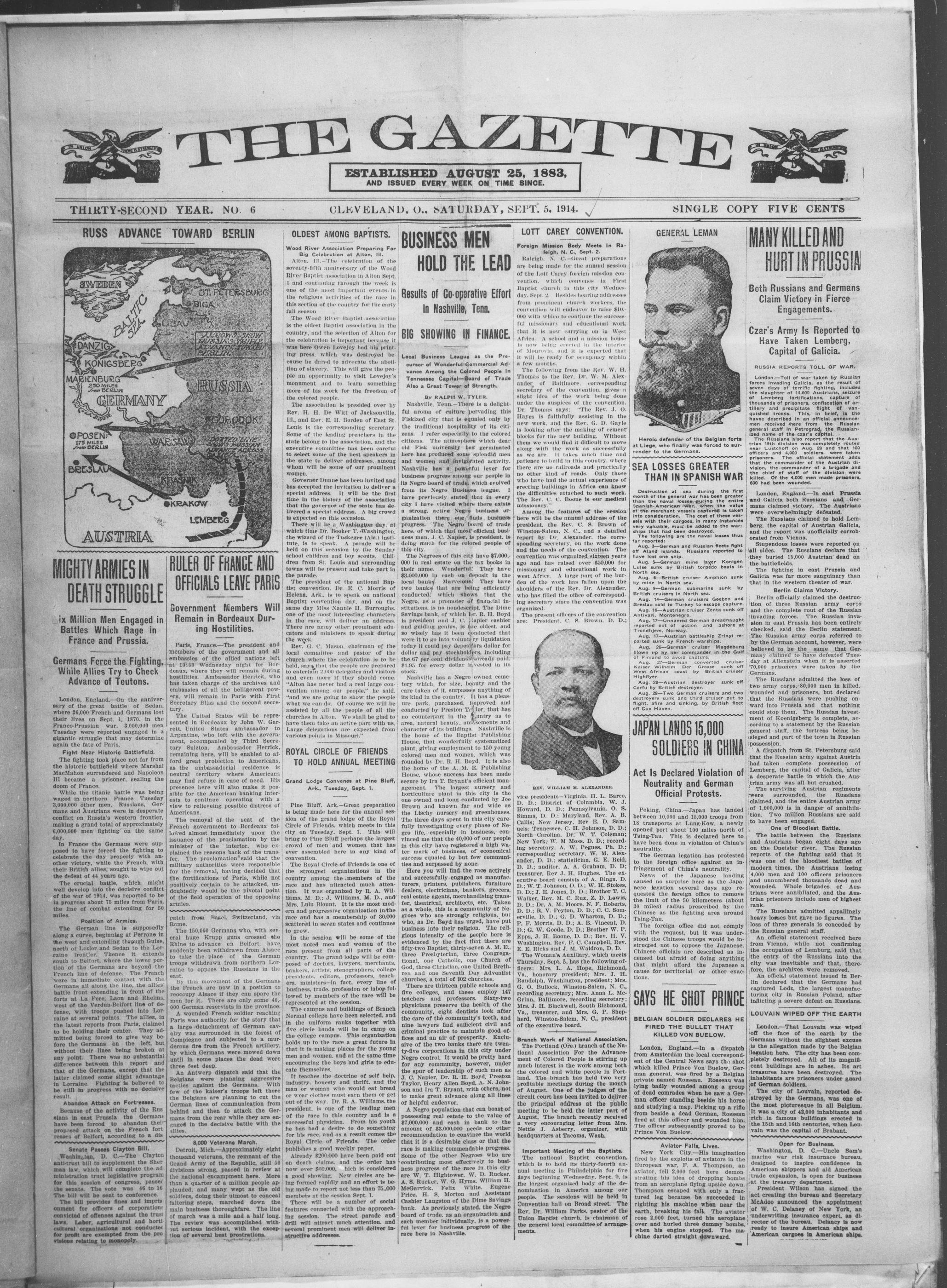
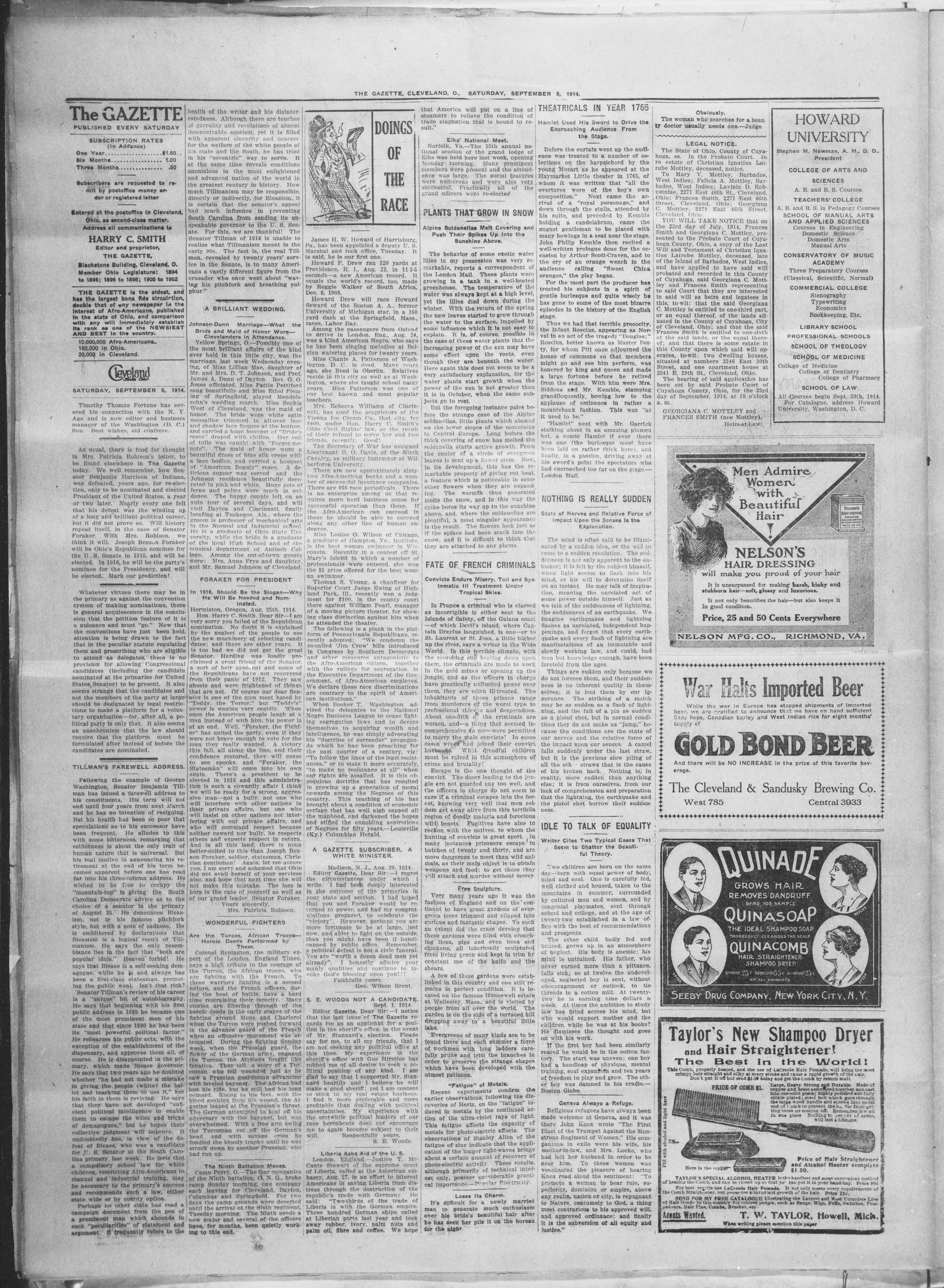
Page text (machine-generated)
TH1RTY-SECOND YEAR. NO. 6
RUSS ADVANCE TOWARD BERLIN
SWEDEN
BALTIC
SEA
OT. PETERSBURG
BIGA
LIBAU
DANZIG
KONIGSBERG
MARIENBURG
250 MILES
FROM BERLIN
GERMANY
RUSSIA
GEORGODOK
POSEN:
175 MILES
FROM BERLIN
WARSAW
DORTED LINE
SWEDEN-BRUSSIA
ADVANCE TOWARD
BRESLAU
KRASNIK
KRAKOW
LEMBERG
AUSTRIA
IN UNION IN GREAT STRength
THIRTY-SECOND
RUSS ADVANCE
SWEDEN
BALTIC
SEA
DANZIG
KONIGSBERG
MARIENBURG
250 MILES
from BERLIN
GEIRMANY
POSEN:
175 MILES
from BERLIN
BRESLAU
AUSTRIA
MIGHTY ARMIES IN DEATH STRUGGLE
ix Million Men Engaged in Battles Which Rage in France and Prussia.
Germans Force the Fighting, While Allies Try to Check Advance of Teutons.
London, England—On the anniversary of the great battle of Sedan, where 26,000 French and Germans lost their lives on Sept 1, 1870, in the Franco-Prussian war, 3,000,000 men Tuesday were reported in a gigantic struggle that may determine again the fate of Paris.
Fight Near Historic Battlefield.
The fighting took place not far from the historic battlefield where Marshal MacMahon surrendered and Napoleon III became a prisoner, sealing the doom of France.
While the titanic battle was being waged in northern France Tuesday 3,000,000 other men, Russians, Germans and Austrians were in desperate conflict on Russia's western frontier, making a grand total of approximately 6,000,000 men fighting on the same day.
In France the Germans were supposed to have forced the fighting to celebrate the day properly with another victory, while the French, with their British allies, sought to wipe out the defeat of 44 years ago.
The crucial battle, which might well develop into the decisive conflict of the war of 1914, was reported to be in progress about 75 miles from Paris, the line of combat extending for 50 miles.
Position of Armies.
The German line is supposedly along a curve, beginning at Perrone in the west and extending through Guise, north of Lesier and Sedan to the Lorraine. Hence it extends to Belfort, where the lower portion of the Germans are beyond the French line of defense. The French were in immediate contact with the Germans all along the line, the allies battle front extending in front of the forts at La Fere, Laon and Rheims, west of the Verdun-Belfort line of defense, with troops pushed into Lorraine at several points. The allies, in the latest reports from Paris, claimed to be holding their center. They admitted being forced to give way before the Germans on the left, but without their lines being broken at any point. There was no substantial difference between this report and that of the Germans, except that the latter claimed some slight advantage in Lorraine. Fighting is believed to be still in progress with no decisive result.
Abandon Attack on Fortresses.
Because of the activity of the Russians in east Prussia the Germans have been forced to abandon their proposed attack on the French fortresses of Belfort, according to a dis.
Senate Passes Clayton Bill.
Washington, D. C. The Clayton anti-trust bill to supplement the Sherman law, will complete the administration trust legislative program for this session of congress, pass the senate. The vote was 46 to 16. The bill will be sent to conference.
The bill provides fines and imprisonment for officers of corporations convicted of offenses against the trust laws. Labor, agricultural and horticultural organizations not conducted for profit are exempted from the provisions relating to monopoly.
THE GAZETTE
RULER OF FRANCE AND
OFFICIALS LEAVE PARIS
Government Members Will Remain in Bordeaux During Hostilities.
Paris, France.—The president and members of the government and all embassies of the allied nations left at 10:50 Wednesday night for Bordeaux, where they will remain during hostilities. Ambassador Herrick, who has taken charge of the archives and embassies of all the belligerent powers, will remain in Paris with First Secretary Bliss and the second secretary.
The United States will be represented in Bordeaux by John W. Garrett, United States ambassador to Argentina, who left with the government, accompanied by Third Secretary Stuart Ambassador Herrick, remaining here, will be enabled to afford great protection to Americans, as the ambassadorial residence is neutral territory where Americans may find refuge in case of need. His presence here will also make it possible for the American banking interests to continue operating with a view to relieving possible distress of Americans.
The removal of the seat of the French government to Bordeaux followed almost immediately upon the issuance of the proclamation by the minister of the interior, who explained the reasons back of the transfer. The proclamation said that the military authorities were responsible for the removal, having decided that the fortifications of Paris, while not positively certain to be attacked, undoubtedly would be the pivotal point of the field operation of the opposing armies.
patch from Basel, Switzerland, via Rome.
The 150,000 Germans who, with several huge Krupp guns crossed the Rhine to advance on Belfort, have suddenly been withdrawn from Alsace to take the place of the German troops withdrawn from northern Lorraine to oppose the Russians in the east.
By this movement of the Germans the French are now in a position to reoccupy Alsace if they can spare the men for it. There are only some 40,000 German reservists in the province.
A wounded French soldier reaching Paris was authority for the story that a large detachment of German cavalry was surrounded in the forest of Compiegne and subjected to a murderous fire from the French artillery, by which Germans were mowed down until in some places the dead were three feet deep.
An Antwerp dispatch said that the Belgians were planning aggressive tactics against the Germans. With few of the kaiser's troops left there the Belgians are planning to cut the German lines of communication from behind and then to attack the Germans from the rear while they are engaged in the decisive battle with the allies.
8,000 Veterans March.
Detroit, Mich.—Approximately eight thousand veterans, the remnant of the Grand Army of the Republic, still 50 divisions strong, passed in review at the national encampment here. More than a quarter of a million people applauded, and many wept as the old soldiers, doing their utmost to conceal faltering steps, marched down the main business thoroughfare. The line of march was a mile and a half long. The review was accomplished without serious incident, with the exception of several heat prostrations.
ESTABLISHED AUGUST 25, 1883 AND ISSUED EVERY WEEK ON TIME SINCE.
CLEVELAND, O., SATURDAY, SEPT. 5, 1914.
OLDEST AMONG BAPTISTS.
Wood River Association Preparing For Big Celebration at Alton, Ill.
Alton, Ill.—The celebration of the seventy-fifth anniversary of the Wood River Baptist association in Alton Sept. 1 and continuing through the week is one of the most important events in the religious activities of the race in this section of the country for the early fall season.
The Wood River Baptist association is the oldest Baptist association in the country, and the selection of Alton for the celebration is important because it was here Owen Lovejoy had his printing press, which was destroyed because he dared to advocate the abolition of slavery. This will give the people an opportunity to visit Lovejoy's monument and to learn something more of his work for the freedom of the colored people.
The association is presided over by Rev. H. H. De Wilt of Jacksonville, Ill., and Rev. E. H. Borden of East St. Louis is the corresponding secretary. Some of the leading preschers in the state belong to the association, and the executive committee has been careful to select some of the best speakers in the state to deliver addresses, among whom will be some of our prominent women.
Governor Dunne has been invited and has accepted the invitation to deliver a special address. It will be the first time in the history of the association that the governor of the state has delivered a special address. A big crowd is expected on this occasion.
There will be a Washington day, at which time Dr. Booker T. Washington, the wizard of the Tuskegee (Ala.) institute, is to speak. A parade will be held on this occasion by the Sunday school children and boy scouts. Children from St. Louis and surrounding towns will be present and take part in the parade.
The president of the national Baptist convention, Dr. E. C. Morris of Helena, Ark., is to speak on national Baptist convention day, and on the same day Miss Nannie H. Burroughs, one of the most interesting characters in the race, will deliver an address that are many other prominent educators and ministers to speak during the week.
Rev. G. C. Mason, chairman of the local committee and pastor of the church where the celebration is to be held, says that the people are prepared to entertain 2,000 delegates and visitors and even more if they should come. "Alton has never had a real large convention among our people," he said, "and we are going to show the people what we can do. Of course we will be assisted by all the people of all the churches in Alton. We shall be glad to have them take an active part with us. Large delegations are expected from various points in Missouri."
ROYAL CIRCLE OF FRIENDS TO HOLD ANNUAL MEETING
Grand Lodge Convenes at Pine Bluff,
Ark., Tuesday, Sept. 1.
Pine Bluff. Ark.—Great preparation is being made here for the annual session of the grand lodge of the Royal Circle of Friends, which meets in this city on Tuesday, Sept. 1. This will bring to Pine Bluff perhaps the largest crowd of men and women that has ever assembled here in any kind of convention.
The Royal Circle of Friends is one of the strongest organizations in the country among the members of the race and has attracted much attention. It was organized by R. A. Williams, M. D.; J. Williams, M. D., and Mrs. Luu Blount. It is the most modern and progressive organization in the race and has a membership of 30,000 scattered in seven states and continues to grow.
In the session will be some of the most noted men and women of the race present from all parts of the country. The grand lodge will be composed of doctors, lawyers, merchants, bankers, artists, stenographers, college presidents, editors, professors, teachers, ministers—in fact, every line of business, trade, profession or labo followed by members of the race will be represented at the session.
The campus and buildings of Branch Normal college have been selected, and in the uniform ranks together with five circle bands will be in camp on the college campus. This organization holds up to the race a great future in that it is making places for the young men and women, and at the same time encouraging the boys and girls to educate themselves.
It teaches the doctrine of self help, industry, honesty and thrift, and the man or woman who would eat bread or wear clothes must earn them or get out of the way. Dr R. A. Williams, the president, is one of the leading men of the race in this country and is a successful physician. From his youth he has had a desire to do something for his race, and as a result comes the Royal Circle of Friends. The order publishes a good weekly paper.
Already $200,000 have been paid out on death claims, and the order has now over $80,000, which is considered a good showing. New circles are being formed rapidly and an effort is being made to report not less than 75,000 members at the session Sept. 1.
There will be a number of social features connected with the approaching session. The street parade and drill will attract much attention, and several prominent men will deliver instructive addresses.
BUSINESS MEN HOLD THE LEAD
Local Business League as the Precursor of Wonderful Commercial Advance Among the Colored People in Tennessee Capital—Board of Trade Also a Great Tower of Strength.
By RALPH W. TYLER.
Nashville, Teen—There is a delightful aroma of culture pervading this Fiskized city that is equaled only by the traditional hospitality of its citizens. I refer especially to the colored citizens. The atmosphere which dear old Fisk university has germinated here has produced some splendid men and women and invigorated activity. Nashville has a powerful lever for business progress among our people in its Negro board of trade which evolved from its Negro Business league. I have previously stated that in every city I have visited where there exists a strong, active Negro business organization there one finds business progress. The Negro board of trade here of which that most efficient business man, J. C. Napier, is president, is doing much for the colored people of this city.
The Negroes of this city have $7,000,000 in real estate on the tax books in their name. Wonderful. They have $3,000,000 in cash on deposit in the local banks. Marvelous. They have two banks that are being efficiently conducted, which shows that the Negro, as a promoter of financial institutions, is no nondescript. The Dime Savings bank, of which Lr. R. H. Boyd is president and J. C. Hapier cashier and guiding genius, is the oldest, and so wisely has it been conducted that were it to go into voluntary liquidation today it could pay depositors dollar and pay depositors dollar and pay depositors dollar the 67 per cent dividends already paid. $1.95 for every dollar invested in its stock
Nashville has a Negro owned cemetery which, for size, beauty and the care taken it, surpasses anything of its kind in the country. It has a pleasure park, purchased, improved and conducted by Preston T. Lor, that has no counterpart in the country as to area, natural beauty, amusements and character of its buildings. Nashville is the home of the Baptist Publishing House, that wonderfully systematized plant, giving employment to 150 young colored men and women, which was founded by Dr. R. H. Boyd. It is also the home of the A. M. E. Publishing House, whose success has been made secure by Ira T. Bryant's efficient management. The largest nursery and horticulture plant in this city is the one owned and long conducted by Joe Brown and known far and wide as the Llischy nursery and greenhouses. The three days spent in this city carefully investigating every phase of Negro life, especially in business, convinced me that the 40,000 of our people in this city have registered a high water mark of business, of economical success equaled by but few communities and surpassed by none.
Here you will find the race actively and successfully engaged as manufacturers, printers, publishers, furniture dealers, electricians, bankers, grocers, real estate agents, merchandising transfer, theatrical, architects, etc. Taken as a whole, this is a community of Negroes who are strongly religious, but who, as Dr. Boyd has urged, have put business into their religion. The religious intensity of the people here is evidenced by the fact that there are fifty-two Baptist, thirty-seven A. M. E. three Presbyterian, three Congregational, one Catholic, one Church of God, three Christian, one United Brethren and one Seventh Day Adventist churches, a total of 102 churches. There are thirteen public schools and five colleges, and these employ 147 teachers and prosecute. Sixty-two physicists and measure the health of the community, eight dentists look after the care of the community's teeth, and nine lawyers find sufficient civil and criminal practice to maintain good offices and an air of prosperity. Exclusive of the two banks there are twenty-five corporations in this city under Negro control. It would be pretty hard for any community, however, under the spur of leadership of such men as J. C. Napier, Dr. R. H. Boyd, president Taylor, Henry Allen Boyd, A. N. Johnson and Ira T. Bryant, with others, not to make great advance along all lines of helpful endeavor.
A Negro population that can boast of possessing real estate to the value of $7,000,000 and cash in bank to the amount of $3,000,000 needs no other recommendation to convince the world that it is a desirable class or that the race is making commendable progress. Some of the other Negroes who are contributing most effectively to business progress of the race in this city are W. T. Hightower, W. D. Rucker, A. S. Rucker, W. G. Hymes, William H. McGavick, Felix White, Eugene Price, H. S. Morton and Assistant Cashier Langston of the Dime Savings bank. As previously stated, the Negro board of trade, as an organization and each member individually, is a powerful lever for business progress of the race here in Nashville.
LOTT CAREY CONVENTION.
Foreign Mission Body Meets In Ra-
leigh, N. G., Sept. 2.
Raleigh, N. C. -Great preparations are being made for the annual session of the Lott Carey foreign mission convention, which convenes in First Baptist church in this city Wednesday, Sept. 2. Besides hearing addresses from prominent church workers, the convention will endeavor to raise $10,000 with which to continue the successful missionary and educational work that it is now carrying on in West Africa. A school and a mission house is now being erected in the interior of Monroe, and it is expected that it will be ready for occupancy within a few months.
The following from the Rev. W. H. Thomas to the Rev. Dr. W. M. Alexander of Baltimore, corresponding secretary of the convention, gives a slight idea of the work being done under the auspices of the convention. Dr. Thomas says: "The Rev. J. O. Hayes is faithfully assisting in the new work, and the Rev. G. D. Gayle is looking after the making of cement blocks for the new building. Without them we would find it difficult to move along with the work as successfully as we are. It takes much time and patience to build in this country, where there are no railroads and practically no other kind of roads. Only those who have had the actual experience of erecting buildings in Africa can know the difficulties attached to such work. The Rev. C. C. Boone is our medical missionary."
Among the features of the session here will be the annual address of the president, the Rev. C. S. Brown of Winston-Salem, N. C., and a detailed report by Dr. Alexander, the corresponding secretary, on the work done and the needs of the convention. The convention was organized sixteen years ago and has raised over $50,000 for missionary and educational work in west Africa. A large part of the burden of the work has fallen upon the shoulders of the Rev. Dr. Alexander, who has filled the office of corresponding secretary since the convention was organized.
The present officers of the convention are: President, C. S. Brown, D. D.;
REV. WILLIAM M. ALEXANDER.
vice presidentes-Virginia, H. L. Barco, D. D.; District of Columbia, W. J. Howard, D. D.; Pennsylvania, O. S. Simms, D. D.; Maryland, Rev. A. B. Callis; New Jersey, Rev. E. D. Daniels, Tennessee, C. H. Johnson, D. D.; North Carolina, Dr. W. T. Coleman; New York, W. M. Moss, D. D.; recording secretary, A. W. Pegues, Ph. D.; corresponding secretary, W. M. Alexander, D. D.; statistician, G. E. Reid, D. D.; auditor, A. A. Graham, D. D.; treasurer, Rev. J. H. Hughes. The executive board consists of A. Binga, D. D; W. T. Johnson, D. D; W. H. Stokes, D. D; J. E. Jones, D. D; Brother T. C. Walker, Rev. M. C. Rux, D. D. Lewis, D. D; Dr. A. M. Moore, F. R. Roberts, D. D; R. V. Peyton, D. D; C. Somerville, D. D; G. D. Wharton, D. D; F. Morris, D. D; A. B. Vincent, D. D; G. W. Goode, D. D; Brother W. P. Epps, J. H. Boone, D. D; Rev. H. W. Washington, Rev. F. C. Campbell, Rev. E. Ricks and J. W. Maldron, D. D. The Woman's Auxiliary, which meets Thursday, Sept. 5, has the following officers: Mrs. L. A. Hope, Richmond, Va., honorary president; Mrs. J. H. Randolph, Washington, president; Mrs. G. O. Bullock, Winston-Salem, N. C., recording secretary; Mrs. Anna L. McGrinn, Baltimore, recording secretary; Mrs. J. H. Blackwell, South Richmond, Va., treasurer, and Mrs. G. P. Shepherd, Winston-Salem, N. C., president of the executive board.
Branch Work of National Association.
The Portland (Ore.) branch of the National Association For the Advancement of Colored People is stirring up much interest in the work among both the colored and white people in Portland. The branch has held two very profitable meetings during the month of August. One of the judges of the circuit court has been invited to deliver the principal address at the public meeting to be held the latter part of August. The branch recently received a very encouraging letter from Mrs. Nettle J. Asberry, organizer, with headquarters at Tacoma, Wash.
Important Meeting of the Baptists.
The national Baptist convention, which is to hold its thirty-fourth annual meeting in Philadelphia for five days beginning Wednesday, Sept. 9. is the largest organized body of the denomination in America among our people. The sessions will be held in Convention hall on Broad street. The Rev. Dr. William Parks, pastor of the Union Baptist church, is chairman of the general local committee of arrangements.
SINGLE COPY FIVE CENTS
Heroic defender of the Belgian forts at Liege, who finally was forced to surrender to the Germans.
Destruction at sea during the first month of the general war has been greater than the naval losses during the entire Spanish-American War, when the value of the merchant vessels captured is taken into consideration. The cost of the war on many instances very valuable, must be added to the warships that had been destroyed.
The following are the naval losses thus far reported:
tair Report:
German and Russian fleets fight off Aland islands. Russians reported to have lost one ship.
Aug. 5—German mine layer Konigen Lulse sunk by British torpedo boats in North sea.
Aug. 6—British cruiser Amphion sunk by mine in North sea.
Aug. 9—German submarine sunk by British cruisers in North sea.
Aug. 14—German cruisers Geeben and Breslau sold to Turkey to escape capture.
Aug. 16—Austrian cruiser Zenta sunk off Antivar, Montenegro.
Aug. 17—Unnamed German dreadnaught reported out of action and ashore at Trondheim, Norway.
Aug. 18—British battleship Zinny reported sunk by French warships.
Aug. 26—German cruiser Magdeburg blown up by her commander in the Gulf of Finland to avoid capture.
Aug. 27—German commander cruiser Kaiser Wilhelm II. Grosse sunk off West African coast by British cruiser Highflyer.
Aug. 28—Austrian destroyer sunk off Cortu by British destroyer.
Aug. 29—Two German cruisers and two destroyers sunk and third cruiser put to flight, afire and sinking, by British fleet off Cux Haven.
Act Is Declared Violation of Neutrality and German Official Protests.
Peking, China—Japan has landed between 10,000 and 15,000 troops from 18 transportes at Lung-Kow, a newly opened port about 100 miles north of Tsing-Tau. This is declared here to have been done in violation of China's neutrality.
The German legation has protested to the foreign office against an infringement of China's neutrality.
News of the Japanese landing caused no surprise here as the Japanese legation several days ago requested the foreign office to remove the limit of the 50 kilometers (about 30 miles) radius prescribed by the Chinese as the fighting area around Tsing-Tau.
The foreign office did not comply with the request, but it was understood the Chinese troops would be instructed not to oppose the Japanese, Chinese officials are described as incensed but afraid of doing anything that might afford the Japanese a cause for territorial or other exactions.
SAYS HE SHOT PRINCE
BELGIAN SOLDIER DECLARES HE FIRED THE BULLET THAT KILLED VON BUELOW.
London, England.—In a dispatch from Amsterdam the local correspondent of the Central News says the shot which killed Prince Von Buelow, German general, was fired by a Belgian private named Rosseau. Rosseau was lying badly wounded among a group of dead comrades when he saw a German officer standing beside his horse and studying a map. Picking up a rifle from beside a dead German, Rosseau fired at this officer and wounded the Officer subsequently proved to be Prince Von Buelow.
Aviator Falls. Lives.
New York City—His imagination fired by the exploits of aviators in the European war, F. A. Thompson, an aviator, fell 2,000 feet here demonstrating his idea of dropping bombs from an aeroplane flying upside down. Thompson escaped with only a fractured leg because he succeeded in righting his machine when near the earth, breaking his fall. The aviator rose 2,000 feet, turned his aeroplane over and hurled three dummy bombs, when his engine stopped. The machine darted straight downward.
THE WORLD UNITED
MANY KILLED AND HURT IN PRUSSIA
Both Russians and Germans Claim Victory in Fierce Engagements.
Czar's Army is Reported to Have Taken Lemberg, Capital of Galicia.
RUSSIA REPORTS TOLL OF WAR.
London—Toll of war taken by Russian forces invading Galicia, as the result of seven days of terrific fighting, includes the slaughter of 14,600 Austrians, seizure of Lemberg'sifications, capture of thousands of prisoners, consolidation of artillery and precipitate flight of vanquished troops. This, in brief, is the havoc described in an official announcement received here from the Russian general station in Petropolis, the Russianized name of the czar's capital.
The Russians also report that the Austrian 15th division was completely routed during the attack on Aug. 29 and that 100 officers and 4,000 soldiers were taken prisoners. The official statement adds that the commander of the Austrian division stationed in Petropolis, the guide and chief of staff of the division were killed. Of the 4,000 men made prisoners, 600 had been wounded.
London, England—In east Prussia and Galicia both Russians and Germans claimed victory. The Austrians were overwhelmingly defeated.
The Russians claimed to hold Lemberg, the capital of Austrian Galicia, and the report was unofficially corroborated from Vienna.
Stupendous losses were reported on all sides. The Russians declare that they buried 15,000 Austrian dead on the battlefields. The fighting in east Prussia and Galicia was far more sanguinary than that in the western theater of war.
Berlin Claims Victory.
Berlin officially claimed the destruction of three Russian army corps and the complete rout of the Russian invading forces. The Russian invasion in east Prussia has been entirely checked, said the Berlin statement. The Russian army corps referred to by the German account, however, were believed to be the same that Germany claimed to have defeated Tuesday at Allenstein when it is asserted 70,000 prisoners were taken by the Germans.
The Russians admitted the loss of two army corps, 80,000 men in killed, wounded and prisoners, but declared that the Russians were pushing onward into Prussia and that nothing could stop them. The Russian investment of Koenigsberg is complete, according to a statement by the Russian general staff, the fortress being besieged and part of the town in Russian possession.
A dispatch from St. Petersburg said that the Russian army against Austria had taken complete possession of Lemberg, the capital of Galicia, after a desperate battle in which the Austrian army was all but crushed.
The surviving Austrian regiments were surrounded, the Russians claimed, and the entire Austrian army of 1,000,000 is in danger of annihilation. Two million Russians are said to have been engaged.
The battle between the Russians and Austrians began eight days ago on the Dneister river. The Russian reports of the fighting said that it was one of the bloodiest battles of modern times, the Austrians losing 4,000 men and 100 officers prisoners and numbered thousands dead and wounded. Whole brigades of Austrians were annihilated, and the Austrian prisoners include men of highest rank.
The Russians admitted appallingly heavy losses but gave no figures. The loss of three generals is conceded by the Russian general staff.
An official statement received here from Vienna, while not confirming the occupation of Lemburg, said that the entry of the Russians into the city was inevitable and that, therefore, the archives were removed.
An official statement issued in Berlin declared that the Germans had captured Lodz, the largest manufacturing city in Russian Poland, after inflicting a severe defeat on Russians.
LOUVAIN WIPED OFF THE EARTH
London.—That Louvain was wiped off the face of the earth by the Germans without the slightest excuse is the allegation made by the Belgian legation here. The city has been completely destroyed. All of its magnificent buildings are in ashes. Its art treasures have been destroyed. The inhabitants are prisoners under guard of German soldiers.
The city of Louvain, reported destroyed by the Germans, was one of the most picturesque in all Belgium. It was a city of 42,000 inhabitants and rich in famous buildings erected in the 15th and 16th centuries, when Louvain was the capital of Brabant.
Open for Business.
Washington, D. C.—Uncle Sam's marine war risk insurance bureau, designed to inspire confidence in American shipers and aid American trade expansion, is open for business at the treasury department.
President Wilson has signed the act creating the bureau and Secretary McAdoo announced the appointment of W. C. Delaney of New York, an underwriting insurance expert, as director of the bureau. Delaney is now ready to insure American ships and American cargoes in American ships.
The GAZETTE
PUBLISHED EVERY SATURDAY
SUBSCRIPTION RATES
(In Aavance)
One Vear..cesseseesvsesss+81.80..
Bix Monthe...cccsecseseses 1.00
Three Months..,.c...ceereey 80
Gubsoribere are requested to re-
mit by postotfice money on
der or reglatered letter
ee the. postoffice In Cleveland,
Ohio, as second-class matter.
‘Address all communications to
HARRY C. SMITH
Editor and proprietor,
‘THE GAZETTE,
Biaokstone Building, Cleveland, O.
Member Ohio Legislature: 1894
te 1896; 1896 to 1898; 1900 to 1902
‘THE GAZETTE Is the oldest, and
thas the largest bona fide clroulrtion,
double that of «ny newspaper ia the
Interest of Afro-Americans, published
in the state of Ohio, and comparison
with any will Immediately. establish
fee rank se one of the NEWSIEST
AND BEST in the sountry.
10,000,000 Afro-Americans...
160,000 in Ohio.
20,000 in Cleveland.
Bi ao, Slack sel
SATURDAY, SEPTEMBER 5, 1914
Timothy Thomas Fortune has sev-
ered his connection with the N. Y.
‘Age and 1s now editor and business
manager of the Washington (D. ©.)
Sun. Best wishes, old confrere
eee
‘As usual, there is food for thought
in Mrs. Patricia Robison’s letter, to
be found elsewhere in The Gazette
today. We well remember, how Sen-
ator Benjamin Harrison of Indiana,
was defeated, years ago, for re-elec-
tlon, only to be nominated and elected
Prosidgat of the United States, « yeas
or two'later. Nearly every one felt
that his defeat was the winding up
of & Jong-atid brilliant political career,
but it did not prove so. Will history
Fepeat itself, in the case of Senator
Foraker. With Mrs, Robison, we
think it will, Joseph Bensun Foraker
will be Ohio's Republican nominee for
the U.S, Senate in 1915, and will be
elected. In 1916, he will be the party's
nominee for the Presidency, and will
‘be elected, Mark our prediction!
Whatever virtues there may be in
the primary as against the convention
system of making nominations, there
in general acquiescence in the conclu:
sion that the petition feature of it is
a nuisance and must “go.” Now that
the conventions have Just been held
attention fs being drawn to the fact
that in the peculiar statute regulating
thom and preseribing who are eligible
to attend as delegates, there is no
provision for allowing Congressional
candidates (Including the- candidate
nominated at the primaries for United
States, Senator) to be present. It also
seems strange that the candidates and
not the members of the party at large
should be designated by legal restric-
tions to make a platform for a volun-
tary organtzation—for, after all, a po-
litical party fs only that, Tt also seems
an anachronism that the Jaw should
require that’ the platform must _ be
formtlated after instead of before the
candidates are nominated,
TILLMAN'S FAREWELL ADDRESS.
Fellowing the example of George
Washington, Senator Benjamin Till
man has issued a farewell address tc
his constituents, His term will not
fend until four years from next Marck
and he has no intention of resigaing
But bis Health has been so poor that
specitlations as to his successor have
deen frequent. He alludes to this
with some bitterness, remarking that
selfishness is about the only trait of
human naturo that is universal, But
hig real motive in announcing his re
tirement at the end of his term be
comes apparent before one has read
far Into his diree-column address. He
wished to be free to ovcupy. the
*mountaintop” in giving the South
Carolina Democrats advice as to the
choleo of @ senator in the primary
of August 25." Me denounces Bleas:
ism, not ip his famous pitchfork
style, but with a note of sadness, He
ig embittered by declarations that
Bieasism is a logical result of TH
manism. He says the only resem.
diance Ties in the {act that “both are
popular idols.” Heaveit” forbid! He
says that Blease is a self-seeking dem
agogue, while be js and always has
been a first-class statesman, promot
Ing the public weal. Isn't that rich’
‘Senator Tillman's review of his career
is a “unique” bit of autobiography
He says that beginning with his first
public address in 1885 he became one
of the most prominent men of his
state and that since 1890 he'has been
its “most powerful. political tactor.”
He rehearses his public acts, with the
exception of the establishment of the
dispensary, and approves them all, of
course. He is disappointed in the pr!
mary, which made Blease governor.
‘He says that two years ago he doubted
whether “he bad not made a mistake
in giving the. people (white) the bat
Tot and teaching them 6 use it.” tut
his faith in them Is reviving. He says
that they) ave: not developed “suf
cient polittoal intellizence to enable
them to escape’ the Wiles and tricks
‘of demagogues,” but he hopes’ thelr
collective: judgment “will improve. It
undoubledly has, in view of the de-
‘feat of Bleasé,who was a candidate
for J. &."Sebator at the South Caro
lina primary, last week. He feels that
‘& compuliory school law for. white
children, restricting si poe to
‘manual and ‘industrial tra may
pod rostaaians tera eto or
a law, either
stato wide or by county option.
Perhape no other state has read
‘campaign document from the pen o!
® proaiinest man which abounds in
‘such " of statement and
argument. ft frequently ‘fefera to the
health of the writer and his disinter-
estedness. Although there are touches
of gatrulity and revelations of almost
inconceivable egotism, yet it 1s filled
with apparent sincerfty and concert
for the welfare of thé white people of
his state and the South, he has tried
in his “eccentric” way to serve. It
at tho, same time reveals conditions
anomalous in the most enlightened
and advanced nation of the world in
the greatest century in history. How
much Tillmanism may be responsible,
directly of indirectly, for Bleasism, It
is certain that the senator's appeal
had much influence in preventing
South Carolina from sending its un-
Speakable governor to the U. S. Sen:
ate. For this, wé are thankful! ‘The
Senator Tillman of 1914 is unable to
realize what Tillmanism meant in the
carly 90s. ‘The fact fs, the real Till:
man, revealed by twenty years’ serv.
fee in the Senate, is to many Amer!
cans a yastly different figure from the
crusader Who once went about “wav
‘ing his pitchfork and breathing sul
phur.”
comer
‘A BRILLIANT WEDDING.
Johnson-Dunn Marriage—What the
Bride and Maid of Honor Wore—
Clevelanders in Attendance.
‘Yellow Springs, O—Possibly one of
the most brilliant affairs of the kind
ever held in this little city, was the
marriage, last week Wednesday even.
ing, of Miss Lillian Mae, daughter of
Mr. and Mrs. D. 'T. Johnson, and Prot
James A. Dunn of Dayton. Rev. 0, 0.
Jones officiated, Miss Pattie Pettiford
sang beautifully. and Miss Ethel Flem
ing of Springfeld, played Mendels
sohn's wedding march. Miss Sophia
West of Cleveland, was the maid of
honor. The bride’ wore white satin
messaline trimmed. in allover face
and shadow lace ounce at the bottom
and carried a huge bouquet of “Bride's
roses” draped with chiffon... Her vei
of tulle was cantht with “Forget-me-
nots", The maid of honor wore a
heautiful dross of blue silk cree with
a lace bodice, and carried a bonaue!
of “American Beauty” roses. A de
Nicious supper was served and the
Johnson residence beautifully dece
Fated in pink and white, Huxe pots a
ferns and prims were much in ev!
denee. ‘The happy couple left on an
atito tonr of several days, and wil
visit Dayton and Cincinnati, finally
Jocating at Tuskegee, Ala., where the
groom. is professor of mechanteal arts
in the Normat and Industrial choot
Ho Is @ graduate of Obio State Un}
versity, while tho bride {s a graduate
of the ‘local High School and of the
musical department of Antioch Col:
lege, Among the out-oftown guests
were: “Mrs. Anna Frye and dauehter,
and Mr, Samuel Johnson of Cleveland
FORAKER FOR PRESIDENT
n 1916. Should Be the Slogan—Why
He Will Be Needed and Nom-
ar cee
eres
Hermiston, Oregon, Aug. 25th. 1914.
Hon. Harry C. Smith, Dear Sir—T am
Yery sorry you failed of the Republteat
nomination. No doubt it {s explained
by the neglect of the people to. use
the new machinery of selecting candi
dates; and there are other yenrs, Tl
Ja too bad we did not get the great
Senator. Harding was. londly "pro
claimed a great friend of the Senator
a sort of helr appa.ent and some of
the Republicans have not recovered
from thelr panic of 1912. They saw
ghosts and were frightened of thins
that are not. Of course our dear Sen-
jator Is one of the men most, hated by
“Teddy. the Terror.” but. “Teddy's”
power ip waning very rapidly. When
‘nee the American people laugh at 2
rman instead of with him, his power is
atan end. Well, “Foreker, the Fient-
er" has united the party, even if they
‘were not brave enough to vote for the
man they really wanted. A victory
this, fall, all along the line, and their
confidence restored, they. will cease
to see spooks, and “Foraker, the
Sistesman” will come into his own
again, There's a president to be
elected in 1916 and this. administra.
tion is such @ cowardly affair I think
we will be ready for a strong, ageres-
sive man—not a bully. not one who
will Interfere with oflier nations in
their ‘private affairs, but one who
will insist on other nations not inter-
fering with our private affairs, and
who will command respect because
nelther coward nor bully, he respects
others and expects respect in return.
‘And in all this land, there is none
detter-suited to this than Joseph Ben-
son Foraker, soldier, statesman, Chris
Man gentleman! Aiain, let me’ assure
you, 1am sorry and ashamed that Ohio
did not avail herself of your services
algo, and hope that next time she will
fiot make this mistake, ‘The loss is
here in the case of yourself as well as
of our ‘grand leader, Senator Foraker,
Yours sincerely,
‘Mrs. Patricia Robison.
WONDERFUL FIGHTERS
Are the Turcos, African Troons—
Herole Deeds Performed by
‘Them.
Colonel Repinston, the military ex-
pert of the London, England ‘Times
pays a high Uibute to the courage of
the ‘Tureos, the Afriean troops, who
are fighting with the French, ‘To
these, warriors. fighting is a second
fhituré, and the Pronch officers, dur:
ing the heat of battle, have a’ hard
time restraining thor ferocity. Many
stories are. Altering through of the
herole deeds in the early stakes of the
fighting around Mons and Charleroi
wher! the Turcos were pushed forward
in the advance guard of the French
vihen au offensive moroment yas st
tempted. During the fighting Sunday
a: the Prussian ‘guard, the
if the lorann eras, poseset
s Ganson tue Arriaga fought ike
tatiatics, ‘They tell a story of a Tur-
conta vg fll wounded fut ts Ne
@ Prussian guehdsman advancing
with foveled basen The africa tnd
Tost his rife, but he atill had his tone
polnard. Rising to ble feet. with the
Blood gushing trom his wound. the AL
ering leaped atthe Prussia’ throw.
‘Tho German attemipted to boat off his
‘adversary with the bayonet, but was
overwhelmed. With a free arm swing
the Turcoman cut off the German's
head. and with Satake cries te
fondled the bloody trophy until he was
struck down by another Prussian, ‘ho
had run up.
Riise me er
etn batinearO NG. oroke
of the Ninth battation, O N. G., broke
camp Sunday morning, obe company
each leaving for Cleveland, Dayton,
Columbus and Springfeld. |For two
dass the camp gtotinds were deserted
until the arrival of the Sixth reeiment.
Tuesday morning, The Ninth needs a
new malor and several of the officers
tiave, for months, been quietly work-
ing to this end.
THE GAZETTE, CLEVELAND, 0., SATURDAY, SEPTEMBER 5, 1914,
9
we
oe
Mi ae
ReSE 2
vue
DOINGS
OF
THE
RACE
James H. W. Howard of Harrisburg,
Pa., has been appointed a deputy U.S.
Marshal and took office, Tuesday.” It
is sald, he is our first one.
Howard P. Drew ran 120 yards at
Providence, R. 1, Aug. 22, in 1135
seconds—a new American record. It
equals the world’s record, too, made
by Reggle Walker of South ‘Africa,
Dec. 6, 1908.
Howard Drew will race Howard
Seward of the Boston A. A., former
University of Michigan star, in a 150
yatd dash at the Springfield, Mass.,
Faces, Labor Day.
Among the passengers from Ostend
to arrive in London, Eng., Aug. 24,
‘was a blind American’ Negro, who says
he has been singing melodies at Bel-
sian watering places for twenty years.
Miss Chante A. Patterson of Wash-
ington. D.C. is dend. Many venrs
ago, she lived in Oberlin. Relatives
reside i this city as well as at Wash:
ington, where she taught school many
years.” Miss Patterson was one of
‘our best known and. most popular
teachers.
| Mrs. Rebecca Williams of Cincin-
nati, has stied the proprietors of the
‘Vienna Tee Cream Co.. that city, tor
3400, under Hon, Harry C. Smith's
Ole Civil Rights’ law, as the result
of thelr rofusal to serve her and two
Irlonds, recently, Good!
The Secretary of War has’ assigned
‘Lieutenant B. 0. Davis, of the Ninth
|Cavalry, as military instructor at Wil
|vorforee University.
| There are now approximately sixty
|bv9 Afro-Ametican banks and a num-
“ber of suecessful Insurance companies
| There are 466 race periodicals.» There
|i8 no enterprise among us that re-
|quires more hard business sense for
|stiecessful operation than these. If
‘the Afro-American ean succead in
[these he should be able to succeed
along any other line of human en:
‘deavor,
Miss Lonise ©. Wilson of Chicago,
& graduate of Hampton, Va., Institate
is the best woman swimmer in \
consin. Recently. in a contest off St
“Mary's Islomd in which a number of
professionals “were entered, she won
‘the $5 prize offered for the best wom:
‘an swimmer,
‘Thomas 8. Young, a chauffeur for
Superior Court Judge Ewing of High:
land Park, Ill, recently won a judg.
ment for $100, in the county court
there against William Pearl, manager
lof « moving picture theater, for show:
ing class distinction against him when
he attended the theater.
‘The following is m plank in the plat
form of Pennsylvania Republicans, re.
cently adopted: “We condemn the
so-called ‘fim Crow’ bills introduced
in Congress by Southern Democrats
and other menstires antagonistie. tc
the Afro-American citizen, together
with the rulings for sexrezation. in
the Executive Department of the Gos:
etnment, of Afro-American emploves
We declare these race discriminations
‘are contrary to the spirit of Ameri-
‘can institutions.”
When Booker T. Washington ad-
wiged the delegates to the National
Negro Business League to coase fight:
‘ing segregation laws and to devote
themselves to acquiring wenith and
intelligence, he was simply advocating
his “doctrine of surrender” propagan-
da which he has heen preaching for
‘the past quarter of a century, viz?
‘To follow the lines of the least resist
ances,” or to state ft more accurately,
“to make no tesistanee at all” when
out rights are assailed. It is this ob-
sequious doctrine that has resulted
in growing up a generation of moral
cowards among the Negroes of this
country. This. teaching of his has
brought about a condition of economic
serfage that has well nigh sapped all
‘the manhood, ond darkened the hopes
and stifled the ennobling aspirations
‘of Negroes for fifty, years—Louisville
“(Ky.) Columbian Herald,
A GAZETTE SUBSCRIBER, A
WHITE MINISTER.
Madison, N. J., Aug. 29, 1914.
Editor Gazette, Dear Sir:—I regret
the cireumstancas: under which |
Write, “Thad bed deeply interested
in the outcome of the primaries in
your state and section. { had hoped
that you and Foraker would be re-
turned to power, and had my congrat-
ulations prepare, to celebrate the
“victory”. However, perhaps you are
more fortunate to be at large, just
now, and abler to fight on the outside,
than you might have been if handi
capped by public office, Remember,
a political defeat is not a civic funeral.
You are “worth a dozen dead men yet
already”, I honestly admire your
manly qualities and continue to. in
Yoke God's blessing upon you!!!
Faithfully yours.
Geo. Wilson Brent.
§. E, WOODS NOT A CANDIDATE.
Raitor Gazette, Dear Sir:—I notice
that the last isiue'of The Gazette ré
gards me ag an applicant for a posi-
tion In the sheriff's office, in the event
of Mr, Stannard’s election. Please
say fot me, to all my friends, that I
am not seeking any political office at
this time, My. exyerience In the
sherif’s office with Gus Hirstius has
robbed me of all desire to’ seek & po-
Hitient position of any kind. T am
lad to say that I supported Mr. Stan-
nard heartily and | believe “he will
take a good sheriff: yet {am content
to stick to my real estate business.
I'fnd it more preferable and more
profitable than dealing with political
uncertainties. My experience with
the erstwhile political leaders of our
tace hereahouts does not encourage
me to again become subject to their
will, Respectfully yours,
S$, B. Woods.
Liberia Asks Aid of the U. 8.
London, Englend—Justice T. Me.
Cants Stewart of the supreme. court
of Liberia, called at the American em-
bassy, Aug. 27, in an effort to interest
Americans In saving Liberia from dis-
tress through the destractfon of the
republic's trade with Germany. He
said: “Twothirds of the trade of
Liberia is with the German empire.
Three hundred German ships called
at Liberian ports last year and took
away rubber, ivory, palm nuts and
palms off, Gbre ahd coffee. We hope
that America will put on a ling of
steamers to relieve the condition of
trade stagnation that is bound to re-
sult.”
Elks’ National. Mest. !
Norfolk, Va—The 16th anual na-
tional session of the grand lodge of
Elks was held here last week, opening
Monday morning. Many prominent
members Were present aud the attend: |
ance was large, ‘The social features
Were numerous and were also very
successtul. Practically all of the
grand officers were reelected
PLANTS THAT-GROW IN SNOW
Alpine Soldanelias Melt Covering and
Push Their Spikes Up Into the
! ‘Sundhine Abous.
‘The behavior of some exotic water
lilies in my possession was very re:
‘markable, reports a correspondent of
‘the London Mail, ‘These plants were
ecto in a tank in a well-heated
greenhouse. The temperature of the
water was always kept at a high level,
yet the lilies died down during the
winter. With the return of the spring
the new leaves started to grow through
the water to the surtace, impelled by
eome influence which ft Is not a to
explain. It {s, of course, possible in
‘the case of these water plants that the
increasing power of the sun may have
some effect upon the roots, even
though they are beneath the water.
Hero again this does not seem to be &
very satisfactory explanation, for the
| water planta atart growth when the
power of the sun fs not greater than
it is in October, when the same sub-
|Jects go to rest,
| But the foregoing instance pales be
fore the strange case of the Alpinc
soldancllas, Ulttle plants which abound
on the lower slopes of the mountains
in Central Europe, Long before the
thick covering of snow has melted the
seldanella starts active growth. From
the center of a circle of evergreen
| teaves {s sent up a flower stem, Now,
Jin its development, this has the re
| markable property of giving out heat.
| feature which {a noticeable in gone
lotner flowers when they are expand
Jing. The warmth thus generated
| imolts the snow, and im this way the
| spike bores ste way up to the sunsbine
| above, and, where tho goldanelias are
plentiful, a most singular appearane:
|{s the rewult. The fowers look Just as
if the aplikes had been stuck nto the
snow, and it is difficult to thinlk tha
they aro attached to any plants.
FATE OF FRENCH CRIMINALS
nals
Convicts Endure Mivery, Toil and Sys
tematic Ill Treatment Under
“Tropical Sklee.
In France a criminal who {s classed
4s incorrigible 1s either sent to tho
Islands of Safety, off the Guiana const
—of which Devil's island, where Cap-
tain Dreyfus languished, is ono—or to
St. Laurent or St. Joan, a little higher
up the river, says a writer in the Wide
World. Th this terrible climate, with
the scorching suf beating down’ upon
them, the criminals are made to work
in the gold mines or opening up tho
Jungle, and as tho officers in charze
have practically vntimited power over
them, they are oiten filtrested. The
Inhabitants of these prisons range
from murderers cf the worst type to
professional thievys and desperadoes.
About one-afth o¥ the criminals are
women, and—a thing that scemed in-
comprehensive t9 me—wore permitted
to,marry the male convicts! In some
cases viyelYad Joined their convict
husbands. Wh2t dreadful children
must be ralsed in this atmosphere of
crime and brutality:
Escape 1s the ono thought of the
convict, The doors leading to the Jimn-
le ere not guarded any too well, and
the officers in charge do not scem to
care’if @ criminal escapes into the for
est, knowing very well that men gel-
dom gét avay alive from this terrtbile
Tegion of deadly mialarla and ferocious
Sid) eee! Raatires tae ako te
reckon with the natives, to whom the
bunting of convicts is great sport. jin
many instances prisoners: escape! in
batehes of twenty and thirty, and are
more dangerous to meet than witd an!
mals, as their matp object is to obtain
werrpons and food: to get these they
Wit attack: and murder without mercy.
Free Sculpture.
Vers many yeurs ago It was the
fashion of England and on the con-
tineht to have great gardens of ever-
green trees trimmed and clipped into
curious ard fantastic shapes. ‘To suck
an extent did the craze develop that
these gardens were filled with crouch-
fng lions, pigs and even hens and
ebiekens, all labcriously sculptured
froti living gresn and kept fn trim by
constant use of the knife and the
shears.
A fow of these gardens were estab-
lished in this country and one stilt re-
mains in perfect condition. It ts lo-
cated on the famous Hunnewell estate
at Wellesley, Mass., dnd ts visited by
people fromall over the world. ‘The
garden is on the side of a terraced bill
dropping away 'to’ a beautiful ttle
lake,”
~Bvergreens of many Kinds are to be
found there'and eich summer a force
of workmen with long ladders care-
fully prune and trim the branches in
order to prescrve the strange shapes
which have been developed with the
‘utmont patience.
manne ok
Recent experiments condrm tie
earlier observations, following the dis-
coveries of Hertz, on the “fatigue” In-
duced in metals by the continued ac-
tlon of the ultra-violet rays of lght.
‘This fatigue affects the capacity of
metals for photo-electri¢ effects. The
‘observations ‘of Stanley Allen of the
fatigue of zine indicate that the applt-
cation of the longer light-waves brings
about a certain amount of recovery of
photo-electric activity. These results,
although primarily of technical inter
eat only, poster cossiderable pract!
cal {mportanes —P-milar Plectricity.
Loses Its Charm.
Its dificult for a newly married
man to generate much enthusiasm
are sete benutiful hair after
‘he bas seen her pile it on the bureau
for the night
THEATRICALS IN YEAR 1768
Hamlet Used His Sword to Drive the
O"Eneroaching Audience From
the Stage.
Before the curtain went up the audi-
ence was treated to a number of se-
lections on the harpaichord by the
Young Mozart as he appeared at the
Haymiarket Little theater in 1765, of
whom it was written that “all ‘the
overtures were of the boy's own
composition.” Next came the ar
rival of a “royal personage,” and
down through the stalls, attended by
his sulte, and preceded by Kemble
holding @ candelabrum, came the
mugust gentleman to be placed with
| ‘many bowings in a seat near the stage,
John Philip Kemble then recited a
well-written prologue done for the oc-
{Santon by ketux Soctsiltaree: eu
‘the ery of an orange wench’ in the
audience calling “Sweet China
oranges,” the play began.
For the most part the producer has
[treated his subjects in a spirit of
“gentle burlesque and quite wisely he
“has gone to some of the most bizarre
‘episodes in the history of the English
| stage.
| qpiniuywe had that torrblo prococtty
the Infant Roselus, appearing as Nor
| val in an act of the tragedy “Douglas; ”
“Roselus, better known as Master Bet
‘ty, for whom Pitt once adjourned the
| house of commons so that members
“might go and see him perform, was
“honored by king and queen and mad¢
a large fortune before he retired
“from the stage. With im were Mrs
Siddons aad Mr. Kemble, stampin
grandiloquently, bowing low to. th
applause of eminence in rather
mountebank fashion. ‘This was “ai
{it used to be.”
“Hamlet” next with Mr. Garrtes
stalking about ta an amazing plume:
hat, a comfe Hamlet if ever ther
was one (the burlesque must have
doen laid on rather thick here), anc
finally, in a passion, driving away al
his sword's point the spectators whe
ad encroached too far on the siage—
London Mall.
NOTHING IS REALLY SUDDEN
Stats of Nerves and Relative Force of
Impact Upon the Sensce ts the
Taurean,
‘The mind ts often said to bo sllum|-
nated by a sudden Idea, or the will to
come to a sudden resolution. The sud-
deriness 4s not only apparent to the on-
looker; It Is felt by the subject himself,
when light geems (0 fash Into his
mind, or his will to determine itselt
on an instant, Ho may talk of inspira-
tlon, meaning the unrelated act of
some power outside himself. Just as
we talk of the suddenness of lightning,
the suddenness of an earthquake. We
Imagine earthquakes and lightning
flashes es unrelated, Independent hap-
penings, and forgot that every earth-
quake and every flash of lightning are
manifestations of an immutable and
slowly working law, and could, had
men but kuowledge enough, have been
foretold from the ages.
‘Things are sudden only because wo
do not foresee them, and their sudden-
ness is no inherent quality in them-
selves; it is lent them by our ig-
norence. The striking of a match
may be as sudden as a flash of light-
ning, and the fall of a pin as sudden
a8 4 pistol shot, but In normal condl-
tions they do not make us “Jump,” be-
cause the conditions are the state of
our nerves and the relative force of
the impact upon our senses. A camel
falls suddenly under the last straw,
but it 1s the previous slow piling of
all the oth ~ straws that is the cause
of his broken back. Nothing is; in
reality, more sudden than anything
else; {t is from ourselves, from our
lack of co:;nprehension and preparation
that the lightning, the earthquake and
the pistol shot borrow their sudden-
‘Sails
IDLE TO TALK OF EQUALITY
“Writer Gites Two Typical Cases That
y Seem to Shatter the Beautl-
ful Theory.
‘Two children are born on the same
day—born with equal power of body,
mind and soul One is carefully fed,
‘well clothed and housed, taken to the
mountains {n summer, surrounded
by cultured men and women, and by
congenial playmates, sent ‘through
schcol and college, and at the age of
twenty-twe established In a law of
fico with the best of recommendations
and prospects.
‘Tho other child, badly fed and
housed, grows up in an atmosphere
of neglect, His body is anemic; his
mind is untrained. His father, who
‘never earned more than a pittance,
falls sick; so at twelve the undevel-
oped, neglected boy Is sent, without
ehcouragement or outlook, to tte
threiids in a cotton mill. At twenty-
two he is earning nine dollars &
week. At times the embition to study
Taw hag fitted across his mind, but
yeh would support mother and the
children while he was at his books?
Ho dismisses the thought and goes
‘on with bis work.
If the first boy had been similarly
reared he would be in the cotton fac-
tory. The start was uneven; one boy
had @ handicap of physique, mental
training, soul expantiga and ten years
of freedom to play and grow. The oth-
ef boy was damned in his cradle—
Tiatin-Glabe,
Geneva Always a Refuge.
Religious refugeea have always been
made welcome at Geneva, and it was
there John Knox wrote “Tho First
Blast of the Trumpet Against the Mon-
atrous Regiment of Women.” His com-
Panjous in exile were bis wite, his
moilierinlaw, and Mrs. Locke, whe
had left her husband in order to be
near him. To these women was
youcksafed the pleasure of hearing
Knox read aloud the sentiment: “To
promote a woman to bear rule, su
perlority, dominion or empire, above
any reali, nation or city, is repugnant
to Nature, contumely to God, a thing
‘most contrarious to his approved will
and approved ordinance: and finally
ft ts the subversion of all equity and
fustice.”
a mame mamma aramcmmescmmmmmaasaamamamaaaia as |
= ye
gee Men Admire J
<a Women L
Ue ae Lig
BSE with 4 Oa
LO aK Beautiful (i
Sia NT ZH ES
2S YY. LE ae
Reg NELSON'S oe
| 32 HAIR DRESSING DO
| F will moke you proud of your hair
Y's wosurpassed for making bard, Kinky 08 94
(7 stubborn hair—soft, glossy and luxurious. Z Wy
1% 4, Ww not only benutifes the hair—but also keeps it 7/7/77,
Vee in good condition, YZ
©) Price, 25 and 50 Cents Everywhere 7
NELSON MFG.CO., RICHMOND, VA.
; :
Wer Hats Imported Beer
: ar 3
| War Halts Imported Beer;
: White the war in Europe has stopped shipments of Imported
> beer, we are cratified to announce that we have on hand sufficient 7
;SGne Rope, Canadian barley and West Indlan Pee for eight menthe!
| And there will be NO INCREASE in the price of this favorite bev.
; erage. E 4
| The Cleveland & Sandusky Brewing Co. :
: West 785 Central 3933 3
rae ee
ie
iv” ‘i ql
> WW sp
<< Ove ok
> Se 1 Y
3 QUINASOAP <
@) Ubetriccmayeunanameny <<"
25 Vllinircenisy ¢ ©
a */ Pea a Tom
Ah re
BY) Almmernemmmaah Ag
‘ Seepy Dru Company, New York City. N.Y.
Taylor's New Shampoo Dryer
and Hair Straightener!
The Best in the World!
‘Tout See ibesh te tin cen ot cess i meatal ace ee oak
ee ae eee eae
th are, Ue Strone mgd Duras, sate
ili OE Sra eee eat
& FAM tuan Diskin plated Pavesi bolt wisien gore throu)
Fe MME {Be large wood ‘bandls sod screws Tazo metal
FOUR UIIMNE, — setctttonb tovreveot tebe We fs ge
SMM ie Sicvian Reach tarrcr css
a TS i |
3 RTE) eee
gra Beep a |
2 |
= doers “a Price of Mair Straichtence
Sine it tata er ate |
E mtae Se esee te om
Test pote amLasiou Wak tema eal ee Aen eeeeeaet
aa Ba4 es Sa ms oti Soret nme errrgea
eo 08 Me aed Gaahoagih aitine bee Maes ol Nek ean Und
x gabDE08 Y ERE CATANOOYN tree er et Scat ct
Asaats Wanted, T. W. TAYLOR, Howell, Mich.
When writing plovay mention this paper
Obviously.
‘The woman who searches for a been.
ty doctor usually needs one—Judge,
LEGAL NOTICE.
‘The State of Ohio, County of Cuya-
hoxa, ss. In the Probate Court. 11
re estate of Christian Ignatius Lat:
robe Motley, deceased, notiee.
To Mary’ V. Mottley, Barbados,
West Indies; Felicia A. Motley, Bar
bados, West Indies; Lavinia D. Rob-
ustnlde, 2271 East 46th St,, Cleveland,
Ohio; Frances Smith, 2271 Bast 46th
Street, Cleveland, Ohio; _ Georgiana
GC. Mottley, 2271" wast 46th Street,
Cleveland, Onto:
YOU WILL TAKE NOTICE that on
the 23rd day of July, 1914, Frances
Smith and Georgiana C. Moitley, pre-
sented to the Probate Court of Cuva-
hoga County, Ohio, a copy of the Last
Will and Testament of Christian Tgna-
tius Latrobe Mottley, deceased, Inte
of the Island of Barbados, West Indies,
and have applied to have said will
probated and recorded in this County
of Cuyahoga, said Georgiana C. Mott-
ley and Frances Smith representing
to sald Court that they are interested
in said will as heirs and legatees in
‘this, towit: that the sald Georgiana
C. Motley is entitled to one-third part,
oF an equal thereof, of the lands sit!
uated in the County of Cuyahoga, City
of Cleveland, Ohio; and that the said
Frances Smith Is entitled to one-sixth
of the said lands, oF the equal there-
of; and that there Is some estate in
this County upon which said will op-
erates, to-wit: two dwelling houses,
situated at numbers 2348 Bast 30th
Street, and one apartment house at
2341 BH, 20th St, Cleveland, Ohio.
‘The hearing of said application has
been set by sald Probate Court, of
Cuyahoga County, Ohio, for the 23rd
‘day of September, 1914, at 10, o'clock
am,
| GEORGIANA ©, MOTTLBY and.
| FRANCES SMITH (nce Motley),
/ Heiveatkiews
UNIVERSITY
Stephen M. Newman, A. My D. D.,
President
COLLEGE OF ARTS AND
SCIENCES
A. B. and B.S. Courses
TEACHERS’ COLLEGE
A. B. and B. 8. in Pedagogy Courses
SCHOOL OF MANUAL ARTS
AND APPLIED SCIENCES.
‘Courses fn Engineering
Domestle.Selence
Domestic Arts
‘Manual Arts
CONSERVATORY OF MUSIC
ACADEMY
‘Three Preparatory Courses
(Classical, Scientific, Normal)
COMMERCIAL COLLEGE
Stenography
‘Typewriting
Economies
Bookkeeping, Ete,
LIBRARY SCHOOL
PROFESSIONAL SCHOOLS
SCHOOL OF THEOLOGY
“SCHOOL OF MEDICINE
College of Medicine
College of Dentistry
College of Pharmacy
SCHOOL OF LAW
AllLCourses begin Sept. 30th, 1914.
For. Catalogue, address Howard
Uhiyersity, Washington, D.C.
The Best is the Cheapest; hence we are the Cheapest.
Arlington Pharmacy
WE WILL ACCEPT THIS ADVERTISEMENT FOR FIVE CENTS IN TRADE, TO APPLY ON ANY PURCHASE OF TWENTY-FIVE CENTS OR MORE.
E. Rukenstein, Ph. C., Prop.
S. W. Cor. Central Ave. & E.
55th St.
STERLING
5 and 10 Cent Store
3003 Central Ave.
Watch Our Windows
For Bargains
Colored Salesladies
Mrs. A. M. Pope—Turnbo
Results of "Poro" Treatment
"PORO COLLEGE"
Largest College of the best in the world.
300 PORO STREET, ST. LOUIS, MO.
SIN GRANTS
If every box of "Poro" is fully possessed of collar leather,
it is sold at the price of the box. 100
PORO COLLEGE, not used with collar leather, is sold at the price of the box. 100
PORO COLLEGE, not used with collar leather, is sold at the price of the box. 100
PORO COLLEGE, not used with collar leather, is sold at the price of the box. 100
SIN GRANTS
SIN GRANTS
For treatment, call on or address:
MISS KATIE B. COLLIER,
4812 Payne Ave.
Cleveland, Ohio;
THE PEOPLES' DRUG STORE
F. H. WEAVER. PHAR. D. Prop.
Cor. Central Ave. and E. 33d St.
Agent for
"HIGH BROWN FACE POWDER,"
WE GIVE TRADING STAMPS.
MONEY ORDERS. NEWSPAPER
ADS. TELEGRAMS.
PRESCRIPTIONS A SPECIALITY.
Open late at Night.
The M organ Hair Refiner
is a new discovery that positively
straightens the hair within fifteen
minutes. No grease. No hot irons. Water
will not affect it.
The G. A. Morgan
Hair Refining Co.
5202 Harlem Avenue, Cleveland, Ohio
Theodore B. Green,
ATTORNEY AT LAW.
507 Superior Building.
Phones: Office, Main 3076
Residence, Eddy 3988-J.
CLEVELAND, O.
DRY GOODS, LADIES' AND GENTS
FURNISHINGS
Double Stamps on Tuesdays and Fridays.
S. E. WOODS
REAL ESTATE
'Phone North 996.
Large First and Second Mortgage
Loans.
Damage Claims Adjusted.
OFFICES:----2828 Central Avenue,
Cleveland, Ohio.
Where to Purchase The Gazette
CHAS. R. MATHEW'S
3664 Avenue.
J. S. HALL'S,
3121 Avenue.
*L. SCHWARTZ'S,
2921 Avenue.
*O. C. SCHROEDER'S,
Guyahua Bldg.
F. VALENTINE'
2130 Avenue.
J. E. BRANHAM'S,
4401 Avenue.
PUSHAW
Superior Arcade.
*OPEN SUNDAYS.
NOTICE TO SUBSCRIBERS
Subscribers not receiving T
us at once. We desire every cop
We advise our patrons to can
tirements before making purchas
this paper should have the patro
that they advertise is assurance
Local reading notices (adve
words in a line).
Social and
Our
Classified Ad
Department
Subscribers not receiving The Gazette regularly should notify us at once. We desire every copy delivered promptly.
We advise our patrons to carefully examine The Gazette's advertisements before making purchases. Business men who advertise in this paper should have the patronage of Afro-Americans. The fact that they advertise is assurance that they want it.
Local reading notices (advertisements) ten cents a line (six words in a line).
Social and Personal
FOR RENT—Two rooms, furnished or unfurnished; reference exchanged. Address: 2307 E. 86th St.
FOR RENT—House of five rooms; $15 a month. Available, Sept. 1. No children; 10532 Arthur Av.
FOR RENT—Four neat rooms, upstairs; gas, $10. Rear house, 9014 Blaine Ave. Inquire, William Thomas, same address.
FOR RENT—Houses and Rooms—If you have them to rent or if you want to rent, advertise in The Gazette. It brings results.
NOTARY PUBLIC—For such services call at The Gazette office, No. 3 Blackstone building, No. 1424 W. Third Street, near Superior Ave.
FOR SALE—Houses or lots. If you have either or nothing else to sell, or if you wish to purchase, advertise in The Gazette. If anything can bring results, it can and will.
FOR SALE.—Forty acres, thirty of which are woodland, in Baldwin County, Ala., about two miles from Perdico beach; two and a half miles from Lillian, Ala.; five and a half miles from Alberta, Ala.; 12 miles from Foley, Ala.; and 19 miles from Pensacola. Fla. $1500, easy payments; or will trade for city property—house or lot. A splendid opportunity and a bargain. Address, Chris Engle, 6123 Dennison Ave., Cleveland, O.
Cleveland
Sixth City
Messrs. Warren Cossey and Thomas Queen were in Chicago, this week.
Mrs. Ola Wheatley and little daughter, were in Youngstown, last week.
Mrs. Andrew Edwards returned, last week, from a six weeks' visit in Chicago.
Dr. Jos. Carroll and sons, of Columbus are visiting his father, Mr. George Carroll.
Miss Cora Ross of Pittsburg, enroute to Detroit, spent a few days in Cleveland.
Mr. and Mrs. Sidney Thompson have moved from Arthur Ave., East End, to 2228 E. 143d St.
Mr. Wm. Wheeler of 2215 E. 30th St. fell from a scaffold, breaking his left arm near the wrist.
Jos. G. Brown of 2247 E. 86th St. has gone to Michigan to purchase a fruit and stock farm.
Mrs. Edward C. Berry of Athens, is the guest of Mr. and Mrs. C. F. Hunnlcutt, 2276 E. 101st St.
Mrs. R. K. Moon held a reception, Wednesday evening, in honor of her visitors from South Carolina.
Miss L. Thompson of Columbus, arrived. Wednesday, and is the guest of Mrs. Gus. Robinson, 2247 E. 86th St.
Rev. and Mrs. E. T. Demby wrote The Gazette, from Detroit, that their visit there was proving "delightful."
Mr. and Mrs. S. Brown of Springfield, left Monday after a two weeks' visit with Mrs. Champion, Cedar Ave.
Mr. and Mrs. W. H. C. Greene of N. Y., are here for a week, visiting Mr. and Mrs. R. Cummings of 2490 E. 19th St.
Mrs. M. Warren of Springfield, arrived last Friday, and is the guest of Mr. and Mrs. S. Anderson, 2158 E. 37th St.
Theo. B. Green, Esa, returned, Sunday, from a ten days' vacation, spent at Atlantic City, N. J., and in N. Y. City.
Mrs. Mary Diehl Richardson of 2189
E. 105th St. left, Monday, for Nash-
ville, Tenn., on an extended visit with
relatives.
Mrs. J. Goings of Abington, Va.,
joined her husband here, Wednesday,
to locate. They are residing in Wood-
hill Road.
Mr. W. Childs of 2813 Central Ave.,
who was so badly burned, last month,
with gasoline, is still in a very serious
condition.
*DR. WEAVER'S,
3315 Central Ave.
*A. GORDON,
2928 Central Ave.
*SAM FERTMAN'S,
3608 Central Ave.
*ELMER F. BOYD'S,
2604 Central Ave.
*S. A. LUCAS',
3943 Central Ave.
*NEWS STORE,
2249 E. 105th St.,
cor. Arthur Ave.
the Gazette regularly should notify
by delivered promptly.
fetually examine The Gazette's adver-
ses. Business men who advertise in
mage of Afro-Americans. The fact
that they want it.
ertirements) ten cents a line (six
Personal
Mr. Powell, local assistant financial
agent of Tuskegee, Ala., Institute, has
returned from several weeks' visit in
the South.
Miss Malzarner Hamlet has returned from a ten weeks' visit in N. Y. City at Brighton, Far Rockaway and Averne, L. I.
J. H. Huff of 3018 Scovill Ave., is busy unloading 1,000 of the best Georgia watermelons. Do not fail to get one. Delicious!
Mrs. M. Gaines of Uniontown, Ala., who visited her sister, P. P. H. Stevens, 2183 E. 43d St. six weeks, left, Wednesday, for home.
Mr. and Mrs. A. W. Dangerfield of Washington, D. C. left, Friday, after a two weeks' visit with their son, Harry, 3717 Cedar Ave.
Miss M. Daley of Knoxville, Tenn., who has been visiting Mr. and Mrs. Washington, 721 Rockwell St., left Monday, for Cincinnati.
Mrs. Maggie Jones of 2335 E. 29th St., entertained pleasantly, Monday evening, in honor of her guest, Mrs. Julia Allen of Lancaster.
Mrs. Beatrice Hubbard-Gaines of Quincy Ave., returned, Sunday, from a two weeks' visit in Chicago, completing a course in chirpody.
Miss Inez, daughter of Mrs. Edward Turner 213 E. 37th St. has just returned from a delightful visit of ten days with Miss Alice Ellis of Detroit.
Misses Florence and Maze Ricks of Monassau, Va. and Miss Johnson left, Monday, for Washington. D. C. All had a pleasant time at 3597 E. 92rd St.
Miss T. Hill of Urbana, is the guest of Mrs. Elwood Myers, 2200 E. 39th St. She will be entertained by Mrs. C. Ridgley of 2377 E. 36th St. Thursday evening.
Miss Fannie E. Hannum of Knoxville, Tenn., and Mrs. Bessie Kitzmüller paid The Gazette sanctum sanctorum a very pleasant visit, Monday afternoon.
Rev. and Mrs. A. J. Irving arrived from Farrell, Pa., last week, to locate. He entered the ministry after leaving here 12 years ago. They are stopping on E. 36th St.
Miss M. Johnson of 3597 E. 93rd St., who has been spending several weeks in Hagerstown, Md., returned to entertain Miss N. Chole and Mrs. W. T. Burke, a few days.
James A. Smith, for many years with the D. O. Summers Co., of this city, who died in Springfield, the 21st utl., was a member of local masonic and Odd Fellow lodges.
Do not fall to read Madam Groom's advertisement, elsewhere in this paper, and patronize her. She is a member of the race, intelligent and exceptionally proficient. Adv.
Mr. Walter B. Wright, Sr., secretary to President Canniff of the Nickel Plate Ry., returned from Chicago Tuesday, where he spent a week with his son, Mr. Harry Wrigl.
Mrs. T. Hawkins and grand-daughter, of Xenia, after a six weeks' visit with the former's daughters, Mrs. A. Taylor and Miss M. Hawkins, 2189 E. 37th St., have returned home.
Mrs. J. W. Westerbrook and Mrs. Calloway of Lancaster, guests of Mrs. A. Patterson, 2193 E. 31st St. left, Tuesday, Mrs. Patterson returning with them to spend the winter.
The U. R. K. P. headed by the Phillips band, Sunday afternoon, marched to Mt. Haven Baptist church and listened to their annual sermon, which was ably preached by the pastor.
Mrs. Fannie Ramey-Calloway of Chicago, returned home, Wednesday, after a pleasant visit with her father, B. F. Ramey. She has a profitable millinery business and store in the "Windy City."
Mrs. D. L. Butler of Cincinnati, left
Sunday, after a week's visit with Mr.
and Mrs. Fields, 2421 Central Ave.
Mrs. Butler was so well pleased, that she has decided to locate here, the coming spring.
Miss M. Cordin of Oberlin, spent
Thursday, with Miss Frances Sims of
911 Gibson Ave. S. E. S. she was enroute to St. Paul's N & L school, Lawrenceville, Va., where she will do stenographic work.
The Rosedale La Palma Brunette Face Powder is 50 cents at all drug stores; or send 10 cents and your dealer's name, for a sample, to the Rosedale Specialty Co., 10605 Superior Ave., this city.-Ade.
Prof. R. F. Ballard of Cadiz, spent the first of the week, in the city, visiting his mother, Mrs. Anna Ballard.
---
and his sister and brother. He and his brother paid The Gazette a pleasant visit Monday afternoon.
The Gazette is indebted to Secretary A. L. Harden of the A. & M. Fair Association, Lexington, Ky., for a press ticket to all of the fair's sessions. Sept. 8-12. Thank you! T. J. Wilson is president of the Association.
Miss Carrie Crawford and Mrs. Anna Newton of Blaine Ave., gave a very enjoyable social to a number of young friends. Wednesday evening. The hostesses gave a number of beautiful piano and vocal selections.
Miss Fannie E. Hannum, a teacher in our schools at Knoxville, Tennessee, has been James Hoodsley's guest, 3568 Central Ave., for a week or more, leaves for home, today. Miss Hannum also visited Wilberforce and Detroit.
Chapter, Royal A. will then be in the Excelsior and Western Reserve Immanuel; and the Ladies' Order of Queen Elizabeth.
Whenever you sit simulating, with m course, I don't clap that person as a matter of fact that he does not able to see thro and assinine effect with his great knot matter of fact, low and intellectual, stock in trade, c and dumb Negro almost ever com
Our advertisers want your trade.
Those who do not ask for it in The Gazette certainly care little, if at all,
for it. Therefore, we urge our readers and all of our friends to patronize those who ask for your trade in this paper.
Mr. George Dunnill is musical director and pianist at the Alpha Theater. Miss Bessie Cook succeeds him as organist at St. John's church. Miss Cook and Mr. Lacey sang a beautiful duet, Sunday evening, at the Christian Endeavor meeting.
The funeral of Mrs. Raymond Fitzsimmons-Weaver of E. 43rd St., occurred, Sunday afternoon. She died in Canon City, Colo., where she had cared for her son, Mrs. Weaver was very popular here, and in Chicago, where she came from two years ago.
---
Send or bring locals and all business matters to The Gazette's offices, suite 2. Blackstone Bldg. If you wish to see the editor call there, please. All matters for publication in current issues of The Gazette, must be in the office by 4 p. m., WEDNESDAY at the latest.
Mrs. Anna Walter of 2272 E. 49th St. who spent the summer with her parents, Mr. and Mrs. Henry Jones of N. Y. City, has returned to the city and will formally open her millinery store at 3965 Central Ave., on Sept. 10, with the latest New York styles in hats.
Mrs. Will Langston, sons and daughter, of Detroit, and her brother, John Stanley, Jr., are visiting their sister, Mr. Ed. Robert and Mr. John Stanley, Sr. of E 21st St. They leave for home, Monday, Mrs. Langston and Mr. Stanley, Jr. are native Clevelanders.
The Z Stars were defeated on the Lake Front grounds, Sunday week, Bailey's Giants claim the Afro-American championship of the city and say the Stars fear to play them. The Giants certainly have been playing championship ball all season and have lost only a few games.
Pred Huston, a member of the race, recently died in prison at Edmonton, Alta., Canada, leaving $1,800. Nothing is known of relatives so the money remains unclaimed. A writer says that among the men there at the time, 1912, were Ernest Cafter, Arthur Golden and Eugene Brown.
Mrs. Robert Smith of E. 86th St., assisted by Mrs. Benn, Dunn of E. 32th St., gave an outing and picnic for the junior department of Mt. Haven S. S., Sept. 1, at Edgewater park. The Canaan club gave a moondrift trolley party. Aug. 27, at Puntas Springs, with a large number attended and enjoyed.
Bailley's Giants will play the Guardian Trust team on the E. 105th St. and Quincy Ave. grounds, Monday morning, and in the afternoon they will play the May Co. team at Garfield park. Manager Davenport says he is "just itching to take a fall out of the Z Stars and that he knows the Giants can do it." *
The Gazette is indebted to Mr. J. H. Gray of 3002 Cedar Ave., former manager of the drug store, corner of Cedar Ave. and E. 30th St., for the excellent letter, in this paper, is now connected with the Gleim & Selzer drug store, corner of Superior Ave. and the "Public Square."
Loula V. Jones of E. 30th St., is spending the week in Columbus, Circille and Lancaster, visiting relatives. He will return on the 8th, when he expects to leave for Boston, Mass. He will be visiting the Conservatory of Music, the war abroad preventing his going there to study the violin, piano, etc., as contemplated. *
Mr. and Mrs. W. H. Smith of 2354 E. 36th St., are rejoicing over the arrival of a baby girl. Next Friday evening, at Lane Memorial church, he will deliver his illustrated lecture on "Human Waste" and present a fine musicale with Misses Madeline Jones and Olive Wells, and Messrs. Floyd Lace, A. D. Lewis and himself as the participants.
Patrolman Mooney, last Friday arrested a member of the race who, when quizzed at Central police station, said he was one of the three men who shot and killed Charles Smith, in Buchanan county, Virginia. Dec. 26, 1912. Smith was on his way home with Christmas presents when he met his death, it is said. Mooney made the arrest in E. 36th St.
Evelyn, Mr. and Mrs. Frank Emery's infant, died Aug. 28. Funeral services, Aug. 11, from the residence, 1022 Central Ave. Rev. Chas. G. Garner officiating. Interment in E. Cleveland cemetery. George Howland, age 42, died Aug. 31, at the State hospital. Funeral services, Sept. 3, from Willis & Co.'s funeral parlor. Interment in Woodland cemetery. J. W. Wills & Co., funeral directors.
After a delightful vacation season here in his old home among his scores of friends and guests, he visited her husband and Mr. Hirsch. Cash of E. 36th St. Ernest O. Orsburn, a member of the faculty of St. Augustine P. E. School, Raleigh, N. C., and for years, many years ago, a member of The Gazette staff, and stationary clerk for the "Big Four" Railroad here, in Indianapolis and Cincinnati, left, Thursday, for the South en route to Raleigh.
The two local commanderies, Ezekiel and Red Cross, are to be consolidated, under the name, Immanuel Commandery, with a membership of about 85. Keystone and St. John's are to be consolidated under the name of Western Reserve
Chapter, Royal Arch Masons. There will then be in the city, two lodges, Excelsior and Eureka; one chapter, Western Reserve; one commandery, Immunuel; and one chapter of the Ladies' Order of the Eastern Star—Queen Elizabeth.
Whenever you hear an individual insinuating, with mock modesty: "Of course, I don't claim to know it all," write that person "down an ass" who, as a matter of fact, knows so little that he does not realize that you are able to see through his transparent and assinine effort to impress you with his knowledge, as a matter of fact, he is extremely shallow and possesses a very low order of intellectuality. This remark is "the stock in trade" of a few very cheap and dumb Negroes, young and old, in almost ever community—Ex.
Mt. Haven church gave a fine rhetorical and musical recital, Thursday evening. There was a large number of participants. Refreshments were served. Next week Tuesday, Wednesday and Thursday evenings, the church will hold its "Grand Harvest Home meeting". The sermon, each evening, will be preached by Revs C. L. Howard, S. C. Harris and E. H. Smith, respectively. Their choirs will furnish the music. Mrs. Grace Noble will sing at the evening service, Sept. 13. the pastor's last day with the church.
CORRESPONDENTS WANTED.
The old reliable Gazette desires an active agent and correspondent in every city and town in Ohio and neighboring states having a number of Afro-American residents. Only a little time on Fridays or Saturdays is required.
We are especially desirous of hearing from persons in the following named cities: Zambia, Zimbabwe, Newark, New York, Chilecillo, ledo, Troy, Canton, Springfield, Plona, Columbus, Cambridge, Steubenville, Bellaire, St. Clarville, Portsmouth, Washington, H. H., Oxford, Sabina, Galipolis, Rendville, Urbana, Delaware, Mt. Verion, East Liverpool, Wellsville, Akron, Dayton, Middletown, Bellefonte, Lima, O., and other places where we have none.
Write to the editor of The Gazette, Blackstone building, Cleveland, O, and terms will be sent promptly. Our readership is by sending at once the addresses of persons in the cities named above, or others, to whom we can write relative to the matter.
RECOVER LOST MONEY
RECOVER LOST MONEY
MANY INSTANCES OF REMARKABLE RESTORATIONS.
Carelessness Responsible in Some Cases, and Failing Memory in Others, but All Wound Up in Satisfactory Manner.
John Neary of Williamsburg left a pocketbook recently in a pair of trousers which had been taken to a cleaner. The pocketbook contained $1,150. Neary did not recollect that he had failed to transfer the money when he transferred his trousers, so when he missed the pocketbook he started a police search. While he was defectedly awaiting reports the doorbell rang and the tailor delivered the $1,450 which he had found but a moment before.
Not long ago a drummer left Cleveland for Denver and was horrified en route to discover that a bill fold in which he had $700 was not in the pocket where it should be. The drummer dashed off the train at Chicago and did a lot of telegraphing to the Cleveland police. Then he thought he would accentuate his concern by going to Cleveland in person. He did so and spent two days there, hoping for good luck reports. Just as he was about to leave his hotel for the Chicago train the clerk said:
"What's the matter. Mr. Kollins? You haven't looked yourself since you came from Chicago. What's the matter?" The drummer at the request of the police had kept mum about his loss. He thought he might as well tell of it, now that the money was gone. And he did.
"Too bad, too bad; indeed, I'm sorry," said the clerk. And as the drummer walked off with his grip he called: "Will you want this envelope this trip, Mr. Rollins? You told me to hold it, you recall, until you came back from Denver."
The drummer pounced on the envelope. It was the $700. He had left it with the clerk for safety at a time when he did not know what the next few hours might bring forth with a few boon companions.
It is on record that a satchel containing $14,000 was left on a seat in the Grand Central station in New York for half a day. The police in the meantime were scurrying all over in search of it after the distracted woman who owned the satchel had reported her loss. And strange to say the last time she could remember having the satchel was fully ten hours before it was carelessly left on the seat.
A cleaner knocked it to the floor inadvertently and his attention was centered on it for some time afterward because he had heard a rattle as it dropped. After an hour had passed and no one had taken possession of it the cleaner turned the satchel in to the parcel room. There it was finally found. There are many instances of people hiding money in their sleep and having no knowledge of where it was in their waking hours.
MILLINERY
FALL OPENING
SEPTEMBER 10
FINE HATS
LATEST NEW
YORK STYLES
Mrs. Anna Walker
3965 CENTRAL AVE.
BEST HOME COOKING
Special Sunday Din ers
PETE ROSS, Prop.
"Here is Your Answer;" in
WEBSTER'S
NEW INTERNATIONAL
THE MERRIAM WEBSTER
Even as you read this publication you
like asking the intimacy of some
new word. A friend asks: "What name
of the Loch Katrine or the location
of Loch Katrine or the pronunciation
of Injutan. What is white coal? This NEW
ONE NAM answer? What are questions
in Language History, Biography,
Fiction, Foreign Words, Trades, Arts
and Sciences, with final authority.
400,000 Words and Phrases Defined.
600,000 Instructions.
Cost $400,000.
2700 Pages.
The only dictionary with
the only printed page,—
characterized as "A
Stroke of Genius."
Write for specimen pages,
including also.
Montana this
publication and receive
this set of pocket
maps.
G. & C.
MERRIAM
CO.
Springfield,
Mass.
for Colored TEACHERS OF BOTH SEXES at the
GREENSBORO, N. C.
will begin June 29th, 1914, and continue five weeks.
In addition to the regular work an attractive lecture course has been arraged, in which will appear some of the most distinguished white and Colored educators in the country.
Board and lodging for the entire session $12.00. Tuition 25c per subject unless other arrangements have been made.
Limited accommodations. Send $1 and have room reserved in advance.
For further information write ar once to
James B. Dudley, President, or
D. J. Jordan, Director,
A. & M. College, Greensboro, N. C.
Real Curly Creole
Straight Hair
SWITCHCHE
1 oz., 18 in.....$1.50 Trans
1½ oz., 20 in.....$2.00 Ex
2 oz., 22 in.....$2.50
Creole Hair
WITCHES
1.50 Transformation
2.00 Extra heavy...
2.50 Extra Wigs ...
Combings Made Into
Hair Grower
make the most stubbby
and glossy. Price,
AM GROOMS
CLEVE
Real Curly Creole Hair or Straight Hair
1 oz, 18 in. $1.50 Transformations $2.00
1½ oz., 20 in. $2.00 Extra heavy $2.50
2 oz., 22 in. $2.50 Gray hair. $50 extra Wigs $4.50
Send Sample of Hair. Combings Made Into Braids, Etc.
Grooms' Hair Grower
This pomade will make the most stubborn hair grow
long, and become soft and glossy. Price, 25c.
MADAM GROOMS
2305 E. 83th St. CLEVELAND, OHIO
ADVERTISEMENT.
& M. ASSO
d its 45TH ANNUAL
OTH, 10TH, 11TH
This bids fair to be
best premiums will
be given here. A r
fun for everyone.
AND," of Dayton,
and Stand. All attra
ons on all railroads en
ming for All K
The banner year, as the finest premiums will bring the best stock. The best racing to be had will be given here. A royal welcome, pleasure and
S. KAUFFMAN
Can Save You Money in Tinning, Roofing, Sheet Metal, Furnace Work and Slating Furnaces Cleaned on Short Notice Let Us Figure Work Guaranteed
KING OF ALL HAIR TONICS.
Straightens Kinky Curly Hair.
AN HONEST REMEDY
HAS GIVEN SATISFACTION FOR MORE THAN 30 YEARS
Straightens Kinky, Troublesome, Refractory Hair
The Best Remedy for Dandruff, Itch, Tetter and other disagreeable Hair and Scalp Diseases, Causes the Hair to Grow Long and Straight, making it Soft and Beautiful.
Put up in Pretty Metal Boxes of 25c, 50c, and $1 each. Sent to any address, carriage prepaid, on receipt of price.
OUR GRAND OFFER. Send this advertisement to us with One Dollar, and we will immediately send you 4 Boxes Ozone, 1 Bottle Skin Refiner, 1 Jar Skin Food, 1 Package Anti-Odor-removes all odors arising from the human body—1 Bar of Purity Scalp Soap and a Handsome Aluminum Comb.
Rosedale Specialty Co.
10605 Superior Ave.,
Cleveland, O.
G. G. REED
Dry Goods
Ladies' and Gents' Furnishings
Sole agents for the
AMERICAN LADY NEMO
R. @ G. COR. ETS
3222 Central Ave.
J. W. WILLS & CO.
The Leading
Funeral Directors
Chapel in Connection.
Service First Class.
2529 Central Avenue
North 474 Central 7562-L
SURE DEATH TO BUGS
"Macks"
Lightning Insect Destroyer
and Non-Staining Disinfectant
Used with a Spray
KILLS INSTANTLY
ROACHES, BED-BUGS, MOTHS,
&c. Also DESTROYS GERMS and
Unpleasant Odors.
SHOULD BE IN EVERY HOME
Price per Gal.....$1.75
Price per Qt.....45
Sprays, each.....50
SOLD ONLY BY
Ohio Specialty Sales Co.
2928 Scovill Ave.
CLEVELAND, OHIO
And Its Duly Authorized Agents
'PHONE, CEN. 7214-K
Mail Orders Given Prompt Attention
GEMENT.
ASSOCIATION
ANNUAL FAIR AT LEXINGTON,
H, 11TH AND 12TH, 1914.
Fair to be
rumms will bring the best stock. The
ere. A royal welcome, pleasure and
everyone.
Dayton, Ohio, WILL BE HEARD
All attractions are new and good.
```markdown
```
AFRO-AMERICAN CULLINGS
Fifty years of neglect have engendered conditions which the new-born zeal of southern whites, armed with all the wisdom which modern social science can furnish, will be hard put to to combat. And alas! the south had first to forge her own weapons, nay, even to build the forge. In all the south there was no training school for social workers, few social experts, few libraries of social science. The single library of Columbia university contains more valuable books than are owned by all the colleges of the south put together.
So the first thing was to train leaders, all the way from district nurses to sanitary engineers. The new south is daring. It not only contemplated a school for social workers whose faculty of white experts should teach in a negro department as well as in classes of their own people, but it dreamed of rallying seven religious denominations to the support of the training school. The dream has come true. The American Interchurch College for Religious and Social Workers opens its doors on the 14th of January. The negro department, opened on the fifteenth anniversary of the proclamation of emancipation, has been in operation almost a year. The school has astutely sat itself down in the shadow of Vanderbilt university and Peabody college (training school for normal teachers) in order to establish a co-operative trist, no one of the colleges duplicating the advantages of the other two, students of one passing freely to lectures in the others. Since the negro department is situated at a little distance (and also because negro students in the south do not go to a white college), professors and social experts from the north will repeat their addresses at Nashville Institute for Negro Christian Workers.
Economy is achieved by this happy arrangement. Each of the seven co-operating denominations will eventually have its own training-school on the campus, building and owning their own halls and giving at their own expense all instruction in denominational doctrine, polity and methods, while the Interchurch college provides a faculty to give all courses which can be taken in common by all the students. This amounts to about four-fifths of the whole curriculum. The social service library, already opened, will be at the command of all, and a chapel, gymnasium and administration building for common use
No such adaulacious system of church co-operation has yet been launched in America, nor do I know its parallel anywhere. It is estimated that the maintenance of seven distinct denominal national schools with seven distinct faculties would require an annual outlay of $105,000. Yet the seven, together with the training schools maintained by the Y. M. C. A. and Y. W. C. A. can be handled co-operatively for $70,000 a year. The saving is actual, too, for the demand for social workers of every sort is so strong throughout the south that the denominations would be compelled to build independently had it not been for the interchurch college. The south is full of the raw material for social work, college men and women who want only expert training to make the finest kind of instruments. The south needs not imported northern experts, but home-bred workers who know their ground.-Mary Bronson Hartt in Washington (D. C.) Star.
In these days of great achievements it is possible to reach heights before unknown by short cuts. The Japanese have assimilated western civilization in about a half century from the time, in 1853, when Commodore Perry of the United States navy first entered the harbor of Tokyo, the capital of Japan, and forced the Japanese to give up their policy of isolation and nonintercourse with foreign nations. There is no question that the colored people have assimilated American civilization in 300 years of contact and are today the equals of the other varieties which make up cosmopolitan America.
The difference between the literacy of the white and colored peoples is not so great as the census would seem to indicate. The dense mass of ignorance is in the South, and the difference between the literacy of the southern colored man and the southern white man is very small. In Chicago, owing to the large foreign population and the fact that all native citizens have had equal advantages, there is probably less illiteracy among the colored people than among the whites.
Russia has 57,612 miles of navigable inland waterways; Germany, 11,293; France, 7,862; England, 3,906; Holland, 3,250; Sweden, 3,187, and Belgium, 1,440.
The value of gold produced in the Gold Coast and Ashanti during 1912 was $2,045,455, the largest production on record.
There are 1,237 British gas companies in England and Wales, 260 in Scotland, 110 in Ireland, 161 in Australia and 72 in other British possessions.
One playground in New York city occupies a site valued at $1,800,000.
English gas companies recently bought more than one million tons of coal from Germany.
Merchant vessels launched by all countries last year had a total tonnage estimated at 3,322,000 tons, the greatest on record.
"French briar" is produced in Sicily, Calabria, Corsica and of late years Algeria.
Some twenty thousand persons are attracted usually to Hampton institute, the pioneer industrial and agricultural training school for negro and Indian youth, founded in 1868 by Gen. Samuel C. Armstrong at Hampton Va. These visitors from all parts of the world, are attracted by the unique and effective educational methods which Hampton institute has been successfully employing for over forty five years in training negroes and Indians for unselfish and efficient service in the home, on the farm, in the shop, and in the kitchen.
Hampton institute is an industrial village with some 1,200 or 1,300 students, 200 teachers and workers, 140 buildings, and an instruction farm of some 600 acres. Whatever work the Hampton school needs to have done, the students are usually prepared to do. Farming, home-making, teaching and the common industries form vital parts in the training of Hampton institute boys and girls. Blacksmithing, brick-laying and plastering, carpentry and cabinetmaking, machine work, painting, printing, shoe making, steamfitting and plumbing, tailoring, tinsmithing, upholstering and wheelwrighting, are the trades which are offered by the Hampton Institute Trade school.
In the busy shops, on the scaffolds of new structures, in odd nooks and corners of the Hampton grounds, negro and Indian carpenters have for many years been daily mastering the building art and have been preparing themselves for life's emergencies by learning how to make the best possible use of their resources—time, tools, skill and moral qualities.
Today the construction of the Hampton institute buildings and the necessary repairs are being satisfactorily done by student tradesmen. When it was necessary to remodel the principal's home, one of the oldest buildings on the Hampton campus, negro and Indian tradesmen did the necessary tearing down and building up. These operations were no easy tasks. The bulk of the work had to be done in hot and trying weather. The boys labored with a will. They were happy to have an opportunity of doing well what professional builders considered a difficult piece of work.
The College of Missions, which is in the charge of the Flanner House settlement, has bought three adjoining vacant lots in Colton street, Indianapolis, which will be converted into a playground. The Flanner house owns four pieces of property and four lots. Plans are being made for an extension of the work. The free cooking school, which is being conducted this summer under the supervision of Mrs. Marion Colefisher, has met with the heartiest response, especially from the mothers in the neighborhood. The work is in the charge of two young women from the College of Missions, one of whom is neighborhood nurse. The main building has been remodeled and things will be in readiness for a resident worker this fall. Rev. H. G. Dertchik, who has the supervision of the social settlement work being conducted in the city under the auxuries of the College of Missions, is outlining plans to create larger interest in the children's department and to increase the force of volunteer family visitors. The play hour, which is conducted each Saturday day during the school year, will be developed into a larger feature this year.
An illustration of the value of effective training in the industrial arts is furnished in the graduates of Tuskegee, Booker T. Washington's school. There are more than one hundred of these trained young men and women in Chicago, according to Fannie Barrier Williams. A recent investigation shows that none of them is out of employment.
The following is a partial list of the occupations in which they are engaged in this city: Two are practicing law, two are veterinary surgeons at the Union stock yards, three are undertakers, three are plumbers and steamfitters, five are merchant tailors, two are shoemakers, three are dressmakers, two are electricians, one an assistant meat inspector at the stock yards, there are three trained nurses, three carpenters, ten clerks in the post office, one editor and publisher.
Wireless telephoning between Paris and a suburb of Brussels recently was accomplished.
Out of a total coinage of $62,800,000 produced by the Paris mint last year, $47,200,000 was in gold.
To encourage boring for oil the government of South Australia has offered a large bonus to the first person or corporation producing 100,000 gallons of crude 90 per cent petroleum from a well.
George Sanford of Bath, Me., has an old-fashioned mortar and pestle standing 14 inches in height, which has been in his family for 150 years.
The United States mints made 186,821,871 coins, worth $37,496,530, last year.
Following an annual custom, a Philadelphia firm is giving away, without any strings attached, 50 planets to families in which there are people of musical ability, but unable to buy an instrument.
Angora goats have been used with profit to keep fire zones clear of inflammable vegetation on national forests in California.
Slam has resumed the production of cotton, several years ago a leading industry.
BASEBALL
Larry Cheney has developed into the hard-luck pitcher of the Cub staff.
Clemson college boasts of a pitcher who can twirl equally well with either hand.
In blanking the Pirates three times straight the Braves have established a season's record.
O'NEILL IS CLEVER CATCHER
DECOLLETE NO. FOR AFTERNIGHT
Smart Parisiennes Wee Low Necked and Sleek Gowns at Congee
REVIVAL OF AN OLDER
Fashion Identical With The Fifty or Sixty Years Severely Simple Co. Are Being Worn With
Chief Johnson ought to save up 1,000 injunctions and then retire.
The umpire still is supreme. When he calls a strike it is not subject to arbitration.
Jay Pogers, a catcher of the New York Americans, was unconditionally released by Manager Frank Chance.
Derrick has grown into a very important part of the Cub team in the short time that he has been with it.
Edgar Collins, the new outfielder of the Pittsburgh club, came from the San Antonio club of the Texas league.
An unexpectedly early opening of the cotton season has led to a plan to close the Georgia State league season early.
The New York Sun says a blind man went to a Yanks' game the other day and enjoyed it. Well, we can understand that.
Dick Hobbitzel and Mike Mitchell, who formerly played with Cinninnatt, are getting along all right in the American league.
The Murray and Boise clubs have been dropped from the Union association and the league will continue with four clubs.
We have been waiting to hear a holder from Ping Bodie about that rumor that he's to be sent to Milwaukee. Nary a peep.
The Opelika club of the Georgia Alabama league has deposed Newell as manager and replaced him with Outfielder Steele.
Old Larry Lajote has been benched.
Manager Hirmingham has put Ivan Olson on second. Pezold, a new player, is guarding third.
The veteran Ralph Glaze has drawn his release at St. Joseph. He pitched some good ball early, but of late has been unable to win.
Heinie Zimm says he will never be put out of a ball game again. Evidently Heinie is under the impression that the summer is over.
Eddie Collins has joined the Pittsburgh Pirates. This Collins, however, is an outfielder and no kin to the second baseman of the Athletics.
Honus Wagner knows he is about ready for the scrap heap and has told some of his friends he would likely terminate his baseball career with this season.
President Gilmore says that he has
15 major leaguers signed up for the
1915 season. But what we'd like to
know is: Do they play big-league ball
or not?
The Detroit club denies that it has
bought Outfielder Bill Jacobson from
Chattanooga, but it has made an offer
for Outfielder Jacobson of the Brockton
Colonial league team.
Karl Hodge, star all-round athlete
at Williams college and pitcher on the
college ball team for the past two seasons,
has been signed by the New
York Giants for a trial.
Bill Collins, the outfielder who was
with the Brooklyn club for several
games in the closing weeks of last
season, is now playing an outfield
position for the Buffalo Federals.
Manager McGraw has announced that he is going to stay at home the coming winter instead of going to South America with the Giants and an American league team.
Clark Griffith of Washington and Jack Dunn of Baltimore are in a clash over who first saw John Blair, an outfielder who has been playing ball somewhere in West Virginia.
William Bierholter is the name of a new umpire in the Central league. He ought to be up in the majors. He'd make a great side-kicker for Pitcher Tincup.
With Derrick making good at short for the Chicago Cubs, Red Corrigan may be traded and the Indianapolis club of the American association has put in a bid for him.
Charles (Tex) McDonald, utility man of the Pittsburgh Feds, who had become somewhat unpopular in the Smoky City because of his static proclivities, has been traded to the Buffalo Feds for Outfielder Frank Delehanty.
"I have plenty of good ball players," says Otto Stifel, the Sloufed magnate. "What a need is spectators."
They're playing a lot of overtime games this year. Perhaps the players are conscience stricken and afraid they won't earn the big salaries they're getting.
The Federal league boasts of playing games faster than either the American or National leagues, going to show the Federals are considerate of their patrona.
---
GEVELAND
Catcher O'Neill of Naps.
One of the best backstops in the American league is Catcher Stephen T. O'Neill of the Cleveland team. He was born at Minooka, Pa., on July 6, 1892, and is tall and rangy, with a fine build for a catcher. He played independently with the Minook Blues until 1910, when he went to the Elmira, New York State league club, now managed by his brother Mike, the once-noted major league pitcher. He caught 28 games and was released to enable Elmira to keep him from the draft, but Connie Mack's keen eye caught him, and he was drafted by the Athletic club. He went South with that team in 1911, but on the return was sent to Worcester of the New England league, from which club Cleveland bought Him in the fall of 1911.
The Brooklyn Nationals say Ollie O'Mara has made more plays at third base than any shortstop in the league. He always is on the alert to cover the base when the third-sacker is called away from his post.
Jersey City has given Catcher Bobby Wella an unconditional release. A year ago he was rated one of the best backstops in the International league, but his arm became worthless and he was dropped.
SPORTING WORLD
Shamrock, IV crew, numbering 33 men, will be English sailors.
The University of California is adding nine new lawn tennis courts.
Mr. Mackrell of Pittsburg is a star tennis player. With a monicker like that he belongs in the net game.
Al Robinson, the former star sprinter of Mercersburg academy, will enter the University of Michigan next fall.
. . .
Clarence H. Geist, a wealthy Philadelphia, has expended $250,000 in the construction of an 18-hole golf course near Absecon, N. J.
They may call off the Olympic games because of the war, but it's a clinch the Marathon record will be smashed a hundred times before the thing is over.
Included in the seven straight victories of the Harvard second 'varsity' eight was the lifting of the Grand Challenge cup at the English Hensley regatta.
New sports to be held in connection with the 1916 Olympic games at Berlin include golf, boxing, polo, catch-catch-can wrestling, water poto, and weight lifting.
The Walkers' Club of America, with headquarters in New York, wants the American Athletes union to add a 25-mile walking race to the national championship events.
The war in Europe probably will prevent this year's international balloon race for the James Gordon Bennett trophy, scheduled to start from Kansas City on October 6.
Tentative plans for a polo invasion of England next year in an attempt to recapture the international polo cup has had to be abandoned because of the general European war.
. . .
It looks as if another great runner has been developed in Dismond, the freshman of Chicago university, who ran a quarter mile in 48 3-5 seconds in the Central A. A. U. championships.
Foreign golf authorities have started an agitation to have all the matches in the championship match play at 36 holes instead of 18, the latter distance being considered too short for championship contests.
Savannah motorcyclists are contemplating staging another 300 mile event over the grand prize automobile course. Thanksgiving day has been selected as the probable date of the meet.
American athletes and the followers of track sports are keenly interested in the appearance of W. R. Applegarth, the phenomenal English sprinter, who is expected to compete in the Amateur Athletic union championship in Baltimore.
DECOLLETE NOW FOR AFTERNOONS
Smart Parisiennes Wearing the Low Necked and Sleeveless Gowns at Converts.
REVIVAL OF AN OLD STYLE
Fashion Identical With That Popular Fifty or Sixty Years Ago—Severely Simple Costumes Are Being Worn Without Ornaments or Jewels.
PARIS.—A few years ago a smart Casino-gown was very much the same sort of dress as that worn by our Parisian beauties at theaters and restaurants. It represented something between an elaborate garden-party toilet and a d'orgnane.
But nowadays the ultra-smart Parisiennes are wearing decollete evening gowns at Casino concerts, in the afternoon as well as at night. At least we should have called this style of dress "evening" a very short time ago.
It may be accepted as a fact that nearly all the new Casino gowns—whether for afternoon or evening wear—are decollate, and many of these gowns are sleeveless. When sleeves are worn they are invariably made of such transparent materials that they cannot be regarded as arm covers in any serious sense. It is a curious but attractive fashion.
And, of course, it is not really a new style. Fifty or sixty years ago our grandmothers wore low-necked dresses, with short sleeves, in the street, and no one considered it an unseemly fashion.
At the Trouville and Deauville Casinos very lovely afternoon and evening toilets are being worn this season. I never remember a year in which such picturesque effects were in evidence.
Black Charmouse and Black Tulle.
There was a charity fete at the Truville Casino and the famous beauty. Mile. Frozanne, appeared in a notable costume. Mile. Frozanne is said to be one of the most beautiful women in Paris and her taste in dress is admittedly perfect.
On the occasion in question she was gowned in black charmeuse and black tulle. The corsage—which was made entirely of black charmeuse—was wee
Chic Tricorne Hat of Pink Batin.
verely plain. In outline it was 1850, and the folds of soft satin were tightly folded about the slender figure.
The skirt was also made of charmeuse and then the full, plaited tunic was in black tulle. There were no sleeves and Mile. Forzanne wore no ornaments or jewels.
At her waist there were a couple of red-purple roses and that was the sole touch of color, for her picture hat was in black chiffon velvet with curved black mounts.
It would have occurred to any ordinary dressmaker to make the folded corsage of tulle, but this particular gown had been created by one of the most influential—and autocratic—sartorial artists in the Rue de la Paix and the effective satin corsage was permitted to remain absolutely and severely plain.
Mile. Forzanne exquisite-coloring and wendful violet eyes were shown to great advantage by her somber gown.
This idea of wearing no ornaments or jewels is becoming very popular with our exclusive Parisiennes. For some months past it has been considered correct to wear pearls and pearls only—in the daytime, and at night also, except for special occasions.
No Ornaments in Afternoon.
Now, however, the unwritten law is that no ornaments at all are to be worn with afternoon gowns, or with Casino dresses in the evening, unless for an important ball or fete.
This notion is highly artistic and it is approved by leading painters. When no jewels are worn, clusters of flowers are given a place of honor and the Paris curiosity shops are being searched for old paste clamps and buckles for the decoration of velvet bracelets, or for waihtbands.
A complete reaction has set in. For nearly a year and a half the Paris dressmakers and their clients laughed at what they called "picture fashions." Everything and everybody was "smart," and rather theatrical. This
Infant Mortality Rates
In the comparison of cities, the infant mortality rate at Dunedin, in New Zealand, was 3.8, while in New York it was in the same year, 1912, 10.5. Faces for 1910 show New Haven, 10.8. Washington, 15.2; Boston, 12.6; Buffalo, 16.2; Syracuse, 16; Philadelphia, 13.8; Pittsburgh, 15; Providence, 14.4; Cincinnati, 13.1; Newark, 12.4; Milwaukee, 14.5; Seattle, 8.2; Los Angeles, 9.7; Spokane, 12.8; Detroit, 17.9; Indianapolis, 12.3, and St. Louis, 11.5. It will be seen that the rate in St.
state of affairs became so serious that a band of portrait and other painters joined together to fight the inartistic tendencies of the age.
They designed special gowns for special beauties, they put forward the advantages of artistic fashions in season and out. And their efforts have been crowned with success.
"Picture" Fashions Again.
"Picture fashions are once more the rage, and as to picture hats, they are larger and more charming than ever.
Mile. de Rohan-Chabot was present at the Trouville fete, to which I have just alluded, and she wore a very fessinating gown, which distinctly recalled the 1830 period. It was composed of desert-dawn pink taffetas and patterned with dull blue roses.
The skirt, which had a crinoline outline, was arranged in two gathered fountains and there was a little clinging underdress in ivory-white shadow lace traced over with silver threads.
This underdress looked like a very smart mittelpiece, and it clung in about the feet in quaint fashion. Pale pink silk stockings were worn and shoes made of silver tissue. The folded corsage was composed of desert-dawn tulle, and Mille de Rohan-Chabot wore a flat picture hat made of black chiffon velvet. This hat was trimmed with a long black ostrich feather which drooped slightly over the brim at one side. Mille de Rohan-Chabot was one of those who wore a sensationally lovely gown at the Duchess de Gramor's "crinoline ball" last season. She is a very pretty girl and universally admired.
Black Materials Popular.
Some months ago I predicted that black materials were going to come right to the front in the world of fashion. And this prediction has been verified.
The rage for black lace and black satin has taken a complete hold upon the society women of Paris. To such an extent have black materials become popular that some of our leading elegantes are again using black satin underwear. So ubiquitous is this fad for wearing black satin, lace or velvet, that one cannot get away from it. At the Trouville Casino every second hat worn by famous beauties is composed of black chiffon velvet. A picture hat I saw last week is one of the most popular shapes of the hour. The brim is wide and at one side it is turned up abruptly. The crown is rather low and some of these picture shapes are left untrimmed, while others are decorated with a single rose and a length of wide ribbon.
Gainsborough Again
The untrimmed velvet hats are decorated with very handsome jeweled hatpins. These shapes are often quite flat and they are worn tilted up at one side, like the famous hat shown in Gainsborough's portrait of the "Duchess of Devonshire". Another hat, noticed may be regarded as a "Trouville sensation". It was worn at the Casino by a well-known Parisian actress, and at first sight it recalled the war headward of an Indian chief.
It was in reality a crownless toque, made of black tulle, with a complete circle of very high black horsehair sigrettes which waves above the head. It was worn with considerable grace, and though some of the onlookers smiled when they saw it, others pronounced it "exceedingly chic."-Idalia De Villiers, in Boston Globe.
HAS STRONG HOLD ON FAVOR
Varnished Satin Used for Millinery Trimming Shows No Signs of Losing Ground.
The path of the varnished satin millinery is broad, and leads straight to the end of summer. By that time it may become wearisome, but evidences point to the fact that it will enjoy a good run of popularity until then. There is no more reason for it to be dropped than for satin, and one must admit that it goes well with the taffeta gowns and the split straw of the day. It is best when simply used. A smart woman wore a black taffeta gown looped up in the back and a straw hat in the old-fashioned sailor shape, around the crown of which was a three-inch band of very soft lacquered ribbon that was drawn to the edge of the brim at the left side and tied there in a loose bow. By the way, while this sailor shape is very trying to the majority of faces, it is beloved by the French woman, as it once was by the American girl of the type made famous by Gibson.
Rosemary for the Hair
Our grandmothers were firm believers in the magic properties of rosemary in promoting the growth of the hair. That they were right in this is borne out by the verdict of hair specialists today—though nowadays rosemary is seldom used alone, but mixed with other ingredients. Constant hair-brushing was the rule also, and although all sorts of oils and dressings were used to keep the scalp in condition, they didn't believe in washing the hair too often, once in three months being deemed sufficient. Whatever we of the present day may have to say for or against this, one thing is certain—one seldom saw thin, straggly, prematurely gray locks on quite young people in our grandmothers' days.
Rose Parasol.
One of the prettiest of the summer's parasols is made in a perfectly ordinary umbrella shop, but at the tip of each rib the silk is gathered a little. These parasols are made of shaded silk, very pale in the center and deep rose at the edge.
Louis is low compared with other cities, and it is probably lower now than at any time, but it is very much above that of the New Zealand city.
How to Campaign
"Why do you take such violent dislikes to young men for no cause at all?"
"Just for fun, ma."
"And why do you show your dislikes so plainly?"
"It's the quickest way to get 'em interested, ma."—Courter-Journal.
ON THE
FUNNY
SIDE
Sweet Girl Approved the Last Sentence of a Sign in an Auto Hack Prohibiting-Expectoration.
Congressman Franklin Brockson of Delaware smiled the other evening when the conversation turned to signs. He said he was reminded of an incident that occurred in his home state. Some time ago two sweet girls boarded an auto hack that runs from the railroad station to the town proper, and eventually the eyes of one of the pretty pair rested on a sign posted in the front of the vehicle.
"Gentlemen will not," she read aloud, 'expectorate in this car; others must not.' "Well," she smiling added. "I certainly like the imperative tone of the last part of the sentence!" "I don't quite catch your meaning, Grace," returned the second. "I am afraid I am a trifle stupid."
"Can't you see, dear?" explained the first. "That 'others' evidently means we women."—Philadelphia Telegraph.
Saving the Situation.
Little Lotte was being taken a journey by train by her Aunt Katie and her young man, and when they got into one of the numerous tunnels of the suburb the smacking of lips was painfully audible to everyone in the compartment, followed by little Lotte lisping:
"Kiss me, too, ankle."
Light broke on them again before Aunt Kate ceased blushing; but then, with great presence of mind, she turned to her coyish little niece and said: "It is wrong of you to say 'Kiss me two,' my dear, you should be correct and say 'Kiss me twice.'"—Strand Magazine
Feeling Betty.
Betty, a bright little five-year-old, was a born gossip. It was her custom, as soon as she arrived at her grandmother's, to say: "Come into the kitchen, g'ma, I've got a lot to tell you." Anxie she generally had, being blessed with three grown-up sisters.
One day, however, she came in looking despondent.
"Any news, Betty?" inquired grandmother.
"Not much," said Betty, soberly.
"William (Sister Mabel's flance) was over last night, but he and Mabel spelled most everything."—Judge.
JOE HANOVER
Mr. Turtle—Darling, you take a mean advantage of me.
Mr. Turtle—Why, every time I go to kiss you you draw up into your shell.
Be Reasonable Parson
At a small country church a newly married couple were receiving some advice as to their future conduct. "You must never both get cross at once; it is the husband's duty to protect his wife, and a wife must love and obey her husband, and follow him wherever he goes." "But, sir—" pleaded the young bride. "I haven't finished yet," remarked the clergyman. "She must—"
"But please, sir, can't you alter that last part?" My husband is a postman."
Commercialism.
"Here is a poem that will rank with the masterpieces of literature."
"You will insist on writing masterpieces!" protested the publisher.
"I suppose you would expect real money for this."
" its value could not be estimated in dollars and cents."
"Why Milton only got $25 for 'Paradise Lost.'"
"Oh, well, if you feel that way about it, have your own way. 'Take it along for $24.98.'"
The Incentive.
Mrs. Brown (in kitchen, smilingly)
—My! Everything is fairly shining.
Olga! I fear you're spending too much time in cleaning.
New Servant! I ain't always so partickler, mum, but I don't know but what me feller might call this evening!—Puck.
His Views.
"Has your husband any pronounced views about elastic currency?"
"O. yes. He has a theory that I ought to stretch half of his income over the whole of our expenses."