The Gazette
Saturday, September 26, 1914
Cleveland, Ohio
Page text (machine-generated)
THIRTY-SECOND YEAR. NO. 9.
IN VOLON
THEM ESSENTIAH
London, England—So far as can be ascertained, 1,067 officers and men were saved out of a total of 2,200 who were on board the three British cruisers when they were sunk by a German submarine Tuesday. The survivors are accounted for as follows: At Harwich, 505; on British ships, 220; at Ymuiden, Holland, 308; at Lowestoft, 34.
It is possible that other Lowestoft fishing trawlers have made further rescues. A trawler which arrived at Lowestoft with 30 survivors saw the three cruisers sink and rescued 350 men, who, with the exception of 34, were transferred to warships. The captain of the trawler says that the first cruiser attacked sank in three minutes, the second in eight minutes and the third as quickly as the first. The Grimsby trawler Kilmarock was sunk by a mine in the North sea. Only three members of her crew were saved. The trawler was bwn in two and went down instantly.
The correspondent at Harwich of the Evening News says he learns from survivors of the disaster to the British cruisers—Aboukir, Cressy and Hogue—that Capt. Robert W. Johnson of the Cressy. Robert W. Johnson with his ship, cheered by his men, who were swimming around the doomed vessel.
The Great Eastern hotel in Harwich, which was converted early in the war into an army hospital, is filled with men from the British navy. Its cots are crowded with survivors of the British cruisers sunk in the North sea. Across the bay from the hotel is the regular Shotley naval hospital, where the wounded from these cruisers are being taken.
One midshipman, no bigger than a grammar school boy, related that he was on board the Cressy, the last of the British cruisers to go down. The three vessels had been scouting, he said. A slight mist over the water obscured the view. Suddenly the Aboutik was seen to keel over heavily. All hands on the Cressy were called and stood to render assistance. The Hogue also coming in, arrived first. Just as she was swinging her small boats over she seemed to be lifted clear of the water. By this time the Aboutik had gone down and the water around her was filled with wreckage and swimming men. Just as the Hogue settled back into the water the watchers on the Cressy caught a glimpse of a submarine and immediately fired at it. The submarine disappeared, evidently hit. Then, in the words of this young midshipman: "Our decks ripped beneath our feet, but the good old tub recovered her balance and would have staid up if we had not been torpedoed a second time. She rolled over so slowly that we had plenty of time to jump well clear of the ship before she disappeared beneath the water."
TELLS OF CZAR'S LOSSES
BERLIN CLAIMS 150,000 RUSSIANS WERE KILLED AND 92,000 TAKEN PRISONERS.
Berlin, Germany (via wireless telegraphy to Sayville, L. L.) - Reports received by the German admiralty show that the destruction of three British cruisers in the North sea was accomplished by the German submarine U9, single handed.
It is officially stated that the Russians lost in the battles near Tauenberg 22,000 men captured and 150,000 men killed.
This statement was issued by the German headquarters staff regarding the bombardment of the cathedral of Rheims:
"Since Sept. 20, when a white flag was hoisted on the steeple, the cathedral of Rheims has been respected by our artillery. We soon discovered that the French had used the steeple as a point for observation, which sufficiently explained the good shooting of the French artillery. It became necessary to remove the observation post, which removal was effected by shrapnel from the field guns. The fire of heavy artillery was not allowed, and the bombardment ceased after the observation post was removed. We could see the steeples still standing. The exterior of the cathedral is still undamaged, but the roof has been destroyed by fire. Our troops did no more damage than was absolutely necessary. The French alone are to blame for misusing the white flag."
Three German Warships Sunk.
• London, England—According to a
message from Paris to the Central
News a Russian cruiser has sunk a
German cruiser and two torpedo boats
in the Baltic.
Death Ends Man's Trial.
Philadelphia, Pa.—The trial of John J. Dallas, the bookkeeper charged with embezzling $50,000 from a wholesale jewelry firm, came to a sudden end when Dallas was killed by an elevated train on his way to court. Dallas had been on trial for several days. Dallas, on a salary of $20 a week, owned a handsome home, entertained extensively, drove an automobile and had money in several banks. He explained he did expert work for outside firms, receiving liberal fees, but witnesses denied this.
THE GAZETTE
M.
Threatens Severe Discipline for All National Institutions Found Guilty.
Washington, D. C.-In a remarkable statement just issued by Secretary of the Treasury McAdoo he threatens severe discipline for the national banks which may hoard money, refuse reasonable accommodations or charge excessive rates of interest. He declared there is no necessity for hoarding money. A daily list of the banks maintaining excessive reserves will be published by the treasury department in order that the public may know the banks which are keeping money out of circulation. Secretary McAdoo gave out the following telegram, which he sent to 10 national banks in four reserve cities in the south:
"I have decided not to deposit the second installment of crop moving funds with your bank at this time. You can, however, if you desire, withdraw one-half of the securities deposited by you and use them as security for the issue of additional currency if you make application therefor. I am informed that many banks in your state are refusing to make any loans for crop moving purposes and that in many cases good loans are rejected or unreasonable rates of interest are asked. I am also informed that many banks which have taken out additional currency are refusing to use it in spite of great demands for money. I trust you are not doing this. I shall withdraw all government deposits from banks charging excessive rates of interest or which refuse reasonable accommodations, and I shall refuse to issue so-called emergency currency to banks which are not making use of it on reasonable terms for the benefit of the business community. It is essential in the present situation that everybody pull together in an unselfish spirit for the good of the country. I, of course, expect the banks to make a reasonable charge for accommodations. My point is that the charge must be reasonable, as the co-operation and help of the treasury will not be extended on any other basis."
"the reports of national banks," said Secretary McAdoo, "now being received by the comptroller of the currency in response to his call for a statement of their condition as of Sept. 12, indicate an extraordinary hoarding of money by many national banks in various sections of the country. I am astonished that so many of the national banks are pursuing a course so contrary to the public interest and so indefensible from any point of view. There is neither occasion nor necessity for it. Full reports have not yet been received by the comptroller, but they are coming in daily. I intend to begin issuing daily a list of the banks which are hoarding money."
SPLITS WITH CARRANZA
SPLITS WITH CARRANZA
VILLA IS IN AN OPEN REVOLT AGAINST PROVISIONAL MEXICAN PRESIDENT.
El Paso—Gen. Francisco Villa has split with Provisional President Carranza and is in open revolt against the first chief, according to reports from various points on the border. Confirmation of the report was received by the military commander at Nueva Laredo in an official telegram from Mexico City announcing that Carranza had issued a manifesto in which it was stated Villa had disavowed Carranza as "first chief" of the Constitutionalists and that the breach between the two factions was permanent. Simultaneously Villa was rushing troops south from Chihuahua as fast as trains could be made up to carry them.
Agree Upon Trust Bill.
Washington, D. C.—A complete agreement on the Clayton omnibus anti-trust bill was reached by the conferences of the senate and house Wednesday. The house provision prohibiting interlocking directorates among banks was restored. The Reed amendment providing for sale of corporations violating the antitrust law to persons who would restore competition was stricken out. A senate amendment was retained prohibiting "tying" or exclusive contracts.
ESTABLISHED AUGUST 25, 1883. AND ISSUED EVERY WEEK ON TIME SINCE.
CLEVELAND, O., SATURDAY, SEPT. 26. 1904.
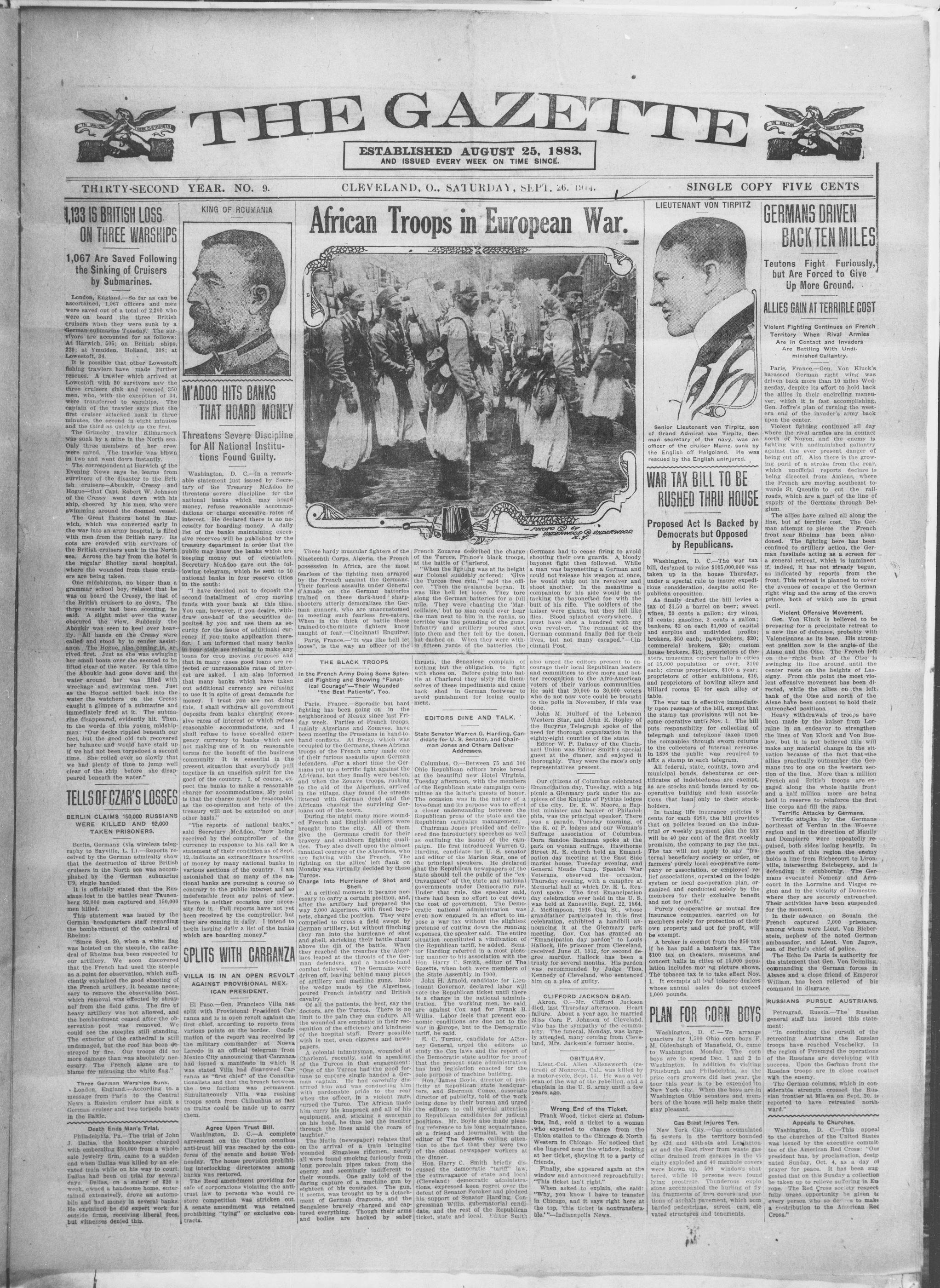
African Troops in European War.
- РИСОЮ С 67
ИНДЕКСООД @ ИНДЕКСООД
X. Y.
These hardy muscular fighters of the Nineteenth Corps, Algeria, the French possession in Africa, are the most fearless of the fighting men arrayed by the French against the Germans. Their fearless assaults under General d'Amade on the German batteries battered the Germans, darkened the shooters utterly demoralizes the German gunners, who are unaccustomed to meeting such fearless fire-eaters. When in the thick of battle these trained-to-the-minute fighters know naught of fear—Cincinnati Enquirer, Paris, France. "It was like hell let loose," is the way an officer of the
THE BLACK TROOPS
In the French Army Doing Some Splendid Fighting and Showing "Fanatical Courage"—Their Wounded "the Best Patients", Too.
Paris, France—Sporadic but hard fighting has been going on in the neighborhood of Meaux since last Friday week. Parties of French troops, mainly Algerians and Zouaves, have been meeting the Prussians in hand-to-hand combat. At Energy, which was occupied by the Germans, these African troops of the French army made one of their furious assaults upon German defenders. For a short time the Germans put up a terrific fight against the Africans, but they finally were beaten, and when the Zouave troops, rushing to the aid of the Algerians, arrived in the village, they found the streets littered with German dead and the Africans chasing the surviving Germans. During the night many more wounded French and English soldiers were brought into the city. All of them give the Germans credit for their bravery and stubborn fighting qualities. They also dwell upon the almost fanatical courage of the Algerines, who are fighting with the French. The fighting on the allies' left flank on Monday was virtually decided by these Turcos.
Charge Into Hurricane of Shot and Shell.
At a critical moment it became necessary to carry a certain position, and, after the artillery had prepared the way 2,000 Algerines, with fixed bayonets, charged the position. They were compelled to cross a field swept by German artillery, but without finching they ran into the hurricane of shields and shields and shields and the dim of the battle. When they reached the trenches the Algerines leaped at the throats of the German defenders, and a hand-to-hand combat followed. The Germans were driven off, leaving behind many pieces of artillery and machine guns. Into the wedge made by the Algerines, poured French infantry and British cavalry. All the patients, the best, say the doctors, are the Turcos. There is no limit to the pain they can endure. All the wounded are emphatic in their recognition of the efficiency and kindness of the hospital staff. Every possible wish is met, even cigarettes and newspapers.
A colonial infantryman, wounded at Charleroi, recently said in speaking to the Turcos that engagement; "One of the Turcos had the good fortune to capture single handed a German captain. He had carefully armed him and was conducting him with pardonable pride to the rear when the officer, in a violent rage, cursed the Turco. In the African army he carry his knapsack and hold his equipment, and sticked his saucepan on his head, he then led the insulter to the lines amid the roars of laughter."
The Matin (newspaper) relates that on the arrival of a train brings wounded Singalese riflemen, nearly all were found smoking furiously from long porcelain pipes taken from the enemy and seemingly indifferent to their wounds. One gaily told of the daring capture of a machine gun by eighteen of his comrades. The gun, it seems, was brought up by a detachment of German dragoons, and the Sengalese bravely charged and captured everything. Though their arms and bodies are hacked by saben
French Zouaves described the charge of the Turcs, France's black troops, at the battle of Charleroi.
"When the fighting was at its height our Colonel suddenly ordered: 'Give the Turcos free rein,' said the officer when the Parachute bimble was like hell let loose. They tore along the German batteries for a full mile. They were chanting the 'Marsellaise,' but no man could ever hear the man next to him in the ranks, so terrible was the pounding of the guns. Infantry and artillery poured shot into him and they fell by the dozen, in disbanded they were with in fifteen yards of the batteries the thrusts, the Sengalese complain of nothing but the obligation, to fight in battle and they slyly themselves of these impediments and came back shod in German footwear to avoid punishment for losing equipment.
EDITORS DIN AND TALK.
State Senator Warren G. Harding, Canidate for U. S. Senator, and Chairman Jones and Others Deliver Addresses.
Columbus, O.-Between 75 and 100 Ohio Republican editors broke bread at the beautiful new Hotel Virginia, Tuesday afternoon, with the members of the Republican state campaign committee as the latter's guests of honor. The occasion was in the nature of a love-feast and its purpose was to effect the Republican press of the state and the Republican campaign management.
Chairman Jones presided and delivered fine introductory speeches as well as outlining the issues of the campaign. He first introduced Warren G. Harding, candidate for U. S. senator and editor of the state Star, one of the Republican speakers, that the Republican newspapers of the state should tell the public of the "extravagance" of the state and national governments under Democratic rule. Under that rule, the speaker said, there had been no effort to cut down the cost of government. The Democrat even now engaged in an effort to impose a war tax without the slightest pretense of cutting down the running expenses, the speaker said. The entire situation constituted a vindication of the Republican tariff, he added. Senator Harding referred in a most pleasing manner to his association with the Hon. John Smith, of The College when he became members of the State Assembly in 1900.
John H. Arnold, candidate for Lieutenant Governor, declared labor will vote the Republican ticket until there is a change in the national administration. The working men, he said, are against Cox and for Frank B. Willis. Labor feels that present economic conditions are due not to the Republican press, but to the Democratic tariff, he said.
E. C. Turner, candidate for Attorney General, urged the editors to study the Cox laws and the report of the Democratic state auditor for proof that the present state administration has had legislation enacted for the sole purpose of manning building the office of Boyle director of publicity at Republican state headquarters, and Sherman Cunoe, associate director of publicity, told of the work being done by their bureau and urged the editors to call special attention to Republican candidates for judicial positions. Mr. Boyle also made pleasing reference to his long acquaintance, Richard Cunoe, editor of The Gazette, calling attention to the fact that they were two of the oldest newspaper workers at the dinner.
Hon. Harry C.arry, chiefly discussed the democratic "tariff" law, the extravagance of state and local (Cleveland) democratic administrations, expressed keen interest over the threat of a lawsuit against the report of Senator Harding, Congress Willis, gubernatorial candidate, and the rest of the Republican ticket, state and local. Editor Smith
Germans had to cease firing to avoid shooting their own guards. A bloody bayonet fight then followed. While a man was baynetting a German and could not release his weapon at once, he would whip up his revolver and shoot another. In the meantime a man by his side would be attacking the bayoneted foe with the butt of his rifle. The soldiers of the kaiser were giants, but they fell like files. Blood splashed everywhere. I must have shot a hundred with my own revolver. The remnant of the German command finally fled for their lives, but not many escaped."—Cincinnati Post.
also urged the editors present to encourage their local Republican leaders and committees to give more and better recognition to the Afro-American community. He said that 20,000 to 30,000 voters who do not now vote could be brought to the polls in November, if this was done.
John M. Mulford of the Bucyrus Telegraph spoke of the need for thorough organization in the eighty-eight counties of the state. Editor R. P. Bahney of the Cincinnati Union was Editor Smith's special guest at the dinner, and enjoyed it thoroughly. They were the race's only representatives present.
Our citizens of Columbus celebrated Emancipation day, Tuesday, with a big picnic a Glemary park under the auspices of the Knights of Pythias lodges of the city. Dr. E. W. Moore, a Baptist minister and banker of Philadelphia, was the principal speaker. There was a parade, Tuesday morning, of the K. of P. lodges and our Woman's Suffrage committee of Columbus. Dora Sandoe Bachman spoke at the park on woman suffrage. Hawthorne Street M. E. church held an Emancipation day meeting at the East Side market house, Tuesday evening, and General Meade Camp, Spanish War Veterans, observed the occasion, Thursday evening, with a campfire at Memorial hall at which Dr. E. L. Exford spoke. The first Emancipation day meeting at the park was held at Zanewille, Sept. 22, 1864. J. McSimpson, 1916 Oak St., whose grandfather participated in this first celebration, exhibited a handbill announcing it at the Glenmary park meeting. Gov. Cox has granted an "Emancipation day dardan" to Louis Hallock, life prisoner from Cleveland, received June 21, 1912, for second degree murder. Hallock has been a trusty for several months. His pardon was recommended by Judge Thos. Kennedy of Cleveland, who sentenced him on a plea of guilty.
CLIFFORD JACKSON DEAD.
Akron, O.—Mr. Clifford Jackson has had a day afternoon heart failure. About a year earlier he missed Miss Cora P. Cleveland of Cleveland, who has the sympathy of the community. The funeral, Monday, was largely attended, many coming from Cleveland, Mrs. Jackson's former home.
OBITUARY.
Lieut.-Col. Allen Allensworth (retired) of Monrovia, Cal., was killed by a motor-cycle, Sept. 13. He was a veteran of the war of the rebellion, and a chaplain in the U. S. army until a few years ago.
Wrong End of the Ticket
Frank Wood, ticket clerk at Columbus, Ind, sold a ticket to a woman who expected to change from the Union station to the Chicago & North Western in Chicago. He noticed that she lingered near the window, looking at her ticket, showing it to a party of friends.
Finally, she appeared again at the window and announced reproachfully: "This ticket isn't right."
When asked to explain, she said: "Why, you know I have to transfer in Chicago, and it says right here at the top, 'this ticket is nontransferable.'"—Indianaapolis News.
LIEUTENANT VON TIRPITZ
Senior Lieutenant von Tirpitz, son of Grand Admiral von Tirpitz, German secretary of the navy, was an officer of the cruiser Mainz, sunk by the English off Helgoland. He was rescued by the English uninjured.
WAR TAX BILL TO BE RUSHED THRU HOUSE Proposed Act Is Backed by Democrats but Opposed by Republicans.
Washington, D. C.—The war tax bill, designed to raise $105,000,000 was taken up in the house Thursday, under a special rule to insure expeditious consideration, despite solid Republican opposition.
As finally drafted the bill levies a tax of $1.50 a barrel on beer; sweet wines, 20 cents a gallon; dry wines, 12 cents; gasoline, 2 cents a gallon; bankers, $2 on each $1,000 of capital and surplus and undivided profits; brokers, $50 each; pawnbrokers, $20; commercial brokers, $20; custom house brokers, $10; proprietors of theaters, museums, concert halls in cities of 15,000 population or over, $100 each; circus proprietors, $100 a year; proprietors of other exhibitions, $10, and proprietors of bowling alleys and billiard rooms $5 for each alley or table.
The war tax is effective immediately upon passage of the bill, except that the stamp tax provisions will not become operative until Nov. 1. The bill puts responsibility for collecting of telegraph and telephone taxes upon the companies through sworn returns to the collectors of internal revenue. In 1898 the public was required to affix a stamp to each telegram.
All federal, state, county, town and municipal bonds, debentures or certificates of indebtedness are exempt, as are stocks and bonds issued by cooperative building and loan associations that loan only to their stockholders.
In taxing life insurance policies 8 cents for each $160, the bill provides that on policies issued on the industrial or weekly payment plan the tax will be 40 per cent of the first weekly premium, the company to pay the tax. The tax will not apply to any "fraternal beneficiary society or order, or farmers" purely local co-operative company or association, or employees' relief associations, operated on the lodge system or local co-operation plan, organized and conducted solely by the members for their exclusive benefit and not for profit."
Purely co-operative or mutual fire insurance companies, carried on by members solely for protection of their own property and not for profit, will be exempt.
A broker is exempt from the $50 tax if he has paid a banker's tax. The $100 tax on theaters, museums and concert halls in cities of 15,000 population includes mong picture shows. The tobacco tax is to take effect Nov. 1. It exempts all leaf tobacco dealers whose annual sales do not exceed 1,000 pounds.
PLAN FOR CORN BOYS
Washington, D. C. —To arrange quarters for L,500 Ohio corn boys F. M. Oldenbaugh of Mansfield, O. came to Washington Monday. The corn boys are to spend Dec. 1 and 2 in Washington. In addition to visiting Pittsburgh and Philadelphia, as the prize corn growers did last year, the tour this year is to be extended to New York city. When the boys are in Washington Ohio senators and members of the house will help make their stay pleasant.
Gas Blast Injures Ten
New York City—Gas accumulated in sewers in the territory bounded by 42d and 44th-sta and Lexington av and the East river from waste gasoline drained from garages in the vicinity exploded and 40 manhole covers were blown up, 500 windows shattered, while 10 persons were found lying prostrate. Thunderbolts explosions accompanied the hurling of firing fragments of fire covers and portions of asphalt pavement, which bombed pedestrians, street cars, elevated structures and tenements.
IN VALOR
IN GESTUL
IN ESTEEM
Teutons Fight Furiously, but Are Forced to Give Up More Ground.
Violent Fighting Continues on French Territory When Rival Armies Are in Contact and Invaders Are Battling With Undiminished Gallantry.
Paris, France.—Gen. Von Kluck's harassed German right wing was driven back more than 10 miles Wednesday, despite its effort to hold back the allies in their encircling maneuver, which it is fast accomplishing, Gen. Joffre's plan of turning the western end of the invader's army back upon the center.
Violent fighting continued all day where the rival armies are in contact north of Noyon, and the enemy is fighting with undiminished gallantry against the ever present danger of being cut off. Also there is the growing peril of a stroke from the rear, which unofficial reports declare is being directed from Amiens, where the French are moving southeast to wards St. Quentin to cut the rail roads, which are a part of the line of supply of the Germans through Belgium.
The allies have gained all along the line, but at terrible cost. The German attempt to pierce the French front near Rheims has been abandoned. The fighting here has been confined to artillery action, the German fuselade acting as a screen for a general retreat, which is imminent if, indeed, it has not already begun, as indicated by reports from the front. This retreat is planned to cover the avenues of escape of the German right wing and the army of the crown prince, both of which are in great peril.
Violent Offensive Movement.
Gen. Von Kluck is believed to be preparing for a precipitate retreat to a new line of defenses, probably with Valenciennes as its base. His strongest position now is the angle of the Alsne and the Oise. The French left on the right bank of the Oise is swinging its line around until the latter reaches the heights of Lansig. From this point the most violent offensive movement has been directed, while the allies on the left bank of the Oise and north of the Alsne have been content to hold their entrenched positions.
Heavy withdrawals of troops have been made by the kaiser from Lorraine in an endeavor to strengthen the lines of Von Kluck and Von Buelow, but it is not believed this will make any material change in the situation because of the fact that the allies practically outnumber the Germans two to one on the western section of the line. More than a million French and British troops are engaged along the whole battle front and a half million more are being held in reserve to reinforce the first line corps and fill the gaps.
Terrific Attacks by Germans.
Terrific attacks by the Germans northeast of Verdun in the Woevre region and in the direction of Maully and Dompierre were repeatedly repulsed, both sides losing heavily. In the south of this region the enemy holds a line from Richecourt to Lronville, intersecting Seicheprey, and is defending it stubbornly. The Germans evacuated Nomeny and Arracourt in the Lorraine and Visgos region and in the vicinity of Domestre, where they are securely entrenched. Their activities have been suspended for the moment.
In their advance on Souain the French captured 7,000 prisoners, among whom were Lieut. Von Bieberstein, nephew of the noted German ambassador, and Lieut. Von Jagow, son of Berlin's chief of police.
The Echo De Paris is authority for the statement that Gen. Von Deimling, commanding the German forces in Alsace and a close friend of Emperor William, has been relieved of his command in disgrace.
RUSSIANS PURUE AUSTRIANS.
Petrograd, Russia—The Russian general staff has issued this statement:
"In continuing the pursuit of the retreating Austrians the Russian troops have reached Veszhelok. In the region of Przemysl the operations of the Russians are developing with success. Upon the German front the Russian troops are in close contact with the enemy.
The German columns, which in considerable strength crossed the Russian frontier at Miawa on Sept. 20, is reported to have retreated northward."
Appeals to Churches.
Washington, D. C—This appeal to the churches of the United States was issued by the executive committee of the American Red Cross: "Our president has, by proclamation, designated Sunday, Oct. 4, as a day of prayer for peace. It has been suggested that on this Sunday a collection be taken up to relieve suffering in Europe. The Red Cross society respectfully urges opportunity be given to every person who so devotes to make a contribution to the American Red Cross."
SUBSCRIPTION RATES
(In Advance)
One Year.....$1.50.
Six Months.....1.00
Three Months.....50
Subscribers are requested to re-
mit by postoffice money or
der or registered letter
Entered at the postoffice in Cleveland
Ohio, as second-class matter.
Address all communications to
HARRY C. SMITH
Editor and proprietor,
THE GAZETTE,
Blackstone Building, Cleveland, O.
Member Ohio Legislature: 1894
to 1936; 1896 to 1898; 1908 to 1902
THE GAZETTE is the oldest, and has the largest bona fide circulation, double that of any newspaper in the interest of Afro-Americans, published in the state of Ohio; and comparison with any will immediately available to the public in the NEWSIEST AND BEST in the country.
19,000,000 Afro-Americans.
160,000 in Ohio.
20,000 in Cleveland.
SATURDAY, SEPT. 26, 1914.
The Gazette is indebted to Editor Dabney of the Cincinnati Union, for the splendid triple column portrait of the Turcos on Page 1.
We ask our readers to give Rev. Geo. Wilson Brent's communication, elsewhere in The Gazette, a careful and thoughtful reading, and to call their friends' and acquaintances' attention to it. It is one of the strongest arguments against the establishment of "jim-crow" Y. M. C. A.'s, particularly in the North, we have ever read.
The Hon. James Boyle, many years ago one of the Cincinnati Commercial Gazette's very best correspondents and writers; later private secretary to Gov. Wm. McKinley who when President him to England as one of our diplomatic representatives, is one of the heads of the Publicity department of the State Republican Executive Committee. No better person for the position could have been found. He is a broad-minded, wholesouled manly whom it is always a pleasure to meet, and we say this after an acquaintance of nearly a quarter of century.
That dinner to Ohio editors, in Columbus, Tuesday, an account of which will be found in our Columbus letter, elsewhere in this paper, was an ex captionally fine and successful affair. The editor of The Gazette cannot fail to fully appreciate the several unusual courtesies shown him on that occasion. Chairman Jones, the rest of the State Republican Executive Committee, and their able assistants at the headquarters, including the ever genial John Buckner, former Cleveland and an old Columbus "boy," are not only wise, and active in the effort to lead the party to a great victory, this fall, but have already shown exceptional ability to do so.
THE MAINE ELECTION
THE MAINE ELECTION.
The election in Maine shows a Republican gain over the vote in the last presidential election of one hundred and twenty-five per cent. The Democratic gain was eighteen per cent. The Progressive loss was sixty-six per cent. The same trend in the coming election in Ohio insures an old-time Republican majority in this State. The Maine September elections have always been regarded as accurately forecasting the general trend of the November elections throughout the country. The incomplete vote in Maine, subject to slight change, is as follows: The vote for Haines, the Republican candidate for Governor, is 57,582; Curtis, Democrat, 61,249; Gardner, Progressive, 17,443. The remarkable gain of the Republican party is shown when these figures are contrasted with those of the presidential election of 1912, when the Republican vote was 26,545, the Democratic 51,113, the Progressive 48,493. The vote achieved by our party is all the more gratifying in view of the fact that the Democratic National administration put forth every effort and strained every resource to make a showing in Maine for its effect on the November elections. In this connection attention is called to the forecast of the New York Herald that Democratic losses all over the country are clearly foreshadowed in its parliamentary canvass of the campaign for the election of the next House of Representatives. All indications point to the "coming back" of the Republican party. There is every incentive to work with the old-time enthusiasm and energy and there is every assurance of complete victory.
DR. BYRD ON DR. WASHINGTON
Rochester, N. Y., Sept. 19, 1914.
My dear Mr. Smith: I thank you very much for your article in The Gazette of Sept. 13th. I am not surprised at the statement made by Mr. Booker T. Washington for it is in line with his whole southern career. It is hard to believe that he is now pursuing as it is for you to go in the other direction. There are evidently two classes of Colored men before the eyes of the American public today. The one, stands for his rights and makes no compromise for a temporary personal gain. He hates injustice and wrong and will not desist from protesting against it. While protesting, he is not seeking to hurt others but to get justice for himself and his race. He represents the tories in our battle for absolute freedom. Acquiescing in the customs and habits of the South is the only safe way for him to continue his school. To stand out for
the rights of his race as the principal of the white Normal or Industrial school of Alabama does, has never entered the cranium of Mr. Washington and his followers; if it did, it has been kept quiet. It is very unfortunate that a man of so little manhood has such a wide influence in this country it is evident, however, that in these later years the influence of the Colored men of the world effect upon the thinking Colored people. His flagrant mistakes have rendered him a subject of great criticism. He has done a great good in his day, but he is now injuring and destroying the good he has done. So long as men have in them manhood, they will fight injustice in what所谓 it comes, be it *segregation*, *jimcrowism* or what not. The world disdains a bully, and equally so it loathes a coward. It is very unfortunate that what might be the arm of the Colored race, The Business Men's League, is and has been a great time Mr. Washington is behind one of the greatest begging-machines that might ever be found. The country is held up to support Tuskegee, while the immense fortunes of the Colored business men go into hiding and only come out once a year when some crank desires to get newspaper notoriety. If the wealth is in the hands of the Colored race, that reports of the League say is there, then Tuskegee should look to Colored men to bear its burdens or go out of business. This is its existence only in the distorted brains of the "Wild Asses" of the League.
You are to be congratulated for the manly stand you have consistently taken against all injustice. History is the author of the Gazette and its heroic editor.
Use this letter in any way you may see fit.
WM. A. BYRD.
As we have repeatedly said in recent years, the price, in a sacrifice of citizen-rights and privileges, the race has paid for the success of Tuskegee Normal & Industrial school, under the leadership of Booker T. Washington, is "all out of proportion" to the good, in every way, it has received from that institution and Mr. Washington. When the National Business League of which he is the president and leader continued to refuse to take any stand and make any aggressive effort in behalf of the race's rights and privileges questioned and denied in any part of the country, and only recently absolutely refused to take an aggressive stand against segregation, as well as lynching, disfranchisement and "jim-crow" cars, we could easily see the Washington influence and the baneful effect of his preaching of his infamous "doctrine of surrender" (of our rights and privileges) which secures to him and his school the favor of the prejudiced South and its Northern allies. What astonishes us most, at this time, is the failure of the great majority of our leading men and women and newspapers to speak out, to the masses of our people, in an effort to warn them of the danger that lies in the growth and spread of that pernicious "doctrine." They certainly cannot fail to see the necessity of such a warning.
"AUNT SOPHIE, GUINEA-GOLD"
Found $200,000 in a Waste-basket and
"Stood Guard" It Most of
a Night.
Washington, D. C.—Sophia Holmes was a free Colored woman, the wife of a "slave owned" by Colonel Seaton, who lived here in Washington at the beginning of the Civil War. Her husband was wifft the army, and lost his life at the battle of Manassas; so his widow, who had ten children to care for, applied to General Spinner, then measured the distance he could cover enough litter to hide them. She was given the task of sweeping, dusting, and emptying waste-baskets at a salary of $15 a month. One day, after the clerks had all left the rooms, she discovered that one of the boxes in which waste paper was thrown was almost full if big bundles of crisp, new money. Some of the bills were as high in denomination as $15, and they were enough litter to hide them and spread over them. Sophia hastily covered up the treasure, and continued her work as if nothing had happened. The watchman making his last rounds asked her why she lingered so late. She pretended to be busy, and the man kept on, and left her undisturbed. Sophia feared to tell the watchman what he was doing, and she took the money himself, and then laid on it mea. Sophia knew that it was the habit of General Spinner to spend the night in his office. So he slept in his anxiety at this time that he slept in a little room that adjoined his main office. In a building and slippers, he took up the building, and satisfied himself that the money was in perfect condition. The box of the money was the box of the money slipped by, and still she failed to hear the tap! tap! tap! of the old slippers coming down the stone hall. But at last she heard the familiar footsteps approach the door. As General Spinner was about to pass, she stepped forward. "Just step in here and see what he is doing in the mysterious voice. Then she took the litter from the top of a big box, and showed to the startled man the bundles of new money within. General Spinner sent at once for some of the treasury officials; the money was counted and found to amount to over $200,000. Meanwhile he sent Sophia home in a carriage to her waiting little ones. No one ever found out who put almost a quarter of a million dollars of newly printed money into the bank. She was invited to this day. As a reward for her honesty, Sophia Holmes was appointed to a position that paid her more than fifty dollars a month. She died thirteen years ago at the ripe age of seventy-nine years.
Great Salt Production
The marketed production of salt in the United States, including Hawaii and Puerto Rico, in 1913 reached the record-breaking total of 34,399,298 barrels of 280 pounds each, or 4,815,902 short tons. The value of the product was $10,123,139. These figures are the greatest yet recorded by the United States geological survey for the salt industry in the United States, and they represent an increase of 3 per cent in quantity produced and of nearly 8 per cent in value compared with 1912.
THE GAZETTE, CLEVELAND, O., SATURDAY, SEPT. 26, 1914.
BUGKEYE LETTERS
WRITTEN BY "THE OLD RELIABLE" GAZETTE'S CORRESPONDENTS.
What Our People Are Doing Each Week—Church, Personal, Social, Lodge, Literary and Musical—Marrigues, Deaths, Etc.
CADIZ—Mrs. R. F. Ballard entered at dinner, Sunday, Mesdames Myrtle Christian, Mary Burt of Newark, and Miss Myrtle Ross, Columbia Pa.—Mrs. Elbira Wallace is visiting in Lorain. Dallas Wallace spent, Sunday, in Wheeling.—Miss Bertha Mac Carter in Steubenville Monday.—Miss Beverly Mrs. and Mrs. Pitter are guests of the latter's parents, Mr. and Mrs. W. H. Miller.—Miss Grace Wallace is visiting in Pittsburgh and Miss Beatrice Tyler in Allegheny.
MASSILLON—Rev. A. E. Adams pastor of the A. M. E. Zion church was given a fine testimonial entertainment and reception, Sunday, by his congregation and friends prior to his leaving for conference. He has done splendid work here, is deservedly popular, and it is hoped that he will be able to continue his work pated in the program were: Mrs. John Winston, Miss Pauline Foster, Mrs Richard Boone, Miss Margaret Peter son and Mrs. Duke Cunningham.
SANDUSKY—Mrs. Edna Williams remains palliate ill, Mrs. G. D. Smith is much improved, and J. R. Davis is suffering with his teeth. Mrs. Anna Crouch, who has been stopping with Mrs. Smith, leaves Monday, for her daughter, Mrs. W. W. Taylor's home in Cincinnati—Mrs. J. C. Turner conducted services at the A. M. E. church, Sunday, and had spieduld success—laughs at an unseen banquet and brother visited an unseen inebritish. Mrs. Lewis from the West, is visiting her niece, Mrs. H. Richards—Mrs. Hopkins of Worn St., is roofering her cosy home—Mr. John Rhodes has pursued a chased home on Decatur St.-Get your paper from The Gazette's local agent, Rev. G. D. Smith.
YOUNGSTOWN—Mrs. Morgan of Wheeling, spent a week with her sister, Mrs. Bert Marks—Henry Johnson is located on Chestnut st.—Wilma daughter of Mr. and Mrs. C. W. Manley, is one month old and doing nicely—Mr. and Mrs. Floyd Davis of Marietta, are here to locate. W. P. Arnold is improving—Buckeye Davis's annual first party, is Monday evening—Rev Jost, is visiting his sister, Mrs. Tammore. the daughter, Mrs. Katie, is a musical prodigy, Miss Olie Branch of Bridge port, is Mr. and Mrs. Jas. Saunders guest. Mrs. Wm. Logan and Mrs. Calvin Bannister gave a delicious four course dinner, at the latter's, last Fri day, which was attended by a number of local and out-of-town guests. It was in honor of Miss Adelalde Stewart, bride-elect, who is deservedly popular and one of our first ladies. Mrs. R. D Lynch also royally entertained in her honor, Monday afternoon—Mrs. John daughter and Mrs. Bend. Svysch of Erle, Pa. spent a week with Mrs. Wm Brown.
CORRESPONDENTS must mail all letters for publication at their main postoffice sufficiently early on Monday (or Sunday) of each week to have them reach The Gazette office on Tuesday morning, and always write also, their names and that of their relatives, in the envelope with a wrapper about returned copies. Use less this latter is done, proper credit cannot be given you. Lists of names, wedding presents, etc., obituary notices, speeches, resolutions, poetry, inquiries for relatives and advertisements of all kinds, including items announcing entertainments to be held in advance or to be presented in advance at the rate of ten cents a line, six words to a line. Our rates for display advertisements will be sent on application. Send postal note and not stamps during warm weather.
AS TO "JIM CROW" Y. M. C. A's.
A Life-long Friend of the Race, and for Several Years a subscriber of "The Old Reliable", is opposed To Them.
Madison, N. J. Sept. 24, 14.
Editor Gazette, Dear Sir:—You voice the sentiments of my soul and spirit—why should Christian America defy the "color-line" and rank it higher than the fundamentals of orthodox religion? The common fatherhood of God (acceded by "The Church in America") implies, to all believers, the common brotherhood of "all men in Jesus Christ";—2 Cor. 5:7; Col. 3:9; Eph. 2:10-19.
I have fought in Virginia (Norfolk), Maryland (Baltimore), and New Jersey the pernicious practice of the Young Men's Christian Association in "drawing the color-line" and using it as an asset. I do not exactly understand Mr. Julius Rosenwald's motive in donating $25,000 to encourage the building of Negro Y. M. C. A.'s in America—do you? Every one built (and successfully maintained) only accentuates and makes more bitter the "color prejudice!" For it is not the fithy, foul-mouthed, evil-smelling whisky-drinking Negro community-bedroom bummed they hate and do not respect the honest, intelligent, self-respecting and capable Negro whose domination and social inequality proclivities they fear, because they recognize in him not only a civil equal in embryo, but actually a moral superior on mentality!!!
Why should the National Y. M. C. A. recognize, legalize and perpetuate the "color-line"? There is none in sin, there is none in sickness, nor poverty, neither in hell nor heaven!! When in so doing, they cater to popular prejudice, they dishonor Christ and kill others, they assault religious and condemn their own national organization as a huge hypocritical conspiracy to bolster up an inhuman lie—the sublime equality of all men.
I wish you every blessing with suc-
cess. Fraternally yours,
(Prayer of the Saints)
MORRIS RE-ELECTED!
Grand-Master of Our Odd Fellows by an overwhelmingly Large Vote—
Henry Lincoln Johnson De-
feated.
Special to The Gazette.
Boston, Mass.—The seventeenth bl-
ennial B. M. C. of the Grand United Order of Odd Fellows has passed into history. Ever since the last meeting two years ago at Baltimore, the Washington-Ben Davis "Link" Johnson faction has endeavored to either unhors Morris or disrupt the Order, but has signally failed. Just why Booker T. and his crowd has been so anxious to dethrone Morris is not clear, unless it be the fact that Mr. Morris has refused to wear the "Booker collar of cringing," and that he would book 300 the rule limiting the term of the Grand Master was repealed and Hon. Edward H. Morris of Chicago was re-elected. The G. U. O. F. re-affirmed the fact that it is a world-wide order, under the jurisdiction of the Committee of Management of England, whose judgments on questions affecting the fundamental law, are final. The great order of Odd Fellows is not simply a Colored organization, confined to America, but it is world-wide and under the world. It means that millions of white men will extend the right hand of fellowship when they meet Afro-American Odd Fellows.
The following officers were elected:
G. M., Edward H. Morris, Illinois; D. G., M., Julius C. Johnson, Alabama; treasurer, W. David Brown, New York; secretary, J. P. Needham, Pennsylvania; editor, Odd Fellows' Journal, Grand P. Slaighter, Washington, D. C.
Grand Directors: I. N. Roberts, Massachusetts; G. A. Mays, Florida; J. H. Johnson, North Carolina; A. T. Shirley, Virginia; E. P. Jonen, Mississippi.
Directors: J. T. Green, South Carolina; W. S. Mixon, Alabama; J. H. Miller, New Jersey.
The next meeting will be held in Washington, D. C., in September, 1915.
MENACE IN HIGH BUILDINGS
Man Who Should Know Declares That City's Chief Peril Is In Its Skyscrapers.
"Quit building 'skyscrapers,'" was the advice given to the convention of the National Association of Building Owners and Managers by Franklin N. Wentworth of Boston.
Mg. Wentworth, who is secretary of the National Fire Protection association, declared that excessively high buildings are becoming a menace to the larger cities of the country.
"It is said that the up and down traffic on the elevators of New York city is almost as great as the horizontal traffic," said he. "New York city has been very fortunate. No disaster more horrifying could be imagined than that which would occur if New York city should have an earthquake; just enough of a shock to break water mains and gas mains and to snap electric beams. The loss of life would be appalling.
"I imagine the panic that would occur if such a disaster came during the rush hours when 100,000 persons would be in the subways or when panic-striken occupants of great buildings were attempting to make their way down to the ground.
"The skyscrapers have made the subway a necessity. A great configuration, such as is possible in New York, would bring the same disastrous results as an earthquake and cheoke the subways.
"New York is beginning to realize the menace and stops are being taken to limit the height of buildings. Other cities not limited in space as New York is should set a limit on the height of buildings. It does not make a city any greater to have high buildings."
FRESH BEYOND ALL DOUBT
Angler Tells of Fish That Was Cooked
In What Might Be Called
Record Time.
"Positively the freshest caught fish I ever ate," said an ardent fisherman, "was one I caught in the wilds of Canada. A friend of mine and I were out with a canoe and a light outfit for two weeks' trout fishing. Along late one afternoon we struck a likely-looking stream, made camp for the night, and went to fishing. In half an hour we had our pockets full of trout. "Then we rolled a couple of stones together, started a fire and put on the frying pan. While my friend was busy with that I said to him I guessed I'd catch a fish or two more while he was cooking. "In half a minute I had a half-pound trout. I swung this fish out and over him, where he stood by the fire, for him to look at. "Hold him so for a minute,' my friend says to me, and I did, just over his head.
"You know there's a way of cleaning a fish by which you remove its head and viscera practically at a touch and my friend knew how. He reached up with his knife to that fish dangling over his head and nicked it in the right spot at the back of its head and then in front at the gills and then he just drew the head and interior fitting away all at once, leaving the fish perfectly cleaned, and then, while it was still dripping with the water from which I had caught it, he dropped this trout in the frying pan.
"You couldn't have fish much fresher caught than that, do you think?"
Killed Snake Found Gold
Killed Snake! Found Song.
W. Nole, a pioneer desert teamster, took a shot at a rattlesnake colled up close to the road in the Calico country, near Sodavillie, away the Los Angeles Times. Immediately after the shot his curiosity prompted the marksmans to look at a rock which had been broken by the bullet after it had struck through the snake's head, and the assay of the rock runs upward of $150 a ton in gold and 200 ounces of silver. At the present time there are 2,500 tons of ore in sight projecting about the surface of the surrounding country, which is included in the claim staked out by Nole.
Fishing for rattlers in the mountains near San Bernardino, Cal., is good. Two anglers fishing along a stream in the region of Big Bear lake disturbed two rattlers in a hole in the rocks along the water's edge. Being unable to get at them in any other way, the anglers fastened hooks to the ends of their poles, and after prodding the snakes for awhile the reptiles became mad and struck at their tormentors, whereupon they were caught on the hooks and drawn out of the hole.
KEEP UP THE OLD CUSTOMS
Curious Practices That Have Long Prevailed in Two Aristocratic London Banks.
A New York banker who spends much time abroad and has recently returned was speaking the other day about the amalgamation of the two old private banking houses of London. Coutts and Robarts, and of some of the queer customs which still prevail in them and doubtless will be carried over to the merged institution.
From time immemorial the owners of Coutts's bank have insisted that mustaches and beards must be taboos to all employees and also as far as possible to its customers. The founder of the bank was a firm believer in character reading from the formation of the mouth and always insisted that he must have a free and unobstructed opportunity to study the mouth of either customer or employee and this has been carried on down to the present day. Moreover, it is an unwritten rule that every official of Coutt's must wear a black frock coat and white tie and it is said that the procession from the bank at closing time appears like a delegation of Non-Conformist clergymen.
In the offices of Robarts', antique little lamps, like those pictured in interiors of the olden time, are used for light and for sealing purposes. These lamps are always kept filled with a specially made brand of oil and gas or electric light has never been able to banish these old style lamps from Robarts'. The merger of these two banks was described by the American banker as a wedding of the two aristocrats of the English banking world.
THIS GOAT WAS ON THE JOB
Burglar Laughed at Watchdog, but Pugnacious Billy Spilled His Blood.
After very carefully avoiding a savage watchdog, chained to the rear of the house he was about to enter, a porch climber came to grief, and narrowly escaped being captured by a pet billy goat in the front yard of the Italian club, says a San Francisco dispatch.
Gaining entrance to the second story by means of a ladder, the burglar collected together $269 in coin, a few gold rings, and odd trinkets, and slid down a porch post to the ground. As his feet touched terra firma, the goat, whose private grazing patch had been invaded, spilled the intruder. Also the intruder spied Billy. Then started an unequal foot race for the nearest fence.
The burglar lost—lost the race, great patches of cuticle, the major portion of his clothing, and several teacupfuls of blood. He finally managed to scale the fence, and disappear in the darkness with the loot, which was the property of John Regalia, Antone Rambono, and Tony Vanoll.
Mrs. E. B. Pond, daughter-in-law of former mayor Pond, of San Francisco, whose local home has been invaded by burglar twice during the pass fortnight, attempted to buy the good from the Italianas. He is not for sale, however, although the savage watchdog, which slept through the entire confusion, can be had for the asking.
Money Talks.
Perry Lukens, a well-known New York advertising man, has discovered that he is a philosopher. He mounted a weighing machine the other day and, dropping a cent in the slot, waited for the dial to indicate the exact number of pounds of avoidpoids tissue he was carrying around. But the money stuck and the durned thing wouldn't work. And not having another penny in change Mr. Lukens was about to give the atmosphere the once over, sulphurously speaking, of course, when he noticed that a youngster had hopped on the weighing machine. "I don't weigh anything," said the little fellow when the dial failed to move. "That was because he did not have a penny to put in the slot," explained the advertisement man. Right here Mr. Lukens got his philosophical inspiration. "How this applies to every day life when a man hasn't anything," solloquized he. "No money—therefore he does not weigh anything." Which are profound words of philosophy, especially if you cannot make a touch.
Nantucket in History.
One hundred years ago the inhabitants of Nantucket declared themselves neutral in the war between the United States and Great Britain. Nantucket is an island off the south coast of Massachusetts, and has an area of about sixty square miles. In earlier days it was famous for its skilled seafarer and large business in whale fishery. It was probably with a view to protecting the last named that the shrewd Nantucketers declared their neutrality in the war of 1812. During the war the Nantucket whaling feet was the only one active. But soon after it lost its supremacy to New Bedford, and the year 1869 was the sailing of the last whaler from Nantucket. Today the picturesque little island is known principally as a summer resort, with its shores dotted with hotels and handsome summer villes.
The Only Condition.
Bernard Shaw, who, with characteristic impetuosity, has jumped into the music hall discussion, was once asked by an American impressario to go no a lecturing tour in the United States.
"There are," the impressario saured him, "only two great lecture attractions remaining to be exploited in the United States. You are one of them."
"And who is the other?" Mr. Shaw asked.
"The German emperor," was the reply of the impressario, who was engaged on the process known as "buttering."
"Then," said Mr. Shaw, "I'll go on this lecturing tour you suggest on one condition."
"And that is?" asked the impressario eagerly.
"That I appear on the same platform with his majesty," replied Mr. Shaw firmly.
Men Admire Women with Beautiful Hair!
NELSON'S HAIR DRESSING
will make you proud of your hair
It is unsurpassed for making harsh, kinky and stubborn hair—soft, glossy and luxurious.
It not only beautifies the hair—but also keeps it in good condition.
Price, 25 and 50 Cents Everywhere
NELSON MFG. CO., RICHMOND, VA.
War Halts Imported Beer
War Halts Imported Beer
While the war in Europe has stopped shipments of imported beer, we are gratified to announce that we have on hand sufficient Saaiz hops, Canadian barley and West Indian rice for eight months' supply of
And there will be NO INCREASE in the price of this favorite beverage.
The Cleveland & Sandusky Brewing Co
West 785 Central 3933
QUINADE
GROWS HAIR
REMOVES DANDRUFF
SINCE 1905 SAMPLE
QUINASOAP
THE IDEAL SHAMPOO SOAP
SHORTHAND AND FLEES THE SCALP
QUINACOMB
HAIR STRAIGHTENER
SHAMPOO DRYER
QUINADE 25, QUINACOMB 30, QUINADE 25,
AT ALL DRUG CITIES
SEEBY DRUG COMPANY, NEW YORK CITY, N.Y.
Taylor's New Shampoo Dryer and Hair Straightener!
The Best in the World!
This Comb, properly heated, and the use of LaCrete Hair Pomade, will bring the most
crimpiness to your hair and the least cause of breakage and hair
dry. Don't put it on but seed it 100% today. The comb is made for rewash only.
TAYLOR'S SPECIAL ALCOHOL HEATER is the handiest and most convenient method of heating the Comb, and can be closed up so that you can put it in your hand bag. Price $26. For the best results, use the Comb Straightener, but promotes a luxurious growth of the hair. Price $26.
SEND FOR MY FREE CATALOGUE Illustrating the Largest and Most Complete Lines of Hair Goods in this country for colored people, such as Bangs, Wigs, Puffs, Switches, Pom-pouses, Hair Fins, Combs, Brushes, etc.
Agents Wanted.
T. W. TAYLOR, Howell, Mich.
When writing please mention this paper.
LOOK AND LIVE
DR. NICKENS FEMALE TONIC; the great nerve and Heart remedy for mental Depression, and general female weakness. Price 50 Cents.
DR. NICKENS KING OF PAIN for all manner of pains.
Price 50 Cents.
DR. NICKENS CATARRH CURE for Old Sores, Chronic Ulcers, Cuts. Price 50 Cents.
DR. NICKENS COUGH AND LUNG SYRUP, for Coughs and Colds and all Throat and Lung Diseases. Price 50 Cents.
DR. NICKENS GREAT ALKALI LINIMENT, cures Headache, Neuralgia, Sore Muscles, Sprains and Swellings of all kinds. Price 50 Cents a Bottle.
DR. NICKENS MEDICINE CO. 2347 E. 85th St. Cleveland. O.
A. B.
Larse, Heavy, Strong and Durable. Made of copper and brass assorted together and cove with a steel handle. Nice nickel plate; a steel bolt which goes through the large wood plate and screws into metal end of a bomb to prevent the handle from going off. Notched in one piece. Nothing to get order of.
Remedies have cured thousands and will cure you. DR. NICKENS BLOOD SARSAPARILLA cures Kidney, Liver and Stomach Diseases, and all the disorders of the blood. Price 50 Cents.
Practical House Painters and Paper Hangers The Best is the Cheapest; hence we are the Cheapest.
Arlington Pharmacy
WE WILL ACCEPT THIS ADVERTISEMENT FOR FIVE
CENTS IN TRADE, TO APPLY
ON ANY PURCHASE OF
TWENTY-FIVE CENTS OR
MORE.
E. Rutenstein, Ph. C., Prop.
S. W. Cor. Central Ave. & E.
56th St.
STERLING
5 and 10 Cent Store
3003 Central Ave.
Watch Our Windows
For Bargains
Colored Salesladies
```markdown
```
Mrs. A. M. Pope—Turnbo
Results of "Poro" Treatment
"PORO COLLEGE"
Aargent College of its kind in the world,
200 PINE STREET, ST. LOUIS, MO.
OVER GRANTED
Every bar of Poro is in holy water, the waters of the holy baptistery.
PORO COLLEGE, or Poro College, is the second of the two institutions of the parish.
It is a private institution, not a public one, offering a variety of courses, including theology, nursing, and theology.
Poro College is located at 200 Pine Street, St. Louis, MO.
Phone: 312-755-4422
Email: robert.poro@poro.edu
For treatment, call on or address:
MISS KATIE B, COLLIER,
4812 Payn Ave.
Cleveland, Ohio.
THE PEOPLES' DRUG STORE
F. H. WEAVER, PHAR. G. PHD.
Cor. Central Ave. and E. 33d St.
Agent for
"HIGH BROWN FACE POWDER."
WE GIVE TRADING STAMPS.
MONEY ORDERS. NEWSPAPER
ADS. TELEGRAMS.
PRESCRIPTIONS A SPECIALITY.
Open late at Night.
MEN'S HAIR
The M organ Hair Refiner
is a new discovery that positively
straightens the hair within fifteen
minutes. No grease. No hot irons. Water
will not affect it.
Absolutely harmless if used according to directions.
Manufactured by
The G. A. Morgan
Hair Refining Co.
5202 Harlem Avenue, Cleveland, Ohio
A Complete Line
DRY GOODS, LADIES' AND GENTS'
FURNISHINGS
Double Stamps on Tuesdays and Fridays.
WALKER'S
MILLINERY
Latest Style Hats at Reasonable
Prices.
Remodeling and Blocking.
Feathers Dyed. Cleaned and
Curled.
Mrs. Anna Walker
3085 Central Ave.
Cleveland, O.
---
Where to Purchase The Gazette
NOTICE TO SUBSCRIBERS
Subscribers not receiving T
us at once. We desire every copy
We advise our patrons to our
tirements before making purchas
this paper should have the patro
that they advertise is assurance
Local reading notices (adve
words in a line).
Social and
Subscribers not receiving The Gazette regularly should notify us at once. We desire every conv delivered promptly.
us at once, we desire every copy delivered promptly.
We advise our patrons to carefully examine The Gazette's advertisements before making purchases. Business men who advertise in this paper should have the patronage of Afro-Americans. The fact that they advertise is assurance that they want it.
Local reading notices (advertisements) ten cents a line (six words in a line).
Social and Personal
Our
Classified Ad
Department
FOR RENT—Houses and Rooms—
If you have them to rent or if you
want to rent, advertise in The Gazette.
It brings results.
NOTARY PUBLIC—For such servi-
ces call at The Gazette office, No. 3
Blackstone building No. 1424 W
Third Street, near Superior Ave.
FOR SALE—Houses or lots. If
you have either or anything else to
sell, or if you wish to purchase, ad-
vertise in The Gazette. If anything
can bring you results, it can and
will.
Cleveland
Sixth City
Dr. A. J. M. Howard has purchased
a flat on Blaine Ave.
Mrs. B. Gaines of Quincy Ave., has
company from Detroit.
Theo. B. Green, Esq., sustained a
sprained ankle, recently.
Mr. G. Whitlock of 2267 E. 27th St.
left, Tuesday, to visit his old home.
Mr. and Mrs. O. Moody have gone
to Atlanta, Ga., to visit his old home.
Mrs. Walter L. Brown is visiting
Mrs. Bertha Greggs in Columbus, this
week.
E. W. Hagley has severed his news
paper connections with Ormond A.
Forte.
Rev. Brown of Howard University lectured at St. John's church, Tuesday evening.
Mr. S. Dickson of 839 E. 100th St. left, Wednesday, to enter school at Wilberforce.
Misses Bertha and Mabel Blue attended the funeral of Mr. Clifford Jackson in Akron.
Mr. V. Crosswhite of 2110 E. 35th St. left, Tuesday, for an indefinite stay in Pittsburgh.
Miss S. Peters of 4811 Scovill Ave. left, Sunday, for a week's visit with her mother in Wheeling.
Mrs. Elizabeth Cole of Philadelphia, is visiting her daughter, Mrs. Walter J. Jones of 3759 Scovill Ave.
Mrs. M. Hopkins, guest of Mrs. L. A. Littlejohn of 1355 Scovill Ave., returned to Columbus, Tuesday.
Detectives are trying to locate about a dozen speak-casies among our people in the Central Ave. district.
Miss Madlock of the Phillis Wheatley home, left, Monday night, for New York City to spend the winter.
Miss E. Newman of Asbury Park, N. J., spent Tuesday, here enroute to the conservatory of music at Oberlin.
Dunbar Co, K. U. R. K. P., will have its annual sermon preached at Shiloh Baptist church, Sunday at 3 p. m.
Mrs. T. G. Venerable of E. 43rd St., is in New Castle, Pa., as a delegate to the A. M. E. Zion S. convention.
Mrs. Maggie Cook-Hyde returned to Indianapolis, Sunday. She visited her parents on E. 4th St., two weeks.
Mrs. Leonora Cunningham is spending a couple of weeks with her daughter, Mrs. Don Berry, in Youngstown.
Mrs. Iroha Burke and Mrs. Jeanneette
Thornton of Chillicothe, are visiting
Mrs. J. S. Winfield, 8608 Carnegie Ave.
Miss M. Jackson of Pittsburg, who
spent six weeks with Mrs. W. Carter,
2235 E. 43rd St., returned home, Tuesday.
Mr. R. Neal of St. Paul, returned
home, Saturday, after several weeks'
visit with C. S. Robinson, 2230 Scovill
Ave.
Mr. D. Ferguson of Pittsburg, returned
home, Tuesday, from a month's
visit with Mrs. S. Hill, 2815 Central
Ave.
Mrs. M. Morris of Indianapolis, returned
home, Saturday, after a week's
visit with Mrs. M. Wallace, 1957 Central
Ave.
Miss Lucy Manson and Mr. and Mrs.
Steveley have returned from a year's
stay in California. They report a
grand trip.
---
THE GAZETTE, CLEVELAND, O., SATURDAY, SEPT. 26, 1914.
Mrs. Olive Laster will give a concert and bazaar for the Old Folks Home's benefit, Sept. 28 and 29, at 4807 Cedar Ave.
Mrs. J. Mansfield of Indianapolis returned home, Sunday, after a month's visit with Mrs. L. Robinson of 1833 E. 90th St.
Mr. Walter S. Langdon of Columbus, a dramatic reader of original selections, will appear at Mt. Haven Baptist church, Sept. 30.
Mrs. Mary Howard of Washington, D.C., returned home, Wednesday, from a ten weeks' visit with Mr. and Mrs. Morgan of E. 106th St.
Mr. and Mrs. M. L. Hannon of Norfolk, Va., returned home, Saturday, after a six weeks' visit with C. E. Sampson, 2189 E. 35th St.
C. O. Mason of 2212 Scovill Ave., returned, last week Wednesday, from a vacation trip that included Indianapolis and Terre Haute, Ind.
Miss C. West, formerly of this city, and Mrs. E. Moore of Columbus, spent a few days here, last week, with relatives, returning home. Friday.
Mrs. James, trained nurse, returned to the city, recently to attend her sister, Mrs. Hawkins of E. 43rd St. who was critically ill at the time.
There is a letter at The Gazette office for Mr. Bert Ward, former resident of E. 46th St. Call his attention to this if you know him, please.
Mrs. J. C. Clark, daughter of Rev. and Mrs. G. V. Clark, returned to Memphis, Tenn. Friday. Her husband is one of our leading dentists of that city.
Dr. Chas. Bundy, Mrs. Henry Taylor, Revs. J. M. Glimre and C. H. Young returned the first of the week from the N. O., A. M. E. conference meet at Lima.
Mrs. Anna Walker remodels and blocks hats, and cleans, dyes and curls feathers, at reasonable prices at her up-to-date millinery store, 3965 Central Ave.—Adv.
Mrs. Anna Payne Robinson and Miss E. Goings, who spent the summer in Portland, Malne, were here, Tuesday, en route to Columbus, and Athens, their home.
Do not fail to read Madam Groom's advertisement, elsewhere in this paper, and patronize her. She is a member of the race, intelligent and exceptionally proficient.—Adv.
J. H. Cowan, who has been visiting his mother in Oberlin, spent Thursday with his sister, Mrs. L. Hunley, 1442 E. 86th St. He was enroute home to Washington, D. C.
Dr. E. M. Grant has also returned from the West Indies. Her husband arrived several months ago. Both have many warm friends in this community, where they lived so long, years ago.
Rev. A. J. Irving of Farrell, Pa., formerly of Cleveland, preached at Mt. Haven Baptist church, Sunday and left for home, Tuesday night. He expects to return with his family in the spring.
Rev. Chas. Bundy has been returned to St. John's church for his fifth year. This was splendid news to his large congregation as well as the community in general. He has won a host of admirers.
The tomato contest given by Mr. and Mrs. Clarence Williams of E. 156th St., was won by Mrs. R. R. Hodges, who consumed seven large tomatoes. Mr. Chas. Jackson was a close second.
The Rosedale La Palma Brunette Face Powder is 50 cents at all drug stores; or send 10 cents and your dealer's name, for a sample, to the Rosedale Specialty Co. 10605 Superior Ave, this city, .Adv.
Mr. and Mrs. Henry W. Cash, Mr.
and Mrs. W. E. McIntire and others
went to Akron, Monday, to attend the
funeral of Mr. Clifford Jackson, husband of Mrs. McIntire's sister, former Miss Cora P. Johnson.
Rev. R. E. Brown, a camp-meeting preacher, of Pittsburg, who is sitting at 2369 E. 30th St. is asking the churches here for collections to bury his wife, Jessie, who died in Philadelphia, three weeks ago.
R. L. Peeble of Grand Rapids, Mich. was the guest of Mr. and Mrs. Coles of 2211 E. 30th St. A host of friends were entertained in his honor and a dinner-party followed, at the residence of Mr. and Mrs. McKenzie.
The Church of God and Saints of Christ, Rev. J. E. Davis, pastor, has $175,000 of church debt $2500. Chief Laws of Church Dickerson of Pittsburg, will assist in an other financial march. Oct. 25.
If you owe The Gazette, pay the collector promptly, please, when he calls; or call at, or send the amount to the office at once, if you desire the paper continued, as all delinquent subscriptions are being discontinued.
St. John's S. S., will hold its annual rally, tomorrow. Promotion exercises and an exhibit, Monday evening. Graduating exercises of the cradle roll, beginners, primary, junior and intermediate departments will be held.
Our advertisers want your trade. Those who do not ask for it in The Gazette correctly care little. If all, for instance, deserve our readers and all of our friends to patronize those who ask for your trade in this paper.
Mrs. Mary Johnson and daughters, Misses R. and M. E., arrived from Oberlin. Monday. The first two receptions time in the morning. M. M. Johnson continued on to Raleigh, N. C., where she teaches in our schools.
The baby-daughter of Mr. and Mrs. Henry Blake of E. 90th St., was baptized at St. Andrew's P. E. church, Sunday evening. Miss Clem Green acted as god-mother and Mr. Clint Fowler, sponsor. Rev. B. W. Paxton officiated.
If you have not given the Rosedale face cream a trial, do so at once and be agreeably surprised at its superiority over the great majority of face creams on the market. Ask your druggist for it and accept nothing else. Only 25 cents—Adv.
The funeral services of Mrs. William Hawkins of E. 43rd St., who died in a hospital, Sunday, the result of an operation, were held, Wednesday afternoon. Mrs. James and another sister and brother-in-law from California arrived the first of the week.
Miss Lottie Bailey, daughter of the pastor of Antioch Baptist church, was married, Monday evening, to the principal of a school in the South, and left, the first of the week, for her new home. The church gave the happy couple a "shower", last Friday evening.
* * * *
Send or bring locals and all business matters to The Gazette's offices, suite 2, Blackstone Bldg. If you wish to see the editor call there, please. All matters for publication in current issues of The Gazette, must be in the office by 4 p. m., WEDNESDAY at the latest.
* * * *
Wanted: Information of Wyatt Jordan or his heirs. He was a Colored man living in or near Cleveland at the time of the Civil War. Any one who may know the character of him will center a favor by writing the undersigned: L. W. Hubbell & Son, Springfield, Mo.
Mrs. Sarah Green Wilson, one of our long-time residents of Cleveland, died, last week Friday, after a long illness. Funeral, Monday, from Grace P. E. church, of which she was a member, many years. A sister and several children have the earnest sympathy of a host of friends. * * * * *
Miss Rachel Walker and mother are visiting Miss Kittie Skeen in S. W. Cleveland, after many years abroad, living principally in London and Paris, where the former is known as a singer and dancer, respectively. She is the daughter of Mrs. Walker and sister of Mr. David Walker. * * * * *
Mrs. Della Eubank and mother wish to extend their sincere thanks to the many friends and neighbors, the two clubs, the Ninth Battallion, and many friends out of the city, for their kind tributes; to Rev. B. W. Paxton and Rev. G. V. Clark for consoling words in their recent bereavement. * * * * *
The editor of **The Gazette** attended the dinner in Hotel Virginia, Columbus, Tuesday, tendered the Republican editors of the state by the Ohio Republican Executive committee and was one of the speakers. Senator Warren G. Harding and other candidates on the state ticket, the Hon. James Boyle and other editors also spoke.
* * * *
The reception in honor of Rev. J. L. E. Burr at M. Hayen Baptist church, last week Wednesday evening, was attended by 200 people. The speaker was Rev. Bailey, White, B. K. Smith, Woolridge, Paxton, Mr. Lawson and Dr. J. K. Nickens. Refreshments were served. Rev. Burr and sister left, Thursday, for his new home in Brown county.
Rev. Wm. Taylor, pastor of a Baptist church in Covington, Ky., in his sermon, Sunday evening, at Lane Memorial C. M. E. church, asked the membership to shake hands. When some refused to do so, he preached fervently to them but to no purpose. He is still endeavoring to conduct the revival, although some of the members want him to return South.
Rev. L. B. Brown, president of the Baptist Mission school for S. S. and B. Y. P. workers, and pastor of the First Baptist church, Lake Forest (Chicago), was the guest of his uncle, Mr. BenJ. Douglass of E. 31st St., Saturday and Sunday. He returned home, Monday. Rev. Brown had been East to attend the National Baptist Association meet in Philadelphia, recently.
Geo. E. Dunnill sent The Gazette the following letter, under date, Sept. 19, 194: "In this week's issue of The Gazette a statement is made that I have announced my marriage to Miss Theresa Gordon. This is not only erroneous but it is an injustice to the young lady. Knowing your desire to publish nothing but facts, I respectfully request you to publish this correct statement. And I am sorry I have incurred and have no intention of entering into a state of matrimony. Thanking you in advance for the courtesy, etc."
Mrs. Wm. Hawkins of E. 43rd St., who died, Sept. 19, was 44 years of age. The funeral was held. Wednesday afternoon, from Antioch Baptist church, Rev. H. C. Bailey officiating. Mrs. Lucy R. James of N. Y. City and Mrs. Chas. Williams of Pasadena, Cal., sisters of the deceased; Geo. Robinson, a brother, and Moses Hawkins of Charleston, W. Va., a brother-in-law, attended the funeral. The floral gifts were numerous and beautiful. Mrs. Hawkins was one of Antioch's faithful S. S. teachers and missionary workers. J. W. Wills, funeral director.
The Lake City Spiritualist church's Sunday evening service in Clayton hall was so well attended that are the services were half over, there was only standing room. The message bearing by Mrs. Steinhauser and Mrs.
Cook, ably assisted by Mr. Bayliss, was impressive and convincing to the fortunate recipients of messages. Walter L. Brown, president, gave a forcible illustration of Divine influence and force-thought upon spiritual and tempestuous events. The lumbus, will be at the church, Sunday afternoon and evening, and will conduct circles, Tuesday and Wednesday evenings, at Clayton Hall.
---
Some of the most beautiful hand-painted china to be found anywhere is being furnished some of the wealthiest residents of this city, on their special order, by Miss Viola Holmes and a Representative of The Gazette was a representative of some of this splendid artist's work, Sunday, and for delicacy in coloring, perfection in the blending of colors, and really fine, artistic work, we have never seen anything superior, and we have never seen anything more beautiful. Viola is a native Cleveland, exceptionally popular, and a daughter of Mr. John Holmes (deceased), one of the company of four persons who launched The Gazette nearly 32 years ago.
ALL SHOULD LEARN TO SWIM
Accomplishment Easy to Acquire and May at Any Time Be of Vital Importance.
"I was very glad that I took swimming lessons at Havergal," said little Helen O'Hara. Well she might be, for otherwise she wound not have survived the sinking of the Empress of Ireland. When the little girls of eight and ten years survive where strong men drown the moral is not to be escaped. It is art, not strength, which conquers the treacherous element. Giant muscles beat themselves out idly in the water unless there is a knowledge of how to make the water a servant.
No swimmer rears himself above the waves in the impossible manner attempted by the ignorant person in the water whose impulse is to lift himself above the level of the waves as though he were pulling himself over a fence. The swimmer knows when it is safe to open his mouth, and that he must not breathe if his nostrils are full of water. Panic, strangling and heart failure cause many deaths in the water. The swimmer has a chance for his life because his accomplishment enables him to keep his wits as well as his wind and strength. He knows better than anybody that he cannot swim ashore, but he knows also that he can get to a deck chair or a plank or a lifeboat, if it is within reasonable distance. The swimmer knows that he can help others to help him, and it is no little thing to be of help to a rescuer at a time when economy of time means saving others' lives as well as your own.
Now is just the time to make this lesson profitable to innumerable thousands. It is the outing season. Learning should not be delayed because the prospect of an ocean voyage is small. Lives may be lost or saved in a duck pond as well as the ocean. Those who go down to the sea in ships or rowboats alike should learn both what to do and what not to do on and in the water. The element should be respected rather than feared. No liberties should be taken with it, but it should not be allowed to end your life before your time. Learn to swim learn this season, and you will be glad as long as you live, even though your life never should be in danger on the water.
STIRRED UP BY THE SLOUCH
British Writers Still Inclined to Observe With Alarm the Genus Nut.
Every age has its own name for him, but essentially he remained the same until a subversive twentieth century produced this negative dandy, whose dandism consists in an affection of the slovenly, a denial of the elegant. His very orthography lacks precision, for we know not whether his initial is K. or N. Our "nut" has no style at all, only mannerism, which is the death of style.
The loose drab clothing that came in with speed, speed of earth or air, may amount in some measure for the nut. These brown husks, we know, contain a kernel that is man; but his godlike shape is disguised quite as much as woman's has been revealed by recent fashion.
Nuts are frequent devotees of vicious energizing, and their odd and chronic rourdiness of shoulder is the eternal sign of a strenuous life and of a body perpetually arched over the steering wheel. And his little soft hat, jammed jealously over his eyes, tells of continual battling with the breeze of speed. Set low, with hunched shoulders and neck outstretched, in his gray torpedo of a racing car, he has no use for elegance. He is merely concerned that his floppiness be expensive—London Times.
Activities of Women.
The International Woman Surgeon Alliance comprises nearly 30 affiliated associations with a membership of over 1,000,000.
Because she dared to pass judgment on a case, Mrs. M. J. Kendall, New England's only woman sheriff, was fined $10 by the court.
Misses Lulu and Lottie Kelly are the only registered pharmacists operating in Kansas. They will have a large drug store in Topeka.
Over $20,000 was collected in one day at Paris recently for the Red Cross society, when 6,000 women sold artificial flowers.
There is a law in Austria under which a wife seeking refuge in that country may be extradited back to her husband if he wants her back.
Miss Bertha Miller, a lawyer of Missouri, is the first of her sex to be admitted to membership in the National Association of Credit Men.
Good Rule for Right Living.
Gentleness and cheerfulness, these come before all morality—they are the perfect duties. If your morals make you dreary, depend upon it they are wrong. I do not say "give them up," for they may be all you have; but conceal them, like a vice, lest they should spoil the lives of better men.
Real Curly Creole Hair or Straight Hair
1 oz., 18 in. $1.50 Transformations $2.00
1½ oz., 20 in. $2.00 Extra heavy $2.50
2 oz., 22 in. $2.50 Wigs $4.50
Gray hair. 500 extra Wigs $4.50
Send Sample of Hair. Combings Made Into Braids, Etc.
Grooms' Hair Grower
This pomade will make the most stubborn hair grow long, and become soft and glossy. Price, 25c.
MADAM GROOMS
2305 E. 86th St. CLEVELAND, OHIO
S. KAUFFMAN
Can Save You Money in Tinning, Roofing, Sheet Metal, Furnace Work and Slating Furnaces Cleaned on Short Notice Let Us Figure Work Guaranteed
KING OF ALL
HAIR TONICS.
Straightens
Kinky
Curly
Hair.
AN HONEST REMEDY
HAS GIVEN SATISFACTION FOR MORE THAN 30 YEARS
Straightens Kinky, Troublesome, Refractory Hair
The Best Remedy for Dandruff, Itch, Tetter and other disagreeable Hair and Scalp Diseases. Causes the Hair to Grow Long and Straight, making it Soft and Beautiful. Put up in Pretty Metal Boxes of 25c, 50c, and $1 each. Sent to any address, carriage paid, on receipt of price.
OUR GRAND OFFER. Send this advertisement to us with One Dollar, and we will immediately send you 4 Boxes Ozone, 1 Bottle Skin Refiner, 1 Jar Skin Food, 1 Package Anti-Odor—removes all odors arising from the human body—1 Bar of Purity Scalp Soap and a Handsome Aluminum Comb.
Write your name and post-office plainly when you send your order to
BOSTON CHEMICAL CO., RICHMOND, VA.
Great Nations of the Present Got Their Ideals From Germanic Sources.
Teutonic civilization crossed the channel and laid the foundation of England. There it has been preserved in a purer state than in any other part of the globe, except in Scandinavia. The free ideals which England has spread broadcast throughout the world are her heritage from the Saxon freemen who founded a new Germany in Britain, while military despotds did violence to German ideals in central Europe.
There is no civilization worthy the name except Teutonic civilization. It fits Europe and America; it dominates Asia and Africa. Its seat is in London and Paris, and Rome and Brussels, and Copponhagen and Stockholm, and New York and Philadelphia, no less than in Berlin and Vienna.
Because we inherit the blood of the Saxons or the Normans or the Frankis or the Longobards we are all Germans; but more especially are we Germans because our most priceless heritage is the free ideals of those free men.
It is idle, therefore, to talk of prejudice against Germans in this conflict. And it is equally futile to argue that Teutonic civilization is at stake in a war in which the most potent factors on either side are themselves the ripest product of that civilization watered by the most ancient German blood.—Philadelphia North American.
Theodore B. Green,
ATTORNEY AT LAW.
507 Superior Building.
Phones: Office, Main 3076.
Residence, Eddy 3988J.
CLEVELAND, O.
THE
WALLOONSAC INN
Cor. Central Ave. & E.31st. St.
NEAT, CLEAN AND NEW
RESTAURANT
BEST HOME COOKING
Special Sunday Dinners
PETE ROSS, Prop.
The Fifteenth Annual Session of the
State Summer School
for Colored
TEACHERS OF BOTH SEXES
at the
GREENSBORO, N. C.
will begin June 29th, 1974, and continue five weeks.
will attend the regular work, an attractive lecture course has been arraged, in which will appear some of the most distinguished white and Colored educators in the country.
Board and lodging for the entire session. Tuition 25c per subject unless other arrangements have been made.
Limited accommodations. Send $1 and have room reserved in advance.
For further information write once as James B. Dudley, President, or D. J. Jordan, Director,
A. & M. College, Greenbore, N. C.
Real Curly Creole
Straight Hair
SWITCHES
1 oz., 18 in.....$1.50 Trans
1 1/2 oz., 20 in.....$2.00 Extra
2 oz., 22 in.....$2.50 Gray hair.....50c extra Wigs
Send Sample of Hair. Combings
Grooms' Hair
Stephen M. Newman, A. M., D. D. President
COLLEGE OF ARTS AND
SCIENCES
A. B. and B. S. Courses
TEACHERS' COLLEGE
A. B. and B. S. in Pedagogy Courses
SCHOOL OF MANUAL ARTS
AND APPLIED SCIENCES
Courses in Engineering
Domestic Science
Domestic Arts
Manual Arts
CONSERVATORY OF MUSIC
ACADEMY
Three Preparatory Courses
(Classical, Scientific, Normal)
COMMERCIAL COLLEGE
Stenography
Typewriting
Economics
Bookkeeping, Etc.
LIBRARY SCHOOL
PROFESSIONAL SCHOOLS
SCHOOL OF THEOLOGY
SCHOOL OF MEDICINE
SCHOOL OF LAW
All Courses begin Sept. 30th, 1914.
For Catalogue, address Howard
University, Washington, D. C.
G. G. REED
Dry Goods
Ladies' and Gents' Furnishings
Sole agents for the
AMERICAN LADY NEMO
R. @ G. CORSETS
3222 Central Ave.
J. W. WILLS & CO.
The Leading
Funeral Directors
Chapel in Connection.
Service First Class.
2529 Central Avenue
North 474 Central 7562-L
ROSEDALE
FACE
Greasy-CREAM-Greasless
25 cents
At all Druggists.
```markdown
```
FFMAN
Money in
Sheet Metal,
and Slating
Short Notice
Work Guaranteed
AFRO-AMERICAN CULLINGS
---
Building operations in connection with the construction of a Masonic temple at Washington for the colored Masonic Temple association, at an approximate cost of $125,000, will be begun as soon as the contract has been awarded. The plans and specifications for the edifice, which is to be of the Italian renaissance style, are being completed by Claughton West, architect, of Washington. The building, which will be an architectural and artistic ornament to the part of the city where it will be located, will be five stories high with basement. It will be fireproof throughout, steel construction being employed with reinforced concrete floors and slag roof.
The structure will measure 82 feet on U street and 134 on Tenth street, and the main entrance will be on U street. Brown tapestry brys, with Indiana limestone and granite trim, will be used in its exterior construction, and the roof will be bordered with highly ornamental galvanized iron coracles. Wrought iron grills will be used in guarding many of the windows. Both facades of the building will be treated with a central pavilion feature. The front on the U street side is to be divided into three bays separated by Italian plasters surmounted by ornamental capitals of Indiana limestone and embracing three stories. There will be seven bays on Tenth street, all of which will be surmounted by a tablelature with a medallion. The fifth story is to be treated in the form of an attic with openings in windows and wrought iron grills. There will be a roof garden laid in red tile.
The rooming facilities of the structure are as follows: The basement will contain a large drill hall, office rooms, toilet rooms and heating apparatus On the first or ground floor will be located a banquet hall, measuring 50 by 75 feet, with kitchen and serving room adjoining. There will be two stores on the U street side and five stores on the Tenth street side. A wide entrance leads from the main entrance on U street to the upper floors.
An auditorium with a seating capacity of 1,200 clear-spanned and with no column support, will be the feature of the second floor. The auditorium is to be about 90 by 100 feet in dimensions, and around it will be office rooms and in the rear a promenade separated from the auditorium by a panel partition with brass railing. The auditorium is to have high arched windows, guarded by wrought iron grills. The third floor will be the balcony floor and will also have offices. The fourth floor will contain lodge and anterooms and three smaller halls and on the fifth floor will be located lodge rooms and a spacious banquet hall. The corridors will be of marble, bordered in mosaic design.
The British colonies have enacted laws holding masters of vessels responsible for passengers landed in the colonies, excepting those passengers under contract to engage in service either for the government or for some business firm or company considered financially responsible by the government, or those convincing the government authorities that they have sufficient money within their possession to pay their return passage from the colony. The Kamerun government requires each person not a native of Africa and not engaged by the govern-
A pertinent suggestion for the church life has reference to the financial support of the church. Most negro churches are constantly overtaxed. The collection table is used more frequently than any other instrument in the church. The people are generous, but the desire is stronger than the ability. Often the largest influence of the church and especially of the minister, is broken on the rock of constant and necessary exhortation to give money for the support of the church.
I am told that the minister shoulders the responsibility of getting the money practically alone. This is un-Baptistic. I am told that the trustees are a body who spend the money thus secured. This is un-Baptistic and unfair. They are at present merely the channels through which the church expends. They ought to be co-operating agents in securing church support. Practical experience has taught us that the greatest results come from the widest distribution of responsibility for securing adequate support for the current expenses of the church as well as for its benevo.
Ties made of a species of native hardwood have been used on the Panama railroad without renewal for more than 50 years.
Brass farthings were authorized by English law in the year 1613. They were suppressed as worthless about 40 years later.
Field experiments in Ireland have shown that liquid manure produces better crops of hay than any other fertilizers.
The most attractive shops in the Chinese cities are those devoted to the sale of coffins.
As a matter of fact, doctors are not as wise as they think their patients think they are.
It is estimated that there are 300, 600 more women than men in Germany.
Protestants of the United States gave $16,398,000 to foreign missions in 1913.
ment or by responsible business people in the colony upon entering the colony to have in his possession 2,000 marks ($476), and the Weermann and other steamship companies require such passengers to deposit 500 marks ($119) each against return passage to port of embarkation. While I am not certain, I think the rule holds true for French West African possessions. Thus it will be seen that Liberia is the only place American negroes can well attempt to colonize. The impression gained by conversations with various government officials of the different colonies is that the American negro is not desired.
This consulate is informed that "Chief Sam" of the Gold Coast, with the assistance of some American negroes, claims to be at the head of a scheme to colonize the Gold Coast colony, or some part of the colony.
My advice is to select some well-informed person to make a thorough investigation, visiting the particular section in which they intend settling, before they pay any part of their passage to West Africa. It is quite evident that some of these schemes are in every sense fraudulent.
Those who have come to West Africa ca suffer misery, are for the most part illiterate farmers who have through a long struggle, managed to save enough to pay passage for themselves and family, with barely enough to live on through their first certain attack of African malaria. Many have expressed the choice of prison life in America to freedom here. In addition to the above, now and then a mis-guided independent missionary comes, suffers and dies—Consul W. T. Yer by of Sierra Leone in Dally Consular Reports.
The Frenchwoman who complained that it was difficult to grow old gracefully had evidently not begun early enough. "The child is father of the man," and hence of the patriarch, and whoever would easily grow old gracefully must take care and regulate wisely the earlier stages. A little artificial tinkering later on will never compensate for radical defects permitted to persist through a lifetime. In one of his letters Huxley remarks: "Somebody started a charming theory years ago—that as you get older and lose volition, primitive evil tendencies, heretofore mastered, come out and show themselves." Huxley treated this theory too lightly; there is more truth in it than he seemed aware of. Botanists tell of defects existing in plants as "sleeping eyes," diseases remaining in a lethargic state for several years, and then, with favorable conditions, revealing themselves; while physiologists similarly allow that morbid growths in the human body may remain lethargic for years and then become disastrously active. There can be no doubt but that it is much the same with the moral life. During the years when criticism and circumstance hold us to good behavior, and in which the will is most masterful, tendencies to temper, avarice and selfishness are checked and disguised, while they become painfully obtrusive when the volitional power declines, and the consideration paid to old age gives them unrestrained play.—Exchange.
The man who would reach success hasn't much time to sit under shade trees by the wayside.
lences. Increasing responsibility in securing financial support should be placed upon the trustees and strongest members of the church.
Another suggestion is also along the same line. There is a tremendous need of trained leadership in the fields of evangelism, education and church management. Some pastors have expressed their great desire to secure such training for the members of their church. They have expressed their appreciation of the help given by the Home Mission society in their former fields in the South, where the actual direct assistance given them in training their workers in specialized fields seems much larger than in this apparently more favored section.
—Standard.
What a poor opinion the good lord would have of himself if he answered all of the fool prayers that are sent up to headquarters!
Shears with their handles extended to one side have been invented to enable a person to follow a pattern more closely.
And the man who publicly boasts of his honesty may secretly pride himself on his ability to escape detection.
An African frog sounds a call under water that can be heard for long distances.
No man can be really happy unless he is on good terms with his stomach.
For every 1,000 males employed in New Jersey there are 276 females.
Cotton goods constitute about one
third of England's manufactured
exports.
Sweden in 1912 imported laundry
machinery valued at $63,702.
The world's output of cocoanuts is
figured at 7,000,000,000.
Italy imports more than 10,000,000
tons of coal each year.
In 1910 Americans contributed $118,
000,000 to charities.
THE GAZETTE, CLEVELAND, O.. SATURDAY, SEPTEMBER 26, 1914.
BASEBALL
The Boston Herald says: "Hugh Bradley, the oldest Red Sox first baseman, who tried to live on his reputation for being the first man to lift the ball over the left field fence at Fenway park, is hitting for .343 for Pittsburgh, in the Federal league."
TO RETAIN JOE BIRMINGHAM
JOYOUS THROUGH AT DEATH
Prevalence of War
Effect on Noted Watering Plants
CENTER OF FASHION
Show Place for the Fines
The New York World rises to remark: "The Federal league certainly did some great picking when it chose this year to start a new enterprise which depended largely upon settled times and easy financial conditions for its success."
Instead of lumbago, two displaced vertebrae have been keeping Rollie Zeider, the Chicago Federal's third baseman, out of a number of games this season. This was announced after an examination by a physician.
Manager Stovall of Kansas City is a wonder in some respects. He just can't help fighting on the ball field, but off it he is not so savage. He likes spirit and pep and he has his players battling for every inch of ground.
---
Marsans' injunction case will not be tried until late in September. In case of victory, then Marsans will be available to play for the St. Louis Feds during the months of October, November and December.
---
Double-headers are the bane of the Pittsburgh club. Five times this season the Pirates have dropped two games on one day and they have yet to win both parts of a double-header.
Frank Chance's prospects are rather peculiar. He has three Rays on his pitching staff—Caldwell, Keating and Fisher—but whether they are rays of hope or raise of salary isn't certain.
Unless he shows a decided improvement, Marty O'Toole is not likely to mingle much longer in polite circles. It is rumored that Clarke has asked for waivers on this spitball pitcher.
The New York American remarks that "headwork plays an important part in baseball, but when Buck Weaver tries to stop balls with his eyebrow he carries it too far."
---
Without a .300 hitter, a leading rungetter or a prominent base-runner in the line-up, the Boston Braves climbed from the cellar to the first division in the National league race.
Pitcher Vean Gregg didn't lose any time in taking up the cudgels in behalf of the Red Sox. It appears from his brief stay on the platform that others also took up the cudgels.
The Senators say Harry Harper is certain to make a great pitcher in time. The youngster has had but a few chances to get experience and hence is handicapped.
Scout John McCloskey of the Reds has reported back from the road with an armful of dope on promising young athletes whom he has discovered in his wanderings.
Cleveland is safe in one respect. It never can be said that after being traded to the Red Sox Vean Gregg turned in and beat the Naps out of the pennant.
Two years ago Johnny Enzmann was pitching vacant lot ball in Brooklyn. Now he's assured a three-year job with the Brooklyn National league club.
Fred Clauss, a brother of Bert Clauss, the southpaw pitcher with Detroit last season, has been added to the New Haven club's roster.
Says the Philadelphia North American: "Asking waivers on Nap Lajobe seems as pathetic as ballists putting an old man out of his home."
A tour of South America this winter by the Chicago White Sox and New York Giants is being considered by Charles A. Comiskey.
The acquisition of Twombly and Daniels has strengthened the Red outfield so that it is in the best shape it has been this season.
Bert Daniels made an auspicious entry into the ranks of Herzog's Reds, he making nine put-outs in his first game and three hits.
Heinie Wagner thinks he will soon be able to join the Red Sox. His elbow is still bandaged, but he engages in light practice daily.
Pitcher Ed Walsh has come back with great eclat, but not to such an extent that he can drive in runs with his pitching arm.
The Detroit club has purchased Pitcher McCreary and Outfielder Marshall from the Butte club of the Union association.
Rumor has it that Doc Johnston of the Cleveland Naps is to be traded to the St. Louis Brown within a short time.
Connie Muck is trying to get Walter Johnson to go with his team to the Pacific coast this fall after the season.
In trying to explain the Braves' feat of winning a game on one hit, a fan suggests that perhaps they bunched it.
Rube Bressler, the youngster uncovered by Connie Mack, is working like a top-notch pitcher with the Athletics.
Mollwitz, the Reds' first baseman, has a considerable reach for thrown balls either high or low.
CLEVELAND
PHOTO BY
F. RAPIN TEXTURER
Some of the Cleveland papers are making a strenuous campaign against the retention of Manager Birmingham, but Owner Somers is quoted as saying that he proposes to keep Birmingham in charge of his team. Somers says he is tired of changing managers and that he proposes to let Birmingham continue until he has had a fair chance to show what sort of a manager he really is.
SPORTING WORLD
Coach Jack Moakley of Cornell university, when asked if he would accept the position of trainer of the American Olympic team to the Berlin games in 1916, said: "Of course, I would accept such a position, providing, of course, it was offered to me. What trainer wouldn't."
Foreign golf authorities have started an agitation to have all the matches in the championship match play at 36 holes instead of 18, the latter distance being considered too short for championship contests.
Over fifteen hundred tracks in the United States and Canada are devoted to the racing of harness horses, and more than ten thousand horses compete annually for $3,000,000 in purses.
George Bonhag, the former long-distance runner, has been selected to coach and train the track team of the Irish-American A. C., of New York. He will succeed Lawson Robertson.
The Walkers' club of America, with headquarters in New York, wants the Amateur Athletic union to add a 25-mile walking race to the national championship events.
Harvard university's freshman football schedule has been reduced from seven to four games for next fall, as a result of the new plans for interdormitory competition.
The big crop of English and French pugilists will find that dodging bullets at about fifteen cents a day and side-stepping fists at $500 a minute are far different pastimes.
Southern California sportsmen plan to raise money by popular subscription to build a 12-meter yacht to compete in the international races in San Francisco next year.
Alfredo de Oro has been challenged for the trophy emblematic of the three-cushion carom billiards championship by George W. Moore.
Peoria, Ill., plans to lay out golf links for the free use of the public. The municipal course will be located in Madison park.
Rocksand, the famous race horse of a decade ago which died recently in Paris, was insured with Lloyd's for the sum of $150,000.
Willie Kolehmatinen, the professional long distance runner, is reported to have opened a cigar store in Edinburgh, Scotland.
Chelsea, England, proposes to put a winning soccer football team in the field next fall if money can accomplish that purpose.
In one of the bloodiest battles seen in Boston in years, Al Delmont defeated "Tiger" Young of New York in ten rounds. * * * *
Mike Gibbons has turned down a contract for three fights offered him in Australia by Promoter "Snowy" Baker. * * * *
One direct result of the war is the calling off of the international chess tournament. This is a hard blow to sport.
The New York Yacht club has 580 yachts enrolled. Of these 110 are motor yachts under sixty feet in length.
Murphy says if Peter Volo is not the stallion champion before snow flies, he will be greatly surprised.
Wouldn't it be nice if all the German, Polish and Turkish wrestlers were drafted to go to war?
Miss Dorothy Becker of San Francisco, a youthful swimmer, can dive in 83 different styles.
One roque player declares it requires 35 years to learn the game. Well, that's 35 years saved.
Grattan Boy has lowered the trotting record of the Canadian northwest to 2:11%.
---
JOYOUS THRONGS AT DEAUVILLE
Prevalence of War Has Little Effect on Noted French Watering Place.
CENTER OF FASHIONABLE LIFE
Show Place for the Finest Creations of Parisian Costumes, Gay Resort Is Visited by All Those Who Are Known in the World of Pleasure.
LIFE in Deauville is very delightful. It is far more homelike than the life of gay little Trouville, and in a way much more "chic." One finds very little of the actress element at Deauville; at the same time the gowns worn at the clubs and at the Casino are unrivaled as regards originality and splendor.
I think the secret of all this is that almost everyone has a villa residence at Deauville, while hotel life is the order of the day at the twin-plage, writes Idalia de Villiers in the Boston Globe.
Of course the villas on the Hennequin hill at Trouville are world-famous, but these can hardly be called Trouville itself. On the other hand the villas at Deauville are very much in evidence, quite as much as are the "cottages" of Newport.
The Rue Gontaut-Biron is to Deauville what the famous Rue de Paris is to Trouville. It is the center of fashionable life. Here in the morning and again in the afternoon one sees the most charming women in the very latest Parisian gowns. Here, too, one encounters all the best known members of the smart racing set.
M. Maurice Ephrussi has brought up his best horses for the race week and M. Marcel Billout, whose special hobby is coaching, has recently built an immense addition to the stables of his beautiful villa.
In the Rue Gontaut-Biron I saw Baronne Henri de Rothschild looking very handsome and wearing a Redfern suit composed of ivory white linen. The skirt was plain and slightly full at the hem. Then the coat was long and very important looking.
Of Antique Design.
It was distinctly Louis XIV in outline and it had wide wide reverbs and deep gauntlet cuffs which belonged to that picturecases period. The buttons on this coat were worthy of note. They were flat and made of mother-of-pearl, with narrow rims of paste forming a frame for each. Except for these beautiful buttons and for the deep rilles of real valenciennes which fell over the wrists the suit was untrimmed, but it attracted general attention because of its original design and perfect fit. Baronne Henri was wearing a flat sailor hat covered with black chiffon velvet and in her hand she carried a long ebone cane. At the Deauville Casino, and also at the many unceremonious garden parties which are given daily, fur-trimmed muslin and chiffon gowns are very much in evidence. Narrow bands of skunk and sable are used in this connection with the best effects.
Charming "Picture Gown."
For example, the really charming gown worn by Lady Anglesey at a Casino concert. It was quite a "picture" gown and the underdress, which was very full, was notably short. Then there was a long, full tunic bordered with skunk and a folded sash of black chantilly lace. The corsage was exceedingly simple and pretty. It opened in front in a deep V, and the short sleeves were bordered with the same fur as the tunic. With this gown Lady Anglesey wore a picturesque hat made of white chiffon and trimmed with loose bows of black velvet. I have seen these bands of skunk introduced on many of the elaborate evening gowns worn at the club and also at the Casino.
As a rule, the most fragile material is used for the dress, and in this way a strong contrast is obtained.
The Comtessie d'Hautpoul recently wore a lovely evening gown made of shell-pink chiffon, which had three wide flouces on the short skirt. Each of these flouces was bordered with narrow bands of skunk and a thin line of the same fur appeared on the crossover kimono corsage. With this gown a wide sash of white chiffon veiled in black shadow lace was worn. This sash was wound round the hips and then crossed at the back, and again drawn forward, to be tied in a knot at one side. More than ever it is the fashion to wear wide, swathed sashes, with all sorts and conditions of dresses.
Sashes of Various Materials.
These sashes are made of many different materials. Supple silk, taffetas, chiffon velvet and—especially this—of chiffon veiled in shadow lace of the finest order.
Mme. Paquain has been using beautiful sashes made of crepe de chine and decorated with genuine Chinese embroideries.
These sashes give splendid effects when worn with simple muslin or washing silk gowns. They are, of course, quite supple, and it is the fashion to have them in strong colors, such as Empire green, Prussian blue, tangerine orange, etc.
Lightning Killed Him.
A few years ago we had a very rainy spring. For twelve days it rained. On the morning of the thirteenth day (which was no exception) my friend and I drove over to the country grocery store. The sage of the community spoke of the weather and the number of days it had lasted, and advised every one to stay indoors. Of course we all laughed at his fear, especially my friend. That afternoon my friend went on his farm to fix a piece of barbed wire on fence. While busy at his
The embroidery introduced on these sashes are really beautiful. Very fine and of the most intricate designs.
Idea Distinctly Parisian.
The idea of introducing such a sash as that just described on a simple muslin gown is very Parisian. Just the sort of thing that might easily make the reputation of a hittee, o unknown dressmaker.
It is rather a curious fact that white fox is very much more in favor than ermine this summer. Our grandmothers would probably have thrown up their delicate hands in amazement at the idea of wearing either of these furs in August, but fashions have changed. Summer furs are now a recognized necessity where a smart woman is concerned.
On cool afternoons I have noticed a great many white fox ties and scarfs worn by the pretty Parisiennes at Deauville. They have a careless way of throwing these soft white scarves off their shoulders which is fascinating, especially so when a decollete gown of white chiffon-or Indian muslin is worn. White fox seems to claim the right to be decorative and nothing more. One really never associates it with the cold days of mid-winter. Wide scarves of pure white ermine are still very much worn with summer frocks, by those who possess them, but it must be admitted that white fox is more "chic."
I met Barome Gérard—a very lovely
woman. I was surprised that she was wearing one
this morning and she was wearing one
Novel Bergere Hat—The Crown Is Covered With White Muslin Lined With Black Charmeuse—The Bow Is of Black Lace.
of the new "pagoda" hats which are having such a huge success at the fashionable seaside resorts.
Really Charming Hat.
I describe this hat for the benefit of my readers, for it was really charming. The "lamp shade" pagoda was made of black Chantilly lace and trimmed with a single rose of great beauty. There were pipings of black velvet to cover the circles of wire which held the lace in shape and the hat was light as a feather.
I have seen the same shape made of drawn chiffon and of shot gaze. In both cases the trimming consisted of a cluster of flowers placed on one side, rather far down on the brim.
The sketch shows one of the latest Lewis models. This is a "Bergere" hat covered with drawn white muslin and the drooping brim is lined with black charnuseme. At the back, standing erect, there is a butterfly bow of fine black lace.
CARE OF THE COMPLEXION
Cleaning the Face Thoroughly Is the Most Important of Methods to Be Observed.
To wash the face, use the best soap. Oatmeal is valuable as a cleansing agent and it whitens. Use hot water and wash carefully, removing the dirt from every pore: Remove all traces of soap. Dash on cold water to close the pores and stimulate the skin. Then use cold cream.
Massage is not so much favored as the patting of the cream into the face. Tap it lightly into the pores. It will stimulate the circulation and strengthen the muscles. Pay particular attention to the long lines by the nose, the fine lines that are prone to creep about the eyes and the forehead wrinkles. Give them a light upward, rotary motion between a rub and a dab.
Carefully remove all the surplus cream. Then use a lump of ice intoxed in a bit of sterilized gauze to art as a tonic and astringent.
Sun Umbrellas.
Blenders, closely furled silk umbrellas are being carried by many women this season, instead of the more fluffy parasol. These sun umbrellas are very dainty affairs and have tall hands, decorated to match the silk covers. For instance, a crimson silk umbrella has a long handle, studded with garnets, and a blue silk umbrella has a handle of blue and red enamel, with a cameo sunk in the knob at the top. Tortoiseshell handles are also considered very chic. These trim, smart silk umbrellas have silk covers to match, and when closed they are carried like a cane, with tailleurs of linen, silk, or mohair and worsted mixtures, a small hat and buttoned boots carrying out the tailored suggestion of costume and umbrella.
work the rain and thunder increased.
A sharp clap of thunder caused us to go in search of him. Imagine our horror on finding his body hanging lifeless on the barbed wire with marks on clothes and body where the lightning had burned.—Chicago Tribune.
Turned Around All Right
"These tires are worth $42; we are now selling them for $24; said the salesman.
"Looks as if they had turned turte," replied the customer.
CAP
and
BELLS
ACQUAINTED WITH FIAT LUX
Secretary of Western Senator Was
More Concerned With Two Lady
Friends Than Correspondent.
There is one young man in Washington, acting as secretary to a senator from a western state, who will be more careful in his correspondence in the coming months. He is a diplomat and prides himself on his tact, but in one case this spring his diplomacy was just one too many.
The senator has frequently been the recipient of letters from people who sign some nom de plume, as "Pro Bono Publico," "Anon," "E Pluribus Unum" and similar phrases. Recently a letter came in regard to the senator's vote on the Panama tolls question, and the cataract of advice was signed simply "Flat Lux" a translation of which would be: "Let there be light."
"Now, this secretary did not think much about the signature, evidently. His head was bothering more with the problem of how to take two girls down the river on the same boat and keep them friends, and also as to the state of an extremely flat purse. But habit was strong and he ran off the following letter, "Mr. Flat Lux, Smithville, Ky. My Dear Sir: I was glad to get your letter and note carefully its excellent advice. It is always a pleasure to hear from you or any of your family, and I recall with pleasure meeting you on the occasion of my last trip too Smithville." As the senator happened to read this over when submitted for signature, it never was sent—and the secretary is congratulating himself that it was not—Washington Star.
Useful Art.
The man in the automobile duster and goggles confronted an artist painting a picture by the roadside.
"Say," said the motorist, "I'll give you five dollars for that picture just as it is. Don't put another stroke to it."
"I am really very flattered by your offer," replied the artist, "but why not use the picture is finished?"
"Can't. I need the canvas to mend a busted tire with."—St. Louis Post-Dispatch.
PROOF.
Tom—Gee! But she's homely.
Dick—Homely! Why, an amateur photographer would flatter her if he took her picture.
Tom—Gee! But she's homely.
Dick—Homely! Why, an amateur photographer would flatter her if he took her picture.
Envious.
Chatting in front of a motor mart the tall blonde said to the short brunette:
"Whadyethink, Mayme says she is going to spend her money for a new machine."
"That so?" the short brunette quizzed. "I thought she usually had her sewing done by a dressmaker."—Youngstown Telegram.
Desperation.
"How long is that orchestra going to play in the grillroom?" asked the nervous stranger in a large city.
"For several more hours," replied the clerk. "Do you want to leave a call?"
"A what?"
"A call. Do you want us to wake you up?"
"Great Scott! No! Give me something to put me to sleep!"
Perfunctory Trouble
"That speech you made placing me in nomination was a splendid statement of the case," said the grateful candidate.
"Yes," replied the old campaigner. "It was a fine statement. But we're going to have a dickens of a time proving it."
Wrong Time for Fruit.
She—A proverb says that fruit is gold in the morning and lead at night, meaning that it's bad for one in the evening, I suppose.
He—That's right! Look at the trouble Adam got into eating an apple after Eve—Boston Transcript.
An Admirer of Silence.
"I guess Jawkins and his wife haven't spoken for six months. I guess they'll separate."
"What do they want to separate for? People who can keep still that long ought to appreciate each other."
C