The Gazette
Saturday, October 24, 1914
Cleveland, Ohio
Page text (machine-generated)
THE UNION
INHERES SUCCESS
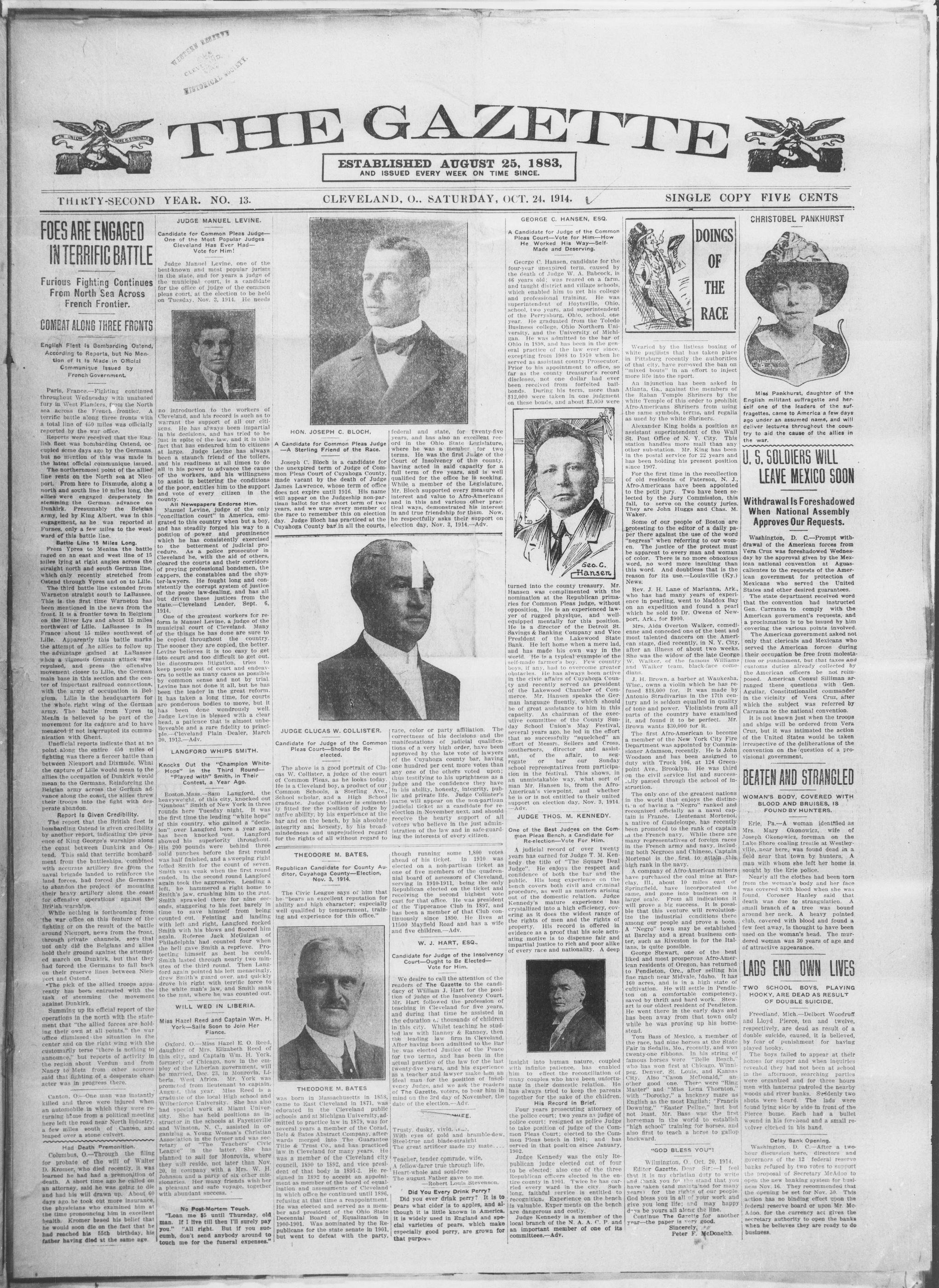
FOES ARE ENGAGED IN TERRIFIC BATTLE
Furious Fighting Continues From North Sea Across French Frontier.
COMBAT ALONG THREE FRONTS
English Fleet is Bombarding Ostend, According to Reports, but No Mention of It is Made in Official Communique Issued by French Government.
Paris, France.—Fighting continued throughout Wednesday with unabated fury in West Flanders, from the North sea across the French frontier. A terrific battle along three fronts with a total line of 450 miles was officially reported by the war office.
Reports were received that the English fleet was bombarding Ostend, occupied some days ago by the Germans, but no mention of this was made in the latest official communique issued. The northernmost point of the allied line rests on the North sea at Nieuport. From here to Dixmude, along a north and south line 10 miles long, the allies were engaged desperately in stemming the German advance on Dunkirk. Presumably the Belgian army, led by King Albert, was in this engagement, as he was reported at Furnes, only a few miles to the westward of this battle line.
Battle Line 15 Miles Long. From Ypres to Menina the battle raged on an east and west line of 15 miles lying at right angles across the straight north and south German line, which only recently stretched from Ostend through Ypres and to Lille.
The third battle line extended from Warneton straight south to LaBassee. This is the first time Warneton has been mentioned in the news from the front. It is a frontier town in Belgium on the River Lys and about 15 miles northwest of Lille. LaBassee is in France about 15 miles southwest of Lille. Apparently this battle marks the attempt of his allies to follow up the advantage gained at LaBassee when a vigorous German attack was repulsed, and press the offensive movement closer to Lille, the German main base in this section and the center of important railroad connections, with the army of occupation in Belgium. Lille is the headquarters for the whole right wing of the German army. The battle from Ypres to Menin is believed to be part of the movement for its capture and to have menaced if not interrupted its communication with Ghent.
Unofficial reports indicate that at no point along the entire 450 miles of fighting was there a fiercer battle than between Nieuport and Dixmude. What the capture of Lille would mean to the allies the occupation of Dunkirk would mean to the Germans. Reinforcing the Belgian army across the German advance along the coast, the allies threw their troops into the fight with desperate abandon.
Report Is Given Credibility.
The report that the British fleet is bombarding Ostend is given credibility by another report, indicating the presence of King George's warships along the coast between Dunkirk and Ostend. This said that terrific bombardment from the battleships, combined with accurate artillery fire from the naval brigade landed to reinforce the land forces, had forced the Germans to abandon the project of mounting their heavy artillery along the coast for offensive operations against the British warships.
While nothing is forthcoming from the war office on this feature of the fighting or on the result of the battle around Nieuwport, news from the front, through private channels, says that not only did the Belgians and allies hold their ground against the attempted march on Dunkirk, but that they had forced the Germans to fall back on their reserve lines between Nieuwport and Ostend.
*The pick of the allied troops apparently has been entrusted with the task of stemming the movement against Dunkirk.
Summing up its official report of the operations in the north with the statement that "the allied forces are holding their own at all points," the war office dismissed the situation in the center and on the right wing with the customarily tense "there is nothing to announce," but reports of activity in the region about Verdun and from Nancy to Metz from other sources said that fighting of a desperate character was in progress there.
Canton, O.—One man was instantly killed and three were injured when an automobile in which they were returning hme from a political meeting here left the road near North Industry a few miles south of Canton, and leaped over a stone culvert.
Had Death Premonition.
Columbus, O.-Through the filing for probate of the will of Walter D. Kromer, who died recently, it was learned he had had a premonition of death. A short time ago he called on an attorney, said he was going to die and had his will drawn up. About 60 days ago he took out more insurance, the physicians who examined him at the time pronouncing him in excellent health. Kromer bessed his belief that he would soon die on the fact that he had reached his 55th birthday, his father having died at the same age.
THE GAZETTE
JUDGE MANUEL LEVINE.
Candidate for Common Pleas Judge—One of the Most Popular Judges Cleveland Has Ever Had—Vote for Him!
Judge Manuel Levine, one of the best-known and most popular jurists in the state, and for years a judge of the municipal court, is a candidate for the office of judge of the common pleas court, at the election to be held on Tuesday, Nov. 3, 1914. He needs no introduction to the workers of Cleveland, and his record is such as to warrant the support of all our citizens. He has always been impartial in his decisions, and has tried to be just in spite of the law, and it is this fact that has endeared him to citizens at large. Judge Levine has always been a staunch friend of the tollers, and his readiness at all times to do all in his power to advance the cause of the workers, and his willingness to assist in bettering the conditions of the poor, entitles him to the support and vote of every citizen in the county.
All Newspapers Endorse Him.
Manuel Levine, judge of the only "conciliation court" in America, emigrated to this country when but a boy, and has steadily forged his way to a position of power and prominence which he has consistently exercised to the betterment of judicial proceedings. He served as a judge of the Cleveland he, with the aid of others, cleared the courts and their corridors of preying professional bondsmen, the cappers, the constables and the shyster-lawyers. He fought long and consistently the corrupt system of justice of the peace law-dealing, and has all but driven these justices from the state.—Cleveland Leader, Sept. 6, 1914.
One of the greatest workers for reform is Manuel Levine, judge of the principal court of Cleveland. Many of the justices he has done are sure to be copied throughout the country. The sooner they are copied, the better. Levine believes it is too easy to get into court and too difficult to get out. He discourages litigation, tries to keep people out of court and endowes to settle as many cases as possible by common sense and not by trial. Levine has not done it all, but he has been the leader in the great reform. It has taken a long time, but courts are ponderous bodies to move, but it has been wondrously well done. Levine is blessed with a clear head, a patience that is almost unobleaveable and a rare fidelity to principle.—Cleveland Plain Dealer, March 30, 1913.—Adv.
LANGFORD WHIPS SMITH
Knocks Out the "Champion White-Hope" in the Third Round—"Played with" Smith, in Their Contest, a Year Ago.
Boston, Mass.—Sam Langford, the heavyweight, of this city, knocked out "Gunboat" Smith of New York in three rounds here Tuesday night. It was the first time the leading "white-hope" of this country, who gained a "doom" over Langford here a year ago, has been knocked out. Langford won his morality throughout. His 200 pounds were behind three solid punches before the first round was half finished, and a sweeping right trolled Smith for the count of seven. Smith was weak when the first round ended. In the second round Langford again took the aggressive. Leading a left, he hammered a right home to Smith's jaw, crushing him to the mat. Smith sprawled there for nine seconds, staggering to his feet barely in time to save himself from being counted out. Feinting and landing with left and right, Langford rocked Smith with his blows and fouled him again. Referee Jack Browne of Philadelphia knocked four when the bell gave Smith a replease. Proving himself as best he could, Smith lasted through nearly two minutes of the third round. Then Langford again pointed his left menacingly drew Smith's guard over, and quickly drove his right with terrific force to the white man's jaw, and Smith sank to the mat, where he was counted out.
WILL WED IN LIBERIA.
Miss Hazel Reed and Captain Wm. H
York–Sails Soon to Join Her
Oxford, O.—Miss Hazel O. E. Reed, daughter of Mrs. Elizabeth Reed of this city, and Captain Wm. H. York, formerly of Chicago, now in the employ of the Liberal government, will be married, Dec 23, in Monrovia, Liberia. West Africa. Mr. York was promoted from leutenant to captain, August, this year, to the local High School and Wifberforce University. She has also had special work at Miami University. She has held positions as instructor in the schools at Fayetteville and Whiston, N. C., assisted in organizing a Young Woman's Christian Association in the former and was secretary of "The Teachers' Club League" in the latter. She planned to sail for Monrovia, where they will reside, not later than Nov. 20, in company with Mrs. W. H. Johnson, part of six other miserable families. Her many friends wish her a pleasant and safe voyage, together with abundant success.
No Post-Mortem Touch.
"Loan me $5 until Thursday, old man. If I live till then I'll surely pay you." "All right. But if you succumb, don't send anybody around to touch me for the funeral expenses."
ESTABLISHED AUGUST 25, 1883 AND ISSUED EVERY WEEK ON TIME SINCE.
GEORGE C. HANSEN, ES
A Candidate for Judge of the Court
Pleas Court—Vote for Him—
He Worked His Way—Seen
Made and Deserving.
George C. Hansen, candidate for four-year unexpired term, caused the death of Judge W. A. Babey 46 years old; was reared on a and taught district and village school which enabled him to get his school and professional training. He superintendent of Hoytsville, school, two years, and superintendent of the Perrysburg, Ohio, school year. He graduated from the Business college, Ohio Northern university, and the University ofigan. He was admitted to the Ohio in 1898, and has been in the eral practice of the law ever excepting from 1908 to 1910 when served as assistant county Prosecutor to his appointment to off far as the county treasurer's disclosures, not one dollar had been received from forfeited bonds. During his term, more $12,000 were taken in one ind on these bonds, and about $3,000
1
HON. JOSEPH C. BLOCH.
A Candidate for Common Pleas Judge
—A Sterling Friend of the Race.
Joseph C. Bloch is a candidate for the unexpired term of Judge of Common Pleas Court of Cuyahoga County, made vacant by the death of Judge James Lawrence, whose term of office does not expire until 1916. His name will appear on the Judgeship non-partisan ballot for the short term of two years, and we urge every member of the race to remember this on election day. Judge Bloch has practiced at the Cuyahoga County bar in all the courts.
JUDGE CLUCAS W. COLLISTER.
Candidate for Judge of the Common Pleas Court—Should Be Re-elected.
The above is a good portrait of Clucas W. Collister, a judge of the court of Common Pleas, as he looks today. He is a Cleveland boy, a product of our Common Schools, a Sterling Ave. School scholar, and a High School graduate. Judge Collister is eminently fitted for the position of judge by his knowledge and experience on the bench, by his absolute integrity and honesty, by his broad-mindedness and unprejudiced regard for the rights of all without regard to
THEODORE M. BATES.
Republican Candidate for County Auditor, Cuyahoga County—Election, Nov. 3, 1914.
The Civic League says or him that he "bears an excellent reputation for ability and high character; especially well qualified by temperament, training and experience for this office."
THEODORE M. BATES
was born in Massachusetts in 1858, came to East Cleveland in 1871, was educated in the Cleveland public schools and at Michigan University, admitted to practice law in 1879, was for several years a member of the Cozad, Belz and Bates Abstract Company, afterwards merged into The Guarantee Title & Trust Co. and has practiced law in Cleveland for many years. He was a member of the Cleveland city council, 1890 to 1892, and vice president of that body in 1891.2. He resigned in 1892 to accept an appointment as member of the board of equalization and assessments of Cleveland in which office he continued until 1896, refusing at that time a reappointment. He was elected and served as a memb
federal and state, for twenty-five years, and has also an excellent record in the Ohio State Legislature, where he was a member for two terms. He was the first judge of the Court of Insolvency of this county, having acted in said capacity for a full term of five years, and is well qualified for the office he is seeking. While a member of the Legislature, Mr. Bloch supported every measure of interest and value to Afro-Americans and cultural ways demonstrated his interest in and true friendship for them. Now, he respectfully asks their support on election day. Nov. 3, 1914.—Adv.
I
race, color or party affiliation. The correctness of his decisions and the manifestations of judicial qualifications of a very high order, have been approved by the late vote of lawyers of the Cuyahoga county bar, having one hundred per cent more votes than any one of the others voted upon; thus testifying to his unprincipled devotion in his ability, honesty, integrity, public and private life. Judge Colliser's name will appear on the non-partisan judicial ticket as a candidate for reelection in November next, and should receive the hearty support of all voters who believe in the just administration of the law and in safe-guarding the interests of every citizen.
though running some 1,800 votes ahead of his ticket. In 1910 was elected on a non-partisan ticket as one of five members of the quadratic board of assessors of Cleveland, serving in 1910-1911, being the only Republican elected on the ticket and receiving the second highest vote of the Tippocane Club in 1897, and has been a member of that Club continuously since 1890. He lives at 11500 Mayfield Road and has a wife and five children. Adv.
W. J. HART, ESQ.
Candidate for Judge of the Insolvency
Court—Officer Elected—
Vote for Him
We desire to call the attention of the readers of The Gazette to the candidacy of William J. Hart for the position of judge of the Insolvency Court. Mr. Hart followed the profession of teaching in Cleveland for five years, and during that time he taught the education c. thousands of children in this city. He taught he studentship with Ranney and Ranney, then the leading law firm in Cleveland. After having been admitted to the Bar he was elected Justice of the Peace for two terms, and has been in the actual practice of the law for the last twenty-five years, and his experience as a teacher and lawyer make him an ideal man for the position of Insolvency judge, and his experience as a lawyer to bear him in mind on the 3rd day of November, the date of the election—Ady.
Trusty, dusky, vivid. . . .
With eyes of gold and bramble-dew,
Steel-tree and blade-straight
The great artificer made my mate. . .
Teacher, tender comrade, wife,
A fellow-farer true through life,
Heart-whole and soul-free
The august Father gave to me.
—Robert Louis Stevenson.
Did You Every Drink Perry?
Did you ever drink perry? It is to
pears what cider is to apples, and
although it is little known in America,
it is widely used in England and
special varieties of pears, which make
especially good perry, are grown for
that purpose.
GEORGE C. HANSEN, ESQ.
A Candidate for Judge of the Common Pleas Court—Vote for Him—How He Worked His Way—Self-Made and Deserving.
A Candidate, can hire the four-year unexpired term, caused by the death of Judge W. A. Babcock, is 46 years old; was reared on a farm, and taught district and village schools, which enabled him to get his college and professional training. He was superintendent of Otho College, and superintendent of the Perrysburg, Ohio, school, one year. He graduated from the Toledo Business college, Ohio Northern University, and the University of Michigan. He was admitted to the bar of Ohio in 1898, and has been in the general practice of the law ever since, excepting from 1908 to 1910 when he served as assistant county Prosecutor. Prior to his appointment to office, so far as the county treasurer records, not one dollar had ever been received from forfeited ballbonds. During his term, more than $12,000 were taken in one judgment on these bonds, and about $3,000 were
Geo. C.
Hansen
turned into the county treasury. Mr. Hansen was complimented with the nomination at the Republican primaries for Common Pleas judge, without opposition. He is an experienced lawyer of rugged physique, and well-equipped mentally for this position. He is a director of the Detroit St Savings & Banking Company and President of the Lawyers Club. He left home when a mere lad and has made his own way in the world. He is a typical example of the self-made farmer's boy. Few country boys, if any, had to overcome greater obstacles. He has always been active in the civic affairs of Cuyahoga County and recently served as president of the Lakewood Chamber of Commerce. Mr. Hansen speaks to the German language fluently, which she is of great when he in him in this office. As chairman of the executive committee of the County Sunday School Union's May Festival, several years ago, he led in the effort that so successfully "squeched" an effort of Sellers. Sellers and Cross, southerners, director and assistant, of the affair, to segregate or bar our Sunday school representatives from participation in the festival. This shows, in an unmistakable way, what sort of man Mr. Hansen is, from the African-American viewpoint, and the one he is or is not entitled to their united support on election day, Nov. 3, 1914.
JUDGE THOS, M. KENNEDY.
One of the Best Judges on the Common Pleas Bench, a Candidate for Re-election—Vote For Him.
A judicial record of over twenty years has earned for Judge T. M. Kennedy the title of "The Square Deal Judge". He enjoys the respect and confidence of both the bar and the public. His long experience on the bench covers both civil and criminal procedure, as well as matters arising out of the domestic relation. Judge Kennedy's mature experience has crystallized into a high efficiency, covering as it does the widest range of the rights of men and the rights of property. His record is offered in evidence as a proof that his sole actuating motive is to dispense fair and impartial justice to rich and poor alike of every race and nationality. A deep
insight into human nature, coupled with infinite patience, has enabled him to effect the reconciliation of many couples who have been unfortunate in their domestic relation. He has always tried to keep the parents together for the sake of the children.
His Record in Brief.
Four years prosecuting attorney of the police court; two years judge of police court; resigning as police Judge of the Common Pleas Court; elected to the Common Pleas bench in 1901; and has served in that position since January, 1902.
Judge Kennedy was the only Republican judge elected out of four to be elected; also one of the three Republican officers elected in the entire county in 1901. Twice he has carried every ward in the city. Such long, faithful service has permitted recognition. Experience on the bench is vital. Experiments on the bench is valuable. Experiments on the bench is valuable.
Judge Kennedy is a member of the local branch of the N. A. A. C. P. and an important member of one of its committees.—Adv.
DOINGS OF THE RACE
Wearied by the listless boxing of white pugilists that has taken place in Pittsburg recently the authorities of that city, have removed the ban on "mixed bouts" in an effort to inject more life into the sport.
An injunction has been asked in Atlanta, Ga., against the members of the Raban Temple Shriners by the white Temple of this order to prohibit Afro-American Shriners from using the same symbols, terms, and regalia as used by the white Shriners.
Alexander King holds a position as assistant superintendent of the Wall St. Post Office of N. Y. City. This station handles more mail than any other substation. Mr. King has been in the postal service for 22 years and has been holding his present position since 1907.
For the first time in the recollection of old residents of Paterson, N. J., Afro-Americans have been appointed to the petit jury. Two have been selected by the Jury Commission, this fall, to serve on the county juries. They are John Huggs and Chas. M. Waker.
Some of our people of Boston are protesting to the editor of a daily paper there against the use of the word negerogue "who wove up the city." The justice of the protest must be apparent to every man and woman of color. There is no more obnoxious word, no word more insulting than this word. And doubtless that is the reason for its use—Louisville (Ky.) News.
Rev. J. H. Lane of Mariana, Ark., who has had many years of experience in pearling, went to Maddox Bay on an expedition and found a pearl which he sold to Dr. Owens of Newport, Ark., for $800.
Mrs. Aida Overton Walker, comedienne and conceded one of the best and most talented dancers on the Americas, after recently, in N. Y. City, after an illness of about two weeks. She was the widow of the late George W. Walker, of the famous Williams and Walker team, black-face comedians.
J. H. Brown, a barber at Waukesha, Wise, owns a violin which he has refused $18,000 for. It was made by Antonio Stradivarius in the 17th century and is seldom used of tone and power. Violinists from all countries have examined it and found it to be perfect. Mr. Brown wants $30,000 for it.
The first Afro-American to become a member of the New York City Fire Department was appointed by Commissioner Adamson, recently. He is John Woodson and has been assigned to duty with Truck 106, at 124 Greenpoint Ave, Brooklyn. He was third on the civil service list and successfully passed through the school of instruction.
The only one of the greatest nations in the world that enjoys the distinction of having a "Negro" ranked and recognized officially as a naval captain is France. Lieutenant Mortenol, a native of Guadeloupe, has recently been promoted to the rank of captain in the French navy. While there are many representatives of foreign races in the French army and navy, including both Negroes and Chinese, Captain Mortenol is the first to attain this high rank in the navy.
A company of Afro-American miners landed on a coal mine at Barclay, Ill., about 10 miles east of Springfield, have incorporated the same, and gone into business on a large scale. From all indications it will prove a big success. It is possible that this venture will revolutionize the industrial conditions there among our people and may prove a boom. A "Negro" town may be established at Barclay, an important business center in the Riveston is for the Italian is quite possible.
George Stewart, one of the best liked and most prosperous Afro-American residents of Oregon, has returned to Pendleton, Ore., after selling his fine ranch near Midvale, Idaho. It has 160 acres, and is in a high state of cultivation. He will settle in Pendleton on a comfortable competency, saved by thrift and hard work. Stewart has been a teacher at other schools. He went there in the early days and has been away from that town only while he was proving up his home-stead.
Tom Bass of Mexico, a member of the race, had nine horses at the State Fair in Sedalia, Mo., recently, and won twenty-one ribbons. In his string of famous horses were "Belle Beach," who has won first at Chicago, Winnipeg, Denver, St. Louis, and Kansas City. Also "Cason McDonald," another good player, and "Miss Lena Thornton," with "Dorothy," a hackney mare as English as the most English; "Francis Downing," "Easter Pelline," last but not least. Mr. Bass was the first horseman in the world to establish "high school" training for horses, and also first to teach a horse to gallop backward.
"GOD BLESS YOU"!
Wilmington, O. Oct. 20, 1914.
Editor Gazette, Dear Sir: I feel
that it is my Christian duty to write
and thank you for the stand that you
have taken (and maintained for many
years) for the rights of our people.
God bless you in all of your work and
give you long life; and may happy
days be yours all along the line.
Continue The Gazette for another
year—the paper is very good.
Sincerely,
Peter F. McDonelth.
PY FIVE CENTS
CHRISTOBEL PANKHURST
© HAUS PROPERTY
Bristol University
Miss Pankhurst, daughter of the English militant suffragette and herself one of the leaders of the suffragette, came to America a few days ago under an assumed name, and will deliver lectures throughout the country to aid the cause of the allies in the war.
U. S. SOLDIERS WILL LEAVE MEXICO SOON
Withdrawal Is Foreshadowed When National Assembly Approves Our Requests.
Washington, D. C.—Prompt withdrawal of the American forces from Vera Cruz was foreshadowed Wednesday by the approval given by the Mexican national convention at Aguascalientes to the requests of the American government for protection of Mexicans who served the United States and other desired guarantees.
The state department received word that the convention had instructed Gen. Carranza to comply with the American government's requests, and a proclamation is to be issued by him covering the various points involved.
The American government asked not only that clericals and Mexicans who served the American forces during their occupation be free from molestation or punishment, but that taxes and customs duties already collected by the American officers be not reimposed. American Consul Silliman arranged these questions with Gen. Aguilar, Constitutionalist commander in the vicinity of Vera Cruz, after which the subject was referred by Carranza to the national convention. It is not known just when the troops and ships will be ordered from Vera Cruz, but it was intimated the action of the United States would be taken irrespective of the deliberations of the convention on the question of a provisional government.
BEATEN AND STRANGLED
BEATEN AND STRANGLED
WOMAN'S BODY, COVERED WITH BLOOD AND BRUISES, IS FOUND BY HUNTERS.
Erie, Pa.—A woman identified as Mrs. Mary Okonowicz, wife of Joseph Okonowicz, foreman on the Lake Shore coaling trestle at Westleyville, near here, was found dead in a field near that town by hunters. A man with whom she left her home is sought by the Erie police.
Nearly all the clothes had been torn from the woman's body and her face was covered with blood when she was found. Coroner Hanley said that death was due to strangulation. A small branch of a tree was bound around her neck. A heavy pointed club, covered with blood and found a few feet away, is thought to have been used on the woman's head. The murdered woman was 30 years of age and of attractive appearance.
LADS END OWN LIVES
TWO SCHOOL BOYS, PLAYING HOOKY, ARE DEAD AS RESULT OF DOUBLE SUICIDE.
Freedland, Mich.—Delbert Woodruff and Lloyd Pierce, ten and twelve, respectively, are dead as result of a double suicide, caused, it is believed, by fear of punishment for having played hooky.
The boys failed to appear at their homes for supper and when inquiries revealed they had not been at school in the afternoon, searching parties were organized and for three hours men with lanterns patrolled the nearby woods and river banks. Sevenly two shots were heard. The lads were found lying side by side in front of the Pierce home. Each had a bullet wound in his forehead and a small revolver elicited in his hand.
Delay Bank Opening.
Washington, D. C.—After a two-hour discussion here, directors and governors of the 12 federal reserve banks refused by two votes to support the proposal of Secretary McAdoo to open the new banking system for business Nov. 16. They recommended that the opening be set for Nov. 30. This action has no binding effect upon the federal reserve board or upon Mr. McAdoo. for the currency act gives the secretary authority to open the banks when he believes they are ready to do business.
PUBLISHED EVERY SATURDAY
SUBSCRIPTION RATES
(In Advance)
One Year. $1.50.
Six Months. 1.00
Three Months. .50
Subscribers are requested to rem-
mit by postoffice money or-
der or registered letter
Entered at the postoffice in Cleveland,
Ohio, as second-class matter.
Address all communications to
HARRY C. SMITH
Editor and proprietor,
THE GAZETTE,
Blackstone Building, Cleveland, O.
Member Ohio Legislature: 1894
to 1896; 1896 to 1898; 1900 to 1902
THE GAZETTE is the oldest, and
has the largest bona fide circulation,
double that of any newspaper in the
interest of Afro-Americans, published
in the state of Ohio, and comparison
with any will immediately establish
its rank as one of the NEWSIEST
AND BEST in the country.
10,000,000 Afro-Americans..
160,000 in Ohio.
20,000 in Cleveland.
SATURDAY, OCT. 24, 1914
When the editor of the Washington (D. C.) Sun, T. Thos. Fortune, fails to induce his friend, Dr. Booker T. Washington, to deny that he endorsed segregation in his speech to the National Business League, some weeks ago, what must he believe?
The Afro-American is not the only one the South's democratic representatives in Congress have "rubbled it into with a vengeance" since that section of the country got control of the government. "As is misery like company," we cannot refrain from calling our readers' attention to the way the democratic Congress is piling up taxes on the North, and making appropriations, for the South, all out of proportion to its needs and merits. About one-half of the $20,000,000 democratic "pork barrel" rivers and harbors bill went to the South. It won't be long until they will have this country in the same financial condition that Ohio democrats have the state and Cleveland democrats have this city—bankrupt. Twas ever thus. But for the determined and lengthy fight led by a Republican—Senator T. E. Burton of this state, former chairman of the rivers and harbors committee—the bill would have carried $33,000,000 instead of $20,000,000.
AN EXPLANATION THAT DOES NOT EXPLAIN.
Recognizing at last that their "Chief" has made a great blunder by his remarks on segregation, the journalistic supporters of Dr. Washington have rushed forward with an explanation of what he "did" say. And this is what they are saying: Dr. Washington was misquoted by the Associated Press when it reported him to have said: "The Negro should stop fighting segregation and lend his forces toward beautifying that part of the city in which he can live." According to them what he "did" said was this: "Let us, in the future, spend less time in talking about the part of the city that we cannot live in, and more time in making the part of the city that we can live in beautiful and attractive." Where is the material difference in the two expressions? Each carries the idea of surrender, each suggests that Colored people ought to be glad to stay on earth at all, neither recognizes the principles of freedom, justice nor equality before the law. And yet we are told to accept the author of these words as our leader and, with some, to criticize him is lese majeste.
When the committee of fifty Colored men appeared before the City Council to protest against the segregation measure, how it would have delighted that narrow-souled body had one of our spokesmen come forward with such a speech. How glad the City Attorney would be to incorporate those words in his brief in favor of the measure.
Dr. Washington, time and again, has said things that have irritated that portion of the race which in spite of all handicaps cannot but believe itself the equal of any other part of the Nation's citizens, but it is doubtful if he has ever said anything that will so lower him in the respect and estimation of the whole race as this advice on segregation. As for the explanation—it does not explain and the "corrected" version is more offensive than the misquotation—Louisville (Ky.) News.
A Miss Hays, her male escort and another lady, presumably her mother, were refused seats on the floor of the Grand theater. Tuesday evening, for which they held tickets. They were given tickets to the balcony, and the difference in the price of the floor and balcony tickets was returned to them. They should have refused both "returns" (money and tickets), left the theater, and entered suit against its management and owners, under our Ohio Civil Rights' law. Each would then have had a good case, while the other two could have acted as witnesses. The legal penalty, for such refusal, ranges from $50 (the minimum) to $500 (the maximum) and costs of the case, in each case. Others of our people were refused tickets to the floor of the theater, the same evening. The management seems to be a new one.
Why, O. WHY will our people in Cleveland, and throughout the State, continue to tolerate such mistreatment in public places, with the law all in their favor? Is there anything that will arouse them to ACTION and not simply to talk in "big meetings" as
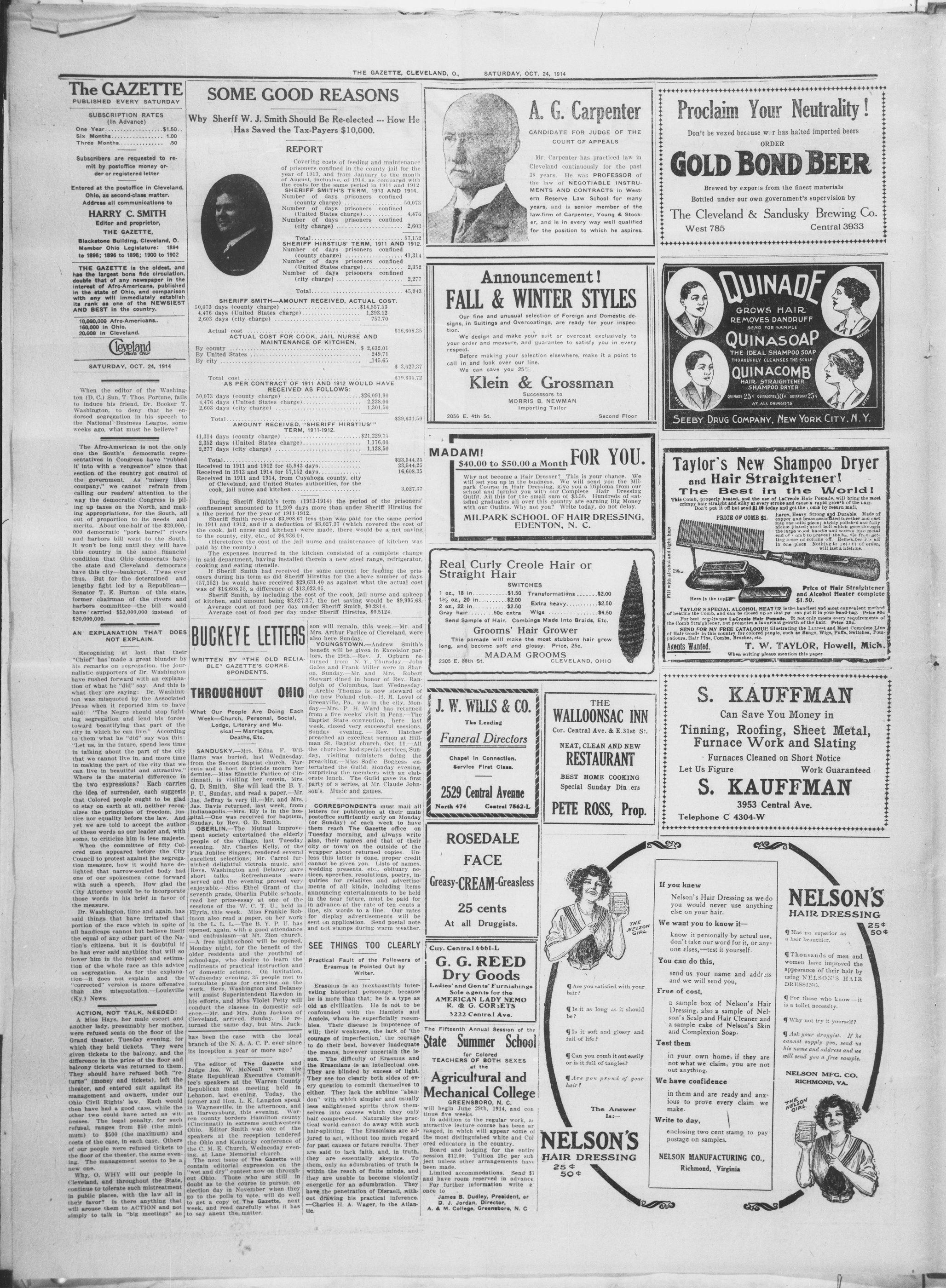
SOME GOOD REASONS
Why Sherff W. J. Smith Should Be Re-elected --- How He Has Saved the Tax-Payers $10.000.
REPORT
Covering costs of feeding and maintenance of prisoners confined in the county jail for the year of 1913, and from January to the month of August, inclusive of, 1914, as compared with the costs for the same period in 1911 and 1912. MISSER SMITH'S 1913 AND 1914. Number of days prisoners confined (county charge) ..... 50,073. Number of days prisoners confined (United States charge) ..... 4,476. Number of days prisoners confined
(city charge) ..... 2,603
Total ..... 57,152
SHERIFF HIRSTIUS' TERM, 1911 AND 1912.
Number of days prisoners confined
(county charge) ..... 41,314
Number of days prisoners confined
(United States charge) ..... 2,352
Number of days prisoners confined
(city charge) ..... 2,277
Total ..... 45,943
AMOUNT RECEIVED, ACTUAL COST.
$14,557.53
(charge) ..... 1,293.12
..... 757.70
$16,608.35
FOR COOK, JAIL NURSE AND
STENANCE OF KITCHEN.
$ 2,632.01
..... 249.71
..... 145.65
$ 3,027.37
ACT OF 1911 AND 1912 WOULD HAVE
RECEIVED AS FOLLOWS:
$26,091.90
(charge) ..... 2,238.00
..... 1,301.50
$29,631.50
EIVED, "SHERIFF HIRSTIUS'"
TERM, 1911-1912.
$21,229.75
(charge) ..... 1,176.00
..... 1,138.50
$23,544.25
for 45,943 days ..... 23,544.25
for 57,152 days ..... 16,608.35
from Cuyahoga county, city
and States authorities, for the
kitchen ..... 3,027.37
In term (1913-1914) the period of the prisoners'
2,09 days more than under Sheriff Hirstius for
1911-1912.
$3,908.87 less than was paid for the same period
reduction of $3,027.37 (which covered the cost of
kitchen) were made, there would be a net saving
$6,936.04.
In the jail nurse and maintenance of kitchen was
in the kitchen consisted of a complete change
installed therein a new steel range, refrigerator.
Received the same amount for feeding the prised
Sheriff Hirstius for the above number of days
received $29,631.40 as against what the actual cost
of $13,023.05.
Using the cost of the cook, jail nurse and upkeep
$3,027.37, the net saving would be $9,995.68.
In the day under Sheriff Smith, $0.2814.
In the day under Sheriff Hirstius, $0.5124.
Total...
SHERIFF SMITH—AMOUNT REC
50,073 days (county charge) ...
4,476 days (United States charge) ...
2,603 days (city charge)
Actual cost ...
ACTUAL COST FOR COOK, J
MAINTENANCE OF
By county ...
By United States ...
By city ...
Total cost ...
AS PER CONTRACT OF 1911 A
RECEIVED AS FO
50,073 days (county charge) ...
4,476 days (United States charge) ...
2,603 days (city charge)
Total ...
AMOUNT RECEIVED, "SHER
TERM, 1911-
41,314 days (county charge) ...
2,352 days (United States charge) ...
2,277 days (city charge)
Total ...
Received in 1911 and 1912 for 45,943 days.
Received in 1913 and 1914 for 57,152 days.
Received in 1911 and 1914, from Cuyahoga
of Cleveland, and United States author
cook, jail nurse and kitchen.
During Sheriff Smith's term (1913-19
conffinement amounted to 11,209 days mo
a like period for the year of 1911-1912.
Sheriff Smith received $3,908.67 less t
in 1911 and 1912, and if a deduction of $3
the cook, jail nurse and kitchen) were m
to the county, city, etc., of $6,936.04.
(Heretofore the cost of the jail nurse
paid by the county).
The expenses incurred in the kitchen
in said department, having installed there
cooking and eating utensils.
If Sheriff Smith had received the sa
oners during his term as did Sheriff Hirst
(57,152) he would have received $29,631.46
was of $16,608.35, a difference of $13,023.05.
Sheriff Smith, by including the cost o
of kitchen, said amount being $3,027.37, th
Average cost of food per day under S
Average cost of food per day under S
SHERIFF SMITH—AMOUNT RECEIVED, ACTUAL COST
50,073 days (county charge) $14,557.53
4,476 days (United States charge) 1,293.12
2,603 days (city charge) 757.70
Actual cost
ACTUAL COST FOR COOK, JAIL NURSE AND
MAINTENANCE OF KITCHEN.
By county $ 2,632.01
By United States 249.71
By city 145.65
Total cost
AS PER CONTRACT OF 1911 AND 1912 WOULD HAVE
RECEIVED AS FOLLOWS:
50,073 days (county charge) $26,091.90
4,476 days (United States charge) 2,238.00
2,603 days (city charge) 1,301.50
41,314 days (county charge) ..... $21,229.75
2,352 days (United States charge) ..... 1,176.00
2,277 days (city charge) ..... 1,138.50
Total:
Received in 1911 and 1912 for 45,943 days.
Received in 1913 and 1914 for 57,152 days.
Received in 1911 and 1914, from Cuyahoga county, city of Cleveland, and United States authorities, for the cook, jail nurse and kitchen..... 3,027.37
During Sheriff Smith's term (1913-1914) the period of the prisoners' confinement amounted to 11,209 days more than under Sheriff Hirstius for a like period for the year of 1911-1912.
Sheriff Smith received $3,908.67 less than was paid for the same period in 1911 and 1912, and if a deduction of $3,027.37 (which covered the cost of the cook, jail nurse and kitchen) were made, there would be a net saving to the county, city, etc., of $6,936.04. (Historica the cost of the jail nurse and maintenance of kitchen was paid by the county.)
The expenses incurred in the kitchen consisted of a complete change in said department, having installed therein a new steel range, refrigerator, cooking and eating utensils.
If Sheriff Smith had received a more amount for feeding the prisoners during his term as did Sheriff Hirstius for the above number of days (571) he would have received $29,631.40 as against what the actual cost was of $16,608.35, a difference of $13,023.05.
Sheriff Smith, by including the cost of the cook, jail nurse and upkeep of kitchen, said amount being $3,027.37, the net saving would be $9,995.68. Average cost of food per day under Sheriff Smith, $0.2814.
---
5.
P.
BUGKEYE LETTERS
WRITTEN BY "THE OLD RELIA BLE" GAZETTE'S CORRESPONDENTS.
THROUGHOUT OHIO
What Our People Are Doing Each Week—Church, Personal, Social, Lodge, Literary and Musical—Marriages, Deaths, Etc.
SANDUSKY—Mrs. Edna F. W. Williams was buried, last Wednesday, from the Second Baptist church. Parents and a host of friends mourn her demise.—Miss Elinette Farice of Cincinnati, is visiting her cousin, Mrs. G. D. Smith. She will lead the B. Y. P. U. Sunday, and read a paper—Mr. Jas. Jeffrey is very ill.—Mr. and Mrs. Jas. Davis returned, last week, from Indianapolis.—Mrs. Bly is in the hospital.—On request for baptism, Sunday, by Rey. G. D. Smith.
OBERLIN.—The Mutual Improvement society entertained the elderly people of the village, last Tuesday evening. Mr. Charles Kelly, of the Fisk Jubilee Singers, rendered several excellent selections; Mr. Carrol furnished delightful victrola music, and Revs. Washington and Delaney gave short talks. Refreshments were served and the students received Miss Ehrel Grant of the seventh grade, Oberlin Public schools, read her prize-essay at one of the sessions of the W. C. T. U. held in Elyria, this week. Miss Frank Robinson also read a paper, on her work in the L. L. L. The B. Y. P. U. has opened, again, with a good attendance and enthusiasm—at Mt. Zion church. —A free night-school will be opened, Monday night, for the benefit of the older residents and the youthful of schoolage, who desire to learn the rudiments of practical instruction and of domestic science. On invitation, Mrs. Ehrel presents 35 formulate plans for carrying on the work. Revs. Washington and Delaney will assist Superintendent Rawdon in his efforts, and Miss Violet Petty will conduct the classes in domestic science.—Mr. and Mrs. John Jackson of Cleveland, arrived. Sunday. He returned the same day, but Mrs. Jack-
has been the case with the local branch of the N. A. A. C. P. ever since its inception a year or more ago?
The editor of *The Gazette* and Judge Jos. W. McNeall were the State Republican Executive Committee's speakers at the Warren County Republican mass meeting held in Lebanon, last evening. Today, the former and Hon. L. K. Langdon speak in Waynesville, in the afternoon, and at Harveyburg this evening. Warren county borders Hamilton county Cincinnati, and in the afternoon Ohio Editor Smith was one of the speakers at the reception tendered the Ohio and Kentucky conference of the C. M. E. Church, Wednesday evening, at Lane Memorial church.
The next issue of *The Gazette* will contain editorial expression on the "wet and dry" contest now on throughout Ohio. Those who are still in doubt as to the course to pursue, on election day in November will go to the poll, the course will to well next, and read carefully what it has to say anent the matter.
THE GAZETTE, CLEVELAND, O.. SATURDAY, OCT. 24, 1914
$16,608,35
$ 3,027,37
$19,635,72
$29,631.50
$23,544.25
23,544.25
16,608.35
3,027.37
son will remain, this week—Mr. and Mrs. Arthur Farice of Cleveland, were also here Sunday.
YOUNGSTOWN.—Andrew Smith's benefit will be given in Excelsior parliars, the 29th. Rev. J. Ogburn returns from Iraq. Tuesday, the Trunk Miller will be in Sharon, Sunday. Mr. and Mrs. Robert Stewart dined in honor of Rev. Randolph of Columbus, last Wednesday.—Archie Thomas is now stewed the new Poland club—H. R. Lovel of Greenville, Pa., was in the city, Monday.—Mrs. P. H. Ward has returned the Baptist State convention Penn. The Baptist State convention Penn. week, closed very successful sessions, Sunday evening. — Rev. Hatcher preached an excellent sermon at Hillman St. Baptist church. Oct. 11. the churches had special services, Sunday, visiting ministers doing the preaching. — Miss Sissie Boggges enlisted as a member of the members with an elaborate lunch. The Guild gave its first party of a series, at Mr. Claude Johnson's, Music and games.
CORRESPONDENTS must mail all letters for publication at their main postoffice sufficiently early on Monday (or Sunday) of each week to have them reach The Gazette office on Tuesday morning, and always write also, their names and that of their names, and outside of the wrapper about return dates, less this latter is done, proper credit cannot be given you. Lists of names, wedding presents, etc., obituary notices, speeches, resolutions, poetry, inquiries for relatives and advertisements of all kinds, including items announcing entertainments to be held in the near future, must be paid for in advance at the rate of ten cents a week for display advertisements will be sent on application. Send postal note and not stamps during warm weather.
SEE THINGS TOO CLEARLY
Practical Fault of the Followers of Erasmus Is Pointed Out by Writer.
Erasmus is an inexhaustibly interesting historical personage, because he is more than that; he is a type as old as civilization. He is not to be confounded with the Hamlets and Amiels, whom he superficially resembles. Their disease is impotence of will; their weakness, the lack of 'the courage of imperfection', the courage to do their best, however inadequate the means, however uncertain the issue. The difficulty of Erasmus and the Erasmians is an intellectual one. They are blinded by excess of light. They see too clearly both sides of every question to commit themselves to either. They lack the sublime "abandon" with which simpler and usually less enlightened spirits throw themselves into causes which they only half comprehend. Naturally the practical world cannot do away with such hair-splitting. The Erasmians are adjured to act, without too much regard for past causes or future results. They are said to lack faith, and, in truth, they are essentially skeptics. To them, only an adumbration of truth is within the reach of finite minds, and they are unable to become violently energetic for an adumbration. They have the penetration of Disraeli, without drawing his practical inference.—Charles H. A. Wager, in the Atlantic.
A. G. Carpenter
A. G. Carpenter
CANDIDATE FOR JUDGE OF THE COURT OF APPEALS
Mr. Carpenter has practiced law in Cleveland continuously for the past 38 years. He was PROFESSOR of the law of NEGOTIABLE INSTRUMENTS AND CONTRACTS in Western Reserve Law School for many years, and is senior member of the law-firm of Carpenter, Young & Stocker, and is in every way well qualified for the position to which he aspires.
ncement!
WINTER STYLES
selection of Foreign and Domestic decoatings, are ready for your inspec-
your suit or overcoat exclusively to
and guarantee to satisfy you in every
selection elsewhere, make it a point to
& Grossman
Announcement
FALL & WINTER
Our fine and unusual selection of Foreign
signs, in Suitings and Overcoatings, are rea
tion.
We design and make your suit or over
your order and measure, and guarantee to s
respect.
Before making your selection elsewhere
call in and look over our line.
We can save you 25%.
Klein & Gross
Announcement! FALL & WINTER STYLES
Our fine and unusual selection of Foreign and Domestic designs, in Suitings and Overcoatings, are ready for your inspection.
We design and make your suit or overcoat exclusively to your order and measure, and guarantee to satisfy you in every respect.
Before making your selection elsewhere, make it a point to call in and look over our line.
We can save you 25%
Successors to
MORRIS B. NEWMAN
Importing Tailor
56 E. 4th St. Second Floor
DAM!
$40.00 to $50.00 a Month FOR YOU.
Why not become a Hair Dresser? This will set you up in the business. We will park courses in Hair Dressings, give you school and furnish you with our Comp Outfit. All this for the small sum of $3 isified graduates all over this country and with our Outfits. Why not you? Write
MILPARK SCHOOL OF HAIR
EDENTON, N.
Real Curly Creole Hair
Straight Hair
SWITCHES
1 oz., 18 in. $1.50 Transformations
1½ oz., 20 in. $2.00 Extra heavy.
2 oz., 22 in. $2.50 Gray hair. 50c extra Wigs
Send Sample of Hair. Combings Made Into B
Grooms' Hair Grower
This pomade will make the most stubborn long, and become soft and glossy. Price, 25
MADAM GROOMS
2305 E. 86th St.
CLEVELAND
Hair Dresser? This is your chance. We
business. We will send you the Hair
Dressing. give you a Diploma from our
u with our Complete Hair Dressing
small sum of $8.50. Hundreds of sat-
ter this country are earning Big Money
not you? Write today, do not delay.
HOOL OF HAIR DRESSING,
ENTON, N. C.
Hole Hair or
CHES
Transformations ..... $2.00
Extra heavy ..... $2.50
Wigs ..... $4.50
Wings Made Into Braids, Etc.
Hair Grower
the most stubborn hair grow
glossy. Price, 25c.
GROOMS
CLEVELAND, OHIO
Why not become a Hair Dresser? This is your chance. We will set you up in the business. We will send you the Milpark Course in Hair Dressing with a Diploma from our school and furnish our Compass in Hair Dressing Outfit. All this for the small sum of $5.50. Hundreds of satisfied graduates all over this country are earning Big Money with our Outfits. Why not you? Write today, do not delay.
MILPARK SCHOOL OF HAIR DRESSING,
EDENTON, N. C.
Real Curly Creole Hair or Straight Hair
NEAT, CLEAN AND NEW RESTAURANT
ROSEDALE
FACE
THE
NEERSON
GIRL
The Fifteenth Annual Session of the State Summer School
NELSON'S
HAIR DRESSING
25¢
50¢
---
PETER H. BURKE
2056 E. 4th St.
MADAM!
J. W. WILLS & CO.
The Leading
Funeral Directors
Chapel In Connection.
Service First Class.
2529 Central Avenue
Greasy-CREAM-Greasless
At all Druggists.
Cuy. Central 6661-L
Ladies' and Gents' Furnishings
Sole agents for the
AMERICAN LADY NEMO
R. @ G. GORSETS
3222 Central Ave.
LOPED
TEACHERS OF BOTH SEXES
at the
GREENSBORO, N. C.
will begin June 29th, 1914, and continue five weeks.
In addition to the regular work, an attractive lecture course has been arraged, in which will appear some of the most distinguished white and Colored educators in the country.
Limited accommodations. Send $ and have room reserved in advance. For further information write g once to James B. Dudley, President, D. J. Jordan, Director, A. & M. College, Greenbore, N. C
Second Floor
```markdown
```
WALLOONSAC INN
Cor. Central Ave. & E.31st St.
BEST HOME COOKING
Special Sunday Dinners
PETE ROSS, Prop.
Are you satisfied with your hair?
Is it as long as it should be?
Is it soft and glossy and full of life?
Can you comb it out easily or is it full of tangles?
Are you proud of your hair?
The Answer
Is:-
Proclaim Your Neutrality!
Don't be vexed because w r has halted imported beers ORDER
GOLD BOND BEER
Brewed by exports from the finest materials Bottled under our own government's supervision by The Cleveland & Sandusky Brewing Co. West 785 Central 3933
QUINADE
GROWS HAIR
REMOVES DANDRUFF
SEMF FOR SAMPLE
QUINASOAP
THE IDEAL SHAMPOO SOAP
THOROUGHLY CLEANSSES THE SCALP
QUINACOMB
HAIR, STRAIGHTENER
SHAMPOO DRYER
QUINADE 25¢ QUINACOMB 50¢ QUINASOAP 25¢
AT ALL DRUGGISTS
SEEBY DRUG COMPANY, NEW YORK CITY. N. Y.
Taylor's New Shampoo Dryer and Hair Straightener!
The Best in the World!
This comb, properly heated, and the use of LaCreole Hair Pomade, will bring the most crimpy hair straight and silky at every stroke and cause a rapid growth of the hair.
Don't put it off but send $1.00 today and get the comb by return mail.
PRICE OF OOMB $1.
Large, Heavy Strong and Durable. Made of copper and brass associated together and cast into one old piece, highly polished and fully nickel plated; stale bolt which goes through the large wood handle and receives in metal end of comb to prevent the ha. die from getting loose or coming off. Remember the all in one piece. Not a blot or a set of letters, will last a lifetime.
Price of Hair Straightener and Alcohol Heater complete $1.50.
TAYLOR'S SPECIAL ALCOHOL HEATER is the handiest and most convenient method of heating the Comb, and can be closed up so that you can put it in your hand bag. Price 50.
SEND FOR MY FREE CATALOGUE illustrating the Largest and most effective instruments of the Comb Straightener, but promotes a luxurious growth of the hair. Price 25c.
SEND FOR MY FREE CATALOGUE illustrating the Largest and most effective instruments of the Comb Straightener, but promotes a luxurious growth of the hair. Price 25c.
Agents Wanted.
T. W. TAYLOR, Howell, Mich.
When writing please mention this paper.
S. KAUFFMAN
Can Save You Money in Tinning, Roofing, Sheet Metal, Furnace Work and Slating Furnaces Cleaned on Short Notice Let Us Figure Work Guaranteed
```markdown
```
If you knew
Nelson's Hair Dressing as we do you would never use anything else on your hair.
know it personally by actual use,
don't take our word for it, or anyone
elsees, -test it yourself.
send us your name and address and we will send you,
Free of cost,
a sample box of Nelson's Hair Dressing; also a sample of Nelson's Scalp and Hair Cleaner and a sample cake of Nelson's Skin and Complexion Soap.
in your own home, if they are not what we claim, you are not out anything.
in them and are ready and anxious to prove every claim we make.
enclosing two cent stamp to pay postage on samples.
NELSON MANUFACTURING CO.,
Richmond, Virginia
NELSON'S
HAIR DRESSING
25¢
50¢
Has no superior as a hair beautifier.
Thousands of men and women have improved the appearance of their hair by using NELSON'S HAIR DRESSING.
For those who know—it is a toilet necessity.
Why not try it yourself?
Ask your druggist. If he cannot supply you, send us his name and address and we will send you a free sample.
NELSON MFG. CO.
RICHMOND, VA.
THE NELSON GIRL
P. HL. Lewis & Son
2549 E. 30th St.
Practical House
Painters and
Paper Hangers
The Best is the Cheapest;
hence we are the
Cheapest.
WE WILL ACCEPT THIS AD-
VERTISEMENT FOR FIVE
CENTS IN TRADE, TO APPLY
ON ANY PURCHASE oF
TWENTY-FIVE CENTS oR
MORE.
E, Rokenstein, Ph. C., Prop.
8. W. Cor. Central Ave. & E.
55th St.
STERLING
5 and 10 Cent Store
3003 Central Ave.
Watch Our Windows
For Bargains
Colored Salesladies
a
Mes. A. M. Pope—Torsbo
Rewia of “Pore” Trestment
a COLLEGE”:
PORO athe word,
ro -
ag eet 5
jh meme ne
essa ee
Bieeceem ag
TEs 4
ate |
Pcs 4
ed ie
cs eee
° r
as hate se ss
For treatment, call on of address:
MI88 KATIE B. COLLIER,
“et2 Payne Ave,
Chaveland, Ohic.
THE PEOPLES’ DRUG STORE
F. H. WEAVER. PHAR. D. Prov.
Cer. Central Ave. and E. 33d St.
eae
“HIGH BROWN FACE POWDER.”
Deve TRADING STAMPS. |
MOREY ORDERS NEWSPAPER
Mow, vevecname.
PRESCRIPTIONS A SPECIALITY.
Dpen late at Night.
Ree
MEN’S HAIR
The M organ Hair Refiner
TE cam discovery. that. postively
isittens the hate wnnin stern wie
Be et iclnat roma: Wer
Steins are it
ete Latrises Hed accor
tng te direchone.
Davnaueasy
The G. A. Morgan
Hair Refining Co.
Bae i Acc Gladana, Onis
Se icine anp unre
J. LOMSKY
Double Stamps on tc
Fridays.
WALKER’S
MILLINERY
Mrs. . Anna Walker
3 4
| : ;
Octal an ersonal :
:
;
a :
a
RESroysaieakas tinsbstsucserscuscasereivscsvarse
| Eli J, Lucas’ funeral services wer:
oO Jeonducted by Rev. Chas. Bundy, th
ur |Kknights ‘Templar and. Rawin. Cowle
¢ |lodge, K. of P. The remains wer
|placed in a vauit at Lake-view ceme
tery. E. F, Boyd, funeral director
| Bre
artim 4 | ‘The Williams Jubilee Singers ar
|tme ones who sang the “Choo-Choo
as |song in St. John’s church, some
FOR RENT.—Nice furnished room| Months ago, and thereby caused con
for lighthousekeeping. Address, Hox/ siderable invidious comment and mc!
H, The Gazette offce, Cleveland _‘'|the chureh, finally involving the pas
FOR RENT —Howses and Rooms | tor.
It you have them to rent or if you soe
Bede read veda cat fig Gasetia'| orp icp! inventinents Co,’ nel
Tt brings result Jannuat meeting Monday, "at Mrs
NOTARY PUBLIC—For such serv |property in thls city valued a 45,00
Hoes call st. iba erewtts omnes No, # Suc credit is due Mrs, Brooks an
Blackstone building, No. 1424 W.| Mrs. Wm. Melntire and 8. E. Wood:
Third Street, near Superior Ave. | for ie success
WORM eet tS oe cage
you have iter or anything lee to, OUr advertisers want your, tra
sell, or if you wish to purchase, ad-/ Those who do not ask fo .
Nertive in The Gazette. "It anything | Gazette cortainly eare litle, if at all
can bring you results, it can and) ory ag all of our friends to patronize
ees) | concen Be OF OGS ThebOs 5 ee
ON ee Sa Stetiay
NA sixth Cit”
Mra. Jane Ann Walker's condition
is very critical, at this writing.
Rev. EB. A. White 1g attending the
M. E. conference at Néshville, Tenn.
Dr. and Mrs, H. M. Newton of N. ¥.
City, are in the city, and expect 0 lo
cate,
Rey. L. Hl, Hughes, editor of the
Winchester (Ky.) Messenger, is at-
tending the C. M. E. conference.
Remember the candidates who ask
for your voto in The Gazette... They
want ft and are deserving.
Mr. and Mrs. J. H. Myers of Pitts:
burg, spent a week in the city, re
turning home, Tuesday.
Mrs. Benj. Dunn, who was operated
om at St. Vincent's hospital, Inst week
Thursday, is slowly convalescing.
Mrs. Della Enbanks and mother,
Mrs Harmon, of Lakewood, were in
the eity the first of the week.
sisters, Mrs. Anna Williams and SP
Hobt, Coram, last week.
Mrs, L. 8, Jones of E. 30th St. en-
tertained at breakfast, last Friday,
Prof. J. A. Patterson,
Garrett_A. Morgan left, Sunday
night for New Orleans, La., to attend
ihe National iremen’s convention.
‘The Boethian class of St. Jrtn's
Sunday school is arranging to sive a
Hallowe'en party.
prof, J. A. Paterson addressed ‘he
mucaday Afternoon Thignble cluly i
quests interesting and practical
manner. Moke
‘the marriage of Miss Orentha Mar
tiene Springheld, and Mr. Arris Shie,
tie tee of this city, has been an
hounced for Nov. 12.
Mir, and Mra. J. Wingfield of Blaine
acl Gitertained at dinner, Sunday
Aveiames Mary ‘Taylor and Virginia
Chaffin ei
Mrs, Dwight Gordon (nee Miss Dor-
othy Foster) was here from Sandusky,
otty Fock, to vieit her mother, In Col
Hinwood. eer
A testimonial will be given Mrs.
miired Sellers, this evening, at Mt
Pion Caviware soon for the South to
locate. eee
Mr, John Brock, who met with a
aevere strect-car accktent” recently,
Mone Tuesday, for Parkersburg, W. Va.
Tesco his sister, Mrs. Smith, who Is
very alk.
‘Attorney John M. Anaerson, 510 Su
perior Bldg., has recently purchased
fiom The Ambler Realty Co.. a new
modern six room house, located at 848
E. 9th St
Klein & Grossman are among the
Jeading and best tailors in the city.
They make the finest clothes and at
Feacenable prices, Give them a trial
and be convinced —Adv.
Daniel Fowler was given a hearty
weleome by St. John’s sebool, Sunday
He gave a splendid account of his trip
to and ftom Rio de Janeiro, Brazil,
‘and his experience in that South
“american city.
ira, Charen Witla, sister of the
late Mrs. Hawkins, left Tuesday night
for Pasadena, Cal. accompanied by
‘Miss Virginia Jackson. Mrs. Alex. O.
Taylor entertained Mrs. Willams at
dinner, last week Thursday.
Mrs, Cora P. Jackson of Akron, is
visiting her aunt, Mrs. Wm. McIntire.
Miss Susie Crawford of that city, is
making her home with Mrs. McIntire
and hopes to establish herself in busi
hness here.
Mra, K Artis, Mra, W, Remley, Mrs
Y. Ward and Miss B. S. McDowell of
Toledo, were delegates to the King’s
‘Daughters’ convention held in Christ's
church, Buclld Ave. and E. Byrd ths
Miss Ozella Moore, Mrs, J. Dobbins
Miss €. Harmon, Revs. EH, Smith
Wor Jackson, and Miss F. Townsen¢
Teturned from Youngstown, Saturday
They were delegates to the State Bap
tist convention.
J..W. Mitchell of Payne Ave., is ou
member of the grand jury, this term
and is our first in the new court
house. A few years ago, Jas. R. Sny
Ger of E 105th, was foreman of th
|srandury.
| Rey. J. BE Davis will bave Mrs. M
J. Laws and Bishop Dickerson of Pitts
burg, to assist him in his fnancia
rally-march, Sunda. at the Church 0
God and Saints of Christ, E, 37th St
of which he is pastor. Everybody in
‘THE GAZETTE, CLEVELAND, 0. SATURDAY, OCT. 24, 1914
Eli J. Lucas’ funeral services were
conducted by Rev. Chas, Bundy, th
Knights ‘Templar and Eawin Cowles
lodge, K. of P. The remains were
placed in a vault at Lakeview come
tery. E. F. Boyd, funeral director.
The Williams Jubilee Singers arc
the ones who sang the “Choo-Choo’
song in St. John’s church, some
| months ago, and thereby caused con
| siderable invidious comment and much
| feeling among some of the members o'
|| the chureh, finally involving the pas
tor.
see
‘The Brooks Investment Co., held it
annual meeting, Monday, at Mrs
Rosle Brooks’, I. 90th St. Tt possesses
| property in this city valued at $5,000
| Much credit is due Mrs. Brooks ‘and
Mrs, Wm. Melntire and 8. E. Woods
|{for its success.
Our advertisers want your trade.
‘Those who do not ask for it in The
| Gazette certainly care little, if at all
|for it, Therefore, we urge our read:
| ers and all of our friends to patronize
those who ask for your trade in this
| paver. .
| av etaience oat noary ad sry
|M. EB. church, Monday evening. was
| greatiy pleased with Miss Rachel Wal
jker's singing. Other numbers, vocal
Jand instruinental,. by Messrs. W. B
Fountaine, H. 'T. Ford, Misses EB
Brewer and E, W. Moss proved very
pleasing, also, J. W. Wills, musical
| director
Send or bring locals and all busi
|ness matters to, The Gazette's offices,
Isuite 2, Blackstone Bldg. If you wish
to see the editor call there, please.
All matters for publication 1n current
issues of The Gazette, must be in the
‘office by 4 p.m, WEDNESDAY at the
latest. iS Gets
Dr. Littlefield, author of the Inter:
national lessons in use in the Sanday
schools of the country, and Rev. Jno,
'B. Ruttledge of the Anti-Saloon
‘League forces, lectured at St. John's
church, Tuesday evening. The former
ig attending the 5.8. Institute at Fu
‘clid Ave, Congregational church, this
week
the editor of The Gazette acknowt
edges the receipt, from Mr. and Mrs,
Ezra W. Reed ‘of Oxford, of an an
nounceinent of the marriage of their
daughter, Hazel E. 0. Reed, to. Wil
liam Hi. York, in Monrovia, | Liberia,
West Atrica, Dec.23, 1914. "For addi
tional information, see Oxford letter
elsewhere in this paper.
Mr. Phillip Taylor of N. ¥. City, ar
rived in the city, last week, en route
to his old home, Akron, to relocate
He returned to Cleveland, the first of
the week, for a few days, and called
on The Gazette. He is a warm ad-
mnirer of this paper and has been for
many years, lke thousands of others
{in all parts of the country
Mrs. Henry W. Cash and Alex. Mar-
tin, Bsa., were (on request) selected
as delegates by four of our local or
ganizations the N. A. A. C. P. local
branch, Ministers’ Alliance, Renevo-
lent Association and C. A. of CM
to. confer with the City Welfare Com
mittee on the general conditions exist
jing among local Afro-Americans, and
to offer helpful suggestions for the
betterment of the same, Excellent se-
lections,
en, Sarah stout, “ofa re
‘porter”, wrote The Gazette. Monday
that the cash receipts of the public
imeeting of the N. A. A. C. P. local
branch, held at Cory M, E. church, Oct
12, were $21.63; new members, 22
The collection, $9.62, was given to the
church, “as has been customary”. Mrs
Ralley ‘should have sent this informa
tion, promptly last week, and thus
prevented the publication in our last
Issue which another member of the
organization brought The Gazette.
around Cleveland a couple of years
‘ago, returned home last week a sure
enough champion. Chapman now
sports the title of “Colored heavy-
Welght chamnion of the northwest.”
He won the title by defeating Press
Cottoms at Lewistown, Mont. Since
Teaving Cleveland Chapman, who
styles himself the “fighting chauf-
feur.” bas beaten a number of food
men. He made a five-week stand at
Goldfield, Nev. where he met all
comers and stowed them away as fast
as they came up. He exnects to win-
ter here and do some fighting around
Akron. Canton, Erie and Columbus be-
fore going back to Montana, where
he homesteaded a ranch.
FI J, Lavens, for nearly fifty years a
‘resident of this city. died at his home,
2220 B. Yith St, early Tuesday morn:
ing. He was ‘well known, having
served as chef for twenty-seven vears
In the old popular Richards and Me-
Kean restaurant which was located
where the American Trust Building
now stands. He cooked the first din-
ner that was served in the old Union
chib. His Jast service was in the em:
ploy of the Sherwin-Williams Paint
Company, where he was chef for
eleven years and from which place he
Fetired fourteen vears ago. He was
a veteran of the Civil War and a Ma-
son. He leaves a widow, one son, Eli
J. Tareas Jr; a daughter, Mrs. Henry
Minter: two stepsons, Abe L. and El-
mer E. Dougherty, and a host of
friends who also sincerely mourn his
demise. Funeral from the residence.
this week Friday at 2:30 p.m_ He was
seventy-five years old. The family has
the sympathy of the community.
‘The case in the Police court Wed-
nesday. against Mrs. Margie McCoy.
F. 29th St., brought by Mrs. Blanche
Giimero, was disminsed because. Mrs
MeCoy, and Mrs. Mattie Ram, witness,
ets inat statements injur'ons to the
‘The case in the Police court Wed-
nesdav, against Mrs, Margie McCoy.
F. 29th St., brought by Mrs. Blanche
Gilmere, was dismissed because Mrs,
MeCoy, and Mrs. Mattie Ram, witness,
swore that statements injur’ons to the
character and reputation of Mrs. Gil-
mere had not been made by Mrs. Me-
Coy, as alleged. Mrs. Gilmere desires
to warn all persons against repeating
the miserable stories and lies that
are being industriously circulated in
this community against her. and
states that she proposes to protect her
good name and character regardless
of court and other costs. Rev. J. AL
Ghmere. husband of Mrs. Gilmore
when placed on the stand Wednesday
in Police court, emphatically stated
that there was absolutely no trath in
the rumors affecting the character and
standing of Mrs. Gilmere, and that
there was absolutely no’ ground {01
them.
‘The Kentucky and Ohio Annual! con.
ference of the C.M. E. Church opened
Wednesday morning, at Lane Memo:
rial church, with Bishop C. H. Phillips
Presiding. Rev. J. M. Hodges, sec
Rev. J. W. Hutchings, assist: Rev. L.
H. Hughes, statistician. Among the
leaders of the conference are: Dr. C.
L, Calhoun, gen. sec., Epworth League;
Dr. J.C. Martin, agent, Book-concern:
Dr. L. W. Brown, P. E., Louisville dis
triet; Rev. H. A] Stewart, P. E,, Ken.
tueky district; Rev. J. 1. ‘Thompson,
P. E., Cleveland district; Revs, D. A.
Walker, 8. H. Mitchell and J. S. Webb.
Mrs. G. M. Noble, private sec., to the
bishop. A good delegation of mission:
ary ladies are in attendance; Mrs. J
L. Thompson of Springfield, pres.:
Mrs, N. L. Fields, see.; Mrs. L, Ran:
som, vice-pres.; Mra. H. 1, Stewart
treas. About a hundred delegates arc
in attendance. The conference recep.
tion, Wednesday evening, at Mt. Ha.
ven Baptist church, was a fine affair.
‘The following program was observed:
Choir selections; invocation, Rev. D.
A. Walker; Welcome address on be-
half of the ‘church, Rey. Wm. Malone;
welcome address on bebalf of the cit-
izens of Cleveland, Hon. Harry C.
Smith; same on behalf of the local
Ministers’ Alliance, Rev. G. V. Clark;
piano solo, Miss Eleanor Alexander:
selection by the Male Choral and
Dramatic society; response for the
conference by Dr. L. H. Brown; ad-
dresses by Bishop Phillips, Rev. C. L.
Howard, pastor of Lane Memorial
annvch: and. other
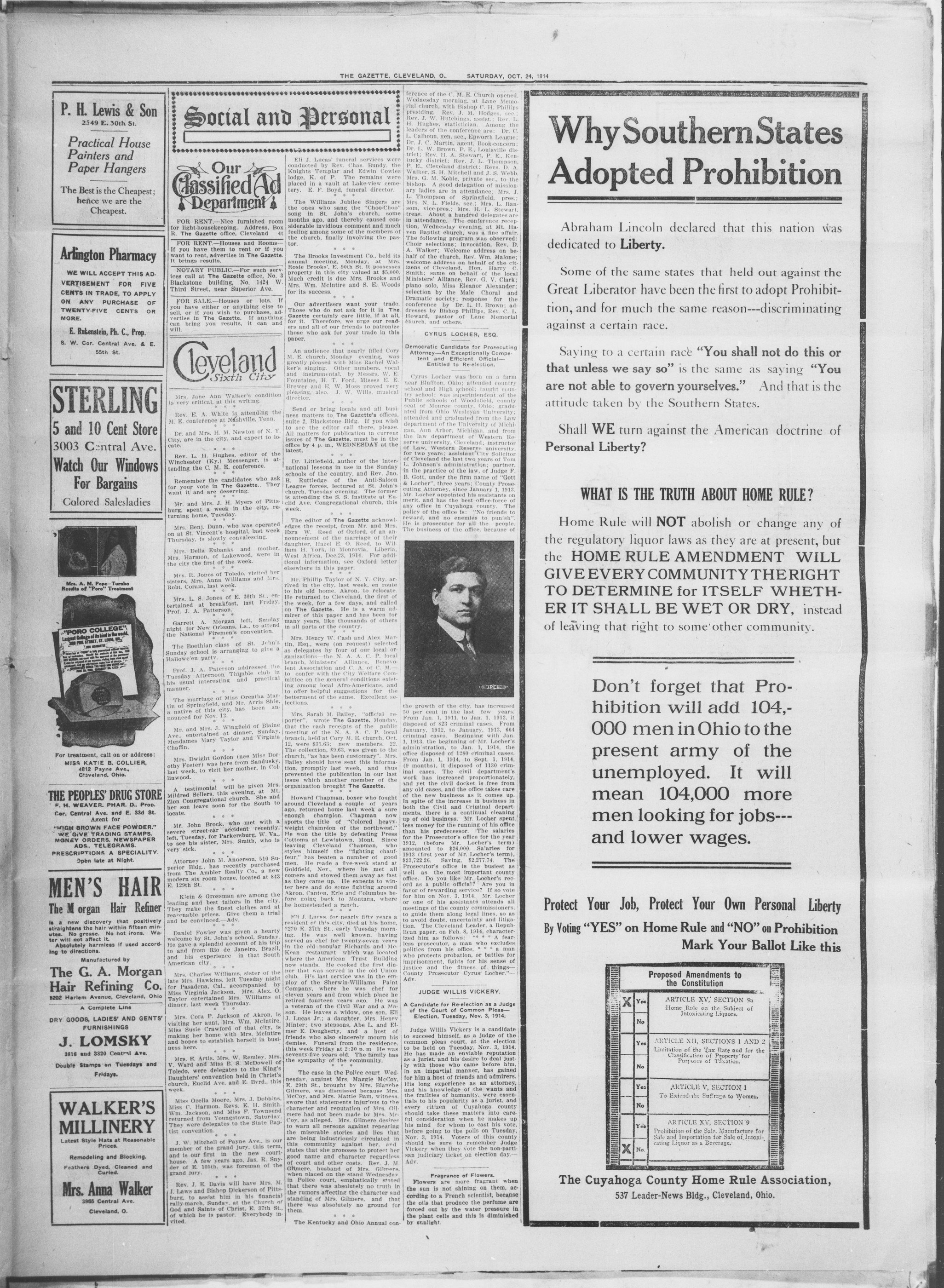
Why SouthernStates
Adopted Prohibition
Abraham Lincoln declared that this nation was
dedicated to Liberty.
Some of the same states that held out against the
Great Liberator have been the first to adopt Prohibit-
tion, and for much the same reason---discriminating
against a certain race.
Saying to a certain race “You shall not do this or
that unless we say so” is the same as saying “You
are not able to govern yourselves.” And that is the
attitude taken by the Southern States.
Shall WE turn against the American doctrine of
Personal Liberty?
| CYRUS LOCHER, ESQ.
Democratic Candidate for Prosecuting
Attorney—An Exceptionally Compe.
tent and Efficient Official—
Entitled to Reelection.
Cyrus Locher was ‘born on a farm
near Bluffton, Ohio; attended country
school and High school; taught coun:
try school; was superintendent of the
Public schools of Woodstield, county
Seat of Monroe counts, Ohio; gradu:
ated from Ohio Wesleyan University;
attended and graduated from the Law
department of the University of Michi:
xan, Aun Arbor, Michigan, and from
the Inw department of Western Re-
serve university, Cleveland, instructor
of Law, Western Reserve university
for (wo years; assistant’City Solicitor
of Cleveland the last two years of Tom
L. Johnson's administration; partner,
in the practice of the law, of Judge F.
B. Gott, under the firm name of “Gott
& Locher", three years: County Prose:
cuting Attorney, since January 1, 1913.
Mr. Locher appointed his assistants on
merit, and has the best office-force of
any office in Cuyahoga county, ‘The
policy of the office is: “No friends to
reward, and no enemies to. pun'sh”
He is prosecutor for all the people.
The business of the office, because of
WHAT IS THE TRUTH ABOUT HOME RULE?
Home Rule will NOT abolish or change any of
the regulatory liquor laws as they are at present, but
the HOME RULE AMENDMENT WILL
GIVEEVERY COMMUNITY THERIGHT
TO DETERMINE for ITSELF WHETH-
ER IT SHALL BE WET OR DRY, instead
of leaving that right to some'other community.
| i Po
. “ Co
Big a
| s
| Yo
|
h
| ,
| REE
Don’t forget that Pro-
hibition will add 104,-
OOO men in Ohio tothe
present army of the
unemployed. It will
mean 104,000 more
men looking for jobs---
and lower wages.
the growth of the city, has increased
50 per cent in the last few years.
From Jan, 1, 1911, to Jan, 1, 112, it
disposed of 82% criminal cases, From
January, 1912, to January, 1913, 664
criminal cases. Beginning with’ Jan.
1, 1913, the beginning of Mr. Locher's
admin’stration, to Jan. 1, 1914, the
oflice disposed of 1280 criminal cases.
From Jan, 1, 1914, to Sept. 1, 1914,
(2 months), it disposed of 1120 crim:
inal cases. The civil department's
work has increased proportionately,
and yet the civil docket is free from
any Old cases, and the office takes care
of the new business as it comes up.
In spite of the Increase in business In
both the Civil and Criminal depart-
ments, there is a continual cleaning
up of old business. Mr. Locher spent
less money for the running of his office
than his predecessor, ‘The salaries
for the Prosecutor's office for the year
1912, (before Mr. Locher’s term)
amounted to $26,000. Sa'aries for
1913 (first year of Mr. Locher's term),
$23,792.26, Saving, $2277.74. ‘The
Prosecutor's office is the busiest as
well as the most important county
office. Do you like Mr, Locher’s rec-
ord as a public official? Are you in
favor of rewarding service? If so vote
for him on Noy. 3, 1914. Mr. Locher
or one of his assistants attends all
meetings of the county commissioners,
to guide them along legal lines, so as
to avoid doubt, uncertainty and litiga-
tion. The Cleveland Leader, a Repub.
ican paper, on Feb. 8, 1914, character-
‘ized him as follows: “* + * A fear.
‘Tess prosecutor, a man who excludes
‘politics from his office, * ° * a man
‘who protects probation, or battles for
‘imprisonment, fights for his sense of
Justice and the fitness of things—
‘County Prosecutor Cyrus Locher.”
i eee
Protect Your Job, Protect Your Own Personal Liberty
By Voting “YES” on Home Rule and “NO” on Prohibition
Mark Your Ballot Like this
f= | Proposed Amendments to
B= the Constitution 3
= ‘s ARTICLE XV; SECTION aay :
BEIM! Stu cue iS
2 ARTICLE NH, SECTIONS 1 AND 2 [EE
= Limitation of the ‘tax Rate and for the [=
= OSBitrencs of Tiseee fae |
a |-| z
= =|
== ARTICLE V, SECTION 1
=| — To Extend:vhe Sufrece to Women,
=| [No =
= = i
=| ARTICLE XV, SECTION'9 |
=) Yo Probiiion of ce Sale Be wfactare for [SEM
S Satog Liquor aba Beverages"
fe x ig 1g e =
The Cuyahoga County Home Rule Association,
537 Leader-News Bldg., Cleveland, Ohio.
JUDGE WILLIS VICKERY.
A Candidate for Re-election as a Judge
of the Court of Common Pleas—
Election, Tuesday, Nov. 3, 1914.
Judge Willis Vickery Is a candidate
to succeed himself, as a Judge of the |
common pleas court, at the election
to be held on Tuesday, Nov. 3, 1914.
He has made an enviable reputation |
as a jurist, and his desire to deal just-
ly with those who came before him,
in an impartial manner, has gained
for him a host of friends and admirers. |
His long experience as an_attorney,,
and his knowledge of the wants and
the frailties of humanity, were essen:
tials to his popularity as a jurist, and |
every citizen of Cuyahoga county
should take these matters into care
ful consideration when he makes up
hi mind for whom to cast his vote,
before going to the polls on Tuesday,
Nov. 3, 1914. Voters of this county
should’ be sure to remember Judge
‘Vickery when they vote the non-part
san judiclary ticket on election day.
Ady
ete ree
| , Flowers are more fragrant when
(the sun is not shining on them, ac-
cording to a French scientist, becanse
the oils that produce the perfume are
forced out by the water pressure in
| the plant cells and this 1s diminished
‘lw caalekt
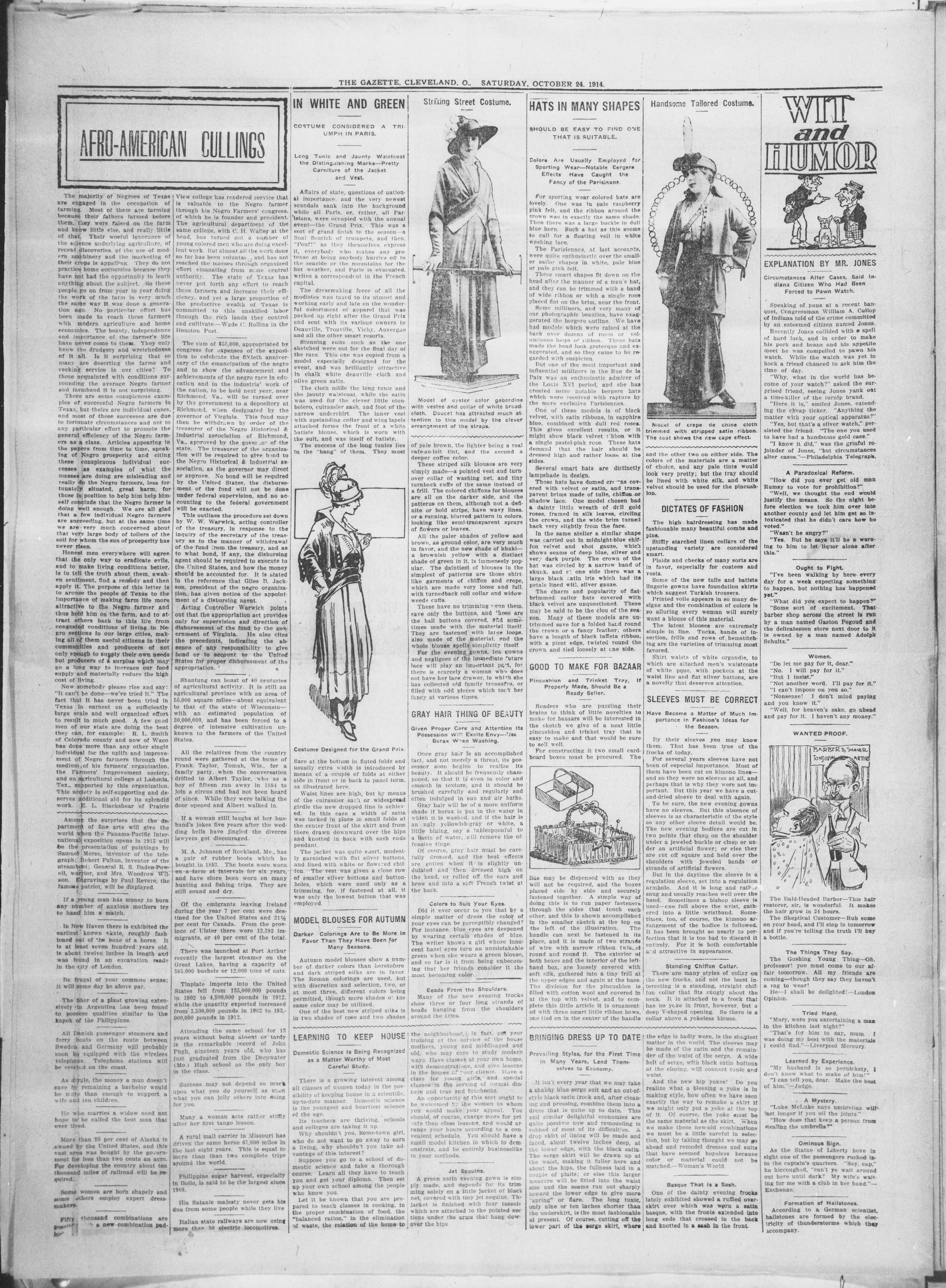
AFRO-AMERICAN CULLINGS
The majority of Negroes of Texas are engaged in the occupation of farming. Most of them are farming because their fathers farmed before them, they were falsed on the farm and know little else, and really little of that. Their woeful ignorance of the science underlying agriculture, of recent discoveries, of the use of modern machinery and the marketing of their crops is appalling. They do not practice home economies because they have not had the opportunity to learn anything about the subject. So these people go on from year to year doing the work of the farm in very much the same way it was done a generation ago. No particular effort has been made to reach these farmers with modern agriculture and home economies. The beauty, independence and importance of the farmer's life have never come to them. They only know the drudgery and wretchedness of it all. Is it surprising that so many are deserting the farms and seeking service in our cities? To those acquainted with conditions surrounding the average Negro farmer and farmhand it is not surprising.
There are some conspicuous examples of successful Negro farmers in Texas, but theirs are individual cases, and most of these successes are due to fortunate circumstances and not to any particular effort to promote the general efficiency of the Negro farmers as a class. Articles appearing in the papers from time to time, speaking of Negro prosperity and citing these conspicuous individual successes as examples of what the masses are doing are misleading and really do the Negro farmers, less forunately situated, great harm, for those in position to help him help himself conclude that the Negro farmer is doing well enough. We are all glad that a few individual Negro farmers are succeeding, but at the same time we are very much concerned about that very large body of toilers of the soil for whom the sun of prosperity has never risen.
Honest men everywhere will agree that the only way to eradicate evils, and to make living conditions better, is to tell the truth about them, awaken sentiment, find a refundy and then apply it. The purpose of this letter is to arouse the people of Texas to the importance of making farm life more attractive to the Negro farmer and thus hold him on the farm, and to attract others back to this life from congested conditions of living in Negro sections in our large cities, making all of them useful citizens in their communities and producers of not only enough to supply their own needs but producers of a surplus which may go a long way to increase our food supply and materially reduce the high cost of living.
Now somebody please rise and say: "It can't be done—we've tried it." The fact that it has never been tried in Texas in earnest on a sufficiently large scale and well organized effort to result in much good. A few good men of our state are doing the best they can, for example: R. L. Smith of Colorado county and now of Waco has done more than any other single individual for the uplift and improvement of Negro farmers through the medium of his farmers' organization, the Farmers' Improvement society, and an agricultural college at Ladonia, Tex., supported by this organization. This society is self-supporting and deserves additional aid for its splendid work. E. L. Blackshear of Prairie
Among the surprises that the department of fine arts will give the world when the Panama-Pacific International exposition opens in 1915 will be the presentation of paintings by Samuel Morse, inventor of the telegraph; Robert Fulton, inventor of the steamboat; General R. S. Baden-Powell, warrior, and Mrs. Woodrow Wilson. Engravings by Paul Revere, the famous patriot, will be displayed.
If a young man has money to burn any number of anxious mothers try to hand him a match.
In New Haven there is exhibited the earliest known state, roughly fashioned out of the bone of a horse. It is at least seven hundred years old. It is about twelve inches in length and was found in an excavation made in the city of London.
Be frugal of your common sense; it will some day be above par.
The sher of a plant growing extensively in Argentina has been found to possess qualities similar to the kapok of the Philippines.
All Danish passenger steamers and ferry boats on the route between Sweden and Germany will probably soon be equipped with the wireless telephone. Telephone stations will be erected on the coast.
As druble, the money a man doesn't save by remaining a bachelor would be more than enough to support a wife and ten children.
He who marries a widow need not hope to be called the best man that ever lived.
More than 99 per cent of Alaska is owned by the United States, and this vast area was bought by the government for less than two cents an acre. For developing the country about ten thousand miles of railroad will be required.
Some women are born shapely and some others employ expert dress-makers.
Fifty thousand combinations are possible in a new-combination padlock.
thousand combinations are a new combination pad
View college has rendered service that is valuable to the Negro farmer through his Negro Farmers' congress, of which he is founder and president. The agricultural department of the same college, with C. H. Waller at the head, has turned out a number of young colored men who are doing excellent work. But almost all the work done so far has been volunteered, and has not reached the masses through organized effort emanating from some central authority. The state of Texas has never put forth any effort to reach these farmers and increase their efficiency, and yet a large proportion of the productive wealth of Texas is committed to this unskilled labor through the rich lands they control and cultivate—Wade C. Rollins in the Houston Post.
The sum of $55,000, appropriated by congress for expenses of the exposition to celebrate the 81st anniversary of the emancipation of the negro and to show the advancement and achievements of the negro race in education and in the industry' work of the nation, to be held next year, near Richmond, Va., will be turned over by the government to a depository at Richmond, when designated by the governor of Virginia. This fund may then be withdrawn by order of the treasurer of the Negro Historical & Industrial association of Richmond, Va., approved by the governor of the state. The treasurer of the organization will be required to give bond to the Negro Historical & Industrial association, as the governor may direct or approve. No bond will be required by the United States, the disbursement of the fund will not be done under federal supervision, and no acc counting to the federal government will be exacted.
This outlines the procedure set down by W. W. Warwick, acting controller of the treasury, in response to the inquiry of the secretary of the treasury as to the manner of withdrawal of the fund from the treasury, and as to what bond, if any, the disburising agent should be required to execute to the United States, and how the money should be accounted for. It is stated in the reference that Giles B. Jackson, president of the negro organization, has given notice of the appointment of a disburising agent.
Acting Controller Warwick points out that the appropriation act provides only for supervision and direction of disbursement of the fund by the government of Virginia. He also cites the precedents, indicating the absence of any responsibility to give bond or to account to the United States for proper disbursement of the appropriation.
Shantung can boast of 40 centuries of agricultural activity. It is still an agricultural province with an area of 55,000 square miles—about equivalent to that of the state of Wisconsin—with an estimated population of 30,000,000, and has been forced to a degree of intensive cultivation unknown to the farmers of the United States.
All the relatives from the country round were gathered at the home of Frank Taylor, Tomah, Wis., for a family party, when the conversation drifted to Albert Taylor, who as a boy of fifteen ran away in 1884 to join a circus and had not been heard of since. While they were talking the door opened and Albert walked in.
If a woman still laughs at her husband's jokes five years after the wedding bells have jingled the divorce lawyers get discouraged.
M. A. Johnson of Rockland, Me., has a pair of rubber boots which he bought in 1883. The boots were worn on a farm at intervals for six years, and have since been worn on many hunting and fishing trips. They are still sound and dry.
Of the emigrants leaving Ireland during the year 7 per cent were destined for the United States and 21½ per cent for Canada. From the province of Ulster there were 12,392 immigrants, or 40 per cent of the total.
There was launched at Port Arthur recently the largest steamer on the Great Lakes, having a capacity of 585,000 bushels or 12,000 tons of oats.
Tinplate imports into the United States fell from 135,000,000 pounds in 1902 to 4,500,000 pounds in 1912, while the quantity exported increased from 3,500,000 pounds in 1902 to 183,000,000 pounds in 1912.
Attending the same school for 13 years without being absent or tardy is the remarkable record of John Pugh, nineteen years old, who has just graduated from the Deepwater (Mo.) High school as the only boy in the class.
Success may not depend so much upon what you do yourself as upon what you can jolly others into doing for you.
Many a woman acts rather stiffly after her first tango lesson.
A rural mail carrier in Missouri has driven the same horse 63,600 miles in the last eight years. This is equal to more than two complete trips around the world.
Philippine sugar harvest, especially in Ilolo, is said to be the largest since 1908.
His Satanic majesty never gets his due from some people while they live
Italian state railways are now using more than 50 electric locomotives.
THE GAZETTE, CLEVELAND, O.. SATURDAY, OCTOBER 24, 1914
IN WHITE AND GREEN
COSTUME CONSIDERED A TRI
UMPH IN PARIS.
Long Tunic and Jaunty Waistcoat the Distinguishing Marks—Pretty Garniture of the Jacket and Vest.
Affairs of state, questions of national importance, and the very newest scandals sank into the background while all Paris, or, rather, all Parisians, were occupied with the annual event—the Grand Prix. This was a sort of annual finish to the season—a final flourish of rumpets, and then, "Pouf" as they themselves express it, everybody who makes any pretense at being any hurries off to the seaside or the mountains for the hot weather, and Paris is evacuated, writes a correspondent in the French capital.
The dressmaking force of all the modistes was taxed to its utmost and working early and late on the wonderful assortment of apparel that was packed up right after the Grand Prix and sent with its various owners to Deauville, Trouville, Vichy, Auvergne and all the other smart resorts.
Stunning suits such as the one sketched were out for the final day of the race. This one was copied from a model especially designed for the event, and was brilliantly attractive in chalk white deauville cloth and olive green satin.
The cloth made the long tunic and the jaunty waistcoat, while the satin was used for the clever little eno bolero, cuiller sash, and foot of the narrow underskirt. The inner vest with upstanding collar and wing laps attached forms the front of a white batiste blouse, which is worn with the suit, and was itself of batiste.
The success of the long tunic lies in the "hang" of them. They must
1
Costume Designer for the Grand Prix
flare at the bottom in fluted folds and
usually extra width is introduced by
means of a couple of folds at either
side in front or in back in panel form,
as illustrated here.
Waist lines are high, but by means
of the cuirassier sash or widespread
girdle the new dropped line is achieved.
In this case a width of satin
was tacked in place in small folds at
the center front of the skirt and from
there drawn downward over the hips
and knotted in back with sash end
pendant.
The jacket was quite saort, modestly
garnished with flat silver buttons
and lined with white or flowered chiff
fon. The vest was given a close row
of smaller silver buttons and button
holes, which were used only as a
trimming, for, if fastened at all, it
was only the lowest button that was
employed.
MODEL BLOUSES FOR AUTUMN
Darker Colorings Are to Be More in Favor Than They Have Been for Many Seasons.
Autumn model blouses show a number of darker colors than heretofore and dark striped silks are in favor. The Roman colorings are used, but with discretion and selection, two, or at most three, different colors being permitted, though more shades of the same color may be utilized.
One of the best new striped silks is in two shades of rose and two shades
LEARNING TO KEEP HOUSE
Domestic Science Is Being Recognized as a Matter Worthy of Most Careful Study.
There is a growing interest among all classes of women today in the possibility of keeping house in a scientific, up-to-date manner. Domestic science is the youngest and heartiest science of the age.
Its teachers are thriving, schools and colleges are taking it up.
Why shouldn't you, home-town girl, who do not want to go away to earn a living, why shouldn't you take advantage of this interest?
Suppose you go to a school of domestic science and take a thorough course. Learn all they have to teach you and get your diploma. Then set up your own school among the people who know you.
Let it be known that you are prepared to teach classes in cooking, in the proper combination of food, the "balanced ration," in the elimination of waste, the relation of the home to
1
Model of oyster color gaberdine with vestee and collar of white broad-cloth. Doucet has attracted much attention to this model by the clever arrangement of the straps.
of pale brown, the lighter being a real cafe-au-lait tint, and the second a deeper coffee color. These striped silk blouses are very simply made—a pointed vest and turnover collar of washing net, and tiny turnback cuffs of the same instead of a frill. The colored chiffons for blouses are all on the darker side, and the sleeves are both though not a deft, turnover or bold stripe, have wavy lines, or a running, blurred pattern in colors, looking like semi-transparent sprays of flowers or leaves.
All the paler shades of yellow and brown, as ground color, are very much in favor, and the new shade of khaki—a brownish yellow with a distinct shade of green in it, is immensely popular. The daintiest of blouses in the simplest of patterns are those shirtt-like garments of chiffon and crepe, which are made very loose and full, with turnedback roll collar and widow-weeds cuts.
These have no trimming upon them, save only the buttons, and these are the ball buttons covered, and sometimes made with the material itself. They are fastened with large loops, also made of the material, and the whole blouse spells simplicity itself. For the evening gowns, tea gowns and negliges of the immediate 'uture lace will play an important part, for there is scarcely a woman who does not have her lace drawer, in which she has collected old family treasures, or filled with old pieces which took her fancy at various times.
GRAY HAIR THING OF BEAUTY
Given Proper Care and Attention its Possession Will Excite Envy—Use Borax When Washing.
Once gray hair is an accomplished fact, and not merely a threat, its possessor soon begins to realize its beauty. It should be frequently shampooed, so that it is even in color and smooth in texture, and it should be brushed carefully and regularly and often indulged in sun and air baths. Gray hair will be of a more uniform shade if borax is put in the water in which it is washed, and if the hair is an ugly yellowish-gray or white, a little bluing, say a tablespoonful to a basin of water, will remove the offensive tinge.
Of course, gray hair must be carefully dressed, and the best effects are gotten when it is slightly undulated and then dressed high on the head, or rolled off the ears and brow and into a soft French twist at the back.
Did it ever occur to you that by a simple matter of dress the color of your eyes can be perceptibly changed? For instance, blue eyes are deepened by wearing certain shades of blue. The writer knows a girl whose innocent hazel eyes turn an unmistakable green when she wears a green blouse, and so far is it from being unbecoming that her friends consider it the most becoming color.
Beads From the Shoulders.
Many of the new evening frocks show three or four long strands of beads banging from the shoulders around the arms.
the neighborhood. In fact, put your training at the service of the house mothers, young and middleaged and old, who may care to study modern ways. Have classes at your own home, with demonstrations, and give lessons in the homes of your clients. Have a class for young girls, and special classes in the serving of formal dinners and teas and luncheons.
An opportunity of this sort ought to be welcomed by the women to whom you would make your appeal. You should, of course, charge more for private than class lessons, and would arrange your hours according to a convenient schedule. You should have a small model kitchen in which to demonstrate, and be entirely businesslike in your methods.
Jet Seguins
A green satin evening gown is sim-
ply made, and depends for its trim-
ming solely on a little jacket of blac-
net, covered with tiny jet sequins. The jacket is finished with four tassels
which are attached to the pointed se-
tures under the arms that hang dow-
over the hips
HATS IN MANY SHAPES
SHOULD BE EASY TO FIND ONE
THAT IS SUITABLE.
Colors Are Usually Employed for Sporting Wear—Notable Bergera Effects Have Caught the Fancy of the Parisienne.
For sporting wear colored hats are lovely. One was in pale raspberry pink felt, and the ribbon around the crown was in exactly the same shade. Then there was a large buckle in dull blue horn. Such a hat as this seems to call for a floating veil in white washing lace.
The Parisienne, at last accounts, were quite enthusiastic over the smaller sailor shapes in white, pale blue or pale pink felt.
These smart shapes fit down on the head after the manner of a man's hat, and they can be trimmed with a band of wide ribbon or with a single rose placed flat on the brim, near the front. Some milliners, and very many of our photographic beauties, have exaggerated the bergere outline. We have had models which were raised at the back over dozens of roses or voluminous loops of ribbon. These hats made the head look grotesque and exaggerated, and so they came to be regarded with suspicion. The most important and influential milliners in the Rue de la Paix was an enthusiastic admirer of the Louis XVI period, and she has created some notable bergere hats which were received with rapture by the more exclusive Parisiennes.
One of these models is of black velvet, with satin ribbons, in sapphire blue, combined with dull red roses. This gives excellent results, or it might show black velvet ribbon with a single pastel-pink rose. These hats demand that the hair should be dressed high and rather loose at the sides.
Several smart hats are distinctly lampshade in design. These hats have domed crescens covered with velvet or satin, and transparent brims made of tulle, chiffon or shadow lace. One model chosen had a dainty little wreath of dull gold roses, framed in silk leaves, circling the crown, and the wide brim turned back very slightly from the face.
In the same atelier a similar shape was carried out in midnight-blue chiffon velvet and shot gauze, which shows seams of deep blue, silver and very dark purple. The crown of the hat was circled by a narrow band of skunk, and; at one side there was a large black satin iris which had its petals细 with silver gauze.
The charm and popularity of flat-brimmed sailor hats covered with black velvet are unquestioned. These may be said to be the clou of the season. Many of these models are untrimmed save for a folded bard round the crown or a fancy feather; others have a length of black taffeta ribbon, with a pict edge, twisted round the crown and tied loosely at one side.
GOOD TO MAKE FOR BAZAAR
Pincushion and Trinket Tray,
Properly Should Be a
Ready, Sack
Readers who are puzzling their brains to think of little novelties to make for bazaars will be interested in the sketch we give of a neat little pincushion and trinket tray that is easy to make and that would be sure to sell well.
For constructing it two small cardboard boxes must be procured. The
lios may be dispensed with as they will not be required, and the boxes placed side by side and securely fastened together. A simple way of doing this is to run paper fasteners through the sides that touch each other, and this is shown accomplished in the smaller sketch at the top on the left of the illustration. The handle can next be fastened in its place, and it is made of two strands of wire with narrow ribbon twisel round and round it. The exterior of both boxes and the interior of the left-hand box, are loosely covered with soft silk, gathered into a tiny trill at the upper edges and again at the base. The division for the pincushion is filled with cotton wool and covered in at the top with velvet, and to complete this little article it is ornamented with three smart little ribbon bows, one tied on in the center of the handle.
Prevailing Styles, for the First Time in Many Years, Lend Themselves to Economy.
It isn't every year that we may take a shabby blue satin suit and an out-of-style black satin trock and, after cleaning and pressing, combine them into a dress that is quite up to date. This and similar delightful economies are quite possessive now and remodeling is robbed of most of its difficulties. A drop skirt of inning will be made and faced, about twelve inches deep, at the lower edge, with the black satin. The serge skirt will be drawn up at the waist, making it fuller here and about the hips, the fullness laid in a couple of plaits; or else this larger measure will be fitted into the waist size and the seams run out sharply toward the lower edge to give more "spring" or flare. The long tunic, only nine or ten inches shorter than the underskirt, is the most fashionable at present. Of course, cutting off the lower part of the serge skirt, where
A
Mocel de crepe de chine cloth trimmed with stripped satin ribbon. The coat shows the new cape effect.
and the other two on either side. The colors of the materials are a matter of choice, and any pale tints would look very pretty; but the tray should be lined with white silk, and white velvet should be used for the pincushion.
DICTATES OF FASHION
The high hairdressing has made fashionable many beautiful combs and pins.
Stiffly starched linen collars of the upstanding variety are considered smart.
Plaids and checks of many sorts are in favor, especially for coattees and vests.
Some of the new tulle and batiste lingerie gowns have foundation skirts which suggest Turkish trousers.
Printed voile appears in so many designs and the combination of trimming is so alluring every woman will surely want a blouse of this material.
The latest blouses are extremely simple in line. Tucks, bands of insertion, frills and rows of, hemmishting are the varieties of trimming most favored.
Shirt waists of white organdie, to which are attached men's waistcoats of white pue, with pockets at the waist line and flat silver buttons, are a novelty that deserves attention.
SLEEVES MUST BE CORRECT
Have Become a Matter of Much Importance in Fashion's Ideas for the Season.
By their sleeves you may know them. That has been true of the frocks of today.
For several years sleeves have not been of especial importance. Most of them have been cut on kimono lines—and so they were no sleeves at all, and perhaps that is why they were not important. But this year we have a cut-and-dried sleeve to deal with again.
To be sure, the new evening gowns have no sleeves. But this absence of sleeves is as characteristic of the style as any other sleeve detail would be.
The new evening bodices are cut in two points that clasp on the shoulder under a jeweled buckle or chap or under an artificial flower; or else they are cut off square and held over the shoulders with jeweled bands or strands of artificial flowers.
But in the daytime the sleeve is a regulation sleeve, set into a regulation armhole. And it is long and rath- snug and usually reaches well over the hand. Sometimes a bishop sleeve is used—one full above the wrist, gathered into a little wristband. sometimes, too, of course, the kimono arm- sleeve. The kimono arm- sleeve has been brought so nearly to perfection that it is too bad to discard it entirely. For it is both comfortable and attractive in appearance.
Standing Chiffon Collar.
There are many styles of collar on the new frocks, and not the least interesting is a standing, straight chiffon collar that fits singly about the neck. It is attached to a frock that has no yoke in front, however, but a deep V-shaped opening. So there is a collar above a yokeless blouse.
the edge is badly worn, is the simplest matter in the world. The sleeves may be made of the sarin and the remainder of the waist of the serge. A wide belt of serge, with black satin buttons at the closing, will connect tunic and waist.
And the new hip yokes! Do you realize what a blessing a yoke is in making style, how often we have seen exactly the way to remake a skirt if we might only put a yoke at the top of it. Of course, the yoke must be the same material as the skirt. When we make these new-old combinations we must be a little careful in selection, but by taking thought we may go ahead and remodel dresses and suits that have seemed hopeless because color or material could not be matched.—Woman's World.
Basque That Is a Sash.
One of the dalty evening frocks lately exhibited showed a ruffled overskirt over which was worn a satin basque, with the front extended into long ends that crossed in the back and knotted in a saah in the front
WIT
and
HUMOR
EXPLANATION BY MR. JONES
Circumstances Alter Cases, Said Indiana Citizen Who Had Been Forced to Pawn Watch.
Speaking of puns at a recent banquet, Congressman William A. Callop of Indiana told of the crime committed by an esteemed citizen named Jones. Recently Jones collided with spell of hard luck, and in order to make his pork and beans and his appetite meet he was compelled to pawn his watch. While the watch was yet in hock a friend chanced to ask him the time of day.
"Why, what in the world has become of your watch?" asked the surprised friend, seeing Jones yank out a time-killer of the turnip brand.
"Here it is," smiled Jones, extending the cheap ticker. "Anything the matter with your optical apparatus?"
"Yes, but that's a silver watch," persisted the friend. "The one you used to have had a handsome gold case."
"I know it did," was the grinful rejoinder of Jones, "but circumstances alter cases."-Philadelphia Telegraph.
A Paradoxical Reform
"How did you ever get old man Rumay to vote for prohibition?"
"Well, we thought the end would justify the means. So the night before election we took him over into another county and let him get so intoxicated that he didn't care how he voted."
"Wasn't he angry?"
"Yes. But he says it'll be a warning to him to let liquor alone after this."
Ought to Flight
"I've been walking by here every day for a week expecting something to happen, but nothing has happened yet."
"What did you expect to happen?"
"Some sort of excitement. That barber shop across the street is run by a man named Gaston Pegoud and the delicatessen store next door to it is owned by a man named Adolpk Schultz."
Women.
"Do let me pay for it, dear."
"No. I will pay for it."
"But I insist."
"Not another word. I'll pay for it."
"I can't impose on you so."
"Nonsense! I don't mind paying and you know it."
Women.
"Well, for heaven's sake, go nhead
and pay for it. I haven't any money."
WANTED PROOF.
BARBER & SHAVER
TONSORMA ARTHUR
The Bald-Headed Barber—This hair
restorer, sir, is wonderful. It makes
the hair grow in 24 hours.
The Skeptical Customer—Rub some on your head, and I'll stop in tomorrow and if you're telling the truth I'll buy a bottle.
The Things They Say.
The Gushing Young Thing—Oh,
professor! you must come to our affair tomorrow. All my friends are coming—though they say they haven't a rag to wear!
He—I shall be delighted!—London Opinion.
Tried Hard
"Mary, were you entertaining a man in the kitchen last night?"
"That's for him to say, mum. I was doing my best with the materials I could find."—Liverpool Mercury.
"My husband is so pernicious, I don't know what to make of him!"
"I can tell you, dear. Make the best of him."—Judge.
A Mystery.
"Luke McLuke says umbrellas will last longer if you oil the joints."
"How does that keep a person from stealing the umbrella?"
Ominous Sign.
As the Statue of Liberty hove in sight one of the passengers rushed in to the captain's quarters. "Say, cap," he hiccupped, "can't ye wait around out here until dark? My wife's waiting for me with a club in her hand."—Exchange.
Formation of Hailstones.
According to a German scientist, hailstones are formed by the electricity of thunderstorms which they accompany.