The Gazette
Saturday, October 31, 1914
Cleveland, Ohio
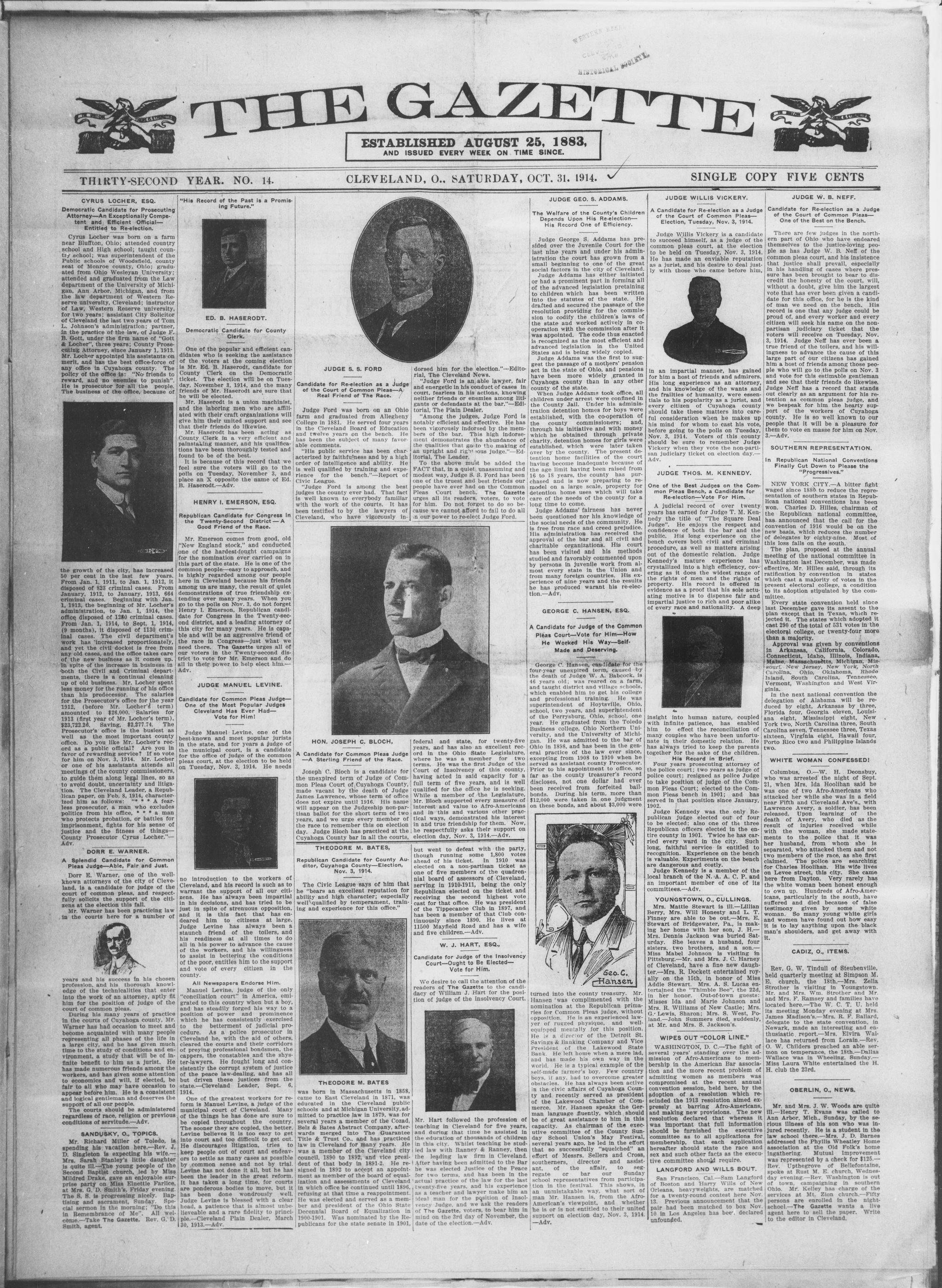
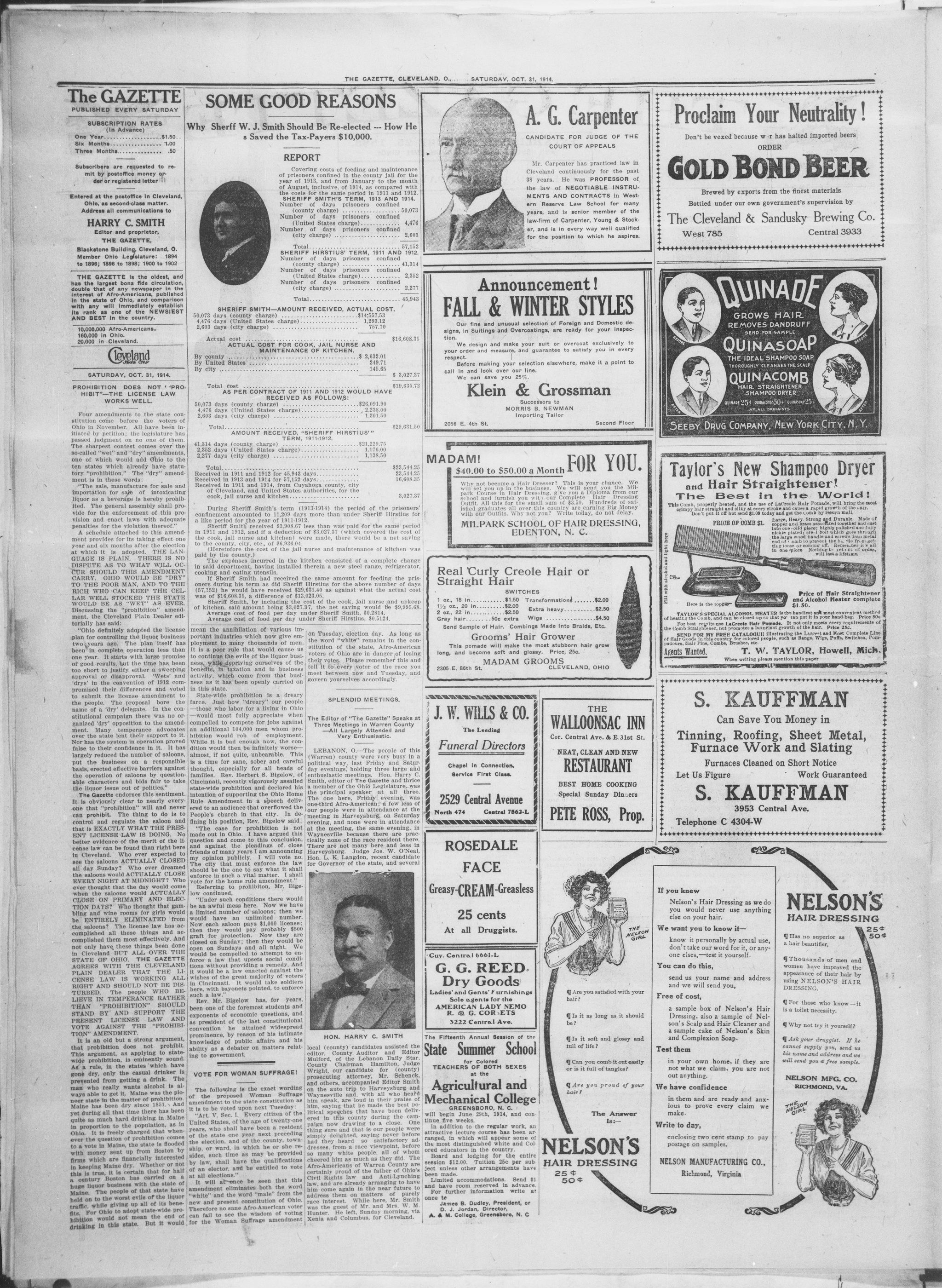
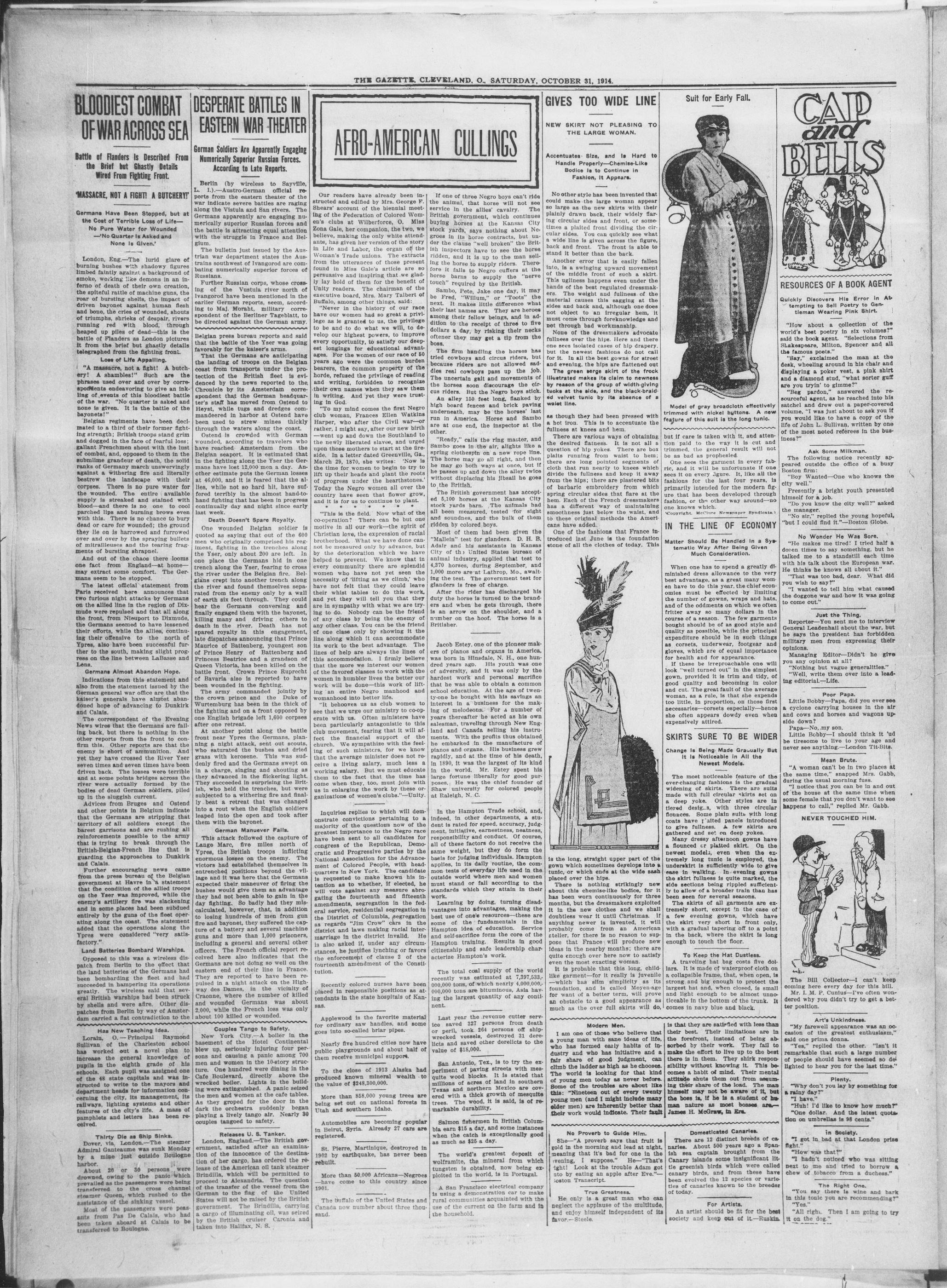
Page text (machine-generated)
TH1RTY-SECOND YEAR. NO. 14.
U. CURTON
DELUXE ASTRONOMIE
Democratic Candidate for Prosecuting Attorney—An Exceptionally Competent and Efficient Official—Entitled to Re-election.
Cyrus Locher was born on a farm near Bluffton, Ohio; attended country school and High school; taught country school; was superintendent of the Public Library; seat of Monroe county, Ohio; graduated from Ohio Wesleyan University; attended and graduated from the Law department of the University of Michigan, Ann Arbor, Michigan, and from the law department of Western Reserve university, Cleveland; instructor of Law, Western Reserve university, for two years; assistant City Solicitor of Cleveland the last two years of Tom L. Johnson's administration; partner, in the practice of the law, of Judge F. B. Gott, under the firm name of "Gott & Locher", three years; County Prosecuting Attorney, since January 1, 1913. He served as the assistant on merit, and has the best office-for-any office in Cuyahoga county. The policy of the office is: "No friends to reward, and no enemies to punish." He is prosecutor for all the people. The business of the office, because of
H. T. BEUCH
the growth of the city, has increased 50 per cent in the last few years. From Jan. 1, 1911, to Jan. 1, 1912, it disposed of 823 criminal cases. From January, 1912, to January, 1913, 664 criminal cases. Beginning with Jan. 1, 1913, the beginning of Mr. Locher's administration, to Jan. 1, 1914, the office disposed of 1280 criminal cases. From Jan. 1, 1914, to Sept. 1, 1914 (9 months), it disposed of 1130 criminal cases. The civil department's work has increased proportionately, and the number of any old cases, and the office takes care of the new business as it comes up. In spite of the increase in business in both the Civil and Criminal departments, there is a continual cleaning up of old business. Mr. Locher spent less money for the running of his office than his predecessor. The salaries for the Prosecutor's office for the year 1912, (before Mr. Locher's term) amounted to $26,000. Salaries for 1913 (first year of Mr. Locher's term) amounted to $22,774. Saving, $22,774, is the busiest as well as the most important county office. Do you like Mr. Locher's record as a public official? Are you in favor of rewarding effort? If so give him on Nov. 3, 1914. Mr. Locher or one of his assistants attends all meetings of the county commissioners to guide them along legal lines, so as to avoid doubt, uncertainty and litigation. The Cleveland Leader, a Republican paper, on Feb. 8, 1914, characterized him as follows: "a man who excludes people from his office. * * a man who protects probation, or battles for imprisonment, fights for his sense of justice and the fitness of things—County Prosecutor Cyrus Locher."—Adv.
DORR E. WARNER.
A Splendid Candidate for Common Pleas Judge—Able, Fair and Just.
Dorr E. Warner, one of the well-known attorneys of the city of Cleveland, is a candidate for judge of the court of common pleas, and respectfully solicits the support of the citizens at the election this fall.
Mr. Warner has been practicing law in the courts here for a number of years and his success in his chosen profession, and his thorough knowledge of the technicalities that enter into the work of an attorney, aptly fit him for the position of judge of the court of common pleas.
During his many years of practice in the courts of Chelanoga county, Mr. Warner has had occasion to meet and become acquainted with many people representing all phases of the life in a large city, and he has given much time to the study of conditions and environment, a study that will be of infinite benefit to him as a jurist. He has made numerous friends among the workers, and has given some attention to economics and will. If elected, he fair to all who may have occasion to appear before him. He is a consistent and logical gentleman and deserves the support of all our people.
The courts should be administered regardless of race, religion or previous conditions of servitude.—Adv.
SANDUSKY, O., TOPICS.
Mr. Richard Miller of Toledo, is spending his vacation here—Rev. J. D. Singleton is expecting his wife—Mrs. Sarah Stanley's little daughter is quite ill—The young people of the Second Baptist church, led by Miss Mildred Drake, gave an enjoyable surprise party on Miss Elnette Farice, at Mrs. G. D. Smith's Friday evening. The S. S. is progressing nicely. Baptising and sacrament, Sunday. Special sermon in the morning; Do. Do. Do. "All welcome—Take the Gazette, Rev. G. D. Smith, agent
THE GAZETTE
"His Record of the Past is a Promising Future."
ED. B. HASERODT.
Democratic Candidate for County Clerk.
One of the popular and efficient candidates who is seeking the assistance of the voters at the coming election is Mr. Ed. B. Haserodt, candidate for County Clerk on the Democratic ticket. The election will be on Tuesday, November 19, 1914, and the many friends of Mr. Haserodt are sure that he will be elected.
Mr. Haserodt is a union machinist, and the laboring men who are affiliated with their craft organizations will give him their united support and see that their friends do likewise.
Mr. Haserodt has been acting as County Clerk in a very efficient and palatating manner, and his qualifications have been thoroughly tested and found to be of the best.
It is because of this record that we feel sure the voters will go to the polls on Tuesday, November 3, and B. Haserrott, the name of Ed B. Haserrott.-Adv.
HENRY I. EMERSON. ESQ
Republican Candidate for Congress in the Twenty-Second District — A Good Friend of the Race.
Mr. Emerson comes from good, old "New England stock," and conducted one of the hardest-fought campaigns for the nomination ever carried on in this part of the state. He is one of the common people—easy to approach, and is highly regarded among our people here in Cleveland because his friends among us are many, the result of quiet demonstrations of true friendship extending over many years. When you go to the polls on Nov. 3, do not forget Henry I. Emerson, Republican candidate for Congress in the Twenty-second district, and a leading attorney of this city for many years. He is capable and will be an aggressive friend of the race in Congress—just what we need there. The Gazette urges all of our voters in the Twenty-second district to vote for Mr. Emerson and do all in their power to help elect him.—Adv.
JUDGE MANUEL LEVINE.
Candidate for Common Pleas Judge—
One of the Most Popular Judges
Cleveland Has Ever Had—
Vote for Him!
Judge Manuel Levine, one of the
best-known and most popular jurists
in the state, and for years a judge
of the municipal court, is a candidate
for the office of judge of the common
pleas court, at the election to be held
on Tuesday, Nov. 3, 1914. He needs
no introduction to the workers of Cleveland, and his record is such as to warrant the support of all our citizens. He has always been impartial in his decisions, and has tried to be in spite of strenuous opposition, and it is this fact that has endured him to citizens at large. Judge Levine has always been a stanch friend of the toilers, and endured at all times to do all in his power to advance the cause of the workers, and his willingness to assist in bettering the conditions of the poor, entitles him to the support and vote of every citizen in the county.
All Newspapers Endorse Him.
[Picture of a man in a suit with a tie].
[Picture of a man in a suit with a bow tie].
JUDGE S. S. FORD
Candidate for Re-election as a Judge of the Court of Common Plea—A Real Friend of The Race.
Judge Ford was born on an Ohio farm and graduated from Allegheny College in 1881. He served four years in the Cleveland Board of Education and twelve years on the bench. He has been the subject of many favorable comments.
"His public service has been characterized by faithfulness and by a high order of intelligence and ability. He is well qualified by training and experience for the bench."—Report of Civic League.
"Judge Ford is among the best judges the county ever had. That fact is well known to everybody familiar with the work of the courts. It has been testified to by the lawyers of Cleveland, who have vigorously in-
HON. JOSEPH C. BLOCH,
A Candidate for Common Pleas Judge
—A Sterling Friend of the Race.
Joseph C. Bloch is a candidate for the unexpired term of Judge of Common Pleas Court of Cuyahoga County, made vacant by the death of Judge James Lawrence, whose term of office does not expire until 1916. His name will appear on the Judgeship non-partisan ballot for the short term of two years, and we urge every member of the race to remember this on election day. Judge Bloch has practiced at the Cuyahoga County bar in all the courts,
THEODORE M. BATES,
Republican Candidate for County Auditor, Cuyahoga County—Election, Nov. 3, 1914.
The Civic League says of him that he "bears an excellent reputation for ability and high character; especially well qualified by temperament, training and experience for this office."
THEODORE M. BATES
was born in Massachusetts in 1858, came to East Cleveland in 1871, was educated in the Cleveland public schools and at Michigan University, admitted to practice law in 1879, was for several years a member of the Cozad, Belz & Bates Abstract Company, afterwards merged into The Guarantee Title & Trust Co. and has practiced law in Cleveland for many years. He was a member of the Cleveland city council, 1880 to 1892, and vice president of that body in 1892. He resigned in 1892 to accept an appointment as member of the board of equalization and assessments of Cleveland in which office he continued until 1896, refusing at that time a reappointment. He was elected and served as a member and president of the Ohio State Decennial Board of Equalization in 1900-1901. Was nominated by the Republicans for the state senate in 1901.
dorsed him for the election."—Editorial, The Cleveland News.
"Judge Ford is an able lawyer, fair and energetic in his conduct of cases in court, fearless in his actions, knowing neither friends or enemies among litigants or defendants at the bar."—Editorial, The Plain Dealer.
"Among the judges, Judge Ford is notably efficient and effective. He has been the indictor by the members of the bar. This high indemnement demonstrates the abundance of the qualities that go to the making of an upright and righteous judge."—Editorial, The Leader.
To the above must be added the FACT that, in a quiet unassuming and modest way, Judge S. S. Ford has been one of the truest and best friends our people have ever had on the Common Ground. Judge S. S. Ford urges all its readers, voters, to vote for him. Do not forget to do so because we cannot afford to fail to do all our power to re-elect Judge Ford.
1910
federal and state, for twenty-five years, and has also an excellent record in the Ohio State Legislature, where he was a member for two terms. He was the first Judge of the Court of Innspection of Ohio, this county, in and capacity for a term of five years, and is well qualified for the office he is seeking. While a member of the Legislature, Mr. Bloch supported every measure of interest and value to Afro-Americans and in this and various other practical ways, demonstrated his interest in and true friendship for them. Now, he respectfully asks their support on election day, Nov. 3, 1914—Adv.
but went to defeat with the party, though running some 1,800 votes ahead of his ticket. In 1910 was elected on a non-partisan ticket as one of five members of the quadrennial board of assessors of Cleveland, serving in 1910-1911, being the only Republican elected on the ticket and receiving the second highest vote for that office. He was president of the Tippecanoe Club in the Club and the Republican Club in the Club, tiniously since 1890. He lives at 11500 Mayfield Road and has a wife and five children—Adv.
W. J. HART, ESQ.
Candidate for Judge of the Insolvency Court—Ought to Be Elected—Vote for Him.
We desire to call the attention of the readers of The Gazette to the candidacy of William J. Hart for the position of judge of the Insolvency Court.
Mr. Hart followed the profession of teaching in Cleveland for five years, and during that time he assisted in the education of thousands of children in this city. Whilst teaching he studied law with Ranney & Ranney, then the leading law firm in Cleveland. After having been admitted to the Bar he was elected Justice of the Peace for two terms, and has been in the actual practice of the law for the last twenty-five years, and his experience as a teacher and lawyer make him an ideal man for the position of Insolvency Judge, and we ask the readers of The Gazette, voters, to bear him in mind on the 3rd day of November, the date of the election.—Ady.
---
JUDGE GEO. S. ADDAMS.
The Welfare of the County's Children Depends Upon His Re-election—His Record One of Efficiency.
Judge George S. Addams has presided over the Juvenile Court for the last nine years and under his administration the court has grown from a small beginning to one of the great social factors in the city of Cleveland. Judge Addams has either initiated or had a prominent part in forming all of the advanced legislation pretaining to children which has been written into the statutes of the state. He received the passage of the resolution providing for the commission to codify the children's laws of the state and worked actively in cooperation with the commission after it was appointed. The code thus enacted is recognized as the most efficient and advanced legislation in the United States and is being widely copied. Judge Addams was the first to suggest the passage of a mother's pension act in the state of Ohio, and have thereby granted in Ohio county than in any other county of the state.
When Judge Addams took office, all children under arrest were confined in the County Jail. Under his administration detention homes for boys were established, with the co-operation of the county commissioners; and, through his initiative and work, which he obtained through private positions for girls were established, which were later taken over by the county. The present detention home facilities of the court having become inadequate because of the age limit having been raised from 16 to 18 years, the county has purchased and is now preparing to remodel on a large scale, probably detained, which will take one of the needs of the county for a long time to come.
Judge Addams' fairness has never been questioned nor his knowledge of the social needs of the community. He is free from race and creed prejudice. His administration has received the approval of the bar and all civil and charitable organizations. His court has been visited and his methods studied and favorably commented upon by persons in juvenile work from ulm and from many foreign countries. His experience of nine years and the results he has produced warrant his re-election.—Adv.
GEORGE C. HANSEN, ESQ.
A Candidate for Judge of the Common Pleas Court—Vote for Him—How He Worked His Way—Self-Made and Deserving.
George C. Hansen, candidate for the four-year unexpired term, caused by the death of Judge W. A. Babcock, 68 years old, was received in arm and eight district and village schools, which enabled him to get his college and professional training. He was superintendent of Hoytsville, Ohio, school, two years, and superintendent of the Perryburg, Ohio, school, one year. He graduated from the Toledo Business college, Ohio Northern University, and the admitted to the bar of Ohio in 1888, and has been in the general practice of the law ever since, excepting from 1908 to 1910 when he served as assistant county Prosecutor. Prior to his appointment to office, so far as the county treasurer's record discloses, not one dollar ever been recorded, nor forfeited ball-ball, during his term, more than $12,000 were taken in one judgment on these bonds, and about $3,000 were
Geo. C.
Hansen
turned into the county treasury. Mr. Hansen 'was complimented with the nomination at the Republican primaries for Common Pleas judge, without opposition. He is an experienced lawyer of rugged physique, and well-equipped mentally for this position. He is a director of the Detroit St. Savings & Banking Company and President of the Law Office. He left home a more lad, and has made his own way in the world. He is a typical example of the self-made farmer's boy. Few country boys, if any, had to overcome greater obstacles. He has always been active in the civic affairs of Cuyahoga County and recently served as president of the Lakewood Chamber of Commerce. Mr. Hansen speaks the German language fluently. He is a beacon to him in this capacity. As chairman of the executive committee of the County Sunday School Union's May Festival, several years ago, he led in the effort that so successfully 'squelched' an effort of Messrs. Sellers and Cross, southerners, director and assistant, of the affair, to segregate or bar our Sunday school representatives from participation in the festive view. This in an institutional way, what sort of man the Hansen is, from the Afro American's viewpoint, and whether he is or is not entitled to their united support on election day, Nov. 3, 1914—Adv.
SINGLE COPY FIVE CENTS
A Candidate for Re-election as a Judge of the Court of Common Pleas—Election, Tuesday, Nov. 3, 1914.
Judge Willis Vickery is a candidate to succeed himself, as a judge of the common pleas court, at the election to be held on Tuesday, Nov. 3, 1914. He has made an enviable reputation as a jurist, and his desire to deal justly with those who came before him,
in an impartial manner, has gained for him a host of friends and admirers. His long experience as an attorney, and his knowledge of the wants and the frailties of humanity, were essential to his popularity as a jurist, and every citizen of Cuyahoga county should take these matters into careful consideration when he makes up his mind for whom to cast his vote, before going to the polls on Tuesday, Nov. 2, 1914. Voters of this county should be sure to remember Judge Vickery when they vote the non-partisan judiciary ticket on election day—Adv.
JUDGE THOS. M. KENNEDY.
One of the Best Judges on the Common Pleas Bench, a Candidate for Re-election—Vote For Him.
A judicial record of over twenty years has earned for Judge T. M. Kennedy the title of "The Square Deal Judge". He enjoys the respect and confidence of both the bar and the public. His long experience on the bench covers both civil and criminal procedure, as well as matters arising out of the domestic relation. Judge Kennedy's mature experience has crystallized into a high efficiency, covering as it does the widest range of the rights of men and the rights of property. His record is offered in evidence as a proof that his sole actuating motive is to dispense fair and impartial justice to rich and poor alike of every race and nationality. A deep
insight into human nature, coupled with infinite patience, has enabled him to effect the reconciliation of many couples who have been unfortunate in their domestic relation. He has always tried to keep the parents together for the sake of the children. His Record in Relief
Four years prosecuting attorney of the police court; two years as judge of police court; resigned as police Judge to take position of judge of the Common Pleas Court; elected to the Common Pleas bench in 1901; and has served in that position since January, 1902. Judge Kennedy was the only Republican judge elected out of four to be elected; also one of the three Republican officers elected in the entire county in 1901. Twice he has carried every ward in the city. Such long, faithful service is entitled to recognition. Experience on the bench is valuable. Experiments on the bench are dangerous and costly. A member of the local branch of the N. A. A. C. P. and an important member of one of its committees.—Adv.
YOUNGSTOWN, O., CULLINGS.
Mrs. Mattie Stewart is ill—Lillian Berry, Mrs. Will Honesty and L. T. Finney are able to be out—Mrs. E. Stewart of Bridgewater, Pa., is making her home with her son, J. H.—Mrs. Dennis Jackson was buried Saturday. She leaves a husband, four sisters, two brothers, and a son.—Miss Mabel Johnson is visiting in Pittsburg, Mr. and Mrs. J. C. Harney of Cleveland, have a fine new daughter.—Mrs. R. Dockett entertained royally on the 15th, in honor of Miss Addie Stewart. Mrs. A. S. Lucas enlisted in the Army in 2014 in her honor. Out-of-town guests: Misses Ida and Marie Johnson and Mrs. R. Williams of New Castle; Mrs. G. Lewis; Sharon; Mrs. S. West, Poland.—John Summers died, suddenly at Mr. and Mrs. S. Jackson's.
WIPES OUT "COLOR LINE."
WASHINGTON, D. C. The fight of several years' standing over the admission of Afro-Americans to membership in the American Bar association and the more recent problem of admitting women as members was compromised at the recent annual convention questioned by the annual committee of a resolution which rescinded the 1913 resolution aimed expressly at barring Afro-Americans, and making new provisions. The new resolution declared that whereas it was important that full information should be furnished the executive committee as to all applications for membership, the committee should state the race and sex and such other facts as the executive committee should require.
LANGFORD AND WILLS BOUT.
San Francisco, Cal.-Sam Langford of Boston and Harry Wills of New Orleans, heavyweights, are matched for a twenty-round contest here Nov. 13. Previous announcement that the pair had been matched to box Nov. 10 in Los Angeles has bee declared unfounded.
UNITED STATES OF AMERICA
JUDGE W. B. NEFF.
Candidate for Re-election as a Judge of the Court of Common Pleas — One of the Best on the Bench.
There are few judges in the northern part of Ohio who have endeared themselves to the justice-loving people of the state. Judge Neff has a reputation of common pleas court, and his instance that justice shall prevail, especially in his handling of cases where pressure has been brought to bear to discredit the honesty of the court, will, without a doubt, give him the largest vote that has ever been given a candidate for this office, for he is the kind of man we need on the bench. His record is one that any judge could be proud of, and every worker and every citizen will seek his name on the non-partisan ticker that the voters will receive on our website Nov. 3, 1914. Judge Neff has ever been a true friend of the tollers, and his willingness to advance the cause of this large part of our citizens has gained him a host of friends among those people who will go to the polls on Nov. 3 and vote for this estimable gentleman and see that their friends do likewise. Judge Neff has a record that stands out clearly as an argument for his re-election as common pleas judge and we bespeak for him the hearty support of the workers of Cuyahoga county. He is so well known to our people that it will be a pleasure for them to vote en masse for him on Nov. 3.—Adv.
SOUTHERN REPRESENTATION.
In Republican National Conventions
Finally Please Please the
Progressives!
NEW YORK CITY — A bitter fight waged since 1880 to reduce the representation of southern states in Republican national conventions has been won. Charles D. Hiles, chairman of the Republican national committee, has announced that the call for the convention of 1916 would be on the new basis, which reduces the number of delegates by eighty-nine. Most of this plan was proposed at the annual meeting of the national committee in Washington last December, was made effective, Mr. Hiles said, through its ratification by convention in states which cast a majority of votes in the present electoral college, a condition to its adoption stipulated by the committee.
Every state convention held since December gave the assent to the plan except in Texas, which rejected it. The states which adopted it cast 290 of the total of 531 votes in the electoral college, or twenty-four more than a majority.
A approval was given by conventions in Arkansas, California, Colorado, Connecticut, Idaho, Illinois, Indiana, Maine, Massachusetts, Michigan, Missouri, New Jersey, New York, North Carolina, Oklahoma, Rhode Island, South Carolina, Tennessee, Vermont, Washington and West Virginia.
In the next national convention the delegation of Alabama will be reduced by eight, Arkansas by three, Florida four, Georgia eleven, Louisiana eight, Mississippi eight, New York two, North Carolina three, South Carolina two, Tennessee three, Texas sixteen, Virginia eight, Hawaii four, Puerto Rico two and Philippine Islands two.
WHITE WOMAN CONFESSED!
Columbus, O.-W. H. Deusbury, who was arrested the night of Sept. 21, when Mrs. Ida Hoolihan said he was one of two Afro-Americans who attacked her while she was in a field near Fifth and Cleveland Ave's., with Lawrence Avery, a soldier, has been released. Upon learning of the death of Avery, she was asked as result of injuries received while with the woman, she made statements to the police that it was her husband, from whom she is separated, who attacked them and not two members of the race, as she first claimed. The police are searching for Charles Hoolihan. His wife lives here from Dayton. Here from Dayton. Very rarely has the white woman been honest enough to own up. Hundreds of Afro-Americans, particularly in the south, have suffered and died because of false testimony given by some white woman. So many young white girls and women have found out how easy it is to lay anything on the man's shoulders, and get away with it.
CADIZ, O., ITEMS.
Rev. G. W. Tindull of Steubenville, held quarterly meeting at Simpson M. E. church, the 18th—Mrs. Zella Strother is visiting in Youngstown. Mr. and Mrs. Wm. Strother and Mr. and Mrs. F. Ramsey and families have located the office of Mrs. Strother meeting Monday evening at Mrs. James Madison's—Mrs. R. F. Ballard, delegate to the state convention, in Newark, made an interesting and enthusiastic report—Mrs. Elvira Wallace has returned from Lorain.—Rev. O. W. Childers preached an able service on temperance, the 18th—Dallas Miss Laura White theeing, smoked Miss Laura White entertained the H. H. club the 23rd.
OBERLIN, O., NEWS.
Mr. and Mrs. J. W. Woods are quite ill—Henry T. Evans was called to Ann Arbor, Mich., Sunday, by the serious illness of his son who was injured recently. He is a student in the law school there—Mrs. J. D. Barnes addressed the Phyllis Wheatley Home at Attica, and the Linda ingathering. Mutual Improvement was represented by a check for $125.—Rev. Upgheve of Bellefontaine, spoke at Rust M. E. church, Wednesday evening. Rev. Washington is out of town, campaigning in southern Ohio. Mr. Kelley has charge of the services at Mt. T. Church in the nighthouse—the Gazette wants a live agent here to sell the paper. Write to the editor in Cleveland.
PUBLISHED EVERY SATURDAY
SUBSCRIPTION RATES |
(in Advance)
Ome Year... ..seeseoe 0181.50
Six Monthe.....seeecessen es 100
‘Three Months.......sc0sec08 50
Subscribers are requested to re-
mit by postoffice money or
_ dor or registered letter!
Entered at the postoffice In Cleveland,
Ohlo, as second-class matter.
Address all communications to
HARRY C. SMITH
Editor and proprietor,
‘THE GAZETTE,
Blackstone Building, Cleveland, 0.
Member ‘Ohio Lepllature: "1994
to 1896; 1896 to 1898; 1900 to 1902
THE GAZETTE Is the oldest, and
han the largest bona fide circulation,
double that of any newspaper in the
interest of Afro-Americans, published
in the state of Ohio, and comparison
with any will immediately establish
Ite rank as one of the NEWSIEST
AND BEST In the country.
70,000,000 Afro-Americans.
160,000 in Ohio.
20,000 in Cleveland, te
SATURDAY, OCT. 31, 1914,
PROHIBITION DOES NOT ‘ ‘PRO
Four amendments to the state con-
stitution come deforo the voters of
Ohio in November, AM have been in-
{tinted by petition; the legislature has
passed judgment on no one of them.
The sharpest contest comes over the
so-called “wet” and “dry” amendments,
‘one of which would add Ohio to the
ten states which already have statu-
tory “prohibition.” ‘The “dry” amend-
ment is in these words:
“The sale, manufacture for sale and
Amportation for sale of intoxicating
liquor as a beverdge is hereby prohib-
ited, The general assembly shall pro-
vide for the enforcement of this pro-
vision and enact laws with adequate
penalties for the violation thereof.”
A schedule attached to this amend-
ment provides for its taking effect one
year and six months after the election
fat which it is adopted, THE LAN-
GUAGE IS PLAIN. THERE IS NO
DISPUTE AS TO WHAT WILL OC-
CUR SHOULD THIS AMENDMENT
CARRY. OHIO WOULD BE “DRY”
‘TO THE POOR MAN, AND TO THE
RICH WHO CAN KEEP THE CEL-
LAR WELL STOCKED THE STATE
WOULD BE AS “WET” AS EVER.
Discussing the “prohibition” amend-
ment, the Cleveland Plain Dealer edi-
torially has said:
“Ohio definitely adopted the license
.plan for controlling the liquor business
two\years ago. The plan ftsolf has
een’ in completa operation less than
one year. It starts with large promise
of ood results, bat the time has been
too short to justify either a sweeping
‘approval or disapproval. ‘Wets’ and
‘drys’ in the convention of 1912 com:
promised their differences and voted
to submit the license amendment to
the people, ‘The proposal bore the
name of a ‘dry' delegate, In the con
stitutional campaign there was no or-
ganized ‘dry’ opposition to the amend-
ment. Many temperance advocates
over the state lent thelr support to it
Nor has the system in operation proved
false to thelr confidence in it. Tt has
largely reduced the number of saloons,
put the business on a responsible
basis, erected effective barriers against
the operation of saloons by question:
able characters and bids fair to take
the lquor issue out of polities.”
‘The Gazette ondorses this sentiment.
It is obviously clear to nearly every-
‘one that “prohibition” will and never
‘ean prohibit. The thing to do is to
control and regulate the saloon and
that is EXACTLY WHAT THE PRES-
ENT LICENSE ‘LAW IS DOING. No
better evidence of the merit of the It
‘cense law can be found than right here
in Cleveland, Who ever expected to
see the saloons ACTUALLY CLOSED
ali day Sunday? Who ever dreamed
the saloons would ACTUALLY CLOSE
EVERY NIGHT AT MIDNIGHT? Who
ever thought that the day would come
when the saloons would ACTUALLY
CLOSE ON PRIMARY AND ELEC-
‘TION DAYS? Who thought that gam-
dling and wine rooms for girls would
be ENTIRELY ELIMINATED ‘from
the saloons? ‘The license law has ac-
complished all these things and ac-
complished them most effectively, And
not only have these things been done
in Cleveland BUT ALL OVER THE
STATE OF OHIO, THE GAZETTE
AGREES WITH THE CLEVELAND
PLAIN DEALER THAT THE Lt
CENSE LAW IS WORKING ALL
RIGHT AND SHOULD NOT RE DIS-
‘TURBED, Tho people WHO BE-
LIBVE IN TEMPERANCE RATHER
THAN “PROHIBITION” SHOULD
STAND BY AND SUPPORT THE
PRESENT LICENSE LAW AND
VOTH AGAINST THE “PROHIBI-
TION" AMENDMENT.
It fg an old but a strong argument,
that probibition does not prohibit.
‘This argument, as applying to state-
‘wide prohibition, is eminently sound.
Ag a rule, in the states which have
goné dry, only the casual drinker is
preyented from getting a drink. The
man who really wants alcohol is al-
ways able to get it. Maine was the pio-
heer state in the matter of prohibition.
Maine has been dry since 1851.) And
yet during all that time there has been
‘quite as much hard drinking in Maine
in proportion to the population, as in
‘Ohio. It is freely charged that when-
‘ever the question of prohibition comes
to a vote in Maine, the state Is flooded
‘with money sent up from Boston by
firms which ere financially interested
Jn keoping Maine dry. Whether or not
true, it is certain that for hal
foe ury ‘Boston has carried on &
fhuge liquor business with the state of
Maine. The people of that state have
held on to the worst evils of the liquor
traffic, while giving up all of its bene-
ffs, For Oblo to adopt state-wide pro-
‘would not mean the end of
ger one tel
THE GAZETTE, CLEVE!
$$$
SOME GOOD REASONS
Why Sherff W. J. Smith Should Be Re-elected --- How He
s Saved the Tax-Payers $10,000.
REPORT |
Covering costs of feeding and maintenance
of prisoners confined in the county jail for the
year of 1913, and from January to the month
of August, inclusive, of 1914, as compared with |
the costs for the same period in 1911 and 1912, |
SHERIFF SMITH'S TERM, 1913 AND 1914.
Number of days prisoners confined |
(county charge) .-..eerceseeeve++ 60,073
Number of days prisoners confined
(United States charge)............. 4476
Number of days prisoners confined |
Gelty Charge) ...s-ss.eseeseeeeeeeee 2,608]
GEA ceteris cee -s sees UAE
SHERIFF HIRSTIUS' TERM, 1911 AND 1912
Number of days prisoners confined
(county charge) Pensevsrs-.ccsves 413144
Number of days prisoners confined
(United States charge)............. 2,852
Number of days prisoners confined
(elty HATES) oe eeecevsseesceeseens 2277
: ABEL es etapa Ses caagcuns cats <n ho O8 |
SHERIFF SMITH—AMOUNT RECEIVED, ACTUAL Cost. ‘ |
50,078 days (county charge) .........++ coneres SUABBISS
4476 days (United States charge) 0000000220000" 1 p9are
2,603 days (city charge) ..........c0scerrcese 797.70
AAMT BORE eek, ease sae $316,608.35
ACTUAL GOST FOR COOK, JAIL NURSE AND |
MAINTENANCE OF KITCHEN. |
BY GORE fees. onsen c eee ceencene tone BOSBOL
By Witte GEAOR so ecse ccc cece sc scceccceace 249.71
BO ve ee telccccsstegictecineccoseess 14565
——— $3027.37
plal tat eee ese ssa Satins 2 $19,085.72
AS PER CONTRACT OF 191i AND i912 WOULD HAVE
RECEIVED AS FOLLOWS:
} 0,073 days (county charge) .......c.eeeseeseese es + $20091.90
4,476 daya (United States charge)... 177 2288.00
21603 days (city charge) .......,..00ccc0cccusceceees 1,801.50
Total... Bes $29,081.50
AMOUNT RECEIVED, “SHERIFF HiRSTiUS'”
TERM, 1911-1912,
41,314 days (county charge) ooo $21,229.75
2/352 days (United States carge)...... TID 76.00
2277 days (city charge) .........ccccccceceecceees 1,188.50
SRL rts Seatac) shy acc Av dek eX $23,544.25
Received in 1911 and 1912 Tor 45,943 days... 00.00.0002. 23,544.25
Received In 1919 and 1914 for 67,152 days. 2.00.00... 12. 16,608.25
Recelved in 1911 and 1914, from Cuyahoga county, city
‘of Cleveland, and United States authorities, for the
cook, jail nurse and kitchen........0+c.scer+0+ 3,027.87
During Sheriff Smith's term (1913-1914) the period of the prisoners’
confinement amounted to 11,209 days more than under Sheriff Hirstius for
a like period for the year of 1911-1912.
Sherif! Smith) received $3,908.67 less than was paid for the samié period
in 1911 and 1912, and if a deduction of $3,027.37 (which covered the cost of
the cook, jail nurse and kitchen) were made, there would be a net saving
to the county, city, ete., of $6,936.04
(Heretofére the cost of the jail nurse and maintenance of kitchen was
paid by the county.)
‘The expénses incurred in the kitchen consisted of a complete change
in sald department, having installed therein a new steel range, refrigerator,
cooking and eating utensils.
If Sheriff Smith had received the same amount for feeding the pris
oners during his term as did Sheriff Hirstius for the above number of days
(67,52) he would have received $29,631.40 as against what the actual cost
Was of $16,608.35, a difference of $13,023.08.
| Sheriff Smith, by including the cost of the cook, jail nurse and upkeep
"of kitchen, sald amount being $3,027.87, the net saving would Be $9,995.68.
‘Average cost of food per day under Sheriff Smith, 30.2814.
‘Average cost of food per day under Sheriff Hirstius, $0.5124
mean the annihilation of various im-
portant industries which now give em
ployment, to many thousands of men.
It is a poor rule that would cause us
to continue the evils of the liquor busi
neg geigeaperiving ourselves of th
benelits, in taxation and in business
activity, which come from that busi
‘ness as {t has been openly carried on
in this state.
State-wide prohibition is a dreary
farce, Just how “dreary” our people
—those who labor for a living in Ohio
—would most fully appreciate when
compelled to compete for jobs against
an additional 104,000 men whom pro-
hibition would rob of employment.
While it is bad enough now, the con:
dition would then be infinitely worse—
almost, if not quite, unbearable. This
isa time for sane, sober and careful
thought, especially for all heads of
families. Rev. Herbert S. Bigelow, of
Cincinnati, recently vigorously assailed
‘state-wide prohibiton and declared his
‘intention of supporting the Ohio Home
Rule Amendment in a speech deliv
ered to an audience that overflowed the
People’s church in that city. In de-
fining his position, Rey. Bigelow said:
“The case for prohibition is not
made out in Ohio. I have argued this
question and come to this conclusion,
and against the pleadings of. close
friends of many years I am announcing
my opinion publicly, I will vote no.
‘The city that must enforce the law
should be the one to say what it shall
enforce in such a vital matter. 1 shall
yote for the home rule amendment.”
low continued,
“Under such conditions there would
be an awful mess here. Now we have
a limited number of saloons; then we
would have an unlimited’ number.
Now each saloon pays $1,000 license;
then they would pay probably $500
graft for protection. Now they are
closed on Sunday; then they would be
open on Sundays and all night. We
would be compelled to attempt to en-
force’ a law that upsets social condt-
tions without providing a remedy. And
it would be a law enacted against the
wishes of the great majority of voters
in Cincinnati. It would take soldiers
here, with bayonets pointed, to enforce
such a law.”
Rey, Mr. Bigelow has, for years,
been one of the foremost students and
exponents of economic questions, and
as president of the last constitutional
convention he attained widespread
prominence, by reason of his intimate
knowledge of public affairs and his
ability as a debater on matters relat:
ing to government.
VOTE FOR WOMAN SUFFRAGE!
‘The following is the exact wording
of the proposed Woman Suffrage
‘amendment to the state constitution as
it is to be voted upon next Tuesday:
“art. V. Sec. I. Every citizen of the
United States, of the age of twenty-one
years, who shall have been a resident
of the state one year next preceding
the election, and of the county, town:
ship, or ward, in which he or she re-
sides, such time as may be provided
by law, shall have the qualifications
of an elector, and be entitled to vote
at all elections.”
It will at~ence be seen that this
amendment eliminates both the word
“white” and the word “male” from the
new and present constitution of Ohio.
Therefore no sane Afro-American voter
can fail to see the wisdom of voting
for the Woman Suffrage amendment
‘on Tuesday, election day. As long as
the word “white” remains in the con-
stitution of the state, Afro-American
lire ONG feo in Vaceror isin
their votes. Please remember this and
tell It {O-every voter of the race you
meet between now and Tuesday, and
govern yourselves accordingly
SPLENDID MEETINGS.
The Editor of “The Gazette” Speaks at
Three Meetings in Warren County
—All Largely Attended and
Very Enthusiastic.
LEBANON, 0.—The people of this
(Warren) county were very busy ina
political way, last Friday and Satur-
day evenings: holding three large and
enthusiastic meetings. Hon. Harry C.
Smith, editor of The Gazette and thrice
a meniber of the Onio Legislature, was
the principal speaker ‘at all three.
The one here, Friday evening, was
one-third Afro-American; 4 few less of
our people were in attendance at the
meeting in Harveysburg, on Saturday
evening, and none were in attendance
at the meeting, the same evening, in_
Waynesville because there are prac:
tically none of the race resident there.
There aré not many here and less in
Harveysburg. Judge Jos. W. O'Neal,
Hon, L. K, Langdon, recent candidate
for Governor of the state, and several |
2 eae
oe |
A
Ait
E . ie
local (county) candidates assisted the
editor, County Auditor and Editor
Mulford, of the Lebanon Daily Star,
County Chairman Hamilton, Judge
Wright, our candidate for (county)
prosecuting attorney, Mr. Schenck,
and others, accompanied Editor Smith
on the auto trip to Harveysburg and
Waynesville and, with all who heatd
him speak, are loud in their praise of
him, saying that he made the best po-
litical spegehes that have been deliv-
ered in this county during the cam-
paign now drawing to a close. One
thing sure and that is our people were
simply delighted, saying never before
had they heard so satisfactory ad-
dresses, from a race viewpoint, before
so many white people, all of whom
cheered him as much as they did. The
Afro-Americans of Warren County are
certainly proud of the father of Ohio's
Civil Rights law and Anti-Lynching
law, and are already arranging to have
him come again in the near future to
address them on matters of purely
race interest. While here, Mr. Smith
was the guest of Mr. and Mrs. W. M
Hunter. He left, Sunday morning, via
Xenia and Columbus, for Cleveland.
eee
. oe A G ¢. ft
es . u. Larpenter
i gee CANDIDATE FOR JUDGE OF THE
bid Sane eR COURT OF APPEALS
ih Se” Mr. Carpenter has practiced law in
Le Se aes Cleveland continuously for the past
\ ees 88 years. He was PROFESSOR of
Pores the law of NEGOTIABLE INSTRU-
} MENTS AND CONTRACTS in West:
Ay Se icin. Le Scoot for mane
et GM, years, and is senior member of the
Loe F ©] | \aw-tirm of Carpenter, Young & Stock-
a sé oe
‘ o ee FSG er, and is in every way well qualified
Pee HE) for the position to which he aspires.
a ca
‘Our fine and unusual selection of Foreign and Domestic de-
signs, in Suitings and Overcoatings, are ready for your inspec:
tion.
We design and make your suit or overcoat exclusively to
your order and measure, and guarantee to satisfy you in every
respect. )
Before making your selection elsewhere, make it a point to
call in and look over our line,
We can save you 25%
Successors to
MORRIS B, NEWMAN
Importing Tailor
2056 E. 4th St. Second Flor
or
oon FOR You
$40.00 to $50.00 a Month °
Why not become a Har Dresser? ‘This 1s your chance. We
wilt set you up in the business. We will send you the Mile
park Course In Hair Dressing, g'¥e you a Diploma from our
Poot aud furnish you wity car Complete flair Dressing
Outht, All this for the small sum of $4.50. Hundreds of sat-
fstied graduates all over this country are earning Big Money
with our Outfits. Why not you? Write today, do not delay.
MILPARK SCHOOL OF HAIR DRESSING,
EDENTON, N. C.
Real Curly Creole Hair or ?
Straight Hair
SWITCHES
tor, 18 in.......-4+.-$1.50 Transformationd .......$2.00
Ba B20 BOO Sten neat (ins AED :
Gray hair...... ..50c extra Wigs pense $4.50
Send Sample of Hair. Combings Made Into Braids, Etc.
Grooms’ Hair Grower
This pomade will make the most stubborn hair grow
long, and become soft and glossy. Price, 25c.
MADAM GROOMS
2305.€. 86th St. CLEVELAND, OHIO
AW. MUS & CO.
j The Leedng |
Funeral Directors 7
,
{Chapel In Connection,
) Serie Frat clas |
| 2529 Central Avenne :
—— as wo
ROSEDALE
FACE
Greasy-CREAM-Greasless
25 cents
At all Druggists.
| ‘Cuy. Central 6661-L
: G. G. REED.
Dry Goods
Ladies’ and Gents’ Furnishings
Sole agents for the
AMERICAN LADY NEMO
R. @ G. CORSETS
3222 Central Ave.
This Fifteenth Annaal Geneon ot tre
for casa
TEACHERS OF SOTH SEXES
athe
Agricultural and
Mechanical College
GREENSBORO, Wc.
will begin June 29th, 1914, and con.
Taree
In addition to the regular work, an
seecata teat cone ee wens ae
Se eet Su Sopany ste
Socatet aintnpuianed Shits ocd Oct
beeper, agree de
Board and lodging for the entire
sortion $1200, ution 360: per sub
ee a eee ee
aan
Ot tt wsommodsiionn “Sand
St ee ree
Se ee ee
wee
Seeses'e: Gestal ipreslaee! on
Pegg seg ot
a es See
ey If you knew %,
PS Nelson’s Hair Dressing as we do NELSON S
(4 you would never use anything
ees Bigg. on yeti tat HAIR DRESSING
yy
Hf we, | We want you to know it— 25¢
ae ween : fi @Has no superior as 50¢
Hy, on know it personally by actual use,
a hair beautifir,
iw don’t take our word for it, or any-
Le one elses,—test it yourself. ericwaaaeeead
: Yeo'cen agtitey women have improved the
appearance of their hair by ;
send us your name and address using NELSON'S HAIR
and we will send you, DRESSING.
tistied with your
£ cost,
Free of cos For those who know —it
a sample box of Nelson’s Hair | is « toilet necessity.
mg as it should Dressing, also a sample of Nel-
son’s Scalp and Hair Cleaner and | @ Why not try it yourselt?
a sample cake of Nelson’s Skin
aie and Complexion Soap. GAs your druggiat. If he
cannet supply you send vs
Test them Iie name and address and wo
conth it out easily. in your own home, if they are | ill send youa free sample.
of tangles? not what we claim, you are not
out anything. NELSON MFG. Co.
proud of your | We have confidence RICHMOND, VA,
in them and are ready and anx-
ious to prove every claim we | 7Zhso Poe.
1e Answer make. oe ee Se:
Tai Write to day, c= SS ee
», enclosing two cent stamp to pay "B i»
ON S porte ce GA yn.
N' Wy
SSSING | NELSON MANUFACTURING CO., ( we Zp
Richmond, Virginia Ke oho,
a US
CAPD ams
WALLOONSAC INN
"RESTAU AND NEW
PETE ROSS, Prop.
oe ae eas eye Or eo. a lf
. i. i
Proclaim Your Neutrality! %
3
Don’t be vexed because w»r has halted imported beers 4
ORDER = ;
GOLD BOND BEER
Brewed by exports from the finest materials 3
: Bottled under our own government's supervision by
| The Cleveland & Sandusky Brewing Cox:
West 785 Central 3933.
Fs) se SNS ak a el ee ae
F WE) :
* ito MEMES rh
RY one
5 QUINASOAP é
Beale) Cela la ei
j Miermeretticnceay
#} QUINACOMB aD
¢ ora ay *
Ap. ents 5 D
APs, SF) cuinnoe 255 ¢ owmaconts50s oumisoar 25%, p y.
BY ner 4 /Zs
SEEBY DRuG COMPANY, New York City, N_Y.
Taylor's New Shampeo Dryer
ana Hair Straightener! -
|The Best in the World!
smistonn,prgmy ban fo he tale Hele Poade ol ee et
eal uve rtf te my sean eter a ite
ee pean cae cet atest na yen
PRIOB OF DOMB gi. £480: Hoary Strong ape para ata aot
pine esceeh acacia ay
eR Mn i Meaiaenteneta nat
= TIMANIM eicetcsece Repeei tt
3! pd ‘will Taek & lifetume, *
1 SS ee
am ee) ‘ idea
2 os -
iS Birt tt ES re BUD ,Piice of Mair Stralghtener
OED Bight
+ to tai sonar QR gran eens Prenton Compan
seeder ANE fior Mp ince acer
ened AVAQRS SPECIAL ALCOMOL HEATER Je band ol mon cocaine
raw elo itm tara Ne epg Talo cr eae
sa ie Nr Bee Govan baa ie Lore oe ei
ce nabRNB.COR AY SURE CAT AOD tg i are Gets Tot
ee eererien cae
Agents Wanted, T. W. TAYLOR, Howell, Mich.
a A an ‘When writing pleass mention this paper
— When writing pleau mention this paper
PDL OT TVET ELIT TOT TT ey re eT ne te
S. KAUFFMAN
Can Save You Money in
Tinning, Roofing, Sheet Metal,
Furnace Work and Slating
Furnaces Cleaned on Short Notice
Let Us Figure ~ Work Guaranteed
S. KAUFFMAN
3953 Central Ave.
Telephone C 4304-W
et IRN IN i
_—
The Best is the Cheapest; hence we are the Cheapest.
Arlington Pharmacy
WE WILL ACCEPT THIS ADVERTISEMENT FOR FIVE CENTS IN TRADE, TO APPLY ON ANY PURCHASE OF TWENTY-FIVE CENTS OR MORE.
E. Rubenstein, Ph. C., Prop.
B. W. Cor. Central Ave. & E.
55th St.
STERLING
5 and 10 Cent Store
3003 Central Ave.
Watch Our Windows
For Bargains
Colored Salesladies
For treatment, call on or address:
MISS KATIE B. COLLIER,
4812 Payne Ave.
Cleveland, Ohio.
THE PEOPLES' DRUG STORE
F. H. WEAVER, PHAR. D. Prop.
Cor. Central Ave. and E. 33d St.
Agent for
"HIGH BROWN FACE POWDER."
WE GIVE TRADING STAMPS.
MONEY ORDERS. NEWSPAPER
ADS. TELEGRAMS.
PRESCRIPTIONS A SPECIALITY.
Open late at Night.
MEN'S HAIR
The M organ Hair Refiner
Is a new discovery that positively straightens the hair within fifteen minutes. No grease. No hot irons. Water will not affect it.
Absolutely harmless if used according to directions.
Manufactured by
The G. A. Morgan
Hair Refining Co.
5220 Harlem Avenue, Cleveland, Ohio
A Complete Line
DRY GOODS, LADIES' AND GENTS'
FURNISHINGS
J. LOMSKY
3816 and 3820 Central Ave.
Double Stamps on Tuesdays and Fridays.
WALKERS'
MILLINERY
Latest Style Hats at Reasonable
Prices.
Remodeling and Blocking.
Feathers Dyed. Cleaned and
Curled.
Mrs. Anna Walker
3965 Central Ave.
Cleveland, O.
---
Our
Classified Ad
Department
FOR RENT.—Nice furnished room
for light-housekeeping, Address, Box
R. The Gazette office, Cleveland 4c
FOR RENT.—Houses and Rooms
If you have them to rent or if you
want to rent, advertise in The Gazette.
It brings results.
NOTARY PUBLIC.—For such services call at The Gazette office, No. 2
Blackstone building, No. 1424 W.
Third Street, near Superior Ave.
FOR SALE.—Two very prettily set
"one quarter size" diamonds, for lady
or gentleman. Very reasonable price.
Address Box 11, The Gazette, Blackstone
Bldg., Cleveland, O.
FOR SALE—Houses or lots. If you have either or anything else to sell, or if you wish to purchase, advertise in The Gazette. If anything can bring you results, it can and will.
Cleveland
Sixth City
Remember the candidates who ask for your vote in The Gazette. They want it and are deserving.
Miss Mabel Dickerson of E. 28th St., is quite sick; also, Mr. John Fairfax, Sr., of E. 35th St.
Miss Ada Redman, 6211 Central Av., entertained the Book and Thimble club, last week Friday.
L. A. Lucas of Detroit, spent, Saturday and Sunday, with his nephew, Saul A. Lucas, and wife.
Mrs. Virginia Chaffin entertained at dinner, Sunday, Mr. and Mrs. J. Winfield and Mrs. Mary Taylor.
Mrs. Edith Wood has disposed of her dry goods and notion store and has gone to Pittsburg, to visit.
Over 200 dinners were served at the Old Folks' home ingathering, last week Thursday. "A record breaker," they say.
Be sure to vote "Yes" on the 1 percent tax amendment. Tuesday, unless you wish rent to be raised as well as taxes.
Mrs. Thomas Cook of E. 29th St. who was taken to Lakeside hospital, last week, in a serious condition, is improving slowly.
The editor of The Gazette acknowledges the receipt, last week, of an invitation to attend the John Hay club dinner to United States Senator Theo. E. Burton, given, Monday noon, at the Gilly hotel.
The Lake Shore private car men (all Afro-Americans) have been given permission to serve as ushers at the union station while in the city. The old ushers (white) are very much chagrined over the order.
Mrs. J. J. Brown of 5230 Superior Av. lodge, Monday, at a two-week visit with her brother, Mr. Fred Thompson, and his wife, in Youngstown. Mr. and Mrs. Thompson were former residents of this city.
Rev. W. M. Dawkins, a graduate of Oberlin College, who has preached at St. John's church, a number of times. The editor of The Gazette Seminary at Wilberforce. The members of the church have again showed their interest in his future by arranging for a special collection, Sunday.
Only 30 persons at Tom Fleming's Woodliff (ideal) hall meeting. Tuesday day evening. Some of these days certain local white politicians will learn the lesson. Watch election day results in the precincts where our people are most thickly populated. Nothing is more discouraging than to have such "leadership" foisted on us. * * * * *
The eighteenth annual report of the Old Folks' home just issued, shows that approximately $4,000 is owed to the property; total income during the year ending Sept. 30, 1914, $2,204.49; expenditures $2,097.25; cash in hand, that date, $107.24. Madam Carolyn Montgomery, contralto, will give a concert at Mt. Zion Congregational church, Nov. 5. for the benefit of the home.
Rev. F. G. Snelson and bride will arrive in the city, today, from Chicago, Detroit and Canada, to spend three days of their honeymoon. They are guests of Mr. and Mrs. Jesse Wesley, 10521 Arthur Ave., and are en route home to Columbus where Dr. Snelson is pastor of M. Vernon Av. A. M. E. church. He preceded Rev. C. H. Young as pastor of St. James A. M. E. church, East Eend, this city.
The seventh annual sermon of the Daughters of Jerusalem and Sisters of Mercy will be preached, Sunday evening, at the Church of God and Saints of Christ, by chief evangelist, S. W. P. Harper, of Cincinnati. All welcome. The pastor, Rev. J. E. Davis and Evangelist Harper, were callers at The Gazette sanctum, Wednesday, and announced that $234.81 was the result of Sunday's rally, at the church.
Our advertisers want your trade.
Those who do not ask for it in The
Gazette certainly care little, if at all,
for it. Therefore, we urge our readers
and all of our readers to patronize
those who ask for your trade in this
paner.
The program rendered by the Allen
C. E. league at St. John's church, Sun-
day evening, was a rare treat. Those
deserving of special treatment were the
paper mail address on "Temperance"
by Mabelle Blue and Mr. Meeks,
respectively; the quartette number,
"Shall You, Shall I," by Messrs. Scott,
Tolbert, Perry and Crowler, and the
piano number by Miss Ellen Howard.
Mrs. Bertha Austin had charge of the
program. Eight new members were
enrolled.
Mrs. Julia Anderson Burdine left, Thursday, for Philadelphia, after a very pleasant visit here in her old home among her hosts of old friends and acquaintances, all of whom were most cordial indeed in their treatment of her. Mrs. Burdine is the mother of Mrs. Edna Anderson Gregory, a native of Cleveland and one of our local public school-teachers, years ago. She
THE GAZETTE, CLEVELAND, O., SATURDAY, OCT. 31, 1914.
makes her home with her daughter and the latter's husband, the Rev. J. Francis Gregory, in the "Quaker City" Mr. Gregory is a graduate of Amherst College, and of the Divinity School of Yale College, an instructor in the Bordentown, N. J., Manual Training School.
A TRUE STORY.
Connecting To-day with the Civil War Period, by an Old Soldier, the Older Brother.
When the War of the Rebellion closed, and the Union soldiers returned to their homes in the North, an Ohio captain, yielding to the appeals of his Colored cook—a Negro boy of about sixteen years—took him home intending to give him a start in the war. Before stepped foot on the streets of Winchester, that little hamlet of four hundred souls, and seven miles from a railroad—with the intention of making that place his home. When the captain and his dusky ward entered the town, the excitement, which the new-comer engendered, was a surprise and great disappointment to the Union soldier. The black boy had cooked his meals, slept in the rear of his tent, trudged at his heels on many a wearliness at march, and helped him off the battlefield. In the engagement of the war under the direction of General Sherman. In the storming of that fort the captain was badly wounded, and the Colored boy
P.
nursed and cared for him until he was conveyed to a hospital, and because of all this, and through a sense of gratitude, he had sought to better the boy's condition. After the lapse of a few days, and the first wild tumult had subsided, a feeling of security came over the new-comer almost seething on hold for the veteran's secondcoming, a lady, third tool in charge and reassuring him by many acts of kindness; and, discovering that he was totally without schooling, taught him to count. Shortly afterward he taught him the alphabet, and in three weeks' time—almost unheard of—that unlettered slavery-cursed black boy was able to read in a primer and count to one hundred. This proficiency in learning was the reason of the treatment he provided that doing the art of the apt pupil. This idea of "teaching a nigger to become the equal of the white man was dangerous, and not to be tolerated," was first whispered, then boldly proclaimed on the street corners and in the post office, and the enemies of the black race held an indignation meeting in the tobacco warehouse on the Germantown road, and more—they then and there passed a resolution and a very much point, notwithstanding the bad grammar, notwithstanding the bad grammar, gave the captain just twenty-four hours to get the unbidden and unwelcome black boy out of town. The paper was not signed; that formality was not necessary, as suggested by prudence. The resolutions were sent to the captain by mail, and when the old postmaster handed the packet to the writer of this narrative, that afternoon, his face threatened and could have given the name of the cowardly ruffian who slipped the warning into the receiving box, when he had turned to wait on a customer.
A family council of war, so to speak, was at once held in the room over the drug store, which the captain's good wife successfully conducted while he was fighting at the front. The meeting was both solemn and heated for the wife wept, as the writer remembers it, and the homeless boy, who was a victim of the color through fright as the captain stormed his indignation, and was in the humor to defy the whole world if need be. As the council finally broke up, and it was decided to heed the warning, the setting sun, shining through the west window of that room, struck a picture of Lincoln on the wall and reflected a halo of light upon the haggard face of that black boy. As though inspired by a proficient voice, he said in trembling voice: "Captain, you told me I was free!" At twelve o'clock that night, and within the limit given in the warning, and when every one in that benighted village was sleeping, excepting the family which knew and feared the vengeance of a mob, the captain and his two sons conducted the bewildered child of a despised race through the back lot and into the stable, the two sons and two women of "home" were silently hitched to the "rockaway", and while the captain and his older son remained to guard the home from attack, the young son of the chagrined soldier (who had fought three long years to free that black boy), seated his trembling pupil behind drawn-curtains, while he mounted the front seat and drove his charge to the Quaker Settlement twelve miles away—to safety. Strange things were happening, and two slaves were 'set free by the emancipation proclamation, the two boys traveled that night over the "Underground Railway", used for that same purpose when the fugitive slave laws ruled the Nation.
The name of that young educator, who brave liberator was—William B. Neef.
The incidents above related shaped the destinies of the Neff family, collectively and individually. Captain Cornelius Neff, smarting under the wrong done him in the town of his birth, sold his property and the next spring removed to Van Wert, Ohio, in the tier of Counties further North. The thrilling experience of that trying night so affected the youngest member of the family, that he has strongly sympathised with the weak and oppressed ever since. In Van Wert the captain at once met Colonel I. N. Alexander, a comrade in the army, and the leading lawyer of the section (arrested United States Dispersion), and an intimacy resulted known only to old soldiers. In due course of time the two sons, figuring in the above narrative, entered the law-office of Alexander and Saltzgaber, the junior member of the firm being now United States Commissioner of Pensions; and in May, 1876, they hung out their "shingle" in Cleveland as Neff and Neff, Attorneys at Law—all traceable to saving a poor, despised black boy.
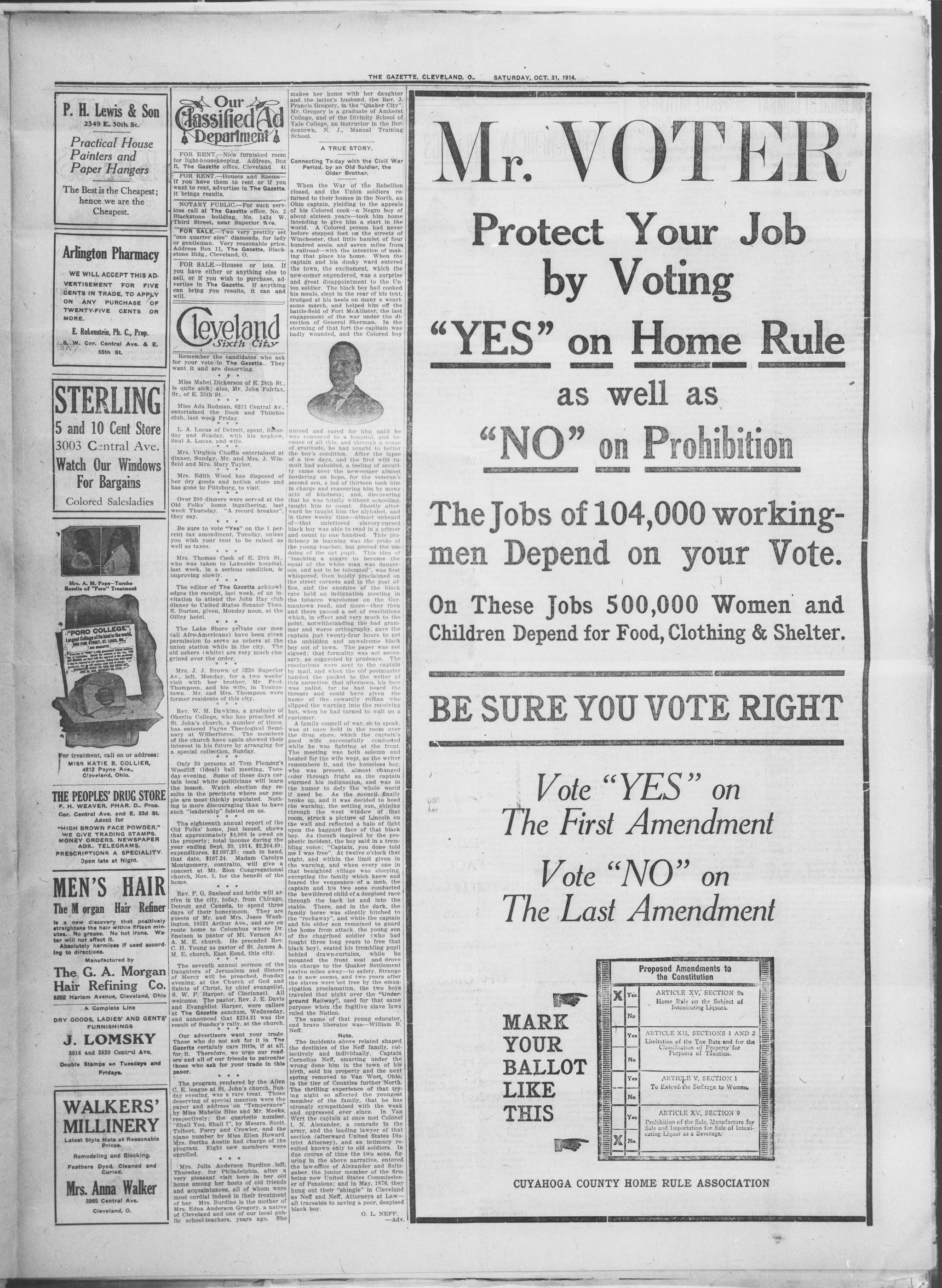
Mr. VOTER
"NO" on Prohibition
The Jobs of 104,000 workingmen Depend on your Vote.
On These Jobs 500,000 Women and Children Depend for Food, Clothing & Shelter.
BE SURE YOU VOTE RIGHT
Proposed Amendments to the Constitution
X Yes
No
Yes
No
Yes
No
Yes
No
ARTICLE XV, SECTION 9a
Home Rule on the Subject of Intoxicating Liquors.
ARTICLE XII, SECTIONS 1 AND 2
Limitation of the Tax Rate and for the Classification of Property for Purposes of Taxation.
ARTICLE V, SECTION 1
To Extend the Suffrage to Women.
ARTICLE XV, SECTION 9
Prohibition of the Sale. Manufacture for Sale and Importation for Sale of Intoxicating Liquor as a Beverage.
MARK YOUR BALLOT LIKE THIS
CUYAHOGA COUNTY HOME RULE ASSOCIATION
Battle of Flanders Is Described From
the Brief but Ghostly Details
Wired From Fighting Front.
"MASSACRE, NOT A FIGHT! A BUTCHERY!"
Germans Have Been Stopped, but at
the Cost of Terrible Loss of Life—
No Pure Water for Wounded
—No Quarter Is Asked and
London, Eng.—The lurid glare of burning bushes with shadowy figures limbed faintly against a background of smoke, working like demons in an inferno of death of their own creation, the spiteful rattle of machine guns, the roar of bursting shells, the impact of driven bayonet against human flesh and bone, the cries of wounded, shouts of triumphs, shrieks of despair, rivers running red with blood, through heaped up piles of dead—this is the battle of Flanders as London pictures it from the brief but ghastly details telegraphed from the fighting front.
Loss of Life Appalling.
"A massacre, not a fight!" A butchery! "A shambles!" Such are the phrases used over and over by correspondents endeavoring to give an inkling of events of this bloodiest battle of the war. "No quarter is asked and none is given. It is the battle of the bayonets!"
Belgian regiments have been decked to a third of their former fighting strength; British troops stand grim and dogged in the face of fearful loss; gallant Frenchmen shout with the lust of combat, and, opposed to them in the submiline grandeur of death, the solid ranks of Germany march unswervingly against a withering fire and literally bestrew the landscape with their corpses. There is no pure water for the wounded. The entire available supply is streaked and stained with blood—and there is no one to cool parched lips and burning brows even with this. There is no chance to bury dead or care for wounded; the ground they lie on is harrowed and furrowed over and over by the spraying bullets of mitrailleuses and the tearing fragments of bursting shrapnel.
And out of the chaos there looms one fact from England—at home—may extract some comfort. The Germans seem to be stopped.
The latest official statement from Paris received here announces that two furious night attacks by Germans on the allied line in the region of Dixmude were repulsed and that all along the front, from Nieuport to Dixmude, the Germans seemed to have lessened their efforts, while the allies, continuing their offensive to the north of Ypres, also have been successful further to the south, making slight progress on the line between LaBasse and Lens.
Germana Almost Abandon Hope.
Indications from this statement and also from the statement issued by the German general war office are that the kaiser's generals have almost abandoned hope of advancing to Dunkirk and Calais.
The correspondent of the Evening News wires that the Germans are falling back, but there is nothing in the other reports from the front to confirm this. Other reports are that the enemy is short of ammunition. And yet they have crossed the River Ryer seven times and seven times have been driven back. The losses were terrible and at some points bridges across the river were actually formed by the bodies of dead German soldiers, piled up in the slurghish current.
Advices from Bruges and Ostend and other points in Belgium indicate that the Germans are stripping that territory of all soldiers except the barest garrisons and are rushing all reinforcements possible to the army that is trying to break through the British-Belgian-French line that is guarding the approaches to Dunkirk and Calaix.
Further encouraging news came from the press bureau of the Belgian government at Havre in a statement that the condition of the allied troops on the Yer was improved, while the enemy's artillery fire was slackening and in some places had been subdued entirely by the guns of the fleet operating along the coast. The statement added that the operations along the Ypres were considered "very satisfactory."
Land Batteries Bombard Warships.
Land Batteries Bombard Warships. Opposed to this was a wireless dispatch from Berlin to the effect that the land batteries of the Germans had been bombarding the fleet and had succeeded in hampering its operations greatly. The wireless said that several British warships had been struck by shells and were afire. Other dispatches from Berlin by way of Amsterdam carried a flat contradiction to the
Has New Teaching Idea.
Lorain, O. — Principal Raymond Sullivan of the Charleston school has worked out a novel plan to increase the general knowledge of pupils in the eighth grade of his schools. Each pupil was assigned one of the 48 state capitals and was instructed to write to the mayors and department heads for information concerning the city, its management, its railways, lighting systems and other features of the city's life. A mass of pamphlets and letters has been received.
Thirty Die as Ship Sinks.
Dover, vla. London.—The steamer Admiral Ganutea was sunk Monday by a mine just outside Boulogne harbor.
About 20 or 30 persons were drowned, owing to the panic which prevailed as the passengers were being transferred to the cross channel steamer Queen, which rushed to the assistance of the sinking vessel.
Most of the passengers were peasants from Pas De Calais, who had been taken aboard at Calais to be transferred to Boulogne.
DESPERATE BATTLES IN EASTERN WAR THEATER
German Soldiers Are Apparently Engaging Numerically Superior Russian Forces. According to Late Reports.
Berlin (by wireless to Sayville, L. L.)—Austro-German official reports from the eastern theater of the war indicate severe battles are raging along the Vistula and San rivers. The Germans apparently are engaging numerically superior Russian forces and the battle is attracting equal attention with the struggle in France and Belgium. The bulletin just issued by the Austrian war department states the Austrails southwest of Ivangorod are combating numerically superior forces of Russians. Further Russian corps, whose crossing of the Vistula river north of Ivangorod have been mentioned in the earlier German reports, seem, according to Maj. Morah, military correspondent of the Berliner Tageblatt, to be directed against the German army.
Belgian press bureau reports and said that the battle of the Yser was going favorably for the kaiser's arms.
That the Germans are anticipating the landing of troops on the Belgian coast from transports under the protection of the British fleet is evidenced by the news reported to the Chronicle by its Amsterdam correspondent that the German headquarter's staff has moved from Ostend to Heyst, while tugs and dredges commandeered in harbor at Ostend have been used to strew mines thickly through the waters along the coast. Ostend is crowded with German wounded, according to travelers who have reached Amsterdam from the Belgian seaport. It is estimated that in the fighting along the Yser the Germans have lost 12,000 men a day. Another estimate puts the German losses at 46,000, and it is feared that the allies, while not so hard hit, have suffered terribly in the almost hand-to-hand fighting that has been in progress continually day and night since early last week.
Death Doesn't Spare Royalty.
One wounded Belgian soldier is quoted as saying that out of the 600 men who originally comprised his regiment, fighting in the trenches along the Yser, only about 200 are left. In one place the Germans hid in one trench along the Yser, fearing to cross the river under the Belgian fire. Belgians crept into another trench along the river and found themselves separated from the enemy only by a wall of earth six feet through. They could hear the Germans conversing and finally engaged them with the bayonet, killing many and driving others to death in the river. Death has not spared royalty in this engagement, late dispatches announcing that Prince Maurice of Battenberg, youngest son of Prince Henry of Battenberg and Princess Beatrice and a grandson of Queen Victoria, has been killed on the battle front. Crown Prince Ruprecht of Bavaria also is reported to have been wounded in the fighting.
The army commanded jointly by the crown prince and the Duke of Wurtemburg has been in the thick of the fighting and on a front opposed by one English brigade left 1,600 corpses after one retreat. At another point along the battle front near Ypres the Germans, planning a night attack, sent out scouts, who saturated the bushes and dried grass with kerosene. This was suddenly fired and the Germans swept on in a charge, singing and shouting as they advanced in the flickering light. They succeeded in surprising the British, who held the trenches, but were subjected to a withering fire and finally beat a retreat that was changed into a rout when the English soldiers leaped into the open and took after them with the bayonet.
German Manuever Falls.
This attack followed the capture of Lange Marc, five miles north of Ypres, the British troops inflicting enormous losses on the enemy. The victors had established themselves in entrenched positions beyond the village and it was here that the Germans expected their maneuver of firing the bushes would give them an advantage they had not been able to gain in the day fighting. So badly had they miscalculated, however, that, in addition to losing hundreds of men from gun fire and bayonet, they suffered the capture of a battery and several machine guns and more than 1,000 prisoners, including a general and several other officers. The French official report received here also indicates that the Germans are not doing so well on the eastern end of their line in France. They are reported to have been repulsed in a night attack on the Highway des Dames, in the vicinity of Cranonne, where the number of killed and wounded Germans was about 2,000, while the French loss was only about 100 killed or wounded.
Couples Tango to Safety.
New York City—A boiler in the basement of the Hotel Continental blew up, seriously injuring four persons and causing a panic among 700 men and women in the 10-story structure. One hundred were dined in the Cafe Boulevard, directly above the wrecked boiler. Lights in the building were extinguished. A panic seized the men and women at the cafe tables. As they groped for the door in the dark the orchestra suddenly began playing a lively tango air. Nearly 30 couples tangued to safety.
Releases U. S. Tanker
London, England.—The British government, satisfied after an examination of the innocence of the destination of her cargo, has ordered the release of the American oil tank steamer Brindille, which will be permitted to proceed to Alexandria. The question of the transfer of the vessel from the German to the flag of the United States will not be raised by the British government. The Brindille, carrying a cargo of illuminating oil, was seized by the British cruiser Caronia and taken into Halifax, N. S.
THE GAZETTE, CLEVELAND, O., SATURDAY, OCTOBER 31, 1914.
AFRO-AMERICAN CULLINGS
Our readers have already been instructed and edified by Mrs. George F. Shears' account of the biennial meeting of the Federation of Colored Women's clubs at Wilberforce, O. Miss Zona Gale, her companion, the two, we believe, making the only white attendants, has given her version of the story in Life and Labor, the organ of the Woman's Trade unions. The extracts from the utterances of those present found in Miss Gale's article are so persuasive and inspiring that we gladly lay hold of them for the benefit of Unity readers. The chairman of the executive board, Mrs. Mary Talbert of Buffalo, among other things said:
"Never in the history of our race have our women had so great a privilege as is granted to us, the privilege to be and to do what we will, to develop our highest powers, to improve every opportunity, to satisfy our deepest longings for educational advantages. For the women of our race of 50 years ago were the common burden bearers, the common property of the horde, refused the privilege of reading and writing, forbidden to recognize their own names when they saw them in writing. And yet they were trusting in God.
"To my mind comes the first Negro club woman, Frances Ellen Watkins Harper, who after the Civil war—or rather, I might say, after our new birth—went up and down the Southland to the newly liberated slaves, and urged upon those mothers to start at the fireside. In a letter dated Greenville, Ga., March 29, 1870, she writes: 'Now is the time for women to begin to try to lift up their heads and plant the roots of progress under the heartstones. Today the Negro women all over the country have seen that flower grow, and it is for us to continue to plant.'
"This is the field. Now what of the co-operation? There can be but one motive in all our work—the spirit of Christian love, the expression of racial brotherhood. What we have done cannot be measured only by advance, but by the deterioration which we have helped to prevent. We know that in every community there are splendid women who have not yet seen the necessity of 'lifting as we climb', who have not felt that they could leave their whist tables to do this work, and yet they will tell you that they are in sympathy with what we are trying to do. Nobody can be the friend of any class by being the enemy of any other class. You can be the friend of one class only by showing it the line along which it can accommodate its work to the best advantage. The lines of help are always the lines of this accommodation. I firmly believe that the more we interest our women of the favored classes to work with the women in humbler lives the better our work will be done—this work of lifting an entire Negro manhood and womanhood into better life.
"It behooves us as club women to see that we urge our ministry to co-operate with us. Often ministers have been particularly antagonistic to this club movement, fearing that it will affect the financial support of the church. We sympathize with the feeling of such ministers, for we know that the average minister does not receive a living salary, much less a working salary. But we must educate them to the fact that the time has come when they, too, must join with us in enlarging the work by these organizations of women's clubs." - Unity
Inquiries replies to which will demonstrate convictions pertaining to a majority of the questions now of the greatest importance to the Negro race have been sent to all candidates for congress of the Republican, Democratic Association for the Advancement of Colored People, with headquarters in New York. The candidate is requested to make known his intention as to whether, if elected, he will vote against any measure abrogating the fourteenth and fifteenth amendments, segregation in the federal service, residential segregation in the District of Columbia, segregation as regards "Jim Crow" cars in the district and laws making racial intermarriage in the district invalid. He is also asked if, under any circumstances, he justifies lynching or favors the enforcement of clause 2 of the fourteenth amendment of the Constitution.
Recently colored nurses have been placed in responsible positions as attendants in the state hospitals of Kansas.
Applewood is the favorite material for ordinary saw handles, and some goes into so-called briar pipes.
Nearly five hundred cities now have public playgrounds and about half of them receive municipal support.
To the close of 1913 Alaska had produced known mineral wealth to the value of $248,300,000.
More than 858,000 young trees are being set out on national forests in Utah and southern Idaho.
Automobiles are becoming popular in Beirut, Syria. Already 27 cars are registered.
St. Pierre, Martinique, destroyed in 1902 by earthquake, has never been rebuilt.
More than 50,000 Africans—Negroes—have come to this country since 1901.
The buffalo of the United States and Canada now number about three thousand.
If one of three Negro boys can't ride the animal, that horse will not see service in the allies' cavalry. The British government, which continues buying horses at the Kansas City stock yards, says nothing about Negroes in its horse contracts, but under the clause "well broken" the British inspectors have to see the horse ridden, and it is up to the man selling the horse to supply riders. Therefore it falls to Negro cuffers at the horse barns to supply the "nerve touch" required by the British. Sambo, Pete, Jake one day, it may be Fred, "William," or "Toots" the next. It makes little difference what their last names are. They are heroes among their fellow beings, and in addition to the receipt of three to five dollars a day, by risking their necks oftener they may get a tip from the boss.
The firm handling the horses has tried cowboys and circus riders, but because riders are not allowed saddles real cowboys pass up the job. The uncertain gait and movements of the horses soon discourage the circus riders. But the Negro boys stick. An alley 150 feet long, flanked by high board fences and brick paving underneath, may be the horses' last run in America. Horse and Sambo are at one end, the inspector at the other.
"Ready," calls the ring master, and Sambo goes in the air, alights like a spring clothespin on a new rope line. The horse may go all right, and then he may go both ways at once, but if he passes up and down the alley twice without displacing his jibsall he goes to the British.
The British government has accepted 5,100 horses at the Kansas City stock yards barn. The animals had all been measured, tested for sight and soundness, and the bulk of them ridden by colored boys.
Most of them had been given the "Mallein" test for glanders. D. H. B. Adair and his assistants in Kansas City of the United States bureau of animal industry, applied that test to 4,370 horses, during September, and 1,000 more are at Lathrop, Mo., awaiting the test. The government test for glanders is free of charge.
After the rider has discharged his duty the horse is turned to the branders and when he gets through, there is an arrow on the shoulder, and a number on the hoof. The horse is a Britsher.
Jacob Estey, one of the pioneer makers of planos and organs in America, was born in Hinsdale, N. H., one hundred years ago. His youth was one of adversity, and it was only by the hardest work and personal sacrifice that he was able to obtain a common school education. At the age of twenty-one he bought with his savings an interest in a business for the making of melodeons. For a number of years thereafter he acted as his own salesman, traveling through New England and Canada selling his instruments. With the profits thus obtained he embarked in the manufacture of planos and organs. His business grew rapidly, and at the time of his death, in 1890, it was the largest of its kind in the world. Mr. Estey spent his large fortune liberally for good purposes. He was the chief founder of Shaw university for colored people at Raleigh, N. C.
In the Hampton Trade school, and, indeed, in other departments, a student is rated for speed, accuracy, judgment, initiative, earnestness, neatness, responsibility and conduct. Of course, all of these factors do not receive the same weight, but they do form the basals for judging individuals. Hampton applies, in its daily routine, the common tests of everyday life used in the outside world where men and women must stand or fall according to the standards which they attain in their work.
Learning by doing, turning disadvantages into advantages, making the best use of one's resources—these are some of the fundamentals in the Hampton idea of education. Service and self-sacrifice form the core of the Hampton training. Results in good citizenship and safe leadership characterize Hampton's work.
The total coal supply of the world recently was estimated at 7,397,533,000,000 tons, of which nearly 4,000,000,000 tons are bituminous. Asia having the largest quantity of any continent.
Last year the revenue cutter service saved 327 persons from death or peril, took 264 persons off shipwrecked vessels, destroyed 31 derelicts and saved other derelicts to the value of $18,000.
San Antonio, Tex., is to try the experiment of paving streets with mesquite wood blocks. It is stated that millions of acres of land in southern Texas and northern Mexico are covered with a thick growth of mesquite trees. The wood, it is said, is of remarkable durability.
Salmon fishermen in British Columbia earn $15 a day, and some instances when the catch is exceptionally good as much as $25 a day.
The world's greatest deposit of wolframite, the mineral from which tungsten is obtained, now being exploited in the world, is in Portugal.
A San Francisco electrical company is using a demonstration car to make rural communities acquainted with the use of the current on the farm and in the household.
---
GIVES TOO WIDE LINE
NEW SKIRT NOT PLEASING TO THE LARGE WOMAN.
Accentuatezs Size, and is Hard to Handle Properly—Chemise-Like Bodice is to Continue In Fashion, it Appears.
No other style has been invented that could make the large woman appear so large as the new skirts with their plainly drawn back, their widely flaring circular sides and front, or sometimes a plaited front dividing the circular sides. You can quickly see what a wide line is given across the figure, back and front. The front is able to stand it better than the back.
Another error that is easily fallen into, is a swinging upward movement of the middle front of such a skirt. This ugliness happens even under the hands of the best regulated dressmakers. The weight and fullness of the material causes this sagging at the sides and back and, although one does not object to an irregular hem, it must come through foreknowledge and not through bad workmanship.
None of the dressmakers advocate fullness over the hips. Here and there one sees isolated cases of hip drapery, but the newest fashions do not call for it. In all the best gowns for street and evening, the hips are flattened out The green serge skirt of the frock illustrated makes its claim to newness by reason of the group of width-giving tucks at the side, and the black-braided velvet tunic by its absence of a waist line. as though they had been pressed with a hot iron. This is to accentuate the fullness at knees and hem.
There are various ways of obtaining the desired flatness. It is not all a question of hip yokes. There are box plats running from waist to hem; there are long pointed segments of cloth that run nearly to knees which divide the fullness and keep it away from the hips; there are plastered bits of barbary embroidery from which spring circular sides that flare at the hem. Each of the French dressmakers has a different way of maintaining smoothness just below the waist, and to these original methods the Americans have added.
One of the fashions that France introduced last June is the foundation stone of all the clothes of today. This
L
is the long, straight upper part of the gown which sometimes develops into a tunic, or which ends at the wide cash placed over the hips.
There is nothing strikingly new about this chemise-like bodice, for it has been worn continuously for three months, but the dressmakers exploited it in the new clothes and we shall doubtless wear it until Christmas. If anything newer is invented, it will probably come from an American stelier, for there is no reason to suppose that France will produce new ideas in the nearby months; there are quite enough over here now to satisfy even the most exacting woman.
It is probable that this long, child-like garment—for it really is juvenile—which has slim simplicity as its foundation, and is called Moyen-age for want of a better term, will prove an obstacle to a good appearance as much as the over full skirts will do.
I am one of those who believe that a young man with sane ideas of life, who has formed early habits of industry and who has initiative and a fair share of good judgment, can climb the ladder as high as he chooses. The world is looking for that kind of young men today as never before. Some of the troubles are about like this: "Nineteen out of every twenty young men (and I might include many older men) are inherently better than their work would indicate. Their faith
No Proverb to Guide Him.
She—"A proverb says that fruit is gold in the morning and lead at night, meaning that it's bad for one in the evening, I suppose." He—"That's right! Look at the trouble Adam got into by eating an apple after Eve."—boston Transcript.
True Greatness
He only is a great man who can neglect the applause of the multitude, and enjoy himself independent of its favor.—Steele.
A
Model of gray broadcloth effectively trimmed with nickel buttons. A new feature of this suit is the long tunic.
but if care is taken with it, and attention paid to the way it is cut and trimmed, the general result will not be as bad as prophesied.
One sees the garment in every fabric, and it will be unfortunate if one sees it on every figure. It, like all the fashions for the last four years, is primarily intended for the modern figure that has been developed through fashion, or the other way around—no one knows which.
Copyright. McClure Newspaper Syndicate.
IN THE LINE OF ECONOMY
Matter Should Be Handled in a Systematic Way After Being Given Much Consideration.
When one has to spend a greatly diminished dress allowance to the very best advantage, as a great many women have to do this year, the chief economies must be effected by limiting the number of gowns, wraps and hats, and of the oddments on which we often fritter away so many dollars in the course of a season. The few garments bought should be of as good style and quality as possible, while the principal expenditure should be in such things as corsets, underwear, footwear and gloves, which are of equal importance for health and for appearance.
If these be irreproachable one will look "well turned out" in the simplest gown, provided it is trim and tidy, of good quality and becoming in color and cut. The great fault of the average woman, as a rule, is that she expends too little, in proportion, on those first necessaries—corsets especially—hence she often appears dowdy even when expensively attired.
SKIRTS SURE TO BE WIDER
Change Is Being Made Gradually But
It Is Noticeable in All the
Newest Models.
The most noticeable feature of the
ever-changing fashions is the gradual
widening of skirts. There are suits
made with full circular skirts set on
a deep yoke. Other styles are in
intered design, s., with three circular
floures. Some plain suits with long
coats have fitted panels introduced
to give fullness. A few skirts are
gathered and set on deep yokes.
Many dressy afternoon gowns have
a flounced cr plaited skirt. On the
newest model, even when the
extremely long tunic is employed, the
underskirt is sufficiently wide to give
ease in walking. In evening gowns
the skirt fullness is quite marked, the
side sections being rippled sufficiently
to allow of a broader train than has
been seen for several seasons.
The skirts of all garments are extremely short, except in the case of a few evening gowns, which have the skirt very short in front only, the skirt very long in front to a point in the back, where the skirt is long enough to touch the floor.
To Keep the Hat Dustless
A traveling hat bag costs five dollars. It is made of waterproof cloth on a collapsible frame, that, when open, is strong and big enough to protect the largest hat and, when closed, is small and light enough to be almost unnoticeable in the bottom of the trunk. It comes in navy blue and black.
is that they are satisfied with less than their best. Their limitations are in the forefront, instead of being absorbed by their work. They fail to make the effort to live up to the best there is in them. They shirk responsibility without knowing it. This becomes a habit of mind. Their mental attitude shuts them out from assuming their share of the load. The man himself may not be aware of it, but the boss is, if he is a student of human nature as most bosses are—James H. McGraw, in Era.
Domesticated Canaries.
There are 12 distinct breeds of canaries. About 500 years ago a Spanish sea captain brought from the Canary islands some insignificant little greenish birds which were called canary birds, and from these have been evolved the 12 species or varieties of canaries known to the breeder of today.
For Artists.
An artist should be fit for the best society and keep out of it—Ruskin.
CAP and BELLS
RESOURCES OF A BOOK AGENT
Quickly Discovers His Error in Attempting to Sell Poetry to Gentleman Wearing Pink Shirt.
"How about a collection of the world's best poetry in six volumes?" said the book agent. "Selections from Shakespeare, Milton, Spencer and all the famous poets."
"Say," exclaimed the man at the desk, wheeling around in his chair and displaying a poker vest, a pink shirt and a diamond stud, "what sorter guff are you tryin' to glimmse?
"Beg pardon," answered the resourceful agent, as he reached into his satchel and drew out a paper-covered volume. "I was just about to ask you if you would like to have a copy of the life of John L. Sullivan, written by one of the most noted referees in the business?"
Ask Some Milkman
The following notice recently appeared outside the office of a busy Boston firm: "Boy Wanted—One who knows the city well." Presently a bright youth presented himself for a job.
"Do you know the city well?" asked the manager.
"No sir," replied the young hopeful, "but I could find it."—Boston Globe.
No Wonder He Was Sore.
"He makes me tired!" I tried half a dozen times to say something, but he talked to me a standstill each time with his talk about the European war. He thinks he knows all about it.
"That was too bad, dear. What did you wish to say?"
"I wanted to tell him what caused the doggone war and how it was going to come out."
Just the Thing.
Reporter--You sent me to interview General Leadenhall about the war, but he says the president has forbidden military men from expressing their opinions.
Managing Editor--Didn't he give you any opinion at all?
"Nothing but vague generalities."
"Well, write them over into a leading editorial—Life."
Poor Papa.
Little Bobby~Papa, did you ever see a cyclone carrying houses in the air and cows and horses and wagons upside down? Do you ever my son.
York, 100-110, 111
Little Bobby—I should think it 'ud be tiresome to live to your age and never see anything—London Tit-Bits.
Mean Brute
"A woman can't be in two places at the same time," snapped Mrs. Gabb, during the usual morning fuss.
"I notice that you can be in and out of the house at the same time when some female that you don't want to see happens to call," replied Mr. Gabb.
M.
The Bill Collector—I can't keep coming here every day for this bill.
Mr. I. M. P. Cunlus—I've often wondered why you didn't try to get a better position.
Art's Unkindness
"My farewell appearance was an occasion of the greatest enthusiasm," said one prima donna.
"Yes," replied the other. "Isn't it remarkable that such a large number of people should have seemed so delighted to hear you for the last time."
Plenty.
"Why don't you lay by something for a rainy day?"
"I have."
"Huh! I'd like to know how much?"
"One dollar. And the latest quotation on umbrellas is 98 cents."
in Society.
"I got in bad at that London prize fight."
"How was that?"
"I hadn't noticed who was sitting next to me and tried to borrow a chew of tobacco from a duchess."
The Right One.
"You say there is wine and bark in this tonic you are recommending?"
"Yes."
"All right. Then I am going to try it on the dog."