The Gazette
Saturday, December 12, 1914
Cleveland, Ohio
Page text (machine-generated)
THIRTY-SECOND YEAR. NO. 20.
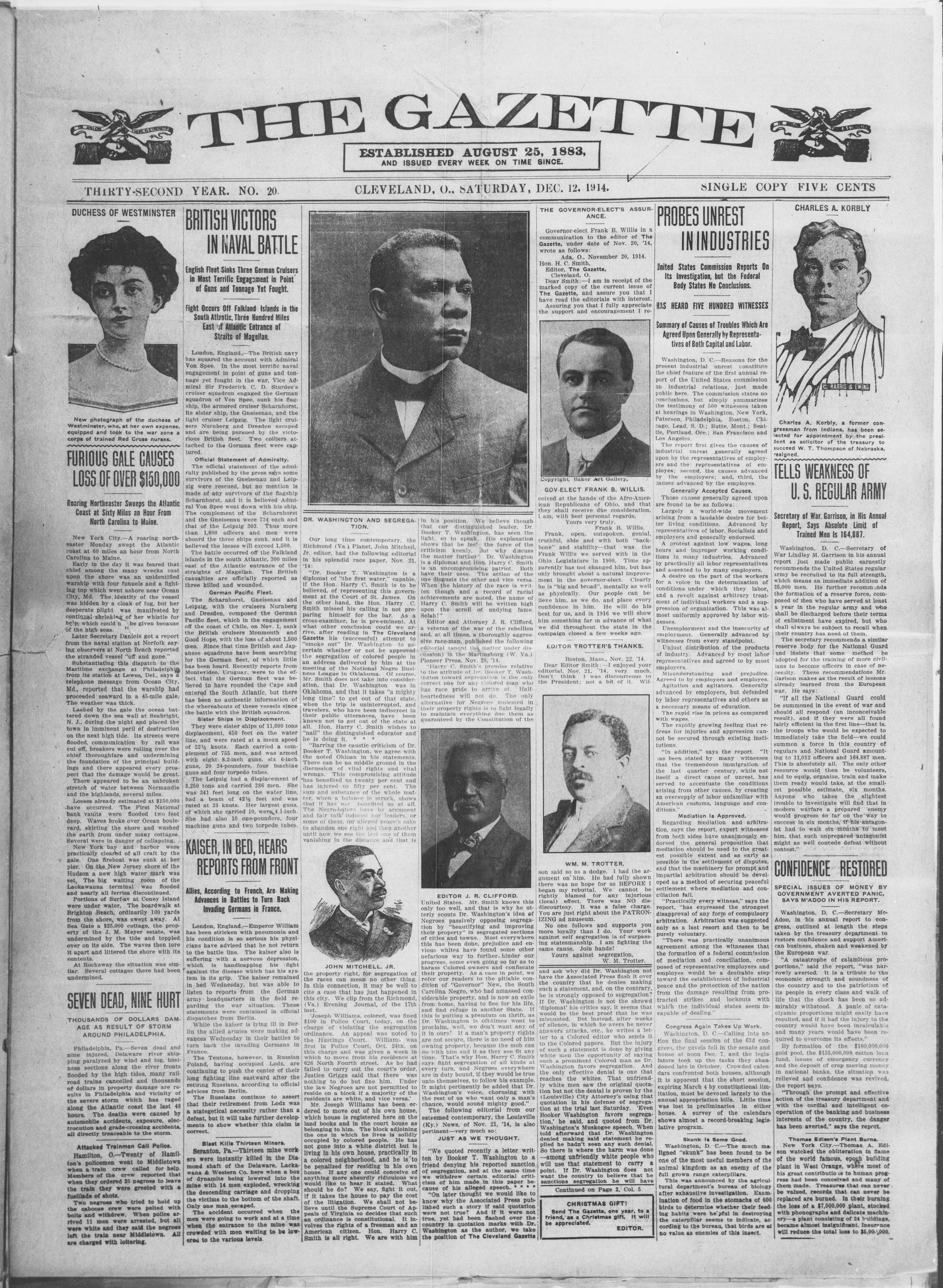
THE VATICAN THANK YOU FOR SUPPORT
New photograph of the duchess of Westminster, who, at her own expense, equipped and took to the war zone a corps of trained Red Cross nurses.
FURIOUS GALE CAUSES LOSS OF OVER $150,000
Roaring Northeaster Sweeps the Atlantic Coast at Sixty Miles an Hour From North Carolina to Maine.
New York City—A roaring north-easter Monday swept the Atlantic coast at 60 miles an hour from North Carolina to Maine.
Early in the day it was feared that chief among the many wrecks cast upon the shore was an unidentified warship with four funnels and a fighting top which went ashore near Ocean City, Md. The identity of the vessel was hidden by a cloak of tog, but her desperate plight was manifested by continual shrieking of her whistle for help, which could not be given because of the high seas.
Later Secretary Daniels got a report from the naval station at Norfolk saying observers at North Beach reported the stranded vessel "off and gone."
Substantiating this dispatch to the Maritime exchange at Philadelphia from its station at Lewes, Del., says a telephone message from Ocean City, Md., reported that the warship had proceeded seaward in a 45-mile gale. The weather was thick.
Lashed by the gale the ocean battered down the sea wall at Seabright, N. J., during the night and placed the town in imminent peril of destruction on the next high tide. Its streets were flooded, communication by rail was cut off, breakers were rolling over the chief thoroughfare and undermining the foundation of the principal buildings and there appeared every prospect that the damage would be great. There appeared to be an unbroken stretch of water between Normandie and the highlands, several miles.
Losses already estimated at $150,000 have occurred. The First National bank vaults were flooded two feet deep. Waves broke over Ocean boulevard, skirting the shore and washed the earth from under many cottages. Several were in danger of collapsing. New York bay and harbor were practically cleared of all craft by the gale. One fireboat was sunk at her plier. On the New Jersey shore of the Hudson a new high water mark was set. The big waiting room of the Lackawanna terminal was flooded and nearly all ferry discontinued. Portions of Surfav at Coney Island were under water. The boardwalk at Brighton Beach, ordinarily 100 yards from the shore, was swept away. At Sea Gate a $25,000 cottage, the property of the J. M. Meyer estate, was undermined by the tide and toppled over on its side. The waves then tore it apart and littered the shore with its contents. At Rockaway the situation was similar. Several cottages there had been undermined.
SEVEN DEAD, NINE HURT
THOUSANDS OF DOLLARS DAMAGE AS RESULT OF STORM AROUND PHILADELPHIA.
Philadelphia, Pa.—Seven dead and nine injured, Delaware river shipping paralyzed by wind and fog, business sections along the river fronts flooded by the high tides, many railroad trains canceled and thousands of dollars in property damage are results in Philadelphia and vicinity of the severe storm which has raged along the Atlantic coast the last 48 hours. The deaths were caused by automobile accidents, exposure, electrocution and grade-crossing accidents, all directly treasable to the storm.
Attacked Trainmen Call Police.
Hamilton, O.—Twenty of Hamilton's policemen went to Middletown when a train crew called for help. Members of the crew reported that when they ordered 25 negroes to leave the train they were greeted with a fusillade of shots. Two negroes who tried to hold up the caboose crew were pelted with bolts and withdrew. When police arrived 11 men were arrested, but all were white and they said the negroes left the train near Middletown. All are charged with lottering.
THE GAZETTE
BRITISH VICTORS IN NAVAL BATTLE
English Fleet Sinks Three German Cruisers in Most Terrific Engagement in Point' of Guns and Tonnage Yet Fought.
London, England.—The British navy has squared the account with Admiral Von Spee. In the most terrific naval engagement in point of guns and tonnage yet fought in the war, Vice Admiral Sir Frederick C. D. Sturdee's cruiser squadron engaged the German squadron of Von Spee, sunk his flagship, the armored cruiser Scharnhorst, its sister ship, the Gneisenau, and the light cruiser Leipzig. The light cruisers Nurnberg and Dresden escaped and are being pursued by the victorious British fleet. Two colliers attached to the German fleet were captured.
Official Statement of Admiralty.
The official statement of the admiralty published by the press says some survivors of the Gneisenau and Leipzig were rescued, but no mention is made of any survivors of the flagship Scharnhorst, and it is believed Admiral Von Spee went down with his ship. The complement of the Scharnhorst and the Gneisenau were 734 each and that of the Leipzig 303. Thus more than 1,800 officers and men were aboard the three ships sunk, and it is believed the losses will exceed 1,500.
The battle occurred off the Falkland islands in the south Atlantic, 300 miles east of the Atlantic entrance of the straights of Magellan. The British casualties are officially reported as three killed and wounded.
German Pacific Fleet.
The Scharnhorst, Gneisenau and Leipzig, with the cruisers Nurnberg and Dresden, composed the German Pacific fleet, which in the engagement off the coast of Chile, on Nov. 1, sank the British cruisers Monmouth and Good Hope, with the loss of about 1,500 men. Since that time British and Japanese squadrons have been searching for the German fleet, of which little has been heard. Recently reports from Montevideo, Uruguay, were to the effect that the German fleet was believed to have rounded the Cape and entered the South Atlantic, but there has been no authentic information of the whereabouts of these vessels since the battle with the British squadron.
Sister Ships in Displacement.
They were sister ships of 11,600 tons displacement, 450 feet on the water line, and were rated at a mean speed of $22\frac{1}{2}$ knots. Each carried a complement of 755 men, and was armed with eight.8-2-inch guns, six 6-inch guns, 20.24-pounders, four machine guns and four torpedo tubes.
The Leipzig had a displacement of 3,250 tons and carried 286 men. She was 341 feet long on the water line, was a beam of $42\frac{1}{2}$ feet and was rated at 23 knots. Her largest guns, of which she carried 10, were 4.1-inch. She had also 10 one-pounders, four machine guns and two torpedo tubes.
KAISER, IN BED, HEARS REPORTS FROM FRONT
Allies, According to French, Are Making Advances in Battles to Turn Back Invading Germans in France.
London, England.—Emperor William has been stricken with pneumonia and his condition is so serious his physicians have advised that he not return to the battle line. The kaiser also is suffering with a nervous depression, which is handicapping his fight against the disease which has his system in its grip. The kaiser remained in bed Wednesday, but was able to listen to reports from the German army headquarters in the field regarding the war situation. These statements were contained in official dispatches from Berlin.
While the kaiser is lying ill in Berlin the allied armies were making advances Wednesday in their battles to turn back the invading Germans in France.
The Teutons, however, in Russian Poland, having occupied Lodz, are continuing to push the center of their long fighting line eastward after the retiring Russians, according to official advises from Berlin.
The Russians continue to assert that their retirement from Lodz was a stategetical necessity rather than a defeat, but it will take further developments to show whether this claim is correct.
Blast Kills Thirteen Miners.
Seranton, Pa.—Thirteen mine workers were instantly killed in the Diamond shaft of the Delaware, Lackawana & Western Co. here when a box of dynamite being lowered into the mine with 14 men exploded, wrecking the descending carriage and dropping the victims to the bottom of the shaft. Only one man, escaped. The accident occurred when the men were going to work and at a time when the entrance to the mine was crowded with men waiting to be lowered to the various levels.
ESTABLISHED AUGUST 25, 1883 AND ISSUED EVERY WEEK ON TIME SINCE.
CLEVELAND, O., SATURDAY, DEC. 12, 1914.
[Picture of a man in a suit with a bow tie].
DR. WASHINGTON AND SEGREGATION.
Our long time contemporary, the Richmond (Va.) Planet, John Mitchell, Jr. editor, had the following editorial in his splendid race paper, Nov. 21, 14: "Dr. Booker T. Washington is a diplomat of "the first water," capable, if the Hon. Harry C. Smith is to be believed, of representing this government at the Court of the Houses. On the other hand, the Hon. Harry C. Smith missed his calling in not preparing himself for the bar. As a cross-examiner, he is pre-eminent. At what other conclusion could we arrive, after reading in The Cleveland Gazette his (successful) attempt to "smoke out" Dr. Washington—to ascertain whether or not he approved the segregation of colored people in an address delivered by him at the meeting of the National Negro Business League in Oklahoma. Of course, Mr. Smith does not take into consideration, that Dr. Washington was in Oklahoma, and that it takes "a mighty long time" to get out of that state, when the trip is uninterrupted, and travelers, who have been indiscreet in their conduct, are known not to get out of the state at all. Hon. Harry C. Smith wishes to "nail" the distinguished educator and he is doing it. * * *
"Barring the caustic criticism of Dr. Booker T. Washington, we agree with the noted Ohio in his statements. There can be no middle ground in the discussion of vital rights and vital wrongs. This compromising attitude has benefited us twenty per cent and has injured us fifty per cent. The sun and substance of the whole matter, when a balance is struck, shows that it has not benefited us at all. The Neuro-haters have by argument and fair talk induced our leaders, or some of them, for alleged peace's sake to abandon one right and then another until now we see the last one of them vanishing in the distance and that is
JOHN MITCHELL, JR.
the property right, for segregation of the races can mean no other thing. In this connection, it may be well to cite a case that has just happened in this city. We clip from the Richmond, (Va.) Evening Journal, of the 17th inst.
Joseph Williams, colored, was fired $100 in Police Court, today, on the charge of violating the segregation ordinance. An appeal was noted to the Hustings Court. Williams was first in Police Court, Oct. 24th, on this charge and was given a week in which to move from his residence at 626 North Fourth street. As he had failed to carry out the court's order, he was charged with nothing to do but fine him. Under the law Negroes are not permitted to reside on a block if a majority of the residents are white, and vice versa. Mr. Joseph Williams has been ordered to move out of his own house, which house is registered here on the land books and in the court house as belonging to him. The block adjoining the one in which he lives is solidly occupied by colored people. He has not gone into a white district but is living in his own house, practically in a colored neighborhood, and he is to be penalized for residing in his own house. If any one could conceive of anything more absurd ridiculous we would like to hear it stated. What should he say to the court? What should the house to pay the cost of the litigation. We shall not be believe until the Supreme Court of Appeals of Virginia so decides that an ordinance is constitutional. It involves the rights of a freeman and an American citizen. Hon. Harry C. Smith is all right. We are with him.
In his position. We believe though that our distinguished leader, Dr. Booker T. Washington, has seen the light, so to speak. His explanation shows that he feel" the force of the criticism keenly. But why discuss the matter further? Dr. Washington is a diplomat and Hon. Harry C. Smith is an uncompromising patriot. Both are well made the official of one disguits the other and vice versa. When the history of the race is written though and a record of racial achievements are noted, the name of Harry C. Smith will be written high upon the scroll of undying fame, Selah!" Editor and Attorney J. R. Clifford, a veteran of the war of the rebellion and, at all times, a thoroughly aggressive race-man, published the following editorial (anout the matter under discussion) in the Martinsburg (W. Va.) Pioneer Press, Nov. 28, '14. "Harry C. Smith's premise relative to the attitude of Dr. Booker T. Washington toward segregation is the only correct one for any Colored man who has race pride to arrive at Half-heartedness for Negroes in alternative for Negroes molested in property rights is to fight legally to maintain everything due them as guaranteed by the Constitution of the
[Picture of a man in a suit and bow tie].
EDITOR J. R. CLIFFORD.
United States. Mr. Smith knows only too well, and that is why utterly scouts his students to make a decisive opposing segregation by "beautifying and improving their property" in segregated sections of cities and towns. Most everywhere this has been done, prejudice and envious whites have found some other nefarious way to further-hinder our progress, some even going so far as to harass Colored owners and confiscate property. We have to refer our readers to the pittable condition of "Governor" New, the South Carolina Negro, who had amassed considerable property, and is now an exile from home, having to flee for his life, and find refuge in another State. If this is putting a premium on thrift, as Dr. Washington is oft-times wont to proclaim, well, we don't want any of you to be a slave. We are not secure, there is no need of him owning property, because the mob can do with him and it as they see fit any time. That's why Hon. Harry C. Smith says fight segregation of all kinds at every turn, and Negroes everywhere are in duty bound, if they would be true unto themselves, to follow his example. It might pertinently be added that Dr. Washington would be the rest of us who want only a man's chance, would sound mighty good."
The following editorial from our esteemed contemporary, the Louisville (Ky.) News, of Nov. 21, '14, is also pertinent—very much so:
"We quoted recently a letter written by Booker T. Washington to a friend denying his reported sanction of segregation, and at the same time we withdrew certain editorial criticism of him made in this paper because of his alleged speech.
"On later thought we would like to know why the Assoc. Press published what if said quotation were not true? And if it were not true, yet had been flashed over the country in quotation marks with Dr. Washington as the author, we take the position of The Cleveland Gazette
THE GOVERNOR-ELECT'S ASSUR ANCE.
Governor-elect Frank B. Willis in a communication to the editor of The Gazette, under date of Nov. 20, '14, wrote as follows:
Ada, O., November 20, 1914.
Hon. H. C. Smith,
Editor, The Gazette,
Cleveland, O.
Dear Smith:—I am in receipt of the marked copy of the current issue of The Gazette, and assure you that I have read the editorials with interest.
Assuring you that I fully appreciate the support and encouragement I re-
Copyright, Baker Art Gallery,
GOV-ELECT FRANK B. WILLIS
received at the hands of the Afro-American Republicans of Ohio, and that they shall receive due consideration, I am, with best personal regards.
Yours truly
Frank B. Willis
Frank, open, outspoken, genial, truthful, able and with both "backbone" and stability—that was the Frank Willis we served with in the Ohio Legislature in 1900. Time apparently has not changed him, but has only brought about a natural improvement in the governor-elect. Clearly he is "big and broad", mentally as well as physically. Our people can be believe him, as we do, and place every confidence in him. He will do his best for us, and in 1916 we will show him something far in advance of what we did throughout the state in the campaign closed a few weeks ago.
EDITOR TROTTER'S THANKS
Boston, Mass. Nov. 22, 14.
Dear Editor Smith:—I enjoyed your editorial, Nov. 21, '14, very much.
Don't think I was discourteous to the President; not a bit of it. Will
WM. M. TROTTER.
son said so as a dodge. I had the argument on him. He had fully shown there was no hope for us BEFORE I began my rebuttal. We cannot be rightly blamed for any inhumious (local) effect. There was NO discourtesy. It was a false charge. You are just right about the PATRONIZING ad nauseum.
No one follows and supports you more loyally than I do. Your work against self segregation is of surpassing statesmanship. I am fighting the same cause. Join hands!
Yours against segregation.
W. M. Trotter.
and ask why did Dr. Washington not have the Associated Press flash it over the country that he denies making such a statement, and, on the contrary, he is strongly opposed to segregation? If Dr. Washington is not the shrewd 'diplomat' his critics say, it seems that would be the best proof that he was misquoted. But instead, after weeks of silence, in which he avers he never answers in words, he writes a letter. Colored editor who sends it to the Colored papers. But the injury of such a statement is done by giving white men the opportunity of saying such a prominent Colored man as Dr. Washington favors segregation. And the only effective denial is one that reaches the whites. That unfriendly white men saw the original quotation but not the denial is proven by the (Louisville) City Attorney's using that quotation in his defense of segregation at the trial last Saturday. 'Even Booker Washington favors segregation,' he said, and quoted Washington's Muskox breed When afterward the Dr. Washington denied making said statement he replied he hadn't seen any such denial. So there is where the harm was done—among unfriendly white people who will use that statement to carry a point. If Dr. Washington does not want the country to believe that he sanctions segregation he will have
Continued on Page 2, Col. 5
CHRISTMAS GIFT!
Send The Gazette, one year, to a friend, as a Christmas gift. It will be appreciated.
SINGLE COPY FIVE CENTS
PROBES UNREST IN INDUSTRIES
United States Commission Reports On Its Investigation, but the Federal Body States No Conclusions.
HAS HEARD FIVE HUNDRED WITNESSES
Summary of Causes of Troubles Which Are Agreed Upon Generally by Representatives of Both Capital and Labor.
Washington, D. C.—Reasons for the present industrial unrest constitute the chief feature of the first annual report of the United States commission on industrial relations, just made public here. The commission states no conclusions, but simply summarizes the testimony of 500 witnesses taken at hearings in Washington, New York, Paterson, Philadelphia, Boston, Chicago, Lead, S. D.; Butte, Mont.; Seattle, Portland, Ore.; San Francisco and Los Angeles.
The report first gives the causes of industrial unrest generally agreed upon by the representatives of employers and the representatives of employees; second, the causes advanced by the employers; and third, the causes advanced by the employees.
Generally Accepted Causes.
Those causes generally agreed upon are found to be as follows:
Largely a world-wide movement arising from a laudable desire for better living conditions. Advanced by representatives of labor, Socialists and employers and generally endorsed.
A protest against low wages, long hours and improper working conditions in many industries. Advanced by practically all labor representatives and assented to by many employers.
A desire on the part of the workers for a voice in the determination of conditions under which they labor, and a revolt against arbitrary treatment of individual workers and a suppression of organization. This was all most uniformly approved by labor wit nesses.
Unemployment and the insecurity of employment. Generally advanced by witnesses from every standpoint. Unjust distribution of the products of industry. Advanced by most labor representatives and agreed to by most employers. Misunderstanding and prejudice. Agreed to by employers and employees. Agitation and agitators. Generally advanced by employers, but defended by labor representatives and others as a necessary means of education. The rapid rise in prices as compared with wages. The rapidly growing feeling that redress for injuries and appassion cannot be secured through existing institutions. "In addition," says the report. "It has been stated by many witnesses that the tremendous immigration of the last quarter century, while not itself a direct cause of unrest, has served to accentuate the conditions arising from other causes, by creating an oversupply of labor unfamiliar with American customs, language and conditions."
Mediation is Approved. Regarding mediation and arbitration, says the report, expert witnesses from both sides have unanimously endorsed the general proposition that mediation should be used to the greatest possible extent and as early as possible in the settlement of disputes, and that the machinery for prompt and impartial arbitration should be developed as a method of securing peaceful settlement where mediation and conciliation fail.
"Practically every witness," says the report, "has expressed the strongest disapproval of any form of compulsory arbitration. Arbitration was suggested only as a last resort and then to be purely voluntary.
"There was practically unanimous agreement among the witnesses that the formation of a federal commission of mediation and conciliation, composed of representative employers and employees would be a desirable step toward the establishment of industrial peace and the protection of the nation from the damage resulting from pro-tracted strikes and lockouts with which the individual states seem in capable of dealing."
Congress Again Takes Up Work.
Congress Again to Work
Washington, D. C.—Calling into action the final session of the 63d congress, the gavels fell in the senate and house at noon Dec. 7, and the legislators took up the tasks they abandoned late in October. Crowded calendars confronted both houses, although it is apparent that the short session, expiring March 4 by constitutional limitation, must be devoted largely to the annual appropriation bills. Little time was lost in preliminaries in either house. A survey of the calendars shows almost a record-breaking legis lative program.
Skunk Is Some Good.
Washington, D. C. The much maligned "skunk" has been found to be one of the most useful members of the animal kingdom as an enemy of the full grown range caterpillars.
This was announced by the agricultural department's bureau of biology after exhaustive investigation. Examination of food in the stomachs of 600 birds to determine whether their feeding habits were heptal in destroying the caterpillar seems to indicate, according to the bureau, that birds are of no value as enemies of this insect.
VIRGINIA
C. HARRIS & EWING
Charles A. Korbly, a former congressman from Indiana, has been selected for appointment by the president as solicitor of the treasury to succeed W. T. Thompson of Nebraska, resigned.
TELLS WEAKNESS OF U. S. REGULAR ARMY
Secretary of War, Garrison, in His Annual Report, Says Absolute Limit of Trained Man Is 164,887.
Washington, D. C.—Secretary of War Lindley M. Garrison in his annual report just made public earnestly recommends the United States regular army be recruited to its full strength, which means an immediate addition of 25,000 men. He further recommends the formation of a reserve force, composed of men who have served at least a year in the regular army and who shall be discharged before their terms of enlistment have expired, but who shall always be subject to recall when their country has need of them.
The secretary recommends a similar reserve body for the National Guard and insists that some method be adopted for the training of more civilians to become officers in case of necessity. These recommendations Mr. Garrison makes as the result of lessons already learned from the European war. He says:
"If all the National Guard could be summoned in the event of war and should all respond (an inconceivable result), and if they were all found fairly efficient in the first line—that is, the troops who would be expected to immediately take the field—we could summon a force in this country of regulars and National Guard amounting to 11,012 officers and 164,887 men. This is absolutely all. The only other resource would then be volunteers, and to equip, organize, train and make them ready would take, at the smallest possible estimate, six months. Anyone who takes the slightest trouble to investigate will find that in modern warfare a prepared enemy would progress so far on the way to success in six months, if his antagonist had to wait six months to meet him, that such unprepared antagonist might as well concede defeat without contest."
SPECIAL ISSUES OF MONEY BY GOVERNMENT AVERTED PANIC, SAYS M'ADOO IN HIS REPORT.
Washington, D. C.—Secretary McAdoo, in his annual report to congress, outlined at length the steps taken by the treasury department to restore confidence and support American business, shaken and weakened by the European war.
"A catastrophe of calamitous proportions," said the report, "was narrowly averted. It is a tribute to the economic strength and soundness of the country and to the patriotism of its people in every class and walk of life that the shock has been so admirably withstood. A panic of cataclysmic proportions might easily have resulted, and if it had the injury to the country would have been incautible and many years would have been required to overcome its effects."
By formation of the $100,000,000 gold pool, the $135,000,000 cotton loan fund, issues of emergency currency and the deposit of crop moving money in national banks, the situation was relieved and confidence was revived, the report says.
"Through the prompt and effective action of the treasury department and with the cordial and intelligent cooperation of the banking and business interests of the country, the danger has been averted," says the report.
New York City.—Thomas A. Edison watched the cathedral in fame of the world famous, epoch building plant in West Orange, where most of his great contributo as to human progress had been conceived and many of them made. Treasures that can never be valued, records that can never be replaced are burned. In their burning the loss of a $7,000,000 plant, stocked with phonographs and delicate machinery—a plant consisting of 24 buildings, became almost insignificant. Insurance will reduce the total loss to $5,000,000.
One Year..... $1.50.
Six Months..... 1.00
Three Months..... .50
Subscribers are requested to re-
mit by postoffice money or-
der or registered letter
Entered at the postoffice in Cleveland
Ohio, as second-class matter.
Address all communications to
Blackstone Building, Cleveland, O.
Member Ohio Legislature; 1894
to 1896; 1896 to 1898; 1900 to 1902
THE GAZETTE is the oldest, and
has the largest bona fide circulation,
double that of any newspaper in the
interest of Afro-Americans, published
in the state of Ohio, and comparison
with any will immediately establish
its rank as one of the NEWSIEST
AND BEST in the country.
10,000,000 Afro-Americans..
160,000 in Ohio.
20,000 in Cleveland.
There is much truth in the letter on "the Ohio situation," signed by H. E. Ferguson, and published elsewhere in this paper. Read it carefully. The Indianapolis Freeman ought to republish it also.
We are in thorough sympathy and accord with Editor Matt. Glaser of the Cincinnati Republican Gazette, chairman and financial secretary of the Cincinnati Republican league, in his refusal to turn over to "the alleged secretary" of the league its books, stationery, etc., without any action of the organization authorizing such a transfer. It is not necessary for The Gazette to tell him to "stand his ground."
"The cat is out of the bag" at last. We often wondered what force it was that made President Wilson appoint a white man as this country's representative to the mulatto republic, Santo Domingo—something that had not occurred for so very many years that we have forgotten when it ever was done before. Now comes that powerful and influential daily newspaper, the New York World, which publicly charges that the appointment of James Mark Sullivan, personal attorney for "Bald Jack" Rose of Rosenthal murder notoriety, as minister to Santo Domingo was promoted by financiers interested in banking and construction schemes in the little republic "Control of contracts and concessions and deposits of government funds—the funds to be made thereby available for executing the contracts—and exploiting the concessions," reads the World article, "was the rich prize in view. Partial proof and plentiful indications of the truth of the foregoing statements have been placed before Secretary of State William Jennings Bryan time and again within the last ten months."
A "JIM-CROW" DECISION.
A majority of the Supreme Court Nov. 30, joined in an opinion that the Oklahoma "jim-crow" law provisional permitting railroads to furnish sleeping, dining, and chair car accommodations only to the white race was unconstitutional, but they did no so decree because of imperfections in the petition on which the case reached the courts. The case was one in which five Afro-Americans claiming that the entire law was unconstitutional, sought an injunction to restrain five railroads in Oklahoma from enforcing it. The Oklahoma Federal courts dismissed the petition, holding the law constitutional. The majority of the court affirmed the dismissal because the Afro-Americans had not shown they had applied to the railroads for accommodation under the law, or that the railroads had notified them that they would be refused certain accommodations. The majority of the court through Justice Hughes, stated, however, that they could not agree with the lower court that the proviso as to sleeping, dining, and chair cars was constitutional. A minority, consisting of Chief Justice White and Justices Holmes, Lamar, and McReynolds, concurred merely in the order of affirmance, but expressed no views on the constitutional question. In the opinion of the majority, Justice Hughes stated previous decisions that laws for separate coaches for the two races was constitutional' were not to be questioned. He then set forth the reasons for the opinion that the lower court was wrong in holding the proviso constitutional. The reasoning is "that there may not be enough persons of African descent seeking these accommodations to warrant the outlay in providing them." This argument with respect to the value of the traffic seems to be without merit. It makes the constitutional right depend upon the number of persons who may be discriminated against, whereas the essence of the constitutional right is that it is a personal one. The Justice points out that defects in the petition presented an insuperable obstacle to the granting of the injunction. The court gave no intimation as to whether in a proper case it would merely hold the "luxury" car section unconstitutional, or whether it would decide that this section being uncon-
situational, the entire law must fail. The five railroads in the case asked the court, when the case decided was argued, to hold the entire law unconstitutional if the "luxury" proviso was annulled—Washington (D. C.) Sun. When will our people, especially our lawyers learn the necessity of going into the U. S. Supreme court, in such cases, with legal representatives of U. S. Supreme court caliber? Case after case of vital importance to the race because they affect our citizen rights, have been lost in that court as a direct result of the failure to do this very thing. It is high time to stop permitting our personal, professional or race pride to result in the loss of such very important cases. When in this city, this week, Dr. Du Bols of the N. A. A. C. P., told the writer that Boston's great lawyer, Mr. Moorefield Storey, called Attorney William Harrison's attention to the weakness in his petition on which the U. S. Supreme court based its refusal to grant the injunction asked and thus pass favorably upon the unconstitutionality of the Oklahoma "jim-crow" car law But a small "crumb of comfort and satisfaction" can be extracted from this case.
ARE WE A RACE OF COWARDS?
Under the above caption, the Atlanta (Ga.) Independent, a few weeks ago, carried the following editorial which we are moved to republish for several good reasons. It reminds us of the fact that the Cleveland Association of Colored Men for several seasons has persisted in holding yearly what it terms "emancipation celebrations" in Luna park, this city where on nearly every other day of the year our people are discriminated against in several of its attractions. This is done, too, in the face of The Gazette's protests backed at times by leading Afro-American ministers and persons of this city. To the members of that association and all others of the race who believe in Dr. Booker T Washington's "doctrine of surrender" we especially commend the Independent's well-written editorial which folows:
"No race of people in the history of civilization ever endured a leadership of more consummate cowards than the Negroes. The average Negro is a coward in his own esteem. Void of self-respect, appreciation or manly resentment, he submits to every indignity, with apology, the white man inflicts upon him. When we speak of cowards, we do not mean physical cowards, but moral, and intellectual cowards; the coward who hasn't the moral courage to resent a wrong; the coward who submits to every indignity imposed upon him by cowardly newspapers; the coward who accepts every 'jim-crow' accommodation offered. If the Negro preacher, leader, pulpit and platform orater would teach their people to decently and respectfully decline to patronize those white business and other enterprises that insult their womanhood and manhood, it wouldn't be long before insults and indignities heaped upon the race because of its color would grow beautifully less. If the Negro preacher would tell his congregation, that a manly and self-respecting race-pride would not permit us to accept accommodation in the 'buzzard-roost', in the atties and lofts of white men's theatres, it would not be long before the 'buzzard-roost' atics and 'jim-crow' places in white theatres would be cut out, because they would have no business; and for the reason a white man has the intelligence and keenness of foresight not to operate a business that does not pay.
"If the Negro preacher would teach his congregation from his pulpit each Sunday, and the orator from the platform, not to read a white paper that endorses outrages against the race that perpetrated and circulated indignities and wrongs upon our man and womanhood, it wouldn't be long before the white papers would cut out that part of their policy, for the reason every white paper in the south is largely read by Negro constituents, and their advertising rates are based upon circulation.
"The Jew will not read a paper that is hostile to Jews. The German cuts out every paper that antagonizes and fights his nationality. The Irishman resents with all of his hot blood insults heaped upon his race by newspapers and other nationalities. The Jap resents with all of his soul, with all of his might, every wrong done him because of his race, his color or his condition.
"There is nobody a coward but the Negro; there is no race so divided against itself and is such a consumate band of bootlicks, cowards and sycophants as black educated leaders. What we need most is a manly leadership—one full of moral courage and intellectual bravery. No bully, no insulter, but a man who has the intelligence and the Christian manhood to resent decently and manly, wrongs heaped upon the race; a man who defends the race of indignities that they ought not to endure, and shows how they may rid themselves of the agencies that seek to crush and undo it. Let us have a manly race; and we can only have a manly race by manly leadership. Let the pulpit and the platform do their duty, and all will be well."
Thank You, Good Friend.
Martinsburg, W. Va., Dec. 2, 1914.
Dear-Smith—Hope you are well
and happy, and that you may live long
to pound the devilish life out of race
hatred.
Very truly yours,
J. R. Clifford.
THE GAZETTE, CLEVELAND, O.. SATURDAY, DECEMBER 12, 1914.
WRITTEN BY "THE OLD RELIABLE" GAZETTE'S CORRESPONDENTS.
THROUGHOUT OHIO
What Our People Are Doing Each Week—Church, Personal, Social, Lodge, Literary and Mu-
OBERLIN.-Miss frankie Robinson visited in Cleveland.-Miss Bessie Bell, student, was called home by illness.-John Cowan, O. H. S., '08, has secured a position as a clerk in the Cleveland post-office.-The children's cantata at Rust M. E. church was very good.-Mrs. Burwell entertained the church aid society. A full house and a splendid meeting.-Pres. H. C. King will address the Parents and Teachers' association. Tuesday evening, the end of the first semester of night school.-The Mutual improvement club will attend the comedy, "You never can Tell." This week. We have been well represented in adding the Red Cross society, which has been organized but for a week.
AKRON.-Our Citizens' league of Akron, led by Julius R. Johnson, are fostering a movement for an emulation celebration on New Year's day. The meeting will be held in the Central Neighborhood house, and Hon. Harry C. Smith, former member of the Ohio legislature, and editor of The Gazette, will speak. The meeting will be held under the auspices of our People's Literary Uplift.-Mrs. Ethee Green has accepted the local agency for The Gazette. You her your order.-Sam Lanford of Boston, and Harry Wills of New Orleans, will fight again, in the latter city, Dec. 28.-Gen Juan isldro Jimines, a former president of the mulatto republic, Santo Domingo, was again inaugurated president, a few days ago.
WILMINGTON—Bernice, the little grandmother of Mrs. J. T. Darnell, is improving—Mrs. Fox of Kentucky, is visiting her brother, Mr. Alfred Bush and relatives, here—Mrs. Mary Horse is visiting in Mechanicsburg—Miss Luella Bell was married last week or town Wilhelm Ballard of Cedarville—Mrs. Tushua was taken to Xenia to prepare for an operation. J. W. Moore of Canada, visited his family here last week—Rev. Toney of Sabina, is here last week, attending the Christian convention at the Quaker church (white)—Miss Cora Rickman of the Battle Creek, Mlech, sanitarium, is among the early Christian parents, Joseph Stephen, are visiting her parents, Mr. and Mrs. Stephen Battis of Chillicothe, for a month.
CORRESPONDENTS must mail all letters for publication at their main postoffice sufficiently early on Monday (or Sunday) of each week to have them reach The Gazette office on Tuesday morning, and write also, their names and that of their parents, Joseph Stephen, a wrapper about returned copies. Unless this latter is done, proper credit cannot be given you. Lists of names, wedding presents, etc., obituary notices, speeches, resolutions, poetry, inquiries for relatives and advertisements of all kinds, including items announcing entertainments to be held in the near future, must be paid for by the post office, and a line, six words to a line. Our rates for display advertisements will be sent on application. Send postal note and not stamps during warm weather.
MANSFIELD—Mrs. C. A. Johnson and Miss Wilson and, Anna, of Delaware, were guests of Mrs. R. Fisher, last week—Mr. W. Powell of Shelby, died suddenly. Apoplexy—Mr. J. Hamilton has returned from Columbus
—Mesdames Spencer and Preston entertained, at dinner, Mesdames R. Davis, E. Dunmore, M. Thompson, Miss Edna Davis, Clara and Mr. Taylor, in honor of Mrs. Preston, who is leaving for Florida. —Bonita Poindexter entered the juvenile society. —Mr. Bright attended church services, Sunday. —Mr. and Mrs. Hamilton of Shelby, were here Tuesday on business. —Mr. F. Alexander has been promoted and Mr. Espy is with him at the Bird House. —David Davis is convulsing. —Mrs. R. Fisher is improving. —Mrs. Wearl (white) gave liberally to the church. —Mr. and Mrs. Reynolds at tended church, Sunday. —The officers are arranging to celebrate Christmas for the children.
SANDUSKY. — Sunday was a bad day and yet the Second Baptist church was well attended in the morning. The A. M. E church is doing well also—The old folk's concert at the Baptist church Friday evening, was a success, all the children missed Misses Emma and Libia Glkerson have been quite ill—Miss Edith Gaines is better—"Mamma" Johnson is visiting her grandson, Mr. Albert Sutton—Mrs. G. Miller is ill—Mr. Mott and his club were disappointed, Sunday, when they were beaten in a football game by the Sandusky Mines in Mines from Youngstown where she spent Thanksgiving—Mrs. Wright has returned to Ft. Wayne, Ind.—Miss Georgia Sebastian, our popular nurse from Battle Creek, Mich., is with us again. The demand for her services is great among the sick of our city. The young people are getting ready to visit in Hillsboro, has returned well pleased with her trip. —Let everybody take the Gazette, and be sure to pay up before Christmas, as we want to turn in our reports for the year.
YOUNGSTOWN—Mrs. Marguerite Harris died at her daughter, Mrs. Eva Williams, Sunday. She was 83 years old and was born in Harrisburg, Ky. She leaves two sons and two daughters, Mrs. D. C. Williams, John Smith, Dayton; G. W. Lewis, McKeepport; and Mrs. Williams this Christmas. The friend of the church, D. Washington, who was killed by a flying piece of steel, Friday, at the Bessmer plant, was held Monday afternoon, from the Third Baptist church of which he was a member, Logan lodge was in charge. Rev. W. O. Harper officiated. The deceased, born in Culpepper, Va., in 1870, was 44 years old. He was a child, children, father (in Virginia), a brother and sister in Washington, D. C. a large number of other relatives, and many friends in this city—Buckeye lodge will hold its memorial meeting at Oak Hill Avenue A. M. E. church, Sunday, at 2 p. m. The following persons have promised to assist in the
program: the district deputy and others of Cleveland, Mrs. Fowler of Sharon, Pa.; Mrs. R. D. Lynch, William Milton, Mrs. A. B. Hicks, Mrs. Violet Robinson, R. D. Lynch and Thomas E. Greene, Jr. Large delegates from New Castle, Sharon and Farrell, Pa. will be present. Committee, C. U Murray, chair, J. H. Bohm, secrete Milton, Mrs. Thomas Robinson and J. H. Moore. All Elks will assemble at the hall at 1 p. m. sharp- Read the "old reliable" Gazette and keep up to date in race news and race matters.
THE OHIO SITUATION.
To the Editor of The N. Y. Age:
In your Columbus letter last week your correspondent letter stated the "never already been picked for office" that already been picked for office" under the new Republican governor. That the readers of The Age may not be misled, I wish to say Governor Willis has not even picked a "prominent" white man for office yet, and it is not customary for officials-elect, no matter how pure of heart, to pick a white man for office. Your correspondent also states that "A Negro attorney will be in the office of the attorney general." The governor has nothing to do with the attorney general's office, that office being chosen, as is the governor, by the people. The new Republican attorney general has announced practically all his appointees, save his jiancheng, the name of no NC attorney has been appointed. Possibly he is reserving the janitorship for the Colored attorney whom your correspondent says will be in the attorney general's office.
Further, your correspondent stated that Negro clerks would be appointed in the State treasurer's and secretary of State offices, so I hope so, but I am not sure that all of these offices, as in all State offices are under State civil service rules; that it will require legislative enactment to repeal the civil service so as to prepare for Colored clerks, and the Republican majority, even if the party was committed to the repeal of civil service, which it is not, in the legislature not sufficient to repeal civil service.
Your correspondent also referred to Thomas W. Fleming as being the only Colored member of the Republican State Committee. No other Colored man wanted it. It's but an empty honor.
Do your correspondent spoke of a wonderful State political organization existing among Colored Republicans. It is wonderful in that it never held a meeting—not even to organize; never has done anything, and the fact of its existence was not known until mentioned in The Age last week. It has been suggested that it was subscribed on paper only, to club officials into the belief that some of its members deserve office.
Like all Colored men, I hope for recognition of the race at the hands of the new administration, when it takes hold in January, but must admit as yet there is "nothing doing."
Columbus, Ohio. H. E. Ferguson.
CHARLEY SUTTON CONTRA-
DICTED.
I thank the editor of The Gazette for this opportunity to correct an error occurring in a recent issue of this paper.
The error (Sutton's) is to the effect that J. Andrew Patterson has been quietly working in Cleveland to the end of promoting a "jimcrow" Y. M. C. A. I want the public to know that this is a sad misconstruction.
And further to those individuals or Federations that have time to look up Patterson's full character. I suggest that he 2166 E. 43d St., and I'll solely assist in the work.
Haman's gallows did not harm Mordecai but became the deathtrap of its builder.
J. Andrew Patterson.
"I move that every Colored editor in the land, every Colored minister, every Colored school teacher, every Colored doctor, every Colored lawyer, every college professor, and above all, every Colored bishop, should join in a great "Buy a Book" propaganda. And to be specific, I mean a book written by one of our own people—a Colored man's book. No matter how many you have on hand, buy one more, and sound the slogan, "Buy a Colored Man's Book." Strong, reliable publishing houses have paid me to my face, "there is the market for books among Colored people." Take up the ery. Buy a Book.
"Who will second this?"
"T. G. STEWARD."
WHY IT IS NOW FOR "PROHIBITION."
Cleveland, Ohio. Dec. 7th, '14.
Editor Gazette, Dear Mr. Smith:—In reply to your inquiry of recent date, permit me to say that during the recent campaign the Advocate solicited The Cuyahoga County Home Rule Association for ("wet") advertising. They sent at least two representatives to see me, each one visiting me on several occasions. It was necessary for the county organization to refuse their request.
I hope this will answer your inquiry fully.
Very truly yours,
C. E. Moore.
Langford-Willis Fight.
Sam Langford of Boston, with a left swing to the jaw knocked out Harry Wills, the giant New Orleans Afro-American, in the 14th round of their 20-round match, Nov. 26, at Vernon, Cal. Both men were knocked down repeatedly, Langford himself taking a partial count four times in the first two rounds. Langford the tight hitter but he fell to the mat in a vicious breakaway. Wills's effective straight arm drives gave him an apparent even break in most of the rounds, but Langford fought with a superior knowledge of the game. The final swing was delivered after a torrent of blows had left Wills staggering.
"Gaining Ground."
Springfield, Mass., Training School played a good game against West Point Nov. 21, at the latter's field. Gibson, the big Afro-American star full back, played a versatile game for "Springfield." There was no color-question involved before or during the game, as Gibson played through the first three periods. This is new for West Point, which heretofore, has protested our players.
CHRISTMAS GIFT!
Send The Gazette, one year, to a friend, as a Christmas gift. It will be appreciated.
Dr. Washington and Segregation.
Continued from Page 1.
Continued from Page 1.
the Associated Press to correct the misquotation. Otherwise Re nor his friends can expect anything else but criticism."
We still insist that Dr. Washington did not deny, in his letter to Editor Winston, or anyone else, that he had endorsed segregation in that Muskogee speech, but only attempted to "qualify" in such a way as to mislead our people into believing that he had not done so indirectly, and at the same time, let the white press and people of the country believe that he had done so by withholding from the Associated Press the denial he should have sent to it promptly. Does this read like a denial? Dr. Washington says in his "Winston" letter:
"What I did attempt to say in Muskogee, and what I have attempted on numerous occasions to say when speaking in public, was to urge our people not to become discouraged or heartened in communities where they are segregated, but notwithstanding such segregation, to go forward and make progress. In a word, to overcome evil with good; to make so much progress in the beauty, comfort and convenience of their superior things that those who have treated them unjustly by being treated to blush with shame because of the progress that the Colored people are making."
Not one word in his letter about fighting segregation in or out of the courts, but advice "to go forward and make progress," &c. If that is not indirect endorsement of segregation, we would like to know what is? With the exhibition President Wilson, an educated, cultured and "Christian" southerner, gave the country, and particularly our people, recently, when approached on this matter of segregation and too, in the face of our rights activists and the "marvelous" progress along all the lines the race has made since the close of the war of the rebellion; and that exhibition the Southern and much of the Northern press and people have backed him up with since, when, may we ask—when in the course of human events would our people "overcome the evil" of segregation with "progress in the beauty, comfort and convenience of our surroundings," be it ever so great? Good Lord! deliver us! We repeat: Whover heard of a people whose rights and privileges were assailed (and taken from them) as ours are in this country, "overcoming" such "injustice through evidences of progress; by progressive constructive work," and by an "appeal to every white man whose good will and influence is worth having"? We have been doing this ever since the close of the war of the rebellion, and what is the result? Loss of rights, privileges, etc., until we are now "forced into a corner with our backs to the wall" where we must fight, FIGHT! in all the courts, and to the "very last ditch," be deprived of all the prejudiced South and its Northern allies, would have us lose. Then would come upon us the terrible condition of the Russian serf and the masses of the Jews in that country.
All things considered, the appointment of Cheeks, Moon and Hodges as vice-presidents of the "Herrick" reception meeting, was decidedly better than that of Fleming. This seems to be the consensus of opinion among our people locally.
******************************
Walker's Toilet and Hair
Preparations
It is necessary to have clear, smooth skin
as well as hair to be beautiful.
Walker's
Black-No-More
A CREAM FOR BLEACHING AND
BEAUTIFYING
50c Brown-Face Powder 25c
23 other Toilet and Hair Preparations
AGENTS WANTED: also travelers to ap-
point representatives. Salary and Commis-
sion. Enclose stamp for full information.
No samples sent; cash with each order.
Goods sent by mail 10c extra
Mrs. Matilda Walker
Box 44 So. Orange, N. J.
THE
NELSON
GIRL
Are you satisfied with your hair?
Is it as long as it should be?
Is it soft and glossy and full of life?
Can you comb it out easily or is it full of tangles?
Are you proud of your hair?
The Answer Is:
NELSON'S
HAIR DRESSING
25¢
50¢
Washington and Wilson Quoted.
Louisville, Ky.—The case of Arthur Harris, who was appealing a fine imposed on him in the Police Court for breaking the secrecy of Saturday morning week. The City Attorney denounced
MADAM!
$40.00 to $50.00 a M
Why not become a Hair Dresser will see you up in the business park Course in Hair Dresser school and furnish you with Outfit. All this for the small self-fed graduates all over the with our Outfits. Why not yet MILPARK SCHOOL EDENT
QUIN
GROWS
REMOVES D
SEND FOR
QUINA
THE IDEAL SH
THOROUGHLY CLEAR
QUINAC
HAIR STRA
SHAMPOO
QUINADE 25¢ QUINACHS
AT ALL ORIG
SEEBY DRUG COMPANY,
The People
GOLD BOX
FOR $50.00 a Month
come a Hair Dresser? This is
a shop in the business. We will
in Hair Dressing. give you a
nourish you with our Complete
is for the small sum of $3.50.
sites all over this country are
sites. Why not you? Write toda
BK SCHOOL OF HAIR
EDENTON, N. C.
QUINADE
GROWS HAIR
REMOVES DANDRUFF
SEND FOR SAMPLE
QUINASOAP
THE IDEAL SHAMPOO 50AP
THOROUGHLY CLEANS THE SCALP
QUINACOMB
HAIR, STRAIGHTENER
SHAMPOO DRYER
IMAGE 25¢ QUINACOMB 50¢ QUINASOAP 25¢
AT ALL DRUGGISTS
COMPANY, NEW YORK
People's C
BOND
Why not become a Hair Dresser? This is your chance. We will set you up in the business. We will send you to our park. Our location is from our school and furnish you wiith our Complete Hair Dressing Outfit. All this for the small sum of $3.50. Hundreds of satisfied graduates all over this country are coming away with our Outfits. Why not you? Write here, do not delay.
MILPARK SCHOOL OF HAIR DRESSING,
EDENTON, N. C.
QUINADE
GROWS HAIR
REMOVES DANDRUFF
SEND FOR SAMPLE
QUINASOAP
THE IDEAL SHAMPOO SOAP
THOROUGHLY CLEANSSES THE SCALP
QUINACOMB
HAIR STRAIGHTENER
SHAMPOO DRYER
QUINADE 25¢ QUINACOMB 50¢ QUINASOAP 25¢
AT ALL DRUGGISTS
SEEBY DRUG COMPANY, NEW YORK CITY, N. Y.
The People's Choice! GOLD BOND BEER
For All Occasions
Taylor's New and Hair Straight The Best in This Comb, properly heated, and the use of crimpy hair straight and silky at every sale. Don't put it off but send $1.00 today.
PRICE OF COMB $1.
Fill with alcohol and light here
Here is the top to
TAYLOR'S SPECIAL ALCOHOL HEAT of heating the Comb, and can be closed up so for best results use LaCreole Hair Pon the Comb Straight ear, but promotes a luxurious SEND FOR MY FREE CATALOGUE in of Hair Goods in this country for colored people, Hair Pins, Combe, Brushes, etc.
Agents Wanted.
T. W.
When writing please
and & Sandusky H
New Shampo
Hair Straighten
rest in the
tated, and the use of LaCreole Hair P
and silky are every stroke and care. R
but spent $1,000 today and get the com
The Cleveland & Sandusky Brewing Co.
West 785 Central 3933
Taylor's New Shampoo Dryer and Hair Straightener!
The Best in the World!
This Comb, properly heated, and the use of LaCreole Hair Pomade, will bring the most crimpy hair straight and silky at every stroke and cause a rapid growth of the hair.
Price
and Alco.
$1.50.
ALCOHOL HEATER is the handiest
can be closed up so that ye' can put it
LaCrete Hair Pomade. It not only
promotes a luxuriant growth of the b
CATALOGUE illustrating the Larg
ary for colored people, such as Bange,
Brushes, etc.
T. W. TAYLOR,
When writing please mention this paper
TAYLOR'S SPECIAL ALCOHOL HEATER is the handiest and most convenient method of heating the Comb, and can be closed up so that you *can* put it in your hand-bag. Price $0c. For best regula use La Crochete Hair Pomade. It not only meets every requirement of the Comb, but also provides a great shine. SEND FOR MY FREE CATALOGUE illustrating the Largest and Most Complete Line of Hair Goods in this country for colored people, such as Bange, Wigs, Puffs, Switches, Pom-pads, Hairst pins, Combs, Brushes, etc.
T. W. TAYLOR, Howell, Mich.
When writing please mention this paper
Nelson's Hair Dressing as we do you would never use anything else on your hair.
We want you to know it—
know it personally by actual use,
don't take our word for it, or any-one elses,—test it yourself.
You can do this,
send us your name and address and we will send you.
Free of cost,
a sample box of Nelson's Hair Dressing, also a sample of Nelson's Scalp and Hair Cleaner and a sample cake of Nelson's Skin and Complexion Soap.
---
If you knew
Colored people for wanting to get in white neighborhoods and quoted Booker T. Washington's Muskegue speech to prove that "even Booker T. Washington" has said President Wilson also favored it and thought it best for both races.
Month FOR YOU.
Dresser? This is your chance. We
ness. We will send you the Mid-
ning, gye you a Diploma from our
our Complete Hair. Dressing
all sum of $3.50. Hundreds of sat-
this country are earning Big Money
you? Write today, do not delay.
L OF HAIR DRESSING,
TON, N. C.
MADE
HAIR
ANDRUFF
SAMPLE
SOAP
CHAMPOO SOAP
RANSSES THE SCALP
COMB
RIGHTENER
O DRYER
$50 • QUINASOAP 25
BRUGGISTS
NEW YORK CITY, N. Y.
e's Choice!
ND BEER
Bandusky Brewing Co.
Central 3933
Shampoo Dryer
raightener!
in the World!
of LA CROIX Hair Pomade. Made of
copper and grassmalt, will bring the most
strike and cause a rapid growth of the hair.
day and get the comb by return mail.
Large, Heavy Strong and Durable. Made of
copper and grassmalt, will bring the most
strike and cause a rapid growth of the hair.
day and get the comb by return mail.
Large, Heavy Strong and Durable. Made of
copper and grassmalt, will bring the most
strike and cause a rapid growth of the hair.
day and get the comb by return mail.
Large, Heavy Strong and Durable. Made of
copper and grassmalt, will bring the most
strike and cause a rapid growth of the hair.
day and get the comb by return mail.
Price of Hair Straightener and Alcohol Heater complete $1.50.
ITER is the handiest and most convenient method that you can put it in your hand-bag. Price 50c emade. It not only meets every requirements of hair growth of the hair. Price 25c illustrating the Largest and Most Complete Line popie, such as Banga, Wigs, Puffs, Switches, Pom-
TAYLOR, Howell, Mich. mention this paper
NELSON'S
HAIR DRESSING
Has no superior as a hair beautifier.
Thousands of men and women have improved the appearance of their hair by using NELSON'S HAIR DRESSING.
For those who know—it is a toilet necessity.
Ask your druggist. If he cannot supply you, send us his name and address and we will send you a free sample.
NELSON MFG. CO.
RICHMOND, VA.
THE
NELSON
GIRL
Brown Drug Co.
SPECIAL
few Neveh te Den ny 4, to
peep aren
HIGH BROWN FREE SowDER,
eras
PURO PERGNIOE CREAM, 250
we are going to sail BOTH OR aie
or ghermomih: “Tne BXOE CLEA
COMBINATION wet cel ramen
fornee
DO NOT FORGET THAT THE
Brown Drug Co.
hamanly ONE BTORE She tnat to
ten cenreae aver eae
‘28th St.
WALKERS’
Eset SANS stat nanesianre
Cee
Remodeling and Blocking.
Feathers Dyed, Cleaned and
ane
hes oanieal as"
Giovetand'6:
J. LOMSKY
> and 10 Cent Store
3003 Central Ave.
Watch Our Windows
For Bargains
Colored Salesladies
w L ACCEPT THIS.AD-
VMRTISEMENT FOR FIVE
NTS IN TRADE, TO APPLY.
\ON ANY PURCHASE OF
TWENTY-FIVE CENTS OR
MORE.
E. Rubenstein, Ph. C., Prop.
8. W. Cor. Central Ave. & E.
S8th St.
The Fifteenth Annual Session of th:
1
State Summer School
tc(Satirse
‘TEACHERS OF BOTH SEXES
Sete
Agricultural and
Mechanical College
GREENSBORO, N. C.
See
tinue’ five weeks.
esate ts tne secular mark wi
Be awa pres ns tees oh
ranged, in which will appear some of
the most distinguished white and Co}
rents cacy.
Board and lodging for the entire
SE go es
ject unless other arrangements have
deen made.
Limited accommodations. Send $)
‘and have room reserveg in. advance.
Braet ete ee
bce
dames B. Dudley, President, or
Bo men hemos
Sai aatincurcomerrk vin
SAGES TBI CriDI
THE PEOPLES DRUG STORE
f. H. WEAVER, PHAR. D., Prop.
Cor. Central Ave. and\E. 33d St.
ie
enjoin BROWN FACE POWDER”
HIGH BROWN, CAE stamps.
we enbene NEWSPAPER
ADS., TELEGRAMS.
PRESCRIPTIONS A SPECIALTY
pth eal ie
PHL Lewis & Son
2549 E. 50th St.
Practical House
Painters and
Paper Hangers
| The Best is the Cheapest;
hence we are the
Cheapest.
——
Cuy. Central 6661-L
_G.G. REED
Dry Goods
Ladies’ and Gents’ Furnishings
Sole agents for the
AMERICAN LADY NEMO
R. @ G, CORSETS
5222 Central Ave. BS a
Where to Purchase the Gazette
J. S. HALL'S, *DR, WEAVER’S,
21 Ganka Ave aie Gurtalcaves
: *A, GORDON,
Fe ete oie S 2928 Central Ave.
: : *SAM_FERTMAN'S,
0. C. SCHROEDER'S, 3608 Central Ave
Sovatioan: Bliste “ELMER F. BOYD'S,
F VALENTINES » BOYD'S,
2130 Central Ave. Res Cantal ae
J. E. BRANHAM’S *8. A. LUCAS,
“4401 (Gentral Ave. 3943 Central Ave.
PusHaW +News eTORE,
The Arcade. 2249 E. 105th St.
Superior Entrance, cor, Arthur Ave.
*OPEN SUNDAYS.
NOTICE TO SUBSCRIBERS
Suiecpibees a0E retstvins Ihe Geeitie ceanArG should “Sotlty
us at once, We desire every copy delivered promptly.
We advise our patrons to carefully examine The Gazette's adver-
tisements before making purchases. Business men who advertise in
BMG RISA Lc amaae Tt AGoaoeione Tue fae
eae teas cameras a ruiniee Gattucl ek
Poe ae aoreat laa ertntite) ton conte a ins atx
words in a line),
| ,
+ Social and Personal ;
OES eT
1
|
wpwmpererrrnrrererettrerr ccc
Mr. and Mrs. Harry Menon have
Our opened a first-class lunch room (quick
z Rervice) at 2900 Central Ave. Every
: thing new, clean and the best. Give
| S i ie them a trial.—Ady
es
Be sure to read Madam Matilda
rt vA Walker's advertisement. elsowhere in
best in the toilet supply: business and
FOR RENT OMG Gad Rone i # Member of the race—Ady
It you have them to rent or if you : a
eee eee te Tettne Gusctte, OUT advertisers want your trade
Reena oni Those who do not ask for lt in The
Gazette certainly care little, if at all
i herefore, we urge our rew
NOTARY PUBLIC—For such serv: (0% sag all al cur friends to patrontse
“ere and all of our friends to patronize
‘ices call at The Gazette office, No. ? those who ask for your trade in this
Blackstone building, No. 1424 W. paver
Third. Street, near Superior Ave, ac
~FOIRENT.—House at 2311 B. Séih| The lower half of the house at 2417
St.; seven rooms, bath, gas, large cel-|P- 82d St. is for rent. Gas, bath
lar, yard, ete. Apply to R. A. Johnson, | large “cellar, yard; five nice ‘rooms,
8808 Carnegie Ave., or 'phone, Garfield | Take Scovill car. Apply, Room 2,
1293 R. | Blackstone Bids., near Super.or Ave.
eR ___| 4 “splendid opportunity to get a com:
For Rent lower ball of Bowne; |fortSnie noms”
five nice rooms, bath, gas, large cel: | neces
lar, yard, ote, at 2417 E. 83d St. Take | airs, John ‘T. Tuck of 3325 Central
Scovill car. “Apply, Room 2, Black-|/ave,, desires greatly to learn the namie
stone Bldg., W. 3d St., near Superior |and ‘address of the boy who stood in
‘Ave. # Shevickhy or she Giskd Thastes in 4be
FOR SALE.—Houses or lots. I)
you have either or anything else tc
Sell, or if you wish to purchase, ad
veriise in The Gazette, if anythine
can bring you results, it can and
will,
Clevel LLG
‘There is a letter at The Gazette of
fice for Hob Able. Please call his at
tention to this.
‘Thirty-five communicants were bap
tized by immersion at Shiloh Baptist
‘ehureh, Sunday.
Prof. James Anderson of Detroit, is
the guest of Mrs, Ada Denney of 1912
Marion Ave., 8. B.
Mrs. S.C. Green of Cedaf Ave.
had as her guest, last week, Mrs.
Emma French of Toledo,
Mr, Allen Guy has returned from
Zanesville where he was summoned
by the death of his father.
‘The Lydians Association will meet
at Mrs. Anna George's, 2480 B, 33d St,
‘Tuesday evening at 8p. m.
Mrs, Rachel Anderson of Cincinnatt,
fs the guest of her daughter, Mrs
Walter Brown, 2835 B, 28th St,
Mr. George Dunjill has gone to Co.
lumbus to accept a position, Mrs
Dunjill will join him next week.
‘There Is a communication at The
Gazette office for George or Frank
Tucker, or Mrs. Grace Tucker Burk.
Delinquent subscriptions will be dis
continued on the 16th of {his month
If you owe, pay before that date
please. ;
es <4
Anonymous communications for
publication, are never accepted. We
have Teeived many in the last fev
weeks,
Dame Rumor says T. J. Cansté
will lead to the hymeneal altar ver
Soon one of Cleveland's most popula
young ladies. 2
‘Mrs Daniels of E, 39th St., enter
tained at supper, Thursday, friend
from Pittsburg, Mrs. B. W. Panke:
‘and son, Aubrey.
Mrs, Georgia Alexander and he
daughter, Miss Ruth, of Altoona, Pa
are visiting their uncle, Mr. Charle
Jackson, of this city.
If Harold 7, Jones will call at Th
Gazette office, before Wednesday, w
will be able to publish his commun
cation in our next issue.
Mr. John Pettiford of Oberlin, a fo
mer Clevelander, was in the cit
Monday, and calied on The Gazett
renewing his subseription.
Mrs| Wallace Bolden of B. 39th St
was shocked Monday by the receipt ¢
The news of the death of her very des
frieud, Mrs. Ross, in Geneva.
Dr. WB. B. DuBois, accompante
by Miss Ruth Anna Fisher of Lorai
and Mrs. Blanche Gilmere, were cal
fara at The Gazette sanctum, Tuesda
Kline & Grossman make some of th
swellest men's garments in the cit
‘Try them and be convinced. See the
advertisement, elsewhere in The G
zette—Adv.
whe Tuesday Afternoon Thimbl
club gave @ successful dinner at Mr
| Burton's on Arthur Ave., Monday evi
ning for the benefit of the Old Folk
‘home. ei
THE GAZETTE, CLEVELAND, 0., SATURDAY, DECEMBER 12, 1914,
Mr. and rs. Harry Menon have
Era oy erate eeetesigee
Milne sey, seas aud the beat. Gtr
Rete Taha
cs yisec ko sek Manca Sail
Blow sho de wet aon for le the
Gazette certainly care ttle, IC atl
egal ish ate aaa
Re dua atl acre ater a panoate
fSbec ocak tor your trade In th
pense.
| he tower halt of te House at 241
Ja aaa Btu toe rent Gans bow
large cella yard: ve lee rooms
Rect Aken
Blsckstons ‘Dlde, ‘neat Superce' AVE
A epieutis opciuany Ue get cleans
heubie hoe
\ Mrs, John 'T. Tuck of 825 Central
Evicies COUR iy omy mead ta
tie lobby of the Grant Theater ia the
Elen be oe oie ke en
Bue eure ater oe iad par
ae tieee
Send or bring locals and all busi
naitinstions to The Gatto’ ottess,
Suite 2 Blackstone Bide. If you Wis
Cree nestor cal tase hess
fet sisloy pibteulan wicurens
igeues of The Gazette: muat be ln the
office by 4 p. m., WEDNESDAY at the
tates
Mz. Eitan McCoy ot Detrott is se
riously fil of pneumonia at his home
er, “Gity of Erie,” the Detroit Elec
Gee ete a at ees
Ree coca Vt arentioas tear
ME us sha
Cayahona Lodge, Bike, held its an
slat ened eed at Cory. Chane ened
ltersoon, the ‘pastor delivering. the
Hipropriaie address: Special fount
en aired ke thee choir ts
Impetigh guavtetin” Fred D< Hisckley
Bleu t Comey tke tee
ate a slendld showing
In renewing his subscription, a few
days ago, J. W. Burris of Wakeman,
wrote: “Find enclosed $1.50 for an-
Oe srr paecines ised
sbi GaretisSuccors to you and
fhe Gatetis We the wih of your sub
seriber.” The general verdict from
one end of the eoumityate the other.
Henry Louis, 26, of N. Y. City, plead-
ac jaiey i tae scaausiy polis more
Steduesday, to a frst deeres: murder
charge. It is alleged he forced Fred
Valentine, Cleveland, to jump from a
Lake Shore bos car at Baybridge, neat
Sandushr'a week neo" after” three
ota tec tad voit nine
On Christmas day at the A. M. E.
Zion church, E. 30th St., near Cedar
Ave., there will be a free dinner given
to poor, needy families. The dinner
‘ul be’ given under the auspices of
the Optimistic Embroidery club. Any-
one knowing of such familfes, will
please report them to Mrs. J. G, Offer,
Bae ping Aves or Stes, Lala Dilard
3317 Contrat Ave” at Doce and otlas
them Seat ie. Opriniale. cha
writ meet Wednesday, at Mrs: Lou
Lacy’s, 2248.E. 46th St.
‘The big-mouthed young (and older)
ogtoee ta pute pesos ennioanc
re nree arora
Gane a's time and place were toh
senate of such af, embarrassing
nature, as to do the most injury to us
tea ace, “They are a cause of the
Bie ces ine oad they ate inrea
fe'sauee of or being heeraeated
public places. We must get busy anc
by some means reach the big-moutt
Negro. Brother minister, talk to hin
from the pulpit. We must all ge’
busy; he must be reached:—Ex.
Enthusiasm ran high at St. James
A.M. E. church. Sunday. It was wom
an's day and Mrs. J. C. Turner wa:
the speaker. The church was packec
to hear her. The revival meeting:
Cauinue cothusitic an a result
Ree seas or ao
Petey will ontinis, ji
Weak” Quarterly” mesting. Sunny
At 5:30 a. m, love-feast; at 10:4:
a, m., preaching by Rev. Turner; a
7:45 p. m., preaching by Rev. Max
well, P. E., followed by communiot
services. St. James’ S, S. attendanc
‘gs increasing rapidly and greatly
ongressman-elect Henry I. Emersot
attended services, Sunday morning.
tn opie of the inclement weather
large crowd greeted ae E, B. D
{Bois of New York City, who spok
‘under the auspices of the Du Bois Li
‘jerary club at Mt. Zion Congregationa
ee
CHRISTMAS GIFT!
Send The Gazette, one year, to a
friend, as a Christmas gift It will
be appreciated.
EDITOR.
church, Monday evening, on “The Eu
ropean War and the Color-Line ‘The
protiem than that of ‘the ‘Negro. 10
thls country. A false plllosopiy, ere
eS
EA AC
fi
(te X
fer :
a i
ee 5
Rye °. Ree
Reo Be
Be ri
o> |
| \ LW vet
q
DR. W. E. 8. DU BOIS.
‘ted, by the newspapers, hax mide’ a
fhoirdehy ‘of Faces mutting the, white
man at the top aud the Negro at. th
bottom.” "As announced tn provious
Aino one by Mine futh, Fisher of Lo
rain, “AN wore greatly appreciated, an
also’ wag the: lecture. "Br Dui Bola
went to Lorain, en route fa’New York
City. There he. was the guest of Mr
a ane
er
@
BANK: [
y Vr, ie
re ENO
WN Yaanae =
oh eh e
oh SN
ERE F
Sorrr ah Mad
DOINGS
OF
THE
RACE
| Fhrough the late William Endicott,
one of the oldest citizens of Boston,
‘Tuskegee, Ala., Institute has just re
ceived a bequest of $5,000.
In an important case involving $15,
000, tried before the U. 8. district
court, on Noy, 19, at Boston,
Judge Morton presiding, William H.
Lewis, Esq., former assistant U. S.
district attorney, won a signal victory.
Send “the old reliable” Gazette to a
friend for one year, as a Christmas
gift, aud thus help it to increase its
circulation. ‘The friend will. apprect-
ate the gift, too.
Judge Charles E, Gathreaux, a rich
and influential citizen of New Orleans,
La,, filed his will, Monday week, leav-
ing his entire estate to his_Afro-Amer-
ican nurse, stating that he did so be-
cause his family hat done nothing for
him. His estate was valued at $375,-
000.
Dr, William J. Thompkins of Kansas
City, Mo., has been appointed super-
intendent of the Colored wards at the
city hospital there, Colored nurses
and internes were installed two
months ago, A new kind of sexresa
tion,
Dr. Daniel Williams of Chicago, our
noted surgeon, has invitations tc
SITY
+
a
ei)
a Gee
eh a
ge: yy
(| 4 < © < >
[ we
ena Neca alan
Louisville, Ky., and Mobile, Ala., to
perform important operations.
Some time Mr. Wilson may learn
that his theories are not the sum total
of all wisdom and that by listening to
critic without losing his temper he
may even improve them a little. He
may also learn that the finest spun
theory, supported by the prettiest
casuistries, is not worth yery much
unless it is executed in a spirit of fai
play and common sense.—N. Y. Trib
une,
The N. Y. Amsterdam News has
reached ita fifth birthday. Congratu
lations, confrere, and sincerest best
wishes for the future. May the News
have many more of them.
J. H. Anderson & Son, successful
contractors and builders, of Piqua
have been awarded the contract for
building Central Hall, the new $20,00¢
building of the Curry Institute at ‘Ur
bana.
Joseph Douglass, grandson of the
late Frederick Douglass, and a fine
violinist, has been engaged by the
Victor Talking Machine Company t
play for them. A series of record:
| wil be made.
‘The Negro race in this country I
the politieal equal of the white race
under the federal constitution anc
in spite of the “jim-crow” status anc
“grandfather” suffrage laws of variou
southern states, segregation in th
Washington departments unquestion
ably violates the spirit of the Consti
tution. That the nation-wide publi
sentiment outside of Washington itsel
sustains classification of this charac
ter in Government departments, is no
susceptible of proof. ‘The souther:
influence now dominating those de
partments Is simply asserting its pon
er by introducing the cruelest south
fern customs into the government c
the whole people—Springfield (Mass.
Republican, %
The first “Folk Song Festival”
the New England states, was held Not
30 in Boston, under the direction an
management’ of Madam E. Azali
Hackley, the soprano. soloist an
teacher.” R. Nathaniel Det, compose
and pianist, and Clarence’ Camero
White, violinist, were the soloist
Only compositions of Afro-America
composers were rendered. It was a
exceptional success.
Dr. Matilda A. Evans of Columb
8. C, who probably has the large:
practice of any Colored physician i
that state, has recently erected a ho:
pital. Its opening celebrated her se\
Jenteeth anniversary as a practicin
physician,
[© Chiet Sam's ship, “The Liberia
was sunk by the German cruise
*Fmden” in the India Ocean( in th
early part of October, with sixty sou
|| aboard, while en route to the gol
east and flying the British flag. The
Weekly News of Sierro Leone, Africa,
gives-quite an interesting account of
the tragedy
‘The camp followers of (Booker T.
Washington) the light and leader of
the apostle of “submission” and ac:
quiescence to all kind of humiliation,
regard that little unpleasantness be:
tween Mr, Wilson and Mr. Trotter as
one of the greatest calamities that has
ever befallen the black man in this
country, ‘They conscientiously believe
that the race has sustained an irrep:
arable loss, and they are trembling In
their boots, their knees are smiting
tozether like Belshazzar. ‘The incident
will be forgotten by President Wilson
long before it will be by that class of
Negroes referred to above, * *
* © There ix a fast growing class of
self-respecting Negroes in this coun:
try with backbone and courage, who
will resent every insult and indignity
forced upon them. It is the highest
duty of every man who believes in the |
peace and perpetuity of America to,
recognize and encourage them, for a
failure to do so spells dire conditions
for the future. If the present condi.
tions are allowed to continue there ts
trouble ahead, as sure as there is a
God. —Loulsville (Ky.) Columbian.
Herald,
In Graham County, Kansas, where
the white vote is ten to one, the Demo-
crats recently nominated and elected
Hon, W. L, Sayers, county attorney,
to a second term. In Logan County of |
Lo
La ao
the same state, the Progressives
elected Samuel E. Cary, Esq., another
Afro-American, and the only one in
the city in which he lives, to the office
of county attorney.
A young Negro from the South,
speaking twenty-two languages, ac
cording to his claims—Frederick Doug.
lass Berger—has been posing among
the Jews of the west side of Chicago,
as a black Hebrew, under the name of
David Itchock, and it is said that he
was so clever in backing up his claims
that many of the prominent Jews of
that city were deceived. He has been
convicted and sentenced.
Assistant District Attorney Corne
Mus W. MeDougald, N. Y. City, who for
five years has been a member of the
staff of District Attorney Whitman,
now governor-lect; has filed suit fp
‘ ge. |
Seas eS
a gh |
Phe. ;
we)
co y
as
" 2
* ee
CORNELIUS W. McDOUGALD, ESQ.
the Supreme Court, New York County,
for $500, the maximum sum allowed
by law, against the proprietors of
Baggs Hotel, Utica, N. Y., for their
refusal to serve him in their lunch
room, Oct. $0, when there to deliver
campaign speech.
‘The way to deal with race prejudice
fn such matters is not to enhance it by
yielding, but resolutely to confront it
With a refusal to give in. It is surpris-
‘ing how often prejudice fades away in
‘a given situation when it finds itself
wholly blocked. It is even more sur-
prising how frequently it is merely a
state of mind. Often there is no ob-
jection whatever to the presence of
Colored people on the most familiar
terms, provided their position is clear-
ly stamped as menial; let them sud-
denly aspire to equal privileges, and
those same people become at once too
offensive to be permitted to breathe
the same atmosphere, ‘The situation
in Washington would be restored in a
twinkling to the old and absolutely
satisfactory status if the highest au:
thority were simply to lay down the
law that there was going to be a
square deal for everybody in the de
partments without the slightest dis.
crimination; that there can be only
one class of public servants—all to be
treated with. courtesy, consideration
and absolute justice—N. Y. Evening
Post.
Charles ‘Town, W. Va., hasn't 2
more valiable and respectable citizen
than Mr. John J. Dixon. He fs one of
its best ‘mechanics; has made and
saved money; has a fine and modern
home with every conceivable im.
provement in it, and a wife fit to serve
a king—in short the home is a dove
cove. His uncle, who left Charles
Town in the early forties for Califor
‘ig, got immensely rich, and besides s
| neat fortune, he had made and sent te
huis nephew, John J. Dixon, one of the
finest gold’ chgins and watches i
America—worth at least @ thousand
dollars.—Martinsburg (W. Va.) Pio
neer Press,
The U, 8. Supreme Count handec
down another decision of far-reachins
Importance to our people, last week
when it decreed the abominable “erm
al contract” system illegal. By thi
system Afro-Americans convicted 0
vetty offenses’ in certain portions o!
the South were being virtually solé
nto slavery to the plantation owners
‘The case in point was the indictment
of two planters in Alabama who hel
a member of the race under such ¢
| contract, on a charge of peonage. Th
ge a ogra ae
Our fine and unusual selection of Foreign and Domestic de-
signs, in Suitings and Overcoatings, are ready for your inspec-
tion,
* We design and make your suit or overcoat #xclusively to
your order and measure, and guarantee to satisfy you in every
respect.
Before making your selection elsewhere, make it a point to
call in and look over our line.
We can save you 25%.
Successors to
MORRIS B, NEWMAN
Importing Tailor
2056 E. 4th St. Second Floor
eS ee ey g
y Bs
[Pee t
(3. 284 10 Great |
i
LOSI Cg
fa Eneet ° \
ez oS Ss \:
EYER Seria
Pw, 2 gy x ’
OSES ZZ i
S TRA” 77 ful of lite and action, fille withthe
y ive of ‘i oe
wea by 280 shor aries of adventure, |
will make
Better Than Ever in 1915
Then the Family Page, a rare Editorial Page, Boys’ Page,
Girls Page, Doctors Advice, and“atonoffan,” Arciciesol
Travel, Science, Education. From the best minds to the best
minds, the best the world can produce for you and everyone
in thehome, ‘Thereisnoage
CUT THIS OUT | timit to eqthusiasm for The
maeiace regan! Toate a
i ene ee 52 Times a Year
FREE piers 7 ce Line 12,
THE COMPANION HOME | Send to-day to The Youth’s Com-
FREE nea Hee | palo, Boston, Mas tor
Tie CoMeANoNerisi | qyace cURRENT 1SSUES-FRER
° SUBSCRIPTIONS RECEIVED AT THIS OFFICE.
(Pm Dr. J, K. Nickens Family
‘ sy i have cured thousands,
- fms @\ Remedies 22° wutcure you.
AR DR. NICKENS BLOOD SARSAPARILLA
el cures Kidney, Liver and Stomach
te ad Diseases, and all the disorders of
SS tay = the blood. Price 50 Cents.
DR. NICKENS FEMALE TONIG; the great nerve and Heart
remedy for mental Depression, and general female weak-
ness. Price 50 Cents.
DR. NICKENS KING OF PAIN for all manner of pains.
_ Price 50 Cents. :
DR. NIGKENS GATARRH CURE for Old Sores, Chronic Ul-
cers, Cuts. Price 50 Cents.
DR. NICKENS GOUGH AND LUNG SYRUP, for Coughs and
| Colds and all Throat and Lung Diseases. Price 50 Cents.
DR. NIGKENS GREAT ALKALI LINIMENT, cures Headache,
Neuralgia, Sore Muscles, Sprains and Swellings of ali
kinds. Price 50 Cents a Bottle.
| Orders by mail giren Special and prompt Attention
Agents Wanted Everywhere. Write for Special Terms, Adérear
DR. NICKENS MEDICINE CO.
2347 E. 85th St. Cleveland O,
] |
Ee
* pm
Men. A.M. Pope—Tarabo
Reva ot *Pore® Trestmot
——————— >,
“PORO COL @
Larges Collegn et roa,
"Snrae Ley
ventions I
Faerasii = Wey
Mise a
eS sree eh
Ge eee
we Rey ee
he ee ao 7
oN ne ae
has
ES
a
ieee
for treatments call on or addrood:
Miss KATIE B, COLLIER,
‘aia Payne Aves
Secon:
LX.L. LUNCH ROOM
2900 Central Ave. CLEVELAND, CHIO
Dinners, 15¢
Short Orders 156, 20¢ and 25¢
Quick Service
Harry Menon, Prop.
’
MEN’S HAIR
The M organ Hair Refiner
The G. A. Morgan
Hair Refining Co.
| ROSEDALE
FACE
Greasy-CREAM-Greasless
25 cents
At all Druggists.
RAC OREM 2
J. W. WILLS & CO.
4 The Leading
Funeral Directors °
4 Chapel In Connection,
g Service First Class,
4 =
i 2529 Central Avenue
ghee 474 Contral 7562-L
AFRO-AMERICAN CULLINGS
Negroes in Muskogee county, according to the city superintendent of schools, own and control 50,000 acres of valuable agricultural and oil land; they own city real estate in Muskogee that is worth $1,500,000. Their business concerns in Muskogee have a value of at least $1,000,000 and include one clothing store for men, one dry goods store, one ice company, one plumbing and plumbing supplies shop, six contractors and builders, 12 barber shops, three concrete contractors, 50 groceries, four drug stores, one harness shop, 20 restaurants, eight blacksmith shops, 12 shoe shops, 12 tailor shops, one dairy, two ice cream stores, ten coal dealers, two undertakers, one steam laundry, three livery stables, 12 real estate brokers, four cab lines, one moving picture theater, one bottling works.
Muskogee has four fine schools for its Negro children. The boys in the Manual Training High school did all the carpentry work last year. on a strictly modern, six-room cottage, 42 by 47 feet, worth $2,000 an. renting for $20 a month when times are hard in Muskogee. The aggregate value of the Negro schools is $80,000 and 36 Negro teachers are employed in the public schools.
That a prominent white Muskogee, a public official, should know these facts concerning Negroes in business and other pursuits is in its self important, because it is a common occurrence to find that many many of the best white people of the South do not know, and, therefore cannot possibly understand, what the better Negroes are doing to reflect credit on themselves, their race and their community.
"I firmly believe that there is a big field for the development of Negro music in America," writes Jesse Rees Europe, Negro musical composer, of New York, "we already have a number of composers of great ability, the two foremost being Harry Burleigh and Will Marion Cook. Mr. Burleigh is remarkable for his development of Negro themes and Mr. Cook is a true creative artist. Then, of course, there was Coleridge Taylor, the greatest composer of the Negro race, although much of his music is not Negro in character. What the Negro needs is technical education, and this he is handicapped in acquiring. I myself have had to pick up my knowledge of music here and there, and the same holds true of my fellow composers. I do not believe that the Negro at present should attempt music distinctively Caucasian in type. The symphony, for instance, he does not really feel as a white musician would feel it. I believe it is in the creation of an entirely new school of music, a school developed from the basic Rhythms and melodies. The Negro is essentially a melodist, and his creation must be in the beautifying and enriching of the melodies which have become his.
"The Negro's songs are the expression of the hopes and joys and fears of his race; were before the war the only method he possessed of answering back his boss. Into his songs he poured his heart, and, while the boss did not understand, the Negro's soul was calmed. These songs are the only folk music America possesses, and, folk music being the basis of so much that is most beautiful in the world, there is indeed hope for the art product of our race."
A thrush has built its nest, laid three eggs, and in the natural course of events will, if undisturbed, rear its young on a scaffold pole at the secondary school for girls, England. The nest has been built at the junction of two poles. There are between 50 and 60 men working on the building, but the bird takes not the slightest notice of them.
The National Women's Trades Union league is at the head of a movement to establish a national training school for women organizers, the object being to place trained organizers in the field to organize the women workers in all trades and occupations.
The industrial commission of Ohio has issued its final report. It deals with the question of wages and hours of labor of women and girls employed in mercantile establishments in Ohio last year.
A Russian publication has just put out its one hundredth issue after many difficulties. Twenty-five of the previous issues were confiscated for seditious articles.
A Californian takes issue with the statement that the South station in Boston is the busiest railroad terminal and shows that the distinction belongs to the Union ferry, at San Francisco, with 39,955,573 passing through it annually.
If Oklahoma has bumper crops this year it will be due in considerable measure to the direct aid rendered the farmers by the schools. Throughout the state the teachers and pupils have been systematically testing seeds for the planters.
The natives of western Australia, according to a current writer, "after gorging themselves on the flesh of the kangaroo, throw the bones over their shoulders to their gins (l. e. wives), who pass them on to the children."
It is calculated that ten thousand tons of carbon, most of it in the form of coal, is the average yearly amount burned in large cities.
The skins of more than a hundred thousand animals are required to bind the Oxford Bibles.
The men who are working for the education of the Negroes in the South always come North with a cheering word of the results. Of course there are two sides to every problem. It would be possible to point out all sorts of discouraging things about the situation of the Negroes. But men like Cooker T. Washington leave the gloom for somebody else to talk about. They point out the wonderful achievements of the race in its comparatively brief opportunity—the number of land owners, the amount of savings, the conspicuous instances of Negroes who have won for themselves a respected place in the community.
Such a man as J. M. Metcalf, president of the Talladega college for Negroes at Talladega, Ala., who was in Kansas City last week. Ask Mr. Metcalf what results his school has achieved and he can point to plenty of specific instances of graduates who have become successful citizens, as well as to the large number of wholesome homes that have been established.
He can tell of the farms that have shown the effect of work done on the school farm, of the spread of alfalfa cultivation, of better methods in all the region. He can refer to graduates who have gone into business and have proved successful merchants; of others who have started savings banks and have instilled the habit of saving and of thrift among the people. He can find cheer for the Negroes even in the political situation in the South in the fact that Negroes of standing in Southern communities find no obstacles put in the way of their votes.
This side of the problem is one that is often lost sight of. It needs to be emphasized for the cheer of the good Negro citizens who in all parts of the country are working for the advancement of their people—Kansas City Star.
There have been many Negro poets in America, but none having a strange and pathetic story which could in any way parallel that of Phyllis Wheatley, born in Senegal, Africa, November 19, 1751, though the day of the month may be doubted, if not the year. She was a child of Africa in a period when slave ships were supposed to be engaged in legitimate commerce, and transported many of the people to those colonies that long after became states which abolished slavery and led in the anti-slavery movement which was really the incipience of secession and the Civil war. Phyllis Wheatley was stolen from her parents and tribe, or sold by one or both of them, and was brought to America in 1761 and sold to Mrs. John Wheatley, wife of a Boston merchant. Her mistress soon discovered that the little girl was remarkably bright and gave her a fair education in English and Latin; and she could hardly more than read and write before she gave utterance to her imaginations in rhyme, doing so with ease and fluency. She went to London with a son of Mrs. Wheatley and there was published a volume of "Poems" dedicated to the countess of Huntington. Sparks, in his "Life of Washington," said it could not be doubted that the poems "exhibit the most favorable evidence on record of the capacity of the African intellect for improvement." On the death of her master and mistress, she married a colored man, Doctor Peters, who "proved unworthy," and she died in great poverty in 1784.
William Houston, a colored man, saved the lives of four Brunswick women when, seeing the peril of the automobile party, he rushed up to the machine and shoved it across the railroad track just as a fast moving freight train swept past.
In crossing the railroad track the machine was slowed down, and just as it mounted the rails the engine went "dead." The freight train was only about one hundred yards distant.
The engineer signaled with the whistle, but the machine remained on the track. It was too close for the engineer to stop the train before reaching the machine.
Houston, who was standing near by, rushed to the car, gave it one hard shove and it crossed the track by only a few inches as the train came by.—Brunswick (Ga.) Dispatch to New York Tribune.
Among the defenses of the Panama canal there will be several batteries of 16 and 12-inch rifles, all of which will be concealed in such manner that, with the use of smokeless powder, it will be impossible for an enemy to locate them.
Forty thousand dollars were spent in England on the production of a single moving picture film.
Chile has spent $5,657,500 for 823 bridges on government railroads.
Missouri's 94,461 trade unionists last year drew $85,019,855 in wages.
France last year exported pleasure autos valued at $41,978,850.
Musk costs $3.50 for one-eighth of an ounce in Manchuria.
Argentina in January shipped 900,000 bushels of corn to the United States.
The United States in 1913 produced
92,697,131 barrels of cement.
Tokyo has 800 public baths, in which
300,000 persons bathe daily.
Oakland, Cal., is to have a new thea-
ter to cost $350,000.
Boston's exports in 1913 were valued
at $70,933,481.
THE GAZETTE. CLEVELAND. O.. SATURDAY. DECEMBER 12. 1914
FOR SEVERE WEATHER
COSSACK COAT HAS CAUGHT
FANCY OF FASHION.
Has a Great Deal to Recommend it, Both for Beauty and Real Comfort That It Affords the Wearer.
It is rather remarkable when you think of it that remote Russia has had so much influence on the fashions of the world. The Russian blouse and dolman have so often been played upon and made very popular that they have come to be considered standards. Since this very noticeable influence made itself felt in times of peace, it is no wonder, then, that in present troubles times, with that great nation under the limelight, it is felt increasingly, as evidenced in the great, full-skirted and fur-bordered Cossack coats that have recently made an appearance.
One such is depicted here, and very madish it is, too, in tan, castor-colored woolen velour, with collar, cuffs and foot banding of otter fur.
In fact, it is double-breasted, with a straight line of closing from neck to hem, buttoned as far as the hip with a close line of rather large cloth-covered buttons. A belt strap from under arm seam to under arm seam buttons across the back, holding in a bit of fullness at a slightly empire waist line. Straight wide sleeves are set under kilmoon shoulder extensions. The skirt
THE COAT
Huge "Cossack" Coats Show the Rus
sian Influence.
Huge "Cossack" Coats Show the Russian Influence.
portion measures almost four yards around the lower edge.
What more can be asked so far as style, warmth and comfort are concerned in the way of a winter wrap?—Washington Star.
FOR WORKER IN EMBROIDERY
The old fashioned embroidery is being revived and improved upon The lusterless warm wools are relieved with a touch of silk that gives them life. Leaves are done in solid sitch and edged with silk of a lighter shade. The leaves are also veined with the silk Flowers are edged and sometimes intersected in much the same way with silk. The wool embroidery consequently takes on a new life and beauty foreign to the old wool work of our grandmothers. This work of wool and silk can be done on any materials but those of cotton and linen, unless, of course, the linen or cotton materials be very dark. Silk materials and wool fabrics are excellent for the purpose. Velvet, while sometimes used, is really too heavy for the purpose and is not a good contrast for the lusterless wool. Table runners and cushions are effective when done in wool embroidery, as are also portieres, provided the portieres are lined to conceal the back of the embroidery.
Convulence for the Muff
Sew inside your muff a small bone ring about three-fourths of an inch in diameter, such as are used for fancy work, attached to a short piece of ribbon. A handkerchief may be drawn through this ring. Gloves may be buttoned into it, and it will securely hold one's veil or even a small parcel.
Square Train.
The square train is shown on some of the new importations. It is especially good when it is used on a frock with a square-cut neck, back and front, just as the long, pointed train was good with a frock in which the V-shaped neck was used.
NEUTRAL TONES FOR SPRING
This Is Not War News, But Refers to the Colors in Women's Costumes.
From a fashion standpoint, neutral tones bid fair to have adoption as the novelty shades for spring.
As a matter of fact, this use of neutral shades began long before the outbreak of the war. It was exemplified in Paris through the great use of mastic, or putty, shades in gaberdine and fine gorse, materials which were at the height of popularity when the war started. Putty had proved the big new favorite at the end-of-June races, and July found it the high style color note for all Paris.
The war, too, has added to the feasibility of creating such a fashion, emphasizing as it has "invisible" colors in field uniforms. These colors show a good range of earth, air, sea, sky and withered foliage tones.
Austria has a sort of atmospheric gray with blush tinge. Germany uses a sturdy stubble color, neither tan nor
Lewend's
Company
This evening coat is a New York design. It is of white velour and black fox. Very narrow long waist line at the back. The bottom is very full and made in square scallop effect; wide fox band at bottom. The fur on the sleeves when brought together gives the effect of a muff. High fur collar scalloped.
SENSIBLE HANDS AND FEET
Women of Today Refuse to Cramp
Their Extremities In Coverings
That Are Too Small.
An old cartoon of the 80s shows us a group of girls of the period with wasp-like waists, big bustles and tiny French heels viewing the statue of the Venus de Milo with horror and disgust and commenting upon the size of her waist and feet. In these days there are plenty of women—young as well as middle-aged—who are as perfectly proportioned as that Venus herself or her great rival, the Samothrace of the glorious draperies. Their hands and feet are larger than those of the women of yesterday, as every bootmaker and glovemaker knows, but the hands are far more graceful, expressive, characteristic, the feet much better shaped.
Moreover, no well-bred woman nowadays dreams of attempting to cram her hands or feet into shoes or gloves a size too small. It is "not done," that is all. The modern woman refutes the old French proverb which translated means. "It is necessary to suffer in order to be beautiful."
MAKING AN EVEN SKIRT HEM
Not Hard Thing to Do If Instructions
Given Here Are Carefully
Followed.
Here is a helpful tip for girls who
do their own dressmaking. It is an
easy matter to turn up the hem of a
dress on one's self if the following
directions are followed:
Put on the skirt; rest one end of a
yardstick on the floor, and, holding it
straight up and down, mark where the
other end comes on the skirt with a
piece of chalk, going all around the
skirt in this way. This will make a
mark all around the hips one yard
from the floor.
Remove the skirt, and, using the
yardstick as a measure, turn up the
skirt one yard from the mark. This
will be absolutely even. If you wish to
make the skirt shorter—say two or
four inches from the floor—turn it up
two or four inches less than a yard
from the mark. This plan has proved
invaluable in actual experience.
Black Fillets Smart.
Black filet veillings are perhaps the foremost of the many types now in favor. Plain black filets are a strong feature. Black filets, with huge velvet squares arranged in border design or else sparsely scattered over the mesh, are smart.
Hexagon and hairline novelties occupy a good position. There is a slightly increased demand for tete de negre brown, taupe and myrtle novelties. New sand colored veillings are shown for wear with sand colored hats. White veillings are in moderate demand for use with smart white hats.
Jet on All Fabrics.
Jet cloths are very much in vogue; they are employed for tunics often, and jet glitters on lace and on thin fabrics set frequently on the side opening of bodices gathered into the shoulder pieces and then reappearing on the tunic.
green or gray, but of a character which melts into the landscape. Holland's uniform is the color of muddy canal water. The Russian uniform is earth color. Great Britain's khaki is already familiar.
Variations on the Cape
A cape which fastens either at the throat or on the shoulders is cut in circular fashion, so that it falls in full folds. It is worn by young girls and older women, made of delicate colors for the former and of black satin with gorgeous lintags for the latter. Small capes are often used instead of scarfs. The so-called waistcoat is really a sleeveless jacket cut rather full at the base, so that it may be drawn up in front. In striped materials these are useful for wearing when thin blouses are not quite warm enough. The hem and the arnholes are bordered either with satin or velvet. They come well down over the hips and require no lining.
The more children a woman has the fewer theories she has about raising them.
The Kind That Is Thick With Fruit—
The Paper Lining Keeps
It From Burning.
Fruit for this should be prepared in advance as follows: Six cupfuls of currants, washed, dried and picked. Three cupfuls sultana raisins, three cupfuls of citron, cut in fine strips, one-half cupful candied lemon peel, two cupfuls of almonds blanched and cut in shreds. In a warm bowl mix four cupfuls of butter and four cupfuls of sugar, granulated or confectioner's, beat these together until very light. Break ten eggs into another bowl, do not beat them.
Cover a wafer with a big sheet of paper; sift four pints of flour over this, add the fruit and the following spices: Two teaspoonfuls each of nutmeg, mace and cinnamon, one tablespoonful each of cloves and all spice. Mix these together and stand aside ready for use. Have ready in a little pitcher one-half pint best brandy. Select a deep cake tin and grease with butter, line it inside with white paper and on the outside and bottom with four or five thicknesses of very thick wrapping paper, which you must tie on. Have your oven hot and the fire banked so it will not burn out quickly. Now heat the butter and sugar once more, add the eggs two at a time, beating the mixture after each addition. When the eggs are all used, turn in the flour and fruit with brandy, mix thoroughly, pour into the prepared cake tin, cover with several thicknesses of brown paper and bake eight hours, keeping the oven steady and clear.
Remove from the oven and allow it to stand on tin sheet until quite cold. ice with a thin coat of white icing top and sides and stand in a cool oven to dry, then give it a second coat of thick icing and ornament according to fancy. An icing made of white egg, a few drops of cold water and confectioner's sugar is the best for the thick icing.
THINGS TO KEEP IN MIND
Four Hints That Will Be Found Well Worth While Pasting in Your Scrap Book.
Not a crumb of bread should be wasted! Hard crusts can be dried in the oven and turned into brown bread crumbs. Stale pieces soaked with boiling water and a little milk make excellent bread pudding.
To Keep the Fire—When you have finished with the kitchen fire for cooking purposes take some fine coal dust, put it in a strong brown paper bag, damp it and put it on the top of the fire. The latter will burn slowly for hours.
To Keep the Yolks Fresh—Yolks of eggs can be kept fresh for many days. Put about three tablespoonfuls of water into a basin, drop in the yolks and leave in a cool place.
The Cook Book.—A small piece of glass placed over a cookery book when lying open on the table keeps it open and enables the cook to read the recipe without handling the book with sticky fingers. A glass from a photo frame or small picture would do.
How to Keep Your Cake
Cakes that contain a great deal of fruit and spice or nuts develop a fine flavor as they are kept—in fact, a nut cake is not at its best for at least a week after baking, and a cake that contains much fruit and spice is better when it is at least a month old.
If you pack a cake fresh from the oven in brown sugar, it will keep fresh almost as long as you wish—for two months, or even more.
Another plan is to take a cake still warm from the oven, and ice it lightly with any simple, quickly made icing just scraped over the surface; or brush it over with a heavy sugar sirup, then set it in the cake box with a jelly glass or other small vessel half filled with water, or two or three green apples cut into halves or quarters. The water or the moisture of the apples keeps the cake from becoming dry. Youth's Companion.
Reef Stew
Cut into small pieces two pounds of any of the cheaper cuts of beef. Add one small yellow turnip, one carrot, one large onion and a half dozen good-sized potatoes, a little salt and about a quart of cold water. The onion should be sliced and the other vegetables diced. Place the meat in the bottom of the kettle and cover with the vegetables. Pour the water over all and cover closely. When it is bolling briskly set it back where it will simmer for a couple of hours. There should be no more than a cupful of juice when it is ready to serve.—Mother's Magazine.
Pumpkin Pie Filling.
Here is a good recipe for pumpkin pie filling: Put the pumpkin in the oven and bake it until it is soft. Then remove the inside and press it through a strainer. This results in drier pumpkin than that prepared in the ordinary way.
To the pulp of one medium-sized pumpkin add a quart of rich milk, a cup of granulated sugar, three beaten eggs, a teaspoonful of ground sugar and one of cinnamon, a big pinch of salt and three tablespoonfuls of dark molasses.
Delicious Oyster Salad
Take one quart of very small oysters, one pint of celery, two tablespoonfuls of French salad dressing and one cup of mayonnaise. Parboll the oysters in their own liquor, remove from the fire and allow them to stand in the liquor until cold. Drain and add the French salad dressing. When ready to serve combine the celery and the oysters, add the mayonnaise and garnish with curled celery.
When Hanging Pictures
Pictures hung by a single wire have an annoying way of getting uneven on account of the slipping of the wire on the picture hook. This can sometimes be avoided by first hanging the picture face to the wall and then turning it around. The single turn this makes in the wire near the hook prevents slipping.
TAKE TIME
TO
SMILE
Sister Hannah Had No Husband, But Desired Congregation to Help Her in Getting One.
When the topic at a dinner party the other evening turned to the efficacy of prayer this story was told by Miss Julia Sanderson, the musical comedy star:
Just before the conclusion of a weekly prayer meeting in a country town one night the minister arose and glanced over the congregation.
"Yes, parson," answered a tall ang-
ular woman, rising quickly to her
feet, "I want the congregation to
pray for my husband."
"Why, Sister Hannah," exclaimed
the dominie in a surprised voice.
"You have no husband!"
"I know I haven't," was the calm
rejoinder of Sister Hannah. "I want
all hands to pitch in and help me
pray for one."—Philadelphia Telegraph.
Decelved
Little Willie was left alone with sister's beau.
"Mr. Champlay," he presently said.
"what is a popinjay."
Sister's beau wrinkled his forehead.
"Whwhy, a popinjay is a-a vain bird."
"Are you a bird, Mr. Champlay?"
"Certainly not."
"That's funny, ma said you was a popinjay, and pa said there was no doubt about your being a jay, an sister said there was small hopes of your popinj, and now you say you ain't a bird at all. That's funny."
Not Very Busy.
"Recorder of Deeds" was the sign over the door of a handsome building on one of the more prominent of the golden streets. A new arrival within the pearly gates entered. "The recording of deeds interests me," he announced. "I used to be a lawyer in the other world. But why is it that all the clerks are working except you?" he inquired of the only idle member of the force.
"I record the good deeds," explained that member courteously.
She Studied the Market
"Of course," said young Mrs. Torkins, reproachfully, "It's easy for a man to adopt an attitude of patient superiority toward the food. A man doesn't have to realize the increase in prices as a woman does." "What makes you think that?" "I have been making an investigation. A ten-cent cigar doesn't cost a bit more than it used to."
Hixon—Did the operation on your wife's throat do her good?
Dixon—It did us both good. She hasn't been able to talk for six weeks.
"Are you saving up something for a rainy day?"
"No," replied Farmer Corntossel.
"What we're troubled with out this way is an annual drought. If we had more rainy days everybody would have money."
Place of Deposit.
"I left a wad of gum under the edge of that table," said the lady, coming back.
The druggist turned the table over
"Here are 37 wads of gum," said he after taking a quick census. "Can you distinguish yours?"
Extreme Devotion.
"Pretty Mrs. Hardcash's rich old husband, who was so devoted to her, is, I am told, on his last legs." "You don't say so! She told a friend of mime the other day he was just dying to please her."
A Series
"Morton has mortgaged his automobile to buy a fur coat. Says he couldn't ride in it without one."
"Nothing unusual in that, but what did he mortgage to buy the car."
"Himself."
Paradoxical Interest.
"It is a wonder there is so much discussion about aviation."
"Why is it a wonder?"
"Because it is such a soar subject."
WATERSPOUT OF TIN VARIETY
Swallop McBride Placed Himself in Ludicrous Position While Listening to Sailor's Yarn.
Coroner James J. Phelan of Bridgeport, whose investigation of the Stamford wreck has given Jim a nationwide reputation for courage and astuteness, said to a reporter, apropos of a legal tangle:
"These lawyers tried hard to confuse the issue, and, if they had succeeded, they'd have put all hands in the ludicrous position of Swallop McBride.
"Swallop McBride, you know, sat listening quizzik it, at the lodge, to a sailor who had just returned to Cinnaminson from a world tour.
"And did you see g.l.y water-spots?" the voyager was asked.
"Waterspouts? Sure!"
"And he described a waterspout with all its horrors that had nearly done for his ship in the Indian ocean.
"At this point Swallon interposed
"Holy smoke!" he said, "you make me tired. All this talk about a waterspout! Why, what the dickens is there in a waterspout to be afraid of?
"You'd know soon enough,' said the sailor loftily, 'if you even ran acrost one."
"Ran acrost one?" said Swallop. Why, there's three in our back yard, and they frighten me no more than a baby."—Boston Globe.
He Was Immune.
A deadly turpentine shell exploded in the trench. An hour or two later an officer found the row of soldiers cold in death. Only one man was alive and he was bravely at his post.
"Well, well," he exclaimed, "how does it happen that you are alive, when all your companions have succumbed to the terrible gases?" "Oh, pshaw!" replied the soldier, "they never bothered me any; I used to drive a garbage wagon."
DIFFERENT KINDS OF LAWN.
DIFFERENT KINDS OF LAWN.
Mrs. Jipks—What's the best and easiest way to wash lawns?
Mrs. Blinks (absently)—Wait until it rains.
A Precise Mind.
"I don't know what I'm going to do with that boy," said the worried teacher.
"Is he stupid?" "Not exactly. I asked him who the rulers of Europe are and he said he didn't know, and he'd bet I didn't, either."
The Falthless Creature.
Auto Owner—Brownlsley is an awful liar!
Nonowner—How so?
Auto Owner—He told me he had the best car in the market and today I found it wasn't the same make as mine at all!
Malapropos.
"What possessed you, Jane, to say what you did to Mr. Smith when he took you out?" "What do you mean?" "You asked him if he did not enjoy the sight of the blue ether all about him, and he just out of the hospital!"
Easy Equipment.
"Do you know there is said to be a fish trust?"
"I have heard so. But I hardly understand how there can be a fish trust when anybody can be an independent operator who can secure a couple of hooks and a piece of string."
"Why do you never make any money?"
"Pecase I am so particular about the company I seek," replied the man who is ever self-reliant. "A fool and his money are/soon parted. I associate only with wise men."
Tired of Domestic Battlefield
"Mrs. Henpeck is going round in hysterics. Poor Mr. Henpeck is still detained abroad." "No, he isn't." "Then why does he stay?" "Says he'd rather be where the fighting is more general."
"We must admit that the cost of living is rather high," said the campaign adviser.
"Well," replied Senator Sorghum.
"We must do something with the money. We can't buy votes with it any more."
Her Forte.
"I see where Mary Garden is going to give up grand opera and go as a nurse to the front. Do you think she will be efficient?" "Well, after all her practice, she ought to be able to manage a large arla."
"Washington isn't so picturesque as it used to be."
"Why not, pray?"
"Statesmen have modified their dress to such an extent that they now look much like other people."
Unnecessary Ballot
"Just as she was entering the ballroom. Gladys turned white to the lips."
"I guess she remembered she had neglected to powder her nose."