The Gazette
Saturday, February 6, 1915
Cleveland, Ohio
Page text (machine-generated)
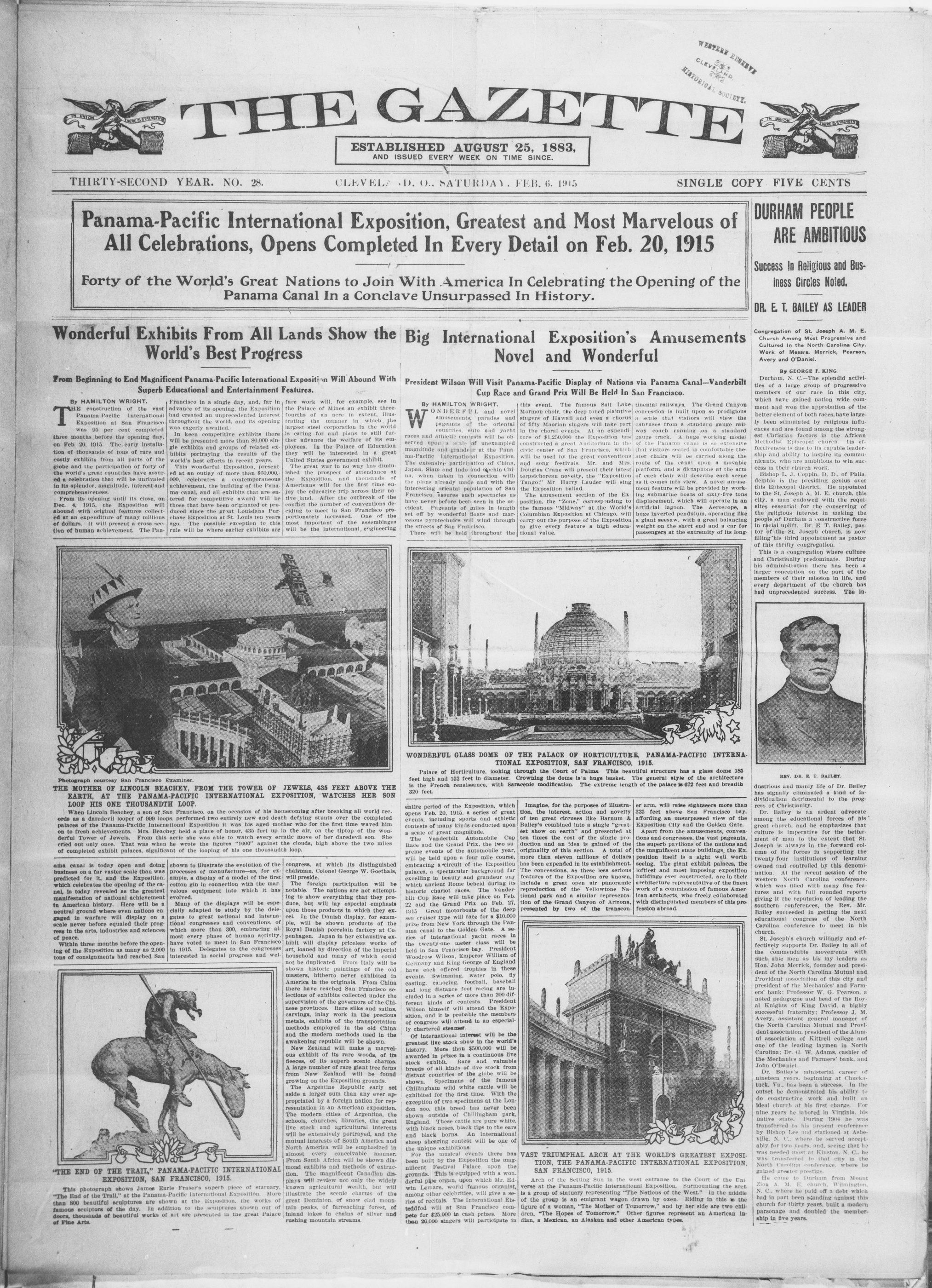
Panama-Pacific International Exposition, Greatest and Most Marvelous of All Celebrations, Opens Completed In Every Detail on Feb. 20, 1915
Forty of the World's Great Nations to Join With America In Celebrating the Opening of the Panama Canal In a Conclave Unsurpassed In History.
Wonderful Exhibits From All Lands Show the World's Best Progress
From Beginning to End Magnificent Panama-Pacific International Exposition Will Abound With Superb Educational and Entertainment Features.
THE PALACE OF THE KING'S TEMPLE
THE MOTHER OF LINCOLN BEACHEY, FROM THE TOWER OF JEWELS, 435 FEET ABOVE THE EARTH, AT THE PANAMA-PACIFIC INTERNATIONAL EXPOSITION, WATCHES HER SON LOOP HIS ONE THOUSANDTH LOOP.
When Lincoln Beachey, a son of San Francisco, on the occasion of his homecoming after breaking all world records as a daredevil looper of 999 loops, performed two entirely new and death defying stunts over the completed palaces of the Panama-Pacific International Exposition it was his aged mother who for the first time waved him on to fresh achievements. Mrs. Beachey held a place of honor, 435 feet up in the air, on the tiptop of the wonderful Tower of Jewels. From this aerial she was able to watch every erratic move of her daredevil son. She cried out only once. That was when he wrote the figures "1000" against the clouds, high above the two miles of completed exhibit palaces, significant of the looping of his one thousandth loop.
"THE END OF THE TRAIL," PANAMA-PACIFIC INTERNATIONAL EXPOSITION, SAN FRANCISCO, 1915.
This photograph shows James Earle Fraser's superb piece of statuary, "The End of the Trail," at the Panama-Pacific International Exposition. More than 800 beautiful sculptures are shown at the Exposition, the works of famous sculptors of the day. In addition to the sculptures shown out of doors, thousands of beautiful works of art are presented in the great Palace of Fine Arts.
BY HAMILTON WRIGHT.
THE construction of the vast Panama-Pacific International Exposition at San Francisco was 95 per cent completed three months before the opening day, on Feb. 20, 1915. The early installation of thousands of tons of rare and costly exhibits from all parts of the globe and the participation of forty of the world's great countries have assured a celebration that will be unrivalled in its splendor, magnitude, interest and comprehensiveness.
From its opening until its close, on Dec. 4, 1915, the Exposition will abound with original features collected at an expenditure of many millions of dollars. It will present a cross section of human achievement. The 'Lan
Photograph courtesy San Francisco B
THE MOTHER OF LINCOLN BEA
EARTH, AT THE PANAMA
LOOP HIS ONE THOUSANDT
When Lincoln Beachey, a son of Sa
ords as a daredevil looper of 999 loop
palaces of the Panama-Pacific Interna
on to fresh achievements. Mrs. Beach
dertful Tower of Jewels. From this
cried out only once. That was when
of completed exhibit palaces, significa
ama canal is today open and doing business on a far vaster scale than was predicted for it, and the Exposition, which celebrates the opening of the canal, is today revealed as the greatest manifestation of national achievement in American history. Here will be a neutral ground where even nations engaged in warfare will display on a scale never before equaled their progress in the arts, industries and sciences of peace.
Within three months before the opening of the Exposition as many as 2,000 tons of consignments had reached San
Francisco in a single day, and, far in advance of its opening, the Exposition had created an unprecedented interest throughout the world, and its opening was eagerly awaited.
In keen competitive exhibits there will be presented more than 80,000 single exhibits and groups of related exhibits portraying the results of the world's best efforts in recent years.
This wonderful Exposition, presented at an outlay of more than $100,000, celebrates a contemporaneous achievement, the building of the Panama canal, and all exhibits that are entered for competitive, award will be those that have been originated or produced since the great Louisiana Purchase Exposition at St. Louis ten years ago.
The possible exception to this rule will be where earlier exhibits are
EXAMINER.
MACHEX, FROM THE TOWER OF THE PACIFIC INTERNATIONAL EXHIBITION LOOP.
San Francisco, on the occasion of his honors, performed two entirely new and dental national Exposition it was his aged mother held a place of honor, 435 feet up in thearle she was able to watch every errant he wrote the figures "1000" against the intent of the looping of his one thousand
shown to illustrate the evolution of the processes of manufacture—as, for example, a display of a model of the first cotton gin in connection with the marvelous equipment into which it has evolved.
Many of the displays will be especially adapted to study by the delegates to great national and international congresses and conventions, of which more than 300, embracing almost every phase of human activity, have voted to meet in San Francisco in 1915. Delegates to the congresses interested in social progress and wel-
ESTABLISHED AUGUST 25, 1883 AND ISSUED EVERY WEEK ON TIME SINCE.
fare work will, for example, see in the Palace of Mimos an exhibit three-fourths of an acre in extent, illustrating the manner in which the largest steel corporation in the world is caring for and plans to still further advance the welfare of its employees. In the Palace of Education they will be interested in a great United States government exhibit. The great war in no way has diminished the prospect of attendance at the Exposition, and thousands of Americans will for the first time, enjoy the educational trip across their native land. After the outbreak of the conflict the number of conventions deciding to meet in San Francisco proportionately increased. One of the most important of the assemblages will be the international, engineering
JEWELS, 435 FEET ABOVE THE EXPOSITION, WATCHES HER SON
homecoming after breaking all world rec. with defying stunts over the completed other who for the first time waved him in the air, on the tiptop of the won- ratic move of her daredevil son. She the clouds, high above the two miles with loop:
congress, at which its distinguished chairman, Colonel George W. Goethals, will preside.
The foreign participation will be notable. The nations are not attempting to show everything that they produce, but will lay especial emphasis upon those products in which they excel. In the Danish display, for example, will be shown products of the Royal Danish porcelain factory at Copenhagen. Japan in her exhaustive exhibit will display priceless works of art, loaned by direction of the imperial household and many of which could not be duplicated. From Italy will be shown historic paintings of the old masters, hitherto never exhibited in America in the originals. From China, there have reached. San Francisco, selections of exhibits collected under the supervision of the governors of the Chinese provinces. Hare silks and satins, carvings, inlay work in the precious metals, exhibits of the transportation methods employed in the old China and the modern methods used in the awakening republic will be shown.
New Zealand will make a marvelous exhibit of its rare woods, of its fleeces, of its superb scenic charms. A large number of rare giant tree ferns from New Zealand will be found growing on the Exposition grounds.
The Argentine Republic early set aside a larger sum than any ever appropriated by a foreign nation for representation in an American exposition. The modern cities of Argentina, the schools, churches, libraries, the great live stock and agricultural interests will be extensively portrayed, and the mutual interests of South America and North America will be emphasized in almost every conceivable manner. From South Africa will be shown diamond exhibits and methods of extraction. The magnificent Canadian displays will review not only the widely known agricultural wealth, but will illustrate the scenic charms of the great Dominion, of snow clad mountain peaks, of farreaching forest, of inland lakes in chains of silver and rushing mountain streams.
President Wilson Will Visit Panama:Pacific Display of Nations via Panama Canal-Vanderbilt Cup Race and Grand Prix Will Be Held In San Francisco.
WONDERFUL GLASS DOME OF THE PALACE OF HORTICULTURE, PANAMA-PACIFIC INTERNATIONAL EXPOSITION, SAN FRANCISCO, 1915.
Palace of Horticulture, looking through the Court of Palms. This beautiful structure has a glass dome 185 feet high and 152 feet in diameter. Crowning the dome is a huge basket. The general style of the architecture is the French renaissance, with Saracenic modification. The extreme length of the palace is 672 feet and breadth 320 feet.
WONDERFUL, and novel amusements, parades and pageants of the oriental countries, auto and yacht races and athletic contests will be observed upon a scale of unexamined magnitude and grandeur in the Panama-Pacific Internatioal Exposition. The extensive participation of China, Japan, Sham and Indo and Yuchin China, when taken in connection with the plans already made and with the interesting oriental population of San Francisco, insures such spectacles as have never before been seen in the occident. Parents of miles in length set off by wonderful boats and marvous pyrotechnics will wind through the streets of San Francisco. There will be held throughout the
WONDERFUL GLASS DOME OF THE TIONAL
Palace of Horticulture, looking the feet high and 152 feet in diameter. C is the French renaissance, with Sara 320 feet.
entire period of the Exposition, which opens Feb. 20, 1915, a series of great events, including sports and athletic contests of many kinds conducted upon a scale of great magnitude. The Vanderbilt Automobile Cup Race and the Grand Prix, the two supreme events of the automobile year, will be held upon a four mile course, embracing a circuit of the Exposition palaces, a spectacular background far excelling in beauty and grandeur any which ancient Rome beheld during its historic charlot races. The Vanderbilt Cup Race will take place on Feb. 22 and the Grand Prix on Feb. 27, 1915. Great motorboats of the deep sea cruiser type will race for a $10,000 prize from New York through the Panama canal to the Golden Gate. A series of international yacht races in the twenty-one meter class will be held in San Francisco bay. President Woodrow Wilson, Emperor William of Germany and King George of England have each offered triplies in these events.—Swimming, water polo, fly casting, canoeing, football, baseball and long distance foot racing are included in a series of more than 200 different kinds of contests. President Wilson himself will attend the Exposition, and it is probable the members of congress will attend in an especially chartered steamer.
Of international interest will be the greatest live stock show in the world's history. More than $500,000 will be awarded in prizes in a continuous live stock exhibit. Share and valuable breeds of all kinds of live stock from distant countries of the globe will be shown. Specimens of the famous Chillingham wild white cattle will be exhibited for the first time. With the exception of two specimens at the London zoo, this breed has never been shown outside of Chillingham park, England. These cattle are pure white, with black noses, black tips to the ears and black horns. An international sheep shearing contest will be one of the unique exhibitions.
For the musical events there has been built by the Exposition the magnificent Festival Palace upon the grounds. This is equipped with a wonderful pipe organ, upon which Mr. Edwin Lenare, world famous organist, among other celebrities, will give a series of recitals. The International Eisteddfod will at San Francisco compete for $25,000 in cash prizes. More than 20,000 singers will participate in
VAST TRIUMPHAL ARCH AT THE WORLD'S GREATEST EXPOSITION, THE PANAMA-PACIFIC INTERNATIONAL EXPOSITION, SAN FRANCISCO, 1915.
Arch of the Setting Sun in the west entrance to the Court of the Universe at the Panama-Pacific International Exposition. Sarmounting the arch is a group of statuary representing "The Nations of the West." In the middle of the group is an emigrant wagon drawn by oxen. Riding in this is the figure of a woman, "The Mother of Tomorrow," and by her side are two children, "The Hopes of Tomorrow." Other figures represent an American Indian, a Mexican, an Alaskan and other American types.
this event. The famous Salt Lake Mormon choir, the deep toned plaintive singers of Hawaii and even a chorus of fifty Maoriian singers will take part in the choral events. At an expenditure of $1,250,000 the Exposition has constructed a great Archieum in the civic center of San Francisco, which will be used by the great conventions and song festivals. Mr. and Mrs. Douglas Craig will present their latest terpsiehorne novelty, the "Exposition Tango"; Mr Harry Lauder will sing the Exposition ballad.
The amusement section of the Exposition, the "Zone," corresponding to the famous "Midway" at the World's Columbian Exposition at Chicago, will carry out the purpose of the Exposition to give every feature a high educational value.
THE PALACE OF HORTICULTURAL EXPOSITION, SAN FRANCISCO, through the Court of Palms. This beautifull Crowning the dome is a huge basket. The accline modification. The extreme length
Imagine, for the purposes of illustration, the interest, action and novelty of ten great circuses like Barnum & Bailey's combined into a single "greatest show on earth" and presented at ten times the cost of the single production and an idea is gained of the originality of this section. A total of more than eleven millions of dollars has been expended in its establishment. The concessions, as these less serious features of the Exposition are known, include a great open air panoramic reproduction of the Yellowstone National park and a similar representation of the Grand Canyon of Arizona, presented by two of the transcon-
SINGLE COPY FIVE CENTS
mental railways. The Grand Canyon concession is built upon so predigitions as scale, that visitors will view the canyons from a standard gauge railway coach running on a standard gauge track. A huge working model of the Grand Canyon canals is an extensive that visitors seated in comfortable theater chairs will be carried on the route of the canal upon a movable platform, and a dictaphone at the arm of each chair will describe each scene as it comes into view. A novel amusement feature will be provided by work-
ing submarine boats of sixty-five tons displacement, which will operate in an artificial lagoon. The Aeroscope, a huge inverted pendulum, operating like a giant seasaw, with a great balancing weight on the short end and a car for passengers at the extremity of its long-
E. PANAMA-PACIFIC INTERNA-
1815.
beautiful structure has a glass dome 185
The general style of the architecture
of the palace is 672 feet and breadth
er arm, will raise sightseers more than 325 feet above San Francisco bay, affording an unassured view of the Exposition City and the Golden Gate.
Apart from the amusements, conventions and congresses, the vast pageants, the superb pavilions of the nations and the magnificent state buildings, the Exposition itself is a sight well worth seeing. The giant exhibit palaces, the loftiest and most imposing, exposition buildings ever constructed, are in their architecture representative of the finest work of a commission of famous American architects, who freely collaborated with distinguished members of this profession abroad.
Congregation of St. Joseph A. M. E. Church Among Most Progressive and Cultured In the North Carolina City. Work of Mossrs. Merrick, Pearson, Avery and O'Daniel.
B. GEORGE F. KING
Durham, N. C.—The splendid activities of a large group of progressive members of our race in this city, which have gained nation wide comment and won the apprehension of the better element of both races, have largely been stimulated by religious influences and are found among the strongest Christian factors in the African Methodist Episcopal church. Its effectiveness is due to its capable leadership and ability to inspire its constituents, who are ambivalent to win success in their church work.... Bishop L. J. Coppin, D. D. of Philadelphia is the presiding genius over this Episcopal district. He appointed to the St. Joseph A. M. E. church, this city, a man endowed with the requisites essential for the conserving of the religious interest in making the people of Durham a constructive force in racial uplift. Dr. E. T. Balley, pastor of the St. Joseph church, is now filling his third appointment as pastor of this thrifty congregation.
This is a congregation where culture and Christianity predominate. During his administration there has been a bigger conception on the part of the members of their mission in life, and every department of the church has had unprecedented success. The in-
P.
dustious and munty life of Dr. Bailey has signally eliminated a kind of individualism detrimental to the progress of Christianity. Dr. Bailey is an ardent advocate among the educational forces of his great church, and he emphasizes that culture is imperative for the betterment of man to the extent that St. Joseph is always in the forward column of the forces in supporting the twenty-four institutions of learning owned and controlled by this denomination. At the recent session of the western North Carolina conference, which was filled with many fine features and with full rounded reports giving it the reputation of leading the southern conferences, the Rev. Mr. Bailey succeeded in getting the next educational congress of the North Carolina conference to meet in his church.
St. Joseph's church willingly and effectively supports Dr. Bailey in all of the commendable movements with such able men as his lay leaders as Hon. John Merrick, founder and president of the North Carolina Mutual and Provident association of this city and president of the Mechanics and Farmers' bank; Professor W. G. Pearson, noted pedagogue and head of the Royal Knights of King David, a highly successful fraternity; Professor J. M. Avery, assistant general manager of the North Carolina Mutual and Provident association, president of the Alumil association of Kittrell college and one of the leading laymen in North Carolina; Dr. G. W. Adams, cashier of the Mechanics and Farmers' bank, and John O'Daniel.
Dr. Bailey's ministerial career of nineteen years, beginning at Chuckucktuck, Va., has been a success. In the outset he demonstrated his ability to do constructive work and built an ideal church at his first charge. For nine years he labored in Virginia, his native state. During 1904 he was transferred to his present conference by Bishop Lee and stationed at Asheville, N. C., where he served acceptably for two years, and, seeing that he was needed host at Kinston, N. C. he was transferred to that city in the North Carolina conference, where he gained greater prestige.
He came to Fortran from Mont-
Zion A M E. goes to Washington
N. C., where he paid off a debt which
had in part been standing against this
church for thirty years, built a modern
parsonage and doubled the membership
in five years.
One Year.....$1.50.
Six Months.....1.00
Three Months......50
Subscribers are requested to re-
mit by postoffice money or-
der or registered letter
Entered at the postoffice in Cleveland
Ohio, as second-class matter.
Address all communications to
Blackstone Building, Cleveland, O.
Member Ohio Legislature: 1894
to 1896; 1896 to 1898; 1900 to 1902
THE GAZETTE is the oldest, and
has the largest bona fide circulation,
double that of any newspaper in the
interest of Afro-Americans, published
in the state of Ohio, and comparison
with any will immediately establish
its rank as one of the NEWSIEST
AND BEST in the country.
10,000,000 Afro-Americans.
160,000 in Ohio.
20,000 in Cleveland.
SATURDAY, FEBRUARY 6, 1915.
Sixty-three of the sixty-five Afro-American families living in Harvey-sburg, Ohio, own their own homes, writes our correspondent at that place. In the language of the irrepressible comedian, Bert. Williams, "that's goin' some, isn't it."
Our people are taken advantage of so often in the stores, and elsewhere, that we suggest a careful reading by all of our readers of the article in The Gazette's local columns, today, under the caption, "SQUARE DEALS IN FOOD." It will pay you. Call your friends' attention to it, too.
The brethren need not worry: When Gov. Frank B. Willis can get to it, he will do just what he promised to do in a letter to The Gazette, some weeks ago—he will treat us fairly and right in the matter of appointments to office. He may be depended on to do so. Be patient awhile longer.
Yes, Frederick Douglas. How we miss him, John M. Langston and others of the great leaders of the past, no one of whom would have countenanced for a single moment the preaching of "a doctrine of surrender." O, that they were alive in this day and time, when they are so much needed.
It is well to remember that that vicious anti-intermarriage bill, for the District of Columbia, is still pending in the U. S. Senate, after passing the lower house of the Congress. Have you written to your U. S. Senators, asking them to work and vote against it, and explaining to them why they should do so?
The exceptionally caustic criticisms, of those Georgia lyachings, by the daily press and magazines of the North, has stirred the governor of that state, and the South in general, in a way that is bound to result in good. Seldom has this been the case, and we sincerely trust that, now that the good work has been so well started, it will be kept up.
A church is not "a public place" in the eye of the law of any state in this Union. And why our contemporaries persist in announcing that a little girl in Brainard, Minn., was denied "civil rights" because she claims to have been discriminated against while attending religious service in a church there, is beyond our understanding, unless they are being misled by the prejudiced daily press.
The Philadelphia Tribune carried a letter from Chambersburg, Pa., last week, which told of an alleged case of peonage in the southern part of that state, which it is hard to credit. An aged woman of the race is said to have worked in the fields, with scant clothing and worse treatment, ever since the close of the war of the rebellion. Our contemporary owes it to the race and the "keystone state" to verify the story or show it untrue, if it can.
"The Motion Picture News," Chicago, calls the attention of moving picture theater proprietors throughout the country to the fact that the civil rights laws of many states in the North are such that it will be wise for discrimination against our people in theaters to cease. At this time we wish to again urge our people to promptly resent, by court action, every attempt to insult them by a denial of rights in all public places. Show that you are MEN and WOMEN, citizens, who know and will have your rights, under the law. A right that is not worth so contending for is not worth exercising.
The death, recently, of Brigadier General Andrew S. Burt, retired, is a distinct loss to the race. He was a native of this state, enlisting in 1861. He continued in the army until 1902 when he was retired with a record of 41 years, during which he saw service in four wars. He served Phillipines from 1888 to 1891, and it was as commander of the Twenty-fifth infantry that he got the experience that caused him to have the greatest respect for our soldiers. When Presidents Roosevelt and Taft, and others, were decrying the Afro-American soldier on account of the "Brownsville Affray," General Burt was one of his strongest champions and went on record with some very many statements. And he has been heard many times since then on the "Negro" as a man and as a soldier. He leaves a widow, two sons and a daughter, and a host of friends to sincerely mourn his loss. Among the latter are our people.
According to a dispatch to the daily papers of the country, under date, Jan.
30, '15—and we are free to admit that, here of late, little credence can be put in most of such dispatches, especially when they have reference to our people—Jack Johnson who is out of the country and cannot return, has been sued by one G. Bernard Gerard who alleges failure on Johnson's part to live up to a contract in 1899—six years ago, and says Jack "assaulted him and extorted $2,250 by violence, the sum being $950 more than the salary due him." This too, about six years ago. If this is not "the limit" (providing, of course, the dispatch can be relied upon), then it is very near to it. What is it some people will not, at least, try to do? It is a good thing that Jack Johnson, many months ago, took care to so arrange his business affairs, which of course includes his property-holdings, in this country, as to make it impossible for persons to "touch it" or he would long ago have been "broke" as has so often been announced and hoped by the prejudiced who never, no never! will pardon him for becoming world's champion heavy-weight pupil. Poor things!
BIG SUMS FOR EDUCATION
Board's Report Shows Our Schools
Have Received Generous Aid.
New York.-The report of the general education board, issued Dec. 31, shows that a large number of institutions for the education of our race in the south have received generous financial aid from funds for that purpose under its control during the past eight years.
The report in part says:
"Between 1906 and 1912 seventy-four schools in Alabama were thus sided toward buildings and equipment costing $54,153, the Jeannes fund of the general education board contributed $18,888; Negro patrons of the schools, $35,265; toward $17,600 spent in maintenance in the year 1910-11, the fund gave $1,068, county boards $9,070 and Negro patrons $7,552.
"At the present time schools are fortunate if they obtain as principals and teachers the graduates of one of the better industrial schools for Negroes. The general education board has therefore assisted some of the more efficient of these industrial training schools as follows: Hampton institute, $138,000; Tuskegee institute, $135,483.48; Spelman seminary, $106,912.88; other institutions, $85,384.77.
"With the same end in view, gifts toward improved physical equipment have been made to a number of secondary schools owned or controlled by Negroes themselves—namely, Waters Normal institute, Winston, N. C. Thompson institute, Lumberton, N. C. Jeruel academy, Athens, Ga.; Americus institute, Americus, Ga.; Howe institute, Memphis, Tenn.; Florida Baptist academy, Jacksonville, Fla., and others.
"It has been recognized that the higher education of Negroes must also be provided for. The reasoning followed in dealing with colleges and universities is equally valid in this connection. If primary and secondary schools are to have good teachers, principals and supervisors provision must be made for higher education."
Besides the amounts contributed to the schools designated above, $114,000 was distributed among the following institutions: Atlanta Baptist college, Atlanta university, Fisk university, Lane college, Leland university, Livingstone college, Miles Memorial college, Paine college, Shaw university and the Virginia Union seminary.
WORKERS' CONFERENCE AT
THE TUSKEGEE INSTITUTE
Annual Gathering of Business Men Scheduled to Begin Jan. 21.
The workers' conference at the Tuskegee (Ala.) institutes will be held on Thursday, Jan. 21. The subject selected for discussion is "The Schools and the Hard Times Situation," under the following subdivisions:
First.—How the "hard times" situation has affected our community; second. What our school is doing to help our community in the present financial situation. (a) To get temporary relief. (b) To get permanent relief. (c) The opportunity that the present situation offers to teach the saving habit. (d) The opportunity of the present situation for initiating and increasing school extension work.
A number of special invitations have been extended important citizens of the south-white and colored—to be present and speak at the workers' day conference. Among others, Mr. J. T. Hollerman of Atlanta on the subject, "Cotton Raising and the Present Economic Situation." It is also proposed to invite a successful colored cotton farmer to tell what he is planning to do with respect to growing cotton during this year.
A representative of the financial interests of the south has been invited to address the conference on "The Financial Situation From the Standpoint of Credit" Invitations will be extended to Mr. G. L. Corner of Eufaula, president of the Alabama Bankers' association, and Mr. R. M. Hobbie, a wholesale grocery merchant of Montgomery. Ala. through whose intelligent direction many Alabama farmers are planning to turn to wheat raising this year instead of cotton raising.
It is planned in connection with the general subject of credits, advances, etc., to ask Mr. J. O. R. Ross, president of the Atlanta State Savings bank himself a planner and one of the race's most successful men, to speak on the subject of "Credits and Advances."
Plenty of Business In Boley, Okla.
Boley, Okla., is the largest city in the United States founded and officered by colored men. It has over eighty business concerns, an electric lighting plant, efficient churches, a high school worth over $15,000, a normal and industrial school supported by the C. M. E. church, flourishing fratern orders, a Masonic temple of the Oklahoma jurisdiction worth $25,000, a telephone system, several cotton glips, a chamber of commerce, a city hall and a railroad station.
THE GAZETTE, CLEVELAND, O. SATURDAY, FEBRUARY 6, 1915
FRESH OHIO NEWS
WRITTEN BY "THE OLD RELIA BLE" GAZETTE'S CORRESPONDENTS
THROUGHOUT THE STATE
What Our People Are Doing Each Week—Church, Personal, Social, Lodge, Literary and Musical—Marriages, Deaths, Etc.
LEBANON.—Mr. Joseph Brown was severely hurt by a fall. Saturday—Wm. Spears of Chillicothe and Joseph Ferguson, were here, last week—Miss Lula Morgan has been quite ill.—Miss Elizabeth Williams entertained at dinner, Sunday evening, Misses Anna and Lula Morgan, and Messrs. Wallace Turner and Artilla Hughes.—"Mother" Quiller is improving slowly.—Havard, the Harvensburg news in this paper, and have you been kind and thoughtful enough to tell your friends to give the local agent their order for a copy of The Gazette, every week?
CADIZ—The B. B.'s were entertained by R. Cooper, Sunday—Mr. George Banks' funeral services were held on the 29th. alt. at Simpson M. E. church, Rev. G. Gray officiating. Those who attended, from a distance, were: Mr. Mitchell Jones and Miss Grace Neuby, Mt. Pleasant, and Mrs. Mary L. Johnson of Colerain.—Ivan Davis spent Sunday in Smithfield.—Mrs. Ella Bolden is again seriously ill—The Kenney and Faithful Bros., Mrs. I. Way of Stone, here. Sunday, Mrs. A. Way of Stone, here. Sunday, the guest of Mrs. Dora S. Johnson, Sunday, addressed the Y. M. L. C. and "Happy Hour" clubs. Saturday evening, and the Missionary society, Sunday afternoon.
SANDUSKY.—The missionary meeting at the Second Baptist church, Sunday, was a success. Rev. Kelly of Oberlin, delivered two fine addresses and the choir sang excellently. The children's band, trained by Mrs. B. Thompson, Mrs. S. Scott, pres, rendered a fine performance in the eve of the service. J. C. Schoenfeld of the A. M. E. church, gave excellent addresses, Mrs. A. Dodd and Miss Sarah Johnson led the devotional services, and Mrs. G. D. Smith led in prayer. Mrs. Mary Jones, pres. of the M. S. and Mrs. John Adams, pres. of the A. M. E. M. S., gave fine talks on mission, state and local, and Rev. M. S. Schoenfeld, pres. of the appropriate sermon. Sunday will be sacrament and rally day.—Mr. S. Scott was elected first vice-pres., of the Citizens' Charity society of this city
MANSFIELD—Mr. S. Love has returned from Toledo, and Mr. W. Powell, from Columbus. The latter was very ill in Indiana.—Mr. and Mrs. Cromer are having their home remodeled.—Misses Hicks, Beaumont, Mrs. L. Lacey, Messrs. W. Fox and H. Breckenridge are ill.—The Elks banquet caterer was Mr. B. Dummore He was assisted by her daughter, Davis Hattie Taylor and Breckenridge Mrs. Hattie Taylor has a good position with the Stark family.—Dr. Geo Maxwell, P. E., will preach and conduct the Lord's supper, Feb. 16. Every body is urged to be present. The trustees gave an excellent program, Sunday evening, all the participants acquitting themselves most creditably indeed. The revival has closed. Many have been spiritually revived and more are attending church. Miss Breckenridge is the guest of Maddesias Fisher and Reynolds, Mr. and Mrs. Hamilton of Shelby, and Mr. E. Dummore of C. J., attended church here. Sunday, the latter visiting his parents.
CORRESPONDENTS must mail all letters for publication at their main postoffice sufficiently early on Monday (or Sunday) of each week to have them reach The Gazette office on Tuesday morning, and always write also, their names and that of their city or town on the outside of the building. Less than less this latter is done, proper credit cannot be given you. Lists of names, wedding presents, etc., obituary notices, speeches, resolutions, poetry, inquiries for relatives and advertisements of all kinds, including items announcing entertainments to be held in the near future, must be paid for by the post office. In line, six words to a line. Our rates for display advertisements will be sent on application. Send postal note and not stamps during warm weather.
OBERLIN.—Thursday evening, two Rust S. S. classes enjoyed a sleighride to Mr. and Mrs. Copes. Tuesday evening, Revs. Boyd, sr. and Jr. and Ellington of Nashville, delivered fine addresses here—The Entre Nous club dance was a success. —Raymond Burton entertained 24 little friends at the missionary party. Friday evening, was a success. Fifty guests; present; a fine menu. —W. Craighead is convalescing. Tonsilitis. Mr. Fred. Wright is seriously ill.—Born to Mr. and Mrs. J. D. Barnes, Jan. 27 twins—Samuel and Rebecca. Mrs. Barnes is president of the Progressive club. Miss Brooks of the Theo. Sem, will speak on Woman at 10:30 a.m. m. Lincoln Shafer at 7:30 p. m. Lincoln's birthday will be celebrated. Feb. 12, and followed by a reception for Rev. and Mrs. Delaenay.—Mt. Zion's revival will begin, Feb. 7. Rev. H. C. Bailey of Cleveland, will assist. "Jeptah" may be repeated by the Progressive club. Mrs. Eliza Cooper of Cleveland, Mrs. M. Pulley, son and daughter, were Sunday guests of Mrs. M. E. Johnston.
HARVEYBURG.- Chas. Martin who died, Jan. 28, left parents, 3 brothers and 3 sisters.- Wm. Williams, many years a farmer in Wayne township, has purchased a fine home on E. South St. Mrs. Imogene White of Columbus, was Mrs. Williams' weekend guest, Mt. Zion's revival was a success. Eight have been added to the orchestra. We are very proud of the fact that 63 of our 65 families here own their own homes. An exceptional record for any people anywhere.- Misses Alice and Mabel Ward, Imogene White, Zelda Martin, Mrs. Ada Bell, Louie Jackson, Walter Miller, Joel Hamilton and Chas. Woodson were guests of Mr. and Mrs. James Woodson, Sunday- Raymond Huffman has la gripple- Give the local agent of the Gazette your order for a copy of the paper, each week.
YOUNGSTOWN . — Mrs. Oscar C. Cameron is convalescing. Quinsy. — H. B. Jefferson of Pittsburgh, is the guest of Mr. and Mrs. Wm. Patterson. — Mrs. H. R. Parker is ill. — Carl Smith of Cleveland, attended his sister, Mrs. Myrtle Frances' funeral, Thursday, from Emerson chapel. — Burns Harvey was in Pittsburg, last week. — Mrs. R. D Lynch entertained the Research Felton, aged 40, died at the City hospital, Jan. 27. Relatives should address H. G. Emerson, 10 Decker St., this city. — Capt. and Mrs. Willis Collins of Lowellville, entertained at dinner, Sunday: Major James Saunders, J. F. Patterson, Clarence Morris, Mr. W. Patterson and Miss Sidie Biegle of Bedford Struthers, gave a delightful sleigh riding party, Tuesday evening, to Miss Emma Arnold's, in Poland. A number of our young people were in the party. — Order "the old reliable" Gazette.
Succinct Story of Part Played by Famous Men and Effective Legislative Enactments Which Resulted In Final Abolition of Slavery—Virginia Exposition Big Feature of 1915 Activities.
At a meeting composed of German Quakers, called Friends, held in April, 1688, a formal protest against slavery in the American colonies was adopted. This was the beginning of the abolition movement which never died out, but gradually spread with the growing colonies and which spread over the country when the states were formed and the government established. As the population grew and the number of slaves increased the spirit of opposition to human slavery increased until the freeing of the slave or the dissolving of the Union to perpetuate slavery became inevitable. And thus the great civil war came.
It became evident that a nation with human slavery as its cornerstone could not stand. The first dawn of freedom appeared over the horizon in 1862, and the full sun of emancipation burst forth when the friends of human slavery gave up the conflict in 1865. The work of making a new man, a new American citizen, then began with the reconstruction of the government. When the slaves found themselves free, men and women they soon began to hold emancipation celebrations, which have grown into county and state fairs and expositions.
A brief study of the work before the Virginia Negro Historical and Industrial association under the lead of the Hon. G. B. Jackson, which is beginning its arrangements for the great celebration of fifty years of freedom and exposition to take place at Richmond next summer, brings us to a relation of the history of the emancipation of the slaves in the United States. After the election of Abraham Lincoln to the presidency in 1800 it was early decided that slavery was a disgrace to our country and a dark blot on our escutcheon in the eyes of Christian and civilized nations, so by an act of congress the slaves in the District of Columbia were freed on the 16th of April, 1862.
This was the real entering wedge and paved the way for a general emancipation. On Sept. 22, 1862, President Lincoln issued a general proclamation of emancipation to take effect on Jan. 1, 1863. This brought about the thirteenth amendment to the constitution on Dec. 14, 1863. On Jan. 13, 1864, Congressman Ashley of Ohio offered an amendment to the constitution prohibiting slavery in the United States and its territories. The late Senator John B. Henderson of Missouri offered an amendment for the complete abolition of slavery and a vote was in the senate on June 15, 1864, but failed because it did not receive the necessary two-thirds vote.
This forced the question into the presidential campaign of 1864 and the cause of abolition won at the polls. A vote was again taken on the Henderson amendment on Jan. 31, 1865, and the amendment was agreed to and was submitted to the states for ratification or rejection, and twenty-seven states, which were two-thirds, ratified it, and it became a part of the federal constitution. The second amendment had been issued on Jan. 1, 1863. After the election of 1864, December 1865, adopted the amendment and slavery died forever in the United States so far as congressional enactment was concerned.
The closing of the civil war also sealed the fate of human slavery in the United States. The former master and the former slave were now confronted with new problems. Neither for a time knew his exact status or just what to do. They finally agreed that they should live on together under their new conditions and rebuild the waste places of the southland and make it once more blossom like the rose. That work since then has been going on. The new freedmen have made wonderful progress in fifty years along all lines, and because of this progress Virginia's colored population will hold a great exposition at Richmond during July and August, 1915.
Pennsylvania Masons Are Thrifty.
The Masonic fraternity in Pennsylvania vanished steady gains in its membership during the past year. The lodges in the western part of the state are credited with having added over 200 to their membership. Crystal Park lodge No. 14, A. F. and A. M., Pittsburg, recently installed the following officers: Lorenzo D. Fowler, W. M.; Jesse T. Gould, S. W.; Henry Baker, J W.; W. C. Quaries secretary; Clem Geary, treasurer. The installing officers were: H. T. Broadus, G. M.; G. B. Childs, grand marshal; B. J. Jetter, P M.
Why not become a Hair Dresser? This is your chance. We will set you up in the business. We will send you from our park Course in Hair Dressing from our school problem from our Complete Hair Dressing All. This for the small sum of $2.50. Hundreds of satisfied graduates all over this country are earning Big Money with our Outfits. Why not you? Write today, do not delay.
MILPARK SCHOOL OF HAIR DRESSING
EDENTON, N. C.
QUINADE
GROWS HAIR
REMOVES DANDRUFF
SEND FOR SAMPLE
QUINASOAP
THE IDEAL SHAMPOO SOAP
THOROUGHLY CLEANSSES THE SCALP
QUINACOMB
HAIR, STRAIGHTENER
SHAMPOO DRYER
QUINADE 25¢ QUINACOMB 50¢ QUINASOAP 25¢
AT ALL DRUGGISTS
SEEBY DRUG COMPANY, NEW YORK CITY, N. Y.
Is absolutely guaranteed and is bottled under Government supervision by The Cleveland & Sandusky Brewing Co. West785 Central 3933
The Best in the World!
This Combo, properly heated, and the use of La Croute Hair Pomade, will bring the most crimpy hair straight and silky at every stroke and cause a rapid growth of the hair.
Put it off it buy send $10.00 today and get the comb by return mail.
Poland Not Wild and Desolate. The prevalent impression in the west that the operations in Poland have been conducted in wild and desolate country is curiously wide of the truth Poland is now more densely populated than any other part of Russia, and the towns which have figured in the recent dispatches are centers of turving industry, Radom, now out of sound of the guns, has large tanneries and distilleries, Kalisz, through which a big German column passed to relieve the pressure in the center, is famous for lace and embroideries. Every little town around which the fighting has raged has its own mills, chiefly textile. Poland is rich in minerals, and its coal field is of considerable extent. It is not necessary to cross into Silesia to find either factories or Germans engaged in running them. If Russia could have saved Poland from invasion we may be sure she would have done so.—London Times.
Where Home Folks Come First
Where Home Folks Come First.
In Chicago men who need work are
being given blue tickets. These tickets
identify the holders as bona fide
residents of Chicago. The object is to
give needy Chicagoans first call on
jobs and charity and to shut out an
army of drifters who crowd into the
city in the cold months to live on
charity. Of course, the blue tickets
do not doom to starvation all strangers
who reach Chicago in a starving
condition. They simply insure preference
to Chicagoans when aid is extended and discourage the professional hoboes.
Crushed Stone Industry.
Crushed stone is the largest factor of the stone industry in the United States. Figures showing the value of crushed stone were first published by the United States Geological Survey in 1898 and amounted to $4,031,445. By 1913 the output was valued at over $31,000,000. Of late years stone crushed for making concrete has largely taken the place of building and foundation stone.
"Is your wife handy with her needle?"
"She's a good deal handler with her hatpin."
CORRESPONDENTS WANTED.
The old reliable Gazette desires an active agent and correspondent in every city and town in Ohio and neighboring states having a number of Afro-American residents. Only a little time on Fridays or Saturdays is required.
We are especially desirous of hearing from persons in the following counties in New York, Lancaster, Lebanon, Chillicothe, Toledo, Troy, Canton, Springfield, Plaqu, Columbus, Cambridge, Steubenville, Bellaire, St. Clairsville, Portsmouth, Washington C. H., Oxford, Sabina, Galipolis, Rendville, Urbana, Delaware, M. Vernon, East Liverpool, Wellsville, Akron, Dayton, Middletown, Bellefontaine, Lima, O., and other places where we have none.
Write to the editor of the Gazette. Blackstone building, Cleveland, O., and teemouth will be promptly. Our readers will oblige us greatly by sending at once the addresses of persons in the cities named above, or others to whom we can write relative to the matter.
Price of Mair Straightener and Alcohol Moater complete $1.50.
the handiest and most convenient method
o can put it in your hand-bag. Price 50c.
It not only meets every requirements of
bread of the hair. Price 25c.
Using the Largest and Most Complete Line
such as Wige, Wige, Puffs, Switches, Pom-
tion this paper.
NELSON'S
HAIR DRESSING
250
Has no superior as
a hair beautifier.
Thousands of men and
women have improved the
appearance of their hair by
using NELSON'S HAIR
DRESSING.
For those who know—it
is a toilet necessity.
Why not try it yourself?
Ask your draggist. If he
cannot supply you, send us
his name and address and we
will send you a free sample.
ai
NELSON MFG. CO.
RICHMOND, VA.
THE
NELSON
GIRL
By Using
Walker's Toilet and Hair
Preparations
It is necessary to have clear, smooth skin
as well as hair to be beautiful.
Walker's
Black-No-More
A CREAM FOR BLEACHING AND
BEAUTIFYING
50c Brown-Face Powder 25c
23 other Toilet and Hair Preparations
AGENTS WANTED: also travelers to ap-
point representatives, Salary and Commis-
sion, Employee stamp for full information.
No samples sent; cash with each order.
Goods sent by mail 100 extra
Mrs. Matilda Walker
Box 44 So, Orange, N. J
Free! Free! Free!
AT THE
Brown Drug Co.
2742 Central Av., cor. E. 28th St.
Cut this ad. out and present it at the Brown Drug Co., and receive a liberal trial size of
B. AND M. HAIR DRESSING
AND TONIC.
This dressing is especially recommended where the hair is stubborn or curly, as it not only makes the hair soft, glossy and straight, but also easy to dress.
B. AND M. HAIR DRESSING is elegantly perfumed, has a very beneficial effect on the scalp, and is a splendid hair-grower.
DON'T FORGET THAT WE HAVE BUT ONE STORE, AND THAT IS at E. 28th St. and Central Ave.
A Complete Line
DRY GOODS, LADIES' AND GENTS
FURNISHINGS
J. LOMSKY
3816 and 3820 Central Ave.
Double Stamps on Tuesdays and
Fridays.
Arlington Pharmacy
WE WILL ACCEPT THIS ADVERTISEMENT FOR FIVE CENTS IN TRADE, TO APPLY ON ANY PURCHASE OF TWENTY-FIVE CENTS OR MORE.
E. Rukenstein, Ph. C., Prop.
S. W. Cor. Central Ave. & E.
55th St.
STERLING
5 and 10 Cent Store
3003 Central Ave.
Watch Our Windows
For Bargains
Colored Salesladies
The Fifteenth Annual Session of the
State Summer School
for Colored
TEACHERS OF BOTH SEXES
at the
Agricultural and
Mechanical College
GREENBORO N. C.
will begin June 29th, 1914, and con-
tinue five weeks.
In addition to the regular work, an
attractive lecture course has been ar-
ranged, in which will appear some of
the most distinguished white and Col-
ored educators in the country.
Board and lodging for the entire
session $1,000 and $26 per subj
subject unless other arrangements have
been made.
Limited accommodations. Send $1
and have room reserved in advance.
For further information write p
once to:
James B. Dudley, President, or
D. J. Jordan, Director,
A. A. M. Colleague, Greenboro, N. C.
THE PEOPLES' DRUG STORE
Cor. Central Ave. and E. 33d St.
Agent for
"HIGH BROWN FACE POWDER."
WE GIVE TRADING STAMPS.
MONEY ORDERS, NEWSPAPER
ADS, TELEGRAMS.
PRESCRIPTIONS A SPECIALTY
Open late at Night.
Cuy. Central 6661-L
G. G. REED
Dry Goods
Ladies' and Gents' Furnishings
Sole agents for the
AMERICAN LADY NEMO
R. @ G. COR ETS
3222 Central Ave.
PATRONIZE ONLY
OUR ADVERTISERS
Where to Purchase The Gazette
NOTICE TO SUBSCRIBERS
Subscribers not receiving The us at once. We desire every copy. We advise our patrons to car tisements before making purchase this paper should have the patron that they advertise is assurance the Local reading notices (adve words in a line).
Subscribers not receiving The Gazette regularly should notify us at once. We desire every copy delivered promptly.
We advise our patrons to carefully examine The Gazette's advertisements before making purchases. Business men who advertise in this paper should have the patronage of Afro-Americans. The fact that they advertise is assurance that they want it.
Local reading notices (advertisements) ten cents a line (six words in a line).
Our
Classified Ad
Department
For Rent—Five rooms, up stairs, at
2417 E. 82d St., water, gas, etc. Apply, Room 2, Blackstone Bldg. $12 per mo.
FOR RENT.—Houses and Rooms—
If you have them to rent or if you
want to rent, advertise in The Gazette.
It brings results.
NOTARY PUBLIC—For such services call at The Gazette office, No. 2
Blackstone building, No. 1424 W.
Third Street, near Superior Ave.
FOR SALE—Houses or lots. If you have either or anything else to sell, or if you wish to purchase, advertise in The Gazette. If anything can bring you results, it can and will.
Cleveland
Sixth City
Mr. Chas. Weaver is convalescent after a severe illness. *
Mrs. Geo. Sampson, sr., of E. 30th St., who has been very ill, is convalescing. Her younger son, Fred, was not married recently, he announces. *
Five nice rooms, upstairs, at 2417 E. $2d St., near Quincy Ave., for rent. Water, gas, etc. Apply at room 2, Blackstone Bldg. $12 per mo.
Mrs. R. J. Callahan of E. 36th St. royally entertained Mr. and Mrs. Ellsworth Grayson and Mr. and Mrs. Benj. Tucker, last Thursday evening.
G. H. Richardson, a former Cleveland, was in the city, the first of the week from Columbus, to see his sister, Mrs. Mary Harris of E. 37th St., who was quite ill.
Rev. Grandison will preach at Cory M. E. church, Sunday morning and evening, and will be in the city about ten days. He has quite a reputation as a speaker.
Anyone needing advice on caring for tuberculosis patients in the home should consult Mrs. J. W. Byrd, who is a specialist in tuberculosis cases, and a member of the Red Cross Nurses' Association (white). Address Mrs. J. W. Byrd, 2310 E. 9th St.- Adv.
Our advertisers want your trade. Those who do not ask for it in The Gazette certainly care little, if at all for it. Therefore, we urge our readers and all of our friends to patronize those who ask for your trade in this paper.
Send or bring locals and all business matters to The Gazette's offices suite 2. Blackstone Hills. If you wish to see it, please there; please all matters for publication in current issues of The Gazette, must be in the office by 4 p. m., WEDNESDAY at the latest.
The "United Workers" of St. John's church will give a supper at Mrs. D. Jackson's, 2170 E. 90th St. Tuesday evening. Admission free. A program will be given.
Miss Hester O. Brown entertained at Mrs. Janet R. Allen's, Jan. 27: Revs R. H. and H. A. Boyd, W. S. Ellington of Nashville; Edwin W. M. Gillard of Oberlin, and Rev. H. C. Bailey. Coviers laid for six, Chas. A. Allen presiding.
Mrs. Belle Moore, wife of the late Charles Moore, who died, recently, at a niece, Mrs. Wm. Gibson's, 2244 E 82d St., was buried in Woodland cemetery, funeral services being held at the house.
The editor of The Gazette received congratulations and gifts, last week Thursday, his birthday, from many parts of the county, well as from local friends and acquaintances, and the cards and gifts continued to arrive until the first of this week. Thanks, good friends, for the many beautiful reminders of the day.
Last week Attorney Harry E. Davis succeeded in getting a favorable decision against William Archer, (white) proprietor of a restaurant on Euclid Av., near Lakeview road. He (Davis) represented Mr. Howard Jackson, an attorney, and Mr. Hon. Harry C. Smith's Ohio Civil Rights' law, against Archer because of the latter's refusal to serve him a meal in his restaurant.
---
---
---
---
The Gazette regularly should notify
the delivered promptly.
fully examine The Gazette's adver-
sions. Business men who advertise in
image of Afro-Americans. The fact
that they want it.
tisements) ten cents a line (six
Personal
A brother-in-law of Mrs. Edith
Woods of the Winona Apts., died, Sunday.
Mrs. Thos. Cook of E. 29th St., was
operated on at Charity hospital, Thursday.
Miss Ella Bailey of Pittsburg, visited her sister, Mrs. Geo. Clark of Bristol Ave., this week.
The Pleasant Co. club held an enjoyable meeting at Miss G. Simmons' E. 46th St., Thursday evening.
Mrs. Ella Johnson of Hillsboro spent the week with Miss Susie Brown, 2740 Central Ave.
Miss Goins of Massillon, Mr. Arthur Scott of Akron, and Miss Howard of Columbus, were in the city, last week.
The Tuesday Afternoon Thimble club held a profitable meeting at Mrs. Lottie Stewart's, Blaine Ave., last week.
A brilliant reception was tendered in honor of the newlyweds, Mr. and Mrs. Wm. Robinson, last week Friday evening, by Mr. and Mrs. Frank Perkins.
Last summer, The Gazette warned members of the race who were "burning up" good money in "auto" and other parties, excursions, trips out of the city, etc., etc., that they would need it this winter when the "hard-times" reached in full force. They are here, and some very foolish people last summer, have "oodles of time," these days, to reflect. "Twas ever thus."
D. C. Fisher of Lorain, receiver for a couple of businesses in that city, was in the city, Tuesday, in bankruptcy court where the affairs of one of them were being considered. He said his daughter, Miss Ruth, is touring the East and was at Atlantic City, visiting, the first of the week.
Mrs. Cora Johnson Jackson of Akron, formerly of this city, assumed the matrorship of the Phillis Wheatley home, Monday. The Association's address by Miss Helen Chestnut, our probation officer, and others. The home still appears to be an expensive luxury.
Charles W. Hines, many years ago a deputy U. S. official at Louisville, Ky., and for years a resident of Cleveland, was in the city again, last week, after an absence of about ten years. He went from here to Youngstown, en route to Lisbon, Sunday afternoon. He told a representative of the Gazette that he had made a trip abroad in recent years.
The Helping-Hand society gave a successful enterprise in St. John's church parlor. Tuesday evening, The S. S. board met, the same meeting, to formulate plans for Easter. Allen C. E. league rendered splendid exercises Sunday evening. Miss Helen Wright and Mrs. N. Talbot were among the participants. Deborah class was delightfully entertained by Miss Mildred Gants, last week Wednesday evening at its teacher, Mrs. Lula B. Cox's, 2299 E. 95th St. Mrs. Elizabeth Toles Moore is president of the class.
The Pleasant Company club's annual reception, last week Thursday, at Mr. and Mrs. Robert Smith's, 2307 E. 86th St., was attended by 75 of the 100 persons invited. An excellent program was rendered, those participating, worthy of special mention being Mr. and Mrs. Harry Thompson, William and Miss Ethel Gregory, Mr. Toy Goods and assistants served a sumptuous two-course luncheon. The dining-room was beautifully decorated with cut-flowers, the color-scheme being in the club colors, purple and white.
In a letter received, Tuesday, from Louia V. Jones of this city, who is studying violin at the Boston Conservatory of Music, he wrote that he played before the St. Mark Musical & Literary society there. Jan. 31, and was splendidly received. As the program led up to a discussion of French literature and music, he very approprtely wrote: "I am a musician for a solo (and Clarence Cameron White's 'Berceuse'). Mrs. White was his accompanist. He sends his best regards to the editor of The Gazette and all his local friends.
After an illness of a few months, "Canade" Boston, age 65, and residing at 1258 Scovill Av., was found dead in bed. Sunday afternoon. Death was due to heart trouble. Mr. Boston, one of our oldest residents, was for years senior member of Boston & Bowman's orchestra which, years ago, played at most of the notable social and other functions of the wealthy and best people, among the whites as well as our people, of northern Ohio. He is the second member of the old Excolonator Reed & Brass Band to die in the last ten days. The body was removed to the county morgue and will be buried by the Musicians' Union of which he was a charter-member.
THE GAZETTE, CLEVELAND, O. SATURDAY, FEBRUARY 6, 1915.
---
---
W. O. Thornhill of E. 37th St., who has been ill, some months, is being visited by his father.
There is only one way to get our race's news, local and general, and that is by taking "the old and reliable" Gazette, every week.
Mr. Frank Lyons was among the graduates from E. Tech. High school, last week Friday evening. He completed the electrical course.
A number of members of our local churches that forbid dancing, "tripped the light fantastic" at the Charity ball, last week Friday evening, and the prospect of a number of "church trials" is most promising.
A "jim-crow" car bill to cover public conveyances in the National capital was reported to the lower house of Congress, Monday, by a committee with recommendations that it be passed.
The report of the Charity ball took up so much time, Monday evening, at the meeting of the C. A. of C. M. that the trial of "Dode" Green was postponed, one week. A committee was appointed to look into proposed charges against Henry Taylor. The internal strife in the Association, at this time, seems to be the greatest. Mr. Taylor was signed from its executive committee. Neither he nor Will Humley attended the ball, last week.
That a Cleveland company has captured the gold medal for a safety device at the second international exposition of safety and sanitation held in New York city has just been announced at the annual meeting of the stockholders of the National Safety Device Co. The device is the Morgan national safety hood and smoke proof device. It is designed to mean of saving many lives and much property during 1914. During the safety exposition in New York the subway disaster occurred and the safety hoods on exhibition in the Grand Central palace were rushed to the scene of the accident, where they enabled the firemen to rescue people from the gas filled subway. The first grand prize medal announces the award on one side, while on the other is a plaque of the Museum of Safety, with its slogan "Now let us conserve human life." The officers of the company elected for the ensuing year are Victor W. Sincere, president; William Ganson Rose, vice president; Edgard A. Hahn, secretary; A. L. Dreyfus, treasurer, and Garrett A. Morgan, general manager.
The following from a recent issue of the Cleveland News, under the caption, "SQUARE DEALS IN FOOD," is of so very much value and interest to our people, especially those who live in the Central Av., district, that The Gazette reproduces and suggests a careful reading of it: Estimating conservatively that Cleveland housekeepers are defrauded of $100,000 annually by tricky tradesmen, the city houses the weight labels on loaves of bread, to beware of dealers who use dented and battered measuring utensils, to look for the city seal on all measures, to watch the scales on which purchases are weighed, to make sure before weighing begins, to see that it comes to a standstill before the weight is announced, and to decline to pay butter and beefsteak prices for wooden plates and paper weighed with purchases. These are simple, often repeated warnings such as should be heeded instinctively by any person of ordinary intelligence and the average aversion to being vicious that they should be neglected to an astute challenger of $100,000 annually is a profit of $100,000 annually is a profit of $100,000 loss. We tend to the optimistic view and to Soybean with a certain suspicion that are to get the worst of the to it. We fear to start anything, to get in wrong, to be upbraided. The public support the commissioner of weights and measures does not get, the only wonder is that the loss is not greater. To mend matters does not contain sufficient pickle. The housewife has only to find an honest dealer and then give him his just due by sticking to him, with only enough cursory watchfulness to make sure that his honesty does not suffer a relapse."
***
One of the most beautiful and elaborate affairs ever given by our people of Cleveland, was the second annual charity ball of the Cleveland Association of Colored Men held at the Chamber of Commerce hall last Friday evening. The hall was decorated with 500 yards of black and orange bunting, the colors of the association. In the center of the hall hung a very large heart with the letters "C. A. of C. M." in black and orange. Flags were artistically arranged over the pictures and between the windows, the walls, and the carpet, systematically distributed through giving a soft, mellow appearance. Bowman's excellent orchestra, hidden behind palms, furnished the music from a stage in the north end of the hall, while in the west end was a palm garden where the finest of refreshments were served by W. F. Hansbury, the caterer. Fifty palms were furnished by the Kirchner Bros. Guests in taxicabs began to arrive about 9 o'clock and were ushered, by footman, under the canopy stretching to the side-walk to the new lobby where the gentlemen checked their belongings in the dressing room, to the west. Dancing continued until 12 o'clock when the grand marche started, led by Theo B. Green and Miss Ruth Baxter of Erie, Pa., followed by Pres. R. R. Cheeks and wife and the members of the association. A flashlight picture was taken at the time, and dancers took out 2 a.m. guests out of theoutfellow guests were Miss and Mr. Lawrence, Miss Ruth Baxter and the Misses Purdy of Erie, Pa., Miss Reynolds of Akron, Mrs. Hughes and Miss Ella Bailey of Pittsburg, Mrs. Thos. Howard and Miss Maude Elliott of
Columbus. The ball was not so well attended as that of last year, because of the failure to properly advertise it and because of the "hard-times", but what it lost in "quantity" it undoubtedly made up in "quality", in the matter of attendance. About two hundred tickets were sold, this year, and either 400 or 500, last year. There seems to be some doubt as to just the number that were disposed of last year. An investigation is in progress.
ARRIVED TOO LATE
The Joke on Ohio-ana as a National Capitol Celebration Senator, Charles Summer
(By Isaiah Mitchell Sr.)
(By Isaiah Mitchell, Sr.)
Washington, D. C. — Our Cleveland, Ohio, colored citizens found a "temper in a teapot." They sent ex-Senator Hill to an amendment to the immigration bill that passed the House and Senate, because it bars Africans from the United States. This is a good joke upon our Ohio friends. If they had the political interests at heart of our disfranchised Southern brethren, they would have sent a delegation here to urge their Republican Senator and the Congressman to press upon the Supreme Court for that decision which affects every citizen of the United States. It seems our friends have forgotten that the immigration laws of this country allow only white people to become citizens. Senator Sumner tried to strike the word "white" out of these laws in the "Seventies" and failed. He succeeded in striking it out of the U. S. statutes so that the newly made citizens of the United States could pay audited by the Auditor of the Treasury. It will be remembered that Chinese are alliens, and Colored men from the French and British Islands worked on the Panama Canal and were returned home when the water-way was finished. There are many alliens from India here, but England guards them as her subjects, while the United States citizens of the United States; our northern friends should remember that charity begins at home.—Louisville (Ky.) Columbian-Herald.
SOUTHERN MISSIONARY MEETING
The Woman's H. & F. M. S. of the A. M. E. Church, of which Mrs. Laura L. Turner, the bishop's wife, is president, will hold its quadrennial sessions in New Orleans, La., Feb. 10-14, 1915. Mrs. Rosa Johnson of Cleveland, president of the N. O. C. B. W. M. M. S. has been selected to represent the Woman's Parent Mite M. S. of the Church at this meeting, and the members of the organization fully appreciate the honor given their faithful president.
Laura Erhart,
cor. sec., N. O. C. B. W. M. M. S.
WHERE IS KATIE FOSTER?
Miss Katie Foster, my sister was separated from me in Fort Scott, Kansas, when but a child. She has since married. I heard she was a school teacher in Ohio. Any one knowing her whereabouts will kindly write 4t.
Sam Foster,
They're Still After Jack
They're Still After Jack.
New York City—Some more "small business." Judgment by default in the sum of $3,489 was entered against Champion Jack Johnson by Justice Benedict in the supreme court on afidavits filed by G. Bernard Gerard, who was the defendant's failure to live up to a contract for an engagement with "the Follies of 1909" about six years ago. Gerard said, in Milwaukee, Johnson assaulted him and extorted $2,250 by violence, the sum being $550 more than the salary due him. Johnson then ran out of his contract, Gerard swore. Isn't this rich?
Gave $6,000 To A Church.
St. Gave $6,000 To A Church.
St. Louis, Mo., The Lutheran Missionary St. C. Frewes is chairman, was surprised recently to learn that Mrs. Ellen Bransford, who was born in slavery and who died Nov. 21, 1914, left a will bequeathing more than $6,000, the savings of a lifespan of her own purposes. The woman made the money doing washing, ironing and other domestic work.
COMFORTS ON FIRING LINE
Everything Possible Is Done for the Men on Duty in the Trenches in Europe.
We are constantly learning more of the economy of trench life, and from time to time we are given a glimpse at what may be called its luxuries. The telephone is, or course, a necessity, but now there is the hyperpericope, by which you may see your enemy without giving his sniper a chance at a pot shot. One letter from the front the other day mentioned that the question of electric lighting is being considered seriously, and the latest refinement is that of the electrophone, by which men in reserve may provide concerts for their comrades in the firing line.
War has often been luxurious before, but only for the men at the top in the seventeenth century a du de Luxembourg, a Vendone or a Richelien took with him a complete town equipment, and his wines, his musicians and his silverware were all in camp. Wellington, though he was frugal enough himself, kept hounds for his officers in Portugal,-London Mall.
Red Cloud's Granddaughter
Red Cloud's Granddaughter.
The biggest thing in the way of an Indian wedding ever held among the Sloux Indians was celebrated at Chadron, Neb. a short time back, when James Galligo, a white ranch owner, and Miss Josephine Richards, granddaughter of the late Red Cloud, big chief of all the Sloux tribes, were married.
The best man was James Roam Eagle, and the bridesmaid was Miss Angeline Kills Above. Miss Kills above is also a granddaughter of Red Cloud. Half a hundred Indians accompanied the party from the Pine Ridge agency to Chadron for the ceremony, which was performed by County Judge Slatter.
Judge Slatter's fee from the bridegroom was $50 and a fine saddle horse. The bride's dowry was a herd of 1,500 Hereford cattle and 500 horses, their total value being probably $150,000. As soon as the snow melts Mr. and Mrs. Galligo intend making a long jour in their automobile.
L OFFER
PER CENT OFF
this year's suitings and overcoatings, rang-
to $40.
$5.00 to $10.00 on each.
We all the latest shades and designs.
innings.
& GROSSMAN
Merchant Tailors
2056 E. 4th St.
(Upstairs).
Eloquence has neither a predecessor nor a com-
mand of women of the race, the leading newspapers
qualifiedly recommend it. To read it is a liberal bel-
gible information accessible in no other form, a
library in itself. No intelligent Negro can af-
fies an inspiration to the old and a help to
the greatest speeches ever delivered by the ablest men
England and France from 1818 to the present time.
and from the standpoint of inspiration alone is
thousands of copies have been sold at that price
new neighborhoods as possible we will send any
almost HALF PRICE—$1.50. A COPY IS HERE
SPECIAL OFFER
20 PER CENT OFF
on all our regular this year's suitings and overcoatings, rang-
ing in price from $25 to $40.
saving you from $5.00 to $10.00 on each.
These woolens are all the latest shades and designs.
We are open evenings.
KLEIN & GROSSMAN
Merchant Tailors
2056 E. 4th St.
(Upstairs).
A Big Cut in the Price of the Masterpieces of Negro Eloquence
NEVER BEFORE SOLD FOR LESS THAN $2.50 A COPY—Edited by Mrs. Alice Moore Dunbar—A LIMITED NUMBER HAS BEEN PLACED AT THE DISPOSAL OF THIS PAPER AS AN ADVERTISING PROPOSITION AND THE READERS CAN HAVE A COPY FOR $1.50. Postpaid.
The Masterpieces of Negro Eloquence has neither a predecessor nor a competitor. The most brilliant men and women of the race, the leading newspapers of addresses endures and uninterrupted, a treasure trove of valuable information accessible in no other form, a reference book, a history, a library in itself. No intelligent Negro home can afford to be without a copy as it is an inspiration to the old and a help to the young. It contains 31 of the greatest speeches ever delivered by the ablest men and women of America, Africa, England and France from 1818 to the present time. Both addresses are a separate gem and from the standpoint of inspiration alone is priceless.
The regular price is $2.50—thousands of copies have been sold at that price but to introduce it in as many new neighborhoods as possible we will send any reader of this paper a copy at almost HALF PRICE—$1.50. A COPY IS HERE FOR YOU. ACT NOW.
The Douglass Publishing Co.
DRAWER I, HARRISBURG PA. U. S. A.
MEN'S HAIR
The Morgan Hair Refiner
is a new discovery that positively straightens the hair within fifteen minutes. No grease. No hot irons. Water will not affect it.
Absolutely harmless if used according to directions.
Manufactured by
The G. A. Morgan
Hair Refining Co.
5202 Harlem Avenue, Cleveland, Ohio
ROSEDALE
FACE
Greasy-CREAM-Greasless
J. W. WILLS & CO.
The Leading
Funeral Directors
Chapel in Connection.
Service First Class.
2529 Central Avenue
North 474 Central 7562-L
10 Great
Serials
TH'S COMPANION
Than Ever in 1915
page, a rare Editorial Page, Boys' Page,
is Advice, and "a ton of fun," Articles of
location. From the best minds to the best
world can produce for you and everyone
in the home. There is no age
limit to enthusiasm for The
Youth's Companion.
52 Times a Year
— not 12.
Send to-day to The Youth's Companion, Boston, Mass., for
THREE CURRENT ISSUES—FREE
OMS RECEIVED THIS OFFICE
Then the Family Page, a rare Editorial Page, Boys' Page, Girls' Page, Doctor's Advice, and "a ton of fun." Articles of Travel, Science, Education. From the best minds to the best minds, the best the world can produce for you and everyone
"My wife got her recipes mixed and all her hard work went for nothing." "How was that?" "She tried to make chocolate fudge out of a formula for cleaning brass work."
Nations are not influenced by prize ring rules. If so, the United States might be expected to be ready to challenge the winner of the European war.
About the only thing that is being accomplished by the persons who argue that there never was an Adam is to spoil the story of Eve.
Let the thermometers do their worst. Summer is coming eventually.
SPECIAL OR
20 PER
on all our regular this year's s
ing in price from $25 to $40.
saving you from
$5.000
These woolens are all the
We are open evenings.
KLEIN & C
Merchant
2056 E.
(Upst
A Big Cut in the Price of the Mast
NEVER BEFORE SOLD FOR LESS
Alice Moore Dunbar—A LIMITED NUMBES
POSAL OF THIS PAPER AS AN ADV
READERS CAN HAVE A COPY FOR $1
The Masterpieces of Negro Eloquence
petter. The most brilliant men and wom
of both races endorse and unifiedly
notion, a treasure trove of valuable in
reference book, a history, a library in it
ford to be without a copy as it is an inse
young. It contains 54 of the greatest sp
and women of America, Africa, England a
Each address is a separate gem and from
priceless.
The regular price is $2.50—thousands
but to introduce it in as many new neig
reader of this paper a copy at almost
FOR YOU, ACT NOW.
The I
DRAWER
Mrs. A. M. Pope—Turnbo
Results of "Poro" Treatment
"PORO COLLEGE"
Largest College off its kind in the world.
300 PINE STREET, ST. LOUIS, MO.
DOU GALANTIE
Every last of "PORO" is fully guaranteed, subject reservation
and payment. Not once will the institution of this box, 500
AFT RELEASE, not once will the collection of this box,
be the reward for any person, including those who again
purchased, and we will give you, according to the terms
purchased, the PORO AND BOOK SET.
WARRANTIES BASED THE PORO AND BOOK SET.
JUNE 26, 1900. WARRANTY NO. 4728.
For treatment, call on or address:
MISS KATIE B. COLLIER,
4812 Payne Ave.
Cleveland, Ohio.
I.X.L. LUNCH ROOM
2900 Central Ave. CLEVELAND, GHIO
Dinners, 15c
Short Orders 15c, 20c and 25c
Quick Service
Harry Menon, Prop.
The YOUTH'S
Better Than
Then the Family Page, a ran
Girls' Page, Doctor's Advice
Travel, Science, Education.
minds, the best the world can
CUT THIS OUT
and send it (or name of this paper)
with $2.00 for The COMPANION
for 1915, and we will send
FREE All the issues of THE COMPANION for the remaining
weeks of 1914.
FREE THE COMPANION HOME CALENDAR for 1915.
THEN The 82 Weekly issues of THE COMPANION for 1915.
SUBSCRIPTIONS RECEI
Observation of Sun Spots.
Astronomers in the Carothell observatory at Houston, Tex., report a new method for observing sun spots without the aid of a telescope, as follows: If images of the sun be formed through clean cut round holes of proper size in a darkened room at sufficient distance from the aperture and cast upon clean white paper or cardboard, sun spots of ordinary size may be readily seen on the image. This method would enable amateurs to note the progress of the spots across the solar disk.
"Well," said the janitor of the city hall in Dixmuze, as he shoved another bomb off the bed coverlets preparatory to rising, "well. I wonder which flag I'll have to put up over the building today!"—Dewitt News.
25 cents
At all Druggists.
full of life and action, filled with the fire of fine inspiration and followed by 250 short stories of adventure, will make
AFRO-AMERICAN CLILINES
In the article of Mr. James Croggon.
fu the Sunday Star, tt {s stated that
“one hundred years ago the first col-
‘red troops who ever served In the
army of the United States won the
commendation of General Jackson in
the battles in and around New Or-
Jeans” This statement ay to when
the rst colored troops served in the
army of the United States is incorrect
writes Albert N. Seip in a communt
gation to the Washington Star. Ban-
groft’s History, volume five, pages
162, 183, says: “On the first of Janu-
ary, 1776, the tricolored American oan-
er, not yet spangled with stars, but
showing 13 stripes of alternate red
‘and white in the field, and the united
Fed and white crosses of Saint George
And Saint Andrew on a blue ground in
the corner, was unfurled over the
Rew continental army around Boston,
‘which, at that moment of its greatest
Weakness, consisted of but 9,650: men.
On that day, free Negroes stood tn the
ranks by the side of white men. In the
beginning of the war they had en-
tered the provincial army; the first
keneral order which was issued by
Geueral Ward had required a return,
among other things, of “the complex-
fon” of the soldiers; and black men,
like others, were retained in the serv-
ce after the troops ware adopted by
the continent.
We have seen Edward Rutledge de-
feated in his attempt to compel their
discharge. In October, the conference
at the camp, with Franklin, Harrison
and Lynch, thought it proper to ex-
clude them from the new enlistment;
‘but Washington, at the crisis of his
distress, finding that they were very
much dissatisfied at being discarded,
reversed the decision and asked the
approval of congress. ‘That body ap-
pointed Wythe, Samuel Adams and
Wilson to deliberate on the question;
‘and, on the report of thelr abl» com-
mittee, they voted “that the free Ne-
roes who had served faithfully in the
army at Cambridge might be re-en-
Usted therein, but no, others.” ‘The
right of free Negroes to take part in
the defense of the country having thus
deen partially admitted by the high:
‘est power, the limitation was lost sight
of, and they served in the ranks of the
American armies during every period
of the war,
When in 1778 the army was reduced
to its lowest point in numbers, Ban-
croft states, in volume six, page 43,
that “Varnum, a brigadier of Rhode
Island, proposed the emancipation of
slaves in that state, on condition of
their enlisting In the army for the war.
‘The scheme, approved by Washington,
and by bim referred to Cooke, the
governor of the state, was accepted. Ev-
ery able-bodied slave in Rhode Island
recetved law Uberty to enlist in the
army for the war. On passing muster
he became free and entitled to all the
wages and encouragements given by
congress to any soldier. The state
made some compensation to thelr mas-
ters, |
As the object of this communteation
fs simply to correct the error of Mr.
Croggon as to when the first colored
troops served in the army of the Unit:
gd Statos, tt ts not necessary to refer
to the wellknown fact that Negroes
fought at tho battle of Bunker Hill,
taking part in common with the white
yeomanry of Massachusetts aud other
States. Ther services in the Union
Pray uring’ the Civil war are well
mows.
Kansas City has 130 miles of boule-
ards,
Houston has a Negro population of
probably thirty thousand, and we be-
delleve it can be sald without exag-
eration that there is not a city in the
‘country where the Negroes are making
Detter progress. We do not mean to
say that there Is not room for Improve-
ment or that everything that might
be done to ald them is being done, but
year by year the white people are com-
ing to know that their interest in ev-
erything that Improves conditions
among’ the Negroes is one of vital im-
portance. It ts no longer difficult to
enlist the co-operation of the white
people in any movement having ¢or its
‘object the welfare of the Negro people,
‘and we think nearly all of the south-
cern cities can say as much.—Houston
(Texas) Post.
One of the objects of an Australian
antarctic expedition will be the estab-
Iishment of a meteorologteal station to
give warnings by wireless of the se-
vere storms which sweep for southern
seas,
Peruvian off flelds are rapidly be-
‘tng developed.
‘The Mlinols river was so termed
trom the Mlint, a tribe of Indians on
its banks. Another derivation is sug-
gested in Isle aux Notx, Island of Nuts.
‘Several derivatives more or less fanct-
ful are suggested by the etymologists
and geographers.
‘One of the strangest cargoes ever
carried on the sea was a shipload of
dees sent from Holland to the Isle
‘of Wight, England, where the native
bees are threatened with extinction by
disease. The cargo consisted of 300
bives, containing about 10,000,000 bees.
Beth, in the name of places men-
tioned in the Bible, is the Hebrew
word for “house.” Thus Beth-lehem
fa the house of bread; Betb-alda,
house of mercy.
‘The Belgian capttal has been off
cially renamed “Brussels” by the Ger
‘mans, They have also Imposed Ger
man time on the elty.
if the land of England and Wales
were equally divided among the resl-
dents there would be a Little more than
a eere for anch person.
“There is much interest in’ the
growth of the modern dances in the
fact that they were all danced and
played by us Negroes long before the
whites took them up,” writes Jesse
Rees Europe in the New York Trib.
une. “One of my own musicians, Wi
Ham Tires, wrote the first tango in
America as far back as the Spanish:
American war, It was known as ‘The
‘Trocha,’ and a few years afterward he
wrote “The Maori’ These two tangos
are now most popular, yet who heard
of them at the time they were writ-
ten? They were the essentially Negro
dances, played and danced by Negroes
alone. The same may be said of the
fox trot, this season the most popular
of all dances.
“The fox trot was created by a
young Negro of Memphis, Tenn. Mr.
W. C, Handy, who five years ago wrote
“The Memphis Blues.’ This dance was
often played by me last season during
the tour of the Castles, but never in
public. Mr, Castle became interested
In it, but did not believe it suitable for
dancing. He thought the time too
slow, the world of today demanding
staccato music. Yet after a while he
began to dance it at private entertain-
ments in New York, and, to his aston-
ishment, discovered that It was imme-
diately taken up It was not until
then that Mr. and Mrs, Castle began to
dance ft in public, with the result that
it is now danced as much as all the
other dances put together. Mr. Castle
has generously given me the credit
for the fox trot, yet the credit, as 1
have sald, really belongs to Mr. Handy.
You see, then, that both the tango
and the fox trot are really Negro
dances, as is the one-step. The one-
step is the national dance of the Ne-
gro. the negro always walking in bis
dances, 1 myself have written probe
ably more of these new dances than
any other composer, and one of my
compositions, ‘The Castle Lume Duck
Waltz,’ is, perhaps, tie most widely
know of any dance now before the
public,”
In the southern stetes are to be
found about seventy banks that are
owned, controlled and operated by Ne-
groes. In addition to these might be
mentioned numerous building and
Joan associations.
The Kindly spirit that prevatis be
tween white people and colored in the
South ts evidenced by the fact that
presidents or cashiers of white peo-
ple's banks have given Uberally of
thelr advice to the competing Negroes’
banks, sometimes opening the first set
of books for them and supervising
thefr operation until they were well
under way.
Not long ago a bank conducted by
Negroes in Richmond nearly became
the object of a “run” because of an
erroneous report concerning _ the
bank’s Integrity. Several of the lead-
Ing banks conducted by white people,
through thelr presidents, told the
Negro bank managers to pay claims
promptly and that they would provide
the funds required if necessary. ‘They
knew that the Negroes’ bank was safe
and solid and they had confidence in
the honosty of the Negro president.
Robert R. Moton of the Hampton
institute reports that “in almost every
community the Negro and white busi
hess men are on terms of harmony
and co-operation, loaning and borrow-
ing and crediting as if both were
white or both were black.
In two years Minnesota has spent
$3,524,814 for better roads,
“Thave written unto you, young men,
Decause ye are strong, and the word
of God abldeth in you, and ye have
overcome the evil one” (I John 2:16)
‘As Professor Findlay comments on
this passage, “a manly self-respect and
self-mastery are gained at adolescence
or are forfeited.” In the days when
all our native powers of will, tmagina-
tlon, enthusiasm and asptration are at
their best, and when the conditions
of Iife are most favorable to self-dls-
cipline, we must deal with those tg-
noble motions of pride, covetousness,
fretfulness, impatience, wrath and
egotism which #0 painfully disfigure
unsanctified old age. Age chiefly shows
what a man 1s, what he has ever been,
whether to his honor or discredit
It 18 not the season of degeneration
80 much as that of revelation. When
the paint peels off, the grain of the
timber becomes evident. When wine
grows sour with age, it fs seen that it
was always akin to vinegar.
‘Twenty-four driving wheels, each 63
inches in diameter, are part of a coco:
motive recently completed at Philadel
phia the most powerful yet built,
Amber is believed by the Turks to
be an infallible guard against the in-
furious effects of nicotine; hence its
extensive use for mouthpleces of
‘pipes,
In France a bronze statue weighing
three and a half tons, that was too
large to be handled by ratiroad or
‘eanal, was hauled on a motor truck
to ite destination, 246 miles,
. For fiscal year ending June 30, 1914,
Porto | Rico's exports to the United
States were valued at $35,000,000.
‘The average express locomotive con-
sumes 12 gallons of water for each
mile traveled.
For every 100,000 persons in Lon-
don there are 45 places of worship
and six theaters.
Stockings firet came nto use in the
eleventh century, before which It was
customary to swathe the feet in ban-
dages.
Japan produces 19,090 tons of am
monia every year.
THE GAZETTE, CLEVELAND, O.. SATURDAY, FEBRUARY 6, 1915.
COLLAR FOR COMFORT) FACES CHANGE WITH FASHION REST AVOID EX’
eet: Remarkable Transformation to Be peers
Noted as the Styles of the
BROAD, LOOSE DESIGN 18 THE Bictond Vary: FASHION HAS NOT YE
STYLE JUST Now. — STYLE OF Ski
Have you noticed how fashions tn
= clothes and fashions in faces go hand eee
Ilustration Shows One of the Latest eee a ctae. Exaggerated Width May
Blouses With This Feature—May | ining it was, when the piokeiny Style, But It Is Not
Be Made Up in a Variety of | was rampant, the mysteriously pulied Langs \earente Gas
Materials, down hat completely shadowing the —Matter of Cos
— eyes came in vogue. At this time the oor
Consider the ups and downs of the stim, slit. seductive clothes were worn, | If One Is altering a str
collar—or perhaps we should say, the| anda stranger walking along one of {Kirt It would ve wiser
rise and fall—and you will find | our principal streets must have had | te exaggerated width, fo
reliable excuse for the sore throats of | the Impression that some dread. dis [Mase the way for a
& lifetime, Unobtrusive in itself, It] case had taken hold of nearly all of | Skirt than we have worn
bas in varied guises been made to| our young etl. |seazons, and now the b
play the parts, alternately, of an in-| “Next year, a transformation! The |‘ cit Hew skirts in. betv
strument of torture and a sort of ywmire'ched her allaky pormeats ana | @1@ths. The shortness o
Pepiator the: weary,” sophistication and became the sweet- ee Nps ou eae
When necks are in style the collar | est little chocolate-eating doll with an semi blancsiol «rel
te Geprived of Ms bones ad Gang open. |oychos corctohccciate ccoccasten [ated Weogth, and, better 6
fs if \
i jf ] i
| ew
|
oo
moe
to the Sreezes and oue may wine and
ine and breathe in comfort, but’ be-
ware of the inevitable uprising (lit
erally) which will soon follow, for
fickle “ashion is never long satisfied
with what she creates
Undoubtedly the so-called radical
changes in blouse styles are pretiy
generally confined to some new fash
foning of collar or sleeves, for the
actual Llouse often remains unchanged
from year to year, but let an odd
twist or turn be introduced in neck
or sleeves, and lo! we have something
novel in blouses.
You will find that the model here
filustrated will work up exceedingly
well in georgette crepe, pussy willow
silk, chiffon or crepe de chine, and the
arrangerient of the collar can be
guaranteed as a real novelty. We are
gradually getting back to “chokers,”
but before they completely envelop us
we are allowed a deep breath of free-
dom in such broad, loose collars as
this, which is particularly modish at
the moment,
‘The blouse itself, of any of the ma:
terlals mentioned above, shows a hort:
zontal slash across the front at the
bust line, between the edges of which
fs hung a ruffle of self material with
the outelde corners hanging in points
below the belt. The front edges are
laced with silver cord, as are also the
outside edges of the deep fitted cuffs.
‘The front corners of the taffeta collar
are trimmed with a silver soutache
braiding, and the taffeta belt Is solidly
braided with the same.
White, cloud pink, maize or mauve
will all be lovely for this dainty
‘Mousa:
FULL SKIRT HAS WON PLACE
Not as Yet Fully Adopted, but Many
of the Smart Dressers Have
Taken It Up.
With the short coat and its military
collar the skirt varies, but the full
skirt without a tunic claims prece-
dence in the very smartest models
and Is gradually making itself more
and more felt, though for the great
mass of winter frocks and sults the
long tunic In one form or another will
hold good. Paris sponsored the plain
full skirt early In the season and the
later models emphasize the idea, but
the eaarliest showing here leaned
rather to the tunic models, and Amer-
fean women are slow in accepting the
newer skirt.
‘And vet one sees it worn here and
there wherever smartly dressed wom
en congregate, and it is featured more
an¢ more prominently in shops of the
better class. One afternoon during
the American fashion show at the
Ritz Carlton, in New York, a group
of five well-known actresses happened
to foregather on the stairway, and
each of the five was wearing a version
of the plain full skirt.
MAKE NEGLIGEES OF CREPON
With Artistie Hand Embroidery They
Are Among the Prettiest of
‘Garments.
, Lovely little negligees can be made
of the crepon that has so taken hold
of the popular fancy. These negligees
fare very easily laundered, and though
attractive are inexpensive. Hand em-
broldery is no longer the arduous
task that it was several years ago,
for some of the modern stitches are
so delightfully easy and s0 quickly
worked that several articles can now
be embroidered in the time that ft
formerly took to embroider one.
What could be prettier than a pale
blue crepon embroidered in white
daisies and green faliage? Both
datstes and foliage can be done fo
lnzy-daisy stitch, than which there ts
nothing quicker. The centers of the
@afsies should be done in yellow
French knots, If you wish to have
the negligee more or less elaborate
silk can be used, but the mercerized
‘cottos ts very effective when worked
FACES CHANGE WITH FASHION
Remarkable Transformation to Be
Noted a8 the Styles of the
Gicend Vane
| Have you noticed how fashions in
clothes and fashions in faces go hand
tn hand?
| Por Instance, year before. iase, 1
ink it was, when the vampire face
was rampant, the mysteriously pulted
down hat completely shadowing the
ferent areata ne
slim, sit, seductive clothes were worn,
fand’a stranger walking along one of
our principal streets must have had
the impression that some dread dle
ease had taken hold of nearly all of
our young girls.
Next year, a transformation! Tho
vampire shed her slinky garments and
sophistication and became the sweet-
est little chocolate-eating doll with an
“oh whata-wicked-worid!” expression
on her protty little pink-cheeked face
‘And if you remember rightly it was at
his season that the youthful short
waisted dresses, dainty slippers and
all sorts of fluffy things appeared.
We seem to have reached « normal
condition this season. 1 have seen
‘more cleareyed, red-cheeked, healthy-
ooking girls in the very sanest
clothes imaginable, than I ean remem-
‘ber seeing for a long, long time. If
we could only make tho health fad a
habit! The clothes are awfully pret-
ty this year, und they ery for a good
healthy body and fine carriage to fit
them.
If we imitate a thing long and hard
enough we must eventually either be
come that thing oF something very
hear to it Hence, if we assume &
wholesome, normal ‘expression of face
and body—don't you see what I mean?
‘And doesn't { make you creep to
think or the consequences of having
fany but tho health’ tad become. tne
growing?
. But I can't decide whether the
clothes make the faces or the faces
|influence the clothes, I think {t's only
another case of the chicken and the
egg.—New York Times.
Would You Lose Flesh?
‘Then eat—
Good olives.
resh fab, if Dotted
Ueguion teat, Vesh Ge ponte
Faribacooue “Dg tons’ or atale
bread, sparingly
Meate—Mutton or lamb, beet, chick
en and game; sparingly, and 10 fat
Vegetables Madison, cabbage, spin
ach, lettuce, celery, onions, asparagus
Watercress, Comehiee snd cauliaamar
TLivulde—-One glass of water ox ne
sgl of ton on ek Wilhsit creas OF
sugar, sipped slowly after meals.
SPRING COSTUME
,
eo aN
ie \
ie y
4 ws ita
Heavy blue gabardine, trimmed with
striped muslin cuffs and collar. Hat:
blue velvet with white silk band.
Flaring Cutts,
Some of the coats are made with
tight, very long sleeves, that are al
most glovelike in their fit at the
wrists. But some are made with a
flaring cuff, like a medict collar at the
wrong place. These deep. flaring cuffs,
usually on velvet coats, are headed
with bands of velvet.
up. The negligee may be very simple.
Edge It with Ince, the wider the bet-
ter, so that it will be more or less
frilly. Then traf! the daisles down
each side of the front and about the
heck of the negligee. Work clusters
of daisy heads about the sleeves, with
here and there c green leaf.
Sure tortie Vaan eid.
Although ‘dark sets atp now ip
vogue, misses’ neckpieces and mutts
show many lighter colored furs than
the pelts chosen for the more mature
women, says, the Dry Goods Econo:
mist. Among the furs most featured
are dyed blue fox, red fox, silver bea
ver, raccoon, Koliusky, elvet cat and
fitch.
I more conservative fur sets for
holiday selling are found skunk, Hud.
son seal, caracul, black, gray and
pointed fox, lynx, fisher and mole.
The sets made up of two varieties of
pelts are particularly smart in the
darker furs and, ftrthermore, are very
practical, as they will match suits or
wraps (rimmed with elther kinds of
pelt. h
FASHION HAS NOT YET SETTLED
STYLE OF SKIRT.
Exaggerated Width May Remain In
Style, But It Is Not Certain—
Long Sleeves to Be Accepted
—Matter of Coats.
If one Is altering a street or house
skirt it would be wiser not to adopt
the exaggerated width, for {t has only
Dlazed the way for a less narrow
skirt than we have worn for several
seasons, and now the best thing ts
to cut Hew skirts in between the two
widths) ‘The shortness of it depends
upon our own inclinations, but there
1 no semblance of a return to an tn-
step length, and, better still, there Is
no sign that they will touch the floor
iv
(Wi
en (Xx
aaa %
PAR ey 4 \\\
HEE
MEY Be NN
Aiea \\\
pity AK
LL All
eta
3 a
Gowns of blue taffeta worn by Ger-
aldine Farrar at a morning concert.
‘The hat is of silver lace with a silver
tassel.
‘We are too inordinately proud of our
footwear these days to accept a style
of skirt that would hide it
It is also safe to accept the gathers
at the waist line of the skirt, but not
at the waist line of the bodice. More
and more are we convinced that the
fitted waist will play the important
part in the spring fashions. Already
there is an alr of oddness about the
Dlouse that sags over the belt, and
there Is no effort made to shorten the
waist and there 1s every indication of
& well-defined waist line.
Long sleeves must be accepted, and
in the evening there fs a rival fashion
creeping up on the one that ellminates
the sleeve altogether; It calls for a
short sleeve of the material, Is a bit
full, and ends in a band of itself and
a ruffle of lace. This Is only used on
those new frocks in which the bodice
1s of the same opaque fabric as the
skirt, One gown that shows this fea-
ture Is of white taffeta embroidered
with huge silver wheels, the skirt
gathered to the belt, and the bodice
merely @ continuation of the material
Opposed to this is the fashionable sur-
pice bodice with the material drawn
up to points on the shoulders and
caught with a flower or a Jewel, but
not holding a sleeve, or providing a
place for one.
As for coats, cut them short if you
are altering on a large scale. The
Jong one has no chance as far as one
can see. Even those that cover the
hips are giving vay to ones that
merely cover the walst line.
Hips are smoothly fitted. even when
there are gathers, strange as it may
sound, for these gathers are held in
by a bel that drops over them and
fastens with a buckle, often of gun
metal
All these points are well-established
and they are good for the woman who
intends now to commence the process
‘of alteration.
Concerning Skirts.
While wide skirts are worn the
skirts of medium length are preferred
and the extreme skirt 1s seen only on
the woman who will always be a fad-
dist. Skifts that measure two yards
around the bottom are oftenest select-
ed. These vary {n construction; some
are circular and many are plaited,
while most are cut with yokes.
The Cape With a Yoke.
‘The cape with a yoke, that most
old-fashioneddooking garment, is very
much in fashion for an evening wrap.
Often this yoke Is only the appearance
of a yoke, for the cape is cut on cfr-
cular lines, shirred in below the shoul-
ders to form the semblance of a yoke
and give it added: warmth.
PRR RAR AIO
SPANISH COMBS COME BACK
Washington Colffeur Also Predicts the
Vogee of the Carmen Comb
‘Micrn «1a Paran:
“Spanish combs are returning,”
such was the reply of a prominent
Washington hairdresser when the rep-
resentative of the Herald asked him
for the latest news in matters of hair
dressing. |
“These ‘combs are to be worn
straight up at the back,of the head ia
the fashion of two decades past. or
be placed at the turning in of the
French twist roll which at present
decorates the head of the average
smartly coiffed woman.
“This comb, called the Carmen, tn
honor of our Farrar, who has made
a great success inthe role, 18 most
popular, but the Sans Gene is equally
well liked
“This comb Is a leaflike affair, de-
veloped in innumerable ways. ‘Second
Re tts beauty its chlet charm {s its con-
‘Yenience, for Itsts shaped to fit the
jourte of the Rad elesty oo Jt may
the worn under the hat.
DISTINCTLY A FUR SEASON
ly Not Only Used for Trimming, But
‘Also Made Up Into Narrow
Waistcoats,
Narrow fur waistcoats are being used
and they are as practical as the # »
pleasing. For seh purpose. however,
short-haired fare are Imperative. like
caracul, ermine, Persian. lamb, ete
‘Then, there are cloth waistcoats
trimmed with fur, white the general
disposition with ons and all fs to have
them buttoned or closed right up to
the throat—a truly wise provision
though one that rather discounts the
value of the large fur stole. As a
matter of fact, the Intter is subsiding
In value among Women who affect the
fatest, which in this connection takes
the giifse of un attached fur trimming
to the coat
‘The purveyors of furs have -been
compelled, despite the war, to consid
erably readjust thelr point of view, or
perhaps one should say of sale, since
the fur deleted from the top of our
attire has to ve doubled at the hem of
both coats and skirts. It Is always
open to question whether the hem of
skirts, anyway for street wear, is ex
actly appropriate for a bordering of
fur; the lower edge fs so apt to get
mixed up disastrously with the ele
ments of the ground, and few things
look worse than bedraggled peltry.
KEEPING THE NECK SHAPELY
Allowing Accumutation of Too Much
Flesh te Fatal to 2 Woman's
Geod Looks.
‘Too much flesh on the neck ts per
haps one of the greatest obstacles to
heauty which any’ woman can possess,
It is almost as bad In appearance as
f ecraway thrdat, kod J tnch more
aimeule to remedy. le tsa far shmopler
thing, to, put flesh on a. womaa's
throat than to take It off, for It the
tissues are fed with a good grease,
neh as cocoa butter, the week will
Soon bein to take on es
Ou the olher band, only exorcise ot
bige of the throat. “Por a tendency to
Gouble chia and. (© tighten the ue
eles which have become loosened In a
flabby neck try this simple but eles
cious exercise. Throw the head back
fe far as it will go, drawing the mus
fies tait.| Now tara the head slowly
be ter > the Vig ca etl gy, than
fe far uo the left. Repeat to. the
Sumber of ten times, Woronpiag a0
you become sccustoinod to the strain
Bathiag the neck trequently with a
toe of lee ersciont for koonig
the fest hrm und for removing. Balr
bineas ?
IN MILITARY EFFECT
ages!
it
In
La. ys ee
OP as
* © i
roy
Lae)
ao
og
A charming novelty is shown In this
morning frock of white taffetas in
needlework effect—an entirely new
material with a delightful old-fash-
loned alr. The gown Is trimmed with
black and gold braid and crochet but-
tons which carry out the same color
‘scheme. A girdle of black velvet and
gold colored silk adds a dainty finish.
‘A Useful Hint.
‘The rough end of the roast can be
ground up and it will make very good
hamburg steak
nnn
“Very little of the ribbon and feath-
er adornment is used this year. It ts
mainly In shell, the semfblonde, the
crystal, a whitish transparent com-
position and the jet.
“For evening wear they are elab-
orately jeweled, exquisite effects in
crystals, rhinestones, claire de luna
and jets produced in doubloon, the
easque, the loop pin and barette
styles,
“The barette is again manifesting tt-
self, for its services are fast becom-
ing indispensable to the mode of com-
paratively high heaféress now fash-
ionable.”
‘eimai
For morning wear with a trim sailor
suit one needs @ sinart and perfectly
cut tailor shirt, absolutely simple and
unadorned, and depending for its et
fect on the excellence of line and at
Vivid hued French tartans are much
in vogue Just now for these shirts, es.
pecially in soft, lustrous satin mousse-
line. For those who prefer quieter
modes there are similar shirts of white
Japanese silk, a specially beautiful
weaving, close, fine and lustrous
poe pode eso |
TAKE TIME
reo
¢ SMILE
© By eas
aS
CURED HIM OF THE PICCOLO
Musician Decides to Dispose of Inatru-
pant Ater Ltn to Pho
During the demonstration of his
new kinetophone, Mr. Edison said:
“With this Inyention an actor may
hear himself speak as well as see him-
self act. Let us hope he won't be dis-
appointed—-I!ke the piccolo player tn
a music store who was urged to Duy @
phonograph, The dealer, aa a last
resort, got the man to make a pho-
nographic record of “The Last Rose
of Summer’ with his own plecolo,
“The dealer then ran the tune off
while the player—a really wretched
performer—tistened with a strange
air. At the end the dealer said:
“There! Isn't that wonderful?
“‘H'm—well—yes,’ said the plecolo
player.
““And now,’ said the dealer, briskly,
‘are you going to buy the phono-
graph?’ )
““No, the player answered. ‘I'm
going to sell the pfecolo.'””
HER FIRST INQUIRY.
ff ‘a
ay ia d
OP vid eer
fi Kee
4 ne an tech)
2 Wii’ HORII TH
A077 (CINE
ys SB
SW" Se
‘The Victim of the Accident (fecor
tring coveclousnens)—Waa mya
new hat burt?
Thella on the Turf.
“They must have had a terrible time
os he oes ok? ele ae Be
Toning “Charley cane taal #0
much dopreased.”
“What happened?” asked the wow:
an who was calling.
“Tt sounds like wholesale slaughter,
but I can’t find anything about ft tn
the paper. Charley eays he went up
against a number of long shots and
Beas oll toe toresdare tend ome”
| oes
egies aoa g
“You should have heard Smith at
the club lunch the other afternoon.
He certainly is in love with his wife
the way he kept talking about her
perfections. 3y the way, I didn't no-
tice Jones there.”
“No, he was at home, putting down
the carpet at thelr flat for fear his
wife would have to do it herself.”
Might Have Boosted Prices.
“T suppose it is annoying when =
man goes out because you haven't
something cheaper.”
“Yes,” said the small merchant, “But
what gives you heart disease is when a
fellow goes out because you haven't
something more expensive.”
The Man and the Machine.
“How many votes did you get?”
“Not nearly as many as the other
fellow.” sald the man who is always
philosophical. “You see, 1 had to
depend on my own efforts for my
votes. His were machine-made.”
Careful Explanations.
“What made you throw that bomb?”
asked the policeman.
“My conscience,” replied the suspt
ctous character. “I got to thinkin’
dat no respectable guy would have a
bomb wit ‘im, see? So I Jest tossed
it from me.”
Wiskaanad.
“So your son's Joined the English
forces at the front. I suppose he was
horrified at the first sight of a bloody
battlefield,”
“Oh, no; he had played too many
football games while he was at col
lege.”
‘A Financial Theory.
“How do you account for psycholog-
teal depression?”
“Your question helps to account for
{t" replied Mr. Dustin Stax. “There's
too much expert accounting and not
enough actual business.”
Horrible Examples,
‘Ted—A genius very seldom amounts
to anything outside bis own particular
field.
Ned—That's so. Chaucer couldn't
spell, while Shakespeare's handwriting
was about the limit—Judge.
A Gentle Suggestion,
Mrs, Henpeck—Is there any differ-
‘ence, Theodore, do you know, between
& fort and « fortress?
Mr. Henpeck—I should imagine «
fortress, my love, would be harder to
silence—London Opinion.
The Estimate.
“That pretty girl's marriage was
purely a business matter on her part.”
“I understood it was a transaction
‘an Sek Bish toluar?: