The Gazette
Saturday, February 13, 1915
Cleveland, Ohio
Page text (machine-generated)
THIRTY-SECOND YEAR. NO. 29.
IN VITAM
PROTESTANTIA
KILLS WIFE, SHOOTS MAN AND THEN SELF
Husband, Crazed by Jealousy, Uses Gun With Deadly Effect in Home.
DISGUISES HIMSELF WITH FALSE BEARD
Slayer, Who Had Been Separated From Spcuse, Knocks at Door and When Woman Appears Ends Her
Akron, O.—Crazed by jealousy, Joseph Crites, a rubber worker, disguised with a false beard, shot and killed his wife at their home Monday, wounded Elliott Anderson, a contractor, then ran into a busy street and after threatening to shoot two policemen, fired a bullet into his abdomen. Crites and Anderson were taken to the city hospital. Crites is expected to die, but Anderson probably will recover. Police believe Mrs. Crites never knew who murdered her. She opened the door when the bearded man knocked and was killed with a bullet before she could speak.
Husband and Wife Separated.
Crites and his wife had been separated for three weeks. According to the police Crites kept in touch with a neighbor to learn what was going on at his home. Crites met Patrolman McGuire in the neighborhood of the Crites home, 373 W. Cedarat, at 3:30 o'clock and after talking with him for a moment went to a drug store, and police say, got a report from the neighbor saying that Anderson was at the Crites home.
Half an hour before the fatal shooting Crites went to the home of Joseph Romig, 332 Wabashah, an old friend. He handed Romig a revolver and a false-bearer, Puzzled at Crite's peculiar actions, Romig began to investigate. Within 10 minutes Crites returned, demanded the gun and left.
Crites hurried to the house, donned the false beard, knocked on the door and when Mrs. Crites appeared he is alleged to have drawn a revolver and fired at her. She screamed and tried to run past him on the porch. A second shot struck her under the right ear and she dropped to the porch.
Man Grapples With Slayer.
Anderson, who is alleged to have been in the house, rushed out and grappled with Crites, who fired two shots at him, the police say, one wounding him, in the right arm and the other in the shoulder. Crites then beat Anderson, on the head with the revolver, it is alleged, and he dropped to the ground.
The sound of the shots attracted a crowd and Crites ran east on Cedar-st until he came to Patrolmen McBellon and Wilson. They tried to stop him, but Crites threatened them with his revolver. When the police ran towards him, Crites pointed the weapon at his abdomen and fired. He sank to the sidewalk as the officers reached him.
When the police arrived at the Crites-home, Mrs. Crites was dead, but Anderson was alive. He and Crites were rushed to the hospital.
Police say Crites had charged Anderson with paying attention to his wife and assert this led to the separation of Mr. and Mrs. Crites.
CONVERTS ARE IMMERSED AFTER AX IS USED TO BREAK HARD SURFACE OF LAKE.
Canton, O.—It was necessary to use an ax to remove four inches of ice from the surface of Congress lake, near this city, Monday, before baptismal services could be held by the Hartville Church of the Irethren.
The 13 converts, one a girl, were led into the water one at a time and completely immersed by the Rev. McFadden.
They were then wrapped in blankets and taken to a nearby home, where they obtained dry clothing.
RECEIVES THREAT NOTES
ITALIAN IS TOLD WIFE WOULD
BE SLAIN IF HE DID NOT
TURN OVER CASH.
Akron, O.—Four letters received
by Benedetto Licato. 130 Ost-
st, demanding $500, were turned over
to Assistant County Prosecutor Musser
by Licato. Detectives Doerler and
Wilson are investigating.
The letters, written in Italian, were
signed "The Assembly." Licato paid no
attention to any of the demands. The
last letter, received Saturday, said that
if Licato failed to deposit $500 on the
W. Marketst bridge Saturday night he
aud. his wife would be slain. Licato
then gave the letters to the prosecutor.
Farm Stock Untainted.
Washington. D. C.-While reap
pearance of the foot and mouth disease
in stockyards of nine cities admittedly
is a serious setback in the campaign
against the plague, department of农
ulture officials said the new outbreak
did not present so grave a situation
as the original infection, because it did
not attack stock on farms.
All the cattle infected in the yards at
Chicago, Pittsburgh, Indianapolis, Cincinnati, Louisville, Buffalo, Columbus, Jersey City and Baltimore were for immediate slaughter.
THE GAZETTE
C HARRIS & EWIN
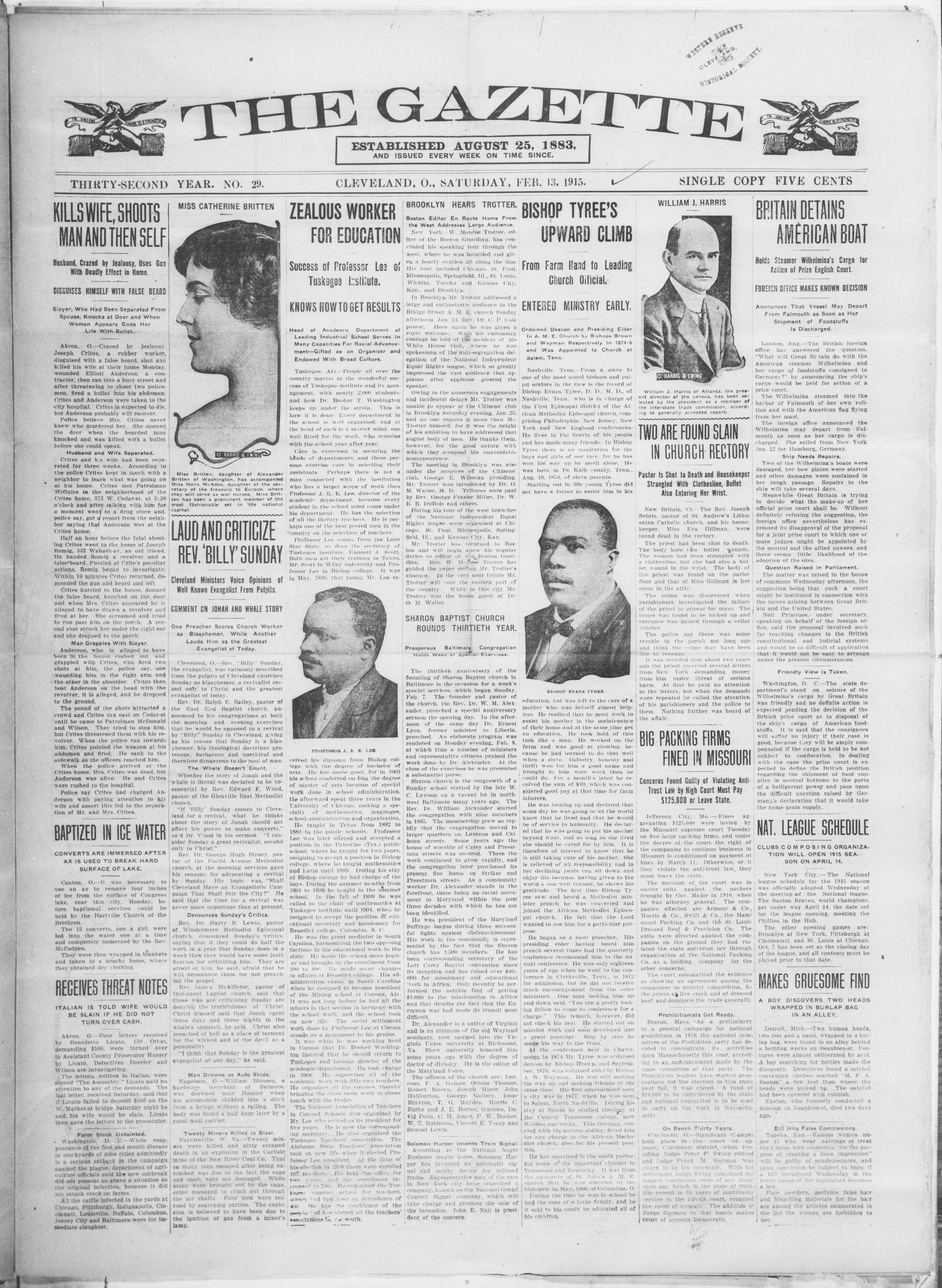
Miss Britten, daughter of Alexander Britten of Washington, has accompanied Miss Nona McAdoo, daughter of the secretary of the treasury to Europe, where they will serve as war nurses. Miss Britten has been a prominent member of the most fashionable set in the national capital.
LAUD AND CRITICIZE REV. 'BILLY' SUNDAY
Cleveland Ministers Voice Opinions of Well Known Evangelist From Pulpits.
COMMENT ON JONAH AND WHALE STORY
One Preacher Scores Church Worker as Blasphemer, While Another Lauds Him as the Greatest Evangelist of Today.
Cleveland, O. Rev. "Billy" Sunday, the evangelist, was variously described from the pulpits of Cleveland churches Sunday as blasphemer, a revivalist second only to Christ and the greatest evangelist of today.
Rev. Dr. Ralph E. Bailey, pastor of the East End Baptist church, announced to his congregations at both the morning and evening exercises that he would be opposed to a revival by "Billy" Sunday in Cleveland, giving as his reason that Sunday is a blasphemer, his theological doctrines grotesque, barbarous and unethical and therefore dangerous to the soul of man.
The Whale Doesn't Count.
Whether the story of Jonah and the whale is literal was declared to be essential by Rev. Edward F. Wood, pastor of the Glenville East Methodist church.
"If 'Billy' Sunday comes to Cleveland for a revival, what he thinks about the story of Jonah should not affect his power to make converts," said Dr. Vood in his sermon, "I consider Sunday a great revivalist, second only to Christ."
Rev. Dr. George Hugh Birney, pastor of the Encidic Avenue Methodist church, at the morning services gave his reasons for advocating a revival by Sunday. His tople was, "Shall Cleveland Have an Evangelistic Campaign That Shall Stir the City?" He said that the time for a revival was never more opportune than at present.
Denounces Sunday's Critics.
Rev. Dr. Harry B. Lewis, pastor of Windermere Methodist Episcopal church, denounced Sunday's vrieties, saying that if they would do half the work in a year that Sunday does in a week then they would have some justification for criticizing him. They are attrail of him, he said, afraid that he will deminounce them for not preaching the gospel.
Rev. James McAllister, pastor of Immanuel Baptist church, said that those who are criticizing Sunday are denying the truthfulness of Christ. Christ himself said that Jonah spent three days, and three nights in the whale's stomach, he said. Christ also preached of hell as a place of torment for the wicked and of the devil as a personality.
"I think that Sunday is the greatest evangelist of our day," he said.
Man Drowns 24 Auto Skis.
Napoleon, O. - William Houser, a hardwarp merchant of Belmont, was drilled north near Hamler when his automobile skidded into a ditch from a bridge without a railing. The body was found a half hour later by a rural mail carrier.
Twenty Miners Killed in Blast.
Fayetteville, W. Vas.-Twenty miners were killed and sixty escaped death in an explosion in the Carlisle mine of the New River Coal Co. That so many men escaped after being entombed was due to the fact the cage and shaft were not damaged. While many were brought out by the cage, some managed to climb out through the air shafts. Four men were rescued by searching parties. The explosion is believed to have been due to the ignition of gas from a miner's lamp.
ESTABLISHED AUGUST 25, 1883 AND ISSUED EVERY WEEK ON TIME SINCE.
ZEALOUS WORKER FOR EDUCATION
Success of Professor Lee of Tuskegee Institute.
KNOWS HOW TO GET RESULTS
Head of Academic Department of Leading Industrial School Serves in Many Capacities For Racial Advancement—Gifted as an Organizer and Endowed With Broad Culture.
Tuskegee, Ala. People all over the country marvel at the wonderful success of Tuskegee institute and its management, with nearly 2,000 students, and how Dr. Booker T. Washington keeps up under the strain. This is how it is done: Every department in the school is well organized, and at the head of each is a master mind, one well fitted for the work, who remains with the school year after year.
Care is exercised in securing the heads of departments, and these persons exercise care in selecting their assistants. Perhaps there is not a man connected with the institution who has a larger scope of work than Professor J. R. E. Lee, director of the academic department, because every student in the school must come under his department. He has the selection of all the literary teachers. He is perhaps one of the best posted men in the country on the selection of teachers.
Professor Lee comes from the Lone Star State, as does the secretary of Tuskegee institute, Emmett J. Scott. Both men got their training in Texas, Mr. Scott in Wiley university and Professor Lee in Bishop college. It was in May, 1889, that young Mr. Lee re-
PROFESSOR J. R. E. LEE.
ceived his diploma from Bishop college with the degree of bachelor of arts. He has made good, for in 1903 his school conferred on him the degree of master of arts because of special work done in school administration. He afterward spent three years in the University of Chicago, making a specialty of mathematics, languages, school administration and organization. He taught in Texas from 1882 to 1889 in the public schools. Professor Lee was later offered and accepted a position in the Palestine (Texas) public school, where he taught for two years, resigning to accept a position in Bishop college, where he taught mathematics and Latin until 1891. During his stay at Bishop Probeidge he had charge of the boys. During the summer months from 1891 to 1890 he taught in the summer school. In the fall of 1890 he was called to the chair of mathematics at Tuskegee institute until 1904, when he resigned to accept the position of educational secretary and missionary for Benedict college, Columbia, S. C.
He was the great mediator in South Carolina, harmonizing the two opposing factions in the educational work in the state. He made the school more popular and brought up the enrollment from 200 to 400. He made many changes in affairs at Benedict college. His administration close, in South Carolina when he resigned to become president of the Mining school at Corona, Ala. It was not long before he had all the miners in that section in harmony with the school work, and the school took on new life. The social settlement work done by Professor Loc at Corona stands as a monument to his genius. It was while he was working hard in Corona that Dr. Booker Washington insisted that he should return to Tuskegee and become director of the academic department. He took charge in 1906. He supervived all of the academic work with fifty two teachers. He organizes all the courses thereby bringing the class room work in closer touch with the trade.
The National Association of Teachers in Colored Schools was organized by Mr. Lee who served as its president for five years. He is now the corresponding secretary. He also organized the Tuskegee Teachers' Association. The Alabama State Teachers' association took on new life when it elected Professor Lee president. At the time of his election in 1955 there were enrolled 107 teachers. He held the office for two years, and the enrollment increased. So he organized the Tuskegee school system for teachers, which last just a decade, an attendance of 60,000 has the confidence of the people and has served all the teachers' associations south.
BROOKLYN HEARS TROTTER.
Boston Editor En' Route Home From the West Addresses Large Audience.
New York, W. Monroe Trotter, editor of the Boston Guardian, has conceived his speaking tour through the west, where he was herded and given on a hearty ovation all along the line. His tour included Chicago, St. Paul, Minneapolis, Springfield, HI, St. Louis, Wichita, Toledo and Kansas City, Kan., and Brooklyn.
In Brooklyn, Mr. Trotter addressed a large and enthusiastic audience in the Bridge Street A. M. E. church Sunday afternoon Jan. 24. Rev. Dr. C. P. Coe pastor. Here again he was given a royal welcome. With his customary courage he told of the incident of his White House visit, where he was spokesman of the anti-segregation delegation of the National Independent Equal Rights league, which so greatly impressed the vast audience that applause after applause greeted the speaker.
Owing to the numerous engagements and incidental delays Mr. Trotter was unable to appear at the Citizens' club in Brooklyn Saturday evening, Jan. 25, and no one regrets it more than Mr. Trotter himself, for it was the height of his ambition to have addressed that august body of men. He thank them, however, for the good nature with which they accepted his unavoidable nonappearance.
The meeting in Brooklyn was also under the auspices of the Citizens' club, George E. Willecan, presiding, Mr. Trottier was introduced by Dr. O. M. Walter, M. D. Tribunes were paid by Rev. George Frazier Miller, Dr. W. E. R. DmBols and others.
During his tour of the west branches of the National Independent Equal Rights league were organized at Chicago, St. Paul, Minneapolis, Springfield, Bld. and Kansas City, Kan.
Mr. Trottier has returned to Boston and will begin since his regular duties as editor of the East Guardian. Mrs. W. W. Moore Trottier has guided the paper during Mr. Trottier's absence. In the very near future Mr. Trottier will tour the eastern part of the country. While in this city Mr. Trottier was the house guest of Dr. O. M. Walter.
SHARON BAPTIST CHURCH ROUNDS THIRTIETH YEAR.
Prosperous Baltimore Congregation Holds Week of Special Exercises.
The thirtieth anniversary of the founding of Sharon Baptist church in Baltimore is the occasion for a week's special services, which began Sunday, Feb. 7. The founder and pastor of the church, the Rev. Dr. W. M. Alexander, preached a special anniversary sermon the opening days. In the afternoon of the same day Dr. Ernest Lyon, former minister to Liberia, preached. An elaborate program was rendered on Monday evening, Feb. 8, at which time a number of ministers and representative citizens praised the work done by Dr. Alexander. At the close of the exercises he was presented a substantial purse.
Sharon church is the outgrowth of a Sunday school started by the late W. C. Lawson on a vacant lot in north-west Baltimore many years ago. The Rev. Dr. William Alexander started the congregation with nine members in 1855. The membership grew so rapidly that the congregation moved to larger quarters on Laurens and Calhoun streets. Some years ago the house of worship at Carey and Presstman streets was secured. There the work continued to grow rapidly, and the congregation later purchased its present fine home on Striker and Presstman streets. As a community worker Dr. Alexander stands in the forefront, there being no racial movement in Maryland within the past three decades with which he has not been identified.
He was president of the Maryland Suffrage league during three successful rights against disfranchisement. His work in the community is represented by the fact that the Sharon church has 1,500 members. He has been corresponding secretary of the Lott Carey Baptist convention since itsception and has raised over $40,000 for missionary and educational work in Africa. Only recently he performed the notable feat of getting $1,000 to the missionaries in Africa and that despite the fact that the European war had made its transit most difficult.
Dr. Alexander is a native of Virginia and is an alumnus of the old Wayland seminary, now merged into the Virginia Union university at Richmond Va. Shaw university honored him some years ago with the degree of doctor of doctor of divinity. He is the editor of the Maryland Voice.
The offices of the church are: Deans, F. A. Gaines, Orlando Thomas Robert Brown, Joseph Minor, John Haltiburton, George Gallery, Iesque Braxton, T. G. Mayden, Morris C Burke and J. E. Bottes trustees, David Penn, C. H. Jones, J. P. W. Booker, W. T. Robinson, Vincent E. Toney and Samuel Lewis.
Solomon Harper Invents Train Signal: According to the National Negro Business league notes, Solomon Harper has invented an automatic signal and safety device for railroad trains. Representative men of the nation in New York city have organized a company, known as the National Grind Control Signal company, which will take charge and promote the sale of the invention. John E. Nail is president of the concern.
BISHOP TYREE'S UPWARD CLIMB
From Farm Hand to Leading Church Oficial.
ENTERED MINISTRY EARLY.
Ordained Deacon and Presiding Elder
In A. M. E. Church by Bishops Brown
and Wayman Respectively in 1874-6
and Was Appointed to Church at
Salem, Tenn.
Nashville, Tenn. From a slave to
one of the most noted bishops and put-
putors in the race is the record of
Bishop Evans Tyree, D. D. M. D. of
Nashville, Tenn. Who is in charge of
the First Episcopal district of the Af-
rican Methodist Episcopal church, com-
pelling Philadelphia, New Jersey, New
York and New England conferences.
He lives in the hearts of his people
and has made many friends. In Bishop
Tyree there is an inspiration for the
boys and girls of our race for he has
won his way up by merit alone. He was born in De Kaltha county, Tenn.
Aug. 19, 1854, of slave parents.
Starting out in life young Tyree did
not have a father to assist him in his
DISHOP EVANS TYKEE
education, but was left to the care of a mother who was herself almost helpless. He realized that he must work to assist his mother in the maintenance of their home and at the same time, get an education. "He took hold of this task like a man. He worked on the farm and was good at plowing, because he had learned to do that well when a slave. Industry, honesty and thrift won for him a good name and brought to him wore work than he could do. For a month's labor he received the sum of $10, which was considered good pay at that time for farm laborers.
He was looking up and, declared that some day he was going to let the world know that he lived and that he would be of service to humanity. He declared that he was going to put his mother beyond want, and as long as she lived she should be cared for by him. It is therefore of interest to know that he is still taking care of his mother. She is relieved of all responsibility and in her declining years can sit down and enjoy life because, having given to the world a son well trained, he shows his gratitude. The first time Bishop Tyre saw and heard a Methodist minister preach he was converted and joined the African Methodist Episcopal church. He felt that the Lord wanted to use him for a particular purpose.
He began as a local preacher. His presiding order having heard him preach several times and the quarterly conference recommend him to the annual conference. He was only eighteen years of age when he went to the conference in Chattanooga, Tenn., in 1872 for admission, but he did not receive much encouragement from the color ministers. One man looking him up and down said, "You are a pretty looking fellow to come to conference for a charge." This remark, however, did not check his zeen. He started out on mission work and soon developed into a great preacher. Step by step he made his way to the front.
At the conference held in Chattanooga in 1874 Mr. Tyree was coed and demeaned by Iphigene Trown, and September 1876 was continued色彩 by Besson W. Wayman. He was still meeting his way up and making friends at the same time. His first appointment near a city was in 1877 when he was sent to Salem, North Nassauville. During his stay at Salem he studied theology at the Central Tennessee college, New Warden university. This time, he competed with his native ability, lived for any charge in the African Methodist church, also for his present position.
He has resigned to the south pastor
some of the important churches in
Tennessee and New Jersey. He was from
Maryland. He is survived by
his husband in May, book at Cummings, O.
During the time he was rescheduled
he held the entire of a large family, and so
it said to his credit he educated all of
his children.
WILLIAM J. HARRIS of Atlanta, the present director of the census, has been selected by the president as a member of the interstate trade commission, according to generally accepted report.
TWO ARE FOUND SLAIN IN CHURCH RECTORY
Pastor Is Shot to Death and Housekeeper
Strangled With Clothesline, Bullet
Also Entering Her Wrist.
New Britain, Ct. The Rev. Joseph Zebris, pastor of St. Andrew's Lithuanian Catholic church, and his housekeeper, Miss Eva Gillman, were found dead in the rectory.
The priest had been shot to death. The body here two bullet wounds. The woman had been strangled with a cipherline, but she had also a bullet wound in the wrist. The body of the priest was found on the parlor floor and that pi Miss Gillman in her room in the attic.
The crime was discovered which parishioners investigated the failure of the priest to appear for mass. The house was found to be locked up and entrance was guarded through a cather window.
The police say there was some trouble in the parish not long ago and thinks the cipher may have been due to revenge.
It was resolved that about two years ago the priest received several letters from New York demanding money from him under threat of serious harm. At first he paid no attention to the letters, but when the demands were repeated he called the attention of his parishioners and the police to them. Nothing further was heard of the affair.
BIG PACKING FIRMS FINED IN MISSOURI
Concerns Found Guilty of Violating Anti-
Trust Law by High Court. Must Pay
$125,000 or Leave State.
Jefferson City, Mo.—Fines, aggregating $125,000 were levied by the Missouri Supreme court Tuesday on five large packing firms, and under the decree of the court the right of the companies to continue business in Missouri is conditioned on payment, ifines by March 11. Otherwise, or if they violate the antitrust law, they must leave the state.
The decision of the court was, in outer suits against the packers brought by Gov. Major in 1900, when he was attorney general. The companies affected are Armour & Co. Morris & Co., Swift & Co., the Hammond Packing Co. and the St. Louis Dressed Beef & Provision Co. The suits were directed against the companies on the ground they had violated the state anti-trust law through organization of the National Packing Co. as a holding company for the other concerns.
"The court summarized the evidence as showing an agreement among the companies to restrict competition, by the prices of the stock and of dressed beef and dominate the trade generally."
Prohibitionists Get Ready.
Boston, Mass. As a preliminary to a general campaign for national prohibition in 1856 the national committee of the Dollinson party has devoted to enumerate its activities in Massachusetts this year, according to an official report made by the state commissioner of that party. The Dollinson party has started preparations for the objection in this state-fall it was stated. A kind of stagnation is constituted by the state and national councils to be used to party on the objection in this state-fall.
On Bench Thirty Years.
Court of the General Court, Nassau County, place in the county court, in the district, when national judge Robert F. Sawyer of New York County, M. C.
IN UNION THERE IS STRONGTH
BRITAIN DETAINS AMERICAN BOAT
Holds Steamer Wilhelmina's Cargo for Action of Prize English Court.
FOREIGN OFFICE MAKES KNOWN DECISION
Announces That. Vessel May Depart. From Falmouth as Soon as Her Shipment of Foodstuffs Is Discharged.
London, Eng. The British foreign office has answered the question, "What will Great Britain do with the American steamer Wilhelmina and her cargo of foodstuffs consigned to Germany?" by announcing the ship's cargo would be held for action of a prize court.
The Wilhelmina steamed into the harbor of Falmouth of her own collision and with the American flag flying from her mast.
The foreign office announced the Wilhelmina may depart from Falmouth as soon as her cargo is discharged. She sailed from New York Jan. 22 for Hamburg, Germany.
Ship Needs Repairs.
Two of the Wilhelmina's boats were damaged, her bow plates were started and other damages were sustained in her rough passage. Repairs to the ship will take several days.
Meanwhile Great Britain is trying to decide what she make up of her official prize court shall be. Without definitely refusing the suggestion, the foreign office nevertheless has expressed its disapproval of the proposal for a joint prize court to which one or more judges might be appointed by the neutral and the allied powers, and there seems little likelihood of the adoption of the idea.
Question Raised in Parliament.
The matter was raised in the house of Commons Wednesday afternoon, the suggestion being that such a court might be instituted in connection with the issues arising between Great Britain and the United States.
Neil Primrose, under secretary, speaking on behalf of the foreign office, said the proposal involved such far reaching changes in the British constitutional and judicial systems and would be so difficult of application that it would not be easy to arrange under the present circumstances.
Friendly View Is Taken.
Washington, D. C.-The state department's stand on seizure of the Wilhelmina's cargo by Great Britain was friendly and no definite action is expected pending the decision of the British prize court as to disposal of the ship's cargo of American foodstuffs. It is said that the consignees will suffer no injury if their case is good, because they will be amply compensated if the cargo is held to be not subject to confiscation. In dealing with the case the prize court is expected to define the British position, regarding the shipment of food supplies in neutral bottoms to the ports of a bolligerent power and pass upon the difficult question raised by German declaration that it would take the home grain supply.
NAT. LEAGUE SCHEDULE
CLUBS COMPOSING ORGANIZATION WILL OPEN 1915 SEASON ON APRIL 14.
New York City.--The National league schedule for the 1915 season was officially adopted Wednesday, at the meeting of the National league. The Boston Braves, world champions, get under way April 14, the date set for the league opening, meeting the Philips in the Hub.
The other opening games are: Brooklyn at New York, Pittsburgh at Cincinnati and St. Louis at Chicago. Oct. 7 has been set as the closing day of the league, and all contests must be played prior to that date.
MAKES GRUESOME FIND
A BOY DISCOVERS TWO HEADS WRAPPED IN BURLAP BAG IN AN ALLEY.
Detroit, Mich. Two human heads, two feet and a hand, wrapped in a burlap bag, were found in an alley behind a bottling works on Beaubienst. Features were almost obliterated by a boy searching for bottles made the discovery. Detectives found a petal containing clothes marked M. F. Easton a few feet from where the heads were picked up. The sate of had been covered with rubbish.
Easton, who formerly conducted a mission on Beaubienst, died two days ago.
Bill Hits False Complexions
Tampa, Fl. Kansas women under 18 wear earrings or treat with cotton in the pub. The petal containing the earrings is a false impression of a mishap and cannot be traced to the cause.
The doctors perfume false hair and bleaching materials for the hair are among the articles enumerated in the list the women are forbidden to
The GAZETTE
One Year.....$1.50.
Six Months.....1.00
Three Months......50
Subscribers are requested to rem-
mit by postoffice money or
der or registered letter
Attended at the postoffice in Cleveland
Ohio, as second-class matter.
Address all communications to
HARRY C. SMITH
Editor and proprietor,
THE GAZETTE,
Blackstone Building, Cleveland, O.
Member Ohio Legislature: 1894
to 1896; 1896 to 1898; 1900 to 1902
THE GAZETTE is the oldest, and has the largest bona fide circulation double that of any newspaper in the interest of Afro-Americans, published in the state of Ohio, and comparison with any will immediately establish its rank as one of the NEWSIEST AND BEST in the country.
10,000,000 Afro-Americans.
160,000 in Ohio.
20,000 in Cleveland.
SATURDAY, FEBRUARY 13, 1915
President Wilson should be proceeded against as a monopolist of wisdom.
Bryan's permanent world peace is as far distant as the millenium; just exactly as far.
In Mexico the question. "What shall we do with our ex-presidents?" is a rapidly growing one.
This is the meanest yet! Senator Cummins says the president's Indianapolis speech was a lamentable attempt to forget courtesy.
The Chicago Culture club (white) refused to admit Mrs. S. S. Feigl, a business woman of that city, because she is a Jewess. The club ought to be disbanded.
We are wondering if our people, the country over, really appreciate the splendid work in their behalf, Dr. Joeel 15. Spingarn has done on his two annual tours? Greater interest in them should be shown by the race press.
Local daily papers throughout the country have published in the last month or two, Panama-Pacific Exposition views that appeared in The Gazette last summer and fall. The "old reliable" leads.
The conclusion that Democracy will nominate President Wilson next year seems foregone. Their campaign must be made on Mr. Wilson's record and who can so ably defend it as he, had though it be?
Many are saying that the United States should not increase its show of military power because it is the logical mediator for the settlement between the warring European nations when they become exhausted. But, is it not probable that a nearby nation with a mobilized army will assume the duty of mediating, using a strong arm?
The greatest danger to the Republic is that the people as a whole show a tendency to consider the Government and its agencies as things apart from them. In this lies the danger from a possible dictatorship. It is only a step from the coercing of Congress by the President, or of the Legislature by the Governor, to the establishment of an empire.
A Put. Sandles in a speech before the agricultural committee of the house of representatives lauded Governor Cox for retaining at the head of the agricultural experiment station at Wooster Director C. E. Thorne, a Republican. He failed to add that after permitting Director Thorne to remain, Governor Cox compelled this venerable scientist of the state to accompany him in his stumping tour for reelection.
A Christian civilization should produce world-wide peace, logically, but we have recently and sadly learned that nations making claim to the highest civilization disregard the rules of civilized warfare in slaying noncombatants and violate international contracts and laws, while appealing for aid to Him who brought peace and good will to the earth. We are savages still.
Governor Willis has distinguished himself in at least one respect since he has been in the state house. Few governors have fired more Democrats in the same length of time.—Marion Tribune.
The foregoing statement again shows the habitual laxity in veracity of the Democratic press. Governor Willis has not removed a single man from office—not even one of the crooks. The places he has filled were made vacant by resignation or expiration of term.
What new tax will the Democratic congress levy to secure the money to buy vessels after the shipping bill is enacted? The loss of national revenue from the Wilson tariff is not fully compensated by the income and "war" taxes. The treasury statement of January 20 shows the government income last year was $35,356,000 less than the previous year, while the expenditures were $12,537,000 greater and that the treasury surplus is $47,834,000 less than a year ago. Next year there will be a loss of about $50,000,000 sugar tax under the president's tariff bill. But Mr. Wilson has undertaken by threats to frighten Congress to appropriate $80,000,000 for the buying of interned ships.
A Winchester, Ky., white brute, aged 50, is out on $3,000 ball in each case for debauching ten Afro-American school-girls of tender years. The youngest 7, the oldest 13. He was carefully watched and evidence gained by the authorities before his arrest. If the authorities, generally, in the South could be induced to show the same activity, thousands of our girls would be saved monthly if not weekly.
When the anti-Negro Reed amendment to the Immigration bill was being discussed in the U. S. Senate, we hoped to hear from Senator Theo E. Burton of Ohio, but was disappointed. Now that the House's "jim-crow" car bill for the District of Columbia has been sent to the Senate, surely he will let us hear from him. In all of his many years in both branches of the Congress, we do not remember his having made a single plea, much as they have been needed, for a people thousands of whom have been among his staunchest and best supporters in this Congress district, and the state at large.
The Curtis Publishing Co., which issues the Philadelphia Saturday Evening Post and the Ladies' Home Journal, repudiates the insult to the race, The Gazette called attention to in recent weeks, and says the insulting publication "is based on an article which appeared in an issue of Advertising and Selling" and that it "entirely misrepresents" toward and their "Mr. Evans' attitude" toward the race and his "statements" relative to it. Also, that it, the Curtis Pub. Co., has called upon "Advertising and Selling," a publication, for an explanation which "will undoubtedly be made in its next issue." The race is indebted to Mr. Wm. Warley of the Louisville (Ky.) News for the above information.
THE ONSWEEP OF A GREAT BUSI
NESS TIDE.
The tidings from every part of the Union is of times steadily improving of business growing larger in volume and value, of idle labor rapidly going into employment in the industrial districts.
Fifteen thousand workmen in the 68 plants of the H. C. Frick Company, in Fayette County, Pennsylvania, on Monday last were placed at work on full time.
One thousand more men have been employed at the Illinois Steel Company plant at Milwaukee, Wis., and the plant is now running at practically full capacity.
The horseshoe works at Catusqua, Penn, have just received an order from the Russian Government for 1,000,000 horseshoes, and the plant is running day and night.
The great Bethlehem Steel Works have ordered the expenditure of $20,000,000 in extension of their plant, and President Schwab has directed that work upon the additions be commenced at once.
Every workman in the employ of the Pittsburgh Steel Company at Charleroi and Monessen reported for work last Monday. Every department in the company's big plants was placed in full operation, and it is estimated that 500 employees who have been on half time will be placed on full time and that 2,500 men who were laid off return now to their old positions.
The depression in the South has gone, and, with the cotton now going out rapidly at higher prices, the cash going into that section is telling most effectively upon general business.
PETTING THE WRONG PEOPLE.
The state's criminals will be petted less during a Republican administration than by the previous one. This is shown by the determination of the house finance committee to furnish, this year, no money for the erection of buildings upon the farm Governor Cox bought for the "damaged social units." The recent administration joined the Socialists, Volunteers of America officers and the "sob sisters" in effort to make happy the lives of those against whom society had found it necessary to protect itself. The governor gave them wages and spent money to secure for them the advantages of a rural home, while he cut out requests for appropriations for needed buildings at state hospitals and children's homes until now there are about 4,000 which laws require the state to care for, awaiting admittance to our charitable institutions. These things which were done by law are charged to Governor Cox because he was as absolute a law giver as Moses—he may not have been inspired of God, however.
Warden Thomas of the penitentiary is handling by moral suasion habitual criminals who long have preyed upon their fellow men; has provided a forum in which they can discuss the uplift of humanity, and recently has given them a Republican form of government.
The only experience Mr. Thomas had before taking charge of the big prison was at the Mansfield Reformatory where first offenders, but no hardened criminals, are sent. This may account for his feebleness in discipline which permitted an average of one escape a week during his first half year; until the more enterprising prisoners were free.
A Civil War Veteran
A Civil War Veteran.
New Albany, Ind.-Lucy Nichols said to be the only woman honored with membership in the G.A.R., and pensioned by the government for service in the Civil war as a nurse and officers' cook, died Feb. 6. As a young "slave" Lucy Nichols joined the Twenty-third regiment in Tenement City in 1883 and lived here since the war. Sanderson Post, G.A.R., composed chiefly of the members of that regiment, elected her an honorary member, several years ago, and helped to obtain by special act of Congress a pension for her. For many years she was a figure in the annual reunions of the Twenty-third regiment and in the Memorial day exercises at the National Soldiers' cemetery here.
Thank you! Editor John M. Mulford.
Our friend, Harry C. Smith, of Cleveland, celebrated the thirty-second and on-half-year of his paper. The Gazette-by publishing an exceedingly fine edition. Harry is an example for all hustling Colored men to pattern after-Lebanon (O.) Western Star.
THE GAZETTE, CLEVELAND, O. SATURDAY, FEBRUARY 13, 1915.
WRITTEN BY "THE OLD RELIABLE" GAZETTE'S CORRESPONDENTS
THROUGHOUT THE STATE
CADIZ—Mr. Chas. Brown entertained the B. B. Sunsay.—Frank Merle Tappan and Mrs. Susie Were quietly married at the A. M. E. parsonage, Feb. 3.—Rev. and Mrs. O. W. Childers were in Stillwater. Sunday.—Miss Bertha Carter has returned from a visit in Wellsburg. Mrs. Laura Olmstead was called to Fernwood by Mrs. Retta Palmer's serious illness.
CAMBRIDGE—Theo. Payton, Mrs Ada L. Phillips and Mrs. E. J. Knox are convalescents—The A. M. E. Laies' Aid society social was a success—Macedonia Baptist church revival under the direction of its pastor, Rev J. R. Green, gives excellent promise of good results.—Stewart Betts was in the city, last week.—Quarterly meeting at the A. M. E. church, Sunday Dr. J. W. Gazaway, P. E. was ill at his home in Springfield so Rev Purs. Rose and Helen Dickens of Craig, were here, last Thursday—Mrs. J. R Green's daughter, Mrs. Jas. Christian of Akron, is convalescing.
OBERLIN—Mr. Fred Wright died Jan. 31. His wife and daughter, Juan ita, have the sympathy of many friends.—Mr. Slimp is sick.—The Elite club entertained the presidents of other clubs at Mrs. Bessie Evans' Wednesday evening. The Hibernian met at Easter evening. The Thursday evening. Mt. Zion's Ald society met at Mr. Fred. Russel's. A debate was the feature: "Resolved that industrial education is more beneficial to the Afro-American than a classical education." The affirmative medical school was also enjoyed.—The Missionary society met at Rust M. E. church. Mrs. E. H. Richards lectured.
SANDUSKY.—Both churches and S. s. were well attended. Sunday, Rev. J. D. Singleton fell in the bay. It is said he is not a good skater. However, he officiated at the funeral of Mrs. McGintha, an old resident, who dled, Friday, and was buried, Monday.—Mr. Williams is quite feeble.—Miss W. Mander has gone to Ft. Lauderdale. Ind. to the Law School, Lewes. Ann Arbor,党组 of her niece, Mrs. H. Richard, will leave for home, this week. She has made many friends, here. Her concert at the Second Baptist church. Friday eevening, under the direction of the Lyceum, was a success. Mr. Mott was the "Doctor Cure All," and was good.—Rev. G. D. Smith will attend the executive board meeting of the church church, in Cleveland.—"Mother" Johnson is quite ill. Also. Mrs. Akins.
CORRESPONDENTS must mail all letters for publication at their main postoffice sufficiently early on Monday (or Sunday) of each week to have them reach The Gazette office on Tuesday morning, and always write also, their names and that of their or town on the outside of the wrapping paper. If this latter is done, proper credit cannot be given you. Lists of names, wedding presents, etc., obituary notices, speeches, resolutions, poetry, inquiries for relatives and advertisements of all kinds, including items for sale in the near future, must be paid for in advance at the rate of ten cents a line, six words to a line. Our rates for display advertisements will be sent on application. Send postal note and not stamps during warm weather.
SPRINGFIELD—Miss Margaret Turner of Cleveland, and Miss Lucy Robinson of Columbus, are visiting their aunt, Mrs. C. C. Jones—Mr. and Mrs. Samuel Baker and Mrs. Amanda Harvey and children of Louisville, Ky. were here, last week. Also, Rev. and Mrs. Chas, Richardson of Detroit, Mrs. W. C. McKinney of Anderson, and Miss Charabell Mathers of Ft. Wayne, Mrs. Abbey Carrs of Benton, retained Tuesday, in honor of visitors. Snowden are very ill—Mr. and Mrs. Geo. Dueson have a fine new baby boy—Mr. and Mrs. C. C. Green and Mr. and Mrs. John Powers were in Plaquen recently. Rev. R. T. Frye conducted a two-weeks' revival in Detroit, returning last week—Mrs. Jas. Parker Mrs. Wm. Green and Mrs. Louis Carpenter were in Dayton, recently.
YOUNGSTOWN.—J. F. Harris is Mahoning Valley lodge's delegate to the Odd Fellows' midwinter session at Columbus, the 14th.—Mr. and Mrs. Otis Carey have a fine baby girl—Mrs. Nancy Burns of Sharon, was Mrs. Wm. Brown's guest, a few days.—Mrs. Neta Blake, was called to Cleveland, Sun. Oct. 14.—Mrs. Edin Hines went an operation, the next day.—St. Mary's two weeks' revival has been a very encouraging success. Rev. S. P. West, pastor.—Rev. W. O. Harper has been in Dayton, his former home, this week, conducting a revival.—Mr. and Mrs. Geo. Holmes left Sunday, to locate in Chicago.—Mrs. Nannie Woods is visiting her mother, Mrs. R. Verse of Poland, entertained the Anglo Wes. of Poland, entertained the Irish Ides' Aid a sewing circle and W. M. M. S, this week.—Buckeye lodge meet the 18th.—Mrs. John Lacy remains quite ill.
MANSFIELD—Mrs. R. Reynolds sang a pretty solo, Sunday, accompanied by Miss D. Barker, Mr. Fox read an excellent paper on "Ruth and Naami." The Juvenile Sunshine chut met at Mr. and Mrs. R. Love's. Saturday, Refreshments. Miss D. Barker's bible-class is still holding the banner. Love-feast; Sunday morning Bishop R. Allen's and A. Lincoln's birthdays will be observed at the A. M. e. church. Sunday. A literary program. Pretend and Mrs. Barker spent a day mentoring with Mrs. R. Cora, Wednesday. Faustina Vasht Ford will be baptized. Tuesday evening, by Dr. Maxwell. Don't forget that he will preach that evening. Let us give him a full house.—Miss Parker of Richwood, was the guest of Mrs. R. Fisher, last week.—Miss C. Pleasants, Mrs. Grant and daughter, Miss Cora, entertained delightfully, last week: Mesdames Dunmore, Love, Thompson, Hamilton and Ford;
Messrs. Pleasant, Ford, Hamilton and Dunmore. Refreshments.—The K. P's will give an entertainment this Friday evening.—Our club gave a meal, the Hall, Friday evening, Messrs. Davs, Dunmore and Ford served the supper.
SMITHFIELD.—Mrs. Mariah Biggs, age 66, died. Saturday morning after a few days' illness. Her husband died about two months ago. A daughter, three sons and 8 grandchildren survive her. She had been a member of the A. M. E. church since girlhood and was one of the "pillars". The passover B. D. Lloyd affiliated at the funeral. She will be greatly missed by Mr. L. Thornton of Pittsburgh, Mr. Wm. Parks of Wintersville, Mr. G. Palmer and daughter, Misses E. and C. Ramsey, Fred Christian and Mr. D. West of Hopedale, Mr. I. Davis of Cadiz, Mr. and Mrs. A. J. Guy and Mrs. Christian of Steubenville, Mrs. W. W. Johnston of Steubenville, Mrs. W. W. Johnston of Mt. Pleasant, and others, were here recently.—Miss Nannie Harris of Wheeling, formerly a resident of this city, and Mr. Archie Johnston of that place, were married recently.—Many came from out of the city to attend the Biggs funeral. A number from Meadow Lake, a few from E. Powell, Mrs. A. Palmer, Mrs. Myrtle Peterson and Mrs. A. Smith are convulsive.
THE "SPINGARN" MEETING
Prominent Men in Attendance. As Usual—Another Splendid Success.
Toledo, O.—Prof. Joel E. Spingarn was introduced at the recent meeting, held in Warren A. M. E. church, here by Judge Charles E. Chittenden of the court of appeals. The house was crowded with one of the most enthusiasic gatherings we ever seen, and several hundred were turned away. Seated the stage were Judge Curtis Johnson, Judge O'Brien O'Donnell, Judge Commnager, Judge Austin ex-Representative Nye and others.
"The American people are tired of the so-called Negro question," said Dr. Spingarn. "They wish that it might be dismissed from their minds for all time; but despite this, it will not down. Certainly it will not down so long as segregation and disfranchisement and lynching and the exclusion of Colored immigrants are the only ways we use to down it. For no question can be solved until it is solved. We have applied a consistent justice to the Negro problem since the war 'amendments were first passed after the civil war. We come to the American people with a plea for justice. We say
PROFESSOR J. E. SPINGARM.
to them frankly, as Sir Sydney Oliver the British governor of black-teeming Jamaica, has said before us, that never can we solve the problem by the deadline of color. When you ask for office or position of responsibility for some able Colored man, you are always met with the answer: "But you can't treat black people like white people; there are some very talented ones, but the whole race is so ignorant and vicious. Even if the masses are ignorant, what has that to do with the able men who are not ignorant? When Woodrow Wilson runs for president, we don't say: "We cannot elect him president because the great masses of the American people are not fit to hold office." We don't have to allow the able men own ideals; and the black man has the right in each individual case to demand that this test and no other be asked of him."
At the conclusion of the meeting it was announced that about 200 new applicants for membership in the N. A. A. C. P. had been received. Dr. Spingarn left for Buffalo, where the last speech of this mid-western tour of a city on Thursday evening. It has been a glorious success from every viewpoint.
WHERE' IS KATIE FOSTER?
Miss Katie Foster, my sister was separated from me in Fort Scott, Kansas, when but a child. She has since married. I heard she was a school teacher in Ohio. Any one knowing her whereabouts will kindly write 4t. Sam Foster, Adv. 344 E. 41st St, Chicago, Ill.
Fighting For a Wife.
Waukegan, Ill.—The color-line has broken out in Zion City. This fact came to light, last week, when Roderick M. Toombs sought the aid of the court in order to wed May Mitchell, (white) a church-worker in Alexander Dowie's famous town. Mr. Toombs said that Miss Mitchell has been imprisoned by her mother, who objects to the marriage. He sought a writ of habeas corpus to compel the mother to release her daughter.
"Chivalrous" Southern Whites.
As related in a dispatch from a Georgia town called Ohopee: "Because she had disciplined their young son. W. J. Hall, former mayor, held a gunshot over Miss Angie Standard of the public school while his wife attacked and whipped her." What a brave, law-abiding man!—Buffalo Daily Express.
THE IMPOTENCY OF CHRISTIANITY.
We who have been, comparatively speaking, but recently converted to Christianity have been amazed time and again at the utter indifference of the Christian Church in times of great wrongs and oppression. Almost without exception the Caucasian Church has hooked arms with the mighty, and the Christian Church has whom Christ expressly said He came to aid, to the fate prepared for them by the powerful—N. Y. Amsterdam News.
If you knew
Nelson's Hair Dressing as we do
you would never use anything
else on your hair.
We want you to know it—
know it personally by actual use,
don't take our word for it, or any-
one else,—test it yourself.
You can do this,
send us your name and address
and we will send you.
Free of cost,
a sample box of Nelson's Hair
Dressing, also a sample of Nelson's Scalp and Hair Cleaner and
a sample cake of Nelson's Skin
and Complexion Soap.
Test them
in your own home, if they are
not what we claim, you are not
out anything.
We have confidence
in them and are ready and anx-
ious to prove every claim we
make.
Write to day,
enclosing two cent stamp to pay
postage on samples.
NELSON'S
HAIR DRESSING
25¢
50¢
Has no superior as
a hair beautifier.
Thousands of men and
women have improved the
appearance of their hair by
using NELSON'S HAIR
DRESSING.
For those who know—it
is a toilet necessity.
Why not try it yourself?
Ask your druggist. If he
cannot supply you, send us
his name and address and we
will send you a free sample.
NELSON MFG. CO.
RICHMOND, VA.
The Answer
Is:—
NELSON'S
HAIR DRESSING
25¢
50¢
NELSON MANUFACTURING CO.,
Richmond, Virginia
THE NEW YORK TIMES
DOINGS OF THE RACE
Mabel Weinrich's father accompanied her when she applied for a marriage license, last week, at Pottsville, Pa., to marry Wm. Hill, a member of the race. She is German.
Tell your friends to subscribe for "the old reliable" Gazette. We want to double our circulation this year and have made an excellent start in January and thus far this month. Our readers can assist us greatly in this effort and we trust they will do so.
Barney Gerard has secured a judgment for $3489 against Jack Johnson. Do I hear a bid? Thirteen cents. Going, going, gone. Sold to the half witted gentleman for 13 cents—Cleve land Daily Press.
Our papers should charge for each thousand of the "National Negro Magazine Supplement". Nashville, Tenn., they circulate, and NOT do the work gregor because of the carrying of the Supplement, and carrying money out of it. Do not be "used" in any such way. Don't be "easy."
Three indictments charging the embezzlement of sums aggregating $751.59 were returned yesterday by the Hustings Court grand jury against Floyd Ross, grand worthy master of the Grand Fountain, United Order True Reformers, a colored fraternal organization charged with embezzling this amount from the Old Folks' Home, an institution under the direction of the order.
The editor of the Washington Bee, W. Calvin Chase, went down to the M Street High School on Monday and attempted to tell Prof. Amplias H. Glenn his duty with regard to marking examination papers of persons who are candidates for positions in the public schools. Now, Mr. Glenn is a most peacefully abused an adult last to seek a job. Chase's mind and words were too much for him. He resented the intrusion and lesson that Mr. Chase attempted to teach him; so he put an end to the interview by breaking two chairs over Chase's head, cutting his mouth badly and doing him up generally. It is reported Mr. Chase begged the teachers present not to let Glenn beat him to death. The result of the encounter has brought about general rejoicing in community. The received hundreds of congratulations by phone and letter and word.-Washington (D. C.) Sum, T. Thos. Fortune, editor.
It is a very significant fact that the census, of 1910 shows, contrary to what was apparently indicated by the census of 1900, that the Negro is making marked gains in the trades. In 1900 there were 86,534 Negroes reported as being in the building and carpentry trades, and 1,024,000 is issued given 288,141 Negroes in these trades. This is an increase for the decade of 201,607, or 235 per cent. Carpentry was one of the trades in which the Negro appeared to be losing ground. In 1900 the number of Negro carpenters working in the building trades was 110,100 there were 21,144, or 1290 less, there were 21,039 Negro carpenters working in the building trades. In addition to these there were 2192 other Negro carpenters who were returned as doing carpentry work in connection with factories, mines, railroads, etc. Similar increases are in the other trades, the other trades and industries in which the Negro was thought to be losing ground.—Monroe N. Work in the Southern Workman.
Johnson Will Charter Steamer
barbados. B. I. —Tipping the beams of ponds, pounds, and edition. Jack Johnson, heavyweight champion, reached here Monday on a steamer from Buenos Aires.
He said he will charter a steamer here to complete his trip to Mexico, where he is to fight Jess Willard. March 6.
Why not become a Hair Dresser? This is your chance. We will set you up in the business. We will send you a copy of our diploma from our school and furnish you wint our Complete Hair Dresser Outfit. All this for the small sum of $3.50. Hundreds of satified graduates all over this country are earning Big Money with our Outfits. Why not you? Write today, do not delay.
MILPARK SCHOOL OF HAIR DRESSING,
EDENTON, N. C.
QUINADE
GROWS HAIR
REMOVES DANDRUFF
SEND FOR SAMPLE
QUINASOAP
THE IDEAL SHAMPOO SOAP
THOROUGHLY CLEANSSES THE SCALP
QUINACOMB
HAIR STRAIGHTENER
SHAMPOO DRYER
QUINADE 25¢ QUINASOAP 50¢ QUINASOAP 25¢
AT ALL DRUGGISTS
SEEBY DRUG COMPANY, NEW YORK CITY, N. Y.
Is absolutely guaranteed and is bottled under Government supervision by The Cleveland & Sandusky Brewing Co West785 Central 3933
Taylor's New Shampoo Dryer and Hair Straightener!
The Best in the World!
This comb, properly heated, and the use of Lacreole Hair Pomade, will bring the most
erimy hair straight and silky at every stroke and cause a rapid growth of the hair.
Don't put it off but send $1.00 today and get the comb by return mail.
PRICE OF COMB $1.
Large, Heavy Strong and Durable. Made of
copper and brass associated together and cast
in pieces. Beautiful polished and
nickle plated; a steel bolt which goes through
in the middle of the comb. End of comb to prevent the ha. she from
getting loose or coming off. Remember it all
in one piece. Nothing to a sort of order,
will last all summer.
Price of Hair Straightener and Alcohol Heater complete $1.50.
Here is the topper
TAYLOR'S SPECIAL ALCOHOL HEATER lets handset and most convenient method of heat up the comb, and can be closed up so you can put it in your handbag. Price 50c for best heat up. For best heat up, the comb is the most convenient of the Comb Straightener, but promotes a luxurious growth of the hair. Price 25c.
SEND FOR MY FREE CATALOGUE! Illustrating the Largest and Most Complete Line of Hair Tools in this country for colored people, such as Bangs, Wigs, Plaits, Switches, Pompadours, Hair Pline, Brushes, etc.
T. W. TAYLOR, Howell, Mich.
When writing please mention this paper
How to be Beautiful
By Using
Walker's Toilet and Hair
Preparations
It is necessary to have clear, smooth skin
as well as hair to be beautiful.
Walker's
Black-No-More
A CREAM FOR BEACHING AND
BEAUTIFYING
50c Brown-Face Powder 25c
23 other Toilet and Hair Preparations
AGENTS WANTED: also travels to ap-
paint representatives, Salary and Commission.
Replaces glue for full information.
No samples sent; cash with each order.
Goods sent by mail ioc extra
Mrs. Matilda Walker
Box 44
So. Orange, N. J
Free! Free! Free!
AT THE
Brown Drug Co.
2742 Central Av., cor. E. 28th St.
Cut this ad. out and present it
at the Brown Drug Co., and re-
ceive a liberal trial size of
B. AND M. HAIR DRESSING
AND TONIC
This dressing is especially
recommended where the hair
is stubborn or curly, as it not
only makes the hair soft, glossy
and straight, but also easy to
dress.
B. AND M. HAIR DRESSING
is elegantly perfumed, has a
very beneficial effect on the
scalp, and is a splendid hair-
groom.
DON'T FORGET THAT WE
HAVE BUT ONE STORE, AND
THAT IS at E. 28th St. and
Central Ave.
DRY GOODS, LADIES' AND GENTS'
FURNISHINGS
J. LOMSKY
3816 and 3820 Central Ave.
Double Stamps on Tuesdays and Fridays.
Arlington Pharmacy
WE WILL ACCEPT THIS ADVERTISEMENT FOR FIVE CENTS IN TRADE, TO APPLY ON ANY PURCHASE OF TWENTY-FIVE CENTS OR MORE.
E. Rubenstein, Ph. C., Prop.
S. W. Cor. Central Ave. & E.
55th St.
STERLING
5 and 10 Cent Store
3003 Central Ave.
Watch Our Windows
For Bargains
Colored Salesladies
The Fifteenth Annual Session of the
State Summer School
for Colored
TEACHERS OF BOTH SEXES
at the
GREENSBORO, N. C.
will be here June 29th, 1914, and continue five weeks.
In addition to the regular work, an attractive lecture course has been arranged, in which will appear some of the most distinguished white and Colored educators in the country.
Board and lodging for the entire semester is $1,990. See per subject unless other arrangements have been made.
Limited accommodations. Send $1 and have room reserved in advance.
For further information write e once.
James B. Dudley, President, or D. J. Jordan, Director, A. & M. College, Greensboro, N. C.
THE PEOPLES' DRUG STORE
F. H. WEAVER, PHAR. D., Prop.
Cor. Central Ave. and E. 33d St.
Agent for
"HIGH BROWN FACE POWDER."
WE GIVE TRADING STAMPS.
MONEY ORDERS, NEWSPAPER
ADS, TELEGRAMS.
PRESCRIPTIONS A SPECIALTY
Open late at Night.
Cuy. Central 6661-L
G. G. REED
Dry Goods
Ladies' and Gents' Furnishings
Sole agents for the
AMERICAN LADY NEMO
R. @ G. COR ETS
3222 Central Ave.
PATRONIZE ONLY
OUR ADVERTISERS
Where to Purchase The Gazette
*DR. WEAVER'S,
3315 Central Ave.
*A. GORDON,
2928 Central Ave.
*SAM FERTMAN'S,
3608 Central Ave
*ELMER F. BOYD'S,
2604 Central Ave.*
*S. A. LUCAS,
3943 Central Ave.
*NEWS STORE,
2249 E. 105th St.
cor. Arthur Ave.
NOTICE TO SUBSCRIBERS
The Gazette regularly should notify
the delivered promptly.
fully examine The Gazette's adver-
s. Business men who advertise in
image of Afro-Americans. The fact
that they want it.
tisements) ten cents a line (six
Personal
Subscribers not receiving The Gazette regularly should notify us at once. We desire every copy delivered promptly.
Local reading notices (advertisements) ten cents a line (six words in a line).
Mrs. Emma Green of E. 40th St., is visiting in Youngstown.
The Excelsior club met at Mrs. Persley's, Blaine Ave., last Tuesday afternoon.
Miss Ethel Alexander and Mr. Edward Washington were married, last week Wednesday evening.
Mrs. Thomas Cook of E. 29th St., who underwent two operations at Charity hospital, last Saturday, is recovering slowly.
Mrs. Mattle Pierson of E. 43rd St. read an excellent paper on "The Negro Press" at the Pleasant Company club meeting, last week.
As the result of an oversight it was not mentioned that Mr. Everett Jack son sang one of the most pleasing solos rendered at the recent reception tendered Miss Cora Crockett by her parents.
James A. Ross, Esq., editor of the Detroit informer and candidate for Recorder of Deeds of the District of Columbia, was in the city, last week and called on The Gazette.
Mr. Clinton Ross, after about five years in St. Louis, Mr. where he conducted a successful fish market, is again in the city circulating among his many friends. He expects to leave the city again in a day or two. Mr. Ross entertained the editor of The Gazette at dinner, Wednesday.
Mrs. Joseph Seelig of E. 74th St. entertained, very pleasantly. last week Wednesday, evening, in honor of the death of E. 74th St. Mrs. Emma Green of E. 43rd St. gave an enjoyable informal tea, on Tuesday, in honor of Mrs. Lane.
About three or six months from now you will see the splendid Panama Pacific Exposition views given in The Gazette, last week, in the local daily papers. That was the case, recently when a local daily paper, in the illus trated section of its Sunday edition of The Gazette, viewed the *The Gazette* published, last summer and last. This is worth remembering.
The moving picture theater, at 3222 Central Ave, has been closed, and the *feed store* next door, has moved, making way for the Kestone restaurant which was moved from 2404 Central Ave, to the *The two blocks between E. 30th and E. 33rd Sts*, are now known as "restaurant row."
The editor of The Gazette acknowledges the receipt of the "vocational education number" (January, 1915) of the Wilberforce Bulletin. It is splendidly illustrated and "jam-full" of interesting information relative to the "Combined Normal and Industrial Department" of the University, in addition to Supt. W. A. Joiner's comprehensive annual report.
Wm. J. Kinney, the tailor, has opened his new shop at 2383 Central Ave. next door to the Brown Drug Co., and is better prepared to accommodate his many patrons than ever before. See his advertisement elsewhere in The Gazette. Mr. Kinney does the best cleaning, repairing and pressing. Give him a trial and be convinced.—Adv.
The Gazette wishes to call the attention of the public to Slaughter Brothers, modern funeral directors, located at 3223 Central Ave. These two young men own and operate one of the best-equipped funeral establishments in the middle west. They carry a full line of caskets, couches and burial robes, etc. They are members of the race, too. See their advertisement elsewhere in this paper—Adv.
The editor of The Gazette acknowledges the receipt of an invitation to attend the tenth annual ball and reunion of Buckeve lodge, Elks, in Excelsior parlors, Younstown, Thursday evening, March 11. Harry Irwin, former Cleveland, is chairman of the board of trustees of the lodge, and our old friend Joe Bobson, W. H. Honesty, John James and John Moore are also members of the board. The various committees, in charge of the ball and reunion, are all in capable hands.
Revival meetings begin at St. John's
A. M. E. church, tomorrow evening.
Miss Mary G. Evans, the evangelist,
will have charge. "Decision Day."
Feb. 28. The S. S. board, as well as
the classes, together with the Allen
league C. E... expects to assist in the
work. A lady evangelist of the Michigan conference spoke, Sunday evening,
after which the pastor, strongly
denounced Rev. Dan. Bradley, pastor
of Pilgrim Congregational church, for
his recent utterances, acquiring the
relevant pastor of preaching dual
religion. Vashtl class will meet Friday
evening in social session at Mrs.
Bellis', 2241 E. 38th St. Their charity
social at Mrs. Hollingsworth's, 2245
E. 43d St., last Friday evening, was a
success.
The dramatic entertainment at a
*O. C. SCHROEDER'S,
Cuyahoga Bldg.
F. VALENTINE'S
2130 Central Ave.
J. E. BRANHAM'S
4401 Central Ave.
PUSHAW
The Arcade.
Superior Entrance.
*OPEN SUNDAYS.
Our
Classified Ad
Department
For Rent—Five rooms, up stairs, at
2417 E. $2d St., water, gas, etc. Apply, Room 2, Blackstone Bldg. $12 per mo.
FOR RENT.—Houses and Rooms—
If you have them to rent or if you
want to rent, advertise in The Gazette.
It brings results.
NOTARY PUBLIC.—For such servi-
ces call at The Gazette office, No. 2
Blackstone building, No. 1424 W.
Third Street, near Superior Ave.
FOR SALE—Houses or lots. If you have either or anything else to sell, or if you wish to purchase, advertise in The Gazette. If anything can bring you results, it can and will.
Cleveland
Sixth City
Mr. George Buchanan is out of Huron Road hospital, having been struck by an auto at E. 55th St., and Central Av., three weeks ago.
Samuel E. Woods has been elected fourth vice-president of the Co. League of Republican Clubs and James R. Snyder, sergeant-at-arms.
S. T. Boyd, who suffered a relapse (pneumonia) after leaving the hospital, is again on the road to health, at the residence of Mr. and Mrs. Edward Daw, E. 86th St. W. H. Boyd, local baseball player, has signed to manage and play third base for Mohawk Giants of Scheneck tady, N. Y. Five nice rooms, upstairs, at 2417 E. 82d St., near Quincy Ave., for rent. Water, gas, etc. Apply at room 2, Blackstone Bldg. $12 per mo. Mr. Phillip Taylor returned, the first of the week, from a trip to Akron and Canton. Mrs. Estella Merritt, 8451 Broadway is conversely after a serious attack of la gripe. Likewise, the editor of The Gazette
Antioch B. Y. P. U. was largely attended, Sunday evening. The topic was opened for discussion by C. M. Dabney. Mrs. Neuman read an excellent paper.
Miss Tillie Rogers of Ambler Heights, who recently located in this city, coming from Columbus, and who was seriously injured in a fall from a street-car, recently, convalesces slowly.
Anyone needing advice on caring for tuberculosis patients in the home should consult Mrs. J. W. Byrd, who is a specialist in tubercular cases, and also a member of the Red Cross Nurse's Association (white). Address Mrs. J. W. Byrd, 2310 E. 9th St—Adv.
Troop 72, Boy Scouts, C. H. Young, scoutmaster, celebrated its fifth anniversary at St. James A. M. E. church Sunday evening. Troops 63 and 88 joined in the exercises, making the ceremonies very interesting.
Our advertisers want your trade
Those who do not ask for it in The
Gazette certainly care little, if at all
for it. Therefore, we urge our readers
and all of our friends to patronize
who ask for your trade in this
paper.
---
Miss Ruth A. Fisher of Lorain, en route home from a month's visit in the East, was in the city, Tuesday, and called on The Gazette. She visited in Boston, N. Y. City, Washington, D. C. Philadelphia and Atlantic City, N. J.
There will be a grand opening at the new Keystone Dining Hall, 3221 Central Ave., cor. E. 33d St., Sunday, Feb. 14, 1915. Everybody is cordially invited to attend. Music by the Sixth City trio, Professor Tibbs, director, Charles McPherson, proprietor.-Adv.
Send or bring locals and all bust mess matters to The Gazette's offices uite 2. Blackstone Bidg. If you wish to see the meet for publication in current issues of The Gazette, must be in the office by 4 p. m., WEDNESDAY at theatest.
THE GAZETTE, CLEVELAND, O. SATURDAY, FEBRUARY 13, 1915
A SQUARE DEAL FOR THE NEGRO
DR. JOEL E. SPINGAR PROTESTS
AMERI
CAN CITIZENS
VOTE AS A DEFENSE
POLITICAL RIGHTS ARE VITALLY IMPORTANT TO THE BLACK IF HE WOULD LIVE HERE.
INJUSTICE IS RIFE NOW
Democratic Congress Willingly Flows the Lead Set by the Present President.
Puffalo, N. Y. "I came here tonight to protest against the wrong which is being done to 10,000,000 people in the United States," was the way in which Dr. Joel E. Spingarn opened his recent address in Perkins' Memorial hall, before a great mass meeting. For twelve years Prof. Spingarn was a professor of literature in Columbia university. This was the last address of his second tour of the country in the interest of the Negro, whom he has so much at heart that he paid his own eve trip preferring to turn the money which he would receive, to other work of the N. A. A. C. P.
"I don't know who needs altering most," said Dr. Spingarn, "whether it is the white man with his ignorance and prejudice or the Negro with his indifference and supersones. The white man certainly needs education regarding the accomplishments of the black. The war in Europe today was caused by the black people and the relationship between the white races and the black. Every country with a black population is looked upon as legitimate prey by the whole of Europe. The greatest war in our history was based on the same cause. One ninth of our population are black and it is bad statesmanship which alienates and embiters 10,000,000 people in the world. The moment of danger. Our plea is for saner statesmanship and we say with Sir Sydney Oliver, the British governor or of Jamaica, that we can never solve the problem with the deadline of color. The fact that the black man can work side by side with you, can sit on the bench and on the jury, can be raised to the highest rank, as has been the case in Jamaica, does not mean that he will be able to work with you. This is what many white men seem to fear. Because Sir Copper Reeves, a Colored man, has been knighted does not mean that he will come to your door and say, "I want your daughter in marriage." We see in congress today an orgy of Negro baiting. A bill was almost passed a few days so which, had it gone too far, would have caused other black man from entering the United States and would have debarred any Negro citizen from returning here. Under the bill a Negro having crossed Suspension bridge at the United States would have been unable to get back to his home in the United States. Immediately after the failure of this bill another was introduced making it too much hypocrisy on this question. I think I am safe in saving that not one black man in a million wants to
moving picture theater in Central Ave.
Monday evening, was a success. Robert I. Drake was in charge.
There is only one way to get our race's news, local and general, and that is by taking "the old and reliable" Gazette, every week.
Mr. Brown, husband of Mrs. Lulu Mead Brown, is quite sick with inflammatory rheumatism at his home, cor. Scovill Av., and E. 30th St.
Messrs. Edward Daw, J. C. Reed and Mr. and Mrs. A. T. Abbott attended an Odd Fellows lodge installation in Wooster, Sunday week.
F. G. Snelson, Jr., of Columbus, arrived in the city, Tuesday, and may locate temporarily, at least. He called on The Gazette, Wednesday.
Norman Flood died at a local hospital, Tuesday. Pneumonia. G. W. Turpin collected about $6 at the Orkins hall dance, Tuesday evening, with which to purchase flowers.
Rev. C. M. Grandison, ex-president of Bennett College, preached an able sermon, Sunday evening, at Cory M. E. church and on Tuesday evening, lectured. The revival meetings will be in his charge. Sunday being "Tag Day", a fund was raised for Southern colleges.
Mrs. Albert White of Blaine Ave., gave a very enjoyable party, the 4th, 'n honor of her daughter, Miss Ruth's birthday. About 40 young people were in attendance and brought many beautiful gifts. Dancing, games, and music by Miss Nelson.
The Metropolitan club will give a dance, Easter Monday, April 5, in the auditorium of the Federal Athletic club. E. 55th St. near Scovill Ave. This auditorium is larger than the Chamber of Commerce hall and has a fine balcony for spectators. The Metropolitan club members are the first of our people to secure the auditorium and their committee of arrangements will spare neither time nor expense to make their Easter dance the grandest social function of the season. Watch The Gazette for further information in connection with this exceptional event. Adv.
A meeting, composed of citizens and a committee from the Ministers' Alliance, was held in St. John's church study, Wednesday evening, for the purpose of organizing something that will prove effective in securing material results, in this community, for our people. The Gazette wishes the movement success. Something of the kind's sorely needed.
Miss Kather Kiner of E. 74th St.,
was given a pleasant surprise party,
last week Monday evening.
* * *
Dunbar Company's drill and dance
at Teutonia hall. Tuesday evening,
was a success. Col. Chas. Royal was in
charge of the former.
* * *
The following from a recent issue
of the Cleveland News, under the caption,
"SQUARE DEALS IN FOOD," is
of so very much value and interest
to our people, especially those who
marry a white girl. The reason why some sections are pushing these bills is not to prevent intermarriage, but to make it safe for white men to wrong Colored women without harm. I do not make this statement without foundation. The situation has been frankly admitted by a senator from South Carolina. The question of segregation and "jim-crowing" the blacks out of public conveyances is also an important one. If we set aside certain cars blacks, at first they may be the all-white, but just as soon as the cars for the white man get worn out they will be turned over to the Negroes, for it is the white man who controls the situation politically and economically. Eight big southern cities, among them Louisville, St. Louis and Baltimore, have passed segregation acts which state that blacks cannot live in a block where the majority of the residents are white. To make this constitution work, the blacks must be white man from living in a block where the majority of the residents are black. When the Negroes were freed after the war, they were penniless and illiterate. They had a complete absence of initiative and responsibility and when responsibility was thrust upon them they did not know what to do with it. Then came teachers who said "Forget politics. What you need is property; an ability to compete economically." They have been taught that blacks now they ask where are those rights which were assured them when they reached this point. While they were acquiring their property, their rights were taken away. The Negro should have fought for his rights while he was acquiring the property, but not having done so, he must fight for it doubly hard now. His vote is the one he would have received if today and the black man who sells this vote is twice the traitor the white man is who loses his in the same way. The Negro will never obtain his rights, except through politics."
Rev. Philip L. Frick presided at the meeting and five-minute talks were also given by Rev. R. W. Boynton and Dr. Jacob Goldberg. At the close of the meeting, 200 applications for membership in a local branch of the N. A. A. C. P., were handed in, and permanent organization was effected, a few evenings later, at Delaware Ave. A. M. E. church, when 40 interested bounty officers were appointed that purpose. Officers elected were: President, John E. Brent; vice-president, the Rev Philip L. Frick; secretary, Miss A. G. Anderson; treasurer, Cornelius Ford. Executive committee, Mrs. John R. Joslyn, Mrs. William H. Talbert, the Rev Richard W. Boynton, pastor of the first Unitarian church, the Rev William Boocock, director of religious education at First Presbyterian church, and Joseph Martin. The purposes of the organization and the benefits which may be derived by united effort through it for our people were determined to revive Rev. Philip L. Frick. Dr. Jacob Goldberg, Rev. J. Edward Nash, pastor of Michigan Ave. Baptist church and others. It will meet monthly and its officers hope soon to have it established in permanent quarters.
In an address delivered in Minneapolis recently, Dr. Spingarn scored President Woodrow Wilson's order for segregation of Negroes in government departments at Washington, D. C. "Through members of his cabinet," he said, "the President has, for the first time in American history since the Civil war, made a distinction in government employment. He has thereby taken the long attitude toward a world problem and it is bad statesmanship."
live in the Central Av., district, that The Gazette reproduces and suggests a careful reading of it: Estimating conservatively that Cleveland housekeepers are defrauded of $100,000 annually by tricky tradesmen, the city commissioner of weights and measures has announced a code of cautions intended to stop the loss. He advises household marketers to do their buying in person, to observe such matters as the weight labels on loaves used and to ware of dealers who use dented and battered measuring utensils, to look for the city seal on all measures, to watch the scales on which purchases are weighed, to make sure that the indicator is at zero before weighing begins, to see that it comes to a standstill before the weight is announced, and to decline to pay butter and beefsteak prices for wooden plates and wrapping paper weighed with purchases. They are simple, often repeated ways of measuring the weight of destructive by any person of ordinary aversion to being cheated. That they should be neglected to an extent enabling petroglues to gather a dishonest profit of $100,000 annually is a circumstance for surprise and explanation. The household purchasing agent finds it much easier to telephone or send to the store than to supervise purchases personally. We are a good-natured people, accepting impositions rather than to bear more than a trifle of the $100,000 we lend. We tend to the optimistic view and hate to go around with a constant suspicion that we are about to get the worst of it. We are not sure of the rules as to weighing the bone in the porterhouse, and the head, feet and inwards with the fowl. We fear to start anything, to get in wrong, to be upbraided. Considering the public support the commissioner of weights and measures does not get, the only wonder is that the loss is not greater. To mend matters does not seem to be possible, housewife has only to find an honest dealer and then give him just due by sticking to him, with only enough cursory watchfulness to make sure that his honesty does not suffer a relapse."
Wrote and Sold a Drama.
Wrote Angeles, Calif.
Company has recently
purchased a drama called "The Struggle"
from John E. M. McLemore, a graduate
of Polytechnic high school, class of
1913. He is about 21 years old and is
employed by the California Eagle as
advertising manager, while studying
law in the University of Southern Cali-
fornia.
HONOR DOUGLASS' MEMORY
Boston, Mass.—The N. I. E. R. league has issued an appeal to our people, to honor the memory of Frederick Douglass, the great race champion and the greatest Afro-American, by public memorial meetings throughout the country, on Feb. 20 or 21. The appeal is to branches of the league, particularly, and to all churches, literary societies, and other race organizations. The Massachusetts branch of the N. I. E. R. league will hold its meeting here in A. M. E. Zion church, Sunday, the 21st, at 3 p. m.
SPECIAL OFFER
20 PER CENT OFF
on all our regular this year's suitings and overcoatings, rang-
ing in price from $25 to $40.
saving you from $5.00 to $10.00 on each.
These woolens are all the latest shades and designs.
We are open evenings.
KLEIN & GROSSMAN
Merchant Tailors
2056 E. 4th St.
(Upstairs).
A Big Cut in the Price of the Masterpieces of Negro Eloquence
NEVER BEFORE SOLD FOR LESS THAN $2.50 A COPY—Edited by Mrs. Alice Moore Dunbar—A LIMITED NUMBER HAS BEEN PLACED AT THE DISPOSAL OF THIS PAPER AS AN ADVERTISING PROPOSITION AND THE READERS CAN HAVE A COPY FOR $5.00.
The Most brilliant men and women of the race, the leading newspapers of both races endorse and unqualifiedly recommend it. To read it is a liberal education, a treasure trove of valuable information accessible in no other form, a reference book, a history, a library in itself. No intelligent Negro home can afford it without a copy it is in an inspiration to the old and a help to the young. It is within all of the greatest speeches ever delivered by the ablest men and women of America, Africa, England and France from 1818 to the present time. Each address is a separate gem and from the standpoint of inspiration alone is priceless.
The regular price is $2.50—thousands of copies have been sold at that price but to introduce it in as many new neighborhoods as possible we will send any reader of this paper a copy at almost HALF PRICE—$1.50. A COPY IS HERE FOR YOU, ATT NOW.
The Douglass Publishing Co.
DRAWER I, HARRISBURG, PA., U. S. A.
MEN'S HAIR
The Morgan Hair Refiner
Manufactured by
The G. A. Morgan
Hair Refining Co.
5202 Harlem Avenue, Cleveland, Ohio
J W WILLS & CO
10 Great Serials
full of life and action, filled with the fire of fine inspiration and followed by 250 short stories of adventure, will make
Then the Family Page, a rare Editorial Page, Boys' Page, Girls' Page, Doctor's Advice, and "a ton of fun," Articles of Travel, Science, Education. From the best minds to the best minds, the best the world can produce for you and everyone
Autos for All Occasions
SPECIAL OF
20 PER
on all our regular this year's su-
ing in price from $25 to $40.
saving you from $5.00
These woolens are all the
We are open evenings.
KLEIN & G
Merchant
2056 E.
(Upstairs
A Big Cut in the Price of the Mass
NEVER BEFORE SOLD FOR LESS
Alice Moore Dunbar—A LIMITED NUMBER
POSAL OF THIS PAPER AS AN ADVEN
READERS CAN HAVE A COPY FOR $1.
The Masterpiece of Negro Exposé-
petter. The most brilliant man and wom-
of both races endorse and unqualifiedly
nation, a treasure trove of valuable in-
ference book, a history, a library in its
ford to be without a copy as it is an in-
sight young. It contains 81 of the greatest ap-
and women of America, Africa, England and
each address is a separate gem and from
priceless.
The regular price is $2.50—thousands
but to introduce it in as many new poise
of this paper a copy at almost HA
FOR YOU, ACT NOW.
The D
DRAWER
```markdown
```
Mrs. A. M. Pope-Turnbo
Results of "Poro" Treatment
"PORO COLLEGE"
Largest Collage of the land in the world,
300 PINE STREET, ST. LOUIS, MO.
FOR GUARANTEE
A Every box of "Poro" is fully guaranteed, whether resale,
sale, or delivery. Should the contents of this box, FORM
AND RELEASE, not be found, the contents of this box will be
released at the request of the system, saving from what legal
warranty, and are not all covered by the Poro and Erosion Act.
MERCHANTS INSURE THE PORO AND EROSION ACT.
JUNE 25, 1944. PRESENTED BY ALEXIS
For treatment, call on or address
MISS KATIE B. COLLIER,
4812 Payne Ave.,
Coveland, Ohio.
CONEY ISLAND VALET
SYSTEM
Men's, Ladies' and Children's
CLOTHES CLEANED, RE-
PAIRED AND PRESSED
First-class Work Only
GARMENTS PRESSED BY
THE MONTH.
Wm. J. KINNEY, Mgr.
2738 Central Av.,
Cleveland, Ohio.
The YOUTH'S
Better Than
Then the Family Page, a rare
Girls' Page, Doctor's Advice
Travel, Science, Education.
minds, the best the world can
CUT THIS OUT
and send it (for name of this paper)
with $2.00 for The COMPANION
for 1915, and we will send
FREE All the issues of THE COMPANION for the remaining weeks of 1914.
FREE THE COMPANION HOME CALENDAR for 1915.
THEN The $2 Weekly Issues of THE COMPANION for 1915.
SUBSCRIPTIONS REC
s a new discovery that positively straightens the hair within fifteen minutes. No grease. No hot irons. Water will not affect it. Absolutely harmless if used according to directions.
ROSEDALE
FACE
Greasy-CREAM-Greasless
25 cents
At all Druggists.
FIERCE BATTLE IS WON BY RUSSIANS
Germans Are Repulsed With Hideous
Slaughter in the Carpathians.
TEUTONS MAKE CHARGE AFTER CHARGE
Doomed Troops Scramble Up Mountain Slopes Repeatedly, Only to Be Mown Down by Fighting Forces of the Czar.
Petrograd, Russia.—By the republic of the Germans with hideous slaughter from the heights of Koziowa the crisis in the present campaign in the Carpathians has been brought appreciably nearer.
The scene of this heroic conflict lies between Stryj and Munkacs, 14 miles from the crest of the ridge, which is the boundary line between Hungary and Galicia. A mile or two south of the village the dense forests give way to naked peaks and slopes. Immediately, to the north the hills are again thickly wooded. The Russians, therefore, were screened from observation and to a certain extent from the German fire, while before them was an extensive glacier across which it was impossible for the enemy to advance without all his movements becoming known and being brought under artillery fire.
On Saturday night, under the cover of darkness, the Germans massed a large force in front of this position. In the gray light of dawn line upon line of infantry was sent forward to death.
The attack was delivered with terrific impetuosity, covered by furious fire of the enemy's heavy artillery. The Germans once more relied almost exclusively on the momentum of enormous numbers driven forward remorselessly and unceasingly.
Doomed Troops Fight Desperately.
Apparently regardless of their fate, the doomed troops scrambled up the slopes in four or five closely ranged lines, those in the rear rapidly filling up the gaps torn in the front ranks by the hurricane of Russian rifle and machine gun fire. The soldiers were mowed down by the thousands, but nothing seemed able to check the steady onrush of the human wave.
At last, in sorely diminished form, it reached the Russian trenches and at one portion of the position actually inundated them for the space of a few minutes. The threatened sector, which was of considerable importance, was hurriedly reinforced and the intruders, who were comparatively few in numbers, were hurled down the slope with the bayonet.
But that was merely the beginning. The attack was maintained with incredible stubbornness and indifference to human life throughout the day. The first wave of German stormers was succeeded by 21 others before the temporary success proved to have merely a herald of a crushing defeat.
Germans' Losses Stupendous.
Germany. Suspended.
The battery of Capt. Pogrebnoff specially distinguished itself. It formed a portion of the artillery posted on the flank and raked the charging enemy with a cross fire. Lieut. Chebenyaeff, not satisfied with what was being done with shrapnel, obtained permission to move his guns into the open. Advancing into the thick of the rife fire he charged his guns with case shot, enflating the enemy's lines and materially lightened the task of the defenders of the trenches.
By evening the Germans were occupying the height in considerable numbers. Their triumph, however, was short lived, for the Russians delivered a general counter attack, which a semi-opponent describes as "an unexamined bayonet battle." The Germans are no match for the Russians with this weapon, and before long the surviving remnants of the forces which had seized the hill were fleeing down its side in irretrievable rout, although it is admitted that for some time they fought with tremendous tenacity. The losses of the enemy were stupendous. The slopes leading up to the Russian position were dotted with the slain, their contorted bodies sharply silhouetted against the white covering of snow.
Miners Get Wage Boost
Calumet, Mich.—Every copper mine in the copper district will, in a few days, put its force on a higher wage. Thousands of men are involved. The wages will be 10 per cent less than the standard before the war curtailed production, but the next increase will be back to normal. The Mohawk and Wolverine put the new rate in effect at once, affecting 900 men.
Boy's Injuries Prove Fatal.
Youngstown, O.—Tony Habyon, nine, died here as the result of injuries suffered when he skated in front of a P. & L. E. engine near his home.
White Man Is Lynched.
Mayfield, Ky. — Thomas Tinker, white, who it is charged, shot and killed Constable Richard Tart, was taken from the county jail here and lynched. The lynching was done by 50 or more men who rode in from the northern part of the county, where the shooting took place. Arriving in town the band of lynchers went directly to the jail and demanded that Tinker be given over to them. Jailer Dupin saw the futility of resistance, it is said, and the men took Tinker from the jail and hanged him to a tree.
(Advisor of Financiers' Dies.
New York City—Norman B. Ream financier and director in many railroads, banks and industrial corporations, died here in a hospital after an operation for intestinal trouble, from which he had suffered for years. He was 7! years old. Mr. Ream's position in the financial world as an "adviser of financiers" is associated with the late J. P. Morgan, Marshall Field, George M. Pullman and other financiers, who are said to have sung his advice in their early undertakings.
AFRO-AMERICAN CULLINGS
"If a stone wall were built around the state of Georgia, and communication with the outside world entirely shut off, the people of the commonwealth could live and enjoy life for an indefinite time," said Claude N. Bennett, president of the Southern Society of Washington, at Washington: Mr. Bennett has just returned from a month's trip through the South, spending most of his time in his native state of Georgia.
"While in Atlanta," he continued, "I attended a 'Georgia products dinner.' This is something new that has been adopted by the present regime there-November 18 of each year is known as 'Georgia Products day,' and on that day, at every important place in the state, great dinners are given, the menu of which is entirely made up of Georgia products. At the one I attended between 1,500 and 2,000 people were present, and the food was good enough, both in quality and variety, to serve at a banquet to the gods.
"The possibilities that the state affords for good, wholesome living can be no better illustrated than by telling of an experience I had one day while making a tour of some Negro farms in Columbia county. I had visited the homes of three colored families and found them all poorly kept and none of the men able to pay his way out of debt—in fact, they were objects of charity. The fourth colored man I found working on land exactly like that occupied by the others, but instead of renting his land he had bought it and paid for it. He rented a little extra land from me adjoining his, but most of it he owned. I found his house as neat as a pin, comfortably furnished, the larder well supplied, and five bales of cotton under the shed. He had provisions enough to last his family all winter, plenty of fodder for his cattle, and his total indebtedness was less than $50. It was afternoon by the time my companion and myself reached his house and we had not had dinner, so we asked his wife if she could fix us up a 'snack'. In less than half an hour she had prepared a most tempting meal, which was set on a table covered with a spotted cloth and clean napkins. The dinner all of which was grown on this colored man's farm, consisted of collard greens (which might be termed the local spinach), bacon, corn bread, wheat biscuits, Irish and sweet potatoes, milk and good butter, and Georgia cane sirup. That was an impromptu meal that would have done credit to any household. Now. If a colored family can, on the spur of the moment, get up a dinner as good as that you can realize what can be done by the other people in the state."
Between 3,000 and 4,000 Boy Scouts have been specially employed in London since the war broke out at various government offices recruiting depots, the headquarters of the prince of Wales' fund and other new organizations requiring dispatch carriers and attendants.
Photography has discovered the depth to which the sun's rays penetrate water. Five hundred and thirty feet below the surface darkness was much the same as that on the earth on a clear but moonless night.
Manchuria is making a new paint out of the bean oil that is produced there in tremendous quantities. The plant is said to be waterproof and fireproof as well as cheap and durable.
In your issue of December 21 (editorial page) appears an article entitled "Germany Hoping to Get Liberla."
While we do not doubt Germany would like to get Liberia, if might be timely to say the American Colonization society, which founded Liberia, in creating that republic reserved to itself certain inalienable rights, to wit: Ownership, in fee, of each alternate block of territory in the original republic for the purpose of colonization by American colored citizens. This covenant runs with the lands and waters of the republic. We shall oppose any alienation of property rights or sovereignty by any of the powers, and shall expect full protection of our rights by the United States. The Liberian constitutional prohibition against ownership of land by whites is obviously plain, and a necessary protection to a colored nation. We are not committed to the theory or belief that the above-mentioned article is a "feeler" in this country advanced by an overactive German affluent press—H. L. E. Johnson. President American Colonization Society in the Washington Post.
The widow's cap is as old as the days of Julius Caesar. An edict of Tiberius commanded all widows to wear the cap under penalty of a heavy fine and imprisonment.
The sinews of the kangaroo are especially desirable for use in surgery, for sewing wounds and binding broken bones together.
Electrical apparatus intended for drying beer vats is used for drying motion picture films in a studio in New York City.
The highest hotel in the United States will be erected in California, at an elevation of 12,000 feet above the sea level.
Norway has 144 tree planting societies. The first was founded in 1900, and since then 26,000,000 trees have been planted.
The total number of trees in the streets of Paris is 86,000, and of these 28,000 are plane trees, 16,000 chestnuts and 14,000 elms.
THE GAZETTE. CLEVELAND. O.. SATURDAY. FEBRUARY 13. 1915
The second oldest American was Flora Thompson, who died at Harba Island, Penn, in 1808, at the age of one hundred and fifty years, writes Willis Fletcher Johnson in the Philadelphia Ledger. She was, however, a Negro slave, and I pass her by, as I do many other records of Negroes of great age, for the reason that in those days the status of that race in this country was such that little credence is to be given to its annals.
Passing by many other less authentic cases, chiefly of Negro slaves, I come to one of this class which seems to be much more authoritative than most of them. This is the case of Wonder Booker, a slave who belonged to George Booker of Prince Edward county, Va., a family name of the most eminent American Negro of our time, Dr. Booker T. Washington. Wonder was so named because his mother was fifty-eight years old at the time of his birth and his birth was therefore regarded little short of miraculous. He was a man of extraordinary physical powers and of considerable mental gifts, all of which remained unimpaired until within a few years of his death. At the age of one hundred and sixteen years he was able to do a full measure of work on his master's plantation, and he died in 1819, at the age of one hundred and twenty-six. I have found, following him, records of more than one hundred persons of from one hundred and twenty-five down to one hundred and ten years of age at death in the United States, more than four-fifths of them dying in the first quarter of the nineteenth century.
---
Dr. J. E. Spingarn, chairman of the board of directors of the National Association for the Advancement of Colored People, is soon to start on a speaking tour of the middle West in the interest of the work and ideals of the association. A year ago he made a similar tour. His present trip began at Pittsburgh on January 10, and will include Columbus, Springfield Dayton and Cincinnati, Ohio, Springfield, Ill., Joseph, Mo., Des Moines, Ia., Omaha, Neb. S., Paul and Minneapolis, Minn., Toledo, Ohio, and Buffalo, N. Y. It is intended that succeeding trips will cover other sections of the country, until all have been organized in the interest of the advancement of the colored people.
The annual meeting of the association will be held at the Ethical Culture hall, West Sixty-fourth street, New York, on February 12. Governor Whit man will present the first "Splungen medal," a gold medallion to be awarded annually to the colored man or woman performing the highest or noblest achievement during the preceding year. The committee on award, consisting of William Howard Taft, Oswald Garrison Villard, Bishop John Hurst, President John Hope of Morehouse college, and Dr. James H. Dillard of the Slater and Jeanes funds, will announce the winner at this meeting.
Dr. Therbald von Bethmann-Hollweg, imperial German chancellor, was a lawyer in his earlier life. He is now fifty-seven years of age. He studied law at Gottingen and practiced for six years, after which he was made a judge at Potsdam. There he became intimate with and gained the confidence of the present emperor, with whom he had formerly been a fellow-student at Bonn.
Obedience to the law was emphasized in a speech at Tuskegee by Booker T. Washington as a principle to which members of his race should conform in their efforts to advance. Doctor Washington was the chief speaker at the twentieth annual Tuskegee Negro conference.
Carrying concealed weapons, theft, gambling, visits to illegal liquor establishments and useless court litigation were enumerated as evil practices with which Nergroes were often charged.
"I know many colored people who spend more on a pistol every year than they do on the education of their children." Doctor Washington said. "The pistol, in nine cases out of ten, not only does not protect the individual, but leads him into trouble."
Resolutions adopted urged the production of food crops in the South. It was declared that there are 220,000 farms, mostly tenanted by Negroes, where there are no hogs; on 250,000 no poultry is raised; 200,000 on which there are no gardens, and 140,000 on which no corn is grown.
Bankers and planters were asked to aid the Negro to raise products other than cotton.
Tod Sloan, the famous American jockey, is at the front with the French Red Cross, driving motor ambulances. He was rejected as a soldier, but being an expert motor driver, was immediately accepted by the medical authorities.
The letter carriers in Portugal save themselves much walking on Sundays by delivering letters at church.
Japan's government forests last year yielded $5,300,000 in revenue and consumed $2,327,000 in expenses.
In a famous German animal park there have been erected life-size models of the huge beasts of prehistoric times.
At the Greene (Me.) fair William Haley, aged eight, exhibited a pair of young steers which he had brought up and broken.
Tests by Irish scientists have shown that the wind will carry disease bacteria 20° feet and as high as 60 feet into the air.
EVENING BODICE
HAS TWO FEATURES THAT CALL
FOR CONSIDERATION.
To Be Made of the Skirt Material,
Which Will Be Liked, and Has
Sleeves That Show the
Empire Influence.
There is too much evidence brought
out for the new kind of evening
bodice not to feel that it will win.
It is not entirely attractive in its pre-
ent tentative guide, but no doubt it
will grow in grace as the weeks ad-
vance.
It is made of the skirt material,
which cannot be said of all the waists
we have worn, and has sleeves, she's
little puffs only, also of the fabric.
It has been more than one decade since
we have worn an opaque sleeve and
one of this shape. It is decidedly the
first empire influence.
Some of these sleeves are straight, extending half way to the elbow and finished there will a stiff turn over cuff, also of the material. It is this sleeve which women do not like. And it is not probable they will wear it. However, its introduction in high places gives one a chance to stop and think. It may be modified and softened, but it evidently leads the way away from the evening sleeve of today.
These two features are the most important of the early season. They point with an unmistakable finger toward something different, but whether the French openings will follow up the prophecy, or we will follow up in detail the French showings, remains to be seen. At any rate, it is well to fix one's mind upon this possible fashion. It may keep one from buying something that will be hopelessly out of the running later in the spring.
Those who know, feel that the very wide skirt skirt has had its day for street wear, although six-yard ones are already featured for the evening, placed, however, over a much narrower underskirt. This assembling of two disks of fabric is a common way suggestive of the Orient, and in one or two of its recent appearances,
Blouse, Trimmed With Braid, With
Satin Collar and Cuffs.
it is unpleasantly so. A figure swathed in a satin underskirt which is caught in at the knees by a band of gold lace, and covered by a six-yard net outer skirt finished at the edge with jet, is a daring garment to put upon any woman, especially when she uses it for dancing.
Skirts for street wear, whether belonging to a suit or a frock, are built on conservative lines. There is no return to the hobble effect, but the immense sweep of the elongated Russian tunic which was the feature of the winter will give place to a hem wide enough for freedom and with a decided flare at the sides. Its shortness will be preserved.
On every side there are evidences that this shortness, which displays all of the boot, will be persisted in, for it is the only possible way in which to make a wide skirt wearable. As soon as it sweeps the instep, it gains an aggressive awkwardness.
(Copyright, 1955, by the McClure Newspaper Syndicate.)
SUSPENDS REELS OF COTTON
Holder That May Be Made in a Few Minutes and Will Be Found Very Useful.
The hanging cotton holder shown in our sketch can be made in a few moments, with the aid of a portion of a cardboard box and a hatpin. Diagram A at the top on the right of the illustration shows one end of a cardboard box and the dotted line indicates the portion that should be cut away to obtain the required shape, and this shape can be fastened upon the wall with two nails run through at the points marked with crosses. The reels of cotton are suspended by means of a hatpin run through
WEAR LONG SLEEVES OR NONE
With the Present Styles There Is Absolutely No Middle Course to Be Adopted.
There certainly is nothing half way about fashion, and from the extremity of no sleeves at all, or at least none to speak of, the long sleeve is now the dernier cri. For afternoon and street wear they are absolutely the only permissible sleeves. As the total absence of arm covering still holds good for evening toilers it is simply a case of long sleeves or none. While the velvet and satin basques all show uncompromisingly long, tight sleeves of the same materials, long sleeves of lace and tulle are very smart in combination with the silken bodices of many of the dressy little afternoon trocks of taffeta or crepe. The lingerie gowns are all showing the long, sheer sleeves now, and a pretty fad is the wearing of a circle of tiny flowers between the elbow and the shoulder to peep through the mist of lace or tulle.
from side to side, and upon the pin they will revolve freely as the cotton is drawn off in a downward direction. For the sake of appearance the cardboard should be covered with thin silk and this may easily be done by turning the material over at the edges and fastening it on inside and at the back with liquid glue. Then pieces of silk can be cut to fit inside and fastened on in a like manner. Only one reel of cotton is shown upon the pin in our sketch, but this has been done so that the way in
Novel Hanging Cotton Holder.
which the holder is constructed can be clearly seen, and a holder for containing three or four丝 of cotton can be made in the way described. This little article would be stronger and last longer carried out in thin wood, and any boy with the aid of a fret saw would be able to make it in a few moments.
PHETTY COVERS FOR CORSETS
Season's Lingerie Is Really Beautiful, and the Prices Accordingly Are "Way Up."
Whether under the classification of corset covers, brassiere or camisole, the little slip that conceals the corset is a most luxurious and fetching affair. When the blouse is of lace or net the corset cover is usually of some silk like pussy willow taffeta or crepe de chine. Under a less transparent blouse it may be shirred net, lace or even embroidered chiffon, and usually it is held up over the shoulders by the merest straps of lace, ribbon or tiny chiffon roses.
Smartly shaped corset covers are now in surplice style—not rounded out at the top, and the deep V of the surplice crossing is arranged at back as well as front. A single snap fastener at the belt line holds the crossed surplice in place and if some sort of fastening is required at the bust a sparkling brooch holds the lace together and gleams through the outer blouse. A corset cover of this type, made of puffing and hand-embroidered strips of organdie is set together with hemstitching and costs $7.98—quite a tidy price to pay for a corset cover, but then women are spending extravagant sums just now on their "undies," as intimate garments are called in England.
The camisole goes straight across the bust and shoulder straps hold it up. It is worn usually with transparent evening blouses, for when the top is drawn up by a ribbon-run beading, the shoulder straps may be slipped down and the shoulder left bare under the gauzy bodice. Camisoles of the prettiest sort are of embroidery and lace insertions arranged in transverse rows and sometimes thy chifton roses in pastel shades are grouped in clusters along the upper edge. If the figure is not slender a brassiere of some sort must be doned under the camisole for support.
BEDROOM SLIPPERS OF LINEN
Have Many Advantages, Chief of Which Is That They Are So Easily Cleaned.
The new idea in bedroom slippers is to make them of linen. These are decidedly comfortable on the feet, wear well, and can be washed casily. They can be made from plain or embroidered linen, just a little heavier than you would use for doilies or center pieces. Buttonshole around the top in a small scallop, and make eyelets in which to run narrow ribbon. They are very pretty made up of embroidery four inches wide and with a well covered edge as well as an open one through which the ribbon can run. When soiled they can be removed from the sol., laundered and replaced with little trouble. It is well to keep a fresh pair always on hand.
This suggests pleasant winter work for summer wear, when we feel that we can spare a little time from our knitting and garment making for the good cause.
Newest Baby Quilts.
Baby's newest down quilt is both pretty and practical. It has the upper and under sides of soft china silk of either pale blue or pink, and over this is a cover of very sheer linen. The cover is the full size of the quilt after the edges are turned over, and it is mitred at the corners. The overlay is at least five inches and is usually finished with an embroidered scallop or lace edge. Is it not a fine idea? For when the cover is soiled it can be easily removed and laundered and the silk quilt is protected from dirt and dust and the soil of frequent handling.
Bracelets of sparkling jewels are also given a welcome haven in like position, and many are the fortunes in gems that one fair maid is thus enabled to keep up her sleeve.
Smart Linen Frocks
There are many lovely frocks of linen shown among the models intended for southern wear, among which was one of yellow linen. It was made with a short bolero, edged with a blaz band of the material. The full skirt was also trimmed at the bottom with material bands. Another model is a coat and skirt of heavy linen, embroidered in self color. The collar and cuffs are of black taffeta.
Girdles of Velvet.
Chiffon and lace gowns are improved by velvet girdles, which are worked in jet, fastened low down on the right side, something like a sword belt.
Fur and Flowers.
For edging on velvet pansies and
poppies for hat decoration are new.
BREADS WITHOUT EGGS
WILL BE WELCOME ON MENU AS
A CHANGE.
Buttermilk Gems and Biscuits Are
Two of Five Recommended—Sweet
Potato Pone—Recipe for Quick
Cinnamon Buns.
Buttermilk Gems or Muffins.—Add a
teaspoonful of soda dissolved in a tea-
spoonful of water to a pint of thick,
sour buttermilk, stir in quickly sufi-
cient flour to make a batter that will
drop from the spoon. Grease gem pans
or muffin rings, fill them partly full
with this mixture, and bake quickly
in a hot oven. If the batter is thin
enough to pour it may be baked on the
griddle.
Buttermilk Biscuits.—Sift one quart
of flour with a level teaspoonful of bla-
carbonate of soda and a half teaspoon-
ful of salt; rub into it a tablespoonful
of shortening. Grease a shallow baking
pan, and see that the oven is hot.
Add to the flour mixture one pint of
thick sour milk or buttermilk; knead
quickly, using sufficient flour to pre-
vent sticking.
Sweet Potato Pone—Pare and grate sufficient sweet potatoes to make one pint, add one cupul of sweet milk, a teaspoonful of ginger, two level tablespoonfuls of butter, melted, and two tablespoonfuls of sugar; beat thoroughly. Sift two level teaspoonfuls of baking powder with one and a half cupuls of flour; add this to the pone, beat a minute, turn into a buttered baking dish, and bake in a moderate oven three-quarters of an hour. Serve in the dish in which it is baked. This is a spoon bread and should be served as soon as taken from the oven. Bachelor's Buttons—To a pint of flour add two level teaspoonfuls of baking powder and a half teaspoonful salt; mix; rub in two tablespoonfuls shortening; add two tablespoonfuls sugar, and milk to just moisten. Roll into small pieces, brush with milk. dust with sugar and bake in a quick oven twenty-five minutes.
Quick Cinnamon Bun—Sift a quart of four into four teaspoonfuls baking powder and a half teaspoonful salt; rub in two tablespoonful shortening; add milk to just moisten. Mix roll into a sheet, spread with butter, dust, thickly with sugar, lightly with cinnamon, and sprinkle with dry clean curRANTS. Make into a roll, cut into two-length lengths, stand these, cut side up, in greased pan, and bake in moderate oven about forty minutes. Serve warm.—Good Housekeeping Magazine.
Godfish Omelet
Allow one egg for each person to be served. Separate yolks and whites, beating the latter until stiff. Heat one level tablepoonful of butter in a fryer. Whip the yolks with two tablespoonful of milk for each four eggs used, then mix in the whites carefully, adding a dash of pepper. Have a cupful of cooked faked codfish. Pour the egg into the hot fryer, and as the bottom of the egg sets spread the fish over; then begin with a broad-bladed knife and turn the omelet gently from the bottom, tipping the pan to allow the uncooked egg to drain out and cook.
To Clean Glass Oven Doors
Glass front ovens are frequently complained of as not sufficiently light and clear to be satisfactory. Such glass doors will do their duty if the housekeeper does hers, for the glass needs frequent thorough washing on both sides with some fine scouring powder or scouring soap; ordinary soap and water will not accomplish the results desired, as in baking the fumes and steam generated sometimes make a coating difficult to remove. In addition a small searchlight may be used where stoves are not well placed for light.
Vegetable Compote
Chop vegetables left from a boiled dinner, such as cabbage, parsnips or potatoes. Sprinkle with pepper. Then place a frying pan over the fire with a piece of butter the size of a hickory nut in it and when butter begins to melt tip the pan in order to oil the bottom. Add the vegetables and one or two spoonfuls of hot water-which has been boiled. Cover quickly to keep in the steam. When heated thoroughly take off cover, stirring contents occasionally until well cooked. Serva hot.
Practical Household Tips
Cooked Beans—If a little baking soda is added when cooking navy beans or shellled beans, they need not be soaked over night, and will be soft in about half the usual time.
Easy Cleaner—Grease spots on wall paper may be removed by rubbing thoroughly with camphorated chalk.
Scorched Cloth—Bread crumbs not too taut, rubbed over scorched cloth will cause the burn to disappear—McClure's Magazine.
Hamburg Roast
Try this and see if it isn't good;
Make a dressing of stale bread soaked
until soft. Then squeeze the water
off and season with a little pepper,
salt, sage, one egg and a few bits of
butter. Stir it into your meat and
put into a greased tin; add a little
hot water and bake about one and a
half hours. One pound of steak fixed
this way is plenty for four.
French Puffs
Cream a third of a cupful of butter with a cupful of sugar and add two eggs, beaten separately, a cupful of milk and two cupfuls of four floured with a teaspoonful of cream tartar, half a teaspoonful of soda and a pinch of salt. Bake in patty pans until brown and serve hot with napple srpup.
For the Cream Pitcher
If you have a small pitcher that has the trying habit of "pouring back" just rub a bit of butter under the nose and you will not be troubled more. This will prevent the dripping from a pitcher used for any purpose and thus save many spots on the tablecloth.
MR. GADSBY SPOKE TOO SOON
Wife Had Not Given Away One of His Best Suits, Shoes and Hat as He Wrongfully Accused Her.
"Henry," said Mrs. Gadsby, "a poor man came to the house this morning and asked me if I had any old clothes to give away, so I—"
"Don't finish! Don't finish!" shouted Mr. Gadsby. "I know exactly what you did. You went and gave away one of the best suits of clothes I had and probably a pair of shoes I could have worn for twelve months longer, and a hat and there's no telling what else, all at a time when I can't afford to buy anything new!"
"Don't be so hasty," said Mrs. Gadsby. "If you had listened to me instead of interrupting, you would have saved your breath and kept your temper. The man wanted something for his wife who is a cripple, he said, and I gave him, one of my old skirts that I used to cook in."
Entitled to a Reward
"You say you saw a burglar climbing out of a window in the house next door to you and he had a phonograph under his arm?" asked the tall man.
"I did," asserted the short man.
"Did you call the police?" asked the tall man.
"Police, nothin!" replied the short man.
"I called the burglar over and handed him a dollar."
Money Wasted.
"That young millionaire says he holds you in the kindest remembrance. He says it was at a party given by you that he proposed to his wife." "The affair has unpleasant reminiscences for me. That was a very expensive party, and I gave it in the expectation that he was going to propose to one of my girls."
Mike—Phwat's come over Casey?
He's bettin' every man he comes across
that he'll live longer than him?
Pat—Didn't yez hear about it? Sure,
he bought two life preservers last
week.
How It Happened
"Drat it!" exclaimed Noah, as he fastened down the last hatch, and the rain began to drum heavily on the roof of the ark, "I knew I'd forget something!"
"What have you left, father?" asked Ham.
"Blame it all!" exclaimed the patriarch, "I've forgotten the missing link!"—Puck.
Why Minstrelley Is Dying Out
Why Ministry's Is Dying Out.
Sambo—Mr. Interlocutor, can yoah tell man where de standin' armies sit down when dey's tired?
Interlocutor—No, Sambo, I cannot. Where do they sit down?
Sambo—On de seat ob war. We will now sing dat-beautiful ditty, entitled "Nebber mind de cotton crop, ef de chicken crop am good."
Gave It Away.
"I have come to tune your piano."
"Who sent you?"
"I come from the establishment of Biff & Bangs."
"I didn't request them to send anybody."
"I think, num," said the man with some hesitation, "that your neighbors clubbed in for the job."
Bringing It Home
"I have called a conference of leading citizens to consider assisting the starving people of Europe."
"I'll provide a nice lunch for those who come."
"No; leave out the lunch. Let 'em feel how it is to go hungry. They'll appreciate the situation better."
Moral Regulation.
"I have forbidden my employees to smoke cigarettes," said the automobile manufacturer.
"That's all right," replied the cigarette man. "We'll get even. We'll forbid our employees to squander their time and money on automobiles."
His Aristocratic Taste.
"Doesn't your wife like automobiling?"
"She likes it, well enough."
"But I've never seen her in the car with you."
"She'd like to go all right, but that blue-blooded bulldog of hers won't ride in anything but a limousine."
The Critic
"How do you like the meter of my poem?" asked the poet when the magazine editor had finished reading it
"There is plenty of gas in the thing, but I am hanged if I can see any meter," replied the heartless editor.
A. Real Pessimist
"He's the most pessimistic person I've ever met."
"Ehucidate."
"He's letting his house fall apart because he's buying it on the installment plan. Says he won't risk a cent on repairs until he has it clear."
The Sort
"I want to buy a carriage—a shay."
"What style, sir?"
"My wife says to show me one of them shav doovers our neighbor's got."