The Gazette
Saturday, February 27, 1915
Cleveland, Ohio
Page text (machine-generated)
DACHS
WORKS FOR
THE
UNION
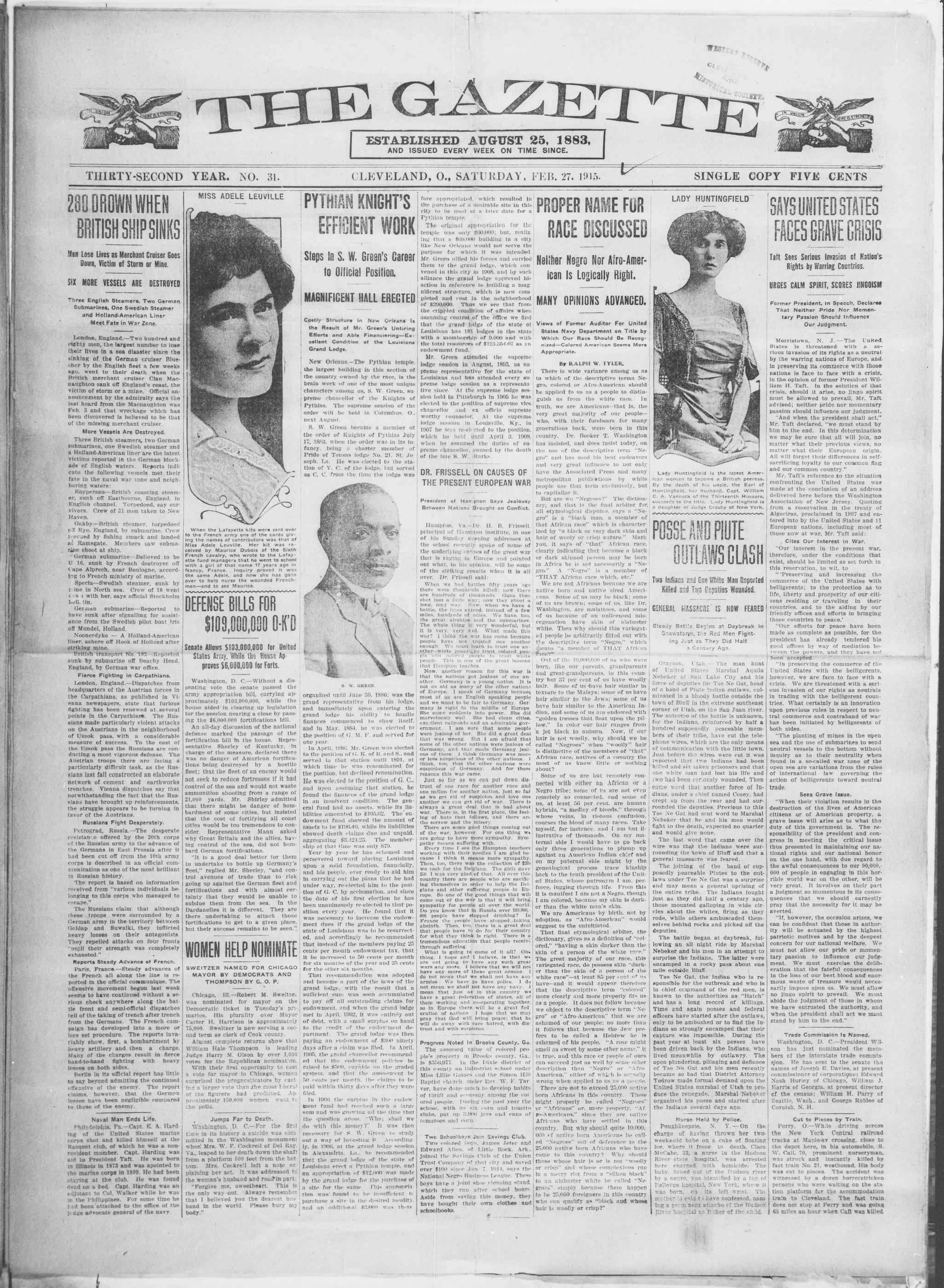
280 DROWN WHEN BRITISH SHIP SINKS
Three English Steamers, Two German Submarines, One Swedish Steamer and Holland-American Liner Meet Fate in War Zone.
London, England.—Two hundred and eighty men, the largest number to lose their lives in a sea disaster since the sinking of the German cruiser, Blücher by the English fleet a few weeks ago, went to their death when the British merchant cruiser Clan Macnaughton sank off England's coast, the victim of storm or a mine. Official announcement, by the admiralty says the last heard from the Macnaughton was Feb. 3 and that wreckage which has been discovered is believed to be that of the missing merchant cruiser.
More Vessels Are Destroyed.
Three British steamer, two German submarines, one Swedish steamer and a Holland-American liner are the latest victims reported in the German blockade of English waters. Reports indicate the following vessels met their fate in the naval war zone and neighboring waters:
Royperana—British coasting steamer, sunk off Eastbourne, England, in English channel, Torpedoed, say survivors. Crew of 31 men taken to New Haven.
Onkby—British steamer, torpedoed off Rye, England, by submarine. Rescued by fishing smack and landed at Ramsgate. Members saw submarine shoot at ship.
German submarine—Believed to be U-16, sunk by French destroyer off Cane Albrecht, near Boulonge, according to French ministry of marine.
Specia—Swedish steamer, sunk by rine in North sea. Crew of 18 went with her, says official Stockholm bull-tin.
German submarine—Reported to have sunk after signalling for assistance from the Swedish pilot boat, Iris off Mundel, Holland.
Noonerdyke—A Holland-American liner, ashore off Hook of Holland after striking mine.
British transport No. 192—Reported sunk by submarine off Beachy Head, England, by German war office.
Fierce Fighting in Carpathians.
London, England—Dispatches from headquarters of the Austrian forces in the Carpathians, as published in Vienna newspapers, state that furious fighting has been renewed at several points in the Carpathians. The Russians made particularly violent attacks on the Austrians in the neighborhood of Uzok pass, with a considerable measure of success. To the east of the Uzok pass the Russians are conducting a most vigorous defense. The Austrian troops there are facing a particularly difficult task, as the Russians last fall constructed an elaborate network of cement and earthworks trenches. Vienna dispatches say that notwithstanding the fact that the Russians have brought up reinforcements, the struggle appears to be turning in favor of the Austrians.
Rusalana Fight Desperately.
Petrograd, Russia.—The desperate resistance offered by the 20th corps of the Russian army to the advance of the Germans in East Prussia after it had been cut off from the 10th army corps is described in an official communication as one of the most brilliant in Russian history.
The report is based on information received from "various individuals belonging to this corps who managed to escape."
The Russians claim that although these troops, were surrounded by a German army in the territory between Goldap and Suwalki, they inflicted heavy losses on their antagonists. They repelled attacks on four fronts unify their strength was completely exhausted.
Reports Steady Advance of French. Paris, France.—Steady advances of the French all along the line is reported in the official communique. The offensive movement begun last week seems to have continued without a serious check anywhere along the battle front and semi-official dispatches tell of the taking of trench after trench from the Germans. The French campaign has developed into a more or less set procedure. The reports invariably show, first, a bombardment by heavy, artillery and then a charge. Many of the charges result in fierce hand-to-hand fighting with heavy losses on both sides.
Berlin in its official report has little to say beyond admitting the continued offensive of the enemy. The report claims, however, that the German losses have been negligible compared to those of the enemy.
Naval Man Ends Life
Philadelphia, Pa.—Capt. K. A. Harding of the United States marine corps shot and killed himself at the Rugged club, of which he was a non-resident member. Capt. Harding was aid to President Taft. He was born in Illinois in 1873 and was appointed to the marine corps in 1899. He had been staying at the club. He was found dead on a bed. Capt. Harding was an adjutant to Col. Walker while he was in the Philippines. For some time he had been attached to the office of the judge advocate general of the navy.
THE GAZETTE
MISS ADELE LEUVILLE
Mary
When the Lafayette kits were sent over to the French army one of the cards giving the names of contributors was that of Abel Abele, a French teacher who received a Maurice Dubois of the Sixth French cavalry, who wrote to the Lafayette fund managers that he went to school with a girl of that name 17 years ago in Nancy, France. Inquiry team members who have gone over to help nurse the wounded Frenchmen—and to see Maurice.
DEFENSE BILLS FOR
$109,000,000 O-K'D
Senate Allows $103,000,000 for United States Army, While the House Approves $6,000,000 for Forts.
Washington, D. C.—Without a disentaining vote the senate passed the army appropriation bill, carrying approximately $103,000,000, while the house aided in clearing up legislation for the session nearing a close by passing the $6,000,000 fortifications bill.'
An all-day discussion of the national defense marked the passage of the fortification bill in the house. Representative Sherley of Kennetty in charge of the measure, deplored there was no danger of American fortifications being destroyed by a hostile fleet; that the fleet of an enemy would not seek to reduce fortresses if it had control of the sea and would not waste ammunition shooting from a range of 21,000 yards. Mr. Shirley admitted that there might be danger of bombardment of some cities, but insisted that the cost of fortifying all coast cities would be too tremendous to consider. Representative Mann asked why Great Britain and the allies, having control of the sea, did not bomb German fortifications.
"It is a good deal better for them to undertake to bittle up Germany's fleet," replied Mr. Sherley, "and control avenues of trade than to risk going up against the German fleet and fortifications and with almost certainty that they would be unable to subdue them from the sea. In the Dardanelles it is different. They are there undertaking to attack those fortifications to get to a given place, but their success remains to be seen."
WOMEN HELP NOMINATE
WOMEN HELP NOMINATE
SWEITZER NAMED FOR CHICAGO
MAYOR BY DEMOCRATS AND
THOMPSON BY G. O. P.
Chicago, Ill.—Robert M. Sweltzer
was nominated for mayor on the
Democratic ticket in Tuesday's primaries. His plurality over Mayor Carter H. Harrison is approximately 75,000. Sweltzer is now serving a second term as clerk of Cook County.
Almost complete returns show that William Hale Thompson is leading Judge Harry M. Olson by over 1,000 votes for the Republican nomination.
With their first opportunity to cast a vote for mayor in Chicago, women surprised the protestators by casting a larger vote than the most liberal of the signers had predicted. Approximately 150,000 women went to the poll.
Jumpa Far to Death.
Washington, D. C.-For the first time in its history a suicide was committed in the Washington monument whon' Mrs. W. F. Cockrell of Del Ray, Va. leaped to her death down the shaft from a platform 500 feet from the bottom. Mrs. Cockrell left a note explaining her act. It was addressed to the woman's husband and read in part: "Forgive, me, sweetheart. This is the only way out. Always remember that I believed you the dearest husband in the world. Please burry my body."
ESTABLISHED AUGUST 25, 1883 AND ISSUED EVERY WEEK ON TIME SINCE.
PYTHIAN KNIGHT'S EFFICIENT WORK
Steps In S. W. Green's Career to Official Position:
MAGNIFICENT HALL ERECTED
Costly Structure in New Orleans is the Result of Mr. Green's Untiring Efforts and Able. Financiering—Excellent Condition of the Louisiana Grand Lodge.
New Orleans.—The Pythian temple, the largest building in this section of the country owned by the face, is the brain work of one of the most unique characters among us. S. W. Green, an supreme chancellor of the Knights of Pythians. The supreme session of the order will be held in Columbus, O. next August.
S. W. Green became a member of the order of Knights of Pythias July 17, 1851, when the order was in its infancy, being a charter member of Pride of Toussaint-lodge No. 21, St. Joseph. La. He was elected to the station of V. C. of the lodge, but served as C. C. from the time the lodge was
organized until June 30, 1886; was the grand representative from his lodge, and immediately upon entering the grand lodge, his ability to handle finances commenced to show itself, and In May, 1884, he was elected to the position of G. M. F. and served for one year.
In April, 1886, Mr. Green was elected to the position of G. K. of K, and S., and served in that station until 1891, at which time he was renominated for the position, but declined renomination. He was elected to the position of G. C., and upon assuming that station, he found the financier of the grand lodge in an insolvent condition. The general fund and no assets, while its liabilities amounted to $16532. The endowment fund showed the amount of assets to be $19640, while its liabilities showed death claims due and unpaid, aggregating $3.12125. The membership at that time was only $79.
Year by year he has schemed and persevered toward placing Louisiana upon a solid foundation, financially, and his people, ever ready to aid him in carrying out the plans that he had under way, re-elected him to the position of G. C. by acclamation, and since the date of his first election he has been unanimously re-elected, to that position every year. He found that it was necessary to increase the endowment dates if the grand lodge of the state of Louisiana was to be resurrected, and accordingly he recommended that instead of the members paying 25 cents per month endowment tax, that it be increased to 50 cents per month for six months of the year and 25 cents for the other six months.
That recommendation was adopted and became a part of the laws of the grand lodge, with the result that a sufficient sum was soon accumulated to pay off all outstanding claims for endowment, and when the grand lodge met in April, 1902, it was entirely out of debt, with a small surplus on hand to the credit of the endowment department. The grand lodge was then paying an endowment of $400 ninety days after a claim was filed. In April, 1905, the grand chancellor recommended that the upholdment policies be raised to $400, payable on the graded system, and that the assessment be 50 cents per month, the debts to be paid within thirty days after they were filed. In 1905 the surplus in the endowment fund had reached such a large sum and was growing all the time that the question arose: "What, shall we do with this money?" It was then necessary for S. W. Green to study out a way of investing it. Accordingly, in 1906, at the grand lodge session in Alexandria, La. he recommended that the grand lodge of the state of Louisiana erect a Pyritian temple, and an appropriation of $12,000 was made by the grand lodge for the purchase of a site for the same. This appropriation was found to be insufficient to purchase a site in the desired location, and an additional $1,000 was there.
fore appropriated, which resulted in the purchase of a desirable site in this city to be used at a later date for a Pyttian temple.
The original appropriation for the temple was only $90,000; but, realizing that a $20,000 building in a city like New Orleans would not serve the purpose for which it was intended, Mr. Green allied his forces and carried them to the grand lodge, which convened in this city in 1908, and by such alliance the grand lodge approved action in reference to building a magnificent structure, which is now completed and cost in the neighborhood of $200,000. Thus we see that from the crippled condition of affairs when assuming control of the office we find that the grand lodge of the state of Louisiana has 181 lodges in the state with a membership of 9,000 and with the total resources of $123,514.07 as an endowment fund.
Mr. Green attended the supreme lodge sessions in August, 1893, as supreme representative for the state of Louisiana and has attended every supreme lodge session as a representative since. At the supreme lodge session held in Pittsburgh in 1903 he was elected to the position of supreme vice chancellor and ex officio supreme worthy counsel. At the supreme lodge session in Louisville, Ky., in 1907 he was reelected to the position, which he held until April 3, 1908 when he assumed the duties of supreme chancellor, caused by the death of the late B. W. Starks.
DR. FRISSELL ON CAUSES OF THE PRESENT EUROPEAN WAR
President of Hampton Says Jealousy
Between Nations Brought on Conflict.
Hampton, Va. Dr H. B. Frissel,
principal of Hampton Says in one
of his Sundays, eaming addresses at
the school recently spoke of some of
the understated careers of the great war
that is raging in Europe and pointed
out what, in his opinion, will be some
of the striking results it is all over,
Dr. Frissel said:
When we had battles fifty years ago,
there were thousands killed, now there
are thousands killed, now there
shot me a little way, now they shoot a
long, long way. Now, when we have a
battle, the lives extend, instead of a few
miles, hundreds of miles. We have too
much to lose, too much to lose. The
whole thing is very wonderful, but
it is very, very sad. What made this
war? I think the war has come because
we have to face one another
necessarily. We must learn to trust colored
people, to people to trust white
people to trust white
people to trust white
people to trust white
Now, another reason for this war is that 'the nations got jealous of one another. Germany is a young nation. It is not as old as many of the other nations. It is not as old as many of the other nations. Most of us are English speaking people and we want to be fair to Germany. Germany is right in the middle of Europe. She came suddenly into power. She did not come suddenly into power. She is excellent railroads and an admirable government. I am sure that some people were jealous of her. She did a great deal that was wrong. But I am afraid that some of the other nations were jealous of her. She was jealous of them. I think Germany was more or less suspicious of the other nations. I think, too, that the other nations were suspicious of Germany. And for these reasons this came. We can put down distrust of one race for another, race and one nation for another nation, just so far as we get rid of suspicion and love one another we can get rid of war. There is a lot of suspicion and war. There is, in the first place, the feeling of hate that follows, and there are the sorrow and the misery. There are 'some good things coming out of the war, however. For one thing 'we are not really sympathetic. Sympathy means suffering with.
Every time I see the Hampton teachers working with their needles I am glad because I think it means more sympathy than we took for the Belgians. The girls have $20 I was very glad of that. All over this country, there are people who are sacrificing themselves in order to help the Belgians and other suffering people in The Netherlands. Come out of the war is that it will bring sympathy for people all over the world. Do you know that in Russia over 150,000,000 people have stopped drinking? In France the people have stopped drinking. In India the people have stopped drinking. That people have to do for their country for what they think is right. There is a tremendous education that people receive through suffering. What is going to come of it all? One thing I believe is, that we are not going to have any such great wars any more. I believe that we will not have any more of these great armies. I do not mean that we shall not have any armies, we shall not have any armies we shall not have any navy. I mean that just as in this country we have a great federation of states, all of them working and co-operating, so in Europe there will be a great fedel and a great gray that God will bring peace; that he will do away with race hatred, with distrust end with spoonlion.
Progress Noted in Brooks County, Ga.
The assessed value of colored people's property in Brooks county, Ga. is $554377. In the Dixie district of this county an industrial school under Miss Lillie Gaines and the Simon Hill Baptist church under Key W. F. Tarver, have done much to develop habitats of theft and economy among the colored people. During the past year the school, with its six corn and tomato clubs, put up 3,000 jerks and cans of tomatoes and corn.
```markdown
```
Two Schoolboys Join Savings Club.
Two colored boys, James Jeter and Edward Allen, of Little Rock, Ark.
Joined the Savings Club of the Union Trust Company of that city and saved over $100 since Jan 7, 1914, says the National Negro Business League. These boys have a joint shoe show stand, which they run after school hours. Aside from saving this money, they have bought their own clothes and schoolbooks.
PROPER NAME FOR RACE DISCUSSED Neither Negro Nor Afro-American Is Logically Right. MANY OPINIONS ADVANCED.
Views of Former Auditor For United States Navy Department on Title by Which Our Race Should Be Recognized—Colored American Seems More Appropriate.
B RALPH W. TYLER
There is wide variance among us as to which of the descriptive terms Negro, colored or Afro American should be applied to us as a people to distinguish us from the white race. In truth, we are Americans that is, the very great, majority of our people—who, with their forebears for many generations 'back' were born in this country. Dr. Booker T. Washington has insisted, and does insist, today, on the use of the descriptive term "Negro" and has used the best载像ers and very great influence to not only have the Associated Press and many metropolitan publications by white people use that we have, but to capitalize it. But are we "Negroes"? The dictionary, and that is the final auditor for all etiquity disputes, says a "Negro" is a "black man, a member of that African race" which is characterized by a "black or very dark skin and hair of woozy or crisp nature." Mark you, it says of that African race clearly indicating that because a black or dark skinned person may be born in Africa he is not necessarily a "Negro." A "Negro" is a member of *THAT African race* which etc.*
We are not Africans because, we are native born and native breed Americans. Some of us may be black; some of us are brown; some of us, like Dr. Washington, are mulattoes, and some of us because of an uncleboise miscegenation have skin of alabaster white. Then why should this variegated people be arbitrarily fitted out with the descriptive term "Negro," which means a member of THAT AFFAIR FACE? Out of the inhabitants of us who were born, like our parents, grandparents and great grandparents, in this country but 47 per cent of us have woolly hair. Some of us have hair similar in texture to the Malays; some of us have hair similar to the Jews; some of us have hair similar to the American Indian, and some of us are endowed with "golden tresses that that upon the pillow." In color our hair ranges from a jet black to anburn. Now, if our hair is not woolly, why should we be called "Negroes" when "woolly" hair is distinctive of the members of "that" African race, natives of a country the most of us know little or nothing about?
Some of us are but remotely connected with either an African or a Negro culture; some of us are not even remotely so connected, and some of us, at least 50 per cent, are human hybrids, "a medley of bloods," through whose veins, in riotous confusion, courses the blood of many races. Take myself, for instance, and I am but illustration of thousands. On my maternal side I would have to go back only three generations to plump up against an American Indian chief and on my maternal side might by the genealogical process, trace kinship back to the tenth president of the United States, whose patron I am, perforce, lugging through life. From this it is manifest I am not a Negro, though I am colored, because my skin is darker than the white man's skin.
We are Americans by birth, not by adoption, as "Aro-American" would suggest to the uninitiated.
That thul etymological arbiter, the dictionary gives as a definition of "colored" "having a skin darker than the skin of a person of the white race." The great majority of our race, this variegated race, do possess skin "darker than the skin of a person of the white race"—at least 85 per cent of us have—and it would appear therefore that the descriptive term "colored" more clearly and more properly fits us as a people. It does not follow because we object to the descriptive term "Negro" or "Mro-American" that we are ashamed of our people, no more than it follows that because the dew prefers to be called a Hebrew he is ashamed of his people. "A rose might smell as sweet by some other name" it is true, and this race or people of our can succeed just as well by some other desicion term "Negro" or "Mro-American" either of which is actually wrong when applied to its as a people. There are not to exceed 25,000 native African in this country. These might properly be called "Negroes" or "Africans" or more properly, "Afro-MroAmerican" since they are native Africans who have so settled in this country. But why should quite 10,000,000 of native Americans be called "Negroes" out of deference to the 25,000 native African who have come to this country? Why should these whose hair is or is not "woolly or crisp" and whose combedness run in a merry blot from a "black black" to an unkissed white be called "Negroes" simply because there happen to be 25,000 foreigners in this country who can qualify as "shuck and whose hair is woolly or crisp"?
SINGLE COPY FIVE CENTS
LADY HUNTINGFIELD CAVC UNITED STATE
J.
Lady* Huntingfield in the latest American woman to become a British peeress. By the death of her uncle, the Earl of Huntingfield, for her husband, Capt. William C. A. Vanomack of the Thirteenth Houses, vassal to the title. Lady Huntingfield is a daughter of Judge Crawley of New York.
POSSE AND PIUTE OUTLAWS CLASH
Two Indians and One White Man Reported
Killed and Two Occupies Wounded.
Dicely Battle begins at Daybreak in Snowstorm in the Red Men Fighting Just as They Did Half a Century Ago.
Argyra Cush. The main hunt of United States Marshal Agnita Nebeker of Iceland. City and his army of deputies for the Tao Gat, head of a band of Philie Indian outaws, culminated in a bloody battle outside the town of Bluff in the extreme southeast corner of Utah, on the San Juan river. The outcome of the battle is unknown, for the Indians, reinforced by half a hundred supposely peaceable members of their tribe, have cut the telephone wires, which are the only means of communication with the little town. Just before the wires were cut it was reported that two Indians had been killed and six taken prisoners and that one white man had lost his life and two had seriously wounded. Then came word that another force of Indians, under a chief named Cosey, had crept up from the rear and had surrounded the deputies. Previous to this Tao Gat had sent word to Marshal Nebeker that he, and his men would fight to the death, expected no quarter and would give none.
The last word that came over the wire was that the Indians were surrounding the town of Bluff and that a general massacre was feared.
The joining of the band of supposedly peaceable Plintes to the outlaws under Tse Ne Gat was a surprise and may mean a general uprising of the entire tribe. The Indians fought just as they did half a century ago, those mounted galloping in wide circles about the whites, fliring as they rode, while others ambushed themselves behind rocks and picked off the deputies.
The battle began at daybreak, following an all night ride by Marshal Nebeker and his men in an attempt to surprise the Indians. The latter were encamped in a rocky pass about one mile outside Bluff.
Tse Ne Gat, the Indian who is responsible for the outbreak and who is in chief command of the red men, is known to the authorities as "Hatch" and has a long record of killings. Time and again posses and federal officers have started after the outlaws, only to be ambushed or to find the Indians so strongly encamped that their capture was impossible. During the past year at least six posses have been driven back by the Indians, who lived meanwhile by outlawry. The open plundering, pillaging and defiance of Tse Ne Gat and his men recently became so bad that District Attorney Tedrow made formal demand upon the United States marshal of Utah to produce the renegade. Marshal Nebeker organized his posses and started after the Indians several days ago.
Nurse Hold by Police
Poughkeepsie, N. Y. — On the charge of having hainted her two-weeks-old baby on a cake of floating ice where it froze to death, Clare McAfee, 32, a nurse on the Hudson River since hospital, was arrested here concerned with homicide. The baby, carried out of the Hudson river by a rage which is branded by a police hospital, New York, where it was born, on its left wrist. The position is to have confessed, naming a prominent attacker of the Hudson River as a parent of the child.
IN UNION
DEVELOPED BY
SAYS UNITED STATES FACES GRAVE CRISIS
Taft: Sees Serious Invasion of Nation's Rights by Warring Countries.
Former President, in Speech, Declares That Neither Pride Nor Momentary Passion Should Influence Our Judgment.
Morristown, N. J. — The United States is threatened with a serious invasion of its rights as a neutral by the warring nations of Europe, and in preserving its commerce with those nations is face to face with a crisis, in the opinion of former President William H. Taft. In the solution of that crisis, should it arise, no jingo spirit must be allowed to prevail. Mr. Taft advised; neither pride nor momentary passion should influence our judgment. "And when the president shall act," Mr. Taft declared, "we must stand by the end to the end. In this determination we must be sure that all will join not matter what their previous views, no matter what their European origin. All will forget their differences in self-sacrificing loyalty to our common flag and our common country."
Mr. Taft's reference to the situation confronting the United States was made at the conclusion of an address delivered here before the Washington Association of New Jersey. Quoting from a reservation in the treaty of Algernau, proclaimed in 1907 and entered into by the United States and 11 European nations, including most of those now at war, Mr. Taft said:
Cites Our Interest in War
"Our interest in the present war, therefore, under the conditions that exist, should be limited as set forth in this reservation, to wit, to
"Preserving and increasing the commerce of the United States with belligerents; to the protection as to life, liberty and prosperity of our citizens residing or traveling. In their countries, and to the aid by our friendly offices and efforts in bringing those countries to peace.
"Our efforts for peace have been made as complete as possible, for the president has already tendered his eagles by way of mediation between the powers, and they have not been accepted.
"In preserving the commerce of the United States with the belligerents, however, we are face to face with a crisis. We are threatened with a serious invasion of our rights as neutrals in trading with the belligerent countries. What certainly is an innovation upon previous rules in respect to neutral commerce, and contraband of war has been-initiated by belligerents of both sides.
"The planting of mines in the open sea and the use of submarines to send neutral vessels to the bottom without inquiry as to their neutrality when found in a so-called war zone of the open sea are variations from the rules of international law governing the action of belligerents toward neutral trade.
Sees Grave Issue.
"When their violation results in the destruction of the lives of American citizens, or of American property, a grave issue will arise as to what the duty of this government is. The responsibility of the president and congress in meeting the critical issue thus presented in maintaining our national rights and our national honor on the one-hand, with due regard to the awful consequences to our 90,000,000 of people in engaging in this horrible world war on the other, will be very great. It involves on their part a judgment so momentous in its consequences that we should carnely pray that the necessity for it may be averted. "If, however, the occasion arises, we can be confident that those in authority will be actuated by the highest patrolic motives and by the deepest concern for our national welfare. We must not allow our pride or momentary passion to influence our judgment. We must "exercise the delicatenation that the fateful consequences in the loss of our best blood and enormous waste of treasure would necessarily impose upon us. We must allow no jingo spirit to prevail. We must abide the judgment of those in whom we have entrusted the authority, and when the president shall act we must stand by him to the end."
Trade Commission Is Named.
Washington, D. C.—President Wilson has just nominated the members of the interstate trade commission. He has sent to the senate the names of Joseph E. Davies, at present commissioner of corporations; Edward Nash Hurley of Chicago, William J. Harris of Georgia, at present director of the census; William H. Parry of Seattle, Wash., and George Rubble of Corigus, N. H.
Cut to Pieces by Train.
Perry, O.-White driving across the New York Central railroad tracks at Mapleleaf crossing, close to the depot here in his automobile, S-W. Call-70, prominent nurseryman, was struck and instantly killed by fast train No. 21, westbound. His body was cut to pieces. The accident was wounded by a derven horrorskilled persons who were waiting on the station platform for the accommodation-train to Cleveland. The fast train does not stop at Perry and was going 60 miles an hour when Call was killed.
One Year.....$1.50.
Six Months.....1.00
Three Months.....50
Subscribers are requested to re-
mit by postoffice money or-
der or registered letter
Entered at the postoffice in Cleveland,
Ohio, as second-class matter.
Address all communications to
HARRY C. SMITH
Editor and proprietor,
THE GAZETTE,
Blackstone Building, Cleveland, O.
Member Ohio Legislature: 1894
to 1896; 1896 to 1898; 1900 to 1902
THE GAZETTE is the oldest, and has the largest bona fide circulation, double that of any newspaper in the interest of Afro-Americans, published in the state of Ohio, and comparison with any will immediately establish its rank as one of the NEWSIEST AND BEST in the country.
10,000,000 Afro-Americans..
180,000 in Ohio.
20,000 in Cleveland.
Cleveland
South City
SATURDAY, FEBRUARY 27, 1915
Professor Wilson kept congress after school all last winter.
Do not forget your duty to Howard University! The time is short.
Even the complaints of the Democrats about Republican bosses are stilled.
The Democratic pork barrel is a piny peculation compared with the robbery of a Democratic tariff.
"We now are on the verge of the most wonderful prosperity the world has ever known."—Woodrow Wilson in May, 1914.
It is quite safe for President Wilson to make faces at either Germany or Great Britain. Their hands, and feet, too, are tied.
In the wreck of President Wilson's ship purchase bill there went down a too-long docile party majority and a self-willed party leader.
The passage of the Chamberlain bill, now before congress, will so strengthen the National Guard that it will become a dependable force for National Defense.
It looks as if the "jim-crow" streetcar bill for the District of Columbia, is dead. Nevertheless write your U. S. Senators to oppose it and to help Howard University to get its greatly needed appropriation of $101,000.
Chicago Afro-Americans are still battling to save their mixed schools and teachers, and to keep down "color lines" in the former that have both eroded them ever since they started their "jim-crow" Y. M. C. A. fund and building.
Denunciation of the Republican party for wasteful management of public resources was one of the prime issues of the 1912 Presidential campaign. On its own bookkeeping the Wilson Administration has broken every promise of thrift that it made to gain office.—New York Sun (Dem.).
Down in Tennessee, about ten days ago, a southerner made his Afro-American cook dance at the point of a gun. He was "showing" his brother, a northerner, "a good time." This has been a favorite pastime in that section of the country for years. But this time it worked out differently. That cook was a MAN. He killed them both.
Mrs. Vauleda F. Steward of Chicago, writing to the Daily Tribune of that city, recently, said that "Afro-American does not aspire to social equality." O, yes they do; if there is any such thing. They "aspire to" everything good that any other class of American citizens "aspires to." It is time we stopped talking such nonsense, to say nothing of writing it to the daily papers.
GOVERNMENT OWNERSHIP OF VESSELS.
Were there a general public sentiment demanding the enactment of the pending ship purchase bill, a special session following the expiration of the Sixty-third Congress would be popular. But no such widespread sentiment exists. There is no present indication that, if the ship purchase bill could be referred to the voters of the United States, it would be sustained—Cleveland Plain Dealer (Dem.).
WE HAVE A CZAR, TOO.
Russia excepted, the United States is the only country whose ruler would dare try to coerce its legislative body as Mr. Wilson has undertaken to coerce Congress. Not in our history has there been such an attempt of the executive to control legislation by threats and bribes. A threat made in public was that at Indianapolis, and the statement that Senator Polindexter, a Progressive from Oregon, was offered the naming of a member of the federal trade commission is undisputed.
HANDING OUT A THOUSAND MILLIONS.
Congress having been occupied almost continuously throughout the Wilson administration with the enactment of his bills to control business of the country, faces the feat of distributing more than a thousand millions of money within eleven days. It is difficult to hope that any body of men, and especially a body under the control of one whose only knowledge of the world's business is that which can be gained in a schoolmaster's cloister, will wisely spend each of ninety odd millions a day which must be appropriated. The first day was given to the $39,000,000 bill in which the pay of congressmen is provided.
"CHIVALROUS" SOUTHERNERS.
Kentucky and Missouri seem to be running a mob-violence race, these days. About ten days ago, the first named state lynch-murdered a white man—for a change, doubtless. Missouri promptly did likewise. About a week ago, some of Kentucky's "chivalrous citizens" of Hickman, thirteen of whom have since been arrested and admitted to $500 ball each, "shot up" and otherwise terrorized our people between that city and Tiptonville. Missouri's "chivalrous" denizens refused to be "outdone" and have done the same thing within a week. All of which but shows clearly, after all, that the veneer of boasted American civilization is very thin indeed in the South.
GOOD NEWS AT LAST:
Says the New York Sun: "The Commander in Chief (President Wilson) of the Sixty-third Congress has been graciously pleased to permit that body to consider and pass the regular appropriation bills, instead of giving its days and nights to the ship-purchase gullery. Consequently, the Sixty-fourth Congress will not have to be called in special session.
"Good news at last! The very first good news sped from Washington during the constant harrying of business by the long Congress. The country has long been sick and tired of the Gab House and a dropsy of statutes, American producers of anything but wind have yearned and yearned unspeakably for the end of this parliament of cuckoos.
"Here's to 12 noon, March 4, 1915: 'Fly swiftly round, ye wheels of Time, And bring the welcome day!'
"A respite from rant, a chance for business to take breath and brace up." And even from the scholastic point of view, what need is there of an extra session? Isn't Congress in permanent session at the White House?"
NEWARK LYNCHING ECHOES.
A recent dispatch to the daily papers of the state from Newark, O. stated that the tragedy of July 8, 1910, in which Dry Detective Carl Etherington was lynched, was recalled when Montella Watha, one of the principals, collapsed on the public square there. He was taken to the city hospital in a semi-stupor, and was believed dying; Doctors believe he brooded over the tragedy and broke down under the nervous strain. Watha received a sentence of twenty years and served about three years in the penitentiary; Etherington was a white Kentuckian; Watha, a black West Indian, and the only person of color who could be dragged into that unfortunate affair. In plain words, the poor fellow was made a "scapegoat" in order that "some color" could be given to the miserable affair. Whether he has died or not, we have been unable to learn to date. Etherington's heirs in Kentucky received the $5,000 provided for in the Ohio Anti-Lynch law which the writer introduced in the State Assembly and secured the enactment of 1896 when a member of the lower branch for the second time.
DR. JOEL E. SPINGARN
Arouses the People and Turns the Tide of Local Sentiment—A New Political Organization.
Columbus, O.—The local branch of the National Association for the Advancement of Colored People starts off with 150 paid-up membership. Dr. Joel E. Spingarn made a splendid impression when he spoke here, and has aroused our citizens to activity. The marvel is that this community long
PROFESSOR J. E. SPINGARN.
reared as a Bocker T. Washington stronghold, has almost unanimously gone over to the other side, and our leading citizens are preaching "equal rights before the law," and tabulating the Washington policy of emphasizing farm-labor and soft-peddlings freedmen's right.
The Lincoln Republican league is the name of a strong race Republican club recently organized here, made up of representative men, who propose to insist that the race receive a fair show at the hands of officeholders, or the latter shall lose their votes when they next run for office. Crap-shooters, gamblers and ward-heels are barred from membership, only clean, high-purposed men being desired.
THE GAZETTE, CLEVELAND, O. SATURDAY, FEBRUARY 27, 1915.
WRITTEN BY "THE OLD RELIA
BLE" GAZETTE'S CORRE-
SPONDENTS
THROUGHOUT THE STATE
What Our People Are Doing Each Week—Church, Personal, Social, Lodge, Literary and Musical—Marriages, Deaths, Etc.
LEBANON—Mrs. Mamie Allen and Eva Singleton are visiting the former's parents, Mr. and Mrs. Sterling Evans, Miss Helen Adams of Springfield, has returned to Michigan, Morton is Columbus, "Mother" is spent two days here, last week—Mrs. Chile of Maulineville, is visiting her sister, Mrs. Celia Smith, Mr. and Mrs. Leslie Sims of Morrow, were here, Sunday. Word was received here that John Mills, formerly of Lebanon is very ill in Cleveland. His mother accompanied by Mr. Wm. Putton, left for Cleveland, Friday, where they will remain until Mr. Mills is able to be brought home, Mr. and Mrs. Bodine spent Sunday in Cincinnati.
CORRESPONDENTS must mail letters for publication at their main postoffice sufficiently early on Monday (or Sunday) of each week to have them reach The Gazette office on Tuesday morning, and always write also, their names and that of their city or town on the outside of the building. Unless this latter is done, proper credit cannot be given you. Lists of names, wedding presents, etc., obituary notices, speeches, resolutions, poetry, inquiries for relatives and advertisements of all kinds, including items announcing entertainments to be held in the near future, must be paid for by the post office. In line six, words to a line. Our rates for display advertisements will be sent on application: Send postal note and not stamps during warm weather.
OBERLIN.—Miss Diza Rivers is visiting her niece, Mrs. Madeline De Angeles, in Jackson, Mich.—Mr. and Mrs. Sam Kemp of Fremont, visited relatives here, last week.—Juannita Quinn and Patricia Cowan spent Sunday and Monday in Cleveland.—The first "mothers meeting" of the year, was held in Centenium Kingston, Mennonah, to be attended by M. M. and M. Zion Baptist churches are holding a union revival, this week. Rev. H. C. Bailey of Cleveland, willingly consented to return for another week. Much good is being done, Woman's day was a success. There was good attendance at the three sessions, and $62.05 was raised (by the teachers) to conference.—The Gazette desires a live agent here. Write to the editor in Cleveland, at once.
SANDUSKY.—The stork brought a fine baby boy to Mr. and Mrs. Nelson Bolling, last Tuesday.—Mrs. David Walton has been quite ill, ten days.—Where is Mrs. John Adams, resident of Hays Ave.? She has not been seen for some time.—The Second Baptist church revival is progressing. The party is a birthday party on Dellamase Early, Saturday, in the "rest room." The B. V. P. U. was well attended. Mrs. Mary Jones opened the discussion of the topic, and Mr. Jas. Davis and Miss Harris sang a fine duet. The church was well filled, Sunday evening. The pastor preached an excellent sermon. Four raised their hands for prayer. The pastor sang a quite teeble—The A. M. E. S. S is prospering and the church is also doing well under the experienced guidance of the veteran clergyman, Rev J. D. Singleton, pastor.
HARVEYBURG.—The surprise party at Mr. and Mrs. John Bell's, last Thursday evening, was an enjoyable affair.—Mrs. Mary Sellers died, last Friday, at Wilmington, leaving three daughters, many other relatives and a host of friends. Funeral services, here, at Zion Baptist church, Sunday at 2 p. m.—Mary McGee suffered a $15 bill of Wilberforce, preached a fine monster at the A. M. E. church Sunday. Mr. Wm. Williams and Mrs. Susie Evans have returned from Dayton. Mr. and Mrs. Albert Adams opened the B. Y. P. U., Sunday evening, with a song, "Precious to Me". S. S. attendance, Sunday, was 25. Collection $3.—A chicken-roast at L. Simpson's sugar camp, this week.—Gerald Adams has signed to "twirl" for the "Runs"; this season. "Jerry" is a woman named Elizabeth Parker was in Xenia, Saturday.—Gerald Wilmington attended the evening services at the A. M. E. church, Sunday.
YOUNGSTOWN—Mrs. H. Blaine of Cleveland, was visiting her brother Chas. Tyler, last week—Wright's or chestra of Columbus, played at the Country club, Saturday—Mrs. John Lacey died. Thursday, after a short illness. She was born in Cleveland 47 years ago, and is survived by her husband, mother, Mrs. Mary Taylor of Toledo; a sister, Mamie; brother, Andrew of Akron; two half-brothers, Samuel Franklin of Detroit; John Franklin of Toledo, other relatives and friends, all of whom sincerely mourn her demise. Funeral, Sunday, from St. Augustine E. mission of
which the deceased was a member,
Rev. J. T. Ogborn officiated. Interment in Belmont park. Mr. and Mrs. Elmer Moore of Alliance, attended the funeral.—Rev. W. O. Harper, pastor of the Third Baptist church, baptized 8 converts, Sunday afternoon.—Mrs. Emma Johnson is very ill at this writing.—Mrs. Jos. Finney, Mrs. Harry Ervin and baby and Mrs. Sandy Duff are ill.—A Lenten tea was served at Mrs. T. Don. Berry's, Wednesday afternoon.—The pieces of St. Augustine mission indies. nantine lodge, F. & A. M., will meet in regular session. Monday evening, at Els' hall.
CADIZ—Melvin Davis entertained the B. S., Sunday—J. J. Phillips, supt., public schools, gave an instructive educational lecture at the A. M. E. church, Feb. 14—Dwight Brooks, after enjoying a few weeks of convalescence, is bedfast again, suffering from a bone which slipped while knitting—Rally class, No. 7, R. F. Ballard, lead, gave a Washington's birthday banquet, the 22nd, at the A. M. E. church. A patriotic program, rendered by the children and a chorus, by 12 young men and ladies, were the subjects of the evening, which was a great success also, contributed much to the enjoyment of the evening. Mrs. Susie Merle has moved to Tippiecem, her future home—Ivan Davis and Dallas Wallace spent Sunday in Smithfield—William Free man of Steubenville, was in town a few days. Little Josephine and Norman Lucas are quite—Class, No. 4, Mrs. O. W. Childers, lead, gave a social, the 19th, at Mrs. J. P. Lucas’—Miss ida Jackson entertained the B. S., club spent a very pleasant evening at Mr. and Mrs. Thos. Mason's, in honor of Mrs. Susie Merle—Mrs. B. S. Lee recently entertained the Y. M. L. club. “The 'Mystic's' are still mysteriously floating around town.
SMITHFIELD.—The five weeks' revival at St. Paul's A. M. E. church closed recently. It was largely attended and the church has been greatly revived, under the leadership of the worthy pastor, Rev R. B. Lowe,—Mr. Sandford West and mother, of McIntyre, were here, Friday. Mr. Ray West of McIntyre, lost his home by fire, last Thursday.—Mr and Mrs. of McIntyre, were here recently. The latter, Miss M. Beall and Mr. W. Munts visited in Flushing, last week.—Mr. F. Carter, Mrs. E. H. Harris, Mrs. A. Henderson, Mr. and Mrs. J. Christian, Messrs. Earl and D. W. Bigsy and others, were in Steubenville, Saturday.—Mr and Mrs. F. Smith attended church here, Sunday.—Mrs. Carrie Fitzgerald entertained at six o'clock dinner, Tuesday, in honor of her daughter, Finch's 1st birthday. Several little folk were present and many elderly ones. Coy were present and many elderly ones. Coy was greatly enjoyed.—Mr and Mrs. G. Binns, Mr. Frank Christian of Hopedale, and Mr. Fred Faithful of Harrisville, were honored guests at a dinner, Sunday, at Mr. and Mrs. Beall's.—Rev J. E. Bigsy returned Saturday week, to Holden, W. Va. where he was called by his mother's sudden death, Sunday, he was, he was and was also entertained by Mrs. E. H. Harris and others.—Messrs. I Davis and R. Wallace of Cadiz, here, last week—Mr. Chas. Smith was a witness in the L. Maley trial in Steubenville, last week.
[Name]
FRANCIS W. POULSON
HAS EARNED PROMOTION.
An Assistant Prosecuting Attorney of
the Municipal Court Whom We
Would Like to See Appointed
Francis W. Poulson, Esq., assistant prosecuting attorney of the Municipal Court of this city, is a candidate for the appointment of assistant U. S. attorney (of this district) under the Hon. Edwin S. Wertz. Mr. Poulson is 28 years of age, a Cleveland product, and is a graduate of law school here. He was admitted to the bar five years ago and has held his present position very creditably indeed during the past three years, gaining much prominence and great credit, deservedly, from his prosecution of "loan sharks", fake fortune-telling milk and food adulterators. Mr. Poulson has without arrests or court trials through the "Cancellation court" than arrests and court trials he has caused. The Gazette takes pleasure in joining with the press of this city, regardless of race or class, in endorsing Mr. Poulson for appointment as an assistant U. S. district attorney under the Hon. Mr. Wertz because it feels his job is being done by a recognition of exceptionally good service rendered the public in his present position, but also because of his special fitness for the position.
Aced Worker Read
St. Louis, Mo.-Anthony Brown, the oldest member of the St. Louis Post-Dispatch force and an old and highly respected Afro-American citizen of this city, died at his home, 4407 Garfield Ave., Feb. 11, after a week's illness. The deceased was 57 years old.
A. Mixed Marriage
Boston, Mass.—Rev, Charles Borum, (white), took out a license to marry Miss Lizzie Lawson, a member of the race. He said he was connected with the Pentecostal Church, was 25 years old, and was born in Brookline, Va. The bride's age was given as 24 years and her birthplace as Newbern, N. C.
DOINGS OF THE RACE
Write your Congressman to favor Howard University's appropriation. Do this at once. Don't delay. It is one of our best institutions.
We are simply lying, whenever you hear any of us saying directly or indirectly, that our race does not want equality of status—in all particulars—with all other races in this country.—Proof Wu Pickans
Dr. Ernest Everett Just, who was recently awarded the Spinning medal, discovered the fact that the butterfish contains the tape-worm germ, which fact has been acknowledged by the biologist. The trouble with our people is they worry too much about what they are going to be as a mass, and place too little stress upon the importance and value of individual, or personal worth. Strive to be a MAN. Quality in every respect to play the part of a real man, and to solve the problems, will then take care of itself. —Philadelphia Tribune.
Tell your friends to subscribe for "the old reliable" Gazette. We want to double our circulation this year and have made an excellent start in January and thus far this month. Our staff will work in this effort and we treat they will do so.
The Georgia Supreme Court on Feb. 12, held unconstitutional an ordinance passed by the Atlanta city council to segregate the residences of white and Afro-American persons. The court said that to prohibit members of the two races from living in the same city, the court required that a person be required, enjoy or dispose of property, and for these reasons is violative of the due-process clause of the Federal and state constitution.
"The Clansman" in moving pictures shall not be shown in Los Angeles, because it is restraining force in the district of Atlanta recently passed a resolution requesting the Board of Censors to prohibit the pictures and requesting the city attorney to frame an ordinance giving them the power, if they lacked it.
Citizens of Douglass, Ariz., recently presented Wade H. Hammond, chief musician of the Ninth Cavalry (U. S. A.) band, a diamond studded, solid band, in appreciation of the services rendered by Director Hammond and the band.
Ira T. Bryant, secretary of the A. M. E. S. S. Union, Nashville, Tenn., has brought serious charges against Bishop Joshua A. Jones of Wilberforce, O., and the bishops' council of the Church has been called upon to investigate the Jack Johnson and Jess Willard's fight at Juarez, Mexico, Mar. 6, has been postponed. Jack is in Havana where he gave a 10 round sparring exhibition. Wednesday evening. He may fight Sam McVey after his go with Willard. While in Barbados, B W. I., Jack was made the defendant in a suit for damages brought by the owners of the schooner Lillian Blau-Clark. He was charged with a contract to charter the vessel. The pugilist acted as his own lawyer and won the case although pitted against the chief government counsel.
CANDIDATE FOR MAYOR
Kansas City, Kan.-Nathanial Singletary, who has grown wealthy as a real estate operator and note broker has been selected as the candidate for mayor by a committee representing various race organizations, and will file as candidate for the primary to be held in March to select nominees for the mayoral election in April. There has been a great deal of dissatisfaction among our people because of the meager representation given them on the city payroll under the non-partisan commission force, and Singletary's platform will be proportionate distribution of the city jobs. The city has a large troo-American voting population and is the largest city in the state.
THE
NELSON
GIRL
Q Is it as long as it should be?
QUINADE
GROWS HAIR
REMOVES DANDRUFF
SEND FOR SAMPLE
QUINASOAP
THE IDEAL SHAMPOO SOAP
THROUGHOUT CLEANSING THE SCALP
QUINACOMB
HAIR STRAIGHTENER
SHAMPOO DRYER
QUINADE 25¢. QUINASOAP 50¢. QUINASOAP 25¢.
AT ALL DRUGGISTS
SEEBY DRUG COMPANY, NEW YORK CITY, N.Y.
The Beer for home use MUST be pure Gold Bond Beer
Is absolutely guaranteed and is bottled under Government supervision by The Cleveland & Sandusky Brewing Co. West,785 Central 3933
Taylor's New Shampoo Dryer and Hair Straightener!
Men's, Ladies' and Children's
CLOTHES CLEANED, RE-
PAIRED AND PRESSED
First-class Work Only
GARMENTS PRESSED BY
THE MONTH.
Wm. J. KINNEY, Mgr.
2738 Central Av..
Cleveland, Ohio.
Chapel in Connection. Service First Class.
USE MUST be pure
and Beer
steed and is bottled
supervision by
Indusky Brewing Co.
Central 3933
Shampoo Dryer
lightener!
the World!
LaCreole Hair Pomade, will bring the most
bake and cause a rapid growth of the hair.
Large, Heavy Strong and Durable. Made of
copper and brass associated together and cascaded
Heavy press, polished smoothly.
Click plated, steel bolls goes through
large wood handles and screws into metal
and of 4 tumb to prevent the handle from getting
losses of coming off. Remember it is all
one piece. Not hollow, it fits in order,
will last a lifetime.
Price of Hair Straightener
and Alcohol Heater complete
$1.50.
Is the handiest and most convenient method
you can put it in your hand-bag. Price 50.
It is not only meets every requirements of
growth of the hair. Price 25.
Extracting the Largest and Most Complete Lines,
such as Bange, Wigs, Puffs, Switches, Pom
TAYLOR, Howell, Mich.
mention this paper
NELSON'S
HAIR DRESSING
Has no superior as
a hair beautifier.
¢ Thousands of men and women have improved the appearance of their hair by using NELSON'S HAIR DRESSING.
¢ For those who knew—it is a toilet necessity.
Ask your druggist. If he cannot supply you, send us his name and address and we will send you a free sample.
NELSON MFG. CO.
RICHMOND, VA.
THE NELSON GIAL
---
2742 Central Av., cor. E. 28th St.
Cut this ad. out and present it at the Brown Drug Co., and receive a liberal trial size of B. AND M. HAIR DRESSING AND TONIC.
This dressing is especially recommended where the hair is stubborn or curly, as it not only makes the hair soft, glossy and straight, but also easy to dress.
B. AND M. HAIR DRESSING is elegantly perfumed, has a very beneficial effect on the scalp, and is a splendid hair-grower.
DON'T FORGET THAT WE HAVE BUT ONE STORE, AND THAT IS at E. 28th St. and Central Ave.
How to be Beautiful
By Using
Walker's Toilet and Hair
Preparations
It is necessary to have clear, smooth skin as well as hair to be beautiful.
Walker's
Black-No-More
A CREAM FOR BLEACHING AND
BEAUTIFYING
50c Brown-Face Powder 25c
23 other Toilet and Hair Preparations
AGENTS WANTED; also travelers to apply temporary lenses, salary and commu-
sion. Enclose stamp for full information.
No samples sent; cash with each order.
Goods sent by mail 100 extra
Mrs. Matilda Walker
Box 44 So. Orange, N. J
STERLING
5 and 10 Cent Store
3003 Central Ave.
Watch Our Windows
For Bargains
Colored Salesladies
Arlington Pharmacy
WE WILL ACCEPT THIS ADVERTISEMENT FOR FIVE CENTS IN TRADE, TO APPLY ON ANY PURCHASE OF TWENTY-FIVE CENTS OR MORE.
E. Rubenstein, Ph. C., Prop.
S. W. Cor. Central Ave. & E.
55th St.
The Fifteenth Annual Session of the
State Summer School
for Colored
TEACHERS OF BOTH SEXES
at the
GREENSBORO, N. C.
will begin June 20th, 1914, and continue five weeks.
In the past the regular work, at attractive lecture course has been arraged, in which will appear some of the most distinguished white and Colored educators in the country.
Board and lodging for the entire session $12.00. Tuition 25c per subject. Other arrangements have been made.
Limited accommodations. Send $1 and have room reserved in advance.
For further information write e-ence to:
James B. Dudley, President, or
A. & M. Colleges Director, N. C.
THE PEOPLES' DRUG STORE
F. H. WEAVER, PHAR. D., Prop.
Cor. Central Ave. and E. 33d St.
Agent for
"HIGH BROWN FACE POWDER."
WE GIVE TRADING STAMPS.
MONEY ORDERS. NEWSPAPER
ADS., TELEGRAMS.
PRESCRIPTIONS A SPECIALTY
Open late at Night.
G. G. REED
Dry Goods
Ladies' and Gent's' furnishings
Sole agents for the
AMERICAN LADY NEMO
R. @ G. COR ETS
3222 Central Ave.
MEN'S HAIR
The Morgan Hair Refiner
is a new discovery that positively
straightens the hair within fifteen minu-
utes. No grease. No hot irons. Wa-
ter will not affect it.
Absolutely harmless if used accord-
ing to directions.
The G. A. Morgan
Hair Refining Co.
6202 Harlem Avenue, Cleveland, Ohio
Where to Purchase The Gazette
*SAM FERTMAN'S,
3608 Central Ave
*ELMER F. BOYD'S,
2604 Central Ave.
*S. A. LUCAS,
3943 Central Ave.
*NEWS STORE,
2249 E. 105th St.
cor. Arthur Ave.
NOTICE TO SUBSCRIBERS
The Gazette regularly should notify by delivered promptly. Fully examine The Gazette's adver- ses. Business men who advertise in magazine of Afro-Americans. The fact that they want it. Artisements) ten cents a line (six
Personal
Subscribers not receiving The Gazette regularly should notify us at once. We desire every copy delivered promptly.
We advise our patrons to carefully examine The Gazette's advertisements before making purchases. Business men who advertise in this paper should have the patronage of Afro-Americans. The fact that they advertise is assurance that they want it.
Local reading notices (advertisements) ten cents a line (six words in a line).
Social and Personal
Our Classified Ad Department
For Rent—Five nice rooms newly
papered, up stairs, at 2417 E. 82d St.
Courtnay Ave. Water, gas, etc.
May next door. Apply, Room 2, Black-
stone Bldg., $12 per month.
FOR RENT—Houses and Rooms—
Mr. and Mrs. Richard Sissle's little
son fell, Sunday, and broke his right
leg.
Dues for 1915 in the N. A. A. C. P.
may be paid to the secretary, S. P.
Keeble, 2158 E. 43d St—Adv.
The Optimistic Embroidery club
held a profitable meeting at Mrs. Della
Offer's, Pine Ave., last Wednesday
evening.
Mrs. Edith Woods of the Winona
Apts., was summoned to Springfield,
Monday, by her father-in-law's sud-
den death.
There is only one way to get our race's news, local and general, and that is by taking "the old and reliable" Gazette, every week.
The members of Shilloh Baptist church gave a pleasant reception last week, in honor of their assistant pastor, Rev. W. M. Jackson, who left for California later in the week.
Five nice rooms, upstairs, at 2417 E. 82d St., near Quincy Ave., for rent. Water, gas, etc. Apply at room 2, Blackstone Blvd. $12 per mo.
Miss Libbie Willis of Hough Ave., was called to Chicago, last week, by a brother's death. Mrs. Grace Thompson was too ill to join her sister.
Miss Flora Davis of this city, died in Mansfield, last Wednesday. Her sister, Mrs. Romelia Davis, of this city, attended the funeral there.
Mr. James French, of Sandusky, spent Sunday with Mr. and Mrs. Allen and Miss Ina Guy, 2217 E. 48rd St. "Dame Rumor" says there may be "something doing" in the near future.
The "Washington" dinner at the Old Folk's home was a success. The pastor of Mt. Zion Cong. church delivered an excellent address on "Manhood Rights."
Mrs. Catherine Smith, age 39, died at Huron Road hospital, Feb. 20. Funeral services, Feb. 23, at 2 p.m., Shiloh Baptist church, the pastor officiating. Interment in Harvard Grove cemetery.—Adv.
The Du Bois Literary club not at Mrs. Blanche McNeil's, E. 74th St. last Wednesday evening. The Junior club gave a reception at Miss Amy Rogers', recently. Both were profitable and enjoyable affairs.
Anyone needing advice on caring for tuberculosis patients in the home should consult Mrs. J. W. Byrd, who is a specialist in tubercular cases, and also a member of the Red Cross Nurse's Association (white). Address Mrs. J. W. Byrd, 2310 E. 9th St.—Adv.
Send or bring locals and all business matters to The Gazette's offices suite 2, Blackstone Bldg. If you wish to see the editor of this please contact the publication in issue of The Gazette, must be in the office by 4 p.m., WEDNESDAY at the latest.
Examinations of applicants for the position of patrolman will take place March 27. The height requirement has been increased from five feet eight inches to five feet nine inches. Applicants must be between 25 and 33 years of age. Take advantage of this opportunity. Patrolmen receive over one thousand dollars a year.
The annual anniversary of the Freedman's Aid was fittingly observed at Cory M. E. church, Sunday. After prayer, by the pastor, and responsive reading, at the morning service, addresses to the S. S. were made by Mrs. J. Burnsides and Mrs. Clara Williams. The evening service was led by the people led by Mr. Richard Sissle assisted Mrs. W. J. Thomas. They made a fine showing, having collected over $20 for schools in the south. The church decorations were fine, the flags being loaned by the Bailey Co., and the pains by the Kirschner Bros. Mrs. Sissle, leader of the Choral society's one of the most active and dependable workers in the church.
Mrs. Louise Ogilvie, former resident of Toledo, and manicurist, in the American Trust building barber shop, promises to be one of the most efficient vote-getters in a local daily paper's exposition voting contest for a free trip to the Panama-Pacific and San Diego expositions. A total of 9,000 votes is required to entitle the contestant to be a guest on the trip. Mrs. Ogilvie had two votes. Tuesday, all piled up within ten days. "I will have the other eight thousand votes required within a month." Mrs. Ogilvie said. Tuesday, and her friends say only an extremely low for occurrence of those votes, her from a group of those to make the trip. The first train chartered for the trip will leave Cleveland, March 16. Stops will be made at many points of interest en route to California. Many side trips by automobile are planned to add to the enjoyment. The entire expense is to be borne by a local daily paper.
---
*O. C. SCHROEDER'S,
Cuyahoga Bldg.
F. VALENTINE'S
2130 Central Ave.
J. E. BRANHAM'S
4401 Central Ave.
PUSHAW
The Arcade.
Superior Entrance.
*OPEN SUNDAYS.
Our
Ad
Department
For Rent—Five nice rooms newly
purchased, up stairs, at 241 F. E. $24 St.
near the Library, or Water, gas, etc.
Key next door. Apply, Room 2, Black
stone Bldg., $12 per month.
FOR RENT—Houses and Rooms—
If you have them to rent or if you
want to rent, advertise in The Gazette.
It brings results.
NOTARY PUBLIC—For such services
call at The Gazette office, No. 2
Blackstone building, No. 1424 W.
Third Street, near Superior Ave.
FOR SALE—Houses or lots,
if you have either or anything else to
sell, or if you wish to purchase, advertise in The Gazette. If anything
can bring you results, it can and will.
Miss Marie Bolden entertained the Patrician club, at a valentine party.
Rev. and Mrs. E. A. White have as guests, Mr. and Mrs. Jones of Batavia.
Misses Bertha and Mabelle Blue of E. 900th St., entertained the Minerva Reading club, recently, in their usual royal manner.
Juanita Quinn and Patricia Cowan of Oberlin, spent Sunday and Monday in the city, visiting relatives of the former.
The Central Novelty club thorughly enjoyed its private "smoker", last week.
Mr. Sidney Thompson has recovered from his recent illness and will return to work, Monday, on the W. & L. E. Ry.
Tuesday evening at a banquet at the Colonial hotel, each guest contributed to a purse for the waiters, which some of them claim to have not received.
Five nice rooms newly papered, up stairs, at 2417 E. $21 St., near Quincy Ave., for rent. Water, gas, etc. Key next door. Apply at room 2. Blackstone Bldg. $12 per month.
Mr. John Mills of Lebanon, is very ill here. His mother and Mr. Wm. Fulton of that city, arrived in the city last Saturday, to care for him and take him home as soon as he is able to travel.
Our advertisers want your trade. Those who do not ask for it in The Gazette certainly care little, if at all, for it. Therefore, we urge our readers and all of our friends to patronize those who ask for your trade in this paper.
Archdeacon Abbott of Trinity Cathedral preached an able sermon at St. Andrew's Episcopal church, Sunday evening. On Friday nights and Saturday mornings, will Easter, the doctor of the church will preach a series of sermons on "What does the Church teach and what does it Stand for."
Mrs. Cornelia, Blue, the Philathea class of St. John's S. S., the Women's Mite Missionary societies of St. John's and St. James' churches are collecting furnishings for the equipment of Mrs. Irene J. Robbins' school in Monrovia, Liberia. Mrs. Robbins, niece of Rev J. W. Johnson, spoke at St. John's, recently, in the interest of her work.
A modification of the old race prejudice will be one of the results of the European conflict in the opinion of Dr. W. E. B. DuBois, who last Friday addressed the City club, 212 Superior avenue N. E., on "War and Race Prejudice." Dr. DuBois called attention to the act that Moors are fighting in the French army and East Europe in the British army with almost the same vigor the native born French and British display. This, the speaker said he thought, would put the colored races more nearly on a plane with the whites. "And the Negro race realizes this and is taking advantage of their opportunity," said the doctor. "Democracy which has heretofe existed only for the white races, must broaden at the close of the war."
Mr Samuel Stewart gave a dinner, last week Thursday evening, in honor of Mr. Arthur Richardson, who left for Florida, the following day.
Miss Mary G. Evans, evangelist, is doing wonderful work in the revival meetings at St. John's A. M. E. church.
THE GAZETTE, CLEVELAND, O. SATURDAY, FEBRUARY 27, 1915.
---
Mrs. Nellie DecForest, one of our oldest residents, died, Monday, at her residence in E. 29th St. She was one of St. John's church's oldest members.
Rev. C. A. Jones, pastor of Zion Baptist church, Chillicothe, has been assisting his son, Rev. R. A. Jones, the new pastor of Mt. Haven Baptist church, in a revival the past four weeks. They are having splendid success.
Among those who are convalescing are: Miss Cara Hackett, E. 36th St.; Mrs. Susan McPherson, E. 43rd St.; Mrs. W. James, E. 49th St.; Mrs. J. H Harlow, E. 28th St.; Mrs. Grace Willis Thompson, Hong Ave.; Mrs. E. Pettiford, E. 66th St.; Mrs. W. E. McIntire and Rev. C. Chundy.
While Cory M. E, church has had financial troubles with several members, in years gone by, it is now aroused as never before as the result of developments at a church officials' meeting, last Monday evening. Through the efforts of Mr. Richard Sissle, a son of Cory's greatly beloved pastor, deceased some months ago, the temporary loss, at least, of $410 of the church's money was disclosed. The offending church official was at the meeting at the church, while the same will be $410 (instead of $310.) A note for this balance was given the church by the offending official. Cory's officials' were anticipating paying over $600 which was overdue, on its church debt, last week, but was prevented from so doing by a lack of funds as a result of the offending official's misconduct. A local sensation has been created by the forgoing and additional facts that have been uncovered, and effort to secure between $25 and $50 of its money long due the church, from a former member, now a resident of Columbus, is also to be made. Several of our leading churches are "harboring" men, as members, who are notoriously bad as the result of just such and similar bad financial transactions with both churches and individuals—some old members of sad churches. Isn't it about time to "cash
***
Charles W. Chesnutt, attorney, author and court stenographer, was the driver of the motor car, late Monday, which speeding along the slippery, mud-coated pavement of the winding road that skirts the foot of a precipitous bluff near the bridge on the Cleveland road, suddenly slid from the roadway against the hillside, then whirled and plunged to the opposite side of the road and over a twenty-foot embankment. The car turned as it fell, Miss Jane Beavis was caught under the car as it fell on its side. Miss Belle Beavis, her sister, was caught under the car and being plunged under the car and were only dazed and slightly injured. Vanily the three tried to lift the heavy car to free the dying girl. But their combined strength was not sufficient to move the auto. All the time the odor of gasoline was almost over
CHAS. W. CHESNUTT. ESO.
powering. The fuel tank of the motor car had burst. Leaving the weeping women, Mr. Chesnutt set out for help. He ran to the farm house of E. O. Foster, a quarter of a mile distant, and returned with Mr. Foster and several farm employees. The motor car was raised from the girl's body. But Dr. E. S. Wakefield of Chagrin Falls announced their work had been done too late when he saw the girl at the farm house. He said Miss Beavis probably had been killed instantly. Her body was taken to the under-taking rooms of Ober & Stevens in Chagrin Falls. Mr. and Mrs. Chesnut and Miss Belle Beavis were taken to the farm where were suffering more from shock than from bodily injuries. Miss Belle Beavis, as was her 18 year old sister, is employed as a stenographer and lives at 1833 E. 101st St.
Wants to Punish Lynchers.
Monticello, Ga.—Judge Park has made an earnest appeal to the Grand Jury to indict every member of the mob that recently lynched four Afro-Americans at this place for whipping him on the charge of selling whisky. Judge Clark said in part to the Grand Jury: "It is cowardly murder for a mob to wrest a prisoner from an officer and swing his body to a limb on the charge of selling whisky. The members of the mob have placed on the pages of Georgia history a blot that time will not efface for many years to come."
Helpless Father
Children are taught to be kind to
dumb brutes, and something should be
said about imposing on father—Atch-
son Glbe.
Your copy of The Gazette after reading it, but give it to a friend or an acquaintance who might subscribe after reading a copy of the paper.
LEADERSHIP OF BISHOP COPPIN
Given Fine Support by the Carolina Churches.
POPULAR WITH THE MASSES
Reports From the Various Conferences of the A. M. E. Denomination In Two Southern States Preise Zealous Work of Lay Members—Appreciates Assistance of the Press.
B GEORGE F. KING.
Philadelphia.-That the Right Rev Bishop Levi J. Coppin, D. D., the noted authority on African missions, author, pulpitteer and an uncompromising advocate of equal opportunities for the race along all lines, is loved by the communicants of his conferences and by members of other denominations was strikingly emphasized at his recent conferences held in North and South Carolina. The work of this remarkable character is encouraging the activities of our people in many directions. Through his many, Christian bearing Bishop Coppin has the cooperation of many able and influential white men in and out of his denomination, some of whom were present at the sessions of the conference held at Roxboro, N. C. These white men stood up for fair play in dealing with the race question and encouraged the Rev Mr. Coppin in his great work.
The cause of proper education for the race was ably represented by the bishop, who is bringing things to pass through the co-operation of the church with its loyal membership. These conferences silently argue the fact that by love of justice and Christian fellowship the two, races will dwell together in this country in peace. Thus when the pulpit sums5 for righteousness it is safe to assume that public sentiment with respect to races and individuals will not be diverted in any other than channels of peace and good will. Emotionalism at these conferences was harnessed to the extent that multitudes were benefited and led along the
BISHOP LEVI J. COPPIN.
upward path. Splendid endowers for home and foreign missions on the part of the women's organizations of the conferences inspired the members to greater activity. This spirit always characterizes the conferences of Bishop Coppin. In spite of the dark hours in the realm of finance the presence of Bishop Coppin rallied his men and with his native Christian spirit, refinement and culture, lent inspiration to them, and we especially mention the two conferences in North Carolina, where both men and women worked like Trojans and brought up rounded reports.
In a recent interview with the writer Bishop Coppin said: "A round of seven conferences during the months of November and December, 1914. I live in South Carolina and the two in North Carolina, revealed the fact that the African Methodist Episcopal church, founded by Richard Allen in 1816, is coming up to the century milestone with great promise. One of the signs of progress and a larger volume of work in the future is the representative part that the laymen are taking in all forward movements." It was a lay delegate in one of the conferences who suggested that each member of the conference volunteer the per capita amount necessary to keep the conference from falling behind in the amount raised for the general fund. This fund is used for home and foreign missions, the cause of education and to assist in the support of superannuated preachers, widows and orphans. It was the laymen who took the lead in a movement to raise sufficient funds to pay the debt on Kittrell college, at Kittrell, N. C.
The women of the church are raising more funds than ever before for the mission fields. News comes to us from across the water that our mission work in South Africa is greatly affected by the terrible conflict of nations now going on, especially as it relates to the Anglo-German war in South Africa.
Not the least among the encouraging signs noticeable during our round of conferences were the reports given by certain leading newspapers of the work. All movements for the good of humanity and the uplift in general of mankind that are shut out from press notice must suffer very much in comparison with that which has been it a friendly press.
Frank's Trial Was Fair
Frank's trial was fair.
Atlanta, Ga.-Denial of the charge that Leo M. Frank's conviction was influenced hostile demonstrations in court and courtmate in the state's brief in Frank's appeal on habeas corpus proceedings, which will be argued in the U. S. Supreme court.
The brief, made public, says: "The supreme court of Georgia is second to no state in according trials free from hostile demonstrations and has gone as far, we venture to assert, as any state in the union in setting aside verdicts where the same were influenced by hostile demonstrations on the part of the spectators."
The man with the straggly beard was arranging a purchase with the salesman in a housefurnishing shop. "And will you have a hair mattress or one of sea grass?" asked the salesman. "Give me sea grass," replied the other. "I am a vegetarian."
Care of the Feet
The more the feet are bathed and rubbed the more comfort you will have. Rubbing the soles of the feet with a raw lemon is very restful after the bath. Keep the toe nails cut straight across, never cut down on the sides, and the cuticle around the nails should be kept loose. A strong, hot salt bath is very restful for the feet.
Awarded a Gold Watch.
Columbus, Q.—It is especially encouraging to the many readers of The Gazette to know that J. Daniel Boswell, aged 19 years, a 1914 graduate of the West High School of this city, was awarded a gold watch by J. A. Metcalf, of the Capitol City Clothing Company, as the best speller in a contest conducted at the Wheatland Ave, M. E. Church. There were 63 Colored and white contestants and the competition lasted until 11:50 P. M. Young Boswell will take up the study of medicine.
R. R. CHEEKS
ATTORNEY-AT-LAW
312-314 Superior Building
WE LEAD THE WAY.
TheNew Keystone
3221 Centr
Charles McP
First-class Service. --
Everything Strictly Fresh. The
OPEN DAY A
WE LEAD THE WAY. OTHERS FOLLOW.
New Keystone Restaurant
3221 Central Ave.
Charles McPherson, Prop.
ess Service. -- See Food in
Strictly Fresh. The Best Meals and Qu
OPEN DAY AND NIGHT
2770 Quali
First-class Service. -- See-food in Season Everything Strictly Fresh. The Best Meals and Quick Service OPEN DAY AND NIGHT
SLAUGHTER BROS.
FUNERAL DIRECTORS & EMBAL
Office and Funeral Parlo
3923 Central Av.,
Autos for All Occasions Calls Answered Day
RAL DIRECTORS & EMBAR office and Funeral Parlo
Office and Funeral Parlors
3923 Central Av.,
s for All Occasions
Calls Answered Day and
SPECIAL OFFER
20 PER CENT O
all our regular this year's suitings and overcoatings,
in price from $25 to $40,
ing you from $5.00 to $10.00 on
These woolens are all the latest shades and design
We are open evenings.
KLEIN & GROSSMAN
on all our regular this year's suitings and overcoatings, ranging in price from $25 to $40,
saving you from $5.00 to $10.00 on each.
These woolens are all the latest shades and designs.
We are open evenings.
Merchant Tailors
2056 E. 4th St.
(Upstairs).
The Price of the Masterpieces of Negro
FORE SOLD FOR LESS THAN $2.50 A COPY
A MEMORIAL HOME BEEN PLACE
PAPER AS AN ADVERTISING PROPOSIT
HAVE A COPY FOR $1.50. Postpaid.
Pieces of Negro Eloquence has neither a prede-
sident brilliant men and women of the race, the le-
ndore and unqualified recommend it. To reach
a trove of valuable information accessible in
a history, a library in itself. No intelligent Ne-
gro writer is an introduction to the old
51 of the greatest speeches ever delivered
in America, Africa, England and France from 1818 to
a separate gem and from the standpoint of
price is $2.50—thousands of copies have been
in it in as many new neighborhoods as possible
at almost HALF PRICE $1.50. A NOW.
A Big Cut in the Price of the Masterpieces of Negro Eloquence
NEVER BEFORE SOLD FOR LESS THAN $2.50 A COPY -Edited by Mrs. Alice Moore Dunbar -A LIMITED NUMBER HAS BEEN PLACED AT THE DISPOSAL OF THIS PAPER AS AN ADVERTISING PROPOSITION AND THE READERS AN HALF FOR $1 Postpaid or a competitor. The most brilliant men and women of the race the leading newspapers both race endorses and unqualifiedly recommend it. To read it is a liberal education, a treasure trove of valuable information accessible in no other form, a gift for the young and the old, a gift for the hard to be without a copy as it is an inspiration to the old and a help to the young. It contains 51 of the greatest speeches ever delivered by the ablest men and women of American, Africa, England and France from 1818 to the present time. Each address is a separate gem and from the standpoint of inspiration alone is worth it. The regular price is $2.50—thousands of copies have been sold at that price but to introduce it in as many new neighborhoods as possible we will send any center of this paper a copy at almost HALF PRICE $1.50. A COPY IS HERE
10 Great
Seria
full of life and action, fire
fire of fine inspiration
by 250 short stories
will make
YOUTH'S COMPANY
10 Great Serials
full of life and action, filled with the fire of fine inspiration and followed by 250 short stories of adventure, will make
The YOUTH'S COMPANION
Better Than Ever in 1915
Then the Family Page, a rare Editorial Page, Boys' Page, Girls' Page, Doctor's Advice, and "a ton of fun," Articles of Travel, Science, Education. From the best minds to the best minds, the best the world can produce for you and everyone in the home. There is no age limit to enthusiasm for The Youth's Companion.
CUT THIS OUT
and send it (or name of this paper) with $2.00 for The COMPANION for 1915, and we will send FREE All the issues of THE COMPANION for the remaining weeks of 1914.
FREE THE COMPANION HOME ALBUM for 1915.
THEN The $2 Weekly Issue of THE COMPANION for 1915.
52 Times a Year
— not 12.
Send to-day to The Youth's Companion, Boston, Mass., for THREE CURRENT I.C.SUES—FREE
SUBSCRIPTIONS RECEIVED AT THIS OFFICE
Strict.
Rosedale 2770
Mr. A. M. Pope—Turnbo
Results of "Poro" treatment
MISS KATIE B. COLLIER.
4812 Payne Ave.
Cleveland, Ohio.
WAY. OTHERS FOLLOW.
ystone Restaurant
Central Ave.
McPherson, Prop.
See-Food in Season
The Best Meals and Quick Service
DAY AND NIGHT
CTORS & EMBALMERS Funeral Parlors
Calls Answered Day and Night
OFFER
PER CENT OFF
year's suitings and overcoatings, rang-
$40.
5.00 to $10.00 on each.
all the latest shades and designs.
ings.
& GROSSMAN
The Masterpieces of Negro Eloquence
R LESS THAN $2.20 A COPY—Edited by Mrs.
NUMBER HAS BEEN PLACED AT THE DIS
N ADVERTISING PROPOSITION AND THE
FOR $1.50, Postpaid.
Eloquence has neither a predecessor nor a com-
mand woman of the race, the leading newspapers
纵然 recommend it. To read it is a liberal ed-
ible information accessible in no other form, a
treat to the old and the new, a an inspiration to the old and a help to the
latest speeches ever delivered by the ablest men
England and France from $18 to the present time,
and from the standpoint of inspiration alone is
massands of copies have been sold at that price
new neighborhood as possible we will send any
most HALF PRICE-$1.50. A COPY IS HERE
The Douglass Publishing Co.
DRAWER I. HARRISBURG, PA. U. S. A.
10 Great Serials full of life and action, filled with the fire of fine inspiration and followed by 250 short stories of adventure, will make
Quality Service
AFRO-AMERICAN CULLINGS
One of the very important phases of the work of the Manassas Industrial School for Colored Youth is a summer school, held for the rural school teachers during July of each year. To this come about a hundred teachers from the rural districts, men and women, who are heart and soul in the work. Some of these teachers are well trained and competent, but the greater number are wholly unit to teach. Many have had no training above fifth grade, and often can only read and write with great difficulty. During the winter of teaching, they often have to travel many miles to their school houses, which are usually meager dilapidated frame buildings, neither wind nor rain-proof, where they are compelled to teach all grades and ages in one room. For this they receive pitifully small salaries, and if they want to add any special work over the regular curriculum, the pennies of the children, with a share of their own small income, are forced to meet the added expense.
They must find enough inspiration during this one short month at the summer school to carry them through their trying winter. The state of Virginia contributes to the work. Besides this summer school, there is held for these rural teachers of northern Virginia, a teachers' institute during the Christmas holidays, where all questions relating to school life and work are discussed by prominent speakers, as well as general discussions on subjects of school hygiene and teaching methods.
There is no doubt that the work accomplished by the school, both in its training of the children and in the broader field of its community work, is of vital importance to the people of northern Virginia—not alone to the colored man, but to the white man as well. That the white man fully realizes this can be judged by the fact that the mayor of Manassas says that the colored community all love and work for the school, and forget to get drunk and get into jail. One mayor told a friend of the school, some years ago, that he attributed his empty jail to the influence of the Manassas Industrial school.
The great financial stress contorting this country on account of the European war, and the diverting into foreign channels of much of the support which in ordinary years goes to our own philanthropies, has forced Manissas, as well as other schools of this tyre, into a very difficult position. The vitality of this work is too strong to let it die, but if the struggle for existence becomes too great, the work must suffer. There is danger of the crippling of one of our most valuable institutions, which has only gained power for good through years of untriring effort and sacrifice.
White citizens of South Carolina have contributed $10,000 for a hospital for Negroes, to be erected at Columbia. There are 75,000 colored people in the state who are without hospitals where they can go for treatment, as the hospitals for white people do not admit them.
In Kansas 17 per cent of the women are married, 14 per cent separated, divorced or widowed, and 69 per cent are unmarried girls.
Fifty-four women have received medals and rewards for heroism from the Carnegie Hero Fund commission during the past ten years.
Although the most intelligent leaders of the race are proud of the folklore songs as the rhythmic cry of the slave, there are those who feel ashamed of them because they hark back to the days of ignorance, superstition and childlike trust. Doctor Dubois says of them: "They are the music of unhappy people, of the child children of disappointment; they tell of the death and sufferings and unvoiced longings toward a truer world of misty wanderings and hidden ways. They are the most beautiful expression of human experience born this side of the seas."
Special emphasis is placed on these songs in all the southern colored schools, especially in Tuskegee, Hampton, Spellman and Fiske university, to which the Negro folk-lore will always be indebted for its revival. The Fiske jubilee singers sang the slave songs so deeply into the hearts of a half-credulous world that it can never wholly forget them again.
Fifty St. Louis women have formed a league with the object of cleaning up that city of rats.
The Henry S. Denison memorial building for medical research at the University of Colorado has now been made ready for use. It contains laboratories for research in bacteriology, pathology, physiology, chemistry and clinical methods.
Spain has just given assurances to the officials of the Panama-Pacific international exposition that her participation in the exposition will proceed according to original plans, and that the war will have no effect on Spanish participation.
A Connecticut inventor's farm tractor consists mainly of a huge wheel, within which is the motor that furnishes the power.
Experiments in tea growing have been started in San Diego, Cal., by English tea dealers. Tea growing is already carried on at Summerville, S. C., and Southern Pines, N. C.
Miss Freda Boss of Superior, Wis., has sailed for China, where she will supervise the plays of oriental children.
The New Jersey state board of education decided that the Bordentown industrial School for Colored Youth shall be made an industrial institution in fact and not merely a school for the academic training of Negro residents of the state.
Contemporaneously with this decision the board accepted the resignations of James M. Gregory, principal of the New Jersey school; Mrs. Gregory, the matron, or preceptress, and J. Francis Gregory, teacher of English. Mr. and Mrs. Gregory had been associated with the school for 18 years, or practically since its inception. Both admitted that, although they had been trained to teach academic branches they did not feel equipped to care for the needs of a purely agricultural and mechanical arts school.
Attempts to choose a successor to Principal Gregory precipitated a wrangle in the board and the matter was laid over for a month. The committee on the Bordentown school recommended the selection of William R. Valentine, a Negro educator of Indianapolis, who was graduated from Harvard in 1904. He is now a supervising principal, having charge of a number of schools, and for three years has been vice-president of the National Education Association for Colored Teachers.
Former Senator Joseph S. Frelinghysen and John P. Murray thought that more than one name should be presented for consideration. He also advocated making the selection from Tuskegee institute with a view of bringing the Bordentown school into closer touch with Booker T. Washington and his associate educators. The committee was disposed to resent the comment of the objecting members as a reflection upon its judgment.
The Bordentown school, as recently brought to public attention, has been an object of serious criticism for its seeming failure to accomplish the aims for which it was established. In short the industrial features, including agriculture and the mechanical arts, were subordinated to the teaching of academic subjects.
The situation is to be exactly reversed, according to the plans for the future outlined by the state board.
Never to have had instruction in art and yet ability to paint well enough to have a picture hung at the Charcoal club's exhibit in the Peabody institute at Baltimore, is the fortune of Ernest Atkinson, a Negro porter. "It must be natural instinct," said Atkinson, "for I never had any instruction and never saw an artist work. I just studied other paintings, and what I observed in other paintings I applied to my own work.
Atkinson is twenty-eight years old and was born in Kingston, Jamaica, where he lived until eight years ago. He then took to the sea and it is to his memory of those years that enabled him to reproduce his present work. His work is an ocean scene, showing the waves breaking against the shore and two boats in the background, one beating against the wind and the other running before it. His talent was first discovered by Charles H. Webb, an instructor in the Maryland institute, when he was asked to criticize one of Atkinson's paintings. Mr. Webb was astonished at the skill shown, and suggests that it be submitted, to the Charcoal club's exhibition. It was submitted without any name on it, and was one of the 82 selected out of the 210 offered.
Talk of cutting down next year's cotton acreage in the South—which may be an economic necessity—comes largely from white planters. What the mass of poor Negro tenant farmers will do is a distressing problem, as Booker T. Washington has said. They have never been taught to plant any crop but cotton, and the system under which they borrow money in the spring to carry them and their family files until the harvest is based on cotton growing exclusively. If many of them cannot plant cotton in the coming year they will be idle and plunged into the deepest poverty. The North now has its one played; the South may have a horde of Negroes to look after the end of 1915.—Spring field Republican.
Mrs. Mary S. Howarth of Chester, Pa., just admitted to practice in the supreme court of Pennsylvania, is the first woman in that state to be so honored.
Corsets worn by the women on the islands of Malayasia are made of telegraph wires.
Bakers in Rotterdam have started to make bread composed of equal parts of flour and potato. They like it. Potatoes there are cheaper than wheat flour.
Dr. M. D. Edwards of St. Paul has served 40 years as pastor of Dayton Avenue Presbyterian church, his first and only pastor.
More than 46,000,000 bunches of bananas were imported into the United States last year, or about 40 bananas for each man, woman and child.
Japanese wood prints are made on lengthwise sections of cherry wood parallel to the grain.
Berne, Switzerland, exports a much higher value in Swiss cheese than in Swiss watches.
In Melbourne no Sunday papers are
permitted and no hotels are allowed
to open their bars.
Dr. Isabel Bradley will most likely
become a member of the Akron (O.)
board of health.
THE GAZETTE, CLEVELAND, O., SATURDAY, FEBRUARY 27, 1915
SKIRTS OF ALL KINDS
WIDE VARIETY IN OFFERINGS OF THE SEASON.
"Skimpiness" is No Longer the Fashionable Effect—Illustration Gives Idea of Just What the New Styles Are Like.
Among the novel tendencies which appear in the choice of styles offered to the smart woman are an extensive variety of skirts, or, to be more explicit, an extensive variety of full skirts. They will continue to put a note of fantasy in the toilets. The plain ones are either circular, kilted, or shirred, while others show a succession of short ruffles, plaited, gathered, scalloped or plain, in materials that match or do not match the dress. Then, too, there is a craze for the full tunic attached to a hip毛料.
The silhouette is entirely transformed from that of last year, which gave an undeniable appearance of skimpiness. This marked change is comprehensively expressed in the illustrated suit design.
It is carried out in bisque-colored ratine with touches of light fur and black trimmings. The jacket is especially modish, with its short-waisted top and faring hip-length skirt portion applied under a covered cord. The fastening is novel. A center panel across the front forms a sort of square bib, trimmed with a close row of black ball buttons on either edge. Only one edge is really used for the opening. The open space below discloses a generous glimpse of the very wide.
1
Several Novel Features Are Exploited Here.
bandsome girdle of black and putty-colored brocade that swathes the waist. Oddly cut sleeves with close-fitting undersleeves add another note of the unusual.
The skirt is in two sections; the deep circular yoke, and the gathered lower part, joined a trifle below hip line under a covered cord finish.
BABY COIFFURE IS POPULAR
New Style of Hairdressing, Popular In New York, Makes Women Look Younger.
The newest thing in belfry decorations is called the baby coiffure. This style has suddenly hit the night life district and New York is "doing it hard" in its New Yorkiest way. And no wonder. It makes women look from five to ten years younger. In fact, everybody is back in the chicken class. To get the effect the gorgeous tresses are reduced to a frizy fringe around the ears, a bandaue is worn to hold it in place. It looks like a Buster Brown hair cut, but is called coiffure de la hebe.
Here's the way to fix the hair so it looks cut off but isn't: First you divide it over the temples straight across the head, half way back. You pin this together in front to keep it out of the way while you fix the rest of it. A little hair on each side you puff out over the ears and then pin the ends to a tight little "foundation knot" in the crook of the neck at the back. Then you comb that front hair straight back and instead of twirling it up you twirl it under and fasten it to your "foundation." Then you fasten your bandeau—and there you are.
There are new block printed crepe de chines with tiny reproductions of the dainty patterns of English chintzes.
BE KIND TO YOUR APPETITE
Demands of the Stomach Will Always
Be Given Attention by the
Sensible Woman.
Every woman ought to take council with herself and treat her appetite and stomach with the greatest deference. Never for a moment forego a substantial breakfast and sustaining luncheon if shopping day is to be a success.
Keeping up one's strength prevents the nerves from becoming panicky and encourages optimism to a surprising degree. While it is true that lunch-econ consumes much valuable time, it is equally necessary to be on good term. with the stomach.
At early luncheon saves time, and where this is not possible a cup of boulon, hot milk or chocolate will take the edge off the appetite. Something warm is far better than an ice and sweet cake.
Eat fruit every day. Canned fruits are good. Cooked fruits are often better than dulible fresh fruit, b it some
WALKING SUIT
MORRIS BROOKS
Of Blue Wool, With Sailor Collar;
Standing Collar of White Maline;
Sash of Black Silk With Frogs.
Of Blue Wool, With Sailor Collar;
Standing Collar of White Maline.
Sash of Black Silk With Frogs.
RED TOP COATS FOR GIRLS
Few More Durable or Becoming Gar-
ments Have Been Produced
This Season.
A number of smart top coats in
vivid rust have been noted on
girls of the school set. These are
necessarily quite severe in cut, usu-
ally with a belt to correspond
and large buttons down the front. Bands
of fur around the neck and sleeves
are sometimes found.
On the girls under twelve or thir-
teen these coats usually reach to the
bottom of the dress, but they may be
of three-quarter length. A jaunty little
hat with a red crown or a red wing is
the natural accompaniment to such a coat
Vivid colors are being used a great deal for young children this year, especially in the little angora or knitted sweater suit, which seems to be indispensable to the outfit of all the youngsters under seven. Hunter's green, bright blue and a brilliant rose red seem to be most in favor, but there are also plenty of fawn and brown to be found when the child has rosy enough cheeks to look well in more somber tones. Cep, leggings, mitts and sweater to correspond make the children look like little goblins and not only are they snug and quaint, but they are fine for sledding, wear under raincoats in bad weather, under top coats in extreme cold and for open air school use they have proved excellent.
MAKES NEAT BOUDOIR CAP
Trifle of Ribbons and Lace That Will Be Appreciated by the Fastidious Woman.
A pretty boudoir cap can be made of ribbons and short pieces of lace by following this diagram.
Cut your ribbon C in half and feather-stitch in pink to either side of insertion D. Cut net through the center (the long way) and baste each half over silkline cut accordingly. Feather-stitch one of the B's to each out-
Diagram to Follow.
side edge of a flowered ribbon. This will form a square. Round corners and face under side to put rubber through. Sew lace A on edge as plainly as possible, draw rubber through and tie in a bow, so that wearer may readjust if necessary. Cut baby ribbon in halves, making two pretty rosettes and attach each as shown in cut.
fresh fruit is essential. Eat fresh, green vegetables whenever you can get them. Thoroughly wash all raw fruits. Eat some of the bulky vegetables of low food value, like carrots, parsnips, spinach, turnips, squash and cabbage, to prevent over-nourishment. Eat slowly and taste your food well, and it will slide down and give more nourishment than food eaten quickly. Never eat when tired or over-exhausted, but lie down, even if only for a few minutes, be 'ore dinner.
Black and White.
Black and white is the newest European idea in draperies and floor coverings, novel and rather extreme, but a pleasant change from colored effects in modest designs one could carry out this scheme as a delightful background for bright color contrasts.
To Remove Paint.
Equal parts of ammonia and turpentine will take paint out of clothing, no matter how hard or dry it is. Saturate spotting times, times, then scrub the soap, the soap, the soap.
---
THE NEW WEAVES
MATERIALS SIMPLIFY PROBLEM
OF TRIMMING.
Greatest Parisian Designer of Costumes Has Decreed That Ruffles Shall Be a Feature of the Coming Season.
Any weave of good voile will make a serviceable spring gown, suitable for many occasions and differing climates. In dark blue it is trimmed with a soft-colored border that may be used as a finish to the long tunic, for cuffs or for the collar.
There is a new silk out, by the way, in deep dark blue on which is a printed border in deep red and a bright tone of blue. This aids the dressmaker in a most gratifying way to solve the problem of trimming. If we are to wear simple lines, and to depend on our original material for our effects, then we may often be in despair as to how to get in our color.
Not only long tunes with borders, but ruffles are to be worn. Worth is making both. The world has looked to the House of Worth for stately lines, not frivolities; it has been the
1
Evening Wrap of Black Velvet and Green and Black Striped Velvet, With a Narrow Fur Collar—Design Sent From Paris by Lafavei.
aposthe of the dignified woman rather than the jaunty one. During these gay years women have accused the Worths of making them look old, a crime that few dressmakers can survive, and there have been times when this house has not enjoyed popularity. Even the American buyers have not paid much attention to its models during the last three seasons; the reason always was that women wanted more trivial, more conspicuous, clothes than Worth gave them. But the house had a decided success last season. One cr two of his models were more widely copied, perhaps, than any other evening gowns
May Be Used as Sleeping Hood or Protection for the Chest in Cold Weather.
This scarf may be worn either as a double scarf in the ordinary way as a sleeping hood with the ends twisted round the neck and crossed in front, or as a protection to the chest by putting it on with the cap part forming a full warm front under an overcoat, the ends crossed on the shoulders and brought around under the arm.
It is worked in khaki wool; a bone hook, No. 12 and about fourteen ounces of wool will be needed to make a scarf about two and a half yards long and twelve inches wide; of course, it can be made wider and longer or narrower and shorter, if preferred, when more or less chain stitches should be worked for the foundation. Both threads of stitch should be taken up throughout the work.
Work a chain of 14 inches; turn, 2 trebles in the fourth from hook, pass 1, *; a double crochet in next, pass 1, 3 trebles in next, pass 1; repeat from * for length of chain, ending with a double crochet; turn.
Three chain, 2 trebles in the last made double crochet, * a double crochet in the middle stitch of next group of trebles, 3 trebles in the double crochet between the groups of trebles, repeat from * to end of row, but working the last double under the chain with which the previous row commenced (this will make a strong and level edge); turn and repeat this last row. Turn and co-continue working
Effect of Whole Attire Depends on the Proper Set of the Under Garment.
Every woman knows that most petittoches have to be altered, that nine out of ten never fit perfectly and that the drawstrings make bunches 'of gathers that defy the dressmakers. One can make very nice silk petittcoats by buying wide silk ribbon, stitching it plainly one row after another, with lace between the rows, and sewing this flounce to the edge of a silk undervest. The vest will fit the 'form as smugly as a glove does the hand. The extreme edge comes below the hips, so that it does not take many yards of lace to furnish the flounce trimmings.
The number of yards of ribbon must be reckoned according to ribbon and lace widths. Some women reverse the old way of hanging a petticoat. They fasten the loops under the lower ruffle and hang the garment upside down. The petticoat is not pulled
during the winter. So this season he has gone in for ruffles as a real novelty or bid for attention. The statement may not sound strange to one who does not know the line for which each house is famous, but, really, it is a strange conjunction: Worth and ruffles!
None of the flouences on these skirts is straight. They go across, the figure on the bias. This gives the dipping line which is so generally becoming to the majority of American figures with their suggestion of squareness.
One of the novelties in evening frocks, not, however, made by Worth, is flouces of white tulle edged with pink worsted embroidery. These coarse threads of crewel are also used on chiffon, on volle, on silk. Taffeta frocks have worsted flowers at the waist, at the end of a sash, as a border to the hem, and one shop offers a frock of dark blue silk with its tunic bordered with short yellow and blue worsted fringe. It is easy to see that the constant knitting by the women all over the world this winter has suggested the idea.
The prevalence of mourning in Europe has brought from the manufacturers a large assortment of mingled black and white materials. The new silks have large and widely separated black flowers on a white ground. The broad striping of the directoire has returned and black coat suits are made with long pointed waistcoats of it. There are also separate coats of it above skirts of plain black silk, or cloth.
SACHET FOR THE HATBOX
Bunch of Tiny Roses is One of the Newest Ideas for the Scenting of Lingerie.
An unusual sachet, which would be very attractive for the hatbox or to keep among the lingerie, is a bunch of tiny rosebuds, such as are used for decorating boudoir caps, negligees, etc. The heart of each rose, before being coiled, should be filled with one's favorite sachet. In a cluster of eight or nine roses, the sachet will be sufficient to impart a delicate fragrance.
A sachet of this sort is extremely dainty and the rosebuds are the most easily manipulated of all the ribbon flowers. The ribbon should be an inch wide and sewed into a little pocket at one end of the sachet, then wrapped around and around until the rosebud is the correct size. Add a few leaves, cut from green velvet, and you will have one of the loveliest of sachets.
Adds Brightness.
Those who recall the colors of 20 years ago will remember the remarkable popularity of cerise. Since then it has returned many times and with each reappearance it has been received with the same amount of pleasure which characterized its first coming.
"Beetroot," "geranium" and various other shades of red have been favored by fashion, but none of them is accepted so cordially as cerise, which reappears under the name of "military red." These brilliant shades of red help to brighten the dark colors which are so popular. The monotony of black, tete de negre and midnight blue shades in vogue is relieved by an occasional dash of brightness, such as cerise or similar colors.
to and fro in this manner for about twelve inches, then decrease by passing over a pattern at the commencement of each row until it is reduced to 1. inches; cease to decrease and continue to work as before until the whole measures about a yard and a quarter; then work a double crochet
Crochet Scarf or Sleeping Hood.
into every stitch in the row, and upon this row of single crochet—always taking up both threads. Fasten off. This completes one half.
Recommence at the other side of the foundation chain and work the second half in precisely the same manner. Fold in half and join (either crochet or sew) the level side together for about twelve inches from the foundation chain, which should come at the top of the hood.
out of shape after hanging in this manner. Winter petticoats of silk on both side, quilted over fleece, made on hi-length yokes, are used when traveling, automobiling or skating. They are light and warm.
Japanese Parasols.
From present indications the flat Japanese types of parasols will play an unusually strong part in this season's parasol demand. Many novelties of this character are being offered. Some of the richest have dark borders, with here and there a delicate bit of hand-embroidery in gold. Again, odd looking velvet birds are appliqued over the inside surface or the parasol. This idea is effective when developed in orange and blue tones, says Dry Goods Economist. Handles are extremely long and in most instances harmonize in color and design with the ferrule end.
Box Coats for Spring
Short box coats are to be worn in the spring. Some are as short as 13 inches from the under arm. The shorter they are, the smarter.
CAP
and
BELLS
TOO MUCH FOR BOOK AGENT
Busy Man Also Had Something He Wanted to Show Breezy Caller—It Was the Door.
"I've something I want to show you," said the breezy caller. "I couldn't go away without showing it to you. My conscience would reproach me if I didn't show it to you."
"Well, what is it?" asked the busy man.
"It's a book, the most valuable book ever published. A compendium of knowledge. Six hundred pages. Numerous illustrations. And the price is—"
"Hold on," said the busy man. "There's something I want to show you. I'd be mad all day if I didn't show it to you."
"What is it?" asked the breezy caller.
"The door. Good-day."
A Helpful Hint
"I am almost in despair about my condition," somberly stated Alexander Aksenide, the well known dyspeptic. "I cannot seem to find anything that will help me. My stomach—" "I doubt there being any help for you, Ellick," interrupted Sanford Merton, a pessimistic person. "But if you would have your stomach symptoms deleted by a competent censor it would relieve the rest of us mightily." —Puck
Two Viewpoints.
"Alas!" sighed the writer. "If I did not have such a large family making daily demands on me what masterpieces I could write and what wealth I could win."
"It's tough working all alone," sighed the writer across the way. "If I only had a family to work for and to make effort worth while, what might things with the pen I could accomplish!"—Judge.
Hard to Decide
Proudley—If Dobleigh has finished his painting, why doesn't he send it to the exhibition and let people see it? Enmereley—Because he's in a quandary about giving it a name. Some of his friends want him to enter it as 'The Falls of Niagara' and others advise him to turn the canvas upside down and call it 'A Yellowstone Park Gevser'."—Puck.
On the River Styx
"Something wrong here," said Charon to himself after collecting the tickets on his ferry boat. "There are eight passengers on board and I've only seven tickets. It looks like I was getting a shade the worst of it this trip."
A STRANGE COINCIDENCE.
Barnes Tormer—In the piece we play tonight the scene is laid about the time of the Spanish war. Hiram Subbubbs—Yep, and the eggs the boys have been buyin' up was laid about the same time.
E. Pluribus Unum
Hinkedink—Doctor Digglewig is a specialist, isn't he?
Plunkelunck—Yes. He has two specialists.
Hinkedink—What are they?
Plunkelunk — Consultations and
fees.
Woman Again.
Visitor—What brought you here?
Prisoner—I owes me downfall to a
woman.
Visitor—How was that, my poor
man?
Prisoner—She yelled for the police.
Corroborative Detail.
"It doesn't follow that a man is serious simply because he is always sending a girl sweets and conserved."
"I don't know about that. I should take such presents as a candied expression."
Madge-How is Dolly getting on in politics?
Marie-Fine!-A rich brother Socialist is going to marry her and let her spend all his money.-Judge.
Hojax-I guess he is; at least he is
never round when wanted.