The Gazette
Saturday, March 6, 1915
Cleveland, Ohio
Page text (machine-generated)
IN ORIGIN
THROUGH MORTALITY
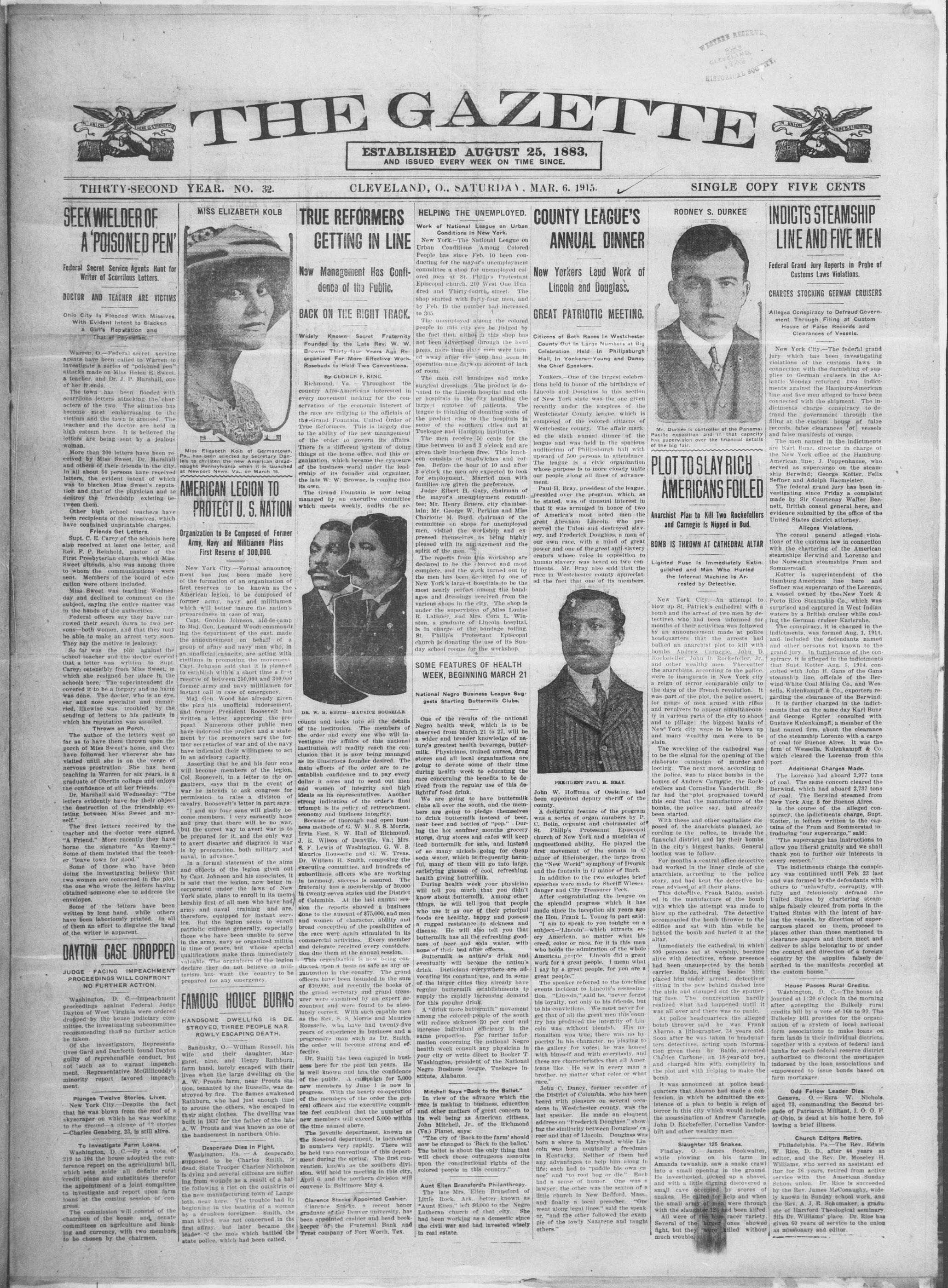
SEEK WHELDER OF A 'POISONED PEN'
Federal Secret Service Agents Hunt for Writer of Scurrilous Letters.
Ohio City Is Flooded 'With Misles,
With Evident Intent to Blacken
a Girl's Reputation and
That
Warren, O.—Federal secret service agents have been called to Warren to investigate a series of "poisoned pen" attacks made on Miss Hellet E. Sweet, a teacher, and Dr. J. P. Marshall, one of her friends.
The town has been flooded with scurious letters attacking the characters of the two. The situation has become most embarrassing to the victims and the town is aroused. The teacher and the doctor are held in high esteem here. It is believed the letters are being sent by a jealous woman.
More than 200 letters have been received by Miss Sweet, Dr. Marshall and others of their friends in the city. In all about 50 persons have received Letters, the evident intent of which was to blacken Miss Sweet's reputation and that of the physician and to destroy the friendship existing between them.
Other high school teachers have been recipients of the missives, which have contained unprintable charges.
Friends Get Letters
Supt. C. E. Carry Letters.
Supt. C. E. Carry of the schools here also received at least one letter, and Rev. F. P. Reinhold, pastor of the First Presbyterian church, which Miss Sweet attends, also was among those to whom the communications were sent. Members of the board of education were others included.
Miss Sweet was teaching Wednesday and declined to comment on the subject, saying the entire matter was in the hands of the authorities.
Federal officers say they have narrowed their search down to two persons—both women, and that they may be able to make an arrest very soon. They say the motive is jealousy.
So far was the plot against the school teacher and the doctor carried that a letter was written to Supt. Caroy; ostensibly from Miss Sweet, in which she resigned her place in the schools here. The superintendent discovered it to be a forgery and no harm was done. The doctor, who is an eye, ear and nose specialist and unmarried, likewise was troubled by the sending of letters to his patients in which his reputation was assailed.
Thrown on Porch.
The author of the letters went so far as to have them thrown upon the porch of Miss Sweet's home, and they have followed her wherever she has waited until she is on the verge of nervous prostration. She has been teaching in Warren for six years, is a graduate of Oberlin college and enjoys the confidence of all her friends.
Dr. Marshall said Wednesday: "The letters evidently have for their object the destruction of the friendship existing between Miss Sweet and myself."
The first letters received by the teacher and the doctor were signed, "A Friend." More recently they have borne the signature "An Enemy." Some of them insisted that the teacher "leave town for good."
Some of those who have been doing the investigating believe that two women are concerned in the plot, the one who wrote the letters having obtained someone else to address the envelopes.
Some of the letters have been written by long hand, while others have been laboriously printed. In all of them an effort to disguise the hand of the writer is apparent.
DAYTON CASE DROPPED
JUDGE FACING, IMPEACHMENT
PROCEEDINGS WILL CONFROT
NO FURTHER ACTION.
Washington, D. C.—Impeachment proceedings against Federal Judge Dayton of West Virginia were ordered dropped-by the house Judiciary committee, the investigating subcommittee recommending that no further action be taken.
Of the investigators, Representative Gard and Danforth found Dayton guilty of reprehensible conduct, but not such as to warrant impeachment. Representative McGillcuddy's minority report favored impeachment.
Plunges Twelve Stories. Lives.
New York City—Despite the fact that he was blown from the roof of a skyscraper on which he was working to the ground—a plunge of 13 stories—Charles Genberg, 23, is still alive.
To Investigate Farm Loans.
Washington, D. C.—By a vote of 219 to 104 the house adopted the conference report on the agricultural bill, which sets aside all definite rural credit plans and substitutes therefor the appointment of a joint committee to investigate and report upon farm loans at the coming session of congress.
The commission will consist of the chairmen of the house and senate committees on agriculture and banking and currency, with two members to be chosen by the chairmen.
THE GAZETTE
Misa Elizabeth Kolb of Germantown, Pa. has been selected by Secretary Darrels to christen the new american dreadnaught Pennsylvania when it is launched at Newport News, Va. on March 16.
Organization to Be Composed of Former Army, Navy and Militiamen Plans First Reserve of 300,000.
New York City—Formal announcement has just been made, here of the formation of an organization of first reserves to be known as the American legion, to be composed of former army, navy and militiamen which will better insure the nation's preparedness in case of war.
Capt. Gordon Johnson, al-dec-camp to Ma. J. Johnson, Leopard Wood commanding the department of the east, made the announcement on behalf of a group of army and navy men who, in an unofficial capacity, are acting with civilians in promoting the movement Capt. Johnson said that it is planned to establish within a short (thirty-four reserve of between 250,000 and 300,000 former army and navy militiamen for instant call in case of emergency.
Ma. J. Gen. Wood has already given the plan his unofficial endorsement, and former President Roosevelt has written a letter approving the proposal. Numerous other public men have indorsed the project and a statement by the promoters says the former secretaries of war and of the navy have indicated their willingness to act in an advisory capacity.
Asserting that he and his four sons will become members of the legion, Col. Roosevelt, in a letter to the organizers, says that in the event of war he intends to ask congress for permission to raise a division of cavalry. Roosevelt's letter in part says: "I and my four sons will gladly become members. I very earnestly hope and pray that there will be no war, but the surest way to avert war is to be prepared for it, and the only way to avert disaster and disgrace in war is by preparation, both military and naval, in advance."
In a formal statement of the aims and objects of the legion given out by Capt. Johnson and his associates, it is said that the legion, now being incorporated under the laws of New York state, plans to enroll in its membership first of all men who have had army and naval training and are, therefore, equipped for instant service. But the legion seeks to enroll patrolic citizens generally, especially those who have been unable to serve in the army, navy or organized militia in time of peace, but whose special qualifications make them immediately valuable. The organizers of the legion declare they do not believe in militarism, but want the country to be prepared for any emergency.
FAMOUS HOUSE BURNS
FAMOUS HOUSE BURNS
HANDSOME DWELLING IS DE-
STROVED, THREE PEOPLE NAR-
ROWLY ESCAPING DEATH.
Sandusky, O.—William Russell, his
wife and their daughter, Marg
garet, nine, and Henry Rathburn,
farm hand, barely escaped with their
lives when the large dwelling on the
A. W. Prouts farm, near Prouts站,
station, tenanted by the Russells, was
destroyed by fire. The flames awakened
Rathburn, who had just enough time
to arouse the others, who escaped in
itsir night clothes. The dwelling was
built in 1837 for the father of the late
A. W. Prouts and was known as one of
the handsomest in-northern Ohio.
Desperado Dies in Eight.
Washington. Pa. — A desperate, supposed to be Charles Smith, is dead, State Trooper Charles Nicholson is dying and several citizens are suffering from wounds as a result of a battle following a riot on the outskirts of the new manufacturing town of Langeloh, near here. The trouble had its beginning in the beating of a woman by a drunken foreigner. Smith, the man killed, was not concerned in the first affray, but later became the leader "of the mob which battled the state police, which had been catched."
ESTABLISHED AUGUST 25, 1883 AND ISSUED EVERY WEEK ON TIME SINCE.
CLEVELAND, O., SATURDAY, MAR. 6. 1915.
TRUE REFORMERS GETTING IN LINE
Widely Known Secret Fraternity Founded by the Late Rev. W. W. Browne Thirty-four Years Ago Reorganized For More Effective Work. Resbuds to Hold Two Conventions.
BY GEORGE F. KING
Richmond, Va. - Throughout the country Afro-Americans interested in every movement making for the conservation of the economic interest of the race are rallying to the officials of the Grand Fountain, United Order of True Reformers. This is largely due to the ability of the new management of the order to govern its affairs. There is a different system of doing things at the home office, and this organization, which became the cynosure of the business world under the leadership of its founder and organizer, the late W. W. Browne, is coming into its own. The Grand Fountain is now being managed by an executive committee which meets weekly, audits the ac
DR. W. H. SMITH- MAURICE NOUSELLER
counts and looks into all the details of the institution. The members of the order and every one who will investigate the affairs of this national institution will readily reach the conclusion that it is now being managed as its illustrious founder desired. The main efforts of the order are to reestablish confidence and to pay every dollar it owes and to send out men and women of integrity and high ideals as its representatives. Another strong indication of the order's final triumph is its policy of retrenchment, economy and business integrity. Because of thorough and open business methods of G. W. M., S. M. Morris, Irvin Eust. S. W. Hall of Richmond, J. R. Wilson of Danville, Va.; M. S. Lewis of Washington, G. W. S. Maurice Rousselle and G. W. Treas. Dr. William H. Smith, composing the executive committee, and hundreds of subordinate officers who are working in harmony, success is assured. The fraternity has a membership of 30,000 in twenty-seven states and the District of Columbia. At the last annual session the reports showed a business done to the amount of $75,000, and men and women of character, ability and broad conception of the possibilities of the race were again stimulated in its commercial activities. Every member and delegate received every consideration due them at the annual session.
This organization is now being conducted on a basis as安全 as any organization in the country. The grand officers have been bound in the sum of $10,000, and recently the books of the grand secretary and grand treasurer were examined by an expert accountant and were found to be absolutely correct. With such capable men as the Rev. S. S. Morris and Maurice Rousseau, who have had twenty-five years of experience in business and a progressive man such as Dr. Smith, the order will become strong and effective.
Dr. Smith has been engaged in business here for the past ten years. He is well known and has the confidence of the public. A campaign for 5,000 new members by June 1 is now in progress. With the henry co-operation of the members of the order the general officers and the executive committee feel confident that the number of new members will exceed 5,000 within the time named above.
The juvenile department, known as the Rosebud department, is increasing in numbers very rapidly. There will be held two conventions of this department during the spring. The first convention, known as the southern division, will hold its meeting in this city, April 6, and the northern division will convene in Baltimore May 4.
Clarence Stacks Appointed Cashier.
Clarence Stacks, a recent honor graduate of the Denver university, has been appointed cashier and head bookkeeper of the Faternal. Bank and Trust company of Fort Worth, Tex.
HELPING THE UNEMPLOYED.
Work of National League on Urban Conditions in New York.
New York--The National League on Urban Conditions Among Colored People has since Feb. 10 been conducting for the mayor's unemployment committee a shop for unemployed colored men at St. Philip's Protestant Episcopal church, 210 West One Hundred and Thirty-four street. The shop started with forty-four men, and by Feb. 10 the number had increased to 205.
The unemployed among the colored people in this city can be judged by the fact that, although this shop has not been advertised through the local press, more than sixty men were turned away after the shop had been operation nine days on account of back of room.
The men roll bandages and make surgical dressings. The product is donated to the Lincoln hospital and other hospitals in the city handling the largest number of patients. The league is thinking of donating some of the product also to the hospitals in some of the southern cities and at Tuskegee and Hampton institutes.
The men receive 50 cents for the time between 10 and 3 o'clock and are given their luncheon free. This luncheon consists of sandwiches and coffee. Before the hour of 10 and after 3 o'clock the men are expected to look for employment. Married men with families are given the preference.
Judge Ellert H. Gary, chairman of the mayor's unemployment committee; Mr. Henry Bruere, city chamberlain; Mr. George W. Perkins and Miss Charlotte M. Royd, chairman of the committee on shops for unemployed men, visited the workshop and expressed themselves as being highly pleased with its engagement and the spirit of the men.
The reports from this workshop are declared to be the clearest and most complete, and the work turned out by the men has been declared, by one of New York's largest hospitals, to be the most nearly perfect among the bandages and dressings received from the various shops in the city. The shop is under the supervision of Miss Louise R. Lattimer, and Mrs. Cora L. Winston, a graduate of Lincoln hospital, is in charge of the bandage rolling. St. Philip's Protestant Episcopal church is donating the use of its Sunday school rooms for the workshop.
SOME FEATURES OF HEALTH WEEK, BEGINNING MARCH 21
National Negro Business League Buggests Starting Buttermilk Clubs.
One of the results of the national Negro health week, which is to be observed from March 21 to 27, will be a wider and broader knowledge of nature's greatest health beverage, buttermilk. Physicians, trained nurses, drug stores and all local organizations are going to devote some of their time during health week to educating the race concerning the benefits to be derived from the regular use of this delightful food drink.
We are going to have buttermilk clubs all over the south, and the members are going to pledge themselves to drink buttermilk instead of beer, near beer and bottles of "pop." During the hot summer months grocery stores, drug stores and cafes will keep feed buttermilk for sale, and instead of so many nickels, going for cheap soda water, which is frequently harmful, many of them will go into large, satisfying glasses of cool, refreshing health giving buttermilk.
During health week your physician will tell you much that you didn't know about buttermilk. Among other things, he will tell you that people who use it as one of their principal foods are healthy, happy and possess a rugged resistance to sickness and disease. He will also tell you that buttermilk has all the refreshing goodness of beer and soda water, with none of their bad after effects.
Buttermilk is nature's drink and eventually will become the nation's drink. Dieticians everywhere are advocating its constant use, and in some of the larger cities they already have regular buttermilk establishments to supply the rapidly increasing demand for this popular drink.
A "drink more buttermilk" movement among the colored people of the south will reduce sickness 30 per cent and increase individual efficiency in the same proportion. For further information concerning the national Negro health week consult any physician in your city or write direct to Booker T. Washington, president of the National Negro Business league Tuskegee institute, Alabama.
Mitchell Says "Back to the Ballot."
In view of the advance which the race is making in business, education and other matters of great concern to its well being as American citizens, John Mitchell, Jr., of the Richmond (Va.) Plinne, says:
"The cry of 'Back to the farm' should now be changed to 'Back to the ballot.' The ballot is about the only thing that will check these outrageous assaults upon the constitutional rights of the colored people in this country."
Aunt Ellen Bransford's Philanthropy.
The late Mrs. Ellen Bransford of Little Rock, Ark., better known as "Aunt Ellen," left $0,000 to the Negro Lutheran church of that city. She had been working as a domestic since the civil war and had invested wisely in real estate.
COUNTY LEAGUE'S ANNUAL DINNER
New Yorkers Laud Work of Lincoln and Douglass.
GREAT PATRIOTIC MEETING.
Citizens of Both Races in Westchester County O'er In Large Numbers at Big Celebration Heid in Phillipsburgh Hall, In Yankees- In Dancy the Chief Speakers.
Yonkers.- One of the largest celebrations held in honor of the birthdays of Lincoln and Douglass in this section of New York state was the one given recently under the auspices of the Westchester County league, which is composed of the colored citizens of Westchester county. The affair marked the sixth annual dinner of the league and was held in the spurious auditorium of Phillipsburgh hall with upward of 500 persons in attendance. The league is a civic organization whose purpose is to more closely unite our people along all lines of advancement.
Paul H. Bray, president of the league, presided over the program, which, as he stated, was of unusual interest in that it was arranged in honor of two of American's most noted men—the great Abraham Lincoln, who preserved the Union and destroyed slavery, and Frederick Douglass, a man of our own race, with a mind of great power and one of the great anti-slavery orators whose voice in opposition to human slavery was heard on two continents. Mr. Bray also said that the race in Westchester county appreciated the fact that one of its members,
PRESIDENT PAUL H. BRAY.
John W. Hoffman of Osskling. had been appointed deputy sheriff of the county.
A delightful feature of the program was a series of organ numbers by P. C. Bollin, organist and choristmaster of St. Philip's Protestant Episcopal church of New York and a musician of unquestioned ability. He played the first movement of the sonata in C minor of Rheinberger, the large to the "New World" symphony of Dvorak and the fantasia in G minor of Bach. In addition to the two enologies brief speeches were made by Sheffield Wiesen-danger and City Treasurer Jack.
After congratulating the league on the splendid progress which it has made since its inception six years ago the Hon. Frank L. Young in part said: "I am to speak to you tonight on a subject—'Lincoln'—which attracts every American, no matter what his creed, color or race, for it is this man who holds the admiration of the whole American people. Lincoln did a great work for a great people. I mean what I say by a great people, for you are a great people."
The speaker referred to the touching events incident to Lincoln's assassination, "Lincoln," said he "never forgot his loyalty, not only to his friends, but to his convictions. We must never forget that of all the great men this country has produced the integrity of Lincoln was without blemish. His nationalism was true; there was no by-policy in his character, no playing to the gallery for votes; he was honest with himself and with everybody, and these are characteristics that all Americans like. He saw in every man a brother, no matter what color or what race."
John C. Dancy, former recorder of the District of Columbian, who has been heard with pleasure on several occasions in Westchester county, was the last speaker. He made an eloquent address on "Frederick Doughlass," showing the similarity between Doughlass' career and that of Lincoln. Doughlass was born a slave in Maryland, while Johncoln was born nominally a freedman in Kentucky. Neither of them had any advantages to help him along in life; each had to "paddle his own canoe" and "to root hog or die." Each had a sense of humor. One was a lawyer; the other was the sexton of a little church in New Bedford, Mass, and finally a local preacher. "One went along legal lines," said the speaker, "and the other followed the example of the lowly Nazarene and taught others."
RODNEY S. DURKEE
Mr. Durkee is controller of the Panama-Pacific exposition and in that capacity has supervision over the financial details of the big fair.
Lighted Fuse Is Immediately Extinguished and Man Who Hurled the Infernal Machine Is Arrested by Detective.
New York City. An attempt to blow up St. Patrick's cathedral with a bomb and the arrest of two men by detectives who had been informed for months of their activities was followed by an announcement made at police headquarters that the arrests had walked an amateur plot to kill with bombs Andrew Carnegie, John D. Rockefeller, John D. Rockefeller, Jr. and other wealthy men. Thereafter the amateurs, according to the police, were to inaugurate in New York city a reign of terror comparable only to the days of the French revolution. It was part of the plot, the police assert, for gangs of men armed with rifles and revolvers to appear simultaneously in various parts of the city to shoot and to pillage; the biggest banks of New York city were to be blown up and many wealthy men were to be blain.
The wrecking of the cathedral was to be the signal for the opening of the elaborate campaign of murder and looting. The next move, according to the police, was to place bombs in the homes of Andrew Carnegie, the Rockefellers and Cornelius Vanderbilt. So far had the plot progressed toward this end that the manufacture of the bombs, the police say, had already been started.
With these and other capitalists disposed of, the anarchists planned, according to the police, to invade the financial district and lay their bombs in the city's biggest banks. General looting was to follow.
For months a central office detective had worked in the inner circle of the anarchists, according to the police story, and had kept the detective bureau advised of all their plans.
This detective, Frank Baldo, assisted in the manufacture of the bomb with which the attempt was made to blow up the cathedral. The detective accompanied the bomb thrower to the edifice and sat with him while he lighted the bomb and hurled it at the altar.
Immediately the cathedral; in which 800 persons sat at worship, became alive with detectives, whose presence had been unspecified by the bomb carrier. Baldo, sitting beside him, placed him under arrest; detectives sitting in the new behind dashed into the aisle and stamped out the sputtering fuse. The congregation hardly realized what had happened until it was all over and there was no panic.
At police headquarters the alleged bomb threater said he was Frank Abarno, a lithographer, 34 years old. Soon after he was taken to headquarters detectives, acting upon information given them, by Baldo, arrested Charles Carbone, an 18-year-old boy, and charged him with complicity in the plot and with helping to make the bomb.
It was announced at police head quarters that Abarno had made a confession, in which he admitted the existence of a plan to begin a reign of terror in this city which would include the assassination of Andrew Carnegie, John D. Rockefeller, 'Corneilus Vanderbilt and other wealthy men.'
Slaughter '125 Snakes
Findlay, O.—James Bookwater, while plowing on his farm, in Amanda tawntship, saw a snake crawl into a small opening in the ground. He investigated, picked up a shovel, and with a little digging discovered a small cave occupied by scores of snakes. He called for help and when the small army (which were through with the slaughter) had been killed. All were of the tracer variety. Several of the snakes showed fight, but they were killed without much trouble.
IN UNION
WE ASSISTED
INDICTS STEAMSHIP LINE AND FIVE MEN
Federal Grand Jury Reports in Probe of Customs Laws Violations.
Alleges Conspiracy to Defraud Government Through Filing at Custom House of False Records and Clearances of Vessels.
New York City—The federal grand jury which has been investigating violations of the customs laws in connection with the furnishing of supplies to German cruisers in the Atlantic: Mohdiny returned two indictments against the Hamburg-American line and five men alleged to have been connected with the shipment. The indictments charge conspiracy to defraud the government through the filing at the custom house of false records, false clearances of vessels and false manifests of cargo. The notation of indictments are Karl Bunz, director in charge of the New York office of the Hamburg-American line; J. Poppenhause, who served as supercargo on the steamship Befwind; George Kotter, Felix Seftner and Adolph Mchelster.
The federal grand jury has been investigating since Friday a complaint made by Sir Courtney Walter Bennett, British consul general here, and evidence submitted by the office of the United States district attorney.
Alleges Violations.
The consul general alleged violations of the customs law in connection with the chartering of the American steamships Bermwind and Lorenzo and the Norwegian steamships Frami and Sommerstad.
Kotter is superintendent of the Hamburg American line here and Sefner was supercargo of the Lorenzo, a vessel owned by the New York & Porto Rico Steamship Co., which was surprised and captured in West Indian waters by a British cruiser while coiling the German cruiser Karlsruhe.
The conspiracy, it is charged in the indictments, was formed Aug. 1, 1914, and included the defendants named and other persons not known to the grand jury. In furtherance of the conspiracy, it is alleged in the indictments that Stuart, Kotter Aug. 5, 1914, consulted with John I. Gans of the Gans steamship line, officials of the Berwind-White Coal Mining Co. and Wessells, Kulenkampff & Co., exporters regarding the clearance of the Berwind.
It is further charged in the indictments that on the same day Karl Bunz and George Kotter consulted with Gustave Kulenkampff, a member of the last named firm, about the clearance of the steamship Lorenzo with a cargo of coal for Buenos Aires. It was the firm of Wessells, Kulenkampff & Co. which cleared the Lorenzo from this port.
Additional Charges Made
The Lorenza had aboard 3,977 tons of coal. The same concern cleared the Berwind, which had aboard 2,737 tons of coal. The Berwind steamed from New York Aug. 5 for Buenos Aires.
In the course of the alleged conspiracy, the indictments charge, Supt. Kotter, in letters written to the captains of the Fram and Sommerstad introducing "our supercargo," said:
"The supercargo has instructions to allow you liberal gratuity and we shall thank you to further our interests in every respect."
The indictments charge the conspiracy was continued until Feb. 23 last and was formed by the defendants with others to "unlawfully, corruptly, willfully and feloniously defraud the United States by chartering steamships falsely cleared from ports in the United States with the intent of having the vessels, by direction of supercargoes, placed on them, proceed to places other than those mentioned in clearance papers and there meet and deliver to ships belonging to or under the control and direction of a foreign country by the supplies - falsely described in the manifests recorded at the custom house."
House Passes Rural Credits.
Washington, D. C.—The house adjourned at 1:20 o'clock in the morning after accepting the Bulkley rural credits bill by a vote of 160 to 99. The Bulkley bill provides for the organization of a system of local national form associations to make loans on farm lands in their individual districts, together with a system of federal land banks for each federal reserve district authorized to discount the mortgages indorsed by the loan-associations and empowered to issue bonds based on farm mortgages.
Odd Fellow Leader Dates:
Geneva, O. — Ezra W. Nichols, aged 73, commanding the Second brigade of Patriarch, Millant, I. O. O. F of Ohio, is dead at his home here, following a brief illness.
Church Editors Retire.
Philadelphia, Pa.—The Rev. Edwin W. Rice, D. D., after 44 years as editor, and the Rev. Dr. Moseley H. Williams, who served as assistant editor for 36 years, retired from active service with the American Sunday School union. Dr. Rice is succeeded by the Rev. James McConaughy, widely known in Sunday school work, and the Rey, A. J. R. Schumaker, a graduate of Hartford Theological seminary, fills Dr. Williams' place. Dr. Rice has given 60 years of service to the union as missionary and editor.
PUBLISHED EVERY SATURDAY
One Year.....$1.50.
Six Months.....1.00
Three Months.....50
Subscribers are requested to re-
mit by postoffice money or-
der or registered letter
attended at the postoffice in Cleveland
Ohio, as second-class matter.
Address all communications to
HARRY C. SMITH
Editor and proprietor,
THE GAZETTE,
Blackstone Building, Cleveland, O.
Member Ohio Legislature: 1894
to 1896; 1898 to 1898; 1900 to 1902
THE GAZETTE is the oldest, and has the largest bona fide circulation, double that of any newspaper in the interest of Afro-Americans, published in the state of Ohio, and comparison with any will immediately establish its rank as one of the NEWSIEST AND BEST In the country.
10,000,000 Afro-Americans..
160,000 in Ohio.
20,000 in Cleveland.
SATURDAY, MARCH 6, 1915.
Republican Prosperity; how sweet the sound!
The ship purchase bill palsied the president's hold upon his party.
The "hard times" struck the Black Patti company a "body blow." It "went to pieces" in Memphis, Tenn., recently.
In two years of power President Wilson, with an obedient congress, has kept his party's pledge to reduce the high cost of living, only by lessening our power to pay it.
In 1895, when a Democratic revenue tariff bankrupted the national government, President Cleveland borrowed money on bonds, which was not so painful as the stamp tax and penny anti of President Wilson.
Rev. Oscar J. W. Scott of Ohio, chaplain of the 25th Infantry, has been promoted to the rank of captain. He was appointed in 1807, and is with his regiment in Hawaii.
Some of our people were so busy celebrating Lincoln's and Washington's birthdays they forgot Frederick Douglass'. 'Twas ever thus—with SOME Afro-Americans.
"We are on the eve of a new era of enterprise and prosperity," said President Wilson last week to the American Electrical Railway Association. He used the same words of prophesy when he gave the country the "tarif" law which blighted its business.
President Wilson ought to lend the business men of the country those wonderful spectacles through which he sees confidence returning. Through most glasses real confidence is seen returning only after the next Presidential election.—Philadelphia Press.
Has the Hon. Harry C. Smith of Cleveland retired from the political arena? At the final roll call of the great Negro journalists, the veteran Cleveland editor, will be on the list.—Kansas City (Mo.) Herald.
No, he has not retired from the political or the journalistic arenas and is not likely to do so, while life lasts. He has been active in both fields of endeavor, too long, to quit now.
The negro race has made tremendous progress in fifty years. Its leaders are urging their people to earn the respect of the white race by honest and fair treatment, even against giving offense. Everybody's Magazine would not wittingly hurt their cause or halt their progress by giving offense. Will others of our friends in the South, or elsewhere, be good enough to tell us whether or not we gave real cause for offense when we called a negro "Mr."?—Everybody's Magazine.
Now let "Everybody's" capitalize the word "Negro," and the offense given in publishing, it with a small "n" will be discontinued. We feel it will join a number of other leading daily papers and magazines, principally in the East, that are doing so, and willingly, too.
"NELLIE, WHY DO YOU FEAR ME?"
Congressman Kahn of California was batting the Democrats of the House. "The business interests of the country have grown afraid of Democratic legislation, threatened and enacted," he shouted. "Why? Why was Nellie, the beautiful cloak model, afraid of the villain?"
He told them about Nellie. In the early part of the play the villain had pushed her off the Brooklyn bridge. Later he threw her overboard from an Atlantic liner. Then again he had thrust her under a descending elevator. And the next time they met, as Nellie shrank away from him he said, "Nellie why do you fear me?" "And the business interests of the country, like Nellie, have a pretty clear understanding of when it's time to be afraid," said Mr. Kahn.
WORTHY OF CONSIDERATION.
Rufus L. Perry, Esq., of Brooklyn, N. Y., suggests the amalgamation of weekly class-publications to operate on a co-operative basis and outlines a plan that is not only feasible but practicable. Relative to Mr. Perry's suggestion, the N. Y. Commercial &
Financial Times of Feb. 1, 1915, says: "The American Press Association furnishes its clients with stories and scientific matter for $1.50 and upwards a newspaper page; the Publishers' Co-operative Union can accomplish the same purpose at a far less price with the same results.
"Mr. Perry is a master of detail. His offices are located at No. 375 Fulton St., Brooklyn, where the first meeting of the association will be held. Notices will be sent to 1000 publishers, and a plan unfolded which will prove startling in its details. The capacity of the publication demonstrated by Mr. Perry. This is an award that should be grasped by every publisher for it means a direct saving in the production of his newspaper."
The saving, in the matter of composition alone, would pay handsomely each member of such an organization. Let our contemporaries consider carefully Mr. Perry's plan.
THE GOVERNOR RIGHT!
Said Gov. Frank B. Willis, in his speech in this city, last week:
"The time is ripe and the occasion is present for us to aid in a genuine revival of real Americanism. Instead of being antagonists, the employer and employee find that they have most interests in common. They are learning with each passing day that a discerning public is beginning to fully recognize its own needs and can quickly pierce the veil of cant or insincerity and will not brook selfishness on the one hand or fanaticism on the other.
"Justice, co-operation and harmony" is a needed slogan to which the business man and wage-earner must both turn their attention. Never was the moment more propitious for us to make our country gain greater prestige. All we require is proper thought and conscientious effort to prevent us from tying our own hands and feet so that steady progress is impossible. The general public realizes that what may have once seemed to be a popular practice of crying out against any and all business, because in some cases there have been wrongful abuse by some interests, is folly, if we would have accomplished for us those things which are best for both the employee and employer.
"Legitimate business, I believe, is always willing to listen to reason and to correct its faults, but it is time for a little less suppression of straight business, honestly intended, and a little more curailing of the professional reformer, whose chief aim is to climb prominently into the limelight while somebody else pays the bill. The people of America are ready and willing to witness a real "comeback" of national commercial supremacy. This will be possible only as business men give larger attention to public affairs." The plea of a statesman!
THIS IS MATERIAL SUCCESS.
New York City—The National Association for the Advancement of Colored People has scored a real triumph in New York in succeeding in getting the National Board of Censorship to reverse its approval of the moving picture film called "The Birth of a Nation," which is based on Thomas Dixon's "Clansman." In connection with the movie, the board met in having this objectionable film censored, it is interesting to note the action taken in Atlanta, Ga., in regard to "Uncle Tom's Cabin," which has recently been produced there in moving pictures. To suit the southern community the name of the production had to be changed to "Old Plantation Polks," and all disagreeable scenes to them were cut out. "Nobody has any right to come here and stir up sectional prejudice by offering such a play. The play recalls all the things we have been trying to forget." This is equally true here in the North.
TRICKS OF SOME TRAVELERS
Depredations of Thoughtless Tourists Who Desire Souvenirs Are Innumerable.
We often hear complaints from tourists about inattention and lack of courtesy on the part of those whose duty it is to cater to the traveling public. But there is another side to the story; for instance, the custodians of places of historic or scenic interest frequently visited by travelers are obliged to maintain constant watch against the vandalism of souvenir hunters. Leslie's states.
What satisfaction can be found in mutilating and demolishing things of interest and value to procure a souvenir, or in appropriating from well-known hotels such property as knives, forks, pepper and salt shakers, napkins, towels and bath mats? The manager of a prominent hotel in New York even reports the disappearance of pillows from the bedrooms. The value of this stolen property yearly amounts to a very large sum. It has been the underlying cause for the appearance of such items as the following on menus: "Chicken en casserole in individual souvenir" or "souvenir cocktail" in which the appetizer is served in a container bearing the house name, and which container is given to the patron. There are numerous little souvenirs, such as silver-plated trays, teaspoons, etc., for sale by various hotels to satisfy collectors. Not all things that disappear from hotels are taken with deliberate intention. Major Bowman, manager of a famous New York hotel, has concluded that linen is not always purloined, but is taken away unconsciously as wrappers for shoes and other articles when packing, and men, he says, unconsciously tuck bar dollies in their coat pockets after using them, and these are dropped at the next hotel visited. This wholesale purloining of hotel articles has led to the formation of a linen exchange. Many of the leading managers now have stock taken of all the foreign linen in their hotels, and at regular intervals this material is sent to its rightful owners, who then return linen not belonging to them.
Woodcraft.
You can make fire by rubbing two pieces of dry wood together, but it is not believed that this method will ever supersede the plan of rubbing a match against a piece of sandpaper.
THE GAZETTE, CLEVELAND, O. SATURDAY MARCH 6, 1915
FRESH OHIO NEWS
WRITTEN BY "THE OLD RELIA
BLE" GAZETTE'S CORRE-
SPONDENTS
THROUGHOUT THE STATE
What Our People Are Doing Each Week—Church, Personal, Social, Lodge, Literary and Musical—Marriages,
OBERLIN.-Mt. Zion Baptist and Rust M. E. churches' joint revival closed Feb. 26, with splendid results—the greatest for a long time; 87 converts. Forty-three joined Mt. Zion; 28, Rust, and 10 are undecided. C. S. Calley of Cleveland, preached effective churches, crowded houses, each evening. Large attendance at the churches, all day, Sunday.-Mrs. Henry Bows has been "jeptahh and His Daughter" was repeated, Mar. 1. —Lexington conference, Mar. 14. —Miss Stella Shaw is "the Crowning of the Fairy Queen," a summer fire occurred at the Holly house, Friday evening.
CORRESPONDENTS must mail all letters for publication at their postoffice sufficiently early on Monday (or Sunday) of each week to have them-reach The Gazette office on Tuesday morning, and always write also, their names and that of their relatives, the names of their wrapper about returned copies. Unless this latter is done, proper credit cannot be given you. Lists of names, wedding presents, etc., obituary notices, speeches, resolutions, poetry, inquiries for relatives and advertisements of all kinds, including items for sale in the near future, must be paid for in advance at the rate of ten cents a line, six words to a line. Our rates for display advertisements will be sent on application. Send postal note and not stamps during warm weather.
MANSFIELD.—Mrs. R. Fisher is ill—Mr. R. Breckenridge is convalescent.—Rev. and Mrs. C. W. Ford spent a delightful evening, Tuesday, with Mrs. H. Banks.—Mrs. Anderson of Detroit, was the guest of Mrs. M. Barker.—Sunday was a gala day at the A. M. E. church. Large congregations at each service. Rev. J. W. Ligins of Canton, and Mrs. Seaman spoke of Mrs. Flora Davis and her work. Mrs. Liggins accompanied her husband and Mrs. Mesdames. Davis R. Reynolds sang beautifully, accompanied by Miss D. Barker. After W. M. M. S. business had been acted at Mrs. W. Spencer's, ice cream and cake were served. Rev. Ford was called to Toledo, Thursday. His cousin, Marion Ware, is not expected to live.
DAYTON—Thad. W. Wheeler has been appointed cost clerk at the city hall. Tom Fleming of Cleveland, had nothing to do with this appointment, or the temporary one as assistant engrossing clerk. Mr. Wheeler held in the House of Representatives, at Columbus, a few weeks in January and February, this year, announcements to the contrary nowwithstand. Mr. Wheeler will arrive here from Cleveland, today, to open a revival at Euclid Ave. A. M. E. church—Mrs. Edward Warren returned to Springfield, last week—Dr. A. B.' Rose has purchased valuable property at the corner of Bank St. and Norwood Ave., and will occupy it with his mother. There is only one way to get the race news, the country over, and that is to take "the old reliable" gazette. Send in your orders for the paper and keep up to date.
SANDUSKY.—Miss Mary Bolling of Greencastle, ID, is visiting her brother, Nelson and family.—Mrs. David Walton is still ill; also, Mrs. B. Thompson, Mrs. Early and Mrs. J. R. Davis.—Mrs. John Adams was in Toledo, last week.—The churches and the S. S., were well attended, Sunday. The revival at the Second Baptist church is progressing. Two converts for baptism. The benedict concert at the church is the 28th in a success.—Wedding bells are ringing here.—Mrs. Chas. Taylor gave a birthday party for Mr. Chas. Jones, last week. The young people thoroughly enjoyed themselves.—The missionary society met at Mrs. Gaines, last Friday, and contacted considerable business. A fine luncheon was served by the hostess. Miss Edith Gaines and Lucile Jeffry have joined the Baptist church. The S. S. was reviewed by Mr. Bordalo Sunday. The P. U. topic was opened by Mrs. S. Scott.—Read "the old reliable" Gazette. It is full of good things from many other cities and towns. Give the local agent your order for a copy of it, every week.
CADIZ—John Doubt entertained the B. B., Sunday.—Miss Elizabeth Ramsey was the guest of Mrs. Ola Brown. Sunday.—The Cadiz Colored
Concert Co. gave a concert at the Opera house, last Friday night—Mr. Henry Carter ("Chip") was buried from the A. M. E. church, last Monday, Rev. O. V. Childers offlacing—Mr. Ollie Ramsey of Massillon, is Mr. Mrs. Mabel Christian was in Coleran, it waswach. Mr. has la gripe—The Y. M. L. club gave a covered-dish party at Mrs. F. W. Lucas', the 25th. ut. Mrs. Minerva Freeman was called here from Urhichville by the death of her brother, Henry Carter—P. T. Brown of E. Liverpool, is here visiting his church members, meeting of A. M. E. church members, it was decided to build a new brick church on Market and Buffalo Strs. this spring.
YOUNGSTOWN.—J. H. Bobson and Robert have rheumatism. Mesdames M. E. Clayton, Jos. Finney, Beverly Jackson, Misses R. H. Holmes and Mary L. Bradsaugh are convalescing.
—Mr. James Clark of Detroit, is dead, leaving a wife and two children. He formerly lived here.—Lenten tea at Mrs. Agnes Lucas, Wednesday evening.—Marie S. Myers has a position at the Hippodrome and Edna Lincoln.
—The Bellet New Shoe store.—Mrs. Edward S. Sexton, CEO, and, in the week with her daughter, Mrs. H. Douglass.—D. J. Wafford, and Miss Mildred Lawson were quietly married, last week.—Mrs. Q. Robinson is about the house on crutches.—Mrs. Chas. Reeves is visiting in Greenville, Pa., this week.—Mrs. Robert Dockett is visiting her mother, Mrs. Crosby, in Toledo. —Mesdames, Jennifer, Simon, P. H. H. S. R. R. R. and Mr. Chas. Lincoln are ill. Mrs. Mary V. V. and Mrs. Robert Mackey are critically ill. —Dr. W. P. Burton, chiropodist, has opened parlors in W. Federal St. —E. S. Moore of Cleveland, has moved his family here.—Wash. Emerson ran a needle in his thumb, Saturday, and had to call a physician. In season and out, the old reliable’s work was put for our people, first last and all the time, and the life you the truth. Order it from the toll agent, or send your subscription, for a year, to it in Cleveland.
ONE RACE PROBLEM ON HAND
We are already staggering under as big a job as we can carry in the so-called Negro problem. No man knows how we are going to work that out for the good of the Negro, for the good of the white man, and for the good of the black man, that is nearer a solution it would be the wildest folly for us to attempt the experiment of mixing in any large way the Occident with the Orient.
We are working on another article on this Japanese question, which will follow in an early number. An article which will not be alarmist, an article which will not be illuminating, an article which we hope will be illuminating.—Everybody's Magazine.
WHAT SEGREGATION DOES
For the Afro-American in the South
A Race Journal's Explanation.
The exponents of race segregation claim that the Colored people "want to live among white people because of a desire to associate with them." That is decidedly, untrue. Colored people object to being segregated because it deprives them of municipal services. The same laws are not enforced when the regard is health; the money that they pay in taxes is usurped for the benefit of white communities; their streets are unpaved, and, in case of fire, the fire fighting apparatus cannot reach their property. They have inadequate police protection and the streets are not properly lighted. An example: When Huntersville and Barboursville were annexed to Norfolk, the bound-lands were extended to cover much of adjoining white wards so as to preclude forever the possibility of Negro votes ever controlling the revenue from Negro taxable values. Taxes were raised 100 per cent and $270,000 were appropriated for street improvements in the wards of the DOLLAR OF SPENT FOR CURBING A SINGLE STREET IN THE COLORED SECTION OF THE WARD—Norfolk (Va.) Journal & Guide.
BASE-BALL NOTES
The following members of Bailey's Glants are requested to meet at 1815 Central Ave., Sunday, Mar. 21: D. C. Davenport, Freeman, Freecrugs, Johnson, Collett, W. H. Craig, W. T. Turner, Frank T. Meteor, GEO, Tucker, "Pitcher" Johnson, "Shortstop" Tinley, W. Nelson of the Cubs, will manage the Blaine A. C., the coming season.
Assistant manager W. H. Craig says he expects a new line-up, this season and also good work from his men.
WHERE IS KATIE FOSTER?
Miss Katie Foster, my sister, was separated from me in Fort Scott, Kansas, when but a child. She has since married. I heard she was a school teacher in Ohio. Any one knowing her whereabouts will tell me. Sam Foster.
Adv. 344 E. 41st St., Chicago, Ill.
Edgar Young Wins the Prize
Philadelphia, Pa.—Edgar C. Young of this city is the first Afro-American to win the George Cabot Ward In Memoriam prize, awarded annually to the senior class of the New York General Theological Seminary for the best reading of the Bible, and of the service of the Protestant Episcopal Church.
Headwaiter Gates' Replies.
March 1, 1915.
Editor Gazette, Dear Sir: It is true that some of the waiters did not get a part of the donation at the hotel, as stated in last week's issue of The Gazette. But, if as many of them are interested in the matter, will call at said hotel it will be a pleasure for me to explain to them why they did not get any. However, I would like further to add that it remains to be proved that the man who made that statement is not the same one who was seen "mixing with cigarettes."
THE SENATE RESTORES MONEY
FOR HOWARD.
Washington, D. C. -By action of the Senate the item for $101,000 for Howard University, which was stricken from the sundry civil bill by the House of Representatives, was replaced in the measure.
Men's, Ladies' and Children's CLOTHES CLEANED, REPAIRED AND PRESSED
THE OLD DOMINION
Lunch Room
at
3652 Central Ave..
Serves THE BEST AND
QUICKEST MEALS
at
Popular Prices. Give it a Trial.
Open Day and Night
First-class Work Only
GARMENTS PRESSED BY
THE MONTH.
Wm. J. KENNEY, Mgr.
2738 Central Av.,
Cleveland, Ohio.
QUINA
GROWS
REMOVES
SEND FOR
QUINA
THE IDEAL
THOROUGHLY CLEAR
QUINA
HAIR STREAK
SHAMMER
QUINA 25¢ QUIMAGE
AT ALL
SEEBY DRUG COMPANY
The Beer for home
Gold Bo
Is absolutely guaran
under Government
The Cleveland & S
West, 785
Taylor's New S
and Hair Straight
The Best in
This comb, properly heated, and the use of
crimpy hair straight and silky at every st
Don't put it off but send $1.00 today.
PRICE OF 00MB $1.
Here is the top of
TAYLOR'S SPECIAL ALCOHOL HEAT
of heater the Comb, and can be closed up so
For best results use LaCreole Hair Pom
the Comb Straightener, but promotes a luxurious
SEND FOR MY FREE CATALOGUE! Use
Hair Goods in this country for colored people
address, star flair, Combe, Brushes, etc.
T. W.
When writing please
QUINADE
GROWS HAIR
REMOVES DANDRUFF
SEND FOR SAMPLE
QUINASOAP
THE IDEAL SHAMPOO SOAP
THOROUGHLY CLEANSSES THE SCALP
QUINACOMB
HAIR STRAIGHTENER
SHAMPOO DRYER
QUINADE 25¢ QUINACOMB 30¢ QUINADE 25¢
AT ALL DRUGGISTS
SEEBY DRUG COMPANY, NEW YORK CITY, N.Y.
SWOOPE'S Soup and Coffee House
2908 Central Ave.
WILLIAM SWOOPE, Prop.
The Cleveland & Sandusky Brewing Co.
West.785 Central 3933
Taylor's New Shampoo Dryer and Hair Straightener!
The Best in the World!
This comb, properly heated, and the use of LaCreole Hair Pomade, will bring the most
crimpy hair straight and silky at every stroke and cause a rapid growth of the hair.
TAYLOR'S SPECIAL ALCOHOL HEATER lebbie bandster and most convenient method of heating the Comb, and can be closed up so that you can put it in your hand-bag. Price $50c. For best results use La Creole Hair Pomade. It only meets every requirement of the Hair Care Catalogue. Illustrating the Largest and Most Complete Line of Hair Goods in this country for colored people, such as Bangs, Wigs, Puffs, Swatches, Pompads, Hair Pins, Combs, Brushes, etc.
If you knew
Nelson's Hair Dressing as we do you would never use anything else on your hair.
we want you to know it—
know it personally by actual use,
don't take our word for it, or any-one else,—test it yourself.
you can do this,
send us your name and address and we will send you,
eee of cost,
a sample box of Nelson's Hair Dressing, also a sample of Nelson's Scalp and Hair Cleaner and a sample cake of Nelson's Skin and Complexion Soap.
Is it soft and glossy and full of life?
Can you comb it out easily or is it full of tangles?
Are you proud of your hair?
The Answer Is:-
NELSON'S
HAIR DRESSING
a sample o
and Comp
Test them
in your ove
not what w
out anything
We have com
in them an
ious to pr
make.
Write to day,
enclosing t
postage on
NELSON MA
Examinations of applicants for the position of patrolmen will take place March 27. The height requirement has been increased from five feet eight inches to five feet nine inches. Applicants must be between 25 and 34 years old. You will have this opportunity. Patrolmen receive over one thousand dollars a year.
Mrs. H. C. Jones, Prop.
A bowl of soup, a cup of coffee
and bread for
FIVE CENTS
Pigs' feet, Baked beans, Stews,
etc., etc.
A Complete Line
DRY GOODS, LADIES' AND GENTS'
FURNISHINGS
J. LOMSKY
3816 and 3820 Central Ave.
Double Stamps on Tuesdays and
Fridays.
Mrs. A. M. Pope- Turnbo
Results of "Poro" Treatment
"PORO COLLEGE"
Largest College of its kind in the world.
200 PINE STREET, ST. LOUIS, MO.
WILL BE HARVESTED.
If every boy of "Poro" is fully guaranteed sufficient access
for or reacquisition. Some boys are guaranteed of the free
$250 BILLBOARDS with the approval of the parsonage.
If any boy is not guaranteed sufficient access for or reacquisition, we will accept the parsonage.
It may be reacquired or not acquired upon the request of the parsonage.
MARSHALERI UNION TREE, CINEMA 101
JUNE 10, 1950, BENARYTY NO. 41228
For treatment, call on or address:
MISS KATIE B. COLLIER,
4812 Payne Ave.,
Cleveland, Ohio.
R. R. CHEEKS
ATTORNEY-AT-LAW
312-314 Superior Building
THE
NELSON
GIRL
Are you satisfied with your
hair?
Is it as long as it should
be?
The Answer
Is:-
The Beer for home use MUST be pure Gold Bond Beer
Is absolutely guaranteed and is bottled under Government supervision by
T. W. TAYLOR, Howell, Mich.
When writing please mention this paper
Large, Heavy Strong and Durable. Made of
metal, it is strong and durable and can
inecidible one solid piece; highly polished
nickle plated; steel bolt which goes through
the large wood panels and screws into metal
holes; it is strong and durable and can
loose or coming off. Remen, be it a
in one piece. Not a single piece of order,
it is one piece.
Price of Hair Straightener and Alcohol Heater complete $1.50.
OR let the hairdresser and most convenient method
that yo ran put it in your hand-bag. Price 50c
in growth of the hair. Price 2c.
Illustrating the Largest and Most Complete Line
sle, such as Bengs, Wigs, Puffs, Switches, Pon-
mention this paper
TAYLOR, Howell, Mich.
NELSON'S
HAIR DRESSING
Has no superior as
a hair beautifier.
¢ Thousands of men and women have improved the appearance of their hair by using NELSON'S HAIR DRESSING.
¢ For those who know — it is a toilet necessity.
Ask your druggist. If he cannot supply you, send us his name and address and we will send you a free sample.
NELSON MFG. CO.
RICHMOND, VA.
THE
NELSON
GIRL
---
2742 Central Av., cor. E. 28th St. Cut this ad, out and present it at the Brown Drug Co., and receive a liberal trial size of B. AND M. HAIR DRESSING AND TONIC. This dressing is especially recommended where the hair is stubborn or curly, as it not only makes the hair soft, glossy and straight, but also easy to dress. B AND M. HAIR DRESSING is elegantly perfumed, has a very beneficial effect on the scalp, and is a splendid hair-grower. DON'T FORGET THAT WE HAVE BUT ONE STORE, AND THAT IS at E. 28th St. and Central Ave.
How to be Beautiful
By Using
Walker's Toilet and Hair
Preparations
It is necessary to have clear, smooth skin
as well as hair to be beautiful.
Walker's
Black-No-More
A CREAM FOR BEACHING AND
BEAUTIFYING
50c Brown-Face Powder 25c
23 other Toilet and Hair Preparations
AGENTS WANTED; also travelers to ap-
point representative. Salts and Compi-
sion. Enclose stamp for full information.
No samples sent; cash with each order.
Goods sent by mail 10c extra
Mrs. Matilda Walker
Box 44 So. Orange, N. J
STERLING
5 and 10 Cent Store
3003 Central Ave.
Watch Our Windows
For Bargains
Colored Salesladies
Arlington Pharmacy
WE WILL ACCEPT THIS ADVERTISEMENT FOR FIVE CENTS IN TRADE, TO APPLY ON ANY PURCHASE OF TWENTY-FIVE CENTS OR MORE.
E. Rubenstein, Ph. C., Prop.
B. W. Cor. Central Ave. & E.
55th St.
The Fifteenth Annual Session of the
State Summer School
for Colored
TEACHERS OF BOTH SEXES
at the
will begin June 29th, 1914, and con-
tinue five weeks.
In addition to the regular work, an
attractive lecture course has been ar-
ranged, in which will appear some of
the most distinguished white and Col-
ored educators in the country,
and the entire session $12.00. Tuition $25 per sub-
ject unless other arrangements have been
made.
Limited accommodations. Send $1
and have room reserved in advance.
For further information write a
one to
James B. Dudley, President, o.
D. J. Jordan, Director,
A. & M. College, Greenboro, N. C
THE PEOPLES' DRUG STORE
F. H. WEAVER, PHAR. D., Prop.
Cor. Central Ave. and E. 33d St.
Agent for
"HIGH BROWN FACE POWDER."
WE GIVE TRADING STAMPS.
MONEY ORDERS, NEWSPAPER
ADS., TELEGRAMS.
PRESCRIPTIONS A SPECIALTY
Open late at Night.
Cuy. Central 6661-L
G. G. REED
Dry Goods
Ladies' and Gents' Furnishings
Sole agents for the
AMERICAN LADY NEMO
R. @ G. COR ETS
3222 Central Ave.
MEN'S HAIR The Morgan Hair Refiner is a new discovery that positively straightens the hair within fifteen minutes. No grass. No hot irons. Wash well after effect it.
Absolutely harmless if used accord ing to directions.
Manufactured by
The G. A. Morgan
Hair Refining Co.
6202 Harlem Avenue, Cleveland, Ohio
THE GAZETTE, CLEVELAND, O. SATURDAY, MARCH 6, 1915
Where to Purchase The Gazette
*NEWS STORE,
2249 E. 105th St.
ccr. Arthur Ave.
NOTICE TO SUBSCRIBERS
The Gazette regularly should notify
very delivered promptly.
fully examine The Gazette's adver-
sises. Business men who advertise in
manage of Afro-Americans. The fact
that they want it.
artisements) ten cents a line (six
Personal
Subscribers not receiving The Gazette regularly should notify us at once. We desire every copy delivered promptly.
We advise our patrons to carefully examine The Gazette's advertisements before making purchases. Business men who advertise in this paper should have the patronage of Afro-Americans. The fact that they advertise is assurance that they want it.
Local reading notices (advertisements) ten cents a line (six words in a line).
Mrs. Edward Seery visited a daughter in Youngstown, recently.
Mrs. Willa Patterson Smith and husband are located in Canton and not Salem.
Dr. Woodruff, rector of Immmanuel Baptist church, Euclid Ave. delivered an excellent discourse at St. Andrew's Episcopal church, Sunday.
There is only one way to get our race's news, local and general, and that is by taking "the old and reliable" Gazette, every week.
Wilbur N. Jones former resident of E. Liverpool and Columbus, arrived in the city, Tuesday, from Oberlin, to ocate.
Mrs. Olive Laster of Frank Ave., who was injured by a Scovill Ave. car, recently, was satisfactorily treated by the C. E. St. Ry. Co.
Go to "The New Keystone", the best restaurant in Central Ave., when you want the best food and the best service, at popular prices...Adv.
Dr. J. Reynolds Lee, is still very ill with spinal meningitis. His sister, Mrs. Alberta Lee Willis, has been summoned from Florida.
Miss Mary G. Evans, evangelist, goes from St. John's church to the Euclid Ave. A. M. E. church, Dayton, where she begins a revival, Sunday.
The neatest and nicest restaurant in the city conducted by our people is "The New Keystone" at 3221 Central Ave., opposite E. 32d. St.-Adv.
Mrs. Jos. McPherson of E. 43d. St., who has been very ill for several weeks, is convalescing. Her son William, was here from Chicago, Sunday, to see her.
Lewis E. Johnson, Esq., former resident of this city, and until a few months ago secretary of the colored Y. M. C. A. of Washington, D. C., has opened a law office in Chicago.
The Gazette congratulates the Montgomery Colored Afabaman on reaching its eighth birthday. It is one of our best papers in the South. We wish it even greater success in the future.
Anyone needing advice on caring for tuberculosis patients in the home should consult Mrs. J. W. Byrd, who is a specialist in tuberculosis cases, and also a member of the Red Cross Nurse's Association (white). Address Mrs. J. W. Byrd, 2310 E. 9th St.—Adv.
O. for a jolly place to eat—"The New Keystone" restaurant, 2221 Central Ave., where you can hear the latest and best music (cabaret). Central Ave. car stops almost in front of the door—at E. 33d. St.—Adv.
When will we learn to rigidly condemn our Negro pulpit whining, grooming and sing-song preaching and praying? Possibly not till all of the foot patting and body wreaking lattice the eternal sleep. Pity they can't be reasoned out of it here and wisely prepare for the hereafter.—Martinsburg, (W. Va.) Pioneer Press.
Next Sunday's dinner at "The New Keystone" restaurant: Cream of tomato soup, celery, olives, fillet of white fish, Robert sauce, broiler lobster, butternut, brazed sweet bread, lamb-fries with tomato sauce, smothered chicken (southern style), roast leg of lamb with mint sauce, succotash, mashed potatoes, combination salad. Desert: apricot ala Colbert, coffee, tea.—Ady.
Send or bring locals and all business matters to The Gazette's offices suite 2, Blackstone Bldg. If you wish to see the editor call there, please contact us at 212-748-2000 or issues of The Gazette, must be in the office by 4 p. m., WEDNESDAY at the latest.
D. B. Johnson of 6712 Hague Ave. after a three weeks' illness which included an operation, is able to be out again. His brother-in-law, C. M. Mullen, of Columbus, spent Sunday with him. Mr. Johnson is one of the best engineers in the city.
The remains of Mr. John Mills who died, last week, were taken to his old home, Lebanon, for burial, by his mother and Mr. Wm. Fulton who came here week before last to care for him. They thank the friends here who showed them and her son so many kindnesses.
W. O. Thorhill's funeral was held. Wednesday afternoon, from Mt. Zion Cong. church, the pastor officiating. His father and a sister came from Trenton, to attend it. For more than 20 years, Mr. Thornhill, sr., has been employed, in the office of the New Jersey penitentiary, as messenger, and is a fine old gentleman. Members of the Caterers' Association showed him many courtesies while here. His son was a prominent member of the organization.
---
*O. C. SCHROEDER'S,
Cuyahoga Bldg.
F. VALENTINE'S
2130 Central Ave.
J. E. BRANHAM'S
4401 Central Ave.
PUSHAW
The Arcade.
Superior Entrance.
*OPEN SUNDAYS
Our Classified Ad Department
For Rent—Five nice rooms newly
papered, up stairs, at 2417 E. 82d St.
near Quincy Ave. Water, gas, etc.
Key next floor. Apply, Room 2. Blackstone Bldg., $12 per month.
FOR RENT—Houses and Rooms.
If you have them to rent or if you want to rent, advertise in The Gazette. It brings results.
NOTARY PUBLIC—For such services call at The Gazette office, No. 2 Blackstone building, No. 1424 W. Third Street, near Superior Ave.
FOR SALE—Houses or labs. If you have either or anything else to sell, or if you wish to purchase, advertise in The Gazette. If anything can bring you results, it can and will.
Cleveland
Sixth City.
L. J. Price of Cedar Ave., after about two weeks' serious illness, is convalescing.
Mrs. Adeliaide Potter of E. 36th St. is slowly improving after serious illness.
O. S. Fox and Bishop C. Lennox of 130th St., S. E., have been very ill and are slowly convalescing.
The Tuesday Afternoon Thimble club met at Mrs. James Owen's, in Arthur Ave., this week.
Miss Mamie Davis of Quebec Ave. entertained the Minerva club, last week Friday.
Mrs. Grace Willis Thompson of Hough Aye, is able to be out again.
Mrs. Tate of Oberlin attended the funeral of her sister, Mrs. Nellie De Forest, last week.
Mrs. K. W. Summerville, E. 43rd. St., royally entertained the Daughters of Elks, last week Wednesday evening.
Be sure to read the Dayton letter, elsewhere in this paper. It will help you to understand some local "fourflushing", along political lines.
W. O. Thornhill died, Sunday afternoon, after a second attack of paralysis. His widow has the sympathy of a host of friends in the community.
Mrs. William E. Bedleman who has been confined in the State Hospital at Newburg, the past six weeks is improving very slowly.
Editor Wm. M. Trotter of Boston, will speak in this city at one of the churches, between March 15 and 19. Geo. W. Johnson, J. W. Wills and Roy R. Cheeks, Esq., have charge of the arrangements.
Five nice rooms newly papered, upstairs, at 2417 E. 82d St., near Quincy Ave., for rent. Water, gas, etc. Key next door. Apply at room 2. Blackstone Bldg. $12 per month.
Mrs. Alex. Taylor entertained at dinner, Sunday, Mr. and Mrs. James of E. 43rd St., and Mr. and Mrs. Henry Blake of E. 90th St., in honor of Miss Ina Guy of Zanesville.
Our advertisers want your trade. Those who do not need help for it in The Game certainly care little, if at all for it. Therefore, we urge our readers and all of our friends to patronize those who ask for your trade in this paper.
We call attention to the advertisement, elsewhere in this paper, of Wm. Swoope's new lunch room at 2908 Central Ave. He is a member of the race, one of the best chefs in the city, and serves nothing but clean, wholesome, well-cooked food—the best. Give him a trial and be convinced.—Adv.
Mr. and Mrs. Roy Smith and Miss Pearl Smith of Hawthorne Ave., royally entertained Mr. and Mrs. Wm. Swoope of Euclid Ave. Mr. and Mrs. Theo. Boston of E. 31st St. and Scovill Ave. and Mr. Jos. Moore. Delightful music was furnished by Mr. and Mrs. Smith.
At its regular meeting, Monday evening, in Clayton block, Henry Taylor explained away the incipient charges that a C. A. of Colored Men committee, of which S. E. Woods was chairman, was contemplating filing. The committee to investigate certain newspaper publications is to report at the organization's next meeting.
Editor Trotter will speak at Cory
M. E. church, Monday evening, March
15. Don't fail to hear him.
Rev. Charles Bunday attended a
meeting of the trustee board of Wil-
berforce University, the first of the
week.
George W. Carroll spent Sunday
week in Columbus with his son, Dr.
Jos. Carroll, and family. He was
joined there by his son, William, of
Chicago.
The revival meetings at St. John's church continues with increasing interest. Last Sunday and during the past week Miss Mary G. Evans, the avangelist, preached soul-winning sermons. A large number of converts have been the result of her great work. Tomorrow, communion, the Lord's Supper being administered in the morning. The Boethian class has elected the following named officers for the ensuing year: J. Smyles, pres.; Edgar Moore, vice.; A. E. Morrils, sec.; F. C. Lyons, assit.; O. Johnson, treas.; C. Gordon, librarian, and J. H. Taylor, fin. sec.
"The Clergyman's Courtship", a three-act play, given under the direction of Mrs. Mottley Smith at Cory M. e Church, Monday evening, was a decided success. At an early hour the church was filled. The play was clean and entertaining throughout, all the participants doing excellent work. Then came an enjoyable social hour in the lecture room, and refreshments, served by Aid No. 1. Mrs. Mary Morris, president. Mrs. Smith, an energetic little lady, one of Cory's new members, is entitled to much credit for the signal success of the play. The young girls' circle entertainment, under the direction of Mrs. Taylor, was a credit, in every way, to all children, and a goodly sum of money realized. The girls deserve better support from the church members. The latter should remember that these girls are the coming women of the church and should be encouraged in their work. Mr. Schooler, superintendent of the S. s, has about twelve students in his teachers' training class. He is desirous of having every teacher in the S. s., a graduate-teacher. The diplomas are granted by the international S. s. Association through the various auxiliary associations. Mrs. Rogers of Michigan, a missionary worker, addressed the S. s. in the morning and the young people in the evening. She is a gifted speaker and teacher, and she is very technically. Those who heard her, never will forget the beautiful words of encouragement she offered the young people. She is also a B. Y. P. u. member. The Daughters of Tabor, St. Mathews Tabernacle, No. 518, gave a delightful social at Mr. and Mrs. Orlando Owens', E. 37th St. A fine supper was served to a large crowd Mrs. Botts, chairman of the committee, handled the affair in a very business-like manner. Mr. and Mrs. Owens who so kindly opened their home for the social, are very congenial people.
DOINGS
OF
THE
RACE
Amanda Smith is dead.
Madam Selika is teaching music in
N.Y.C.
Oscar De Priest is the Republican
candidate for alderman in the second
ward, Chicago.
"Billy" Skipwith is a Virginia baptist
"preacher and singing evangelist"
who appears popular.
Frederick Douglass died 20 years ago—Feb. 20. The greatest Afro-American!
Clarence Stacks, a recent honor graduate of the Denver (Col.) University, has been appointed cashier and head-bookkeeper of the Fraternal Bank & Trust Co. of Fort Worth, Tex. Independence Heights, a suburb of Houston, Tex., has been incorporated. It has an Afro-American mayor, G. O. Burgess, and two commissioners.
H. Binga Dismond of Chicago University, recently ran a quarter in 24.5. setting a new record at Purdue University and lowering the one held by Davenport, the former star of all quarter-milers at Chicago University. Dr. and Mrs. J. W. Anderson, of Dallas, Texas, have presented to Meharry Medical College, Nashville, Tenn., property easily valued at $10, for the erection of a building known as the "Anderson Anatomical Hall."
Judge McCarrall, of Harrisburg, Pa. ruled that our respectable and well-behaved people are entitled, under the laws of the State of Pennsylvania, to be received in any house of entertainment and be treated in the same way as other respectable and well-behaved guests.
Mrs. Maud G. Hall, said to be a gifted woman of the race, has been made editor of the Embroidery Magazine, published by the Pictorial Review Co. N, Y. City.
We hope Dr. R. H. Boyd, of The Union-Review of Nashville, and Rev. Sutton E. Griggs will soon bury the hatchet and stop slinging mud. These denominational leaders closed doors less they serve in disorganizing the great National Baptist Convention, the largest religious body among our people in the world — Louisville (Ky.) News.
Editor John Mitchell, Jr. had a new Mergenthal Linotype (cost $3,700, motor extra) installed in the Planet Office this week. It is the latest creation of the Mergenthal Linotype Co. and is known as Model No. 14. This is the first machine of this specimen to be produced in the United States which embraces Delaware, Maryland, West Virginia, Virginia and North Carolina — Richmond (Va.) Planet. Grand Worthy Master Floyd Ross case was dropped from the docket in the Police Court Friday, February 19th. The reason for this was that he had been indicted for the same offense by the grand jury of the Hustings Court. He will now be required to meet the charges in the higher tribunal. Strenuous efforts have been made to compromise the case, but he will not up to this time — Richmond Planet. Walter Harmon of Hagerstown, m the wealthiest Afro-American in Washington county, died. Feb. 12, of heart disease. He owned a hotel and thirty-seven houses in Hagerstown and his
Everything Strictly Fresh. The Best Meals and Quick Service
Cabaret Every Evening from 6 P. M. to 11 P. M.
OPEN DAY AND NIGHT
SPECIAL OFFER
20 PER CENT OFF
on all our regular this year's suitings and overcoatings, rang-
ing in price from $25 to $40.
saving you from $5.00 to $10.00 on each.
These woolens are all the latest shades and designs.
We are open evenings.
KLEIN & GROSSMAN
Merchant Tailors
2056 E. 4th St.
(Upstairs).
A Big Gift in the Price of the masterpieces of Negro Eloquence
NEVER BEFORE SOLD FOR LESS THAN $2.50 A COPY - Edited by Mme. Alberto Borelli, President of Haiti, No Intelligent Negro and THE POSAL OF THIS PAPER AS AN ADVERTISING PROPOSITION AND THE READERS CAN HAVE A COPY FOR $1.50. Postpaid.
The Masterpieces of Negro Eloquence has neither a predecessor nor a competitor. The most brilliant men and women of the race, the leading newspapers of both races endorse and uniquely recommend it. To read it is a liberal education, a treasure trove of valuable information accessible in no other form, a reference book, a history, a library for learning, a book of knowledge, a gift in an inspiration to the old and a help to the young. It contains 51 of the greatest speeches ever delivered by the ablest men and women of America, Africa, England and France from 1818 to the present time. Each address is a separate gem and from the standpoint of inspiration alone is priceless.
The regular price is $2.50. Each book has been sold at that price but to introduce it in as many new neighborhoods as possible we will send any reader of this paper a copy at almost HALF PRICE - $1.50. A COPY IS HERE
The YOUTH'S COMPANION Better Than Ever in 1915
Then the Family Page, a rare Editorial Page, Boys' Page, Girls' Page, Doctor's Advice, and "a ton of fun," Articles of Travel, Science, Education. From the best minds to the best minds, the best the world can produce for you and everyone
Jacket 6144
Skirt 5989
Bokero 6158
Skirt 6149
Costume 6130
Waist 6156
Skirt 6137
estate is valued at $75,000. At one time he was a Pullman porter. Captain William H. York of Springfield, Ill., and Miss Hazel E. O. Reed of Oxford, O., graduates of Wilberforce University, were married, Jan. 6, in Major Charles Young's residence, in Moorovia, Liberia, Africa.
J. H. H.
Rosedale 2770
A War of the Rebellion Hero—Mem-
ber of Congress—Many Years
a Federal Officer—One of
"The Old Guard."
News of the death of Gen. Robert Smalls at his home in Beaufort, S. C., early last week, will be received with much sadness by our people throughout the country. He had been sick for ten months and the end came with the immediate members of his family at his bedside. In the death of Gen. Smalls, a career of 75 years, full of many deeds of valor and of triumph, and of many striving for the uplift of the race, was brought to a close. He was born in Beaufort, April 5, 1839, and was a river-pilot by profession. Being so well acquainted with theaters in South Carolina after the war broke out, he was used as a pilot on a privateer, "The Planter," on which was fitted up by the Confederates as a gunboat. He conceived the idea of giving over the boat to the federals. This he confided to his brother, chief engineer, and several Negro deck hands. They all agreed. The custom of the officers to ashore and to attend social functions as one night while the officers were away en route to make a move to make away with the boat. Finally one night, he and his courageous crew out loose the lines and started on their journey to the federals. He knew all the signs and pass-words of the Confederates. Several times during the voyage the ship was stopped by the Confederates, once by the sentinel at Fort Sumter, but upon being hailed by the watch, he sounded the counter-sign with the whistle and was allowed to pass, then he came up a white flag and delivered his ship to the commander. For this deed he was commended by Congress, and on account of his thorough knowledge of navigation around South Carolina, was retained as pilot and given a commission by the Government on the steamer he had turned over to them. After the war, he served several terms in the legislature of South Carolina, and later on served as RepubliCk Congress, at 48th and 49th Congress. Later, he was appointed collector of Port of Beaufort, S. C., by several Presidents, including President McKinley, and in this office until 1913.
Requiescat in pace.
M. B.
GOV. CHAS. S. WHITMAN'S CREED.
Gov. Whitman, (N. Y.), in presenting the Spingar medal to Prof. Just, made a strong and unequivocal speech. There were no qualifications and modifications, no "ifs" and "buts." What he said was clear and definite, and in full accord with his fearless record on the race question. Among other things he said:
"Speaking for the State, discrimination as against any race or class or creed must in the end injure all. We are one people in New York. We have a common duty and a common destiny, and, for selfish reasons if for no other reason, the rights of the weaker be guarded and protected by the stronger, and the sacred privileges of American citizenship must be denied to none."
We do not believe that these are mere empty words and phrases from the Governor; we believe he said what he meant and meant what he said.—N. Y. Age.
Your copy of The Gazette after reading it, but give it to a friend or an acquaintance who might subscribe after reading a copy of the paper.
3221 Central Ave.
Charles McPherson, Prop.
Mass Service. -- See-food in
Strictly Fresh. The Best Meals and Quick
Set Every Evening from 6 P. M. to 11 P. M.
OPEN DAY AND NIGHT
2770 Quality
SLAUGHTER BROS.
RAL DIRECTORS & EMBALM
Office and Funeral Parlor
Sales McPherson, Prop.
See-food in Season
Fresh. The Best Meals and Quick Service
Evening from 6 P. M. to 11 P. M.
ON DAY AND NIGHT
Quality Service
DIGHTER BROS.
RECTORS & EMBALMERS
and Funeral Parlors
3923 Central Av.
SPECIAL OFFER
20 PER CENT OLD
for regular this year's suitings and overcoating
price from $25 to $40.
You from $5.00 to $10.00 o.
The woolens are all the latest shades and design
are open evenings.
KLEIN & GROSSMAN
Merchant Tailors
2056 E. 4th St.
(Upstairs).
The Price of the Masterpieces of Negro
ORE SOLD FOR LESS THAN $2.50 A COPY-EAR—A LIMITED NUMBER HAS BEEN PLACED.
PAPER AS AN ADVERTISING PROPOSITION
HAVE A COPY FOR $1.50. Postpaid.
A COPY for $1.50. Postpaid.
A trove of valuable information accessible in no
history, a library in itself. No intelligent Negro
but a copy as it is an inspiration to the old and
50 of the greatest impressions ever delivered by
America, Africa, England and France from 1818 to the
price is $2.50—thousands of copies have been sold
it in as many neighborhoods as possible. We
prepare a copy at almost HALF PRICE—$1.50. A CO
OFFER PER CENT OFF
Your year's suitings and overcoatings, rang-
to $40.
5.50 to $10.00 on each.
All the latest shades and designs.
sings.
& GROSSMAN
Merchant Tailors
2056 E. 4th St.
(Upstairs).
The Masterpieces of Negro Eloquence
FOR LESS THAN $2.50 A COPY—Edited by M.
NUMBER HAS BEEN PLACED AT THE DEN
ADVERTISING PROPOSITION AND THE
$1.50 Postpaid.
Eloquence has neither a predecessor nor a co-
and women of the race, the newspa-
quently recommended it. To read it is a liberal
information accessible in no other form
in itself. No intelligent Negro home can
is an inspiration to the old and a help to
the greatest speeches ever delivered by the ablest
England and France from 1818 to the present t
thousands of copies have been sold at that p
new neighborhoods as possible we will send
the HALF PRICE—$1.50. A COPY is he
The Douglass Publishing Co.
DRAWER I, HARRISBURG, PA., U. S. A.
10 Great
Serials
10 Great Serials full of life and action, filled with the fire of fine inspiration and followed by 250 short stories of adventure, will make
YOUTH'S COMPANY
Better Than Ever in 1915
The Family Page, a rare Editorial Page, Book Page, Doctor's Advice, and "a ton of fun," Science, Education. From the best minds the best the world can produce for you and in the home. The limit to enthusiasm Youth's Company
OUT THIS OUT
it (or name of this paper) 100 for THE COMPANION and we will send
All the issues of THE COMPANION for the remaining weeks of 1914
THE COMPANION HOME CALENDAR for 1915.
N The 52 Weekly Issues of THE COMPANION for 1915.
52 Times a
— not 12
Send to-day to The Y
panion, Boston, M
THREE CURRENT ISSUES
SUBSCRIPTIONS RECEIVED AT THIS OFFICE
YOUTH'S COMPANION
Better Than Ever in 1915
The Family Page, a rare Editorial Page, Boys' Page,
Page, Doctor's Advice, and "a ton of fun," Articles of
Science, Education. From the best minds to the best
the best the world can produce for you and everyone
in the home. There is no limit to enthusiasm for The
Youth's Companion.
OUT THIS OUT
it (or name of this paper)
100 for The COMPANION
and we will send
All the issues of THE COMPANION for the remaining
weeks of 1914.
THE COMPANION HOME
CALENDAR for 1915.
The 82 Weekly Issues of
THE COMPANION for 1915.
SUBSCRIPTIONS RECEIVED AT THIS OFFICE
52 Times a Year
— not 12.
Send to-day to The Youth's Companion, Boston, Mass., for
THREE CURRENT ISSUES—FREE
IT COSTS NO MORE TO DRESS IN STYLE
The secret is to know how.
THE NEW EMPIRE DRESSS
are the latest word in Fashions.
NEW EMPIRE DRESSES
the latest word in Fashions.
THE NEW EMPIRE DRESSES are the latest word in FASHIONS.
PICTORIAL REVIEW PATTERNS today, absolutely the best pattern made in America.
THE SPRING FASHION BOOK only 10 cents extra when purchased with one 15 cent pattern.
APRIL STYLES now ready.
Quality Service
AFRO-AMERICAN CULLINGS
Dewey Green, a fourteen-year-old colored boy of Tulsa county, is Oklahoma's champion cotton raiser. His exhibit was awarded first prize at the Oklahoma state fair, eastern Oklahoma fair at Muskogee and the Tulsa county fair. What this ambitious little colored boy accomplished has brought him into favorable notice of the state board of agriculture.
Dewey Green resides with his father on a farm near Jenks, in the lowlands of the Arkansas river, which cannot be exciled in Oklahoma for cotton. He was enrolled in the Tulsa County Boys' Cotton club early last year.
When it was announced that Dewey had decided to join the club the white boys in the club were inclined to view the advent of a Negro boy with disdain. "You won't get anywhere in a contest with the white boys," was the fling one boy took at Deewey.
"You all jes' wait till pickin' time and I'll show you who can grow cotton," was the relincher of the lad.
On his one acre of cotton he made more money than did his father on forty acres of the same land adjoining. Not only was the yield unusually heavy, but in point of lint, number of bolts to the stalk and seed it outgraded anything shown in the three fairs.
Dewey says he accomplished what he did by following out the instructions of the department of agriculture to the letter and by refusing to seek the shade when the torrid sun of July and August took all of the "play" out of experimental farming.
Dewey has enrolled in the Boys' Corn club of Tulsa county and will go in for corn this year, as the disastrous luck attending the marketing of cotton owing to the war will have a tendency to eliminate cotton from the 1915 crops in Tulsa county.
If anything, the Negro farmers of Tulsa county take more interest in the efforts of the government to promote scientific farming than the whites. They attend agricultural meetings and listen with rapt attention to all that is said. Many Negro farmers are going in for wheat, oats and alfalfa who until two years ago had never raised anything but cotton and corn. All who tried wheat and oats in 1914 made money. Where they have planted alfalfa they have for the first time in their lives gone in for bog raising.
Maj. Robert Russa Moton, commandant of cadets at the Hampton institute, in making his appeal for the school, said:
"As a result of Hampton's extension work, the Negro Organization society, a movement which grew out of Hampton institute, has succeeded in getting nearly two hundred thousand colored people in the state of Virginia during "clean-up week" last April, to clean up their premises, destroy breeding places for mosquitoes, files, etc., thereby making possible better sanitary conditions for blacks and whites.
"The workers at Hampton, led by its self-effacing principal, Doctor Frissell, are helping in a concrete fashion to bring peace on earth and good will toward men—black men, white men, northern men, and southern men—and helping toward a peace and good will which a very large part of the civilized world, at the present time at least, seems to have quite forgotten.
This year Hongkong has exported $200,000 worth of peanuts to the United States.
After hearing Frederick Douglas and Anna Dickinson speak at the first Southern Loyall convention at Philadelphia, John Minor Botts, the famous Virginian political leader, said: "Today I h..he heard the greatest white woman and the greatest colored orator in America. I tell you, sir, if Douglas had been a white man he would have been regarded as one of the greatest men in America." "Well, sir," was the reply of his northern listener, "we regard him as one of the greatest men in our country, even though he is a colored man." After accepting office, Douglas virtually retired from the lecture field, and whenever he appeared in public made Republican speeches. Mr. Douglas died in Washington, December 10, 1895.
Charles H. Summer of Goffstown, N. H., has an old clock, which is in a soapstone case, with dots for the hours and no numerals. The case stands about fourteen inches high. The works are peculiar, having double escapement with a straight verge and will run in any position. It is more than a century old.
Speaking at New York in behalf of Hampton institute, Booker T. W. Washington praised the Carnegie and Rockefeller Foundations.
"The work of these boards should be followed into our southern states, where the money that they have given is helping to make a new South and a new civilization," he said.
"I wish that those in charge of these investigations could get into the South and trace the influence of the Rockefeller and Carnegie money in bringing about better supervision of the schools."
In order to provide the greatest safety and light, the latest school building in Rochester, N. Y., has a door from every room leading either to the street or to the playground in the rear.
The average weight of a man's brain is three pounds and eight ounces, and of a woman's brain two pounds and eleven ounces.
Cattle guards made of cactus planted in beds across the tracks have proved to be successful on a railroad in Arizona.
Booker T. Washington was the principal speak r at the annual New York meeting in the interests of Hampton institute, Virginia, at Carnegie hall. Mr. Washington said: "The Hampton institute in Virginia, whose interests bring us here tonight, more than any single institution in the South has led the way for a higher and better civilization for both whites and blacks in the South, and the credit for this leadership is very largely due to the far-sighted, modest, unselfish, brave man, Dr Hollis B. Frissell, the principal of Hampton institute.
"Aside from the millions of white people in the South, there are nine millions of black people. Taking the country as a whole, there are more black people in the United States than there are people in the Dominion of Canada, nearly as many as constitute the population of the whole of Mexico. We have enough Negroes in the United States to populate five of the smaller European countries, and then have two million remaining.
"We can all congratulate ourselves that the United States congress refused a few days ago to enact that unjust law preventing more Negroes from coming into the United States. Such a law would have been unjust and needless."
"While here and we often have evidences of needless racial friction in the South, yet, when we consider what is going on in Europe, where the races are white, we may congratulate ourselves that in the South, where we have two races, different in color, that conditions are so peaceful and hopeful as they are, notwithstanding the wrongs that so frequently come to the surface.
"The South just now is the most interesting place in which to live because there are so many changes taking place and so much work to be done.
If the buildings of the school at Manassas need painting or repairing, the boys take care of it; all the children's shoes are kept in order, from a small patch to half soles and heels, by the young cobblers; the mattresses used in the dormitories are all made at the school; the washing for the entire school, as well as for the teachers, is done by the girls, as well as all the housework and cooking. In fact, there are few occasions when there is need to call in outside labor for a job of any sort.
These boys and girls go back to their home towns or rural communities carrying with them the inspiration of skilled usefulness and ideals of better living, and the surrounding community is showing decided signs of this influence in most gratifying ways. The school comes also in touch with the people of the country round about through the Negro Agricultural, Educational and Industrial alliance, which meets three times a year at Manassas. This brings together the farmers, ministers, teachers and leaders of industrial work among the colored people to discuss their special problems, as well as the best cultivation of the soil, crops and stock, home building, school work, co-operation of home, school and church, and any other subject which presents itself as timely.
A caterpillar's eyes can see nothing at a distance beyond two-fifths of an inch.
Six women, leaders in local society, members of the Wom.u.s Charitable association, acted as palebearers at the funeral at Punxutawney, Pa., of Mrs. Martha Thomas, an aged colored washman. The palebearers were Mrs. James S. Lockard, Mrs. W. E. Porter, Mrs. T. C. Redding, Mrs. W. S. Sutter, Mrs. G. L. Shicker and Mrs. T. G. Alabran. The women agreed to bury the Negress when it was found that the body would be turned over to an anatomical society, and had an undertaker prepare the body for burial. When the body was about to be removed to the cemetery, the women found they had no palebearers. They volunteered to act and the funeral proceeded.
While digging potatoes in Hope, Me., Arthur Hobart found one 12 by 15 inches in circumference, in which was a mouse nest, containing one old one and four little ones. The skin was left on the top like a trap door.
A Chilean province has established two floating schools to enable the residents of its many islands to obtain an education.
High-grade cattle fodder is a new French product from tomato seeds. The seeds are dried in a furnace, sifted to remove woody fiber, crushed by heated millstones, freed from oil in a hydraulic press and compressed into four-pound loaves.
A striking illustration of the desire for education in Formosa is furnished by the fact that the English Presbyterian mission is founding a high school in Tainan which will cost $60,000. Toward this sum $30,000 has been contributed by non-Christian Chinese.
The ants in South America have been known to construct a tunnel three miles in length.
Recently compiled official figures
place the gold production of Alaska
to the close of last year at $228,392,
540.
Straw hats can be cleaned with
dampened corn meal.
An Ohioan has patented a fireproof
artificial wood made from waste
paper.
THE GAZETTE. CLEVELAND, O.. SATURDAY. MARCH 6. 1915
BEFORE SPRING COMES
GOOD IDEA FOR SELECTING BE
TWEEN-SEASON COSTUMES.
With Allowance Made for Possibility of Changing Styles, the Main Purpose Must Be to Select Up-to-Date Designs.
As it is always a bit difficult to arrange for between-season frocks and suits, the best plan to follow is to select designs as up-to-date as possible, so that there will be no danger of them going out of style too soon, writes Lillian E. Young in the Washington Star. Then, if there should happen to be fur trimming, be sure that they are so arranged that they may be removed when spring comes. The shops are showing many modish fur-trimmed garments, which later in
1
This Suit Shows Remarkable Fur Trimmings.
the season may graduate from winter service to spring; in fact, many of the very new light-cloth suits show removable for collars and cuffs of bandings.
The illustrated model is particularly commendable for between-season service, made up in olive green Tipperary cloth with skunk band trimmings.
The coatlike glove (stetson) in back
Dainty Fabrics Protected by the Use of This Contrivance Quite Simple to Make.
Every woman needs several cases for protecting dainty chiffon blouses or separate lace waists. Where such waists are made of soft and very pliable materials they may be laid away in cases or boxes, but with many fabrics their fresh, uncrumpled look is best preserved by hanging the waist on a wire hanger and protecting it from the dust by a thin slip cover of
C.C.S.
swiss or lawn. A yard and a half of figured material is enough to make a protector. Fold together, make a slit at the center of the fold about an inch long through which the wire hook may be slipped. Seam up the sides and hem the two ends. Attach ribbons at both ends of the two hems so that the inverted bag can be tied together.
SOME ORNAMENTS OF RIBBON
Many Besides Those Described Here Will Suggest Themselves to the Woman of Taste.
A modified Greek band is caught and held by white ribbon. Three narrow wires are covered with ribbon by windin it around from end to end. These bands are held at the ends by a full rosette of the white ribbon. That is all, but a classic line is added to the youthful side pieces, and this ornament is fit to grace my girlish head.
What can be more attractive than tiny pink rosebusi peeping from the dark coils of hair at the back of the head? A narrow cover wire crosses at the top. On each side is a large rose of pink ribbon, and twined around in a graceful line at the nape of the neck are rosebuds, made of narrow ribbon. They are hidden in some places by green artificial leaves.
Sweet peas in a soft cluster at the side give a youthful ornament for the hair. Narrow ribbon is caught in five small loops, three at the top and two below, with a realistic touch in the
it must be cut in the form of a loose hip-length skirt, slashed to the bust line at either side of the front to form a sort of panel that is pouched over the waist line. The material at the sides is then draped up under the slashes until the lower fur-bound edge is even with the pouching of the panel. This only applies to the front, however, for the fur-bordered edge describes a slanting line toward the back, where the length of the blouse is unbroken. Long sleeves are finished with turn-back silks of cream colored grosgrain silk. There is an upstanding military collar of the same.
The skirt is in two parts. The under one consists merely of a gathered portion extending from hip to hip, its length broken by a false yoke seam running several inches below the belt. The back of this underskirt can be of satin or taffeta, for it is completely covered by the tunic. The tunic is full length across the entire back, but from the sides slants upward toward the center. It is slashed through the center and turned back over either hip, with just that turned-back portion bordered with fur at the bottom. Later on in the season, when the warmer weather makes one tire of trimmings, the fur may be removed and an attractive change made by adding sand colored foul collar and cuffs, which color combines beautifully with the olive green.
TO ACQUIRE SHAPELY ANKLES
In These Days of the Short Skirt Its Possession is Something Greatly to Be Desired.
There used to be a time when our dresses, or at least the dresses of our mothers, reached to the floor, or so nearly so that brush braid or coarse binding on the bottom hem was necessary to preserve the fabric. In those days, if the finest bit of a feminine ankle showed above the shootet it was a cue for a woman to blush. Praise be, these conditions do not hold today. What with our hobble skirts, silt skirts, tight skirts, short skirts and now short circular skirts, we have become accustomed to displaying our ankles. Woman's right to the possession of ankles has finally been recognized, consequently pretty ankles are greatly to be desired, as they add to one's general appearance—and beauty is indeed a duty. To improve the skimpliness of ankles, exercise and massage will do wonders. It will be found that most ankles which are unattractive, or not quite so shapey as the possessor might wish, either lack sufficient flesh or also are too fleshy.
If your ankies are a little stout you can reduce them in a month, or two months at the most, by means of a little exercise ten minutes morning and night. Remove the shoes and stockings and cross the knees so that the support is removed from one ankle. Thrust out the foot and move it around from the ankle in a twisting motion, then bend it up and down, making sure that all this is done with the ankle bone. When one foot becomes tired shift position and exercise the other ankle—C. Eleanor Mather in New York Press.
Perspiring hands indicate sluggish circulation and nervousness. Fresh air is the best cure. Bathe the palms of the hands with alcohol.
Twenty-seven inch material is wide enough to make the slip from. The one pictured was made of dotted swiss.
Material Is Employed to a Greater Extent Than It Has Been for Many Seasons.
While one's attention is centered upon cotton, one must not lose sight of silks. They occupy a very prominent place in the wardrobe of the up-to-date woman. All dresses intended for afternoon functions are made of silk Delicate volles or ottomans, soft tafetas, silk velvets and wool velour are all used in developing these dressy frocks. Distinctive effects may be obtained by combining these materials with gold-embroidered chiffon, jet, pearls, or adding to them bands of fur, such as skunk, sable, ermine and the popular ape skin.
The evening dresses of this season are not so rich and daring as those of last winter, but in many ways they are more pleasing. The textures are exquisite, reminiscent of the lovely fabrics of the days of the Italian renaissance. There are soft gold and silver broaches, delicate taffetas, thin lace drawn through with metal thread; and crystal and jet embroidered chiffons and tulles.
To go back to the less costly materials, such as silk and fine cottons, in which the majority of women are interested in these hard times, a dance frock of bordered organdie, taffeta silk, striped roile or cotton crepe is now considered the correct thing—Indianapolis News
yellow stamens. A large bow ties this charming bunch of blossoms.
Wide satin ribbon of pale yellow, with the two edges placed together, may be fashioned into large roses by winding the folded satin around a finger and sewing the corded ends together. Green leaves give a natural touch to this bunch of flowers. It is just the ornament needed for the girdle of a simple party frock. Ribbons, a few green leaves and some wire, under the magic touch of the needle woman, will grow into ornaments fit for a queen. They are also inexpensive when one realizes that they may be worn again and again without losing their delicate colorings or graceful form.
Scissors In a Case.
Scissors, for some reason, are almost always easier to mislay than to find. A case of soft suede, in brown, holds three pairs of scissors of different shapes, and sells for a dollar and a half, and if one could be sure of keeping track of the case, one would be sure of keeping track of the scissors within.
GET COMFORT IN FOOTSTOOL the table and also one wherever I sat a short woman.
CHANGES IN COATS FEW
ADOPTED STYLES WILL BE CAR
RIED INTO SPRING.
Separate Wraps Will Rely on Fabrics for Differences in Effects—Serges of All Weaves and Finishes in Favor.
The generally adopted lines of narrow shoulder and wide skirt will be carried into spring, and the separate coats will rely on the fabrics for any change in effect. Which material will you have?
There are the new covert cloths that have always stood the tests of time, and return from time to time after a little rest. The suits of this material have been such good friends that the separate coats are to profit from their example. Covert cloths in tan and green will be in vogue.
Serges of all finishes and weaves will be in high favor. Those in dark blue and green and all shades of brown will be in order. They will be matched in the color of braid and wooden buttons and trimmed with these practical materials.
Gabardines will also be in good standing for the new coats. This material is good in color, and was a wearing quality that is a desideratum when topcoats are considered.
Novelty worsteds and woolens in light weights will be made in sports coats and topcoats for the informal hours. The raglan sleeve and high belt line will be in evidence and will be of leather, suede cloth or soft suede.
Checks and broken plaid effects are to be used, and the trimming will be in a color that repeats the shade of one thread in the weave.
PANTALETS UNDER SKIRT
MERCER AND BELL POINT
This striking gown might have stepped from a daguerreotype of the forties, but it will actually be worn at a prelent dance. The skirt, a quaint shirred and twisted affair of gold-colored taffeta with a tucked ruffle, is lifted to show the pantalets of ruffled tulle. The bodice is exceedingly negligible, a wisp of tulle over the shoulder and short puffed sleeves of taffeta being all there is to it.
GOOD USE FOR THE EYELET
The eyelet is quite as accommodating as the French knot, and can be used effectively for so many different designs, varying in size from a mere transparent point to the size of the natural grape, although the necessity for the latter size is rare.
An up-to-the-minute art needlework shop recently showed an effective centerpiece of blackberries and their foliage. The blackberries instead of being done in the usual French knot stitch, were formed of eyelets, the tiniest kind. The eyelets changed the centerpiece from a rather commonplace design to one of distinct individuality, and the sales person back of the counter said the store couldn't keep enough of the designs in stock. It is sometimes necessary for the blackberries to have their dots spread farther apart for the eyelets than for the knots, although it must be remembered that the eyelet are of the tiniest and that
Small Women Especially Will Appreciate This Little Article of Household Furniture.
Consider the footstool. It never goes out of fashion because it has a mission in life, bringing real comfort when a person sits long sewing, reading or holding a baby, especially a person who is short of stature. But quite the most satisfying use of the footstool was discovered by a small woman when she sat down to dinner at a friend's home and found one at her place. Previous to this occasion she had always become very tired when halfway through a formal meal, but at this particular dinner she was as fresh at the last course as the first. She snook to her hostess about the stool.
"I am short myself," said the lady, "and, like you, I used to think I just had to put up with tall chairs, until one day at a hotel I slipped my feet under the table and they lauded upon a comfortable cushion. The restfulness of it I determined then always to have a footstool at my own place at
Two Costumes in Which Wearer May
Be Assured She is Thoroughly
Up-to-Date.
Walking Costume.—For fine cloth
or serge, our smart model is well
suited.
It has the skirt made with a plain
lower part and deep-pleated tunic.
The coat is short and loose-fitting
and has the lower part set on with
wrapped seam; satin is used to face
the collar and cuffs.
Hat of straw to match, trimmed with
ribbon and little wings.
Materials required: Seven yards 46
inches wide, one-half yard satin 22
TWEEN
inches wide, two yards coat lining 40
inches wide.
Tweed Costume. — Gray tweed
checked with green would be very
useful for country wear made up in
this style.
The skirt is a two-piece pattern with
wrapped seam at left side front and
right of back.
The loose sports coat has Magyar
shoulders, with sleeves set into a double
stitched seam. The collar is of
the same material cut in a different
way; it is stitched twice round the
edge. Collar and cuffs of plain green
cloth; a very large button fastens the
belt; smaller ones are sewn on the
cuffs.
Gray felt hat, trimmed with green
velvet and a small mount.
Material required for the costume:
Five yards 46 inches wide.
USE ALCOHOL ON THE HAIR
Especially if It is Apt to Get Dusty and Unmanageable is This Recommended.
If the hair is dusty and unmanageable after a journey of any sort, try using alcohol to make it fluffy. The alcohol will dry in a few moments and the hair will be ready then to arrange. Many women who have taken a railroad journey of several hours' duration to a wedding or dance have found their hair, owing to the heat and dust of the journey, quite heavy and dirty, and have despaired of getting it in shape in time for the festivities. A shampoo takes too long to be indulged in while one is dressing—and sometimes it leaves the hair too fluffy for immediate managing.
To get back to the alcohol treatment. Part the hair and rub a little alcohol on a piece of gauze on the scalp until it is free from dust. Then rub the hair about the brows and ears and the nape of the neck with the alcohol. Of course, it should first have been brushed as free as possible from dust. Then let the hair hang loosely until the alcohol has dried out. The hair will be light and fluffy.
fine thread and a fine needle are used in the working of them. The California pepper design is also displayed to best advantage when worked in eyelids instead of solid stitch.
A centerpiece with a grape border is ten times as effective in eyelet work for the grapes as when the grapes are worked in solid stitch or outline. Huckleberries and mulberries should also be worked in eyelets. Remember that if the eyelet edges are worked too heavily the artistic effect desired in such designs is lost. Flower centers may often be eyeleted instead of worked solidly or in French knots, and there are ever so many other designs which eyelets will enhance.
Rhinestone Patches
Little beauty patches for the face are now covered by a rhinestone which is stuck to them. This gives a most amusing effect, for the patch does not show and the little sparks of light are quite mysterious. This, of course, is not a serious fashion, and is to be worn more in a spirit of fun or at a fancy dress ball.
Much on the same order was the experience of a petite bride who went to l'e with her husband's family. When one day the beaming husband demanded in his exe of devotion if the little lady's happiness was complete, she told him the truth.
"No, I want a chair that will let my feet reach the grov d." she said. "And, Bill, make it a rocker. There isn't one in this whole house."
Parasol Veil
A novelty of note is the so-called parasol veil. This is a huge circular veil thrown over the hat so that it falls in equal ripples on all sides. A border of ribbon combined with velvet dots renders this creation a striking one.
Still another idea is featured in a fancy mesh veiling, so that it would appear over the mouth when the veiling is adjusted. This style is strongly suggestive of the old-time vanity veil.
The jitney fever is moving eastward and has taken a tochoel on Baltimore
CAP
and
BELLS
HOW TO CATCH GREASE FISH
Bore Hole in Water and Bait Surface
With Dried Prunes—Fish 'wells
and Can't Get Back.
When Fred Heiskell was city editor
of the Arkansas Gazette, a cub re-
porter turned in a "story" that ran
like this: "Buck Seymour was seen
with a two inch auger going down the
river road this morning. Wonder what
Buck is after now?"
"Here, young man," called out the
city editor, "this story is incomplete.
We don't print that kind of items in
the Gazette. 'Tell what Buck was
doing with the auger.'"
"I—I didn't find out," the cub stam-
mered.
"Well, I'll tell you this one time. Plainly, he was going after grease fish. You catch it by boring a hole in the water and baiting the surface with dried prunes. The grease fish come out, eats the prunes and swells up so he can't get back in the hole"—New York Evening Mail.
Merely an Oversight.
The party with the uncut hair had boarded the newspaper editor in his lair and submitted some verses—not necessarily for publication, but as a guaranty that his nerve was still on the job.
"I fail to see any sense in this stuff," growled the man behind the blue pen cill.
The verse carpenter glanced on the manuscript in the editorial hands.
"Pardon me," he said, "I made a mistake and handed you a poem intended for a magazine."—Indianapolis Star.
He Came From Boston.
Professor Zueblin once told the lowing story to illustrate how "boston people are looked on in the West;
"In San Francisco a gentleman once gave a boy a nickel for a shine.
"I beg your pardon, sir," said the bootblack, handing back the coin.
"The price is ten cents."
"What!' exclaimed the gentleman; 'we pay only five cents in Boston.'"
"Oh, be you from Boston?" came the quick reply. "Then consider your self my guest."
Indebted to Uncle Sam.
A Boston tourist who was staying at Stratford-on-Avon said to his landlord one morning. "Who is this Shakepeare of whom one hears so much in this town? Was he a very great man?"
"Lor, sir," was the reply, "he warn't thought nothing on a few years ago. It's the Americans as has made 'in what e' is."
Bang—Jones doesn't seem to take any interest in the game at all. Wang—Well, you see, he has just returned from the Congo, and I presume even football seems a bit tame after that.
Gabriel was just about to blow his trumpet.
"Hey, hold on there!" shouted a newly anise spirit. "Tail till I get the movie men on the job." \
Thus we see the continued need of photoplay censorship.
Asked and Answered.
"What is love?" asked the fair but innocent maid from Marlon.
"Love," replied the knowing young widow from Washington, "is something that induces a bachelor to exchange good quarters for a better half."
The Proper Kind.
"I wonder, what kind of fish the student party who have ordered dinner would prefer?"
"As I understand they all belong to the boat team, why not give them roe?"
Cynical Comparison.
"Many mature people enjoy reading love stories."
"Yes," replied Miss Cayenne; "just as old sailors or soldiers like to read about hairbreadth escapes."
The Supreme Test.
"Star actors take the ground that Bacon really wrote the Shakespeare plays."
"Because the star parts in the plays are such 'fat' ones."