The Gazette
Saturday, May 8, 1915
Cleveland, Ohio
Page text (machine-generated)
IN URICH
BROKEN VESSEL
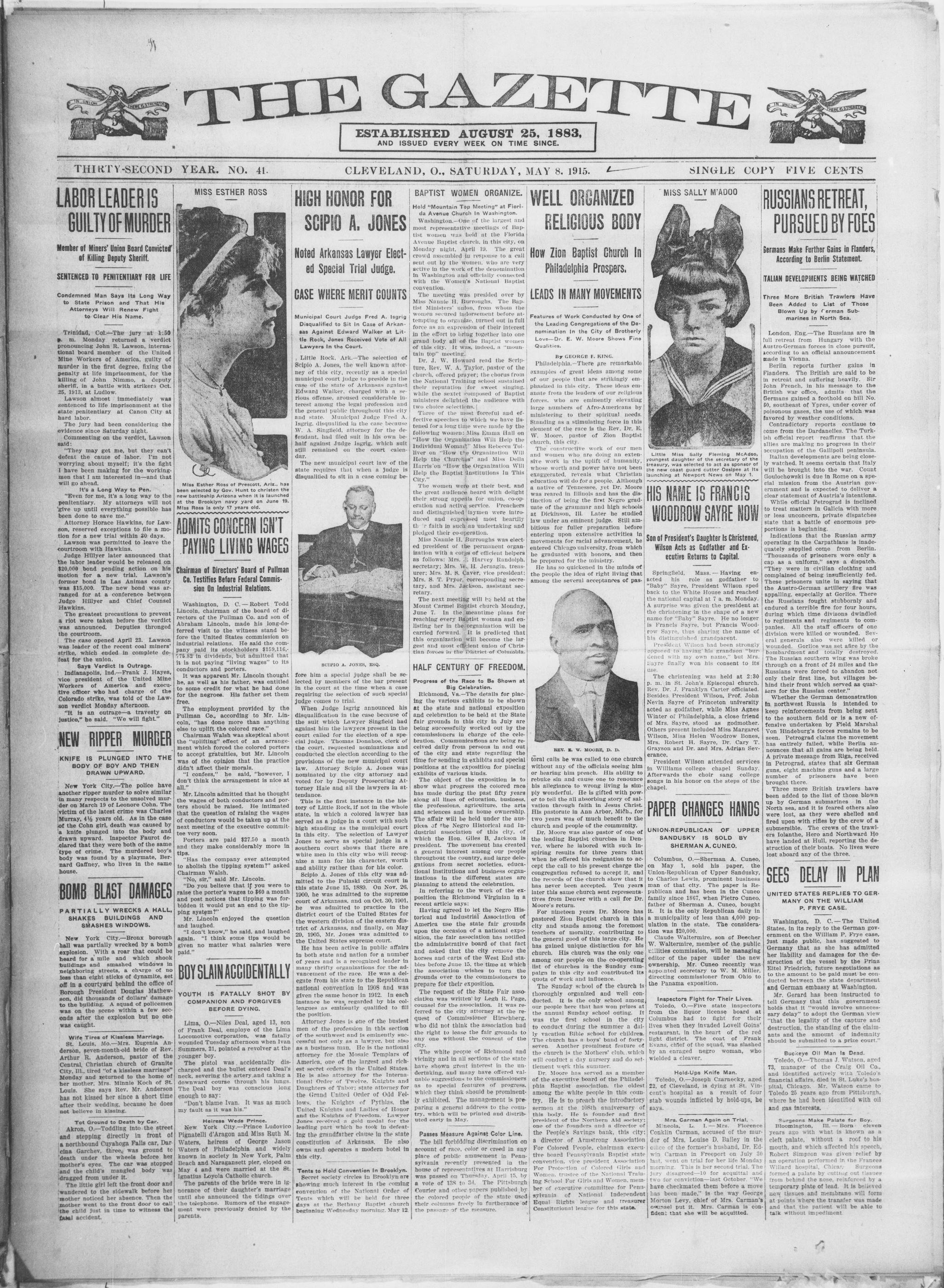
LABOR LEADER IS GUILTY OF MURDER
Member of Miners' Union Board Convicted of Killing Deputy Sheriff.
Condemned Man Says Its Long Way to State Prison and That His Attorneys Will Renew Fight to Clear His Name.
Trinidad, Col.-The jury at 1:50 p.m. Monday returned a verdict pronouncing John R. Lawson, international board member of the United Mine Workers of America, guilty of murder in the first degree, fixing the penalty at life imprisonment, for the killing of John Nimmo, a deputy sheriff, in a battle with strikers Oct. 25, 1913, at Ludlow.
Lawson almost immediately was sentenced to life imprisonment at the state penitentiary at Canon City at hard labor.
The jury had been considering the evidence since Saturday night.
Commenting on the verdict, Lawson said:
"They may get me, but they can't defeat the cause of labor. I'm not worrying about myself; it's the fight I have been making for the workmen that I am interested in—and that will go ahead. It's a Long Way to Pen.
"Even for me, it's a long way to the penitentiary. My attorneys will not give up until everything possible has been done to save me."
Attorney Horace Hawkins, for Lawson, reserves exceptions to file a motion for a new trial within 20 days.
Lawson was permitted to leave the courtroom with Hawkins.
Judge Hillyer later announced that the labor leader would be released on $20,000 bond pending action on his motion for a new trial. Lawson's former bond in Las Animas county was $15,000. The new bond was arranged for at a conference between Judge Hillyer and Chief Counsel Hawkins.
The greatest precautions to prevent a riot were taken before the verdict was announced. Deputies thronged the courtroom.
The case opened April 23. Lawson was leader of the recent coal miners' strike, and stood in complete defeat for the union.
Says Verdict is Outrage.
Indianapolis, Ind.-Frank J. Hayes, vice president of the United Mine Workers of America and executive officer who had charge of the Colorado strike, was told of the Lawson verdict Monday afternoon.
"It is an outrage—a travesty on justice," he said. "We will fight."
NEW RIPPER MURDER
KNIFE IS PLUNGED INTO THE BODY OF BOY AND THEN DRAWN UPWARD.
New York City.—The police have another ripper murder to solve similar in many respects to the unsolved murder on March 19 of Leonore Cohn. The victim of the latest crime was Charles Murray, 4½ years old. As in the case of the Cohn girl, death was caused by a knife plunged into the body and drawn upward. Inspector Faurot declared that they were both of the same type of crime. The murdered boy's body was found by-a-playmate, Bernard Gaffney, who lives in the same house.
BOMB BLAST DAMAGES
PARTIALLY WRECKS A HALL, SHAKES BUILDINGS AND SMASHES WINDOWS.
New York. City.—Bronx borough hall was partially wrecked by a bomb explosion. With a roar that could be heard for a mile and which shook buildings and smashed windows in neighboring streets, a charge of no less than eight sticks of dynamite, set off in a courtyard behind the office of Borough President Douglas Mathewson, did thousands of dollars' damage to the building. A squad of policemen was on the scene within a few seconds after the explosion but no one was caught.
Wife Tires of Kissless Marriage.
St. Louis, Mo.—Mrs. Eugenia Anderson, seven-month-old bride of Rev. Arthur-R. Anderson, pastor of the Central Christian church of Granite City, Ill., tired "of a kissless marriage" Monday and returned to the home of her mother, Mrs. Minnie Koch of St. Louis. She says Rev. Mr. Anderson has not kissed her since a short time after their wedding, because he does not believe in kissing.
Tot Ground to Death by Car
Akron, O.—Toddling into the street and stopping directly in front of a northbound Cuyahoga Falls car, Darcina Garchev, three was ground to death under the wheels before her mother's eyes. The car was stopped and the child's mangleled body was dragged from under it. The little girl left the front door and wandered to the sidewalk before her mother noticed her absence. Then the mother went to the front door to call the child just in time to witness the fatal accident.
THE GAZETTE
C.
Misla Ester Rose of Prescott, Ariz., has been selected by Gov. Gov. to christen the at the Brooklyn navyjacket is launched at the Brooklyn navyjacket is June 19. Missla Rose. is only 17 years old.
ADMITS CONCERN ISN'T PAYING LIVING WAGES
Chairman of Directors' Board of Pullman Co. Testifies Before Federal Commission On Industrial Relations.
---
Washington, D. C. — Robert Todd Lincoln, chairman of the board of directors of the Pullman Co. and son of Abraham Lincoln, made his long-deferred visit to the witness stand before the United States commission on industrial relations. He said the company paid its stockholders $159,116,775.82 in dividends, but admitted that it is not paying "living wages" to its conductors and porters.
It was apparent Mr. Lincoln thought he, as well as his father, was entitled to some credit for what he had done for the negroes. His father set them free.
The employment provided by the Pullman Co., according to Mr. Lincoln, "has done more than anything else to uplift the colored race."
Chairman Walsh was skeptical about the "uplifting" effect of an arrangement which forced the colored porters to accept gratitudes, but Mr. Lincoln was of the opinion that the practice didn't affect their morals.
"I confess," he said, "however, I don't think the arrangement is nice at all."
Mr. Lincoln admitted that he thought the wages of both conductors and porters should be raised. He intimated the question of raising the wages of conductors would be taken up at the next meeting of the executive committee very soon.
Porters are paid $27.50 a month and they make considerably more in tips.
"Has the company ever attempted to abolish the tipping system?" asked Chairman Walsh.
"No, sir," said Mr. Lincoln.
"Do you believe that if you were to raise the porter's wages to $60 a month and post notices that tipping was forbidden it would put an end to the tipping system?" Mr. Lincoln enjoyed the question and laughed. "I don't know," he said, and laughed again. "I think some tips would be given no matter what salaries were paid."
BOYSLAIN ACCIDENTALLY
YOUTH IS FATALLY SHOT BY COMPANION AND FORGIVES BEFORE DYING.
Lima, O—Niles Deal, aged 13, son of Frank Deal, employee of the Lima Locomotive corporation, was fatally wounded Tuesday afternoon when Ivan Summers, 21, pointed a revolver at the younger boy.
The platoi was accidentally discharged and the bullet entered Deal's neck, severing the artery and taking a downward course through his lungs.
The Deal boy was conscious long enough to say:
"Don't blame Ivan. It was as much my fault as it was his."
Heiress Weds Prince.
New York City—Prince Ludovice Pignatelli d'Arragon and Miss Ruth M. Waters, heress of George Jason Waters of Philadelphia and widely known in society in New York, Palm Beach and Naragansett pler, eloped on May 4 and were married at the St. Ignatius Loyola Catholic church.
The parents of the bride were in ignorance of their daughter's marriage until she announced the tidings over the telephone. Rumors of the engagement were previously denied by the parens.
ESTABLISHED AUGUST 25, 1883. AND ISSUED EVERY WEEK ON TIME SINCE.
HIGH HONOR FOR SCIPIO A. JONES
Noted Arkansas Lawyer Elect-ed Special Trial Judge.
CASE WHERE MERIT COUNTS
Municipal Court Judge A. Isgur
Disqualified to Sit in Case of Arkansas Against, Edward Walker at Little Rock, Jones Received Vote of All Lawyers In the Court.
Little Rock, Ark. The selection of Sculpion A. Jones, the well known attorney of this city, recently as a special municipal court judge to preside in the case of the state of Arkansas against Edward Walker, charged with a serious offense, aroused considerable interest among the legal profession and the public throughout this city. Municipal Judge Fred A. Isgur, disqualified in the case because W. A. Singleton, attorney for the defendant, had filed suit in his own behalf against Judge Isgur, which suit still remained on the court calendar.
The new municipal court law of the state requires that when a judge is disqualified to sit in a case coming be-
SCIPIO A. JONES, ESQ.
fore him a special judge shall be selected by members of the bar present in the court at the time when a case requiring the selection of such special judge comes to trial.
When Judge Isigrig announced his disqualification in the case because of the suit which Lawyer Singheld had against him the lawyers present in the court called for the election of a special Judge. Thomas Donahoe, clerk of the court, requested nominations and conducted the election according to the provisions of the new municipal court law. Attorney Schlop A. Jones was nominated by the city attorney and voted for by Deputy Prosecuting Attorney Hale and all the lawyers in attendance. This is the first instance in the history of Little Rock, if not in the whole state, in which a colored lawyer has served as a judge in a court with such high standing as the municipal court in this city. The selection of Lawyer Jones to serve as special judge in a southern court shows that there are white men in this city who will recognize a man for his character, worth and ability rather than for his color. Schlop A. Jones of this city was admitted to the Pulaski circuit court in this state June 15, 1889. On Nov. 20, 1900, he was admitted to the supreme court of Arkansas, and on Oct. 30, 1901, he was admitted to practice in the district court of the United States for the western division of the eastern district of Arkansas, and finally, on May 29, 1905, Mr. Jones was admitted to the United States supreme court.
He has been active in public affairs in both state and nation for a number of years and is a recognized leader in many thrifty organizations for the advancement of the race. He was a delegate from his state to the Republican national convention in 1908 and was given the same honor in 1912. In each instance he was regarded by his colleagues as eminently qualified to fill the position.
Attorney Jones is one of the busiest men of the profession' in this section of the southwest and is eminently successful not only as a lawyer, but also as a business man. He is the national attorney for the Mossie Templars of America, one of the largest and richest secret orders in the United States. He is also attorney for the International Order of Twelve, Knights and Daughters of Tabor; state attorney for the Grand United Order of Old Fellows, the Knights of Pythias, the United Knights and Ladies of Honor and the Knights of Freedom. Lawyer Jones received a gold medal for the leading part which he took in defeating the grandfather chase in the state constitution of Arkansas. He also owns and operates a modern hotel in this city.
Tents to Hold Convention in Brooklyn
Secret society circles in Brooklyn are showing much interest in the coming convention of the National Order of Tents which will be held for three days at the Bethany Baptist church beginning Wednesday morning, May 12.
BAPTIST WOMEN ORGANIZE.
Hold "Mountain Top Meeting" at Florida Avenue Church in Washington
da Avenue Church in Washington. Washington.-One of the largest and most representative meetings of Baptist women was held at the Florida Avenue Baptist church, in this city, on Monday night, April 19. The great crowd assembled in response to a call sent out by the women, who are very active in the work of the denomination in Washington and officially connected with the Women's National Baptist convention.
The meeting was presided over by Miss Nannie H. Burroughs. The Baptist Ministers' union, from whom the women secured enforcement before attempting to organize, turned out in full force as an expression of their interest in the effort to bring together into one grand body all of the Baptist women of this city. It was, indeed, a "mountain top" meeting.
Dr. J. W. Howard read the Scripture, Rev. W. A. Taylor, pastor of the church, offered prayer; the chorus from the National Training school sustained their reputation for sweet singing, while the sextet composed of Baptist ministers delighted the audience with two choice selections.
Three of the most forceful and effective speeches to which we have listened for a long time were made by the following women: Miss Emma Hall on "How the Organization Wilt Help the Individual Woman"; Miss Robert Toliver on "How the Organization Will Help the Church"; and Miss Delia Harris' on "How the Organization Will Help the Baptist Institutions In This City."
The women were at their best, and the great enthusiasm with delight their strong appeals for union, co-operation and active service. Proachers and distinguished nyman were introduced and expressed most heartily to faith in such up undertaking and pledged their co-operation.
Miss Namile H. Burroughs was elected president of the permanent organization with a corps of efficient helpers as follows: Mrs. J. Harvily Randolph, secretary; Mrs. W. H. Jehagin, treasurer; Mrs. M. S. Caver, vice president; Mrs. S. T. Pryor, corresponding secretary, and Mrs. Jackson, assistant secretary.
The next meeting will be held at the Mount Carmel Baptist Church Monday, June 7. In the meantime plans for reaching every Baptist woman and enlisting her in the organization will be carried forward. It is predicted that this organization will become the largest and most efficient union of Christian forces in the District of Columbia.
HALF CENTURY OF FREEDOM.
Progress of the Race to Be Shown at Big Celebration.
Richmond, Va.—The details for placing the various exhibits to be shown at the state and national exposition and celebration to be held at the State fair grounds in this city in July are being successfully worked out by the commissioners in charge of the celebration. Communications are being received daily from persons in and out of the city and state regarding the time for sending in exhibits and special positions at the exposition for placing exhibits of various kinds.
The object of the exposition is to show what progress the colored race has made during the past fifty years along all lines of education, business, the professions, agriculture, the arts and sciences and in home ownership. The affair will be held under the muscles of the Negro Historical and industrial association of this city, of which the Hon. Giles B. Jackson is a resident of the current interest among people throughout the country, and large delegations from secret societies, educational institutions and business organizations in the different states are planning to attend the celebration.
In referring to the work of 'the exposition the Richmond Virgilian in a recent article says:
Having agreed to let the Negro Historical and Industrial 'Association of America' use the state fair grounds upon the occasion of a national exposition, the fair association has notified the administrative board of that fact and asked that the city remove the horses and carts of the West End stables before June 15, the time at which the association wishes to turn the grounds over to the commissioners to prepare for their exposition.
The request of the State Fair 'association was written' by Leigh R. Page, counsel for the association. It was referred to the city attorney at the request of Commissioner Hirschberg, who did not think the association had the right to lease the fair grounds to any one without the consent of the city.
The white people of Richmond and vicinity and in all sections of the state have shown great interest in the undertaking, and many have offered valuable suggestions to the commissioners as to special features of progress, which they think should be prominently exhibited. The management is preparing a general address to the country, which will be printed and distributed early in May.
Passes Measure Against Color Line.
The bill forbidding discrimination on account of race, color or creed in any place of public amusement in Pennsylvania recently presented in the house of representatives at Harrisonburg was passed on Thursday, April 15, by a vote of 138 to 24. The Pitt-Buchanan Courier and other papers published by the colored people of the state used their columns freely in furtherance of the passage of the measure.
WELL ORGANIZED RELIGIOUS BODY How Zion Baptist Church In Philadelphia Prospers.
LEADS IN MANY MOVEMENTS
Features of Work Conducted by One of the Leading Congregations of the Denomination in the City of Brotherly Love. Dr. E. W. Moore Shows 'Fine Qualities.
BY GEORGE F. KING.
Philadelphia. There are remarkable examples of great ideas among some of our people that are strikingly emphasized in this city. Those ideas emanate from the leaders of our religious forces, who are eminently elevating large numbers of Afro-Americans by ministering to their spiritual needs. Standing as a stimulating force in this element of the race is the Rev. Dr. E. W. Moore, pastor of Zion Baptist church, this city.
The constructive work of our men and women who are doing an extensive work in the uplift of humanity, whose worth and power have not been exaggerated, reveals what 'Christian education will do for a people. Although a native of Tennessee, yet Dr. Moore was reared in Illinois and has the distinction of being the First Negro graduate of the grammar and high schools at Dickinson, Ill. Later he studied law under an eminent judge. Still ambitious for further preparation before entering upon extensive activities in movements upon racial advance, he entered Chicago university, from which he graduated with honors, and then he prepared for the ministry.
He has so quickened in the minds of the people the idea of right living that among the several acceptances of pass-
REV. E. W. MOORE, D. D.
toral calls he was called to one church without any of the officials seeing him or hearing him proach. His ability to rebuke sin and cause one to renounce his allegiance to wrong living is, simply wonderful. He is gifted with power to tell the all absorbing story of salvation through faith in Jesus Christ. His pastorate in Ann Arbor, Mich., for two years was of much benefit to the church and people of the community.
Dr. Moore was also pastor of one of the leading Baptist churches in Denver, where he inbured with such inspirational results for three years that when he offered his resignation to accept the call to his present charge the congregation refused to accept it, and the records of the church show that it has never been accepted. Ten years later this same church sent representatives from Denver with a call for Dr. Moore's return.
For nineteen years Dr. Moore has pastored Zion Baptist church in this city and stands among the foremost teachers of morality, contributing to the general good of this large city. He has gained unique distinction for his church. His church was the only one among our people on the co-operating list of churches in the Sunday campaign in this city and contributed its quota of work and influence.
The Sunday school of the church is thoroughly organized and well conducted. It is the only school among our people here that has won prizes at the annual Sunday school outing. It was the first school in the city to conduct during the summer a daily vacation: Bible school for children. The church has a boy's band of forty-seven. Another prominent feature of the church is the Mothers' club, which conduct a day nursery and do settlement work this summer.
Dr. Moore has served as a member of the executive board of the Philadelphia Baptist association, the oldest among the white people in this country. He is to preach the introductory sermon at the 160th anniversary of this body. He is founder and first president of the Northern Aid society, one of the founders and a director of the People's Savings bank, this city, a director of Armstrongz Association For Colored People, chairman executive board Pennsylvania Baptist state convention, vice president, Association For Proposition of Colored Girls and Women, faculty of the National Training School For Girls and Women member of executive committee for Pennsylvania of National Independent Equal, Rights league and treasurer Constitutional league for this state.
Little Miss Sally Fleming McAdoo, youngest daughter of the secretary of the treasury, was selected to act as sponsor of the new coast guard cutten Ossipee at its launching at Newport News on May 1.
HIS NAME IS FRANCIS WOODROW SAYRE NOW
Son of President's Daughter Is Christened Wilson Acts as Godfather and Executive Returns to Capital.
Springfield. Mass. — Having enacted his role as godfather to "Baby" Sayre, President Wilson sped back to the White House and reached the national capital at 7 a. m. Monday. A surprise was given the president at the christening in the shape of a new name for "Baby" Sayre. He no longer is Francis Sayre, but Francis Woodrow Sayre, thus sharing the name of his distinguished grandparent.
President Wilson had been strongly opposed to having his grandson "hus dead with my own name," but Mrs. Sayre finally won his consent to its use.
The christening was held at 2:30 p. m. in St. John's Episcopal church, Rev. Dr. J. Franklin Carter officiated. Besides President Wilson, Prof. John Nevin Sayre of Princeton university acted as godfather, while Miss Agnes Winter of Philadelphia, a close friend of Mrs. Sayre, stood as godmother. Others present included Miss Margaret Mrs. Miss Helen Woodrow Bones, Mrs. Robert H. Sayre, Dr. Cary T. Grayson and Dr. and Mrs. Adrian Severance.
President Wilson attended services in Williams college chapel Sunday. Afterwards the choir sang college songs in his honor on the steps of the chapel.
PAPER CHANGES HANDS
UNION-REPUBLICAN OF UPPER SANDUSKY IS SOLD BY SHERMAN A. CUNEO.
Columbus, O.—Sherman A. Cuneo, on May 1, sold his paper, the Union-Republican of Upper Sandusky, to Charles Lewis, prominent business man of that city. The paper is Republican and has been in the Cuneo family since 1867, when Pietro Cuneo, father of Sherman A. Cuneo, bought it. It is the only Republican daily in a municipality of less than 4,000 population in the state. The consideration was $20,000.
Claude Waltermire, son of Beecher W. Waltermire, member of the public utilities commission, will be managing editor of the paper under the new ownership. Mr. Cuneo recently was appointed secretary to W. M. Miller, directing commissioner from Ohio to the Panama exposition.
Inspectors Fight for Their Lives.
Toledo, O.—Five state inspectors from the liquor license board at Columbus had to light for their lives when they invaded Lovell Goins' restaurant, in the heart of the red light district. The coat of Frank Evans, chief of the squad, was slashed by an caraged negro woman, who wielded a cleaver.
Hold-Ups Knife Man
Toledo, O.—Joseph Czarnecky, aged 22, of Cleveland, is dying at St. Vincent's hospital as a result of four stab wounds inflicted by hold-ups, he says.
Mrs. Carman Again on Trial.
Mineola, L. L.—Mrs. Florence Conklin Carman, accused of the murder of Mrs. Louise D. Bailey in the case of the former's husband, Dr. Edwin Carman in Preference on July 10, 2014, on trial for her life Monday morning. This is her second trial. The jury awarded -10 for acquittal and two for conviction -last October. "We have checked them before a move has been made," is the way George Morton Levy, chief of Mrs. Carman's counsel put it. Mrs. Carman is confident that she will be acquitted.
IN UMOR
TRUSTE
RUSSIANS RETREAT PURSUED BY FOES
Germans Make Further Gains in Flanders According to Berlin Statement.
ITALIAN DEVELOPMENTS BEING WATCHED
Three More British Trawlers Have Been Added to List of Those-Blown Up by Cerman Sub-
London, Eng.—The Russians are in full retreat from Hungary with the Austro-German forces in close pursuit, according to an official announcement made in Vienna.
Berlin reports further gains in Flanders. The British are said to be in retreat and suffering heavily. Sir John French, in his message to the British war office, admits that the Germans gained a foothold on Hill No. 50, southeast of Ypres, under cover of poisonous gases, the use of which was favored by weather conditions.
Contradictory reports continue to come from the Dardanelles. The Turkish official report, reaffirms that the allies are making no progress in their occupation of the Gallipoll peninsula. Italian developments are being closely watched. It seems certain that Italy will be brought into the war. Count Goulouchowski is due in Rome on a special mission from the Austrian government and is expected to deliver a clear statement of Australia's intentions.
While official Petrograd is inclined to treat matters in Galicia with more or less unconcern, private dispatches state that a battle of enormous proportions is beginning.
Indications that the Russian army operating in the Carpathians is inadequately supplied come. from Berlin. "Thousands of prisoners, wore only a cap as a uniform," says a dispatch. "They were in civilian clothing and complained of being insufficiently fed. These prisoners unite in saying that the Austro-German artillery fire was appalling, especially at Gorlice. There the Russians_fought stubbornly and endured a terrible fire for four hours, during which time divisions dwindled to regiments and regiments to companies. All the staff officers of one division were killed or wounded. Several generals also were killed or wounded. Gorlice was set afire by the bombardment and totally destroyed. The Russian southern wing was broke through on a front of 24 miles and the Russians were forced to abandon not only their first line, but villages behind their front which served as quarters for the Russian center."
Whether the German demonstration in northwest Russia is intended to keep reinforcements from being sent to the southern field or to a new of the enemy, the Russians' guns were to be seen. Petrograd claims the movement has entirely failed, while Berlin announces that all gains are being held. A private message from Riga, received in Petrograd, states that six German guns, eight machine guns and a large number of prisoners have been brought there.
Three more British trawlers have been added to the list of those blown up-by, German submarines in the North sea, and it is feared others also were lost, as they were shelled and fired upon with rifles by the crew of a submersible. The crews of the trawlers Iolathe, Hero and Northward Ho have landed at Hull, reporting the destruction of their boats. No lives were lost aboard any of the three.
SEES DELAY IN PLAN
SEES DELAY IN PLAN
UNITED STATES REPLIES TO GER
MANY ON THE WILLIAM
P. FRYE CASE.
Washington, D. C.—The United
States, in its reply to the German
government on the William P. Frye case,
just made public, has suggested to
Germany that as she has admitted
her liability and damages for the
destruction of the vessel by the Prinz
Eitel Friedrich, future negotiations as
to the amount to be paid must be
conducted between the state department
and German embassy at Washington.
Mr. Gerard has been instructed to
tell Germany that this government
holds that, it "would, involve unnecessary
delay" to adopt the German view
"that the legality of the capture and
destruction, the standing of the claimants
and the amount of indemnity
should be submitted to a prize court."
Buckeye Oil Man Is Dead.
Toledo, O.—Thomas J. Watson, age
73, manager of the Craig Oil Co.
and identified actively with Toledo's
financial affairs, died in St. Luke's
hospital, Chicago. Mr. Watson came to
Toledo 25 years ago from Pittsburgh,
where he had been identified with oil
and gas interests.
Bloomington, Ill.—Born eleven years ago with what is known as a cleft palate, without a Foet to his mouth, and which affected his speech, Robert Simpson was given relief by an question performed in the France Wilhelm hospital, Chau. Simpson formed a palate by cutting off tissues from behind the nose, reinforced by a temporary plate of lend. It is believed new tissues and membrane will form at points where the transfer was made and that the patient will be able to talk without impairment
One Year.....$1.50.
Six Months.....1.00
Three Months......50
Subscribers are requested to remit by postoffice money er-
der or registered letter
Scheduled at the postoffice in Cleveland
Ohio, as second-class matter.
Address all communications to
Blackstone Building, Cleveland, O.
Member Ohio Legislature: 1894
to 1896; 1896 to 1898; 1900 to 1902
THE GAZETTE is the oldest, and
has the largest bona fide circulation,
double that of any newspaper in the
interest of Afro-Americans, published
in the state of Ohio, and comparison
with any will immediately establish
its rank as one of the NEWSIEST
AND BEST in the country.
10,000,000 Afro-Americans..
160,000 in Ohio.
20,000 in Cleveland.
Cleveland
SIXTH CITY
SATURDAY, MAY 8, 1915.
Barnes and Roosevelt are burying
what is left of the "Progressive"
party.
We are certainly pleased to receive
and publish our conferee, Editor Dabney's letter. It "clears the atmosphere."
Business men now are taking part in national politics. They must or they will not be in business much longer.
That decision of the Supreme Court of Pennsylvania, noted in our Phila-delphia letter, elsewhere in this paper, is indeed a most important one and should be remembered.
We would "take some stock" in President Wilson's alleged praise of the Ninth and Tenth cavalry if he would order the re-enlistment of all the members of "The Black Battalion" as provided for in Senator Foraker's bill which congress enacted, several years ago.
In the last national election the two candidates who advocated a protective tariff received a million and a quarter votes more than President Wilson. The supporters of the two candidates will stand against Mr. Wilson in the next election, and so will several millions made jobless by the Wilson tariff.
Senator Pomerene says that "a year hence the public will be for Wilson." If the public should delay the reversing of its opinion of the president half a year longer than the limit guessed by the senator, the result will be fatal to Democracy, for it would be after the national election. This will be the case, too.
The loan shark bill, which ends for ever in Ohio the bleeding of those forced to borrow on salaries or chatels, is identical with the bill in the previous general assembly which was defeated by the order of Gov. Cox. It relieves many thousands of persons from paying back double or treble, or more, the amounts they have borrowed.
The president may reform his habit of giving high positions, after congress has adjourned, to men whose appointments the senate has refused to confirm—for instance, that of Mr. Ruble as a member of the federal board. The comptroller of the treasury, who is the court of last resort in all questions of payment of public money, holds that such appointees cannot be paid salaries from the United States treasury.
The Republican victories in the west can have but one meaning. After two years of trial, the people are sick and tired of Democratic incompetence. There is a pronounced reaction in public sentiment against the extreme radicalism of late years, as well as against continued middlesome interference by the government in the private affairs of its citizens. The Republican slogan next year should be: "The government of this great country is too big a job for the Democratic party."—Senator Oliver, of Pennsylvania.
EQUALLY AS APPALLING
Last week we called attention to the growth of race prejudice—how that by books, newspapers, lectures, dramas, photo-plays and political platforms, unfriendly white men are increasing it.
This we thought and think yet, was annualling. But equally as appalling is the indifference of the members of the race—Louisville (Ky.) News. How much worse still, brother, are the Negroes who can view the photoplay, "The Nigger," as an Indianapolis woman of color did, and then announce to the reading public, in the race press of that city, that she saw nothing in it to justify the "hue and cry that drove that miserable photoplay (and "The Birth of a Nation") out of Ohio? The most appalling of the three—growth of race prejudice, indifference of members of the race to the same, and the "jim-crow" ("doctrine of surrender") Negro—is the latter. May the Lord forgive them!
WHY NOT HUERTA AGAIN?
We are told, from Washington, that President Wilson is considering carefully the matter of recognizing General Carranza as president of Mexico. But President Huerta was legally chosen by the congress to fill a vacancy while Carranza, no longer Huerta maintained government over surplits of the population of Mexico for a year during which President Wilson aided with arms the rebellion against his authority; destroyed his credit by refusing him recognition, because he was said to have killed a man; seized his only important seaport, killed more than a hundred Mexicans, and carried away a million dollars of customs receipts of the port of Vera Cruz. Huerta might prove able to bring peace in that ruined republic if given the million and the support from this country given Francisco Villa, if Mr Wilson would prevent further purchase of munitions of war from the United States by the revolutionists.
ANOTHER MISERABLE PHOTO-
PLAY.
The indications are that the mayor-elect of Chicago, Wm. Hale Thompson, a Republican, will bar from that city, the miserable photo-play, "The Birth of a Nation," founded on Tom Dixon's infamous book and play, "The Clansman." This, too, in spite of the fact that former Mayor Carter Harrison's wife, was one of two persons, the other being Mayor Harrison's private secretary, who viewed the picture privately and on whose recommendation it was approved and passed a month ago, "by executive order" in that city.
In a speech, one night, last week, delivered to a large audience of our people at the Institutional church, that city, Mr. Thompson said that he was going to see the picture (which opened in Chicago Monday) just as soon as possible, and if he found anything objectionable to his friends of our race he failed to see how the film could be shown in Chicago. There is so much in that miserable photo-play, not only "objectionable," but grossly insulting indecent, mob-inciting and vitally injurious, that we cannot see how May-or-elect Thompson can possibly fall to bar the vicious photo-play from Chicago just as soon as he is inducted into office. The riots it caused, in recent weeks, in New York and Boston, ought also to have their influence upon the new mayor.
A friend in Chicago has called our attention to the fact that "Mrs. Carter H. Harrison is a 'southron' lady (1) and writes 'beautiful and romantic fairy stories for children.' Comment unnecessary.
FLEMING AND BRASCHER
Supported Tod's Candidacy and Op-posed Willis'.
Columbus, O.—A story is going the rounds here to the effect that Nahum D. Brascher, who is an applicant for a job under Gov. Willis, met Senator Harding at one of the hotels here recently, and went on to go to the front for him and go strong. The senator replied, it is reported: "Why every time I attempt to boost you some one hits me with a Tod club." This reply of Senator Harding is supposed to have been occasioned by the fact that Nahum D. started out to work for Gov. Willis' nomination, but switched soon after, and became a Tod booster. The loss to Willis was nothing, and the loss to Nahum D. Brascher is depending largely on Tom. Fleming, "a weak prop", to pull him through to a job. This country refused to endorse Brascher.
IN OHIO AND MASSACHUSETTS.
Hon. Harry C. Smith, editor of The Cleveland (O.) Gazette, secures to have been more successful in dealing with the officials in Ohio than (our people of New York or) Editor W. Monroe Trotter and his coterie of friends and sympathizers in the city, telling the officials in Massachusetts. In the former case a polite, but many letter to the Governor of Ohio brought a prompt response with the result that the objectionable play was barred from the bill-boards and theaters in Cleveland (and Ohio). In Boston, it was necessary for the co-owner of the house, so to speak, before they could secure a respectful hearing. As the matter now stands, some of the most prominent colored citizens in Boston are now under bond upon a charge of disorderly conduct. We regret the disorder incident to the struggle, but see from the reports that Mr. Trotter had the right to the matter—Richmond (Va.) Planet, John Mitchell, Jr. editor.
EMPLOYE CANNOT WAIVE DAM AGES.
$14,000 Verdict for Personal Damages Sustained by Pullman Porter on Reading—Their Safety Now Assured.
Philadelphia, Pa.—In sustaining, recently, the verdict of $14,000 obtained by Arthur M. Murray, formerly a Pullman porter, against the Reading Railway, as damages for personal injuries sustained, the Supreme Court made an appeal impinging on the right of an employee to be safely carried to his destination the same as a regular passenger on a train. The claim of Murray has been vigorously fought by the railway company, and as a last resort it produced the contract of employment between the plaintiff and the Pullman Company, which contained a waiver of rights to recover damages in the event of an accident.
The accident occurred on November 4, 1911, when a train running between Philadelphia and Williamsport, came to a stop at the railway company working on the last car. He alleged that the stopping of the train, which was going at the rate of forty miles an hour, was so sudden and violent that he was hurled a distance of eight feet to the platform, striking with his head. His sine was injured and paralysis resulted. He has since been confined to an invalid's chair.
Sustaining Judge Patterson's rulings, Justice Potter decided that the waiver clause in the contract of employment of a Pullman porter is not available as a defense in a suit for damages. He also upholds the lower court's decision of the alleged negligence of the engineer in bringing the train to a sudden halt.
THE GAZETTE, CLEVELAND, O. SATURDAY, MAY 8, 1915.
BY "THE OLD RELIA
GAZETTE'S CORRE-
SPONDENTS
THROUGHOUT THE STATE
What Our People Are Doing Each Week—Church, Personal, Social, Lodge, Literary and Musical—Marriages, Deaths, Etc.
YOUNGSTOWN.—Dr. C. A. Pettiford was taken very ill, Saturday evening—Logan Lodge, K. P., will meet. Thursday evening, and complete preparation for 15. at the Thanksgiving services, May 16.—Moses Sutton is sick—The Williams Jubilee singers concert pleased greatly.—(Items in this letter advertising entertainments of all kinds to which an admission fee is charged must be paid for: ten cents a line, six words to a line. Editor.)
FINDLAY.—Rev. W. H. Grimes preached, Sunday, for Rev. J. H. Jones at Zion Baptist church. Daniel Emery will present for 15. at the convention, May 14, 15, and 16 at W. Mansfield. The men gave an enjoyable church dinner, May 6.—Mrs. Bertie Benson was called to Delphos by her father, Thos. Caldwell's illness.—Rev. J. H. Collins, P. E, held quarterly meeting and conference at the A. M. E. church, Sunday and Monday.—Male and Emma Harper who visited an institution, Mrs. Amie Mitchell, in Kenton, returned last Monday evening.—Order The Gazette from the local agent.
SANDUSKY.—The churches were well attended Sunday and the Second Baptist S. S. exercises were fine. All the delegates made very encouraging reports. Both the county and district seem to be in a prosperous condition.—The Old Fellows will hear their annual sermon at the Second Baptist Church, Sunday. Rev. George D. Smith, office associate, assisted by the Rev. J. W. Simpson, pastor of Neal St. A. M. E. church and James R. Davis' choir. It promises to be a gala day. On the 16th, the K. of P. will visit Oberlin to hear thankgiving services.
CORRESPONDENTS must mall letters for publication at their main postoffice sufficiently early on Monday (or Sunday) of each week to have them reach The Gazette office on Monday, and always write also, their man, and that city or town on the outside of the wrapper about returned copies. Unless this latter is done, proper credit cannot be given you. Lists of names, wedding presents, etc., obituary notices, speeches, resolutions, poetry, inquiries for relatives and advertisements of all kinds, including items announcing entertainments to be held in the near future, must be paid for in advance at the rate of ten cents a person. For display advertisements will be sent on application. Send postal note and not stamps during warm weather.
OBERLIN—Mrs. Augusta Bowley and Mrs. Martha Brown of Cleveland were called here. Wednesday, by their mother, Mrs. Jones' serious illness. Mrs. Mamie Willis of the same city, was the guest of Mrs. M. Barnes, Sunday—Miss Estelle Pinkney went to Washington C. to sing the leading song of the Church. The President of the Howard University—A good "green supper" was served at Mrs. G. Field's, by Rust M. E. church ladies. A reception in honor of the fifth wedding anniversary of Rev. and Mrs. F. S. Delaney was held at the church. Tuesday evening—At M. Zion missionary school, mending Mr. Preston of the Seminary, spoke on "What are the Uses of Missions?" The O. C. Glee club concert, May 5, under the auspices of the Aid society, was fine. The Progressive club will observe "Mother's Day." May 9—Miss Jessie Hunter of Cleveland, will lecture here for the M. L. society, May 11.—Eugene Anderson will be appointed assistantinist of President St. orchestra. The Gazette desires a live agent here to sell copies of the paper. Address the editor in Cleveland, at once.
THE ALLEGED CHAMPION
Continues to Fail to Attract Crowds to See Him Act and Spar—Will Have to Fight Soon, To Make Some Money.
New York City.—The chances are that alleged Champion Jess Willard will be seen in the ring much sooner than the Willard syndicate had contemplated. Jess, as a pugilistic attraction and a footlight "star", just now, is a "natural bust." After the miserably poor houses that greeted the "American idol" at Hammersstein's, white plains (bloodiest (frosts) at White Plains and Boston) Pough John L. Sullivan who, when champion, dared not fight Peter Jackson, was on hand in the "Hub City" to add "glory" to the occasion. Jess drew just $309. The crowd at White Plains was so small that he took a peek at it, turned around and rushed off to this city, again. So, if the pseudo champion and his "outfit" are to make any money, he will have to fight, it seems, and demonstrate to the satisfaction of the "fans" that he is champion and his "outfit" is to Virginia fight with Jack Johnson was not the miserable flasco so many believe it was.
CONGRATULATIONS
Editor Gazette, My Dear Harry:—I wish to congratulate you on your victory over Mayor Baker, regarding the mob-inciting photo-play. I cannot understand the mayor's attitude in the matter, and from the corpse pawers in your paper, am pleased to note the firm stand taken by our governor.
Buys the Old Dodd Residence.
St. Louis, Mo.—The old Dodd residence, at the northwest corner of Lucas and Garrison Aves, was purchased recently by our W. W. C. A., for its future home. The fifteen-room mansion is to be remodeled. A two-story garage is on the rear of the house. The ground is a frontage of 150 feet on each street.
DABNEY VS. WINN!
Editor and Doctor Clash Over Cash
Used in the Platt-Ellis Bill Fight
—Brother Dabney Explains.
Editor Gazette, Dear Sir:—In your issue of last week, there appeared a letter with the heading: "Chiropodists who did Pay," signed by R. J. Winn of Springfield. The P. S. stated: "I know it to be a fact that Mr. John Banks gave $5 to Mr. Phil Dabney of Cincinnati, for the bill, and Mrs. Carey gave $15."
The information is partially correct. What I "know to be a fact" is that no money was given me "for the bill," but for my personal expenses and articles published in my paper, "The Union," relative to the Platt-Ellis House bill, No. 220. $25 was given me by Mr. John Banks; $25 by Dr. and Mrs. O'Bannon, and $25 by Mrs. Boone.
Now, when Dr. R. J. Winn of Springfield sends me his one dollar for his subscriptions to "The Union" we will consider the incident cheerfully and harmoniously closed.
Respectfully yours,
W. Phil Dabney.
C. W. McDOUGALD RESIGNS.
New York City—Deputy Assistant District Attorney Cornelius W. McDougall, who was appointed by former District Attorney, now Gov. Charles S. Whitman, January 1, 1910, and who was reappointed by District Attorney Charles Albert Perkins, January 1, 1913, resigned (May I. Mr. McDougall will resume the private practice of law and take more interest in national politics than the exacting duties of his office will permit.
DOINGS OF THE RACE
The Cleveland (O.) Gazette has its eyes "wide-open" on the Johnson-Willard bout and it will keep them open—Richard W. Va.) Planet.
Pittsburgh has barred an objectionable photo-play, and our people are now fighting to bar it out of the state. We hope they succeed.
Oberlin College will be represented by Benjamin Allen, a race student to whom the great Ohio institution looks to win oratorical honors in a contest of Northern Colleges and universities. In a contest among the best speakers at Oberlin held recently, Mr. Allen was judged the best orator, his subject being, "Freedom in Fact." Judge George Thomas of Columbus, O., recently decided that if a man accepts a paper, he will be awarded the paper. The decision was rendered in the case brought by the Columbus Telegram against a man for $2.25. The Telegram had been sent to the man's home, and he had accepted the paper. When called upon to pay for it he refused, and suit was brought. When Judge Thomas heard their evidence he instructed the jury to bring in a verdict for the Telegram.
I. T. Garnett of Philadelphia, has been reappointed to the police force and handed a warrant for all back pay accruing since his disbarment. The Pennsylvania Supreme Court that a discharged policeman can be reinstated. Other race papers come and go while "the old reliable" Gazette remains with you. There is no race publication in this part of the country that compares at all favorably with it, in circulation or otherwise. You can easily satisfy yourself as to this, if you are interested. Subscribe for and advertise in The Gazette if you want the BEST.
Howard Drew ran 100 yards in 10 seconds at the recent great "Pen" meet at Columbus. He was first, of course, and his contestants were some of the best sprinters in the country.
Mrs. Luhu Adams of Los Angeles, Cal., is a fine artist, many of her paintings—scenery and flowers—are purchased by tourists, at the principal art store in that city.
Dr. Clarence Poe, former resident of Raleigh, N. C., an advocate of rural segregation says that in the South Atlantic States in the last decade, white, white farmers, while "Negro" farmers increased 23 per cent. He also pointed out that "Negroes" are growing faster in farm ownership, there being 188,000 increase in the number of "Negro" tenant farmers in the last decade, against only 118,000 increase in white tenant farmers.
The Afro-American U. S. soldiers stationed at this point are sore and sick under what they term the rankest and greatest humiliation which has been shown our soldiers since the Brownville affair. For the first time in the history of the service segregation found its way into an army post when the detachment commander is sent with their families should occupy a part of the balcony separate from the white enlisted men and their families at the graduating exercises of the class in equitation in the riding hall at Fort Leavenworth on April 1.
Our People In Buffalo Advised to Co-operate.
SPEAKS FOR EQUAL RIGHTS
Hundreds Attend Great Patriotic Meeting Under Auspices of the Christian Culture Congress and National Association—We Must Have Better Homes, St. Andrew's Minister Says.
Buffalo—What the colored people of Buffalo might do for themselves to overcome some of the prejudices or the discriminations of the white man was very forcibly expressed in the Michigan Avenue Baptist church, in this city, recently by the Rev. Houghton Fosbroke rector of St. Andrew's Episcopal church.
More than 400 men and women attended the gathering held under the auspices of the Christian Culture congress and the local branch of the National Association For the Advancement of Colored People. The program included a talk on the universal brotherhood of men of all colors by the Rev. Philip L. Frick, a talk on the Public School league by Mrs. Bryant B. Glenny, the president, the address by Mr. Fosbroke and short talks by Dr. Jacob Goldberg and Mrs. Barrell. Mrs. William H. Talbert presided.
The Rev. Houghton Fosbroke, the principal speaker, in part said:
It is not alone sufficient for the colored people to demand citizen rights, but they must also secure justice before the serious situation which they face can be corrected. Justice means restitution, and restitution back what has been taken from them. Your forefathers were robbed of those opportunities for advancement which you now enjoy, and back what has been taken from you now enjoy. There must no longer be any difference in the manhood of the black and the white. It is for the white people to have their race and to realize the enormity of the theft and the robbery. It is then, for you to take an active interest in the advancement of the colored people. The society works to correct certain evils of the white people's attitude toward the colored in discrimination, segregation and the refusal, and to support, but your moral support. This must be supported, but your opinion in one direction is made. As Mrs. Glenny has said of the Public School league, your duty if you are to arouse public opinion there is need today to spread among white men a knowledge of the conditions. The white people as a nation are ignorant of what is actually going on. They are not aware of the problems of the colored people. They are, as I have found in long experience, no more given to thought than the average of the colored people. Whether white or black, few men are thinking, and more women are thinking. Now, I want to tell you of three dangers that you are clashing on yourselves. I want to tell you of three increases segregation and discrimination. Your own self segregation has probably wrought up attempts to segregate your
You are segregating yourselves, for instance. In a section of this city that is the shame of the city that it exists at all. Vile houses are but a door away from the city, and people who are decent and clean living having their homes down there. Why don't you move out of that district and say to the citizens of Buffalo that you want to help them rent to help to support that vice spot? There is a further danger. That is the segregation of culture, which is otherwise known as snobbishness. Those of you who want to help the white race when you refuse to associate with all of your race that this culture, this refinement, may be shared and thoroughly assimilated. That is the duty you owe to the others who have been snobbishness. That is the duty you owe to the others who have been snobbishness. Thirdly, there is a lack of unity brought about by the habit of snobbishness. There is a lack of ability to band together. There is a plan in mind to help the others who have been snobbishness. What we need is a building suitable for public meetings, for the educations of the boys and the girls. I would have it conducted somewhat along the lines of the Y. M. C. A. It should be the
Service of Aircraft
It cannot be said on the evidence so far furnished by the war that the striking power of aircraft—as distinguished from their use for reconnissance—has as yet been absolutely vindicated, except perhaps as a means of attacking definite points unassailable by other means, such as ammunition stores and airship sheds in the heart of the enemy country. On the other hand, it would seem that against airplanes as distinguished from airships the present methods of attack from the earth are almost negligible.—London News and Leader.
QUINADE
GROWS HAIR
REMOVES DANDRUFF
SEMF. FOR SAMPLE
QUINASOAP
THE IDEAL SHAMPOO SOAP
THROUGHLY CLEANSSES THE SCALP
QUINACOMB
HAIR. STRAIGHTENER
SHAMPOO DRYER
QUINADE 25¢ QUINASOAP 25¢
AT ALL DRUGGISTS
SEEBY DRUG COMPANY, NEW YORK CITY, N. Y.
Is absolutely guaranteed and is bottled under Government supervision by The Cleveland & Sandusky Brewing Co. West 785 Central 3933
Taylor's New Shampoo Dryer and Hair Straightener! The Best in the World!
This comb, properly heated, and the use of Lacrete Hair Pomade, will bring the moss, crimpy hair straight and silky at every stage and cause a rapid growth of the hair.
SPECIAL ALCOHOL HEATR $10 the handiest and most convenient pub, and can be closed up so that you can put it in your hand-bag suit use La Creme Hat Pomade. It not only meets every regular suit, but promotes a luxurious growth of the hair. Price 25c. FREE CATALOG HUIILITERATING the Largest and Most Comfortably colored people, such as Large, Wide, Puffs, Sweat, Combs, Brushes, etc. T. W. TAYLOR, Hewell, When writing please mention this paper
TAVLOR'S SPECIAL ALCOHOL HEATER is the handset and most convenient method of heating the Comb, and can be closed up so that you can put it in your hand-bag. Price $16. For best results use LaCrete Hair Pomade. It not only meets every requirements of the Comb Straightener, but promotes a natural grooming of the hair. It is also great for illustrating the Care and Most Complete Line of Hair Goods in this country for colored people, such as Bangs, Wigs, Puffs, Swatches, Pompadours, Hair Pins, Comb, Brushes, etc.
T. W. TAYLOR, Howell, Mich.
When writing please mention this paper
The YOUTH'S Better Than Then the Family Page, a rai Girls' Page, Doctor's Advice Travel, Science, Education. minds, the best the world can
YOUTH'S COMPANIC Better Than Ever in 1915 the Family Page, a rare Editorial Page, Boy Page, Doctor's Advice, and "a ton of fun," Art Science, Education. From the best minds to the best the world can produce for you and e
The YOUTH'S COMPANION Better Than Ever in 1915
Then the Family Page, a rare Editorial Page, Boys' Page, Girls' Page, Doctor's Advice, and "a ton of fun," Articles of Travel, Science, Education. From the best minds to the best minds, the best the world can produce for you and everyone in the home. There is no age limit to enthusiasm for The Youth's Companion.
CUT THIS OUT and send it (or name of this paper) with $500 Gift COMPANION for 1915, and we will send FREE All the issues of THE COMPANION for the remaining weeks of 1914. FREE THE COMPANION HOME CALENDAR for 1915. The 52 Weekly issues of THE COMPANION for 1915.
52 Times a Year — not 12.
Send to-day to The Youth's Companion, Boston, Mass., for THREE CURRENT ISSUES—FREE
SUBSCRIPTIONS RECEIVED AT THIS OFFICE
IT COSTS NO MORE TO DRESS IN STYLE
The secret is to know how.
THE NEW EMPIRE DRESSES are the latest word in Fashions.
IT COSTS NO MORE TO DRESS IN STYLE The secret is to know how. THE NEW EMPIRE DRESSES are the latest word in Fashions.
IT COSTS NO MORE TO DRESS IN STYLE
The secret is to know how.
THE NEW EMPIRE DRESSES
are the latest word in Fashions.
Jacket 6144
Skirt 5989
Bolero 6158
Skirt 6149
Costume 6130
Waist 6156
Skirt 6137
PICTORIAL REVIEW PATTERNS today, absolutely the pattern made in America. THE SPRING FASHION BOOK only 10 cents extra when purchased with one 15 cent pattern. APRIL STYLES now ready.
Large, Heavy Strong and Durable. Made of copper, topped with a layer of solid piece; highly polished and polished nickle plated; steel bolt which goes through the large wood handle and screws into metal casing. The handles loose or coming off. Remember it all in one piece. Not all handles will last a longer.
Price of Hair Straightener and Alcohol Heater complete $1.50.
ER is the handiest and most convenient method that you can put it in your hand-bag. Price $10 made. It not only meets every requirements of the Great and Most Complete Line, such as Banges, Wigs, Puffs, Switches, Pom- mention this paper
TAYLOR, Howell, Mich.
10 Great Serials
full of life and action, filled with the fire of fine inspiration and followed by 250 short stories of adventure, will make
S COMPANION
in Ever in 1915
rare Editorial Page, Boys' Page, Face, and "a ton of fun," Articles of.
From the best minds to the best man produce for you and everyone
in the home. There is no age limit to enthusiasm for The Youth's Companion.
52 Times a Year
— not 12.
Send to-day to The Youth's Companion, Boston, Mass., for THREE CURRENT ISSUES—FREE
RECEIVED AT THIS OFFICE
E TO DRESS IN STYLE
is to know how.
EMPIRE DRESSES
word in Fashions.
PURO HERBS consist of the best possible mixture of Nature's health giving Herbs, contains no potash or mercury—being purely vegetable does not contain any quinine or creat compound, as it is composed of such well-known herbs as Burdock, Dandelion, Sarsaparilla, Red Clover, Mandrake, Stillingia, Prickly Ash and other herbs—all the very best approved blood purifiers.
PURO HERBS cleans the system of all Impurities in health and vigor, and drives away that tired, run-down feeling, due to impurities collecting In the system during the winter months.
PURO HERBS cost but 35c a box, the contents of which, boiled with one quart of water, makes one quart of the medicine, equal to three ordinary one dollar bottles in size and better than any patent medicine, regardless of price.
PURO HERBS are also supplied in liquid form, for those who do not care to make it themselves, at 75c a quart. Sold only at
BROWN DRUG CO.
2742 CENTRAL AVE., cor. 28th Street
Leading Cut-Rate Druggists
North 1494-J Central 2234-L
I Take Care of Your Feet
Home Treatment if Desired
DR. G. H.
TURNER
Chiropodist
DR. G. H.
TURNER
Corns, Bunions, Callouses and
ingrowing Nails, Painlessly Treated
Open Evenings, Sundays & Holidays
Special Attention Given Visitors
From Out of the City
Hours: 8:30 to 11:30 A. M.
5:30 to 8:30 P. M.
3119 Central Avenue, Cleveland
STERLING
5 and 10 Cent Store
3003 Central Ave.
Watch Our Windows
For Bargains
Colored Salesladies
Arlington Pharmacy
WE WILL ACCEPT THIS ADVERTISEMENT FOR FIVE CENTS IN TRADE, TO APPLY ON ANY PURCHASE OF TWENTY-FIVE CENTS OR MORE.
E. Rubenstein, Ph. C., Prop.
S. W. Cor. Central Ave. & E.
55th St.
The Fifteenth Annual Session of the State Summer School
for Colored TEACHERS OF BOTH SEXES at the Agricultural and Mechanical College
GREENSBORO, N. C.
will begin June 29th, 1914, and continue five weeks.
In addition to the regular work, an attractive lecture course has been arranged, in which will appear some of the most distinguished white and Colored educators in the country.
Board and lodging for the entire semester $12.00. Tuition 25c per subject unless other arrangements have been made.
Limited accommodations. Send $1 and have room reserved in advance.
For further information write once to
James B. Dudley, President, or
D. J. Jordan, Director,
A. & M. College, Greensboro, N. C.
THE PEOPLES' DRUG STORE
F. H. WEAVER, PHAR. D., Prop.
Cor. Central Ave. and E. 33d St.
Agent for
"HIGH BROWN FACE POWDER."
WE GIVE TRADING STAMPS.
MONEY ORDERS, NEWSPAPER
ADS., TELEGRAMS.
PRESCRIPTIONS A SPECIALTY
Open late at Night.
THE OLD DOMINION
Lunch Room
at
3652 Central Ave.,
Serves THE BEST AND
QUICKEST MEALS
Popular Prices. Give it a Trial.
Open Day and Night
Mrs. H. C. Jones, Prop.
Where to Purchase The Gazette
Where to Purchase The Gazette
J. S. HALL'S,
3121 Central Ave.
*O. C. SCHROEDER'S,
Cuyahoga Bldg.
F. VALENTINE'S
2130 Central Ave.
J. E. BRANHAM'S
4401 Central Ave.
PUSHAW
The Arcade.
Superior Entrance.
*OPEN SUNDAYS.
NOTICE TO SUBSCRIBERS
Subscribers not receiving The us at once. We desire every copy d We advise our patrons to careful tisements before making purchases. this paper should have the patrona that they advertise is assurance that Local reading notices (advertise words in a line).
Subscribers not receiving The Gazette regularly should notify us at once. We desire every copy delivered promptly.
We advise our patrons to carefully examine The Gazette's advertisements before making purchases. Business men who advertise in this paper should have the patronage of Afro-Americans. The fact that they advertise is assurance that they want it.
Local reading notices (advertisements) ten cents a line (six words in a line).
Social and Personal
Our
Classified Ad
Department
FOR RENT—Houses and Rooms—
If you have them to rent or if you
want to rent, advertise in The Gazette.
It brings results.
NOTARY PUBLIC—For such servi-
ces call at The Gazette office, No. 2
Blackstone building, No. 1424 W.
Third Street, near Superior Ave.
FOR SALE—Houses or lots. If
you have either or anything else to
sell, or if you wish to purchase, ad-
vertise in The Gazette. If anything
can bring you results, it can and
will.
FOR RENT.-Five nice large rooms, down stairs, bath, gas, large cellar, yard, etc. 2417 E. 82d St., near Quincy Ave. Apply. 2 Blackstone building, W. 3d St., near Superior Ave. Key, next door.
FOR SALE.-A bargain for cash. Desire to leave the city as early as possible. Two lots, 40 ft. each, and an eight room house; electric light and gas; in Mt. Pleasant allotment, 3298 E. 128th street. Apply to owner, Rev. J. J. Smith, or Union National Bank. Will sell, part cash and mortgage.
Cleveland
Sixth City
Mr. Jones Anderson of Cannons burgh, Pa., was here, recently, and will return later to locate.
Mrs. Augusta Bowley and Mrs. Martha Brown were called to Oberlin, Wednesday, by their mother's critical illness.
* * *
Wm. E. Johnson and Lucy Clayton were married, May 3, by Justice Will Brown of the Blackstone bldg.
* * *
Mrs. W. O. Thornhill, E. 37th St., is visiting relatives in St. Louis, and will probably visit her uncle in Chicago before returning home.
* * *
Our advertisers want your trade. Those who do not ask for it in The Gazette certainly care little, if at all, for it. Therefore, we urge our readers and all of our friends to patronize those who ask for your trade in this paper.
* * *
The Shriners will give a "smoker" at Masonic temple, Ontario St. May 19. Elaborate preparations for an exceptionally enjoyable time have been made. Cabaret, refreshments, instrumental music, etc.
Dr. J. M. Glinne, pastor of the Oak Hill Ave. A. M. E. church, Youngstown, returned from Washington, D.C., where he went, recently, to attend an important meeting of the Financial Board of the A. M. E. church. He reports his church work as being in a fine condition. * * * *
Andrew Holbert, an uncle of Frank and George Tucker, and a resident of Cleveland from early youth to manhood, who has for many years made his home in various parts of N. Y. state, is in the city visiting his sister, Mrs. Margaret Tucker, and other relation of a state building at Albany, N. Y., for years, until recent months. He may locate in Cleveland.
John E. Leverett and Grace L. Brown were quietly married by Soutrie Will Brown of the Blackstone bldg., May 1, in the presence of her father and his parents. She is one of our most promising young ladies and he is a fine young man. They have The Gazette's best wishes. Soutrie Brown recently married Norman White of E. 29th St, and Miss Laura Westbrook, a former resident of Steubenville. He is known as the "marrying justice" performing more, possibly, than any other person in the city.
The Senior Allen League, C. E meeting, Sunday evening, at St. John's church, was led by two little girls of the junior C. E. one of whom is Elsie Cox, the daughter of Mrs. Lulu Bundy Cox. The United Workers met last week. Tuesday evening, and reported promising prospects for the rally in May. Miss Clara Offet is president. The church, under the direction of Carl roll Scott, gave a spring festival of song, last week Tuesday evening, for the benefit of one of its rally clubs. Mr. and Mrs. Harry Thompson were the soloists. Mrs. and Key Jones, 2217 E. 33rd St. last week Wednesday evening, and the Deborah class at Mrs. Fillsi's, 2370 E. 33rd St. the following evening. The Vashti class met at Mrs. F. Turner's, 2240 E. 39th St. May 7.
---
*ELMER F. BOYD'S,
2604 Central Ave.
*S. A. LUCAS,
2943 Central Ave.
*NEWS STORE,
2249 E. 105th St.
cor. Arthur Ave.
The Gazette regularly should notify
daily delivered promptly.
fully examine The Gazette's adver-
sions. Business men who advertise in
image of Afro-Americans. The fact
that they want it.
tirements) ten cents a line (six
Personal
Garrett A. Morgan, left for N. Y.
City, Sunday evening.
Major and Mrs. W. T. Anderson will
return to Cleveland, in June to locate.
Mrs. Marie T. Perkins, 2188 E. 73rd St. is quite ill. Nervous breakdown.
There is only one way to get our race's news, local and general, and that is by taking "the old and reliable" Gazette, every week.
Beman G. Catto of Buffalo, and Mrs. Ella Childers, 3112 Central Ave., were married, last week.
Mrs. Carrie Scott, 3017 E. 82d St. is very ill. Mrs. Grace Boyd Lucas is convalescent.
Mrs. Walter Brown, 2335 E. 29th St. returned from Cincinnati last Week Thursday, where she was summoned by her grandmother's sudden death.
Mrs. Mary C. Johnson of E. 43rd St. left, Monday, for Pennsylvania, to visit a relative who is very ill.
Major W. T. Anderson and wife who have been guests of Mr. and Mrs. Geo. A. Meyers, off and on for some weeks, left Wednesday, for Chicago Denver, and San Francisco. While on vacation, the couple will visit the great Panama-Pacific
MAJOR W. T. ANDERSON
Exposition as the special representative of The Gazette, daily enjoying all the courtesies of the Exposition extended visiting representatives of the press by the management. This, on the special invitation (of the management) to the editor of The Gazette.
Geo. J. Tate, preceptor of the Central Shirt shop, was robbed of a diam ring and $60 in money. Monday evening in a pool room on Scovill Ave.
Send or bring locals and all business matters to The Gazette's offices suite 2, Blackstone Bldg. If you wish to see the editor call there, please All matters for publication in current issues of The Gazette, must be in the office by 4 p. m., WEDNESDAY at the latest.
W. H. Crawford, precinct committee teeman in the 18th ward, was app pointed as that ward's committee representative by the Co. League of Republican clubs, last week, for their annual picnic.
Charles Cooper, for many years a resident of this city, died suddenly, Saturday, of heart trouble, and was buried, Tuesday, from Antioch Baptist church, the pastor officiating. Two companies of the U. R. K. P., under the command of Lieut-Col. Fountain, attended the funeral.
Henry Lowrey, an employee of a local garage was hurt more seriously than he was thought to be, the first of the week. On his arrival home he laid on a bed where he was found dead a short time afterward.
Mrs. Rosa Farmer Boyd of E. 82d St., widow of Samuel T. Boyd, the letter-carrier who was buried, last week, died, the first of the week after many months' illness. She too, was murdered in Cong, church and had a host of friends here and elsewhere in the country, who will sincerely mourn her demise. The worry and care of her husband during his long, serious illness undoubtedly greatly hastened her death.
Among the 128 members of the Advisory committee of citizens named recently, by the Survey committee of the Cleveland foundation, to aid in the educational survey of this city, being made by Dr. Leonard P. Ayres of the Russell Sage foundation, were George A. Myers and Charles W. Chessut. The first meeting of the committee was held Wednesday, when Dr. Ayres presented a general outline of the survey as decided upon by him after a two weeks' inspection of the local field.
THE GAZETTE. CLEVELAND. O. SATURDAY. MAY 8. 1915.
The Men's Auxiliary of the Old Folk's home, met, Sunday afternoon.
W. M. Orr, 2555 E. 73rd St. was called to Birmingham, Ala., by his wife's critical illness.
Mrs. Luther W. Nickens, E. 71st St. had as her guest, last week, her sister, Mrs. Iva Fullum of Ravenna.
Rev. A. R. Johnson of Alliance, addressed the Dunbar Literary society of Shiloh Baptist church, Tuesday evening.
A little race pride will prompt you to patronize the Central Shirt shop. See advertisement, elsewhere in this paper.—Adv.
Mrs. Orr, wife of W. M. Orr, of 2555 E. 73rd St. died April 27. The husband has the sympathy of the community.
Wm. Davis, tailor in Central Ave., until last fall when he returned to Atlanta, Ga., for an indefinite stay, has returned to Cleveland.
Mrs. Anderson of E. 43rd St., and T. M. Farlice of E. 63rd St., who inserted for rent advertisements in our last issue, wrote The Gazette, the first of this week: "My suite of rooms, is rented. I am very much obliged to you." You get quick results, as a rule, when advertising in "the old reliable" Gazette.
Charles H. Seals, a former resident of this city, who located in Chicago several years ago, and established the Seals Toilet Co., manufacturers of high grade toilet articles, writes The Gazette that he has established a splendid business and is sending his goods to all parts of the country. Mr. Seals is a captain and adjunct of the first regiment, U. R. of K. P. and a member of John C. Buckner Lodge, Odd Fellows, Chicago.
Our local Ministers' Alliance elected the following named officers, last week Tuesday: president, Rev. W. M. Page; vice-president, Rev. S. C. Harris; rev. C. R. Jones; assist-sec. Rev. G. V. Clark; treas., Rev. J. H. Watkins.
---
```markdown
```
Mrs. Carrie Clifford of Washington, D. C., formerly of this city, gave a splendid account of her trip to foreign countries, last year, at Mt. Zion Cong, church, last week, Monday evening; addressed St. John's S. S., and the Cleveland branch of the N. A. A. C. P., at Mrs. Theo Cole's, Moorlid, church, last week; addressed Mrs. Clifford and Mrs. Blanche Gilmore visited Miss Ruth Fisher in Lorain, Thursday.
* * *
Bishop W. A. Leonard, Friday night, administered confirmation rites at St. Andrews' Episcopal church. At the annual church meeting, Tuesday night, the rector selected these vestrymen to serve one year: T. W. Walker, senior warden; J. P. Green, junior warden; J. E. Teed, John, junior warden; J. A. Armstrong, Charles Leatherman, William Wade, William Dade, Clinton Fowler, R. C. Cheeks, Ralph Jackson, J. Crawford and J. R. Lee.
"Mother's Day", tomorrow, at St John's A. M. E. church. The Allen League, C. E. will have a special program in the evening, under the direction of Mr. Russell Scott. The S. S. had its picture taken, Sunday. The attendance was over 600. Mrs. Sada Anderson, wife of Ex-Chaplin Anderson, addressed the school, and a young lady from Oberlin sang beautifully. The Men's congress met. Wednesday evening, and discussed. Was Not Golah as much of an assistant teacher the Hand to God, to show His power, as David? Those J. Berryman is president of the congress, and W. A. Lewin. The classes closed at the Phillis Wheatley home, Monday evening, will reopen in October. The Daniel and Timothy classes of young men of St John's S. S. have arranged for the use of the Association "gym" for the season.
R. R. PORTERS UNDERPAID
Says Robert T. Linclon, Son of the Martyred President, and Head of the Pullman Co.
Washington, D. C.-Robert T. Linclon, chairman of the board of directors of the Pullman Co., frankly told the U. S. commission on industrial relations here, Tuesday, he believed the system of paying sleeping car porters should be changed and that their wages and those of Pullman car porters should be changed. He thanked those of these subjects, he said, would be taken up by the company's directors in the near future.
The son of President Lincoln freely discussed the subject of tips upon which the porters are compelled to rely for a living. He agreed to bear the equipment afforded by the Pullman company had been one of the most uplifting opportunities the race has had.
While declaring his belief tipping of Pullman porters by the public would continue even if the meager salary of $27.50 a month should be increased. Mr. Lincoln admitted the wage system for porters was an antiquated one and had given him considerable annoyance.
DON'T THROW AWAY
Your copy of The Gazette after reading it, but give it to a friend or an acquaintance who might subscribe after reading a copy of the paper.
EFFICIENT WORK OF URBAN LEAGUE
Conduct of Shop For Unemployed Was a Success.
IN OPERATION TEN WEEKS.
National Organization For Bettering Conditions Among Colored People Secures Positions For Hundreds of Men In New York—City Officials and Business Men Praise Effort.
New York. The workshop for unemployed men, which has been conducted in the basement of the St. Philip's church, in this city, for the past ten weeks by the National League on Urban Conditions Among Negroes, was closed on Friday, April 16, after a very successful period of operation. The total attendance at the shop was 12,739. There were 774 different men registered at the shop, and the total expense of operating amounted to $8,430.59, the gift of the mayor's committee on unemployment. While the shop was allowed 79 cents per day per man, the per unit daily cost of the shop at St. Philip's church was 6.61 cents.
This shop has received the commendation of officials of the unemployment committee and such visitors as Theodore Roosevelt, Judge Elbert Gary, City Chamberbain Bruere, Mr. Shilhady, the director of the unemployment committee; Mr. George W. Perkins, Mr. Charles W. Anderson, Mrs. William H. Baldwin, Jr., and Mr. L. Hollingsworth Wood.
In fact, it has been frequently stated at the committee's headquarters that this shop was one of the most economically run of all of the chain of workshops and that the cleanliness in the kitchen and the workroom, the behavior of the men and the character of the output were exceptionally satisfactory and prudenceful.
While the other shops used machines for rolling bandages and making the surgical dressings, the officials of the league felt that it would be more beneficial to the men if the expense of purchasing machines was omitted so that the men could receive as much in wages as possible. However, in spite of the fact that the men used their hands only for the work, the output was remarkable.
These goods were boxed and shipped to hospitals operated by or for colored people in 'New York and other cities. The hospitals receiving contributions of surgical dressings are as follows: Lincoln hospital, Vanderbilt clinic, Roosevelt hospital, St. Mary's hospital, St. Mark's hospital, New York; Provident hospital, Chicago; Red Cross sanitarium, Louisville, N. C.; Richmond hospital, Richmond, Va.; St. Agnes' hospital, Raleigh, N. C.; Dixie hospital, Hampton institute, Hampton, Va. John A. Andrew Memorial hospital, Tuskegee institute, Tuskegee, Ala.; hospital at Voorhees industrial school, Denmark, S. C.; Charity hospital and East Side sanitarium, Savannah, Ga. donated through the Savannah branch of the National League on Urban Conditions Among Negroes and the Hubbard hospital, Nashville, Tenn.
Of the 774 men registered at the shop there were 156 West Indians and 605 of American birth. Of these men 50 per cent were voters. The staff of the shop consisted of Miss Louise R. Laitier, superintendent; Mrs. C. L. Winston, supervising nurse; Monzo DeG. Smith, clerk, and Mrs. E. A. Cummings, matron. Volunteer service was provided by the Utopia Neighborhood club and from the St. Philip's parish. When the shop closed only 250 men were employed, none being turned away. When the shop opened on Feb. 10 it rapidly increased in size until its capacity of 350 was taxed and men were being turned away at the rate of from 250 to 350 per day. Approximately 325 of the men registered at the shop have secured employment.
The National League on Urban Conditions has, in addition to the management of the shop, been active in securing employment for colored people in other directions during the financial depression of the winter. Since Jan. 1 more than 500 different individuals have been secured positions other than those referred to above. Fifty-two girls and women between the ages of sixteen and twenty-five are being paid $3 per week for six weeks while being taught domestic science. Other classes will be formed when these girls have completed their courses.
Citizens of Boydton, Va., Against Crime.
The colored citizens of Boydton, Va., recently held a mass meeting for the purpose of condemning the rash act of one Tome Coles, also colored, charged with murder. The committee under whose auspices the meeting was held consisted of the Revs. R. C. Yancey, L. T. Thorpe, F. R. Hite, Savory Goodle, W. H. Hayes, Isam Baskerville, W. H. Hughes and J. Graham Scott, secretary.
Methodist Extension Board Meets.
The annual meeting of the board of church extension of the A. M. E church was held at the headquarters of the department. 1535 Fourth Street, Washington, Wednesday, April 28. Bishop L. J. Coppin presided. The Rev. Dr R. F. Watson is secretary-treasurer of the department.
Recreation for Soldiers.
Supplies of games are now being sent by the war office to the British troops at the front, as well as to those in training at home. They include chess, checkers, dominoes, backgammon, cards, and wall quofts. British firms are finding it difficult to meet the demand. At the present rate of production it will take about forty weeks to supply all the sets of dominoes ordered by the government, and in addition supplies of games are wanted for French and Russian troops
Rosedale 2770 Quality Service
SLAUGHTER BROS.
FUNERAL DIRECTORS & EMBALMERS
Office and Funeral Parlors
3923 Central Av.,
Autos for All Occasions Calls Answered Day and Night
NEVER BEFORE SOLD FOR LESS THAN $2.50 A COPY—Edited by Mrs. Alice Moore Dunbar—A LIMITED NUMBER HAS BEEN PLACED AT THE DISPOSAL OF THIS NUMBER AS AN ADVERTISING PROPOSITION AND THE FEDERAL ORDER HAVE HAVENE THE Masterpieces of NB Eloquence has neither a predecessor nor a competitor. The most brilliant men and women of the race, the leading newspapers of both races endorse and unqualifiedly recommend it. To read it is a liberal education, a treasure trove of valuable information accessible in no other form, a reference book, a history, a library in itself. No intelligent Negro home can afford it. It is a book that is not only for young. It contains $1 of the greatest speeches ever delivered by the ablest men and women of America, Africa, England and France from 1818 to the present time. Each address is a separate gem and from the standpoint of inspiration alone is valuable. The regular price is $2.50—thousands of copies have been sold at that price but to introduce it in as many neighborhoods as possible we will send any reader of this paper a copy at almost HALF PRICE-$1.50. A COPY IS HERE
Impeccious Husband Really Had No Alternative, According to His Explanation.
There was a flower stand at the street corner, and an old chap had been gazing at the display of lilies for the last five minutes, as he leaned against a lamp-post, when a middle-aged woman came up in search of a flower. The florist was temporarily engaged with a customer, and the old man stepped forward and asked:
"Ah, madam, you are looking for a lily I presume?"
"I am, sir," was the reply.
"Lilies and Easter—Easter and lilies. Ah, how it saddens my heart to think of them. Five years ago my dear wife asked me to buy her an Easter lily. It almost broke my heart to refuse her, but I had to do it."
"What! exclaimed the woman, 'you wouldn't buy your wife an Easter lily?'
"Alas, madam, I could not, owing to financial reasons."
"But you could have bought a lily from a dollar up."
"I presume so, madam, but when one has only 13 cents in cash, in his pocket, and a half a bushel of cornmeal in the house, how is one even to buy a dollar lily?"
The woman looked him from top to bottom and muttered a "humph," and turned away in disgust. She did not realize that there are times when even millionaires are compelled to economize, even though it breaks hearts.
R. R. CHEEKS
ATTORNEY-AT-LAW
Main 806
312-314 Superior Building
J. LOMSKY
3816-3820 Central Ave.
DRY GOODS
LADIES' AND GENT'S
FURNISHINGS
Lomsky Special Corsets, $1.00
Also our Ladies' $1.00 Waists
They are good
The Elyria
Progressive Club
2556 E. 22d ST.,
is neat and under good manage-
ment. On
Every Wednesday Night
the Club gives its WEEKLY
SOCIAL SESSION, and accepts
members for initiation. The
Club has a NICE DINING
ROOM.
Cuy. Central 6661-L
G. G. REED
Dry Goods
Ladies' and Gents' Furnishings
Sole agents for the
AMERICAN LADY NEMO
R. @ G. COR ETS
3222 Central Ave.
Where do you buy your Collars, Shirts, Neckwear, etc.?
is the place to get Everything in the Haberdasher line.
2908 Central Ave.
Rosedale 2770
SLAUGHT
FUNERAL DIRECTOR
Office and Fu
Queen Orchid Freaks.
An extraordinary collection of plants, many of them hitherto unknown, is to be exhibited in New York city by Harry J. Black, an American, who has spent years on Bolivia, Peru and Brazil, hunting orchids and other strange flora. The collection of orchids which he is bringing with him to the show is valued at $75,000. Among his other flowers, one specimen is so sensitive that it closes its petals in fright at a sharp noise. Others wilt into unconsciousness if anesthetics are applied to their leaves. A species of jatropha, from Colombia, secretes a poison, which it shoots through two fangs like a serpent's when touched, and the sting is deadly. Another stinging plant is covered with coarse hairs, and when one of them is snapped enough poison is discharged to kill a man.
Sharon, Pa., May 3, '15.
Editor, Gazette: "Rush me governor" opinion on phone call in New York (case pending here).
(Telegram), Geo, H. Burke.
MME. ALYCE H.
THOMAS
```markdown
```
Has it ever occurred to you, your scalp needs medical attention? Is it eczema, fallout and breaking hair and dry scalp? No one
thing will reach every case.
MME. Thomas studied medicine in order to give to the public honest, absolutely guaranteed, money-back remedies for face and scalp.
Describe scalp, enclosing piece of hair, 10 counts for sample of THOMAS' MAGIC HAIR-GROWER; price, 50c and $1.
THOMAS' BLEACHING CREAM makes you three shades fairer and is harmless; price 25c.
THOMAS' STRAIGHTENING CREAM, 25c.
Start a business of your own, MME.
THOMAS will teach you to treat the scalp, straighten the hair, and give you three guaranteed hair-promoter formulas for $5.00. Liberal terms to agents. Fine hair goods always in stock.
MME. ALYCE THOMAS.
No. 355 Prairie Ave., Chicago, Ill.
CONEY ISLAND VALET
SYSTEM
Men's, Ladies' and Children's
CLOTHES CLEANED, RE-
PAIRED AND PRESSED
First-class Work Only
GARMENTS PRESSED BY
THE MONTH.
Wm. J. KENNEY, Mgr.
2738 Central Av.,
Cleveland, Ohio.
SWOOPE'S
Soup and Coffee House
A bowl of soup, a cup of coffee
and bread for
FIVE CENTS
Pigs' feet, Baked beans, Stews,
etc., etc.
2908 Central Ave.
WILLIAM SWOOPE, Prop.
STOP, READ AND THINK
How do you invest your money? Why not in real estate? Something no one man or two can carry away. I have lots from $150 up, on easy terms. Also a few lots left in Mt. Pleasant. Call or address. R. W. WINBUSH 2192 E. 35th St. Prospect 1043-J
Quality Service
RIGHTER BROS.
ELECTORS & EMBALMERS
and Funeral Parlors
1923 Central Av.,
Calls Answered Day and Night
the Masterpieces of Negro Elequence
FOR LESS THAN $2.50 A COPY—Edited by Mrs.
D NUMBER HAS BEEN PLACED AT THE DIS-
AN ADVERTISING PROPOSITION AND THE
Elequence has neither a predecessor nor a com-
mand woman of the race, the leading newspapers
qualifiedly recommend it. To read it is a liberal edu-
lable information accessible in no other form, a
curry in itself. No intelligent Negro home can af-
fies an inspiration to the old and a help to the
createst speeches ever delivered by the ablest men
Embalm and France from 1818 to the present time,
and from the standpoint of inspiration alone is
thousands of copies have been sold at that price
new neighborhoods as possible we will send any
almost HALF PRICE—$1.30. A COPY IS HERE
The Douglass Publishing Co.
DRAWER I, HARRISBURG, PA., U. S. A.
AFRO-AMERICAN CULLINGS
The first funds for the Manassas industrial School for Colored Youth were collected in and around Marion, Mass., during the summer of 1891. Jennie Dean obtained work as a cook in a boarding house in Marion, and when her day's work was over, she went about talking of her school in churches or to any one that would listen to her. She also went to Washington, where she managed to interest in her scheme several prominent men and women, who formed a board of directors to promote the work. Miss Dean then went to Boston with letters to Dr. Edward Everett Hale, who helped her by sending out an appeal for funds from his own office, with the result that Jennie Dean returned to Manassas in the following spring with the necessary amount.
Since the early days of the single frame schoolhouse to its present state of a number of substantial buildings, there have been desperately hard roads to travel, and the end has not been reached yet. Through all these years there has always been the same cry for more funds to carry on the work, for the cause of Negro education does not always call forth the largest contributions. Through all Miss Dean's uniting efforts and struggles, up to the time had the fullest sympathy of the Negroes of her section of Virginia. Many of them were too poor to give money, but there were few who did not give in some form, varying from a barrel of apples to a day's labor.
There could never be a moment's question of the real need of an institution of this sort, the natural outgrowth of a deep and fervent desire of a people fully appreciative of their lack of all that would make them of value to the white man's world, of which they were now a part. The interest of the Negroes of this district in the school has increased year by year, and while their contributions are of necessity very small, they manage to raise annually something over a thousand dollars toward an endowment fund through personal gifts, church entertainments, picnics, and frequent church collections.
Recently there was erected at the Hampton institute a two-story brick building to be used as a social center for the boys. Contracts were awarded to the trade school departments and student tradesmen did the construction work. Today the building stands completed. It is known as Clarke hall. It is used by the Young Men's Christian association. To appreciate the meaning of these three examples of construction work done by the Hampton tradesmen, one must see the completed structures and realize the building problems which the young Negro and Indian tradesmen met and successfully solved.
While construction work calls for ability to read working drawings and follow detailed specifications, the demands made by repair problems are in many instances even more taxing. To make a repair quickly, skillfully and economically, requires unusual ability. Hampton institute is indeed an industrial village in which there is constant demand for men who can do good repair and construction work.
So long as his mother lives there is no probability that anyone in our town will be permitted to forget that Lafe Swisgewog has a good job in New York.
When I consider the cost of this war; when I think of the blood that has been shed; of the property that has been destroyed and the misery that has been caused—I am sometimes inclined to thank God that I am not a member of a superior race. Rather I am disposed to thank God that I belong to a people that cannot hope and does not desire to prosper at the cost of any other race.
There is a certain advantage in belonging to a race that has to make its way peacefully through the world; a race that prospers, if it prospers at all, because it has made friends rather than enemies of the people by whom it is surrounded. There is a certain satisfaction, also, in belonging to a race whose hope of success in the world consists of making itself useful to the world, and it is not wholly a disadvantage to the Negro that, though he should fight in every war as he has in this, it is not to maintain his own superiority, but that of some other race that he fights—Booker T. Washington in the North American Review.
For misinformation concerning any incident apply to a bystander.
Next to the search for a good time, that of striving for comfort is the most marked human characteristic. Sim Heckle has a cushion on his wheelbarrow.
A man goes back to his old home town and discovers that the girl he mistakes for the one he used to know is her granddaughter.
If you are not particular about the way you get it a good living can be made off those whom the doctors have failed to cure.
Humor finds its expression in various ways. Elza Bernhart, who is six feet four inches in height, has been called "Shorty" ever since he was a boy.
Hon. Mortimer C. Littson is so good natured that he will stand for anything from his friends except praise of another man.
A man learns a lot as he goes along, but he never realizes that he doesn't amount to anything and never will.
In an interview at New York Mr. Percy Grainger, noted Australian pianist, said: "Frederick Delius has a harmonic and polyphonic sense that makes him like a modern Bach, and it is easy to see how he could be attracted by the improvised songs which he heard on his father's plantation. It is not so much the method in these songs which attracts one as it is the method of singing—especially the part singing." He then referred to his stay in New York and the pleasure he had had in meeting several of the negro composers whose work he had previously known, and in hearing them play.
"When I arrived in New York," Mr. Grainger said, "it was a very great pleasure to me to meet Mr. J. Rosa mond Johnson, whom I had long admired as a composer, having fallen in love with his delightful song 'Under the Bamboo Tree' several years ago when I first heard it it while on an extended tour in Australia, my native country. There were several good singers with me. and I choralized it and we sang it often. An American creative genius that I am particularly interested in is the colored composer, Will Marlon Cook, whose choruses, 'Rain Song' and 'Invocation'—to mention only two—are works of great originality and true inspiration, and have a suitable harmonic flavor all their own.
"I have had many delicious musical impressions while in New York, but none of my hours has been more happily spent than at the Music School Settlement for Colored People, over which Mr. Rosamond Johnson presided, and where I first heard the Hampton quartette, Mr. Henry Burleigh and several other fascinating Negro artists."
No institution of learning is now complete without its extension department, and a recent "exhibit" in this direction was varied, dramatic and full of that humor that borders on pathos. Two men at Tuskegee were brought in from the adjoining country to tell how they acquired land and were now tilling their own farms, tracing their inspirations, of course, to the farmer conferences and to the radiating influences of Tuskegee. One woman told of how she secured a better schoolhouse for the "chillin". Egg selling, chicken raising, and many other ways too well known to the women of the North, which often indicate an obscure selfishness and a hidden pennuriousness, here became high generalship and splendid courage. But more eloquent than the farmer parsons or the soliciting schoolhouse builders was the wife who said to the preacher, "You go to school and I will take care of the plowing and the children." She said not a word. She received no plaudits, but she, not the parson, moved the silent depths of the soul. One slip of a girl, from the "honor three months" of required cadeting in a country school, told how she not only washed up the schoolhouse but cleaned up the homes in which she boarded, brought in the cook stove that was all right except that it had lost one leg, and taught them how to enlarge their dietary list. The extension department of Tuskegee goes far afield and there were thrilling stories of achievements in South Carolina and other adjoining states—Exchange.
Rev. H. H. Dunn of New Orleans in a sermon has outlined the progress of the colored people of New Orleans for the last year. The first public playground for colored children was opened; $500 was raised by the colored citizens for it, and white citizens contributed $2,300 in addition; white and colored physicians met together to discuss Negro health; public library for Negroes has been started; the city council has purchased a site at a cost of $8,000 and appropriated $2,500 annually for maintenance; a building valued at $33,000 is nearing completion. The public school system still lacks a high school, but there are 8,164 pupils enrolled and 155 public school teachers, of whom eight are white. One new school building has been opened. The eighth grade has been restored in three schools, and will be started in another this month. There are a number of patrons' and parents' clubs.
On the McMasters farm in Richmond, Me., there are two families of foxes, numbering 13 in all. They were brought up on a bottle and have become pets of the family.
At Baldwin Farms, some dozen miles from Tuskegee, a few northern capitalists have secured possession of 2,000 acres or more of land, which they are selling in small lots on reasonable terms to ambitious home-steaders, helping them build the initial cottage, lending them a little money with which to get started. Here college graduates and city bred young husbands and wives are settling down contentedly to the task of making homes on the farm.
In every 1,000 marriages solemnized in Great Britain 21 are between first cousins. Among the nobility the rate is much higher, amounting to 45 in 1,000.
When Waterloo was fought both Napoleon and Wellington were forty-seven years old. Wellington's Prussian ally, Blucher, was seventy-three.
In the Australian savings fund there are, on the average, $70 deposited for each man, woman and child in the country.
SOMETHING TO SMILE AT
DAINTY LITTLE FROCK
DESIGN WILL BE FOUND EASY TO FASHION.
That It Must Be Simply Made Is First Requirement—Guimpe of White Chiffon Is Softly Surpliced Over the Bust.
For the benefit of those who wish to know how to remake a taffeta frock for semievening wear I am showing the design sketched herewith, and perhaps it may solve similar problems
Black and white, slan green, seal blues are also imitated.
Chiffon and net stiffness to be found with net and silk, chiffon. These sand, putty, Belgian blues, seal and l color net trimmed is very smart, attractive.
White lace is used in linings, black or white. Three-four have high collars, high collars use high at the back or little in front.
BEST WAY TO
Safety Must Be as Most Efficient
HE WAS SWEET-LOOKING COP
Humble Maid Servant Expresses Admiration for General Wood, Chief of Staff of the Army.
Gen. Leonard Wood, chief of staff of the United States army, has had many expressions of admiration voiced as to his personal appearance. It remained, however, for a humble maid servant to apotheaseize his looks.
A young girl—who, knowing the general, worships him as her hero—always keeps a photograph of him in uniform on her dressing table. One day, entering her bedroom suddenly, she chanced upon her newly acquired maid, who stood agape, with gleaming eyes, holding the photograph in her hand.
Startled into speech, the servant asked:
"What's he, miss?"
"He's an officer, Norah." The young mistress deemed that answer sufficient.
"Gee, miss," was the breathless comment as the maid put down the picture lingeringly; "but ain't he the sweet-looking cop!"—Neale's Monthly.
SHE ATTACKED THE COPPERS.
Mrs. Oldwed—Why did you pick out such a pretty cook?
Mrs. Newwed—My husband is away a great deal, and I wanted to have police protection.
Convincing Proof
"How can you tell whether a man has been married only a short hour, or long enough to get used to it?" "You can tell that very easily by observing how he says, I have a wife to provide for." "Yes?" "If he says it proudly, he hasn't been married long, but if he says it with an air of deep dejection you may be sure that the iron has entered his soul."
Doubtful.
"How would you like to be a wounded French soldier from the trenches, convalescing in a luxurious Paris hotel, which had been converted into a military hospital, and with a beautiful nurse to wait on you who was probably a nobleman's daughter?" "No doubt that would be fine, but I don't believe I would enjoy heaven much if I had to go through hell to get there."
Getting Serious.
Mr. Newpop (2 a. m. at the phone)
—Hello, doctor! Can you come down
and see the baby right away?
Doctor—What seems to be the trous
Doctor—What seems to be the trouble?
Mr. Newpop—I'm not quite sure but I tbhk he has insomnia.
Her View.
Patience—I read in a paper today
that 90 per cent of the stenographers
are women.
Patrice—Of course; trying to blame
all the bad spelling on the poor
women.
No Man.
Patience—And you say she is inclined to be exclusive?
Patrice—I should say so! Why, it
is said she sometimes sits i. the parlor all alone with the gas turned down low.
Deserved Punishment
"Did you ever have a desire to go on the stage?" asked the man who had a minor part in the show.
"Oh, yes," replied his neighbor.
"The first time I ever saw you try to act I did."
Used to Growling.
Mrs. Myles—What has become of that nurse you used to have for your pet dog?
Mrs. Styles—Oh, she's married.
"She ought to get along all right. She's used to growling."
Seemed So.
Bacon—I see the human family is subject to about twelve hundred different kinds of disease and ailments. Egbert—Well that can't be right, for my wife has over twelve hundred ailments alone.
A Scarecrow.
Bill—I see a woman who conducts a farm near Los Angeles wears male clothing when at work.
Jill—That possibly saves the trouble of putting up a scarecrow.
DAINTY LITTLE FROCK
DESIGN WILL BE FOUND EASY TO FASHION.
That It Must Be Simply Made Is First Requirement—Guimpe of White Chiffon is Softly Surpliced Over the Bust.
For the benefit of those who wish to know how to remake a taffeta frock for semi-evening wear I am showing the design sketched herewild, and perhaps it may solve similar problems
K. P. P.
Simple Frock Interestingly Treated.
for some others, writes Lillian E. Young in the Washington Star.
It is specified that it must be simply made, with enough material for the necessary full skirt, but very little left for the bodice. And so, with this verbal diagram to go by, we have evolved the sketch.
It may readily be seen that very little material will be required for the peasant bodice made with shoulder straps, corded at a high waist line and finished with a narrow frill. The open front edges are caught together with little hows, or may be laced in true peasant style.
Since the requirements include semielevating purposes, the guipure is long-sleeved, though their length, of course, is optional. It is made of white chiffon softly surplaced over the bust and finished around the neck with a ruffle of itself. The sleeves are shirred at the wrists and trimmed with ruffles.
The gathered skirt is cut out in deep scallops at the foot and finished with taffeta, covered cording or narrow, flat bias folds. The point between scallops is trimmed with a rose and the spaces below are filled in with lace gathered at the top.
I hope the design will prove satisfactory. It is one that will work out pretty in almost any of the delicate evening shades.
FOR THE SEPARATE WAIST
Many Materials. In All Designs and Colors, Are Sanctioned by Dame Fashion.
Separate waists are made of cotton, silk, net, chiffon, crepe, lace and embroidery. Among the washables are handkerchief linens in white, light and dark blue, sand, gray, pink, lavender, etc, plain and striped. Heavy linens in white, light or navy blue, trimmed with a tailored finish, are varied by the use of cotton braid and buttons.
There are fancy shirttails, such as men wear; plain, striped and embroidered voiles, white and fancy madras, corded cottons in plain and fancy effects, ripple and crepe effects in cotton, finely corded plaque and many other cotton novelties. Hairline stripes of a color are smart. In these cottons are also sheer crepes, lawns, batiste, etc.
Volle, lawn, bististe, crepe and nainsook with tiny allover designs make charming waists. Embroidered edgings of volle and crepe are easily applied to fabrics of the same nature. Such fabrics as crepe de chine and Georgette crepe are made up alone or combined with lace or net. Not only white, but also sand, putty, battleship gray, Copenhagen and chestnut are popular. Taffeta, messaline, faille, satin, printed foulard, checks, a few plaids, stripes of all descriptions, fine cord effects and regular silk shirtings are all used in tailored and dressy waists.
USE FOR OLD SILK MATERIAL
Pretty Camisole, for Instance, May Be Designed From Garment That Has Been Discarded.
An old silk evening frock or pale silk petticoat that is partly worn will sometimes furnish a wealth of material for a pretty camisole. An old white silk blouse will often make a silk undervest, and left-over pieces of silk or dainty cotton material are frequently large enough for the fashioning of a boudou cap. Dressing jackets can also be made from the old evening frock.
Three charming bits of lingerie were seen a short while ago, the bourdoir cap, dressing jacket and a tucked in petticoat. The charming cap of cream lace was simply made and trimmed with that latest note in bourdoir caps—black velvet ribbon Equally as charming was the short dressing jacket of palest blue China silk with its rippling cutaway effect. A black velvet ribbon emphasizes a high waist line and also relates the cap to the jacket. Another corresponding note
Black and white, Russian violet, Russian green, seal, French and delft blues are also important waist colors. Chiffon and net both nice, the extra stiffness to be found in combining lace with net and silk, and lace or net with chiffon. These are in white, flesh, sand, putty, Belgian and Copenhagen blues, seal and black, chiefly. Sand-color net trimmed with a little fine jet is very smart. Printed chiffons are attractive. White lace is used over flesh-colored linings, black over black, flesh and white. Three-fourths of the waists have high collars and long sleeves, the high collars usually meaing those high at the back and cut down much or little in front.
BEST WAY TO REDUCE FLESH
Safety Must Be Considered, as Well as Most Efficient Way of Removing Adipose Tissue.
The quickest and safest way to reduce flesh is to adopt a well-balanced diet that excludes all carbonaceous foods. Starch, sugar, oil and alcohol should be put aside by a fat person.
To set an appetizing table, yet omit these, is not so difficult as may appear, for there remain all kinds of meat excepting pork, all game, all sea food, all fruit except bananas, a majority of salads and green vegetables—in fact all vegetables except potatoes, corn, dried beans and lentils. From this list it is easy to compose a variety of tempting menus. Eggs also may be eaten in moderation, and the amount of oil used in salad dressing is not enough to be fattening.
Sirup, gravy, milk, bread, potatoes, cereals, sweets and alcohol beverages are to be avoided. Bar these rigorously from the table and within a month you will begin to lose flesh.
It is a simple matter to eliminate from your diet all foods that are excessively fat-producing. It is a treatment that cannot fail to reduce your flesh if you adhere to it, and if you compose your menus with care and intelligence you will be surprised to note how little you will miss these forbiddens foods after a brief time.
When you have attained the weight you desire it is not necessary to follow the diet quite so closely. Nevertheless you should be on your guard against fat-producing foods, for if it your tendency to be corpulent all such food will be fatal to your figure
CHIC EVENING GOWN
A Pretty Pink Satin, Sublime Gold
Lace Evening Gown. This Steele-
less Model With Pink Ostrich,
Black Tulle Streamers at the Neck,
With Pink Roses on the Skirt, Has
Attracted Wide Attention.
Erect Figure Now Stylish.
The fashionable girl of 1915 appears on the scene with a beautiful, erect figure, a free swing to her walk and with clothing of sufficient width to permit her to be graceful in her carriage. The stooped shoulders, with head bent forward and souching gait once assumed by those who wanted to attain the extreme in styles has entirely passed and, like an old-fashioned dress of several seasons ago, will be discarded by those who care enough for fashion to change their manner of carrying themselves.
Fringe as a Finish
Fringe of many sorts is still used. Some of the newest skirts show an edging of fringe at the bottom. There is a silk-corded fringe that is often used with faille. And there is a ringe made of strands of beads that is used a good deal on evening frocks.
was the cream lace upon the sleeves. The lace upon the cap and jacket need not match in design or even in kind if "scraps" are being used, but the lace upon both articles should be of the same color. This matching can be obtained by dipping the too pale lace in tea or coffee. As cream and not cru will probably be desired for these pieces of lingerie, the tea or coffee must be very weak. The black velvet ribbon belt is slipped through long buttonholed eyelets.
Belts on New Jackets.
Belts are a form of militarism in clothes that has made an appearance. There are few jackets from which this dividing line is omitted. It is more frequently placed at the normal waist line than we have had it for years, but evidently the old-fashioned place for the waist is to be popular again, and belts pay their obeisance to it. The empire line is also observed. One sees evening frocks that are a distinct return to those lines worn by Josephine, the single large ornament in front coming back as a feature of adornment.
PROPER WAY TO MAKE COFFEE
Beverage Requires Care in its Preparation If One Would Have It at Its Best.
All the world loves a good cup of coffee. The average housekeeper seems to think, however, that all that is necessary is to put in the coffee pot a few tablespoons of indifferent coffee, and a little hot water, and let it take care of itself, to come to the table as luck determines, either palatable or so muddy and weak as to be undrinkable.
While a percolator is best for making the beverage, as it can then be made at the table and boiling water assured, still good coffee is made in the old-fashioned coffee pot. Be sure that the coffee is properly ground and roasted, and do not have it ground too fine, as when too finely ground it makes muddy coffee, and be sure to put into the pot a tablespoonful of coffee for each cup to be served, and one for the pot. Settle with a part of an egg, and use boiling water, allowing the coffee to boil for a few seconds. Do not use a whole egg each day for clearing coffee. Break a small hole in the end of the shell and use only a part of the egg. Then wrap the egg in a cloth and keep it in a cup in a cool place. It will then serve for several days. Some housekeepers mix well-beaten eggs with a pound of coffee and let dry in a warm oven, taking care not to burn by stirring often. This makes coffee taste just as good as if it were added just before using, and saves trouble.
If you use a percolator, fill the upper part with the coffee press it down firmly, then gradually pour on the boiling water, having previously measured the amount required. Put on the lid and let the liquid run through, remembering that the slower the water is added the better the coffee. For cafe noir a tablespoonful of ground coffee should be allowed for each cup.
GOOD JELLY AND MARMALADE
Mixture of Grapefruit and Lemons Is Recommended as One of the Best Known.
For eight glasses of jelly and twelve glasses of marmalade, stx grapefruits and three medium-sized lemons.
Remove and discard thin outer yellow rind. Remove all white and tie this in a close-mesh bag. Shred pulp very fine. Add three times its bulk of water. Boll hard 45 minutes with the bag of white (which furnishes the pectin). Skim frequently, remove bag, throw contents away. Strain off six glasses of clear liquid and let both pulp (which should also have sufficient liquid on it) and clear juice stand 24 hours.
Carefully siphon off the top of the clear liquid, put to boll ten minutes, add equal quantity of warmed sugar and boil till it "jells" (about five minutes).
When the liquid "sheets" from the spoon it is tiled.
Treat the pulp the same way for the marmalade. Those who do not object to the orange peel and white may leave it in. This process makes the clear amber jelly. The part which settles in the clear juice will make good jelly, but it is congee.
Caramel Custard
Five eggs, three tablespoonfuls sugar, one quart milk, two tablespoonfuls vanilla—beat eggs with sugar five minutes, add vanilla—let the milk come to a boil, take it off to cool; when lukewarm pour it into the eggs slowly, beating your eggs while doing so. For your caramel: Put one pound granulated sugar in an iron spider or kettle, wet it with a little water, let it cook slowly until it gets a nice brown; stir it so it won't burn; pour this in your pudding dish all around the sides; when cold, pour the custard in and it is ready for the oven; bake 20 minutes with a medium heat. Try with blade of knife if ready. To be eaten cold.
Orange Puffs.
Cream 1½ tablespoonfuls butter, add one-fourth cupul sugar, gradually, one egg yolk beaten, two tablespoonfuls of milk and one-half cupul four mixed and sifted with three-fourths teaspoonful of baking powder and few grains of salt. Serve with orange sauce made by beating the white of one egg until stiff, using a silver fork; add gradually one-third cupul powdered sugar, then add three tablespoonfuls orange juice and one-half teaspoonful lemon juice.
French Stew
Put a little butter in a spider, slice a small onion and fry in the butter. Cut left-over turnip and carrot in fancy shapes. Put the gravy left from the roast into the spider. Cook a few minutes and strain. Now cut nice slices of the cold roast meat, and put in the gravy. Cook ten minutes, add turnip and carrot and one can of peas. Pour on a platter and serve.
Cheese Ball Salad
Mash one cream cheese, add two teaspoonfuls melted butter, one teaspoonful cream, a little paprika and five English walnut meats chopped. Mold into balls. Place on lettuce leaves. Mix two tablespoonfuls cooked salad dressing with two tablespoonfuls whipped cream. Drop in teaspoonfuls over cheese balls and dot with bar-leduce or with plain currant jelly.
Veal Scallop.
Chop cold roast very fine, put a layer in the bottom of a pudding dish, season with salt and pepper, cover with a layer of rolled crackers and bits of butter. Wet well with milk and continue until dish is full. Wet the whole with broth and milk; invert a pan over it so as to retain steam and bake one ha' hour.
Pork Chops.
Take as many chops as required, cut off all fat, then take the chops, dip one in flour, egg, and then in cracker meal. Salt the flour and meal. Then take the fat, cut it in small pieces and try out and cook the chops in it. These are delicious hot or cold with a salad. Please try.
WHEN CLEANING THE HOUSE
Renovation of Furniture and Woodwork is One of the Most Important Considerations.
Housecleaning is here. We hear the sound of rug beating, see windows devoid of their hangings, come upon evidences every day that the annual cleaning period is under way. Of course all furniture must be thoroughly gone over at this time. Furniture, like other woodwork, tends to shrink if it becomes too dry, and should be washed for the sake of moisture as well as for cleanliness. Hence furniture, besides being cleaned when necessary with suitable cleaning compounds, should be sponged occasionally with clear water and wiped dry.
But do not use soap or washing powders on painted or varnished furniture. Remove dirt, dust and stains with other cleansing agents and rinse by sponging with clear water. Wipe dry, oil and polish. Detergents recommended for cleaning-furniture, removing finger marks, white spots and stains are olive, sweet, linseed, paraffin and other oils; whiting, fuller's earth, cold tea, kerosene, turpentine, soda, essence of peppermint, camphor, asphaltum, vinegar, various acids and combinations of these.
To wash furniture, use a large sponge, wipe dry as possible with a chamois skin wrung out of clear water, or with a soft flannel cloth. Do not use dry chamois on varnished wood or polished surfaces. Wipe always in one direction, preferably with the grain of the wood.
Wash carved wood with a stiff hair paintbrush dipped in clear water.
To keep polished or varnished furniture in good order, each article should be gone over lightly once a week on cleaning day with clear hot (not boiling) water without soap, or with cold tea or any other suitable cleaner. Or, if there is not time for this, after dusting the furniture rub it over with a cloth moistened with kerosene, turpentine, cold tea or cold-drawn linseed oil, or with a mixture of equal parts of these. This practice will assist in keeping it in good order.
HOUSEHOLD HINTS
Soap should be stored time before using in order to get the best value out of it. Remove wrapper, put the soap on a tin and place in a hot oven until moist, but be careful not to leave it too long or it will run out of shape. Remove and place in a cool spot. In a few hours it will be found hard and will last twice as long. When washing and rinsing colored materials add a teaspoonful of epsom salts to each gallon of water, and even the most delicate shades will neither fade nor run.
To remove slime from sponges, thoroughly soak them in salt water and then rinse in clear water, afterward allowing them to dry in the air. When a box of sardines is opened it should be drained of its oil at once and the fish turned out.
A pretty way to serve hot biscuits is folded in napkin on a sweetgrass basket with a handle.
Raised Doughnuts
One yeast cake, one cupful lukewarm milk, two tablespoonfuls lukewarm water, $2\frac{1}{2}$ pints sifted flour, one half teaspoonful nutmeg, two eggs, $1\frac{1}{2}$ tablespoonfuls butter, one cupful granulated sugar and one-half teaspoonful salt. Dissolve yeast in lukewarm water. To this add the milk and one pint of flour to make sponge. Set aside in warm place for one hour or more, until bubbles rise to the surface. When well risen add butter and sugar well mixed; salt, nutmeg, eggs well beaten and remainder of flour, $1\frac{1}{2}$ pints, to make soft dough.
Knead thoroughly, but keep soft. Set in warm place to rise again. Should be light in $1\frac{1}{2}$ hours. When light, roll out to one-quarter-inch thickness on well-flowled board and cut with doughnut cutter. Set to rise again until light, and then drop into boiling fat. Makes about three dozen.
Date Suet Pudding
Stone and cut small one pound of dates. Chop six ounces of fresh beef suet and mix with it three-fourths of a pound of fine bread crumbs. Sprinkle a scant cupful of sugar over the dates and add them to the crumbs and suet. To one well-beaten egg add one-half cupful of milk and stir it into one-half cupful of flour sifted with a level teaspoonful of baking powder. Mix all well together, turn into a mold and steam three hours. Serve with lemon sauce.
Apple and Cranberry Jelly
Cut two large tart apples in small pieces and mix with one quart of cranberries. Pour on water, just enough to show through the fruit, but not enough to cover. Cook until tender and strain through a colander. Measure the juice and allow as many cupfuls of sugar as you have juice. Cook fifteen or twenty minutes. This will make a firm jelly without the sharp taste that so many object to in cranberries.
Oatmeal Cookies
One cupuil melted butter, one cupuil melted lard, one teaspoonful soda, one cupuil sweet milk, four cupuil flour, eight cupuil rolled oats, two and one-half cupuil sugar, one teaspoonful vanilla, pinch of salt. Roll out and bake. Half this quantity is sufficient for a small family.
Fried Pressed H:m
Have the ham sliced rather thin, remove the skin, fry n sausage fat, ham drippings, or, if you can afford butter, well and good. Trown on each side. Remove from fire, serve with hot potatoes, tomato soup and hot corn bread and a nice dessert on the end.
---
Chop four baked potatoes and one Spanish onion fine. Slice one green pepper across so that it makes large rings and put them on lettuce leaves; fill the rings with the potatoes and onions and heap mayonnaise on top of each.