The Gazette
Saturday, May 15, 1915
Cleveland, Ohio
Page text (machine-generated)
THIRTY-SECOND YEAR. NO. 42
IN UNION
THERE IS STRength
SUMMER SCHOOL PROGRAM READY
SPECIAL FEATURE COURSES
Institution Recently Advanced to College Rank Offers Educators Fine Chance to Better Equip Themselves For Their Profession—Session Scheduled to Begin Monday, June 14.
Institute. W. Va.—Much general interest centers in the summer school which will begin June 14 at the West Virginia Collegiate institute in this town. Some of the features that will receive special attention will be methods and manual training, domestic science and arts, agriculture, nature study and Sunday school teacher training.
The methods and manual training work will be under the direction of Mrs. Fannie Cobb-Carter, who is general-
MISS CHARLOTTE R. CAMPBELL.
ly regarded as one of the most capable teachers in her special line to be found in this country. She has made special preparation for this work by study at Oberlin, the Ohio State university, Chicago university and Columbia university. In addition to this she has had several years of actual and practical application of the principles and methods learned at these schools.
The domestic science will be under the direction of Miss Charlotte R. Campbell, who has made special preparation in her line by study at Chicago university and Columbia university after having graduated at the West Virginia Collegiate institute. The teachers who took this work under Miss Campbell last year were highly gratified with the instruction received. The domestic arts will be directed by Miss Amanda Gamble, who is generally recorded as a very capable teacher. She has also studied at Chicago university. The agriculture and nature study will be taught by Professor A. W. Curtis, who has given most general satisfaction in the teaching of this subject in the summer school from year to year. Mr. J. A. Arnold of the United States department of agriculture says that Mr. Curtis has shown a higher degree of skill in farm management in conducting the institute farm than most of the men he has had working under him.
The Sunday school teacher training will be under the supervision of the Rev. H. C. Lyman, D. D., of Atlanta, Ga. Dr. Lyman has been employed by the Sunday School Association of the United States as a special worker among our people. He has had a high degree of success in his special line. He has probably visited more schools conducted by the colored race than any other man in the United States and is thoroughly acquainted with their needs as to Sunday school teacher training. Those who were under his instruction at the institute last summer were highly pleased and will no doubt return, bringing with them many others. Among the able corps of lecturers who will speak before the teachers of the summer school from time to time during the session will be Professor George E. Haynes, Ph. D., of Fisk university. Dr. Haynes is one of the most scholarly men of the race. He is much devoted to the highest and best interests of the race and has made a very close study of the Negro from a sociological standpoint. The academic work of the summer school will be directed by an able corps of teachers. President Byrd Prillerman will answer all communications regarding the summer school addressed to him at Institute W. Va.
The West Virginia Collegiate Institute is situated six miles west of Charleston, the capital of the state, on the Kanawha and Michigan railway, in the most beautiful part of the great Kanawha valley. The institution is surrounded by a thriving community of intellective. Negro citizens, who own the homes in which they live. The school is connected with Charleston by railway, interurban car line and long distance telephone. The campus consists of eighty acres, much of which is covered with beautiful trees. It is usually cool in summer, and a more pleasant place at which to attend summer school is hard to find.
THE GAZETTE
LABORS OF DR. I. L. THOMAS.
What He Has Accomplished as Minister and Field Agent.
Baltimore.—One of the most prominent men of our race in the M. E. church is the Rev. Dr. I. L. Thomas of this city, who for ten years has been the field agent of the board of home mission and Church Extension society of the M. E. church. He was elected to this office from the Sharpe Street M. E. church here, of which for three years he had been the pastor. Dr. Thomas is well known in M. E. circles, and before becoming a general officer of the church was pastor of some of the most prominent churches in the connection. He was once pastor of Asbury M. E. church in Washington. During his administration there he remodeled the church and parsonage and added over 500 members to the church during his pastorate of six years. Dr. Thomas was born in Maryland and was educated in the public schools and Morgan college, Baltimore. He took his theological course at Howard university. He has reflected credit on the church and race in his present office and is one of the foremost churchmen of the connection. Dr. Thomas is now calling the communicants' attention to the observance of the semicentennial of the home mission board, which will occur in the very near future.
INFLUENCE OF DR. A. J. CAREY
Chicago Minister Speaks Against Intermarriage Bill at Springfield, Ill. Through his own efforts alone, it is said, and by his logical and eloquent presentation of the case the Rev. A. J. Carey, D. D., pastor of the Institutional A. M. E. church, Chicago, defeated the bill recently offered by Senator Coleman of the Illinois state senate to prohibit the intermarriage of white and colored Americans.
The bill had been referred to the committee of the whole, and the Rev. Mr. Carey, who happened to be in Springfield, was invited by Senator Dalley of Peoria to make a speech against the bill. Mr. Carey had no time for preparation, but as he is always ready to speak against injustice he hurried to the senate chamber and made one of the most masterly addresses ever delivered before the Illinois legislature.
The bill was defeated by a unanticipous vote of the senators present, the author of the same having gone out of the hall before the vote was taken. Dr. Carey is not only well known as a minister, but is very popular with the masses of our people on account of his loyalty to the best interests of the race along all lines.
WOMEN'S CLUBS HOLD LARGE
MASS MEETING IN NEW YORK
Anti-lynching Department of Northeastern Federation is Militant.
The department for the suppression of lynching connected with the Northeastern Federation of Women's Clubs held a large protest mass meeting in the Bethel A. M. E. church, New York, on Wednesday evening, April 28. Miss Adena C. E. Minott is head of the department. She gave a very instructive address, in which she set forth the work of the department and urged the audience as individuals to ad whenever possible every agency which stands for right against wrong. The Rev. B. W. Arnett, pastor of the church, offered prayer, and Dr. A. A. Crooke presided. Among the speakers were Attorney James L. Curtis, Miss Florence Kelley, secretary of the National Consumers' league; Rev. W. S. Holder and John E. Robinson, city editor of the Amsterdam News. Miss Minnie Brown, the well known soprano soloist, delighted the audience with selections from S. Coleridge Taylor and H. T. Burleigh's compositions and also led the audience in singing the "Battle Hymn of the Republic."
The Northeastern Federation of Women's Clubs was organized in Boston eighteen years ago. There are ninety clubs in the general organization, and the aggregate membership is 8,000. Miss Elizabeth C. Carter of New Bedford, Mass., educator and philanthropist, is president of the federation, which holds its annual meeting at Allen A. M. E. church, Philadelphia, beginning on Wednesday, July 7. Mrs. Susan I. Amos of New Haven, Conn., is secretary, and Mrs. Mary J. Glasseco of Providence, R. I., is the treasurer.
Home For Convalescent Patients
Home For Convalescent Patients.
One of the most pressing needs of the colored people of Greater New York is a home in which patients recovering from medical treatment can convalesce, says Eugene Kinckle Jones, associate director of the National League on Urban Conditions Among Colored People. They are invariably denied admission to existing homes for convalescents. The National league has been reasonably assured that if it can secure a suitable house in the country where twenty or twenty-five persons can be accommodated funds for the equipment and maintenance of the home will be donated by a wealthy New York corporation.
Brooklyn May Have Weekly Paper.
Under the leadership of Dr. Gladstone M. Hinkson a number of professional young men in Brooklyn are planning to start an eight page weekly, to be known as the Brooklyn Advocate.
The first issue is scheduled to appear early in May. The National Negro Press association will gladly welcome the new paper to its membership.
ESTABLISHED AUGUST 25, 1883 AND ISSUED EVERY WEEK ON TIME SINCE.
CLEVELAND, O., SATURDAY, MAY 15, 1915.
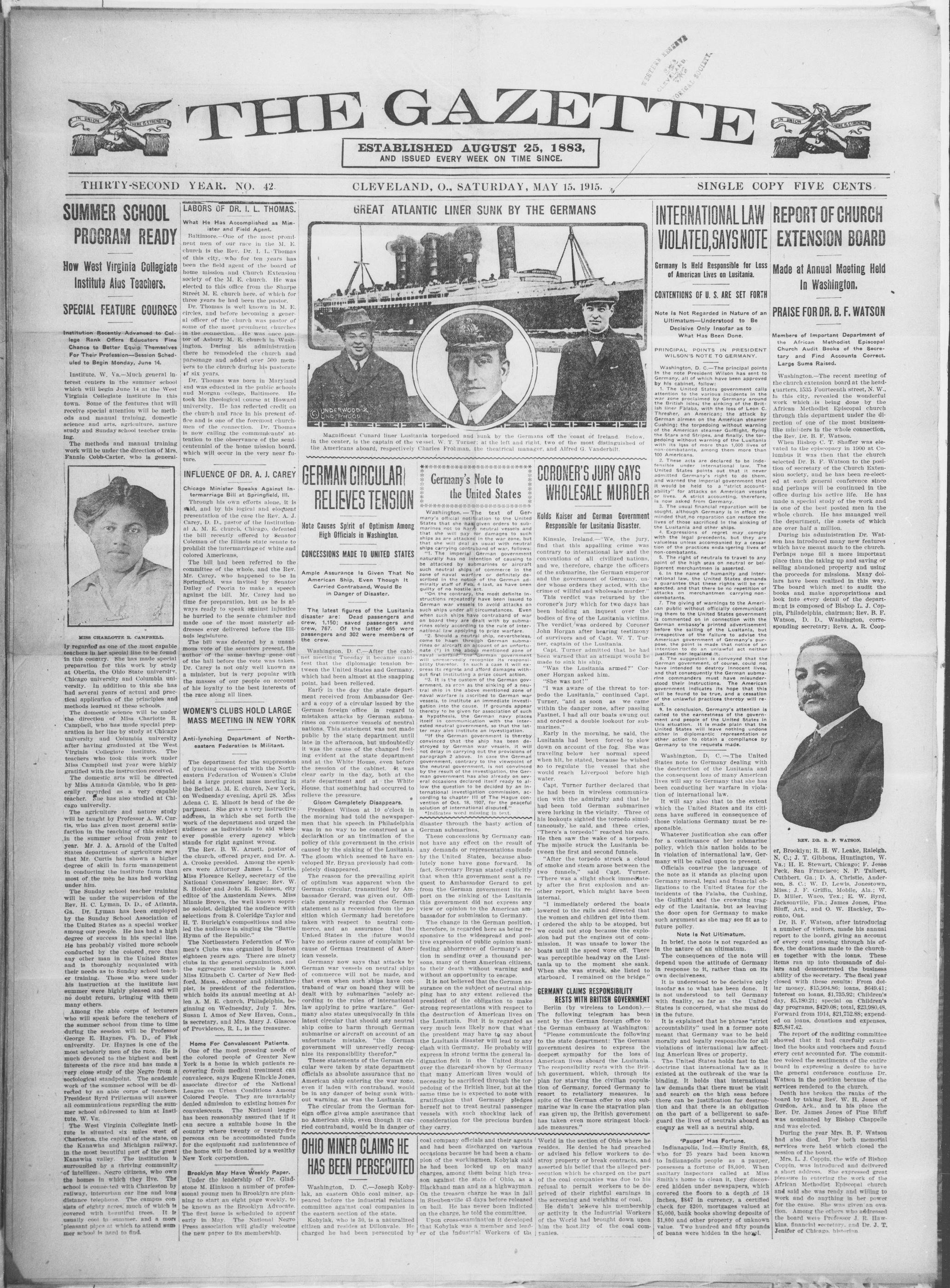
GREAT ATLANTIC LINER SUNK BY THE GERMANS
Magnificent Cunard liner Lusitania torpedoed and sunk by the Germans off the coast of Ireland. Below, in the center, is the captain of the vessel, W. T. Turner; at the left and right, two of the most distinguished of the Americans aboard, respectively Charles Prohman, the theatrical manager, and Alfred G. Vanderbilt.
Magnificent Cunard liner Lausitania torpeded and sunk by the Germans off the coast of Ireland. Below, in the center, is the captain of the vessel, W. T. Turner; at the left and right, two of the most distinguished of the Americans aboard, respectively Charles Frohman, the theatrical manager, and Alfred G. Vanderbilt.
GERMAN CIRCULAR RELIEVEST TENSION
Note Causes Spirit of Optimism Among High Officials in Washington.
CONCESSIONS MADE TO UNITED STATES
Ample Assurance Is Given That No American Ship, Even Though It Carried Contraband, Would Be in Danger of Disaster.
The latest figures of the Lusitania disaster are: Dead passengers and crew, 1,150; saved passengers and crew, 767. Of the latter 465 were passengers and 302 were members of the crew.
Washington, D. C.—After the cabinet meeting Tuesday it became manifest that the diplomatic tension between the United States and Germany, which had been almost at the snapping point, had been relieved.
Early in the day the state department received from Ambassador Gerard a copy of a circular issued by the German foreign office in regard to mistaken attacks by German submarines on commerce vessels of neutral nations. This statement was not made public by the state department until late in the afternoon, but undoubtedly it was the cause of the changed feeling evident at the state department and at the White House, even before the session of the cabinet. It was clear early in the day, both at the state department and at the White House, that something had occurred to relieve the pressure.
President Wilson at 10 o'clock in the morning had told the newspapermen that his speech in Philadelphia was in no way to be construed as a declaration or an intimation of the policy of this government in the crisis caused by the sinking of the Lusitania. The gloom which seemed to have enveloped Mr. Bryan previously had completely disappeared.
The reason for the prevailing spirit of optimism was apparent when the German circular, transmitted by Ambassador Gerard, was given out. Officials generally regarded the German statement as a recession from the position which Germany had heretofore taken with respect to neutral commerce, and an assurance that the United States in the future would have no serious cause of complaint because of German treatment of American vessels.
Germany now says that attacks by German war vessels on neutral ships of commerce will not be made, and that even when such ships have contraband of war on board they will be dealt with by submarines "solely according to the rules of international law applying to prize warfare." Germany also states unequivocally in this latest circular that should any neutral ship come to harm through German submarine or aircraft on account of an unfortunate mistake. "the German government will unreservedly recognize its responsibility therefor."
These statements of the German circular were taken by state department officials as absolute assurance that no American ship entering the war zone, even if laden with contraband, would be in any danger of being sunk without warning, as was the Lustania. The circular from the German foreign office gives ample assurance that no American ship, even though it carried contraband, would be in danger of OHIO MINER CLAIMS HE HAS BEEN PERSECUTED
Washington, D. C.—Joseph Kobylak, an eastern Ohio coal miner, appeared before the industrial relations committee against coal companies in the eastern section of the state.
Kobylak, who is 30, is a naturalized citizen and resides at Dillonville. He charged he had been persecuted by
Germany's Note to the United States
*
"If the German government is thereby convinced that the ship has been destroyed by German war vessels, it will be attacked by German war vessels, the third time of paragraph 2 above. In case the German government, contrary to the viewpoint of the neutral government, is not convinced by the result of the investigation, the German government has already taken the final occasions declared itself ready to allow the question to be decided by an international investigation commission, according to chapter III of the Hague公约, to investigate the situation of a peaceful solution of international disputes." "Indicates word missing in text.
disaster through the hasty action of German submarines.
These concessions by Germany cannot have any effect on the result of any demands or representations made by the United States, because absolutely none have gone forward.
In fact, Secretary Bryan stated explicitly that when this government sent a request to Ambassador Gerard to get from the German government its report on the sinking of the Lusitania this government did not express any view or opinion to the American ambassador for submission to Germany.
The change in the German position, therefore, is regarded here as being responsive to the widespread and positive expression of public opinion manifesting aberrance of Germany's action in sending over a thousand persons, many of them American citizens, to their death without warning and without an opportunity to escape.
It is not believed that the German assurance on the subject of neutral shipping has to any extent relieved the president of the obligation to make strong representations with respect to the destruction of American lives on the Lusitania. But it is regarded as very much less likely now that what the president may have to say about the Lusitania disaster will lead to any clash with Germany. He probably will express in strong terms the general indignation felt in the United States over the disregard shown by Germany that many American lives would of necessity be sacrificed through the torpedoing of the British liner, but at the same time he is expected to note with gratification that Germany pledges herself not to treat neutral passenger vessels with such shocking lack of consideration for the precious burden they carry.
coal company officials and their agents and had been discharged on various occasions because he had been a champion of the workingmen. Kobylak said he had been locked up on many charges, among them being high treason against the state of Ohio, as a Blackhand man and as a highwayman. On the treason charge he was in jail in Steubenville 43 days before released on bail. He has never been indicted on the charge, he told the committee.
Upon cross-examination it developed that Kobylak was a member and lead-er of the board.
CORONER'S JURY SAYS WHOLESALE MURDER
CORONER'S JURY SAYS WHOLESALE MURDER
Holds Kaiser and German Government
Responsible for Lusitania Disaster.
Kinsale, Ireland—"We, the jury, find that this appalling crime was contrary to international law and the conventions of all civilized nations, and we, therefore, charge the officers of the submarine, the German emperor and the government of Germany, under whose orders they acted, with the crime of willful and wholesale murder." This verdict was returned by the coroner's jury which for two days has been holding an inquest over the bodies of five of the Lusitania victims. The verdict was ordered by Coroner John Horgan after hearing testimony of survivors and of Capt. W. T. Turner, captain of the Lusitania. Capt. Turner admitted that he had been warned that an attempt would be made to sink his ship.
"Was the Lusitania armed?" Coroner Horgan asked him.
"She was not!"
"I was aware of the threat to torpedo the Lusitania," continued Capt. Turner, "and as soon as we came within the danger zone, after passing Fastnet, I had all our boats swung out and ordered a double lookout for submarines."
Early in the morning, he said, the Lusitania had been forced to slow down on account of the fog. She was traveling below her normal speed when hit, he stated, because he wished so to regulate the vessel that she would reach Liverpool before high water.
Capt. Turner further declared that he had been in wireless communication with the admiralty and that he had been told German submarines were lurking in the vicinity. Three of his lookouts sighted the torpedo simultaneously, he said, and three cries, "There's a torpedo!" reached his ears. He then saw the wake of a torpedo. The missile struck the Lusitania between the first and second funnels. "After the torpedo struck a cloud of smoke and steam arose between the two funnels," said Capt. Turner. "There was a slight shock immediately after the first explosion and another report, which might have been internal. "I immediately ordered the boats lowered to the rails and directed that the women and children get into them. I ordered the ship to be stopped, but we could not stop because the explosion had put the engines out of commission. It was unsafe to lower the boats until the speed wore off. There was perceptible headway on the Lusitania up to the moment she sank. When she was struck, she listed to starboard. I remained on the bridge."
GERMANY CLAIMS RESPONSIBILITY
DEFEAT WITH BRITISH COVERMEN
BERLIN (by wireless to London).—The following telegram has been sent by the German foreign office to the German embassy at Washington: "Please communicate the following to the state department: The German government desires to express the deepest sympathy for the loss of American lives aboard the Lusitania. The responsibility rests with the British government, which, through its plan for starving the civilian population of Germany, forced Germany to resort to retaliatory measures. In spite of the German offer to stop submarine war in case the starvation plan was given up, the British government has taken even more stringent blockade measures."
World in the section of Ohio where he resides. He denied he had preached or advised his fellow workers to destroy property or break contracts, and asserted his belief that the alleged persecution which he charged on the part of the coal companies was due to his refusal to permit workers to be deprived of their rightful earnings in the screening and weighing of coal.
He didn't believe his membership or activity in the Industrial Workers of the World had brought down upon him the hostility of the coal companies.
SINGLE COPY FIVE CENTS
INTERNATIONAL LAW VIOLATED,SAYSNOTE
Germany Is Held Responsible for Loss of American Lives on Lusitania.
CONTENTIONS OF U. S. ARE SET FORTH
Note Is Not Regarded in Nature of an Ultimatum—Understood to Be Decisive Only Insofar as to What Has Been Done.
PRINCIPAL POINTS IN PRESIDENT WILSON'S NOTE TO GERMANY.
Washington, D. C.—The principal points in the note President Wilson has sent to Germany, all of which have been approved by his cabinet, follow:
1. The United States government calls attention to the serious incidents in the war zone proclaimed by Germany around the British isles, the sinking of the British liner Falabla, with the loss of Leon C. American; the attack by German aliens on the American steamer Cushing; the torpeding without warning of the American steamer Guillfight, flying the Stars and Strips, and finally, the torpeding without warning of the Lusitania with its loss of more than 1,000 lives of non-combatants, among the more than 100 Americans.
2. These acts are declared to be under the international law. The United States outlawed it, it admitted Germany's right to do them, and warned the imperial government that it would be held to a "strict accountability" for attacks on American vessels, therefore, is now asked from Germany.
3. The usual financial repatriation will be sought, although Germany is in effect reminded that no repatriation can restore the Lusitania and other ships.
It will say also that to the extent which the United States and its citizens have suffered in consequence of those violations Germany must be responsible.
Whatever justification she can offer for a continuance of her submarine policy, which this nation holds to be in violation of international law, Germany will be called upon to present.
Officials construe the language of the note as it stands as placing upon Germany moral, legal and financial obligations to the United States for the incidents of the Falaba, the Cushing, the Gulflight and the crowning tragedy of the Lusatian, but as leaving the door open for Germany to make such argument as she may see fit as to future policy.
Note Is Not Ultimatum.
Note Is Not Ultimatum.
In brief, the note is not regarded as in the nature of an ultimatum.
The consequences of the note will depend upon the attitude of Germany in response to it, rather than on its own decisiveness.
It is understood to be decisive only insofar as to what has been done. It is not understood to tell Germany with finality, so far as the United States is concerned, what she must do in the future.
It is explained that he phrase "strict accountability" used in a former note meant that Germany was to be held morally and legally responsible for all violations of international law affecting American Lives or property.
The United States holds fast to the doctrine that international law as it existed at the outbreak of the war is binding. It holds that international law demands that there must be visit and search on the high seas before there can be justification for destruction and that there is an obligation on the part of a belligerent to safeguard the lives of neutrals aboard an enemy as well as a neutral ship.
'Pauper' Has Fortune
Indianapolis, Ind—Emily Smith, 68, who for 25 years had been known to Indianapolis people as a pauper, possesses a fortune of $8,000. When sanitary inspectors called at Miss Smith's home to clean it, they discovered hidden under newspapers, which covered the floors to a depth of 18 inches, $847 in currency, a certified check for $200, mortgages valued at $5,000, bank books showing deposits of $1,800 and other property of unknown value. Two hundred and fifty pounds of beans were hidden in the hotel.
IN UBILION
THRICE STRONGER
REPORT OF CHURCH EXTENSION BOARD
Made at Annual Meeting Held In Washington.
PRAISE FOR DR. B. F. WATSON
Members of Important Department of the African Methodist Episcopal Church Audit Books of the Secretary and Find Accounts Correct. Large Sums Raised.
Washington—The recent meeting of the church extension board at the headquarters, 1835 Fourteenth street, N. W., in this city, revealed the wonderful work which is being done by the African Methodist Episcopal church through this department under the direction of one of the most business-like ministers in the whole connection, the Rev. Dr. B. F. Watson.
When Bishop C. T. Shaffer was elevated to the episcopacy in 1900 at Columbus it was then that the church selected Dr. B. F. Watson to the position of secretary of the Church Extension society, and he has been re-elected at each general conference since and perhaps will be continued in the office during his active life. He has made a special study of the work and is one of the best posted men in the whole church. He has managed well the department, the assets of which are over half a million.
During his administration Dr. Watson has introduced many new features which have meant much to the church. Perhaps noe fill a more important place than the taking up and saving or selling abandoned property and using the proceeds for missions. Many dollars have been realized in this way. The board which met to audit the books and make appropriations and look into every detail of the department is composed of Bishop L. J. Coplin, Philadelphia, chairman; Rev B. F. Watson, D. D., Washington, corresponding secretary; Revs A. R. Copp
REV. DR. B. F. WATSON.
er, Brooklyn; R. H. W. Leake, Raleigh, N. C.; J. T. Gibbons, Huntington, W. Va.; H. E. Stewart, Chicago; F. Jesse Peck, San Francisco; N. P. Talbert, Cutlbert, Ga.; D. A. Christie, Anderson, S. C.; J. F. Griffin, Mobile, Ala.; D. W. Miller, Waco, Tex.; E. W. Byrd, Jacksonville, Fla.; James Jones, Pine Bluff, Ark, and O. W. Hackley, Toronto, Ont.
Dr. B. F. Watson, after introducing a number of visitors, made his annual report to the board, giving an account of every cent passing through his office, the donations made to the churches together with the loans. These items ran up into thousands of dollars and demonstrated the business ability of the secretary. The fiscal year closed with these results: From dollar money, $15,944.86; loans, $649.41; interest on loans, $1,735.92; Children's day, $1,580.21; special on Children's day programs, $420.08; total, $2,938.08. Forward from 1914, $2,752.88; expended on loans, donations and expenses, $25,847.42.
The report of the auditing committee showed that it had carefully examined the books and vouchers and found every cent accounted for. The committee voiced the sentiments of the entire board in expressing a desire to have the general conference continue Dr. Watson in the position because of the services rendered to the church.
Death has broken the ranks of the board by taking Rev. W. H. Jones of Gurdon, Ark., and in his place the Dr. Rev. James Jones of Pine Biff was nominated by Bishop Chappelle and was elected.
During the rear Mrs. B. F. Watson had also died. For both memorial services were held which closed the session of the board.
Mrs. L. J. Coppin, the wife of Bishop Coppin, was introduced and delivered a short address. She expressed great pleasure in entering the work of the African Methodist Episcopal church and said she was ready and willing to work and do anything in her power for the cause. She was given an ovation. Among the others who addressed the board were Professor J. R. Hawkins, financial secretary, and Dr. J. T. Jenifer of Chicago, historian.
The GAZETTE
One Year.....$1.50.
Six Months.....1.00
Three Months.....50
Subscribers are requested to re-
mit by postoffice money or-
der or registered letter
ordered at the postoffice in Cleveland,
Ohio, as second-class matter.
Address all communications to
HARRY C. SMITH
Editor and proprietor,
THE GAZETTE,
Blackstone Building, Cleveland, O.
Member Ohio Legislature: 1894
to 1896; 1896 to 1898; 1900 to 1902
THE GAZETTE is the oldest, and has the largest bona fide circulation, double that of any newspaper in the interest of Afro-Americans, published in the state of Ohio, and comparison with any will immediately establish its rank as one of the NEWSIEST AND BEST in the country.
10,000,000 Afro-Americans..
160,000 in Ohio.
20,000 in Cleveland.
Poor old John is apparently in his dotage—he has broken loose again. About five years ago, he did the same thing. When any one mentions the fact that the editor of The Gazette, when a member of the Ohio Legislature in 1894 and 1896, secured the passage of bills which he introduced and which are now Ohio's Civil Rights and Anti-Lynching laws, respectively, (see laws of Ohio, passed in 1894 and 1896). John immediately recalls the fact
Delhays
that he too served THREE terms in the Ohio Assembly, prior to 1894, AND MADE ABSOLUTELY NO EFFORT TO DO THIS AND OTHER THINGS OUR PEOPLE OF THE STATE OF OHIO WERE IN SUCH SHOE NEED OF. This too, in spite of the fact that HE WAS IMPORTUNED BY MEMBERS OF THE RACE (THE WRITER AMONG THE NUMBER) TO INTRODUCE A CIVIL RIGHTS' BILL. But why waste time with further discussion of John and his "knocks" when they are not worth it?
"FRANK" MOVING PICTURES.
Cleveland, O., April 23. 1915.
Gov. Frank B. Willis, Columbus, O.
Dear Friend:—I am enclosing you some clippings from local daily papers to which I wish to call your attention. You know the "Frank" case of Atlanta. The man has been adjudged guilty many times by the courts of the country—from the U. S. Supreme court and the Supreme court of Georgia, on down to the lowest local courts in that state. Conley, the "Negro", referred to in this clipping, was sentenced to a year in the Georgia penitentiary as an accomplice of his employer, Frank. The point I wish to make is this; in spite of the judgments of all the courts of Georgia, and also the U. S. Supreme court, and regardless of the fact that prejudice in the south against the Jew is certainly no less than that against the (so-called) "Negro", they are preparing to exhibit moving pictures of the Frank case in Ohio that seek to fasten the crime, in the public mind; upon Frank's "Negro" employee and forced accomplice, Conley. What good this will do anybody, is a question. If it is intended to change public sentiment to Frank's favor, then, the exhibitions should take place in Georgia, where commutation of sentence can only be secured; certainly not in Ohio.
You will notice in one of the clip pings I am enclosing in this communication to you that a private exhibition of the "Frank" pictures, was given in the Princess Theatre, here one evening the first of the week, and that they are promised for "many Clever land (and Ohio) theatres within the next few weeks."
These moving pictures in the face of so many court decisions, from the highest to the lowest (courts), would be not only harmful to the "Negro" of Ohio and the North, but insulting to the judiciary of this country, and should not be tolerated by the chief executive and authorities of any state. With greater prejudice against the "Negro" in the South, than against the Jew, it is the merest nonsense to make the claim, the Frank moving pictures seek to impress the public with. They are but little better than those miserable play-creations, "The Birth of a Nation," and "The Nigger."
While I am on this matter, permit me to ask the State Board of Moving Picture censors, through you, to withdraw their approval of film, No. 2923, with title, "Colored Villainy," (which is issued by The Mutual Film Co., through the Keystone Film Co.), in
which is frequently flashed upon the screen, the miserable, insulting word, "Nigger." The Mutual Film Co., is the one that issues and promotes the photo-play, "The Birth of a Nation," which is based upon Tom Dixon's infamous book and play, "The Clansman." Film 2923 is being shown in a number of moving picture theatres in Cleveland, as well as elsewhere in the state.
Very truly yours,
Harry C. Smith.
STATE OF OHIO,
EXECUTIVE DEPARTMENT.
Columbus, April 26, 1915.
Hon. Harry C. Smith, Dear Friend:
I am in receipt of your letter relative to the proposed exhibition of films illustrative of the Frank case and pointing out the dangers which would result from such exhibition. Personally it seems to me that such films ought not to be exhibited because they are as a rule gotten up in such a way as to arouse a morbid sense of horror. I am asking you your objection also to the title of No. 2923. I am taking pleasure in handing your letter to the Chairman of the Board of Film Censors with my recommendation that your suggestions
GOV. FRANK B. WILLIS.
shall have very early attention.
Thanking you for your expressions
of confidence, I am
Cleveland, O., May 2, 1915.
Gov. Frank B. Willis, Capitol, Columbus bus, O.
Dear Friend:--Just learned that the mob-descriptive, Negro-baiting and maligning "Leo. M. Frank" moving-pictures are to be exhibited at the "Globe" and "Fountain" theaters, this city, on Monday, May 11, 1915. They will arouse a tremendously dangerous feeling among a class of people in a section of this city where a friendly racial feeling has always existed. Much more than a merely morbid sense will be aroused I assure you, and to what end? The U. S. Supreme Court has upheld the decision of the Georgia Supreme Court which sustained that state's lower courts' decisions in the "Leo. M. Frank" case. The moving pictures seek to make a Negro guilty of Frank's brutal murder (after criminal assault) of a little Irish girl in the minds of those who see them. Will you permit this in Ohio? I do not think so. Your letter of April 26, 1915, indicates that you will NOT!
Columbus, May 3, 1915.
Hon. H. C. Smith, Editor, The Gazette,
Cleveland, Ohio.
Dear Mr. Smith:—Just have your re-
cent letter with inclusions touching
the matter of "Leo Frank" plei-
tures and have referred the same to
the State Censor Board with the ur-
gent request that it be given imme-
diate attention.
Yours very truly,
Frank B. Willis.
THE OHIO BOARD OF FILM CEN-
SORS.
Charles G. Williams, Maude Murray
Miller, W. R. Wilson.
233 South High Street
Hon. Harry C. Smith, Editor, The Gar-
cette, Cleveland, Ohio.
Dear Sir:—Your letters of protest in reference to the motion picture, "The Frank Case," addressed to the Governor, have been referred to me with the request that they be given immediate attention. I beg to advise that our records show that this picture was passed some time in February last. It has been exhibited in different cities of Ohio since that time, has been run in Columbus, and, so far as I can learn, there have been objections to it here. People mention that the picture is really not so bad as it is reputed to be. Of course, I have not seen it, as I was not a member of this Board at the time it was passed, and do not know its character except from its reputation; but I presume it bears upon the historical fact of the Frank trial. Of course you know that the papers and magazines have been full of publications in reference to this case; and from what I have gathered from all of those articles, the man in this picture thus of the Jews. While another man than Frank is supposed to have been implicated in the crime, I take it that this is an individual matter and not racial.
Under our present law it is a very difficult matter to revoke the authority given to exhibit a picture when a certificate of approval has been issued, as in this case. We are trying to take care of matters of this kind in our amendment pending before the Senate. Should it be that this picture caused trouble in Cleveland because of a local situation which not exist elsewhere? You indicate that no city could stop its exhibition. Having met you personally, I am sure that you will be reasonable about this matter and rapidly see the situation. I further want to assure you that there is no prejudice entertained against your race by this Board and that no pictures are intentionally passed to show the same. Several other protests in reference to pictures have been referred to me by the Governor, asking that they be given attention, which I cannot. You of course realize that this Board passes upon hundreds of pictures, and many protests are received from all parties, for and against different pictures. These protests are constantly before us, and we cannot give each individual case the attention we would like. Personally, I am
E. CAZETTE, CLEVELAND, O. SATURDAY, MAY 15, 1915
of the opinion that it is a mistake to make pictures such as the one under discussion, and that very little good, if any, can come from their exhibition. However, you will realize that because of the manner in which a picture is assembled, it is often a difficult problem to decide whether a picture is or is not harmful or dangerous under the law.
Trusting that this explanation is satisfactory. I am.
Jeverland, May 12, 1615.
Mr. Charles, 233 South
Hugh St. Columbia, Ohio
High St., Columbus, Ohio.
Dear Sir…As I wrote you last week in reply to your letter of May 3, 1915, I would not press further my urgent request for the elimination of the "Frank case" pictures, until I could see them. Last evening was my first opportunity to do so—at the Globe Theatre, this city. After a careful viewing of the same and having had some extremely distasteful and disagreeable experiences while in the theatre, and when passing in and out of it, the direct result of the presentation of many of the objectionable pictures, I can only reiterate in the strongest possible manner all that I wrote in my letters to the governor under dates of April 23, and May 2, 1915, and which were turned over to you "with the request that they be given immediate attention."
First and foremost: The "Frank case" pictures libel American court procedure and justice, as the "Leo M. Frank" case, or some phase of it, has passed through the various lower courts of Georgia to the Supreme court of that state, and from there to the United States Supreme court.
Second: The clear purpose of the pictures, in defiance of the judgments of all the courts referred to, is to prejudice the minds of the masses of the people against the "Negro", by fixing the terrible murder of poor little Mary Phagan (white) upon a member of my race whom the courts of Georgia declared not guilty of the crime and whom they punished with a year's imprisonment as a forced accomplice of Leo M. Frank.
Third: The mob scenes are bad, the picture is pitifully weak because of the miserably poor acting of the principals, and the frequent repetition of scenes are clearly for the sole purpose of arousing not only the morbid sense, but also the passions and prejudice of all who are so unfortunate as to see them. All this, that people may be coerced into signing petitions for the commutation of the "Frank" sentence from hanging to life imprisonment. It is far too tremendous a toll in the basement of minds of the masses, and increase of passions and prejudice, etc. to be permitted to be exacted in Ohio, to say nothing of the belittling of American court procedure and justice.
You are wrong in your surmise that the 'only question in reference to race in the 'Frank' pictures is that of the Jews", and that "while another man than Frank is supposed to have been implicated in the crime, this is an individual matter and not racial." As I trust I have made perfectly clear to you, in the foregoing and other communications, just the opposite is true—the pictures unjustly, and contrary to all the Georgia courts' decisions, attempt to fix the crime upon a "Negro", and thereby make of it a racial matter, pure and simple. Therefore, the suppression of the "Frank case" pictures is a state matter to be dealt with by the governor and your Board, and not the mayor of this or any other city in the state.
As you write, having met you and the other two members of the Board and having fresh in mind the splendid stand on similar matters of great interest to my people of the state you have taken in the recent past, and knowing so well Gov. Frank B. Willis' position in the matter, are what make me feel sure you will not hesitate longer to suppress the viciously harmful pictures, referred to repeatedly in this communication, just as soon as possible, and before thousands have been harmed by their presentation as hundreds have been in this city, this week. Very truly yours. Harry C. Smith.
THE PSEUDO CHAMPION
U. S. Judge Sustains Federal Action
Barring the Johnson-Willard
Court
Jersey City, N. J.—The action of Frederick F. Freed, collector of the port of Newark, N. J. in refusing to allow the entrance of photographic films of the Willard-Johnson fight at Havana, was upheld by Federal Judge Thomas Haight of the U. S. district court here, last week Wednesday. Judge Haight denied the application of T. Lawrence Weber for an injunction to restrain the collector from interfering with Weber in entering the films through the Newark custom house. Counsel for Weber stated that the appeal would sign papers so that the appeal would come before the U. S. circuit court of appeals in Trenton, Monday. If the appeal is unsuccessful there another appeal will be taken to the U. S. supreme court, the attorney said.
Dan Morgan, a well-known sportwriter on an eastern daily newspaper, said, last week, referring to the peseudo champion: 'Jess Willard as a theatrical attraction is a joke. 'To get the money he'll have to fight a few heavyweights. Battling Levinsky is entitled to first chance against the 'champ'. Jess was afraid of Levinsky before he 'beat' Johnson. Everyone knows Levinsky beat 'Bearcat' McMahon and 'Gunboat' Smith and both of these men have whipped Willard. Jess can't be coaxed into the battle. The shirt says, 'The shirt is going to stand for any more posing by the new heavyweight 'champ'. Battling Levinsky, the real king of the heavies, is ready to make a show out of the 'champion' any time his battalion of managers permit him to box Levinsky.' Willard has been forced to join a wild west show.
EDITOR VANN VERY ILL.
Pittsburgh, Pa.—Robert L. Vann, editor of the Pittsburgh Courier, is seriously sick at his home in Monticello St., suffering from a general break down and congestion of the kidneys. Editor Vann, one of our most successful lawyers here, is a native of North Carolina and completed his legal training at the University of Pittsburgh.
FRESH OHIO NEWS
BY "THE OLD RELIA
GAZETTE'S CORRE-
SPONDENTS
THROUGHOUT THE STATE
What Our People Are Doing Each Week—Church, Personal, Social, Lodge, Literary and Musical — Marriages, Deaths, Etc.
YOUNGSTOWN.—Dr. C. A. Pettiford is convalescing. Miss Bessie Carter of Washington, D. C., is visiting her brother and wife, Mr. and Mrs. Oscar D. Carter—Mrs. Mollie Mackey who has been ill, six months, remains about the game—Moses Stuton is convalescent. The K. P. will hear their annual sermon at Oak Hill Ave. A. M. E. church. Sunday at 2 p. m.—Rev. W. O. Harper was in Philadelphia, two weeks—Mrs. Wm. Saunders of 488 Edwards St. is ill. A cantata will be rendered at the Third Baptist church, May 24.—Mrs. Charles Jackson visited relatives in Cleveland, visited Boston will visit visitors in Dayton, the last of the week.—Henry Johnson has a beaked thumb.
SANDUSKY—Thanksgiving services of Erie Lodge, which were participated in also by Cleveland Odd Fellows, Household of Ruth, No. 7, and the "Household" of this city, was a grand success. J. E. Reed of Cleveland, master of ceremonies; Frank L. H. Reed of Cleveland, vice chair which sang some beautiful selections. Rev. George D. Smith, pastor of the Second Baptist church, preached an excellent sermon. A $15 collection was given the church and a $6 collection for mission work was taken. The rest room of the church was taken to accommodate the good visitors from Accoma land, and | the Clevelanders were greatly pleased with their treatment while here. Come again, gentlemen
CORRESPONDENTS must mail all letters for publication at their main postoffice sufficiently early on Monday (or Sunday) of each week to have them reach The Gazette office on Tuesday morning, and always write also, their names and that of their city or town on the outside of the building. If less than less this latter is done, proper credit cannot be given you. Lists of names, wedding presents, etc., obituary notices, speeches, resolutions, poetry, inquiries for relatives and advertisements of all kinds, including items announcing entertainments to be held in the near future, must be paid for by the post office. In line six words to a line. Our rates for display advertisements will be sent on application. Send postal note and not stamps during warm weather.
CADIZ—Mrs. B. H. Lee, who visited her son, B. S. Lee, has returned to Pittsburg.—Miss Annie Davis of Smithfield, was Miss Gwendoline Redmond's guest, Sunday.—Mr. and Mrs. Carl Brown, of Newark, were called here by her mother Mrs. Anna Harris' serious illness.—Mothers "day" of Mrs. Harris, was Sunday. M. E. church, Sunday. Services were conducted by the Y. M. L. club. Last Friday, it gave an elaborate "Mothers' banquet." Seventy-five plates.—At the Harrison Co. High School field meet held here, the 8th, Dallas Wallace won first prize in a two-mile run and about 15 minutes later (without previous notice) won second prize in a 100-yard run. Mrs. May Blanchard of Flushing, visited Mrs. Wallace.—Mrs. Liza Christian of Columbus, has returned home. Mrs. Timbers and Mrs. N. Carter are convalescing.
OBERLIN—Mrs. Mary A. Jenkins died at her daughter, Mrs. Isadore Martin's, in Philadelphia, April 29. The remains were brought here for burial, May 2. Mrs. Jenkins was a resident of Oberlin for fifty years.—Mrs. M. Allen of Cleveland, was here recently and Mr. James Houston of the same school, was visited by Gareth Sandyuk, visited his home, this week.—Edwin C. Berry of Athens, was called here by his mother, Mrs. E. M. Hale's serious illness.—A grand reception was given in honor of Elder Courtney, D. S., at Rust M. E. church, Friday evening. The Oberlin College quartet gave a good concert for the benefit of Mt. Zion's new assembly hall. The Ladies' Aid society is in charge of it. Lisses, Bessie Boyd, Juanita Quirk, Bessie Boyd, to trip to Lakewood by "auto" to visit the primary classes there, Wednesday. There was a good W. C. T. U. meeting, Sunday.
AKRON.—Women's day at Bethel A. M. E. church, this city, was a grand success. A splendid audience greeted the speakers of the evening. The ladies from St. John's A. M. E. church, Cleveland, contributed largely to the success of the occasion. They were: Mrs. S. A. Lucas, Mrs. John Early, Misses Olive Wells, Mabel and Bertha Blue. A great improvement is noticed in the work here, under the administration of Rev. H. H. Summers. The K. P. banquet at the Second Baptist Church was a large affection Friday evening. The tables, filled with good things, brought smiles to many faces and satisfaction to many appetites. Rev. R. A. Jones will preach the annual sermon.—The concert given by the Oberlin Jubilee Sextet for the benefit of Bethel A. M. E. church was largely attended. Some of the best citizens of both races were present. Every one was highly pleased with the splendid renditions. This is the third time they have concerted in a year.
COLUMBUS—Mrs. Mary Talbert of Buffalo, vice-president of the National Federation of Women's Clubs spoke at St. Paul's A. M. E. church, Sunday afternoon. Her subject, "The Call of the Hour" was ably handled. Mrs. Talbert has been lecturing in Pennsylvania, Indiana and Kentucky. The local branch of the N. A. A. C. P., met at Odd Fellows' hall, Saturday afternoon. The principal address was made by the newly elected president, the Hon. George Geiger, who served by a large and appreciative audience. He deprecated the efforts of both political parties in allowing the letter and the spirit of the law to be nullified in regard to according the Afro-American his civil and political rights. He advised our people to use every means
to mold a favorable public sentiment, exhaust every legal means to maintain civil rights and privileges, and make effective use of the ballot. A vote of approval which carries with it financial assistance, if necessary, was given C. A. Napper of Greenfield, who presented in an effective way the legal fight being made in that little city against segregation in a local theater. A vote of thanks was unanimously extended to Gov. Frank B. Willis and Hon. Harry C. Smith for preverting the showing of objects from Flushing Ohio to the elite race prejudice. The editor of The Gazette led the fight and was backed up by our sterling governor. —"Noomdy" Brascher, Tom Fleming's newspaper "booster," has joined his friend in Cleveland.
THEY ARE APPRECIATIVE.
Springfield, O, May, 6th., 1915.
Hon. Harry C. Smith, Editor Gazzette. Dear Sir:—By the authority of the Colored Men's Council of the city of Springfield, the undersigned (committee) have been authorized to express to you, and all others who in any way assisted you, our sincere appreciation for your times, work in our efforts to improve the quality of that degrading photoplay, "The Birth of a Nation," and others in Ohio. We heartly commend the wisdom of our Governor, in his wise decision, to stop all productions in the state that lead to race friction. Such scenes as "The Birth of a Nation," are hideous, repulsive and degrading, and we urge all citizens of color, in every community, to unite in securing fair treatment in public places as well as other citizens of prison. Again assuring you of our commitment, in all matters that lead to race elevation, we are.
Yours respectfully,
S. S. Jordan, M. D., R. E. Pettiford,
M. D., and C. D. Swayne, committee.
A WHITE FRIEND'S VIEW.
Editor, Gazette.' Friend Smith: "You are certainly putting up a hot fight against (photo-play) pictures that do injury to the colored people. I glory in your spunk and hope you will use them to show that you sat every point. I sent your last week's editorial to the 'Lookout.' You yours truly.
SUMNER AND ROCK.
Under the caption of "An Epochal Day in the Supreme Court's History," the Boston Transcript told us on the fiftieth anniversary of the occasion that on February 1st, 1865, a remarkable scene was enacted in the Supreme Court of the United States. Charles Summer, Esq. of Boston, a member of the bar of the Supreme Court, was present, having in his company John S. Rock, of Boston, a colored man. As soon as the judges had taker their seats, Summer arose and moved that Mr. Rock be admitted to the court of the Chief Justice Chase, after mutely collecting the opinion of the associate justices, granted Summer's motion. Mr. Rock paid the clerk the customary admission fee, and for the first time in its history the Supreme Court had a colored man at its bar duly admitted to practice.
High Rents In Cities.
The enormous rise in London rents, among rich and poor alike, during the past five years is shown by statistics issued by the board of trade. Lord Allendale, who three years ago paid $5,560 a year for his house in Piccadilly, now pays $2,500. The rent of the United Service club, which until 1904 was $725, is now $19,150; and that of Lloyds bank, at the corner of St. James street and King street, is $15,000 a year. One must, however, go to New York to find the most highly rented tenant in the world-Mr. Murray Guggenheim, who pays $25,000 a year for his residence at the corner of Fifth avenue and Eighty-first street.
Food Problem in Austria.
The Austrian minister of education says that all school children required for work in the fields will be allowed unlimited leave in absence from the schools, which will be closed during the summer months if necessary. It has been proposed to introduce several days' compulsory abstinence from meat weekly in Austria. The population has been enraged at hearing the results of the requisition of corn in Hungary, where, it is said, stores sufficient for the needs of the whole of the dual monarchy have been discovered.
QUINADE
GROWS HAIR
REMOVES DANDRUFF
SEND FOR SAMPLE
QUINASOAP
THE IDEAL SHAMPOO SOAP
THOROUGHLY CLEANSSES THE SGALP
QUINACOMB
HAIR, STRAIGHTENER
SHAMPOO DRYER
QUINADE 25¢ QUINACOMB 50¢ QUINASOAP 25¢
AT ALL DRUGGISTS
SEEBY DRUG COMPANY, NEW YORK CITY, N. Y.
Is absolutely guaranteed and is bottled under Government supervision by The Cleveland & Sandusky Brewing Co. West 785 Central 3933
Taylor's New Shampoo Dryer and Hair Straightener!
The Best in the World!
This comb, properly husted, and the use of LaCroche Hair Pomade, will bring the most crimps hair straight and silky at every stroke and cause a rapid growth of the hair.
Don't put it off but sell it $1.00 today and get the comb by return mail.
TAYLOR'S SPECIAL ALCOHOL HEATER is the handiest and most convenient method of heating the Comb, and can be closed up so that you can put it in your hand-bag. Price $36. Wonderful for the Largest Comb, and is the only requirement of the Comb Straightener, but it provides a luxurious growth of the hair. SEND FOR MY FREE CATALOGUE illustrating the Largest and Most Complete Line of Hair Goode in this country for colored people, such as Bangs, Wigs, Puffs, Switches, Pompadour, Stain Plain, Combs, Brushes, etc.
Agents Wanted.
T. W. TAYLOR, Hewell, Mich.
When writing please mention this paper
The YOUTH'S COMPANION Better Than Ever in 1915
Then the Family Page, a rare Editorial Page, Boys' Page, Girls' Page, Doctor's Advice, and "a ton of fun." Articles of Travel, Science, Education. From the best minds to the best minds, the best the world can produce for you and everyone
IT COSTS NO MORE TO DRESS IN STYLE The secret is to know how. THE NEW EMPIRE DRESSES are the latest word in Fashions.
Jacket 6144
Skirt 5989
Bolero 6158
Skirt 6149
Costume 6130
Waist 6156
Skirt 6137
PICTORIAL REVIEW PATTERNS today, absolutely the best pattern made in America. THE SPRING FASHION BOOK only 10 cents extra when purchased with one 15 cent pattern. APRIL STYLES now ready.
THE NEW YORK TIMES
The YOUTH'S
Better Than I
Then the Family Page, a rare
Girls' Page, Doctor's Advice,
Travel, Science, Education,
minds, the best the world can
CUT THIS OUT
and send it (or name of this paper)
with $2.00 for THE COMPANION
for 1915, and we will send
ALL the issues of THE COMPANION for the remaining weeks of 1914.
FREE THE COMPANION HOME CALENDAR for 1915.
THEN The $2 Weekly issues of THE COMPANION for 1915.
SUBSCRIPTIONS RECORD
IT COSTS NO MORE
The secret is to
Large, Heavy Strong and Durable. Made of
metal, one solid piece; highly polished and fully
nickel plated; steel bolt which goes through
the metal; and a steel sleeve. End of conduit to
end of conduit to prevent the leak. die from
getting loops or coming off. Remember, it all
in one place. Note: Not in order of order,
but in order of appearance.
Price of Hair Straightener and Alcohol Heater complete $1.50.
ITER is the handiest and most convenient method that 70 can put it in your hand-bag. Price 50c made. It not only meets every requirements of its growth of the hair. Price 25c, illustrating the Largest and Most Complete Line shape, such as Banga, Wige, Puffs, Switches, Pom.
TAYLOR, Howell, Mich.
mention this paper
10 Great Serials
full of life and action, filled with the fire of fine inspiration and followed by 250 short stories of adventure, will make S COMPANION Ever in 1915
PURO HERBS consist of the best possible mixture of Nature's health giving Herbs, contains no potash or mercury—but merely vegetable does not contain it, and cannot a secret compound, as it is in such well-known herbs as Burdock, Dandelion, Sarsaparilla, Red Clover, Mastillake, Strikingly Prickly Ash and other herbs—all the very best approved blood purifiers.
PURO HERBS cleans the system of all impurities, restores health and vigor, weeps away musculine and down feeling, due to impurities collecting in the system during the winter months.
PURO HERBS cost but 35c a box, the contents of which, boiled with one quart of water, makes one quart of ordinary musculine equal to three ordinary one dollar bottles in size and better than any patent medicine, regardless of price.
PURO HERBS are also supplied in liquid form, for those who do not care to make it themselves, at 75c a quart. Sold only at
BROWN DRUG CO.
2742 CENTRAL AVE., cor. 28th Street
Leading Cut-Rate Drugs
North 1494-J Central 2234-L
I Take Care of Your Feet
Home Treatment if Desired
DR. G. H.
TURNER
Chiropodist
DR. G. H.
TURNER
Corns, Bunions, Callouses and
ingrowing Nails, Painlessly Treated
Open Evenings, Sundays & Holidays
Special Attention Given Visitors
From Out of the City
Hours: 8:30 to 11:30 A. M.
5:30 to 8:30 P. M.
2119 Central Avenue, Cleveland
STERLING
5 and 10 Cent Store
3003 Central Ave.
Watch Our Windows
For Bargains
Colored Salesladies
Arlington Pharmacy
WE WILL ACCEPT THIS ADVERTISEMENT FOR FIVE
CENTS IN TRADE, TO APPLY
ON ANY PURCHASE OF
TWENTY-FIVE CENTS OR
MORE.
E. Rukenstein, Ph. C., Prop.
S. W. Cor. Central Ave. & E.
55th St.
The Fifteenth Annual Session of the
State Summer School
for Colored
TEACHERS OF BOTH SEXES
at the
Agricultural and
Mechanical College
GREENSBORO, N. C.
will begin June 29th, 1914, and continue five weeks.
In addition to the regular work, an attractive lecture course has been arraged, in which will appear some of the most distinguished white and Colored students in the country.
Board and lodging for the entire session $12.00. Tuition 25c per subject unless other arrangements have been made.
Limited accommodations. Send $1 and have room reserved in advance.
For further information write a once to
James B. Dudley, President, or
D. J. Jordan, Director,
A. & M. College, Greensboro, N. C.
THE OLD DOMINION
Lunch Room
at
3652 Central Ave.,
Serves THE BEST AND
QUICKEST MEALS
at
Popular Prices. Give it a Trial.
Open Day and Night
Mrs. H. C. Jones, Prop.
DON'T THROW AWAY
Your copy of The Gazette after reading it, but give it to a friend or an acquaintance who might subscribe after reading a copy of the paper.
Editor
Where to Purchase The Gazette
*NEWS STORE,
2249 E. 105th St.
cor. Arthur Ave.
NOTICE TO SUBSCRIBERS
The Gazette regularly should notify
them delivered promptly.
fully examine The Gazette's adver-
s. Business men who advertise in
mage of Afro-Americans. The fact
that they want it.
tirements) ten cents a line (six
o Personal
Subscribers not receiving The Gazette regularly should notify us at once. We desire every copy delivered promptly.
We advise our patrons to carefully examine The Gazette's advertisements before making purchases. Business men who advertise in this paper should have the patronage of Afro-Americans. The fact that they advertise is assurance that they want it.
Local reading notices (advertisements) ten cents a line (six words in a line).
Social and Personal
Miss Laura Lee, who has been seriously ill, is improving.
Mrs. Hattie Hollingsworth is improving at St. Luke's hospital.
Joseph Seelig, Jr., was appointed a clerk in the local Post Office, last week.
Miss Cleo Davis of Columbus, and Mr. Herbert Walker of this city will be married next week.
Garrett A. Morgan returned last week, Wednesday, from a business trip to New York City.
Mrs. Marie Perkins is seriously ill at Huron Rd. hospital, having sustained an operation.
Mr. Jesse Stewart of Central Ave., is convalescing after several weeks' critical illness. Pneumonia.
The health of Mr. Geo, Foster of Circleville, who is visiting his sister, Mrs. L. S. Jones of E. 30th St., is slowly improving.
There is only one way to get our race's news, local and general, and that is by taking "the old and reliable" Gazette, every week.
A farewell reception was tendered Mrs. James Tilley at Mt. Zion Cong church by the Ladies' Aid, DuBois and Missionary societies.
Mrs. Manie Willis and Mr. Wm. Hawkins were married, last Saturday evening, at Mr. and Mrs. J. Beck with's, 12018 Woodland Ave.
Mrs. Alberta Lee Willis was the guest of Mrs. Edwina Seelig, for several weeks. She will visit in Dayton, Louisville and Atlanta en route to Petersburg, Fla.
Mr. George Dunill will be one of the participants in the Cleveland School of Music's thirteenth anniversary concert at Epworth Memorial church, the 18th.
Miss Maggie, daughter of Mr. and Mrs. Thomas Cook, 2335 E. 29th St., has accepted a position as stenographer and bookkeeper for the Fred Douglass Insurance Co., of Indianapolis.
* * *
Misses "Mickie" Cook and Anna Williamson teachers in our Baltimore, Md., High School, contemplate spending a part of the summer season in this vicinity, guests of Mrs. Della Eubanks of Lakewood.
* * *
Send or bring locals and all business matters to The Gazette's offices suite 2, Blackstone Bldg. If you wish to see the editor call there, please contact the editorial publication in issue of The Gazette. must be in the office by 4 p. m., WEDNESDAY at the latest.
* * *
T. P. Howard of Xenia, grand lecturer, for Ohio, will meet Excelsior and Eureka lodges, F. and A. M. May 31 and exemplify the third degree of Hasa Temple, O. M. S, will have a "smoker" May 19, and our local Maonic lodges will celebrate St. John's day, June 24.
The editor of The Gazette was invited, last week, to address the American War veterans of Columbus, on the evening of May 13, 15, at Memorial hall, that city, but was unable to accept owing to a previous engagement. Gov. F. B. Willis was to be the principal speaker.
Just continue to remember that the Luna Park management bars you from its skating rink, dance hall and bathing pool. If you do not believe The Gazette, go out today, tomorrow or next day, and try to skate, dance or bathe. Have race pride, self-respect, manhood and "womanhood".
The Gazette is in a position to announce on the best authority that Mrs. Rosa Boyd, widow (deceased) of Samuel T. Boyd, who also died recently, held the property in E. 824 St. and her other possessions, to a number of friends of BOTH races and not to only those of one race—as so persistently rumored ever since her death.
We wish to call our readers' attention, particularly, to the advertisement, elsewhere in this paper, of Louis B. Rappaport, the eye specialist, who has opened a large and most complete optical parlor in the New Haltown Bldg. E. 55th St., near Woodland Ave. Patronize him. He is one of the best in the city and solicits your trade. The others do not.—Adv.
St. John's junior stewardesses will present The Alpha Mu society in a Japanese play, "The Revenge of Shari-Hot-See," under the direction of Miss Genevieve Davis, on May 26. The cast of characters will be cohosted by Miss Mighty Johnson, Ruth Deag, Helen Wright, Wilberetta Hansbary, Blanche Johnson, Hazel Smith and Edith Wright. The play will be followed by a Japanese fan drill under the direction of Miss Blanche Johnson, Edith Wright, pres. and Amy Rogers, sec.
---
*O. C. SCHROEDER'S,
Cuyahoga Bldg.
F. VALENTINE'S
2130 Central Ave.
J. E. BRANHAM'S
4401 Central Ave.
PUSHAW
The Arcade.
Superior Entrance.
*OPEN SUNDAYS.
Our Classified Ad Department
FOR RENT.—Houses and Rooms—
If you have them to rent or if you
want to rent, advertise in The Gazette.
It brings results.
NOTARY PUBLIC—For such services call at The Gazette office, No. 2
Blackstone building, No. 1424 W
Third Street, near Superior Ave.
FOR SALE.—Houses or lots. If you have either or anything else to
sell, or you wish to purchase, advertise in The Gazette. If anything
can bring you results, it can and will.
FOR RENT.—Five large rooms,
down stairs, bath gas, large cellar,
yard, rec. 5242 P 801 St, Man Canye
Cinney Ave. Apply, if 2 Blackstone building,
W 3d St. near Superior Ave. Key, next
door.
FOR SALE.—A bargain for cash.
Desire to leave the city as early as possible. Two lots, 40 ft. each, and an eight room house; electric light and gas; in Mt. Pleasant allotment, 3298 E. 128th street. Apply to owner, Rev. J. J. Smith, or Union National Bank. Will sell, part cash and mortgage.
Cleveland
Sixth City
Miss Arabella Croxton visited in Detroit, recently.
Mrs. M. Allen and Mr. Jas. Houston visited in Oberlin, recently.
Charles Sutton was home from Columbus, the first of the week.
Mrs. Chas. Jackson of Youngstown, visited relatives in the city, recently.
Mr. John Pulpress of Allegheny,
Pa., was in the city, the first of the
week.
A little race pride will prompt you
to patronize the Central Shirt shop.
See advertisement, elsewhere in this
paper.—Adv.
Mrs. St. John returned the first of
the week from a delightful three
weeks' visit in her old home, Washington,
D. C.
Mrs. Etta Ford of Croton Ave., and
Elmer Fletcher, and Mrs. Mary Hull
and J. Dillard of Central Ave., were
married last week.
The Gazette sanctum received a
pleasant call, Monday, from Mr. and
Mrs. F. G. Snedson, Jr., of E. 39th St.,
who recently located in the city, coming
from Columbus via Zanesville.
The father of Mrs. David Quinn and
Mr. John Tuck died, Monday evening,
at the former's, 2211 E. 36th St. The
remains were taken to Oberlin, Tuesday,
day, for burial.
Mrs. Lalu B. Cox is acting matron and assistant secretary of the Phillis Wheatley home. Miss Edith Wright addressed the ladies of the home. Sunday afternoon, at the regular vesper service.
About 140 of our local Odd Fellows went to Sandusky, Sunday, to participate in the Thanksgiving services and parade there. They made an excellent showing, were highly entertained and returned home greatly pleased.
Mrs. Alberta Lee Wills who has been teaching in the South for a year, of two and who was called to the city recently, by her father's illness and living matters, left for Petersburg, Fla. on the middle of this week to teach summer school.
Miss Emma Bows of Oberlin visited Miss Pauline Milner, Thursday. They spent the afternoon visiting Mrs. M. Thomas of Harris Ave. Mrs. M. of E. 46th St., and Miss J. E. Hunter of The Phillis Wheatley home. After dinner, they enjoyed the evening "autoing."
Dr. 'George H. Turner, of 3119 Central Ave., whose advertisement will be found elsewhere in this paper, is one of the most expert chiroprists and masseurs in the city—a graduate of D. Yankee's school of Swedish massage. Give him a call and be convinced.—Adv.
Madison Johnson, of 1517 Scovill Ave., who works on the D. & C. docks, on Tuesday won a $20 Panama hat furnished by a local daily newspaper, to the tallest man in Cleveland. Johnson is 6 ft. 9% in. tall. He says that he three brothers more than 6 ft. 2, that his mother than 6 ft. 1, but, much more, that his mother is a little man. "I can't have 'Champion' Jack Johnson, we can at least have Champion Madison Johnson.
THE GAZETTE, CLEVELAND, O. SATURDAY, MAY 15, 1915.
---
Prof. W. S. Scarborough, president of Wilberforce University, was in the city this week, and paid The Gazette several pleasant visits. He was a
delegate to the World Court Congress, which convened in Grays Armory May 12, 13, 14. Quite an honor.
delegate to the World Court Congress, which convened in Grays Armory May 12, 13, 14. Quite an honor.
DOINGS OF THE RACE
Geo. W. Blackwell, Esq., has been appointed assistant prosecutor for the city of Chicago.
There was no truth in the Chicago Defender's Cleveland letter, last week, which had reference to white women waiters on the W. & L. E. dining cars, an so Afro-American employee of that road informs The Gazette.
A. J. Bowling has been reinstated as a member of Chicago's "Movie" censor board. He is the only Afro-American member.
Robert T. Lincoln testifies that the Pullman Co. has been a benefactor of the colored race. Robert probably is thinking of the fact that the company doesn't make its porters pay fare on their work trips—Cleveland Daily Press.
J. H. Kelly is the chief train dispatcher at Carbondale, Ill. He has been employed by the Illinois Central Railroad for forty two years.
Seret Wm. Patterson, Ninth Cavalry, U. S. A., who enlisted at Cincinnati, in 1886 has just retired (at Ft. Leavenworth, Kas.) after 30 years' service. He was born in Raleigh, N. C., in 1868.
Edward Ward was fatally stabbed, Wednesday, in a fight with his white brother-in-law, Harry Ellsworth. Ellsworth was beating his wife when Ward interfered. A quarrel ensued, when Ellsworth turned upon his brother-in-law disobeyed him with a knife. Ellsworth was arrested. Ward died on the way to the hospital, Chicago (Ill.) Idea.
Other race papers come and go while "the old reliable" Gazette remains with you. There is no race publication in this part of the country that compares at all favorably with it, in circulation or otherwise. You can easily satisfy yourself as to this, if you are interested. Subscribe for and advertise in The Gazette if you want the BEST.
Our people in Chicago are still fighting residence and schoolchildren, which followed the establishment of a "jim-crow" Y. M. C. A. in that city, a few years ago; Twas ever thus.
Miss Mae Coleman of Chicago, at one time stenographer for Alderman Oscar DePriest of that city, took a civil service examination and secured a position to work for the government during the "war fever" with last year. Then she took a state examination and secured a position at Springfield, Ill., in the state capitol. Recently Miss Coleman took another Federal civil service examination and made the second highest average with a hundred or more taking it.
Joseph E. Howard has been appointed manager of the Chicago Branch of the National Publishing Company, of the largest manufacturer of books, bibles and leather goods in the U.S. The Chicago office takes care of all business from that city to the Pacific coast. Mr. Howard has been with the company fifteen years.
It is probable that Mesick, Wexford county, has the only white church in Michigan which has a colored pastor. Recently Rev. Nathan Pritchard, the pastor of the Free Methodist church at Meauwataka, the members of which are whitees, was transferred by District Elder A. G. Hardie to Mesick as pastor of the Free Methodist church in that village. It is stated that Mr. Pritchard was given a royal welcome by the church membership of nearly 100. They faded Editor William Monroe Trotter twenty dollars for assaulting a policeman in Boston, in the riot over the infamous photo-play "The Birth of a Nation." This is rather hard on the policeman, for it was not believed that Trotter would assault anybody but Dr. Booker T. Washington. Those Boston people have an eye to business. Editor Trotter has been travelling all over the country for several months making money and the Bosch people have found it easier to make him spend it—Richmond (Va) Planet.
Gov. F. B. Willis of Ohio, recently elected, has promised Hon. Harry C. Smith, of The Cleveland (O.) Gazette, to look out for the "Birth of a Nation" and put a quietus on it. He recently stopped "The Nigerger," a prejudice-breeding photoplay, and there's no doubt he will stop Dixon's obnoxious picture. Of course, when "The Nigerger" was first billed for that state, Colored men in New York had to but credit is generally given Mr. Smith because of his leadership in the fight and his personal influence with and friendship for Gov. Willis—Louisville (Ky.) News. Attorney Harry S. Cummings was recently re-elected a member of the Baltimore, Md., city council.
NEGROES LOSE OFFICES.
Many Have Been Dismissed or Reduced Recently.
In a letter to the Cleveland (O.) Plain Dealer, which appeared in its issue of Tuesday, April 27, the Hon. Harry C. Smith, editor of the Cleveland Gazette, writes as follows:
"In the issue of your paper of Tuesday, April 20, 1915, an Oil City (Pa.) reader of the same made inquiry as to 'What presidential places have been taken from the colored race under the Wilson administration?' Will you please permit me to add the following to the information given your Oil City reader:
"Every presidential appointment in the United States diplomatic service abroad, except the ministership to Liberia, Africa, every presidential appointment in the federal service, at home and abroad, except the minor and local one, a judge of the municipal court of the District of Columbia, held by Negroes, and scores of minor positions in the federal service, even many covered by civil service, held by the same class of Americans, have been taken from them under the Wilson administration.
"In many other cases minor positions, covered by civil service, they have been reduced. This course was successfully pursued in the cases of many others to force their resignations. In all hundreds of Afro-American office-holders have lost positions in the federal service in the last two years under President Wilson's administration. Only the two presidential places named are retained, and they are the only two Afro-American presidential appointments made by the president national administration."
URBAN LEAGUE DIRECTOR
ON BUSINESS TRIP SOUTH
Closer Union is Purpose of E. K. Jones' Visit to Branch Leagues.
New York.-Eugene Knickle Jones, the associate director of the National League on Urban Conditions Among Colored People, left this city Friday, April 30, to make an official visit to the various organizations affiliated with the National Urban league in Richmond, Savannah, Augusta, Atlanta, Louisville and St. Louis.
Mr. Jones' trip is in furtherance of one of the plans of the national scope of the league. Uplift work is needed in all large cities of the south, and the accomplishments of the league in New York city will serve as an added stimulus to increased activities and efficiency.
The main purpose, however, of the present trip of the associate director is to foster co-operation between the branch leagues and the various public and private organizations working in their respective communities. The city departments where leagues are organized will be asked to unite with the branch organizations in all phases of social uplift work.
The associate director plans to urge whenever possible the employment of a full time worker to supervise the activities of the affiliated organizations. At present several cities have the services of a trained supervisor, and one organization has decided to engage a director of work in the fall. Reports from most of the affiliated organizations have been encouraging. Upon the return of Mr. Jones the National League on Urban Conditions will issue a bulletin of the achievements of the movements in cities other than New York.
After leaving St. Louis on the press trip the associate director will go to Baltimore to be present at the national conference of charities and correction, where he will take part in the discussion on the methods to be used in preparing colored men and women for social work among their people.
AFRICA IN SACRED HISTORY
Fact Bearing on Country In Connection With Childhood of Christ.
Perhaps few people know that the gold, frankincense and myrrh which the Magi presented to Jesus when they came to worship him as he lay in the manger at Bethlehem were all the products of Africa, the gold probably coming from the Gold Coast, as it is now called, and the frankincense and myrrh from Somalia, where they are found in great abundance.
Africa, it has been shown, was very much in evidence in the life of Jesus, Balthasar, a proud black, gave the young child, Jesus, asylum when Herod sought his life and thus became host to the Son of God, and Simon, the Cyrenian, another black, helped him to bear the cross up Gelgotha's rugged heights.
Africa has nothing to be ashamed of in the past and nothing to fear for the future. "Resurgam" is written on her banner, and she will rise again with healing in her wings. God doesn't forget.
Odd Fellows Celebrate Anniversary.
The members of Industry lodge No 1535. Grand United Order of Odd Fellows. Pittsburgh, will celebrate the forty-second anniversary of the lodge at the John Wesley Zion church on Tuesday evening. May 11. A banquet will be held at the conclusion of the literary program.
Most Glowing.
An old man attended a public funeral in honor of an American statesman a few years ago. In describing it to a Boston friend, a close relative, he said enthusiastically: "Jim, it was grand. It was the most glown' paragoric of words I have ever had' casion to listen to!"
Another Feather for Julius.
A French investigator has given Julius Caesar the credit for being one of the earliest and most earnest opponents of race suicide.
ANNOUNCEMENT
Louis B. Rappaport
Eye Specialist
of the Masterpieces of Negro Eloquence
FOR LESS THAN $2.50 A COPY—Edited by Mrs.
NED NUMBER HAS BEEN PLACED AT THE DISAN
ADVERTISING PROPOSITION AND THE
POP FOR $1.50. Postpaid.
Eloquence has never a predecessor nor a com-
mander of women of the race, the leading newspapers
qualifiedly recommend it. To read it is a liberal ed-
uatable information accessible in no other form, a
library in itself. No intelligent Negro can af-
tach to an inspiration to the old and a help to the
earnest speeches ever delivered by the oldest men
England and France from 1838 to the present time,
and from the standpoint of inspiration alone is
thousands of copies have been sold at that price
new neighborhoods as possible we will send any
almost HALF PRICE=$1.50. A COPY IS HERE
A Big Cut in the Price of the Masterpieces of Negro Eloquence
NEVER BEFORE SOLD FOR LESS THAN $2.50 A COPY—Edited by Mrs. Alice Moore Dunbar—A LIMITED NUMBER HAS BEEN PLACED AT THE DISCIPLINE OF HIS PAPER SALE, AN IMPOSITION AND THE READERS CAN HAVE A COPY FOR $1.50. Postpaid.
The Masterpieces of Negro Eloquence has neither a predecessor nor a competitor. The most brilliant men and women of the race, the leading newspapers of both races endorse and unqualifiedly recommend it. To read it is a liberal education book, a history, a library in itself. No intelligent Negro home can afford to be without a copy as it is an inspiration to the old and a help to the young. It contains 51 of the greatest speeches ever delivered by the ablest men of America, Artica, England and France from 1839 at the present time. Each address is a separatism and from the sunset point of inspiration alone is priceless.
The regular price is $2.50—thousands of copies have been sold at that price but to introduce it in as many new neighborhoods as possible we will send any request for a copy at almost HALF PRICE-$1.50. A COPY IS HERE FOR YOU ACT NOW.
The Douglass Publishing Co.
DRAWER I, HARRISBURG, PA., U. S. A.
RIGHTER BROS.
RECTORS & EMBALMERS
nd Funeral Parlors
SLAUGHTER BROS. FUNERAL DIRECTORS & EMBALMERS Office and Funeral Parlors
3923 Central Av.,
ns Calls Answered Day and Night
SWOOPE'S Soup and Coffee House
2908 Central Ave.
WILLIAM SWOOPE, Prep.
*****
CORRESPONDENTS WANTED.
The old reliable Gazette desires an active agent and correspondent in every city and town in Ohio and neighboring states having a number of Afro-American residents. Only a little time on Fridays or Saturdays is required.
We are especially desirous of hearing from persons in the following named cities: Zanesville, Newark, Lancaster, Lebanon, Chillicothe. Toledo, Troy, Canton, Springfield, Plaquem, Columbus, Cambridge, Beauvillon, Bellaire, St. Clairsville, Portsmouth, Washington C. H., Oxford, Sabina, Gallipolis, Rendville, Urbana, Delaware, M. Vernon, East Liverpool, Wellsville, Akron, Dayton, Midtown, Bellefontaine, Lima, O. and other places where we have none.
Write to the editor of The Gazette Blackstone building, Cleveland, O., and terms will be sent promptly. Our readers will oblige us greatly by sending at once the addresses of persons in the cities named above, or others, to whom we can write relative to the matter.
A Big Cure in the Price of the Ma
NEVER BEFORE SOLD FOR LES
Alice Moore Dunbar—A LIMITED NUMBER
POSAL OF THIS PAPER AS AN ADV
READERS CAN HAVE A COPY FOR $
The Masterpieces of Negro Eloquence
petter. The most brilliant man and wow
of both races endorse and unqualifiedly
creation, a treasure trove of valuable in-
ference book, a history, a library in i-
ford to be without, a copy as it is an i-
young. It contains 51 of the greatest s
and women of America, Africa, England
Each address is a separate gen and fro-
priceless.
The regular price is $2.50—thousands
but to introduce it in as many new net
reader of this paper a copy at almost H
FOR YOU, ACT NOW.
Rosedale 2770
SLAUGHT
FUNERAL DIRECTOR
Office and Fu
3923 Cent
Autos for All Occasions
THE PEOPLES' DRUG STORE
F. H. WEAVER, PHAR. D., Prop.
Cor. Central Ave. and E. 33d St.
Agent for
"HIGH BROWN FACE POWDER."
WE GIVE TRADING STAMPS.
MONEY ORDERS, NEWSPAPER
ADS., TELEGRAMS.
PRESCRIPTIONS A SPECIALTY
Open late at Night.
R. R. CHEEKS
ATTORNEY-AT-LAW
Main 806
312-314 Superior Building
J. LOMSKY
3816-3820 Central Ave.
DRY GOODS
LADIES' AND GENT'S
FURNISHINGS
Try Our
Lomsky Special $1.00 Corsets,
Also our Ladies' $1.00 Waists
They are good
The Elyria Progressive Club
2556 E. 22d ST.,
is neat and under good manage-
ment. On
the Club gives its WEEKLY
SOCIAL SESSION, and accepts
members for initiation. The
Club has a NICE DINING
ROOM.
G. G. REED
Dry Goods
Ladies' and Gents' Furnishings
Sole agents for the
AMERICAN LADY NEMO
R. @ G. COR. ETS
3222 Central Ave.
Where do you buy your Collars, Shirts, Neckwear, etc.?
is the place to get Everything in the Haberdasher line.
---
Our advertisers want your trade.
Those who do not ask for it in The
Gazette certainly care little, if at all,
for it. Therefore, we urge our readers
and all of our friends to patronize
who ask for your trade in this
paper.
Has opened one of the largest and most complete Optical Parliars in the East End, in Room 7, the new Haitnorth building, E. 55th St., near Woodland Ave. Eyes Examined and glasses fitted.
Central 3647 R
Quality Service
MME. ALYCE H.
THOMAS
1960
Has it ever occurred to you, your scalp needs medical attention for dandruff, oozone falling and breaking hair and dry scalp? No one thing will reach every case.
Mme. Thomas studied medicine in order to give to the public honest, absolutely guaranteed, money-hack remedies for face and scalp.
Describe scalp, enclosing piece of hair and 10 cents for sample of THOMAS' MAGIC HAIRGROWER; price, 50c and $1.
THOMAS' RELEACHING CREAM makes you three shades fairer and is harmless; price 25c.
THOMAS' STRAIGHTENING CREAM, 25c.
Start a business of your own. MME. THOMAS will teach you to treat the scalp, straighten the hair, and give you three guaranteed hair-promoter formulas for $5.00. Liberal terms to agents. Fine hair goods always in stock.
MME. ALYCE THOMAS,
No. 355 Prairie Ave, B Chicago, IQ.
CONEY ISLAND VALET
SYSTEM
Men's, Ladies' and Children's
CLOTHES CLEANED, RE-
PAIRED AND PRESSED
GARMENTS PRESSED BY
THE MONTH.
Wm. J. KENNEY, Mgr.
2738 Central Av.,
Cleveland, Ohio.
A bowl of soup, a cup of coffee
and bread for
FIVE CENTS
Pigs' feet, Baked beans, Stews,
etc., etc.
STOP, READ AND THINK
How do you invest your money? Why not in real estate? Something no one man or two can carry away. I have lots from $150 up, on easy terms. Also a few lots left in Mt. Pleasant. Call or address.
R. W. WINBUSH
2192 E. 35th St. Prospect 1043-J
AFRO-AMERICAN CULLINGS
In a bulletin prepared by the bureau of the census, which shows the standing of the Negro race in this country at the time of the last census, five facts stand out to the credit of Negroes, and to the country at large. The report shows an increasing tendency among Negroes toward home ownership, a marked increase in the percentage of schools, a decided decrease in the percentage of illiteracy a decrease in the mortality rate, and an increase in the proportion of church membership. Another feature in connection with the report worthy of special notice is that all the work on it, including the preparation of the statistical tables, as well as the clerical work, was done by Negro employees of the department.
In 1790 the Negro population of the United States was 757,208, which at that time was 19.3 per cent of the total population of the country. In 1910 the Negro population was 9,827,763, or 10.7 per cent of the total population. It should be remembered in this connection, however, that since 1810 there has been practically no Negro immigration into this country, while the white population has been constantly augmented by the inflow of immigrants from Europe. The report shows that 99.2 per cent of all Negroes in the United States in 1910 were natives of native parentage, while the remainder were of foreign or mixed foreign and native parentage. Thus it would appear that the race is in no danger from dying by the slow process of race suicide.
For several years associations interested in the advancement of the Negro race have urged on southern Negroes the advantage of owning their homes. The Negro is naturally home-loving. He is not by nature inclined to rove from the place where he has attained maturity, yet it was found that the number of Negroes who owned their homes was small. This movement seems to have met with the approval of the Negroes, especially in the southern states. In 1910 there were in these states 1,917,391 Negro homes, of which 430,449, or 22.4 percent, were owned by Negroes. In Virginia the percentage rises to 41.3, but the Negroes farther south appear to be slower to adopt the home-buying plan, for in Georgia the percentage drops to 14.7. The total increase, however, is substantial, and this is a hopeful sign which should give encouragement to all interested in the progress of the race.
The world is accustomed to marvel at the progress made by the Japanese and by the Germans during the last half century, and rightly. But here in the United States a race has moved forward no less triumphantly. The drama of the American Negro's advancement, it is true, has not been accompanied by a military glamour with its martial music, nor has it had the literary stimulus of a great racial consciousness.
But for all the quietness and unobtrusiveness of this upward movement, the victories of the Negro have an immense meaning for the welfare of the world. The Negroes have succeeded in the arts of peace. Individually generation by generation, they have become more fit for the great struggle of contemporary life. They have accomplished the miracle of lifting a people en masse.
For twenty years Hampton institute has been sending out into the South a band of well trained tailors—men who have not only been able to make good clothes, but also have been able to help their communities in church and Sunday school work, the management of boys' clubs and the improvement of civic conditions. Today one finds in positions of responsibility and trust Hampton trained tailors who, on account of their rigorous years of apprenticeship, have learned how to use their native powers.
"Whether as journeymen or as proprietors, the tailors who have gone out from the school have done, on the whole, uncommon well," says the Southern Workman. "That the South offers young Negroes an opportunity to succeed in the tailoring business is clear from the fact that many of the Hampton tradesmen have received, without difficulty and without prejudice, the patronage of some of the very best southern white people. Hampton has succeeded in the tailoring department in training men who cannot only make their fellows outwardly more attractive, but also better in character."
Robinson Crusoe's immortal island, Juan Fernandez, now has communication with the mainland by wireless.
Gray horses are the longest lived and cream colored ones the most affected by temperature changes.
Contempt may also be defined as a merchant's attitude toward a package that wasn't tied up in his store.
If there were anything in having a national reputation Harry Thaw would be one of our greatest men.
Sim Heckle has been married three times. But Sim claims he never proposed to a woman in his life.
Those who wish to establish the truth will find it necessary to lie a good deal in doing so.
If you have good taste you were born with it. Good taste is a gift, not an acquirement.
What, by the way, has become of the Civil war veteran who voted as he shot?
While Washington stood at the head of the list with the highest Negro population of any city of the country in 1910, according to a bulletin made public by the census bureau, the percentage of increase in this population between 1900 and 1910 was much lower than that for any other city. New York, New Orleans, Baltimore and Philadelphia came next in the order in which they are named.
The gain in the Negro population of Washington between 1900 and 1910 was 8.9 per cent. The greatest gain, both numerically and proportionally, was shown by Birmingham, Ala., the Negro population of which increased by 35,730, or 215.6 per cent. New York and Philadelphia showed the next largest numerical gains, 21,043 and 21,486, respectively, the rates of increase for these cities being 51.2 per cent and 34.9 per cent, respectively.
The census bureau report, which was prepared by Negro employees of the bureau, points out that there is a tendency on the part of the Negroes to marry at earlier ages than the whites.
The percentage of illiteracy among the Negro population ten years of age and over was 30.4 for the United States as a whole, as compared with 3.7 per cent for the native whites of native parentage. The continual improvement in educational opportunities offered to the Negro race, according to the bulletin, is shown by the fact that in almost every state and city the percentage of illiteracy among Negroes is consistently lower in the younger generations than in the older. Increases in the ownership of homes by the Negroes and decrease in the mortality is also noted by the bulletin.
The colored race has no better friend than Mr. Julius Rosenwald of Chicago. It remained for this Jewish gentleman to see that Negroes were in need of Y. M. C. A. homes and to offer a liberal contribution for such buildings in every case where the organization raised a given amount by its own efforts. In Indianapolis, the Star of that city recalls, his gift was $25,000. He has made contributions for this purpose in a number of cities and is very well known for his benefactions in this line.
Not so many know, however, of his gifts, or offered gifts, in another direction. Within the past year he volunteered to duplicate, up to $600, the money raised in any rural district in the South for Negro school buildings. It is too soon to know what response this offer will have, as systematic effort will be required by educational organizations and individual workers to circulate the news of this opportunity in the quarters where such help is most needed and it will take time and struggle to raise $600 in the rural neighborhoods of the South; yet the offer is not only help in the right place, but the stipulations will stimulate effort and interest of the right kind.
Public schools in the South, even for white children, are far from what they should be, while Negroes are placed at a great disadvantage in most states of the region by an inequitable division of the school funds. If their children are educated at all in many districts it must be through private enterprise. If they are once provided with suitable school buildings, however, further steps in the undertaking will be easier. Mr. Rosenwald is serving the colored folk wisely and well.
In the decade from 1900 to 1910 the number of homes owned by Negroes in the southern states increased by 102, 912, or 31.4 per cent. In 1910 in Alabama 17,227 farm homes and 16,714 other homes—chiefly in urban communities—were owned by Negroes.
In a Tuskegee pamphlet it is stated that 450,000 Negroes in the South are seriously ill all the time; that the annual cost of sickness of these 450,000 Negroes is $75,000,000; that one-half of this sickness is preventable; that the annual economic loss to the South from sickness and death among the Negroes is $300,000,000.
This whole question is of great economic importance and the white people of the South should stand ready to assist the Negroes in this "better health movement."
Friendship is essential to happiness. Even the man who is his own best friend can't get along very well without a few others.
When a woman has no diamonds there is nothing she deplores so much as the vulgarity of people who wear diamonds.
An election is also to be deplored for the reason that it gives every lazy man an excuse for quitting work.
There are 217,586,892 Hindus, 66,647,299 Moslems, 10,721,453 Buddhists and 3,876,203 Christians in India.
Boys and girls in Vienna under the age of fourteen have been ordered to serve as hospital orderlies.
The rule is that if a woman secs much of her husband she must do it before she marries him.
As a rule we don't care to have people tell us their troubles, unless we happen to be lawyers.
The judges of the contest have decided that the verbatim report is the most tiresome thing.
The number of women who have died of broken hearts has been greatly overestimated.
The reason a long-lost friend looks you up is that he wants you to indorse a check
THE GAZETTE, CLEVELAND, O., SATURDAY, MAY 15, 1915
NEAT TRAVELING COAT
CAN BE DEVELOPED IN A VARIETY OF MATERIAL.
Styles Just Now May Be Said to More Nearly Meet the Requirements of the Wearer Than Any Previously Introduced.
Coats for motoring and traveling more nearly meet every possible requirement demanded of them than have any heretofore introduced. They are roomy throughout, comfortable, smartly tailored and express a chic ensemble that could not be improved upon.
Here, for example, is one that may be developed in club-cHECKed or blue serge, covert cloth, pongue, or even linen crash. The collar can be left open as well as closed by unbuttoning the right overlapping front of the coat and turning it back in a triangular panel.
The front of the coat shows a broad belt introduced from the sides through oblique eyelocks. A double-breasted effect is maintained both in the blouse and skirt portions, which brings the line of closing well over the left side. The flared upstanding collar is held erect by a band that encircles the base of the neck, then turns downward, following the line of closing of the blouse. It fastens with a row of flat nickel buttons. The skirt of the coat is gathered beneath the belt, but at the sides and
1
Traveling Coat. in back the lengths from shoulder to hem are in one piece flaring below the waist. Note the clever pockets which so consistently repeat the buttoned band arrangement of the collar. There is a new summer fabric that would be splendid for this model should it be used as a dust coat, and that is khaki-kool, a new khaki-colored raw silk weave particularly recommended for coats and suits.
BUREAU SCARFS IN SUMMER
Should Be Lighter, Both in Materia
and Color, Those Used in
Winter.
Even bureau scarfs should be of a more simple character during the hot months. All fussy things, including scarfs, should be carefully packed away with the blankets and (if you have such antiques) feather beds. Strips or lengths of volle make excellent scarfs. These may be plainly hemmed or hemsticked about the edges. It is a pretty idea to introduce into the bureau scarf the dominant color of the bedroom. Supposing this color to be a cool blue, then the color in the scarf may be blue, and perhaps mixed with a little green foliage. Make a colored border about the scarf, either by stenciling or in stitching a blue thread. Various designs and stitches can be used for this purpose. If there is not time to embroider the scarf in color it is possible to obtain the volle already stamped with colored flowers that need no retouching, so that the effect is very like stenciling. The curtains might be made to match.
NOTES OF THE SEWING ROOM
Proper Way to Cut Out Lining of Blouse—Repairing Glove—When Threading Silk.
When cutting out the lining of a blouse yoke be sure to cut it the same way of the material as the outside, otherwise it will be unsatisfactory and will not fit.
CLA'M A NEW ANNIVERSARY
First One Coming After Wedding Should Be Electric, Is Idea Put Forward.
A great many persons say that the electric wedding anniversary should be the first one following the legal one, because within that time the wedded pair will have found that their home lacks many small electric conveniences. The occasional guest can easily discover if the new menage lacks a portable electric lamp with an adjustable shade, and whether the one to be provided would be of base or pedestal shape in nickel, brass, bronze or a glazed composition. Or whether a side wall, a desk or a lamp would not be the most acceptable.
The occasional guest can nearly always learn if there is an electric clock, a cigar lighter, a percolator, coffee urn or chafing dish in the establishment, while only an intimate friend of the housewife can know—but she can tell others—if the kitchen holds an electric teaster, a small emergency
EVENING GOWN
A
Pink Crepe de Chine. A Flesh Net and Flowered Taffeta Made in Pannier Effect and Trimmed With Spruces of Flowers Adds Novelty to This Beautiful Evening Gown.
Using a warm iron when cutting out a garment will do away with pins on tissue paper patterns. Lay the paper on the material and press lightly with the warm iron. The pattern clings to the cloth.
Quite the newest way of making a casing to run ribbon through is by making a wide cat stitch or feather stitch on the outside of the article to be used and through this run the ribbon. It holds as well as the old-fashioned way.
If a glove splits at the thumb or near a seam a sure and permanent way to repair it is to buttonhole the kid on either side of the split, then sew the buttonhole edges together. The result will be a new, firm seam that will never tear again. When buttonhole be sure to take a good hold of the kid, otherwise the stitches will pull out from the kid.
Always thread silk into a needle by putting the end of the silk that exists before it is unwound from the spool in the eye first. If the silk is put in from the end you break or cut, it unwinds more easily than if it is threaded from the other end. Clip all bastings to be removed at five or six inch intervals. They can then be pulled out without wrinkling the fabric.
MUCH DEPENDS ON NEEDLE
Successful Embroiderer Will Make Careful Selection and Have an Abundant Supply.
Very frequently embroiderers have their nerves trazzled when the silk trays they work with it. Not every person knows that this condition is due to the fact that the eye of the needle is too small for the number of silk that is being used. It is just as big a mistake, however, to select a needle having too large an eye. In such a case the work takes on the appearance of having too few stitches and holes mark the edges of every stitch.
When embroidering a piece of work which requires shading, the sewer will find it very convenient to have a needle for each color used and use them in succession as each color is required in her work. You will never find an experienced embroiderer confining herself to one needle where a number of colors have to be used alternately.
Dressy Sport Suits.
Palm Beach cloth is one of the attractive new fabrics for making up into good-looking sport suits for beach and country-club wear. It is a crisp, light worsed weave, which absolutely refuses to crease or wrinkle, and for this reason it is excellent for motor coats, as well as for belted flare-skirted sport suits. A little more dressy is khaki-kool, all silk in, weave and one of the most distinguished fabrics of the spring. Even masculine suits for summer wear are being built of this pleasing khaki-kool, which is to be bead in white and in the various palo tan, cement and putty shades now fashionable
Correct for the Stout
There is a new corset for broadshouldered, stout "gures. The manufacturers of it declare it "will prove nothing short of a blessing for the one type of figure for which it is intended." Really it is to be welcomed by many, for it is designed for a broadshouldered, stout figure, with high, small hips, small bust and with an accumulation of fat below the bust. It is said to be a health producer and to cause unnatural and excessive flesh to disappear without the least discomfort or ill effect.
stove or a flatiron. Also whether the parlor maid ever operated an electric suction cleaner, and if an electric hair curler lies on the mistress' dressing table or if there is an electric shaving light for the master's chiffonier.
Normal Waist Line
Short-waisted arrangements in suit coats and separate coats are not so much in evidence as they were in the midwinter and advance spring showing, the normal waist line being given preference, but occasional models with the high waist line are sponsored by the best designers, and these coats are more becoming to some figures than those of more sharply defined waist curves.
Trellis Veiling.
Trellis velling is chic. It has a large open mesh, yet it will confine stray locks and give the trim appearance which wearers of vells like. It comes in several designs, but the large square mesh, each square a half-inch or over in width and height, is one of the best to be had.
EMBROIDERY ON LINEN
EMBROIDERY ON LINEN
NEW DARNING STITCH HAS MUCH
TO RECOMMEND IT.
Extremely Pretty, and Any Woman
Who Can Sew May Produce It
at Cost of Little Effort
and Time.
I have seldom seen anything quite so effective, produced at a cost of so little effort and time, as the new darning stitch embroidery on linen, writes Helen Howe in the Washington Star. Nor is skill in color combinations necessary; because the work is carried out with white threads only. Consequently, any woman who can sew may decorate her house linen in this attractive way if she wishes.
Table covers, centerpieces, pillow slips, scarfs, dolls, etc., come stamped in colors on white and neutral-tinted linens—as natural, gray and sand color—in both floral and conventional designs. One has only to go over the entire printed design with a long and short darning stitch, as shown in detail, and then to outline each flower, leaf or motif of the design with coronation braid.
Mercerized thread is used for darning the larger pieces, and silk for the smaller.
Printed description conveys but a faint idea of the beauty of the completed work. The colors—at first apparently so strong and crude—take on most delicate tints after the working, while the white stitches look like frost work.
The outline of coronation braid gives the substantial touch required in such dainty work.
The embroidery shows most effectively upon the tinted background, but the white linen is very pleasing to the eye and for dinner table use will naturally be preferred. The finish to the various pieces may be a narrow linen or mercerized fringe, or a linen lace in chuny or torchon.
One having even a slight knowledge of painting on linen could make her own designs; and in that case she would be in dependent of the stores and could make articles that do not come ready stamped. For example, a scrap basket, night dress, handkerchief or veil case, a magazine cover, telephone book cover, baby carriage spread or pillow shams. The painting would be so well covered with the stitches that assence of detail in coloring would not be noticed.
Buttonhole scalloping makes a very pretty finish to the smaller pieces of darned linen. The cutting out of the scallops always should be done before the embroidery is washed—and for this reason: One never can cut so closely to the scallops that not a thread is left; but as linen shrinks a little the first time it is washed, any
New Embroidery on Linen.
threads that have been left disappear into the buttonholing. If the cutting is done after the washing the edge may look very neat at the time, but a little fringe soon, will appear, and constant clipping will be necessary to keep the edge tidy.
I have seen many pieces of work beautifully done, spoiled because of the indefinite outline caused by washing before cutting out.
FOR THE MOURNING BONNET
French Styles of the Season in the Somber but Attractive Headgear of Grief.
Mourning, of course, holds a sadly large place among the spring modes. One of the newest mourning veils was arranged for the wife of a French officer who was killed in a gallant charge near Soissons. This veil was laid cross-wise across a small round hat and securely pinned to the brim in front, with the ends falling forward over the shoulders like a scarf. Another is closely pinned to the calotte and confined by a narrow band of crepe. In the back the crepe veil flares in the way of a wedding veil.
Another mourning bonnet is shaped somewhat like a peaked cap, with the peak formed of white crepe and the black veil falling in long straight folds in the back. Another—a small calotte—has a nunlike band of sheer white crepe drawn closely across the forehead, and a strap of white crepe under the chin, while the long veil falls from the sides and back—Vogue.
Women Are Now Devoting Proper Attention to the Appearance of Their Hair.
Women on the whole have long been accused of untidy, ungraceful hair dressings, but the reproach is deserved less every day. It is nearly always a delight to look at the heads of the girls behind the counters of any large shop. Moreover, the clever woman has dropped the idea that a suggestion of the masculine in her dress or the style of doing her hair expressive of her intellect. She has become too clever for that, and we are accustomed now to see highly learned ladies whose hair is waved softly about their heads and whose gowns are cut according to fashion's insinuations, though not slavishly in agreement with her freaks.
Many other minor matters might well be considered under the heading of striving to please from the way we greet the other members of the family at the breakfast table to our manner of offering an apology to the
AFTERNOON DRESS
Arnold Model Afternoon Dress of
Charmeuse. Blue and Black Hat
Trimmed With Net and Paradise
Ostrich Feather, Neck Rue, Parasol
and Handbag. All in Corbeau
Blue to Match.
WORRYING HABIT A BAD ONE
Woman Who Gets Into It Makes Trouble for Herself and All Around Her.
Mrs. Smith is so very apprehensive that she makes herself—and other people—absolutely miserable.
She is always anticipating trouble and worries. She sees her husband off to the city every morning as if it were a last farewell; and if by any chance he should be half an hour late in the evening, he finds his wife in a perfect frenzy of anxiety as to what may have happened to him.
This kind of thing is so unnecessary and very boring to a man.
She is just the same with her children.
"Be careful." "Mind, you don't hurt yourself," are her most constant remarks to the little ones.
Well, of course, all mothers are anxious for their families' welfare, but it is a great mistake for any woman to allow herself to get into the habit of always anticipating troubles and worries. Troubles are bad enough when they do come, but by constantly dwelling on gloomy eventualities one loses the strength which will carry one successfully through the real worries of life. There's plenty of sunshine about, if you will only look for it.
How Silver Is Arranged
The accepted way of arranging silver at each cover is to place the forks at the left of the plate in the order in which they are to be used and the knives and spoons at the right in the same order. This does not include the silver for dessert. Bread and butter spreaders are frequently laid on the bread and butter plates. For a dinner of soup, meat salad, dessert and coffee, the silver is arranged thus: at the left of the plate the fork for meat on the outside and the salad fork next, at the right of the plate the meat knife next to the plate and the soup spoon next to it on the outside. Bouillon spoons are used for soup.—Woman's Home Companion.
Amusing Place Cards
If you have photographs of friends whom you want to entertain at lunch-eon or dinner, cut out the photographed heads and paste them on bodies cut from magazines or other pictures. Very amusing results can be obtained in this way. Mount these composite people, with your friends' heads, on little cards' and label each with the name of the person to whom the head belongs. Small snap-shot photographs are the best for this purpose.
stranger against whom we have wollied on a crowded pavement. Perhaps, however, the tendency among many good women is toward carelessness in appearance rather than in any other matter, and just because "things are not what they seem" we would all like them to look as nice as they are.
Becoming Frills.
With an alacrity that was hardly anticipated here has been accepted and adopted the exceedingly high neck frill of tulle. In some cases it looks desperately uncomfortable, possibly by contrast with the free, uncovered throats still to be seen about. Others, again, look perfectly happy, wearing two and even three of these light frills, the prettiest and most becoming sloping down a trifle toward the front after the ears are passed. The frame afforded by these upright frills is becoming to a young and pretty face.
Valuable Cleanser
The juice of raw potatoes is excellent for removing stains from the hands and from woolen fabrics.
SINGING WAS WOMAN'S FORTE
Announcement That Miss Smith Would Sing "For All Eternity" Was Too Much for Drummer.
Her delusion was a belief in her ability to sing and she was giving a musicle. A violinist and a pianist were assisting the singer, who had arranged to sing 20 numbers, and in this way left very little room for the other performers.
A commercial traveler who had drifted into town, found interest centering upon the concert, and, having nothing else to do, bought a ticket and obtained a seat well to the front of the hall.
Promptly at eight the aspirant for vocal laurels began to sing, and she repeated the operation at short intervals for the best part of three hours, while admiring friends applauded. By eleven she had succeeded in singing a little over half of her numbers, numerous encores having delayed her somewhat.
The names of the songs were not printed on the program, so a tall youth with a nasal voice announced each selection. Finally, about half past eleven, the young man arose and said: "Miss Smith will now sing 'For All Eternity.'" "My Gawd!" exclaimed the drummer, springing to his feet and upsetting his chair. "My all in—let me out."
NOT OF THE NEW SCHOOL.
"Dobbins is an unnatural father." "How so?"
"His baby threw his gold watch from the third-story window to the pavement and he didn't see anything cute in it."
Skeptical.
"I overheard a young fellow talking to his best girl on a trolley car yesterday."
"What did he say?"
"He told her he would never tire of hearing her voice, and when she asked, 'Not even in admonition?' he answered 'No.'"
"Well, what did you think about that?"
"I recalled David's saying that all men are liars."
No Science.
"Isn't it dreadful to see the way those boys are fighting?" exclaimed the agitated old lady. "Tis so, madam," answered the man with sporting instincts, who was an interested observer of the combat. "Neither one of them seems to know the value of an unpercut."
Truth Will Prevail
They met at the soiree.
"Permit me," he remarked, "to introduce my friend, Professor Spoof, author of 'Genius a Species of Insanity.'"
"Oh, I'm so glad," responded the fair young thing. "I am delighted to meet a genius."
Hia Thought
Bacon—I see the best excelsior is made from basswood, or linden. Aspen and cottonwood, however, supply nearly half of the total amount manufactured.
Egbert—Is that so? I always thought excelsior was made from breakfast food.
Her Picture Would Do.
"I cannot give you an answer until you have seen mamma."
"Ah, that is not necessary."
"But I think it is."
"Aw, show me her picture and let it go at that. I don't care how homely she is, it is you I love."
Awful Medicine
Church—A Danish nerve specialist places his convalescent patients on top of a piano that they may be benefited by the vibrations as it is played. Gotham—That certainly ought to make 'em forget their nerve troubles.
Too Thin.
"I see wood is cut thin enough to be used as a substitute for wall paper," said the father behind his paper. "Well," said the ybung son, feelingly, "mother seems to have some such idea when she's cutting the ple."
"This show is intended to benefit the tired business man," explained the manager. "It does the trick," replied Mr. Dustin Stax. "It's the first two hours' sleep I've had in a long time."
Useless Equipment.
"Were your accomplishments as a linguist of value to you while you were in Europe?" "Not much. I had studied five languages, but I was so scared I couldn't speak any."
Caught on the Jump.
"You have certainly got some wonderful new steps. Originate them yourself?"
"No, got them from my brother when he had a jumping toothache."
Overheard In Street Car
First Young Thing—Don't you just dote on Shakespeare.
Second Ditto—I adore him. Our club gave his "School Scandal" last month and it was perfectly lovely.