The Gazette
Saturday, June 12, 1915
Cleveland, Ohio
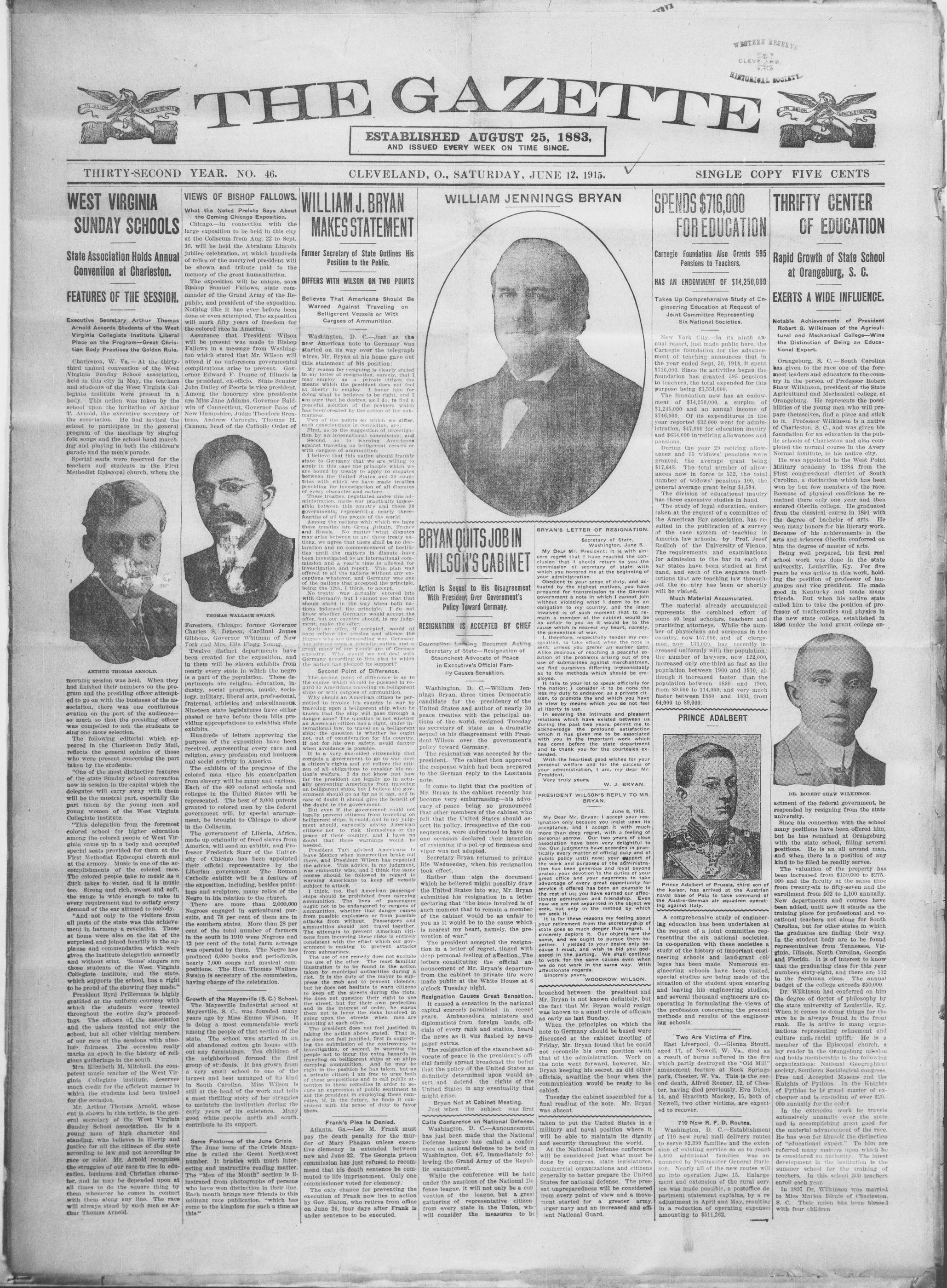
Page text (machine-generated)
THIRTY-SECOND YEAR. NO. 46.
IN UNION
THE RESPECTS GIVEN
WEST VIRGINIA SUNDAY SCHOOLS
State Association Holds Annual Convention at Charleston.
FEATURES OF THE SESSION.
Executive Secretary Arthur Thomas Arnold Accords Students of the West Virginia Collegiate Institute Liberal Place on the Program—Great Christian Body Practices the Golden Rule.
Charleson, W. Va—At the thirty-third annual convention of the West Virginia Sunday School association, held in this city in May, the teachers and students of the West Virginia Collegiate institute were present in a body. This action was taken by the school upon the invitation of Arthur T. Arnold, the executive secretary of the association. He had invited the school to participate in the general program of the meetings by singing folk songs and the school band marching and playing in both the children's parade and the men's parade.
Special seats were reserved for the teachers and students in the First Methodist Episcopal church, where the
ARTHUR THOMAS ARNOLD.
morning session was held. When they had finished their numbers on the program and the presiding officer attempted to go on with the business of the association, there was one continuous ovation on the part of the audience—so much so that the presiding officer was compelled to ask the students to sing one more selection.
The following editorial which appeared in the Charleston Daily Mail, reflects the general opinion of those who were present concerning the part taken by the students: "One of the most distinctive features of the state Sunday school convention now in session in the capital which the delegates will carry away with them will be the musical part, especially the part taken by the young men and young women of the West Virginia Collegiate Institute.
"This delegation from the foremost colored school for higher education among the colored people of West Virginia came up in a body and occupied special seats provided for them at the First Methodist Episcopal church and at the armory. Music is one of the accomplishments of the colored race. The colored people take to music as a duck takes to water, and it is music too. Strong and rich, sweet and soft, the range is wide enough to take in every requirement and to satisfy every demand of the ear attuned to melody.
"And not only to the visitors from all parts of the state was this achievement in harmony a revelation. Those at home were also on the list of the surprised and joined heartily in the applause and commendation which were given the institute delegation earnestly and without stint. 'Some' singers are those students of the West Virginia Collegiate institute, and the state, which supports the school, has a right to be proud of the showing they made."
President Byrd Prillerman is highly gratified at the uniform courtesy with which the students were treated throughout the entire day's proceedings. The officers of the association and the ushers treated not only the school, but all other visiting members of our race at the sessions with absolute fairness. The occasion really marks an epoch in the history of religious gatherings in the south.
Mrs. Elizabeth M. Mitchell, the competent music teacher of the West Virginia College institute, deserves much credit for the efficient manner in which the students had been trained for the occasion.
Mr. Arthur Thomas Arnold, whose cut is shown in this article, is the general secretary of the West Virginia Sunday School association. He is a young man of high character and standing, who believes in liberty and justice for all the citizens of the state according to law and not according to race or color. Mr. Arnold recognizes the struggles of our race to rise in education, business and Christian character, and he may be depended upon at all times to do the square thing by them whenever he comes in contact with them along any line. The race will always stand by such men as Arthur Thomas Arnold.
THE GAZETTE
VIEWS OF BISHOP FALLOWS.
What the Noted Prelate Says About
the Coming Chicago Exposition.
Chicago.—In connection with the large exposition to be held in this city at the Coliseum from Aug. 22 to Sept. 16, will be held the Abraham Lincoln jubilee celebration, at which hundreds of relics of the martyred president will be shown and tribute paid to the memory of the great humanitarian.
The exposition will be unique, says Bishop Samuel Fallow, state commander of the Grand Army of the Republic, and president of the exposition. Nothing like it has ever before been done or even attempted. The exposition will mark fifty years of freedom for the colored race in America.
Assurance that President Wilson will be present was made to Bishop Fallow in a message from Washington which stated that Mr. Wilson will attend if no unforeseen governmental complications arise to prevent. Governor Edward F. Dunne of Illinois is the president, ex-officio. State Senator John Dalley of Pooria is vice president. Among the honorary vice presidents are Miss Jane Addams, Governor Baldwin of Connecticut, Governor Bass of New Hampshire, Judge Theodore Brentano, Andrew Carnegie, Thomas H. Cannon, head of the Catholic Order of
TROMAS WALLACE SWANN.
Foresters, Chicago; former Governor Charles S. Deneen, Cardinal James Gibbons, Governor Whitman of New York and Mrs. Ella Flagg Young.
Twelve distinct departments have been created for the exposition, and in them will be shown exhibits from nearly every state in which the negro is a part of the population. These departments are religion, education, industry, social progress, music, sociology, military, liberal arts, professional, fraternal, athletics and miscellaneous. Nineteen state legislatures have either passed or have before them bills providing appropriations to establish state exhibits.
Hundreds of letters approving the purpose of the exposition have been received, representing every race and religion, every profession and business and social activity in America.
The exhibits of the progress of the colored man since his emancipation from slavery will be many and various. Each of the 400 colored schools and colleges in the United States will be represented. The best of 3,000 patents granted to the colored men by the federal government will, by special arrangement, be brought to Chicago to show in the Collisseum.
The government of Liberia, Africa, made up originally of freed slaves from America, will send an exhibit, and Professor Frederick Starr of the University of Chicago has been appointed their official representative by the Liberian government. The Roman Catholic exhibit will be a feature of the exposition, including besides paintings and sculpture, many relics of the Negro in his relation to the church.
There are more than 2,000,000 Negroes engaged in agricultural pursuits, and 78 per cent of them are in the southern states. More than 28 per cent of the total number of farmers in the south in 1910 were Negroes and 12 per cent of the total farm acreage was operated by them. The Negro has produced 6,000 books and periodicals, nearly 7,000 songs and musical compositions. The Hon. Thomas Wallace Swann is secretary of the commission, having charge of the celebration.
Growth of the Mayesville (S. C.) School. The Mayesville Industrial school at Mayesville, S. C., was founded many years ago by Miss Emma Wilson. It is doing a most commendable work among the people of that section of the state. The school was started in an old abandoned cotton gin house without any furnishings. Ten children of the neighborhood formed the first group of students. It has grown from a very small school to one of the largest and best managed of its kind in South Carolina. Miss Wilson is still at the head of the work and tells a most thrilling story of her struggles to maintain the institution during the early years of its existence. Many good white people north and south contribute to its support.
Some Features of the June Crisis.
The June issue of the Crisis Magazine is called the Great Northwest number. It bristles with much interesting and instructive matter. The "Men of the Month" section is illustrated from photographs of persons who have won distinction in their line. Each month brings new friends to this militant race publication, "which has come to the kingdom for such a time as this."
ESTABLISHED AUGUST 25, 1883 AND ISSUED EVERY WEEK ON TIME SINCE.
CLEVELAND, O., SATURDAY, JUNE 12, 1915.
WILLIAM J. BRYAN MAKES STATEMENT
Former Secretary of State Outlines His Position to the Public.
Believes That Americans Should Be Warned Against Traveling on Belligerent Vessels or With Cargoes of Ammunition.
Washington, D. C.—Just as the new American note to Germany was started on its way over the telegraph wires, Mr. Bryan at his home gave out this statement of his position:
My reason for resigning is clearly stated to my letter of resignation, namely, that I must employ as a teacher means which the president does not feel at liberty to employ. I honor him for doing what he believes to be right, and I am sure that he desires, as I do, to find a peaceful solution of the problem which has been created by the action of the sub-
Two of the points on which we differ, each consensuities in conviction, are
First, as to the suggestion of investigation by an international commission; and second, as to warning Americans against traveling to war vessels or with cargoes of ammunition.
I believe that this nation should frankly state to Germany that we are willing to apply in this case the principle which we have established between the United States and 30 countries with which we have made treaties providing for investigation of all disputes of every character and nature. Under this administration, made war practically impossible between this country and these 30 governments, representing nearly three-fourths of all the people of the world, we have these treaties are Great Britain, France and Russia. No matter what disputes may arise between us and these treaty nations, we agree that there shall be no decisions until the matters in dispute have been investigated by an international commission and a year's time is allowed for investigation and report. This plan was made in 1915, and we have ceptions whatever, and Germany was one of the nations that accepted the principle, being the 12th, I think to accept.
No treaty was actually entered into when the treaties were made, that should stand in the way when both nations indented the principle. I do not know whether Germany would accept the offer, but our country should, in my judgment, make the offer, and I accepted, would at once release the tension and silence the jumps who are demanding war. Germany just goes home a friendly nation and a justice. Why should we not deal with Germany according to this plan to which the nation has pledged its support?
Second Point of Difference.
The second point of difference is as to the course which should be pursued in regard to Americans travelling on belligerent ships. Why should we not deal with Germany according to this plan to which the nation has pledged its support?
The use of one remedy does not exclude the use of the other. The most familiar remedy taken by municipal authorities during a riot. It is the duty of the mayor to suppress the mob and to prevent violence, but he does not hesitate to warn citizens of the dangers of going upon the streets when men are shooting at each other. The president does not feel justified in the interest of order, he warms up the people and is stated. That is he does not feel justified, first in suggesting the submission of the controversy to investigation, or second, in warning the people not to incur the extra hazards in the streets. He may be carrying ammunition. And he may be right in the position he has taken, but as a private citizen I am free to urge both the police and the authorities to these remedies in order to secure an expression of public sentiment to aid the president in employing these remedies, if, in the future, he finds it convenient with his sense of duty to favor them.
Frank's Plea Is Denied
Atlanta, Ga.—Leo M. Frank must pay the death penalty for the murder of Mary Phagan unless executive clemency is extended between now and June 22. The Georgia prison commission has just refused to recommend that his death sentence be commuted to life imprisonment. Only one commissioner voted for clemency. The only chance for preventing the execution of Frank now lies in action by Gov. Slaton, who retires from office on June 26, four days after Frank is under sentence to be executed.
WILLIAM JENNINGS BRYAN
[Portrait of a man in formal attire, with a bow tie and a suit, set against an oval frame].
---
BRYAN QUITS JOB IN WILSON'S CABINET
Counselor Leading Becomes Acting Secretary of State—Resignation of Staunchest Advocate of Peace in Executive's Official Family Causes Sensation.
Washington, D. C.—William Jennings Bryan, three times Democratic candidate for the presidency of the United States and author of nearly 30 peace treaties with the principal nations of the world, resigned Tuesday as secretary of state as a dramatic sequel to his disagreement with President Wilson over the government's policy toward Germany.
The resignation was accepted by the president. The cabinet then approved the response which had been prepared to the German reply to the Lusitania note.
It came to light that the position of Mr. Bryan in the cabinet recently has become very embarrassing—his advocacy of peace being so pronounced that other members of the cabinet who felt that the United States should assert its policy, irrespective of the consequences, were understood to have on one occasion declared their intention of resigning if a policy of firmness and vigor was not adopted.
Secretary Bryan returned to private life Wednesday, when his resignation took effect.
Rather than sign the document which he believed might possibly draw the United States into war, Mr. Bryan submitted his resignation in a letter declaring that "the issue involved is of such moment that to remain a member of the cabinet would be as unfair to you as it would be to the cause which is nearest my heart, namely, the prevention of war." The president accepted the resignation in a letter of regret, tinged with deep personal feeling of affection. The letters constituting the official announcement of Mr. Bryan's departure from the cabinet to private life were made public at the White House at 6 o'clock Tuesday night.
Resignation Causes Great Sensation.
It caused a sensation in the national capital scarcely paralleled in recent years. Ambassadors, ministers and diplomats from foreign lands, officials of every rank and station, heard the news as it was flashed by newspaper extras.
The resignation of the staunchest advocate of peace in the president's official family spread broadcast the belief that the policy of the United States as definitely determined upon would assert and defend the rights of the United States in any eventuality that might arise.
Bryan Not at Cabinet Meeting.
Just when the subject was first
Calls Conference on National Defense.
Calls Conference on National Defense. Washington, D. C.—Announcement has just been made that the National Defense league has called a conference on national defense to be held in Washington, Oct. 4-7, immediately following the Grand Army of the Republic encampment. While the conference will be held under the auspices of the National Defense league, it will not only be a convention of the league, but a great gathering of representative citizen from every state in the Union, who will consider the measures to be
My Dear Mr. President: It is with sincere regret that I have reached the conclusion that I should return to you the commission of secretary of state with which you honored me at the beginning of your administration. Obedient to your sense of duty, and actuated by the highest motives, you have prepared for transmission to the German government a note in which I cannot join you in administering to my country, and the issue involved is of such moment that to remain a member of the cabinet would be as unfair to you as it would be to the administration of my heart, namely, the prevention of war.
I, therefore, respectfully tender my resignation, to take effect when the note is read. My profound admiration for Alike desirous of reaching a peaceful solution of the problems arising out of the use of submarines against merchantmen, we find ourselves differing irreconcilably as to the methods which should be employed.
It falls to your lot to speak officially for the nation; I consider it to be none the less my duty to endeavor, as a private citizen, to the end which you have in view by means which you do not feel at liberty to use.
In severing the intimate and pleasant relations which have existed between us during the past two years, permit me to thank you for your kindness, which it has given me to be associated with you in the important work which has come before the state department and which I thank you for the courtesies extended.
With the heartiest good wishes for your personal welfare and for the success of your administration, I am, my dear Mr. President.
Very truly yours.
W. J. BRYAN.
PRESIDENT WILSON'S REPLY TO MR. BRYAN.
June 8, 1915.
My dear Mr. Bryan: I accept your resignation only because you insist upon its acceptance, and I accept it with much more than deep regret, with a feeling of personal satisfaction have been very delightful to me. Our judgments have accorded in me practically every matter of official duty and of public policy until now; your support of the work and purpose of the administration has been generous and loyal beyond praise; your devotion to the duties of your great office and your eagerness to take part in the service it offered has been an example to the rest of us; you have earned our affectionate admiration and friendship. Even now we are not separated in the object we seek it. It is for these reasons my feeling about your retirement from the secretaryship of state goes so much deeper than regret for the fact that we do not work for the same causes even when we do not work in the same way. With affectionate regards.
Sincerely yours,
WOODROW WILSON.
broached between the president and Mr. Bryan is not known definitely, but the fact that Mr. Bryan would resign was known to a small circle of officials as early as last Sunday.
When the principles on which the note to Germany should be based were discussed at the cabinet meeting of Friday, Mr. Bryan found that he could not reconcile his own position with that of the administration. Work on the note went forward, however, Mr. Bryan keeping his secret, as did other officials, awaiting the hour when the communication would be ready to be cabled.
Tuesday the cabinet assembled for a final reading of the note. Mr. Bryan was absent.
taken to put the United States in a military and naval position where it will be able to maintain its dignity and security throughout the world.
At the National Defense conference will be considered just what must be done by congress, state legislatures, commercial organizations and citizens generally to better prepare the United States for national defense. The present unpreparedness will be considered from every point of view and a movement started for a greater army, urge army and an increased and efficient National Guard.
WESTERN RESERVE
CLEVELAND
HISTORICAL SOCIETY
TE
SINGLE COPY FI
SINGLE COPY FIVE CENTS
SPENDS $716,000 FOR EDUCATION
Carnegie Foundation Also Grants 595
Pensions to Teachers.
HAS AN ENDOWMENT OF $14,250,000
Takes Up Comprehensive Study of Engineering Education at Request of Joint Committee Representing Six National Societies.
New York City.—In its ninth annual report, just made public here, the Carnegie foundation for the advancement of teaching announces that in the year ended Sept. 30, 1914, it spent $716,000. Since its activities began the foundation has granted 595 pensions to teachers, the total expended for this purpose being $2,551,000.
The foundation now has an endowment of $14,250,000, a surplus of $1,245,000 and an annual income of $746,000. Of its expenditures in the year reported $82,000 went for administration, $47,000 for education inquiry and $634,000 in retiring allowances and pensions.
During the year 29 retiring allowances and 15 widows' pensions were granted, the average grant being $17,648. The total number of allowances now in force is 332, the total number of widows' pensions 100, the general average grant being $1,594.
The division of educational inquiry has three extensive studies in hand.
The study of legal education, undertaken at the request of a committee of the American Bar association, has resulted in the publication of a survey of the case system of teaching in America law schools, by Prof. Josef Redlich of the University of Vienna. The requirements and examinations for admission to the bar in each of our states have been studied at first band, and each of the separate institutions that are teaching law throughout the country has been or shortly will be visited.
Much Material Accumulated.
The material already accumulated represents the combined effort of some 40 legal scholars, teachers and practicing attorneys. While the number of physicians and surgeons in the country, now 157,000, and of clergymen, now 133,000, has recently increased uniformly with the population; the number of lawyers, now 122,000, increased only one-third as fast as the population between 1900 and 1910, although it increased faster than the population between 1890 and 1900, from 9,000 to 114,000, and very much faster between 1880 and 1891, from 64,000 to 98,000.
PRINCE ADALBERT
Prince Adalbert of Prussia, third son of the kaiser, has arrived at the Austrian naval base of Pola to take command of the Austro-German air squadron operating against Italy.
A comprehensive study of engineering education has been undertaken at the request of a joint committee representing the six national societies. In co-operation with these societies a study of the history of important engineering schools and land-grant colleges has been made. Numerous engineering schools have been visited, special studies are being made of the situation of the student upon entering and leaving his engineering studies, and several thousand engineers are cooperating in formulating the views of the profession concerning the present methods and results of the engineering schools.
Two Are Victims of Fire
East Liverpool, O.-Glenna Stoutt, aged 17, of Newell, W. Va., died as a result of burns suffered in the fire which partly destroyed the "Old Mill" amusement feature at Rock Springs park, Chester, W. Va. This is the second death, Alfred Reener, 12, of Chester, having died previously. Eva Dales, 14, and Hyacinth Mackey, 15, both of Newell, two other victims, are expected to recover.
710 New B. E. D. Routes
Washington, D. C.—Establishment of 719 new rural mail delivery routes to serve 8,239 families and the extension of existing service so as to reach 5,400 additional families was announced by Postmaster General Burleson. Nearly all of the new routes will go into operation June 15. Enlargement and extension of the rural service was made possible, a postoffice department statement explains, by a re-adjustment in April and May, resulting in a reduction of operating expenses amounting to $511,262.
IN UNION
THERE IS TRUSTEUR
THRIFTY CENTER OF EDUCATION
Notable Achievements of President Robert S. Wilkinson of the Agricultural and Mechanical College—Wins the Distinction of Being an Educational Expert.
Orangeburg, S. C. — South Carolina has given to the race one of the foremost leaders and educators in the country in the person of Professor Robert Shaw Wilkinson, president of the State Agricultural and Mechanical college, at Orangeburg. He represents the possibilities of the young men who will prepare themselves, find a place and stick to it. Professor Wilkinson is a native of Charleston, S. C., and was given his foundation for an education in the public schools of Charleston and also completed the normal course in the Avery Normal institute, in his native city.
He was appointed to the West Point Military academy in 1884 from the First congressional district of South Carolina, a distinction which has been won by but few members of the race. Because of physical conditions he remained there only one year and then entered Oberlin college. He graduated from the classical course in 1891 with the degree of bachelor of arts. He won many honors for his literary work. Because of his achievements in the arts and sciences Oberlin conferred on him the degree of master of arts.
Being well prepared, his first real school work was done in the state university, Louisville, Ky. For five years he was active in this work, holding the position of professor of languages and vice president. He made good in Kentucky and made many friends. But when his native state called him to take the position of professor of mathematics and physics in the new state college, established in 1896 under the land grant college en-
DR. ROBERT SHAW WILKINSON. actment of the federal government, he responded by resigning from the state university.
Since his connection with the school many positions have been offered him, but he has remained at Orangeburg with the state school, filling several positions. He is an all around man, and when there is a position of any kind to be filled he readily serves.
The valuation of the property has been increased from $150,000 to $275,000 and the faculty at the same time from twenty-six to fifty-seven and the enrollment from 502 to 1,100 annually. New departments and courses have been added, until now it stands as the training place for professional and vocational teachers not alone for South Carolina, but for other states in which the graduates are finding their way. In the student body are to be found representatives from Tennessee, Virginia, Illinois, North Carolina, Georgia and Florida. It is of interest to know that the graduating class for this year numbers sixty-eight, and there are 112 in the freshman class. The annual budget of the college exceeds $50,000.
Dr. Wilkinson had conferred on him the degree of doctor of philosophy by the state university of Louisville, Ky. When it comes to doing things for the race he is always found in the front rank. He is active in many organizations representing refinement and culture and racial uplift. He is a member of the Episcopal church, a lay reader in the Orangeburg mission and holds membership in the following organizations: National Geographical society, Southern Sociological congress, Free and Accepted Masons and the Knights of Pythias. In the Knights of Pythias he is grand master of exchequer and is custodian of over $20,000 annually for the order.
In the extension work he travels extensively annually over the state and is accomplishing great good for the material advancement of the race. He has won for himself the distinction of "educational expert." To him are referred many matters upon which he is considered an authority. The latest development in the institution is the summer school for the training of teachers. In this school 300 teachers enroll each year.
In 1857 Dr. Wilkinson was married to Miss Marion Birule of Charleston, S. C. Their union has been blessed with four children
One Year.....$1.50.
Six Months.....1.00
Three Months.....50
Subscribers are requested to re-
mit by postoffice money er-
der or registered letter
Entered at the postoffice in Cleveland
Ohio, as second-class matter.
Address all communications to
HARRY C. SMITH
Editor and proprietor,
THE GAZETTE,
Blackstone Building, Cleveland, O.
Member Ohio Legislature: 1894
to 1896; 1896 to 1898; 1900 to 1902
THE GAZETTE is the oldest, and has the largest bona fide circulation double that of any newspaper in the interest of Afro-Americans, published in the state of Ohio, and comparison with any will immediately establish its rank as one of the NEWSIEST AND BEST in the country.
10,000,000 Afro-Americans.
160,000 in Ohio.
20,000 in Cleveland.
Cleveland
Stock Star
Surely we are entitled to war pros
perity after having paid a "war tax."
In this country we must return to
the policy of having the government
boost business instead of bust busi
ness.
---
We do not believe the Georgia Pardon board and governor will commute Leo M. Frank's sentence to life imprisonment.
The Gazette is proud of the success in life made by President R. S. Wilkinson, a member of the staff many years ago. Congratulations, Prof. Wilkinson.
The fact that over sixty-two per cent of our imports came in tree of duty in the month of January throws some light on the reason why the revenues of the government are decreasing.
The will of the late Bishop H. M. Turner, of the A. M. E. Church, disposes of property amounting to $7,000. It is said that he gave $50,000 to his family and to educational institutions just prior to his death. Who can verify this? There are many who would like to know.
---
The governor of Arkansas has closed the Branch Normal College for our people of that state because its white superintendent insulted an Afro-American lady teacher. Queer punishment of our people of Arkansas for something they have not done. This is, however, the kind of "justice" they receive, as a rule, in the south where members of the two races are so concerned.
---
The Democrats enacted a tariff for revenue. Instead of using the facts gathered by Taft's tariff commission they guessed at the needed rates and guessed wrong. When a treasury deficit came in sight they levied a "war" tax, guessed it would produce enough money and guessed wrong. For the fiscal year which ends with this month the treasury shortage will be near $100,000,000. Will they add another tax on business or go in debt by borrowing on bonds?
In making choice, between candidates for governor and for the legislature, the voter is influenced by the principles of government for which the candidates stand. The principles for which they stand are declared in the party platform. Governor Willis and the Republican majority in the general assembly, just adjourned, have met the requirements of the platform; therefore, they deserve the confidence placed in them by the electorate.
---
Dr. John O. Hopkins, our only member of the Wilmington, Del., city council, introduced recently and secured the passage of an ordinance which prohibits the exhibition of motion pictures like "The Birth of a Nation." It pays to have a representative of the race in legislative bodies, municipal, state and national. Our people everywhere should remember this and govern themselves accordingly. We sincerely trust that Representative Jackson of Illinois is as successful in the state state with his bill as he was in the house. Massachusetts, at last, has an effective motion-picture censor law.
THE "NEUTRAL MAN"!
What the writer doubtless conceived to be a very clever bit of newspaper writing, but what in reality was (in part) a very small and characteristic piece of business, was the "Cleveland, O.," letter in the "Chicago Defender" of last week. As a matter of fact, the letter was not written in this city at all. That doubtless accounts for the two glaring misstatements it contains. The first is, the announcement that the editor of this paper "hns filed an application with Gov. Willis for a fat job." The second is, that "there is a very bitter rivalry" existing between the writer and one Tom Fleming, of this city. This latter is so ridiculous that we do not believe there is a person of any class in the city of Cleveland who would be guilty of publicly making such an announcement. Any objections we have raised or may be based upon the same facts which form the foundation of the objections of many other persons in this community
and elsewhere in the state. We publish the foregoing for the especial benefit of the would-be "neutral man" who wrote the alleged "Cleveland" letter.
GOVERNOR WILLIES MAKES A
PRECEDENT.
Not a little comment throughout the state has been caused by the action of Governor Willis a few days ago, in which he gave a pardon to one old soldier and caused several others, confined in the Ohio penitentiary, to be paroled to the Soldiers and Sailors' Home at Sandusky. All were old men and this act of executive clemency leaves no Civil war veterans in the big prison. Governor Willis' act was inspired by a feeling of tender sympathy for the veterans and a belief that the penitentiary is not a proper place for old men like them, whatever may have been the occasion that caused them to be sent there. The Governor's feeling for the old soldiers is no new nor sudden inspiration, as is very well known. His venerable father is a veteran of the great struggle and because of this Governor Willis long has cherished a peculiar affection for his father's comrades. When in Congress, Governor Willis availed himself of every opportunity, in season and out of season to be of service to the old soldiers. The latest act of Governor Willis does credit to his big, generous, sympathetic and tender heart. Although the state had placed the mark of the criminal upon these unfortunate old men who is there to find fault and to criticise? Not one—Piqua, (O.) Call.
THE FRANK CASE
By a vote of 2 to 1, the Georgia prison commission, on Thursday of this week, refused to recommend commutation of the death sentence of Leo M. Frank. The majority report of the commission held neither the grand jurors, trial jury, nor the prosecutors had asked for commutation; that all the courts, state and federal, which reviewed the case, had upheld the verdict; that no new evidence or facts bearing upon the prisoner’s guilt on innocence had been shown and that they saw no reason to interfere. The decision was no surprise to us; nor do we believe that the chief executive of Georgia, Gov. John M. Slaton, who has the power to do so, will commute the sentence, although he has indicated a willingness to hear the arguments favoring commutation. It is not at all likely that he will practically reverse the decision of the U. S. Supreme court, Georgia courts and the Georgia prison commission. He retires from office on the 26th of this month. His successor, Judge Nat. M. Harris of Macon, has already indicated, indirectly it is true, his disinclination to interfere with the verdict of the Georgia courts. This will place the last hope of Frank’s friends in the hands of the chief executive of the United States—Pres. Woodrow Wilson.
STATE APPROVAL.
Teacher's Certificates Without Examination.
The Combined Normal and Industrial Department of Wilberforce University has been examined by the State Supervisor of Normal Schools and placed on the list for the training of teachers for elementary schools and special work, such as Domestic Science, Manual Training, etc.
This recognition by the State Department of Public Instruction means much to the graduates of Wilberforce University and giving themselves to teach, as graduates from this department are entitled to a teachers' four-year provisional certificate without examination. After twenty-four months of successful teaching the holder is entitled to a life certificate of the same grade, good anywhere in the state, and recognized in thirty-four other states.
Students who graduated prior to 1915 and who had completed a four year high school course before beginning the two-year normal course of this department will, likewise, benefit by this arrangement and many such will find that by slight additions to their professional work they may become entitled to the provisional certification. With the added facilities of gymnastium and well equipped recitation halls and shops Wilberforce now of fers splendid opportunities to prospective teachers.
PRAISE FOR "THE OLD RELIABLE."
Wilmington, O., May 27, 1915.
Mr. Smith, Dear Sir;— I have faith in you and know that you will do all that is in your power for the race, and that this you have done for many years. You have fought one of the greatest battles that ever was fought in this state for our people of Ohio and for the race in general. God be with you, Mara! We have with you old reliable" Gazette. I would to God that all of our people would read it, for it is an inspiration.
Yours for the race,
Peter McDonelth.
PERSONALS.
J. M. Smyles left Tuesday, for Kansas City, Mo, to locate. St. John's S. S. Boethian class, of which he has been president for the past year, gave him a very pleasant farewell reception.
Elmer R. Timbers of Blaine Ave., who was ill for two weeks with inflammation of the right car, a week later had his son C. C. Cainin in elevator shaft at the C. A. C. building, where he was operating a car.
Mr. Leroy Redmon Jackson, an old soldier, and pioneer citizen of this city, who died, last Saturday afternoon, at his residence, 2199 E. 38th St. after a lingering illness with Bright's disease, leaves a wife, Mrs. Edith Jackson; son, Leroy M. Jackson; brother, Wm. R. Jackson, and other relatives to mourn his loss.
The Pleasant Company club held a very interesting session at Mrs. J. R. Person's, E. 43rd St. Thursday afternoon.
The remains of Mrs. Emily Berry,
2607 Central Ave., were taken to Fairfield,
for interment. Mrs. Libbile Talafero,
Mrs. Mar. Martinez, Neal, Mrs.
Bernard, Mrs. W. W. Bomarcuan, and
Mr. Albert Berry are the children left to mourn her demise.
THE GAZETTE, CLEVELAND, O. SATURDAY, JUNE 12, 1915.
FRESH OHIO NEWS
WRITTEN BY "THE OLD RELIA
BLE" GAZETTE'S CORRE-
SPONDENTS
THROUGHOUT THE STATE
What Our People Are Doing Each Week—Church, Personal, Social, Lodge, Literary and Musical—Marriages, Deaths, Etc.
FINDLAY.—Rev. W. Viney of Tiffin, preached morning and evening, Sunday, at Zion Baptist church, and Rev. L. H. Dodd will preach, Monday evening.—Give your local news for this letter, and order for The Gazette to Maud or Ralph Harper. Always do the former before Monday of each week, only way to get the news of our people in all parts of the country, is to take and read The Gazette every week.
LEBANON.—Mr. Sterling Evans' many friends are glad to know his operation was successful and that he is improving.—Mr. Tom Seniors has been confined to his home for several weeks, suffering from rheumatism.—The Misses Murphy entertained quite a number from Dayton, Sunday.—Miss Jessie Johnson entertained Mr. Dillard Bodine, at dinner, Sunday.—Mrs. M. Evans and Miss Blanche Singleton were entertained Sunday afternoon.—A number of young people are contemplating a trip to Wilberforce, June 16, to attend the commencement exercises.—"Mother", Tilton is sick. Mrs. Laura Hopson and Mrs. Maggie Chase spent Decoration day with home-folk.
CORRESPONDENTS must mail all letters for publication at their main postoffice sufficiently early on Monday (or Sunday) of each week to have them reach The Gazette office on Tuesday morning, and always write also, their names and that of their city or town on the outside of the building. If the letter less this latter is done, proper credit cannot be given you. Lists of names, wedding presents, etc., obituary notices, speeches, resolutions, poetry, inquiries for relatives and advertisements of all kinds, including items announcing entertainments to be held in the near future, must be paid for in advance at the rate of ten cents a letter for display advertisements will be sent on application. Send postal note and not stamps during warm weather.
OBERLIN—Mrs. Cynthia Cooper and son, Merie, spent Sunday and Monday in Sandusky, visiting relatives. Mrs. M. Janey also spent Decoration day there.—Mr. William Mitchell purchased the house of Herbert Leasonhop on E. Lorain St., Saturday.—Guy W. Hale, Mr. and Mrs. Ed C. Berry returned to Athens, Sunday. They attended the funeral of their mother, M. Berry Hale, last Thursday. Fred R. Roche, sixth grade, Prospect St. school, won first prize for the school in the recent Indian drawing contest. The drawings will be sent to the Longtonglow house. The Y. W. Elite club observed Woman's day at Rust M. E. church, Sunday. An excellent address was made by President H. C. King, Mrs. Sadie Johnson, Mrs. Isabella teaching in Raleigh, N. C.—Much practice for Children's day program at Mt. Zion church.
SANDUSKY. —Mr. James Davis, Mr. and Mrs. O. B. Sackhieldorf are ill—Rev. J. D. Singleton, pastor, and members of the A. M. E. church, attended the June rally at the Second Baptist church, Sunday. He preached an inspiring sermon. Collection. $156 Rev. Geo. D. Smith thanked all for the sermon, and feels sure, that the members who were not present, will make up a greater part of the $44 balance in two weeks—Mr. Nelson Bollinger, Mr. Levi Lacy, Mr. W. Mott and Mr. H. Willson were in Detroit, Sunday. —Mrs. J. D. Singleton is visiting in Delaware. —Mrs. Minerva Washington has visited the school. Mr. Samuel Scott is building a new house for himself on Franklin St. —Mr. James Davis has painted his house on Fulton St. —Things are moving on nicely among our people of this city. —Rev. G. D. Smith, local representative of "the old reliable" Gazette, urges our people, here and everywhere, to take it because it is worth the money. We will give our lives of Sandusky, and the readers will also get the Ohio news and that of other states, in The Gazette. Give him your order for the paper and get a copy, every week.
AKRON.—Mr. Aka Haines will leave for Detroit, where he has accepted a position in a department store.—Miss Helen Taylor of Wadsworth, who graduated in a class of 30, was the happy recipient of fifty presents.—The Golden Eagle club met at Mrs. Ida Brown's Wednesday evening. Business of importance was transacted and refreshments were served by hostess. The convention was very successful fully given at Wadsworth, under the auspices of Mr. Wm. Archer's club.—The Hobnob baseball team won the game with the Wadsworth league team. Score 3 to 0.—"Our Minister's Birthday" was one of the best high-class plays ever produced here. Miss Iva Haines played the leading role and Mr. Joe Riley was the leading man. He participated in the presentation. John Haines, Haines, Miss M. Broady, Mrs. Julius Johnson and others. It will be reproduced at the Neighborhood house at an early date.—Mr. Frank Hailstock gave an interesting program at Zion club, May 20, in honor of the old soldiers. Mr. Hailstock, Mr. Morrison, Dr. S. J. Johnson, all old soldiers, were on the program. Iva Haines sang a solo. "The Star Sangled Banner."—Miss Cora B. Annis of Cleveland, addressed the young people of the Second Baptist Church, most capacity—Tuesday, June 2. Miss Elia Hooper of Lancaster, was happily married to Mr. Joe Chasson of this city.—The K. P. annual services were held at the U. B. church. Rev. R. A. Jones delivered the address, and special music was rendered. J. J. Jackson, director.
SMITHFIELD.--Mr. Wm. Hargrave and little daughter of Cleveland, and Dr. Chas. Hargrave of Pittsburgh, visi
ited their mother, last week. The latter is convalescing—Miss Minnie Beall left, Saturday, for Chicago, for an indefinite stay. Rev. R. B. Lowe was out of town, Monday. Mr. and Mrs. Fred Christian and family of Hopedale, came here Sunday in their car, en route to Mt. Pleasant. Mrs. Ed. West left, Sunday, to visit in Steubenville—Many from Mt. Pleasant attended the concert here, Saturday evening. Misses Ira Toney, Sandi and others of McIntyre, attended church at Steubenville. Mrs. Nannie Johnson of Wheeling, visited her mother here, last week. Quite a number from here attended commencement at Cadiz, last Thursday.—Mr. Earl Washington of Steubenville, was here recently.—Mr. and Mrs. W. Jordan of Wintersville, was the guest of Mr. and C. W. Parks, Saturday and Sunday.—Mr. and Mrs. Orris Munts of Flushing, spent the week-end here, guests of relatives and friends. The former left, Saturday, D. D. Lewis in Chicago. And Mrs. D. D. Lewis in family, left Friday for Barnesville. Alexander of Mingo, visited her aunt Mrs. Bessie Thompson, last week. The concert given at the Opera House Saturday evening, by the Lucas sisters and Mr. Brigham of Martins Ferry, was quite a success. Women's day was fittingly observed at St. Paul's A. M. E. church, Sunday, Mrs. Linnie G. of Steubenville, being the princial pal speaker. The entire program was very good. The attendance was good
YOUNGSTOWN. — Mrs. Estella Stewart Simpson left, Monday, for a three months' trip in the west for her health, and will visit the Panama-Pacific exposition on her return. — Mrs. Robert Mackey remains the same. The funeral of the late David Holland, who died, Wednesday, was held, Friday, from the chapel. Interment in Tod's cemetery. He leaves a daughter, James, and a sister, James, Addison and Jesse of this city, a sister, Mrs. Lizzie Botts of Yellow Springs, and a host of relatives and friends. Dr. J. M. Gilmore officiated.
—Mr. John Lewis is able to be out after a four weeks' illness.—Louis Edwards court (of Calanthe) will meet, Wednesday evening.—The funeral of the late Mrs. Jennie Jeffries, who died, Monday, was held from the Third Baptist church, Thursday. She leaves a husband, son, sister and brother in Danville, Va., and a host of friends. Mrs. Jeffries was a member of Consuela Stewart court. Mrs. M. Wade of Danville, Va., and Miss L. Smith of Pittsburg, attended the funeral.—Miss Jessie Wells, Miss Martha Harris, Mr. John Harris and Mr. Paul Fletcher visited Mrs. Kate Fletcher and son, Scott, May 30. Mrs. Harry Erwin, who underwent an operation at the hospital, is doing nicely.—The June rally at Oak Hill Ave. A. M. E. church, Sunday and Monday, was a grand success. Nearly $700 was realized.—Rev. W. Bell of Sharon, Pa., preached an able sermon at St. Mary's A. M. E. Zion church Sunday.—A. H. Berry of Leetonia, was in the city, Sunday.—Order The Gazette and get the race news, the country over.
DOINGS
OF
THE
RACE
Sam Langford says he is going to Australia because the "fight" game is no good in this country. Hard on pseudo "champ" Willard.
It is reported that Mrs. Tina Johnson, the mother of Jack Johnson, is about to lose her home at 3344 Wabash Av. Chicago. It is claimed that she went on the bond of James Baglous, a convicted pander, for $2,500, and he failed to appear in court.
Chas. McQueen of Sequin, Tex., a native of Pennsylvania, has just received a patent from the government on a weight-motor house-fan that is run automatically by a clock.
One life prisoner at O. P., Columbus, Griffin Mayo, of Cuyahoga county, who was convicted in Cleveland. of murder in the second degree, about 10 years ago, was granted a parole by board of pardons, last week. He will be released when he obtains employment.
Don't ride every excursion that runs this summer, and if you do please don't ride that if you do alms when reach begins. bible ice cream and soda water now will mean more meal and meat this winter. Take your choice.—Charlotte (N. C.) Star of Zion.
"Negro Day" at the California Panama-Pacific exposition should be frowned upon by every colored man and woman in the states. We want no such race distinction in ours. Were we going to attend the anti-Negro exposition at all we certainly would not do so on "Negro Day." National Baptist Union-Review. It is said that Joseph Ray acts as traveling secretary to Chas. M. Schwab, the steel magnate, and receives a salary of $10,000 a year. Miss Florence Anderson has been appointed State Superintendent of our rural schools in Kentucky. I honor the man who in the conscientious discharge of his duty dares to stand alone the world, with ignorant, tolerant judgment, may contend the contenances of relatives may be covered and heart of friends grow cold, but the sense of duty done shall be sweeter than the applause of the world, the contenances of relatives or the hearts of friends.-Charles Summer.
The Tennessee segregation bill was killed in the state senate and the one in Richmond, Va., died because of a jury disagreement. Good!
Captain Herschler of the U. S. Army Recruiting Station, Cincinnati, was recently confronted with an unusual problem in disposing of Willard C. Wimp, a native of Jersey City, N. J., who had successfully passed an examination for an enlistment and had requested to be assigned to a military affair. He stated that his father was a Frenchman and his mother of Irish descent. Despite this statement there was a doubt in the mind of the officer as well as Sergeant Roth. Captain Herschler finally stated that he could place him in a Negro regiment and Wimp accepted the change. He is slightly over 21 years of age and is a clerk by occupation.
1865 1915
National Half Century Anniversary Exposition and The Lincoln Jubilee
The Most UNIQUE EVENT of Modern Times.
The Tribute of a United People to the SAVIOUR of Their NATION.
CHICAGO DAY
MONDAY, AUG. 23rd, 1915
Opens
August 22nd, 1915
Closes
Sept. 16th, 1915
COLISEUM CHICAGO
Camile L. Nickerson, pianist, and Estelle M. Pinkney, soprano, of Oberlin conservatory, gave a program of splendid merit at Antioch Baptist church, Tuesday evening. Mrs. Florence B. Washington, organist, and Mr. Archie Allen, reader, assisted in a creditable manner.
In a letter from Springfield, Mo., Mr. Floyd J. Williams of Baltimore, Md., formerly a resident of this city, announces the death of his mother, Mrs. Caroline Williams, June 2, 1915. She was a member of the M. E. church, and a devoted mother. She leaves two sons, three daughters and a brother, her demise. Williams writes about her death. He been very ill for seven weeks, just prior to his mother's death. He has the earnest sympathy of a host of friends in this city and Baltimore.
The Pride of Carolina
The State Agricultural and Mechanical College of South Carolina
Orangeburg, S. C.
Next session begins September
29th and ends May 25th,
1916.
No Tuition, no Room Rent, no
Charges for Water, Lights or
Fuel. Entrance Fee $10.00.
Board $10.00 per Month in Advance, Books, Laundry and Personal Expenses Extra.
Every Modern Facility. Standard Equipment. A Faculty of 57 Officers and Instructors.
For Information and Catalogue, Write
R. S. Wilkinson, Pres.
Orangeburg, S. C.
A GOLDEN OPPORTUNITY OPEN TO ALL
We cordially invite Colored people to invest in the most desirable and valuable real estate at RICHLAND, N. J. "The Rapidly Growing City", only 45 minutes' ride from Philadelphia, "The Big Metropolis", and 25 minutes from Atlantic City, the world-famous all year round seaside resort having the largest and finest of Colored people where thousands of Colored people are employed and earning big wages.
Extremely desirable town lots, containing 2500 square feet, $50,00 each and up. Garden Plots, containing 16 City Lots, $125.00 up, and farms, containing five acres and over, $350.00 up. Payable $3.00 monthly until paid for.
No interest and no taxes charged to purchasers.
Richland soil is highly productive. Vegetables ripen early and produce two crops a year. Its fruits are famous, particularly grapes, cherries and peaches, which grow in abundance bring big prices. Highly adaptable for poultry raising and a person understanding same can grow rich, as there is a big demand.
Hundreds of people have taken advantage of this opportunity and we expect a thriving community of Colored people.
We are building modern homes for our purchasers, low-priced, payable in monthly installments like rent.
Become a property owner at RICHLAND and have your say in the affairs of the City.
Clergymen, scholars, and professional people are cordially invited to cooperate with us in establishing religious and educational institutions at RICHLAND.
We are open for a few keen and progressive agents on desirable terms. THE N. T. HEGEMAN COMPANY, Owners, Builders, and Developers.
Main Office—9 Church St., N. Y. City—Phila, office, 430 Spruce St., well established, and reliable firm and will stand the strictest investigation. All our properties are guaranteed.
Kindly address all communications to Main Office.—Adv.
TAYLOR'S NEW SHAMPOO DRYER and Hair Straightening Comb The Best in the World! Price $1.00
TAYLOR'S SPECIAL ALCOHOL HEATER is the easiest and most convenient method of heating the Comb, and can be closed up so that you can put it in your hand. For best results use LaCreole Hair Pomade. It not only meets every requirement of the hair, but also of hair. Price, by mail, 3e. 50, LACREOLE BROWN SKIN FACE POWDER, by mail, 3e. 50. SEND FOR MY FREE CATALOGUE illustrating the Largest and Most Complete Collection of hair products such as Bangs, Wigs, Tape, Switches, Pompadours, Hair Pins, Combs, Brushes, etc.
Agents Wanted. T. W. TAYLOR. 346 Antoine St.
When writing, please mention this paper. MICHIGAN
Opening of Pictorial Review Patterns
10 and 15 Cents—None Higher
So many requests have been received during the past from
the patrons of our store for
Pictorial Review
Patterns
that, after thorough investigation of their merits, we
have decided to sell
Pictorial Review
Patterns
from now on in our
establishment
The New
Empire Dresses,
Guimpe Dresses,
Flare Skirts,
Short Loose Jackets
and Robes Tailleur
for Serge, Gabardine
and Covert Cloth, are
the latest notes in
Spring Fashions
April Patterns
are on sale now,
also, the
Spring
Fashion Book
OF
Pictorial Review Patterns
Costume 6194—15c
Costume 6179—15c
We recommend to all women who are not yet acquainted with the superior merits of
these patterns to try one—JUST ONE. It will convince them that Pictorial Review
Patterns fully deserve the reputation they are enjoying all over the country.
Schlaither
World! Price $1.00
and the use of LaCreole Hair Pomade, will bring the most
at every stroke and cause a rapid growth of the hair.
It holds and treats combs by return mail. It is large.
Made of copper and brass associated together and cast
polished and steel plated; stock plated, which
through the large wood handle and screws into
metal end of Comb to prevent the handle from
getting loose or coming off. Remember it's
all in one piece. Nothing to get out of order.
Will hast a lifetime.
will bring the most
will bring the most of the hair.
It is large, together and east
east bolt which goes
into the corner, away from
the handle from ff.
Remember it's
to get out of order.
Price of Comb
and Alcohol
Heater, complete.
$1.50.
Is the topo-
COHOL HEATER is the handiest and most convenient
and can be closed up so that you can put it in your
sole Hair Pomade. It not only meets every requirement
promotes a luxurious growth of hair. Price, by mail, 30c.
A VASE POWDER, by mail, 50c.
ATALOGUE illustrating the Largest and Most Complete
country for colored people, such as Bangs, Wigs, Puffs,
ins, Combs, Brushes, etc.
T. W. TAYLOR,
346 Antoine St.
DETROIT, MICH.
writing, please mention this paper.
For Young and Old---
SCHLATHER'S
Famous Malt Tonic
and most convenient
can put it in your
every requirement
Price, by mail, 30c.
and Most Complete
Songs, Wigs, Puffs,
346 Antoine St
DETROIT, MICH.
d---
IER'S
Tonic
Take it with your meals. It's absolutely pure----will build up weakened nerve and muscle tissues and strengthen the entire system. Bottled fresh daily. 24 PINT BOTTLES $1.50 Bell West 785 Cuy. Cent. 3933 actorial Review Patterns
Patterns
PURO HERBS consist of the best possible mixture of Nature's health giving Herbs, contains no potash or mercury—baking purely vegetable does not require any secret compound, as it is composed of such well-known herbs as Burdock, Dandelion, Sarsaparilla, Red Clover, Mandrake, Stillingia, Prickly Ash and other herbs—all the very best approved blood purifiers.
PURO HERBS cleans the system of all impurities, restores health and vigor, makes the skin down feeling, due to impurities collecting in the system during the winter months.
PURO HERBS cost but 35c a box, the contents of which, boiled with one quart of water, makes one quart of ordinary water already infused, runs ordinary one dollar bottles in size and better than any patent medicine, regardless of price.
PURO HERBS are also supplied in liquid form, for those who do not care to make it themselves, at 75c a quart. Sold only at
BROWN DRUG CO., 2742 CENTRAL AVE., cor. 28th Street Leading Cut-Rate Druggists
North 1494-J Central 2234-L
I Take Care of Your Feet
Home Treatment if Desired
DR. G. H.
TURNER
Chiropodist
DR. G. H.
TURNER
Corns, Bunions, Callouses and
ingrowing Nails, Painlessly Treated
Open Evenings, Sundays & Holidays
Special Attention Given Visitors
From Out of the City
Hours: 8:30 to 11:30 A. M.
5:30 to 8:30 P. M.
3119 Central Avenue, Cleveland
STERLING
5 and 10 Cent Store
3003 Central Ave.
Watch Our Windows
For Bargains
Colored Salesladies
Arlington Pharmacy
WE WILL ACCEPT THIS ADVERTISEMENT FOR FIVE
CENTS IN TRADE, TO APPLY
ON ANY PURCHASE OF
TWENTY-FIVE CENTS OR
MORE.
E. Rukenstein, Ph. C., Prop.
S. W. Cor. Central Ave. & E.
55th St.
The Fifteenth Annual Session of the
State Summer School
for Colored
TEACHERS OF BOTH SEXES
at the
Agricultural and
Mechanical College
GREENSBORO, N. C.
will begin June 29th, 1814, and continue five weeks
Board and lodging for the entire session $12.00. Tuition 25c per subject unless other arrangements have been made.
Limited accommodations. Send $1 and have room reserved in advance. For further information write e-
to James B. Dudley, President, or D. J. Jordan, Director,
A. & M. College, Greensboro, N. C.
THE OLD DOMINION
Lunch Room
at
3652 Central Ave.,
Serves THE BEST AND
QUICKEST MEALS
at
Popular Prices. Give it a Trial.
Open Day and Night
Mrs. H. C. Jones, Prop.
Your copy of The Gazette after reading it, but give it to a friend or an acquaintance who might subscribe after reading a copy of the paper.
Editor
Where to Purchase The Gazette
Where to Purchase The Gazette
*DR. WEAVER'S,
3315 Central Ave.
*A. GORDON,
2928 Central Ave.
*SAM FERTMAN'S,
3608 Central Ave.
*ELMER F. BOYD'S,
2604 Central Ave.
*S. A. LUCAS,
3943 Central Ave.
*NEWS STORE,
2249 E. 105th St.
cor. Arthur Ave.
NOTICE TO SUBSCRIBERS
The Gazette regularly should notify
their delivered promptly.
Fully examine The Gazette's adver-
sions. Business men who advertise in
image of Afro-Americans. The fact
that they want it.
Artisements) ten cents a line (six
Personal
Subscribers not receiving The Gazette regularly should notify us at once. We desire every copy delivered promptly.
We advise our patrons to carefully examine The Gazette's advertisements before making purchases. Business men who advertise in this paper should have the patronage of Afro-Americans. The fact that they advertise is assurance that they want it.
Local reading notices (advertisements) ten cents a line (six words in a line).
Social and Personal
Mr. Philip Taylor left, Monday, for Erie, Pa., where he has employment in a bath house.
Henry W. Cash of E. 36th St., is convalescing rapidly; a severe case of blood-poisoning.
Leroy R. Jackson of E. 38th St., sexton of St. John's church, died Saturday. Funeral, Tuesday, from the residence.
Mrs. Archie Thurston of E. 38th St., left, Wednesday, for Painesville, to attend the Ohio Baptist Association meeting as a delegate from Antioch Baptist church.
Mrs. Sadie Cisco Bolden of Chicago, a native and long resident of this city, arrived in the city, last week, and is the guest of Mr. and Mrs. Andrew Edwards.
Motorman Edward Turner's soon-to-be bride arrived in the city, recently from Texas and is stopping at Dr. and Mrs. E. A. Dale's. Mr. Turner has recently made a number of improvements in his home.
There is only one way to get our race's news, local and general, and that is by taking "the old and reliable" Gazette, every week.
The Gazette notes with satisfaction the endorsement of the "cleanup" of the Central Ave. district it inaugurated some weeks ago, by our local Ministers' Alliance, the Cleveland Association of Colored men and others.
A collector (white) who had some difficulty with a member of the race who lives opposite Dunn's barbershop struck her, one day last week, so she claims. He didn't know that her husband was in the house. The result was that the collector was compelled to take refuge, minus his hat, in the store on the cor. of E. 31st St. and Central Ave. where he was protected by police until a sufficient number of the latter arrived to escort him to safety.
* * * *
Current Rumor has it that an employee of the Brown Drug Co., abscended recently, with a goodly sum of money. He was sent to get change.
* * * *
St. John's A. M. E. church has contracted for the erection of a parsonage on the lot on (E. 40th St.) to cost $3850 and which is to be completed on or before Aug. 15, 1915. A Jackson & Son are the contractors.
Edward Burks, champion sprinter of East Tech High, will compete with Alden Woodley, (white) champion of Glenwood High, at the "muny" meet to take place at Brookside stadium, the 19th
Prof. W. A. Jessup, director of the School of Education of the University of Iowa, addressed the Advisory Committee and (friends) of the Cleveland Foundation Educational Survey, Monday noon, while at luncheon in the Assembly Hall of the Hollennden Hotel, the community Messrs. Chesnut, Cheeks, Myers and the editor of The Gazette, were in attendance. Prof. Jessup's subject was, "Sources and Administration of the Teaching Force," and it was exceptionally well handled. Possibly the most striking paragraph of his excellent address was: "Success of your schools don't depend alone upon fine buildings and equipment." Jessup told members of the citizens' committee of the best teachers you must pay satisfactory salaries, require more ability, insure stability in positions and require proper preparation. School officials seem to find it easier to tinker with the curriculum and issue bonds for new buildings than attack the teaching problem."
Other race papers come and go while "the old reliable" Gazette remains with you. There is no race publication in this part of the country that compares at all favorably with it, in circulation or otherwise. You can easily satisfy yourself as to this, if you are interested. Subscribe for and advertise in The Gazette if you want the BEST.
In a large display advertisement in a Sunday paper, Luna Park advertised an "ocean-surf bathing-beach," "Luna's new dance-floor, or pool," "Luna's new dance-floor and enlarged roller-rink!" We would like to ask those persons of color who love to "boost" Luna Park, in various ways, whether they can use it or not. We would like to ask that the park daily refuses our people only of all local public, the free use of the beach, dance-floor and roller-rink! It isn't also a fact that our people of this community have failed, except in one or two instances to punish the Luna Park management for unlawful discrimination on account of color? Our Ohio Civil Rights' law expressly forbids just such discrimination in all public places. Use the law and put a stop to such insults, and stop "them" them, of trying to beat them down. What do you think of members of the race who persist in doing this very thing?
*O. C. SCHROEDER'S,
Cuyahoga Bldg.
F. VALENTINE'S
2130 Central Ave.
J. E. BRANHAM'S
4401 Central Ave.
PUSHAW
The Arcade.
Superior Entrance.
*OPEN SUNDAYS
Our Classified Ad Department
FOR RENT.—Houses and Rooms—
If you have them to rent or if you want to rent, advertise in The Gazette. It brings results.
NOTARY PUBLIC.—For such services call at The Gazette office, No. 2 Blackstone building, No. 1424 W. Third Street, near Superior Ave.
FOR SALE.—Houses or lots. If you have either or anything else to sell, or if you wish to purchase, advertise in The Gazette. If anything can bring you results, it can and will.
FOR SALE—Latest Discovery: A Wonderful Hair Dressing. If you have not yet used Johnston's Wonderful Hair Dressing, send 10c to cover postage for a box with full particulars. Johnston & Sons Co., Broad & 25th St's., Richmond, Va.
Cleveland
Sixth City
Mr. Chas. Weaver wishes it announced that he has not moved from 3038 Central Ave., as erroneously announced recently.
Mr. and Mrs. Wm. Thomas of the East End, who went to Unionville, near Geneva, a couple of months ago, to take charge of "The Old Tavern," are getting on nicely and are greatly pleased with their new location. Mr. Thomas was in the city the first of the week, circulating among his many friends.
Miss Cora B. Annis delivered an interesting address to the young people of the Second Baptist church, Akron, May 30. The church was filled to its utmost capacity.
Mr. William Hargrave and little daughter, visited his mother in Smithfield, last week. She has been very ill.
When any man has enjoyed public office for twenty-three years, as a representative of his people, he ought to be able to point to something of material benefit to them, he has accomplished. Don't you think so?
Mrs. C. F. Hunnicut of E. 101st St., left last week to visit her mother in Rendville, and will also visit Athens and Zanesville, en route home.
Send or bring locals and all business matters to *The Gazette*'s offices, suite 2, Blackstone Bldg. If you wish to see the editor call there, please. All matters for publication in current issues of *The Gazette*, must be in the office by 4 p. m., WEDNESDAY at the latest.
The Gazette sanctum was visited on Tuesday, by Rev. Jas. J. Price of Jackson, Miss., former state missionary of the A. M. E. church of Mississippi, who has come to Cleveland to locate.
Mrs. Irene Sharber of E. 93rd St., and Mrs. Hazel Blake are visiting in Milan and Sandusky.
PROF. W. S. SCARBOROUGH
The editor of The Gazette acknowledges the receipt of an invitation from the trustees, faculties and graduating classes of Wilberforce University, to attend its fifty-second annual commencement exercises, next Thursday. The university embraces college, theological, academic, normal and industrial departments; Prof. W. S. Scarborough, president.
THE GAZETTE, CLEVELAND, O. SATURDAY, JUNE 12, 1915
Mrs. Marie T. Perkins of E. 717 St. has returned from Ypsilanti, Mich., greatly recuperated from her recent illness.
Miss Effie Berry of E. 36th St., returned from Xenia, last week Thursday, after a pleasant trip and visit with her mother.
Miss Lucy Manson of E. 34th St. left, last week Wednesday, for Atlantic City, to spend the summer.
The Deborah class of St. John's A. M. E. church, was entertained, Wednesday evening, at Mrs. Dora Adam's, 2422 Central Ave.
Slaughter Bros., are obliging, careful and successful. See their advertisement, elsewhere in this paper.—Adv.
Mrs. Essie Brown, who is very ill, suffering from cancer, was recently moved from the Old Folks home to the City hospital. She has been a member of the Episcopal church for a great many years, a number of which she has spent in St. Andrews, always, as long as health permitted, being very active in its church work. A number of the members feel that the rector of St. Andrews, should arrange to have Mrs. Brown cared for differently, if not in a better manner than she can possibly be at the City hospital.
Mr. and Mrs. James Allen of E. 43rd St., spent the first of last week in Columbus and Delaware with relatives and friends. They made the trip in their touring car.
M.
MME. E. AZALIA HACKLEY
Mme. E. Azalia Hackley, the well-known soprano and vocal teacher gave a delightful song recital, Monday evening, at the A. M. E. church for the benefit of the Old Folks' home. Many of our older residents will remember her as Miss Azalia Smith, a public-school teacher of Detroit, years ago. She has traveled extensively in this country and abroad, studying muzae. Both the "new and the old worlds."
STILL FIGHTING
For the Production of The Infamous Photo-Play, "The Birth of a Nation"—Some Pertinent Comment
Chicago, Ill., June 9.—"The New Era" is a postulate to "The Birth of a Nitition" which local city officials also refuse to allow exhibited here, even tho' separated from the rest of the play. J. J. McCarthy, its manager, and David W. Griffith, its producer, have taken their fight for the entire photo-play into the local courts and have secured an injunction from Judge Cooper against the city to restrain it from interfering with the dangerous effects of its production. The defendant, George L. Reker, who has in charge the city's case against the production, was strong in his denunciation of the film. "It is wonderful and thrilling, but it is an outrage," said Mr. Reker. "Say for that it is a damnable insult to the Negro. I am more positive than before in the dangerous effects of its production, and I am confident that he has a hard enough battle even now in this country. This is another obstacle to his betterment. With the exception of a few conventional Negro characters—the southern mummy type—there isn't a commendable action by a Negro in the whole action. They are connected definitely, all the way, to the death and debauchement. Mr. Reker has he not determined what course to pursue in the matter. It is expected that he will ask that the injunction against the city be dissolved. Relative to "The New Era," McCarthy says: "The New Era" gives a vivid impression of the progress of the race. It shows that in the last fifty years the Negro population has increased and his trail of evil influences over the Colored people their wealth has increased from $17,000,000 to $300,000.000. It shows how Hampton institute is making valuable citizens. It shows the agricultural advance of the race. It exhibits progressive types of Colored men and women. In fact, it is a tribute to the Black people for their capabilities for INDUSTRIAL and SOCIAL progress. Yet Maj. Funkhouser won't let us show it."
A white friend of the race, Jacob Egherth, comments upon McCarthy's charge thus: "Mark 'industrial and social progress'! This remark gives the key to the whole tune. Keep the Negro out of politics—distranchise him—or where he is already deprived of his political rights keep him thus. The representative men, the 'deals' of this band of Negro friends, is Booker Washington, the 'great compromise'; not DuBois, the 'great equalizer!' Beg pardon, gentlemen, your democracy is as rotten as your Christianity! It is a shame! But in the end, you will fail as you must fail, if justice is to prevail, just as those who compromised on a sleevy issue, failed ultimately, to fall, if humanity was to succeed. No, not your sophistry and all hedging will not do—we must meet this issue squarely, Negroes, be men! Don't hedge. Don't compromise!"
MAJOR W. T. ANDERSON.
'The Gazette's' Special Representative Arrives at the Great Panama-Pacific Exposition — Every Courtesy Extended Him.
San Francisco, Cal, June 5, 1915.
Special to The Gazette.
Editor, Gazette, Dear Sir:—We are here in the great Panama-Pacific Exposition grounds and find that it is well worth while a visit of every one who wishes a vacation. The grounds are beautiful and the buildings magnificent. As it appears to me, the Canadian building and display is the finest, with the California building and display an excellent co-equal. No one would miss seeing the Canadian building.
The admission card given me, as a representative of The Gazette, was presented to the Exposition's newspaper representatives at its press building here on the grounds, and they furnished me with free admission cards, as The Gazette's special representative, for my entire stay. In this building I met Mr. Chas, Alexander, a professor of the University, who is an attache of the press building, and he is doing everything possible for our people. He is able to give all necessary information for our guidance in this city and on the exposition grounds. I was much pleased with the courtesy extended me as a special representative of The Gazette.
Sunday I attended the A. M. E. church here. Rev. D. E. Wilson is the pastor, and he had an occasion to meet our colleague on behalf of our newspapers. He urged his people to know the race and said that the best medium of knowing a race was thru its press.
BLAMES HIS COLORED WIFE.
A Peculiar Plea for Clemency Made By a White Convict Under Sentence of Death in the Ohio "Pen."
Columbus, O.—Sam Schiff, (white), 21 years old, of Cincinnati, who is under sentence to die in the electric chair, filed an application for clemency, June 2, with the State Pardon Board. Schiff participated in the burglary of a saloon here last November and was convicted of having killed Patrolman James Ballard at that time. He has five brothers in Cincinnati. A but is being made to give him from the death chair and give his source committed to life-imprisonment. Schiff's statement, filed with the board, which heard his application, June 3, in part as follows:
"My father and mother were born in Austria-Hungary, and I was born in Cleveland, Ohio, January 26, 1894. I have five brothers, Nathan, Jacob, Sidney, Barnard and Henry Schiff, all of Cincinnati, and five sisters, two of whom are married. I was sent to school up to the time I was 14 years old and attended a synagogue, and when I left home I was a correct and wholly Jewish. The term in my life to work in a Charleston, W. Va., saloon. I was put behind the bar and the patrons of saloons were persons of low order, many of them Negro criminals. I remained there several years and then went into the grocery business, where I met a Colored woman of the name of Nettle Jones." He charges she forced him to marry her under threat of exposing him to prosecution under the Mann act, after that he married her. She married her in Cincinnati in July 1914, using an assumed name in order to prevent his relatives from knowing this fact. She then brought him to Columbus, he said, where she introduced him to "Money Jim" Smith, who is serving a life term in the penitentiary for complicity in the murder of Patrolman Ballard. Referring to the patrolman Hall's school, Sidney, Barnard and Henry Schiff, the men and the evil influence of the woman. At the time of this unfortunate occurrence I was not 21 years old."
DENIES WRITING MURDER CASE
LETTERS.
The Main Witness in the Leo. M. Frank Case Finishes His Prison Term and Gives New Testimony —Hearing of the Frank Application Ended.
Atlanta, Ga. —James Conley, the Afro-American factory sweeper, who last week Tuesday night completed his sentence of one year as accessory to Leo M. Frank in the murder of little Mary Phagan, denied, on June 2, that he had written the Anna and Ino Leo M. Frank's extraordinary motion for a new trial. Conley's denial, made in the presence of Solicitor Dorsey, was the first intimation that he had not been the author of these letters, by which Frank's lawyers sought to show that he (Conley) had written without assistance the famous "murder notes" found beside Mary Phagan's body. Conley testified at Frank's trial the notes were written by him at Frank's dictation. Frank's counsel contended the expressions and general form of diction in the Carter letters were identical with those of the "murder notes" and that Conley had written both independent of outside suggestions that he not carefully enough to do. Hearing of Frank's application for commutation of his death sentence to life imprisonment was completed here late last week Monday before the State Prison Commission. The commission's recommendation probably will be transmitted within the next ten days to the governor, who will take final action on the appeal.
CORRESPONDENTS WANTED.
The old reliable Gazette desires an active agent and correspondent in every city and town in Ohio and neighboring states having a number of Afro-American residents. Only a little time on Fridays or Saturdays is required.
We are especially desirous of hearing from persons in the following named, cities: Zanesville, Newark, Lancaster, Lebanon, Chillicothe, Toledo, Troy, Canton, Springfield, Plaqu, Columbus, Cambridge, Steubenville, Bellaire, St. Clairsville, Portsmouth, Washington C. H., Oxford, Sabina, Galipolis, Rendville, Urbana, Delaware, M. Vernon, East Liverpool, Wellsville, Akron, Dayton, Middletown, Bellefontaine, Lima, O., and other places where we have none.
We will be the editor of The Gazette, Blackstone building, Cleveland, O, and terms will be sent promptly. Our readers will oblige us greatly by sending at once the addresses of persons in the cities named above, or others, to whom we can write relative to the matter.
Rosedale 2770
SLAUGHT
FUNERAL DIRECTOR
Office and Fu
3923 Cent
Autos for All Occasions
LIGHTER
DIRECTOR
and Fund
3923 Central
asions C
KINI
Rosedale 2770 Quality Service
SLAUGHTER BROS.
FUNERAL DIRECTORS & EMBALMERS
Office and Funeral Parlors
3923 Central Av..
Autos for All Occasions Calls Answered Day and Night
Atlanta, Ga. Exelento Medicine Co., Gentlemen: I am sending you my picture to show you what your EXELENTO QUINNE POMADE has done for my hair. It has grown to 26 inches long and very thick hair; it is soft and silky, and can now fix up my hair the way I want to. It is certainly the best hair grower in the world; it also keeps the scalp very clean.
AGENTS WANTED EVERYWHERE.
Write for particulars today
A vigorous old lady when asked the secret of her eighty-three years of health replied: "I never allow myself to fret over things I cannot help. I take a nap, and sometimes two of them, every day. I do not carry my washing, ironing, dressmaking, or baking to bed with me; and I try to oil all the friction out of my busy life by an implicit belief that there is a brain and a heart to this great universe, and that I can trust them both."
THE PEOPLES' DRUG STORE
F. H. WEAVER, PHAR. D., Prop.
Cor. Central Ave. and E. 33d St.
Agent for
"HIGH BROWN FACE POWDER."
WE GIVE TRADING STAMPS.
MONEY ORDERS, NEWSPAPER
ADS., TELEGRAMS.
PRESCRIPTIONS A SPECIALTY
Open late at Night.
J. LOMSKY
3816-3820 Central Ave.
"POWDER." STAMPS. WSPAPER MMS. SPECIALTY light. KY Ave.
DRY GOODS
LADIES' AND GENT'S
FURNISHINGS
Try Our
Lomsky Special $1.00 Corsets,
Also our Ladies' $1.00 Waists
They are good
The Elyria
Progressive Club
2556 E. 22d ST.,
The Elyria Progressive Club
2556 E. 22d ST.,
is neat and under good manage-
ment. On
the Club gives its WEEKLY SOCIAL SESSION, and accepts members for initiation. The Club has a NICE DINING ROOM.
Cuy. Central 6661-L
G. G. REED
Dry Goods
Ladies' and Gents' Furnishings
Sole agents for the
AMERICAN LADY NEMO
R. @ G. COR-ETS
3222 Central Ave.
Where do you buy your Collars, Shirts, Neckwear, etc.?
The Central Shirt Shop is the place to get Everything in the Haberdasher line.
2908 Central Ave.
---
P
Our advertisers want your trade. Those who do not ask for it in The Gazette certainly care little, if at all, for it. Therefore, we urge our readers and all of our friends to patronize those who ask for your trade in this paper.
ANNOUNCEMENT
Louis B. Rappaport
Eye Specialist
Has opened one of the largest and most complete Optical Parators in the East End, in Room 7, the new Halftorn building, E. 55th St., near Woodland Ave. Eyes Examined and glasses fitted.
Central 3647 R
QUALITY SERVICE
HER BROS.
MRS & EMBALMERS
murcal Parlors
Central Ave.
Calls Answered Day and Night
IKY HAIR
Don't be fooled by using some fake preparation which claims to straighten your hair. Kinda hair could be made straight you are just fooling yourself by using it. You have to have hair before you can Exelente Quinine Pomade is a hair wash that treats the scalp and roots of the hair and makes the hair grow very fast and you soon can see the results by using several times. It is a powerful Hair grower. It cleans dandruff and stops Falling Hair at once. It leaves harsh, stubborn, nappy looking hair soft and, and you can fix up your hair the way you want it. We give money back. You don't do the way we claim. Try at box. Price 25c on mail, on receipt of stamps or coin.
CONEY ISLAND VALET
SYSTEM
Men's, Ladies' and Children's
CLOTHES CLEANED, RE-
PAIRED AND PRESSED
First-class Work Only
GARMENTS PRESSED BY
THE MONTH.
Wm. J. KENNEY, Mgr.
2738 Central Av.,
Cleveland, Ohio.
SWOOPE'S
Soup and Coffee House
A bowl of soup, a cup of coffee
and bread for
FIVE CENTS
Pigs' feet, Baked beans, Stews,
etc., etc.
2908 Central Ave.
WILLIAM SWOOPE, Prop.
STOP, READ AND THINK
How do you invest your money? Why not in real estate? Something no one man or two can carry away. I have lots from $150 up, on easy terms. Also a few lots left in Mt. Pleasant. Call or address.
R. W. WINBUSH
2192 E. 35th St. Prospect 1043 J
A
Has it ever occurred to you, your scalp needs medical attention for dandruff, eczema, falling and breaking hair and dry scalp? No one
thing will reach every case.
MME, Thomas studied medicine in order to give to the public honest, absolutely guaranteed, money-back remedies for face and scalp.
Describe scalp, enclosing piece of hair and 10 cents for sample of THOMAS' MAGIC HAIRGROWER; price, $0.00 and $1.
THOMAS' BLEACHING CREAM makes you three shades fairer and is harmless, price $2c.
THOMAS' STRAIGHTENING CREAM, $2c.
Start a business of your own, MME. THOMAS will teach you to treat the scalp, straighten the hair, and give you three guaranteed hair-promoter formulas for $5.00. Liberal terms to agents. Fine hair goods always in stock.
MME. ALYCE THOMAS.
No. 3565 Prairie Ave., Chicago, Ill.
AFRO-AMERICAN CULLINGS
In the fall of 1879, when a little group of colored folk were seeking a place for themselves to worship, it was the very kind and good Doctor Locke of Grace church who helped them get a hall in which to begin the work of an unorganized mission. In this humble way the first congregation of colored people of our church in Chicago began. In 1881 Rev. James Thompson was appointed as their first colored priest in charge. In 1883, largely through the muni-fence of Mr. and Mrs. Tolman Wheeler, St. Thomas' church was built on South Dearborn near Thirtighth street. Mr. Thompson was a man of rare good judgment and affability, and when he retired, in 1896, was succeeded by Rev. A. H. Lealted. Mr. Lealted did faithful work for nine years, and when he left in 1905 there were three hundred communicants in St. Thomas'. The present priest in charge, Rev. J. B. mastiah, came to Chicago from Detroit in 1906, and found a loyal congregation which had grown too large for its quarters on Dearborn street. Mr. Mastiah's first plan, Bishop Anderson heartily endorsed, was to get a building that would meet the demands of the growing ingress of the South. Just a year after Mr. Mastiah's coming the present church building at Wahab avenue and Thirty-eighth street was bought from the Calvary Baptist congregation for $20,000. Since then the gains made by this congregation of colored people, all of whom are poor, have been remarkable. Very large confirmation classes have been presented during the last eight years the aggregate being 631 persons, or an average of nearly 80 persons a year. The number confirmed by Bishop Anderson at his last visitation was 101. The communicants have in creased to 900; the Sunday school has an enrollment of 250; the guild has 150 members in its different departments. Few churches have a large or contributing list in proportion to the size of the congregation than this church. The current demands are promptly met, the church is kept in splendid condition, and generous contributions made to missions.
There are 70,000 colored persons in Chicago, and St. Thomas' is the only church of our communion to minister to this large and ever growing number. The total present indebtedness on the church property is $9,500, and this sum must be raised by May 1. The Church League for Colored Work in the diocese is acting as the agent for the board of missions in asking aid for the work. In commending the work of the league to the public, Bishop Anderson refers to the needs of the colored people, and of the efforts being made at St. Thomas to meet them, and says: "It will be seen that this church is not only a beneficiary of missionary enterprise, but also a contributor towards it. They have done well. Let us help those who have shown a willingness and ability to help themselves." Contributions may be sent to the treasurer, Mr. E. P. Balley, Chicago Savings bank; or to Rev. J. B. Massiah, 8817 Ashland avenue.
The American sewing machine, oil and tobacco companies that have successfully entered the Chinese market have agents all through the interior. The sewing machine company has even established schools in which Chinese women are taught to embroider on machines.
The Negroes are making progress, probably faster than is realized by themselves or their white fellow citizens. A bulletin recently issued by the United States census bureau shows notable advance in many ways. The bulletin itself is the work of Negroes. The Negro population in 1790 was 757,208, or 19.3 per cent of the total population of the nation. In 1910 the Negro population was 9,827,763, or 10.7 per cent of the total. The increase has not kept pace, in proportion, with the white growth, for the reason that so many millions of the latter races have come in by immigration. There has been gratifying growth in religious organization and profession. In 1906 there were 35,770 Negro church organizations with 3,685,097 communicants or members. Between 1890 and 1906 the number of Negro church organizations increased by 56.7 per cent and the number of communicants or members by 37.8 per cent, the increase in Negro population during the same period being 26.1 per cent.
As a rule gray horses live the longest and roams next.
About sixty-five per cent of the Swiss Federal railways rest on steel tires.
In the fiscal year ending March 14, 1914, Canada welcomed 400,000 new settlers.
About one-third of the textile goods made in France is the product of female labor.
More than 1,600 motorcycles have just been ordered by the Russian army from England.
A field marshal never retires, but remains on the active list and draws full pay till the day of his death.
Railroads of the United States annually consume more than 2,700,000 gallons of water for each mile of line.
Massachusetts has the largest Portuguese population of any state, Rhode Island ranking next.
The city of Peking will be encircled by a railroad which will hug the historic walls
For the exceptional man there must always be the opportunity to rise just as far as his genius will carry him; in the second place, if a great mass of people is to be uplifted, they must have leaders of their own fitted to command because of their intellectual powers and their specially advanced training. They must have intelligent and well-taught clergymen, teachers, physicians and lawyers, to say nothing of the other professions and of the need of skilled insurance company managers, bankers, etc. These are not often to be obtained from the common schools, particularly if these schools are more pretenses, not schools, as are so many in the southern states. This need has recently been well expressed in the first report of the general education board, where it is pointed out that if "primary and secondary Negro schools are to have good teachers, principals and supervisors, provision must be made for the higher training of these instructors and supervisors." At the same time the report points out that the "mere attempt to deliver the traditional college curriculum to the Negro does not constitute a higher education," and urges the establishment of college curricula which shall be adapted from time to time to the needs, environment, and capacity of the Negro student. With this we are in the main heartily agreed, and in so far as the opposition to the higher education of the Negro is based on a belief that subjects are taught him which can have no practical value for him, this program would properly meet the objection.
For the exceptional man of Professor Just's type no one nought, however, to fence in any field of learning. He should be free to roam wherever he will in our choicest educational pastures. Anything else would spell folly and, what is worse, a gross national injustice which would merely have to be stated to carry its own condemnation. Whenever opposition to throwing open the doors of our educational institutions is based merely on color prejudice and a belief in another person's alleged inferiority, it most be attacked without a moment's delay. Professor Just and his peers of his race are the most effective answer to those who would go back to the educational dark ages.—New York Evening Post.
E. B. Baldwin gave a formal dinner here to eleven of his father's former slaves, according to a Marshallville (Ga.) dispatch to the New York World. He himself remembers the closing days of the Confederacy.
He and his brother, W. P. Baldwin, wore aprons and served as butlers. The guests, six old "mammies" and five Negro men, were ushered into the large dining room and seated at tables. The dinner had been directed by the best cook in South Georgia. W. P. Baldwin offered a prayer of thanksgiving that brought tears to the eyes of all. One of the oldest "mammies" delivered a temperance lecture, and when she sat down the sister sitting next to her said: "Shaw! I drink whisky when ebber I gets it. I went to Miss Johnson's recently and ast her for a drink and she gibs me a tumbler plumb full. If it hadn't been for manners I'd ast her fer unnudder."
As they said good-by the oldest of the men expressed the sentiments of the guests: "Ef I allus felt as good ez I do now, I'd nebber want to go ter hebben."
"We Negroes are under a great handicap," recently declared Jesse Rees Europe, a musical composer of note. "For The Castle Lame Duck I receive only one cent a copy royalty and the phonograph royalties in like proportion. A white man would receive from six to twelve times the royalty I receive, and compositions far less popular than mine, but written by white men, gain for their composers vastly greater rewards. I have done my best to put a stop to this discrimination, but I have found that it was no use. The music world is controlled by a trust, and the Negro must submit to its demands or fail to have his compositions produced. I am not bitter about it. It is, after all, but a slight portion of the price my race must pay in its at times almost hopeless fight for a place in the sun. Some day it will be different and justice will prevail."
California is unusual among the salt producing states in that the great bulk of her salt comes from sea water, being obtained by solar evaporation on San Francisco bay, near Long Beach and near San Diego.
Many of the Arabian peasant population of Palestine have emigrated to North and South America, and the Mohammedan population from the environs of Jerusalem is beginning to emigrate. The lack of suitable employment is the cause of this exodus.
The noted Order of the Golden Fleece is a military one instituted by Philip the Good, duke of Burgundy, in 1429, on the occasion of his marriage with the Portuguese Princess Isabella. The order now belongs to both Spain and Austria.
Floating mines, under various names, have figured in naval warfare for nearly 350 years, but they were first used with really deadly effect in the Russo-Japanese war of 1904-5.
Sweden's waterfalls are estimated to contain about 6,000,000 horsepower, of which only about sixteen per cent is being utilized.
A kite soaring out of sight can still distinguish lizards and field mice on the ground and can often swoop down in time to catch them.
THE GAZETTE, CLEVELAND, O., SATURDAY, JUNE 12, 1915.
SMART DRESSES ARE BEGINNING TO APPEAR AGAIN.
Correspondent Writes of Some of the Prettiest—Military Model in Dark Blue Serge Likely to Be Widely Copied.
It seems almost like a crime to speak of smart dresses created for the Parisian stage, but it is really true that, after long months of inaction, the theaters in Paris are beginning to wake up, writes Idalia de Villiers in the Boston Globe.
It is, of course, certain that this will not be a brilliant season, or anything approaching that, but still there is a little life to be found in the theaters and some of our leading dressmakers are creating charming models for them.
For example, the frocks which Buzenet has recently created for Blanche Tourtain in "La Souris." At least two of these little dresses are ideal models for young girls' wear in the warm summer months.
One is an indoor gown composed of embroidered chiffon in a clear shade of oyster-white. The short skirt was round and very wide—just a deep flounce of embroidered chiffon finely gathered in at the waist. The little "baby" corsage was chiefly made of plain white chiffon, and the transparent sleeves were tucked from shoulder to wrist. Round the waist there was a culture, with long tasseled ends, made of crystal bugle beads, and a delicious touch of vivid rose was introduced on the lining of the high collar.
Another gown of the same order was made of desert-dawn-pink taffetas and fine white lace. The taffetas front took the form of a wide, gathered apron, and at the back there were flouces which ran right up from the hem to the waist. A border of tiny chiffon roses bordered the taffetas "apron," and at either side there were quaint pocketets. The bodice was almost exaggeratedly simple in design, a cross-over, with pointed ends, which
FASHION
A New "Military" Model by Beers, in Dark Blue Serge With Faded Petunia Red Silk Braidings and Silver Buttons.
were tied at the back, forming a sort of sash.
Still another indoor gown, was composed entirely of iridescent taffetas, which showed delicate shades of pink, blue and silver. The skirt was very short and accordion plaited, and there was a shaped band, like a yoke, over the hips, which was traced over with silver threads in Chinese designs.
The cross-over bodice opened in front over a chemisette decorated in similar style and at the waist there was a very large velvet rose in a dull shade of purple. This flower was framed in dark satin leaves.
The model illustrated was expressed in dark blue serge. The flowing skirt and short coat were trimmed with handsome silk braid in a faded shade of petunia-red silk, and the flat buttons were dull silver. This is a favorite Beers design. The coat, half eton, half bolero, had long sleeves, which ended in curved cuffs, and there was a high military collar turned over with braid.
American-Made Mantles
American factories are now entirely independent of Europe for the manufacture of 'incandescent mantles.
VARIETY IN FULL SKIRTS
At Least Three Distinct Styles Are Permissible in the Somewhat Distinguishing Garments.
There are three methods of handling the full skirts. Those who sell ceng to the tight underskirt merely add the short full overdress. The full underkirts with the overskirts that are slightly, if any, shorter are another variety, while those that are frankly short skirts and very full at back, worn without even a petticoat, for the third. While on the subject of petticoats there is a word to be said. Petticoats are to be treated seriously and not lightly set aside as they have been for several seasons past. Many women reluctantly gave up the frilly feminine affairs and will welcome them quite as reluctantly, for their elimination has simplified dressing to a great extent. But petticoats are to be worn, there is no getting away from that fact. Many of the French gowns have little ruffles that give the petticoat effect these ruffles, attached to
6
A One-Piece Trottour Frock in Navy Blue With Military Braiding and Bayadere Sash. Choker Collar and Dickey of White Pique. The Model Is Worn With a Similarly Tailored Bolero Coat.
GLOVES MUST MATCH FROCK
Many Novelties Have Been Introduced for the Approval of the Devotee of Fashion.
No longer are gloves merely long or short, white, brown or black. We now have reception gloves, gloves for the dance, gloves for lingerie frocks. As this is the season when the silk glove very naturally steps into the foreground, it is the silk glove that is the forerunner in the new models and designs. One glove seen in several exclusive shops is the reception glove in white silk with a series of tucks stitched in black extending up the entire arm, carrying out the black and white idea now so popular. The pointing is in black, not too heavy to accord well with the daintiest afternoon costume. Another novelty is the silk glove of white with a plaited frill running up the arm from the wrist to the glove top. This frill comes in black or in all white. It makes an excellent complement to the airy gowns now so popular, especially in the South.
Another silk glove which has struck popular fancy is for the traveling gown, the shopping costume or the tailleur. It is of white with black wrist frill and fine black pointing. The "Queen Elizabeth," as this glove is called, also comes in all white, in putty, sand and the fashionable neutral tints.
Many new ideas are shown in the stitching and pointing on the silk gloves. One rich effect is obtained by the combination of black and white stitching, giving a mottled effect. This comes on both long and short silk gloves and is one of those little inspirations that lend distinction to any costume.
Directions: Bridal Luncheon
Some pretty place cards for a bridal luncheon or dinner are decorated with sprays of white blossoms, put in with water colors with sky blue and green foliage to throw them into relief. Attached to each card is a ribbon about six inches long and at the end of the ribbon is a tiny tulle bag of rice.
Rice for Bridal Luncheon.
Some pretty place cards for a bridal luncheon or dinner are decorated with sprays of white blossoms, put in with water colors with sky blue and green foliage to throw them into relief. Attached to each card is a ribbon about six inches long, and at the end of the ribbon is a tiny tulle bag of rice.
The School Lunch
Some mothers today are providing their children at school with a set of white enameled water plate and cups for use at lunch hour. These things can be easily kept clean and their introduction does away with the breakage which so frequently occurs in the lunch-time frolics.
the underside of the skirt proper. The petticoat that was much talked about in a recent opening in New York was fashioned of accordion plaited grass green hemstitched chiffon. It was a full-length petticoat.
Snaps for Pump Bows
Instead of sewing the bows on my pumps, I put them on with snap fasteners. I find this particularly good for white shoes, for the bows do not become soiled with the dressing and are always fresh. They are easily changed from one pair of shoes to another and lie flatter and smoother than if sewed.—Good Housekeeping.
For a Wedding Present
Among the bride's gifts was 'one she found especially useful. A friend, who had found the government bulletins very helpful, sent for all those of special interest to homemakers and bound them neatly in a decorated cover bearing the title, "Suggestions from Uncle Sam." All who saw the gift thought it was a very clever idea.
If a girl marries well her friends will overlook her other faults.
COSTUME FOR STREET
MAY BE DEVELOPED IN MANY KINDS OF MATERIALS.
Taffeta, Serge, or Linen All Equally
Suitable—Narrow Cotton Southeast
Taffeta, serge or linen—any of these are suitable for the development of the attractive street costume of the cut.
Thers is a pocketlike blouse worn over a soft, high-collared gulpe of white net that shows between the open-front edges.
The blouse is just caught together at the top, and the fronts are cut off.
Coat-Dress Suitable for Serge or Linen.
short in square tabs that hang free of the belt. These are embroidered in some simple outline work, or braided. The sides and back of the blouse are tucked under the belt and an embroidered peplum added below. There are long sleeves cut with the raglan shoulder line and finished with odd and attractive circular cuffs buttoned on at the sides. The neck has a deep turned-back collar rounded across the back.
For an underskirt it will 'be best to use a very thin silk dress the front breadth of which a panel of the dress material is sewed, and the spaces at the top and bottom that show between the open edges of the tunic are garnished with a touch of the embroidery or braiding used on the waist.
The tunic is full length, except just in front, where the material is cut away diagonally. At the top a four-inch space is left between the edges, and by crossing them farther down the triangular space results. Pocket slashes are cut just in front of either hip.
Should you use linen for this design the braiding can be done with a narrow soutache braid. It comes in fast colors and washes very well.
SELECT THE RIGHT COLORS
One of the Main Ideas to Be Observed by Woman Who Aims to Be Well Dressed.
A sallow skin is invariably beautified by blue, particularly the brighter shades. But all grays, tans, moles and undecided colors should be most rigidly avoided. The woman with black hair and a sallow complexion can always dress in the rather brilliant colors, white the woman with light brown hair must make the most of blues, cerise, pinky maize, and possibly scarlet. She should seldom wear white; and must beware of the delicate pastel shades that so beautify the blonde and brunette with a pink and white skin.
Very few people can look as smart or charming in one color as in another, and while a dress of the most becoming hue incurs the expenditure of not one penny more than a robe of doubtful taste it is worth three or four times as much to its wearer. It enhances her good points and makes the very best of her defects, and is still wearable—nav, more, still charming—after a length of service that would
STYLES HAVE WARLIKE AIR
Military Effects Are Noticeable on Almost All the Garments Just Now Popular.
One of the newest of the military notes in the world of feminine apparel is a boot with blue cloth tops marked down the front with two lines of gilt braid and buttoned with brass military buttons. The vamp of these boots is made of black patent leather or kid in gun metal finish.
Of course, we are all used to the military collar on coats and to the suits with ornaments of braid applied in soldier fashion. Then there are military belts of leather now and then, and it may be that the war is responsible for the prevalence of the zouave jacket.
It is strange, though, isn't it, that the cape — the essence of military clothes tendency — should have been discarded by fashion just as the war began? Who can tell why it was that the cape had such a long life? It was becoming, it was convenient. To be
have taken every scrap of effect and charm from a dress which had been chosen for its style alone.
Many women oure our reputation for beauty to being harmoniously dressed—for choosing the right color scheme and having the courage to stick to it. But, of course, this is not by any means an easy thing to do, particularly in these days of "readymades," when in order to be faithful to one's belief in color-care it is often necessary to pass by an unusually attractive hat or blouse simply because its hue is apt to accentuate the wearer's paleness when fatigued, or in another case, to detract from the brightness of her eyes.
But the limitations imposed upon a woman by this care and discrimination in dress are compensated for by the fact that however simply or economically attired she is always at her best.
RETURNS TO MODES OF OLD
Liking for the Early Victorian Styles Is Just Now Extremely Pronounced.
Eliminate the long trailing skirt and the hobble from our midst and there is practically no mode that can be described as demode. The subject of the crinoline has several times come under discussion.
The conditions of life are completely altered since its triumph.
Motors and railways and other means of transit will ever militate against its resuscitation. The picturesque style of dress is meeting with approval, but that does not mean the crinoline. The conceits which are most in vogue are the offspring of the days of the early Victorian era. Women were essentially feminine and, today they are harking back to this place in their mode of living as well as in their fashions. Raiment for out-ofdoor wear is thoroughly practical and smart, the esthetic or picturesque note being reserved for the home.
There is nothing new under the sun is an axiom that is forcibly brought home when one studies the newest versions of the old world headgear that has once more come into use again. In the old coaching days the position wore a hat; with the shape we are all familiar. The smart mondaine now has this hat carried out in panama; around the crown is a drapery of black satin, in front a single quill is introduced, on which is appliqued the wearer's favorite flower. The old world sailor has a low crown and very broad brim.
SKULL CAP FROM PARIS
-
A Very Chic Looking Toque Is This Skull Cap of Straw by Cora Harsan of Paris. Shadow Checked Taffeta Runs Through Vertical Bands of Straw and Surmounting the Brim Are Two Horschair Brushes Set In Ornate Cups.
Braid and Fur.
Braid and fur are interestingly combined in ornaments for cloth coats. There are frogs of black braid edged with a narrow fringe of soft black fur, and with a fur collar or braid banding on the coat, the effect of these frocks would be very good.
To Unscrew Bottle Top
When you cannot unscrew the top of a bottle try inserting the top between the door and the jamb and pulling back the door; this will hold the top so tightly that you will have no difficulty in unscrewing it.
sure, it admits wind in the winter, but this is no plausible reason why women who braved several winters with bared chests should discard the cape in August.
Doubtless the very sudden and very complete popularity which the cape attained was the cause of its equally sudden and complete downfall.
Reed Furniture
The demand for reed, rattan and fiber furniture has constantly increased during the last few years, for the reason that it fills the long-felt want of serviceable and decorative living room, sun room and veranda furniture. It also lends itself to all kinds of finish, being brought out in the natural color, stains of various colors, mostly brown, and very frequently in white enamel and old ivory for rooms of more delicate treatment. Loose cushion upholstery adds very materially to the decorative effect of this popular furniture. Tapestries for the darker, pieces and chintz, cretones and linens for those in the lighter finishes are very popular.
HOW FLIGHTLY MADE GOOD
Howling Success as Writer of Fiction,
Not in Books, but Summer Res-
ort Advertisements.
"Your friend Flightly," remarked
Gyer, "possesses a wonderful imagination.
As a writer of fiction he ought
to be a howling success.
"Success has already crowned his
efforts as a fiction writer," replied
Myer, "and incidentally enabled him
to pile up a nice bank balance."
"Indeed!" exclaimed the other. "It's queer that I never happen to get hold of any of his books." "Oh, he doesn't write books," said his friend. "His specialty is writing advertisements for summer resoris."
A Ruse That Failed.
Comedian—While Ravenyelp was traveling in Italy he thought it would be a great press agent stunt to get himself captured by bandits and held for ransom.
Soubrette—How did the scheme work?
Comedian—Robbers captured him, all right, but when they found he was an actor they made him work for his board.—Judge.
Would Be Made Welcome.
Tramp It is needless to ask the question, madam. You know what I want.
Lady—Yes. I know what you want badly, but I've only one bar of soap in the house, and the servant is using it. Come again some other time.
Hard to Explain.
"Human nature is a curious thing."
"That remark is often made."
"I was thinking of my grocer. He seems to have no respect for me because I pay him cash, while Dubawe, who uses his credit to the limit, is treated as if he owned the store."
Prelasing the Quarrel
"There is nothing in the world I wouldn't give you," he said.
"Perhaps so," she answered, icily,
"but just at present you are giving me something I don't want."
"What?"
"A pain."
Explaining the Stiffness.
"What's the matter?"
"I'm suffering with a Victrola arm."
"That's a new complaint."
"Yes. We had a two-hour concert at our house last night, and I had to wind the darned machine up every time."
Wanted to Retire.
"Miss Ethel," said Chloie Staylate,
"if I should tell you I was going away
tomorrow would you feel sorry?"
"Tomorrow," she answered, glancing
at the clock. "Yes, I should feel sorry—I thought you might go away tonight."
An Enumeration.
"Abybody play poker in Crimson Gulch?" asked the breezy stranger. "Yep," replied Broncho Bob, "me an' Three-Finger Sam an' Rattlesnake Pete plays the game an' about seventy-five other citizens thinks they does."
Ubiquitous Female.
She (during argument)—You must not forget that truth is a woman.
Sno-You often oof 'meant'
Hs-You often heard of mis-rep-
resent, haven't you?
"What a brilliant marriage! He is worth several millions and she will inherit at least a billion."
"Would you call that a marriage, or a merger?"
**In a Bad Fix.**
"Wombat thinks he's engaged to the wrong girl."
"Better break it, then."
"He can't. He's buying the engagement ring on the installment plan."
**No Improvement.**
"Everything seems to be going from bad to worse."
"Yes, indeed. Do you know sometimes I'm really sorry that I didn't stick to my first husband."
Not His Own Hair
Mrs. Bacon—And when your hasband gets angry, does he tear his hair?
Mrs. Egbert—Oh, no; he's afraid to. It's not his, you know.