The Gazette
Saturday, July 3, 1915
Cleveland, Ohio
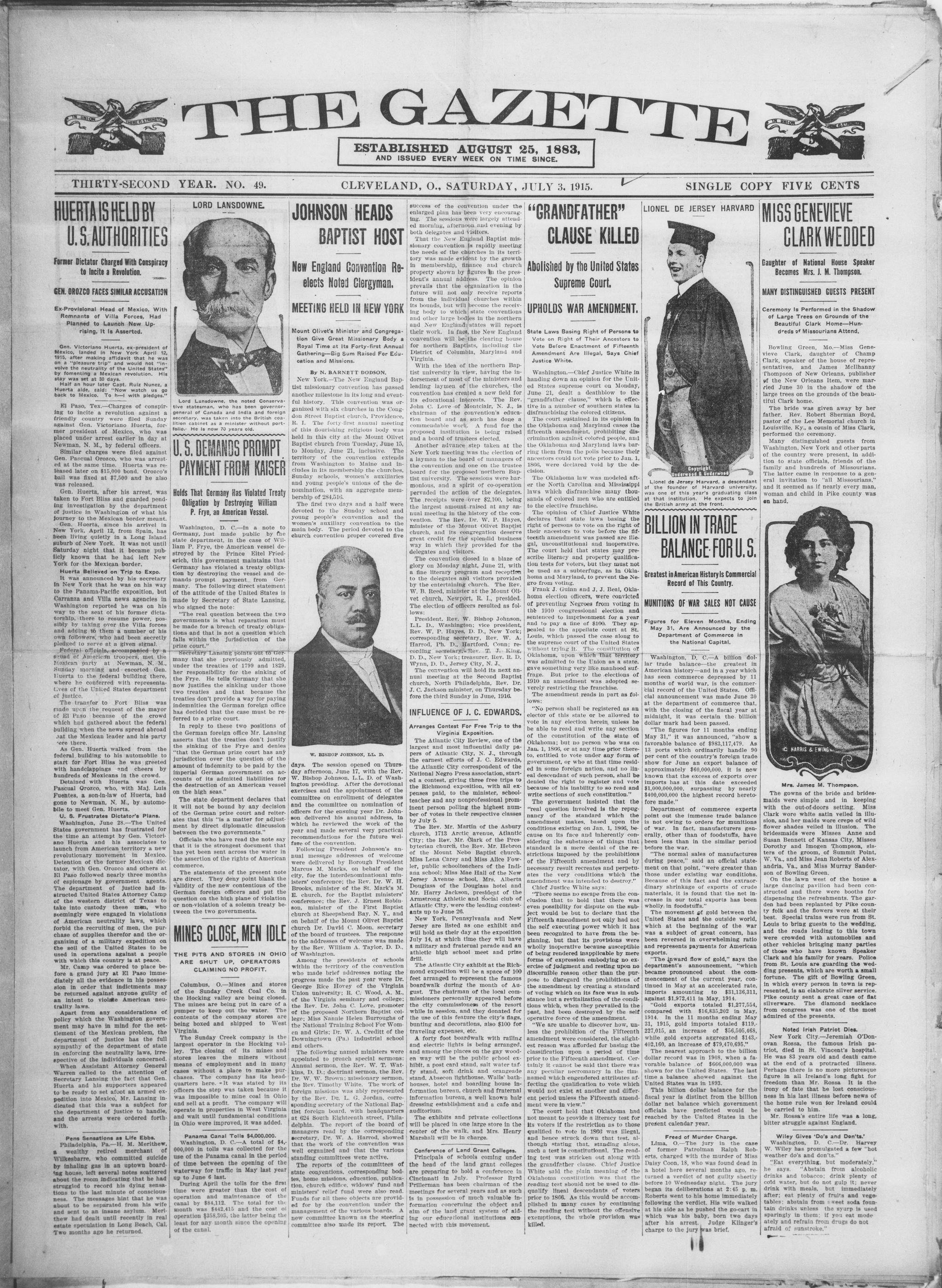
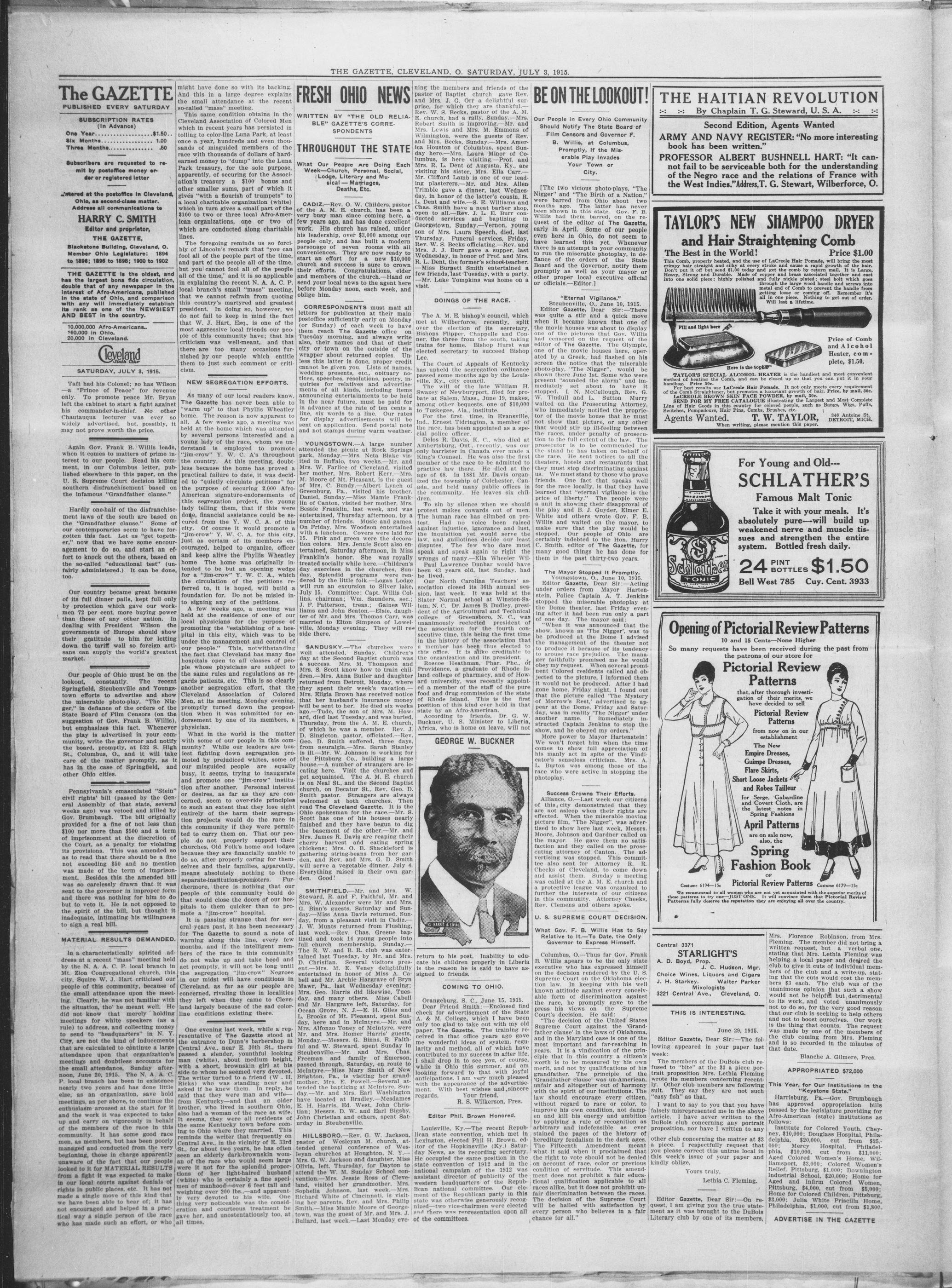
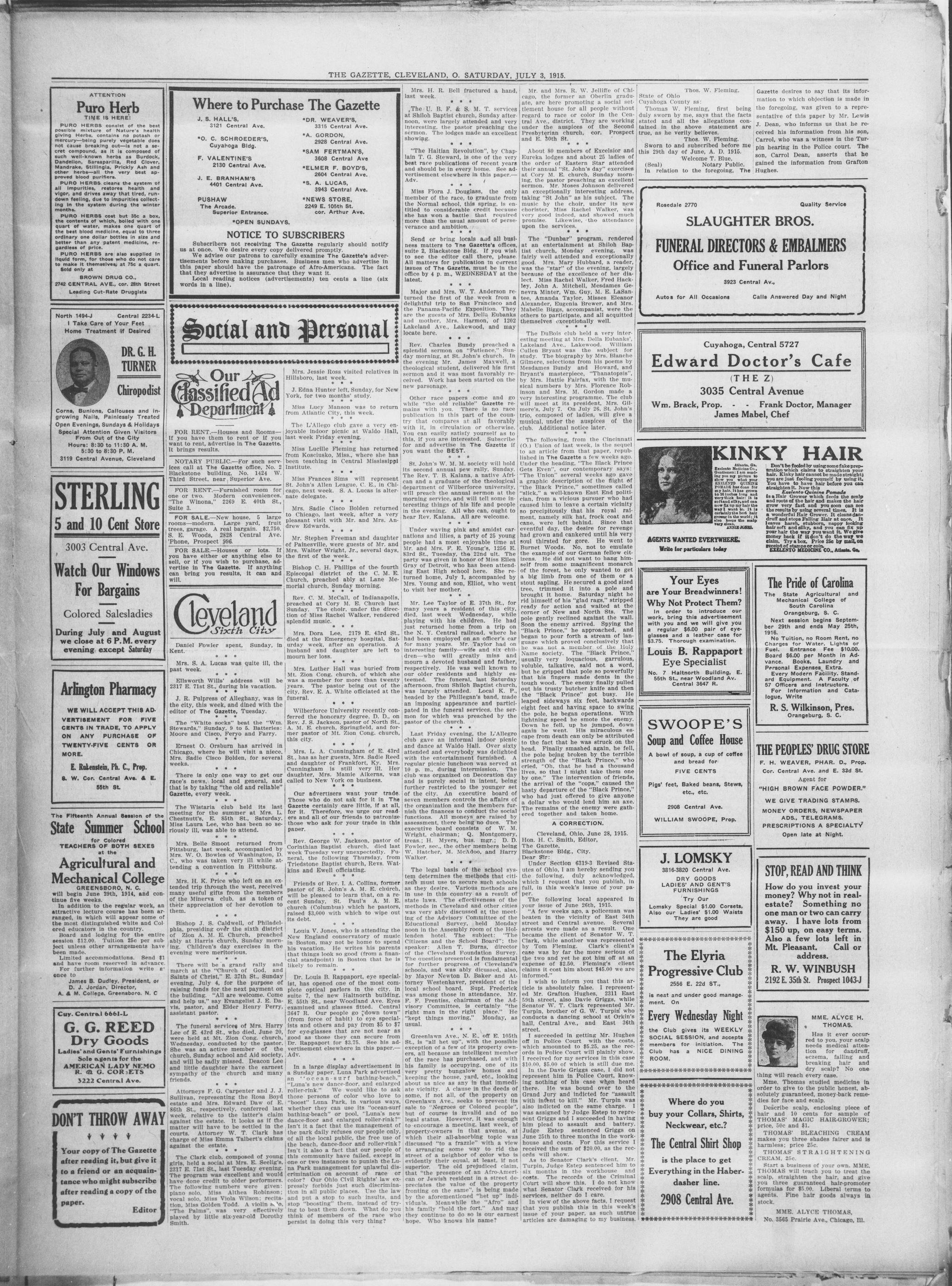
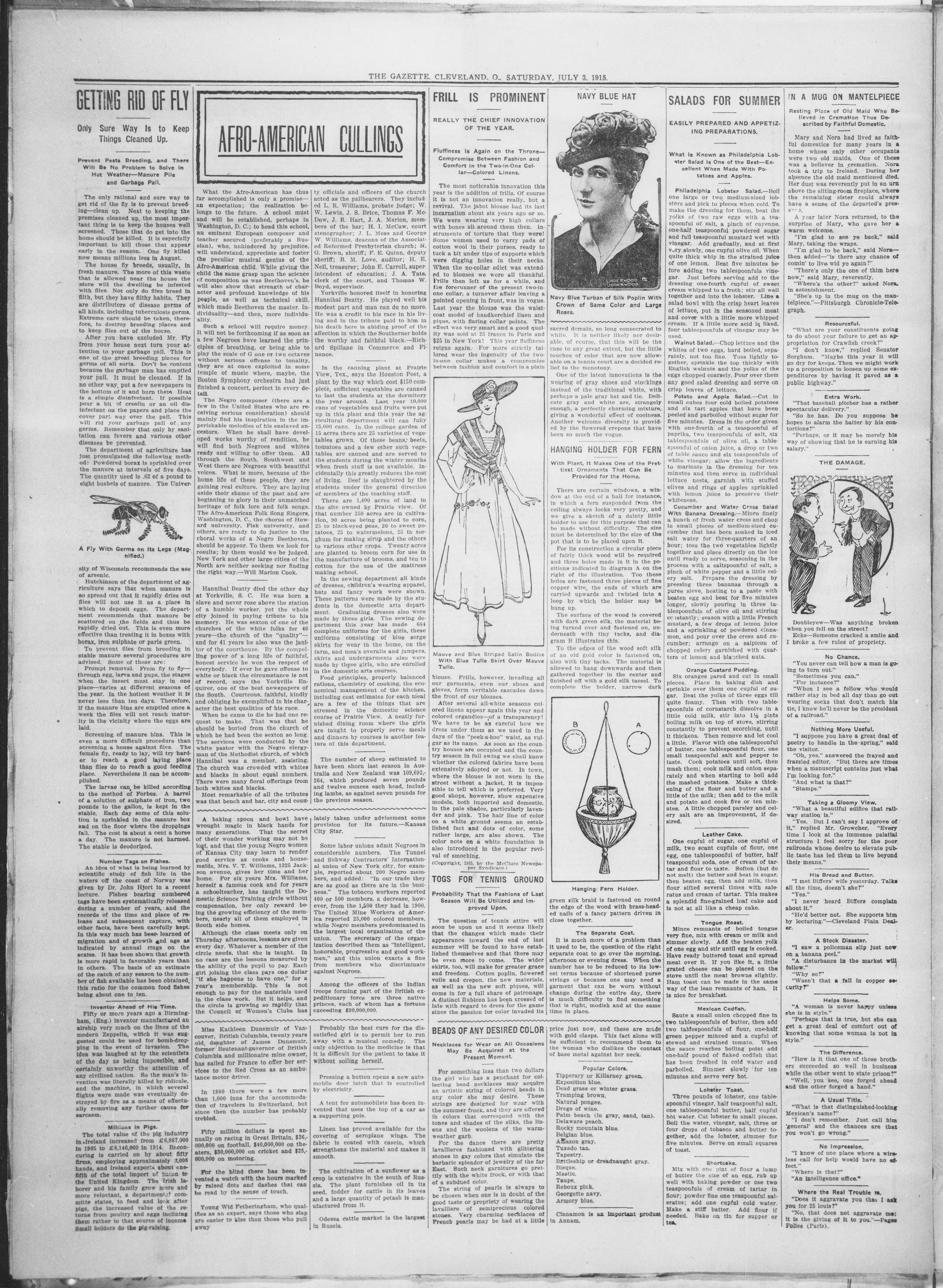
Page text (machine-generated)
IN DUTILITIES
ASSISTANCE
HUERTA IS HELD BY U.S.AUTHORITIES
Former Dictator Charged With Conspiracy to Incite a Revolution.
Ex-Provisional Head of Mexico, With Remnants of Villa Forces, Had Planned to Launch New Uprising, It Is Asserted.
Gen. Victoriano Huerta, ex-president of Mexico, landed in New York April 12, 1915, after making affidavit that he was on a "pleasure trip" and would not "involve the neutrality of the United States" by forming an unpopular revolution. His stay was at 30 days.
Half an hour later Capt. Ruiz Nunez, a Huerta alda, said: "Now watch us go back to Mexico. To h— with pledges."
El Paso, Tex.—Charges of conspiring to incite a revolution against a friendly country were filed Sunday against Gen. Victoriano Huerta, former president of Mexico, who was placed under arrest earlier in day at Newman, N. M., by federal officers.
Similar charges were filed against Gen. Pascual Orozco, who was arrested at the same time. Huerta was released later on $15,000 bond. Orozco's ball was fixed at $7,500 and he also was released.
Gen. Huerta, after his arrest, was taken to Fort Bliss and guarded, pending investigation by the department of justice in Washington of what his journey to the Mexican border meant.
Gen. Huerta, since his arrival in New York, April, 12, from Spain, has been living quietly in a Long Island suburb of New York. It was not until Saturday night that it became publicly known that he had left New York for the Mexican border.
Huerta Believed on Trip to Expo.
It was announced by his secretary in New York that he was on his way to the Panama-Pacific exposition, but Carranza and Villa news agencies in Washington reported he was on his way to the seat of his former dictatorship, there to resume power, possibly by taking over the Villa forces and adding to them a number of his own followers, who had been secretly pledged to serve at a given signal.
Federal officials, accompanied by a squad of American troopers, met the Mexican party at Newman, N. M., Sunday morning and escorted Gen. Huerta to the federal building there, where he conferred with representatives of the United States department of justice.
The transfer, to Fort Bliss was made upon the request of the mayor of El Paso because of the crowd which had gathered about the federal building when the news spread abroad at the Mexican leader and his party were there.
As Gen. Huerta walked from the federal building to his automobile to start for Fort Bliss he was greeted with handclappings and cheers by hundreds of Mexicans in the crowd.
Detailed with Huerta was Gen. Pascual Grozio, who, with Maj. Luis Fuentes, a son-in-law of Huerta, had gone to Newman, N. M., by automobile to meet Gen. Huerta.
U. 8. Frustrates Dictator's Plans.
Washington, June 28—The United States government has frustrated for the time an attempt by Gen. Victoriano Huerta and his associates to launch from American territory a new revolutionary movement in Mexico. Detention of the former Mexican dictator, with Gen. Orozco and others at El Paso followed nearly three months of espionage by government' agents. The department of justice had instructed United States Attorney Camp of the western district of Texas to take into custody these men, who seemingly were engaged in violations of American neutrality laws, which forbid the recruiting of men, the purchase of supplies therefor and the organizing of a military expedition on the soil of the United States to be used in operations against a people with which this country is at peace.
Mr. Camp was ordered to place before a grand jury at El Paso immediately all the evidence in his possession in order that indictments may be returned, against anyone guilty of an intent to violate American neutrality laws.
Apart from any considerations of policy which the Washington government may have in mind for the settlement of the Mexican problem, the department of justice has the full sympathy of the department of state in enforcing the neutrality laws, irrespective of the individuals concerned. When Assistant Attorney, General Warren called to the attention of Secretary Lansing the fact that Gen. Huerta and his supporters appeared to be ready to set foot an armed expedition into Mexico, Mr. Lansing indicated that this was a subject for the department of justice to handle, and the arrests were ordered forthwith.
Pens Sensations as Life Ebbs.
Philadelphia, Pa.—H. M. Merithew, a wenythy retired merchant of Wilkesbarre, who committed suicide by inhaling gas in an uptown boarding house, left several notes scattered about the room indicating that he had struggled to record his dying sensations to the last minute of consciousness. The messages hint that he was about to be separated from his wife and sent to an insane asylum. Merithew had dealt until recently in real estate speculation in Long Beach, Cal. Two months ago he returned.
THE GAZETTE
Lord Lansdowne, the noted Conservative statesman, who has been governor-general of Canada and India and foreign secretary, was taken into the British coalition cabinet as a minister without portfolio. He is now 70 years old.
U. S. DEMANDS PROMPT
PAYMENT FROM KAISER
Washington, D. C.—In a note to Germany, just made public by the state department, in the case of William P. Frye, the American vessel destroyed by the Prince Eitel Friedrich, this government maintains that Germany has violated a treaty obligation by destroying the vessel and demands prompt payment from Germany. The following direct statement of the attitude of the United States is made by Secretary of State Lansing, who signed the note:
"The real question between the two governments is what reparation must be made for a breach of treaty obligations and that is not a question which falls within the jurisdiction of the prize court."
Secretary Lansing points out to Germany that she previously admitted, under the treaties of 1799 and 1829, her responsibility, for the sinking of the Frye. He tells Germany that she now justifies the sinking under those two treaties and that because the treaties don't provide a way for paying indemnities, the German foreign office has decided that the case must be referred to a prize court.
In reply to these two positions of the German foreign office Mr. Lansing asserts that the treaties don't justify the sinking of the Frye and denies "that the German prize court has any jurisdiction over the question of the amount of indemnity to be paid by the imperial German government on accounts of its admitted liabilities for the destruction of an American vessel on the high seas."
The state department declares that it will not be bound by any decision of the German prize court and reiterates that this "is a matter for adjustment by direct diplomatic discussion between the two governments." Officials who have read the note say that it is the strongest document that has yet been sent across the water in the assertion of the rights of American commerce.
The statements of the present note are direct. They deny point blank the validity of the new contentious of the German foreign officers and put the question on the high plane of Violation or non-violation of a solemn treaty between the two governments.
MINES CLOSE, MEN IDLE
THE PITS AND STORES IN OHIO ARE SHUT UP, OPERATORS CLAIMING NO PROFIT.
Columbus, O.—Mines and stores of the Sunday Creek Coal Co. In the Hocking valley are being closed. The mines are being put in care of a pumper to keep out the water. The contents of the company stores are being boxed and shipped to West Virginia.
The Sunday Creek company is the largest operator in the Hocking valley. The closing of its mines and stores leaves the miners without means of employment and in many cases without a place to make purchases. The company has its headquarters here. It was stated by its officers the step was taken because it was impossible to mine coal in Ohio and sell at a profit. The company will operate in properties in West Virginia and wait until fundamental conditions in Ohio were improved, it was added.
Panama Canal Tolls $4,000,000.
Washington, D. C.—A total of $4,000,000 in tolls was collected for the use of the Panama canal in the period of time between the opening of the waterway for traffic in May last year up to June 6 last.
During April the tolls for the first time were greater than the cost of operation and maintenance of the canal by $44,112. The total for the month was $442,415 and the cost of operation $358,303, the latter being the least for any month since the opening of the canal.
ESTABLISHED AUGUST 25, 1883 AND ISSUED EVERY WEEK ON TIME SINCE.
CLEVELAND, O., SATURDAY, JULY 3, 1915.
JOHNSON HEADS BAPTIST HOST
Mount Olivet's Minister and Congregation Give Great Missionary Body a Royal Time at Its Porty-first Annual Gathering—Big Sum Raised For Education and Missionation
By N. BARNETT DODSON
New York.-The New England Baptist missionary convention has passed another milestone in its long and eventful history. This convention was organized with six churches in the Congregational Street Baptist church, Providence, R. b. The forty first annual meeting of this flourishing religious body was held in this city at the Mount Oliveet Baptist church from Tuesday, June 15, to Monday, June 21, inclusive. The territory of the convention, extends from Washington to Maine and includes in its membership the churches, Sunday schools, women's auxiliaries and young people's unions of the denomination, with an aggregate membership of 284,516. The first two days and a half were devoted to the Sunday school and young people's convention and the women's auxiliary convention to the main body. The period devoted to the church convention proper covered five
W. BISHOP JOHNSON, LL. D.
days. The session opened on Thursday afternoon, June 17, with the Rev. W. Bishop Johnson, L.L. D. of Washington presiding. After the devotional exercises and the appointment of the committee on enrollment of delegates and the committee on nomination of officers for the ensuing year Dr. Johnson delivered his annual address, in which he reviewed the work of the year and made several very practical recommendations for the future welfare of the convention.
Following President Johnson's annual message addresses of welcome were delivered by Borough President Marcus M. Marks, on behalf of the city, for the interdenominational ministers' conference; the Rev. Dr. W. H. Brooks, minister of the St. Mark's M. E. church, for the Baptist ministers' conference; the Rev. J. Ernest Robinson, minister of the First Baptist church at Sheepshead Bay, N. Y., and on behalf of the Mount Olivet Baptist church Dr. David C. Moon, secretary of the board of trustees. The response to the addresses of welcome was made by the Rev. William A. Taylor, D. D. of Washington.
Among the presidents of schools within the territory of the convention who made brief addresses noting the progress made the past year were Dr. George Rice Hovey of the Virginia Union University; R. C. Wood, A. M., of the Virginia seminary and college; the Rev. Dr. John C. Love, promoter of the proposed Northern Baptist college; Miss Nannie Helen Burroughs of the National Training School For Women and Girls; Dr. W. A. Creditt of the Downingtown (Pa.) Industrial school and others.
The following named ministers were appointed to preach special sermons: Annual sermon, the Rev. W. T. Watkins, D. D.; doctrinal sermon, the Rev. D. W. Brown; missionary sermon, the Rev. Timothy White. The work of foreign missions was ably represented by the Rev. Dr. L. G. Jordan, corresponding secretary of the National Baptist foreign board, with headquarters at 624 South Eighteenth Street, Philadelphia. The report of the board of managers read by the corresponding secretary, Dr. W. A. Harrood, showed that the work of the convention was well organized and that the various standing committees were active.
The reports of the committees of state conventions, corresponding bodies, home missions, education, publication, church edifice, widows' fund and ministers' relief fund were also read. Funds for all these objects are provided for by the convention under the management of the various boards. A new committee known as the steering committee also made its report. The
success of the convention under the enlarged plan has been very encouraging. The sessions were largely attended morning, afternoon and evening by both delegates and visitors.
That the New England Baptist missionary convention is rapidly meeting the needs of the churches. in its territory was made evident by the growth in membership, finance and church property shown by figures in the president's annual address. The opinion prevails that the organization in the future will not only receive reports from the individual churches within its bounds, but will become the receiving body to which state conventions and other large bodies in the northern and New England states will report their work. In fact, the New England convention will be the clearing house for northern Baptists, including the District of Columbia, Maryland and Virginia.
With the idea of the northern Baptist university in view, having the endorsement of most of the ministers and leading laymen of the churches, the convention has created a new field for its educational interests. The Rev. John C. Love of Montclair, N. J., chairman of the convention's education board and as such has done a commendable work. A fund for the proposed institution is being raised and a board of trustees elected.
Another advance step taken at the New York meeting was the election of a byman to the board of managers of the convention and one on the trustee board for the proposed northern Baptist university. The sessions were harmonious, and a spirit of co-operation pervaded the action of the delegates. The receipts were over $2,100, being the largest amount raised at any annual meeting in the history of the convention. The Rev. Dr. W. P. Hayes, minister of the Mount Olivet Baptist church, and its congregation deserve great credit for the splendid business way in which they provided for the delegates and visitors.
The convention closed in a blaze of glory on Monday night, June 21, with a fine literary program and reception to the delegates and visitors provided by the entertainment church. The Rev. W. B. Reed, minister at the Mount Olivet church, Newport, R. I., presided.
The election of officers resulted as follows:
President. Rev. W. Bishop Johnson, L.L. D., Washington; vice president, Rev. W. P. Hayes, D. D., New York; corresponding secretary, Rev. W. A. Harrood, Ph.D., Hartford, Conn.; recording secretary, Rev. T. J. King, D. D. New York; treasurer, Rev. R. D. Wynn, D. D., Jersey City, N. J.
The convention will hold its next annual meeting at the Second Baptist church, North Philadelphia, Rev. Dr. J. C. Jackson minister, on Thursday before the third Sunday in June, 1910.
INFLUENCE OF J. C. EDWARDS.
Arranges Contest For Free. Trip to the Virginia Exposition.
The Atlantic City Review, one of the largest and most influential daily papers of Atlantic City, N. J., through the earnest efforts of J. C. Edwards, the Atlantic City correspondent of the National Negro Press association, started a contest, giving three free trips to the Richmond exposition, with all expenses paid, to the minister, schoolteacher and any nonprofessional prominent person polling the highest number of votes in their respective classes by July 5.
The Rev. Mr. Martin of the Asbury church, 1718 Arctic avenue, Atlantic City; the Rev. Mr. Clark of the Presbyterian church, the Rev. Mr. Hebron of the Mount Nebo Baptist church, Miss Lena Carey and Miss Alice Fowler, public schoolteachers of the Indiana school; Miss Mae Hall of the New Jersey Avenue school, Mrs. Alberta Douglass of the Douglass hotel and Mr. Harry Jackson, president of the Armstrong Athletic and Social club of Atlantic City, were the leading contestants up to June 26.
New York, Pennsylvania and New Jersey are listed as one exhibit and will hold us their day at the exposition July 14, at which time they will have a military and fraternal parade and an athletic high school meet and prize drill.
The Atlantic City exhibit at the Richmond exposition will be a space of 100 feet arranged to represent the famous boardwalk during the month of August. The chairman of the local commissioners personally appeared before the city commissioners of the resort while in session, and they donated for the use of this feature the city's flags, bunting and decorations, also $100 for traveling expenses, etc.
A forty foot boardwalk with railing and electric lights is being arranged, and among the places on the gay wooden way will be the public school exhibit, a post card stand, salt water taffy stand, soft drink and orangeade stand. Absecon lighthouse, Walls' bathhouses, hotel and boarding house information bureau, church and fraternal information bureau, a well known hair dressing establishment and a cafe and auditorium.
The exhibits and private collections will be placed in one large store in the center of the walk, and Mrs. Henry Marshall will be in charge.
Conference of Land Grant Colleges.
Principals of schools coming under the head of the land grant colleges are preparing to hold a conference in Cincinnati in July. Professor Byrd Prillerman has been chairman of the meetings for several years and as such is in possession of much valuable information concerning the object and aim of the land grant system of aiding our educational institutions connected with this movement.
State Laws Basing Right of Persons to Vote on Right of Their Ancestors to Vote Before Enactment of Fifteenth Amendment Are Illegal, Says Chief Justice White.
Washington—Chief Justice White in handing down an opinion for the United States supreme court on Monday, June 21, dealt a deathblow to the "grandfather clause," which is effective in a number of southern states in disfranchising the colored citizens.
The court sustained in its opinion in the Oklahoma and Maryland cases the fifteenth amendment, prohibiting discrimination against colored people, and the Oklahoma and Maryland laws barring them from the polls because their ancestors could not vote prior to Jan. 1, 1866, were declared void by the decision.
The Oklahoma law was modeled after the North Carolina and Mississippi laws which disfranchise many thousands of colored men who are entitled to the elective franchise.
The opinion of Chief Justice White declares that state laws basing the right of persons to vote on the right of their ancestors to vote before the fifteenth amendment was passed are illegal, unconstitutional and inoperative. The court held that states may prescribe literacy and property qualification tests for voters, but they must not be used as a subterfuge, as in Oklahoma and Maryland, to prevent the Negro from voting.
Frank J. Gulm and J. J. Real, Oklahoma election officers, were convicted of preventing Negroes from voting in the 1910 congressional election and sentenced to imprisonment for a year and to pay a line of $100. They appealed to the appellate court at St. Louis, which passed the case along to the supreme court of the United States without trying it. The constitution of Okinoha, upon which that territory was admitted to the Union as a state, gave something very like manhood suffrage. But prior to the elections of 1010 an amendment was adopted severely restricting the franchise.
The amendment reads in part as follows:
"No person shall be registered as an elector of this state or be allowed to vote in any election herein unless he be able to read and write any section of the constitution of the state of Oklahoma; but no person who was on Jan. 1, 1866, or at any time prior thereto, entitled to vote under any form of government, or who at that time resided in some foreign nation, and no linear descendant of such person, shall be deceived the right to register and be caused of his inability to so read and write sections of such constitution."
The government insisted that the "real question involved is the repugnancy of the standard which the amendment makes, based upon the conditions existing on Jan. 1, 1896, because on its face and inherently considering the substance of things that standard is a mere dental of the restrictions imposed by the prohibitions of the Fifteenth amendment and by necessary result recreates and perpetuates the very conditions which the amendment was intended to destroy."
Chief Justice White says:
"There seems no escape from the conclusion that to hold that there was even possibility for dispute on the subject would be but to declare that the Fifteenth amendment not only had not the self executing power which it has been recognized to have from the beginning, but that its provisions were wholly imperative because susceptible of being rendered unapplicable by mere forms of expression embodying no exercise of judgment and resting upon no discernible reason other than the purpose to disregard the prohibitions of the amendment by creating a standard of voting which on its face was in substance but a revitalization of the conditions which, when they prevailed in the past, had been destroyed by the self operative force of the amendment.
"We are unable to discover how, unless the prohibition of the Fifteenth amendment were considered, the slightest reason was afforded for basing the classification upon a period of time prior to the Fifteenth amendment. Certainly it cannot be said that there was any regular necromancy in the timed which engendered attributes affecting the qualification to vote which would not exist at another and different period unless the Fifteenth amendment were in view."
The court held that Oklahoma had not meant to provide a literacy test for its voters if the restriction as to those qualified to vote in 1850 was illegal, and hence struck down that test, although stating that, standing alone, such a test is constitutional. The reading test was strenken out along with the grandfather clause. Chief Justice White said the plain meaning of the Oklahoma constitution was that the reading test should not be used to disqualify lineal descendants of voters prior to 1850. As this would be accomplished in many cases by continuing the reading test without the offensive exemptions, the whole provision was killed.
Copyright
Underwood & Underwood
Lionel de Jersey Harvard, a descendant of the founder of Harvard university, died on Friday at that institution. 'He expects to join the British army at the front.
BILLION IN TRADE BALANCE FOR U.S.
Greatest in American History is Commercial Record of This Country.
MUNITIONS OF WAR SALES NOT CAUSE
Figures for Eleven Months, Ending May 31, Are Announced by the Department of Commerce in the National Capital.
Washington, D. C.—A billion dollar trade balance—the greatest in American history—and in a year which has seen commerce depressed by 41 months of world war, is the commercial record of the United States. Official announcement was made June 30 at the department of commerce that, with the closing of the fiscal year at midnight, it was certain the billion dollar mark had been passed.
"The figures for 11 months ending May 31," it was announced, "show a favorable balance of $83,117,479. As 13 ports which ordinarily handle 90 per cent of the country's foreign trade show for June an export balance of approximately $60,000,000, it is now known that the excess of exports over imports has at this date exceeded $1,000,000,000, surpassing by nearly $400,000,000 the highest record heretofore made."
Department of commerce experts point out the immense trade balance is not owing to orders for munitions of war. In fact, manufacturers generally, other than of foodstuffs, have been less than in the similar period before the war.
"The normal sales of manufactures during peace," said an official statement on that point, "were greater than those under existing war conditions. Because of this fact and the extraordinary shrinkage of exports of crude materials, it is found that the net increase in our total exports has been wholly in foodstuffs."
The movement of gold between the United States and the outside world, which at the beginning of the war was a subject of great concern, has been reversed in overwhelming ratio and represents payments for American exports.
"The inward flow of gold," says the department's announcement, "which became pronounced about the commencement of the current year, continued in May at an accelerated rate, imports amounting to $31,136,361 against $1,972,411 in May, 1914.
"Gold exports totaled $1,277,554, compared with $16,835,202 in May, 1914. In the 11 months ending May 31, 1915, gold imports totaled $119,277,015, an increase of $56,545,468, while gold exports aggregated $143,402,160, an increase of $79,470,695."
The nearest approach to the billion dollar record was in 1908, when a favorable balance of $066,000,000 was shown for the United States. The last time a balance showed against the United States was in 1893.
This billion dollar balance for the fiscal year is distinct from the billion dollar net balance which government officials have predicted would be reached by the United States in the present calendar year.
Freed of Murder Charge.
Llma, O.-The jury in the case of former Patrolman Ralph Roberts, charged with the murder of Miss Daisy Coon, 18, who was found dead in a hotel here several months ago, returned a verdict of not guilty shortly before 10 Wednesday night. The jury began its deliberations at 2:45 p. m. Roberts went to his home immediately following the verdict. His wife walked at his side as he pushed the go-cart in which was his baby, born two days after his arrest. Judge Kilinger's charge to the jury was brief.
IN VATICAN
VIVAM EST
MISS GENEVIEVE
CLARK WEDDED
Daughter of National House Speaker Becomes Mrs. J. M. Thompson.
Ceremony Is Performed in the Shadow of Large Trees on Grounds of the Beautiful Clark Home—Hundreds of Missourians Attend.
Bowling Green, Mo.—Miss Genevieve Clark, daughter of Champ Clark, speaker of the house of representatives, and James—Mellhanny Thompson of New Orleans, publisher of the New Orleans Item, were married June 30' in the shadow of the large trees on the grounds of the beautiful Clark home.
The bride was given away by her father. Rev. Robert Sherman-Boyd, pastor of the Lee Memorial church in Louisville, Ky., a cousin of Miss Clark, performed the ceremony.
Many distinguished guests from Washington, New York and other parts of the country were present, in addition to state officials, friends of the family and hundreds of Missourians.
The latter came in response to a general invitation to "all Missourians," and it seemed as if nearly every man, woman and child in Pike county was on hand.
C. HARRIS & EWING
Mrs. James M. Thompson.
The gowns of the bows and the bridesmaids were simple, and in keeping with the out-of-doors setting. Miss Clark wore white satin veiled in illusion, and her maids wore crepe of wild flower shades veiled in illusion. The bridesmaids were Misses' Anne and Susan Bennett of Kansas City, Misses Dorothy and Imogen Thompson, sisters of the groom, of Summit Point, W. Va., and Miss Jean Roberts of Alexandria, Va., and Miss Murray Sanderson of Rowling Green.
On the lawn west of the house a large dancing pavilion had been constructed, and there were boots for dispensing the refreshments. The garden had been replanted by Pike county folk and the flowers were at their best. Special trains were run from St. Louis to bring guest to the wedding, and the roads leading to this town were crowded with automobiles and other vehicles bringing many parties of those who have known Speaker Clark and his family for years. Police from St. Louis are guarding the wedding presents, which are worth a small fortune. The gift of Bowling Green, in which every person in town is represented, is an elaborate silver service. Pike county sent a great case of flat silverware. The diamond necklace from congress was one of the most admired of the presents.
Noted Irish Patriot Dies.
New York City—Jeremiah O'Donovan Rossa, the famous Irish patriot, died in St. Vincent's hospital. He was 83 years old and death came at the end of a protracted illness. Perhaps there is no more picturesque figure in all Ireland's long fight for freedom than Mr. Rossa. It is the irony of fate that he lost consciousness in his last illness before news of the home rule won for Ireland could be carried to him.
Mr. Rossa's entire life was a long, bitter struggle against England.
Washington, D. C.—Dr. Harvey W. Wiley has promulgated a few "hot weather do's and don'ts."
"Eat everything, but moderately," he says. "Abstain from alcoholic drinks and tobacco; drink plenty of cold water, but do not gulp it; never drink with meals, but immediately after; eat, plenty of fruits and vegetables; abstain from weet soda fountain drinks unless the swurp is used sparingly in them; if you eat mode, and refrain from drugs do not afraid of sunstroke."
One Year.....$1.50.
Six Months.....1.00
Three Months......50
Subscribers are requested to rem
mit by postoffice money en-
der or registered letter
entered at the postoffice in Cleveland
Ohio, as second-class matter.
Address all communications to
Blackstone Building, Cleveland, O.
Member Ohio Legislature: 1894
to 1898; 1898 to 1898; 1900 to 1902
THE GAZETTE is the oldest, and
has the largest bona fide circulation,
double that of any newspaper in the
interest of Afro-Americans, published
in the state of Ohio, and comparison
with any will immediately establish
its rank as one of the NEWSIEST
AND BEST in the country.
10,000,000 Afro-Americans.
160,000 in Ohio.
20,000 in Cleveland.
SATURDAY, JULY 3, 1915.
Taft had his Colonel; so has Wilson—a "Prince of Peace" for revenue only. To promote peace Mr. Bryan left the cabinet to start a fight against his commander-in-chief. No other Chautauqua lecturer was ever so widely advertised, but, possibly, it may not prove worth the price.
Again Gov. Frank B. Willis leads, when it comes to matters of prime interest to our people. Read his comment, in our Columbus letter, published elsewhere in this paper, on the U. S. Supreme Court decision killing southern distranchisement based on the infamous "Grandfather clause."
Hardly one-half of the distranchise ment laws of the south are based on the "Grandfather clause." Some of our contemporaries seem to have gotten this fact. Let us "get together," now that we have some encouragement to do so, and start an effort to knock out the others, based on the so-called "educational test" (unfairly administered.) It can be done too.
Our country became great because of its full dinner dinner, kept full only by protection which gave our work men 72 per cent. more buying power than those of any other nation. In dealing with President Wilson the governments of Europe should show their gratitude to him for letting down the tariff wall so foreign artisans can supply the world's greatest market.
Our people of Ohio must be on the lookout, constantly. The recent Springfield, Steubenville and Youngs town efforts to advertise and show the miserable photo-play, "The Niger," in defiance of the orders of the State Board of Film Censors (on the suggestion of Gov. Frank B. Willis), but emphasizes this fact. Whenever the play is advertised in your community, write the governor and notify the board, promptly, at 522 S. High St., Columbus, $O_2$, and it will take care of the matter promptly, as it has in the case of Springfield, and other Ohio cities.
---
Pennsylvania's emasculated "Stein" civil rights bill (passed by the General Assembly of that state, several weeks ago) was vetoed and killed by Gov. Brumhaugh. The bill originally provided for a fine of not less than $100 nor more than $500 and a term of imprisonment at the discretion of the Court, as a penalty for violating its provisions. This was amended so as to read that there should be a fine not exceeding $50 and no mention was made of the term of imprisonment. Besides this the amended bill was so carelessly drawn that it was sent to the governor in improper form and there was nothing for him to do but to veto it. He is not opposed to the spirit of the bill, but thought it inadequate, intimating his willingness to sign a real bill.
MATERIAL RESULTS DEMANDED
In a characteristically spirted ad dress at a recent "mass" meeting held by the N. A. A. C. P. local branch in Mt. Zion Congregational church, this city, Squire W. J. Hart criticised our people of this community, because of the small attendance upon the meeting. Clearly, he was not familiar with the situation, tho' he meant well. He did not know that merely holding meetings for white speakers (as a rule) to address, and collecting money to send to "headquarters" in N. Y. City, are not the kind of inducements that are calculated to continue a large attendance upon that organization's meetings and doubtless accounts for the small attendance, Sunday afternoon, June 20, 1915. The N. A. A. C. P. local branch has been in existence nearly two years and has done little else, as an organization, save hold meetings, as per above, to continue the enthusiasm aroused at the start for it and the work it was expected to take up and carry on vigorously in behalf of the members of the race in this community. It has some good race men, as members, but has been poorly managed and conducted from the very beginning, those in charge apparently unaware of the fact that our people looked to it for MATERIAL RESULTS from a fight it was expected to make in our local courts against denials of rights in public places, etc. It has not made a single move of this kind that we have been able to hear of; it has not encouraged and helped in a practical way a single person of the race who has made such an effort, or who
might have done so with its backing. And this in a large degree explains the small attendance at the recent so-called "mass" meeting.
This same condition obtains in the Cleveland Association of Colored Men which in recent years has persisted in tolling to color-line Luna Park, at least once a year, hundreds and even thousands of misguided members of the race with thousands of dollars of hard-earned money to "dump" into the Luna Park treasury, for the sole purpose, apparently, of securing for the Association's treasury a $100 bonus and other smaller sums, part of which it gives "with a flourish of trumpets" to a local charitable organization (white) which in turn gives a small part of the $100 to two or three local Afro-American organizations, one or two of which are conducted along charitable lines.
The foregoing reminds us so forcibly of Lincoln's remark that "you can fool all of the people part of the time, and part of the people all of the time, but you cannot fool all of the people all of the time,' and it is so applicable in explaining the recent N. A. A. C. P. local branch's small "mass" meeting, that we cannot refrain from quoting this country's martyred and greatest president. In doing so, however, we do not fail to keep in mind the fact that W. J. Hart, Esq., is one of the most aggressive local friends our people of this community have; that his criticism was well-meant, and that there are too many occasions furnished by our people which entitle them to just such comment or criticism.
NEW SEGREGATION EFFORTS.
As many of our local readers know, the Gazette has never been able to "warm up" to that Phyllis Wheatley home. The reason is now apparent to all. A few weeks ago, a meeting was held at the home which was attended by several persons interested and a young lady of the race, whom we understand is employed to promote "jim-crow" Y. W. C. A. throughout the country. At this meeting, doubtless because the home has proved a practical failure to date, it was decided to "quietly circulate petitions" for the purpose of securing 2,000 Afro American signature-endorsements of this segregation project, the young lady telling them, that if this were done, financial assistance could be secured from the Y. W. C. A. of this city. Of course it would promote a "jim-crow" Y. W. C. A. for this city just as certain of its members encouraged, helped to organize, officer and keep alive the Phyllis Wheatley home. The home was originally intended to be but an opening wedge for a "jim-crow" Y. W. C. A., which the circulation of the petitions referred to, it is hoped, will build a foundation for. Do not be misled into signing any of the petitions.
A few weeks ago, a meeting was held at the residence of one of our local physicians for the purpose of promoting the "establishing of a hospital in this city, which was to be under the management and control of our people." This, notwithstanding the fact that Cleveland has many fine hospitals open to all classes of people whose physicians are subject to the same rules and regulations as regards patients, etc. This is so clearly another segregation effort, that the Cleveland Association of Colored Men, at its meeting, Monday evening, promptly turned down the proposition when it was submitted for endorsement by one of its members, a physician.
What in the world is the matter with some of our people in this community? While our leaders are busiest fighting down segregation promoted by prejudiced whites, some of our misguided people are equally busy, it seems, trying to inaugurate and promote one "jim-crow" institution after another. Personal interest or desires, as far as they are concerned, seem to over-ride principles to such an extent that they lose sight entirely of the harm their segregation projects would do the race in this community if they were permitted to carry them on. That our people do not properly support their churches, Old Fols' home and lodges because they are financially unable to do so, after properly caring for themselves and their families, apparently means absolutely nothing to these separate-institution-promoters. Furthermore, there is nothing that our people of this community could do that would close the doors of our hospitals to them quicker than to promote a "jim-crow" hospital.
It is passing strange that for several years past, it has been necessary for The Gazette to sound a note of warning along this line, every few months, and if the intelligent members of the race in this community do not wake up and take heed and act promptly, it will not be long until the segregation "jim-crow" Negroes in our midst will have conditions in Cleveland, as far as our people are concerned, rivaling those in localities they left when they came to Cleveland largely because of the sad colorline conditions existing there.
One evening last week, while a representative of The Gazette stood at the entrance to Dunn's barbershop in Central Ave., near E. 30th St, there passed a slender, youthful looking man (white), about medium height with a short, brownskin girl at his side to whom he seemed very devoted. The writer turned to a friend (W. H. Ricks) who was standing near and asked if he knew them. In reply, he said that they were man and wife—from Kentucky—and that an older brother, who lived in southern Ohio, also had a woman of the race as wife. It seems, they were all residents of the same Kentucky town before coming to Ohio where they frequently reminds the writer that frequently on central Ave., in the vicinity of E. 33rd St, for about two years, he has often seen an elderly dark-brownskin woman of the race who would seem large were it not for the splendid proportions of her light-haired husband (white) who is certainly a fine specimen of manhood—over 6 feet tall and weighing over 200 lbs.,—and apparently devoted to his wife. One thing very noticeable was the consideration and courteous treatment he gave her, and unostentiously too, at all times.
THE GAZETTE, CLEVELAND, O. SATURDAY, JULY 3, 1915
WRITTEN BY "THE OLD RELIABLE" GAZETTE'S CORRESPONDENTS
THROUGHOUT THE STATE
What Our People Are Doing Each Week—Church, Personal, Social, Lodge, Literary and Musical—Marriages, Deaths, Etc.
CADIZ—Rev. O. W. Childers, pastor of the A. M. E. church, have been a very busy man since coming here, a few years ago, and has done excellent work. His church has raised, under his leadership over $3,000 among our people only, and has built a modern parsonage of seven rooms with conveniences. They are now ready to start an effort for a new $10,000 church and success is sure to crown their efforts. Congratulations, elder and members of the church—Hand or send your local news to the agent here before Monday noon, each week, and oblige him.
CORRESPONDENTS must mail all letters for publication at their main postoffice sufficiently early on Monday (or Sunday) of each week to have them reach The Gazette office on Tuesday morning, and always write also, their names and that of their city or town on the outside of the post office. Unless this latter is done, prosecutions cannot be given you. Lists of names, wedding presents, etc., obituary notices, speeches, resolutions, poetry, inquiries for relatives and advertisements of all kinds, including items announcing entertainments to be held in advance at the rate of ten cents a line, six words to a line. Our rates for display advertisements will be sent on application. Send postal note and not stamps during warm weather.
YOUNGSTOWN — A large number attended the picnic at Rock Springs park, Monday—Mrs. Neta Blake visited in Buffalo, two weeks. Mr. and Mrs. W. Flarice of Cleveland, visited her mother, Mrs. Robert Kerr—Mrs. M. Moore of M. Pleasant, is the guest of Mrs. C Bundy—Albert Lynch of Mrs. C Bundy—Albert Lynch of Daniel, Sunday—Miss Mamie Franklin of Canton, visited her mother, Mrs. Bessie Franklin, last week, and was entertained, Thursday afternoon, by a number of friends. Music and games. On Friday, Mrs. Woodson entertained with a luncheon. Covers were laid for 15. Pink and green were the decoration colors. Mrs. Jennie Scott also entertained, Saturday afternoon, in Miss Franklin's honor. She was royally treated socially while she spent her ten day exercises in the churches on day. Splendid programs were rendered by the little folk—Logan Lodge will run an excursion to Silver lake July 15. Commission: Capt. Willis Collins, chairman; Wm. Saunders, sec. J. Fatterson, treas.; Gaines Williams and John Seaton—Elsie, daughter of Mr. and Mrs. Thomas Carr, was invited to Eton Simpson of Lowellville, Monday evening. They will reside there.
SANDUSKY.—The churches were well attended. Sunday, Children's day at the Second Baptist church was a success. Mrs. M. Thompson and Mrs. S. Scott know how to train children.—Mrs. Anna Butler and daughter returned from Detroit, Monday, where they spent their week's vacation.—Mrs. Eligia Brown has received notice that her husband's insurance money will be sent to her. He died six weeks after his death.—Mr. Howard, died last Tuesday, and was buried Thursday, from the A. M. E. church, of which he was a member. Rev. J. D. Singleton, pastor, officiated.—Rev. Geo. D. Smith suffered, three days, from neuralgia.—Mrs. Sarah Stanley is ill. Mr. W. Johnson is working for the Pittsburgh Co., building a large house.—A number of strangers are located here. Visit the churches and get acquainted. The A. M. E. church is on Neal St., and the Second Baptist church, on Decatur St., Rev. Geo. D. Smith pastor. Strangers are always welcomed at both churches. Then read The Cleveland Gazette. It is the Ohio spokesman for the race.—Mr. S. James R. Davis is reaping their cherry harvest and eating spring chickens; Mrs. O. B. Shackleford is gathering string-beans from her garden, and Rev. and Mrs. G. D. Smith will serve a vegetable dinner. July 4. Everything raised in their own garden. Good!
SMITHFIELD—Mr. and Mrs. W. Steward, R. and F. Faithful, Mr. and Mrs. W. Alexander were Mr. and Mrs. G. Binn's guests, Saturday and Sunday—Miss Anna Davis returned, Sunday, from a pleasant visit in Cadiz; J. W. Munts returned from Flushing last week—Rev. Chas. Greene baptized and took 14 young people into full church membership, Sunday; The R. W. and B. R. club was entered last Tuesday, by Mr. and Mrs. D. Christian. Several visitors press en. Mrs. Greene敏丽ently interred in honor of Mrs. A. bell and Mr. Archie Hargrave of Bryn Maw, P. last Wednesday evening; Mrs. Geo. Harris did likewise, Tuesday, and many others. Miss Cabell and Mr. Hargrave left, Saturday, for Ocean Grove, N. J.—E. H. Giles and L. Brooks of Mt. Pleasant, spent Sunday, here and in McIntyre, Mr. and Mrs. Alfonzo Toney of McIntyre, were Mr. and Mrs. Homer Harris' guests, Monday—Messrs. G. Binns, R. Faithful and W. Steward, spent Sunday in Steubenville, Mr. and Mrs. Chas. Freeman and family of Emerson, passed through, Saturday, en route to McIntyre, Miss Mary Smith of New Brighton, Pa. is visiting her grandmother, Mrs. D. W. and Earl Bigsay,ended the bantizing at McIntyre, Sunday—Mr. and Mrs. Earl Washington have located at Bradley—Wesdames E. H. Harris, Ed. West, John Christian, Messrs. D. W. and Earl Bigsay, John Christian and others, spent Saturday in Steubenville.
HILLSBORO—Rev. G. W. Jackson pastor of Wesleyan M. church, attended general conference of Wesleyan churches at Houghton, N. Y.—Mrs. G. W. Jackson and daughter, Miss Olivia, left. Thursday, for Dayton to attend the W. M. Sunday School convention.—Mrs. Jessie Ross of Cleveland, visited her grandmother, Mrs. Sophella Johnson, last week.—Mrs. Richard White of Chicago, last week.—Mrs. Rev. and Mrs. Philip Smith—Miss Mamie Moore of Georgetown, was the guest of Mr. and Mrs. J. Bullard, last week.—Last Monday eve-
ning the members and friends of the pastor of Baptist church gave Rev. and Mrs. J. G. Orr a delightful surprise, for which they are thankful.-Rev. W. S. Becks, pastor of the A. M. e. church, had a rally, Sunday.-Mrs. Robert Smith is improving.-Mr. and Mrs. Lewis and Mrs. M. Emmons of Wilmington, were the guests of Rev. and Mrs. Becks, Sunday.-Mrs. America Houston of Columbus, spent Sunday here.-Ms. Laura Minor of Columbus, is here visiting.-Prof. and Mrs. Becks, Sunday.-Mrs. America Houston of Columbus, are visiting his sister, Mrs. Ellen. Mr. Clifford Lamb is one of our leading plasterers.-Mr. and Mrs. Allen Trumble gave a dinner, last Wednesday, in honor of the latter's cousin, R. L. Dent and wife.-S. E. Williams and Chas. Smith have a neat barber shop, open to all.-Rev. J. L. E. Burr conducted services and baptizing in Georgetown, Sunday.-Vernon, young son of Mrs. Laura Speech, died, last Thursday. Funeral services, Friday, Rev. W. S. Becks officiating.-Rev. and Mrs. J. J. Burr gave a supper, last Wednesday, in honor of Prof. and Mrs. R. L. Dent, the former's school-teacher, Burnett Smith entertained a few friends, last Tuesday, with a party.-Mr. Luke Tompkins was home on a visit
DOINGS OF THE RACE.
The A. M. E. bishop's council, which met at Wilberforce, recently, split over the election of its secretary, Bishops Flipper, Chappelle and Conner, the three from the south, taking trains for home. Bishop Hurst was elected secretary to succeed Bishop Lee.
The Court of Appeals of Kentucky has upheld the segregation ordinance passed some months ago by the Louisville, KY, city council.
The will of the late William H. Swazey of Newburyport, filed for probate at Salem, Mass., June 19, makes among other bequests, one of $10,000 to Tuskegee a. a. institute.
For F. G. First, Tidrington, Evansville, Ind. Ernest Tidrington, a member of the race, has been appointed as a special police officer.
Delos R. Davis, K. C., who died at Amhtersbighs, Ont., recently, was our only barrister in Canada ever made a King's Counsel. He was also the first member of the race to be admitted to practice law there. He died at the age of 68. In 1881 Mr. Davis organized the township of Colchester, Canada, and held many public offices in the community. He leaves six children. To sin by silence when we should protest makes cowards out of men. The human race has climbed on protest. Had no voice been raised against injustice, ignorance and lust, the inquisition yet would serve the law, and gullotines decide our least disputes. The few who dare must speak and speak again to right the wrongs of many—Ella Wheeler Will. Paul Lawrence Dunbar would have been 43 years old, last Sunday, had he
Our North Carolina Teachers' association closed its 36th annual session, last week. It was held at the Slater Normal school at Winston-Salem, N. C. Dr. James B. Dudley, president of the Agricultural and Technical college of Greensboro, N. C., was unanimously reelected president of the association for the fourth consecutive time, and the president of the association that a member has been thus elected to this office. It is alike creditable to the organization and its president, Roscoe Heathman, Phar. Phc., of Providence, a graduate of Rhode Island college of pharmacy, and of Howard university, was recently appointed a member of the staff of the pure food and drug commission of the state of Rhode Island. This is the first time a member of that state by an Afro-American, According to friends, Dr. G. W. Buckner, U. S. Minister to Liberia, Africa, who is home on leave, will not
C HARRIS & EWING
return to his post. Inability to educate his children properly in Liberia is the reason he is said to have assigned to friends.
COMING TO OHIO.
Orangeburg, S. C., June 15, 1915.
Dear Friend Smith:—Enclosed fine check for advertisement of the State A. & M. College, which I have been only too glad to take out with my old paper. The Gazette. The training received in that office years ago gave me wonderful ideas of system, regality and method, all of which have contributed to my success in after life. I shall drop in to see you, of course, and am looking forward to that with joyful anticipations. I am very much pleased with the appearance of the advertisement. With best wishes and sincere regards. Your friend.
R. S. Wilkerson, Pres.
Editor Phil. Brown Honored.
Louisville, Ky.—The recent Republican state convention, which met in Lexington, elected Phil H. Brown, editor of the Hopkinsville (Ky.) Saturday News, as its recording secretary. He occupied the same position in the state convention of 1912 and in the national campaign of the 1912 was assistant director of publicity of the western headquarters of the Republican national committee. Our element of the Republican party in this state was otherwise generously recognized—two vice-chairmen were elected and there was representation upon all of the committees.
BE ON THE LOOKOUT!
Our People in Every Ohio Community Should Notify The State Board of Film Censors and Governor F.
B. Willis, at Columbus,
Promptly, If the Miserable Play Invades
Your Town or
City
[The two vicious photo-plays, "The Nigger" and "The Birth of a Nation," were barred from Ohio about two months ago. The latter has never been shown in this state. Gov. F. B. Willis had them barred, on the request of the editor of The Gazette, early in April. Some of our people even here in Ohio, do not seem to have learned this yet. Whenever there is an attempt in your community to run the miserable photoplay, in de- Board and the Government of the State promptly as well as your mayor or other proper local executive official or officials.—Editor.1
"Eternal Vigilance."
Steubenville, O., June 10, 1915. Editor Gazzare, Dear Sir:—There was quite a stir and a quick move when it became known that one of the movie houses was about to display one of the pictures that Gov. Willis ordered of the The Gazette. The Observer one of the movie houses here, operated by a Greek, had flashed on his screen the notice that the miserable photo-play, "The Nigger", would be shown there June 1st. Some who were present "sounded the alarm" and immediately set about to have it stopped. I. N. McCullough, Rev. G. Dull andull, Rev. G. waited on the Prosecuting Attorney who immediately notified the proprietor of the movie house that he must not show that picture, or any other that would stir up ill-feeling between the races, under penalty of prosecution to the full extent of the law. The prosecutor is to be commended for the stand he has taken on behalf of the theaterers, hotels and restaurants that they must stop discriminating against us. We must stand by those who prove friends. One fact that speaks well for the race locally, is that they have learned that "eternal vigilance is the price of liberty." The people were a unit in their disapproval of the play and B. J. Guyder, Elmer E. White and others gave Gov. F. B. and waited on the mayor to make sure that the stopper stopped. Our people of Ohio are certainly indebted to the Hon. Harry C. Smith, editor of The Gazette, for many good things he has done for them in the past thirty-two years.
The Mayor Stopped It Promptly.
Youngstown, O, June 10, 1915. Editor *Gazette*, Dear Sir:—Acting under orders from Mayor Hartenstein, Police Captain A. T. Jenkins stole, the miserable play at the Dome she had just Friday evening after it had been run only a part of one day. The mayor said: "When it was announced that the show, known as 'The Nigger', was to be produced at the Dome I was advised the management of the theater not to produce it because of its tenency to arouse race prejudice. The management of the theater must obey my request. When several prominent Colored residents called and objected to the picture, I informed them it would not be produced. After I had gone home, Friday night, I found out that the picture called 'The Mystery of Morrow's Rest', advertised to appear at the Dome, Friday and Satur-
More power to Mayor Hartenstein! We won't forget him when the time comes to show full appreciation of his manly act in spite of the Vindicator's senseless criticism. Mrs. A. L. Burton was among those of the race who were active in stopping the photoplay.
Success Crowns Their Efforts.
Alliance, O.-Last week our citizens of this, city demonstrated that they are not asleep when their rights are effected. When the miserable moving picture film, "The Nigger," was advertised to show here last week, Messrs. Moore, Johnson and Gardner called on the mayor. He gave them no satisfaction and they called on the prosecuting attorney of Canton. The advertising was stopped. This committee also sent for Attorney R. R. Moore to come down and assist them. Sunday a meeting was called at the A. M. E. church and a protective league was organized to further the interests of our citizens in this community. Attorney Cheeks, Rev. Clemens and others spoke.
U. S. SUPREME COURT DECISION.
What Gov. F. B. Willis Has to Say Relative to It—To Date, the Only Governor to Express Himself.
Columbus, O.-Thus far Gov. Frank B. Willis appears to be the only state executive who has expressed himself on the decision rendered by the U. S. Supreme Court on the Oklahoma election law. In keeping with his well known attitude against even more conspicuous form of discrimination against the race, he promptly gave to the press his views on the Supreme Court's decision. He said:
"The decision of the United States Supreme Court against the 'Grandfather clause' in the laws of Oklahoma and in the Maryland case is one of the most important and far-reaching in years. It is a vindication of the principle that in this country a citizen's worth is to be measured by his own merit, and not by qualifications of his grandfather. The principle of the 'Grandfather clause' was un-American and therefore abolished with the spirit of our institutions. The law should encourage every citizen, without regard to race or color, to improve his own condition, not dampen and kill his energy and ambition by applying a rule of recognition as arbitrary and indefensible as ever stained the pages of the history of hereditary feudalism in the dark ages. The Fifteenth Amendment meant what it said when it proclaimed that the right to vote should not be denied on account of race, color or previous condition of servitude. This amendment does not a education qualification applicable to all races alike, but it does not prohibit unfair discrimination between the races. The decision of the Supreme Court will be hailed with satisfaction by every person who believes in a fair chance for all."
ARMY AND NAVY REGISTER: "No more interesting book has been written."
PROFESSOR ALBERT BUSHNELL HART: "It cannot fail to be serviceable both for the understanding of the Negro race and the relations of France with the West Indies."Address.T.G. Stewart, Wilberforce, O.
TAYLOR'S NEW SHAMPOO DRYER and Hair Straightening Comb
in the top!
ALCOHOL HEATER is the handiest and most convenient
and can be closed up so that you can put it in your
cole Hair Pomade. It not only meets every requirement
in face paint and hair. Price, by mail, 30c.
N FACE POWDER, by mail, 30c.
ATALOGUE illustrating the Largest and Most Complete
country for colored people, such as Bangs, Wigs, Puffs,
Pins, Combs, Brushes, etc.
T. W. TAYLOR,
346 Antoine St.
DETROIT, MICH.
writing, please mention this paper.
For Young and Old---
SCHLATHER'S
Famous Malt Tonic
TAYLOR'S SPECIAL ALCOHOL HEATER is the easiest and most convenient method of heating the Comb, and can be closed up so that you can put it in your handbag. Price 30c. Use laCreole Hair Pomade. It not only meets every requirement of the Comb Stretcher, but promotes a luxurious hair of hair. Price, by mail, 30c.
Take it with your meals. It's absolutely pure—will build up weakened nerve and muscle tissues and strengthen the entire system. Bottled fresh daily.
24 PINT BOTTLES $1.50
Bell West 785 Cuy. Cent. 3933
Pictorial Review Patterns
and 15 Cents—None Higher
have been received during the past from
patrons of our store for
Pictorial Review
Patterns
that, after thorough investiga-
tion of their merits, we
have decided to sell
Pictorial Review
Patterns
from now on in our
establishment
The New
Empire Dresses,
Guimpe Dresses,
Flare Skirts,
Short Loose Jackets
and Robes Tailleur
for Serge, Cabardine
and Covert Cloth, are
the latest notes in
Spring Fashions
April Patterns
are on sale now,
also, the
Spring
Fashion Book
OF
Pictorial Review Patterns
Costume 6179—15c
men who are not yet acquainted with the superior merits of
ST ONE. It will convince them that Pictorial Review
putation they are enjoying all over the country.
Opening of Pictorial Review Patterns
10 and 15 Cents—None Higher
So many requests have been received during the past from
the patrons of our store for
Pictorial Review
Patterns
that, after thorough investigation of their merits, we
have decided to sell
Pictorial Review
Patterns
from now on in our
establishment
The New
Empire Dresses,
Guimpe Dresses,
Flare Skirts,
Short Loose Jackets
and Robes Taileur
for Serge, Gabardine
and Covert Cloth, are
the latest notes in
Spring Fashions
April Patterns
are on sale now,
also, the
Spring
Fashion Book
OF
Pictorial Review Patterns
Costume 6194—15c
Costume 6179—15c
We recommend to all women who are not yet acquainted with the superior merits of
these patterns to try one—JUST ONE. It will convince them that Pictorial Review
Patterns fully deserve the reputation they are enjoying all over the country.
---
Schlafter
TONIC
Opening of Pictorial
10 and 15 Cent
So many requests have been
the patrons of
Pictorial
Pai
that, after
gation of
have
Pic
from
The
Empire
Guimpe
Flare S
Short Loose
and Roi
for Serge
and Cover
the late
Spring
April
are on
Sp
Fashion
Costume 6194—15c
Pictorial R
We recommend to all women who are
these patterns to try one—JUST ONE.
Patterns fully deserve the reputation the
A. D. Boyd, Prop.
J. C. Hudson, Mgr.
Choice Wines, Liquors and Cigars
J. H. Starkey, Walter Parker
Mixologists
3221 Central Ave., Cleveland, O.
THIS IS INTERESTING.
Editor Gazette, Dear Sir:—The following appeared in your paper last week:
The members of the DuBois club refused to "bite" at the $3 a piece portrait proposition Mrs. Letha Flinch wrote its members concerning recently. Other club members are following suit. They say they are not such "easy fish" as that.
I want to say to you that you have falsely misrepresented me in the above article. I have never written to the DuBois club concerning any portrait proposition, nor have I written to any other club concerning the matter at $3 a piece. I respectfully request that you please correct this untrue local in this week's issue of your paper and kindly oblige.
Yours truly.
Editor Gazette, Dear Sir:—On request, I am giving you the true statement as it was brought to the DuBois Literary club by one of its members,
Price of Comb
and Alcohol
Heater, complete,
$1.50.
Mrs. Florence Robinson, from Mrs. Fleming. The member did not bring a written request, but a verbal one, stating that Mrs. Lethia Fleming was helping a local paper and desired the club to give it cuts of individual members of the club and a write-up, stating that the cuts would cost the members $3 each. The club was of the unanimous opinion that such a show would not help it detrimental to its work, and voted unanimously not to do so, for the very good reason that our club is seeking to help others and not to boost ourselves. Our work is the thing that counts. The request was made by one of the members of the club coming from Mrs. Fleming and is so recorded in the minutes of that date.
Blanche A. Gilmore, Pres.
APPROPRIATED $72,000
This Year, for Our Institutions in the "Keystone State."
Harrisburg, Pa.—Gov. Brumbaugh has approved appropriation bills passed by the legislature providing for Afro-American (state) institutions as follows:
Institute for Colored Youth, Cheyne, $10,000; Douglass Hospital, Philadelphia, $20,000; cut from $25,000; Mercy Hospital, Philadelphia, $10,000; cut from $11,000; Aged Colored Women's Home, Williamsport, $3,000; Colored Women's Relief, Pittsburg, $1,000; Downing Industrial School, $20,000; Home for Aged and Infirm Colored Women, Pittsburg, $4,000; cut from $5,000; Home for Colored Children, Pittsburg, $3,000; Julia White Priscilla Home, Philadelphia, $1,000; cut from $1,800.
ADVERTISE IN THE GAZETTE
GETTING RID OF FLY
Only Sure Way Is to Keep Things Cleaned Up.
Prevent Pests Breeding, and There Will Be No Problem to Solve in Hot Weather—Manure Pile
The only rational and sure way to get rid of the fly is to prevent breeding—clean up. Next to keeping the premises cleaned up, the most important thing is to keep the houses well screened. Those that do get into the home should be killed. It is especially important to kill those that appear early in the season. One fly killed now means millions less in August.
The house fly breeds, usually, in fresh manure. The more of this waste that is allowed near the house the more will the dwelling be infested with flies. Not only do flies breed in filth, but they have filth habits. They are distributors of disease germs of all kinds, including tuberculosis germs. Extreme care should be taken, therefore, to destroy breeding places and to keep flies out of the house.
After you have excluded Mr. Fly from your house next turn your attention to your garbage pail. This is one of the great breeding places for germs of all sorts. Don't be content because the garbage man has emptied your pail. It must be cleaned. If in no other way, put a few newspapers in the bottom of it and burn them. Heat is a simple disinfectant. If possible pour a bit of creolin or an oil disinfectant on the papers and place the cover part way over the pail. This will rid your garbage pail of any germs. Remember that only by sanitation can fevers and various other diseases be prevented.
The department of agriculture has just promulgated the following method: Powdered borax is sprinkled over the manure at intervals of five days. The quantity used is .62 of a pound to eight bushels of manure. The Univer
A Fly With Germs on Its Legs (Magnified.)
sity of Wisconsin recommends the use of arsenic.
Hutchinson of the department of agriculture says that when manure is so spread out that it rapidly dries out files will not use it as a place in which to deposit eggs. The department recommends that manure be scattered on the fields and thus be rapidly dried out. This is even more effective than treating it in boxes with borax, iron sulphate or paris green.
To prevent files from breeding in stable manure several procedures are advised. Some of these are:
Prompt removal. From fly to fly—through egg, larva and pupa, the stages when the insect must stay in one place—varies at different seasons of the year. In the hottest weather it is never less than ten days. Therefore, if the manure bins are emptied once a week the files will not reach maturity in the vicinity where the eggs are laid. Screening of manure bins. This is even a more difficult procedure than screening a house against files. The female fly, ready to lay, will try harder to reach a good laying place than files do to reach a good feeding place. Nevertheless it can be accomplished.
The larvae can be killed according to the method of Forbes. A barrel of a solution of sulphate of iron, two pounds to the gallon, is kept in the stable. Each day some of this solution is sprinkled in the manure box and on the floor where the droppings fall. The cost is about a cent a horse a day. The manure is not harmed. The stable is deodorized.
Number Tags on Fishes
An idea of what is being learned by scientific study of fish life in the waters off the coast of Norway was given by Dr. John Hjort in a recent lecture. Fishes bearing numbered tags have been systematically released during a number of years, and the records of the time and place of release and subsequent capture, with other facts, have been carefully kept. In this way much has been learned of migration and of growth and age as indicated by annual rings on the scates. It has been shown that growth is more rapid in favorable years than in others. The basis of an estimate of the catch of any season to the number of fish available has been obtained, this ratio for the common food fishes being about one to ten.
Inventor Ahead of His Time
Fifty or more years ago a Birlingham, (Eng.) inventor manufactured an aliphay very much on the lines of the modern Zeppelin, which it was suggested could be used for bomb-dropping in the event of invasion. The idea was laughed at by the scientists of the day as being impossible, and certainly unworthy the attention of any civilized nation. So the man's invention was literally killed by ridicule, and the machine, in which several flights were made was eventually destroyed by fire as a means of effectually removing any further cause for sarcasm.
Millions in Pigs.
The total value of the pig industry in Ireland increased from £6,887,000 in 1905 to £8,146,000 in 1914. Beconuring is carried on by about fifty firms, employing approximately 3,000 hands, and Ireland exports about one-fifth of the total import of bacon to the United Kingdom. The Irish laborer and his family grow more and more reluctant, a departmental committee states, to feed and look after pigs, the increased value of the returns from poultry and eggs inclining them rather to that source of income. Small holders do the pig-raising.
AFRO-AMERICAN CULLINGS
What the Afro-American has thus far accomplished is only a promise—an expectation; the realization belongs to the future. A school must and will be established, perhaps in Washington, D. C.; to head this school, an eminent European composer and teacher secured (preferably a Russian), who, unhindered by prejudice, will understand, appreciate and foster the peculiar musical genius of the Afro-American child. While giving the child the same grasp upon the science of composition as was Beethoven's, he will also show that strength of character and profound knowledge of his people, as well as technical skill, which made Beethoven the master. Individuality—and then, more individuality.
Such a school will require money. It will not be forthcoming if as soon as a few Negroes have learned the principles of breathing, or being able to play the scale of G one or two octaves without serious offense to tonality, they are at once exploited in some temple of music where, maybe, the Boston Symphony orchestra had just finished a concert, perfect in every detail.
The Negro composer (there are a few in the United States who are receiving serious consideration) should mainly find his inspiration in the impersonable melodies of his enslaved ancestors. When he shall have developed works worthy of rendition, he will find both Negroes and whites ready and willing to offer them. All through the South, Southwest and West there are Negroes with beautiful voices. What is more, because of the home life of these people, they are gaining real culture. They are laying aside their shame of the past and are beginning to glory in their unmatched heritage of folk lore and folk songs. The Afro-American Folk Song Singers, Washington, D.C., the chorus of Howard university, Fisk university, and others, are ready to do justice to the choral works of a Negro Beethoven, should he appear. To them we look for results; by them would we be judged. New York and other large cities of the North are neither seeking nor finding the right way—Will Marion Cook.
---
Hannibal Beauty died the other day at Yorkville, S. C. He was born a slave and never rose above the station of a humble worker, yet the whole city joined in paying tribute to his memory. He was sexton of one of the churches of the white folks for 46 years—the church of the "quality" and for 41 years he also was the jankor of the courthouse. By the compelling power of a long life of faithful, honest service he won the respect of everybody. If ever he gave offense to white or black the circumstance is not of record, says the Yorkville Enquirer, one of the best newspapers of the South. Courteous, faithful, kindly and obliging he exemplified in his character the best qualities of his race.
When he came to die he had one request to make. That was that he should be buried from the church of which he had been the sexton so long. The services were conducted by the white pastor with the Negro clergy, man of the Methodist church, of which Hannibal was a member, assisting. The church was crowded with whites and blacks in about equal numbers. There were many floral offerings from both whites and blacks. Most remarkable of all the tributes
A baking spoon and bowl have wrought magic in black hands for many generations. That the secret of their wonder working may not be lost, and that the young Negro women of Kansas City may learn to render good service as cooks and housemafs, Mrs. V. T. Williams, 1325 Jackson avenue, gives her time and her home. For six years Mrs. Williams, herself a famous cook and for years a schoolteacher, has taught the Domestic Science Training circle without compensation, her only reward being the growing efficiency of the members, nearly all of them employed in South side homes.
Although the class meets only on Thursday afternoons, lessons are given every day. Whatever a member of the circle needs, that she is taught. In no case are the lessons measured by the ability of the pupil to pay. Each girl joining the class pays one dollar "if she happens to have one," for a year's membership. This is not enough to pay for the materials used in the class work. But it helps, and the circle is growing so rapidly that the Council of Women's Clubs has
Miss Kathleen Dunsmuir of Vancouver, British Columbia, twenty years old, daughter of James Dunsmuir, former heutenant-governor of British Columbia and millionaire mine owner, has sailed for France to offer her services to the Red Cross as an ambulance motor driver.
In 1880 there were a few more than 1,000 inns for the accommodation of travelers in Switzerland, but since then the number has probably trebled.
Fifty million dollars is spent annually on racing in Great Britain, $36,000,000 on football, $40,000,000 on theaters, $30,000,000 on cricket and $25,000,000 on motoring.
For the blind there has been invented a watch with the hours marked by raised dots and dashes that can be read by the sense of touch.
Young Wid Fetheringham, who qualifies as an expert, says those who slap are easier to kiss than those who pull away.
THE GAZETTE. CLEVELAND, O., SATURDAY, JULY 3, 1915.
ty officials and officers of the church acted as the bearerers. They included L. R. Williams, probate judge; W. L. Lewis, J. S. Brice, Thomas F. McDow, J. R. Hart, J. A. Marion, members of the bar; H. I. McCaw, court stenographer; J. L. Moss and George W. Williams, deacons of the Associated Reformed Presbyterian church; K. G. Brown, sheriff; F. E. Quinn, deputy sheriff; B. M. Love, auditor; H. E. Neil, treasurer; John E. Carroll, superintendent of education; J. A. Tate, clerk of the court, and Thomas W. Boyd, supervisor. Yorkville honored itself in honoring Hannibal Beauty. He played well his modest part and man can do no more. He was a credit to his race in his living and in the tribute paid to him in his death here is abiding proof of the affection in which the Southerner holds the worthy and faithful black—Richard Spillane in Commerce and Finance.
In the canning plant at Prairie View, Tex., the says the Houston Post, a plant by the way which cost $150 complete, sufficient vegetables are canned to last the students at the dormitory the year around. Last year 10,000 cans of vegetables and fruits were put up in this plant and this year the agricultural department will can fully 15,000 cans. In the college garden of 15 acres there are 25 varieties of vegetables grown. Of these beans; beets, tomatoes and a few other such vegetables are canned and are served to the students during the winter months when fresh stuff is not available. Incidentally this greatly reduces the cost of Living. Beef is slaughtered by the students under the general direction of members of the teaching staff.
There are 1,400 acres of land in the site owned by Prairie view. OF that number 350 acres are in cultivation, 90 acres being planted to corn, 25 to black-eyed peas, 20 to sweet potatoes, 25 to watermelons, 25 to sorghum for making sirup and the others to various other crops. Twenty acres are planted to broom corn for use in the manufacture of brooms, and ten to cotton for the use of the mattress making school.
In the sewing department aH kinds of dresses, children's wearing apparel, hats and fancy work were shown. These patterns were made by the students in the domestic arts department. Graduating dresses also were made by these girls. The sewing department this year has made 684 complete uniforms for the girls, these uniforms consisting of blue serge skirts for wear in the home, on the farm, and men's overalls and jumpers, skirts and undergarments also were made by these girls, who are enrolled in the domestic arts courses.
Food principles, properly balanced rations, chemistry of cooking, the economical management of the kitchen, including cost estimates for each meal are a few of the things that are stressed in the domestic science course of Prairie View. A neatly furnished dining room where the girls are taught to properly serve meals and dinners by courses is another feature of this department.
The number of sheep estimated to have been shorn last season in Australia and New Zealand was 109,692,264, which produced seven pounds and twelve ounces each head, including lambs, as against seven pounds for the previous season.
lately taken under advisement some provision for its future.—Kansas City Star.
---
Some labor unions admit Negroes in considerable numbers. The Tunnel and Subway Contractors' International union of New York city, for example, reported about 200 Negro members, and added: "In our trade they are as good as there are in the business." The tobacco workers reported 400 or 500 members, a decrease, however, from the 1,500 they had in 1900. The United Mine Workers of America reported 25,000 colored members, while Negro members predominated in the largest local organization of the union. The secretary of the organization described them as "intelligent, honorable, progressive and good workmen," and this union exacts a fine from members who discriminate against Negroes.
Among the officers of the Indian troops forming part of the British expeditionary force are three native princes, each of whom has a fortune exceeding $20,000,000.
Probably the best cure for the dissatisfied girl is to permit her to run away with a musical comedy. The only objection to the medicine is that it is difficult for the patient to take it without soiling herself.
Pressing a button opens a new automobile door latch that is controlled by electricity.
A tent for automobilists has been invented that uses the top of a car as a supporting pole.
Linen has proved available for the covering of aeroplane wings. The fabric is coated with casein, which strengthens the material and makes it smooth.
---
The cultivation of a sunflower as a crop is extensive in the south of Russia. The plant furnishes oil in its seed, fodder for cattle in its leaves and a large quantity of potash is manufactured from it.
Odessa cattle market is the largest in Russia.
FRILL IS PROMINENT
REALLY THE CHIEF INNOVATION OF THE YEAR.
Fluffiness Is Again on the Throne— Compromise Between Fashion and Comfort in the Two-in-One Collar—Colored Linens.
The most noticeable innovation this year is the addition of frills. Of course it is not an innovation really, but a revival. The jabot blouse had its last incarnation about six years ago or so. We were wearing very high collars with bones all around them. Instruments of torture that they were! Some women used to carry pads of cotton wool in their purses, ready to tuck a bit under tips of supports which were digging holes in their necks. When the no-collar edict was extended to blouses we were all thankful. Frills then left us for a while, and the forerunner of the present two-in-one collar, a turnover affair leaving a pointed opening in front, was in vogue. Last year the blouse was the waist-coat model of handkerchief linen and plique, with faring collar points. The effect was very smart and a good quality was sold at 25 francs in Paris and $25 in New York. This year fuffiness reigns again. For more strictly tailored wear the ingenuity of the two-in-one collar makes a compromise between fashion and comfort in a plain
THE FASHION OF THE TWENTIETH CENTURY
Mauve and Blue Striped Satin Bodice With Blue Tulle Skirt Over Mauve Tulle.
blouse. Frills, however, invading all our garments, even our shoes and gloves, form veritable cascades down the front of our blouses.
After several all-white seasons colored linens appear again this year and colored organdes—of a transparency! We have to be as careful how we dress under them as we used in the days of the "peek-a-boo" waist, as vulgar as its name. As soon as the country houses are occupied and the country season in full swing we shall know whether the colored fabrics have been extensively adopted or not. In town, where the blouse is not worn in the street without a jacket, it is impossible to tell which is preferred. Very good shops, however, show expensive models, both imported and domestic, in the pale shades, particularly lavender and pink. The hair line of color on a white ground seems an established fact and dots of color, some rather large, are also shown. The color note on a white foundation is also introduced in the popular revival of smocking.
(Copyright, 1915, by the McCurtie Newspaper Syndicate)
TOGS FOR TENNIS GROUND
Probability That the Fashions of Last Season Will Be Utilized and Improved Upon.
The question of tennis attire will soon be upon us and it seems likely that the changes which made their appearance toward the end of last summer will be found to have established themselves and that there may be even more to come. The wider skirts, too, will make for greater grace and freedom. Cotton poplin, flowered volle and crepon, the new materials, as well as the new soft piqués, will come in for a full share of patronage. A distinct Rubicon has been crossed of late with regard to dress for the game since the passion for color invaded its
Necklaces for Wear on All Occasion May
Present Mommy at the
Present Mommy
For something less than two dollars the girl who has a penchant for collecting bead necklaces may acquire an artistic string of colored beads in any color she may desire. These strings are designed for wear with the summer frock, and they are offered in colors that correspond with the tones and shades of the silks, the linens and the woolens of the warm-weather garb.
For the dance there are pretty lavallieres fashioned with glittering stones in gay colors that simulate the barbary splendor of jewelry of the far East. Such neck garnitures go pretty with the white frock, or with that of a subdued color.
The string of pearls is always to be chosen when one is in doubt of the good taste or propriety of wearing the lavalliere of semi-precious colored stones. Very charming necklaces of French pearls may be had at a little
UNDERWOOD
UNDERWOOD
Navy Blue Turban of Silk Poplin With Crown of Same Color and Large Roses.
sacred domain, so long consecrated to white. It is neither likely nor desirable, of course, that this will be the case to any great extent, but the little touches of color that are now allowable on a tennis court are a decided relief to the monotony.
One of the latest innovations is the wearing of gray shoes and stockings instead of the traditional white, with perhaps a pale gray hat and tie. Dellicate gray and white are, strangely enough, a perfectly charming mixture, giving a wonderful effect of coolness. Another welcome diversity is provided by the flowered crepons that have been so much the vogue.
HANGING HOLDER FOR FERN
With Plant, It Makes One of the Prettiest Ornaments That Can Be Provided for the Home.
There are certain windows, a window at the end of a hall for instance, in which a fern suspended from the ceiling always looks very pretty, and we give a sketch of a dainty little holder to use for this purpose that can be made without difficulty. The size must be determined by the size of the pot that is to be placed upon it.
For its construction a circular piece of fairly thick wood will be required and three holes made in it in the positions indicated in diagram A on the right of the illustration. Too these holes are fastened three pieces of fine copper wire, the ends of which are carried upwards and twisted into a loop by which the holder may be hung up.
The surface of the wood is covered with dark green silk, the material being turned over and fastened on, underneath with tiny tacks, and diagram B illustrates this.
To the edges of the wood soft silk of an old gold color is fastened on, also with tiny tacks. The material is allowed to hang downwards and then gathered together in the center and finished off with a gold silk tassel. To complete the holder, narrow dark
B A
Hanging Fern Holder.
green silk braid is fastened on round
the edge of the wood with brass-head
ed nails of a fancy pattern driven in
close together.
The Separate Coat
It is much more of a problem than it used to be, the question of the right separate coat to go over the morning, afternoon or evening dress. When the number has to be reduced to its lowest terms because of shortened purse strings or because one may need a garment that can be worn without change during the entire day, there is much difficulty to find something that is right, modish and at the same time in place.
price just now, and these are made with gold clasps. This fact alone will be sufficient to recommend them to the woman who dislikes the contact of base metal against her neck.
Popular Colors.
Popular Colors.
Tipperary or Killarney green.
Exposition blue.
Dead grass or winter grass.
Tramping brown.
Natural pongee.
Dregs of wine.
Palm beach (in gray, sand, tan).
Delaware peach.
Rocky mountain blue.
Belgian blue.
Amazon gray.
Tuxedo tan.
Tapestry.
Bettleship or dreadnaught gray.
Bisque.
Mastic.
Taupe.
Reboux pink.
Georgette navy.
Armory blue.
Cinnamon is an important product
in Annam.
SALADS FOR SUMMER
EASILY PREPARED AND APPETIZ
ING PREPARATIONS.
What Is Known as Philadelphia Lobster Salad Is One of the Best—Excellent When Made With Potatoes and Apples.
Philadelphia Lobster Salad—Boll one large or two medium-sized lobsters and pick to pieces when cold. To make the dressing for them, beat the yolks of two raw eggs with a teaspoonful of salt, a pinch of cayenne, one-half teaspoonful powdered sugar and full teaspoonful mustard wet with vinegar. Add gradually, and at first verry slowly, one cupful olive oil. When quite thick whip in the strained juice of one lemon. Beat five minutes before adding two tablespoonful vinegar. Just before serving add to the dressing one-fourth cupful of sweet cream whipped to a froth; stir all well together and into the lobster. Line a salad bowl with the crisp heart leaves of lettuce, put in the seasoned meat and cover with a little more whipped cream. If a little more acid is liked, four tablespoonfuls of vinegar may be used.
Walnut Salad.—Chop lettuce and the whites of two eggs, hard boiled, separately, not too fine. Toss lightly together, sprinkle the top thickly with English walnuts and the yolks of the eggs chopped coarsely. Pour over them any good salad dressing and serve on crisp leaves of lettuce.
Potato and Apple Salad.—Cut in small cubes four cold boiled potatoes and six tart apples that have been peeled and parboiled without sugar for five minutes. Dress in the order given with one-fourth of a teaspoonful of paprika, two teaspoonfuls of salt, six tablespoonfuls of olive oil, a tablespoonful of onion juice, a drop or two of table sauce and six teaspoonfuls of white vinegar; allow the ingredients to marinate in the dressing for ten minutes and then serve in individual lettuce nests, garnish with stuffed olives and rings of apples sprinkled with lemon juice to preserve their whiteness.
Cucumber and Water Cress Salad With Banana Dressing—Mince finely a bunch of fresh water cress and chop in small pieces of medium-sized cucumber that has been soaked in iceed salt water for three quarters of an hour; toss the two vegetables lightly together and place directly on the ice until ready to serve, seasoning in the process with a saltspoonful of salt, a pinch of white pepper and a little cerysal. Prepare the dressing by pressing three bananas through a puree sieve, heating to a paste with beaten egg and beat for five minutes longer, slowly pouring in three tablespoonfuls of olive oil and stirring constantly; season with a little French mustard, a few drops of lemon juice and a sprinkling of powdered clinnamon, and pour over the cress and cucumber; arrange on a salicorn of chopped celery garnished with quarters of lemon and blached nuts.
Orange Custard Pudding
Six oranges pared and cut in small pieces. Place in baking dish and sprinkle over them one cupful of sugar. Beat the yolks of three eggs till quite foamy. Then with two tablespoonfuls of cornstarch dissolve in a little cold milk, stir into $1\frac{1}{2}$ pints boiling milk on top of stove, stirring constantly to prevent scorching, until it thickens. Then remove and let cool a little. Flavor with one tablespoonful of butter, one tablespoonful four, one small teaspoonful salt and pepper to taste. Cook potatoes until soft, then mash them; cook milk and onion separately and when starting to boll add the mashed potatoes. Make a thickening of the flour and butter and a little of the milk; then add to the milk and potato and cook five or ten minutes. A little chopped parsley and celery salt are an improvement, if desired.
Leather Cake.
One cupful of sugar, one cupful of milk, two scant cupfuls of flour, one egg, one tablespoonful of butter, half teaspoonful soda, one of cream of tartar and flour to taste. Soften (but do not melt) the butter and beat in sugar, then beaten egg, then add milk, then flour sifted several times with saleratus and cream of tartar. This makes a splendid fine-grained loaf cake and is not at all like a cheap cake.
Tongue Roast.
Mince remnants of boiled tongue very fine, mix with cream or milk and simmer slowly. Add the beaten yolk of one egg and stir until egg is cooked. Have ready butter toast and spread meat over it. If you like it, a little grated cheese can be placed on the stove until the meat browns slightly. Ham toast can be made in the same way of the lean remnants of ham. It is nice for breakfast.
Mexican Codfish
Saute a small onion chopped fine in two tablespoons of butter, then add two tablespoonfuls of flour, one-half green pepper minced and a cupful of stewed and strained tomato. When the sauce reaches boiling point add one-half pound of flaked codfish that has been freshened in cold water and parboiled. Simmer slowly for ten minutes and serve very hot.
Lobster Toast.
Three pounds of lobster, one tablespoonful vinegar, half teaspoonful salt, one tablespoonful butter, half cupful hot water. Cut lobster in small pieces. Boil the water, vinegar, salt, three or four drops of tobacco and butter together, add the lobster, simmer for five minutes. Serve on small squares of toast.
Shortcake.
Mix with one pint of flour a lump of butter the size of an egg, rub up well with baking powder or use two teaspoonfuls of cream of tartar in flour; powder fine one teaspoonful saleratus; add one cupful cold water. Make a stiff batter. Add flour if needed. Bake on tin for supper or tea.
IN A MUG ON MANTELPIECE
Resting Place of Old Maid Who Believed in Cremation Thus Described by Faithful Domestic.
Mary and Nora had lived as faithful domestics for many years in a home whose only other occupants were two old maids. One of these was a believer in cremation. Nora took a trip to Ireland. During her absence the old maid mentioned died. Her dust was reverently put in an urn above the sitting-room fireplace, where the remaining sister could always have a sense of the departed's presence.
A year later Nora returned, to the surprise of Mary, who gave her a warm welcome.
"I'm glad to see you back," said Mary, taking the wraps.
"I'm glad to be back," said Nora—then added—"its there any chance of comin' to live wid yoe again?"
"There's only the one of them here now," said Mary, reverently.
"Where's the other?" asked Nora in astonishment. "She's up in the mug on the mantelpiece."—Pittsburgh Chronicle-Telegraph.
Resourceful.
"What are your constituents going to do about your failure to get an appropriation for Crawfish creek?"
"I don't know," replied Senator Sorghum. "Maybe this year it will go dry for keeps. Then we might work up a proposition to loosen up some expenditures by having it paved as a public highway."
Extra Work.
"That baseball pitcher has a rather spectacular delivery."
"So he has. Do you suppose he hopes to alarm the batter by his contortions?"
"Perhaps, or it may be merely his way of showing that he is earning his salary."
A
Ecks--Someone cracked a smile and I broke a few rules of propriety.
No Chance
"You never can tell how a man is going to turn out."
"Sometimes you can."
"For instance?"
"When I see a fellow who would rather wear socks all day than go out wearing socks that don't match his tie, I know he'll never be the president of a railroad."
Nothing More Useful
"I suppose you have a great deal of poetry to handle in the spring," said the visitor.
"Oh, yes." answered the frayed and frazzled editor. "But there are times when a manuscript contains just what I'm looking for."
"And what is that?"
"Stamps."
Taking a Gloomy View.
"What a beautiful edifice that railway station is."
"Yes. But I can't say I approve of it," replied Mr. Growcher. "Every time I look at the immense palatial structure I feel sorry for the poor railroads whose desire to elevate public taste has led them to live beyond their means."
His Bread and Butter.
"I met Biffers' wife yesterday. Talks all the time, doesn't she?"
"Yes."
"I never heard Biffers complain about it."
"He'd better not. She supports him by lecturing"—Cleveland Plain Deal
A Stock Disaster
"I saw a policeman slip just now on a banana peel."
"A disturbance in the market will follow."
"Why so?"
"Wasn't that a fall in copper security?"
Helps Some.
"A woman is never happy unless she is in style."
"Perhaps that is true, but she can get a great deal of comfort out of knowing that some woman is not in style."
The Difference.
"How is it that one of those brothers succeeded so well in business while the other went to state prison?" "Well, you see, one forged ahead and the other forged a hand."
A Usual Title.
"What is that distinguished-looking Mexican's name?" don't remember. Just call him 'genius' and the chances are that you won't go wrong.
No Impression.
"I know of one place where a wire
call for help would have no
feet."
"Does it aggravate you that I ask you for 25 louis?"
"No, that does not aggravate me;
it is the giving of it to you."—Pages Folles (Paris).