The Gazette
Saturday, July 10, 1915
Cleveland, Ohio
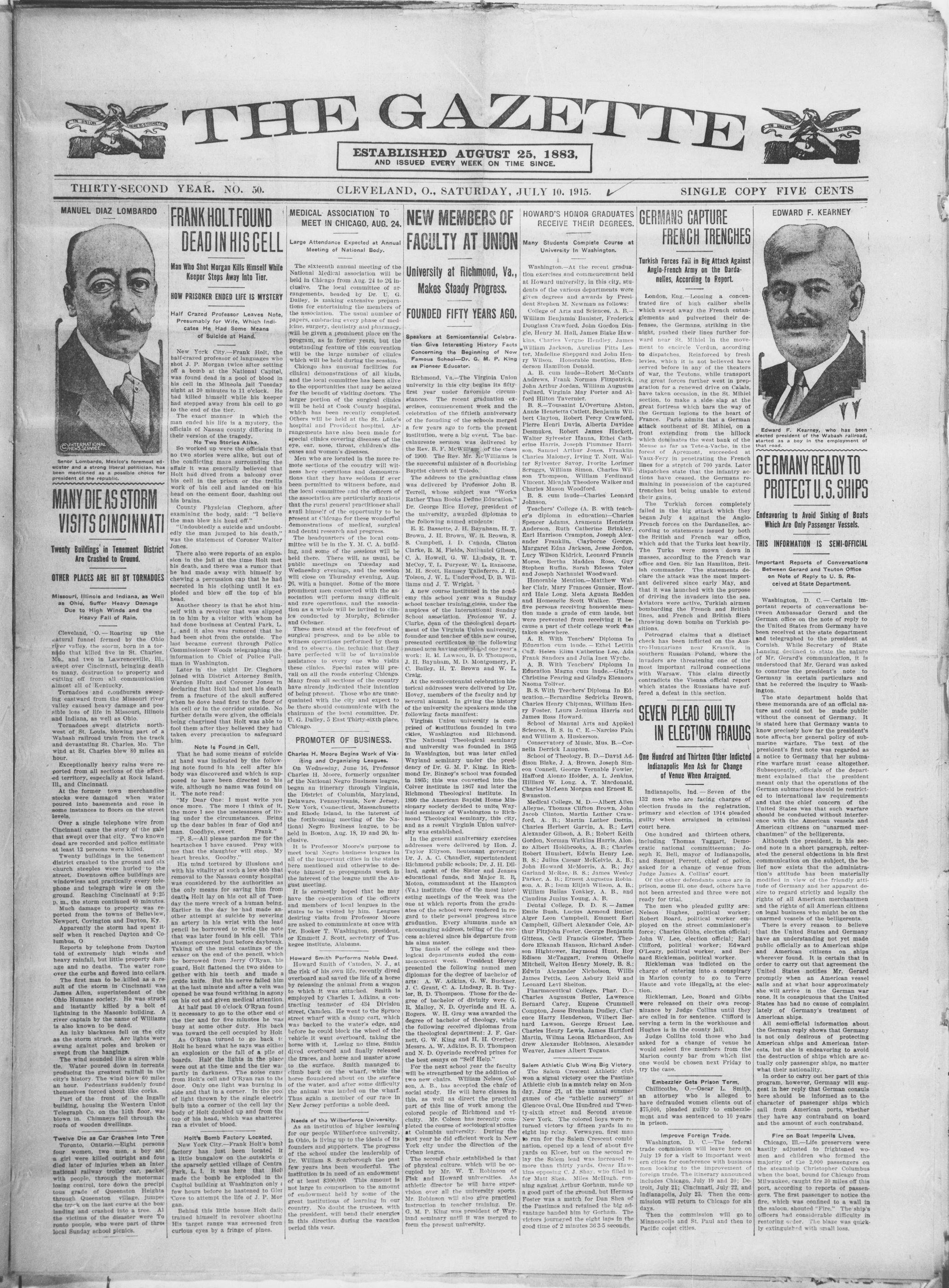
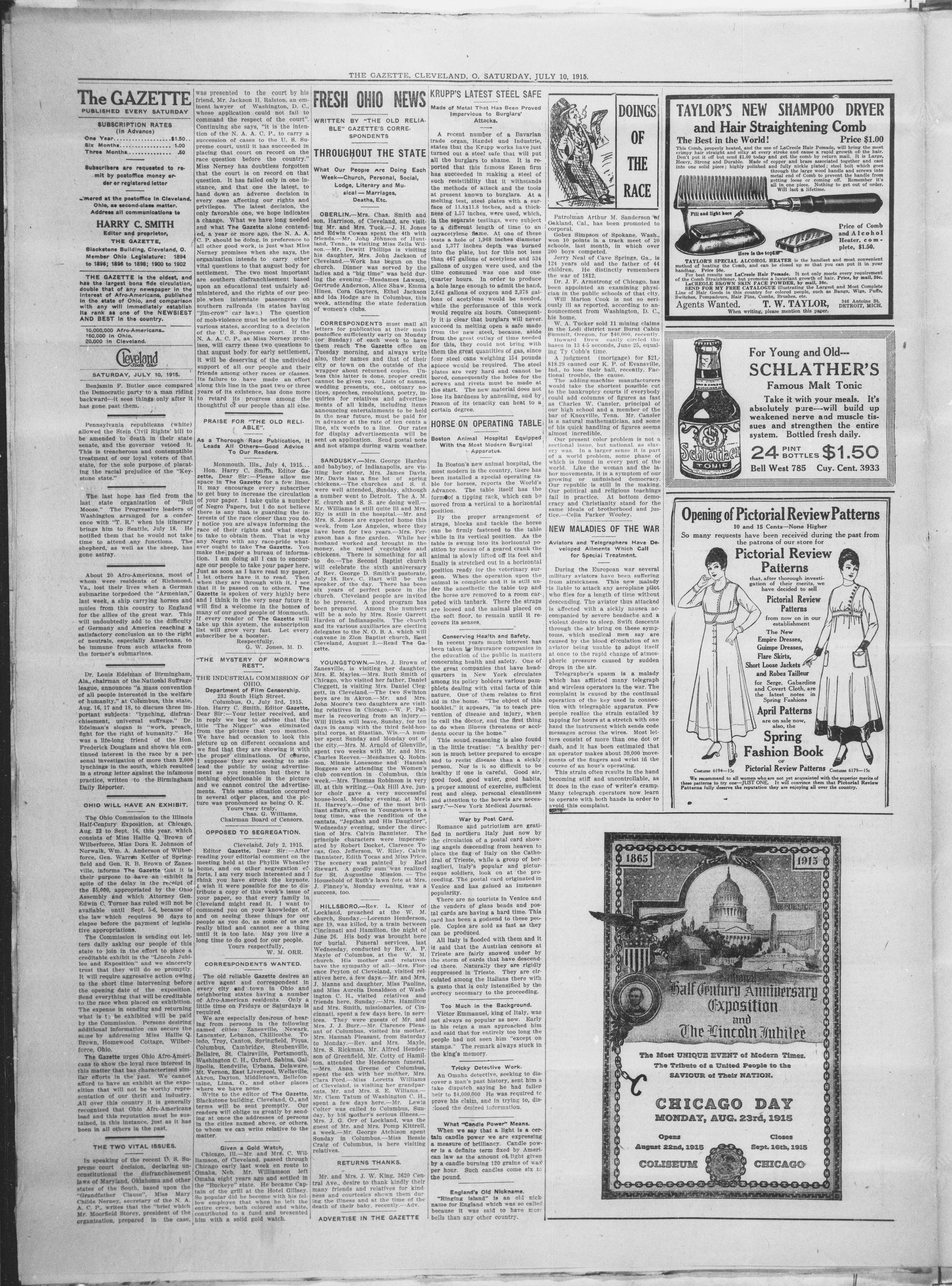
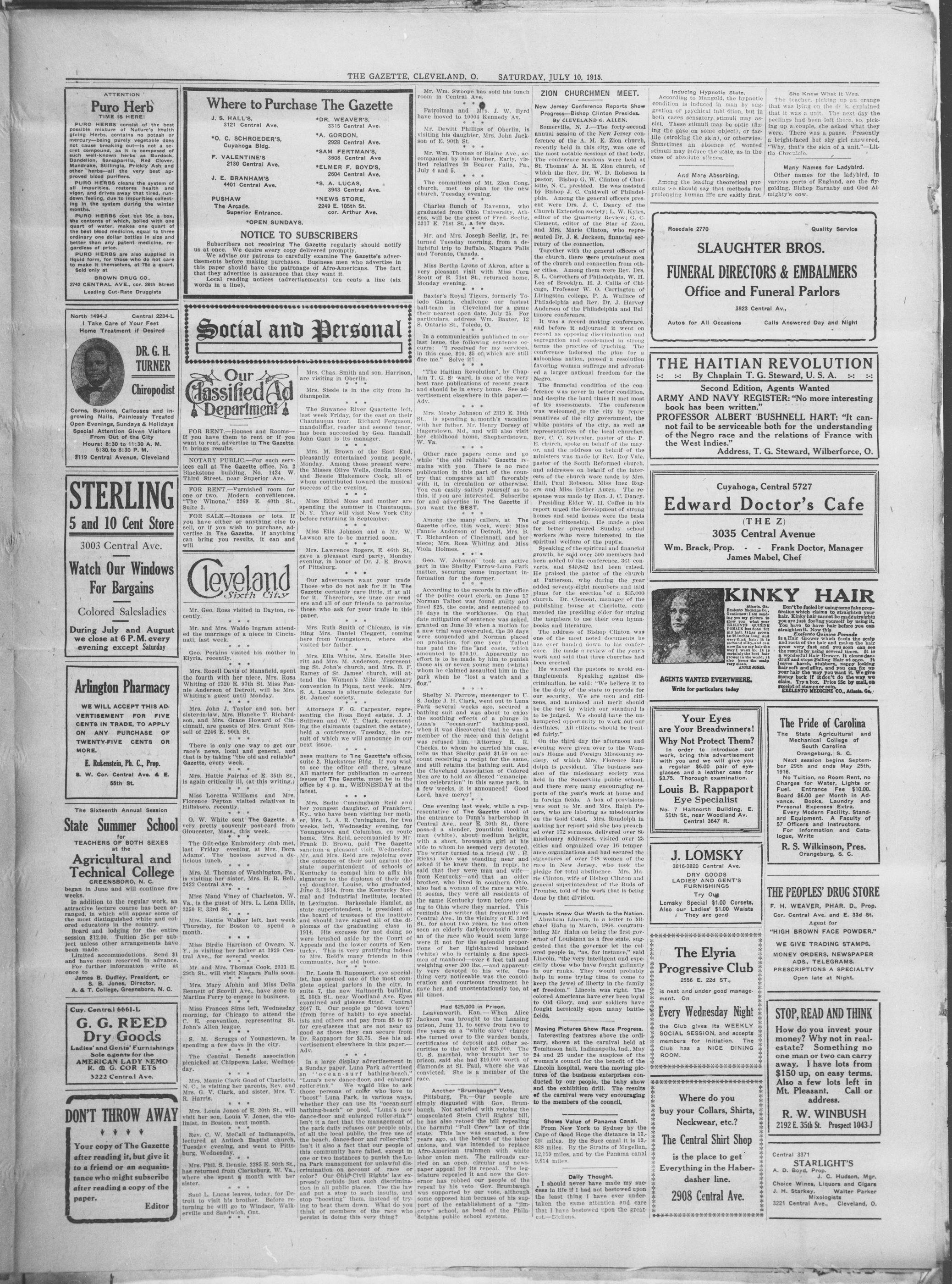
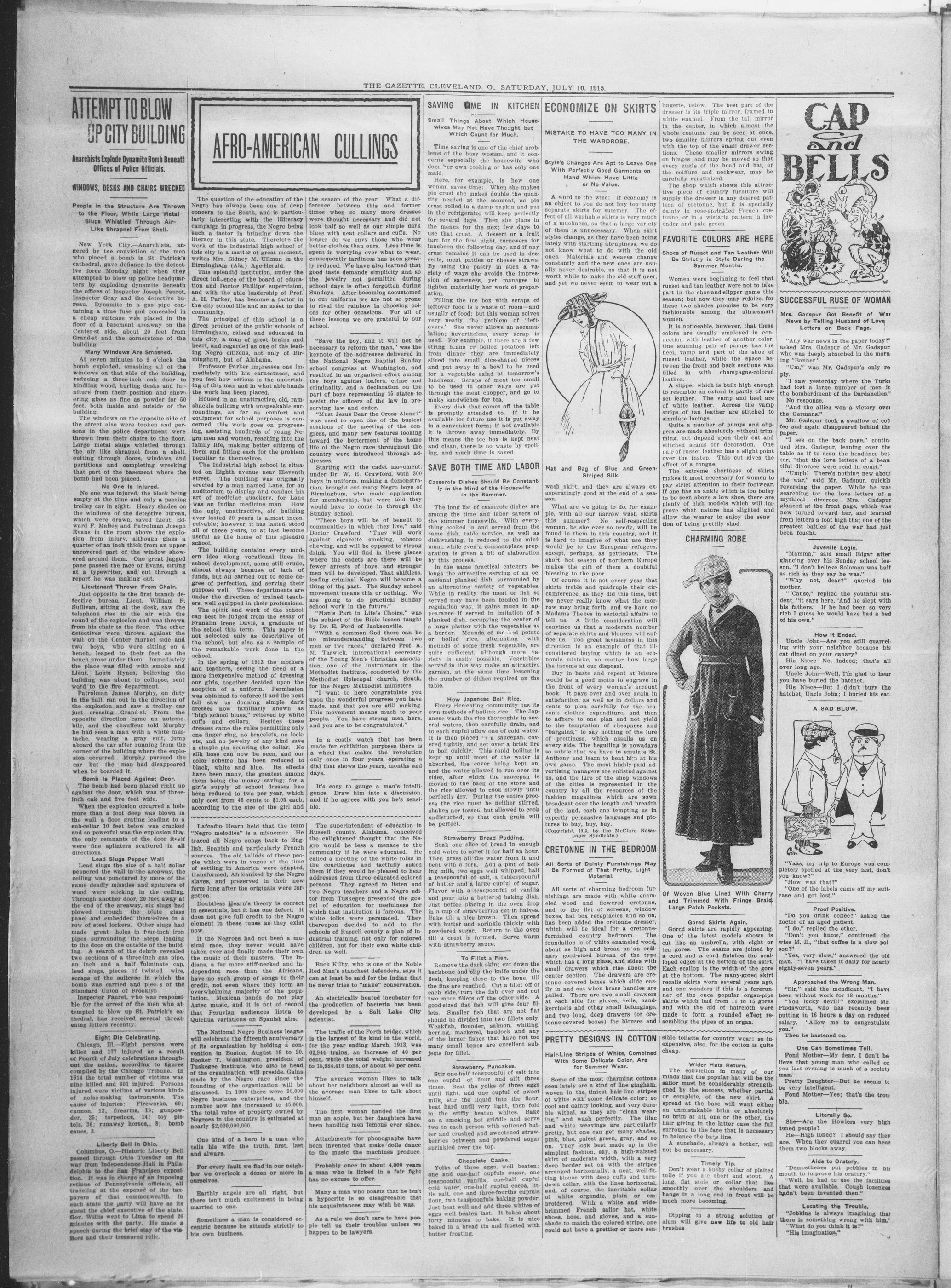
Page text (machine-generated)
THIRTY-SECOND YEAR. NO. 50.
IN WATCH
FORCE ESTHETIC
MANUEL DIAZ LOMBARDO
INTERNATIONAL
FILMS SERVICE
Senor Lombardio, Mexico's foremost educator and a strong liberal politician, has been mentioned as a possible choice for president of the republic.
Missouri, Illinois and Indiana, as Well as Ohio, Suffer Heavy Damage Due to High Winds and the Heavy Fall of Rain.
Cleveland, O. — Roaring up the natural funnel formed by the Ohio river valley, the storm, born in a tornado that killed, live in St. Charles, Mo., and two in Lawrenceville, Ill., swept over Cincinnati, bringing death to many, destruction to property and cutting off from all communication almost all of Kentucky.
Tornadoes and cloudbursts sweeping eastward from the Missouri river valley caused heavy damage and possible loss of life in Missouri, Illinois and Indiana, as well as Ohio.
Tornadoes swept districts northwest of St. Louis, blowing part of a Wabash railroad train from the track and devastating St. Charles, Mo. The wind at St. Charles blew 80 miles an hour.
Exceptionally heavy rains were reported from all sections of the affected territory, especially at Rock Island, Ill., and Cincinnati.
At the former town merchandise stocks were damaged when water poured into basements and rose in some instances to floors on the street levels.
Over a single telephone wire from Cincinnati came the story of the gale that swept over that city. Two known dead are recorded and police estimate at least 12 persons were killed.
Twenty buildings in the tenement district crashed to the ground and six church steeplees were hurled to the street. Downtown office buildings are windowless and practically every telephone and telegraph wire is on the ground. Reaching Cincinnati at 9:25 p.m. the storm continued 40 minutes. Much damage to property was reported from the towns of Belleview, Newport, Covington and Dayton, Ky. Apparently the storm had spent itself when it reached Dayton and Columbus, O. Reports by telephone from Dayton told of extremely high, winds and heavy rainfall, but little property damage and no deaths. The water rose over the curbs and flowed into cellars. The first man to be killed as a result of the storm in Cincinnati was James Allen, superintendent of the Ohio Humane society. He was struck and instantly killed by a bolt of lightning in the Masonic building. A river captain by the name of Williams is also known to be dead. An inky blackness fell on the city as the storm struck. Are lights were awaking against poles and broken or swept from the hangings. The wind sounded like a siren whistle. Water poured down in torrents producing the greatest rallfall in the city's history. The wind blew 60 miles an hour. Pedestrians suddenly found themselves forced about like corks. Part of the front of the Ingalls building, housing the Western Union Telegraph Co. on the 15th floor, was blown in. Chimneys fell through the roofs of wooden dwellings.
Twelve Die as Car Crashes Into Tree
Toronto, Ontario.—Eight persons
four women, two men, a boy and
a girl were killed outright and four
died later of injuries when an Inter-
national railway trolley car, packe-
d with people, through the motorna-
losing control, tore down the precipl
tous grade of Queenston Heights
through. Queenston village, jumper
the track on the last curve at the boat
landing and crashed into a tree. All
the victims of the disaster were To-
ronto people, who were part of three
local Sunday school picnics.
THE GAZETTE
FRANKHOLTFOUND DEAD IN HIS CELL
FRANKHOLTFOUND DEAD IN HIS CELL
Man Who Shot Morgan Kills Himself While Keeper Steps Away Into Tier.
HOW PRISONER ENDED LIFE IS MYSTERY
Half Crazed Professor Leaves Note, Presumably for Wife, Which Indicates He, Had. Some Means of Sulcide at Hand.
New York City.—Frank Holt, the half-crazed professor of languages who shot J. P. Morgan twice after setting off a bomb at the National Capitol; was found dead in a pool of blood in his cell in the Mineola jail Tuesday night at 20 minutes to 11 o'clock. He had killed himself while his keeper had stepped away from his cell to go to the end of the tier.
The exact manner in which the man ended his life is a mystery, the officials of Nassau county differing in their version of the tragedy.
Two Stories Allike.
So worked up were the officials that no two stories were alike, but out of the conflitting maze surrounding the affair it was generally believed that Holt had died from hepatic over his cell in the prison or the trellis work of his cell and landed on his head on the cement floor, dashing out his brains.
County Physician Cleghorn, after examining the body, said: "I believe the man blew his head off."
"Undoubtedly a suicide and undoubtedly the man jumped to his death," was the statement of Coroner Walter Jones.
There also were reports of an explosion in the fall at the time. Holt met his death, and there was a rumor that he had made away with himself by chewing a percussion cap that he had secreted in his clothing until it exploded and blew off the top of his head.
Another theory is that he shot himself with a revolver that was slipped in to him by a visitor with whom he had done business at Central Park, L. I, and it also was rumored that he had been shot from the outside. The last became current through Police Commissioner Woods (telegraphing the information to Chief of Police Pullman in Washington.
Later in the night Dr. Cleghorn joined with District Attorney Smith, Warden Hutz and Coroner Jones, in declaring that Holt had met his death from a fracture of the skull suffered when he dove head first to the floor of his cell or in the corridor outside. No further details were given, the officials being chagrined that Holt was able to fool them after they believed they had taken every precaution to safeguard him.
Note Is Found in Cell:
That he had some means of suicide at hand was indicated by the following note found in his cell after his body was discovered and which is supposed to have been directed to his wife, although no name was found on it. The note read:
"My Dear One: I must write you once more. The more I think of it, the more I see the uselessness of living under the circumstances. Bring up the dear babies in fear of God and man. Goodbye, sweet. Frank."
"P. S.—All please pardon me for the heartaches I have caused. Pray with me that the slaughter will stop. My heart breaks. Goodby."
His mind tortured by illusions and with his vitality at such a low ebb that removal to the Nassau county hospital was considered by the authorities as the only means for saving him from death. Holt lay on his cot of Tuesday the mere wreck of a human being. Earlier in the day, he had made another attempt at suicide by severing an antery in his wrist with the lead pencil he borrowed to write the note that was later found in his cell. This attempt occurred just before daybreak. Taking off the metal castings of the graser on the end of the pencil, which he borrowed from Jerry O'Ryan, his guard. Holt flattened the two sides together with his teeth and made a crude knife. But his nerve failed him at the last minute and after a vein was opened he was found writting in agony on his cot and given medical attention.
At half past 10 o'clock O'Ryan found it necessary to go to the other end of the tier and for five minutes he was busy at some other duty. His back was toward the cell occupied by Holt. As O'Ryan turned to go back to Holt he heard he says was either an explosion or the fall of a pile of boards. Half the lights in the place were out at the time and the tier was partly in darkness. The noise came from Holt's cell and O'Ryan ran to the door. Only one light was burning in side and that in a corner. In the pool of light thrown by the electric bulb lighted up of the cell lay the body of Holt doubled up and from the top of his head, which was shattered ran a rivulet of blood.
Holt's Bomb Factory Located.
New York City — Frank Holt's bomb factory has just been located. It a little bungalow on the outskirts of the sparsely settled village of Centra Park, L. I. It was here, that Holt made the bomb he exploded in the Capitol building at Washington only a few hours before he hastened to Gler Cove to attempt the life of J. P. Moran.
Behind this little house Holl dally trained himself in revover shooting. His target range was screened from curious eyes by a fringes of pines.
ESTABLISHED AUGUST 25, 1883 AND ISSUED EVERY WEEK ON TIME SINCE.
MEDICAL ASSOCIATION TO MEET IN CHICAGO, AUG. 24.
Large Attendance Expected at Annual Meeting of National Body.
The sixteenth annual meeting of the National Medical association will be held in Chicago from Aug. 24 to 26 inclusive. The local committee of arrangements, headed by Dr. U. G. Dalley, is making extensive preparations for entertaining the members of the association. The usual number of papers, combining every phase of medicine, surgery, dentistry and pharmacy, will be given a prominent place on the program, as in former years, but the outstanding feature of this convention will be the large number of clinics which will be held during the session. Chicago has unusual facilities for clinical demonstrations of all kinds, and the local committee has been alive to the opportunities that may be seized for the benefit of visiting doctors. The larger portion of the surgical clinics will be held at Cook County hospital, which has been recently completed. Others will be held at the St. Luke's hospital and Provident hospital. Arrangements have also been made for special clinics covering diseases of the eye, ear, nose, throat, children's diseases and women's diseases.
Men who are located in the more remote sections of the country will witness here operations and demonstrations that they have seldom if ever been permitted to witness before, and the local committee and the officers of the association are particularly anxious that the rural general practitioner shall avail himself of the opportunity to be present in Chicago for these wonderful demonstrations of medical, surgical and dental research and progress. The headquarters of the local committee will be in the Y. M. C. A. building, and some of the sessions will be held there. There will, as usual, be public meetings on Tuesday and Wednesday evenings, and the session will close on Thursday evening, Aug. 26, with a banquet. Some of the more prominent men connected with the association will perform many, difficult and rare operations, and the association as a whole will be invited to clinics conducted by Murphy, Schruder and Ochsner.
These men stand at the forefront of surgical progress, and to be able to witness operations performed by them and to observe the technique that they have perfected will be of invaluable assistance to every one who visits these clinics. Special rates will prevail on all the roads entering Chicago. Many from all sections of the country have already indicated their intention of being present. Those who are unacquainted with the city and expect to be there should communicate with the chairman of the local committee, Dr. G. D. Dalley, 5 East Thirty-sixth place, Chicago.
PROMOTER OF BUSINESS.
Charles H. Moore Begins Work of Via
Itation and Organizing Leagues.
On Wednesday, June 16, Professor Charles H. Moore, former organizer of the National Negro Business league, began an itinerary through Virginia, the district of Columbia, Maryland, Delaware, Pennsylvania, New Jersey, New York, Connecticut, Massachusetts and Rhode Island, in the interest of the forthcoming meeting of the National Negro Business league, to be held in Boston, Aug. 18, 19 and 20, inclusive.
It is Professor Moore's purpose to meet local Negro business leagues in all of the important cities in the states here mentioned and otherwise to devote himself to propaganda work in the interest of the league until the August meeting.
It is earnestly hoped that he may have the co-operation of the officers and members of local leagues in the states to be visited by him. Leagues desiring visits from Professor Moore are asked to communicate at once with Dr. Booker T. Washington, president, or Emmett J. Scott, secretary of Tuskegee institute, Alabama.
Howard Smith Perform Noble Dead. Howard Smith of Camden, N. J., at the risk of his own life, recently dived overboard and saved the life of a horse by releasing the animal from a wagon to which it was attached. Smith is employed by Charles L. Adams, a contracting teamster of 434 Division street, Camden. He want to the Spruce street wharf with a dump cart, which was backed to the water's edge, and before he could block the wheel of the vehicle it went overboard, taking the horse with it. Losing no time, Smith dived overboard and finally released the traces, and horse and master arose to the surface. Smith managed to climb back on the wharf, while the horse floored about on the surface of the water, and after some difficulty the animal was laughed in the wharf. Thus again a member of our race in New Jersey performs a noble deed.
Needs of the Wilberforce University. As an institution of higher learning for our people Wilberforce university, In Ohio, as living up to the ideals of its founders and supporters. The progress of the school under the leadership of Dr. William S. Scarborough the past few years has been wonderful. The institution is in need of an endowment of at least $300,000. This amount is not large in comparison to the amount of endowment held by some of the great institutions of learning in our country. No doubt the trustees, with the president, will bend their energies in this direction during the vacation period this year.
NEW MEMBERS OF FACULTY AT UNION
University at Richmond, Va., Makos Steady Progress.
FOUNDED FIFTY YEARS AGO.
Speakers at Semicentennial Celebration Give Interesting History Facts Concerning the Beginning of Now Famous School—Dr. G. M. P. King as Pioneer Educator.
Richmond, Va.—The Virginia Union university in this city begins its fifty-first year under favorable circumstances. The recent graduation exercises, commencement week and the celebration of the fifteenth anniversary of the founding of the schools merged a few years ago to form the present institution, were a big event. The baccalaureate sermon was delivered by the Rev. B. P. McWilliam of the class of 1900. The Rev. Mr. McWilliam is the successful minister of a flourishing Baptist church at Toledo.
The address to the graduating class was delivered by Professor John B. Terrell, whose subject was "Works Rather Than Books Define Education." Dr. George Rice Howey, president of the university, awarded diplomas to the following named students;
E. E. Bassette, J. H. Baynham, H. T. Brown, J. H. Brown, W. R. Brown, S. S. Campbell, I. D. Canada, Clinton Clarke, R. M. Fields, Nathaniel Gibson, C. A. Howell, G. W. Lladsay, R. T. McCoy, T. L. Puryear, W. L. Ransome, M. H. Scott, Ransley Tailfero, J. H. Tolson, J. W. L. Underwood, D. B. Williams and J. T. Wright.
A new course instituted in the academy this school year was a Sunday school teacher training, class, under the auspices of the International Sunday School association, Professor W. J. Clarke, dean of the theological department of the Virginia Union university, founder and teacher of this new course, presented certificates to the following named men having conferred one year's work: R. M. Lawson, B. D. Thompson, J. H. Bayahum, M. D. Montgomery, P. C. Bailey, H. T. Brown and W. L. Craig.
At the semicentennial celebration historical addresses were delivered by Dr. Hovey, members of the faculty and by several alumni. In giving the history of the university the speakers made the following facts manifest:
Virginia Union university is comprised of institutions founded in two cities, Washington and Richmond. The National Theological seminary and university was founded in 1865 in Washington, but was later called Wayland seminary under the presidency of Dr. G. M. P. King. In Richmond Dr. Binney's school was founded in 1865; this was converted into the Coler institutes in 1867 and later the Richmond Theological institute. In 1890 the American Baptist Home Mission society decided to unite Wayland seminary of Washington to Richmond Theological seminary, this city, and as a result Virginia Union university was established.
In the general anniversary exercises addresses were delivered by Hon. J. Taylor Ellison, lieutenant governor; Dr. J. A. C. Chandler, superintendent Richmond public schools; Dr. J. H. Dillard, agent of the Slater and Jeanne educational funds, and Major R. R. Moton, commandant at the Hampton (Va.) institute. One of the most interesting meetings of the week was the one at which reports from the graduates of the school were rendered in regard to their personal progress since graduation. Every alumnus made an encouraging address, telling of the success achieved since his departure from his alma mater.
The finals of the college and theological departments ended the commencement week. President Hove presented a presentation of his diploma for the degree of bachelor of A. W. Adkins, G. W. Buckner, J. C. Grant, C. A. Lindsay, R. B. Taylor, B. D. Thompson. Those for the degree of bachelor of divinity were G. R. Malloy, N. D. Oyerude and H. A. Rogers. W. H. Gray was awarded the degree of bachelor of theology, while the following received diplomas from the theological department: J. F. Garnett, G. W. King and H. H. Overby, Messrs. G. W. Adkins, B. D. Thompson and N. D. Oyerinde received prizes for the best essays on "Self Help."
For the next school year the faculty will be strengthened by the addition of two new chairs. William Nelson Colson, A. B., has accepted the chair of social study. He will have classes in this, as well as direct the practical part of this line of work among the colored people of Richmond and vicitnity. Mr. Colson has recently completed the course of sociological studies at Columbia university. During the past year he did efficient work in New York city under the direction of the Urban league.
The second chair, established is that of physical culture, which will be occupied by Mr. W. T. Robinson of Fisk and Howard University. As athletic director he will have supervision over all the university sports. Mr. Robinson will also give practical instruction in teacher training. Dr. G. M. P. King was president of Wartau seminary until it was merged to form the present university.
HOWARD'S HONOR GRADUATES RECEIVE THEIR DEGREES.
Many Students Complete. Course at 'University In Washington.
Washington. At the recent graduation exercises and commencement hold at Howard university, in this city, students of the various departments were given degrees and awards by President Stephen M. Newman as follows: College of Arts and Sciences, A. B. William Benjamin Bainister, Frederick Douglass Crawford, John Gordon Dingle, Henry M. Hull, James Blake Hawkins, Charles Vergne Headney, James William Jackson, Aurielis Pitts Lester, Madeline Sheppard and John Henry Wilson. Honourable mention, Henderson Hamilton Donald.
A. B. cum laude—Robert McCants
Andrews, Frank Lorman Fitzpatrick,
John Arthur Jordan, William Augustus
Pollard, Virginia May Porter and
Aldford Hilton Taverpier.
B. S. Toussaint L'Overture Alston,
Amie Henrietta Cutlett, Benjamin Wil-
bert Clayton, Robert Percy Crawford,
Pierre Henri Davis, Alberta Davidee
Desmukes, Robert James Huckett,
Walter Sylvester Hanna, Ethel Cather-
line Harris, Joseph Percy Harrison,
Samuel Mahoney, Irving T. Nutt, Walt
Sylvester Savesy, Phorie Lorimer
Seruggs, William Simon, Charles Wilson
Thompson, William Ferdinand
Vincent, Mieghaj Theodore Walker and
Charles Mason Woodford.
B. S. cum laude—Charles Leonard
Johnson.
Teachers' College (A. B. with teacher's
diploma in education—Charles
Spencer Adams, Ardmenta Henrietta
Anderson, Ruth Catherine Brinkley,
Earl Harrison Campion, Joseph Alex-
dore Mugaret Elvin Johnson, Joseph
Luxy Wilson Kidrick, Leonard Francis
Morse, Bertha Mudden Rose, Guy
Stephen Ruffin, Sarah Eagles Toles
and Joseph Nathaniel Woodward.
Honorable Mention—Matthew Walker
Clur, Mary Frances Gunner, Howard
Hale Long, Meta Agusta Redden
and Homezelle Scott Walker. These
five persons receiving honorable menta-
tion made a grade of cum laude, but
were prevented from receiving it
because a part of their college work was
taken elsewhere.
A. B. With Teachers' Diploma In Education cum laude. - Ethel Lelitta Cuf. Helen Eiliza catherine Lee, Ada Frank Sanders and Julia Inez Wyche. A. B. With Teachers' Diploma In Education Magna cum laude. - Gladys Christine Fearing and Gladys Eleanna Naoma Toliver. B. S. With Teachers' Diploma In Education. - Bernardine Sedricks Brown, Charles Henry Chipman, William Henry Foster, Laura Jemma Harris and James Ross Howard. School of Manual Arts and Applied Sciences, B. S. in C. E. - Narcisco Fain and William A. Huskerson.
Conservatory of Music, Mus. B.-Cornell Derrick Lampton.
School of Theology, B. D.-David Adelson Blake, J. A. Brown, Joseph Simon Connell, George Vernable Fowler, Hafford Alonzo Holder, A. J. Lenkins, Hillard W. Long, A. T. Macdonald, Charles McLean Morgan and Ernest E. Swanston.
Medical College, M. D.-Albert Allen Alleyne, Thononas Clinton Brown, John Jacob Clinton, Martin Luther Crawford, A. B.; Martin Luther Dottin, Charles Herbert Gavin, A. B.; Lev Alexander Gibson, A. B.; Robert Keith Gordon, Norman Watkins Harris, Alonzo Albert Holldrooks, A. B.; Charles Robert Humbert, Edwin Henry Lee, B. S.; Julius Caesar McKelvie, A. B.; John-Howard McMorris, A. B.; Jay Garland McMease, S. J.; James Wesley Parker, A. B.; Erasmus Augustus Ridgson, A. B.; Isaen Elijah Wilson, A. B.; William Ballas Yoakley, A. B., and Claudius Junius Young, A. B.
Dental College, D. D. S.-James Emile Hish, Lacus Armand Butler, Alger Leon Campbell, Emmett Earl Campbell, Gilbert Alexander Cole, Arthur Fitzjohn Foster, George Benjamin Gittens, Coell Francis Gloster, Theodore Eilakhan Inanson, Richard Anderson Highower, Raymond Hunt, Roy Edison Mackagert, Iverson Othello Mitchell, Welton Henry Mosely, B. S.; Edwin Alexander Nicholson, James Petts, Leon Asbury Reid and Leonard Levil Shelton.
Pharmaceutical College, Ph. D.-Charles Augustus Butler, Lawrence Bernard Carey, Eugene Crummell Compton, Jesse Brenhann Dudley, Chance Harry Henderson, Wilbert Bernard Lawson, George Ernest Lee, Charles Henry Lewis, James Hartford Martin, Wilhelm Leona Richardson, Andrew Alexander Robinson, Alexander Weaver, James Albert Togans.
Salem Athletic Club Wins Big Victory
The Salem Crescent - Athletic club won a signal victory over the Pastimus Athletic club in a match relay on Monday, June 21, at the annual summer games of "the athletic nursery" at Glencoe Oval, One Hundred and Twenty-sixth street and Second avenue, New York. The colored boys were returned victors by fifteen yards in an eight lap relay. Verwayen, fgst man **bo** run for the Salem Crescent combination, opened up a lead of about five yards on Kiefer, on the second relay the Salem lead was decreased to more than thirty yards. Oscar Huns opposing J. L Sha, finished in for Matt Skea, Miles Mellugh, running against Arthur Gorman, made up a good part of the ground, but Herman Foster was a match for Dan Shea of the Pastimus and retained the big advantage handed him by Gorman. The victors journeyed the eight laps in the good time of 2 minutes 36.3 seconds.
SINGLE COPY FIVE CENTS
GERMANS CAPTURE
FRENCH TRENCHES
GERMANS CAPTURE
FRENCH TRENCHES
Turkish Forces Fail in Big Attack Against Anglo-French Army on the Dardanelles, According to Report.
London, Eng. Loosing a concentrated fire of high caliber shells which swept away the French entanglements' and pulverized their defenses, the Germans, striking in the night, pushed their lines further forward near St. Michel in the movement to encircle Verdun, according to dispatches. Reinforced by, fresh levies, which it is not believed have served before in any of the theaters of war, the Teutons, while transporting great forces further west in preparation for a renewed drive on Calais, have taken occasion, in the St. Michel section, to make a side slap at the great fortress, which bars the way of the German legions to the heart of France. Paris admits that a German attack southwest of St. Michel, on a front extending from the hillock which dominates the west bank of the Meuse, as far as Tete-Vache, in the forest of Apremont, succeeded at Vanx-Fery in penetrating the French lines for a stretch of 700 yards. Later dispatches state that the infantry actions have ceased, the Germans remaining in possession of the captured trenches but being unable to extend their gains.
The Turkish forces completely failed in the big attack which they began July. 4 against the Anglo-French forces on the Dardauelles, according to statements issued, by both the British and French war office, which add that the Turks lost heavily. The Turks were mown down in masses, according to the French war office and Gen. Sir Ian Hamilton, British commander. The statements declare the attack was the most important 'delivered' since early May, and that it was launched with the purpose of drying the invaders into the sea. Aviators were active, Turkish airmen bombarding the French and British lines, and French and British filers throwing down bombs on Turkish positions.
Petrograd claims that a distinct check has been inflicted on the Austro-Hungarians near Krasnik, in southern Russian Poland, where the invaders are threatening one of the most important railroad connections with Warsaw. This claim directly contradicts the Vienna official-report which states the Russians have suffered a defeat in this section.
SEVEN PLEAD GUILTY IN ELECTION FRAUDS
SEVEN PLEAD GUILTY IN ELECTION FRAUDS
One Hundred and Thirteen Other Indicted Indianapolis Men Ask for Change of Venue When Arraigned.
Indianapolis, Ind. — Seven of the 132 men who are facing charges of election frauds in the registration, primary and election of 1914 pleaded guilty when arraigned in criminal court here.
One hundred and thirteen others, including Thomas Taggart, Democratic national committee man; Joseph E. Bell, mayor of Indianapolis, and Samuel Perrott, chief of police, asked for a change of venue from Judge James A. Collins' court.
Of the other defendants some are in prison, some ill, one dead, others have not been arrested and three were not ready for trial.
The men who pleaded guilty are Nelson Hughes, political worker; Robert Board, political worker employed on the street commissioner's force; Charles Gibbs, election official; John W. Lee, election official; Earl Clifford, political worker; Edward O'Leary, political worker, and Bernard Rickleman, political worker.
Rickleman was indicted on the charge of entering into a conspiracy in Marion county to go to Terre Haute and vote illegally at the election.
Rickleman, Lee, Board and Gibbs were released on their own recognition by Judge Collins until they are called in for sentence. Clifford is serving a term in the workhouse and Hughes is in the county jail.
Judge Collins told those who had asked for a change of venue he would select five members from the Marion county bar from which list one would be chosen next Friday to try the case.
Embezzler Gets Prison Term. Chillicothe, O.-Oscar L. Smith, an attorney who is alleged to have defrauded women clients out of $75,000, pleaded guilty to embezzlement and was sentenced to 10 years in prison.
Improve Foreign Trade. Washington, D. C.-The federal trade commission will leave here on July 19 for a visit to important western cities for conference with business men looking to the improvement of foreign trade. The imminent announced includes Chicago, July 19 and 20; Detroit, July 21; Cincinnati, July 22; Indianapolis, July 23. Then the commission will return to Chicago for six days.
Then the commission will go to Minneapolis and St. Paul and then to Pacific coast cities.
IN HONOR OF THE ESTATE
Edward F. Kearney, who has been elected president of the Wabash railroad, started as a boy in the employment of that road.
Endeavoring to Avoid Sinking of Boats Which Are Only Passenger Vessels.
THIS INFORMATION IS SEMI-OFFICIAL
Important Reports of Conversations Between Gerard and Teuton Office on Note of Reply to U. S. Received at D. State Department.
Washington, D. C. — Certain important reports of conversations between Ambassador Gerard and the German office on the note of reply to the United States from Germany have been received at the state department and telegraphed to the president at Cornish. While Secretary of State Lausung declined to state the nature of Mr. Gerard's communication, it is understood that Mr. Gerard was asked to construe the president's note to Germany in certain particulars and that he referred the inquiry to Washington.
The state department holds that these memoranda are of an official nature and could not be made public without the consent of Germany. It is stated here that Germany, wants to know precisely how far the president's note affects her general policy of submarine warfare. The text of the president's first note was regarded as a notice to Germany that her submarine warfare must cease altogether. Subsequently, officials of the department explained that the president meant only that the operations of the German submarines should be restricted to international law requirements and that the chief concern of the United States was that such warfare should be conducted without interference with the American vessels and American citizens on "unarmed merchantmen" of the belligers.
Although the president, in his second note in a short paragraph, reiterated the general objections in his first communication on the subject, the belief now exists that the administration's attitude has been materially modified in view of the friendly attitude of Germany and her apparent desire to regard strictly and legally the rights of all American merchants and the rights of all American citizens on legal business who might be on the unarmed vessels of the belligerents. There is every reason to believe that the United States and Germany have an understanding not yet made public officially as to American ships and American citizens on ships wherever found. It is certain that in order to carry out that agreement the United States notifies Mr. Gerard promptly when an American vessel sails and at what hour approximately she will arrive in the German war zone. It is conspicuous that the United States has had no cause of complaint lately of Germany's treatment of American ships.
All semi-official information about the German reply shows that Germany is not only desirous of protecting American ships and American interests, but she is endeavoring to avoid the destruction of ships which are actually only passenger ships, no matter what their nationality.
In order to carry out her part of this program, however, Germany will suggest in her reply that German consuls here should be informed as to the character of passenger ships which sail from American ports, whether they have any contraband on board and the amount of such contraband.
Fire on Boat Imperilis Lives.
Chicago, IL—Life preservers were hastily adjusted to frightened women and children who formed "the majority of the 2,000 passengers on the steamship Christopher Columbus when the boat, bound for Chicago from Milwaukee, caught fire 30 miles off this port, according to reports of passengers. The first passenger to notice the fire, which was confined to a wall in the saloon, shouted "Fire." The ship's officers had considerable difficulty in restoring order. The blaze was quickly extinguished with small loss.
One Year. $1.50.
Six Montha. 1.00
Three Montha. .50
Subscribers are requested to re-
mit by postoffice money en-
der or registered letter
mered at the postoffice In Cleveland
Ohio, as second-class matter.
Address all communications to
HARRY C. SMITH
Editor and proprietor,
THE GAZETTE,
Blackstone Building, Cleveland, O.
Member Ohio Legislature: 1894
to 1896; 1896 to 1898; 1900 to 1902
THE GAZETTE is the oldest, and has the largest bona fide circulation, double that of any newspaper in the interest of Afro-Americans, published in the state of Ohio, and comparison with any will immediately establish its rank as one of the NEWSIEST AND BEST in the country.
10,000,000 Afro-Americans..
160,000 in Ohio.
20,000 in Cleveland.
SATURDAY, JULY 10, 1915.
Benjamin F. Butler once compared the Democratic party to a man riding backward—it sees things only after it has gone past them.
Pennsylvania republicans (white) allowed the Stein Civil Rights' bill to be amended to death in their state senate, and the governor vetoed it. This is treacherous and contemptible treatment of our loyal voters of that state, for the sole purpose of placating the racial prejudice of the "Keystone state."
The last hope has fled from the last state organization of "Bull Moose." The Progressive leaders of Washington arranged for a conference with "T. R." when his itinerary brings him to Seattle, July 18. He notified them that he would not take time to attend any functions. The shepherd, as well as the sheep, has gone astray.
About 20 Afro-Americans, most of whom were residents of Richmond, Va., lost their lives when a German submarine torpedoed the "Armenian," last week, a ship carrying horses and mules from this country to England for the allies of the great war. This will undoubtedly add to the difficulty of Germany and America reaching a satisfactory conclusion as to the right of neutrals, especially Americans, to be immune from such attacks from the former's submarines.
Dr. Louis Edelman of Birmingham, Ala., chairman of the National Suffrage league, announces a "mass convention of all people interested in the welfare of humanity," at Columbus, this state, Aug. 16, 17 and 18, to discuss three important subjects: "lynching, disfranchisement, universal suffrage." Dr. Edelman's slogan is "work, preach fight for the right of humanity." He was a life-long friend of the Hon Frederick Douglass and shows his continued interest in the race by a personal investigation of more than 2,000 lynchings in the south, which resulted in a strong letter against the infamous practice, written to the Birmingham Daily Reporter.
OHIO WILL HAVE AN EXHIBIT.
The Ohio Commission to the Illinois Half-Century Exposition, at Chicago, Aug. 22 to Sept. 16, this year, which consists of Miss Hallie G. Brown of Wilberforce, Miss Dora E. Johnson of Norwalk, Wm. A. Anderson of Wilberforce, Gen. Warren Keifer of Spring field and Gen. R. B. Brown of Zanesville, informs The Gazette that it is their purpose to have an exhibit in spite of the delay in the receipt of the $5,000, appropriated by the Ohio Assembly and which Attorney Gen. Edwin C. Turner has ruled will not be available until Sept. 5-6, because of the law which requires 90 days to elapse before the payment of legislative appropriations.
The Commission is sending out letters daily asking our people of this state to join in the effort to place a creditable exhibit in the "Lincoln Jubilee and Exposition" and we sincerely trust that they will do so promptly. It will require aggressive action owing to the short time intervening before the opening date of the exposition. Send everything that will be creditable to the race when placed on exhibition. The expense in sending and returning what is to be exhibited will be paid by the Commission. Persons desiring additional information can secure the same by addressing Miss Hale Q. Brown, Homewood Cottage, Wilberforce, Ohio.
The Gazette urges Ohio Afro-Americans to show the loyalty race interest in this matter that has characterized similar efforts in the past. We cannot afford to have an exhibit at the exposition that will not be worthy representation of our thrift and industry. All over this country it is generally recognized that Ohio Afro-Americans lead and this reputation must be sustained, in this instance, just as it has been in all others in the past.
THE TWO VITAL ISSUES.
In speaking of the recent U. S. Supreme court decision, declaring unconstitutional the disfranchisement laws of Maryland, Oklahoma and other states of the South, based upon the "Grandfather Clause", Miss Mary Childs Nerney, secretary of the N. A. A. C. P. writes, that the "brief which Mr. Moortfield Storey, president of the organization, prepared in the case,
was presented to the court by his friend, Mr. Jackson H. Ralston, an eminent lawyer of Washington, D. C., whose application could not fail to command the respect of the court". Continuing she says, "it is the intention of the N. A. A. C. P., to carry a succession of cases to the U. S. Supreme court, until it has succeeded in placing that court on record on the race question before the country". Miss Nerney has doubtless forgotten that the court is on record on that question. It has failed only in one instance, and that one the latest, to hand down an adverse decision in every case affecting our rights and privileges. The latest decision, the only favorable one, we hope indicates a change. What we have long needed and what The Gazette alone contended, a year or more ago, the N. A. A. C. P. should be doing, in preference to all other good work, is just what Miss Nerney promises when she says, the organization intends to carry other vital questions to that august body for settlement. The two most important are southern disfranchisement based upon an educational test unfairly administered, and the rights of our people when interstate passengers on southern railroads (in states having "jim-crow" car laws). The question of mob-violence must be settled by the various states, according to a decision of the U. S. Supreme court. If the N. A. A. C. P., as Miss Nerney promises, will carry these two questions to that august body for early settlement, it will be deserving of the undivided support of all our people and their friends among other races or classes. Its failure to have made an effort along this line in the past two or three years of its existence, has done more to retard its progress among the thoughtful of our people than all else.
PRAISE FOR "THE OLD RELI-
ABLE".
As a Thorough Race Publication, I
Leads an Outreach Advice
To Our Readers
Monmouth, Ill., July 4, 1951. Hon. Harry C. Smith, Editor Gazette, Dear Sir:—Please allow me space in The Gazette for a few lines. It may encourage every subscriber to get busy to increase the circulation of your paper. I take quite a number of Negro Papers, but I do not believe there is any that is guarding the interests of the race closer than you do. I notice you are always informing the race of their rights and what steps they can take to ensure any Negro with any race-pride what ever ought to take The Gazette. You make the paper a bureau of information. I am doing all I can to encourage our people to take your paper here. Just as soon as I have read my paper, I let others have it to read. Then when they are through with it, I see that is passed on to others. The Gazette will be highly here and I think in the very near future it will find a welcome in the homes of many of our good people of Monmouth. If every reader of The Gazette will take up this system, the subscription list will grow very fast. Let every subscriber be a booster.
Respectfully,
G. W. Jones, M. D.
"THE MYSTERY OF MORROW'S REST".
THE INDUSTRIAL COMMISSION OF OHIO.
Department of Film Censorship.
233 South High Street.
Columbus, O., July 3rd, 1915.
Hon. Harry C. Smith, Editor Gazette.
Dear Sir: Your letter received, and in reply we beg to advise that the title "The Nigger" was eliminated from the picture that you mention.
We have had occasion to look this picture up on different occasions and we find that they are showing it with the proper eliminations. Of course I suppose they are seeking to mis lead the public by using advertisement as you would, that there is nothing objectionable in the picture and we cannot control the advertisements. This same situation occurred in several other places, and the picture was pronounced as being O. K.
Yours very truly.
Chas. G. Williams.
Chairman Board of Censors.
OPPOSED TO SEGREGATION.
Cleveland, July 2. 1915.
Editor Gazette, Dear Sir:—after reading your editorial comment on the meeting held at the Phyllis Wheatley home, and on other segregation efforts, I am very much interested and I think you have struck the keynote. I wish it we had a tribute a copy of this week's issue of your paper, so that every family in Cleveland might read it. I want to commend you on your knowledge of, and on seeing these things for our people as you do, as some of us are really blind and cannot see a thing until it is too late. May you live a long time to do good for our people.
Yours respectfully,
W. M. ORR.
CORRESPONDENTS WANTED.
The old reliable Gazette desires an active agent and correspondent in every city and town in Ohio and neighboring states having a number of Afro-American residents. Only a little time on Fridays or Saturdays is required.
We are especially desirous of hearing from persons in the following named cities: Zanesville, Newark, Wilmington, Chillicothe, ledo, Troy, Canton, Springfield, Piqua, Columbus, Cambridge, Steubenville, Bellaire, St. Clairville, Portsmouth, Washington C. H., Oxford, Sabina, Galipolis, Rendville, Urbana, Delaware, Mt. Vernon, East Liverpool, Wellsville, Akron, Dayton, Middletown, Bellefontaine, Lima, O., and other places where we have none.
Write to the editor of The Gazette. Blackstone building, Cleveland, O., and terms will be sent promptly. Our sender will personally be greatly by sendert once the addresses of persons in the cities named above, or others, to whom we can write relative to the matter.
Given a Gold Watch
Chicago, Ill.-Mr. and Mrs. C. Williamson, of Cleveland, passed through Chicago early last week en route to Omaha, Neb. Mr. Williamson left Omaha eight years ago and settled in the "Buckeye" state. He became "captain of the grill at the Hotel Gillese. So popular did he become with his fellow employees that when he left the entire crew, both colored and white, contributed to a fund and uplifted him with a solid gold watch.
THE GAZETTE, CLEVELAND, O. SATURDAY, JULY 10, 1915
FRESH OHIO NEWS
FRESH OHIO NEWS
WRITTEN BY "THE OLD RELIABLE" GAZETTE'S CORRESPONDENTS
THROUGHOUT THE STATE
What Our People Are Doing Each Week—Church, Personal, Social, Lodge, Literary and Musical—Marriages, Deaths, Etc.
OBERLIN—Mrs. Chas. Smith and son, Harrison, of Cleveland, are visiting Mr. and Mrs. Tuck.—J. H. Jones and Edwin Cowan spent the 4th with friends.—Mr. John Johnson of Huntland, Tenn. is visiting Miss Zola Wilson.—Mr. Dewitt Phillips is visiting his daughter, Mrs. John Jackson of Cleveland.—Work has begun on the church. Dinner was served by the ladies and a "big time" was held during the evening—Mesdames Lawson, Gertrude Anderson, Alice Shaw, Emma Hines, Cora Gayters, Etel Jackson and Ida Hodge are in Columbus, this week, attending the state federation of women's clubs.
CORRESPONDENTS must mail all letters for publication at their postoffice sufficiently early on Monday (or Sunday) of each week to have them reach The Gazette office on Tuesday morning, and always write also, their names and that of their names on or outside of the wrapper attached to the envelope less this latter is done, proper credit cannot be given you. Lists of names, wedding presents, etc., on ountary notices, speeches, resolutions, poetry, inquiries for relatives and advertisements of all kinds, including items annuaries to entertainments to the near future, must be paid for in advance at the rate of ten cents a line, six words to a line. Our rates for display advertisements will be sent on application. Send postal note and not stamps during warm weather.
SANDUSKY.—Mrs. George Harden and babyboy, of Indianapolis, are visiting her sister, Mrs. James Davis. Mr. Davis has a fine lot of spring chickens.—The churches and S. S were well attended, Sunday, although a number went to Detroit. The A. M. E. church and S. S. are doing well.—Mr. Williams is still quite and Mrs. Ely.—Mr. Williams is still quite and Mrs. S. Jones are expected home this week, from Los Angeles, where they have been for two years.—Mrs. Ferguson has a fine garden. While her husband worked and brought in the money, she raised vegetables and chickens. There is something for all to do.—The Second Baptist church will celebrate the sixth anniversary of George D. Smith's baptism July 18. Rev. C Hart will be the speaker of the day. There has been six years of perfect peace in the church. Cleveland people are invited to be present. A good program has been prepared. Among the numbers will be a solo by Mrs. Rosie Garett Harden of Indianapolis. The church and its various auxiliaries are electing a new pastor. Convene in Zion Baptist church, East Cleveland, August 2.—Read The Gazette
YOUNGSTOWN.—Mrs. J. Brown of Zanesville, is visiting her daughter, Mrs. E. Mayles.—Mrs. Ruth Smith of Chicago, who visited her father, Daniel Cleggett, is visiting Mrs. Daniel Cleggett, in Cleveland. The two Swinton boys are in Akron. Mr. and Mrs. John Moore's two daughters are visitable in Chicago, as the result of a farmer is recovering from an injury, Will Hickles will leave, Sunday, for ten days in camp with the third field-hos-pital corps, at Stastian, Wis. A number spent Sunday and Monday out of the city. Mrs. M. Arnold of Glenville spent two weeks with Mr. and Mrs. Charles Reeves.—Mesdames Q. Robin Hargreaves, as the result of a Boggess are attending the Women's club convention in Columbus, this week.—Mrs. Thomas Robinson is very ill, at this writing. Oak Hill Ave, join for chair gave a very successful house-local, Monday evening, at Mrs. Harvey's.—One of the most brilliant affairs, given in Youngstown in a long time, was the reunion of tatiana Jephah and His Daughter." Wednesday evening, under the direction of Mrs. Calvin Bannister. The principle characters were impersonated by Robert Docket, Clarence Tocas, Geo. Jefferson, W. Riley, Calvin Bannister, Edith Tocas and Miss Price. The scenery was painted by Earl Stewart. A goodly success was achieved by Miss Mission. — The Household of Ruth's lawn fete at Mrs. J. Finney's, Monday evening, was a success, too.
HILLSBORO—Rev. L. Kiner of Lockland, breached at the W. M. church, Sunday,—Lorenzo Henderson age 19, was killed, by a train between Cincinnati and Hamilton, the night of June 26. His body was brought here for burial. Funeral services, last Wednesday, conducted by Rev. A. P Mayle of Columbus, at the W. M. church. His mother and relatives have the sympathy of all—Mrs. Florence Peyton of Cleveland, visited relatives here, a few days.—Mr. and Mrs. J. Manns and daughter, Miss Pauline, and Miss Aurelia Donaldson of Washington C. H., visited relatives and friends here, Sunday.—Mrs. and Mrs. Hannah Pleasant, from Cincinnati, spent a few days here, in services. They were guests of Mr. and Mrs. J. Burr.—Mr. Clarence Pleasant of Columbus, visited his mother, Mrs. Hannah Pleasant, from Saturday to Monday.—Rev. and Mrs. Mayle, Mrs. S. Rickman, Mr. Alfred Henderson of Greenfield, Mr. Cotty of Hamilton, attended the Henderson funeral.—Mrs. Anna Greene of Columbus, spent the 4th with her mother, Mrs. Clara Ford.—Miss Loretta Williams of Cleveland, is visiting her grandparents, Mr. and S. E. Willams, Mr. Clem Tatum of Washington C. H., spent a few days with her wife, Mrs. Lewis called to Columbus, Sunday, by his mother's serious illness.—Mrs. J. G. Orr of Lockland, was the guest of Mr. and Mrs. Pomp Kittrell, a week.—Mr. George Atchison spent Sunday in Columbus.—Miss Bessie Craig of Columbus, is here visiting relatives.
RETURNS THANKS.
Mr. and Mrs. J. W. King, 3620 Central Ave. desire to thank kindly their many friends and relatives for kindness and courtesies shown them during the illness and at the time of the death of their baby, recently—Adv.
ADVERTISSE IN THE GAZETTE
KRUPP'S LATEST STEEL SAFE
Made of Metal That Has Been Proved
Impervious to Burglar's
A recent number of a Bavarian trade organ, Handel und Industrie, states that the Krapp works have just turned out a steel safe that will put all the burglars to shame. It is reported that this famous Essen firm has succeeded in making a steel of such resistibility that it withstands the methods of attack and the tools at present known to burglars. At a melting test, steel plates with a surface of 11.8x11.8 inches, and a thickness of 1.57 inches, were used, which, in the separate testings, were subject to a different length of time to an oxyacetylene flame. At one of these tests a hole of 1,968 inches diameter and 1,377 inches depth was burned into the plate, but for this not less than 467 gallons of acetylene and 534 gallons of oxygen were used, and the time consumed was one and one quarter hours. In order to produce a hole large enough to admit the hand, 2,642 gallons of oxygen and 2,378 gallons of acetylene would be needed, while the performance of this work would require six hours. Consequently it is clear that burglars will never succeed in melting open a safe made from the new steel, because, aside from the great outlay of time needed for this, they could not bring with them the great quantities of gas, since the steel cans weighing 154 pounds apiece would be required. The steel plates are very hard and cannot be bored, consequently the holes for the screws and rivets must be made at the start. The new material does not lose its hardness by annealing, and by reason of its tenacity can heat to a certain degree.
HORSE ON OPERATING TABLE
Boston Animal Hospital Equipped With the Most Modern Surgical Apparatus.
In Boston's new animal hospital, the most modern in the country, there has been installed a special operating table for horses, reports the World's Advance. The table itself has the form of a tipping rack, which can be moved from a vertical to a horizontal position.
By the proper arrangement of straps, blocks and tackle the horse can be firmly fastened to the table while in its vertical position. As the table is swung into its horizontal position by means of a geared crank the animal is slowly lifted off its feet and finally is stretched out in a horizontal position ready for the veterinary surgeon. When the operation upon the animal is complete and it is still under the anesthetic the table top and the horse are removed to a room carpeted with tanbark. There the straps are loosed and the animal placed on the soft floor, to remain until it recovers its senses.
Conserving Health and Safety
Conserving Health and Safety.
In recent years much interest has been taken in insurance companies in the education of the public in matters concerning health and safety. One of the great companies that have headquarters in New York circulates among its policy holders various pamphlets dealing with vital facts of this nature. One of them relates to first aid in the home. "The object of this booklet," it appears, "is to teach prevention of disease and injury, when to call the doctor, and the first thing to do when illness threatens or accidents occur in the home."
This sound reasoning is also found in the little treatise: "A healthy person is much better prepared to escape and to resist disease than a sickly person. Nor is it so difficult to be healthy if one is careful. Good air, good food, good water, good habits, a proper amount of exercise, sufficient rest and sleep, personal cleanliness and attention to the bowels are necessary."—New York Medical Journal.
War by Post Card.
Romance and patriotism are gratified in northern Italy just now by the circulation of a postal card showing angels descending from heaven to place the flag of Italy on the Cathedral of Trieste, while a group of bersaglieri, Italy's popular and pictureque soldiers, look on at the proceeding. The postal card originated in Venice and has gained an immense popularity.
There are no tourists in Venice and the venders of glass beads and postal cards are having a hard time. This card has been a godsend to these people. Copies are sold as fast as they can be produced.
All Italy is flooded with them and it is said that the Austrian censors at Trieste are fairly snowed under by the storm of cards that have descended there. Naturally they are rigidly suppressed in Trieste. They are circulated among the Italians with a gusto that is only intensified by the secrecy necessary to the proceeding.
Too Much in the Background.
Victor Emmanuel, king of Italy, was not always so popular as now. Early in his reign a man approached him and said that for entirely too long the people had not seen him "except on stamps." The remark always stuck in the king's memory.
Tricky Detective Work
An Orlean, detective, seeking to discover a man's past history, sent him a fake dispatch saying he had fallen heir to $4,000,000. He was required to prove his claim, and in trying to, disclosed the desired information.
What "Candle Power" Means
What "Candle Power" Means.
When we say that a light is a certain candle power we are expressing a measure of brilliance. Candle power is measured by American can law as the amount of light given by a candle burning 120 grains of wax per hour. Such candles come six to the pound.
England's Old Nickname
"Ringing island" is an old nick name for England which was so called because it was said to have more bells than any other country.
1865 1915
Half Century Anniversary
Exposition
and
The Lincoln Jubilee
The Most UNIQUE EVENT of Modern Times.
The Tribute of a United People to the
SAVIOUR of Their NATION.
CHICAGO DAY
MONDAY, AUG. 23rd, 1915
Opens
August 22nd, 1915
Closes
Sept. 16th, 1915
COLISEUM CHICAGO
DOINGS
OF
THE
RACE
Patrolman Arthur M. Sanderson of
Oakland, Cal., has been promoted to
corporal.
Gobez Simpson of Spokane, Wash.
won 10 points in a track meet of 20
schools, last month, in which over
200 boys competed.
Jerry Neal of Cave Springs, Ga., is 124 years old and the father of 44 children. He distinctly remembers the war of 1812.
Dr. J. F. Armstrong of Chicago, has been appointed an examining physician in the public schools of that city, and so seriously ill as reported, according to announcement from Washington, D. C., his home.
W. A. Tucker sold 11 mining claims in the Lodi district near Burnt Cabin Summit, Oregon, for $40,000, recently. Howard Drew easily circled the bases in 13 4-5 seconds, June 25, equaling Tyc Cabin's time. (mortgage) for $21, $18.29 caused our K. P. of Evansville, Ind., to lose their hall, recently. Factional trouble, the cause.
The making-machine manufacturers would take the shortest possible cut to the bankruptcy courts if everybody could add columns of figures as fast as Charles W. Cansler, principal of our high school and a member of the Cancer is a natural mathematician, and some of his quick handling of figures seems almost incredible.
Our present color problem is not a sectional issue, but national, as slavery was. In a larger sense it is part of a world problem some phase of which is the national problem world. Like the woman and the labor movements, it is a symptom of our growing or unfinished democracy. Our republic is still in the making. Our political and religious teachings fall in practice. At bottom democracy is for the same ideals of brotherhood and justice—Cella Parker Wooley.
NEW MALADIES OF THE WAR
Aviators and Telegraphers Have Developed Alliments Which Call for Special Treatment.
During the European war several military aviators have been suffering from airstickness. This new malady is liable to attack any aeroplane pilot who files for a length of time without descending. The aviator thus attacked is affected with a sickly nausea accompanied by severe headache and a violent desire to sleep. Swift descents through the air bring on these symptoms, which medical men say are caused by the blood circulation of an aviator being unable to adopt itself at once to the rapid change of atmospheric pressure caused by sudden drops in the air.
Telegrapher's spasm is a malady which has afflicted many telegraph and wireless operators in the war. The complaint is caused by the continual operation of the key used in connection with telegraphic apparatus. Few people realize the strain entailed by tapping for hours at a stretch with one hand the instrument which sends code messages across the wires. Most letters consist of more than one dot or dash, and it has been estimated that an operator makes about 20,000 movements of the fingers and wrist in the course of an hour's operating. This strain often results in the hand becoming stiff and uncontrollable, as it does in the case of writer's cramp. Many telegraph operators now learn to operate with both hands in order to avoid this complaint.
TAYLOR'S NEW SHAMPOO DRYER and Hair Straightening Comb
Fill and light here
Price of Comb and Alcohol Heater, complete, $1.50.
Here is the top.
TAYLOR'S SPECIAL ALCOHOL HEATER is the handiest and most convenient method of heating the Comb, and can be closed up so that you can put it in your handbag. Price 50c.
For best results use LaCroche Hair Pomade. It not only meets every requirement
For best results use LaCretelle to bind the matte with a luxurious growth of hair. Price, by mail, mull. 36.
LACREULE BROWN SKIN FACE POWDER, by mail, mull. 36.
SEND FOR MY FREE CATALOGUE illustrating the Largest and Most Complete
Goods in this country for colored people, such as Bangs, Wigs, Puffs,
Splishies, Pompons, Fashion Accessories.
Agents Wanted. T. W. TAYLOR. 346 Antone St. When writing, please mention this paper. MICH.
Opening of Pictorial Review Patterns
10 and 15 Cents—None Higher
So many requests have been received during the past from
the patrons of our store for
Pictorial Review
Patterns
that, after thorough investigation of their merits, we
have decided to sell
Pictorial Review
Patterns
from now on in our
establishment
The New
Empire Dresses,
Guimpe Dresses,
Flare Skirts,
Short Loose Jackets
and Robes Tailleur
for Serge, Gabardine
and Covert Cloth, are
the latest notes in
Spring Fashions
April Patterns
are on sale now,
also, the
Spring
Fashion Book
of
Pictorial Review Patterns
Costume 6194—15c
Costume 6179—15c
We recommend to all women who are not yet acquainted with the superior merits of
these patterns to try one—JUST ONE. It will convince them that Pictorial Review
Patterns fully deserve the reputation they are enjoying all over the country.
Schlather
TONIC
Take it with your meals. It's absolutely pure—will build up weakened nerve and muscle tissues and strengthen the entire system. Bottled fresh daily.
24 PINT BOTTLES $1.50
Bell West 785 Cuy. Cent. 3933
PURO HERBS consist of the best possible mixture of Nature's health giving Herbs, contains no potash or mercury—being purely vegetable does not cause breaking out—it is not a set of herbs being such well-known herbs as Burdock, Dandelion, Sarsaparilla, Red Clover, Mandrake, Stillingia, Prickly Ash and other herbs—all the very best approved blood purifiers.
PURO HERBS clean the system of all impurities, relieves health and vigor, and drives away that tired, run-down feeling, due to impurities collecting in the system during the winter months.
PURO HERBS cost but 35c a box, the contents of which, boiled with one quart of water, makes one quart of impurities, and medicine equal to three ordinary one dollar bottles in size and better than any patent medicine, regardless of price.
PURO HERBS are also supplied in liquid form, for those who do not care to make it themselves, at 75c a quart. Sold only at.
BRUND GROWN ADMIT
2742 CENTRAL AVE., cor. 28th Street
Leading Cut-Rate Drugs
North 1494-J Central 2234-L
I Take Care of Your Feet
Home Treatment if Desired
DR. G. H.
TURNER
Chiropodist
Corns, Bunions, Callouses and ingrowing Nails, Painlessly Treated
Open Evenings, Sundays & Holidays
Special Attention Given Visitors
From Out of the City
Hours: 8:30 to 11:30 A. M.
5:30 to 8:30 P. M.
$119 Central Avenue, Cleveland
STERLING 5 and 10 Cent Store
3003 Central Ave.
Watch Our Windows
For Bargains
Colored Salesladies
During July and August
we close at 6 P.M. every
evening except Saturday
Arlington Pharmacy
WE WILL ACCEPT THIS ADVERTISEMENT FOR FIVE CENTS IN TRADE, TO APPLY ON ANY PURCHASE OF TWENTY-FIVE CENTS OR MORE.
E. Rukenstein, Ph. C., Prop.
S. W. Cor. Central Ave. & E.
55th St.
The Sixteenth Annual Session
State Summer School
for
TEACHERS OF BOTH SEXES
at the
Agricultural and
Technical College
GREENSBORO, N. C.
began in June and will continue five
weeks.
In addition to the regular work, an
attractive lecture course has been an-
arranged, in which will appear some of
the most distinguished white and colo-
red educators in the country.
Board and lodging for the entire
session $12.00. Tuition 25c per sub-
ject unless other arrangements have
been made.
Limited accommodations. Send $1
and have room reserved in advance.
For further information write at
once to
James B. Dudley, President, or
S. B. Jones, Director,
A. & T. College, Greensboro, N. C.
G. G. REED
Dry Goods
Ladies' and Genis' Furnishings
Sole agents for the
AMERICAN LADY NEMO
R. @ G. COR ETS
3222 Central Ave.
DON'T THROW AWAY
Your copy of The Gazette after reading it, but give it to a friend or an acquaintance who might subscribe after reading a copy of the paper.
Editor
Where to Purchase The Gazette
F. VALENTINE'S
2130 Central Ave.
J. E. BRANHAM'S
4401 Central Ave.
PUSHAW
The Arcade.
Superior Entrance.
*OPEN SUNDAY
NOTICE TO SUBSCRIBERS
Subscribers not receiving The us at once. We desire every copy We advise our patrons to care tisements before making purchase this paper should have the patro that they advertise is assurance the Local reading notices (adver words in a line).
Subscribers not receiving The Gazette regularly should notify us at once. We desire every copy delivered promptly.
We advise our patrons to carefully examine the Gazette's advertisements before making purchases. Business men who advertise in this paper should have the patronage of Afro-Americans. The fact that they advertise is assurance that they want it. Local reading notices (advertisements) ten cents a line (six words in a line).
Our
Classified Ad
Department
FOR RENT.—Houses and Rooms
If you have them to rent or if you want to rent, advertise in The Gazette. It brings results.
NOTARY PUBLIC.—For such services call at The Gazette office, No. 2 Blackstone building, No. 1424 W. Third Street, near Superior Ave.
FOR RENT.—Furnished room for one or two. Modern conveniences. "The Winona," 2269 E. 40th St., Suite 3.
FOR SALE.—Houses or lots. If you have either or anything else to sell, or if you wish to purchase, advertise in The Gazette. If anything can bring you results, it can and will.
Cleveland
Sixth City
Mr. Geo. Ross visited in Dayton, recently.
Mr. and Mrs. Waldo Ingram attended the marriage of a niece in Cincinnati, last week.
Geo. Perkins visited his mother in Elyria, recently.
Mrs. Rozell Davis of Mansfield, spent the fourth with her niece, Mrs. Ross Whiting of 2320 E. 97th St. Miss Fannie Anderson of Detroit, will be Mrs. Whiting's guest until Monday.
Mrs. John J. Taylor and son, her sister-in-law, Mrs. Blanche T. Richardson, and Mrs. Grace Howard of Cincinnati, are guests of Mrs. Grant Russell of 2246 E. 90th St.
There is only one way to get our race's news, local and general, and that is by taking "the old and reliable" Gazette, every week.
Mrs. Hattie Fairfax of E. 35th St. is again critically ill, (at this writing.)
Miss Loretta Williams and Mrs. Florence Peyton visited relatives in Hillsboro, recently.
Q. W. White sent The Gazette a very pretty souvenir post-card from Gloucester, Mass., this week.
The Gilt-edge Embroidery club met, last Friday evening, at Mrs. Dora Adams'. The hostess served a delicious lunch.
Mrs. M. Thomas of Washington, Pa., is visiting her sister, Mrs. H. R. Bell, 2422 Central Ave.
Miss Maud Viney of Charleston, W. Va., is the guest of Mrs. L. Lena Dills, 2350 E. 33rd St.
Mrs. Hattie Walker left, last week
Thursday, for Boston to spend a
month.
Miss Birdie Harrison of Owego, N.
N., is visiting her father at 3929 Central
Ave., for several weeks.
Mr. and Mrs. Thomas Cook, 2331 E.
29th St., will visit Niagara Falls soon.
Mrs. Mary Albin and Miss Della
Bennett of Scovill Ave., have gone to
Martins Ferry to engage in business.
Miss Frances Sims left, Wednesday
morning, for Chicago to attend the
C. E. convention, representing St.
John's Allen league.
S. M. Scruggs of Youngstown, is
spending a few days in the city.
The Central Benefit association
pickicked at Chippewa Lake, Wednesday.
Mrs. Mamie Clark Good of Charlotte, N. C., is visiting her parents, Rev. and Mrs. G. V. Clark, and sister, Mrs. T. R. Harris.
Mrs. Louia Jones of E. 30th St., will visit her son, Louia V. Jones, the violinist, in Boston, next month.
Rev. C. W. McCall of Indianapolis, lectured at Antioch Baptist church, Tuesday evening, and went to Pittsburg, Wednesday.
Mrs. Phil. S. Dennie, 2285 E. 90th St., has returned from Clarksburg, W. Va., where she spent a month with her sister.
Saul L. Lucas leaves, today, for Detroit to visit his brother. Before returning he will go to Windsor, Walkerville and Sandwich, Ont.
---
*DR. WEAVER'S,
3315 Central Ave.
*A. GORDON,
2928 Central Ave.
*SAM FERTMAN'S,
3608 Central Ave
*ELMER F. BOYD'S,
2604 Central Ave.
*S. A. LUCAS,
3943 Central Ave.
*NEWS STORE,
2249 E. 105th St.
cor. arthur Ave.
The Gazette regularly should notify
delivered promptly.
fully examine The Gazette's adver-
s. Business men who advertise in
image of Afro-Americans. The fact
that they want it.
tirements) ten cents a line (six
Mrs. Chas. Smith and son, Harrison,
are visiting in Oberlin.
Mrs. Sissle is in the city from Indi-
nanapolis.
The Swaune River Quartette left, last week Friday, for the cast on their Chauuntaqua tour. Richard Ferguson, mandolinist, reader and second tenor, has been succeeded by Geo. Randall. John Gant is its manager.
Mrs. M. Brown of the East End, pleasantly entertained young people, Monday. Among those present were: the Misses Olive Wells, Ozella Moore and Bessie Blakemore Cook, all of whom contributed toward the musical success of the evening.
Miss Ethel Moss and mother are spending the summer in Chauuntaqua, N. Y. They will visit New York City before returning in September.
Miss Ella Johnson and a Mr. W. Lawson are to be married soon.
Mrs. Lawrence Rogers, E. 46th St, gave a pleasant card party, Monday evening, in honor of Dr. J. E. Brown of Pittsburg.
Our advertisers want your trade Those who do not ask for it in The Gazette certainly care little, if at all for it. Therefore, we urge our readers and all of our friends to patronize those who ask for your trade in this paper.
Mrs. Ruth Smith of Chicago, is visiting Mrs. Daniel Cleggett, coming here from Youngstown, where she visited her father.
Mrs. Ella White, Mrs. Estelle Merritt and Mrs. M. Anderson, representing St. John's church, and Mrs. B. F. Ramey of St. James' church, will attend the Women's Mite Missionary convention in Piqua, next week. Mrs. S. A. Lucas is alternate delegate for St. James' society.
Attorneys F. G. Carpenter, representing the Rosa Boyd estate, J. J. Sullivan and W. T. Clark, representing the claimants (against the estate), held a conference, Tuesday, the result of which we will announce in our next issue.
ness matters to The Gazette's offices suite 2, Blackstone Bldg. If you wish to see the editor call there, please All matters for publication in current issues of The Gazette. must be in the by 4 p. m., WEDNESDAY at the latest
Mrs. Sadie Cunningham Reid and her youngest daughter, of Frankfort, Ky., who have been visiting her mother, Mrs. L. A. R. Cunningham, for two weeks, left. Wednesday evening, for Youngstown and Columbus, en route home. Mrs. Reid, accompanied by Mr. Frank D. Brown, paid the Gazette sanctum a pleasant visit. Wednesday the outcome of their suit against the state superintendent of schools of Kentucky to compel him to affix his signature to the diploma of their oldest daughter. Louise, who graduated, June 3, 1914, from the Kentucky Normal and Industrial Institute, located in Lexington. Barkedale Hamlet, as state superintendent, is president of the board of trustees of the institute of the University of Kentucky, the diplomas of the graduating class in 1914. His excuses for not doing so were brushed aside by the Court of Appeals and the lower courts of Kentucky. This is very gratifying indeed to Mrs. Reid's many friends in this community, her old home.
Dr. Louis B. Rappaport, eye specialist, has opened one of the most complete optical parlors in the city, in suite 7, the new Haltnorth building, E. 55th St, near Woodland Ave. Eye examined and glasses fitted. Central 3647 R. Our people go "down town" (from force of habit) to eye specialists and others and pay from $5 to $7 for eye-glasses that are not near as good as those they can secure from Dr. Rappaport for $3.75. See his advertisement elsewhere in this paper.—Adv.
In a large display advertisement in a Sunday paper, Luna Park advertised an "ocean-surf bathing-beach," "Luna's new dance-floor, and enlarged roller-rink." We would like to ask those persons of color who love to "boost" Luna Park, in various ways, whether they can use its "ocean-surf bathing-beach" or pool. "Luna's new dance-floor and enlarged roller-rink?" Isn't it a fact that the management of the park daily refuses our people only, of all the local public, the free use of the beach, dance-floor and roller-rink? Isn't it also a fact that our people of this community have failed, except in one or two instances to punish the Luna Park management for unlawful discrimination on account of race or color? Our Ohio City district law expresses forbidden such discrimination in public places. Use the law and put a stop to such insults, and stop "boosting" them, instead of trying to beat them down. What do you think of members of the race who persist in this very thing?
---
THE GAZETTE, CLEVELAND, O. SATURDAY, JULY 10, 1915.
---
Mr. Wm. Swope has sold his lunch room in Central Ave.
Patrolman and Mrs. J. W. Byrd have moved to 10004 Kennedy Av.
Mr. Dewitt Phillips of Oberlin, is visiting his daughter, Mrs. John Jackson of E. 90th St.
Mr. Wm. Thomas of Blaine Ave, accompanied by his brother, Early, visited relatives in Beaver Falls, Pa., July 4 and 5.
The committees of Mt. Zion Cong, church, met to plan for the new church, Tuesday evening.
Charles Bunch of Ravenna, who graduated from Ohio University, Athens, will be the guest of Fred. Seelig, 2317 E. 71st St., a few days.
Mr. and Mrs. Joseph Seelig, Jr., returned Tuesday morning, from a delightful trip to Buffalo, Niagara Falls and Toronto, Canada.
Miss Bertha Lyons of Akron, after a very pleasant visit with Miss Cora Scott of E. 71st St, returned home, Monday evening.
Baxter's Royal Tigers, formerly Toledo Giants, challenge our fastest ball-train in Cleveland for a game nearest past date July 25. For particulars, address Wm. Baxter, 12 S. Ontario St., Toledo, O.
In a communication published in our last issue, the following sentence occurs: "I received for my services, in this case, $10, $5 of which are still due me." Solve it!
The Haitian Revolution", by Chapain T. G. S. ward, is one of the very best race publications of recent years and should be in every home. See advertisement elsewhere in this paper.—Adv.
Mrs. Mosby Johnson of 2319 E. 30th St., is spending a month's vacation with her husband Henry Dussey of Hagerstown, Nd., and will also visit her childhood home, Shepherdstown, W. Va.
Other race papers come and go while "the old reliable" Gazette remains with you. There is no race publication in this part of the country that compares at all favorably with it, in circulation or otherwise. You can easily satisfy yourself as to this, if you are interested. Subscribe for and advertise in The Gazette if you want the BEST. * * * * *
Among the many callers, at The Gazette office, this week, were: Miss Fannie Anderson of Detroit, Mrs. B. T. Richardson of Cincinnati, and her niece; Mrs. Rosa Whiting and Miss Viola Holmes. * * * * *
Geo. W. Johnson" took an active part in the Shelby Farrow-Luna Park matter, securing some important information for the former. * * * * *
According to the records in the office of the police court clerk, on June 17 Norman Talbot was found guilty and fined $25, the costs, and sentenced to 30 days in the workhouse. On that date mitigation of sentence was asked, granted on June 30 when a motion for a new trial was over-ruled, the 30 days were suspended and Norman placed on probation, for one year. Talbot has paid the fine and costs, which amounted to $750. Apparently no effort is to be made by his punishment six or seven young men (white), whom he claimed assaulted him in the park when he "lost a watch and a dog."
```markdown
```
Shelby N. Farrow, messenger to U. S. Judge J. H. Clark, went out to Luna Park several weeks ago, secured a bathing suit and was about to enjoy the soothing effects of a plunge in the water. Judge H. Clark, when it was discovered that he was a member of the race, and this delight was refused him. Attorney R. R. Cheeks, to whom he carried his case tells us that Sheldy paid $1.50 on account receiving a receipt for the same and still retains the bathing suit. And Judge H. Clark, the Colony Men are to hold an alleged 'emancipation celebration' in this same park, in a few weeks, it is announced! Good Lord, have mercy!
One evening last week, while a representative of The Gazette stood at the entrance to Dunn's barbershop in Central Ave., near E. 30th St. there passed a slender, youthful looking man (white), about medium height, with a short, brownskin girl at his side to whom he seemed very devoted. He was a student of Rick's (who was standing near and asked if he knew them. In reply, he said that they were man and wife—from Kentucky—and that an older brother, who lived in southern Ohio, also had a woman of the race as wife. It seems, they were all residents of the same Kentucky town before coming to Ohio where they married. This reminds the writer that frequent visitors to the town in the vicinity of E. 30th St. for about two years, he has often seen an elderly dark-brownskin woman of the race who would seem large were it not for the splendid proportions of her light-haired husband (white) who is certainly a fine specimen of manhood—over 6 feet tall and weighing over 20 lbs.—and apparent thing very noticeable was the consideration and courteous treatment he gave her, and unostentatiously too, at all times.
Had $25,000 in Prison
Leavenworth, Kan. — When Alice Jackson was brought to the Lansing prison, June 11, to serve from two to five years on a "white slave" charge she turned over to the warden bonds, certificates of deposit and other securities to the value of $25,000. The U. S. marshal, who brought her to prison, said she had $10,000 worth of diamonds at St. Paul, where she was convicted. She is a member of the race.
Another "Brumbaugh" Vet
Another "Brumbaugh" Veto. Pittsburg, Pa.-Our people are simply disgusted with Gov. Brumbaugh. Not satisfied with vetoing the emasculated Stein Cove Rights' bill, he has also asked the "Great crew" to amend "Full crew" law of this state. This law was enacted, a few years ago, at the behest of the labor unions, and was intended to replace Afro-American trainmen with white labor union men. The railroads carried on an open, circular and newspaper appeal for its repeal. The legislature repealed it and now the Governor has robbed our people of the repeal. Brumbaugh has supported by our vote, although some opposed him because of his support of the establishment of a "jim-crow" school, as head of the Philadelphia public school system.
ZION CHURCHMEN MEET.
New Jersey Conference Reports Show Progress—Bishop Clinton Presides
Somerville, N. J.-The forty-second annual session of the New Jersey conference of the A. M. E. Zion church, recently held in this city, was one of the most notable sessions of that body. The conference sessions were held at St. Thomas' A. M. E. Zion church, of which the Rev. Dr. W. D. Robeson is pastor. Bishop G. W. Clinton of Charlotte, N. C., presided. He was assisted by Bishop J. C. Caldwell of Philadelphia. Among the general officers present were Drs. J. C. Dancy of the Church Extension society; L. W. Kyles, editor of the Quarterly Review; G. C. Clement, editor of the Star of Zion, and Mrs. Marie Clinton, who represented Dr. J. E. Jackson, financial secretary of the connection.
Together with the general officers of the church, there were prominent men of the church and connection from other cities. Among them were Rev. Drs. S. L. Corrothers of Philadelphia, W. H. Lee of Brooklyn, H. J. Calls of Chicago, Professor W. O. Carrington of Livingston college, P. A. Wallace of Philadelphia and Rev. Dr. J. Harvey Anderson of the Philadelphia and Baltimore conference.
It was a record making conference, and before it adjourned it went on record as opposing discrimination and segregation and condemned in strong language the practices of tyranny. The conference indorsed the plan for a maloneless nation, passed a resolution favoring woman suffrage and advocated a larger national freedom for the Negro.
The financial condition of the conference was never in better condition, and despite the hard times it met most of its assessments. The conference was welcomed to the city by representatives of the city government, the white pastors of the city, as well as representatives of the local churches. Rev. C. C. Sylvester, pastor of the P. E. church, spoke on behalf of the mayor, and the address on behalf of the ministers was made by Rev. Roy Vale, pastor of the South Reformed church, and addresses on behalf of the interests of the church were made by Mrs. Hall, Paul Robeson, Miss Inez Rogers and Miss Esther Auten. The response was made by Hon. J. C. Dancy. Presiding Elder W. H. Coffee in his report urged the development of strong homes and said homes were the basis of good citizenship. He made a plea for better prepared Sunday school workers who were interested in the spiritual welfare of the pupils.
Speaking of the spiritual and financial growth, he said over 500 members had been added to the conference, 361 converts, and $48,842 had been raised. He praised the pastor of the church at Patterson, who during the year added seventy-eight members and laid plans for the erection of a $35,000 church. Dr. Clement, manager of the publishing house at Charlotte, commended the presiding elder for urging the members to use their own hymnbooks and literature.
The address of Bishop Clinton was one of the most noted documents he has ever handled down to his conference. He reviewed the years' work and said that three churches had been erected.
He warned the pastors to avoid entanglements. Speaking against discrimination, he said: "We believe it to be the duty of the state to provide for our security. We are men and citizens, and manhood and merit should be the test by which our standard is to be judged. We should have the unhampered opportunity to work out our destinies. All citizens should be treated fairly."
On the third day the afternoon and evening were given over to the Woman's Home and Foreign Missionary society, of which Mrs. Florence Randolph is president. The business session of the missionary society was held in the Somerville public school, and there were many encouraging reports of the year's work at home and in foreign fields. A box of provisions was sent to Mr. and Mrs. Ralph Peters, who are laboring as missionaries on the Gold Coast. Mrs. Randolph in making her report said she has preached over 172 sermons, delivered over 86 missionary addresses, visited over 25 cities and organized over 16 temperance organizations and had secured the signatures of over 748 women of the race in New Jersey, who took the pledge for total abstinence. Mrs. Marie Clinton, wife of Bishop Clinton and general superintendent of the Buds of Promise, told of the work that is being done by that division.
Lincoln Knew Our Worth to the Nation.
Abraham Lincoln, in a letter to Michael Hahn in March, 1864, congratulating Mr Hahn on being the first governor of Louisiana as a free state, suggested that the governor let the colored people in, "as, for instance," said Lincoln, "the very intelligent and especially those who have fought gallantly in our ranks. They would probably help in some trying time to come to keep the jewel of liberty in the family of freedom." Lincoln was right. The colored Americans have ever been loyal to Old Glory, and our soldiers have fought heroically upon many battlefields.
Moving Pictures Show Race Progress.
Interesting features above the ordinary, shown at the carnival held at Tomilinson hall, Indianapolis, Ind, May 24 and 25 under the auspices of the woman's council for the benefit of the Lincoln hospital, were the moving pictures of the business enterprises conducted by our people, the baby show and the exhibition drill. The results of the carnival were very encouraging to the members of the council.
Shows Value of Panama Canal.
From New York to Sydney by the Cape of Good Hope the distance is 13.396 miles. By the Suez canal it is 13.828 miles. By the Straits of Magellan, 12.159 miles, and by the Panama canal 9.814 miles.
Dally Thought.
I should never have made my success in life if I had not bestowed upon the least thing I have ever undertaken the same attention and care that I have bestowed upon the great cat—Dickens.
Rosedale 2770 Quality Service
SLAUGHTER BROS.
FUNERAL DIRECTORS & EMBALMERS
Office and Funeral Parlors
3923 Central Av.,
Autos for All Occasions Calls Answered Day and Night
PROFESSOR ALBERT BUSHNELL HART: "It cannot fail to be serviceable both for the understanding of the Negro race and the relations of France with the West Indies." Address, T. G. Steward, Wilberforce, O.
Wm. Brack, Prop. - - Frank Doctor, Manager
James Mabel, Chef
Inducing Hypnotic State.
According to Mangold, the hypnotic condition is induced in man by suggestion or psychical inhibition, but in both cases sensatory, stimuli may assist. These stimuli may be optic (fixing the gaze on some object), or tactile (stroking the skin), or otherwise.
Sometimes an absence of wonted stimuli may induce the state, as in the case of absolute silence.
And More Absorbing.
Among the leading theoretical puits . . . should say that methods for prolonging human life are easily first.
Rosedale 2770
SLAUGHTY
FUNERAL DIRECTOR
Office and Fun
3923 Cent
Autos for All Occasions
THE HAITIAN
By Chaplain T. G.
Second Edition,
ARMY AND NAVY REGISTER
book has been written."
PROFESSOR ALBERT B.
not fail to be serviceable
of the Negro race and th
the West Indies."
Address, T.
Cuyahoga, G
Edward Do
(T H)
3035 Cent
Wm. Brack, Prop. - -
James M.
P
AGENTS WANTED EVERYWHERE.
Write for particulars today
Your Eyes are Your Breadwinners!
Why Not Protect Them?
In order to introduce our work, bring this advertisement with you and we will give you a regular $6.00 pair of eyeglasses and a leather case for $3.75. Thorough examination.
Louis B. Rappaport
Eye Specialist
No. 7 Haltnorth Building, E.
55th St., near Woodland Av.
Central 3647 R.
J. LOMSKY
3816-3820 Central Ave.
DRY GOODS
LADIES' AND GENT'S
FURNISHINGS
Try Our
Lomsky Special $1.00 Corsets,
Also our Ladies' $1.00 Waists
They are good
The Elyria
Progressive Club
2556 E. 22d ST.,
is neat and under good manage-
ment. On
the club gives its WEEKLY SOCIAL SESSION, and accepts members for initiation. The Club has a NICE DINING ROOM.
Where do you buy your Collars, Shirts, Neckwear, etc.?
is the place to get Everything in the Haberdasher line.
2908 Central Ave.
The teacher, picking up an orange that was lying on the deck, explained that it was a unit. The next day the peelings had been left there, so, picking up a couple, she asked what they were. There was a pause. Presently a bright-faced but shy girl answered, "Why, that's the skin of a unit." -Little Chrysalis.
Many Names for Ladybird.
Other names for the ladybird, in various parts of England, are the fly-golding, Bishop Barnaby and God Almighty's cow.
Quality Service
ER BROS.
ERS & EMBALMERS
General Parlors
Central Av.,
Calls Answered Day and Night
REVOLUTION
Steward, U. S. A. :: ::
Agents Wanted
STER: "No more interesting
USHNELL HART: "It can both for the understanding the relations of France with G. Steward, Wilberforce, O.
Central 5727
Doctor's Cafe
E Z)
Central Avenue
Frank Doctor, Manager
label, Chef
KY HAIR
Don't be fooled by using some fake preparation which claims to straighten your hair. You have to have hair before you can straighten it yourself by using it. You have to have hair before you can straighten it yourself by using it. Exelente Quinine Pomade is a Hair Grower which feeds the scalp and roots of the hair and makes the hair grow. It works by increasing the results by using several times. It is a wonderful Hair Grower. It cleans dandruff and leaves the hair stubborn, nappy taking hair soft and silky, and you can fix up your hair the way you want it. We give you a free trial and a free claim. Try a box. Price 25c by mail or receipt of stamp or coin.
The Pride of Carolina
The State Agricultural and Mechanical College of South Carolina
Orangeburg, S. C.
Next session begins September 29th and ends May 25th, 1916.
No Tuition, no Room Rent, no Charges for Water, Lights or Fuel. Entrance Fee $10.00.
Board $6.00. Month in Advance. Books, Laundry and Personal Expenses. Extra.
R. S. Wilkinson, Pres.
Orangeburg, S. C.
THE PEOPLES' DRUG STORE
F. H. WEAVER, PHAR. D., Prop.
Cor. Central Ave. and E. 33d St.
Agent for
"HIGH BROWN FACE POWDER."
WE GIVE TRADING STAMPS.
MONEY ORDERS, NEWSPAPER
ADS., TELEGRAMS.
PRESCRIPTIONS A SPECIALTY
Open late at Night.
STOP, READ AND THINK
How do you invest your money? Why not in real estate? Something no one man or two can carry away. I have lots from $150 up, on easy terms. Also a few lots left in Mt. Pleasant. Call or address.
R. W. WINBUSH
2192 E. 35th St. Prospect 1043-J
STARLIGHT'S
A. D. Boyd, Prop.
J. C. Hudson, Mgr.
Choice Wines, Liquors and Cigars
J. H. Starkey. Walter Parker
Mixologists
3221 Central Ave., Cleveland, O.
Anarchists Explode Dynamite Bomb Beneath
Offices of Police Officials.
WINDOWS, DESKS AND CHAIRS WRECKED
People in the Structure Are Thrown to the Floor, While Large Metal Slugs Whistled Through Air Like Shrapnel From Shell.
New York City—Anarchists, angered by the conviction of the men who placed a bomb in St. Patrick's cathedral, gave defiance to the detective force Monday night when they attempted to blow up police headquarters by exploding dynamite beneath the offices of Inspector Joseph Faurot, Inspector Gray and the detective bureau. Dynamite in a gas pipe containing a time fuse and concealed in a cheap suitcase was placed in the floor of a basement areaway on the Center-st side, about 20 feet from Grand-st and the cornerstone of the building.
Many Windows Are Smashed.
At seven minutes to 9 o'clock the bomb exploded, smashing all of the windows on that side of the building, reducing a three-inch oak door to kindling wood, hurling desks and furniture from their position and showering glass as fine as powder for 50 feet, both inside and outside of the building. The windows on the opposite side of the street also were broken and persons in the police department were thrown from their chairs to the floor. Large metal slugs whistled through the air like shrapnel from a shell, cutting through doors, windows and partitions and completing wrecking that part of the basement where the bomb had been placed.
No One Is Injured.
No one was injured, the block being empty at the time and only a passing trolley car in sight. Heavy shades on the windows of the detective bureau which were drawn, saved Lieut. Edward F. Malley and Patrolman Joseph Evans in the room above the explosion from injury, although glass a quarter of an inch thick from an upper uncovered part of the window showed around them. One great jagged pane passed the face of Evans, sitting at a typewriter, and cut through a report he was making out.
Lieutenant Thrown From Chair.
Just opposite is the first branch detective bureau. Lieut. William F. Sullivan, sitting at the desk, saw the telephone rise in the air with the sound of the explosion and was thrown from his chair to the floor. The other detectives were thrown against the wall on the Center Market side and two boys, who were sitting on a bench, leaped to their feet as the bench arose under them. Immediately the place was filled with smoke and Lieut. Louis Hynes, believing the building was about to collapse, sent word to the fire department.
Patrolman James Murphy, on duty in the hall, ran out in the direction of the explosion and saw a trolley car just crossing Grand-st. From the opposite direction came an automobile, and the chauffeur told Murphy he had seen a man with a white mustache, wearing a gray suit, jump aboard the car after running from the corner of the building where the explosion occurred. Murphy pursued the car but the man had disappeared when he boarded it.
Bomb Is Placed Against Door.
The bomb had been placed right up against the door, which was of three-inch oak and five feet wide.
When the explosion occurred a hole more than a foot deep was blown in the wall, a floor grating leading to a sub-cellar 10 feet below was cracked and so powerful was the explosion that the only remnants of the door it were fine splinters scattered in all directions.
Lead Slugs Pepper Wall
Lead slugs the size of a half dollar peppered the wall in the areaway, the ceiling was punctured by more of the same deadly missiles and spinters of wood were sticking in the ceiling. Through another door, 20 feet away at the end of the areaway, six slugs had plowed through the plate glass panel and embedded themselves in a row of steel lockers. Other slugs had made great holes in four-inch iron pipes surrounding the steps leading to the door on the outside of the building. A search of the debris revealed two sections of a three-inch gas pipe, an inch and a half fulminate cap, lead slugs, pieces of twisted wire, scraps of the suissece in which the bomb was carried and pieces of the Standard Union of Brooklyn
Inspector Fauret, who was responsible for the arrest of the men who attempted to blow up St. Patrick's cathedral, has received several threatening letters recently.
Eight Die Celebrating.
Chicago, IL—Eight persons were killed and 177 injured as a result of Fourth of July celebrations throughout the nation, according to figures compiled by the Chicago Tribune. In 1914 the total number of victims was nine killed and 601 injured. Persons injured were victims of various kinds of noise-making instruments. The cause of injuries: Fireworks, 60; cannon, 12; firearms, 19; gunpowder, 25; torpedoes, 14; toy pistols, 36; runaway horses, 8; bomb canes, 2.
Liberty Bell In Ohio
Columbus, O—Historic Liberty Bell passed through Ohio Tuesday on its way from Independence Hall in Philadelphia to the San Francisco expo-ition. It was in charge of an imposing retinue of Pennsylvania officials, all traveling at the expense of the tax-payers of that commonwealth. In each state the party will have as its guest the chief executive of the state. Gov. Willis went to Lima to spend 20 minutes with the party. He made a speech during the brief stay of the visitors and their treasured relic.
AFRO-AMERICAN CULLINGS
The question of the education of the Negro has always been one of deep concern to the South, and is particularly interesting with the illiteracy campaign in progress, the Negro being such a factor in bringing down the literacy in this state. Therefore the work of the industrial high school of this city is a matter of great moment, writes Mrs. Sidney M. Ullman in the Birmingham (Ala). Age-Herald. This splendid institution, under the direct influence of the board of education and Doctor Phillips' supervision, and with the able leadership of Prof. A. H. Parker, has become a factor in the city school life and an asset to the community. The principal of this school is a direct product of the public schools of Birmingham, raised and educated in this city, a man of great brains and heart, and regarded as one of the leading Negro citizens, not only of Birmingham, but of Alabama.
Professor Parker impresses one immediately with his earnestness, and you feel how serious is the undertaking of this man and in what able hands the work has been placed.
Housed in an unattractive, old, ramshackle building with unspeakable surroundings, as fer as comfort and equipment for school purposes is concerned, this work goes on progressing, assisting hundreds of young Negro men and women, reaching into the family life, making better citizens of them and fitting each for the problem peculiar to themselves.
The Industrial high school is situated on Eighth avenue near Eleventh street. The building was originally erected by a man named Lane, for an auditorium to display and conduct his art of medicine quackery, for Lane was an Indian medicine man. How the ugly, unattractive, old building ever lasted 20 years is almost inconceivable; however, it has lasted, stood all of these years, to at last become useful as the home of this splendid school.
The building contains every modern idea along vocational lines in school development, some still crude, almost always because of lack of funds, but all carried out to some degree of perfection, and serving their purpose well. These departments are under the direction of trained teachers, well equipped in their professions. The spirit and work of the school can best be judged from the essay of Franklin Irene Davis, a graduate of the school this term. This paper is not selected only as descriptive of the school, but also as a sample of the remarkable work done in the school.
In the spring of 1913 the mothers and teachers, seeing the need of a more inexpensive method of dressing our girls, together decided upon the acoption of a uniform. Permission was obtained to enforce it and the next fall saw us donning simple dark dresses now familiarly known as "high school blues," relieved by white cuffs and collars. Besides these dresses came the rules permitting only one finger ring, no bracelets, no lockets, and no jewelry of any kind save a simple pin securing the collar. No silk hose can now be seen, and our color scheme has been reduced to black, white and blue. Its effects have been many, the greatest among them being the money saving; for a girl's supply of school dresses has been reduced to two per year, which only cost from 45 cents to $1.05 each, according to the size of the girl and
Lafcadio Hearn hold that the term "Negro melodies" is a misnomer. He traced all Negro songs back to English, Spanish and particularly French sources. The old ballads of these people which were in vogue at the time of settling in America were adapted, transformed, Africanized by the Negro slaves, and preserved in their new form long after the originals were forgotten.
Doubtless Hearn's theory is correct in essentials, but it has one defect. It does not give full credit to the Negro element in these tunes as they exist now.
If the Negroes had not been a musical race, they never would have taken over and finally made their own the music of their masters. The Indians, a far more stiff-necked and independent race than the Africans, have no such group of songs to their credit, not even where they form an overwhelming majority of the population. Mexican bands do not play Aztec music, and it is not of record that Peruvian audiences listen to Quichua variations on Spanish afrs.
The National Negro Business league will celebrate the fifteenth anniversary of its organization by holding a convention in Boston, August 18 to 20, Booker T. Washington, president of Tuskegee institute, who also is head of the organization, will preside. Gains made by the Negro race since the founding of the organization will be discussed. In 1800 there were 20,000 Negro business enterprises, and the number now has increased to 45,000. The total value of property owned by Negroes in the country is estimated at nearly $2,000,000,000.
One kind of a hero is a man who tells his wife the truth, first, last and always.
For every fault we find in our neighbor we overlook a dozen or more in ourselves.
Earthly angels are all right, but there isn't much excitement in being married to one.
Sometimes a man is considered eccentric because he attends strictly to his own business.
THE GAZETTE. CLEVELAND, O., SATURDAY, JULY 10, 1915
the season of the year. What a difference between this and former times when so many more dresses were thought necessary and did not look half so well as our simple dark blues with neat collars and cuffs. No longer do we envy those who wear better clothes than ours. Less time is spent in worrying over what to wear, consequently tardiness has been greatly reduced. We have also learned that good taste demands simplicity and so the jewelry not permitted during school days is often forgotten during Sundays. After becoming accustomed to our uniforms we are not so prone to rival the rainbow in choosing colors for other occasions. For all of these lessons we are grateful to our school.
"Save the boy, and it will not be necessary to reform the man" was the keynote of the addresses delivered in the National Negro Baptist Sunday school congress at Washington, and resulted in an organized effort among the boys against loafers, crime and criminality, and a declaration on the part of boys representing 15 states to assist the officers of the law in preserving law and order.
"Must Jesus Bear the Cross Alone" was used to open one of the busiest sessions of the meeting of the congress, and many new features looking toward the betterment of the home life of the Negro race throughout the country were introduced through addresses.
Starting with the cadet movement, under Dr. W. H. Crawford, with 300 boys in uniform, making a demonstration, brought out many Negro boys of Birmingham, who made application for membership, but were told they would have to come in through the Sunday school.
"These boys will be of benefit to communities in which they live," said Doctor Crawford. "They will work against cigarette smoking, tobacco chewing, and will be opposed to strong drink. You will find in these places where the cadets are there will be fewer arrests of boys, and stronger men will be developed. That shiftless, loafing criminal Negro will become a thing of the past. The Sunday school movement means this or nothing. We are going to do practical Sunday school work in the future."
"Man's Part in Life's Choice," was the subject of the Bible lesson taught by Dr. E. Ford of Jacksonville.
"With a common God there can be no misunderstanding between two men or two races," declared Prof. A. M. Tarwick, international secretary of the Young Men's Christian association, one of the instructors in the Methodist institute, conducted by the Methodist Episcopal church, South, for the Negro Methodist ministers
"I want to here congratulate you upon the wonderful progress you have made, and that you are still making. This movement means much to your people. You have strong men here, and you are to be congratulated."
In a costly watch that has been made for exhibition purposes there is a wheel that makes the revolution only once in four years, operating a dial that shows the years, months and days.
It's easy to gauge a man's intelligence. Draw him into a discussion, and if he agrees with you he's sensible.
The superintendent of education in Russell county, Alabama, conceived the enlightened thought that the Negro would be less a menace to the community if he were educated. He called a meeting of the white folks in the courthouse and tactfully asked them if they would be pleased to hear addresses from three educated colored persons. They agreed to listen and two Negro teachers and a Negro editor from Tuskegee presented the gospel of education for usefulness for which that institution is famous. The white folks were persuaded. They thereupon decided to add to the schools of Russell county a plan of industrial training, not only for colored children, but for their own white children as well.
Buck Kilby, who is one of the Noble Red Man's stanchest defenders, says it can at least be said for the Indian that he never tries to "make" conservation.
An electrically heated incubator for the production of bacteria has been developed by a Salt Lake City scientist.
The traffic of the Forth bridge, which is the largest of its kind in the world, for the year ending March, 1913, was 62,944 trains, an increase of 40 per cent, while the total weight increased to 15,984,410 tons, or about 60 per cent.
The average woman likes to talk about her neighbors almost as well as the average man likes to talk about himself.
The first woman handed the first man an apple, but her daughters have been handing men lemons ever since.
Attachments for phonographs have been invented that make dolls dance to the music the machines produce.
Probably once in about 4,000 years a man who is licked in a fair fight has no excuse to offer.
Many a man who boasts that he isn't a hypocrite is so disagreeable that his acquaintances may wish he was.
As a rule we don't care to have people tell us their troubles unless was happen to be lawyers.
SAVING ME IN KITCHEN
Small Things About Which House
wives May Not Have Thought, but
Which Count for Much.
Time saving is one of the chief problems of the busy woman, and it concerns especially the housewife who does her own cooking or has only one maid.
Here, for example, is how one woman saves time: When she makes pie crust she makes double the quantity needed at the moment, as pie crust rolled in a damp napkin and put in the refrigerator will keep perfectly for several days. Then she plans in the menus for the next few days to use that crust. A dessert or a fruit tart for the first night, turnovers for luncheon the following day, and if any crust remains it can be used in desserts, meat patties or cheese straws.
By using the pastry in such a variety of ways she avoids the impression of sameness, yet manages to lighten materially her work of preparation.
Filling the ice box with scraps of leftover food is a waste of room—and usually of food; but this woman solves very neatly the problem of "leftovers." She never allows an accumulation; nevertheless, every scrap is used. For example, if there are a few string beans cr boiled potatoes left from dinner they are immediately sliced into small dice-shaped pieces and put away in a bowl to be used for a vegetable salad at tomorrow's luncheon. Scraps of meat too small to be used in other ways are put through the meat chopper, and go to make sandwiches for tea.
Every dish that comes off the table is promptly attended to. If it be available for future use it is put away in a convenient form; if not available it is thrown away immediately. By this means the ice box is kept neat and clean, there is no waste by spoiling, and much time is saved.
SAVE BOTH TIME AND LABOR
Casserole Dishes Should Be Constantly in the Mind of the Housewife in the Summer.
The long list of casserole dishes are among the time and labor savers of the summer housewife. With everything cooked in and served from the same dish, table service, as well as dishwashing, is reduced to the minimum, while even a commonplace preparation is given a bit of elaboration by this process.
In the same practical category belongs the attractive serving of an occasional planked dish, surrounded by an alternating variety of vegetables. While in reality the meat or fish so served may have been broiled in the regulation way, it gains much in appearance if served in imitation of an planked dish, occupying the center of a large platter with the vegetables as a border. Mounds of mailed potato or boiled rice, alternating with mounds of some fresh vegetable, are quite sufficient, although more variety is easily possible. Vegetables served in this way make an attractive garnish, at the same time lessening the number of dishes required on the table.
How Japanese Boil Rice
Every rice-eating community has its own methods of boiling rice. The Japanese wash the rice thoroughly in several waters, then carefully drain, and to each cupful allow one of cold water. It is then placed in a saucepan, covered tightly, and set over a brisk fire to boil quickly. This rapid boiling is kept up until most of the water is absorbed, the cover being kept on, and the water allowed to run over its sides, after which the saucepan is moved to the back of the stove and the rice allowed to cook slowly until perfectly dry. During the entire process the rice must be neither stirred, shaken or tossed, but allowed to cook undisturbed, so that each grain will be perfect.
Strawberry Bread Pudding
Strawberry Bread Pudding.
Soak one slice of bread in enough cold water to cover it for half an hour. Then press all the water from it and beat with a fork. Add a pint of boiling milk, two eggs well whipped, half a teaspoonful of salt, a tablespoonful of butter and a large cupful of sugar. Flavor with a teaspoonful of vanilla and pour into a buttered baking dish. Just before placing in the oven drop in a cup of strawberries cut in halves. Bake till a nice brown. Then spread with butter and sprinkle thickly with powdered sugar. Return to the oven till a crust is formed. Serve warm with strawberry sauce.
To Fillet a Fish.
Remove the dark skim; cut down the backbone and slip the knife under the flesh, keeping close to the bone, till the fins are reached. Cut a fillet off of each side; turn the fish over and cut two more fillets off the other side. A good-sized flat fish will give four fillets. Smaller fish that are not flat should be divided into two fillets only. Weakfish, flounder, salmon, whiting, herring, mackerel, haddock and any of the larger fishes that have not too many small bones are excellent subjects for fillet.
Strawberry Pancakes
Stir one-half teaspoonful of salt into one cupful of flour and sift three times. Beat the yolks of three eggs until light, add one cupful of sweet milk, stir the liquid into the flour, beat hard until very light, then fold in the stiffly beaten whites. Bake on a smoking hot griddle and serve two to each person with softened butter and crushed and sweetened strawberries between and powdered sugar sprinkled over the top.
Chocolate Caake.
Yolks of three eggs, well beaten; one and one-half cupful sugar, one teaspoonful vanilla, one-half cupful cold water, one-half cupful cocoa, little salt, one and three-fourths cupful flour, two teaspoonfuls baking powder. Just heat well and add three whites of eggs well beaten last. It takes about forty minutes to bake. It is nice baked in a bread巾 and frosted with butter frosting.
ECONOMIZE ON SKIRTS
MISTAKE TO HAVE TOO MANY IN
THE WARDROBE.
Style's Changes Are Apt to Leave One
A word to the wise: If economy is an object to you do not buy too many separate skirts for summer. The effect of all washable skirts is very much of a muchness, so that a large variety of them is unnecessary. When skirt styles change, as they have been doing lately with startling abruptness, we do not know what to do with the old ones. Materials and weaves change constantly and the new ones are usually never desirable, so that it is not worth while to make the old stuff over, and yet we never seem to wear out a
1
Hat and Bag of Blue and Green
Striped Silk.
Hat and Bag of Blue and Green-Striped Silk.
wash skirt, and they are always exasperatingly good at the end of a season.
What are we going to do, for example, with all our narrow wash skirts this summer? No self-respecting woman, be she ever so needy, will be found in them in this country, and it is hard to imagine of what use they would be to the European refugees, except, perhaps, as petticoats. The short, hot season of northern Europe makes the gift of them a doubtful blessing to the poor.
Of course it is not every year that skirts treble and quadruple their circumference, as they did this time, but we never really know what the morrow may bring forth, and we have no Madame Thebes in sartorial affairs to tell us. A little consideration will convince us that a moderate number of separate skirts and blouses will suffice us. Too great lavishiness in this direction is an example of that ill-considered buying which is an economic mistake, no matter how large the income at our disposal.
Buy in haste and repent at leisure would be a good motto to engrave in the front of every woman's account book. It pays over and over again in satisfaction, as well as in dollars and cents to plan carefully for the season's clothes expenditure, and then to adhere to one plan and not yield to the temptation of cheapness and "bargains," to say nothing of the lure of prettiness, which assails us on every side. The beguiling is nowadays so subtle that we have to emulate St. Anthony and learn to beat him at his own game. The most highly-paid advertising managers are enlisted against us, and the lure of the shop windows of the cities is represented in the country by all the resources of the fashion magazines which are sown broadcast over the length and breadth of the land, each one tempting us in expertly persuasive language and pictures to buy, buy, buy.
(Copyright, 1915, by the McClure Newspaper Syndicate.)
CRETONNE IN THE BEDROOM
All Sorts of Dainty Furnishings May Be Formed of That Pretty, Light Material.
All sorts of charming bedroom furnishings are made with white enameled wood and flowered cretonne, and to the list of screens, window boxes, hat box receptacles and so on, has been added the cretonne dresser, which will be ideal for a cretonne-furnished country bedroom. The foundation is of white enameled wood, about as high and broad as an ordinary good-sized bureau of the type which has a long glass, and sides with small drawers which rise about the center section. The drawers are cretonne covered boxes which slide easily in and out when brass handles are pulled. There are two small drawers at each side for gloves, vells, handkerchiefs and other small belongings, and two long, deep drawers (or cretonne-covered boxes) for blouses and
PRETTY DESIGNS IN COTTON
Hair-Line Strips of White, Combined With Some Delicate Color, Are for Summer Wear.
Some of the most charming cottons seen lately are a kind of fine gingham, woven in the within tilted hair-line stripes of white with the most delicate color; so cool and dainty looking, and very durable withal, as they are "clean wearing," and wash perfectly. The lilac and white weavings are particularly pretty, but one can get many shades, pink, blue, palest green, gray, and so on. They look best made up in the simplest fashion, say, a high-waisted skirt of moderate width, with a very deep border set on with the stripes arranged horizontally, a neat, well-fit blouse with deep cuffs and turndown collar, with the lines horizontal, and, of course, the inevitable collar of white organdie, plain or embroidered. With a white and wide-brimmed French sailor hat, white shoes, hose, and gloves, and a sunshade to match the colored stripe, one could not have a pretier or more sen-
lingerie, below. The best part of the dresser is its triple mirror, framed in white enamel. From the tall mirror in the center, in which almost the whole costume can be seen at once, two smaller mirrors spring out even with the top of the small drawer sections. These smaller mirrors swing on hinges, and may be moved so that every angle of the head and hat, or the coifure and neckwear, may be carefully scrutinized.
The shop which shows this attractive piece of country furniture will supply the dresser in any desired pattern of cretonne, but it is specially dainty in rose-sparkled French cretonne, or in a wistaria pattern in lavender and pale green
FAVORITE COLORS ARE HERE
Shoes of Russet and Tan Leather WILL Be Strictly in Style During the Summer Months.
Women were beginning to feel that russet and tan leather were not to take part in the shoe-and-slipper game this season; but now they may refoie, for these two shades promise to be very fashionable among the ultra-smart women.
It is noticeable, however, that these colors are usually employed in connection with leather of another color. One stunning pair of pumps has the heel, vamp and part of the shoe of russet leather, while the space between the front and back sections was filled in with champagne-colored leather.
A slipper which is built high enough to resemble an oxford is partly of russet leather. The vamp and heel are of white leather. Across the vamp strips of tan leather are stitched to stimulate laceings.
Quite a number of pumps and slippers are made absolutely without trimming, but depend upon their cut and stitched seams for decoration. One pair of russet leather has a slight point over the instep. This cut gives the effect of a tongue.
The extreme shortness of skirts makes it most necessary for women to pay strict attention to their footwear. If one has an ankle which is too bulky to be seen above a low shoe, there are plenty of high models which will improve what nature has slighted and allow the wearer to enjoy the sensation of being prettily shod.
CHARMING ROBE
Of Woven Blue Lined With Cherry and Trimmed With Fringe Braid Large Patch Pockets.
Gored Skirts Again.
Gorcd skirts are rapidly appearing. One of the latest models shown is cut like an umbrella, with eight or ten gores. The seams are joined by a cord and a cord finishes the scalloped edges at the bottom of the skirt. Each scallop is the width of the gore at the bottom. The many-gored skirt recalls skirts worn several years ago, and one wonders if this is a forerunner of the once popular organ-pipe skirts which had from 11 to 15 gores and with the aid of haircloth were made to the aid of a rounded effect resembling the pipes of an organ.
sible toilette for country wear; so inexpensive, also, for the cotton is quite cheap.
Wider Hats Return
The conviction in many of our minds that the popular hat will be the sailor must be considerably strengthened by the success, whether partial or complete, of the new skirt. A spread at the base will want either an unmistakable brim or absolutely no brim at all, one or the other, the hair giving in the latter case the full surround to the face that is necessary to balance the barge line. A sunshade, always a bother, will not be necessary.
Timely Tip.
Don't wear a bushy collar or platted tuille if you are short and stout. A long, flat stole or collar that lies smoothly over the shoulders and hangs in a long end in front will be much more becoming.
Dipping in a strong solution of alum will give new life to old hair brushes
CAP
and
BELLS
SUCCESSFUL RUSE OF WOMAN
Mrs. Gadspur Got Benefit of War
News by Telling Husband of Love
Letters on Back Page.
"Any war news in the paper today?"
asked Mrs. Gadspur of Mr. Gadspur
who was deeply absorbed in the morning
"Banner."
"Um," was Mr. Gadspur's only reply.
"I saw yesterday where the Turks
had lost a large number of men in
the bombardment of the Dardanelles."
No response.
"And the allies won a victory over
the Germans."
Mr. Gadspur took a swallow of coffee
and again disappeared behind the paper.
"I see on the back page," continued
Mrs. Gadspur, leaning over the table as if to scan the headlines better,
"that the love letters of a beau-tiful divorcee were read in court."
"Umph! There's nothing new about the war," said Mr. Gadspur, quickly reversing the paper. While he was searching for the love letters of a mythical divorcee Mrs. Gadspur glanced at the front page, which was now turned toward her, and learned from letters a foot high that one of the greatest battles of the war had just been fought.
Juvenile Logic
"Mamma," said small Edgar after glancing over his Sunday school lesson. "I don't believe Solomon was half as rich as they say he was." "Why not, dear?" queried his mother. "Cause," replied the youthful student, "it says here, 'And he slept with his fathers.' If he had been so very rich I guess he would have had a bed of his own."
Uncle John—Are you still quarrelling with your neighbor because his cat dined on your canary?
His Niece—No, indeed; that's all over long ago.
Uncle John—Well, I'm glad to hear you have buried the hatchet. His Nicee—But I didn't bury the hatchet, Uncle John; I buried his cat.
A SAD BLOW.
"Yaas, my trip to Europe was completely spoiled at the very last, don't you know?"
"One of the labels came off my suitcase and got lost."
Proof Positive.
"Do you drink coffee?" asked the doctor of an aged patient.
"I do," replied the other.
"Don't you know," continued the wise M. D., "that coffee is a slow polson?"
"Yes, very slow," answered the old man. "I have taken it daily for nearly eighty-seven years."
Approached the Wrong Man
"Sir," said the mendicant, "I have been without work for 18 months."
"You lucky devil!" exclaimed Mr. Plodsworth, who has recently been putting in 16 hours a day on reduced salary. "Allow me to congratulate you."
Then he hastened on.
One Can Sometimes Tell.
Fond Mother—My dear, I don't believe that young man who called on you last evening is much of a society man.
Pretty Daughter—But he seems to be very intelligent.
Fond Mother—Yes; that's the trouble.
Literally So.
She—Are the Howlers very high toned people?
He—High toned? I should say they are. When they quarrel you can hear them two blocks away.
in his mouth to improve his orator. "Well, he had to use the facilities that were available. Cough lozenges hadn't been invented then."
Locating the Trouble.
Jobkus is always imagining that there is something wrong with him.
"What do you think it is?"
"His imagination."