The Gazette
Saturday, September 11, 1915
Cleveland, Ohio
Page text (machine-generated)
---
IN URGON
DEMOCRATIC
GERMAN ZEPPELINS AGAIN RAID ENGLAND
GERMAN ZEPPELINS AGAIN RAID ENGLAND
Visit Coast Towns and Drop Bombs Causing the Death of 13 People and Injury of 46 Others.
London, England.—For the second time within 24 hours German Zeppelins have raided England. The casualties of the second raid, which occurred shortly after midnight of Wednesday, have not been officially announced. The casualties of the first raid—that of Tuesday night—were announced by the press-bureau as 13 killed, and 48 injured. Of the killed 12 were women and children.
With Emperor Nicholas in direct command, the Russian armies are battling desperately from Riga to Bessarabia to halt the Austro-Germans, who are attacking at almost every point on the 900-mile line. On a front of 56 miles the Russians have been forced to retreat beyond the Ikwa river, according to an official statement just received from Vienna. Duobno, the Volhynian fortress; stands on the Ikwa, and military experts fear it is imperilled by the Austrian victory. While the greatest activity continues on the two extreme wings, the Germans claim considerable progress in the center, where Prince Leopold's armies, striking at the Vilna-Lemberg railway, have occupied Wolkowsyk. This city, east of Bialytatok, is little less, than half way between that point and Baranovitchi, the railroad junction at which they are driving. About 2,800 prisoners were taken at Wolkowsyk.
Other groups of this army working their way through the marshes are reported to have captured 1,000 Russian prisoners. Fighting of the most serious conflict continues on both the northern and southern sides of the former theater the German, while still held in check on the Dvina river, have made further advances toward Vilna, winning the narrow necks of land between the lakes in the Troiknowe district, southwest of the city. Everywhere they are meeting heavy resistance on the part of the Russians, who apparently have received large supplies of ammunition and reinforcements of men, probably withdrawn from the Petrograd district.
Grand *Duke Nicholas* has been transferred to the Caucasus by Emperor Nicholas. The emperor took this action on assuming command of the military and naval forces of Russia. In transferring the grand duke, he appointed him viceroy of the Caucasus and the commander-in-chief of the army on the southern front, with an overall supervision with general reorganization of such importance that it has stirred the nation deeply. The grand duke replaces the famous viceroy of the Caucasus, Count Von Vorontzoff-Dashkoff.
HEAR TEUTON DEFENSE IN SINKING OF ARABIC
U. S. Officials Learn Thru Press Reports
Germany Contends That Her Submarine
Was in Danger of Being Rammed.
Berlin, Germany (via London).—Germany's note to the United States concerning the sinking of the White Star liner Arabic says the submarine acted in self-defense, expresses the German government's deep regret that American lives were lost thereby, and offers to refer the questions of reparation and compensation to The Hague for adjustment. The note was handed to American Ambassador James W. Gerard Wednesday evening. It reveals in detail the instructions to submarine commanders concerning their treatment of liners. They are ordered not to attack a passenger steamer except in case it attempts to escape after it is ordered to halt, or unless its actions indicate an intention to attack a submarine.
Washington, D. C.—State department officials said that they have not yet received from Ambassador Gerard the German note in explanation of the sinking of the Arabic. They had read, however, press dispatches that the note had been handed to Gerard and that Germany sets up the defense that her submarine was in danger of being rammed by the Arabic.
"This defense," said one official, "presents a view of the matter favorable to the German cause. Our information, however, has been altogether to the contrary, that the vessel was torpedoed without warning. This defense, if it proves to be official, creates simply a new issue of fact, and the evidence on both sides must be weighed before the department can state an opinion or make a reply to the German note."
Robbera Use Warfare Tactics.
Jefferson, Okla.—Tactics borrowed from the trench warfare in Europe enabled three robbers to loot the Farmers' state bank here. Before entering the bank the men broke into a hardware store and procured some barbed wire with which they erected entanglements about the bank. Four charges of explosives were used to wreck the safe. The first aroused the townpeople; but before the citizens could devise a way of overcoming the wire barrier, the robbers had taken $2,000 and escaped.
THE GAZETTE
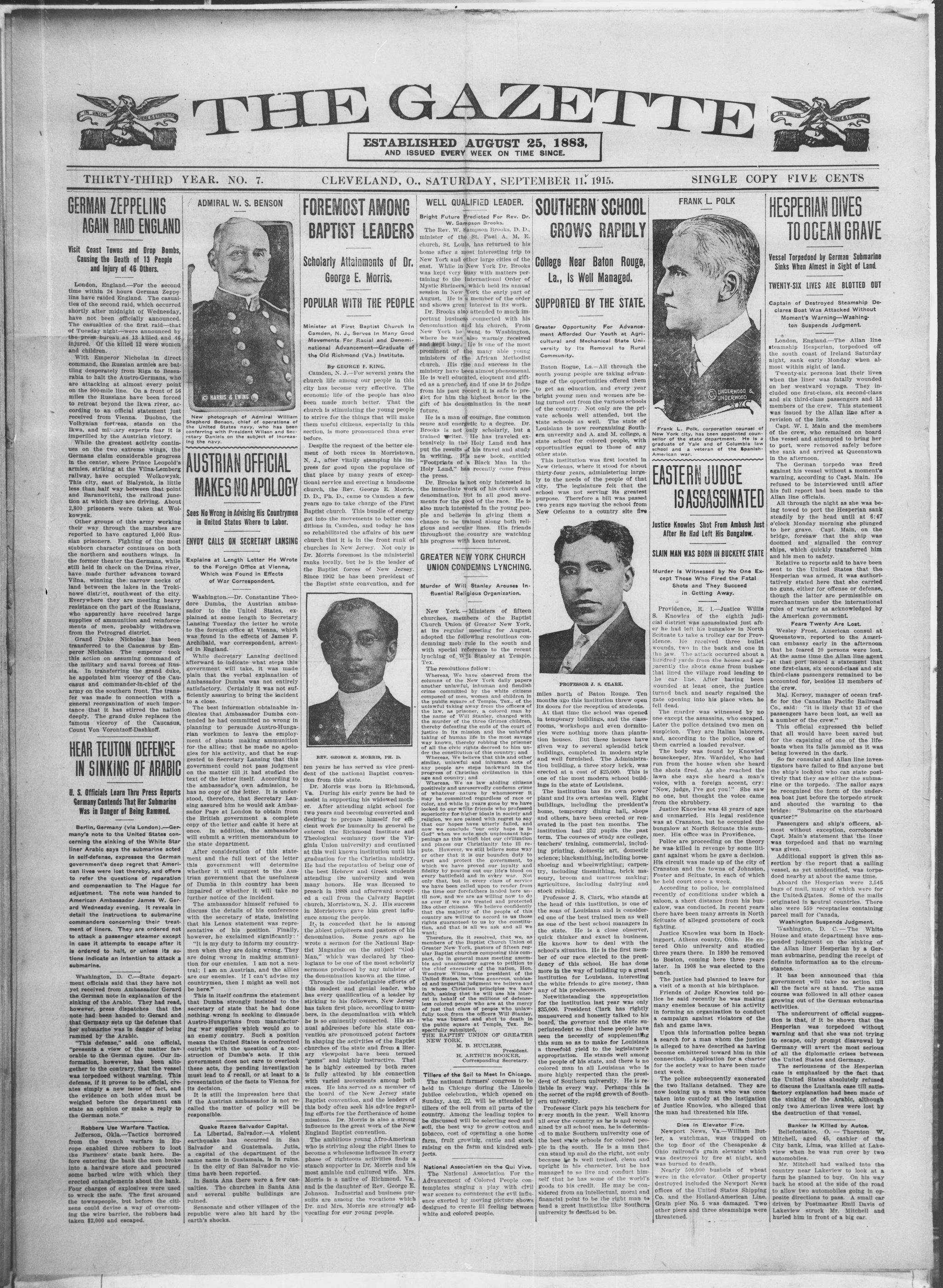
ADMIRAL W. S. BENSON
New photograph of Admiral William Shephard Benson, chief of operations of the United States navy, who has been conferring with President Wilson and Secretary Daniels on the subject of increasing the navy.
AUSTRIAN OFFICIAL MAKES NO APOLOGY
ENVOY CALLS ON SECRETARY LANSING
Explains at Length Letter He Wrote to the Foreign Office at Vienna, Which was Found in Effects of War Correspondent.
Washington.—Dr. Constantine Theodore Dumba, the Austrian ambassador to the United States, explained at some length to Secretary Lansing Tuesday the letter he wrote to the foreign office at Vienna, which was found in the effects of James F. Archibald, war correspondent, arrested in England.
While Secretary Lansing declined afterward to indicate what steps this government will take, it was made plain that the verbal explanation of Ambassador Dumba was not entirely satisfactory. Certainly it was not sufficiently assuring to bring the incident to a close.
The best information obtainable indicates that Ambassador Dumba contended he had committed no wrong in planning to persuade Austro-Hungarian workmen to leave the employment of plants making ammunition for the allies; that he made no apologies for his activity, and that he suggested to Secretary Lansing that this government could not pass judgment on the matter till it had studied the text of the letter itself. According to the ambassador's own admission, he has no copy of the letter. It is understood, therefore, that Secretary Lansing assured him he would ask Ambassador Page at London to obtain from the British government a complete copy of the letter and cable it here at once. In addition, the ambassador will submit a written memorandum to the state department.
After consideration of this statement and the full, text of the letter this government will determine whether it will suggest to the Austrian government that the usefulness of Dumba in this country has been impaired or whether it will take no further notice of the incident.
The ambassador himself refused to discuss the details of his conference with the secretary of state, insisting that his Lenox statement was representative of his position. Finally, however, he exclaimed significantly:
"It is my duty to inform my countrymen when they are doing wrong. They are doing wrong in making ammunition for our enemies. I am not a neutral; I am an Austrian, and the allies are our enemies. If I can't advise my countrymen, then I might as well not be here."
This in itself confirms the statement that Dumba strongly insisted to the secretary of state that he had done nothing wrong in seeking to dissuade Austro-Hungarians from manufacturing war supplies which would go to an enemy country. Such a position means the United States is confronted outright with the question of a construction of Dumba's acts. If this government does not care to overlook these acts, the pending investigation must lead to a recall, or at least to a presentation of the facts to Vienna for its decision.
It is still the impression here that if the Austrian ambassador is not recalled the matter of policy will be responsible.
Quake Razes Salvador Capital.
La Libertad, Salvador. A violent earthquake has occurred in San Salvador and Guatemala. Jutia, a capital of the department of the same name in Guatemala, is in ruins. In the city of San Salvador no victims have been reported.
In Santa Ana there were a few casualties. The churches in Santa Ana and several public buildings are ruined.
Sensorone and other villages of the republic were also hit hard by the earth's shocks.
ESTABLISHED AUGUST 25, 1883 AND ISSUED EVERY WEEK ON TIME SINCE.
CLEVELAND, O., SATURDAY, SEPTEMBER 11, 1915.
FOREMOST AMONG BAPTIST LEADERS
FOREMOST AMONG BAPTIST LEADERS
Scholarly Attainments of Dr. George E. Morris.
Minister at First Baptist Church in Camden, N. J., Serves in Many Good Movements for Racial and Denominational Advancement—Graduate of the Old Richmond (Va.) Institute.
By GEORGE P. KING.
Camden, N. J.-For several years the church life among our people in this city has become very effective. The economic life of the people has also been made much better. That the church is stimulating the young people to strive for the things that will make them useful citizens, especially in this section, is more pronounced than ever before.
Despite the request of the better element of both races in Morristown, N. J., after vitally stamping his impress for good upon the populace of that place by many years of exceptional service and erecting a handsome church, the Rev. George E. Morris, D. D, Ph. D., came to Camden a few years ago to take charge of the First Baptist church. This bundle of energy got into the movements to better conditions in Camden, and today he has so rehabilitated the affairs of his new church that it is in the front rank of churches in New Jersey. Not only is Dr. Morris faremost in the ministerial ranks locally, but he is the leader of the Baptist forces of New Jersey. Since 1902 he has been president of the Baptist state convention, and for
REV. GEORGE E. MORRIS, PH. D.
ten years he has served as vice president of the national Baptist convention from this state.
Dr. Morris was born in Richmond, Va. During his early years he had to assist in supporting his widowed mother. After attending night school for two years and becoming converted and desiring to prepare himself for efficient work for humanity in general he entered the Richmond Institute and Theological seminary (now the Virginia Union university) and continued at this well-known institution until his graduation for the Christian ministry. He had the reputation of being one of the best Hebrew and Greek students attending the university and won many honors. He was licensed to preach in 1888 and afterward accepted a call from the Calvary, Baptist church, Morristown, N. J. His success in Morristown gave him great influence among the people. It is conceded that 'he is among the ablest pulpeters and pastors of his denomination. Some years ago he wrote a sermon for the National Baptist Magazine on the subject "God Man," which was declared by theologians to be one of the most scholarly sermons produced by any minister of the denomination known at the time.
Through the indefatigable efforts of this modest and genial leader, who has every qualification of a leader by sticking to his followers, New Jersey has taken first place, according to numbers, in the denomination with which he is so eminently connected. His annual addresses before his state convention are pronounced potent factors in shaping the activities of the Baptist churches of the state and from a literary viewpoint have been termed "gems" and highly instructive. That he is highly esteemed by both races is fully attested by his connection with varied movements among both races. He has served as a member of the board of the New Jersey state Baptist convention, and the leaders of this body often seek his advice regarding efforts for the furtherance of home missions. Dr. Morris is also a strong influence in the great work of the New England Baptist convention.
The ambitious young Afro-American who is striving along the right lines to become a wholesome influence in every phase of righteous activities finds a stanch supporter in Dr. Morris and his most amiable and cultured wife. Mrs. Morris is a native of Richmond, Va., and is the daughter of Rev. George E. Johnson. Industrial and business pursuits are among the vocations: which Dr. and Mrs. Morris are strongly advocating for our young people.
WELL QUALIFIED LEADER.
Bright Future Predicted For Rev. Dr. W. Simpson, Brooks.
The Rev. W. Simpson Brooks, D. D., minister of the St. Paul A. M. E. church, St. Louis, has returned to his home after a most interesting trip to New York and other large cities of the east. While in New York Dr. Brooks was kept very busy with matters pertaining to the International Order of Mystic Shriners, which held its annual session in New York the early part of August. He is a member of the order and shows great interest in his work. Dr. Brooks also attended to much important business connected with his denomination and his church. From New York he went to Washington, where he was also warmly received and kept busy. He is one of the most prominent of the many able young ministers of the African Methodist church. His rise and success in the ministry have been almost phenomenal. He is well educated, eloquent and gifted as a preacher and if one is to judge from his past record it is safe to prescribe for him the highest honor in the his denomination in the near future.
He is a man of courage, fhe common sense and energy to a degree. Dr. Brooks is not only scholarly, but a trained writer. He has traveled extensively in the Holy Land and has put the results of his travel and study in writing. His new book, entitled "Footprints of a Black Man in the Holy Land" has recently come from the press.
Dr. Brooks is not only interested in the immediate work of his church and denomination, but in all good movements for the good of the race. He is also much interested in the young people and believes in giving them a chance to be trained along both religious and secular lines. His friends throughout the country are watching his progress with keen interest.
GREATER NEW YORK CHURCH
UNION CONDEMNS LYNCHING
Murder of Will Stanley Arouses Influential Religious Organization.
New York.—Ministers of fifteen churches, members of the Baptist Church Union of Greater New York, at its regular meeting for August, adopted the following resolutions condemning mob rule in the south and with special reference to the recent lynching of Will. Stanley at Temple, Tex.
The resolutions follow:
Whereas, We have observed from the columns of the New York daily papers another unlawful, inhuman and foulish crime committed by the white citizens composed of men, women and children in unlawful taking away from the officers of the law, as prisoner, a colored man by the name of Will Stanley, charged with thereby defeating the ends of the court of justice in its mission and the unlawful taking of human life in the most savage way known, thereby robbing the prisoner and thereby defeating the ends of the constitution of this country; and
Whereas, We believe that this and other similar, unlawful and inhuman acts of progress of Christian civilization in this age and country; and
Whereas, We as law as believer citizens positively and unreservedly condemn crime or may be committed regardless of race, or color, and while in years gone by we have looked to our white friends who professed religion, we are pulled with regret to any that our hopes have utterly failed, and now we conclude "our only hope is in God," we now conclude "we must shoot blot our civilization and places our Christianity into ill repute. However, we still believe some way or other that it is our bound duty to every battlefield and in every war. Not only that, we have proved our loyalty and loyalty by pouring out our life's blood on every battlefield and in every war. Not only that, we have been called upon to render from the time our forefathers landed here until now, and we are as willing now to do so every battlefield and in every war. Not only that, we have been called upon to render confidently that the majority of the people of this country are willing to accord to us those rights guaranteed to us by the constitution, and that is all we ask and all we
Therefore, Do I resolved, that we, as members of the Baptist Church Union of Greater New York, pastor of fifteen regiment churches, do in general mass meeting assembly and unanimously agree to petition to the chief executive of the nation, Hon. Woodrow Wilson, the president of the nation, and impartial judgment we believe and in whose Christian principles we have faith, asking that he will use his interest in behalf of the millions of defense workers and impartial judgment of just that class of people who unlawfully took from the officers Will Stanley, who was burned, and shot to death in the public square at Temple, Tex. RE: THE BAPTIST UNION OF GREATER
THE BAPTIST UNION OF GREATER
NEW YORK
Tillers of the Soil to Meet In Chicago
The national farmers' congress to be held in Chicago during the Lincoln jubilee celebration, which opened on Sunday, Aug. 22, will be attended by tillers of the soil from all parts of the country. Among the leading topics to be discussed will be selecting seed and soil, the best way to grow cotton and tobacco, cost of operating a one horse farm, fruit growing, cattle and stock raising on the farm and kindred subjects.
National Association on the Qui Vive.
The National Association For the Advancement of Colored People contemplates staging a play with civil war scenes to counteract the evil influence exerted by moving picture shows designed to create ill feeling between white and colored people.
SOUTHERN SCHOOL GROWS RAPIDLY
SUPPORTED BY THE STATE.
Greater Opportunity For Advancement Afforded Our Youth at Agricultural and Mechanical State University by its Removal to Rural Community.
Baton Rouge, La.-All through the south young people are taking advantage of the opportunities offered them to get an education, and every year bright young men and women are being turned out from the various schools of the country. Not only are the private schools well attended, but the state schools as well. The state of Louisiana is now reorganizing Southern University and A. and M. college, a state school for colored people, with opportunities equal to those of any other state.
This institution was first located in New Orleans, where it stood for about thirty-four years, administering largely to the needs of the people of that city. The legislature felt that the school was not serving its greatest purpose. Therefore a bill was passed two years ago moving the school from New Orleans to a country site five
PROFESSOR J. B. CLARK.
miles north of Baton Rouge. Ten months ago this institution threw open its doors for the reception of students.
At that time the school was opened in temporary buildings, and the classrooms, workshops and even dormitories were nothing more than plantation houses. But these houses have given way to several splendid brick buildings, completed in modern style and well furnished. The Administration building, a three story brick, was erected at a cost of $25,000. This is one of the most modern school buildings in the state of Louisiana.
The institution has its own 'power plant and its own artisanal well. Eight buildings, including the president's home, temporary dung hall, shops and others, have been erected or renovated in the past ten months. The institution had 252 pupils the past term. The courses of study are college, teachers' training, commercial, including printing, domestic art, domestic science, blacksmithing, including horse-shoeing and wheelwrighting; carpentry, including thinsmithing; brick masonry, broom and mattress making; agriculture, including dairying and stock raiding.
Professor J. S. Clark, who stands at the head of this institution, is one of the sons of Louisiana and is considered one of the best trained men as well as one of the best school managers in the state. He is a close observer, quick thinker and exact in business. He knows how to deal with the school's situation. He is the first member of our race elected to the presidency of this school. He has done more in the way of building up a great institution for Louisiana, interesting the white friends to give money, than any of his predecessors.
Notwithstanding the appropriation for the institution last year was only $35,000. President Clark has rightly maneuvered and honestly talked to his board, the governor and the state superintendent so that these people have seen the necessity of supplementing this sum so as to make for Louisiana a threefold yield to the legislature's appropriation. He stands well among the people of his state, and there is no colored man, in all Louisiana who is more highly respected than the president of Southern university. He is reliable in every way. Perhaps this is the secret of the rapid growth of Southern university. Professor Clark pays his teachers for every month in the year. Well known all over the country as he is and recognized by all school men, he is determined to make Southern university one of the best state schools for colored people in the south. He is a man that can stand up and do the right, not only because he is well trained, clean and upright in his character, but he has managed to so live and conduct himself that he has some of the world's goods to his credit. He may be considered from an intellectual, moral and financial point to be the right man to head a great institution like Southern university is destined to be.
SINGLE COPY FIVE CENTS
UNDERWOOD & UNDERWOOD
Frank L. Polk, corporation counsel of New York city, has been appointed counselor of the state department. He is a graduate of Yale and of Columbia law school and a veteran of the Spanish-American war.
EASTERN JUDGE ISASSASSINATED
Justice Knowles Shot From Ambush Just After He Had Left His Bungalow.
SLAIN MAN WAS BORN IN BUCKEYE STATE
Murder Is Witnessed by No One Except Those Who Fired the Fatal
"Providence, R. I.—Justice Willis S. Knowles of the eighth judicial district was assassinated just after he had left his bungalow in North Scituate to take a trolley car for Providence. He received three bullet wounds, two in the back and one in the jaw. The attack occurred about a hundred yards from the house and apparently the shots came from bushes that lined the village road leading to the car line. After having been wounded at least once, the justice turned back and nearly regained the gate opening into his place when he fell dead.
The murder was witnessed by no one except the assassins, who escaped. Later the police detained two men on suspicion. They are Italian laborers, and, according to the police, one of them carried a loaded revolver.
The body was found by Knowles housekeeper, Mrs. Wardell, who had run from the house when she heard the shots fired. As she reached the lawn she says she heard a man's voice, with a foreign 'accent, cry' "I've got you!" She saw no one, but thought the voice came from the shrubbery.
Justice Knowles was 48 years of age and unmarried. His legal residence was at Cranston, but he occupied the bungalow at North Scituate this summer. His office was in Providence.
Police are proceeding on the theory he was killed in revenge by some littigant against whom he gave a decision. His circuit was made up of the city of Cranston and the towns of Johnston, Foster and Scituate, in each of which he held court once a week.
According to police, he complained recently of conditions under which a saloon, a short distance from his bungalow, was conducted. In recent years there have been many arrests in North Siculate of alleged promoters of cock fighting.
Justice Knowles was born in Hockingport, Athens county, Ohio. He entered Ohio university and studied three years there. In 1890 he removed to Boston, coming here three years later. In 1908 he was elected to the bench.
The justice had planned to leave for a visit of a month at his birthplace.
Friends of Judge Knowles told police he said recently he was making many enemies because of his activity in forming an organization to conduct a campaign against violators of the fish and game laws.
Upon this information police began a search for a man whom the Justice is alleged to have described as having become embittered toward him in this connection. Application for a charter for the society was to have been made next week.
The police subsequently exonerated the two Italians detained. They are now looking up a man who was once taken into custody at the instigation of Justice Knowles, who alleged that the man had threatened his life.
Dies in Elevator Fire.
Newport News, Va.—William Butler, a watchman, was trapped on the top floor of the Chesapeake & Ohio railroad's grain elevator which was destroyed by fire at night, and was burned to death. Nearly 500,000 bushels of wheat were in the elevator. Other property destroyed included the Newport News offices of the United States Shipping Co. and the Holland-American Line. Grain plier No. 5 was damaged. Two other piers and three steamships were threatened.
IN HONOR OF
BESTIALITY
HESPERIAN DIVES TO OCEAN GRAVE
Vessel Torpedoed by German Submarine
Sinks When Almost in Sight of Land.
TWENTY-SIX. LIVES- ARE BLOTTED. OUT
Captain of Destroyed Steamship Declares Boat Was Attacked Without Moment's Warning—Washington Suspends Judgment.
London, England—The Allan line steamship Hesperian, torpedoed off the south coast of Ireland Saturday night, sank early Monday—when almost within sight of land.
Twenty-six persons lost their lives when the liner was fatally wounded on her westward voyage. They included one first-class, six second-class and six third-class passengers and 13 members of the crew. This statement was issued by the Allan line after a revision of the lists.
Capt. W. I. Main and the members of the crew, who remained on board the vessel and attempted to bring her to port, were removed safely, before she sank and arrived at Queenstown in the afternoon.
The German torpedo was fired against his vessel without a moment's warning, according to Capt. Main. He refused to be interviewed until after his full report had been made to the Allan line officials.
All through the night as she was being towed to port the Hesperian sank steadily by the head until 6:47 o'clock Monday-morning she plunged to her grave. Capt. Main, on the bridge, forsaw that the ship was doomed and signalled the convoy ships, which quickly transferred him and his men to safety.
Relative to reports said to have been sent to the United States that the Hesperian was armed, it was authoritatively stated here that she carried no guns, either for offense or defense, and that she posed no menace under international rules of warfare as acknowledged by the American government.
Fears Twenty Are Lost.
Wesley Frost, American consul at Queenstown, reported to the American embassy early in the afternoon that he feared 20 persons were lost. At the same time the Allan line agent at that port issued a statement that one first-class, six second-class and six third-class passengers remained to be accounted for, besides 13 members of the crew.
Maj. Kersey, manager of ocean traffic for the Canadian Pacific Railroad Co. said: "It is likely that 12 of the passengers have been lost, as well as a number of the crew."
This official expressed the belief that all would have been saved but for the capsizing of one of the lifeboats when its falls jammed as it was being lowered in the dark.
So far consular and Allan line investigators have failed to find anyone but the ship's lookout, who can state positively that they saw either the submarine or the torpedo. The sailor says he recognized the threat. The sea boat just before the torpedo struck and shouted the warning to the bridge: "Submarine on the starboard quarter!"
Passengers and ship's officers, almost without exception, corroborate Capt. Main's statement that the liner was torpedoed and that no warning was given.
Additional support is given this assertion by the report that a sailing vessel, as yet unidentified, was torpedoed nearby at about the same time.
Aboard the Hesperian were 3,545 bags of mail, many of which were for the United States: Some of the mails originated in neutral countries. There also were 559 receptacles containing parcel mail for Canada.
Washington Suspends Judgment.
Washington, D. U.—The White House and state department have suspended judgment on the sinking of the Allan submarine, pending the receipt of definite information as to the circumstances.
It has been announced that this government will take no action till all the facts are at hand. The same course was followed in all other cases growing out of the German submarine activities.
The undercurrent of official suggestion is that, if it be shown that the Hesperian was torpeded without warning and that she was not trying to escape, only prompt disavowal by Germany will avert the most serious of all the diplomatic crises between the United States and Germany.
The seriousness of the Hesperian case is emphasized by the fact that the United States absolutely refused to discuss the Luistania case till satisfactory explanation had been made of the sinking of the Arabic, although only two American lives were lost by the destruction of that vessel.
Bellefontaine, O. — Thornton W. Mitchell, aged 45, cashier of the City bank, Lima, was killed at Lakeview when he was run over by two automobiles. Mr. Mitchell had walked into the country near Lakeview to look at a farm he planned to buy. On his way back he stood at the side of the road to allow two automobiles going in opposite directions to pass. A small car driven by Postmaster Emil Davis of Lakeview struck Mr. Mitchell and hurled him in front of a big car.
PUBLISHED EVERY SATURDAY
SUBSCRIPTION RATES
(in Advance)
One Vearicecccceccebeeees 8180,
Bix Monthe.....ee.cceeeeees 1.00
Three Monthe.......cceeee. 60
Subscribers are requested to re-
mit by postoffice money or-
der or registered letter
Sntered at the postotfice In Cleveland,
‘Ohio, as second-class matter.
Address all communications to
HARRY C. SMITH
Editor and proprietor,
THE GAZETTE,
Blackstone Building, Cleveland, 0.
Member Ohio Legislature: 1894
‘to 1896; 1896 to 1898; 1900 to 1902
THE GAZETTE Is the oldest, and
has the largest bona fide circulation,
double that of any newspaper in the
Interest of Afro-Americans, published
tn the, state of Ohio, and comparison
with any will Immediately establish
fe rank as one of the NEWSIEST
AND BEST In the country.
10,000,000 Afro-Americans..
160,000 in Ohio.
20,000 in Cleveland.
SATURDAY, SEPT. 11, 1915.
DARE TO DO YOUR DUTY.
“Let us have faith that right
makes might, and in that faith
Jet us to the end dare to do our
duty as we understand it”"—
Abraham Lincoln.
Eaitor John Mitehell is certainly
Keeping the supreme lodge of our
Knights of Pythias busy, these days.
‘That Chicago G. A. R. Post com-
mittee has certainly “sized up” the
malicious photoplay, “The Birth (Dirt)
of a Nation.” See Chicago letter else-
where in this paper.
A prosperity which depends alone
upon the madness of warring Buro-
Peans cannot last long and is likely
to end suddenly.
‘The national treasury being empty,
the money for national defense must
coms from some new tax, or the in-
crease of an old one.
‘The story-that the Democratic ad-
ministration will ask congress to sub-
stitute a lamb for the eagle on our
shield probably is a canard.
John B, Milholland, the wealthy
New Yorker and sterling friend of
the race, certainly strikes some
mighty blows for us in the columns
of loading newspapers of the country.
One would hardly believe it, but:
there are a number of our ministers,
and in this section of the country, too,
‘who need to heed the warning given
jn the Philadelphia letter elsewhere
in this paper.
‘There was genuine and general re-
Bret, several weeks ago, when it was
announced that Howard Drew, our
‘world’s champion runner, was to re-
tire from the track. There will be
Just as much satisfaction to learn that
the report was untrue.
Cleveland, and every other city of
‘any size in this country that has any
considerable number of our people,
needs, and sadly too, an organization
that will confine its efforts to fight:
ing in the courts every effort in their
various communities to deny our peo-
ple their citizen rights and privileges
in public places.
Monday Is “Ohio Day” at the Tl
nois Half Century (Lincoln. Jubilee)
Exposition at the Coliseum, Chicago,
and it is confidently expected to be
‘one of the greatest of that. exception-
ally successful affair. The Ohio Com-
mission has made elaborate prepara-
tons for it and we are looking for-
ward to a demonstration, in exercis-
‘es, ete,, that will reflect great credit
‘on our people of this state.
‘The value of the output of the in-
dustrial plants of this country in Re-
publican. years aggregates twenty.
eight billions, which is more than that
of Great Britain and Germany com-
bined. Nearly one in four of the
American people live from factory
‘wages. The value of our manufactures
ig three times that of our farm pro-
ducts. Democratic national legisla.
tion, which reduced the output of the
factories 30 to 50 per cent, has, nec-
essarily, made hard times for millions
ot our people.
A few years ago the south was con-
tinually howling against northern
newspapers and persons, who dared
to refer to the miserable treatment of
‘our people in that section, and. so vig-
‘orously accused them of “waving the
Dloody shirt” that the discussion was
practically stopped. Now comes that
‘very section, through representatives
here fn the north, with most miserable
photoplays like “The Birth of a Na-
tion,” waving the “bloody shirt” until
they are all but wearing out and off
its tails, And hardly a word is being
‘said against this by the northern press
and people. If it were not for the
fight some of our people are making,
not & word would be sald against it
even in Miinols and Massachusetts,
and, too, in spite of the fact that
these sie photoplsys revile some of
those states’ greatest historical char-
acters, “How the mighty Mave
fallen.” ae
ie a ee
WHITE MAN’S BURDEN IN HAITI.
‘Word comes trom Washington that
Haiti will sign a convention accept-
{ng the “financial protectorate of the
United States.” ‘This means that
American officials will collect cus.
toms duties, control expenditures,
audit accounts. It means that the
taxes which have served as the prize
of domestic war will be turned to pro-
uctive uses, prosperity will increase,
revolutions will stop, and all will be
lovely. * * *
‘That is the worst of the white
man's burden. It has a habit of grow.
ing heavier instead of lighter. But
there are times when a nation like
‘our own has to assume the load, and
this is one of the times.
‘The foregoing is part of an edito
rial from a Chicago daily paper o!
recent date. Commenting on it, “Ja
cob Egberth” (white) of that city
writes, and very pertinently, too:
“The black man has borne the white
man's burden so long that for 2
change it is, but just the white mar
should bear the burden—just to learr
and know how it feels to be bur
dened.” AGREED!
WILLIS IS RIGHT, AS USUAL,
Published reports of a break be-
tween Gov. Frank B. Willis and the
state board of administration will not
cause a panic in Ohio. If the board
desires to quarrel with the governor
Decause he tells the head of some
state institution that his place is de-
‘sired for a Republican, let it quarrel,
and there will be founda way to re-
jorganize the board. ‘The specific case
involved is that of General Burnett,
commandant of the Soldiers’ and Sail-
ors’ home, at Sandusky. We do not
understand there is serious objection
to General Burnett. He has been do-
ing his work well, and doing some ef-
fective Democratic polities with it.
* * * It is rumored that Gen R. B.
Brown, of Zanesville, will secure this
place when the vacancy is created.
Nothing could be more fitting. Gen.
Brown made the sacrificial race for
governor in 1912, when every Repub-
Tiean in Ohio knew it to be a hopeless
undertaking, and he is highly deserv-
ing of the recognition. Moreover,
Gen, Brown is @ former commander
of the Grand Army, a veteran news-
paper man, and served for many years
6n the board of trustees which man-
aged the affairs of the home, for the
honor of serving. It ts fitting and
worth while to ask a resignation to
make a place for a veteran like Gen.
Brown, The board of administration
may not like it, but we are ready to
‘applaud the governor up this way, be-
‘cause we like his action in the matter.
“Marion (0.) Star,
Gen, R. B. Brown, the man whom
Gov. Willis has in mind for the place
He has asked Gen. Burnett to vacate,
was a member of the board of man-
agers of the home (who get no pay)
for twelve years, being succeeded by
Gen. J. W. Cline, who subsequently
was made commandant in 1899. In
1904 Gov. Harmon asked and got
Cline’s resignation and gave the place
to Burnett. Now Gen. Burnett wishes
to retire and Gov. Willis wants Gen.
Brown, who has been the head of the
G. A. R. in Ohio and the most effective
worker for soldiers’ pensions, to man-
age the soldiers’ home, and Gen.
Brown will do so. Mark our predic-
tion!
“THE BIRTH OF A NATION.”
George H. Thomas Post, G. A. R., Ap
' propriately Denounces It.
Chicago, Il.—George H. Thomas
Post, this city, appointed a committee
to investigate the play “The Birth of a
Nation,” The report, which gives well-
deserved censure, was unanimously
adopted and sent to department head-
quarters. It reads:
“The play is a remarkable work of
art, but is meant to reproduce in sub-
stance the book of Thomas Dixon, en-
titled, ‘The Clansman,’ whose chief
purpose is to, glorify the cause of se-
cession, create and intensify hatred
against the Negro and make It appear
that the infamous Ku-Klux-Klan was
‘an organization of chivalrous white
men, to defend the people.
“th the moving picture show there
fs-one scene that represents a com-
pany of United States soldiers in uni-
form, commanded by a white officer,
in possession of a town, shooting and
burning and acting like fiends. His:
tory does not record a single instance
of the kind. It is a base slander on
the men who wore the blue, The Ne-
groes represented in the picture are
Jown-lown criminals, and totally de-
based. To people ignorant of the
facts they make the impression that
Colored people are a depraved and
¢riminal race governed only by brutal
lusts. It has no suggestion as to the
great advance made by the Negroes
since emancipation, in religion, educa-
tion, in property and usefulness as
citizens,
“The main point of the play seems
to be to show that as to slavery and
fecession the south was altogether
right, and that in the civil war and
reconstruction the men who defended
the Union were wholly wrong. The
Whole influence of the exhibition is to
‘excite sectional feeling and bitterness,
‘and its representations are utterly
false to history.
“We recommend the adoption of
the following resolution:
“The George H. Thomas Post, No.
5, Department of Iilinofs, G. A. R., pro-
tests against the exhibition called
“The Birth of a Nation.’
“First—Because it contains slander-
ous representations as to the soldiers
who fought to preserve the Union and
earientures the history of the war.
“Second—It represents the infa-
‘mous Ku-Klux-Klan as @ society of pa-
triotic chivalrous men.
“Third—Its whole influence is to ex-
cite and intensify hatred of the Negro
Tace and perpetuate sectional bitter-
ness. Signed—Duncan C. Milner,
George C. Barker, E.G. Ingersoll, W.
Ft ahaa eoenittee:”.
ATTORNEY HAINEN’S ESTIMATE.
Cleveland, Sept. 7, 1915.
Hon. Harry C. Smith,
Editor, Gazette,
City.
My Dear Mr, Smith:—I am glad to
note that The Gazette is keeping up
its long record for clean news, good
citizenship and upright politics.
_ It is refreshing to find a paper
which clings so tenaciously to what it
believes to be right.
‘Yours truly,
FRANK BE. HAINEN,
Society for Savings Building.
“Social Equality” in the South.
Richmond, Va—Seven arrests were
made about midnight, Aug. 28-29, in a
THE GAZETTE, CLEVELAND, 0. SATURDAY, SEPTEMBER 11, 1915.
raid upon 401-2 N. 15th St by Police: |Day.—The grand rally
men Campodonica and Goalsby of the | chure h Sunday was cf
“purity squad.” All were entered at jane ence Bs acids
the First Police station and bailed for | eae aan)
their appearance in Police court. L.| Woods left Sunday
Blunts Keeper of the store on the WRITTEN BY “THE OLD RELIA. Divine spent the vac
At foge of the Dutuing, was arrest BLE" GAZeTTE’s CORRE. |{Tadvarents, Mr, an
ed on charge of being proprietor of @ vous.
Aisorderly house, Two couples. were SPONDENTS Woods.—Rev. and Mrs.
arrested on charge of immoral con ees REEL tained Rev. Orr at supi
duct, and two other women were taken . oo
on charge of being inmates of a dis-/ THROUGHOUT THE STATE! sreusenvitte—s
orderly house. ‘The men, both white, | church has received a
gave their names to the police as J. S. ———1 attend’ th golden Abt
momen. ait biased, ase ane Sica; | What Our Peopre are Doing Each 3. E, church, Wheelin
women, eee Sane Siena. is of v. GW. Tindull, a
Marion Perkins, Alberta Wicks and| Week—Church, Personal, Social, | Her. GW. Tindull, a
Pearl Johnson. sodge, Literary and Mu- have hear’ asked to ai
rae sical — Marriages, the program. A fine
NEXT TQ THE BIBLE. Deaths, Ete rendered byte chil
— seta at the church, conduc
Wilmington, O., Sept. 7, "15. SANDUSKY. At Ai | Anderson. The servic
Saeat ert Williams | ground were discontin
MBean Sir-—Pens contin the gona | 8 Faery, opt ture, Satu |e‘
ano tale iain icing. "A Huerta
tencher ‘anda history mex to the | Betlin Heights attended the funeral — | aauh City and Pittsb
Renn ANG 8 LY Mrs. B. Thompson and Miss B. Shack: | Nncon cf Gada wea
. elford left, Monday, for a two weeks | Johmson of Cadiz wa
Tay gubeeription ia Grtow dave, |Wslt with rolatives.-Mr. ‘and Mrs, [9% Toute Home from
Of mY Aybiee Tor the mace, "| Geo. Taylor are visiting Mr, and Mra,|J0bn Davis. who, hold
PETER F. McDONELTH, | Chas. Taylor.—Mr. and Mrs. 8, D. An-| Position at Labell Mil
ge
AN "|
by >
WA",
DOINGS
OF
THE
RACE
OL
Omaha, Neb., churches (white) re
fused to admit our church choirs tc
(their “Bible Sunday” meetings’ cho
us, after sending them invitations.
‘recently won one of the prizes given
'by a daily newspaper of that city tor
writing one of the best letters.
Howard Drew, world's champfor
sprinter, will not retire from the
track, as announced in the dally news
papers of the country, several week:
ago.
‘Defender’s “Columbus” correspondent,
[who sometimes writes “Cleveland” let
‘ters, was “at It” again last week and
the week previous. When will the ed
litors of those papers “tumble”?
| “The Birth of a Nation,” writes
‘Thomas Dixon. “The Birth of a
(Dam)nation,” suggests the St. Louis
Fraternal Clarion. Which is just a:
appropriate as placing the “Damn” be
‘fore “Birth."—Baltimore (Md) Afro:
| American,
sae
___ One thousand dollars a year to Mrs
8 Coleridge-Taylor, widow of the
great composer; $100 to his mother
_and $200 to each of the children unt
‘they reach the age of 21. These pen:
‘sions are the estimate the British gov’
‘ernment sets upon the work of a great
‘man, What beeame of the money
raised in this country for the widow
and her children?
___ The “Colored” school on Fitth street
Is next door to a “white” school in
which the same grades are taught
and the population of that section is
a mixture of all races and posseses
the smallest amount of race prejudice
There is no excuse for its establish
ment that is worthy of acceptance by
any conscientious, intelligent person
since the school should and could be
mixed in teachers as well as pupils.—
pees (0.) Union,
|_ Isaiah T. Montgomery, the founder
|ot Mound Bayou, Miss,, the only mem
ber of the race in Mississippi's consti
tutional convention years ago, and the
man who proved a bitter disappoint
|ment to the race as such, is in dire
financial straits and calling on his
[sleudt tor $200 to It a orien
on his plantation, at one time th
[property and home of the traitor, Jet
/ferson Davis. ‘Mound Bayou is linked
in the threatened disaster.
Never let_go unnoticed an expres
sion in favor of the race. Write «
letter of thanks to the president, the
Senator, the congressman or to’ an}
citizen for any kind of expression i
our behalf. Whenever an_unfriend)
expression Is made, write the offende:
your protest. Let’ it be known thai
| we are not asleep when our rights ar
{protected nor when assatled.—Mrs
| Sarah G. Jones, in Cincinnati (0.) Fra
ternal Monitor.
|dollar bond issue for new schools re
‘cently. Out of this sum it was de
cided by the white school board to ap
| propriate $115,000 for our schools 0
|that city. Our people brought suit
Jand were sustained by the court in
levery point; consequently the bon
jissue is tied up. The school board i
now seeking a_ compromise through
|an offer to spend $100,000 more on ou
[Schools there. Before suit was brough
‘they hanghtily refused to consider all
|petitions made by our citizens for 3
[more liberal appropriation of the fund
This is another example of what car
be done to secure our fundamenta
Tights, even through Southern courts
President Wilson is full of praise
now and then for Negro. soldiers
bravery. He sees war clouds.\ Pre
cisely as Washington did with the
3,500 slaves he took to Yorktown an¢
won a victory with them, and ther
‘sent them back to slavery, so would
‘our noted segregation president, after
the war, allow us to return home tc
be forced to ride in “jimerow” cars
lynched, aistranchised, denied schoo!
Fights and every other right he and
his enjoy. We take the broad com
‘mon sense theory that nothing is set
‘led till it 1s settled right, and wars
‘may help this—Martinsburg (W. Va.)
Ploneer Press. | |.
‘The Supreme court of the District
of Columbia, Mr. Justice Siddons pre
siding, upon’ motion of counsel for the
Grand Lodge, K. of P.. of Virginia
issued a rule against ‘the supreme
lodge officials, who were recently in
session at Columbus, O., requiring S.
W, Green, supreme chancellor, of New
Orleans, La; BE Underwood, su
preme keeper of records and seal,
Frankfort, Ky; S.A. T. Watkins, sw
preme attorney, Chicago, Ul, and R.
R. Jackson, major general, ‘Chicago,
Ii. to appear before the court, Friday,
Oct. §, 1915, to show cause why they
should not be fined and imprisoned
for disobeying an injunction issued by
the Supreme court. The supreme lodge
revoked the charter of the Virginia
state grand lodge and barred out its
delegates.
WRITTEN BY “THE OLD RELIA.
BLE” GAZETTE’S CORRE:
SPONDENTS.
THROUGHOUT THE STATE
What Our Peopie are Doing Each
Week—Chureh, Personal, Social,
sodge, Literary and Mu-
sical — Marriages,
Deaths, Etc,
SANDUSKY.—Mr, Albert Williams
died, Tuesday, and was buried, Satur-
day, from the A. M. E. chureh, the
pastor officiating. A number ‘trom
Berlin Heights attended the funeral, —
Mrs. B. Thompson and Miss B. Shack-
elford left, Monday, for a two weeks
visit with relatives—Mr. and Mrs.
Geo. Taylor are visiting Mr, and Mrs.
Chas, Taylor.—Mr. and Mrs. 8, D. An:
derson are ill—Though fl, Mr. Chas.
‘Taylor thinks he must register every
L.S. train that passes the station. He
has worked for the company for 30
Years, first for the L. B, and then for
the LS. Ry., now the N, Y. Central—
Miss C. Christian, who visited her sis
ter, Mrs. Ramsey, in Cleveland, re
turned, last week—Please have’ the
money ready for the paper when the
agent calls, as he is required to make
prompt weekly settlements.—Miss H.
Alexander is visiting in Detroit. Mr
Harry Alexander returned from there
Neat Week.
| CORRESPONDENTS jnust mall all
letters for publication ht thelr main
‘postoffice suificiently early on Monday
(or Sunday) of each week to have
‘them reach The Gazette office on
‘Tuesday morning, and always. write
also, their names and that of thett
city or town on the outside of the
wrapper about returned copies. Un:
toss this latter is done, proper eredit
cannot be given you. Lists of names,
wedding presents, etc. obituary’ no-
tees, speeches, resolutions, poetry, in
quirles for relatives and ‘advertise
ments of all kinds, including items
annotineing entertainments to be held
in the near future, must be paid for
In advance at the rate of ten cents 1
line, six words to a line, Our rates
for’ display. advertisements will. be
sent un application. Send postal note
and not stampe during warm weather.
GEORGETOWN.—The A. M. B.S. 8,
plenic was given at Mrs. Belts’ and a
large number of children enjoyed
themselves greatly.—Mrs. Vinnie Burr,
Miss Minnie Murr and Miss Marie
Moore attended the M, S. convention
at Ripley, Saturday and Sunday. Dele-
gates from Cincinnati, Dayton, Hamil
ton and other places near were in at.
tendance. The state president, Mrs.
Rosa Johnson, and the district’ presi
dent, Mrs. Moore of Dayton, were
present. Rev. Albert Grayson preach:
ed ably, Sunday evening.—Foster
Burr is visiting his uncle, Prof. Boyd
of Charleston, W. Va—Miss Mabel
Morton of Cincinnati has been forced
to prolong her visit by her mother's
iliness—Mrs. Ada B. Jamison of Cin-
cinnati visited her parents, Sunday—
Our young people of Georgetown, Rip-
ley and Hillman had a pleasant time
at Mrs. Beatrice Bennett's, last Thurs.
day night—Send yoursitems to Miss
Laura Boston, correspondent, — Mr.
and Mrs. Alfred Masterson have a fine
baby boy and girl, born last week —
Prof. Perfecto’ Morton will open
school, Monday.—Rev. B. F. Boston, en
route home from Columbus, stopped
‘at his old home, Dayton, the guest of
Mrs, Banks Taylor and Alonzo Boyd.
YOUNGSTOWN.—Rev. W. 0. Har-
per fs attending a Baptist convention
in Chicago, this week. John Clark
and Chas. Stery returned from there.
‘Sunday.—Mrs. J. H. Johnson and
daughter, Mable, Mr. and Mrs. Lewis,
James Harrison and Mrs, Blanch As:
king speht Sunday in Jamestown, N.
Y.—Chas, Jenkins of Alliance spent 2
few days here, recently. —Mrs. Jas.
Cowins returned from Columbus, last
week.—Mrs, C. R. Edwards returned
from Cleveland, Monday, and Wednes-
day entertained a theater party.—Mrs.
C, Norman of Steubenville, is visiting
her daughter, Mrs. ©, A. Murray.—
Mr. and Mrs. Wm. Major entertained,
Saturday evening, at dinner in honor
of Mrs, L. Lewis and Miss Cora Stew-
art of Pittsburg, their guests —Buck-
eye lodge will hear the report of the
grand session at its meeting, Sept. 16.
—Frank Miller spent Monday in Sha-
ron and Farrell, Pa—Mr. and Mrs. J.
Espy entertained at dinner, Monday,
Mr, and Mrs. Bias and Mr. and Mrs.
Dan. Lynch, in honor of their guests,
Mr. and Mrs, C. W. Hogan and Miss
L. Hartzell of Beaver Falls, Pa—Mas.
ter Oliver Manley returned to New
Brighton, Pa,, last week after a three
months’ ‘stay with his father —Mr.
Garfield Butler spent ten days in De-
troit—Mr. Chas, Roberts of Erie, was
the guest of Mrs. O. C. Jameson, a few
days.—Miss Irene Stewart left, Thurs:
day week, for Chicago to meet her
sister, Miss Estelle, court stenosra:
pher, ‘who is en route home from a
three months’ trip in the west for her
health. She visited the expositions,
and is much improved —Rev. Geo. Wil
liams preached Wayman Miller's fun.
eral.—Mr. and Mrs. Wm, Major will
Seal Mr. Sn MRO ee ona ary
HILLSBORO.—Mr. Jobn Brown of
‘Dayton was the guest of Mrs. Alline
Burton this week.—Have you asked
your friends to give the local agent
‘their order for The Gazette? Please
do so at once—Miss Lula Morton of
Parkersburg, W. Va., {s\the guest of
Rey. and Mrs, G. W. Jackson—Mrs.
Amanda Owens of Cincinnati visited
here last week.—Mrs. A. Burton re-
turned recently from a three weeks’
visit in Columbus and Dayton, accom-
panied by her niece, Miss Ruth Smoth-
ers of Dayton, who will visit her.—
Rey. and Mrs.’A, P, Mayle of Colum-
bus, are visiting the latter's parents,
Mr, and Mrs. Carey Williams.—Mr.
Leo Carey visited his mother in New
Vienna from Saturday to Tuesday.—
Mrs. Lang Young entertained last
Wednesday, in honor of her little
niece, Miss’ Cleona Carlisle of Zanes-
ville, the Misses Lyne B. Hudson, Co-
rina’ Delaney, Rosetta Nelson, Helen
and Bernadine Johnson, Anita’ Burr
and Ada Williams.—Rey. J. L. B. Burr,
B.S. L., a strong friend of The Ga-
zette, was chosen moderator of the
E. U. B. association, held recently in
Columbus.—Rey. W. S, Becks, pastor
of the A. M. E. church, will hold the
rally, Sunday. A special program will
be rendered. He and his wife will
soon leave for conference.—Rev. Phil:
ip Smith {s seriously {ll.—Mrs. Homer
Page of Cincinnati was the guest of
Mrs. Hannibal Williams.—Miss Cleona
Carlisle returned to Zanesville, Satur-
day, after an extended visit with her
aunt—Mr. John Crabtree of Indianap-
olis is visiting Mr. and Mrs. Charles
Day.—The grand rally at the Baptist
church Sunday was a success, Amount
raised, $103.05, for which Rev. Orr and
Members are thankful—Miss Helena
Woods left Sunday for Indianapolis,
having spent the vacation with her
grandparents, Mr, and Mrs, Henry
Woods. She was accompanied by Mrs.
Woods.—Rey. and Mrs. Jackson enter.
tained Rev. Orr at supper Sunday,
STEUBENVILLE.—Simpson M. E.
church has received an invitation to
attend the golden jubilee of Simpson
M. E. church, Wheeling, Oct. 3 to 10.
Hey. G. W. ‘Tindull, and chotr under
the leadership of I, 'N. McCullough,
have been asked to fill one evening on
the. program. A. fine program. was
rendered by the children, last Friday,
‘at the chureh, conducted by Miss Ivy
Anderson. The services at the camp
ground. were discontinued because of
the Weather.—Mre, M.-L, Jenkins has
returned from a month's visit with her
davehter in Philadelphia and at_At
Tantic City’ and’ Pittsburg.—-Mrs, Cad
Johnson of Cadiz was here, over night,
fen Toute home from Cleveland.—Mr.
John Davis, who holds an. fmportant
position at ‘Labell Mills, has quite.
“number of men under him, He is-one
of the staunchest supporters of “the
‘old. reliable” Gazette-Mr, Horace
|Burwell and Dennis Palmer are rin-
ning an up-to-date pooltoom, They are
eo ee ee eto te
serve our patronage—Mr. John Ab:
Gerson of Washingtn, Pa, te visiting
hls uncle and cousin, ‘Mr, John Ander
son and daughter, Ivy, of Church St—
Dr. Dewitt. Turpean of Wheeling,
[preached ably" at Simpson. Mf. B
Chureh, last week, ‘Thursday, He fs a
noted speaker and has been in the em:
loy. of the AntiSaloon. leagues’ of
Maryland and West. Virginia—-W. C.
MeMasters, candidate for mayor, is a
friend of the race and deserves our
support. We must stand. by. our
friends if we are to have any.” Then
oo he is a patron of The Gazette
John F. Murray is one of the leading
contracting painters Jn the city. -Mr
Howard Doubt, a bricklayer, has lo:
cated here and {s working right along
with the ‘white mechanics. — Mrs
Blanch Washington of Mingo Junction
ie'on w ten-day trip to Atlantic’ Clty:
SMITHFIELD.—Misses Mamie and
Ethel MeMechens, Mrs, L, Dolan and
Earl Jones of Wheeling were guests
of Mrs. M. E. Veney, recently, when
en route to their camp at McIntyre.
‘They returned home, Saturday, after a
month in camp.—Mrs, J. Harris and
brother, Robert Beall, delightfully en-
tertained the Silver’ Leaf club, last
‘Tnesday evening, Mr, and Mrs. A. J
Guy, sons, and the new preceptress
from Cadiz, were the visitors. The
club gave a yery successful supper at
Mrs. J. Reall’s, Aug. 28, realizing $13.
—Miss E, Faithful of Harrisville vis-
ite her aunt, Mrs. G. D. Binns, last
week—Mesdames M. E, Veney, A.
Binns, J. M. Davis, Miss M. West, G.
D. Binns and EB. West attended ‘the
S. 8. pienie at Fernwood, last Tues-
day—Mrs. F. Harris was called to
Mansfield, last. week, by her son-in-
law, Rev, Chas, Ford's death—Mr. J,
Harris and Miss Anna Wilson attend:
ed the barbecue at Mcintyre, Satur-
day. ‘The former, Mr. and Mrs. H.
Harris and others spent. Monday in
Steubenvillé—Mr, and Mrs. A,B.
Reed, Mr. and Mrs. Geo. Johnston. R.
Lowe and P. Fletcher of Steubenville,
visited relatives here, Sunday.—Mrs,
M, EB. Veney and daughter visited the
MeMechens at Melntyre, last Wednes-
day—Mrs. J. Fletcher spent Saturday
in Steubenville, and Mr. F. Carter,
Monday, in Mt. Pleasant,—Miss Fran-
cis Beasley of Pittsburg, who spent
several weeks with her aunt, Mrs. M
E. Veney, returned home,” Monday
week—Mr. and Mrs, H. Parks of
Fernwood, visited Mr. and Mrs. W.
Parks, recently.—The — Smith-West:
Freeman reunion at the fair grounds,
Saturday week, was well attended. —
D. W. Bigsby and J. Beall were here,
Sunday, from Elwood City, Pa, to
visit their families —The ‘steward-
esses’ festival, Saturday evening, was
‘well attended.—Mr. D. Freeman of Me-
Intyre spent Sunday here—Rev. R. B.
Lowe preached two eloquent sermons,
Sunday, to large congregations —Mr.
and Mrs. Geo. Lesile have two fine
baby girls.
ZANESVILLE.—Mrs. Edw. Lucas
‘was apponited delegate and Miss Mary
Sweed, alternate, to the B. Y. P. U.
convention in. Coltmbus In October
Mrs. Chas. Morgan is the M, 8's dete:
gate, Both organizations, displayed
excellent judgment in their selections.
“Miss Mary Fisher, who visited her
sister, Mrs. W. Young, has returned to
Cambridge.—Moorehead's band gave a
most enjoyable promenade at Odd Fel-
lows’ hall, Monday evening. It is a
new organization and citizens are
much’ interested in thelr unustal
progress.—Mr. and Mrs. Mitchell and
Mr, White of Newark, were here, Sun-
Ady. The latter was formerly sti
Gent at Wilberforce, and is @ must
ian of considerable’ abiiity.—Nr. Olt
‘ver, assisted by some of the best local
talent, will give a musical recital at
St. Paul's A. M. EB. church, Sept. 9.—
Miss Lucy Turner left, Sunday, for
St. Louis to take charge of her school.
“Miss Jessie Guy, will leave, the 11th
for Bluefield, WW. Va, to teach, this
‘year. Miss Guy is a graduate of Wil
‘berforce and Bluefield institute
‘Misses Magdalene Mackey and Bertha
Kendall will also leave on the 11th ot
18th for Bluefield to attend the insti-
tute. All wish them success and a
happy yaar-—Rey. Garrett of the M. P.
‘conference. (white), preached avers
able sermon at Union Baptist church,
‘Sunday evening, to a very apprecia-
tive congregation —Mr. Carl Blackwell
will take a post graduate course at
Curry institute, this year, taking up
‘new work.—Cail your friends’ atten-
‘on to the following:
Condense your news and have it ready
when the agent calls. Also please be
prepared to pay for your copy of the
paper, because the editor requires
prompt weekly settlements. Help the
local representative of The Gazette,
our “old reliable” race advocate and
newspaper, to build up a good cireu-
Tation again inthis city. by taking. t
yourself and urging your friends and
acquaintances to do so also. The Ga-
zette is recognized all over this coun-
try, among our people, as the oldest
and best face paper in Ohio and one
of the best in the country. You simp-
Jy cannot keep up with Ohio matters
of prime and even vital interest to
the race unless you read it A care-
ful reading will convince any unbiased
mind of the truthfulness of this state-
ment. Tt has been a success for
Tore than thirty-two years, and its
editor, wellknown in this city, 1s a
national figure because of his unsel-
fish work for our people not_ only
throuzh the columns of The Gazette
but also for three terms (six years)
in the Ohio legislature where he in-
troduced and secured the passage of
Ohio's Civil Rights’ Iaw and Ohio's
Anti-Lynching law—two everlasting
monuments to his race-loyalty, race-
interest and race-work. Any one is
welcome to a sample copy of The
Gazette. Ask the local representative
AT THE ‘
Half Century Lincoln Jubilee
Arrange for Sept. 13th
The program arranged by the Ohio Commission
for the Fiftieth Anniversary Celebration bids fair
to eclipse that of any other state in the Union.
Such noted Educators as:
PROF. W. 8. SCARBOROUGH,
Of Wilberforce
. GENERAL J. WARREN KEIFER,
OF Springfield
PROF. E. B. CURRY,
Of Urbana
MISS IDA JOYCE JACKSON,
Columbus
MRS. MINNIE SCOTT,
President of the Ohio Federation
MR. BENJAMIN STEWART,
Of Newark
GEN. SHERWOOD,
‘Of Toledo
will have charge of the program cn Ohio Day.
The acknowledged ability of the people here men-
tioned and their national reputation as leaders of
the race in all ideals of race advancement, justifies
the conclusion that Ohio Day Celebration will
occupy a unique place in the history of this Anni-
versary. With the coming of this distinguished
gathering of people the attention of every Ohioan
should be attracted, and nothing should be left
undone to make Ohio Day the most important
of any state in the Union.
=: The Colored A. & M. Fair Association :-:
Will hold its 46th Annual Exhibition at
Lexington, Ky., Sept. 7, 8, 9, 10 and 11, 1915
More and Better Attractions Than Ever Before.
The 9th 0. N. G. Military Band of Columbus, 0., will furnish music
ne Big, Week of Gold. Plocsure
Reduced Aiton on All’ Ralroade
T. dk Wilton, Pres, perig tiene es
and Hair Straightening Comb
The Best in the World! Price $1.00
Ths Cob, prone ted, ad the ao LaCrasda Hate Pay wil brag cha ast
Eee ee ie teins ree eer at os oak ee
Bare yee ler ber ean hole esky ation cae Seay eee en ey ee
eer nen ted Deu tate see oad trae uct etc eaaeaea
SS CPSanS Gres ey pata ere ene ee cats rae eat ae
pe oy
4 SAADONANNUIOAR Ea eee ae ee
IAN AMMDNN sion! Siti et Sa ce
i ii a ‘Will last itetime, 5” *** Ov Of order-
Fill and light here > =
iS gee Price of Comb
ye eee and Alcohol
——-_ esiey com
| plete, $1.50.
SSS ‘Hore fs the topka
‘TAYLOR'S SPECIAL ALCOHOL HEATER is th handlest and mot convenient
se Ras eee, eine acest Ea
ae ioe
RS aut co hscneny ete resales 1 eetieny ws ere oon
of the Comb Straightener, but promotes a luxuriant growth of hair. Price, by mail, 30¢,
WACHEOLE HROWW SKIN" FACE BOM DEAE V9 mal ee
Heroes BEN ER LAGE Une Mii tee ete and Moat Complete
rane of Rate Gos Inte ce far ele ples naa Baten Wise Pa
Pence Sere ee see em
Agents Wanted. T. W. TAYLOR, 3 sotetit'snéi
‘When wilting, please ‘entation thin papers
Oe
ay
ind on
ie ie
bie
hand it to a friend. Any copy of The
Gazette “will speak for itself.”
AS TO E, 25TH STREET!
Last year, when The Gazette an-
nounced to our people of the Eleventh
ward, this city, that it intended to
haye'a street cut through trom Cen-
tral Ay. to Cedar Av., between B. 220
St. and E. 28th St, in the face of the
many failures of efforts, projected by
various members of the race, for ev-
eral years, to accomplish this, the
fool-knockers “got busy.” So did we,
as Councilman FitzGerald can and
will attest. The result: East 25th
(dead-end) court or “Place” is now
and has been for many months, a
street, from Central Av. to Cedar Av.
Thanks are due also to Ex-Director
Springborn, Director Sidlo, Director
Coughlin and Mr. FitzGerald.
When Director Sidlo saw the fore-
going in a recent issue of “the old re-
liable” Gazette, he wrote the editor a
very nice letter of thanks for the de
served reference to him it contains.
To this the editor of The Gazette re-
plied, and incidentally called his at-
tention to the present sad condition
of the new street—E. 25th, between
Central and Cedar Avenues, and asked
that it be improved. The following is
Director Sidio's very satistactory re-
ply:
Hon. Harry C. Smith,
Proprietor, The Gazette,
Blackstone Building, City.
Dear Mr. Smith:—I have your kind
acknowledgment of Sept. 4th, and
shall endeavor to have E. 25th Street,
from Central Ave. to Cedar Ave, placed
in a more passable condition.
Mr. W. S. Springborn’s present ad-
dress is care The New Bedford Ex-
tractor Company, New Bedford, Mass.
‘Yours very truly,
THOMAS SIDLO,
Director of Public Service.
WOMAN'S CHARM
Pretty hair lends a charm to a woman's
face and makes her attractive,
HER-TRU-LINE makes pretty hair. It
cleans and heals the scalp, removes dand-
ruff, stops the hair from falling out, break-
ing off and splitting.
HER-TRU-LINE removes the ugly kinks
and curls, and makes the hair grow so
long and soft that it can be done up in any
style.
This pretty picture was sent us by a
customer made happy by using HER-TRU-
LINE. Large jars 50c at drug stores and
by our agents.
~ Send us ten cents for a sample box and
you will thank us for telling you about It.
‘Agents wanted.
Bt See os he
a :
F Ny
Br, Py
ATTORNEY J. 7. OATNEAL
Announces His Candidacy for Justice
ie rene
| Washington C. H., O.—Jobn T. Oat-
jneal, Esq., who recently fled his peti-
‘tion for justice of the reace in Union
‘Township, is our only local attorney
and has been practicing for some
‘time. He was connected with the U.
S. Claim department at Washington,
®. C., for nearly two years and is the
first citizen of the race in this city to
‘seek office. Of late he has been asso-
ciated with work in the Justice courts
to a considerable extent and has been
a faithful performant of his duties.
Our people here should make Attorney
atneal’s candidacy a united effort—
mot @ race contention—and work dil!-
gently and unceasingly for success be-
aalan Ee cekalas 00 Sencha
ee ee Omi. > ee
MME.C.H.JONES' Hair Tonic and Invigorator
STERLING
5 and 10 Cent Store
3003 Central Ave.
Watch Our Windows
For Bargains
Colored Salesladies
During July and August
we close at 6 P.M. every
evening except Saturday
Arlington Pharmacy
WE WILL ACCEPT THIS ADVERTISEMENT FOR FIVE CENTS IN TRADE, TO APPLY ON ANY PURCHASE OF TWENTY-FIVE CENTS OR MORE.
E. Rukenstein, Ph. C., Prop.
S. W. Cor. Central Ave. & E.
55th St.
Your Eyes are Your Breadwinners!
Why Not Protect Them?
In order to introduce our work, bring this advertisement with you and we will give you a regular $6.00 pair of eye-glasses and a leather case for $3.75. Thorough examination.
Louis B. Rappaport
Eye Specialist
No. 7 Haitnorth Building, E.
55th St., near Woodland Av.
Central 3647 R.
J. LOMSKY
DRY GOODS
LADIES' AND GENT'S
FURNISHINGS
Try Our
Lomsky Special $1.00 Corsets,
Also our Ladies' $1.00 Waists
They are good
Central 3371
STARLIGHT'S CAFE
A. D. Boyd, Prop.
J. C. Hudson, Mgr.
J. H. Starkey, Mixologist
Choice Wines, Liquors and Cigars
3221 Central Ave., Cleveland, O.
DON'T THROW AWAY
Your copy of The Gazette after reading it, but give it to a friend or an acquaintance who might subscribe after reading a copy of the paper.
Our advertisers want your trade. Those who do not ask for it in The Gazette certainly care little, if at all, for it. Therefore, we urge our readers and all of our friends to patronize those who ask for your trade in this paper.
Where to Purchase The Gazette
Where to Purchase The Gazette
NOTICE TO SUBSCRIBERS
Subscribers not receiving The us at once. We desire every copy We advise our patrons to care tisements before making purchases this paper should have the patron that they advertise is assurance the Local reading notices (adver words in a line).
Subscribers not receiving The Gazette regularly should notify us at once. We desire every copy delivered promptly.
We advise our patrons to carefully examine The Gazette's advertisements before making purchases. Business men who advertise in this paper should have the patronage of Afro-Americans. The fact that they advertise is assurance that they want it.
Local reading notices (advertisements) ten cents a line (six words in a line).
Social and Personal
Our
Classified Ad
Department
For Rent—Furnished room with use of 'phone, electric light and heat. 10630 Greenlawn Ave.
WANTED—Small apartment of two or three rooms, furnished or un-furnished with conveniences. Marlo, 2411 (Dorsey.)
FOR RENT—Houses and Rooms—If you have them to rent or if you want to rent, advertise in The Gazette. It brings results.
NOTARY PUBLIC—For such services call at The Gazette office, No. 2 Blackstone building, No. 1424 W. Third Street, near Superior Ave.
FOR SALE—Houses or lots. If you have either or anything else to sell, or if you wish to purchase, advertise in The Gazette. If anything can bring you results, it can and will.
Cleveland
Sixth City
Dr. W. S. Biggs is visiting in Lexington, Ky.
Miss Zephyr Nolle of Chicago, is visiting her mother on E. 36th St.
Mrs. Emma Lyon, 6815 Central Ave. and Mr. John Wood, E. 31st St. are seriously ill.
Miss Ina Guy, guest of Mrs. James Allen, E. 43d St., returned to Zanesville, last week.
Mrs. W. A. Waltcott of Tuskegee Ala., was the guest of Mrs. Wallace Bolden, E. 39th St., last week.
Miss Anna Christmas of Philadelphia, and Mrs. Wm. Cooper, 3406 Cedar Ave., were married, Sunday evening.
Have you called your friends' attention to the good work, for the race The Gazette has been doing, again, in recent weeks? Tell it to the "knockers" and make them happy().
Mr. and Mrs. D. H. Saunders of W. 117th St., have returned from Chicago, where they were guests of Mr. and Mrs. Robert Wood of Forest Ave. The latter also visited relatives in Nashville "because of the" or anything were highly entertained at luncheon, Sunday, by Mr. and Mrs. Wm. Swope of E. 71st St.
Do not be 'a Luna Park Negro!" The Caterers' association ought to be ashamed to ask our people to go there because "of the" or anything else while the color-line is an established thing at the park. Ask Geo. W. Johnson what its management told him about its color-line drawing against our people only.
Mrs. W. M. Hawkins of E. 43d St., was the hostess of a beautiful reception, from 2 to 4 p. m., Sept. 2. The 65 guests were received by Mrs. John Tuck and introduced by Mrs. Jas. Beckwith. Among the visitors present were: Miss Willis of Indianapolis, Mrs. Butler of Springfield, Mrs. Bryant of Portsmouth and Miss Tillie Rogers of Ambler Heights.
An evangelistic service, to last two weeks, will be held at Mt. Haven Bapst church, beginning Sept. 12, at 3 p. m. Rev. H. C. Bailley, pastor of Antioch church, will preach. This meeting will be conducted by the Baptist ministers of the city. The evangelistic service will be in charge of land B. V. U. and will mark the first anniversary of the organization.
Mrs. C. M. Williams of 2298 E. 90th St. will have charge of the local demonstrations of Madam C. H. Jones, exceptionally fine hair tonic and invigorator, advertised elsewhere in this paper. Mrs. C. M. H. Blake, of the same address, will have charge of the local agency for Madam Jones. Persons desiring to demonstrate and sell the splendid tonic and invigorator should call on Mrs. Blake at 2298 E. 90th St., at once.—Adv.
The Cleveland Foundation has recently completed a survey of local charitable institutions and is now engaged in making one of the public schools. It will soon take up the subjects of "freedom of occupation" and "freedom of habitation," both of vital interest to our people. Mr. Allen T. Burna, the head of the Foundation, has just returned from his vacation and will speak at St. John's church, Sunday evening at 7:30 p. m. sharp. Be on time and learn what local philanthropic people, who have established this wonderful organization, contemplate doing for our people. An excellent musical program has been prepared.
*ELMER F. BOYD'S,
2604 Central Ave.
*S. A. LUCAS,
3943 Central Ave.
The Gazette regularly should notify
delivered promptly.
faultfully examine The Gazette's adver-
sions. Business men who advertise in
image of Afro-Americans. The fact
that they want it.
trsements) ten cents a line (six
Dr. Z. Green is spending a few days
in Michigan.
Miss Clara Bailey is expected home
from Chicago, this week.
Mr. Wm. Rogers of Xenia arrived,
Monday, to attend the funeral of his
nephew.
Mrs. Ethel Moss, guest of Miss Eugenia Ballard, E. 43d St., returned to
Chicago, Monday.
Mr. Clarence Allen, E. 29th St., is
enjoying a fishing season in Michigan
resorts, this week.
Mrs. Howard Shorter, E. 29th St.,
left, Saturday, for Clarksburg, W. Va.,
to visit her mother.
Mr. Lawson Smith of E. Palestine, a student of Harper's Ferry school, was in the city, last week.
Mr. and Mrs. Lewis of Wickliff were in the city. Monday, the latter's sister, Mrs. Cowan of Dayton, accompanying them.
Wanted—1,000 men to trade regularly at the Central Shirt Shop. 2922 Central Ave. Hats, caps, neckwear, underwear, arrow collars and shirts, etc.—Adv.
Send or bring locals and all business matters to The Gazette's offices, suite 2. Blackstone Bldg. If you wish to see the editor call there, please. All matters for publication in current issues of The Gazette, must be in the office by 4 p. m., WEDNESDAY at the latest.
Mrs. Gertie Hawk Jones arrived, Monday, to visit her mother, Mrs. M. Gaines of Central Ave., a few days. Some years ago she was one of Cleveland's foremost singers. Mrs. Jones has been very successful in vaudeville since she chose that field, several years ago.
Mr. Frank D. Brown and Mrs. Mary Oliver were quietly married, the first of the week. Both are well and favorably known to the older residents of this city, among whom they have many warm friends, all of whom, including The Gazette, wish them a long, happy and successful married life. Mr. and Mrs. Brown have both been married before and therefore "know the way."
A large and appreciative audience attended the concert of the Tuskegee singers at St. John's church, Monday evening. The program was of rare quality and rendered with credit by the young students. They left for Pittsburgh and Philadelphia, Wednesday, expecting to reach Camden, N. J., in a few days to sing for the Victor Talking Machine company. The entertainment was under the auspices of a uncle of which Mrs. Grace Lucas is president.
M. Porter Touncil of Frank Ave., gave a most enjoyable "smoker," Monday evening. Mr. Wesley Douthitt, toastmaster, was in his element, serving most acceptably. Others in attendance were: Messrs. Engene Wilkins, Wesley Wiggins, Carl H. Morgan, Walter Boyd, C. Bailley and Wm. Carr. Mrs. Touncil, an artist along a culinary line, captured the "smokers" with her delicious biscuits. The "lawn party," another phase of the social function, was really fine.
On Sunday evening, Sept. 12, Mr. Allen T. Burns, the head of the Cleveland Foundation, will speak at St. John's A. M. E. church, under the auspices of the Junior Stewardesses of the church, on the work of the Foundation. This should be highly interesting to our people because the provisions of the Foundation are to be carried out regardless of race, color or creed, and there is now approximately $100,000,000 in the fund. We should all be there to learn all we can about the Foundation.
Several years ago our local clerk were vily cursed in a county convention in the hearing of Rev. H. C. Bailey and by a well-known local individual. This fact should not have deterred them from coming out in the open and taking a firm stand against our people going to color-line Luna park on the occasion of the recent alleged "emancipation celebration". Dr. Sissle had the courage of his convictions in this matter and set them an example some one, at least, of them should have had the courage to follow.
The case of Edward Daw vs. Otto Moser was postponed to Sept. 23. Be in police court on Champlain Ave. that day at 10 a. m. to hear it. It is of interest and value to you, reader. Moser was employed by Tommy Smith, years ago, in his cafe on Wilson Ave. (now E. 55th st., near Euclid Ave., and is well known to many of our older residents. Attorney W. T. Clark has charge of the other case (civil rights) against Moser for Mr. Daw. Two court convictions of any saloon-keeper is sufficient to deprive him of a renewal of license, says County Liquor License Commissioner Ed. Horn. Please remember this and ACT on it!
THE GAZETTE, CLEVELAND, O. SATURDAY, SEPTEMBER 11, 1915.
---
Mrs. Hattie Hollingsworth of E. 43d St. remains quite ill.
Miss Flora Coram left, Friday, for Wilberforce university.
Miss Bertha Brumback of Pawpaw, W. Va., is the guest of Mrs. M. Bam of E. 29th St.
Mrs. Nancy Hollingsworth of E. 36th St. is visiting relatives in Russellville and Lewisburg Ky.
Mr. and Mrs. Wm. McIntire of E. 71st St. are visiting relatives in E. Liverpool and vicinity.
Mrs. H. S. Slaughter, 3922 Central Ave., returned, Monday from Urbana, Springfield and Columbus.
Mr. and Mrs. Robert Parker of E. 36th St., left, Saturday, for Philadelphia for an indefinite stay.
Mrs. Hattie Meeks and Miss Bertha Hunster of Columbus visited the former's brother, Mr. Walter Stratton of Central Av., Sunday.
Mrs. Sarah E. Hunter and Mrs. Amanda Thomas, E. 34th St., were called to Cadiz, Sunday, by the sudden death of their sister, Mrs. Theo. Mason.
Mr. and Mrs. James A. Smith of Scovill A. went to Youngstown, Monday, to consult Boerse' Reese in regard to his (Mr. Smith's) A. It was treated and greatly benefited. Mr. Reese assures him that he will soon have the full use of the arm again. It was injured last year in an accident.
MUST NOT PREACH SO LOUD!
Court Frees an A. M. E. Minister Accused of Being Too Boisterous.
Philadelphia, Pa—Rev. Emory M. Watson of the A. M. E. church, Thompson St., this city, who was in fall awaiting a further hearing before Magistrate Call on a charge of leading a boisterous congregation in a disorderly manner, Aug. 18 by Judge Davis in nabeas corpus proceedings.
"What's the complaint against this man?" inquired Judge Davis, somewhat puzzled to find a colored minister before him, charged with conducting a disorderly house.
"Too much enthusiasm and nerve-racking shrirls from the pulpit," explained Assistant District Attorney Speiser.
"When do you hold your services?" asked the judge.
"From 7 to 10, three times a week, your honor," spoke up the minister.
"These hot nights?"
"Yes, sir," replied the minister proudly.
"You go back to your congregation and tell them to modify their voices not to be fanatical." Reese in judge "Explain to them that they must not be fanatical, and put a note of calmness in your own voice from the pulpit."
"Yes, sir," and the minister started from the court room.
"And don't forget to close the windows before you preach," was the parting injunction of the court.
Kenneth Rogers, a fine lad, oldest son of Mr. and Mrs. James A. Rogers of Central Ave., died, Sunday night, after a brief illness. Tuberculosis. The young man was generally liked by the community, later in the general Wednesday, from St. John A. M. E. church. His parents have the sympathy of the community.
. . .
The editor of The Gazette is indebted to the A. & M. Fair Association of Lexington, Ky., Mr. A. L. Harden, see retary, for a "press pass" (received last week) for that popular annual event—the fall, Sept. to October in Chicago, for the Des Moines to Inclu- Stevens, former resident of this city, for a copy of the Des Moines (lowa) Register and Leader's fine 62-page edition, Sunday, Aug. 29, '15.
---
One of the prettiest weddings ever solemnized in Cleveland was that of last week, Wednesday, at the bride's parents, Mr. and Mrs. Richard Blue, E. 90th St. Mabelle Cunningham Blue, one of our popular school teachers, and Thomas H. Reynolds, professor of history andumar in the Kansas City, Kansas high school cipicals. Rev. Charles Bundy performed the ceremony. Miss Hazel Lucas of Chillicothe and Mrs. Cora J. Jackson of Richmond, Ind., were bridesmaids; Mrs. Inez Fairax, matron of honor; Miss Bertha J. Blue, maid of honor; Mr. Sterling McElwaine of Indianapolis, best man; George Hinton, Elmer Okeefe of Ocala Johnson, usher, and little Marie Fields. The house was tastefully decorated and the presents were numerous, expensive and useful. Receptions were held afternoon and evening to accommodate the large number of friends of the couple. The bride was active in St. John's S. S. and several women chas, including the Milmera Reading and Mary Reynolds will be at home at $35 Nebraska Ave., Kansas City, Kan., after Sept. 15.
The St. Paul (Minn.) Appeal says: "The fact that three Jews have bought the rights for the state of Massachusetts for the production of 'The Birth of the Nation', the infamous and false film, and that Jewish capitalists are exploiting the photo-play all over the country, should cause our people to see that many of their most bitter enemies are Jews. A Jewish attorney general was responsible for the Mary land disfranchisement law recently declared unconstitutional. A Jewish senator and a Jewish congressman have been accused of rudeness against the race. In many localities Jews aided the passage of the segregation laws. A Jew worth millions is giving thousands of dollars to aid in the establishment of 'jimcrow' Y. M. C. A. s., and is actually aiding the alleged Christians in their efforts to segregate their believers of darker hue. All this is queer work for a people who have been oppressed for thousands of years and who are still marginalized. All Jews are not enemies of the colored people, but those who have power and money seem to take a special delight in striking the colored man and also—gathering in the coin."
Don't be a "nigger." Don't dub other people as "niggers." You don't know what it means—and nobody else. Those who use it are about as near a definition for it as we can conceive. The white man who uses it is about as much a "nigger" as the "nigger" he "niggers." See? And a Negro who "niggers" a Negro is less than a white man who "niggers" a Negro, because the Negro is "niggering" his own. Whatever estimate you piece upon, the Negro is in the habit of valuing things above market price, and market prices are generally placed upon goods in proportion as needed. Again, large, showy apples bring better prices than small ones, however good the little ones may be. So there is something in appearance. People want good-looking things. Put a proper estimate upon yourself. Be a high-priced article. If "nigger" brand is supposed to be inferior, do away with it yourself and that will help others away. You can't be away more than what you are, know, and what you are to a more extent is in your hands unless you're in jail. Let's cut out "nigger," whatever that is. If you don't do it—listen—you're a "nigger"—whatever that is. See us? Hope so.—Nashville News.
"THE OLD RELIABLE."
Detroit, Mich., Aug. 28, '15.
Dear Mr. Smith: I have been intending to write to you for some time. As ever, I see that you and "the old reliable" Gazette are still in the forefront battling for right and justice for the Afro-American. I must congratulate you on your brave and courageous fight against the racist photoshoots. MORE POWER TO YOU! Inclosed find $1.50 for another year's subscription to The Gazette.
Very sincerely,
Allen H. Dorsey.
Power of Music.
Music washes away from the soul
the dust of everyday life—Auerbach
Court Frees an A. M. E. Minister Accused of Being Too Boisterous.
Philadelphia, Pa.—Rev. Emory M. Watson of the A. M. E. church, Thompson St., this city, who was in jail awaiting a further hearing before Magistrate Call on a charge of leading a boisterous congregation in a disorderly manner, was freed, Aug. 9, by Judge Davis in habeas corpus proceedings.
“What’s the complaint against this man?” inquired Judge Davis, somewhat puzzled to find a Colored minister before him, charged with conducting a disorderly house. The much criticized and nerve-racking shrieks from the pulpit, “explained Assistant District Attorney Speiser.
“When do you hold your services?” asked the judge.
“From 7 to 10, three times a week, your honor,” spoke up the minister. “These hot nights?”
“Yes, sir,” replied the minister proudly.
“你 go back to your congregation and tell them to modify their voices and not get too zealous,” said the judge.
“Explain to them that they must not be fanatical, and put a note of calmness in your own voice from the pulpit.”
“Yes, sir,” and the minister started from the court room.
“And you must close the windows before you preach.” was the parting injunction of the court.
TEXAS' ATROCITIES
A terrible crime in Temple, Tex., has just been followed by one still more atrocious. Neither crime is a stranger to the district of the south in which it was perpetrated. The first occurs in every part of the world. The second, a substitution of burning by a mob for execution after fair trial and condemnation under the law is one which does not occur among any other people. The American south. This fact is the darkest stain on the good name of America. It burns red across the world. Wherever news travels, the horror of Temple, Tex., will be known, as the horror years ago of Paris, Tex., was known. The murder or ravishing of women is an offense that stirs emotions deeper, perhaps, than any other in our nature. That justice should follow swiftly and terrible is right. But what followed in Temple, and what has followed too often in the south, is an offense more heinous, more insulting, more in its influence than that which it was assumed to punish.
Not only is this true beyond debate, but it is also true that since the latter offense is recurrent as well as the former, the guilt of it, the shame of it, falls upon the community which tolerates its repetition. Texas is disgraced by it, and the south and the United States. All America suffers from it, as any one knows who has recalled or heard the frequent reference to the inhuman design books, in the mouths of men and women famous or obscure. It is one of the outstanding phenomena of American society, a reproach against our social intelligence, our respect for law or justice, our humanity, our self-control. Against the noble rhetoric of our leaders, the enlightenment of our aims, the reality of our institutions, the reality of our reasoning and unrestrained animalism, the inous and unescapable. How can Texas, a proud commonwealth, how can America, with any shadow of self-respect, permit this crime to go on as it has, year by year, until it is advertised the world over as an American institution? Is Texas so unable to cope with the dregs of its own people that it must permit this unspeakable crime against America again and again? Is Texas unwilling to cope with it by legislation or by efficient police administration? Other communities have in their care subject or backward races or classes. They do not tolerate such outbreaks of the abmal brute. What has Texas done to protect her women better and to protect herself better? What is she going to do? A European of distinction recently remarked to an American traveler: "Is it possible that these communities think of the offense against your women better and to protect herself better? How else can a civilized people permit these burnings and lynchings to occur?" It was a terrible indictment. How are we to face it? But, more important still, how are we to face our own conscience, our own self-respect while this "American institution" endures? -Chicago Daily Tribune Editorial, Aug. 3, 1915.
The following is Texas' and the south's answer to the foregoing:
TEXAS MOB BURNS MEN AT
STAKE IN PARK.
Sulphur Springs, Tex., Aug. 30.—Buford park here today was cleared of the evidences of yesterday's "holiday" when a crowd recruited from this city and the surrounding country watched the burning at the stake of a Negro and the cremation in the same fire of the body of his brother, who was killed in a fire and had killed a deputy sheriff and fatally wounded Sheriff Butler. They were captured by a posse, one of them dying of bullet wounds.
The Tribune's editorial, republished above, is excellent with the one exception of the impression that it gives forth that lynch-murders in the south are the result of "offenses against women" when, as a matter of fact, this is not even charged against ten per cent of the unfortunate lynch-murdered, hardly one of whom is ever given even a semblance of a trial. The Leo M. Frank lynch-murder is another answer to the Tribune's questions in its splendid editorial; and there have been at least a half dozen others since its publication on August 3 of this year. A U. S. Supreme Court decision, several years ago, made it plain that lynch-murder cannot be reached by federal legislation, but that it is a matter for the individual state to handle. This makes it clear that the sentiment favoring it must be changed before it is to be stopped even to a minimum degree. Ohio took the lead in this, nineteen years ago, when it enacted into law our Mob Violence or Anti-Lynching bill, and Illinois followed, some years later, when it did the same thing, enacting substantially the same law. These two are the only states in the union to have effective anti-lynch-murder laws. O, that boasted American (U. S.) civilization!
Lincoln Jubilee and National Exposition of Half Century of Negro Freedom
Coliseum, Chicago, Illinois August 22 to September 16, inclusive
"LET US KEEP STEP TO THE MUSIC OF THE REPUBLIC."
A. LINCOLN.
DO NOT FORGET THE GREATEST LINCOLN CELEBRATION OUR COUNTRY HAS EVER SEEN
THE MOST REPRESENTATIVE EXHIBIT OF THINGS PERTAINING TO PRESIDENT LINCOLN YET GIVEN TO THE PUBLIC.
THE MOST NOTABLE JUBILEE SINGERS WHO HAVE EVER APPEARED BEFORE AMERICAN AUDIENCES.
GREAT FOLK SONG FESTIVALS WITH CHORUSES OF 1,000 VOICES.
GREAT SPECTACULAR PAGEANTS ILLUSTRATING THE PROGRESS OF THE AMERICAN NATION.
LIVING TABLEAUX DEPICTING THE ADVANCE OF NEGRO PEOPLES FROM PRIMITIVE MAN TO THE HISTORIC PERIOD.
GREAT HISTORIC TABLEAUX PORTRAYING THE MARVELOUS DEEDS OF THE NEGRO RACE IN PREVIOUS CIVILIZATIONS.
LIVING TABLEAUX REPRESENTING THE ADVANCE OF THE AMERICAN NEGRO FROM THE BIRTH OF THE REPUBLIC TO THE PRESENT TIME.
TABLEAUX OF PHILIP THE EVANGELIST INSTRUCTING THE ETHIOPIAN REPRESENTATIVE OF QUEEN CANDACE.
BEST BANDS OF MUSIC DAILY IN THE EXPOSITION.
Ohio Day, Sept. 13, 1915
3923 Central Av.,
Occasions Calls Answered Day and Night
Cuyahoga, Central 5727
rd Doctor's Cafe
(THE Z)
3035 Central Avenue
Prop. - - Frank Doctor, Manager
James Mabel, Chef
GOLD BOND
THE CREAM OF
TABLE BEERS
Autos for All Occasions Calls Answered Day and Night
3035 Central Avenue Wm. Brack, Prop. Frank Doctor, Manager James Mabel, Chef
GOLD BOND THE CREAM OF TABLE BEERS
W.785 C.3933
The Cleveland and Sandusky Brewing Co.
just introducing
Hats and Caps
store and are making a SPECIALTY OF HATS,
ONE TO TWO DOLLARS in all the LATEST
D SHADES FOR FALL WEAR.
We are just introducing
Hats a
in our new store and are n
ranging from ONE TO TWO
SHAPES AND SHADES FOR
in our new store and are making a SPECIALTY OF HATS, ranging from ONE TO TWO DOLLARS in all the LATEST SHAPES AND SHADES FOR FALL WEAR.
The Central Shirt Shop
2922 Central Ave.
We Give Savings Checks.
G. G. REED
Dry Goods
Ladies' and Gents' Furnishings
Sole agents for the
AMERICAN LADY NEMO
R. @ G. CORSETS
3222 Central Ave.
ADVERTISE IN THE GAZETTE.
The Pride of Carolina
The State Agricultural and Mechanical College of South Carolina
Orangeburg, S. C.
Next session begins September 29th and ends May 25th, 1916.
No Tuition, no Room Rent, no Charges for Water, Lights or Fuel. Entrance Fee $10.00.
Board $6.00 per Month in Advance. Books, Laundry and Personal Expenses Extra.
Every Modern Facility. Standard Equipment. A Faculty of 87 Officers and Instructors.
For Information and Catalogue, Write
R. S. Wilkinson, Pres.
Orangeburg, S. C.
---
GOLDEAU
GOLDEAU
Where do you buy your Collars, Shirts, Neckwear, etc.?
The Central Shirt Shop is the place to get Everything in the Haberdasher line.
2922 Central Ave.
STOP, READ AND THINK
How do you invest your money? Why not in real estate? Something no one man or two can carry away. I have lots from $150 up, on easy terms. Also a few lots left in Mt. Pleasant. Call or address.
R. W. WINBUSH
2192 E. 35th St. Prospect 1043-J
AFRO-AMERICAN CULLINGS
Exhibits of the handwork of 2,000:000 colored school children in all parts of America form part of the Lincoln jubilee exhibit in the Coliseum, Chicago.
One of the leading exhibits is that of Wilberforce university, the oldest colored institution in America, and a school where students are taught everything from Latin to making plowshares. Another school which has a well-arranged exhibit is Howard university of Washington, D.C., while the instruction given to Negro students in medicine, pharmacy, dentistry and nursing is well displayed in the exhibit of Meharry medical college of Nashville, Teen.
Chicago is not neglected, for there are 15 boys and a like number of girls, about sixteen years old, who are demonstrating the training in the manual arts and domestic science courses which is given in the local public schools.
The Chicago display is under the direction of A. J. Brinkman of the Hendricks school and Mies Eileen Gerty of the Mitchell school. Wilberforce university is near Xenia, O., and is in the direct line taken in the middle of the last century by slaves escaping from their southern bondage. The archives of the school are filled with thrilling incidents of the escape of slaves, some of whom had the temerity to stop and attempt to secure an education at Wilberforce. The university was founded by the Methodist Episcopal church, and Dr. Rust of the Freedmen's Ald was its first president. When the war broke out, communication with the South was cut off and the Methodist church wished to sell the property.
A brewery offered to buy it, but the offer was turned down and finally it was bought by Dr. Daniel A. Paine, a prominent colored man, and control of the institution passed to the African M. E. church. Now the school is well established financially and annual sums are appropriated by the Ohio legislature for its support. Last year the appropriation was $55,000. There are now 500 students, ranging in age from fourteen years upward. The exhibit includes a plew which was made by a student, examples of cabinet work in the line of bookcases, chairs and other furniture. Howard university at Washington, D. C., is represented through a number of photographs showing the students in various phases of their collegiate work. Howard university was founded by Gen. O. O. Howard, who was supported by Harriett Beecher Stowe, Henry Ward Beecker, Stephen A. Douglas and other noted Americans of the Civil war days.
The work of the Catholic church is shown through the exhibit of five orders of nuns, the Oblate Sisters of Providence, the Sisters of the Holy Family, the Sisters of the Blessed Sacrament, the Techny Sisters and the Sisters of the Good Shepherd. The first two sisterhoods named are exclusively for colored women.
Much has been said of what Booker T. Washington is doing for the Negro. So much has been said that was good of his influence, and so much that was bad, that we have hesitated between the right and the wrong of it. writes Mrs. J. B. Reid in the Birmingham (Ala.) Age-Herald.
We have sometimes come in contact through our domestic service with an element of arrogance, impudence and
Of the total number of 7,317,922 Negroes ten years of age and over, enumerated in 1910, 5,192,535, or 71 per cent, were reported as gainfully employed, the percentages for males and females being 87.4 and 54.7 respectively. The corresponding percentages for native whites were 77.9 and 19.2. Of the gainfully employed Negro males, 30.9 per cent—almost one-third—were farm laborers, and 25 per cent were farmers. The other leading occupation groups for Negro males, with the percentage of the total represented by each, were as follows: Laborers, building and hand trades, 5.2; laborers, saw and planning mills, 2.9; laborers, steam railroad, 2.7; porters, except in stores, 1.6; draymen, teamsters and expressmen, 1.6; coal mine operatives, 1.2; laborers, porters and helpers in stores, 1.2; waiters, 1.1; laborers, road and street building and repairing, 1.1; cooks, 1.0; deliverymen, stores, 1.0; carpenters, 1.0.
For females, the leading capacities in which employed, with the percentage represented by each, were as follows: Farm laborers, 48.1; laundresses (not in laundry), 17.9; cooks, 10.2.
In response to the advertisement of the United States navy department for 1,500,000 decking logs, a Mauilla lumber firm has submitted an offer of 500,000 feet of yacal, a Philippine wood resembling teak, which is regarded as the equal of teak for construction purposes. This is the first time that such offers of Philippine woods have been made to the navy.
It all depends. If you are not interested in golf it is a bore. If you are it is a disease.
The giraffe is said to be the only animal in nature that is entirely dumb, not being able to express itself by any sound whatever.
Auction sales were originated in an
cient Rome, and were introduced to
enable soldiers to dispose of their loot,
the spoils of war.
The volume of the rocky crust of
the earth, estimated as ten miles thick,
including the mean elevation of the
land above the sea is 1,633,000,000 cuicle
miles.
ignorance who claim tutorage, even to have graduated at "Booker Washington's school." These have prejudiced us against an attempt to educate the Negro.
Again, we have members of the race living among us giving good, intelligent, unpretentious service, striving quietly for right, and working capably in their line of industry.
This is because we do not know, have not actually seen what is being done for the Negro, with Alabama as the working center.
A week ago I left Birmingham for Tuskegee, reaching there the afternoon of the same day. Arriving at the depot at about two o'clock, I was driven through the quaint little town, with its huge shade trees and colonial homes, to the Tuskegee Normal institute.
From the moment I entered the grounds I saw the result of a wonderful industry—a small city laid off in streets, with parks, blooming plants and graveled driveways. The center, the school plant and its workshops, with a circular border of well-kept homes, the homes of the teachers. At a distance a beautiful view of growing fields and meadows with stock grazing leisurely along. Amazed does not express my impression at first, and astonishment never ceased in my rounds. All of the route from Montgomery along the way I had noticed the same old plantation shanty, the wash pot and the half red dog, I could never have imagined such a transformation from existence to comfort, from idleness to work, could have taken place within so few miles of one to the other.
The story reads like a fable. In 1881, 34 years ago, there was a political campaign on in Macon county. The Negro had a voice in the elections. As a reward for political service a promise was fulfilled to the leader of the Negro voters—"that a good teacher would be furnished to the Negroes of Tuskegee." Booker T. Washington was the fulfillment of that promise—a political product that has worked well. He had been educated at Hampton, Va., and came in response to the demand for a teacher—thus the Negro race came to be in possession of a leader whose influence" has been felt over the world, and whose executive ability has built a city of his own out of the barren fields in Macon county. Land was purchased at $1 an acre; then that has price today. Gradually the school property has increased in acreage until it numbers 2,300 acres now, with 1,500 under cultivation. Already there are 38 handsome buildings of brick, dormitories, study halls, dining hall, a Carnegie library with a circulation of 4,000 books, a hospital recently built and equipped at the cost of $55,000; an electric plant at a cost of $300,000 has just been finished. These bear the names of the philanthropists who have made them possible. All of the labor has been done by the student body of the school—even the brick are made on the premises. This is a wonderful workshop from gateway to field. It would take one a week to see the industry that is under process of creation along all lines; and a book to enumerate all I thought and half that I saw.
The entire work of shop and field is done by the student body, thus the expense of procuring the advantages offered by the school is very much reduced to the pupil.
farmers, 3.9; dressmakers and seamstresses (not in factory), 1.9; school teachers, 1.1.
Statistics compiled by the National Negro Business league show that in the fifteen years of the organization's existence the value of farm property in this country owned by Negroes has increased from $177,404,688 to $492,892,218. That is a truly remarkable record of race progress in thrift and in the agricultural pursuits which it has latterly been the fashion to encourage. The Negro at least is setting an excellent example in "getting back to the land."—New York World.
A Springfield (Mo.) man took out homestead papers the other day on an 80-acre tract of land 100 miles from that city. Before applying at the land office for the papers he walked the entire distance and back in order to visit the property. When he got back he had just enough money to pay for the land and cover the necessary fees.
You can never tell what a woman thinks by what she says.
People generally speak well of Hobe Fisher, who is a hopeless inefficient and who has been a burden on his wife's people ever since he was married. But they bitterly attack Samuel Plympton, who is rich and influential and one of the fairest men in town.
Medical men say that persons who attain their thirtieth year without suffering from any serious disease are likely—all things being equal—to live till they are at least seventy-eight years of age.
When it comes to combing a customer's hair, the barber does his best. But that is all that can be said for the job.
In a small town most of the scorn and contumely is directed toward the man who wears white flannel trousers. But a little of it is saved for the man who beats his wife.
Some women are born beautiful and others have beauty thrust upon them by the society reporter who writes up the wedding.
THE GAZETTE. CLEVELAND. O.. SATURDAY, SEPTEMBER 11, 1915.
SUITABLE FOR HOLDING THE
SEWING MATERIALS
May Easily be Made From a Cardboard Box—Pockets on Two Sides Furnish Additional Accommodations for the Sewer.
Work baskets suitable for holding sewing materials for porch or lawn use can be made at home from a short remnant of cretonne or art ticking. Half a yard will be ample if one must buy goods. In all probability there will be scraps available for the purpose on hand.
The foundation of the sewing basket is a cardboard box about nine inches square and three or four inches high. These can be had for the asking at any small dry goods store. The outside is entirely covered with the chosen material, carefully pasting it down, and then the same is done upon the inside, but not necessarily with the same goods. The basket is fitted upon the sides with pockets drawn up on marring elastic to hold thread, thimble and other odds and ends, while little bobster-like pincushions are sewed to the opposite sides. Lastly a high handle about $1\frac{1}{2}$ inches wide is cut from strong cardboard and covered with the cretonna. A couple of good paper fasteners will secure the handle to the basket. If the handle is made quite high it will conveniently carry over the arm. The sewing on hand can be folded and placed in the bottom of the basket.
This is a very dainty affair even though it is home made and should add to the attractive picture a pretty girl always makes when occupied in sewing.
More prosaic, but just as useful, is the sewing bag of cretonne. This is just an ordinary bag made any desired size, but instead of finishing the top with a drawstring, it is hemmed over an oval embroidery hoop. This kind of bag is convenient in that it can be rolled up or twisted around with out injury. A thick cord makes the best kind of handles, if any at all are thought necessary.
To my thinking this style of bag is good for soiled linen; the mouth being large makes it much more con-
venient for use than the drawstring. The bottom of the bag should be left open and one side cut longer than the other, say about six inches on so. This flap is hemmed and worked with four buttonholes to correspond with four buttons sewed to the bag. To empty the contents release the buttons.
All children love bright colors, and any one of them will appreciate a school bag of pretty cretonne. This is a suggestion for using up an old piece on hand. Make the bag in envelope shape, binding all the edges close with button and loop. Instead of sewing handles to the bag, which the weight of the books may pull out, buy a 5-cent pair of small leather straps and catch in place at the bottom of the bag through loops, just to keep them from becoming mislaid.
PAY ATTENTION TO DETAILS
Small Things of Dress Are What Give
Perfection to the Costume as
It seems superfluous to say that the perfection of the details in dress make for its complete success more than the more dress itself. Yet it must be owned that many forget this, and it is not unusual to see a pretty, well-dressed woman fail to look at her best because her shoes, her gloves or the dressing of her hair are not what they might have been. Even in these days, when no one cares much about clothes, personal appearance has to count, and it is nothing to be ashamed of.
Paris is filled with women dressed in navy blue. The amazing thing is that the people do not get tired of it. it is to the wardrobe what bread is to the larder. Its possibilities for complete downdiness and unequaled smartness have no limit. It can be the most correct thing in the world and one of the most incorrect. You see a woman of irreproachable distinction in a blue tailor-made, and you see a young person in something very like it and the effect is entirely different. Both can be quite nice to look at, and which you like best depends upon your point of view, like most other things.
TRAYCLOTH TO MATCH DISHES
Tea Set of Japanese Design Must Have Appropriate Fittings to Secure the Best Results.
If you have a tea set decorated with a Japanese design, don't fail to get a tracloth on which realistic Japanese birds and trees are stamped. Embroider the design in loose darning stitches, combining black and blue materials. By securing a pattern which is tinted you will have less work to do and the result will be just as satisfactory.
Since tea cozies are very much in prominence, it would be advisable for you to make one for your china teapot, being sure to have the birds and trees stamped upon the cozy. Should you be unable to secure a cozy on which the Japanese design is stamped you may find two dollies bearing the design desired. In this case you can easily make a cozy from the two dollies by joining them together, allowing them to remain unattached for sufficient distance, so that the cozy can be easily slipped over the teapot. Or
IN TAFFETA SILK
IN TAFFETA SILK
UNDERWOOD & UNDERWOOD
Taffetta silk basque with ruffled skirt
Waist and lower half of sleeve
laced with taffetta silk finished off
with tassels. Standing collar faced
with white satin.
RUGS FROM WASH DRESSES
Pretty and Inexpensive Articles May
Be Made If a Little Thought
Is Used.
Pretty and inexpensive rugs can be
made for bathrooms and also bed
rooms from old percale dresses that
have no further use as wearing apparel.
The pretty blues and pinks make the
most attractive rugs. The only expense
is to purchase a wooden needle. Mine
is ten inches long and thicker than a
lead pencil.
The rugs should be cut and not torn
to avoid the thread hanging. They
should be cut three-quarters of an inch
wide and sewed together just as rugs
for an old-fashioned rag carpet.
Crochet a chain of several stitches and make in this way a center, and then knit around and around, throwing your thread (which is the rag) over before putting the needle through the chain. You must put in two stitches to keep it from drawing up like a poke. Put your needle through the back part of the stitch and use your taste in knitting the colors and finish with an edge like an old-fashioned tidy
BEST KIND OF TABLE COVER
In This. Housewife May Find a Solution of Something That Has Been a Trouble to Her.
If you are like most housekeepers, you have a number of little tables about the house which are always needing clean covers. Usually, one doesn't like to use embroidered centerpieces and dolllies for the purpose, for these little tables are more than likely used as stands for plants or are little catch-alls which make them rather trying household children to keep clean. An excellent solution in the way of little table dresses is the plain linen cover ornamented with a colored edge. Natural colored, oyster or white linen may be used or even gray linen (all depending upon the use of the little table), and then the edge is bound with linen or heavy muslin of any color that you prefer. The binding, when completed, is an inch in width and sometimes more. Guard against colored materials that are inclined to run, and also exercise a reasonable amount of care in the washing, for no matter how unimportant a little table may be its dress shouldn't be streaked.
A new idea for the summer girl was introduced at a shore resort the other evening by a young woman丹cer, who had butterfly flounders of plaited lace attached to the back of her silk stockings and to the inside of her wide skirt. These plaited flounders extended and folded after the manner of an accordion at each step, and suggested a modern winged victory of feminine persuasion.
A Little Less Darning to Do.
Paste pieces of velvet, soft side up, into the heels of your shoes, bottom and back, and you will find your stocking darning reduced by a big per cent.—Woman's World.
course, a padding of asbestos must be slipped into the home-made cozy. Be sure to keep this fact in mind when selecting dolls, so that they will be sufficiently large.
Evening Frock.
A charming but simple evening frock in made of soft satin, with no other trimming than bands and fringe of crystal. A high empire waist line is formed by several rows of shirring, and the waist is filled in at the square neck with tulle, accompanied by short tulle sleeves headed by a band of the tulle going over the shoulder with a tiny cap of lace caught up in the center of the arm. A long tunic edged with the crystal trimming falls over a full flounce shirred on to the lining at about the knee. In black with jet, this evening frock is very smart, as it is also in flesh, robin's-egg blue or a deep gold.
To Make Lace Yokes Like New.
Apply a white paste such as is used for cleaning white shoes. Rub the paste on smoothly, let it dry and then brush it off.
TURN TO THE PANNIER
FRENCH MODISTES TAKE UP THE
NEW STYLE.
Old Fashion Revived and In Pronounced Form—Has Much to Recommend It from the Point of Beauty.
At the Newport fashion show as well as at the openings in Paris, there was an undoubted preference shown to the pannier. Lucille has advocated it for six months and will continue to do so, as her new and wonderfully lovely costumes for Florence Walton have proved.
In these she makes the pannier of tulle or gold lace, sometimes wired to stand out, again bunched high in masses of materials. She has also returned to favor the afternoon frock of colored silk with a fuchu of organdle and high loopings of the fabric over the skirt, a kind of Mozartian costume which is quite fetching.
Paris has shown an even more pronounced form of the pannier borrowed from Marie Antoinette's day. The skirt of the special frock that has caused much comment has a flounce of blue chiffon edged with velvet ribbon, over which are panniers of flowered yellow taffeta. This fabric extends above the belt to form half of the bodice, the other half being built of chiffon with shoulder straps of blue velvet.
Panniers are not exactly the kind of thing that one wears well in the street, but for the evening they are charming. Made of the soft taffeta that will remain fashionable this winter, or in tulle edged with brilliant metal embroidery, they present a pleasing contrast to the type of evening frock that the designers have given us for several seasons.
If the fashion for combining laces with satin or flowered silk is actually taken up as it deserves to be, then the pannier will be the most exquisite choice. The materials in juxtaposition of materials in juxtaposition of silk that is embossed with large flowers of
A
metal will have its place among the evening fabrics and no one wants more than a yard or two of it on a gown. To use it as a pannier or side drapery of some kind will be displaying it to its best advantage over tulle or tea-colored lace. (Copyright, 1915, by the McClure Newspaper Syndicate.)
Hint for Those Who Have an Over supply of Those Always Useful Little Articles.
"I have a number of these square crash dollles which I had intended for a luncheon set before I was married," said Mrs. Bride-of-a-Month, "but I have so many luncheon sets now for wedding and shower gifts that I know I will use them if such a shame to see good work going to waste, and I hate little dollles lying promiscuously around under vases and such."
"I know just how you feel," interrupted Mrs. Bride-of-a-Year. "I had a half dozen beautiful little squares all embroidered in dull blue crush, but I made use of them. First of all, I joined three of them with rather wide cluny insertion to make a scarf for my blue-and-white guest room dressing table. Then I edged two more with the narrow cluny edging, cut a round hole in the middle and used them as candleshades for the glass candlesticks for the same dressing table, and the sixth made half of a cute little bag that every feminine guest can use when she finds it hanging on her dressing table. I could have used several more pincushions and tray covers and I did have an idea of making four more and joining them together for a boudou pillow. I may do it yet."
American Woman Extravagant in the Matter of Expenditure for Her Apparel.
Women—and also their husbands—suffer from feminine slavery to fashions that other women wear. We need clothes. We need useful clothes for comfort. We need beautiful clothes to develop and satisfy our love of beauty. But we need to learn how to select clothes that are reasonable in cost, that do not require much time to put on and take off, and that can be worn acceptably as long as the material lasts.
American women are more extravagant in the matter of dress than women anywhere else in the world. The "ultra smart" fashions of other countries are worn only by comparatively few women, and the majority do not trouble their heads about them.
In this country we are other people far too much. American women seem to lack strength of mind enough to buy what they can afford. They buy what
BROADCLOTH SUIT
Black chiffon broadcloth suit with cir-
cular skirt scalloped at the bottom
and plaited around the hips. The
jacket is short, coming to the waist,
and buttons down the front. High
collar opens at the neck. A large
butterfly bow is tied in the back.
The cuffs are high and plaited, com-
ing to a point.
Costume for Small Girl That Will Give Very Little Trouble to Her Mother.
With finely embroidered flouncings one can turn out, as if by magic, the adorable, tiny confections that make up a tiny girl's wardrobe. The edging does away with the necessity of a hem; it can be tied over the shoulders with ribbons and gathered around the neck so that there are practically but two kinds to be run—the under-arm and a placket at the back, and the dress is made.
fections that make up a tiny girl's wardrobe. The edging does away with the necessity of a hem; it can be tied over the shoulders with ribbons and gathered around the neck so that there are practically but two kinds to be run—the underarm and a placket at the back, and the dress is made.
I never tried, but I am sure it would not be beyond one's powers to turn out two such little frocks in an afternoon, for they seem no more than doll's clothes.
The cunning little design shown here concedes a trifle more to elaboration, for there are many tiny tucks run through the material to hold it in at a high waist line. They should not be more than an inch and a half long, and there are a few others half that length distributed around the top of the dress under the cord that marks the rounded neck. They lie between in the shape of a ruff edge of the embroidery are set around the armholes and caught up on the shoulders with bows of colored ribbon or black vevet. Dotted swiss or plain sheer batistie are both lovely fabrics for this quaint and simple little garment.—Lillian Young in Washington Star.
Patch Bag.
Now just where do you keep your patches? Do you let them lie in an untidy fashion in a bureau drawer? Do you throw them into the sewing basket with the rest of your sewing materials or do you keep them in a box or bag? Either one of the last two places is the most convenient receptacle for the purpose. The latter can be made of white or tan linen or rep. A very artistic patch bag, seen recently was made of white rep. It was rectangular in shape and its opening was concealed by means of a flap. On the flap were cubist designs which were quite appropriate for the type of bag they adorned.
Everything Now to Be Beaded.
The woman who wants to have new furs for old will be able to acquire the former by using her ermine, molekin or seal scarf and muff as the foundation for elaborate embroideries done in bead work.
in fact, this is the latest fashion mandate from Paris. Everything is to be beaded, from hats to shoes, and even the choiceest furs will not be exempt from the brace craz. Of course, it is not likely that beaded clothing is important but they are interesting as indicating a new departure in modish nets.
think is the proper thing to have.
Sane thrift is noticeably lacking in America on every side. It is especially lacking in women's dress.
Some of the men in America are trying to help us women. They are turning out good values in moderate-priced street clothes, such as the women of no other country can find unless they come to America. But instead of simplifying our wardrobes by making more use of seasonable, sensible, good-looking, economical tailored suits, and less of other styles, we have merely added to our already overcrowded wardrobes.-Good Health.
Purple Hats in New York
"All New York is in purple hats.
The windows, too, are full of them."
said an observant woman who returned the first of the week from the metropolis. This sounds very attractive and is a welcome change from the eternal black or blue.
Unsteady Price of Tin.
The price of tin fluctuates very rapidly and widely.
CAP
and
BELLS
EDITOR EXPLAINS AN ERROR
Indignant Citizen Objects to Being Called "Greedy Jobber"—Copy Read Plainly "Robber."
"See here," yelled the indignant citizen, as he entered the office of the editor of the Daily W.loop. "What do you mean by this article in yesterday's paper?
"What is it?" asked the editor. "What is it?" shouted the indignant citizen. "Why, you refer to me as a greedy jobber."
"That is too bad," replied the editor. "It is a typographical error, and I am sorry it appeared as it did."
"O, very well," answered the indignant citizen. "I accept your apology."
"I don't know how that foolotype man came to set the word 'jobber,'" added the editor. "I wrote the word 'robber' very plainly,"—Cincinnati Enquirer.
Feminine Logic.
Mrs. A.—Yes. Belle is married at last, and do you know her husband is the very man who proposed to her ten years ago.
Mr. A.—She ought to have married him then.
Mrs. A.—Oh, my dear, he was really quite too old for her at that time.
Getting the Highest Bid.
"I could have done better than to marry you."
"A common cry among wives, my dear. You women shouldn't blame us men for your lack of business acumen. To assure yourselves that you have married as well as possible you should invite sealed proposals."
What Base Uses. Etc.
The new roomer was disappointed,
"I thought the rooms were all finished in hardwood," he hinted.
"They used all that in stuffing the mattresses," rejoined the one who had lived there four years because he was always behind with his rent."
Almost a Faux Pas
"I notice in the paper," gasped the Washington hostess, "that Senator Geewhiz was not re-elected to the next congress."
"What of that?"
"And I was just about to ask him to dinner."
The Hero.
"There's a burglar in the house," she said in frightened tones.
"What of it?" asked her more or less better half from beneath the blankets.
"I have never yet uncovered myself for any man," he added with due hauteur.
WHAT HE DISPLAYED.
Lady of House (to tramp who has just jumped over picket fence)—You've got a tremendous nerve to come over that fence.
Tramp—Not only nerve, madam; I think I displayed considerable ability ad well.
She Knew the Business.
Aunt—You bride, my dear boy, is wealthy and all that, but I don't think she'll make much of a beauty show at the altar.
Nephew—You don't, eh! Just wait till you see her with the bridesmaids she has selected.
Like Trouble.
"Jim, you had better not go into this spelling bee."
"Why not?"
"Because, with your limitations, you'll find yourself in a hornet's nest."
Twin Souls.
Female Twin Soul—"Pardon my disheveled appearance; I have but just come from the bath."
Male Twin Soul—"Another habit in common. How sweet!"
A Chain of Antagonism
"Are your relations with Jawkins friendly?"
"No," answered Mr. Growcher.
"That's one reason why I don't like my relations."
Appropriate Ending.
"Those joy riders certainly did meet with a fitting finish."
"How so?"
"They collided with the electric trouble wagon."