The Gazette
Saturday, November 6, 1915
Cleveland, Ohio
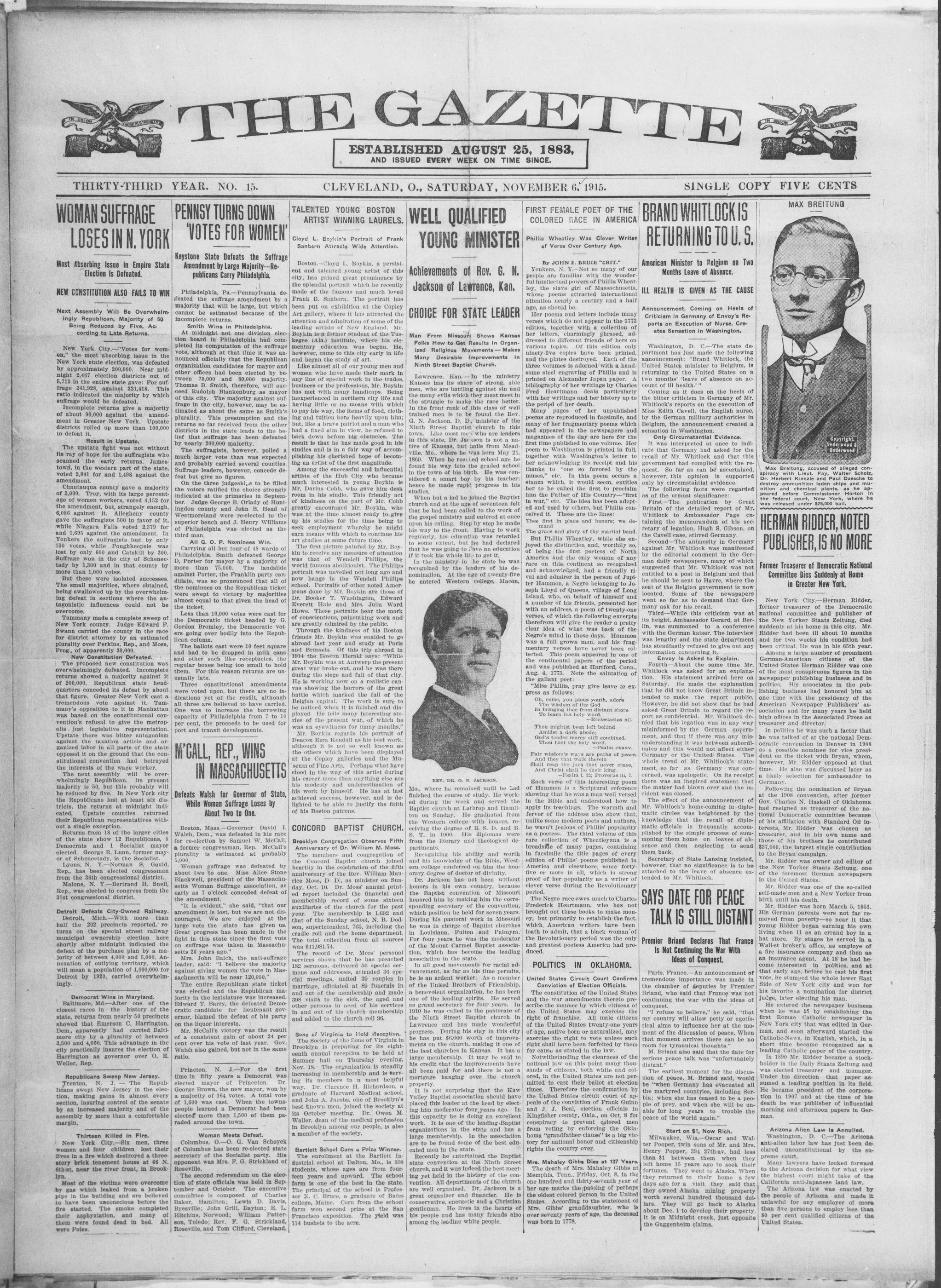
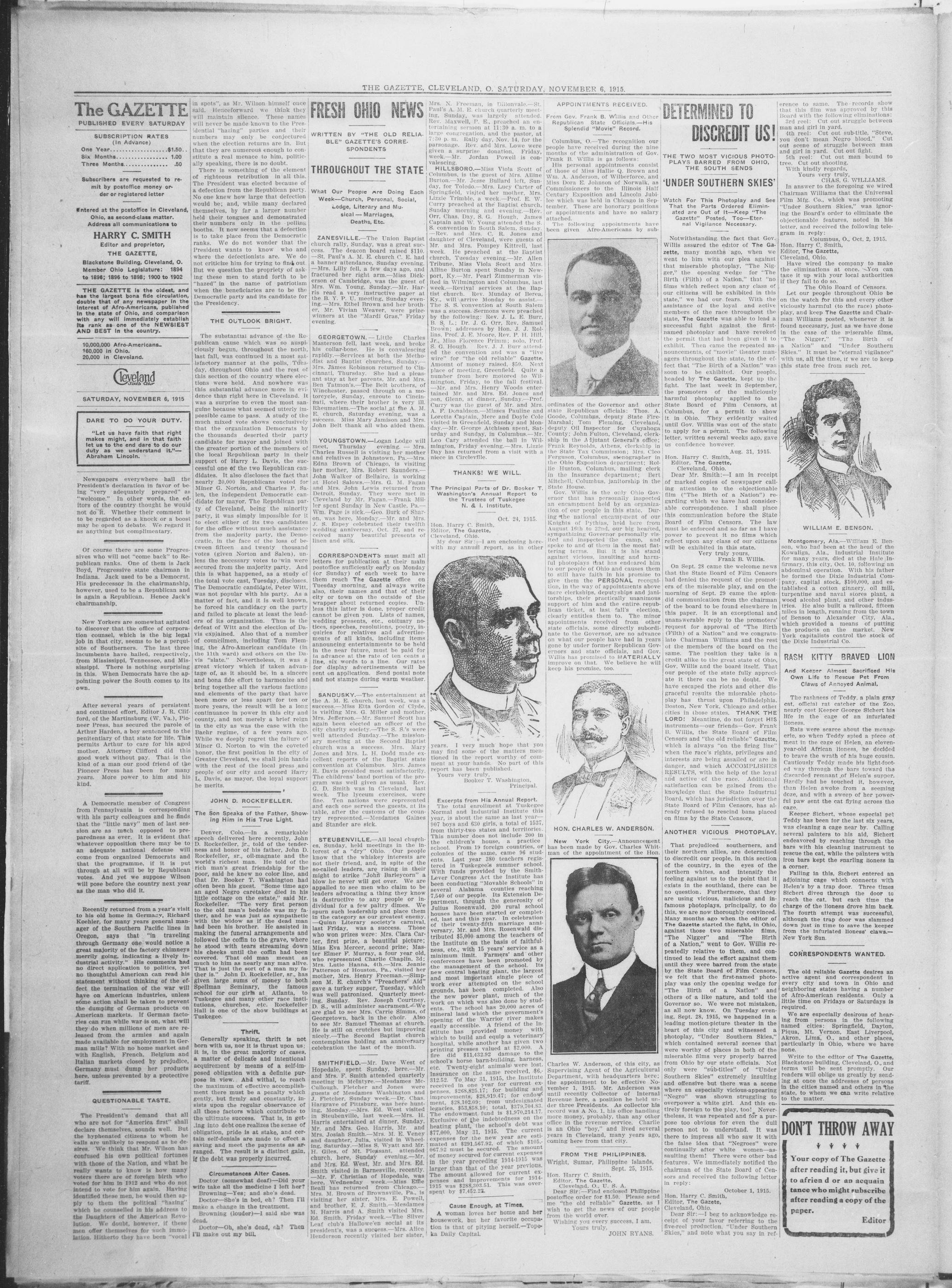
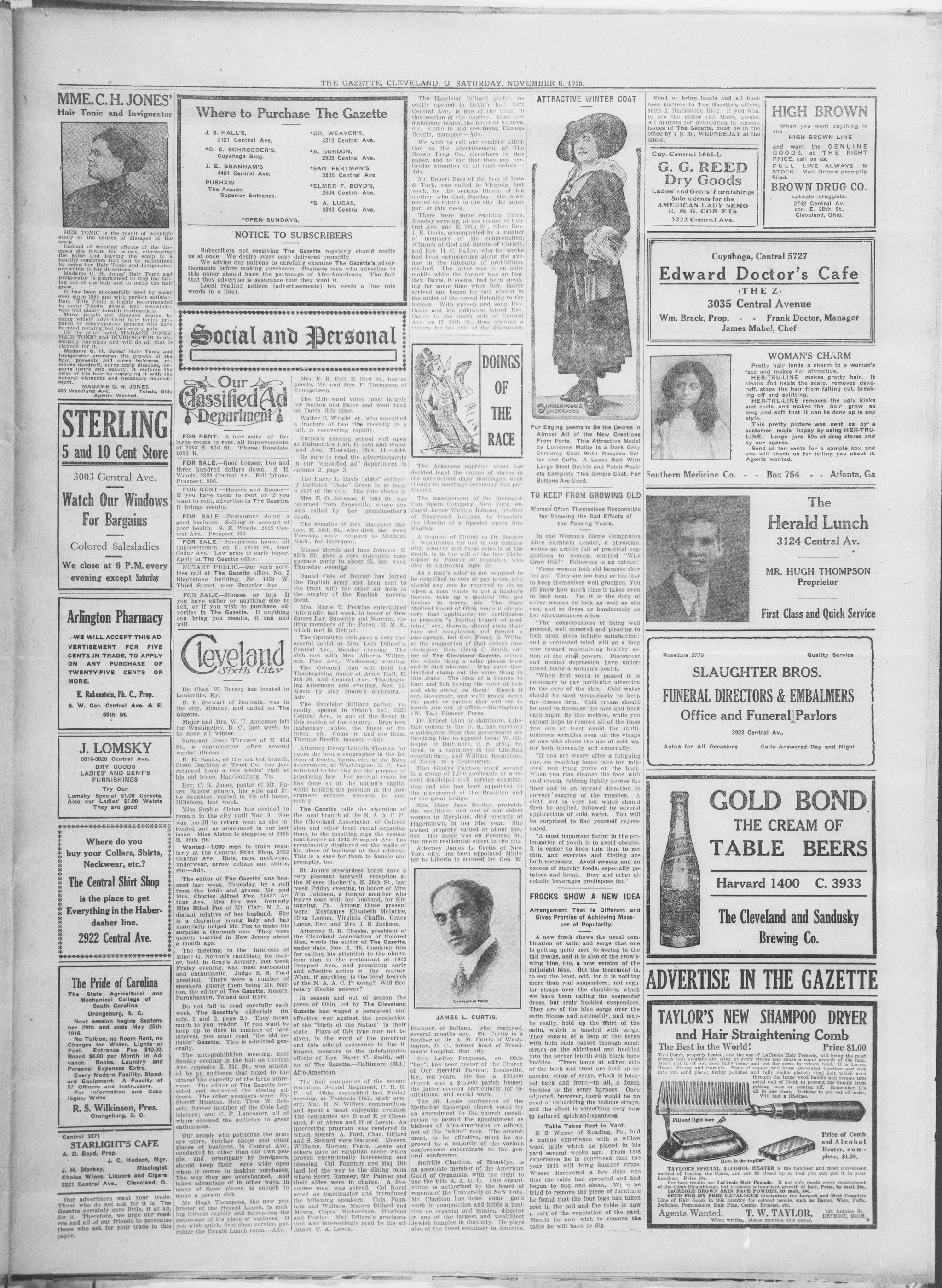
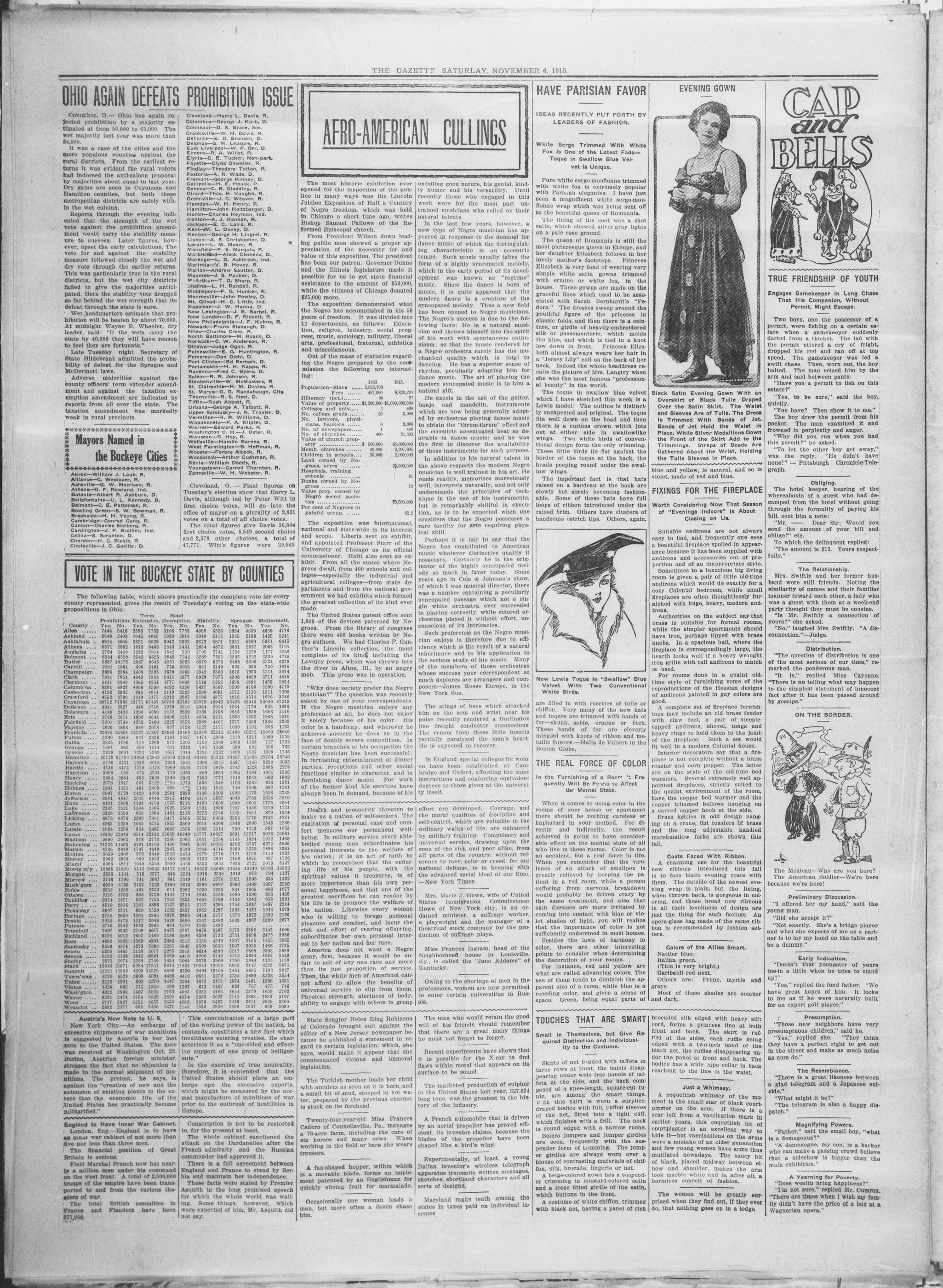
Page text (machine-generated)
IN UNION
UNION STRONGER
WOMAN SUFFRAGE LOSES IN N.YORK
Most Absorbing Issue in Empire State Election Is Defeated.
NEW CONSTITUTION ALSO FAILS TO WIN
Next Assembly Will Be Overwhelming Republican, Majority of 50 Being Reduced by Five, According to Late Returns.
New York City.—"Votes for women," the most absorbing issue in the New York state election, was defeated by approximately 200,000. Near midnight, 2,467 election districts out of 5,713 in the entire state gave: For suffrage 241,928, against 321,418. This ratio indicated the majority by which suffrage would be defeated.
"Incomplete returns give a majority of about 00,000 against the amendment in Greater New York. Update districts rolled up more than 100,000 to defeat it.
Result In Unstate
The upstate fight was not without its ray of hope for the suffragists: who scanned the early returns, James town, in the western part of the state, voted 2,841 for and 1,498 against the amendment.
Chautauqua county gave a majority of 3,000. Troy, with its large percentage of women workers, voted 4,152 for the amendment, but, strangely enough, 6,086 against it. Allegheny county gave the suffragists 500 in favor of it, while Niagara Falls voted 2,379 for and 1,695 against the amendment. In Yonkers the suffragists lost by only 130 votes, while Poughkeepsie was lost by only 600 and Catskill by 300. Suffrage won in the city of Schenectady by 1,300 and in that county by more than 1,000 votes.
But these were isolated successes. The small majorities, where obtained, being swallowed up by the overwhelming defeat in sections where the antagonistic influences could not be overcome.
Tammany made a complete sweep of New York county. Judge Edward F. Swann carried the county in the race for district attorney by an estimated plurality over Perkins, Rep. and Moss, Prog. of apparently 38,000.
New Constitution Defeated.
The proposed new constitution was overwhelmingly defeated. Incomplete returns showed a majority against it of 200,000. Republican state headquarters conceded its defeat by about that figure. Greater New York cast a tremendous vote against it. Tammy's opposition to it in Manhattan was based on the constitutional convention's refusal to give the metropolis just legislative representation. Update there was bitter antagonism against the taxation article and organized labor in all parts of the state opposed it on the ground that the constitutional convention had betrayed the interests of the wage worker.
The next assembly will be overwhelmingly Republican. Its present majority is 50, but this probably will be reduced by five. In New York city the Republicans lost at least six districts, the returns at midnight indicated, Update counties returned their Republican representatives without a single exception.
Returns from 18 of the larger cities of the state show 12 Republicans, 5 Democrats and 1 Socialist mayor elected. George R. Lunn, former mayor of Schenectady, is the Socialist. Lyons, N. Y.—Norman S. Gould, Rep., has been elected congressman from the 36th congressional district. Malone, N. Y.—Bertrand H. Snell, Rep., was elected to congress from the 31st congressional district.
Detroit Defeats City-Owned Railway,
Detroit, Mich.-With more, than half the 202 preclinics reported,
returning on the special street railway
municipal ownership election here
shortly after midnight indicated the
defeat of the purchase, plan by a
majority of between 4,000 and 5,000. Anexation of outlying territory, which
will mean a population of 1,000,000 for
Detroit by 1920, carried overwhelmingly.
Democrat Wins in Maryland
Baltimore, Md.—After one of the closest races in the history of the state, returns from nearly 50 precincts showed that Emerson C. Harrington, Dem. apparently had carried Baltimore city by a plurality of between 3,500 and 4,000. This advantage in the city practically insures the election of Harrington as governor over O. E. Weller, Rep.
Republicans Sweep New Jersey.
Trenton, N. J. — The Republicans swept New Jersey in the election, making gains in almost every section, insuring control of the senate by an increased majority and of the assembly by more than a comfortable margin.
Thirteen Killed in Fire.
New York City—Six men, three women and four children lost their lives in a fire which destroyed a three-story brick tenement house at 66 N. 6th, near the river front, in Brooklyn.
Most of the victims were overcome by gas which leaked from a broken pipe in the building and are believed to have been unconscious before the fire started. The smoke completed their asphyxiation, and many of them were found dead in bed. All were Poles.
THE GAZETTE
PENNSY TURNS DOWN 'VOTES FOR WOMEN'
PENNSY TURNS DOWN 'VOTES FOR WOMEN'
Keystone State Defeats the Suffrage Amendment by Large Majority---Republicans Carry Philadelphia.
Philadelphia, Pa.—Pennsylvania defeated the suffrage amendment by a majority that will be large, but which cannot be estimated because of the incomplete returns.
Smith Wins in Philadelphia.
At midnight not one division election board in Philadelphia had completed its computation of the suffrage vote, although at that time it was announced officially that the Republican organization candidates for mayor and other offices had been elected by between 70,000 and 80,000 majority. Thomas B. Smith, therefore, will succeed Rudolph Blankenburg as mayor of this city. The majority against suffrage in the city, however, may be estimated as about the same as Smith's plurality. This presumption and the returns so far received from the other districts in the state leads to the belief that suffrage has been defeated by nearly 200,000 majority.
The suffragists, however, polled a much larger vote than was expected and probably carried several counties. Suffrage leaders, however, concede defeat but give no figures.
On the three judgements to be filled the voters ratified the choice strongly indicated at the primaries in September. George George B. Orlady of Huntingdon, county and John B. Head of Westmoreland were re-elected to the superior bench and J. Henry Williams of Philadelphia was elected as the third man.
All G. O. P. Nominees Win.
Carrying all but four of 48 wards of Philadelphia. Smith defeated, George D. Porter for mayor by a majority of more than 75,000. The landlords against Porter, the Franklin party candidate, was so pronounced that all of the nominees on the Republican ticket were swept to victory by majorities almost equal to that given the head of the ticket.
Less than 10,000 votes were cast for the Democratic ticket headed by G. Gordon Bromley, the Democratic voters going over bodily into the Republican column.
The ballots cast were 10 feet square and had to be dropped in milk cans and other such like receptacles, the regular boxes being too small to hold them. For this reason returns are unusually late.
Three constitutional amendments were voted upon, but there are no indications yet of the result, although all three are believed to have carried. One was to increase the borrowing capacity of Philadelphia from 7 to 10 per cent, the proceeds to be used for port and transit developments.
M'CALL, REP., WINS IN MASSACHUSETTS
Defeats Walsh for Governor of State While Woman Suffrage Loses by About Two to One.
Boston, Mass.—Governor David I. Walsh, Dem., was defeated in his race for re-election by Samuel W. McCall, a former congressman, Rep. McCall's plurality is estimated at probably 5,000.
Woman suffrage was defeated by about two to one. Miss Alice Stone Blackwell, president of the Massachusetts Woman Suffrage association, as early as 7 o'clock conceded defeat of the amendment.
"It is evident," she said, "that our amendment is lost, but we are not discouraged. We are enjoyed at the large vote the state has given us. Great progress has been made in the fight in this state since the first vote on suffrage was taken in Massachusetts 20 years ago."
Mrs. John Balch, the anti-suffrage leader, said: "I believe the majority against giving women the vote in Massachusetts will be near 120,000."
The entire Republican state ticket was elected and the Republican majority in the legislature was increased. Edward T. Barry, the defeated Democratic candidate for lieutenant governor, blamed the defeat of his party on the liquor interests.
Mr. McCall's victory was the result of a consistent gain of about 24 per cent over his vote of last year. Gov. Walsh also gained, but not in the same ratio.
Princeton, N. J.-For the first tine in fifty years a Democrat was elected mayor of Princeton. Dr. George Brown, the new mayor, won by a majority of 164 votes. A total vote of 1,600 was cast. When the town's people learned a Democrat had been elected more than 1,500 of them paraded around the town.
Woman Meets Defeat.
Columbus, O.—O. G. Van Schoyck of Columbus has been re-elected state secretary of the Socialist party. His opponent was Mrs. F. G. Strickland of Roseville. The second referendum on the election of state officials was held in September and October. The executive committee is composed of Charles Baker, Hamilton; Lewis D. Davis, Byesvieh; John Grill, Dayton; E. L. Hitchins, Norwood; William Patterson, Toledo; Rev. F. G. Strickland, Roseville, and Mr. Clifford, Cleveland.
ESTABLISHED AUGUST 25, 1883. AND ISSUED EVERY WEEK ON TIME SINCE.
TALENTED YOUNG BOSTON ARTIST WINNING LAURELS
Cloyd L. Boykin's Portrait of Frank Sanborn Attracts Wide Attention.
Boston—Cloyd L. Boykin, a persistent and talented young artist of this city, has gained great prominence by the splendid portrait which he recently made of the famous and much loved Frank B. Sanborn. The portrait has been put on exhibition at the Copley Art gallery, where it has attracted the attention and admiration of some of the lending artists of New England. Mr. Boykin is a former student of the Tuskegee (Alb.) institute, where his elementary education was begun. He, however, came to this city early in life and began the study of art.
Like almost all of our young men and women who have made their mark in any line of speech work in the trades, business or the professions, Mr. Boykin has met with many handicaps. He has experienced in northern city life and having little or no mems with which to pay his way, the items of food, clothing and tuition bore heavily upon him; but, like a brave patriot and a man who had a fixed aim in view, he refused to back down before big obstacles. The result is that he has made good in his studies and is in a fair way of accomplishing his cherished hope of becoming an artist of the first magnitude. Among the successful and influential artists of the Hub City who became much interested in young Boykin is Mr. Darwin Cobb, who gave him desk room in his studio. This friendly act of kindness on the part of Mr. Cobb greatly encouraged Mr. Boykin, who was at the time almost ready to give up his studies for the time being to seek employment whereby he might earn means with which to continue his art studies at some future time. The first picture painted by Mr. Boykin to seek employment was that of Wendell Phillips, the world famous abolitionist. The Phillips portrait was unveiled not long ago and now hangs in the Wendell Phillips school. Portraits of other noted Americans done by Mr. Boykin are those of Dr. Booker T. Washington, Edward Everett Hale and Mrs. Julia Ward Howe. These portraits bear the mark of conscientious, painstaking work and are greatly admired by the public.
Through the kindness of his Boston friends Mr. Boykin was enabled to go abroad last year and study at Paris and Brussels. Of this trip abroad in 1914 the Boston Herald says, "While Mr. Boykin was at Antwerp the present great war broke out, and he was there during the siege and fall of that city. He is working now on a realistic canvas showing the horrors of the great battle which marked the fall of the Belgian capital. The work is sure to be noticed when it is finished and displayed. He tells many interesting stories of the war, and an eyefulness for many months". Mr. Boykin reasks his portrait of Deacon Ezra Kendall as his best work, although it is not so well known as the others which have been displayed at the Cophy galleries and the Museum of Fine Arts. Perhaps what have stood in the way of this artist during his career more than anything else are his modesty and underestimation of his work by himself. He has at last achieved success, however, and is delighted to be able to justify the faith of his Boston patrons.
CONCORD BAPTIST CHURCH.
Brooklyn Congregation Observes Fifth Anniversary of Dr. William M. Moss.
Anniversary of Dr. William M. Mosse
The members and congregation of the Concord Baptist church joined heartily in the celebration of the fifth anniversary of the Rev. William Maurice Moss, D. D., as minister on Sunday, Oct. 10. Dr. Moss' annual printed report included the financial and membership record of some sixteen auxiliaries of the church for the past year. The membership is 4,692 and that of the Sunday school, N. B. Dodson, superintendent, 765, including the cradle roll and the home department. The total collection from all sources was $11,951.74.
The record of Dr. Mess' personal services shows that he has prescheduled 182 sermons, delivered 56 special sermons and addresses, attended 36 special meetings, united 30 couples in marriage, officiated at 89 funerals in and out of the membership and made 308 visits to the sick, the aged and other persons in need of his services in and out of his church membership and added to the church roll 00.
Sone of Virginia to Hold Reception.
The Society of the Sons of Virginia in Brooklyn is preparing for its eighteenth annual reception to be held at Summer hall on Thursday evening, Nov. 18. The organization is steadily increasing in membership and is serving its members in a most helpful way. Dr. Clarence H. Richardson, a graduate of Harvard Medical school, and John A. Jacobs, one of Brooklyn's best known men, joined the society at its October meeting. Dr. Owen M. Walter, dean of the medical profession in Brooklyn among our people, is also a member of the society.
Bartlett-School Corn a Prizo Winner.
The enrollment at the Bartlett Industrial school at Dalton, Mo., is 108 students, whose ages are from fourteen years and upward. The school farm is one of the best in the state. The principal of the school is Professor N. C. Bruce, a graduate of Bates college, Maim, Corn from the school farm won second prize at the San Francisco expoition. The yield was 114 bushels to the acre.
WELL QUALIFIED YOUNG MINISTER
CHOICE FOR STATE LEADER
Man From Missouri Shows Kansas Folks How to Get Results in Organized Religious Movements — Makes Many Desirable Improvements in Ninth Street Baptist Church.
Lawrence, Kan. — In the ministry Kansas has its share of strong, able men, who are battling against sin and the many evils which they must meet in the struggle to make the race better. In the front rank of this class of well trained men is to be found the Rev. G. N. Jackson, D. D., minister of the Ninth Street Baptist church in this town. Like most men who are leaders in this state, Dr. Jacob is not a native of Kansas, but印业 from Meadville, Mo. where he was born May 21, 1869. When he rented school age he found his way into the graded school in the town of his birth. He was considered a smart boy by his teacher; hence he made rapid progress in his studies. When but a bld he joined the Baptist church and at the age of seventeen felt that he had been called to the work of the gospel ministry and entered at once upon his calling. Step by step he made his way to the front. Having to work regularly, his education was retarded to some extent, but he had declared that he was going to have an education if it took his whole life to get it.
In the ministry in he state he was recognized by the leaders of his denomination. At the age of twenty-five he entered Western college, Macon,
REV. DR. G. N. JACKSON.
Mo., where he remained until he had finished the course of study. He worked during the week and served the Baptist church at Lathrop and Hamilton on Sunday. He graduated from the Western college with honors, receiving the degree of B. S. D. and B. S. T. in 1900. His diplomas were from the literary and theological departments.
Recognizing his ability and worth and his knowledge of the Bible, Western college conferred on him the honorary degree of doctor of divinity. Dr. Jackson has not been without honors in his own country, because the Baptist convention of Missouri honored him by making him the corresponding secretary of the convention, which position he held for seven years. During his pastoral work in Missouri he was in charge of Baptist churches in Louisiana, Fulton and Palmyra. For four years he was the moderator of the Mount Carmel Baptist association, which has become the leading association in the state. In all good movements for racial advancement, as far as his time permits, he is an ardent worker. As a member of the United Brothers of Friendship, a benevolent organization, he has been one of the leading spirits. He served as grand secretary for four years. In 1910 he was called to the pastorate of the Ninth Street Baptist church in Lawrence and has made wonderful progress. During his stay in this city he has put $0,000 worth of improvements on the church, making it one of the best churches in Kansas. It has a large membership. It may be said to his credit that the improvements have all been paid for and there is not a mortgage hanging over the church property.
It is not surprising that the Kaw Valley Baptist association should have placed this leader at the head by electing him moderator four years ago. In this capacity he is doing an excellent work. It is one of the leading Baptist organizations in the state and has a large membership. In the association are to be found some of the best educated men in the state.
Recently he entertained the Baptist state convention at the Ninth Street church, and it was indeed the best meeting yet held in the history of the convention. All departments of the church are well organized. Dr. Jackson is a great organizer and financier. He is conservative, energetic and a Christian gentleman. He lives in the hearts of his people and has many friends also among the leading white people.
FIRST FEMALE POET OF THE COLORED FACE IN AMERICA
Phillis Wheatley Was Clever Writer
of Verse Over Century Age.
BY JOHN E. BRUCE "GRIT."
Yonkers, N. Y. Not so many of our people are familiar with the wonderful intellectual powers of Phillips Wheeler, the star girl of Massachusetts, whose poems attracted international attention nearly a century and a half ago, as should be.
Her poems and letters include many verses which do not appear in the 1773 edition, together with a collection of her letters, charmingly phrased, addressed to different friends of hers on various topos. Of this edition only ninety-five copies have been printed, and the plates destroyed. Each of the three volumes is adorned with a hand-some steel engraving of Phillips and is printed on Alexander Japan paper. A bibliography of her writings by Charles Fred Heartmann deals particularly with her writings and her history up to the peripod of her death.
Many pages of her unpublished poems are reproduced in facsimile, and many of her fragmentary poems which had appeared in the newspapers and magazines of the day are here for the first time published in one volume. Her poem to Washington is printed in full, together with *Washington's* letter to her acknowledging its receipt and his thanks to "one so favored by the muses," in. In this poem occurs a stanza which, it would seem, entitles her to be called the first to proclaim him the Father of His Country—"first in war," etc. The idea has been adopted and used by others, but Phillips conceived it. These are the lines:
The first in place and honors; we demand
The grace and glory of the martial band.
But Philips Wheatley, while she enjoyed the distinction and, worthy so, of being the first poetess of North America and the only woman of nity race on this continued so recognized and acknowledged, had a friendly rival and admirer in the person of Jupiter Hammon, a Negro belonging to Joseph Lloyd' of Queens, village of Long Island, who, on behalf of himself and a number of his friends, presented her with an address, a poem of twenty-one verses, of which the following excerpts therefrom will give the reader a pretty clear idea of what was back of the Negro's mind in those days. Hammon was a full grown man, and his fragmentary verses have never been collected. This poem appeared in one of the congratulatory papers of the period and was published at Hartford, Conn., Aug. 4, 1773. Note the salutation of the gallant poet:
"Miss Philips, may give leave to express as follows:
Oh, come, you pious youth, adore
The wisdom of the God
Fair wisdom's ways are paths of peace.
And they that walk therein
Shall reap the joys that never cease,
And Christ shall be their king.
*Blessed L. E. Joseph.*
Each verse of this interesting poem of Hummon is a Scriptural reference showing that he was a man well versed in the Bible and understood how to apply its teachings. The warmth and favor of the address also show that, unlike some modern poets and authors, he wasn't jealous of Philips' popularity as a poet. 'The third volume of this rare collection of Wheatleyana is a broadside of many pages, containing in fessilite the title pages of every edition of Philips' poems published in America and elsewhere, some forty-five or more in all, which is strong proof of her popularity as a writer of clever verse during the Revolutionary period.
'The Negro race is much to Charles Frederick Heurtmann, who has not brought out these books to make money, but primarily to establish the fact, which, American writers have begun to admit, that a black woman of the Revolutionary period was the only and greatest poets America had produced.
POLITICS IN OKLAHOMA.
United States Circuit Court Confirms Conviction of Election Officials.
The constitution of the United States and the war amendments thereto prescribe the manner by which citizens of the United States may exercise the right of framehise. All male citizens of the United States twenty-one years of age, native born or naturalized, may exercise the right to vote unless such right shall have been forfeited by them for cause as stated in the law.
Notwithstanding the clearness of the national law on this point many thousands of citizens, both white and colored, in the United States are not permitted to cast their ballot at election times. Therefore the confirmation by the United States circuit court of appeals of the conviction of Frank Guilm and J. J. Beal, election officials in Kingsgather county, Oka., on Oct. 8 for conspiracy to prevent colored men from voting by enforcing the Oklahoma "grandfather clause" is a big victory for national honor and citizenship rights the country over.
Mrs. Mahaley Gibbs Dies at 137 Years.
The death of Mrs. Mahaley Gibbs at Memphis, Tennessee, Friday, Oct. 8, in the one hundred and thirty-seventh year of her age marks the passing of perhaps the oldest colored person in the United States. According to the statement of Mrs. Gibbs' granddaughter, who is over seventy years of age, the deceased was born in 1778.
SINGLE COPY FIVE CENTS
BRAND WHITLOCK IS RETURNING TO U.S.
American Minister to Belgium on Two Months Leave of Absence.
ILL HEALTH IS GIVEN AS THE CAUSE
Announcement, Coming on Heels of Criticism in Germany of Envoy's Reports on Execution of Nurse, Creates Sensation in Washington.
Washington, D. C.—The state department has just made the following announcement: "Brand Whitlock, the United States minister to Belgium, is returning to the United States on a two months' leave of absence on account of ill health."
Coming as it does on the heels of the bitter criticism in Germany of Mr. Whitlock's reports on the execution of Miss Edith Cavell, the English nurse, by the German military authorities in Belgium, the announcement created a sensation in Washington.
Only Circumstantial Evidence.
It was interpreted at once to indicate that Germany had asked for the recall of Mr. Whitlock and that this government had complied with the request. So far as can be ascertained, however, this opinion is supported only by circumstantial evidence.
The following facts were regarded as of the utmost significance:
as of the utmost significance:
First—The publication by Great Britain of the detailed report of Mr. Whitlock to Ambassador Page containing the memorandum of his secretary of legislation. Hugh S. Gibson, on the Cavell case, stirred Germany.
Second—The animosity in Germany against Mr. Whitlock was manifested by the editorial comment in the German daily newspapers, many of which suggested that Mr. Whitlock was not entitled to a post in Belgium and that he should be sent to Havre, where the seat of the Belgian government is now located. Some of the newspapers suggested a demand that Germany ask for his recall.
Third—While this criticism was at its height, Ambassador Gerard, at Berlin, was summoned to a conference with the German kaiser. The interview, was lengthy and the state department has steadfastly refused to give out any information concerning it.
Envoy Is Asked to Explain.
Fourth--About, the same time Mr. Whitlock was asked for an explanation. His statement, arrived here on Saturday. He made the explanation that he did not know Great Britain intended to make the report public. However, he did not show that he had asked Great Britain to regard the report as confidential. Mr. Whitlock denied that his legation was in any way misinformed by the German government, and that if there was any misunderstanding it was between spbordinates and this would not affect either Germany or the United States. The whole trend of Mr. Whitlock's statement, so far as Germany was concerned, was apologetic. On its receipt there was an inspired statement that the matter had blown over and the indictment was made. The effect of the announcement of Mr. Whitlock's home-coming in diplomatic circles was heightened by the knowledge that the recall of diplomatic officials is frequently accomplished by the simple process of summoning them home on leaves of absence and then neglecting to send them back.
Secretary of State Lansing insisted, however, that no significance is to be attached to the leave of absence extended to Mr. Whitlock.
SAYS DATE FOR PEACE
TALK IS STILL DISTANT
Paris, France.—An announcement of tremendous importance was made in the chamber of deputies by Premier Briand, who said that France was not continuing the war with the ideas of conquest.
"I refuse to believe," he said, "that my country will allow petty or egotistical aims to influence her at the moment of the discussion of peace. When that moment arrives there can be no room for tyrannical thoughts."
M. Briand also said that the date for serious peace talk was "unfortunately distant."
The earliest moment for the discussion of peace, M. Briand said, would be "when Germany has evacuated all the martyred countries; including Serbia; when she has ceased to be a people of prey, and when she will be unable for long years to trouble the peace of the world again."
Start on $1 Now Rich
Milwaukee, Wis.-Oscar and Walter Pooper, twin sons of Mr. and Mrs. Henry Popper, 394, 27th-av, had less than $1 between them when they left home 15 years ago to seek their fortunes. They went to Alaska. When they returned to their home a few days ago for a visit they said that they owned Alaska mining property worth several hundred thousand dollars. They will go back to Alaska about Dec. 1 to develop their property. It is on Midnight creek, just opposite the Guggenheim claims.
IN COLOR
THE WORLD'S MOST FOLKLORED
MAX BREITUNG
Copyright
Jude;wood &
Underwood
Max Brettung, accused of village conspiracy, pleaded guilty. Scholtz, Dr. Herbert Klenzle and Paul Daseche to destroy ammunition laden ships and mutilation and chemical plants, as he appeared before Commissioner Horton in the federal court, New York; where he was released under $25,000 bail.
HERMAN RIDDER, NOTED
PUBLISHER, IS NO MORE
Former Treasurer of Democratic National Committee Dies Suddenly at Home in Greater New York.
New York City—Herman Ridder, former treasurer of the Democratic national committee and publisher of the New Yorker Staats Zeitung, died suddenly at his home in this city. Mr. Ridder had been ill about 10 months and for two weeks his condition had been critical. He was in his 65th year. Among a large number of prominent German-American citizens of the United States Herman Ridder was one of the most conspicuous figures in the newspaper publishing business and in politics. His associates in the publishing business had honored him at one time with the presidency of the American Newspaper Publishers' association and for many years he held high offices in the Associated Press as treasurer and director.
In politics he was such a factor that he was talked of at the national Democratic convention in Denver in 1908 as a possible nominee for vice president on the ticket with Bryan, whom, however, Mr. Ridder opposed at that time. He also was discussed later as a likely selection for ambassador to Germany.
Following the nomination of Bryan at the 1908 convention, after former Gov. Charles N. Haskell of Oklahoma had resigned as treasurer of the national Democratic committee because of his affiliation with Standard Oil interests, Mr. Ridder was chosen as treasurer, and in his own name and those of his brothers he contributed $37,000, the largest single contribution to the Bryan campaign.
Mr. Ridder was owner and editor of the New Yorker Staats Zeitung, one of the foremost-German newspapers in the United States.
Mr. Ridder was one of the so-called self-made men and a New Yorker from birth until his death.
Mr. Ridder was born March 5, 1851. His German parents were not far removed from poverty—so near it that young Ridder began earning his own living when 11 as an errand boy in a hat store. By stages he served in a Wallis broker's office, as employee of a fire insurance company and then as an insurance agent. At 18 he had become interested in politics, and at that early age, before he cast his first vote, he stumped the whole lower East Side of New York city and won for his favorite, a nomination for district judge, later electing his man.
He entered the newspaper business when he was 21 by establishing the first Roman. Catholic newspaper in New York city that was edited in German, and soon afterward started the Catholic News, in English, which, in a short time became recognized as a leading Catholic paper of the country.
In 1850 Mr. Ridder became a stockholder in the Daily Staats Zeitung and was elected treasurer and manager. Under his direction that paper assumed a leading position in its field. He became president of the corporation in 1907 and at the time of his death he was publisher of influential morning and afternoon papers in German.
Arizona Alien Law is Annulled.
Washington, D. C.—The Arizona anti-alien labor law has just been declared unconstitutional by the supreme court.
Many lawyers have looked forward to the Arizona decision for what view the highest court might take of the California anti-Japanese land law.
The Arizona law was enacted by the people of Arizona and made it unlawful for any employer of more than five persons to employ less than 80 per cent qualified citizens of the United States.
SUBSCRIPTION RATES
(In Advance)
One Year.....$1.50.
Six Months.....1.00
Three Months......50
Subscribers are requested to re-
mit by postoffice money or-
der or registered letter
Entered at the postoffice in Cleveland
Ohio, as second-class matter.
Address all communications to
HARRY C. SMITH
Editor and proprietor,
THE GAZETTE,
Blackstone Building, Cleveland, O.
Member Ohio Legislature: 1894
to 1896; 1896 to 1898; 1900 to 1902
THE GAZETTE is the oldest, and has the largest bona fide circulation, double that of any newspaper in the interest of Afro-Americans, published in the state of Ohio, and comparison with any will immediately establish its rank as one of the NEWSIEST AND BEST In the country.
10,000,000 Afro-Americans..
160,000 in Ohio.
20,000 in Cleveland.
SATURDAY, NOVEMBER 6, 1915
DARE TO DO YOUR DUTY.
"Let us have faith that right makes might, and in that faith us to the end understand to do our duty, and to understand it."—Ambra Lincoln.
Newspapers everywhere hall the President's declaration in favor of being "ing very adequately prepared" as "welcome." In other words, the editors of the country thought he would not do it. Whether their comment is to be regarded as a knock or a boost may be open to debate. We regard it as anything but complimentary.
Of course there are some Progressives who will not "come back" to Republican ranks. One of them is Jack Boyd, Progressive state chairman in Indiana. Jack used to be a Democrat. His predecessor in the chairmanship, however, used to be a Republican and is again a Republican. Hence Jack's chairmanship.
New Yorkers are somewhat agitated to discover that the office of corporation counsel, which is the big legal job in that city, seems to be a perquisite of Southerners. The last three incumbents have hailed, respectively, from Mississippi, Tennessee, and Mississippi. There is nothing surprising in this. When Democrats have the appointing power the South comes to its own.
After several years of persistent and continued effort, Editor J. R. Clifford, of the Martinsburg (W. Va.), Pioneer Press, has secured the parole of Arthur Harden, a boy sentenced to the penitentiary of that state for life. This permits Arthur to care for his aged mother. Attorney Clifford did this good work without pay. That is the kind of a man our good friend of the Pioneer Press has been for many years. More power to him and his kind.
A Democratic member of Congress from Pennsylvania is corresponding with his party colleagues and he finds that the "little navy" men of last session are as much opposed to preparedness as ever. It is evident that whatever opposition there may be to an adequate national defense will come from organized Democrats and that the programme, if it is put through at all will be by Republican votes. And yet we suppose Wilson will pose before the country next year as the man who did it.
---
Recently returned from a year's visit to his old home in Germany, Richard Koehler, for many years general manager of the Southern Pacific lines in Oregon, says that "in traveling through Germany one would notice a great majority of the factory chimneys merrily going, indicating a lively industrial activity." His comments had direct application to politics, no thoughtful American can read his statement without thinking of the effect the termination of the war will have on American industries, unless some action shall be taken to prevent the dumping of German products on American markets. If German factories can run while war is on, what will they do when millions of men are released from the armies and again made available for employment in German mills? With no home market and with English, French, Belgium and Italian markets closed by prejudice, Germany must dump her products here, unless prevented by a protective tariff.
QUESTIONABLE TASTE.
The President's demand that all who are not for "America first" shall declare themselves, sounds well. But the hyphonated citizens to whom he calls are unlikely to respond as he desires. We think that Mr. Wilson has confused his own political fortunes with those of the Nation, and what he really wants to know is how many voters there are of foreign birth who voted for him in 1912 and who do not intend to vote for him again. Having identified these men, he would then apply to them the political "hazing" which he counselled in his address to the Daughters of the American Revolution. We doubt, however, if these men offer themselves for such immolation. Hitherto they have been "vocal
in spots", as Mr. Wilson himself once said. Henceforward we think they will maintain silence. These names will never be made known to the Presidential "having" parties and their numbers may only be conjectured when the election returns are in. But that they are numerous enough to constitute a real menace to him, politically speaking, there is no doubt.
There is something of the element of righteous retribution in all this. The President was elected because of a defection from the Republican party. No one knew how large that defection would be; and, while many declared themselves, by far a larger number held their tongues and demonstrated their numbers only in the polling booths. It now seems that a defection is to take place from the Democratic ranks. We do not wonder that the President wants to know who and where the defectionists are. We do not criticize him for trying to find out. But we question the propriety of asking these men to stand forth to be "hazed" in the name of patriotism when the beneficiaries are to be the Democratic party and its candidate for the Presidency.
THE OUTLOOK BRIGHT.
The substantial advance of the Republican cause which was so auspiciously begun, throughout the north, last fall, was continued in a most satisfactory manner at the polls, Tuesday, throughout Ohio and the rest of this section of the country where elections were held. And nowhere was this substantial advance more in evidence than right here in Cleveland. It was a surprise to even the most sanguine because what seemed utterly impossible came to pass. A study of the much mixed vote shows conclusively that the organization Democrats by the thousands deserted their party candidate for mayor and joined with the greater portion of the members of the local Republican party in their support of Harry L. Davis, the successful one of the two Republican candidates. It also discloses the fact that nearly 20,000 Republicans voted for Miner G. Norton, and Charles P. Salen, the independent Democratic candidate for mayor. The Republican party of Cleveland, being the minority party, it was simply impossible for it to elect either of its two candidates for the office without much assistance from the majority party, the Democratic, in the face of the loss of between fifteen and twenty thousand votes (given Norton and Salen), unless the necessary votes to win were secured from the majority party. And this is what happened, as a study of the total vote cast, Tuesday, discloses. The Democratic candidate, Peter Witt, was not popular with his party. As a matter of fact, and it is well known, he forced his candidacy on the party and failed to placate at least the leaders of its organization. Thus is the defeat of Witt and the election of Davis explained. Also that of a number of councilmen, including Tom Fleming, the Afro-American candidate (in the 11th ward) and others on the Davis "slate." Nevertheless, it was a great victory which if taken advantage of, as it should be, in a sincere and bona fide effort to harmonize and bring together all the various factions and elements of the party that have been more or less apart for ten or more years, the result will be a long continuance in power in this city and county, and not merely a brief reign in the city as was the case with the Bachr regime, of a few years ago. While we deeply regret the failure of Miner G. Norton to win the coveted honor, the first position in the city of Greater Cleveland, we shall join hands with the rest of the local press and people of our city and accord Harry L. Davis, as mayor, the loyal support he merits.
JOHN D. ROCKEFELLER
The Son Speaks of the Father, Showing Him in His True Light.
Denver, Colo.—In a remarkable speech delivered here recently, John D. Rockefeller, Jr., told of the tenderness and honor of his father, John D. Rockefeller, sr., oil-magnate and the world's richest man. He told of the rich man's great friendship for the poor, said he knew no color line, and that Dr. Booker T. Washington had often been his guest. "Some time ago an aged Negro caretaker died in his little cottage on the estate," said Mr. Rockefeller, who was person to the old man's bedside for another, and he was just as sympathetic with the widow as if the dead man had been his brother. He assisted in making the funeral arrangements and followed the coffin to the grave, where he stood with tears streaming down his cheeks until the coffin had been covered. That old man meant as much to him as nearly any man alive. That is just the sort of a man my father is. John D. Rockefeller, sr., has a large sum of money to both Spellman Seminary, the famous school for our girls at Atlanta, to Tuskegee and many other race institutions, churches, etc. Rockefeller Hall is one of the show buildings at Tuskegee.
Thrift
Generally speaking, thrift is not born with us, nor it is thrust upon us; it is, in the great majority of cases, a matter of delicate and intentional acquirement by means of a self-imposed obligation with a definite purpose in view. And with ital, to reach the maximum of effective accomplishment there must be a penalty which gently, but firmly and constantly, insists upon the regular observance of all those factors which contribute to the ultimate success. That is, in getting into debt one realizes the sense of obligation, pride is at stake, and certain self-denials are made to effect a saving and meet the payments as arranged. The result is a distinct gain, if the debt was properly incurred.
Circumstances Alter Cases.
Doctor (somewhat deaf)—Did your wife take all the medicine I left her? Browning—Yes; and she's dead.
Doctor—She's in bed, eh? Then I'll make a change in the treatment.
Browning (louder)—I said she was dead.
Doctor—Oh, she's dead, oh? Then I'll make out my bill.
THE GAZETTE, CLEVELAND, O. SATURDAY, NOVEMBER 6, 1915
FRESH OHIO NEWS
FRESH OHIO NEWS
WRITTEN BY "THE OLD RELIA
BLE" GAZETTE'S CORRE-
SPONDENTS
THROUGHOUT THE STATE
What Our People Are Doing Each Week—Church, Personal, Social, Lodge, Literary and Musical — Marriages, Deaths, Etc.
ZANESVILLE.—The Union Baptist church rally, Sunday. A great success. The deacon board raised $110. St. Paul's A. M. E. church C. E. had a banner attendance, Sunday evening; Mrs. Lilly fell, a few days ago, and fractured her right arm —Miss Diekerson of Cambridge, was the guest of Mrs. Wm. Young, Sunday —Mr. Harris read a very instructive paper at the B. Y. P. U. meeting, Sunday evening.—Mrs. Ethel Brown and her brother, Mr. Vivian Weaver, were prize winners at the "Mardi Gras." Friday evening.
GEORGETOWN. — Little Charles Masterson fell, last week, and broke his collar-bone. He is convalescing rapidly. — Services at both the Methodist and Baptist churches, Sunday. — Mrs. James Robinson returned to Cincinnati on Thursday. She had a pleasant stay at the hospital. Ben Tatmon's. — The Belt brothers, of Winchester, passed through on a motorcycle, Sunday, enroute to Cincinnati, where their brother is very ill Rheumatism. — The social at the M. M. M. Hospital was successful. Miss Mary Jamison and Mrs John Belt thank all who aided them.
YOUNGSTOWN—Logan Lodge will meet, Thursday evening. — Mrs Charles Russell is visiting her mother and relatives in Johnstown, Pa.—Mrs Edna Brown of Chicago, is visiting her mother, Mrs. Robert Saunders. —John Walker of Bellaire, is working with Mrs. Saunders and Mrs. John Lewis returned from Detroit. Sunday. They were met in Cleveland by Mr. Fagan. —Frank Miller spent Sunday in New Castle, Pa.—Wm. Page is sick—Gee. Burk of Sharon, was here, Monday. —Mr. and Mrs. J. S. Espey celebrated their twelfth anniversary, Oct. 27, and received many beautiful presents of linen and silk.
CORRESPONDENTS must mail all letters for publication at their main postoffice sufficiently early on Monday (or Sunday) of each week to have them reach The Gazette office on Tuesday morning, and always write also, their names and that of their city or town on the outside of the building. If the loss this latter is done, proper credit cannot be given you. Lists of names, wedding presents, etc., obituary notices, speeches, resolutions, poetry, inquiries for relatives and advertisements of all kinds, including items announcing entertainments to be held in the near future, must be paid for in advance at the rate of ten cents a book. In the case of for display advertisements will be sent on application. Send postal note and not stamps during warm weather.
SANDUSKY.—The entertainment at the A. M. E. church, last week, was a success.—Miss Etta Gordon of Clyde, is visiting Mrs. G. Miller and mother, Mrs. Jefferson.—Mr. Samuel Scott has again been elected an officer of the city charity society.—The S. S.'s were well attended Sunday.—The missionary meeting at the Second Baptist church was a success. Mrs. Mary Jones and Mrs. L. H. Dodd made excellent reports of the Baptist state convention at Columbus. Mrs. James was present.—The children's band portion of the program was well given as usual. Rev. G. D. Smith was in Cleveland, last week. The lycme exercises, were fine. Ten nations were represented and each one served the guests, at its table, after the customs of the country represented.—Mesdames Gaines and Stander are sick.
STEUBENVILLE.—All local churches, Sunday, held meetings in the interest of a "dry" Ohio. Our people know that the whiskey interests are not their friend, and, in spite of the so-called leaders, are rising in their might to strike "John Barleycorn" a blow he never will get over. We are appalled to see men who claim to be leaders advocating a thing they know is destructive to any people or individual for a few paltry dimes. We spurn such leadership and place them in the category as our greatest enemy; they are the leaders last Friday, was a success. Those who won prizes were: Mrs. Clara Carter, first prize, a beautiful picture; Miss Eva Mercer, second prize; Master Elmer F. Murray, a four year old who represented Charlie Chaplin, 3d; Mrs. Lutie Hanna, 4th—Mrs. Jennie Patterson of Houston, p.a., visited her mother, Mrs. Henry Freeman—Slimp son M. E. church's "Preachers' Aid" gave a turkey supper, Tuesday, which was well patronized. Quarterly meeting, Sunday, Rev. Joseph Courtney, pastor of the church, are glad to see Mrs. Charlie Simms, of Georgetown, back in the choir. Also to see Mr. Samuel Thomas at church. He is still on crutches but improving nicely.—The Second Baptist church contemplates holding an anniversary celebration the last of the month.
SMITHFIELD—Mr. Dave West of Hopedale, spent Sunday, here—Mr. and Mrs. F. Smith attended quarterly meeting in McIntyre—Mesdames McLough, Fletcher and Jones, were guests of Mesdames Washington and J. Fletcher, Sunday week—Dr. Chas, Hargrave of Pittsburg, was here hunting, Monday—Mr. Ed. West visited in Steubenville, last week—Mrs. H. Harris entertained Mrs. Ed. Harris, Mr. and Mrs. Josiah Smith, Mrs. M. E. Veney and daughter, Julia, visited in Wheeling, Saturday—Miss S. Wyatt and Mr. H. Giles, of Mt. Pleasant, attended church, here, Sunday evening—Mr. and Mrs. Ed. West, Mr. and Mrs. Ed. Smith visited in Barnesville, recently.—Mr. F. Christian of Hopedale, was here, Wednesday week—Miss Elle Beall has returned from Chicago. Mrs. M. Brown of Brownsville, is visiting her here. Mrs. E. J. Smith—Mesdames M. Harris and A. Smith visited Mrs. Ed. Smith, Friday week—The Silver Leaf club Halloween social at its president's, was a success—Mrs. Alice Henderson recently visited her sister,
Mrs. N. Freeman, in Dillonvale.—St. Paul's A. M. E. church quarterly meeting, Sunday, was largely attended. Rev. Maxwell, P. E., preached an entertaining sermon at 11:30 a.m. to a large congregation, and the pastor, at 7:30 p. m. Rally day, Nov. 14, for the parsonage. p. m. and Mrs. Lowe were surprise donation, Friday, week—Mr. Jordan Powell is convalescent.
HILLSBORO—Miss Viola Scott of Columbus, is the guest of Mrs. Alline Burton.—Mr. Jesse Bullard left, Sunday, for Toledo.—Mr. Lucy Carter of Springfield, visited her mother, Mrs. Lizzie Trimble, a week—Prof. E. W. Curry preached at the Baptist church, Sunday morning and evening.—Rev. Orr, Chas, Day. S. G. Hough, James Captain and W. Young attended the S. G. Hough, Mrs. C. R. Jones and daughter of Cleveland, were guests of Mr. and Mrs. Pompey Kittrell, last week. He preached at the Baptist church, Tuesday evening.—Mr. Allen Tribune, Miss Viola Scott and Mrs. Alline Burton spent Sunday in Newport, Ky.—Mr. Pearl Zimmerman visited in Wilmington and Columbus, last week. Revival services at the Baptist church. Rev. Munday of Berea, arrive Monday to assist. The S. G. Hough was a success. Sermons were preached by the following: Rev. J. L. E. Burr, B. S. L.; Dr. J. G. Orr, Samuel Brown; addresses by Hon. J. J. Rolins, Prof. J. E. Moore, Rev. P. H. Hill, Jr., Miss Fremont Princess; solo, Prof. S. G. Hough, Rev. J. J. Burr attended the convention and was a "live wire" for "the old reliable" Gazette amount of money raised. $50. Next place of meeting Greenfield. Quite a meeting at the meeting room, soaked inington, Friday, to the fall festival.—Mr. and Mrs. Henry Woods entered trained Mr. and Ed. Jones and son, Glenn, at dinner, Sunday.—Prof Curry was the guest of Mr. and Mrs. A. F. Donaldson.—Misses Pauline and Loretta Captain, Mere and Doyle Cole visited in Greenfield, Sunday and Monday.—Mr. George Atchison spent Sat. and Sun. at the meeting room, soaked inington. Leo Cary attended the ball in Wilmington. Friday evening. Mrs. Lizzie Day has returned from a visit with a niece in Circleville.
THANKS! WE WILL.
The Principal Parts of Dr. Bocker T
Washington's Annual Report to
the Trustees of Tuskegee
N. & I. Institute.
My dear Sir;- I am enclosing here with my annual report, as in other
P.
years. I very much hope that you may find some of the matters mentioned in the report worthy of comment at your hands. No part of this report has been published.
Yours very truly,
Booker T. Washington.
Principal.
Cause Enough, at Times.
A woman loves her home and her housework, but her favorite occupation is that of pitying herself.—Topoica Daily. Capital.
APPOINTMENTS RECEIVED.
From Gov. Frank B. Willis and Other Republican State Officials—His Splendid "Movie" Record.
Columbus, O.—The recognition our people have received during the nine months of the administration of Gov. Willis. It is as follows.
His personal appointments consist of those of Miss Hallel Q. Brown and Wm. A. Anderson, of Wilberforce, and Miss Dora E. Johnson of Norwalk, as Commissioners to the Illinois Half Century Exposition and Lincoln Jubilee which was held in Chicago in September. These are honorary positions or appointments and have no salary attached.
The following appointments have been given Afro-Americans by sub
PETER H.
ordinates of the Governor and other state Republican officials: Thos. A. Goode, Columbus, deputy State Fire Marshal; Tom Fleming, Cleveland, deputy Oil Inspector for Cuyahoga County; John Fulton, Cleveland, clerkship in the Adjunct General's office; Frank Reynolds, Athens, clerkship in the State Tax Commission; Mrs. Cloe Pereguson, Columbus, stenographer in the Insurance department; Mrs. Lie Huston, Columbus, mailing clerk in the Insurance department; Bert Mitchell, Columbus, janitorship in the State House.
Gov. Willis is the only Ohio Governor that has personally inspected an encampment held by an organization of our people in this state. During the national encampment of our Knights of Pythias, held here from August 16th to 22nd, our big hearted, sympathetic Governor personally visited and spoke to and of them in the most flattering terms. But it is his stand against vicious, insulting and harmful photoplayts that has endured him to our people of Ohio and causes them to still have faith in his promise to give them the PERSONAL recognition he has received, and more murkery, deputyships and juniorships, their practically unanimous support of him and the entire republican ticket, at last fall's election, clearly entitles them to. The minor appointments received from other state officials, some directly subordinate to the Governor, are no advance on what our people have had in years gone by under former Republican Gov. Willis in order to ensure that Willis has promised to MATERIALLY improve on that. We believe he will keep his promise, too.
HON. CHARLES W. ANDERSON.
New York City.—Announcement has been made by Gov. Charles Whit man of the appointment of the Hon
PETER H. BURKE
Charles W. Anderson, of this city, as Supervising Agent of the Agricultural Department, with headquarters here; the appointment to be effective November 1, 1915. Mr. Anderson was until recently Collector of Internal Revenue here, a position he held under three Presidents. As collector his record was A No. 1, his office handling more money, probably, than any other office in the revenue service. Charlie is an Ohio "boy," and lived several years in Cleveland, many years ago coming here from that city.
Wright, Sumar, Philippine Islands,
Sept. 25, 1915.
Hon. Harry C. Smith,
Editor, The Gazette,
Cleveland, O. U. S. A.
Cleveland, O., U. S. A.
Dear Sir:- Find enclosed Philippine
postoffice order for $1.50. Please send
me "the old reliable" Gazette, as I
wish to get the news of our people
from the world over.
shing you every success, I am.
Yours truly,
JOHN RYANS.
DETERMINED TO DISCREDIT US
THE TWO MOST VIGIOUS PHOTO
PLA TER THE SOUTH SENDS
THE SOUTH SENDS
'UNDER SOUTHERN SKIES
Watch For This Photoplay and See
That the Parts Ordered Elimin-
ates the Camera
The Gazette" Posted Too—Eto-
ral Vigilance Necessary.
Notwithstanding the fact that Gov. Willis assured the editor of The Gazette, many months ago, when we went to him with our plea against that miserable photoplay, "The Nigger," the opening wedge for "The Birth (Filth) of a Nation," that "no films which reflect upon any class of our citizens will be exhibited in this state," we had our fears. With the assistance of the loyal and active members of the race throughout the state, The Gazette was able to lead a successful fight against the first named photoplay and have revoked the permit that had been given it to exhibit. Then came the repeated announcements, of "movie" theater managers throughout the state, to the effect that "The Birth of a Nation" was soon to be exhibited. Our people headed by The Gazette, kept up the fight. The last week in September the promoters of the maliciously harmful photoplay applied to the State Board of Film Censors, at Columbus, for a permit to show it in Ohio. They evidently waite until Gov. Willis was out of the state to apply for a permit. The following letter, written several weeks ago, gave us confidence however.
Aug. 31, 1915.
Hon. Harry C. Smith,
Editor, The Gazette,
Cleveland, Ohio.
Dear Mr. Smith:—I am in receipt of marked copies of newspaper calling attention to the objectionable film ("The Birth of a Nation") regarding which we have had considerable correspondence. I shall place this communication before the State Board of Film Censors. The law must be enforced and so far as I have power to prevent it no films which reflect upon any class of our citizens will be exhibited in this state.
On Sept. 28 came the welcome news that the State Board of Film Censors had denied the request of the promoters of the miserable play, and on the morning of Sept. 29 came the splendid communication from the chairman of the board to be found elsewhere in this paper. It is an exceptional and unanswerable reply to the promoters request for approval of "The Birth (Flith) of a Nation" and we congratulate Chairman Williams and the rest of the members of the board on the same. The position they take is a credit allie to the great state of Ohio Gov. Willis and the board itself. That our people of the state fully appreciate it there can be no doubt. We have escaped the riots and other disgraceful results the miserable photo play has thrust upon Philadelphia, Boston, New York, Chicago and other cities in those states. THANK THE LORD! Meantime, do not forget HIS instruments—our friends—Gov. Frank B. Willis, the State Board of Film Censors and "the old reliable" Gazette, which is always "on the firing line" when the race's rights, privileges and interests are being assailed or are in danger, and which ACCOMPLISHES RESULTS, with the help of the loyal and active of the race. Additional satisfaction can be gained from the knowledge that the State Industrial Board, which has jurisdiction over the State Board of Film Censors, has already refused to rescind bans placed on films by the State Censors.
ANOTHER VICIOUS PHOTOPLAY
That prejudiced southerners, and their northern allies, are determined to discredit our people, in this section of the country, in the eyes of the northern whites, and intensify the feeling against us to the point that it exists in the southland, there can be no question. Furthermore, that they are using vicious, malicious and infamous photoplays, principally, to do this, we are now thoroughly convinced. Many months ago when the editor of The Gazette started the fight, in Ohio, against those two miserable films, "The Nigger" and "The Birth of a Nation," went to Gov. Willis repeatedly relative to them, and continued to lead the effort against them until they were barred from the state by the State Board of Film Censors, we felt that the first-named photoplay was only the opening wedge for "The Birth of a Nation" and the governor so of a like nature, and told the governor so as now know. On Tuesday evening, Sept. 28, 1915, we happened in a leading motion-picture theater in the heart of this city and witnessed a photoplay, "Under Southern Skies," which contained several scenes that were worthy of places in both of the miserable films very properly barred from Ohio by our state officials. Not only were "sub-titles" of "Under Southern Skies" extremely insulting and offensive but there was a scene where an especially vicious-appearing "Negro" was shown struggling to overpower a white girl. And this entirely foreign to the play, too! Nevertheless, it was repeated and for a purpose too obvious for even the dull person not to understand. It was there to impress all who saw it with the false idea that "Negroes" were continually after white women—assaulting them! There were other bad features. We immediately notified the chairman of the State Board of Censors and received the following letter in reply:
October 1, 1915.
Hon. Harry C. Smith,
Editor, The Gazette,
Cleveland, Ohio.
Dear Sir:—I beg to acknowledge receipt of your favor referring to the five-real production. "Under Southern Skies," and note what you say in ref.
erence to same. The records show that this film was approved by this Board with the following eliminations: 3rd reel: Cut out struggle between man and girl in yard. Cut out subtitle. Cut out title. You don't mean Negro blood." Cut out scene of struggle between man and girl in yard. Cut out fight. 5th reel: Cut out man bound to tree. Cut out shooting. With kindly regards, Yours very truly. CHAS. G. WILLIAMS. In answer to the forgiving we wired Chairman Williams that the Universal Film Mfg. Co., which was promoting "Under Southern Skies," was ignoring the Board's order to eliminate the objectionable features, noted in his letter, and received the following telegram in reply. Columbus, O., Oct. 2, 1915. Hon. Harry C. Smith.
Editor, The Gazette, Cleveland, Ohio.
Have wired the company to make the eliminations at once. You can take it up with your local authorities if they fail to do so.
The Ohio Board of Censors.
Let our people throughout Ohio be on the watchful hand and every vicious harmful (to the race) photo-play, and keep The Gazette and Chairman Williams posted, whenever it is found necessary, just as we have done in the case of the miserable films, "The Nigger," "The Birth of a nation" and "Under Southern Skies." It must be "eternal vigilance" with us, all the time, if we are to keep this state free from such rot.
WILLIAM E. BENSON.
Montgomery, Ala.—William E. Benson, who had been at the head of the Kowaliga, Ala. Industrial Institute for many years, died at the Hale Infirmary, this city, Oct. 10. following an illness. He was born with his father he formed the Dixie Industrial Company, capital stock, $100,000, and established a cotton ginery, oil mill, turpentine and naval stores plant, wood alcohol plant, and other industries. He also built a railroad, fifteen miles in length, running from the town of Benson to Alexander City, Ala. Industrial Institute, the products on the market. New York capitalists control the stock of the Dixie Industrial Co.
RASH KITTY BRAVED LION
And Keeper Almost Sacrificed His Own Life to Rescue Pet From Claws of Annoyed Animal.
The rashness of Teddy, a plain gray cat, official rat catcher of the Zoo, nearly cost Keeper George Schertl his life in the cage of an infuriated lioness.
Rats were scarce about the menagerie, so when Teddy spied a piece of meat in the cage of Helen, an eleven-year-old African lioness, he decided to brave the wrath of his huge cousin. Cautiously Teddy made his light-footed way through the bars toward the discarded remnant of Helen's supper. Hardly had he touched it, however, than Helen awoke from a seeming doze, and with a sweep of her powerful paw sent the cat flying across the cage.
Keeper Sichert, whose especial pet Teddy has been for the last six years, was cleaning a cage near by. Calling several painters to his aid, Sichert endeavored by reaching through the bars with his cleaning instrument to rescue the cat, while the painters with iron bars kept the snarling liness in a corner.
Falling in this, Sichert entered an adjoining cage which connects with Helen's by a trap door. Three times Sichert dived through the door to reach the cat, but each time the charge of the lionsess drove him back. The fourth attempt was successful, although the trap door was slammed down just in time to save the keeper from the infuriated lioness' claws.—New York Sun.
CORRESPONDENTS WANTED.
The old reliable Gazette desires an active agent and correspondent in every city and town in Ohio and neighboring states having a number of Afro-American residents. Only a little time on Fridays or Saturdays is required. We are especially desirous of hearing from persons in the following named cities: Springfield, Dayton, Piqua, M. Vernon, East Liverpool, Akron, Lima, O., and other places, particularly in Ohio, where we have none.
Write to the editor of The Gazette, Blackstone building, Cleveland, O, and terms will be sent promptly. Our readers will oblige us greatly by sending at once the addresses of persons named and others in the state, to whom we can write relative to the matter.
Your copy of The Gazette after reading it, but give it to afriend d or an acquaintance who might subscribe after reading a copy of the paper.
MME.C.H.JONES' Hair Tonic and Invigorator
HER TONIC is the result of scientific study of the causes of diseases of the scalp.
Instead of treating the effects of the diseases she treats the causes, eliminating the same and having the scalp in healthy condition that can be maintained by using her Hair Tonic and Invigorator, according to her directions.
Madame C. H. Jones Hair Tonic and Invigorator is guaranteed to stop the falling out of the hair and to make the hair
It has been successfully used by many ever since 1800 and with perfect satisfaction by many Toledo people and elsewhere, by many Toledo people and testimonials. Many people are grateful testimonials by using widely advertised hair tonics prepared by unscrupulous persons who have been trained to use the INVIGORATOR is absolutely harmless and that is claimed for it. H. Jones promotes the growth of hair, prevents and cures baldness, removes dandruff, cures scalp disease, imitates the appearance of the color of the hair by supplying it with the natural elements and necessary nourishment. MADAME C. H. JONES 335 Woodland Toledo, Ohio Agents Wanted.
STERLING
5 and 10 Cent Store
3003 Central Ave.
Watch Our Windows
For Bargains
Colored Salesladies
We close at 6 P.M.every evening except Saturday
Arlington Pharmacy
WE WILL ACCEPT THIS ADVERTISEMENT FOR FIVE CENTS IN TRADE, TO APPLY ON ANY PURCHASE OF TWENTY-FIVE CENTS OR MORE.
E. Rukenstein, Ph. C., Prop.
B. W. Cor. Central Ave. & E.
55th St.
J. LOMSKY
3816-3820 Central Ave.
DRY GOODS
LADIES' AND GENT'S
FURNISHINGS
Try Our
Lomsky Special $1.00 Corsets,
Also our Ladies' $1.00 Waists
They are good
Where do you buy your Collars, Shirts, Neckwear, etc.?
The Central Shirt Shop is the place to get Everything in the Haber-dasher line.
2922 Central Ave.
The Pride of Carolina
The State Agricultural and Mechanical College of South Carolina
Orangeburg, S. C.
Next session begins September
29th and ends May 25th,
1916.
No Tuition, no Room Rent, no Charges for Water, Lights or Fuel. Entrance Fee $10.00.
Board $6.00 per Month in Advance. Books, Laundry and Personal Expenses Extra.
Every Modern Facility, Standard Equipment. A Faculty of 57 Officers and Instructors.
For Information and Catalogue, Write
R. S. Wilkinson, Pres.
Orangeburg, S. C.
Central 3371
STARLIGHT'S CAFE
A. D. Boyd, Prop.
J. C. Hudson, Mgr.
J. H. Starkey, Mixologist
Choice Wines, Liquors and Cigars
3221 Central Ave., Cleveland, O.
Our advertisers want your trade. Those who do not ask for it in The Gazette certainly care little, if at all, for it. Therefore, we urge our readers and all of our friends to patronize those who ask for your trade in this paper.
Where to Purchase The Gazette
Where to Purchase The Gazette
*S. A. LUCAS,
3943 Central Ave.
NOTICE TO SUBSCRIBERS
The Gazette regularly should notify
delivered promptly.
faulty examine The Gazette's adver-
sions. Business men who advertise in
mage of Afro-Americans. The fact
that they want it.
artisements) ten cents a line (six
Personal
Subscribers not receiving The Gazette regularly should notify us at once. We desire every copy delivered promptly.
We advise our patrons to carefully examine The Gazette's advertisements before making purchases. Business men who advertise in this paper should have the patronage of Afro-Americans. The fact that they advertise is assurance that they want it.
Local reading notices (advertisements) ten cents a line (six words in a line).
Social and Personal
Our Classified Ad Department
FOR RENT.—A nice suite of five large rooms to rent, all improvements, at 2388 E. 63d St. 'Phone, Rosedale, 023 R.
FOR SALE.—Good houses; two and three hundred dollars down. S. E. Woods, 2828 Central Av. Bell 'phone, Prospect, 996.
FOR RENT.—Houses and Rooms—If you have them to rent or if you want to rent, advertise in The Gazette. It brings results.
FOR SALE.—Restaurant doing a good business. Selling on account of poor health. S. E. Woods, 2828 Central Ave. Prospect, 996.
FOR SALE.—Seven room, house all
Mrs. E. R. Bell, E. 93rd St., has as guests, Mr. and Mrs. F. Thompson of Youngstown.
The 11th ward voted most largely for Norton and Salen and went back on Davis this time.
Walter B. Wright, sr., who sustained a fracture of two ribs recently in a fall, is recovering rapidly.
Turpin's dancing school will open at Haltnorth's Hall, E. 55th and Woodland Ave., Thursday, Nov. 11.—Adv.
Be sure to read the advertisements in our "classified ad" department in column 2, page 3.
The Harry L. Davis "slate" evidently included "Dode" Green in at least a part of the city. His vote shows it.
Mrs. E. O. Johnson, E. 30th St., has returned from Zanesville, where she was called by her grandmother's death.
The remains of Mrs. Margaret Barney, E. 36th St., who died, last week Tuesday, were shipped to Midland, Mich., for interment.
Misses Myrtle and Inez Johnson, E. 95th St, gave a very enjoyable masquerade party to about 25, last week Thursday evening.
Daniel Cole of Detroit has joined the English army and been sent to the front with the other air men in the employ of the English government.
Mrs. Marie T. Perkins entertained informally, last week, in honor of Mesdames Day, Snowden and Norcum, visiting members of the Parent M. M. S, which met in Detroit.
The Optimistic club gave a very successful social at Lulu Dillard's, Central Ave., Monday evening. The club met with Mrs. Albert Wilkinson, Pine Ave., Wednesday evening.
The Oriental club will hold its Thanksgiving dance at Acme Hall, E. 9th St, and Central Ave. Thanksgiving afternoon and evening, Nov. 25. Music by May Moore's orchestra—Adv.
The Excelsior Billard parlor, recently opened in Orkin's hall, 3223 Central Ave., is one of the finest in this section of the country. Bran new mahogany tables, the finest of fixtures, etc. Come in and see them, Thomas Reedix, maager—Adv.
Attorney Henry Lincoln Thomas, for years the best stenographer in the Bureau of Docks, Yards, etc., of the Navy department, at Washington, D. C., has returned to the city for the purpose of practicing law. For several years he has done so at the nation's capital while holding his position in the government service. Success to you, Henry.
The Gazette calls the attention of the local branch of the N. A. A. C. P., the Cleveland Association of Colored Men and other local racial organizations, to the insulting sign the restaurant-keeper at 1012 Prospect Ave. has displayed on the walls of his place of business at that address. This is a case for them to handle and promptly, too.
St. John's stewardess board gave a very pleasant farewell reception at the Misses Hackett's, E. 36th St., last week Friday evening, in honor of Mrs. Wm. Johnson, a former member who leaves soon with her husband, for Kittanning, Pa. Among those present were: Mesdames Elizabeth McIntire, Eliza Lemon, Virginia Chaffin, Grace Lucas, Rev. and Mrs. J. S. Jackson.
Attorney R. R. Cheeks, president of the Cleveland Association of Colored Men, wrote the editor of The Gazette, under date, Nov. 2, 17, thanking him for caring for the obsolete sign in the restaurant at 1012 Prospect Ave, and promising early and effective action in the matter. What, if anything, is the local branch of the N. A. A. C. P. doing? Will Secretary Keeble answer?
In season and out of the season the press of Ohio, led by The Cleveland Gazette has waged a persistent and effective war against the production of the "Birth of the Nation" in their state. Plays of this type may not be given, is the word of the governor and this official assurance is due in largest measure to the indefatigable efforts of Hon. Harry C. Smith, editor of The Gazette—Baltimore (Md.) Afro-American.
The four companies of the second Battalion, Second Regiment, U. R. K. P. of Ohio, assembled last Friday evening, at Teutonia Hall, their armory, Maj. R. N. Willard commanding, and spent a most enjoyable evening. The companies are B and K of Cleveland, F of Akron and H of Lorain. An interment was held in Josh Messrs. A. Ford, Chas. Dillard and S. Seward were featured. Messrs Williams, Morton, Fears, Lewis and others gave an Egyptian scene which proved exceptionally interesting and pleasing. Col. Fountain and Maj. Dillard led the way to the dining room where Sergt. Ramsey, Mr. Palmer and their aides were in charge. A five course meal was served. Col Royal acted as toastmaster and introduced the following speakers: Col. Fountain and Charles Richardson Howland and Fowler, Maj. Dillard's proclamation was interestingly read by his adjutant, C. A. Lewis.
---
J. E. BRANHAM'S
4401 Central Ave.
PUSHAW
The Arcade.
Superior Entrance.
*OPEN SUNDAYS.
Our
Classified Ad
Department
FOR RENT.—A nice suite of five
large rooms to rent, all improvements,
at 2358 E. 63d St. 'Phone, Rosedale
1023 R.
FOR SALE.—Good houses; two and
three hundred dollars down. S E
Woods, 2828 Central Av. Bell 'phone,
Prospect, 996.
FOR RENT.—Houses and Rooms—
If you have them to rent or if you
want to rent, advertise in The Gazette.
It brings results.
FOR SALE.—Restaurant doing a
good business. Selling on account of
poor health. S E. Woods, 2828 Central
Ave. Prospect 996.
FOR SALE.—Seven-room house, all improvements, on E. 101st St. near Cedar Ave. Low price to early buyer. Apply at The Gazette office.
NOTARY PUBLIC.—For such services call at The Gazette office, No. 2 Blackstone building, No. 1424 W Third Street, near Superior Ave.
FOR SALE—Houses or lots. If you have either or anything else to sell, or if you wish to purchase, advertise in The Gazette. If anything can bring you results, it can and will.
Cleveland Sixth City
Dr. Chas. W. Dorsey has located in Louisville, Ky.
B. F. Stewart of Norwalk, was in the city, Monday, and called on The Gazette.
Major and Mrs. W. T. Anderson left for Washington, D. C., last week, to be gone all winter.
Sergeant Jesse Throower of E. 43d St. is convalescent after several weeks' illness.
E. E. Banks, of the market branch, State Banking & Trust Co., has just returned from a two weeks' visit at his old home, Harrisonburg, Va.
Rev. C. R. Jones, pastor of Mt. Haven Baptist church, his wife and little daughter, visited in his old home, Hillsboro, last week.
Miss Sophia Alaston has decided to remain in the city until Nov. 9. She was too ill to return west as she intended and as announced in our last issue. Miss Alston is stopping at 2185 E. 36th St.
There are 1,000 men to trade regularly at the Central Shirt Shop, 2922 Central Ave. Hats, neckwear, underwear, arrow collars and shirts, etc.-Adv.
The editor of The Gazette was honored last week, Thursday, by a call from the bride and groom, Mr. and Mrs. Charles Alfred Fox, 10532 Arthur Ave. Mrs. Fox was formerly Miss Ethel Fox of Mt. Clair, N. J., is a distant relative of her husband. She is a charming young lady and has materially helped Mr. Fox to make his surprise a thorough one. They were quietly married in New Jersey about a month ago.
The meeting, in the interests of Miner G. Norton's candidacy for mayor, held in Gray Armory, last week Friday evening, was most successful and enthusiastic. Judge S. S. Ford presided. There were a number of speakers, among them being Mr. Norton, the editor of The Gazette, Messrs. Parquharson, Toland and Hyre.
Do not fail to read carefully each week, The Gazette's editorsials (in cols. 1 and 2, page 2). They mean much to you, reader. If you want to keep in mind matters of race interest you must read "the old reliable" Gazette. This is admitted generally.
The anti-prohibition meeting, held Sunday evening in the hall on Central Ave, opposite E. 33d St., was attended by an audience that taxed to the utmost the capacity of the large storeroom. The editor of The Gazette presided and delivered the closing address. The other speakers were close: E. 33d St., the W. Roberts, former member of the Ohio Legislature; and C. P. Lancaster, all of whom aroused the audience to great enthusiasm.
Our people who patronize the grocery store, butcher shops and other places of business, in Central Ave., conducted by other than our own people, and principally by foreigners, should keep their eyes wide open when it comes to making purchases. The way they are overcharged, and taken advantage of in other ways, in many of these places, is enough to make a person sick.
Mr. Hugh Thompson, the new proprietor of the Herald Lunch, is making friends rapidly and increasing the business. If you wish quick, first class service, patronize the Herald Lunch room—Adv.
THE GAZETTE, CLEVELAND, O. SATURDAY, NOVEMBER 6, 1915
The Gazette
R. WEAVER'S,
3315 Central Ave.
GORDON,
2928 Central Ave.
AM FERTMAN'S,
3608 Central Ave.
LMER F. BOYD'S,
2604 Central Ave.
A. LUCAS,
3943 Central Ave.
The Excelsior Billiard parlor, recently opened in Orklin's hall, 3623 Central Ave., is one of the finest in this section of the country. Bran new mahogany tables, the finest of fixtures, etc. Come in and see them. Thomas Reedix, manager.—Adv.
We wish to call our readers' attention to the advertisement of The Brown Drug Co., elsewhere in this paper, and to say that they pay particular attention to all mail orders.—Adv.
Mr. Robert Bass of the firm of Bass & Turk, was called to Virginia, last week, by the serious illness of his mother, who died Sunday. He is expected to return to the city the latter part of this week.
ATTRACTIVE
There were some exciting times, Monday evening, at the corner of Central Ave, and E. 30th St. when Rev. J. E. Davis, accompanied by a number of members of his congregation, march of God (Saints of Christ), and Balls of Saint (Saints of Christ) who had been campaigning along the avenue in the interests of prohibition, clashed. The latter was in an automobile while the former was on foot. Rev. Davis, it seems, had been speaking for some time when Rev. Bailey arrived and began his talk almost in the midst of the crowd listening to the former. With speech and song Rev. Davis, the crowd followed Bailey to the north side of Central Ave, on E. 30th St., thus winning a victory for his side of the discussion.
DOINGS
OF
THE
RACE
The Arkansas supreme court has decided legal the unions of slaves in the ante-bellum days' marriages, even though no marriage ceremony was performed.
The management of the Metropolitan Opera Company, New York, engaged James Welden Johnson, brother of Rosmond Johnson, to translate the Ibretto of a Spanish opera into English.
A bequest of $10,000 to Dr. Booker T. Washington for use in our community, country and rural schools of the South, is in the will of the late Christopher G. Painter of Brooklyn, who died in California June 20.
As a man's color is not required to be described to vote or pay taxes, why should any one be required to do so when a man wants to get a hunter's license, take up a medical life, get license to marry, etc. The State Medical Board of Ohio ordains that an applicant must practice "a limited branch of medicine," etc. therein, should state their race and complexion and furnish a photograph, but Gov. Frank B. Willis, at the suggestion of that ardent race champion, Hon. Harry C. Smith, editor of The Cleveland Gazette, struck out the idea of a "limited branch" and it died abnormally. Why can't Gov. Hatfield stamp out the same thing in this state. The idea of a license to hunt and fish having the color of hair and skin stated on them! Knock it out, Governor, and well we'll knock it out, Governor, and well we'll try to knock you out of office — Martinsburg (W. Va.) Pioneer Press.
Dr. Ernest Lyon of Baltimore, Liberian consul to the U. S., has received a cablegram from that government authorizing him to appoint Isaac W. Gillespie, of Baltimore, U. S. army, retired, to a captainry in the Liberian constabulary, and to William Roundtree, of Baltimore, U. S. army, Miss Gladys Caution stood second in a group of 1,500 applicants at a recent municipal civil service examination and she has been appointed to the playground at the Brooklyn end of the great bridge. Mrs. Mary Jane Reeder, probably the wealthiest and one of our oldest women in Maryland, died recently at Hagerstown, in her 91st year. She owned property valued at $40,000. Her home was on Potomac St., the finest residential street in the city. James J. James, of New York city, has been appointed Minister to Liberia to succeed Dr. Geo. W.
COMPETITIVE PRESS
JAMES L. CURTIS.
Buckner, of Indiana, who resigned, several months ago. Mr. Curtis is a brother of Dr. A. M. Curtis of Washington, D. C., former head of Freedman's hospital, that city.
Rev. LeRoy Ferguson, an Ohio "boy" has been a member of the Church of Jesus Christ of Jesus, Louisville, Ky. ten years. He has a $30,000 church and a $15,000 parish house; the latter erected particularly for institutional and social work.
The St. Louis conference of the Methodist Episcopal church voted for an amendment to the church constitution to permit the appointment as bishops of Afro-Americans or others, not of the "white" race. The amendment, must be appended. Must be appended by a majority of the various conferences subordinate to the general conference.
Melville Charlton, of Brooklyn, is an associate member of the American Guild of Organists, with the right to use the title A. A. G. O. This organization is authorized by the board of regents of the University of New York. Mr. Charlton has done some good work in composition and holds a position as organist and musical director in one of the largest and wealthiest Jewish temples in that city. He plays also at the finest seminary in America.
ATTRACTIVE WINTER COAT
UNDERWOOD & UNDERWOOD
Fur Edging Seems to Be The Decree in Almost All of the New Creations From Paris. This Attractive Model by Lucienne Malby Is a Dark Gray Corduroy Coat With Raccoon Collar and Cuffs. A Loose Belt With Large Steel Buckle and Patch Pockets Complete This Simple Coat. Fur Buttons Are Used.
TO KEEP FROM GROWING OLD
Women Often Themselves Responsible for Showing the Bad Effects of the Passing Years.
In the Woman's Home Companion Alice Farnham Leader, a physician, writes an article full of practical suggestions to women, entitled "Why Grow Old?" Following is an extract:
"Some women look old because they 'let go'. They are too busy or too lazy to keep themselves well groomed. You all know how much time it takes even to look neat. Yet it is the duty of every woman to look as well as she can, and to dress as handsomely as her circumstances allow.
"The consciousness of being well gowned, well corseted and pleasing to look upon gives infinite satisfaction; and a contented mind will go a long way toward maintaining healthy action of the vital powers. Discontent and mental depression have underlined many a woman's health.
"When first youth is passed it is necessary to pay particular attention to the care of the skin. Cold water should be used unsparingly to keep the tissues firm. Cold cream should be used to massage the face and neck each night. By this method, while you cannot hope to remove all of the lines you can at least avoid the multitudinous wrinkles seen on the visage of one who shuns the use of cold water both internally and externally.
"If you are weary after a fatiguing day, on reaching home take ten minutes' rest lying prone on the back. When you rise cleanse the face with cold cream, rubbing lightly across the lines and in an upward direction to correct 'sagging' of the muscles. A cloth wet in very hot water should then be applied, followed by several applications of cold water. You will be surprised to find yourself rejuvenated.
"A most important factor in the prolongation of youth is to avoid obesity. It is easier to keep thin than to get thin, and exercise and dieting are both necessary. Avoid sweets, and an excess of starchy foods, especially potatoes and bread. Beer and other alcoholic beverages predispose fat."
FROCKS SHOW A NEW IDEA
Arrangement That Is Different and Gives Promise of Achieving Measure of Popularity.
A new frock shows the usual combination of satin and serge that one is getting quite used to seeing in the fall frocks, and it is also of the crow's-wing blue, too, a new version of the midnight blue. But the treatment is, to say the least, odd, for it is nothing more than real suspenders; not regular straps over the shoulders, which we have been calling the suspender dress, but truly buckled suspenders. They are of the blue serge over the satin blouse and ostensibly, and may be really, hold up the skirt of the satin, which is banded with serge. They consist of a loop of the serge with both ends passed through small straps on the skirtband and buckled into the porper length with black bone buckles. These loops at either side of the back and front are held up by another strap of serge, which is buckled back and front—in all, a dozen buckles to the serge harness. Once adjusted, however, there would be no need of unbuckling the tedious straps, and the effect is something very new in tailored spick and-spanness.
Table Takes Root in Yard.
S. S. Wisser of Reading, Pa., had a unique experience with a willow wood table which he placed in his yard several weeks ago. From this experience he is convinced that the year 1915 will bring bumper crops. Wisser discovered a few days ago that the table had sprouted and had begun to bud and shoot. When he tried to remove the piece of furniture he found that the four legs had taken root in the soil and the table is now a part of the vegetation of the yard. Should he now wish to remove the table he will have to dig.
Send or bring locals and all business matters to The Gazette's offices, suite 2. Blackstone Blld. If you wisl to see the editor call there, please All matters for publication in current issues of The Gazette, must be in the office by 4 p. m., WEDNESDAY at the latest.
Cuy. Central 6661-L
G. G. REED
Dry Goods
Ladies' and Gents' Furnishings
Sole agents for the
AMERICAN LADY NEMO
R. @ G. CORRETS
3222 Central Ave.
Cuyahoga, C
Edward Do
(T H
3035 Centr
Wm. Brack, Prop. - -
James Ma
Cuyahoga, Central 5727
d Doctor's Cafe
(THE Z)
035 Central Avenue
rop. - - Frank Doctor, Manager
James Mabel, Chef
Wm. Brack, Prop. - Frank Doctor, Manager James Mabel, Chef
The Herald Lunch 3124 Central Av.
Southern Medicine Co. - - Box 754 - - Atlanta, Ga
P. S. S.
Quality Service
LAUGHTER BROS.
DIRECTORS & EMBALMERS
and Funeral Parlors
3923 Central Av.,
occasions Calls Answered Day and Night
GOLD BOND
THE CREAM OF
TABLE BEERS
Rosedale 2770
SLAUGHTER
FUNERAL DIRECTOR
Office and Fun
3923 Cent
Autos for All Occasions
Rosedale 2770 Quality Service
SLAUGHTER BROS.
FUNERAL DIRECTORS & EMBALMERS
Office and Funeral Parlors
3923 Central Av.,
Autos for All Occasions Calls Answered Day and Night
GOLD BOND THE CREAM OF TABLE BEERS
Harvard 1400 C.3933
The Cleveland and Sandusky
Brewing Co.
USE IN THE GAZETTE
NEW SHAMPOO DRYER
Hair Straightening Comb
The World!
Price $1.00
rated, and the use of LaCroole Hair Pomade, will bring the most
and silky at every stroke and cause a rapid growth of the hair.
and $1.00 today and get the comb by return mail. It is Large,
stable. Made of copper and brass associated together and cast
ADVERTISE IN
TAYLOR'S NEW
and Hair Strain
The Best in the World!
This Comb, properly heated, and the use of
crimpy hair stretched and dried, may
Don't put it off but it doubles today and
Heavy, Strong and Durable. Made of cop
into one solid piece; highly polished and
ADVERTISE IN THE GAZETTE
This Comb, properly heated, and the use of LaCreole Hair Pomade, will bring the most emery hair straight and silky at every stroke and cause a rapid growth of the hair. It is also very durable and can be used on very large, heavy, Strong and Durable. Made of copper and brass associated together and into one solid piece; highly polished and highly nickel plated; steel bolt which goes through the large wood handle and serrows into metal end of Comb to prevent the handle from getting too hot or coming off. Remember it's all in one piece. Nothing to do out of order. Will last a lifetime.
Fill and light here
Price of Comb and Alcohol Heater, complete, $1.50.
Here is the tops!
TAYLOR'S SPECIAL ALCOHOL HEATER is the handiest and most convenient method of heating the Comb, and can be closed up so that you can put it in your handbag. Price 30c.
been here with you LaCole Hair Pomade. It not only needs every requirement of the Comb Straightener, but promotes a luxuriant growth of hair. Price by mail. 30c.
LACREO BROWN SKIN FACE POWDER, by mail. 30c.
GROW MY FURS AND LACE ME! This heater, the Largest and Most Complete Line of Hair Goods in this country for colored people, such as Bangs, Wigs, Fuffs, Switches, Pompadours, Hair Fins, Combs, Brushes, etc.
[Image of a woman with long hair and a white dress].
COB7060
BOTTLED BY
COB7060
BOTTLED BY
HIGH BROWN
When you want anything in the
HIGH BROWN LINE
and want the GENUINE
GOODS, at THE RIGHT
PRICE, call on us.
FULL LINE ALWAYS IN
STOCK. Mail Orders promptly
filled.
BROWN DRUG CO.
cut-rate druggists.
2742 Central Av.
cor. E. 28th St.
Cleveland, Ohio.
WOMAN'S CHARM
Pretty hair lends a charm to a woman's face and makes her attractive.
HER-TRU-LINE makes pretty hair. It cleans and heals the scalp, removes dandruff, stops the hair from falling out, breaking off and spitting.
HER-TRU-LINE removes the ugly kinks and curls, and makes the hair grow so long and soft that it can be done up in any style.
This pretty picture was sent us by a customer made happy by using HER-TRU-LINE. Large jars 50c at drug stores and by our agents.
Send us ten cents for a sample box and you will thank us for telling you about it. Agents wanted.
MR. HUGH THOMPSON Proprietor
First Class and Quick Service
OHIO AGAIN DEFEATS PROHIBITION ISSUE
VOTE IN THE BUCKEYE STATE BY COUNTIES
VOTE IN THE BUCKEYE STATE BY COUNTIES
The following table, which shows practically the complete vote for every county represented, gives the result of Tuesday's voting on the state-wide propositions in Ohio;
Columbus, O. O. Ohio has again rejected prohibition by a majority estimated at from 50,000 to 65,000. The wet majority last year was more than 84,000. It was a case of the cities and the more populous counties against the rural districts. From the earliest returns it was evident the rural voters had indorsed the anti-saloon proposal by majorities about equal to last year. Dry gains are seen in Cuyahoga and Hamilton counties, but both these metropolitan districts are safely within the wet column.
Reports through the evening indicated that the strength of the wet vote against the prohibition amendment would carry the stability measure to success. Later figures, however, upset the early calculations. The vote for and against the stability measure followed closely the wet and dry vote through the earlier returns. This was particularly true in the rural districts, but the wet city districts failed to give the majorities anticplated. Here the stability vote dragged so far behind the wet strength that its defeat through the state is sure. Wet headquarters estimate that prohibition will be beaten by about 70,000. At midnight Wayne B. Wheeler, dry leader, said: "If the wets carry the state by 40,000 they will have reason to feel they are fortunate." Late Tuesday night Secretary of State Hildebrant admitted the probability of defeat for the Sprague and McDermott laws.
Adverse majorities against the county officials' term extender amendment and against the taxation exemption amendment are indicated by reports from all over the state. The taxation amendment was markedly weak in rural precincts.
Mayors Named in the Buckeye Cities
Akron—William J. Laub, R.
Alpine—R. R. Ahlene, R.
Ashburn—G. W. Morrison, R.
Athens—O. F. Rowland, Ind.
Batavia—Albert R. Ashburn, D.
Bellefontaine—U. L. Kennedy, R.
Belmont—C. E. Patterson, R.
Belle-S. W. Boerman, R.
Brookside—H. H. Young, R.
Cambridge—Conrad Gang, R.
Canton—Charles Stolberg, R.
Candington—J. F. Broller, Ind.
Callen—D. W. Chardon, H. C. Bickle, R.
Circleyville—J. C. Goeller, D.
Austria's New Note to U. S.
New York City-An embargo of excessive shipments of war munitions is suggested by Austria in her last note to the United States. The note was received at Washington Oct. 29. Burian, Austrian foreign minister, stresses the fact that no objection is made to the normal shipment of munitions. The protest, he says, is against the "creation of new and the extension of existing plants to the extent that the economic life of the United States has practically become militarized."
England to Have Inner War Cabinet.
London, Eng.-England is to have an inner war cabinet of not more than five nor less than three men.
The financial position of Great Britain is serious.
Field Marshal French now has nearly a million men under his command on the west front. A total of 2,500,000 troops of the empire have been transported to and from the various theaters of war.
The total British casualties in France and Flanders have been 377,000.
Cleveland—Harry L. Davis, R.
Columbus—George J. Karb, R.
Conneaut—D. S. Brace, Soc.
Crooksville—H. W. Davis, R.
Defiance—B. Bronson, D.
Lafayette—E. Laird, R.
East Liverpool—W. F. Orr, D.
Elmore—R. A. Willett, R.
Elyria—E. Tucker, Non-part-
ent, W. F. Orr, D.
Flindley—theDodge Totton, R.
Fostoria—A. R. Wade, R.
Fremont—George Kinney, R.
Gallipol—E. F. Foucher,
Godinger—B. C. Gailinger, R.
Girard—Thos. H. Vaughn, R.
Greenville—J. C. Weaver, R.
Hamden—W. H. Henry, R.
Hamden—Charles Heyman, Ind.
Ironton—A. J. Hannan, R.
Jackson—E. C. Laird, R.
Kent—E. Laird, R.
Kenton—George H. Lingrel, R.
Lilson—A. E. Christopher, D.
Lorain—L. M. Moore, R.
Mansfield—F. S. Marquille, R.
Mansfield—D. L. M. Moore,
Marengo—L. D. Ashbrook, Ind.
Marietta—V. B. Hovey, R.
Marion—Andrew Sautter, D.
Maumee—J. S. Paunken, D.
Shankar—J. S. Paunken,
Medina—L. H. Randall, R.
Middleport—F. G. Hunker, R.
Montroville—John Powley, D.
Mt. Gilead—H. C. Little, Ind.
Mopholis—R. A. Willett, R.
New Lexington—J. B. Barbel, R.
New London—D. F. Rickett, R.
New Philadelphia—J. F. Kuhn, R.
Newark—Frank B. Baghau, D.
Downtown—N. C. Little, Ind.
North Baltimore—M. Roach, R.
Norwalk—C. W. Anderson, R.
Ottawa—Judge Ogan, R.
Riverhead—M. Riverhead, R.
Pomeroy—D. Diehl, D.
Port Clinton—Ed Bertsch, R.
Portsmouth—H. K. Happa, R.
Plymouth—B. H. Happa, R.
Salem—R. R. Johnson, R.
Steubenville—W. McMaesters, R.
St. Clairville—H. M. Davies, R.
Thornville—R. S. Neel, R.
Tiffin—Rush Abbott, R.
Urbana—George A. Talbott, R.
Upper Sandusky—J. N. Traxler, D.
Washington—H. J. Oster, R.
Wapakoneta—F. A. Kilpell, R.
Warren—Edward Parks, R.
Washington C. H. J. Oster, R.
Wapakoneta—F. A. Kilpell, R.
Wellsville—Hamilton Barnes, R.
West Farmington—B. Hoffman, R.
Wooster—Forbes Alcock, R.
Woodstock—Arthur Cushman, R.
Wyatt—Wyatt, R.
Youngstown—Carroll Thornton, R.
Zanesville—W. H. Webster, R.
Cleveland, O. — Final figures on Tuesday's election show that Harry L. Davis, although led by Peter Witt in first choice votes, will go into the office of mayor on a plurality of 2,831 votes on a total of all choice votes. The total figures give Davis 36,844 first choice votes, 8,549 second choice and 2,378 other choices, a total of 47,771. Witt's figures were 39,869
This concentration of a large part of the working power of the nation, he contends, constitutes a new fact which invalidates existing treaties. He characterizes it as a "one-sided and effective support of one group of belligerents."
In the exercise of true neutrality, therefore, it is contended that the United States should place an embargo up on the excessive exports, which might be measured by the normal manufacture of munitions of war prior to the outbreak of hostilities in Europe.
Conscription is not to be restorted to, for the present at least.
The whole cabinet sanctioned the attack on the Dardanelles after the French admiralty and the Russian commander had approved it.
There is a full agreement between England and France to stand by Serbia and maintain her independence.
These facts were stated by Premier Asquith in the long promised speech for which the whole world was waiting. Some things, however, which were expected of him, Mr. Asquith did not say.
THE GAZETTE SATURLAY, NOVEMBER 6, 1915
AFRO-AMERICAN CULLINGS
The most historic exhibition ever opened for the inspection of the public in many ways was the Lincoln Jubilee Exposition of Half a Century of Negro freedom, which was held in Chicago a short time ago, writes Bishop Samuel Fallowes of the Reformed Episcopal church.
From President Wilson down leading public men showed a proper appreciation of the necessity for and value of this exposition. The president has been our patron. Governor Dunne and the Illinois legislature made it possible for us to get state financial assistance to the amount of $50,000, while the citizens of Chicago donated $25,000 more.
The exposition demonstrated what the Negro has accomplished in his 50 years of freedom. It was divided into 12 departments, as follows: Education, religion, industry, social progress, music, sociology, military, liberal arts, professional, fraternal, athletics and miscellaneous.
Out of the mass of statistics regarding the Negro prepared by the commission the following are interesting:
1863 1915.
Population - Slave ... 3,533,760
Free ... 487,900 9,828,291
Illiteracy (age) ... 90 27
Value of property ... $1,200,000 $1,000,000,000
College and university ... 1
No. college grubs ... 30 3,000
No. lawyers, physi-
clians, bankers ... 0 3,000
No. of newspapers ... 1 1,900
No. of churches ... 400 3193
Value of church property ... $500,000 65,000,000
Memb. churches ... 40,000 3,307,000
Children in schools ... 25,000 2,000,000
Land owned by Negroes acres ... 25,000,000
Hospitals, training schools ... 61
Banks owned by Negroes ... 72
Value prop. owned by Negro secret societies ... $9,000,000
Per cent of Negroes in gainful occup. ... 62.2
The exposition was international, national and state-wide in its interest and scope. Liberia sent an exhibit, and appointed Professor Starr of the University of Chicago as its official commissioner. Haiti also sent an exhibit. From all the states where Ngroes dwell, from 400 schools and colleges—especially the industrial and agricultural colleges—from state departments and from the national government we had exhibits which formed the greatest collection of its kind ever made.
The United States patent office sent 1,000 of the devices patented by Ngroes. From the library of congress there were 400 books written by Negro authors. We had Charles F. Gunther's Lincoln collection, the most complete of its kind including the Lovejoy press, which was thrown into the river in Alton, ill., by an angry mob. This press was in operation.
"Why does society prefer the Negro musician?" The question was recently asked by one of your correspondents. If the Negro musician enjoys any preference at all, he does not enjoy it solely because of his color. His color is a handicap, and wherever he achieves success he does so in the face of doubly severe competition. In certain branches of his occupation the Negro musician has been successful: In furnishing entertainment at dinner parties, receptions and other social functions similar in character, and in furnishing dance music. For work of the former kind his services have always been in demand, because of his
Health and prosperity threaten to make us a nation of self-seekers. The exaltation of personal ease and comfort menaces our permanent well-being. In military service every abled-bodied young man subordinates his personal interests to the welfare of his nation; it is an act of faith by which he recognizes that the enduring life of his people, with the spiritual values it treasures, is of more importance than his own personal happiness, and that one of the greatest sacrifices he can render by his life is to promote the welfare of his nation. Likewise every woman who is willing to forego personal pleasure and comfort, and incur the risk and effort of rearing offspring, subordinates her own personal interest to her nation and her race.
America does not want a Negro army, first, because it would be unfair to ask of any one race any more than its just proportion of service. Then the white men of American cannot afford to allow the benefits of universal service to slip from them. Physical strength, alertness of body, ability to engage with others in group
State Senator Helen Ring Robinson of Colorado brought suit against the editor of a New Jersey newspaper because he published a statement in regard to certain legislation, which, she says, would make it appear that she counternanced vicious and immoral legislation.
The Turkish mother loads her child with amulets as soon as it is born, and a small bit of amud, steeped in hot water, prepared by the previous charms, is stuck on its forehead.
Twenty-four-year-old Miss Frances Cadero of Connellsville, Pa., manages a 76-acre farm, including the care of six horses and many cows. When working in the field or bara she wears trousers.
A fan-shaped hopper, within which is a movable blade, forms an implement patented by an Englishman for quickly slicing fruit for marmalade.
Occasionally one woman leads a man, but more often a dozen chase htm.
unfalling good nature, his genial, kindly humor and his versatility. Until recently those who engaged in this work were for the most part untrained musicians who relied on their natural talents.
In the last few years, however, a new type of Negro musician has appeared in response to the demand for dance music of which the distinguishing characteristic is an eccentric tempo. Such music usually takes the form of a highly syncopated melody, which in the early period of its development was known as "ragtime" music. Since the dance is born of music, it is quite apparent that the modern dance is a creature of the syncopated melody. Thus a new field has been opened to Negro musicians. The Negro's success is due to the following facts: He is a natural musician and throws himself into the spirit of his work with spontaneous enthusiasm; so that the music rendered by a Negro orchestra rarely has the mechanical quality which is fatal to dancing. He has a superior sense of rhythm, peculiarly adapting him for dance music. The art of playing the modern syncopated music is to him a natural gift.
He excels in the use of the guitar, banjo and mandolin, instruments which are now being generally adopted by orchestras playing dance music to obtain the "thrum-thrum" effect and the eccentric accentuated boat so desirable in dance music; and he was the first to discover the availability of these instruments for such purpose. In addition to his natural talent in the above respects the modern Negro musician is well trained in his art. He reads readily, memorizes marvelously well, interprets naturally, and not only understands the principles of technique in the use of his instruments, but is remarkably skilful in execution, as is to be expected when one considers that the Negro possesses a rare facility for arts requiring physical skill.
Perhaps it is fair to say that the Negro has contributed to American music whatever distinctive quality it possesses. Certainly he is the originator of the highly syncopated melody so much in favor today. Some years ago in Cole & Johnson's show, of which I was musical director, there was a number containing a peculiarly syncopated passage which not a single white orchestra ever succeeded in playing correctly, white colored orchestras played it without effort, unconscious of its intricacies.
Such preference as the Negro musician enjoys is therefore due to efficiency which is the result of a natural inheritance and to his application to the serious study of his music. Many of the members of those orchestras whose success your correspondent so much deplores are arrangers and composers—James Reese Europe, in the New York Sun.
The stings of bees which attacked him on the arm and wrist near his pulse recently rendered a Burlington line freight conductor unconscious. The venom from these little insects partially paralyzed the man's heart. He is expected to recover.
In England special colleges for women have been established at Cambridge and Oxford, affording the same instructions and conferring equivalent degrees to those given at the university itself.
effort are developed. Courage, and the moral qualities of discipline and self-control, which are valuable in the ordinary walks of life, are enhanced by military training. Compulsory and universal service, drawing upon the sons of the rich and poor alike, from all parts of the country, without reference to race, color or creed, for our national defense, is in keeping with the advanced social ideal of our time.
—New York Times.
Mrs. Marie J. Howe, wife of United States Immigration Commissioner Howe of New York city, is an ordained minister, a suffrage worker, a playwright and the manager of a theatrical stock company for the production of suffrage plays.
Miss Frances Ingram, head of the Neighborhood house in Louisville, Ky., is called the "Jane Addams" of Kentucky.
Owing to the shortage of men in the professions, women are now permitted to enter certain universities in Russia.
The man who would retain the good will of his friends should remember that there are a great many things he must not forget to forget.
Recent experiments have shown that it is possible for the X-ray to find flaws within metal that appears on its surface to be sound.
The marketed production of sulphur in the United States last year, 327,634 long tons, was the greatest in the history of the industry.
A French automobile that is driven by an aerial propeller has proved efficient, its inventor claims, because the blades of the propeller have been shaped like a bird's wing.
Experimentally, at least, a young Italian inventor's wireless telegraph apparatus transmits written messages, sketches, shorthand characters and all sorts of designs.
Maryland ranks tenth among the states in taxes paid on individual incomes
HAVE PARISIAN FAVOR
IDEAS RECENTLY PUT FORTH BY LEADERS OF FASHION.
White Serge Trimmed With White Fox Is One of the Latest Fads—Togue in Swallow Blue Velvet is Unique.
Pure white serge-mouflonne trimmed with white fox is extremely popular with Parisian elegantes. I have just seen a magnificent white serge-mouflonne wrap which was being sent off to the beautiful queen of Roumania.
The lining of the coat was a shot satin, which showed silver-gray lights on a pale rose ground.
The queen of Roumania is still the most picturesque queen in Europe, and her daughter Elizabeth follows in her lovely mother's footsteps. Princess Elizabeth is very fond of wearing very simple white satin gowns trimmed with ermine or white fox, in the house. These gowns are made on the graceful lines which used to be associated with Sarah Bernhardt's "Fedora." The dresses sweep around the youthful figure of the princess in classic folds, and then there is a ceniture, or girdle of heavily-embroidered silk or passementerie, which molds the hips, and which is tied in a knot low down in front. Princess Elizabeth almost always wears her hair in a "Jersey Lily" coll on the back of her neck. Indeed the whole headress recalls the picture of Mrs. Langry when she was the most famous "professional beauty" in the world.
The toque in swallow blue velvet which I have sketched this week is a Lewis model. The outline is distinctly unexpected and original. The toque fits well down on the head and then there is a curious crown which juts out at either side in swallowlike wings. Two white birds of conventional design form the only trimming. These little birds lie flat against the border of the toque at the back, the heads peeping round under the swallow wings.
The important fact is that hats raised on a bandeau at the back are slowly but surely becoming fashionable. Some of these hats have full loops of ribbon introduced under the raised brim. Others have clusters of handsome ostrich tips. Others, again,
New Lewis Toque In "Swallow" Blue Velvet With Two Conventional White Birda.
New Lewis Toque In "Swallow" Blue Velvet With Two Conventional White Birds.
are filled in with rosettes of tulle or chiffon. Very many of the new hats and toques are trimmed with bands of fur—skunk, sable, sermine or flitch. These bands of fur are cleverly mingled with knots of ribbon and metallic flowers—Idalia de Villiers in the Boston Globe.
THE REAL FORCE OF COLOR
In the Furnishing of a Room: 'If
frequently Will Be Affect
to Affect
When it comes to using color in the rooms of your house or apartment there should be nothing careless or haphazard in your method. For directly and indirectly, the result achieved is going to have considerable effect on the mental state of all who live in those rooms. Color is not an accident, but a real force in life. When you remember that the virulence of an attack of smallpox is greatly relieved by keeping the patient in a red room, while a person suffering from nervous breakdown would probably be driven crazy by the same treatment, and also that skin diseases are more irritated by coming into contact with blue or violet shades of light, you will realize that the importance of color is not sufficiently understood in most homes. Besides the laws of harmony in color, there are other interesting points to consider when determining the decoration of your rooms.
For instance, red and yellow are what are called advancing colors. The use of them tends to diminish the apparent size of a room, while blue is a receding color, and gives a sense of space. Green, being equal parts of
Small in Themselves, but Give Required Distinction and Individuality to the Costume.
Skirts of net bunded with taffeta in three rows at front, the bands disappearing under wide free panels of taffeta at the side, and the back composed of a knee-length, square-cut tunic, are among the smart things. With this skirt is worn a surpiecedraped bodice with full, puffed sleeves of the net, fitted into a tight cuff, which finishes with a frill. The neck is round edged with a narrow ruche. Bolero jumpers and jumper girdles are seen, frequently with the suspender form of trimming. The jumper girdles are always worn over a blouse of contrasting materials of chiffon, silk, brocade, burglar or net.
A beige-colored gown has a suspender trimming in mustard-colored and a loose fitted girdle of the satin, which buttons in the front.
A costume of white chiffon, trimmed with black net, having a panel of rich
Lancaster & Deferrance
Black Satin Evening Gown With an
Overskirt of Black Tulle Draped
Over the Satin Skirt. The Waist
and Sleeves Are of Tulle. The Dress
Is Trimmed With Bands of Jet.
Bands of Jet Hold the Waist in
Place. While Silver Medallions Down
the Front of the Skirt Add to the
Trimmings. Straps of Beads Are
Gathered About the Wrist, Holding
the Tulle Sleeves in Place.
blue and yellow, is neutral, and so is
violet, made of red and blue.
FIXINGS FOR THE FIREPLACE
Worth Considering Now That Season of "Evenings Indoors" is About Closing on Us.
Suitable andirons are not always easy to find, and frequently one sees a beautiful fireplace spooled in appearance because it has been supplied with andirons and accessories out of proportion and of an inappropriate style. Sometimes to a luxurious big living room is given a pair of little old-time andirons which would do exactly for a cozy Colonial bedroom, while small fireplaces are often thoughtlessly furnished with huge, heavy, modern andirons.
Authorities on the subject say that brass is suitable for formal rooms, while the simpler apartments should have iron, perhaps tipped with brass knobs. In a spacious hall, where the fireplace is correspondingly large, the hearth looks well if a heavy wrought iron grille with tall andirons to match is used.
For rooms done in a quaint old-time style of furnishing some of the reproductions of the Hessian designs of andirons painted in gay colors are good.
A complete set of fireplace furnishings may include an old brass fender with claw feet, a pair of steepe-topped andirons, shovel, tongs and heavy rings to hold them to the jamb of the fireplace. Such a set would fit well in a modern Colonial house.
Interior decorators say that a fireplace is not complete without a brass roaster and corn popper. The latter are on the style of the old-time bed warmers. Several extremely well appointed fireplaces, strictly suited to the quaint environment of the room, have the copper bed warmer and the copper trimmed bellows hanging on a carved copper hook at the side.
Brass kettles in odd design hanging on a crane, flat toasters of brass and the long adjustable handled marshmallow forks are shown this fall.
Coats Faced With Ribbon
Coats Paced With Ribbon.
A charming use for the beautiful new ribbons introduced this fall is to face black evening coats with them. The outside of the newest evening wrap is plain, but the lining, when thrown back, is gorgeous in coloring, and these broad new ribbons in all their loveliness of design are just the thing for such facings. An opera-glass bag made of the same ribbon is recommended by fashion setters.
Colors of the Allies Smart.
Nattier blue.
Italian green.
(This is very bright.)
Garibald red next.
Others are: Prune, myrtle and grays.
Most of these shades are somber
Most of these shades are somber and dark.
brocaded silk edged with heavy silk cord, forms a princess line at both front and back. The skirt is ruffled at the sides, each ruffle being edged with a two-inch band of the black net, the ruffles disappearing under the panel at front and back. The bodice has a wide cape collar in back reaching to the line of the waist.
Just a Whimsey.
A coquettish whimsey of the moment is the small star of black courtplaster on the arm. If there is a scar left from a vaccination mark in earlier years, this coquettish bit of courtplaster is an excellent way to hide it—but vaccinations on the arms were a mistake of an older generation and few young women have arms thus mutilated nowadays. The saucy bit of black, placed midway between elbow and shoulder, makes the arm look marble white and is, after all, a harmless conceit of fashion.
The women will be greatly surprised when they find out, if they ever do, that nothing goes on in a lodge.
CAP
and
BELLS
TRUE FRIENDSHIP OF YOUTH
Engages Gamekeeper In Long Chase That His Companion, Without Permit, Might Escape.
Two boys, one the possessor of a permit, were fishing on a certain estate when a gamekeeper suddenly darted from a thicket. The lad with the permit uttered a cry of fright, dropped his rod and ran off at top speed. The gamekeeper was led a swift chase. Then, worn out, the boy halted. The man seized him by the arm and said between pants: "Have you a permit to fish on this estate?"
"Yes, to be sure," said the boy, quietly.
"You have? Then show it to me." The boy drew the permit from his pocket. The man examined it and frowned in perplexity and anger.
"Why did you run when you had this permit?" he asked.
"To let the other boy get away," was the reply. "He didn't have none!" — Pittsburgh Chronicle-Telegraph.
Obliging.
The hotel keeper, hearing of the whereabouts of a guest who had decamped from the hotel without going through the formality of paying his bill, sent him a note:
"Mr. ——. Dear Sir: Would you send the amount of your bill and oblige?" etc.
To which the delinquent replied:
"The amount is $13. Yours respectfully."
The Relationship
Mrs. Swiftly and her former husband were still friends. Noting the similarity of names and their familiar manner toward each other, a lady who was a guest with them at a week-end party thought they must be cousins.
"Is Mr. Swiftly a connection of yours?" she asked.
"No." laughed Mrs. Swiftly. "A disconnection."—Judge.
Distribution.
"The question of distribution is one of the most serious of our time," remarked the ponderous man. "It is," replied Miss Cayenne. "There is no telling what may happen to the simplest statement of innocent fact after it has been passed around by gossips."
The Mexican—Why are you here?
The American Soldier—We're here
because we're here!
The Mexican—Why are you here?
The American Soldier—We're here because we're here!
Preliminary Discussion.
"I offered her my hand," said the young man.
"Did she accept it?"
"Not exactly. She's a bridge player and what she expects of me as a partner is to lay my hand on the table and be a dummy."
"Doesn't that youngster of yours toe-in a little when he tries to stand up?"
"Yes," replied the fond father. "We have great hopes of him. It looks to me as if he were naturally built for an expert golf player."
Presumption.
"Those new neighbors have very presumptuous children," said he.
"Yes," replied she. "They think they have a perfect right to get out in the street and make as much noise as ours do."
The Resemblance.
"There is a great likeness between a glad telegram and a Japanese suicide."
"What might it be?"
"The telegram is also a happy dispatch."
"A demagogue, my son, is a barker who can make a passing crowd believe that a sideshow is bigger than the main exhibition."
"I'm not sure," replied Mr. Cumrow. "There are times when I wish my family didn't have the price of a box at a Wagnerian opera."