The Gazette
Saturday, November 13, 1915
Cleveland, Ohio
Page text (machine-generated)
THIRTY-THIRD YEAR. NO. 16.
THE EAGLE AND THE WOLF
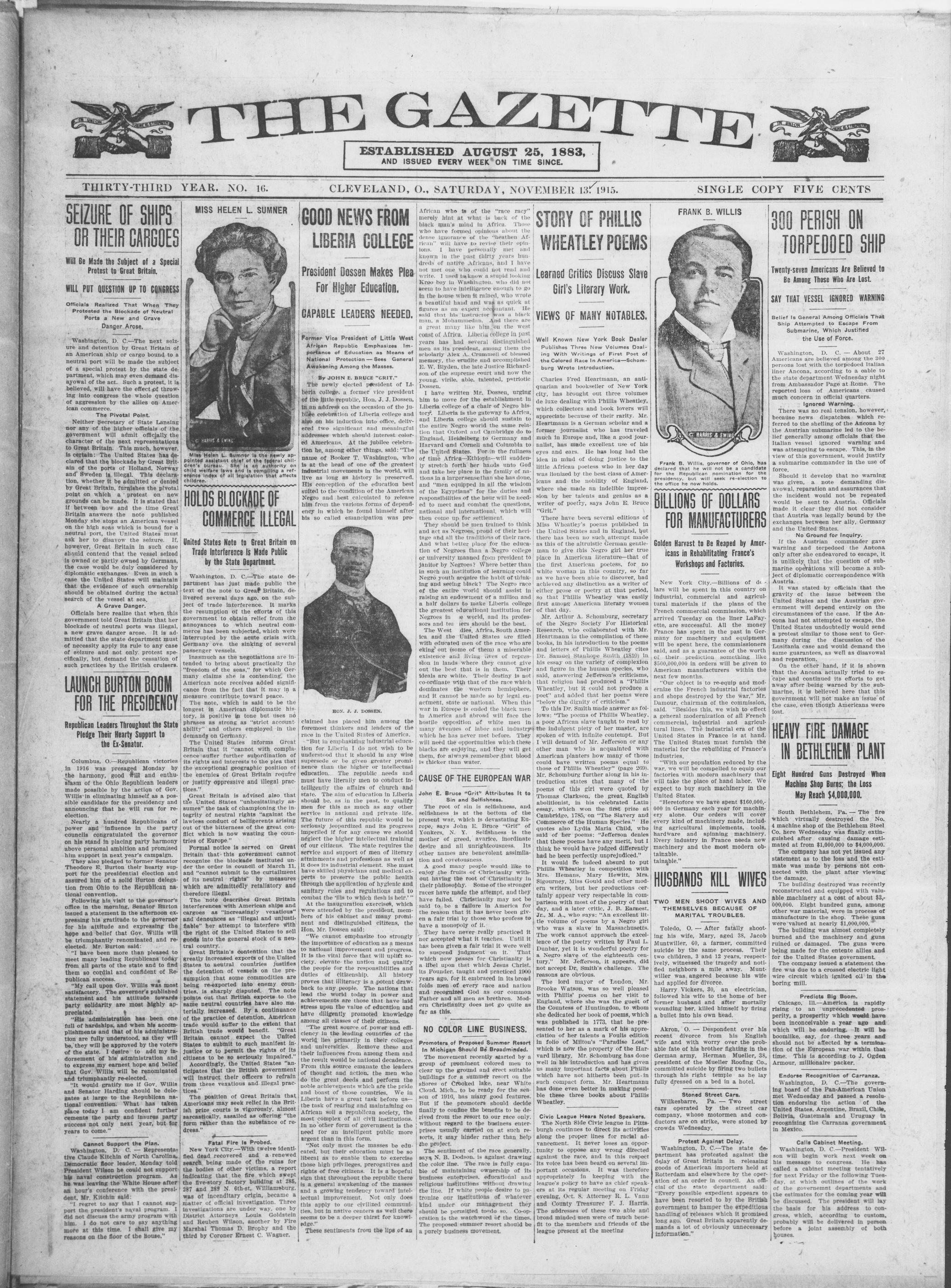
SEIZURE OF SHIPS OR THEIR CARGOES
Will Be Made the Subject of a Special Protest to Great Britain.
Officials Realized That When They Protested the Blockade of Neutral Ports a New and Grave Danger Arose.
Washington, D. C.—The next seizure and detention by Great Britain of an American ship or cargo bound to a neutral port will be made the subject of a special protest by the state department, which may even demand disgayal of the act. Such a protest, it is believed, will have the effect of throwing into congress the whole question of aggression by the allies on American commerce.
The Pivotal Point.
Neither Secretary of State Lansing nor any of the higher officials of the government will admit officially the character of the next representations to Great Britain. This much, however, is certain: The United States has declared that the blockade by Great Britain of the ports of Holland, Norway and Sweden is illegal. This declaration, whether it be admitted or denied by Great Britain, furnishes the pivotal point on which a protest - on new grounds can be made. It is stated that if between now and the time Great Britain answers the note published Monday she stops an American vessel on the high seas which is bound for a neutral port, the United States must ask her to disavow the seizure. If, however, Great Britain in such case should contend that the vessel seized is owned or partly owned by Germans, the case would be duly considered by diplomatic exchanges. Even in such a case the United States will maintain that the evidence of such ownership should be obtained during the actual search of the vessel at sea.
A Grave Danger.
Officials here realize that when this government told Great Britain that her blockade of neutral ports was illegal, a new grave danger arose. It is admitted that the state department must of necessity apply its rule to any case of sozure and not only protect specifically, but demand the cessation of such practices by the British cruisers.
LAUNCH BURTON BOOM FOR THE PRESIDENCY
Republican Leaders Throughout the State Pledge Their Hearty Support to the Ex-Senator.
Columbus, O.—Republican victories in 1916 was presaged Monday by the harmony, good will and enthusiasm of the Ohio Republican leaders made possible by the action of Gov. Willis in eliminating himself as a possible candidate for the presidency and announcing that he will run for reelection.
Nearly a hundred Republicans of power and influence in the party councils congratulated the governor on his stand in placing party harmony above personal ambition and promised him support in next year's campaign.
They also pledged to former Senator Theodore E. Burton—their hearty support for the presidential election and assured him of a solid Burton delegation from Ohio to the Republican national convention.
Following his visit to the governor's office in the morning, Senator Burton issued a statement in the afternoon expressing his gratitude to the governor for his attitude and expressing the hope and belief that Gov. Willis will be triumphantly renominated, and re-elected. Mr. Burton said:
"I have been more than pleased to meet many leading Republicans today from all parts of the state and to find them so cordial and confident of Republican success.
"My call upon Gov. Willis was most satisfactory. The governor's published statement and his attitude towards party solidarity are most highly appreciated.
"His administration has been one full of hardships, and when his accomplishments and that of his administration are fully understood, as they will be, they will be approved by the voters of the state. I desire to add my endorsement of his administration and to express my earnest hope and belief that Gov. Willis will be renominated and triumphantly re-elected.
"It would gratify me if Gov. Willis and Senator Harding should be delegates at large to the Republican national convention. What has taken place today I am confident further cements the party and insures party success not only next year, but for years to come."
Cannot Support the Plan.
Washington, D. C. — Representative Claude Kitchin of North Carolina, Democratic floor leader, Monday told President Wilson he could not support his naval construction program. As he was leaving the White House after an hour's conference with the president, Mr. Kitchin said: "I regret to say that I cannot support the president's naval program. I did not discuss the army program with him. I do not care to say anything more at this time. I shall give my reasons on the floor of the house."
THE GAZETTE
MISS HELEN L. SUMNER
Miss Helen L. Sumner is the newly appointed assistant chief of the federal children's bureau. She is an authority on child welfare laws and is compiling a reference index of all legislation that affects children.
HOLDS BLOCKADE OF COMMERCE ILLEGAL
United States Note to Great Britain on Trade Interference is Made Public by the State Department.
Washington, D. C.—The state department has just made public the text of the note to Great Britain, delivered several days ago, on the subject of trade interference. It marks the resumption of the efforts of this government to obtain relief from the annoyances to which neutral commerce has been subjected, which were interrupted by the acute crisis with Germany owe. the sinking of several passenger vessels.
Inasmuch as the negotiations are intended to bring about practically the "freedom of the seas," for which Germany claims she is contending, the American note receives added significance from the fact that it may in a measure contribute toward peace.
The note, which is said to be the longest in American diplomatic history, is positive in tone but uses no phrases as strong as "strict accountability" and others employed in the demands on Germany.
The United States informs Great Britain that it "cannot with compliance suffer further subordination of its rights and interests to the plea that the exceptional geographic position of the enemies of Great Britain require or justify oppressive and illegal practices."
Great Britain is advised also that the United States "unhesitatingly assumes" the task of championing the integrity of neutral rights "against the lawless conduct of belligerents arising out of the bitterness of the great conflict which is now wasting the countries of Europe."
Formal notice is served on Great Britain that this government cannot recognize the blockade instituted under the order in council of March, 11, and "cannot submit to the curtailment of its neutral rights" by measures which are admittedly retaliatory and therefore illegal.
The note describes Great Britain interferences with American ships and cargoes as "increasingly vexatious" and denounces as "illegal and unjustifiable" her attempt to interfere with the right of the United States to sell goods into the general stock of a neutral country.
Great Britain's contention that the greatly increased exports of the United States to neutral countries justifies the detention of vessels on the presumption that some commodities are being re-exported into enemy countries, is sharply disputed. The note points out that British exports to the same neutral countries have also materially, increased. By a continuance of the practice of detention, American trade would suffer to the extent that British trade would benefit. "Great Britain cannot expect the United States to submit to such manifest injustice or to permit the rights of its citizens to be so seriously impaired."
Accordingly, the United States "anticipates that the British government will instruct their officers to refrain from these vexatious and illegal practices."
The position of Great Britain that Americans may seek relief in the British prize courts is vigorously, almost sarcastically, assailed as offering "the form rather than the substance of redress."
Fatal Fire Is Probed.
New York City—With twelve identified dead recovered and a renewed search being made of the ruins for the bodies of other victims, a report indicating that the fire which swept the firestory factory building at 285, 287 and 299 N. 6th-st, Williamsburg, was of incendient origin, became a matter of official investigation. Three investigations are under way, one by District Attorneys Louis' Goldstein and Reuben Wilson, another by Fire Marshal Thomas D. Brophy and the third by Coroner Ernest C. Wagner.
ESTABLISHED AUGUST 25, 1883 AND ISSUED EVERY WEEK ON TIME SINCE.
CLEVELAND, O., SATURDAY, NOVEMBER 13. 1945.
CAPABLE LEADERS NEEDED.
Former Vice President of Little West African Republic Emphasizes importance of Education as Means of National Protection—See: General Awakening Among the Masses.
BY JOHN E. BRUCE "GRIT."
The newly elected president of Liberia college, a former vice president of the little republic, Hon. J. J. Dossen, ill on address on the occasion of the jubilee celebration of Liberia college and also on his induction into office, delivered two significant and meaningful addresses which should interest colored Americans. At the jubilee celebration he, among other things, said: "The name of Booker T. Washington, who is at the head of one of the greatest industrial movements in the world, will live as long as history is preserved. His conception of the education best suited to the condition of the American Negro and best calculated to release him from the various forms of dependency in which he found himself after his so called emancipation was pro-
HON. J. J. DOSSEN.
claimed has placed him among the foremost thinkers and leaders of the race in the United States of America. "But in emphasizing industrial education for Liberia I do not wish to be, understood that it should in any wise supersede or be given greater prominence than the higher or intellectual education. The republic needs and must have literally men to conduct intelligently the affairs of church and state. The aim of education in Liberia should be, as in the past, to qualify men for this as much as any other service in national and private life. The future of this republic would be seriously jeopardized and its progress imperiled if, for any cause we should neglect the higher intellectual training of our citizens. The state requires the education of its military attachments and professions as well as it does its industrial element. She must have skilled physicians and medical experts to preserve the public health through the application of hygienic and sanitary rules and regulations and to combat the "ill to whilf flesh is heir." At the inauguration exercises, which were attended by the president, members of his cabinet and many prominent and distinguished citizens, the Hon. Mr. Dosen said:
"We cannot emphasize too strongly the importance of education as a means to national improvement and progress. It is the vital force that will uplift society, elevate the nation and qualify the people for the responsibilities and duties of citizenship. All history proves that illiteracy is a potent drawback to any people. The nations that lead the world today in power and achievements are those that have laid stress upon the value of education and have, diligently promoted knowledge among all classes of their citizens.
"The great source of power and efficiency in the leading countries of the world lies primarily in their colleges and universities. Remove these and their influences from among them and the result would be national decadence. From this source emanate the leaders of thought and action; the men who do the great deeds and perform the noble achievements which are the pride and bosst of those countries. We in Liberia have a great task before us—the task of reaying and maintaining on African soil a republican society, the most complex of all civil institutions. In no other form of government is the need for an intelligent public more urgent than in this form.
"Not only must the masses be educated, but their education must be so liberal as to enable them to exercise those high privileges, prerogatives and rights of free citizens. It is a hopeful sign that throughout the republic there is a general awakening of the masses and a growing tendency toward intellectual improvement. Not only does this apply to our civilized communities, but in native centers as well there seems to be a deeper thirst for knowledge."
These sentiments from the lips of an
African who is of the "face race" merely blunt at what is back of the black man's mind in Africa. Those who have formed opinions about the dense ignorance of the "heathen African" will have to revise their opinions. I have personally met and known in the past thirty years hundreds of native Africans, and I have not met one who could not read and write. I used to know a stupid looking Kroo boy in Washington, who did not seem to have intelligence enough to go in the house when it rained, who wrote a beautiful hand and wag as quick at figures as an expert accountant. He said that his instructor was a black man, a Mohammedan. And there are a great many like him on the west coast of Africa. Liberia college in past years has had several distinguished men as its president, among them the scholarly Alex A. Crummell of blessed memory, the erudite and accomplished E. W. Blyden, the late Justice Richardson of the supreme court and now the young, virile, able, talented, patriotic Dosen.
I have written Mr. Dossen, urging him to move for the establishment in Liberia college of a chair of Negro history. Liberia is the gateway to Africa, and Liberia college should sustain to the entire Negro world the same relation that Oxford and Cambridge do to England, Heidelberg to Germany and Harvard and Cornell and Columbia to the United States. For in the fulness of time Africa—Ethiopia—will suddenly stretch forth her hands unto God and take her place in the family of nations in a hargers sense than she has done, and "men equipped in all the wisdom of the Egyptians" for the duties and responsibilities of the hour will be needed to meet and combat the questions, national and international, which will then come up for settlement.
They should be men trained to think and act as Negroes, proud of their heritage and all the traditions of their race. And what better place for the education of Negroes than a Negro college or university manned from president to janitor by Negroes? Where better than in such an institution of learning could Negro youth acquire the habit of thinking and seeing black? The Negro race of the entire world should assist in raising an endowment of a million and a half dollars to make Liberia college the greatest educational institution for Negroes in a world, and its professors and teachers should be the best. The West dies, Africa, South America and the United States are filled with educated men of the race who are eking out (some of them) a miserable existence and living lives of repression in lands where they cannot give out the best that is in them. Their ideals are white. Their destiny is to co-ordinate with that of the race which dominates the western hemisphere, and it cannot be made so by legal enactment, state or national. When this war in Europe is ended the black men in America and abroad will face the hostile opposition of white men in many avenues of labor and industry which he has never met before. They will need the opportunities which these blacks are enjoying, and they will get them, for always remember that blood is thicker than water.
CAUSE OF THE EUROPEAN WAR
John E. Bruce "Grit" Attributes it to Sin and Selfishness.
The root, of sin is selfishness, and selfishness is at the bottom of the present war, which is devastating Europe, says John E. Bruce "Grit" of Yonkers, N. Y. Selfishness is the mother of greed, avarice, lordinate desire and all unrighteousness. Its other names are benevolent assimilation and covetousness.
A good many people would like to enjoy the fruits of Christianity without having the root of Christianity in their philosophy. Some of the stronger races have made the attempt, and they have failed. Christianity, may not be said to be a failure in America for the reason that it has never been given a fair trial by those who profess to have a monopoly of it.
They have never really practiced it nor accepted what it teaches: Until it has been given a fair trial it were well to suspend judgment on it. That which now passes for Christianity is a label upon that which Jesus Christ, its Founder, taught and practiced 1900 years ago, for it enabrated in its broad folds men of every race and nation and recognized God as our common Father and all men as brethren. Modern Christianity does not go quite as far as this.
NO COLOR LINE BUSINESS.
Promoters of Proposed Summer Resort
In Michigan Should Be Broadminded.
in Michigan should be brokened.
The movement recently started by a group, of prominent colored men to clear up the ground and erect suitable buildings for a summer resort on the shores of Crooked lake, near White Cloud. Mitch, to be ready for the season of 1910, has many good features. But if the promoters should decide finally to confine the benefits to be derived from the resort to our race only, without regard to the business enterprises usually carried on at such resorts, it may hinder rather than help the project.
The sentiment, of the race generally, says G. B. Dodson, is against drawing the color line. The race is fully capable of maintaining ownership of its business enterprises, educational and religious institutions without drawing the line. If white people desire to patronize our institutions of whatever kind under our management they should be permitted to do so. Co-operation is the watchword of the times. The proposed summer resort should be a purely business movement.
Well Known New York Book Dealer
Publishes Three New Volumes Dealing
With Writings of First Poet of the
Colored Race in America—Schomburg Wrote Introduction.
Charles Fred Heartmann, an antiquarian and bookseller of New York city, has brought out three volumes de luxe dealing with Phillis Wheatley, which collectors and book lovers will appreciate because of their early. Mr. Heartmann is a German scholar and a former journalist who has traveled much in Europe and, like a good journalist, has made excellent use of his eyes and ears. He has long had the idea in mind of doing Justice to the little African poets who in her day was honored by the best class of Americans and the nobility of England, where she made an indelible impression by her talents and genius as a writer of poetry, says John E. Bruce "Grit."
There have been several editions of Miss Wheatley's poems published in the United States and in England, but there has been no such attempt made as this of the attributive German gentleman to give this Negro girl her true place in American literature—that of the first American poets, for no white woman in this country, so far as we have been able to discover, had achieved any distinction as a writer of either prose or poetry at that period, so that Phillis Wheatley was easily first among American literary women of that day.
Mr. Arthur A. Schomburg, secretary of the Negro Society for Historical Research, who collaborated with Mr. Heurtmann in the compilation of these books, in his introduction to the poems and letters of Philips Wheatley, cited Dr. Samuel Stanhope Smith (1510) in his essay on the variety of complexion and figure in the human species, who said, answering Jefferson's criticisms, that religion had produced a "Phillips Wheatley, but it could not produce a poet" and added that her poems were "below the dignity of criticism."
To this Dr. Smith made answer as follows: "The poems of Phillips Wheatley, a poor African slave taught to read by the indugent piety of her master, are spoken of with infinite contempt. But I will demand of Mr. Jefferson or any other man who is acquainted with American planes, written poems of those could be written poems equal to those of Phillips Wheatley" (page 260). Mr. Schomburg further along in his introduction states that many of the poems of this girl were quoted by Thomas Clarkson, the great English abolitionist, in his celebrated Latin essay, which won the first prize at Cambridge, 1785, on "The Slavery and Commerce of the Human Species." He quotes also Lyda Maria Child, who said of her poems: "Jefferson denies that these poems have any merit, but I think he would have judged differently bad he been perfectly unprejudiced."
It would be indeed absurd to put Philis Wheatley in competition with Mrs. Hennans, Mary Hewitt, Mrs. Sigourney, Miss Gould and other modern writers, but her productions certainly appear very respectable in comparison with most of the poetry of that day, and a later critic, J. B. Earnest, Jr. M. A., who says: "An excellent little volume of poems by a Negro girl who was a slave in Massachusetts. The work cannot approach the excellence of the poetry written by Paul L. Dunbar, yet it is wonderful poetry for a Negro slave of the eighteenth century." Mr. Jefferson, it appears, did not accept Dr. Smith's challenge. The reasons are oblivious.
The lord mayor of London, Mr. Brooke Watson, was so well pleased with Philis' poems on her visit to England, where she was the guest of the Countess of Huntingdon, to whom she dedicated her book of poems, which was published in 1773, that he presented to her as a mark of his appreciation of her talents a Fouls edition in folio of Milton's "Paradise Lost," which is now the property of the Harvard library. Mr. Schomburg has done well in his introduction and has given us many important facts about Philis which have not hitherto been put in such compact form. Mr. Heartmann has done even better in making possible these three books about Philis Wheatley.
Civic League Hears Noted-Speakers. The North Side Civic league in Pittsburgh continues to direct its activities along the proper lines for racial advancement. It never loses an opportunity to oppose any wrong directed against the race, and in this respect its voice has been heard on several important occasions. It was therefore appropriately in keeping with the league's policy to have as chief speakers at its regular meeting on Friday evening, Oct. 5. Attorney R. L. Vann and County Treasurer F. J. Harris. The addresses of these two able and broad-minded men were of much benefit to the members and friends of the league present at the meeting.
FRANK B. WILLIS
C HARRIS & EWING
Frank B. Willis, governor of Ohio, has declared that he will not be a candidate for the Republican nomination for the presidency, but will seek re-election to the office he now holds.
Golden Harvest to Be Reaped by Americans in Rehabilitating France's Workshops and Factories.
New York City.—Billions of dollars will be spent in this country on industrial, commercial and agricultural materials if the plans of the French commercial commission, which arrived Tuesday on the liner LaFayette, are successful. All the money France has spent in the past in Germany for machinery and equipment will be spent here, the commissioners said, and as a guarantee of the worth of their production something like $500,000,000 in orders will be given to American manufacturers within the next few months.
"Our object is to re-equip and modernize the French industrial factories and shops destroyed by the war," Mr. Dauour, chairman of the commission, said. "Besides this, we wish to effect a general modernization of all French commercial industrial and agricultural lines. The industrial era of the United States in France is at hand. The United States must furnish the material for the rebuilding of France's industries.
"With our population reduced by the war, we will be compelled to equip our factories with modern machinery that will take the place of hand labor. We expect to buy such machinery in the United States."
"Heretofore we have spent $160,000,000 in Germany each year for machinery alone. Our orders will cover every kind of machinery made, including agricultural implements, tools, hardware and spinning machinery. Every industry in France needs new machinery and the most modern obtainable, talmanable."
HUSBANDS KILL WIVES
TWO MEN SHOOT WIVES AND THEMSELVES BECAUSE OF MARITAL TROUBLES.
Toledo, O. — After fatally shooting his wife, Mary, aged 38, Jacob Muntwiller, 60, a farmer, committed suicide by the same process. Their two children, 3 and 12 years, respectively, witnessed the tragedy and notified neighbors a mile away. Muntwiller was angered because his wife had applied for divorce.
Harry Vickers, 30, an electrician, followed his wife to the home of her former husband and after mortally wounding her, killed himself by firing a bullet into his own head.
Akron, O. — Despondent over his recent divorce from his English wife and with worry over the probable fate of his brother fighting in the army, Herman Mueller, 38, president of the Mueller, Roofing Co., committed suicide by flying two bullets through his right temple as he lay fully dressed on a bed in a hotel.
Stoned Street Cars.
Wilkesbarre, Pa. — Two street cars operated by the street car company, whose motormen and conductors are on strike, were stoned by crowds Wednesday.
Protest Against Delay
Washington, DC. The state department has protested against the degree of Great Britain in releasing goods of American importers held at Rotterdam and elsewhere by the operation of an order in council. An official of the state department said: "Every possible expedient appears to have been resorted to by the British government to hamper the expedition handling of releases which it promised long ago. Great Britain apparently demands a lot of obviously unnecessary information."
PY FIVE CENTS
300 PERISH ON TORPEDOED SHIP
Twenty-seven Americans Are Believed to Be Among Those Who Are Lost.
SAY THAT VESSEL IGNORED. WARNING
Belief Is General Among Officials That Ship Attempted to Escape. From Submarine, Which Justified the Use of Force.
Washington, D. C. — About 27 Americans are believed among the 300 persons lost with the torpedoed Italian liner Ancona, according to a cable to the state department Wednesday night from Ambassador Page at Rome. The reported loss of Americans 'caused much concern in official quarters.
Ignored Warning.
There was no real tension, however, because news dispatches which referred to the shelling of the Ancona by the Austrian submarine led to the belief generally among officials that the Italian vessel ignored warning and was attempting to escape. This, in the view of this government, would justify a submarine commander in the use of force.
Should it develop that no warning was given, a note demanding disavowal, reparation and assurances that the incident would not be repeated would be sent to Austria. Officials made it clear they did not consider that Austria was legally bound by the exchanges between her ally, Germany and the United States.
No Ground for Inquiry.
If the Austrian commander gave warning and torpedoed the Ancona only after she endeavored to escape, it is unlikely that the question of submarine operations will become a subject of diplomatic correspondence with Austria.
It was stated by officials that the guard of the issue between the United States and the Austrian government will depend entirely on the circumstances of the case. If the Ancona had not attempted to escape, the United States undoubtedly would send a protest similar to those sent to Germany during the discussion of the Lusitania case* and would demand the same guarantees, as well as disavowal and repatriation.
On the other hand, if it is shown that the Ancona actually tried to escape and continued its efforts to get away after being warned by the submarine, it is believed here that this government will not make an issue of the case, even though Americans were lost.
HEAVY FIRE DAMAGE IN BETHLEHEM PLANT
Eight Hundred Guns Destroyed When
Machine Shop Burns; the Loss
May Reach $4,000,000.
South Bethlehem, Pa. — The fire which virtually destroyed the No. 4 machine shop of the Bethlehem Steel Co. here Wednesday was finally extinguished after causing damage estimated at from $1,000,000 to $4,000,000. The company has not yet issued any statement as to the loss and the estimate was made by persons not connected with the plant after viewing the damage. The building destroyed was recently reconstructed and equipped with valuable machinery at a cost of about $3,000,000. Eight hundred guns, among other war-material, were in process of manufacture in the shop. These guns were valued at nearly $1,000,000. The building was almost completely burned and the machinery and guns ruined or damaged. The guns were being made for the entente allies and for the United States government.
The company issued a statement the fire was due to a crossed electric light wire circuit, which ignited oil in the boring mill.
Predicts Big Boom.
Chicago, Ill.—America is rapidly rising to an unprecedented prosperity, a prosperity which would have been inconceivable a year ago and which will be enduring. It will be boomlike, say, for three years and should not be affected by a termination of the European war within that time. This is according to J. Ogden Armour, millionaire packer.
Endorae Recognition of Carranza.
Washington, D. C.—The governing board of the Pan-American Union met Wednesday and passed a resolution endorsing the action of the United States, Argentine, Brazil, Chile, Bolivia, Guatemala and Uruguay in recognizing the Carranza, government in Mexico.
Calls Cabinet Meeting.
Washington, D. C.—President Wilson will begin work next week on his message to congress. He has called a cabinet meeting tentatively for next Friday or the following Tuesday, at which outlines of the work of the government departments and the estimates for the coming year will be discussed. The president will lay the basis for his address to congress, according to custom, probably will be delivered in person before a joint assembly of both houses.
The GAZETTE
One Year.....$1.50.
Six Months.....1.00.
Three Months......50
Subscribers are requested to rem-
mit by postoffice money or-
der or registered Letter
Entered at the postoffice in Cleveland
Ohio, as second-class matter.
Address all communications to
Blackstone Building, Cleveland, O.
Member Ohio Legislature: 1894
to 1896; 1896 to 1898; 1900 to 1902
THE GAZETTE is the oldest, and
has the largest bona fide circulation,
double that of any newspaper in the
interest of Afro-Americans, published
in the state of Ohio, and comparison
with any will immediately establish
its rank as one of the NFWSIEST
AND BEST in the country.
10,000,000 Afro-Americans.
160,000 in Ohio.
20,000 in Cleveland.
SATURDAY, NOVEMBER 13, 1915.
"Let us have faith that right makes might, and in that faith let us to the end dare to do our duty as we understand it."—Abraham Lincoln.
Theodore E. Burton served twenty or more years in both houses of the Congress. He is now a candidate for the republican nomination for the presidency. It is therefore proper that his friends of color inform us what, if anything, in the past twen ty or more years he has ever said or done for our people, particularly Somebody will have to get very busy
The conduct of the leaders of the National Baptist Convention in Chicago which resulted in a split of the largest and most progressive denomination in America, is nothing less than a race's disgrace; nothing less than a complete plea of guilty of the white man's charge that the Negro is incapable of self-government; that he must have a boss, that he must have white leadership for the reason he has been denied the abilities. - Atlanta (Ga.) Independent.
O. Pshaw! Our contreer takes it entirely too seriously, bad as it is. Editor Davis has forgotten the last national republican convention "split" and the near-split (and all that went with it) of the last national democratic convention. Then just notice, please, what Wm. Jennings Bryan is promising for the next one—the real thing, like that of the Roosevelt-Taft mess of a few years ago. The "white" man has stopped making the triple-headed "charge," our contemporary refers to, because he, too, lives "in a glass house." The National Baptist convention split "is a disgrace" alright, but the other class or race has like disgraces, only bigger ones, proportionately too.
WHO IS DEAN?
With a recent issue, the Afro-American Ledger with appropriate ceremony entered the year that brings it within touching distance of a quarter-century of its existence. On July 31st, last, The Cleveland (O.) Gazette celebrated its thirty-second birthday and reiterated its commitment to the tradition 'harness' so long, we feel like the dean of the Afro-American press." "If the deanship goes to age, this paper was established March 2, 1882, and entered on its thirty-fourth year, last March) it belongs to us" remarks the Martinsburg (W. Va.) Pioneer Press, which however is willing to cast the first vote for "deanship," not due but for better services rendered in favor of its Ohio contemporary.
To this The Gazette报载 most likely that the palm undoubtedly belongs to the "Pioneer Press," and the Afro-American Ledger was on the point of casting the second vote, when a glance at the files proved there are three contemporaries older than either of the two mentioned, and one more which the Christian Chisholm, of Philadelphia, is sixty three years old; the Charlotte (N. C.) "Star of Zion," thirty-nine; the Louisville (Ky.) "American Baptist," thirty-seven, and the "Richmond (Va.) Planet," thirty-two. Now who is dean? -Baltimore (Md.) Afro-American Ledger. The editor longest, CONTINUOUSLY, in the editorial "harness" is the dean of the Afro-American press. The question therefore is, has Editor Steward of the Louisville (Ky.) American Baptist been in the editorial "harness" thirty-seven CONSECTIVE years? An answer, in the affirmative, from him, will settle the matter.
"THE BIRTH OF A NATION."
Special to The New York Age.
Spectator to the New York Age.
Columbus, O., Oct. 5.—The victory of the Colored people and decent white people achieved last week, when the State Board of Censors refused a perimeter Birth of the Nation to show in Ohio, before it faced a more gruelling fight. Daniel J. Ryan, former Secretary of State for Ohio, a leading Ohio lawyer, led the fight against granting a permit to show the films in Ohio, and to him, more than any factor, are the Colored people of Ohio indebted for the victory won.
The foregoing is a fair sample of the rot the same Columbus correspondent has been sending to various race papers, some of which, apparently, have not as yet realized the mean, low and contemptible advantage of them he is taking. There is absolutely no truth in the foregoing from the Age, except the information as to the Ohio board of censors' formal action in refusing to permit that vicious photo-play to show in Ohio. It was not until the last week of a "guerrelling" SIX MONTHS' FIGHT, made by our
---
people of Ohio—particularly Cleveland—and a few of their white friends, led by the editor of The Gazette, that former secretary of state, Dan J. Ryan, Robert Barcus and the local branch of the N. A. A. C. P., all of Columbus, O. got into the fight against the "Birth of a Nation." Therefore, it is readily seen how much injustice there is in the manifestly unfair claim of the persistent Columbus writer, that Ryan, Barcus and others "led the light" and are entitled to the credit for influencing the governor and the state board of censors against permitting the play to show in Ohio. Especially is this true when it is remembered that MONTHS AGO Gov. Frank B. Willis promised the editor of The Gazette, in personal interviews at Columbus, and in numerous letters, some of which have been published, that "The Birth of a Nation" would not be allowed to show in this state. This was MONTHS before Ryan, Bacus and the Columbus branch of the N. A. A. C. P., made a move in the matter. The statement in the excerpt from the New York Age, that to Ryan, "more than any factor are the Colored people of Ohio indebted for the victory won", is simply ridiculous. No one knows this better than Dan J. Ryan, and that Columbus writer relative to whom R. W. Thompson, the well-known Washington, D. C. correspondent, had the following to say in a recent issue of the Indianapok Olive Freeman:
A recent issue of The Cleveland (O.) Gazette, edited by that dashing Henry of Navarre of the race, Harry C. Smith, had the following to say of a certain scribbler, formerly an occupant of a federal office here, and who is now doing "something or other" on papers in Ohio, Washington, Chicago, New York and elsewhere. Said The Gazette:
"The New York Age's and Chicago Defender's 'Columbus' correspondent, who sometimes writes 'Cleveland' and 'Cinchmati' letters, was 'at it' again last week and the week previous, and that he writes is not true. When will the editors of those papers 'tumble?'"
Washingtonians, familiar with the methods of this shifty correspondent, are asking the same question. Why do so-called wise newspaper men "fall for" the thinly-disguised machinations of this chronic grouch and marplot? The matter is referred to The New Age and The Chicago Defender for appropriate comment and fitting action.
MATERIAL PROGRESS MADE
Cleveland, O., Oct. 14, 1915.
Mr. C. E. Moore.
Sec. Cuy. Co. Home Rule Association,
635 Leader-Wells Bldg.
City.
Friend Moore:—In connection with a talk I had with you the other day relative to sloon-keepers, especially from district, drawing a "color-line," and telling all the attention of the leaders of the Cuyahoga Co. Home Rule Association to the fact with a view to having it stopped at once for obvious reasons, I wish to say that again today, as well as last week, several complaints have been brought to me. You know that the last ago one Otto Moser, 2044 E. 4th St. was on the Quiet Court for the mistreatment of one of our leading local colored citizens, because the latter entered his place of business and ordered a glass of whiskey, which was refused him unless a dollar was paid for it. For this refusal the citizen referred to has for $500 damage in the Court Rights' law, which I introduced and secured the enactment of when a member of the Legislature in 1894.
Complaints have reached this office against other saloons in E. 4th St. on the Public Square, and in other down-town districts. I want to urge you and your association the necessity of immediate action in connection with these complaints. While the enclosures are not directly related to the local situation, they are pertinent and interesting because they show the temper of the colored men not only in Cincinnati and the west but also here in Cleveland when they are so prettily and gratuitously indulged in their exercise the civil rights guaranteed them by the state and federal constitutions. Hoping to be able to find time to discuss this matter more fully with you at an early date, I am, sincerely,
Cleveland, O., October 15, 1915.
Mr. Albert Eisele.
Pres. Cuy. Co. Liquor Dealers' Association
American Trust. Bldg.
City.
Dear Sir:—The enclosed is a copy of a letter which I received today from Hon. Harry C. Smith. I am forwarding this to you with the request that some action be taken immediately. Mr. Smith states that the situation is such as to cause a general effort on the part of the colored population to resent alleged discriminations, which he states are taking place in Cleveland. Trusting that you will give this matter your prompt attention, I am.
Cleveland, Oct. 15, 1915.
Mr. Albert Eisele,
Pres. Cuy, Co., Liquor Dealers' Association,
American Trust Bldg., City.
Friend Elisee: "I wish to call your
business to the saloon-keepers in
the business section. I am sure you are
very foolishly drawing a "colorline" and thereby gradually making
hundreds of votes for "prohibition."
Last and this week, as well as
repeatedly in recent months, complaints
as the result of refusals to serve Colored men, in several down-town saloons, solely because of their color or race, have been brought to me, and are causing a bitter feeling to arise
anyone of this city against the saloon business that is trying to nullify the efforts against "prohibition" being made among them. There is no same reason why these few saloon-keepers should be permitted to continue this illegal and foolish conduct, and I am calling your attention
to the matter with a view to your task.
I am sure you are president, and doing what you and it can do to put a stop to it.
Several weeks ago, one Otto Moser, 2044 E. 4th St., was convicted and fined, in Police Court, for the mistreatment of one of the leading Colored men in the city who in a gentlemanly way entered his saloon and ordered a glass of whiskey which was served to him, for the same. For this latter, the citizen and voter referred to, has pending, in Common Pleas court a suit
against Moser for $500 damages which was instituted under our Ohio Civil Rights' law. Bitter complaints, of a similar nature, have reached this office against other saloon keepers in down-town districts.
I want to urge upon you and your Association the necessity of immediate action in connection with these complaints, good as well as in the interest to decent, fair and legal treatment in public places for all citizens, without regard to race or color, who conduct themselves properly. There is, as I have said, no excuse for the denial of citizen-rights in the few saloons to which I am calling your attention, and it should be stopped at once.
Trusting you will give this important matter the prompt attention it surely merits. I am.
FRESH OHIO NEWS
WRITTEN BY "THE OLD RELIABLE" GAZETTE'S CORRESPONDENTS
THROUGHOUT THE STATE
What Our People Are Doing Each Week—Church, Personal, Social, Lodge, Literary and Musical—Marriages, Deaths, Etc.
for the girl's dormitory, hey was greatly surprised erality of the congregation a collection of $25, gage of the assessment. Column having to raise $21.50. T er's Aid turkey supper. T ing, was a success and well the ladies charged but program will be rendered worth League. Friday short session of the cal close. Simpson M. E. che best in the state. S ing it was complimented The ladies were robed in the men wore the conven with white vests. The S. on new life, and yet there of young people who tend who should do so.
Cleveland, O. Nov. 6, 1915.
Hon. H. H. G.
Editor, The Gazette
Editor, The Gazette
Blackstone Bldg, City
My dear Mr. Smith:—Your very kind communication addressed to our president, Mr. Eisele, dated October 15th, relative to the question of serving colored men in the saloons of Cleveland on equality with other patrons, was read at our regular meeting held November 3rd and after a general discussion, by motion made and carried, the writer as secretary was directed to advise you by letter that this association as such SHALL DO ALL WITHIN THEIR POWER to see fair-play and due consideration all patrons, of our members, conducting themselves in a proper and gentlemanly manner. Justicing this will be entirely satisfactory to those whom you represent and thanking you for the interest manifested in this matter, we remain.
Respectfully yours,
The Cuyahoga County Retail Liquor
Dealers Ass'n.
Right in the midst of the campaign, just closed, came the denial of rights complained of in the foregoing. Immediately, we took up the matter with those in a position to help us most to stop it. In addition, in spite of the suggestions of others that the time was not opportune, we encouraged, directed the legal fight also referred to in the foregoing. We believe in "striking the iron while it is hot," and take pleasure in announcing to our readers that material progress has been made both in the courts and out of them. While we do not urge our people to frequent saloons, we do insist, in season and out, that our civil rights in ALL public places, saloons included, must not be abridged or denied when our conduct does not warrant the same. This has been The Gazette's slogan from its inception and shall ever remain with it. We insist that our people show in a proper way the same determination that all other classes of Americans evidence, and that is to exercise, in a gentlemanly and womanly way, their citizen-rights and privileges in all public places, free from insult and other attempts at a denial of the same. We are greatly pleased to have arrayed on our side in this matter the powerful local organization, the Cuyahoga County Liquor Dealer's Association, and its broad-minded president. Mr. Albert Elsele, because both can do so much to help stamp out a pernicious practice that is not only new but foreign to Cleveland and this county, and certainly should have no place here or elsewhere in this boasted "land of the free and home of the brave." There are so many classes of Americans and "isms," and so many foolish prejudices in this country—against Jew, Irish, German, Afro-Americans; catholicism, protestantism, etc., on down the calendar—that whatever one of them (prejudice) pokes its vicious head above the surface, it should promptly be split beyond repair with a blow from a giant's hand, and that is what we are trying to do to this latest color-line.
A MATTER OF DRESS.
David Morrison in "All-Story Weekly."
Each year the girlies' gowns are growing bolder,
Girls are wearing less as they grow older;
Each winter feels a trifle colder—
Where will it all end?
They get a little worse with each creation,
Cause a little more of a sensation,
Leave a little less to imagination,
What will they take off next?
Next year the blind will have an awful
season,
Styles are even going to be more
* teasin*;
Lord help the men to keep their reason—
"See America" first, the idea's growing;
Lots of scenery here since the girls are showing
More and more each year.
But they haven't got anything on Eve,
For she set an awful pace;
All she wore was a cute little smile
(be
tween two little dimples),
Fashions today are driving men in sane,
But the clothes Eve wore made Adam raise Cain:
So they haven't got anything on Eve,
For she had nothing on, herself!
Sideshow Manager—What's worse than a giraffe with a sore throat?
Big Show Manager—A centipede with corn.
FRESH OHIO NEWS
WRITTEN BY "THE OLD RELIA BLE" GAZETTE'S CORRE- SPONDENTS
THROUGHOUT THE STATE
What Our People Are Doing Each Week—Church, Personal, Social, Lodge, Literary and Musical — Marriages, Deaths, Etc.
YOUNGSTOWN—James, little son of Mr. and Mrs. John Seaton, is very ill—Mrs. Violet Hamm of Cleveland, who died, Sunday morning, while on a visit at Mr. and Mrs. S. Holmes, leaves a husband, Mr. John Hamm of Cleveland; a brother, Rev. Daniel Butler of Springfield, and other relatives—Louisa Edward court will meet, Wednesday evening; Buckeye lodge, Thursday evening, and initiate 7 new candidates—Mr. and Mrs. Floyd Davis announce the engagement of their daughter, Marle, to Walter Hill of bushburg, wedding Nov. 25. Miss Davies gives a line dance, Friday evening—Frank Willey was called to Pittsburgh, to see George Lomax who was shot and is in bad shape in a hospital—The Geo society met at Mr. and Mrs. Geo. Jefferson's Tuesday evening—The Elite club gave a supper at Mrs. C. H. Lincoln's Tuesday evening, for the benefit of charity.
SANDUSKY.—Roy Smith was in Oberlin and Cleveland, Saturday and Sunday.—Rev. A. A. Hampton of Cleveland, preached at the Second Baptist church, Sunday. He is an old acquaintance of the pastor. The S. S. at 9:30 a. m., instead of 12 m.—Mrs. Albert Straver is convalescing. Also w. H. Alexander and Mr. Charley Taylor. Mr. Moses Thompson is grower. Mr. Alice Gaines has been quite feeble. Mr. Nicole one of our oldest residents, is cullsick at Mrs. Henry Richard's.—Mr. and Mrs. S. Scott are moving into their new home. It is a credit to the race —J. R. Davis, O. B. Shackelford, Wm Jones W. H. Alexander, Stephen Wallace, Henry Richard, D. S. Anderson M. N. Washington, Charles Gilkerson Mrs. G. Miller and Charley Taylor—at live in their own homes. Many men are live in those. Those men are members of the Second Baptist church. If you own your own home, you have some hope of having a permanent church and a representative people in the town. Read The Gazette and keep posted. Rev. Geo D. Smith, agent.
CORRESPONDENTS must mail all letters for publication at their postoffice sufficiently early on Monday (or Sunday) of each week to have them reach The Gazette office on Tuesday morning, and always write also, their names and that of their parents. The Gazette wrapper about returned copies. Use less this latter is done, proper cannot be given you. Lists of names, wedding presents, etc., obituary notices, speeches, resolutions, poetry, inquiries for relatives and advertisements of all kinds, including items announcing entertainments to be held in the near future, must be paid for by the postmaster. On line, six words to a line. Our rates for display advertisements will be sent on application. Send postal note and not stamps during warm weather.
CADIZ—Luce and Clyde Stewart Earl, Richard and Martha Tyler of Flushing, spent Sunday here—Miss Catherine Thompson and Miss Eliza beth Ramsey spent Saturday and Sunday at the latter's home in Hope dale—Miss Nellie Glenn, visited her parents in Marysville, last week—Ralph, oldest son of John Olmstead died Sunday morning—Mr. and Mrs. A. J. Guy, and Mr. and Mrs. Matthews of Steubenville, spent Sunday here—Rev. G. W. Maxwell, P. E., held quarterly meeting at the A. M. E. church and was the guest of Rev. and Mrs. Childers at the parsonage—The Knights of Pythias gave six candidates the right rank. Thursday evening. Among the candidates present were: Abraham L. Schoenlees of Lesville, Chas. Allen and William Christian of Stillwater, Frank Truman, C. W. Williams, George Smith, James Adkins, C. J. and Frederick Christian, of Uhrschville. P. J. Lucas entertained the B. B.'s Sunday—Young people held a "covered dish" party at Catherine Thompson's, Friday evening.
SMITHFIELD—Mrs. E. Harris and daughters, Alice and Nellie, Mrs. James and Mrs. Howard spent Sunday in McIntyre—Mesdames W. H. Veney, and J. M. Davis spent Sunday with Mrs. S. Ramssey and Mrs. F. Christain in Hopedale, Mrs. Dave West stopped here, that day, en route to McIntyre. Mrs. F. Christain is attending Normal school at Cadiz and C. Thompson, high school of the same place, were guests of Mrs. S. Ramssey of Hopedale, Sunday. Mr. Billens also visited there. Mr. Frank Smith recently sold a very fine horse. He and a number of others have secured employment at the Bradley mines. I. Davis of Cadiz, spent Sunday entertainment Saturday evening, given by the club. W. a success.—The rally, Sunday, for the parasenage at McIntyre, was a success. Receipts, $70. Rev. Chas, Green is certainly doing excellent work.—St. Paul A. M. E. church rally, Sunday; a concert and supper, Saturday evening. Great preparations are being made for both occasions. Are Bradley and Mrs. F. Christain—Mesdames H. and J. Harris. A. Henderson and Miss E. Beaill visited in Bradley, last week.—Rev. C. Green and son were here, Monday.
STEUBENVILLE.—Rev. E. M. Grandison, of the Second Baptist church, is working hard to make his anniversary a success. He is a man with the "punch."—Quinn A. M. E. church, Rev. J. T. Farley, pastor, is moving on nicely. The services, Sunday, were largely attended.—Rev. G. W. Tindall was in Wheeling, four days, assisting Rev. Turpin in a revival. Mrs. Tindall visited there and in Bridgeport. Rev. Turpin, Elmer Walker, Ambrose Kent and others, report the woods as being full of rabbits, and they never return empty-handed (?).—Quarterly meeting services at Simpson M. E. church, Sunday, were held in the morning and delivered a fine sermon in the morning and an address in the evening on "The Forward Movement." There was one accession to the church. A collection was lifted, for $ Christmas present to Walden University, Nashville, to purchase a range and some other things
for the girl's dormitory. Dr. Courtney was greatly surprised at the liberality of the congregation, which after a collection of $25, gave one fifth of the assessment, Columbus district having to raise $21.50. The Preacher's Aid turkey supper, Tuesday evening, was a success and well worth 50c, tho' the ladies charged but 25c. A fine program will be rendered by the Epworth League, Friday evening. A short session of the cabinet at its music room. The choir is one of the best in the state. It was complimented on all sides. The ladies were robed in white while the men were the conventional black with white vests. The S. S. is taking on new life, and yet there are a number of young people who do not attend who should do so.
HILLSBORO—Mrs. Annie Larter is visiting in Cleveland—Mrs. Martha Taylor of Georgetown, visited her sister, Mrs. James Johnson, several days.—Miss Viola Scott returned to Columbus. She visited Mrs. Alline Burton.—James C. Wallace of Circleville, was here on Saturday.—Prof. S. G. Gough visited his parents in James weeks.—Mr. Minor of Good Hope and Mrs. Pauline tain spent Sunday in Highland, guests of the latter's aunt, Mrs. Mason
—Miss Aurelia Donaldson left, Monday, for Curry College at Urbana.—Mr. Andrew Morton, formerly of Georgetown, died here, Friday. Funeral services Sunday afternoon conducted by Rev. J. J. Burr. Relatives in attendance from out-of-town: Mrs. Samuel Morton, Prof. P. Morton of Georgetown, died here. Funeral services of Cincinnati.—Miss Ida Nelson visited in Loveland and Cincinnati, last week.—Miss Lucile Frazier spent a week in her home, Columbus. She is one of the teachers in Lincoln school. —Miss Bessie Craig returned to Columbus accompanied by Miss Helen Williams who will visit there.—Miss Raymond Day attended the fall festival in Wellington. Mr. Tucker of Columbus passed through here last week on a hunting trip.—Mr. Dudley Cole of Washington C. H., visited his brother, Joe and family, last week.—Mrs. James Burns died, last Thursday. Funeral services, Sunday, conducted by Rev. J. L. E. Burr at the Carthagen church. She leaves a husband, and she is mourning her loss. Mr. Leo Cary and Miss Mere Cole attended the funeral. Mrs. Lucy Trimble of Ploia, was called here by the death of her sister-in-law, Mrs. Burns.—Miss Bertha Orr of Lockland, visited Mrs. Pomp Kittrell, last week.—Rev. and Mrs. J. J. Burr entertained at dinner, Sunday, Mrs. Morton and son of Georgetown, and Miss Hattle Tatman.
"CAUGHT DAN'S JACK."
Doc Medlin, former Western Reserve halfback and one of the most rabid Reserve rooters in Cleveland, was in a reminiscent mood as he journeyed to Oberlin Saturday to witness the slaughter of the Congregationalists by W. R. U.
"Remember McAndrews, who coached our eleven 1988 and 1997? Some coach ever hear how he won his game over Dan Fairfax, whom we used to think was the last word when it came to punting?
"Dan thought pretty well of his punting in his second year at Reserve, but McAndrews saw his faults. And when Mac thought a thing he did not waste any words in voicing his opinions, he did not care the feelings of the player whom he was criticizing. He wound up his remark to Fairfax by saying: 'I can kick further in my stocking feet than you can with your shoes on.'
"Fairfax replied by muttering something under his breath.
"What's that?" asked McAndrews.
"Fairfax reluctantly repeated that the coach was talking through his hat or words to that effect.
"I am, am, am!" retorted McAndrews as he took off one of his shoes.
"Fairrax put all his power into an effort and booted the ball fifty yards whereupon McAndrews with his right foot clad only in a stocking, punted fifty-five yards." — Cleveland Plain Dealer
LIFEBOAT MADE OF PAPER
Japanese Has Constructed Vessel
That is an Improvement Over
All Others.
A paper lifeboat that can be packed away in a space of about one cubic foot, but which, when inflated, is seaworthy and durable, is the invention of a retired admiral of the Japanese navy. The boat is constructed from Japanese paper called "hashikirazu," which is treated chemically to make it waterproof. The paper comes from the mulberry tree. It is unusually durable, and possesses great strength when the stresses are in the direction of the fiber.
A thin sheet of paper that is strong when stressed in any direction is made by pasting together two sheets with the fibers crossing at right angles. This is the way in which the paper boats are constructed. The first boat manufactured by the admiral consisted merely of a large pillow with a depression in the center, the whole being inflated with air. Because of the ease with which paper can be punctured, it was necessary to change the method of construction, so several pipe-like bags were made and placed side by side in the form of a raft, which finally was modified to the form of a boat.
The result is a life-saving craft practically immune to wreck, for even if one or two of the pipes are punctured or broken, the boat still has sufficient buoyancy to be seaworthy.
Owing to its strength and lightness, and its waterproof qualities, this paper is evidently adapted to a wide range of uses, among which are the making of coverings for aeroplane wings and for dirigible balloons.
Try This on Your Cook.
A friend of mine who is a culinary expert gave me the following recipe for cup custards; One quart of milk, seven duck eggs, five hens' eggs, sweeten to the taste and cook in good sized bowls. He said he ate two of them for his dessert for a Sunday dinner and was taken sick that evening. I should have thought that he would have been.
One such cup custard was big enough for any ordinary man, but to crowd two such ones into the stomach was bound to wreck the best con stitution. And he wanted me to see how it would affect me. I rather guess not.—Gloucester Times.
MIGHTY SMALL THIS ATTEMPT
To Give a White Man Credit Negroes Have Earned.
'UNDER SOUTHERN SKIES'
Determined to Discredit us—Watch
For This Photoplay and See That
The Parts Ordered Eliminated are
Out of it—Keep "The Gazette" Posted.
Too—Eternal Vigilance Necess
That prejudiced southerners, and their northern allies, are determined to discredit our people, in this section of the country, in the eyes of the northern whites, and intensify the feeling against us to the point that it exists in the southland, there can be no question. Furthermore, that they are using vicious, malicious and infamous photoplays, principally to do this, we are now thoroughly convinced. Many months ago when the editor of the Gazette started the fight, in Ohio, against those two miserable films, "The Nigger" and "The Birth of a Nation," went to Gov. Willis repeatedly relative to them, and continued to lead the effort against them until they were barred from the state by the State Board of Film Censors, we felt that the first-named photoplay was only the opening wedge for "The Birth of a Nation" and others of a like nature, and told the Governor so. We were not mistaken, as all now know. On Tuesday evening, Sept. 28, 1915, we happened in a leading motion-picture theater in the heart of this city and witnessed a photoplay, "Under Southern Skies," which contained several scenes that were worthy of places in both of the miserable films very properly barred from Ohio by our state officials. Not only were "sub-titles" of "Under Southern Skies" extremely insulting and offensive but there was a scene where an especially vicious appearing "Negro" was shown struggling to overpower a white girl. And this entirely foreign to the play, too! Never theless, it was repeated and for a purpose too obvious for even the dull person not to understand. It was there to impress all who saw it with the false idea that "Negroes" were continually after white women—as saulting them! There were other bad features. We immediately notified the chairman of the State Board of Censors and received the following letter in reply:
October 1, 1915.
Hon. Harry C. Smith,
Editor, The Gazette,
Cleveland, Ohio.
Dear Sir: — I beg to acknowledge receipt of your favor referring to the five-reel production, "Under Southern Skies," and note what you say in reference to same. The records show that this film was approved by this Board with the following eliminations: 3rd reel: Cut out struggle between man and girl in yard. 4th reel: Cut out sub-title, "Steve you don't mean Negro blood." Cut out scene of struggle between man and girl in yard. Cut out fight.
5th reel: Cut out man bound to tree. Cut out shooting.
With kindly regards,
Yours very truly,
CHAS. G. WILLIAMS,
In answer to the foregoing we wired Chairman Williams that the Universal Film Mfg. Co., which was promoting "Under Southern Skies," was ignoring the Board's order to eliminate the objectionable features, noted in his letter, and received the following telegram in reply:
Columbus, O., Oct. 2, 1915.
Hon. Harry C. Smith,
Editor, The Gazette,
Cleveland, Ohio.
Have wired the company to make the eliminations at once. You can take it up with your local authorities if they fail to do so.
The Ohio Board of Censors. Let our people throughout Ohio be on the watch for this and every other viciously harmful (to the race) photoplay, and keep The Gazette and Chairman Williams posted, whenever it is found necessary, just as we have done in the case of the miserable films, "The Nigger," "The Birth of a Nation" and "Under Southern Skies." It must be "eternal vigilance" with us, all the time, if we are to keep this state free from such rot.
Notwithstanding the fact that Gov. Willis assured the editor of The Gazette, many months ago, when we went to him with our plea against that miserable photoplay, "The Nigger," the opening wedge for "The Birth (Filth) of a Nation," that "no films which reflect upon any class of our citizens will be exhibited in this state," we had our fears. With the assistance of the loyal and active members of the race throughout the state, The Gazette was able to lead a successful fight against the first named photoplay and have revoked the permit that had been given it to exhibit. Then came the repeated announcements, of "movie" theater managers throughout the state, to the effect that "The Birth of a Nation" was soon to be exhibited. Our people, headed by The Gazette, kept up the fight. The last week in September, the promoters of the maliciously harmful photoplay applied to the State Board of Film Censors, at Columbus, for a permit to show it in Ohio. They evidently waited until Gov. Willis was out of the state to apply for a permit. The following letter, written several weeks ago, gave us confidence however.
Cleveland, Ohio.
Mr. Smith:—I am in receipt of marked copies of newspaper calling attention to the objectionable film ("The Birth of a Nation") regarding which we have had considerable correspondence. I shall place this communication before the State Board of Film Censors. The law must be enforced and so far as I have power to prevent it no films which reflect upon any class of our citizens
will be exhibited in this state.
Very true yours.
Krish. Willis.
On Sept. 28 came the welcome news that the State Board of Film Censors had denied the request of the promoters of the miserable play, and on the morning of Sept. 29 came the splendid communication from the chairman of the board to be found elsewhere in this paper. It is an exceptional and unanswerable reply to the promoters' request for approval of "The Birth (Filth) of a Nation" and we congratulate Chairman Williams and the rest of the members of the board on the same. The position they take is a credit alike to the great state of Ohio, Gov. Willis and the board itself. That our people of the state fully appreciate it there can be no doubt. We have escaped the riots and other disgraceful results the miserable photoplay has thrust upon Philadelphia, Boston, New York, Chicago and other cities in those states. THANK THE LORD! Meantime, we do not forget HIS instruments—our friends—Gov. Frank B. Willis, the State Board of Film Censors and "the old reliable" Gazette, which is always "on the firing line" when the race's rights, privileges and interests are being assailed or are in danger, and which ACCOMPIRES RESULTS, with the help of the loyal and active of the race. Additional satisfaction can be gained from the knowledge that the State Industrial Board, which has jurisdiction over the State Board of Film Censors, has already refused to rescind bans placed on films by the State Censors.
APPOINTMENTS RECEIVED.
From Gov. Frank B. Willis and Other Republican State Officials.-His Splendid "Movie" Record.
Columbus, O.-The recognition our people have received during the nine months of the administration of Gov. Frank B. Willis is as follows:
His personal appointments consist of those of Miss Hallie Q. Brown and Wm. A. Anderson, of Wilberforce, and Miss Dora E. Johnson of Norwalk, as commissioners to the Illinois Half Century Exposition and Lincoln Job December. These are honorary positions or appointments and have no salary attached.
The following appointments have been given Afro-Americans by subordinates of the Governor and other state Republican officials: Wilbur E. King, Esq., supervisor "loan shark" bureau; Thos. A. Goode, College, deputy State Treasurer; shall; Tom Fleming, Cleveland, deputy Oil Inspector for Cuyahoga County; John Fulton, Cleveland, clerkship in the Adjutant General's office; Frank Reynolds, Athens, clerkship in the State Tax Commission; Mrs. Clergus, Columbus, stenographer in the Ohio Exposition department; Rollie Huston, Columbus, mailing clerk department; Bert Mitchell, Columbus, janitorship in the State House.
Gov. Willis is the only Ohio Governor that has personally inspected an encampment held by an organization of our people in this state. During the national encampment of our Knights of Pythias, held here from 1915 to 1920, sympathizing Governor personally visited and inspected the camp, and spoke to and of them in the most flattering terms. But it is his stand against vicious, insulting and harmful photoplayts that has endeared him to our people of Ohio and causes them to still have faith in his promise to take action. In the way of appointments above mere skilts, deputyships and jantorships, their practically unanimous support of him and the entire republican ticket, at last fall's election, clearly entitles them to. The minor appointments received from other state officials, some directly subordinate to the governor, are no doubt what our people have had in years by under former Republican Governors and state officials, and Gov. Willis has promised to MATERIALLY improve on that. We believe he will keep his promise, too.
Soldier's Untimely Return
A typical story of Yorkshire character is told of a returned soldier. Anyone who knows the all-importance of washing day in Yorkshire will appreciate the humor of it. He was just out of the hospital, and except that his left arm was tucked into the breast of his jacket, you would never have guessed what he had suffered for king and country. As he crossed the threshold of his home his father took the pipe out of his mouth and gave him a real Yorkshire welcome.
"Thah's never cuver. Moother! there's aar Jim." And "moother," hurrying in from the back yard, added her felicities thus: "Thah's looking noocan so bad, lad; but whatever med the cue cum hoam on a wesh day?"
CORRESPONDENTS WANTED.
The old reliable Gazette desires an active agent and correspondent in every city and town in Ohio and neighboring states having a number of Afro-American residents. Only a little time on Fridays or Saturdays is required. We are especially desirous of hearing from persons in the following named cities: Springfield, Dayton, Piqua, M. Vernon, East Liverpool, Akron, Lima, O., and other places, particularly in Ohio, where we have none.
Write to the editor of The Gazette, Blackstone building, Cleveland, O, and terms will be sent promptly. Our readers will oblige us greatly by sending at once the addresses of persons in the named and others in the state, to whom we can write relative to the matter.
Your copy of The Gazette after reading it, but give it to a friend or an acquaintance who might subscribe after reading a copy of the paper.
MME.C.H.JONES' Hair Tonic and Invigorator
HER TONIC is the result of scientific study of the causes of diseases of the scalp. Instead of treating effects of the diseases she treats the causes, eliminating the same and leaving the scalp in a healthy condition that can be maintained by using her Hair Tonic and Invigorator, according to her directions. Madame C. H. Jones Hair Tonic and Invigorator is guaranteed to stop the failing out of the hair and to make the hair.
It has been successfully used by many fashion and beauty organizations. This Tonié is highly recommended by many Toledo people and elsewhere, and is used by many people get diseased scabs by using widely advertised hair tonics pre-treatment for cutaneous persons who have in mind nail problems. On the other hand, MADAME JONES' solutely harmless and will do all that is claimed for it. H. Jones' Hair Tonic and invigorator promotes the growth of the hair, prevents and cures baldness, restores dandruff, dandruff and hair parts of the hair. Beauty it restores the color of the hair by supplying it with the natural elements and necessary nourlash. MADAME C. H. JONES 353 Woodland Toledo, Ohio Agents Wanted.
STERLING
5 and 10 Cent Store
3003 Central Ave.
Watch Our Windows
For Bargains
Colored Salesladies
We close at 6 P.M.every evening except Saturday
Arlington Pharmacy
WE WILL ACCEPT THIS ADVERTISEMENT FOR FIVE CENTS IN TRADE, TO APPLY ON ANY PURCHASE OF TWENTY-FIVE CENTS OR MORE.
E. Rukenstein, Ph. C., Prop.
S. W. Cor. Central Ave. & E.
55th St.
J. LOMSKY
3816-3820 Central Ave.
DRY GOODS
LADIES' AND GENT'S
FURNISHINGS
Try Our
Lomsky Special $1.00 Corsets,
Also our Ladies' $1.00 Waists
They are good
Where do you buy your Collars, Shirts, Neckwear, etc.?
is the place to get Everything in the Haberdasher line.
2922 Central Ave.
The Pride of Carolina
The State Agricultural and Mechanical College of South Carolina
Orangeburg, S. C.
Next session begins September 29th and ends May 25th, 1916.
No Tuition, no Room Rent, no Charges for Water, Lights or Fuel, Entrance Fee $10.00.
Board $6.00 per Month in Advance. Books, Laundry and Personal Expenses Extra.
Every Modern Facility, Stand-
ard Office, or Instructor
of 87, Offices and Instructors
For Information and Catalogue, Write
R. S. Wilkinson, Pres.
Orangeburg, S. C.
Central 3371
STARLIGHT'S CAFE
A. D. Boyd, Prop.
J. C. Hudson, Mgr.
J. H. Starkey, Mixologist
Choice Wines, Liquors and Cigars
3221 Central Ave., Cleveland, O.
Our advertisers want your trade. Those who do not ask for it in The Gazette certainly care little, if at all, for it. Therefore, we urge our readers and all of our friends to patronize those who ask for your trade in this paper.
---
Where to Purchase The Gazette
Where to Purchase The Gazette
*OPEN SUNDAYS
NOTICE TO SUBSCRIBERS
Subscribers not receiving The us at once. We desire every copy. We advise our patrons to car tirements before making purchases this paper should have the patric that they advertise is assurance the Local reading notices (adve works in a line).
Subscribers not receiving The Gazette regularly should notify us at once. We desire every copy delivered promptly.
We advise our patrons to carefully examine The Gazette's advertisements before making purchases. Business men who advertise in this paper should have the patronage of Afro-Americans. The fact that they advertise is assurance that they want it.
Local reading notices (advertisements) ten cents a line (six words in a line).
Our Classified Ad Department
FOR RENT—Eight room house,
2347 E. 8th St. bath, gas, furnace,
etc. Apply Suite 2, Blackstone Bldg.
FOR SALE.—Modern six-room
house, electric lights. Price—$2,500
$500 down; balance same as rent. Garfield 4472 J.
FOR RENT—A nice suite of five
large rooms to rent, all improvements,
at 2358 E. 63d St. Phone, Rosedale,
1023 R.
FOR SALE—Good houses; two and
three hundred dollars down, S. E.
Woods, 2828 Central Av. Bell 'phone
Prospect, 996.
presidents of clubs and church organi-
izations are requested to be present,
and, if possible, join. Mrs. H. K.
Price, Pres.
Juriman Hudson, Tom Fleming and
others journeyed to Columbia, Mon-
day, in an effort to land "Germany"
in the disputed impressors to be
vacated by Tom, S. E. Woods. En-
H. Burke, Steve Ball and others are
also candidates for the place.
The first annual Thanksgiving service
of the C. B. Y. P. union will be held
at Shiloh Baptist church at 3 p. m.
Sunday, the 28th. Rev. Wm. Page will
deliver the sermon. The children's
choir of the church will render seve-
ral anthems. The proceeds will be
given to our Old Folk's Home.
Do not fail to read carefully each
week, The Gazette's editorsials (in
cols. 1 and 2, page 2). They mean
much to you, reader. If you want to
keep up to date in matters of race
interests, you must read "the old re-
liable" Gazette's editorials.
FOR RENT —Houses and Rooms —
If you have them to rent or if you
want to rent, advertise in The Gazette.
It brings results.
FOR SALE —Restaurant doing a
good business. Selling on account of
poor health. S. E. Woods, 2828 Central
Ave. Prospect 996.
FOR SALE —Seven-room house, all
improvements, on E. 101st St, near
Cedar Ave. Low price to early buyer.
Apply at The Gazette office.
NOTARY PUBLIC —For such services
call at The Gazette office, No. 2
Blackstone building, No. 1424 W.
Third Street, near Superior Ave.
FOR SALE —Houses or lots. If
you have either or anything else to
sell, or if you wish to purchase, advertise in The Gazette. If anything can bring you results, it can and
will.
Cleveland
Sixth City
Rev. A. A. Hampton preached in
Sandusky, Sunday.
Mrs. Annie Larter of Hillsboro, is
visiting in the city.
Mrs. Wm. Mcintire entertained re-
cently in honor of guests.
Mrs. Emma W. Williams, of Central Ave., entertained recently. Covers were laid for 20.
Mr. Walter Brown of E. 29th St., has
been quite ill and Mrs. Mary Taylor
is convalescent.
Mr. M. Putman of Central Ave.,
has Mrs. Mary Dixon of Chicago, as a
guest.
Be sure to read the advertisements
in our "classified ad" department in
column 2, page 3.
Have you noticed that every precinct in Ward 11, but one, voted against "prohibition."
Miss Alta Moss represented Mt. Zion S. S. at the Congregational convention in Akron, recently.
Mr. Wm. James of Central Ave., entertained, last week Thursday evening, in honor of his wife's birthday.
Allen Hyde, J. H. Beecham and Alonzo Jackson have returned from a successful hunting trip near Bellefontaine.
Our City Federation of Women's clubs held an interesting meeting at St. John's A. M. e church, Sunday, afternoon.
Mrs. Marie Tillman returned to Akron the first of the week. She visited her daughter, Mrs. C. Patterson, of Central Ave.
Mrs. J. Washington gave a successful organ recital at Antioch Baptist church, Monday evening, assisted by other splendid talent.
Mrs. M. Henderson of E. 37th St. gave a very enjoyable party, last week Friday evening, in honor of her daughter, Miss Glady's 18th birthday.
Mrs. Violet Hamm of 2500 E. 55th St., died in youngstown, Sunday morning. A husband, Mr. John Hamm; a brother, Rev. Daniel Butler of Springfield, and other relatives survive her. Wanted, 1,000 men to trade regularly at the Central Shirt Shop, 2522 Central Ave. Hats, caps, neckwear, underwear, arrow collars and shirts, etc.-Adv.
Mrs. Rosa Johnson of this city, was elected first vice president of the Parent. M. M. society at its recent meeting in Detroit. She is president of the North Ohio A. M. E. conference M. M. S.
The funeral services of Mrs. T. P. Pightower, were held at St. John's church, Saturday, Rev. J. S. Jackson officiating. She was a daughter of Rev. and Mrs. Robert Mosley, a devoted wife and mother.
Mrs. R. N. Mitchell of Frank Ave. left last week for New York city, called by a sister in a critical illness. The latter died last week Tuesday and last Thursday. Mrs. Mitchell stopped in Pittsburgh, Sunday, on route home, arriving Monday.
Our Cleveland Council of Women's clubs will meet, Monday evening at 8 p. m., at the Old Folks' home. All
THE GAZETTE, CLEVELAND, O., SATURDAY, NOVEMBER 13, 1915.
presidents of clubs and church organizations are requested to be present and, if possible, join. Mrs. H. K. Price, Pres.
Juriman Hudson, Tom Fleming and others journeyed to Columbus, Monday, in an effort to land "Germany" in the deputy oil inspectorship to be vacated by Tom. S. E. Woods, Ernest H. Burke, Steve Ball and others are also candidates for the place.
The first annual Thanksgiving service of the C. B. Y. P. union will be held at Shiloh Baptist church at 3 p. m., Sunday, the 28th. Rev. Wm. Page will deliver the sermon. The children's choir of the church will render several anthems. The proceeds will be given to our Old Folk's Home.
Do not fail to read carefully each week. The Gazette's editorials (in colls. 1 and 2, page 2). They mean much to you, reader. If you want to keep up to date in matters of race you must read "the old reliable" Gazette. This is admitted generally.
Councilman FitzGerald, campaign manager for Harry L. Davis, maye-elect, and Tom Fleming turned down the Afro-American following in Ward 11 when Steve. Ball asked for the appointment of young Fairax as a clerk in an election booth just prior to the recent election. Steve Ball and others presented this at the polls.
The Cleveland Branch of the National Association for the Advancement of Colored People, will hold a meeting at St. John's A. M. E. church, Sunday, Nov. 14, at 3 p.m. Miss Mary Childs Nerney, the national secretary, will be the speaker. The public is invited. Mrs. Harriet K. Price, press committee—Adv.
Mrs. Wm. Wloe Bwowman of Chicago, a former resident of this city, while here last week, collected $700 from the Samuel T. & Roy Bosey childrens settlement of her claim of $1700; Miss Emma Tolbert, some time ago, received $50 in settlement of her claim of $100; and it is said that Mrs. Edward Daw has accepted $125 in settlement of her claim against the Boyd estate.
Our people who patronize the grocery store, butcher shops and other places of business, in Central Ave. conducted by other than our own people, and principally by foreigners, should keep their eyes wide open when it comes to making purchases. When it comes to making purchases, and taken advantage of in other, or many of these places, is enough to make a person sick.
Mr. and Mrs. John Smith of Painesville, were guests of their cousin, Mrs. Wm. E. McIntire, Sunday, Mrs. Mary E. Bowman of Chicago, twin sister of Mrs. McIntire, was in the city, last week, returning home Monday evening. Mrs. Bowman enjoyed a pleasant reunion with many friends at her sister's, Sunday afternoon. Her sister, Mrs. Easher Johnson Williams of Krause relatives, and Mr. Richard Morrison of Wooster, were also present.
Geo. W. Johnson, an ardent supporter of Pete Witt, for mayor, felt his defeat deeply. Nearly all of our voters in Ward 11 were for Norton, Salen and Witt and the majority of them did not vote. E. Woods made a game fight in the ward for Chas. P. Salen. When Maschke heard 'the precinct returns from Ward 11, election night, it is said he bemoaned the death of "Ben" Srulovitz, saying he lost his best friend in that ward when "Benny" died.
On Sunday afternoon at Mr. and Mrs. Jos. K. Alston's, 10790 Frank Ave, a most enjoyable dinner was given in honor of their sister, Miss Sophia Alston of Venice, Cal., who visited here, her former home, several weeks, returning west, the past week. Those present were: Mr. and Mrs. T. L. Jones, Mr. and Mrs. H. Dorsey, Miss Pearl Kinslow, Hon. Harry C. Smith, Mr. and Mrs. Wm. Guy, Miss Ethel Gregory, Mr. H. Shulston, H.N. Nicholas Kinslow, Mr. and Mr. Mrs. Alston. A most elaborate menu was served and the guests voted the host and hostess most delightful entertainers.
On Nov. 2, 15, George G. Jones entered the "Unedea" lunch room, 1012 Prospect Ave. for the purpose of securing a lunch. He was informed by L. L. Shaw, manager, that, as it was against the expressed directions of the proprietor, he was deemed to have no presence there, he could not take his order. Mr. Jones entered the lunch room in a gentlemanly manner and for the humiliation inflicted upon him by said refusal, because of his color or race, has brought suit, under Hon. Harry C. Smith's Ohio Civil Court. The suit alleges $500 damages, through his attorney, R. R. Cheeks, Esq., against the proprietor of the lunch room.
In Common Pleas Court, last week Thursday, Judge Vickery finally overruled the demurrier filed by the attorney for Otto Moser, saloon-keeper at 2044 E. 4th St., against whom Mr. Edward Daw, through his attorney, Senator W. T. Clark, several weeks ago filed soil C. C. Smith, C. Smiths O. Cowl Rights Law, because of Moser's refusal to serve Mr. Daw in his place of business, several weeks ago, by charging him $1 for a drink, etc. Mr.
Daw had Moser arrested and fined in Police Court, several weeks ago, on a charge of assault and battery as the result of mistreatment in the saloon, the day of the refusal.
The advisory committee of The Cleveland Foundation's education survey resumed its luncheon meetings, Monday, at 12 o'clock, in the assembly room of the Hollenden hotel. The subject discussed was "Progress of Survey During Summer and Fall," and the speakers were: D. C. Westenhaven, Esq., president of the board of education; E. M. Williams, vice-president, and Allen T. Burns, director, Cleveland Foundation Survey. The findings of the survey will be presented beginning with the luncheon, last Monday, E. P. Pestane, chairman of the advisory committee, and Messrs. Chas, W. Chesnutt, Roy R.-Cheeks, Geo. A. Myers and the editor of The Gazette are its Afro-American members.
The DuBois Literary club met at Mrs. Julia Rogers', E. 39th St. Wednesday afternoon. It tendered a shower to Melba May, her infant daughter, and the first baby of the DuBois club, the organization is assisting Mary Louise Edmonds, who is attending Howard University, Washington, D. C. She is highly recommended, by President Newman, of the University, and Rev. Sterling N. Brown. The club will give a musicale at J. Walter Wills' evening, for the benefit of its students, and will be rendered. The public is invited Mrs. Sophia Harmon, of Lakeland Ave., Lakewood, was elected an honorary member of the club. The next meeting will be held at Mrs. Ethel Colbert's, E. 63d St. Its study will be the works of Mr. Chas. Chesnutw.
As a man's color is not required to be described to vote or pay taxes, why should any one be required to do so when a man wants to get a hunter's license, take up a medical life, get license to marry, etc. The State Medical Board of Ohio, made it obligatory that applicants for certificates to practice "a limited branch of medicine," etc., therein, should state their race and complexion and furnish a photograph, but Gov. Frank B. Willis, at the suggestion of that ardent race enthusiast, wrote to the director of The Cleveland Gazette, struck the whole thing a solar plexus blow and died it abnormally. Why can't Gov. Hatfield stamp out the same thing in this state. The idea of a license to hunt and fish having the color of hair and skin stated on them! Knock it out, Governoir, and we'll knock down the party or parties that will try to knock you out of office—Martinsburg (W. Va.) Pioneer Press.
DOINGS
OF
THE
RACE
Hon. C. H. Payne, U. S. Minister at
St. Thomas, D. W. I. is home in Huntington, W. Va., on a vacation.
Tom Fleming was elected to the
Cleveland, O., city council from the
11th Ward by a plurality of 71. Few
Colored men voted for him.
Gov. "HI" Johnson has appointed W. E. Easton custodian of the subcapital of California. This is his first appointment of an Afro-American. Hon. J. Milton Turner of St. Louis, ex-mister to Liberia, Africa, died at Ardmore, Okla., recently. He was 75 years of age. Hon. J. Smith and Miss M. St. Clair Rogers have won a case against the O. X. O. Bakery and Lunch Room for discrimination, and have been awarded $100 each as damage. Good! Richard A. Cooper, one of our best known men in Philadelphia, was reelected a member of the city council. So was Attorney Harry S. Cummings in Baltimore. Archibald Hamilton & Moss, proprietor of the Beauts Arts Cafe, New York city have been sued in District Court by Constable William J. Tyson, for $500 damages because he was refused a glass of beer in their place.
The Colored Industrial School of Cincinnati is probably the best equipped industrial school anywhere in the North especially for our youth. It has a million dollar endowment, the gift of John C. Cleveland who wished to found an institution for the industrial education of our youth in Cincinnati.
In season and out of season the press of Ohio, led by The Cleveland Gazette has waged a persistent and effective war against the production of the "Birth of the Nation" in their state. Plays of this type may not be given, is the word of the governor and this official assurance is due in largest measure to the indefatigable efforts of Hon. Harry C. Smith, editor of The Gazette—Baltimore (Md.) Afro-American.
The Cleveland (O.) Gazette is rightfully jubilant over the decision of the State Board of Film Censors in barring "The Birth of a Nation" from the moving picture houses of Ohio. *O.* Hon. Charles G. Williams, chairman of the Board of "Censors appears in the limelight, while Gov. Frank B. Willis is in the process of ship of human rights. We have observed the course of The Gazette and its brilliant editor for more than twenty years and it seems strange to us that the Colored people of the United States in general and of Ohio in particular do not realize that these two agencies have been true to the interests of the race during all of that time. We may, with Editor at time but upon the fundamental questions affecting the race he is "as true as the needle to the pole."—Richmond (Va.) Planet, John Mitchell, Jr., editor.
YOUTH'S COMPANION CALENDAR.
The publishers of *The Youth's Companion will, as always at this season, present to every subscriber whose subscription is paid for 1916, a Calendar for the new year. It is a gem of calendar-making. The decorative mounting pillow, by the time it is to be produced a calendar that is useful, and that purpose has been achieved.
**King in 'Loan Shark' Office.**
Columbus, O. - Wilbur E. King, attorney, of this city, was appointed suprincipal of the state banking department Wednesday by Harry T. Hall, state superintendent of bank.
M'ADOO ISSUES TIMELY WARNING
Ex-Slave's Suit For Millions Has No Merit.
United States Supreme Court May Dismiss Action Brought Against the Government by Attorney For Four Former Slaves to Recover $68,000,000. Case Creates Unusual Interest.
Washington—Secretary of the Treasury McAdoo has earned the everlasting gratitude of the colored people of the entire country. The latter part of October he released an official statement to the effect that there is no fund $68,000,000 or any other sum in the treasury of the United States for ex-slaves or their heirs or for any other persons who worked in the cotton fields of the south.
Secretary McAdoo thus sounds a timely note of warning that payments made by individuals to defray costs and expenses of suits against the government to recover any part of any such fictitious fund is a waste of money. This is intended to shut off the financial supply of promoters of the action against the government, who, it is said, have sent circulars broadcast over the land calling for contributions of $1.75 cach from those who might be supposed to have an interest in pressing the claim.
The record shows that suit was brought last July in the supreme court of the District of Columbia in the names of four persons—H. N. Johnson of Louisiana, R. Bowers of Texas, C. B. Williams of Mississippi and Mamie Thompson of Tennessee—for themselves and all others who have similar interests as plaintiffs, in which the secretary of the treasury of the United States of America is made defendant, the purpose of the suit being to have the sum of $68,000,000 pro rated and paid to claimants and all ex-slaves who helped to produce certain cotton or to their heirs.
The cotton in question was produced by slave labor between the years 1859 and 1868 or the period between 1862 and 1868, and the $88,000,000 represents the internal revenue tax on the raw cotton under the law and is now held in the treasury among the general funds of the government. It is the view of the treasury department that there is no legal or just basis for the suit filed in the supreme court, and that it or any other suit brought for the same purpose will prove unfounded and fruitless.
The treasury holds that the tax was collected lawfully, as determined by the courts years ago, and no one who is familiar with the law on the subject and the decisions of the courts thereon would think of bringing suit for the recovery thereof. Even if those who were slaves were entitled to compensation for their work, their claim would be against their former masters, and they would have no reserves at the date day against such masters for the debts of the cotton produced by their land, a contention that they could now collect anything for such service would be fraudulent and absurd. Secretary McAdoo explains this point at length because the statements of the promoters of the suit are liable to mislead persons unacquainted with the facts.
Cornelius J. Jones of Memphis, Tennessee, is chief counsel for the exslave claimants. He has been in this city recently and delivered a speech on the matters at issue. He made no attempt, however, to answer leading questions raised just after the filing of the suit. The Baltimore speech of Lawyer Jones was published in the Washington Bee. The treasury calls attention to a circular sent out by the said C. J. Jones purporting to give "instructions what to do to make claim to share in $88,000,000 sued for by persons who labored in the production of cotton." The department has also received another circular issued by C. B. Williams of Clarkslabs, Miss, which is headed "Make a Just Claim," embodying therein a copy of the bill of complaint filed in the court in Washington.
When the suit was filed by Lawyer Jones in July he had associated with him former Judge E. M. Hewlett, a prominent member of the District bar. Judge Hewlett, in view of all the facts, has now made edifavit that his confidence has been abused and that he now sees no merit in the suit and, further, that in view of the statements made in the printed circulars put into circulation in the south advising the colored people to give money to conduct the suit, etc., he has withdrawn from the case.
Judge Hewlett is a man of the highest standing, and his action is asserted to be an indication that an honest man cannot afford to be identified with the proceedings as conducted by the promoter in chief. The treasury warning concludes with the declaration that as the pending suit is against the secretary of the treasury it is a familiar law; that a suit of this nature is a suit against the government.
It is therefore more than probable that the case will be dismissed by the court on a preliminary motion. The papers of the country published by our people should give Secretary McAdoo's plain and timely warning the widest and fullest publicity.
One of the favorite mascots of deep-sea fishermen, to which they attach great importance, is a tiny flat stone, or bone, found in the ears of plaice and other fish. The wearer of one of these stones is supposed to be immune from the danger of drowning. It is easy to find these stones in the ears of fish, although they are no bigger than a split lentil. Anybody who cares to look for one and to examine it will see on its surface light and dark rings, similar to those found on a larger scale in tree trunks. The number of rings tells the age of the fish, as a new ring appears each year.
Send or bring locals and all business matters to The Gazette's offices, suite 2. Blackstone Bldg. If you wish to see the editor call there, please. All matters for publication in current issues of The Gazette, must be in the office by 4 p. m., WEDNESDAY at the latest.
Cuy. Central 6661-L
G. G. REED
Dry Goods
Ladies' and Genius' Furnishings
Sole agents for the
AMERICAN LADY NEMO
R. @ G. COR ETS
Cuyahoga, Central 5727
d Doctor's Cafe
(THE Z)
035 Central Avenue
rop. - - Frank Doctor, Manager
James Mabel, Chef
Cuyahoga, C
Edward D
(T H
3035 Cent
Wm. Brack, Prop. -
James Ma
Cuyahoga, Central 5727
Edward Doctor's Cafe
(THE Z)
3035 Central Avenue
Wm. Brack, Prop. - - Frank Doctor, Manager
James Mabel, Chef
The Herald Lunch 3124 Central Av.
P. S. S.
Quality Service
LAUGHTER BROS.
DIRECTORS & EMBALMERS
e and Funeral Parlors
3923 Central Av.,
occasions Calls Answered Day and Night
GOLD BOND
THE CREAM OF
TABLE BEERS
SLAUGHT
FUNERAL DIRECTOR
Office and F
3923 Cent
Autos for All Occasions
Harvard 1400 C.3933
THE Cleveland and Sandusky
Brewing Co.
SE IN THE GAZETTE
NEW SHAMPOO DRYER
Hair Straightening Comb
The World!
Price $1.00
Letted, and the use of LaCreole Hair Pomade, will bring the most
and silky at every stroke and cause a rapid growth of the hair.
and $1.00 today and get the comb by return mail. It is Large.
Made of copper and brass associated together.
ADVERTISE IN
TAYLOR'S NEW
and Hair Strai
The Best in the World!
This Comb, properly heated, and the use of
tumpy hair straight and curly at every st
Don't put it off but send $1.00 today
Heavy, Strong and Durable. Made of cop
into one solid piece; highly polished and
TAYLOR'S NEW SHAMPOO DRYER
and Hair Straightening Comb
The Best in the World!
Price $1.00
This Comb, properly husted, and the set of LaCreole Hair Pomade, will bring the most
crimpy hair straight and silky at every stroke and cause a rapid growth of the hair.
Don't put it off but send $1.00 today and get the comb by return mail. It is Large,
Heavy, Strong and Durable.
Made of copper and brass associated together and cast
into one solid piece; highly polished and fully nickel plated; steel boot which goes
through the large wood handle and screws into
metal end of Comb to prevent the handle from
getting loose or coming off. Remember it's
all in one piece. Nothing to get out of order.
Will last a lifetime.
Fill and light here
Price of Comb
and Alcohol
Heater, complete,
$1.50.
Here is the top!
TAYLOR'S SPECIAL ALCOHOL HEATER is the handiest and most convenient
method of heating the Comb, and can be closed up so that you can put it in your
hand.
For best results use LaCreole Hair Pomade. It not only meets every requirement
of the Comb but also provides a smooth finish of hair. Price, by mail, $3.
LaCreole BROWN SKIN FACE POWDER, by mail, $36.
SEND FOR MY FREE CATALOGUE illustrating the Largest and Most Complete
Line of Hair Goods in this country for colored people, such as Bangs, Wigs, Puffs,
Swatches, Pompadours, Hair Pins, Combs, Brushes, etc.
Agents Wanted.
T. W. TAYLOR
When writing, please mention this paper.
P.
Rosedale 2770
KOMO
15
COLABER
HIGH BROWN
When you want anything in the
HIGH BROWN LINE
and want the GENUINE
GOODS, at THE RIGHT
PRICE, call on us.
FULL LINE ALWAYS IN
STOCK. Mail Orders promptly
filled.
BROWN DRUG CO.
cut-rate druggists.
2742 Central AV.
cor. E. 28th St.
Cleveland, Ohio.
WOMAN'S CHARM
Pretty hair lends a charm to a woman's face and makes her attractive.
HER-TRU-LINE makes pretty hair. It cleans and heals the scalp, removes dandruff, stops the hair from falling out, breaking off and splitting.
HER-TRU-LINE removes the ugly kinks and curls, and makes the hair grow so long and soft that it can be done up in any style.
This pretty picture was sent us by a customer made happy by using HER-TRU-LINE. Large jars 50c at drug stores and buy us ten cents for a sample box and you will thank us for telling you about it. Agents wanted.
MR. HUGH THOMPSON Proprietor
First Class and Quick Service
‘Groat Bfitain’s Daily Expenditures Have
‘Recchod Vast Sum of $21,750,000.
No, soveT LOAN CAN’ BE EFFECTED
‘But What of Succeeding Loans? Is
Acked; Conflicting Reports From
Balkans Make the Situztion
Somewhat Obscure.
London, England.—"Great Britain
faces’a grave financial crisis. It can:
ot fo on indefinitely as it has been
Ming and maintain its financial sol-
vency.”
‘This athazing admission was made
by Baron Davenport in the house of
lords during a debate of Premier As-
quith's report on the expenditures for
War purposes since the conflict began.
‘The report, made during the afternoon
to the house of commons, shows that
Great Pritain's-dally expenditures are
now $21,750,000, having risen to that
figure since Sopcember 12 trom $13,
100,000.
Resort to Forced Loan.
Continuing, Lord Davenport de-
clared that he thought it likely that
the government would have to resort
to a forced loan.
“There 15 no doubt that the next
Yoan will be subseritied,” he said, “but
‘what of the loan after that and the
Joan after that again?”
‘Similar fear of a great financial
crisis was expressed in the house of
commons when Laming W. Evans,
Unionist: member fram Colchester, de-
slared that it might be necessary’ for
nt to mobilize the na-
Hons ageeta, In Ghat manner, ho de-
¢lared, England could ascertain exact-
ly what foreign securities are held in
‘the country, and, if necessary, submit
to their being fequisitioned by the
government for the purpose of support-
ing the national credit.
Won Important Victory.
Lonfon, England—Conficting re-
ports from the Balkans make the situ-
ation there somewhat obscure, but
there soems to be little doubt that in
the south French and British have won
an Important victory in the reoccupa-
tlon of Veles.
In the north the Austro-Germans are
pushing their advance and the situa-
tion of the Serbian army is daily be-
coming more perilous.
"he occupation of Veles ts con-
firmed by “oflleial” dispatches trom
Monastir and from Athens.
Near Strumitza a violent battle has
‘Been tn progress for four days be-
‘tween the French and Bulgarians, act
cording to dispatches from Salonki to
the Athens Patris, and ts still in prog-
ress, ‘The French are outnumbered
and Gen. en has sent reinforce-
ments to fhe scene.
‘With the French © reoceupation of
Veles the position of the Bulgarians
at Uskup sind west of that town are
precarious,
Paris, France—Ig’ Belgium tho
French artillery bombarded systemat-
feally and’ with visible” efficacy the
German organizations in the region of
the Dunes and on the sector of Hoe-
singhe.
Tn Champagne, following the bom-
ardment reported Wednesday morn-
ing, the Germans made two violent as-
aaults on the French positions on the
slopes of the Tahure butte, The first
‘Was stopped by heavy fire aya was not
able to reach the trenches. The sec-
ond, after penetrating the trenches at
one point, was driven back by an im-
medinte-counter attack, .
Between the Meuse and the Moselle
French batteries replied vigorously to
the German cannonade and completely
@ispersed an Infantry coltmn on the
pared ‘along the road from St. Maur-
to” Woel.,
SUPERIOR SPEED ONLY SAVES
ANOTHER VESSEL FROM A
LKE FATE.
London, England. — The’ French
steamer France, 4,025 tons, has been,
sunk and the Leyland liner Mercian
shelled’ in the submarine infested
Waters of the Mediterranean. Twenty
three mien were killed by bursting
shrapne] aboard the Mercian, 60 were
wounded and 0 are missing. ‘The
Mercian, through her superior speed.
Managed to escape the fate of the
France and the Italien liner Ancona.
Badly damaged by gunfire, she put
into a harbor, the name of which is
‘withheld by the admiralty,
Death of Prominent Toledoan.
‘Toledo, O.—Sum Cohn, aged 58,
eounty tax commissioner, died Wea:
nesday, Mr, Cohn was a stanch Re
publican: and) Imown throughout the
state.
chichand Bontas Probe;
Lima, ©. — Fourteen men and
two Women underwent . inquisition
J the county courthouse here Wed-
jtesday at the opening of Coroner B. J.
‘Curtis’ inquest into the murder of
hn Hauenstzin, 67, wealthy retired
Bien Gant aie fs en et
‘office in the Phoonix apartments the
ight of Nov: 1. In the testimony of
the witnesses was heard the story of
the’ murdered man's alleged intimacy
‘with several women, who visited him
in ne oes ‘No materii! facts were
brought out.
Will Lay Down Arms.
London, England —“The conditions
‘under which the allies will lay down
‘thelr arms are the same now as they
were a year ago,” declared Premier
Asquith in bis speech at the Guild hall
banquet Tuesday night in honor of the
naew Jord mayor of London. He added:
Be the Journey long or short., we
not couse nor falter until’ we
pee recered. ete wor states
of Burope & charter of independence
and for Burope itself, what we all have
{at heart, final emancipation from a
‘gales of force.”
AFRO-AMERICAN CULLINGS
mortality among Negroes go hand in
hand. What Hampton and other
schools have déclared to be sound in
theory is now found to be true in prac-
tieoy namely, education, to be truly
worth while, must furnish results {n
the shape of well and happy people
living in clean, attractive Christian
homes. ‘The Negro death rato in the
Tegistration areg, according to the
census of 1910, was 25.5 per 1,000 pop-
ulation—a decrease as eompared with
the rate in 1900, which was 29.4. ‘The
white death rato in the same territory
was 14.6 per 1,000 population. While,
therefore, there is some reason for re-
Joicing, the fight against the high Ne-
gro death rate must be even more in-
telligently directed. More attention
must be given to Negro housing, the
care of consumptives, the feeblomind-
ed and other handicapped classes,
child conservation afd public health
education. The figures from selected
cities show, with few exceptions, a
decrease, according to the consus of
1010, in the Negro death rate as com:
pared with that shown by the 1800
census. A study of typlcat southern
ities discloses, however, in spite of
@ decreasing Negro death rate, a
health problem which white and ¢ol-
red people must face eels intel-
ligently and immodiately. . When Ne-
groes aro dying at least as fast again
45 their white neighbors, there is no
health security for educated and
wealthy people, regardless of their
color, Better health for Negroes!
‘This ery should be heedgd by school
and health officers, business and pro-
fessional men, church and Sunday
‘School workers, indeed, by all classes
of citizens, regardless of race or creed.
“The question as to whether the de-
crease in mortality among Negtoes in
1910 as compared with 1900,” says a
recent bulletin issued by the census
bureau, “was due to permanent causes,
such as improved housing conditions,
better medical attention, and general-
ly improved sanitary conditions, and
not to the absence of epidemics, is an
important and interesting one." -Then
follows this significant staement, and
‘the figures which accompany it war-
fant a respectful hearing: “Undoubt-
edly one of the factors which have
caused the decrense in the Negro
death rate is the increase in home
ownership among the Negro popula:
tion.” Afabama and Virginia, in which
Tuskegee and Hampton are located,
make a good showing. In Alabama
Negroes owned, in 1910, 33,941 homes.
(ncluding 17,227 farmliouses), an tn-
crease of 44.2 per cent over 1900, or
one owned home for every 27 Negro
inhabitants. In Virginia there were, In
1910, 56,933 homes (including 32,528
farmhouses), an increase of 23.1 per
cent over 1900, or one owned home for
every 12 Negrp inhabitants. For the
southern states as a whole, the figures
were, ii 1910: Total owned homes of
Negro families, 430,449 (including 212,-
507 farmhouses), an increase of 31.4
per cent over 1900, or one owned home
for every 20 Negro inhabitants. To
offset this good record for whole
groups of states and for the entire
South, there ts the ‘clearest kind of
evidence that the city Negro is not
essentially a home owner, despite the
lowering Negro death rate in typical
cities. Important work remains to be
done, not only in forcing down and
down the Negro.death rate, but also
in helping the Negro, rural as well as
urban, to own his home. The good
work of reducing Negro mortality,
through home owning should be con-
‘The United States treasury depart-
ment has started out to defeat the
scheme of cortain persons operating
fn.the South who are collecting money
from former slaves by telling them
they are entitled to share in a fund
of $68,000,000, an amount said to have
been collected in Civil war times as
n internal revenue tax on raw cot-
ton. “There is no fund of $68,000,000
or any other sum in the treasury of
the United States for former slaves
or thelr heirs, or for any other per-
sons who worked in the cotton fields
of the South,” declared an ‘official
statement {ssued over the signature
of Secretary McAdoo. The former
slaves, according to the statement, are
informed by the persons behind the
project that a part of the alleged fund
4s due them on account of labor per-
formed by them during the years from
1859 to 1868, ‘Those who would make
the collections for the former slaves
or their helrs generally propose the
institution of a sult in the District
supreme court against the secretary
of the treasury with utter disregard,
it fs sald, of the fact that it is a
familiar law that a suit of this nature
‘There are still three survivors of
the original Mormon band to find its
way into the valley of the Great Salt
fake in 1847. One is Lorenao So-
beski Young, -who belonged to the
third “ten” of the orlginal company.
to which Brigham Young also be
longed. His first home was a wagon
box lifted from its truck and supported
by posts.
In making up the numbers for thelr
Jotteries the Italians always leave out
2 Poy
L, Wilbur Messer, general secre
tary of the ¥. M. C. A. of Chicago,
hhas announced a donation of $25,000
from Jullus Rosenwald for the Y. M.
©, A. building in Cincinnat! for col-
ored men and boys.
‘An Argentine government commit:
toe has found that several native
plants yield bers suitable for textile
purposes.
—_
Queensland fs estimated to have
40,040,000 acres of forests ns yet unin-
eundie abd nrenereed.
THE GAZETTE, CLEVELAND, O., SATURDAY, NOVEMBER 13, 1915.
tinued by white and colored people
working together for better housing,
bett#t schools and better home lite—
Southern Workman.
Antipathy to the Negro and unjust
abuse of him is born of misconception
of his place in southern industrial life.
‘What truth there is in charges made
to tus grand tpry ok abuses Srton ey
by clty officials against Negro prison-
ers this writer does not kuow. But tho
picture drawn by charges of beatings
inflicted, of property confiscated and
of general mistreatment of ignorant
and unprotected blacks closely paral-
lels the hideous picture of the Black
Hole of Calcutta, and constitutes a
biot upon the record of this boaited
section of civilization.
‘The Negro ta yot a ward of this na-
tion, of the white mon who compose,
guide and direct it, and he is entitled
‘to the protection and care of the
couris and of society. He 18, too, an
tmportant integral part of our indus
trial life. By his labor the South has
‘prospered, the fires of industry have
‘beon kindied and kept alive. He guidea
the plow in thousands of fields. He
delves deep into the bowels of the
earth and brings forth treasure for
the people.
‘That many Negroes are ignorant is
no fault of theirs; that many are
vicious is but a natural tendency of
the human race, both white and black.
¥et the Negro must ever be regarded
‘48 a producer, especially’ in this South-
Jand of ours. Remove him from the
industrial flelds of the South, and the
Joss would fall heavily upon capital
and progress would be retarded.
It {s thought that the Bessemer case
1s not the only one that should be ven-
‘tilated and punishment follow, Tho
fee system has long oppressed the Ne-
gro, and many are the victims of in-
Justice at the hands of official oppres-
sors. ‘The strong hand of the law
should be invoked to protect the op-
Pressed, and intelligence and morality
should demand fairness for blacks and
for whites alike. Let it be remem-
bered that dependence between whites
and blacks s mutual in this great in-
dustrial district, and to discourage and
drive away one class would work serl-
‘ous hardships to the other. ‘The bone
and sinew of blacks directed by the
brain and capital of whites constitutes
the driving force in our march of
progress
Is it not probable that such abuses
as those alleged against Bessemer of-
ficials cause criminal Negroes to so
often shoot and kill deputy sheriffs
and policemen while in the discharge
of their duties in making arrests?—
Bessemer (Ala.) Weekly.
‘There are 278 Mbraries in Massachu-
setts which have been gifts to the com-
munities, and the donor of 33 is Mr.
Camegie. In 48 towns of the stato
funds are being accumulated to erect
Ubrary buildings, and in the tree pub-
lic libraries now in existence there are
housed more: than six, million books.
or about two books for each inhabi-
tant,
Probably the longest and most luxu-
tient beard in the world is that of
Zachary T. Wilcox of Carson City,
Nev. a veteran of the Civil war. He
has not shaved or .had it cut for 32
years, and his hirsute adornment 1s
now 8% feet long. Ordinarily it ts
‘worn wrapped around a plece of card-
board and thrust under the owner's
vest.
‘against an officer of the government ts
a sult against the government itself,
and the government cannot be sued.
Suit, already has been filed by four
persons. The treasury statement, how-
ever, expressed the opinion that it 18
“more than probable that the case
will be dismissed by the court on a
preliminary motion.”
Some of the most enterprising farm-
ers inthe state are colored men and
it ts characteristic of them that when
they once establish a record they hold
to it, Such 1s the case with G. W.
Kistler, a colored farmer of Cumber-
land county. For a number of years
he has been the seller of the first bale
of new cotton on the Fayetteville mar-
ket, and he has Just repeated the per-
formance for the* present season.
Should Kistler ever lose the record,
the Observer would confess to disap
ointment. ‘The Negro who holds a
record in any line of good endeavor
deserves the encouragement of his
white neighbors and friends, and gen-
erally has it—at least that {s the sen-
timent in this section of the state—
Charlotte (N. C.) Observer.
Mme. Caillaux, the French expre-
mier's wife, Intely acquitted of the
charge of murdering M. Calmette, 1s
finding fn the war an opportunity of
escape from a position which must
have been, after all, very trying, even
though the jury acquitted her. She
fs now in command of a nursing corps
at the rear of the main French army.
‘The census that Holland took early
this year gave the country a popula
tion of 6.936,070, a gain in ten years
of 438,241.
Men who are hopelessly inefficient
im other respects are often able to hit
g-cuspidor at a range of three yards.
Another objection to marriage is
that the gullty parties get no time off
for good behavior.
‘The world’s record sugar plantation
contains 13,000 acres, 30 miles of raf
‘way and employs 1,500 people,
A man is a basso when ho talks to
women. But he often is a tenor whem
he converses with mea.
TRIMMINGS IN FAVOR
FUR COLLARS AND CUFFS ON THE
FLIMSIEST FROCKS,
Chiffon Votle or Cloth Has Attained
Great Popularity—Description of
One of the Moat Effective
Banat behax:
‘Thin gowns carry little adornment
in the way of white at the neck. Near-
ly all of them fasten straight up to the
neck after the manner of the coats,
or have a single flaring collar of white
organdie that goes out sharply from
‘the necktiand and reaches to the tips
of the ears.
Fur Is used for collars and cuffs,
even on the flimsiest of frocks, and it
is arranged to tura down when there
4 a high coat collar with which to
‘reckon,
Chitfon votle or cloth is made up
into morning gowns to wear under any
kind of warm coat as a substitute for
the regulation coat sult. ‘The weartnd
quelity of this weave of chiffon has
been satisfactorily proved, and wonien
Uke It as well, if not better, than
serge. It is lavishly trimmed with
ribbon, usually of velvet, although the
ribbed ‘silk ribbons are eftective. Rows
Of Mt are placed around the skirt, as
a bolt, cuffs, and sometimes as a
plaiting placed below the hem.
One of the’ most effective of these
chiffon frocks for afternocn wear
which will be copied here in many. co!
ors with different fur {s moleskin chit
fon with a gathered skirt flowing into
soft fullness at the ankles and run
with vertical graded bands of mole:
akin, The points reach toward the
waist, but end about six inches below
{t. ‘The blouse hus collar and cuffs of
the same fur, and there 1s a girdle of
moleskin velvet.
In all these gowns the slecvon arc
long. ‘There ts no expertmenting with
the length, but @ vast variety of ex:
Deriments are made with the shape
‘and the trimming. Paquin features
sleeves and prodytes a dozen or more
good {deas. The modified log-o-mut
ton is universally used.
CUSHION FOR THE HATPINS
New “That Teessjoteererts aro
Dae seneisiey mesos
AE gehen
An eramerd tion arse
us seabsicerise Wes Maye
LETS
COR:
ue
ier)
a oy Ba
to fall over. Our sketch shows a prac-
tical little cushion for this purpose
that will not fall over, on account of
its weight,
It is made from an ordinary Jam Jar.
‘The jar in the first place is covered
‘with thin silk, the material being tas-
tened on just inside and underneath
the Jar with a strong adhesive. ‘The
wage and the base of the Jar are next
finished of with a platted silk cord,
As the heavier the weight of this little
article the better, the jar can be filled
with sand, shot, or anything of weight,
and then the remaining part filled
with cotton wool and covered in at
the top with some pretty little rem-
nant of brocade.
‘Tho colors of the material are a
matter of choice, but this little cush:
fon looks very pretty carried out with
pale pink silk and gold cord, and cov-
ered in at the top with colored bro-
cade,
DETAIL GAVE GARMENT CHARM
‘Delicate Finishing Touches Made Alt
the Difference in Looks of
‘Simple Blouse.
‘One thing, and it is of vast tmport-
ance, the insistent simpler dressing
hos brought to the surface, and that
fs the value of fine, delicate finishing
touches, writes Mrs. Jack May. The
other day 1 picked up a slightly sofled
gray Georgette blouse at one of the
exclusive houses, and wondered for
the space of a second or so why it
was so attractive. For the style was
simplicity itself, the front and back
united on the shoulders beneath an
applied band, the fullness of the latter
jaid in a series of small boxplaits, and
the fronts just slightly gathered and
faced back with broad, loose pleces
of gray faille, There were deep cuts
‘and a high up-and-down collar of the
faille, cut away in front, and support-
ed by @ narrow cravat of black moire
ribbon. it all, I admit, sounds nothing
nnn
DRAPERIES FOR THE DOORS
Proper Materials Must Be Employed
If the Best Results Are to
Be Attained.
Scrim and other sheer materials
are not appropriate for door hangings,
aad rather than use them it would be
better to keep doors plain. For a
medium-weight portiere, one that wil
break the severe line of the wood-
work, but not seem to fill a room, raw
silk end pongee are charming mat
rials, If you are obliged to get sinaie
width, wo strips fagoted togi@ber with
silk of the same color are effective.
‘The portieres will iook best if they
are a shade or so darker than the gen:
eral tone of the room. For a recessed
window curtains a trifle darker than
the walls are best, and 9 valance
should go nest to the windew, not on
the edge of the sicore.
‘A better effect is produced tn a room
by treating the plate glass in the front
door as if it were merely another win-
dow, draping it with the same mate
rial as used for the other window cur
teins. This curtain can either be
FUR-TRIMMED CLOAK
: ata ;
ee
ee Laks
Pe gol
ee SEA Gy
eek \ bey
ed A agg
Ait aan
ae se *
The mode! of this attractive cloak,
which is three-quarter length, le
made of white cheviot and hange
fosusly team the anguldgre. Ie
belted. halt wey at the” waist
Raccoon fur atthe neck, sleeves and
Bottom of the cloak enhances. Its
beauty. "The cloak. may be, worn
ith alors guy sumtin, Secegh
combination with a, write cult er
ress fl unsuepenned In styl.
in the telling, whereas the charm of
the model ‘was seltevident on closer
eaamiination’ It wan the Ane touch fmm
parted to every detall, the delicate
Workmanship it never pays any bat
the best modistes to. put into things,
au for example, the tiny piping with
Which the aarrow shoulder band. of
Georgette was set on, and the group
of similar pipings that finished both
the collar and cute,
EMPLOY CARE IN SELECTING
Stout Woman Must Keep in Mind the
Tact That All Styles Are Not
eee
‘The stout woman who has pride {s
ever on the alert for a style of dress
that will be especially becoming to
her. Ono afternoon gown that sug:
gests length of line is made of white
crepe de chine. It Is made in two sec-
tlons, the upper one giving a coat ef
fect and extending down to within
eight inches of the bottom of the
under section, The coat section ts
made with two plaits down either aide
of the front and the back. ‘The spaces
between the box plaits are filled in
with small tucks which, Ike the box
plaits, extend from the shoulder line
to the bottom of the upper section of
the dress, Through slots made be-
neath the box > laits a narrow green
velvet belt is passed and allowed to
hang loosely.
‘The sleeves are long and pointed
at the wrist, a fouture that every stout
woman should demand in having her
gowns made. Flowing cuffs or circus
lar trimmings should not be seen on
sleeves intended to cover stout arms.
allie 'ten eiateeih: annem!
The new ribbons are lovely, some
flowered, some striped, some plain
with picot edge. Others again show
an edge of gold or silver, following
the trend of fashion for all things
metallic, Doublefaced ribbons are
smart, showing two colors, and one
side of satin, the other of moire or
failie, Evenings gowns are trimmed
with ribbon, tailored and perky bows
are wade of them, negligees are bound
with ribbon, Plafd ribbon in inch
width trims the new fall blouses of
Georgette crepe or net, and forms a
bow and band to hold the high col-
lar in position. A similar band and
bow holds the sleeves in at the wrist.
Finger Tip Lengths.
‘The new “tinger tip” length for
coats is gauged by stretching the arms
down straight at the sides, the point
the finger Ups reach determining the
coats length,
Grenadier Biue.
Grenadier blue is a deep tone,
heightened by green and then dulled
by gray. Very popular in cloths,
heavy silks and ribbons for tailored
millinery.
made in one piece or divided, to draw
back when necessary, The result will
be the same when pulled across the
glass.
If the materfal does not offer sum
clent protection at night, it would be
well to have a roller shade fitted to
the glass door, matching those at the
other windows, and the curtain rod
must then be fastened with extenston
brackets, so as to come out beyond
and cover the shade when it {s rolled
up In the daytime.
Petal’ Effects.
‘The Sower petal effect is very popu-
lar in dance frocks. A full tune of
chiffon is gathered to the waistband
and the lower nal of this tunic is of
taffeta, long points of the taffeta run-
ing up into the chiffon almost to the
waist. In pink chiffon and pink pus-
sywiliow taffeta a frock of this sort
resembles a big, full-blown Tose, and
the suggestion is charming, Under
the taring, tower-petal tunic 1s a nar
rower skirt, also of pussywillow tat
feta, and the bodice of gathered chit.
fon has pin roses on the shoulder
straps.
CAID
IQ
REELS
Pek
a AAS
sed, O TER
E Cheap
hie aa 4
Te)
Leet BEAD
ONE LITTLE DETAIL MISSING
wrwyar Bil Maroun Wanta te Kose
Which War Is Meant.
In 8 rural district of Kansas two ‘s-
borers working on the country hikb-
way discussed various people and
settled affairs of nations as they wigld-
ed) pick and shovel, Finally one of
them referred to the secretary ot
war, and the other asked:
“Hiram, who Is the secretary of
War?”
“1 don't remember his name,” said
Hi, “but here comes old Bill Mor.
gan, We'll ask him.” f
So, a8 old Morgan drove up one of
the laborers called out: “Hey, Bill,
kin you tell us who the secretary of
war {82”
“Well,” said Bill, *T oughter know,
but I can't seem to remember.” And
he drove on, thinking deeply.
Soon the two men saw Bill coming
back, and when he came within hatl-
ing distance, he called out: “Say, you
fellers, what war did you mean?”
Cautious Publicity.
“Isn't that rather frivolous reading
you are engaged in?" j
“No,” replied Senator Sorghum.
“These jokes are pretty serious so
far a 1am concerned. The humor
ous anecdotes that go around with a
public man's wame worked into
‘em may have a great’ deal of in:
fueneo in giving the publle an
Idea of his personality. Hereafter |
am going to land out my own anec,
dotes.”
Sims hiot! douttcolal
After arduous toll the poet had per-
fected a sonnet.
Ah!” he exclatmed. “This will sure-
ly make me famous!”
A few minutes later he read tt to
his wife and waited for commeat.
“It's a pretty piece,” she sald. “7
Wke to soe the lines all about the
same length, instead of raggedy, as
they are in some of your longer po-
ems, dear.”
Can't See It That Way.
“Fatherly pride is w great thing,
There's Dubson’s boy. Just because
the youngster Is making good marks
at school Dubson is'as proud as it ne
were doing it himself.”
“Ab, yes. Poor Dubson! He was
always at the foot 6t the class when
he was in school, yet if you tell him
the boy takes after his mother he is
grievously offended.”
< Geax Geen: P
“Look at that poor old drinksodden
wren
“Evidently he’s down and out.”
see|tums ee tine wast he
deeousied ta Gn miLine ins Gade
“ou don't say sol"
“Why, I've seen him pitch the first
Sallis Gon oping gene ot oe
jor league baseball season.”
GRECIAN ART.
wee
@ ix
fl \ i ¢ i
> f is ih
{| i (j
fl N2- ees
i ( EX j
& LIZ! /)
pi a \ ee
ww) AN
Cf Se
Te
il ROS
Hh) ABRSS VOL
Ui La S =|
ie =
we J
ig ee Greets pire cacy adie
eeu
ne Vag Usd bea co Tau: to ae
eee) User aiauas memes
Seen peas cece oe oe
engaging in polishing people's shoes.
An Explanation.
“why do they call ‘em lawyers’
briefs pa? Are they so short?”
“No, my son; but by the time they
set through with them the lawyers’
clients are.”
Hanging Out There.
“Pop, will you tell me something.”
“sure, my son.”
“Is the best place to see the wash of
the sea when you cross the line?
Patadoxieal Humor.
“What 1s the matter with the tel
low who is quarreling with the hotel
clerk?"
“Byidedtly be is sour about his
suite." ‘
Tie Bonet.
“George's speech last night was bis
maiden effort.”
“That so? I thought it sounded very
mueb ifke a miss.”
The Object.
“Lam going into the laundry bust-
ness.”
“Why?”
“Because I want to clean up a pile.”
CHARITY LACKING AT HOME
Wife Spends Year on Plece of Fancy-
work and Then Is Requested to
Sew Button on Trousers.
“There,” said Mrs. Goodwin, as she
laid down her work, “my contribution
to the charity bazaar is finished at;
last.”
“What fs it, my dear?” inquired her
husband, looking up from eo
“It’s a piece of fancy nfedlework,”
replied Mrs. G. "I have been working
on it at odd times for nearly a year.
{t contains oxactly 21,897 stitches.”
“Well, I'm glad it's finfshed,” sald
the patient and’ long-suffering Good-
win. “Perhaps you can now find time
to sew a button on my trousers for
the purpose of relieving the nail that
has connected them with my suspen-
ders for lo, these many moons.”
Good-By to the Sergeant,
Private Doherty was six feet four
in his socks; the sergeant was a
foot shorter. ‘The sergeant looked
along the line,
“Head up there, Doherty." he cried.
Doherty raised his head.
“Up higher,” said the little ser
geant. “There, that’s better. Don't
tet_me see your head down again.”
“Am 1 to be always like this?”
asked Doherty, staring away above the
Mittle sergeant’s head. ¢
“You are.”
“Then I'll say good-by to ye, ser
geant, for I'll never eee yez again.”
Putting on Airs.
“I presume your boy ts getting
ready to reterny wlgollege, ME, Top
soi”
Yee. Me da le ma salt
breathe easter when he goes.”
“Tm surprised to hear you say that,
Won't you miss your von?”
“Oh, yes. We'll mias him, of course,
but it's been quite @ strain on us to
keep from gittin’ rattled when he'd
set down at ty! table an’ say, “Well,
Solna Whe tun: sane Spo
aay?
AMONG THE FLYERS.
so
id im Tol See,
Za open, ji
MY ar
=
LS
a fe
, Sp
IP G2
HI GGA
Mui hn. LY
ul Re
i ay
E — CG
Lite
“1 took a flyer in Wall street.”
“And the result?”
“Same old aviation news. A fine
start and all of a sudden a fearful
bump.” §
Unchanged.
“Money maker a big difference in
people,” remarked the near philoso-
pher.
“I don’t agree with you,” answered
his friend.
“No?”
“Ve known money to alter the
outward appearance of people consid-
erably and make radical changes in
thelr mode of living, but thelr gram-
mar remains muck the same.”
_ Practical Poetry.
“What Is your favorite poem?” asked
the literary young woman,
“The Boy Stood on the Burning
Deck,’" answered the commonplace
young man, “I used to recite it every
time father aud mother had come
ee
"And did you recite it with effect?”
“Father thought the effect was
pretty good. He sald he honestly bo
Heved it kept us from having so much
company.”
Behind the Scenes.
“The audience is pretty chilly,” re-
marked the leading Indy.
“That's right," rejoined the low
comedian, "but I guess the snowstorm
in the next act will warm them up,
all right.”
Rapid Thinker:
Mother—Always think twice before
you speak.
‘Tommy—Gee, ma, it you do that
yourself you must do some swift think-
ing when you git goin' for pa."
A Broad Hint.
“Please, mum, ye remember sondin*
some brandy to a feller we saved from
drownjn’ last Toosday?”
“Yes, what of it?"
“He fell in again today."—Lite.
Escaped With His “Load.”
“Hallo, Bibber, "0 you got bome
last night without, being torpedoed?”
‘“Whadyamean ‘torpedoed?’ ”
“Why, you were taking a zigzag
course when I saw you."
‘peeks Dieta!
“What's become of the clerk you
used to have here, named Cannon?”
“I fred him. But where ts your old
porter, Ball?”
“[ bounced him.”
Opportunity De Lyxe.
“Then ho doesn’t expect Opportu:
nity to knock at his’ door?”
“No; to interest him, Opportunity
will have to honk outside with an au-
tomobile hora.”
A Saving Quality. :
“Ho ts too much of an egotist to
make a faux pép."
“What's his being an egotist got to
do with it?"
“He couldnt so far forget himselt.”*
Disappointed.
“Ferdy had one great disappoind
ment while in Greece.”
“What was that?"
“He coudin't find anybody that be
longed to a Greek letter society.”