The Gazette
Saturday, November 20, 1915
Cleveland, Ohio
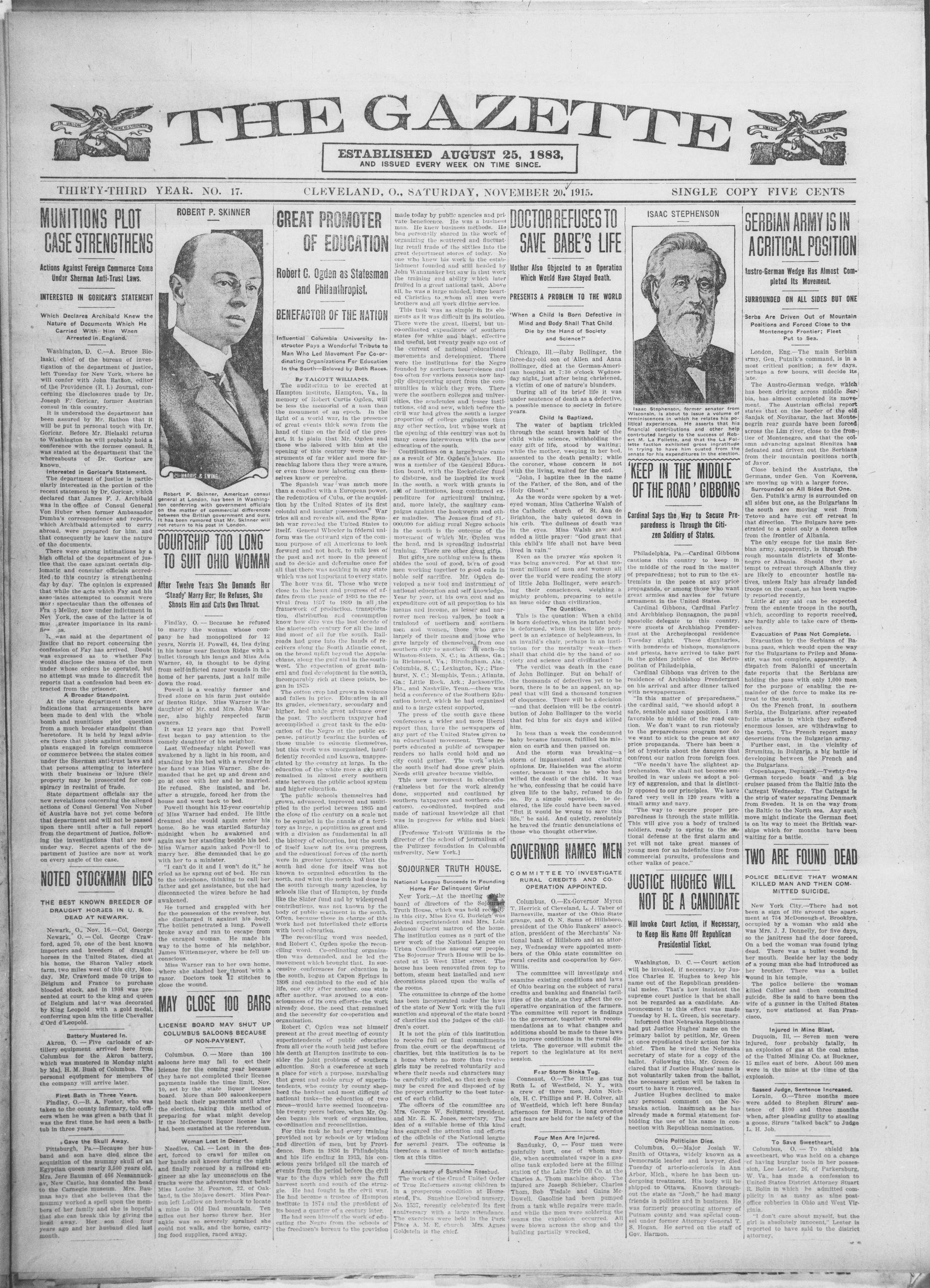
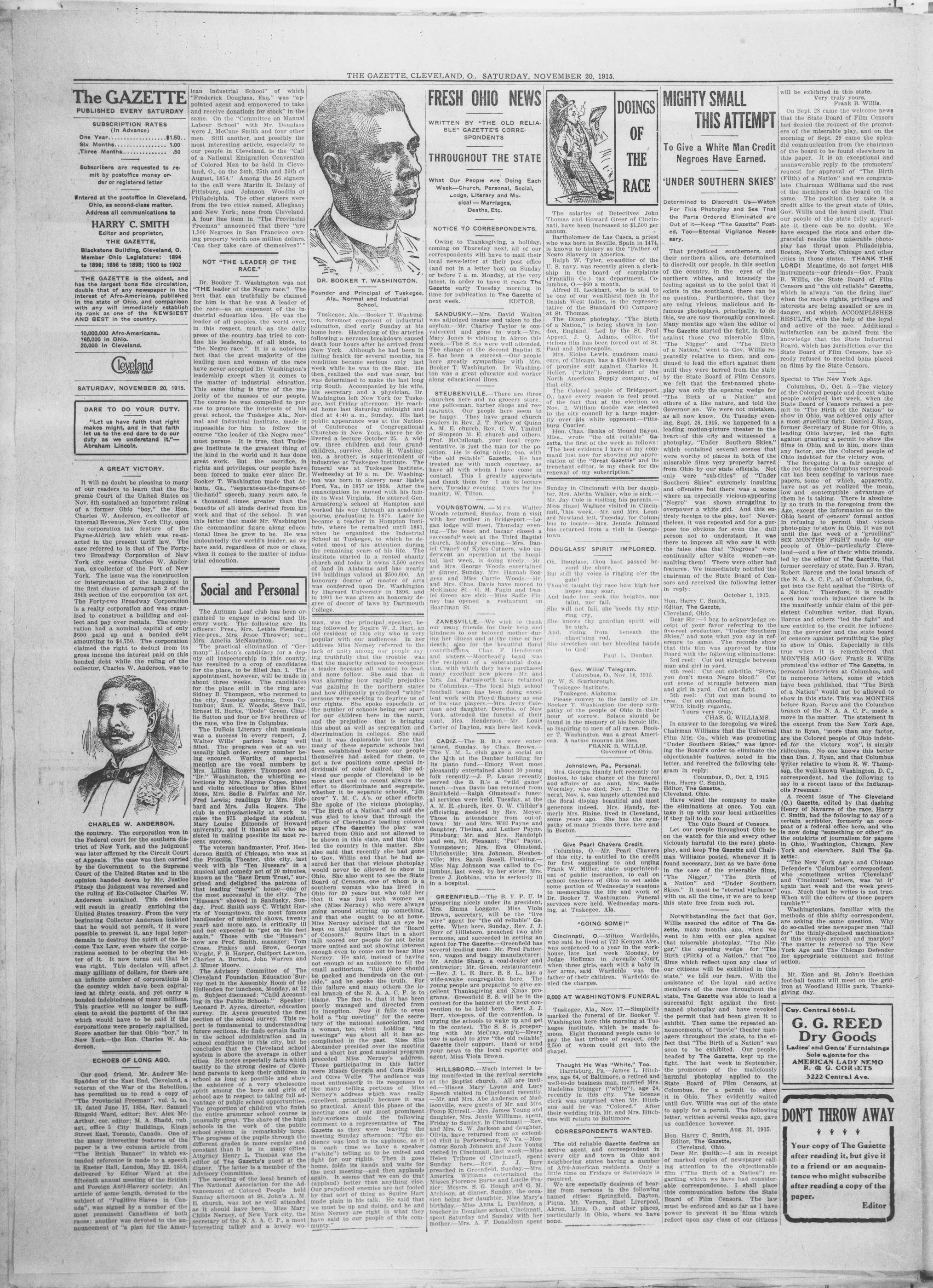
Page text (machine-generated)
IN VIRTU
VIRTUS SATURDIUS
MUNITIONS PLOT CASE STRENGTHENS
Actions Against Foreign Commerce Coma
Undar Sherman Anti-Trust Laws.
Which Declares Archibald Knew the Nature of Documents Which He Carried With Him When Arrested in England.....
Washington, D. C.—A. Bruce Bice laski, chief of the bureau of investigation of the department of justice, left Tuesday for New York, where he will confer with John Rathon, editor of the Providence (R. I.) Journal, concerning the disclosures made by Dr. Joseph F. Goricar, former Austrian consul in this country.
It is understood the department has been assured by Mr. Rathon that it will be put in personal touch with Dr. Goricar. Before Mr. Blehaski returns to Washington he will probably hold a conference with the former consul. It was stated at the department that the whereabouts of Dr. Goricar are known.
Interested in Goricar's Statement.
The department of justice is particularly interested in the portion of the recent statement by Dr. Goricar, which declared that James F. J. Archibald was in the office of Consul. General Tom Huber when former Ambassador Dumbrell's papers, which Archibald attempted to carry abroad, were prepared for him, and that consequently he knew the nature of the documents.
There were strong intimations by a high official of the department of justice that the case against certain diplomatic and 'consular officials, accredited, to this country is strengthening day by day. The opinion is expressed that while the acts which Fay and his assocates attempted to commit 'were of Fra x Melloy, now under indictment in New York, the case of the latter is of greater importance in its ramifications as. I was said at the department of justice that no report concerning the confession of Fay has arrived. Doubt was expressed as to whether Fay would disclose the names of the men involved in the case, he had not attempt was made to discredit the reports that a confession had been extracted from the prisoner.
A Broader Standpoint.
At the state department, there are indications that arrangements have been made to deal with the whole bomb and munitions plot question from a much broader standpoint than heretofore. It is held by legal advisers there that plots against munitions plants engaged in foreign commerce or commerce between the states comes under the Sherman anti-trust laws and that persons attempting to interfere with their business or injure their property may be prosecuted for conspiracy in restraint of trade.
State department officials say the new revelations concerning the alleged actions of Consul General Nubar Nuber of the U.S. Embassy in Cobbe before that department and will not be passed upon there until after a full report from the department of justice, following the investigations that are now under way. Secret agents of the department of justice are now at work on every angle of the case.
NOTED STOCKMAN DIES
NOTED STOCKMAN DIES
THE BEST KNOWN BREEDER OF
DRAUGHT HORSES IN U. S.
DEAD AT NEWARK.
Newark, O. Nov. 16—Col. George
Newark, O.—Col. George Cra-
ford, aged 70, one of the best known
importers and breeders of draught
horses in the United States, died at
his home, the Sharon Valley stock
farm, two miles west of this city, Mon-
lys, O. F. Craweold, made 70 fries to
Maryland. France to purchase
blooded stock, and in 1908 was
presented at court to the king and queen
of Belgium and later was decorated
by King Leopold with a gold medal,
conferring upon him the title Chevaller
d'Ord Leopold.
Battery Mustered In.
Akron, O. — Five carloads of artillery, equipment arrived here from Columbus for the Akron battery, which was mustered in Monday night by Maj. H. M. Bush of Columbus. The personal equipment for members of the company will arrive later.
First, Bath in Three Years.
Findlay, O.-B. A. Foster, who was taken to the county infirmary, told officers when he was given a bath that it was the first time he had seen a bath-tub in three years.
Gave the Skull Away,
Pittsburgh, Pa.—Because her husband and son have died since the acquisition of the mummy skull of an Egyptian queen nearly 3,500 years old, Mrs. Jere Bauman of 466 Nessannuckav, New Castle, has donated the head to the Carnegie museum. Mrs. Bauman says that she believes that the mummy worked a spell upon the members of her family and she is hopeful that she can break this by giving the lieed away. Her son died four years ago and her husband died last month.
ROBERT P. SKINNER
C HARRIS & EWING
Robert P. Skinner, American consul general at London, has been in Washington conferring with government officials on the matter of commercial differences between the United States and China. It has been rumored that Mr. Skinner will not return to his post in London.
COURTSHIP TOO LONG
TO SUIT OHIO WOMAN
Findlay, O., — Because, he refused to marry the woman whose company he had monopolized for 12 years, Norris H. Powell, 44, lifes dying in his home near Benton Ridge with a bullet through his lungs and Miss Ada Warner, 40, is thought to be dying from self-inflicted razor wounds in the home of her parents, just a half mile down' the road. Powell is a wealthy farmer and lived alone on his farm just outside of Benton Ridge. Miss Warner is the daughter of Mr. and Mrs. John Warmer, who also highly respected farm owners. It was 12 years ago that Powell first began to pay attention to the comely daughter of his neighbor. Last Wednesday night Powell was awakened by a light in his room, and standing by his bed with a revolver in her hand was Miss Warner. She demanded that he get up and dress and go at once with her and be married. He refused. She insisted, and he, after a struggle, fled from the house and back to bed. Powell thought his 12-year courtship of Miss Warner had ended. He little dreamed she would again enter his home. So he was started Saturday midnight when he awakened and again saw her standing beside his bed. Miss Warner again asked Powell to marry her. She demanded that he go with her to a minister. "I can't do it and I won't do it," he cried as he sprang out of bed. He ran to the house and got assistance to call her and get assistance, but she had disconnected the wires before he had awakened.
He turned and grappled with her for the possession of the revolver, but she discharged it against his body. The bullet penetrated a lung. Powell broke away and ran to escape from the enraged woman. He made his way to the home of his neighbor, James Wittenmeyer, where he fell unconscious. Warner ran to her own home, where she slashed her throat with a razor. Doctors took 12 stitches to close the wound.
MAY CLOSE 100 BARS
LICENSE BOARD MAY SHUT UP COLUMBUS'S SALOONS BECAUSE OF NON-PAYMENT.
Columbus: O. — More than 100 saloons here may fail to get their license for the coming year because they have not completed their license payments inside the time limit, Nov. 0, get by the state liquor license board. More than 500 saloonkeepers held back their payments until after the election, taking, this method of preparing for what might develop if the McDermott liquor license law had been sustained at the referendum.
Woman Lost In Desert.
Needles, Cal. — Lost in the desert, forced to crawl for miles on her hands and knees during the night and finally rescued by a railroad engineer as she lay unconscious on the tracks were the adventures that beffold Miss Louise M. Pearson, 22, of Oakland, in the Mojave desert. Miss Pearson left Ludlow on horseback to locate a mine in Old Dad mountain. Ten miles out her horse threw her. Her ankle was so severely sprained she could not walk, and the horse, carrying food supplies, raced away.
ESTABLISHED AUGUST 25, 1883,
AND ISSUED EVERY WEEK ON TIME SINCE.
CLEVELAND, O., SATURDAY, NOVEMBER 20, 1915.
GREAT PROMOTER OF EDUCATION
BENEFACTOR OF THE NATION
Influential Columbia University Instructor Payo a Wonderful Tribute to Man Who Led Movement For Co-ordinating Organizations For Education in the South—Beloved by Both Races.
BY TALGOTT WILLIAMS.
The auditorium to be erected at Hampton institute, Hatton, Va., in memory of Robert Curtis Ogden, will be less the memorial of a man than the monument of an epiph. In the light of a world war, in the presence of great events thick sown from the hand of time on the field of the present, it is plain, that Mr. Ogden and those who labored with him at the opening of this century were the instrumentators of laborers than they were aware, or even those now laboring can themselves know or perceive.
The Spanish war was much more than a conflict with a European power, the redemption of Cuba, or the acquisition by the United States of its first colonial and insular possessions." War tries all and reverses all, and the Spanish war revealed the United States to itself. General Wheeler in federal uniform was the outward sign of the common purpose of all Americans, loosening the bond of the past and not more in the present and to decide and determine once for all that there was nothing in any state which was not important to every state.
The hour was fit. Those who were close to the heart and progress of affairs from the pane of 1853 to the revival from 1857, to 1859 in all, the framework of production, transportation, distribution, and consumption know how diris was the last decade of the 1850s, and most of all for the south. Railroads had gone into the hands of receivers along the South Atlantic coast, on the broad uplift beyond the Appalachians, along the gulf and in the southwest. The expectation of great mineral and fund development in the south, incomparably rich at these points, began in 1857. In 1859 had grown in volume and fallen in price. Education in all its grade, elementary, secondary and higher, had made great advance over the past. The southern taxpayer had accomplished a great task in the education of the Negro at the public expense, patiently helping the burden of those unable to educate themselves, but this work was unorganized, insufficiently recorded and known, unappreciated by the country at large. In the years before the Civil War, the country remained in almost every southern state between the public school system and higher education.
The public schools, themselves had grown, advanced, improved and multiplied in the period between 1865 and the close of the century on a scale not to be equalled in the annals of a territory as large, a population as great and with a division as fundamental in all the history of education, but the south of itself knew not its own progress, and the educational forces of the north were in greater ignorance. What the south had done for itself was not known to organized it, nor had the north had to organize it, the south through many agencies, by schools like that of Hampton, by funds like the Slater fund and by widespread contributions, was not known by the body of public sentiment in the south. Often, because these in charge of this work had not interlinked their efforts with local education.
The reconciling word was needed, and Robert C. Ogden spoke the reco-缔ling-word. Co-ordinating organization was demanded, and he led the movement which brought that. In successive conferences for education in the south, began at Copen Springs in 1865 and continued to the end of his life. In another opinion, after another, was arraised to a consciousness of its own efforts—the work already done, the need that remained and the necessity for co-operation and organization.
Robert C. Ogden was not himself present at the great meeting of county superintendents of public education from all over the south held just before his death at Hampton institute to consider the joint problems of southern education. Such a conference at such a place for such a purpose, marshaling that great and noble army of superintendents, who county by county shepherded the nation, most often offended national tasks—the education of two races—would have seemed inconceivable twenty years before, when Mr. Ogden began his work of organization, co-ordination and reconciliation.
For this task he had every training provided not by schools or by wisdom and direction of men, but by Providence. Born in 1830 in Philadelphia and his life ending in 1913, his conscious years bridged all the march of events from the period before the civil war to the present day, the furthest north and south of the struggle. He had fought in the civil war. He had become a trustee of Hampton institute in 1874 and the president of its board a quarter of a century later. He had seen himself the work of educating the Negro from the schools of the freedmen's bureau to the provision
made today by public agencies and private benefit. He was a business man. He knew business methods. He had personally shared in the work of organizing the scattered and fluctuating retail trade of the sixties into the great department stores of today. No one who knew his work in the industry had been trained by John Wannamaker but saw in that work the training and ability which later fruited in a great national task. Above all, he was a large minded, large hearted Christian to whom all men were brothers and all work divine service. This task was as simple in its elements as it was difficult in its solution. There were the great, liberal, but un-coordinated expenditure of southern states for white and black, effective and useful but twenty years ago of our time. There were the movements and development. There were the institutions for the Negro founded by northern benevolence and too often for various reasons now happily disappearing apart from the communities in which they were. There were the southern colleges and universities, the academies and lesser institutions, old and new, which before the civil war had given the south a larger proportion of college graduates than the north. There was the opening of this century was not in many cases interwoven with the new education of the south.
Contributions on a large scale came as a result of Mr. Ogden's labors. He was a member of the General Education board, with the Rockefeller fund to dishuse, and he inspired its work in the south a work with grants in all of institutions, long continued expenditure for agricultural training, and, more likely, the sanitary campaigns against the hookworm and other maladies. The Jones fund of $10,000 for ailing rural Negro schools in the south is the outcome of the men's work together to good ends in noble self sacrifice. Mr. Ogden developed a new tool and instrument of national education and self knowledge. Year by year, at its own cost and an expenditure out of all proportion to his means and income, as lesser and narrower men reckon values, he took a tranfididn of northern and southern men and women, who gave largely of their means and those who gave largely of themselves, from one southern city to another. In each—Winston-Salem, in Athens, in Atlanta, in Columbus, in S.C. in Lexington, Ky.; Pinehurst, N.C. in Memphis, Teen., Atlanta, Gla.; Little Rock, Ark.; Jacksonville, Fla., and Nashville, Teen.—there was hold a conference of the Southern Education host, which he had organized and to a large extent supported.
The press of the south gave these conferences a wider and more liberal report than have the newspapers of any part of the United States given to an educational movement. These reports educated a public of newspaper readers no balls could lose and no work the south itself had done grew plain. Needs still greater became visible. This new movement in education (valueless but for the work already done, supported and continued by southern taxpayers and southern educators), co-ordinated, inspired and made of national knowledge all that was in progress for white and black men. (Professor, Talcott Williams, is the director of the school of journalism of the Pulitzer foundation in Columbia university, New York.)
SOJOURNER TRUTH HOUSE.
National League Succeeds In Founding Home For Delinquent Girls.
New York. At the meeting on the board of directors of the Sojourner Truth House, which was held recently in this city, Miss Eva G. Burleigh was elected superintendent and Mrs. Loh Johnson Guest matron of the home. The institution comes as a part of the Urban Conditions among our people. The Sojourner Truth House will be located at 15 West 131st street. The house has been renovated from top to bottom, steam heat installed and new decorations placed upon the walls of the rooms.
The committee in charge of the home has been incorporated under the laws of the state of New York with the full sanction and approval of the state board of charities and the judges of the children's court.
It is not the plan of this institution (to be final or final commitments from the court or the department of charities, but this institution is to be a home where no more than twelve girls may be received voluntarily and where their needs and characters may be carefully studied, so that each case may be cared for and disposed of by the proper authority to the best interest of each child.
The officers of the committee are Mrs. George W. Selligman, president, and Mr. F. S. Jones, secretary. The officer F. S. Jones engaged the attention and efforts of the officials of the National league for several years. The outcome is therefore a matter of much satisfaction at this time.
Anniversary of Sunshine Rosebud.
The work of the Grief Guided Order of True Recorders among children is in a persevering condition at Homestead, Pa. Sunshine Rosebud nursery, Nov. 16th, recently celebrated its first anniversary with a tribute attendance. The excerpts held in the Park Place A. M. E. creech b. Mrs. Agnes Goldstein is the grief.
DOCTOR REFUSES TO SAVE BABE'S LIFE
"When a Child is Born Defective in
Mind and Body Shall That Child
Die by the Hand of Society
and Science?"
Chicago, Ill.—Ruby Bollinger, the
three-day-old son of Allen and Anna
Bollinger, died at the German-American hospital at 7:30 o'clock Wednesday night, just after being christened, a victim of one of nature's blunders.
During all of its brief life it was
under sentece of death as a defective,
male menace to society in future
years.
Child Is Baptized.
The water of baptism trickled through the scant brown hair of the child while science, withholding the easy gift of life, stood by waiting; while the mother, weeping in her bed, assented to the death penalty; while the coroner, whose concern is not with the living, waited for the end. "John I baptize the in name of the abolition of the Son, and of the Holy Ghost." As the words were spoken by a weteyed woman, Miss Catherine Walsh of the Catholic church of St. Ann de Brighton, the baby quieted down in his crib. The dullness of death was in the eyes. Miss Walsh saw and added a little prayer: "God grant that this child's life shall not have been lived in vain." The prayer was spoken it was being answered. For at that moment millions of men and women all over the world were reading the story of Little John Bollinger, were searching their consciences, weighing a mighty problem, preparing to settle an issue older than civilization.
The Question.
This is the question: When a child is born defective, when its infant body is deformed, when its best life prospect is an existence of helplessness, when its mental institution for the mental weak—then shall that child die by the hand of society and science and civilization?
The verdict was death in the case of John Bollinger. But on behalf of the thousands of defectives yet to be born, there is to be an appeal, an appeal that will find a thousand tongues of eloquence. There will be a decision—and that decision will be the contribution of John Bollinger to the world that fed him for six days and killed him. In less than a week the condemned baby became famous, fulfilled his mission on earth and then passed on. And the storm was breaking—a storm of impassioned and clashing opinions. Dr. Haiselsen was the storm center, because it was, he who had willed the death of the child. It was he who, confessing that he could have given life to the baby, refused to do so. By the time he was dead, the life he could have been saved. "But it would be wrong to save this life," he said. And quietly, resolutely he braved the frantic denunciations of those who thought otherwise.
GOVERNOR NAMES MEN
GOVERNOR NAMES MEN
COMMITTEE TO INVESTIGATE RURAL CREDITS AND CO-OPERATION APPOINTED.
Columbus, O.—Ex-Governor Myron T. Herrick of Cleveland, L. J. Taber of Barnesville, master of the Ohio State grange, and O. N. Sams of Hillsboro, president of the Ohio Bankers' association, president of the Merchants' National bank of Hillsboro and an attorney, Wednesday were appointed members of the Ohio state committee on rural credits and co-operation by Gov. Willis.
The committee will investigate and examine existing conditions and laws of Ohio bearing on the subject of rural credits and bankers' facilities as they affect the cooperative organization of the farmers. The committee will report is findings to the governor, together with recommendations as to what changes and additions should be made to these laws to improve conditions in the rural districts. The governor will submit the report to the legislature at its next session.
Fear Storm Sinks Tug.
Conneau, O.—The little gas tug Ruth L. of Westfield, N. Y., with a crew of three men, John Nichols, H. C. Phillips and P. H. Colver, all of Westfield, which left here Sunday afternoon for Huron, is long overdue and fears are held for the safety of the craft.
Four Men Are Injured.
Sandusky, O. — Four men were painfully hurt, one of whom may die, when accumulated vapor in a gasoline tank exploded here at the filling station of the Lake Erie Oil Co. at the Charles A. Thom machine shop. The injured are Joseph Schieber, Charles Thom, Bob Tisdale and Gains McDowell. Gasoline had been pumped from a tank while repairs were made, and while the men were soldiering the seams the explosion occurred. All were blewn across the shop and the building partially swept.
SINGLE COPY FIVE CENTS
Isaac Stephenson, former senator from Wisconsin, is about to issue a volume of reminiscences in which he relates his political experiences. He asserts that his financial contributions and other help contributed largely to the success of Robbette Atkinson and gave the Le Follette faction exhibited gross ingratitude in trying to have him ousted from the senate for his expenditures in the election.
'KEEP IN THE MIDDLE OF THE ROAD' GIBBONS
Cardinal Says the, Way to Secure Preparedness is Through the Citizen Soldiery of States.
Philadelphia, Pa.—Cardinal Gibbons cautions this country to keep in the middle of the road in the matter of preparedness; not to run to the extremists in the peace at any price propaganda, or among those who want great armies and navies for future armament in the United States.
Cardinal Gibbons, Cardinal Farey and Archbishop Bonagnon, the apostolic delegate to this country, were guests of Archbishop Prendergast at the Archbishopspalast in the city of high significance, with hundreds of bishops, monsignors and priests, have arrived to take part in the gilden jubilee of the Metropolitan of Philadelphia.
Cardinal Gibbons was driven to the residence of Archbishop Prendergast on his arrival and after dinner talked with newspapermen.
In this matter of preparedness, the priest should adopt a safe, sensible and sane position. I am favorable to middle of the road caution. We don't want to run riotlessly to the preparedness program nor do we want to stick to the peace at any price propaganda. There has been a lot of hysteria about the dangers that confront our nation from foreign foes. "We needn't have the slightest apprehension. We shall not become embroiled in war unless we adopt a policy that is not opposed to our principles. We have fared very well in 120 years with a small army and navy.
"The way to secure. proper preparedness is through the state militia. This will give you a body of trained soldiers, ready to spring to the national defense at the first alarm and the second alarm, young men for an indefinite time from commercial pursuits, professions and other walks of peace."
JUSTICE HUGHES WILL NOT BE A CANDIDATE
Will Invoke Court Action, if necessary, to Keep His Name Off Republican Presidential Ticket.
Washington, D. C. — Court action will be invoked, if necessary, by Justice Charles E. Hughes to keep his name out of the Republican presidential melee that he's how insistent the court is, but he shall not be regarded as a candidate. Announcement to this effect, was made Tuesday by H. L. Green, his secretary. Informed that Nebraska Republicans had put Justice Hughes' name on the primary ballot by petition, Mr. Green at once repudiated their action for his chief. Then he wired the Nebraska secretary of state for a copy of the ballot. Following this, Mr. Green declared that if Justice Hughes' name is not voluntarily taken from the ballot, the necessary action will be taken if court to hear it approved. Justice Hughes declined to make any personal comment on the Nebraska action. Inasmuch as he has already made a formal statement forbidding the use of his name in connection with Republican nomination.
Ohio Politician Dics.
Columbus, O.,—Major Josiah W. Smith of Ottawa, widely known as a Democratic leader and lawyer, died Tuesday of arteriosclerosis in Ann Arbor, Mich., where he has been undergoing treatment. His body will be shipped to Ottawa. Known throughout the state as "Josh," he had many friends in politics and in business. He was formerly, prosecuting attorney of Putnam county and was special counsel under former Attorney General T. S. Hogan. He served on the staff of Gov. Harmon.
IN WHICH HAS ESTABLISHED
SERBIAN ARMY IS IN ACRITICAL POSITION
Iustro-German Wedge Has Almost Completed Its Movement.
Serbs Are Driven Out of Mountain
Positions and Forced Close to the
Montenegro Frontier; Fleet
Put to Sea.
London, Eng. -- The main Serbian
army, Gen. Putnik's command, is in a
most critical position; a few days,
serbs a few hours, will decide its
date.
The Austro-German wedge, which has been driving across middle Serbia, has almost completed its movement. The Austrian official-report states that on the border of the old Sanjak of Novibazar, the last Montenegrin rear guards have been forced across the Llm river, close to the frontier of Montenegro, and that the column advancing against Slenitza has defeated and driven out the Serbians from their mountain positions north of Javor. They are behind the Austrians, the Germans, under Gen. Von Koexess, are moving up with a larger force. Surrounded on All Sides But One. Gen. Putink's army is surrounded on all sides but one, as the Bulgarians in the south are moving west from Tetovo and have cut off retreat in that direction. The Bulgars have penetrated to a point only a dozen, miles from the frontier of Albania.
The only escape for the main Serbian army, apparently, is through the rough mountain districts of Montenegron or Albania. Should they attempt to retreat through Albania they are likely to encounter hostile natives, unless Italy has already landed troops on the coast, as has been vaguely reported recently. A can be expected from the entente troops in the south, which, according to reports received, are hardly able to take care of themselves.
Evacuation of Pass Not Complete.
Evacuation by the Serbians of Bahuna pass, which would open the way for the Bulgarians to Prilep and Monastir, was not complete, apparently. A dispatch from Salonikli of uncertain date reports that the Serbians are holding the pass with only 1,000 men, and are enabling the remainder of the force to make its retreat to the south.
On the French front, in southern Serbia, the Bulgarians, after repeated futile attacks in which they suffered enormous losses, are withdrawing to the north. The French report many desertions from the Bulgarian army.
Furler east, in the vicinity of Stritmia, in Bulgaria, a big battle is developing between the French and the Bulgarians.
Copenhagen, Denmark—Twenty-five German torpedo boats and a big cruiser passed from the battle into the cathedral address. The Cathedral is separating Denmark from Sweden. It is on the way from the Battle to the North sea. Any such move might indicate the German fleet is on its way to meet the British warships which for months have been waiting for a battle.
TWO ARE FOUND DEAD
POLICE BELIEVE THAT WOMAN
KILLED MAN AND THEN COM.
MITTED SUICIDE.
New York City. There had not
been a sign of life around the apartment at 754 McDonough-st. Brooklyn,
occupied by a woman who said she
was Mrs. J. J. Donnelly, for five days,
so the sanitizer had the door forced.
On a bed the woman was found lying dead. There was a bullet wound in her mouth. Beside her lay the body of a young man she had introduced as her brother. There was a bullet wound in his temple.
The police believe the woman killed Collier and then committed suicide. She is-said to have been the wife of a gunner in the United States navy, now stationed at San Francisco.
Injured In. Mine Blast.
Duquoin, Ill. — Seven men were injured, four probably fatally, in an explosion of gas at the coal mine of the United Mining Co. at Buckner, 15 miles east of here. About 500 men were in the mine at the time of the explosion.
Sassed Judge, Sentence increased. Lorain, O.—Three months more were added to Stephen Sirrus' sentence of $100 and three months when, after pleading guilty to stealing a goose, Sirrus "talked back" to Judge L. H. Job.
To Save Sweetheart
Columbus, O. — To shield his sweetheart, who was held on a charge of having burial tools in her possession, Lee Lester, 26, of Parkersburg, W. Va., has made a confession to United States District Attorney Stuart R. Bolin in which he admitted complicity in as many as nine post-office robberies in Ohio and West Virginia.
"I don't care about myself, but the girl is absolutely innocent." Lester is reported to have said to the district attorney.
PUBLISHED EVERY SATURDAY
SUBSCRIPTION RATES.
(in Advance)
One Year.....s.ecesese0+++ $1.50.
SIX Monthe.......0..60006 1.00
‘Three Months........c00006 50
Subscribers are requested to re-
mit by postoffice money or
der or registered letter
Mntered at the postoffice In Cleveland,
Ohio, as second-class matter.
Address all communications to
HARRY C. SMITH
Editor and proprietor,
THE GAZETTE,
Blackstone Building, Cleveland, 0.
Member Ohio Legisiature: 1894
to 1896; 1896 to 1898; 1900 to 1902
THE GAZETTE is the oldest, and
has the largest bona fide circulation,
double that of any newspaper in the
Interest of Afro-Americans, published
in the state of Ohio, and comparison
with any will immediately establish
its rank as one of the NEWSIEST
AND BEST in the country.
10,000,000 Afro-Americans...
160,000 in Ohio.
20,000 in Cleveland.
SATURDAY, NOVEMBER 20, 1915.
DARE TO DO YOUR DUTY.
“Let us have faith that right
makes might, and in that faith
let us to the end dare to do our
duty as we understand It”—
Abraham Lincoln.
A GREAT VICTORY.
It will no doubt be pleasing to many
of our readers to learn that the Su-
preme Court of the United States on
Nov. 8th sustained an important ruling
of a former Ohio “boy,” the Hon,
Charles W. Anderson, ex-collector of
Internal Revenue, New York City, upon
the corporation tax feature of the
Payne-Aldrich law which was re-en-
acted in the present tariff law. The
case referred to is that of The Forty-
two Broadway Corporation of New
York city versus Charles W, Ander-
son, ex-collector of the Port of New
York. The issue was the construction
or interpretation of the language in
the first clause of paragraph 2 of the
88th section of the corporation tax act.
‘The Forty-two Broadway Corporation
is a realty corporation and was organ-
ized to construct @ building and col-
leet and pay over rentals. The corpo-
ration had a nominal capital ot only
$600 paid up and a bonded debt
amounting to $4,750. ‘The corporation
¢laimed the right to deduct from its
gross income the interest paid on this
bonded debt while the ruling of the
collector, Charles W. Anderson, was to
pe - 4
i a
DP
ad
‘the contrary. The corporation won in
the Federal court for the southern dis-
trict of New York, and the judgment
‘was later affirmed by the Circuit Court
‘of Appeals. ‘The case was then carried
by the Government to the Supreme
Court of the United States and in the
opinion handed down by Mr, Justice
Pitney the Judgment was reversed and
the ruling of Ex.Collector Charles W.
Anderson sustained. This decision
will result in greatly enriching the
United States treasury. From the very
Deginning Collector Anderson insisted
that he would not permit, if it were
possible to prevent it, any legal leger-
demain to destroy the spirit of the In-
‘come Tax Law, even where the corpo-
rations seemed to be obeying the let-
ter of it. It now turns out that he
was right. This decision will. affect
many millions of dollars, for there are
‘an infinite number of corporations in
the country which have been capital-
jaed mt thirty cents, and yet carry a
Bonded indebtedness of many millions.
‘Phis practice will no longer be sufl
cient to avoid the payment of the tax
Which would have to be paid if the
corporations were properly capitalized.
Score another for that Ohio “boy,” in
‘New York—the Hon. Charles W. An-
derson,
ECHOES OF LONG AGO.
Our good friend, Mr. Andrew Mc-
‘Spadden of the East End, Cleveland, a
yeteran of the War of the Rebellion,
has permitted us to read a copy of
“The Provincial Freeman", vol. 1, no.
18, dated June 17, 1854, Rev. Samuel
Ringold Ward, editor; Rev, Alex Me-
Arthur, cor. editor; M. A. Shadd, nub.
agt,, office 5 City Buildings, Kings
Street East, Toronto, Canada. One of
the many interesting features of the
paper js a two column article trom
“The British Banner” in which ex-
tended reference is made to a speech
in Exeter Hall, London, May 22. 1854,
delivered by Editor Ward at the
fifteenth annual meeting of the British
and Foreign Anti-Slavery society. An
article of some length, devoted to the
subject of “Fugitive Slaves in Can-
ada”, was signed by a number of the
most prominent Canadians of both
races; another was devoted to the an:
nouncement of “a plan for the Amer-
jean Industrial School” of which
“Frederick Douglass, Esq.” yas "ap-
pointed agent and empowered to take
and receive donations for stock” in the
same. On the “Committee on Mantal
Labour School” with Mr. Douglass
were J, McCune Smith and four other
men, Still another, and ‘possibly the
most interesting article, especially to
our people in Cleveland, is the “Call
of a National Emigration Convention
of Colored Men to be held in Cleve:
land, ©,, on the 24th, 25th and 26th of
August, 1854." Among the 26 signers
to the call were Martin R. Delany of
Pittsburg, and Johnson Woodlin of
Philadelphia, ‘The other signers were
from the two cities named, Alleghany
and. New York; none from Cleveland
A four line item in “The Provincial
Freeman” announced that there “are
1,500 Negroes in San Francisco own
ing property worth one million dollars.
‘Can they take care of themseives?"”
NOT “THE LEADER OF THE
RACE.”
Dr. Booker T. Washington was not
“THE leader of the Negro race.” The
best that can truthfully be claimed
for him is that he was A leader of
the race—as an exponent of the in
dustrial education idea. He was the
leader of all peoples, the world over,
in this respect, much ‘as the daily
Dress of the country bas tried to con:
fine his leadership, of'all kinds, to
“the Negro race.” It is a notorious
fact that the great majority of the
leading men and women of the race
have never aecepted Dr. Washington's
leadership except when it comes to
the matter of industrial education.
‘This same thing is true of the ma-
Jority of the masses of our people.
The course he was compelled to pur-
sue to promote the interests of his
Breat school, the Tuskegee Ala., Nor-
mal and Industrial Institute, made it
impossible for him to follow the
course “the leader of the Negro race"
must pursue. It is true, that Tuske-
gee Institute is the greatest thing of
the kind in the world and it has done
great work. But the sacrifice, in
rights and privileges, our people have
been forced to make ever since Dr.
Booker T. Washington made that At
lanta, Ga., “separate-as.the-fingers-of
theshand” speech, many years ago, is
@ thousand times greater than the
benefits of all kinds derived from his
work and that of the school. It was
this latter that madé Mr. Washington
the commanding figure along educa
tional lines he grew to be. He was
undoubtedly the world’s leader, as we
have said, regardless of race or class,
when it comes to the matter of indus-
trial education.
Social and Personal
‘The Autumn Leaf club has been or-
ganized to engage in social and lit
erary work. The following are its
officers: Pres.. Mrs. Lethia Fleming;
vice-pres., Mrs. Jesse Thrower; sec.
Mrs. Amelia McNaughton.
‘The practical elimination of “Ger
many” Hudson's candidacy for a dep:
uty oll inspectorship in this county,
has resulted in a crop of candidates
for the place, to be filled Jan. 1, The
appointment, however, wili be made in
about three’ weeks, “The candidates
for the place still in the ring are:
Sidney B, Thompson, who returned to
the city, Tuesday morning, trom Co:
lumbus;" Sam. E. Woods, Steve Ball,
Emest H. Burke, “Dode” Green, Char-
Me Sutton and four or five brethren of
the race, who live in Columbus.
‘The DuBois Literary club musicale
was a success in every respect, J.
Walter Wills’ parlors being ‘well
filled, The program was of an un:
usually high order, every number be-
ing encored. Worthy of _ especial
mention are the vocal numbers by
‘Mrs, Lillian Rogers Thompson and
“Dr.” Washington, the whistling. se-
lections by Mrs. Mayme Copes, piano
‘and violin selections by Miss Ethel
‘Moss, Mrs. Sadie S. Fairfax and Mr.
Fred Lewis; readings by Mrs. Hub-
bard and Mrs, Julia Rogers. The
club is enthusiastically at work to
raise the $75 pledged its student,
Mary Louise Edmonds of Howard
university, and it thanks all who as:
sisted in making possible its most re-
cent success.
The veteran bandmaster, Prof. Hen.
derson Smith of Chicago, who was at
the Priscilla ‘Theater, this city, last
week with bis “Ten’ Hussars” in a
musical and comedy act of 20 minutes,
known as the "Bass Drum ‘Trust,” sur:
prised and delighted the patrons of
that leading “movie” house—one of
the most successful in the city. ‘The
“Hussars” showed in Sandusky, Sun-
day. Prof. Smith says C. Wright Har-
tis of Youngstown, the most famous
bandleader of minstrel shows, twenty
years and more ago, is critically ill
and not expected to “get on his tect
again.” Those with the “Hussars”
now are Prof. Smith, manager; Tom
Cross, Pinkey and’ Brow, George
‘Wright, F. B. Harper, Gulfport Lawton,
Charles A. Burton, John Warren and
J. Elmer Moore.
“The Advisory Committee of The
Cleveland Foundation Education 'Sur-
vey met in the Assembly Room of the
Hollenden for hincheon, Monday, at 12
m, Subject discussed: “Child Account-
ing-in the Public Schools.” Speaker:
Leonard P. Ayres, director, education
survey. Dr. Ayres presented the first
section of the school survey. This re-
port is fundamental to understanding
future sections. He finds certain faults
in the schoo! administration and in
school conditions in this city, but he
conchides that the Cleveland school
system is above the average in other
cities. He notes especially facts which
testify to the strong desire of Cleve-
Jand parents to keep their children in
school as long as possible and show
the existence of a very wholesome
spirit among the boys and girls of
school age in respect to taking full ad-
vantage of public school opportunities.
‘The proportion of children who finish
the entire grammar school course is
unusually great. The share of the high
schools in the work of the public
school system is remarkably large.
The progress of the pupils through the
different grades is more regular and
constant than it is in miany cities.
‘Attorney Henry L. Thomas was the
caitor of The Gazette's guest at the
Gipner. ‘The latter is a member of the
Advisory Committee.
The meeting of the local branch of
‘The National Association for the Ad-
vancement of Colored People held
Sunday afternoon at St. John’s A. M
B. ebureh, was not as well attended
as it should have been. Miss Mary
Childs Nerney, of New York city, the
secretary of the N. A. A. C. P., a most
interesting talker and a lovely wo-
THE GAZETTE, CLEVELAND, O., SATURDAY, NOVEMBER 20, 1915.
<= ..9 FRESH OID NEWS/.@
SESS gue | 7
See | — Al's j hig
Braap /)1'((, [WRITTEN BY “THE OLD RELIA. ||US (%
Bee oe = | Bue" Gazerre's corre | AMANSAN(Y
Beet aS SPONDENTS Re SD
cee RS WW 4aee 2
leas oS THROUGHOUT THE STATE. aE Z
Cent ee” ¥ 1 OMS ON, %
Rau oe oe Es SNe
ae < What Our Peopte are Doing Each|| KUMARAN
Wem iees 7 he Week-chureh, Personal seelay” |] ROME SEARS
Sa Bader ee wodge, Literary and Mu- | Lee
Raia te sical — Marriages, | DEPTS
ond Deaths, Ete | io eateries aD
A\ Sas —_— ‘Thomas and Howard Gre
\ eS | nati, have been increased
AW SSE NOTICE 0 CORRESPONDENTS. _ ll, ve Deen Snctessed
WIS — Bartholomew de Las C
Nw. AN Pera etna ister ene one
\ ASSETS 2) [coming on ‘Thursday next, ail of our| is known to history as th
oe ea correspondents will have to mail their | Negro Slavery in Americ
Sp SSA GA L | loca newstetter at their post ofiee || Raloh W. ‘Tyler, ex-a
5 WN YD, | (ana not im a tetter box) on Sunday | U- 8. navy, was recently
as, ! - 2 : oe Y|ship in. the board of
5. or before Ta. m. Monday, at the very [SUD Inthe board. 0
DR. BOOKER T. WASHINGTON. atest, in order to have ft reach The | (hranklin Co.) tax dep
—— Gazette carly ‘Tuesday morning in| "EONS, O; $60.8, month,
Founder and Principal of Tuskegee, | time for publication in The Gazette of | pe one of our wealthiest
Ala, Normal and Industrial “| next week EDITOR, | Danish West Indies, is |
Tuskegee, Ala.—Booker T. Washing-
ton, foremost exponent of industrial
education, died early Sunday at his
home here. Hardening of the arteries
following a nervous breakdown caused
death four hours atter he arrived from
New York. Although he had been in
failing health for several months, his
condition became serious only last
week while he was in the East. He
then, realized the end was near, but
was determined to make the last long
trip South. Accompanied by his wife,
his secretary and a physician, Dr.
Washington left New York for Tuske-
gee, last Friday afternoon. He reach-
ed home last Saturday midnight and
died at 4:40 0, m,, Sunday. His last
public appearance was at the Nation-
al Conference of Congregational
Churches in New York, where he de-
livered a lecture October 25. A wid
ow, three children and four grand.
children, survive, John H. Washing.
ton, a brother, is superintendent. of
industries at Tuskegee Institute. The
funeral was at Tuskegee Institute,
Wednesday at 10 a. m. Dr. Washing:
ton was born in siavery near Hale's
Ford, Va., in 1857 or 1858. After the
emancipation he moved with his fam-
ily to West Virginia. He entered Gen.
Armstrong's school at Hampton and
worked his way through an academic
course, graduating in 1875. Later he
became a teacher in Hampton Insti
tute, where he remained until 1881,
When “he organized the Industrial
School at Tuskegee, to which he de
voted most of his’ attention during
the remaining years of his life. The
institute started in a rented shanty
church and today it owns 2,500 acres
of land in Alabama and has nearly
100 buildings valued at. $500,000. An
honorary degree of master of arts
was conferred upon Dr. Washington
by Harvard University in 1896,_and
in 1901 he was given an honorary de:
gree of doctor of laws by Dartmouth
visto ys
man, was the principal speaker, be
ing followed by Squire W. J. Hart. an
old resident of this elty who is very
popular with our audiences. In her
Address Miss Nerney referred to the
Hack of unity among our people sty
Jing truthfully that the trouble was
that the majority refused to recoxnize
|i leader ‘because ‘ll wanted to lead
fand none follow. She said that it
was alarming how rapidly prejudice
was gaining inthe northern states
and how diligently prejudiced “white”
Dersons were seeking to deprive us of
Our rights, She spoke especlally. of
the umber of schools being set apart
for our children here in the north,
and the prejudice that is bringing
this about as well as segregation and
discrimination in colleges. She said
that It was deplorable but true that
Imany of these separate schools had
been established because our people
themselves had asked for them, "to
get @ few positions some special in-
dividuals of color desired, She ad-
vised our, people of Cleveland to be
more alert and to resent always. the
effort to discriminate and. segregate,
Whether it be separate schools, Jimi
crow” Y, M.C. A's, or other efforts.
She spoke of the vicious photoplay,
“phe Birth of a Nation,” and said she
was glad to know that through the
efforts of Cleveland's leading colored
paper (The Gazette) the play was
barred from Ohio and not allowed to
be shown in this state, and that Ohio
Ted the country in this matter. She
also said that recently she had gone
to Gov. Willis and that he had as-
sured her that (hat vicious photoplay
would never be allowed to show fn
Ohio. She also went to seo the State
Board of Censors, one of whom 15 a
southern woman ‘who has lived in
Ohio for 20 years but who told her
that it" was Just such women as
she (Miss Nerney) who were always
going around stirring up something,
and that she ought to bo at home.
Miss Nerney advised that an eye be
Kept on that ‘member of the “Board
of Censors.” Squire Hart in a short
talk scored our people for not being
more united and not showing interest
enough even to come out to hear Miss
Nemey. He said, instead of having
hot enough of an audience to fil the
small auditorium, “this place should
be packed and ‘hundreds on the out:
side,” and he spoke the truth, For
this’ failure and many others the 1o-
‘eal branch of the N. A. A. C. P. is to
blame. The fact is, that it has been
poorly managed and directed trom
{iS inception. Now it fails to even
hold a “big meeting" for the secte:
tary of the national association, and
a woman, too, ‘when holding ' “big
Meetings” was about all it has _ac-
complished in the past. Miss Ella
Giexander presided over the meeting
and a short but good musical program
preceded Miss. Nerney’s address.
Those participating in this latter
were Misses Georgia and Cora Fields
‘and Olive Welle. The audience was
‘most enthusiastle in its responses to
‘the many telling portions of | Miss
Nemey's address which was really
‘excellent, principally because it was
$0 practical. Anent this phase of the
necting one of our most prominent
lady-workers made the _ following
‘comment to a representative of | The
Gazette as they were leaving the
mneeting Sunday afternoon: “The au
Gience was lond in its applause, as it
{seach time we have a speaker
Cwhite”) telling us to be united and
fight for our rights. Then it goes
home, folds its hands and waits for
the next meeting—and then applauds
asain, It seems that we can do that
fappland) better than anything else
Our prejudiced enemies are not fooled
by tut sort of thing es Squire Hart
fuade plain in bis talk. He said that
we must be up and doing, and he and
Miss Nerney are right in what they
have said to our people of this com-
eae. le ee
WRITTEN BY “THE OLD RELIA.
BLE” GAZETTE’S CORRE.
SPONDENTS
THROUGHOUT THE STATE
Wet Our “Peesis “are Doing Gaon
Week churehy Persooal, costal
odkes Litany sal we
aaah marriagte
Deatha, to
NOTICE TO CORRESPONDENTS.
owkig (o ‘rmssiesiting a. holldsy,
Gessiap areata ast allo ee
cavoupsaasts wutiate torasll ee
loot niet atti wereicne
ential i a etter Fos) a Suny
te oles Tee menter, er tae sory
Hater, a ardor to bare ie Tesch Tie
Gazette early Tuesday morning in
tine for pablloaton In The Gazette of
eee ene
SANDUSKY.—Mrs, David Walton
was adjudged insane and taken to the
asylum.—Mr. Charley Taylor 1s con-
valescent and gone to. work.—Mrs.
Mary Jones is visiting in Akron this
week. —The S. S.s were well attended.
‘The change at the Second Baptist S.
S. has been a sticcess.—Our people
here greatly sympathize with Mrs.
Booker T. Washington. Dr. Washing.
ton was a great edueator and worker
along educational lines.
STEUBENVILLE—There are three
eburehes here and no grocery store:
‘one policeman, barber shops and res-
taurants, Our people here seem to
be happy. They have grand church
leaders in Rev. J. T. Farley of Quinn
A.M. E, church, Rey. G. W. ‘Tindull
of Simpson M. E. church and others.
Prof. McCullough, your local repre
sentative, is just the man for the po-
sition, He is doing nicely, too. with
“the old reliable” Gazette. He has
treated me with much courtesy, as
have all with whom I have come in
contact. ‘This I greatly appreciate
and thank them for. 1 am to lecture
here, Tuesday evening. Yours for hu:
manity, W. Tilton. ‘
YOUNGSTOWN. —Mrs. Walter
Woods returned, Sunday, from a visit
with her mother in Bridgeport—Lo-
gan lodge will meet, Thursday even.
ing—The feast and’ bazaur closed a
successful? week at the Third Baptist
church, Monday evening.—Mrs. Dan-
fel Crane¥ of Kyles Corners, who un-
derwent an operation at the hospi.
tal, last week, is doing nicely.—Mr.
and Mrs. George Woods entertained
at dinner) Sunday, Mrs. Hannah Bog-
gess and Miss Carrie Woods.—Mr.
And Mrs, Chas. Davis have moved to
McKinnie St—G, M. Fagin and Dan
fel Green are sick.—Miss Sadie Fin-
ney has opened a restaurant on
Sinaia Bt
| ZANESVILLE.—We wish to thank
oe ae fede or ey beiy ex
ater ee alee men ae
Mae Lie Users gon Milla tase on er
ded giro. Tor tue beaut ote
Gea as Searsean gas ee
E recipient of « eibrantiat dona
Gag. With hist Gay have oacebanes
May sosbaut wow wee me nod
Ste ak areasoil aye ether
(0 Columbus The local high school
foothall teats Hea born doing exee!
Hur SHA wie Povafiiaincey 3 one
Sat yee ae teres aie
man ahd peg ene a) Mine
Terk aisuien Ge fungal of cualr
aunt, Mrs. Henderson.~-Mr. Louis
Carter of Dayton, was here last week.
| CADIg.—the BBs were enter
‘tained, Sanday, "by ‘Chat rown
fey A Sut pee oes oe
‘the Mi at the Dunbar building, for
its piano fund.—Emory West most
pleasantly entertained about 30 young
Der trendyod. br faces voces
eal ge a ae «teil ane
ach taea pat bas cetcrned sks
[Smithnelde “Ralph Olmstead’s tuner:
at services were held, Tuesday, at the
A.M. E. church, Rev. O. W, Childer’s
officiating, assisted by Rev, Moyer,
‘Thome ft tenance, trom outot
town’ Me oud Mra Wall Paves sud
‘daughter, Thelma, and Luther Payne,
‘Pittsburg; Mr. and Mrs, Randolph
and son, Mt, Pleasant; “Pat” Payne,
Youngstown; Mrs. Eva Olmstead,
Uhrichsville; Mrs, Johnson, Steuben-
ville; Mrs. Sarah Bosell, Flushing.—
Miss May Johnson was called to Co-
Jumbus, last week, by her sister, Mrs.
Irene J. Robbins, who is seriously ill
in a hospital.
_ GREENFIELD.—The B. Y. P. U. is
prospering nicely under its president,
Mrs. Emma Loggans. Miss Viola
Brown, secretary, will be the “live
wire” agent for “the old reliable” Ga-
zette. When here, Sunday, Rev. J. J.
Burr of Hillsboro, preached two able
sermons, and succeeded in getting an
agent for The Gazette.—Greenfield has
‘several leading men: Mr. Fred Patter:
son, wagon and buggy manufacturer;
Mr. Archie Sharp, a coaldealer and
‘contractor; Mr, Green, restauranteur,
Rev. J. LE. Burr, B.S. L., has @
wide-awake congregation here. ‘The
‘young people are preparing to give ex-
cellent Thanksgiving and Xmas pro-
‘grams, Greenfield 8. 8. will be in the
‘contest for the banner at the next con-
yention to be held here. Rev. J. J.
Burr, vice-pres. of the convention, is
urging the schools to wake up and get
in the contest. ‘The 8. S. is prosper-
ing with Mr. McCray, sup’t—Every
one is asked to give “the old reliable”
Gazette their support. Hand or send
your news to the local reporter and
‘agent, Miss Viola Brown,
HILLSBORO. such interest Is be
ing manifested In the revival servicks
at the Baptist church. All are invit-
ed.—Misses Mary Lyons and Lucy
Speech visited in. Cincinnati recently.
Mr, and Mrs. Abe Anderson of Mad-
igonville, were guests of Mr. and Mrs
Pomp Kittrell.—Mrs. James Young and
daughter, Mrs. Jessie Williams, spent,
Friday to Sunday, in Cincinnati —Rev.
and Mrs. G. W. Jackson and daughter,
Olivia, have returned from an extend-
ed visit in Parkersburg, W. Va—Mes-
Games Sarah Johnson and Jane Young
Visited in Cincinnat, last week. —Miss
Helen Tribune of Cincinnat!, spent
Sunday here—Rev. J.J. Burr
preached in Greenfield, Sunday.—Mrs.
Kmerica. Williams entertained the
Misses Florence Burns and Lucile Fra-
fier: Mesers. 5. G. Hough and G. M.
‘Atchison, at dinner, Sunday, the ocea-
sion beitig her daughter, Miss Mary's
birthday —-Miss Anna L. Davidson, a
teacher in Douglass school, Cincinnati,
spent Saturday and Sunday with her
fuother—-Mrs. A. F. Donaldson spent
fh
Gas
Bit AN
vy ‘S) “S
Qs
ea 2
DOINGS
OF
THE
RACE
The salaries of Detectives John
‘Thomas and Howard Greer of Cincin.
nati, have been increased to $1,500 per
annum, ;
Bartholomew de Las Casca, a priest
‘who was born in Seville, Spain in 1474,
is known to history as the “Father of
Negro Slavery in America,
Ralph W. Tyler, exauditor of the
U.S. navy, was recently given a clerk-
ship in the board of complaints
(Franklin Co.) tax department, Co-
lumbus, 0.—$60 a month,
Alfred H. Lockhart, who ts said to
be one of our wealthiest men in the
Danish West Indies, is the represen-
ative of the Standard Oi Company
at St. Thomas.
‘The Dixon photoplay, “The Birth
of a Nation," is being shown in Lon:
don, England. Led by the St, Paul
Appeal, J. Q. Adams, editor, the
‘vicious’ lm has been forced out of St.
‘Paul and Minneapolis.
Mrs. Bloise Lewis, quadroon mani
‘cure, of Chicago, has’ a $10,000 breach
‘of promise suit, against Charles TL
‘Heller, (“white”), president of the
‘North American Supply company, of
that. city
"The Colored people of Bridgeport,
0., have every reason to feel proud
‘of’ the faet that at the election on
Nov. 2, William Goode was. elected
to the city counell by a large major-
ity over: his white opponent —Pitts:
“burg Courier.
"Hon. Chas. Banks of Mound Bayou,
“‘Miss., wrote “the old reliable” Ga:
“zette, te first of the week as follows:
“The best evidence I have at my com-
mand just now for showing my appre-
ciation of the “Great Gazette” and its
trenchant editor, is my check for the
renewal of my subscription.”
Sunday in Cincinnati with her daugh-
ter, Mrs, Aletha Walker, who is sick.—
Mr. Jay Cole is visiting his parents —
Miss Hazel Wallace visited in Cincin-
nati, "this week—Mr. and Mrs, Leon-
ard Newland left, Tuesday, for Colum
bus to locate—Mrs, Jennie Johnsot
has returned from a visit in George-
town,
DOUGLASS’ SPIRIT IMPLORED.
Oh, Douglass, thou hast passed be-
yond the shore,
Rut still thy voice is ringing o'er the
gale!
‘Thow'st taught thy race how high her
hopes muy soar,
And bade her seek the heights, nor
faint, nor fail.
She will not fail, she heeds thy stir.
ring cry,
She knows thy guardian spirit will
be nigh,
And, tising’ from beneath the
chast’ning rod,
She stretches out her bleeding hands
to God!
Paul L. Dunbar.
Gov. Willis’ Telegram.
Columbus, O., Now. 16, 1915,
Dr, W, 8. Searborougih,
‘Tuskegee Institute,
‘Tuskegee, Alabama
Please convey to the family of Dr.
Booker 'T. Washington the deep sym-
pathy of the people of Ohio in. their
hour of sorrow. Solace should be
found in the memory of his heroic life,
so Inspiring to men of all races. Book-
er T. Washington was a great Ameri-
ean, A nation mourns bis loss.
PRANK B. WILLIS,
"Goveric® ot Obie.
Johnstown, Pa. Personal.
Mrs. Georgia Handy left recently for
Boston. to take charge of the funeral
and affairs of an aunt, Mrs. Sadie
Wormley, who died, Noy. 1. ‘The fu:
neral, Nov. 5, was largely attended and
the floral display beautiful and most
generous indeed. Mrs. Handy, for-
merly Mrs. Blaine, lived in Cleveland,
some years ago. She has the sym:
pathy of many friends there, here and
in Boston.
Give Pearl Chavers Credit.
Columbus, O.—Mr, Pearl Chayers
of this city, is entitled to the credit
for first suggesting to and urging
Frank W, Miller, state superintend-
ent of publie instruction, to call on
school teachers of Ohio to set aside
some portion of Wednesday's sessions
to memoralize the life and work of
Dr. Booker T. Washington. Funeral
services were held, Wednesday morn-
ing, at Tuskegee, Ala,
“GOING SOME!”
Cincinnati, 0.—Milton Warflelds,
who said he lived at 722 Kenyon Ave.,
was senfenced to a year in the work-
house, late last week Monday, by
Judge Hoffman in Juvenile Court,
when three girls, each with a baby in
her arms, said ‘Warflelds was the
father of their children. Warflelds de-
nied the charges.
8,000 AT WASHINGTON’S FUNERAL
‘Tuskegee, Ala, Nov. 17.—Simplicity
marked the funeral of Dr. Booker T.
Washington here this morning at Tus-
kegee Institute, which he made fa-
mous. Eight thousand people came to
pay the last tribute of respect, only
2,500 of whom could get into the
chapel.
oe ahie-fte Wine “Wihite.” “Tee.
Harrisburg, Pa.—James L. Hitch-
ens, age 64, of Baltimore, a retired and
well-to-do business man. married Mrs.
Madeline Irbinger (“white”), age 24,
recently In this city. The license
clerk was surprised when Mr. Hiteh-
ens said he was “Colored.” After
their wedding trip, Mr. and Mrs. Hitch-
ens will return to Baltimore.
CORRESPONDENTS WANTED.
‘The old reliable Gazette desires an
active agent and correspondent in
every city and town in Ohio and
neighboring states having a number
of Afrd-American residents. Only a
little time on Fridays or Saturdays is
required.
‘We are especially desirous of hear.
Ing from persons in the following
named cities: Springfield, Dayton,
Piqua, Mt. Vernon, East Liverpool,
Akron, Lima, 0. and other places,
particularly in Obio, where we have
ee
MIGHTY SMALL
THIS ATTEMPT
To Give a White Man Credit
Negroes Have Earned.
‘UNDER SOUTHERN SKIES’
Determined to Discredit Us—Waten
For This Photoplay and See That
the Parts Ordered Eliminated are
Out of itKeep "The Gazette” Post:
ed, Too—Eternal Vigilance Neces-
caus
‘That prejudiced southerners, and
their northern allies, are determined
to discredit our people, in this section
of the country, in the eyes of the
northern whites, and intensify the
feeling against us to the point that it
exists in the southland, there can be
no question. Furthermore, that they
are using vicious, malicious and in-
famous photoplays, principally, to do
this, we are now thoroughly convinced.
Many months ago when the editor of
The Gazette started the fight, in Ohio,
against those two miserable films,
“The Nigger’ and “The Birth
of @ Nation,” went to Gov. Willis re-
peatedly relative to them, and con-
tinned to lead the effort against them
until they were barred from the state
by the State Board of Film Censors,
we felt that tlie firstnamed photo-
play was only the opening wedge for
“The Birth of a Nation” and
others of a like nature, and told the
Governor so. We were not mistaken,
as all now know. On Tuesday even-
ing, Sept. 28, 1915, we happened in a
leading motion-picture theater in the
heart-ot this city and witnessed a
photoplay, “Under Southern Skies,”
which contained several scenes that
were worthy of places in both of the
miserable films very properly barred
from Ohio by our state officials, Not
only were “subtitles” of “Under
Southern Skies” extremely insulting
and offensive but there was a scene
where an especially viclous-appearing
“Negro” was shown struggling to
overpower a white girl. And this en-
tirely foreign to the play, too! Never-
theless, it was repeated and for a pur-
pose too obvious for even the dull
person not to understand. It was
there to impress all who saw it with
the false idea that “Negroes” were
continually after white —women—as-
saulting them! ‘There were other bad
features. We immediately notified the
chairman of the State Board of Cen-
sors and received the following letter
‘in reply:
. October 1, 1915,
Hon, Harry C. Smith,
‘Editor, The Gazete,
Cleveland, Ohio.
Dear Sir:—I heg to acknowledge re-
ceipt of your favor referring to the
five-reel production. “Under Southern
Skies.” and note What yon say in ref-
erence to same. The records show
[that this film was approved by this
‘Board with the following elfminations:
| Grd reel: Cut out struggle between
man and girl in yard.
Ath reel: Cut out subtitle, “Steve,
you don't mean Negro blood.” Cut
out scene of struggle between man
and girl in yard. Cut out fight
Sth reel: Cut out man bound to
tree. Cut out shooting.
With kindly regards,
Yours very truly,
CHAS. G. WILLIAMS.
_In answer to the foregoing we wired
Chairman Williams that the Universal
Film Mfg. Co., which was promoting
“Under Southern Skies,” was ignor-
‘Ing the Board's order to elfminate the
objectionable features, noted in his
letter, and received the following tele-
‘gram in reply:
. Columbus, 0., Oct. 2, 1915.
Hon, Harry C. Smith,
Editor, The Gazette,
Cleveland, Ohio.
| Haye wired the company to make
the eliminations at once. You can
taxe it up with your local authorities
they tall toda 60,
‘The Ohio Board of Censors.
a Se ere a eae Caer
on the wateh for this and every other
viciously harmful (to the race) photo-
play, and keep The Gazette and Chair-
man Williams posted, whenever it is
found necessary, just as we have done
in the case of the miserable films,
“The Nigger,” “The Birth of
a Nation” and “Under Southern
Skies.” It must be “eternal vigilance”
with us, all the time, 1f we are to keep
this state free from such rot.
/_ Notwithstanding the fact that Gov.
| Witiie ananead tha efitie ot The SA.
Notwithstanding the fact that Gov,
Willis assured the editor of The Ga-
zette, many months ago, when we
went to him with our plea against
that miserable photoplay, “The Nig-
ger,” the opening wedge for “The
Birth (Filth) of a Nation,” that “no
films which reflect upon any class of
our citizens will be exhibited in this
state,” we hid our fears, With the
assistance of the loyal and active
members of the race throughout the
state, The Gazette was able to lead a
Successful fight against the first:
named photoplay and have revoked
the permit that had been given it to
exhibit. ‘Then came the repeated an-
nouncements, of “movie” theater man-
agers throughout the state, to the ef-
fect that “The Birth of a Nation” was
soon to be exhibited. Our people,
headed by The Gazette, kept up the
fight. The last week in September,
the promoters of the maliciously
harmful photoplay applied to the
State Board of Film Censors, at
Columbus, for a permit to show
it im Ohio. They evidently waited
until Gov. Willis was out of the state
to apply for a permit. The following
letter, written several weeks ago, gave
us confidence however.
‘Aug. 31, 1915.
Hon. Harry C, Smith,
Editor, The Gazette,
ee ee
Cleveland, Ohio.
Dear Mr. Smith:—I am in receipt
of marked copies of newspaper call-
ing attention to the objectionable
film (“The Birth of a Nation”) re-
garding which we have had consider-
able correspondence. I shall place
this communication before the State
Board of Film Censors. The law
must be enforced and so far as I have
power to prevent it no films which
reflect upon any class of our citizens
will be exhibited in this state.
Very truly yours,
See aa vith
On Sept. 28 came the welcome news
that the State Board of Film Censors
had denied the request of the promot-
ers of the miserable play, and on the
morning of Sept. 29 came the splen-
did communication from the chairman
of the board to be found elsewhere in
this paper. It is an exceptional and
unanswerable reply to the promoters’
request for approval of “The Birth
(Filth) of a Nation” and we congratu-
late Chairman Williams and the rest
ot the members of the board on the
same, The position they take is a
credit alike to the great state of Ohin,
Gov, Willis and the board itself. That
our people of the state fully apprect-
ate it there can be no doubt. We
have escaped the riots and other dis-
graceful results the miserable photo-
play bas thrust upon Philadelphia,
Boston, New York, Chicago and other
cities in those states, THANK THE
LORD! Meantime, do not forget HIS
instruments—our friends—Gov. Frank
B. Willis, the State Board of Film
Censors and “the old reliable” Gazette,
which is always “on the firing line”
when the race's rights, privileges and
Interests are being assailed or are in
danger, and which ACCOMPLISHES
RESULTS, with the help of the loyal
and active of the race. Additional
satisfaction can be gained from the
knowledge that the State Industrial
Board, which has jurisdiction over the
State Board of Film Censors, has al-
ready refused to rescind bans placed
on films by the State Censors,
See cnet ame tee ae ae
Columbus, 0. Oct. 5—The vietory
of the Colored people and decent white
people achieved last week, when the
State Board of Censors refused a per-
mit to “The Birth of the Nation” to
show in Ohio, was achieved only after
a most gruelling fight. Daniel J. Ryan,
former Secretary of State for Ohio, a
leading Ohio lawyer, led the fight
against granting a permit to show the
films in Ohio, and to him, more than
any factor, are the Colored people of
Ohio indebted for the victory won.
‘The foregoing is a fair sample of
the rot the same Columbus correspond-
ent has been sending to various race
papers, some of which, apparently,
have not as yet realized the mean,
low and contemptible advantage of
them he is taking. There fs absolute-
ly no truth in the foregoing from the
Age, except the information as to the
‘hig board of censors’ formal action
in refusing to permit that. vicious
photo-play to\show in Ohio. It was not
until the last week of a “gruelling”
SIX MONTHS' FIGHT made by our
people of Ohio—particutarly Cleve-
land—and a few of their white friends,
led by the editor of The Gazette, that
former secretary of state, Dan J. Ryan,
Robert Barcus and the local branch of
the N. A. A.C. P., all of Columbus, 0.,
got into the fight against the “Birth of
a Nation.” Therefore, it is readily
seen how much injustice there fs in
the manifestly unfair claim of the per-
sistent Columbus writer, that Ryan,
Barcus and others “led the fight” and
are entitled to the credit for influenc-
ing the govertior and the state board
of censors against permitting the play
to show in’ Ohio. Especially is this
true when {t is remembered that
MONTHS AGO Goy. Frank B. Willis
promised ‘the editor of The Gazette, in
personal interviews at Columbus, and
in numerous letters, some of which
have been published, that “The Birth
of a Nation” would not be allowed to
show in this state. This was MONTHS,
before Ryan, Bacus and the Columbus
branch of the N. A. A.C. P., made a
move in the matter. ‘The statement in
the excerpt from the New York Age,
that to Ryan, ‘more than any factor,
Jare the Colored people of Ohio indebt-
ed for the victory won", is simply
ridiculous. No one knows this better
than Dan. J. Ryan, and that Columbus
Writer relative to whom R. W. Thomp-
sop, the well-known Washington, D, C.,
correspondent, had the following to
‘say in a rocent issue of the Indianap-
olis Freeman:
A recent issue of The- Cleveland
(O.) Gazette, edited by that dashing
Henry of Navarre of the race, Harry
. Smith, had the following to say of a
certain seribbler, formerly an occu-
paut of a federal office here, and who
is now doing “something or other” on
the outskirts of journalism for papers
in Ohio, Washington, Chicago, New
York and elsewhere. Said The Ga-
zette:
“The New York Age's and Chicago
Defender’s ‘Columbus’ correspondent,
who sometimes writes ‘Cleveland*
and ‘Cincinnati’ letters, was ‘at it’
again last week and the week previ-
ous. Much that he writes is not true.
When will the editors of those papers
tumble?”
Washingtonians, familiar with the
methods of this shifty correspondent,
are asking the same question. Why
do so-called wise newspaper men “fall
for” the thinly-disguised machinations
of this chronic grouch and marplot?
‘The matter {s referred to The New
York Age and The Chicago Defender
for appropriate comment and fitting
action.
at. (Okan ake Ge. Ewha taoatiae
Mt. Zion and St, John’s Boethian
focg iat topes Wi meet oe he Oe
fron at Woodland Hills park, ‘Thashs
ete ony.
Cuy. Central 6661-L.
Dry Goods
Ladies’ and Gents’ Furnishings:
Sole agents for the
AMERICAN LADY NEMO
R. @ G. COR>DETS
3222 Central Ave.
TAS
Your copy of The Gazette
after reading it, but give it
toa friend or ap acquain-
tance who might subscribe
after reading a copy of the
paper.
Editor
MME.C.H.JONES' Hair Tonic and Invigorator
HER TONIC is the result of scientific study of the causes of diseases of the scalp.
Instead of treating effects of the diseases that it causes the causes, eliminating the same and leaving the scalp in a healthy condition that can be maintained by using the Hair Tonic and Invigorator, according to her directions.
Madame C. H. Jones' Hair Tonic and Invigorator is guaranteed to stop the falling out of the hair and to make the hair grow.
It has been successfully used by many ever since 1800 and with perfect satisfaction by many Toledo people and elsewhere, who will gladly furnish testimonials, by using widely advertised hair tonics prepared by unscrupulous persons who have been trained to use MADAME JONES' On the other hand, MADAME JONES' solitely harmless and will do all that is claimed for it. MADAME H. H. Jones' Hair Tonic and Invigorator promotes the growth of the hair, prevents and cures baldness, removes dandruff, cures scalp disease, improves hair color and provides the color of the hair by supplying it with the natural elements and necessary nourishment. MADAME C. H. JONES 355 Woodland Hills, Toledo, Ohio Agents' Wanted.
STERLING 5 and 10 Cent Store
3003 Central Ave.
Watch Our Windows
For Bargains
Colored Salesladies
We close at 6 P.M.every
evening except Saturday
Arlington Pharmacy
WE WILL ACCEPT THIS ADVERTISEMENT FOR FIVE CENTS IN TRADE, TO APPLY ON ANY PURCHASE OF TWENTY-FIVE CENTS OR MORE.
E. Rabenstein, Ph. C., Prop.
S. W. Cor. Central Ave. & E.
55th St.
J. LOMSKY
3816-3820 Central Ave.
DRY GOODS
LADIES' AND GENT'S
FURNISHINGS
Try Our
Lomaky Special $1.00 Coralets,
Also our Ladies' $1.00 Walsts
They are good
Where do you
buy your Collars, Shirts,
Neckwear, etc.?
is the place to get Everything in the Haber dasher line. 2922 Central Ave.
The Pride of Carolina
The State Agricultural and Mechanical College of South Carolina
Orangeburg, S. C.
Next session begins September 29th and ends May 25th, 1916.
No Tuition, no Room Rent, no Charges, for Water, Lights or Fuel. Entrance Fee $10.00.
Board $6.00 per Month in Advance. Books, Laundry and Personal Expenses Extra.
Every Modern Faculty, Standard Equipment, Faculty of 57 Officers and Instructors.
For Information and Catalogue, Write
R. S. Wilkinson, Pres.
Orangeburg, S. C.
J. C. Hudson, Mgr.
J. H. Starkey, Mixologist
Choice Wines, Liquors and Cigars
3221 Central Ave., Cleveland, O.
Our advertisers want your trade. Those who do not ask for it in The Gazette certainly care little, if at all, for it. Therefore, we urge our readers and all of our friends to patronize those who ask for your trade in this paper.
Where to Purchase The Gazette
*OPEN SUNDAYS.
NOTICE TO SUBSCRIBERS
Subscribers not receiving The us at once. We desire every copy We advise our patrons to care tisements before making purchase this paper should have the patron that they advertise is assurance the Local reading notices (adver words in a line).
Subscribers not receiving The Gazette regularly should notify us at once. We desire every copy delivered promptly.
We advise our patrons to carefully examine The Gazette's advertisements before making purchases. Business men who advertise in this paper should have the patronage of Afro-Americans. The fact that they advertise is assurance that they want it.
Local reading notices (advertisements) ten cents a line (stx words in a line).
Social and Personal
Our
Classified Ad
Department
FOR RENT—Room with conveniences, for a couple, 2285 E. 90th St.
Phone, Garfield 954W.
FOR RENT—Two nice rooms, all conveniences, for gentlemen, 2347 E. 86th St., near Quincy Ave. Take Swo vill car. Call after 6 p. m.
FOR RENT—Eight room house, newly papered and in good condition; furnace, bath, gas, nice yard, cellar, etc. Apply, Suite 2, Blackstone Bldg.
FOR SALE—Modern six-room house, electric lights. Price—$2,500-$500 down; balance same as rent. Garfield 4472 J.
FOR RENT. A nice suite of five large rooms to rent, all improvements, at 2358 E. 63d St. 'Phone, Rosedale, 1023 R.
FOR SALE. Good houses; two and three hundred dollars down. S. E. Woods, 2828 Central Av. Bell 'phone, Prospect, 996.
FOR RENT. Houses and Rooms. If you have them to rent or if you want to rent, advertise in The Gazette. It brings results.
FOR SALE. Restaurant doing a good business. Selling on account of poor health. S. E. Woods, 2828 Central Ave. Prospect 996.
FOR SALE. Seven-room house, all improvements, on E. 101st St. near Cedar Ave. Low price to early buyer. Apply at The Gazette office.
NOTARY PUBLIC. For such services call at The Gazette office, No. 242 Blackstone building, No. 1424 W. Third Street, near Superior Ave.
FOR SALE—Houses or lots. If you have either or anything else to sell, or if you wish to purchase, advertise in The Gazette. If anything can bring you results, it can and will.
Cleveland
Sixth City
Miss Bessie Purdy of Erie, Pa., was the guest of Miss Laura Lee, last week.
Mrs. Hattie Hollingsworth died Monday night at St. Luke's hospital.
Mrs. Mollie Taylor and Mr. Albert Withers were married, Saturday.
Mrs. Jennie Waller Christian of New York, is visiting her sister, Mrs. N. W. McAllister of E. 34th St.
Mrs. Marla Hollinsell, mother of Mrs. J. W. Hinton of Pierce Court, died in Oberlin, last week.
Mr. Ed. Huston, of Oberlin, for years a resident of this city, lost a sister by death, recently.
Mrs. C. F. Hunnickt, of E. 101st St., returned, Saturday, from a visit in southern Ohio and W. Va.
Be sure to read the advertisements in our classified ad department in column 2, page 3.
Our Cleveland Council of Women's clubs held an interesting meeting at the Old Folk's Home, Monday evening.
Mrs. James Weaver, E. 43rd St., is still very ill. Raymond, a son, was here from Chicago, last week.
Mr. Cortez Hatcher, and Miss Welybart, latter at Huron Road hospital, are very sick.
Mr. and Mrs. Henry Fountain have moved into their new home at 831 Whitcomb road.
The marriage of Miss Helen Hanbary and C. M. Putnam, is announced for Thanksgiving day.
Mrs. Lulu B. Cox and Mrs. Bessie Kullerller attended the suffrage meetings at the Hollden, last week.
The Book and Thimble club held a pleasant meeting at Miss Bessie Early's, E. 111th St., Saturday evening.
Mrs. Lulu B. Cox has returned from a very pleasant week's visit in Toledo with her parents, Rev. and Mrs. Charles Bundy.
The Minister Bundy is arranging for a Booklet T. Washington memorial meeting at one of our local churches at an early date.
The executive committee and chairmen of all other committees of the N. A. A. C. P. held a meeting at President R. K. Moon's, Monday evening.
Wanted—1,000 men to trade regularly at the Central Shirt Shop, 222 Central Ave. Hats, caps, neckwear, underwear, arrow collars and shirts, etc.—Adv.
Ferd L. Barnett, former resident of this city, now, "Pound-Master" of Omaha, Neb., in the editor of The Gazette sends "best wishes to all his old friends and acquaintances"
The assault and battery case of Mrs. Fred Hughes, E. 43rd St. against Homer Weaver, resulted in the latters receiving a sentence of $10 and costs; payment of the $10
THE GAZETTE, CLEVELAND, O., SATURDAY, NOVEMBER 20, 1915.
*DR. WEAVER'S,
3315 Central Ave.
*A. GORDON,
2928 Central Ave.
*SAM FERTMAN'S,
3608 Central Ave
*ELMER F. BOYD'S,
2604 Central Ave.
*S. A. LUCAS,
3943 Central Ave.
The Gazette regularly should notify
delivered promptly.
fully examine The Gazette's adver-
s. Business men who advertise in
image of Afro-Americans. The fact
at they want it.
risesments) ten cents a line (six
Personal
fine being suspended by Judge Field-
er Saunders of the Municipal Court.
Ara. Hughes has a suit for damages
against Mr. Wewer pending in the
Common Pleas Court. The assault
took place on Aug. 6, 1915.
The Oriental club will hold its Thanksgiving dance at Acme Hall, E. 9th St. and Central Ave., Thanksgiving afternoon and evening, Nov. 25. Music by May Moore's orchestra—A.A.
Mrs. Mary Jefferson, E. 46th St., entertained the Topaz Cluster Embroidery club, last week Friday evening, at Mrs. H. S. Slaughter's, 3923 Central Ave. The latter entertains, next Friday evening.
At its meeting, Monday evening in Clayton block, the Cleveland Association of Churches, on the death of Booker T. Washington and arranged for its memorial meeting.
Mrs. Margaret Barnes of Oberlin will speak at St. James A. M. E. church, Hudson Avenue, near E. 105th St. Sunday afternoon, at 3:30 p. m., under the auspices of Thurman un-
morning. Mrs. H. K. Price, Pres. Good music.
The Excelsior Billiard parlor, recently opened in Orkin's hall, 622nd Central Ave., is one of the finest in this section of the country. Bran new mahogany tables, the finest of fixtures, etc. Come in and see them. Thomas Reacher manager. The company at St. John's church, Tuesday evening, for the benefit of P. W. Home, netted about $50. It was also an artistic success. Miss E. J. Howell, E. 46th St., had charge of the program, the participants being local "white" artists. Don't forget to attend the grand renaissance Church of God and Saints of Christ, 2226 E. 377th St. Sunday. The members desire to raise $200 to pay on the building and respectfully request the assistance of the public—Adv.
Do not fail to read carefully each week. The Gazette's editors (in col. 1 and 2, page 2). They mean much to you, reader. If you want to keep up to date in matters of race you must read "the old reliable" Gazette. This is admitted generally.
Mrs. Elizabeth J. Doan, aged 78 years, widow of Mr. Geo. Doan and mother of Rev. Edward S. Doan, rector of St. George's P. E. church, Louisville, Ky., and former rector of St. Andrew's P. E. church, this city, was buried Tuesday afternoon from her home, 13617 Euclid Ave.
Try a box of Miss L. E. Avear's hair, hair per cent for box ten days only, beginning Nov. 20 and continuing to Nov. 29 inclusive.
On sale at the People's Drug Store, 3315 Central Av; Mrs. R. H. Bell's, 2422 Central Av, and at Miss Warren's store, 3927 Central Av.... Adv.
The Independent Banking club will meet at Mrs. Elmer Boyd's, this Friday evening. The Tuesday Afternoon Thimble club held a pleasant meeting at Mrs. A. Lucas's, Tuesdays meeting will be held at Mrs. Nora Whitman's, E. 106th St., this Friday evening.
Mrs. Louis A. S. Jones of 2256 E. 101st St. was very much surprised, the evening of Nov. 8th when friends, whom her husband had invited, began to arrive. It was Mrs. Jones' birthday. Covers were laid for 12. Mr. Jones presented his wife with some very useful and a sum of money. An occasionally pleasant evening was enjoyed by all.
The new confectionery and delicatessen store, opened at the corner of Central Ave. and E. 35th St., by Mr. M. Smith, recently, is one of the best in the city. He desires our patronage and is asking for it in an advertisement in this paper. We urge our readers to visit our boutiques and boutesset store at 3503 Central Ave. just as soon as possible. Adv.
Our people who patronize the grocery store, butcher shops and other places of business, in Central Ave. conducted by other than our own people, and principally by foreigners, should keep their eyes wide open when it comes to making purchases. The way they are overcharged, and taken advantage in other ways, in many of their places, is enough to a person sick.
Loula V. Jones, son of Mr. and Mrs. L. S. Jones, 2255 E. 101st St., who has made splendid progress as a student of the Boston Conservatory of Music, has been honored with the position as a second violinist in the Conservatory Symphony orchestra which consists of about 10 pieces. Our only other member of the orchestra is Wesley Howard of Richmond, Ind., who is also a second violinist. Master Jones will spend the Christmas holidays at home with his parents.
The Ministers Alliance Booker T. Washington memorial meeting will be held, Monday evening, at Antioch Baptist church. The speakers will be David Y. Carr, pastor of church, Rev. H. C. Bailley, pastor of Antioch, and two members of the laity. The Cleveland Association of Colored Men will hold its meeting, Sunday afternoon, at St. John's A. M. E. church, its president, R. R. Cheeks, will preside, and Pres. C. F. Thwing, and Rev. M. O. Simons will be the speakers.
(Additional Locations on Page 2)
---
MATERIAL PROGRESS MADE.
Cleveland, O., Oct. 14, 1915.
Mr. C. E. Moore.
Sec. Cuy. Co. Home Rule Association, 636. Leader News Bldg., City. Friend Moore: "In connection with a talk I had with you the other day relative to saloon-keepers, especially in the down-town district, drawing a comparison to the attention of the leaders of the Cuyahoga Co. Home Rule Association to the fact with a view to having it stopped at once for obvious reasons, I wish to say that again today, as well as last week, several complaints have been brought to me. You know that over weeks ago one Otto Moser, 62 years old, was convicted in the Court for the mistreatment of one of our leading local colored citizens, because the latter entered his place of business and ordered a glass of whiskey, which was refused him unless a dollar was paid for it. For this refusal the citizen referred to has pending in Common Pleas court a油 Rights' law, which I introduced and secured the enactment of when a member of the Legislature in 1894.
Complaints have reached this office against other saloons in E. 4th St., on the Public Square, and in other down-town districts. I want to urge upon you and your association the action to take to correct the connection with these complaints. While the enclosures are not directly related to the local situation, they are pertinent and interesting because they show the temper of the colored men not only in Cincinnati and the west but also here in Cleveland when they are so gravely and gratuitously injurious to their own esteem, encouraging to exercise the civil right guaranteed by the state and federal constitutions. Hoping to be able to find time to discuss this matter more fully with you at an early date, I am, sincerely,
Cleveland. O., October 15, 1915.
Mr. Albert Eisele,
Pres. Cuy. Co. Liquor Dealers' Association,
American Trust Bldg.
City.
Dear Sir: The enclosed is a copy of a letter which I received today from Hon. Harry C. Smith. I am forwarding this to you with the request that some action be taken immediately. Mr. Smith states that the situation is such as to cause a general effort on the part of the colored population to re-establish the states are taking place in Cleveland. Trusting that you will give this matter your prompt attention, I am.
Cleveland, Oct. 15, 1915.
Mr. Albert Elsele,
Pres. Cuy. Co., Liquor Dealers' Association,
American Trust Bldg., City.
Friend Elsele:-I wish to call your attention to a few saloon-keepers in the business section of the city who are very fondly drawing a "colorful and thereby hundreds of votes for "prohibition." Last and this week, as well as repeatedly in recent months, complaints as the result of refusals to serve Colored men, in several down-town saloons solely because of their color or race, have been brought to me, and are causing a bitter feeling to arise against the saloon business that this far cannot nullify the efforts against "prohibition" being made among them. There is no sane reason why these few saloon-keepers should be permitted to continue this illegal and foolish conduct, and I am calling your attention to the matter with a view to your taking it up at once with the Association of which you are president, and doing you and it can do to put a stop to it.
Several weeks ago, one Otto Moser, 2044 E. 4th St., was convicted and fined, in Police Court, for the mistreatment of one of the leading Colored men in the city who in a gentlemanly way entered his saloon and ordered a glass of whiskey which was refused him, unless he pay a dollar for the same. For this latter, the citizen and rotter referred to, has pending conviction. Please court, a suit against Moser for 5500 damages which was instituted under our Ohio Civil Rights' law. Bitter complaints, of a similar nature, have reached this office against other saloon-keepers in down-town districts.
I want to urge upon you and your Association the necessity of immediate action in connection with these complaints for your own good as well as in the interest of decent, fair and legal treatment in public places for all citizens, without regard to race or color, who conduct themselves properly in the case for the denial of citizen-rights in the few saloons to which I am calling your attention, and it should be stopped at attention.
Trusting you will give this important matter the prompt attention it surely merits, I am,
Yours truly,
Harry C. Smith.
Cleveland, O., Nov. 6, 1915.
Hon. Harry C. Smith,
Editor, The Gazette,
Blackstone Bldg., City.
My dear Mr. Smith: Your very kind communication addressed to our president, Mr. Elsele, dated October 16th, relative to the question of serving colored men in the saloons of Cleveland on equality with other patrons, was read at our regular meeting, and received a brief, after a general discussion, by motion made and carried, the writer as secretary was directed to advise you by letter that this association as such SHALL DO ALL WITHIN THEIR POWER to see fair play and due consideration to all patrons of our members, conduct themselves as a proper and gentlemanly manner.
Trusting this will be entirely satisfactory to you and those whom you
The Excelsior
Orkin's Hall, 36
One of the Finest in The
New Mahog
The Finest of Fixtu
Private
Orkin's Hall, 3623 Central Ave.
One of the Finest in This Section of the Country.
New Mahogany Tables
The Finest of Fixtures
Private Tables by the Hour
Thos. Reedix, Mgr.
BELL 'PHONE.
BELL 'PHONE.
represent and thanking you for the interest manifested in this matter, we remain.
Respectfully yours,
The Cuyahoga County Retail Liquor
Dealers, Assn.
Right in the midst of the campaign, just closed, came the denial of rights complained of in the foregoing. Immediately, we took up the matter with those in a position to help us most to stop it. In addition, in spite of the suggestions of others that the time was not opportune, we encouraged, directed the legal fight also referred to in the foregoing. We believe in "striking the iron while it is hot," and take pleasure in announcing to our readers that material progress has been made both in the courts and out of them. While we do not urge our people to frequent saloons, we do insist, in season and out, that our civil rights in ALL public places, saloons included, must not be abridged or denied when our conduct does not warrant the same. This has been The Gazette's slogan from its inception and shall ever remain with it. And we insist that our people show in a proper way the same determination that all other classes of Americans evidence, and that is to exercise, in a gentlyman and womanly way, their citizen-rights and privileges in all public places, free from insult and other attempts at a denial of the same. We are greatly pleased to have arrayed on our side in this matter the powerful local organization, the Cuyahoga County Liquor Dealer's Association, and its broad-minded president, Mr. Albert Eisele, because both can do so much to help stamp out a pernicious practice that is not only new but foreign to Cleveland and this county, and certainly should have no place here or elsewhere in this boasted "land of the free and home of the brave." There are so many classes of Americans and "isms," and so many foolish prejudices in this country—against Jew, Irish, German, Afro-Americans; catholicism, protestantism, etc., on down the calendar—that whenever one of them (prejudice) pokes its vicious head above the surface, it should promptly be split beyond repair with a blow as from a giant's hand, and that is what we are trying to do to this latest color-line.
A MATTER OF DRESS.
David Morrison in "All-Story Weekly."
Each year the girlies' gowns are growing bolder.
Girls are wearing less as they grow older;
Each winter feels a trifle colder—
Where will it all end?
They get a little worse with each
creation.
Cause a little more of a sensation,
Leave a little less to imagination.
What will they take off next?
Next year the blind will have an awful
season.
Styles are even going to be more
teasin';
Lord help the men to keep their
reason—
Girls, please have a heart!
Abroad the wealthy are no longer
"See America" first, the idea's growing;
Lots of scenery here since the girls
are showing
More and more each year.
But they haven't got anything on Eve,
For she set an awful pace;
All she wore was a cute little smile,
And she wore that on her face (be-
(ween two little dimples).
Fashions today are driving men in
But the clothes Eve wore made Adam raise Cain;
So they haven't got anything on Eve,
For she had nothing on, herself!
C. A. Powell arrived in Tuskegee, last week.
The Old Folks' home's nineteenth annual report shows total cash receipts, $2,298.97; disbursements, $2,194.28; balance, $104.69, Oct. 1, 1915.
Delicattessen and Confectionary Store
3503 Central Ave.
M. SMITH, PROPRIETOR.
Soda Water, Ice Cream, Cigars, Cigar
ettes, Tobacco, Stationary, Etc., Etc.
Christmas Toys and Goods a Specialty
HIGH BROWN
When you want anything in
the
HIGH BROWN LINE
and want the GENUINE
GOODS, at THE RIGHT
PRICE, call on us.
FULL LINE ALWAYS IN
STOCK. Mail Orders promptly
filled.
BROWN DR"G CO.
cut-rate druggists.
2742 Central Av.
cor. E. 28th St.
Cleveland, Ohio.
Billiard Parlor
623 Central Ave.
This Section of the Country.
any Tables
res
Tables by the Hour
---
NOTICE Church of God and Saints of Christ
A Grand Rally and March given at the Church of God and Saints of Christ, 2226 E. 37th St., Sunday, Nov. 21, 1915.
For the purpose of raising $200 to pay on the building, portrait of which appears herewith.
All are welcome; come and bring a friend and he us in the struggle.
A Grand Rally and March given at the Church of God and Saints of Christ, 2226 E. 37th St., Sunday, Nov. 21, 1915.
For the purpose of raising $200 to pay on the building, portrait of which appears herewith.
All are welcome; come and bring a friend and help us in the struggle.
EVANGELIST J. E. DAVIS, Pastor. ELDE
Cuyahoga, Central
Edward Doctor
(THE Z)
3035 Central Ave
Wm. Brack, Prop. - - Frank
James Mabel, Ch
Cuyahoga, Central 5727
ward Doctor's Cafe
(THE Z)
3035 Central Avenue
Hack, Prop. - - Frank Doctor, Manager
James Mabel, Chef
Cuyahoga, Central 5727
Edward Doctor's Cafe
(THE Z)
3035 Central Avenue
Wm. Brack, Prop. - Frank Doctor, Manager
James Mabel, Chef
A
Pretty hair lends a charm to a woman's face and makes her attractive.
face and makes her attractive.
HER-TRU-LINE makes pretty hair. It cleans and heals the scalp, removes dandruff, stops it from falling out, breaks and splitting.
HER-TRU-LINE removes the ugly kinks and curls, and makes the hair grow so long and soft that it can be done up in any style.
This pretty picture was sent us by a customer made happy by using HER-TRU-LINE. Large jars 50c at drug stores and by our agents. We send cents for a sample box and you will thank us for telling you about it. Agents wanted.
P. S. S.
Rosedale 2770 Quality Service
SLAUGHTER BROS.
FUNERAL DIRECTORS & EMBALMERS
Office and Funeral Parlors
RAL DIRECTORS & EMBALMERS
office and Funeral Parlors
3923 Central Av.,
r All Occasions Calls Answered Day and Night
GOLD BOND
THE CREAM OF
TABLE BEERS
Office and Funeral Parlors
3923 Central Av.,
Autos for All Occasions Calls Answered Day and N
Autos for All Occasions Calls Answered Day and Night
Harvard 1400 C.3933
The Cleveland and Sandusky
Brewing Co.
RTISE IN THE GAZETTE
DR'S NEW SHAMPOO DRYER
and Hair Straightening Comb
in the World!
Price $1.00
properly heated, and the use of LaCreole Hair Pomade, will bring the most
straight and silky at every stroke and cause a rapid growth of the hair.
of but send $1.00 today and get the comb by return mail. It is Large,
and Drench Made, and has accepted
ADVERTISE IN THE
TAYLOR'S NEW SHAPE
and Hair Straighter
The Best in the World!
This Comb, properly heated, and the use of LaCreole
crimpy hair straight and silky at every stroke and d
Don't put it off but send $1.00 today and get the c
Heavy, Strong and Durable. Made of copper and b
into one solid piece, highly polished and fully incl
TAYLOR'S SPECIAL ALCOHOL HEATER is the easiest and most convenient of heaters, the Comb, and can be closed up so that you can put it in your handbag, suitcase, or car.
Agents Wanted. T. W. TAYLOR. 346 Antone St. DETROIT, MICH.
When writing, please mention this paper.
Rosedale 2770
XII
rch of
Sun-
n the
d help
ELDER H. M. PERRY, Assistant.
WOMAN'S CHARM
The Herald Lunch 3124 Central Av.
MR. HUGH THOMPSON Proprietor
Quality Service
Price of Comb
and Alcohol
Heater, complete,
$1.50.
AFRO-AMERICAN CULLINGS
In a communication to The Living Church, George F. Bragg, Jr. of Baltimore, advances the following arguments for church unity:
A National and Not a Sectional Question.
To the Editor of The Living Church:
It is perfectly permissible, as well as lawful, within the bounds of Province No. 2, for a congregation of colored persons to be constituted on racial lines. It is permissible, and lawful, also, for colored persons to become members of parishes made up of white people. We certainly would not change this liberty. We would vigorously protest against any law declaring that colored people shall be organized along racial lines. We would as vigorously protest against a law which compelled the admission of colored persons into white parishes.
What we now ask is that the several congregations organized on racial lines within the province be permitted either to associate themselves with the diocesan convention of the particular diocese where situate or to associate themselves with similar congregations within the province and be given a "status" of their own, with a convocation and missionary bishop. In every division of the church there will be colored members, but in the racial division the great body of colored people will be found. The point of unity is in the one episcopate. Still again, this unity would be in evidence in the Provincial synod.
By such an arrangement, which is not mandatory but simply permissive, the great body of colored churchmen would be associated together in the work of missions, and also in building up institutions for colored orphans, the aged and infirm, and other charitable concerns. Otherwise, they would justly claim the benefits of such institutions now practically confined to white people. Right here is a great and vexing problem that is sure to arise, without the permissive legislation which is sought.
We are asking simply for the legislation. The initiative, in every case, must be taken by the diocesan bishops. The question of a more elastic episcopal supervision for the colored race is not a sectional but a national question, and is intimately connected with the subject of church unity.
If in 1878, when an entire Negro denomination, bishop, ministers, and daity, asked to be received into the Episcopal church in Virginia, the legislation which we are now asking the general convention to adopt had been a part of our canon law, the church would not have lost such a splendid opportunity. At the next meeting of the house of bishops the bishop of Virginia would have laid the whole matter before that body. And the probable result would have been somewhat like this: North Carolina and Virginia would have been constituted a special missionary district with respect to the colored race, and the very best colored priest that could be secured consecrated a missionary bishop and set to work, with the co-operation and guidance of the bishops of North Carolina and Virginia. That organization alone would have given him twenty-odd ministers, and more than two thousand communicant members.
I know enough about racial life to assert that it is entirely within the range of possibility, some day, for the bishop of New York to be surprised with a request from some Negro body in the state of New York, seeking admission into the church, not as pau-
At a colored Baptist ministers meeting it was decided to hold a city wide evangelistic campaign in Washington during the two weeks beginning October 24. The following evangelists participated: Revs. Richard Carroll and William Carter of South Carolina; S. L. Johnson and S. A. Brown of Virginia; Granville Hunt and C. L. Roy Butler of New York; Junius Gray of Maryland and J. W. Bailey of Texas. An executive committee, consisting of the following pastors, was selected to have charge of the campaign; Rev. M. W. D. Norman, chairman; Rev. J. I. Loving, secretary; Rev. W. D. Jarvis, treasurer; and Revs. Joseph H. Lee, Robert J. Hawkins, William Bishop Johnson, A. Wilbanks, J. E. Willis, J. P. Green, W. G. Brent, J. A. Tyler, Walter H. Brooks, J. W. Howard, S. G. Lankms, Holland Powell, William H. Jernagin and J. Milton Waldron. It is the general opinion that this was the great revival meeting ever held among colored people in Washington.
Redditch is where all British needles are made.
Rev. Dr. Weston Bruner, formerly of this city, but for some time past at the head of the department of evangelism of the home board of the Southern Baptist convention, is now engaged in work for the evangelization of the entire South, and has already inaugurated a series of meetings in nearly a hundred cities and towns of the South. these meetings including both white and colored Baptist churches.
British Columbia reports the discovery of extensive gypsum deposits.
It is no trouble to entertain the people. If you will submit to being hammered with a board, or if you will permit other men to throw baseballs at your head, you can make yourself the source of much entertainment and amusement.
The most difficult place to convict a man is in the courts. The easiest place is in a mass meeting.
An active, sneering enemy is of more real value to a man than three ordinary friends.
pers, but as self-supporting people. Such a happening would almost daze the good bishop, when immediately the vexing character of the new problem would dawn upon him in all its fullness. Under the legislation which is proposed, the solution would be quite easy, and prove a great triumph for the church, and the cause of Christian unity. The clerical and lay deputies in the general convention from the North are not wise in treating this question as pertaining to the South. Southern Negroes are constantly flocking to the North, and when they go they carry themselves. They have the same desire in the North that they have in the South. They want their own convention, and their own bishop. Sooner or later, there will be "trouble" in the white camp if the black saints of the household are "snubbed."
Twelve hundred Chicago Negroes have banded together and purchased about eleven hundred acres of land on the shores of Crook lake, just outside Baldwin, Mich., and the islands which dot the lake, and are perfecting a form of government for the colony to be transplanted to the new city the first of next May.
At a meeting a committee was appointed to draft a constitution, arrange for an election of officers by postcard ballot and make preparations for building a clubhouse on an island in the lake, which has been rechristened Lake Idlewilde.
The new city is to be called Idlewilde.
Negotiations are being conducted by a syndicate of Chicago Negroes looking toward the purchase of the Draper Hall summer resort in Oconomowoc, Wis.-Chicago Herald.
How the Tuskegee Normal and Industrial institute is teaching Negroes and whites of the South to raise their own food crops; how it is establishing rural schools, largely through donations from Mr. and Mrs. Julius Rosenwald of Chicago, and how it is establishing a farm colony for graduates are some of the things disclosed in the annual report of the principal, Dr. Booker T. Washington.
In the report is made an appeal to the public for funds to carry on the work of this institution for the benefit of the Negro race.
Seth Low, chairman of the trustees, announced the annual deficit is about $50,000, and Doctor Washington says there is needed a $2,000,000 addition to the endowment fund; $50,000 each for boys' and girls' dormitories.
"The Star of Ethiopia" was the name of a pageant held by colored citizens in celebration of the fiftieth anniversary of the adoption of the thirteenth amendment to the Constitution. The American League baseball park was the scene of the celebration.
Mrs. Quincy Shaw of Boston and the Misses Lewison of New York and others furnished the fund with which this pageant is given. The colored citizens of Washington guaranteed an additional fund of $1,000.
Charles C. Hopkins, clerk of the supreme court at Lansing, Mich., is the oldest employee of the state in point of continuous service, having held his present position 33 years.
Clerk Hopkins is also the only clerk the supreme court has had since the court was given power to appoint its clerk.
Booker T. Washington has issued a circular directing attention to the claims on public generosity of the Tuskegee Normal and Industrial Institute, Alabama, of which he is the principal. The school, which was established to educate Negroes, started with one teacher and 30 students, and now has 1,500 students from 33 states and 18 foreign countries, officers and teachers numbering 193. The institution owns 3,000 acres of land, and the entire value of its property is $1,362,000. Training is given in academic studies, trades and religion, and 6,000 graduates and undergraduates have been sent out as farmers, mechanics, housewives, teachers, and business men. The managers are seeking help for operating expenses and to increase the endowment fund of the institution. Seth Low is chairman of the board of trustees.
Maxim Gorky is fighting as a volunteer with the Russian army in Galicia.
The rivers of the United States are wearing down its lands at a rate of about a foot in 9,120 years.
When an aged man recovers from a severe illness the neighbors make the best of it. But they never are able entirely to conceal their disappointment.
In communities large enough to support more than one newspaper there always are two sides to every question.
The popular conception of the devil is that of a male adult adorned with hoofs and a forked tail. But the devil people really dread is old age.
After a woman reaches a certain age she becomes permanently indebted to the dotted veil.
The larger the town the less attention an officer of the grand lodge attracts.
When a man prefers the simple life, that is an indication he never was compelled to live it.
A man's indorsement of a cause generally is predicated on the belief that the cause will help his business.
THE GAZETTE, CLEVELAND, O., SATURDAY, NOVEMBER 20, 1915
STYLE NOW IMPORTANT
SEASON'S MODES MAY BE SAID
TO DEMAND NEW FIGURE.
Point to Remember Is That the New Corset Must Be Worn With Intelligence—Mincing Step Is No Longer in Order.
It does not take exceptional insight to see that the clothes of this winter demand a new figure. The curved body that wore the graceful folds of clinging drapery that formed our frocks a couple of years ago does not wear to advantage the short-skirted, tight-waisted, flaring frock of today. No, with the acquirement of our new supply of frocks we must acquire a new figure.
Now the new corset is, of course, essential to the good fit of the new frock. But the new corset is not everything. It helps to mold the figure, it gives the right proportion to the hips, it emphasizes the slimness of the waist. But the new corset must be worn with intelligence. The debutante-slouch figure must be discarded, with all its attributes. And to wear the new corset properly the figure must first be straightened out a bit.
The new frocks do not demand the old sort of uprightness that came into fashion just about the time that the Gibson girl arrived. But they do demand well-held shoulders, a rather straight back and such carriage that an easy, swinging gait is possible. For a mincing step with our wide skirts would be decidedly of out place, according to our modern notions. This shows how far we have really advanced, in our sartorial progress, from the days of 1860, when full, swinging skirts were properly accompanied by short, mincing steps. No; we don't like to mince. When hobble skirts demand a shortened gait we, haltingly and after many accidents, fall into it. But as soon as wide skirts return, our stride lengths.
We like to minimize the effects of the world-war on fashions. We see a few gilt buttons, a little braiding and many hats modeled on different military caps, but on the whole we say that the war has had little direct result on fashions. Yet perhaps it is the war that has actually brought this new figure into being. Full, short skirts were created in the minds of the Paris dressmakers before war was declared—but not before the feeling for war began; and it is said that one
Smart Little Cape of Seal Edged With White Fur, and Hat and Muff to Match. Notice the Lace Mitts.
Smart Little Cape of Seal Edged With White Fur, and Hat and Muff to Match. Notice the Lace Mitts, of the strong reasons influencing their fashion this autumn in Paris is that so many Parisiennes have to work. Their automobiles have been volunteered or requisitioned for work at the front.
So, perhaps, if the war had not been, short, full skirts would have had no more vogue than the famous but short-lived lampshade tunic that Poiret introduced a few years ago.
The full, short skirt is here, however, and with it other style details that demand upright shoulders and straightened back. Don't rest too much confidence in the new corsets; give them a chance by standing up. (Copyright, 1915, by the McClure Newspaper.)
DAINTY DANCE FROCK SLIP
Suggestion for Negligee Garment That Will Be Satisfactory or Wear at All Times.
Between-season time is the ideal period for making up negligees, fanciful petticoats and dancing slips for the coming winter. Styles in these garments are not arbitrary and volatile, and nothing is gained by leaving their making until the last minute, when more important dressmaking will be under consideration. From last year's evening frock a charming dance dappeticoat may be evolved for this winter, and as for negligees, where is the woman who has not some cherished idea of a particular negligee which she intends to "when she gets around to it"? Here is a pretty idea for a dancing slip which may be worn under the winter dance frock of lace or silk: A short, gath-
FANCY HATBANDS IN FAVOR
For Various Reasons They Will Be Found to Make a Special Appeal to the Average Woman.
Fancy adjustable hatbands are a feature of the new millinery and appeal to the woman whose longing for variety is hampered by a limited purse. They furnish an excellent means of introducing daring touches of color in an otherwise dark street costume and are adaptable to the stiff crowned, narrow brimmed models as well as to the soft sport hats of felt and beaver for which they were originally designed.
Plain colored ribbons in the new, bright shades, as well as in striped and blocked effects, combining two colors in sharp contrast, are the most used for adjustable hatbands. Many of these are so woven as to pass for hand knitted bands and have a convenient elasticity which makes them easily adjustable to any size crown. Others are of a stiff ribbed silk similar to belting and fasten under the fattest of tailored bows.
[ ]
A stunning creation is this walking suit of checked velour which Bernard of Paris has designed for fall wear. The coat of the model is three-quarter length with the bottom of it falling into a flare. Its deep roll collar is luxuriantly trimmed with beaver and deep cuffs of the same fur are used with good effect on the sleeves. The coat fastens with two large buttons. The skirt is of medium width and reaches to the shoe tops.
ered skirt and little brassiere reaching from waistline to armpit, are of soft silk in white or flesh pink tone. Two puffings of the net footing are set into the brassiere all the way around and six ruffles of the net footing trim the skirt, each ruffle its own width above the next. Bodice and skirt are united under a cording and ribbons hold the brassiere over the shoulders.
PROPER TABLE LINEN HEM
Much Depends Upon the Way In Which This Most Important Work Is Done.
Lay the hems as for the ordinary hemming stitch and baste to position. Fold the hem back onto the right side of the napkin so as to form a crease that is just even with the first turn of the hem. Se., the first turn of the hem and the crease in the napkin together with the overhand stitch.
In making the overhand stitch one may work either from right to left or from left to right. To fasten the thread at the beginning of the work, leave an end about one-half inch long and take the first stitches over the end of the thread. The needle is brought through the work from the back and is pointed directly toward the worker. Do not pull the thread too tight in working. The hem should open out flat and there should be no ridge on the wrong side.
At the end of the hem the thread is secured by taking two or three stitches back over the work just completed.
When correctly made the overhand stitch should be straight on the right side and should slant slightly to the left on the wrong side. -Beryl Dixon, Colorado Agricultural College, Fort Collins, Colo.
DICTATES OF FASHION
Children's dresses are finished with cavalier slashes.
Some of the new tailored suits have full circular skirts.
Fashion loves fur this winter even more than she did last. Some of the new sleeves show very full puffs above the elbow.
There will be a great deal of chiffon and crepe material used. New skirts are in soft plaids, faint stripes and plain colors.
Young girls' frocks frequently have a betelle fashioned waist.
It is hinted that the train will return to favor for evening wear.
Gorgeous Petticoats
Very pretty petticoats are made of white taffeta, with two lace flounces and a little trimming of ribbon in color. They are very pretty and one hardly believes the price tag, which says that they cost only $2.95.
Sleeves for Day Wear.
Sleeves of daytime dresses are very varied this season. Besides the return of the drop shoulder leg of mutton sleeve there is a bishop sleeve that is slashed from the cuff to the elbow bone. The edge is outlined with embroidery and soutached braid. Another sleeve, also set into the usual armhole, is slightly full and the fullness ends in a frill half way between elbow and wrist. A second puff and frill, emerging from the first, continues to full sleeve length.
Lingerie Becoming Wider
Lingerie has forsaken the straight and narrow way and is becoming wider and wider and more voluminous. The chemise is once more recognized apart from the combination. Hand embroidery on lingerie is now an important feature and the fabrics, while growing more and more gossamer, derive some firmness from their embroideries. Flemish lace is in demand, likewise mallines and the ever-popular valenciennes are all used for trimming.
MOST PRACTICAL APPAREL FOR THE SMALL GIRL.
Garment Will Be of Service at All Seasons of the Year and May Be Made of a Wide Variety of Materials.
This dainty and practical little child's apron is the sort of pattern that will make up suitably for a little frock to wear around the house, since it is of dress length, and a small child does not require anything more by way of dress indoors.
This apron has an embroidered design worked on the band across the top and pockets, but embroidery is not necessary, although hand work is always charming on a child's clothes.
A good many people trim frocks and aprons with a design worked out in fancy braids, of which many come in wash varieties.
Suitable materials for this apron are gingham, cambric, percale, pique, the stiffer cotton weaves and cretonne, which is used a good deal at present for making up house frocks and aprons. The dainty coloring of cretonne lends a brightness to costumes for both big and little folk that is very attractive. For many reasons it is considered more sanitary to have children wear cotton clothing in the winter, over their flannel or silk underwear, and an infinite variety of cotton weaves are on the market in every sort of col-
A girl in a polka-dotted dress holding a rose.
Little Folks' Apparel. or combination. Many of them are so durable that a child outgrows the material very quickly and the dress is good for another child's uses.
TEA GOWN WORTH COPYING
Description of One of the Most Successful of These Always Eminently Serviceable Garments.
A pleasing tea gown seen recently was carried out in soft black brocade, the slightly full, short trained skirt slit up in front to show a petticoat of charmeuse and black shadow lace. Over this fell a three-quarter length coat of black mousselline de soie, finished with a flounce of the same fimly lace headed by thy silver roses, placed at fairly close intervals, but not touching. Again, about the region of the hips the fullness was just lightly drawn to the figure, after the manner of the favorite coat bands, by a double line of the same silver roses, the body part concluding with elbow sleeves, arranged to fall in long points, weighted with silver tassels.
Perhaps, however, the cachet of the scheme rested on a lovely fancy purple velvet ribbon, embroidered in silver, that, after softly draping the waist, fell down the front in one long and one shorter end.
Feather breasts encircle many small hats, with or without brim, and are the only trimmings, save for little "feeters" curling out and up from among the feathers or wings in one with the breast trimming.
How to Fringe.
When fringing a table cover or anything with deep fringe, first tear it up as deep as you want the fringe, at intervals of a finger or all the way across the end, then fringe out these short pieces one by one, which is a much easier way than pulling out a long thread every time, having it break and being obliged to hunt for the end with up or needle.
PELTS IN NATURAL STATE
Are Frequently Used Today Without Passing Through the Hands of the Dyer and Dresser.
One finds many pelts used in their natural state on topcaps. This does not mean they are more attractive than when they have passed through the experienced hands of dyer and dresser; it merely indicates that although furs are plentiful enough the scarcity of dyes and dressers has made it almost imperative to use them "au naturel."
This is why we find a coat of Hudson seal bordered with a white band of natural lynx, which at first sight seems to resemble badger in its pale yellow tone and black marking. It is not as elegant as the lynx that is dyed black, and its price is far above rubies just now.
Then there is the coat of cloth or velvet trimmed with natural muskrat, with which a few seasons ago a woman would have hesitated to have anything to do. Now, however, conditions have made it a la mode along
underwood & Underwood
The model is cut full length and with a pronounced fullness which be-speaks comfort. Its large roll lapels may be fastened close about the neck and its deep-scaloped collar tends to keep out the biting winds. The coat is fastened with one large bone button and is belted half around the waist. Deep turn-back cuffs are scalloped and fastened with two buttons.
AS LINEN CLOSET SHOULD BE
Right Way to Keep Receptacle Upon Which So Much of the Family's Comfort Depends.
The shelves of the linen closet look most attractive if they are trimmed with white paint from top to bottom. Cheesecloth, with a thickness of cotton batting, sprinkled with lavender flowers, should be packed up against the back of each partition, and small bunches of dried lavender hung up from the top shelf.
The top should be reserved for blankets, spreads and quilts. Partitions on the lower shelves should separate the sheets, pillowcases, towels, tablecloths and napkins, and a special place should be provided for dolls, tray cloths and bureau covers. By the human methodically arranged in this manner, the housekeeper knows exactly how her stock stands and can replenish systematically.
Many women have adopted the plan of adding one new article to the linen chest each week, and thus can keep ahead of the game without any perceptible drain on the family purse.
Aprons of Chintz
The vogue for chintz in dress has led a young matron who does her own housework—and likes to look well while doing it—into making a set of work aprons and caps out of this decorative material. The firm weave of chintz makes it an admirable dustproof protection for gown and hair and keeps a fresh look. Chintz does not wrinkle easily, and if a gay all-over design be chosen it will not look spotted for a long while. Dressed in her chintz apron and cap to match, the young matron looks pretty to a degree—more as though arrayed for some fancy dress affair than for mere work, a fact that makes work go gayly. Her aprons cover her gowns entirely. They are trigly belted in at the waist and furnished with a commodious pocket. An apron and a cap striped in inch bars of dark blue alternating with a pattern of green leaves and yellow flowers on white background make her favorite chintz armor against dust and soil.
Pierrot Boa.
No, it's not for a masquerade, but just for wearing along your favorite promenade. It makes the people turn to look again, for it consists of black and white chiffon velvet, one end white and ending in a black tassel, and the other black, finished by a corresponding white tassel. Where the two colors meet in the back they are cleverly overlapped and finished with black jet buttons.
with unplucked otter, hair seal, yellow kolinsky and the like.
Jeweled Combs.
Jewelled combs and hairpins are among the novelties for evening wear. Sapphires and emeralds seem to be the favored stones set in amber or tortoise shell, alone or in combination with rhinestones. For the dowager there are handsome jet combs, as well as combs set with jet and rhinestones and black onyx and pearls. As amidst the puffs and soft curls of the coiffure they add a note of distinct charm. Worn high, they impart even to the frivolous coquette an air of dignity.
Cretonne Covers
Covers for tables and dressers are made of pretty flowered cretonne. Some are trimmed with lace and others have a wide hem of plain linen, the hem matching the flowers in color. Other designs are charming. Some are of dainty wreaths and garlands, others of rich coloring, patterns of rich coloring, and all with a silky silky sheen. They are also used for bedroom draperies and accessories.
CAP
and
BELLS
IOKE ON CURIOUS NEIGHBORS
Young Wife Was Scolding Curly-Haired Black Pup and Not Her Husband, as Was Supposed.
His name was Charlie and they had been married only a week. She was particularly affectionate and their thin-walled apartment concealed little of import from curious neighbors. One night the neighbors gasped in amazement and then suspended all other things to listen, says Columbus Dispatch. "She" was speaking in strident, angry tones.
"Charlie," she was saying imperiously, "if you ever come into this house again and muddy my carpets with your feet, right back home you go!"
"Gosh! A divorce," breathed the next-door man to his wife. They spent most of the night wondering whether the newweds could live together another week.
"Well, he had no right to spoil her carpets," commented the wife with a finality that ended the discussion.
Next morning a curly-haired black pup was cavorting over the lawn of the newlyweds.
"Charlie," the young wife was saying to the new pet, "I'm sorry I scolded you last night, but your feet were terribly muddy."
And She Believed Him.
"Hubby."
"Yes, my love."
"You used to seem glad when I telephoned you at the office, but when I called you up today you were as cross as an old bear."
"That was only a pose of mine, Angela."
"Oh?"
"Our contounded office boy was grinning so I had to conceal how delighted I really was."
Overestimated Them
"A man should stop every now and then and take stock of himself," remarked the philosopher. "I don't agree with you," said the pessimistic person. "Why not?" "It is impossible for a man to remain always twenty-one. And that is about the only time in life when taking stock of himself is apt to give him any considerable amount of satisfaction."
Rapid Progression.
"Well, sir?" said the judge, sternly. "Me'an my wife had some words, your honor," began the prisoner, "an one thing led to another."
"What do you mean by that?" "You see, sir, she started by throwing the salt shaker at me. Then she shiled a few cups an' saucers, then a few plates an' wound up by hittin' me over the head with the coffee pot."
She—I understand that young De Pinch has been operated on for appendicitis.
He—Yes, it's the first time anyone was known to get anything out of him. But you see they had to give him chloroform to get that.
**Playing to the Galleries.**
"Senator Bluffum seems always anxious to fight the battles of the people."
"In a strictly oratorical sense, of course."
"Oh, yes. He represents a constituency who believe that the more noise he makes the harder he is working to protect them from his unscrupulous associates."
**Faint Praise.**
"What did the critics seem to think of Scibison's latest novel?"
"They didn't seem to think much of it."
"No?"
"One said it might be a good book to read on a train, if there were plenty of charm; scenery to look at along the route."
Melancholia.
"If I were to offer you a job, what would you think?" asked the practical philanthropist. "Indeed, sir," replied the mournful-looking tramp, "dere ain't nothin' you could say to me dat maw would add to de mental depression I've been laborin' under fur many years."