The Gazette
Saturday, December 25, 1915
Cleveland, Ohio
Page text (machine-generated)
IN UNION
GREAT STRength
RUSSIANS CAPTURE BULGARIAN HARBOR
Land Troops at Black Sea Port After a Terrific Bombardment.
BRITISH RENEW SUBMARINE ACTIVITY
German Forces Are Marching Across Albania to Forestall Italian Occupation of the Coast; Greeks and Bulgars Meet.
London, England.—The Russians are said to be securely intrenched on Bulgarian soil.
The Russians are reported unofficially to have bombarded and occupied Varna with a sufficient number of men to hold the Bulgarian Black sea port against attack.
On Bulgarian Soil
Should the capture of Varna prove true, it would mean that the oft-repeated intention of the Russians to land on Bulgarian soil, either by way of the Danube river or on the Black sea coast, to take the Bulgarians and Turks and their Teutonic allies on the flank, has been accomplished.
The only additional details of the withdrawal of the British forces from the Gallipolip peninsula revealed from British sources Tuesday were those gleaned from Premier Asquith's speech in the house of commons, in which he stated that the British losses were confined to three men wounded, a few guns abandoned after being rendered useless and an insignificant amount of sires which were left behind.
There has been renewed British submarine activity in Turkish waters, Athens reporting a British underwater boat has sunk the German steamer Leros and several other craft in the Sea of Marmora.
Marching Across Albania.
Marcing Across Alabama.
The Albanian ports of Durazzo are said to be the latest objective of the Teutonic-Bulgarian campaign in the Balkans. Strong forces are believed to be marching across Albania in an effort to forestall Italian occupation of the coast.
The first concrete evidence of friction between Greeks and Bulgarians comes from Epirus, where Bulgarians bands and Greek forces, according to press dispatches, have come in conflict.
The French have captured with infantry, after preparing by artillery, an important part of the German works at Hartmanns-Wellekopf, in the Vosges mountains. Elsewhere on the western front there has been nothing but artillery bombardment.
Vienna reports the annihilation of two companies of Italians who were attempting to make an advance on San Michele mountain, in the isonzo zone of the Austro-Italian battle line.
VILLA TROOPS RIOT IN TOWN OF JUAREZ
El Paso, Tex. — Three hundred Mexicans, former soldiers of Francisco Villa, rioted in Juarez, opposite here, Tuesday afternoon, and before order was restored one American had been killed and, according to reports, a number of Mexicans lost their lives. The Villa soldiers, reaching Juarez from the interior, were in a desperate condition for lack of food. Being months in arrears in pay and learning the de facto government was in possession of the town, they at once began looting. Reports Tuesday night from Juarez were order finally had been restored. Heavily armed Mexican and American troops lined opposite banks of the Rio Grande. One shot from south of the border, believed by the United States military authorities to have been fired on American troops, topped George A. Dlepert of El Paso, a brakeman, from off the top of an El Paso & Southwestern railroad freight car. He was dead with a bullet in his heart when a corporal's guard reached him.
Synod and College Head Diss
Lancaster, Pa.-Rev. J. H. Stair, aged 70, president of the general synod of the Reformed Church of the United States and former president of the Franklin and Marshall college, is dead:
Water Plant Wrecked by Gas. Wellsville, O.-A gas explosion badly wrecked the Wellsville waterworks plant. It crumbled a 14-foot stone wall. Engineer A. E. McBane miraculously leased injury.
Newlyweds' Busy Day.
Hot Springs, Va.—President Woodrow Wilson and his bride abandoned plans to play golf Monday to reply to hundreds of messages of congratulation from personal friends, relatives and officials. Since reaching here the two have remained in such deep seclusion that only members of their immediate party have seen them. Arrangements for a Christmas celebration at the president's hotel are being made. There will be a Christmas tree and a special musical entertainment.
THE GAZETTE
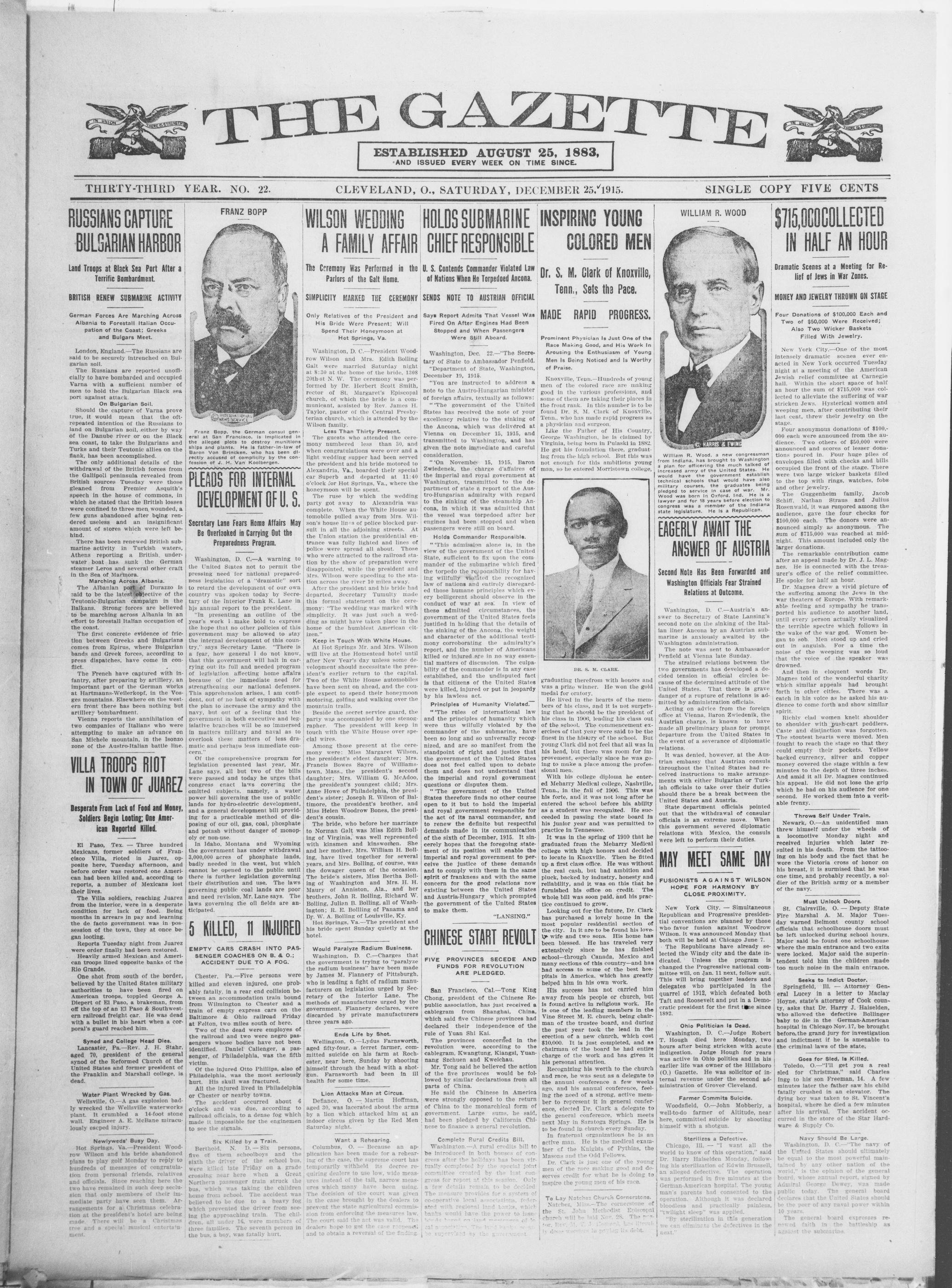
FRANZ BOPP
Franz Bopp, the German consul general at San Francisco, is implicated in the alleged plots to destroy munitions ships and plants. He is father-in-law of Bacon Van Brinken, who has been directly accused of complicity by the confession of J. H. Van Koolbergen.
PLEADS FOR INTERNAL DEVELOPMENT OF U. S.
Secretary Lane Fears Home Affairs May Be Overlooked in Carrying Out the Preparedness Program.
Of the comprehensive program for legislation presented last year, Mr. Lane says, all but two of the bills were passed and today, he urges that congress enact laws covering the omitted subjects, namely, a water power bill governing the use of public lands for hydro-electric development, and a general development bill providing for a practicable method of disposing of our oil, gas, coal, phosphate and potash without danger of monopoly or non-use.
In Idaho, Montana and Wyoming the government has under withdrawal 3,000,000 acres of phosphate lands, badly needed in the west, but which cannot be opened to the public until there is further legislation governing their distribution and use. The laws governing public lands are poor and need revision, Mr. Lane says. The laws governing the oil fields are anticipated.
5 KILLED, 11 INJURED
EMPTY CARS CRASH INTO PASSENGER COACHES ON B. & O.; ACCIDENT DUE TO A FOG.
Chester, Pa.—Five persons were killed and eleven injured, one probably fatal, in a rear end collision between an accommodation train bound from Wilmington to Chester and a train of empty express cars on the Baltimore & Ohio railroad Friday at Falcon two miles south of here.
Two of the dead were employees of the railroad and two were negro passengers whose bodies have not been identified. Daniel Callenger, a passenger, of Philadelphia, was the fifth victim.
Of the injured Otto Phillips, also of Philadelphia, was the most seriously hurt. His skull was fractured.
All the injured lived in Philadelphia
All the injured lived in Philadelphia or Chester or nearby towns.
or Chester or nearby towns. The accident occurred, about 6 o'clock and was due, according to railroad officials, to a dense fog which made it impossible for the enginemen to see the signals.
Six Killed by a Train
Bertheid, N., D. — Six persons five of them schoolboys and the sixth the driver of the school bus were billed late Friday on a grade crossroad here when a Great Northern passenger tram struck the bus, which was taking the children home from school. The accident was believed to be due to a heavy for which prevented the driver from seeing the approaching train. The children, all under 18, were members of three families. The seventeen person in the bus, a boy, was totally hurt.
ESTABLISHED AUGUST 25, 1883. AND ISSUED EVERY WEEK ON TIME SINCE.
WILSON WEDDING A FAMILY AFFAIR
The Ceremony Was Performed in the Parlors of the Galt Home.
Only Relatives of the President and His Bride' Were Present; Will Spend Their Honeymoon at Hot Springs, Va.
Washington, D.C.-President Woodrow Wilson and Mrs. Edith Holling Galt were married Saturday night at 8:30 at the home of the bride, 1308 20th st. N. W. The ceremony was performed by Dr. Herbert Scott Smith, rector of St. Margaret's Episcopal church, of which the bride is a communiant, assisted by Rev. James H. Taylor, pastor of the Central Presbyterian church, which is attended by the Wilson family.
Less Than Thirty Present
The guests who attended the ceremony numbered less, than 30, and when congratulations were over and a light wedding supper had been served the president and his bride motored to Alexandria, Va., boarded their special car Superb and departed at 11:40 o'clock for Hot Springs, Va., where the honeymoon will be spent.
The ruse by which the wedding party got away to Alexandria was complete. When the White House automobile pulled away from Mrs. Wilson's house lines of police blocked pursuit in all the adjoining streets. At the Union station the presidential entrance was fully lighted and lines of police were spread all about. Those who were attracted to the railroad station by the show of preparation were disappointed, while the president and Mrs. Wilson were speeding to the station across the river 10 miles away.
After the president and his bride departed, Secretary Tumulty made this formal statement on the ceremony: "The wedding was marked with simplicity. It was just such a wedding as might have taken place in the home of the humblest American citizen."
Keep in Touch With White House.
At Hot Springs Mr. and Mrs. Wilson will live at the Homestead hotel until after New Year's, day unless some development should necessitate the president's earlier return to the capital.
Two of the White House automobiles have been sent on ahead, and the complete expect, to spend their honeymoon motoring, golfing and walking over the mountain trails.
Beside the secret service guard, the party was accompanied by one stenographer. The president will keep in touch with the White House over special wires.
Among those present at the ceremony were: Miss Margaret Wilson, the president's oldest daughter; Mrs. Francis Bowes Sayre of Williamstown, Mass., the president's second daughter; Mrs. William G. McAdoo, the president's youngest child; Mrs. Anne Howe of Philadelphia, the president's gister; Joseph R. Wilson of Baltimore, the president's brother, and Miss Helen Woodrow Bone, the president's cousin.
The bride, who before her marriage to Norman Galt was Miss Edith Bolling of Virginia, with represented members of the Knox and Kwashoune. She and her mother, Mrs. William H. Bolling, have lived together for several years, and Mrs. Bolling, of course, was the dowager queen of the occasion.
The bride's sisters, Miss Bertha Bolling of Washington aid, Mrs. H. Maury of Anniston, Ala., and her brothers, John R. Bolling, Richard W. Bolling, Julian R. Bolling, all of Washington; R. E. Bolling of Panama and Dr. W. A. Bolling of Louisville, Ky.
Hot Springs, Va.—The president and his bride spent Sunday quietly at the hotel.
Would Paralye Radium Business. Washington, D. C.-Charges that the government is trying to "paralye the radium business" have been made by James M. Flannery of Pittsburgh, who is leading a fight of radium manufacturers on legislation urged by Secretary of the Interior Lane. The methods of manufacture urged by the government. Flannery declares, were discarded by private manufacturers three years ago.
Ends Life by Shot.
Wellington, O.-Lydus Farnsworth, aged fifty-four, a ferret farmer, committed suicide on his farm at Rochester, near here, Sunday by shooting himself through the head with a shotgun. Farnsworth had been in ill health for some time.
Lion Attacks Man at Circus.
Defiance, O.- Martin Hoffman, aged 30, was lacerated at the arms by a lion which attacked him at an indoor circus given by the Red Men Saturday night.
Want a Scheacing:
Columbus, O. - Because an application has been made for a rebuilding of the case, the supreme court has temporarily withheld the decision requiring display to see how well measures restricting the tall, narrow measures which may have been made. The decision of the court was made in the case brought by the dealing to prevent the state surveillance. The decision from enforcing the measure. The court and the dealing helped to
HOLDS SUBMARINE CHIEF RESPONSIBLE
U. S. Contends Commander Violated Law of Nations When He Torpedoed Ancona.
Says Report Admits That Vessel Was Fired On After Engines. Had Been Stopped and When Passengers
Washington, Dec. 22.——The Secretary of State to Ambassador Pemphold.
"Department of State, Washington, December 19, 1915.
"You are instructed to address a note to the Austro-Hungarian minister of foreign affairs, textually as follows:
"The government of the United States has received the note of your excellency relative to the sinking of the Ancona, which was delivered at Vienna on December 15, 1915, and transmitted to Washington, and has given the note immediate and careful consideration.
"On November 15, 1915, Baron Zwiedenek, the charge d'affaires of the imperial and royal government at Washington, transmitted, to the department of state a report of the Austro-Hungarian admiralty with regard to the sinking of the steamship Ancona, in which it was admitted, that the vessel was torpedoed after her engines had been stopped and when passengers were still on board.
Holdé Commander: Responsible.
Holds Commander Responsible.
"This, commander alone is, in the view of the government of the United State, sufficient to fix upon the commander of the submarine which fired the torpedo the re- responsibility for having willfully violated the recognized law of nations and entirely disregarded those humane principles which every belligerent should observe in the conduct of war at sea. In view of these admitted circumstances, no government of the United States can justified in holding that the details of the sinking of the Ancona, the weight and character of the additional testimony corroborating the admiralty's report, and the number of Americans killed or injured are in no way essential matters of discussion. The culpability of the commander is in any case established, and the undisputed fact is that citizens of the United States were killed, injured or put in jeopardy by his lawless act.
Principles of Humanity Violated.
"The rules of international law and the principles of humanity which were thus wilfully violated by the commander of the submarine, have been so long and so universally recognized, and are so manifest from the standpoint of right and justice that the government of the United States does not feel called upon to debate them and does not understand that the imperial and royal government questions or disputes them.
"The government of the United States therefore finds no other course open to it but to hold the imperial and royal government responsible for the act of its naval commander, and to renew the definite but respectful demands made in its communication of the sixth of December, 1915. It sincerely hopes that the foregoing statement of its position will enable the government to perceive the justice of these demands and to comply with them in the same spirit of frankness and with the same concern for the good relations now existing between the United States and Austria-Hungary, which prompted the government of the United States to make them.
CHINESE START REVOLT
FIVE PROVINCES SECEDE AND FUNDS FOR REVOLUTION ARE PLEDGED.
San Francisco, Cal.—Tong King Chong, president of the Chinese Republic association, has just received a cablegram from Shanghai, China, which said five Chinese provinces had declared their independence of the rule of Yuan Shi Kai.
The provinces concerned in the revolution were, according to the cablegram, Kwangtung, Klangsai, Yuannang Szechuan and Kwelchau.
Mr. Tong said he believed the action of the five provinces would be followed by similar declarations from all parts of China.
He said the Chinese in America were strongly opposed to the return of China, to the monarchical form of government. Large sums, he said, had been pledged by California Chinese to finance a general revolution.
Complete Rural Credits Bill
Complete Rural Credits Bill.
Washington — A relief on this bill to
be introduced in such house as may be
appropriate.
INSPIRING YOUNG COLORED MEN
Prominent Physician Is Just One of the Race Making Good, and His Work In Arousing the Enthusiasm of Young Men Is Being Noticed and Is Worthy of Praise.
Knoxville, Teen, Humbleds of young men of the colored race are making good in the various professions, and some of them are taking their places, in the front rank. In this number is to be found Dr. S. M. Clark of Knoxville, Teen, who has made rapid progress as a physician and surgeon.
Like the Father of His Country, George Washington, he is claimed by Virginia, being born in Puskin in 1858. He did his high school work from the high school. But this was not enough for this ambition young man, so he entered Morristown college.
DR. S. M. CLARK.
graduating therefrom with honors and
was a prize winner. He won the gold
medal for oratory.
He lived in the hearts of the members of his class, and it is not surprising that he should be the president of his class in 1958, heading his class out of the school. The commencement exercises of that year were said to be the finest in the history of the school. But young Clark did not feel that all was in his head, but there was room for improvement, especially since he was going to make a place among the professional men.
With his college diploma he entered Mehary Medical college, Nashville, Penn, in the fall of 1906. This was his forte, and it was not long after he entered the school before his ability as a student was recognized. He succeeded in passing the state board in his junior year and was permitted to practice in Tennessee.
It was in the spring of 1910 that he graduated from the Mehary Medical college with 'high honors and decided to locate in Knoxville. Then he fitted up a first class office. He was without the real cash, but und ambitious and pluck, backed by industry, honesty and reliability, and it was on this that he furnished his office on credit. The whole bill was soon paid, and his practice continued to grow.
Looking out for the future, Dr. Clark has purchased a lovely home in the most popular residential section of the city. It are to be found his love-wife and two sons: His home has been blessed. He has traveled very extensively since he has finished school—through Canada, Mexico and many sections of this country—and has had access to some of the best hospitals in America, which has greatly helped him in his own work.
His success has not carried him away from his people or church, but is found active in religious work. He is one of the leading members in the Vine Street M. E. church, being chairman of the trustee board, and during the past year took the lead in the erection of a new church, which cost $10,000. It is just completed, and as chairman of the board he had entire charge of the work and has given it his personal attention.
Recognizing his worth to the church and race, he was sent as a delegate to the annual conference a few weeks ago, and his annual conference, feeling the need of a strong, active member to represent it in general conference, elected Dr. Clark a delegate to the general conference, which meets next May in Saratoga Springs. He is to be found in church every Sunday.
In factorial organizations he is an active man. He is the medical examiner of the Knights of Pythias, the Masons and the Old Fathers.
Dr. Clark is the man of the highest rank in the service of the church, which has greatly helped him in his own work.
To La
SINGLE COPY FIVE CENTS
HARRIS & EWING
William R. Wood, a new congressman from Indiana, has brought to Washington a plan for officering the much talked of police force, and he would have the government establish technical schools that would have also military courses, the graduates being pledged to service in case of war. He is a lawyer and for 18 years before election to congress was a member of the Indiana state legislature. He is a Republican.
EAGERLY AWAIT THE ANSWER OF AUSTRIA
Washington, D. C. — Austria's answer to Secretary of State Lansing, second note on the sinking of the Italian liner Anoura by an Austrian submarine is anxiously awaited by the Washington administration.
The note was sent to Ambassador Penfield at Vienna late Sunday.
The strained relations between the two governments has developed a decided tension in official circles, because of the determined attitude of the United States. That there is grave danger of a rupture of relations is admitted by administration officials.
Acting on advice from the foreign office at Vienna, Baron Zwiedenik, the Austrian charge, is known to have made all preliminary plans for prompt departure from the United States in the event of a severance of diplomatic relations.
It was denied, however, at the Austrian embassy that Austrian consuls throughout the United States had received instructions to make arrangements with either Bulgarian or Turkish officials to take over their duties should there be a break between the United States and Austria.
State department officials pointed out that the withdrawal of consular officials is an extreme move. When this government severed diplomatic relations with Mexico, the consuls were left to perform their duties.
MAY MEET SAME DAY
FUSIONISTS AGAINST WILSON
HOPE FOR HARMONY BY
CLOSE PROXIMITY.
New York City. — Simultaneous
Republican and Progressive presi-
dential conventions are planned by those
who favor fusion against Woodrow
Wilson. It was announced Monday that
both will be held at Chicago June 7.
The Republicans have already se-
lected the Windy city and the date
indicated. Unless the program is
changed the Progressive national
committee will, on Jan. 11 next, follow suit.
This will bring together leaders and
delegates of who participated in the
meetings of 1912, which defeated both
Taft and Roosevelt and put in a Democra-
tic president for the first time since
1892.
Ohio Politician Is Dead.
Washington, D. C.-Judge Robert T. Hough died here Monday, two hours after being stricken with acute indigestion. Judge Hough for years was active in Ohio politics and in his caribbean was owler of the Hillsboro O'Geezet. O'Geezet internal revenue under the second administration of Grover Cleveland.
Farmer Commits Suicide.
Woodsfield, O.-John Mobberly, a well-to-do farmer of Altitude; near here, committed suicide by shooting himself with a shotgun.
Sterilizes a Defective
Chicago, Ill. — "I wear all the world to know of this operation" said Dr. Harry Husbanden Monday, following the sterilization of Dr. Brown Brissell, an allied officer in the operation. He was presented with the medal of the American Presidency by the mayor of Chicago.
IN LITOR
VECKSTER
$715,000COLLECTED IN HALF AN HOUR
Dramatic Scenes at a Meeting for Relief of Jews in War Zones.
MONEY AND JEWELRY THROWN ON STAGE
Four Donations of $100,000 Each and Two of $50,000 Were Received; Also Two Wicker Baskets Filled With Jewelry.
New York City.-One of the most intensely dramatic scenes ever enacted in New York, occurred Tuesday night at a meeting of the American Jewish relief committee at Carnegie hall. Within the short space of half an hour the sum of $175,000 was collected to alleviate the suffering of war stricken Jews. Hysterical women and weeping men, after contributing their last cent, threw their jewelry on the stage.
Four anonymous donations of $100,000 each were announced from the audience. Two others of $50,000 were announced and scores of lesser donations poured in. Four huge piles of envelopes filled with checks and bills occupied the front of the stage. There were two large wicker baskets filled to the top with rings, watches, fobs and other jewelry.
The Guggenheim family, Jacob Schiff, Nathan Straus, and Julius Rosenwald, it was rumored among the audience, gave the four checks for $100,000 each. The donors were announced simply as anonymous. The sum of $75,000 was reached-at midnight. This amount included only the larger donations.
The remarkable contribution came after an appeal made by Dr. J. L. Magnes. He is connected with the treasurer's office of the relief committee. He spoke for half an hour.
Dr. Magnes drew a vivid picture of the suffering among the Jews in the war theaters of Europe. With remarkable feeling and sympathy he transported his audience to another land, until every person actually visualized the terrible spectre which follows in the wake of the war-god. Women began to sob. Men stood up and cried out in anguish. For a time the noise of the weeping was so loud that the voice of the speaker was drowned.
And then in eloquent words Dr. Magnes told of the wonderful charity which similar appeals had brought forth in other cities. There was a catch in his voice as he asked his audience to come forth and show similar spirit.
Richly clad women knelt shoulder to shoulder with push-cart peddlers. Caste and distinction was forgotten. The stoutest hearts were moved. Men fought to reach the stage so that they could empty their pockets. Yellow backed currency, silver and copper money covered the stage within a few minutes to the depth of three inches. And amid it all Dr. Magnes continued his appeal. He did not lose the grip which he had on his audience for one second. He worked them into a veritable frenzy.
Throws Self Under Train.
Newark, O.—An unidentified man threw himself under the tires of a locomotive. Monday night and received injuries which later resulted in his death. From the tattooing on his body and the fact that he wore the Victoria cross of honor on his breast, it is surmised that he was one time, and probably recently, a soldier of the British army or a member of the navy.
Must Unlock Doors
St. Clairsville, O. — Deputy State Fire Marshal A. M. Major Tuesday warned Belmont county school officials that schoolhouse doors must be left.unlocked during school-hours. Major said he found one schoolhouse where the main entrance and two exits were locked. Major said the superintendent told him the children made too much noise in 'the main entrance.
Seeks to Indict Doctor
Springfield, Ill. — Attorney General Lucey in a letter to Maclayne Hoyne, state's attorney of Cook-country, asks that Dr. Harry J. Halselden, who allowed the defective Bollinger baby to die in the German-American hospital in Chicago Nov. 17, be brought before the grand jury for investigation and indictment if he is amenable to the criminal laws of the state.
Goes for Sled. Is Killed.
Toledo. O.—"I'll get you a real sled 'for Christmas," said Charles Ingge to his son Freeman, 14. A few minutes later the father saw his child fatally crushed, in *a* elevator. The dying boy was taken to St. Vincent's hospital, where he died a few minutes after his arrival. The accident occurred in the store of the Star Hardware & Supply Co.
Navy. Should Be Large.
One Year.....$1.50.
Six Months.....1.00
Three Months......50
Subscribers are requested to remit by postoffice money order or registered letter
Entered at the postoffice In Cleveland Ohio, as second-class matter.
Address all communications to
HARRY C. SMITH
Editor and proprietor,
THE GAZETTE,
Blackstone Building, Cleveland, O.
Member Ohio Legislature: 1894
to 1896; 1896 to 1898; 1900 to 1902
THE GAZETTE is the oldest, and has the largest bona fide circulation, double that of any newspaper in the interest of Afro-Americans, published in the state of Ohio, and comparison with any will immediately establish its rank as one of the NEWSIEST AND BEST in the country.
10,000,000 Afro-Americans..
160,000 In Ohio.
20,000 In Cleveland.
Cleveland
State Star
SATURDAY, DECEMBER 25, 1915.
"Let us have faith that right makes might, and in that faith let us to the end dare to do our work to understand it"—Abraham Lincoln.
Latest reports indicate that another "war" is on between the Kroos and Liberians.
Col. Theodore "Brownsville" Rhoeovelt has lost, none of his ability to "play to the galleries," it seems.
Gov. Frank B. Willis should give a few first-class appointments to Ohio's sixty thousand Afro-American Republican voters. He promised to do so.
"Christmas gift!
Those of you who have lived in the South, and many who have not, know what that means. Let us hear from you, please.
President Scarborough certainly "trimmed," and to a "frazile," too, one Charles E. Hall of the Washington, D. C., "Wilberforcians," in last week's Christian Recorder, Philadelphia, Pa.
Senator Foraker's candidacy would inject new life in the campaign, next year, and the party in Ohio needs all it can get from such a good source. By all means, be a candidate, Senator!
It is not surprising that President Wilson cannot recognize the editors he wrote for a college paper 35 years ago. In fact, he cannot recognize the speeches he wrote about the Baltimore platform only three years ago.
A canvass of Democratic State Committee throughout the country has shown their belief that the tariff is to be the big issue in 1916, and that they want something done by this congress to head off the embarrassing question. Too late. The Underwood bill has already done its deadly work on both the Democratic party and the country's enterprise.
If, as announced, Emmett J. Scott, Dr. Booker T. Washington's private secretary, has been selected by the board of trustees of Tuskegee, Ala., Institute, to direct the raising of a $250,000 memorial fund, among our people, for the purpose of erecting a suitable monument on the school campus in honor of the deceased educator, his success in the effort will go a long way toward making him the principal of the institute.
Senator Kern having declared that Wilson is the greatest President the country has had since the days of Jefferson, the Philadelphia "Press" sets out to read the Senator a lesson in history. Cannot this matter be compromised, brethren? Why not say that Wilson is the greatest candidate the Democratic party has had since the days of William J. Bryan, and let it go at that?
Senator John Sharp Williams of Mississippi says he is in no fear of a force bill from a Republican Congress, even if cloture rules in the Senate. Mr. Williams may be right in one respect—but he should remember that there is a constitutional alternative which the South may not relish. If the South wishes to curtail her voting strength, it is possible to compel the South to take a reduction in her representation in Congress and in the Electoral College. This would not be force-bill legislation, technically speaking; but it would be quite as effective.
Statistics furnished by the Louisville (Ky.) American Baptist, show conclusively that our good friend, Editor W. H. Steward of that paper, is NOT dean of the Afro-American editorial corps, because he has not been an editor for as many consecutive years as Editor J. R. Clifford, of the Martinsburg (W. Va.) Pioneer Press. According to the American Baptist's statistics, he was associate-editor, with Rev. A. C. Carpenter as editor, for a portion of the time, and has served as editor a less number of consecutive years than Brother Clifford of the Pioneer Press. In the light of all the information, relative to the deanship of the race press, this seems to be the logical and correct conclusion.
SCOTT FOR PRINCIPAL.
Our Alabama newspapers are viewing with deep concern the differences
among the trustees of Tuskegee Institute that made it impossible for them to elect a successor to Dr. Booker T. Washington at the board meeting, last week Monday, Dec. "13." There was a deadlock, Major Moten of Hampton, Va., Institute and Secretary Emmett J. Scott being the two candidates for principal of the Institute, balloted for Anent this, the Montgomery (Ala.) Daily Advertiser, of recent date, says: "If eighteen years of service mean anything at all, and particularly service as Secretary Scott, has rendered, as the right hand man of Dr. Booker Washington, it does not seem that there should be much room for division. We do not question either the capacity or the character of Major Moten, who is the right hand man at Hampton Institute, but the fact that Emmet J. Scott is acceptable to the Southern people who want a man familiar with all conditions at the head of the institute, and the fact that he is equally well known to the men of the North, by reason of his intimate connection, with all of Tuskegee's varied interests, and greatly the argument of those on the board who wish to see Mr. Scott selected as the successor of Dr. Washington."
HELPFUL TO THE SOUTH ANYWAY.
Democrats are inclined to talk volubly about the great benefits accruing to the business of the country from the operations of the Federal Reserve Bank system. If they are Southern Democrats, they have a sound sectional basis for so declaring. The December bulletin of the Federal Reserve Board furnishes additional evidence that the South is the chief beneficiary of the new system. According to this bulletin there are 7,649 member banks in the Federal Reserve system. In November 796, or a little more than ten per cent, of them took advantage of the rediscount privilege, which is the chief means of help to the business man. Of this number, 389, or very nearly half, came from the Southern districts of Richmond, Atlanta and Dallas. In volume of business transacted the percentages are even more impressive. The Richmond bank had 21.7 per cent of the total rediscounts for the month; Atlanta has 23 per cent; Dallas has 15.7 per cent. The three Southern reserve banks combined had 60.4 per cent of all the rediscounts in the entire country. Boston and New York had less than one per cent each, and Chicago had only 8.1 per cent. The next time we hear a democrat boasting what a great thing the Federal Reserve system is for business we shall move to amend so that it will read, "Southern business."
ASSERT YOUR RIGHTS
Denounce Race Segregation and Ask
Equal Opportunity—Officers
Elected
Philadelphia, Pa.—An address to the country urging our people to use their votes, and every other means in their power, to receive full recognition and to overthrow segregation was sent out last week Thursday at the final session of the eighth annual meeting of the National Rights League, held at the Allen A. M. E. Church, this city. Prominent speakers from various parts of the country were heard. The league, in addition to its strong address to the country, passed resolutions deprecating the seizure of Haiti, which it contrasted with the Mexican policy, and voted to send a delegation to demonstrate to the S. Senate. Other resolutions endorsement of the segregation of our government clerks; appealed to the public to oppose plays, slandering the race, and urging our men in the South to register. Officers were elected as follows: President, Rev. Byron Gunner. Hillburn, our correspondent. William Montgomery, Boston, and M. W. Spencer, Delaware; recording secretary, Dr. J. L. Johnson, Ohio; treasurer, Thomas Walker Washington; national organizer, Rev. R. C. Ransom, New York; chaplain, Rev. E. George Biddle, Connecticut.
BURTON OHIO'S CHOICE?
The newspapers state that Ohio will present the name of ex-Senator Burton as her choice for President. The Bee does not recall a single instance during his entire term as Senator from Ohio when he ever opened his mouth in defense of the race. He never spoke against a bill attacking the rights of the race. The Bee also recalls that he was always too busy to ever accept an invitation to address the nation. He said he bers that Mr. Burton was so satisfied with the jim-crowning of the Negro employees in the government service by the Wilson administration that he never uttered a sound against it. The Bee wants a candidate for President who will stand by the race. Will Negro voters want Burton? Will Burton please the Negro delegates to the next republican convention? The Bee asks this question. Will Wesley be the favorite son, No Burton for the Bee. Might as well retain the present incumbent as to name the ex-Senator from Ohio—Washington (D. C.) Bee.
How About "The Black Battalion?" Tuskegee, Ala.-Former President Roosevelt addressing a gathering at Tuskegee Institute, recently, paid tribute to the memory of Booker T. Washington, who died Nov. 14. The memorial services were presided over by Seth Low, president of the board of trustees of the institute. Col. Theo. "Brownsville" Roosevelt declared that when he was president, Dr. Washington was one of the few men to whom he turned for advice and wisdom that he would not give me one word based on a selfish motive, and because he would state what in his best judgment was for the best interests of the people of the entire country."
Beat Down the Color Line!
Beat Down the Color Line!
Boston, Mass.—On Dec. 10, Mayor Curley appointed Fred. Smith First Assistant Assessor at a salary of $1,000 for about 100 days' work, and besides this he receives $50 for every day he testifies in court as an expert appraiser of property. He has been employed in the Assessor's office for twelve years as a second assistant at the City of Chicago for 55 days a day. The Civil Service Commission certified him twice before for the same position, but because of his color he was each time rejected. At the time of his appointment he stood at the top of the civil service list.
THE GAZETTE, CLEVELAND, O.. SATURDAY, DECEMBER 25, 1915
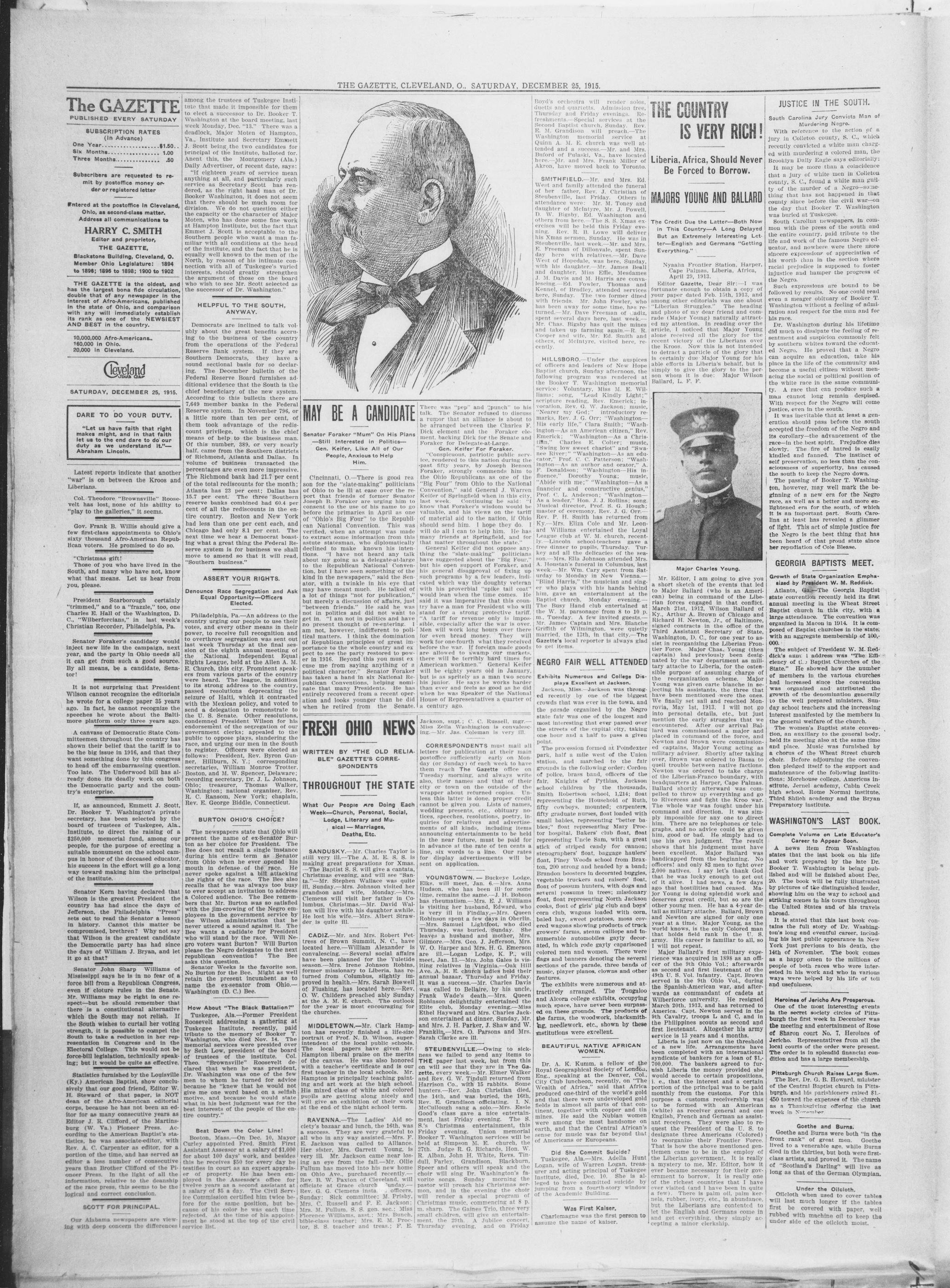
MAY BE A CANDIDATE
Senator Foraker "Mum" On His Plans
—Still Interested in Politics—
Gen. Keifer, Like All of Our
People, Anxious to Help
Cincinnati, O—There is good reason for the "slate-making" politicians of Ohio to be ill at ease over the report that friends of former Senator Joseph B. Foraker are urging him to consent to the use of his name to go before the primaries in April as one of "Ohio's Big Four" to the Republican National Convention. That was why he wanted to extract some information from this astute statesman, who diplomatically declined to make known his intentions. "I have not heard any talk about my going as a delegate-at-large to the Republican National Convention. I have seen something of the kind in the presidential candidate. With a twinkle in his eye that may have meant much. He talked of a lot of things "not for publication," but merely a discussion of affairs, just "between friends." He said he was not in politics and did not want to get in. "I am not in politics and have no present thought of re-entering. I am not interested in political matters. I think the domination of Republican principles of great importance to the whole country and expect to see the party restored to power in 1916. Beyond this you must excuse me from saying anything of a political character." Senator Foraker has taken a hand in six National Re-elections, and he has not nominate that many Presidents. He has entirely recovered from a recent operation and looks younger than he did when he retired from the Senate.
FRESH OHIO NEWS
FRESH OHIO NEWS
WRITTEN BY "THE OLD RELIA
BLE" GAZETTE'S CORRE-
SPONDENTS
THROUGHOUT THE STATE
What Our People Are Doing Each Week—Church, Personal, Social, Lodge, Literary and Musical—Marriages, Deaths, Etc.
SANDUSKY.—Mr. Charles Taylor is still very ill—The A. M. E. S. S. is making great preparations for Xmas—The Baptist S. S. will give a cantata Christmas evening, and will see "Santa"—Mr. Stephen Wallace was visited ill, Sunday, Mrs. Johnson visited her grandson and wife. Monday—Mrs. Clemens will visit her father in Columbus, Christmas—Mr. David Walton will live with his daughter awhile He lost his wife—Mrs. Albert Strawder is quite ill.
CADIZ. Mr. and Mrs. Robert Pettress of Brown Summit, N. C. have located here.—William Alexander is convalescing.—Several social affairs have been planned for the Yuletide season.—Mrs. Irene Johnson Robins, former missionary to Liberia, has returned from Columbus, slightly improved in health.—Mrs. Sarah Boswell of Flushing, has located here.—Rev. James Preached Sunday at the A. M. E. church. The outlook for the year is most encouraging for the churches.
MIDDLETOOWN. Mr. Clark Hampton has recently finished a life-size portrait of Prof. N. D. Wilson, superintendent of the local public schools. The local papers have given Mr. Hampton liberal praise on the merits of the canvas. He was also honored with a teacher's certificate and is our first teacher in the local schools. Mr. Hampton is principally teaching painting and art work at the high school. His mixed class of white and colored puns are getting along nicely and will give an exhibition of their work at the end of the night school term.
RAVENNA—The Ladies' Aid so ciety's bazaar and the lunch, the 16th was a success. They are very grateful to all in who any way assisted. Mrs. F. E. Jackson was called to Alliance. Her sister, Mrs. Garrett Young, is very ill. Mr. Jackson came near losing an eye from the fall. Mr. Ollie Fullum has moved into his new home on Ohio Ave., purchased recently. Rev. B. W. Paxton of Cleveland, will officiate at Grace church unday. Rev. G. S. Clemens insts. unday. Randa M. G. Clemens insts. M. Prisby. C. Russell and F. E. Jackson; Mrs. M. Fullum, S. S. gen. sec.; Mrs. Florence Williams, asst.; Mrs. Bunch, bible-class teacher; Mrs. E. M. Proctor; S. S. teacher and treas.; F. E.
There was "pep" and "punch" to his talk. The Senator refused to discuss a rumor that an alliance is about to be arranged between the Charles F Dick element and the Foraker element, backing Dick for the Senate and Foraker for Delegate-at-Large.
Gen. Keifer for Foraker.
"Good job," he continued. "I commend the public service, rendered to this nation during the past fifty years, by Joseph Benson Foraker, strongly commends him to the Ohio Republicans as one of the "Big Four" from Ohio to the National Convention," said General J. Warren Keifer of Springfield when in this city last week. Continuing he said: "I know that Foraker's wisdom would be valuable, and his views on the tariff would be valuable, and his views on the tariff should send him. I hope they do. will do all I can to help him. He has many friends at Springfield, and for that matter throughout the state."
General Keifer did not oppose anything the "slate-making" politicians have suggested about the "Big Four," but his open support for the Foraker, and his general disapproval of fixing up such programs by a few leaders, indicated way the doughty veteran with his principal "spike tail cont" when he told the timewarner said it was imperative that this country have a man for President who will stand for a strong protective tariff. "A tariff for revenue only is impossible, especially after the war is over. Men will work long hours over there for even bread money. They will work for one-fourth what they received before the war. If foreign made goods are allowed to swamp our markets, there will be terribly hard times for American workmen." General Keifer will be eight years old in January, he is making a new his junior. He says he works harder than ever and feels as good as he did when he was Speaker of the National House of Representatives a quarter of a century ago.
Jackson, supt.; C. C. Russell, mgr.—Miss Zella Washington is convalescing.—Mr. Jas. Coleman is very ill.
CORRESPONDENTS must mail all letters for publication at their main postoffice sufficiently early on Monday (or Sunday) of each week to have them reach The Gazette office on Tuesday morning, and always write also, their names and that of their city or town on the outside of the wrapper about returned copies. Unless this latter is done, proper credit cannot be given you. Lists of names of the recipients, of others, of tapes, speeches, resolutions, poetry, inquiries for relatives and advertisements of all kinds, including items announcing entertainments to be held in the near future, must be paid for in advance at the rate of ten cents a line, six words to a line. Our rates for display advertisements will be sent on application.
YOUNGSTOWN — Buckeye Lodge Elks, who meet, Jan. 6 — Mrs. Anna Hudson, who has been ill for some time, remains the same. J. H. Bobson has rheumatism — Mrs. E. J. Williams is visiting her husband, Edward, who is very ill in Findlay — Mrs. Queen Robinson spent a few days in Oberlin. Mrs. Samuel Lightfoot, who died Tuesday, leaves a husband and mother, Mrs. Gilmore — Mrs. Geo. J. Jefferson, Mrs. W. O. Harper and Mrs. H. G. Emerson are ill — Logan Lodge, K. P., will meet, Jan. 13 — Mrs. John Gales is visiting relatives in Virginia — Oak Hill Ave. A. M. E. church ladies held their annual bazaar, Thursday and Friday. It was a success. Mr. Charles Davis was called to Bellaire, by his uncle, Robinsonade's eighth, entertained the Elite club, Monday evening. Miss Ethel Hayward and Mrs. Charles Jackson entertained at dinner, Sunday, Mr. and Mrs. J. H. Parker, J. Shaw and W. Franklin. — Mrs. O. Parsons and Mrs. Sarah Clarke are ill.
STEUBENVILLE—Owing to sickness we failed to send any items to THE paper last week, but from this on will see that they are in The Gazette, every week. Mr. Elmer Walker and Rev. G. W. Tindall returned from Harrison Co. with 15 rabbits. Some hunters. Rev John Christian died, the Rev E. Grandison officiating. I. N. McCullough sang a solo.—Mrs. Essie Good's class gave a nice entertainment, last Friday evening. The S. S.'s Christmas entertainment, this Friday evening. Union memorial Booker T. Washington services will be held at Simpson M. church, the Rev E. Grandison, the R. Alban, John H. White, Revs. Tindall, Farley, Grandison, Blackson, Speer and others will speak and the choir will sing Dr. Washington's favorite songs. Sunday morning the pastor will preach his Christmas sermon, and in the evening the choir will render a special program of Christmas music, commencing at 8 p.m. sharp the Gaines Trio, the entertainment, the 23th. A Jubilee concert, Thursday evening, and on Friday
Boyd's orchestra will render solos, duets and quartets. Admission free, Thursday and Friday evenings. Refreshments—Special services at the Second Baptist church, Sunday. Rev E. M. Grandison will preach—The Washington memorial service at Quinn A. M. E. church was well attended and a success—Mr. and Mrs. Buford of Pulaski, Va., have located here—Mr. and Mrs. Frank Miller of Akron, have moved back to Toronto
SMITHFIELD.—Mr. and Mrs. Ed. West and family attended the funeral of her father, Rev. J. Christian of Steubenville, last Friday. Others in attendance were: Mr. M. Toney and daughter of McIntyre, Mr. J. Powell, D. W. Bigsby, Ed. Washington and others from here—The S. X. S.mx exercises will be held this Friday evening. Rev. R. B. Lowe will deliver his Xmas sermon, Sunday. He was in Steubenville, last week.—Mr. and Mrs. P. Bemham Dillowhale, spent sun day here with him. The West of Hopedale, was here, Sunday, with his daughter.—Mr. James Beall and daughter, Miss Effie, Mesdames J. M. Davis and M. Harris are convalescing.—Ed. Fowler, Thomas and Kennel, of Bradley, attended services here, Sunday. The two former dined with friends. Mr. John Fowler, who has been away for some time, has returned.—Mr. Dave Freeman of Cadiz days here, last week.—Mr. Chas. Bigsby, attended and taken up farming again.—R. R. Cooper and wife, Mr. Ed. Smith and others, of McIntyre, visited here, recently.
HILLSBORO—Under the auspices of officers and leaders of New Hope Baptist church, Sunday afternoon, the following program was rendered at the Booker T. Washington memorial service: Voluntary, Miss M. E. Williams; song, "Lead Kindly Light"; scripture reading, Rev. Emerick; invocation, Rev. G. W. Jackson; music, Nearer, my God; introductory remembrance, Rev. J. A. Wiggins; his early life, Clara Smith; "Washington—As an American citizen," Rev. Emerick; "Washington—As a Christfier," Charles E. Colter; music, "Swing low sweet charlot" and "Swanee River"; "Washington—As an educator," Prof. C. C. Patterson; "Washington—As an author and orator," F. A. Donaldson; "Washington—His influence," Prof. A. J. Wiggins; "Abide with me"; "Washington—As financier and constructive genius," Prof. C. L. Anderson; "Washington—As a leader," Hon. J. J. Rollins; song, "Museum director, Rev J. G. Orr." Rev. P. H. has returned from Ky., Mrs. Eliza Cole and Mr. Leonard Williams entertained the Loyal League club at W. M. church, recently—Lincoln school-teachers gave a free dinner to pupils, Thursday. Turm of the church, Mrs. Eliza Johnson, Mrs. Eliza Johnson attended Mrs. A. Houston's funeral in Columbus, last week. Mr. W. Cary spent from Saturday to Monday in New Vienna—"Blind Harris," the musician and singer who plays with his hands behind him, gave an entertainment at the Baptist church, Monday evening.—The Busy Hand club entertained at the M. V. parsonage from 8 to 10 p. M. James Captain and Mrs. James Captain and Mrs. Blanche Griffith of Wilmington, were quietly married, the 13th in city.—The Gazette's local reporter is always glad to get its items.
NEGRO FAIR WELL ATTENDED
Exhibits Numerous and College Displays Excellent at Jackson
prayes Excellent at Jackson.
Jackson, Miss.-Jackson was thronged recently by one of the biggest crowds that was ever in the town, and the parade organized by the Negro state fair was one of the longest and most interesting that ever passed over the streets of the capital city, taking one hour and a half to pass a given point.
The procession formed at Poindexter park, half a mile west of the Union station, and marched to the fair grounds in the following order: Cordon of police, brass band, officers of the fair, Knights of Pythias, Jackson school children by the thousands, Smith Robertson school, 1,214; float representing the Household of Ruth fifty cowboys, mounted; carpenters, fifty graduate nurses, float loaded with small babies, representing "better babies"; float representing Mary Proctor hospital, Bakers' club float, float representing Uncle Sam, with a great stick of striped candy for cannon; stenographers' float, baggage haulers' float, Piney Woods school from Braxton, 200 strong and headed by a band; Brandon boosters in decorated buggies, vegetable truckers and raisers' float, float of possum hunters, with dogs and several possums in trees; missionary float, float representing North Jackson cooks, float of girls' pig club and boys' corn club, wagons loaded with corn, baled hay, sweet potatoes, moss covered wagons showing products of truck growers' farms, steam calliope and innumerable automobiles gayly decorated, in which rode gayly caprisoned colored men and women. There were flags and banners denoting the several sections of the parade, three bands of music, player pianos, clowns and other features.
The exhibits were numerous and attractively arranged. The Tongaloo and Alcorn college exhibits, occupying much space, have never been surpassed on these grounds. The products of the farms, the woodwork, blacksmithing, needlework, etc., shown by these institutions were excellent.
BEAUTIFUL NATIVE AFRICAN WOMEN.
Dr. A. K. Kumm, a fellow of the Royal Geographical Society of London, Eng., speaking at the Denver, Col. Club luncheon, recently, on "The Wealth of Africa," said that Africa produced one-third of the world's gold and that there were undeveloped gold fields in almost all parts of that continent, together with copper and tin mines. He said the Nubian women were among the most handsome on earth, and that the Central African's sense for music was far beyond that of Americans or Europeans.
Did She Commit Suicide?
Tuskegee, Ala—Mrs. Adella Hunt Logan, wife of Warren Logan, treasurer and acting principal of Tuskegee Institute, died, Dec. 10. She is alleged to have commuted suicide by fire from the university's window of the Academic Building.
Was First Kaiser.
Charlemagne was the first person to assume the name of kaiser.
THE COUNTRY IS VERY RICH!
Liberia, Africa, Should Never Be Forced to Borrow.
MAJORS YOUNG AND BALLARD
The Credit Due the Latter—Both Now in This Country—A Long Delayed But an Extremely Interesting Letter—English and Germans “Getting Everything.”
Nyaaha Frontier Station, Harper, Cape Palmas, Liberia, Africa, April 29, 1913.
Editor Gazette, Dear Sir:—I was fortunate enough to obtain a copy of your paper dated Feb. 15th, 1913, and among other editorials was one about Libarian juggles. The headings and rade (Major Young) naturally attracted my attention. In reading over the article, I noticed that Major Young alone received all the glory for the recent victory of the Liberians over the Kroos. Now this is not intended to detract a particle of the glory that is certainly due Major Young for his able efforts in Liberia's behalf, but is also due the glory to the per son whom it is due: Major Wilson Ballard, L. F. F.
Major Charles Young.
Mr. Editor, I am going to give you a short sketch of the events that led to Major Ballard (who is an American) being in command of the Liberian forces engaged in that conflict. March 21st, 1912, Wilson Ballard of Ky., Arthur H. A. Brown of Chicago and Richard H. Newton, Jr., of Baltimore, signed contracts in the office of the Liberian forces to Washington, D. C., for one year to assist in reorganizing the Liberian Frontier Force. Major Chas. Young (then captain) had previously been designated by the war department as military attaché to Liberia, for the ostensible purpose of assuming charge of the reorganization scheme. Major Young was given carte blanche in sequestration, and have been mentioned were the ones. We finally set sail and reached Monrovia, May 1st, 1913. I will not go into personal details, etc., but just mention the early struggles that we encountered. After our arrival Ballard was commissioned of the force, and Newton and Brown were commissioned to serve in the military adviser. Shortly after taking over, Brown was ordered to Bassa to Newton trouble between native factions. Newton was ordered to take charge of the Liberian-Franco boundary, with headquarters at Harper, Cape Palmas. Ballard shortly afterward was compelled to throw up everything and give him, good or bad. He simply had to use his own judgment. The result shows that his judgment must have been excellent. Major Ballard was handicapped from the beginning. No officers! and only $2 men to fight over that he was lucky enough to get out of it alive. I had news, a few days ago that hostilities had ceased. Major Young is doing splendid work and deserves great credit, but so are the other young men. He has a 4-year detail as military attaché. Ballard, Brown and Newton are signed for only one year at a time. Major Young, as the captain of the Liberian forces that holds field rank in the U. S. army. His career is familiar to all, so I will not repeat.
Major Ballard's first military experience was acquired in 1888 as an officer of the 9th Ohio Vol.; afterwards as second and first lieutenant of the 49th U. S. Vol. Infantry. Capt. Brown served in the 9th Ohio Vol., during the Spanish-American war, and afterwards as commander of the Army at designated March 20th, 1913, and has returned to America. Capt. Newton served in the 9th Cavalry, troops L and C, and in the Philippines scouts as second and first lieutenant. Altogether his army service is 13 years and 4 months.
Liberia is just now on the threshold of a new life. Arrangements have been completed with an international syndicate of bankers for a loan of $1,700,000. The bankers agreed to furnish Liberia the money provided she would accede to certain propositions, and to provide the portion of the principal was to be paid monthly from the customs. For this purpose a customs receivership was to be formed with an American (white) as receiver general and one English, French and German as assistant receivers. They were also to request the President of the U. S. to designate three Americans (Colored) to reorganize their Frontier Force. That is how the above mentioned gentlemen came to be in the employ of the Liberian government. It is really a mystery to me. Mr. Editor, how it ever became necessary for their government to borrow. It is really one of the richest countries that I have visited, and that I have inquire a few). There is palm oil, palm kernels, rubber, ivory, etc. in abundance, but the Liberians are contented to let the English and Germans come in and get everything, they simply accepting a minor clerkship.
JUSTICE IN THE SOUTH.
South Carolina Jury Convicts Man of Murdering Negro.
With reference to the action of a jury in Colleton county, S. C., which recently convicted a white man charged with murdering a colored man, the Brooklyn Daily Eagle says editorially: It may be more than a coincidence that a jury of white men in Colleton county, S. C., found a white man guilty of the murder of a Negro—something that has not happened in that county since before the civil war—on the day that Booker T. Washington was buried at Tuskegee.
South Carolina newspapers, in common with the press of the south and the entire country, paid tribute to the life and work of the famous Negro educator, and nowhere were there more sincere expressions of appreciation of his worth than in the section where racial prejudice is supposed to foster injustice and hamper the progress of the Negro.
Such expressions are bound to be followed by results. No one could read even a meager obituary of Booker T. Washington without a feeling of admiration and respect for the man and for his race.
Dr. Washington during his lifetime did much to dissipate the feeling of resentment and suspicion commonly felt by southern whites toward the educated Negro. He proved that a Negro can acquire an education, take his place in the life of the community and become a useful citizen without menacing the social or political position of the white race in the same community. A race that can produce such a man cannot long remain despised. With respect for the Negro will come justice, even in the south.
It was inevitable that at least a generation should pass before the south accepted the freedom of the Negro and its corollary—the advancement of the race in the best spirit. Prejudice dies slowly. The fire of hatred is easily kindled and fanned. The instinct of self preservation, no less than the consciousness of superiority, has caused the south to keep the Negro down.
The passing of Booker T. Washington, however, may well mark the beginning of a new era for the Negro race, as well as a better and more enlightened era for the south, of which it is an important part. South Carolina at least has revealed a glimmer of light. This act of simple justice for the Negro is the best thing that has been heard of that proud state since her repudiation of Cole Blease.
GEORGIA BAPTISTS MEET.
Growth of State Organization Emphasized by President W. M. Reddick.
Atlanta, Ga. The Georgia Baptist state convention recently held its first annual meeting in the Wheat Street Baptist church in this city, with a large attendance. The convention was organized in Macon in 1914. It is composed of Baptist churches in the state, with an aggregate membership of 100,000.
The subject of President W. M. Reddick's annual address was "The Efficiency of the Baptist Churches of the State." He showed how the number of members in the various churches had increased since the convention was organized and attributed the growth of the denomination generally to the well prepared ministers. Sunday school teachers and the increasing interest manifested by the members in the general welfare of the church.
The women's Baptist state convention, an auxiliary to the general body, held its meeting also at the same time and place. Music was furnished by a chorus of the Wheat Street church choir. Before adjourning the convention pledged itself to the support and maintenance of the following institutions: Morehouse college. Americus institute, Jernel academy, Cabin Creek high school, Rome Normal Institute, Third Shiloh academy and the Bryan Preparatory institute.
WASHINGTON'S LAST BOOK.
Complete Volume on Late Educator's Career to Appear Soon.
A news item from Washington states that the last book on his life and work prepared by the late Dr. Booker T. Washington is being published and will be finished about Dec. 20. The book will be fully illustrated by pictures of the distinguished leader, showing him on the way to school and striking scenes in his tours throughout the United States and of his travels abroad.
It is stated that this last book contains the full story of Dr. Washington's long and eventful career, including his last public appearance in New York just previous to his death, the 14th of November. The book comes as a happy omen to the millions of people of both races who were interested in his work and who in various ways were helped by his life of toll and usefulness.
Heroines of Jericho Are Prosperous.
One of the most interesting events in the secret society circles of Pittsburgh the first week in December was the meeting and entertainment of Rose of Sharon court no. 7. Heroines of Jericho. Representatives from all the local courts of the order were present. The order is in splendid financial condition and has a large membership.
Pittsburgh Church Raises Large Sum.
The Rev. Dr. G. B. Howard, minister of the Central Baptist church in Pittsburgh, and his parishioners raised $1,450 toward the expenses of the church as a Thanksgiving offering the last week in November.
Goethe and Burns
Goethe and Burns were both "in the front rank" of great men. Goethe lived to a venerable age, while Burns died in the thirties, but both were first-class artists, and proved it. The name of "Scotland's Darling" will live as long as that of the German Olympian.
Under the Oilcloth
Oilcloth when used to cover tables will last much longer if the tables first be covered with paper, well rubbed with machine oil to keep the under side of the oilcloth moist.
HER TONIC is the result of scientific study of the causes of diseases of the scalp.
Instead of treating effects of the diseases she treats the causes, eliminating the same and leaving the scalp in a healthy condition that can be maintained by using her Hair Tonic and Invigorator, according to her directions.
Madame C. H. Jones Hair Tonic and Invigorator is guaranteed to stop the falling out of the hair and to make the hair grow.
STERLING
5 and 10 Cent Store
3003 Central Ave.
Watch Our Windows
For Bargains
Colored Salesladies
We close at 6 P.M. every evening except Saturday
Arlington Pharmacy
WE WILL ACCEPT THIS ADVERTISEMENT FOR FIVE CENTS IN TRADE, TO APPLY ON ANY PURCHASE OF TWENTY-FIVE CENTS OR MORE.
E. Rukenstein, Ph. C., Prop.
&. W. Cor. Central Ave. & E.
55th St.
J. LOMSKY
3816-3820 Central Ave.
DRY GOODS
LADIES' AND GENT'S
FURNISHINGS
Try Our
Lomsky Special $1.00 Corsets,
Also our Ladies' $1.00 Waists
They are good
Where do you buy your Collars, Shirts, Neckwear, etc.?
is the.place to get Everything in the Haberdasher line.
2922 Central Ave.
The Pride of Carolina
The State Agricultural and Mechanical College of South Carolina Orangeburg, S. C. Next session begins September 29th and ends May 25th, 1916.
No Tuition, no Room Rent, no
Charges for Water, Lights or
Fuel. Entrance Fee $10.00.
Board $6.00 per Month in Advance.
Books, Laundry and
Personal Expenses Extra.
Every Modern Facility, Standard
Equipment. A Faculty of
57 Officers and Instructors.
For Information and Catalogue, Write
R. S. Wilkinson, Pres.
Orangeburg, S. C.
Central 3371
STARLIGHT'S CAFE
A. D. Boyd, Prop.
J. C. Hudson, Mgr.
J. H. Starkey, Mixologist
Choice Wines, Liquors and Cigars
3221 Central Ave., Cleveland, O.
Our advertisers want your trade. Those who do not ask for it in The Gazette certainly care little, if at all, for it. Therefore, we urge our readers and all of our friends to patronize those who ask for your trade in this paper.
Where to Purchase The Gazette
Where to Purchase The Gazette
*OPEN SUNDAYS
NOTICE TO SUBSCRIBERS
Subscribers not receiving The us at once. We desire every copy. We advise our patrons to carie disceptions before making purchases this paper should have the patrons that they advertise is assurance the Local reading notices (adve words in a line).
Social an
Subscribers not receiving The Gazette regularly should notify us at once. We desire every copy delivered promptly.
We advise our patrons to carefully examine The Gazette's advertisements before making purchases. Business men who advertise in this paper should have the patronage of Afro-Americans. The fact that they advertise is assurance that they want it.
Local reading notices (advertisements) ten cents a line (six words in a line).
Our
Classified Ad
Department
FOR RENT.—Eight-room house on
E. 43d St. Bath and furnace. Com-
fortable home. Very reasonable. Apply at 2271 E. 49th St. or 'phone. Rosedale 1738 R. 2t.
FOR RENT.—Nicely furnished
room for single person or couple. 2218
E. 43rd St.
WANTED—An active young man,
preferably a student in one of our local high schools or colleges, who desires to make some money, without any investment, during his spare hours. Address Box 4. The Gazette office, Blackstone Bldg, City.
FOR SALE.—Good houses; two and three hundred dollars down. S. E. Woods, 2828 Central Av. Bell 'phone, Prospect, 996.
FOR RENT.—Houses and Rooms.—If you have them to rent or if you want to rent, advertise in The Gazette. It brings results.
NOTARY PUBLIC.—For such services call at The Gazette office, No. 2 Blackstone building, No. 1424 W Third Street, near Superior Ave.
FOR SALE.—Houses or lots. If you have either or anything else to sell, or if you wish to purchase, advertise in The Gazette. If anything can bring you results, it can and will.
* Any of your relatives or
friends, young or old, will
appreciate a year's subscription
of old reliable 'Gazette.
Try it!
Cleveland
Sixth City
Mrs. H. S. Shlaughter and son, who have been quite ill for ten days, are convalescing.
Be sure to read carefully the letter from Africa published elsewhere in this paper.
Robert Moseley has been doing excellent work at the Citizens' mission, 1030 Webster Av.
Prof. A. W. Whalley of New York city, "human rights and educational lecturer," arrived in this city, recently.
Thos. McAlpin has returned to the city from Columbus and a host of his friends and acquaintances are pleased to see him in the city again.
Wanted—1,000 men to trade regularly at the Central Shirt Shop, 2922 Central Ave. Hats, caps, neckwear, underwear, arrow collars and shirts, etc.-Adv.
An interesting meeting was held in the office of 5 E. Woods Clayton Brooklyn evening, for the purpose of perfecting an effective political organization.
The Gazette acknowledges the receipt of a neat "Merry Christmas" card, wishing it "A bright and happy New Year," from the "trustee board of the Allegretto club." The editor of The Gazette acknowledges the receipt of a very pretty Christmas card wishing it "A Merry Christmas at Happy New Year" from the Handy, Altoona, Ohio has a marked talent for the violin. She is studying at the New England Conservatory, Boston. — Grace Lucas-Thompson in Indianapolis Freeman, Dec. 18, '15. Cleveland has been selected as the place for the 1916 meeting of the NationalEqual Rights League, which just closed its annual meeting at Philadelphia. The league is on record as opposed to the candidacy of President Wilson. Holiday dances at Haltnorth's hall, E. 55th St. and Woodland Av. Cleveland, O. will be given by the Oriental club. Christmas, Dec. 25, and New Year, Jan. 1. Dancing, 8:30 p. m. to 1:30 a. m. Admission, 50 cents. May Moore's orchestra—Adv.
The first Afro-American police sergeant and lieutenant is Lieut. John Anderson (now on the pension roll) of this city, and not Lieut. W. E. Childs of Chicago. Anderson was appointed sergeant, Jan. 17, 1898, and lieutenant, June 22, 1908.
The Cincinnati Republican, "the paper with a punch," Matt Glaser, editor, re-published in its issue of Dec. 29, '75. The Gazette's "Senator Foraker Should be a Candidate," with well displayed headlines, and credited it to the "old reliable."
The meeting of the Advisory Committee of the Cleveland Foundation's
THE GAZETTE, CLEVELAND, O., SATURDAY, DECEMBER 25, 1915.
*S. A. LUCAS,
3943 Central Ave.
The Gazette regularly should notify
delivered promptly.
fully examine The Gazette's adver-
sions. Business men who advertise in
image of Afro-Americans. The fact
that they want it.
tirements) ten cents a line (six
Personal
school survey, was held in the Assemble Room of The Hollenden, Monday noon. The subject was "Financ-
ing the Public Schools" and the speak-
er, Dr. Leonard P. Ayres, director of
the survey.
Mrs. Nancy Snelson Bronson, age 66, of Los Angeles, Cal., mother of Rev. F. G. Snelson, former pastor of St. James A. M. E. church of this city, now located in Chicago, where he is in charge of St. Mary's A. M. E. church, died there, Nov. 26. Dr. Snelson attended his mother's funeral.
The editor of The Gazette acknowledges the receipt of an invitation from St. Mary's Musical club to attend a violin recital to be given by Master Louia V. Jones, Tuesday evening, at Gallaghan's dancing academy. Committee: Mrs. F. J. Kitzmiller, Mrs. H. Jones, Mrs. Lottie Green and Miss C. Dyson.
Leaving the city. For sale 6 rooms bath, gas, electric lights, furnace; exclusive white neighborhood off Enclav Av. Must sell. Price $2700; $400 down. $1800 mortgage at 5% can stand. This is a rare opportunity to buy a cheap in a fine condition. John M. Anderson, a Superior Bldg.-Adv. 21
The fate of the Colored race is in its own hands. You will get your rights when you are fit to have them, for when you are fit to have them you will take them, and until you take them you are not fit to have them—at Faneul Hall, Boston, at Semi-Centennial of Fort Wagner, 1913. The Harden Printing Co., whose advertisement will be found elsewhere in The Gazette, is a race enterprise and a good one, too. First-class work only, and at most reasonable rates, the printing business, the printing business, the calling for and work delivered promptly. Give them a trial and be convinced. Phone, Garfield 4379 M.—Adv. The new confectionary and delicatessen store, opened at the corner of Central Ave, and E. 35th St., by Mr. M. Smith, recently, is one of the best in the city. He desires our patronage and is asking for it in an advertisement in this paper. We urge our readers to visit the new Central and E. 35th Central Ave. just as soon as possible.—Adv.
Do your Christmas shopping at the Sterling 5 and 10 cent store. Our line of toys, games, books, dolls, china and glassware and Christmas novelties is larger than ever. Fresh Christmas candies are sold at cents or every Everything for trimming the home and Christmas tree. A souvenir given free with each purchase of twenty-five cents or over, during Christmas week. We make a speciality of Christmas candy for Sunday schools and lodges—Adv.
The Brown Drug Co. is carrying for the schools a finest line of postcards, booklets and leaflets even seen in the city. Their line of fancy box candy and fine perfumes, ranging in price from 25c to $10, always make very acceptable Christmas presents for the ladies. For the men who smoke, they have cigars and holiday boxes, from 25c to $10, to certain to please, as everything they show has the mark of quality, for which the Brown Drug Co. is famous—Adv.
MADE CHIEF ENGINEER.
Detroit, Mich.-Daniel F. Cole has been appointed chief engineer and technical adviser of the Ontario Aeroplane Company, Ltd., of Gravenhurst, Ontario to make a group of Toronto capitalists to make flies for the British army.
PROF. JAMES M. GREGORY.
Baltimore, Md.-Prof. James Monroe Gregory, Howard University's oldest college graduate, and former president of the State College at Bordentown, N. J., is very ill. Prof. Gregory was dean of "Howard" for twelve years, and president of "Bordentown" for twenty-five years. He is at the residence of his son-in-law, Mason M. Hawkins.
AGENTS WANTED
To sell "The Life of Dr. Booker T. Washington"; 350 large pages, profusely illustrated, handsomely bound, good large type—easily read. A splendid Christmas gift! Price $1.00. The N. G. Hamilton Pub. Co., 505 The Arcade, Cleveland, O. Also, agents wanted for holiday books.—Adv.
The Youth's Companion 9 Great Serials 250 Short Stories
We heartily recommend this famous FAMILY WEEKLY and make this
GREAT FAMILY COMBINATION OFFER
Expressed by One of the Race's Best Friends—Editor Villard on Dr. Booker T. Washington.
"Mr. Washington (Booker T.) did not speak on the things which the intellectual men of the race deemed of far greater moment than bricks and mortar, industrial education, or business leagues—the matter of their social and political liberties. He was silenced by political insults, many crying wrong and bitter insults and more and more Colored men came to resent it. They would not have objected had he, like other heads of schools, kept out of politics
Oswald Garrison Villard.
and assumed no leadership beyond that of industrial training. But when they saw him, under Taft and Roosevelt, a powerful political factor in the White House, when they saw him in the attitude of a race-leader forever dwelling upon the bright side of the future and having no words of indignation for injustices that cry out to high Heaven for redress, the unhappiness grew until MEN OPENLY ACCUSED HIM OF SELLING THEIR BIRTHRIGHT FOR A MESS OF POTTAGE"—New York Evening Post, Oswald Warrick Villard, publisher. Mr. Villard is also one of the most active leaders of the National Association for the Advancement of Colored People.
GIVEN "THE LEGION OF HONOR."
Remarkable Experience of a Turko With 50,000 Frances Entrusted to His Care—A War Encode.
Paris, France. The first and only trooper of the Turkos, or French black troops from Senegal and Algeria, to receive the Legion of Honor from the French government is a thick-set, middle-aged infantryman who went through one of the queerest experiences of the war. While operations were active at the front a short time ago, it was determined to fall back on the Turkish lines. The enemy was given the small steel safe containing 50,000 francs in government funds to carry back to the new position. He was given a donkey and started off with the safe and treasure. Suddenly, however, all the plans of removal were interrupted by a German raid, which swept the Turkos and the enemy. Some units had to have the Turko, with the safe on his back, trudge into camp. His donkey had been killed, and for three days he had been inside the German lines carrying a steel safe on his back. He never let go of the safe. When the Turko lines were swept into confusion by the machine gun fire, he first lost his donkey and then with his safe creep under some bushes. He was then forced to have the ing place and he was left behind the German lines. He kept concealed during the day and at night, with the safe on his back, picked his way forward through the German rear guard to please new hiding place. This was kept up until at last he trudged into the French camp and laid down the safe and treasure before the astonishing sight of the Legion of Honor, and the whole regiment was drawn up as he received it from the representative of the government, who gave the acolade, or kiss of honor, on his coal-black face.
Won Civil Rights Suit
Riverhead, L. I, N. Y.-Rev. William H. Williams and B. G. Squires, last Wednesday, won their suits against Cornellus Botheleham, a former restaurant keeper in Huntington. They and Henry Brewer, also an Afro-American could get meals in the restaurant when they gave orders. The verdicts were for $100 each. Botheleham has gone out of the restaurant business.
9 Great Serials
The year 1916 will be crowded with the very best reading in
REPUBLICAN OR PROGRESSIVE
Editor Plain Dealer—Sir: I have read with considerable interest the letter of Wilbur F. Schneider in Friday's Plain Dealer on the subject of "Colored Delegates." There is one thing he has doubtless overlooked, and that is that Ralph W. Tyler of the University of Pennsylvania probable candidate for delegate-atlarge, is not a Republican, but a Progressive, having, like Pinchot and others, been given a position at Washington, D. C., by President Roosevelt, and having been a devoted follower of the colonel ever since, in spite of the latter's unenviable record in that "Black Battalion, Brownville nat. of the South," he has been Theodore E. Burton's candidacy for the Republican nomination for the presidency next year for the very good reason that the great mass of his people of this state and the entire country will never support it. They have nothing, absolutely nothing, to thank Burton for as a result of his "twenty years in the congress, and the fact that he has never secrest criticism of him. Tyler was among those of my people at Washington who vainly tried, repeatedly, to get Mr. Burton to do and say something for us in that august body when we were in such sore need of assistance. WALTER J. JONES.
DIVORCE NOTICE.
Ernest Lane, whose last known place of residence was No. 663 North Thirteenth Street, Philadelphia, Pennsylvania, is hereby notified that on the ninth day of December, 1515, the unauthorized petition against him in the Court of Common Pleas of Cuyahoga County, Ohio, being case No. 147,340, praying for a divorce on the grounds of extreme cruelty and gross neglect of duty. Said case will be for hearing on and after the 1st day of February, A. D. 1911. CARRIE B. LANE. BY H. L. Thomas, her attorney.
CORRESPONDENTS WANTED
The old reliable Gazette desires an active agent and correspondent in every city and town in Ohio and neighboring states having a number of Afro-American residents. Only a little time on Fridays or Saturdays is required.
We are especially desirous of hearing from persons in the following named cities: Springfield, Dayton, Piqua, Mt. Vernon, East Liverpool, Akron, Lima, O., and other places, particularly in Ohio, where we have none.
Stephen J. Young, Mgr.
Call Up Gar. 4379-m
The Harden Printing Co.
Art Printers
We are Classic and know not
Procrastination
Send To or For Us
'Originators of Peculiarities'
10710 ARTHUR AVE., S. E.
Cuy. Central 6661-L
G. G. REED
Dry Goods
Ladies' and Gent's Furnishings
Sole agents for the
AMERICAN LADY NEMO
R. @ G. CORSETS
3222 Central Ave.
DON'T THROW AWAY
Your copy of The Gazette after reading it, but give it to a friend or an acquaintance who might subscribe after reading a copy of the paper.
s Companion
250 Short Stories
Rare Articles, Nature and Science,
Exceptional Editorial Page, Family
Page, Boys Page, Girls Page, Children's Page. All ages liberally provided for.
Twice as much as any magazine gives in a year. Fifty-two times a year—not twelve.
Send to-day to The Youth's Companion, Boston, Mass., for
nous FAMILY WEEKLY and make this
COMBINATION OFFER
regular Price $1.50 Both
Papers $2.00 Together
For One Year
Rate Send All Subscriptions to This Office
BROWN DRUG CO.
cut-rate drugs.
2742 Central Av.
cor. E. 28th St.,
Cleveland, Ohio.
Cuyahoga, Central 5727
d Doctor's Cafe
(THE Z)
035 Central Avenue
rop. - - Frank Doctor, Manager
James Mabel, Chef
The
Fifty-Fifty Lunch Room
3124 Central Av.
Soda Water, Ice Cream, Cigars, Cigarette, Tobacco, Stationary, Etc., Etc.
Christmas Toys and Goods a Specialty.
Cuyahoga, C
Edward Do
(T H)
3035 Cent
Wm. Brack, Prop. - -
James Ma
Cuyahoga, Central 5727
Edward Doctor's Cafe
(THE Z)
3035 Central Avenue
Wm. Brack, Prop. - - Frank Doctor, Manager
James Mabel, Chef
P. S. S.
SLAUGHT
FUNERAL DIRECTOR
Office and F
3923 Cent
Autos for All Occasions
The Excelsior
Orkin's Hall, 36
One of the Finest in The
New Mahog
The Finest of Fixtu
Private
Thos. Re
BELL 'PHONE.
AUGHTER BROS. DIRECTORS & EMBALMERS and Funeral Parlors
Office and Funeral Parlors
3923 Central Av..
celsior Billiard Parlor
Hall, 3623 Central Ave.
The Finest in This Section of the Country.
Mahogany Tables
of Fixtures
Private Tables by the Hour
os. Reedix, Mgr.
GOLD BOND
THE CREAM OF
TABLE BEERS
The Excelsior Billiard Parlor
Orkin's Hall, 3623 Central Ave.
One of the Finest in This Section of the Country.
New Mahogany Tables
The Finest of Fixtures
Private Tables by the Hour
Thos. Reedix, Mgr.
Harvard 1400 C.3933
The Cleveland and Sandusky
Brewing Co.
SE IN THE GAZETTE
NEW SHAMPOO DRYER
Hair Straightening Comb
the World!
Price $1.00
stated, and the use of LaCroole Hair Pomade, will bring the most
and silky at every stroke and cause a rapid growth of the hair.
and $1.00 today and get the comb by return mail. It is larger.
ADVERTISE IN
TAYLOR'S NEW
and Hair Strai
The Best in the World!
This Comb, properly heated, and the use of
crimpy hair straight and silky at every a
Don't put it off but send $1.00 today and
ADVERTISE IN THE GAZETTE
TAYLOR'S NEW SHAMPOO DRYER
and Hair Straightening Comb
The Best in the World!
Price $1.00
This Comb, properly heated, and the use of LaCrooke Hair Pomade, will bring the most
crimpy hair straight and silky at every stroke and cause a rapid growth of the hair.
Don't put it off but send $1.00 today and get the comb by return mail. It is Larger,
Heavy, Strong and Durable. Made of copper and brass associated together and cast
into one solid piece; highly polished and fully nickel plated; steel bolt which goes
through the large handle and scraves into
metal end of Comb to prevent the handle from
getting loose or coming off. Remember it's
all in one piece. Nothing to get out of order.
Will last a lifetime.
Fill and light here
Price of Comb
and Alcohol
Heater, com-
plete, $1.50.
Here is the top!
TAYLOR'S SPECIAL ALCOHOL HEATER is the hardiest and most convenient
method of heating the Comb, and can be closed up so that you can put it in your
handbag. Price 59c.
3503 Central Ave.
M. SMITH, PROPRIETOR.
Rosedale 2770
COLONIA
and want the GENUINE GOODS, at THE RIGHT PRICE, call on us.
FULL LINE ALWAYS IN STOCK. Mail Orders promptly filled.
MR. HUGH THOMPSON Proprietor
First Class and Quick Service
Quality Service
AFRO-AMERICAN CULLINGS
Washington's own contribution to the work at Tuskegee was first the plan, then the finding of money to sustain it. He had the address and the kind of persistence which win money from the rich for beneficent purposes. He was perhaps the most successful solicitor of funds the country has ever known. For more than twenty years he has ranged up and down the country setting forth his purposes at Tuskegee, exploiting the effects of his work, and through these appeals winning financial support. The great establishment at Tuskegee, now liberally endowed, is a monument to his industry, his powers of exposition, and of his absolute devotion to a great cause. Ten years ago or more Mr. Andrew Carnegie made direct provision of a fund of $100,000 for Washington's personal benefit. At the time it was predicted that being thus removed from the possibilities of individual necessity Washington's energies in behalf of Tuskegee would suffer a decline. But not so. Up to the day of his death he gave to the institute the same unwearying devotion that he had given it in his own days of poverty.
It is not too much to say of Booker Washington that the example of his Tuskegee school affected profoundly the educational fashion of the country. Twenty years ago a distinguished man wrote to a famous college president asking if he knew where a white boy might get precisely the training afforded to colored youth at Tuskegee. The inquiry startled the educational world in the sense that it exhibited the practical deficiencies of our system. The effect of it was to stimulate the industrial and vocational idea throughout the country.
Because of a late ruling of the county court at Tulsa, Okla., in which the owner of an oil lease is forced to turn over to the lesssee the royalty oil instead of its equivalent, Sarah Rector, one of the very rich, if not the richest Negro girl in Oklahoma and probably in all the world, now is receiving in royalties $2,000 more a month than formerly.
According to this ruling her guardian, J. T. Porter, is permitted to sell this royalty oil in the open market at the highest price available, and has entered into a contract with an oil company to buy it at ten cents premium a barrel, the market price being 80 cents, the price at which she was compelled to sell before this decision was rendered. This girl, who was born in poverty and ignorance, suddenly became very wealthy when about ten years of age. Like all other Negro children of freedman parents living in the Creek nation, she inherited the right to choose or have chosen for her 160 acres of Creek land. Her land was leased to oil prospectors, and when developed became exceedingly valuable. It is said she least now produces 160,000 barrels a month, one-eighth of which is her royalty. This amount, at 90 cents a barrel, brings her $18,000 a month.
As several independent refineries are in the market to buy oil at a premium it is probable many other guardians will take advantage of Judge Campbell's ruling.
It is estimated that the churches in the United States spent on Negro education during 1912-13 $2,000,000. The Methodist Episcopal church leads the
Whenever all the colored people of a community unite earnestly in asking and working sanely and wisely for a needed improvement, whether it is a better schoolhouse, a manual training or cooking equipment, better teachers, better sanitation, or anything else worth while, they usually get it. Scores of delegates at the recent third annual meeting of the Negro Organization society, which was held in Petersburg, Va., testified to this truth.
Maj. R. R. Moton, commandant at Hampton institute and president of the society, said, in part:
"The movement among colored people for better schools, better homes, better health, better farms, seems to have made an irresistible appeal to all the people of the state. Religious, benevolent, secret, and educational organizations of every character have joined in this movement. Leading white people, including the officials of the Virginia boards of health, education and of charities and correction, have been most cordial in their support.
"The state-wide campaign for clean premises, clean homes and clean lives
Last year the new wealth produced on American farms was officially placed at about ten billion dollars. This year it will be nearer eleven billion dollars than ten billion dollars.
After three years of work a government committee has recommended a uniform system of weights and measures for all India.
Honey and wax to the value of more than six million dollars are produced annually in the United States.
Honduras is a rich country and its resources remain in almost virgin condition. It possesses a climate that varies with its topography, the temperature of the coasts being hot, in the lowlands of the interior it is warm, and in the mountains it is temperate and in some places cold. Its mountains abound in minerals, and its tablelands and valleys are especially adopted for raising cattle and for agriculture.
Peking is rigidly regulating automobiles.
denominations in the amount of money given. This church gave for the year $412,303. The Congregational church (through the American Missionary society) leads in the matter of permanent endowment for work among Negroes.
A report says: "As typical church organizations doing extensive work among Negroes, the following are given: The Congregational church has 65 schools, 12,097 students, and a permanent endowment of over $2,000,000. The Methodist Episcopal church had 22 schools, with 6,588 students, and it has about $1,500,000 invested in school plants. The American Baptist home mission board has 24 schools, 7,351 students, and about $1,250,000 invested in school plants. The Pressbyterian board of missions for freedmen has 126 schools (112 of them given as elementary), 16,427 students, and not quite $1,000,000 invested in school plants."
Another report concerning denominal education for Negroes closes by saying: "The secretaries of the various church boards at their semi annual meeting in Washington, D. C. February 2, laid definite plans for the future in the following particulars: As far as possible there would be in the future no duplication between private and public schools; the various Negro schools would be standardized; and the denominations would act in concert in preventing schools under different denominational control from occupying the same territory."
J. M. Gandy, president of the State Normal school at Petersburg, who is the executive secretary of the Negro Organization society, reported that in one year over 5,000 people had been addressed on subjects relating to community improvements; 502 school terms had been lengthened; 604 school leagues had been reached; $340 had been given to five schools, and that these small gifts had inspired the people to raise thousands upon thousands of dollars for their own schools. T. C. Erwin of Petersburg, the society's field agent, reported that 347 organizations and 643 individuals had become members of the Negro Organization society. Professor Erwin has been at work in 38 Virginia counties. He has carried a message of new hope through organization to thousands of men and women. He has reached school improvement leagues in 19 counties and has aroused the people to the necessity of practicing self-help and working out a constructive plan.
Several hundred delegates attended the annual meeting and heard addresses by Mayor Cabanis and Prof. James E. Shields of Petersburg; Rev. Dr. L. D. Lowing, Roanoke; Prof. S. C. Atkins, Winston-Salem, N. C.; W. T. B. William, Hampton institute; J. H. Binford, Jackson Davis, Ennion G. Williams, R. C. Stearnes and Miss Agnes D. Randolph of Richmond; Principal E. A. Long of Christiansburg, Dr. W. E. Atkins and Mrs. Janie Porter Barret of Hampton, and many other white and colored speakers, who are experts in community improvement.
Sediment carried to sea by the Amazon river can be detected 100 miles from the coast.
Extensive work has been begun to prove definitely whether petroleum can be found in South America.
has received help and support that was little dreamed of. The two races have been brought together on the ground of common needs of humanity. We have given white people a chance which they have long desired—a chance to help the Negro without compromise or embarrassment. They have met us more than half way.
"I am most anxious that we shall continue to be sane and wise in what we do and say, and not be sweep off our feet by those who feel that the great problems of humanity can be solved by abusing those with whom we do not agree."
Reports from delegates, including many women, showed clearly that hundreds of rural communities are waking up to the possibility of making genuine progress by having people work together for common economic and social interests, regardless of religious or fraternal affiliations. Ideas gathered at preceding meetings have been carried to distant rural districts, and have been the means of emancipating thousands from the bonds of poor health, interior schools and unattractive homes and churches.
The world's principal jade mine is in Burma, where the privilege of mining the stone has been in possession of one Indian tribe for many generations.
Europe has about three and one-half times the telegraph traffic, nearly twice the first-class mail traffic, but only two-fifths the telephone traffic of the United States.
Eighty per cent of Cuba's shoes come from the United States.
Elise Cavaillon of Nimes, France, when in September he presented himself to the recruiting station in answer to an enlistment order, was informed that he had been officially dead since 1904, and that he was under arrest for an effort fraudulently to escape military service. He later established the fact that his father had brought about the certification, but even so he was unable to escape a two-years' prison sentence.
Five new Mongolian towns have been opened to trade.
THE GAZETTE, CLEVELAND, O., SATURDAY, DECEMBER 25, 1915
BEIGE HIGH IN FAVOR
HANDY SMALL WRITING DESK
HANDY SMALL WRITING DESK
MATERIAL THAT HAS MUCH TO RECOMMEND IT.
Can Be Worn, and Look Well, With
Almost Any Kind of Garment,
While More Glaring Colors
Become Distasteful.
Out of the flower garden of gorgeous tones that the early autumn produced, beige has crept into sight, gained on the other colors, and it now looks as though it might lead for street costumery.
It is a neutral color. It allows a woman to wear whatever hat, or blouse, or belt she possesses. Any kind of fur can be placed upon it without detriment to either fabric. No wonder, with those excellent qualities, it is making friends and finding a welcome among the most exclusive fashions.
One gets tired of a riot of colors. There must be tropical blood and tropical climate to allow of a continued use of scarlet, bright blue, flame pink, prelate purple, emerald green and ruby. These colors are all good in the evening, and no one wishes to take away from them a limited degree of popularity. For the street, for the passing crowd, for the perpetual panorama of women parading to and fro, and up and down, the eye demands something more subdued than the violent colors mentioned. There is always black to fall back on, but the American women have a violent distaste for black clothes this season; they want to get away, probably, from the symbol of all the sorrow across the water; this does not mean that they
THE COAT
Coat of Pony Skin With Wide Border.
Collar and Cuffs of Sable Squirrel.
Coat of Pony Skin With Wide Border,
Collar and Cuffs of Sable Squirrel.
are not charitable and sympathetic,
but why wear black, they ask? And
why should they?
If not black, then what? Beige is
the quick answer that has come from
the smart shops that have. The new
tone that goes under this name is
not exactly the one that came out of
France last summer; it is deeper,
warmer, more vibrating.
Sloping Surface That May Be Easily Arranged is a Matter of More Than Comfort.
Writing or drawing upon a flat surface such as a writing-table causes the writer to stoop much more than if the paper is arranged at an angle sloping towards him, and not only this,
but it is much more comfortable and far less tiring to write upon a sloping surface. We give a sketch here of a handy little desk that can be easily made from a small drawing board or even the well-made lid of a wooden box.
On either side of the board under
neath, pieces of wood of the shape
HIGH NECKWEAR THE VOGUE
All Sorts of Material May Be Employed, But Fashion Insists Upon One Point.
There are high, low and combination styles, but the high stock, with or without a jabot, is especially well fitted. The lily type of collar enveloping the head to the mouth is very smart. Novel ideas in lace, silk crepe with satin and black and white effects are liked. Net is used as a drill with a band of velvet or moire ribbon. Finely plaited net and crepe are combined.
Designs in Georgette crepe have a little silk embroidery in colors. Colored edge net plaitings are highly favored. Necklaces of satin, with fancy silk or bead tassels, are still worn with low necks. Jabots of a deep-plaited frill below a wide, deeply pointed collar are seen. High lawn collars have a plaited frill of lace on each side, labored nearly to the waist line.
Sport collars are in wide awning stripes. Bodicei all around collars make
ONE OF THE NEWEST GOWNS
UNDERWOOD
UNDERWOO
Bodice and alternate fixtures of delicate pink satin; right half of bodice, delicate pink tulle. Short sleeves of pink tulle; lower middle and upper section of skirt of pailletted pink tulle studded with rhinestones. Pink rose tucked in corsage. High comb of jet and brilliants.
It does not soil easily and it makes an admirable redingote to wear over any kind of frock, serge or silk, velvet or chiffon; it is chosen by the really smart women for a severely plain coat and skirt touched off with deep brown fur, for it is the opinion of the experts that soon the motto for the tailors will be: The plainer the better.
(Copyright, 1915, by the McClure Newspaper Syndicate.)
CURTAINS THAT COST LITTLE
Inexpensive Material for Windows
May Be Made Attractive If a Little Care Is Exercised.
There are many inexpensive materials which have been utilized for window curtains with surprising success. One woman hung curtains of cheesecloth, trimmed with narrow cotton fringe. Another is using cream-colored seersucker, also finished with this narrow cotton fringe. The advantages of the latter material from the laudress' point of view are many, since the curtains will never need to be ironed.
Unbleached muslin has many possibilities. One made-over farmhouse has in the room on the ground floor sash curtains of this muslin, on which squares of Persian figured calico or print have been stitched at intervals, just suitting the old-fashioned small-paned windows. For a blue dining room or one with quaint Dutch doors and windows, unbleached muslin would be charming with the mixed red and blue cotton fringe.
Making a High Collar.
These suits of checks and other mixed fabrics, which are made with out fur collars and often with open collars of the regulation notched sort, can be converted into high-collared suits with the help of a little standing collar of fur. The coat is simply closed to the throat and the little fur collar is worn over the aptured collar of the coat-with a decidedly smart result.
shown in diagram C are fastened; this can be done either with nails or screws run through the board and into the upper edges of the wood. Then for fitting it up as a writing desk, "corners" made of kid can be glued on where indicated and pieces of blotting paper cut to fit slipped in underneath them. Diagram A shows the shape of the pieces of kid required, and they are folded at the points marked with the dotted lines with the result shown in diagram B.
To complete the desk, a small circular hole can be cut in the top right-hand corner of the board into which a bottle of ink can be filled as shown.
Striped Stockings.
Stripes still play an important part in stockings. Sometimes the stripes are at the top of the stockings, running round and round, and sometimes it is the ankles that are striped.
Silver and gilt buttons, globe shaped, are especially effective as trimming for tafeta frocks.
open collar of Georgette crepe turned over in deep, double points has scarfs of crepe on each side half a yard long and bound, like the collar, with narrow purple-colored satin ribbon binding all edges. A plain high collar of linen, with tiny points, three buttons fastening it, with separated points below and the space below filled in with a fan jabot of shadow eye, is simple but charming. Belts and neckpieces of velvet ribbon are edged narrowly with fur and worn as a set. They may end with a tiny animal head.
To Keep Hands Soft
Keep at hand a jar of almond meal, or oven oatmeal or cornmeal, and after washing the hands with soap and warm water rub the meal thoroughly over the hands. A cake of pumice stone will take off obstinate spots. If the hands are wrinkled from long immersion in water dip them into vinegar before washing them. Dry every part of the hand carefully on a soft towel and rub in any healing lotion or cream that you find especially agrees with your skin.
PICTURESOUE AND NEW
BATH ROBES AND NEGLIGEES
BATH ROBES AND NEGLIGEES
PARISIAN HEAD-DRESS THAT
WILL BE WELCOME.
Has All Fashion's Distinguishing Marks and Other Points That Will Make It Popular in This Country.
Some of the ultra-smart Parisiennes have revived genuine "picture" head-dresses. Now that evening dresses, in France, are of the simplest possible order it has been found necessary to pay special attention to the head-dress and some of the latest styles are really fascinating. For example, the head-dress illustrated. Here there are loose curls, but these fall at the back
Old-Fashioned Coiffure Revived to Go With the New "Picture" Frocks.
behind the ears. In this case the hair quite free from artificial waves, is drawn softly back from the face and arranged in a chignon at the back. Set waves are a thing of the past. No one thinks of adopting them now. The hair is made as soft and fluffy as
Ideas for Cold Weather That Are Well Worthy of Having a Place in the Memory.
The winter negligee may be as diaphanous as chifton and lace can make it, but the winter bath robe, to be right, must be warm and downy. Nothing is more uncomfortable than to emerge from a refreshing bath to find the world grown cold. A thick bath robe is sure to make the world seem warm and cozy.
A blanket robe is durable and comfortable and can be made quite becoming. It should be rather full in cut, and not long enough to touch the floor. The color and design should be carefully chosen. There are some lovely grays, if a dark robe is desired, and for a light one there is lavender, and there is blue and there is pink.
Sometimes a satin hem and satin bindings are put on blanket robes, but these are rather fragile. They soil very quickly, and they are sure to wear thin and shabby before the blanket part wears at all.
A pocket for the handkerchief is a useful addition to any bath robe. A big rubber-lined pocket is also desirable if one lives in a boarding house or a big family and has to use a bathroom in common with many others, for the various toilet articles, brushes, soap and tooth paste, can be carried in this pocket.
A deep collar or hood adds much to the becomingness of a bath robe of this sort. And a scallop crocheted around the edge of collar and cuffs is an attractive finish. A cord, too, should be fastened at the waist, or else a wide belt of the blanketing should be used, with a frog fastening.
A quilted robe is almost as warm as a blanket robe. But it is not so durable. The blanket can be washed time and again. The quilted robe, if it be of silk, must be carefully cleaned in gasoline.
Like a blanket robe, a quilted one should be made on rather generous lines. One that is quite flat and tight is unbecoming. And, again, the color must be chosen with an eye to be comingsness.
Velvet Afternoon Gowns.
According to the Dry Goods Economist, rich afternoon gowns of velvet are featured in black, brown, rose, white and blue. Green in also shown to some extent, but has not proved as popular as the colors named. Fur trimmingss finish off many of these gowns. The furs most in use are skunk, raccoon, kolinky, fox, krimmer, mole, beaver and caracul. In many instances the furs harmonize in color with that of the dress, mole being used on gray, skunk and beaver on brown, beaver on beige and white fox on white and similar combinations. Some of the
Muslin Garments, After a Somewhat Long Absence, Have Been Restored to Favor.
Petticous of muslin are back again in the feminine wardrobe after an enforced retirement of several seasons' duration. They are shaped somewhat differently from their predecessors, having been influenced by the changing lines in outer apparel.
Some of the new models incline to close fitting hip lines and a faring flounce.
There are others that are only moderately wide through the hem. One reason advanced for the maintenance of the comparatively narrow petticou is that with the revival of the very wide outer skirt, particularly as advocated for dance purposes, the need for the clinging foundation skirt is at once apparent.
Lingerie makers in Paris have not been seriously disturbed by the war. Naturally this work is done by women and the greater trouble has been to get it transported to this country.
possible and then it is simply drawn back and fastened with ornamental pins or handsome combs. And in this connection I may mention that pale brown hair is all the rage. The red and red-brown shades have quite gone out. Very fair hair is in great favor, but it is not easy to obtain, by natural means. Nut-brown hair is considered "very chic," and indeed all the soft brown shades are in favor. The idea that red-brown hair, produced by henna, made a woman look specially youthful is exploded. Nowadays everyone realizes that these red-brown shades are specially trying for anyone except a young woman or girl. On the other hand, the soft brown shades are dattering to the complexion.
I do not think that powdered hair is so fashionable as it was. A great many women are beginning to regret having gone in for "white hair," even when it was so much the fashion. They are beginning to realize that white hair, unless powdered and worn by a very young woman, gives an impression of age at first sight. Powdered hair is becoming to many women, but it does not make for youth.
Many young girls in England are going in for the "Castle crop." It seems rather a pity to cut off one's hair, when it is long and thick, but the "Castle crop" is undoubtedly rather fascinating. It makes a young and pretty girl look like a little angel.—Idalia de Villiers in the Boston Globe.
Veils Have Maldenhair Designs
Vells Have Maldenhair Designs.
A new face veil, for winter days has a maldenhair pattern, wrought in delicate thread design in a fine hexagon mesh. The lattice patterns, with a very open, crossed mesh, is also a favorite and is becoming to women with a good deal of color. As a rule patterned vells best become women of pale complexion. The face veil has an artfully placed beauty spot, which comes over the cheek or at one side of the mouth, the long veil floating in graceful folds around the figure to the waist line.
GRENADIER HAT
The model designed by Lewis of Paris suggests nothing so much as the "grenadier's" hat. It is practically brimless and close-fitting, and its height is increased considerably by its drapery. A wreath of white flowers sewn on a silver ribbon trims the hat effectively. The cape scarf is of fox, as is the huge barrel muff.
more striking effects in afternoon gowns are brought out by the use of beaver on white broadcloth or on chiffon velvet, or the black fox on white or on tan.
White Crepe With Eur.
A charming frock is made of white Georgette crepe. The skirt is edged with a wide hem of white fox, and there is a high choker collar of the fur and cuffs of it, with big fur buttons for trimming. The charm of the frock consists in the almost startling combination of the sheer crepe and the very heavy bands of fur.
A camera has been designed for reading electric, gas and water meters and recording the readings.
Replacing the powder jar and puff which have stood, heretofe, on the guestroom dresser, is a new arrangement which fastidious guests will appreciate. This is a dainty bag of white net and ribbon, filled with tiny lambswool powder pads, which hang beside the dresser. Each guest helps herself to one of the little powder pads which is for her individual use—just as is the tiny, wrapped package of guestroom soap; and when her visit is over she may take the little powder pad with her, or toss it into the guestroom waste basket; the next occupant of the room having a fresh lambswool pad for her own use.
Velvet Collars.
On some of the very smart checked suits there are collars of velvet which are tacked on so lightly, withal firmly enough to withstand hard wear, that they can be ripped off without in the least hurting the style of the collar. So, when one becomes tired of the velvet or when it looks worn it can simply be removed without in any way injuring the coat
CAP
and
BELLS
LORD READING TELLS STORY
Former English College Athlete is Reminded of Fact That Dardanelles Are Very Narrow.
Lord Reading said at a luncheon in New York:
"The allies' loan promises to be as plethoric as my friend Heron-Plume, who recently enlisted.
"Heron-Plume had bowled for Rugby and pulled stroke for Oxford in the dear dead days beyond recall, but he went out of training afterward, and when he appeared at the club in khaki a few months ago he certainly made an imposing figure. Chest 84 inches, you know, but a little low down.
"Where are you going to fight, Heron-Plume?" I asked, as my huge friend sank puffing into a chair and unfastened a couple of buttons at the—er—breast of his tunic.
"Dardanelles' he answered.
"But, Heron-Plume,' said another man, 'don't you know the Dardanelles are frightfully narrow?"
```markdown
```
No, Not Fallen Pedestrians.
They were out in their Rattler car and had had several breakdowns. As hubby got out his repair kit for the fifth time wife remarked:
"Pity we didn't bring a squirrel along."
"What for—a mascot?"
"No," she replied; "it could run behind and pick up the nuts."
A Premonition
"I think I'll come out that life insurance. It will come in very handy for my wife at this time."
"Well, insurance is a fine thing, but you're good for forty years yet."
"I don't know. I have a foreboding that the agent is going to talk me to death."
His Only Preventive
Artist (to model he has just picked up in the street)—A man I had up here the other day stole two pounds when my back was turned. Would you do a thing like that? Model—Oh, no, sir, I haven't the speed.—London Punch.
Vanished Value.
"You can't get something for nothing," said the ready-made philosopher.
"Somebody did," exclaimed Mr. Chuggins. "The automobile I bought day before yesterday wouldn't bring half its price if I sold it today."
They All Do It.
Parker—Old Minturn is continually reminding man that he is a self-made man, afflicted with a sort of religious mania.
Harker—What's the answer?
Parker—He's always praising his maker.
"I have always said there should be no money in politics."
"Yes; everybody knows of your strong effort to get it all out."
Creating "Atmosphere."
"I judge this is going to be a problem play."
"What makes you think so?"
"During every pause in the dialogue the hero drinks a highball and lights a fresh cigarette."
Well Paired.
"You and Grump seem to get along pretty well."
"Yes. You see, he never borrows anything but trouble, and that's all I ever have to lend."
Wake Up.
Vain Actor—It is the dream of my life to play Hamlet!
Unsympathizing Friend — Haven't they got any alarm clocks where you live?
Moral: Don't Get Found Out.
Dix—I never knew a rogue yet who wasn't unhappy.
Dix—Of course not. It's the rogues who are not known who are the happy ones.
She—I believe in always using gentle methods.
He—Always? Then I suppose instead of beating eggs you coax 'em into a froth—what?