The Gazette
Saturday, February 12, 1916
Cleveland, Ohio
Page text (machine-generated)
THIRTY-THIRD YEAR. NO. 29.
THIRTY-THIRD YEAR
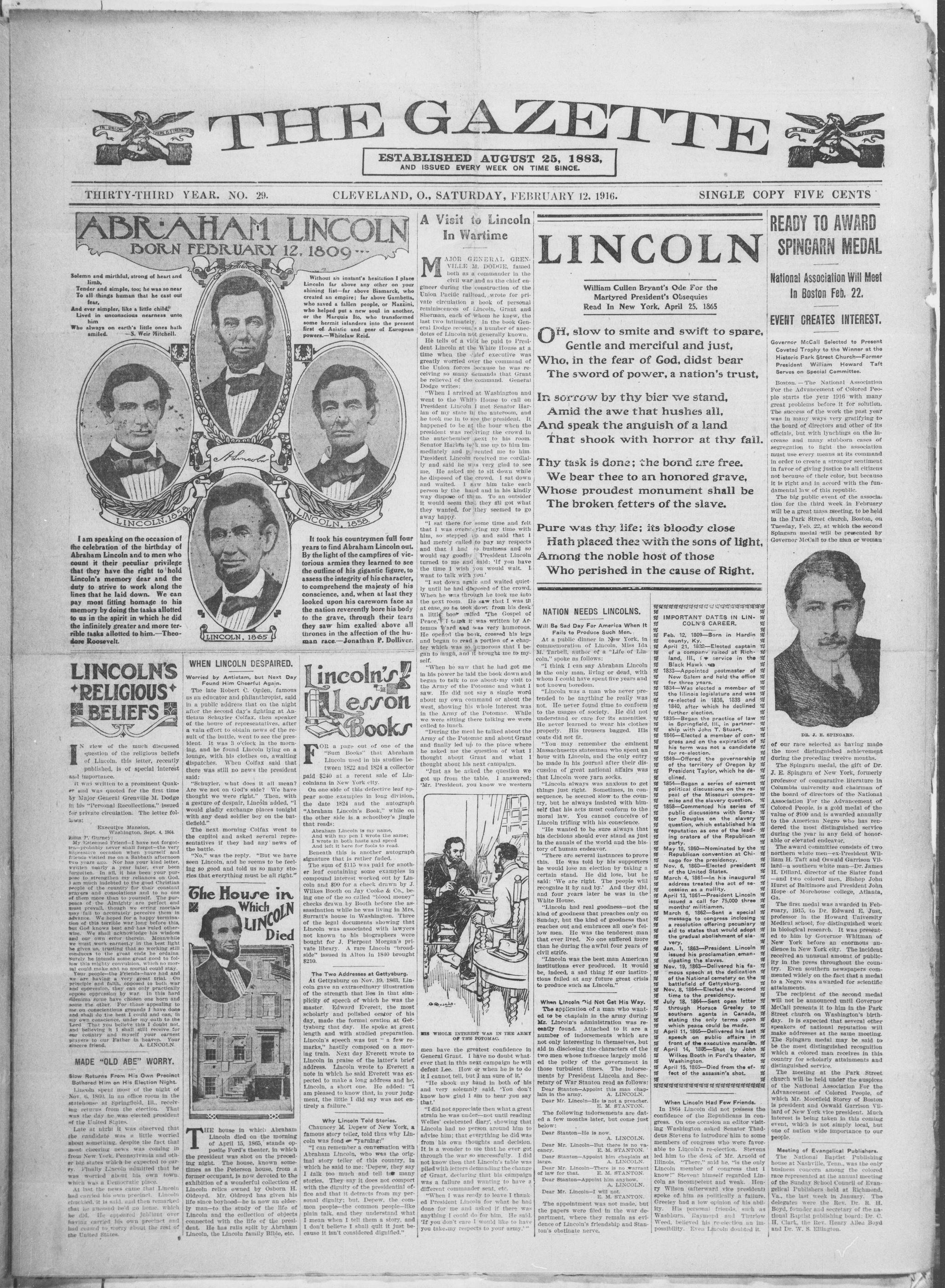
ABR:A
BORN F
Solemn and mirthful, strong of heart and
limb,
Tender and simple, too; he was so near
To all things human that he cast out
fear,
And ever simpler, like a little child.
Lived in unconscious nearness unto
him
Who always on earth's little ones hath smiled. —S. Weir Mitchell.
LINCOLN, 1858.
I am speaking on the occasion of the celebration of the birthday of Abraham Lincoln and to men who count it their peculiar privilege that they have the right to hold Lincoln's memory dear and the duty to strive to work along the lines that he laid down. We can pay most fitting homage to his memory by doing the tasks allotted to us in the spirit in which he did the infinitely greater and more terrible tasks allotted to him.—Theodore Roosevelt.
LINCOLN'S
RELIGIOUS
BELIEFS
In view of the much discussed question of the religious beliefs of Lincoln, this letter, recently published, is of special interest and importance.
it was written to a prominent Quaker and was quoted for the first time by Major General Grenville M. Dodge in his "Personal Recollections," issued for private circulation. The letter follows.
Executive Mansion.
news:
Executive Mansion,
Washington, Sept. 4, 1864
Elijah P. Gurney:
My Naezedem Friend—I have not forgo-
ten—probably never shall forget—the very
impressive occasion when yourself an
arm of God has been sent to you two
years ago. Nor has your kind letter
written nearly a year later, ever be
forgotten. In all, it has been your pu-
pose to strengthen my reliances on God
am much indebted to the good Christian
arm of God, prayers and consolations and to no or
of them more than to yourself. The pu-
poses of the Almighty are perfect ar-
ms of God, and you fail to accurately perceive them
advance. We hope for a happy termi-
nation of this terrible war long before the
but God knows best and has ruled other
wise. We shall acknowledge his wisdom
and the greatness of God. We must work earnestly in the best lie
he gives us, trusting that so working at
Your people—the Friends—have had and we are having a very great trial. On our own ground, we have been oppression, they can only practically oppose oppression by war. In this hard dilemma some have chosen one horn and some the other. For those appealing to the Lord, they have ground their own and shall do the best I could and can, in my own conscience, under my oath to the Lord. That you believe this doubt not, but you believe your country and myself your earnest prayers to our Father in heaven. Your sincere friend, A. LINCOLN.
MADE "OLD ABE" WORRY.
Slow Roturns From His Own Prescinct Bothered Him on His Election Night.
Lincoln spent most of the night of Nov. 6, 1830, in an office room in the statehouse at Springfield, Ill., receiving returns from the election. That was the day he was elected president of the United States.
Late at night it was observed that the candidate was a little worried about something, despite the fact that most cheering news was coming in from New York, Pennsylvania and other big states which he expected to carry. Finally Lincoln admitted that he was worried about his own town, which was a Democratic place.
At last the news came that Lincoln had carried his own prescinct. Lincoln clucked, it is said, and then remarked that he answered he go home, which he did. He appeared Jubilant over having carried his own prescinct and had ceased to worry about the rest of the United States.
THE GAZETTE
LINCOLN, 1865
WHEN LINCOLN DESPAIRED.
Worried by Anti-tam, but Next Day
Found-Him Cheerful Again.
The late Robert C. Ogden, famous us an educator and philanthropist, said in a public address that on the night after the second day's fighting at Antelope Schuyler Colfax, then speaker of the house of representatives, after a vain effort to obtain news of the result of the battle, went to see the president. It was 3 o'clock in the morning, and he found Lincoln lying on a lounge, with his clothes on, awaiting dispatches. When Colfax said that there was still no news the president said: "Schuyler, what does it all mean? Are we not on God's side? We have thought we were right." Then, with a gesture of despair, Lincoln added, "I would gladly exchange places tonight with any dead soldier boy on the battlefield."
The next morning Colfax went to the capitol and asked several representatives if they had any news of the battle.
"No," was the reply. "But we have seen Lincoln, and he seems to be feeling so good and told us so many stories that everything must be all right."
The House in Which LINCOLN Died
THE house in which Abraham Lincoln died on the morning of April 15, 1865, stands opposite Ford's theater in which
posite Ford's theater, in which the president was shot on the preceding night. The house, known sometimes as the Peterson house, from a former occupant, is now devoted to the exhibition of a wonderful collection of Lincoln relics owned by Osborn H. Oldroyd. Mr. Oldroyd has given his life since boyhood—he is now an elderly man—to the study of the life of Lincoln and the collection of objects connected with the life of the president. He has rails spit by Abraham Lincoln, the Lincoln family Bible, etc.
ESTABLISHED AUGUST 25, 1883 AND ISSUED EVERY WEEK ON TIME SINCE:
CLEVELAND, O., SATURDAY, FEBRUARY 12, 1916.
Without an instant's hesitation I place Lincoln far above any other on your shining list—far above Bismasck, who created an empire: far above Gambetta, who saved a fallen people, or Mazzini, who helped put a new soul in another, or the Marquis Ito, who transformed some hermit islanders into the present first of Asiatic and peer of European powers.—Whitelaw Reid.
LINCOLN, 1858.
It took his countrymen full four years to find Abraham Lincoln out. By the light of the campfires of victorious armies they learned to see the outline of his gigantic figure, to assess the integrity of his character, to comprehend the majesty of his conscience, and, when at last they looked upon his careworn face as the nation reverently bore his body to the grave, through their tears they saw him exalted above all thrones in the affection of the human race.—Jonathan P. Dolliver.
Lincoln's Lesson Books
FOR a page out of one of the "Sum Books" that Abraham Lincoln used in his studies between 1822 and 1824 a collector paid $240 at a recent sale of Lincoln in New York city.
On one side of this defective leaf appear some examples in long division, the date 1824 and the autograph "Abraham Lincoln's Book," while on the other side is a schoolboy's jingle that reads:
Abraham Lincoln in my name.
I wish you can write the same;
I wrote in both haste and speed
And left it here for books to read.
Beneath this is another autograph signature that is rather faded.
The sum of $145 was paid for another leaf containing some examples in compound interest worked out by Lincoln and $90 for a check drawn by J. Wilkes Booth on Jay Cooke & Co., being one of the so called "blood money" checks drawn by Booth before the assassination while he was living in Mrs. Surratt's house in Washington. Three of the legal documents showing that Lincoln was associated with lawyers not known to' his biographers were bought for J. Pierpont Morgan's private library. A rare Lincoln "broadside" issued in Alton in 1840 brought $210.
The Two Addresses at Gettysburg-
At Gettysburg on Nov. 19, 1863. Lincoln gave an extraordinary illustration of the strength that lies in that simplicity of speech of which he was the master. Edward Everett, the most scholarly and polished order of his day, made the formal ordon at Gettysburg that day. He spoke at great length and with studied preparation. Lincoln's speech was but "a few remarks," hastily, composed on a moving train. Next day Everett wrote to Lincoln in praise of the latter's brief address. Lincoln wrote to Everett a note in which he said Everett was expected to make a long address and he, Lincoln, a short one. He added: "I am pleased to know that, in your judgment, the little I did say was not entirely a failure."
Why Lincoln Told Stories.
Chaucey M. Depew of New York, a famous story teller, told thus why Lincoln was fond "warning"
"I can remember a conversation with Abraham Lincoln, who was the original story teller of this country, in which he said to me: 'Depew, they say I talk too much and tell to many stories. They say it does not comport with the dignity of the presidential office and that, it detracts from my personal dignity; but, Depew, the common people—the common people-like plain talk, and they understand what I mean when I tell them a story, and I don't believe I shall quit it just because it isn't considered dignified."
A Visit to Lincoln In Wartime
MAJOR GENERAL GREN VILLE M. DODGE, failed both as a commander in the civil war and as the chief engineer during the construction of the Union Ipside railroad, wrote for private circulation a book of personal reminiscences of Lincoln, Grant and Sherman, each of whom he knew, the last two intimately. In the book General Dodge recounts a number of anecdotes of Lincoln not generally known.
He tells of a visit he paid to President Lincoln at the White House at a time when the chief executive was greatly worried over the command of the Union forces because he was receiving so many demands that Grant he relieved of the command. General Dodge writes:
"When I arrived at Washington and went to the White House to call on President Lincoln to my state in the antebellum, and he took me in to see the president. It happened to be at the hour when the president was receiving the crowd in the mute chamber next to his room. Senator Harlan to me up to him immediately and patted me to him. President Lincoln received me cordially and said he was very glad to see me. He asked me to sit down while he disposed of the crowd. I sat down and waited. I saw him take each person by the hand and in his kindly way disposed of them. To an outsider it would seem that they all got what they wanted, for they seemed to go away happy.
"I sat there for some time and felt that I was overestimated my time with him, so stepped up, and said that I had merely called to pay my respects and that I had to business and so would say goodly. President Lincoln turned to me and said: 'If you have the time I wish you would wait. I want to talk with you.'
"I sat down again and waited quietly until he had disposed of the crowd. When he was through he took me into the next room. He saw that I was ill at ease, so he took down from his desk a little book called 'The Gospel of Peace. I think it was written by Artemus ward and was very humorous. He opened the book, crossed his legs and began to read a portion of a chapter which was so humorous that I began to muggle, and it brought me to myself.
"When he saw that he had got me in his power he told the book down and began to talk to me about my visit to the Army of the Potomac and what I saw. He did not say a single word about my own command or about the west, showing his whole interest was in the Army of the Potomac. While we were sitting there talking we were called to lunch.
"During the meal he talked about the Army of the Potomac and about Grant and finally led up to the place where he asked me the question of what I thought about Grant and what I thought about his next campaign.
"Just as he asked the question we got up from the table. I answered: Mr. President, you know we western
MIS WHOLE INTEREST WAS IN THE ARMY OF THE POTOMAC.
men, have the greatest confidence in General Grant. I have no doubt what ever that in this next campaign he will defeat Lee. How or when he is to do it I cannot tell, but I am sure of it.
"He shook my hand in both of his and very solemnly said, 'You don't know how glad I am to hear you say that.'"
"I did not appreciate then what a great strain he was under—not until reading Welles' celebrated diary, showing that Lincoln had no person around him to advise him; that everything he did was from his own thoughts and decision. It is a wonder to me that he ever got through the war so successfully. I did not know then that Lincoln's table was piled with letters demanding the change of Grant, declaring that his campaign was a failure and wanting to have a different commander sent, etc.
"When I was ready to leave I thank President Lincoln for what he had done for me and asked if there was anything I could do for him. He said, 'If you don't care I would like to have you take my respects to your army.'"
LINCOLN
William Cullen Bryant's Ode For the Martyred President's Obsequies Read In New York, April 25, 1865
OH, slow to smite
Gentle and me
Who, in the fear of
The sword of power
In sorrow by thy hand
Amid the awe that
And speak the anguish
That shook with me
Thy task is done; the
We bear thee to a
Whose proudest man
The broken fetter
Pure was thy life; the
Hath placed thee with
Among the noble h
Who perished in
OH, slow to smite and swift to spare,
Gentle and merciful and just,
Who, in the fear of God, didst bear
The sword of power, a nation's trust,
In sorrow by thy bier we stand,
Amid the awe that hushes all,
And speak the anguish of a land
That shook with horror at thy fall.
Thy task is done; the bond are free.
We bear thee to an honored grave,
Whose proudest monument shall be
The broken fetters of the slave.
Pure was thy life; its bloody close
Hath placed thee with the sons of light,
Among the noble host of those
Who perished in the cause of Right.
NATION NEEDS LINCOLNS.
Will Be Sad Day For America When It Fails to Produce Such Men.
At a public dinner in New York, in commemoration of Lincoln, Miss Ida M. Turrell, author of a "Life of Lincoln" spoke as follows:
"I think I can say Abraham Lincoln is the only man. Living or dead, with whom I could have spent five years and not known boredom.
"Lincoln was a man who never pretended to be anything he really was not. He never found time to conform to the usages of society. He did not understand or care for its amenities. He never learned to wear his clothes properly. His trousers bagged. His coats did not fit.
"You may remember the eminent Massachusetts statesman who spent an hour with Lincoln, and the only entry he made in his journal after their discussion of great national affairs was that Lincoln wore yarn socks.
"Lincoln always was anxious to get things just right. Sometimes, in consequence, he seemed slow to the country, but he always insisted with himself that his acts must conform to the moral law. You cannot conceive of Lincoln trifling with his conscience.
"He wanted to be sure always that his decisions should ever stand as just in the animals of the world and the history of human endeavor.
"There are several instances to prove this. He was told by his supporters he would lose an election by taking a certain stand. He did lose, but he said: 'We are right. The people will recognize it by and by.' They did, and four years later he was in the White House.
"Lincoln had real goodness—not the kind of goodness that preaches only on Sunday, but the kind of goodness that reaches out and embraces all one's fellow men. He was the tenderest man that ever lived. No one suffered more than he during the awful four years of civil strife.
"Lincoln was the best man American institutions ever produced. It would be, indeed, a sad thing if our institutions failed at any future great crisis to produce such as Lincoln."
When Lincoln Did Not Get His Way.
What Lincoln Did Not Get His Way.
The application of a man who waited to be chaplain in the army during Mr. Lincoln's administration was recently found. Attached to it are a number of indorsements which are not only interesting in themselves, but aid in disclosing the characters of the two men whose influence largely molded the policy of the government in those turbulent times. The indorsements by President Lincoln and Secretary of War Stanton read as follows:
Dear Stanton—Appoint this man chaplain in the army:
A. LINCOLN.
Dear Mr. Lincoln—He is not a preacher.
E. M. STANTON.
The following indorsements are dated a few months later, but come just below:
Dear Stanton—He is now.
A. LINCOLN.
Dear Mr. Lincoln—But there is no vacancy.
E. M. STANTON.
Dear Stanton—Appoint him chaplain at large.
A. LINCOLN.
Dear Mr. Lincoln—There is no warrant of law for that.
E. M. STANTON.
Dear Stanton—Appoint him anyhow.
LINCOLN.
Dear Mr. Lincoln—I will not.
E. M. STANTON.
The appointment was not made, but the papers were filed in the war department, where they remain as evidence of Lincoln's friendship and Stanton's obstinate nerve.
and swift to spare
cruciful and just,
of God, didst bear
power, a nation's trust,
bier we stand,
that hushes all,
aguish of a land
in horror at thy fall
the bond are free.
in honored grave,
monument shall be
ars of the slave.
its bloody close
with the sons of light,
most of those
the cause of Right.
IMPORTANT DATES IN LIN-
COLN'S CAREER.
Feb. 12, 1809 Born in Hardin
county, Ky.
April 21, 1832—Elected captain of a company raised at Richland, Ill., for service in the Black Hawk
1833—Appointed postmaster of New Salem and held the office for three years.
1834—Was elected a member of the Illinois legislature and was re-elected 1836, 1839 and 1840, after which he declined further election.
1835—Began the practice of law in Springfield, Ill., in partnership with John T. Stuart.
1846—Elected a member of congress and on the expiration of his term was not a candidate for re-election.
1849—Offered the governorship of the territory of Oregon by President Taylor, which he declined.
1854—Began a series of earnest political discussions on the repeal of the Missouri compromise and the slavery question.
1858—Commenced his series of public discussions with Senator Douglas on the slavery question, which established his reputation as one of the leading orators of the Republican party.
May 1860—Nominated by the Republican convention at Chicago for the presidency.
April 13, 1861—President Lincoln issued a call for 75,000 three months' militiamen.
March 6, 1862—Sent a special message to congress inclosing a resolution offering pecuniary aid to states that would adopt the gradual abolishment of slavery.
Jan. 1, 1863—President Lincoln issued his proclamation emancipating the slaves.
Nov. 19, 1863—Delivered his famous speech at the dedication of the national memorial on the occasion of Georgetown.
Nov. 8, 1864—Elected the second time to the presidency.
July 18, 1864—Sent open letter through Horace Greeley to southern agents in Canada, stating 'the only terms upon which peace could be made.
April 11, 1865—Delivered his last speech on public affairs in front of the executive mansion April 14, 1865—Shot by John Wilkes-Booth in Ford's theater, Washington. April 15, 1865—Died from the effect of the assassin's shot.
When Lincoln Had Few Friends.
In 1864 Lincoln did not possess the confidence of the Republicans in congress. On one occasion an editor visiting Washington asked Senator Thaddeus Stevens to introduce him to some members of congress who were favorable to Lincoln's reelection. Stevens led him to the desk of Mr. Arnold of Illinois, "There," said he, "is the only Lincoln member of congress that I know." Stevens himself regarded Lincoln as incompetent and weak. Henry Wilson afterward vice president) spoke of him as politically a failure. Greeley had a low opinion of his ability. His personal friends, such as Washburn, Raymond F. and Timlow Wood, believed his reelection was impossible. Eva Lincoln doubted it.
SINGLE COPY FIVE CENTS
COPY FIVE CENTS
READY TO AWARD
SPINGARN MEDAL
National Association Will Meet
In Boston Feb. 22.
EVENT CREATES INTEREST.
Governor McCall Selected to Present
Coveted Trophy to the Winner at the
Historic Park Street Church—Former
President William Howard Taft
Serves on Special Committee.
Boston. — The National Association For the Advancement of Colored People starts the year 1916 with many great problems before it for solution. The success of the work the past year was in many ways very gratifying to the board of directors and other of its officials, but with lynchings on the increase and many stubborn cases of segregation to fight the association must use every means at its command in order to create a stronger sentiment in favor of giving justice to all citizens not because of their color, but because it is right and in accord with the fundamental law of this republic.
*The big public event of the association for the third week in February will be a great mass meeting, to be held in the Park Street church, Boston, on Tuesday, Feb. 22, at which the second Sphingam medal will be presented, by Governor McCall to the man or woman
DR. J. E. SPINGARN.
of our race selected us having made the most distinguished achievement during the preceding twelve months.
The Spingarn medal, the gift of Dr. J. E. Spingarn of New York, formerly professor of comparative literature in Columbia university and chairman of the board of directors of the National Association For the Advancement of Colored People, is a gold medal of the value of $100 and is awarded annually to the American Negro who has rendered the most distinguished service during the year in any field of honorable or elevated endeavor.
The award committee consists of two northern white men—President William H. Taft and Oswald Garrison Villard—a southern white man—Dr. James H. Dillard, director of the Slater fund—and two colored men, Bishop John Hurst of Baltimore and President John Hope of Morehouse college, Atlanta, Ga.
The first medal was awarded in February, 1915, to Dr. Edward E. Just, professor in the Howard University Medical school, for distinguished work in biological research. It was presented to him by Governor Whitman of New York before an enormous audience in New York city. The incident received an unusual amount of publicity in the press throughout the country. Even southern newspapers commented widely on the fact that a medal to a Negro was awarded for scientific attainments.
The recipient of the second medal will not be announced until Governor McCall presents it to him in the Park Street church on Washington's birthday. It is expected that several other speakers of national reputation will make addresses, at the same meeting. The Spingarn medal may be said to be the most distinguished recognition which a colored man receives in this country for scholarly attainments and distinguished service.
the meeting at the Park Street, church will be held under the auspices of the National Association For the Advancement of Colored People, of which Mr. Moorfield Storey of Boston is president and Oswald Garrison Villard of New York vice president. Much interest is being taken in this coming event, which is not simply local, but one of nation wide importance to our people.
Meeting of Evangelical Publishers.
The National Baptist Publishing house at Nashville, Tenn., was the only business concern among the colored race represented at the annual meeting of the Sunday School Council of Evangelical Publishers held at Richmond, Va., the last week in January. The delegates were the Rev. Do R. H. Boyd, founder and secretary of the National Baptist publishing board, Dr. C. H. Clark, the Rev. Henry Allen Boyd and Dr. W. S. Ellington.
The GAZETTE
One Year.....$1.50.
Six Months.....1.00
Three Months......50
Subscribers are requested to re-
mit by postoffice money or
order or registered letter
Entered at the postoffice In Cleveland
Ohio, as second-class matter.
Address all communications to
Blackstone Building, Cleveland, O.
Member Ohio Legislature: 1894
to 1898; 1896 to 1898; 1900 to 1902
THE GAZETTE is the oldest, and
has the largest bona fide circulation,
double that of any newspaper in the
interest of Afro-Americans, published
in the state of Ohio, and comparison
with any will immediately establish
its rank as one of the NEWSIEST
AND BEST in the country.
10,000,000 Afro-Americans..
180,000 in Ohio.
20,000 in Cleveland.
SATURDAY, FEBRUARY 12, 1916
"Let us have faith that right might, and in that faith let us to the end dare to do our duty as we understand it"—Abraham Lincoln.
It has been interesting to note newspaper comment on Huerta's death. No matter how most editors may have regarded the old Indian, none of them forgot to recall that he did not "satuate the flag" at President Thomas Woodrow Wilson's command and that the blood of our soldiers and sailors was shed in vain during the puerile expedition to Vera Cruz.
A list of five members of Secretary McAdoo's family, who are feeding at the public trough, has made its appearance. The bureau of internal revenue supplies the provender. If Mr. McAdoo is not careful he will get into a muss with First Assistant Postmaster General Daniel C. Roper as to whose kinfoks are going to run the United States government.
---
Since February fourteenth has been accepted as the birthday of the Hon Frederick Douglass, our people everywhere should observe that day in connection with their Lincoln birthday celebrations. As the martyrs president, Abraham Lincoln, is the greatest character in American his tory, so is the "silver-tongued orator the old man eloquent," Frederick Douglass unquestionably the greatest Negro or Afro-American that has lived to date.
The most embarrassing feature of President Wilson's frequent change of attitude on important governmental problems is the practical admission that his judgment has been bad. He has changed front on every issue except the tariff. That is the only issue on which the American people wish he would change, but he won't. By changing on every other issue, he practically admits that the American people have been spending $75,000 a year to convince him of the error of his previous notions, or, in the event that he was formerly right and wrong now, we have spent $75,000 a year to no purpose. Next time we will employ as chief public servant some man who has had experience in the solution of national problems.
DEALING WITH A "CRISIS."
At a moment when the peripatetic Carranza had not been reached with our protest against the murder of Americans in Mexico, when Southern Senators were grandiloquently vocal in an attempt to embroil our relations with Great Britain, when our controversies with the Teutonic Allies were still in process of discussion, when Congress was wrestling with the grave problems of providing for the national defense and of finding the money to pay for that while at the same time wiping up the deficit caused by Democratic extravagance and folly in the conduct of the nation's finances—at a time, in short, when, if ever, there was occasion for dragging to the front once more that well-worn theatrical property of the administration, a "crisis," how did the President deal with it?
Did he come forward again in his well-remember character of "the lonely man in the White House?" Did he for an unnumbered time, fill the ears of the people with the muff fled click of his rickety typewriter as he closed the door of his study and composed another of those "notes" so fine in their phrasing and so barren in their benefits? Did he summon the chiefs, either of his own party or of the opposition, to confer with him as to the national policy? Did he go again in person to Congress to demand a "blank check" of indeterminate power to use the military forces of the country as he alone might see fit? Did he do any of the things which a man clothed with heavy responsibility might be expected to do in the face of a situation grave enough to be described by that weighty word "crisis?"
HE DID NOT!
He boarded the presidential yacht, the "Mayflower," and went off for a pleasure cruise.
"BIRTH OF A NATION" TRUTH!
Editor, Plain Dealer, Dear Sir:— In the interest of fairness and truth, and in reply to a statement made in The Plain Dealer of this date, please state that "The Birth of a Nation"
has been "interfered with" and its presentation opposed in MANY cities of the north and a number of the south. There are states of the south from which it has been barred, and a large number of cities in the north, if not states other than Ohio and Kansas, have been and are strongly opposed to the photo-play. Nowhere has it been presented in this country but what it has caused prejudice and in many cases, trouble. Boston and Philadelphia are not the only cities in which demonstrations were made against the presentation of "The Birth of a Nation."
Editor W. Monroe Trotter of The Boston Guardian did not "stir up the disturbance" in that city. It was SPONTANEOUS; nor was he "ordered out of the White House for insulting the President of the United States." Politics had absolutely nothing to do with the demonstration against the photo-play in Philadelphia, which, like the one in Boston, culminated in a riot against the photo-play that lasted considerably more than "a few minutes."
To patriotic Americans who have not seen "The Birth of a Nation" and who wish to know something of the photo-play, I suggest a careful reading of Attorney General E. C. Turner's recent letter to the Ohio Board of Film Censors, after witnessing the photo-play's production, a few weeks ago, in the State Board's rooms at 232 S. High St., Columbus, O. Yours truly,
Harry C. Smith.
Cleveland, O., Feb. 4, 1916.
"WHY LYNCH-LAW EXISTS."
In what we regard as one of the most remarkable communications—because of its frankness and evident truthfulness—we have ever read, C. D Rivers ("white") of Summerville, Ga., in the Chattanooga, (Tenn.) Daily Times of Jan. 26, 1916, explains why there are so many lynchings and other mob-violence demonstrations in the south, especially Georgia, Alabama, Mississippi and Louisiana. He holds plantation owners responsible for them and says they are invariably promoted by the overseers who adopt this method of cowing the colored employees and inhabitants of their immediate section of the state. The former, with a view of securing the largest results from their labor and the latter, for the purpose of protection. He calls attention to the fact that:
“Georgia lynchers use automobiles and do not belong to the great mass of the population which does not use them. Across central Georgia, central Alabama and through Mississippi and Louisiana extends the black belt where the best cotton lands lie, and where the plantations are often large-owned by absentee landlords, and where nearly all the field work is done by Negroes. The country is almost as black as Africa, the only whites being a few overseers, agents and occasionally a white farmer or white tenant.”
“These overseers, throughout this vast black belt of cotton plantations are expected to do with the Negroes to get results from them in the form of cotton produced at the least possible cost, which can not be got from whites or blacks, except by unrelenting harshness.”
"And as much as possible to prevent the Negroes from taking revenge, it is absolutely necessary that they should always be kept in mind of swift and terrible penalties, which wait not for the slow movements of the law, but stand ever ready to strike them. The authority which the overseers and owners of these Negroes are obliged to resist the Negro workers cannot be sustained by law. There must be extra legal means always in reach, and this extra-legal means is the mob, always ready to inflict capital punishment upon Negroes violating that 'code', which arises upon the relations between blacks and whites in the black belt. Consider the immense territory over which these conditions prevail, and the immense white population that lives in the area, the influence of the interests which are protected by lynch law, and you may see how difficult it is to suppress lynching"
While it is undoubtedly true that the foregoing does not explain all of the lynching and mob demonstrations in the south, it certainly does do that very thing for a very large proportion of them. Long, long ago the overseers lost sight of the fact, if indeed they ever recognized it, that humane treatment of employees, and fair pay, would make the mob unnecessary even in those densely populated sections to which attention is called. The same power that suppresses it can secure the treatment necessary. Therefore, it is not a difficult problem to solve. The difficulty lies in getting the power—the law making and enforcing power of the south—to act properly in the matter.
Seduced 13-Year Girl
Topeka, Kan.—Arthur Davenport, "white," married, an employee at the State Hospital, has been convicted by a jury composed of "white" men, in the district court, for seducing Thelma Grant, the 13-year-old committed the asylum and other places, and a number of letters from Davenport to the little girl, in which he expressed his love for her, were read to the jury. On the stand and in the presence of his wife, he admitted that he loved her, and that he had sent her from the city to prevent her testifying in the case.
Alston-Fox Marriage
Lockland, O. — Saddle Belle, the daughter of Rev. and Mrs. Primus Alston, of this city, the latter well and most favorably known throughout Ohio, was married, Wednesday, Jan. 26, 1916, at high noon to Rev. A. R. Fox, D. D., of Hannibal, Mo. Rev. Fox is a 1915 alumnus of the theological department of Wilberforce University, and Mrs. Fox is also a 1915 alumnus of the commercial, millinery and cooking department of the university. They are residing in Palmyra, Mo.
Gov Harris on Lynching
Atlanta. Ga.—Lynchings of eighteen Negroes in Georgia in January, this year, is denounced by Gov. Harris in a statement, last Thursday, in which he declares that "unless conditions improve by the time the next General Assembly meets" he will ask for the enactment of laws in this state." Pretty near time to do something. The General Assembly meets in June.
THE GAZETTE, CLEVELAND, O., SATURDAY, FEBRUARY 12, 1916
What Our People Are Doing Each Week—Church, Personal, Social, Lodge, Literary and Musical — Marriages, Deaths, Etc.
RAVENNA—There is a revival at Allen A. M. E. church, this week. We wish it every success. The Ladies' Aid society will give an entertainment and chicken supper, the 24th. The R. D. S. club met at Mrs. Thaddeus Proctor's, Saturday, and spent an enjoyable evening. Mr. Earl Jackson is training Arn Fremont to fight Chub Baxter, Feb. 15th, here. The trainer is a new star, is very fast, and a hard hitter. We look for him to win.
SANDUSKY—Mrs. S. D. Anderson, Mrs. M. N., Washington, Mrs. Chas. Salee, Mr. Wm. Jones, O. B. Shackleford, Mrs. Pete Patre, Mrs. Alice Gaines, Mrs. Albert Sutton, Rev. J. D. Singleton and Rev. G. D. Smith are better—Mr. Charley Taylor is falling fast—the two churches' union meeting was held at the Second Baptist church, last Friday evening. The debate, "Resolved, that this country should prepare to protect its citizens and its liberty," proved very entertaining. Morte Thompson and Fred Thompson, aff., and Earl and Harry Axeland, and Scott J. McCarthy, M. J. French and W. W. Pinkins, J. R. D. Davis, master of ceremonies, ice cream and oysters were served to a good crowd—The S. S. and church were well attended. Sunday—Mrs. Anthony is expected to return home from the hospital, soon.
CORRESPONDENTS must mail all letters for publication at their main postoffice sufficiently early on Monday (or Sunday) of each week to have them reach The Gazette office on Tuesday morning, and always write also, their names and that of their city or town on the outside of the wrapper about returned copies. Unless this latter is done, proper credit cannot be given you. Lists of names, wedding presents, etc., obituary notices, speeches, resolutions, poetry, inquiries for relatives and advertisements, including items announcing entertainments to be paid in the near future, must be in advance at the rate of ten cents a line, six words to a line. Our rates for display advertisements will be sent on application.
IRONTOON.—Mr. Canutt was buried from Triedstone Baptist church, Friday afternoon.—Quarterly meeting at Quinn A. M. E. chapel, Sabbath. Rev West, P. E., Rev J. S. Ferguson, pastor. C. D. Irwin and committee, Mames king and banks rendered excellent service. the choir will reorganize with Misses Flosee Jones, Page, Prince, Robison, Harris and Fox as young lady members. Mrs. King may join it. Rev Brewer, pastor at Ashland, Ky., and members, will attend meeting here at Quinn A. M. E. chapel.—Mr. Brewer is good bar-shop on 7th St.—Rev Vanessa of Triedstone Baptist church is conducting a revival.—Mrs. Peters is the reporter for the personal column of the Irontonian.—Mr. and Mrs. Stratton run a first-class boarding house on 8th St.—Let our people take The Gazette every week and get the race news.
HAMILTON.—Mrs. Jackson, age 68 of Cokeon, died, after an illness of several months. She moved here, 9 years ago, was a native of Kentucky, and leaves five daughters to mourn her loss. The remains were interred at Coventry.—Mr. and Mrs. Bates of Co. Kentucky, where are on business. Mrs. Glover, who visited her mother in Plaqua, has returned to Jackson, Mich.—Mrs. Hackley is convalescing. Mrs. S. C. Dyson is convalescing. If you want to read the race's Ohio news also, purchase The Gazette. Call 1555 L, and Charles Dyson will be glad to take your order. Call 466, and R. B. Moseley will be glad to receive your news for this letter. Mrs. G. Chand, Mrs. R. B. Moseley, Mr. and Mrs. R. B. Moseley entertained. Thursday evening. Games music and a fine lunchon.
HILLSBORO—Rev J. M. Ross, pastor, and the A. M. E. congregation are holding revival services to which all are invited. They have an excellent choir—Miss Raymond Day and Mrs Lyman Ross visited their sister, Mrs Oliver Smith, in Cincinnati. Sunday, Mrs Oliver Smith, in Greenfield, visited Mr. and Mrs. Frank Powers, this week. Wesleyan church's Loyal League gave Mrs. Lizzie Trimble, (a member) a liberal donation, last Thursday evening. Mr. and Mrs. James Taylor entrained Mrs. Lillie Young, at dinner, Sunday. The "Grig" society entertained at Mrs. Lillie Young, at dinner, Sunday. Rev E. Burr is conducting revival services at Georgetown—The Mothers' club will meet at "Dear Old Lincoln" next Friday evening, and a special program will be rendered. The president of the Cincinnati club, will deliver an address. All members are requested to attend. Mr. and Mrs. Tommy Taylor, niece Miss Lucy Qualls, who visited her sister, Mrs. Minne Hudson, left Monday for Arkansas.
SMITHFIELD.—Mrs. Homer Harris delightfully entertained the Silver Leaf club, last Saturday evening and also entertained Mr. and Mrs. D. Christian at dinner, Sunday.—Mrs. E. H. Harris and daughters, Mrs. Alice Henderson and Miss Nelle Miller, both of Wheeling, N. J. Houston of Wheeling, Saturday and Sunday. She was brought home quite ill by her sons, John, and Haze, in an auto, Sunday.—Mrs. Ford of Steubenville, is here visiting her daughter.—Rev. R. B. Lowe, Mrs. Powell and B. B. Acke.—Dave and Frank Christian, Hendale, spent Sunday here.—Miss Effle Beall was in Pittsburg, Saturday.—Mrs. Chas, Ford, Geo, and Wm. Harris of McIntyre, visited their mother, here. Sunday.—Dave Freeman of McIntyre, spent Saturday and Sunday, here.—Mrs. Chas. Thompson is seri- tious. The infant daughter was buried, last week.—Mrs. Carrie Fitzgerald has located in Steubenville.
CADIZ—Messrs. Francis Tyler and Dwight Brooks were in Steubenville, a day, last week—Miss Elizabeth and her sister, Miss Elizabeth, in a small school here, was called home to
"The Republican Party is the Ship, all else the Sea."—
Frederich Douglass.
FREDERICK DOUGLASS.
"The Old Man Elouquent," the greatest Negro This Country Has Produced —Feb. 14 His Birthday.
The Dallas (Texas) Daily Times Herald has a letter from a "white" man landing Frederick Douglass, a black-breasted bachelor who was recognized for over 20 years by the greatest minds of all political parties as the greatest Negro that America
Hopedale by her mother's illness. We regret she cannot finish school, this term. Miss Martha Tyler of Flushing, has returned, Mrs. Ola Brown and Mrs. Sara Miller are ill—Mrs. Cora Olmstead of M. T pleasant, is visiting Mrs. Laura Olmstead—Mrs. Parthenia Johnson and Mrs. Edward Freeman who arrived by boat by Mrs. Bowles' death. No evangelist in years has so stirred this community as has Miss Emma Bowman of Cleveland, who conducted a three weeks' revival at the A. M. E. church that resulted in 48 conversions. Modest and massuming, yet thrilling and eloquent in preaching the gospel, she touched the hearts of many. A large group of the people of both races here. A large free-will offering was presented her, Sunday evening. R. F. Ballard spoke in touching terms of the lasting impression of her labors here. Miss Bowman was the guest of Rev. and Mrs. O. W. Childers. Rev. W. S. Meek, a well-known, well-meeting at the M. E. church, morning. -Michael Jones of Mt. Pleasant, is seriously ill.
YOUNGSTOWN—Mrs. Jane Bradley, aged 80, died at her daughter, Mrs. Mark Palus', in Hubbard, Wednesday evening.—Mrs. Adel Arman of Chicago has located here.—Chas. Van Dusen died at the city hospital in Sharon, Saturday.—Mrs. Margaret Simms announces the engagement of her daughter, Mae Lenora, to Herman T. Smith.—Miss Elie Crabble of New Castle, spent Friday with Mrs. R. Jones, Agnes Lucus, gave a decretely enjoyable The Hunt party, last Friday evening, in honor of Miss Violet Robinson who is to wed the last of this month. Prizes were awarded those attaining the highest scores. The decorations were in white and pink. An elaborate luncheon was served by the hostess.—Wm. Honesty entertained. Wednesday evening, at dinner in honor of Thaddeus Young who leaves, Thursday, to locate in Atlantic City, N. J.—Wm. D. Dawson died, Friday. He was born in Nelson Co. He leaves a wife, mother two brothers he is ill, a demeisse H. J. Hobson is ill.—Mr. and Mrs. Andy Smith's infant died, Friday evening.—J. C. Jackson died at the city hospital, Saturday.—Mr. and Mrs. Geo. Jefferson's little daughter, Margaret, has a broken leg.—Buckeye lodge annual party, Mar. 7.
Watch Your Manner.
As a rule courtesy receives courtesy. Many times a rudeness which we resent was called out by something out of the way in our own conduct. A child will very often speak impertinently to one who addresses him roughly, while courtesy he instinctively answers in kind. The girl who is continually encountering rudeness, had better make a study of her own manner.
Swimming Grindstone.
Some of the fishermen on the River Tyne, in England, are not only ignorant but stupid. On one occasion two of these fishermen were caught by a heavy freshet and driven out of the river to sea. As the story goes, one of the men saw, in the dusk, a hoop floating by. The hoop was full of foam. "We are saved!" exclaimed the man. "Here's a grindstone swimming!"
Book of Mormon.
Joseph Smith published his work known as "The Book of Mormon" in the year 1830. He claimed that the work was a transcript, under divine guidance, of certain golden plates buried in central New York, the existence of which had been supernaturally revealed to him by an "angel from heaven."
His Practical Mind
A certain famous British cathedral, which shall be nameless, was visited by two farmers. A clergyman on the same errand waited by them, curious to hear their opinion of it. At length after looking long and earnestly at its interior space and height, one said to the other: "Man, John, what a fine lot of hay ye could put in here!"
Real Neighborly.
Willie—"Ma, may I have Tommy Wilson over to our house to play Saturday?" Mother—"No, you make altogether too much noise. You'd better go over to his house and play."—Boston Transcript.
Daily Thought.
The best of men and the most earnest workers will make enough mistakes to make them humble. Thank God for mistakes and take courage Don't give up on account of mistakes —Dwight L. Moody.
has ever produced—and to our thinking the world, unless it might be Toussaint L'Ouverture of Saint Domingo, who styled himself the greatest of blacks and Napoleon the greatest of "whites."
"When we consider the conditions and the environments existing at the time of their living Booker T. Washington's fame or greatness will compare with Frederick Douglass, as will to sunlight on a twilight day in June."
WILLIAM H. LEWIS, ESC.
Former Assistant U. S. Attorney General Made an Excellent Showing in the Mohr Trial.
Providence, R. I.—The notorious Mohr trial has finally come to an end, with the conviction of the two colored men, one of whom Attorney Lewis defended, and the freeing of the woman. The leading attorney in the trial of Mrs. Elizabeth Mohr, for the murder of her husband, Dr. Mohr was William H. Lewis, Esq., of Boston, the former Harvard football star, whose senses and his fine conception of legal tactics, showed him a lawyer of marked distinction. Physically and otherwise he towered above the others, and his quickness of perception, his brilliant cross-examinations, and his alertness, logic, politeness and keen sense of humor stamped him at once as an exceptional man. He is regarded as one of the ablest lawyers freshman at Amherst college, in '82 Judge Stearns, the presiding judge at the trial, was a senior. Mr. Lewis played center on the Harvard football team, in '83; was an assistant U. s. attorney-general at Washington, D. C., under President Taff; an assistant U. s. attorney at Boston under President Roosevelt; and, prior to both of these appointments, to be president of the college institution. In Lewis' law class at Harvard was Attorney-General Herbert A. Rice, who was head of the prosecution's legal staff in the Mohr trial.
THE DELEGATE RACE IS OPEN
The Secretary of State's Ruling Aids Senator Foraker's Plan.
Columbus, O.-Any voter in Ohio who cares to, may run for delegate to the national conventions, this year, under the construction of the law made, Feb. 4, by Secretary of State Charles Hildebrant. All the voter must do is to declare he will support, as first and second choice, men who have notified the secretary of state they are willing to have their names used as a candidate for president. Under the ruling, Senator Joseph Benton, who was elected late for a place on the Republican big four, and he will not be forced to obtain the permission and approval of Theodore E. Burton, either.
Old Citizen Dead.
Columbus, O.-James S. Tylier, old and well known resident of this city, died recently. He was the father of Ralph W. Tylier and four or five other sons, and two daughters. He was highly respected.
Some Name.
Over the whole basin of the Atlantic there is spread an enormously thick covering of what seems to be mud, but is really a mixture of tiniest shells, either perfect or in pieces, that need the microscope to be seen. This is called Globigerina Ooze—just as if it were a girl.—Cumberland (England) Mail.
Hardly Worth Consider it
Hardly Worth Considering.
"Would your wife vote for you as a candidate for office?" "I don't think there's any use of my bothering my head about that," replied Mr. Meckton. "I don't believe Henrietta would let me run in the first place."—Washington Star.
What He Thinks Remarkable
"Do you think there is anything remarkable in love at first sight?" asked the romantic youth. "Not at all!" answered the cynic. "It's when people have bees looking at each other for four or five years that it becomes remarkable." — Pearson's Weekly.
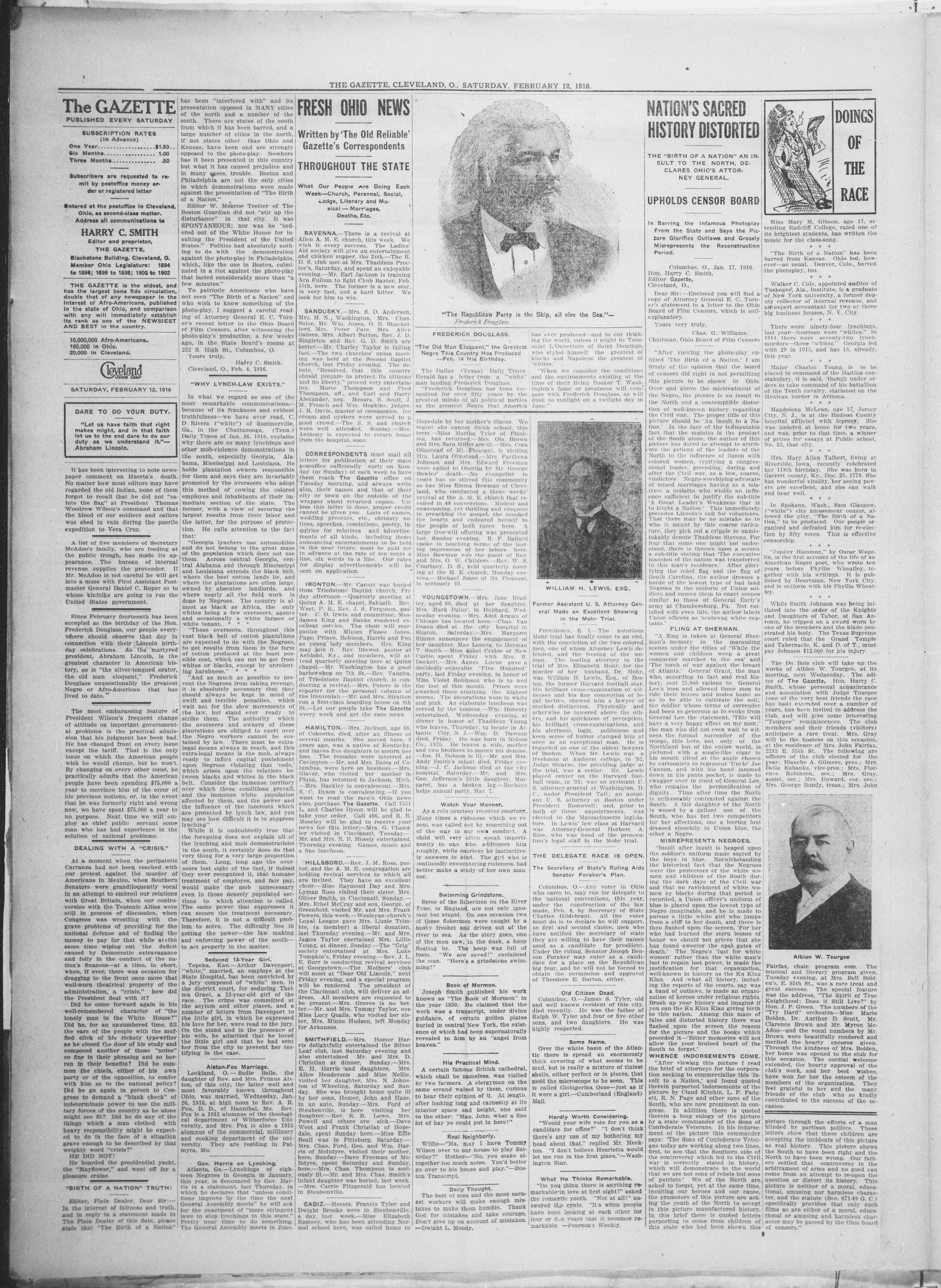
NATION'S SACRED HISTORY DISTORTED
THE "BIRTH OF A NATION" AN IN
SULT TO THE NORTH, DE-
CLARES OHIO'S ATTOR-
NEY GENERAL.
UPHOLDS CENSOR BOARD
In Barring the Infamous Photoplay
From the State and Says the Picture Glorifies Outlaws and Grossly Misrepresents the Reconstruction Period.
Columbus, O., Jan. 17, 1916.
Hon. Harry C. Smith.
Editor Gazette
Cleveland, O.
Dear Sir:—Enclosed you will find a copy of Attorney General E. C. Turner's statement in a letter to the Ohio Board of Film Censors, which is self-explanatory.
Yours very truly,
Chas. G. Williams,
Chairman, Ohio Board of Film Censors
"After viewing the photo-play entitled 'The Birth of a Nation.' I are firmly of the opinion that the board of censors did right in not permitting this picture to be shown in Ohio, Over and above the mistreatment of the Negro, the picture is an insult to the North and a contemptible distortion of well-known history regarding the Civil war. The proper title of this picture should be 'An Insult to a Nation.' In the face of the indisputable fact that the mulatto is the product of the South alone, the author of this picture has dared to attempt to attribute the actions of the leaders of the North to the influence of lioness with colored women, typifying a congressional leader, preceding, during and after Civil War, as low, coarse, vindictive. Negroes as well as white, of mixed marriages having as a mistress a mulatto who wields an influence sufficient to justify the subtitle 'A Great Leader's Weakness that is blight a Nation.' This immediately precedes Lincoln's call for volunteers. That there may be no mistake as to who is meant by this coarse caricature, they pick out a cripple to unmistakably denote Thaddeus Stevens. For fear that some one might not understand a subtitle stating that. The executive mansion of the nation was transferred to this man's residence. After glorifying the rebel flag and the flag of South Carolina, the author dresses a horde of the lowest type of bad land Negroes in the uniform of Union soldiers and causes them to enact scenes similar to those of General Early's army at Chambersburg, Pa. Not satisfied with even this, the author labels officers as 'scalawag white captains.'
FLING AT SHERMAN.
"A fling is taken at General Sherman's memory in the marauding scenes under the titles of 'While the women and children weep a great conqueror marches to the sea' and 'The torch of war against the breast of Atlanta.' General Grant, the man who, according to fact and real history, sent 25,000 rations to General Sherman, when he came to ride the horses and mules hounds as to be able to cultivate the soil; the soldier whose terms of surrender had been so generous as to evoke from General Lee the statement, 'This will have a very happy effect on my men'; the man who did not even wait to witness the formal surrender of the troops, this here not only of the men, but of the women pictured with a siogie-like cigar in his mouth tilted at the angle chosen by cartoonists to represent 'Uncle Joe Cannon, and with his hand jammed down in his pants pocket, is made to swagger over in front of General Lee, who remains the personification of dignity. Time after time the North is unfavourable contagued against the South. A woman of the thigh by a gallant son of the South, who has but two competitors for her affections, one a leering lout dressed slouchily in Union blue, the other a Negro.
MISREPRESENTS NEGROES
MISREPRESENT'S NEGROES.
After insult is insult upon the soldier's uniform made sacred by the boys in blue. Notwithstanding the boys in blue, the Negroes were the protectors of the men and children of the South during the dark days of the Civil war and that no ravishment of white women by blacks during that period is recorded, a Union officer's uniform of blue is placed upon the lowest type of Negro imaginable, and he is made to pursue a little white girl who jumps from a cliff to her death, and there is then flashed upon the screen. For her white women, the stern face of honor we should not grieve that she has found sweeter the opak gates of death. The Negro's 'just for white women' rather than the white man's lust to regain lost power, is made the justification for that organization, well-known in history as the Ku Klux Klan. And what all history, including the reports of the courts, say was a band of outlaws, is made an organization of heroes under religious rights. Brush up your history an imagine if you were a Ku Klux Klan to this nation. Among this mass of false and distorted history there was flashed upon the screen the reason for the picture and the books which preceded it—Bitter memories will not allow the poor bruised heart of the South to forget.
WHENCE INDORSEMENTS COME.
"After viewing this picture I read the brief of attorneys for the corporation seeking to commercialize this Insult to a Nation," and found quoted therein purported indorsements of the picture by Claud Kitchin, L. P. Padget, R. N. Page and other sons of the South, who are now prominent in congress. In addition there is quoted therein the testimony of the picture by a state commander of the Confederate Veterans. In his indorsement of the picture this commander says: "The Sons of Confederate Veterans today are working along two lines, first, to see that the Southern side of the controversy which led to the Civil war is correctly stated in history, which will demonstrate to the world that we are not sons of rebels but sons of patriots." We of the North are asked to forget and the same time, insult the heroes of the promoters of this picture are asking the youth of the North to accept in this picture manufactured history. In this brief there is quoted letters purporting to come from children of this state who had been shown this
DOINGS
OF
THE
RACE
Miss Mary M. Gibson, age 17, attending Radcliff College, rated one of its brightest students, has written the music for the class-song.
"The Birth of a Nation" has been barred from Kansas. Ohio led, however—as usual. Denver, Colo., barred the photoplay, too.
Walker C. Cole, appointed auditor of Tuskegee, Ala., Institute, is a graduate of New York university, a former deputy collector of internal revenue, and an expert accountant for two or three big business houses, N. Y. City.
There were ninety-four lynchings, last year—fourteen were "whites." In 1914, there were seventy-two lynchmurders—three "whites." Georgia led with 29 in 1915, and has 18, already this year.
Major Charles Young, is to be placed in command of the Haitian constabulary, it is said, though under orders to take command of his battalion of the Tenth cavalry, stationed on the Mexican border in Arizona.
Magdelena McLean, age 17, Jersey City, N. J., is at the Hudson County hospital附设 with leprosy. She was added to the hospital years, and was, prior to that time, a winner of prizes for essays at Public school, 23, that city.
☆ ☆ ☆
Mrs. Mary Allen Talbert, living at Riverside, Iowa, recently celebrated her 118th birthday. She was born in Garrett county, Ky. Dec. 25, 1779. She has wonderful vitality, her seeing power, strength, and she can walk and hear well.
---
In Spokane, Wash., Sam Glasgow, ("white") city amusement censor, allowed the play, "The Birth of a Nation," to be produced. Our people organized and defeated him for re-election by fifty votes. This is effective censorship.
“Jupiter Hammon,” by Oscar Wegellin, is the first account of the life of an American Negro poet, who wrote ten years before Phyllis Wheatley, together with his writings. It is published by Heartman, New York City, and is uniform with his Phyllis Wheatley.
0 0 0
While Smith Johnson was being initiated into the order of the Knights and Daughters of Tabor, at San Antonio, he tripped on a sword worn by one of the members and the blade penetrated the wound. The court ruled that the Grand Temple and Tabernacle, K. and D. of T, must pay Johnson $12,000 for his injury.
The Du Bois club will take up the works of Albion W. Tourgee, at its meeting, next Wednesday. The editor of The Gazette, Hon. Harry C. Smith, whose personal acquaintance and association with Judge Tourgee (one of the very best friends the race has had) extended over a number of years, will be a club, and will give some interesting "Tourgee" reminiscences. The club members and their friends (visitors) anticipate a rare treat. Mrs. Gray will be the hostess on this occasion, at the residence of Mrs. John Fairax, 2213 E. 35th St. The following are officers of the club elected for the year: Blanche A. Gillmore, pres.; Mrs. Della Erbanks, vice-pres.; Mrs. Gregor Gass, pres.; Mrs. Howard, cor. sec.; Mrs. George Bundy, treas.; Mrs John
Albion W. Touragee
Fairfax, chair, program com. The musical and literary program given, Tuesday evening, at Mrs. Bell Bolden, E. 85th St., was a rare treat and great success. The special feature was the address, "The Spirit Knighthood; Does it Still Live?" by Hon J. P. Green. The numbers of the "Try Hard" orchestra—Miss Marie Bolden, Dr. Arthur D. Scott, Mr. Clarence Brown and Mr. Myron McAdo—and the vocal numbers by Mr. Brown were beautifully rendered and given. Through the kindness of Mrs. Bolden her home was opened to the club for this occasion. The cordial welcome extended, the hearty approval of the club's work, and her best wishes, have won for her the esteem of the members of the organization. They attended the club so many friends of the club who so kindly contributed to the success of the occasion.
picture through the efforts of a man blinded by parrisan politics. These letters show that these children are accepting the incidents of this picture as real history. This picture shows the South to have been right and the North to have been wrong. Our fathers settled that controversy in the arbitration of arms and no good can come from an attempt to re-open the court or distort its history. This picture is a memoir of a moral, educational, amusing nor harmless character, and the statute (Sec. $7149 G O) specifically provides that only such films as are either of a moral, educational or amusing and harmless character may be passed by the Ohio board of censors."
HER TONIC is the result of scientific study of the causes of diseases of the scalp.
Instead of treating effects of the diseases she treats the causes, eliminating the same and tearing the scalp in a healthy condition that can be maintained by using her Hair Tonic and Invigorator, according to her direction.
Madame C. H. Jones Hair Tonic and Invigorator is guaranteed to stop the failing out of the hair and to make the hair
It has been successfully used by many ever since 1300 and with perfect satisfaction by many Toledo people and elsewhere, who who fondly furnish numerous scalps by many Toledo people and elsewhere, who who fondly furnish numerous scalps by using widely advertised hair tonics prepared by unscrupulous persons who have been trained in the INVIGORATOR is absolutely harmless and is claimed for it. The H. Jones Hair Tonics in the Invigorator promotes the growth of the hair, prevents and cures baldness, repairs and cures scalp diseases, imparts lustre and color of the hair by supplying it with the natural elements and necessary nourishment.
MADAME C. H. JONES
353 Woodland Toledo, Ohio
Agents Wanted
STERLING
5 and 10 Cent Store
3003 Central Ave.
Watch Our Windows
For Bargains
Colored Salesladies
We close at 6 P.M.every
evening except Saturday
Arlington Pharmacy
WE WILL ACCEPT THIS ADVERTISEMENT FOR FIVE CENTS IN TRADE, TO APPLY ON ANY PRUCHASE OF TWENTY-FIVE CENTS OR MORE.
E. Rubenstein, Ph. C., Prop.
S. W. Cor. Central Ave. and E.
J. LOMSKY
DRY GOODS
LADIES' AND GENT'S
FURNISHINGS
Try Our
Lomsky Special $1.00 Corsets,
Also our Ladies' $1.00 Waists
They are good
HIGH BROWN
When you want anything in the HIGH BROWN LINE and want the GENUINE GOODS, at THE RIGHT PRICE, call on us.
FILL LINE ALWAYS IN STOCK. Mail Orders promptly filled.
cut-rate druggists.
2742 Central Av.
cor. E 28th St.
cleveland, Ohio.
The Pride of Carolina
The State Agricultural and Mechanical College of South Carolina
Orangeburg, S. C.
Next session begins September 29th and ends May 25th, 1916.
No Tuition, no Room Rent, no Charges for Water, Lights or Fuel. Entrance Fee $10.00.
Board $6.00 per Month in Advance. Books, Laundry, and Personal Expenses Extra.
Every Modern Facility, Standard Equipment. A Faculty of 57 Officers and Instructors.
For Information and Catalogue, Write
R. S. Wilkinson, Pres.
Orangeburg, S. C.
Central 3371
STARLIGHT'S CAFE
A. D. Boyd, Prop.
J. C. Hudson, Mgr.
J. H. Starkey, Mixologist
Choice Wines, Liquors and Cigars
3221 Central Ave., Cleveland, O.
Our advertisers want your trade. Those who do not ask for it in The Gazette certainly care little, if at all, for it. Therefore, we urge our readers and all of our friends to patronize those who ask for your trade in this paper.
Where to Purchase The Gazette
Subscribers not receiving The Gazette regularly should notify us at once. We desire every copy delivered promptly.
We advise our patrons to carefully examine The Gazette's advertisements before making purchases. Business men who advertise in this paper should have the patronage of Afro-Americans. The fact that they advertise is assurance that they want it.
Local reading notices (advertisements) ten cents a line (six words in a line).
Social and Personal
J. E. BRANHAM'S
4401 Central Ave.
PUSHAW
The Arcade.
Superior Entrance.
*OPEN SUNDAYS.
NOTICE TO SU
Subscribers not receiving The us at once. We desire every copy de We advise our patrons to careful tisements before making purchases. this paper should have the patronas that they advertise is assurance that Local reading notices (advertis words in a line).
Social and
Our
Classified Ad
Department
FOR RENT.—Houses and Rooms—
If you have them to rent or if you
want to rent, advertise in The Gazette.
It brings results.
NOTARY PUBLIC.—For such services
call at The Gazette office, No. 2
Blackstone building, No. 1424 W.
Third Street, near Superior Ave.
FOR SALE.—Houses or lots. If
you have either or anything else to
sell, or if you wish to purchase,
advertise in The Gazette. If anything
can bring you results, it can and
will.
Cleveland
Sixth City
Miss Emma Tolbert of 2218 E. 25th
St. is ill.
Mr. Thomas Cook, E. 29th St. is
convalescing.
Mr. John Burden was summoned to Detroit, the first of the week.
to Detroit, the first of the week.
Mr. Fred Richey, E. 30th St., is convalescing slowly.
Mr. James Pigg of Chicago, is the guest of Mrs. Fox E. 43rd St. J. S. Thomas was called to Chicago, last week, by his grandmother's death.
Miss Berta Thaun continues to improve and hopes soon to be teaching again.
Miss Edith Wright made a splendid talk on "Mosaic Art" Sunday at the P. W. A. Museum.
The following (sick) are improving—Mrs. J. E. Reed, Miss Laura Lee and Mr. Thos. Edmonds.
The Minerva Reading club will meet at Mrs. Sarah M. Bailey's, 2212 E. 87th St., today (Saturday).
Do not forget the valentine social, 40 for 14 at Mrs. Joseph L. Seelig's, 2317 E. 10th Street.
Mrs. Lucy Martineau of E. 95th St., who has been ill for the past three months, is slowly improving.
"Dr. Newton is critically ill at his rooms over the barber-shop in Central Ave., opposite E. 38th St. Dropsy.
Mrs. Charles Jackson, E. 110th street, entertained the Wisteria club recently She is a delightful hostess. Miss Inez Richardson was appointed chairman of the music department and of the library of the East End Normal school.
Mrs. Rachel Anderson who visited her daughter, Mrs. Walter Brown, E. 29th st., returned to Cincinnati, Wednesday. Mr. Wm. Mead was Mrs. Lulu Mead Brown's father. She has the heartfelt sympathy of a host of friends in this community.
If you wish to purchase a fine business in Central Ave., call on The Gazette. It is splendidly located and the outlook excellent—Adv.
Mrs. James Rogers of Central Ave., was hostess to the Tuesday Afternoon Thimble and the Fortnightly clubs, the past week.
Mrs. James Fairfax entertained the Book and Thimble club, last week Friday. The guests were: Mrs. Mary Slaughter, Messrs. Arthur Morton and J. Fairfax.
Do not forget the New York restaurant when you want something good to eat, good service, and in a nice, neat, clean and up-to-date restaurant.-Adv.
Miss Eugenia Ballard has returned for a pleasant week's visit with Major Chas. Young wife and mother, Mrs. Armintie Lowery, of Wilberforce.
Wanted—1,000 men to trade regularly at the Central Shirt Shop. 2922 Central Ave. Hats, caps, neckwear, underwear, arrow collars and shirts, etc.-Adv.
The Harden Printing Co., a race enterprise, does first-chass work at most offices. Orders called for, and work delivered promptly. Phone, Garfield 4379 M7 Adv.
Mrs. Della Offer, who left, recently, for Chicago, called by the illness of a nephew, whom she reared, writes that he is still critically ill, with small chance of recovery.
Miss Ruth Sissle, a recent graduate of Shortridge High School, Indianapolis, arrived in the city recently, to visit her mother, Mrs. Martha Sissle.
Miss Ruth is to enter Butter College, this fall.
Circle No. 30, of St. John's A. M. E. church, gave a social and guessing contest, this Friday evening, at Mr. John Ballard's, 2250 E. 46th St. A pleasant evening was spent with "familiar authors." The editor of The Gazette received a very pretty souvenir post-card from Oklahoma City, Okla., Thursday morning, from F. D. Sampson, W. C. Calhoun, C. Marshall and John H. Hunter, all Clevelanders. Mrs. Daisy Underwood Wade's quartette sang at the Hippodrome Sunday afternoon and evening. The members are Mrs. Wade, soprano; Miss Bessie Cook, contralto; John D.
THE GAZETTE, CLEVELAND, O., SATURDAY, FEBRUARY 12, 1916
*DR. WEAVER'S,
3315 Central Ave.
*SAM FERTMAN'S,
3608 Central Ave.
*ELMER F BOYD'S,
2604 Central Ave.
*S. A. LUCAS,
3943 Central Ave.
SUBSCRIBERS
The Gazette regularly should notify
delivered promptly.
fully examine The Gazette's adver-
s. Business men who advertise in
image of Afro-Americans. The fact
that they want it.
tisements) ten cents a line (six
Personal
Washington, tenor; H. Edward Thompson,
baritone.
We request our readers to buy their clothes of I. E. Grossman, designer and tailor, 209 Schofield Blidg. He is a friend of the race, a first class tailor, and deserves a fair share of your patronage. See his advertisement elsewhere in this paper.—Adv. Additional appointments under the administration: Wood B. Hawkinson, driver; Beasley driver, aspiration truck; $80; Elmer E. Daugherty, garbage department, $80; and five more white wings at $2 per day. No clerkships, wm. Wm. Mead, for years familiarly known as "Uncle Billy" by his close friends, died, last Friday, after a brief illness. Blood-poisoning. Funeral, Monday, from Rogers' undertaking parlors. Mr. Mead was steward of the Caterers' club, for years. The funeral of Mr. Sam Lambert was held at Mr. Zhao, church, last week. Thursday afternoon, the pastor conducting the services. The Caterers' association, of which the deceased was a member, attended in a body.
Mrs. Jesse Thrower who entertained, recently, has established a fine reputation as an exceptional hostess. She and her husband, Sergeant Thrower (U. S. army, retired) have made a visit to the location in this city, several years ago.
A valentine and oyster social will be given, Monday evening, Feb. 14, at Mrs. Joseph L. Seelig's, 2317 E. 71st St. The program will consist of music and games. The proceeds are for the benefit of Mt. Zion ladies' S. S. class; Miss Bessie Brown, chairman.
Shiloh Baptist church's new choir is doing splendid work under Miss Lucille Fleming, chorister. The members: Mesdames Gantz, Smith, Brown, Erwin, Perkins, Farlow, Miss Ada Smith, Messrs. Renfrow, Scott, Williams and Wiggins. Miss Ruth Brown is organist.
The *Gazette* every week—tell your friends and they, too, will understand such "Birth of a Nation" publications as appeared on the *Movie* "the Cleveland Plain Dealer" as Friday. It certainly stirred up some of our people—not readers of "the old reliable" *Gazette*
Misses Myrtle and Inez Johnson, E 93rd St, entertained the Alpha Mu club. Saturday evening. The author "O'Henry," was discussed very interestingly by Misses Wilberetta Hansbary and Lucretia Grant. Miss Amy Rogers will entertain the club, the 15th. Harry A. Williams, the tenor soloist, vocal teacher, musical director and composer, another native of this city, who has been located in Washington, D. C., for several years, is at Palm Beach, Fla., playing and singing at the Hotel Ponciana, possibly the greatest (summer or) winter hostelry in the country.
The following were among the graduates from * the several high schools of the city, recently: Mayme Brock, Hazel Dangerfield, Katherine Taylor, Justine Stanford Herbert Brown, Gretel Reibel, Sally Salkis Lolls Scott, Moss Lee, Mildred Anderson, Ruth Washington, Russell Davis, Manola Smith and Dorothy Myers.
Having noticed in the "Old Reliable", last week, the dire need of a place wherein our lodges and other organizations may meet, we desire to state that we have leased Woodliff block; that it is now clean and up-to-date, and that we ask our lodges to make it their future home. White & Wells, managers. See advertisement, elsewhere in this paper.—Adv. The drama, "The Perils of a Great City", given last week Friday evening, for the benefit of the Pew Charitable Trust. The parties were: Misses Inez Bunce Ruth Jackson and Hazelle Black; Messrs. Reginald Ryan, Daniel Fowler, Ernest P. Jackson, Woodworth Wright and Quinn F. Montgomery.
Mrs. Lottie Stewart of Blaine Ave. entertained the Book and Thimble club, last Friday afternoon, and Mrs. Ida B. Cash of E. 36th St. the Independent Banking club, in the evening. The officers of the latter are: Mrs. George Brooks, pres.; Mrs. Grace W. Thompson, sec., and Mrs. P. W. Lemon, treas. Our dentists, for more than a year, have insisted that there has been more work than they could do. This makes it look mighty good for Dr. A. J. Whitehead, well and favorably known in the city for several years, who recently returned and opened fine offices at 3655 Scovill Av. His advertisement will be found elsewhere in this paper. Patronize him.—Adv.
Rev. E. H. Smith, after years' service, tendered his resignation as pastor of Shiloh Baptist church, one evening this week, and insisted upon his acceptance. This was done by Mrs. Bajal of Shiloh Baptist, Rev. C. R. Jongen of Mt. Haven, also resigned, recent. Rev. W. M. Page of Mt. Zion church, East End, is our only local Baptist pastor not to abdicate.
An informal, yet delightful recital was held at Mrs. Lillian Rogers Thompson's, Blaine Av., recently. The participants were: Mrs. Kittle S. Mitchell, Mrs. Grace W. Thompson, Mrs. Jeanette Allen, Miss Marie McAbee and Mrs. Rogers Thompson, sopranos; H. Edward Thompson, baritone, and Miss Hattle Nelson, accompanist.
Perfect Fit Or No Pay
For Good Tailoring
Go to
I. E. Grossman
Designer of Snappy Clothes
No. 209 Schofield Bldg.
Formerly of
Klein & Grossman
A Guarantee with Every Suit
Low Prices Better Clothes
Samuel Lambert, a resident of Detroit for years before locating in this city about 15 years ago, died, Monday week, after several months' illness. He was born in 1920 and line for twelve years and in its employ for fifteen years. Mr. Lambert
[Picture of a man in a suit and hat].
and wife lived in Woodland Ave., near E. 28th St. He was popular with his employers and all who knew him. His wife and other relatives have the sympathy of the community. Funeral from the residence, the middle of last week. I. W. Noble gave a very enjoyable program to a crowded house at Calvary church, East Cleveland, recently, and displayed splendid ability as a mandolinist, responding to several encores. The Harmony Trio, the Misses Wells and Mrs. Pearl Cleage, also responded to several encores. Miss Bessie Cook, accompanist, played three piano solos. The audience has requested an early return date. The Pleasant Company club met, last Thursday afternoon, at Mrs. I. A. Lawson's, E. 128th St. and presented her a handsome cut-glass fruit bowl. Mrs. Mattle Plierl son gave a splendid rendition of original poems and the title of her piece, "Folson." An elaborate luncheon was served, Mrs. Lawson proving a charming hostess.
Miss Eva G. Burleigh, former resident of Erie, Pa., has been elected superintendent, and Mrs. Lola Johnson Guerst, matron of the Sojourner Truth House, a home for unfortunate girls in New York City. Miss Burleigh is a sister of Harry T. Burleigh, the baritone soloist teacher, and composer. She has many friends in this city. For F. B. Willis made a strong talk at the Tipppecane club banquet in this city, last Saturday evening, making a pleasing reference to our people which the guests did not "warm up to" as they should have. He made it however, and good and strong, too. Our people appreciate the statement and the man who was manly and courageous enough to make it. More power to his kind.
Mrs. Annie Seals Robinson died, Sunday. She was one of the late Daniel Seals' two daughters and a native Clevelander. Mrs. Robinson was a fine woman and always highly respected. Her husband and family have the heartfelt sympathy of many old friends and family. Mrs. Robinson who has lived abroad for many years, and a brother, Daniel, in addition to her immediate family, survive her.
The members and friends of The Cleveland Branch of the National Association for the Advancement of Colored People are invited to attend the "Lincoln Day" services at the First M. e Church, Euclid Ave, and E. 30th St., Sunday, February 13, at 7:15 p.m. Lynn Waldorf, will deliver the address, subject, "Lincoln's Unfinished Task." All are welcome—Ady.
If "white" men are looking for white leaders they go to the State Capitol or heads of big enterprises for them, but when they look for Negro leaders, do not they go to the State Capitol or heads of big enterprises for reliable trusty servant to lead the business, professional and tradesmen of color of Denver? Why is it? Is it because we stand for it? How long will you stand for it?—Denver (Colo.) Star. The Old Folk's Home "investigation committee met, recently, and listened to a communication from George A. Myers in which he declined to act as a member of, such a committee. No further action looking to the promised investigation has been taken. The committee is in a quandary as to whom to ask to serve as chairman of the committee. We suggest Alex H. Martin, Esq. The man of the home is to leave, next week.
It is said only about six changes may be made in the detective department. Many of the men not certain of their positions are new men. The men among whom the changes will be made are Arthur McFarland, Michael Bellet, Fred Schutt, David Sifling, George George, William Brenner, William Isaac, William Hackett, Davis Roser, Thomas Appleton, Ben Woodring, Jacob Somers, Albert Soukup, George Fless, William Kaler and Albert Westphal.—Cleveland Plain Dealer. McFarland is our only detective. Mr. George W. Carroll of Cleveland, Ohio, one of the oldest and most respected of Cleveland's citizens, spent three days at the Tuskegee Institute, last week. For many years, Mr. Carroll has been interested in Tuskegee and has been of considerable help to the school. During his sojourn here, he was a guest at a meeting held in Dorothy Hall on Hall on September the 30th, Mr. Warren Logan, host, Mr. Carroll is very enthusiastic in his praise of the work being done at the school.—Tuskegee (Ala.) Student, Feb. 5, 1916.
The old reliable Gazette destres an active agent and correspondent in every city and town in Ohio and neighboring states having a number of Afro-American residents. Only a little time on Fridays or Saturdays is required.
We are especially desirous of hearing from persons in the following named cities: Springfield, Dayton, Pleuza, M. Vernon, East Liverpool, Akron, Lima, O., and other places, particularly in Ohio, where we have none.
Write to the editor of The Gazette, Blackstone building, Cleveland, O, and terms will be sent promptly. Our address on us greets us by sending it once in the city named and others in the state, to whom we can write relative to the matter.
There are cases on record of lightning flashes striking the surface of ponds, lakes and rivers, and killing quantities of fish.
Remodeled!
New Center Hall
(Old Woodliff)
Under new management. To rent to lodges and for Private Dancing Parties, etc.
WHITE & WELLS
Managers
2400 Central Ave. Cleveland, O.
WANTED
A reliable Agent in each city and town for Phyllis Hair Dressing & Grower. It straightens harsh, stubborn and kinky hair Without the aid of a straightening comb, thereby avoiding the danger of burning the hair with an overheated comb—and makes the hair Grow long, glossy and beautiful. Write at once for exclusive territory open.
Polyclinic Medicine Co.
Dept. G. Cincinnati, O.
DR. A. J. WHITEHEAD
Wishes to announce to his many friends and to the public that he has opened his office at
Where he will be found during the following office hours:
9 to 12 a. m., 2 to 5 p. m., 6 to 8 p. m.
Sundays by Appointment.
Stephen J. Young, Mgr.
Call Up Gar. 4379-m
The Harden Printing Co.
Art Printers
We are Classic and know not
Procrastination
Send To or For Us
'Originators of Peculiarities'
10710 ARTHUR AVE., S. E.
DELICATESSEN and
Confectionary Store
3503 Central Ave.
M. SMITH, PROPRIETOR.
SODA WATER, ICE CREAM, CIGARS,
CIGARETTES, TOBACCO,
STATIONARY, ETC.
Toys, Etc., a Specialty.
DON'T THROW AWAY
Your copy of The Gazette after reading it, but give it to a friend or an acquaintance who might subscribe after reading a copy of the paper.
Editor
New York Restaurant
3854 Central Ave. Silver Britto, Prop.
The Best Home Cooking. First-class
Service. Everything New, Neat and
Clean. Home-made Bread, Pies
and Other Pastry.
Regular Meals and Short Orders
Try Our Rolls and Coffee. Lunch Counter. (Car Stop-E. 39th St.)
Wm. Brack, Prop. Frank Doctor, Manager James Mabel, Chef
P. S. S.
Quality Service
LAUGHTER BROS.
DIRECTORS & EMBALMERS
and Funeral Parlors
3923 Central Av.,
SLAUGH
FUNERAL DIRECT
Office and I
3923
The Excelsior
Orkin's Hall, 3
One of the Finest in
New Maho
The Finest of Fixt
Privat
Thos. R
BELL 'PHONE.
eelsior Billiard Parlor
Hall, 3623 Central Ave.
Finest in This Section of the Country.
Mahogany Tables
of Fixtures
Private Tables by the Hour
os. Reedix, Mgr.
GOLD BOND
THE CREAM OF
TABLE BEERS
Harvard 1400 C. 3933
The Excelsior Billiard Parlor Orkin's Hall, 3623 Central Ave. One of the Finest in This Section of the Country. New Mahogany Tables The Finest of Fixtures Private Tables by the Hour
Harvard 1400 C.3933
The Cleveland and Sandusky Brewing Co. SE IN THE GAZETTE
ADVERTISE I
TAYLOR'S NEW
ADVERTISE IN THE GAZETTE
TAYLOR'S NEW SHAMPOO DRYER
and Hair Straightening Comb
The Best in the World!
Price $1.00
This Comb, properly heated, and the use of LaCroole Hair Pomade, will bring the most
crimpy hair straight and silky at every stroke and cause a rapid growth of the hair.
Don't put it off but send $1.00 today and get the comb by return mail. It is Larco,
Heavy, Strong and Durable. Made of copper and brass associated together and cast
into one solid piece; highly polished and fully nickel plated; steel both which goes
through the large wood handle and screws into
metal end of Comb to prevent the handle from
petting loose or coming off. Remember it's
all in one piece. Nothing to set out of order.
Will last a lifetime.
Fill and light here
Price of Comb
and Alcohol
Heater, com-
plete,
$1.50.
Here is the top!
TAYLOR'S SPECIAL ALCOHOL HEATER is the handiest and most convenient
machine of heating the Comb, and can be closed up so that you can put it in your
handling.
For best results use LaCroole Hair Pomade. It not only meets every requirement
of the Comb Straightener, but promotes a powerful growth of hair. Price, by mail, 30.
LACROLE BROWN, NEW FACE POWDER, by mail, 30.
SEND FOR MY FREE CATALOGUE illustrating the Largest and Most Complete
Line of Hair Goods in this country for colored people, such as Bangs, Wigs, Puffs,
Switches, Pomnadours, Hair Pins, Combs, Brushes, etc.
Agents Wanted.
T. W. TAYLOR,
When writing, please mention this paper.
246 Antoine St.
DETROIT, MICH.
Rosedale 2770
Autos for All Occasions
SOLIDA
Farmland
MR. HUGH THOMPSON Proprietor
First Class and Quick Service
Calls Answered Day and Night
AFRO-AMERICAN CULLINGS
How many white men have argued wheel is greater than one made of iron.
Among the differences that set apart the Negro race as a peculiar people, none is more significant than the fact that he is insistently adjured to look to the future. Other men may rejoice not only in the present, but also in the past. But If the Negro recalls the past, this is merely to enable him to measure his progress away from it. If he thinks of the present, it is as a basis for the radiant time that is to come. No doubt may ever cross his mind as to whether the present is as noble as some parts of the past. His past is happily dead. There is nothing in it he would perpetuate. His duty and his pleasure are to travel as fast and as far from it as he may. His own feeling about it has been enforced from the first day of freedom by those of more fortunate races who have shown an interest in him.
Why then, asks the New York Evening Post, should the new year be signalized by the appearance of a magazine bearing the title. The Journal of Negro History? How can there be such a thing as history for a race which is just beginning to live? For the Journal does not juggle the words; by "history" it means history and not current events. The answer is to be found within its pages. The opening article, "The Negros of Cincinnati Prior to the Civil War," is a reminder that slavery did not cover all the country. Undaunted by persistent opposition, writes Doctor Woodson, "the Negroes of Cincinnati achieved so much during the years between 1835 and 1840 that they deserved to be ranked among the most progressive people of the world." Still, 1835 and 1840 are not very far back in the past, as other races measure time. By "history" most people mean ancient history. What has the Negro to look back to in that sort of past that he would not prefer to ignore? Well, in an article on "The Passing Tradition and the African Civilization." Monroe N. Work presents little-regarded developments in the Dark Continent a thousand years ago which show that the black man need not despise the rock whence he was hewn. "Not all black men every where throughout the ages have been hewers of wood and drawers of water. On the contrary, through long periods of time there were powerful black nations which have left the records of their achievements and of which we are just now beginning to learn a little."
More impressive than these shad- owy records are literary productions of which neither the Negro nor his better-educated white brother is often aware. These are the most interesting and impressive things in the initial number of the Journal, as to the Negro they should be the most in- inspiring. Here is one passage: "That the Americans after consider- ing the subject in this light—after making the most manly of all possible exertions in defense of liberty—after publishing to the world the principle upon which they contended, viz.: "That all men are by nature and of right ought to be free, should still retain in subjection a numerous tribe of the human race merely for their own private use and emolument, is, of all things, the strongest inconsistency, the deepest reflection on our conduct, and the most abandoned apostacy that ever took place, since the Almighty flat spoke into existence this habitable world."
Says the macon (Ga.) telegraph: "To set up that the South can get along without the Negro is ridiculous, and this being true, not a county should be allowed to shirk its share of the problem by the simple expedient of shoving it off bodily into the next one." Suppose that, by some magician's want, the Negro could be removed from the South. Instead of benefiting that section, the action would plunge it into bankruptcy. The African element is our farm labor—all we have and all we ever will have. If it is incompetent, that is a reason for improving it, not for dispensing with it. The trained Negro "is a more efficient instrument than the untrained white man"—and it is because the latter instinctively senses dangerous competition that he moves for banishment of the black.
Empress Sadako of Japan is the mother of four sons, one having been born to her on December 2. The other children are Hiohito Michimoniya, the crown prince, born in 1901; Yasuhito Atsunomiya, born in 1902; and Nobuhito Terunomiya, born in 1905.
According to the United States public health service, a new disinfectant, derived from pine oil, a by-product in the manufacture of turpentine, possesses qualities superior to ordinary disinfectants, being more than four times as powerful as carbolic acid for disinfecting purposes, yet nontoxic and without harmful effects when it comes in contact with delicate membranes or with fabrics or metals. This discovery is particularly valuable at this time because of the shortage of coal tar derivatives for disinfectant purposes.
For automobilists who wish to sleep out of doors an attachment for cars has been invented that extends to form a bed and folds to hold baggage when not otherwise needed.
To make a child maintain an erect position while writing at a school desk a German has invented a rod to be attached to a desk, terminating in a cup against the child's chin.
Greenheart wood from British Guiana is said to outlast iron or steel when used under water.
more powerfully than the Negro who signed himself, in this essay and an another, "Othello"? He has a striking way of turning the tables:
"Might not the inhabitants of Africa, with still greater justice on their side than we have on ours, cross the Atlantic, seize our citizens, carry them into Africa, and make slaves of them, provided they were able to do it? But should this be really the case, every corner of the globe would reverberate with the sound of African oppression; so loud would be our complaint, and so 'feeling our appeal' to the inhabitants of the world at large. We should represent them as a lawless, piratical-set of unprincipled robbers, plunderers and villains, who basely prostituted the superior powers and information which God had given them for worthy purposes to the vilest of all ends."
"The chief aim of the higher education is to produce an efficient leadership," remarks Prof. Kelly Miller of Howard university. "According to the last available data from the federal census, there are 15,000 Negro clergymen, about two thousand Negro physicians and dentists, 21,000 Negro teachers, 700 Negro lawyers, and several thousand workers along the other lines of the higher callings and pursuits. These constitute about one-half of 1 per cent of the race; but it is to this class that the 99½ per cent must look for leadership."
Then Professor Miller points out that the graduates of Negro colleges and universities are at times "derided in all the moods and tenses of irony and ridicule.
"In the rapid rise of this class from the lower to the higher levels of life instances of mal-adaptations and grotesque misfits might naturally be expected. But a wide acquaintance with the graduates of Negro colleges and universities in all parts of the land convinces me that such instances are exceptional, and do not in the least characterize them as a class. They are almost universally employed along lines of useful endeavor for the general betterment of the community and command the respect and good will of the people of both races among whom they live and work."
In a communication to the Baltimore American, Eliet Norton urges the formation of an army of Negroes. He writes:
"Preparedness is in the air. Secretary of War Garrison recommends an army of 500,000 men. Such men would be the hired men of the United States government, but they would not be engaged in any useful labor. It would, therefore, be a detriment to the country and to every taxpayer to take them from the ranks of regular laboring men. There is no overplus of labor in this country. But we do have a class, constantly increasing, of men who idle away their lives, who are detrimental and wasters. I refer to the Negroes, especially those in the cities. Why not make our proposed army out of them? They make first-class soldiers. And the training they would receive would make men of them. To take 500,000 male Negroes, or half that number, and to train and discipline them as soldiers would pretty nearly settle the so-called Negro question."
The tensile strength of a paper fly wheel is greater than one made of iron.
The swiftest dog in the world, the borzoi, or Russian wolfhound, has made record runs that show 75 feet in a second, while the gazelle has shown measured speed of more than 80 feet a second, which would give it a speed of 4,800 feet in a minute if the pace could be kept up.
To enable an automobile to pull itself out of a mud hole there has been invented a reel of broad tape which, when fastened to a mired wheel, is unwound by it to form a dry pathway.
By a Frenchman's invention as a language student hears a word spoken by a phonograph he also sees it appear on a printed roll in conjunction with its translation in his own tongue.
During the last year 79,281,735 short tons of sand and gravel, having a value of $23,846,999, were dug out in the United States.
This year will establish a record for the number of messages sent over Swedish telegraph lines.
A new lifeboat which its inventor claims is proof against storm waves consists of a water-tight cylinder enclosing a suspended floor that always remains level, connected to which are pipes to admit air.
Japan will build at Tokyo an astronomical observatory the equal in size and completeness of anything in the United States or Europe.
If a word to the wise is sufficient, lawyers must consider jurors a lot of idiots.
Fame, from a literary point of view, consists in having people know you have written a lot of stuff they haven't read.
There is nothing too good for the small urchin, who has a pretty grown-up sister.
A small boy's idea of happiness is to be able to lick another boy a size larger.
Scotland now has 124 agricultural co-operative trading societies.
THE GAZETTE, CLEVELAND, O.. SATURDAY, FEBRUARY 12, 1916.
AMERICAN WOMEN TAKE TO THE
SEPARATE SHIRTWAIST.
Has Been Developed in All Kinds of Blouses—Color Contrasts a Matter for Consideration—Suits of Gunmetal Cloth.
A feature of fashion that is insisted upon at this time of the year and promises to grow stronger with the spring, is the jumper or separate shirtwaist which was invented by the house of Cheruit.
The jumper idea has been developed in all kinds of blouses, even those that are sold as separate shirtwaists for $10. One of its best manifestations is in chiffon velvet with chiffon sleeves and velvet cuffs, belted in at the waist line with a narrow girdle embroidered in gold thread and a rolling collar of white chiffon hemstitched at the edge. This is made up in black and colored materials, to be worn with a tailor suit in the same color.
Those who are skilful in making color contrasts do not stick to this idea; they introduce bright red with dark blue, apple green with black, and white gold with dark green. Because of the fashion of these separate shirtwists made after the jumper idea, there are a number of fashionable frocks in which the skirt material is used as a jumper and the sleeves and yoke are of self-colored chiffon. Probably a large number of women are more interested in street than in evening clothes, for they have more opportunity for one than the other. It is not unusual for a large majority of women to get their spring suits now. They order them direct from the tailor or buy them at the sales where all gowns are reduced. If a warning is given, it should be directed against the so-called skating costume. This consists of a full, short
```markdown
```
High Turban of Black Tulle With Jet Ornament and Feathers.
skirt and a Russian blouse edged with fur. At small and large prices it has been done to death. Its strongest temptation lies in the fact that it is good looking and has the adaptability that makes it universally becoming.
Yet, with all its appeal, it looks as though it would have to make any for a simpler form of street suit. There is growing evidence that the coat and skirt of rough material, without fur and without much fullness is coming into fashion.
Ultra-smart women ordering suits of gunmetal cloth, the skirts not over two and a half yards wide at the hem, guttility of trimming, the only fullness being in a slight line of gathers below the belt at the back. Above this skirt is a plain coat with many lapped and stitched seams, fastened in a straight line down the front and ending in a high, fur collar.
(Copyright, 1916, by the McClure Newspa Syndicate.)
Filling a Corner.
isn't it fortunate that one is at liberty to add something more ornamental al than an initial on a tea napkin? Tea napkins, you know, are the only ones that admit a wreath or other decorative motif in the corner. Given this privilege, they are at liberty to have the initial as well. Quite a pleas ant change from the usual wreaths etc., comes the figure of a Chinese baby embroidered in simplest stitches and in real bright Chinese colors in one corner of the napkins. What could be more appropriate than a baby from China nestling on the corner of the napkin which you hold while drinking tea from some China town?
Flesh-Pink Tulle.
Georgette crepe is the most favored material for the dressy separate blouse, and the very pale tints, such as champagne, flesh pink and ivory, are most in demand.
ABOUT ROBES AND MANTEAUX
Well-Dressed Woman Pays Especial Attention to the Accessories That Count for So Much.
Although clothes may not make the woman they are an admirable letter of introduction. It is by her accessories rather than by her costumes that a woman is judged; they are all important, and are worth studying, as they will amply repay time and money spent on them. Better economize in anything rarer than in these interesting adjuncts.
This winter the sports coat or house coat is a very needful asset. The new coats for this purpose are made of spun and Milanese silk; they are very warm and quite light. A charming one is of flesh-colored pink Milanese silk trimmed with skunk. The sleeves are set into the regulation armhole, the shape of which takes a new interest when it reaches the wrist. Below the sash, which is arranged in a novel manner, the basque fares impartently. The fastenings consist of cords and buttons, the latter inserted
DOROTHY
Dress hat of black velvet with band of folded ribbon about crown and fancy feather ornament mounted at the front. French sailor of hatter's plush and velvet with band of flitter-jet about the crown and a jet ornament at the front.
KEEP YOUR JEWELRY CLEAN
Ornaments Require Frequent Attention—Systematic Washing a Matter of Much Importance.
All jewelry that is constantly worn should be washed every month or six weeks. It is not a difficult matter, either. All you have to do is to make a soapy lather and add a few drops of ammonia.
Take an old toothbrush and brush all the dirt out of the crevices. When quite clean, take the jewelry out of the water and rub perfectly dry with a chamois leather or ordinary tissue paper.
When cleaning any article that is set with stones, such as a ring, be more gentle with the toothbrush, for if you brush too vigorously you may easily loosen a stone. A pendant set with emeralds, rubies or diamonds is better immersed . a little eau de Cologne than water.
If you are the lucky possessor of any pearls, remember they must never be put into soapy water, though sea water is good for them. Pearls that are shut away and seidem worn lose their beautiful sheen, so if you have a necklace wear it regularly, even if it is under your blouse. The contact with the skin keeps the pearls in good color.
Turquolses are best washed with warm water and a little ammonia, but no soap. Soap is apt to turn their pretty blue into a green. When you are cleaning opals, be careful not to drop them, for they are brittle and chip with alarming case. In fact, they have earned a name for being unlucky simply because they are so fragile.
When you are not wearing jewelry do not leave it lying about or in a drawer knocking against other ornaments. Keep it either in a piece of leather or in cotton wool. Steel ornaments should always be wrapped up carefully in tissue paper, for the air will quickly spoil their beauty.
WASHING THE SWEATER SET
Ten Rules That If Carefully Followed
Will Keep the Garments Looking
Like New.
The sweater will get dirty and
can be washed successfully if the
following decalogue is kept in mind:
1. Prepare water of tepid or 100
degrees Fahrenheit temperature.
2. Make a white soap solution as
follows: One large bar ivory soap,
two tablespoonfuls powdered borax,
one half cupful wood alcohol, three
quarts cold water.
Shave the soap into the cold water
and heat slowly until dissolved; add
borax and alcohol when soap water is
cold. Mix well and stir a small
quantity into the washing water.
3. Lay in the garment quickly, keeping
it in a heap and moving it with the
two hands up and down, taking care
that no part darts or weighs down the
whole mass.
4. Remove from soap water and put
into rinsing water of the same
temperature, repeating above process.
5. Squeeze, but do not wring out of rinse water.
6. Stretch garment carefully, especially bottom edge, pockets, cap band, etc., getting it back into normal shape.
7. Never hang up to dry. But lay on a board or table covered with a white cloth and in a warm location—about 70 degrees Fahrenheit.
8. Pin the garment in shape either with thumb tacks or large pins.
9. Turn the coat or garment over at least once while drying.
10. Do not hurry the drying, as it is better to take two days to dry slowly and thoroughly than to subject it to more heat and dry in a short time, for that would toughen the wool and make the article stiff.
In large slots which give it an immense cachet and reveal the vest of the corsage.
Smart Combination.
In Paris the leading tailors are combining navy serge with dark crimson silk, an effective touch of black fur being introduced very discreetly. Crimson and dark blue always look well together. For some years past this combination of color has been voted rather ordinary, but it is once again immensely popular. There is nothing prettier than a neat tailor-made in navy serge, which shows a masculine waistcoat made of dark crimson satin or fallie. With such a costume a tie and muff of caracul or black marabou would give delightful results, and a touch of bright crimson might be introduced on the toque.
Lemon Juice for Skin.
Lemon juice is said to be very good for the skin, and it certainly helps to keep it smooth, even in cold weather. So rub the hands every day with a slice of lemon and then dry them thoroughly.
EYE NEEDS MUCH ATTENTION the action of the cells.
HIGH CROWNS IN VOGUE
FASHION TURNS TO IDEAS OF A
PAST GENERATION.
Hats Copied From the Paintings of Alfred Stevens Have Been Taken Up by Those Who Set the Styles in Millinery.
We are quite "Alfred Stevens," so far as our hats are concerned. This popular painter has always had a strong influence on the world of fashion. When he was living he painted all the fashionable beauties of his day in their best and most attractive toilets, the Empress Eugenie, for example, and all the lovely women of Queen Victoria's court, writes Idalia de Villiers, Paris correspondent.
Just now the high-crowned Alfred Stevens hat is an absolute rage in Paris. I have sketched one of the new models, and you will be able to see for yourself that the outline is as charming as it is unexpected.
The narrow brim of this hat was covered with mink fur and the exaggeratedly high crown was made of bordureaux red silk ribbon, the latter being arranged in a series of large loops over a stiff net crown. Directly in front there was an oxydized silver rose. This style of hat looks charming when worn in conjunction with a smart little tour de cou, as shown in my drawing. Any woman possessed of small, regular features will find these Alfred Stevens hats most becoming and it must always be remembered that the hair must be dressed close to the head when such hats are worn.
Very high-crowned toques are also fashionable this winter; the material used for these toques is almost always velvet and no trimming is introduced. T ey fit close to the head and are pressed down over the hair. The folds of velvet are so cleverly manipulated that they form a 'ort of cup in the mouth' and the cup is too unexpected heights. Lewis, the Parisian milliner, is again using large "weeping" feathers, and when this artist gives a decided lead one may
```markdown
```
One of the New "Alfred Stevens"
Touques of Bordeaux Red Silk
Ribbons With a Brim of Mink.
take for granted that he will have a
large following.
It seems almost a pity to revive the
fashion of "weeping" feathers. Though
they were undoubtedly picturesque,
they had understated to make a hat,
or totoe with very heavy, and then the
spirit of exaggeration seems to cling
to feathers of this order; once woman
begin to wear them they do not know
where to stop; two, three and four
—large, loose feathers are quickly
found on a single hat or toque.
STOCKING LORE WORTH NOTE
Proper Fit, and Other Details, Are Seldom Given the Attention That They Deserve.
Now that black dyes are scarce, women throughout the country have been urged to wear white or light-colored stockings. We have been warned several times of the dearth of dyes for black stockings, but apparently the supply of black stockings is good and the dye seems to be as good as ever. Probably later in the season we shall feel more acutely the effects of the dye famine.
Really there is wisdom in wearing white or light-colored stockings, apart from the reason of the dye scarcity.
Now that shoes are worn extra high one can wear white or light stockings without having them show, and, in fact, so familiar have stockings other than black become to most folk that there is no reason that we shouldn't wear them, anyway. Light stockings.
Perfect Beauty Impossible if That Important Detail is in Any Way Neglected.
A pretty woman's weapon is her eye; it is hers with which to flatter, to beguile, to charm, to repel, to fascinate and to search. Throughout "these windows of the soul" she can express her whole being if she will, or hide her innest soul forever. But here again enters in the question of health, a dull, lackluster eye, with heavy lids, encircled by dark rings, bespeaks bad health and lack of sleep and exercise. In its normal condition the white of the eye is clear and unfucked, the pupil large and dark, the tris a clear, deep color and the surrounding skin fair and transparent enough to mirror the dusky lashes and droop over it. Only too often thin and straggly lashes and eyebrows mar otherwise beautiful eyes. To correct this it is only necessary to apply a small amount of white vaseline each night, rubbing it in well. The friction as well as the lotion itself stimulates
```markdown
```
Handsome utility coat in a heavy mixture of gray, black and white, in a cross-bar pattern. Seams piped with black and collar and buttons of black corduroy. The raglan sleeves are finished with deep inset cuffs. Large patch pockets.
especially white, wear better, on account of the absence of the chemicals of the dye. Besides, white stockings can be washed cleaner. If you must wear the cheaper sort of stockings there is no comparison between the cheap black stocking and a white stocking at the same price. The white one at the price is both more durable and feels better to the skin.
Few persons realize how important it is to see that stockings fit perfectly. It is, in fact, as important as to see that shea skin fit well, for chiroapiists say that many foot ille result from stockings that are too tight or from stockings that are creased and wrinkled. Not only must the stockings be of the right length, but it must also be of the right width, and this can be secured only by finding a brand of stocking that is just of the right proportion, and then sticking to it.
Tall women have most of their stocking trouble from breaking at the knees. Recently, however, a progressive manufacturer put extra length stockings on the market for the tall woman. But when these special hose cannot be bought, the regular sort can be lengthened by sewing a strip of muslin on in the shape of an extended hem.
Much time in darning stockings can be saved by simply sewing on the paired numbers that come in woven tapes especially for the purpose. In this way one can see at a glance when the stockings come from the laundry just which should be paired off.
STYLES SHOWN IN NEW YORK
Ideas That May Be Accepted as Authoritative and Adopted Without Further Consideration.
Window displays of spring military, primarily intended for the edification of southbound tourists, reveal interesting fashion points which may prove useful later on.
In one smart basement shop, a hat of green straw with a round crown has a wide upturned brim. On the top of the crown is a bow of green tulle with branches or rose silk made pears spreading out on either side and quite covering the crown.
One of the large department stores fronting on Fifth avenue exhibits an entire window full of black satin hats of many shapes and sizes.
Many of these are trimmed with straw motifs. A black satin sailor with a green straw crown is trimmed with a large silver buckle only.
Another sailor sports an curled quill, held in place with a jet made flower.
Jet is one of the fashionable trimmings selected for the first spring models. So definite is the selection, jetted lamp shade vells are also showing. The jet is used in tiny paillettes in the shape of flowers and scrolls, decorating brown, white and colored vells as well as black. Ostrich feather trimmings will be very prominently used, especially on low crowned leghorn straws of the garden hat variety.
Every dressing table should contain a soft camel's hair brush for smoothing down the brows. "Thou hast the right arched beauty of the brow," says Falstaff. Imagine a dusky, black-eyed beauty with thin, poorly defined eyebrows! Imagine a tremulous, round-eyed blonde with eyebrows that stand up like quills on a porcupine. Yet all too often it is defects exactly like these that prevent perfect beauty.—Sperry Magazine.
Conspicuous Pockets
Very picturesque pockets are applied even to afternoon frocks. Very often the long slit shows a band of embroidery and the opening is accentuated with narrow knife plaitings. On one gown, big fancy oblong draped pockets fell in two points weighted by tassels.
Rubber Flowers Again
There are all sorts of hat trim mings made of glossy rubber—flower foliage of beautiful colors, buttons ornaments of peculiar shapes and waterproof ribbon.
CAP
and
BELLS
FREE IN EXPRESSING OPINION
Wife Might Be Bad, But That's Not Saying Husband Was Good, Said the Cook on Leaving.
"Well, Mary," said the man of the house to the cook, "what is your opinion of my wife? You must have had considerable experience with other men's wives. Is she any worse or better? I have a curiosity to know whether I am any better or worse off than the average man."
"I've seen 'em worse," replied Mary, "and I've seen 'em better."
"Why are you going to leave, then? It's something I'd sometimes like to do, I confess, but can't."
"Sure, I'm going to leave because I need a change. I'm of a rovin' nature, I'm used 'o going about. It's in me blood. I despise all the women I work for. None of 'em knows how to treat help."
"Then you think, on the whole, that if I had to do it over again, I might be worse off?"
"It's not for the likes of me to make ye discontented with your lot. Sure, man, make the best of it. Take a holiday once in awhile and ye can stand it better. This is a sorry world at best."
"But she spends all my money, Mary—never keeps her word—has no character nor sense of justice."
"Be ye an angel of God yourself?"
"I suppose not. But, Mary, let me ask you an honest question, as man to man. If I was the boss, would you stay any longer?"
"Sure, I'd 'a' been gone already."—Life.
Question of Direction
"When I started out in life," said Mr. Dustin Stax, "I was full of idealistic theories. I was determined that I would never take an unfair advantage of any man."
"But you had to sacrifice some of your ideals," suggested Miss Cayenne. "Oh, yes. A man must be practical you know. I have reached a point where I can afford to be indifferent to criticism. I began at the bottom and worked my way up."
"Perhaps. But are you sure you didn't begin at the top and slide down?"
Mrs. Henpeck—Do you believe in hypnotism?
Mr. Henpeck—Sure. Otherwise I'd be a happy bachelor.
Biorganic Method
"Mrs. Dubwita says a married woman should occasionally show her husband his place."
"I don't agree with her," said Mrs. Twobble, coldly.
"No?"
"I get the best results by impressing on Mr. Twobble that he not only has no official standing, but has very little excuse for existence."
Hls Inspiration.
Poet —My dear, I wish you would take the children out for a walk. I am going to write a poem.
Wife—All right. But are you sure you feel the proper inspiration?
Poet—Oh, I've got the inspiration, all right. I need the money.
None Whatever.
"Gaddersley just misses being a great man."
"What does that signify?"
"Nothing, I suppose."
"Of course it signifies nothing. There are no medals for the near-great."
His Experience.
"A man who has been a hand in a piano salesroom wants a position here as a film actor." "What ground does he ask it?" "That he's had considerable experience in the movie business."
The Certain Prospect
"I am going into an elevator trust." "Don't do that. It's sure to go up. You had better follow my example and invest in milk stock."
"Are you sure it will hold water?" Safety First. "They say people with opposite characteristics make the happiest marriages." "Yes; that's why I'm looking for a girl with money."