The Gazette
Saturday, February 19, 1916
Cleveland, Ohio
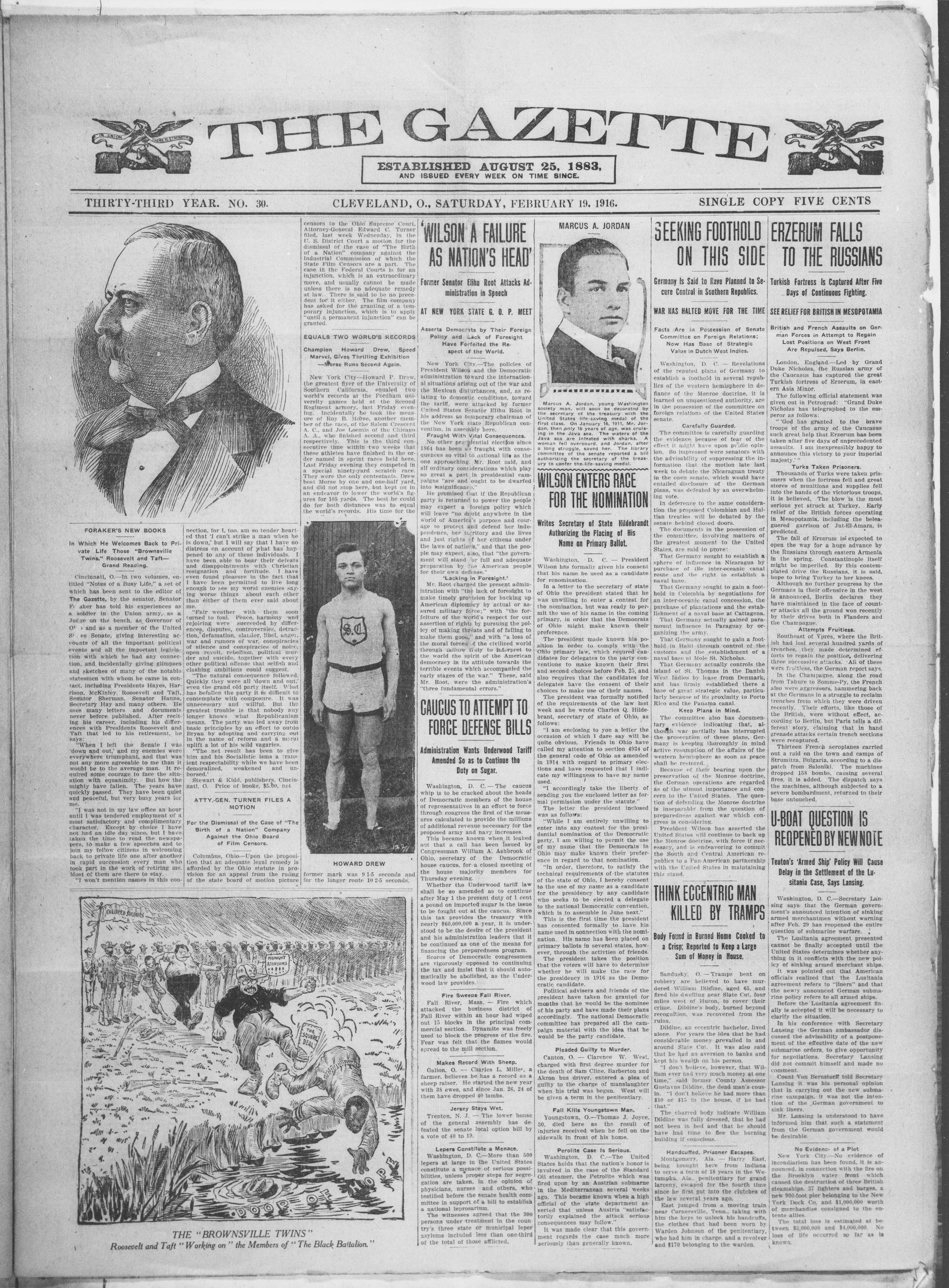
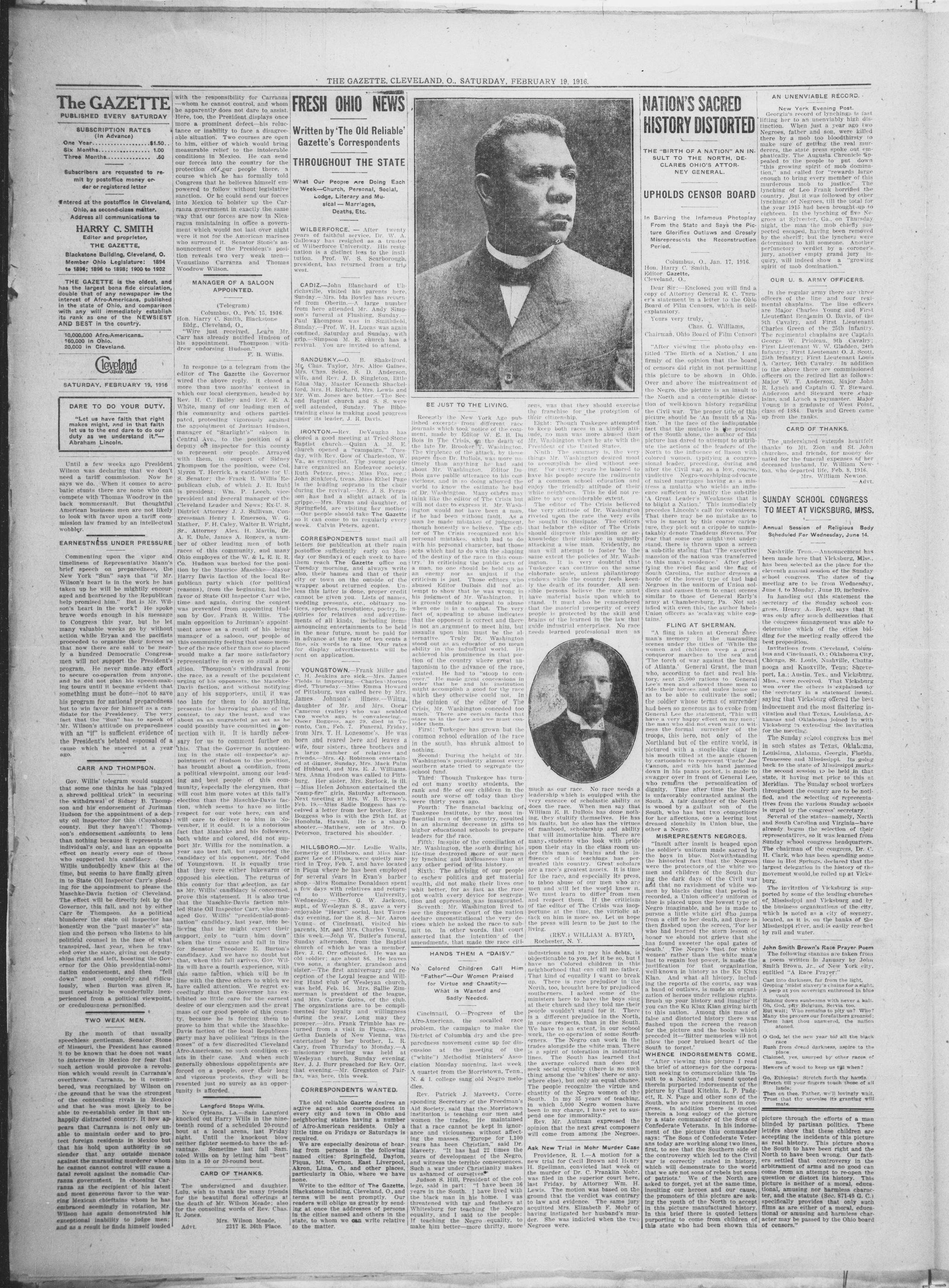
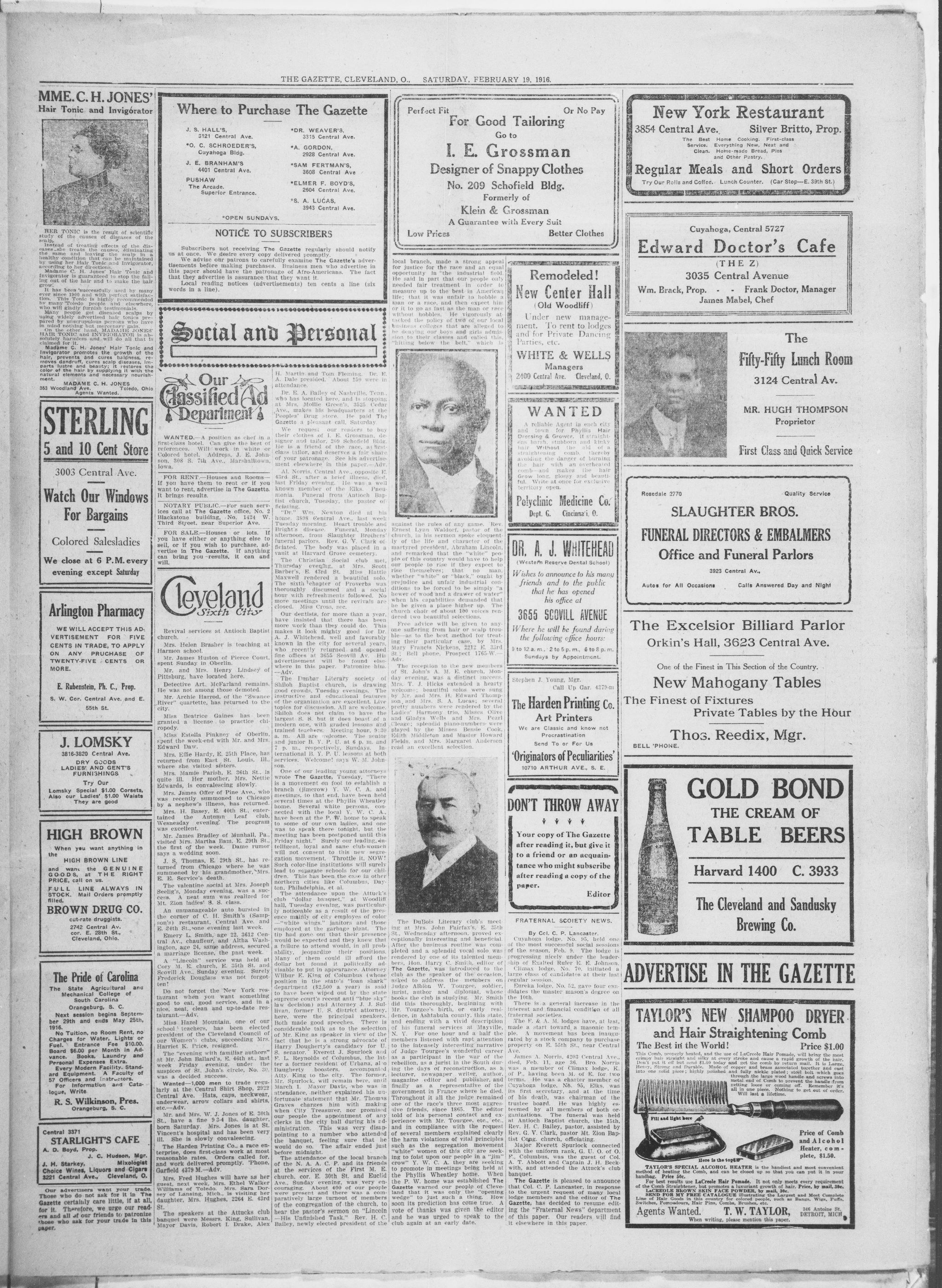
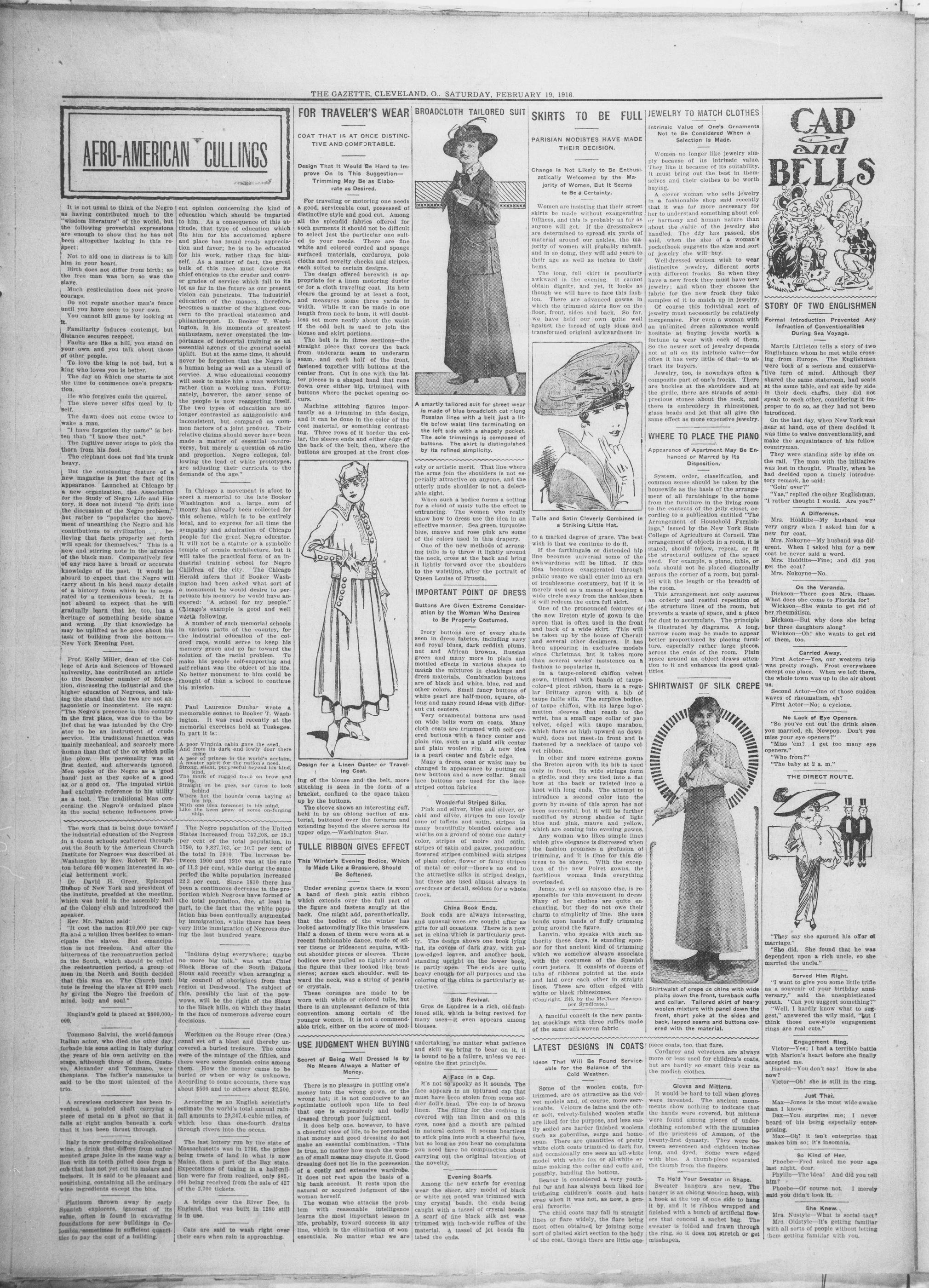
Page text (machine-generated)
M.
COLLIDED MURDERS
MIDNIGHT ASSASSINES
THE SQUARE DEAL
DOOP OF HOPE
THE "BROWNSVILLE TWINS"
Roosevelt and Taft "Working on" the Members of "The Black Battalion."
FORAKER'S NEW BOOKS
In Which He Welcomes Back to Private Life, Those "Brownville Twina," Roosevelt and Taft—Grand Reading.
Cincinnati, O.—In two volumes, entitled "Notes of a Busy Life," a set of which has been sent to the editor of The Gazette, by the senator, Senator Frater has told his experiences as a soldier in the Union army, as a Judge on the bench, as Governor of Ohio and as a member of the United States Senate, giving interesting accounts of all the important political events and all the important legislation with which he had any connection, and incidentally giving glimpses and sketches of many of the notable statesmen with whom he came in contact, including Presidents Hayes, Harrison, McKinley, Roosevelt and Taft, Senator Sherman, Senator Hanna, Secretary Hay and many others. He uses many letters and documents never before published. After receiving a difference with Presidents Roosevelt and Taft that led to his retirement, he says:
"When I left the Senate I was 'down and out,' and my enemies were everywhere triumphant, and that was not any more agreeable to me than it would be to the average man. It required some courage to face the situation with equanimity. But how the Senate failed is equally quicky passed. They have been quiet and peaceful, but very busy years (for me).
"I was not in my law office an hour until I was tendered employment of a most satisfactory and complimentary character. Except by choice I have not had an idle day since, but I have taken the time to read the newspapers, to make a few speeches and to join my fellow citizens in welcoming back to private life one after another in rapid succession every man who took part in the work, of retiring me. Most of them are there to stay.
"I won't mention names in this con
THE GAZETTE
nction, for I, too, am so tender hearted that 'I can not strike a man when he is down', but I will say that I have no distress on account of what has happened to any of these individuals. I have been permitted to bear the blame and displeasure with a Christian resignation and fortitude. I have even found, pleasure in the fact that I have been permitted to live long enough to see my worst enemies saying worse things about each other than either of them ever said about me. 'Fair weather with them soon turned to foul, Peace, harmony and rejoicing were' succeeded by differences, disputes, controversies, detraction, defamation, slaughter, libel, anger, war and rumors of war, conspiracies of silence and conspiracies of noise, open revolt against unjust authority, unjustIELD, together with every other political offense that selfish and clashing ambitions could suggest.
"The natural consequence followed. Quickly they were all 'down and out', even the grand old party itself. What has befallen the party it is difficult to contemplate, with composure. It was unnecessary and willful, but the party has the nobody longer knows what Republicanism means. The party was led away from basic principles by an effort to outdo Bryan by adopting and carrying out in the name of reform and a moral uplift a lot of his wild vagaries. The net result has been to give him the power to transient respectability while we have been demoralized, 'weakened and unhorsed.' Stewart & Kidd, publishers, Cincinnati, O. Price of books, $5.00, net
For the Dismissal of the Case of "The Birth of a Nation" Company Against the Ohio Board of Film Censors.
Columbus, Ohio-Upon the proposition that an adequate legal remedy is afforded by the Ohio statute in provision for an appeal from the ruling of the state board of motion picture
ESTABLISHED AUGUST 25, 1883 AND ISSUED EVERY WEEK ON TIME SINCE.
censors to the Ohio Supreme Court, Attorney-General Edward C. Turner filed, last week Wydnesday, in the U. S. District Court a motion for the dismissal of the case of "The Birth of the Industrial Commission" of which the State Film Censors are a part. The case in the Federal Courts is for an injunction, which is an extraordinary move, and usually cannot be made unless there is no adequate remedy at law. There is said to be no precedent for the granting of a temporary injunction, which is to apply "until a permanent injunction" can be granted.
EQUALS TWO. WORLD'S RECORDS
Champion Howard Drew, Speed Marvel, Glives Thrilling Exhibition — Horse Runs Second Again.
New York City—Howard P. Drew, the greatest flyer of the University of Southern California, equaled two world records at the Fordham university games held at the Second Regiment armory, last Friday evening. Incidentally he took the measure of Roy B. Morse, another member of the Scales, at the A.C. and Joe Locas, the Chicago A. A., who finished second and third respectively. This is the third consecutive time within two weeks that these athletes have finished in the order named in sprint races held here. Last Friday evening they competed in a special ninety-yard scratch race. They were the only contestants. Drew and did not stop out, but kept on in an endeavor to lower the world's figures for 105 yards. The best he could do for both distances was to equal the world's records. His time for the
S.C.
HOWARD-DREW
former, mark, was 9 1-5 seconds and
for the longer route 10 2-5 seconds.
WILSON A FAILURE AS NATION'S HEAD
Asserta Democrats by Their Foreign Policy and Lack of Foresight Have Forfeited the Respect of the World.
New York City—The policies of President Wilson and the Democratic administration toward the international situations arising out of the war and the Mexican disturbances, and, as relating to domestic conditions, toward the tariff, were attacked by former United States Senator Elliott Root in his address as temporary chairman of the New York state Republican convention, in assembly here.
Fraught With Vital Consequences.
No other prelonial election since 1864 has been so fraught with consequences so vital to national life as the one approaching. Mr. Root said, and all ordinary considerations which play so great a part in presidential campaigns "are and ought to be dwarfed into insignificance."
He promised that if the Republican party is returned to power the people may expect a "foreign policy which will leave "no doubt anywhere in the world of America's purpose and courage to protect and defend his independence, her territory and the lives and just rights of her citizens under the laws of nation's," and that the people may expect, also, that "the government will stand or full and adequate preparation by the American people for their own defense."
'Lacking in Foresight.'
Lacking inForeignism:
Mr. Root charged the present administration with "the lack of foresight to make timely provision for backing up American diplomacy by actual or assured military force," with "the forfeiture of the world's respect for our assertion of rights by pursuing the policy of making threats and of falling to make them good," and with "a loss of the moral forces of the civilized world through a failure only to interpret to the world the spirit of the American democracy in its attitude towards the terrible events which accompanied the early stages of the war." These, said Mr. Root, were the administration's "three (undamental errors."
CAUCUS TO ATTEMPT TO FORCE DEFENSE BILLS
Washington, D. C. — The caucus whip is to be cracked about the heads of Democratic members of the house of representatives in an effort to force through congress the first of the measures calculated to provide the millions of additional revenue necessary for the proposed army and navy increases. This became known when it leaked out that a call has been issued by Congressman William A. Ashbrook of Ohio, secretary of the Democratic house caucus, for a closed meeting of the house majority members for Thursday evening.
Whether the Underwood tariff law shall be so amended as to continue after May 1 the present duty of 1 cent a pound on imported sugar is the issue to be fought out at the caucus. Since this tax provides the treasury with nearly $60,000,000 a year, it is understood to be the desire of the president and his administration leaders that it be continued as one of the means for financing the preparedness program.
Scores of Democratic congressmen are vigorously opposed to continuing the tax and insist that it should automatically be abolished, as the Underwood law provides.
Fire: Sweeps Fall River
Fall River, Mass. — Fire which attacked the business district of Fall River within an hour had wiped out 15 blocks in the principal commercial section. Dynamite was freely used to block the progress of the fire. Fear was felt that the flames would spread to the mill section.
Makes Record With Sheep
Gallion, O. --- Charles L. Miller, a farmer, believes he has a record as a sheep raiser. He started the new year with 38 ewes, and since Jan. 26, 24 of them have dropped 40 lambs.
Jersey Stays Wet.
Trentten, N. J. — The lower house of the general assembly has defeated the senate local option bill by a vote of 40 to 19.
Arizona Constitution & Maintenance
Washington, D. C.-More than 500 lepers at large in the United States constitute a menace of serious possibilities, unless proper steps for segregation are taken. in the opinion of physicians, nurses and others, who testified before the senate health committee in support of a bill to establish a national leprosarium. The witnesses agreed that the 300 persons under treatment in the country's three state or municipal leper asylums included less than one-third of the total of those afflicted.
PETER
Margus A. Jordan, young Washington society man, will soon be decorated by the secretary of the treasury with the insignia of the first class. On January 16, 1911, Mr. Jordan, then only 16 years of age, was crushing in the Jury. The state of the nation are infested with sharks, a woman fell overboard, and Jordan, after a long struggle, saved her. The library was authorized to authorize the secretary of the treasury to confer the life-saving medal.
WILSON ENTERS RACE FOR THE NOMINATION
Writes Secretary of 'State Hildebrandt
Authorizing the Placing of His
Name on Primary Ballot.
Washington, D. C. — President Wilson has formally given his consent that his name be used as a candidate for nomination.
In a letter to the secretary of state of Ohio the president stated that he was unwilling to enter a contest for the nomination, but was ready to permit the use of his name in the coming primary, in order that the Democrats of Ohio might make known their preference.
The president made known his position in order to comply with the Ohio primary law, which required candidates for delegates to the party conventions to make known their first and second choices before Feb. 25, and also requires that the candidates for delegates have the consent of their choices to make use of their names.
The president was formally notified of the requirements of the law last week and he wrote Charles Q. Hildebrant, secretary of state of Ohio, as follows:
"I am enclosing to you a letter the occasion of which I dare say will be quite obvious. Friends in Ohio have called my attention to section 4934 of the general code of Ohio as amended in 1914 with regard to primary elections and have requested that I indicate my willingness to have my name used.
"I accordingly take the liberty of sending you the enclosed letter as formal permission under the statute."
The letter the president enclosed was as follows:
"While I am entirely unwilling to enter any contest for the presidential nomination of the Democratic party, I am willing to permit the use of my name that the Democrats in Ohio may make known their preference in regard to that nomination.
"In order, therefore, to satisfy the technical requirements of the statutes of the state of Ohio, I hereby consent to the use of my name as a candidate for the presidency by any candidate who seeks to be elected a delegate to the national Democratic convention, which is to assemble in June next."
This is the first time the president has consented formally to have his name used in connection with the nomination. His name has been placed on primary ballots in several states, however, through the activities of friends.
The president takes the position that the voters will have to determine whether he will make the race for the presidency in 1916 as the Democratic candidate.
Political advisers and friends of the president have taken for granted for months that he would be the nominee of his party and have made their plans accordingly. The national Democratic committee has prepared. all the campaign material with the idea that he would be the party candidate.
Pleaded Guilty to Murder.
Canton, O. — Clarence W. West,
charged with first degree murder for
the death of Sam Cline, Barberton and
Akron bus driver, entered a plea of
guilty to the charge of manslaughter
when his trial was begun. West will
be given a term in the penitentiary.
Fall Kills Youngstown Man.
Youngstown, O.—Thomas J. Joyce,
30, died here, as the result of
injuries received when he fell on
the sidewalk in front of his home.
Perolite Case Is Serious.
Washington, D. C.-The United States holds that the nation's honor is involved in the case of the Standard Oil steamer, the Petrolite which was fired upon by an Austrian submarine in the Mediterranean, several weeks ago. This became known when a high official of the state department asserted that unless Austria "satisfactorily explained the attack serious consequences may follow." It was made clear that this government regards the case much more seriously, than generally known.
SINGLE COPY FIVE CENTS
SEEKING FOOTHOLD ON THIS SIDE
Germany Is Said-to Have Planned to Secure Control in Southern Republics.
WAR HAS HALTED MOVE FOR THE TIME
Facts Are in Possession of Senate Committee on Foreign Relations; Now Has Base of Strategic Value in Dutch West Indies.
Washington, D. C. - Revolutions of the reputed plans of Germany to establish a tankhead in several republics of the western hemisphere in defence of the Monroe doctrine, is learned on unquestioned authority, are in the possession of the committee on foreign relations of the United States senate.
Carefully Guarded.
The committee is carefully guarding the evidence because of fear of the effect it might have upon public opinion. So impressed were senators with the advisability of suppressing the information that the motion late last week to debate the Nicaraguan treaty in the open senate, which would have entailed disclosure of the German plans, was defeated by an overwhelming vote.
In reference to the same consideration the proposed Colombian and Haitian treaties will be debated by the senate behind closed doors.
The documents in the possession of the committee, involving matters of the greatest moment to the United States, are said to prove:
That Germany sought to establish a sphere of influence in Nicaragua by purchase of the inter-oceanic canal route and the right to establish a naval base.
That Germany sought to gain a foothold in Colombia by negotiations for an inter-oceanic canal concession, the purchase of plantations and the establishment of a naval base at Cattagena.
That Germany actually gained paramount influence in Paraguay by organizing the army.
That Germany sought to gain a foothold in Haiti through control of the customs and the establishment of a naval base at Mole St. Nicholas.
That Germany actually controls the island of St. Thomas in the Danish West Indies by lease from Denmark, and has firmly established there a base of great strategic value, particularly because of its proximity to Porto Rico and the Panama canal.
Keep Plans In Mind.
The committee also has documentary evidence indicating that, although war, partially has interrupted the prosecution of these plans, Germany is keeping thoroughly in mind active resumption of the affairs of the western hemisphere as soon as peace shall be restored. Because of their bearing upon the preservation of the Monroe doctrine, the German operations are regarded as of the utmost importance and concern to the United States. The question of defending the Monroe doctrine is inseparable from the question of preparedness against war which congress is considering. President Wilson has asserted the United States will continue to back up the Monroe doctrine, with force if necessary, and is endeavoring to commit the South and Central American republics to a Pan-American partnership with the United States in maintaining this stand.
THINK ECGENTRIC MAN KILLED BY TRAMPS
Body Found in Burned Home Cooked to a Crisp; Reported to Keep a Large Sum of Money in House.
Sandhuky, O. — Tramps bent on robbery are believed to have murdered William Dilfine, aged 65, and fired his dwelling near Slate Cut, four miles west of Huron, to cover their crime. Dilfine's body, burned beyond recognition, was recovered from the ruins.
Dilfine, an eccentric bachelor, lived alone. For years the idea that he had considerable money prevailed in, and around Slate Cut. It was also said that he had an aversion to banks and kept his wealth on his person.
"I don't believe, however, that William ever had very much money at one time," said former County Assessor Gustave Dilfine, the dead man's cousin.
"I don't believe he had more than $10 or $15 in the house, if he had that."
The charmed body indicate William Dilfine was fully dressed, that he had not been in bed, and that he should have had time to flee the burning building if conscious.
Handcuffed, Prisoner Escapes.
Montgomery, Ala. — Harry East, being brought here from Indiana to serve a term of 18 years in the Wetumpka, Ala., penitentiary for grand larceny, escaped for the fourth time since he first got into the clutches of the law several years ago.
East jumped from a moving train near Cornersville, Tennessee, taking with him the keys to unlock his handcuffs, the clothes that had been worn by Warden Johnson of the penitentiary, who had him in charge, and a revolver and $170 belonging to the warden.
IN DIXON
REPRESENTED
ERZERUM FALLS TO THE RUSSIANS
Turkish Fortress Is Captured After Five Days of Continuous Fighting.
SEE RELIEF FOR BRITISH IN MESOPOTAMIA
British and French Assaults on German Forces in Attempt to Regain Lost Positions on West Front Are Repulsed, Says Berlin.
London, England—Led by Grand Duke Nicholas, the Russian army of the Caucasus has captured the great Turkish fortress of Erzerum, in eastern Asia Minor.
The following official statement was given out in Petrograd: "Grand Duke Nicholas has telegraphed to the emperor as follows:
"God has granted to the brave troops of the army of the Caucasus such great help that Erzerum has been taken after five days of unprecedented assaults.
I am inexpressibly happy to announce this victory to your imperial majesty."
Turks Taken Prisoners.
Thousands of Turks were taken prisoners when the fortress fell and great stores of munitions and supplies fell into the hands of the victorious troops, it is believed. The blow is the most serious yet struck at Turkey. Early relief of the British forces operating in Mesopotamia, including the beleaguered garrison of Jut-El-Amara, is predicted.
The fall of Erzerum is expected to open the way for a huge advance by the Russians through eastern Armenia in the spring. Constantinople itself might be imperiled. By this contemplated drive the Russians, it is said, hope to bring Turkey to her knees.
Although no further progress by the Germans in their offensive in the west is announced, Berlin declares they have maintained in the face of counter attacks all the ground won recently by their drives both in Flanders and the Champagne.
Attempts Fruitless.
Southeast of Vipres, where the British had lost several hundred yards of trenches, they made determined efforts to regain the position, delivering three successive attacks. "All of these were fratless, the German report says. In the Champagne, along the road from Tature to Somme-Py, the French also were aggressors, hammering back at the Germans in a struggle to reclaim trenches from which they were driven recently. Their efforts, like those of the British, were without effect, according to Berlin, but Paris tells a different story, claiming that in hand grenade attacks certain trench sections were recaptured. Thirteen French aeroplanes carried out a raid on the town and camps of Strumitza, Bulgaria, according to a dispatch from Saloniki. The machines dropped 158 bombs, causing several fires, it is added. The dispatch says the machines, although subjected to a severe bombardment, returned to their base untouched.
U-BOAT QUESTION IS REOPENED BY NEW NOTE
Washington, D. C.—Secretary Lansing says that the German government's announced intention of sinking armed merchantmen without warning after Feb. 29 has reopened the entire question of submarine warfare.
The Lusitania agreement presented cannot be finally accepted until the United States determines whether anything in it conflicts with the new policy of sinking armed merchant ships. It was pointed out that American officials realized that the Lusitania agreement refers to "liners" and that the newly announced German submarine policy refers to all armed ships.
Before the Lusitania agreement finally is accepted it will be necessary to clarify the situation.
In his conference with Secretary Lansing the German ambassador discussed the advisability of a postponement of the effective date of the new submarine orders, to give opportunity for negotiations. Secretary Lansing did not commit himself and made no comment.
Count Von Bernstorff told Secretary Lansing it was his personal opinion that in carrying out the new submarine campaign, it was not the intention of the German government to sink liners.
Mr. Lansing is understood to have informed him that such a statement from the German government would be desirable.
No Evidence of a Plot.
New York City—No evidence of incendiarism has been found. It is announced, in connection with the fire on the Brooklyn water front which caused the destruction of three British steamships, 37 lighters and barges, a new 900-foot pier belonging to the New York Dock Co. and $1,000,000 worth of merchandise consigned to the entente allies.
The total loss is estimated at between $3,000,000 and $1,000,000. No loss of life occurred so far as is known.
PUBLISHED EVERY SATURDAY
SUBSCRIPTION RATES ‘
(in Advance)
One Years... ceeseencesees S180...
Six Monthe... 22... 1.00
Three Months......-cecee. 60
Subscribers are requested to re-
mit by postoffice money on
der or registered letter
‘Sntered at the postoffice In Cleveland,
Ohio, a8 second-class matter.
‘Address all communications to
HARRY C. SMITH
Editor and proprietor,
THE GAZETTE,
Blackstone Building, Cleveland, 0.
Member Ohio Legislature: 1804
te 1898; 1896 to 1898; 1900 to 1902
THE GAZETTE is the oldest, and
has the largest bona fide circulation,
double that of any newspaper im the
interest of Afro-Americans, published
in the state of Ohio, and comparison
with any will immediately establish
its rank as one of the NEWSIEST
AND BEST in the country.
"40,000,000 Afro-Americans.
160,000 in Ohio.
20,000 in Cleveland.
SATURDAY, FEBRUARY 19, 1916
DARE TO DO YOUR DUTY.
“Let us have faith that right
makes might, and in that faith
let us to the end dare to do our
duty as we understand it"—
Abraham Lincoln.
Until @ few weeks ago President
Wilson was declaring that we don’t
need a tariff commission. Now he
says we do.. When it comes to acro-
batie stunts there are none who can
compete with Thomas Woodrow in the
back sommersault. But thoughtful
American business men are not likely
to look with favor upon a tarift com:
mission law framed by an intellectual
‘wobbigr.
EARNESTNESS UNDER PRESSURE
Commenting upon the vigor and
timeliness of Representative Mann's
brief speech on preparedness, the
New York “Sun says that “if Mr.
Wilson's heart is in the work he has
taken up he will be mightily encour
‘aged and heartened by the Republican
help promised him.” But is Mr. Wil
son's heart in the work? He spoke
brave words enough in his message
to Congress this year, but he let
many valuable weeks go by without
action while Bryan and the pacifists
proceeded to organize their forces so
that now there are sald to be near
ly @ hundred Democratic Congress.
men will not support the President's
program, He never made.any effort
to secure co-operation from anyone,
and he did not plan bis speect-max-
ing tours until it became evident that
something must be done—not to save
his program for national preparedness
hut to win favor for himselt as a can:
Miidate for the Presidency. The very
fact that the “Sun” has to speak of
‘Mr. Wilson's attitude on preparedness
with an “if” is sufficient evidence of
the President's belated espousal of a
eause which he sneered at a year
ago. .
CARR AND THOMPSON.
Gov. Willis’ telegram would suggest
‘that some one thinks he has “played
® shrewd political trick” in securing
the withdrawal’ of Sidney B. Thomp-
son and his endorsement of Juriman
Hudson for the appointment of a dep-
uty ofl inspector for this (Cuyahoga)
county, But they haven't! ‘Thomp.
son's endorsement «amounts to less
than nothing because it represents an
individual's only, and has an opposite
effect on nearly every one of those
Who supported his candidacy. . Gor.
Willis undoubtedly knew this at the
time, but seems to have finally given
in to State Oil Inspector Carr's plead-
ing for the appointment to please the
Maschke-Davis faction of Cleveland.
‘The effect will be directly felt by the
Governor, this fall, and not by either
Carr 8 ‘Thompson, As a political
Dlunderer' the state oil inspector has
honestly won the “past master's” sta-
tion and the person who listens to his
political counsel in the face of what
transpired, Jast year, when he trav-
sled over the state, giving out deputy:
ships Fight and leti, boosting the Gov-
ernor for the Qhio presidential-nomi-
nation endorsement, and then “fell
down" most completely and ridicu-
Jously, when Burton was given it,
must ‘certainly be wondertully inex.
perienced from a political viewpoint,
or credulousness personified,
Sa
TWO WEAK MEN.
By the mouth of that usually
speechless gentleman, Senator, Stone
of Missouri, the President has caused
it to be known that he does not want
to intervene in Mexico for fear that
such action would provoke a revolu-
tion which would result in Carranza’s
overthrow. Carranza, be it remem-
bered, was recognized by Wilson on
the ground that he was the strongest
‘of the contending rivals in Mexico
and that he was most Ukely to be
able to reestablish order in that un-
happily distracted country. It now ap-
pears that Carranza ix not only un-
able to maintain order and to pro-
tect foreign residents in Mexico but
that bis hold upon authority is so
slender that any outside menace
against the marauding murderer whom
he cannot cannot control will cause a
fatal revolt against the nomadic Car
fanaa government. In choosing Car
yanza a8 the recipient of bis latest
and mest generous favor to the war
ring Mexican chieftains whom he has
embraced seemingly in rotation, Mr.
Wileon has again demonstrated his
exceptional inability to judge men;
and as s result he finds himself loaded
with the responsibility for Carranza
—whom he cannot control, and whom
he apparently does not dare to, assist.
Here, too, the President displays once
‘more a prominent defect—his. relue-
tance or inability to face a disagree-
able situation. Two courses are open
to him, either of which would bring
measurable relict to the intolerable
conditions in Mexico. He can send
our forees into the country for the
protection of/gur people there, a
course which he has formally told
Congress that he belioves himself em-
powered to follow without legislative
sanction. Or he could send our forces
into Mexico to bolster up the Car
‘ranza government in exactly the same
way that our forces are now in Nica-
ragua maintaining in office a govern:
ment which would not last over night
were It not for the American marines
who surround It. Senator Stone's an:
houncement of the President's posi
‘tion reveals two very weak men—
Venustiano Carranza and Thomas
Woodrow Wilson.
| MANAGER OF A SALOON
APPOINTED.
| eg
peg meats chp RAE hike llad ic ey ag
his appointment. Thompson with:
drew endorsing Hudson.”
FB. Willis.
In response to a telegram trom the
editor of The Gazette ihe Governor
wired the above reply. It closed a
more than two months’ contest in
which our local clergymen, headed by
Rev. H.C. Bailey and itev. KE. A.
White, many of our leading men of
this community and others partiel-
pated, protesting vigorously against
the appointment of Juriman Hudson,
manager of “Starlight’s" saloon in
Central Ave., to the position of a
depiiy of inspector for this county
to represent our people. Arrayed
with them, in support of Sidney
Thompson for the position, were Col.
Myron T. Herrick, a candidate for U.
8. Senator; the Frank B. Willis Re
publican club, of which J.B. nll
is president; Wm. P. Leech, vice:
president and general manager of the
Cleveland Leader and News; Bx-U. S,
District Attorney J. J. Sullivan, Con-
gressman. Henry 1. Emerson, W. G.
Mather, F. H. Caley, Walter B. Wright,
Sr. Attorney Alex. H. Martin, Dr
‘A. E, Dale, James A. Rogers, a num.
ber of other leading men of both
races of this community, and many
Ohio employes of the W. & L. BR. R.
Co, Hudson was backed for the posi-
tion by the Maurice Maschke—Mayor
Harry Davis faction of the local Re:
publican party which (for political
Yeasons), from the beginning, had the
favor of State Oil Inspector Carr who,
time and again, during the conjest
was prevented from appointing Hud:
son by Gov. Frank B. Willis. The
main opposition to Juriman’s appoint
ment arose as a result of his being
manager of a saloon, our people of
this community feeling that some mem-
‘ber of the race other than one so placed
would make a far more satisfactory
representative in even So sinall a po-
sition. ‘Thompson's withdrawal from
the race, as a result of the persistent
turing of his eppenests, the Masehke.
Davis faetlon, and without notifying
any of his supporters, until, it was
too late for them to ‘do anything,
presents the harrowing phase of the
eontest, to say the least, and) was
About as an ungrateral an act as he
Could possibly have committed in gon-
nection with il, It is hardly. neces
sary for us to comment further on
‘this, That the Governor in acquiese-
ing in the state oil inspector's ap:
pointment of Hudson to the position,
has brought about a condition, from
a political viewpoint, among our lead:
ing and best people of this com-
munity, especially the clergymen, that
will cost him more votes at this tall’s
election than the Muschke-Davis tac:
tion, which seems to have so tlitle
respect for our vote here, can and
will care to deliver to him in No:
vember, if It could. It Is @ notorious
fact that Maschke and his followers,
both white and colored, did not. sup-
port Mr. Willis for the nomination, a
year ago last fall, but supported the
éandidacy of his opponent, Mr. Todd
of Youngstown. It is equally true
that they were either lukewarm or
opposed his election. The returns of
this county for that ylection, as. far
as Mr. Willis’ candidacy if concerned,
prove this statement. It is also true
that the MaschkeDavis faction mis-
led State OM Inspector Carr, who man-
aged Gov. Willis’ “presidentiatasomt-
nation” candidacy. last year, into be-
lieving that he might expect their
support, only to “turn him down”
when the time came and fall in tine
for Senator Theodore E, Burton's
candidacy. And we have no doubt but
that, when this fall aurives, Gov. Wil-
lis will have a fourth experience, with
this same fattion, which will be in
Une with the three others to which we
have called attention. We regret ex-
ceedingly that the Governor his ex-
hibited so little care for the earnest
desire of our clergymen and the great
mass of our good people of this coun-
ty, because he Is forcing them to
prove to him that while the Maschke-
Davis faction of the local Republican.
party may have political “rings in the
noses” of a few discredited Cleveland
Afro-Americans, no such condition ex-
ists in their case. And when such
gaveratiy bbbasioun oppslotipents are
forced on a people, over their tons!
and vigorous protests, they will be:
resented just so surely as an oppor-
tunity Is afforded.
Langford Stops Wills.
New Opleans, La—Sam Langford
knocked out Harry Wills in the nine-
teenth round of a scheduled 20-round
bout at a local arena, last Friday
night. Until the knockout _ blow
neither fighter seemed-to have the ad-
vantage. Sometime last fall Sam.
toled Wills on by letting him “best”
him in a 10 or 20-round bout.
CARD OF THANKS.
The undersigned and daughter.
Lulu, wish to thank the many friends
for the beautiful floral offerings at
the death of Mr. Wilson Meade; also
for the consoling words of Rev. Chas.
R. Jones.
Mrs, Wilson Meade,
Advt. 2317 E. 26th Place.
~_THE GAZETTE, CLEVELAND, 0., SATURDAY, FEBRUARY 19, 1916.
=2 = Se ——
FRESH OHIO NEWS (apr ssnesconcpeseme
1 oe es aie es gL igs
Written by ‘The Old Reliable’ Paes ee v4 a mA
Gazette's Correspondents | | 4 ;
THROUGHOUT THE STATE) |) | 9 mi al
a ee BI
What Our Peopte mre Doing Each) [Pee eae ee
Week—Chureh, Personal, Social, ae et
iodge, Literary and Mu- | see \ by
sical — Marriages, | el * a
Deaths, Ete, eee : sit
c= ae | ee i Oe on
WILBERFORCE. — After twenty, |fee ees
Gelloway as resized és a trustee | [Ug ae ba R
ation is a distinct loss to the insti: Se Sr be itt
‘president, has returned trom a tri) | | Eames
CADIZ—John Blanchard of Ub.
richsville, Visited his parents here,
Sunday.— Mrs. lda Bowles has return
ed from Oberlin.—A large number
from here attended Mr. Andy Simp-
son’s funeral at Flushing, Sunday.
Paul Bhompson was in’ Smitinfietd,
Sunday.—Prof, W. H. Lucas was again
confined, Saturday and Sunday, with
grip.—Simpson M. EB. church has a
revival. You are invited to attend,
SANDUSKY.—O. B. Shakeliord,
My Chas. Taylor, Mrs. Alice Gaines,
MS. Chas. Selec, 8. D. Anderson,
wife, and Rey. J. D. Singleton, litue
Ndna May, Master Kenneth Shackel-
ford, irs. H. Richard, Mrs. Lewis and
Mr. ‘Wm. Jones are better The See:
ond Paptist church and S. 8. were
well attended, Sunday. The Bible-
training claxs js making zood progress
under its leader, J. R. Davis.
IRONTON.—Rev. DeVaughn has
Gloged good meeting at Tried-Stone
Baptist church--Quinn A.M. E,
ehureh opened a “campaign,” ‘Tues
day, with Rev. Gow of Charleston, W
Va., as evangelist. The young people
have organized an Endeavor society,
Ruth Peters, pres; Miss Fox, see;
John Sinkford, treas. Miss Ethel Page
is the leading soprano in the choir
during the revival—Mrs. J. S. Ferau-
son has had a slight attack of la
grippe—Mrs. Evans and daughter, of
Springfield, are visiting her mother.
Our people should tuke The Gazette
so it can come to us regularly every
week. Calvin Peters, agent.
CORRESPONDENTS must mail all
letters for publication at thelr main
postofice sufficiently early on Mon
day (or Sunday) of cach week to have
them reach The Gazette office on
Tuesday morning, and always write
also, their hanes and that of their
city or town on the outside of the
wrapper about returned copies. Un-
less this latter is done, proper eredit
cannot be given you, Lists of names,
wedding presents, ete. obituary no.
tices, speeches, resolutions, poetry, ‘:
aniries for, relatives and advertise
ments of all Kinds, including items
announcing entertainments to be held
in the near future, must be paid for
in advance at the rate of ten cents a
line, six words to a line. Our rates
for display advertisements will be
‘ent on application.
YOUNGSTOWN. —Frank Miller and
C,H. Jenkins are sick.— Mrs, James
Fields ‘is. Improving —Charles storton
died, "Thursday. Miss Emma Howard
of Pittsburg, was called here by Mrs
James. Johnson's illness,—Wilma,
daughter of Mr. and Mrs. Oscar
Cameron (valley) who was sealded
two weeks aio, fs convalescing
Osenr Boseess, age 20. died in To:
ronto, Can, Feb. t Funeral, Friday,
from Mrs. T, H. Lonesome’s. | He was
born and reared here and leaves a
wife, four sisters, three brothers and
a larze number of relatives and
friends —aIrs. @. Robinson entertain-
ed at dinner, Sunday, Mrs. Mack Palm
of Hubbard, and Mrs. B. J. Williams,
Mrs. Anna Hudson was called to Pitts
burg. Her sister, Mrs, Surlock, ts il.
—Aiss Helen Johnson entertained the
“eamp-fire” gitls, Saturday afternoon.
Next meeting at Mrs. W. 1. Brown's,
Feb. 18,—Miss Sadie Rosigess has re
ceived a letter from her brother, Roy
Boggess who is with the 29th Int at
Honolula, Hawaii, He is a. sharp-
shooter.—Matihew. son of Mrs. 0.
Peterson, fractured his shoulder.
HILLSBORO.—Mr. Leslie Walls,
formerly of Hillsboro, and Aliss Mar
Earet Lee of Piqua, were quietly mar
vied in ‘Troy, Feb. 7, and have located
in Piqua where he has been employed
for several years in Evan's barber
shop.- -Mies Romaine Donaldson spent
a few days with relatives and return-
ed to Wilberforce University,
Wednesday. — Mrs. G. W. Jackson,
supt., of Wesleyan 8. S., gave a very
enjoyable “Heart” social, last. Taurs
day evening, for the S. S—Mr. Aaron
Young. of Cincinnati, visited his
parents, Mr, and Mrs. Charles Young,
this week: —Johm W. Butler's funeral
Sunday afterndon, from the Baptist
ciniteh of which he was a member.
Rev. I. G. Orr officiated. He was ai
old soldier; axe about 86. He leaves
two sons, daughter, grandson and
sister—The first anniversary and re-
ception of the Loyal league and Will-
ing Hand club of Wesleyan church,
Was held, Feb. 16. Mrs, Sallie Zim
merman is president of the league,
and Mrs. Carrie Goins, of the club.
The organizations are to be compli-
mented: for loyalty and willingness
during the year. Long may they
prosper.—Mrs. Frank ‘Trimble has re-
turned from a visit in Piqua—Mrs,
Geta Daniels of New Vienna, was
entertained by her brother, 1. R.
Cary, from Thursday to Monday.—A |
miskionary meeting was held at
Wesleyan church, Sunday evening.
ee tee coer
that’ evening.—Mr. Gregston of Fair”
fax, was here, this week,
CORRESPONDENTS WANTED.
The old reliable Gazette desires an
aciive agent and correspondent in
every city and town in Ohio and
neighboring states having a number
of Afro-American residents. Only a
Iittle time on Fridays or Saturdays is
required.
We are especially desirous of hear:
ing from persons in the following
named cities: Springfield, Dayton,
Piqua, Mt. Vernon, East ‘Liverpool,
Akron, Lima, 0., and other places,
particularly in Ohio, where we have
none.
Write to the editor of The Gazette,
Blackstone building, Cleveland, O,, and
terms will be sent promptly. "Our
readers will oblige us greatly by send.
Ing at once the addresses of persons
in the cities named and others in the
state, to whom We ean write relative
to the matter.
ee se ee
ee
Ne
er Ss | Ss
eee a > Ae ee es
ee ee : gO emacs? ee
> “a ee
-— $=
Ce
Bee te. oo Ses
Oy a a eee
ae oe Oo eae:
tee hoi gu ener ue ea
Ree aw Fe ee
BE JUST TO THE LIVING.
Recently the New York Age pub:
lished. excerpts. from different. Pace
Journals which toa notice of the cont
ment, made by Editor W. BB. Du
Bois in The Crisis, qn the deatis of
the lute ‘Dr. Brooker *t. Wastin: ton
‘The virplenee of the attack, by these
papers don Dr. Dufois, was more ui
timely than anything he had sald
about Mr. Washington, Editor Du
Bois gave public stterance to Ins com
/victione, and in so doing. allowed the
world {o know the estimate he. bd
of Dr. Washington, Many others mas
[think like the editor of The Crisis but
“Will not date to express ft. Str. Wash
ington wotld ‘not have been aman,
it he had been without fault. Aww
an he made mistakes of Judgment,
‘thongh honestly. wn believe. "The eat
tor of The Crisis recognized not his
Personal mistakes, whiten had. to do
with his personal charactor, bat those
)acts which had to do with the shaping
Of the destiny of the race in this coun.
Ary." In criticising Use publie acts of
A man, no one should be held up. as
Aan enemy nor as unjust. it. the
Criticism is just. ‘Those editors. who
bused" Editor Dubois. did “not at.
empt to show that he was. wrong in
his fudgmiont of Mr. Washington. Tt
‘is. grossly unfalr to. appeal ta. abuse
when one iain a combat. The vers
Tact ‘of appealing to abuse Indicates
that the opponent is correct and there
is not an argument to meet him, but
[assaulis upon him must be the al
ae ‘Truly. Dr. Washington
stood out as an educator of no mean
ability. in “the industrial world. He
Achieved bis prominence in that_ por
tion of the country where great an-
‘tagonism to the advance of the race,
existed, He had to “stoop to con
titer” He made arent concessions. In
sis that he end his institution
might accomplish a k0od for the race
whieh they otherwise could not, in
‘the opinion of the editor of The
“Crisis, Mr. Washington conceded too
auch hero arg ‘eentatn’ tacts -tuet
-ttave’ ws in the face and’ We must fon
sider. en.
| fist: "Puskegoe has gzoen Dut the
common school education of the race
in the south, has shrunk almost to
nothing,
Second: During the helght of Mr.
Washington's popularity almost every
youthern state tried to. segregate the
School fund.
Third: ‘Though ‘Tuskegee has turn-
ed out many worthy students, the
ani and file of ont children im. the
South are worse off today than they
‘were thirty” years ago.
fourth: The financial backing of
Tuskegee Institute, by the most in-
fuential men of the coumtry, resulted
invan alarming decrease in. itts
higher educational schools to prepare
leaders for thé race,
Fifth: Inespite of the conciliation of
Mr. Washington, the south during his
Mcestme dentroged more of our men
hy. Iynehing and layilessness. than at
any other period of is history.
Sixth: ‘The advising of our people
to eschew politics and get_material
‘wealth, did not make their lives one
whit better, for as fast as the race
Peale waeceie Gunsee
tion ‘and oppression was snaugurated.
“Seventh: Mr. Washington lived to
‘see the Supreme Court of the nation
deemare unconstitutional the very de-
vioes which le asked the race to sub-
‘mit to. In other words, that court
asserted that the intention” of the
GSE EES Never sree see en er ca
HANDS THEM A “DAISY.”
No Colored Children Call Him
“Father”—Our Women Praised
for Virtue and Chastity—
What is Wanted and
‘Sadly Needed.
Cincinnati, O.—Progress of — the
Mro-American, the socalled race
problem, the campaign to make the
District of Columbia dry and the pre
paredness movement came up for dis:
enssion at the meeting of the
Cwhite”) Methodist Ministers’ Asso:
ciation Monday morning, last week
A quartet from the Morristown, Tenn..
N. & I. college sang old Negro melo.
dies.
Rev. Patrick J. Maveety, Corre.
sponding Secretary of the Freedman's
Aid Socfety. said that the Morristown
institution is teaching our men and
women the trades. He maintained
that a race cannot be kept in ignor-
ance and viciousness without affect:
ing the masses. “Europe for 1,100
years has heen Christian,” said Dr.
Maveety. “It has had 22 times the
years of development of the Negro,
and witness the terrible consequences.
Such a war under Christianity makes
us ashamed of ourselves?
‘Judson S, Hill, President of the col-
lege, said in part: “I have been 36
years in the South. 7 have lived with
the black man in bis home. I was
threatened with tar and feathers at
Whitesburg for teaching the Negro
equality, and I said to the people:
If teaching the Negro equality, to
make him better—more thrifty, more
zens, was that they should exercise
the franchise for the protegtion of
their citizenship,
Ejeht: ‘Though Tuskegee attempted
to keep both races in a kindly atti-
tude, no man was miore abused (han
Mr, Washington when he ate with the
President of he United States,
Ninth: ‘The summary is, the very
things Mr. Washington desired most
fo accomplish he died without see
ing. For twenty years he labored to
have his people secure the rudiments
of & common school education and
enjoy the friendly. attitude of their
white neishhors. ‘This he did not re:
lize to any considerable extent,
The editor of The Crisis. believed
the very attitude of Dr, Washington
riveted uon the race the very evils
he sought to dissipate. ‘The editors
that helabor the editor of The Crisis
should disprove this position or ac-
Knowledge their mistake in unjastly
attacking a wise man. Evidently, no
man will attempt to foster ‘to the
same extent the policies of Mr. Wash-
ington. It is very doubtful that
‘Tnskexee ean continue on the same
elaborate ‘scale, unless philanthropy
endows while the country feels keen-
ly the death of its founder. All sen:
sible persons believe the race mnst
have material basis upon which to
stand. It must also be remembered
that the material prosperity of every
people is protected by the skill and
brains of the learned in the law that
unide industrial enterprises. No race
needs learned professional men as
Gi.
i *.
[ys ee
ae ile
Rae
Ne
much as our race. No race needs a
leadership whieh is equipped with the
very essence of scholastic ability ax
does the race. When men say that
William £. B. DuBois has done noth-
ing, they stultify themselves. He has
his faults, but he also has the virtues
of manhood, scholarship and ability
that will immortalize him, ‘There are
many. students who look with pride
upon their stay in the elas room un-
der this man of brains and the in-
fluence of his teachings has per-
mieated this country, Great: scholars
are a race’s greatest assets. It is time
for the race, and especially its press,
to taboo abuse of our men who are
men and will let the world know it
We must learn to differ from men
and respect them. If the criticism
Of the editor of The Crisis was inop-
portune xt the time, the vitriolic at-
Tack on him is moreso. Let us hope
the press will Iearn to be just to the
living,
(REV.) WILLIAM A. BYRD,
AMES yn oe +
industrious and to pay his debts, is
objectionable to you, let it be so, but 1
have no Colored ‘children in this
neighborhood that can call me. father.
‘That kind of equality 1 want (o break
up. ‘There is race prejudiced in_ the
North, too, brought here by prejudiced
Southerners. I asked some of the
ministers here to have the boys sing
at their church and they told me their
people wouldn't stand for it. There
fs a different prejudice in the North,
in some respects, than in the South.
We have to an extent, in our school
Work, the co-operation of some South-
erners. The Negro can work in the
trades alongside the white man, There
is spirit of toleration in industrial
lines. The South has learned that
the average colored man does not
seek social equality (there is no such
thing among the ‘whites’ there or any-
where else), but only an equal chance.
‘The people’ recognize the virtue and
chastity of the Negro women of the
South. In my 95 years of teaching.
in which 5,000 Negro women have
been in my charge, I have yet to sus-
pend one for immorality.”
Rey. Mr, Aultman expressed the
opinion that the next great composers
will come from among the Negroes.
Ask New Trial in Mohr Murder Case
Providence, R. 1—A motion for a
new trial for Cecil Brown and Henry
H. Spellman, convicted last week ot
the murder of Dr. C. Franklin Mohr.
was filed in the superior court here,
Inst Friday, by Attorney Wm. H.
Lewis. The motion was based on the
ground that the verdict was contrary
to law and evidence. The same jury
acquitted Mrs. Elizabeth F. Mohr of
having instigated her husband’s mur.
der. She was indicted when the twu
Negroes were.
NATION'S SACRED
| HISTORY DISTORTED
| ecanes GHio's APTOR.
| NEY GENERAL.
| UPHOLDS CENSOR BOARD
Ip: Barring. She, (atameus: PAotoplay,
From the State and Says the Pic-
ture Glorifies Outlaws and Grossly|
Misreprescnts the Reconstruction
Period.
Columbus, 0. Jan. 17, 1916.
Hon. Harry C. ‘Smith,
Kaitor Gazette,
Cleveland, 0.,
Dear Sir:—Bnelosed you will find a
copy of Attorney Genefal B.C. Then:
er's sintement in a letter to the Ono,
Board of Pili Censors, which is sel
explanatory
Yours very truly,
Chas, 6. Willams,
Chairmaa, Ohio Board of Fitm Censors
“after viewing the photoplay en
filed “The Birth of a Nation, 1 am
firmly of the opinion that the board
of censors dill right in not permitting
this picture to be shown in Ohfo.
Over and above the mistreatment of
the Negro, the pleture is an insult to
ite North and @ contemptible distor-
tion of wellknown history regarding |
the Civil war. ‘The proper title of this
picture should be “An Insult t6 a Na-
tion.” in the face of the indisputable
fact thgt the mulatto Is wie product
of the South alone, Une author of this
pletuire lias dared to atiempt to attrib
lite the actions of the leaders of the
North to the influence of Hason with
colored women, ypitying a congres
stonal leader, preceding, during and
after the Civil war, ag a low, coarse,
Vindictive Negro.worshiping-advocare
Of mixed marriages having as a mis
tess & mulatto who wields an insu
ence suffielent to justify Hie subtitle
HA Great Leader's: Weakness that is
‘to blight a Nation.’ This immediately
[preceies Lincoln's call for volunteers.
‘That there may be no mistake as to
who is meant by. this coarse caries
ture, they pick out a cripple to unmis-
fadabiy ccuois Tuatihens Stevens 901
Tear that some one might\not under-
stand, there ig thrown upon a screen
‘a subtitle stating that ‘The executive
mansion of the nation was transferred
fo this man’s residence." After glori-
ping "the Fobel fax and the ‘nag of
South Carolina, the author dresses a
horde of the lowest type of bad land
Negroes in the uniform of Union so
diers and causes them to enact scenes
similar to those of General Barly's
army at Chambersburg, Pa. Not sat-
jeted with even this, the author labels
Union ofliecrs as ‘sealawas white eap-
‘tains.
FLING AT SHERMAN.
anc fing Is taken at General Sher-|
man’s memory. in the marauding
/seenes under the titles of ‘While the
Women ‘and. children weep a great
conqueror marches to the sea” and
“The torch of war against the breast
of Atlanta.’ General Grant, the man
who, accoriling to fact and real his:
tory, sent 25,000 rations fo “General
Lee's men and allowed those men to
Fide thelr horses. end mules hore 30
as to be able to cultivate the soit;
the soldier whose terms of surrender
had been so generous ax to evoke from
General Lee the statement, “This will
have a very happy effect on my mens"
the man who did nol even walt Lo Wit
ness the formal “surrender of the:
troops, this lero, not only of the.
Northland but of the entire world, is
pictured with a siogielike cigar in’
his mouth tilted at the angle chosen
by cartoonists to represent “Uncle” oe
Canon, and with his hand jammed
down In his pants pocket, is made to
swagger over in front of General Lee,
who remding the personitication of
dignity. Time after time the North
is unfavorably contrasted against the
South. A fair daughter of the North
is wooed by a gallant son of the
South, who has but two competitors
for her affections, one « leering lout
dressed slouchily in Union blue, the |
other a Negro. |
MISREPRESENTS NEGROES.
“Insult after insult is heaped upon’
the soldier's uniform made sacred by
the boys in blue, | Notwithstanding |
the historical fact that the Negroes
were the protectors of the white Wo:
mien and children of the South dur
ing the dark days of the Civil_war|
afd that no ravishment of white wo-
men by blacks during that period is
Pecanted, a Udlonotteere anitorn Gf
blue is placed upon the lowest type of
Negro imaginable, and he is made to
pursue a liitle white girl who jumps
from a cliff to her death, and there is
then flashed upon the screen, ‘For her |
who liad learned the stern Tesson of
honor we should not grieve that she
has found sweeter the opal gates of
death.’ The Negro’s Must. for white
‘women’ rather than the white mare!
lust to regain lost power, is mate the
Justification for that ‘organization,
Well-known in history as the Ku Klux
Klan, And what-ail history, includ.
ing the reports of the courts, say. was
a band of outlaws, is made an organi-
zation of heroes under religious rights,
Brush up your history and imagineit
you can the Ku Klux Klan giving birth
to this nation, Among this mass of
false and distorted history there was
flashed upon the screen. the reason
for the picture and the books which
preceded it—Bitter memories wilk not
allow the poor braised heart of the
South to forget.”
“After viewing this picture I read
ae ace ae
tion seeking to commercialize this ‘In-
‘ute to a Nation.’ and found quoted
therein purported indorsements of the
picture by Claud Kitehin, L. P. Padg-
‘ett, R. N. Page and other sons of the
‘South, who are now prominent in con-
‘gress. In addition there is quoted
‘therein a long eulogy of the picture
‘by a state commander of the Sons of
Confederate Veterans. In his indorse-
ment of the picture this commander
says: “The Sons of Confederate Veter-
ans today are working along two lines,
first, to see that the Southern side of
the controversy which led to the Civil
war is correctly stated in history.
which will demonstrate to the world
eto. wie Compeunsresn. to tae" Wee
enn ce ee ee eS cen
Georgia's record of Iynchings ts fast
lifting her to an unenviably high dis
tinction. When just a year ago Iwo
Negroes, father and son, were killed
there by a mob too bloodthirsty io
make sure of getting the real mur-
derers, the state press spoke out em-
phaticaily. The Augusta Chronicle %p-
pealed to the people to put down
“this growing spirit of mob domina.
tion," and called for “rewards large
enough to bring every member of this
murderous mob to justice.” The
lynching of Leo Frank horrified the
country, ,But it was followed by other
lynchings of Nesroes, till the total for
the year 1918 had heen brought.ap to
eighteen. In the lynching of five Ne-
grocs at Sylvester, Ga, on Thursday
night, the man-the mob chiefly sus-
peeted escaped, having been removed
by the sheriff; but the lynchers were
determined to kill someone. Another
perfunctory verdict by a. coroner's
Jury, another empty grand jury _in-
quiry, will indeed show a “growing
spirit of mod domination.”
In the regular army there are three
officers of the line and. four regi
niental chaplains. ‘The line officers
are Major Charles Young aud. First
Lieutemant Penjamin 0. Davis, of te
sth Cavalry, and First Lieutenant
Charles Green of the 25th Infantry.
The reginienta! chaplains are Captain
George W. Prioleau,. $th Cavalry:
First Lieutenant W. W. Gladden, 24th
Infantry; First Lieutenant 0. J. Seott,
25th Infantey; First Lieutenant Louis
A. Carter, 10th Cavalry. In addition
io the above there are commissioned
officers on the retired list as follows:
Major W. T. Anderson, Major John
R. Lynch and Captam G, T. Steward.
Anderson and Steward were .chap-
jnins, and Lynch a paymaster. Major
Young is a graduate of West Point,
class of 1384. Davis and Green came
‘up from: the ranks:
‘The undersigned ‘extends heartfelt
thanks’ to. Mt, Zion and St. John
churehes, and friends, for money do
nated for the funeral expenses of her
deceased husband, Dr. William Now-
ton. who departed Vite, Feb. 8, 1916,
Mrs, Wiliam ‘Newton.
Adve
SUNDAY SCHOOL CONGRESS
TO MEET AT VICKSBURG, MISS.
Arial Goaslan or oFolipfere cer
‘Scheduled For Wednesday, June 14.
Nashville, ‘Teyn.—Annonncement kas
been made here that Vicksburg, Miss.,
has been selected as the place for the
eleventh ginal session of the Sanday
school congress. ‘The dates of the
meeting are to be fom Wednesday,
June 4, to Monday, June 19, inclusive.
In handing out this statement the
secretary of the Sunday school con-
gress, Henry A. Royd, sags that It
was only afier iuch deliberation that
the congress ianagement was able to
determine which of the cities bid-
Ging for the meeting really offered the
best proposition.
Invitations from Cleveland, Coldny-
dus and Cincinnati, 0.: Oklahoma Cy,
Chieago, St. Lovls, Nashville, Chattae
nooga and Knoxville, Tenn; Shreve-
port, La.: Austin, Tex., and Vieksburs,
Miss., were received, ‘That Vieksburs
won over the others fs ‘explained by
ihe seerctary In a statement. Issued,
saying that Vicksburg offered the best
inducement and the most flattering in-
vitation aud that Texas, Louisiana, Ar-
Kansae sud Oklahoma Joined In. with
Vicksburg i extending the Invitation
for the meeting: .
‘The Sunday sczool congress bas met
in such states as ‘Texas, Oklaoma,
Louisiana, Alabama, Georgia, Florida,
Tennessee and Mississippl Its going
back to the state of Mississippl marks
the second session 19 be held Jn. that
state, it having met prior to this at
Meridian. The Sunday school workers
throughout the country are to be noti-
fied, and the selecting of representa.
tives from the various Sunday schools
Is urged by the congress’ secretary.
Several of the states—namely, North.
and South Carolina and Virginta—have
Already begun the selection of (helt
representatives, so it was learned from
Sunday school congress headquarters.
‘The chairman of the congress, Dr. C.
HT Clark, who has been spending some
tine in Hot Springs, declared that the
largest delegation in the history of the
movement would,be rolled up at Vicks-
burg.
‘The invitation of Vicksburg ke sup-
ported by some of the leading ehurehes
of, Mississipp! and Vieksburg and by
the business organtzations of the city,
which {s noted as a city of seeners,
Tocated, a8 it fs, on the banks of the
Mississippt river, andis easily reachet
by rail and water.
John Smith Brown's Race Prayer Poem
‘The following stanzas are taken froin
@ poem written iy January by John
Smith Brown, Jr, of New York elty,
entitled “A Race Prayer:”
‘Cast into darkness, far from the tight,
Groping ‘midst slavers"s chains for a sight.
A peep at yon soversiin enthroned in blue
vault
Raining down sunbeams with never a alt,
‘Oh, Goa, phy Belgium, Servia too.
But wait; Who remains to pity us? Who?
Many the prayers our forefathers groaes
‘Them hast thou unswered, the nation
‘atoned,
© God, Jet the new year bid all the black
race
Rush from dread darkness, anplre to the
place
Claimed, yes, usurped by” other racen of
Hewers of wood to keep us til when?
Go, Ethiopia! stretoh forth thy hands,
Streteh {iN your fingers touch those of all
lands:
‘Then on thee, Father, we'll lovingly wait.
‘Trost that thy oromine Its granting will
gc
picture through the efforts of a man
blinded by partisan politics. These
lettérs show that these children are
accepting the incidents of this picture
as real history. This picture shows
the South to have been right and the
North to have been wrong. Our fath
ers settled that controversy in the
arbitrament of arms and no good can
come from an attempt to re-open the
question or distort its history. ‘This
picture is neither of a moral, educa-
tional, amusing nor harmless’ charac-
ter, and the statute (Sec. 871-49 G. C.)
specifically provides that only such
films as are either of « moral, educa-
tional or amusing and harmless char-
acter may be passed by the Ohio board
amen
| + ie Se aay
AN UNENVIABLE RECORD.
OUR U. S. ARMY OFFICERS.
CARD OF THANKS.
= Ramee
ee
hit eal 7
eee
aire
a2 eee
alia
a ae
a
es
is eens
ES ane
CS ices, ©
i i 1 eed ee
a esc
sr Rama
ae
pee Seater
he <2
ae
1S nae,
[aa
3 a
ae
a aS
Ghee
1am
eae
5 eS ane
Ce as
See
eee
Bees te
one:
tie ae
1 Gr See anre 5
Soames
“DS Saeese
ae
2 ae SR
aio aa
ah ee
2h ge
i toe ons
2 eee
ee
Ve Bes
Ret shes sien
fof eee
eee ee
Cee
Ue es
3 ee eee
a
{OES pasa 2
7 a a
«a OS ave
SS iveamaaeg!
tea
Dae
OB egies
yaa aes
gee
(Saas
ee ee,
eee sty
Sees
eta
VAS teas:
ee ae
(ees
Ajai ‘gee
a
I te
pe AEB
a ee
5 Oren
ae
Sc eee
ie. ae
OO aa
HER TONIC is the result of scientific study of the causes of diseases of the scalp.
Madame C. H. Jones' Hair Tonic and Invigorator stop the falling out of the hair and to make the hair moist. It has been 'successfully used by many ever since 1880 and with perfect satisfaction by many 'Toledo people and others who will gladly testimonials, by using widely advertised hair tones prepared by unscrupulous persons who have in mind nothing but misuse of Madame JONES' HAIR TONIC and INVIGORATOR is adbustless and will do all that is claimed for Madame C. H. Jones' Hair Tonic and Invigorator promotes the growth of the hair, provides and curses baldness, imparts lustre and beauty; it restores the natural hair by supplying it with the natural elements and necessary nourishment.
MADAME C. H. JONES
363 Woodland, Toledo, Ohio
Agents Wanted.
STERLING
5 and 10 Cent Store
3003 Central Ave.
Watch Our Windows
For Bargains
Colored Salesladies
We close at 6 P.M.every
evening except Saturday
Arlington Pharmacy
WE WILL ACCEPT THIS ADVERTISEMENT FOR FIVE CENTS IN TRADE, TO APPLY ON ANY PRUCHASE OF TWENTY-FIVE CENTS OR MORE.
E. Rubenstein, Ph. C., Prop.
S. W. Cor. Central Ave. and E.
55th St.
J. LOMSKY
DRY GOODS
LADIES' AND GENT'S
FURNISHINGS
Try Our
Lomsky Special $1.00 Corsets,
Also our Ladies' $1.00 Waists
They are good
HIGH BROWN
When you want anything in the
HIGH BROWN LINE
and want the GENUINE
GOODS, at THE RIGHT
PRICE, call on us.
FULL LINE ALWAYS IN
BOCK. Mail Orders promptly
given.
cut-rate druggers
2742 Central Av.
cor. E. 28th St.
Cleveland, Ohio.
The Pride of Carolina
The State Agricultural and Mechanical College of South Carolina
Orangeburg, S. C.
Next session begins September
29th and ends May 25th,
1916.
No Tuition, no Room Rent, no Charges for Water, Lights or Fuel. Entrance Fee $10.00.
Board $6.00 per Month in Advance. Books. Laundry and Personal Expenses Extra.
Every Modern Facility, Standard Equipment. A Faculty of 57 Officers and Instructors.
For Information and Catalogue, Write
R. S. Wilkinson, Pres.
Orangeburg, S. C.
Central 3371
STARLIGHT'S CAFE
A. D. Boyd, Prop.
J. C. Hudson, Mgr.
J. H. Starkey, Mixologist
Choice Wines, Liquors and Cigars
3221 Central Ave., Cleveland, O.
Our advertisers want your trade.
Those who do not ask for it in The Gazette certainly care little, if at all, for it. Therefore, we urge our readers and all of our friends to patronize those who ask for your trade in this paper.
THE GAZETTE, CLEVELAND, O., SATURDAY, FEBRUARY 19, 1916.
Where to Purchase The Gazette
*DR. WEAVER'S,
3315 Central Ave.
*SAM FERTMAN'S,
3608 Central Ave
*ELMER F. BOYD'S,
2604 Central Ave.
*S. A. LUCAS,
3943 Central Ave.
YS.
NOTICE TO SUBSCRIBERS
The Gazette regularly should notify
delivered promptly.
fully examine The Gazette's adver-
sions. Business men who advertise in
image of Afro-Americans. The fact
that they want it.
eisements) ten cents a line (six
Personal
Subscribers not receiving The Gazette regularly should notify us at once. We desire every copy delivered promptly.
We advise our patrons to carefully examine The Gazette's advertisements before making purchases. Business men who advertise in this paper should have the patronage of Afro-Americans. The fact that they advertise is assurance that they want it. Local reading notices (advertisements) ten cents a line (six words in a line).
H. Martin and Tom Fleming, Dr. E. A. Dale presided. About 150 were in attendance.
Dr. E. A. Bailey of Nashville, Tenn., who has located here, and is stopping at Mrs. Mollie Green's, 3525 Cedar Ave., makes his headquarters at the People's Drug store. He paid The Gazette a pleasant call. Saturday
We request our readers to buy their clothes of I. E. Grossman, designer and tailor, 209 Schofield Bldg. He is a friend of the race, a first-class tailor, and deserves a fair share of your patronage. See his advertisement elsewhere in this paper.—Adv. A. Norris, Central Ave., opposite E. 454. After a brief illness, died. After Friday's funeral, a known member of the Elks. Pneumonia. Funeral from Antioch Baptist church. Tuesday, the pastor of ficticing.
"Dr." Wm. Newton died at his home, 3888 Central Ave., last week Tuesday morning. Heart trouble and Bright's disease. Funeral, Monday afternoon, from Slaughter Brothers' funeral parlor. Rev. G. V. Clark of officiated. The body was placed in a vault at Harvard Grove cemetery. The Christian Social club met, Thursday Social Club, Mr. Barber's, E. 43rd St. Miss Hattie Maxwell rendered a beautiful solo. The sixth chapter of Proverbs was thoroughly discussed and a social hour with refreshments followed. No more meetings until the revivals are closed. Miss Cross, sec.
Our dentists, for more than a year, have insisted that there has been more work than they could do. This makes it look mighty good for Dr. A. J. Whitehead, well and favorably known in the city for several years, who recently returned and opened fine offices at 3655 Scovill Av. His retirement will be found elsewhere in this paper. Putzimate him.
—Adv.
The Dunbar Literary society of Shiloh Baptist church, is drawing good crowds. Tuesday evenings. The instructive and educational features of the organization are excellent. Live for discussion, and are welcome. Shiloh Baptist church largest S. S, but it does boast of a modern one, with graded lessons and trained teachers. Meeting hour, 9:30 a. m. All are welcome. The senior and junior B. Y, P. U, at 6 p. m. and 7 p. m., respectively. Sundays. International B. Y, P. U, lessons at both services. Welcome! says W. M. Johnson.
One of our leading young attorneys wrote The Gazette, Tuesday, "There is a movement on foot to establish a branch (jimcrow) Y. W. C. A. and meetings, to that end have been held home. Several white persons, connected with the local Y. W. C. A. have been at the P. W. home to speak to some of our own ladies, and one was to speak there tonight, but the other was to speak Friday night." Surely our leading intelligent, loyal and sane club-women will not consent to this new segregation movement. Throttle it. NOW! Such color-line institutions will surely lead to separate schools for our children. This has been the case in other Philadelphia, Columbus, Dayton, Philadelphia, et al.
The attendance upon the Attuck's club a dollar banquet, at Woodliff hall. Tuesday evening, was particularly noticeable as a result of the presence mainly of city employees of color—"white wings." janitors and those employed at the garbage plant. The tip had gone out that their presence would be expected and they knew that a failure to attend would, in all probability, jeopardize their business. But they could still afford the dollar but found it politically advisable to put in appearance. Attorney Wilbur E. King of Columbus (whose position in the state's "loan shark" department ($2,500 a year) is said to have been wiped out by the state supreme court's recent anti "blue sky" law decision) and Attorney J. J. Sullivan, former U. S. district attorney, here, were the principal speakers. Both made good speeches. There is considerable talk as to the selection of Mr. King as speaker in view of the success of the campaign. Henry Dougherty's candidacy for U. S. senator. Everett J. Spurlock and L. E. Reynolds of Columbus, the latter a former resident of Urbana, al. o Daugherty, boosters, accompanied Atty. King to the city. The former, Mr. Spurlock, will remain here, until March 1. May Davis, who was in attendance, neither explained his unfortunate statement that Mr. Thomas Graves charges him with making when City Treasurer, nor promised to be appointed of any clerks in the city hall during his administration. This was very disappointing to a number who attended the banquet, feeling sure that he would do so. The affair ended just before midnight.
The attendance of the local branch of the N. A. A. C. P. and its friends at the services of the First M. E. church, cor. E. 30th St. and Euclid Ave., Sunday evening, was very encouraging. About 400 of our people were present and there was a comparatively large turnout of members of the congregation of the church, to hear the pastor's sermon on "Lincoln—His Unfinished Task." Rev. H. C. Bailey, newly elected president of the
PUSHAW
The Arcade.
Superior Entrance.
*OPEN SUNDAYS.
Our Classified Ad Department
WANTED.—A position as chef in a first-class hotel. Can give the best of references. Will work in white or Colored hotel. Address, J. E. Johns, 308 S. 7th Ave., Marshalltown, Iowa.
FOR RENT—Houses and Rooms—If you have them to rent or if you want to rent, advertise in The Gazette. It brings results.
NOTARY PUBLIC—For such services call at The Gazette office, No. 2 Blackstone building, No. 1424 W. Third Street, near Superior Ave.
FOR SALE—Houses or lots. If you have either or anything else to sell, or if you wish to purchase, advertise in The Gazette. If anything can bring you results, it can and will.
Cleveland
Sixth City
Revival services at Antioch Baptist church.
Mrs. Helen Brasher is teaching at Harmon school.
Mr. James Huston of Pierce Court, spent Sunday in Oberlin.
Mr. and Mrs. Henry Lindsay of Pittsburg, have located here. Detective Art. McFarland remains. He was not among those demoted.
He was not among those demoted.
Mr. Archie Harrod, of the "Swance River" quartette, has returned to the city.
Miss Beatrice Gaines has been granted a license to practice chiropody.
Miss Estella Pinkney of Oberlin, spent the week-end with Mr. and Mrs. Edward Daw.
Mrs. Effie Hardy, E. 25th Place, has returned from East. St. Louis, Ill., where she visited sisters.
Mrs. Mamie Parish, E. 36th St. is quite ill. Her mother, Mrs. Nettie Edwards, is convalescing slowly.
Mrs. H. Basey, E. 40th St., entertained the Autumn Leaf club, Wednesday evening. The program was excellent.
Mr. James Bradley of Munhall, Pa., visited Mrs. Martha Bam, E. 29th St., the first of the week. Dame rumor says a wedding soon.
J. S. Thomas, E. 29th St., has returned from Chicago where he was summoned by his grandmother. Mrs. E. E. Service's death.
The valentine social at Mrs. Joseph Seelig's Monday evening, was a success. A neat sum was realized for Mt. Zion ladies' S. S. class.
An unmanageable auto bursted in the corner of C. H. Smith's (Sampson's) restaurant, Central Ave. and E. 34th St., one evening last week.
A "lincoln" service was held at Cory M. E. church, E. 35th St. and Scovill Ave. Sunday evening. Surely Frederick Douglass was not forgotten!
Do not forget the New York restaurant when you want something good to eat, good service, and in a nice, neat, clean and up-to-date restaurant.—Adv.
Miss Hazel Mountain, one of our school's teachers, has been elected president of the Cleveland Council of our Women's clubs, succeeding Mrs. Harriet K. Price, resigned.
The "evening with familiar authors" at Mr. John Ballard's, E. 46th st., last Friday. Friday evening, under the auspices of St. John's circle, No. 30, was a stold success.
Wrapped—1,000 men to trade regularly at the Central Shirt Shop, 2522 Central Ave. Hats, caps, neckwear, underwear, arrow collars and shirts, etc.—Adv.
Mr. and Mrs. W. J. Jones of E. 30th St. have a fine 3.4 lbs. daughter, born Saturday. Mrs. Jones is at St. Vincent's hospital and has been very ill. She is slowly convalescing. The Harden Printing Co., a race enterprise, does first-class work at most reasonable rates. Orders called for, and work delivered promptly. Phone, Garfield 4379 M.-Adv. Mrs. Fred Hughes will have as her guest, next week, Mrs. Ethel Walker Williams of Toledo. Mrs. Sara Dorsey of Lansing, Mich., is visiting her daughter, Mrs. Hughes, 2244 E. 35th S.
The speakers at the Attucks club banquet were Messrs. King, Sullivan, Mayor Davis, Robert I. Drake, Alex
Perfect Fit Or No Pay
For Good Tailoring
Go to
I. E. Grossman
Designer of Snappy Clothes
No. 209 Schofield Bldg.
Formerly of
Klein & Grossman
A Guarantee with Every Suit
Low Prices Better Clothes
local branch, made a strong appeal for justice for the race and an equal opportunity in the industrial field. He said in part that our people only needed fair treatment in order to measure up to the best in American life; that it was unfair to hobble a man or a race, and then expect him or it to go as fast as the man or race without hobbles. He vigorously attacked the policy of two of our local business colleges that are alleged to be denying our boys and girls admissions to college. "Hitting below the belt," which is
A. B.
against the rules of any game. Rev. Ernest Lynn Waldorf, pastor of the church, in his sermon spoke eloquently of the life and character of the martyred president, Abraham Lincoln, and remarked that the "white" people of this country would have to help the poor in the best of their rise themselves; that no man, whether "white" or "black," ought by prejudice and unfair industrial conditions to be forced to be simply "a hewer of wood and a drawer of water" when his capabilities demanded that he be given a place higher up. The church chair of about 150 voices rendered two beautiful selections.
Free advice will be given to anyone suffering from hair or scalp trouble. The church will be asking their particular case, by Mrs. Mary Francis Nickens, 2212 E. 33rd St.; Bell phone, Prospect 1765 W.—Ady.
The reception to the new members of St. John's A. M. E. church, Monday evening, was a distinct success. Mrs. T. J. Hicks extended a hearty welcome; beautiful solos were sung by Mr. and Mrs. H. Edward Thompson, and Mrs. S. A. Lucas; several pretty numbers were rendered by the Ladies' Harmony trio. Misses Olive and Gladys Wells and Mrs. Pearl played by the Misses Bessie Cook. Edith Middleton and Master Howard Fields, and Mrs. Margaret Anderson read an excellent selection.
M. B.
The DuBois Literary club's meeting at Mrs. John Fairfax E. 35th St. Wednesday afternoon, proved exceptionally interesting and beneficial. After the business routine was completed and a splendid vocal solo was rendered by one of its talented members, Hon. Harry C. Smith, editor of The Gazette, was introduced to the club as the speaker of the occasion, and a splendid vocal solo was performed by Judge Albion W. Tourgee, soldier, instr, author and diplomat, whose books the club is studying. Mr. Smith did this thoroughly, beginning with Mr. Tourgee's birth, or early residence, in Ashtabula county, this state, and ending with a vivid description of his funeral services at Mayville, N. Y. For one hour and a half the members listened with rapt attention to the intensely interpersonal narrative of the digitally conducive role as a participant in the war of the rebellion, as a jurist in the South during the days of reconstruction, as a lecturer, newspaper, writer, author, magazine editor and publisher, and finally as a representative of the government in France where he died. Throughout it all the judge remained one of the race's three most aggressive members, and told of his personal contact and experience with Mr. Tourgee, etc., etc. and in compliance with the request of several members explained clearly the harm violations of vital principles such as the segregation movement "white" women of this city are seeking to foil upon our people in a "jim crow" Y. W. C. a. they are seeking to promote in meetings being held at the Phyllis Wheatley home. On the P. W. home were people of Cleverland that it was only the "opening wedge" to just such a thing. How soon its prediction has come true. A vote of thanks was given the editor and he was urged to speak to the club again at an early date.
Under new manage-
ment. To rent to lodges
and for Private Dancing
Parties, etc.
WHITE & WELLS
Managers
2400 Central Ave. Cleveland, 0.
WANTED
A reliable Agent in each city and town for Phyllis Hair Dressers & Grower. If straightens hair, stunburn and kinky hair Without the aid of a straightening comb, thereby avoiding the danger of burning the hair with an overheated comb and makes the hair Grow long, glossy and beautiful. Write at once for exclusive territory open. Polyclinic Medicine Co. Dept. G. Cincinnati'i. O.
DR. A. J. WHITEHEAD
(Western Reserve Dental School)
Wishes to announce to his many friends and to the public that he has opened his office at
Where he will be found during the following office hours:
9 to 12 a.m., 2 to 5 p.m., 6 to 8 p.m.
Sundays by Appointment.
Stephen J. Young, Mgr.
Call Up Gar. 4379-m
The Harden Printing Co.
Art Printers
We are Classic and know not
Procrastination
Send To or For Us
'Originators of Peculiarities'
10710 ARTHUR AVE., S. E.
DON'T THROW AWAY
Your copy of The Gazette after reading it, but give it to a friend or an acquaintance who might subscribe after reading a copy of the paper.
FRATERNAL SCOIETY NEWS.
By Ccl. C. P. Lancaster.
Cuyahoga lodge. No. 95, held one of the most successful social sessions of the season, Feb. 9. The lodge is progressing nicely under the leadership of Exalted Ruler E. E. Johnson. Climax lodge, No. 70, initiated a large class of candidates at their last public appearance. Eureka lodge, No. 52, gave four candidates the master mason's degree on the 10th. There is a general increase in the interest and financial condition of all fraternal societies. The F. & A. M. lodges have, at last, made a start toward a masonic temple. A movement has been inaugurated by a stock company to purchase property on E. 55th St., near Central Ave.
James A. Norris, 4203 Central Ave. died, Feb. 18, age 36. Bro. Norris was a member of Climax lodge, K. of P., having been M. of E. for two terms. He was a charter member of the University of North Carolina. Elks is its first secretary, and at the time of his death, was chairman of the trustee board. He was highly esteemed by all members of both organizations. The funeral was held at Antioch Baptist church, the 15th, Rev. H. C. Bailley, pastor, assisted by Rev. G. V. Clark, pastor M. Zion Baptist Cong. church, officiating. Connected with the uniform rank, G. U. of O. F., Columbus, was the guest of Col. A. T. Abbott and Captain J. H. Beckwith, and attended the Attuck's club banquet. The Gazette is pleased to announce that Col. C. P. Lancaster, in response to a request of many local lodge members, Gazette has decided to resume editing the "Fraternal News" department of this paper. Our readers will find it elsewhere in this book.
---
Regular Meals and Short Orders
Try Our Rolls and Coffee. Lunch Counter. (Car Stop—E. 39th St.)
(THE Z)
3035 Central Avenue
Wm. Brack, Prop. Frank Doctor, Manager
James Mabel, Chef
The
Fifty-Fifty Lunch Room
3124 Central Av.
MR. HUGH THOMPSON
Proprietor
First Class and Quick Service
Rosedale 2770 Quality Service
SLAUGHTER BROS.
FUNERAL DIRECT
Office and
3923 O
Autos for All Occasions
The Excelsior
Orkin's Hall, 3
One of the Finest in
New Maho
The Finest of Fixt
Privat
Thos. R
BELL 'PHONE.
GENERAL DIRECTORS & EMBALMERS
Office and Funeral Parlors
3923 Central Av.,
For All Occasions Calls Answered Day and Night
Excelsior Billiard Parlor
Bain's Hall, 3623 Central Ave.
of the Finest in This Section of the Country.
New Mahogany Tables
nest of Fixtures
Private Tables by the Hour
Thos. Reedix, Mgr.
GOLD BOND
THE CREAM OF
TABLE BEERS
Autos for All Occasions Calls Answered Day and Night
The Excelsior Billiard Parlor Orkin's Hall, 3623 Central Ave. One of the Finest in This Section of the Country. New Mahogany Tables
Harvard 1400 C.3933
The Cleveland and Sandusky Brewing Co.
RTISE IN THE GAZETTE
OR'S NEW SHAMPOO DRYER
ADVERTISE IN TAYLOR'S NEW
TAYLOR'S SPECIAL ALCOHOL HEATER is the handiest and most convenient one in the Comb, and can be closed up so that you can put it in your handbag. Price $36.
Rosedale 2770
GIN BLEU
The Fifty-Fifty Lunch Room 3124 Central Av.
MR. HUGH THOMPSON Proprietor
First Class and Quick Service
Quality Service
Price of Comb
and Alcoh o l
Heater, com plete,
$1.50.
AFRO-AMERICAN CULLINGS
It is not usual to think of the Negro as having contributed much to the "wisdom literature" of the world, but the following proverbial expressions are enough to show that he has not been altogether lacking in this respect:
Not to aid one in distress is to kill him in your heart.
Birth does not differ from birth; as the free man was born so was the slave.
Much gesticulation does not prove courage.
Do not repair another man's fence until you have seen to your own.
You cannot kill game by looking at it.
Familiarity induces contempt, but distance secures respect.
Faults are like a hill, you stand on your own and you talk about those of other people.
To love the king is not bad, but a king who loves you is better.
The day on which one starts is not the time to commence one's preparation.
He who forgives ends the quarrel.
The sieve never sifts meal by itself.
The dawn does not come twice to wake a man.
"I have forgotten thy name" is better than "I know thee not."
The fugitive never stops to pick the thorn from his foot.
The elephant does not find his trunk heavy.
But the outstanding feature of a new magazine is just the fact of its appearance. Launched at Chicago by a new organization, the Association for the Study of Negro Life and History, it does not intend "to drift into the discussion of the Negro problem," but rather to "popularize the movement of unearthing the Negro and his contributions to civilization . . . believing that facts properly set forth will speak for themselves." This is a new and stirring note in the advance of the black man. Comparatively few of any race have a broad or accurate knowledge of its past. It would be absurd to expect that the Negro will carry about in his head many details of a history from which he is separated by a tremendous break. It is not absurd to expect that he will gradually learn that he, too, has a heritage of something beside shame and wrong. By that knowledge he may be uplifted as he goes about his task of building from the bottom—New York Evening Post.
Prof. Kelly Miller, dean of the College of Arts and Sciences of Howard university, has contributed an article to the December number of Education, discussing the industrial and the higher education of Negroes, and taking the stand that the two are not antagonistic or inconsistent. He says: "The Negro's presence in this country in the first place, was due to the belief that he was intended by the Creator to be an instrument of crude service. His traditional function was mainly mechanical, and scarcely more human than that of the ox which pulls the plow. His personality was at first denied, and afterwards ignored. Men spoke of the Negro as a 'good hand' just as they spoke of a good ax or a good ax. The imputed virtue had exclusive reference to his utility as a tool. The traditional bias concerning the Negro's ordained place in the social scheme influences pres-
The work that is being done toward the Negroes in a dozen schools scattered throughout the South by the American Church Institute for Negroes was described at Washington by Rev. Robert W. Patton before 400 women interested in social betterment work.
Dr. David H. Greer, Episcopal Bishop of New York and president of the institute, presided at the meeting, which was held in the assembly hall of the Colony club and introduced the speaker.
Rev. Mr. Patton said:
"It cost the nation $10,000 per capita and a million lives besides to emancipate the slaves. But emancipation is not freedom. And after the bitterness of the reconstruction period in the South, which should be called the redistribution period, a group of men in the North and South decided that this was so. The Church institute is freeing the slaves at $100 each by giving the Negro the freedom of mind, body and soul."
England's gold is placed at $800,000.000.
Tommaso Salvini, the world-famous Italian actor, who died the other day, forbade his sons in acting in Italy during the years of his own activity on the stage, although three of them, Gustavo, Alexander and Tommaso, were thespians. The father's namesake is said to be the most talented of the trio.
A screwless corkscrew has been invented, a pointed shaft carrying a piece of metal on a pivot so that it falls at right angles beneath a cork that it has been thrust through.
Italy is now producing decoholized wine, a drink that differs from unfermented grape juice in the same way a lion with its teeth pulled does from a cub that has not yet cut its molars and incisors. It is said to be pleasant and nourishing, containing all the ordinary wine ingredients except the bite.
Platinum thrown away by early Spanish explorers, ignorant of its value, often is found in excavating foundations for new buildings in Colombia, sometimes in sufficient quantities to pay the cost of a building.
ent opinion concerning the kind of education which should be imparted to him. As a consequence of this attitude, that type of education which fits him for his accustomed sphere and place has found ready appreciation and favor; he is to be educated for his work, rather than for himself. As a matter of fact, the great bulk of this race must devote its chief energies to the cruder and coarser grades of service which fall to its lot as far in the future as our present vision can penetrate. The industrial education of the masses, therefore, becomes a matter of the highest concern to the practical statesmen and philanthropist. D. Booker T. Washington, in his moments of greatest enthusiasm, never overstated the importance of industrial training as an essential agency of the general social uplift. But at the same time, it should never be forgotten that the Negro is a human being as well as a utensil of service. A wise educational economy will seek to make him a man working, rather than a working man. Fortunately, however, the saner sense of the people is now reasserting itself. The two types of education are no longer contrasted as antagonistic and inconsistent, but compared as common factors of a joint product. Their relative claims should never have been made a matter of essential controversy, but merely a question of ratio and proportion. Negro colleges, following the lead of white prototypes, are adjusting their curricula to the demands of the age."
In Chicago a movement is afoot to erect a memorial to the late Booker Washington and a large sum of money has already been collected for this scheme, which is to be entirely local, and to express for all time the sympathy and admiration of Chicago people for the great Negro educator. It will not be a statute or a symbolic temple of ornate architecture, but it will take the practical form of an industrial training school for Negro Children of the city. The Chicago Herald infers that if Booker Washington had been asked what sort of a monument he would desire to perpetuate his memory he would have answered: "A school for my people." Chicago's example is good and well worth following.
A number of such memorial schools in various parts of the country, for the industrial education of the colored race, would serve to keep his memory green and go far toward the solution of the racial problem. To make his people self-supporting and self-reliant was the object of his life. No better monument to him could be thought of than a school to continue his mission.
Paul Laurence Dunbar wrote a memorable sonnet to Booker T. Washington. It was read recently at the memorial exercises held at Tuskegee. In part it is:
A poor Virginia cabin gave the seed, and from its dark and lowly door there
A peer of princes in the world's scalm, a master spirit for the nation's need. Strong, silent, purposeful beyond his kind, kind
The mark of rugged force on brow and lip, Straight on he goes, nor turns to look behind
Where hot the hounds come baying at his hip.
With one idea foremost in his mind, like the keen prow of some on-forging slip.
The Negro population of the United States increased from 757,208, or 19.3 per cent of the total population, in 1780, to 8,827,763, or 10.7 per cent of the total in 1910. The increase between 1900 and 1910 was at the rate of 11.2 per cent, while during the same period the white population increased 22.3 per cent. Since 1810 there has been a continuous decrease in the proportion which Negroes have formed of the total population, due, at least in part, to the fact that the white population has been continually augmented by immigration, while there has been very little immigration of Negroes during the last hundred years.
"Indians dying everywhere; maybe no more big talk," was what Chief Black Horse of the South Dakota Sloux said recently when arranging a big council of aborigines from that region at Deadwood. The subject of this, possibly the last of the powwows, will be the right of the Sloux to the Black hills, on which they insist in the face of numerous adverse court decisions.
Workmen on the Rouge river (Ore.) canal set off a blast and thereby uncovered a buried treasure. The coins were of the mintage of the fifties, and there were some Spanish coins among them. How the money came to be buried or when or why is unknown. According to some accounts, there was about $500 and to others about $2,500.
According to an English scientist's estimate the world's total annual rainfall amounts to 29,347.4 cubic miles, of which less than one-fourth drains through rivers into the ocean.
The last lottery run by the state of Massachusetts was in 1786, the prizes being tracts of land in what is now Maine, a part of the Bay state. Expectations of taking in a half-million were far from realized, only $85,000 being received from the sale of 427 of the 2,700 tickets.
A bridge over the River Dee, in England, that was built in 1280 still is in use.
Cats are said to wash right over their ears when rain is approaching.
THE GAZETTE, CLEVELAND, O.. SATURDAY, FEBRUARY 19, 1916
FOR TRAVELER'S WEAR
COAT THAT IS AT ONCE DISTING
TIVE AND COMFORTABLE.
Design That It Would Be Hard to Improve On Is This Suggestion—Trimming May Be as Elaborate as Desired.
For traveling or motoring one needs a good, serviceable coat, possessed of distinctive style and good cut. Among all the splendid fabrics offered for such garments it should not be difficult to select just the particular one suited to your needs. There are fine white and colored corded and sponge surfaced materials, corduroys, polo cloths and novelty checks and stripes, each suited to certain designs.
The design offered herein is appropriate for a linen motoring duster or for a cloth traveling coat. Its hem clears the ground by at least a foot, and measures some three yards in width. While it can be made in one length from neck to hem, it will doubtless set more neatly about the waist if the old belt is used to join the blouse and skirt portions.
The belt is in three sections—the straight piece that covers the back from underarm seam to underarm seam, and each half of the front, fastened together with buttons at the center front. Cut in one with the latter pieces is a shaped band that runs down over either hip, trimmed with buttons where the pocket opening occurs.
Machine stitching figures importantly as a trimming in this design, and it can be done in the color of the coat material, or something contrasting. Three rows of it border the collar, the sleeve ends and either edge of the back of the belt, then, where the buttons are grouped at the front close.
S
Design for a Linen Duster or Travel
Ing Coat.
Design for a Linen Duster or Traveling Coat.
ing of the blouse and the belt, more stitching is seen in the form of a bracket, confined to the space taken up by the buttons.
The sleeve shows an interesting cuff, held in by an oblong section of material, buttoned over the forearm and extending beyond the sleeve across its upper edge.-Washington Star.
TULLE RIBBON GIVES EFFECT
This Winter's Evening Bodice, Which Is Made Like a Brassiere, Should Be Softened.
Under evening gowns there is worn a band of flesh pink satin ribbon which extends over the full part of the figure and fastens snugly at the back. One might add, parenthetically, that the bodice of the winter has looked astoundingly like this brassiere. Half a dozen of them were worn at a recent fashionable dance, made of silver tissue or iridescent sequins, without shoulder pieces or sleeves. These bodices were pulled so tightly around the figure that they looked like brasieres; across each shoulder, well toward the neck, was a string of pearls or crystals. These corsages are made to be worn with white or colored tulle, but there is an unpleasant defiance of this convention among certain of the younger women. It is not a commendable trick, either on the score of mod-
USE JUDGMENT WHEN BUYING
Secret of Being Well Dressed is by No Means Always a Matter of Money.
There is no pleasure in putting one's money into the wrong gown, or the wrong hat; it is not conducive to an optimistic outlook upon life to feel that one is expensively and badly dressed through poor judgment. It does help one, however, to have a cheerful view of life, to be persuaded that money and good dressing do not make an essential combination. *This is true, no matter how much the woman of small means may dispute it. Good dressing does not lie in the possession of a costly and extensive wardrobe. It does not rest upon the basis of a big bank account. It rests upon the natural or acquired judgment of the woman herself.
The woman who attacks the problem with reasonable intelligence learns the most important lesson in life, probably, toward success in any line, which is the elimination or non-essentials. No matter what we are
M
A smartly tailored suit for street wear is made of blue broadcloth cut long Russian lines with a belt just a little below waist line terminating on the left side with a shapely pocket. The sole trimmings is composed of buttons. The skirt is distinguished by its refined simplicity.
esty or artistic merit. That line where the arms join the shoulders is not especially attractive on anyone, and the utterly nude shoulder is not a detectable sight.
When such a bodice forms a setting for a cloud of misty tulle the effect is entrancing. The women who really know how to dress use the idea in an effective manner. Sea green, turquoise blue, mauve and rose pink are some of the colors used in this drapery.
One of the new methods of arranging tulle is to throw it lightly around the neck, cross at the back and bring it lightly forward over the shoulders to the waistline, after the portrait of Queen Louise of Prussia.
IMPORTANT POINT OF DRESS
Buttons Are Given Extreme Consideration by the Woman Who Desires to Be Properly Costumed.
Ivory buttons are of every shade seen in dress fabrics, including navy and royal blues, dark reddish plums, nut and African browns, Russian green and many more in plain and mottled effects in various shapes to match the mixtures in cloakings and dress materials. Combination buttons are of black and white, blue, red and other colors. Small fancy buttons of white pearl are half-moon, square, oblong and many round ideas with different cut centers.
Very ornamental buttons are used on wide belts worn on coats. Many cloth coats are trimmed with self-covered buttons with a fancy center and plain rim, such as a plaid silk center and plain woolen rim. A new idea is a pearl center and fabric edge.
Many a dress, coat or waist may be changed in appearance by putting on new buttons and a new collar. Small lace buttons are used for the lace-striped cotton fabrics.
Wonderful Striped Silks.
Pink and silver, blue and silver, orchid and silver, strips in one lovely tone of taffetta and satin, strips in many beautifully blended colors and widths on a ground of some one dainty color, stripes of moire and satin, strips of satin and gauze, pumpadour flowered stripes combined with stripes of plain color, flower or fancy stripes of metal or color—there's no end to the attractive silks in striped design, but these are used almost always in overdress or detail, seldom for a whole trock.
China Book Ends
Book ends are always interesting,
and unusual ones are sought after as
gifts for all occasions. There is a new
set in china which is particularly prety.
The design shows one book lying
flat, its covers of dark gray, with
yellow-edged leaves, and another book,
standing upright on the lower book,
is partly open. The ends are quite
heavy enough for all purposes and the
coloring of the china is particularly
attractive.
Silk Revival.
Gros de Londres is a rich, old-fashioned silk, which is being revived for many uses—it even appears among blouses.
undertaking, no matter what patience and skill we bring to bear on it, it is bound to be a failure, unless we recognize the first principle.
A Face in a Cap.
It's not so spooky as it sounds. The face appears in an upturned cap that must have been stolen from some soldier doll's head. The cap is of brown linen. The filling for the cushion is covered with tan linen and on this eyes, nose and a mouth are painted in natural colors. It seems heartless to stick pins into such a cheerful face, but so long as you hear no complaints you need have no compunction about carrying out the original intention of the novelty.
Evening Scarfs.
Among the new scarfs for evening wear the sheer, airy model of black or white net noted was trimmed with tiny crystal beads, the ends being caught with a tassel of crystal beads. A scarf of fine black silk net was trimmed with inch-wide ruffles of the material. A tassel of jet beads finished the ends.
SKIRTS TO BE FULL
SKIRTS TO BE FULL
PARISIAN MODISTES HAVE MADE
THEIR DECISION.
Change Is Not Likely to Be Enthusiastically Welcome by the Majority of Women. But It Seems to Be a Certainty.
Women are insisting that their street skirts be made without exaggerating fullness, and this is probably as far as anyone will get. If the dressmakers are determined to spread six yards of material around our ankles, the majority of women will probably submit, and in so doing, they will add years to their age as well as inches to their hems.
The long, full skirt is peculiarly awkward in the evening. It cannot obtain dignity, and yet, it looks as though we will have to face this fashion. There are advanced gowns in which the trimmed skirts flow on the floor, front, sides and back. So far, we have held our own quite well against the inroad of ugly ideas and transformed original awkwardness in
Tulle and Satin Cleverly Combined in a Striking Little Hat.
to a marked degree of grace. The best wish is that we continue to do it.
If the farthingale or distended hip line becomes universal some of the awkwardness will be lifted. If this idea becomes exaggerated through public usage we shall enter into an era of troublesome costumery, but if it is merely used as a means of keeping a wide circle away from the ankles, then it will redeem the extra full skirt.
One of the pronounced features of the new Breton style of gown is the apron that is often used in the front and back of a wide skirt. This will be taken up by the house of Cherut and several other designers. It has been appearing in exclusive models since Christmas, but it takes more than several weeks' insistence on a fashion to popularize it.
In a taupe-colored chiffon velvet gown, trimmed with hands of taupe-colored plot ribbon, there is a regular Brittany apron with a bib of taupe faillie silk. The surplice bodice, of taupe chiffon, with its large leg-omuton sleeves that reach to the wrist, has a small cape collar of pan velvet, edged with taupe marabou, which flares as high upward as downward, does not meet-in front and is fastened by a necklace of taupe velvet ribbon.
In other and more extreme gowns the Breton apron with its bib is used only in front. Its wide strings form a girdle, and they are tied into a flat bow at the back or twisted into a knot with long ends. The attempt to introduce a second color into the gown by means of this apron has not been successful, but it will be further modified by strong shades of light blue and pink, mauve and yellow, which are coming into evening gowns.
Any woman who likes simple lines which give elegance is distressed when the fashion promises a profusion of trimming, and it is time for this distress to be shown. With the exception of the new Poiret gowns, the fastidious woman finds everything overloaded.
Jenny, as well as anyone else, is responsible for this movement in dress. Many of her clothes are quite enchanting, but they do not owe their charm to simplicity of line. She uses bands upon bands of fluffy trimming going around the figure.
Lanvin, who speaks with such authority these days, is standing sponsor for that ancient kind of trimming which we somehow always associate with the costumes of the Spanish court jesters. It consists of dozens of tabs of ribbons pointed at the ends and laid over each other in straight lines. These are often edged with white or black rhinestones.
(Copyright, 1916, by the McClure Newspaper Syndicate.)
A fanciful conceit is the new panta-tlet stockings with three ruffles made of the silk-woven fabric
LATEST DESIGNS IN COATS
Ideas That Will Be Found Serviceable for the Balance of the Cold Weather.
Some of the woolen coats, fur-trimmed, are as attractive as the velvet models, and of course, more serviceable. Velours de laine and the other soft, velvet-finished woolen stuffs are liked for the purpose, and less easily soiled are harder finished woolens such as gabardine, serge and home-spun. There are quantities of pretty white cloth coats trimmed in dark fur, and occasionally one sees an all-white model with white fox or all-whiteermine making the collar and cuffs and, possibly, banding the bottom.
Beaver is considered a very youthful fur and has always been liked for trimming children's coats and hats even when it was not, as now, a general favorite.
The child coats may fall in straight lines or flare widely, the flare being most often obtained by joining some sort of plaited skirt section to the body of the coat, though there are little one
JEWELRY TO MATCH CLOTHES
Intrinsic Value of One's Ornaments
Not to Be Considered When a
Selection Is Made.
Women no longer like jewelry simply because of its intrinsic value. They like it because of its suitability. It must bring out the best in themselves and their clothes to be worth buying.
A clever woman who sells jewelry in a fashionable shop said recently that it was far more necessary for her to understand something about color or harmony and human nature than about the value of the jewelry she handled. The day has passed, she said, when the size of a woman's pocketbook suggests the size and sort of jewelry she will buy.
Well-dressed women wish to wear distinctive jewelry, different sorts with different frocks. So when they have a new frock they must have new jewelry; and when they choose the fabric for the new frock they take samples of it to match up in jewelry.
Of course this individual sort of jewelry must necessarily be relatively inexpensive. For even a woman with an unlimited dress allowance would hesitate at buying jewels worth a fortune to wear with each of them. So the newer sort of jewelry depends not at all on its intrinsic value—for often it has very little of that—to attract its buyers.
Jewelry, too, is nowadays often a composite part of one's frocks. There are buckles at the shoulders and at the girdle, there are strands of semi precious stones about the neck, and there is embroidery in rhinestones, glass beads and jet that all give the same effect as more expensive jewelry.
WHERE TO PLACE THE PIANO
Appearance of Apartment May Be En-
hanced Marred by Its
Appearance
System, order, classification, and common sense should be taken by the housewife as the basis of the arrangement of all furnishings in the home from the furniture in the living room to the contents of the jelly closet, according to a publication entitled "The Arrangement of Household Furnishings," issued by the New York State College of Agriculture at Cornell. The arrangement of objects in a room, it is stated, should follow, repeat, or the structural outlines of the space used. For example, a piano, table, or sofa should not be placed diagonally across the corner of a room, but parallel with the length or the breadth of the room.
This arrangement not only assures an orderly and restful repetition of the structure lines of the room, but prevents a waste of space, and a place for dust to accumulate. The principle is illustrated by diagrams. A long, narrow room may be made to appear better proportioned by placing furniture, especially rather large pieces, across the ends of the room. Plain space around an object draws attention to it and enhances its good qualities.
SHIRTWAIST OF SILK CREPE
A. H.
Shirtwaist of crepe de chine with wide plaits down the front, turnback cuffs and collar. Tailored skirt of heavy woolen mixture with panel down the front, short yoke at the sides and back, lapped seams and buttons covered with the material.
piece coats, too, that flare.
Corduroy and velveteen are always more or less used for children's coats, but are hardly so smart this year as the modish clothes.
Gloves and Mittens
It would be hard to tell when gloves were invented. The ancient monuments show nothing to indicate that the hands were covered, but mittens were found among pieces of underclothing entombed with the mummies of the priestess of Ammon, of the twenty-first dynasty. They were between seventeen and eighteen inches long, and dyed. Some were edged with blue. A thumb-piece separated the thumb from the fingers.
To Hold Your Sweater in Shape. Sweater hangers are new. The hanger is an oblong wooden hoop, with a hook at the top of one side to hang it by, and it is ribbon wrapped and finished with a bunch of artificial flowers that conceal a sachet bag. The sweater is folded and drawn through the ring, so it does not stretch or get misshapen.
CAP
and
BELLS
STORY OF TWO ENGLISHMEN
Formal Introduction Prevented Any Infraction of Conventionalities During Sea Voyage.
Martin Littleton tells a story of two Englishmen whom he met while crossing from Europe. The Englishmen were both of a serious and conservative turn of mind. Although they shared the same stateroom, had seats at the same table, and sat side by side in their deck chairs, they did not speak to each other, considering it improper to do so, as they had not been introduced.
On the last day, when New York was near at hand, one of them decided it was time to waive conventionality, and make the acquaintance of his fellow countryman.
They were standing side by side on the rail. The man with the initiative was lost in thought. Finally, when he had decided upon a timely introductory remark, he said:
"Goin' over?"
"Yas," replied the other Englishman.
"I rather thought I would. Are you?"
A Difference
Mrs. Holdtite—My husband was very angry when I asked him for a new fur coat.
Mrs. Nokoyne—My husband was different. When I asked him for a new coat he never said a word.
Mrs. Holdtite—Fine; and did you get the coat?
Mrs. Nokoyne—No.
On the Veranda.
Dickson—There goes Mrs. Chase.
What does she come to Florida for?
Wickson—She wants to get rid of her rheumatism.
Dickson—But why does she bring her three daughters along?
Wickson—Oh! she wants to get rid of them, too.
Carried Away.
First Actor—Yes, our western trip was pretty rough. Frost everywhere except one place. When we left there, the whole town was up in the air about us.
Second Actor—One of those sudden waves of rheumatism, eh?
First Actor—No; a cyclone.
No Lack of Eye Openers.
"So you've cut out the drink since you married, eh, Newpop. Don't you miss your eye openers?"
"Miss 'em? I get too many eye openers."
THE DIRECT ROUTE.
"They say she spurned his offer of marriage."
"She did. She found that he was dependent upon a rich uncle, so she married the uncle."
Served Him Right
"I want to give you some little trifle as a souvenir of your birthday anniversary," said the unsophisticated youth. "Can you suggest something?" "Well, I hardly know what to suggest," answered the wily wizard, "but I think those new-style engagement rings are real cute."
Engagement Ring.
Victor—Yes; I had a terrible battle with Marion's heart before she finally accepted me.
Harold—You don't say! How is she now?
Victor—Oh! she is still in the ring.
Just That.
Max—Jones is the most wide-awake man I know.
Dax—You surprise me; I never heard of his being especially enterprising.
Max—Oh! it isn't enterprise that makes him so; it's insomnia.
So Kind of Her.
Phoebe—Fred asked me your age last night, dear.
Phyllis—The idea! And did you tell him?
Phoebe—Of course not. I merely said you didn't look it.
She Knew.
Mrs Nustyle—What is social tact?
Mrs Oldstyle—It's getting familiar with all sorts of people without letting them getting familiar with you.