The Gazette
Saturday, March 4, 1916
Cleveland, Ohio
Page text (machine-generated)
THIRTY-THIRD YEAR. NO. 32.
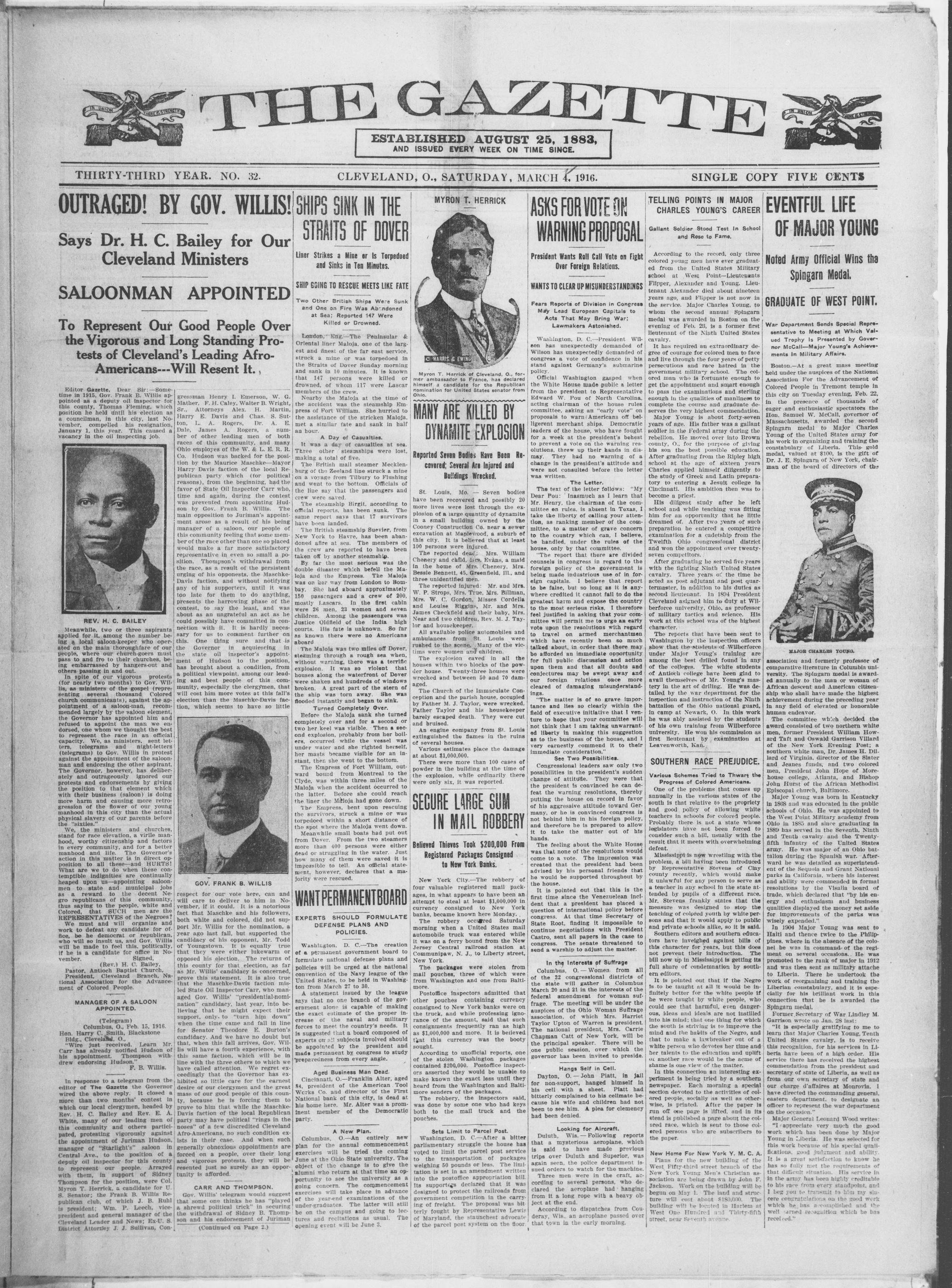
OUTRAGED! BY GOV. WILLIS! Says Dr. H. C. Bailey for Our Cleveland Ministers
SALOONMAN APPOINTED
To Represent Our Good People Over the Vigorous and Long Standing Protests of Cleveland's Leading Afro-Americans----Will Resent It.
IN UTERO PROTESTANTISM
THIRTY-THIRD YEAR
OUTRAGED! BY
Says Dr. H. C. B
Cleveland M
SALOONMAN
To Represent Our G
the Vigorous and Lon
tests of Cleveland's
Americans---W
Editor Gazette, Dear Sir!—Sometime in 1915, Gov. Frank B. Willis appointed as a deputy oil inspector for this county, Thomas Fleming, which position he held until his election as a councilman, in this city, last November, compelled his resignation; January 1, this year. This caused a vacancy in the oil inspecting job.
REV: H. C. BAILEY
Meanwhile, two or three aspirants applied for it, among the number being a local saloon-keeper who operated on the main thoroughfare of our people, where our church-goers must pass to and free to their churches, be welcomed by the church-out and others passing in and out.
In spite of our vigorous protests (for nearly two months) to Gov. Willis, as ministers of the gospel: representing several thousand 'Colored church communicants', against the appointment of a saloon-man, recommending the appointment of the Governor has appointed him and refused to appoint the man we endorsed, one whom we thought the best to represent the race in an official capacity. We, as ministers, sent letters, telegraphs and night-letters (telegraphs) to Gov. Willis, protest against the appointment of the man and endorsing the other aspirant. The Governor, however, has, deliberately and outrageously ignored our protests and endorsements by giving the position to that element which with their business (saloon) is doing more harm and causing more retrogression in the city than the actual physical slavery of our parents before the "skirties."
We, the ministers and churches, stand for race elevation, a virile manhood, worthy citizenship and factors in every community, and for a better environment in this matter in direct opposition to all these—and HURTS! What are we to do when these contemptible, indignities are continually heaped upon us—appointing saloons to men to usse and mummies to women to the deceased Negro republicans of this community, thus saying to the people, white and Colored, that SUCH men are the REPRESENTATIVES of the Negroes? We must and will organize and work to defeat and cancern the Negroes, who will so insult us, and Gov. Willis will be made to feel this, politically, if he is a candidate for office in November. Signed, Rev. (R) H. G. Crawford, Pastor, Antioch Baptist Church, President, Cleveland Branch, National Association for the Advancement of Colored People.
MANAGER OF A SALOON
APPOINTED.
(Telegram)
Columbus, O., Feb. 15, 1918.
Hon. Harry C. Smith, Blackstone
Bldg., Cleveland, O.
"Wire just received. Learn Mr. Carr has already notified Hudson of his appointment. Thompson withdrew endorsing Hudson."
F. B. Willis:
In response to a telegram from the editor of The Gazette the Governor wired the above reply. It closed a more than two months' contest in which our local clergymen, headed by Rev. H. C. Bailey and Rev. E. A. White, many of our leading this community and others participated, protesting vigorously against the appointment of Juriman Hudson, manager of "Starlight's" saloon in Central Ave., to the position of a deputy oil inspector for this county to represent our people. Arrayed with them, in support of Sidney Thompson for the position, were Col. Myron T. Herrick, a candidate for U. S. Senator; the Frank B. Willis Republican club, of which J. B. Rull is president; Wm. P. Leech, vice-president and general manager of the Cleveland Leader and News; Ex U. S. District Attorney J. J. Sullivan, Con-
THE GAZETTE
gressman Henry I. Emerson, W. G. Mather, F. H. Caley, Walter B. Wright, Sr., Attorneys Alex. H. Martin, Harry E. Davis and Chas. S. Sutton, L. A. Rogers, Dr. A. E. Dule, James A. Rogers, a number of other leading men of both races of this community, and many Ohio employees of the W. & L. E. R. Co. Hudson was backed for the position by the Maurice Maschke—Mayor Harry Davis faction of the local Republican party which (for political reasons), from the beginning, had the favor of State Oil Inspector Carr who, time and again, during the contest was prevented from appointing Hudson by Gov. Frank B. Wills. The main opposition to Jurman's appointment arose as a result of his being manager of a saloon, our people of this community feeling that some member of the race other than one so placed would make a far more satisfactory representative in even so small a position. Thompson's inward position from the race, as a result of the persistent urging of his opponents, the Maschke-Davis faction, and without notify any of his supporters, until it was too late for them to do anything, presents the harrowing phase of the contest, to say the least, and was about as an ungrateful an act as he could possibly have committed in connection with it. It is hardly necessary for us to comment further on this. One thing sure and that is the Governor in acquiescing in the State oil inspector's appointment of Hudson to the position, has brought about a condition, from a political viewpoint, among our leading and best people of this community, especially the clergymen, that will cost him more votes at this fall's election than the Maschke-Davis faction, which seems to have so little
GOV. FRANK B. WILLIS
respect for our vote here, can and will care to deliver to him in November, if it could. It is a notorious fact that Maschke and his followers, both white and colored, did not support Mr. Willis for the nomination, a year ago last fall, but supported the candidacy of his opponent, Mr. Todd of Youngstown. It is equally true that they were either likewise or opposed his election. The returns of this county for that election, as far as Mr. Willis' candidacy is concerned, prove this statement. It is also true that the Maschke-Davis faction missed State Oil Inspector Carr, who managed Gov. Willis' "presidential-nomination" candidacy, last year, into believing that he might, expect their support, only to "turn him down" when the time came and fall in line for Senator Theodore E. Burton's candidacy. And we have no doubt but that, when this fall arrives, Gov. Willis will have a fourth experience, with this same faction, which will be in line with the three others to which we have called attention. We regret exceedingly, that the Governor has exhibited so little care for the earnest desire of our clergymen and the great mass of our good people of this county, because he is forcing them to prove to him that while the Maschke-Davis faction of the local Republican party may have political "rings in the noses" of a few discredited Cleveland Afro-Americans, no such condition exists in their case. And when such generally obnoxious appointments are forced on a people, over their long and vigorous protests, they will be resented just so surely as an opportunity is afforded.
CARR AND THOMPSON.
Gov. Willis' telegram would suggest that some one thinks he has "played a shrewd political trick" in securing the withdrawal of Sldnei and his endorsement of Jurman
ESTABLISHED AUGUST 25, 1883 AND ISSUED EVERY WEEK ON TIME SINCE.
CLEVELAND, O., SATURDAY, MARCH 4, 1916.
SHIPS SINK IN THE STRAITS OF DOVER
Liner Strikes a Mine er Is Torpedoed and Sinks in Ten Minutes.
SHIP GOING TO RESCUE MEETS LIKE FATE
Two Other British Ships were Sunk and One on Fire Was Abandoned at Seal; Reported 147 Were Killed or Drowned.
London: Eng.-The Peninsular & Oriental liner Matoja, one of the largest and finest of the far east service, struck a mine or was torpedoed in the Straits of Dover Sunday morning and sank in 10 minutes. It is known that 147 persons were killed or drowned, of whom 117 were Lascar members of the crew. The ship was at the time of the accident was the steamship Empress of Fort William. She hurried to the assistance of the stricken Matoja, met a similar fate and sank in half an hour.
A Day of Casualties.
It was a day of casualties at sea. Three other steamships were lost, making a total of five.
The British mail steamer Mecklenburg of the Zealand line struck a mine on a voyage from Tilbury to Flushing and went to the bottom. Officials of the line say that the passengers and crew were saved.
The steamship Birgit, according to official reports, has been sunk. The same report says that 17 survivors have been landed.
The British steamship Suevier, from New York to Hayle, has been abandoned afire at sea. The members of the crew are reported to have been taken off by another steamship.
By far the most serious was the double disaster which befell the Maloja and the Empress. The Maloja was on her way from London to Bombay. She had aboard approximately 150 passengers and a crew of 200, mostly Lascars. In the first cabin were 26 men, 23 women and seven children. Among the passengers was Justice Oldfield of the India high courts. His fate is unknown. So far as known there were no Americans aboard. The Maloja was two miles off Dover, steaming through a rough sea when, without warning, there was a terrific explosion. It was so violent that houses along the waterfront of Dover were shaken and hundreds of windows broken. A great part of the stern of the ship was torn away. She was flooded instantly and began to sink.
Turned Completely Over.
Before the Malola jank she turned completely over and for a second or two her keel was visible. Then a second explosion, probably from herders, occurred while the keel was under water and she righted herself, her mast came visible for an insult she went to the bottom.
The Empress of Fort William, outward bound from Montreal to the Clyde, was within three miles of the Malola when the accident occurred to the latter. Before she could reach the liner the Malola had gone down.
The Empress, bent upon rescuing the survivors, struck a mine, or was torpedoed within-a short distance of the spol where the Malaja went down. Meanwhile small boats had put out from Dever. From the two steamers more than 400 persons were either dead or struggling in the water. Just how many of them were saved it is impossible to tell. An official statement, however, declares that a majority were rescued.
WANT PERMANENT BOARD
EXPERTS SHOULD FORMULATE DEFENSE PLANS AND POLICIES.
Washington, Dr. C.—The creation of a permanent government board to formulate national defense plans and policies will be urged at the national convention of the Navy league of the United States, to be held in Washington from March 27 to 30.
A statement issued by the league says that no one branch of the government alone is capable of making the exact estimate of the proper increase of the naval and military forces to meet the country's needs. It is suggested that a board composed of experts on all subjects involved should be appointed by the president and made permanent by congress to study preparations from every angle.
Agrd Business Man Dead.
Cincinnati, O.-Franklin Alter, aged 84, president of the American Tool Works Co. and director of the First National bank of this city, is dead at his home here. Mr. Alter was a prominent member of the Democratic party.
A New Plan.
Columbus, O—An entirely new plan for the annual commencement exercises will be tried the coming June at the Ohio State university. The object of the change is to give the alumni who return at that time an opportunity to see the university as a going concern. The commencement exercises will take place in advance of the year-end examinations of the undergraduates. The latter will still be on the campus and going to lectures and recitations as usual. The opening event will be June 3.
C HARRIS & EWING
Myron T. Herrick of Cleveland, O., former ambassador to France, has declared himself a candidate for the Republican nomination for United States senator from Ohio.
MANY ARE KILLED BY DYNAMITE EXPLOSION
Reported Seven Bodies Have Been Recovered; Several Are Injured and Buildings Wrecked.
St. Louis, Mo. — Seven bodies have been recovered and possibly 20 more lives were lost through the explosion of a large quantity of dynamites in a small building owned by the Cooney Construction Co. near a sewer excavation at Maplewood, a suburb of this city. It is believed that at least 100 persons were injured.
The reported dead: Mrs. William Cheney and child, Mrs. Evans, a mould in the home of Mrs. Cheney, Mrs. Bessie Bennett, 45, Greenfield, Ill., and three unidentified men.
The reported injured: Mr. and Mrs. W. P. Strops, Mrs. True, Mrs. Billman, Mrs. W. C. Gordon, Misses Cordella and Louse Higgins, Mr. and Mrs. James Checkfield and their baby, Mrs. Near and two children, Mrs. M. J. Taylor and housekeeper.
All available police automobiles and ambulances from St. Louis were rushed to the scene. Many of the victims were women and children.
The explosion caved in all the houses within two blocks of the powder house. Twenty-three houses were wrecked and between 50 and 70 damaged.
The Church of the Immaculate Conception and the parish house, occupied by Mrs. M. J. Taylor, were wrecked. Father Taylor and his housekeeper barely escaped death. They were cut and bruised.
An engine company from St. Louis extinguished the flames in the ruins of several houses.
Various estimates place the damage at about $1,000,000.
There were more than 100 cases of powder in the building at the time of the explosion, while ordinarily there were only six. It was reported.
SECURE LARGE SUM IN MAIL ROBBERY
Believed Thieves Took $200,000 From Registered Packages Consigned to New York Banks.
New York, City.—The robbery of four valuable registered mail packages, in what appears to have been an attempt to steal at least $1,000,000 in currency consigned to New York banks, became known here Monday.
The robbery occurred Saturday morning when a United States mail automobile truck was entered while it was on a ferry bound from the New Jersey Central railroad station at Communipaw, N. J., to Liberty street, New York.
The packages were stolen from mail pouches, three of which were from Washington and one from Baltimore.
Postoffice inspectors admitted that other pouches containing currency consigned to New York banks were on the trip and while professing ignorance of the amount, said that such consignments frequently ran as high as $1,000,000 and more. It is believed that this currency was the booty sought.
According to unofficial reports, one of the stolen Washington packages contained $200,000. Postoffice inspectors asserted they would be unable to make known the exact loss until they heard from the Washington and Baltimore senders of the packages.
The robbery, the inspectors said, was done by some one who had keys both to the mail truck and the pouches.
Sets Limit to Parcel Post
Washington, D. C. After a bitter parliamentary struggle the house has voted to limit the parcel post service to the transportation of packages weighing 50 pounds or less. The limitation is set in an amendment written into the postoffice appropriation bill. its supporters declared that it was designed to protect the railroads from government competition in the carrying of freight. The proposal was bitterly fought by Representative Lewis of Maryland, the staunchest advocate of the parcel post system on the floor
ASKS FOR VOTE ON WARNING PROPOSAL
President Wants Roll Call Vote on Fight Over Foreign Relations.
WANTS TO CLEAR UP MISUNDERSTANDINGS
Fears Reports of Division in Congress May Lead European Capitals to Acts That May Bring War; Lawmakers Astonied.
Washington, D. C.—President Wilson has unexpectedly demanded of Wilson has unexpectedly demanded of congress a 'vote of confidence in his stand against Germany's submarine policy.
Official Washington gasped when the White House made public a letter from the president to Representative Edward W. Pou of North Carolina, acting chairman of the house rules committee, asking an "early vote" on proposals to warn Americans off belligerent merchant ships. Democratic leaders of the house, who have fought for a week at the president's behest to prevent a vote on the warning resolutions, threw up their hands in dismay. They had no warning of a change in the president's attitude and were not consulted before the letter was written.
The Letter.
The text of the letter follows: "My Dear Pon: 'Inasmuch as I learn that Mr. Henry, the chairman of the committee on rules, is absent in Texas, I take the liberty of calling your attention, as ranking member of the committee, to a matter of grave concern to the country which can, I believe, be handled, under the rules of the house, only by that committee.
"The report that there are divided counsels in congress in regard to the foreign policy of the government is being made industrial use of in foreign capitals. I believe that report to be false, but so long as it is anywhere credited it cannot fail to do the greatest harm and expose the country to the most serious risks. I therefore feel justified in asking that your committee will permit me to urge an early vote upon the resolutions with regard to travel on armed merchantmen which have recently been so much talked about, in order that there may be afforded an immediate opportunity for full public discussion and action upon them and that all doubts and conjectures may be swept away and our foreign relations once more cleared of damaging misunderstandings.
"The matter is of so grave importance and lies so clearly within the field of executive initiative that I venture to hope that your committee will not think that I am taking unwarranted liberty in making this suggestion as to the business of the house, and I very earnestly commend it to their immediate consideration."
See Two Possibilities.
Congressional leaders saw only two possibilities in the president's sudden change of attitude. They were that the president is convinced he can defeat the warning resolutions, thereby putting the house on record in favor of his aggressive attitude toward Germany, or he is convinced congress is not behind him in his foreign policy, and therefore he is prepared to allow it to take the matter out of his hands.
The feeling about the White House was that none of the resolutions would come to a vote. The impression was created that the president had been advised by his personal friends that he would be supported throughout by the house.
It is pointed out that this is the first time since the Venezuelan incident that a president has placed a question of international policy before congress. At that time Secretary of State Root, finding it impossible to continue negotiations with President Castro, sent all papers in the case to congress. The senate threatened to send a warship to adjust the matter.
In the Interests of Suffrage
Columbus, O. — Women, from all of the 22 congressional districts of the state will gather in Columbus March 20 and 21 in the interests of the federal amendment for woman suffrage. The meeting will be under the auspices of the Ohio-Woman Suffrage association, of which Mrs. Harriet Taylor Upton of Warren is president. The national president, Mrs. Carrie Chapman Catt of New York, will be the principal speaker. There will be one public session, over which the governor has been invited to preside.
Hands Self in Cell.
Dayton, O. — John Platt, in fall for non-support, hanged himself in his cell with a sheet. Platt had bitterly complained to his cellmate because his wife and children had not been to see him. A plea for clemency had been denied.
Looking for Aircraft.
Duluth, Wis.—Following reports that a mysterious aeroplane, which is said to have made previous trips over Duluth and Superior, was again seen the police department issued orders to watch for the machine. Three men were in the craft, according to several persons, who declared the aeroplane had hanging from it a long rope with a heavy object at the end. According to dispatches from Couderay, Wis. an aeroplane passed over that town in the early morning.
SINGLE COPY FIVE CENTS
TELLING: POINTS IN MAJOR CHARLES YOUNG'S CAREER
Gallant, Soldier Stood, Test In School and Rose to Fame.
According to the record, only three colored young men have ever graduated from the United States Military school at West Point—Lieutenants Flipper, Alexander and Young. Lieutenant Alexander died about nineteen years ago, and Flipper is not now in the service. Major Charles Young, to whom the second annual Spingarn medal was awarded in Boston on the evening of Feb. 23, is a former first lieutenant of the Ninth United States cavalry.
It has required an extraordinary degree of courage for colored men to face and live through the four years of petty persecutions and race hatred in the government military school. The colored man who is fortunate enough to get the appointment and smart enough to pass the examinations, and sterling enough in the qualities of manliness to complete the course and graduate deserves the very highest commendation.
Major Young is about forty-seven years of age. His father was a gallant soldier in the Federal army during the rebellion. He moved over into Brown county, O., for the purpose of giving his son the best possible education. After graduating from the Ripley high school at the age of sixteen years Charles applied himself diligently to the study of Greek and Latin preparatory to entering a Jesuit college in Checiniati. His ambition then was to become a priest.
His diligent study after he left school and while teaching was fitting him for an opportunity that he little dreamed of. After, two years of such preparation he entered a competitive examination, for a cadetship from the Twelfth congressional district and won the appointment over twenty-seven competitors.
After graduating he served five years with the Lightning Ninth United States cavalry. Three years of the time he acted as post adjutant and post quartermaster. In addition to his duties as second lieutenant. In 1854 President Cleveland assigned him to duty at Wilberforce university, Ohio, as professor of military tactics and science. His work at this school was of the highest character.
The reports that have been sent to Washington by the inspection officers show that the students of Wilberforce under Major Young's training are among the best delisted found in any of the colleges. The white students of Antioch college have been glad to avail themselves of Mr. Young's mastery in the art of drilling. He was detailed by the war department for the inspection and instruction of the Ninth battalion of the Ohio national guard, in camp at Newark, O. In this work he was ably assisted by the students of his own training from Wilberforce university. He won his commission as first lieutenant by examination at Leavenworth, Kan.
SOUTHERN RACE PREJUDICE.
Various Schemes Tried to Thwart the
Revenge of Colored Americans
Progress on the problems that comes up annually, the various states of the south is that relative to the propriety and good policy of allowing white teachers in schools for colored people. Probably there is not a state whose legislators have not been forced to consider a such bill, usually with the result that it meets with overwhelming defeat.
Mississippi is now wrestling with the problem, a bill having been introduced by Representative Stevens of Clay county recently, which would make it unlawful for any person to serve as a teacher in any school in the state attended by pupils of a different race. Mr. Stevens frankly states that the measure was designed to stop the teaching of colored youth by white persons and that it would apply to public and private schools alike, so it is said. Southern editors and southern newspapers are published against bills of this character for years, but this does not prevent their introduction. The bill now up in Mississippi is getting its full share of condemnation by southern editors.
It is pointed out that if the Negro is to be taught at all it would be infinitely better for the white people if he were taught by white people, who could see that harmful, even dangerous, ideas and ideas are not instilled into his mind; that one thing for which the south is striving is to improve the mind and the habits of the Negro, and that to make a lawbreaker out of a white person who devotes her time and her talents to the education and uplift on another race would be the name of shame is one view of the matter.
In this connection an interesting experiment is being tried by a southern newspaper. Each morning a special section devoted to the activities of colored people, socially as well as otherwise, is printed. After the paper is run off one page is lifted, and in its stent is published a page about the colored race, which is sent to those colored persons who are subscribers to the paper.
New Home For New York Y. M. C. A. Plans for the new building of the West Third street branch of the New York Young Men Christian association are being drawn by John F. Jackson. Work on the building will be begun on May 1. The land and structure will cost about $15,000. The building will be located in Harlem at West One Huntley and Tifty-fifth street, near Seventh Avenue.
IN BRIEF
MORTALITY
EVENTFUL LIFE OF MAJOR YOUNG
War Department Sends Special-Representative to Meeting at Which Valued Trophy Is Presented by Governor McCall—Major Young's Achievements in Military Affairs.
Boston—At a great mass meeting held under the auspices of the National Association For the Advancement of Colored People in Tremont temple in this city on Tuesday evening, Feb. 22, in the presence of thousands of eager and enthusiastic spectators the Hon. Samuel W. McCall, governor of Massachusetts, awarded the second尊敬 medal to Major Charles Young of the United States army for his work in organizing and training the constabulary of Liberia. This gold medal, valued at $100, is the gift of Dr. J. E. Spingarn of New York, chairman of the board of directors of the
MAJOR CHARLES YOUNG.
association and formerly professor of comparative literature in Columbia university. The Spingarn medal is awarded annually to the man or woman of African descent and American citizenship who shall have made the highest achievement during the preceding year in any field of elevated or honorable human endeavor.
The committee—which decided the award consisted of two northern white men, former President William Howard Taft and Osswald Garrison Villard of the New York Evening Post; a southern white man, Dr. James H. Dillard of Virginia, director of the Slater and Jeanes funds, and two colored men, President John-Hope of Morehouse college, Atlanta, and Bishop John Hustet of the African Methodist Episcopal church, Baltimore.
Major Young was born in Kentucky in 1888 and was educated in the public schools of Ohio. He was appointed to the West Point Military academy from Ohio in 1885 and since graduating in 1889 has served in the Seventh, Ninth and Tenth cavalry and the Twenty-fifth infantry of the United States army. He was major of an Ohio battalion during the Spanish war. Afterward he was detailed as superintendent of the Sequoia and Grant National parks in California, where his interest and ability were commended in formal resolutions by the Visalia board of trade, which declared that "by his energy and enthusiasm and business qualities displayed the money set aside for improvements of the parks, was wisely expended."
In 1904 Major Young was sent to Haiti and thence twice to the Philippines, where in the absence of the colonel he was in command of the regiment on several occasions. He was promoted to the rank of major in 1912 and was then sent as military attach to Liberia. There he undertook the work of reorganizing and training the Liberian constabulary, and it is especially for his, brilliant work in this connection that he is awarded the Spingarn medal.
Former Secretary of War Lindley M. Garrison wrote on Jan. 28 just: "It is especially gratifying to me to learn that Major Charles Young, Tenth United States cavalry, to receive this recognition, for his services in LIBERA have been of a high order. His work has been commended from the president and secretary of state of Liberia, as well as from our own secretary of state and our charge d'affaires at Monrovia. I have directed the commanding general, eastern department, to designate an officer to represent the war department on the occasion."
Major General Leonard Wood writes,
"I appreciate very much the good work which has been done by Major Young in Liberia. He was selected for this work because of his special qualifications, good judgment and ability. It is a great satisfaction to know he has so fully met the requirements of that difficult situation. His service in in the army has been highly creditable to his race from every standpoint, and I beg you to transmit to him my sincere congratulations on the good work which he has accomplished and the well armed to combat which he has received."
PUBLISHED EVERY SATURDAY
SUBSCRIPTION RATES
(In Advance)
One Year.....$1.50.
Six Months.....1.00.
Three Months......50
Subscribers are requested to re-
mit by postoffice money en-
der or registered letter
Entered at the postoffice in Cleveland,
Ohio, as second-class matter.
Address all communications to
Blackstone Building, Cleveland, O.
Member Ohio Legislature: 1894
to 1898; 1896 to 1898; 1900 to 1902
THE GAZETTE is the oldest, and
has the largest bona fide circulation,
double that of any newspaper in the
interest of Afro-Americans, published
in the state of Ohio, and comparison
with any will immediately establish
its rank as one of the NEWSIEST
AND BEST in the country.
10,000,000 Afro-Americans.
150,000 in Ohio.
20,000 in Cleveland.
SATURDAY, MARCH 4, 1916
DARE TO DO YOUR DUTY.
"Let us have faith that right makes might, and in that faith let us have faith to serve to our duty as we understand it."—Abraham Lincoln.
Our Columbus letter, elsewhere in this paper, has some interesting and truthful statements that it will be well for you to read carefully and thought fully. Do not overlook it.
About the time of his election, President Thomas Woodrow Wilson said that he would dislike to think that the success of an administration depended upon one man. Upon this, also, he has apparently changed his mind.
We desire to call our readers' attention, particularly, to the advertisement, elsewhere in this paper, headed "Easter is Coming." Have your pastor call the members of the church's attention to it, too, please.
The Gazette is indebted to that well-known and leading firm of jewelers, The Sigler Bros. Co., Garfield Bldg., Cleveland, for an "ideal Perpetual Calendar," for office-use, that seems perfection as well as perpetual, along a calendar line.
It is difficult to understand why Bryan or any other man would want to be chairman of the committee on platform in the next democratic national convention. A platform that "reiterates" the principles of the 1912 convention or that "points with pride" to the fulfillment of the pledges of that platform, might do for humor but wouldn't serve very well as a campaign document. And how can any platform committee report a platform that omits these time-honored planks?
The third of a series of articles, being issued monthly by State Auditor A. W. Donahay, is devoted to Wilber force University, is extremely compilatory, and ought to be read generally, especially by some gentlemen of color, residing in Washington, D. C., who have been busy "knocking," in recent months. Write to Mr. Donahay, at Columbus, O., for a copy of it. No charge. If our space permitted, The Gazette would be pleased to publish the article. We hope to give excerpts from it at an early date.
Editor Matt. Glaser, (white), of the "Cincinnati Republican" has been politically "skinning" our young governor, Mr. Willis, for several weeks. His editorials, last week, were certainly strong and exceptionally interesting. Gov. Willis has kept about him some mighty poor political advisors and seems unable to judge well for himself. They have caused him to lose many good strong friends whom he will sorely need and sadly miss, this spring and fall, when a candidate for delegate-at-large and for governor, respectively.
According to Chairman Williams, of the State Board of Film Censors, who wrote the editor of The Gazette, some weeks ago, we HAVE been giving Gov. Frank B. Williams entirely too much credit for the barring from Ohio of the infamous photoplays, "The Niger" and "The Birth of a Nation." Mr. Williams says, in the letter, that the governor left them free to take such action as they, the Board, saw fit. Thank you, Mr. Williams, for the information. Our people throughout Ohio should remember this. Give the governor the credit due him, but no more. We have all along held a different idea and are free to confess it.
Two Negroes, apparently the same in each case, held up three men, Tuesday night, at the point of revolvers, obtaining $117 for their night's work Grant M. Duncan, 1969 E. 40th St., was held up at E. 40th and Windsor Av., and was robbed of $63 and his gold watch. Philip Porriss, 6908 Hough Av., lost $9 and his watch to the pair on E. 69th St., near Euclid. John Langford, 2389 E. 65th St., was held up on Carnegie avenue, near 36th street, and $45 was taken from him. It is about time for our local ministers and "Reform" league to "get busy!" These things lead up to mob demonstrations. That has been the case in other northern cities. For several weeks Negro highwaymen have been setting a new record, and a bad one, for Cleveland, we regret to say.
WILSON AND CONGRESS.
Discussing Mr. Garrison's resigna-
tion, the New York Times, somewhat parenthetically remarks:
"The country will give its instant, loyal and determined support to the President in any contest congress may invite through refusal, from whatever motive, to make provision for really adequate defense of the nation." Nevertheless, we have just witnessed such an occurrence. Mr. Wilson went before congress, when this session opened, and argued in favor of the Garrison plan for an increase in the army. Congress invited a contest on this point. Well nigh unanimously the military committees rejected the proposal and they were sustained by their colleagues on the floor. Yet Mr. Wilson did not accept the challenge of congress, nor did he appeal to the country for "its instant, loyal and determined support." On the contrary, he surrendered in such abject manners that Secretary of War Garrison quit the cabinet almost instanter. The President will not quarrel with Congress, this year. Neither can he boss it in such masterful fashion as he did two years ago. His own party no longer acknowledges the President's will as law. The dissensions in the democratic party have been emphasized by Mr. Garrison's resignation—and the President's weakness as a party leader and as a formulator of national policies is emphasized by the same incident. If the country is to witness any "provisions for really adequate defense of the nation," such as the New York Times evidently wishes to see, it will be by the patriotic action of the republicans in congress.
SENATOR FORAKER'S LIFE
HISTORY.
The sale of former Senator J. B. Foraker's book, "Notes of a Busy Life," in two volumes, which his publishers placed upon the market week before last, has been phenomenal. The demand has far exceeded the expectations of the Senator's closest friends, and in a short space of time a second edition will be placed upon the market. The sale of this life history is not confined to the State of Ohio, which claims this prominent statesman, but it is being sold from coast to coast, where he is known to thousands. The book, from cover to cover, deals with facts of intense interest. The Senator does not shield himself or his friends in telling details that are of importance. He publishes correspondence that teems with the vital questions of their time, and in many places the book reads like fiction because of its wonderful portrayal. There is not a dull chapter in the two volumes, and when the reader picks up the book he does not want to lay it down until it is completed. The Senator has spared neither time nor expense in getting out his biography. The books are printed on exceptionally good paper in gilt edge, and the illustrations are works of art. The two volumes would adorn a connoisseur's library, but they must be read to be appreciated.
DOUGLASS ON LINCOLN
Some Plain Truth That Ought to Be Seared Into the Minds and Hearts of All of Our People.
Washington, D. C.—In his masterful oration, delivered here at the unveiling of the Freedmen's monument in memory of Mr. Lincoln, April 14 1876, Frederick Douglass said, among other things:
"It must be admitted, truth compels me to admit it even here in the presence of the monument we have erected to his memory; Abraham Lincoln was not in the fullest sense of his character, but in his elation. In his interests, in his associations, in his habits of thoughts, and in his prejudices, he was a white man. He was pre-eminently the white man's President, entirely devoted to the welfare of the white man. He was ready and willing at any time, for years, his administration to deny, postpone, and sacrifice the rights of humanity in the Colored people to promote the welfare of the white people of this country. In all his education and feeling he was an American of the Americans, " and race to which we belong was not the special object of his consideration."
THE GAZETTE, CLEVELAND, O., SATURDAY, MARCH 4, 1916.
Written by 'The Old Reliable' Gazette's Correspondents
THROUGHOUT THE STATE
What Our People Are Doing Each Week—Church, Personal, Social, Lodge, Literary and Musical — Marriages,
RAVENNA—The A. M. E. Ladies' Ald society gave a very enjoyable and successful entertainment and supper, recently—Mrs. John Prisby has been and Mr. James Coleman is very ill.—Rev. G. W. Maxwell, P. E., will be here, Mar. 10.—Rev. G. G. Clemens was Mr. and Mrs. Chas. Proctor's guest, Sunday.—Subscribe for The Gazette, our trust and best race paper.
CORRESPONDENTS must mail all letters for publication at their main postoffice sufficiently early on Monday (or Sunday) of each week to have them reach The Gazette office on Tuesday morning, and always write also, their names and that of their city or town on the outside of the wrapper about returned copies. Unless this latter is done, proper credit cannot be given you. Lists of names, wedding presents, etc., obituary notices, speeches, resolutions, poetry, inquiries for relatives and advertisements, including items announcing entertainments to be held in the near future, must be paid for in advance at the rate of ten cents a line, six words to a line. Our rates for display advertisements will be sent on application.
CADIZ.-Wilberforce's native African quintet concerted at the Opera House, Monday evening, under the auspices of rally class. No. 9; James Pettres, leader.-Miss Julia Kelly, guest of Miss Elena Brown, has returned to E. Liverpool.-Miss Catherine Thompson entertained Mrs. Caro Browne, and Mrs. Sunday. The A. M. E. S. S. observed "Educational Day" with an interesting program. Three great leaders of the race--Douglass, Payne and Washington--were eulogized and Hampton, Wilberforce and Tuskegee schools were the subject of much interesting comment. Bentley the bethsay of Hopedale, spent a few weeks with Lola Ramsey.-Mrs. Elvira Wallace was called to Lorain, by her daughter, Miss Grace's serious illness. She had been visiting there.
SANDUSKY.—The Second Baptist church and S. S. were well attended. Sunday, O. B. Shackelford was preset, after two months' illness. The "Martha Washington" social, the 23d was a success. Rev. McWilliams of Toledo, will conduct the revival, be preset, and will Sunshine club of the A. M. E. church so soon. Friday evening, which was a most encouraging success.—Mt. Olivet lodge K. P., lost a good charter-member in John A. Logan.—Mrs. Geo. Scott is much better, but Mr. Charlie Taylor remains the same. Mrs. Alice Gaines, who has suffered greatly for two years, will be preset. Mrs. derson—Friends read "the old reliable" Gazette. It is our truest and best race paper, and can always be depended upon for the FACTS. Read them! Rev. Geo. D. Smith, agent.
SMITHFIELD—Wilberforce's native African quintette entertained a large audience at the City hall, Saturday evening. They came under the auspices of the McIntyre church. The Silver Leaf Social club sold refreshments. Its entertainment at Mr. and Mrs. W. H. Veney's, Friday evening, was largely attended and quite a success. The Mr. S. Making a M. church—Mrs. Carrie Fitzgerald of Steubenville, spent Sunday here with her family and sister—Mr. D. Freeman of McIntyre, was here last week, Edw. and John Fowler, J. Nelson and C. Stokes were here, Saturday evening—Mr. Paul Freeman of McIntyre, was buried there, last Thursday afternoon. Rev. Chas. Greene officiated—Mr. Patterson of Wheeling, was here last week, the guest of Mr. Freeman of McIntyre, was rev. Chas. Greene were guests of Mr. and Mrs. H. Harris, Saturday—Misses Palmer, F. Adams and Mr. E. Palmer of Fernwood, visited Mrs. A. Palmer, Saturday and Sunday—Mr. and Mrs. F. Toney of Parlette, and the African quintette were guests of Mrs. E. Powell—Mr. and Mrs. Braden, Mrs. T. and J. Christian, Mrs. T. and J. Christian, Saturday and Sunday—Mr. and Mrs. C. Smith and family have moved to the Rose farm near the Wabash station.
HILLSBORO--Misses Ethel Trimble and Lyma Greene of Piqua, are visiting Mr. and Mrs. Frank Trimble--The chicken supper, last Tuesday evening, given by the A. M. E. Ladies Ald society, was a success--Mr. Arthur Donaldson and Mr. Wyatt Young are sick--Rev. George Burp preached in Bloomingburg, Sunday--Miss Amelia Donaldson of Curry school, Urbana, arrived, Thursday, to visit her parents. Mrs. Walker of Cincinnati another daughter, also spent Sunday here with them--We are sorry to hear of the serious illness of Rev. B. A. Mitchell, Athens, clerk of the E. U. B. association and a former pastor at the church, Mrs. Chester Anderson, entertained, last Thursday, from 8 to 12 p. m., in honor of Prof. and Mrs. Chester Anderson. Mr. Luke Tompkins of Blanchester, spent Friday and Saturday here with his family--Rev. and Mrs. Jackson entertained at supper, Friday evening, Mrs. Ed. Dixon, Miss Laura Seldon of Greenfield, and Mrs. A. P. Mayle of Columbus--Rev. J. M. Ross held quarterly meeting at the A. M. E. church, Sunday--The B. Y. P. U. is progressing nicely with the G. Hough nurse, Mr. Jesse B. Blum of Toledo, is visiting his family--L. R. Cary entertaining the "Grig" society, Friday evening--Miss Laura Seldon was the guest of Mr. and Mrs. Joe Williams, last week--Mrs. Stella Newland of Columbus, will return home, this week--Mr. John Captain has been ill, quite a while.
YOUNGSTOWN.—Rev. Scoot, Wood of St. Phillips P. christian, Pittsburg, preached two able sermons at St. Angustine mission, Sunday and Monday. He is a fine man and speaker—Mrs. Hannah Boggess and Mrs. James Johnson are better. The latter sustained a relapse—Robert Lacey of Farrell, Pa., is here. The Central club's meet at Oak Hill Ave., A. M. E. church, Sunday was largely attended. A fine talk by Dr. Glimmer.
DOINGS OF THE RACE
The Gazette gives its readers quantity and quality of race news, and not merely quantity of paper. Remember this, please.
Mose C. Moore of Dayton, has a race horse named "Marion Goosby," which won the "Merchants" Handi cap" (Pursue $2,765), the feature of the racing card at New Orleans, La. Feb. 19.
A Negro entered the Mechanics' State bank at St. Joseph, Mo., on Monday and, after forcing the cashier and two clerks into the vault, obtained $1,600 and escaped. Wonder if fellow's face was "blacked," too? Thad. W. Wheeler of Dayton, has lost his job as a clerk at the city hall. Our ministers of that city are trying to help him regain the position. Most of the prejudice in that city was caused by the establishment of a "jim crow" Y. M. C. A. In Jamaica, the Colored man is considered to belong either to the Negro or the white race, according to the Negro profession he attains in education, training or influence. Some are ranked and work with Negroes in the fields; others are lawyers, doctors or business men.
Howard P. Drew, running at indoor games in Hartford, Conn., on Washington's birthday, easily outclassed a fast and excellent field of six other sprinters in the special 75-yard dash. Roy P. Morse again followed on to the tape, winning second place and headwell (white) of Vale was forced to be content with Loomis' place—third.
Captain Loving of the Constabulary Band, Manilla, P. I, an Afro-American, has been retired with the rank of major, and will return to this country. He has been tendered a splendid testimonial by the leading residents of Manilla and given some valuable presents. He ranks with the Sousa, Darnosrock, Innes and others.
Speaking of a section of its city, the Chicago Defender says: "No Colored man was indorsed for anything in a territory where ( in the Second ward) the republican vote is 75 per cent black and 25 per cent white; and in the First Congressional District, where the Republican vote is 60 per cent black and 40 per cent white. Can they whiten of the South do worse?"
The Afro-American has increased from 4,000,000 to 10,000,000 in population, since 1863. He owns more than $600,000 in property. He has 135 private High Schools, 30,000 teachers, 82 banks, 400 newspapers and periodicals. He has decreased law firm fees. He can have 1,500 lawyers, 2,500 physicians, several thousand ministers, 149 wholesale houses, 9,058 retail merchants and 1,186 manufactories. He has scientists, poets, authors, musicians, artists and inventors.
"I hate the term Negro because it is being used in terms of hatred. It is the cause of the segregation of the Negro; it is being used in contempt in public places; it is an excuse for distranchising him; and it is an excuse for lynching him. The e-fourth in America of the Colored people in America can trace their descent to Africa, and there is no more right to call all Colored people Negroes than to call all white people Turks or Armenians."—Ex-Assist. U. S. Atty. Gen. Wm. H. Lewis, Boston, Mass.
and a program.—The Third Baptist choir gave an enjoyable leap year party at Mr. Plumber Henderson's Tuesday evening. The pastor, Rev W. O. Harper, made an excellent impression at Shiloh church, Cleveland when he preached there, Sunday week, and may be called to that pastorate.—Mabel E. Johnson and James D. Harrison were married, Wednesday day.—Miss Posey of Oberlin, was Mrs J. J. Harvey's guest.—Miss Lousa nurses at the hospital, who is honor of B. W. Bolden of Beaver Falls Pa. and Mr. and Mrs. Clas. Jackson entertained, Sunday, in honor of Mr. and Mrs. Wm. Goings who were married, Feb. 26.—Mrs. Lett of Zanesville is the guest of Mrs. W. H. Johnson.—Mrs. Edward Jones gave a fine dinner in honor of Mrs. Lillian Johnson, Monday, her birthday.—Miss Violet Johnson and R. Burns Harvey were married, Feb. 23, at the bride's parents, Mr. and Mrs. at Robbins, quite a special function.—Mr. York Stokes, of Pittsburg, and Ettl E. Crawford were granted a license last week.—Mrs. T. D. Berry was in Cleveland, again, recently. Her mother has arrived to make her home with her.
MORE "SOCIAL EQUALITY"
MORE "SOCIAL EQUALITY"
Wealthy Southern Broker to Adopt His Mulatto "Daughter"—Applies to Court.
Evansville, Ind.-Clifford Yarborough, ("white") 48 years old, a wealthy grain broker of Pulaski, Tenn., made application in Circuit Court here, last Wednesday, for permission to adopt Eugenia Murray, a pretty 17-year-old mulatto he was the father of the girl. He was accompanied to court by an attorney, who presented the written consent of the girl's mother, Alice Murray, to the adoption. "I feel that I should rectify a wrong," said Yarborough. "I have plenty of money to take care of the child. I brought $7000 to Evansville with me."
He added that he wanted to give the girl his name, admitted he was married, but said he and his wife were living apart, and that he had not consulted her about the adoption proceedings. The girl was in the courtroom. She could easily pass as a "white" girl and is strikingly beautiful. Eugenia is laid to be dressed in music. Eugenia is laid to be dressed here from Pulaski. Feb. 7. It is said they formerly lived on Yarborough's plantation there. There are thousands of similar cases in the South, and still that section "froths at the mouth" over "social equality" (a myth), and almost every indication of them being in such public places as railroad and street cars, waiting rooms, parks, restaurants, hotels, etc. etc. GOOD LORD!
ATTACKS BURTON AND WILLIS!
Allen Declared For Foraker-Tyler Sore, "Kicks Over Traces"—Cottrill Candidate for Nothing—Editor of *The State* is Written—Some Live State Capital News.
Special to The Gazette
Columbus, O.—Randolph W. Walton, a state leader in bull moose politics, pronounces former Senator Burton, candidate for president, and Gov Frank B. Willis, candidate for re-election as governor, "both hopelessly impossible from a progressive standpoint." The following from the Columbus "Ohio State Journal, of last month," wrote the fact that GOV. WILLIIS HAS NOT APPOINTED A SINGLE AFRO AMERICAN TO OFFICE DURING THIS YEAR AND TWO MONTHS' IN OFFICE AS GOVERNOR, and in view of the additional fact that no member of his administration has, to date given any member of the race A RIVERSIDE GOVERNOR, to GOV. Willis PROMISED faithfully to do so early last year, but has FAILED utterly to keep his promise AND SHOWS NO INCLINATION TO DO. The Journal said, last Friday:
Senator Joseph B. Foraker
Well-known colored men, including Ralph W. Tyler, yesterday said they considered they are entitled to recognition, in view of the race having 70,000 voters in Ohio. They declared a voter'sGOvernor Willis alleged friendship is the reason that would not be molested by any such apparent apposet sash as the governor's ban on "The Birth of a Nation." "We want tangible recognition," one of them declared. Then too, the Board of State Film "has given the credit for harring" "The Birth of a Nation" from Ohio Chairman Williams saying: "He (Gov. Willis) has always left the matter of judging films to the judgment and discretion of this Board." So it is unfair to the latter to give Willis that the judge that we have been "singing his praises" too much, too loud and too long.
The Republican slate candidates for delegates-at-large are Governor Willis, William Cooper Proctor, Cincinnati; U. S. Senator Harding of Marion, and John S. Sullivan, Cleveland. All white, the anti-state candidates are W. M. Gladstone, D. S. Giffen, Columbus, and Rahm W. Tyler, Columbus. The last named says that Ohio Republicans have not selected a colored man to be a delegate-at-large for 40 years, and he thinks that it is high time that the race was getting recognition, (from Willis, too), inasmuch as it has 70,000 voters in Ohio. Willis refused to give Tyler a chance to be "sore" ever since. Still his statement as to representation is very true and worthy of consideration.
Robert S. Allen, "popular Bob," who has entered as a candidate for alternate to the Republican national convention from the Twelfth district, gave Senator J. B. Foraker as his choice for the presidency. As the latter has not consented to the use of his name, it will be for the Franklin county election board to decide whether his candidacy is valid. Every Afro-American in "Bob's" district is anxious to vote for him, and he will win. Another, Cottrell, of Toledo, is Burton's colored candidate for alternate-at-large (the same as nothing) to the Republican national convention. He ought to have refused it. Burton's twenty years in Congress PROVES HIM TO BE NO FRIEND OF THE RACE.
Matt Glaser (white), editor of the Cincinnati Republican, who was first strong for Governor Willis for a second term, but who is now fighting him, came to Columbus, last week Thursday, and announced that there would be opposition to the "big four" slate fixed up by Republican managers or the national convention. Glaser opposed to Burton's candidacy, too. Some "hot times" coming, in Ohio Republican politics.
OUTRAGED!
(Continued From Page 1.)
Hudson for the appointment of a deputy oil inspector for this (Cuyahoga) county. But they haven't! Thompson's endorsement amounts to less than nothing because it represents an individual's only, and has an opposite effect on nearly every one of those who supported his candidacy. Gov. Willis undoubtedly knew this at the time, but seems to have finally given in to State Oil Inspector Carr's pleading for the appointment to please the Governor. The effect will directly felt by the Governor, this fall, and not by either Carr or Thompson. As a political blunderer the state oil inspector has honestly won the "past master"'s station and the person who listens to his political counsel in the face of what transpired, last year, when he traveled over the state, giving out deputies right and left, boosting the Governor for his administration endorsement, and then "fall down" most completely and ridiculously, when Burton was given it, must certainly be wonderfully inexperienced from a political viewpoint, or credulousness personified.
A WORTHY EFFORT——HELP!
Ravenna, O.-The officers of Allen A. M. E. church, of this city, are asking for help. For thirty years we have been trying to get a church here, but never before has the effort been successful. It takes a certain time, and this latter is the direct result of hard work, believing in honesty and prayer. Friends, help us; we are few in number and poor, but are energetic and hopeful. All donations can be sent to Charles Russell, 161 N. Chestnut St., Ravenna, Ohio.
FORD'S HAIR POMADE
MAKES HARSH HAIR WATER MORE FLABLE, LEASH TO COMB AND PUT UP IN ANY STYLE THE LEASH WILL PERMIT PRICE 25¢ AND 50¢ A BOTTLE
FORD'S ROYAL WHITE SKIN LOTION
MAKES HARSH HAIR LOOK WHITER AS SOON AS IT IS PUT ON, EXCELLENT FOR PIMPLES, ROUGH SKIN AND LOOK DURING BREATH PRICE 25¢ A BOTTLE
FORD'S PATENT
TWO PIECE SHAMPOO
FORD'S HAIR STRAIGHTENER
NO.022 STRAIGHTEN THE HAIR BY ROLLING IT BETWEEN YOUR BRASS ROLLS, BEING OF STRETCHING WIDTH OF TO STRAIGHTEN ANE PRICE $1.50
PATENT SECTIONAL TOOTH COMB
PATENTED LOOKING DEVICE FOR ROLLING TEETH TIGHT
AND HAIR STRAIGHTENING COMB NO.023. YOU HEAT THE ROD, NOT THE COMB THING, AND SOILING THE COMB RETAINS THE COMB
NO.023' TEETH IN THE COMB ARE MADE OF SEPARATE PIECES OF BRASS, MOUNTED ON A STEEL GOD AND HELD BY A PATENT FERULE. SHOULD THE TEETH BECOME LOOS, TURN THE REMBELD BY FIRSTING THE TEETH WITH THE SLEEVE UP TIGHTLY AGAINST THE TEETH AND HOLD THEM FIRMLY. PRICE $1.25
FORD'S LARGE BRASS
HAIR STRAIGHTENING AND SHAMPOO PLATED, LARGE AND VERY WIDE, CANNOT BURN THE HANDLE OF SPECIAL DEVICE WITHOUT SOLDERING. PRICE $1.00
SHAMPOO AND HAIR STRAIGHTENING COMB NO.025. LARGE AND VERY WIDE, MAKING AGOOD AND SERVICABLE COMB FOR THE MONEY. PRICE $1.00
FORD'S SMALL BRASS
SHAMPOO AND HAIR STRAIGHTENING COMB NO.027. A SMALL STRONG COMB USED BEST ON REAL SHORT HAIR MICROPLATED. PRICE $2.00
FORD'S HAIR PRESSER
NO.028 NICHEL PLATED, STEEL FRAME, SOLID BRASS KNIVES, VERY SERVICABLE PRICE $0.00
ALL YOUR GOODS WAPRAMED AS DESCRIBED, OR MONEY REFUSED. FOR SALE BY YOUR SELLER OR DIRECT FROM US UPON RECEIPT OF PRICE. IN WRITING DIRECT, SEMI MONEY BY POST OFFICE OR EXPRESS MONEY ORDER.
OZONIZED OX MARROW CO. 46 W. KINZIE ST. CHICAGO, ILL
MONEY MADE EASILY
If you are in position and have the time to become an Agent and will take up the sale of our Toilet Articles, you can make Money Easily and establish a good business of your own that will be worth much to you, and will be considered by us, and thousands of others who voluntarily testify to their merit, and will prove to you, the best on the market. You can make 100 per cent profit and we will aid and protect you in building up a substantial trade. You can start in a small way. Agents all over the United States are making good and are delighted with our work and we can only get you started, it is easy to secure your co-operation ever afterwards. Just sit down and write us for particulars and enclose this ad. However, we only appoint agents in such localities where we are not now represented, and when a new agent takes up the work we protect them by taking advantage to take advantage of their business.
We want you to sell "White's Specific" Face Cream (beach), Bold Cream, Face Powder (in assorted colors, including brown), Soap and Hair Dressings.
In answering your inquiry for particulars we will also forward you samples of above articles, free of charge.
Write us at once.
WHITE'S SPECIFIC TOILET CO.,
Nashville, Tenn.
Dept. "E." —Adv.
Three "Negroes" who, police say, confessed. Wednesday night, to robbing the grocery store of Aaron Meltzer, 3102 Central Ave., the Lavine drug store, 3513 Scovill Ave, and the drug store of Fred Miller, 3193 Cedar Ave, were bound over to the grand jury by Judge Silbert in police court, last week Thursday. They are Robert Burrell, 3633 Central Ave.; Stanley Warren, nineteen, 2258 E. 40th St., and Randolph Jefferson, eighteen, 2231 E. 31st St. The police said they charged against George Dyer, twenty-five, and Robert Townsend, twenty, who live at 1128 Scovill Ave. They were bound over to the grand jury by Judge Silbert, last week Monday, when Jacob Fromson, clerk in Lavine's drug store, positively "identified" them as the "black bandits" who held him up. Dyer and Townsend each ought to have two good damage cases. Two men, arrested on suspicion with a warrant and Townsend, were charged with a suspicion of five-dollar costs, and thirty days by Judge Moylan in police court, last week Thursday.
St. John's "Mary Campbell Missionary Lights," young girls, gave a "fire-light" social, last Friday evening, at Mrs. Owen's E. 43d E. and cleared a neat sum to be devoted to the support of a native teacher in Africa, Mrs. Owen's St. Stanley, sec. Thelma Lewis, treas. Mrs. Rosa Johnson perfected the organization, to assist in missionary work. It will hold a membership contest in March. Mrs. Owen, supt. The M. M. Gleaners entertained new members, their husbands and beaux at a reception on St. 22, at Mrs. Carrie Scott's, 82d A. a hay day, gowned a la "Martha Washington," while others were in beautiful evening dress. The social and "make-happy" committees served an excellent lunch, using small American flags as place-cards. A splendid program was presented by O. M. societies, Mrs. Rosa Johnson, making a strong address and organizing the men into a missionary auxiliary, as an advisory board.
Dr. E. A. Bailey
PHYSICIAN AND SURGEON
(Winona Apartments)
2269 E. 40th Street
(Cor. Central Ave.)
Office Hours
9:30 to 11:30 a. m. 2 to 3 p. m.
8 to 9 p. m.
TELEPHONE
EASTER IS COMING.
The 20th Annual Foreign Mission Easter Programs are now ready for the coming year. For inspiration of old and young, to greater love and service in Kingdom Work. Live, stirring, sweet songs with music. ORDER TO DAY.
WHITE REV. L. G. JORDAN,
701 S. 19th St., Philadelphia, Pa.
GET ALL YOU NEED FREE.
FORD'S
HAIR POMADE
MAKES HARSH
KINNY HAIR SOFTER,
MORE PLAIN, EASER
TO COMP AND PUP
IN ANY STYLE THE
LENGTH WILL PERMIT
PRICE 25¢ AND 50¢ A BOTTLE
FORD'S HAIR STRAIGHTENER
FOR SHAPING AND SHINING
BY ROLLING IT BETWEEN FOUR BRASS
ROLLS, BEST AND QUICKEST THING
WE KNOW OF TO STRAIGHTEN HAIR
The Palace Hotel and Restaurant
R. R. BROOKS, Prop.
2733 Central Ave.
Cleveland, O.
OPEN DAY AND NIGHT
Best Home Cooking—Quick Service
Regular Meals and Short Orders
LUNCH COUNTER
CIGARS AND TOBACCO
YOU
should take PURO HERBS,
the great Spring remedy.
Cleanses the organs and purifies
the blood.
A blood medicine with a reputation
that cannot be beaten.
Made from Nature's health giv-
ing herbs.
( 35c PACKAGE -- Dry Form
PRICES 75c PACKAGE -- Liquid Form
$1 PER BOTTLE -- Extra Strong
FOR SALE ONLY AT
BROWN DRUG CO.
CARL R. SEYFERT. Prop.
2742 Central Ave. Cor. E. 28th
The Mile Track Club
1200 Webster Ave.
LOGAN OWENS
President
Nice Dining Room, Dance
Hall and up-to-date features
for the Social Entertainment
of its Members.
Applications for membership should be filed with
ERNEST W. SHREVE
Secretary
1200 Webster Ave.
Cleveland, O.
Remodeled!
New Center Hall
(Old Woodliff)
Under new management. To rent to lodges and for Private Dancing Parties, etc.
WHITE & WELLS
Managers
2400 Central Ave. Cleveland, O.
DR. A. J. WHITEHEAD
(Western Reserve Dental School)
Wishes to announce to his many
friends and to the public
that he has opened
his office at
3655 SCOVILL AVENUE
Where he will be found during
the following office hours:
9 to 12 a.m., 2 to 5 p.m., 6 to 8 p.m.
Sundays by Appointment.
Stephen J. Young, Mgr.
Call Up Gar. 4379-m
The Harden Printing Co.
Art Printers
We are Classic and know not
Procrastination
Send To or For Us
'Originators of Peculiarities'
10710 ARTHUR AVE., S. E.
FORD'S
BOYKL WHITE
SKIN LOT ION
MAKES THE SKIN
LOOK WHITER
AS SOON AS IT IS
PUT ON. EXTREMELY
FOR PIMPLES, ROUGH SKIN AND
LOCAL SKIN DISEASES
PRICE: $24.00 BOTTLE
FORD'S PATENT
TWO PIECE SHAMPOO
AND HAIR STRAIGHTENING
COMB NO. 023, YOU HEAT
THE ROOF, NOT THE COMB
HER TONIC is the result of scientific study of the causes of diseases of the scalp.
Instead of treating effects of the diseases she treats the causes, eliminating the same and leaving the scalp in a healthy condition that can be maintained by using Her Hair 'Tonic and Invigorator, according to her directions.
Madame C. H. Jones' Hair Tonic and Invigorator is guaranteed to stop the falling out of the hair and to make the hair grow.
It has been successfully used by many ever since 1800 and with perfect satisfaction, it is recommended by many Toledo people and, here, will gladly furnish testimonials.
Many people get diseased scabs by using widely advertised hair tonics prepared in a bottle and have in mind nothing but mercury pain. On the other hand, MADAME JONES' HAIR TONIC and INVIGORATOR is absolutely essential and will do all that is claimed for it.
Madame C. H. Jones' Hair Tonic and Invigorator help the growth of the hair by increasing its strength, moves dandruff, cures scalp diseases, imparts lustre and beauty; it restores the natural elements and necessary nourishment.
MADAME C. H. JONES
353 Woodland Ave.
Tolteo, Ohio
Agents Wanted.
STERLING
5 and 10 Cent Store
3003 Central Ave.
Watch Our Windows
For Bargains
Colored Salesladies
We close at 6 P.M.every
evening except Saturday
Arlington Pharmacy
WE WILL ACCEPT THIS ADVERTISEMENT FOR FIVE CENTS IN TRADE, TO APPLY ON ANY PRUCHASE OF TWENTY-FIVE CENTS OR MORE.
E. Rubenstein, Ph. C., Prop.
S. W. Cor. Central Ave. and E.
55th St.
J. LOMSKY
3816-3820 Central Ave.
DRY GOODS
LADIES' AND GENT'S
FURNISHINGS
Try Our
Lomsky Special $1.00 Corsets,
Also our Ladies' $1.00 Waists
They are good
WANTED
A reliable Agent in each city and town for Phyllis Hair Dressing & Grower. It straightens harsh, stubborn and kinky hair Without the aid of a straightening comb, thereby avoiding the danger of burning the hair with an overheated comb-and makes the hair Grow long, glossy and beautiful. Write at once for exclusive territory open.
Polyclinic Medicine Co.
Dept. G. Cincinnati, O.
The Pride of Carolina
The State Agricultural and
Mechanical College of
South Carolina
Orangeburg, S. C.
Next session begins September
29th and ends May 25th,
1916.
No Tuition, no Room Rent, no
Charges for Water, Lights or
Fuel. Entrance Fee $10.00.
Board $6.00 per Month in Advance.
Books, Laundry and
Personal Expenses Extra.
Every Modern Facility. Stand-
ard Equipment. A Faculty of
57 Officers and Instructors.
For Information and Catalogue, Write
R. S. Wilkinson, Pres.
Orangeburg, S. C.
Central 3371
STARLIGHTS CAFE
A. D. Boyd, Prop.
J. C. Hudson, Mgr.
J. H. Starkey, Mixologist
Choice Wines, Liquors and Cigars
3221 Central Ave., Cleveland, O.
Our advertisers want your trade. Those who do not ask for it in The Gazette certainly care little, if at all, for it. Therefore, we urge our readers and all of our friends to patronize those who ask for your trade in this paper.
THE GAZETTE, CLEVELAND, O., SATURDAY, MARCH 4, 1916
Where to Purchase The Gazette
*DR. WEAVER'S,
3315 Central Ave.
*A. GORDON,
2928 Central Ave.
*SAM FERTMAN'S,
3608 Central Ave
*ELMER F. BOYD'S,
2604 Central Ave.
*S. A. LUCAS,
3943 Central Ave.
YS.
NOTICE TO SUBSCRIBERS
The Gazette regularly should notify
delivered promptly.
fully examine The Gazette's adver-
sions. Business men who advertise in
image of Afro-Americans. The fact
that they want it.
artisements) ten cents a line (six
Personal
Subscribers not receiving The Gazette regularly should notify us at once. We desire every copy delivered promptly.
We advise our patrons to carefully examine The Gazette's advertisements before making purchases. Business men who advertise in this paper should have the patronage of Afro-Americans. The fact that they advertise is assurance that they want it.
Local reading notices (advertisements) ten cents a line (six words in a line).
Rev. George Washington of Oberlin, and Rev. H. C. Bailley were visitors at The Gazette office, last Friday afternoon. The former assisted the latter in the revival at Antioch Baptist church.
Revs. Bailey and Lowry preached at Shiloh Baptist church. Sunday. A large number were baptized at Antioch church. Sunday, as a result of its recent revival. Rev. Geo. Washington certainly did splendid work.
St. John's S. S. Philanthean class's annual party at Mrs. Mollie F. Green's, Cedar Ave, last Friday evening. Mrs. Green, pres.; Mrs. Nannie Hicks, teacher. The Boethian class will hold its annual supper, Monday evening.
Mr. Grafton Butler, age 87, died. Funeral from 2228 Scovill Park. Funeral at 2228 Scovill Park. Grave Towne cemetery in Harvard Cemetery. Two children and other relatives survive him. Slaughter Bros., funeral directors.
J. H. Gray of 3002 Cedar Av., former manager of the drug store at that address, and a sterling friend of the race, has been very ill for two weeks. His many friends will regret to learn this and all wish him a speedy recovery.
"An evening in the Orient," at Mrs. John Fairfax's, 2209 E. 35th St., Monday evening, for the benefit of the DuBois Literary club's "student fund," will prove not only an unique affair but an exceptionally pleasing one as orchestral music also. Refreshments.
Garrett A. Morgan opened his new factory at 5204 Harlem Av., last Friday evening, with a "smoker" which was well attended and proved an enjoyable affair. The editor of The Gazette regrets that a previous engagement made it impossible for him to be present.
Little Miss Mildred Bradford of E. 95th St, entertained, last Saturday afternoon, of her classmates in honor of her seventh birthday. The table was very prettily decorated. Music and games, also. The guests: Kelly Johnson, May and Nina Hatter and Vianian Alston. They had a fine time.
The few "Negro" members of the Attucks club who have a little race and self respect left will find it harder and harder to remain in the organization, dominated politically as it is, "Specious explanations of what is wrong," "EXPLAIN it," and it is certainly pitiful amusing to hear one of them trying to save his "face" with one of those "specious explanations."
The one lone editorial in "The Alien," last week, was evidently written by the "germ-bearing Columbus mosquito" and not by its alleged "editor"—a messenger or porter for a well-known business firm. The title next one, "The Naturalized Bee," is "When I am Naturalized, become a Citizen of this Country and can Vote."
Mr. Richard Stowers, of this city, and Miss Rosa Bowie of Washington, D. C., were married in that city, Saturday, and arrived here, Monday, locating at 2322 E. 38th St. The bride and groom are receiving the congratulations and best wishes of his host of local friends. Mrs. Bowie is a fine woman, and quite an acquisition to our local population.
Our dentists, for more than a year, have insisted that there has been more work than they could do. This makes it look mighty good for Dr. A. J. Whitehead, well and favorably known in the city for several years, the most famous of which are offices at 3655 Scovill Av. His advertisement will be found elsewhere in this paper. Patronize him.—Ady.
W. H. Crawford has been appointed messenger in the Engineers' department, City hall, and Samuel Kyles, barm-man at the garbage plant. No clerkship at the City hall for our people yet. Davis and Maschke do not belong to the garage plant. Only janitorships, "white wings," garbage plant employees, driver-drivers, barmen, a messenger or two, and the like'. Two dollar a day jobs.
Since J. Walter Willis has entered as a candidate for delegate to the state Republican convention, also R. R. Cheeks, Esq., and Chas. F. G. Garland, in their respective wards, they ought not to do the "Syd. Thompson act" and permit the Maschke-Davis faction of the local Republican party to secure their withdrawal from the race. All are capable, and The Gazette would like to see them win. BE MEN! The Palace restaurant, R. R. Brooks, proprietor, near the corner of E. 28th St., on Central Av. certainly "fills a long-felt want" and great need in that of the thoroughfare. With the able assistance Mrs. Brooks, they are giving the home-cooking and quick service—two things that "count big" in their favor. Both have had many years' experience in the business, too.—Ady.
Rev. E. H. Smith preached, morning and evening, at Cory M. E. church, Sunday, 1200 and 900 persons, respectively, attending the services and giving him a large collection. He was pastor of Shiloh Baptist church for six, and a half years, resigning recently because of an official misunderstanding, and left the church paid for and with money in the treasury, he says. His future plans are not as yet mature.
PUSHAW
The Arcade.
Superior Entrance.
*OPEN SUNDAYS.
Our
Classified Ad
Department
WANTED.—A position as chef in a
first-class hotel. Can give the best of
references. Will work in white or
Colored hotel. Address. J. E. John-
son. 308 S. 7th Ave. Marshalltown,
lowa.
FOR RENT.—Houses and Rooms—
If you have them to rent or if you
want to rent, advertise in The Gazette.
It brings results.
NOTARY PUBLIC.—For such services
call at The Gazette office, No. 2
Blackstone building, No. 1424 W.
Third Street, near Superior Ave.
FOR SALE—Houses or 'lots. If you have either or anything else to sell, or if you wish to purchase, advertise in The Gazette. If anything can bring you results, it can and will.
Cleveland
Sixth City
Alexander G. Stanley is serving on the Blenchetti jury.
Dr. Arthur Scott's mother returned to Cincinnati, last week.
Mrs. Albert McFall has returned from Cincinnati and Indianapolis.
Misses Nina Chaffin and Lucia Merchant visited in Buffalo, last week.
Miss Jennie Gray of Detroit, is visiting her sister, Mrs. Young of E. 83d St.
Mrs. Nettie Edwards and daughter, Mrs. Mamie Parish of E. 36th St. are convalescing.
Charles S. Walden was called to Mt. Vernon, to attend his father's funeral this week.
Mr. Samuel Perry of Central Ave., experienced the Y. M. Social club, last week Tuesday evening.
Mrs. W. J. Jones and baby, of E. 30th St., returned home from the hospital, Saturday evening.
Miss Ruth Dean entertained, last week Monday evening. As a hostess she is an exceptional success.
Mrs. Tom O. Queen of E. 43d St., who has been very ill for two weeks, she is in slight improvement.
Mrs. Ina Guy Webster has returned to Zanesville, to spend several weeks with her mother and sisters.
Mr. and Mrs. Peter Baker of E. 368 St., were called to Virginia, last week, by the latter's mother's death.
"Dode" Green left, the first of the week, for Florida, to bring home his bride. They will reside on E. 95th St.
Mr. Thos. Gauffney and Miss Catherine Cochran, R. C. Smith and Miss Hattie Johnson were married, last week.
Mr. Eugene, Crawford of Blaine Ave., entertained at dinner, Sunday, Messrs. Walker, Dade and Arthur Wade.
Mr. George Copes of E. 31st St., who has been quite ill for two weeks with a touch of pneumonia, improves slowly.
Hailer's barber shop has been moved to Central Av., and E. 37th St. The rent at the old place was raised too high, he says.
Misses Ruth Anderson, Cochran and Company all were hostesses at a "Washington" birthday party at Miss Allen's E. 109th St.
Do not forget the New York restaurant when you want something good to eat, good service, and in a nice, neat, clean and up-to-date restaurant—Adv.
St. Andrews' Entre Nous club will hold a pancake social in the parish house, E. 49th St. Tuesday, to which the public is invited. No admission charge.
Waived—1,000 men to trade regularly at the Central Shirt Shop, 2922 Central Ave. Hats, caps, neckwear, underwear, arrow collars and shirts, etc.—Adv.
The 50c banquet at the Old Folk home, Tuesday evening, given by the Men's Auxiliary, was a success. The attendance was good and the "eatings" likewise.
The Harden Printing Co., a race enterprise, does first-class work at most reasonable rates. Orders called for, and work delivered promptly, "Phone, Garland Malt, Adv." Mr. Walters B. Wright, sr., celebrated his birthday, Sunday. Mr. and Mr. Grant Clemens of Chicago, and Mr. and Mrs. Harry Wright of that city were honor guests.
Thos. A. Goode, an employee of the State Fire Marshall's office at Columbus, was in the city recently and called on The Gazette. Also Messrs. Reynolds and Spurlock of the same city.
Mrs. Elnora Cunningham of E. 43d St., many years resident of this city, has located in Youngstown with her daughter, Mrs. Nona Evans Berry. She has been in very poor health for some time.
NATION'S SACRED HISTORY DISTORTED
THE "BIRTH OF A NATION" AN IN-
SULT TO THE NORTH, DE-
CLARES OHIO'S ATTOR-
NEY GENERAL.
UPHOLDS CENSOR BOARD
In Barring the Infamous Photoplay
From the State and Says the Picture Glorifies Outaws and Grosly Misrepresents the Reconstruction Period.
Columbus, O., Jan. 17, 1916.
Hon. Harry C. Smith,
Editor Gazette,
Cleveland, O.
Dear Sir:—Enclosed you will find a copy of Attorney General E. C. Turner's statement in a letter to the Ohio Board of Film Censors, which is self-explanatory.
Yours very truly,
Chas. G. Williams,
Chairman, Ohio Board of Film Censors
"After viewing the play-play entitled 'The Birth of a Nation', I am firmly of the opinion that the board of censors did right in not permitting this picture to be shown in Ohio. Over and above the mistreatment of the Negro, the picture is an insult to the North and a contemptible distortion of well-known history regarding the actions of the president of this picture should right be 'A result of this action'. In the face of the indisputable fact that the mulatto is the product of the South alone, the author of this picture has dared to attempt to attribute the actions of the leaders of the North to the influence of lison with colored women, typifying a congressional leader, preceding, during and after the Civil war, as a low, coarse, or worst-worsening advocate of mixed marriage. With stress a mulatto who wields an influence sufficient to justify the subtitle 'A Great Leader's Weakness that is to blight a Nation'. This immediately precedes Lincoln's call for volunteers. That there may be no mistake as to who is meant by this coarse caricature, they pick out a cripple to unmistakably denote Thaddeus Stevens. For fear that some one might not understand the subtitle stating that 'The executive mansion of the nation was transferred to this man's residence'. After glorifying the rebel flag and the flag of South Carolina, the author dresses a horde of the type of bad land Negroes in the uniform of Union soldiers similar to those of General Early's army at Chambersburg, Pa. Not satisfied with even this, the author labels officers as 'scalawag white captains'.
FLING AT SHERMAN.
"A fling is taken at General Sherman's memory in the marauding scenes under the titles of 'While the women and children weep a great conqueror marches to the sea' and 'The torch of war against the breast of Atlanta.' General Grant, the man who led the feeble and history, entailed 25,000 rations to General Lee's men and allowed those men to ride their horses and mules home so as to be able to cultivate the soil; the soldier whose terms of surrender had been so generous as to evoke from General Lee the statement, This will have a very happy effect on my men; the man who did not even wait to witness the formal surrender of the troops, this hero, not only of the Northland but of the entire country, the elegant cigar he smiled in his mouth tilted at the angle chosen by cartoonists to represent 'Uncle Joe Cannon, and with his hand jammed down in his pants pocket, is made to swagger over in front of General Lee, who remains the personification of dignity. Time after time the North is unfavorably contrasted against the South. A fair daughter of the North is woed by a gallant son of the officer for her affections, one a leaving lout dressed slouchily in Union blue, the other a Negro.
MISREPRESENTS NEGROES.
"Insult after insult is heaped upon the soldier's uniform made sacred by the boys in blue. Notwithstanding the historical fact that the Negroes were the protectors of the white women and children of the South during the Civil War, that no ravishment of white women by blacks during that period is recorded, a Union officer's uniform of blue is placed upon the lowest type of Negro imaginable, and he is made to pursue a little white girl who jumps from a cliff to her death, and there is then flashed upon the screen. 'For her who had learned the stern lesson of honor we should not grieve that she has found sweeter the opal gates of death,' rather than the white man'sust to regain lost power, is made the justification for that organization, well-known in history as the Ku Klux Klan. And what all history, including the reports of the courts, say was a band of outlaws, is made an organization of heroes under religious rights. Brush up your history and imagine if you can the Ku Klux Klan giving birth to a child among this many of false and distorted history there was flashed upon the screen the reason for the picture and the books which preceded it—Bitter memories will not allow the poor bruised heart of the South to forget."
WHENCE INDORSEMENTS COME.
"After viewing this picture I read the brief of attorneys for the corporation seeking to commercialize this 'insult to a Nation,' and found quoted therein purported indorsements of the picture by Claud Kitchin, L. P. Padgett, South, who are now prominent in congress. In addition there is quoted therein a long eulogy of the picture by a state commander of the Sons of Confederate Veterans. In his indorsement of the picture this commander says: 'The Sons of Confederate Veterans today are working along two lines, first, to see that the Southern side of the controversy which we are studying is stated in history, which will demonstrate to the world that we are not sons of rebels but sons of patriots.' We of the North are asked to forget, yet at the same time, insulting our heroes and our cause, the promoters of this picture are asking the youth of the North to accept in this picture manufactured history. In this brief there is quoted letters purporting to come from children of this state the youth of the efforts of a man blinded by partisan politics. These letters show that these children are accepting the incidents of this picture as real history. This picture shows
the South to have been right and the North to have been wrong. Our fathers settled that controversy in the arbitrament of arms and no good can be done to them. We question or distort its history. This picture is neither of a moral, educational, amusing nor harmless character, and the statute (Sec. 871-49 G. C.) specifically provides that only such films as are either of a moral, educational, amusing and harmless character may be passed by the Ohio board of censors."
THE BIRTH OF A NATION.
The wily press agents of "The Birth of a Nation," fill the papers that will print the stuff with very seductive advertisements of the play. Here, for example, is a paragraph: "The Ku Klux Klan will ever be remembered by all, as these daring horsemen dash along, scaling high mountains, daring the dangers of the steep roads, the sharp turns, etc. Such horsemanship is not to be seen in these days and as hundreds of these dare-devils sweep one feels a desire to rise and cheer, so intensely inspiring is the scene."
Nothing more ridiculous can be imagined. The "dare-devilriders" were merely a lot of worthless, character less poor white trash of the South who delighted to torment the Negroes. No men of character or decency would Join in these night raids to harass and frighten in their homes the timid, ignorant blacks. It was as cowardly and frightening as any other man I had neglected. The talk about Negro supremacy was one of those miserable scares used by cheap demagogs to inflame the poor whites against the Negroes and secure their votes. In every State in the South, except South Carolina and Mississippi, the whites out-numbered the blacks. The whites were educated and had all the wealth of the State in their hands, and were supported by the white population every way to the Colored population. No one, but a perverted brain that wanted to believe things that are not so, could give any credence to the inflammatory falsehoods about dangers of Negro supremacy. The Ku Klux was born in rage of slaveholders over losing their property in Negroes, and, in the mean, cowardly hatred of the lower order of the whites against the lower order of the blacks in our history is something that makes every American blush and wish that it would be erased and forgotten. Washington (D. C.) National Tribune, (organ of the old soldiers.)
When barring "The Birth of a Nation," recently, the Kansas Board of Film Censors said: "The picture is rejected because it is not proper, is not instructive, and from its false title thru its tissue of misrepresentations of the North, the Negro and our country's history, to the final culminating travesty which pictures peace on earth and good will to men as the outcome of passion, of harm and murder; it is violent and immoral, not alone in the parts that are sexually suggestive, but in its whole revelation of race prejudice and sectional bitterness."
We request our readers to buy their clothes of I. E. Grossman, designer and tailor, 209 Schofield Bldg. He is a friend of the race, a first class, and deserves a fair share of your patronage. See his advertise-
Under the able direction of President Walker, Shiloh's Dunbar Literary society is certainly taking rank with the best in the state. The feature of its next meeting, Tuesday evening, will be Daniel Fowler's talk on "Brazil: The Baptist Daughters," Young Girl: The Young Girl Organization, P. U. I, are active church organizations. Miss Faustina Townsend and Miss Ozella Moore conduct the meetings of the last two. Large congregations attended Sunday's services. Mrs. Fred. Hughes of E. 43d St., who secured the conviction in Police court of Homer Weaver, last fall, on Tuesday of this week, was awarded a verdict (damages) in Common Pless court of $100 (and costs) against him. The first case resulted in Weaver's being fine $10 and costs, the latter amounting to about $30. The costs in the case ending, Tuesday, will agitate that it is estimated. Mr. Hughes was out of the city when the assault took place.
J. W. Crawford who came to Cleveland, years ago, from Springfield, and who has been in the restaurant business at various places in the city ever since, died. Saturday evening, after a long illness, he was beamed ailing for years—in fact, ever since the amputation of a leg in an effort to stop gangrene. A widow survives him, and has the earnest sympathy of the community. He was a member of Zion Church, the church he planned the funeral was held, the first of the week.
Messrs. Wm. McIntire and Frank Perkins, a committee from the Old Folk's home management, honored The Gazette with an official call, last Thursday afternoon. Come again, gentlemen. The editor trusts he succeeds in the wisdom, not only of the promised investigation, but also, of an important change in the home's rules relative to the care of sick inmates; also, that he is friendly, and not unfriendly, to the Home because he stands by the aged inmates, some of them old residents of Cleveland. The fact that "all the inmates" were induced to pay attention to the retiring matron proving nothing.
Mrs. Amanda M. King, widow of the late Capt. Thomas King, still so well remembered in local secret order circles, wrote the editor of The Gazette, under date Feb. 25, 1916, as follows: "Dear Sir: - You knew before today the Old Folk's home sent our dear friend, Robert Scott, to the Scranton Road Poor House to die; you know they never take any one out of your life." I told him that so many times, he would not believe me. I told him while I had a roof over my head he was welcome to come, without one cent, as the Lord will provide for his children. When I heard it, it broke me all up. As soon as I can I will go over to see him. Some one will believe now, when you are sick, over you go from the home." Since the foregoing was written, we understand that Mr. Scott was taken to the City hospital for an operation for gravel. The editor of the Gazette did NOT know, prior to the receipt of Mrs. King's letter, that Mr. Scott had been taken to the hospital, and regrets exceedingly to learn of his death (last week). He was an old resident of this city, well-known and highly esteemed. We have not as yet been able to learn when or why he was taken to the management of the Old Folk's home doubtless send this information at the same time it announces the date of the investigation of the home it promised the public, some weeks ago.
Perfect Fit Or No Pay
For Good Tailoring
Go to
I. E. Grossman
Designer of Snappy Clothes
No. 209 Schofield Bldg.
Formerly of
Klein & Grossman
A Guarantee with Every Suit
Low Prices Better Clothes
New York Restaurant
3854 Central Ave. Silver Britto, Prop.
The Best Home Cooking. First-class
Service. Everything New, Nest and
Clean. Home-made Bread, Pies
and Other Pastry.
Regular Meals and Short Orders
Try Our Rolls and Coffee. Lunch Counter. (Car Stop-E. 39th St.)
Rosedale 2770 Quality Service
SLAUGHTER BROS.
FUNERAL DIRECTORS & EMBALMERS
Office and Funeral Parlors
3923 Central Av.,
Autos for All Occasions Calls Answered Day and Night
The Excelsior Billiard Parlor Orkin's Hall, 3623 Central Ave.
GOLD BOND
THE CREAM OF
TABLE BEERS
Harvard 1400 C. 3933
The Cleveland and Sandusky
Brewing Co.
ADVERTISE IN THE GAZETTE
TAYLOR'S SPECIAL ALCOHOL HEATER is the handiest and most convenient method of heating the Comb, and can be closed up so that you can put it in your handsaid. Price $5c. LaCurele Hair Pomade. It not only meets every requirement of the Comb Straightener, but它 can a lagrant growth of hair. Price, by mail.
LACREOLE BROWN SKIN FACE POWDER, by mail, 39c.
SEND FOR MY FREE CATALOGUE illustrating the Largest and Most Complete Line of Hair Goods in this country for colored people, such as Bangs, Wigs, Puffs, Switches, Pompadours, Hair Pins, Combs, Brushes, etc.
This Comb, properly heated, and the us
criminal hair, stained and silky at alway
Heavy, Strong and Durable. Made of
into one solid piece; highly polished
of LaCroce Hair Pomade, will bring the most stroke and cause a rapid growth of the hair, and cause a comb by return it under the copper and fully nickel placed; steel belt which goes through the large wood handle and screws into metal end of Comb to prevent the handle from getting or coming off. Remember it's all in the plaiting to get out of order. Will last a lifetime.
Price of Comb
and Alcohol
Heater, complete,
$1.50.
AFRO-AMERICAN CULLINGS
---
More than a quarter of a century ago, at Princess Anne, Md., on what was formerly an old slave plantation, was founded Princess Anne academy (eastern branch of Maryland Agricultural college). This school was established for the expressed purpose of the industrial training of the Negroes of the state of Maryland, as its name implies. Its beginnings were meager, but, like the biblical grain of mustard seed, it has grown and developed beyond the most manguine hopes of its most ardent friends. Perpetuating forever the Booker T. Washington doctrine of efficiency and real accomplishment, we need only to cite the real work of this institution to commend it to its friends and those who have to do largely with its destinies for their favorable consideration. This limited space will not admit of any detailed account of the work of the various departments, but the following will at least serve to show the kind, grade and scope of the work done.
The agricultural department is well stocked with horses, Guernsey cattle, Berkshire hogs and Rhode Island Red poultry. The farm proper consists of 117 acres. About 100 acres are under cultivation, on which the following crops are growing. Wheat, rye, timothy and clover. The farm is the drained, all open ditches closed. In addition to the regular academic course in agriculture, which all students must take before graduation, a special course has been arranged in order that more time may be given to those who feel the need of more work in special subjects.
The blacksmithing department is turning out such articles as androns, flower stands, fire tongs, swings, wheelbarrows, chairs and many other articles too numéroït to mention. All of the school vehicles are repaired in the shops, all horses shod and all other work on the premises in the blacksmithing line is done by the students of this department. As far as possible, they take up the study of the construction of the horse's hoof, the various causes for lameness, diseases of the hoof and the proper way to prevent these defects.
The printing department prepares all of the stationery for the school, including a monthly sheet for school news and the annual catalogue of 72 pages. This course completed entitles the student to a certificate. Graduates from this department have been offered as much as $600 salary to begin with.
The department of domestic science and art gives full courses. All girls make their own graduating gowns, evincing the merits of the course pursued. One of the graduates of this department is at present the teacher of domestic science in the high school of Baltimore city.
All of the heads of these departments with one exception are graduates of Hampton institute, the cradle of industrial training for the Negro. This one exception, however, is a graduate of both the high and manual training school of Washington, D.C.
Certainly the faculty of 12 competent, conscientious, consecrated teachers would not be complete but for the liberally educated Principal T. H. Kish, A. B. Principal Kish has not only taught some of the more important subjects in addition to his superintendency of the work, but he has so familiarized himself with the
Sue Berta Coleman is a well-known teacher of her race. She has taught in the public schools in the county, and now is among the teachers employed by the Tennessee Coal and Iron company, and her success has been watched by many of her white friends.
The growth of the community work among the Negro women of this state has been noted with great interest. Through the medium of their clubs they have accomplished a splendid work among their members and stimulated greater efforts through their women over the state. The Federation of Negro Women's Clubs have done a splendid work for the Old Folks' home, near Graymont, this city, and the reform school at Mount Melgs. There has been for some time a mortgage on the Old Folks' home, which has been assumed by the clubs and not only the interest paid yearly by them, but a part of the original debt. At the general federation's annual meeting each club assumes its share of the indebtedness, and they have never failed, even through these hard times, to meet their obligation. When the illiteracy campaign was started the
Colored farmers control nearly $1,000,000,000 worth of land and buildings in the South. Yet they control only one-eighth of the land and buildings on all the farms of the South.
The Baltimore oriole, one of the most picturesque of the birds common in the northern United States, gets his name from his black and orange vestments, those being the colors of the Calvert family, of which Lord Baltimore, who settled the estate of Maryland, was then chief.
The only completed railroad in Ecuador is that between Guayaquil and Quito. A branch of this road to extend 190 miles from Curaray to Ambato is now under construction.
A western ranchman hurled from an automobile landed squarely on the back of a calf and was uninjured. But the poor beast suffered a broken back.
Ground has just been broken in Lon
Lon for a huge new permanent ex
hibition building known as the Fal
area of industry.
work of every department that he could serve well as a substitute in the absence of most any teacher.
The motto of this institution of learning is training for service. The criterion of its educational propaganda is efficiency. If power from within is to result in the meriting of help from without; if the Negroes of the counties of Maryland are to qualify for the occupancy of a man's place; if they are to become a real indispensable part of this present-day industrial system, the popularity and importance of which increase commensurately with the passing of the years; if they are to become contributors rather than a menace to the highest and noblest citizenship of this state, the exigencies of the case warrants, may demands the maintenance, perpetuation and further development of this institution of learning.—J. U. King, in Baltimore American.
The inexperienced country colored girl who has no conception nor idea of the dangers she is to meet in a large city continues to come to town, and for her the Philadelphia Association for the Protection of Colored Women carries on a persistent work which improves steadily. In comparing the yearly number of girls traveling forth from the South by boat line, the association finds that the number this year is not quite as large as in the past years. This it feels is due to two causes: first, the result of literature which it has sent South setting forth conditions in the northern cities, intended to discourage immigration in large numbers; and, secondly, because boat lines are carrying more freight than formerly. One of the interesting cases of the year is that of a young girl only sixteen years of age coming from Sussex county, Va., going to Wildwood, N. J., to join her mother, who had gone ahead to find employment for them both. Being poor, she could only send the girl her carfair. When the girl reached Philadelphia she was tired and hungry. The association's worker carried her to the Camden side where she later boarded a train for Wildwood, gave her her breakfast and a little carfair, so if she missed her mother who was to meet her at the station she might ride to the address given her. The girl was very grateful and after reaching Wildwood sent a very nice letter saying how grateful she and her mother were for the help. She said, "I was so tired and hungry I would have gone with most any one if I had not met you."
"Titustown" is the name of a pamphlet dealing with the very interesting experiment being made just outside of Norfolk in the way of providing self-respecting Negroes with an opportunity to live healthy, normal lives. It is a simple story, outlining a successful venture in Negro home planning and community building, but it is a significant story in that it shows one solution of a difficult problem involving the issue of life and death not only for the Negro but also for his white neighbor. Copies of the report can be had from Hampton institute.
Platnum thrown away by early Spanish explorers, ignorant of its value, often is found in excavating foundations for new buildings in Colombia, sometimes in sufficient quantities to pay the cost of a building.
Negro teachers began getting ready to help their race. We have kept in touch with their work through visits to their schools, their churches and their clubs—and sometimes to their homes.—Birmingham (Ala.) Age-Herald.
The high cost of living is producing many hardships in the great Russian city of Harbin, in northern Manchuria. The cost of boots is especially felt. A year ago they could be bought for $4 or $5. Now they cost $9 to $12, and are virtually out of reach of the Russian laborer, whose wages are $15 to $25 a month. With the thermometer at zero, Fahrenheit, laborers set off for the day's work with only the canvas shoes on their feet.
It is entirely proper that the world's most southern city, located in farthest Tierra del Fuego, in latitude 55, should bear the name sounding as much like winter wind as Ushuaia. There is also an appropriate suggestion of waiting in the word, and the penal settlement of Argentina is located there.
The curious sight of great fields of fine cabbage heads, frozen stiff and ruined, greets the traveler through upper New York state's cabbage country around Geneseo, the reason being that fall prices were less than the fertilizing value of leaving the vegetables upon the soil.
Year rings on the scales of fish are used in Norway and France to determine the age of sardines, whether they have reached their full growth and when they will spawn.
All the machinery and space for passengers and crew of a new English dirigible balloon are contained within it, the idea being to overcome wind resistance.
A good grade of paper can now be commercially made from the hop refuse of breweries, which has heretofore been thrown away.
India's coal production has passed the 12,000,000-mark annually and electrical machinery is being introduced into its mines.
THE GAZETTE, CLEVELAND, O., SATURDAY, MARCH 4, 1916
IN BEST OF STYLE
IN BEST OF STYLE
EXCELLENT DESIGN FOR POPUL
LAP FOUR-GORED SKIRT.
Simple, but Distinctly Effective and Even Striking in Appearance—May Be Worn Either With or Without a Collar.
So simple that a child could make it, and yet in good style, is the design for a dress with a four-gored skirt, shown here. The waist is full and loose and yet without the bagginess over the belt that has distinguished waists in the past. It buttons down the front of the dress and flock brock on a collar girl or baby woman, both of whom need dresses that can be donned quickly. The pattern is adapted to any material that is suitable for a wearable frock that is not intended for dress occasions.
The frock illustrated is built of midnight blue serge and is trimmed with a band of bright plaid around the skirt, with the same plaid used in the welt, with collar and cuffs. If do
A
stret) pockets, also of plaid, will be very useful and fashionable. This plaid may be either of wool or silk, and silk looks prettier and more dressy. On the other hand, when cleaning is considered, wool trimming will be more practical than silk. If a stripe or plaid is chosen for the dress, then the trimming should be of plain material or of braids.
Now that fitted guimps and stock collars have returned to vogue, frocks of this sort are worn with a neat stock of net or lace. It is not wise to make collars of any but diaphanous materials, as the skin of the neck becomes ruined if thick collars are worn, and a tight collar is bad for the eyesight and the health generally. This dress may be worn either with or without a collar around the throat.
In making a dress of this sort for outdoor wear it must be remembered that "sport clothes" are the very latest thing and these are all short. An outdoor dress is made barely to reach the tops of the high shoes that are now in vogue, and some do not reach that far. Dresses as short as that do not look nice except on young girls. Practically all outdoor sport skirts are trimmed around the bottom, especially with fur.
Organdie Collars.
An organdie collar has revers scalloped and embroidered, and a high, upright accordion-plaited frill across the back only. Organdie revers are thickly dotted with hand-embroidered dots or bars, with high Medici collar dotted and scalloped, wired and worn slightly turned back. Rather stiff organdie with fine handwork is used for collar and cuff sets and vestes. A vestee of organdie in fine tucks is attached to a high collar, with a narrow embroidered turnover just showing on both parts, and a crush ribbon over the collar passes through slits in front, leaving the edges of a fuchu about an inch and a half apart.
An elaborate style of organdie collar has a frill of oriental lace on the lower edge to the shoulder only. A partly closed round turnover of embroidered organdie is worn with a short tied cravat of black velvet ribbon.
Ribbon Trimmings.
Ribbons trimmed many of the charming evening dresses in a recent display of new French models. One of the prettiest arrangements was a succession of graduated widths of white ribbon in a tulle dance frock. The ribbons were not gathered, but the skirt was, and each band of ribbon was set an inch above the next, the widest ribbon being at the bottom and the narrowest at the top. Pendants falling from the waist line on long ribbons were another interesting ribbon feature.
Distinctive Suit
A white broadcloth suit that is "diff ferent" forms part of the wardrobe of a society maiden. The skirt is mod erately wide and the hip length jacket is bordered with kolinsky fur, ap plied in the form of Van Dyck points
New Neckhands
The newest thing in neckbands is the small black silk cord from which hangs a jeweled pendant. These may also be used as veil fasteners, placing the cord and pendant over the veil.
To lessen heavy labor there is nothing dainter than a long scarf across the table from mother's place to father's, with doilies under the other plates, cups and saucers and serving dishes. The numerous small pieces count, however, in ironing though they make light washing. They may be made from tablecloths which are some what worn. Scarves are used in opposite directions, one lengthwise of table and two crosswise, and are equally or more effective for small families and do away with the numerous small pieces.
Either method gives a more pleasing effect than the cloth covering the entire table and eases up on the heavy laundering. The scarves may be made of checked glass-toweling or crash for ordinary wear, with dress-up ones of Japanese toweling or damask. Of course the table top must be in good shape if one is to adopt either of these methods, but there are plenty of wood-finishes on the market with which any woman can refinish her furniture.
Homemade Fruits
Because the little bunches of handmade tomatoes, apples, cherries, etc., were so expensive, I decided to make them of raw cotton, china silk and crepe de chine scraps. With oil paint and gasoline a girl can have a very stylish hat trimming. Take a piece of cotton and stuff it into a round scrap of silk, then draw the edges tightly. Run the needle up through the center and back again and make a strong knot. Touch up the fruit with the reds, browns and yellows of apple tints; the same process is gone through for the various fruits desired. Sew the fruit to a piece of milliner's wire and run the wire through a rubber stem taken from an old bunch of artificial flowers.—From the Delineator.
Health and Beauty.
Do not neglect to brush and comb the hair and massage the scalp merely to save a curl or wave.
An iron that is heated to the right degree may not injure the hair. The use of kids is always safe, although the process of curling or waving takes more time.
People who are "run down" are particularly subject to chiblains, in cold weather, so it is essential to keep fit. Have a tonic made up if you feel below par. Eat good, nourishing food.
Warm underclothing is an essential to health. Sufferers from chiblains on the feet have found the wearing of good cotton stockings, as opposed to woolen, most beneficial, especially if they have to do a great deal of walking.
Hat Flower Trimmed.
Q
In all the displays of new millinery, hats of braid or of thin materials are shown trimmed with flowers and ribbons. In those pictured here roses and narrow, fancy ribbons are featured.
Fabric Combinations.
The combination of fabrics is meeting with favor, according to the Dry Goods Economist. Among the most desirable are navy blue serges or gaberdines with black taffetas. Navy blue serge is also combined with black satin and, again, with silk of the same color. Smart checks and plaids are being cleverly combined with plain materials. Plain and novelty silks are also used together very effectively. While such combinations produce very effective-looking garments, they are being taken cautiously, on account of their novelty character.
Colonial Shoes.
Colonial low shoes will be smart for spring, for the tongueless shoe that lacked trimming made the foot and ankle appear too bare with the abbreviated skirts that fashion decrees and fair woman insists on wearing. While the skirts remain short there will be a demand for high shoes and the height will depend on the length of the skirt.
Powder Puff Corsage.
One of the most fascinating conceits that Paris has sent us is a silk chrysanthemum for the corsage. The center of the flower is a tiny powder puff which conceals a box of powder nesting in the heart of the flower, while hidden in the green silk leaves is a wee mirror. There is a choice of three colors—yellow, purple and a dull red that is almost brown.
Frilly Petticoats
The frilly petticoat has come into its own again, flesh pink being a favorite choice for the foundation for an evening underskirt completed by flouces of white or cream toned lace. Ribbons and knots of roses are sometimes introduced to enhance the decorative effect.
Capes of Fur.
Capes of fur are to be worn this winter. Some new models noted were of kolinsky. These had attached cravats, the long ends of which fell down its front or were thrown carelessly over the shoulder. A small flat muff of the fur accompanied the cape.
MATERIAL FOR SPRING
Quilting to Be Revived
JERSEY CLOTH BIDS FAIR TO BE
ACCEPTABLE.
Seems to Be the Required Thing as a Substitute for Serge—Shades of Brown Likely to Be Returned to Favor.
There is no doubt that women will like the new weaves of jersey cloth for they are anxiously looking for a substitute for serge in spring suits. Taffeta and ribbed silk have been offered over and over as substitutes for the woolen fabric, but the Anglo-
Smart Little Sailor of Black Straw With Black Patent Leather Quill
Saxon woman, whether she be in England or America, feels more content with a thread of worsted in her street suit until hot weather comes and makes it unbearable. Even through the dog days she likes to feel that such a coat and skirt are hanging in her wardrobe, ready for an emergency. The new jersey cloth has something of the feeling of the sweater, and while the larger part of its use may be confined to life in the country and in small towns, there is good reason to prophesy that it will find its way in the streets of the great centers.
Brown is one of the colors that the dyers of the new jersey cloth evidently like, for some very smart suits of it have appeared. Brown has not been among the fashionable shades for several seasons. We have quite ignored it, although we have given a warm slice of our affections to its pale sister, beige. Probably the welcome accorded the leather tones has suggested to the dyers the introduction of real brown. The reason, however, is a negligible factor in the condition. The fact remains that brown as well as gray are colors to be reckoned with from now on. There was so much distate on the
You didn't know that quilting was in again; well, where have you been all this time? It is in style again, oh, not only bed quilts but running to motifs on children's clothes, curtains, slipovers, cushions and table covers, too. All this is of the applique variety. But the designs are not the ones which have been overworked in the church bazaars and ladies' aids. Instead of the rose designs there are wonderful ones just like those of long ago, done in the flowers of that date. There are hollyhocks and morning glories in the blues and pinks and lavenders, in which the dainty little Godey persons were not to regale themselves. The quilt is finished in a binding from one inch on to wider of a solid color used in one of the flowers. The width of the border must be a matter of individual taste.
Can't you fancy the soft pillows, too? They have the background in soft cream—quilted, too. Grapes and shaded flowers are used. What a nice, dainty boudou pillow one of these would make. Cretone or any colorfast material could be chosen from which the figures can be cut.
Worsted flowers and cross-stitch in colored cottons have been utilized to give the costumes and the coats and hats of small children the quaint touch which seems a special part of their make-up these days. Why not cut two red, plum cherries from solid red cloth or from a piece figured in cherries, add two green leaves and quilt them closely, then apply them to a little linen or crepe frock belonging to her miniature highness. On her spring hat a cluster of flowers in satin or preferably linen, padded thickly, quilted and sewed to the straw hat would be a smart addition.
If you say when you read this that a table cover worked in this way wouldn't be worth the time and labor with a brown Holland linen center or one of monk's cloth, then try to buy one already made and feel your hair curl at the price. Spring has many dull and dark days on which there is
-
The wide beruffled and crinoline skirts have brought into fashion ruffled and flared effects in bags. This one is of black taffeta with taffeta quillings.
part of the fastidious ones for fur by the time the new year arrived, because of its lavish use in women's apparel during the last six months, that everyone thought its day was done; and yet, here it reappears in a variety of capricious ways. For instance, one of the Palm Beach hats of striped blue and white linen lawn is edged with fur, and Poiret's idea of combing skunk out to make it look like fringe and using it for trimming has started an entirely new development in use of peltry. He first brought this out on a Brittany gown of purple and white striped silk and velvet, and then the millimens took it up for the new straw hats. If you want to employ some of your leisure time at home in arranging fur instead of embroidering, you might try your luck at achieving a Poiretesque result with an old piece of fur and a thick comb.
(Copyright, 1916, by the McClure Newspaper Syndicate.)
For New Sleeves.
Now that sleeves are coming to mean so much in fashion, a pattern for new sleeves means a good deal to those who have old frocks to be remodeled. Such a pattern can be had for the new bishop sleeves, three three-quarter length, and three full length. The longer ones have long, shirring at the top that holds the sleeve in close to the arm.
Ribbon Casings of Point d'Esprit. Shirred bands of point d'esprit are placed around the neck of some of the nightgowns, with wide ribbon underneath. The same sort of trimming is very often used at the waist when there is a ribbon sash.
Coats for Girls.
Schoolgirls are wearing good-looking sport or "skating" coats of soft, thick velours in checked pattern; and jaunty little hats and muffers come to match. One of these coats for a girl of fifteen is of green and white checked velours with big white ball buttons down the front and fastened with wide, loose belt. The coat has deep patch pockets and a muffler collar also closing with white ball buttons. The muffler is trimmed with black tassels and the hat of black velvet with a rolling brim of checked velours.
Blankets for Den.
At one or two shops are seen big, warm, black blankets, made for men who go in for hunting and camping. But they would be good possessions, too, for the home—not for beds, but for sofas in library and den. With corse crewel needle and thick wool one might enliven such a blanket working big red or yellow flowers upon it in long stitch. And purple flowers or arabesques would look fine, too, upon the background.
time for bits of needlework. If you care to show that you know what is what, don't forget your quilting.
LEATHER-TRIMMED COAT
```markdown
```
A coat, made of plain cloth, is very cleverly cut. It is shaped on simple and graceful lines and finished with leather, matching the cloth in color. The leather appears in the divided belt, at back and front, and in bands on collar and cuffs.
Smelling Salts Put Up in a Variety of Ways That Will Appeal to
The woman who likes sweet odors almost always likes smelling salts.
The newer ones are packed into bottles of charming shape. Some of them have very elaborate stoppers—as, indeed, all the perfume bottles do, too. Wide fan-shaped stoppers are one of the novelties.
Geranium, colored rose, is one of the popular smelling salts odors at the moment.
There are also very attractive sachets covered with chiffon or very fine net, containing an interesting combination of flower odors. The foundation for this is sweet lavender, and there are rose and violet leaves, and spices and oils, so that the combination is something on the order of potpourri. And of course all this sweetness is visible through the very sheer covering.
CAP
and
BELLS
GABRIEL TOOK HIS MEASURE
Suppliant at Pearly Gates Had Not Played Summer Baseball, But Lied to Attendance Committee.
The scene was that usual finale to earthly existence at which St. Peter passes upon those whose aviatory proclivities have progressed to the stage where they are suppliants for wings.
An individual approaches the pearly fates.
"Age, color and previous condition of servitude?" demanded St. Peter.
"Twenty-two, white—I was a student at Ann Arbor."
"Humph!!" muttered St. Peter, and forthwith dispatched a night letter to his satanic majesty, whereat the imps prepared for another collegiate celebration.
"Have you never sinned?" inquired the saint.
"Once," came the confession.
"Oh! so you played summer baseball?" snapped the heavenly guardian.
"No. I lied to the attendance committee."
St. Peter looked at the suppliant sternly, "Step right up, young man, while Gabriel measures you for wings." - Michigan Gargoyle.
And It Came to Pass.
Meeks—By the way, old man, do you believe in dreams?
Weeks—You bet I do. One night about a month ago I dreamed an angel came to my bedside and said: "Prepare for the worst."
Meeks—Well?
Weeks—The next day our cook left and my wife has done the cooking ever since.
More So.
"She always dresses like a fashion plate," we say, referring to the lady who, though stout, is nevertheless charming.
"Do you think so?" murmurs her bosom friend, sweetly. "Now, I should say she was more like a fashion platter."-Judge.
Point of View
White—I understand young Green lost all the money his father left him on the races, and he's now looking for a job. He won't have such a soft thing as formerly.
Brown—Oh, I don't know; he'll continue to have a soft thing as long as he doesn't lose his mind.
Study in Sacrifice
"Would you sacrifice your principles for the sake of an office!"
"I suppose not," replied Senator Sorghum. "And yet when you smother your principles you stand a chance of reviving them after you get the office. it seems too bad to sacrifice both."
NOT IN SOCIETY.
"What a peculiar-acting child that is."
"Yes. You see it was raised by its own mother."
Hammand—Since Walker Tighs inherited $50,000 he is a paradox.
Egglet—How's that?
Hammand—He's one of the richest and also one of the poorest actors on the boards.
Willing to Help.
"All I need is a thousand dollars to make us both rich," said the flashily-dressed caller. "Good!' exclaimed his prospective victim. "Let's you and I go out and see if we can't borrow it somewhere."
Did He Want an Exception?
Head of Vestry—It will be your duty to toll the bell, take care of the furnace and blow the organ.
New Sexton—Have I got to listen to all of the sermons, sir?—Judge.
Now They Don't Speak
Miss Screecher—When I'm asked to sing I don't say, "No, I can't sing," but I just sit down at the piano and—Miss Caustique—And let the company find it out themselves.
Nothing to Worry About.
Thin Thurston—De reason you're fat is dat you eat all de time an don't worry enuf.
Fat Fagin—But, if I kin git some eat re'car, how kin I worm