The Gazette
Saturday, March 25, 1916
Cleveland, Ohio
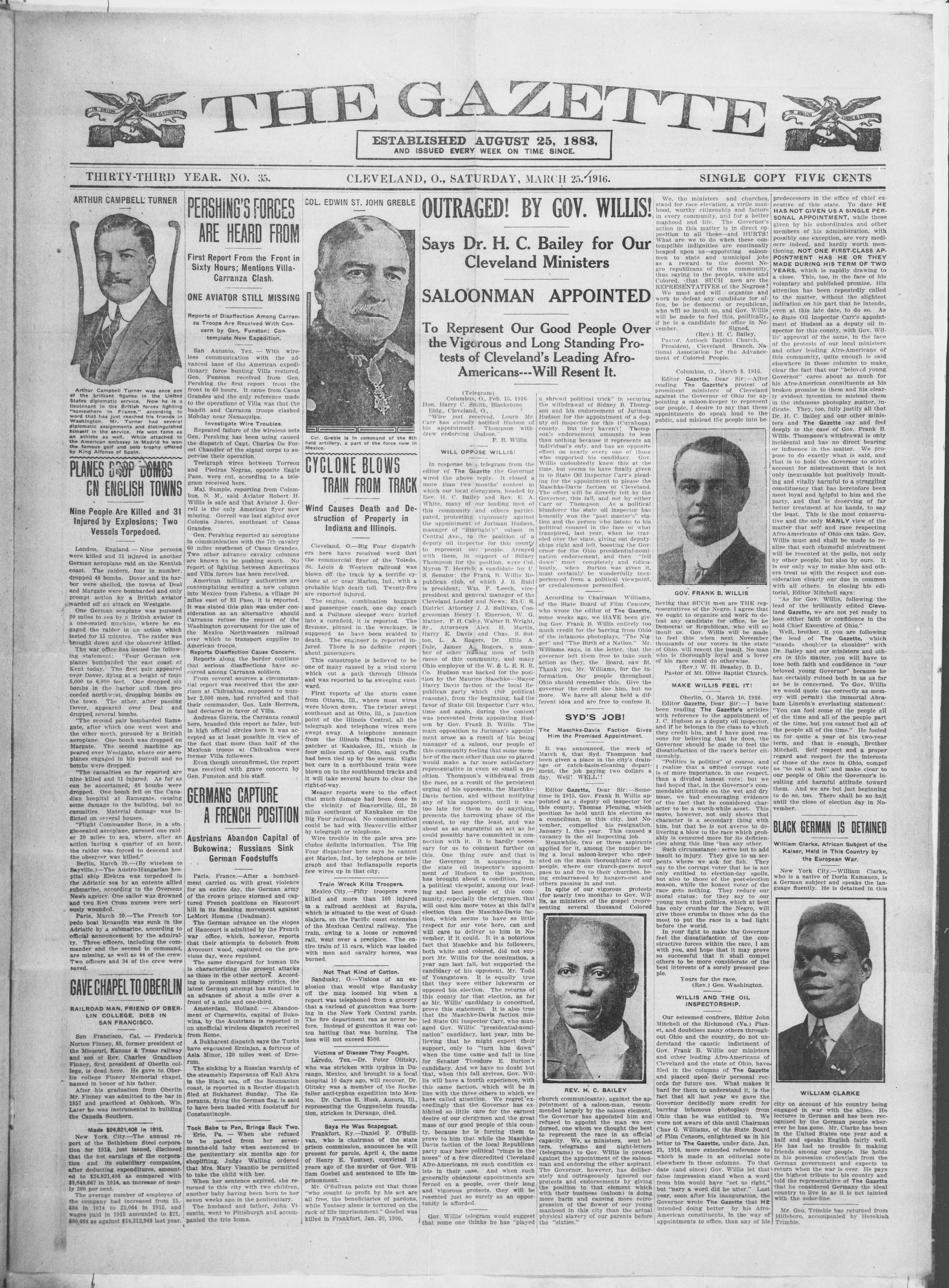
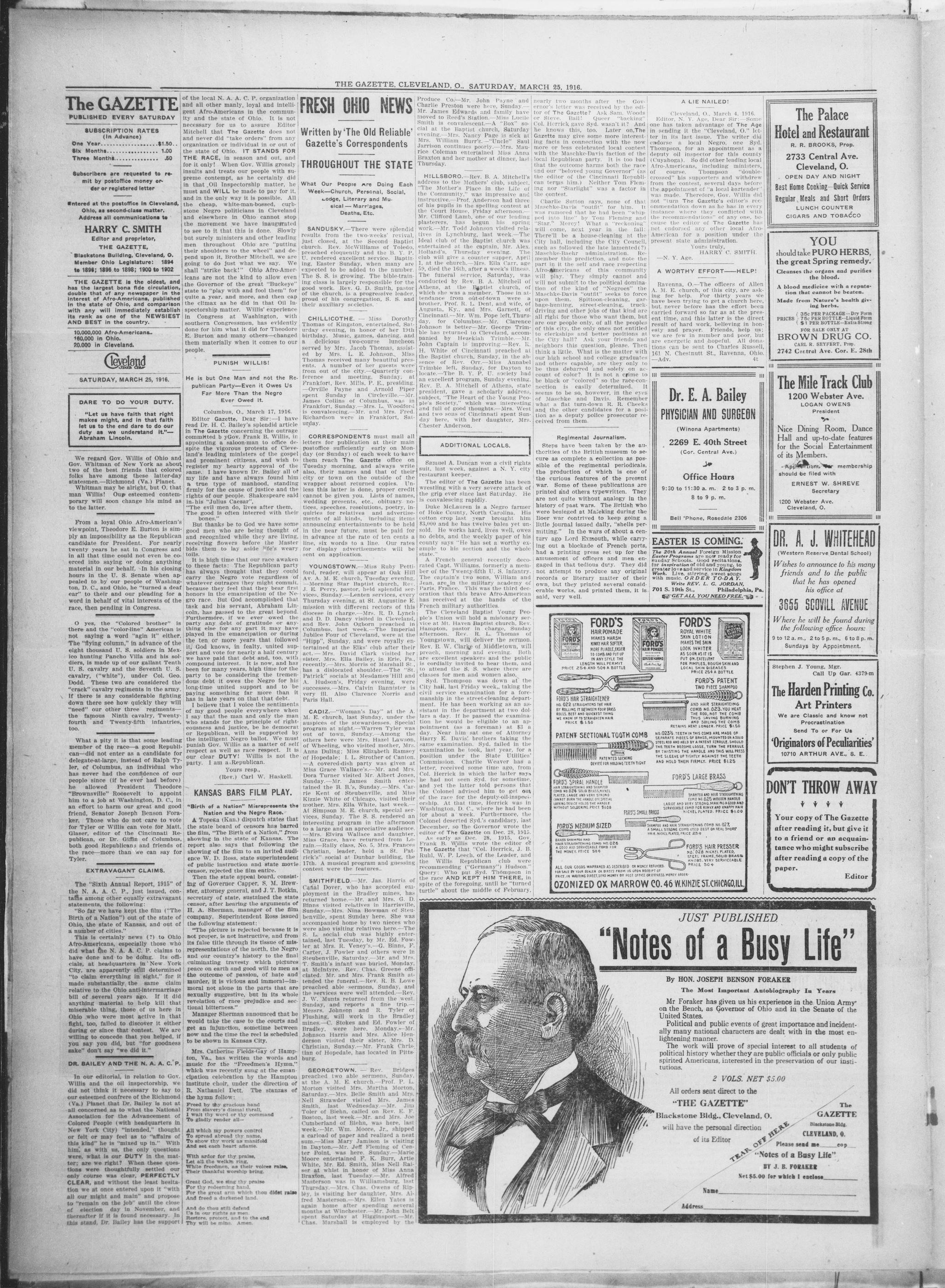
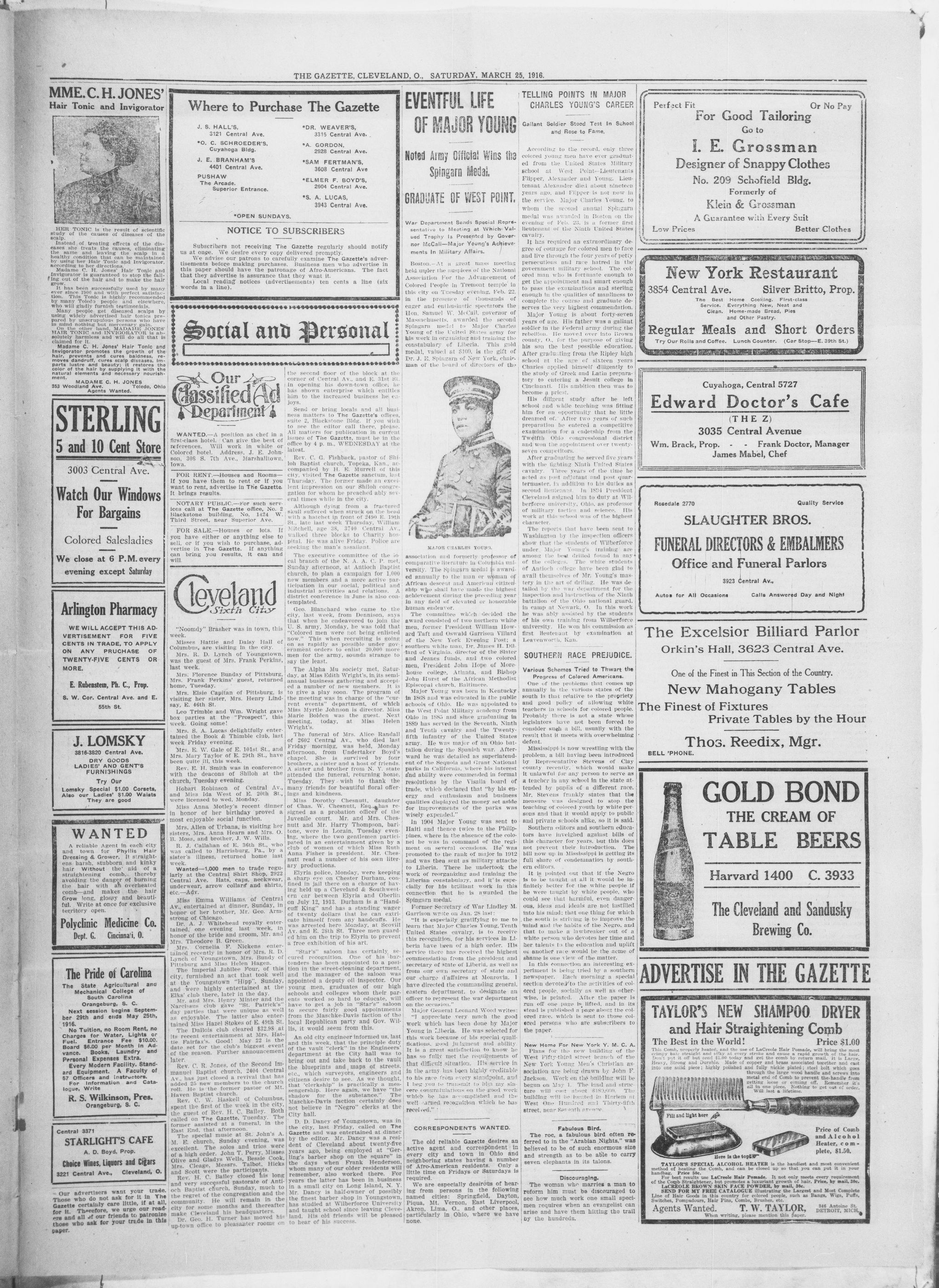
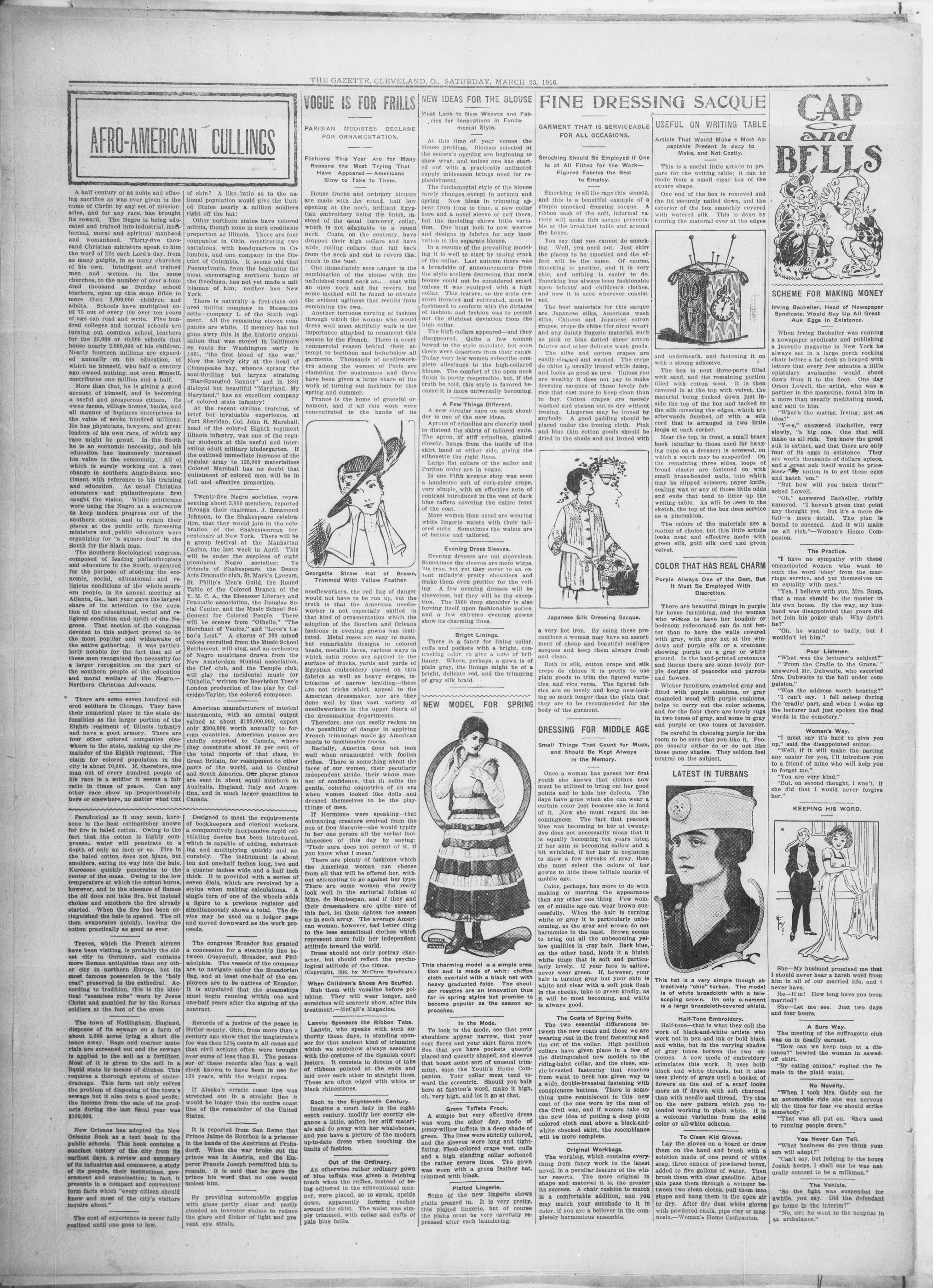
Page text (machine-generated)
THIRTY-THIRD YEAR. NO. 35.
IN UNION
HIS & STRONG
ARTHUR CAMPBELL' TURNER
Arthur Campbell Turner was once one of the best military forces in the United States diplomatic service. Now he is a lieutenant in the British forces, fighting "somewhere in France," according to word that has just reached his friends in Washington, N.Y. Turner had several diplomatic assignments and distinguished himself in the service. He won fame as an athlete as well. While attached to the American combat in Madrid he won the famous golf and polo trophy offered by King Alfonso of Spain.
PLANES GROUP DOM8S
CN ENGLISH TOWNS
Nine People Are Killed and 31 Injured by Explosions; Two Vessels Torpedoed.
London, England. — Nine persons were killed and 31 injured in another German aeroplane raided on the Kentish coast. The raiders, four in number, dropped 48 bombs. Dover and its harbor were shelled, the towns of Deal and Margate were bombarded and only prompt action by a British aviator warded off an attack on Westgate.
One German seaplane was purged 20 miles to sea by a British pilot in a one-seater aircraft, where he engaged in an action which wasasted for 15 minutes. The raider was bought down and the observer killed.
The war office has issued the following statement: "Four German seaplanes bombarded the east coast of Kent: today. The first pair appeared over Dover, flying at a height of from 5,000 to 6,000 feet. One dropped six bombs in the harbor and then proceeded northwest, dropping bombs on the town. The other, after passing Dover, appeared over Deal and dropped several bombs.
"The second pair bombarded Ramsgate, after which one went west and the other north, pursued by a British aeroplane. One bomb was dropped on Margate. The second machine appeared over Westgate, where our aeroplanes engaged in his pursuit and no bombs were dropped.
"The casualties so far reported are nine killed and 31 injured. As far as can be ascertained, 48 bombs were dropped. One bomb fell on the Canadian hospital at Ramsgate, causing some damage to the building, but no casualties. Material damage was inflicted on several houses.
"Flight Commander Bone, in a single-seated aeroplane, pursued one rattler 30 miles to sea, where, after an action lasting a quarter of an hour, the raider was forced to descend and the observer was killed."
Berlin, March 20.—(By wireless to Sayville.)—The Austro-Hungarian hospital ship Elektra was torpeded in the Adriatic sea by an entente allied submarine, according to the Overseas News agency. One sailor was drowned and two Red Cross nurses were seriously wounded.
Paris, March 20.—The French torpedo boat Renandin was sunk in the Adriatic by a submarine, according to official announcement by the admiralty. Three officers, including the commander and the second in command, are missing, as well as 44 of the crew. Two officers and 34 of the crew were saved.
GAVE CHAPEL TO OBERLIN
RAILROAD MAN. FRIEND OF OBERLIN COLLEGE, DIES IN SAN FRANCISCO.
San Francisco. Cal. — Frederick Norton Finney, 85, former president of the Missouri, Kansas & Texas railway and son of Rev. Charles Grandison Finney, first president of Oberlin college, is dead here. He gave to Oberlin college Finney Memorial chapel, named in honor of his father.
After his graduation from Oberlin Mr. Finney was admitted to the bar in 1857, and practiced at Oshkosh, Wis. Later he was instrumental in building the Canada Southern.
Made $24,821,408 In 1915.
New York City—The annual report of the Bethlehem Steel corporation for 1918, just issued, disclosed that the net earnings of the corporation and its subsidiary companies, after deducting, expenditures, amounted to $24,821,408 as compared with $9,649,649 in 1918, an increase of nearly 260 per cent.
The average number of employees of the company had increased from 15,586 in 1914 to 22,064 in 1915, and wages paid in 1915 amounted to $21,800,664 as against $14,312,948 last year.
THE GAZETTE
PERSHING'S FORGES ARE HEARD FROM
First Report From the Front in Sixty Hours; Mentions Villa-Carranza Clash.
ONE AVIATOR STILL MISSING
Reports of Diaffection Among Carranza Troops Are Received With Concern by Gen. Funston, Contemplate New Expedition.
San Antonio, Tex. — With wireless communication with the advanced base of the American expeditionary force hunting Villa restored, Gen. Funston received from Gen. Pershing the first report from the front. in 60 hours. It came from Casas Grandes and the only reference made to the operations of Villa was that the bandit and Carranza troops clashed Monday near Namaquila.
Investigate Wire Troubles.
Repeated failure of the wireless sets Gen. Pershing has been using caused the dispatch of Capt. Charles De Forest Chandler of the signal corps to supervise their operation.
Telegraph wires between Torreon and Pledras Negras, opposite Eagle Pass, were cut, according to a telegram received here.
Mal. Sample, reporting from Columbus, N. M., said Avilator Robert H. Willis is safe and that Avilator J. Gorrell is the only American flyer now missing. Gorrell was last sighted over Colonin Junrez, southeast of Casas Grandes.
Gen. Pershing reported an aeroplane in communication with the 7th cavalry 60 miles southeast of Casas Grandes. Two other advance cavalry columns are known to be pushing south. No report of fighting between Americans and Villa forces has been received.
American military authorities are contemplating sending a new column into Mexico from Fabens, a village 30 miles east of El Paso, it is reported. It was stated this plan was under consideration as an alternative should Carranza refuse the request of the Washington government for the use of the Mexico Northwestern railroad over which to transport supplies to American troops.
Reports Disaffection Cause Concern.
Reports along the border continue that serious disaffections have occurred among Carranza soldiers.
From several sources a circumstantial report was received that the garrison at Chihuahua, supposed to number 2,000 men, had revolted and that their commander, Gen. Luis Herrera, had declared in favor of Villa.
Andreas Garcia, the Carranza consul here, branded this report as false, but in high official circles here it was accepted as at least possible in view of the fact that more than half of the Mexican troops at Chihuahua were former Villa followers.
Even though unconfirmed, the report was received with grave concern by Gen. Fonston and his staff.
GERMANS CAPTURE A FRENCH POSITION
Austrians Abandon Capital of Bukowina; Russians Sink German Foodstuffs
Paris, France.—After a bombardment carried on with great violence for an entire day, the German army of the crown prince stormed and captured French positions on Haucourt hill in its flanking movement against LeMort Homme (Deadman).
The German advance on the slopes of Haucourt is admitted by the French war office, which, however, reports that their attempts to debouch from Avocourt wood, captured on the previous day, were repulsed.
The same disregard for human life is characterizing the present attacks as those in the other sectors. According to prominent military critics, the latest German attempt has resulted in an advance of about a mile over a front of a mile and one-third.
Amsterdam, Holland. — Abandonment of Czernowitz, capital of Bukowina, by the Austrians is reported in an unofficial wireless dispatch received from Rome.
A Bukharest dispatch says the Turks have evacuated Erzinjan, a fortress of Asia Minor, 120 miles west of Erzurum.
The sinking by a Russian warship of the steamship Esperanza off Kall Akra in the Black sea, off the Romanian coast, is reported in a Reuter dispatch filed at Bukharest Sunday. The Esperanza, flying the German flag, is said to have been loaded with foodstuff for Constantinople.
Took Babe to Pen, Brings Back Two. Erie, Pa. — When she refused to be parted from her seven-months-old baby when sentenced to the penitentiary six months ago for shoplifting, Judge Walling ordered that Mrs. Mary Visantio be permitted to take the child with her. When her sentence expired, she returned to this city with two children, another baby having been born to her seven weeks ago in the penitentiary.
The husband and father, John Vi santo, went to Pittsburgh and accompanied the trio home.
ESTABLISHED AUGUST 25, 1883 AND ISSUED EVERY WEEK ON TIME SINCE.
CLEVELAND, O., SATURDAY, MARCH 25, 1916.
COL. EDWIN ST. JOHN GREBLE
OUTRAGED! BY GOV. W.
Says Dr. H. C. Bailey for Cleveland Ministers
SALOONMAN APPOINT
To Represent Our Good People the Vigorous and Long Standing tests of Cleveland’s Leading A Americans---Will Resent It
(Telegram)
Columbus, O., Feb. 15, 1918.
Hon. Harry C. Smith, Blackstone Bldg., Cleveland, O.
"Wire just received, learn Mr. Carr has already notified Hudson of his appointment. Thompson with a shrewd political trick the withdrawal of Sidjou son and his endorsement Hudson for the appointment of inspector for this county. But they have
Col. Grebe is in command of the 6th
territory, a part of the force now in
Mexico.
Cleveland, O.—Big Four dispatchers here have received word that the commercial flyer of the Toledo, St. Louis & Western railroad was blown off the track by a terrific cyclone at or near Marlon, Ind., with a probable high death toll. Twenty-five are reported injured.
The engine, combination baggage and passenger coach, one day coach and a Pullman sleeper were hurried into a cornfield, it is reported. The fireman, plumed in the wreckage, is supposed to have been scaled to death. The engineer is reported injured. There is no definite report about passengers.
This catastrophe is believed to be one of many caused by a wind storm which cut a path through Illinois and was reported to be sweeping eastward.
First reports of the storm came from Ottawa, Ill., where most wires were blown down. The twister, swept southeast and at Otto, Ill., a junction point of the Illinois Central, all the telegraph and telephone wires were swept away. A telephone message from the Illinois Central train dispatcher at Kankakee, Ill., which is four miles north of Otto, said traffic had been tled up by the storm. Eight box cars in a northbound train were blown on to the southbound tracks and it will take several hours to clear the right-of-way.
Menger reports were to the effect that much damage had been done in the vicinity of Beaverville, Ill., 20 miles southeast ofankakee on the Big Four railroad. No communication could be had with Beaverville either by telegraph or telephone. Wire trouble in the gale area precludes definite information. The Big Four dispatcher here says he cannot get Marion, Ind., by telephone or telegraph and that Indianapolis reports few wires up in that city.
Train Wreck Kills Troopers
Mexico City.—Fifty troopers were killed and more than 100 injured in a railroad accident at Sayula, which is situated to the west of Guadalajara, on the Pacific coast extension of the Mexican Central railway. The train, owing to a loose or removed rail, went over a precipice. The entire train of 15 cars, which was loaded with men and cavalry horses, was burned.
Not That Kind of Cotton.
Sandusky, O.—Visions of an explosion that would wipe Sandusky off the map 'loomed big when a report was telephoned from a grocery that a carload of guncotton was burning in the New York Central yards. The fire department ran as never before. Instead of guncotton it was cotton 'batting that was' burning. The loss will not exceed $500.
Victims of Disease They Fought.
Laredo, Tex.-Dr. Peter Olitsky, who was stricken with typhus in Durango, Mexico, and brought to a local hospital 10 days ago; will recover. Dr. Olitsky was a member of the Rockefeller anti-typhus expedition into Mexico. Dr. Carlos E. Husur, Aurora, Ill., representing the Guggenheim foundation, stricken in Durango, died.
Save He Was Scapegoat.
Frankfort, Ky.—Daniel F. O'ullivan, who is chairman of the state prison commission, announces he will present for parole, April 4, the name of Henry E. Youtsey, convicted 18 years ago of the murder of Gov. William Goebel and sentenced to life imprisonment. Mr. O'Sullivan points out that those "who sought to profit by his act are all free, the beneficiaries of pardons, while Youtsey alone is tortured on the rack of life imprisonment." Goebel was killed in Frankfort, Jan. 30, 1900.
OUTRAGED! BY GOV. WILLIS!
Says Dr. H. C. Bailey for Our Cleveland Ministers
To Represent Our Good People Over the Vigorous and Long Standing Protests of Cleveland's Leading Afro-Americans---Will Resent It.
(Telegram)
Columbus, O., Feb. 15, 1916.
Hon. Harry C. Smith, Blackstone
Bldg., Cleveland, O.,
Gov. Willis' telegram would suggest that some one thinks he has "played
a shrewd political trick* in securing the withdrawal of Sidney B. Thompson and his endorsement of Juriman Hudson for the appointment of a deputy oil inspector for this (Cuyahoga) county, but they haven't*. Thompson's endorsement amounts to less than nothing because it represents an effect on nearly every one of those who supported his candidacy. Gov. Willis undoubtedly know this at the time, but seems to have finally given in to State Oil Inspector Carr's pleading for the appointment to please the Maschke-davis faction of Cleveland. The effect will be directly felt by the Governor, this fall, and not by other cars or the public. The state oil inspector has honestly won the "past master" station and the person who listens to his political counsel in the face or what transpired, last year, when he traveled over the state, giving out deputies right and left, boosting the Governor for the Ohio presidential nomination endorsement, and then "tell down" most completely as asserting that he must certainly be wonderfully intercepted from a political viewpoint, or credulousness personified.
According to Chairman Williams, of the State Board of Film Censors, who wrote the editor of The Gazette, some weeks ago, we HAVE been giving Gov. Frank H. Willis entirely too much credit for the harring from Ohio of the infamous photoplay, "The Nigger" and "The Birth of a Nation," Mr. Williams says, in the letter, that the governor left them free to take such action as they, the Board, saw fit. Thank you, Mr. Williams, for the information. Our people throughout Ohio should remember this. Give the governor the credit due him, but no more. We have all along held a different idea and are free to confess it.
SYD'S JOB!
The Maschke-Davis Faction Gives Him the Promised Appointment.
It was announced, the week of March 6, that Syd. Thompson had been given a place in the city's drainage or catch-basin-cleaning department, the job paying two dollars a day. Well! WELL!!
Editor Gazette, Dear Sir: —Sometime in 1915, Gov. Frank B. Willis appointed as a deputy inspector for this county, Thomas Fleming, which position he held until his election as a councilman, in this city, last November, compelled his resignation, January 1, this year. This caused a hurry in inspecting Mennille, two or three aspirants applied for it, among the number being a local salon-keeper who operated on the main thoroughfare of our people, where our church-goers must pass to and fro to their churches, being embarrassed by hangers-out and others passing in and out of vigorous protests (for nearly two months) to Gov. Willis, as ministers of the gospel (representing several thousand Colored
REV. H. C. BAILEY
church communicants), against the appointment of a saloon-man, recommended largely by the saloon element, the Governor has appointed him and refused to appoint the man we endorsed, one whom we thought the best to represent the saloon man. We as ministers, sent letters, telegrams and night-letters (telegrams) to Gov. Willis in protest against the appointment of the saloon-man and endorsing the other asplendant. The Governor, however, has deliberately and outrageously ignored our protests and endorsements by giving the position of a saloon man, self-business (saloon) is doing more harm and causing more retrogression of the flower of our young manhood in this city than the actual physical slavery of our parents before the "sixties."
We, the ministers, and churches, stand for race elevation, a virile manhood, worthy citizenship and factors in every community, and for a better manhood and life. The Governor's action in this matter is in direct opposition to all these—and HURTS! What are we to do when these contemptible indignities are continually heaped upon us—appropriately saloon-men to state of municipal jobs a reward to the decent Negro republicans of this community, thus saying to the people, white and Colored, that SUCH men are the REPRESENTATIVES of the Negroes? We must and will organize and work to defeat any candidate for office, he be democrat or republican, who will so insult us, and Gov. Willis will be made to feel this, politically, if he is a candidate for office in November. Signed, (Rev.) H. C. Bailley, Pastor, Antioch Baptist Church, President, Cleveland Branch, National Association for the Advancement of Colored People. Columbus, O. J., March 8, 1916. Editor, Gazette, Decar. Sir: After reading The Gazette's article of prominent ministers of Cleveland against the state of Ohio for appointing saloon-treepier to represent the people, I desire to say that these appointments do speak loud to the public and mislead the people into be-
GOV. FRANK B. WILLIS
leaving that SUCH man are THE representatives of the Negro. I agree that we ought to organize and work to defeat any candidate for office, be he Democrat or Republican, who will so insult us. Gov. Willis will be made to feel this when next. November thousands of our voters in the state of Ohio, will resent the insult. No man who is thoroughly loyal and a lover of his race could do otherwise.
(Rev.) W. H. Beasley, B. D.
Pastor of Mt. Olive Baptist Church.
MAKE WILLIS FEEL IT!
Oberlin, O., March 10, 1946.
Editor Gazette, Dear Sir: I have been reading The Gazette's articles with reference to the appointment of J. C. Hudson as a deputy oll inspector, and if he belongs to the class to which he belongs, I will be sons for believing that he does, the Governor should be made to feel the dissatisfaction of the race's better citizenship.
"Politics is politics" of course, and I realize that a united corrupt vote is of more importance, in one respect, than a divided honest vote; but we had hoped that, in the governor's compartment, we would be the ones to issue we had encouraging-evidence of the fact that he considered character to be a worth-while asset. This move, however, not only shows that character, is a secondary thing with him, but that he is not averse to delivering a blow to the race which probably is ensured more for its deficiencies along this line than any other.
Such circumstance; serve but to add insult to the face of apprehensions we ask for fish. They say to the corrupt voter that he is not only entitled to election-day spoils, but also to those of the post-election season, while the honest vote of the race gets nothing. They reduce our moral status; for they say to our young men that politics, which at best has only crumbs for the Negro, is not the race in those who do the most to put the race in a bad light before the world:
In your fight to make the Governor feel the dissatisfaction of the constructive forces within the race. I am with you, and hope that it may prove so successful that it shall compel others to be more considerate of the best interests of a sorely pressed people.
Yours for the race,
(Rev.) Geo. Washington.
Our esteemed conferee, Edilor John Mitchell of the Richmond (Va.) Planet, and doubtless many others throughout Ohio and the country, do not understand the caustic indictment of Gov. Frank B. Willis our ministers and other leading Afro-American of Cleveland and the state of Ohio, have filed in the columns of The Gazette and placed upon their personal records for future use. What makes it hard for them to understand it, is the fact that all last year we gave the Governor decidedly more, credit for barring infamous photoplays from Ohio than he was entitled to. We were not aware of this until Chairman Chas G. Williams, of the State Board of Film Censors, enlightened us in his letter to The Gazette, under date. Jan. 21, 1916, more extended reference to which is made in an editorial note elsewhere in these columns. To that date (and since) Gov. Willis let that false impression stand when a word from him would have "set us right," but "nary a word did he utter." Last year, soon after his inauguration, the Governor wrote The Gazette that HE intended doing better by his Afro-American constituents, in the way of appointments to office, than any of his
IN WHICH HEREBY HELPED ME
predecessors in the office of chief executive of this state. To date HE HAS NOT GIVEN US A SINGLE PERSONAL APPOINTMENT, while those given by his subordinates and other members of his administration, with possibly one exception, are very medically indeed, and hardly worth mentioning. NOT ONE FIRST CLASS APPOINTMENT HAS HE OR THEY MADE DURING HIS TERM OF TWO YEARS, which is rapidly drawing to a close. This, too, in the face of his voluntary and published promise. His attention has been repeatedly called to the matter, without the slightest indication on his part that he intends, even at this late date, to do so. As to State Oil Inspector Carr's appointment of Hudson as a deputy oil inspector for this county, with Gov. Willis' approval of the same, in the face of the protests of our local ministers and other leading Afro-Americans this community, quite enough is said elsewhere in these columns to make clear the fact that our "beloved young Governor" cares about as much for the infamous playway matter, indicate. They, too, fully justify all that Dr. H. C. Bailey and our other ministers and other leaders of the Gazette and feel deeply in the case of Gov. Frank B. Willis. Thompson's withdrawal is only incidental and has no direct bearing or influence in the matter. We propose to do exactly what is said, and that is to hold the Governor to strict account for mistreatment that is not only inexcusable but positively insulting and vitally harmful to a struggling constituency that has heretofore been most loyal and helpful to him and the party, and that is deserving of far better treatment at his hands, to say the least. This is the most conservative and the only MANLY view of the matter that self and race respecting Afro-Americans of Ohio can take. Gov. Willis must and shall be made to realize that such shameful mistreatment will be resented at the polls, not only by other people, but also by ours. It is our only way to make him and others treat us with the respect and consideration clearly our due in common with all others. In closing his editorial, Editor Mitchell says:
"As for Gov. Willis, following the lead of the brilliantly edited-Cleveland Gazette, we are not yet ready to lose either faith or confidence in 'the bold Chief Executive of Ohio.'" — Well, brother, if you are following the lead of The Gazette, which "stands shoulder to shoulder" with Dr. Bailey and our ministers and others in this matter, you will have to lose both faith and confidence in "our beloved young Governor" because he has certainly ruined both in us as far as he is concerned. To Gov. Willis we would quote (as correctly as memory will permit) the immortal Abraham Lincoln's everlasting statement: "You can fool some of the people all of the time and all of the people part of the time, but you cannot fool all of the people all of the time." He fooled us for quite a year of his two-year term, and that is enough, Brother Mitchell. Self respect and a proper regard and respect for the interests of those of the race. In Ohio, compel us "to call a halt" and make clear to our people of Ohio the Governor's insulting and harmful attitude toward them. And we are but just beginning to do so, too. There shall be no halt until the close of election day in November.
BLACK GERMAN IS DETAINED
BLACK GERMAN IS DETAINED
William Clarke, African Subject of the Kaiser, Held in This Country by the European War.
New York City.—William Clarke, who is a native of Dorla Kamaueen, is a German subject and speaks the language fluently. He is detained in this
WILLIAM CLARKE
city on account of his country being engaged in war with the allies. He lectures in German and has been recognized by the German people wherever he has gone. Mr. Clarke has been in the United States one year, and a half and speaks English fairly well. He has had no trouble in making friends among our people. He holds in his possession credentials from the German government and speaks to return when the war is over. He pays the highest tribute to his country and told the representative of The Gazette that he considered Germany the ideal country to live in as it is not tainted with the color-line.
Mr. Geo. Trimble has returned from Hillsboro, accompanied by Hezekiah Trimble.
PUBLISHED EVERY SATURDAY
SUBSCRIPTION RATES
(In Advance)
ne Vear.......seseeseeres $1.80..
BIx Months... ceseeseese 1.00
Three Montht....esseecees 60
Subscribers are requested to re
mit by postotfice money or
dor or registered letter
mntored at the postoffice In Cleveland,
Ohio, as second-class matter,
‘Address all communications te
HARRY C. SMITH
Editor and proprietor,
THE GAZETTE,
~ Blackstone Bullding, Cleveland, 0.
Member Ohio Legislature: 1804
to 1896; 1896 to 1898; 1900 to 1902
THE GAZETTE is the oldest, anc
has the largest bona fide circulation
double that of any newspaper in the
Interest of Afro-Americans, publishes
In the state of Ohio, and comparisor
with any will immediately establist
ita rank as one of the NEWSIEST
AND BEST In the country.
10,000,000 Afro-Americans.,
460,000 in Ohio.
20,000 in Cleveland.
SATURDAY, MARCH 25, 1916.
DARE TO DO YOUR DUTY.
“Let us have faith that right
makes might, and in that faith
let us to the end dare to do our
duty as we understand it”—
Abraham Lincoln.
We regard Gov. Willis of Ohio and
Goy. Whitman of New York as about
two of the best friends that colored
folks have among these latter-day
statesmen,—Richmond (Va.) Planet.
Whitman may be alright, but O, that
man Willis! Oup esteemed contem:
porary will soon change his mind as
to the latter.
From a loyal Ohio Afro-American’s
viewpoint, Theodore E. Burton is sim
ply an impossibility as the Republican
candidate for President. For nearly
twenty years he sat in Congress and
in all that time could not even be co-
erced into saying or doing anything
material in our behalf, “In his closing
hours in the U. S. Senate when ap-
pealed to by our people of Washing.
ton, D. C., and Ohio, he “turned a deat
ear” to their and our pleading for a
word in behalf of vital interests of the
‘race, then pending in Congress.
© yes, the “Colored brother” is
there and the “coloriine” American is
not saying a word “agin it” either.
‘The “flying colunm,” in advance of the
eight thousand U. 8. soldiers in Mex.
feo hunting Pancho Villa and his sol-
diers, is made up of our gallant Tenth
U. 8. cavalry and the Seventh U. S.
cavalry, (“white”), under Col. Geo.
Dodd. ‘These two are considered the
“crack” cavalry regiments in the army.
If there is any considerable fighting
down there see how quickly they will
“need” our other three regiments—
the famous Ninth cavalry, Twenty:
fourth and Twenty-fifth infantries,
too,
‘What a pity it is that some leading
member of the race—a good Republl
can—did not enter as a candidate for
delegate-at-large, instead of Ralph ‘Ty.
Jer, of Columbus, an individual who
has never had the confidence of our
people since (if he ever had before)
he allowed President Theodore
“Brownsville” Roosevelt to appoint
him to a job at Washington, D. C., in
an effort to harm our great and good
friend, Senator Joseph Benson Fora-
ker, Those who do not care to vote
for Tyler or Willis can vote for Matt.
Glaser, editor of the Cincinnati Re-
publican, or Dr. Giffin of Columbus,
both good Republicans and friends of
the race—more than we can say for
‘Tyler.
EXTRAVAGANT CLAIMS.
‘The “Sixth Annual Report, 1915” of
the N. A. A.C. P,, just issued, con-
tafhs among other equally extravagant
statements, the following:
“So far we have kept the film (“The
Birth of a Nation”) out of the state of
Ohio, the state of Kansas, and out of
1 nuinber of cities.”
‘This ts certainly news (2) to Ohio
Afro-Americans, especially those who
did what fie N. A. A.C. P. claims to
have done and to be dog. Its off
clas, at headquartera in*New York
City, are apparently stil! determined
“to claim everything in sight,” for it
made substantially, the same claim
relative to the Ohio antlintermarriage
Dill of several years ago. If it did
anything material to help kill that
miserable thing, those of us here in
Ohio who were most active in that
fight, too, taled to discover it elther
during or since that ¢ontest. We are
willing to concede that you helped, if
You say you did, but “for goodness
sake" don’t say “we did it.”
DR. BAILEY AND THE N.A.A.C.'P.
In our editorial, in relation to Gov.
‘Willis and the oil inspectorship, we
did not think it necessary to aay to
our esteemed confrere of the Richmond
(Va.) Planet that Dr. Bailey is not at
all concerned. as to what the National
Association for the Advancement of
Colored People (with headquarters in
New York City) “intended,” thought
or felt or may feel as to “affairs of
this kind” he is “mixed up fn.” With
‘him, as with us, the only questions
were, what is our DUTY In the mat-
ter; are we right?) When these ques-
tons were thoughtfully settled our
‘only course was clear, PERFECTLY
CLEAR, and without the least hesita-
tion we at onee entered upon it “with
‘all our might end main” and propose
to “remain on the job” until the close
‘ef election day in November, and
thereafter if it is found necessary. In
this stand, Dr. Bailey has the support
of the local N. A. A. C. P. organization
and all other manly, loyal and intelli
gent Afro-Americans in the commun-
ity and the state of Ohio. It is not
necessary for us to assure Editor
Mitchell that The Gazette does not
and never did “take orders” from any
organization or individual in or out of
the state of Ohio. IT STANDS FOR
THE RACE, in season and out, and
for it only! When Goy. Willis grossly
insults and treats our people with su-
preme contempt, as he certainly did
in that Ol Inspectorship matter, he
‘must and WILL be made to pay for it,
and in the only way it Is possible. All
the cheap, white-man-bossed, curb-
stone Negro politicians in Cleveland
and elsewhere in Ohio cannot stop
the movement we have inaugurated
to see to it that this is done, Slowly
but surely ministers and other leading
'men throughout Ohio are “putting
thelr shoulders to the wheel” and de-
pend upon it, Brother Mitchell, we are
going to do just what we say. We
shall “strike back!” Ohio Afro-Amer
|Icans are not the kind to allow even
the Governor of the great “Buckeye”
ee to "play with and foo! then” fo
quite a year, and more, and then cap
the climax as he did in that Oi In
spectorship matter. Willis’ experience
in Congress at Washington, with
southern Congressmen, has evidently
done for him what it did for Theodore
F, Burton and many others—change¢
them materially when it comes to ou
people.
| SaRaETEWICEIST
He is but One Man and not the Re
publican Party—Even it Owes Us
Far More Than the Negro
use Owea
Columbus, O., March 17, 1916.
Editor Gazette, Dear Sir:—I have
read Dr. H.C. Bailey's splendid article
in The Gazette concerning the outrage
committed b yGov. Frank B. Willis, ir
appointing a saloon-man to office de-
spite the vigorous protests of Cleve.
land's leading ministers of the gospel
and prominent citizens, and wish to
‘register my hearty approval of the
same. I have known Dr. Bailey all ot
‘a true type of manhood, standing
firmly for the cause of justice and the
‘rights of our people. Shakespeare said
in-his “Jullus Caesar",
‘Phe good Is often interred with thei
pones.”
But thanks be to God we have some
good men who are being thought of
and recognized while they are living,
recelving flowers before the Master
Bide them to lay aside Me's weary
toils.
It is high time that our race awaken
to these facts: ‘The Republican parts
has always thought that they could
carry the Negro vote regardless of
Whatever outrages they might commit,
because they feel that they bear frst
honors in the emancipation of the Ne
gro race. But God accomplished that
task and his servant, Abraham Lin:
coln, has passed to the great beyond
Furthermore, if we ever owed. the
party any debt of gratitude or any:
thing else for any part it may have
played in the emancipation or during
the ten or more years that followed
ity God knows, in fealty, united sup:
port and vote for nearly @ half century
we have paid that debt and, too, with
Fompound interest. It is now, and has
been for many years, high time for the
party to be considering the tremen:
dous debt it owes the Negro for his
long-time united support and to be
paying something far more than it
has in late years on that that debt
Thelieve that I voice the sentiments
of my good people everywhere when
Tsay that the man and only. the man
who stands for the principle of right
‘eousness and justice, be he democrat
or Republican, will be supported. by
‘the intelligent Negro ballot. We must
punish Gov. Willis as a matter of sel
Tespect as well as race respect. It i
our clear DUTY! Willis is not the
‘party, Tam a,Republican.
. Yours resp.,
(Rey.) Carl W. Haskell.
KANSAS BARS FILM PLAY.
(ESS SF a: enon = Miarppresters SNe
Nation and the Negro Race.
A Topeka (Kan,) dispatch states that
“the state board of censors has barred
the film, “The Birth of a Nation," from
“showing in the state of Kansas. ‘The
‘report also says that following the
“showing of the film to an invited audi-
“ence W. D. Itoss, state superintendent
of public instruction and state movie
censor, rejected the film entize.
Seema et
tng of Goveruor Capper, 8. M. Brew:
‘ster, attorney general, and J." Botkin,
secretary of state, sustained the state
censor, after hearing the arguments of
H. A. Sherman, manager of the film
company. Superintendent Ross issued
the following statement:
“The picture is rejected because tt Is
not proper, {s not instructive, und from
its false title through its tissue of mis-
representations of the north, the Nezro
“and our country’s history to the final
culminating travesty which pletures
peace on enrth und good will to men as
the outcome of passion, of hate and
/ murder, it is vicious and immoral—tm-
‘moral not alone in the parts that are
sexually suggestive, but in its whole
revelation of race prejudice and sec
tional bitterness.”
Manager Sherman announced that he
‘would take the case to the courts and
get an injunction, sometime between
now and the time the reel is scheduled
to be shown in Kansas City.
Mrs. Catherine Fields Gay of Hamp
ton, Va., bas written the words and
music for the “Freedmen's Hymn."
Which was recently sung at the eman
clpation celebration by the Hampton
institute choir, under the direction of
R, Nathanicl 'Dett. The stanzas of
‘the hymn follow:
Freed by thy gracious hand
Fron slavery's dismal thrall,
I wait thy word or tay command
‘To gladly render atl a
‘Ait whic my powers contro!
To spread abroad thy name,
To show thy Work as manifold
‘And wet each heart aflame.
With antor for thy praise,
Lat all the welkin rin,
While frecdmen, ax thelr volces raise,
Their thankful worsip bring.
Great God, we wing thy praise
For thy redeeming hard
For the yreat arm which thow @ldet raise
‘And freed darkened Iand
‘And do thou atti detend
Goin our richte ne men
Restore, provect. and to the end
‘Thy will be mine. Amen,
THE GAZETTE, CLEVELAND, O., SATURDAY, MARCH 25, 1916.
Produce Co—Mr. John Payne and| nearly two mont
FRI Hl OHIO EWS Charlie’ Preston were hve, Sunday —|ernors tetter we
Mr. James Edwards and family have tor of The Gazett
moved {0 Reed's Station. —Miss Latelle jor Steve, Balk
Sanne Smith is convalescent A. “Box” so: Col. Torrie av
4 7 y cial at the Baptist church, Saturday|he knows this,
Written by ‘The Old Reliable’ evening hrs "Nancy Page is sick at | Gazette may sive
' Mrs, William Burr’. “Uncle” Saul |ing facts in cont
Gazette’s Correspondents | Sarrison continues ports. Mrs, Maw | more or lens eat
{rice Coleman entertained Miss Anna’ with the Maschki
| raxton and her mather at dinner, last local Republican
THROUGHOUT THE STATE ‘Thursday. that the outcome
| | —_ and our “beloved
—_— | gaffiLLSBORO. Hey. BA. atttenett the editor of th
address to the Mothers’ club, subject, |can teruis him.)
phat Cur) Pepi mre ‘Doing Each. Mothers. Place in the Life ot| ing non “Startie
Week—Church, Personal, Social, | the Community,” was linpressive and |the contest
odge, Literary and Mu- instructive.—Prof. Anderson had three | Charlie Sutton
abi Meiagse, of ls pupils in the spelling vontest at| atasehkeDavin
the Court House, Friday afternoon | wis rumored tha
Deaths, Etc, |Mr. Clifford Lamb, one of our leading | ped inte’ iiges by
— plasterers, has. begin” his spring "Star Mores!
SANDUSKY.—There were splendid | Work Mr. Todd Johnson visited tela: | will come,, next
results from the two-weeks’ revival, tives in Lynchburg, last week.—The| There'll be a. h
Just closed, atthe Second Baptist | Ideal club of the Baptist church was City hall, includ
Church. “Rev. McWilliams of ‘Toledo, entertained st the captain, Mr. Alex.|such as followed
| preached eloquently and the B. Y. P.|Holland’s, Thursday evening. The | Maschke-Bacht
U. rendered exeeliont service. ‘Baptix:| club will give a counter supper, April [member this, pre
ing, Easter Sunday, when many ure|1, t the ohureh.—Mrs. Kila Carr, age part th it the el
expected to be added to the number. |52% died the 16th, after a week's lines. | roogmerieans
|The S'S. is growing. The bibletrai.|The funeral service, Saturday, "Waa will play. They
ing class is largely responsible for the| Conducted by Rev. B.A. Mitchell of | wi not submit t
| good work. Rev. G. D. Smith, pastor| Athens, at the Bgptist church, of|ton of the, kin
Of the hue, In progres ender, | which she was’ member, Those iA) Marchte-Davis
cr Oe te See eet BF (HO or Tee Dror ie: Le ent and wile oben
CHILLICOTHE. — Miss Dorothy
‘Thomas of Kingsion, entertained, Sai-
urday- evening, in honor of her’ 1th
birthday. Music, games, dancing, and
& delicious two-vourse luncheon
served by Mrs. Jacob Thomas, assist-
ed by Mrs. LE, Johnson, Miss
‘Thomas received many beautiful pres-
ents, A number of lier guests were
from out of the city.—Quarterly con
ference and meeting, Sunday, at
Frankfort, Rev. Mills, P. E., presiding.
—Orville Payne and Arnold Piper
spent Sunday in Circleville.—Mr
James Collins of Columbus, was in
Frankfort, Sunday.—Mrs. L. Woodford
is convalescing-Mr. and Mra, Fred
Richardson were in Frankfort, Sat
urday.
CORRESPONDENTS must mail all
letters for publication at their main
Postoffice suieiently early on Mon-
day (or Sunday) of each week to-have
them reach The Gazette office on
‘Tuesday morning, and always write
also, their names and that of their
city’ or town on the outside of the
wrapper about returned copies. Un-
‘less this latter is done, proper credit
cannot be given you. Lists of names,
wedding presents, ete., obituary no:
tices, speeches, resolutions, poetry, in
quiries for relatives and advertise.
ments of all kinds, including items
announcing entertainments to be held
in the near future, must be paid for
in advance at the rate of ten cents a
line, six words to a line. Our rates
for ‘display advertisements will be
pant Ga application.
ticiythsch ina cektg tarde Sse hgapet tr ety Akpan
ford, reader, will appear at Oak Hil
Ay. A. M. B. chureh, Tuesday evening
—Morning Star Buptist chureh, Rev
J.B. Perry, pastor, held splendid ser:
vices, Sunday.—Lenten services, every
Thursday evening, at St. Augustine E.
mission with different rectors of this
diocese in charge.—Mrs, RD. Lyneh
and D. D. Dancy visited in Cleveland,
and Rev. John Oghorn preached in
Columbus, ‘last. week.—The Imperial
Jubilee Four of Cleveland, were at the
“Hipp”, Sunday, and were royally en:
tertained at the Elks’ club after their
aet.—Mrs. David Clark visited her
Sister, Mrs. Ella Bailey, in Erie, Pa,
recenily.—Ars, Morris of Marshall St,
has a dislocated shoulder—The “St
Patrick” socials at Mesdames Hill and
A. Hudson's, Priday evening, were
sticcesses—Mrs. Calyin Bannister is
very ill Also Clarence Norris and
Paris Hall.
CADIZ.—“Woman's Day” at the A.
M. E. chureh, last Sunday, under the
auspices of the stewardesses. Special
program at night—Warren Tyler was
out of town, Sunday—Among the
others here were Mrs, Hazel Lawson,
of Wheeling, who visited mother, Mrs.
Anna Duling; Miss Blizabeth Ramsey
of Hopedale; 1. L.. Strother of Canton.
—A covered-aish party was given at
Miss Grace Wallace’s—Mr. and Mrs.
Dora Turner visited Mr. Albert Jones,
Sunday.—Mr. James Smith enter:
tained the B. B’s, Sunday.—Mrs. Car
rie Kent of Steubenville, and Miss
Kizzle White of Chicago, visited their
mother, Mrs, Ella White, last week.
At Simpson M. E. church, special ser-
Vices, Sunday. The S. 8. rendered an
interesting program in the afternoon
to a large and an apreciative audience.
—Mrs, Blvira Wallace and daughter,
Miss Grace, have returned trom Lo.
rain.—Rally class, No. 5, Mrs, Frances
Christian, leader, held a St. Pat-
riek’s" social at Dunbar building, the
17th. A musical program and guessing
‘contest were the features..
SMITHFIELD.—Mr. Jas. Harris of
Canal Dover, who has accepted em:
ployment in the Bradley mines, has
returned home.—Mr. and Mrs. G. D.
Binns visited relatives in Harrisvitle,
Sunday.—Mrs, Nina Bowman of Ste:
benville, spent Sunday here, She was
accompanied home by two nieces who
were also visiting relatives here.—The
S. L. social club was highly ‘enter-
tained, last Tuesday, by Mr. Ed. Fow
ler at Mrs. R. Veney's.—G. Binns, F
Carter, J. Fowler and others were In
Steubenville, Saturday.—Mr. and Mrs.
‘T, Smith's infant was buried, Monday,
at Meintyre. Rev. Chas. Greene off
‘olated. Mr. and Mrs. Frank Smith at-
tended the funeral.—Rev. R. B. Lowe
Dreached able “sermons, Sunday, and
the services were well attended.—Rev.
J. W, Munts returned from the west.
Sunday, and reports a fine trip. —
Messrs, Johnson and R. Tyler of
Flushing, will work in the Bradley
mines—C. Stokes and Ed. Fowler of
Bradley, were here. Monday.—Mr.
Johnson Harris and Mrs. Alice Hen-
Gerson visited their sister, Mrs. D.
Christian, Sunday.—Mr. Frank Chris.
tian of Hopedale, has located in Pitts:
bur.
) MEORGETOWN. = Rev. Bridges
preached two able sermons, Sunday,
at the A.M. BE. cburch—Prof. P. L.
Morton visited Mrs. Martha Morton,
‘Saturday.—Mrs. Belle Smith and Mrs:
‘Nell Strawder visited Mrs. Jamés
‘Smith, last Wednesday—Mr. Jit
‘Toler ‘of Biebn, called on Rev. EF.
Boston, last week —Mr. and Mrs. Joe
Cumberiand of Biehn, was here, last
‘week:—Mr. Wm. Moore, Jr... shipped
‘a carioad of paper and realized a neat
sum—Miss Mary Jamison is visiting
in Dayton.—Mr. Jef Fleming of Cen-
ter Point, was here, Sunday.—Marie
Moore entertained F. K. Burr, Artie
‘White, Mr. Ed. Smith, Miss Nell Rai-
ser at whist in honor of Miss Anna
Braston last’ “Tuesday—Mr. Alfred
Masterson was in Williamsburg, last
‘Thursday.—Mrs. Chas, Owens of Rip
ley, is visiting her daughter, Mrs. Al-
fred Masterson —Mys. Ellen’ Yates is
‘again home after spending several
‘months at Winchester.—atr. John Belt
Spent Saturday at Higginsport.—Mr.
‘Chas. Marsbell is employed by the
— JUST PUBLISHED
LS .
ZESNSSER iG ”
Z =H fii in
= aA
oan
S22 A TN
See TAME 0) AN sn a AC
aa
es aM a Wy A Y The Most Important Autobiography In Years
Se A int spc i fs a Kee
Aiea Seay Wey if / cote ean a eee of Oto end in the Senate of the
ee Se ae), Political and public events of great importance and incident-
Vine ames Se “in eas i A\ ally many national characters are dealt with in the most en-
NN) \\ Shen eso special inereat tall atdena of
cae ad ee FN | \| political history whether they are public officials or only public
Re UN ge CG ii\\.,. spirited Americans: intecesten taiztie preseeacion enone tants
WE ee eg” i ea Mn 2 VOLS. NET 35.00
Ni ee Zz h)) | } All orders sent direct to the
Vere ian cea” (ea .
\ Gi eA , “THE GAZETTE! The
Ni par oe B ie a GAZETTE
WY Ye Satake Uy H Yj, Blackstone Bidg., Cleveland, 0. =e
y YF PAN y in M/° sci: ave‘ vhd parmnal Seton ge nave
VV i / ; 0.
My Re Z Vi] i) Ui My"! ee “Notes of a Busy Life”
WA Vi Yi} I) tH BY J.B. PORAKER
Pape} ] HH] Yo : Net $5.00 for which ! enclose
FA Wy if Lf
i: il Yi f4 Wy Wy Name ees
“mM Wy | // Address, Sees
WN APE"! / A ves
Chouce Co—Mr. John Payne “and
Charlie Preston were hrre, Sunday
Mr. James Edwards and family have
nioved to Reed's Station.— Miss Lucile
Smith is convalescent—A “Box” so:
clal at the Baptist church, Saturday
evening.—Mrs, Nancy Page is sick al
Mrs, William Bure. “Uncle” Saul
Jarrison continues poorly. —Mrs, Mau
Tiee Coleman entertained Miss Ann
Braxton and her mother at dinner, last
"Thursday.
HILLSBORO.—Rey. B. A. Mitchell's
address to the Mothers’ club, subject,
“The Mother's Place in the Life of
the Community,” was impressive and
instructive.—Prof, Anderson had three
of his pupils in the spelling contest at
the Court House, Friday afternoon —
Mr, Clifford Lamb, one of our leading
plasterers, has ‘begun his springs
Work.—Mr. Todd Johnson visited rela-
tives in Lynchburg, last week. —The
Ideal club of the Baptist church was
entertained at the captain, Mr. Alex.
Holland's, Thursday evening. | The
‘club will give a counter supper, Apri
1, at the obureh.—Mrs, Ella Carr, age
58, died the 16th, after a week's ilnose.
‘The funeral service, Saturday, was
conducted by Rey. B.A. Mitchell o!
Athens, at the Bgptist church, o!
which she was a member, Those in av
tendance from oiltoftown were 4
brother. Prof. R. L. Dent, and wife, of
Augusta, Ky. and Mrs. Garnett, 01
Cincinnati—Air. Wm. Pope left, Thurs
day, for Columbus—Mr, _ Clarence
Johnson is better—Mr. George Trim
ble has returned io Cleveland, accom
panied by Hezekiah ‘Trimble—Mr
John Captain ix improving —Rev. K
H. White of Cincinnati preached a
the Baptist church, Sunday, in the ab
sence of Rev. Orr—Miss Annabel
‘Trimble left, Sunday, for Dayton te
locate—The B. Y. P._U. saciety had
an excellent program, Sunday evening
Rey. B. A. Mitchell of Athens, stat
president, gave a scholarly address
subject, “The Heart of the Young Peo
ple’s Society,” which was interestins
and fall of good thoughts.—Mrs, Wes!
and two sons of Cincinnati spent Sun
day here, with her daughter, Mrs
Ohanken Audavade:
ADDITIONAL LOCALS.
Samuel A. Duncan won a civil rights
suit, last Week, against a N. Y. city
restaurant keeper.
‘The editor of The Gazette lias been
wrestling with @ very severe attack of
the grip ever since last Saturday. He
is convalescing rapidly.
Duke McLauren is a Negro farmer
of Hoke County, North Carolina, His
cotton crop last’ year brought him
$8,000 and he has twelve bales yet un:
sold. He works hard, lives well, owes
no debts, and the weekly paper of his
county says “He has set a worthy ex
ample to his section and the whole
state.”
‘A’ Preneh general’ recently deco-
rated Capt. Williams, formerly a mem.
ber of the Twenty-fifth U. 8, Infantry.
The captain's two sons, William and
Jean, are_in the military academy. 01
Paris, Prahee. This was the third dec.
oration that this brave Afro-American
has recelved at the hands of the
French military authorities.
| The Cleveland Baptist Young Peo
fe Union will hold a misionary ser
Vice at Mt, Haven Baptist church, Rev
Hampton, pastor in’ charge, Sunday
afternoon. “Rey. RL. Thomas 0
Youngstown, will deliver the sermon,
Rev. B, W. Clarke of Middletown, will
preaeh, morning and evening. Both
Jare excellent speakers and the public
is cordially: invited. to hear them, and
to attend the S.S, where there arc
classes for men and women also,
Syd. ‘Thompson was down at the
City hall, last Friday week,, taking the
‘civil service examination ‘for a fore
manship in the street-cleaning depart
‘ment. He has been working as an as
‘sistant in the department at two dol
Jars a day. If he passed the examina
tion he would be eligible to an_ ap:
pointment (is @ foreman) at $0
day. Near him sat one of Attorney
Harry E, Davis! brothers taking. the
same examination, Syd, failed in the
examination he (ook, last year, for a
position under the State Utilities
Commission. Charlie Weaver has. a
Teter, received some time ago, from
Col. Herrick in which the latter says
‘he had not seen Syd. for sometime,
and yet the latter told persons thal
the Colonel advised him to get om
of the race for the deputy-oiL inspect
‘orship. At that time, Herriek was In
Washington, D.C. where he had been
for about a week. Furthermore, the
Colonel deserted Syil’s candidacy, last
‘December, so the Governor wrote the
‘editor of The Gazette on Dec, 28, 1915
‘AS curly as Dec. 28, 1915," Gov.
‘Frank B. Willis wrote ‘the editor ol
The Gazette that “Col. Herrick, J. B
Rub, W. P. Leech, of the Leader, and
‘the ‘Willis Republican club were
‘recommending ("Germany") Hudson.”
Query: Who put Syd. Thompson in
the rice AND KEPT HIM THERE, in
spite of the foregoing, until he “turned
turtle” about the middle of February,
ESSE Tt
== FORD'S S=== FORD'S fie
(| uarpowaoe NS (ey | nowt wire | Ray
VERDS| wartrest AVlepaps|| —amcsmesun fe
A pore runsicosee BS LOOK WHITER
eorsaweater fl Ascomnasttis
ae fa set ea
omce 2beano soeaucie NY tocatskinageaaes
arte isine
=== ——=>
S N57 ==] FORD'S PATENT
E> Two nice sand
ORD HM STRAIGHTENER MO
fe dee tbc io wai stig
Brann acinar ts my come ne oes wouvesr
ae Tom eee see
race 8180, : no coring tHe come,
rere wee aaah ae BIRD
PATENT SECTIONAL TOOTH COMB e228 Seerestus cotnteraaa crue
Setter sola pramtie rime see
WTI RT Srinrstine TRE WAMOCE AnD TS WL PRESS
en aD oF Sree Mn ee
UVIENTEECRME | Yao NOLO MON THM PRICE BLS
CEB Sr avo.e a FORD'S LARGE BRASS
uma eveaits, os) Daas e209
[RATER LARGE AND vERy S)ROND HATA seanreo ano war stexortng
coeceeatne eee
‘erinbun Suoenne Puck B10 SRRGLADE ona Fete ane uae ae
FOROS SMAL BRASS ia ATED. peice $1.00
a nes a
eS Ste
= Sn
Seen FoRDS HAIR PRESSER
Apeamiecc ae = ere WAR Reece
eet
A cue cs moan sca, anny Snes
Tact mg DEC stno mone OY Post DIME REPRESS ONE ORE
OZONIZED OX MARROW CO. 46 W.KINZIE ST.CHICAGO,ILL]
nearly two months after the Gov
emor's letter was received by the ed:
tor of The Gazette? Ask Sam, Woods
or Steve, Ball! Queer “backing”
Col. Herrick gave Syd. wasn’t 2 And
he knows this, too. Later on,The
Gazette may give some more Interest
ing facts tn connection with the now
more or less celebrated local contest
with the Maschke-Davis faction of the
local Republican party. It is too bad
that the outcome harms both the race
and our “beloved young Governor” (ax
the editor of the Cincinnati Republi
ean terms him.) Neither Tom Flem-
ing nor “Starlight” was a factor in
‘the contest.
Charlie Sutton says, none of that
“Mesebke-Davis “outtit® for him. tt
was rumored that he had been “whip.
ped into line” by ‘Tom Fleming and
“Stan.” Mercy! What a. “reckoning”
Nill come, next year in the fall
‘There'll be a house-clegning at the
City hall, including the City Council
‘such as followed the lute lamented(?)
Maschke-Baehr administration. — Ke
“member this prediction, and nate the
‘part in it the self and race respecting
Alro@mericans of this community
“will play. They simply cannot and
will not Submit to the political domina:
tion of the kind of “Negroes” the
Maschke-Davis “outfit” seeks to force
upon them. Spittoon-cleaning, gar
bagehunling, streeteletning, truck:
“driving and other fobs of that kind are
all right for those who want them, but
are our people only, of all the people:
of this city, the only ones not entitled
to cleriships and better positions al
“ihe City hall?” Ask your friends and
“neighbors this question, please. Then
think a little. What is the matter with
Jour high school and college graduate:
|and others capable, are they only 10
“be thus debarred ‘und solely on ac
|gount of colar? It 4s nots pie tc
be black or “colored” so the race-con
nection is easily determined. 1
“seems to be so, hoyever, in the eyes
of Maschke and Davis, Remember
[what a flat turndown R. Ro Check:
jand the other candidates for a pos!
Uion as a deputy police prosecutor re
| ceived trom them. ?
Regimental Journalism.
Steps have been taken by the au
thorities of the British museum to ae-
cure as complete a eollection as pos:
sible of the regimental periodicais,
the production of which is one of
the curious features of the present
war. Some of these publications are
printed snd others typewritten. ‘They
are not quite without analogy in the
history of past wars. ‘The British who
were besieged at Mareking during the
Hoer war contrived to Keep going
little journal issued daily, “shells per
mitting.” In the wars of about a cen
tury ago Lord Exmouth, while carry:
ing out a blockade of French ports,
had a printing press set up for the
amusement of officers and men en-
gaged in thut tedious duty. They did
not attempt to produce any original
records or lterary matter of their
own, but they printed several consid.
erable works, and printed them, it ts
said, very well.
ALIE NAILED!
Cleveland, O., March 4, 1916.
Editor, NY. Age, Dear Sit-Some
one has taken’ advantage of The Age.
in sending it the “Cleveland, 0.” let
ter in its last issue, The writer did
endorse a local Negro, one Syd.
Thompson, for an appointment as a
deputy olf inspector for this county
(Cuyahoga). So did other leading local
Afro-Americans, including ministers,
of course, "Thompson “double:
Crossed” his supporters and withdrew
from the contest, several days before
the appointment Of “a local bartender”
was made, ‘Therefore, Gov, Willis did
not “(urn The Gazette's editor's ree
Ommendation down a8 he has in every
Instance where they, coniticted with
the recommendations” of any one, be
Guse the editor of The Gazette ha
ot endorsed any” other local “Afro:
American for a position under the
‘present state administration,
Yours truly,
HARRY C, SMITH
| NY. Age
"A WORTHY EFFORT—HELP!
| Ravenna, 0—The officers of Allen
A.M. EB. chureh, of this city, are ask:
Jing for’ hetp.. For thirty. years. we
[nave been trsing to get a church here,
Dut never before has the effort been
carried forward so far as at the pres
ent time, and this latter Is the direct
result of hard work, believing in hon
esty and prayer. Friends, help us:
we are few in number and poor, tut
jare energetic and hopeful. AML dona
|tions can be sent to Charles Russell
161 N, Chesinutt St, Ravenna, Ohio.
a Kae. at
Dr. E. A. Bailey
PHYSICIAN AND SURGEON
(Winona Apartments)
2269 E. 40th Street
(Got cone aves)
a
Office Hours
0:90 t0 11:30 a, m. 208 p.m.
8 tod p.m. =
tot) Phone, Resodate 2000 |
1 ee
EASTER IS COMING.
fachusrteteahe lrctatlons
eaciciser cee
Witt OR BER FORTE
ite REV. Ls G. JORDAN,
701 §.10th St," Phiedelyhin, Pa
eter ob
The Palace |
Hotel and Restaurant
R. R. BROOKS, Prop.
2733 Central Ave.
Cleveland, O.
OPEN DAY AND NIGHT
Best Home Cooking—Quick Service
Regular, Meals and Short Orders
LUNCH COUNTER
CIGARS AND TOBACCO
YOU
should take PURO HERBS,
the great Spring remedy.
Cleanses the organs and purifies
the blood.
A blood medicice with a repata-
tion that cannot be beaten.
Made from Nature's health giv-
ing herbs,
( 95 PER PACKAGE Dry Borm
prices ‘$5 Pen bottte-Ligu Form
(Bian wore ta Strog
FOR SALE ONLY AT
BROWN DRUG CO.
CARL R, SEYFERT, Pop
| 2742 Central Ave. Cor. E. 28th
The Mile Track Club
1200 Webster Ave.
-
Nice Dining Room, Dance
Hall and up-to-date features
for the Social Entertainment
of its Members.
wipe ivnmwer membership
t
Of. AL J, WalTEHEAD
(Western Reserve Dental Schoo!)
Wishes to announce to his many
Friends and to the public
that he has opened
his office at
368 SCOVILL AVENUE
Where he will be found during
the following office hours:
9t012a,m, 2405 p.m, 6to8p.m.
Sundays by Appointment.
Stephen J. Young, Mar.
Call Up Gar, 4379-m
The Harden Printing Co.
Art Printers
We are Classic and know not
Procrastination
Send To or For Us
‘Originators of Peculiarities’
40710 ARTHUR AVE. 8. E.
?
DONT THROW AWAY
TONE
Your copy of The Gazette
after reading it, but give it
toa friend or ap acquain-
tance who might subscribe
after reading a copy of the
paper.
Editor
Wie: co su tee
es
0
MME.C.H.JONES' Hair Tonic and Invigorator
HER TONIC is the result of scientific study of the causes of diseases of the scalp.
Instead of treating effects of the diseases she treats the causes, eliminating the same and leaving the scalp in a healthy condition that can be maintained by using her Hair Tonic and Invigorator, according to her directions.
Magazine C. H. Jones Hair Tonic and Invigorator is guaranteed to stop the falling out of the hair and to make the hair new.
It has been successfully used by many ever since 1900 and with perfect satisfaction by many Toledo people and elsewhere, who will gladly furnish testimonials, hair skirts and hair suits by using widely advertised hair tonics pre-made in mind nothing but the persons who have been trained to use them. On the other hand, MADAMI5 JONES' Invigorator promotes the growth of the hair, prevents and cures baldness, restores hair color and strength, parts lustre and beauty; it restores the color of the hair by supplying it with the natural elements and necessary nourishments. MADAME C. H. JONES 355 Woodland and Toledo, Ohio Agents Wanted.
STERLING
5 and 10 Cent Store
3003 Central Ave.
Watch Our Windows
For Bargains
Colored Salesladies
We close at 6 P.M. every
evening except Saturday
Arlington Pharmacy
WE WILL ACCEPT THIS ADVERTISEMENT FOR FIVE CENTS IN TRADE, TO APPLY ON ANY PRUCHASE OF TWENTY-FIVE CENTS OR MORE.
S. W. Cor. Central Ave. and E.
55th St.
J. LOMSKY
3816-3820 Central Ave.
DRY GOODS
LADIES' AND GENT'S
FURN13HINGS
Try Our
Lomsky Special $1.00 Corsets,
Also our Ladies' $1.00 Waists
They are good
WANTED
A reliable Agent in each city and town for Phyllis Hair Dressing & Grower. It straightens harsh, stubborn and kinky hair Without the aid of a straightening comb, thereby avoiding the danger of burning the hair with an overheated comb—and makes the hair Grow long, glossy and beautiful. Write at once for exclusive territory open.
Polyclinic Medicine Co.
Dept. G. Cincinnati, I.
The Pride of Carolina
The State Agricultural and Mechanical College of South Carolina
Orangeburg, S. C.
Next session begins September 28th and ends May 25th, 1916.
No Tuition, no Room Rent, no Charges for Water, Lights or Fuel. Entrance Fee $10.00.
Board $6.00 per Month in Advance. Books, Laundry and Personal Expenses Extra.
Every Modern Facility, Standard Equipment. A Faculty of 57 Officers and Instructors.
For Information and Catalogue, Write
R. S. Wilkinson, Pres.
Orangeburg, S. C.
Central 3371
STARLIGHT'S CAFE
A. D. Boyd, Prop.
Choice Wines, Liquors and Cigars
3221 Central Ave., Cleveland, O.
Our advertisers want your trade. Those who do not ask for it in The Gazette certainly care little, if at all for it. Therefore, we urge our readers and all of our friends to patronize those who ask for your trade in this paper.
Where to Purchase The Gazette
NOTICE TO SUBSCRIBERS
Subscribers not receiving The us at once. We desire every copy We advise our patrons to care tisements before making purchases this paper should have the patron that they advertise is assurance the Local reading notices (adver words in a line).
Subscribers not receiving The Gazette regularly should notify us at once. We desire every copy delivered promptly.
We advise our patrons to carefully examine The Gazette's advertisements before making purchases. Business men who advertise in this paper should have the patronage of Afro-Americans. The fact that they advertise is assurance that they want it.
Local reading notices (advertisements) ten cents a line (stx words in a line).
Our Classified Ad Department
WANTED.—A position as chef in a first-class hotel. Can give the best of references. Will work in white or Colored hotel. Address, J. E. Johnson, 308 S. 7th Ave., Marshalltown, Iowa.
FOR RENT.—Houses and Rooms—If you have them to rent or if you want to rent, advertise in The Gazette. It brings results.
the second floor of the block at the center of Central Av., and E. 31st St. In opening his down-town office, he has shown enterprise which entitles him to the increased business he enjoys.
Send or bring locals and all business matters to The Gazette's offices suite 2, Blackstone Bldg. If you wish to see the editor call please, please. All matters for publication in current issues of The Gazette, must be in the office by 4 p. m. WEDNESDAY at the latest.
Rev. C. G. Fishback, pastor of Shiloh Baptist church, Topeka, Kan., is compaired by H. E. Murrell of this city, visited The Gazette sanctum last Thursday. The former made an excellent impression on our Shiloh congregation for whom he preached ally sey
NOTARY PUBLIC.—For such services call at The Gazette office, No. 2 Blackstone building, No. 1424 W. Third Street, near Superior Ave.
FOR SALE—Houses or lots. If you have either or anything else to sell, or if you wish to purchase, advertise in The Gazette. If anything can bring you results, it can and will.
Cleveland
Sixth City
"Noomdy" Brasher was in town, this week.
Misses Hattie and Daisy Hall of Columbus, are visiting in the city.
Mrs. R. D. Lynch of Youngstown, was the guest of Mrs. Frank Perkins, last week.
Mrs. Florence Bunday of Pittsburgh,
Mrs. Frank Perkins' guest, returned
home, Tuesday.
Mrs. Elsie Capitan of Pittsburg, is
visiting her sister, Mrs. Henry Lindsay,
E. 46th St.
Leo Trimble and Wm. Wright gave
box parties at the "Prospect", this
week. Going some!
Mrs. S. A. Lucas delightfully entertained the Book & Thimble club, last week Friday evening.
Mrs. E. W. Gale of E. 101st St., and
Mrs. Mary Taylor of E. 29th St., have
been quite ill, this week.
Rev. E. H. Smith was in conference
with the deacons of Shiloh at
the church, Tuesday evening.
Miss Anna Motley's recent dinner in honor of her birthday proved a most enjoyable social function.
Mrs. Allen of Urbana, is visiting her sisters, Mrs. Anna Hearn and Mrs. O. B. Moss, and brother, J. W. Wills.
R. J. Callahan of E. 36th St., who was called to Harrisburg, Pa., by a sister's illness, returned home last week.
Wanted—1,000 men to trade regularly at the Central Shirt Shop, 2922 Central Ave. Hats, caps, neckwear, underwear, arrow collars and shirts, etc.—Adv.
Miss Emma Williams of Central Av., entertained at dinner, Sunday, in honor of her brother, Mr. Geo. Armstrong of Chicago.
Dr. A. J. Whitehead royally entertained, one evening last week, in honor of the bride and groom, Mr. and Mrs. Theodore B. Green.
Mrs. Cornelia F. Nickens entertained recently in honor of Mrs. R. D. Linden of Youngstown, Mrs. Bundy of Pittsburgh and Miss Helen Hagen.
The Imperial Jubilee Four, of this city, furnished an act that took well at the Youngstown "Hipp", Sunday, and were highly entertained at the Elks club there, later in the day. Mr. and Mrs. Henry Minter and the Narcissus club gave "St. Patrick's" day parties that were unique as well as enjoyable. The latter, the entertained Miss Hazel Stoker of E. 49th St. The DuBois club seated $32.98 at its recent entertainment at Mrs. Hattie Stork's. Good! May 22 is the date set for the club's biggest event of the season. Further announcement later. Rev. C. R. Jones of the Second Immanuel Baptist church, 2404 Central Av, has just closed a revival that has added 25 new members to the church. He is the former pastor of Mt. Haven Baptist church. Rev. C. W. Haskell of Columbus, spent the first week in the city, the guest. Rev. H. C. Bailley, Both called on the Gazette. Tuesday, the Former assisted at a funeral, in the End, that afternoon.
The special music at St. John's A. M. E. church, Sunday evening, was excellent. The solos and trios were of a high order. T John T. Perry, Misses Olive and Gladys Wells, Bessie Cook, Mrs. Cleage, Messrs. Tailor, Hicks and Scott were the participants.
Rev. H. C. Balley closed his long and very successful pastorate of Antioch Baptist church, Sunday, much the regret of the congregation and the community. He will remain the city for some months thereafter make Cleveland headquarters. Turner has moved his
Dr. Geo. H. Turner has moved his up-town office to pleasanter rooms on
THE GAZETTE, CLEVELAND, O., SATURDAY, MARCH 25, 1916
the second floor of the block at the corner of Central Av., and E. 31st St. in opening his down-town office, he has shown enterprise which entitles him to the increased business he enjoys.
Send or bring locals and all business matters to The Gazette's offices, 2. Blackstone Bldg. If you wish to see it, enter here or there. All matters for publication in current issues of The Gazette, must be in the office by 4 p. m., WEDNESDAY at the latest.
Rev. C. G. Fishback, pastor of Shiloh Baptist church, Topeka, Kan., accompanied by H. E. Murrell of this city, visited The Gazette sanctum, last Thursday. The former made an excellent impression on our Shiloh congregation for whom he preached ably several times while in the city.
Although dying from a fractured chest suffered when struck on the head with a bullet, 2490 St. late last week Thursday, William Mitchell, age 38, 3740 Central Av., walked three blocks to Charity hospital. He was alive Friday. Police are seeking the man's assailant.
The executive committee of the local branch of the N. A. A. C. P. meet, Sunday afternoon, at Antioch Baptist church, to plan a campaign for 1,000 new members and a more active participation in our social, political and industrial activities and relations. A district conference in June is also contemplated.
Geo Blanchard who came to the city last week from Denmark, says that when he endeavored to join the U. S. army, Monday, he was told that "Colored men were not being enlisted now." This when recruiting is going on as rapidly as possible under government orders to enlist 20,000 more men for the army, sounds strange to say the least.
The Alpha Mu society met, Saturday, at Miss Edith Wright's, in its semi-annual business gathering and accepted a number of new members. It is to give a play soon. The program of the meeting was in charge of the "current events department, of which Miss Johnson is officer." Marie Boulden was the guest. Next meeting, today, at Miss Helen Wright's.
The funeral of Mrs. Alice Randall of 2602 Central Av., who died last Friday morning, was held, Monday afternoon, from Undertaker Boyd's chapel. She is survived by four brothers, a sister and a host of friends. A sister and brother from Y, N. state attended the funeral, returning home. Tuesday. They wish to thank the many friends for beautiful floral offerings and kindness.
Miss Dorothy Chesnutt, daughter of Chas, W. Chesnutt, Esq., has resigned as a probation officer of the Juvenile court. Mr. and Mrs. Chesnutt and Mr. Harry Thompson, baritone, were in Lorain. Tuesday evening, where the two gentlemen partici- pated in the funeral, given by a club of women of which Miss Ruth Anna Fisher is president. Mr. Chesnutt read a number of his own literary productions.
Elyria police, Monday, were keeping a sharp eye on Chester Durham, confined in jail there on a charge of having held up a Cleveland & Southwestern car between Elyria and Oberlin on July 12, 1913. Durham is a "handcuff King" and has a standing wager of twenty dollars that he can extricate himself from any handcuffs. He was arrested on Monday, at Scovill Av. and E. 28th St. Three men guarded him on the trip to Elyria to prevent a free exhibition of his art.
"Star's" saloon has certainly secured recognition. One of his bartenders has been appointed to a position in the street-cleaning department, and the manager of the saloon was appointed a deputy oil inspector. Our young men, graduates of our high schools and colleges who have worked so hard to educate, will secure fairly good appointments from the Maschke-Davis faction of the local Republican party and Gov. Will it, it would seem from
An old city engineer informed us, last and this week, that the principle duty of the vault "clerk" in the Engineers' department at the City hall was to bring out and take back to the vault the blueprints and maps of streets, etc., which surveyors, engineers and citizens desire to see. As we thought, that "clerkship" is practically a messengership. Here again, we have "the shadow for the substance." The Maschke-Davis faction certainly does not believe in "Negro" clerks at the City hall.
D. D. Dancy of Youngstown, was in the city, last Friday, called on The Gazette and was entertained at dinner by the editor. Mr. Dancy was a resident of Cleveland about twenty-five years ago, being employed at "Gare Singing School," where he cared in the days when Frank Henderson, whom many of our older residents will remember, also worked there. For years the latter has been in business in a small city on Long Island, N. Y. Mr. Dancy is half-owner of possibly the finest barber shop in Youngstown, has studied law, and school since leaving Cleveland. His old friends will be pleased to hear of his success.
EVENTFUL LIFE OF MAJOR YOUNG
Noted Army Official Wins tha Spingarn Medal.
GRADUATE OF WEST POINT.
War Department Sends Special Representative to Meeting at Which Valued Trophy is Presented by Governor McCall—Major Young's Achievements in Military Affairs.
Boston.—At a great mass meeting held under the auspices of the National Association For the Advancement of Colored People in Tremont temple in this city on Tuesday evening, Feb. 22, in the presence of thousands of eager and enthusiastic spectators the Hon. Samuel W. McCall, governor of Massachusetts, awarded the second Spingarn medal to Major Charles Young of the United States army for his work in organizing and training the constabulary of Liberia. This gold medal, valued at $100, is the gift of Dr. J. E. Spingarn of New York, chairman of the board of directors of the
MAJOR CHARLES YOUNG.
association and formerly professor of comparative literature in Columbia university. The Sipingarn medal is awarded annually to the man or woman of African descent and American citizenship who shall have made the highest achievement during the preceding year in any field of elevated or honorable human endeavor. The committee which decided the award consisted of two northern white men, former President William Howard Taft and Owain Garrison Villard of the New York Evening Post; a southern white man, Dr. James H. Dillard of the University of the State of Utah; and jennes funds, and two colored men, President John Hope of Morehouse college, Atlanta, and Bishop John Hurst of the African Methodist Episcopal church Baltimore.
Major Young was born in Kentucky in 1888 and was educated in the public schools of Ohio. He was appointed to the West Point Military academy from Ohio in 1885 and since graduating in 1888 has served in the Seventh, Ninth and Tenth cavalry and the Twenty-fifth infantry of the United States army. He was major of an Ohio battalion during the Spanish war. Afterward he was detailed as superintendent of the Sequoia and Grant National parks in California, where his interest and ability were commended in formal resolutions by the Visalia board of trade, which declared that "by his energy and enthusiasm and business qualities displayed the money set aside for improvements of the parks was wisely expended."
In 1904 Major Young was sent to Haiti and thence twice to the Philippines, where in the absence of the colonel he was in command of the regiment on several occasions. He* was promoted to the rank of major in 1912 and was then sent as military attache to Liberia. There he undertook the work of reorganizing and training the Liberian constabulary, and it is especially for his brilliant work in this connection that he is awarded the Spingarm medal.
Former Secretary of War Lindley M. Garrison wrote on Jan. 28 last:
"It is especially gratifying to me to learn that Major Charles Young, Tenth United States cavalry, is to receive this recognition, for his services in Liberia have been of a high order. His service there has received the highest commendation from the president and secretary of state of Liberia, as well as from our own secretary of state and our charge d'affaires on Monrovia. I have directed the commanding general, eastern department, to designate an officer to represent the war department on the occasion."
Major General Leonard Wood writes: "I appreciate very much the good work which has been done by Major Young in Liberia. He was selected for this work because of his special qualifications, good judgment and ability. It is a great satisfaction to know he has so fully met the requirements of that difficult situation. His service in in the army has been highly creditable to his race from every standpoint, and I beg you to transmit to blit my sincere congratulations on the good work which he has accomplished and the well earned recognition which he has received."
CORRESPONDENTS WANTED.
The old reliable Gazette desires an active agent and correspondent in every city and town in Ohio and neighboring states having a number of Afro-American residents. Only a little time on Fridays or Saturdays is required.
We are especially desirous of hearing from persons in the following named cities: Springfield, Dayton, Piqua, Mt. Vernon, East Liverpool, Akron, Lima, O., and other places, particularly in Ohio, where we have none.
TELLING POINTS IN MAJOR CHARLES YOUNG'S CAREER
Gallant Soldier Stood Test In School and Rose to Fame.
According to the record, only three colored young men have ever graduated from the United States Military school at West Point—Lieutenants Flipper, Alexander and Young, Lieutenant Alexander died about nineteen years ago, and Flipper is not now in the service. Major Charles Young, to whom the second annual Sphingarm medal was awarded in Boston on the evening of Feb. 23, is a former first lieutenant of the Ninth United States cavalry.
It has required an extraordinary degree of courage for colored men to face and live through the four years of petty persecutions and race hatred in the government military school. The colored man who is fortunate enough to get the appointment and smart enough to pass the examinations and sterling enough in the qualities of mansliness to complete the course and graduate deserves the very highest commendation. Major Young is about forty-seven years of age. His father was a gallant soldier in the Federal army during the rebellion. He moved over into Brown county, O., for the purpose of giving his son the best possible education. After graduating from the Ripley high school at the age of sixteen years Charles applied himself diligently to the study of Greek and Latin preparatory to entering a Jesuit college in Cincinnati. His ambition then was to become a priest.
His diligent study after he left school and while teaching was fitting him for an opportunity that he little dreamed of. After two years of such preparation he entered a competitive examination for a cadetship from the Twelfth Ohio congressional district and won the appointment over twenty-seven competitors.
After graduating he served five years with the fighting Ninth United States cavalry. Three years of the time he acted as post adjutant and post quartermaster. In addition to his duties as second lieutenant. In 1894 President Cleveland assigned him to duty at Wilberforce university, Ohio, as professor of military tactics and science. His work at this school was of the highest character.
The reports that have been sent to Washington by the inspection officers show that the students of Wilberforce under Major Young's training are among the best drilled found in any of the colleges. The white students of Antich college have been glad to avail themselves of Mr. Young's mastery in the art of drilling. He was detailed by the war department for the inspection and instruction of the Ninth battalion of the Ohio national guard, in camp at Newark, O. In this work he was ably assisted by the students of his own training from Wilberforce university. He won his commission as first lieutenant by examination at Leavenworth, Kan.
SOUTHERN RACE PREJUDICE.
Various Schemes Tried to Thwart the
Progress of Colored Americans.
Progress of Colored Americans
One of the problems that comes up annually is the south is that relative to the propriety and good policy of allowing white teachers in schools for colored people. Probably there is not a state whose legislators have not been forced to consider such a bill, usually with the result that it meets with overwhelming defeat.
Mississippi is now wrestling with the problem, a bill having been introduced by Representative Stevens of Clay county recently, which would make it unlawful for any person to serve as a teacher in any school in the state attended by pupils of a different race.
Mr. Stevens frankly states that the measure was designed to stop the teaching of colored youth by white persons and that it would apply to public and private schools alike, so it is said.
Southern editors and southern educators have invaded against bills of this character for years, but this does not prevent their introduction. The bill now up in Mississippi is getting its full share of condemnation by southern editors.
It is pointed out that if the Negro is to be taught at all it would be infinitely better for the white people if he were taught by white people, who could see that harmful, even dangerous, ideas and ideals are not instilled into his mind; that one thing for which the south is striving is to improve the mind and the habits of the Negro, and that to make a lawbreaker out of a white person who devotes her time and her talents to the education and uplift on another race would be the acme of shame is one view of the matter.
In this connection an interesting experiment is being tried by a southern newspaper. Each morning a special section devoted to the activities of colored people, socially as well as otherwise, is printed. After the paper is run of one page is lifted, and in its stead is published a page about the colored race, which is sent to those colored persons who are subscribers to the paper.
New Home For New York Y. M. C. A.
Plans for the new building of the West Fifty-third street branch of the New York Young Men's Christian association are being drawn by John F. Jackson. Work on the building will be begun on May 1. The land and structure will cost about $8,000. The building will be located in Harlem at West One Hundred and Thirty-fifth street, near Ninth avenue.
Fabulous Bird.
The roc, a fabulous bird often referred to in the "Arabian Nights," was believed to be of such enormous size and strength as to be able to carry seven elephants in its talons.
Discouraging.
The woman who marries a man to reform him must be discouraged to see how much work one small specimen requires when an evangelist can arise and have them hitting the trail by the hundreds.
Perfect Fit Or No Pay
For Good Tailoring
Go to
I. E. Grossman
Designer of Snappy Clothes
No. 209 Schofield Bldg.
Formerly of
Klein & Grossman
A Guarantee with Every Suit
Low Prices Better Clothes
New York Restaurant
3854 Central Ave. Silver Britto, Prop.
The Best Home Cooking. First-class
Service. Everything New, Neat and
Clean. Home-made Bread, Pies
and Other Pastry.
Regular Meals and Short Orders
Try Our Rolls and Coffee. Lunch Counter. (Car Stop—E. 39th St.)
Rosedale 2770 Quality Service
SLAUGHTER BROS.
FUNERAL DIRECTORS & EMBALMERS
Office and Funeral Parlors
3923 Central Av.,
Autos for All Occasions Calls Answered Day and Night
The Excelsior Billiard Parlor Orkin's Hall, 3623 Central Ave.
Harvard 1400 C.3933
The Cleveland and Sandusky Brewing Co.
TAYLOR'S NEW SHAMPOO DRYER
and Hair Straightening Comb
The Best in the World!
Price $1.00
This Comb, properly heated, and the use of LaCreole Hair Pomade, will bring the most
crimy hair straight and silky at every stroke and cause a rapid growth of the hair.
Don't put it off just word it 1.00 today and get the comb by return mail. It is Large,
Heavy, Strong and Durable. Made of copper and brass associated together and cast
into one solid piece; highly polished and fully nickle plated; steel bolt which goes
through the large wood handle and screws into
metal end of Comb to prevent the hands from
getting loose or coming off. Remember it's
all in one piece. Nothing to get out of order.
Will last a lifetime.
Fill and light here
Price of Comb
and Alcohol
Heater, complete, $1.50.
Here is the top!
TAYLOR'S SPECIAL ALCOHOL HEATER is the bandiest and most convenient one of the Comb, and can be closed up so that you can put it in your handbag. Price $36. For best results use LaCrete Hair Pomade. It not only meets every requirement of the Comb, but also the Hair Primer, Price $36. LaCreteBROWN SKIN FACE POWDER, by mail, $36. For best results use LaCrete ALCOHOL illustrating the Largest and most convenient Lines of Hair Goals. This course also uses such as Hanks, Wigs, Puffs, Switches, Pompadours, Hair Pins, Combs, Brushes, etc.
AFRO-AMERICAN CULLINGS
A half century of as noble and effacing sacrifice as was ever given in the name of Christ by any set of missionaries, and for any race, has brought its reward. The Negro is being educated and trained into industrial, intellectual, moral and spiritual manhood and womanhood. Thirty-five thousand Christian ministers speak to him the word of life each Lord's day, from as many pulpits, in as many churches of his own. Intelligent and trained men and women in the same churches, to the number of over a hundred thousand as Sunday school teachers, open up this same Bible to more than 2,000,000 children and adults. Schools have multiplied until 75 out of every 100 over ten years of age can read and write. Five hundred colleges and normal schools are turning out common school teachers for the 35,000 or 40,000 schools that house nearly 2,000,000 of his children. Nearly fourteen millions are expended annually on his education, of which he himself, who half a century ago owned nothing, not even himself, contributes one million and a half.
More than that, he is giving a good account of himself, and is becoming a useful and prosperous citizen. He owns farms, village homes, banks, and all manner of business enterprises to the value of seven hundred millions. He has physicians, lawyers, and great leaders of his own race, of which any race might be proud. In the South he is an economic necessity, and his education has immensely increased his value to the community. All of which is surely working out a vast change in southern Anglo-Saxon sentiment with reference to his training and education. As usual Christian educators and philanthropists first caught the vision. While politicians were using the Negro as a scarecrow to keep modern progress out of the southern states, and to retain their places at the public crib, farseeing ministers and public educators were organizing for "a square deal" in the South for the black man.
The Southern Sociological congress, composed of leading philanthropists and educators in the South, organized for the purpose of studying the economic, social, educational and religious conditions of the whole southern people, in its annual meeting at Atlanta, Ga., last year gave the largest share of its attention to the question of the educational, social and religious condition and uplift of the Negroes. That section of the congress devoted to this subject proved to be the most popular and wideawake of the entire gathering. It was particularly notable for the fact that all of these men recognized the necessity for a larger recognition on the part of the southern people of the education and moral welfare of the Negro. Northern Christian Advocate.
There are some seven hundred colored soldiers in Chicago. They have their numerical place in the state defensibles as the larger portion of the Eighth regiment of Illinois infantry and have a good armory. There are four other colored companies elsewhere in the state, making up the remainder of the Eighth regiment. The claim for colored population in the city is about 70,000. If, therefore, one man out of every hundred people of his race is a soldier it seems a fair ratio in times of peace. Can any other race show up proportionately here or elsewhere, no matter what tint
Paradoxical as it may seem, kerosene is the best extinguishing known for fire in baled cotton. Owing to the fact that the cotton is highly compressed, water will penetrate to a depth of only an inch or so. Fire in the baled cotton does not blaze, but smolders, eating its way into the bale. Kerosene quickly penetrates to the center of the mass. Owing to the low temperature at which the cotton burns, however, and to the absence of flames the oil does not take fire, but instead chokes and smothers the fire already started. When the fire has been extinguished the bale is opened. The oil then evaporates quickly, leaving the cotton practically as good as ever.
Treves, which the French airmen have been visiting, is probably the oldest city in Germany, and contains more Roman antiquities than any other city in northern Europe, but its most famous possession is the "holy coat" preserved in the cathedral. According to tradition, this is the identical "seamless robe" worn by Jesus Christ and gambled for by the Roman soldiers at the foot of the cross.
The town of Nottingham, England, disposes of its sewage on a farm of about 2,000 acres lying a short distance away. Rags and coarser materials are screened out and the sewage is applied to the soil as a fertilizer. Most of it is given to the soil in a liquid state by means of ditches. This requires a thorough system of underdrainage. This farm not only solves the problem of disposing of the town's sewage but it also nets a good profit; the income from the sale of its products during the last fiscal year was $100,000.
New Orleans has adopted the New Orleans Book as a text book in the public schools. This book contains a succinct history of the city from its earliest days, a review and summary of its industries and commerce, a study of its people, their institutions, government and organization; in fact, it presents in a compact and convenient form facts which "every citizen should know and most of the city's visitors inquire about."
The cost of experience is never fully realized until one goes to law.
of skin? A like ratio as to the national population would give the United States nearly a million soldiers right off the bat! Other northern states have colored militia, though none in such creditable proportion as Illinois. There are four companies in Ohio, constituting two battalions, with headquarters in Columbus, and one company in the District of Columbia. It seems odd that Pennsylvania, from the beginning the most encouraging northern home of the freedman, has not yet made a militiaman of him; neither has New York.
There is naturally a first-class colored militia company in Massachusetts—company L of the Sixth regiment. All the remaining eleven companies are white. If memory has not gone away this is the historic organization that was stoned in Baltimore en route for Washington early in 1861, "the first blood of the war." Now the lovely city at the head of Chesapeake bay, whence sprang the soul-thrilling but larynx straining "Star-Spangled Banner" and in 1861 dislayed but beautiful "Maryland, My Maryland," has an excellent company of colored state infantry!
At the recent civilian training, of brief but invaluable experience, at Fort Sheridan, Col. John R. Marshall, head of the colored Eighth regiment Illinois infantry, was one of the regular students at this useful and interesting adult military kindergarten. If the outlined immediate increase of the regular army to 125,000 materializes Colonel Marshall has no doubt that enlistment of colored men will be in full and effective proportion.
Twenty-five Negro societies, representing about 3,000 members, reported through their chairman, J. Rosamond Johnson, to the Shakespeare celebration, that they would join in the celebration of the Shakespeare tercentary at New York. There will be a group festival at the Manhattan Casino, the last week in April. This will be under the auspices of eight prominent Negro societies: Ye Friends of Shakespeare, the Beaux Arts Dramatic club, St. Mark's Lyceum, St. Phillip's Men's Guild, the Round Table of the Colored Branch of the Y. M. C. A., the Ebenezer Literary and Dramatic association, the Douglas Social Center, and the Music School Settlement for Colored People. There will be scenes from "Othello." "The Merchant of Venice," and "Love's Labor's Lost." A chorus of 200 mixed voices recruited from the Music School Settlement, will sing, and an orchestra of Negro musicians drawn from the New Amsterdam Musical association, the Clef club, and the Temple club, will play the incidental music for "Othello," written for Beerbohm Tree's London production of the play by Coleridge-Taylor, the colored composer.
American manufacturers of musical instruments, with an annual output valued at about $100,000,000, export only $300,000 worth annually to foreign countries. American planos are chiefly exported to Canada, where they constitute about 90 per cent of the total imports of that class, to Great Britain, for reshipment to other parts of the world, and to Central and South America. Our player pianos are sent in about equal numbers to Australia, England, Italy and Argentina, and in much larger quantities to Canada.
Designed to meet the requirements of bookkeepers and clerical workers, a comparatively inexpensive rapid calculating device has been introduced, which is capable of adding, subtracting and multiplying quickly and accurately. The instrument is about ten and one-half inches long, two and a quarter inches wide and a half inch thick. It is provided with a series of seven dials, which are revolved by a stylus when making calculations. A single turn of one of the wheels adds a figure to a previous register and simultaneously shows a total. The device may be used on a ledger page and moved downward as the work proceeds.
The congress Ecuador has granted a concession for a steamship line between Guayaquil, Ecuador, and Philadelphia. The vessels of the company are to navigate under the Ecuadorian flag, and at least one-half of the employees are to be natives of Ecuador. It is stipulated that the steamships must begin running within one and one-half years after the signing of the contract.
Records of a justice of the peace in Butler county, Ohio, from more than a century ago show that the magistrate's fee was then 12½ cents in all cases and that civil actions often were brought over sums of less than $1. The possessor of these records also has a wall clock known to have been in use for 130 years, with the weight ropes.
If Alaska's erratic coast line was stretched out in a straight line it would be longer than the entire coast line of the remainder of the United States.
It is reported from San Remo that Prince Jaime de Bourbon is a prisoner in the hands of the Austrians at Frohsdorff. When the war broke out the prince was in Austria, and the Emperor Francis Joseph permitted him to remain. It is said that he gave the prince his word that no one would molest him.
By providing automobile goggles with glass partly clear and partly clouded an inventor claims to reduce the glare and flicker of light and prevent eye strain.
THE GAZETTE, CLEVELAND, O., SATURDAY, MARCH 25, 1916.
VOGUE IS FOR FRILLS
VOGUE IS FOR FRILLS
PARISIAN MODISTES DECLARE
FOR ORNAMENTATION
Fashions This Year Are for Many Reasons the Most Trying That Have Appeared — Americans Slow to Take to Them.
House frocks and ordinary blouses are made with the round, half low opening at the neck, brilliant Egyptian embroidery being the finish, instead of the usual turn-over, collar, which is not adaptable to a round neck. Coats, on the contrary, have dropped their high collars and have wide, rolling collars that fall back from the neck and end in reverses that reach to the bust.
One immediately sees danger in the combination of the blouse with the unfinished round neck and coat with an open neck and flat revers, but some method will be found to obviate the evident ugleness that results from combining the two.
Another tortuous turning of fashion through which the woman who would dress well must skillfully walk is the importance attached to ornament this season by the French. There is every commercial reason behind their attempt to beribbon and befurbellow all garments. Thousands of needleworkers among the women of Paris are clamoring for sustenance and these have been given a large share of the work of turning out fashions for this spring and summer.
France is the home of graceful ornament, and if all this work were concentrated in the hands of its
Georgette Straw Hat of Brown
Trimmed With Yellow Feather.
needleworkers, the red flag of danger would not have to be run up, but the truth is that the American needleworker is not especially skilled in that kind of ornamentation which the adoption of the Bourbon and Orleans fashions in evening gowns has instituted. Metal roses are easy to make, but remarkable designs in colored beads, metallic laces, various ways in which satin roses are applied to the surface of frocks, yards and yards of Egyptian embroidery placed on thin fabrics as well as heavy serges, intricacies of narrow braiding—these are not tricks which appeal to the American dressmaker, nor are they done well by that vast variety of needleworkers in the upper floors of the dressmaking departments. Therefore, one can easily reckon on the possibility of danger in applying French trimming made by American bands to fashionable frocks.
Racially, America does not look well when ornamented with foolish trifles. There is something about the faces of our women, their peculiarly independent stride, their whole manner of confidence, that il befits the gentle, colorful coetactics of an era when women looked like dolls and dressed themselves to be the playthings of men.
If Hermione were speaking—that entrancing creature evolved from the pen of Don Marquis—she would typify in her one person all the verbal foolishnesses of this day by saying: "Their aura does not permit of it, if you know what I mean."
There are plenty of fashions which the American woman can choose from all that will be offered her, without attempting to go against her type. There are some women who really look well in the sartorial foibles of Mme. de Montespan, and if they and their dressmakers are quite sure of this fact, let them righten the season up in such array. The average American woman, however, had better cling to the less sensational clothes which represent more fully her independent attitude toward the world. Dress should not only portray character, but should reflect the psychological attitude of the times.
(Copyright, 1916, by McClure Syndicate).
When Children's Shoes Are Scuffed.
Rub them with vaseline before polishing. They will wear longer, and scratches will scarcely show, after this treatment.—McCall's Magazine.
Lanvin Sponsors the Ribbon Tabs.
Lanvin, who speaks with such authority these days, is standing sponsor for that ancient kind of trimming which we somehow always associate with the costume of the Spanish court jesters. It consists in dozens of tabs of ribbons pointed at the ends and laid over each other in straight lines. These are often edged with white or black rhinestones.
Back to the Eighteenth Century.
Imagine a court lady in the eighteenth century, modify her courtly elegance a little, soften her stiff materials and do away with her whalebones, and you have a picture of the modern up-to-date dress when touching the limits of fashion.
Out of the Ordinary.
An otherwise rather ordinary gown of blue taffeta was given a fetching touch when the ruffles, instead of being adjusted in the conventional manner, were placed, so to speak, upside down, apparently forming ruches around the skirt. The waist was simply trimmed, with collar and cuffs of pale blue faille.
NEW IDEAS FOR THE BLOUSE
Must Look to New Weaves and Fabrics for Innovations in Fundamental Style.
At this time of year comes the blouse problem. Blouses selected at the season's opening are beginning to show wear, and unless one has started out with a practically unlimited supply midseason brings need for replenishment.
The fundamental style of the blouse rarely changes except in autumn and spring. New ideas in trimming appear from time to time, a new collar here and a novel sleeve or cuff there, but the modeling shows little variation. One must look to new weaves and designs in fabrics for any innovation in the separate blouse.
In a resume of the prevailing modeling it is well to start by taking stock of the collar. Last autumn there was a broadside of announcements from the style atellers decreeing that one's blouse could not be considered smart unless it was equipped with a high collar. This feature, so the style creators iterated and reiterated, must be fashioned to conform with the dictates of fashion, and fashion was to permit not the slightest deviation from the high collar.
The high collars appeared—and they disappeared. Quite a few women bowed to the style mandate, but soon there were deserters from their ranks. Today very few women subscribe complete allegiance to the high-collared blouse. The comfort of the open neck finish is partly responsible, but, if the truth be told, this style is favored because it is more universally becoming.
A. Few Things Different
Few Things Different.
A new large cape on each shoulder is one of the new ideas.
Aprons of crinoline are cleverly used to distend the skirts of tailored suits.
The apron, of stiff crinoline, plaited closely, hangs from the inside of the skirt band at either side, giving the silhouette the right lines.
Large flat collars of the sailor and Puritan order are in vogue.
In one Fifth avenue shop was seen a handsome suit of corn-color crape, very simple, with an effective note of contrast introduced in the vest of dark blue taffeta covering the entire front of the coat.
More women than usual are wearing white lingerie waists with their tailored suits. Sometimes the waists are of batiste and tailored.
Evening Dress Sleeves
Evening dresses are not sleeveless. Sometimes the sleeves are mere wispa, 'tis true, but yet they cover to an extent milady's pretty shoulders and make them even prettier for the velling. A few evening dresses will be sleeveless, but they will be the exception. The 1860 drop shoulder is also forcing itself upon fashionable notice, and a few extreme evening gowns show its charming lines.
Bright Linings.
There is a fancy for lining collar,
cuffs and pockets with a bright, contrasting color, to give a note of brilliancy. Where, perhaps, a gown is of plain gray, the linings might be of a bright, delicate red, and the trimming of gray silk braid.
NEW MODEL FOR SPRING
Copyright
Copyright
This charming model is a simple creation and is made of white chiffon cloth overlaid with a black net with heavy graduated folds. The shoulder rosettes are an innovation thus far in spring styles but promise to become popular as the season approaches.
In the Mode.
To look in the mode, see that your shoulders appear narrow, that your coat fares and your skirt fares more. See that you have pockets queerly placed and queerly shaped, and sleeves that boast some sort of unusual trimming, says the Youth's Home Companion. Your collar must tend toward the eccentric. Should you balk here at fashion's word, make it high, oh, very high, and let it go at that.
Green Taffeta Frock
A simple but very effective dress was worn the other day, made of pussy-wing taffetta in a deep shade of green. The lines were strictly tailored, and the sleeves were long and tight fitting. Flesh-colored crape vest, cuffs and a high standing collar softened the rather severe lines. The gown was worn with a green feather hat, trimmed with black.
Plaited Lingerie.
Some of the new lingerie shows plaits pressed in. It is very pretty, this plaited lingerie, but of course the plaits must be very carefully repressed after each laundered.
FINE DRESSING SACQUE
GARMENT THAT IS SERVICEABLE
FOR ALL OCCASIONS.
Smocking is all the rage this season, and this is a beautiful example of a simple smocked dressing sacque. A ribbon sash of the soft, informal variety will make this sacque presentable at the breakfast table and around the house.
You say that you cannot do smocking. Well, you need not. Just shirr the places to be smocked and the effect will be the same. Of course, smocking is prettier, and it is very chic, and nothing is easier to do. Smocking has always been fashionable upon infants' and children's clothes, and now it is used wherever consistent.
The best materials for this sacque are Japanese silks, American wash silks, Chinese and Japanese cotton crapes, crope de chine (for nicer wear) and any dainty lingerie material, such as pink or blue dotted sheer cotton fabrics and other delicate wash goods.
The silks and cotton crapes are easily cleaned and washed. The crepe de chine $l_2$ usually ironed while damp and looks as good as new. Unless you are wealthy it does not pay to make dressing sacques of those lovely fabrics that cost more to keep clean than to buy. Cotton crapes are merely washed and shaken out to dry without ironing. Lingeries may be ironed by anybody. A good padding should be placed under the ironing cloth. Pink and blue thin cotton goods should be dried in the shade and not ironed with
Japanese Silk Dressing Sacque.
a very hot iron. By using these precautions a woman may have an assortment of cheap and beautiful negligee sacques and keep them always fresh and clean.
Both in silk, cotton crape and silk crepe de chines it is pretty to use plain goods to trim the figured varieties, and vice versa. The figured fabrics are so lovely and keep new-looking so much longer than the plain that they are to be recommended for the body of the garment.
DRESSING FOR MIDDLE AGE
Small Things That Count for Much,
and Should Be Kept Always
in the Memory.
Once a woman has passed her first
youth she knows that clothes now
must be utilized to bring out her好
points and to hide her defects. The
days have gone when she can wear
a certain color just because she is fond
of it. Now she must regard its be-
comingness. The fact that peacock
blue was becoming to her at twenty-
five does not necessarily mean that it
is equally ten years later. If her skin is becoming sallow and a
bit wrinkled, if her hair is beginning
to show a few streaks of gray, then
she must select the colors of her
gowns to hide these telltale marks of
middle age.
Color, perhaps, has more to do with making or marring the appearance than any other one thing. Few women of middle age can wear brown successfully. When the hair is turning white or gray it is particularly unbecoming, as the gray and brown do not harmonize in the least. Brown seems to bring out all the unbecoming yellow qualities in gray hair. Dark blue, on the other hand, lends it a bluish white tinge that is soft and particularly lovely. If your face is sallow, never wear green. If, however, your hair is turning gray but your skin is white and clear with a soft pink flush in the cheeks, take to green kindly, as it will be most becoming, and white is always good.
The Coats of Spring Suits.
The two essential differences between the new coats and those we are wearing rest in the front fastening and the cut of the collar. High postion collars have given place in a few of the distinguished new models to the riding-habit collar, and the close, single-breasted fastening that reaches from waist to neck has given way to a wide, double-breasted fastening with conspicuous buttons. There is something quite reminiscent in this new coat of the one worn by the men of the Civil war, and if women take up the new idea of putting a deep plum colored cloth coat above a black-and-white checked skirt, the resemblance will be more complete.
Original Workbags
The workbag, which contains everything from fancy work to the latest novel, is a peculiar feature of the winter resorts. The more original in shape and material it is, the greater its success. A chair cushion to match is a comfortable addition, and you may match your sunshade to it in color, if you are a believer in the completely harmonious ensemble.
Article That Would Make Most Acceptable Present Is easy to Make, and Not Costly.
This is a useful little article to prepare for the writing table; it can be made from a small cigar box of the square shape.
One end of the box is removed and the lid securely nalled down, and the exterior of the box smoothly covered with watered silk. This is done by turning the material over at the edges
and underneath, and fastening it on with a strong adhesive.
The box is next three-parts filled with sand, and the remaining portion filled with cotton wool. It is then covered in at the top with velvet, the material being tucked down just inside the top of the box and tucked to the silk covering the edges, which are afterwards finished, off with a silk cord that is arranged in two little loops at each corner.
Near the top, in front, a small brass hook (similar to those used for hanging cups on a dresser) is screwed, on which a watch may be suspended. On the remaining three sides, loops of broad elastic are fastened on with small brass-headed nails, into which may be slipped scissors, paper knife, sealing wax or any of those little odds and that ends to tilt to litter up the writing table. As will be seen in the sketch, the top of the box does service as a pincushion.
The colors of the materials are a matter of choice, but this little article looks neat and effective made with green silk, gold silk cord and green velvet.
COLOR THAT HAS REAL CHARM
Purple Always One of the Best, But It Must Be Employed With Discretion.
There are beautiful things in purple for house furnishing, and the woman who wishes to have her boudor or bedroom redecorated can do not better than to have the walls covered with gray, with gray net at the windows and purple silk or a cretonne showing purple on a gray or white ground. In the hand-printed cretonnes and linens there are some lovely purple designs of peacocks and parrots and flowers.
Wicker furniture, enameled gray and fitted with purple cushions, or gray enameled wood with purple cushions, helps to carry out the color scheme, and for the floor there are lovely rugs in two tones of gray, and some in gray and purple or two tones of lavender.
Be careful in choosing purple for the room to be sure that you like it. People usually either do or do not like these pansy shades. They seldom feel neutral on the subject.
LATEST IN TURBANS
This hat is a very simple though atractively "chie" turban. The model is of white broadcloth with a telescoping crown. Its only ornament is a large broadcloth-covered shield.
Half-Tone Embroidery.
Half-tone—that is what they call the work of black-and-white artists who work not in pen and ink or bold black and white, but in the varying shades of gray tones between the two extremes. A new mode of embroidery stimulates this work. It uses both black and white threads, but it also uses plenty of grays until a basket of flowers on the end of a scarf looks more as if drawn with soft charcoal than with needle and thread. Try this on the new pattern which you intended working in plain white, it is a welcome variation from the solid color or all-white scheme.
To Clean Kid Gloves
Lay the gloves on a board or draw them on the hand and brush with a solution made of one pound of white soap, three ounces of powdered borax, added to five gallons of water. Then brush them with clear gasoline. After this pass them through a wringer between two clean cloths, pull them into shape and hang them in the open air to dry. After dry dust white gloves with powdered chalk, pipe clay or magnesia.—Woman's Home Companion.
CAP
and
BELLS
SCHEME FOR MAKING MONEY
Irving Bacheller, Head of Newspaper Syndicate, Would Buy Up All Great Auk Eggs in Existence.
When Irving Bacheller was running a newspaper syndicate and publishing a juvenile magazine in New York he always sat in a large porch rocking chair before a fat desk so heaped with letters that every few minutes a little epistolary avalanche would shoot down from it to the floor. One day Orson Lowell, the artist, who was a partner in the magazine, found him in a more than usually meditating mood, and said to him.
"What's the matter, Irving; got an idea?"
"Y-e-a," answered Bacheller, very slowly, "a big one. One that will make us all rich. You know the great auk is extinct, and that there are only four of its eggs in existence. They are worth thousands of dollars apiece, and a great auk itself would be priceease, not notion is to get these eggs and hatch 'em."
"But how will you hatch them?" asked Lowell.
"Oh," answered Bacheller, visibly annoyed. "I haven't given that point any thought yet. But it's a mere detail—a mere detail." The plan is bound to succeed. And it will make us all rich."—Woman's Home Companion.
The Practice.
"I have no sympathy with these emancipated women who want to omit the word 'obey' from the marriage service, and put themselves on an equality with men."
"Yes, I believe with you, Mrs. Snap, that a man should be the master in his own house. By the way, my husband was disappointed that yours did not join his poker club. Why didn't he?"
"Oh, he wanted to badly, but I wouldn't let him."
Poor Listener
"What was the lecturer's subject?"
"From the Cradle to the Grave."
answered Mr. Dubwaite, who escorted Mrs. Dubwaite to the hall under compulsion.
"Was the address worth hearing?"
"I can't say. I fell asleep during the 'cradle' part, and when I woke up the lecturer had just spoken the final words in the cemetery."
Woman's Way.
"I must say it's hard to give you up," said the disappointed suitor. "Well, if it will make the parting any easier for you, I'll introduce you to a friend of mine who will help you to forget me."
"You are very kind."
"But, on second thought, I won't. If she did that I would never forgive her."
KEEPING HIS WORD.
She—My husband promised me that I should never hear a harsh word from him in all of our married life, and I never have.
He—H'm! How long have you been married?
She—Let me see. Just two days and four hours.
A Sure Way.
The meeting of the suffragette club was on in deadly earnest.
"How can we keep man at a distance?" bowled the woman in sawed-off skirt.
"By eating onions," replied the female, in the plaid, waist.
"When I took Mrs. Gaddy out for an automobile ride she was nervous all the time for fear rye should strike somebody."
"That was all put on. She's used to running people down."
"What business do you think your son will adopt?" But judging by the hours Joshtak keeps, I shall say he was naturally content to be a milkman."
The Vehicle.
"So the light was suspended for awhile, you say. Did the defendant go home in the interim?"
"No, sir; he went to the hospital in an arubian."