The Gazette
Saturday, April 29, 1916
Cleveland, Ohio
Page text (machine-generated)
THIRTY-THIRD YEAR. NO. 40.
IN VATICAN
THEIR SUPPORT
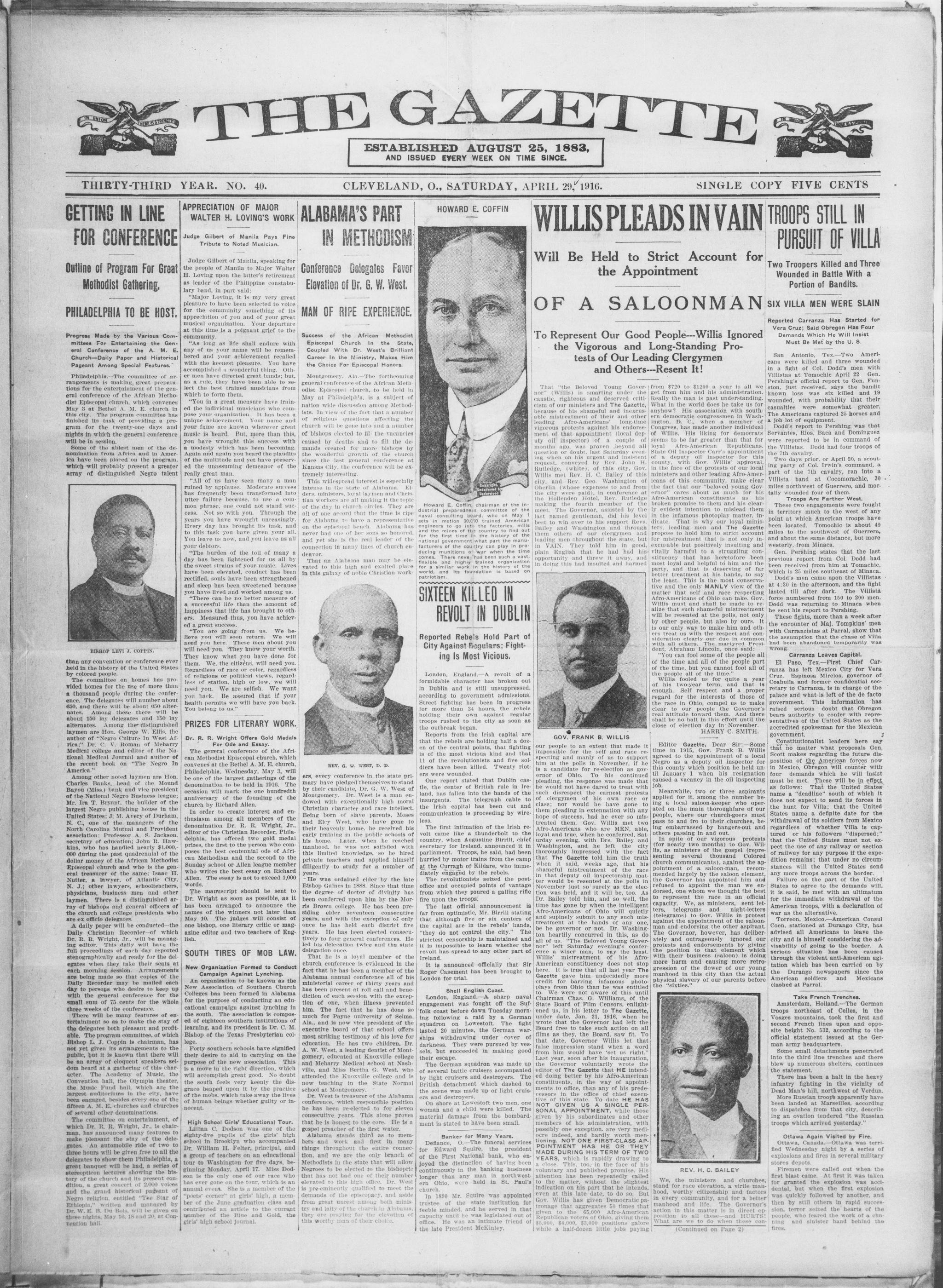
GETTING IN LINE FOR CONFERENCE
PHILADELPHIA TO BE HOST.
Progress Made by the Various Committees For Entertaining the General Conference of the A. M. E. Church—Daily Paper and Historical Pageant Among Special Features.
Philadelphia.—The committee of arrangements is making great preparations for the entertainment of the general conference of the African Methodist Episcopal church, which convenes May 3 at Bethel A. M. E. church in this city. The program committee has finished its task of providing a program for the twenty-one days and nights in which the general conference will be in session.
Some of the ablest men of the denomination from Africa and in America have been placed on the program, which will probably present a greater array of distinguished Negro talent
BISHOP LEVI J. COPPIN.
than any convention or conference ever held in the history of the United States by colored people.
The committee on homes has provided homes for the use of more than a thousand people during the conference. The delegates will number about 650, and there will be about 650 alternates. Among these there will be about 150 lay delegates and 150 lay alternates. Among the distinguished laymen are Hon. George W. Ellis, the author of "Negro Culture in West Africa"; Dr. C. V. Roman of Mchary Medical college and editor of the National Medical Journal and author of the recent book on "The Negro In America."
Among other noted laymen are Hon. Charles Banks, head of the Mound Bayon (Miss.) bank and vice president of the National Negro Business league; Mr. Ira T. Bryant, the builder of the largest Negro publishing house in the United States; J. M. Avery of Durham, N. C., one of the managers of the North Carolina Mutual and Provident association; Professor A. S. Jackson, secretary of education; John R. Hawkins, who has handled nearly $1,000,000 during the past quadrennial of the dollar money of the African Methodist Episcopal church and who is the general treasurer of Isaac H. Nutter, a lawyer, of Atlantic City, N. J.; other lawyers, schoolteachers, physicians, business men and other laymen. There is a distinguished array of bishops and general officers of the church and college presidents who are ex office delegates.
A daily paper will be conducted—the Daily Christian Recorder—of which Dr. R. R. Wright, Jr., will be managing editor. This daily will have the full proceedings of each day reported stenographically and ready for the delegates when they take their seats at each morning session. Arrangements are being made so that copies of the Daily Recorder may be mailed each day to persons who desire to keep up with the general conference for the small sum of 75 cents for the whole three weeks of the conference. There will be many features of entertainment so as to make the stay of the delegates both pleasant and profitable. The program committee, of which Bishop L. J. Coppin is chairman, has not yet given its arrangements to the public, but it is known that there will be an array of eloquent speakers seldom heard at a gathering of this character. The Academy of Music, the Convention hall, the Olympia theater, the Music Fund hall, which are the largest auditoriums in the city, have been engaged, besides every one of the fifteen A. M. E. churches and churches of several other denominations.
The committee on entertainment, of which Dr. R, K. Wright, Jr., is chairman, has announced many features to make pleasant the stay of the delegates. An automobile ride of two to three hours will be given free to all the delegates to show them Philadelphia, a great banquet will be had, a series of stereopoint lectures showing the history of the church and its present condition, a great concert of 2,000 voices and the grand historical pageant of Negro religion, entitled "The Star of Ethiopia," written and managed by Dr. W. E. B. Du Bols, will be given on three nights, May 16, 18 and 20, at Convention hall.
THE GAZETTE
APPRECIATION OF MAJOR WALTER H. LOVING'S WORK
Judge Gilbert of Manila Pays Fine Tribute to Noted Musician.
Judge Gilbert of Manila, speaking for the people of Manila to Major Walter H. Loving upon the latter's retirement as leader of the Philippine constabulary band, in part said:
"Major Loving, it is my very great pleasure to have been selected to voice for the community something of its appreciation of you and of your great musical organization. Your departure at this time is a polignant grief to the community.
"As long as life shall endure with any of us your name will be remembered and your achievement recalled with the keenest pleasure. You have accomplished a wonderful thing. Other men have directed great bands; but, as a rule, they have been able to select the best trained musicians from which to form them.
"You in a great measure have trained the individual musicians who compose your organization. It has been a unique achievement. Your name and your fame are known wherever great music is heard. But, more than this, you have wrought this success with a modesty which has been becoming. Again and again you heard the plaudits of the multitude and yet have preserved the unassuming demeanor of the really great man.
"All of us have seen many a man ruined by applause. Moderate success has frequently been transformed into utter failure because, to use a common phrase, one could not stand success. Not so with you. Through the years you have wrought unceasingly. Every day has brought its task, and to this task you have given your all. You leave us now, and you leave us all your debtors.
"The burden of the toil of many a day has been lightened for us all by the sweet strains of your music. Lives have been elevated, conduct has been rectified, souls have been strengthened and sleep has been sweetened because you have lived and worked among us.
"There can be no better measure of a successful life than the amount of happiness that life has brought to others. Measured thus, you have achieved a great success.
"You are going from us. We believe you will soon return. We will need you here. These men about you will need you. They know your worth. They know what you have done for them. We, the citizens, will need you. Regardless of race or color, regardless of religious or political views, regardless of station, high or low, we will need you. We are selfish. We want you back. Be assured that if your health permits we will have you back. You belong to us."
PRIZES FOR LITERARY WORK
Dr. R. R. Wright Offers Gold Medals For Ode and Essay.
The general conference of the African Methodist Episcopal church, which convenes at the Bethel A. M. E. church, Philadelphia, Wednesday, May 3, will be one of the largest gatherings of the denomination to be held in 1916. The occasion will mark the one hundredth anniversary of the founding of the church by Richard Allen.
In order to create interest and enthusiasm among all members of the denomination Dr. R. R. Wright, Jr., editor of the Christian Recorder, Philadelphia, has offered two gold medal prizes, the first to the person who composes the best centennial ode of African Methodism and the second to the Sunday school or Allen league member who writes the best essay on Richard Allen. The essay is not to exceed 1,000 words.
The manuscript should be sent to Dr. Wright as soon as possible, as it has been arranged to announce the names of the winners not later than May 10. The judges will consist of one bishop, one literary critic or magazine editor and two teachers of English.
SOUTH TIRES OF MOB LAW.
New Organization Formed to Conduct Campaign Against Lynching.
An organization to be known as the New Association of Southern Church Colleges has been formed in Alabama for the purpose of conducting an educational campaign against lynching in the south. The association is composed of eighteen southern institutions of learning, and its president is Dr. C. M. Bishop of the Texas Presbyterian college.
Forty southern schools have signified their desire to aid in carrying on the purpose of the new association. This is a move in the right direction, which will accomplish great good. No doubt the south feels very keenly the disgrace heaped upon it by the practice of the mobs, which take away the lives of human beings whether guilty or innocent.
High School Girls' Educational Tour.
Lillian C. Dodson was one of the eighty-five pupils of the girls' high school in Brooklyn who accompanied Dr. William H. Feltter, principal, and a group of teachers on an educational tour to Washington for five days, beginning April, 17. Miss Dodson is the only one of our race who has ever gone on the tour, which is an annual event. She is a member of the "poets' corner" at girls' high, a member of the June graduation class and contributed an article to the current number of the Blue and Gold, the girls' high school journal.
ESTABLISHED AUGUST 25, 1883 AND ISSUED EVERY WEEK ON TIME SINCE.
CLEVELAND, O., SATURDAY, APRIL 29, 1916.
ALABAMA'S PART IN METHODISM
MAN OF RIPE EXPERIENCE.
Success of the African Methodist Episcopal Church In the State, Coupled With Dr. West's Brilliant Career In the Ministry, Makes Him the Choice For Episcopal Honors.
Montgomery, Ala.—The forthcoming general conference of the African Methodist Episcopal church, to be held in May at Philadelphia, is a subject of nation wide discussion among Methodists. In view of the fact that a number of religious questions affecting the church will be gone into and a number of bishops elected to fill the vacancies caused by deaths and to fill the demands created for more bishops by the wonderful growth of the church since the last general conference at Kansas City, the conference will be extremely interesting.
This widespread interest is especially intense in the state of Alabama. Elders, ministers, loyal laymen and Christian workers are all making it the topic of the day in church circles. They are all of one accord that the time is ripe for Alabama to have a representative on the episcopal beach. Alabama has never had one of her sons so honored, and yet she is the real leader of the connection in many lines of church endeavor.
That an Alabama man may be elevated to this high and exalted place in this galaxy of noble Christian work.
REV. G. W. WEST, D. D.
ers, every conference in the state primary have pledged themselves to stand by their candidate, Dr. G. W. West of Montgomery. Dr. West is a man endowed with exceptionally high moral Christian character and rare intellect. Being born of slave parents, Moses and Elcy West, who have gone to their heavenly home, he received his early training in the public schools of his home. Later, when he reached manhood, he was not satisfied with this limited knowledge, so he hired private teachers and applied himself diligently to study for a number of years.
He was ordained elder by the late Bishop Gainnes in 1888. Since that time the degree of doctor of divinity has been conferred upon him by the Morris Brown college. He has been presiding elder seventeen consecutive years, and with the exception of only once he has held each district five years. He has been elected consecutively to four general conferences. He led his delegation twice and the state delegation once.
That he is a loyal member of the church conference is evidenced in the fact that he has been a member of the Alabama annual conference all of his ministerial career of thirty years and has been present at roll call and benediction of each session with the exception of one, when illness prevented him. The fact that he has done so much for Payne university of Selma, Ala., and is now vice president of the executive board of that school offers most striking testimony of his love for education. He has two children, Dr. A. W. West, a leading dentist of Montgomery, educated at Knoxville college and Meharry Medical school at Nashville, and Miss Bertha G. West, who attended the Knoxville college and is now teaching in the State Normal school at Montgomery. Dr. West is treasurer of the Alabama conference, which responsible position he has been re-elected to for eleven consecutive years. This alone proves that he is honest to the core. He is a gospel preacher of the first water. Alabama stands third as to members and work and first in many things throughout the entire connection, and we are the only branch of Methodists in the state that will allow Negroes to be elected to the bishopric that has not had one of their number elevated to this high office. Dr. West is pre-eminently qualified to meet the demands of the episcopacy, and aside from great unrest among both ministry and laity of the church in Alabama, they are praying for the elevation of this worthy man of their choice.
Copyright
Meadowood &
Bedworth
Howard E. Coffin, chairman of the industrial preparedness committee of the naval consulting board, who on May 1 sets in motion 30,000 trained American sailors in the training of sailors and the mines of the country to find out for the first time in the history of the national government what part the manufacturers of the country can play in preparing for future naval operations. There never has been such a vast, flexible and highly trained organization for a similar work in the history of the world, and its foundation is based on
SIXTEEN KILLED IN REVOLT IN DUBLIN
Reported Rebels Hold Part of City Against Regulars; Fighting Is Most Vicious.
Reported Rebels Hold Part of City Against Regulars; Fighting Is Most Vicious.
London, England.—A revolt of a formidable character has broken out in Dublin and is still unsuppressed, according to government admissions. Street fighting has been in progress for more than 24 hours, the rebels holding their own against regular troops rushed to the city as soon as the outbreak began.
Reports from the Irish capital are that the rebels are holding half a dozen of the central points, that fighting is of the most vicious kind and that 11 of the revolutionists and five soldiers have been killed. Twenty rioters were wounded.
One report stated that Dublin castle, the center of British rule in Ireland, has fallen into the hands of the insurgents. The telegraph cable to the Irish capital has been cut and communication is proceeding by wireless.
The first intimation of the Irish revolt came like a thunderbolt to the country, when Augustine Birrill, chief secretary for Ireland, announced it in parliament. Troops, he said, had been hurried by motor trains from the camp at the Curtraga of Kildare, who immediately engaged by the rebels.
The revolutionists seized the postoffice and occupied points of vantage from which they poured a galling rifle fire upon the troops.
The last official announcement is far from optimistic, Mr. Birrill stating that although five or six centers of the capital are in the rebels' hands, "they do not control the city." The strictest censorship is maintained and it is impossible to learn whether the revolt has spread to any other part of Ireland.
It is announced officially that Sir Roger Casement has been brought to London for trial.
Shell English Coast
London, England.—A sharp naval engagement was fought off the Suffolk coast before dawn Tuesday morning following a raid by a German squadron on Lowestoft. The fight lasted 20 minutes, the German warships withdrawing under cover of darkness. They were pursued by vessels, but succeeded in making good their escape.
The German squadron was made up of several battle cruisers accompanied by light cruisers and destroyers. The British detachment which dashed to the scene was made up of light cruisers and destroyers.
On shore at Lowestoft two men, one woman and a child were killed. The maternal damage from the bombardment is stated to have been small.
Banker for Many Years.
Defiance, O.-The funeral services for Edward Squire, the president of the First National bank, who enjoyed the distinction of having been continuously in the banking business longer than any man in northwestern Ohio, were held in St. Paul's church. In 1890 Mr. Squire was appointed trustee of the state institution for feeble minded, and he served in that capacity until he was legislated out of office. He was an intimate friend of the late President McKinley.
WILLISPLEADS INVAIN
Will Be Held to Strict Account for the Appointment
That "The Beloved Young Governor" (Willis) is smarting under the caustic, righteous and deserved criticism of our ministers and The Gazette, because of his shameful and inexcusable mistreatment of their and other leading Ato-Americans. Long-time president of his ministry, he ment of that appointment (local deputy oil inspector) of a couple of months ago, was proven beyond all question or doubt, last Saturday evening when on his urgent and insistent request, conveyed by Rev. John H. Rutledge, (white), of this city, Gov. Willis met Rev. H. C. Bailey of this city, and Rev. Geo. Washington of the city, who were paid), in conference at the Hollenden Hotel, Rev. Rutledge making the fourth member of the meet. The Governor, assisted by the last named gentleman, did his level best to win over to his support Revs. Bailey and Washington and through them others of our clergymen and leading men brought the state, but the truth was that The Governor, plain English that he had had his opportunity and threw it away, and in doing this had insulted and harmed
GOV. FRANK B. WILLIS
SINGLE COPY FIVE CENTS
from $720 to $1200 a year is all we get from him and his administration. Really the man is past understanding. What in the world does he take us for anyhow? His association with southern democratic congressmen in Washington, D. C., when a member of Congress, has made another individual of Willis. His liking for democrats seems to be far greater than that for the other party. He is a service-level officer of State Oil Inspectors' car's appointment of a deputy oil inspector for this county, with Gov. Willis approval, in the face of the protests of our local ministers and other leading Afro-Americans of this community, make clear the fact that our "beloved young Gov'ernor" cares about as much for his Afro-American constituents as his body-and-clothes-to-clothes-level president as evident intention to mislead them in the infamous photoplay matter, in dictate. That is why our loyal ministers, leading men and The Gazette propose to hold him to strict account for mistreatment that is not only in excusable but positively insulting and vitally harmful to a struggling constituency that has heretofore been most loyal and helpful to him and the party, and that is deserving of far better treatment at his hands, to say the least. This is the only way for the matter that only MANLY view of the matter that self and race respecting Afro-Americans of Ohio can take. Gov. Willis must and shall be made to re-alize that such shameful mistreatment will be resented at the polls, not only by other people, but also by ours. It is our only way to make him and others treat us with the respect and consideration clearly our due in common.
"You can fool some of the people all of the time and all of the people part of the time, but you cannot fool all of the people all of the time."
Willis fooled us for quite a year of his two-year term, and that is enough. Self respect and a proper ego to the city are the race in Ohio, compus us to make clear to our people the Governor's real attitude toward them. And there shall be no hail in this effort until the close of election day in November.
HARRY C. SMITH.
Editor Gazette, Dear Sir:—Some time in 1915, Gov. Frank B. Willis asked to the appointment of a local Negro as a deputy inspector in this county which position he held until January 1 when his resignation caused a vacancy in the oil inspecting job.
Meanwhile, two or three aspirants applied for it, among the number being a local saloon-keeper who operated on the main thoroughfare of our people, where our church-goers must be churches, being embarrassed by hanger-out and others passing in and out.
In spite of our vigorous protests (for nearly two months) to Gov. Willis, as ministers of the gospel (representing several thousand Colored church communicants), against the appointment of a saloon-man, recommended largely by the saloon element, the Governor has appointed him and refused to appoint the man we envisioned to represent the race in an official capacity. We, as ministers, sent letters, telegrams and night-letters (telegrams) to Gov. Willis in protest against the appointment of the saloon-man and endorsing the other asprant. The Governor, however, has deliberately and outrageously ignored our protests and endorsements by giving the position to that element which with their business (saloon) is doing more harm and causing more retrograde change in manhood in this city than the actual physical slavery of our parents before the "sitties."
REV. H. C. BAILEY
We, the ministers and churches, stand for race elevation, a virile manhood, worthy citizenship and factors in every community, and for a better manhood and life. The Governor's action in this matter is in direct opposition to all these—and HURTS! What are we to do when these con-
IN UNION
HONOR & STRENGTH
TROOPS STILL IN PURSUIT OF VILLA
Two Troopers Killed and Three Wounded in Battle With a Portion of Bandits.
Reported Carranza Has Started for Vera Cruz; Said Obregon Has Four Demands Which He Will Insist Must Be Me't by the U. S.
San Antonio, Tex.-Two Americans were killed and three wounded in a fight of Col. Dodd's men with Villistas at Tomochie April 22. Gen. Pershing's official report to Gen. Funston, just received, says the bandit known loss was six killed and 19 wounded, with probability that their casualties were somewhat greater. The Americans captured 25 horses and a job lot of equipment.
Dodd's report to Pershing was that Servantes, Rios, Baca and Dominguez were reported to be in command of the Villistas. Dodd had four troops of the 7th cavalry.
Two days prior, or April 20, a scouting party of Col. Irwin's command, a part of the 7th cavalry, ran into a Villista band at Cocomorachie, 30 miles northwest of Guerrero, and mortally wounded four of them.
Troops Are Farther West.
These two engagements were fought in territory much to the west of any point at which American troops have been located. Tomochie is about 40 miles to the southwest of Guerrero, and about the same distance, but more westerly, from Minaca.
Gen. Pershing states that the last previous report from Col. Dodd had been received from him at Tomachie, which is 25 miles southeast of Minaca.
Dodd's men came upon the Villistas at 4:30 in the afternoon, and the fight lasted till after dark. The Villista force numbered from 150 to 200 men. Dodd was returning to Minaca when he sent his report to Pershing. These fights, more than a week after the encounter of Maj. Tompkins' men with Carranistas at Parral, show that the assumption that the chase of Villa had been abandoned temporarily was wrong.
Carranza Leaves Capital.
El Paso, Tex—First Chief Carranza has left Mexico City for Vera Cruz. Espinosa Mirelos, governor of Coahulia and former confidential secretary to Carranza, is in charge of the palace and what is left of the de facto government. This information has raised serious doubt that Obreg bears authority to confer with representatives of the United States as the accredited spokesman for the Mexican government.
Constitutionalist leaders here say that no matter what proposals Gen. Scott makes regarding the future disposition of the American forces now in Mexico, Obreg will counter with four demands which he will insist must be met. These will be in effect as follows: That the United States name a "deadline" south of which it does not expect to send its forces in the hunt for Villa; that the United States name a definite date for the withdrawal of its soldiers from Mexico regardless of whether Villa is captured or his followers "dispersed;" that the United States must not expect the use of any railway or section of railway for any purpose if the expedition remains; that under no circumstances will the United States send any more troops across the border.
Failure on the part of the United States to agree to the demands will, it is said, be met with an ultimatum for the immediate withdrawal of the American troops, with a declaration of war as the alternative.
Torreon, Mexico.—American Consul Coen, stationed at Durango City, has advised all Americans to leave the city and is himself considering the advisability of going to the border. A serious situation has been caused through the violent anti-American agitation which has been carried on by the Durango newspapers since the American soldiers and Mexicans clashed at Parral.
Take French Trenches
Amsterdam, Holland.—The German troops northeast of Celles, in the Vosges mountains, took the first and second French lines upon and opposite height No. 532, according to the official statement issued at the German army headquarters.
Some small detachments penetrated into the third line trenches and there blew up numerous shelters, continues the statement.
There has been a halt in the heavy infantry fighting in the vicinity of Dead Man's hill, northwest of Verdun.
More Russian troops apparently have been landed at Marselles, according to dispatches from that city, describing an ovation tendered "the Russian troops which arrived yesterday."
Ottawa Again Visited by Fire.
Ottawa, Canada.—Ottawa was terrified Wednesday night by a series of explosions and fires in several military stores depots.
Firemen were called out when the first blast came. At first it was taken for granted the explosion was accidental, but when the first explosion was quickly followed by another, and then by still others in rapid succession, terror seized the hearts of the people, who feared the work of a chinning and sinister hand behind the fires.
MME.C. H. JONES’
Hair Tonic and Invigorator
oot a Be
ke eee
p> ae |
1
Poy Mae C25
Sie ao
Rie fe oe Kas
Pee caren No
Tie ot ee ade the result of scientific
study of ‘the causes of diseases of the
scalp.
Instead of treating effects of the dis-
gases she treats the causes, eliminating
the ‘same and leaving. the’ scalp. in.
healthy ‘condition that can be maintained
by using her Hair ‘Tonic and Invigorator,
accovding to: her directions,
Mudame C, it. Jones Hair Tonic and
Invigorator fs guaranteed to stop the fall=
ing Out of the hair and to make the hair
grow. :
It has been successfully used by many
qvar since 1900 and with perfect satistace
Hon, this Tonle ta hiehfy recommended
Thany Toledo. people and. wlucwhere
who wil) ghudiy turmich testimonials
Many People \et diseased’ sctls by
using widely) advertised hale’ tones pre!
Bere umechupuious: persone who ave
in mind nothing but mercenary gui,
On the other hand, MADAME JONES’
HAIR TONIC and INVIGORATOR is ab-
solutely harness and will do all that ts
Shmed for tt.
Madame C,H. Jones’ Hair Tonic and
invigorator promotes “the growth of ‘the
hairs prevents: and ‘cures “badness: re"
moves "dandruff, cures scalp diseases, Im-
Parts lustre and beauty: It ‘restores. the
Color of the hair by supplying It with the
natural elements and necessary nourish:
ment,
MADAME C. H. JONES
‘883 Woodland, Ave. ‘Toledo, Ohio
1
STERLING
5 and 10 Cent Store
3003 Central Ave.
Watch Our Windows
For Bargains
Golored: Baleslastics
We close at 6 P.M.every
evening except Saturday
WE WILL ACCEPT THIS AD-
VERTISEMENT FOR FIVE
CENTS IN TRADE, TO APPLY
ON ANY PRUCHASE OF
TWENTY-FIVE CENTS OR
MORE.
E. Rubenstem, Ph. C., Prop.
8. W. Cor. Central Ave. and E.
55th St.
9816-3820 Central Ave.
DRY Goops
LADIES’ AND GENT’S ,
FURNISHINGS
Try Our
Lomsky Special $1.00 Corsets,
Also our Ladies’ $1.00 Waists
‘They are good
PO ia) geal ancl oy
Re a aren ia sen
Besealagra Gower straigue
ens harsh, stubborn and kinky
hair Without the aid of a
POAEMIaUSG comb, thereby
Recenee Wee danger ‘ot burvice
Re ean on cearnoned
elaine cs tae
eee tee aly
ful. Write at once for exclusive
terror open:
Polyclinic’ Medicine Co.
Dept. G. Cincinnati, 0.
The Pride of Carolina
The Stato Agricultural ana
Mechanical College of
‘South carolina
ialennsbers. © ©.
ext sncsion. begine. Septem
pen ath and ence May” 25th,
1916,
Mb Tuition, no Room Rent, no
cotges toe’ Wetery Lights. or
Fuel. Entrance Fee $10.00.
Beara $600" per’ Month in Ad:
fears aeele, asedry “and
Petweuat ‘Expenees Extra.
eee aedarn Pacis Biang-
oot Bien A Posuny of
87 Officers and (nstructors.
For information and Cata-
logue, Write
R. S. Wilkinson, Pres.
foraneshire: & ©.
Central $371
STARLIGHT’S CAFE
‘A. D. Boyd, Prop.
Choice Wines, Liquors and Cigars
$221 Central Ave, Cleveland, 0.
Our advertisers want your trade.
‘Those who do not ask for it in The
Gazette certaluly care little, if at all,
Sarit Sireetore, we urge’ our read:
ere and all of our ‘friends tc patronize
those who ask for your trade in this
eee
Where to Purchase The Gazette
Pacis: Dor errant
aietacteen Ave! etbice guinea
+0. C. SCHROEDER'S, dmccncons
Cuyahoga Bidg. 2928 Central Ave.
J. ©, BRANHAM “aA PATNA
He Cancel aes. seen coer Avs
nusHAW
iiaunie nove!
The Arcade. é
Superior Entrance. eae arith Ave:
*S. A. LUCAS,
2043 Cararal Ave.
SOPEN euNDave.
NOTICE TO SUBSCRIBERS
Subscribers not receiving The Gazette regularly should notify
us at once. We desire every copy delivered promptly.
Fees peer CC te eh ancetins adver
acre eee trace orgicune cincien Loe certs are
Fone ueiuarte hea, tat eee eae
ee ey arouse ieee cane
ae dine citoa Uaareecat Cay aS cate inline tax
words in a line).
Soctal and Personal
A
| Rev, Chas, Hart preached, Easte:
ur 2 at Mt Haven Baptist chureh, Th
‘very good. Miss Anna Dunn wa
FOR RENT Houses a00 Roome—| iitde Lilian “E., daughter of Mr
NOTARY PUMLIOMWor each sary | the family, only the immediate 1
oie AL pees. Grid clerianios at tue Clty hall, Aca
Gtxcth Cit57 |, Coming! Three seniors trom Ove
Miss Ressie Brown visited relatives
in Sandusky, Sunday.
Mrs. Alta Cousins visiter her mother
in Youngstown, last week. *
Miss Susie Johnson of Columbus
visited Mrs, Mardo Brown, Sunday
Miss Ozella left, Thursday, to at
tend the N. 0. B. M. S., at Akron,
Mrs, Ina Guy Webster is still. visit
ing her mother and sisters in Zanes
ville,
It is rumored that “Sonny” Brown
and Miss Marie Bolden will be mar
ried soon.
Mrs. L. A. Cunningham is very
at her daughter, Mrs. Don Berry’s, in
Youngstown.
‘Born to Mr, and Mrs. Simeon John:
son, B. 20th St, a fine baby boy, last
‘week Monday.
Mrs. Madeline Early, . 70th St., en:
tertains the Book and Thimble club,
this Friday.
Miss Moss Lee, B, 49th St,, and Miss
Grace Brock, E. 43d St, are improv:
ing slowly.
o“Rev. N.S. Merritt, of Rendville
preached two able sermons at Antioch
church, Sunday.
“Mr, Joseph Jackson of Buffalo, visit
ed his parents, Rey. and Mrs. J. 8.
‘Jackson, last week.
Mrs, Lula B, Cox will spend Sunday
in Toledg with her parents, Rev. and
Mrs. Charles Bundy.
Sam. Langford is training in_ this
city for his ten round fight with Sam.
MeVey at Akron, May 2.
Mrs, George ‘Jones, 2517 Central
‘Ave,, was called to Indianapolis, last
week, by a brotherin-law’s death.
‘The © were 765 at St. John’s 8. S,
Sunday, in spite of the rain. The
Baraca ‘class, men, claimed 70.
Mrs. Dave Quinn and Mrs, 1. F.
Montgomery. visited the latter's
mother in Chicago, last week.
Miss Aurelia Ward of Chicago, vis-
ited Mr. and Mrs. Robert Hodges, last
week, enroute to Boston, her native
home.
‘The Easter party and dance given
at Callaghan's hall by a St. Andrews’
P. E. church organization was a suc-
cess.
‘The Parlor Dining room, 2924 ©. 87th
St., is the most unique restaurant in
the city. Good service and reasonable
prices—Adv.
Mra. A. D. Boyd who has been living
with her mother, Mrs. Hamlett, of the
East End, for some. weeks, was to
Jeave for N. Y. City, Wednesday night,
to locate.
Miss Ruth Fisher of Lorain, guest
ét Mrs. W. Fowler of E. 86th. St.,
this week, was entertained by Mrs.
Bdwina Selig, E. Tist. St., Monday
evening.
‘Mrs. P. S. Dennie, B. 90th St, is
quite sick. Mr. Wallace Bolden, E.
30th St., is confined with rheumatism.
Mrs. B. W. Gale, E. 101st St., and Mr.
. Lyon, Central Ave., are convalesc:
ing.
Mr. and Mrs, Chas. W. Chesnutt of
Lamont Ave, entertained Miss Ruth
Fisher of Lorain at dinner, Tuesday,
and the editor of The Gazette enter:
tained her and Mr. Clint, Fowler at
dinner on Wednesday.
Chas. L. Stewart, Esq. and Rey.
Josie K. Folsom-Stewart ‘will lecture
and give spirit messages, respectively,
Sunday evening, at Pythian temple.
Mr, Stewart's subject will be, “The
War and the World's Progress.”
‘The Parker Players close their sea-
son contract with the Hollenden hotel,
today. The members of the organiza:
tion, Samuel Stewart, Millard Rob-
bins, Lawrence Dixon, Renan Rob-
bins and Paul Jordan, will return to
Columbus.
‘Mt, Zion Cong. choir rendered a
beautiful Easter anthem, Sunday
morning. Rev. Sterling N. Brown of
Washington, D. C., former pastor of
the chureh, preached an excellent ser
mon. The 8. S. exercises in the even-
ing were very good.
Mrs. Mary B. Talbert of Buffalo,
vico-presidentatlarge of our National
Federation of Women’s clubs, @ gradu
ate of Oberlin college and one of the
Tace’s most talented women as well
‘as speakers, will deliver an address
‘at Cory M. B. church, Sunday’ after
noon, May 7, on “The Call of the
Hour.” You’ cannot afford to miss
hearing her,
THE GAZETTE, CLEVELAND, O.. SATURDAY, APRIL 29, 1916.
| Rey, Chas, Hart preached, Easter,
at Mt. Haven Baptist church. The
jexerelges of the S. 8. Juntors were
very good. Miss Anna Dunn was
elected S. 8. delegate to the N. O'S.
S. Association “at Akron, this week
Rey. H.C. Bailey will preach, Sunday
evening. (Mr. Ll. O'Neal will again
lead the B. ¥. P. U. devotional ser
viees, at 6 p.m,
Miss Lillian K., daughter of Mrs
Mary BE. Plelds of E. ath, St, and
Mé, Landis Downey will be married,
May 6, at 4 p.m. Owing to sickness
in the family, only the immediate rel
tives will witness the ceremony
The Masehke-Davis local faction of
the ‘Republican party. seems. deter
mined that our people shall not have
clerkships at the City hall, A color
line!
‘A musical and literary entertain
ment will be given by three young
lady seniors of Oberlin college, assist
jed by a professional reader and im
personator, at St. John’s A.M. i
church, Wednesday evening, Mas
[tor the benefit of the local branch of
the National Association for the Ad
|vancement of Colored People. ‘There
| will be no admission charge; only a
isilver offering.—Adv
| "Coming! Tiree seniors tom Over
[tin college: “Miss Bstelle B. Pinkney,
Vocalist and pianist; Miss Camille L.
| Nickerson, pianist and organtst; | Mr
‘Benjamin’ W. P. Allen, professional
reader and impersqnator, at St. John's
|A. M. E. chureh, Wednesday evening,
May 3, 1916, at Sp. m.._ presented by
|the local branch of the National As
sociation for the Advancement of Col
Jered People, Do not miss this.—-Ady
“T-got him a job at $10 a week, but
‘he wouldn't work,” Mrs. Carrio B.
Lane, 3769 Scovill Ave,, told Judge
Kennedy, last week Friday morning
[at the trial of her divorce sult against
|Hrnest Lane, of Philadelphia." “ie
said only fools and and mules work
‘ed,,” she testified. Lane spent most of
‘his time following the “bangtails,”
‘his wife said, Attorney Henry L.
‘Thomas, Superior Bldg, represented
[Mrs. Lane. The divoree will doubtless
be granted her in 30 or 60 days:
Patrolman August Krohn, of the B.
37th St. station, was shot twice last
[week Friday morning in a pistol bat
tle with a man with whom he inter
fered in Floyd Ct, for shooting
pigeons. Krohn is at Charity hospital
Acith one bullet in his shoulder and
Janother in his leg. ‘The man who did
the, shooting, said to be John Bile,
40,2718 Floya Ct; was arrested. He
was caught and taken to Charity hos:
pital, with a slight injury. Accord-
ing to the police, Krohn heard. re
Nolver shots, and on investigating,
found Bile shooting at pigeons. “When
Krohn interfered, it is said, Bile
turned the weapon on him and ‘pulled
the trigger twice. Krohn returned the
fire and hit Bile, Physicians say the
patrolman will recover. Bile” was
transferred to Jail and charged with
shooting to kill.
What proved an exceptionally en
Joyable social function was the dinner
tendered thelr lady friends, Sunday,
at the New York restaurant, 3854
Central Ave. by five young men of
this city. Those participating were:
J. Algernon Green, Miss Helen Alina
Howard; J. Henry’ Wright, Miss Ruth
Washington; Benjamin Smith, Miss
Lena Bernard; Chas. C._ Williams,
Miss Madeline Jones: Clarence L.
Robinson and. Mise Emma L. Case.
‘The “menu consisted of macaroni
soup, fried chicken, mashed potatoes,
lettuce with Mayonaise dressing,
erackers, cottage pudding’ with wine
sauce, ice cream, coffee, With such
encouragement “the conversation
Jagged until the appetites were satis:
fled and then the young men when
‘called upon for speeches pleaded “in
‘extenuation” on the grounds of their
“peing to full” to deliver one, but O,
how they could talk to the ladies, and
express their profuse thanks to Mr.
jand Mrs, Silver Brito, proprietors of
the restaurant, the latter being the
chef. ‘They did not overlook the
waitress, either.
Webster J. Porter, 2199 B. 39th St.,
died, April 23. Funeral from Slaugh:
ter Bros.’ chapel, the th, Rev. C.
R. Jones officiating. Interment in B.
C. ‘cometery. Margaret. McConnell,
2207 B. 48d St, died, April 22. Fun:
‘eral from the residence, the 25, Rev. J.
5. Jackson officiating. Interment in
Lake View cemetery. Slaughter
Bros, funeral directors, are receiving
merited praise for the’ splendid serv-
ice rendered at boch funerals.
"Mr. John Fairfax, age 78, 2213 E.
25th St., one of our oldest and most
highly ‘esteemed residents, dropped
dead in the offices of | Pickands,
‘Mather & Co, Monday morning,
where he had” been employed for
many years. He left home apparently
{n'good heatth,” ‘The surprise to the
community was very great, so well
‘known was hie. A widow, three sons
and two daughters survive him and
have the sympathy of a host of friends
and acquaintances. Before the War
of the Rebellion, Mr. Fairfax was em-
ployed asa waiter in “Joe Richards’
Testaurant," on the Public Square.
Later on,’ for many years, he was
head-belliman at the Kennard House,
going from there to the Pickands,
‘Mather Co. He was a member of Mt.
Zion. Cong. church, the pastor of
‘which officiated at the funeral which
was held from the family residence,
‘Thursday afternoon. The attendance
was very large. Mrs, Fairfax and
family have the hearfelt sympathy of
the community.
Written by ‘The Old Reliable’
Gazette's Correspondents
THROUGHOUT THE STATE
What Our Peopie are Doing Each
Week—Church, Personal, Social,
sodge, Literary and Mu:
sical — Marriages,
Deaths, Ete.
CHILLICOTHE. — Mr, Warden
Woodford of Frankfort, spent Sim:
day week at home, returning on Mon
day to Wilberforce University. —Miss
Aggie Hogan was quietly married to
Mr A. Goins, last ‘week—An Easter
fair ‘Was given at Frankfort, Satur
day evening—Rev, T. W. Johnson ‘at
tended the district conference and 8
S.convention, Inst week. He. will un
veil the altar of his ehureh at Frank
fort, May 21—Mission chapel will
xive a supper, May 18, The Raster
spondent here: “Write 0. the editor
in Clevelant alone;
CORRESPONDENTS must mail all
letters for publication at their main
postoMfice sufficiently early on Mon:
day (or Sunday) of each week to have
them reach The Gazette office on
‘Tuesday morning, and always write
also, their names and that of their
city or town on the outside of the
Wrapper about returned copies. Un-
less this latter is done, proper eredit
cannot be given you. Lists of names,
wedding presents, éte.. obituary no:
tiees, speeehes, resolutions, poetry, tn
quiries for reiatives and advertise:
ments of all kinds, including items
announcing entertainments to be held
in the near future, miust be paid for
in advance at the rate of ten cents a
line, six words to a line. Our rates
for ‘display advertisements will be
‘ent on application.
SANDUSKY.—The Easter programs
at both churches were fine and there
Were many visitors in the city, Mr,
and Mrs. Robert Davis of Detroit, are
visiting his brother, Mr. J. Davis, and
wife.--Eleven converts were baptized
into the Second Raptist church, Sun:
ay, Sacrement, In the evening. I
proved one of the most glorious days
in the history of the church, ‘The
altar was decorated with flowers and
the chureh filled with young members
The pastor, Rev. G. P. Smith, preach-
ed two sonbstirring sermons, morn
ink and evening.-Miss Mildred Drake
spent Sunday at Clyde, visiting old
friends.—-Miss_ Bessie Brown, of
Cleveland, und a lady friend, visited
her brother, Mr. Jas. Davie, and wite,
Kaster--Mr. and Mrs. 8. Scott enter:
tained relatives and friends from
Cleveland, Sunday.~Misy Blanche
Thompson came very near losing an
eye, last week.—-Samuel D. Anderson
is quite Ill. Indigestion—Mrs. Adline
Gardner is sick. Read The Gazette
and get the news of the race.
Cadiz.--Mr. Leander Blue of Zanes-
ville, i visiting Mrs, Joana Duling,
Miss KE. Ragusey of Hopedale, was
here, Easter, Mr, E, Freemait re-
turned recently from Oberlin. and
Cleveland.—Mr. A, Wallace, Jr, of
Pittsburg, {s visiting Mr. and Mra. A.
Wallace-~Mrs. Irene J. Robbins. is
seriously il—-Mr. Jas, Pettress is. vis
iting in Sumter, §. C.—Mr, A, Strother
of Latrobe, Pa., is visiting his sister,
Mra. M, Christian.— Prof, W. H. Lucas
was called to Xenia by his brother's
illness.-Mr. Jas. Green of Zanesville,
is here visiting—Robert Doubt’s bro:
ken arm is mending.—P. T. Brown of
E. Liverpool, was here Raster. Mr.
and “Mrs. 8. Taylor of Youngstown,
spent Faster with the latter's mother,
Mrs, J. Davis.—Miss Hattie Lucas is
teaching temporarily in Dunbar school
Miss Elise Ballard entertained at
dinner, Easter, the Misses Nell Glenn,
Hattie’ Lucas and Elizabeth Ramsey
in honor of her guest, Miss Wilma
Kenney of Harrisville.Miss Lavinia
Kenney visited Mise Pauline Ballard,
Friday—A large attendance at 8. S.,
eaten,
Smithfield.—Mrs, Vide Toney and
two children are visiting her sister,
Mrs, Homer Harris, —Easter exercises
at St. Paul’s A. M. E. chureh were
fine.S. West, R. Smith, M. Cooper
and D. Freeman of Mcintyre, were
here this week.—Hd. and John Fowler,
Messrs. Stokes and Gray of Bradley,
were Miss Eva Smith’s guests, Mon:
day evening.—Miss Estelle Smith of
Melntyre, closed her first term of
school, last Friday.—Mrs. M. Mitchell
and Miss V. Carter were called to
Steubenville, last week, by Mrs, Grace
Walker's iliness.—Mr. Ru ‘Tyler of
Flushing, was here, inst” week.—Mr,
and Mrs. J. Smith of Youngstown,
visited her sister, Mrs. L. Carey,
Easter.—Mr, and Mrs. 2 Smith, Mrs.
C. Greene and Mrs. C. Becks of Me:
lnityre, were here, Monday.—Rumor
has it’ that Miss Margaret Thompson,
now in Ethel, Va., is married.—Miss
Harper of Mingo, visited Mrs. Chas,
Thompson, and Miss Emma Howard
of Wintersville, visited “Mrs. ©. West,
Sunday.—Misses Lola and ‘Tracy
Smith, Mrs, Emma Powell and_ son,
Spent Easter in Steubenville-—Mr. D.
West of Hopedale, visited his daugh-
ter, Thelma, Sunday.
Youngstown.—Dr. J. M. Gilmere.
who is the third Episcopal district
representative on the financial board
of the A. M, E. Church, will leave for
Philadelphia, May 1. As chairman of
the auditing committee, he will meet
the board and remain in that city dur-
ing the General Conference. ‘The lo:
cal A. M. B. church, of which Dr,
Gilmere is pastor, has organized for
a grand rally to raise money to pay
the balance of the church-ebt, which
was more than $4,000 when Dr. Gi-
mere took charge.—Robert Dockett is
ill—Edward J. Williams has returned
to Findlay.—Mr, and Mrs. W. R.
Stamps left, Monday, to visit relatives
at Danville. Va., Greensboro and Dur.
ham, N.C. They will make their
headquarters at Semara, N. C., with
her mother, Mrs, Mary J. Hicks. Their
tailor-shop will be closed during their
absence—Mr and Mrs. Wm. Lynch
entertained, Thursday evening, in
honor of Mrs. Nellie Coleman of Yel:
low Springs—-Dr. Leroy Watkins
spent Easter in Columbus with rela.
tives—Mrs, Alta Cousins of Cleve
land, visited her mother, Mrs. Susan
Holmes.—Mrs. W.. Harper, Mrs. John
Moore and Mrs. C. Bannister are con
yalescing—Mr, Gordon has enlarged
and renovated his depot restaurant.—
All the churches had good Easter ex
ercises and were well attended.—Mrs
L. A. Cunningham, mother of Mrs. T.
D, Berry, is very il.—Mrs. Jas, Stew
art entertained the Elite club, Mon
day evening.—Mrs. Julia Hackett cele-
brated her Sith, birthday, April 18. Tt
was also Wm, Holland's 32d. anniver
sary, Music and Junch.—The All-Star
Whist club's annual party, May 3 in
Bycelsior pariors.—Miss Anna Shep
pard of Burgettstown, Pa., is. visiting
her uncle, W. A. Johnson.—Tell your:
friends to read “the old reliable” Ga.
zette if they wish the reliable race:
aaa |
| HILLSBORO. — It was a pretty
nome wedding. acter, at Mr and
Mrs. James Hardin's, when their:
Evanddauehter, cata.” Daisy” Hist
‘Sargen, and’ Lyman i Ames, a pros
perous young farmer, were. married,
NO, ronive Ae.” was beautifully suns
by’ Prot. 8G. Hough. Miss Many”
Wilams played the weeding. march
and ihe ceremony’ was performed bs
‘Kev. 6. W. Jackson. “The bride ware
beautiful dress. of pink and” white
organdie while the bridesmaid, Miss:
‘Anna Ames, was likewise attired.
Prof, Mought sas best ian. There
were a number Of guests.” ‘The happy
Qouple’ received wiany valuable And
tet presents. Many friends extend
best Whee, Mrs Brock ‘of Parkers:
tung, ‘W.Va, attended the wetding
Brecitent aster programa were ren
dered "at_the ghurehex-Miss ARMA
Davidson entertained at supper, Sun:
day, the Misses Bertha Allen, Mary
Whitams, “Messrs. “GM. -Atchigon,
Rother Holden and $.'G. Hough Mr
other ‘Wallace ‘dinga with Mr. and
Mie'ted Tones thet same day.
James Captain spent Sunday in Wi:
mington.-The A, M. E. Church Aid
foctely, gave a surprise for "Aunt"
Suite Jenne, tat ‘Ehureday evening
‘iice Helen Williams: of ColnsnPr
fa tinue cod Mies Mae Grea, of
Gjnetnnats: spent. Sunday” with. tree |
purents ke Te Carey and mother Tet,
Saturday, for a visit in the “Queens
City,” Dayton and Greenfield.—Mrs.
Tateinda Harris of Tacoma, Wash, tn
visiting Mr and tre. Henay. Wood
Mr ahd’ Stes ving ‘of “cinetmnats,
Spent Sunday” with the latter's aunt,
Mis" price Pluie ars” Hannay Pes
ane eitertained. at diner, Sunday,
Hrs, dames Young, alia Hazel” Me"
Paring Mrs Millie Waters, Mrs
Te phure and. danger, Apiita, Mr
dads, John Hiudeon and daughter |
tyne. fernice, ‘visited. the former’
parents at Bichn Sunday.—-Mles” Anna |
Davidson of Cincinnaty, accompanied |
by Mtoe Betta Alten and the Stine
Young. spent Sunday with relatives.
Kor Gectes Wort preached sta Fy,
Sunday, at the Carthagenia chureh. |
Fe wis asisted by Rew J. Burt
Mrs Mamie ance has returned trom
See cneaon tn cole une |
2 Seer
fa: sae
Fan - > ane)
‘ pa
Mr
jee
ote
A :
as
es
\ Y wre.
eS
The contest for district delegate to
the state convention in precinets F, G,
H, and J of the 11th ward between
Tom Fleming and J. Walter Wills
proved an Interesting one and #
mighty big surprise to the Maschke-
Davis faction of the local Republican
party, ‘The result undoubtedly shows
a real victory for Wills and the MEN
who made the fight with him and who
stand for a higher and proper stand-
ard of recognition, representation and
Teadership in our local political af-
fairs. Opposed by city employes ga.
lore, denied challengers and witnesses
of the official count of votes, and, too,
fighting a campaign fund extracted
from city employes, Wills was beaten
by only 29 votes, He carried his own
precinet 80 to 26, lost. precincts G,
H, 1 and J by 10, §, 6 and 9 votes, re-
spectively on the face of the returns,
One can only guess what a change in
this, in Wills’ favor, would have been
wrought if he had been allowed to
have challangers and witnesses at and
in the voting booths as his opponents
did, Wills, $. EB, Woods and R. R.
Cheeks, Esa., were refused challenger
and witness’ blanks by County Com.
mittee Chairman Geo. B. Harris and
Fleming, who is ward or precinct com-
mitteeman, when they made formal
demand for them, Monday afternoon.
And Wills managed Fleming’s cam:
paign for the City Council, last fall!
‘The result shows, beyond all question
or doubt, that ‘the Maschke-Davis-
“Starlight”—Fleming regime MUST
GO and, what is more to the point,
WILL GO-from the eleventh ward,
at least, just as soon as possible.
Wills, Woods, Cheeks, Thomas and
others, including the voters who sup-
ported them at the polls, are entitled
to full eredit for the splendid fight
they made.
John Young, 3136 Central Ave., last
week Friday was in Charity hospital
with a knife wound in the back be:
cause late last week Thursday, ac:
cording to police, he neglected to pay
a Scovill Ave. barber for a haircut
and shave, Young left the shop with:
out paying the check and, when pur.
sued by the angry barber, hurled a
brick, according to police.” The bar
ber thereupon jabbed Young with a
knife, Young Was not seriously in
‘doved.
”
)ONT THROW AWAY
POW
Your copy of The Gazette
after reading it, but give it
to friend or av acquain-
tance who might subscribe
after reading a copy of the
paper.
Editor
New York Restaurant
3854 Central Ave. Silver Brito, Prop.
‘The Best Home Cooking. First-class Service. Everything New,
Neat and Clean. Home-made Bread, Pies and Other Pastry. .
Regular Meals and Short Orders
Try Our Rolls and Coffee. Lunch Counter.
Cuyahoga, Central 5727
Edward Doctor’s Cafe
(THE Z)
3035 Central Avenue
Wm. Brack, Prop. - ~- Frank Doctor, Manager
James Mabel, Chef
SPECIAL OPENING ANNOUNCEMENT
BB ecsSING APR et ana continuing tor ftom day
a ten per cent discount will bo given cn all GPRING
and SUMMER SUITS and TOP COATS as an Opening An
novneement of my new Talloring, Eatabiiahment.- Dont
mise your chance, come early and get sour Easter Sule
I. E. GROSSMAN
Designer of Good Giothes
OPEN MONDAY, WEONESDAY and_ NOW LOCATED AT
SATUROAY EVENINGS 209 SCHOFIELD BLOG.
*Phone Main 5985 J
SLAUGHTER BROS. _
FUNERAL DIRECTORS & EMBALMERS
Office and Funeral Parlors
The East India Hair Grower |
ei Will Promote 2 Full Growth of Hair, |
i ae Will Also Restore the Strength,
be Oe ree), Vitality and the Beauty of the Hair.
; - fa Your ‘Hair is Dry and Wiry, Try
sre ma East India Hair Grower |
8) If you are bothered with falling
s oe Hair, Dandruff, Itching Scalp, or
a. any Hair Trouble, we want you
ae SS to try a jar of East India Hair Grower. |
; “G4, The remedy contains medical proper- |
RY ties that go to the roots of the Hair,
“stimulate the skin, helping nature do |
SHED its work. Leaves the hair soft and silky. Perfumed
| with a balm of a thousand flowers, The best known
| remedy for Heavy and Beautiful and Black Eye-
brows, also restores Gray Hair to its Natural
: Color. Can be used with Hot Iron for Straightening.
| Price Sent hy Mail 50 Cents --- 10c Extra for Postage :
| S. D. LYONS, General Agent
314 East Second Street =: : —: ‘Oklahoma City, Oklahoma
|-TAKES THE KINKS OUT eg j Srp
1S Pie R
PLOUGH’S "Zz
ani =
Hair Dressing fees
Does the Trick Every Time: WORCHia fad
No matter what other preva- \Qeiene
ee ae
tee, ee See Ki te ff
Sid ie nae acre Ko
eas eter Ixy, hile
Tate note fatty, dak, tes: hy sf!
AGES A
ee akties Sct ssmes cache same afk poe aa
cadena acest ee ee oie Sareea Te SG a
en som seme Pa 2a cee nee ee eee
Pepe ras whee ae he ee ke bat ea ae ao ene
Pe eh cit tee ee ea 24
fog iesold all over the world.” < = ~
jane caerares
PLOUGH CHEMICAL CO., Memphis, Tenn,
| Dr. E. A. Bailey
“PHYSICIAN AND SURGEON
(Winona Apartments)
2269 E. 40th Street
a
Office Hours
Beil "Phone, Rosedale 2306
The Mile Track Club
1200 Webster Ave.
LOGAN OWENS
President
*
Nice Dining Room,- Dahce
Hall and up-to-date features
for the Social Entertainment
of its Members.
Applications for membership
should be filed with
ERNEST W. SHREVE
Secretary
1200 Webster Ave.
Cleveland, 0.
ANSWER TO NOTE WILL BE DELAYED
German Chancellor Will Again Confer With the Kaiser Before Replying.
OUTLOOK MORE FAVORABLE
German Ambassador Exerting Every Effort to Prevent a Severeance of Diplomatic Relations Over Submarine Controversy.
Berlin, Germany (via London).—Germany's reply to the American note on submarines may be delayed. It was learned that it will not be delivered to Ambassador Gerard until Chancellor Von Bethmann-Hollweg has had another opportunity to confer with the kaiser.
Gerard Confers With Chancellor.
Ambassador Gerard visited the imperial chancellor's palace in response to a telephonic request and was in conference with Von Bethmann Hollweg for more than an hour. As he departed he was asked if he would make any statement relative to the subject of the conference. He replied that there was nothing that he could say.
Washington, D. C. — Count Von Bernstorf, the German ambassador, is exerting every effort to bring the United States and Germany to an agreement that will avert a severance of diplomatic relations over the submarine controversy.
This, coupled with encouraging advice from Ambassador Gerard at Berlin, gave a still more favorable aspect to the German situation.
Secretary of State Lansing said the situation was "on an even keel." Other high administration officials described it as more hopeful than hopeless.
Ambassador Von Bernstorf is understood to have sent a message to his government urging that a reply to the American communication be delayed until the receipt of a long dispatch he was preparing. It is believed this dispatch has gone forward to Berlin.
In this communication the ambassador is understood to have reviewed at length his negotiations with Secretary Lansing over the submarine issue and to have impressed upon his government the earnestness of the United States government in presenting its demands for abandonment of present methods of undersea warfare.
Advises Against Being Misled.
It is understood also that t' ambassador advised his government not to be misled by the recent division in congress over the armed merchantman question into assuming that there would be any division between the executive and congress or any division in the ranks of the American people if a flat rejection by Berlin of all American demands forced a severance of relations.
Whether the exchanges between the ambassador and his government will serve to delay receipt of the reply from Berlin is not known.
One reason given for this delay is that not only must the chancellor and foreign minister consult with the kaiser, but Germany must consult with her allies before changing a war policy in the success of which all the central powers are interested. Administration officials would not publicly discuss the contents of the cablegrams received from Ambassador Gerard. It is known, however, that Mr. Gerard communicated the views of prominent German officials and sent extensive press comment, the general tenor of which was more favorable than was expected in view of the strong language and stronger demands made in the American note. It is felt that when the German government realizes that the United States is not demanding the abandonment of all submarine warfare, but only illegal warfare, recognized as such by international law, a basis of agreement will be reached.
Save Invention Is Not New.
Elmira, N. Y. — E. D. Lewis, a local inventor, declares that the scheme to run gasoline motors with water and a chemical mixture is not new and that he worked out the plan successfully before the present publicity was given to the proposition by Louis Enricht, the Farmingdale, L. I., inventor.
Sunday Gets $40,500
Baltimore. Md. — With a 'check for $32,500, the gift of the people of Baltimore, Billy Sunday left for Philadelphia, where he will spend a short time before going to his Indiana home. He will receive $8,000 more, making the total Baltimore gift $4,500.
Given Life Sentence.
Cleveland, O.—Pleading guilty to a charge of second degree murder, Albert Foglein, 39, was given a life sentence in the state penitentiary by Judge Stevens for the shooting of his wife, Mrs. Carmella Foglein, 31.
Sells Secret to Ford.
New York City.—Louis Enricht, inventor of a substitute for gasoline to sell at 1½ cents per gallon, is reported to have sold his secret to Henry Ford, the automobile manufacturer. The story was told in Farmingdale, L. l., where the inventor lives, by intimate friends. According to the report, Enricht told a friend he had "signed, sealed and delivered the goods" to Henry Ford. It is reported that Enricht will go to the Ford factory in Detroit and continue his work.
Not a Branch of Embassy.
New York City.—Evidence presented here before the federal grand jury investigating the alleged plot to destroy the Welland canal established, according to federal authorities, that Capt Franz Von Papen's former office at 60 Walt-st. was not a branch of the German embassy when Wolfe Von Igel was arrested there. Attorney General Gregory and the local prosecuting officers insisted that the former office of Von Papen was not German territory, and advise against giving up the papera seized.
CARGO BOATS MAY ARM FOR DEFENSE
Statement to Powers Holds Status of Ship May Be Determined by Previous Conduct.
DEMAND ADMIRALTY ORDERS
Armed Merchantmen Under Orders to Use Armament Aggressively Not Entitled to Same Hospitality
as Peaceable Armed Boats.
Washington, D. C.—The state department has made public a statement addressed to all the belligerents and neutral powers, in which it is held that a merchant ship has right to arm for protection only. The statement holds, however, that merchantmen which have used their armament for aggressive purposes are not entitled to the same hospitality in neutral ports as peaceable armed merchantmen.
Secretary Lansing announced that the United States has reiterated to Great Britain its request for the orders of the admiralty to British merchant captains, which Germany alleges orders destruction of submarines.
The terms of the orders will have a bearing on the administration of the new principles.
"The status of an armed merchant vessel of a belligerent," says the statement, "is to be considered from the point of view of a neutral when the vessel enters its ports, and from that of an enemy when the vessel is on land." The vessel treats at length of these differences in status and sums them up as follows:
Decide by Presumption.
"The status of an armed merchant vessel as a warship in neutral waters may be determined in the absence of documentary proof or conclusive evidence of offensive aggressive conduct, by presumption derived from all the circumstances of the case.
"The status of such vessel as a warship on the high seas must be determined only upon conclusive evidence of aggressive purpose, in the absence of which it is to be presumed that the vessel has a private and peaceable character and it should be so treated by an enemy warship.
"In brief, a neutral government may proceed upon presumption that an armed merchant vessel of belligerent nationality is armed for aggression, while a belligerent should proceed on the presumption that the vessel is armed for protection.
"Both of these presumptions may be overcome by evidence—the first by secondary or collateral evidence, since the fact to be established is negative in character; the second, by primary and direct evidence, since the fact to be established is positive in character."
It lays down the rule that while merchantmen armed only for protection against the enemy are entitled to enter and leave neutral ports without hindrance in the course of legitimate trade, they are not so entitled under certain circumstances, which are detailed as follows:
When Not So Entitled.
"Armed merchantmen of belligerent nationality under a commission or orders of their government to use, under penalty, their armament for aggresive purposes, or merchantmen which without such commission or orders have used their armaments for aggresive purposes, are not entitled to the same hospitality in neutral ports as peaceable armed merchantmen."
The German note on the question of armed merchantmen, to which the statement is regarded as an answer charged that British merchant ships were armed to attack submarines, and that their commanders were under secret orders, from the admiralty, to do so, and that rewards had been offered to commanders who succeeded in destroying submersibles.
The statement declares that there is a distinct difference "between the exercise of the right of self-protection and the act of cruising the seas in an armed vessel for the purpose of attacking enemy naval vessels."
Died From Shock.
Hoboken, N. J.-Herman Kaney, 44 years old, is dead from shock. Throughout much of a thrifty life Kaney entertained a deep distrust of banks. So he kept his life savings, amounting to $1,700, in a discarded vest. He was packing, preparatory to a voyage to London, where he was to wed, when he discovered that the vest had disappeared.
Jumps From Hotel Window.
New York City.-Suffering from nervous trouble, Mrs. Theresa Krausman, wife of a wealthy Pittsburgh merchant, committed suicide by jumping from an 11th-story window at the Ritz-Carlton hotel.
New Buying Falling Off.
New York City.—The Iron Age says: The oversold condition of leading steel producers and the lightening of the steel market so far as concerns deliveries this year are more plainly indicated by the developments of the past week. Leaving out rails, new buying has fallen off, but mainly because of definite efforts of sells to repress demand, particularly in bars, billets, plates and shapes. Without regard to the demand for particular finished products, the situation is still one of a scarcity of steel.
Bad Insurance Risks.
Eluding the festive automobile is shown to be one of the leading outdoor sports among New York pedestrians. Some 4,865 persons failed to dodge motor cars. Of these 177 died as a result of injuries.
THE GAZETTE, CLEVELAND, O., SATURDAY, APRIL 29, 1916
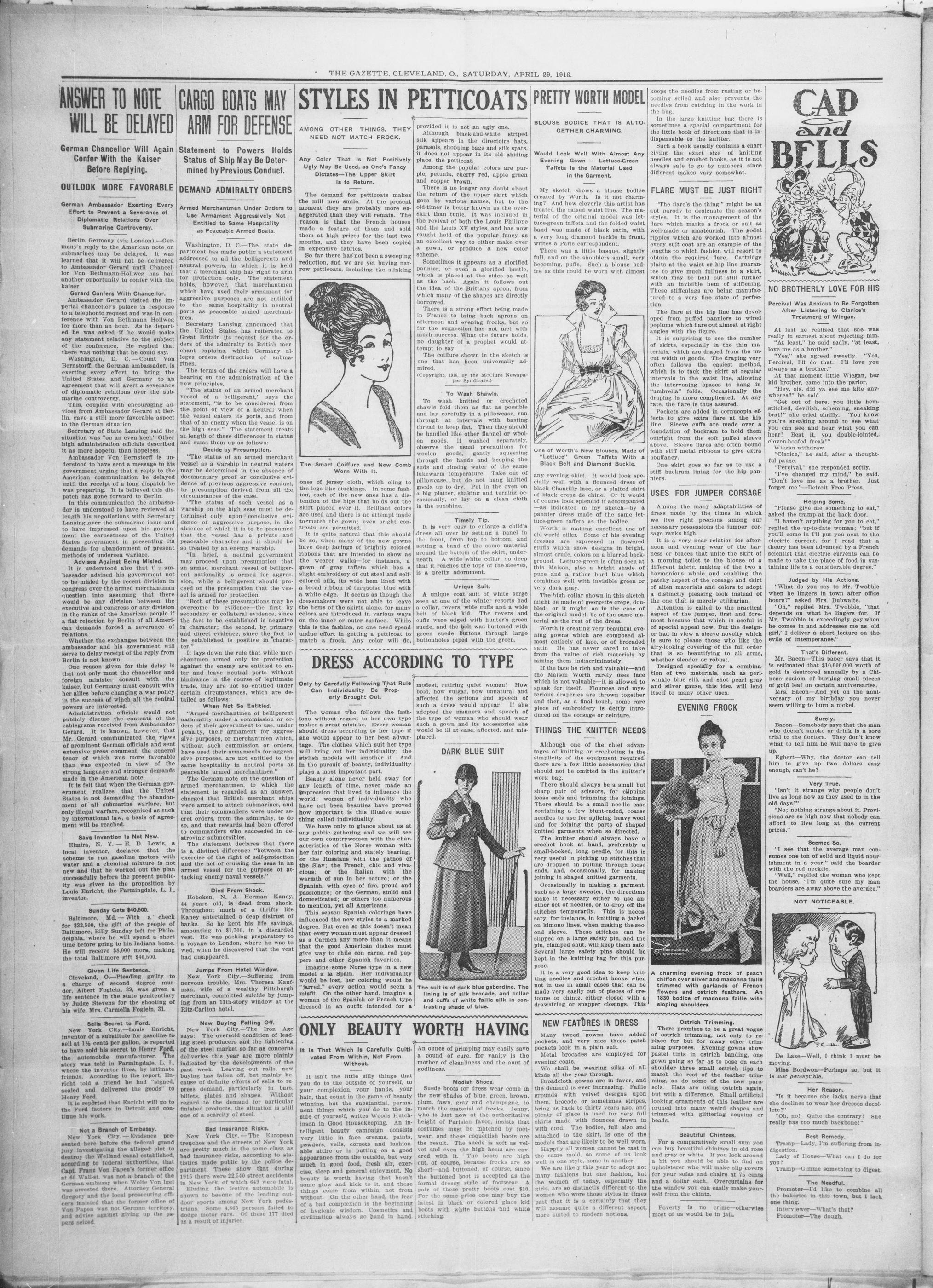
STYLES IN PETTICOATS
DRESS ACCORDING TO TYPE
ONLY BEAUTY WORTH HAVING
AMONG OTHER THINGS, THEY
NEED NOT MATCH FROCK.
The demand for petticoats makes the mill men smile. At the present moment they are probably more exaggerated than they will remain. The reason is that the French houses made a feature of them and sold them at high prices for the last two months, and they have been copied in expensive fabrics.
So far there has not been a sweeping reduction, and we are yet buying narrow petticoats, including the slinking
The Smart Coifure and New Comb Worn With It.
ones of jersey cloth, which cling to the legs like stockings. In some fashion, each of the new ones has a distention of the hips that holds out the skirt placed over it. Brilliant colors are used and there is no attempt made to match the gown; even bright contrasts are permitted.
It is quite natural that this should be so, when many of the new gowns have deep facings of brightly colored ribbons that are intended to show as the wearer walks—for instance, a gown of gray taffeta which has a slight embroidery of cut steel and self-colored silk, its wide hem lined with a broad ribbon of turquoise blue with a white edge. It seems as though the dressmakers were not able to leave the hems of the skirts alone, for many colors are introduced in various ways on the inner or outer surface. While this is the fashion, no one need spend undue effort in getting a petticoat to match a frock. Any color will do.
Only by Carefully Following That Rule Can Individuality Be Properly Brought Out.
The woman who follows the fashions without regard to her own type makes a great mistake. Every woman should dress according to her type if she would appear to her best advantage. The clothes which suit her type will bring out her individuality; the stylist models will smother it. And in the pursuit of beauty, individuality plays a most important part.
Beauty alone never held sway for any length of time, never made an impression that lived to influence the world; women of individuality who have not been beauties have proved how important is this illusive something called individuality.
We have only to glance about us at any public gathering and we will see our own countrywomen with the characteristics of the Norse woman with her fair coloring and stately bearing; or the Russians with the pathos of the Slay; the French, chic and vivacious; or the Italian, with the warmth of sun in her nature; or the Spanish, with eyes of fire, proud and passionate; or the German, stolid and domesticated; or others too numerous to mention, yet all Americans.
This season Spanish colorings have influenced the new styles to a marked degree. But even so this doesn't mean that every woman must appear dressed as a Carmen any more than it means that the good American dishes must give way to chile con carne, red peppers and other Spanish favorites.
Imagine some Norse type in a new model a la Spain. Her individuality would be lost, her coloring would be "jarred," every action would seem a misfit. On the other hand, imagine a woman of the Spanish or French type dressed in an outfit intended for a
It Is That Which Is Carefully Cultivated From Within, Not From Without.
It isn't the little silly things that you do to the outside of yourself, to your complexion, your hands, your hair, that count in the game of beauty winning, but the substantial, permanent things which you do to the inside of yourself, writes Woods Hutchinson in Good Housekeeping. An intelligent beauty campaign consists very little in face creams, paints, powders, veils, corsets and fashionable attire or in putting on a good appearance from the outside, but very much in good food, fresh air, exercise, sleep and general enjoyment. No beauty is worth having that hasn't some glow and kick to it, and these things come from within, not from without. On the other hand, the fear of a bad complexion is the beginning of hygienic wisdom. Cosmetics and civilization always go hand in hand.
provided it is not an ugly one.
Although black-and-white striped silk appears in the directoire hats, parasols, shopping bags and silk spats, it does not appear in its old abiding place, the petticoat.
Among the popular colors are purple, petunia, cherry red, apple green and copper brown.
There is no longer any doubt about the return of the upper skirt which goes by various names, but to the old-timer is better known as the overskirt than tunic. It was included in the revival of both the Louis Philippe and the Louis XV styles, and has now caught hold of the popular fancy as an excellent way to either make over a gown, or produce a new color scheme.
Sometimes it appears as a glorified pannier, or even a glorified bustle, which is placed at the sides as well as the back. Again it follows out the idea of the Brittany apron, from which many of the shapes are directly borrowed.
There is a strong effort being made in France to bring back aprons on afternoon and evening frocks, but so far the suggestion has not met with much success. What the future holds, no daughter of a prophet would attempt to say.
The colfure shown in the sketch is one that has been universally admired.
(Copyright, 1916, by the McClure Newspaper Syndicate.)
To Wash Shawls.
To wash knitted or crocheted shawls fold them as flat as possible and lay carefully in a pillowcase, run through at intervals with basting thread to keep flat. Then they should be handled like other flannel or woolen goods. If washed separately, observe the usual precautions for woolen goods, gently squeezing through the hands and keeping the suds and rinsing water of the same lukewarm temperature. Take out of pillowcase, but do not hang knitted goods up to dry. Put in the oven on a big platter, shaking and turning occasionally, or lay on a clean cloth in the sunshine.
Timely Tip.
It is very easy to enlarge a child's dress all over by setting a panel in the front, from top to bottom, and setting a band of the same material around the bottom of the skirt, underneath. A wide white collar, so deep that it reaches the tops of the sleeves, is a pretty adornment.
Unique Suit
A unique coat suit of white serge seen at one of the winter resorts had a collar, revers, wide cuffs and a wide belt of black kid. The revers and cuffs were edged with hunter's green suede, and the belt was buttoned with green suede buttons through large buttonholes nipped with the green.
modest, retiring quiet woman! How bold, how vulgar, how unnatural and affected the actions and speech of such a dress would appear! If she adopted the manners and speech of the type of woman who should wear such a gown and its accessories she would be ill at ease, affected, and misplaced.
DARK BLUE SUIT
UNDERWEAR
UNDERWEAR
The suit is of dark blue gaderned. The lining is of silk brocade, and collar and cuffs of white faile silk in contrasting shade of blue.
An ounce of primping may easily save a pound of cure, for vanity is the mother of cleanliness and the aunt of godliness.
Modish Shoes.
Suede boots for dress wear come in the new shades of blue, green, brown, plum, fawn, gray and champagne, to match the material of frocks. Jenny, who is just now at the authoritative height of Parisian favor, insists that costumes must be matched by footwear, and these coquettish boots are the result. The suede is soft as velvet and even the high heels are covered with it. The boots are high cut, of course, because frocks are so short—and buttoned, of course, since the buttoned boot is accepted as the formal dressy style of footwear. A pair of these pretty boots cost $10. For the same price one may buy the latest in black or colored glace kid boots with white buttons and white stitching.
PRETTY WORTH MODEL
BLOUSE BODICE THAT IS ALTO
GETHER CHARMING.
Would Look Well With Almost Any Evening Gown — Lettuce-Green Taffeta Is the Material Used in the Garment.
My sketch shows a blouse bodice created by Worth. Is it not charming? And how cleverly this artist has treated the raised waist line. The material of the original model was lettuce-green taffeta and the folded waist band was made of black satin, with a very long diamond buckle in front, writes a Paris correspondent.
There was a little basque, slightly full, and on the shoulders small, very becoming, puffs. Such a blouse bodice as this could be worn with almost
同
One of Worth's New Blouses, Made of "Lettuce" Green Taffeta With a Black Belt and Diamond Buckle. any evening skirt. It would look specially well with a flounced dress of black Chantilly lace, or a plaited skirt of black crope de chine. Or it would of course look splendid if accompanied—as indicated in my sketch—by a pannier dress made of the same lettuce-green taffeta as the bodice. Worth is making excellent use of old-world silks. Some of his evening dresses are expressed in flowered stuffs which show designs in bright, almost crude, colors on a blurred background. Lettuce-green is often seen at this Maison, also a bright shade of puce and a rather hard blue which combines well with invisible green or very dark gray. The high collar shown in this sketch might be made of geogette crepe, doubled; or it might, as in the case of the original model, be of the same material as the rest of the dress.
Worth is creating very beautiful evening gowns which are composed almost entirely of lace, or of brocaded satin. He has never cared to take from the value of rich materials by mixing them indiscriminately.
If the lace be rich and valuable—and the Maison Worth rarely uses lace which is not valuable—it is allowed to speak for itself. Flouces and mysterious draperies are thrown together and then, as a final touch, some rare piece of embroidery is definitely introduced on the corsage or culture.
THINGS THE KNITTER NEEDS
Although one of the chief advantages of knitting or crocheting is the simplicity of the equipment required, there are a few little accessories that should not be omitted in the knitter's work bag.
There should always be a small but sharp pair of scissors, for clipping loose ends and trimming the joinings. There should be a small needle case containing a few blunt-ended, coarse needles to use for splicing heavy wool and for joining the parts of shaped knitted garments when so directed.
The knitter should always have a crochet hook at hand, preferably a small-hooked, long needle, for this is very useful in picking up stitches that are dropped, in pulling through loose ends, and, occasionally, for making joined in shaped knitted garments.
Occasionally in making a garment, such as a large sweater, the directions make it necessary either to use another set of needles, or to drop off the stitches temporarily. This is necessary, for instance, in knitting a jacket on kimono lines, when making the second sleeve. These stitches can be slipped on a large safety pin, and the clamp, clamped shut, will keep them safe. Several large safety pins should be kept in the knitting bag for this purpose.
It is a very good idea to keep knitting needles and crochet hooks when not in use in small cases that can be made very easily out of pieces of cretonne or chintz, either closed with a drawstring or snapper closings.
NEW FEATURES IN DRESS
Many tweed gowns have added pockets, and very nice these patch pockets look in a plain suit.
Metal brocades are employed for evening coats.
We shall be wearing silks of all kinds all the year through.
Broadcloth gowns are in favor, and the demand is ever increasing. Faille grounds with velvet designs upon them, brocade or sometimes stripes, bring us back to thirty years ago, and plenty of glace is used for very full skirts made with flouces drawn in with cord. The bodice, full also and attached to the skirt, is one of the models that are likely to be well worn.
Harmfully all women cannot be cast in
Happily all women cannot be cast in the same mold, so some of us look well in one style, some in another. We are likely this year to adopt not many fashions but one fashion, but the women of today, especially the girls, are so distinctly different to the women who wore those styles in times past that it is a certainty that they will assume quite a different aspect, more suited to modern notions.
keeps the needles from rusting or becoming soiled and also prevents the needles from catching in the work in the bag.
In the large knitting bag there is sometimes a special compartment for the little book of directions that is indispensable to the knitter.
Such a book usually contains a chart giving the exact size of knitting needles and crochet hooks, as it is not always safe to go by numbers, since different makes vary somewhat.
FLARE MUST BE JUST RIGHT
"The flare's the thing." might be an ap party to designate the season's styles. It is the management of the flare which marks a frock or suit as well-made or amateurish. The godet ripples which are worked into almost every suit coat are an example of the lengths to which fashion will resort to obtain the required flare. Cartridge plaits at the waist or hip line guarantee to give much fullness to a skirt, which may be held out still further with an invisible hem of stiffening. These stiffenings are being manufactured to a very fine state of perfection. The flare at the hip line has developed from puffed panniers to wired poplums which flare out almost at right angles with the figure.
It is surprising to see the number of skirts, especially in the thin materials, which are draped from the uncut width of goods. The draping very often follows the easiest method, which is to tack the skirt at regular intervals to the waist line, allowing the intervening spaces to hang in "umbrella" folds. Occasionally the draping is more complicated. At any rate, the flare is thus assured.
Pockets are added in cornucopia effects to give extra flare at the hip line. Sleeve cuffs are made over a foundation of buckram to hold them outright from the soft puffed sleeve above. Sleeve flares are often bound with stiff metal ribbons to give extra bourquency.
One skirt goes so far as to use a stiff buckram lining for the hip paniers.
USES FOR JUMPER CORSAGE
Among the many adaptabilities of dress made by the times in which we live right precious among our necessary possessions the jumper corsage ranks high.
It is a very near relation for afternoon and evening wear of the harness or braces that unite the skirt of a morning toilet to the blouse of a different fabric, making of the two a harmonious whole and enabling the patchy aspect of the corsage and skirt of alien materials and colors to adopt a distinctly pleasing look instead of the one that is merely utilitarian.
Attention is called to the practical aspect of the jumper, first and foremost because that which is useful is of special appeal now. But the designer had in view a sleeve novelty which is sure to please those who like the air-lowing covering of the full order that is so beautifying to all arms, whether slender or robust.
Designed specially for a combination of two materials, such as perlwinkle blue silk and shot pearl gray and silver gauze, this idea will lend itself to many other uses.
EVENING FROCK
SUNDERWOLD & UNDERWOLD
A charming evening frock of peach chiffon over silver and madonna faille trimmed with garlands of French flowers and ostrich feathers. An 1830 bodice of madonna faille with sloping shoulders.
There promises to be a great vogue of ostrich trimming, not only to replace fur but for many other trimming purposes. Evening gowns show pastel tints in ostrich banding, one gown going so far as to pose on each shoulder three small ostrich tips to match the rest of the feather trimming, as do some of the new parasols. Hats are using ostrich again, but with a difference. Small artificial looking ornaments of this feather are pruned into many weird shapes and trimmed with glittering sequins or beads.
Beautiful Chintzes
For a comparatively small sum you can buy beautiful chintzes in old rose and gray or white. If you look around a bit you should be able to find an upholsterer who will make slip covers for your sofas and chairs at 75 cents and a dollar each. Overcurtains for the window you can easily make yourself from the chintz.
Poverty is no crime—otherwise most of us would be in jail.
CAP
and
BELLS
NO BROTHERLY LOVE FOR HIS
Percival Was Anxious to Be Forgotten After Listening to Clarice's Treatment of Wiegan.
At last he realized that she was really in earnest about rejecting him. "At least," he said sadly, "at least, love me as a brother."
"Yes," she agreed sweetly. "Yes, Percival, I'll do that. I'll love you always as a brother."
At that moment little Wiegan, her kid brother, came into the parlor.
"Hey, sis, did ya see me kite anywheres?" he said.
"Get out of here, you little hemstitched, devilish, scheming, sneaking brat!" she cried shrilly. "You know you're sneaking around to see what you can see and hear what you can hear! Beat it, you double-jointed, cloven-hoofed freak!" Wiegan withdrew.
"Clarice," he said, after a thoughtful pause.
"Percival," she responded softly. "I've changed my mind," he said. "Don't love me as a brother. Just forget me."—Detroit Free Press.
Helping Some.
"Please give me something to eat," asked the tramp at the back door. "I haven't anything for you to eat," replied the up-to-date woman; "but if you'll come in I'll put you next to the electric current, for I read that a theory has been advanced by a French scientist that electric currents can be made to take the place of food in sustainable life to a considerable degree."
Judged by His Actions
"What do you say to Mr. Twobble when he lingers in town after office hours?" asked Mrs. Dubwaite. "Oh," replied Mrs. Twobble, "that depends on what he lingers for. If Mr. Twobble is exceedingly gay when he comes in and addresses me as 'old girl', I deliver a short lecture on the evils of intemperance."
That's Different
Mr. Bacon—This paper says that it is estimated that $10,000,000 worth of gold is destroyed annually by a Chinese custom of burning small pieces of gold leaf on certain anniversaries. Mrs. Bacon—And yet on the anniversary of my birthday you never willing to burn a nickel.
Surely.
Bacon—Somebody says that the man who doesn't smoke or drink is a sore trial to the doctors. They don't know what to tell him he will have to give up.
Egbert—Why, the doctor can tell him to give up two dollars easy enough, can't he?
Very True.
"Isn't it strange why people don't live as long now as they used to in the old days?"
"No; nothing strange about it. Provisions are so high now that nobody can afford to live long at the current prices."
Seemed So
"I see that the average man consumes one ton of solid and liquid nourishment in a year," said the boarder with the red necktie.
"Well," replied the woman who kept the house, "I'm quite sure my man boarders are away above the average."
NOT NOTICEABLE.
De Laze—Well, I think I must be moving.
Miss Bordwon—Perhaps so, but it is not perceptible.
"Is it because she lacks nerve that she declines to wear her dresses decollete?"
"Oh, no! Quite the contrary! She really has too much backbone!"
Tramp—Lady, I'm suffering from indigestion.
Lady of House—What can I do for you?
Promoter—I'd like to combine all the bakeries in this town, but I lack one thing.
Interviewer—What's that?
Promoter—The dough.