The Gazette
Saturday, September 2, 1916
Cleveland, Ohio
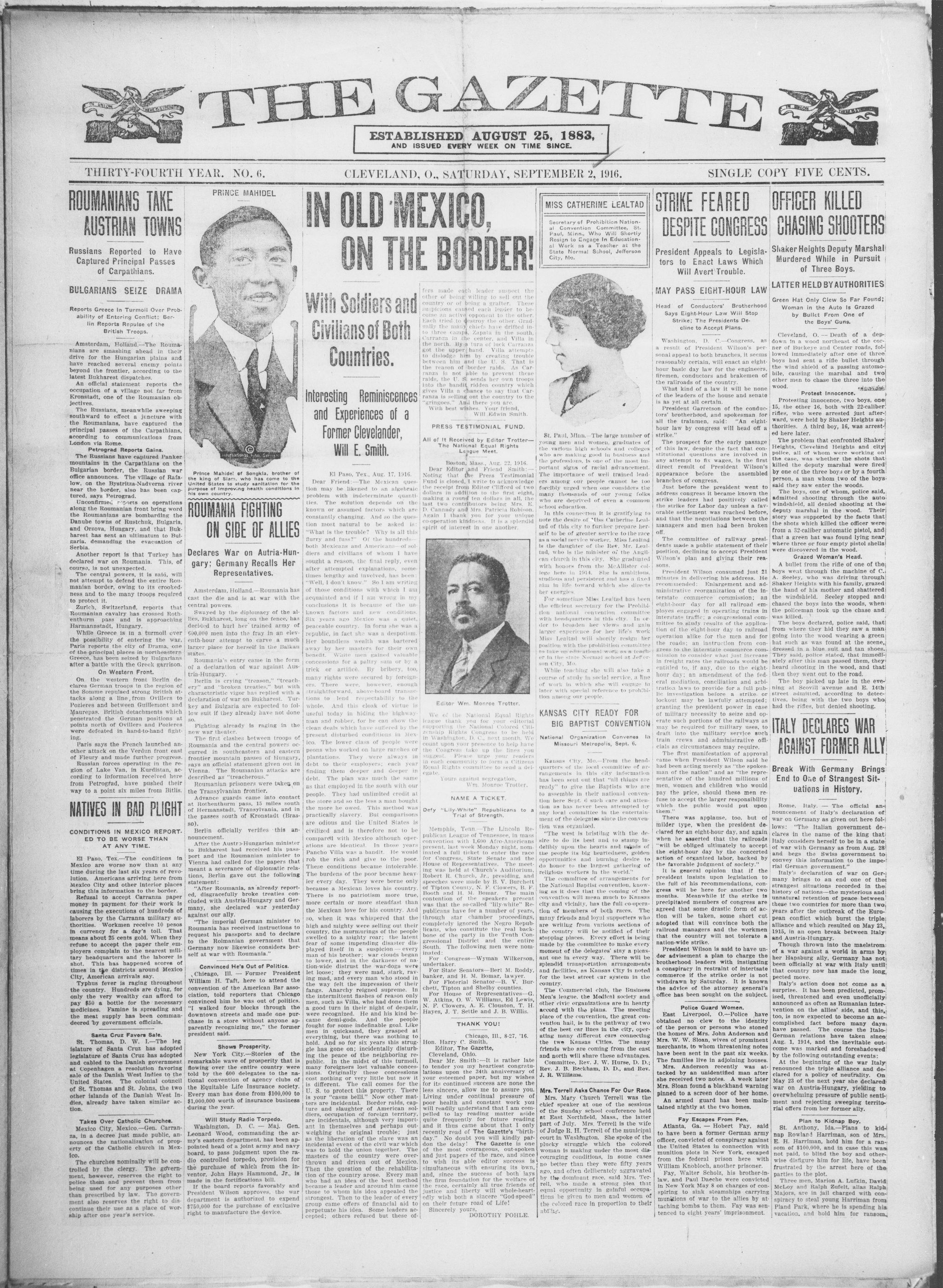
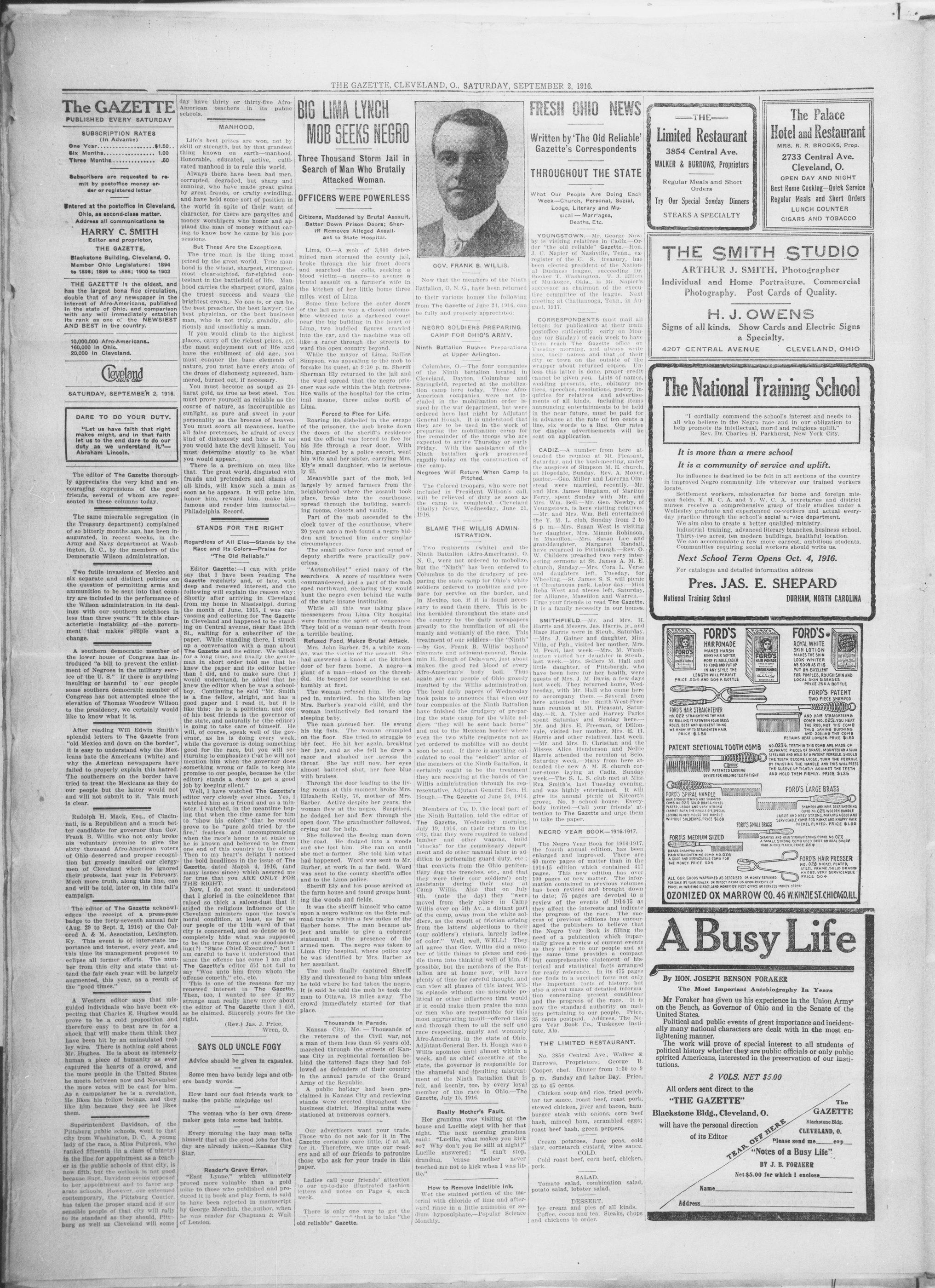
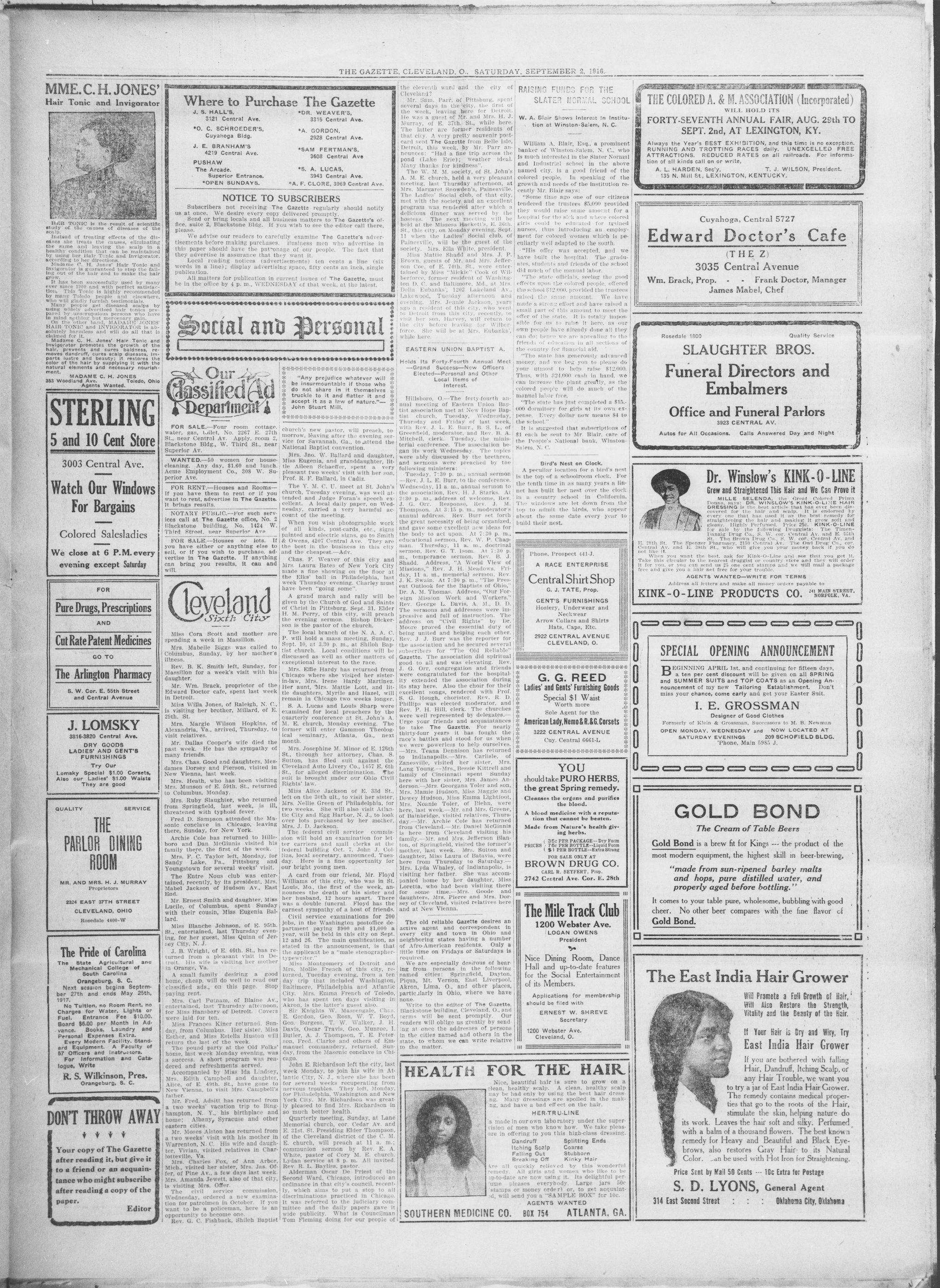
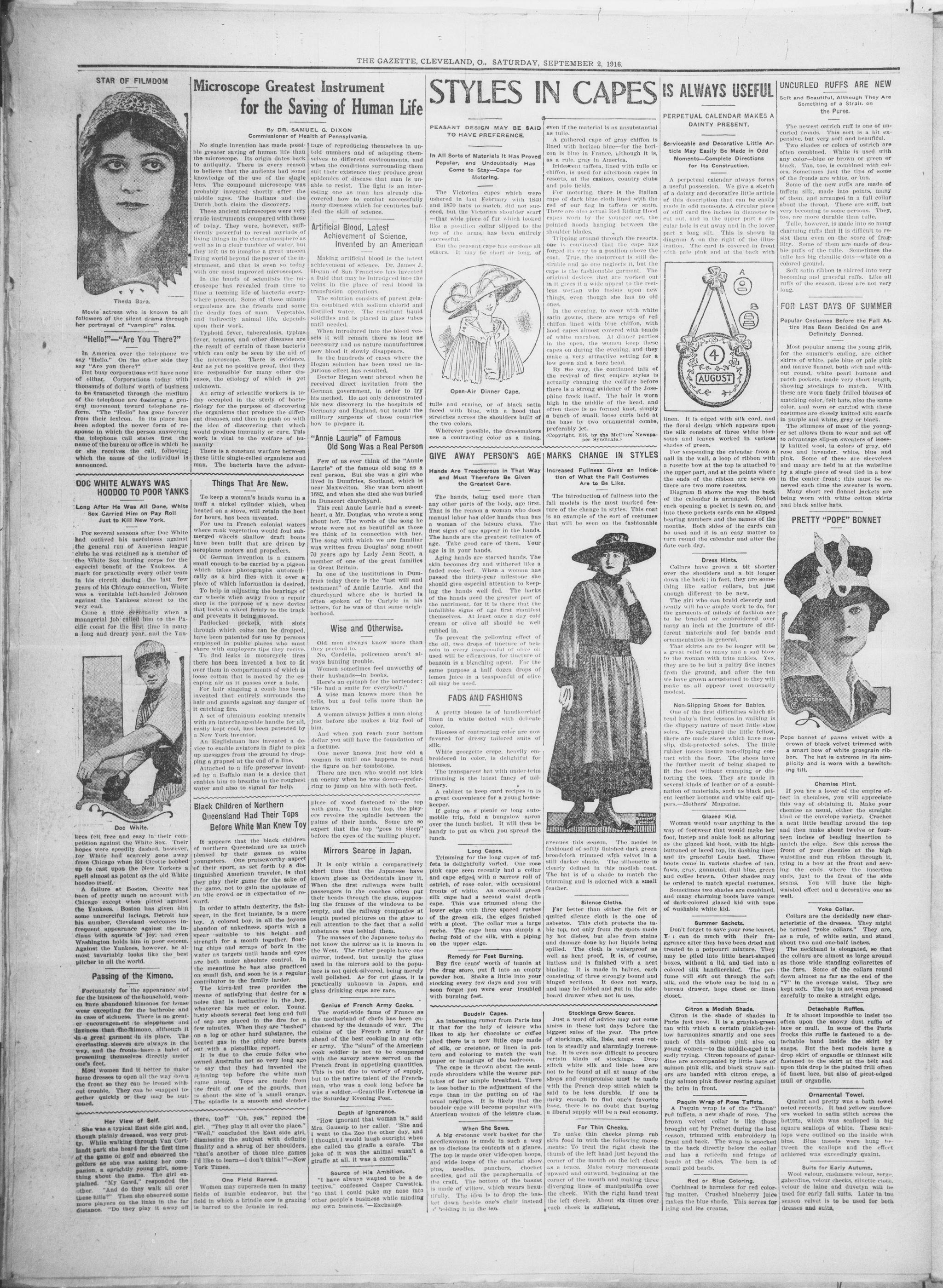
Page text (machine-generated)
THIRTY-FOURTH YEAR. NO. 6.
IN UNION
UNDER ASSUMPTION
ROUMANIANS TAKE AUSTRIAN TOWNS
Russians Reported to Have Captured Principal Passes of Carpathians.
BULGARIANS SEIZE DRAMA
Reports Greece in Turmoil Over Probability of Entering Conflict; Berlin Reports Repulse of the British Troops.
Amsterdam, Holland.—The Roumanians are smashing ahead in their drive for the Hungarian plains and have reached several enemy points beyond the frontier, according to the latest Bukharek dispatches.
An official statement reports the occupation of a village not far from Kronstadt, one of the Roumanian objectives.
The Russians, meanwhile sweeping southward to effect a juncture with the Roumanians, have captured the principal passes of the Carpathians, according to communications from London via Rome.
Petrograd Reports Gains.
Petrograph Reports Gains.
The Russians have captured Panker mountains in the Carpathians on the Bulgarian border, the Russian war office announces. The village of Rafał, on the Bystritza-Nadverna river near the border, also has been captured, says Petrograd.
Unconfirmed reports on operations along the Roumanian front bring word the Roumanians are bombarding the Danube towns of Rustchuk, Bulgaria, and Orsova, Hungary, and that Bukharest has sent an ultimatum to Bulgaria, demanding the evacuation of Serbia.
Another report is that Turkey has declared war on Roumania. This, of course, is not unexpected.
The central powers, it is said, will not attempt to defend the entire Roumanian border, owing to its crookedness and to the many troops required to protect it.
Zurich, Switzerland, reports that Roumanian cavalry has crossed Rothenhmur pass and is approaching Harmannstadt, Hungary.
While Greece is in a turmoll over the possibility of entering the war, Paris reports the city of Drama, one of the principal places in northeastern Greece, has been seized by Bulgarians after a battle with the Greek garrison.
On Western Front.
On the western front Berlin declares German troops in the region of the Somme repulsed strong British attacks along a line, from Ovilliers to Pozieres and between Guillemont and Maurepas. British detachments which penetrated the German positions at points north of Ovilliers and Pozieres were defeated in hand-to-hand fighting.
Paris says the French launched another attack on the Verdun front east of Fleury and made further progress. Russian forces operating in the region of Lake Van, in Kurdistan, according to information received here from Petrograd, have pushed their way to a point six miles from Bitlis.
NATIVES IN BAD PLIGHT
CONDITIONS IN MEXICO REPORTED TO BE WORSE THAN AT ANY TIME.
El Paso, Tex.—The conditions in Mexico are worse now than at any time during the last six years of revolution. Americans arriving here from Mexico City and other interior places bring this information to the border. Refusal to accept Carranza paper money in payment for their work is causing the executions of hundreds of laborers by the Carranza military authorities. Workmen receive 10 pesos in currency for a day's toil. That means about 25 cents gold. When they refuse to accept the paper their employers complain to the nearest military headquarters and the laborer is shot. This has happened scores of times in the districts around Mexico City, American arrivals say.
Typhus fever is raging throughout the country. Hundreds are dying, for only the very wealthy can afford to pay $50 a bottle for the necessary medicines. Famine is spreading and the meat supply has been commanded by government officials.
Santa Cruz Favers Sale.
St. Thomas, D. W. I.—The legislature of Santa Cruz has adopted legislature of Santa Cruz has adopted and cabled to the Danish government at Copenhagen a resolution favoring sale of the Danish West Indies to the United States. The colonial council of St. Thomas and St. Johns, the two other islands of the Danish West Indies, already have taken similar action.
Takes Over Catholic Churches.
Mexico City, Mexico—Gen. Carranza, in a decree just made public, announces the nationalization of property of the Catholic church in Mexico.
The churches nominally will be controlled by the clergy. The government, however, reserves the right to police them and prevent them from being used for any purposes other than prescribed by law. The government also reserves the right to continue their use as a place of worship after one year's service.
PRINCE MAHIDEL
universalat film service
Prince Mahidel of Songka, brother of the king of Slam, who has come to the United States to study sanitation for the health health conditions in his own country.
Declares War on Autria-Hungary; Germany Recalls Her Representatives.
Amsterdam, Holland.—Roumania has cast the die and is at war with the central powers.
Swayed by the diplomacy of the allies, Bukharest, long on the fence, has decided to hurt her trained army of 600,000 men into the fray in an eleventh-hour attempt to carve a much larger place for herself in the Balkan states.
Roumania's entry came in the form of a declaration of war against Austria-Hungary.
Berlin is crying "treason," "treachery" and "broken treaties," but with characteristic vigor has replied with a declaration of war on Bukharest. Bulgaria and Bulgaria are expected to follow suit if they already have not done so.
Fighting already is raging in the new war theater.
The first clashes between troops of Roumania and the central powers occurred in southeastern and eastern frontier mountain passes of Hungary, says an official statement given out in Vienna. The Roumanian attacks are described as "treacherous."
Roumanian prisoners were taken on the Transylvanian frontier.
Advance guards came into contact at Rothenhurm pass, 15 miles south of Hermanstadt, Transylvania, and in the passes south of Kronstadt (Brasso).
Berlin officially verifies this announcement.
After the Austro-Hungarian minister to Bukharest had received his passport and the Roumanian minister to Vienna had called for the papers that meant a severance of diplomatic relations, Berlin gave out the following statement:
"After Roumania, as already reported, disgracefully broke treaties concluded with Austria-Hungary and Germany, she declared war yesterday against our ally.
"The imperial German minister to Roumania has received instructions to request his passports and to declare to the Rolmanian government that Germany now likewise considers herself at war with Roumania."
Convinced He's Out of Politics.
Chicago, Ill. — Former President William H. Taft, here to attend the convention of the American Bar association, told reporters that Chicago convinced him he was out of politics.
"I walked four blocks through the downtown streets and made one purchase in a store without anyone apparently recognizing me," the former president said.
Shows Prosperity
New York City.—Stories of the remarkable wave of prosperity that is flowing over the entire country were told by the 600 delegates to the national convention of agency clubs of the Equitable Life Insurance society. Every man has done from $100,000 to $1,000,000 worth of insurance business during the year.
WILL Study Radio Torpedo
Washington, D. C. — Maj. Gen. Leonard Wood, commanding the army's eastern department, has been appointed head of a joint army and navy board, to pass judgment upon the radio controlled torpedo, provision for the purchase of which from the inventor, John Hays Hammond, Jr., is made in the fortifications bill. If the board reports favorably and President Wilson approves, the war department is authorized to expend $750,000 for the purchase of exclusive right to manufacture the device.
ESTABLISHED AUGUST 25, 1883 AND ISSUED EVERY WEEK ON TIME SINCE.
CLEVELAND, O., SATURDAY, SEPTEMBER 2, 1916.
IN OLD MEXICO, ON THE BORDER!
With Soldiers and Civilians of Both Countries.
Interesting Reminiscences and Experiences of a Former Cleveland, Will E. Smith.
El Paso, Tex. Aug. 17, 1916.
Dear Friend:—The Mexican question may be likened to an algebraic problem with indeterminate quantities. The solution depends on the known or assumed factors which are constantly changing. And so the question most natural to be asked is: "What is the trouble? Why is all this furry and fuss?" Of the hundreds—both Mexicans and Americans—of soldiers and civilians of whom I have sought a reason, the final reply, even after attempted explanations, sometimes lengthy and involved, has been: "Well, I don't know." So I am writing of those conditions with which I am acquainted and if I am wrong in my conclusions it is because of the unknown factors and new conditions. Six years ago Mexico was a quiet, peaceable country. In form she was a republic, in fact she was a despotism. Her boundless wealth was bartered away by her masters for their own benefit. White men gained valuable concessions for a patry sum or by a trick or artifact. By bribery, too, many rights were secured by foreigners. There were, however, enough straightforward, above-board transactions to lend respectability to the whole. And this cloak of virtue is useful today in hiding the highwayman and robber, for he can show the clean deals which have suffered by the present disturbed conditions in Mexico. The lower class of people were peons who worked on large ranches or plantations. They were always in debt to their employers; each year finding them deeper and deeper in debt. The plan was much the same as that employed in the south with our people. They had unlimited credit at the store and so the less a man bought the more he owed. This method was practically slavery. But comparisons are odious and the United States is civilized and is therefore not to be compared with Mexico although operations are identical. In those years Pancho Villa was a bandit. He would rob the rich and give to the poor. These conditions became intolerable. The burdens of the poor became heavier every day. They were borne only because a Mexican loves his country. There is no patriotism more true, more certain or more steadfast than the Mexican love for his country. And so, when it was whispered that the high and mighty were selling out their country, the murmurings of the people swelled to a mighty roar; the latent fear of some impending disaster displayed itself in a suspicion—every man of his brother; war clouds to lower, and in the darkness of night to let loose; they were dark, staring, raving mad, and every man who stood in the night of despair, were recognized. Anarchy reigned supreme. In the intermittent flashes of reason only men, such as Villa, who had done them a turn in their night of despair, were recognized. And his kind became fond of some indefinite good like everything, but there was nothing to hold. And so for six years this struggle has gone and incidentally disturbing the peace of the neighboring republic. In the midst of this turnip, many foreigners lost valuable concessions. Originally these concessions cost nothing or very little but now it is different. The call comes for the U. S. to protect this property. There is your "casus belli." Now other matters are incidental. Border raids, capitals, dwellings, the war department, occupation of foreign territory, are incidentals, although very important in themselves and perhaps outweighing the original trouble; just as the liberation of the slave was an incidental event of the civil war which was to hold the union together. The masters of the country were overthrown and driven out of Mexico. Then the question of the rehabilitation of the country arose. Every man who had an idea of the best method to those to whom his idea appealed the strongest. Then to the leader of every group came offers of financial aid to perpetuate his idea. Some leaders accepted; others refused but these of
fers made each leader suspect the other of being willing to sell out the country or of being a grafter. These suspicions caused each leader to become an active opponent to the other. Each tried to destroy the other. Gradually the many chiefs have drifted into the Carranza in the center, and Villa in the north. By a turn of luck Carranza got the upper hand. Villa attempts to dislodge him by creating trouble between him and the U. S. That is the reason of border raids. As Carranza tries to dislodge the raids, the U. S. sends her own troops into the bandit ridden country which gives Villa a chance to say that Carranza is selling out the country to the "gringoes." And there you are.
With best wishes. Your friend,
Will Edwin Smith.
PRESS TESTIMONIAL FUND
All of it Received by Editor Trotter-
The National Equal Rights
League Meet.
Boston, Mass., Aug. 22, 1916.
Dear Editor and Friend Smith:—Noting that the Press Testimonial Fund is closed, I write to acknowledge the receipt from Editor Clifford of two dollars in addition to the first eight, making a round ten dollars in all, the last two contributions being Mrs. E. D. Cannady and Mrs. Patricia Robinson. Again I thank you for your unique co-operation kindness. It is a splendid spirit of interest in one another.
Editor Wm. Monroe Trotter.
We of the National Equal Rights league thank you for your editorial supporting the National Colored Citizenship Rights Congress to be held in Washington, D.C., next month. We count upon your presence to help have the Congress take up the lines you suggest. Please urge your readers each community to form a Citizens Equal Rights committee to send a delegate. Yours against segregation, Wm. Monroe Trotter.
NAME A TICKET
Defy "Lily-White" Republicans to a Trial of Strength.
Memphis, Teen—The Lincoln Republican League of Tennessee, in mass convention with 1,600 Afro-Americans present, last week Monday night, nominated a full ticket to enter the race for Congress, State Senate and the House of Representatives. The meeting was held at Church's Auditorium, Robert R. Church, Jr., presiding, and speeches were made by B. V. Burchell of Tipton County, N. F. Clowers, B. F. Booth and M. H. Borar. The main contention of the speakers present was that the so-called "lily-white" Republicans have for a number of years, through star chamber proceedings, completely ignored the Negro Republicans to constitute the red blood of the party in the Tenth Congressional District and the entire South. The following men were nominated:
For Congress—Wyman Wilkerson, undertaker.
For State Senators—B. M. Roddy, banker, and H. M. Borar, lawyer.
For Plotterial Senator—B. F. Burchell of Roosevelt counties.
For House of Representatives—G. W. Atkins, O. W. Williams, Ed Lewis, N. F. Clowers, A. E. Clouston, T. H. Hayes, J. T. Settle, J. B. Willis.
THANK YOU!
Chicago, Ill., 8-27, '16.
Hon. Harry C. Smith,
Editor, The Gazette
Cleveland, Ohio.
Dear Mr. Smith:—It is rather late to tender you my heartiest congratulations upon the 34th anniversary of your retirement. I am grateful for its continued success are none the less sincere, allow me to assure you.
Living under continual pressure of poor health and constant work you will readily understand that I am compelled to lay reading matter aside quite frequently for future reading and it thus came about that I only recently read of The Gazette's "birthday." No doubt you will kindly parade with me in the room of the most courageous, out-spoken and just papers of the race, and since to wish its able editor success is simultaneous with ensuring its own, and, since the success of both lays the firm foundation for the welfare of the race, certainly all true friends of justice and liberty will whole-heartedly wish both a sincere "God-speed" on their future read of Life!
Sincerely yours,
DOROTHY PHOLE
MISS CATHERINE LEALTAD
Secretary of Prohibition National Convention Committee, St. Paul, Minn., Who Will Shortly Rosign to Engage In Educational Work as a Teacher at the State Normal School, Jefferson City, Mo.
St. Paul, Mim.—The large number of young men and women, graduates of the various high schools and colleges who are making good in business and the professions, is one of the most important signs of racial advancement. The importance of well trained leaders among our people cannot be too forcefully urged when one considers the many thousands of our young folks who are deprived of even a common school education.
In this connection it is gratifying to note the desire of "tiss Catherine Leatad of this city to further prepare herself to be of greater service to the race as a social worker. Miss Leatad is the daughter of the Rev. Mr. Leatad, who is the minister of the Anglican church in this city. She graduated with honors from the McAllister college here in 1914. She is ambitions, studious and persistent and has a fixed aim in life toward which she directs her energies.
For sometime Miss Leatad has been the efficient secretary for the Prohibition national convention committee with headquarters in this city. In order to broaden her views and gain larger experience for her life's work Miss Leatad will shortly resign her position with the prohibition committee to take an educational work as a teacher in the state Normal school at Jefferson City, Mo.
While teaching she will also take a course of study in social service, a line of work in which she will engage in later with special reference to prohibition among our people.
KANSAS CITY READY FOR
BIG BAPTIST CONVENTION
National Organization Convenes in Missouri Metropolis, Sept. 6.
Kansas City, Mo.—From the headquarters of the local committee of arrangements in this city information has been sent out that "all things are ready" to give the Baptists who are to assemble in their national convention here Sept. 6 such care and attention as has never been attempted by any local committee in the entertainment of the delegates since the convention was organized.
"The west is bristling with the desire to do its best and to stamp indelibly upon the hearts and minds of the people its big heartedness, golden opportunities and burning desire to do honor to the largest gathering of religious workers in the world."
The committee of arrangements for the National Baptist convention, knowing, as it does that the coming of the convention will mean much to Kansas city and vicinity, has the full co-operation of members of both races. The many friends and loyal supporters who are writing from various sections of the country will be notified of their stopping places. Every effort is being made by the committee to make every moment of the delegates' stay a pleasant one in every way. There will be splendid transportation arrangements and facilities, as Kansas City is noted for the best street car system in the country.
The Commercial club, the Business Men's league, the Medical society and other civic organizations are in hearty accord with the plans. The meeting place of the convention, the great convention hall, is in the pathway of two of the best car lines in the city, operating many different cars connecting the two Kansas Cities. The many friends who are coming from the east and north will share these advantages. Committee, Rev. J. W. Hurse, D. D.; Rev. J. B. Bckham, D. D., and Rev. J. R. Williams.
Mrs. Terrell Asks Chance For Our Race. Mrs. Mary Church Terrell was the chief speaker at one of the sessions of the Sunday school conference held at East Northfield, Mass., the latter part of July. Mrs. Terrell is the wife of Judge R. H. Terrell of the municipal court in Washington. She spoke of the plucky struggle which the colored woman is making under the most discouraging conditions, in some cases no better than they were fifty years ago, and often deliberately aggravated by the dominant race, said Mrs. Terrell, who made a strong plea that equal opportunity in gainful occupations be given to men and women of the colored race in proportion to their ability.
SINGLE COPY FIVE CENTS.
STRIKE FEARED DESPITE CONGRESS
President Appeals to Legislators to Enact Laws Which Will Avert Trouble.
MAY PASS EIGHT-HOUR LAW
Head of Conductors' Brotherhood
Says Eight-Hour Law Will Stop
Strike; The Presidents Decline to Accept Plans.
Washington, D. C.—Congress, as a result of President Wilson's personal appeal to both branches, it seems reasonably certain, will enact an eight-hour basic day law for the engineers, firemen, conductors and brakemen of the railroads of the country.
What kind of a law it will be none of the leaders of the house and senate is as yet at all certain.
President Garretson of the conductors' brotherhood, and spokesman for all the trainmen, said: "An eight-hour law by congress will head off a strike."
The prospect for the early passage of this law, despite the fact that constitutional questions are involved in any attempt to fix wages, is the first direct result of President Wilson's appearance before the assembled branches of congress.
Just before the president went to address congress it became known the strike leaders had positively called the strike for Labor day unless a favorable settlement was reached before, and that the negotiations between the managers and men had been broken off.
The committee of railway presidents made a public statement of their position, declining to accept President Wilson's plan and giving their reasons.
President Wilson consumed just 21 minutes in delivering his address. He recommended: Enlargement and administrative reorganization of the interstate commerce commission; an eight-hour day for all railroad employees engaged in operating trains in interstate traffic; a congressional committee to study results of the application of the eight-hour day to railroad operation alike for the men and for the roads; an instruction from congress to the interstate commerce commission to consider what just increase in freight rates the railroads would be entitled to, if any, due to the eight-hour day; an amendment of the federal mediation, conciliation and arbitration laws to provide for a full public investigation before a strike or lockout may be lawfully attempted; granting the president power in case of military necessity to seize and operate such portions of the railways as may be required for military uses, to draft into the military service such train crews and administrative officials as circumstances may require. The first manifestation of approval came when President Wilson said he had been acting merely as "the spokesman of the nation" and as "the representative of the hundred millions of men, women and children who would pay the price, should these men refuse to accept the larger responsibility which the public would put upon them."
There was applause, too, but of milder type, when the president declared for an eight-hour day, and again when he asserted that the railroads "will be obliged ultimately to accept the eight-hour day by the concerted action of organized labor, backed by the favorable judgment of society." It is general opinion that if the president insists upon legislation to the full of his recommendations, congress will be here for another two months. Meanwhile if the strike is precipitated members of congress are agreed that some drastic form of action will be taken, some short cut adopted that will convince both the railroad managers and the workmen that the country will not tolerate a nation-wide strike.
President Wilson is said to have under advisement a plan to charge the brotherhood leaders with instigating a conspiracy in restraint of intersate commerce if the strike order is not withdrawn by Saturday. It is known the advice of the attorney general's office has been sought on the subject.
Police Guard Women
East Liverpool, O.—Police have obtained no clew to the identity of the person or persons who stoned the homes of Mrs. John Anderson and Mrs. W. W. Sloan, wives of prominent merchants, to whom threatening notes have been sent in the past six weeks. The families live in adjoining houses. Mrs. Anderson recently was at tacked by an unidentified man after she received two notes. A week later Mrs. Sloan found a blackhand warning pinned to a screen door of her home. An armed guard has been main tained nightly at the two homes.
Fay Escapes From Pen
Atlanta, Ga. — Hobert Fay, said to have been a former German army officer, convicted of conspiracy against the United States in connection with minton plots in New York, escaped from the federal prison here with William Knobloch, another prisoner. Fay, Walter Scholz, his brother-in-law, and Paul Daeche were convicted in New York May 8 on charges of conspiring to sink steamships carrying munitions of war to the allies by attaching bombs to them. Fay was sentenced to eight years' imprisonment.
IN BELION DESPARTITO
OFFICER KILLED CHASING SHOOTERS
Shaker Heights Deputy Marshall Murdered While in Pursuit of Three Boys.
LATTER HELD BY AUTHORITIES
Green Hat Only Clew So Far Found;
Woman in the Auto Is Grazed
by Bullet From One of
the Boys' Guns.
Cleveland, O. — Death of a depdown in a wood northeast of the corner of Buckeye and Center roads, followed immediately after one of three boys had sent a rifle bullet through the wind shield of a passing automobile, causing the marshal and two other men to chase the three into the wood.
Protest Innocence.
Protesting innocence, two boys, one 15, the other 16, both with 22-caliber rifles, who were arrested just afterward, were held by Shaker Heights authorities. A third boy, 16, was arrested here later.
The problem that confronted Shaker Heights, Cleveland Heights and city police, all of whom were working on the case, was whether the shots that killed the deputy marshal were fired by one of the three boys or by a fourth person, a man whom two of the boys said they saw enter the woods.
The boys, one of whom, police said, admitted shooting through the auto windshield, all denied shooting at the deputy marshal in the wood. Their story was supported by the facts that the shots which killed the officer were from a 32-caliber automatic pistol, and that a green hat was found lying near where three or four empty pistol shells were discovered in the wood.
Grazed Woman's Head.
A bullet from the rifle of one of the boys went through the machine of C. A. Seeley, who was driving through Shaker Heights with his family, grazed the hand of his mother and shattered the windshield. Seeley stopped and chased the boys into the woods, when the policeman took up the chase and was killed.
The boys declared, police said, that from where they hid they saw a man going into the wood wearing a green hat such as was found at the scene, dressed in a blue suit and tan shoes. They said, police stated, that immediately after this man passed them, they heard shooting in the wood, and that then they went out to the road.
The boy picked up late in the evening at Scovill avenue and E. 14th street admitted, according to detectives, being with the two boys who had the rifles, but denied shooting.
ITALY DECLARES WAR AGAINST FORMER ALLY
Break With Germany Brings End to One of Strangest Situations in History.
Rome, Italy. — The official announcement of Italy's declaration of war on Germany as given out here follows: "The Italian government declares in the name of the king that Italy considers herself to be in a state of war with Germany as from Aug. 28 and begs the Swiss government to convey this information to the imperial German government."
Italy's declaration of war on Germany brings to an end one of the strangest situations recorded in the history of nations—the mysterious and unnatural retention of peace between these two countries for more than two years after the outbreak of the European conflict which burst the triple alliance and which resulted on May 23, 1915, in an open break between Italy and Austria-Hungary.
Though thrown into the maelstrom of a war against a world in arms by her Hapsburg ally, Germany has not been officially at war with Italy until that country now has made the long pected move.
Italy's action does not come as a surprise. It has been predicted, promised, threatened and even unofficially announced as often as Rumanian intervention on the allies' side, and this, too, is now expected to become an accomplished fact before many days have passed. The course the Italo-German relations have taken since Aug. 1, 1914, and the inevitable outcome was marked and foreshadowed by the following outstanding events: At the beginning of the war Italy renounced the triple alliance and declared for a policy of neutrality. On May 23 of the next year she declared war on Austria-Hungary, yielding to overwhelming pressure of public sentiment and rejecting sweeping territorial offers from her former ally.
Plan to Kidnap Box
St. Anthony, Ida.—Plans to kidnake naprow Lord Harriman, son of Mrs. E. H. Harriman, hold him for a ransom of $100,000, and in case this was not paid, to blind the boy and otherwise disguise him for life, have been frustrated by the arrest here of the parties to the plot.
Three men, Marion A. Lufkin, David McLoy and Ralph Zufelt, alias Alph Majors, are in jail charged with conspiracy to steal young Harriman from Pland Park, where he is spending his vacation, and hold him for ransom.
SUBSCRIPTION RATES
(In Advance)
One Year.....$1.50.
Six Months.....1.00
Three Months......60
Subscribers are requested to
remit by postoffice money or
order or registered letter
Entered at the postoffice in Cleveland
Ohio, as second-class matter.
Address all communications to
Blackstone Building, Cleveland, O.
Member Ohio Legislature: 1894
to 1896; 1896 to 1898; 1900 to 1902
THE GAZETTE is the oldest, and
has the largest bona fide circulation,
double that of any newspaper in the
Interest of Afro-American, published
in the state of Ohio, and comparison
with any will immediately establish
its rank as one of the NEWSIEST
AND BEST in the country.
10,000,000 Afro-American.
160,000 in Ohio.
20,000 in Cleveland.
Cleveland
SATURDAY, SEPTEMBER 2, 1916.
DARE TO DO YOUR DUTY.
"Let us have faith that right makes might, and in that faith let us have faith that dare to do our duty as we understand it."—Abraham Lincoln.
The editor of The Gazette thoroughly appreciates the very kind and encouraging expressions of the good friends, several of whom are represented in these columns today.
The same miserable segregation (in the Treasury department) complained of so bitterly months ago, has been inaugurated, in recent weeks, in the Army and Navy department at Washington, D. C., by the members of the Democratic Wilson administration.
Two futile invasions of Mexico and six separate and distinct policies on the question of permitting arms and ammunition to be sent into that country are included in the performance of the Wilson administration in its dealings with our southern neighbors in less than three years. It is this characteristic instability of the government that makes people want a change.
A southern democratic member of the lower house of Congress has introduced "a bill to prevent the enlistment of Negroes in the military service of the U. S." If there is anything insulting or harmful to our people some southern democratic member of Congress has not attempted since the elevation of Thomas Woodrow Wilson to the presidency, we certainly would like to know what it is.
After reading Will Edwin Smith's splendid letters to The Gazette from "old Mexico and down on the border"; it is easy to understand why the Mexicans hate the Americans (white) and why the American newspapers have failed to properly explain this hatred. The southernners on the border have tried to treat the Mexicans as they do our people but the latter would not and will not submit to it. This much is clear.
Rudolph H. Mack, Esq., of Cincinnati, is a Republican and a much better candidate for governor than Gov. Frank B. Willis who not only broke his voluntary promise to give the sixty thousand Afro-American voters of Ohio deserved and proper recognition but grossly insulted our clergy men of Cleveland when he ignored their protests, last year in February. Much more truth, along this line, can and will be told, later on, in this fall's campaign.
The editor of The Gazette acknowledges the receipt of a press-pass badge to the forty-seventh annual fair (Aug. 29 to Sept. 2, 1916) of the Colored A. & M. Association, Lexington, Ky. This event is of inter-state importance and interest, every year, and this time its management proposes to eclipse all former efforts. The number from this city and state that attend the fair each year will be largely augmented, this year, as a result of the "good times."
A Western editor says that mis-guided individuals who have been expecting that Charles E. Hughes would prove to be a cold proposition and therefore easy to beat are in for a shock that will make them think they have been hit by an uninsulated trolley wire. There is nothing cold about Mr. Hughes. He is about as intensely human a piece of humanity as ever captured the hearts of a crowd, and the more people in the United States he meets between now and November the more votes will be cast for him. As a campaigner he is a revelation. He likes his fellow beings, and they like him because they see he likes them.
Superintendent Davidson, of the Pittsburgh, public schools, went to that city from Washington, D. C. A young lady of the race, a Miss Fulpress, who ranked fifteenth (in a class of ninety) in the line for appointment as a teacher in the public schools of that city, is now fifth, but the outlook is not good because Supt. Davidson seems opposed to her appointment and to favor separate schools. However, our esteemed contemporary, the Pittsburgh Courier, has taken the proper stand and if our sensible people of that city will rally to its standard as they should, Pittsburgh as well as Cleveland will some
day have thirty or thirty-five Afro-
American teachers in its public
school
MANHOOD.
Life's best prizes are won, not by skill or strength, but by that grandest thing known on earth—manhood. Honorable, educated, active, cultivated manhood is to rule this world. Always there have been bad men, corrupted, degraded, but sharp and cunning, who have made great gains by great frauds, or crafty swindling, and have held some sort of position in the world in spite of their want of character, for there are parasites and money worshipers who honor and applaud the man of money without caring to know how he came by his possessions.
But These Are the Exceptions.
The true man is the thing most prized by the great world. True manhood is the wisest, sharpest, strongest, most clear-sighted, far-sighted contest in the battlefield of life. Manhood carries the sharpest sword, gains the truest success and wears the brightest crown. No one is, or can be, the best preacher, the best lawyer, the best physician, or the best business man, who is not truly, grandly, gloriously and unselfishly a man. If you would climb to the highest places, carry off the richest prizes, get the most enjoyment out of life and have the sublimest of old age, you must conquer the base elements of nature, you must have every atom of the dross of dishonesty squeezed, hammered, burned out, if necessary.
You must become as sound as 24-karat gold, as true as best steel. You must prove yourself as reliable as the course of nature, as incorruptible as sunlight, as pure and sweet in your personality as the breezes of heaven. You must scorn all menness, loathe all false pretenses, be afraid of every kind of dishonesty and hate a lie as you would hate the devil himself. You must determine stoutly to be what you would appear.
There is a premium on men like that. The great world, disgusted with frauds and pretenders and shams of all kinds, will know such a man as soon as he appears. It will prize him, honor him, reward him, make him famous and render him immortal.—Philadelphia Record.
STANDS FOR THE RIGHT
Regardless of All Else—Stands by the Race and Its Colors—Praise for "The Old Reliable."
Editor Gazette:—I can with pride say that I have been reading The Gazette regularly and, of late, with deep and renewed interest, and the following will explain the reason why: Shortly after arriving in Cleveland from my home in Mississippi, during the month of June, 1915, I was canonized in Cleveland and happened to be standing on Central avenue, near East 35th St., waiting for a subscriber of the paper. While standing there, I struck up a conversation with a man about The Gazette and its editor. We talked for a long time, and finally the gondolier knew the paper and its editor better than I did, and to make sure that I would understand, he added that he knew the editor when he was a schoolboy. Continuing he said "Mr. Smith is a fine fellow, alright, and has a good paper and I read it, but it is like this: he is a politician, and one who knows the state, and naturally he (the editor) is going to take care of himself. He will, of course, speak well of the governor, as he is doing every week, while the governor is doing something good for the race, but you will see (turning to emphasize) that he will not mention him when the governor does the job, and he promises to our people, because he (the editor) stands a show to get a good job by keeping silent."
Well, I have watched The Gazette editor very closely ever since. Yes, I watched him as a friend and as a minister. I watched, in the meantime hoping that when the time came for him to "show his colors" that he would prove to be "pure gold tried by the fire," fearless and uncompromising when the race's honor is at stake as he is known and believed to be from one end of this country to the other. Then to my heart's delight I noticed the bold headlines in the issue of The Gazette, dated March 18, 1858 (and since) which assured me for true that you ARE ONLY FOR THE RIGHT
Now, I do not want it understood that I gloried in the coincidence that raised so thick a saloon-dust that it stifed the religious influence of the Cleveland ministers upon the town's moral condition, at least, as far as the city is concerned, and so dense as to completely hide what was supposed to be the true form of our good-meaning(?) "State Chief Executive," but I am careful to have it understood that since the offense has come I am glad to say that I am not going to say "Woe unto him from whom the offense cometh," etc., etc.
This is one of the reasons for my renewed interest in The Gazette. Then, too, I wanted to see if my strange man really knew more about the editor of The Gazette than I did. He claimed. Sincerely yours for the right.
SAYS OLD UNCLE FOGY
Advice should be given in capsules.
Some men have bandy legs and others bandy words.
How hard our fool friends work to make the public misjudge us!
The woman who is her own dressmaker gets into some bad habits.
Every morning the lazy man tells himself that all the good jobs for that day are already taken.—Kansas City Star.
Reader's Grave Error
"East Lynne" which ultimately proved more valuable than a gold mine to those who published and produced it in book and play form, is said to have been rejected in manuscript by George Meredith, the author, when he was reader for Chapman & Wall of London.
THE GAZETTE, CLEVELAND, O.. SATURDAY, SEPTEMBER 2. 1916.
BIG LIMA LYNCH
MOB SEEKS NEGRO
Three Thousand Storm Jail in Search of Man Who Brutally Attacked Woman.
OFFICERS WERE POWERLESS
Citizens, Maddened by Brutal Assault,
Batter Down Prison Doors; Sher-
iff Removes Alleged Assailant
to State Hospital.
Lima, O.—A mob of 3,000 deter-
mined men stormed the county jail,
broke through the big front doors
and searched the cells, seeking a
blood victim—a negro—to avenge a
brutal assault on a farmer's wife in
the kitchen of her little home three
miles west of Lima.
Some time before the outer doors
of the jail gave way a closed automobile
whizzed into a darkened court
near the big building in the heart of
Lima, two huddled figures crawled
into the car, and the machine was off
like a racer through the streets to-
ward the open country beyond.
While the mayor of Lima, Balliss Simpson, was appealing to the mob to forsake its quest, at 9:30 p. m. Sherif Sherman Ely returned to the jail and the word spread that the negro prisoner was safe within the high fortress-like walls of the hospital for the criminal insane, three miles north of Lima.
Forced to Flee for Life.
Roaring its disbelief in the escape of the prisoner, the mob broke down the doors of the sheriff's residence and the official was forced to flee for his life through a rear door. With him, guarded by a police escort, went his wife and her sister, carrying Mrs. Ely's small daughter, who is seriously ill.
Meanwhile part of the mob, led largely by armed farmers from the neighborhood where the assault took place, broke into the courthouse, spread through the building, searching rooms, closets and vaults.
Part of the mob ascended to the clock tower of the courthouse, where 20 years ago a mob found a negro hiden and lynched him under similar circumstances.
The small police force and squad of deputy sheriffs were practically powerless.
"Automobiles!" cried many of the searchers. A score of machines were commandeered, and a part of the mob sped northward, declaring they would hunt the negro even behind the walls of the state insane institution.
While all this was taking place messengers from Lima City hospital were fanning the spirit of vengeance. They told of a woman near death from a terrible beating.
Refused Food. Makes Brutal Attack.
Mrs. John Barber, 24, a white woman, was the victim of an assault. She had answered a knock at the kitchen door of her farm home. A negro—a giant of a man—stood on the threshold. He begged for something to eat, humbly at first.
The woman refused him. He stepped in, uninvited. In the kitchen lay Mrs. Barber's year-old child, and the woman instinctively fled toward the sleeping baby.
The man pursued her. He swung his big fists. The woman crumpled on the floor. She tried to struggle to her feet. He hit her again, breaking her jaw, and as she fell he drew a razor and slashed her across the throat. She lay still now, her eyes almost battered shut, her face blue with bruises.
Through the door leading to the living rooms at this moment broke Mrs. Elizabeth Kelly, 76, mother of Mrs. Barber. Active despite her years, the woman few at the negro. Surprised, he dodged her and flew through the open door. The grandmother followed, crying out for help.
She followed the fleeing man down the road. He dodged into a woods and she lost him. She ran on until she met a farmer. She told him what had happened. Word was sent to Mr. Barber, at work in a far field. Word was sent to the county sheriff's office and to the Lima police.
Sheriff Ely and his posse arrived at the farm house and found groups hunting the woods and fields.
It was the sheriff himself who came upon a negro walking on the Erie railroad tracks within a few miles of the Barber home. The man became a object and unable to give a coherent statement in the presence of the armed men. The negro was taken to Lima City hospital, where police say he was identified by Mrs. Barber as her assailant. The mob finally captured Sheriff Ely and threatened to hang him unless he told where he had taken the negro. It is said he told the mob he took the man to Ottawa, 18 miles away. The crowd immediately started for that place.
Thousands in Parade
Kansas City, Mo. — Thousands of the veterans of the Civil war, not a man of them less than 65 years old, marched through the streets of Kansas City in regimental formation behind the tattered flags they had followed as defenders of their country in the annual parade of the Grand Army of the Republic.
A public holiday had been proclaimed in Kansas City and reviewing stands were erected throughout the business district. Hospital units were stationed at numerous corners.
Our advertisers want your trade. Those who do not ask for it in the Gazette certainly care little, if at all, for it. Therefore, we urge our readers and all of our friends to patronize those who ask for your trade in this paper.
Ladies call your friends' attention to our up-to-date illustrated fashion letters and notes on Page 4, each week.
There is only one way to get the old reliable 'Gazette' that is to take 'the old reliable' Gazette.
GOV. FRANK B. WILLIS.
Now that the members of the Ninth Battalion, O. N. G., have been returned to their various homes the following from The Gazette of June 24, 1916, can be fully and properly appreciated:
NEGRO SOLDIERS PREPARING
CAMP FOR OHIO'S ARMY.
Ninth Battalion Rushes Preparations at Upper Arlington.
Columbus, O.—The four companies of the Ninth battalion located in Cleveland, Dayton, Columbus and Springfield, reported at the mobilization camp here today. These Afro-American companies were not included in the mobilization order issued by the war department, but were ordered here last night by Adjutant General Hough. It is understood that they are to be used in the work of preparing the mobilization camp for American troops who are expected to arrive Thursday or early Friday. With the assistance of the Ninth battalion work progressed rapidly today on the construction of the camp.
Negroes Will Return When Camp Is Pitched.
The Colored troopers, who were not included in President Wilson's call, will be relieved of duty as soon as camp is completed.-Cleveland (Daily) News, Wednesday, June 21 1916.
BLAME THE WILLIS ADMINISTRATION.
Two regiments (white) and the Ninth Battalion (Afro-Americans), O. N. G., were not ordered to mobilize, but the "Ninth" has been ordered to Columbus to do the drudgery of preparing the state camp for Ohio's white soldiers ordered to mobilize and prepare for service on the border, and in Mexico, too, if it is found necessary to send them there. This is being heralded throughout the state and the country by the daily newspapers greatly to the humiliation of all the manly and womanly of the race. This treatment of our soldiers—the "Ninth"
—by Gov. Frank B. Willis' boyhood and adult and adjutant general, Benjamin H. Hough of Delaware, just about makes the good red blood of every Afro-American's body boil. Thus again are our people of Ohio grossly insulted by the Willis administration. The local daily papers of Wednesday took pains to announce that when our four companies of the Ninth Battalion have finished the drudgery of preparing the state camp for the white soldiers "they will be sent back home" and not to the Mexican border where even the two white regiments not yet ordered to mobilize will no doubt be sent. If there is anything calculated to cool the "soldier" ardor of the members of the Ninth Battalion, it certainly ought to be the treatment they are receiving at the hands of the Willis administration through its representative, Adjutant General Ben. Hough —The Gazette of June 24, 1916.
Members of Co. D, the local part of the Ninth Battalion, told the editor of The Gazette, Wednesday morning, July 19, 1916, on their return to the city, that they were required to unload lumber and other wagons, build "shacks" for the commissary department and do other manual labor in addition to performing guard duty, etc.; that convicts from the Ohio penitentiary dug the trenches, etc., and that they were their (our soldiers') only assistants during their stay at Camp Willis. Also that on July 4th, (note the day) they "were moved from their place in Camp Willis over on 5th Av., a distant part of the camp, away from the white soldiers, as the result of friction arising from the latters' objections to their (our soldiers') visitors, largely ladies of color." Well, well, well! They all agree that Gov. Willis did a number of little things to please and coddle them into thinking well of him, if possible, but the members of the Battalion are at home now, will have plenty of time for careful thought, and can view all phases of this latest Willis episode without the miserable political or other influences that would if it could make them praise the man or men who are responsible for this most aggravating insult—offered them and through them to all the self and race respecting, manly and womanly Afro-Americans in the state of Ohio. Adjutant-General Ben. H. Hough was a Willis apoineen until almost within a week, and as chief executive of the state, the governor is responsible for the shameful and insulting misattirement of the Ninth Battalion that is felt, and keenly, too, by every loyal member of the race in Ohio.—The Gazette, July 15, 1916.
Really Mother's Fault.
Her grandma was visiting at the house and Lucille slept with her that night. The next morning grandma said: "Lucille, what makes you kick so? Why don't you lie still at night?" Lucille answered: "I can't stop, drandma, 'cause mother never teached me not to kick when I was little."
How to Remove Indelible Ink.
How to Remove Indelible Ink.
Wet the stained portion of the material with chloride of lime and afterward rinse in a little ammonia or sodium hyposulphate—Popular Science Monthly.
FRESH OHIO NEWS
Written by 'The Old Reliable Gazette's Correspondents
THROUGHOUT THE STATE
What Our People Are Doing Each Week—Church, Personal, Social, Lodge, Literary and Musical — Marriages, Deaths, Etc.
YOUNGSTOWN — Mr. George Newby is visiting relatives in Cadiz. Order "the old reliable" Gazette — Hon. J. C. Napier of Nashville, Tenn., exregister of the U. S. treasury, has been elected president of the National Business league, succeeding Dr. Booker T. Washington, T. E. Elliot of Mukwaukee, as Dr. N. Napier's successor as chairman of the executive committee of the league. Next meeting at Chattanooga, Tenn., in August, 1917.
CORRESPONDENTS must mail all letters for publication at their main postoffice sufficiently early on Monday (or Sunday) of each week to have them reach The Gazette office on Tuesday morning, and always write also, their names and that of their city or town on the outside of the wrapper about returned copies. Unless this latter is done, proper credit cannot be given you. Lists of names, wedding presents, etc., obtitary notices, speeches, resolutions, poetry, inquiries forresses and an advertisement of all kinds, including items announcing entertainments to be held in the near future, must be paid for in advance at the rate of ten cents a line, six words to a line. Our rates for display advertisements will be sent on application.
CADIZ.—A number from here attended the reunion at Mt. Pleasant, Saturday, and the bus-munching, under the auspices of Simpson M. E. church, at Hopaled, Sunday. Rev. A. Moyer, pastor.—Geo. Miller and Luverna Olmstead were married, recently.—Mr. and Mrs. James Bingham, of Martins Ferry.—spent Sunday with the Newby, Youngstown, is here visiting relatives.—Mr. and Mrs. Wm. Bell entertained the M. Y. L. club, Sunday from 2 to 6 p. m.—Mrs. Susan West is visiting her daughter, Mrs. Minnie Robinson, in Massillon.—Mrs. Susan Lee and granddaughter, Margaret, Randall, have returned to Pittsburgh—Rev. O. W. Childers preached two very intersurgery sermons at Massillon church, Mr.ora L. Verse and daughters left, Tuesday, for Wheeling.—St. James S. S. will picnic at Chanquita park, Labor day.—Miss Reba West and nieces left, Saturday, for Alliance, Massillon and Warren.—Urge your friends to read The Gazette. It is a family necessity in our homes.
SMITHFIELD.—Mr. and Mrs. H. Harris and Messrs. Jas. Harris, jr., and Haze Harris were in Steub, Saturday.—Mrs. J. Gainer and daughter, Miss Villa, of Pgh., visited her mother, Mrs. M. Pearl, last week.—Mrs. M. Washington visited her daughter in Steub, last week.—Mrs. Sellers M. Hall and little daughter, of Pittsburgh, who have been here for her health, were guests of Mrs. J. M. Davis, a few days last week. They returned home, Wednesday, with Mr. Hall who came here to accompany them.—Several from here attended her birthday at M. Pleasant, Saturday.—R. A. Tyler and Harvey Parks spent Saturday and Sunday here.—Mr. and Mrs. E. Freeman, of Dillonvale, visited her mother, Mrs. E. H. Harris and other relatives, last week.
—Mr. and Mrs. D. Christian and the Misses Alice Henderson and Nellie Harris attended the reunion at Sco. Saturday week—Many from here attended the new A. M. E. church corral—The S. L. S. school meet—The S. L. S. club meet at Miss Eva Smith's, last Tuesday evening, and was highly entertained. It will give its annual picnic at Kitcart's grove; No. 9 school house. Everybody will call your friends' attention to The Gueste and urge them to take the paper.
NEGRO YEAR BOOK—1916-1917.
The Negro Year Book for 1916-1917, the fourth annual edition, has been enlarged and improved. There are 60 more pages of matter than in the 1914-15 edition which contained 417 pages. This new edition has over 100 pages of new matter. The information contained in previous volumes has been brought through to date; 75 pages are devoted to a review of the events of 1914-15 as they affect the interests and indicate the progress of the race. The success of previous editions has encouraged the publishers to believe that the Negro Year Book is filling the need of a publication which impartially gives a review of current events and relates to our people and the same time provides a compact but comprehensive statement of historical and statistical facts arranged for ready reference. In its 475 pages one finds in a succinct form not only the important facts of history, but also a great mass of detailed information concerning present conditions and the progress of the country now presented and authority on matters pertaining to our people. Price, 35 cents postpaid. Address. The Negro Year Book Co., Tuskegee Institute, Ala.
THE LIMITED RESTAURANT
No. 3854 Central Ave., Walker & Burrows, Proprietors; George B. Cooper, chef. Dinner from 1:30 to 9 p.m. Sunday and Labor Day. Price, 35 to 45 cents.
Chicken soup and rice, fried perch, tar tar sauce, roast beef, roast pork, stewed chicken, liver and bacon, hamburger steak with onions, corn beef hash, minced beef, scrambled eggs; roast beef hash, green peppers.
Cream potatoes, June peas, cold slaw, cornstarch custard, wine sauce.
COLD.
Cold roast beef, corn beef, chicken, pork.
SALAD.
Tomato salad, combination salad, potato salad, lobster salad.
DESSERT.
Ice cream and pies of all kinds.
Coffee, cocoa and tea. Steaks, chops and chickens to order.
THE SMITH S
ARTHUR J. SMITH, Ph.
Individual and Home Portraitu
Photography. Post Cards
H. J. OWEN
Signs of all kinds. Show Cards a
a Specialty.
4207 CENTRAL AVENUE
The National Traini
"I cordially commend the school's in
all who believe in the Negro race and i
help promote its intellectual, moral and
Rev. Dr. Charles H. Parkhurst,
THE SMITH STUDIO
ARTHUR J. SMITH, Photographer Individual and Home Portraiture. Commercial Photography. Post Cards of Quality.
H. J. OWENS
Signs of all kinds. Show Cards and Electric Signs a Specialty.
The National Training School
"I cordially commend the school's interest and needs to all who believe in the Negro race and in our obligation to help promote its intellectual, moral and religious uplift." Rev. Dr. Charles H. Parkhurst, New York City.
It is more than a mere school
It is a community of service a Its influence is destined to be felt in all in improved Negro community life wherever locate. Settlement workers, missionaries for h
Its influence is destined to be felt in all sections of the country in improved Negro community life wherever our trained workers locate.
Settlement workers, missionaries for home and foreign mission fields, Y. M. C. A. and Y. W. C. A. secretaries and district nurses receive a comprehensive grasp of their studies under a Wellesley graduate and experienced co-workers and actual everyday practice through the school's social service department.
We aim also to create a better qualified ministry.
Industrial training, advanced literary branches, business school, Tertiary two-years, can medium buildings, healthful location.
We can accommodate a few more earnest, ambitious students.
Communities requiring social workers should write us.
Pres. JAS. E. SHEPARD
FORD'S
HAIR POMADE
MAKES HARSH
KINNY HAIR SOPTER
MORE STRONGER
TO COMB AND PUT UP
IN ANY STYLE THE
LENGTH WILL PERMIT
PRICE 25¢ AND 50¢ A BOTTLE
FORD'S
ROYAL WHITE
SKIN LOTION
MAKES THE SKIN
LOOK WELL
AS SOON AS IT IS
FOR PIMPLES, ROUGH SKIN AND
LOCAL SKIN DISEASES
PRICE $2.99
FORD'S PATENT
TWO PIECE SHAMPOO
NO.022 STRAIGHTENS THE HAIR
BY ROLLING IT TWICE FOR BRASS
ROLLS, BEST AND QUICKEST THING
WE KNOW OF ITS GREAT HAIR
PRICE $1.59
PATENTED LOCKING
DEVICE FOR MOLDING TEETH TIGHT
PATENT SECTIONAL TOOTH COMB
NO.023 STRAIGHTENS THE HAIR
BY ROLLING IT TWICE FOR BRASS
ROLLS, BEST AND QUICKEST THING
WE KNOW OF ITS GREAT HAIR
PRICE $1.59
NO.023 TEETH IN THIS COMB IS COMPARED
TO OUR MOLDING TEETH COMB AND
STEEL ROOF AND HOLD BY A PATENT FERULE. SHOULD
THE TEETH BECOME LOose, TURN THE FERULE
BY TWISTING THE HANDLE AND THIS WILL PRESS
THE SLEEVE UP TIGHT AGAINST THE TEETH
AND HOLD THEM FIRMLY. PRICE $1.25
FORD'S SPIRAL HANDLE
HAIR STRAIGHTENING AND SHAMPOO
COMB NO.024 SOLID BRASS, NICKEL
LATTE, OR SOLID BRASS FOR SPECIAL
LOCKING DEVICE HOLDS THE HANDLE
WITHOUT SOLDERING. PRICE $1.00
FORD'S LARGE BRASS
SHAMPOO AND Hair STRAIGHTENING
COMB NO.025 SOLID BRASS, NICKEL
LATTE, OR SOLID BRASS FOR SPECIAL
LOCKING DEVICE HOLDS THE HANDLE
WITHOUT SOLDERING. PRICE $1.00
FORD'S MEDIUM SIZED
BRASS SHAMPOO AND
HAIR STRAIGHTENING COMB NO.026
A GOOD AND SERVICABLE COMB FOR
THE MONEY. PRICE $50¢
ALL OUR GOODS WARRANTED AS DESCRIBED OR MONEY REFERRED.
FOR SALE IN YOUR SPAIR OR DIRECT FROM US U.S. POST OFFICE OR MONEY MORDER.
OZONO OX MARROW CO. 46 W.KINZIE ST.CHICAGO,ILL
ABusyLife
The Most Important Autobiography In Years
Mr Foraker has given us his experience in the Union Army on the Bench, as Governor of Ohio and in the Senate of the United States.
Political and public events of great importance and incidentally many national characters are dealt with in the most enlightening manner.
The work will prove of special interest to all students of political history whether they are public officials or only public spirted Americans, interested in the preservation of our institutions.
2 VOLS. NET $5.00
All orders sent direct to the
"THE GAZETTE"
Blackstone Bldg., Cleveland, O.
will have the personal direction
of its Editor
TEAR OFF HERE
The
GAZETTE
Blackstone Bldg.
CLEVELAND, O.
Please send me___eop___
"Notes of a Busy Life"
BY J. B. FORAKER
Net $5.00 for which I enclose___
Name___
Address___
Regular Meals and Short Orders
Try Our Special Sunday Dinners
STEAKS A SPECIALTY
The Palace Hotel and Restaurant
MRS. R. R. BROOKS, Prop.
2733 Central Ave.
Cleveland, O.
OPEN DAY AND NIGHT
Best Home Cooking-Quick Service
Regular Meals and Short Orders
LUNCH COUNTER
CIGARS AND TOBACCO
H. STUDIO
H. Photographer
Portraiture. Commercial
Cards of Quality.
WENS
Cards and Electric Signs
Quality.
CLEVELAND, OHIO
Training School
school's interest and needs to
face and in our obligation to
ordre and religious uplift."
Parkhurst, New York City.
school
service and uplift.
celt in all sections of the country
wherever our trained workers
ties for home and foreign mis-
C. A. secretaries and district
grasp of their studies under a
d co-workers and actual every-
social service department.
qualified ministry.
veterinary branches, business school,
buildings, healthful location.
more earnest, ambitious students.
workers should write us.
Opens Oct. 4, 1916.
formation address
SHEPARD
DURHAM, NORTH CAROLINA
FORD'S.
ROYAL WHITE
SKIN LOTION
MAKES THE SKIN
LOOK WHITE FETT
AS SOON AS IT IS
PUT ON EXCELLENT
FOR PIMPLES, ROUGH SKIN AND
HER TONIC is the result of scientific study of the causes of diseases of the scalp.
Instead of treating effects of the diseases she treats the causes, eliminating the same and treating the scalp in a healthy condition that can be maintained by using her Hair Tonic and Invigorator, according to her direction, Hair Tonic and Invigorator is guaranteed to stop the falling out of the hair and to make the hair grow.
It has been successfully used by many
ever since 1900 and with perfect satisfa-
cion. Theonic is highly recommended
by many Tolkien fans elsewhere,
where you will likely forsyth, testify.
On the other hand, MADALEE JONES' HAIR TONIC and INVIGORATOR is abolished and will do all that is claimed for it.
Madame C. H. J. Hones' Hair Tonic and Invisalign, prevents hair, prevents and cures baldness, removes dandruff, cures scalp disease, improves color of the hair by supplying it with the natural elements and necessary nourishment.
MADADE C. H. JONES
353 Woodland Ave.
Toledo, Ohio 44701
STERLING
5 and 10 Cent Store
3003 Central Ave.
Watch Our Windows
For Bargains
Colored Salesladies
We close at 6 P.M.every
evening except Saturday
FOR
Pure Drugs, Prescriptions
AND
Cut Rate Patent Medicines
GO TO
The Arlington Pharmacy
AND
GO TO
S. W. Cor. E. 55th Street and Central Avenue
3816-3620 Central Ave.
DRY GOODS
LADIES' AND GENT'S
FURNISHINGS
Try Our
Lomsky special $1.00 Corsets,
Also our Ladies' $1.00 Waists
They are good
QUALITY SERVICE
THE
PARLOR DINING
ROOM
MR. AND MRS. H. J. MURRAY
Proprietors
2324 EAST 37TH STREET
CLEVELAND, OHIO
Rosedale 4400-W
The Pride of Carolina
The Pride of Carolina
The State Agricultural and Mechanical College of South Carolina
Orangeburg, S. C.
Next session begins September 27th and ends May 25th, 1917.
No Tuition, no Room Rent, no Charges for Water, Lights or Fuel. Entrance Fee $10.00.
Board $6.00 per Month in Advance. Books, Laundry and Personal Expenses Extra.
Every Office Facility. Standard Equipment. A Faculty of 57 Officers and Instructors.
For Information and Catalogue, Write
R. S. Wilkinson, Pres.
Orangeburg, S. C.
DON'T THROW AWAY
Your copy of The Gazette after reading it, but give it to a friend or an acquaintance who might subscribe after reading a copy of the paper.
Editor
Editor
J. E. BRANHAM'S
4219 Central Ave.
PUSHAW
The Arcade.
Superior Entrance.
*OPEN SUNDAYS.
NOTICE TO SUBSCRIBERS
Subscribers not receiving The us at once. We desire every copy Send or bring locals and all bu fice, suite 2, Blackstone Bldg. If y please.
We advise our readers to care tises before making purchases this paper should have the patron they advertise is assurance that the Local reading notices (adver words in a line); display advertise publication.
All matters for publication in or be in the office by 4 p. m., WEDN
Subscribers not receiving The Gazette regularly should notify us at once. We desire every copy delivered promptly.
Send or bring locals and all business matters to The Gazette's office, suite 2, Blackstone Bldg. If you wish to see the editor call there, please.
We advise our readers to carefully examine The Gazette's advertisements before making purchases. Business men who advertise in this paper should have the patronage of our people. The fact that they advertise is assurance that they want it.
Local reading notices (advertisements) ten cents a line (six words in a line); display advertising space, fifty cents an inch, single publication.
All matters for publication in current issues of The Gazette, must be in the office by 4 p. m., WEDNESDAY of that week, at the latest.
Social and Personal
Our Classified Ad Department
FOR SALE.—Four room cottage, water, gas, toilet, No. 2267 E. 27th St., near Central Av. Apply, room 2, Blackstone Bldg., W. Third St., near Superior Av.
WANTED.—50 women for house cleaning. Any day, $1.60 and lunch. Acme Employment Co., 308 W. Superior Ave.
"Any prejudice whatever will be insurmountable if those who do not share in it themselves truckle to it and flatter it and accept it as a law of nature."—John Stuart Mill.
church's new pastor, will preach, morrow, leaving after the evening a vice for Savannah, Ga., to attend National Baptist convention.
Mrs. Dew W. Ballard and daughter Miss Eugenia, granddaughter, the Aileen Schaefer, spent a v pleasant two weeks' visit with her her Prof. R. F. Ballard, in Cadiz.
FOR RENT—Houses and Rooms—
If you have them to rent or if you
want to rent, advertise in The Gazette.
It brings results.
NOTARY PUBLIC—For such services
call at The Gazette office, No. 2
Blackstone building, No. 1424 W.
Third Street, near Superior Ave.
FOR SALE—Houses or lots. If
you have either or anything else to
sell, or if you wish to purchase, advertise in The Gazette. If anything
can bring you results, it can and
will.
Cleveland
Sixth City
Miss Cora Scott and mother are
spending a week in Massillon.
Mrs. Mabelle Biggs was called to
Columbus, Sunday, by her mother's
illness.
Rev. B. K. Smith left, Sunday, for Massillon for a week's visit with his daughter.
Mr. Wm. Brack, proprietor of the Edward Doctor cafe, spent last week in Detroit.
Miss Willa Jones, of Raleigh, N. C., is visiting her brother, Millard, of E. 29th. St.
Margie Wilson Hopkins, of Alexandria, Va., arrived, Thursday, to visit relatives.
Mr. Dallas Cooper's wife died the past week. He has the sympathy of many friends.
Mrs. Heath, who has been visiting Mrs. Munson of E. 59th St., returned to Columbus, Monday.
Mrs. Ruby Slaughter, who returned from Springfield, last week, is ill, threatened with typhoid fever.
D. F. Sampson attends the Mae Sloan College, leaving there. Sunday, for New York.
Mrs. F. C. Taylor left, Monday, for Sandy Lake, Pa., Pittsburgh and Youngstown for several weeks' visit.
The Entre Nous club was entertained, recently, by its president, Mrs. Mabel Jackson of Hudson Av., East End.
Mr. Ernest Smith and daughter, Miss Lucile, of Columbus, spent Sunday with their cousin, Miss Eugene Ballard.
Miss Blanche Johnson, of E. 95th St., entertained, last Thursday evening, for her guest, Miss Quinn of Jersey City, N. J.
J. B. Wright, of E. 46th St., has returned from a pleasant visit in Detroit. His wife is visiting her mother in Orange, Va.
A small family desiring a good home, cheap, will do well to read our classified ads, on this page. Stop paying rent.
Mrs. Carl Futnam, of Blaine Av., entertained, last Thursday afternoon, for Miss Hansbany of Detroit. Covers were laid for ten.
Miss Frances Kiner returned. Sunday, from Columbus. Her sister, Miss Esther, and Miss Estella Huston will return the last of the week.
The pound party at the Old Folks home, last week Monday evening, was a success. A short program was rendered and refreshments served.
Accompanied by Miss Ida Lindsey, Mrs. Edith Campbell and daughter of E. of 49th St., have gone to New Vienna, to visit Mrs. Campbell's father.
Mr. Fred, Adsitt has returned from a two weeks' vacation trip to Binghampton, N. Y., his birthplace and home; Albany, Syracuse and other eastern cities.
Mr. Moses Alston has returned from a two weeks' visit with his mother in Warrenton, N.C. His wife and daughter, Vivian, visited relatives in Charlotteville, Va.
Mrs. Charles Fox, of Ann Arbor, Mrs. Mary Arbor her sister, Mrs. Jas. Offer of Pine Av., a few days last week Mrs. Amanda Jewett, also of that city, is visiting Mrs. Offer
The civil service commission,
Wednesday, ordered a new examination for patrolmen in October. If you want to be a policeman, here is an opportunity to become one.
Rev. G. C. Fishback, Shiloh Baptist
一
*SAM FERTMAN'S,
3608 Central Ave
*S. A. LUCAS,
3943 Central Ave
*A. F. CLORE, 3969 Central Ave
The Gazette regularly should notify
delivered promptly.
business matters to The Gazette's of-
wish to see the editor call there.
Fully examine The Gazette's adver-
s. Business men who advertise in
image of our people. The fact that
they want it.
elements) ten cents a line (six
ing space, fifty cents an inch, single
current issues of The Gazette, must
SDAY of that week, at the latest.
Personal
"Any prejudice whatever will be insurmountable if those who do not share in it themselves truckle to it and flatter it and accept it as a law of nature."—John Stuart Mill.
church's new pastor, will preach, to morrow, leave after the evening service for Savannah, Ga., to attend the National Baptist convention.
Mrs. Jno. W. Ballard and daughter, Miss Eugene, and granddaughter, Ltle Aileen Schaeffer, spent a very pleasant two weeks' visit with her son, Prof. R. F. Ballard, in Cadiz.
The Y. M. C. U. meet at St. John's church, Tuesday evening, was well attended and Judge Foran's speech excellent. A local daily paper, on Wednesday, carried a very harmful account of the meeting.
When you wish photographic work of all kinds, post-cards, etc, signs palm-shaped signs, go to Smith & Owens, 4207 Central Ave. They are the best in the business in this city and the cheapest—Adv.
Chas. F. Weaver of this city and Mrs. Laura Bates of New York City made a fine showing on the floor at the Elks' ball in Philadelphia, last week in the sermon. Charley must have been "going sooong." A grand march and rally will be given by the Church of God and Saints of Christ in Pittsburg, Sept. 31, Elder H. M. Perry, of this city, will preach the evening sermon. Bishop Dickerson is the pastor of the church.
The local branch of the N. A. A. C. p. will hold a mass meeting, Sunday, Sept. 10, at 3:20 p. m., at Shiloh Baptist Church, which will be discussed as well as other matters of exceptional interest to the race.
Mrs. Elle Hardy has returned from Chicago where she visited her sister-in-law, Mrs. Irene Hardy Martinez, her aunt, Mrs. Mattie Lott, and little daughters, Myrtle and Hazel, will remain in Chicago two weeks longer. S. A. Lucas and Louis Sharp were examined for local preachers by the quarterly conference at St. John's A. M. e. church, Monday evening. The former will enter Gammon Theological seminary, Atlanta, Ga., next month.
Mrs. Josephine M. Minor of E. 126th St., through her attorney, Chas. S. Sutton, has filed suit against the Cleveland Auto Livery Co., 1457 E. 6th St., for alleged discrimination. The suit is brought under our Ohio Civil Rights' law.
Miss Alice Jackson of E. 33d St., left on the 30th ult., to visit her sister, Mrs. Nellie Green of Philadelphia, for two weeks. She will also visit Atlanta Charterbor, N. J., to look over lots purchased by her mother, Mrs. J. D. Jackson.
The federal civil service commission will hold an examination for letter carriers and mail clerks at the federal building Oct. 7, John J. Collins, local secretary, announced, Tuesday. Here is a fine opportunity for our bright young men.
A card from our friend, Mr. Floyd Williams of this city, who was in St. Louis, Mo., the first of the week, announces the death of his sister and brother, who was a double funeral. Floyd has the earnest sympathy of a host of friends.
Civil service examinations for 200 jobs, in the Washington postoffice department paying $900 and $1,000 a year, will be held in this city on Sept. 12 and 26. The main qualification, as stated in the announcement, is that the applicant be a "male stenographer-typewriter."
Miss Montgomery of Detroit and Mrs. Mollie French of this city, returned, Tuesday evening, from a ten day trip that included Washington Square and Atlantic City, Mrs. Emma French of Toledo, who has spent ten days visiting in Akron is the latter's guest also.
Sir Knights W. Massengale, Chase E. Gordon, G. Ross, W. T. Boyd, Geo Burgess, T. W. Walker, J. H. Davis, Oscar Travis, G. Munroe, I. Butler, A. J. Thompson, T. E. Peterson, Fred. Clarke and others of Emmanuel commandery, returned. Sunday, from the Masonic conclave in Chicago.
John E. Richardson left the city, last week Monday, to join his wife in Atlantic City, N. J., where she has been for several weeks recuperating from nervous troubles. They left, Monday, for Philadelphia, Washington and New York City. Mr. Richardson was great by the first. Mr. Richardson in so much better health.
Quarterly meeting, Sunday, at Lane Memorial church, cor. Cedar Av. and E. St. St. Presiding Elder Thompson, of the Cleveland district of the C. M. E. church, will preach at 11 a. m.; communion sermon by Rev. E. A. White, pastor of Cory M. E. church, Lynda service at 8 p. m. All invited. Rev. R. L. Bayliss, pastor.
Alderman Oscar De Priest of the Second Ward, Chicago, introduced an ordinance in that city's council, recently, which aims to put a stop to all discriminations practiced in Chicago. It was referred to the judiciary committee and the daily papers gave it wide publicity. What is Councilman Tom Fleming doing for our people of
THE GAZETTE, CLEVELAND, O., SATURDAY, SEPTEMBER 2, 1916.
Phone, Prospect 441 J.
A RACE ENTERPRISE
Central Shirt Shop
G. J. TATE, Prop.
GENT'S FURNISHINGS
Hosiery, Underwear and
Neckwear
Arrow Collars and Shirts
Hats, Caps, Etc.
2922 CENTRAL AVENUE
CLEVELAND, O.
The Mile Track Club
1200 Webster Ave.
Cleveland, O.
HEALTH FOR THE HAIR
Nice, beautiful hair is sure to grow on a clean, healthy scalp. A clean, healthy scalp may be had only by using the best hair dressing. Many of us use it in the making, and have a bad effect on the hair.
HER-TRU-LINE
is made in our laboratory under the supervision of men who know how. We take pleasure in offering to you this high-class dressing.
Are all quickly relieved by this wonderful remedy. All girls and women who like to be up-to-date are now using it. Its delightful per-ume pleases everybody. Large jars 50c (stamps or money order) or, to get acquainted, will send you a "SAMPLE BOX" for 10c.
AGENTS WANTED
NE CO. BOX 754 ATLANTA, GA.
the eleventh ward and the city of Cleveland?
Mr. Sam, Parr, of Pittsburgh, spent several days in the city, the first of the week, leaving here for Detroit. He was a guest of Mr. and Mrs. H. J. Murray, of E. 27th. St., while here. The latter are former residents of that city. A very pretty souvenir postcard sent The Gazette from Belle Isle,迅驰, to the week in the city, the monies: "Hah, I'm traced across the pond (Lake Erie); weather ideal. Many thanks for kindness".
The W. M. M. society, of St. John's A. M. E. church, held a very pleasant meeting, last Thursday afternoon, at Mrs. Margaret Snowden's, Painesville The Ladies' Social club, of that city, met with the society and an excellent program was rendered after which a delicious dinner was served by the hostess. The next meeting will be held on Monday evening, at St. this city, on Monday evening, Sept. 11 when the Ladies' Social club, of Painesville, will be the guest of the society. Mrs. Ella White, president.
Miss Mattie Shadd and Mrs. J. P Brown, guests of Mr. and Mrs. Jeffer son Coe, of E. 74th, St., were entertained by Miss "Mickie" Cook of Wilberforce, former resident of Washington D. C. and Baltimore, Md., at Mrs Della Eubanks', 1202 Lakeland Av., Lakewood, Tuesday afternoon and evening. Mrs. Jeanie Jackson, years ago a resident of this city, who went to trade from this city recently, to attend a will will meet the city before leaving for Wilberforce. She will be at Mrs Eubanks', while here.
Holds Its Forty-Fourth Annual Meet
—Grand Success—New Officer
Elected—Personal and Other
Local Items of Interest.
Hillsboro, O.—The forty-fourth annual meeting of Eastern Union Baptist association meet at New Hope Baptist church, Tuesday, Wednesday, Thursday and Friday of last week with Rev. J. L. E. Burr, B. S. L., of Greenfield, moderator, and Rev. B. A. Mittel, clerk, Tuesday, the minister of the church, to indicate the man its work Wednesday. The topics were ably discussed by the brethren, and sermons were preached by the following ministers:
Tuesday, 7:30 p.m., annual sermon — Rev. J. L. E. Burr, to the conference. Wednesday, 11 a.m., annual sermon to the association, Rev. H. J. Starks. At 2:30 p.m., address of welcome, Rev. J. G. Orr, Response, Rev. J. M. Thompson. At 3:15 p.m., moderator's annual address. Rev. Burr set forth the great necessity of being organized, and gave some excellent new ideas for the body to act upon. At 7:30 p.m., education sermon, Thurs. 7:30 p.m., doctrinal sermon, Rev. G. T. Isom. At 7:30 p.m., temperance sermon, Rev. B. J. Shadd. Address, "A World View of Missions," Rev. J. H. Meadows. Friday, 11 a.m., memorial sermon, Rev. J. K. Swain. At 7:30 p.m., "The Present Outlook for the Baptists of Ohio." Dr. A. M. Thomas, Address, "Our Foreign Mission Work and Workers." Rev. George L. Davis, A. M., D. D. The sermons and addresses were impressive and full of instruction. The Moore proved the essential duty of being united and helping each other. Rev. J. J. Burr was the reporter for the association and he secured several subscribers for "The Old Reliable" Gazette. The association did spiritual good to all and was elevating. Rev. J. G. Orr, congregation and friends were congratulated for the hospitality extended the association during its stay here. Also the choir for their excellent songs, rendered with Prof. G. Hough, christian leader, Rev. P. H. Hill, moderator, and Rev. P. H. Hill, clerk. The churches were well represented by delegates. Urge your friends and acquaintances to take The Gazette. For nearly thirty-four years it has fought the race's battles and stood for us when we were powerless to help ourselves.
—Mrs. Teana Dennison has returned to Indianapolis.—Mrs. Carlisle, of Zanesville, visited her sister, Mrs. Lang Young.—Mrs. Bessie Kittrell and family of Cincinnati spent Sunday here with her sister, Mrs. James Anderson.—Mrs. Georgeantha Anderson.—Mrs. Maggie and Drew Hudson, Miss Emma Lightfoot, Mrs. Noanie Toler, of Diehle, were here, last week.—Mr. and Mrs. Greene, of Bainbridge, visited relatives, Thursday.—Mr. Archie Cole has returned from Cleveland.—Mr. Daniel McGinnis is here from Cleveland visiting his family.—Mr. and Mrs. Jefferson Blanton, of Springfield, visited the former's mother, last week. Mrs. Sutton and daughter, Miss Laura of Batavia, were here from Thursday to Saturday.—Mrs. Lyda Whale, of Indianapolis, is visiting her father. She was home companyed home by her daughter, Miss Coretta, who had been visiting there for time.—Mrs. Goode and daughters, Mrs. Pierce and Mrs. Dorsey of Cleveland, visited relatives here and at New Vienna.
The old reliable Gazette desires an active agent and correspondent in every city and town in Ohio and neighboring states having a number of Afro-American residents. Only a little time on Fridays or Saturdays is required. We are especially desirous of hearing from persons in the following named cities: Springfield, Dayton, Plqua, Mt. Vernon, East Liverpool, Akron, Lima, O., and other places, particularly in Ohio, where we have none.
Write to the editor of The Gazette, Blackstone building, Cleveland, O. and terms will be sent promptly. Our readers will oblige us greatly by sending at once the addresses of persons in the cities named and others in the state, to whom we can write relative to the matter.
A.
SOUTHERN MEDICINE CO.
RAISING FUNDS FOR THE SLATER NORMAL SCHOOL
W. A. Blair Shows Interest in Institution at Winston-Salem, N. C.
William A. Blair, Esq., a prominent banker of Winston-Salem, N. C., who is much interested in the Slater Normal and Industrial school in the above named city, is a good friend of the colored people. In speaking of the growth and needs of the institution recently Mr. Blair says:
"Some time ago one of our citizens tendered the trustees $5,000 provided they would raise same amount for a hospital for the sick and where colored girls could be educated for trained nurses, thus introducing an employment for colored women which is peculiarly well adapted to the south.
"His offer was accepted, and we have built the hospital. The graduates, students and friends of the school did much of the manual labor.
"The state officials, seeing the good effects upon the colored people, offered the school $12,000, provided the trustees raised the same amount. We have made a strong effort and have raised a small part of this amount to meet the offer of the state. It is totally impossible for us to raise it here, as our own people have already done all they can do hence we are appealing to the friends of education in all sections of the country for financial aid.
"The state has generously advanced money, and we beg you to please do your utmost to help raise $12,000. Thus, with $24,000 cash in hand, we can increase the plant greatly, as the colored people will do much of the manual labor free.
"The state has just completed a $15.000 dormitory for girls at its own expense. Every dollar now means $4 to the school."
It is suggested that subscriptions of $1 each be sent to Mr. Blair, care of the People's National bank, Winston-Salem, N.C.
Bird's Nest on Clock
A peculiar location for a bird's nest is the top of a schoolroom clock. For the tenth time in as many years a linet has built her nest over the clock in a country school in California. The windows are let down from the top to admit the birds, who appear about the same date every year to build their nest.
G. G. REED
Ladies' and Gents' Furnishing Goods
Special $1 Waist
Worth more
Sole Agent for the
American Lady, Nemo & R. R. G. Corsets
3222 CENTRAL AVENUE
Cuy. Central 6661-L
should take PURO HERBS,
the great Spring remedy.
Cleanses the organs and purifies
the blood.
Made from Nature's health giv-
ing herbs.
( 3E5 PER PACKAGE--Dry Form
PRICES ( $1 PER PACKAGE--Liquid Form
($1 PER BOTTLE--Extra Strong
FOR SALE ONLY AT
BROWN DRUG CO.
CARL R. SEFERT. Prop.
2742 Central Ave. Cor. E. 28th
1200 Webster Ave.
LOGAN OWENS
President
Nice Dining Room, Dance
Hall and up-to-date features
for the Social Entertainment
of its Members.
Applications for membership
should be filed with
ERNEST W. SHREVE
Secretary
HER-TRU-LINE
FORTY-SEVENTH ANNUAL FAIR, AUG. 29th TO
SEPT. 2nd, AT LEXINGTON, KY.
Always the Year's BEST EXHIBITION, and this time is no exception.
RUNNING AND TROTTING RACES daily. UNEXCELLED FREE
ATTRACTIONS. REDUCED RATES on all railroads. For information
of all kinds call on or write.
Wm. Brack, Prop. - - Frank Doctor, Manager
James Mabel, Chef
Rosedale 1800
SLAUGE
Funeral D
Emb
Office and
3923 0
Autos for All Occasions.
MILLE SELENDA, the Great Colored Prima Donna, says: DR. WINSLOW'S KINK-O-LINE HAIR covered for the hair and scalp. It is endorsed by every one that has used it as the best remedy for straightening the hair and making it grow soft and shiny. It is also available for sale by the following Druggists: The Timen-Danzig Drug Co., S. W. cor. Central Av. and E. 55th St. The Brown Drug Co., S. W. cor. Central Av. and E. 55th St.
Danzig Dr.
E. 88th St. The Spenzer Pharmacy
Central Av. and E. 88th St. who
not like it.
When you want the best, ask
Take this circular to the nearest d
it for von, or you can send us $2
free and give you a hair net free for
AGENTS WANT
Address all letters and n
KINK-O-LINE PR
SPECIAL OPEN
BEGINNING APRIL is
a ten per cent discos
and SUMMER SUITS and
nouncement of my new
miss your chance, come e
I. E. G.
Designer
Formerly of Klein & Gross
OPEN MONDAY, WEDNES
SATURDAY EVENING
'Phon
When you want the best, ask for Kink-O-Line and see that you get it. Take it to Kink-O-Line and see that it will work for you, or you can send us 25 one cent stamps and we will mail a package free and give you a hair net free for your trouble.
AGENTS WANTED-WRITE FOR TERMS
Address all letters and make all money orders payable to
KINK-O-LINE PRODUCTS CO. A MAIN STREET,
NORFOLK, VA.
---
SPECIAL OPENING ANNOUNCEMENT
BEGINNING APRIL 1st, and continuing for fifteen days, a ten per cent discount will be given on all SPRING and SUMMER SUITS and TOP COATS as an Opening Announcement of my new Tailoring Establishment. Don't miss your chance, come early and get your Easter Suit.
Formerly of Klein & Grossman, Successors to M. B. Newman
OPEN MONDAY, WEDNESDAY and NOW LOCATED AT
SATURDAY EVENINGS 209 SCHOFIELD BLDG.
'Phone, Main 5985 J.
---
GOLD BOND
The Cream of Table Beers
Gold Bond is a brew fit
most modern equipment,
"made from sun
and hops, pure
properly aged b
It comes to your table pur
cheer. No other beer c
Gold Bond.
The East Inc
Bond is a brew fit for Kings --- the product modern equipment, the highest skill in beer-ben made from sun-ripened barley malts and hops, pure distilled water, and properly aged before bottling." es to your table pure, wholesome, bubbling wit No other beer compares with the fine fla Bond.
Gold Bond is a brew fit for Kings --- the product of the most modern equipment, the highest skill in beer-brewing, made from sun-ripened barley malts and hops, pure distilled water, and properly aged before bottling." It comes to your table pure, wholesome, bubbling with good cheer. No other beer compares with the fine flavor of Gold Bond.
The East India Hair Grower
to
T
tie
st
its work. Leave
with a balm of a
remedy for Hea
brows, also rea
Color. can be
Price Sent by Mail 50
S. D. LYC
314 East Second Street
its work. Leaves the hair soft and silky. I with a balm of a thousand flowers. The be remedy for Heavy and Beautiful and Bl brows, also restores Gray Hair to its Color. Can be used with Hot Iron for Stra
its work. Leaves the hair soft and silky. Perfumed with a balm of a thousand flowers. The best known remedy for Heavy and Beautiful and Black Eyebrows, also restores Gray Hair to its Natural Color. Can be used with Hot Iron for Straightening.
Price Sent by Mail 50 Cents --- 10c Extra for Postage
S. D. LYONS, General Agent
314 East Second Street : : : Oklahoma City, Oklahoma
A. B.
Quality Service
GHTER BROS.
Directors and
embalmers
and Funeral Parlors
23 CENTRAL AV.
Ms. Calls Answered Day and Night
Winslow's KINK-O-LINE
and Straightened This Hair and We Can Prove it
LLE SELENDA, the Great, Colored Prima
says: DR. WINSLOW'S KINK-O-LINE HAIR
ING is the best article that we all need. It is endorsed by
one that has used it as the best remedy for
altering the hair and making it grow soft and
highly Performed. Price 25c. KINK-O-LINE
by the following Druggists: The Timer-
Drug Co., S. W. cor. Central Av. and E. 551
Drug Co., S. W. cor. Central Av. and E. 551
Money, 250 Central Av. The Owl Drug Co.,
who will give you your money back if you do
ask for Kink-O-LINE and see that you get it
at drugstri or country store and they will order
one cent stumps and we will mail a package
for your trouble.
PRODUCTS CO. 241 MAIN STREET
NORFOLK, VA.
ENING ANNOUNCEMENT
L 1st. and continuing for fifteen days,
discount will be given on all SPRING
and TOP COATS as an Opening A-
new Tailoring Establishment. Don't
nearly get your Easter Suit.
GROSSMAN
Designer of Good Clothes
Grossman, to M. B. Newman
ONESDAY and NOW LOCATED AT
SENINGS 209 SCHOFIELD BLDG.
phone, Main 5985 J.
fit for Kings --- the product of the
at, the highest skill in beer-brewing,
un-ripened barley malts
pure distilled water, and
d before bottling."
pure, wholesome, bubbling with good
compares with the fine flavor of
India Hair Grower
Will Promote a Full Growth of Hair,
Will Also Restore the Strength,
Vitality and the Beauty of the Hair.
If Your Hair is Dry and Witry, Try East India Hair Grower
If you are bothered with falling Hair, Dandruff, Itching Scalp, or Trouble Trouble
any Hair Trouble, we want you to try a jar of East India Hair Grower. The remedy contains medical properties that go to the roots of the Hair, stimulate the skin, helping nature doaves the hair soft and silky. Perfumed of a thousand flowers. The best known Heavy and Beautiful and Black Eyestores Gray Hair to its Natural be used with Hot Iron for Straightening.
150 Cents --- 10c Extra for Postage
YONS, General Agent
: : : Oklahoma City, Oklahoma
[Name]
Theda Bara.
Movie actress who is known to all followers of the silent drama through her portrayal of "vampire" roles.
"Hello!"—"Are You There?"
In America over the telephone we say "Hello." On the other side they say "Are you there?" But busy corporations will have none of either. Corporations today with thousands of dollars' worth of business to be transacted through the medium of the telephone are fostering a general movement toward telephone reform. "The "Hello" has gone forever from their lexicon. In its place has been adopted the newer form of response in which the person answering the telephone call states first the name of the bureau or office in which he or she receives the call, following which the name of the individual is announced.
DOC WHITE ALWAYS WAS
HOODOO TO POOR YANKS
Long After He Was All Done, White Sox Carried Him on Pay Roll Just to Kill New York.
For several seasons after Doc White had outlived his usefulness against the general run of American league clubs he was retained as a member of the White Sox hurling corps for the especial benefit of the Yankees. A mark for practically every other team in his circuit during the last few years of his Chicago connection, White was a veritable left-handed Johnson against the Yankees almost to the very end.
Came a time eventually when a managerial job called him to the Pacific const for the first time in many a long and dreary year, and the Yan-
L
Doc White.
kees felt free and easy in their competition against the White Sox. Their hopes were speedily dashed, however for White had scarcely gone away from Chicago when Ed Cicotte bobbed up to cast upon the New Yorkers a spell almost as potent as the old White hoodoo itself.
A failure at Boston, Cicotte has been of pretty much no account with Chicago except when pitted against the Yankees. Boston has given him some unmerciful lauches, Detroit has his number, Cleveland welcomes infrequent appearance against the Indians with squeals of joy, and ever Washington holds him in poor esteem. Against the Yankees, however, he almost invariably looks like the best pitcher in all the world.
Passing of the Kimono.
Fortunately for the appearance and for the business of the household, women have abandoned kimonos for house wear excepting for the bathrobe and in case of sickness. There is no greater encouragement to sloppiness and laxness than the kimono, although it is a great garment in its place. The everlasting sleeves are always in the way, and the fronts have a habit of presenting themselves directly under one's feet.
Most women find it better to make home dresses to open all the way down the front so they can be ironed without trouble. They can be snapped together quickly or they may be outfitted.
Her View of Self.
She was a typical East side girl and, though plainly dressed, was very pretty. While walking through Van Cortlandt park she heard for the first time of the game of golf and observed the golfers as she was asking her companion, a sprightly young girl, something about the game. The girl explained. "My Gawd," responded the other. "And do they walk all over these hills?" Then she observed some more players on the links in the far distance. "Do they play it away off
Microscope Greatest Instrument for the Saving of Human Life
By DR. SAMUEL G. DIXON
Commissioner of Health of Pennsylvania.
No single invention has made possible greater saving of human life than the microscope. Its origin dates back to antiquity. There is every reason to believe that the ancients had some knowledge of the use of the single lens. The compound microscope was probably invented shortly after the middle ages. The tailans and the Dutch both claim the discovery.
stage of reproducing told numbers and selves to different when the conditions suit their existence epidemics of disuse able to resist. The esting one as man covered how to co-many diseases which
These ancient microscopes were very crude instruments compared with those of today. They were, however, sufficiently powerful to reveal myriads of living things in the clear atmosphere as well as in a clear tumbler of water, but they left us to imagine a great unseen living world beyond the power of the instrument, and that is even so today with our most improved microscopes.
In the hands of scientists the microscope has revealed from time to time a teeming life of bacteria everywhere present. Some of these minute organisms are the friends and some the deadly foes of man. Vegetable, and indirectly animal life, depends upon their work.
Typhoid fever, tuberculosis, typhus fever, tetanus, and other diseases are the result of certain of these bacteria which can only be seen by the aid of the microscope. There is evidence, but as yet no positive proof, that they are responsible for many other diseases, the etiology of which is yet unknown.
An army of scientific workers is today occupied in the study of bacteriology for the purpose of discovering the organisms that produce the different diseases, and then to push on with the idea of discovering that which would produce immunity or cure. This work is vital to the welfare of humanity. There is a constant warfare between these little single-celled organisms and man. The bacteria have the adven-
Things That Are New.
To keep a woman's hands warm in a muff a nickel cylinder which, when heated on a stove, will retain the heat for hours, has been invented.
For use in French colonial waters where rank vegetation would foul submerged wheels shallow draft boats have been built that are driven by aeroplane motors and propellers.
Of German invention is a camera small enough to be carried by a pigeon which takes photographs automatically as a bird flies with it over a place of which information is desired.
To help in adjusting the bearings of car wheels when away from a repair shop is the purpose of a new device that locks a wheel firmly to the track and prevents it being moved.
Padlocked pockets, with slots through which coins can be dropped, have been patented for use by persons employed in public places who must share with employers ties they receive.
To find leaks in motorcycle tires there has been invented a box to fit over them in compartments of which is toose cotton that is moved by the escaping air as it passes over a hole. For hair singing a comb has been invented that entirely surrounds the hair and guards against any danger of it catching fire. A set of aluminum cooking utensils with an interchangeable handle for all, easily kept cool, has been patented by a New York inventor. An Englishman has invented a device to enable aviators in flight to pick up messages from the ground by dropping a grenelm at the end of a line. Attached to a life preserver invented by a Buffalo man is a device that enables him to breathe in the roughest water and also to signal for help.
Black Children of Northern Queensland Had Their Tops Before White Man Knew Toy
It appears that the black children of northern Queensland are as much plumed by their games as white youngsters. One priusworthy aspect of their sport, as set forth by a distinguished American traveler, is that they play their game for the sake of the game, not to gain the applause of an idle crowd or in expectation of reward.
In order to attain dexterity, the fishsear, in the first instance, is a mere toy. A colored boy, in all the joyous abandon of nakedness, sports with a spear suitable to his height and strength for a month together, floating chips and scraps of bark in the water as targets until hands and eyes are both under absolute control. In the meantime he has also practiced on small fish, and soon he is a regular contributor to the family larder.
The kirara-kul tree provides the means of satisfying that desire for a noise that is instinctive in the boy, whatever his race or color. Young, lusty shoots several feet long and full of sap are placed in the fire for a few minutes. When they are "bushed" on a log or other hard substance, the heated gas in the pithy core bursts out with a pistollike report. It is due to the crude folks who owned Australia not so very long ago to say that they had invented the salining top before the white man came along. Tops are made from the fruit of one of the gourds, that is about the size of a small orange. The spindle is a smooth and slender
there, too?" "Oh, yes," replied the girl. "They play it all over the place." "Well," concluded the East side girl, dismissing the subject with definite finality and a shrug of her shoulders, "that's another of those nice games I'd like to learn—I don't think!"—New York Times.
One Field Barred.
Women may supersede men in many fields of humble endeavor, but the field in which a brindle cow is grazing is barred to the female in red.
tage of reproducing themselves in untold numbers and of adapting themselves to different environments, and when the conditions surrounding them suit their existence they produce great epidemics of disease that man is unable to resist. The fight is an interesting one as man has already discovered how to combat successfully many diseases which for centuries buffled the skill of science.
Artificial Blood, Latest Achievement of Science, Invented by an American
Making artificial blood is the latest achievement of science. Dr. James J. Hogan of San Francisco has invented a fluid that may be introduced into the veins in the place of real blood in transfusion operations.
The solution consists of purest gentian combined with sodium chlorid and distilled water. The resultant liquid solidifies and is placed in glass tubes until needed.
When introduced into the blood vessels it will remain there as long as necessary and as nature manufactures new blood it slowly disappears.
In the hundreds of cases where the Hogan solution has been used no injurious effect has resulted.
Doctor Hogan went abroad when he received direct invitation from the German government, in order to try his method. He not only demonstrated his new discovery in the hospitals of Germany and England, but taught the military surgeons of those countries how to prepare it.
"Annie Laurie" of Famous Old Song Was a Real Person
Few of us ever think of the "Annie Laurie" of the famous old song as a real person. But she was a girl who lived in Dunfries, Scotland, which is near Maxwellton. She was born about 1682, and when she died she was buried in Dunscot churchyard.
This real Annie Laurie had a sweet-heart, a Mr. Douglas, who wrote a song about her. The words of the song he wrote were not as beautiful as those we think of in connection with her. The song with which we are familiar was written from Douglas' song about 70 years ago by Lady Jean Scott, a member of one of the great families in Great Britain.
In one of the institutions in Dumfries today there is the "last will and testament" of Annie Laurie. And the churchyard where she is buried is often spoken of by Carlyle in his letters, for he was of that same neighborhood.
Wise and Otherwise.
Old men always know more than they pretend to.
No, Cordelia, policemen aren't always hunting trouble.
Women sometimes feel unworthy of their husbands—in books.
Here's an epitaph for the bartender: "He had a smile for everybody."
A wise man knows more than he tells, but a fool tells more than he knows.
A woman always jollies a man along just before she makes a big fool of him.
And when you reach your bottom dollar you still have the foundation of a fortune.
One never knows just how old a woman is until one happens to read the figure on her tombstone.
There are men who would not kick an enemy when he was down—preferring to jump on him with both feet.
piece of wood fastened to the top with gun. To spin the top, the players revolve the spindle between the palms of their hands. Some are so expert that the top "goes to sleep" before the eyes of the smiling player.
Mirrors Scarce in Japan.
It is only within a comparatively short time that the Japanese have known glass as Occidentals know it. When the first railways were built passengers in the conches often put their heads through the glass, supposing the frames of the windows to be empty, and the railway companies at length pasted pictures on the glass to call attention to the fact that a solid substance was behind them.
The masses of the Japanese today do not know the mirror as it is known in the West. The richer people have one mirror, indeed, but usually the glass used in the mirrors sold to the populace is not quick-silvered, being merely well polished. As for cut glass, it is practically unknown in Japan, and glass drinking cups are rare.
Genius of French Army Cooks.
The world-wide fame of France as the motherland of chefs has been enchanced by the demands of war. The cuisine of the French army is far ahead of the best cooking in any other army. The "slum" of the American cook soldier is not to be compared with the savory stews served on the French front in appetizing quantities. This is not due to variety of supply, but to the native talent of the Frenchman, who was a cook long before he was a soldier.—Granville Fortescue in the Saturday Evening Post.
Depth of lonerance.
"How ignorant that woman is," said Mrs. Gaussip to her caller. "She and I went to the Zoo the other day, and I thought I would laugh outright when she called the giraffe a carafe. The joke of it was the animal wasn't a giraffe at all, it was a camomile."
Source of His Ambition.
"I have always wanted to be a defective," confessed Casper Cawstick, "so that I could pike my nose into other people's business while minding my own business."—Exchange.
THE GAZETTE, CLEVELAND, O., SATURDAY, SEPTEMBER 2, 1916
STYLES IN CAPES IS ALWAYS USEFUL
PEASANT DESIGN MAY BE $AID
TO HAVE PREFERENCE.
In All Sorts of Materials It Has Proved Popular, and Undoubtedly Has Come to Stay—Cape for
The Victorian capes which were ushered in last February with 1840 and 1870 hats to match, did not succeed, but the Victorian shoulder scarf — that wide piece of fur which looked like a position collar slipped to the top of the arms, has been entirely successful. But the peasant capes have outdone all others. It may be short or long, of
Open-Air Dinner Cape.
tulle and ermine, or of black satin faced with blue, with a hood that stretches across the shoulders built of the two colors.
Wherever possible, the dressmakers use a contrasting color as a lining.
Hands Are Treacherous in That Way and Must Therefore Be Given the Greatest Care.
The hands, being used more than any other parts of the body, age first. That is the reason a woman who does manual labor has older hands than has a woman of the leisure class. The first signs of age appear in the hands. The hands are the greatest telltales of age. Take good care of them. Your age is in your hands.
Aging hands are starved hands. The skin becomes dry and withered like a faded rose leaf. When a woman has passed the thirty-year milestone she should give especial attention to keeping the hands well fed. The backs of the hands need the greater part of the nutriment, for it is there that the infallible signs of age first manifest themselves. At least once a day cold cream or olive oil should be well rubbed in.
To prevent the yellowing effect of the oil, two drops of tincture of benzoin in every teaspoonful of olive oil used will be efficacious, for tincture of benzoin is a bleaching agent. For the same purpose a half dozen drops of lemon juice in a teaspoonful of olive oil may be used.
FADS AND FASHIONS
A pretty bousse is of handkerchief linen in white dotted with delicate color.
Blouses of contrasting color are now favored for dressy tailored suits of silk.
White georgette crepe, heavily embroidered in color, is delightful for blouses.
The transparent hat with under-brim trimming is the latest fancy of millinery.
A cabinet to keep card recipes in is a great convenience for a young housekeeper.
If going on a picnic or long automobile trip, fold a bungalow apron over the lunch basket. It will then be handy to put on when you spread the lunch.
Long Capes.
Trimming for the long capes of tafetta is delightfully varied. One rose pink cape seen recently had a collar and cape edge with a sarrow roll of ostrich, of rose color, with occasional fronts of white. An emerald green silk cape had a second waist depth cape. This was trimmed along the lower edge with three spaced rushes of the green silk, the edges finished with a plot. The collar was a large ruche. The cape hem was simply a facing fold of the silk, with a piping on the upper edge.
Remedy for Foot Burning
Buy five cents' worth of tunnin at the drug store, put it in an empty powder box. Shake a little into your stocking every few days and you will soon forget you were ever troubled with burning feet.
Boudolir Capes
An interesting rumor from Paris has it that for the lady of leisure who likes to sip her chocolate or coffee abused there is a new little cape made of silk, or cretonne, or linen in pattern and coloring to match the wait paper or hangings of the bedroom. The cape is thrown about the semi-nude shoulders while the wearer partakes of her simple breakfast. There is less bother in the adjustment of the cape than in the putting on of the usual negligee. It is likely that the boudoir cape will become popular with American women of the leisure class.
When She Sews.
A big cretone work basket for the needlewoman is made in such a way as to disclose its contents at a glance. The top is made over wide-open hoops, and wide loops of the material show pins, needles, punchers, choched needles, and all the paraphernalia of the craft. The bottom of the basket is made of wiltow, which wears beautifully. The idea is to drop the basket down beside one's chair instead of holding it in the top.
even if the material is as unsubstantial as tulle.
A gathered cape of gray chiffon is lined with horizon blue—for the horizon is blue in France, although it is, as a rule, gray in America.
Iridescent taffeta, lined with tulle or chiffon, is used for afternoon capes in resorts, at the casinos, country clubs and polo fields.
For motoring, there is the Italian cape of dark blue cloth lined with the red of our flag in taffeta or satin. There are also actual Red Riding Hood capes worn by the younger set, the pointed hoods hanging between the shoulder blades.
Tripping around through the resorts, one is convinced that the cape has forged its way to a position above the cont. True, the motorcort is still desirable and no one neglects it, but the cape is the fashionable garment. The original devices that are worked out in it gives it a wide appeal to the restless woman who insists upon new things, even though she has no old ones.
In the evening, to wear with white satin gowns, there are wraps of red chiffon lined with blue chiffon, with hood caps almost covered with bands of white marabou. At dinner parties in the open, the women keep these capes on during the evening, and they make a very attractive setting for a low gown and a bare head.
By the way, the continued talk of the revival of first empire styles actually changing the coiffure before there is a strong evidence of the Josephine frock itself. The hair is worn high in the middle of the head, and often there is no formed knot, simply a bunch of small, loose curls held at the base by two ornamental combs, preferably jet.
(Copyright, 1916, by the McCure Newspaper Syndicate.)
MARKS CHANGE IN STYLES
Increased Fullness Gives an Indication of What the Fall Costumes Are to Be Like.
The introduction of fullness into the fall models is the most marked feature of the change in styles. This coat is an example of the sort of costumes that will be seen on the fashionable
Copyright
Birmingham
Birmingham
avenues this season. The model is fashioned of softly finished dark green brondelcloth trimmed with velvet in a still darker shade. The silhouette is clearly defined in this modish cont. The hat is of a shade to match the trimming and is adorned with a small feather.
Silence Cloths.
Far better than either the felt or quitted silence cloth is the one of asbestos. This cloth protects the table top, not only from the spots made by hot dishes, but also from stains and damage done by hot liquids being spilled. The cloth is waterproof as well as heat proof. It is, of course, lintless and is finished with a net blinding. It is made in halves, each consisting of three strongly bound and hinged sections. It does not warp, and may be folded and put in the sideboard drawer when not in use.
Just a word of advice may not come amiss in these last days before the biggest sales of the year. The price of stockings, silk, lisse, and even cotton is steadily and alarmingly increasing. It is even now difficult to procure certain kinds of stockings. Drop stitch white silk and lisse hose are not to be found at all at many of the shops and compromise must be made with the French drop stitch which is said to be less durable. If one is nucky enough to find one's favorite hose, there is no doubt that buying a liberal supply will be a real economy.
For Thin Cheeks.
To make thin cheeks plump rub skin food in with the following movements: To treat the right cheek the thumb of the left hand just beyond the corner of the mouth on the left cheek as a brace. Make rotary movements upward and outward, beginning at the corner of the mouth and making three diverging lines of manipulation over the cheek. With the right hand treat the left cheek. About six times over each cheek is sufficient.
PERPETUAL CALENDAR MAKES A DAINTY PRESENT.
Serviceable and Decorative Little Article May Easily Be Made in Odd Moments—Complete Directions for Its Construction.
A perpetual calendar always forms a useful possession. We give a sketch of a dainty and decorative little article of this description that can be easily made in odd moments. A circular piece of stiff card five inches in diameter is cut out, and in the upper part a circular hole is cut away and in the circular part a long slit. This is shown in diagram A on the right of the illustration. The card is covered in front with nail pink and at the back with
A
B
4
AUGUST
linen. It is edged with silk cord, and the floral design which appears upon the silk consists of three white blossoms and leaves worked in various shades of green.
For suspending the calendar from a nail in the wall, a loop of ribbon with a rosette bow at the top is attached to the upper part, and at the points where the ends of the ribbon are sewn on there are two more rosettes.
Diagram B shows the way the back of the calendar is arranged. Behind each opening a pocket is sewn on, and into these pockets cards can be slipped bearing numbers and the names of the months. Both sides of the cards can be used and it is an easy matter to turn round the calendar and alter the date each day.
Dress Hints.
Collars have grown a bit shorter over the shoulders and a bit longer down the back; in fact, they are something like sailor collars, but just enough different to be new. The girl who can braid cleverly and neatly will have ample work to do, for the garments of midday of fashion are to be braided or embroidered over many an inch at the juncture of different materials and for bands and ornamentation in general. That skirts are to be longer will be a great relief to many and a sad blow to the woman with trim ankles. Yes, they are to be but a patry five inches from the ground, and after the ten we have grown accustomed to they will poke us all appear most unusually modest.
Non-Slipping Shoes for Babies
Non-Slipping Shoes for Babies.
One of the first difficulties which attend baby's first lessons in walking is the slippery nature of most little shoe soles. To safeguard the little fellow, there are made shoes which have non-slip, disk-protected soles. The little rubber insures non-slipping contact with the floor. The shoes have the further merit of being shaped to fit the foot without cramping or distorting the toes. They are made in several kinds of leather or of a combination of materials, such as black patent leather bottoms and white calf uppers. -Mothers' Magazine.
Glazed Kid.
Woman would wear anything in the way of footwear that would make her foot, instep and ankle look as alluring as the glazed kid boot, with its high-buttoned or laceed top, its dashing lines and its graceful Louis heel. These boots come in various shades of tan, fawn, gray, gunmetal, dull blue, greec and coffee brown. Other shades may be ordered to match special costumes. Sometimes two shades are combined, and many charming boots have vamps of dark-colored glazed kid with tops of washable white kid.
Summer Sachets
Don't forget to save your rose leaves. You can do much with their fragrance after they have been dried and treated to a potpourri mixture. They may be piled into little heart-shaped boxes, without a lid, and tied into a colored silk handkerchief. The perfume will sift out through the soft silk, and the whole may be laid in a bureau drawer, hope chest or linen closet.
Citron a Modish Shade
Citron is the shade of shades in Paris just now. It is a grayish-green tan with which a certain pinkish-yellow harmonizes smartly and one sees much of this salmon pink also on young women—to the middle-aged it is sadly trying. Citron topcorns of gabardine are accompanied by little hats of salmon pink silk, and black straw sailors are banded with citron crepe, a tiny salmon pink flower resting against the brim in front.
Raspin Wrap of Rose Taffeta
A Piquen wrap is of the "Thann" red taffeta, a new shade of rose. The brown velvet collar is like those brought out by Premet during the last season, trimmed with embroidery in front and back. The wrap is smocked in the back directly below the collar and has a reticella and fringe of beads at the sides. The hem is of small gold beads.
Red or Blue Coloring
Cochineal is harmless for red coloring matter. Crushed blueberry juice makes the blue shade. This serves for ice and ice creams.
UNCURLED RUFFS ARE NEW
Soft and Beautiful, Although They Are Something of a Strain, on
The newest ostrich ruff is one of uncurried fronds. This sort is a bit expensive, but very soft and beautiful.
Two shades or colors of ostrich are often combined. White is used with any color—blue or brown or green or black. Tan, too, is combined with colors. Sometimes just the tips of some of the fronds are white, or tan.
Some of the new ruffs are made of tauffe silk, made into points, many of them, and arranged in a full collar about the throat. These are stiff, but very becoming to some persons. They, too, are more durable than tulle.
Tulle, however, is made into so many charming ruffs that it is difficult to resist them even on the score of fragility. Some of them are made of double puffs of the tulle. Sometimes the tulle has big chenille dots—white on a colored ground.
Soft satin ribbon is shirred into very becoming and graceful ruffs. Like all ruffs of the season, these are not very long.
FOR LAST DAYS OF SUMMER
Popular Costumes Before the Fall Atire Has Been Decided On and Definitely Donned.
Most popular among the young girls, for the summer's ending, are either skirts of white, pale blue or pale pink and mauve flannel, both with and without round, white pearl buttons and patch pockets, made very short length, showing stockings to match. With these are worn finely knitted blouses of matching color, felt hats, also the same color, and worn or carried with these costumes are closely knitted silk scarfs in purple and white, gray or black.
The slimness of most of the younger set allows them to wear and set off to advantage slip-on sweaters of loosely knitted wool, in colors of gray, old rose and lavender, white, blue and pink. Some of these are sleeveless and many are held in at the waistline by a single piece of wool tied in a bow in the center front; this must be renewed each time the sweater is worn. Many short red flannel jackets are being worn with white cotton skirts and black sailor hats.
PRETTY "POPE" BONNET
UNDERWOOD
MA UNDERWOOD
Pope bonnet of panné velvet with a crown of black velvet trimmed with a smart bow of white grosgrain ribbon. The hat is extreme in its simplicity and is worn with a bewitching tilt.
Chemise Hint.
If you are a lover of the empire effect in chemises, you will appreciate this way of obtaining it. Make your chemise as usual, either the straight kind or the envelope variety. Crochet a neat little bending around the top and then make about twelve or fourteen inches of beading insertion to match the edge. Sew this across the front of your chemise at the high waistline and run ribbon through it, tying in a bow at the front and sewing the ends where the insertion ends, just to the front of the side seams. You will have the high-waisted effect and a decorative one as well.
Yoke Collar.
Collars are the decidedly new characteristic of the dresses. They might be termed "yoke collars." They are, as a rule, of white satin, and stand about two and one-half inches.
The neckband is elongated, so that the collars are almost as large around as those wide standing collarettes of the furs. Some of the collars round down almost as far as the end of the "V" in the average waist. They are kept soft. The top is not even pressed carefully to make a straight edge.
Detachable Ruffles
It is almost impossible to insist too often upon the snowy dust ruffle of lace or mull. In some of the Paris frocks this ruffle is fastened to a detachable band inside the skirt by snaps. But the best models have a drop skirt of organdre or thinest silk fastened to the skirt at the belt and upon this drop is the plaited frill often of finest lace, but also of picot-edged mull or organdre.
Ornamental Towel
Quaint and pretty was a bath towel noted recently. It had yellow sunflowers worked in satin stitch across the bottom, which was scalloped in big square scallops of white. These scallops were outlined on the inside with blue. Blue tassels were hung between the scallops and the effect achieved was exceedingly quaint.
Suits for Early Autumn
Wool velour, cashmere velour, serge-
gardene, velour checks, silvelt cloth,
velour de laine and duvetton will be
used for early fall suits. Later in the
season velvet is to be used for both
dresses and suits.