The Gazette
Saturday, September 9, 1916
Cleveland, Ohio
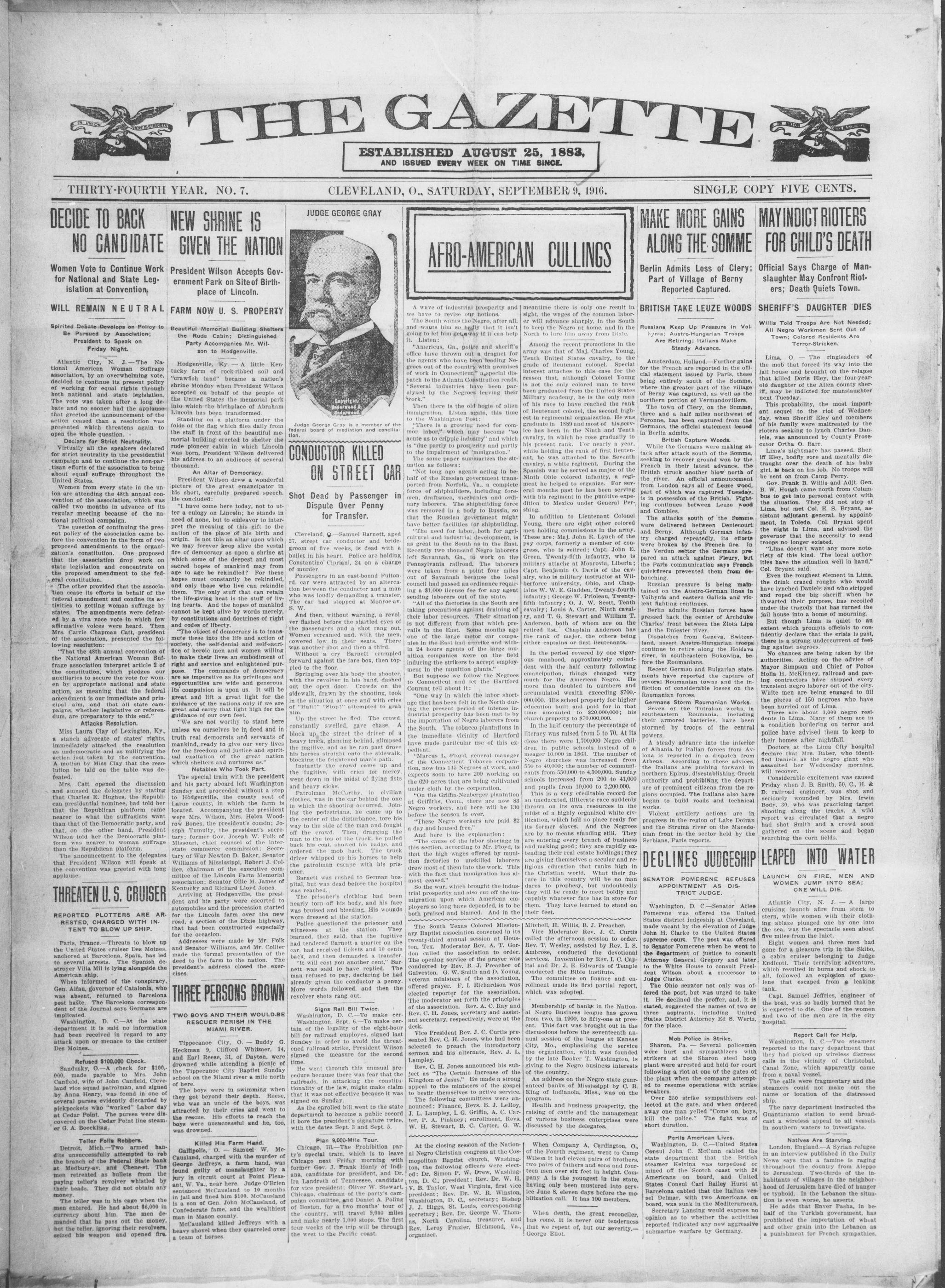
Page text (machine-generated)
THIRTY-FOURTH YEAR. NO.7.
IN VALCH
VIRGINES SIMPLICIT
DECIDE TO BACK
NO CANDIDATE
Women Vote to Continue Work for National and State Legislation at Convention.
Spirited Debate. Develops on Policy to Be Pursued by Association; President to Speak on Friday Night.
Atlantic City, N. J.—The National American Woman. Suffrage association, by an overwhelming vote, decided to continue its present policy of working for equal rights through both national and state legislation. The vote was taken after a long debate and no sooner had the applause that greeted the announcement of the action ceased than a resolution was presented which threatens again to open the whole question.
Declare for Strict Neutrality.
Virtually all the speakers declared for strict neutrality in the presidential campaign and to continue the non-partisan efforts of the association to bring about equal suffrage throughout the United States.
Women from every state in the union are attending the 48th annual convention of the association, which was called two months in advance of its regular meeting because of the national political campaign.
The question of continuing the present policy of the association came before the convention in the form of two proposed amendments to the organization's constitution. One proposed that the association drop work on state legislation and concentrate on the proposed amendment to the federal constitution.
The other provided that the association cease its efforts in behalf of the federal amendment and confine its activities to getting woman suffrage by states. The amendments were defeated by a viva voce vote in which few affirmative voices were heard. Then Mrs. Carrie Chapman Catt, president of the association, presented the following resolution: "That the 48th annual convention of the National American Woman Suffrage association interpret article 2 of the constitution, which pledges our auxiliaries to secure the vote for women by appropriate national and state action, as meaning that the federal amendment is our immediate and principal aim, and that all state campaigns, whether legislative or referendum, are preparatory to this end."
Attacks Resolution.
Miss Laura Clay of Lexington, Ky., a stanch advocate of states' rights, immediately attacked the resolution as undemocratic and as nullifying the action just taken by the convention. A motion by Miss Clay that the resolution be laid on the table was defeated.
Mrs. Catt opened the discussion and amused the delegates by stating that Charles E. Hughes, the Republican presidential nominee, had told her that the Republican platform came nearer to what the suffragists want than that of the Democratic party, and that, on the other hand, President Wilson told her the Democratic platform was nearer to woman suffrage than the Republican platform. The announcement to the delegates that President Wilson will speak at the convention was greeted with long applause.
REPORTED PLOTTERS ARE ARRESTED, CHARGED WITH IN TENT TO BLOW UP SHIP.
Paris, France.—Threats to blow up the United States cruiser Des Moines, anchored at Barcelona, Spain, has led to several arrests. The Spanish destroyer Villa Mil is lying alongside the American ship.
When informed of the conspiracy, Gen. Alfau, governor of Catalonia, who was absent, returned to Barcelona post haître. The Barcelona correspondent of the Journal says Germans are implicated.
Washington, D. C.—At the state department it is said no information had been received in regard to any attack upon or menace to the cruiser Des Moines.
Refused $100,000 Check
Refused $100.000. Check
Sanduki, O.—A. check for $100.
000, made payable to Mrs. John
Canfield, wife of John Canfield, Cleveland vice squad patrolman, and signed by Anna Henry, was found in one of several purses evidently discarded by pickpockets who "worked" Labor day at Cedar Point. The purses were discovered on the Cedar Point line steamer G. A. Boeckling.
Taller Folla Robbers.
Detroit, Mich.-Two armed bandits unsuccessfully attempted to rob the branch of the Federal State bank at Medbury-av. and Chene-at. The men retreated as bullets from the paying teller's revolver whistled by their heads. They did not obtain any money. The teller was in his cage when the men entered. He had about $6,000 in currency about him. The men demanded that he pass out the money, but the teller, ignoring their revolvers, seized his weapon and opened fire.
THE GAZETTE
NEW SHRINE IS GIVEN THE NATION
President Wilson Accepts Government Park on Site of Birthplace of Lincoln.
FARM NOW U. S. PROPERTY
Beautiful Memorial Building Shelters the Rude Cabin; Distinguished Party Accompanies Mr. Wilson to. Hodgenville.
Hodgenville, Ky. — A little Kentucky farm of rock-ribbed soil and "crawfish land" became a nation's shrine Monday when President Wilson accepted on behalf of the people of the United States the memorial park into which the birthplace of Abraham Lincoln has been transformed.
Standing on a platform under the folds of the flag which dies daily from the staff in front of the beautiful memorial building erected to shelter the rude pioneer cabin in which Lincoln was born, President Wilson delivered his address to an audience of several thousand.
An Altar of Democracy:
President Wilson drew a wonderful picture of the great emancipator in his short, carefully prepared speech. He concluded:
"I have come here today, not to utter a eulogy on Lincoln; he stands in need of none, but to endeavor to interpret the meaning of this gift to the nation of the place of his birth and origin. Is not this an altar upon which we may forever keep alive the vestal fire of democracy upon a shrine at which some of the deepest and most sacred hopes of mankind may from age to age be rekindled? For these hopes must constantly be rekindled, and only those who live can rekindle them. The only stuff that can retain the life-giving heat is the stuff of living hearts. And the hopes of mankind cannot be kept alive by words merely, by constitutions and doctrines of right and codes of liberty.
"The object of democracy is to transmute these into the life and action of society, the self-denial and self-sacrifice of heroic men and women willing to make their lives an embodiment of right and service and enlightened purpose. The commands of democracy are as imperative as its privileges and opportunities are wide and generous. Its compulsion is upon us. It will be great and lift a great light for the guidance of the nations only if we are great and carry that light high for the guidance of our own feet.
"We are not worthy to stand here unless we ourselves be in deed and in truth real democrats and servants of mankind_ready to give our very lives for the freedom and justice and spiritual exaltation of the great nation which shelters and nurtures us."
Notablea Who Took Part.
The special train with the president and his party board left Washington Sunday and proceeded without a stop to Hodgenville, the county seat of Larva county, in which the farm is located. Accompanying the president were Mrs. Wilson, Mrs. Helen Woodrow Bones; the president's cousin; Joseph Tumulty, the president's secretary; former Gov. Joseph W. Folk of Missouri, chief counsel of the interstate commerce commission; Secretary of War Newton D. Baker, Senator Williams of Mississippi, Robert J. Collier, chairman of the executive committee of the Lincoln Farm Memorial association; Senator Ollie M. James of Kentucky and Richard Lloyd Jones.
Arriving at Hodgenville, the president and his party were escorted to automobiles and the procession started for the Lincoln farm over the new road, a section of the Dixie highway, that had been constructed especially for the occasion.
Addresses were made by Mr. Folk and Senator Williams, and Mr. Collier made the formal presentation of the deed to the farm to the nation. The president's address closed the exercises.
THREE PERSONS BROWN
TWO BOYS AND THEIR WOULD-BE RESCUER PERISH IN THE MIAMI RIVER.
Tippecanoe City, O. — Buddy G. Heckman 9, Clifford Whitmier, 14, and Earl Reese, 31, of Dayton, were drowned while attending a picnic of the Tippecanoe City Baptist Sunday school on the Miami river a mile north of here.
The boys were in swimming when they got beyond their depth. Reese, who was an uncle of the boys, was attracted by their cries and went to the rescue. His efforts to reach the boys were unsuccessful and he, too, was drowned.
Killed His Farm Hand.
Gallipolis, O. — Samuel W. McCausland, charged with the murder of George Jeffreys, a farm hand, was found guilty of manlaughter by a jury in circuit court at Point Pleasant, W. Va., near here. Judge O'Brien sentenced McCausland to 10 months in jail and fined him $100. McCausland is a son of Gen. John McCausland, of Confederate fame, and the wealthiest man in Mason county. McCausland killed Jeffreys with a heavy shovel when they quarreled over a team of horses.
ESTABLISHED AUGUST 25, 1883 AND ISSUED EVERY WEEK ON TIME SINCE.
CLEVELAND, O., SATURDAY, SEPTEMBER 9, 1916.
Judge George Gray is a member of the federal board of mediation and conciliation.
Cleveland, Q. Samuel Barnett, aged 27, street car conductor and bridegroom of five weeks, is dead with a bullet in his heart. Police are holding Constantino Cipriani, 24 on a charge of murder.
Passengers in an east-bound Fulton rd. car were attracted by an alteration between the conductor and a man who was loudly demanding a transfer. The car had stopped at Mongoose-av. S. W.
And then, without warning, a revolver flashed before the startled eyes of the passengers and a shot rang out. Women screamed and, with the men, cowered low in their seats. There was another shot and then a third.
Without a cry Darnett crumpled forward against the fare box, then toppled to the floor.
Springing over his body the shooter, with the receiver in his hand, dashed out the open door. Crowds on the sidewalk, drawn by the shooter, took in the situation at once and with cries of "Hail!" "Stop!" attempted to grab him.
Up the street he fleed. The crowd, constantly swelled, gave chase. A block up, the street the driver of a heavy truck, glancing behind, glimpsed the fugitive, and as he ran past drove his horses straight onto the sidewalk, blocking the frightened man's path.
Instantly the crowd came up and the fugitive, with cries top more, went down in the midst of flying fists and heavy sicks.
Patrolman McCarthy, in civilian clothes, was in the car behind the one in which the shooting occurred. Joining the pedestrians, he came up to the center of the disturbance, tore his way to the side of the man and fought off the crowd. Then, dragging the man to the top of the truck, he pulled back his coat, showed his badge, and ordered 'the mob back.' The truck driver whipped up his horses to help the patrolman escape with his prisoner.
Barnett was rushed to German hospital, but was dead before the hospital was reached.
The prisoner's clothing had been nearly torn off his body, and his face was bruised and bleeding. His wounds were dressed at the station.
Police questioned the prisoner and witnesses at the station. They learned, they said, that the fugitive had tendered Barnett a quarter on the car, had received tickets and 10 cents back, and then demanded a transfer. "It will cost you another cent," Barnett was said to have replied. The man refused to pay, declaring he had already given the conductor a penny. More words followed, and then the revolver shots rang out.
Siins Ball Bill Twice
Washington, D. C.—To make cer-
Washington, Sept. 6.—To make certain of the legality of the eight-hour bill for railroad employees, signed last Sunday in order to avoid the threaten-
ened railroad strike, President Wilson signed the measure for the second time.
He went through this unusual procedure because there was fear that the railroads, in attacking the constitutionality of the law, might make claim that it was not effective because it was signed on Sunday.
As the enrolled bill went to the state department to become a public record it bore the president's signature twice, with the dates Sept. 3 and Sept. 5.
Plan 8,000-Mile Tour
Plan 9,000-mile Tour.
Chicago. Ill. The Prohibition party's special train, which is to leave Chicago next Friday morning with former Gov. J. Frank Hanley of Indiana, candidate for president, and Dr. Ira Landreth of Tennessee, candidate for vice president; Oliver W. Stewart, Chicago, chairman of the party's campaign committee, and Daniel A. Polling of Boston, for a two months' tour of the country, will travel 3,000 miles and make nearly 1,000 stops. The first four weeks, of the trip will be through the west to the Pacific coast.
AFRO-AMERICAN CULLINGS
A wave of industrial prosperity and we have to revise our notions.
The South warns the Negro, after all, and waits him so boldly that it isn't going to let him get away if it can help him. Listen.
"Americans, Gn., police and sheriffs office have thrown out a dragnet for the agents who have been leading Negroes out of the country with promises of work in Connecticut," a special dispatch to the Atlanta Constitution reads. "Several industries have been paralyzed by the Negroes leaving their work."
Then there is the old bogie of allen immigration. Lyden again, this time to the Washington Post:
"There is a growing, need for common labor," which may become "so nectate as cripple industry" and which is "blue partly to prosperity and partly to the impairment of 'immigration.'"
The same paper summarizes the situation as follows:
"Not long ago agents acting in behalf of the Russian government transported from Norfolk, Vn., a complete force of shipbuilders, including foremen, drafters, mechanics and ordnary laborers. The shipbuilding force was removed in a body to Russia, so that the Russian government might have better facilities or shipbuilding.
"The need for labor, both for agricultural and industrial development, is as great in the South as in the East. Twenty two thousand Negro laborers left Savannah, Gn., to work on the Pennsylvania railroad. The laborers were taken from a point four miles out of Savannah because the local commell had passed an ordnance requiring a $1,000 license fee for any agent sending laborers out of the state.
"All of the factories in the South are taking precautions against draining of their labor resources. Their situation is not different from that which prevails in the East. Some months ago one of the large motor car companies in the East had workers and within 24 hours agents of the large munition companies were on the field inducing the strikers to accept employment in the munition plants."
But suppose we follow the Negroes to Connecticut and let the Hartford Courant tell about it:
"One way in which the labor shortage that has been felt in the North during the present period of intense industrial prosperity has been met by the importation of Negro laborers from the South. The tobacco plantations in the immediate vicinity of Hartford have made particular use of this expellent.
"Marcus L. Floyd, general manager of the Connecticut Tobacco corporation, now has 115 Negroes at work, and expects soon to have 200 working on the 620 acres that are being cultivated under cloth by the corporation.
"On the Griffin-Neuberger plantation at Griffin, Conn., there are now 38 Negro workers, and here will be 130 before the season is over."
"These Negro workers are paid $2 a day and housed free."
And here is the explanation:
"The cause of the labor shortage in this section, according to Mr. Floyd, is that the high wages offered by mutilation factories to unskilled laborers drew most of them into the work. This with the fact that immigration has almost ceased."
So the war, which brought the industrial prosperity and also cut off the immigration upon which American employees so long have been, is to be both praised and blamed. And in the
The South Texas Colored Missionary Baptist association convened in its twentieth annual session at Houston, Tex. Moderator Rev. A. T. Gordon called the association to order. The opening service of the prayer was conducted by Rev. B. J. Preecher of Galveston. G. W. Smith and D. Young, veteran ministers of the association, offered prayer. F. I. Richardson was elected reporter for the association. The moderator set forth the principles of the association. Rev. A. C. Ray and Rev. C. H. Jones, secretary and assistant secretary, respectively, were at the desk.
Vice President Rev. J. C. Curtis presented Rev. C. H. Jones, who had been selected to preach the introductory sermon and, his alternate, Rev. J. L. Loyleys
Rev. G. H. Jones announced his subject as "The Certain Increase of the Kingdom of Jesus." He made a strong appeal to the ministers of the gospel to bestir themselves to active service. The following committees were announced: Finance, Revs. B. J. LeRoy, J. L. Lampley, I. G. Griffin, A. C. Carter, P. A. Pinkney; enrollment, Revs. W. H. Stewart, B. C. Carter, G. W.
At the closing session of the National Negro Christian congress at the Cosmopolitan Baptist church, Washington, the following officers were elected: Dr. Simon P. W. Drew, Washington, D. C., president; Rev. Dr. W. H. V. B. Taylor, West Virginia, first vice president; Dr. Dr. W. R. Winston, Washington, D. C., secretary; Bishop J. Higgs, St. Louis, corresponding secretary; Rev. Dr. George W. Thomas, North Carolina, treasurer, and Rev. Leroy Frazier, Richmond, Va. organizer.
meantime there is only one result in the wages, the wages of the common laborer will advance sharply, in the South to the Negro in home, and in the North to Free him away from Dale.
Among the recent promotions in the army was that of Maj. Charles Young, Tenth United States cavalry, to the grade of lieutenant colonel. Special interest attaches to this case for the reason that, although Colonel Young is not the only colored man to have been graduated from the United States Military academy, he is the only man of his race to have reached the rank of lieutenant colonel, the second highest in regimental organization. He was graduate in 1859 and most of his service has been in the Ninth and Tenth cavalry, in which he rose gradually to his present rank. For nearly a year, while holding the rank of first lieutenant, he was attached to the Seventh cavalry, a white regiment. During the Spanish war he served as major of the Ninth Ohio colored infantry, a regiment he helped to organize. For several months post-tre has been serving with his regiment in the punitive expedition to Mexico under General Pershing.
In addition to Lieutenant Colonel Young, there are eight other colored men holding commissions in the army. These are: Maj. John R. Lynch of the pay corps, formerly a member of congress, who is retired; Capt. John E. Green, Twenty-fifth Infantry, who is military attache at Monroeville, Liberia; Capt. Benjamin O. Davis of the cavalry, who is military instructor at Wilkforce university, Ohio, and Chapkins W. W. G. Glidden, twenty-fourth infantry; George W. Proleon, Twenty-fifth infantry; O. J. W. Scott, Tenth cavalry; Louis A. Carter, Ninth cavalry, and T. G. Stewart and William T. Anderson, both of whom are on the retired list. Chapman Anderson has the rank of under, the others being either captain or first Lieutenants.
In the period covered by one vigorous manhood, approximately coincident with the half century following emancipation, things changed very much for the American Negro. He more than doubled in numbers and accumulated wealth exceeding $700,000,000. His school property for higher education built and paid for in that time amounted to $20,000,000; his church property to $70,000,000.
In the half century the percentage of
literacy was raised from 5 to 70. At its
close there were 1,700,000 Negro children
in public schools instead of a meager 10,000 in 1855. The number of
Negro churches was, increased from
550 to 40,000; the number of commun-
ications from 550,000 to 4,300,000. Sunday
schools increased from 200 to 41,000
and tumbs from 10,000 to 2,250,000.
This is a very creditable record for on uneducated, illiterate race suddenly thrown on its own resources in the midst of a highly organized white civilization, which had no place ready for its former slaves. And the Negroes are by no means stounding stiff. They are entering every branch of business and making good; they are rapidly extending their real estate holdings; they are giving themselves a secular and religious education that ranks 'high' in the Christian world. What their future in this country will be no manners to prophesy, but undoubtedly they will be ready to meet boldly and capably whatever fate has in store for them. They have learned to stand on their feet.
Mitchell, H. Willis, B. J. Preacher.
Vice Moderator Rev. J. C. Curtis called the afternoon session to order.
Rev. T. Wesley, assisted by Rev. I. S. Ambrose, conducted the devotional services, Invocation by Rev. I. C. Capital and Dr. J. E. Edwards of Temple conducted the Bible institute.
The committee on finance and employment made its first partial report, which was adopted.
Membership of banks in the National Negro Business league has grown from two, in 1000, to fifty-one at present. This fact was brought out in the discussions before the seventeenth annual session of the league at Kansas City, Mo., emphasizing the service the organization, which was founded by the late Booker T. Washington, is giving to the Negro business interests of the country.
An address on the Negro state guaranteed banks of Mississippi by C. B. King of Indianah, Miss., was on the program.
Health and business prosperity, the raising of cattle and the management of various business enterprises were discussed by the delegates.
When Company A. Cardington, O., of the Fourth regiment, went to Camp Wilson it had eleven pairs of brothers, two pairs of fathers and sons and fourteen men over six feet in height. Company A is the youngest in the state, having only been mustered into service June 8, eleven days before the mobilization call. It has 100 members.
When death, the great reconciler, has come. It is never our tenderness that we repent of, but our seerity. George Ellot.
SINGLE COPY FIVE CENTS.
MAKE MORE GAINS ALONG THE SOMME
Berlin Admits Loss of Clery; Part of Village of Berny Reported Captured.
Russians Keep Up Pressure in Vol-
onia; Austro-Hungarian Troops.
Are Retiring; Italians Make
Steady Advance.
Amsterdam, Holland.—Further gains
for the French are reported in the offi-
cial statement issued by Paris; these
belong entirely south of the Somme,
where the greater part of the village
of Berny was captured, as well as the
northern portion of Vermandvilliers.
The town of Clery, on the Somme,
threep and a half miles northwest of
Peronne, has been captured from the
Germans, the official statement issued
in Berlin admits.
British Capture Woods.
While the Germans were making attack
after attack south of the Somme,
socking to recover ground won by the
French in their latest advance, the
British struck another blow north of
the river. An official announcement
from London says all of Leuze wood,
part of which was captured Tuesday,
is in possession of the British. Fight-
ing continues between Leuze wood
and Combles.
The attacks south of the Somme
were delivered between Deniecourt
and Berny. Although German infantry
charged repeatedly, its efforts
were broken by the French fire. In
the Verdun sector the Germans prea-
red an attack against Fleury, but
the Paris communication says French
quickfriers prevented them from de-
bouching.
Russian pressure is being maintained on the Austro-German lines in Volhynia and eastern Galicia and violent fighting continues.
Berlin admits Russian forces have pressed back the center of Archduche Charles' front between the Zhota Lipa and the Dniester river.
Dispatches from Geneva, Switzerland, assert Austro-Hungarian troops continue to retire along the Holdava river, in southeastern Bukowina, before the Roumanians.
Recent German and Bulgarian statements have reported the capture of several Roumanian towns and the infliction of considerable losses on the Roumanian forces.
Germans Storm Roumanian Works. Seven of the Tutrakan works, in southeastern Roumania, including their armored batteries, have been stormed by troops of the central powers. A steady advance into the interior of Albania by Italian forces from Aylona is reported in a dispatch from Athens. According to these advises, the Italians are pushing forward in northern Epirus, disestablishing Greek authority and prohibiting the departure of prominent citizens from the regions occupied. The Italians also have begun to build roads and technical works. Violent artillery actions are in progress in the region of Lake Poiaran and the Struma river on the Macedonian front in the sector held by the Sebrians, Paris reports.
DECLINES JUDGESHIP
SENATOR POMERENE REFUSES
APPOINTMENT AS DIS
TRICT JUDGE.
Washington, D. C.—Senator Atlee
Pomerene was offered the United
States district judgeship at Cleveland,
made vacant by the elevation of Judge
John H. Clarke to the United States
supreme court. The post was offered
to Senator Pomerene when he went to
the department of justice to consult
Attorney General Gregory and later
to the White House to consult President
Wilson about a successor to
Judge Clarke.
The Ohio senator not only was offered
the post, but was urged to take it.
He declined the proffer, and, it is
stated, suggested the names of two or
three aspirants, including United
States District Attorney Ed S. Wertz,
for the place.
Mob Police in Strike.
Sharon, Pa. — Several policemen were hurt and sympathizers with strikers at the Sharon steel hoop plant were arrested and held for court following a riot at one of the gates of the plant when the company attempted to resume operations with strike breakers. Over 250 strike sympathizers collected at the gate, and when ordered away one man yelled "Come on boys, kill the police." The fight was of short duration.
Perils American Lives.
Washington, D. C.-United States Consul John C. McCunn called the state department that the British steamer Kelvina was torpedoed or mined off the Scotch coast, with 28 Americans on board, and United States Consul Carl Balley Hurat at Barcelona cabled that the Italian vessel Delmar, with two Americans on board, was sunk in the Mediterranean. Secretary Lansing would express no opinion as to whether the activities reported indicated any new aggressive submarine warfare by Germany.
VIRGINIA
THE
REPUBLIC
MAY INDICT RIOTERS FOR CHILD'S DEATH
Official Says Charge of Manslaughter May Confront Rioters; Death Quiets Town...
SHERIFF'S DAUGHTER DIES
Willis Told Troops Are Not Needed; All Negro Workmen Sent Out of Town; Colored Residents Are Terror-Stricken.
Lima, O. — The ringleaders of the mob that forced its way into the jail house, and brought on the relapse that killed Dort's Eley, the four-year-old daughter of the Allen county sheriff, may be indicted for manslaughter next Tuesday.
This probability, the most important sequel to the riot of Wednesday, when Sheriff Eley and members of his family were maltreated by the rolters seeking to lynch Charles Daniels, was announced by County Prosecutor Ortha O. Barr.
Lima's nightmare has passed. Sheriff Eley, bodily sore and mentally distraught over the death of his, baby girl, back on his job. No troops will be sent on from Camp-Perry.
Gov. Frank B. Willis and Adj. Gen. B. W. Hough came north from Columbus to get into personal contact with the situation. They did not stop at Lima, but met Col. E. S. Bryant, assistant adjutant general, by appointment, in Toledo. Col. Bryant spent the night in Lima, and advised the governor that the necessity to send troops no longer existed.
"Lima doesn't want any more notoriety of this kind. The local authorities have the situation well in hand," Col. Bryant said.
Even the roughest element in Lima, the drink craved roughs who would have lynched Daniels and who stripped and roped the big sheriff when he thwarted their purpose, has recoiled under the tragedy that has turned the jail house into a home of mourning.
But though Lima is quiet to an extent which prompts officials to confidently declare that the crisis is past, there is a strong undercurrent of feeling against negroes.
No chances are being taken by the authorities. Acting on the advice of Mayor Simpson and Chief of Police Holla H. McKinney, railroad and paving contractors have shipped every transient negro laborer out of the city. White men are being engaged to fill the places of 150 negroes who have been hurried out of Lima.
There are about 1,000 negro residents in Lima. Many of them are in a condition bordering on terror and police have advised them to keep to their homes after nightfall.
Doctors at the Lima City hospital declare that Mrs. Baber, who identified Daniels as the negro giant who assaulted her Wednesday morning, will recover.
Considerable excitement was caused Friday when J. B. Smith, 50, C., H. & D. railroad engineer, was shof and seriously wounded by Mrs. Irwin Bddy, 30, who was practicing target shooting along the tracks. A wild report was circulated that a negro had shot Smith and a crowd soon gathered on the scene and began searching the corn fields.
LEAPED INTO WATER
LAUNCH ON FIRE, MEN AND WOMEN JUMP INTO SEA ONE WILL DIE.
Atlantic City, N. J. — A large cruising launch afire from stem to stern, while women with their clothing ablaze plunged one by one into the sea, was the spectacle seen about five miles from the Inlet.
Eight women and three men had gone for a pleasure trip in the Skibo, a cabin cruiser belonging to Judge Endicott. Their terrifying adventure, which resulted in burns and shock to all, followed an explosion of gasoline that escaped from a leaking tank.
Capt. Samuel Jeffries, engineer of the boat, was so badly burned that he is expected to die. One of the women and two of the men are in the city hospital.
Report Call for Help.
Washington, D. C. - Two steamers reported to the navy department that they had picked up wireless distress-calls in the vicinity of Christobal, Canal Zone, which apparently came from a naval vessel.
The calls were fragmentary and the steamers could not make out the name or location of the distressed ship.
The navy department instructed the Guantanamo station to send broadcast a wireless appeal to all vessels in southern waters to investigate.
Natives Are Starving.
London. England.—A Syrian refugee in an interview published in the Daily News says that a famine is raging throughout the country from Aleppo to Jerusalem. Two-thirds of the inhabitants of villages in the neighborhood of Jerusalem have died of hunger or typhoid. In the Lebanon the situation is even worse, he asserts.
He adds that Enver Fasha, in behalf of the Turkish government, has prohibited the importation of wheat and other grain into the Lebanon as a punishment for French sympathies.
One Year.....$1.50.
Six Months.....1.00
Three Months......50
Subscribers are requested to re-
mit by postoffice money or
der or registered letter
Entered at the postoffice in Cleveland
Ohio, as second-class matter.
Address all communications to
Blackstone Building, Cleveland, O.
Member Ohio Legislature: 1894
to 1898; 1896 to 1898; 1900 to 1902
THE GAZETTE is the oldest, and has the largest bone fide circulation, double that of any newspaper in the interest of Afro-Americans, published in the state of Ohio, and comparison with any will immediately establish its rank as one of the NEWSIEST AND BEST in the country.
10,000,000 Afro-Americans..
160,000 in Ohio.
20,000 in Cleveland.
SATURDAY, SEPTEMBER 9, 1916.
DARE TO DO YOUR DUTY.
"Let us have faith that right makes might, and in that faith let us to the end dare to do our duty as we understand it"—Abraham Lincoln.
A Tammany politician, hearing that Attorney Samuel Untermeyer's health will not permit him to be the Democratic candidate for Senator in New York this year, immediately diagnosed Mr. Untermeyer's disease as "cold feet."
One unique distinction that Mr. Charles E. Hughes quickly achieved in this campaign was that of having a Cabinet meeting devoted to a discussion of his Detroit speech. Cabinet meetings are supposed to be national councils—but Thomas Woodrow Wilson makes his resemble a conference of political chenchmen.
A certain Judge Hudspeth, of New Jersey, has been at Washington, D.C., talking most optimistically about the re-election of Wilson. "We await tranquilly," he says, "the result at the polls in November." This recalls the familiar line which comes from a prison on the eve of an execution. "The doomed man was wholly calm," the reporters always say.
The idols of the Southwest are crumbling. We certainly wish we could say as much for the Southeast. Added to the failure of "Cyclone" Davis to achieve a renomination to Congress in the Democratic primaries we now have the startling intelligence that "Alfalfa Bill" Murray, of Oklahoma, has been denied another term by his Democratic constituents.
Democratic campaign managers should not be so disappointed over the course of the Progressives in going back into the Republican party. In the Progressive platform of 1912 the Progressives adopted a tariff plank that was identical with one previously adopted by a Republican convention. In the differences that exist over the tariff question, we find the fundamental difference between the Republican and Democratic parties. A Progressive who believes in an "America First" tariff could not do otherwise than go back to the Republican party.
"National Guardsmen Enjoy Life in Camp," says a Democratic campaign bulletin. Since the Democratic National Committee is thus trying to make politics out of the retention of the guardsmen on the border, they must not complain when the men and their relatives at home pass criticism upon the management of the Mexican flasco. It is a poor rule that won't work both ways, and it is a safe guess that when it comes to making politics of a military maneuver that calls for a $130,000,000 bond issue, there will be more than one side to it.
Ex-Gov. Cole Blease, of South Carolina, whose abuse of our people, is only paralleled by Senator Ben Tillman's, in his calmest days, led his nearest competitor for the nomination of U. S. Senator by thousands of votes, but failed to get a clear majority. On the twelfth of this month there is to be another primary and the outlook is that the unspeakable Blease will win. Tillman is about to retire from the U. S. Senate, bequeathing to the people at large a successor who out-Tillmans Tillman. They are to be pitted. Abuse of the "Negro" pays in the South. Blease and Tillman and others have proved this beyond all question or doubt.
A popular testimonial of some kind should be given by the public at large in this state, to Sheriff Sherman Eley of Lima. His heroic work and great personal and family sacrifice in doing his duty—saving the life of his prisoner, an Afro-American—are seldom, if ever, duplicated in this country. There is no doubt of the salutary influence of our Ohio anti-lynching law in this case, either, as in dozens of others since its enactment in 1896. It is sincerely to be hoped, for the good name of Ohio, that many if not all of the participants, in the mob, that are indicted will be convicted and given good, long sentences in the state penitentiary. It is said that southerners residents of Lima, led the mob. This is usually the case.
Three years ago President Thomas
---
Woodrow Wilson first took the Mexican problem to Congress, and he then declared that an orderly and constitutional and fair election should be held in that country. Since then he has taken no steps to secure this result—but his protege, Carranza, is supplying the omission. Carranza has just decreed that an election shall take place in Mexico, at which he will be a candidate. In order that the election shall result in no mischance choice of a President for Mexico, Carranza will name all the election officers, who, in turn, will prepare all the lists of voters. Thus, none but Carranza men will come to the polls and Carranza will be chosen. It is evident that Carranza has studied the model of Woodrow Wilson's party to good advantage. This is the method which the Democratic party in the South adopts to keep itself in power. We shall ently see how it will work still further south, in Mexico.
THE "JIM-CROW NEGRO" AGAIN
Establishment of a military institute for Negro students along the lines of the West Point Military Academy was urged upon President Wilson, Aug. 30, by a delegation of Negro Democrats, representing the Hannibal National Democratic League. The delegation presented a memorial pledging the support of the league in the president's campaign for re-election. The memorial requested that a Negro West Point be created for the purpose of turning out officers for the Negro military organizations of the army as a fitting acknowledgment of the services performed by Negro troops in Mexico and during the Spanish-American war.
Again, the "jim-crow" Negro' Won't some one crack the members of that "Hannibal National Democratic League" on the heads long enough to wake them up? Their desire for "political preferment seems powerful enough to make them say and do almost anything regardless of how much harm it may do the race. Even they ought to realize by this time that President Thomas Woodrow Wilson and his southern-controlled democratic Congress are not only bitterly opposed to Afro-American officers in the U. S. army but also to the enlistment of members of the race. They showed this unmistakably in the passage of the most recent army reorganization bill.
The eleven hundred citizens of Syracuse, N. Y., whose children attend mixed schools, were considerably startled, recently, by the utterances of a Washington, D. C., school teacher in advocating separate schools there for our children. The teacher is Miss Lola Johnson, director of music in the Washington Normal school. As all know the nation's capital has separate schools for our children; and Miss Johnson is one of our teachers there. Wonder if she, too, is a member of the "Hanubal National Democratic League"? Comment unnecessary. Whither are we drifting? Of course, our people of Syracuse are much wrought up over Miss Johnson's shameful and disgraceful attempt to "turn back the hands of progress" and change the long existing system of mixed schools with which they are well satisfied. The race's greatest and most active enemy, today, seems to be the "tim-cum" Negro.
J. R. Pulpress, of Pittsburg, Pa., whose daughter has recently been refused a school in that city, after fully complying with all the requirements of those who would teach in Pittsburg's public schools, is in Cleveland endeavoring to have her placed in our schools and we sincerely hope that he is successful. It will prove an object lesson for Sup't. Davidson of that city, and the city itself, that apparently is much needed. Mr. Pulpress complains bitterly of the "jim-crow" Negroes of his city, who include many of our leading men there whom he names, saying that for fear of the loss of political prestige with the local Republican "bosses", they refused to espouse the cause of his daughter, SHAME! It is more a race question than that of the individual.
ADOPTED SON, WHITE.
Contesting Hitchens' Will—Over $100
000 Estate Left—White Wife
Withdraws Her Contest.
Baltimore, Md.—A third chapter was written Saturday week in the contest over the $100,000 estate of the late James L. Hitchens, when his white adopted son attacked, through Attorney Warner T. McGuinn, the validity of Hitchens' marriage to his white widow at Harrisburg, Pa., last October. It is alleged to be void because Maryland laws do not permit inter-marriage. This suit may bring the question to an issue. Attorneys Peter J. Campbell, German H. H. Warner T. McGuinn, the latter Colored, who have been named as administrators of the estate, were named as receivers, and who are paid $10,000. The property is to cover several valuable properties owned by the testator. Young Hitchens is the principal legaee. The widow of the testator, who was left only a small share, at first filed a notice of contest for her dower rights, but later withdrew same. Hitchens left three brothers—Ernest, John and Stephen Hitchens, the latter of New York City—$600 between them. They have contested the will through Attorneys Hawkins and McMechen.
Army officers at Washington, D. C. are interested in reports from Manila of the successful trial of a new and powerful gunpowder invented by two troopers of the Ninth Cavalry, "Will Peters and Kyle Arnell, which can be made at hat the cost of the powder now used for rifle cartridges. It is smokeless, is said to have been ened in a regulation army rifle at Camp Stotzenburg in Pennsylvania, P.L., and enamed to bullet half way through an inch of solid steel. At 1,000 yards it is only necessary to use the regulation 100 yards elevation of the gun. If this is true it is more powerful than the powder now used by the army. Kyle Arnell is from Cincinnati and Peters from Louisville.
Civil service examinations for 200 jobs in the Washington postoffice department paying $800 and $1,000 a year, will be held on September 26. The main qualification, as stated in the announcement, is that the applicant be a "male stenographer-towriter."
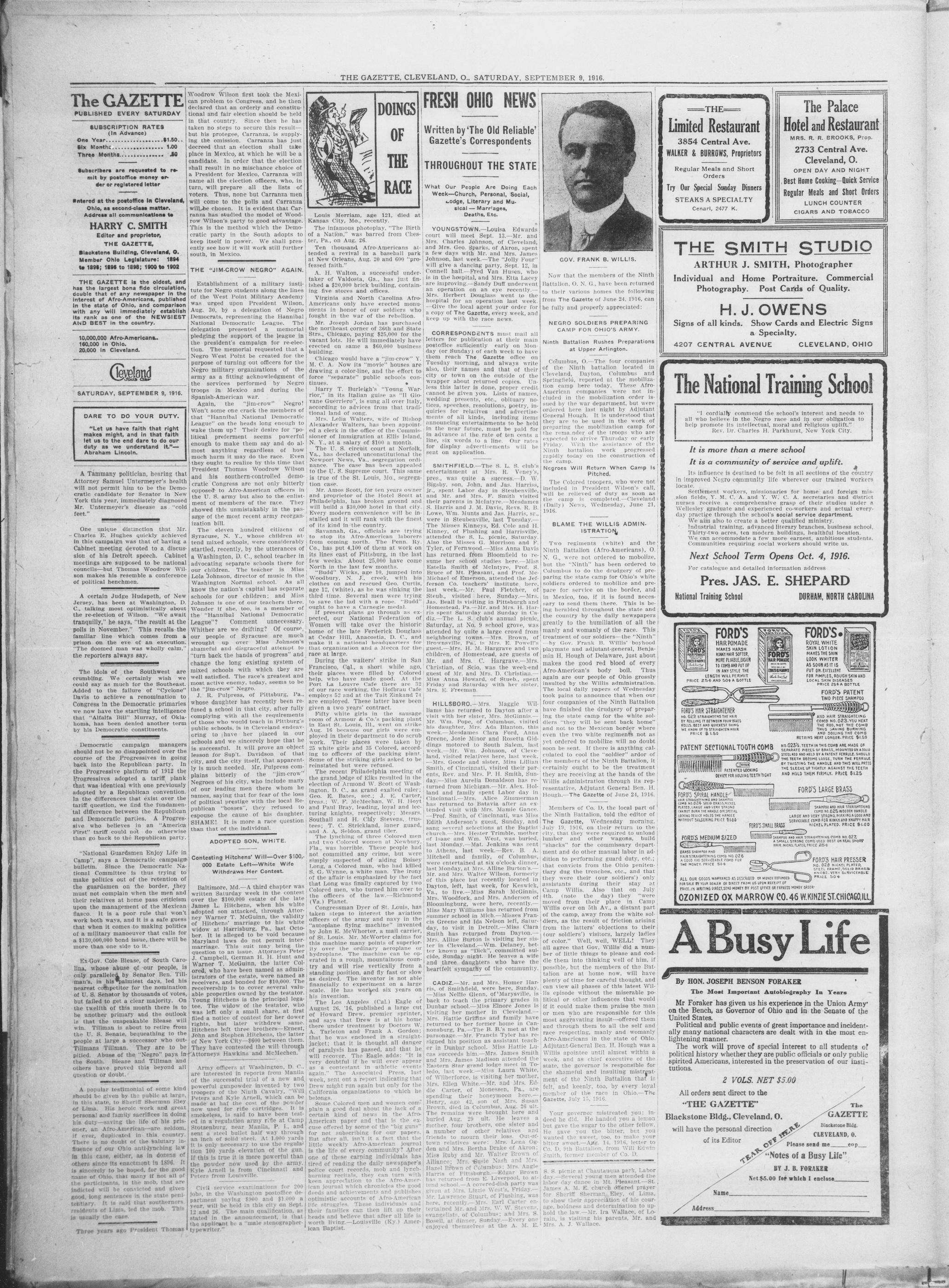
THE GAZETTE, CLEVELAND, O., SATURDAY, SEPTEMBER 9, 1916.
DOINGS OF THE RACE
Louis Merriam, age 121, died at Kansas City, Mo., recently. The infamous photoplay, "The Birth of a Nation," was barred from Chester, Pa., on Aug. 26.
FRESH OHIO NEWS
Written by 'The Old Reliable' Gazette's Correspondents
THROUGHOUT THE STATE
What Our People Are Doing Each Week—Church, Personal, Social, Lodge, Literary and Musical—Marriages, Deaths, Etc.
YOUNGSTOWN—Louisa Edwards court will meet Sept. 13.—Mr. and Mrs. Charles Johnson of Cleveland
Ten thousand Afro-Americans attended a revival in a baseball park at New Orleans, Aug. 20 and 600 "professed faith."
A. H. Walton, a successful undertaker of Valdosta, Ga., has just finished a $20,000 brick building, containing five stores and offices.
Virginia and North Carolina Afro-Americans only have erected monuments in honor of our soldiers who fought in the war of the rebellion.
Fought with Jordan has purchased the northeast corner of 36th and State Strs, Chicago paying $25,000 for the vacant lots. He will immediately have erected on same a $60,000 business building.
Chicago would have a "jim-crow" Y. M. C. A. Now its "movie" houses are drawing a color-line, and the effort to force "separate" public schools continues.
Harry T. Bulewright's "Young Warriors in its Italian guise as "All Glue Gauceri" is sung over Italy, according to advice from that traditional land of song.
Mrs. Lelia Walters, wife of Bishop Alexander Walters, has been appointed a clerk in the office of the Commissioner of Immigration at Ellis Island, N. Y., at a salary of $100 a month. The U. S. circuit court at Norfolk, Va., has declared unconstitutional the Va. segregation ordinance. The case was heard to the U. S. Supreme court. This same is true of the St. Louis, Mo., segregation case. Mr. Amos Scott, for ten years owner and proprietor of the Hotel Scott at Philadelphia, has broken ground and will build a $30,000 hotel in that city. Every modern convenience will be installed and it will rank with the finest of its kind in the country. Savannah, Ga., officials are trying to stop its Afro-American laborers from working in the Co., has put 4,100 of them at work on its lines east of Pittsburgh, in the last few weeks. About 25,000 have come North in the last few months.
"Budd" Wicks, age 10, jumped into Woodbury, N. J. creek, with his clothes on and rescued Geo. Curtis, age 12, (white), as he was sinking the third time. Several men were trying to save the lad with a rope. "Budd" outwitted him. In present plans go through as expected, our National Federation of Women will take over the historic home of the late Ferdierk Douglass at Cedar Hill, Anacostia, D. C., and make it a national headquarters for that organization and a Mecca for the race at large. During the waiters' strike in San Francisco, Cal., a short while ago, their places were filled by Colored help, who have made good. At the end of the race, all of our race working, the Hofbrau Cafe employs 52 and at the Tait Zinkand 7 are employed. These latter have been given a two years' contract.
Fifty white girls in the sausage room of Armour & Co.'s packing plant in East St. Louis, IL, went on strike Aug. 16 because our girls were employed in their department to do scrub work. Their places were taken by 25 white girls and 35 Colored, according to officers of the packing plant. Some of the striking girls asked to be reinstated but were refused.
The recent Philadelphia meeting of the grand lodge of Elks resulted in the election of Armond W. Scott of Washington D. C., as grand exalted ruler; E. B. Bray, of Boston; E. Carter, trees; W. F. McMechan, W. H. Hoyt and Paul Bray, leading, loyal and lecturing knights, respectively; Messrs. Southall and H. Clay Stevens, trustees; T. C. Strickland, inner guard, and A. A. Seldon, grand tiler.
The lynching of three Colored men and two Colored women at Newbury, Fla., was horrible. These people had not committed any crime, but were simply suspected of aliding Boisey Long, a Colored man, who had killed S. G. Wynne, a white man. The irony of the affair is emphasized by the fact that Long was mainly captain of the ship, who turned him over to the officers of the law — Richmond (Va.) Planet. Congressman Dyer of St. Louis, has taken steps to interest the aviation officers of the army and navy in the "autoplane flying machine" invented by John E. McWhorter, a mail carrier, of St. Louis. Mr. McWorter claims for this machine many points of superiority over the ordinary aeroplane or hydroplane. The machine can be operated with high commanding coords and will rise vertically from a standing position, and fly fast or slow as desired. The inventor is not able financially to experiment on a large scale. He has worked six years on his invention.
The Los Angeles (Cal.) Eagle of August 26, 16, published a large cut of Howard Drew, premier sprinter, and says that Drew is at his home there under treatment by Doctors W. A. Tarleton and Frank A. Gordon; that he was enclosed in a straight jacket; that it is thought all danger of paralysis has passed, and that he will recover. The Eagle adds: "It is very doubtful if he will ever appear in contest and in athletic events again." The Associated Press, last week, sent out a report indicating that Drew might run again but only for the California organizations to which he belongs.
Some Colored men and women complain a good deal about the lack of a certain kind of news in the Afro-American paper and that is the excuse offered by some of the "big guns" for not subscribing for our papers. But after all, isn't it the case that Afro-American journal is the life of every community? After one of these earning individuals has tired of reading the daily newspaper's police court records, mob and lynchburning recitals, they can turn with keen appreciation to the Afro-American journal which chronicles the good deeds and achievements and publishes optimistic accounts of Afro-American life struggles. These individuals and their families can be heard that after all life is worth living—Louisville (Ky.) American Baptist.
FRESH OHIO NEWS
Written by 'The Old Reliable' Gazette's Correspondents
THROUGHOUT THE STATE
What Our People Are Doing Each Week—Church, Personal, Social, Lodge, Literary and Musical—Mariages, Deaths, Etc.
YOUNGSTOWN.—Louisa Edwards court will meet Sept. 13.—Mr. and Mrs. Charles Johnson, of Cleveland, and Mrs. Geo. Sparks, of Akron, spent a few days with Mr. and Mrs. James Johnson, last week.—The "Jolly Four" will give a dancing party, Sept. 12, in Cornell hall.—Fred Van Husen, who is in the hospital, and Mrs. Etta Lacey are impatient. Duff underwent an operation on an accident recently. Herbert Douglass went to the hospital for an operation last week.—Give the local agent your order for a copy of The Gazette, every week, and keep up with the race news.
CORRESPONDENTS must mail all letters for publication at their main postoffice sufficiently early on Monday (or Sunday) of each week to have them reach The Gazette office on Tuesday morning, and always write also, their names and that of their city or town on the outside of the wrapper about returned copies. Unless this latter is done, proper credit cannot be given you. Lists of names, wedding presents, etc., obituary notices, speeches, resolutions, poetry, inquiries for relatives and advertisements of all kinds, including items in the near future, must be paid for in advance at the rate of ten cents a line, six words to a line. Our rates for display advertisements will be sent on application.
SMITHFIELD—The S. L. S. club's entertainment at Mrs. R. Veney's, pres, was quite a success.—D. W. Bigsby, son, John, and Jas. Harris, jr., spent Labor day in Steubenville, and Mr. and Mrs. F. Smith visited their parents in McIntyre—Mesdames S. Harris and J. M. Davis, Revs. R. B. Lowe, Wm. Munts and Jas. Harris, sr., were in Steubenville, last Tuesday. The Misses Kninnes, Ed. Cole and H. Kirkman, held an evening and holiday attended the L. S. picnic, Saturday. Also the Misses G. Morrison and F. Tleyr, of Fernwood—Miss Anna Davis has returned from Bloomfield to resume her school studies here.—Miss Estella Smith of McIntyre, Prof. S. Bruce of M. Pt. M pleasant, and Prof. M. McMichael of Emerson, attended the Jefferson Co. teachers' institute last week. Mr. Paul Fletcher, of week, he has held the Mrs. Jas. Beall is visiting in Pittsburgh and Homestead. Pa.-Mr. and Mrs. H. Harris spent Saturday and Sunday in Cadiz.—The L. S. club's annual picnic, Saturday, at No. 9 school grove, was attended by quite a large crowd from neighboring towns—Mrs. Brown, of Brownville, Pa., is Mrs. E. Powell's guest.—Mrs. H. M. Hargrave and two children, of Homestead, are guests of Mr. and Mrs. C. Hargrave—Mrs. Hargrave, of week, the week-end guest Mr. and Mrs. M. Miss Anna Howard, of Stueb, spent Friday and Saturday with her sister, Mrs. E. Freeman.
HILLSBORO—Mrs. Maggie Williams has returned to Dayton after a visit with her sister, Mrs. McGinnis.—Mr. Wm. Pope, of Columbus, visited his daughter, Mrs. Ada Blanton, this week.—Mesdames Clara Ford, Anna Greene, Josie Minor and Rosetta Giddings motored to South Salem, last week.—Mr. Wm. Johnson, of Cleveland, visited relatives here, last week.—Mrs. Goode and sister, Miss Lillian Smith, of Cincinnati, part of the family.—Mr. P. H. Smith, part of day.—Miss Annelia Donaldson has returned from Michigan.—Mr. Alex Holland and family spent Labor day in Cincinnati—Mrs. Alice Zinnerman has returned to Batavia after an extended visit with Mrs. Mamie Gance.
—Prof. Smith, of Cincinnati, was Miss Edith Anderson's guest, Sunday, and sang several selections at the Baptist church—Mrs. Hester Stremler, mother of Isaac and Wm. Winst. was buried, and Mrs. Hester Stremler, mother of Athens, last week—Rev B. A. Mitchell and family, of Columbus, were entertained at six o'clock dinner, last Monday, at Mrs. Alline Burton's. Mr. and Mrs. Walter Wilson, formerly of this place but recently located in Bayton, left, last week for visit with Mrs. Sharra McGinnis, Mrs. Woodford, and Mrs. Anderson of Bloomingburg, were here, recently. Miss Mary Williams has returned from summer school in Mich.—Misses Francis Greene and Ida Nelson left, Saturday, to visit in Detroit. Miss Clara Smith has returned from Dayton. Mrs. Ida Burton has visited in Coventry. Miss Delaney, better known as "Dick", committed suicide, Sunday night. He leaves a wife and three daughters who have the heartfelt sympathy of the community.
CADIZ—Mr. and Mrs. Homer Harris, of Smithfield, were here, Sunday. —Miss Nellie Glenn, of Marysville, is back to teach the primary grades in Dunbar school. —Miss Ehore Jones is visiting her mother in Cleveland. is back to teach the primary grades in Dunbar school to her former home in Cannonsburg, Pa. —The B. B.'s met at the parsonage. —Mr. Francis Tyler has resigned his position as assistant teacher in Dunbar school. Mrs Hattie Lucas succeeds him. —Mrs. James Smith and Mrs. James Madison attended the Eastern Star grand lodge meet in Toledo. In the lodge we see Mrs. Willow. We are visiting her mother, Mrs. Ellen White. —Mr. and Mrs. Eddie Carter, of Monessen, Pa., are spending their hourneymoon here. —Henry, age 42, son of Mrs. Susan Brown, died in Columbus, Aug. 26. The remains were brought here and buried Aug. 29. ult. He leaves a mother, four brothers, one sister and a number of other relatives and friends. Our relative were Mrs. Lena Ondra and Mrs. Bertha Drake of Akron; Miss Ruby and Mr. Walter Brown of Alliance; Mrs. Susie Nash and Mrs. Hazel Brown of Columbus; Mrs. Angle Harris of Pittsburgh—Edgar Brown has returned from E. Liverpool, to attend school. A covered-dish party was given at Mrs. Lizzie West's Friday. Mrs. Lawrence Stuart has entertained Mrs. Earl Carter entertained Mr. and Mrs. W. W. Stevens, evangelists, of Columbus; and Mrs. S. Bosell, at dinner, Sunday—Every one enjoyed themselves at the A. M. E.
GOV. FRANK B. WILLIS.
Now that the members of the Ninth Battalion, O. N. G., have been returned to their various homes the following from The Gazette of June 24, 1916, can be fully and properly appreciated:
NEGRO SOLDIERS PREPARING
CAMP FOR OHIO'S ARMY.
Ninth Battalion Rushes Preparations at Upper Arlington.
Columbus, O.—The four companies of the Ninth battalion located in Cleveland, Dayton, Columbus and Springfield, reported at the mobilization camp here today. These Afro-American companies were not included in the mobilization order issued by the war department, but were ordered here last night by Adjutant General Hough. It is understood that they are to be used in the work of preparing the mobilization camp for the rema.nder of the troops who are expected to arrive Thursday or early Friday. With the assistance of the Ninth battalion work progressed rapidly today on the construction of the camp.
Negroes Will Return When Camp Is Pitched.
The Colored troopers, who were not included in President Wilson's call, will be relieved daily as soon as the camp is completed—Cleveland (Daily) News, Wednesday, June 21, 1916.
BLAME THE WILLIS ADMINISTRATION,
Two regiments (white) and the Ninth Battalion (Afro-Americans), O. N. G., were not ordered to mobilize, but the "Ninth" has been ordered to Columbus to do the drudgery of preparing the state camp for Ohio's white soldiers ordered to mobilize and prepare for service on the border, and in Mexico, too, if it is found necessary to send them there. This is being herded throughout the state and the country by the daily newspapers greatly to the humiliation of all the manly and womanly of the race. This treatment of our soldiers—the "Ninth" by Gov. Frank B. Willis' boyhood and adjutant-general, Benjamin H. Hough of Delaware, just about makes the good red blood of every Afro-American's body boil. Thus again are our people of Ohio grossly insulted by the Willis administration. The local daily papers of Wednesday took pains to announce that when our four companies of the Ninth Battalion have finished the drudgery of preparing the state camp for the white soldiers "they will be sent back home" and not to the Mexican border where even the two white regiments not as yet ordered to mobilize will no doubt be sent. If there is anything calculated to cool the "soldier" ardor of the members of the Ninth Battalion, it certainly ought to be the treatment they are receiving at the hands of the Willis administration through its representative, Adjutant General Ben. H. Hough—The Gazette of June 24, 1916.
Members of Co. D. the local part of the Ninth Battalion, told the editor of The Gazette, Wednesday morning, July 19, 1916, on their return to the city, that they were required to unload lumber and other wagons, build "shacks" for the commissary department and do other manual labor in addition to performing guard duty, etc.; that convicts from the Ohio penitentiary dug the trenches, etc., and that they were their (our soldiers') only assistants during their stay at Camp Willis. Also that on July 4th, (note the day) they "were moved from their place in Camp Willis over on 5th Av., a distant part of the camp, away from the white soldiers, as the result of friction arising from the latters' objections to their (our soldiers') visitors, largely ladies of color." Well, well, WELL! They all agree that Gov. Willis did a number of little things to please and coddle them into thinking well of him, if possible, but the members of the Battalion are at home now, will have plenty of time for careful thought, and can view all phases of this latest Willis episode without the miserable political or other influences that would if it could make them praise the man or men who are responsible for this most aggravating insult—offered them and through them to all the self and race respecting, manly and womanly Afro-Americans in the state of Ohio. Adjutant-General Ben. H. Hough was a Willis apointee until almost within a week, and as chief executive of the state, the governor is responsible for the shameful and insulting mistreatment of the Ninth Battalion that is felt, and keenly, too, by every loyal member of the race in Ohio—The Gazette, July 15, 1916.
Your governor mistreated you; indeed he did. He handed you a lemon but gave the sugar to the other fellow. He gave you the bitter, but you wanted the sweet, too, to make your bitter sweet.—Agre, 14, 19,16, letter to Co. D, 5th Battalion, from Will Edwin Smith, former member of Co. D.
S. S. picnic at Chauqua park, Labor day—Several young men attended the labor day dance in Mt. Pleasant—St. James A. M. E. church offered prayer for Sheriff Sherman, Eley, of Lima, to show their appreciation, bolstering and determination to uprise law. Mr. Ira Wallace, of Lorain, is visiting his parents, Mr. and Mrs. A. J. Wallace.
THE SMITH S
ARTHUR J. SMITH, Pho
Individual and Home Portraitu
Photography. Post Cards
H. J. OWEN
Signs of all kinds. Show Cards an
a Specialty.
4207 CENTRAL AVENUE
The National Traini
"I cordially commend the school's in-
all who believe in the Negro race and i
help promote its intellectual, moral and r
Rev. Dr. Charles H. Parkhurst,
THE SMITH STUDIO
ARTHUR J. SMITH, Photographer Individual and Home Portraiture. Commercial Photography. Post Cards of Quality.
The National Training School
"I cordially commend the school's interest and needs to all who believe in the Negro race and in our obligation to help promote its intellectual, moral and religious uplift," Rev. Dr. Charles H. Parkhurst, New York City.
It is more than a mere school
It is a community of service a
Its influence is destined to be felt in all
in improved Negro community life wherever
locate.
Settlement workers, missionaries for h
It is a community of service and uplift.
Its influence is destined to be felt in all sections of the country in improved Negro community life wherever our trained workers locate.
Settlement workers, missionaries for home and foreign mission fields, Y. M. C. A. and Y. W. C. A. secretaries and district nurses receive a comprehensive grasp of their studies under a Wellesley graduate and experienced co-workers and actual everyday practice through the school's social service department.
We can also create a better qualified ministry.
Industrial training, advanced literary branches, business school.
Thirty-two acres, ten modern buildings, healthful location.
We can accommodate a few more earnest, ambitious students.
Communities requiring social workers should write us.
Next School Term Opens Oct. 4, 1916.
FORD'S HAIR POMADE
MAKES HARSH
KINNY HAIR SOFTER,
MORE PLABLAGE EASIER
IN ANY STYLE THE
LENGTH WILL PERMIT
PRICE 25¢ AND 50¢ A BOTTLE
FORD'S HAIR STRAIGHTENER
NO. 022 STRAIGHTENS THE HAIR
BY ROLLING IT BETWEEN FOUR BRASS
KWELS. BEST AND QUICKEST THING
WE KNOW FROM THE STRAIGHTENED HAIR
PRICE $1.50
PATENTED LOCKING
DEVICE FOR BUILDING TEETH TIGHT
FORD'S SPRIPAL HANDLE
MAKES HAIR STRAIGHTENED
NO. 022 GOLD BRASS NICKEL
CAMBER BURN THE MODEL OFF SPECIAL
LOCKING DEVICE HOLDS THE HANDLE
WITHOUT SOLLERING. PRICE $1.00
FORD'S MEDIUM SIZED
BRASS SHAMPOO AND
HAIR STRAIGHTENING COMB NO. 026
A GOOD AND SERVICABLE COMB FOR
THE MONEY. PRICE $50
ALL OUR GOODS WARRANTED AS DISCREDED ON MONEY RETURNED.
ALL OUR GOODS WARRANTED AS DISCREDED ON MONEY RETURNED.
PRICE, IN WRITING DIRECT, SEND MONEY BY POST OFFICE OR EXPRESS MONEY ORDER:
FORD'S PATENT
TWO PIECES SHAMPOO
AND HAIR STRAIGHTENING
COMB NO. 023. YOU HEAT
THE ROO, NOT THE COMB
THOSE SAILING BUILT
SOULING THE COMB
RETAINS HEAT LONGER. PRICE $1.50
NO. 023% TEETH IN THIS COMB IS MADE OF
SOLID HAIR. WE HAVE USED STEEL ROO AND HELD A PATENT FERRULE. SHOULD THE TEETH BECOME LOose, TURN THE FERRULE
BY TWISTING THE HANDLE AND THIS WILL PRESS
THE SLEEVE UP TIGHTLY AGAINST THE TEETH
AND HOLD THEM FIRMLY. PRICE $1.25
FORD'S LARGE BRASS
SHAMPOO AND HAIR STRAIGHTENING
COMB NO. 025 WOODEN HANDLE
LARGE AND VERY STRONG, MAKING GROUND AND
SERVICABLE COMB FOR MINIYA AND KNAPPY HAIR
NICHEL PLATED. PRICE $1.00
FORD'S MEDIUM SIZED
BRASS SHAMPOO AND
HAIR STRAIGHTENING COMB NO. 026
A GOOD AND SERVICABLE COMB FOR
THE MONEY. PRICE $50
ALL OUR GOODS WARRANTED AS DISCREDED ON MONEY RETURNED.
ALL OUR GOODS WARRANTED AS DISCREDED ON MONEY RETURNED.
PRICE, IN WRITING DIRECT, SEND MONEY BY POST OFFICE OR EXPRESS MONEY ORDER:
FORD'S HAIR PRESSER
NO. 027. FRAME, SOIL BRASS
KNOBS, VIRY SERVICABLE
PRICE $50
OZONIZED OX MARROW CO. 46 W.KINZIE ST.CHICAGO,ILL
ABusy Life
Mr Foraker has given us his experience in the Union Army' on the Bench, as Governor of Ohio and in the Senate of the United States. Political and public events of great importance and incidentally many national characters are dealt with in the most enlightening manner. The work will prove of special interest to all students of political history whether they are public officials or only public spirited Americans, interested in the preservation of our institutions.
All orders sent direct to the
"THE GAZETTE"
Blackstone Bldg., Cleveland, O.
will have the personal direction
of its Editor
TEAR OFF HERE
The
GAZETTE
Blackstone Bldg.
CLEVELAND, O.
Please send me___eop___
"Notes of a Busy Life"
BY J. B. FORAKER
Net $5.00 for which I enclose___
Name___
Address___
Regular Meals and Short Orders
Try Our Special Sunday Dinners
STEAKS A SPECIALTY
Cenarl, 2477 K.
The Palace
Hotel and Restaurant
MRS. R. R. BROOKS, Prop.
2733 Central Ave.
Cleveland, O.
OPEN DAY AND NIGHT
Best Home Cooking—Quick Service
Regular Meals and Short Orders
LUNCH COUNTER
CIGARS AND TOBACCO
HER TONIC is the result of scientific study of the causes of diseases of the scalp. Instead of treating effects of the diseases she treats the causes, eliminating the same and healing the scalp in a healthy condition that can be maintained by using her Hair Tonic and Invigorator, according to her Breeding, Madane C. H. Jones' Hair Tonic and Invigorator is guaranteed to stop the failing out of the hair and to make the hair
It has been successfully used by many even since 1900 and with perfect satisfaction by many Toledo people and elsewhere, by many Toledo people and elsewhere. Many people get disease scabs by using widely advertised hair tonics prepared by unscrupulous persons who have been infected. On the other hand, MADAME JONES' H. H. Jones' Hair Tonic and Invigorator promotes the growth of the hair, prevents and cures baldness, restores hair color and partures lustre and beauty; it restores the color of the hair by supplying it with the natural elements and necessary nourlash. MADAME C. H. JONES 283 Woodland Toledo, Ohio Agents Wanted.
STERLING
5 and 10 Cent Store
3003 Central Ave.
Watch Our Windows
For Bargains
Colored Salesladies
We close at 6 P.M. every
evening except Saturday
FOR Pure Drugs, Prescriptions AND
AND
Cut Rate Patent Medicines
GO TO
The Arlington Pharmacy
GO TO
S. W. Cor. E. 55th Street
and Central Avenue
J. LOMSKY
3816-3820 Central Ave.
DRY GOODS
LADIES' AND GENT'S
FURNISHINGS
Try Our
Lomsky Special $1.00 Corsets,
Also our Ladies' $1.00 Waists
They are good
QUALITY SERVICE
THE
PARLOR DINING
ROOM
MR. AND MRS. H. J. MURRAY
Proprietors
2324 EAST 37TH STREET
CLEVELAND, OHIO
Rosedale 4400-W
The State Agricultural and Mechanical College of South Carolina
Orangeburg, S. C.
Next session begins September 27th and ends May 25th, 1917.
No Tuition, no Room Rent, no Charges for Water, Lights or Fuel. Entrance Fee $10.00.
Board $6.00 per Month in Advance. Books, Laundry and Personal Expenses Extra.
Every Modern Faculty, Standard Equipment. Faculty of 57 Officers and Instructors.
For Information and Catalogue, Write
R. S. Wilkinson, Pres.
Orangeburg, S. C.
DON'T THROW AWAY
Your copy of The Gazette after reading it, but give it to a friend or an acquaintance who might subscribe after reading a copy of the paper.
Editor
J. E. BRANHAM'S
4219 Central Ave.
PUSHAW
The Arcade.
Superior Entrance.
*OPEN SUNDAYS.
NOTICE TO SUBSCRIBERS
Subscribers not receiving The us at once. We desire every copy Send or bring locals and all buff face, suite 2, Blackstone Blidg. If y please. We advise our readers to caref tirements before making purchases, this paper should have the patron they advertise is assurance that the Local reading notices (adver words in a line); display advertisi publication. All matters for publication in c be in the office by 4 p. m., WEDNE
Subscribers not receiving The Gazette regularly should notify us at once. We desire every copy delivered promptly.
Send or bring locals and all business matters to The Gazette's office, suite 2, Blackstone Bldg. If you wish to see the editor call there, please.
We advise our readers to carefully examine The Gazette's advertisements before making purchases. Business men who advertise in this paper should have the patronage of our people. The fact that they advertise is assurance that they want it.
Local reading notices (advertisements) ten cents a line (six words a line); display advertising space, fifty cents an inch, single publication.
All matters for publication in current issues of The Gazette, must be in the office by 4 p. m., WEDNESDAY of that week, at the latest.
Social and Personal
Our
Classified Ad
Department
FOR SALE.—Four room cottage,
water, gas, toilet, No. 2267 E. 27th
St., near Central Av. Apply, room 2.
Blackstone Bld., W. Third St., near
Superior Av.
WANTED.—50 women for house
cleaning. Any day, $1.60 and lunch.
Acme Employment Co., 308 W. Superi
or Ave.
FOR RENT.—Houses and Rooms.
If you have them to rent or if you
want to rent, advertise in The Gazette.
It brings results.
NOTARY PUBLIC.—For such services
call at The Gazette office, No. 2
Blackstone building, No. 1424 W.
Third Street, near Superior Ave.
FOR SALE—Houses or lots. If you have either or anything else to sell, or if you wish to purchase, advertise in The Gazette. If anything can bring you results, it can and will.
Cleveland
Sixth City
Miss Elmora Jones, of Cadiz, is here visiting her mother.
Mr. and Mrs. Phil Dennie spent Sunday at Niagara Falls.
Mr. and Mrs. Charles Johnson visited in Youngstown, last week.
Mr. and Mrs. Turner Hicks spent Sunday and Monday in Columbus.
Mrs. H. Ferguson, of E. 28th St. left, last week, for Chicago to visit her sister.
Lewis J. Dean started up the lakes Thursday, to spend the last week of his vacation.
Mr. Andrew McSpadden is spending his vacation at his old home in Chatham, Canada.
Mr. and Mrs. J. Bradley, of E. 29th St., have Mrs. Cyril, of Pittsburgh, as their guest.
J. A. Thomas, of E. 29th St., leaves the first of the week for Boston to visit an uncle.
Mrs. Wm. R. Green, Mrs. Mattie McAdoe and Mrs. Laura Lee have returned to Camp Perry.
Sg. R. E. Curry and daughter, Miss Mae, attended the funeral of Mr. Willie Johnson in Akron, Sunday.
Mr. and Mrs. Robert Dickerson returned, Thursday, from a several weeks' visit in Toledo and Detroit.
Mrs. Arthur McFarland and Mrs. Warren Hatcher, of Cedar Ave., returned, last week Friday, from Chicago.
Mr. Wm. Johnson visited relatives in Hillsboro, last week. Mrs. Alline Burton of that city, is here visiting a sister.
Several weddings of prominent local members of the race are soon to be announced. They will surprise many.
Don't wait for the collector, but send or bring what you we The Gazette to the office. It is pleasant to all concerned.
Mrs. J. W. Boldon and Mrs. R. L. Jones of 39th St. had as their guest last week, Miss Catherine Gazaway of New York City.
Mrs. Bessie Kitzmiller attended the recent annual meeting of our National Federation of Women, at Baltimore, Md., and is very enthusiastic over its results.
Mr. his civil service commission, Wednesday, ordered a new examination for patrolmen in October. If you want to be a policeman, here is an opportunity to become one.
Communion services at Antioch Baptist church were well attended, Sunday. The pastor preached two interesting sermons. Six were baptized and five added to the church. A house church, Sept. 21, at Mr. and Mrs. D. Mead's, E. 30th. St., for the benefit of Rev. E. H. H. Smith and family. The former is losing his sight. Rev. E. A. White, pastor of Cory M. E. church, preaches his farewell sermon, tomorrow. About the 20th, he will assume charge of Walden University. Nashville, Tenn., the Elysian Evelyn of Dallas, Tex., a school teacher, who has been studying at the University of Chicago, stopped in Cleveland four days last week, visiting Mrs. Ed. Turner of Quebec St. Rev. C. G. Fishback, pastor of Stilih baptist church, left Monday, for Savannah, Ga., to attend a convention. He will return, Wednesday. He raised $111.52, Sunday, by ordinary collec-
The niece of Mrs. Wm. Thomas, of Hudson Ave., Miss Henrietta Childress, of Pittsburgh, has returned home after a very pleasant visit of several weeks with Mrs. Martin and Mrs. Lee of Mt. Pleasant. The Dartmouth League held a pleasant meeting, Thursday evening, at Mrs. Wm. Guy's, Frank Ave. $25 were ordered sent to Mrs. Mary Bethune, prin-
*A. GORDON,
2928 Central Ave.
*SAM FERTMAN'S,
3608 Central Ave
*S. A. LUCAS,
3943 Central Ave.
*A. F. CLORE, 3969 Central Ave.
The Gazette regularly should notify
delivered promptly.
business matters to The Gazette's of-
wish to see the editor call there.
fully examine The Gazette's adver-
tisement. Business men who advertise in
age of our people. The fact that
they want it.
tirements) ten cents a line (six
ing space, fifty cents an inch, single
current issues of The Gazette, must
SDAY of that week, at the latest.
"Any prejudice whatever will be insurmountable if those who do not share in it themselves truckle to it and flatter it and accept it as a law of nature."—John Stuart Mill.
cipal of our Daytona, Fla., Girls' industrial institute.
When you wish photographic work of all kinds, post-cards, etc., signs painted and electric signs, go to Smith & Owens, 4207 Central Ave. They are the best in the business in this city and the cheapest.—Adv.
Prof. and Mrs. Geo. Sampson, jr., and children, who spent their summer vacation with his parents, Mr. and Mrs. Geo. Sampson, sr. of E. 30th St., has returned to Venia where he teaches in the public schools.
The editor of The Gazette addressed the Young Men's Sedulcus club at the Hiram house, Tuesday evening, and listened to a program of musical selections and recitations above the average. It was really a treat.
The federal civil service commission will hold an examination for letter carriers and mail clerks at the federal building Oct. 7, John J. Collins, local secretary, announced Tuesday. Here is a fine opportunity for our burglary men. The Miss Susan and Sophia Grant of Central Av, entertained, last Wednesday evening, in honor of Miss Quinn of Jersey City, their guest, Whist and dancing. The colors were white and yellow. Miss Quinn left for home, Saturday evening.
Postmaster Murphy, last Friday, was authorized to employ 35 additional men for work in the postoffice. Increased business makes more help available to Miss Quinn, $31,000, an increase of $7,800 over any other August in the history of the office.
Miss Louisa Wormley, of Washington, D. C., has returned from Denver and Chicago to visit here and at Camp Perry. She is the guest of Mrs. Rosa Whiting of E. 97th. St. Miss Mayne Davis, who accompanied Miss Wormley west, stopped in Chicago but will return in time to take charge of her
St. John's church and S. S. will celebrate "Educational Day." tomorrow. The school and C. E. society are arranging a farewell for S. A. Lucas and Louis Sharp, next Friday evening. Both have been active workers in different departments of the church and will leave about the 20th for Atlanta, to study for the ministry at Gammon Theological Seminary. Alderman Oscar De Priest of the Second Ward, Chicago, introduced an ordinance in that city's council, recently, which aims to put a stop to all discriminations practiced in Chicago. It was referred to the judiciary, compared with papers gave wide publicity. What is Councilman Tom Fleming doing for our people of the eleventh ward and the city of Cleveland?
Mrs. Ida Brown Cash and Mrs. John J. Brown, the former one of our local public school teachers, returned, the first of the week, from their visit in Chicago, Evanston, Ill., and Milwaukee, Wisc., greatly pleased with the trip. Their cousin, Mrs. Sadie Cisco Bollo, Boho College, New York, of Chicago, former residents of this city, desire to be kindly remembered to their many friends "in the old home." He is able to be out again. Rheumatism. J. R. Pulpress and daughter, of Alleghany, Pa., arrived in the city, the first of the week. He was the guest of the editor of The Gazette at breakfast, and Mr. Henry Bollo, restaurant, Mr. Pulpress has for years been one of our leading business men of that city. He and his daughter called on The Gazette, Tuesday. Miss Willa Shook, one of our popular school teachers, gave a most enjoyable reception, recently, in honor of several visiting ladies. Mrs. B. M. Shook, mother of the hostess, is visiting her son and daughter-Judy M. Shook, mother of the hostess, is visiting "a bouncing boy" arrived at the Home recently.
Illiterates are increasing in number in New England and in New York, New Jersey and Pennsylvania, and in the far west. Illiterates are decreasing in numbers in the southern states. The north and the west are not meeting their problem of the illiterate white man. White immigration explains the increase in the number of illiterates in the north and west. C. A. Pittman, a St. Louis, Mo. real estate dealer and successful business man, was in his last of last week, a guest of the Hollanden hotel, Mr. Pittman paid The Gazette sanc- several pleasant visits and dined with the editor, last week Thursday evening, at the Parlor Dining room. He is chairman of the executive committee of the St. Louis branch of the N. A. A. C. P.
A force of 300 Afro-American students from the Hampton Institute, Va., and 500 others, from the south farmed and harvested the onion crop in a portion of Connecticut this year, when the regular farm hands left the fields for higher wages in the munition factories of the state, according to a statement of J. W. Alsop of Avon, Conn., before the onion growers of Hampshire and Franklin counties.
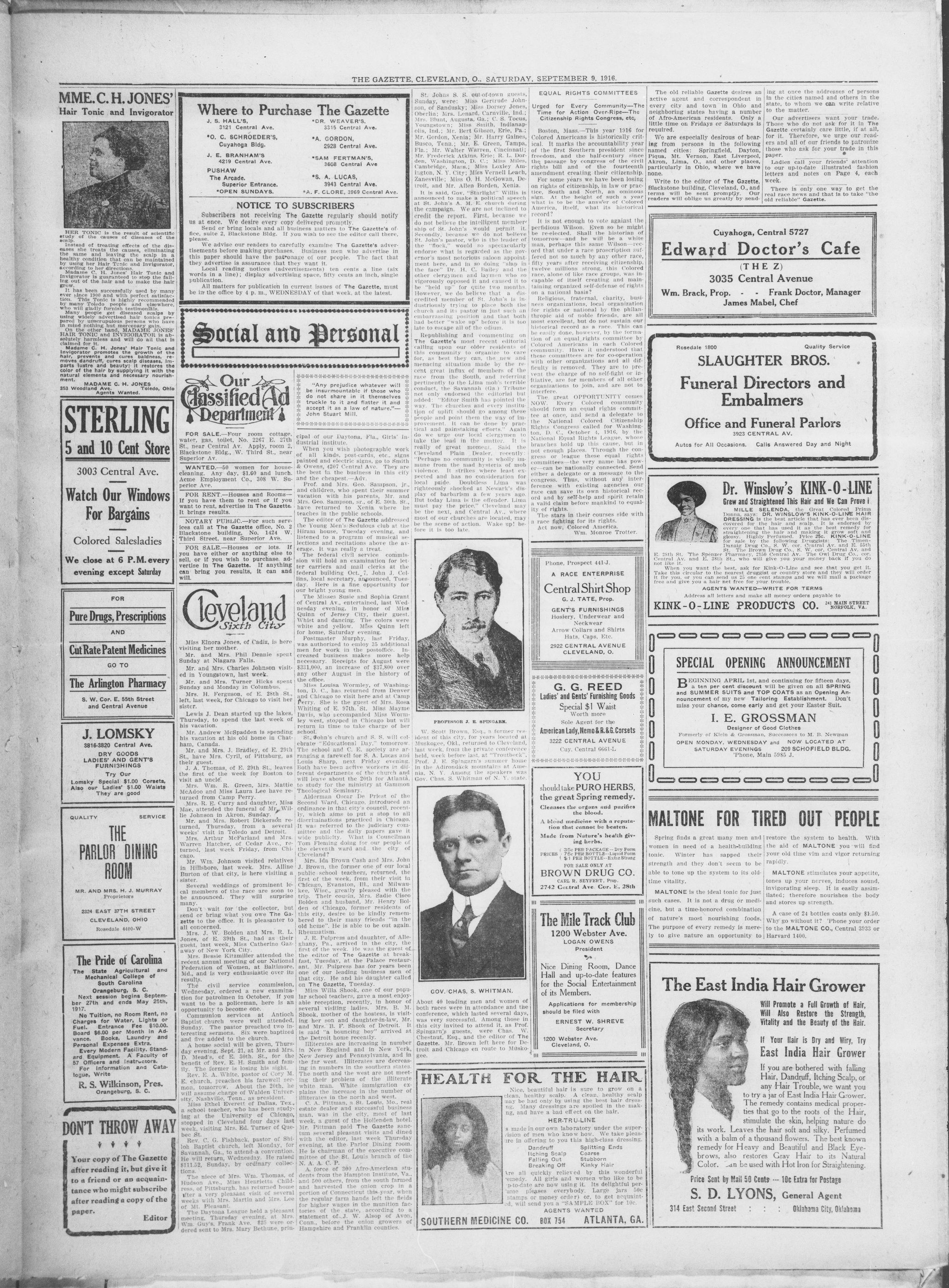
THE GAZETTE, CLEVELAND, O., SATURDAY, SEPTEMBER 9, 1916.
YOU
should take PURO HERBS,
the great Spring remedy.
Cleanses the organs and purifies
the blood.
A blood medicine with a reputa-
tion that cannot be beaten.
Made from Nature's health giv-
ing herbs.
( 35c PER PACKAGE — Dry Form
PRICES : 75c PER BOTTLE—Liquid Form
( $1 PER BOTTLE—Extra Strong
FOR SALE ONLY AT
BROWN DRUG CO.
CARL R. SEYFERT, Prop.
2742 Central Ave. Cor. E. 28th
The Mile Track Club
1200 Webster Ave.
LOGAN OWENS
President
FOR THE HAIR
HEALTH FOR THE HAIR
Nice, beautiful hair is sure to grow on a clean, healthy scalp. A clean, healthy scalp may be had only by using the best hair dressing. Many dressings are spoiled in the making, and have a bad effect on the hair.
HER-TRU-LINE
is made in our own laboratory under the supervision of men who know how. We take pleasure in offering to you this high-class dressing.
Are all quickly relieved by this wonderful remedy. All girls and women who like to be up-to-date are now using it. Its delightful per-
mune pleases everybody. Large jars 50c (stamps or money order) or, to get acquainted, will send you a "SAMPLE BOX" for 10c.
AGENTS WANTED
NE CO. BOX 754 ATLANTA, GA.
St. John S. S. out-of-town guests
Sunday, were; Miss Gertrude Johnson,
of Sandusky; Miss Dorsy Jones
Oberlin; Mrs. Lenard, Carnville, Ind.
; Mrs. Blunt, Augusta, Ga.; C. S. Tocus
Youngstown; Miss Smith, Indianapolis,
Ind.; Mr. Bert Gibson, Erie, Pa.
; Mr. Gordon, Xenia; Mr. Harry Gaines,
Busco, Tenn.; Mr. E. Green, Tampa,
Fla.; Mr. Walter Warren, Cincinnati;
Mr. Frederick Atkins, Erie; R. L. Dorden,
Washington, D. C.; Miss Miles,
Cambridge, Mass.; Miss Loxley Amington,
N. Y. City; Miss Vernell Chase,
Zanesville; Miss O. H. McGowan, Detroit, and Mr. Allen Borden, Xenia.
It is said, Gov. "Starlight" Willis is announced to make a political speech at St. John's A. M. E. church during the campaign. We are not inclined to credit the report. First, because we do not believe the intelligent membership of St. John's would permit it. Secondly, because we do not believe the "hook" would so spectacularly endorse what is regarded as the governor's most notorious saloon appointment here, and in so doing "slap in the face" Dr. H. C. Bailey and the other clergymen and laymen who so vigorously opposed it and caused it to be "held up" for quite two months. However, we do believe that a discredited member of St. John's is in dustrious trying to place both the embarrassing position and that both had better "wake up" before it is too late to escape all of the odium.
Republishing and commenting on The Gazette's most recent editorial calling upon our older residents of this community to organize to care for, as best they can, the new and menacing situation made by the recent great influx of members of the race from the South, and referring pertinently to the Lima mob's terrible conduct, the Savannah (Va.) Tribune not only endorsed the editorial but added, "Editor Smith has pointed the way to the leader of the unjustification of uplift should go among these people and point them the way of improvement. It can be done by practical and painstaking efforts." Again do we urge our local clergymen to take the lead in the matter. It is really of great moment. Said the Cleveland Plain Dealer, recently: "Perhaps no community is wholly immune from the mad hysteria of mob violence. It strikes where least expected and has no consideration for local pride. Doubless Lima was righteously shocked at Newark's display of barbarianism a few years ago and must pay the price." Cleveland Lima must pay the price. Cleveland Lima be the next, and Central Av., where most of our churches are located, may be the scene of action. Wake up! be fore it is too late.
J.
W. Scott Brown, Esq., a former resident of this city, for years located at Muskogee, Okl., returned to Cleveland, last week, from the private conference held, week before last, at "Troutbeck" Prof. J. E. Spinigar's summer home in Muskogee, N. Y. Among the speakers was Gov. Chas, S. Whitman of N. Y. state
M. B.
GOV. CHAS. S. WHITMAN.
About 40 leading men and women of both races were in attendance and the conference, which lasted several days, was very successful. Among those in this city invited to attend it, as Prof. Spingarn's guests, were Chas. W. Chestnut, Esq., and the editor of The Gazette. Mr. Brown left here for Detroit and Chicago en route to Muskox.
A.
EQUAL RIGHTS COMMITTEES
Urged for Every Community—The Time for Action Over-Ripe—The Citizenship Rights Congress, etc,
Boston, Mass.—This year 1916 for Colored Americans is historically critical. It marks the accountability year of the first Southern president since freedom, and the half-century since the passage by congress of the civil rights bill and of the fourteenth amendment creating their citizenship. For some years we have been losing on rights of citizenship, in law or practice, South and North, an ominous sign. At the height of such a year what is to be the answer of Colored America, Itself, what its historical record?
It is not enough to vote against the peridificid Wilson. Even so he might be re-elected. Shall the historian of tomorrow—and he will be a white man, perhaps this same Wilson—record that under a race proscription suffered not so much by any other race, fifty years after receiving citizenship, twelve millions strong, this Colored race, alone of like race groups, was incapable of itself creating and maintaining organized self-defense of rights on a national basis? Religious, fraternal, charity, business, local localization for rights or national by the philanthropic aid of noble friends, are all most excellent, but do not sustain our historical record as a race. This can be easily done, however, by the formation of an equal rights committee by Colored Americans in each Colored community. Have it understood that these committees are for co-operation with other organizations and all difficulty is removed. They vent the charge of no selffight or initiative, are for members of all other institutions to join, and are not to interfere.
The great OPPORTUNITY comes NOW. Every Colored community should form an equal rights committee at once, and send a delegate to the National Colored Citizenship Rights Congress called for Washington to October 19, 1946, by the National Equal Rights League, whose branches hold up this cause, but in not enough places. Through the congress or league these equal rights committees—the very name has power—can be nationally connected. Send either a delegate or a message to the congress with existing agencies our race can save its own historical record and by self-help and spirit retain a valid claim before mankind to equality of rights. The stars in their courses side with a race fighting for its rights.
Phone, Prospect 441-J.
A RACE ENTERPRISE
Central Shirt Shop
G. J. TATE, Prop.
GENT'S FURNISHINGS
Hosiery, Underwear and
Neckwear
Arrow Collars and Shirts
Hats, Caps, Etc.
2922 CENTRAL AVENUE
CLEVELAND, O.
G. G. REED
Ladies' and Gents' Furnishing Goods
Special $1 Waist
Worth more
Sole Agent for the
American Lady, Nemo & R. & G. Corsets
3222 CENTRAL AVENUE
Cuy, Central 6661-L
Nice Dining Room, Dance Hall and up-to-date features for the Social Entertainment of its Members.
Applications for membership should be filed with
ERNEST W. SHREVE
Secretary
1200 Webster Ave.
Cleveland, O.
Cuyahoga, Central 5727
Edward Doctor's Cafe
(THE Z)
3035 Central Avenue
Wm. Brack, Prop. - - Frank Doctor, Manager
James Mabel, Chef
Rosedale 1800 Quality Service
SLAUGHTER BROS.
Funeral Directors and
Embalmers
Office and Funeral Parlors
3923 CENTRAL AV.
Autos for All Occasions. Calls Answered Day and Night
Dr. Winslow's KINK-O-LINE Grew and Straightened This Hair and We Can Prove i
MILLE SELENDA, the Great Colored Prima Donna, says: DR. WINSLOW'S KINK-O-LINE HAIR DRESS best article that has ever covered for the hair and scalp. It is endorsed by every one that has used it as the best remedy for hair loss and a masking and glossy. Highly Perfumed and Price 25c. KINK-O-LINE for sale by the following Druggists: The Timen-Danzig Dress Co., W. cor. Central Av. and E. 28th St., The Spenser Pharmacy, 2150 Central Av. The Owl Drug Co., cor. Central Av. and E. 38th St., who will give you your money back if you do not use it. When you want the best, ask for KINK-O-Line and see that you get. Take this circular to the nearest druggist or country store and they will order it. We will ship it and we will mall a package free and give you a hair net free for your trouble.
KINK-O-LINE PRODUCTS CO. 241 MAIN STREET NORFOLK, VA.
BEGINNING APRIL 1st, and continuing for fifteen days,
a ten per cent discount will be given on all SPRING
days. You will receive a Tailoring Establishment.
nouncement of my new Tailoring Establishment. Don't
miss your chance, come early and get your Easter Suit.
Formerly of Klein & Grossman, Successors to M. B. Newman
OPEN MONDAY, WEDNESDAY and NOW LOCATED AT
SATURDAY EVENINGS 209 SCHOFIELD BLDG.
Phone, Main 5985 J.
---
MALTONE FOR TIRED OUT PEOPLE
The East India Hair Grower
its work. Leaves the hair soft and silky. Perfumed with a balm of a thousand flowers. The best known remedy for Heavy and Beautiful and Black Eyebrows, also restores Gray Hair to its Natural Color. Can be used with Hot Iron for Straightening.
Price Sent by Mail 50 Cents --- 10c Extra for Postage
314 East Second Street : : : Oklahoma City, Oklahoma
The old reliable Gazette desires an active agent and correspondent in every city and town in Ohio and neighboring states having a number of Afro-American residents. Only a little time on Fridays or Saturdays is required.
We are especially desirous of hearing from persons in the following named cities: Springfield, Dayton, Piqua, Mt. Vernon, East Liverpool, Akron, Lima, O., and other places, particularly in Ohio, where we have none.
Write to the editor of The Gazette, Blackstone building, Cleveland, O, and terms will be sent promptly. Our readers will oblige us by greatly send
Cuyahoga, C
Edward Doyle
(T H
3035 Centr
Wm. Brack, Prop. -
James Ma
Rosedale 1800
SLAUGHT
Funeral Dir
Emba
Office and F
3923 CEN
Autos for All Occasions.
P
Danzig Drug
St. The Brow
E. 28th St. The Spencer Pharmacy, 21
Central Av. and E. 38th St., who will
not like it.
When you want the best, ask for
Take this circular to the nearest drugi
it for you, or you can send us 25 one o
tree and give you a hair net free for you
AGENTS WANTED
Address all letters and make
KINK-O-LINE PROD
SPECIAL OPENING
BEGINNING APRIL 1st, a
ten per cent discount
and SUMMER SUITS and T
nouncement of my new Ta
miss your chance, come early
I. E. GRO
Designer of
Formerly of Klein & Grossma
OPEN MONDAY, WEDNESDAY
SATURDAY EVENINGS
Phone, M
MALTONE FOR T
Spring finds a great many men and women in need of a health-building tonic. Winter has sapped their strength and they don't seem to be able to tone up the system to its old-time vitality.
MALTONE is the ideal tonic for just such cases. It is not a drug or medicine, but a time-honored combination of nature's most nourishing foods. The purpose of every remedy is merely to give nature an opportunity to
to
T
ti
st
its work. Leaves th
with a balm of a th
remedy for Heavy
brows, also restor
Color. Can be usec
Price Sent by Mail 50 Cen
S. D. LYON
314 East Second Street
ing at once the addresses of persons in the cities named and others in the state, to whom we can write relative to the matter.
Our advertisers want your trade. Those who do not ask for it in The Gazette certainly care little, if at all, for it. Therefore, we urge our readers and all of our friends to patronize those who ask for your trade in this paper.
Ladies call your friends' attention to our up-to-date illustrated fashion letters and notes on Page 4, each week.
There is only one way to get the real race news and that is to take "the old reliable" Gazette.
Doctor's Cafe
(THE Z)
Central Avenue
Frank Doctor, Manager
Mabel, Chef
Quality Service
RIGHTER BROS.
Directors and
embalmers
and Funeral Parlors
23 CENTRAL AV.
Calls Answered Day and Night
Winslow's KINK-O-LINE
and Straightened This Hair and We Can Prove it
says: DR. WINSLOW'S KINK-O-LINE HAIR
ING is the best article that has ever been chl
d for the hair and scalp. It is endorsed by
one that has used it as the best remedy for
attening the hair and making it grow soft and
highly perfumed. Price 26c. KINK-O-LINE
by the following Druggists: The Timen-
Drug Co., S. W. cor. Central Av. and E. 55th
the Brown Drug Co., S. W. cor. Central Av. and
216d Central Av. The Owl Drug Co., cor.
who will give you your money back if you do
ask for Kink-O-Line and see that you get it.
drugist or country store and they will order
25c one cent stamps and we will mail a package
for your trouble.
UNTED-WRITE FOR TERMS
and make all money orders payable to
PRODUCTS CO. 241 MAIN STREET
NORFOLK, VA.
OPENING ANNOUNCEMENT
L 1st, and continuing for fifteen days,
discount and TOP COATS as an Opening An-
new Tailoring Establishment. Don't
nearly and get your Easter Suit.
GROSSMAN
Designer of Good Man.
Grossman, Successors to M. B. Newman
ONESDAY and NOW LOCATED AT
ENINGS 209 SCHOFIELD BLDG.
phone, Main 5985 J.
TIRED OUT PEOPLE
en and building their to be its old for just or medi- nation foods, is mere- nity to restore the system to health. With the aid of MALTONE you will find your old time vim and vigor returning rapidly.
MALTONE stimulates your appetite, tones up your nerves, induces sound, invigorating sleep. It is easily assimilated; therefore nourishes the body and stores up strength.
A case of 24 bottles costs only $1.50. Why go without it? 'Phone your order to the MALTONE CO., Central 3933 or Harvard 1400.
Will Promote a Full Growth of Hair,
Will Also Restore the Strength,
Vitality and the Beauty of the Hair.
If Your Hair is Dry and Wiry, Try
East India Hair Grower
If you are bothered with falling
Hair, Dandruff, Itching Scalp, or
any Hair Trouble, we want you
to try a jar of East India Hair Grower.
The remedy contains medical properties that go to the roots of the Hair,
stimulate the skin, helping nature do
haves the hair soft and silky. Perfumed of a thousand flowers. The best known Heavy and Beautiful and Black Eye-restores Gray Hair to its Natural be used with Hot Iron for Straightening.
150 Cents --- 10c Extra for Postage
YONS, General Agent
: : : Oklahoma City, Oklahoma
A. B.
Editor Gazette, Dear Sir:--Some time in 1915, Gov. Frank B. Willis agreed to the appointment of a local Negro as a deputy oil inspector for this county which position he held until January 1 when his resignation caused a vacancy in the oil inspecting job.
Meanwhile, two or three aspirants applied for it, among the number being a local saloon-keeper who operated on the main thoroughfare of our people, where our church-goers must pass to and fro to their churches, being embarrassed by hangers-out and others passing in and out.
In spite of our vigorous protests (for nearly two months) to Gov. Willis, as ministers of the gospel (representing several thousand Colored church communicants), against the appointment of a saloon-man, recommended largely by the saloon element, the Governor has appointed him and refused to appoint him to the department we thought the best to represent the race in an official capacity. We, as ministers, sent letters, telegrams and night-letters (telegrams) to Gov. Willis in protest against the appointment of the saloon-man and endorsing the other aspirant. The Governor, however, has deliberately and outrageously ignored protests and endorsements by the position to has a element which with their business (saloon) is doing more and causing more retrocession of the flower of our young manhood in this city than the actual physical slavery of our parents before the "sirties."
We, the ministers and churches, stand for race elevation, a virile manhood, worthy citizenship and factors in every community, and for a better manhood and life. The Governor's action in this matter is in deserved position to all these—and HURTS! What are we to do when these contemptible indignities are continually heaped upon—appointing saloonmen to state and municipal jobs a reward to the decent Negro republicans of this community, thus saving to the people, white and Colored, that SUCH men are the REPRESENTATIVES of the Negroes? We must and will organize and work to defeat any candidate for office, be he democrat or republican, who will so insult us, and Gov. Willis will be made to feel this, politically, if he is a candidate for office in November.
Signed.
(Rev.) H. C. Bailley, Pastor, Antioch Baptist Church, President, Cleveland Branch, National Association for the Advancement of Colored People.
REV. CARL W. HASKELL.
Columbus, O., March 17, 1916.
Editor Gazette, Dear Sir; I have read Dr. H. C. Bailley's splendid article in The Gazette concerning the outrage committed by Gov. Frank R. Ripley, appointed to office despite the vigorous protests of Cleveland's leading ministers of the gospel and prominent citizens, and wish to register my hearty approval of the same. I have known Dr. Bailey all of my life and have always found him a true type of manhood, standing firm and strong in the rights of our people. Shakespeare said in his "Julius Caesar":
"The evil men do, lives after them,
The good is often intertwined with their
bones."
But thanks be to God we have some
good men who are being thought of
and recognized while they are living,
receiving flowers before the Master
bids them to lay aside life's weary
It is high time that our race awaken to these facts: The Republican party has always thought that they could carry the Negro vote regardless of whatever outrages they might commit, because they feel that they bear first honors in the emancipation of the Negro race. But God accomplished that task and his servant, Abraham Lincoln, has passed to the great beyond. Furthermore, if we ever owed the party any debt of gratitude or anything else for any part it may have played in the emancipation or during the ten or more years that followed it. God knows, in fealty, united support and vote, that he did that debt and, too, with compound interest. It is now, and has been for many years, high time for the party to be considering the tremendous debt it owes the Negro for his long-time united support and to be paying something far more than it has in late years on that debt.
I believe that I voice the sentiments of my good people everywhere when I say that the man and only the man who stands for the principle of right-ousness and justice, be he democrat or Republican, will be supported by the intelligent Negro ballot. We must punish Gillis. Willis as a matter of self respect is not supported. It is our clear DUTY! Willis is not the party. I am a Republican. Youra resp. (Rev) Carl W. Haskell.
TO WEAR ON TOUR
UNDERWEAR THAT IS SMART
---
IDEAS FOR COLOR SCHEMES
MADE UP OF HANDKERCHIEFS
EFFECTIVE CLOTHES DESIGNED
FOR FAIR MOTORISTS.
Furs of Every Kind and Design Are Permissible—Empire Hats Reappearing—Dinner Frook in Pale Smoke Gray.
No matter how sensitive a woman may be about wearing great bands of fur, ermine capes and foxes strung about the neck on hot days, she may throw her sensitiveness to the winds when it comes to motoring.
Here she may glory in all the petty that she wishes. Her sports suit of Jersey, woolen, rather than silk, may
1
Voile Frock for Dinner.
be banded with fur from the knees down and the shoulders up, and she may wear fur hats as well, if she wishes.
Her motor coat may be copied after
Manufacturers Have Outdone Them-
selves in Providing Pretty Lingerie for Milady's Use.
An unusual petticoat is made of
nainsook trimmed with two deep ruffles
of batiste cut in points and
chemise has a panel front and shirred
val lace. Rosebuds are placed at
intervals on the ruffles.
A pink crepe de chine envelope
chemise has a panel front and shirred
sides which make it especially suited
to wear under a gown that is flat in
front and distended at the sides.
A fine quality of pink crepe de chine
fashions a chemise trimmed with fine
val lace. It is cut on new lines, showing
how a panel effect may be given
with two rosettes to gather the fullness to the sides.
A dainty pair of knickerbockers is made of white flaxon evenly striped, with one sheer and one heavier stripe. The bodice is of flesh-colored habutal silk, straps and all, with piet edges for a finishing and three tiny flat bows of satin down the front.
Val lace is ruffled on every edge of a nainsook chemise in princess style and festoons of insertion in bolero effect. A ribbon bow with fluttering ends trims the front.
A band of French knotted embroidery finishes the straight top of a nain-
IDEAS FOR CO
Must Not Be Too Slavishly Followed
—Flowers That Make Beautiful Table Decorations.
In carrying out a color scheme for a luncheon or dinner it is not wise to try to stick to it too closely so far as the food is concerned, but rather to suggest it. For instance, in a violet and yellow scheme, in the first course the yellow may be suggested in an egg-yolk garnish and the purple in ripe olives. The custard in the soup should be yellow, as well as the sauce with the fish, the orange cup for the salad and the yellow dressing.
Purple sweet peas form a beautiful table decoration, as do pansies or violets. Many flowers may be found to carry out this color scheme and may be used in decorating the place cards, which may be lightly tinted yellow, with a spray of the chosen flower. Nut buckets could be tied with little bows of yellow or purple ribbon and covered with either color of crepe paper. If another salad than orange were used, an orange ice could be served, and little cakes decorated with can-
MADE UP OF H All Sorts of Useful and Pretty Arti-
Pillow slips may be made of four handkerchiefs to each sham, caught together with insertion or fagotting. Table covers for summer bedrooms may be formed of handkerchiefs and they may even be used as table dolies, when treated to some decorative work in stencil or needlecraft.
Women's smaller handkerchiefs make all sorts of pretty things. A bureau runner may quickly be cooceted of five or six bordered handkerchiefs, with insertion between each and edging all around. A small sheer handkerchief makes a pretty pin-cushion cover, over blue or pink silk. Buttonholed eyelids are placed at one inch intervals around the inside of the colored border of two handkerchiefs; then place a square pin-cushion between them and lace them together with baby ribbon of a matching shade.
---
THE GAZETTE, CLEVELAND, O., SATURDAY, SEPTEMBER 9, 1916.
one of the smart new models, which is of olive green velour, with a cape collar, immense cuffs and a straight panel from neck to hem of back and white fur laid in broad checks.
France is wearing fur on all her August hats, from San Sebastian to Rhone valley, and America is wearing it on her motor hats throughout every state in the Union. She has unearthed or else bought a top coat of soft fur which she uses on cold nights, and she has even taken her muff out of camphor, sinned it a bit and included it in her motor wardrobe.
She is ready for whatever comes in the way of weather, for the shops have provided for her usage in case of rain, a London coat made of transparent oilskin, in colors plain or iridescent.
This, with a hood to match, can be rolled up in a tiny case and stowed away as easily as a box of biscuits. It is the raincoat de luxe for motoring, and it has solved the problem for the woman who can stand anything but getting wet.
An interesting fact is that second empire hats are coming out with first empire frocks. What's history between milliners and dressmakers? They have no more hesitancy in mingling the eleventh with the twentieth century, the renaissance with the great war and 1800 with 1812, than the hostess of a fancy dress ball.
The new second empire hats are made after the shape that the Empress Eugenie loved. The milliners often call them shepherdess hats. They are made of a soft quality of velvet, the edge bound with ribbed ribbon.
The French draped hats are are in quantities, especially in a brilliant Vatican purple and a petunia reddish purple, but so far, the American women seem to prefer the stiff shapes which have only a bow of ribbon or a buckle for trimming.
The charming dinner frock illustrated is of pale smoke gray, made over a slip of gray sunnin and is trimmed with a white ribbon. (Copyright, 1916, by the McClure Newspaper syndicate.)
sook chemise and double ribbons are used for shoulder straps. Another chemise of white batiste is tucked to just below the bust line and finished with insertion. Ribbon is laced through eyelets in this band, tying in front, and double ribbons form the shoulder straps. Below a yoke of embroidery and lace another chemise of white batiste hangs nearly straight in box plats. The shoulder straps are ribbon, and a ribbon is laced in and out of the yoke.
ONE OF THE LATEST DESIGNS
In black or navy charmeuse edged with silver gallon, brim becomingly bent.
died violet leaves would further carry
out the color scheme.
DICTATES OF FASHION
The white beaded nets are in high favor for evening wear.
White bead trimming is the feature of a sports suit of white nongee.
Flesh colored organdie takes the place in some of the summer frocks that flesh colored chiffon took in winter frocks.
The upstanding frill around the neck that is cut away a bit at the shoulders is still featured in some of the imported frocks of silk and satin.
Stripes are as much worn by children as by the mammals and big sisters. Usually a striped skirt is made with a plain white or colored blouse to give the best results.
Yellow is enjoying a vogue it has not before known for years. Yellow silk sweaters seemed to blaze the way for the vogue, and now there are yellow and white striped sports clothes, and many attractive frocks of yellow combined with white or some other color.
A small bow of inch-wide ribbon of the same color is tied at one corner. A monogram in white or colored thread further adds to the cushion. A pretty boudin pillow may be made by laying two large sheer handkerchiefs together and stitching them on the machine to form an inch border. They may also be whipped together and lace sewed at the seams.
Tunics Are Established
The tunic is an established fact and rather a convenient one. It gives the economically inclined the chance of wearing an old gown under a new aspect, concocted out of two old ones. Sometimes the tunic takes the form of an apron, and the idea of a deeply accentuated point in front has furthered the idea. An overskirt and tunic now seem to be synonymous terms and give a great variety of choice; they both melt occasionally into panniers and do not ignore the bustle.
LINGERIE OF MERIT
"Underthings" and negligee garments are quite as important to the well-dressed woman as are the suits, gowns and coats of her wardrobe. She knows that smart dressing must have a correct foundation, and that such a foundation never consists of poorly made, ill-fitting undergarments. Personal daintiness demands that a real pride be taken in the material and make of inglerie and negligee apparel, and while there is rarely as quick and radical a revolution in the style lines of these garments as is realized frequently in outer apparel, certainly undergarment styles do change and each season sees the introduction of many novelties.
Sheer silks and very soft, pliable satins are well liked for undergarments by many women, white for real hot-weather wear the thin cottonts—buttie, net, etc.—are generally preferred.
White batiste and muslin undergarments are correctly trimmed with ornamental embroidery in all white or
touch of
Nightgown of Satin or Crepe de Chine
In French gray, and dainty embroideries carrying two colors, such as the palest of pink and blue shades, are featured.
For underbodices satin and Georgette crepe are the most popular fabrics, regardless of season or weather. Either material may be used alone or the two effectively combined.
The sketch illustrates a dainty nightdress that may be made of crepe de chine or washable satin in white or flesh color. Valenciennes lace and insertion edge the garment, and a further trimming touch is given by narrow ribbon, matching in color that used for the shoulder straps, run through handworked eyelets, groupings of small tucks breaking between each ribbon.
Two widths of satin or other material 36 inches wide—the length, of course, regulated by the figure for which it is made—will be required for the nightdress shown, and the garment is sloped so that only a scant fullness is in evidence at the top.—Washington Star.
NEWS AND NOTES OF FASHION
Use of Fur Even More Pronounced
Than It Was Last Season—Beaded
Fabrics and Braid.
The woman who had last winter's
skirt cut a little longer than fashion
required so that it would be sure to do
service this winter, is in the same
boat with the woman who refrained
from fur trimming because she was
afraid it would be out of style this
season. Skirts are shorter if any-
thing than they were last winter, and
as for fur, it is everywhere.
The use of fur on very sheer材
aterials is more pronounced this季
season than it was last. One of the
advanced autumn models is of gray chif-
fon with a foot-wide hem of seal. This
is only typical of the many frocks that
show fur on diaphanous fabrics.
Jersey cloth of various sorts ap-
pears in fur trimmed form in some
of the between-season models that
are now available.
For eventing, as everybody knows, beaded fabrics of all sorts are much in vogue, and head embroidery, metalix thread embroidery, metal buttons and sequins are all used lavishly on the new models.
Soutache braid stitched in intricate designs is one of the trimming motifs of street frocks, and some afternoon gowns of chiffon show heavy braiding as their sole trimming. This gives
Children's Dresses.
Combination ideas are much used in new models for children, the little coattees or bodices being of plain fabrics, and the skirt and trimmings of a new material or silk. The midy idea is used, as well as sailor dresses with novelty collars, cuffs and shields, Russian blouses, contees and pleated effects and guippes and suspender skirts with white or silk waistles are also much in evidence. Sashes and belts are used, some being of self-material, others of silk and leather. Wash dresses are in plique, cordaline, linen, rep and chambray in white and in plain colors. Many of these are simply trimmed with hand or machine embroidery. Many are made in high-waisted empire effect. A few have the belt placed slightly above the normal waistline, and others at the normal or a few inches below that point.
Fashion Whimax.
An unexpected development of the season is velvet as a sports fabric, Summer always brings some fashion whimsy or other, and this year it happens to be velvet. Big velvet bows
somewhat the same contrast between a heavy trimming and a sheer fabric that fur banding on chiffon and crepe bring.
WASHING CREPE DE CHINE
Fabric Must Be Handled in Manner
That Will Not Cause It
to Lose Color.
Today, when this fabric is so popular, it is well to know how to wash it in a way that preserves its beauty. The yellow appearance of washed white crepe or crepe de chine which is sometimes seen can be avoided by a knowledge of a few simple rules.
Luke-warm water should be used, with any pure, white soap that does not contain too much lye. Professional houndresses use a mixture of salts of turtar and borax—half and half in warm water—but the soap one is accustomed to use is just as effective. Oily stains at the neck and wrists should be removed with gasoline before washing. After a good suds is made, dip the garment in, and do not rub, but move it about in the water so that the suds come in contact with all parts. Rinse in several waters very thoroughly so that not one particle of son-puds is left on the garment. In each case squeeze the water out; never wring it, or the material will have a pulled appearance, even after ironing. Also georgie crepe, or any thin crepe, is liable to part or give way on the crosswise strands if it is handled roughly. Shake out of the last rinsing water and wrap the garment in a cloth until nearly dry. Then iron the garment on the wrong side. Usually the colors are fast, and with this method a waist or an undergarment will look as if it had just come from the shop.
Flesh-colored crepe de chine, georgette crepe, silk or batiste underwear should be washed with a little red ink or a bit of red ribbon or red crepe paper in the final rinsing water. This will preserve the flesh tint through many launderings. Be sure that the ink or dye is evenly distributed through the water, or the material will be streaked and spotted in an ugly way.
USE OF TRANSFER PATTERNS
All Sorts of Designs Are at Command and Their Employment Should Be General.
For a long time it has been possible to buy machine-embroidered shelf edging in heavy white cotton. Now the design for this edging can be bought and transferred to white cotton bands. It consisted of tiny kitchen en utilisés—bowls, coffee mills, pepper pots, spoons and teapots. There are similar designs to apply to the ends of kitchen towels. The same designs are very effective worked on buffet and serving-table scarfs for the simple dining room. They are most effective in blue, on white.
The swallow and bluebird remain favorite designs for embroidery, and they may be bought in numerous attitudes to apply to centerpieces and table dolls, to towels, bureau scarfs and other linen.
Cross-stitch is used, and very effectively, too, for embroidering towels, and it can be quite as effectively used on children's dresses. Worked in pink or blue on white it gives charming results.
The woman who does much embroidering should buy several sets of the alphabet, in transfer patterns. She will then have any letter she needs, whenever she needs it. (Copyright, 1916, by the McClure Newspaper publisher.)
NEAT HOLDER FOR PARASOL
Arrangement of Ribbon That May Be Fixed to Inside of the Cupboard or Wardrobe.
This holder, which is made from ribbon or strips of sateen or cretonne, may be fixed inside a cupboard or wardrobe or on the wall of a room. It consists of two long loops stiffened at end, falling from bows that are attached to a piece of wood also covered with ribbon.
The holder is fixed by a ring in each end that may be hung over nails in the wall. The sunshade is slipped through the loops as shown and is safely kept.
are appearing on sports hats; velvet ribbons are used for sashes on summary frocks and very smart hats of straw have huge, soft tam crowns of black velvet. Even smarter are sports coats of black velvet or dark green velvet. The coat is a jaunty little afair falling just below the waist line and fastening with a single button at the throat. There are pockets to slip the fingers in and a round cape-collar at the neck. Coat and collar are lined with white satin, and the square coat fronts are faced with witchitex, the light, resilient stiffening which is better than the old-fashioned, crinoline facing, because it neither crushes nor becomes limp from exposure to dampness.
The Neatly Tailored Suit
A girl in a neatly tailored suit, even if it be of the mode of year before last, is sure to look well if her hat is smart and becoming, her boots neat and well chosen and her gloves fresh and immaculate. If I had a limited amount of money to spend on clothes, I think I should be tempted to spend most of it in pleasant details.
LINEN SUITS LIKED
MATERIAL POPULAR WITH FASHIONABLE EUROPEANS.
Sketch Shows Model in Soft Silver Gray—Collars and Trimmings of Rich Fur Accompany Coats Made of White Linen.
My drawing shows a linen costume which was specially created for the racing season at San Sebastian, writes Idalia de Villiers, special correspondent of the Boston Globe. The color of the suit was a beautifully soft silver gray, and the panel embroideries on the skirt were executed in washing silks in the same color.
The coat had an exceptionally full basque and the waistline was very slightly raised. Then there was a superb collar of chinchilla.
This/suit was created for a well-known Spanish beauty who has a villa at Biarritz, and who never fails to make a sensation, by reason of her wonderful clothes, on the Grande Plage in August and September. This same lady has ordered a number of linen suits in brilliant colors, such as sapphire blue, orange, rose Dubarry and Czar violet. Asbest all these linen coats have collars or trimmings of rich fur, and they are to be accompanied by fragile blouses in filmy tulle and by large flat-brimmed hats covered with hatter's plush or crepe de chine. Linen suits in very brilliant colors will play a prominent role in the world of fashion this summer.
They will be simple in detail but highly original in design. They will vie with the dend white dresses and
THE FASHION OF THE TWENTIETH CENTURY
Smart Tailor-Made of Silver Gray Linen Enbroidered and Braided to Match Collar of Chinchilla.
tallored suits which are so dear to the hearts of our more exclusive Parisiennes.
As I said, in a recent article, the true Parisienne will wear pure white, black and white or soft gray, all through the summer and autumn. For her, brilliant colors are out of the question. She has known so much of sorrow and anxiety since the outbreak of this terrible war that she has no inclination to appear in bright-hued gowns.
But the lovely American and Spanish girls in our midst have other ideas. For them the great dressmakers and tailors in the Rue'de la Paix and Place Vendome have designed costumes in butterfly tints, and for this fact we feel intensely grateful, for a linen suit in bright rose linen, or even in emerald green, is a cheery sight on a glorious summer day.
How to Arrange Flowers.
Flowers to be cut for use in vases must have long stems. Dahilas are very fine for vase use. Do not crowd into a vase flowers enough to supply half a dozen vases. When grouping cut flowers, remember that quality and not quantity is what should govern. Have stalks long enough to lift them well above the vase in which they are placed. Before cutting blossoms, study the general appearance of the plant from all sides. Let the plant itself tell you how its blossoms should be clustered.
Short-stemmed flowers should be placed in low, flat bowls. They are especially attractive for table decora-
Double-Faced Tailored Suits.
Among the early fall shows are a considerable number of severely cut tailored suits made of double faced materials and colored harmoniously. One of the most attractive of these soon last week was of deep wine purple faced with puce. The skirt was cut with straight front and back panels and circular hips and the hem was uneven so that with every movement the light facing of the under side was visible. The bottom of the skirt was blanket stitched with heavy purple hoss and a very little of this stitching was used on the coat, which was cut sung round the shoulders, with but a rippled body. The collar was high and stood out well from the chin in front and was piped with seal.
Chintz Table Mats.
No one need be without table mats if they care to follow these directions, which even the children can carry out. The result is pretty and useful. The mats are braided from strips of bright colored chintz. It is torn into
tion. Pansies and nasturtiums are in this class. Nasturtiums are particularly effective in bowls of oin blue or delicate green china, or in glass bowls with the delicate green stems showing through the glass. These flowers may be used in thick clusters. Use with the blossoms a few of the leaves, but never combine other foliage with these flowers. Peonies are beautiful when placed in a wide-mouthed vase that permits them to arrange themselves naturally. Sweet peas should be cut with the longest possible stems, and no attempt made to arrange them before they are put into vases. Use only white, pink, pale yellow and lavender together. The deep colored do not harmonize well with the delicately colored. Drop a handful into a vase, give it a shake, and each flower will seem to settle into the place where it belongs.
Blotter Always of Use.
A blotter is one of the most useful things either to have for one's own use or to give to a friend.
They make most handsome presents, but are expensive to buy. With very little trouble, however, most artistic ones can be made at home at very little cost.
Two strong pieces of cardboard will be needed, each to measure 8 inches by 11 inches, and about half a yard of holland, cretone or linen. The material must be double the size of one piece of cardboard, allowing 2 or 3 inches over, both in length and width. To make: lay the pieces of cardboard down on the wrong side of the material as in small sketch, leaving 1 inch between the cardboards. Now nick the edges of the material all round; mollage them or brush over with paste and fasten them down to the cardboard that lies on the inside of the blotter. When this is quite secure and dry, take two pieces of paper the size of the cards, white or colored, and paste them over the cardboard so that none of the edges of the material show. The little pieces of material between the two boards form the backs; the ends of these must be cut to the height of the backs and neatly pasted down.
Sew at the top of this back on the inside an end of fine elastic, and secure the other end to the bottom of the back. Cut several sheets of white blotting paper a trifle smaller than the blotter and slip under the elastic; this holds them firm and a kind of book is made.
Tricorne Style.
Fascinating new tricorne in navy
brown with pearl marmor and soft silk
grain with gold, with edged tips.
Friction Baths.
A salt rub in the morning after a hot night is very invigorating. Use ordinary course salt, or the sea salt that is bought in boxes. Soak a handful in a small quantity of water. Then rub the skin briskly with it, body and limbs, until a glow results. After this some bathers like either a hot or cold sponge with fresh water, while others consider that the salt water has a tonic effect if left to dry in.
Just plain dry friction, too, is excellent in stimulating the skin. A loofah, a mitten of linen crash, or one knitted of a hard cord material, are all good to use. This follows the ordinary daily sponge bath—or, to replace the bath, use the friction with water, dipping the mitten in cold water and rubbing briskly, drying each part before proceeding to another.
On Your Parasol.
Embroider your name on a narrow piece of silk ribbon and sew it on the strap or inside of your parasol. It provides an excellent and inconspicuous mark of ownership.
inch-wide strips, braided carefully so that all raw edges are folded in and the braid rolled into round or oval mats, from a few inches in diameter to larger size. The braids are stitched into place on the under side as they are rolled.
Study Your Good Points.
There are two little rules which, when understood and learned, ought to form a basis for any woman who wants to look attractive. The first is bring out your good points and the second is conceal your bad ones. In other words, the art of dressing depends upon your remembering that you are an individual and determining exactly what kind of an individual you are.
For a True Bias.
To obtain a true bias place the material flat on the cutting table and with a ruler or a yardstick laid across one corner draw a line with chalk or colored peaclet. Use this line for a guide in cutting.