The Gazette
Saturday, October 7, 1916
Cleveland, Ohio
Page text (machine-generated)
THIRTY-FOURTH YEAR. NO.11.
IN UNION FOR EVERYTHING
13 KILLED AND 25 HURT IN ACCIDENT
Detroit Street Car, Filled With Passengers, Wrecked at Crossing by Train.
NINETY PEOPLE IN CAR
Most of Dead Were Killed by Jumping and Falling Under Wheels of the Freight Cars; Second-Accident at the Crossing.
Detroit, Mich.—Thirteen persons were killed and more than 25 injured, several probably fatal, late Sunday night when a switch engine pushing two freight cars crashed into a crowded street car at Forest-av. and Dequinder-at. on the East Side. There were more than 90 persons in the street car, many of them returning from the theaters.
The street car was struck almost in the center, the impact pushing it from the tracks and sliding it alongside of the freight cars.
Panic-stricken passengers began jumping from both the front and rear doors and climbing through windows. Most of the dead were killed by jumping from the car and falling under the wheels of the still moving freight cars.
Ambulances from every hospital in Detroit were rushed to the scene and quickly took the injured to the hospitals, where medical aid was given.
At midnight one hospital alone reported 15 injured and one dead had been taken there.
The accident is the third of a similar nature here in the last year and the second to occur at the Forest-av. crossing.
MYSTERIOUS DEATH
CLAIMS THREE WOMEN
Neighbors Find Spinsters Dead Sitting in Rocking Chairs; No Cause Is Found.
Lancaster, O. — Death Mysteriously smote three women here Sunday afternoon as they sat in their rocking chairs in a room at the Smetters home. They were found sitting in natural attitudes, one of them with her glasses on and a newspaper in her lap, as though she had laid the paper by to take a short nap. There was no sign of violence or of poison. Complete mystery shrouds the cause of their deaths. The women are Miss Agnes Smetters, 48; Miss Alice Smetters, 50, and Miss Mary Stretton, 30. Neighbors entered the house about 6:30 p. m. when it was remembered that neither of the Smetters sisters had been seen during the afternoon. It is believed the deaths of the women occurred within three hours before 6:30, as Miss Stretton was seen to enter the house at about 3:30. Miss Stretton is the daughter of W. C. Stretton, an oil well contractor, and spent much time with the two maledain ladies. Dr. G. O. Berrey, who was called, was baffled and could give no reason for death. He said there were no signs of poison and no escape of gas. The coroner took the bodies in charge.
PLATFORM AT CHURCH DEDICATION FALLS, SENDING 250 TO BASEMENT.
Hinghamton, N. Y. — Sixty persons were injured, three seriously, in Johannes City, a suburb when a temporary platform seating a congregation of more than 250 collapsed as the ceremonies of dedicating the new First Presbyterian church were begun. Those who were to have been speakers, and the band and choir, sitting upart from the main body, were left on the edge of a deep chasm filled with debris and struggling men and women.
The accident was caused by the buckling of wooden supports under the north end as this section fell in, the rest of the platform sloping and tearing free from the sliding. The congregation fell 25 feet into the church basement.
Aged Women Suffocated.
New York. City—Two aged women, Miss Sarah Weeder, 70, and Miss Carolyn Cutherbeck, 68, were suffocated when fire swept through their home in Brooklyn. Their bodies were found on the third floor of the house. One was under the bed and the other was found lying at the window.
Ashes Strewn on Lake.
Coshocton, O.—Charles Gosser, a leading citizen and business man of this city, who died Thursday, provided in his will that his remains be cremated and the ashes strewn on the waters of Lake Erie.
The remains were taken to Cleveland for orientation, after which six pallbearers who accompanied the remains to that city took the ashes in a motor boat nearly to the breakwater and consigned them to the water.
Mr. Gosser was a student of theRelikons of Hindus and other peoples.
THE GAZETTE
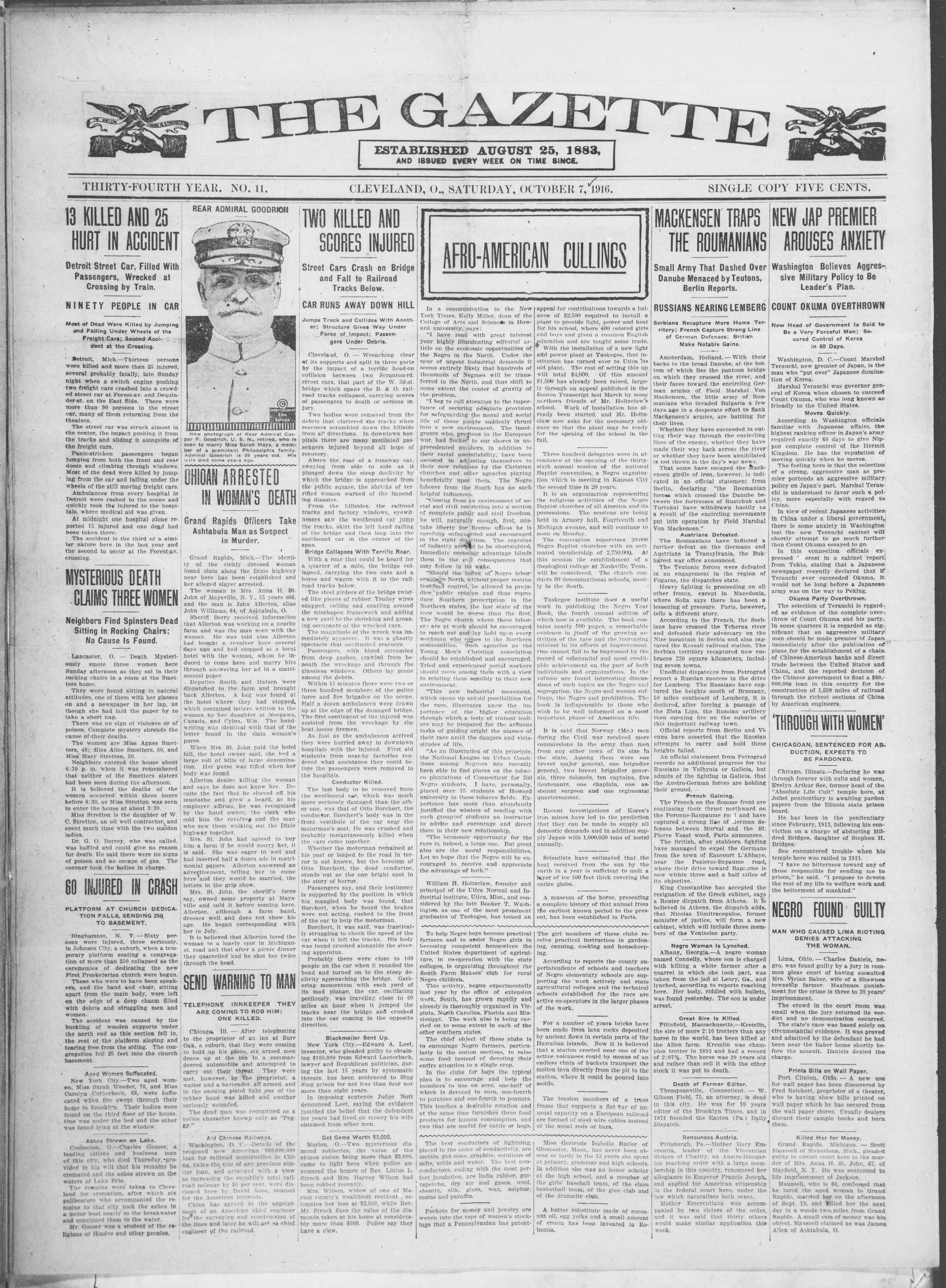
New photograph of Rear Admiral Caspar F. Goodrich, U. S. N., retired, who is soon to marry Miss Barah Hays, a mem- as of a prominent Philadelphia family. Admiral Goodrich is 60 years old. His wife died some years ago.
Grand Rapids, Mich.-The identity of the richly dressed woman found slain along the Dixie highway near here has been established and her alleged slayer arrested.
The woman is Mrs. Anna H. St. John of Maysville, N. Y., 55 years old, and the man is John Allerton, alias John Williams, 64, of Ashtabula, O.
Sherif Berry received information that Allerton was working on a nearby farm and was the man seen with the woman. He was told also Allerton had bought a revolver here several days ago and had stopped at a local hotel with the woman, whom he induced to come here and marry him through answering her ad in a matrimonial paper.
Deputies Smith and Matzen were dispatched to the farm and brought back Allerton. A bag was found at the hotel where they had stopped, which contained letters written to the woman by her daughter at Neepawa, Canada, and Cylon, Wis. The hand-writing was identical with that of the letter found in the slain woman's purse.
When Mrs. St. John paid the hotel bill, the hotel owner said, she had a large roll of bills of large denomination. Her purse was rifted when her body was found.
Allerton denies killing the woman and says he does not know her. Despite the fact that he shaved off his mustache and grew a beard, as his employer affirms, he was recognized by the hotel owner, the clerk who sold him the revolver, and the man who saw them walking out the Dixie highway together.
Mrs. St. John had agreed to buy him a farm if he would marry her, it is said. She was eager to wed and had inserted half a dozen ads in matrimonial papers. Allerton answered an advertisement, telling her to come here and they would be married, the letters in the grip show.
Mrs. St. John, the sheriff's force say, owned some property at Maysville and sold it before coming here. Allerton, although a farm hand, dresses well and does not show his age. He began corresponding with her in July.
It is believed that Allerton lured the woman to a lonely spot in Michigan's road and that after a picnic dinner they quarrelled and he shot her twice through the head.
SEND WARNING TO MAN
TELEPHONE INNKEEPER THEY ARE COMING TO ROB HIM; ONE KILLED.
Chicago, Ill. --- After telephoning to the proprietor of an inn at Burr Oak, a suburb, that they were coming to hold up his place, six armed men drove up at 'the inn in a commanded automobile and attempted to carry out their threat. They were met, however, by 'the proprietor', a waiter and a bartender, all armed, in the ensuing pistol fight one of the robber band was killed and another seriously wounded.
The dead man was recognized as a police character known only as "Peggy."
Aid Chinese Railways.
Washington, D. C. Details of the proposed new American $80,000,000 loan for railroad construction in China, twice the size of any previous similar loan, and arranged with a view to increasing the resulting total railroad mileage by 50 per cent, were disclosed here by David Bose, counsel for the American interests.
China has agreed to the appointment of an American chief engineer for the surveying and construction of the lines and later he will set as chief engineer of the railroad.
ESTABLISHED AUGUST 25, 1883 AND ISSUED EVERY WEEK ON TIME SINCE.
CLEVELAND, O., SATURDAY, OCTOBER 7, 1916.
TWO KILLED AND SCORES INJURED
Street Cars Crash on Bridge and Fall to Railroad Tracks Below.
CAR RUNS AWAY DOWN HILL
Jumps Track and Collides With Another; Structure Gives Way Under Force of Impact; Passengers Under Debris.
Cleveland, O. — Wrenching clear of its supports and split in three parts by the impact, of a terrific head-on collision between two Scranton-rd. street cars, that part of the W. 3d-st. bridge which spans the B. & O. railroad tracks collapsed, carrying scores of passengers to death or serious injury.
Two bodies were removed from the debris that cluttered the tracks when rescuers scrambled down the hillside from all directions. In downtown hospitals there are many mutilated passengers injured beyond all hope of recovery.
Above the roar of a runaway car, swaying from side to side as it plunged down the steep decivity by which the bridge is approached from the public square, the shrieks of terrified women warned of the impending disaster.
From the hillsides, the railroad tracks and factory windows,眼 witnesses saw the westbound car jump the tracks, skirt the left hand railing of the bridge and then leap into the castbound car in the center of the span.
Bridge Collapses With Terrific Roar.
With a roar that could be heard for a quarter of a mile; the bridge collapsed, carrying the two cars and a horse and wagon with it to the railroad tracks below.
The steel girders of the bridge twisted like pieces of rubber. Trolley wires snapped, coiling and snapping around the misshapen framework and adding a new peril to the shipling and grooming occurrences of the wrecked cars.
The magnitude of the wreck was immediately at parent. It was a glastly spectacle that confronted rescuers.
Passengers, with blood streaming from deep gashes, crawled from beneath the wreckage and through the glassless windows. Others lay prone among the debris.
Within 15 minutes there were two or three hundred members of the police force and fire brigades on the scene. Half a dozen ambulances were drawn up at the edge of the damaged bridge.
The first contingent of the injured was assisted from the wreckage by the boat house firemen.
As fast as the ambulances arrived they were hurried away to downtown hospitals with the injured. First aid students from nearby factories rendered what assistance they could before the passengers were removed to the hospitals.
Conductor Killed.
The last body to be removed from the westbound car, which was much more seriously damaged than the other one, was that of Otto Borchert, the conductor, Borchert's body was in the front vestibule of the car near the motorman's seat. He was crushed and probably instantaneously killed when the cars came together.
Whether the motorman remained at his post or leaped to the road in terror is not known, but the heroism of Otto Borchert, the dead conductor, stands out as the one bright spot in the story of horror.
Passengers say, and their testimony is supported by the position in which his mangled body was found, that Borchert, when he found the brakes were not acting, rushed to the front of the car to help the motorman.
Borchert, it was said, was frantically struggling to check the speed of the car when it left the tracks. His body was found crushed alongside the steering apparatus.
Probably there were close to 100 people on the car when it rounded the bend and turned on to the steep decelvity approaching the bridge. Gathering momentum with each yard of its mad plunge, the car, oscillating perilously, was traveling close to 60 miles an hour when it jumped the tracks near the bridge and crushed into the car coming in the opposite direction.
Blackmailer Sent: Up.
New York City.—Edward A. Leet, inventor, who pleaded guilty to obtaining $100,000 from Edward Lauterbach, lawyer and Republican politician, during the last 15 years by systematic threats, has been sentenced to Sing Sig prison for not less than four nor more than eight years. In imposing sentence Judge Nott denounced Leet, saying the evidence justified the belief that the defendant for years had lived on money his wife obtained from other men.
Get Gems Worth $3,000.
Marion, O. Two mysterious diamond robberies, the value of the stones stolen being more than $3,000, came to light here when police announced the homes of Rev. Linius L. Strock and Mrs. Harvey Wilson had been robbed recently.
Mrs. Wilson, widow of one of Marion county's wealthiest resident, estimates her loss at $2,500, while Rev. Mr. Strock fixes the value of the diamonds taken at his home at considerably more than $500. Police say they have a clew.
AFRO-AMERICAN CULLINGS
In a communication to the New York Times, Kelly Miller, dean of the College of Arts and Sciences in Howard university, says:
"I have read with great interest your highly illuminating editorial article on the economic opportunities of the Negro in the North. Under the spur of urgent industrial demands it seems entirely likely that hundreds of thousands of Negroes will be transferred to the North, and thus shift to song extent the center of gravity of the problem.
appent for contributions towards a balance of $2,500 required to install a plant to provide light, power and heat for his school, where 400 colored girls and boys and given a common English education and are taught some trade. With the installation of a new light and power plant at Tuskegee, that institution has turned over to Utica its old plant. The cost of setting this up will total $4,000. Of this amount $1,500 has already been raised, largely through an appeal published in the Boston Transcript last March by some
"I beg to call attention to the importance of securing adequate provision for safeguarding the moral and social life of these people suddenly thrust into a new environment. The inmigrants, who prejuveni to the European war, had flocked to our shores in unprecedented numbers, in addition to their racial assimilability, have been assisted in adjusting themselves to their new relations by the Christian churches and other agencies playing benefically upon them. The Negro laborer from the South has no such helpful influences." "Coming from an environment of social and civil restriction into a section of complete public and civil freedom, he will, naturally enough, first, mistake liberty, for license unless he is carefully safeguarded and encouraged in the right direction. The captains of industry are urged to be shortsighted, immediate, economic advantage blinds them to the evil consequences that may follow in its wake.
"Should the intuit of Negro laborers' North, without proper restraint, be controlled, he allowed to prejudice 'public opinion and thus reproduce Southern proscription in the Northern states, the last state of the race would be worse than the first. The Negro church where these laborers are in work should be encouraged to reach out and lay hold upon every workman who opposes to the Northern communities. Such agencies as the Young Men's Christian association should be established and encouraged. Tried and experienced social workers should move among them with a view to relating them sensibly to their new environment. "This new Industrial movement, which opens up untold possibilities for the race, illustrates anew the importance of the higher education through which a body of trained healers may be prepared for the arduous tasks of guiding night the masses of their race amid the dangers and vicissitudes of life. "As an illustration of this principle, the National League on Urban Conditions among Negroes has recently been able to find places on the tobacco plantations of Connecticut for 700 Negro students. I have, personally, placed over 75 students of Howard university in these tobacco fields. Experience has more than abundantly justified the wisdom of sending with each group of students an instructor to advise and encourage, and direct them in their new relationship.
"The economic opportunity for the race is, indeed, a large one. But great also are the moral responsibilities. Let us hope that the Negro will be encouraged to receive and appreciate the advantage of both."
Willium II. Holtzclaw, founder and principal of the Utica Normal and Industrial institute, Utica, Miss., and considered by the late Booker T. Washington as one of the most prominent graduates of Tuskegee, has issued an
To help Negro boys become practical farmers and to assist Negro girls in becoming competent housewives the United States department of agriculture, in co-operation with the state colleges, is organizing throughout the South Farm Makers' club for rural Negro children.
This activity, begun experimentally last year by the office of extension work, South, has grown rapidly and already is thoroughly organized in Virginia, North Carolina, Florida and Mississippi. The work also is being carried on to some extent in each of the other southern states.
The chief object of these clubs is to encourage Negro farmers, particularly in the cotton sections, to raise some food instead of devoting their entire attention to a single crop.
In the cubs for boys the typical plan is to encourage and help the members to use an acre, one-half of which is devoted to corn, one-fourth to potatoes and one-fourth to peanuts. This teaches a desirable rotation and at the same time furnishes three food products for human consumption, and two that are useful for cattle or hogs.
The best conductors of lightning, placed in the order of conductivity, are metals, gasoline, graphite, solutions of sulfur, acids and water. The best non-conductors, ending with the most per-foot insulation, are India rubber, gutapercha, dry, air and gases, wool, phonite, silk, glass, wax, sulphur, resins and paraffin.
Pockets for money and jewelry are woven into the tops of women's stockings that a Pennsylvania has patent-
applied for contributions towards a balance of $2,500 required to install a plant to provide light, power and heat for his school, where 400 colored girls and boys and given a common English education and are taught some trade. With the installation of a new light and power plant at Uxuegeek, that institution has turned over to Uxue's old plant. The cost of setting this up will total $4,000. Of this amount $1,500 has already been raised, largely through an appeal published in the Boston Transcript last March by some northern friends of Mr. Holtzchaw's school. Work of installation has already been started, and Mr. Holtzchaw now asks for the necessary assistance so that the plant may be ready for the opening of the school in the fall.
Three hundred delegates were in attendance at the opening of the thirty-sixth annual session of the national Baptist convention, a Negro organization which is meeting in Kansas City the second time in 20 years.
It is an organization representing the religious activities of the Negro Baptist churches of all America and possessions. The sessions are being held in Armory hall, Fourteenth and Michigan avenue, and will continue to noon on Monday.
The convention supervises 29,000 Negro Baptist churches with an estimated membership of 2,750,000. At this session the establishment of a theological college at Nashville, Tenn., will be considered. The church conducts 50 denominational schools, mostly in the South.
---
Tuskegee institute does a useful work in publishing the Negro Year Book, the fourth annual edition of which now is available. The book contains nearly 500 pages, a remarkable evidence in itself of the growing activities of the race and the increasing interest in its efforts at improvement. One cannot fail to be impressed by the record of substantial and most credible achievement on the part of both individuals and organizations. In the volume are found interesting discussions of such topics as the Negro gendr segregation, the Negro and woman suffrage, the Negro and prohibition. The book is indispensable to those who wish to be well informed on a most important phase of American life.
It is said that Norway (Me.) men during the Civil war received more commissions in the army than men from any other town of its size in the state. Among them were one brevet major general, one brigadier general, two brevet brigadier generals, three colonels, ten captains, five lieutenants, one chaplain, one assistant surgeon and one regimental quartermaster.
Recent investigations of Korea's iron mines have led to the prediction that they can be made to supply all domestic demands and in addition supply Japan with 1,000,030 tons of metal annually.
Scientists have estimated that the heat received from the sun by the earth in a year is sufficient to melt a layer of ice 100 feet thick covering the entire globe.
A museum of the horse, presenting a complete history of that animal from the earliest known period to the present, has been established in Paris.
The girl members of these clubs receive practical instruction in gardening, canning, cooking and housekeeping.
According to reports the county superintendents of schools and teachers of Negro elementary schools are supporting the work actively and state agricultural colleges and the technical schools established for the race are active co-operators in the larger phases of the work.
For a number of years bricks have been made from lava rocks deposited by ancient flows in certain parts of the Hawaiian Islands. Now it is believed that a station erected near one of the active volcanoes could by means of an endless chain of buckets transport the molten lava directly from the pit to the station, where it could be poured into molds.
The tension members of a truss frame that supports a flat tar of unusal capacity on a European railroad are formed of steel wire cables instead of the usual rods or bars.
Miss Gerrude Isabelle Butler of Gloucester. Miss, has never been abused or tarp in the 13 years she spent at primary, grammar and high schools. In addition she was an honor scholar at the high school, and a member of the girls' baseball team, of the class basketball team, of the glee club and of the dramatic club.
A butter substitute made of coconut oil, egg yolks and a small amount of cream has been invented in Bohema.
SINGLE COPY FIVE CENTS.
MACKENSEN TRAPS NEW JAP PREMIER THE ROUMANIANS AROUSES ANXIETY
Small Army That Dashed Over Danube Menaced by Teutons, Berlin Reports.
RUSSIANS NEARING LEMBERG
Serbians Recapture More Home Territory; French Capture Strong Line of German Defenses; British Make Notable Gains.
Amsterdam, Holland. With their backs to the broad Danube, at the bottom of which lies the pontoon bridge on which they crossed the river, and their faces toward the encircling German armies of Field Marshal Von Mackensen, the little army of Romanians who invaded Bulgaria a few days ago in a desperate effort to flank Mackensen's armies, are battling for their lives.
Whether they have succeeded in cutting their way through the encircling lines of the enemy, whether they have made their way back across the river or whether they have been annihilated is not shown in the day's war news.
That some have escaped the Mackensen girdle of iron, however, is indicated in an official statement from Berlin, declaring "the Romanian forces which crossed the Danube between the fortresses of Ruschuk and Turtukai have withdrawn hastily as a result of the encircling movements put into operation by Field Marshal Von Mackensen."
Austrians Defeated.
The Romanians have inflicted a further defeat on the Germans and Austrians in Transylvania, the Bukharest war office announced.
The Teutonic forces were defeated in an engagement in the region of Fogarias, the dispatches state.
Heavy fighting is proceeding on all other fronts, except in Macedonia, where Sofa says there has been a lessening of pressure, Paris, however, tells a different story.
According to the French, the Serbians have crossed the Tcherna river and defeated their adversary on the Nize mountain in Serbia and also captured the Kessali railroad station. The Serbian territory recaptured now embraces 230 square kilometers, including seven towns.
Unofficial dispatches from Petrograd report a Russian success in the drive for Lemberg. The Russians have captured the heights south of Brzezany, 50 miles southeast of Lemberg, it is declared, after forcing a passage of the Zhota Lipa, the Russian artillery then opening fire on the suburbs of this important railway town.
Official reports from Berlin and Vienna have asserted that the Russian attempts to carry and hold these heights failed.
An official statement from Petrograd records no additional progress for the Russians in Volhynia or Galicia, but admits of the fighting in Galicia, that the Austro-German forces are holding their ground.
French Gaining.
The French on the Somme front are continuing their thrust northward on the Porenne-Baupaume roi; and have captured a strong line of German defenses between Morval and the St. Pierre Vaast wood, Paris announces.
The British, after stubborn fighting have managed to expel the Germans from the town of Euancourt L'Abbaye, near the Pozieres-Baupaume road, where their drive toward Bapraise is now within three and a half miles of its objective.
King Constantine has accepted the resignation of the Greek cabinet, says a Reuter dispatch from Athens. It is believed in Athens, the dispatch adds, that Nicolas Dimitracopoulos, former minister of justice, will form a new cabinet, which will include three members of the Venizelos party.
Negro Woman Is Lynched.
Albany, Georgia—A negro woman named Connelly, whose son is charged with killing a white farmer after a quarrel in which she took part, was taken from the jail at Leary, Ga., and lynched, according to reports reaching here. Her body, riddled with bullets, was found yesterday. The son is under arrest.
Great Sire Is Killed.
Pittsfield, Massachusetts—Kremmlin, the sire of more 2:10 trotters than any horse in the world, has been killed at the Allen farm. Kremmlin was champion trotter in 1892 and had a record of 2.07%. The horse was 29 years old and rather sell it with the other stock it was put to death.
Death of Former Editor
Thompsonville, Connecticut. — W. Gibson Field, 75, an attorney, is dead in this city. He was for 10 years editor of the Brooklyn Times, and in 1874 founded the Easton (Pa.) Daily Dispatch.
Renounces Austria.
Pittsburgh, Pa.—Mother Mary Emerita, leader of the Victorian sisters of Charity, an Austro-Hungarian tombstone order with a large membership in this country, renounced her allegiance to Emperor Francis Joseph, and applied for American citizenship in the federal court here under the law which naturalizes both sexes. Mother Emerita was accompanied by two sisters of the order, and it was said that thirty others would make similar application this week.
COPY FIVE CENTS.
NEW JAP PREMIER AROUSES ANXIETY
Washington Believes Aggressive Military Policy to Be Leader's Plan.
COUNT OKUMA OVERTHROWN
New Head of Government Is Said to
Be a Very Forceful Man; Secured Control of Korea
in 60 Days.
Washington, D. C.-Count Marshal
Terauchi, new premier of Japan, is the
man who "put over" Japanese domination
of Korea.
Marshal Terauchi was governor general of Korea when chosen to succeed
Count Okuma, who was long known as
friendly to the United States.
Moves Quickly.
According to Washington officials familiar with Japanese affairs, the highest ranking officer in Japan's army required exactly 60 days to give Nippon complete control of the Hermit Kingdom. He has the reputation of moving quickly when he moves.
The feeling here is that the selection of a strong, aggressive-man as premier portends an aggressive military policy on Japan's part. Marshall Terauchi is understood to favor such a policy, more especially with regard to China.
In view of recent Japanese activities in China under a liberal government, there is some anxiety in Washington lost the new Terauchi cabinet will shortly attempt to go much further than Count Okuma essayed to go.
In this, connection officials expressed 'erest in a_cabinet report' from Tokyo, stating that a Japanese newspaper recently declared that if Terauchi ever succeeded. Okuma, it would not be long, before a Japanese army was on the way to Peking.
Okuma Party Overthrown.
Okuma Party Overthrow.
The selection of Terenchi is regarded as evidence of the complete overthrow of Count Okuma and his party. In some quarters it is regarded as significant that an aggressive military man should be made premier of Japan immediately after the publication of plans for the establishment of a chain of Chinese-American banks and direct trade between the United States and China, and the reported decision of the Chinese government to float a 600,000,000 loan in this country for the construction of 1,500 miles of railroad through the richest sections of China by American engineers.
'THROUGH WITH WOMEN'
CHICAGOAN, SENTENCED FOR AB-
DUCTION, EXPECTS TO
BE PARDONED.
Chicago, Illinois.—Declaring he was
through forever with cubs and women,
Evelyn Arthur See, former head of the
"Absolute Life Cult" temple here, at
Jollet penitentiary is awaiting pardon
papers from the Illinois state prison
board.
He has been in the penitentiary
since February, 1913, following his con-
viction on a charge of abducting Mil-
dred Bridges, daughter of Stephen H.
Bridges.
See encountered trouble when his
ture here was raided in 1911.
"I have no bitterness toward any of
those responsible for sending me to
prison," he said. "I propose to devote
the rest of my life to welfare work and
the betterment of mankind."
NEGRO FOUND GUILTY
MAN WHO CAUSED LIMA RIOTING
DENIES ATTACKING
THE WOMAN.
Lima, Ohio. — Charles Daniels, negro, was found guilty by a jury in common pleas court of having assaulted Mrs. Vivian Baber, wife of a Shawnee township farmer. Maximum punishment for the crime is three to 20 years' imprisonment.
The crowd in the court room was small when the jury returned its verdict and no demonstration occurred. The stale case was based solely on circumstantial evidence. It was proved and admitted by the defendant he had been near the Baber home shortly before the assault. Daniels denied the charge.
Prints Bills on Wall Paper.
Port Clinton, Ohio. — A new use for wall paper has been discovered by Fred Reichert, proprietor of a theater, who is showing bill prints printed on wall paper which he has secured from the wall paper stores. Usually dealers discard their, sample books and burn them.
Killed Her for Money.
Grand Rapids, Michigan. — Scott Mansoil of Memphis, Mich., pleaded guilty in great court here to the murder of Mrs. Anna H. St. John, 67, of Mavield, N.Y. He was sentenced to life imprisonment at Jackson.
Mausell, who is 64, confessed that he lured the aged woman to Grand Rapids, married her on the afternoon of Sept. 19, and killed her the next day in a woods two miles from Grand Rapids. A small sum of money was his object. Mausell claimed he was James Allen of Ashtabula, O.
One Year.....$1.50.
Six Months.....1.00
Three Months......50
Subscribers are requested to re-
mit by postoffice money or-
der or registered letter
Entered at the postoffice in Cleveland,
Ohio, as second-class matter.
Address all communications to
HARRY C. SMITH
Editor and proprietor,
THE GAZETTE,
Blackstone Building, Cleveland, O.
Member Ohio Legislature: 1894
to 1896; 1898 to 1898; 1900 to 1902
THE GAZETTE is the oldest, and has the largest bona fide circulation, double that of any newspaper in the interest of Afro-Americans, published in the state of Ohio, and comparisonately easily establishes its rank as one of the NEWSIEST AND BEST in the country.
10,000,000 Afro-Americans.
180,000 In Ohio.
20,000 In Cleveland.
SATURDAY, OCTOBER 7, 1916.
"Let us have faith that right makes might, and in that faith let us to the end dare to do our duty as we understand it"—Abraham Lincoln.
Desperation has driven President Thomas Woodrow Wilson and the democratic party to trying to scare the voters of the country into supporting him for re-election by telling them that Republican success means war. While the effort is positively silly it is a dangerous one just at this time and it will pay our campaign leaders to make strenuous efforts to riddle it.
By the way, speaking of customers duties, whatever became of the port duties collected by the United States at Vera Cruz when the Mexican custom house at that place was taken over? Did son-in-law McAdoo incorporate them in his notorious net balance? Carranza is after a loan. Why don't we give him the money we collected at Vera Cruz, or send him a consignment of ammunition to square the account?
THANKLESS CANADA
Pacific Coast fishermen complain that the Canadian Government has refused them bait and supply privileges at Canadian ports. It is also reported that Canada has blacklisted American fishing vessels in North Pacific waters. This is an ill return for giving Canada free trade in fish in the American market, as was done in the Democratic tariff law, under which Canada has nearly doubled her sale of fish to us, although the Democratic party, assuring us that free trade would reduce the cost of fish, is now blaming the high cost of fish to the sharks on the Atlantic Coast. The American fishermen can help bring Canada to her senses by voting for the restoration of protective rates on her exports of fish to our market through the election of a Republican Congress and President.
HOW FAR HE WENT
When the President said that steps must be taken to prevent the recurrence of another railroad situation such as we recently passed through, he spoke words of solemn import upon which he turned his back as soon as Congress proposed to adopt a palliative instead of a real remedy. There is absolutely nothing now to prevent a recurrence of the trouble—either with the Brotherhoods or with other classes of railroad employees—whenever they see fit to inaugurate it. The Brotherhoods may decide that they want the time and a half instead of the pro rata pay, the other employees who do not benefit by the present arrangement may decide that they want the eight-hour day. There is nothing to prevent them from formulating the demand and nothing to prevent them from coming to Congress and fixing a day and hour before which the legislation must be enacted. The President went the whole distance in yielding.
AN AID TO PROTECTION
By forcing the eight-hour day and ten-hour pay upon the railroads, with the consequent increase in rates of fares and freights to enable the roads to meet this increased expense, President Thomas Woodrow Wilson has unwittingly furnished the advocates of a protective tariff with a very potent argument. The increase in the cost of transportation which is thus entailed will fall upon all raw materials and upon all finished products alike. The manufacturer will have to charge more for his product because his raw material will cost him more when he gets it to his mill. The jobber will have to charge the retailer more for the same reason. And likewise the store-keeper will have to get more money out of the consumer. All these items of increased cost will work to the detriment of American goods if they are compelled to compete with foreign goods in the American market. The foreign goods will be produced by cheaper labor than ours. They will be laid down in American ports by water freights, which are much lower than railroad freights. To their initial cost, on the dock must be added only the one increased charge for transportation to the point of their ultimate distribution. They will thus have the advantage over American goods at every point. The only remedy is to keep them out of the American market—
which can be accomplished only by a high and a protective tariff.
RAILROAD RATES AND THE "H. C.
OF L."
The President came into office on a platform pledging him to reduce the high cost of living. He intends to quit office after having attempted to increase it. He has given an impetuous—though politically calculated—and endorsement of the proposition to increase the pay of railroad men and to grant the railroads higher rates in order to meet the enlarged pay-roll. Higher freight rates will increase the cost of all commodities. Every merchant will find his dry goods, his groceries, his hardware, his every item of stock costing more because it will take more money to get it out of the freight station. This increased cost he will be compelled to hand on to his customers. The people who trade at the stores of the country will provide the money to carry Mr. Wilson's scheme through. This means an addition to the high cost of living—which Wilson was pledged to reduce. That it involves the direct repudiation of one of his campaign planks is probably the least of the President's concerns. He has already shattered so many of the planks of the Baltimore platform that he is doubtless by this time inured to the sight of splinters even if he does not delight to see them. But the millions of house-keepers who will be put under tribute may have other and quite different emotions when they look at the bills which the butcher, the baker and the candlestick maker will present.
CHARLES DANIELS IS FOUND GUILTY Convicted on Circumstantial Evidence Only; Sheriff Still Protects His Prisoner
Lima, O., Oct. 4,—Charles Daniels, charged with assaulting Mrs. Vivian Baber, (white.) on August 30, was found guilty by a jury in common pleas court tonight. The trial occupied less than eight hours. Hundreds of people were taken to see the Negro whom a mob tried to lynch a few hours after his arrest. Daniels had been spirited away from the jail and the enraged mob then threw a noose around the neck of a telephone by an attempt to a telephone plea for refusing to divulge where he had hidden the prisoner.
Tells Straight Story.
A stir swept over the courtroom when Daniels took the stand to deny the charge this afternoon. He told a straightforward story, accounting for every move he had made since leaving his home in Mississippi last January. He has an extraordinary memory and his recital of the towns he had visited as a tramp resembled a train caller's announcement. Efforts of Prosecuting Attorney Barr to shake his story failed. He admitted being in the neighborhood of the Baber home and having been fed by a woman living in the vicinity. Mrs. Baber "identified" Daniels as her assailant.
Chose Wrong Man
Other witnesses, including Charles Cole, Negro prisoner in the county jail, told how Mrs. Baber picked him as the man who had attacked her, when Daniels, Cole and another Negro prisoner were brought before her at the City hospital. Cole has served several months in the local county jail. They were handcuffed to the prisoner with a toddler. Elaborate precautions were taken by Sheriff Eley to protect Daniels in the courtroom until he had been taken back to his cell in the jail, both at noon and evening adjournments.
Mrs. Vlifian Baber is the wife of a Shawnee township farmer. Maximum punishment for the crime is three to twenty years' imprisonment. The crowd in the courtroom was small when the jury returned its verdict and no demonstration occurred. Sheriff Eley had prepared to cope with an outbreak of rioting such as marked Daniel's arrest. The state's case was based solely on circumstantial evidence. It was proved and admitted by the defendant that he had been near the Baber home shortly before the assault, but he steadfastly denied the charge.
TO THE CLEVELAND GAZETTE—
CONGRATULATIONS.
The Cleveland Gazette, referred to by its friends as the "Old Reliable," has just started its thirty-fourth year, and as it says with pardonable pride, "on time every week."
The News is young, very young as compared with our co-laborator, The Gazette, and yet it knows something of what it means to get out a paper every week on time and to have something worth while in each time that no one else can use. Congratulations! The Gazette on what is a very great feat and to wish for it unlimited success and unprescribed life.
There are four hundred and fifty Colored newspapers—some not worth their salt, some personal organs, some political mushroom organs, some sensational, regardless-of-truth organs, and a select few consecrated to the cause of the race. Of this select company The Gazette is a prominent newspaper, and stood all these years, a beacon light, holding out the inscription, so all may see, of Absolute Equality. It proudly boasts the Slogan to demand for our people, in this section of the country, and continuing to fight for until secured "All that is due all American citizens under the law." That is a high and noble motto and no reader familiar with race papers will deny it. We are all of these years. The race needs such papers, its hope for the future lies in such papers, and so we hope for The Gazette continued life and a great measure of prosperity and success.—Louisville (Ky.) News, Ang. 12, 1916.
Ladies call your friends' attention to our up-to-date illustrated fashion letters and notes on Page 4, each week.
THE GAZETTE, CLEVELAND, O., SATURDAY, OCTOBER 7, 1916
FRESH OHIO NEWS
Written by 'The Old Reliable Gazette's Correspondents
THROUGHOUT THE STATE
What Our People Are Doing Each Week — Church, Personal, Social, Lodge, Literary and Musical — Marriages, Deaths, Etc.
CADIZ.—Miss Grace Banks has returned from Steubenville.—Mrs. Rosa Johnson, of Cleveland and Kenton, the guest of W. J. Wohnson, addressed the W. M. J. society, Wednesday evening. She is president of the organization in the N. O. conference district, having served as such nearly twenty years. Mrs. Johnson is an interesting speaker, Miss King, guest of Mrs. James Smith, who returned to Pittsburg.—Edward S. (sarah) son of Mr. Frank West, died Sunday. Mr. and Mrs. Norris Freeman's infant daughter was buried the same day.—Rev. J. D. Smith, of Findlay, guest of Rev. O. W. Childers, preached Wednesday evening.—Urge your friends to give Harold Lee, the local representative, their order for our best and most loyal race newspaper and advocate. "The old reliable" always stands up for the race
CORRESPONDENTS must mail all letters for publication at their main postoffice sufficiently early on Monday (or Sunday) of each week to have them reach The Gazette office on Tuesday morning, and always write also, their names and that of their city or town on the outside of the wrapper about returned copies. Unless this latter is done, proper credit cannot be given you. Lists of names, wedding presents, etc., obituary notices, speeches, resolutions, poetry, in memoriam, and obituary items of all kinds, including items announcing entertainments to be held in the near future, must be paid for in advance at the rate of ten cents a line, six words to a line. Our rates for display advertisements will be sent on application.
SANDUSKY. — The travelers and vacationists are returning and the church and S. S. attendance is beginning to pick up—Mrs. Alice Gaines was buried, last Friday afternoon, from the Second Baptist church. The pastor officiated. — The A. M. E. church's new pastor is Rev. G. G. Clemens. Rev. J. D. Singleton was sent to Delaware. — Rev. G. D. Smith, Miss Emma Glkerson and A. H. Dodd expect to attend the state convention at Cincinnati, next week. — J. R. Davis is training his choir at the Second Baptist church and the work is progressing nicely. Rev. Meadows, state Baptist missionary, was a visitor, Sunday, and Rev. W. Phillips, of Columbus, and Rev. W. Harper, of Youngtown, who have spent much of their summer vacations. — Atheistastic fishermen. Come again, brothers; we love to have you with us. — Mr. Harry Alexander returned, last week, from his vacation and reports a good time. — Order "the old reliable" Gazette from the local representative and get the news of the race that will benefit you.
SMITHFIELD.—Mrs. Rosa Johnson, of Cleveland and Kent, is here and at McIntyre in the interest of the W. M. M. S., and is the welcome guest of friends.—Rev. R. R. Bowe left, Saturday, for his new charge at Delaware, Rev. J. Williams is St. Paul's new pastor.—Rev. and Mrs. S. W. White were guests of Mr. and Mrs. W. H. Veney, several days last week, and were highly entertained by Mesdames D. W. Bigsby, R. Veney, M. Harris, E. Powell and L. Hargrave. They were tendered a very hearty reception by all who knew them in past years. Mrs. Edward W. D. Lincoln's cook Quinn A. M. E. church during the Steubenville conference. A large crowd from here and McIntyre attended.—Mrs. Annie Howard, Mrs. John Christian, Mrs. Carrie Fitzgerald, Miss E. Beall; Messrs. R. Tyler, N. Parks and D. Freeman, of Steubenville, Atty. John White and others from various places, attended the county fair here last week.—Mrs. Mary Brown left recently for her home in Brownsville, Pa.—Mr. Archie Hargrave has returned to Brymwra, Pa.—Rev. Lewis is the guest of Mr. and Mrs. Homer Harris.—Rev. Toney visited relatives and friends here and at McIntyre, last week.—Mrs. G. E. Bowe entertained Mrs. G. E. Bowe by left for Steubenville.—Tay your friends to give the local agent their orders for "the old reliable" Gazette.
YOUNGSTOWN — Fifteen St. Augustine E. mission members attended the Reginald club meeting in Warren Friday evening. — W. N. Paynter visit ed relatives in Wheeling and Bellaire — Louisa Edward court will meet, Wednesday evening and Logan lodge Thursday evening. — Mrs. Wm. Logan is ill and Mr. Chas. Williams shows little improvement. — Mrs. Curtis Brown is visiting relatives in Lexington, Ky., and other southern places. — Mrs. of Mr. Madison Simms, died Saturday, 10. — Durham she was born in Lexington Co. Va. 61 years ago and leaves a husband, sisters, Mrs. Rosie Lewis of this city and Mrs. Mary Jefferson of Washington, Pa., and a brother, Mr. Daniel Johnson of Cleveland. They have the heartfelt sympathy of many friends and acquaintances here and in Cleveland. — Rev. J. M. Glmere, pastor of Oak Hill Av. A. M. E. church, has been returned here for another year by the Steubenville conference, and his congregation is greatly pleased. Dr. Glmere has certainly done good work. Mrs. Glmere is it appreciated, too. — Mrs. S. T. Grinage is visiting relatives in Washington, Pa. — Mrs. Jane Thompson, age 69, died. Tuesday, at her daughter, Mrs. Jos. Bobson's. Complication of diseases. The deceased had been a resident of this city for many years. Mrs. Bobson has the earnest sympathy of a host of friends. — Mrs. Margaret Nroctor died, Saturday. She was born and reared in this city.
HILLSBORO—Rev. J. G. Orr has returned from a two weeks' vacation. He attended a meeting in Kentucky and was a delegate to our National Fraternal congress held in Little Rock, Ark.-Mrs. J. M. Ross enter-mented. He attended the meeting of Cleveland.-Miss Mae Greene, of Cincinnati, spent a few hours here, Sunday, with her parents, Mr. and Mrs. Ed. Greene—Mr. Samuel Graves has returned from a pleasant visit with his nephew, Mr. Steward Kittrell,
eleven public schools. Howe Institute, a Baptist college, has 150 students. La Moyne school has 300 scholars. There are not as many enterprises as should be here, according to the population. 60,000 Colored population averages 4 persons to a family; means 15,000 families, each of which spend $4 a week for groceries or $3,120,000 a year; clothes at $15 suit, $900,000; shoes at $4 pair, $240,000; hats at $3 each, $180,000; drugs at $1 per family, $180,000; furniture and household goods, $100 per, $1,500,000; 3 moving-picture shows, 800 attendants, 2,400 at 5 cach, $120 daily, $43,800, for year $6,163,800. And still members of the race here complain because of "a lack of business opportunities," with the greatest opportunity for business enterprises right at their own door.
Your respectfully.
J. K. Nickens, M. D.
THE SINGERS SURPRISED THEM
Memphis, Tenn.—A record Sunday afternoon crowd at the TriState Fair was entertained by a jubilee chorus of 500 Negro voices. They sang old-fashioned hymns and other songs to the delight of the audience (white) which filled the grandstand. This chorus sang last week Wednesday night at the fair, and created such a favorable impression that the programme was repeated Sunday by request. The singers are remarkably well trained, say the local daily papers.
NORTH CAROLINA FAIRS.
Winston-Salem, N. C.—Our Piedmont fair opens here, Oct. 10 to 13, and the midway, this season, will be better than ever. Two free performances daily. We have a No. 1 band to play for us during these days of amusement. We have the Fair at Raleigh, opens, Oct. 24 to 28, with an address by Gov. Locke Craigle. Music furnished by the Durham band. O. C. Gordon.
Training School
the school's interest and needs to race and in our obligation to moral and religious uplift." Parkhurst, New York City.
Our school
service and uplift.
we felt in all sections of the country life wherever our trained workersaries for home and foreign mis- W. C. A. secretaries and district grasp of their studies under a secured co-workers and actual every- social service department. Her qualified ministry. Her library branches, business school, in buildings, healthful location. More earnest, ambitious students. Workers should write us.
Opens Oct. 4, 1916.
The National Training School
"I cordially commend the school's interest and needs to all who believe in the Negro race and in our obligation to help promote its intellectual, moral and religious uplift." Rev. Dr. Charles H. Parkhurst, New York City.
It is more than a mere school
It is a community of service and uplift.
Its influence is destined to be felt in all sections of the country in improved Negro community life wherever our trained workers locate.
Settlement workers, missionaries for home and foreign mission fields, Y. M. C. A. and Y. W. C. A. secretaries and district nurses receive a comprehensive grasp of their studies under a Wellesley graduate and experienced co-workers and actual everyday practice through the school's social service department.
We aim also to create a better qualified ministry.
Industrial training, advanced literary branches, business school.
Thirty-two nurses, ten modern buildings, healthful location.
We can accommodate a few earnest, ambitious students.
Communities requiring social workers should write us.
Next School Term Opens Oct. 4, 1916.
For catalogue and detailed information address.
quine Ruppe
at On Tr
Wear a T
Experience I Have H
d Children That Ac
The above is C. E. Brooks, inventor
and who is now giving others
if ruptured, write him
A Genuine Rupture Cure Sent On Trial To Prove It Don't Wear a Truss Any Longer.
After Thirty Years' Experience I Have Produced An Appliance for Men, Women and Children That Actually Cures Rupture.
[Image of a man in a suit with a bow tie].
The above is C. E. Brooks, inventor of the Appliance, who cured himself and who is now giving others the benefit of his experience. If ruptured, write him today, at Marshall, Mich. and served three years in Eckle's Art therapy program. If hope God will reward you for the good you are doing for suffering humanity.
Remember
Others Failed But the Appliance Cured
Mr. C. E. Brooks,
Marshall, Mich.
Dear Sir,
Your Appliance did all you claim
for the little boy and more, for it
cured him sound and well. We do
him wear it for about a year in all,
although it cured him $3 months after
he had begun to wear it. We had
tried several other remedies and got
no relief, and I shall certainly re-
commend it to friends for we surely owe
it to you. Yours respectfully,
WM. PATTERSON,
No. 71' S. Main St., Akron, O.
of Alliance—Mrs. Anna Weston and daughter, Mrs. Laura Jones, of Cincinnati, were guests, Sunday, of Rev. G. W. Burr and daughter, Mrs. Jas. Anderson—Mr. and Mrs. Mal. Kittrell entertained the former's sister, Mrs. Polly, of Cleveland, at dinner, Sunday,—Mr. Chas. Greene is convalescing.—Mr. and Mrs. Odus Bolden, of Cincinnati, here visiting their parents.—Mrs. Alla has returned from an extended visit in Cleveland and Dayton—Mrs. John Hudson entertained Mrs. Asa Jackson and son, Wilbur, at dinner, Sunday—Rev. J. J. Burr preached, Sunday, at Georgetown—Mr. Daniel McGinnis has returned from Cleveland—Friends here received, Sunday night, the sad news of Maggie Bryant Day's death in Columbus. She was injured by a fall, recently. Mr. James Blanton was called to Columbus, last week, by her illness.—Mrs. George Hudson is visiting her parents, Mr. and Mrs. Homer and Mrs. Mrs. Blanche Gill more has returned to Cleveland.—Mrs. Mary C. Ellis, of Cincinnati, visited her mother, Mrs. Christy, Sunday.
GLORIOUS OPPORTUNITIES
Right at Their Own Doors and Still They Mourn the Lack of Them, Says a Cleveland.
Memphis, Tenn., Oct. 3-16.
Editor Gazette, Dear Sir:—I receive
The Gazette, every Saturday morning,
and it is full of good news as of old.
Memphis has 60,000 Afro-Americans,
eleven public schools with 160 teachers.
La Rose Street school has 26
teachers. There are 88 physicians, 28
lawyers, 15 undertakers, 2 banks, 4
grocery-stores, 5 drug-stores, 55
churches, 1 auditorium, 1 medical col-
lege, 2 newspapers, 1 Old Folk's Home and Children's Home. 5 job-printing establishments, 1 photographer.
The largest Baptist church is Beale
St. church. The largest A. M. E.
church is Avery chapel. About 4,000
children are seen daily going to the
National Training School
If you have tried most everything else, come to me. Where others fall is not the same. Send attached coupon today and I will send you free my illustrated book on my website and give you prices and names of many people who have tried and and all others fail. Remember we use no salves, no harness, no lies. Say is true. You are the judge and once having seen my illustrated book and you have my hundreds of patients whose letters you can also read. Fill out free coupon below and mail today. It’s well known whether you try my Appliance or not.
Pennsylvania Man Thankful
Mr. C. E. Brooks,
Marshall, Mich.
Desire.
Perhaps it will interest you to know
that I have been ruptured six years
and have always had trouble with it
and got my Appliance. It is very
easy to get the Appliance and snug-
and is not in the way at any time, day or
night. In fact, at times I did not know
the shape of the body and seemed to
be a part of the body, as it clung to
the shot, no matter what position I
was.
It would be a veritable God-send to
the unfortunate who suffer from ruptu-
ture Appliance and wear it. They
would certainly never regret it.
I would certainly upgrade it up
and nothing ever did it but your Appliance.
Whenever the opportunity presents it,
I will say a good word for your
appliance in which you deal with ruptu-
ture people. It is a pleasure to recommend
a good thing among your friends or
stranger you can.
Your very sincerely,
JAMES A. BRITTON,
80 Spring St., Bethlehem, Pa.
Commerce, Ga., R. F. D. No. 11.
Mr. C. E. Brooks
had glad to tell you that
I am now sound and well and can
plough or do any heavy work. I can
manage the land and can
manage cure. Before getting your
Appliance, as in terrific, I
would have been of ever
being any better. If it hadn't been for
my care, I would have been
butcher on six-eighty years old.
DURHAM, NORTH CAROLINA
FORD'S HAIR POMADE
MAKES HARSH KINNY HAIR SOFTER, WOODEN PLAIN CUSHION TO COMB AND PUT UP IN ANY STYLE THE LENGTH WILL PERMIT PRICE 25¢ AND 50¢ A BOTTLE
FORD'S ROYAL WHITE SKIN LOTION
MAKES HARSH KINNY HAIR SOFTER, WOODEN PLAIN CUSHION TO COMB AND PUT UP IN ANY STYLE THE LENGTH WILL PERMIT PRICE 25¢ AND 50¢ A BOTTLE
FORD'S PATENT
TWO PICE SHAMPOO
FORD'S HAIR STRAIGHTENER
NO. 022 STRAIGHTENING THE HAIR BY ROLLING IT BETWEEN YOUR BRASS ROLLS. BEST AND QUICKEST THING WE KNOW OF TO STRAIGHTEN HAIR PRICE $ 1.50
PATENTED LOCKING DEVICE FOR ROLLING TEETH TIGHT
FORD'S SPIRAL HANDLE
HAIR STRAIGHTENING AND SHAMPOO
COMB NO. 024 SOLID BRASS, NICKEL MATTE, AND VERY STRONG LOCKING DEVICE HOLDS THE HANDLE WITHOUT SOLDERING. PRICE $ 1.00
FORD'S LARGE BRASS
SHAMPOO AND HAIR STRAIGHTENING
COMB NO. 025 NICKEL MATTE, AND VERY STRONG LOCKING DEVICE HOLDS THE HANDLE WITHOUT SOLDERING. PRICE $ 1.00
FORD'S MEDIUM SIZED
BRASS SHAMPOO AND HAIR STRAIGHTENING COMB NO. 026 A GOOD AND VERY STRONG LOCKING DEVICE HOLDS THE HANDLE WITHOUT SOLDERING. PRICE $ 50
ALL SUPPLIES WAREPANED AS DESCRIBED OR MONEY REFURNISHED. FOR SALE IN YOUR REALER, OR DIRECT FROM US UPON REceipt OF PRICE, IN WRITING DIRECT, MONEY BY POST OFFICE OR EXPRESS MONEY ORDER.
OZONIZED OX MARROW CO. 46 W.KINZIE ST. CHICAGO, ILL
ABusyLife
By HON. JOSEPH BENSON FORAKER
Mr Forakcr has given us his experiences on the Bench, as Governor of Ohio and in United States. Political and public events of great importance many national characters are dealt with lightening manner. The work will prove of special interest political history whether they are public or spirited Americans, interested in the present tutions.
2 VOLS. NET $5.00
All orders sent direct to the "THE GAZETTE"
Blackstone Bldg., Cleveland, O.
will have the personal direction of its Editor
Please
"Notes of a
BY J. B. H.
Net $5.00 for while
Name_
Address_
Future Cure
Cruel To Pro
Bruss Any Long
Produced An Appliance for actually Cures Rupture.
Term
You Should
1. It is anance of the and in it that invest years.
2. The rupture cation.
3. Bein ber it cil never pli
4. Unil pads, use cumberson
5. It is positively the cloth
6. The the Appliance pleasantness.
7. The foul, and can be the least.
8. The the Appliance ting and
9. All Appliance uses that durable a
10. My fair deal listed by years of my prices so fair, to no hesitation.
of the Appliance, who cured himself the benefit of his experience. today, at Marshall, Mich.
Remember
Mr. C. E. B. Dear S. haggle, please a if we co
The Most Important Autobiography In Years
Mr Forakcr has given us his experience in the Union Army on the Bench, as Governor of Ohio and in the Senate of the United States.
Political and public events of great importance and incidentally many national characters are dealt with in the most enlightening manner.
The work will prove of special interest to all students of political history whether they are public officials or only public spirited Americans, interested in the preservation of our institutions.
1. It is absolutely the only Appliance of the kind on the market today, and in it are embodied the principles of years.
2. The Appliance for retaining the rupture cannot be thrown out of position.
3. Being an air cushion of soft rubber it clings closely to the body, yet never blisters or causes irritation.
4. Unlike the ordinary so-called pastry it does trusses, it is not cumbersome or ungrateful.
5. It is small, soft and pliable, and position cannot be detected through the cloth.
6. The soft, pliable bands holding the Appliance do not give one the unpleasant sensation of wearing a harness.
There is nothing about it to get foul, and when it becomes soiled it can be washed without injuring it in the least.
A. There are no metal springs in the Appliance to torture one by cutting and bruising the flesh.
9. All of the material of which the Appliances are made is of the very high quality, making it a curable and safe Appliance for a year.
10. My reputation for honesty and fair dealing is so thoroughly established in the Appliance of this years of dealing with the public, and my prices are so reasonable, my terms so fair, that there certainly should be no hesitancy in sending free coupon today.
Child Cured in Four Months
81 James St. Imbuque, Iowa.
Mr. C. E. Brooks, Marshall, Micro,
Dear Sir:—The baby's rupture is altogether cured, thanks to your Appliance, and we are so thankful to you.
I am very happy to have known of it sooner, our little boy vows not having had to suffer near as much as he did. He wore your brace a little over four months.
ANDREW EGGER, FRYER
FREE Information
Mr. C. E. BROOKS,
455 Stato St., Marshall, Mich.
Please send me by mail in plain wrapper your illust
about your Appliance for the cure of rapture.
Name .....
Address .....
R.F.D. City ....
FREE Information Coupon
Mr. C. E. BROOKS,
455 State St., Marshall, Mich.
Please send me by mail in plain wrapper your illustrated book and full information
about your Appliance for the cure of rupture.
Name.....
Address.....
R.F.D. City. State.
I send my Appliance on trial to prove
the judge. I fill out free coupon below
the judge.
Ten Reasons Why
You Should Send For Brooks
Ruture Appliance
HER TONIC is the result of scientific study of the causes of diseases of the scalp.
Instead of treating effects of the diseases she treats the causes, eliminating the same and boosting the scalp in healthy condition that can be maintained by using her Hair Tonic and Invigorator, according to her directions.
Madame C. H. Jones Hair Tonic and Invigorator is guaranteed to stop the failing out of the hair and to make the hair
It has been successfully used by many ever since 1900 and with perfect satisfac- tion, it has been highly recommended by many Tololo cooks, where, who will gladly furnish testimonials.
On the other hand, MADAME JONES' TONIC and INVIGORATOR is absolutely claimed for it.
MADAME J. H. JONES Hair Tonic and Invigorator promotes the growth of the hair, prevents and cures baldness, repairs hair damage, imparts beauty and beauty. It reemits the color of the hair by supplying it with the natural elements and necessary nourishment.
MADAME C. H. JONES
853 Woodland Ave. Toledo, Ohio
Agents Wanted
STERLING
5 and 10 Cent Store
3003 Central Ave.
Under New Management!
Watch Our Windows
For Bargains
Colored Saleslady
We close at 8 P.M. every evening except Saturday
FOR
Pure Drugs, Prescriptions
AND
AND
Cut Rate Patent Medicines
GO TO
The Arlington Pharmacy
GO TO
S. W. Cor. E. 55th Street
and Central Avenue
J. LOMSKY
3816-3820 Central Ave.
DRY GOODS
LADIES' AND GENT'S
FURNISHINGS
Try Our
Lomsky Special $1.00 Corets,
Also our Ladies' $1.00 Walts
They are good
The Pride of Carolina
The State Agricultural and
Mechanical College of
South Carolina
Orangeburg, S. C.
Next session begins September
27th and ends May 25th,
1917
No Tuition, no Room Rent, no Charges for Water, Lights or Fuel. Entrance Fee $10.00. Board $6.00 per Month in Advance. Books, Laundry and Personal Expenses Extra. Every Modern Facility, Standard Equipment. A Faculty of 57 Officers and Instructors. For Information and Catalogue, Write
R. S. Wilkinson, Pres.
Orangeburg, S. C.
G. G. REED
Ladies' and Gents' Furnishing Goods
Special $1 Waist
Worth more
Sole Agent for the American Lady, Nemo & R. & G. Corsets
3222 CENTRAL AVENUE
Cuy. Central 6661-L
DON'T THROW AWAY
Your copy of The Gazette after reading it, but give it to a friend or an acquaintance who might subscribe after reading a copy of the paper.
Don't wait for the collector, but send or bring what you owe The Gazette to the office. It is pleasanter to all concerned.
3121 Central Ave.
*O. C. SCHROEDER'S,
Cuyahoga Bldg.
J. E. BRANHAM'S
4219 Central Ave.
PUSHAW
The Arcade.
Superior Entrance.
JACKSON'S,
3641 Central Ave.
*OPEN S
NOTICE TO SUBSCRIBERS
Subscribers not receiving The us at once. We desire every copy Send or bring locals and all buff face, suite 2, Blackstone Bldg. If you please. We advise our readers to care tisements before making purchases this paper should have the patron they advertise is assurance that the Local reading notices (adver words in a line); display advertis publication. All matters for publication in or be in the office by 4 p. m., WEDNE
Social and
Subscribers not receiving The Gazette regularly should notify us at once. We desire every copy delivered promptly.
Send or bring locals and all business matters to The Gazette's office, suite 2, Blackstone Bldg. If you wish to see the editor call there, please.
We advise our readers to carefully examine The Gazette's advertisements before making purchases. Business men who advertise in this paper should have the patronage of our people. The fact that they advertise is assurance that they want it.
Local reading notices (advertisements) ten cents a line (six words in a line); display advertising space, fifty cents an inch, single publication.
All matters for publication in current issues of The Gazette, must be in the office by 4 p. m., WEDNESDAY of that week, at the latest.
Our Classified Ad Department
FOR SALE.—Four room cottage, water, gas, toilet, No. 2267 E. 27th St., near Central Av. Apply, room 2 Blackstone Bldg., W. Third St., near Superior Av.
WANTED.—50 women for house cleaning. Any day, $1.75 and lunch. Acme Employment Co., 308 W. Superior Ave.
FOR RENT.—Houses and Rooms. If you have them to rent or if you want to rent, advertise in The Gazette. It brings results.
NOTARY PUBLIC.—For such services call at The Gazette office, No. 2 Blackstone building, No. 1424 W. Third Street, near Superior Ave.
FOR SALE.—Houses or lots. If you have either or anything else to sell, or if you wish to purchase advertise in The Gazette. If anything can bring you results, it can and will.
Cleveland Sixth City
Mrs. Polly visited in Hillsboro, the first of the week.
Mr. Owens, of Canton, a brother of H. J. Owens, visited him, last week.
Mr. George Carroll is visiting his son, William, in Chicago, this week.
Mrs. Edgar Moore delightfully entertained her embroidery club, Tuesday.
Mr. Daniel McGinnis and Mrs. Blanche Gilmore have returned to Hillsboro.
E. W. Scott, of Washington, D. C., is visiting his daughter, Mrs. S. Miller of E. 81st. St.
Miss Ruth Cain, of Chicago, is visiting her father, Mr. Clarence Cain, E. 28th St.
Mr. Wallace Bolden spent a few days with his wife in Chicago, this week.
The Pleasant Company club will be entertained by Mrs. Scott Barber, E. 46th St. Thursday. There is only one way to get the ride when that is to take "the old reliable" Gazette. Mrs. R. E. Curry, of Arthur Ave., motored to Ashland, Wednesday, to spend the week end with her sister.
spend the week end with her sister.
The board of lady managers of the Old Fok's Home was entertained by Mrs. Katie Guy, of Mt. Pleasant, recently.
Bee, G. C. Fishback left after Sunday evening's service at Shiloh Baptist church for Topeka, Kans, to move his family to this city.
C. B. Wallace, of Sandusky, was the guest of Mr. Eugene Howard, of Scovill Av., week before last.
Mrs. Ida Belle Carey and son, Leroy, are guests of Mrs. Good and daughters, Mesdames Pierson and Dorsey.
Mr. Daniel Johnson's sister, Mrs. Madison Simms, age 61, died, Saturday, in Youngstown. He has the sympathy of many friends. Youngstown representative of The Gazette, was in the city, Thursday and called at our sanctum.
Mrs. Loula V. Jones of E. 101st St. entertained, last week Tuesday evening, 17 guests in honor of Mrs. Alberta L. Wills. A fine time resulted. Evangelist J. E. Davis and Elder H. M. Perry left, Wendy H. Paldil to attend the General Assembly of the Church of God and Saints of Christ.
Do not leave notes, letters, items for the paper, etc., at the editor's home. Send or bring them to The Gazette of face, and call THERE when you wish to see him, please. A service commission will hold an examination for Cuyahoga county, October 28, to fill the position of rural mail carrier at West Park. The examination is open to all.
When you wish photographic work of, all kinds, post-cards, etc., signs painted and electric signs, go to Smith & Owens, 4207 Central Ave. They are the best in the business in this city
St. John's S. S. attendance Sunday, was 1063, the occasion being the annual rally day and promotion. Collection, $76.50. The superintendent, W. M. Dawkins and Mr. Harry Lucas deserve special praise for the harvest time decorations. Our advertisers' want your trade. Those who do not ask for it in The Gazette certainly care little, if at all, for it. Therefore, we urge our readers and all of our friends to patronize those who ask for your trade in this paper.
Sydney Thompson, age 44, 2351 E. 36th. St., and Mary Chapman, age 42, 2211 E. 36th. St., were married by Rev. J. S. Jackson, the first of the week. Syd's wife died a few months ago, leaving him with a two or three-year-old boy and a baby.
*A. GORDON,
2928 Central Ave.
*SAM FERTMAN'S,
3608 Central Ave
*MRS. BESSIE KITZMILLER'S
3943 Central Ave.
*A. F. CLORE,
3969 Central Ave.
UNDAYS.
The Gazette regularly should notify
delivered promptly.
business matters to The Gazette's off-
you wish to see the editor call there,
fully examine The Gazette's adver-
Business men who advertise in
image of our people. The fact that
they want it.
attements) ten cents a line (six
ing space, fifty cents an inch, single
current issues of The Gazette, must
SDAY of that week, at the latest.
"Any prejudice whatever will be insurmountable if those who do not share in it themselves truckle to it and flatter it and accept it as a law of nature."—John Stuart Mill.
W. M. Dawikns, guest of P. W. Lemon, returned to Wilberforce, Monday, to resume his studies at Payne Theological seminary. He preached and sang effectively Sunday. St. John's congregation presented him with a goodly purse.
Charlie Crawford, bondsman for Walter Marion, age 40, 2400 Central Av, delivered the latter to Judge Powell. Monday, in court. It ended a nine month chase. Marion was indicted last December, and bailed out, pleading not guilty. He was arrested in Detroit.
Ex-Chaplain W. T. Anderson, who succeeded Rev. Chas. Bundy as pastor of Warren Chapel, A. M. E. church Toledo, was in the city, this week arranging to move there. The major and wife have been living in Washington, D. C., since leaving Wilber force and Cleveland.
Mr. A. R. Gillespie, of 2274 E. 99th St. wishes to announce that he will have been invited to sale within a short time a chemical called "GILLES PIE'S De ODOR," a mixed formula that is ABSOLUTELY PURE and will destroy impure odor over night. Agents wanted.—Adv.
COMING SOON: The coming of Lyndon Hoffman Caldwell, Musical Bachelor and concert pianist, of Syracuse, N. Y. to Cleveland for a recital leading musical artists is an event of unusual interest. The date and place will be announced later.—Ady.
The Home Restaurant, 711 Bolivar road, near E. Near 9th St., is our only well-conducted one in that section of the city and is convenient to our hundreds of "down-town" employees. It ought to have the major portion of this patronage, and The Gazette urges all of our employees to patronize the Home Restaurant—Adv.
Mr. Jasper H. Sheadle of the Cleveland-Cliffs Iron Co., who died two weeks ago, and whose will was probated, Wednesday, among other bequests left $2,000 to pay off a mortgage on the home of Lewis J. Dean, for fifteen years stenographer to Mr. Sheadle and still connected with the stenographer—chief of an office division.
The next issue of The Gazette will contain one of Will Edwin Smith's very best letters on our people and the "Mexican-U. S. Question." Tell your friends and acquaintances not to miss it. It is one of the most interesting and valuable articles on that very live subject we have ever read. Those who have missed his letters, in The Gazette in recent months, have only been unfortunate, to say the least.
According to the daily papers, last week, Zurich A. De Bren, age 34, of Brinsburg, Pa., and Mary Green, age 40, of 3525 Cedar Av., were issued a marriage license. Mr. De Bren is generally known as Mr. "Brown," and is thought to be from the British West Indies. R. W. Miller was looking for ward to becoming the head coach, he says, and as a result is greatly worried over his failure to succeed in winning the lady. A foot-ball team, recently organized, is composed largely of our boys who have played on high school teams. They are working hard in practice and are very enthusiastic. Dan, Fairfax is their coach. Following is a list of some of the members of the team: Eurke, of E. Tech; Johnson, Brooks and Smith, of Central; Hyatt, of De Bren; and Will, of others well known to football fans. The boys will be glad to see all their friends at their games. Success, is the wish of The Gazette.
Secretary E. A. Kline of the local civil service commission reports that only seventy-eight application blanks have been taken out with an examination for patrolmen only a few weeks away. "The age limit has been reduced to 21 years and the height requirement has been reduced to five feet eight inches," said the secretary to have a larger response. About 300 applications ought to have been filed by this time." The examination is scheduled for Oct. 21. Here is your opportunity to get on the police force.
The Old Folk's Home association elected the following new officers, Monday evening: Mrs. Minerva Taylor, pres.; Mrs. David Quinn, chairman of the board of lady managers; Mrs. Geo. Jones, record. sec., and Mrs. C. H. Young, assist.; Dr. E. M. Grant, finan. sec.; Mrs. Marie Perkins, corresp. sec. The other officials were re-elected. The total receipts of the fiscal year, $2,164.97, expenditures, $1,871.16, balance in hand, $370.43. During the year, $555.50 was received from the Poteration for Charity and Philanthropy. The indebtedness on the home (building) is $2,700.
Geo. C. Sutton writes the editor as follows: "Please insert the following for me in the local columns of The Gazette, this week, and oblige: The
THE GAZETTE, CLEVELAND, O., SATURDAY, OCTOBER 7, 1916.
Gazette
ER'S,
Central Ave.
Central Ave.
local branch of the N. A. A. C. P. in executive meeting of Oct. 3, 1916 REFUSED TO INVESTIGATE the case of discrimination in the Western Reserve Medical School against Geo. C. Sutton, presented to them, ONE YEAR AGO; also the recent case of Armen E. Evans, who has been advised by the medical school authorities to remain in this school for two years, because of the alleged difficulty of training him further as a Colored student."
Cleveland's evening high schools will open for instruction Monday, at 7 p. m. The schools that will conduct evening classes are Central, Glenville, Lincoln, South, High School of Commerce and East Technical and West Technical schools. At High School of Glenville, Lincoln and South High schools, modern and classical languages, stenography and mathematics will be taught. At High School of Commerce a business course will be offered, while technical subjects will be taught at the two technical schools. Classes of fifteen or more members of the high school are in the day high schools. These schools are open to all and free—no charge.
Mr. and Mrs. Charles Smith's son, Harrison, age 15, of E. 88th St., won five first prizes in the municipal roller-skating races, Saturday, held on E. 6th St., between Lakeside and St. Clair Aves.,—the 50, 100 and 200-day dashes for boys under 16 years of age; also the 50-yard backward race for boys under 16, and the 200-yard dash on one skate for boys. Nearly all of his contestants were white. Harrison "cleaned up" in much the same way at Oberlin recently. Lakeside, the 200-day dashed, is certainly coming as an athlete and coming fast. His victories, Saturday, netted him gold and silver medals and merchandise. They have been on exhibition at the City Hall, all week. Harrison is now the champion 15-year-old roller-skater in the city.
The meeting at Cory M. E. church, Sunday afternoon, of the local branch of the N. A. A. C. P., in honor of Sheriff Eliff of Lima, who so courageously and nobly uphold the laws of Ohio, recently, during the mob demonstration there, was an exceptionally well-organized and ventured the attendance of the speaker advertised—Judge Thos. M. Kennedy Rev. H. C. Bailey, president, and Francis E. Young, vice-president, of the organization, occupied the time to good purpose, however, urging a closer union and greater loyalty to those, regardless of race. It was most timely. There were several additional spirited talks and then came the reading of resolutions from St. John's S. S. Baracucca class which were unanimously adopted. A committee of the branch had previously sent the sheriff a strong letter to the organization. Several new members were added to the roll. The meeting was successful and profitable. A "Woman's Day" is being planned with Miss Eleanor Alexander in charge.
A. R. Gilpiep wired his most famous slogan called, "Promote The Independent," to the National Negro Congress—industrious and worthy colored men—which is convening in Washington, D. C.
NOMINATED FOR STATE SENATOR
And on the Democratic Ticket—Won Over Two Prominent White Members of That Party.
Detroit, Mich—In an idle moment, Attorney Francis H. Warren dropped into the county clerk's office, gave up $4 and became a candidate for the Democratic nomination for state senator. Then he forgot it. He even went out of town, nor did he return till the primary elections were over and people had ceased talking about them. He met Judge Hulbert Monday, "I think you've been nominated for state senator," he said. "Cavaleer," he said, and Mr. Warren laughed, "Never tried for it, and the other candidates were mighty good men."
The tabulation of the returns was consulted, and this was what it
ation of Credit men..... 359
Francis Rosenthal, attorney 251
Francis H. Warren..... 1,273
Mr. Warren promised a red-hot campa
ign and though his district, the
third, is regarded as Republican, he
feels reasonably sure of being elected
because his opponent is being opposed
by a considerable faction in his party.
PRAISE FOR "THE OLD RELIABLE"
Wilmington, O. Sept. 30, 1916.
Editor Gazette, Dear Sir:—It is a pleasure to write and commend you in the strongest possible manner for the incessant, timely battling for the race you do. Though we are far away, the principle of your fight against colorline Luna park, Cleveland, and such disgraceful affairs as that recent "Willis Boost Meeting" in St. John's A. M. E. church, Cleveland, is appreciated fully by all of The Gazette's thousands of readers in all parts of this country. Continue to sound the alarm, in God's name.
I will renew my subscription in a few days. Please continue to send me the good, "old reliable" Gazette.
Yours for the race,
Peter McDonelth.
"Turning the Tables."
The Romans took great pride in their tables of citron wood from Mauretania. They were inlaid with ivory and old at a price that was exceedingly extravagant. When any of the men centured to accuse the ladies of extravagance, the latter "turned the tables" on them by reminding them of the large sums of money they wasted a buying tables.
Problem of Health Solved.
More than half of preventive medicine centers around the kitchen. The cook is the arbiter in large measure of the coseless battle between life and death. Given good food, pure water, plenty of fresh air, and cleanliness of person; and the problem of good health is solved. With these, all that is further necessary reasonable hours and exercise.
Aversions.
"Some people say that things that were good enough for their fathers and their grandfathers are good enough for them," said Shafer Mathews. "They are not. This is an age of progress. It is well enough to have ancestors, but it is greater to be an ancestor. It is better to be like best of your grandchildren will be, but like your grandfather was."
UNDERBROOK
UNIVERSITY
"I am and always have been friendly in my feelings to the Colored people. I have expressed it in this city at a meeting held with reference to Dr. Washington. I know the burdens and problems of your people. In what I say as to brotherhood and opportunity denied to none because of race in that word race I include the Colored American and am mindful of your problems. There are parts of my career I can not bring into politics but in the position that I have taken is to be seen my principles as to equal rights. Americanism is a spirit. It means equality of opportunity, character, intelligence. In intellect, in character, in equality of opportunity there is no, there can be no color line. I am a person of color stand."—Hon. Charles E. Hughes, to a delegation of Afro-Americans, at Astor Hotel, N. Y. City, on August 2 1916.
"I say to you that I stand, if I stand for anything, for equal and exact justice to all. I stand for the maintenance of the rights of all citizens, regardless of race or color. The one word that I love above all others is the word 'justice'. We want in this country what is right. I am sure you do not wish particular things done because of color. You want what is right and fair. I desire to see such fair and decent and just people who will make you feel your manhood and womanhood."—Charles E. Hughes in an address at Fisk University, Nashville, Tenn., Sept. 4, 1916.
DOINGS
OF
THE
RACE
Tuskegee Ala. N. & I. Institute opened its fall term, recently, with nearly 800 students.
Dr. J. E. Spingarn, of the N. A. A. C. P., has inaugurated a movement to present Sheriff Eley of Lima, O., with a loving-cup.
Ever since the Chicago "jim-crow" Y. M. C. A. was made a certainty, white citizens of that city have been demanding separate schools for Colored teachers and children. Last week the demand was renewed through the columns of a Chicago daily newspaper.
* * * *
In August, Mrs. Mabel Owens, the white wife of William Owens, black, gave birth to twins. The girl was white and the boy, black. These two children are wards of the state, because the mother-relinquished them. The father deserted her and she was unable to care for them.
* * * *
Major Chas. W. Pillmore former resident of Springfield, O. and major of the North Burlington, O. N. G. is recently reworn in as senior captain of the 15th Regiment, Infantry, N. Y. N. G. He commands Co. B. Bert Williams, comedian, is also an officer in this, New York state's only Afro American regiment. The colonel (Hayward) is white.
Charles D. Irvine, of Steubenville, O., has invented certain new and useful improvements in skimmers and troughs for blast furnaces and the invention has for its primary object, the provision of novel means for conveying the residue of a skimmer trough to moulds or laddes, thereby dispensing with a side-gate heretofore used in a trough for removing the residue and forming pigs or pieces of iron.
* * * *
The Bohe brothers, James and George, celebrated banjo players in this country and then Europe, twenty years ago, lived many years in London, Eng, where they taught royalty, the Prince of Wales among the number, however, the favorite instrument. They lived in Cleveland, O. for sometimes before going to England with Haverly's Minstrels. They grew rich. James died abroad. George is in New York city. He lost his money as the result of bad investments.
Bert Williams is somewhat of a philosopher as well as a comedian. Among other things he says: "There's no such thing as 'social equality.' * * * The poor white man 'kids' himself into believing he is as good as any other white man. * * * The rich white man derives much schizophrenia from contemplation of much harder material in the poor white man. * * * The Colored man with money has it all over the white man who is without money."
YOU
(35c PER PACKAGE--Dry Form
PRICES 75c PER BOTTLE--Liquid Form
$1 PER BOTTLE--Extra Strong
FOR SALE ONLY AT
BROWN DRUG CO.
CARL R. SEYFERT. Prop.
2742 Central Ave. Cor. E. 28th
SMITH STUDIO
J. SMITH, Photographer
Home Portraiture. Commercial
Post Cards of Quality.
J. OWENS
Show Cards and Electric Signs
a Specialty.
AVENUE CLEVELAND, OHIO
oga, Central 5727
Doctor's Cafe
(THE Z)
Central Avenue
Frank Doctor, Manager
James Mabel, Chef
Quality Service
RIGHTER BROS.
Directors and
ambalmers
and Funeral Parlors
1923 CENTRAL AV.
Calls Answered Day and Night
R TIRED OUT PEOPLE
ARTHUR J. SMITH, Photographer Individual and Home Portraiture. Commercial Photography. Post Cards of Quality.
Wm. Brack, Prop. Frank Doctor, Manager James Mabel, Chef
Rosedale 1800 Quality Service
SLAUGHTER BROS.
Funeral Directors and
Embalmers
Office and Funeral Parlors
3923 CENTRAL AV.
Autos for All Occasions. Calls Answered Day and Night
MALTONE FOR TIRED OUT PEOPLE
Nice, beautiful hair is sure to grow on a clean, healthy scalp. A clean, healthy scalp may be had only by using the best hair dressing. Many dressings are spoiled in the making, and have a bad effect on the hair.
HER-TRU-LINE
Is made in our own laboratory under the supervision of men who know how. We take pleasure in offering to you this high-class dressing.
Are all quickly relieved by this wonderful remedy. All girls and women who like to be up-to-date are now using it. Its delightful perme pleases everybody. Large jars 50c stamps or money order) or, to get acquainted, will send you a "SAMPLE BOX" for 10c.
AGENTS WANTED
NE CO. BOX 754 ATLANTA, GA.
Open Day and Night
Tables for Ladies
CORRESPONDENTS WANTED.
The old reliable Gazette desires an active agent and correspondent in every city and town in Ohio and neighboring states having a number of Afro-American residents. Only a little time on Fridays or Saturdays is required.
We are especially desirous of hearing from persons in the following named cities: Springfield, Dayton, Dearborn, Mt. Moriah, East Liverpool, Akron, Lima, O, and other places, particularly in Ohio, where we have none.
Write to the editor of The Gazette, Blackstone building, Cleveland, O, and terms will be sent promptly. Our readers will oblige us greatly by sending at once the addresses of persons we meet named and others in the state, to whom we can write relative to the matter.
THE SMITH
ARTHUR J. SMIT
Individual and Home
Photography. Post
H. J. O.
Signs of all kinds. Show
a Spe
4207 CENTRAL AVENUE
Cuyahoga, C
Edward Do
(T H
3035 Centr
Wm. Brack, Prop. -
James Ma
Rosedale 1800
SLAUGHT
Funeral Di
Emba
Office and F
3923 CEN
Autos for All Occasions.
MALTONE FOR T
Spring finds a great many men and women in need of a health-building tonic. Winter has sapped their strength and they don't seem to be able to tone up the system to its old-time vitality.
MALTONE is the ideal tonic for just such cases. It is not a drug or medicine, but a time-honored combination of nature's most nourishing foods. The purpose of every remedy is merely to give nature an opportunity to
A
SOUTHERN MEDICINE CO
Regular Meals and Short Orders
Try Our Special Sunday Dinner
STEAKS A SPECIALTY
Central 2477 K.
should take PURO HERBS,
the great Spring remedy.
Cleanses the organs and purifies
the blood.
A blood medicine with a reputation
that cannot be beaten.
Made from Nature's health giving
herbs.
The Palace
Hotel and Restaurant
MRS. R. R. BROOKS, Prop.
2733 Central Ave.
Cleveland, O.
OPEN DAY AND NIGHT
Best Home Cooking—Quick Service
Regular Meals and Short Orders
LUNCH COUNTER
CIGARS AND TOBACCO
restore the system to health. With the aid of MALTONE you will find your old time vim and vigor returning rapidly.
MALTONE stimulates your appetite, tones up your nerves, induces sound, invigorating sleep. It is easily assimilated; therefore nourishes the body and stores up strength.
A case of 24 bottles costs only $1.50. Why go without it? 'Phone your order to the MALTONE CO., Central 3933 or Harvard 1400.
Season's Coats Show Novelty
Sportswoman's Woolen Stockings
Two Distinct Styles Have Been Featured by the Parisian "Big Houses."
SLEEVES MADE A FEATURE
Decree Is That They Must Be Tight From the Elbow Down—Directoire and First Empire Effects Copied—Embroidery Used In Profusion.
New York—The coats of the season may be roughly summed up in two parts—the short, capelike shapes with sleeves that ripple over the top of a high-walsted, embroidered belt attached to the skirt—these are in the minority, but very smart—and the manish directoirs coat featured by Cheruit, Bernard, Doullief, Callot and most of the other big Paris houses.
This latter coat will probably be the shape seen on more than half the women this season. It has a slim top that fits the figure, a small belt that draws attention to itself through buttons or buckles in front, and an extra
New Satin Blouse From France
full skirt which convolutes around the figure and in which are exploited several of the newest features. They are difficult to describe in detail; the general idea is that the material is brought back and twisted over in many curious ways, as if the designer had been trying out an experiment with the cloth and had pinned it up into pockets, loose straps and revers and then left them all there.
Coat Has Novel Features.
The novelty in the top part of the coat consists in radiating lines from neck to waist by gussets of the same material inserted and corded or stitched at the edges. It is probable that this idea was evolved from what is known as the delta decollet, which was exploited by the Duchess de Vendome in Paris last winter, but which was never taken up in this country. These gussets inserted from neck to waist make a deep delta effect. The sleeves are gathered at the top, sometimes made after the genuine leg-o-mutton shape which is not approved by American dressmakers and which has been altered by many of them into a more graceful shape which is buttoned tightly from the knuckles of the hand to just below the elbow, then flaring to the armhole, where its fulness is slight enough to be put into a few well-streaked gathers at the back.
Whatever else sleeves are, they are tight from the elbow down. Cuffs of fur are frequent, but they fit the wrist and flare upward and outward to hold the fullness of the sleeve as it mounts toward the bend of the elbow. Fur collars are made in this shape, often pointed in front, fitted tightly to the shoulders and flaring upward and outward to the ears. Satin, velour, jersey and velvet are the choice of materials for these suits.
Inclined to the Directoire.
The prophecies for directoire and first empire styles have come good. There are gowns of dull blue satin that have small jacket effects attached to the skirt, half covered with gray sutache embroidery, which are cut in a straight line just under the bust and then dipped to long points of braiding over the hips.
The street coats that have been described might have been worn in France under the *directory*. The three-quarter topcoats, which are the strongest feature of the new fashions, are belted so high under the bust and have such narrow shoulders that they instantly suggest a costume worn by Tosca. The skirts of these coats are full, cling to the figure and are covered with sutache or embroidery. There is a band of fur on the outside of the hem—this is a novelty borrowed from the Russians—and a deeper band on the inside.
Coats of Heavy Blue Satin.
Heavy satin is used as frequently for coats as velvet, and a bright dark blue seems to be the choice of the French designers. Both of them are
Who would have thought a couple of years ago that any woman would be just delighted to have a pair of nike, soft woolen stockings, white ones, done in a box for a birthday present? The golf women took them first from England and found them comfortable, then a few little Scotch plaids and heather mixtures were tinted introduced and now the thinnest of Shotland zephyr stockings are embroidered and clocked and popular, and as expensive as alik.
Bit of Embroidery
Chifton, georgette crope and all other diaphanous materials, whether they are used for gowns or a part of costumes of silk or cloth, are usually trimmed with embroideryles. There is something pleasingly pliant about a bit of embroidery applied to a delicate, diaphanous material. Often when used on these ally fabrics the embroidery is quite heavy, but is confined to a small space. A great quan-
heaped with fur. Nutria is used, rubb, brown, gray and white, but not many of the coarse, long-haired peltry. The fur this season must use flat and pliable, so that it can lie itself to all the soft curves of the material. Bernard has turned out a black satin coat with brown fur that the American dressmaker think will have a long run of popularity. It follows the fashion of last year, in that it has wide, distended openings at the side, exactly below the waist, that are heavily cored at the edges. There is a black gown that goes with this, with a deep renaissance yoke of gold lace, but the majority of women will buy the coat, probably, without the gown.
Miles of Embroidery.
It would be terrifying to have a statistician measure in miles the embroidery used on the new gowns. It would make a new burden for our minds to carry, which are already feeling the burden of this departure in clothes:
If there is one thing that France knows how to do better than any other place in the world, it is needlework. She has called up all her resources in this line today. All her needleworkers are not under the colors, but they are under orders to cover every piece of material that goes out of Paris with the most complicated embroidery. The designs are drawn from several sources of inspiration. China, Japan and Russia are the nations which are represented. The majority of the designs, however, are reminiscent of the moyen age—those sumptuous and exquisite patterns that were produced from the twelfth to the fifteenth century. There are bits of embroidery on street suits that look as though they were copied from altar cloths. Enire coats have their surfaces plastered with soutache braiding, which incorporate hundreds of flat disks, wonderfully done.
Oyster gray soutache is the color chosen for the largest amount of braiding done, and every color is used in the embroidery, as well as every stitch and design that the world has ever produced.
Jet and colored beads are profusely used. A black silk house gown is almost covered with a design in Jet. Colored beads in ornamental motifs hang from belts, collars and cuffs.
Metal thread is invisibly employed and usually several metals are combined. One of the most effective eye-
FASHION
Evening Coat in Brilliant Colors.
ing gowns has its mass of embroidery done in gold, silver, red and blue metal threads.
The blouse illustrated is in biscuit color, with a double collar and cuffs of chiffon edged with narrow bands of brown rabbit. The sash is of brown chiffon, tied at the side and finished with gold fringe.
Exceedingly popular is the coat shown. It has been drawn from the eighteenth century and is made of bright, rose-colored satin trimmed with ermine and silver roses. The pockets are cored and topped with roses.
(Copyright, 1916, by the McClure Newspaper Syndicate.)
Widow's Bonnet
While the majority of mourners are not making their mourning conspicuous by its very intensity, there are still widows who persist in wearing the long veil as a token of their beaement. For such there are several picturesque new styles being shown. The veil draping is not very different from that employed by those out of mourning who are adopting the long veil for its smart style qualities. It is thrown over a small toque foundation, thrown back from the face and held perfectly plain in front by a band of white crepe around the face line. A bridle of white crepe is passed under the chin and is quietly very chic to an attractive woman.
tity of it would naturally be apt to pull the material out of shape. Gold and black embroidery motifs were used on a putty-colored chiffon afternoon gown seen recently, and on a pale gray crope gown there were embroideries of silver, gray and blue. A white net evening gown was trimmed with embroidery placed on the skirt to catch up the dreseries at the side and on the tiny sleeves.
Silver Ribbon Fur Trims Hats.
The only trimming of a taupe velvet sailor with a drooping brim is a band of two-inch silver ribbon along one edge of which is a roll of kolinsky. The ribbon is knotted at the front and the large double bow is slightly wired.
A Suggestion.
Crepe de chine underwear is often finished with a narrow binding of satin ribbon.
THE GAZETTE, CLEVELAND, O.. SATURDAY, OCTOBER 7, 1916
TRIMMED WITH FUR
---
Apropos of felt hats, I must record the fact that "cut felt" hats are an absolute rage in Paris and also at Blairitz, writes a correspondent from the latter place. These hats are "cut everywhere." The border of the brim is cut and left without binding; the only trimming consists of a band and flat bow of felt with "cut" edges.
These hats are charming in all the soft neutral tints; pale beige, silver gray, gray-blue and so on. Directoire shapes are being revived, and while crowns get higher and higher, very narrow brims are all the fashion. Nearly all the new sailor shapes in felt have soft crowns which are cleverly manipulated to give the impression of a double band around the crown.
In some cases wide bands of black or dark blue ribbon are introduced.
The Latest Biarritz Novelty Is the Hat of Cut Felt With Hatter's Band to Match.
but the correct thing at the present moment is the felt hat trimmed with fur. Lewis is showing some very eccentric hats in his Biarritz establishment. This milliner has the courage of his convictions and such a large following that almost any model launched by him becomes popular. In his showrooms I have seen a good many directoire toques, with towering crowns and the narrowest of narrow brins.
These toques are trimmed with flat bands of fur; or with lengths of bright colored picot ribbons, the latter being twisted round the high crown and tied in jaunty bows at one side.
White felt hats are now worn with the thinnest and most transparent dresses, and it is said that white and pale tinted felt hats will be fashionable all through the winter.
I have recently seen some beautiful
A MILITANT TOUCH
Guerreau & Guerreau
This frock and hat are examples of the effect produced by a few innovations along military lines. The hat is suggestive of a hussar's, carried to an extreme. The long lines of the coat, which is of light-toned biceit-colored broadcloth, cannot be anything if not soldier-like. The cross bands at the waist and the button-hole bands might easily have been taken from the uniform of the West Pointer. The collarette, wide skirt bands, and cuffs are of Hudson seal.
No Reason Why American Women Should Not Possess Quality That Means So Much.
The chic of the Parisienne is providential, so much so that the word, which started years ago as a bit of Quarter slang, has come to be a real word in the French dictionary.
Chic means, according to the best authorities, a very good imitation of anything. So a chic Parisienne is one who wears her simple clothes with the same style and dash as a fashionable French woman who has all the money and taste in the world to gown herself.
Corsets may be several years old, but better so, so long as they fit. A dress may be four years old—I know a little Parisienne who was saving up for her dot, and she wore hers that long—but such a dress fits and is made dainty by little white inexpensive collars. A hat may be of last year's vintage, but is brushed nicely
tailored suits in Worth's show rooms. This dressmaker remains true to the traditions of his house. Nothing eccentric or merely sensational finds a place in the Maison Worth, but everything is in the most perfect taste. Worth is making all his new winter coats quite long, that is to say, knee-length. And these coats are accompanied by plaited skirts which almost reach the ankle. The result is admirable. He showed me a lovely Louis XIV coat which had just been created for an English duchess. It was made of raven's-wing-blue faced cloth and trimmed with bands of sable; there were large cut Jet buttons which had tiny diamond centers, and the coat was lined with pompadour brocade which showed dull blue flowers on a dark purple ground.
No panniers; nothing that could possibly be twisted into a "bustle." His dinner gowns for matrons—these have always been a Worth specialty—are made of the most magnificent velvets and brocades, and some of the trains of these gowns are heavily embroidered.
DONE IN APPLIQUE WORK
Tea Cosy in a Design That Is Both Effective and Original Shown in the Sketch.
An effective and very original cosy is shown in the accompanying sketch. It is carried out in cream-colored silk, and the boats are indicated with small pieces of material of various colors sewn in their places in applique work.
The sails are made of brown silk, and diagrams A and B show the shapes in which they should be cut out.
The side of the boat is represented with black silk, and diagram C shows the shape of the piece that will be re-
quired. Diagram D gives the shape of the material for the stern of the boat, and for this gray silk is used. The reflections of the boats in the water are worked with silk of various shades of blue, and the seagulls are indicated with gray silk. The masts of the boats are worked with dark brown silk and the little flags with scarlet. The cosy is edged with blue and white silk cord, which is arranged in three little loops in the center at the top.
With the exercise of a little ingenuity some very quaint and pretty cosies of other designs can be prepared in the manner described.
PLEA FOR TAILORED SUIT
Its Slim Body and High Rolling Collar Become the American Woman Very Well.
The top coat will be in its glory this season. That much is settled over here. The one-piece frock, therefore, will triumph over the tailored suit, as far as numbers go. The American woman, however, is peculiarly fitted to wear the tailored suit, and if she gives it up she will make a serious mistake. The lack of men workers in France and the garment makers here produced a comparative dearth of plain coats and skirts.
The suits that have been brought over, however, are excessively good looking. If a woman wears one with brilliancy she will look like a miniature of one of her ancestors.
Collarls are high and rolling. Revers are large and important. The body part is slim, such as a dandy would like, and the full peplum fails in various convolutions over the hips.
There is room enough, however, for several kinds of costumes in the average American's wardrobe. The one piece frock is a necessity. If one leads any manner of social life. The top coat is lavishly trimmed this year, when it is used for ceremonial occasions, and in satin, heavily suttoned, it has reached the apex of fashion.
Capes for Motoring.
Jersey cloth capes, reaching almost to the hem of the skirt, are worn for motoring. The capes are of plain color, with trimming of stripes, hems, collars, bands, straps and tabs.
New Fall Model.
The dropped yoke is fastened to the front of the blouse with chenille covered buttons and there an inch band of it crosses the back of the collar.
and saucily posed on an immaculate coifire, for that is one thing that the poorest French girl will spend money on.
She will wear white lise gloves all the year round, but they are white, not the prevalent New York fashion of dirty white gloves. If she has a pair of kid gloves for the theater, over them go the white lise gloves till she gets to the theater, for omnibus and tram rails are as rusty as they are often here.
Her boots may be a queer shape—they often are—but they are not run down at the heels and they are blacked before she leaves the house. It is a part of the housework in any bourgeois home.
She has some little individual way of dressing her hair, fastening her girdle or belt or wearing a certain becoming color exclusively that keeps her from looking like the next woman who passes by.
This is French chic. This is what many of the American women have yet to learn. Speed the day!—New York Herald.
---
SEASON'S GARMENTS ARE AMONG THE SMARTEST.
Frock Composed of Two Fabric Should Delight the Wearer-Velvet and Satin the Best Materials to Be Employed.
A frock of two fabrics for a girl from eight to twelve years is shown in the sketch. The selection of fabrics and colors is one that may be decided by the mother of the young woman to be outfitted. The garment is very smart, however, and for first choice velvet and satin are recommended. The "tam" may match the frock, and an altogether charming street outfit result. If preferred, velvet and broadcloth may be combined instead of the velvet and satin as suggested. The dress is one of the straight-line garments thoroughly approved by high-grade designers of children's frocks, and an invisible fastening at the right, side front is effected. A box plait on either side of the front and two similarly placed in the back give the garment sufficient
A
Smart Frock for the Very Young Woman.
Smart Frock for the Very Young Woman.
fullness and flare. The front, of soft brondelcloth or satin, is gathered in at the waistline, and confined with a two-inch-wide velvet belt. The lower half of the sleeves and the flaring turned-back cuffs are of brondelcloth or satin, matching the front of the frock.
To make this frock for the average ten-year-old girl, two yards of velvet or other material 36 inches wide will be required for the major portions, together with one and a quarter yards of contrasting material the same width for the front, collar and cuffs.
The question of school frocks is a vital one to the mother of daughters of school age, and foremost in frocks of the character are the dark blue serges. Wool embroideries and braidings in bright colors make excellent trimming. Dull gold is a tone applied to dark blue with excellent results.
Belts of colored leather and soft suede in colors, as well as patent leather belts, are used on many of the practical dresses. Pockets are noted on practically all except the very dressless of frocks.
High, normal and long-waisted models are equally popular, and perfectly straight dresses, loosely belted, are also good.
The general outline or silhouette of girl's dresses does not change as rapidly as in garments for the grown-up members of the family. Each season, however, introduces its own trimming novelties, and the needs of the junior girl and her smaller sister should be studied carefully.
Without philosophizing on the why or whereof it, it may be truthfully stated that the happiness of a child may be made or marred by clothes, and surely a child's happiness is worth striving for, even in such surface matters as dress.—Washington Star.
Knitted Work in Favor.
Paris is flooded not only with rain but with the products of war-relief workrooms. Something new, pretty and practical has been developed recently by one of these organizations; this is the crocheting or knitting of collars, cuffs and decorative trimmings for dresses. This crocheting or knitting is done in bright-colored woolen yarn, which looks astonishingly pretty on frocks of dark serge or velvet. Sometimes a flower or geometrical design of another color is knitted into a cuff or revers with very good results. An odd necklace for a child is made
Use Old Chinese Colorings.
We have turned in clothes, as in art, to the old Chinese colorings, and the French designers have led us to use a bit of Chinese embroidery in lice of a solid color, where color is required. A bit of brocade at the waistline, a bow of it on the hat, a hem of it on the skirt, is strongly commended by the highest authorities.
The odd, apparently vague in outline, Chinese designs, are copied in silk and in beaded embroidery on ceremonious frocks, and even pieces of jet are used on tulle hats, cut to resemble gentle dragons.
There is a new country hat worn with muslin frocks which is definitely Chinese in its color and trimming. It has a wide, flopping brim and a round crown covered with green embroidery and touched with balls of jade.
By the way, there is another hat worn with country muslin frocks made of white felt and embroidered with flowers cut out of black lace.
Speaking of hats, it is well to be warmed that the majority of fashion-
of bright-colored knitted woolen beads, strung on a black silk cord. Knitted woolen cavatts are effective on school frocks for children, and the little hands of these same small people may be thrust into tiny knitted muffs edged with narrow bands of fur. Knitted hats, trimmed with knitted flowers, are also edged with fur. The knitting needle has lately been responsible for very much.—From Vogue.
Keep the Buttons Apart.
Most of us know how difficult it is to find any particular button that may be required when buttons are kept loosely mixed together in a work-bag or work-box, so that it is well worth while to prepare a receptacle for them in which the different kinds can be kept separate from each other.
We give a sketch of a neat little article for this purpose that is composed of six small cardboard boxes all of the same shape and size. The boxes are placed side to side and joined together with paper fasteners, and diagram A shows two of the boxes fastened together in this manner. No difficulty will be found in doing this, and the interior of the divisions so formed can then be lined with thin white silk. The sides of the boxes are covered with dark green silk, tacked on to the edges and then turned over underneath and fastened down with a strong adhesive. The cover is made of dark green silk or linen, lined with thin white silk and edged with gold silk cord, and ribbon strings are sewn on in front to secure the cover when it is drawn over the boxes. Diagram B shows this done, and the word "Button" can be worked where indicated with gold silk.
"Two-Faced."
Ribbon black on one side, colored on the other, is smartly applied to some hats, with one edge turned over for half an inch so that both colors show.
Ruffles of Ribbons
Short full dresses for little girls have row upon row of ribbon ruffles finishing skirts and sleeves.
For Fall Wear.
This waterfall monkeyskin dress is for early fall wear. The edge of the skirt, the cuffs and the little hand on the collar are of a heavy velour. The collar is unusually high and does not insure comfort, even in the early fall. The dress is extremely simple in its cut and trimming but nevertheless is as dainty and pleasing a garment as any fair lady would wish to wear.
able ones flare so high at the back that they show most of the hair. This is not true of the sports hats and all that large variety of headgear that is intended for the sun and the country, but of the ceremonious hats that are intended for usage with one's best frock.
Sometimes they turn up abruptly at the back after the manner of the caneat hat that Mrs. Castle made famous over a year ago; others slant out and up from the crown, as far as it is possible for the brim to go without being arrested.
For a New Sofa Cushion.
Make a bag of scrim or unbleached cotton the size you wish the pillow to be and hang it in a convenient closet. Put into the bag, from time to time, every scrap of waste silk that is too small for other uses. When the bag is full, sew up the open end, cover and you will have a new cushion. Don't forget to start a new bag when you sew up the old one.
ECONOMY IN HOME
MANY WAYS IN WHICH MONEY MAY BE SAVED.
Substitutes for Expensive Meats and Other Table Furnishings Are Possible, and Health of the Family Will Be Improved.
By Nellie Maxwell, Department of Farmers' Institutes of the University of Wisconsin.
We all know, if we have given the subject any thought that the feeding of the family is the most expensive item in the list of household accounts.
Every housewife should keep a careful account of her income and outgo.
Too many of us are like the young bride who was given a set of books in which to keep her accounts and when asked by her husband at the end of the month if her accounts balanced, showed him the book, on one page was written, "Received of John, sixty dollars," on the opposite page these words "spent it all."
Since the cost of living is constantly advancing it is vitally necessary that real concern be paid to reducing certain items of expenditure, and as meat is one of the most expensive of our foods, any economy in the purchase of it will make a noticeable reduction in the food bill.
By using meat substitutes of cheese, nuts, milk and eggs which are less expensive but fully as nutritious, the expenses may be reduced. Cheese has a food value of twice that of meat pound for pound, and can be used with much less waste. The use of cheese in combination with milk and eggs makes a most satisfactory substitute for meat.
The cheaper cuts of meat may be utilized more often and on the farm all kinds of meat may be salted, pickled, canned or dried for future use. So that in time of plenty prepare for the famine. Pork sausage, fried to sear both sides of small cakes, packed in large jars and covered with the boiling hot fat so that it makes a perfect seal over the sausage will keep to use in midsummer and is a constant source of satisfaction for it is so easy to get it ready for breakfast as it needs but little more cooking. Chicken may be canned when too much is cooked and set away for another time when an emergency calls it forth. The utilizing of left-overs in the planning of the meals is another important point for the housewife to consider. It goes without saying that she plans her menus days ahead in order to save expense and use these left-overs accentually.
Fruits and vegetables lend themselves to all sorts of combinations as salads and soups, and make dishes that are tasty and wholesome. The costly habit of eating more than we need is not only wasteful of material, bad on the complexion, but vastly more important, ruinous, to the digestive organs. Preparing more food than is used, paring away vegetables and fruits, cooking vegetables in so much water that much of the food value is wasted, throwing away the trimmings and bones of meat, that would make good broths, stews or soups—these are some of the wastes that need to be watched. Constant vigilance is the price of success in expenditures as in other things.
Lemon Preserve.
Peel and cut one dozen lemons in slices and soak for a day in cold water. Then boil four pounds of sugar and a cupful of water for about twenty minutes and stir to keep from burning. Next add the lemons, some chopped rusks and almonds and let thicken slowly. This is a delicious and new filling for sandwiches to serve with ice tea or lemonade on a warm afternoon.
To keep lemons fresh, put a layer of fine dry sand at the bottom of a large earthen jar. Place on this a layer of lemons, stalk end downward, being careful that they do not touch one another. Cover these with a three-inch layer of sand. Add another layer of lemons, and on so until the jar is full. In a cool, dry place lemons packed like this will keep a year.
Some Favorite Potato Recipes
Some Favorite Potato Recipes.
Potatoes Fried Whole—When nearly boiled enough, put small potatoes into a saucepan with butter or beef drippings. Shake them about to prevent burning until they are brown and crisp. Drain them from the fat. It will be an improvement if they are floured, dipped in beaten egg and rolled in fine bread crumbs and then friend.
Potatoes for Breakfast—Cut cold boiled potatoes in slices lengthwise, dip them in beaten egg and put on a buttered pie plate in the oven. As soon as they are brown and hot, serve.
Cucumber Sandwiches
One cupful cream whipped stuff, one small cucumber cut very fine, three teaspoonfuls powdered gelatin, salt to taste, also parika to taste, five tablespoonfuls vinegar. Soak gelatin in as little cold water as possible and dilute in as little hot water as possible. Mix together and set on ice to cool. Then spread on thin slices of bread.
Pickled Beet Root
Two beet roots, pepper, salt and vinegar. Wash the beet root, taking care not to break the surface. Bake in a slow oven for about three hours. When cold peel and slice thin, sprinkle with pepper and salt, pour over a little vinegar. Leave for a few hours before serving.
Keeping Pongee Like New.
Wash pongee in a warm suds of white soap and hang in the sun until bone dry. Then iron on the wrong side without sprinkling.
To Prevent Cakes Burning.
Spinkle the bottom of the oven with fine, dry salt to prevent cakes, pies, and other pastry from burning on the bottom.
Washing Comforters.
When washing summer comforters do not wring them. Let them hang and drip from the line. Then before they are quite dry whip with a beater to make them fuzzy and light.