The Gazette
Saturday, October 21, 1916
Cleveland, Ohio
Page text (machine-generated)
IN VALLEY
FREESTYLE
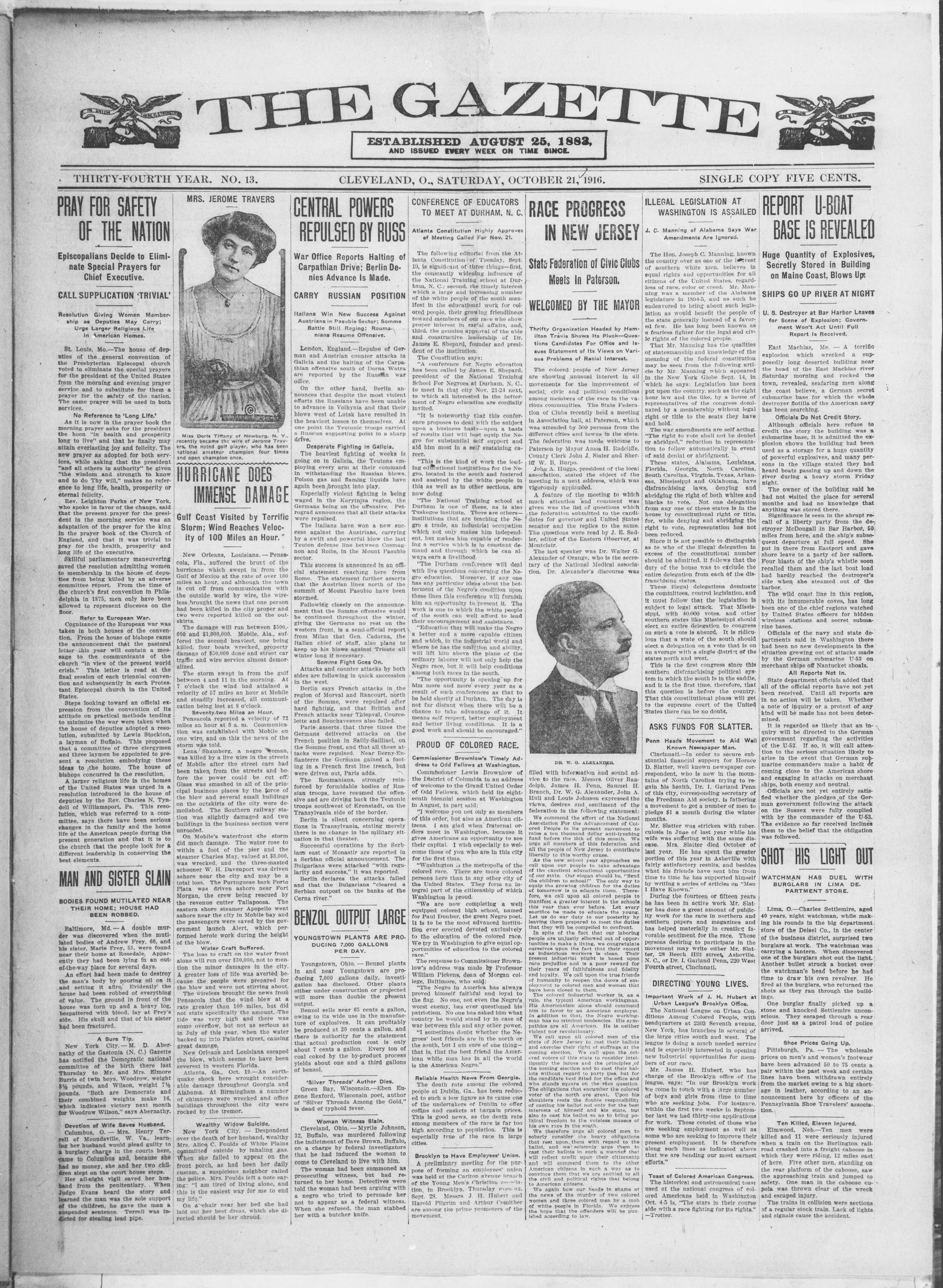
PRAY FOR SAFETY OF THE NATION
Episcopalians Decide to Eliminate Special Prayers for Chief Executive.
CALL SUPPLICATION 'TRIVIAL'
Resolution Giving Women Membership as Deputies May Carry; Urge Larger Religious Life in American Homes.
St. Louis, Mo.—The house of deputies of the general convention of the Presbyterian Episcopal church voted to eliminate the special prayers for the president of the United States from the morning and evening prayer service and to substitute for them a prayer for the safety of the nation. The same prayer will be used in both services.
No Reference to 'Long Life.'
As it is now in the prayer book the morning prayer asks for the president the boon "in health and prosperity long to live" and that he finally may attain everlasting joy and felicity. The new prayer as adopted for both services, while asking that the president "and all others in authority" he given "the wisdom and strength to know and to do Thy will," makes no reference to long life, health, prosperity or eternal felicity.
Rev. Leighton Parks of New York, who spoke in favor of the change, said that the present prayer for the president in the morning service was an adaptation of the prayer for the king in the prayer book of the Church of England, and that it was trivial to pray for the health, prosperity and long life of the executive.
Skillful parliamentary maneuvering saved the resolution admitting women to membership in the house of deputies from being killed by an adverse committee report. From the time of the church's first convention in Philadelphia in 1875, men only have been allowed to represent docentes on the
Refer to European War.
Cognizance of the European war was taken in both houses of the convention. From the house of bishops came the announcement that the pastoral letter this year will contain a message to the communicants of the church "in view of the present world crisis." This letter is read at the final session of each triennial convention and subsequently in each Protestant Episcopal church in the United States.
Steps looking toward an official expression from the convention of its attitude on practical methods tending to minimize the war were taken when the house of deputies adopted a resolution, submitted by Lewis Stockton, a layman of Buffalo. This proposed that a committee of three clergymen and three laymen be appointed to present a resolution embodying these ideas to the house. The house of bishops concurred in the resolution.
A larger religious life in the homes of the United States was urged in a resolution introduced in the house of deputies by the Rev. Charles N. Tyndell of Williamsport, Pa. This resolution, which was referred to a committee, says there have been serious changes in the family and the home life of the American people during the present generation and that it is to the church that the people look for a different leadership in conserving the best elements.
MAN AND SISTER SLAIN
MAN AND SISTER SLAIN
BODIES FOUND MUTILATED NEAR THEIR HOME; HOUSE HAD BEEN ROBBED.
Baltimore, Md.—A. double murder was discovered when the mutilated bodies of Andrew Frey, 60, and his sister, Marie Frey, 55, were found near their home at Rosedale. Apparently they had been lying in an out-of-the-way place for several days.
An effort had been made to destroy the man's body by pouring oil on it and setting it afire. Evidently the house had been robbed of everything of value. The ground in front of the house was torn up and a heavy log, bespattered with blood, lay at Frey's side. His skull and that of his sister had been fractured.
A Sure Tip.
New York City.—M. D. Abernathy of the Gastonia (N. C.) Gazette has notified the Democratic national committee of the birth there last Thursday to Mr. and Mrs. Elmore Burrs of twin boys. Woodrow, weight 8½ pounds, and Wilson, weight 7½ pounds. "Both are Democrats and their 'combined weights make 16, which indicates victory next month for Woodrow Wilson," says Abernathy.
Devotion of Wife Saves Husband.
Columbus, O. — Mrs. Henry Terrell of Moundsville, W. Va., learning her husband would plead guilty to a burglary charge in the courts here, came to Columbus and, because she had no money; she and her two children slept on the court house steps.
Her all-night vigil saved her husband from the penitentiary. When Judge Evans heard the story and learned the man was the sole support of the children, he gave the man a suspended sentence. Terrell was indicted for stealing lead pipe.
THE GAZETTE
MRS. JEROME TRAVERS
Miss Doris Tiffany of Newburg, N. Y., recently became the wife of Jerome Travers, the noted golf player, who has been national amateur champion four times and open champion once.
HURRICANE DOES
IMMENSE DAMAGE
Gulf Coast Visited by Terrific Storm; Wind Reaches Velocity of 100 Miles an Hour.
New Orleans, Louisiana. — Pensacola, Fla., suffered the brunt of the hurricane which swept in from the Gulf of Mexico at the rate of over 100 miles an hour, and although the town is cut off from communication with the outside world by wire, the wireless brought the news that one person had been killed in the city proper and two were reported killed on the outskirts.
The damage will run between $500,000 and $1,000,000, Mobile, Ala., suffered the second heaviest, one being killed, four boats wrecked, property damage of $50,000 done and street car traffic and wire service almost demoralized.
The storm swept in from the gulf between 4 and 11 in the morning. At 7 o'clock the wind had attained a velocity of 57 miles an hour at Mobile and steadily increased, all communication being lost at 8 o'clock.
Seventy-two Miles an Hour.
Pensacola reported a velocity of 72 miles an hour at 8 a.m. Communication was established with Mobile on one wire, and on this the news of the storm was told.
Lena Shamberg, a negro woman, was killed by a live wire in the streets of Mobile after the street cars had been taken from the streets and before the power could be cut off. Glass was smashed in all of the principal business places by the force of the blow and several small buildings on the outskirts of the city were demolished. The Southern railway station was slightly damaged and two buildings in the business section were unroofed.
On Mobile's waterfront the storm did much damage. The water rose to within a foot of the pier and the steamer Charles May, valued at $3,000, was wrecked, and the three-masted schooner W. H. Davenport was driven ashore near the city and may be a total loss. The Portuguese bark Porto Plata was driven ashore near Fort Morgan, the crew being rescued by the revenue cutter Tallapoosa. The eastern shore steamer Apopello went ashore near the city in Mobile bay and the passengers were saved by the government, launch Alert, which performed heroic work during the height of the blow.
Water Craft Suffered.
The loss to craft on the water front alone will run over $20,000, not to mention the minor damages in the city. A greater loss of life was averted because the people were prepared for the blow and were not stirring about. The wireless brought the news from Pensacola that the wind blew at a rate greater than 100 miles, but did not state specifically the amount. The tide was very high and there was some overflow, but not as serious as in July of this year, when the water backed up into Palafox street, causing great damage. New Orleans and Louisiana escaped the blow, which seems to have been severest in western Florida. Atlanta, Ga., Oct. 19—An earthquake shock here wrought considerable damage throughout Georgia and Alabama. At Birmingham a number of chimneys were wrecked and office buildings throughout the city were rocked by the tremor.
Wealthy Widow Suicide.
New York City. — Despondent over the death of her husband, wealthy Mrs. Alice C. Foulds of White Plains committed suicide by inhaling gas. When she failed to appear on the front porch, as had been her daily custom, a suspicious neighbor called the police. Mrs. Foulds left a note saying: "I am tired of living alone, and this is the easiest way for me to end my life." On a chair near her bed she had laid out her best dress, which she directed should be her shroud.
ESTABLISHED AUGUST 25, 1883 AND ISSUED EVERY WEEK ON TIME SINCE.
CENTRAL POWERS REPULSED BY RUSS
War Office Reports 'Halting of Carpathian Drive; Berlin Denies Advance Is Made.
CARRY RUSSIAN POSITION
Italians Win New Success Against Austrians in Pasubio Sector; Somme Battle Still Raging; Roumanians Resume Offensive.
London, England.—Repulse of German and Austrian counter attacks in Galicia and the halting of the Carpathian offensive south of Dorna Wytra are reported by the Russian war office.
On the other hand, Berlin announces that despite the most violent efforts the Russians have been unable to advance in Volhynia and that their blows west of Lutsk have resulted in the heaviest losses to themselves. At one point the Teutonic troops carried a Russian supporting point in a sharp drive.
Desperate Fighting in Galicia.
The heaviest fighting of weeks is going on in Galicia, the Teutons employing every arm at their command in withstanding the Russian blows. Polson gas and flaming liquids have again been brought into play.
Especially violent fighting is being waged in the Korytniza region, the Germans being on the offensive. Petrograd announces that all their attacks were repulsed.
The Italians have won a new success against the Austrians, carrying by a swift and powerful blow the last Teuton defense line between Cosmagnon and Rothe, in the Mount Pasubio sector.
This success is announced in an official statement reaching here from Rome. The statement further asserts that the Austrian lines north of the summit of Mount Pasubio have been stormed.
Following closely on the announcement that the Somme offensive would be continued throughout the winter, giving the Germans no rest on the western front, is a semi-official report from Milan that Gen. Adorna, the Italian chief of staff, also plans to keep up his blows against Trieste all winter long if necessary.
Somme Fight Goes On.
Attacks and counter attacks by both sides are following in quick succession in the west.
Berlin says French attacks in the region of Morval and Rancourt, north of the Somme, were repulsed after hard fighting, and that British and French attacks near Thiepval, Courcelle and Bouachavesnes also failed.
Paris asserts that three times the Germans delivered attacks on the French position in Saffly-Sallissel, on the Somme front, and that all these attacks were repulsed. Near Bergen-Enanterre the Germans gained a footing in a French first line trench, but were driven out, Paris adds.
The Roumanians, strongly reinforced by formidable bodies of Russian troops, have resumed the offensive and are driving back the Teutonic troops southwest of Kronstadt, on the Transylvanian side of the border.
Berlin is silent concerning operations in Transylvania, stating merely there is no change in the military situation in that theater.
Successful operations by the Serbians east of Monastir are reported in a Serbian official announcement. The Bulgarians were attacked "with regularity and success," it was reported.
Berlin declares the attacks failed and that the Bulgarians "cleared a Serbian outpost on the banks of the Corna river."
BENZOL OUTPUT LARGE
YOUNGSTOWN PLANTS ARE PRODUCING 7,000 GALLONS PER DAY:
Youngstown, Ohio. — Benzol plants in and near Youngstown are producing 7,000 gallons daily, investigation has disclosed. Other plants either under construction or projected will more than double the present output.
Benzol sells near 65 cents a gallon, owing to its wide use in the manufacture of explosives. It can profitably be produced at 20 cents a gallon, and there is authority for the statement that actual production cost is only about 7 cents a gallon. Every ton of coal coked by the by-product process yields about one and a third gallons of benzol.
'Silver Threads' Author Dles.
Green Bay, Wisconsin—Eben Eugene Rexford, Wisconsin poet, author of "Silver Threads Among the Gold," is dead of typhoid fever.
Woman Witness Slain
Cleveland, Ohio. — Myrtle Johnson, 32, Buffalo, was murdered following the indictment of Dave Brown, Buffalo, on a charge by federal investigators that he had induced the woman to come to Cleveland to live with him. The woman had been summoned as prosecuting witness, but had returned to her home. Detectives were told the woman had been arguing with a negro who tried to persuade her not to appear as a federal witness. When she refused, the man stabbed her with a butcher knife.
CONFERENCE OF EDUCATORS TO MEET AT DURHAM, N. C.
Atlanta Constitution Highly Approves of Meeting Called For Nov. 21.
The following editorial from the Atlanta Constitution of Tuesday, Sept. 19, is significant of three things—first, the constantly widening influence of the National Training school at Durham, N. C.; second, the timely interest which a large and increasing number of the white people of the south manifest in the educational work for colored people, their growing friendliness toward members of our race who show proper interest in racial affairs, and, third, the genuine approval of the able and constructive leadership" of Dr. James E. Shepard, founder and president of the institution.
The Constitution says:
"A conference for Negro education has been called by James E. Shepard, president of the National Training School For Negroes at Durham, N. C. to meet in that city Nov. 21-21 to which all interested in the betterment of Negro education are cordially invited.
"It is noteworthy that this conference proposes to deal with the subject upon a business basis—upon a basis of results that will best equip the Negro for substantial self support and aid him most in a self sustaining career.
"This is the kind of work the leading educational institutions for the Negro, located in the south and fostered and assisted by the white people in this as well as in other sections, are now doing."
"The National Trailing school at Durham is one of these, as is also Tuskegee institute. There are others—institutions that are teaching the Negro a trade, an industrial occupation which not only makes him independent, but makes him capable of rendering a service which is in constant demand and through which he can always earn a livelihood.
"The Durham conference will deal with five questions concerning the Negro education. Moreover, if any one has any particular ideas about the betterness of the Negro's condition upon these lines this conference will furnish him an opportunity to present it. The work is one to which the white people of the south can well afford to lend their encouragement and assistance.
"Education that will mans the Negro a better and a more capable citizen and which, in the industrial world and where he has the ambition and ability, will lift him above the plane of the ordinary laborer will not only help the Negro race, but it will help conditions among both races in the south.
"The opportunity is opening up for him more and more every year as a result of such conferences as that to be held shortly at Durham. The day is not far distant when there will be a chance to take advantage of it. It means self respect, better employment and better living conditions. It is a good work and should be encouraged."
PROUD OF COLORED RACE.
Commissioner Brownlow's Timely Address to Odd Fellows at Washington.
Commissioner Lewis Brownow of the District of Columbia in an address of welcome to the Grand United Order of Odd Fellows, which held its eighteenth biennial session at Washington in August, in part said:
"I welcome you not only as members of this order, but also as American citizens. I am glad when fraternal orders meet in Washington, because it gives Americans an opportunity to see their capital. I wish especially to welcome those of you who are in this city for the first time.
"Washington is the metropolis of the colored race. There are more colored persons here than in any other city of the United States. They form an integral part of the citizenship of which Washington is proud.
"We are now completing a well equipped colored high school, named for Paul Dunbar, the great Negro poet. It is to be the most advanced institution ever erected devoted exclusively to the education of the colored race. We try in Washington to give equal opportunities of education to the colored race."
The response to Commissioner Brownlow's address was made by Professor William Pickens, dean of Morgan college, Baltimore, who said:
"The Negro in America has always proved himself faithful and loyal to the flag. No one, not even the Negro's worst enemy, has ever questioned his patriotism. No one has asked him what country he would stand by in case of war between this and any other power. "I sometimes doubt whether the Negroes' best friends are in the north or the south, but I am sure of one thing—that is, that the best friend the American white man has in all the world is the American Negro."
Reliable Health News From Georgia. The death rate among the colored people at Dublin, Ga., has been reduced to such a low figure as to cause one of the undertakers of Dublin to offer coffins and caskets at bargain prices. This is good news, as the death rate among members of the race is far too high according to population. This is especially true of the race in large cities.
Brooklyn to Have Employees' Union. A preliminary meeting for the purpose of forming an employees' union was held at the Carlton avenue branch of the Young Men's Christian association. In Brooklyn, Thursday evening, Sept. 28, Messrs. J. H. Hulbert and Harold Pilgrim and Arthur Comther are among the prime promoters of the movement.
RACE PROGRESS IN NEW JERSEY
Thrifty Organization Headed by Hamilton Travis Shows Its Pluck—Questions Candidates For Office and Issues Statement of Its Views on Various Problema of Racial Interest.
The colored people of New Jersey are showing unusual interest in all movements for the improvement of social, style and political conditions among members of the race in the various communities. The State Federation of Clubs recently held a meeting in Association hall, at Paterson, which was attended by 500 persons from the different cities and towns in the state. The federation was made welcome to Paterson by Mayor Amos H. Radcliffe, County Clerk John J. Shater and Sheriff W. B. Burge.
John A. Huggs, president of the local association, stated the object of the meeting in a neat address, which was vigorously applauded.
A feature of the meeting to which much attention and comment was given was the list of questions which the federation submitted to the candidates for governor and United States senator and the replies to the same.
The questions were read by J. E. Sadler, editor of the Eastern Observer, at Montclair.
The last speaker was Dr. Walter G. Alexander of Orange, who is the secretary of the National Medical association. Dr. Alexander's discourse was
DR. W. G. ALEXANDER:
Allied with information and sound advice to the race. Messrs. Oliver Rangolph, James H. Penn, Samuel H. Branch, Dr. W. G. Alexander, John A. Hull and Louis Johnson expressed the views, desires and sentiment of the federation in the following statement:
We commend the effort of the National Association For the Advancement of Colored People in its present movement to fund the work of the organization fund before the 15th of this month. We urge all members of this federation and all the people of New Jersey to contribute liberally to this worthy cause. As the new school year approaches we will encourage the advantage of the excellent educational opportunities of our state. Our slogan should be: "Send the children to school!" The only way to equip the growing children for the duties of our society is to work with them, we call upon all colored people to manifest a greater interest in the schools this year than ever before. Let every sacrifice he made to educate the young, the old, the sick, the disabled, leaving them prepared to meet the duties that they will be compelled to confront. In spite of the fact that our laboring people are unjustly allowed out of, opportunity for, and in the work of, ourselves upon the fact that their record as industrial workers is clean. Their present industrial plight is based upon race prejudice and is a poor reward for older years (fatiguefulness and fidelity of humanity to reopen the doors of employment to colored men and women that have been closed to them). Our worker is as a rule the typical American workingman. His Americanism alone should command him to favor by an American employer. In addition to that, the Negro working-man has no criminal tendencies. His sympathy for the poor. He is another violent new revolution.
We call upon all colored men of the state of New Jersey to cast their ballots and exercise their right of suffrage at the counting election. We call upon the colored voters to exercise their right of illegitimately the issues and the principles of the coming election and to cast their ballots without regard to party ties, but for the candidate best fitted for the office and who stands square on the race question. The obligations that the colored voters have with regard to this shoulders the double responsibility of casting his ballot, not only for the best interests of himself and his state, but also to cast his ballot so as to bring political freedom to the voleless masses of the nation. We therefore urge all colored men to soberly consider the heavy obligations that rest upon them with regard to the ballot, and we solemnly urge them to cast their ballots in such a manner that will reflect credit upon their citizenship and American citizens in such a way as to convince them that we are entitled to all the civil and political rights that belong to American citizens. We again bow our heads in shame at the news of the murder of two colored men in Florida and the murder of white people in Florida. We express the hope that the offenders will be punished according to law.
SINGLE COPY FIVE CENTS.
ILLEGAL LEGISLATION AT WASHINGTON IS ASSAILED
J. C. Manning of Alabama Says War Amoridments Are Ignored.
The Hon. Joseph C. Manning, known the country over as one of the lowest of southern white men, believes in equal rights and opportunities for all citizens of the United States, regardless of race, color or creed. Mr. Manning was a member of the Alabama legislature in 1845, and as such he endured to bring about such legislation as would benefit the people of the state generally instead of a favored few. He has long been known as a fearless fighter for the legal and civil rights of the colored people.
That Mr. Manning has the qualities of statesmanship and knowledge of the meaning of the federal constitution may be seen from the following article by Mr. Manning which appeared in the New York Globe Sept. 14, in which he says: Legislation has been put upon the country, such as the eight hour law and the like, by a house of representatives of the congress dominated by a membership without legal right or title to the seats they have and hold.
The war amendments are self acting. "The right to vote shall not be denied or abridged," reduction in representation to follow automatically in event of said denial or abridgment.
These states, Alabama, Louisiana, Florida, Georgia, North Carolina, South Carolina, Virginia, Texas, Arkansas, Mississippi and Oklahoma, have disfranchising laws, denying and abridging the right of both whites and blacks to vote. Not one delegation from any one of these states is in the house by constitutional right, or title, for, while denying and abridging the right to vote, representation has not been reduced.
Since it is not possible to distinguish as to who of the illegal delegation in excess of the constitutional number should be admitted, it follows that the duty of the house was to exclude the entire delegation from each of the disfranchising states.
These illegal delegations dominate the committees, control legislation, and it must follow that the legislation is subject to legal attack. That Mississippi, with 40,000 votes, and other southern states like Mississippi should elect an entire delegation to congress on such a vote is absurd. It is ridiculous that a state of the south should elect a delegation on a vote that is on an average with a single district of the states north and west.
This is the first congress since this southern disranchising political system in which the south is in the saddle, and it is the first time, therefore, that this question is before the country. That this constitutional phase will get to the supreme court of the United States there can be no doubt.
ASKS FUNDS FOR SLATTER.
Penn Heads Movement to Aid Well Known Newspaper Man.
Cincinnati.—In order to secure substantial financial support for Horace D. Slatter, well known newspaper correspondent, who is now in the mountains of North Carolina trying to regain his health, Dr. I. Garland Penn of this city, corresponding secretary of the Freedman Aid Society, is fathering a movement to get a number of men to pledge $1 a month during the winter months.
Mr. Slatter was stricken with tuberculosis in June of last year while his wife was suffering with the same disease. Mrs. Slatter died October of last year. He has spent the greater portion of this year in Asheville with fairly satisfactory results, and besides what his friends have sent him from time to time he has supported himself by writing a series of articles on "Men I Have Known."
During the fourteen or fifteen years he has been in active work Mr. Slatter has done a great amount of publicity work for the race in northern and southern papers and magazines and has helped materially in creating favourable sentiment for the race. Those persons desiring to participate in the movement may write either Mr. Slatter, 28 Beech Hill street, Asheville, N. C., or Dr. I. Garland Penn, 220 West Fourth street, Cincinnati.
DIRECTING YOUNG LIVES.
Important Work of J. H. Hubert at Urban League of Brooklyn Office.
The National League on Urban Conditions Among Colored People, with headquarters at 2303 Seventh avenue, New York, has branches in several of the large cities south and west. The league is doing a much needed service and is especially interested in opening new industrial opportunities for members of our race.
Mr. James H. Hubert, who has charge of the Brooklyn office of the league, says: "In our Brooklyn work we come in touch with a large number of boys and girls from time to time who are seeking jobs. For instance, within the first two weeks in September last we had thirty-one applications for work. These consist of those who are seeking employment as well as some who are seeking to improve their present employment. It is therefore along such lines, as indicated above that we are bending our most earnest efforts."
Toast of Colored American Congress.
The historical and astronomical toast used at the national congress of colored Americans held in Washington Oct. 4. 15. is "The stars in their course side with a race fighting for its rights." — Trotter.
IN HIGH
GOVERNMENT
REPORT U-BOAT BASE IS REVEALED
Huge Quantity of Explosives Secretly Stored in Building on Maine Coast, Blows Up.
U. S. Destroyer at Bar Harbor Leaves for, Scene of Explosion; Government Won't Act Until Full-Report Is Received.
East Machias, Me. — A terrific explosion which wrecked a supposedly long: deserted building near the head of the East Machias river Saturday morning and rocked the town, revealed, seafaring men along the coast believe, a German secret submarine base for which the whole destroyer flotilla of the American navy has been searching.
Officials Do Not Credit Story.
Although officials here refuse to credit the story the building was a submarine base, it is admitted the explosion shows the building had been used as a storage for a huge quantity of powerful explosives, and many persons in the village stated they had heard boats passing up and down the river during a heavy storm Friday night.
The owner of the building said he had not visited the place for several months and had no knowledge that anything was stored there.
Significance is seen in the abrupt recall of a liberty party from the destroyer McDougall in Bar Harbor, 50 miles from here, and the ship's subsequent departure at full speed. She put in there from Eastport and gave shore leave to a party of her sailors. Four blasts of the ship's whistle soon recalled them and the last boat load had hardly reached the destroyer's side when she steamed out of the harbor.
The wild coast line in this region, with its innumerable coves, has long been one of the chief regions watched by United States officers for hidden wireless stations and secret submarine bases.
Officials of the navy and state departments said in Washington there had been no new developments in the situation growing out of attacks made by the German submarine, U-53 on merchant ships off Nantucket shoals.
All Reports Not In.
State department officials added that all of the official reports have not yet been received. Until all reports are in no action will be taken. Whether a note of inquiry or a protest of any kind will be made has not been determined.
It is regarded as likely that an inquiry will be directed to the German government regarding the activities of the U-53. If so, it will call attention to the serious situation likely to arise in the event that German submarine commanders make a habit of coming close to the American shore and engaging in attacks on merchant ships, both enemy and neutral. Officials are not yet entirely satisfied whether the pledges of the German government following the attack on the Sussex were fully complied with by the commander of the U-53. The evidence so far received inclines them to the belief that the obligation was followed.
WATCHMAN HAS DUEL WITH BURGLARS IN LIMA DE-PARTMENT STORE.
Lima, O.—Charles Settlemire, aged 40 years, night watchman, while making his rounds in the big department store of the Delsel Co., in the center of the business district, surprised two burglaries at work. The watchman was carrying a lantern. When discovered one of the burglaries shot out the light. Another bullet struck a bucket over the watchman's head before he had time to draw his own revolver. He fired at the burglaries, who returned the shots as they ran through the buildings.
One burglar finally picked up a stone and knocked Settlemire unconscious. They escaped through a rear door just as a patrol load of police arrived.
Shoe Prices Going Up
Pittsburgh, Pa.—The wholesale prices on men's and women's footwear have been advanced 50 to 75 cents a pair within the past week and certain lines have been withdrawn entirely from the market owing to a big shortage in leather, according to an announcement here by officers of the Pennsylvania Shoe Travelers' association.
Ten Killed, Eleven Injured.
Elmwood, Neb.-Ten men were killed and 11 were seriously injured when a train on the Burlington railroad crashed into a freight caboose in which they were riding, 12 miles east of here. Five other men, standing on the rear platform of the caboose, saw the approaching train and jumped to safety. One man in the caboose cupola was thrown clear of the wreck and escaped injury.
The trains in collision were sections of a regular stock train. Lack of lights and signals cause the accident.
The GAZETTE
PUBLISHED EVERY SATURDAY
SUBSCRIPTION RATES
(in Advance)
One Year.....$1.50.
Six Months.....1.00
Three Months......50
Subscribers are requested to re-
mit by postoffice money or-
der or registered letter
Entered at the postoffice in Cleveland
Ohio, an second-class matter.
Address all communications to
HARRY C. SMITH
Editor and proprietor,
THE GAZETTE,
Blackstone Building, Cleveland, O.
Member Ohio Legislature: 1894
to 1896; 1896 to 1898; 1900 to 1902
THE GAZETTE is the oldest, and has the largest bona fide circulation, double that of any newspaper in the interest of Afro-Americans, published in the state of Ohio, and comparison with any will immediately establish NEWSIEST AND BEST in the country.
10,000,000 Afro-Americans..
160,000 in Ohio.
20,000 in Cleveland.
SATURDAY, OCTOBER 21, 1916.
DARE TO DO YOUR DUTY
"Let us have faith that right makes might, and in that faith let us to the end dare to do our duty as we understand it"—Abraham Lincoln.
President Thomas Woodrow Wilson says he feels that the war in Europe is going to this country a great service. Going to! It has already dragged the business of the country out of the industrial depression into which it was thrown by the Wilson-Underwood tariff law. It has afforded the Democratic administration a pretext for a "prosperity" claim. What more does President Wilson ask or expect it to do?
MUST HAVE THE PRESIDENCY AND CONGRESS.
The Republican party must make a clean sweep in the federal elections this year. Not only must Hughes be elected, but a Republican house and senate must be chosen with him. The present prospect is for the accomplishment of all these results. The electoral college is sure to be Republican. The gains which we shall make in the Congressional elections in a few States only assure a Republican majority in the lower House. To gain the Senate is less easy—but it will be done. The unhappy division of 1912 came at an unfortunate time for the Republican cause. The number of Senatorial seats that year fell vacant showed a preponderance in Republican States, where the Republican split made an easy and undeserved success possible for the Democrats. These seats cannot be regained until 1918 and this fact adds to the difficulties of Republican campaigning this time. This condition, however, is serving as a spur to Republican activities. Some of the States which elect Senators happen to be also highly important by reason of the size of their electoral vote. New York, New Jersey, Chio, Indiana, Missouri, California, Massachusetts, West Virginia and Connecticut have Senatorial contests this year. These States carry 170 electoral votes and will choose ten Senators, six of whom will succeed Democrats. These are the essential States from every point of view. Carrying them, in addition to the other States where the contest will be less severe, means a clean sweep for Republicanism. Nothing short of this will satisfy the party, nothing short of this will serve the country. If the wrongs perpetrated by Democracy are to be right, if sanity and order are to be again enthroned in our national administration, if economy and efficiency are again to rule national legislation, if the broad view of nationalism rather than of sectionalism is again to command the action of Congress—then there must be a clean sweep for Republicanism in November.
THE COLORED MAN'S DEBT TO
THE REPUBLICAN PARTY.
If the Colored citizen recalls the past he must acknowledge that every privilege he has in this country came to him from the Republican party. The Democrats opposed every proposition looking toward his welfare during the long struggle over the race for the governors following the slaveholders' rebellion. The history of the United States tells a conclusive story on these points. Freedom, manhood, education, suffrage, opportunity were given by the party of which Hughes and Fairbanks are the standard bearers. To the Democratic party the race owes: Two hundred and fifty years of slavery, peonage, disfranchisement, Jim-crowism, lynching, curtailment of freedom, negotiation, humiliation and degradation. National Republican Campaign Matter
We are "Republicans" alright; and for Hughes and Fairbanks and all the rest of the Republican ticket, national, state and county, with the exception of Frank B. Willis, candidate for governor, and possibly one other state and one or two local candidates. However, we would warn the national Republican committee "to put the brakes on" that obsolete "stuff"—"The Colored Man's Debt to The Republican Party." It is nonsense, pure and simple, and was worn out twenty-five years ago. "The Republican party's debt to the Colored man" is the way it should be put because we finished paying "the debt," and with compound interest, too, a quarter of a century ago, and any attempt at this late date to revive and saddle it on us, and too in the light of a great experience and vastly improved intelligence on this particular political "stunt," will result in driving intelligent voters from the support of Hughes, Fairbanks and
STATEMENT OF THE OWNERSHIP
MANAGEMENT, CIRCULATION,
ETC., REQUIRED BY THE ACT OF
CONGRESS OF AUGUST 24, 1912.
Of THE GAZETTE published weekly
at Cleveland, Ohio, for October, 1916.
State of Ohio, County of Cuyahoga,
SS.
Before me, a notary public, in and
for the state and county aforesaid,
personally appeared Harry C. Smith,
who, having been duly sworn according
to law, deposes and says that he is
the editor and owner of THE GAZETTE
and that the following is, to the best of his knowledge and belief,
a true statement of the ownership,
management, etc., of the aforesaid
publication for the date shown in the
above caption, required by the act of
August 24, 1912, embodied in section
443, postal laws and regulations,
puncted on the reverse of this form, to
wit:
1. That the name and address of
the publisher, editor, managing editor,
and business manager is: Harry C.
Smith.
2. That the owner is: Harry C. Smith.
3. No bondholders, mortgages, or other security holders.
Signed. Harry C. Smith.
Signature of publisher, business manager and owner.
Sworn to and subscribed before me
this the 4th, day of October, 1865.
Zimmer
(Seat) Alexander Zimmer My commission expires Jan. 23, 1918.
other deserving Republican candidates, this fall, by the whole-sale. Another thing, that should be remembered by the publicity man of the national committee is the fact he seems to overlook, and that is, "the Colored man" has been a very important factor of the Republican party almost since its inception and has helped it, as well as all the American armies, to "save the country" many times, as well as to secure to himself, with the party's assistance, "freedom, suffrage" (in the North only), etc., etc. Much more along this line could be as truthfully written but it is not necessary. "The Colored man owes the Republican party" nothing but good will. On the contrary that party is heavily in debt to him. "The Colored Man" is a Republican and will vote for Hughes and Fairbanks because it is to his best interest to do so and not because "he recognizes the existence" of that long wiped-out "debt" our national committee publicity writer has unfortunately recalled.
TRI-STATE FAIR A SUCCESS.
School Displays Most Striking—Attendance Largest in the Fair's History—Woman Farmer Excels.
Memphis, Tenn.—Friday was child's day at our T-State fair, and as a result a good attendance rewarded the efforts of the management. The schools were dismissed for the day, and our pupils seized the opportunity to attend it. During the day lectures were given by T. W. Hampton and M. V. Link on subjects of applied science. The daily program of racing, the annual golf tournament was carried out, Saturday, the third and last day of the fair, a similar program was given in front of the grand stand, and at night the jubilee singers gave another concert in front of the grand stand. Both in point of exhibits and attendance this fair has been much superior to those which have preceded it. Members of the state board of education visited the fair Friday and were much impressed by the work of the grounds, which officers of the fair association estimated at 10,000. J. W. Hale, president of the Industrial Normal school at Nashville, and Prof. Klippinger of the LeMoyne Institute, lectured during the afternoon and the supervisor of our schools of West Tennessee gave several demonstrations. Much favorable comment was passed on the exhibits of the Manassas Street school and on the displays of the State golf course. Splendid individual exhibits of farm products testify to the ability of their entrants. One of the best collections of farm and garden growths is that shown by a woman farmer, who is an annual exhibitor.
THE SPINGARN MEDAL.
New York City, Oct. 14, 1916.
Editor Gazette, Dear Sir: The committee of award will appreciate any suggestions from you as to possible candidates for the 1917 Spingarn Medal. The first, as you know, was awarded to Dr. J. E. Juhn, indulged work in biology, and the second to Major (now Lieut. Col.) Charles Young for his services in Liberia. The third will be awarded early next January, and the names of any candidates you care to suggest should be sent to Bishop John Hurst, chairman of the committee of award, room 518, 70 Fifth Ave., New York, not later than Dec. 15, 1918.
Very truly yours.
ROY NASH,
Sec. N. A. A. C. P.
LEGAL NOTICE.
The Wyoming Land and Credit Co., a corporation, whose principal place of business is Laramie, Wyoming, is hereby notified that E. O. S. Brown has filed his petition in Case No. 152,106 in the Common Pleas Court of Cuyahoga County, Ohio, against the above named defendant and sets forth therein that he is the owner in fee simple and in the possession of the following described premises:
Situated in the village of West Park, County of Cuyahoga and State of Ohio, and known as being sub-lot No. 20 in The Scott-Hall-Clark Co.'s subdivision of original Rockport township, Section No. 1. San Antonio, No. 1 was a frontage of 40 ft. to the north side of Wainfield St., and extends back of equal width. — feet
That the aforesaid defendant claims an ownership or some interest in the above described property adverse to the said plaintiff but that he has none interest in the claim of defendant is that the claims of said defendant may be adjudged null and void; that plaintiff's title to said premises may be quieted and for such other and further relief as may be just and equitable, said defendant is required to answer said petition on or about Dec. 9, 1916, or judgment will be taken
E. O. S. Brown, by Carver & Thompson, Attorneys.
Lets Others Do That.
Curiously enough, the family loafer never thinks of providing the family loaf.—The Youth's Companion.
THE GAZETTE, CLEVELAND, O., SATURDAY, OCTOBER 21, 1916.
Written by 'The Old Reliable Gazette's Correspondents
What Our People Are Doing Each Week—Church, Personal, Social, Lodge, Literary and Musical, Marriages, Deaths, Etc.
CADIZ—The Busy Bees met at Charles Christian's and had an interesting meeting—Rev. and Mrs. C. M. Hogans, of Plqua, visited Mrs. Thomas Mason, last week—Quarterly meeting, Sunday, at the A. M. E. church. Rev. Charles Bundy, P. E. will be present. Mr. and Mrs. Franklin Murphy, of Tippecanoe, are here visiting. Mrs. Irene Johnson Robbins has been quite sick recently—Francis Tyler and Dwight Brooks, of Dennison, visited their parents, last week.—Mesdames Clara Ramsey and Lola Ramsey are visiting in Massillon.—Rev. Moyer, of the M. Church, Home Coming Service, of the Church, evening event, W. G. Harding will speak here Oct. 25.
George and Harry Bowman visited their sister, Mrs. Mason. The W. M. S. elected the following officers recently: Pres., Mrs. Henrietta Smith; vice-pres., Mrs. Olive Lucas; sec., Mrs. Parthenia Johnston; corresp. sec., Mrs. Dora Johnston.
CORRESPONDENTS must mail all letters for publication at their main postoffice sufficiently early on Monday (or Sunday) of each week to have them reach The Gazette office on Tuesday morning, and always write also; their names and that of their city or town on the outside of the wrapper about returned copies. Unless this latter is done, proper credit cannot be given you. Etc. lists of names, wedding presents, etc., obituary notes, memorials, resolutions, poetry, inquiries for relatives and advertisements of all kinds, including items announcing entertainments to be held in the near future, must be paid for in advance at the rate of ten cents a line, six words to a line. Our rates for display advertisements will be sent on advertisement.
YOUNGSTOWN —Wm. Moore, age 41, died at the Infirmary, Monday. —Elmer Harvey entertained royally in honor of his wife's birthday, recently. —Mrs. J. H. Moore is visiting in Chicago. —Harry Barrett, who died at the hospital after being run over by an auto, was buried Wednesday. —Mrs. C. A. Jackson and Mrs. John Shaw visited in Cleveland, recently. —Mrs. Emma Moore, of Culpepper, Va., is visiting her grandmother, Mrs. Tansmore. —Mrs. Emma Tarver and Edward A. Wilber were married, Wednesday evening. —Charles Saunders is ill. Dorothy Davis is improving after three months of Cindennati, lectured, Thursday evening, at the Third Baptist church. —St. Augustine mission will hold services at 7.30 p. m., Sundays, until further notice. —The ladies will give a masquerade party at Odd Fellows' hall, Oct. 30. —Order The Gazette, tell your friends.
SANDUSKY—Rev. G. D. Smith returned, Monday, from the State Baptist convention in Rev. L. W. Gray's church at Walnut Hills. It was the greatest in the history of the church in Ohio. More than 500 delegates were in attendance. Next meeting in Cleveland at Mt. Haven church; Oct. 1917. Rev. E. Burton preached at the Second Baptist church, Sunday. The A. M. E. church is progressing nicely. The Woman's convention was grand. Also the B. Y. P. U., over $1,000 being contributed during the meeting. There were more biggers. The Rev. Clemens is the right man in the right place. Both churches and S. S. were well attended. Sunday and the scholars are already looking forward to a great work, this fall. The Second Baptist church will hold a rally, Nov. 5. Only $1 for each member, that day; and the pastor will not ask them to a rally again this year if each one gives the dollar.
SMITHFIELD—Mr. Chas. Bigsby visited in Wheeling and Bellaire, recently—Mr. Edw, West, Mrs. A. Palmer and daughter, Florence Christian, attended Miss B. West's funeral—Mr. and Mrs. A. J. Guy and son, Rev. and Mrs. J. H. Farley, Mr. and Mrs. Parker Morton and son, of Steubenville, visited relatives here, Satursday and Sunday—Mr. and Mrs. Archie Johnson, who visited her and other relatives, last week, returned to Wheeling, last Friday—Mr. Chas. Ford left, Monday for Bellaire—Mrs. Rhoda Veney entertained, Tuesday evening, at supper in honor of her sister, Mrs. Johnson, and husband; Mrs. E. H. Harris, the Misses Alice, Nellie and Mrs. Jas Harris, Jr., Mr. and Mrs. Homer Harris. They were also entertained by Mr. and Mrs. D. Christian, Mr. and Mrs. Wm. Harris, Mr. and Mrs. E. Freeman the Freeman visited in Pittsburgh, last week—Mesdames Atkins and A. Toney, of McIntyre, were guests of Mrs. H. Harris, Monday—Miss Betty West, an old resident of this place, died at Richmond, recently—Rev. J. M. Williams preached two able sermons, Sunday. He hopes to be located here soon. Collections were very good at both services, Mr. D. Freeman and Mrs. A. Freeman and the Dowell brothers, Mr. Chas, Freeman and son, William of Mr. M pleasant, attended services here, Sunday—Mr. and Mrs. Homer Harris gave a successful oyster supper, Saturday evening, for the trustees' benefit.
HILLSBORO—Prof. Chester Anderson son visited in Cleveland recently—Mr. and Mrs. Odus Bolden have returned to Columbus. They visited their parents—Mrs. Elmer Polly has returned to Cleveland after a three weeks' visit here and at Greenfield—Mr. and Mrs. Jas. Blanton, Ralph Rickman, Nancy Sallie and Susan Day, Isaac Hudson, Mr. and Mrs. Arthur Kittrell and Dr. Robert Barker, Bob Boro fair, last Thursday—John Hudson, Asa Jackson and Tom Perkins returned to Cleveland, Sunday, after a week's visit here—Rev. G. W. Burr, Rev. J. G. Orr, Prof. S. G. Hough, Miss Lowler Carre were delegates to the O. B. S. convention in Bethel church, Cincinnati, last week—Rev. Wyatt, of Cincinnati, will preach at New Hope Baptist church, Friday evening. Don't miss hearing him—Mr. Mrs. Hudson, Dr. Robert Barker, Bob Boro fair, Sunday in Cincinnati, visiting their son, Aaron and family, and daughter, Mrs. Giddings,—Mrs. Ona Peyton vis-
ited her aunt in New Vienna, Sunday,
—Charles Colter, Lang Young, Mrs.
Addie Young, Hazel McMearland, Harvey
Ames, Clara Smith, Virgil Paxton,
Mr. and Mrs. John Williams and
daughter, Ada, Harvey Henderson,
George Johnson, Fred Riggs, Arthur
Donaldson, Harry Parson, Rev. J. J.
Burr and family also attended the
B. S. convention at Cincinnati, Sunday,
—Mrs. Elsie Hurd Hall, of Montreal, Ca., is here visiting relatives,
Mrs. Walsh Anderson is visited
daughter, Mrs. Walsh Satell and
Sunday, in Cincinnati, Miss Selika
Thomas has returned from a visit in
Washington C. H.—Mr. Otho Hudson,
formerly of this place, and Miss Ber-
the Mason, of W. Va., were married,
Saturday, in Columbus. They have
the best wishes of many friends.
DOINGS
OF
THE
RACE
Not "Fred" Douglass, brother; but
the Hon. Frederick Douglass!
Young Turner, age 71, farmer, of
Lebanon, Ill., said to be one of the
wealthiest Afro-Americans in that
state, died last week Wednesday.
The famous Loen迪 club of Pittsburg, has honored itself by electing Capt. C. W. Posey its president. He is one of Pennsylvania's pioneer successful business men.
A number of race papers are being "worked" by an eastern advertising agency that is furnishing them cartoons for much more valuable advertising space. Do not be so "easy," confres.
Ellis Smith, of Boonville, Mo., was a consistent winner at the recent state fair, winning 13 ribbons and $23 in prize money, all on grapes. He won second on the largest collection of prize winning grapes, which payed a premium of $6.
I have never known a more unselfish nor a kinder-hearted man than Bishop Alex. Walters, nor a truer friend of his race; I care nothing about his politics or where he came from or what he was—"Bruce-Grit" in Charlotte (N.C.) Star of Zion, organ of the Zion A.M. M. E. Church.
Editor Jones, editor of the New Orleans (La.) S. W. Christian Advocate, organ of the Afro-American membership of the M. E. church, asserts that the Negroes in the Methodist Episcopal church are fearful of the white leadership of the church and that this fear has suppressed independence and conviction. This fear, Editor Jones asserts further, is influenced by the feeling of dependence, for the loaves and fishes, which are given by "the white part" of the church for the support of the Negro schools, home missionary schools, or work among them. He declares that the price the Negro has paid for his charity is the loss of independence and selfassertion—Baltimore (Md.) Commonwealth, Rev. Ernest Lyon, editor, and member of M. E. church.
```markdown
```
Editor Harry C. Smith, of The Cleveland Gazette, is pointing out to our good people there the danger they are incident to from the rowdy class of Negroes who have been coming to the "Forest City" of late months from the Southland. Ignorant, venal, immoral, loud-mouthed, and disregarding the rights and privileges of others, they are an almost constant source of irritation between their particular class and a like grade of white people. In view of what we have said above, it is the bounden duty of all good citizens to hand themselves together and see that these undesirables are either made behave themselves, or be made to leave a section which, barring their presence, is a fine section to dwell in. —Martinsburg (W. Va.) Pioneer Press.
Judging from the import of a letter written to Hon. Harry C. Smith, of Cleveland, by crief of Police R. H. McKinney, of Lima, O., the three recent "assaults" by Negroes upon white women in that city have been more the result of the deluded imaginations of the three females who underwent the supposed "attacks" and the creative genius of an enterprising and prejudiced Associated Press correspondent, whose oak aim was to injure our race. In all cases, the single instance so far has it been fully proven that a Negro was the assailant of any one of the three women. Our conclusions are pretty strong, but we have arrived at them after careful consideration of what Lima's chief has to say, and if anybody ought to know the true condition of things there he is one of the men—Pioneer Press.
CORRESPONDENTS WANTED
The old reliable Gazette desires an active agent and correspondent in every city and town in Ohio and neighboring states having a number of Afro-American residents. Only a little time on Fridays or Saturdays is required.
We are especially desirous of hearing from the respondents in the following named cities: Springfield, Dayton, Plqua, M. Vernon, East Liverpool, Akron, Lima, O., and other places, particularly in Ohio, where we have none.
Write to the editor of The Gazette, Blackstone building, Cleveland, O, and terms will be sent promptly. Our readers will oblige us greatly by sending at once the addresses of persons in the named and others in the state, to whom we can write relative to the matter.
HARRY WILLS STOPS COTTON.
New York City—Harry Wills, of New Orleans, defeated George Cotton of Pittsburgh, here, last week Friday night, the referee stopping the match in the fifth round to save Cotton from further punishment. Weighed 210 pounds and Cotton 203.
Our advertisers want your trade. Those who do not ask for it in The Gazette certainly care little if it is a trade for George our readers and all of our friends to patronize those who ask for your trade in this paper.
UNDERWATER
LINCOLN
CHARLES E. HUGHES.
"I am and always have been friendly in my feelings to the Colored people I have expressed it in this city at a meeting with Dr. Washington. I know the burdens and problems of your people. In what I say as to brotherhood and opportunity denied to none because of race, in that word race I include the Colored American and am mindful of your problems. There are parts of my career I can not bring into politics, but I am not. It is to be seen my principles as to equal rights. Americanism is a spirit. It means equality of opportunity, character, intelligence. In intellect, in character, in equality of opportunity there is no, there can be no color line. That is the Americanism for which I stand. -Hon. Charles E. Hughes, to delegation of Afro-Americans, at Astor Hotel, N. Y. City, on August 2, 1916.
"I say to you that I stand, if I stand for anything, for equal and exact justice to all. I stand for the maintenance of the rights of all citizens, regardless of race or color. The one word that I love above all others is the word 'justice'. We want in this country what is right. I am sure you do not wish particular things done because of color. You want what is right and fair. I desire to see you and decent and just treatment as will make you proud of your manhood and womanhood."—Charles E. Hughes in an address at Fisk University, Nashville, Tenn., Sept. 4, 1916.
A. B.
Editor Gazette, Dear Sir:—Some time in 1915, Gov. Frank B. Willis agreed to the appointment of a local Negro as a deputy oil inspector for this county which position he held until January 1 when his resignation caused a vacancy in the oil inspecting job.
Meanwhile, two or three aspirants applied for it, among the number being a local saloon-keeper who operated on the main thoroughfare of our people, where our church-goers must attend churches, being embarrassed by hangers-out and others passing in and out.
In spite of our vigorous protests (for nearly two months) to Gov. Willis, as ministers of the gospel (representing several thousand Colored church communicants), against the appointment of a saloon-man, recommended largely by the saloon element, the Governor has appointed him and refused to appoint the man we envisioned to represent the race in an official capacity. We, as ministers, sent letters, telegrams and nightletters (telegrams) to Gov. Willis in protest against the appointment of the saloon-man and endorsing the other aspirant. The Governor, however, has deliberately and outrageously ignored our protests and endorsements by giving the position to that element which with their business (saloon) is doing more harm and causing more retrogressive social manhood in this city than the actual physical slavery of our parents before the "sixties."
We, the ministers and churches, stand for race elevation, a virile manhood, worthy citizenship and factors in every community, and for a better manhood and life. The Governor's action in this matter is in direct opposition to all these—and HURTS! What are we to do when these contemptible indignities are continually heaped upon us, impeding our state and municipal jobs as a reward to the decent Negro republicans of this community, thus saying to the people, white and Colored, that SUCH men are the REPRESENTATIVES of the Negroes? We must and will organize and work to defeat any candidate for office, be he democrat or republican, who will so insult us, and Gov. Will will be made to feel this, politically, if he is a candidate for office in November. (Rev.) H. O. Bailley, Pastor, Antioch Baptist Church, President, Cleveland Branch, National Association for the Advancement of Colored People.
OWENS Show Cards and Electric Signs a Specialty.
H. J. OWE
Signs of all kinds. Show Cards a
Specialty.
5709 Longfellow Ave.
Sister: Read My
ad My Free Offer!
Sister: Read My Free Offer!
I am a woman. I know a woman's trials.
If you feel unfit for household duties, social pleasures, or daily employment, write and tell me just how you suffer, and let me send you free, a 10 ten days' trial of home treatment that has brought joyous, blessed relief to hundreds of women who suffered in a similar way. Men cannot understand women's sufferings. What we women know from experience, we know better than any man. I want to tell you how to successfully treat yourself at home at a cost of about 12 cents a week.
If you suffer from women's peculiar ailments causing pain in the head, back or bowels, feeling of weight and dragging down sensation, kidney and bladder weakness or constipation and piles, painful and irregular periods of carparous symptoms, discharges, extremes of smear, depressed spirits, melancholy, painful or fear of something evil about to happen, creeping feeling of the spine, palpitation, hot flushes, weariness, sallow complexion with dark circles under the eyes' pain in the left breast or a general feeling that life is not worth living.
DO SEND TODAY FOR MY FREE TEN
and learn how thousands of women like you are easily and succeed.
If may date you the dangers and expense of a drained operation
only life age you can pass the good word along to some other
young and old. The Riders of Daughter will help you
regardless, beaches, and hastitude in young women and
all who if you are worried about your daughter. We will help you
treat a sun day, rain and does not interfere with delivery.
send your pane with a few lines explaining how you feel.
we meet tree and also a free copy of my illustrated booklet. We
will all in print wrapping postcard. We are time, you can call
and return to me. Bend today, so you may see there.
MRS. M. SUMMERS, 824 E. WASHINGTON
Rosedale 1800
SLAUGHTER
Funeral Direct
Embalmer
Office and Funeral
3923 CENTRAL AVENUE
Autos for All Occasions. Calls Answer
FORD'S HAIR POMADE
MAKES HARSH
KINNY HAIR SOFTER
MORE PLABLE EASHER
TO ROLL IT WITH THE
IN ANY STYLE THE
LENGTH WILL PERMIT
PRICE $2.50 AND $5.00 A BOTTLE
FORD'S HAIR STRAIGHTENER
NO.022 STRAIGHTENS THE HAIR
BY ROLLING IT WITHEN FOUR BRASS
ROLLS, DEST AND QUICKEST THING
WE MOW OF TO STRAIGHTEN HAIR
PRICE $1.50
PATENT SECTIONAL TOOTH COMB
PATENTED LOCKING
DEVICE FOR ROLLING TEETH TIGHT
FORD'S SPIRAL HANDLE
HAIR STRAIGHTENING AND SHAMPOO
COMB NO.024 SOLID BRASS,NICKEL
PLAYED LARGE AND VERY STRONG
COMB BURNS THE WING AND THE CELL
LOCKING DEVICE HOLDS THE HANDLE
WITHOUT SOLIDERING PRICE $1.00
FORD'S SMALL BRASS
FORD'S MEDIUM SIZED
BRASS SHAMPOO AND
HAIR STRAIGHTENING COMB NO.026
A GOLD AND SERVICABLE COMB FOR
THE MONEY. PRICE $5.00
ALL OUR GOODS WARPANED AS DESCRIBED, OR MONEY REFUNDED.
FOR SALE BY YOUR SPAIR OR DIRECT FROM US UPON RECEIPT OF
PRICE. IN WRITING DIRECT SEND MONEY BY POST OFFICE OR EXPRESS MONEY
OZONIZED OX MARROW CO. 461
A Busy
and learn how thousands of women like you are easily and successfully treating these ailments in home. It may save you the dangers and expenses of a dreaded operation. When you are cured, and able to enjoy life again, you can pass the good word along to some other sufferer. My home treatment is for young and old. To Mothers of Daughters, I will explain how to overcome green sickness (chlorosis), regularities, headaches, and baseline in young women and restore them to plummness and health. Tell me if you are worried about your daughter. Remember it costs you nothing to give my home treatment a ton days' trial, and does not interfere with daily work. If health is worth asking for, then send your name with a few lines explaining how you feel. I want you to have a trial of this treatment free and also a free copy of my illustrated booklet. "Women's Own Medical Adviser." I will send all in plain wrappers postpaid. To save time, you can cut out this offer, mark your feelings, and return to me. Send today, as you may not see this offer again. Address.
MRS. M. SUMMERS, 824 E. WASHINGTON AVE., SOUTH BEND. IND.
Rosedale 1800 Quality Service
SLAUGHTER BROS.
Funeral Directors and
Embalmers
Office and Funeral Parlors
3923 CENTRAL AV.
Autos for All Occasions. Calls Answered Day and Night
FORD'S
HAIR POMADE
MAKES HARSH
MINK HAIR SOFTER
MASK FRIENDLY LEADER
TO COMB AND PUT UP
IN ANY STYLE THE
LENGTH WILL PERMIT
PRICE 25¢ AND 50¢ A BOTTLE
FORD'S HAIR STRAIGHTENER
NO. 022 STRAIGHTENING THE HAIR
BY ROLLING TWICE TOWEBRASS
ROLLS, DEST AND QUICKEST THING
WITH KNIFE OF THE STRAIGHTENED HAIR
PRICE $1.50
PATENT SECTIONAL TOOTH COMB
PATENTED LOCKING
DEVICE FOR ROLLING TEETH TIGHT
FORD'S SPIRAL HANDLE
HAIR STRAIGHTENING AND SHAMPOO
COMB NO. 024 SOLID BRASS NICKEL
CAMP AND BURN THE HANDLE OFF SPECIAL
LOCKING DEVICE HOLDS THE HANDLE
WITHOUT SALLOWING, PRICE $1.00
FORD'S MEDIUM SIZED
BRASS SHAMPOO AND
HAIR STRAIGHTENING COMB NO. 026
A SMALL STRONG COMB FOR
THE MONKEY, PRICE $5.00
ALL OUR GOODS WARED AS DESIGNED OR MONEY REFURNED
FOR SALE IN YOUR WALLET OR DIRECT FROM US UPON RECEIPT OF
PRICE. IN WRITING DIRECT MONEY BY POST OFFICE OR EXPRESS MONEY ORDER
OZONIZED DX MARROW CO. 46 W.KINZIE ST. CHICAGO, ILL.
FORD'S ROYAL WHITE
SKIN LOTION
MAKES HARSH
LOKKING WRITER
AS SOON AS IT IS
PUT ON. EXCELLENT
FOR PIMPLES, ROUGH SKIN AND
LOCAL SKIN DISEASES
PRICE $25 A BOTTLE
FORD'S PATENT
TWO PIECE SHAMPOO
AND HAIR STRAIGHTENING
COMB NO. 023. YOU HEAT
THE ROO, NOT THE COMB
THE SKIN BURNING AND
SOILING THE COMB
RETAINS HEAT LONGER. PRICE $1.50
NO 023% TEETH IN TWENTY OF SEPARATE PIECE OF STEEL, MOISTURE AND
STEEL ROO AND HELOD OF A PATENT FERRULE. SHOULD THE TEETH BECOME LOSE, TURN THE FERRULE
BY TWISTING THE HANDLE AND THIS WILL PRESS THE SLEEVE UP TIGHTLY AGAINST THE TEETH AND MOLD TREN TIRRILY. PRICE $1.25
FORD'S LARGE BRASS
SHAMPOO AND HAIR STRAIGHTENING
COMB NO. 026 WOOD HANDLE
LARGE AND VER STRONG, MAKING A GOOD AND
SERVICIAL COMB FOR HINKS AND NAPPY HAMEL
NICKEL PLATED, PRICE $1.00
SHAMPOO AND HAIR STRAIGHTENING COMB NO. 027
A SMALL STRONG COMB USED BEST ON REAL SHORT
HAIR, NICKEL PLATED, PRICE $2.50
FORD'S HAIR PRESSER
MAKES HARSH
STEEL FRAME, SOLID BRASS
KNOWS. VIRT SERVICEABLE
PRICE $5.00
ABusyLife
By HON. JOSEPH BENSON FORAKER
The Most Important Autobiography
Mr Foraker has given us his experiences on the Bench, as Governor of Ohio and in United States.
Political and public events of great importance many national characters are dealt with lightening manner.
The work will prove of special interest political history whether they are public or spirited Americans, interested in the presentations.
2 VOLS. NET $5.00
All orders sent direct to the
"THE GAZETTE"
Blackstone Bldd., Cleveland, O.
Autobiography In Years
his experience in the Union Army
of Ohio and in the Senate of the
s of great importance and incident-
ers are dealt with in the most en-
special interest to all students of
y are public officials or only public
ed in the preservation of our insti-
NET $5.00
the
The
GAZETTE
The Most Important Autobiography In Years
Mr Foraker has given us his experience in the Union Army on the Bench, as Governor of Ohio and in the Senate of the United States.
Political and public events of great importance and incidentally many national characters are dealt with in the most enlightening manner.
The work will prove of special interest to all students of political history whether they are public officials or only public spirted Americans, interested in the preservation of our institutions.
2 VOLS. NET $5.00
All orders sent direct to the
"THE GAZETTE"
Blackstone Bldg., Cleveland, O.
will have the personal direction of its Editor
TEAR OFF HERE
The GAZETTE
Blackstone Bldg.
CLEVELAND, O.
Please send me eop
"Notes of a Busy Life"
BY J. B. FORAKER
Net $5.00 for which I enclose
Name
Address
APPRECIATES "THE OLD RELIABLE."
Garrettsville, O., Oct. 16, 1916.
Editor Gazette, Dear Sir: "Enclosed find $1.50 due for one year's subscript ever so much for sending the sample copies. They will be handed to friends. I have been reading The Gazette most of the time for the past twelve years and cannot do without it.
The Home Restaurant, 711 Bolivar road, near E. 9th St., is our only well-conducted one in that section of the city and is convenient to our hundreds of "down-town" employees. It ought to have the major portion of this patronage. The Company serves all of our people, who can, to patronize the Home Restaurant.-Adv.
```markdown
```
Rosedale 1800
"Heart of City" Lunch Room
720 W. Frankfort Ave.
Between West 6th and West 9th Sts.
BEST HOME COOKING
QUICK SERVICE
T. E. BLAIR, Prop.
Phone. Rosedale 1631-W
HER TONIC is the result of scientific study of the causes of diseases of the scalp.
Instead of treating effects of the diseases she treats the causes, eliminating the same and healing the scalp in a healthy condition that can be maintained her Hair Tonic and Invigorator, according to her directions.
Madame C. H. Jones' Hair Tonic and Invigorator is guaranteed to stop the falling out of the hair and to make the hair grow.
It has been successfully used by many ever since 1900 and with perfect satisfaction. This Tonic is highly recommended by many Toledo people and elsewhere, who will gladly furnish testimonials.
Many people get diseased scalp by using widely advertised hair tonics prepared by unscrupulous persons who have in mind nothing but mercenary gain.
On the other hand, MADAME JONES' HAIR TONIC and INVIGATOR is absolutely harmless and will do all that is claimed for it.
Madame C. H. Jones' Hair Tonic and Invigorator promotes the growth of the hair, prevents and cures baldness, removes dandruff, cures scalp diseases, imparts lustre and beauty; it restores the color of the hair by supplying it with the natural elements and necessary nourishment.
MADAME C. H. JONES
353 Woodland Ave. Toledo, Ohio
Agents Wanted.
STERLING
5 and 10 Cent Store
3003 Central Ave.
Under New Management!
Watch Our Windows
For Bargains
Colored Saleslady
We close at 8 P. M. every evening except Saturday
Pure Drugs, Prescriptions AND Cut Rate Patent Medicines GO TO The Arlington Pharmacy
AND
GO TO
S. W. Con. E. 55th Street
and Central Avenue
J. LOMSKY
3816-3820 Central Ave.
DRY GOODS
LADIES' AND GENT'S
FURNISHINGS
Try Our
Lomsky Special $1.00 Corsets,
Also our Ladies' $1.00 Waists
They are good
The Pride of Carolina
The State Agricultural and Mechanical College of South Carolina
Orangeburg, S. C.
Next session begins September 27th and ends May 25th, 1917.
No Tuition, no Room Rent, no Charges for Water, Lights or Fuel. Entrance Fee $10.00.
Board $6.00 per Month in Advance. Books, Laundry and Personal Expenses Extra.
Every System Facility, Standard Equipment. A Faculty of 57 Officers and Instructors.
For Information and Catalogue, Write
R. S. Wilkinson, Pres.
Orangeburg, S. C.
G. G. REED
Ladies' and Gents' Furnishing Goods
Special $1 Waist
Worth more
Sole Agent for the
American Lady, Nemo & R. & G. Corsets
3222 CENTRAL AVENUE
Cuy. Central 6661-L
DON'T THROW AWAY
Your copy of The Gazette after reading it, but give it to a friend or an acquaintance who might subscribe after reading a copy of the paper.
Don't wait for the collector, but send or bring what you owe The Gazette to the office. It is pleasanter to all concerned.
NOTICE TO SUBSCRIBERS
Subscribers not receiving The us at once. We desire every copy Send or bring locals and all buffe, suite 2, Blackstone Bldg. If y please. We advise our readers to caret tirements before making purchases, this paper should have the pat-on they advertise is assurance that the Local reading notices (adver words in a line); display advertisi publication. All matters for publication in c be in the office by 4 p. m., WEDNE
Subscribers not receiving The Gazette regularly should notify us at once. We desire every copy delivered promptly.
Send or bring locals and all business matters to The Gazette's office, suite 2, Blackstone Bldg. If you wish to see the editor call there, please.
We advise our readers to carefully examine The Gazette's advertisements before making purchases. Business men who advertise in this paper should have the patronage of our people. The fact that they advertise is assurance that they want it.
Local reading notices (advertisements) ten cents a line (six words in a line); display advertising space, fifty cents an inch, single publication.
All matters for publication in current issues of The Gazette, must be in the office by 4 p. m., WEDNESDAY of that week, at the latest.
Social and Personal
Our
Classified Ad
Department
FOR SALE.—Four room cottage,
water, gas, toilet, No. 2267 E. 27th
St., near Central Av. Apply, room 2,
Blackstone Bld., W. Third St., near
Superior Av.
WANTED.—50 women for house-
cleaning. Any day, $1.75 and lunch.
Acme Employment Co., 308 W. Superi-
or Ave.
FOR RENT.—Houses and Rooms—
If you have them to rent or if you
want to rent, advertise in The Gazette.
It brings results.
NOTARY PUBLIC.—For such services
call at The Gazette office, No. 2
Blackstone building, No. 1424 W.
Third Street, near Superior Ave.
FOR SALE—Houses or lots. If you have either or anything else to sell, or if you wish to purchase, advertise in The Gazette. If anything can bring you results, it can and will.
Cleveland
Sixth City
Wesley Jackson of Hudson Av., has been visiting in Chicago. Leroy H. Godman, Esq., of Columbus, was in the city, the first of the week. Meidames John Shaw and C. A. Jackson of Youngstown, were in the city, last week. Miss Lucy Manson, of Cedar Ave., has returned from a very pleasant visit, Nigra McIntyre, of Mrs. Wmz McIntyre, of E. 71st St., entertained the Hiawatha club, Monday evening. There was no "break down of the press," last week Friday, as announced in "The Allen." Mr. Waters, 2309 E. 95th St., a clerk in the P. O., is critically ill. Nervous
Mrs. Susie Smith, of E. 35th St.,
entertained the Priscilla Needle club,
this Friday evening.
There is only one way to get the
real race news and that is to take "the
old reliable" Gazette.
H. J. Owen, the sign painter, is loca-
ted at 5709 Longfellow Ave. Phone,
Bell, Rosedale, 1631 W.—Adv.
Mrs. Frances Mitchell, of E. 31st
St., was hostess to the Lydians Asso-
ciation, Tuesday evening.
Mrs. J. W. of Des Moines,
Ia., are stopping with Mrs. Bates of
E. 88th St., and expect to locate here.
Mrs. Wallace Bolden has return-
ed from a very pleasant visit with Mr.
and Mrs. T. H. Samuels of Chicago.
Mr. and Mrs. W. W. May, of Louis-
ville, Ky., have located in this city.
They are stopping at 5907 Longfellow
Ave.
Dr. W. S. Biggs marrled a Kentu-
ky belle, last week, to take into his
new home. Best wishes, Mr. and Mrs.
Biggs
$400 down buys a new modern 6
room house on Jefferies Ave. John M.
Anderson, 510 Superior Bldg. Central,
5320 L.—Adv.
The Caterers' Association gave a banquet, Monday evening, to its certificate members. Chas. Martin, president of the club, presided.
Mrs. John Rollins and son, who visited relatives, Mrs. Charles Good, Mesdames Pierson and Dorsey, have returned to New Vienna.
Mr. and Mrs. Bates of E. 88th St., entertained us last week Thursday, Miss Leonora Lockett of Birmingham, Miss Leonora Lockett of Birmingham, Mr. and Mrs. Geo. Toy.
Mrs. Elmer Polly has returned from a three weeks' visit in Hillsboro and Greenfield. Tom Perkins, Asa Jackson and John Hudson have also returned.
For Christmas photos go NOW to the Smith Studio, 4207 Central Ave. Show your race pride in an upodate business enterprise that is a credit to our people of this city.—Adv.
Mrs. Jesse Hutchinson of E. 46th St., royally entertained the Pleasant Club at its meeting, last Thursday. The next meeting at Mrs. Doser's Election of officers.
The U. S. civil service commission will hold an examination for Cuyahoga county, October 28, to fill the position of rural mail carrier at West Park. The examination is open to all. Mrs. Wm. Gibson, of E. $340. St., entertained Mrs. Sarah Jacoby and Mrs. of Hamilton, Mrs. Julia Burdine of Washington, Mrs. C. and Mrs. C. C. Juror of this city, at dinner last week Thursday.
Mrs. Lillian Harris, of Pittsburg, is visiting her cousin, Mrs. Richard H. Scott of Aetna Rd. Miss Helen Batch, guest of Mrs. Scott for three weeks, returned to Monongahela City, Pa., last Monday.
The Gazette
*DR. WEAVER'S,
3315 Central Ave.
*A. GORDON,
2928 Central Ave.
*SAM FERTMAN'S,
3608 Central Ave
*MRS. BESSIE KITZMILLER'S
3943 Central Ave.
ERNEST JACKSON'S,
3969 Central Ave.
The Gazette regularly should notify
delivered promptly.
business matters to The Gazette's of-
fice you wish to see the editor call there,
finally examine The Gazette's adver-
sance. Business men who advertise in
age of our people. The fact that
they want it.
dissements) ten cents a line (six
ing space, fifty cents an inch, single
current issues of The Gazette, must
SDAY of that week, at the latest.
Personal
"Any prejudice whatever will be insurmountable if those who do not share in it themselves truckle to it and flatter it and accept it as a law of nature."—John Stuart Mill.
WANTED COLORED DISCIPLES of the Christian Church, at 5909 Griswold Ave., Oct. 22, 11 o'clock, to organize. Griswold Ave., is one block from E. 55th. St. and Kinsman road. J. S. Conway, minister—Adv.
Current rumor has it that Mrs. "Bebe" Brown Waters, of Allegheny, Pa., is very ill. She is a native of this city, a sister of Clarence "Sonny" Bror, Jr. Her father is in Los Angeles, Cal.
Collections at Shiloh church, Sunday, amounted to $96. Rev. C. G. Fishback preached two interesting sermons, having returned, Saturday, from Topeka, Kans., with his wife and sister-in-law. He and Chaplain Anderson are brothers-in-law.
The reception to new members of the senior department of St. John's S. S., Monday evening was a pleasant affair. A splendid program was rendered. Mrs. Grace Thompson is the efficient superintendent of this department, as well as choreist.
The following are the officers of the B.P.'s investment Co., which had its annual meeting on Monday, the Rosa Brooks, pres.; Mrs. Ida B. Cash, sec.; Mrs. Lizzie McIntire, fig. sec.; Miss Anna Hackett, treas., and Wm. McIntire, assist. treas.
Mesdames John Smith, L. Gant, Jennie Dobbins, Misses Ozella Moore, Carrie Harmon, Faustina Townsend and Rev. W. Jackson, returned, Saturday, from the O. B. S. convention at Cincinnati. Rev. Fishback also attended it when en route to Cleveland.
John W. Hunter, of E. 34th St., after practically 18 years' absence, spent the last week of the native heath, Wakeman, with his aged but hale and hearty grandmother (over 80 years of age), and other relatives.
Forty or more new saloon licenses were issued, the first of the week, and although our people are entitled to twice the number they have, not one of these new ones did they get. And the money in that business out of our people in Central Ave. is if it fair?
The annual ingathering of the Old Folks' home, 4807 Cedar Ave, has been announced for Oct. 26. Chicken dinner from 11.30 to 9 p. m., 35c. Donations will be thankfully received. Mrs. M. Moyer, pres., Mrs. Marie Perkins, sec., Mrs. Quinn, chair, board of lady Quinn managers.
Our folks who are employed in "the heart of the city," or are in that section about noon time or any time of the day, should not fail to patronize Blair's Lunch Room at 720 W. Frankfort Ave., between W. 6th and W. 9th Streets. Home cooking, quick service and above all a race enterprise.—Adv.
An interesting story is being told in connection with the purchase of a house in Earl Ave. recently, by Dr. W. S. Biggs. It is said a neighbor of color 'phoned the doctor and was very indignant because of his purchase of the place and immediately put a "For Sale" sign on his house. Wonder if it is true?
In the face of Judge Foran's charge, the law and the evidence in the Daw-Moser civil rights cases the jury, after being out a day and a half, brought in verdicts for the defendant, Wednesday evening. The cases will be appealed to a higher court where the jury will be acquitted, then justice will be secured Mr. Daw
Mr. and Mrs. Henry M. Duncan and son and daughter, of Westerville, were in the city, Sunday, visiting their nephews, Benjamin and Letter Dunn. They were entertained by Mr. and Mrs. B. Dunn of 10629 Hudson Ave. and attended a meeting of the Chris 20131 E. 63d. St. Rumor has it that a petition is being circulated for signatures protesting against the opening of that "big gambling house" in the Clayton block, certain individuals have been bragging they were going to open with "protection". Chief Rowe is still "on the job" and he is not "helpless" as in, as Mr. Ernest Jackson, Central Ave. "sports" promoting the "joint". "Mr. Ernest Jackson, a son of Rev. and Mrs. J. S. Jackson, a home "boy" thoroughly competent and experienced, will open an updatable drug store at the corner of E. 40th. St. and Central Ave., in the store room for merely occupied by Clore's ice cream and candy parlor. The room is being used in about a week. Success Erny
Wong Kee, proprietor of the Gold Dragon Chinese restaurant on the Public square, smiled and thanked the jury in Common Pleas Judge Frank E. Stevens' court, last week. George C. Ecton, 2309 E. $50th. St., had sued Wong Kee for $500 for failure to serve him and a friend a meal. The jury found in favor of Wong Kee. Ecton will win his case if he will take it to a higher court and thus get away from a jury.
THE GAZETTE, CLEVELAND, O. SATURDAY, OCTOBER 21, 1916
Gazette
ER'S,
Central Ave.
N.
Central Ave.
nounces that the N. A. A. C. P. anti-
lynching fund has reached $11,000 and
that it raised $180.26 of the amount.
The organization desires to thank all
organizations, such as the Caterers'
Women's clubs, C. M. of C. M., the dif-
ferent churches, its members and
friends for generous support. A men's
day is announced for Nov. 12 at Mt.
Zion Cong. church.
possible, but the members
tallion are at home now
plenty of time for careful
can view all phases of the
its episode without the m
litalic or other influences
if it could make them prai
or men who are responsi
most aggravating insu-
Our better class of voters of the 11th ward was conspicuously absent from the political meeting held in the so-called Douglass club rooms in the Clayton block. Tuesday evening, which was addressed by Mayor Davis, Maurice Maschke and others. No one asked the mayor and his political boss why they refuse to appoint a member of the race to a clerkship in the city hall and why they refuse to appoint one of our young attorneys as an assistant police prosecutor. The attendance was not large and was made up primarily of the city employees, only those of the garbage department. Most of these latter were appointed under the preceding democratic administration.
The local N. A. A. C. P. branch meeting, Sunday afternoon at St John's church, was well attended and a success. Musical numbers were given by Miss Cora Fields, Mrs. Ruby Slaughter, Miss Clara Dyson and Mrs. Land, and there were excellent papers by Miss G. Davis and Mrs. Harriet K Price. The latter being ill, her paper was read by Mrs. Taylor. The closing address and appeal for support was made by Miss Hazel Mountain, president of our Federation of Women's clubs. The local branch an-
9
Now that the members of the Ninth Battalion, O, N. G., have been returned to their various homes the following from The Gazette of June 24, 1916, can be fully and properly appreciated:
NEGRO SOLDIERS PREPARING
CAMP FOR OHIO'S ARMY.
Ninth Battalion Rushes Preparations at Upper Arlington.
Columbus, O.—The four companies of the Ninth battalion located in Cleveland, Dayton, Columbus and Springfield, reported at the mobilization here today. These are American companies were not included in the mobilization order issued by the war department, but were ordered here last night by Adjutant General Hough. It is understood that they are to be used in the work of preparing the mobilization camp for the expected to arrive Thursday or early Friday. With the assistance of the Ninth battalion work progressed rapidly today on the construction of the camp.
Negroes Will Return When Camp Is Pitched.
The Colored troopers, who were not included in President Wilson's call, will be relieved of duty as soon as the camp is completed.-Cleveland (c) News, Wednesday, June 21 1916.
BLAME THE WILLIS ADMINISTRATION.
Two regiments (white) and the Ninth Battalion (Afro-Americans), O. N. G., were not ordered to mobilize, but the "Ninth" has been ordered to Columbus to do the drudgery of preparing the state camp for Ohio's white soldiers ordered to mobilize and prepare for service on the border, and in Mexico, too, if it is found necessary to send them there. This is being heralded throughout the state and the country by the daily newspapers greatly to the humiliation of all the manly and womanly of the race. This treatment of our soldiers—the "Ninth"—by Gov. Frank B. Willis' boyhood playmate and adjutant-general, Benjamin H. Hough of Delaware, just about makes the good red blood of every Afro-American's body boil. Thus again are our people of Ohio grossly insulted by the Willis administration. The local daily papers of Wednesday took pains to announce that when our four companies of the Ninth Battalion finished the drudgery of preparing the state camp for the white soldiers "they will be sent back home" and not to the Mexican border where even the two white regiments not as yet ordered to mobilize will no doubt be sent. If there is anything calculated to cool the "soldier" arder of the members of the Ninth Battalion, it certainly ought to be the treatment they are receiving at the hands of the Willis administration through its representative, Adjutant General Ben. H. Hough.—The Gazette of June 24, 1916
Members of Co. D, the local part of the Ninth Battalion, told the editor of The Gazette, Wednesday morning, July 19, 1916, on their return to the city, that they were required to unload lumber and other wagons, build "shacks" for the commissary department and do other manual labor in addition to performing guard duty, etc.; that convicts from the Ohio penitentiary dug the trenches, etc., and that they were their (our soldiers') only assistants during their stay at Camp Willis. Also that on July 4th, note, the day they moved from their place in Camp Willis over on 5th Av., a distant part of the camp, away from the white soldiers, as the result of friction arising from the latters' objections to their (our soldiers') visitors, largely ladies of color." Well, well, WELL! They all agree that Gov. Willis did a number of little things to please and codie them into thinking well of him, if
possible, but the members of the Battalion are at home now, will have plenty of time for careful thought, and can view all phases of this latest Willis episode without the miserable political or other influences that would if it could make them praise the man or men who are responsible for this most aggravating insult—offered them and through them to all the self and race respecting, manly and womanly Afro-Americans in the state of Ohio. Adjutant-General Ben. H. Hough was a Willis apointee until almost within a week, and as chief executive of the state, the governor is responsible for the shameful and insulting mistreatment of the Ninth Battalion that is felt, and keenly, too, by every loyal member of the race in Ohio—The Gazette, July 15, 1916.
Your governor mistreated you; indeed he did. He handed you a lemon but gave the sugar to the other fellow. He gave you the bitter, but you wanted the sweet, too, to make your bitter sweet.—Aug. 14, 1916, letter to Co.D. 9, Battalion, from Will Edwin Smith, former member of Co.D.
EXTRA MATINEE.
The Cleveland Colored Dramatic Society presents their first play, "THE VOODOO MAN," featuring Mr. Gordon Bunch and company at the Grand Central Theater, E. 36th St. and Central Ave., Friday afternoon, Oct. 27. Get early. No standing room sold. Admission, adults 25 cents; children, 10. NOTICE! Your fortune will be told FREE by the Hindoo Fortune-telling Machine used in the play. Tickets on sale at the People's drug store, E. 33d St. and Central Ave.—Adv.
Do not leave notes, letters, items for the paper, etc., at the editor's home. Send or bring them to The Gazette office, and call THERE when you wish to see him, please.
Surely Doing His Best.
"Why, Willie, what in the world are you doing in there?" asked the mother of a small boy as she opened the door of the big refrigerator and discovered him sitting inside. "Well, you see, I've got to speak a piece at school this afternoon," explained Willie, "and papa said I'd get along all right if I kept cool."
Explaining Ingratitude.
The general cry is against ingratiude, but the complaint is misplaced; it should be against vanity; none but direct villains are capable of willful ingratiude; but almost everybody is capable of thinking he hath done more than another deserves, while the other thinks how hath received less than he deserves. - Pope
He Understood Her
She—`want you to forget that I told you I didn't mean what I said about not taking back my refusal to change my mind. I've been thinking it over and I've decided that I was mistaken in the first place." "Do you really mean that, isabel?" "Life.
"Boston Geese."
Years ago the Boston market received quite a reputation for their green geese, owing to the style of carcass and the manner of dressing them. The tail and wing feathers, and a ruff around the neck were allowed to remain. Ever since then geese dressed in that style are termed "Boston Geese."
The Artist.
Gloomy Workman (whitening posts and curbs, to chatty, old lady)—"There's nothing inspiring about this job, mum. Now, in our own fine, white-washing ceilings, you can put some soul in yer work."—London Opinion.
The Palace Hotel and Restaurant
MRS. R. R. BROOKS, Prop.
2733 Central Ave.
Cleveland, O.
OPEN DAY AND NIGHT
Best Home Cooking—Quick Service
Regular Meals and Short Orders
LUNCH COUNTER
CIGARS AND TOBACCO
HOW I CURED MY CATARRH TOLD IN A SIMPLE WAY
Without Apparatus. Inhalers. Salve Tenors. Inhalers. Ionizing Smoke. Electricity.
HEALS DAY AND NIGHT!
It is a new way. It is something absolutely differ, ent. No leapties, or sickly smelling salves or creams. No a smoker, or any apparatus of any kind. Nothing to smoke or inhale. No steaming, or rubbing or clawing. No the vibration or vibration or massage. No power, no plaster, no keeping in the house. No ting of that kind at all—something new and differ—something dilliful and beautiful—something instantly successful. You do not have a v to wait, and pay no cost, and money you can stop it over
Nothing to smoke or inhale,
no steaming, or rubbing or
junctions. No electricity
to warm the house.
No powder, no plaster, no
keeping in the house. No
thing of that kind at all-
something new and differ-
ent—something delightful
and delightful, and delightful
extensively successful. You
do not have to wait, and
lackers, and pay out a lot of
fine money for the work you
will do. **HOW I FOUND** I am a doctor and this is not a
so-called prescription—but I am cured, and my Suffering
will stop at once like a gun. My Suffering will stop at once like a gun.
I AM FREE--YOU CAN BE FREE
My caturnu was nihil and lestations. It made me
dilated my mind. It undermined my heart.
I caught the hawking. I caught the
made me bake to us all. I caught the
gusting hints made even my loved ones owe me a s-
timate. I caught the food I loved me and
impaired. I knew that in time it would bring to me an
ultimately grave because every moment of the dry and
fruity food I ate, and I am ready to tell you about it
Writing: W.
RISK JUST ONE CENT
Send no money. Just your name and address on a postal card. Say: "Dear Sam Katz, Please tell me how you cured your earth and how I can cure mine." That's all you need to say. I will understand and I will write to you with complete information. FREE, at once. Do not delay. Send the postal card or write me a letter asked. Don't think of to ring this page until you have to day for this wonderful treatment that it can do for you what it has done for me.
SAM KATZ, Suite A. C. 457
2909 Indiana Ave. Chicago, Ill
G. J. TATE, Prop.
GENT'S FURNISHINGS
Hosiery, Underwear and
Neckwear
Arrow Collars and Shirts
WALKER & BURROWS
Regular Meals a
Orders
Regular Meals and Short Orders
Try Our Special Sunday Dinners
STEAKS A SPECIALTY
Central 2477 K.
YOU
should take PURO HERBS,
the great Spring remedy.
Cleanses the organs and purifies
the blood.
A blood medicine with a reputation
that cannot be beaten.
Made from Nature's health giving herbs.
( 35c PACKAGE — Dry Form
PRICES 75c POTTLE — Liquid Form
$1 POT BOTTLE — Extra Strong
FOR SALE ONLY AT
BROWN DRUG CO.
CARL R. SEYFERT, Prop.
2742 Central Ave. Cor. 28ths
Christmas Photo
Our work has class and distinction that apart from the every-day sort.
Make the appointment NOW for this particular HOLIDAY time.
PHOTOS TAKEN DAY OR NIGHT
THE SMITH STUDIO
4207 CENTRAL AVENUE
buy., Cent.#7408-L
Bell, Rosedale 5028
Cuyahoga, Central 5727
Edward Doctor's Care
(THE Z)
3035 Central Avenue
Wm. Brack, Prop. - - Frank Doctor, Ma
James Mabel, Chef
mas Photos!
pass and distinction that sets it
every-day sort.
ment NOW for this particu-
me.
IN DAY OR NIGHT
TH STUDIO
CENTRAL AVENUE
Bell, Rosedale 5028
oga, Central 5727
Doctor's Cafe
(THE Z)
Central Avenue
Frank Doctor, Manager
James Mabel, Chef
Christmas Photos!
Christmas Photos!
Our work has class and distinction that sets it apart from the every-day sort.
Make the appointment NOW for this particular HOLIDAY time.
PHOTOS TAKEN DAY OR NIGHT
3035 Central Avenue
Wm. Brack, Prop. - - Frank Doctor, Manager
James Mabel, Chef
GOLD BOND
The Cream of Table Beers
Gold Bond is a brew fit for Kings --- the product most modern equipment, the highest skill in beer-brew.
"made from sun-ripened barley malts and hops, pure distilled water, and properly aged before bottling."
It comes to your table pure, wholesome, bubbling with cheer. No other beer compares with the fine flask Gold Bond.
The National Training Sch
"I cordially commend the school's interest and need all who believe in the Negro race and in our obligate help promote its intellectual, moral and religious uplift. Rev. Dr. Charles H. Parkhurst, New York CI
fit for Kings --- the product of the
nt, the highest skill in beer-brewing,
sun-ripened barley malts
pure distilled water, and
ed before bottling."
pure, wholesome, bubbling with good
er compares with the fine flavor of
al Training School
mend the school's interest and needs to
e Negro race and in our obligation to
lectual, moral and religious uplift."
Bries H. Parkhurst, New York City.
Gold Bond is a brew fit for Kings --- the product of the most modern equipment, the highest skill in beer-brewing.
"made from sun-ripened barley malts and hops, pure distilled water, and properly aged before bottling."
It comes to your table pure, wholesome, bubbling with good cheer. No other beer compares with the fine flavor of Gold Bond.
The National Training School
The National Training School
"I cordially commend the school's interest and needs to all who believe in the Negro race and in our obligation to help promote its intellectual, moral and religious uplift." Rev. Dr. Charles H. Parkhurst, New York City.
It is more than a mere school
It is a community of service and uplift.
Its influence is destined to be felt in all sections of the in improved Negro community life wherever our trained locate.
Settlement workers, missionaries for home and for sion fields, Y. M. C. A. and Y. W. C. A. secretaries and nurses receive a comprehensive grasp of their studies. Wellesley graduate and experienced co-workers and active day practice through the school's social service department.
We aim also to create a better qualified ministry.
Industrial training, advanced literary branches, busine Thirty-two acres, ten modern buildings, healthful loc We can accommodate a few more earnest, ambitious Communities requiring social workers should write u
Next School Term Opens Oct. 4, 1916
unity of service and uplift.
used to be felt in all sections of the country
country life wherever our trained workers
missionaries for home and foreign mis-
and Y. W. C. A. secretaries and district
prehensive grasp of their studies under a
experienced co-workers and actual every-
school's social service department.
have a better qualified ministry.
advanced literary branches, business school.
in modern buildings, healthful location.
be a few more earnest, ambitious students.
ing social workers should write us.
Term Opens Oct. 4, 1916.
It is a community of service and uplift.
Its influence is destined to be felt in all sections of the country in improved Negro community life wherever our trained workers locate.
Settlement workers, missionaries for home and foreign mission fields, Y. M. C. A. and Y. W. C. A. secretaries and district nurses receive a comprehensive grasp of their studies under a Wellesley graduate and experienced co-workers and actual everyday practice through the school's social service department.
We aim also to create a better qualified ministry. Industrial training, advanced literary branches, business school. Thirty-two acres, ten modern buildings, healthful location. We can accommodate a few more earnest, ambitious students. Communities requiring social workers should write us.
Next School Term Opens Oct. 4, 1916.
For catalogue and detailed information address
Pres. JAS. E. SHEPARD National Training School DURHAM, NORTH HEALTH FOR THE
S. E. SHEPARD
DURHAM, NORTH CAROLINA
Pres. JAS. E. SHEPARD National Training School DURHAM, NORTH CAROLINA
HEALTH FOR THE HAIR
HEALTH FOR THE HAIR
Nice, beautiful hair is sure to grow on a clean, healthy scalp. A clean, healthy scalp is essential in the best hair dressing. Many dressings are skilled in the making, and have a bad effect on the hair.
HER-TRU-LINE
's made in our own laboratory under the supervision of men who know how. We take pleasure in offering to you this high-class dressing.
Are all quickly relieved by this wonderful remedy. All girls and women who like to be up-to-date are now using it. Its delightful per-ume pleases everybody. Large jars 50c (stamps or money order) or, to get acquainted, will send you a "SAMPLE BOX" for 10e.
AGENTS WANTED
SOUTHERN MEDICINE CO. BOX 754 ATLANTA, GA.
AGENTS WANTED
NE CO. 80X 754 ATLANTA, GA.
Central Shirt Shop
2922 CENTRAL AVENUE
CLEVELAND, O.
711 BOLIVAR RD., Near E.9th St.
Meals 10c, 15c, 25c
MRS. M. H. WHITE, Prop.
[Picture of a woman with long hair and a white dress].
1
---
A
Christopher Horrocks, machinist, and for 47 years in the employ of the Westinghouse Company, shaking hands with Republican Presidential Nominee Charles Evans Hughes at the Airbrake plant, Wiltmerding, Penn. The veteran employee conducted Mr. Hughes on a trip through the works and later introduced him to the assembled workmen.
Christopher Horrocks, machinist, and for 47 years in the employ of the Westinghouse Company, shaking hands with Republican Presidential Nominee Charles Evans Hughes at the Airbrake plant, Wiltmerding, Penn. The veteran employee conducted Mr. Hughes on a trip through the works and later introduced him to the assembled workmen.
Another Stray!
Why DO they hang
around here?
NO ARBITRATION
(IN R.R. OAK)
WATCHFUL WAITING
TOO Proud TO Fight
With Mr. Roosevelt likening his "neutrality" to that of President Wilson and the Houston Post coupling his most famous act with that of a Democratic Congress, the late Mr. Pontius Plate must be having an uncomfortable time in his grave, if he has a grave.
Mr. Wilson used four pens to affix his signature to the Adamson bill, a souvenir for each of the brotherhood's chiefs. The public's souvenir will be in the form of an added tax amounting, say, to fifty million dollars a year, or fifty cents a head for every man, woman and child.
In a speech to 2,000 negroes at Nashville, Penn, Mr. Hughes said: "We want honesty with respect to the ballot. I want an honest and a pure ballot. I say to you, that I stand, if I stand for anything, for equal and exact justice to all. I stand for the maintenance of the rights of all American citizens regardless of race or color." The saddest and sorest people in the land are the negroes who voted for Wilson four years ago. And there were a lot of them.
Election of Hughes Meana Peace With Honor—Not War, Not Peace With Infamy.
"We have heard in recent days that the alternative of the policy of the present Administration is war. I think the alternative of the present administration is peace with honor. I am a man devoted to the pursuits of peace. We cherish the ideals of peace. We entertain no thoughts of aggression; we are not covetous, we are not exploiters, but we are Americans, and American rights must be maintained throughout the world. That is the cornerstone of our security; that is the essential basis of peace. We are not courting struggle, but I do say in all seriousness that we have been living in a period of national humiliation.
"Our citizens have been murdered, their property destroyed and our commerce interrupted. The alternative of a weak and vacillating policy is not war; it is a firm insistence on known rights in a world where all nations desire our friendship and we desire the friendship of all and where only inexcusable blundering could drag us into strife." —Charles E. Hughes at Union League Club reception in New York City, October 3.
Christopher Horrocks, machinist, hands with Republican President! The veteran employee conducted Mr. B sembled workmen.
Another shot
why DO the
around her
NO ARGITRATION
(N.R.R.045)
SEES FIVE MORE YEARS' WAR
Navy League Expert Returns From Europe With Discouraging News of Conflict.
Washington.—Col. Robert M. Thompson, president of the Navy league, predicts that the war in Europe will last five years yet.
"One of the most reliable experts of the Navy league has spent a year in Europe since the war began. He is a navy who has devoted a lifetime to
EUROPE'S WAR PROVES PROTECTION IS RIGHT
Elihu Root Shows That the Republican Party's Cardinal Principle Has Won the Only Decisive Battle of the Contest.
WE PROSPER BECAUSE,THE
HOME MARKET IS OUR OWN
When Peace Comes and Foreign Commercial Confederations Look Hungrily Toward America, We Should Deserve What Happens to Us If Provision Is Not Made Against Disaster by a Tariff Quite Different From the Underwood Folly.
There is one particular subject with which the United States must deal in order to meet the revulsion in production and trade which will accompany the close of the great war. That is the Tariff. I think there is very general agreement upon that. When the demand for supplies to the armies in the field has ended great numbers of men will return to productive employment in Europe and great numbers of operatives will be thrown out of employment here and will have to find other work. Europe will have little money and be heavily in debt. She will be under strong compulsion to pay her debts by making and selling goods. She will be on a basis of strict economy and high organization and she can make and sell cheaply. The United States will have an abundance of money and vast purchasing power. Our market has always been attractive to European producers. It will be far more attractive after the war. It is highly probable that even England will resort to a protective tariff, so that our production will meet protective barriers in all foreign markets. What are we going to do then? We must do something. We must protect ourselves or we shall become the dumping ground of the world and our workmen will beg in the streets.
Even the Democrats have seen that something must be done, for they have provided a tariff board to ascertain and report the true facts to which a tariff law is to be applied. In Mr. Taft's Administration the Republicans provided for a tariff board to report to the President and it was appointed and doing excellent work. When the Democratic House elected in 1910 came in they starved it out of exist-
EVERY PLEASED TO MEET
and for 47 years in the employ of the
final Nominee Charles Evans Hughes at the
Hughes on a trip through the works and
"DOG-GONE IT ALL!"
ray!
y hang
e?
WATCHFUL
WAITING
TOO Proud
TO Fight
—CARTOON BY BRA
the study of military problems. His judgment of military organization should be the best; he believes the war will end about 1921," said Colonel Thompson.
"This conclusion is reached from an 'estimate of the situation' in Europe. It is pointed out that the contenders are completely deadlocked at present. After two years of fighting there is almost no advantage to one side or the other. The offensive still shifts from one antagonist to the other, as does the defensive. The determina-
THE GAZETTE, CLEVELAND, O.. SATURDAY, OCTOBER 21, 1916.
ence by refusing appropriations. In the last session of the Gist Congress the Republicans passed through both Houses a new bill for a tariff board to report to Congress. There were some slight differences of detail in the two Houses which were agreed upon in conference, but the Democrats filibustered against the final conference report and so killed the bill. So the tariff board was dead—slain by the Democratic party. It has now been resurrected by that party because they see that something must be done about the tariff when the war closes. Now, we can all understand that if the country wants a tariff for revenue only they may put the making of it in the hands of the Democratic party. But, can any sane man contemplate that party making a protective tariff? In the first place they can't do it honestly. They don't believe in it. They were born and bred in a different faith. They have been crying so long that protection is an abuse of power and an abomination that they can't reconcile themselves to a protective tariff, and they regard the Underwood tariff as a model. That is what we are to have if the Democrats go back. The Underwood tariff still, with perhaps here and there a slight modification regarding dye stuffs and some other articles which can be shown to gentlemen from Missouri and elsewhere. Well, if there ever was a clumsy, ill conceived misfit law, it is the tariff which bears Mr. Underwood's name. We had already discovered what its effect was when the war in Europe began.
Many mills and factories were closed or running but a part of the time. Great numbers of laborers were thrown out of employment and the market for American products was still further reduced by the destruction of their purchasing power. Enterprise halted, discouraged and apprehensive of the future. New enterprises were no longer attempted. Old plants were no longer enlarged. The Underwood tariff had already failed when the war in Europe began. That war furnished and continues to furnish to American production the most absolute protection because it has to so great a degree stopped production in Europe. So long as the war lasts our producers have practically no competition in our home market, for Europe does not make the goods to sell here. At the same time, while the war lasts our producers have an enormous market in Europe for the things that Europe can't produce in sufficient quantities. When the war is over that condition will cease, and we shall deserve what happens to us if we do not provide against that time by a tariff quite different from the Underwood tariff and made by men who do not consider a tariff for revenue only an article of religious faith.—From the speech of Elhuh Root delivered at Carnegie Hall, New York City, October 5, 1916.
YOU."
Westinghouse Company, shaking the Airbrake plant, Wilmerding, Penn. later introduced him to the as-
DLEY IN CHICAGO DAILY NEWS.
tion and confidence of neither is materially shaken.
"The information in the possession of the league would lead to the conclusion that the defeat of Germany is inevitable. It will, however, require a long time to establish a dominance over the allies of that nation and drive it back inside its own borders. It will take much fighting to expel the Germans from France and Belgium."
Sheep dogs are free from tax in the United Kingdom.
STRAIGHT LINE
IS THE FEATURE
SPORTS BLOUSES OF VELVET
Dominates in the Latest Importations From the French Masters.
DIRECTOIRE TO THE FRONT
Grecian Styles as Used Under the Directoire Are Also Revived—All Skirts Remain Full, But Cling to the Figure.
New York.—The dominating feature of the French gowns which recently arrived in this city is the straight line from the head to heels, which all the Paris masters seem to have adopted.
One of the best gowns from the house of Calot is called Vislon, and is built of amethyst velvet with Grecian bodice girdled with a narrow band of gold braid. A scarlet flower is placed at the side of the waist. The tulle over one shoulder hangs across the back and follows the long, pointed train. The skirt is very short in front and the train reached out from the side.
An already famous gown resembles a mummy case. It is called Chrysis. The front is a straight panel with the bodice part of black chiffon, and the rest of black satin thickly embroidered with metal threads and green beads in blocks. A box plait of satin at the back is also embroidered. A gray one that has been greatly admired is called Sacre Feu. The bodice is of net embroidered in oxidized silver with a panel of the same down back and front. A gray tule cape goes over the shoulders and begins at the middle of the neck in the back under a small narrow cravat of fire colored velvet ribbon, the ends dropping to the knees. Around the waist is a narrow belt of the same.
Bulloz strikes a new Note.
The moment the buyers arrived they saw that Bulloz was going to make a sensation. In a way, this house took its pattern after Callet, but it has done brilliant things, and there is a feeling among the experts that the lines of Bulloz will lead in a few weeks among the really smartly dressed, exclusive set.
A frock called Empress Josephine is of black velvet made in a straight line from the bust, with a pointed ornament of green and silver in front and back, a little to one side. The skirt is narrow, with a long train, and the small sleeves are of black tulle. There is an unlined band of gold lace below the hem. The skirt is longer at the right side and is laid in plaits at the hips.
There is also a jade green brocade gown with stamped silver flowers which are very vague in outline. It is called Lueceure. There are two straight panels in front and back, also
THE FASHION OF THE TWENTIETH CENTURY
Worth's Coat of Ruby Velvet.
a long train and a half bodice of white tulle and rhinestones. There are long, medieval sleeves.
A marked deviation from the medieval sleeves, gown by Bulloz called "Wattenu." It is of flowered silk, with many groups of roses, and open panniers edged with gold lace.
Cherruit has sent over a coat gown of black panne velvet, which is distinguished. The plain skirt has a train, slight fullness and is unusually long in front. The jacket blouse reaches the knees, is shaped in an austere, medieval manner, and is fastened down the front with three large gold ornaments.
There is a narrow black velvet girdle slipped down over the hips, fastened in front with another gold ornament.
New Winter Models Are Shown in All Sorts of Attractive Varieties.
Gabrielle Channel of Paris has set her seal of approval on velvet by using it in her new winter sports models. Many very attractive coats and dresses have already arrived in New York of velvet and velutina. The slip-on Russian blouse, the one that looks like a glorified middy blouse, is still seen in her models. There are all sorts of attractive variations of this blouse. It is slightly fuller and longer, made of velvet and embroidered with gold or silver braid, so that it takes on quite a decorative and different air from the jersey blouse of last summer. Fur collars and cuffs and often fur hem bands are sometimes plain, sometimes plaited. They seem to be secondary, in all cases, to the blouse part. The slash which enables the wearer to don the blouse is much deeper, so much so that a good deal of the point of the finger or
There are straight, short elbow sleeves. The placing of the girdle has created a good deal of discussion on this side of the water. Some designers put it around a normal waistline; others insist that Cheruit intends it to be dropped well below the waistline.
There is also a medieval gown of tuffetra skirt, which reverts to the barrel effect that Callot exploited last winter. It is trimmed with many irregular rows of black sequins run around the hips. There is a square, medieval curvature of heavy silver lace over white tulle. It is loosely bolted at the normal waistline. The peplum is quite short and full and there is a large, drooping silver rose at the side. The half-low neck in front is outlined by a straight collar of white tulle which grows much larger in the back, and it and the silver lace droop together in the back, hoodlike, nearly to the waistline. Beneath this hood is passed a straight piece of flesh-phunk chiffon. Loose, straight sleeves of the silver hang to the elbow.
Worth and His Rhinestones.
One of the most popular and high-priced evening models by Worth called Kubis, has an extra full skirt of gathered ruby tube hanging straight from a neckline. The fabric is a low V in the back, ornamented with a spreading butterfly of red beads, which holds in place the court train
UNDERWOOD
UNDERWOOD
Velvet Directoire Hat.
of red velvet. The edges of this train are attached to the back of the full tulle skirt, which serves as a lining to the train, and while not holding it closely to the body, does not allow it to turn over on itself. The entire front of the bodice is a butterfly arrangement of ruby rhinestones, in the well-known Worth manner.
There is also a sumptuous evening coat, quite significant of Worth, made of ruby-colored velvet, its wide sleeves finished with a deep fringe of ostrich tips, to match the immense collar which is entirely made of these feathers.
Georgette Exploits the Grecians
Georgette Explores the Grecian.
Georgette has sent over a gown called Phryne, which is quite Greek. It is of flesh-pink crepe de chine. There is a draped surplice at the back, but it is straight across the front below the collar-bone. The loose armholes are edged with bral and there is a loose gilt bracelet across the top of the arm. The skirt has long, drooping folds at the hips. There is a loose, gold girdle tied at the back, ending in red and pink roses, and a wreath of red and pink roses thrown over one shoulder at the back. There is a petticoat of satin, with a deep tucked ruffle of flesh pink chiffon.
Another gown by Georgette called Groseille is of black satin, the skirt placed on the bodice with Elizabethan plats at the sides and back. It is a trifle long waisted. The bodice and high, loose collar are fastened down the back with black buttons, and there is much fancy braiding in oyster gray.
The milliners and the dressmakers go hand in hand in emphasizing the directoire and the middle ages. So quickly has the fashion spread in America that the conservatives are wondering where they can get exclusive hats. The blessed part of it is that variety has been the keynote of French originality this season. The dominating feature is the high crown, no matter what the brim. Of ornamentation, there is very little. Metal threads are conspicuously used, as they are in gowns. The crowns are soft and can be pulled in and out of shape as the wearer wills. While the wide brim remains the low, round crown has vanished.
by the McClure Newspaper Syndicate.)
crepe blouse can be seen as the edges, which are unfastened, fall apart.
The Kimono Shoulder.
The kimono shoulder has been reinstated after an absence of something like four seasons. Although the shoulder cut in one with the body of the garment is back, the sleeve itself usually tapers off to follow the contour of the arm. There are, of course, exceptions to this rule.
Wear a Fichu.
There are pretty fichus this season, and among the prettiest are those of cotton net. One edged with a narrow frill, and ending in long tabs that tie in a bow at the front, is embroidered with white cotton dots.
To Eastern Coat Buttons
16 Pasteen Coat Buttons.
When sewing on the large tin-backed coat buttons, so fashionable at present, if you will use round or flat elastic instead of thread, the buttons will stay on longer.
FURS TO THE FORE
Long and very distinctive coats trimmed with fur are an assured vogue for the coming months. This is an economical fashion which permits of much variety. With those who ought to know, the belief stands firm that for the early months of autumn the coat gown will remain in favor, as well it may. But with the coming of the colder days, resource will fall back on this second line of defense, the cloth coat of particular cachet, with always a touch of fur in its composition. And as many are already in process of thinking out the future of their warm wraps and the renovating of fur possessions, it is wise to talk of this subject at this moment.
From a reliable source there halls a report that will be readily credited, of a feeling for "capey" effects at the back. One very stunning coat seen a short while ago illustrated the fact that these tiny capes swing from the shoulders can be very charming. It was developed in brown gibbricord and ornamented effectively with rows of coarse machine stitching and bands of skunk. The cape effect was very obvious and took form in a separate loose swing affair, weighted by a deep band of the fur. A collar of the skunk gave a touch of richness to the coat.
Just a word about furs. Reduced in size, as are both neck fitments and muffs, almost more skill than ever will be required to maneuver these new fashions. There was abundant evidence last year of the futility of amateur fingers trying to compose one of those upright collars, the upper edge of which stood right away from the head at the back. For the construction of these the most delicate shaping is exacted, while only a past master in the petty art is capable of producing the more elaborate of collars, some of which are so ingeniously contrived that they can be rolled down right over the shoulders or rolled upward to close closely about the throat and incidentally almost envelop the head.
Again, though simpler in general effect, there is probably quite as much, if not more, making in the small melon muff than was exacted by the straight, loose sandbag bag flung over a separate bolster foundation. Obviously the decree aimed at is the complete suppression of the mammoth muff. At the same time it is clear even at this early date that the melon shape will have many formidable rivals. Few women are very enamored of the melon in its most extravagantly small and pronounced aspect.
PRETTY VOILE DRESS
1
Raspberry pink volle is used for the dress shown here. The full skirt is tucked above the hem and is gauged in front at waist. Bodice and sleeves are trimmed with tucks.
Hat of pink mote, lined black and trimming is of velvet.
Maternal required; 5½ yards 40 inch volle.
SUITS AND COATS FOR FALL
General Tendency is to Show Outline of Figure Without Making Garment Tight-Fitting.
A few suit coats are cut knee length and many trimmed with fur bands are even longer. Jackets all show a fitted tendency above the waistline and nearly all are full and flaring over the hips. The general tendency is to show the
Embroidered Corset Bag.
If you desire a convenient place to keep your corset while travelling or visiting you can make one of the very useful corset bags. These are very simple to make and require very little material. You can create two large pieces of the material and outline a small design in the center of both pieces. Fill this in with solid embroidery or French knots—the latter is much the simpler way—and then sew the pieces together and hem at the top. Draw together with a cord of the same color. A very effective way would be to embroider the design in a contrasting color.
Choice of Fabrics
The separate blouse this season offers a wide choice in materials. Georgette crepe heads the list; then there comes crepe de chine, together with lace, net, plain and chenille striped cotton voile, batiste, linen and Japanese silk. Then there are the decorations, hand-wrought open-work stitch, smockings, delicate entre-deux of lace, set in by hand to suggest various scrolls, loops and bow devices. On
outline of the figure without making of coat tight-fitting.
The collars of new suit coats are very high, especially at the sides and back. They are made so that they can be worn open or closed at the throat. Suit skirts are cut on simple lines. A few plaits are used, and many models have a yoke around the hips. Skirts are a little longer.
Separate coats are longer than last year. Sport coats are about knee length. Some are close-fitting above the waistline, others are semi-fitted, while many hang loosely from the shoulders. Frequently a yoke is cut at the shoulders with the lower part of the coat hanging loose and flaring from the yoke.
All coats are very full and flaring around the bottom. Cape collars and sailor collars, either long, square or cut in points, are highly favored for separate coats. Other collar ideas are those that softly roll, and military types that stand straight up.
DAINTY SHADES FOR LIGHTS
These Are Easily Made and Are a Great Improvement to Any Room.
Dainty shades for the lights, whether they are electric or gas, make a great improvement to any room. The shade in the sketch is an excellent one for many reasons; it does not obscure the light, yet it slightly
Dainty Light Shades.
softens it; it will fit on almost any shape of shade and it is simple and inexpensive to make.
Dried sprays of maldenhair fern can be bought ready in packets; they are quite cheap and can be had at any fancy store; they are quite green and look like the fresh fern.
The material that the shade is made of should be transparent, such as net, tule, or thin ninon, and pieces sufficient will no doubt be found in the piece-bag.
Take a piece of net say 15 inches square, and lay it flat on a table; in each corner put a pretty spray of fern, secure the fern to the net with a few stitches.
Now over this put another square of net and gently sew the edges together.
Round the edges put a little edging of gold or silver gimp, or beads; cut out a circle in the center of the square, the size will depend upon the size of the shade over which it has to fit. Hem neatly well round the edges of the circle, and work some French knots in green silk.
The net of nylon should be very pale cream, white, or a very pale yellow or green are the best colors to use. Nothing could look dullier than these pretty shades, and when the material is at hand the cost is very trivial.
TRIMMING, THE AUTUMN MODE
Trimming, always of paramount importance, is very interesting this autumn and is as varied as the winds. Here are some of its striking phases:
Worth uses ostrich for trimming evening gowns and, of course, many American dressmakers have followed suit.
Brocade is much used for trimming afternoon and evening frocks.
Embroidery in Chinese and Japanese style is much employed, especially for blouses and evening wraps.
Real lace is used again for trimming and will probably grow in favor. We may see a return of Irish lace to the place it held half a dozen years ago.
Wool embroidery is much used on frocks of serge, and silk and bead embroidery are also used.
A good deal of fur is used for trimming. It takes the form of hens and wide bands on the skirt and of buttons and cuffs on the bodice.
Chenille embroidery is almost as much favored as wool embroidery.
Spangled nets and spangle embroidery are used for trimming for evening wear.
Peacock feathers are cleverly used.
Their gorgeousness of color and prettiness of design make them particularly suitable for trimming.
such stuffs as Georgette, crepe chiffon and nylon there is a marked fancy for embroideries, carried out in a darning stitch with silk, picked out with colored sampler beads. Picot edging buttonhole stitch, small and mammoth pipings, are all in evidence.
Covering for Dress
Five yards of paper camibric, cut in two strips two and one-half yards long, will make a suit cover; join by selvages; lap over the other two selvages and button down the front. Cut a tap at the top and button over crosswise, envelope shape. Make a small opening at the top, through which the coat-hanger or skirt tapes can pass to hang by. It keeps your suit or light dress from the dust and is too light to crush them.
New Silk Braids.
Many new and narrow mohair and silk braids are to be found in the shops, and among them are the new strips of leatherette that have the gloss of half-shy rubber. This comes in several widths, and is used for trimming both suits and hats.