The Gazette
Saturday, December 2, 1916
Cleveland, Ohio
Page text (machine-generated)
IN WHICH PROTESTS IT
Copyright
Bidarwood &
Cotshaw
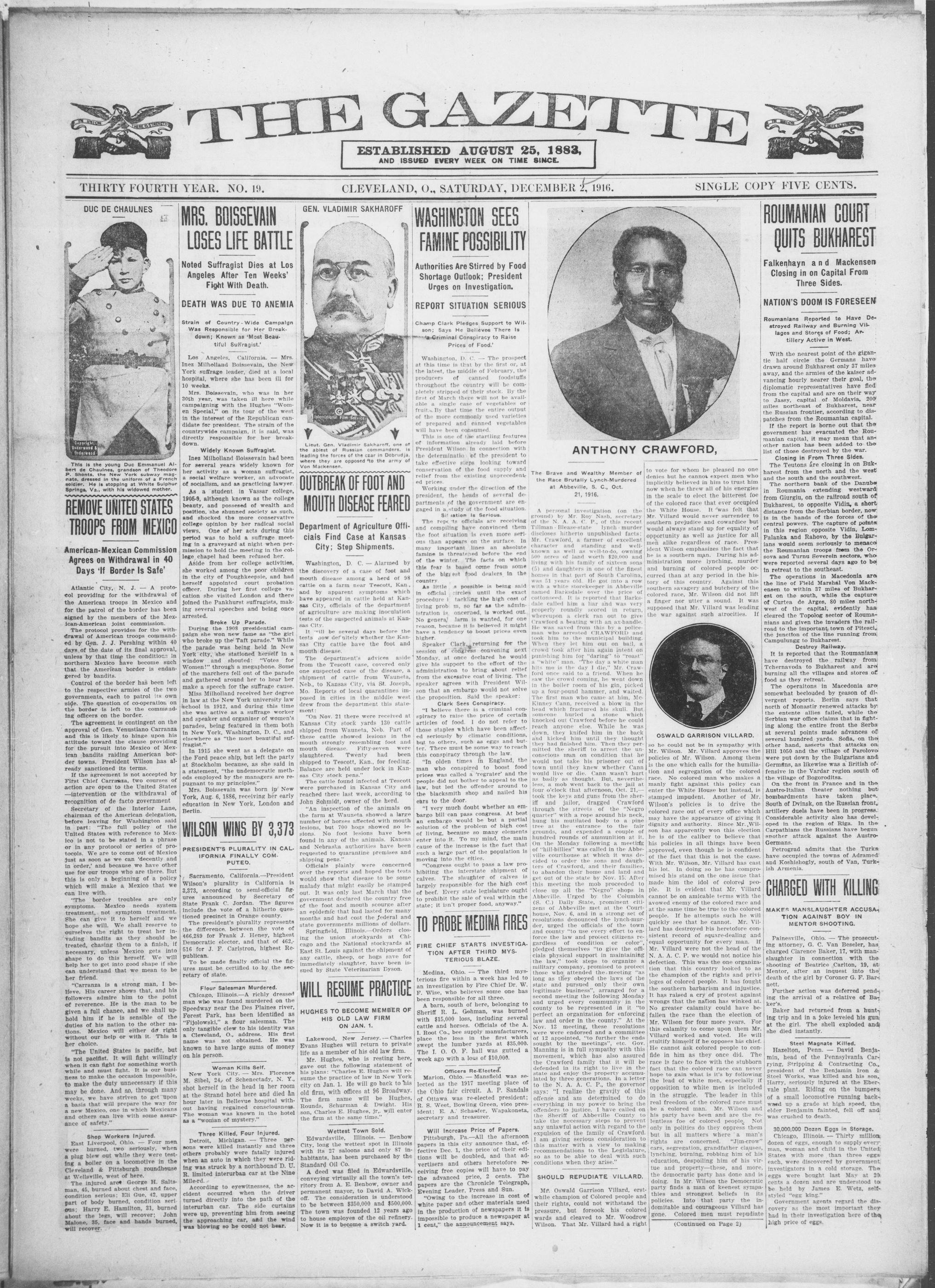
This is the young Duc Emmanuel Albert de Chauins, grandson of theodore P. Shonts, the New York subway magnate, dressed in the uniform of a French soldier. He is stopping at White Sulphur Springs, Va., with his widowed mother.
REMOVE UNITED STATES
TROOPS FROM MEXICO
American-Mexican Commission Agrees on Withdrawal in 40 Days 'If Border Is Safe'
Atlantic City, N. J. — A protocol providing for the withdrawal of the American troops in Mexico and for the patrol of the border has been signed by the members of the Mexican-American joint commission. The protocol provides for the withdrawal of American troops commanded by Gen. J. P. Pershing within 40 days, of the date of its final approval, unless by that time the conditions in northern Mexico have become such that the American border is endangered by bandits. Control of the border has been left to the respective armies of the two governments, each to patrol its own side. The question of co-operation on the border is left to the commanding officers on the border. The agreement is contingent on the approval of Gen. Venustiano Carranza and this is likely to hinge upon his attitude toward the clause providing for the pursuit into Mexico of Mexican bandits raiding American border towns. President Wilson has already sanctioned its terms. If the agreement is not accepted by First Chief Carranzaza, two courses of action are open to the United States—intervention or the withdrawal of recognition of de facto government.
Secretary of the Interior Lane, chairman of the American delegation, before leaving for Washington said in part: "The full policy of the United States with reference to Mexico is not to be stated in a phrase or in any protocol or series of protocols. We are to come out of Mexico just as soon as we can 'decently and in order', and because we have other use, for our troops who are there. But this is only a beginning of a policy which will make a Mexico that we can live with.
"The border troubles are only symptoms. Mexico needs system treatment, not symptom treatment. She can give it to herself and we hope she will. We shall reserve to ourselves the right to treat her invading bandits as they should be treated, chasing them to a finish necessary, unless Mexico gets into shape to do this herself. We will help her to get into good shape if she can understand that we mean to be her friend.
Carranza is a strong man, I believe. His career shows that, and his followers admire him to the point of reverence. He is the man to be given a full chance, and we shall uphold him if he is sensible of the duties of his nation to the other nations. Mexico will either do right without our help or with it. This is her choice.
"The United States is pacific, but is not pacifist. It will fight willingly when it can fight for something worth while and must fight. It is our business to make the occasion impossible, to make the duty unnecessary if this may be done. And so, through many weeks, we have striven to get upon a basis that will prepare the way for a new Mexico, one in which Mexicans and others can live with some assurance of safety."
Shop Workera Injured.
East Liverpool, Ohio. — Four men were burned, two seriously, when a plug blew out while they were testing a boiler on a locomotive in the Cleveland & Pittsburgh roundhouse at Wellsville, west of here.
The injured archege George H. Saltman, 45, burned about chest and face, condition serious; Ell Gue, 42, upper part of body burned, condition serious; Harry E. Hamilton, 31, burned about the legs, will recover; John Malone, 35, face and hands burned, will recover.
THE GAZETTE
MRS. BOISSEVAIN LOSES LIFE BATTLE
MRS. BOISSEVAIN LOSES LIFE BATTLE
Noted Suffragist Dies at Los Angeles After Ten Weeks' Fight With Death.
DEATH WAS DUE TO ANEMIA
Strain of Country-Wide Campaign Was Responsible for Her Breakdown; known as 'Most Beautiful Suffragist.'
Los Angeles, California. — Mrs. Inez Milholland Boisevalain, the New York suffrage leader, died at a local hospital, where she has been ill for 10 weeks.
Mrs. Boisevalain, who was in her 30th year, was takep ill here while campaling with the Hughes "Women Special," on its tour of the west in the interest of the Republican candidate for president. The strain of the countrywild campaign, it is said, was directly responsible for her breakdown.
Widely Known Suffragist.
Inez Milholland Boisselaine had been for several years widely known for her activity as a woman suffragette, a social welfare worker, an advocate of socialism, and as practicing lawyer. As a student in Vassar college, 1905-9, although known as the college beauty, and possessed of wealth and position, she shunned society as such, and shocked the more conservative college opinion by her radical social views. One of her acts during this period was to hold a suffrage meeting in a graveyard at night when permission to hold the meeting in the college chapel had been refused her. Aside from her college activities, she worked among the poor children in the city of Poughkeepsie, and had herself appointed court probation officer. During her first college vacation, she visited London and there joined the Pankhurst suffragists, making several speeches and being once arrested.
During the 1908 presidential campaign she won new fame as "the girl who broke up the 'Taft parade.' While the parade was held in New York city, she stationed herself in a window and shouted: "Votes for Women!" Through a megaphone, Some of the marchers fell out of the parade and gathered around her to hear her make a speech for the suffrage cause. Miss Milholland received her degree in law at the New York university law school in 1912, and during this time she was active as a suffrage worker and speaker and organizer of women's parades, being featured in them both in New York, Washington, D. C., and elsewhere as "the most beautiful suffragist." In 1915 she went as a delegate on the Ford peace ship, but left the party at Stockholm because, as she said in a statement, "the undemocratic methods employed by the managers are repugnant to my principles." Mrs. Bolseyean was born in New York, Aug. 6, 1886, receiving her early education in New York, London and Berlin.
WILSON WINS BY 3,373
PRESIDENT'S PLURALITY IN CALIFORNIA FINALLY COMPUTED.
Sacramento, California—President Wilson's plurality in California is 3,373, according to semi-official figures announced by Secretary of State Frank C. Jordan. The figures include the vote of a hitherto questioned prescient in Orange county. The president's plurality represents the difference between the vote of 466,289 for Frank J. Honey, highest Democratic elector, and that of 462, 516 for J. F. Carlstrom, highest Republican.
To be made finally official the figures must be certified to by the secretary of state.
Flour Salesman Murdered.
Chicago, Illinois.—A richly dressed man who was found murdered on the Speedway near the Des Plains river, Forest Park, has been identified as "Filgolowski" a flour salesman. The only tangible clew to his identity was a Cleveland, O. address. His first name was not obtained. He was known to have large sums of money on his person.
Woman Kills Self.
New York City. — Mrs. Florence M. Sibel, 24, of S寡ectadency, N. Y., shot herself in the head in her room at the Strand hotel here and died an hour later in Bellevue hospital without having regained consciousness. The woman was known in the hotel as a "wonian of mystery."
Three Killed Four Injured
Detroit, Michigan. — Three persons were killed instantly and three others' probably wore fatally injured when an auto in which they were riding was struck by a northbound D. U. R. limited interurban car at the Nine Mile-rd.
According to eyewitnesses, the accident occurred when the driver turned directly into the path of the interurban car. The side curtains were up, preventing him-from seeing the approaching car, and the wind was blowing so he could not hear.
ESTABLISHED AUGUST 25, 1883 AND ISSUED EVERY WEEK ON TIME SINCE.
CLEVELAND, O., SATURDAY, DECEMBER 2, 1916.
Lieut. Gen. Vladimir Sakharoff, one of the ablest of Russian commanders, is leading the forces of the star in Dobruja, where they are opposed to the army of Von Mackensen.
OUTBREAK OF FOOT AND MOUTH DISEASE FEARED
Department of Agriculture Offi cials Find Case at Kansas City; Stop Shipments.
Washington, D. C. — Alarmed by the discovery of a case of foot and mouth disease among a herd of 28 cattle on a farm near Tescott, Kan., and by apparent symptoms which have appeared in cattle held at Kansas City, officials of the department of agriculture are making inoculation tests of the suspected animals at Kansas City.
"It will be several days before the tests, now definitely whether the Kansas City cattle have the foot and mouth disease.
The department's advises a sub from the Tescott case, covered only one suspected case of the disease, a shipment of cattle from Waukee, Neb., to Kansas City, via St. Joseph, Mo. Reports of local quarantines imposed in cities in the middle west drew from the department this statement:
"On Nov. 21 there were received at Kansas City stock yards 130 cattle shipped from Waukee, Neb. Part of these cattle showed lesions in the mouth strongly resembling foot and mouth disease. Fifty-seven were slaughtered. Twenty had been shipped to Tescott, Kan., for feeding. Balance are held under lock in Kansas City stock pens."
The cattle found infected at Tescott were purchased in Kansas City and reached there last week, according to John Schmidt, owner of the herd.
"An inspection of the animals on the farm at Wanneta showed a large number of horses affected with mouth lesions, but 700 horses showed no lesions. No foot lesions have been found in any of the animals. Kansas and Nebraska authorities have been requested to quarantine premises and shipping pens." Officials plainly were concerned over the reports and hoped the tests would show that disease to be some malady that might easily be stamped out. It was only last March that the government declared the country free of the foot and mouth scourge after an epidemic that had lasted for many months and had cost the federal and state governments millions of dollars. Springfield, Illinois... Orders closing the union stockyards at Chicago and the National stockyards at East St. Louis against the shipment of any cattle, sheep, or hogs save for immediately snagger, have been issued by State Veterinarian Dyson.
HUGHES TO BECOME MEMBER OF
HIS OLD LAW FIRM
ON JAN. 11
Lakewood, New Jersey. — Charles Evans Hughes will return to private life as a member of his old law firm.
Mr. Hughes, who is resting here, gave out the following statement of his plans: "Charles E. Hughes will resume the practice of law in New York city on Jan. 1. He will go back to his old firm, with offices at 96 Broadway. The firm name will be Hughes, Roundts, Schurman, & Dwight. His son, Charles E. Hughes, Jr., will enter the firm at the same time."
Wettest Town Sold.
Edwardsville, Illinois. — Benhow City, long the wettest spot in Illinois with its 27 saloons and only 87 inhabitants, has been purchased by the Standard Oil Co. A deed was filed in Edwardsville, conveying virtually all the town's territory from A. E. Benhow, owner and permanent mayor, to David A. Wickoff. The consideration is understood to be between $300,000 and $500,000. The town was founded 12 years ago to house employees of the oil refinery. Now it is to become a switch yard.
WASHINGTON SEES FAMINE POSSIBILITY
Authorities Are Stirred by Food Shortage Outlook; President Urges on Investigation.
REPORT SITUATION SERIOUS
Champ Clark Pledges Support to Wilson; Says He Believes There is a Criminal Conspiracy to Raise Prices of Food.
Washington, D. C. - The prospect at this time is that by the first or, at the latest, the middle of February, the producers of canned foodstuffs throughout the country will be completely stripped of their stock. By the first of March there will not be available a single case of vegetables or fruit. By that time the entire output of the more commonly used varieties of prepared and canned vegetables will have been consumed.
This is one of the starting features of information already laid before President Wilson in connection with the determinative of the president to take effective steps looking toward conservation of the food supply and relief from the existing unprecedented prices.
Working under the direction of the president, the heads of several departments of the government are engaged in a study of the food situation.
The reports of officials are receiving and compiling have convinced them the food situation is even more serious than appears on the surface. In many important lines an absolute famine is threatened and before the end of the winter. The facts on which this fear is based come from some of the biggest food dealers in the country.
As little is possible is being said in official circles until the exact procedure tackling the high cost of living prob in so far as the administration is onerous, is worked out. No general arm is wanted, for one reason, because it is believed it might have a tendency to boost prices even higher.
Speaker Clark, returning for the session of congress convening next Monday, at once declared he would give his support to the effort of the administration to bring about, relief from the excessive cost of living. The speaker agrees with President Wilson that an embargo would not solve the proposition. Said the speaker:
Clark Sees Conspiracy.
It behoves you to raise the price of certain articles of food. I do not refer to those staples which have been affected seriously by climatic conditions, but to others, such as eggs and butter. There must be some way to reach this conspiracy through the law.
"In olden times in England, the man who conspired to boost food price was called a 'regrater' and the people did not bother to appeal to the law, but led, the offender around to the blacksmith shop and named his cars to the door.
"I very much doubt whether an embargo bill can pass congress. At host an embargo would be but a partial solution of the problem of high cost of living, because so many elements enter into it. To my mind, the main cause of the increase is the fact that such a large part of the population is moving into the cities.
"Congress ought to pass a law prohibiting the interstate shipment of calves. The slaughter of calves is largely responsible for the high cost of beef. Every state legislature ought to prohibit the sale of veal within the state; it isn't proper food, anyway."
TO PROBE MEDINA FIRES
FIRE CHIEF STARTS, INVESTIGATION AFTER THIRD MYSTERIOUS BLAZE.
Medina, Ohio. — The third mysterious fire within a week has led to an investigation by Fire Chief Dr. W. F. Wise, who believes some die, has been responsible for all three.
A barn, south of here, belonging to Sheriff R. L. Gehman, was burned with $15,000 loss, including several cattle and horses. Officials of the A. I. Root Co., bee supply manufacturers, place the loss in the first which swept the lumber yards at $35,000.
The I. O. O. F. hall was gutted a week ago with a loss of $10,000.
Officers Re: Elected
Marion, Ohio. — Mansfield was selected as the 1917 meeting place of the Ohio fair circuit. A. P. Sandals of Ottawa was re-elected president: R. S. Weet, Bowling Green, vice president: E. A. Schafer, Wapakoneta, secretary and treasurer.
WII Increase Price of Papers
Will increase Price of Papers.
Pam. All the afternoon papers in this city announce that, effective Dec. 1, the price of their editions will increase, and other advertisers and others herefore receiving free copies will have to pay an advanced price, 2 cents. The papers are the Chronicle Telegraph, Evening Leader, Press and Sun.
"Owing to the increase in cost of white paper and other materials used in the production of newspapers it is impossible to produce a newspaper at 1 cent," the announcement says.
M. B. S.
The Brave and Wealthy Member of
the Race Brutally Lynch:Murdered
at Abbeville, S. C., Oct.
21.1916
SHOULD REPUDIATE VILLARD.
Mr. Oswald Garrison Villard, erst while champion of Colored people and their rights, could not withstand the pressure, but forsook his colored wards and cleaved to Mr. Woodrow Wilson. That Mr. Villard had a right
SINGLE COPY FIVE CENTS.
to vote for whom he pleased no one denies but he cannot expect men who implicitly believed in him to trust him now when he threw up of his energies in the scale to elect the bitterest foe of the colored race that ever occupied the White House. It was felt that Mr. Villard would never surrender to southern prejudice and cowardice but would always stand up for equality of opportunity as well as justice for all men alike regardless of race. President Wilson emphasizes the fact that he is a southern man. During his administration more lynching, murder and burning of colored people occurred than at any period in the history of this country. Against this southern savagery and butchery of the colored race, Mr. Wilson did not lift a hinder nor utter a sound. It was supposed that Mr. Villard was leading the war against such atrocities. OSWALD GARRISON VILLARD.
so he could not be in sympathy with Mr. Wilson. Mr. Wilson approves the policies of Mr. Wilson. Among them is the one which calls for the humiliation and segregation of the colored race. No colored man who makes a mainly tight against this policy can enter the White House but instead, is stamped impudent. Another of Mr. Wilson's policies is to drive the colored race out of every office which may have the appearance of giving it dignity and authority. Since Mr. Wilson has apparently won this election, he is of the caliber to believe that his policies in all things have been approved, even though he is confident of the fact that this is not the case With Mr. Wilson, Mr. Wilson has cast his lot. In doing so he has compromised his stand on the one issue that made him the idol of colored people. It is evident that Mr. Villard cannot on amenable terms with the avowed omity of the colored race and at the same time be true to the colored people. If he attempts such he will quickly see that he cannot. Mr. Villard has destroyed his heroic deed and equal opportunity for the head of the N. A. A. C. P. we would not notice his organization that this country looked to as the champion of the rights and privileges of colored people. It has fought the southern barbarian and injustice. It has raised a cry of protest against wrongs that the nation has winked at. No greater calamity could have befallen the race than the election of Mr. Wilson for four more years. For this calamity to come upon them Mr. Villard worked and voted. He will sultify himself if he opposes his chief. He cannot ask colored people to confide in him as they once did. The race is face to face with the stubborn fact that the colored race can never hope to gain what is it by following the lead of white men, especially if opposition to white men is included in the struggle. The leader in this real freedom of the colored race must be a colored man. Mr. Wilson and his party have been and are the relentless foe of colored people. Not only in politics do they oppress them but in all matters where a man's rights are concerned. "Jim-crow" segregation, grandfather clause, lynching, burning, robbing him of his education, despairing, him of his virtue and property—these, and more, the democratic party has done and is doing. In Mr. Wilson the Democratic party finds a man of loosest sympathies and strongest beliefs in its policies. Into that party the indomitable and courageous Villard has gone. Colored men must repudiate
IN WHICH I AM A MAN
ROUMANIAN COURT QUITS BUKHAREST
Falkenhayn. and Mackensen Closing in on Capital From Three Sides.
NATION'S DOOM IS FORESEEN
Roumanians Reported to Have Destroyed Railway and Burning Villages and Stores of Food, Artillery Active in West.
With the nearest point of the gigantic half circle the Germans have drawn around Bukharest only 37 miles away, and the armies of the kaiser advancing hourly nearer their goal, the diplomatic representatives have fled from the capital and are on their way to Jassy, capital of Moldavia, 200 miles northwest of Bukharest, near the Russian frontier, according to dispatches from the Roumanian capital.
If the report is borne out that the government has evacuated the Roumanian capital, it may mean that another nation has been added to the list of those destroyed by the war.
Closing in From Three Sides.
The Teutons are closing in on Bukharest from the north and the west and the south and the southwest.
The northern bank of the Danube in Roumania extending westward from Glurgu, on the rairford south of Bukharest, to opposite Vidin, a short distance from the Serbian border, now is in the hands of the forces of the central powers. The capture-of-points in this region opposite Vidin, Lom-Palanka and Rahovo, by the Bulgarians would seem seriously to menace the Roumanian troops from the Orsova and Turnu Severn sectors, who were reported several days ago to be in retreat to the southeast.
The operations in Macedonia are the line of Field Marshal Von Mackensen to within 37 miles of Bukharest on the south, while the capture of Curca de Arges, 80 miles northwest of the capital, evidently has cleared the Topolog sector of Roumanians and given the invaders the railroad to the important town of Pitsele, the function of the line running from Campulung to Bukharest.
Destroy Railway.
It is reported that the Roumanians have destroyed the railway from Tchernavoda to Bukharest and are burning all the villages and stores of food as they retreat.
The operations in Macedonia are somewhat beclouded by reason of divergent reports. Berlin says that north of Monastir renewed attacks by the entente, allies failed, while the Serbian war office claims that in fighting along the entire front the Serbs at several points made advances of several hundred yards. Sofa, on the other hand, asserts that attacks on Hill 1050 and the village of Parolov were put down by the Bulgarians and Germans, as likewise was a British offensive in the Vardar region south of the village of Bogorodita.
On the front in France and in the Austro-Italian theater nothing but bombardments have taken place. South of Dylsk, on the Russian front, artillery duels have been in progress. Considerable activity also has developed in the region of Riga. In the Carpathians the Russians have begun another attack against the Austro-Germans.
Petrograd admits that the Turks have occupied the towns of Adramed and Koshishogly, south of Van, Turkish Armenia.
CHARGED WITH KILLING
MAKES MANSLAUGHTER ACCUSATION AGAINST BOY IN MENTOR SHOOTING.
Paineville, Ohio. — The prosecuting attorney, G. C. Van Beseler, has charged Clarence Baker, 17, with manslaughter in connection with the shooting of Beatrice Carlton, 19, at Mentor, after an inquest into the death of the girl by Coroner G. F. Barnett.
Further action was deferred pending the arrival of a relative of Baker's.
Baker had returned from a hunting trip and in a joke leveled his gun at the girl. The shell exploded and she died instantly.
Steel Magnate Killed
Steel Magnate Killed.
Hazelton, Penn. — David Benjamin, head of the Pennsylvania Carrying, Stripping & Contracting Co., president of the Benjamin Iron & Steel Works, was killed and his son, Harry, seriously injured at the Ebervale plant. Riding on the bumps of a small locomotive running backward up a grade at high speed, theeller Benjamin fainted, fell off and was crushed to death.
30,000,000 Dozen Eggs in Storage.
30,000,000 Dozen Eggs in Storage.
Chicago, Illinois. — Thirty million,
dozen of eggs, enough to supply every
man, woman and child in the United
States with more than three eggs
each, were discovered by government
agents who bought eggs were bought last May at 20
pence a dozen and are understood to
be held by James E. Wetz, self-
styled "egg king."
Government agents regard the discovery
as the most important they had in their investigation here of the
high price of eggs.
SUBSCRIPTION RATES
(in Advance)
One Year.....$1.50.
Six Months.....1.00
Three Months......50
Subscribers are requested to re-
mit by postoffice money en-
der or registered letter
Entered at the postoffice in Cleveland
Ohio, as second-class matter.
Address all communications to
HARRY C. SMITH
Editor and proprietor,
THE GAZETTE,
Blackstone Building, Cleveland, O.
Member Ohio Legislature: 1894
to 1896; 1896 to 1898; 1900 to 1902
THE GAZETTE is the oldest, and has the largest bona fide circulation, double that of any newspaper in the Interest of Afro-Americans, published in the state of Ohio, and comparison immediately establish its rank as one of the NEWSIEST AND BEST in the country.
10,000,000 Afro-Americans.
160,000 in Ohio.
20,000 in Cleveland.
SATURDAY, DECEMBER 2, 1916.
DARE TO DO YOUR DUTY.
"Let us have faith that right makes might, and in that faith let us to the end dare to do our duty as we understand it."—Abraham Lincoln.
Gov. Frank B. Willis hasn't rallied from that awful walloping given him. When he does he will no doubt learn that it pays to be true to your friends.—Cincinnati Republican.
This is the anniversary of the death of that martyr of martyrs—JOHN BROWN, the immortal! He was executed, Dec. 2, 1859, at Charlestown, Va. Who he was and what he stood and died for will always remain recent history in the minds and hearts of our people, and all other right-fitting people. In his raid on Harper's Ferry where he captured a U. S. arsenal and armory and forty prisoners, he lost, two sons, most of his company of twenty brave MEN, some of them members of the race, and he himself was wounded and taken prisoner. Our people, throughout this country, should fittingly recognize this day.
REASONS FOR DEFEAT IN OHIO.
After sufficient time has passed to allow a comparison of observations there has come a consensus of opinion among political students as to the reasons which turned Ohio over to the Democracy on November 7. The first and overwhelming reason was the plea that President Thomas Woodrow Wilson "kept us out of war". As the campaign progressed the Republican managers were confronted with this until it became a haunting night-mare. The fact that Wilson really was not entitled to the credit for keeping the country out of the European maelstrom and the further fact that he really was at war on his own initiative with Mexico, made no difference. The Democrats persistently urged the plea, and in Ohio probably more than in any other state the men and women became saturated with an almost hysterical sentiment for peace at any price. The Republicans were powerless to combat this sentiment. The second reason for the Wilson deluge was the fact that since the European war commenced Ohio has had enormous prosperity through orders for munitions and food supplies for the Allies. The farmers have never gotten such prices and the workingmen have never received such wages. Both the workers and workingmen forget all about the disastrous effects of the Underwood Tariff law before the war, and they refused to consider what is to happen after the war with that law still in operation. The prosperity is under the Wilson administration—and the majority of the voters refused to venture on a change. The third reason was the Adamson law. In most of the industrial states the workingmen had enough "gumption" to appreciate that measure at its true value, but the Democratic press and the labor leaders of Ohio succeeded in bambooizing the vast majority of the industrial voters. Another reason is the poor organization of the Republican party for a number of years in Ohio. Ever since the days of Mark Hanna the Democrats have beaten the Republicans at organization "out of their boots". Then there is another reason—the fact that in a majority of the cities of the state the most influential newspapers are Democratic, although some of them cloak themselves with the raiment of "independence". Still another reason is a very weak state ticket headed by a most unpopular candidate in the person of Gov. Frank B. Willis.
THE SOLID SOUTH
Since Mr. Hughes has conceded the election of Mr. Wilson it is time to discuss how it happened. Among many things, the solid South is one of the chief reasons why Mr. Wilson was re-elected. Few people realize what the solid South means.
First; it means that eleven states of the Union have decided that they will only support one political party under any and all conditions; that they will have uniform laws respecting the franchise and these laws will govern the South even though they nullify the federal Constitution.
Second; that they will not only deprive the colored race of participation in national or state election with impunity but they will demand the counting of the colored voters' vote when it comes to establishing the representation of these states in Congress and the electoral college.
Third: that they will depend upon
violence, intimidation and the general cowardice of its great opponent (the North) to keep the representation they desire.
Fourth: that these states will be a unit in keeping alive certain prejudices and racial hatred so that a uniform sentiment will pervade all of them and they in turn will do what they can to convert the rest of the country to their way of thinking.
By the above mentioned policy every democratic presidential candidate goes into a Presidential election campaign with these electoral votes unquestionably in his columns, regardless of the issue. Any division of opinion in the rest of the states will easily make the democrat the winner. This was Mr. Wilson's chief asset. The Republican party is responsible for this state of affairs. It had the government for fifty years and was in a position to see to it that no part of the country nullified the Constitution. Because this nullification bore hardest upon colored people nothing was done to correct this gigantic wrong. The South is a fixed asset in the democratic party. It is opposed to anything the Republican party espouses even though it be the best for the nation. Remember this solid South was formerly the solid slave-holding states. Every one of them fought savagely to retain slavery. As savagely they are now fighting to maintain the political slavery of the colored man. Just as the rest of the country winked at slavery till its stench aroused the nation, so will the stench of political bondage arouse the nation and the South will again lose in its unjust fight.
Can the Republican party come back? Has it lost its fundamental principle—justice and liberty to all? Has a righteous God rejected this party because it refused to stand up for the liberty of the lowliest and surrendered to an unfounded prejudice which has resulted in making America the most lawless and brutal country in the world, Russia not excepted? As a result of its departing from that which gave it power and victory in the sixties, the conquered has become the conqueror and now the South scruples at nothing to rivet its advantage upon the whole country "The southern rebel is in the saddle" and the country is feeling his hand. Eternal justice recoils against the foul betrayal of the colored man by this nation. The Republican party was and is the receiver of his strength and influence. In the North the colored man gets for his allegiance broken promises. In the South, disfranchise and the shot-gun. His beloved party gave him over to his enemy there, so that now he is almost beyond aid. As a result the Republican party is routed with discordant notes in almost every state and bitter jealousies are ranking in many bosoms. Defeat stares it at every turn. This party can come back if it again takes up the burden of the oppressed and fearlessly nights, for God will be on its side. The one thing necessary for the Republican party to win is its uncompromising stand for the re-enfranchisement of the colored voter in the South. This issue will win. The moment the colored race is re-enfranchised, that moment the great American crime will be atoned for and every portion of the country will be in position to hear the policies of all parties.
The South may hypocritically put away saloons and rum but it will never put away barbarism until it learns to respect the rights of every man alike regardless of his race. To bring about this, the solid South must be broken up, politically. The fight for 1920 will be for the franchise for all men alike. Men will be asked to take their stand. This may be called social legislation. This is what we want. There must be a conscience in our politics. Woodrow Wilson received with happiness the murdered franchise of the colored voter in the electoral college but he was too cowardly to insist upon the South giving this representation to the colored voter so that at the polls his wishes might be registered.
The plain duty of every newspaper that believes in a square deal is, to fight for the restoration of the ballot to every American citizen. Had the Republican party followed Mr. Lodge in his attempts to apply the Constitution by cutting down the representation of the South in congress and the electoral college because of its unjust laws with-holding the franchise from colored people and thousands of white Republicans, there would not be in the white house today a Woodrow Wilson. The Constitution is very explicit on this issue. But the Republican party gave away to Bent Millan of South Carolina and Hoke Smith of Georgia, and a million and a half citizens were left to the mercy of its implacable political foe—southern democracy. It will be difficult for the party to come back without the aid of our people.
The colored race will be less than a race if it does not take this psychological moment to obtain its long-sought blessing. Who will join us in our cruse to awaken the American nation again so that our second freedom may be made sure? Let us break up the solid South and do justice to the American nation as well as to our race. (REV.) W.M. A. BYRD.
Stage Music.
Orchestras, theater and otherwise have some responsibility on their shoulders in the way of improving the musical taste of a community. Instead of the simple music that elevates the hearer's taste, we have ragtime incessant with all its tortuous and tempestuous conglomerations. It is high time we were getting something else, something that ministers to the culture and refinement of an audience. There is too much noise and slam-bang in the music we have. It is enough to set one's teeth on edge. A little fine music goes a good deal farther than such a conglomeration of sawing, pounding, blowing and beating. Actually the audiences don't want half as much as they are being. Because a person can play by note is no sign he is a musician; he may do that all right and be a boor in taste. People prefer melodies and quiet music to rattle-de-bang music that confronts them on public occasions.
THE GAZETTE, CLEVELAND, O., SATURDAY, DECEMBER 2. 1910.
FRESH OHIO NEWS
Written by 'The Old Reliable' Gazette's Correspondents
THROUGHOUT THE STATE
What Our People Are Doing Each Week—Church, Personal, Social, Lodge, Literary and Musical — Marriages, Deaths, Etc.
BATAVIA — Rev. J. J. Burr preached, Sunday, at the C. M. E. church to an appreciative audience. Rev. G. C. McPheeters has built a new church for his congregation. He is a race man and a christian worker. Rev. Burr preached for Rev. Coleman at 3 p.m. But pastor welcome him back again. The church was a spiritual and financial success. Both congregations read "The old reliable" Gazette.
CADIZ—Mr. and Mrs. C. W. Blocksome, of Cause, are visiting Mr. and Mrs. James Smith—Karl Naylor, of East Liverpool, is the guest of Edgar Brown—Miss Goldie Blanchard and brother, Frank, have been very sick. "The *Bus Bees*" met at W. H. Lucas. Sunday—The M. E. church has installed a new heater—Mrs. Alberta is improving—Thewerent an operation. E is improving—Thewerent E. Church was successful in the context with Cadiz, in attendance at church and S. S.—The W. C. T. U. had a meeting at Mrs. Dora Johnston's.
SANDUSKY—Mrs. G. D. Smith left Tuesday morning, for Cincinnati. The churches and S. S. were well attended, Sunday. Communion services, at 10.30 a. m., at the Second Baptist church, Sunday. Remember, Dec. 8. The pastor of the A. M. E. church is the pastor of the A. M. E. charge is proud of him. Rev. E. W. Gressing nicely at the Homeville mission, several having joined. Mrs. S. Wallace is convalescing. Mr. and Mrs. Pullman are rejoicing over the arrival of a bran new son. New families or the better class of our people are being welcomed here, every week. They are from the South. We stand here, from all we can. They are readily finding employment, we are glad to say.
CORRESPONDENTS must mail all letters for publication at their main postoffice sufficiently early on Monday (or Sunday) of each week to have them reach The Gazette office on Tuesday morning, and always write also, their names and that of their city or town on the outside of the wrapper about returned copies. Unless this latter is done, proper credit cannot be given you. Lists of names, wedding presents, etc., obituary notices, speeches, resolutions, poetry, inquiries for relatives and advertisements of all kinds, including items in the near future, must be in advance at the rate of ten cents a line, six words to a line. Our rates for display advertisements will be sent on application.
SMITHFIELD.—C. W. Parks is ill Pneumonia.—Mr. and Mrs. A. J. Gay and Mr. and Mrs. P. S. Morton, and sons, of Steubenville, attended St. Paul's church, Sunday evening. Mr. and Mrs. H. Bowman, of that city, visited relatives here, Saturday and Sunday, while Mr. Jas. Harris was there, those days.—Little Elizabeth, daughter of Mrs. Rhoda Veney, was badly burned, last Saturday. Her clothing caught fire while playing in the yard.—Mr. Harvey Parks has returned.—Mr. Harvey Parks has returned and R. Hargraves spent Sunday in Wheeling.—Mrs. Homer Harris entertained the S. L. club, last Tuesday evening. Rev. and Mrs. Williams, Mrs. Griffin and Mrs. Kinney were the visitors.—Mr. Jas. Harris, Jr., spent Saturday evening, in Steuben.—Rev. and Mrs. J. Williams were in Mt. Pleasant and Adena, last week.
HILLSBORO The remains of Mrs. Elizabeth Potee, of Springfield, were brought here for burial, last Tuesday. Mr. Potee and her sister, Miss Addie Stribbling, and brother, Walter, accompanied the body. Miss Myrle Kittrell, of Norwood, visited her parents, Mr. and Mrs. Mal Kittrell, last week. Miss Lucy Speech daughter night at a hospital in Cincinnati, and was brought here for burial. Funeral from Mrs. Martha Henderson's, Monday morning, conducted by Rev. P. H. Smith, -Mr. and Mrs. Milton Day announce the marriage of their daughter, Miss Raymond, to Mr. Enoch Frye, of Covington, Ky. They have the best wishes of many friends. Master D. E. Cole is better. Mrs. Zizzi Best, E. Cole is quite sick. Mr. Edward Kilgoon is better. Mrs. Hugh Johnson, of Dayton, is here visiting relatives. -Rev. George Burr preached at his church in Bloomingburg, Sunday. -Mrs. Narcisse Essex, one of the oldest residents of the county, died Friday night.
OBITUARY.
William Richard Johnson, who died at his late residence, 2323 E. 29th St. Nov. 19, 1916, was an exslave, born April 11, 1817, in Suffolk, Va., and was a resident of this city for 56 years. His life was filled with interesting events. Mr. Johnson sailed the Atlantic Ocean from New York to Liverpool, for 27 Lakes; for a number of years. He served 14 months in the Civil War and went to California during the "gold rush" of 1876, returning home to remain until 1881, when he went back to California where he remained one year. He then went to Arkansas where he resided for a couple of years before returning to Cleveland to spend the rest of his days with M. Johnson. Although Mr. Johnson had reached an ordinary age of 99 years, he was active until a week before his death. A widow, Mrs. Hannah R. Johnson; three daughters, Mesdames Eva Burnett and Alice Kelly of Akron; Arvilla Johnson and Oberlin, and four sons, Joseph and Hiram Arthur Johnson of this city; and four daughters, Johnes Johnson; also four daughters-in-law, two sons-in-law and four grandchildren, to mourn his demise. Interment in Oberlin—Adv.
Do not leave notes, letters, items for the paper, etc., at the editor's home. Send or bring them to The Gazette of New York to PRECE when you wish to see him, please.
DOINGS
OF
THE
RACE
Wesley L. Sledge, of Ann Arbor, Mich., has been appointed a deputy sheriff of Washtenaw county, Mich. John of Albuquerque, O., died in Oberlin, some weeks ago. He was also well known in Washington, D. C., where he lived, some years ago.
Lazy, shiftless Southern Afro-Americans should not be encouraged to come North. Our papers in that section should make this plain. Here they must work or go to the workhouse.
Edward Poindexter, sr., saved 42 families, the night of Nov. 1748, before losing his life in a fire in the Purling Apartment, 770 St. Nicholas Ave., New York City. For 16 years he had been nightwatchman in the apartment.
Arthur Taylor, of Detroit, has invented a dinner-pail that enables one to keep his dinner warm; both solid and liquid food. It is an improvement the thermos bottle. He also invented the "railroad skate" that is very valuable.
It is reliably reported that Princeton refused to play Brown on the gridiron this year because of Fred Pollard, Brown's sensational halfback. Woodrow Wilson was for many years President of Princeton and during his regime Colored applicants were refused admission because of their color. His influence as an enemy of the Negro still lives at Princeton. And this same Woodrow Wilson is for "unity" and poses as a disciple of "justice."—N. Y. Age.
The Charity Hospital and Training school for nurses, cor. 36th and Florence Sts., Savannah, Ga., owned by our people of that city, and which has been established for 23 years and has done so very much good for the unfortunate of the race, asks your help, to be a benefactor from Dec. 20, 1916) to raise $20,000 for the erection of a more serviceable and convenient hospital. Send contributions to Sol C. Johnson, editor of the Savannah, Ga., Tribune and help this meritorious effort and cause.
Major Moton, principal of Tuskegee Ala., N. & I. Institute, goes them all one better in "advising" the Northern Colored man, enjoying the franchise and the rights of manhood, to go South, where neither franchise nor manhood awaits him, where security of property, security of life, security of WIFE and DAUGHTER are not known to the repressed and ostracized Colored millions. This, Major Moton advises. Major Moton who recently apologized for his wife's atrocities to like a human being.—N. Y. City Amsterdam News.
The machine gun troop of the Ninth Cavalry, U. S. A., in the Phillipines, recently had gun practice and set a new record for cavalry machine gun companies. They went into battle and literally shot the line of targets down after scoring 73 hits on 65 percent of the targets, firing 240 rounds in a minute and ten seconds, the range being battle sight. At another time during the same series of tests the machine gun had to hit at 550 yards in thirty seconds' firing, and 96 per cent of figures hit at 780 yards in one minute of firing.
MORE DESERVED PRAISE.
The Chairman of the Republican National Executive Committee, Hon. Herbert Parsons, Compliments Hon. Chas. W. Anderson.
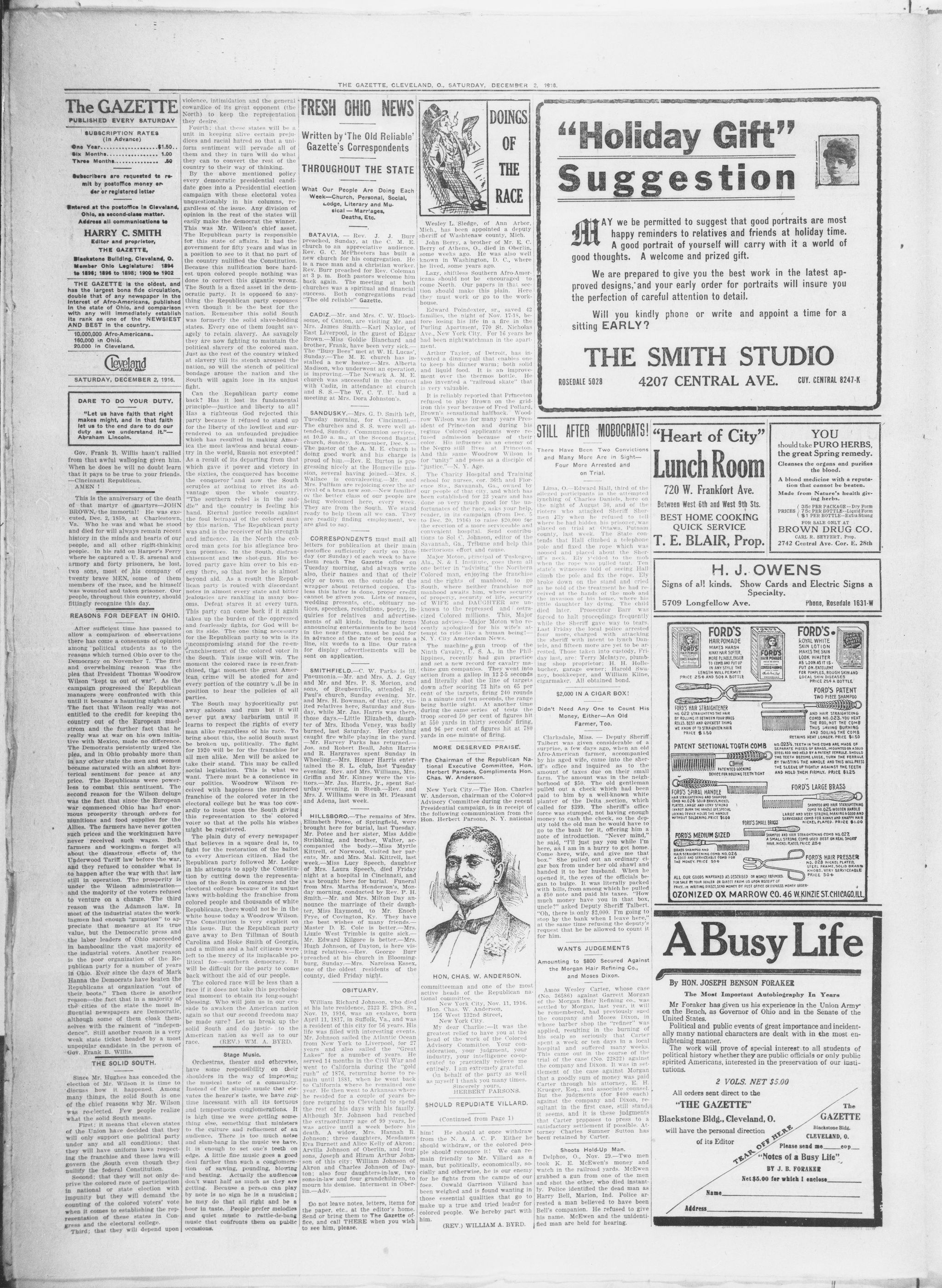
New York City.—The Hon. Charles W. Anderson, chairman of the Colored Advisory Committee during the reopening of the school, is in receipt of the following communication from the Hon. Herbert Parsons, N. Y. national
HON, CHAS. W. ANDERSON.
committeeman and one of the most active heads of the Republican na
New York City, Nov. 11, 1916.
Hon. Chas. W. Anderson.
156 West 132nd Street.
New York City.
My dear Charlie—it was the greatest relief to have you at the head of the work of the Colored Advisory Committee. Your consideration, your judgment, your industry, your intelligence cooperated to practically relieve me entirely. I am extremely grateful. On behalf of the party as well as myself, I thank you many times.
SHOULD REPUDIATE VILLARD.
(Continued from Page 1)
him! He should at once withdraw from the N. A. A. C. P. Either he should withdraw, or the colored people should renounce it! We can remain friendly to Mr. Villard as a man, but politically, economically, socially and otherwise, he is our enemy for he fights from the camps of ouroes. Oswald Garrison Villard has been weighed and is found wanting in those essential qualities that go to make up a true and tried leader for colored people. We hereby part with him.
(BEV) WILLIAM A. BYRD.
"Holiday Gift" Suggestion
AY we be permitted to suggest that good portraits are most happy reminders to relatives and friends at holiday time. A good portrait of yourself will carry with it a world of good thoughts. A welcome and prized gift.
We are prepared to give you the best work in the latest approved designs; and your early order for portraits will insure you the perfection of careful attention to detail.
Will you kindly phone or write and appoint a time for a sitting EARLY?
THE SMITH STUDIO
STILL AFTER MOBOCRATS!
There Have Been Two Conviction and Many More Are in Sight— Four More Arrested and
Lima, O.—Edward Hall, third of the alleged participants in the attempted lynching of Charles Daniels, here on the night of August 30, and of the rioters who attacked Sheriff Sherman Elm when he refused to tell them where the rope was placed on trial at Ottawa, Putnam county, last week. The State contends that Hall climbed a telephone pole and fixed the rope which was noosed and placed about the Sheriff's neck. Ely yielded to the mob when the rope was pulled taut. Ten minutes later, the mob climbed the pole and fix the rope. Ely broke down on the stand and cried as he told of the treatment he had received at the hands of the mob and the invasion of his home, where his little daughter lay dying. The child died later. Prosecutor Barr was forced to halt proceedings framed by the police, and he was to tears. Last Friday the local police arrested four more, charged with attacking the sheriff with intent to lynch Daniels, and fifteen more are yet to be arrested. Those taken into custody, Friday last, are: Terry McIntyre, plumbing shop proprietor; Hollie Hollenbeck, proprietor; Hold Swainey, bookkeeper, and William Kline, cigarmaker. All obtained bond.
$2,000 IN A CIGAR BOX!
Didn't Need Any One to Count His Money, Either—An Old
Clarksdale, Miss. — Deputy Sheriff Talbert was given considerable of a surprise, a few days ago, when an old Afro-American farmer, accompanied by his aged wife, came into the sheriff's office and inquired as to the amount of taxes due on their small farm. The amount was in the neighborhood, and pulled out a check which had been paid to him by a well-known white planner of the Delta section, which called for $399. The sheriff's office force was stumped, not having enough money to cash the check, so the deputy told the old man he would have to go to the bank for it, offering him a note of introduction. "Never mind," he said, "I just will pay you while I here, as am in a place, as am here, and give me that box." She pulled out an ordinary eigar box from under her old shawl and handed it to her husband. When he opened it, the eyes of the officials began to bulge. It was literally packed with bills, from among which he pulled a $50 note and paid his taxes. "How much money have you in that box uncle?" asked Deputy Sheriff Talbert. "Oh, there is only $2,000. I'm going to at the same time when I leave here," the deputy's request that he be allowed to count it for him.
WANTS JUDGEMENTS
Amounting to $800 Secured Against the Morgan Hair Refinishing Co., and Moses Dixon.
Amos Wesley Carter, whose case (No. 36586) against Garratt Morgan of the Morgan Hair Refinishing Co., was settled by Morgan, last year, it will be remembered, had previously sued the company and Moses Dixon, in whose barber shop the "refiner" was applied, resulting in the burning of his scalp so seriously that Carter spent a week or two in a courtroom and affirmed many weeks. This came out in the course of the trial of the case (No. 22822) against the company and Dixon. It was in settlement of the case against Morgan that a goodly sum of money was paid Carter through his attorney, E. H. Krueger, Esq., and associate counsel. But the judgments for $400 each against the company and Dixon, re-sultant in the case, still stand, it seems, and it is these judgments. Carter proposes to press to a satisfactory settlement if possible. Attorney Charles Sumner Sutton has been retained by Carter.
Shoots Hold-Up Man.
Delphos, O., Nov. 23—Two men took K. E. McEwen's money and watch in the railroad yards. McEwen grabbed a gun from one of the men and shot the other, who died instantly. Police identified the dead man as Harry Bell, Marion, Ind. Police arrested a man believed to have been Bell's companion. He refused to give his name. McEwen and the unidentified man are held for hearing.
720 W. Frankfort Ave.
Between West 6th and West 9th Sts.
BEST HOME COOKING
QUICK SERVICE
T. E. BLAIR, Prop.
H. J. OWENS
Signs of all kinds. Show Cards a
Specialty.
5709 Longfellow Ave.
FORD'S
HAIR POMADE
MAKES MARSH
KNIVES HAIR SOLDER
MORE PLABLE EASHER
TO COMB AND PUT UP
IN ANY STYLE THE
LENGTH WILL PERMIT
PRICE $2.50 AND $0.49 A BOTTLE
FORD'S HAIR STRAIGHTENER
NO.022 STRAIGHTENS THE Hair
BY ROLLING IT RETURNING SOURCE BRASS
ROTATING AND QUICKLY THING
WE KNOW OF IT STRAIGHTEN Hair
PRICE $1.50
PATENT SECTIONAL TOOTH COMB
NO.023% SEPARATE
STEEL ROOF
BY WHATTEE
THE SLEEVEN
AND HOLD
PATENTED LOCKING
DEVICE HAR HOLDING TEETH TIGHT
FORD'S SPIRAL HANDLE
HAIR STRAIGHTENING COMB
NO.024 SOLID BRASS NICKEL
PLATED, LARGE AND VERY STRONG
KNIGHT BURN THE HANDLE OFFSPECIAL
RANGE OF SERVICES OVER THE HANDLE
WITHOUT SOLDERING. PRICE $1.00
LARGE
SERVICE
FORD'S SMALL BRASS
FORD'S MEDIUM SIZED
BRASS SHAMPOO AND
BRASS STRAIGHTENING COMB NO.025
A GOOD AND SERVICABLE COMB FOR
THE MONEY. PRICE $5.00
SHAMPOO AND HAIR
A SMALL STRONG
HAIR, NICKEL PLAT
ALL OUR GOODS WAREPANED AS DESCRIBED OR MONEY REFunded.
FOR SALE BY YOUR SELLER OR ORDER FROM US UPON RECEIPT OF
PRICE, IN WRITING DIRECT, SEND MONEY BY POST OFFICE OR EXPRESS MONEY
OZONIZED OX MARROW CO.46
A Busy
ABusyLife
By HON, JOSEPH BENSON FORAKER
The Most Important Autobiography
Mr Foraker has given us his experiences on the Bench, as Governor of Ohio and in United States.
Political and public events of great importance many national characters are dealt with lightening manner.
The work will prove of special interest political history whether they are public or
Most Important Autobiography In World
has given us his experience in the U.S.
has Governor of Ohio and in the S.
public events of great importance
onal characters are dealt with in t
ill prove of special interest to all
whether they are public officials or
ans, interested in the preservation
The Most Important Autobiography In Years
Mr Foraker has given us his experience in the Union Army' on the Bench, as Governor of Ohio and in the Senate of the United States.
Political and public events of great importance and incidentally many national characters are dealt with in the most enlightening manner.
The work will prove of special interest to all students of political history whether they are public officials or only public spirited Americans, interested in the preservation of our institutions.
2 VOLS. NET $5.00
All orders sent direct to the
"THE GAZETTE"
Blackstone Bldg., Cleveland, O.
will have the personal direction
of its Editor
TEAR OFF HERE
The GAZETTE
Blackstone Bldg.
CLEVELAND, O.
Please send me ___ cop ___
"Notes of a Busy Life"
BY J. B. FORAKER
Net $5.00 for which I enclose ___
Name ___
Address ___
portraits are most
s at holiday time.
with it a world of
in the latest ap-
s will insure you
point a time for a
UDIO
CUY. CENTRAL 8247-K
YOU
should take PURO HERBS,
the great Spring remedy.
Cleanses the organs and purifies
the blood.
A blood medicine with a reputation
that cannot be beaten.
Made from Nature's health giving herbs.
( 35c PER PACKAGE -- Dry Form
PRICES ( 75c PER BOTTLE -- Liquid Form
$1 PER BOTTLE -- Extra Strong
FOR SALE ONLY AT
BROWN DRUG CO.
CARL R. SEYFERT, Prop.
2742 Central Ave. Cor. E. 28th
FORD'S
ROYAL WHITE
SKIN LOTION
MAKES THE SKIN
LOOK WHITER
AS SOON AS IT IS -
PUT ON, EXCELLENT
FOR PIMPLES, ROUGH SKIN AND
MADE
1
Phone, Rosedale 1631-W
HER TONIC is the result of scientific study of the causes of diseases of the scalp.
Instead of treating effects of the diseases she treats the causes, eliminating the same and leaving the scalp in a healthy condition that can be maintained by using her Hair Tonic and Invigorator, according to her direction.
Madame C. H. Jones' Hair Tonic and Invigorator is guaranteed to stop the falling out of the hair and to make the hair
It has been successfully used by many ever since 1900 and with perfect satisfaction. This Tonic is highly recommended by many Toledo people and elsewhere, who will gladly furnish testimonials. It will gently furnish testimonials by using widely advertised scabs by using widely advertised persons who have prepared by unscrupulous persons who have nothing but mercenary gain. On the other hand, the TONIC'S HAIR TONIC and INVIGORATOR is absolutely harmless and will do all that is Madame C. H. Jones' Hair Tonic and invigorator promotes the growth of the hair. prevents and cure hair tonics, removes dandruff, cures scalp diseases, imparts ustrue and beauty; it restores the color of the hair by supplying it with the natural elements and necessary nourishment.
MADAME C. H. JONES
353 Woodland Ave.
Agents Wanted.
MADAME C. H. JONES
5 and 10 Cent Store
3003 Central Ave.
Under New Management!
Watch Our Windows
For Bargains
Colored Saleslady
We close at 8 P.M. every
evening except Saturday
FOR
Pure Drugs, Prescriptions
AND
Cut Rate Patent Medicines
GO TO
The Arlington Pharmacy
S. W. Cor. E. 55th Street
and Central Avenue
J. LOMSKY
3816-3820 Central Ave.
DRY GOODS
LADIES' AND GENT'S
FURNISHINGS
Try Our
Lomsky Special $1.00 Corsets,
Also our Ladies' $1.00 Waistes
They are good
The State Agricultural and
Mechanical College of
South Carolina
Orangeburg, S. C.
Next session begins September
27th and ends May 25th,
1917.
No Tultion, no Room Rent, no
Charges for Water, Lights or
Fuel. Entrance $1,00.00.
Board $50 per Month in Advance.
Book Laundry and
Personal Expenses. Extra.
For Information and Catalogue, Write
R. S. Wilkinson, Pres.
Orangeburg, S. C.
G. G. REED
Ladies' and Gents' Furnishing Goods
Special $1 Waist
Worth more
Sole Agent for the
American Lady, Nemo & R. & G. Corsets
3222 CENTRAL AVENUE
Bell 'Phone: Prospect 1200 R.
DON'T THROW AWAY
Your copy of The Gazette after reading it, but give it to a friend or an acquaintance who might subscribe after reading a copy of the paper.
Editor
Don't wait for the collector, but send or bring what you owe The Gazette to the office. It is pleasanter to all concerned.
---
Where to Purchase The Gazette
*ERNEST P. JACKSON'S
3969 Central Ave.
*OPEN SUNDAYS,
NOTICE TO SUBSCRIBERS
Subscribers not receiving The us at once. We desire every copy. Send or bring locals and all bu fice, suite 2, Blackstone Bldg. If you please. We advise our readers to care theioments before making purchases this paper should have the paten they advertise is assurance that the Local reading notices (adve words in a line); display advertise publication. All matters for publication in be in the office by 4 p. m. WEDN
Subscribers not receiving The Gazette regularly should notify us at once. We desire every copy delivered promptly.
Send or bring locals and all business matters to The Gazette's office, suite 2, Blackstone Bldg. If you wish to see the editor call there, please.
We advise our readers to carefully examine The Gazette's advertisements before making purchases. Business men who advertise in this paper should have the patronage of our people. The fact that they advertise is assurance that they want it.
Local reading notices (advertisements) ten cents a line (six words in a line); display advertising space, fifty cents an inch, single publication.
All matters for publication in current issues of The Gazette, must be in the office by 4 p. m., WEDNESDAY of that week, at the latest.
Social and Personal
Our Classified Ad Department
FOR RENT—Houses and Rooms—
If you have them to rent or if you
want to rent, advertise in The Gazette.
It brings results.
NOTARY PUBLIC—For such services
call at The Gazette office, No. 2
Blackstone building, No. 1424 W.
Third Street, near Superior Ave.
FOR SALE—Houses or lots. If
you have either or anything else to
sell, or if you wish to purchase, advertise in The Gazette. If anything can bring you results, it can and will.
FOR SALE—FINE property on E. 86h 6t St.; $3,000. Eight room house in excellent condition and with all modern improvements; furnace, etc. Call or write The Gazette, at once, if you are interested. The owner has left the city to reside. This is an OPPORTUNITY you will not get again soon.
ANY WOMAN CAN MAKE BIG MONEY IN HER ONLY HOME. THIS IS A GREAT OPPORTUNITY! GRASP IT AT ONCE! FOR PARTICULARS, WRITE EVELYN HORTON MFG. CO., 4188 W. BELLE PLACE, ST. LOUIS, MO., AND MENTION "THE GAZETTE" PLEASE.
Cleveland
Sixth City
Mrs. E. Azalia Hackley will leave, Tuesday, for N. Y. City.
Mrs. Ferguson, E. 43d. St., accompanied her mother to Mt. Vernon, last week.
The Old Folk's home association will meet, Friday evening, Dec. 8, at the home.
Mrs. Anna Fowler, of Boston, is the guest of Mrs. Warren, E. 28th St., and Central Ave.
Mrs. W. P. Elsner, E. 93d. St., entertained the Excelsior Embroidery club, Tuesday.
Dr. Chas. H. Garvin, of Washington, D. C., has located in the city at 3720 Scovill Ave.
The younger daughter of Mr. and Mrs. A. W. Hardy, E. 25th. St., is sick. Typhoid pneumonia.
Mrs. Baltimore, 9611 Hough Ave., was to be hostess to the Vashi class, this Friday evening.
J. H. Doggett and Lawrence Rogers have returned from a pleasant visit at Yellow Springs.
Mrs. Cora Brock has returned from Alliance where she assisted Rev. J. C. Turner in a series of meetings.
Arthur C. Brown, age 23, and Catherine Clark, 19, both of 3203 Central Av., secured a marriage license, Saturday.
Misses Georgia and Cora Fields and Dr. A. J. Whitehead attended the Frogs' assembly in Pittsburg, last week.
The captains of the "new building" rally at Shiloh church, Sunday, reported $1,014.30. There were five new additions to the church.
Mr. Arthur T. Abbott, 2127 E. 96th St., who was taken very ill, last week, Monday evening, is slightly improved at this writing. Heart trouble.
There is nothing so thoroughly appreciated, as a Christmas gift, as a Station to "the old reliable" Gazette. Try it!
The Cincinnati Publication, Matt N. Glaser, editor, republished in its issue of last week. The Gazette editorial, "RETRIBUTION". He is a stamina friend of the race.
There is no Christmas gift your relatives and friends will receive more real benefit from than a year's subscription to "the old reliable" Gazette. Try it!
Ernie Jackson's formal opening of his new drug store, car of E. 66th St., where he was an apusious event, Sunday. Best wishes to the Gazette, Erney. He has a fine up-to-date store. Patronize him!
Attorney Edward A. Brown and W. Scott Brown, Jr., here from the South to attend their father's funeral, paid The Gazette sanctum a visit, Monday afternoon. They are old friends of the editor who is always pleased to see them.
Mr. and Mrs. James A. Rogers, who lost their older son, two years ago, buried the other and the youngest child, the first of the week and have the sympathy of the community. The lad was very promising. Undertaker Slaughter had charge of the funeral.
St. John's S. S. Boethian class held its annual banquet at Mrs. Bessie Kitzmiller's Tuesday evening. About 40 members were present, a large number responding to toasts. Ernest P. Jackson was toast-master. Edgar
*DR. WEAVER'S,
3315 Central Ave.
*A. GORDON'S,
2928 Central Ave.
JACKSON'S,
3641 Central Ave.
*MRS. BESSIE KITZMILLER'S
3943 Central Ave.
SUNDAYS.
The Gazette regularly should notify delivered promptly. business matters to The Gazette's office wish to see the editor call there, fully examine The Gazette's advert. Business men who advertise in age of our people. The fact that they want it. institutions) ten cents a line (six ing space, fifty cents an inch, single current issues of The Gazette, must SDAY of that week, at the latest.
"Any prejudice whatever will be insurmountable if those who do not share in it themselves truckle to it and flatter it and accept it as a law of nature."—John Stuart Mill.
Moore is president and Felix Worth, teacher of the class.
The state civil service examinations for many good jobs at state institutions will be held, this month, in Cleveland, Columbus, Springfield Dayton and Cincinnati. Write to the State Civil Service Board at Columbus, at once, for information and instructions and TAKE THE EXAMINATION!
The Minerva Club elected the following named officers recently: Mrs. H. K. Price, pres.; Mrs. Bertha J. Blue, vice-pres.; Mrs Blanche Johnson, sec.; Miss Mabel Early, cor. sec.; Mrs A. B. Young, treas.; Mrs Anna B. Jure, Jef Fairfax, and Mrs L. Blue, research committee; Mrs. Cornelia F. Nickens and Mrs. Price entertained the club at its last meeting.
Bishop Shaffer, of Chicago, preached at St. John's church, Sunday morning, addressed the S. S. in the afternoon and lectured, Monday evening, after which a reception was tendered him, the members of the local Ministers' Alliance and their wives being guests also. The junior and senior stewardesses served an elaborate dinner. The bishop was the guest of Rev. and Mrs. J. S. Jackson. S. S. attendance. 528.
The only thing that marred the otherwise enjoyable reception to the ladies tendered them, Monday evening, by the Caterers' Association, was the knowledge of the fact that the organization persisted in years gone by in invigorating thousands of our people to color-line Luna park. We hope that the manhood, self and race respect in the organization will assert itself, next year, and show something better along this line to our people, next fall.
The editor of The Gazette acknowledges the receipt of an invitation from Mr. and Mrs. Wm. H. Talbert, of Buffalo, to attend the marriage of their talented daughter, Sarah May, a graduate of the Boston Conservatory of Music, to Harry Sanderlin Keelan, of Michigan Avenue at the parade hall 521. Michigan Ave. Winnemucca evening. The young couple will be at home after Feb. 1, 1917, in Pacific Ave. La Salle. They have The Gazette's best wishes.
Dr. Chas. L. Reason (34) and Phillips (30) struggled through ninety innings of billiards at Helm's Superior avenue rooms, last Friday afternoon, in the interroom three-cushion billiard tourney, Reason won 34 to 27. He had a high run of four, Phillips one of three. Sanders ("white") defeated Dr. Reason 36 to 34 in a seventy-four-hour tournament, the room last Friday night. It was a nip and tuck battle. Reason had a run of four, Sanders one of three.
It is growing rapidly, and RIGHT HERE IN CLEVELAND: Bert. Stokes was refused service in the Gills house cafe, Monday, and has retained Attorney Fred. L. Thompson, 825 Engineers' bldg, one of the best attorneys in the city for such cases, to bring suit for $500 damages against the management of the "Gills", unauthorized by Rights' law GOOD! He will fight in the courts even if the local branch of the N. A. A. C. P. will NOT do.
Messrs. Savage and Bailey, who have rooms in the block at 3854 Central Av., have not heard a word, of their clothes, etc., stolen from their suite, about two weeks ago. The latter mourns, the former percovers that was "the apple of his eye", purchased about three weeks ago; while the former seems to feel most keenly the loss of "a light suit and some bran new silk shirts" that were "things of beauty and joy forever." The editor of The Gazette, having lost a valuable umbrella, is in a position to sympathize with them.
Suit to set aside the will of Jennie Washington, who died at the Warrensville sanitarium, June 15, in which she left all her real estate to the Old Folk's home, was brought last Saturday by Chas. L. Washington, brother of her husband (deceased). It is said that the will was made one week before her death and that Probate Judge Hadden had just previously committed her to the Cleveland Detention hospital as being of doubtful mental condition. Also that on May 27, she was diagnosed as improved and her opinion diagnosed as "sinful dementia." Attorney Chas. S. Sutton represents the claimant and Jennie E. Hunter, of the P. W. A., is executrix of the estate.
Last Sunday morning, Rev. B. W. Paxton, rector of St. Andrews' E. Church, made an accepted explanation and retraction of a statement made on a previous Sunday to his congregation relative to why his recent marriage of Mr. and Mrs. C. W. Chinn, and to which Mrs. Jessie Cowan, former Mrs. C. W. Chinn, so strenuously objected as to threaten to enter suit for damages to the extent of $10,000 against Paxton.
THE GAZETTE, CLEVELAND, O., SATURDAY, DECEMBER 2, 1916
Persistent rumors, that will not down, still claim that a well known member of M. Z. Kelley, which is a member of the arm operating "the biggest gambling house" ever opened in that section of the city; that the police know the "gambling hell" is in the Clayton block and yet dare not suppress it because, as one of the firm operating the "hell" claims, it has "protection", presumably of the Maschke-Davis administration. How do our ministers and others like this? What has become of that "reform league", made up of members of the army, that was the time of existence some months ago? Is it about time for it and our Ministers Alliance to "get busy"?
LEGAL N.
Edward M. Tracy is unknown, is he E. Q. S. Brown has in case No. 153.043 pleas court of Cuba against said defen forth therein that he following described Situated in the 6 County of Cuyahog, Ohio, and known as 179 in L. A. Kelley of a part of 453 formerly in New recorded in Vol. Page 20 of Cuyahog
The Maschke-Davis local administration gives the Central Av. street car line about the worst cars and service in the city. It amounts to an outrage and would not be so if we had a councilman in the 11th. ward who took proper care of his immediate constituents. There will come a change in both councillors and the next fall. Mark our prediction! One of the Central Av. cars we rode home in Monday evening gave evidence of having been on earth "when Noah shoved off" and of having been in service "somewhere" ever since. We are told that the franchise of that line provides for at least FOUR or five minutes service (instead of EIGHT as we have now) and that the cars be run to the Public Carriage House in the 11th. ward who had the ability and courage, and would fight for his constituents!
W. Scott Brown, Sr., age 74, an old resident of this city, died last Friday night. He had lived in Cleveland about 20 years, spending practically the last 10 years of his life in the South with his sons. Funeral, Tuesday afternoon, from the residence, 2681 E. 10th St., Cleveland. The deceased is survived by the widow, Mrs. W. S. Brown, Sr., a daughter, Mrs. Alex. H. Martin of this city, and six sons: Drs. Arthur M, William R, James B., and Attorney Edward A., all of Birmingham, Ala.; Dr. Samuel H, of Fayette, Tenn., and Attor- tory James B., of Muskogee Old. The deceased was a Muskogee Light of the West lodge, F. A. A. M., and Mt. Zion Cong. church. For many years he was an employ of the Hol- lenden House barber shop and was always highly respected. The monument he erected for himself and his good wife, with her loyal assistance and friend, was a national and character way for their children. The daughter, before her marriage, was one of our best local public school teachers. More need not be said, although much of an equally praiseworthy nature could. Mrs. Brown, Sr., will make her home with her son, Edward, in Birmingham. They will that city, today. All of the children were in attendance upon the funeral.
The local branch of the N. A. A. C. P., which has collected so much of our local residents' money to "send to the headquarters of the organization in New York City" where Oswald Garrison Villard, who supported President Thomas Woodrow Wilson in the recent campaign presides over it as first vice-president and active president, has refused to help Edward Dixon in his Civil Rights case, which was from the Common Pleas court to a higher court. Cost, $100. It is a fight in which ALL of our people of this community are interested because it is an effort to secure our rights in ALL public places and to help kill color-lines in ALL such places discriminating on account of race or color. What is the use of our giving our hard-earned money to send to New York, or anywhere else, because we want to be where the wisdom of supporting an organization that will allow a few short-sighted members to place it in such a questionable position? What REAL good to our people of this community is any organization, like the local branch of the N. A. A. C. P., that will REFUSE absolutely to go into court to fight for our citizen rights? There is talk of reviving the old Citizens rights league and it ought to be done. God knows we need it, or something akin, since the aforementioned orthing akin, since the aforementionedization has taken its latest stand.
The Cowan-Chinn-Paxton controversy has revived discussion of the alleged causes of the untimely death of that at one time very promising organization of young men known as the Union Club of St. Andrew, which met in a AstraZeneca building. A. E. church in Central Ave. it seems that Attorney "Dode" Green, who was representing Mrs. Jessie Cowan in her threatened suit for damages against "Father" Paxton, was at one time proposed for membership in the club and was backed by Paxton for the same. The organization, it is said, turned down the application. Paxton, who was concerned about the gradual dissolution of the organization by a decision to merge the club into the church organization so he could control it and thus secure membership for "Dode", former members say. This was done, it seems, with the ultimate result, as far as the club was concerned, stated above. Last week, "The Alien's" edited editor, finally awoke to facts, etc., that "the old reliable" Gazette has been publishing ever since the first of the month, and noted the Cowan-Chinn-Paxton controversy, last week, for the first time, and it over a month, for the time, and has been rector, who must have soliloquized when he saw the belated sensational way the publication was made in "The Alien."
THE SMITH STUDIO,
whose advertisement appears elsewhere in The Gazette, especially urges prospective patrons to make early appointments for CHRISTMAS PHOTOS. DO IT NOW! Thus giving ample time necessary to best results.
CORRESPONDENTS WANTED.
The old reliable Gazette desires an active agent and correspondent in order to live low and low and neighboring states having a number of Afro-American residents. Only a little time on Fridays or Saturdays is required.
We are especially desirous of hearing from persons in the following named cities: Springfield, Dayton, Piqua, Mt. Vernon, East Liverpool, Akron, Lima, O., and other places, particularly in Ohio, where we have
Write to the editor of The Gazette, Blackstone building, Cleveland, O, and terms will be sent promptly. Our readers will oblige us greatly by sending at once the addresses of persons in the cities named and others in the state, to whom we can write relative to the matter.
LEGAL NOTICES.
Edward M. Tracy, whose residence is unknown, is hereby notified that E. O. S. Brown has filed his petition in case O. N. 153,040, in the common pleas court of Cuyahoga County Ohio, against said defendant and setting forth therein that he is the owner in fee simple and in possession of the following described premises.
Situated in the City of Cleveland, County of Ohio and State of Ohio, and known as being sublot No. 179 in L. A. Kelley's Allotment No. 3, of a part of general lots Nos. 452 and 453 formerly in Newburgh Township, as recorded in Volume 16 of Maps, Page 20 of Cuyahoga county records.
That the atoresaid defendant claims an ownership or some interest in the above described property adverse to said plaintiff, but that he has none in reality. The prayer of said petition is that the claims of said defendant may be adjudged null and void; that plaintiff's title to said premises may be quoted and for such other and further belief as may be just and equitable.
Said defendant is required to answer petition on or before, Feb. 3, 1916, or judgment will be taken against him. E O. S. Brown. By Fred L. Thompson, his attorney.
Zuzanna Hrkal whose residence is unknown, is hereby notified that E. O. S. Brown, has filed his petition in case No. 153,629, in the common pleas court of Cuyahoga County, Ohio, against said defendant, setting forth therein that he is the owner in fee simple and in actual possession of the property. Situated in the City of Cleveland, County of Cuyahoga and State of Ohio, and known as being part of Original Lot No. 428, and being Sub-Lot No. 88 in the Rice Homestead Allotment of Original Lot No. 428. Said Sub-Lot No. 88 being 35 feet front on the easterly side of the property, back of equal width 164 feet deep.
That the aforesaid defendant claims some interest in the said property adverse to said plaintiff, but that she has none in reality. The prayer of said petition is that the claims of said defendant may be judged null and void, and the plaintiff's said premises may be quieted and for such other and further relief as may be just and equitable.
Said defendant is required to answer said petition on or before Feb. 3, 1917, or judgment will be taken against him.
E. O. S. Brown.
By Fred L. Thompson, his attorney.
Martin A. Gates and Martha A. Gates, whose residences are unknown, are hereby notified that E. O. S. Brown has filed his petition in case No. 153.028 in the common pleas court of Cuyahoga County, Ohio, against said defendants and setting forth that he be the owner in the property and possession of the following described premises:
Situated in the City of Cleveland, County of Cuyahoga and State of Ohio and known as being Sub-Lot No. 88 in the W. H. Kelley's Heirs Allotment of part of Original one hundred acre lot No. 445, as is shown by the plat of said allotment in Volume 14 of Maps, page 39 of Cuyahoga County Records.
Said Sub-Lot No. 88 being forty feet from on the north side of Oakfield Avenue formerly known as Cannon Street.
That he defendants' claims as ownership or some interest in the above described premises adverse to said plaintiff, but that they have none in reality. The prayer of said petition is that the claims of the said defendants may be adjudged null and void; that the plaintiff's title to said premises may be quieted and for such other and further relief as may be just and equitable.
That the defendants are required to answer said petition on or before Feb. 3, 1917, or judgment will be taken against them.
E. O. S. Brown,
By Fred L. Thompson, his attorney.
THE SMITH STUDIO, 4207 Central Av., is one of the very best in the city, the best in that section of Cleveland, and a race enterprise. PATRONIZE IT! Order your Christmas photos NOW if you want to make sure of them.—Adv.
Our advertisers want your trade. Those who do not ask for it in The Gazette certainly care little, if at all, for it. Therefore, we urge our readers and all of our friends to patronize those who ask for your trade in this paper.
Big American manufacturer wants men and women representatives everywhere to take and fill retail orders for complete line toilet preparations and beauties specialties. Face Creams, Powders, Hair Dressings, Tooth Preparations, etc. Samples free. Full or part time. Experience. Immediate capital required. Permanent business. Write now for particulars and illustrations. The W. Wilbert Company, 1934 Arch Street, Philadelphia, Pa.
Phone, Prospect 441-J.
A RACE ENTERPRISE
Central Shirt Shop
G. J. TATE, Prop.
GENT'S FURNISHINGS
Hosiery, Underwear and
Neckwear
Arrow Collars and Shirts
Hats, Caps, Etc.
2922 CENTRAL AVENUE
CLEVELAND, O.
The Palace Hotel and Restaurant
MRS. R. R. BROOKS, Prop.
2733 Central Ave.
Cleveland, O.
OPEN DAY AND NIGHT
Best Home Cooking—Quick Service
Regular Meals and Short Orders
LUNCH COUNTER
CIGARS AND TOBACCO
Wm. Brack, Prop. Frank Doctor, Manager James Mabel, Chef
DUGHTER BROS.
Femal Directors and
Embalmers
and Funeral Parlors
3923 CENTRAL AV.
Sessions. Calls Answered Day and Night
FOR THE HAIR
Autos for All Occasions. Calls Answered Day and Night
HEALTH FOR THE HAIR
Nice, beautiful hair is sure to grow on a clean, healthy scalp. A clean, healthy scalp may be hard to find. A clean, healthy dressing may be hard to find. Dressings are spooled in the making, and have a bad effect on the hair.
P
is made in our own laboratory under the super vision of men who know how. We take pleasure in offering to you this high-class dressing
Are all quickly relieved by this wonderful remedy. All girls and women who like to be up-to-date are now using it. Its delightful perfume pleases everybody. Large jars 50c (stamps or money' order) or, to get acquainted, will send you a "SAMPLE BOX" for 0c.
AGENTS WANTED
NE CO. BOX 754 ATLANTA, GA.
LD BOND
SOUTHERN MEDICINE CO. GOLD
GOLD BON
The Cream of Table Beers
Gold Bond is a brew fit for
most modern equipment, the
"made from sun-rise
and hops, pure and
properly aged before
It comes to your table pure,
cheer. No other beer com-
Gold Bond.
The National T
"I cordially commend the
all who believe in the Negro
help promote its intellectual
Rev. Dr. Charles H
It is more than a m
It is a community oi
Its influence is destined to be
in improved Negro community
locate.
Settlement workers, mission
sion fields, Y. M. C. A. and Y.
nurses receive a comprehensive
Wellesley graduate and experien-
day practice through the school.
We aim also to create a be
Industrial training, advance
Thirty-two acres, ten mode-
We can accommodate a few
Communities requiring soo
Next School Term
Gold Bond is a brew fit for Kings --- the pro-
post modern equipment, the highest skill in b
made from sun-ripened barley rye
and hops, pure distilled water,
properly aged before bottling."
comes to your table pure, wholesome, bubbli-
beer. No other beer compares with the fm
Gold Bond.
The National Training
"I cordially commend the school's interest in
all who believe in the Negro race and in our
help promote its intellectual, moral and religious
Rev. Dr. Charles H. Parkhurst, New Y
ate.
It is more than a mere school
It is a community of service and up
Its influence is destined to be felt in all sections
improved Negro community life wherever our t
Settlement workers, missionaries for home and
n fields, Y. M. C. A. and Y. W. C. A. secretari-
ses receive a comprehensive grasp of their
lesley graduate and experienced co-workers and
practice through the school's social service dept
We aim also to create a better qualified minist-
Industrial training, advanced literary branches,
Thirty-two acres, ten modern buildings, health
We can accommodate a few more earnest, ambi-
Communities requiring social workers should
Next School Term Opens Oct. 4,
new fit for Kings --- the product of the
ment, the highest skill in beer-brewing,
sun-ripened barley malts
pure distilled water, and
aged before bottling."
ple pure, wholesome, bubbling with good
beer compares with the fine flavor of
National Training School
commend the school's interest and needs to
the Negro race and in our obligation to
intellectual, moral and religious uplift."
Charles H. Parkhurst, New York City.
In a mere school
unity of service and uplift.
attained to be felt in all sections of the country
community life wherever our trained workers
s, missionaries for home and foreign mis-
s. and Y. W. C. A. secretaries and district
apprehensive grasp of their studies under a
and experienced co-workers and actual every-
the school's social service department.
create a better qualified ministry.
advanced literary branches, business school.
open modern buildings, healthful location.
create a few more earnest, ambitious students.
bring social workers should write us.
Term Opens Oct. 4, 1916.
Gold Bond is a brew fit for Kings --- the product of the most modern equipment, the highest skill in beer-brewing, "made from sun-ripened barley malts and hops, pure distilled water, and properly aged before bottling." It comes to your table pure, wholesome, bubbling with good cheer. No other beer compares with the fine flavor of Gold Bond.
The National Training School
The National Training School
"I cordially commend the school's interest and needs to all who believe in the Negro race and in our obligation to help promote its intellectual, moral and religious uplift." Rev. Dr. Charles H. Parkhurst, New York City.
It is a community of service and uplift.
Its influence is destined to be felt in all sections of the country in improved Negro community life wherever our trained workers locate.
Settlement workers, missionaries for home and foreign mission fields, Y. M. C. A. and Y. W. C. A. secretaries and district nurses receive a comprehensive grasp of their studies under a Wellesley graduate and experienced co-workers and actual everyday practice through the school's social service department.
We also to create a better qualified ministry.
Industrial training, advanced literary branches, business school.
Thirty-two acres, ten modern buildings, healthful location.
We can accommodate a few more earnest, ambitious students.
Communities requiring social workers should write us.
Next School Term Opens Oct. 4, 1916.
For catalogue and detailed information address
Pres. JAS. E. SHEPARD
National Training School
DURHAM, NORTH CAROLINA
Pres. JAS. E. SHEPA
National Training School DURHAM, I
10 GRE
12 GREAT SERIALS OR GROUP STORIES IN 1917 Stories upon Stories—and plenty of them. Action,
12 GREAT SERIALS OR GROUP STORIES IN 1917
Stories upon Stories—and plenty of them. Actics, Life, Adventure, Fun, Pathos, Inspiration.
The Youth's Companion
will make 1917 a Great Story Year. Besides the Great Serials and 229 Short Stories, there are rare Special Pages for each one. Family Page, exceptional Editorial Page, Boys' Page, Girls' Page, Children's Page, Doctor's Corner, Current Events, Nature and Science, Travel, Information, etc.
Everything from everywhere for every-one in the family.
THE YOUTH'S COMPANION, St. Paul St., BOSTON, MASS.
CUT THIS OUT
and send it (or the name of this paper) with $2.00 for The Companion for 1917, and we will send you FREE
All the remaining issues of THE COMPANION for 1916
FREE THE COMPANION CALENDAR for 1917
THEN The Phily, a weekly issue of THE COMPANION for 1917.
DURHAM, NORTH CAROLINA
Quality Service
INDOOR GOWNS IN PROFUSION
THE FASHION OF THE TWENTIETH CENTURY
Velvet Coat With Trouser Effect.—It is of midnight blue velvet, with red broadcloth collar and cuffs edged with fur. The hem is turned under to give the trouser effect. The wide girdle is embroidered in gold. Evening Wrap Trimmed With Ermine.—It is in gold and black brocade, the deep cuffs, band at the bottom and collar of ermine. The collar crosses in front and fastens in back.
KEEPING THINGS IN ORDER
Assortment is the Greatest Thai Has Been Offered Purchasers for Many Seasons.
TOP COAT NOW A NECESSITY
Unless a Woman is Willing to Be Content. With a Coat Blouse and Separate Skirt She Must Include That Article of Apparel in Wardrobe This Winter.
New York.—The woman who goes hunting winter clothes cannot fall to be surprised, even though she thinks herself prepared for it, at the amazing assortment of indoor gowns offered.
It is not possible to carry through the cold weather with any of the new clothes unless one adds a top coat to the wardrobe, and a smartly-turned-out one at that. So, unless one is willing and able to buy a new coat—for it is improbable that an old one will do—then it is safer and wiser to stick to the American uniform—a coat suit with a separate blouse.
What appeals to the economy and satisfies the pride of being well dressed in a thin one-piece frock of satin or cloth is the fact that it serves for every occasion when one must enter into some form of gayety during the day. One would be exaggerating the truth to say that the coat and skirt, no matter how handsome, are entirely unsuitable this season for indoor affairs, but one must be reasonably cautious about using them for any hour but those spent in routine work.
Reason for Cloth Suits.
It may be that, with this end in view, the tailors are turning out more cloth than velvet suits, using up that expensive material for top coats and evening frocks with trains.
Velour is evidently the first choice of those who cater to the women who are willing to put a goodly sum of money into the coat and skirt that, after all, dresses them most of the time for seven months of their year.
The first utterance the average woman makes when this material is ad-
Velvet Coat With Trouser Effect.—It broadcloth collar and cuffs edged to give the trouser effect. The Evening Wrap Trimmed With Ermin deep cuffs, band at the bottom and in front and fastens in back.
vised for her winter suit is that she hates velour and never found it satisfactory. She remembers it in its initial stage, which was most imperfect. Since then the greatest weavers have given the best of their time and thought to developing it into something satisfying, and they have succeeded. The modern version of this old fabric is good to look at and good to wear, but it is costly. Many reasons contribute to that fact. The price of labor, the price of the looms and the difficulty of procuring a large amount of perfect weaving.
Artistic Colorings.
The colorings in velour are most artistic. The threads take the deep rich dyes in a manner that pleases the heart of the dyer. Evidently, there is a plentiful supply of dyeing matter somewhere, not only in this country, but in France, for the season will be conspicuous for its brilliancy in coloring. Burgundy, 'bottle green, brown and copper, purple and gray have been tried in several shades that were heretefore considered almost impossi-
Good Idea is to Have Various Compartments in Which Articles Have Their Separate Places.
"The woman with a will always finds a way." This remark can be from a housewife who had just been complimented on having such neat drawers in her dressing table. Most of you women know how untidy these drawers can get in spite of all efforts to arrange ribbons, vells, gloves, etc., into next piles. What this housewife did to facilitate the task of arranging her articles was to have a carpenter make strips of wood to fit in her drawer to form compartments. One was long enough to accommodate the comb and brush, another held handkerchiefs, another ribbons, another vells and so on. Each strip of wood was low enough to allow a tray, which was also divided into compartments, for the purpose of holding hairpins of various sizes. The tray could be lifted out on the table when the owner was dressing her hair, or an compartment idea was suc-
ABOUT OLYMPIC CENTER
ble, and the result is admirable. There is one tailored suit called Charles the Sixth that is built of a wonderful shade of gray in velour, in which the half-long chemise coat is girdled up below the hips in a medieval manner that is new to us and very interesting. It presents a new treatment of the coat for street wear and gives the dressmakers something to offer that is quite out of the conventional. Bernard is responsible for it.
Many Like the Short Jacket.
There are a few short coats in the street suits, and it is remarkable how rapidly they are picked up by the more exclusive class of women, showing one thinks, that the trend of fashion may turn this way before the New Year. These jackets are not after the Eton model, nor do they have the least relationship with the army jacket of the British soldiers. They have a tendency to become basques under the slightest persuasion. The shoulders are fitted to the figure, there are darts in front, the fastening is negligible, with a button at one shoulder and another at the waist. In order that a resemblance to a basque should be further extended, the darts pinch in whatever fullness might occur at the waistline, and the peplum is cut in points.
This is the idea of Mime, Raquin, and there are several variations of it. It is quite natural that we should be a bit weary of the blouse of the peasant that has been with us for over three years, and as skirts are definitely longer, it is well to regard this shortening of the jacket as an augury of the near future.
Glory of the Top Coat.
So much for what has developed new in the matter of the most substantial garment of our winter outfit, the costume to which the great major pin their faith and on which they place the larger part of their dress allowance. As to the top coat, the garment that has seemingly reached its apex this season, there is no method by which its variety could be boxed into a small space of written matter. In coloring, to begin with, it is almost exotic as the evening gowns which have borrowed dyes from the
is of midnight blue velvet, with red
with fur. The hem is turned under
wide girdle is embroidered in gold.
e—it is in gold and black brocade, the
d collar of ermine. The collar crosses
palettes of the fifteenth-century painters. There is no bin* of the futurist school in these colors. We are not listening to a call from the years to come; but harkening to the far call of the past, a seemingly fit thing to do in an epoch which has been turned backward five centuries in its method of exterminating mankind.
Garments That Envelop.
The top cont covers all. It has no half measures this season. The only necessity for wearing a frock beneath it is that you may wish to take it off in a public place. It reaches to the chin and falls to the ankles. It usually closes all the way down the front, and the models that don't are not found convenient. Not only do they demand a skirt beneath that harmonizes in color if not in fabric, but their hems飞 out with the wind in an exasperating way that leaves one's body exposed to the elements from feet to waist. Nothing satisfying about that, is there? (Copyright 2016, by the McLure News
1916, by the McClure Newspaper Syndicate.)
cessfully carried out by a woman who was her own carpenter to a certain extent. She purchased a tin gem pan and filled the sx compartments with the following articles: Screws, screw hooks, tacks, nails, thumb tacks. When anything needs to be repaired she picks up her tray and a hammer, and is equipped for work.
Shetland Veils.
Vells made of a finer, lighter quality of Shetland than sweaters are intended for motoring and sport. In color they usually match or harmonize with the sweater. Some are of creamy white made with delicate shaded borders or striped with two-tone bands.
Anent Collars.
High collars on blouses are seen rarely, but when they are found there is usually an accompanying jabot, lace trimmed, and this, if for no other reason, is feminine enough to increase its popularity.
THE GAZETTE, CLEVELAND, O., SATURDAY, DECEMBER 2, 1916.
SHOW RICH EFFECTS FOR EVENING WEAR
---
A few days ago I had the pleasure of examining at close quarters a very beautiful evening dress created by Callot for a Spanish woman whose husband is one of King Alfonso's favorite ambassadors. This particular ambassador has been created a grudgee of Spain and for the ceremony of investiture his wife ordered from Callot the dress in question.
It was really superb, writes the Paris correspondent of the Boston Globe. The chief material was metallic gray tulle, richly embroidered, nearly all over, with silver designs. There was an immensely long, square train and on the corsage effective touches of black. With this gown, on the way to the palace at Madrid, the ambassadress will wear a magnificent sable cloak fitted withermine.
The ceremony, so far as the indy is concerned, is called "Tomar la almada," which means taking the cushion. It is a very similar ceremony to that which used to exist at the royal court of France, when the "footstool" was given to certain ladies in witness of the fact that they had the right to sit in presence of their sovereign.
Callot is making good use of the most magnificent materials this winter, in the construction of evening gowns. Many of her metallic tulles are fine enough to merit a place in a museum; and these fragile stuffs are combined with lengths of chiffon velvet or shot chiffon, with bands of costly fur introduced at unexpected points.
Callot favors the oriental outline for certain clients. And this oriental outline is expressed in bizarre embroideries and fragile materials bordered with heavy fringes which seem to sparkle with every rich color one could imagine.
Some of these oriental dresses have pointed ceilings which fall low over the hips, in Fedora fashion. Others have no ceilage at all, but fall in straight, heavy, folds from breast to hem.
In creating robes of this order it is of the first importance to select an original scheme of color and then to combine, skillfully, unexpected materials. It is in work of this kind that the Callot sisters excel.
The large head sketched shows a charmingly simple evening coifure for a young and pretty girl. The hair is arranged in a dip over the fore-head and at the sides it is rather bunchy.
New Colfurce Tied with a Twist of Silver Gauze.
giving something of the early Victorian effect in side curls.
Then at the back there is a high roll, and this roll is circled by a length of silver tulle, which is carelessly twisted and then tied in a butterfly bow at the back. Only a very young girl could carry off such a coiffure gracefully, but for her it would be ideally becoming. Black tulle sparkling with diamond dust looks exceedingly well when used in this way on fair hair.
WORK DRESS WITHOUT SKIRT
Worn With an Outer Tunic and Gaiters, it Makes Strong Appeal to Active Women.
Photographs of women in Europe dressed in garments adapted to out-of-doors work were already beginning to have their influence on the attitude of working women over here when it was found that two big overall factories in the United States were making great numbers of these work clothes. Immediately demands were received for similar garments for American women, and the result is that a work suit of khaki or galatea was offered. The divided skirt is plaited back and front to produce the necessary fullness, which is strapped at the ankles or at the knees like bloomers. When this is done gaiters or puttees are supposed to be worn. A sort of middy shirt with a soft rolling collar is worn tucked into
NOVELTIES SHOWN IN SHOES
Footwear Fashions Continue as Attractive as They Have Been for Many Seasons Past.
A number of new boots for wear with the simple tailored suit are fashions of tan, brown or black leather and these have soft buckskin uppers in the same or contrasting color. For country wear the boots have heels that are low, certainly lower than those that are worn by the majority of women. These country shoes follow the lead of the English walking shoe in line and cut. To accompany them are soft puffes made so especially to recommend themselves to the favor of women. The usual high shoe also comes with either high, medium or low heels and especial attention is paid to the cut and fit of these shoes.
Patent leather shoes for wear with the afternoon costume have attractive tongues and beautiful buckles. High shoes are also formed of the patent leather.
For evening, slippers of satin are recommended, but the very latest show
the brood belt or outside like a jumper or doubled. An outer garment intended to serve as protection from the weather and to wear to and from work in the streets is made with long sleeves and a wide black leather belt. Cut something like a Russian coat it reaches to the knees. With the costume is worn a soft hat of stitched velour.
Made in lighter materials, in percale or even crude silk, this model would prove a boon to house workers. Gardeners and farm women as well as nurses would find not only comfort, but a tremendous aid to efficiency in a skirtless dress, not to mention its sanitary advantages.
WALKING SUIT
To prove that there is something new under the sun, fashion experts have modeled a new snappy walking suit with what they call "Boomerang" pockets. This model is made of Burgundy velvet, trimmed with beaver fur, and is belted at a slightly raised waistline. The cut of the suit was made with the idea of appealing to the younger set, but experts now say this style will be worn generally this winter.
FOR ONE'S HEAVY HATPINS
Weighted Cushion, for Obvious Reasons, Has an Advantage Over One in Use for Smaller Sizes.
Hatpins as a general rule are long and often have heavy tops; they therefore can't be put into an ordinary cushion.
Novel Hatpin Cushion.
ion without upsetting it, so it is necessary to have a weighted cushion to stick them in.
The cushion we show here is very pretty. In the first place, there is a round cushion about three inches across, filled with sawdust; it is covered with pink silk, then over the top with black net. Round it is a fruit of black silk pinked out at both edges and gathered up one inch from inner edge. This is sewed round the cushion; then inside this small pink silk roses are set closely together in a circle. The stalk is where the weight is put; it is made from several lead weights such as are used to weight coat seams; these are put several together and bound round with silk; the stalk may be sewed to the lower end of cushion and has ribbon wound round and tied in a bow. Green taffeta and ribbon with pink roses look pretty instead of black.
the use of a contrasting satin in a line to break the slipper from the stocking of the same color. Gold and silver cloth showing the influence of a color forms either the whole slipper or they form a part usually the back part and the heel.
Attractive Gray Velvet Costume. One of the most smuggled fitted of the new tailored models noted recently was a costume of gray velvet. The coat front crosses over from the right to the left and fastens with three large material buttons. A large point-shaped lapel extends down over the coat front. The bottom of the coat is finished with deep point shapes at the front and in a long square tab at the back. The full skirt is formed of material folds at the sides, leaving the front and back in plain panel form. Skunk trims the high collar and cuffs.
The new frocks show a general tendency toward more snugness of bodice and departure from straight up and down lines. This tendency indicates itself in many and varied ways, and some of these are more interesting than beautiful.
SMART FROCK DESIGNED ALONG ORIENTAL LINES.
Blue Tulle and Silver Sequins Employed to Get the Desired Effect—Will Look Bee* on Tall, Rather Slender Figure.
Oriental, in name at least, is the smart little evening frock shown in the sketch. The "Assyrian" bodice is of blue and silver sequins, and the gown proper is of blue tulle in the same shade over cloth of silver. The long, straight panel-shaped train is of royal blue velvet lined with cloth of silver and adorned with silver and blue sequin motifs, the same decorative touch appearing on the front of the skirt.
This is essentially a gown for a tail, slender figure, and while it is youthful, like most apparel of the present day, the gown is not designed for a debutante. The tendency is to omit the train when designing an evening gown for a very young woman, and the clever little empire models featured by a number of American, as well as European, designers are decidedly popular.
In no class of apparel is the question of skirt length so difficult as it is in evening gowns. While modest ankle length is recorded as entirely correct in all tailored garments, evening gowns run to extremes, the smartest models being either very short or very long and sweeping.
Glittering spangled effects appear more and more as the season advances in the trimming or construction of evening gowns. Silver-and-gold, metal embroideries, either forming the entire gown or the bodice, as shown in the sketch, or set on in bands of varying widths, are well thought of, and
THE MERMAID
Evening Frock of Tulie and Sequins.
some of the more elaborate frocks are trimmed in bands of rhinestones.
Many hundreds of French costumes have been brought over to America this season, despite the discouraging effects of the war on European business generally, but a pleasant commentary on American progress in fashion development is that American interpretations of these foreign-designed costumes are in the majority of cases better looking than the originals.
Spanish Modes Find Favor.
A Spanish chapeau shown by one of the best known Parisienne milliners caused much favorable comment and many copies this fall. It is a dashing, effective mode and one that is most becoming to the majority of women. Not many women, however, could wear the little silk scarf that is tied around the head in true toeard fashion, topped by the chapeau, that is usually black. But the Spanish hat has influenced the sports hat, and many will be reproduced for wear with sports clothes this season. Not only is the hat the only Spanish note to be observed in this realm of fashion, for quite as often is seen the mantilla of lace, used in various ways by the Paris contourers in their latest offerings. Chantilly lace has been revived, both in black and white and also reproduced in the various metallic threads.
Straight, full skirts, a bit longer
Filipino Embroidery on Silk.
For some years Filipino embroidered lingerie has been steadily gaining recognition, and now that so much of the French work is no longer to be had, women are reconsidering their opinions about the dowdy shapes of the island handicraft. As a matter of fact, the models so beautifully embroidered are now being made by skilled designers in this country who superintend the work in the Philippine schools. And these models are not only of finest minkook but are also carved out in washing satin and crepe embroidered in silk. It was a difficult task to get the native women to work on silk, but the task has been accomplished successfully and now the most beautiful underclothes can be had at a price which, while not to be reckoned cheap (it certainly ought not to be cheap, for the work is exquisite) is still less than the imported work.
Keeping Attractive.
An important step in keeping attractive is to see that your neckwear and
than those we have been wearing, also carry out this idea and the pointed bobble frequently seen in evening frocks for this winter's wear, is another note of importance. Laces such as the Spanish women wear are easily made at Lyons and will probably be much in evidence for spring. There will also be a revival of the high carved comb, so typical of the Spanish modes.
UNDERWOOD
UNDERWOOD
An attractive three-piece set of furs is the newest combination. The set is adaptable for all outdoor wear, and looks particularly pleasing to the eye on dark material such as velvet.
Excellent Idea for Gift.
Here is a splendid idea for a quickly made gift, but one should send a card proclaiming its use or else the recipient will be at a loss. The gift is a laundry bag made of a square of material. Since everyone alms to have one's belongings as bright and as attractive as possible, the bag should be made of cretonne, which is pretty decorated and which is heavy enough for the purpose. Hem the four sides of the square. Turn back each corner and embroider the recipient's initial on one corner. On each of the blunted corners fasten a loop of tape. By the four loops the square is hung on a nail in one's closest. The result is a bag into which one can easily tuck solled clothes. Similar bags for smaller articles can be made in the same way. Lighter materials can be used for this purpose. Large silk handkerchiefs would prove useful.
Pretty and Useful Gift.
One of the most useful Christmas gifts and one which will be appreciated by any of your friends who knit is a knitting bag like the one illustrated.
One yard of cretonne, silk or any material desired, two oval embroidery hoops, which are used for handles, three yards of inch ribbon and two large brass rings are all that you need to make the bag. It is best made of French cretonne in the Dresden shades and lined with rose-colored silk. First wind the embroidery hoops with the rose ribbon, then carefully line the yard of cretonne with the rose silk
H
Knitting Bag Completed.
Now folded cinnamon in two crosswise, gather top on one side to one hoop and other side to other hoop, finishing neatly at top. Next over the two large brass rings with single crochet, using rose silk-finished cotton, sew to cretonne about four inches from the top of bag on each side, then gather bag and sew neatly to these rings.
accessories are fresh. Always put your hat and veil on with care. Choose the most becoming colors for your gowns and suits. The well-groomed woman has the advantage over her sister who is untidy. The knowledge gives her self-confidence and with self-confidence rightly gained one can accomplish anything.
For Needleworkers
To make dainty Sandkerchiefs, cut the hem off from plain hemstitched handkerchiefs just outside the hemstitching, then crochet an edge on it. The hemstitching makes a place to put the needle through, and you also have a body over which to crochet.
Ball-Trimmed Sailor Hats.
Sailor hats of velvet are shown for wear with tailored suits; these have fairly high crowns and narrow brims. A row of little velvet balls may trim the edge of the brim, or even little round disks hang all around. This trimming is also seen on some of the dresses.—Harper's Bazar.
1.
BEEF STEW WITH DUMPLINGS
Either "Aitch" or Shinebone May Be Used—Vegetables in Plenty Requisite for Success.
Use an "aitch" bone for this and reserve part for a roast, as the whole bone would make stew enough for 15 people. However, shinebone can be used if you prefer.
Take off enough of the fat to brown the meat and vegetables and let it be trying out while you are preparing the meat. If there is no fat use a little pork fat or drippings.
Cut your meat into dice about an inch large each way, dredge them well with salt, pepper and flour and brown in hot fat. Put in your stewpan.
Cut two onions, one small turnip, and half a carrot into dice and brown; add to the meat, cover with boiling water and cook until the meat is tender. Remove bone and skim off the fat; add six or eight small potatoes, which have been pared and parboiled. Add salt and pepper to taste. Cook until nearly done and then add dumplings.
Dumplings.—One pint of flour, one half teaspoonful of salt, two teaspoonfuls baking powder. Mix thoroughly. Add enough milk to make a soft dough. Shape and cook ten minutes in the soft dough. Add salt and baking powder to the flour, and sift all so as to mix them thoroughly with enough milk to make a dough you can handle; it will take about a cupful; they can be dropped from the spoon or shaped a little with the hands.
The stew should be boiling rapidly when the dumplings are added, and continue to boil rapidly while they are in. Do not have so much water or broth in the stew that the dumplings cannot rest on the meat or on the potatoes. If they do not they will be heavy. And do not put in so many that they will crowd each other, for that makes them heavy also.
JOHN BULL PLUM PUDDING
Recipe That Has Been Popular in England for Many Generations—Sauce to Accompany Dish.
One pound each of suet, sugar, currants, raisins, sultana raisins (seeded), mixed candied orange and lemon peel; one half pound each of bread crumbs and flour, one teaspoonful each of salt and mixed spices, eight eggs, a wine-glassful of brandy. Chop the suet finely and mix in the following manner: Put the twice-sifted flour in a large bowl, add the salt, spice and sugar, then the chopped raisins and currants and fruit peel, then the bread crumbs and the sultana raisins, which are not chopped. Beat the eggs together for ten minutes, then strain and add the brandy to them and pour into the bowl. Stir and beat well for 25 minutes. Put the pudding into a well-buttered mold, which must be tied up in a white napkin which has been thoroughly boiled just before using, and floured over the top. Set the mold in a large kettle, cover with boiling water and boll for 13 hours.
Pudding Sauce.—One wine-glassful of brandy, two ounces of fresh butter, a cupful of powdered sugar. Set the butter and sugar near the stove, where they will dissolve, add the brandy and beat thoroughly with an 'egg-heater. Just before serving set in the top of a teacake and serve folling hot.
Dove Chicken.
As cooked by the West India creoles, it is most delicious. Boil a large chicken in just enough water to cover it. When tender remove from the fire and add to the chicken water, a half can of tomatoes, some minced parsley, two red pepper cones, two chopped onions, a little black pepper and enough salt to taste. Stew down to a rich gravy. Then make a stuffing of mashed Irish potatoes, moistened with this gravy, adding a teacupful of raisins; stuff the chicken and brown in the oven. When done, serve with what was left of the tomato gravy.
Lamb and Asparagus.
One neck or breast of lamb, one can asparagus, celery salt or seed, one onion, one sprig parsley, pepper and salt to taste.
Place the meat in a stewpan, cover it with cold water, and a pinch of celery salt or seed, the onion chopped, sprig of parsley, pepper and salt to taste. Let all simmer till the meat and vegetables are tender; two lumps of sugar improve the flavor. Remove the meat and vegetables, reduce the liquor a little, take any fat off, place the meat in the center of a hot dish, pour the gravy over, and arrange the asparagus, which has been heated previously.
Lemon Pudding
Beat two egg yolks with two cupfuls of sugar. Dissolve four tablespoonfuls of cornstarch in enough water to dissolve it, str into four coffee cups of boiling water (not lot, but it must be boiling), add juice and grated rind of two lemons, then add the sugar and eggs. Bake in a buttered dish about twenty minutes, then cover with the beaten whites and two tablespoonfuls of sugar. Brown in the oven and serve very cold.
Cold Fean Croquettes
Here is a nice way of using cold beans in crenctees: Get them ready at night, so it takes just a moment to cook them for breakfast. Mash two cupfuls baked beans, yolks of one or two eggs, one tablespoonful melted butter, pinch of salt. Form into cones. Roll in cracked crumbs. Do not coat with egg, as they are rather moist, and the cracker crumbs stick on all right.—Boston Globe.
Pickled Eggs.
Boll fresh eggs one-half hour, then put into water. In the meantime have beets boiled until tender, remove skins, cut in dice form and covered with spiced vinegar. Shell the eggs and drop into the pickle jars. This is an ornamental pickle and considered very good.
Butter Substitute.
A great saving may be effected by mixing equal quantities of good margarine and fresh butter. The mixture tastes quite as well as fresh butter.